
Grade 7 Science Worksheets
6,039 worksheets
Grade 7 Science – Seasonal Cycles & Earth's Tilt Daily Reading Worksheet
 Created byBright Mind Resources
Learning Objectives
- Understand how the sun's position changes throughout the year
- Identify the effects of seasonal thermal cycles on environments
- Describe energy transfer processes related to seasons
Also included in: Grade 7 Heat Transfer Science Daily Reading Worksheets Lesson Bundle | Alberta +2 more
Instant download

Data Representations Assessment | General Grade 7 Science Worksheet
 Created byPrism Point Learning
Learning Objectives
- Understand how data is organized in tables with proper units and labels.
- Interpret graphs by analyzing trends, clusters, and relationships.
- Compare data groups by examining the shape and direction of data patterns.
Also included in: Grade 7 Scientific Inquiry Practices Science Lesson Bundle: General
Instant download
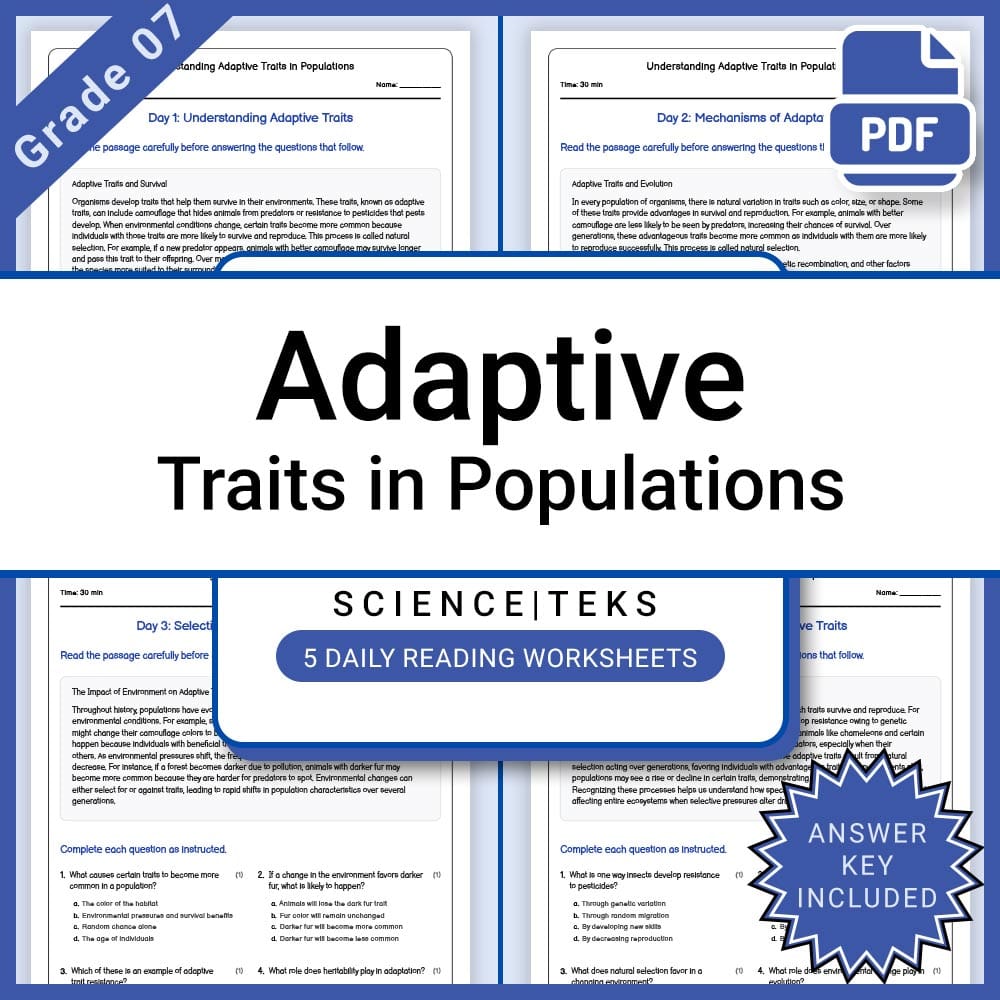
Grade 7 Science – Adaptation Forms in Animals | Worksheet + Answer Key
JCreated byJ.S SheetsLearning Objectives
- Understand different types of adaptations: morphological, physiological, and behavioral
- Identify specific examples of morphological adaptations in various species
- Explain how adaptations enhance survival and reproduction in specific environments
Also included in: Grade 7 Science Lesson Bundle | Ecosystems, Cell Structure & Adaptations +1 more
Instant download
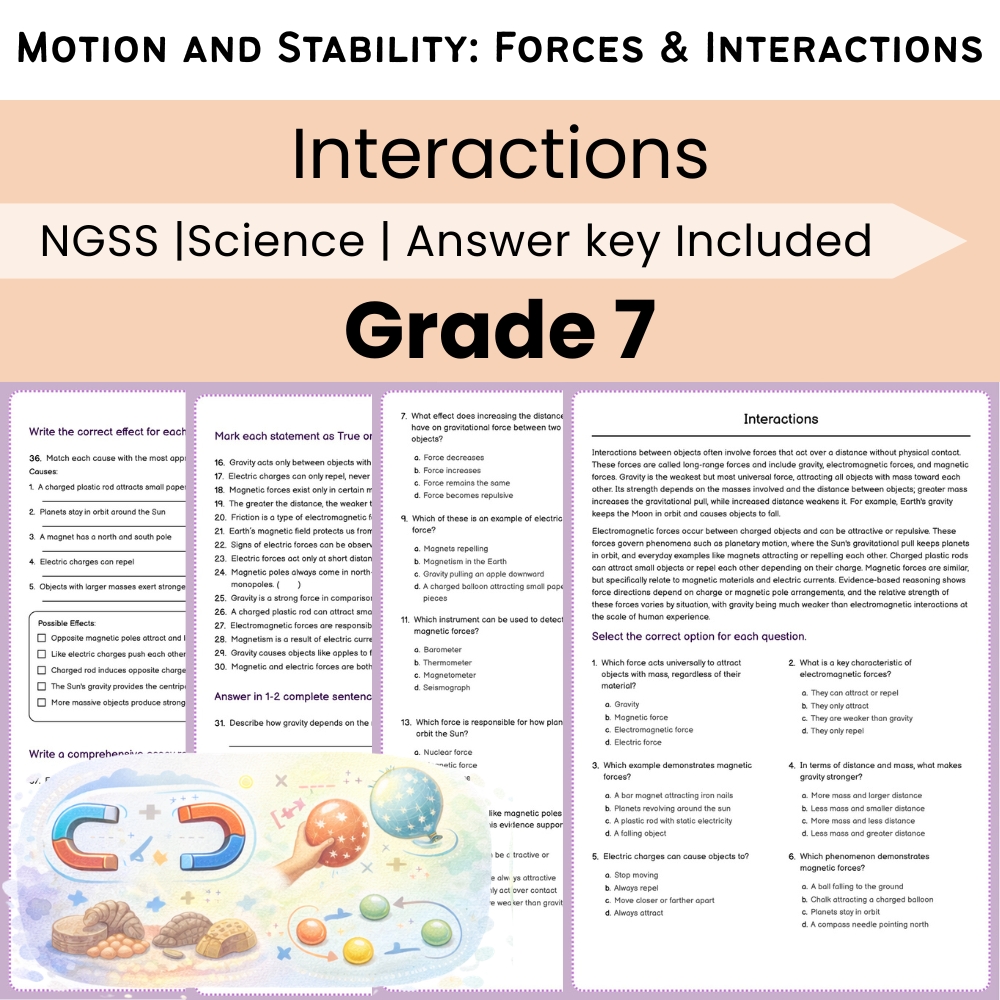
Interactions Worksheet for Grade 7 Science | NGSS Printable PDF Assessment
Learning Objectives
- Explain the different types of long-range forces: gravitational, electric, and magnetic.
- Describe how gravity acts universally and how electromagnetic forces can be attractive or repulsive.
- Relate gravitational attraction to mass and distance qualitatively.
Also included in: Grade 7 Science Lesson Bundle | Motion and Stability: Forces and Interactions +1 more
Instant download
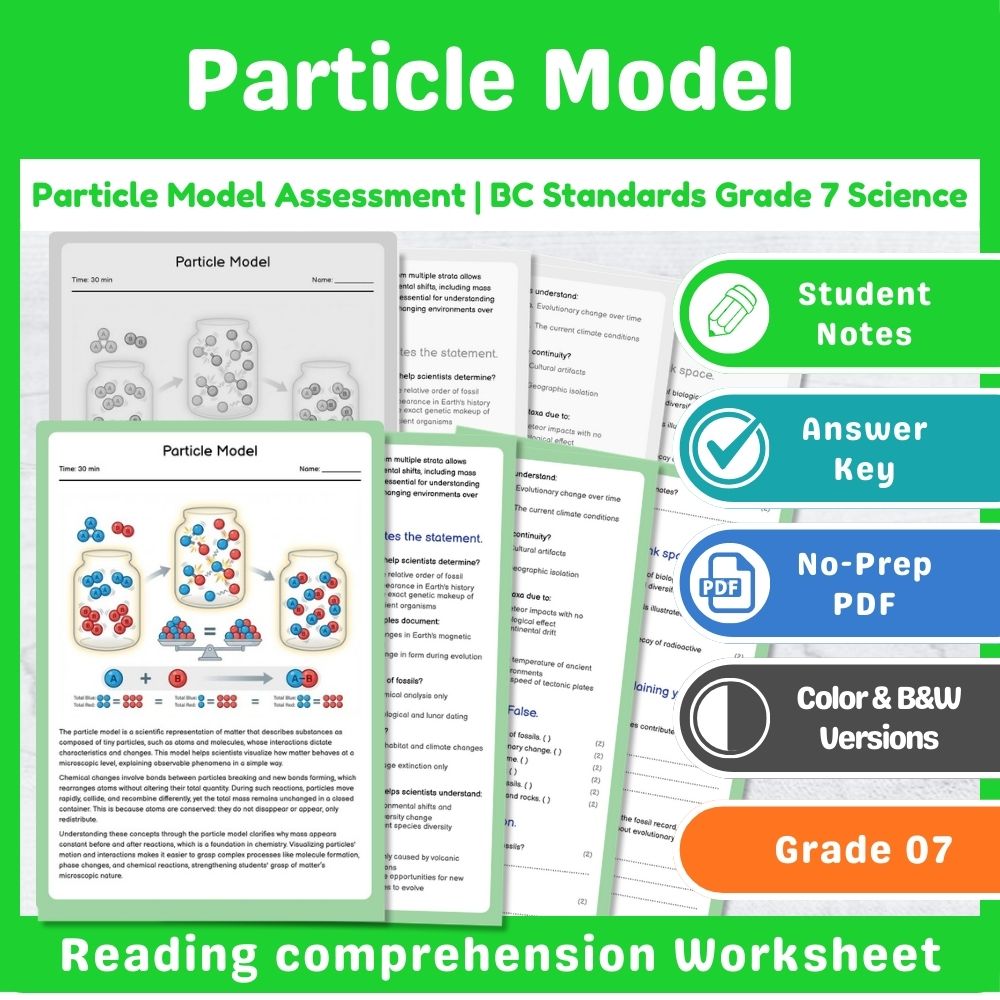
Particle Model Assessment | BC Standards Grade 7 Science
Created byPrism Point LearningLearning Objectives
- Explain the particle model as a way to represent matter at the atomic and molecular level.
- Describe how particles behave during chemical changes, including breaking and forming bonds.
- Understand and illustrate why total mass remains constant during reactions in a closed environment.
Instant download
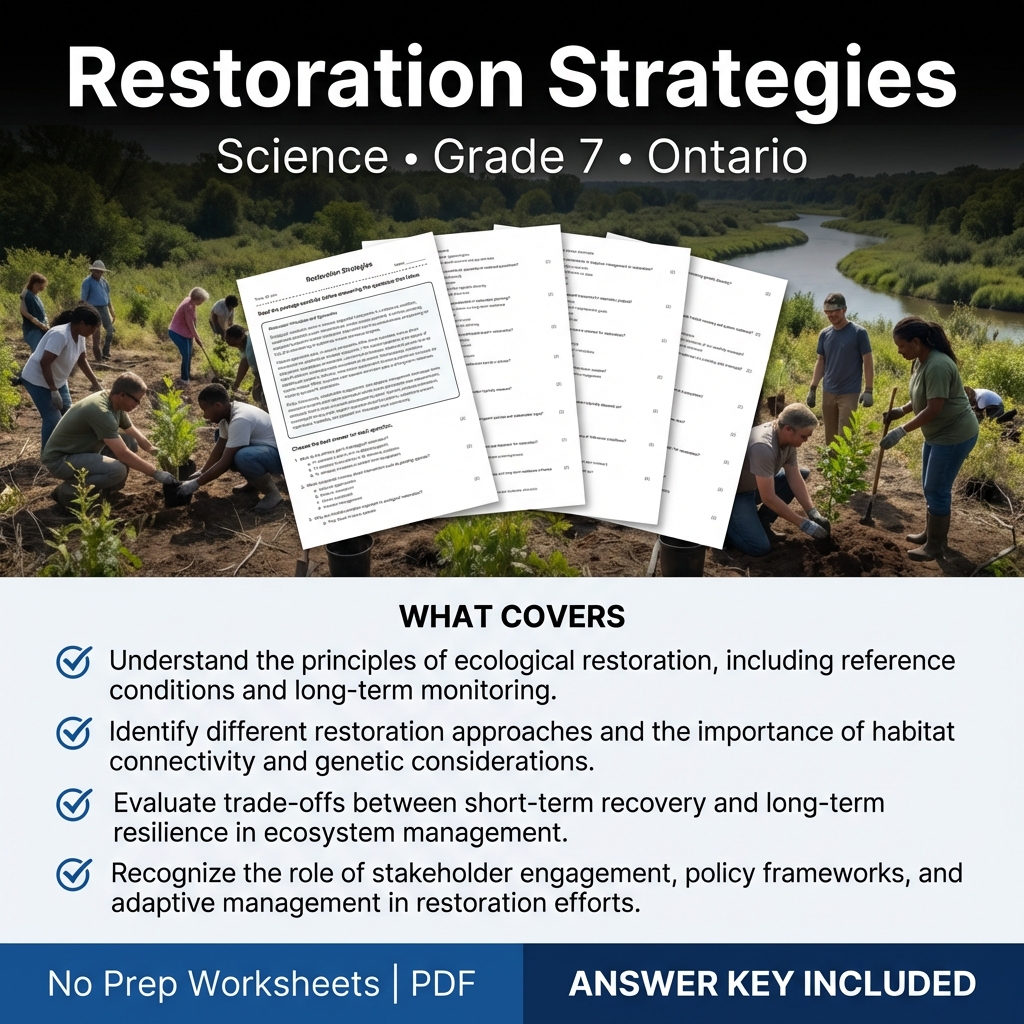
Grade 7 Science Worksheet on Restoration Strategies | Ontario Standards
 Created byCoral Reef Learning
Learning Objectives
- Understand the principles of ecological restoration, including reference conditions and long-term monitoring.
- Identify different restoration approaches and the importance of habitat connectivity and genetic considerations.
- Evaluate trade-offs between short-term recovery and long-term resilience in ecosystem management.
Instant download
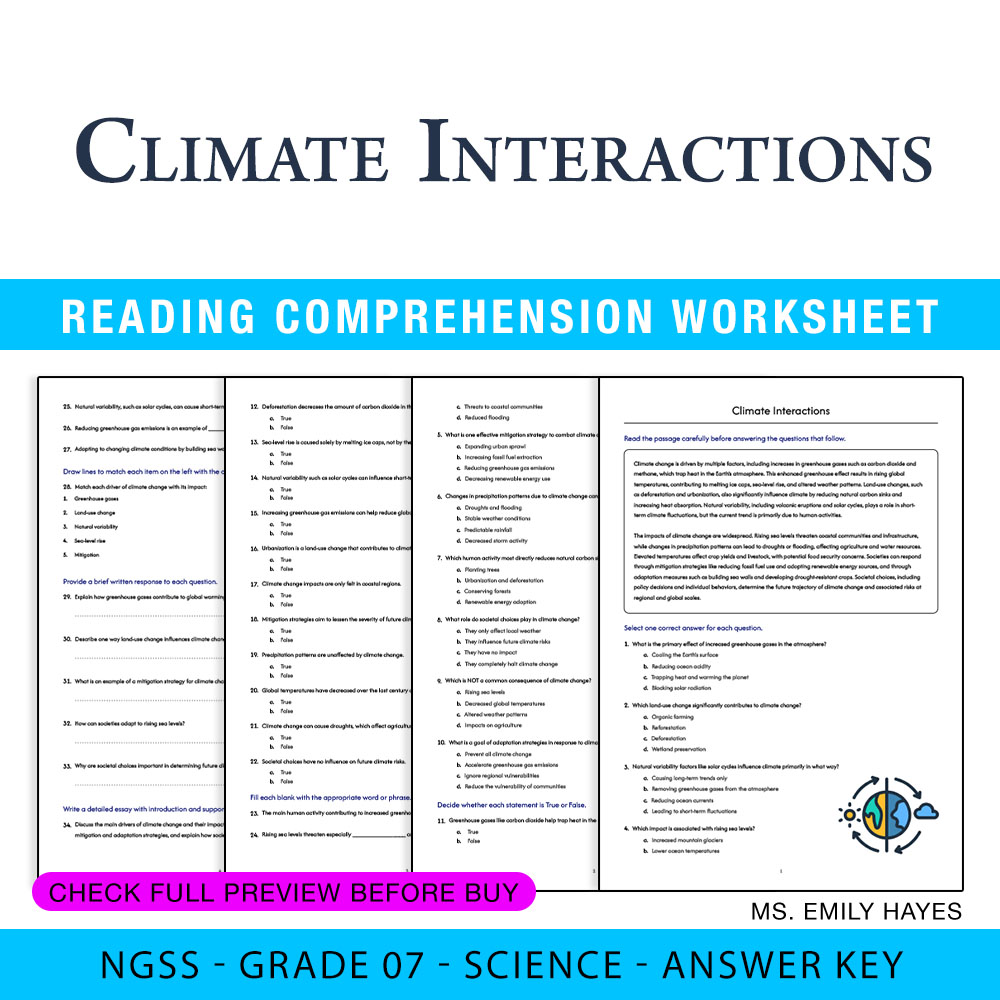
7th Grade Science | Climate Interactions Worksheet (PDF+ Answer Key)
 Created byCopper Leaf Classroom
Learning Objectives
- Analyze evidence for climate change drivers such as greenhouse gases, land-use change, and natural variability.
- Assess impacts of climate change on sea levels, precipitation, and agriculture.
- Understand how societal choices influence future climate risks and explore mitigation strategies.
Instant download

Grade 7 Science Reaction Evidence Worksheet NGSSS Data Analysis
 Created byEvergreen Desk Education
Learning Objectives
- Identify observable evidence that indicates a chemical reaction is occurring.
- Connect macroscopic evidence (gas, color change, precipitate, irreversibility) to particle-level rearrangement.
- Use evidence-based reasoning to distinguish chemical reactions from physical or temporary changes.
Instant download

Optimization in Engineering Trade-Offs Science Worksheets Grade 7
Created byPrism Point LearningLearning Objectives
- Identify performance metrics and constraints in engineering design problems
- Explain how parameter variation reveals changes in design performance
- Interpret sensitivity analysis to prioritize high-impact design parameters
Also included in: Scientific Inquiry & Data Practices Lesson Bundle | Grade 7 Science | Ontario +1 more
Instant download

Grade 7 Science – Variables & Scientific Experiments | Daily Reading Worksheet
Created byBright Mind ResourcesLearning Objectives
- Identify independent, dependent, and controlled variables in experiments
- Understand the importance of operational definitions
- Recognize sources of confounding variables
Also included in: Grade 7 Modeling & Simulation Science Daily Reading Lesson Bundle | Ontario +1 more
Instant download

Cell Structure Worksheet | 7th Grade Science TEKS Practice & Assessment
JCreated byJ.S SheetsLearning Objectives
- Identify major organelles (nucleus, mitochondria, chloroplasts, and cell membrane) and describe their primary functions
- Explain how organelles’ specialized structures support survival and overall cell performance
- Connect cellular energy capture (producers vs. consumers) to tissue and organ function in multicellular organisms
Instant download
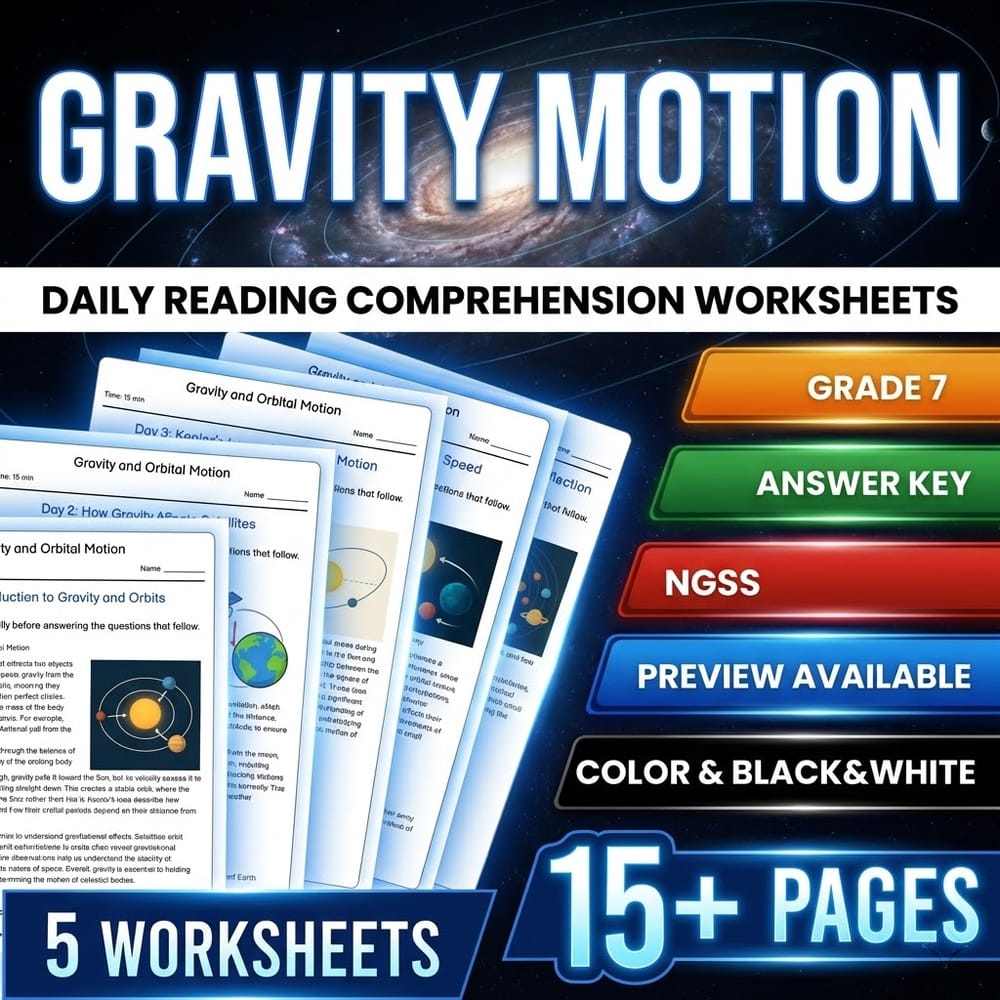
Grade 7 Science – Gravity & Orbital Motion | Daily Reading Worksheet
 Created byElena Brooks
Learning Objectives
- Understand the basic principles of gravity and its role in orbital motion.
- Recognize how gravity affects planets, moons, and satellites in the solar system.
- Learn about the mathematical relationships describing orbital velocity and elliptical orbits.
Also included in: Earth's Place in the Universe Grade 7 Science Worksheets Bundle | NGSS +1 more
Instant download

Natural Selection Worksheet | Grade 7 Science NGSS Evolution Activity
 Created byAmber Owl Education
Learning Objectives
- Explain how heritable variation and environmental pressures can change trait frequencies in a population over generations
- Describe how differential survival and reproduction lead to adaptation
- Use examples such as antibiotic resistance or island finch beak size to connect traits, selection, and evolution
Also included in: Grade 7 Science Evolution & Biodiversity Lesson Bundle – NGSS +1 more
Instant download

Decomposition & Nutrient Cycling Worksheets Grade 7 Science Ecosystems
Created byPrism Point LearningLearning Objectives
- Explain how detritivores, fungi, and bacteria break down organic matter
- Describe how carbon moves through detrital pools and producers
- Explain how nitrogen transformations support primary producers
Also included in: Interactions in the Environment Lesson Bundle | Grade 7 Science | Ontario +1 more
Instant download

Grade 7 Science | Energy Transfer in Matter - Daily Reading Comprehension
Created byCoral Reef LearningLearning Objectives
- Identify and explain the three main mechanisms of heat transfer: conduction, convection, and radiation.
- Understand how temperature gradients, specific heat, and phase-change processes relate to thermal energy flow.
- Describe observable phenomena that demonstrate different mechanisms of heat transfer, such as metal heating rates, convective currents, and radiant warming.
Instant download
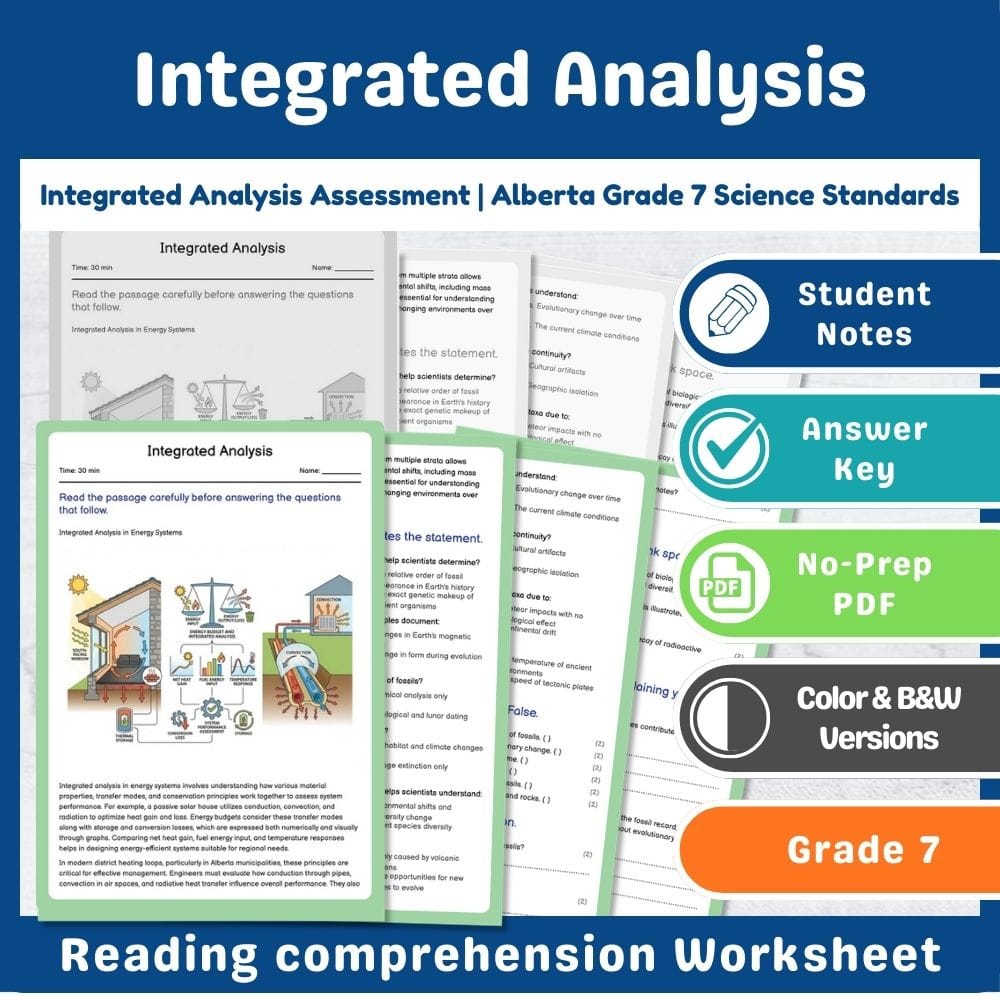
Integrated Analysis Assessment | Alberta Grade 7 Science Standards
Created byPrism Point LearningLearning Objectives
- Understand principles of energy transfer modes and conservation in system analysis.
- Apply properties and mechanisms of conduction, convection, and radiation to real-world systems.
- Interpret energy budgets through numerical data and graphical representations.
Also included in: Lesson Grade 7 Science Mini Bundle | Energy, Heat & Thermal Processes +1 more
Instant download
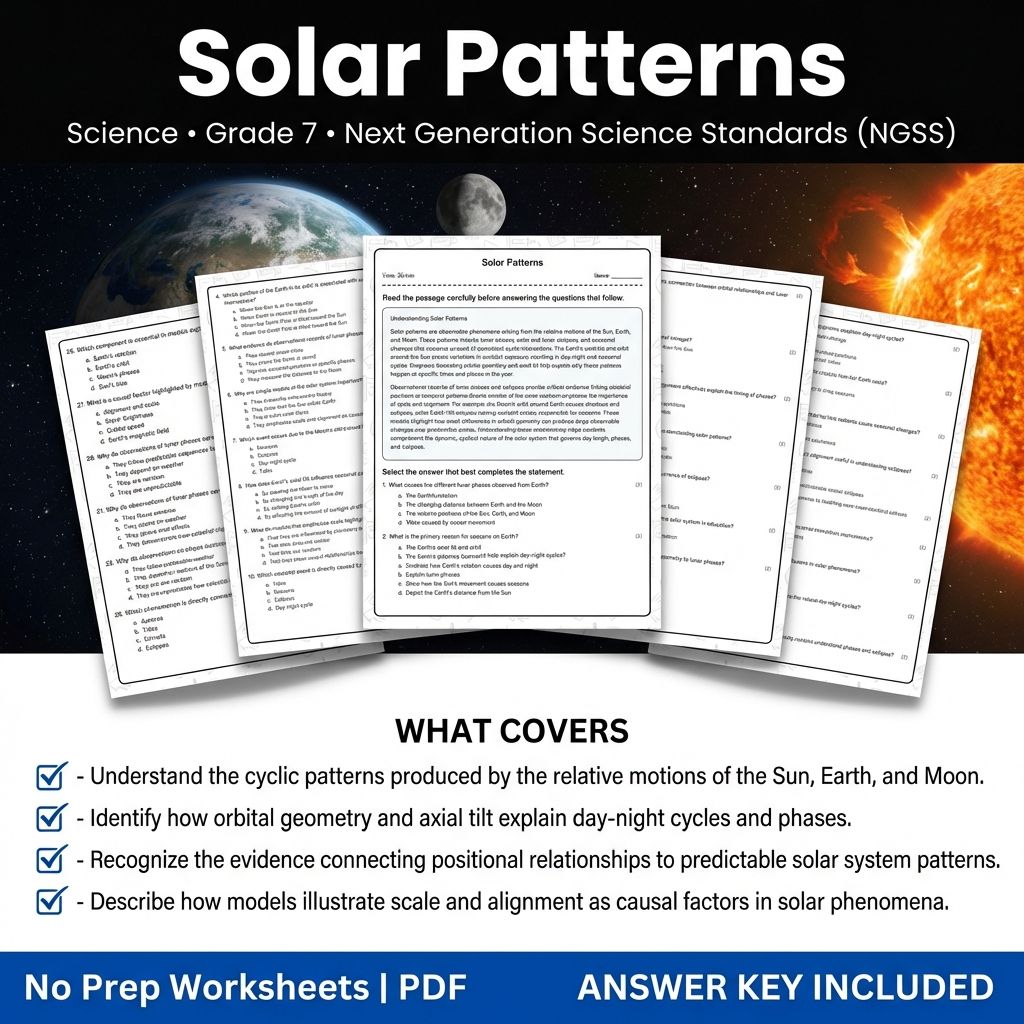
Grade 7 Science Worksheet | Solar Patterns & Celestial Movements (PDF + Answer Key)
Created byCoral Reef LearningLearning Objectives
- Understand the cyclic patterns produced by the relative motions of the Sun, Earth, and Moon.
- Identify how orbital geometry and axial tilt explain day-night cycles and phases.
- Recognize the evidence connecting positional relationships to predictable solar system patterns.
Instant download
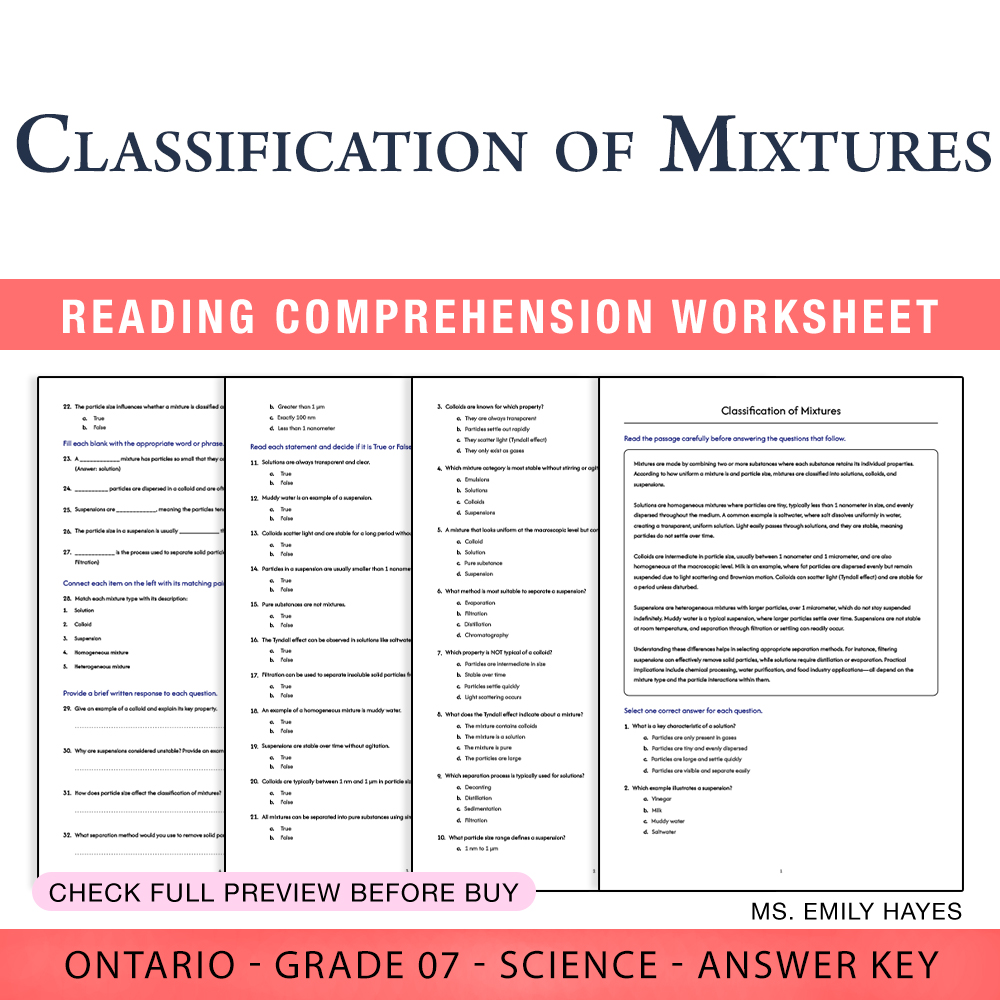
Grade 7 Science | Classification of Mixtures Worksheet (PDF+ Answer Key)
Created byCopper Leaf ClassroomLearning Objectives
- Describe the different types of mixture categories: solutions, colloids, and suspensions.
- Identify and differentiate between homogeneous and heterogeneous mixtures based on their properties.
- Explain how particle size, light scattering, and stability influence mixture classification.
Instant download

Grade 7 Science Solution Comparison Worksheet | NGSS Engineering Design
Created byAmber Owl EducationLearning Objectives
- Use consistent metrics to compare two or more engineering design solutions using models or prototypes
- Identify and quantify trade-offs among performance, cost, durability, and manufacturability
- Justify a ranking of design options using evidence and clearly state limitations
Also included in: Grade 7 Science Engineering Design Lesson Bundle – NGSS +1 more
Instant download

Grade 7 Science | Survival Structures in Organisms - Daily Reading Comprehension
Created byCoral Reef LearningLearning Objectives
- Understand how internal systems support survival in organisms.
- Identify different internal structures and their functions.
- Explain the importance of internal systems for growth and reproduction.
Instant download

Forces and Change Worksheet | Grade 7 Science Practice
Created byPrism Point LearningLearning Objectives
- Explain how net force affects an object’s velocity over time
- Distinguish between balanced and unbalanced forces based on motion
- Describe how friction, air resistance, and gravity influence motion near Earth
Instant download
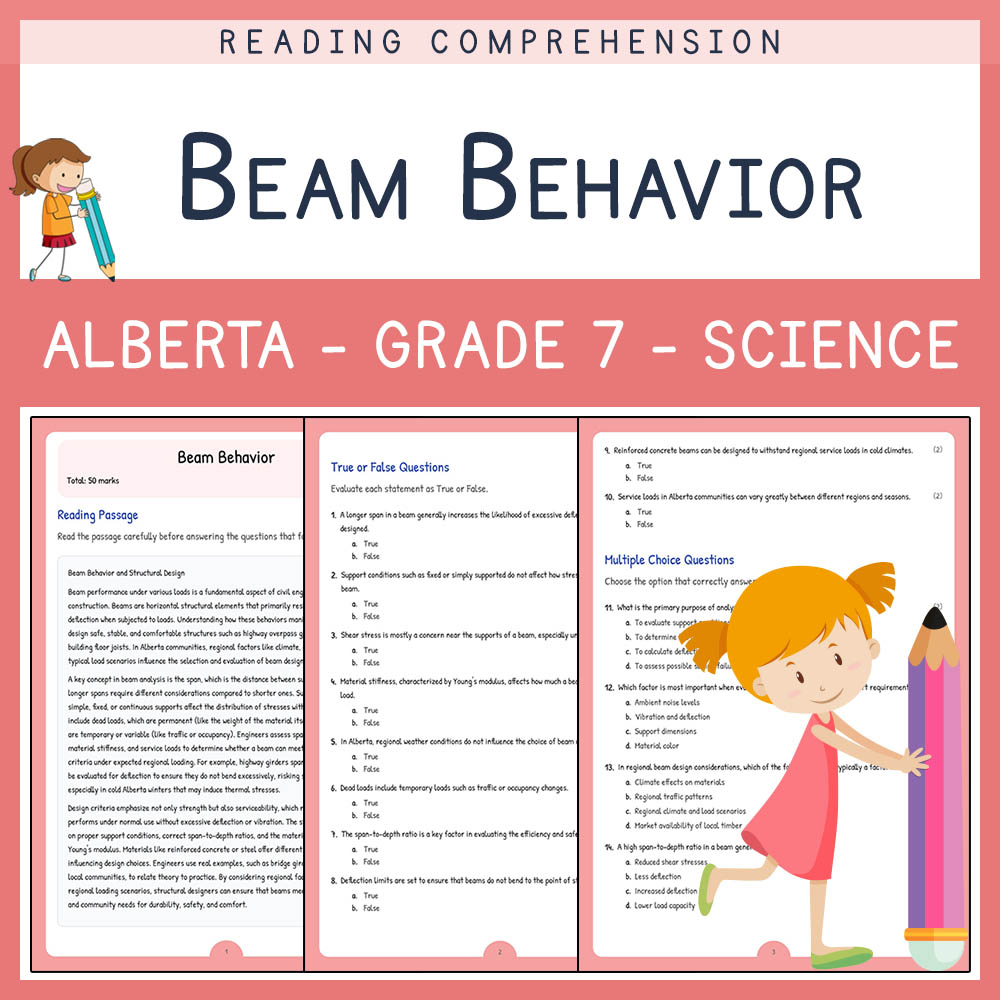
Grade 7 Science | Beam Behavior Worksheet | Alberta Standards
 Created byLumora Learning
Learning Objectives
- Understand the concepts of span, support conditions, and load types in beam analysis.
- Relate beam performance to real-world applications such as highway girders and building joists.
- Evaluate how span-to-depth ratios, material stiffness, and service loads influence beam stability and comfort.
Instant download

Grade 7 Biodiversity Stability Worksheet | NGSS Practice PDF
 Created byClear Sky Classroom
Learning Objectives
- Explain how biodiversity can increase ecosystem stability through functional redundancy
- Describe how disturbances like habitat loss and invasive species can reduce biodiversity and weaken ecosystem processes
- Use evidence from a passage to identify main ideas and correctly answer questions about biodiversity
Instant download
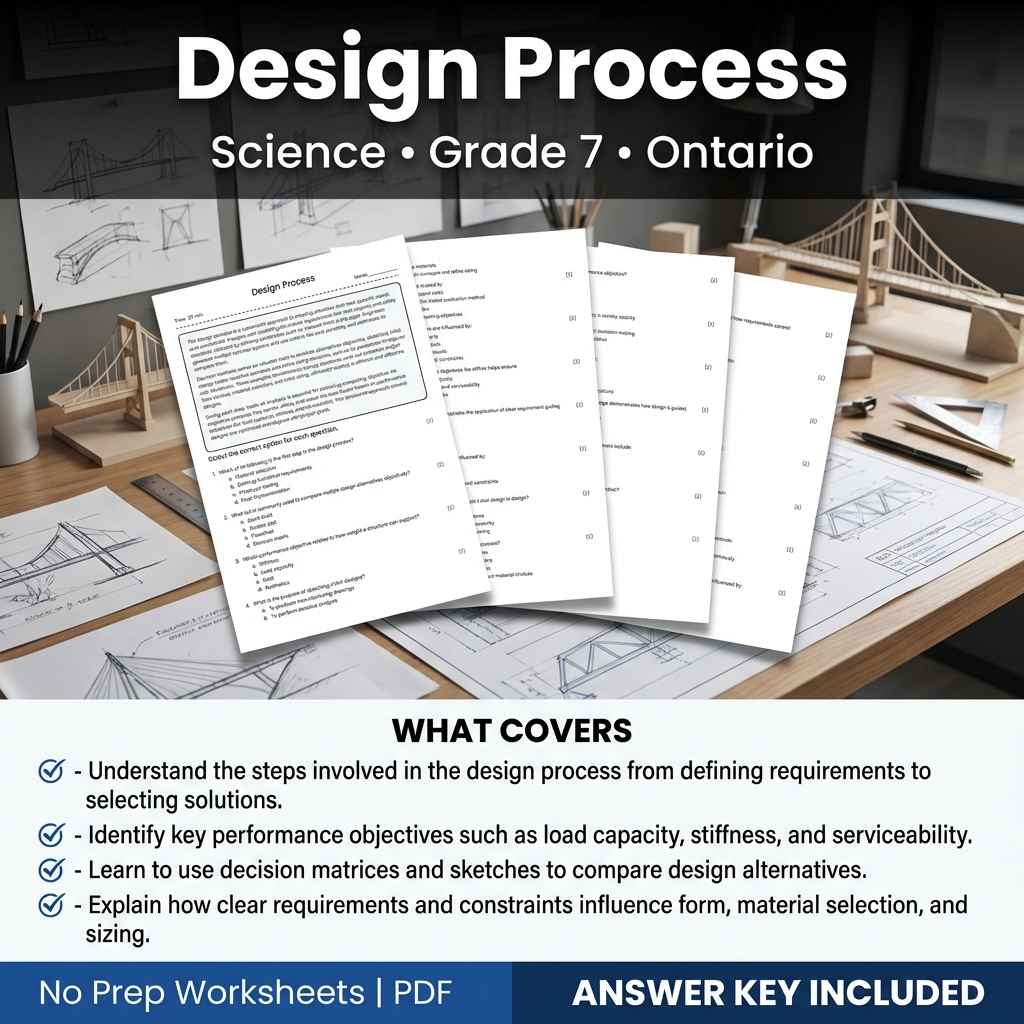
Grade 7 Science Worksheet on Design Process | Ontario Standards
Created byCoral Reef LearningLearning Objectives
- Understand the steps involved in the design process from defining requirements to selecting solutions.
- Identify key performance objectives such as load capacity, stiffness, and serviceability.
- Learn to use decision matrices and sketches to compare design alternatives.
Instant download

Grade 7 Population Factors Worksheet | Alberta Practice & PDF
Created byClear Sky ClassroomLearning Objectives
- Explain how birth rate, death rate, immigration, and emigration interact to change population size.
- Describe how abiotic constraints and resource availability influence where populations can persist.
- Interpret population trends to understand local extirpations and range expansions.
Instant download
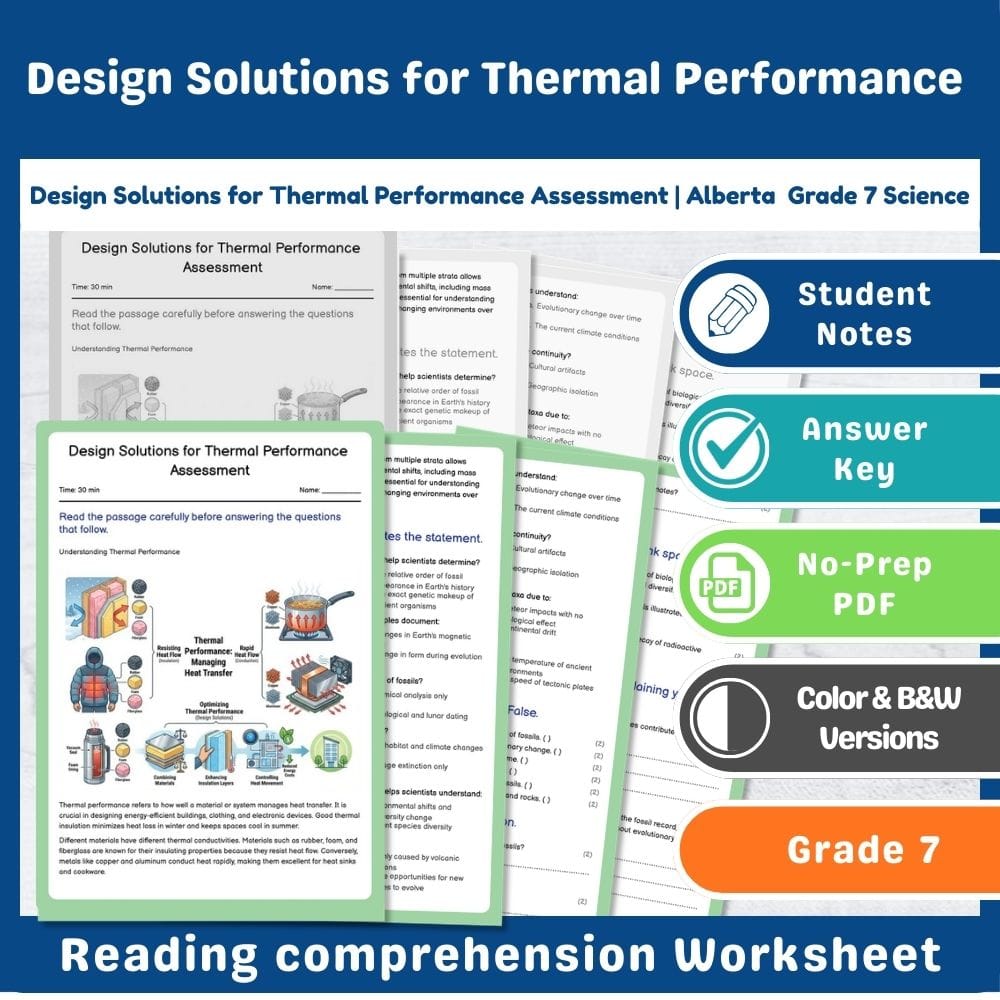
Design Solutions for Thermal Performance Assessment | Alberta Assessment Grade 7 Science
Created byPrism Point LearningLearning Objectives
- Understand key factors affecting thermal performance of materials.
- Analyze different design solutions to optimize thermal performance.
- Evaluate the effectiveness of various insulation and cooling techniques.
Also included in: Lesson Grade 7 Science Mini Bundle | Energy, Heat & Thermal Processes +1 more
Instant download

Grade 7 Science – Habitat Fragmentation & Effects Daily Reading Worksheet
Created byBright Mind ResourcesLearning Objectives
- Understand what habitat fragmentation is.
- Identify the effects of habitat fragmentation on ecosystems.
- Recognize ways to connect fragmented habitats.
Also included in: Grade 7 Ecosystems & Population Ecology Science Lesson Bundle | BC +1 more
Instant download
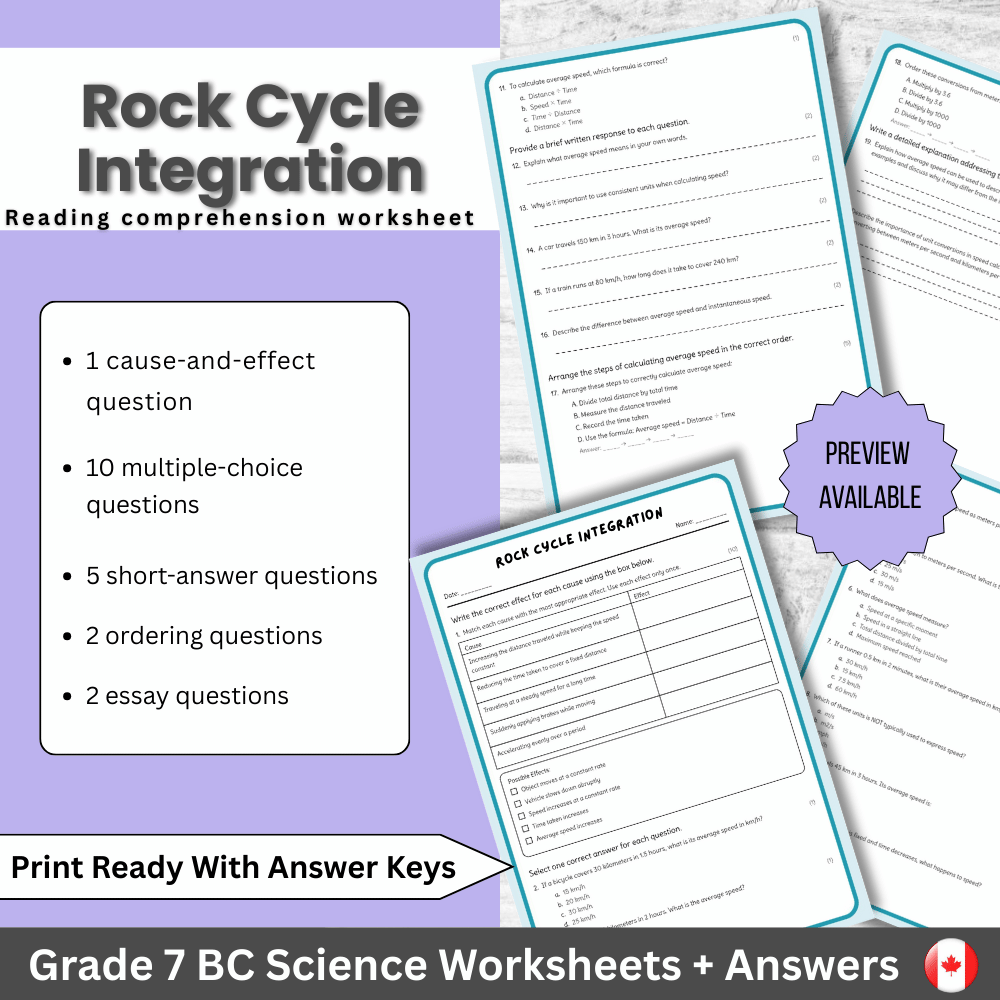
Grade 7 Science | Rock Cycle Integration Worksheet (PDF) – BC Standards
Created byBright Mind ResourcesLearning Objectives
- Understand the processes involved in the rock cycle and how they connect various geological activities.
- Identify different types of rocks and their formation pathways within the cycle.
- Describe how surface and deep Earth processes contribute to material recycling in geology.
Instant download

Grade 7 Science – Membrane Transport & Cell Processes | Daily Reading Worksheet
Created byBright Mind ResourcesLearning Objectives
- Understand the process of diffusion across cell membranes
- Identify the differences between passive and active transport mechanisms
- Explain how water moves through osmosis
Also included in: Cell Function & Transport Grade 7 Science Daily Reading Worksheets Bundle | BC +1 more
Instant download

Grade 7 Science – Physical Properties & Measurement | Daily Reading Worksheet
Created byBright Mind ResourcesLearning Objectives
- Define and identify physical properties such as mass, volume, and density.
- Measure mass and volume of different objects accurately.
- Understand how physical properties help differentiate substances.
Also included in: Grade 7 Matter Science Daily Reading Worksheets Lesson Bundle | Ontario +1 more
Instant download
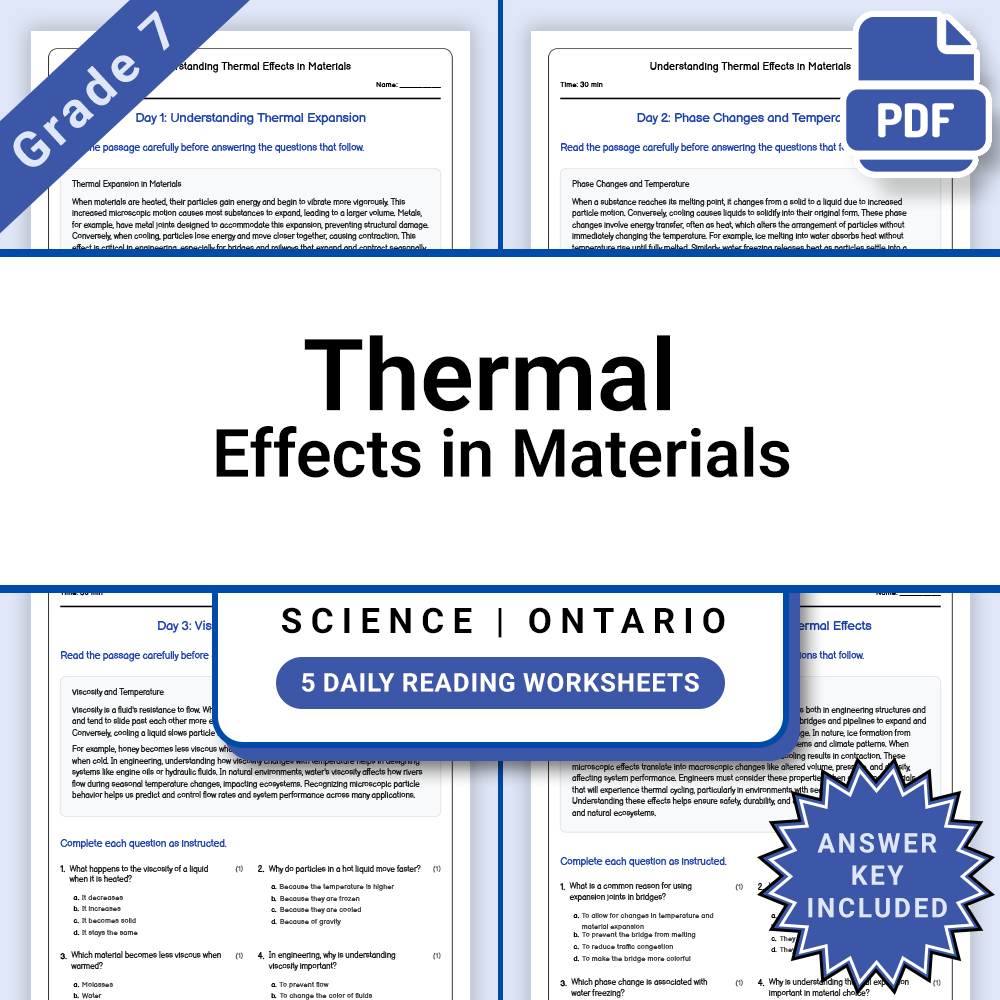
Grade 7 Science – Thermal Basics Daily Reading Worksheet + Answer Key
JCreated byJ.S SheetsLearning Objectives
- Understand key concepts related to Science
- Apply knowledge through practice questions
- Demonstrate comprehension of the material
Also included in: Grade 7 Science Lesson Group: Ontario Curriculum | Thermal & Heat Transfer +1 more
Instant download

Grade 7 Science | Understanding Scientific Models - Daily Reading Comprehension
Created byCoral Reef LearningLearning Objectives
- Define what a scientific model is
- Identify the purpose of scientific models
- Explain the limitations and assumptions within models
Instant download

Grade 7 Science – Space Technology & Observation Daily Reading Worksheet
Created byBright Mind ResourcesLearning Objectives
- Understand the historical development of space telescopes.
- Identify key technological advancements in space observation tools.
- Recognize important missions that expanded our view of space.
Also included in: Earth & Space Grade 7 Science Daily Reading Worksheets Bundle | TEKS +2 more
Instant download

Grade 7 Science – Solar System & Planets Daily Reading Worksheet | TEKS Aligned
Created byBright Mind ResourcesLearning Objectives
- Understand the basic components of the solar system
- Learn about planetary origins and formation
- Identify properties of terrestrial and gas giant planets
Also included in: Earth & Space Grade 7 Science Daily Reading Worksheets Bundle | TEKS +2 more
Instant download
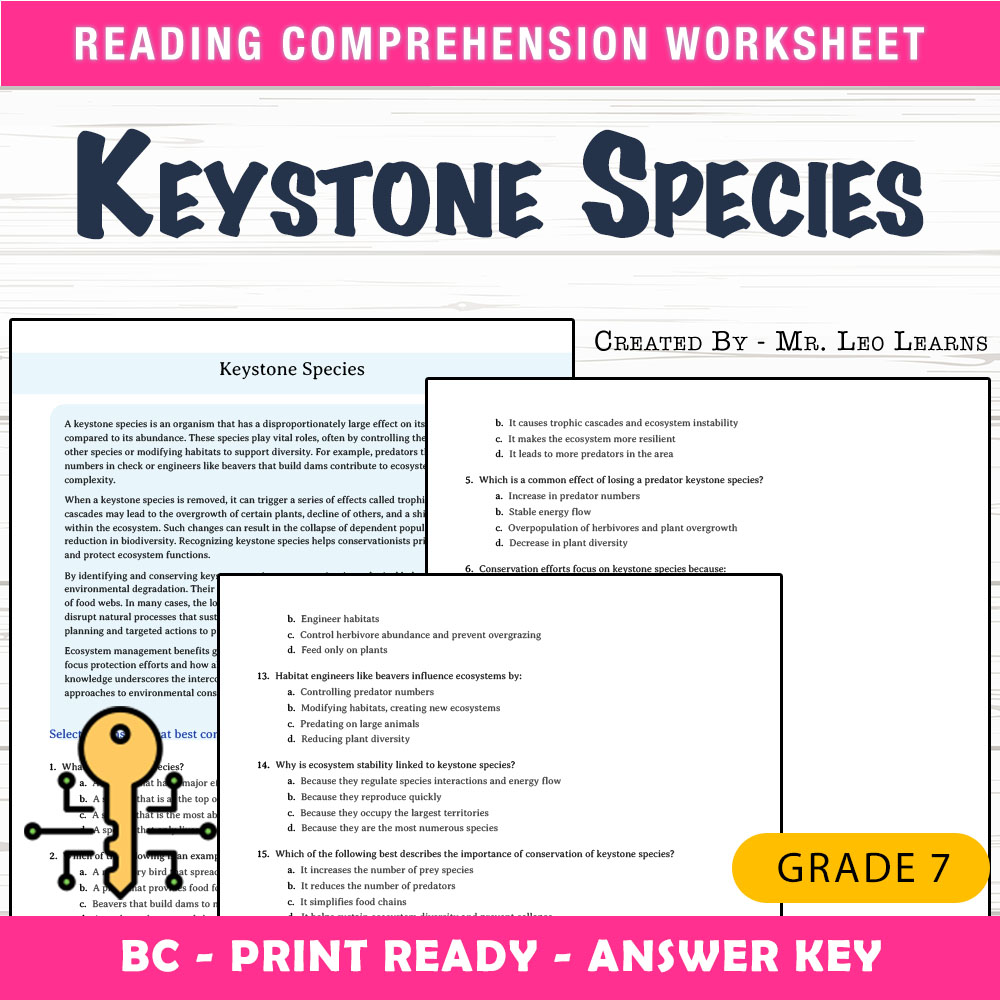
Grade 7 Science — Keystone Species Worksheet MCQ Paper
 Created byThe Resource Hub
Learning Objectives
- Understand the role of keystone species in ecosystem stability.
- Identify examples of keystone species and their effects on food webs.
- Explain trophic cascades and ecosystem consequences of removing keystone species.
Also included in: Grade 7 Science Ecosystems & Interactions Worksheet Bundle +1 more
Instant download
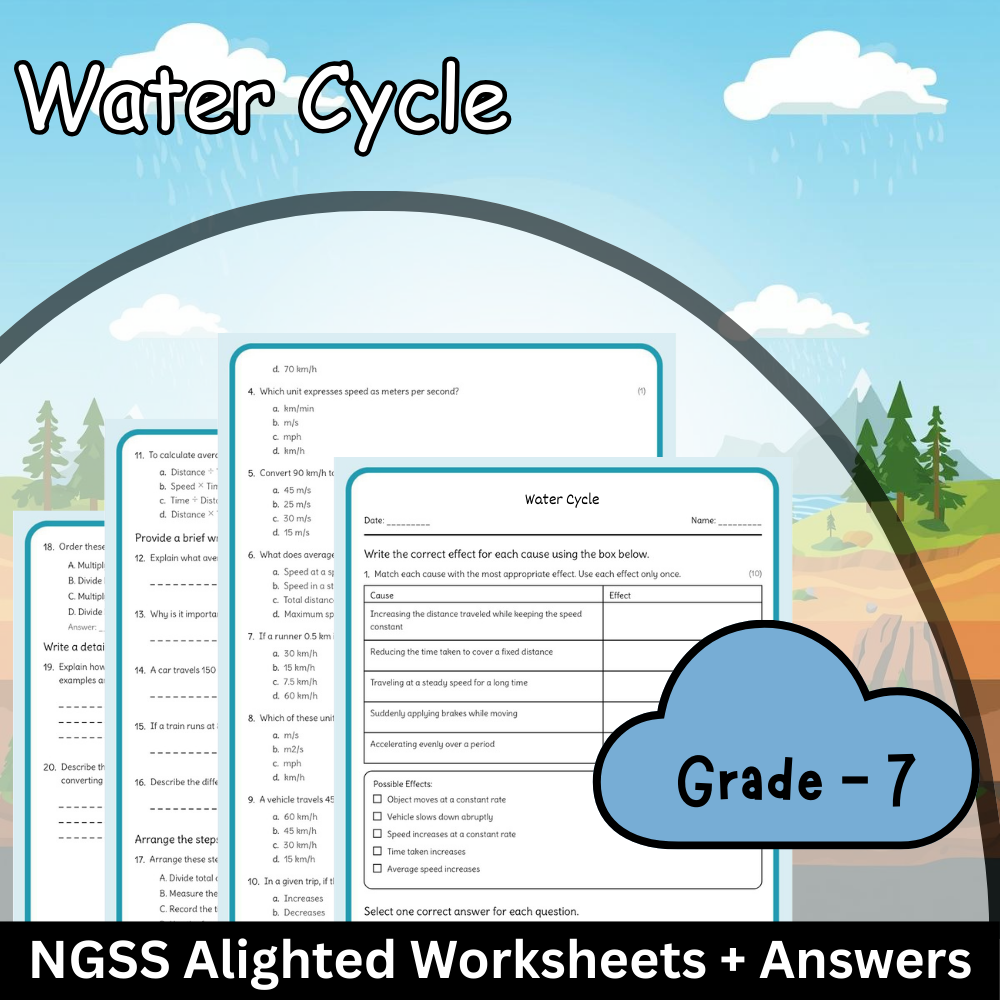
Grade 7 Science | Water Cycle Worksheet (PDF) – NGSS Standards & Activities
Created byBright Mind ResourcesLearning Objectives
- Describe the stages and processes involved in the water cycle.
- Explain interactions among Earth's spheres in water movement.
- Identify pathways, residence times, and coupling of the water cycle.
Instant download

Grade 7 Earthquakes And Faults Worksheet | BC Use Practice PDF
Created byClear Sky ClassroomLearning Objectives
- Explain how accumulated tectonic stress leads to earthquakes along faults
- Compare normal, reverse, and strike-slip fault motion and how each reflects stress regimes
- Describe how earthquake magnitude, depth, and local geology affect shaking and seismic intensity
Instant download

Trophic Energy Flow and Efficiency Worksheet Grade 7 Ontario Science
 Created byTeacher's Corner
Learning Objectives
- Explain how energy moves through trophic levels in a food chain and why efficiency decreases at higher levels.
- Calculate and interpret simple energy-transfer patterns using trophic efficiency percentages.
- Describe how biomass pyramids reflect energy availability and limit how many top consumers a community can support.
Instant download
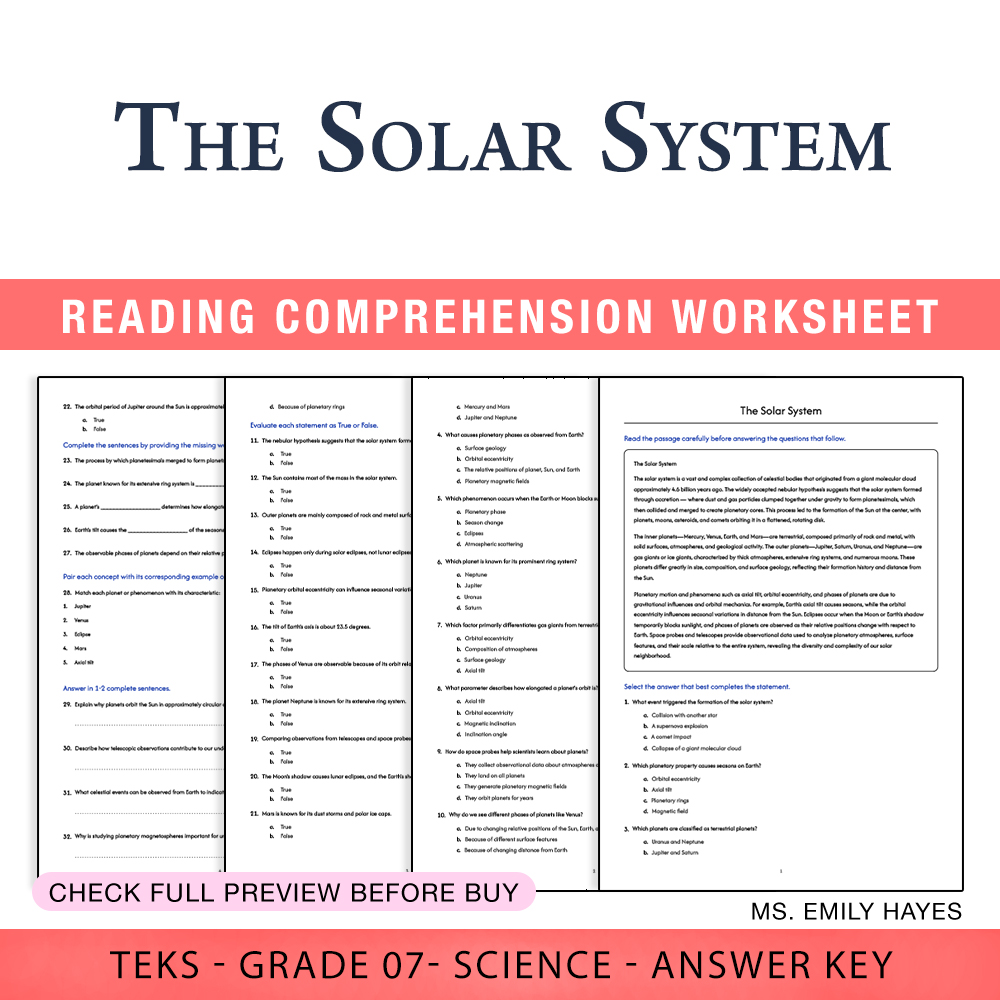
7th Grade Science | The Solar System Worksheet (PDF+ Answer Key)
Created byCopper Leaf ClassroomLearning Objectives
- Describe the origin and formation of the solar system based on current scientific models.
- Identify the key properties and features of planets within our solar system.
- Explain the orbital relationships and phenomena such as phases, eclipses, and axial tilt.
Instant download

Convection Dynamics Worksheet | Ontario Grade 7 Science Assessment
 Created byCedar Grove Learning
Learning Objectives
- Explain how buoyancy and density variations drive convective heat transfer in fluids
- Describe how temperature gradients and fluid properties influence convection strength
- Relate convection to real-world phenomena such as sea and land breezes, thermals, and lake overturning
Also included in: Grade 7 Thermal Energy & Heat Transfer Science Lesson Bundle: Ontario +1 more
Instant download
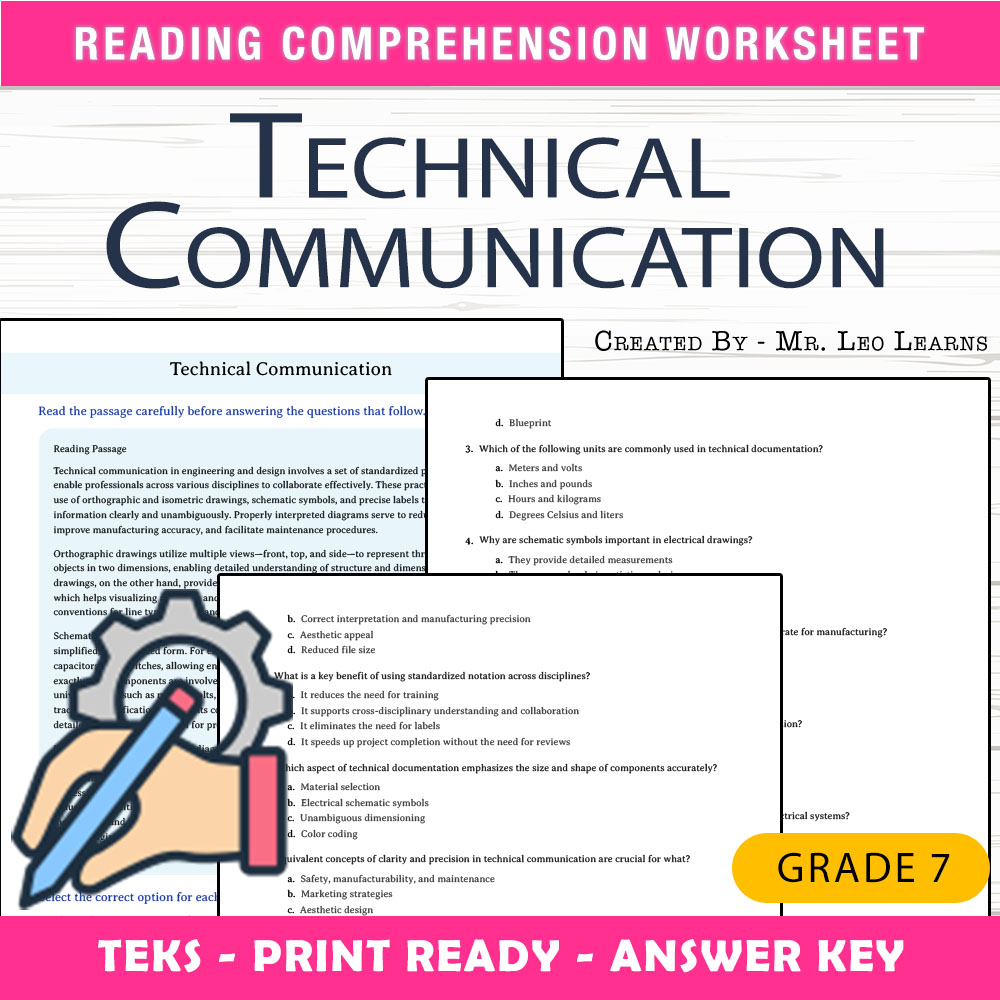
Grade 7 Science — Technical Communication Worksheet for Mastery
Created byThe Resource HubLearning Objectives
- Understand the conventions used in technical drawings, diagrams, and schematics
- Identify and interpret standardized units, symbols, and labels in technical documentation
- Recognize the role of clarity and unambiguity in conveying design intent
Also included in: Grade 7 Science Unit | Engineering, Technology & Innovation Worksheet Bundle +1 more
Instant download

Filtration Methods Worksheet | Ontario Grade 7 Science Assessment
Created byCedar Grove LearningLearning Objectives
- Explain how filtration separates particles based on size and material properties of porous media
- Describe how pore size selection and flow behavior affect filtration results for sand-water suspensions and precipitates
- Compare filtration with follow-up separation methods such as evaporation and centrifugation
Also included in: Grade 7 Matter: Mixtures and Separation Science Lesson Bundle | Ontario +1 more
Instant download

Reaction Evidence Worksheet Grade 7 Science Activities | Chemical Reactions
Created byPrism Point LearningLearning Objectives
- Identify observable evidence that suggests a chemical reaction has formed new substances.
- Explain how particle rearrangement connects to macroscopic observations like gas, color change, and precipitates.
- Differentiate chemical evidence from physical or reversible changes.
Also included in: Physical Science Lesson Bundle | Grade 7 Science | Florida NGSSS
Instant download

Grade 7 Science | Separating Matter Worksheet (PDF) for Standards Alignment
Created byEvergreen Desk EducationLearning Objectives
- Explain how physical changes and separation methods depend on properties of matter.
- Describe how density differences can be used to predict settling and layering.
- Connect solubility differences to how substances dissolve selectively in a solvent.
Also included in: Grade 7 Energy Transfer & Motion Science Lesson Bundle Worksheets (General) +1 more
Instant download

Grade 7 Science Photosynthesis Capture Worksheet | CA Standards PDF
Created byEvergreen Desk EducationLearning Objectives
- Explain how producers use light, carbon dioxide, and water to make sugars during photosynthesis
- Describe how photosynthesis stores energy in chemical bonds in biomass
- Connect photosynthesis to energy flow and matter cycling through food chains
Instant download

Population Limits Worksheet for Grade 7 Science | NGSS Standards Practice
JCreated byJ.S SheetsLearning Objectives
- Understand how resource availability influences population growth and decline.
- Interpret data from graphs and quantitative datasets related to ecosystems.
- Analyze the effects of competition, food, water, and shelter on population dynamics.
Also included in: Grade 7 Ecosystem Dynamics Science Lesson Bundle Worksheets – NGSS +1 more
Instant download
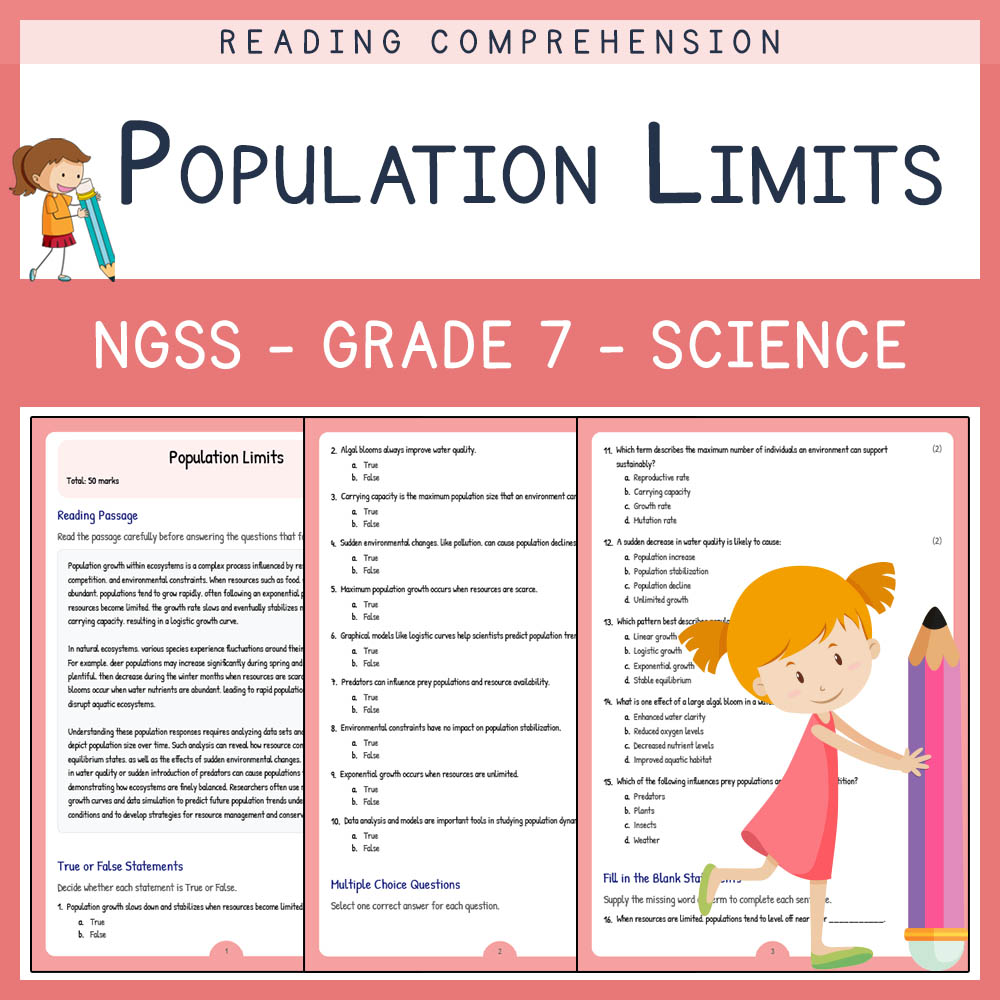
Grade 7 Science | Population Limits Worksheet & Answer Key (NGSS-Aligned)
Created byLumora LearningLearning Objectives
- Understand how resource availability and competition influence population size and growth rates.
- Interpret logistic growth curves and concepts of carrying capacity.
- Analyze how populations respond to limited resources like food, water, and shelter using real-world examples.
Instant download
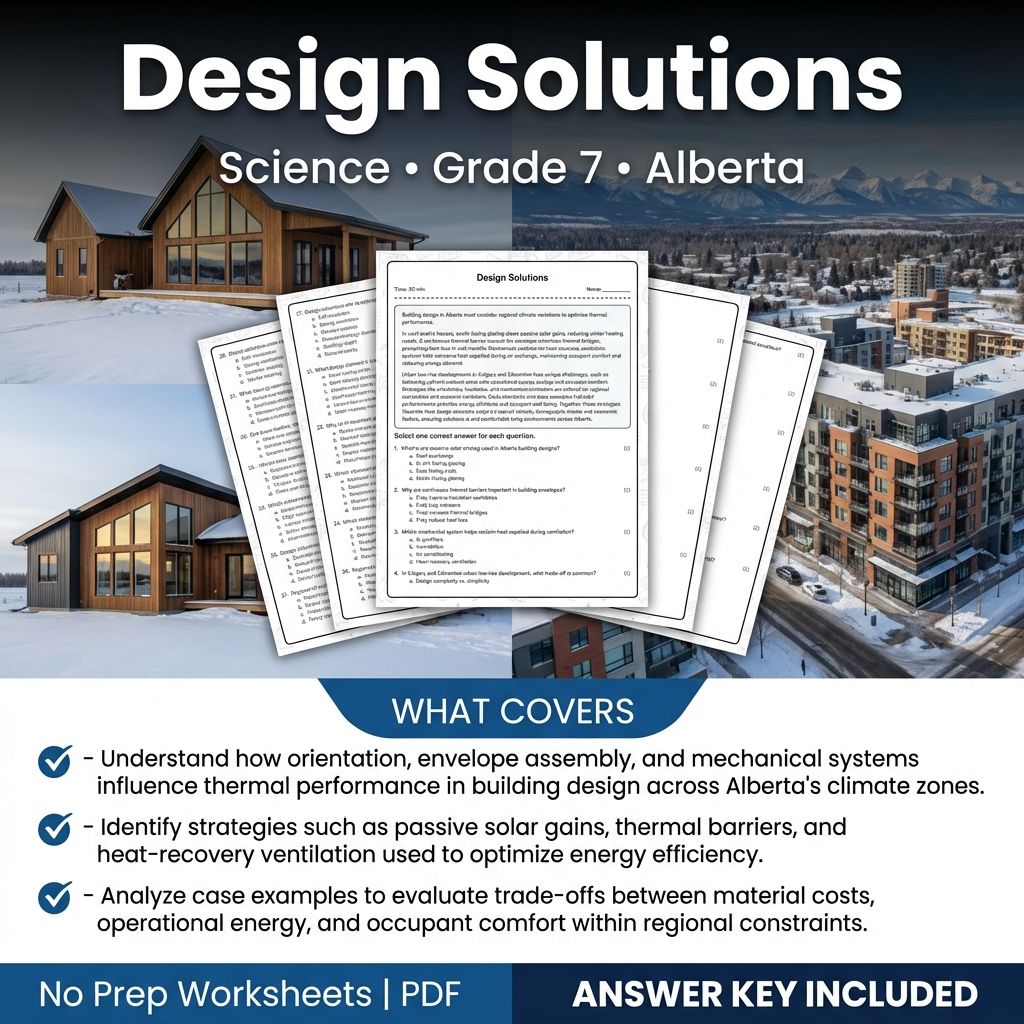
Grade 7 Science Worksheet on Design Solutions | Alberta Standards
Created byCoral Reef LearningLearning Objectives
- Understand how orientation, envelope assembly, and mechanical systems influence thermal performance in building design across Alberta's climate zones.
- Identify strategies such as passive solar gains, thermal barriers, and heat-recovery ventilation used to optimize energy efficiency.
- Analyze case examples to evaluate trade-offs between material costs, operational energy, and occupant comfort within regional constraints.
Instant download
About Grade 7 Science Worksheets
Browse 6,039 printable Grade 7 Science worksheets — ready-to-print PDFs with answer keys where available.
Every worksheet on MyTeachingSheets is created by independent teacher-authors and reviewed before publication. All resources download as printable PDFs for classroom, homework, or at-home practice, and many include answer keys. Preview any worksheet free before buying.