
Grade 7 Science Worksheets
6,039 worksheets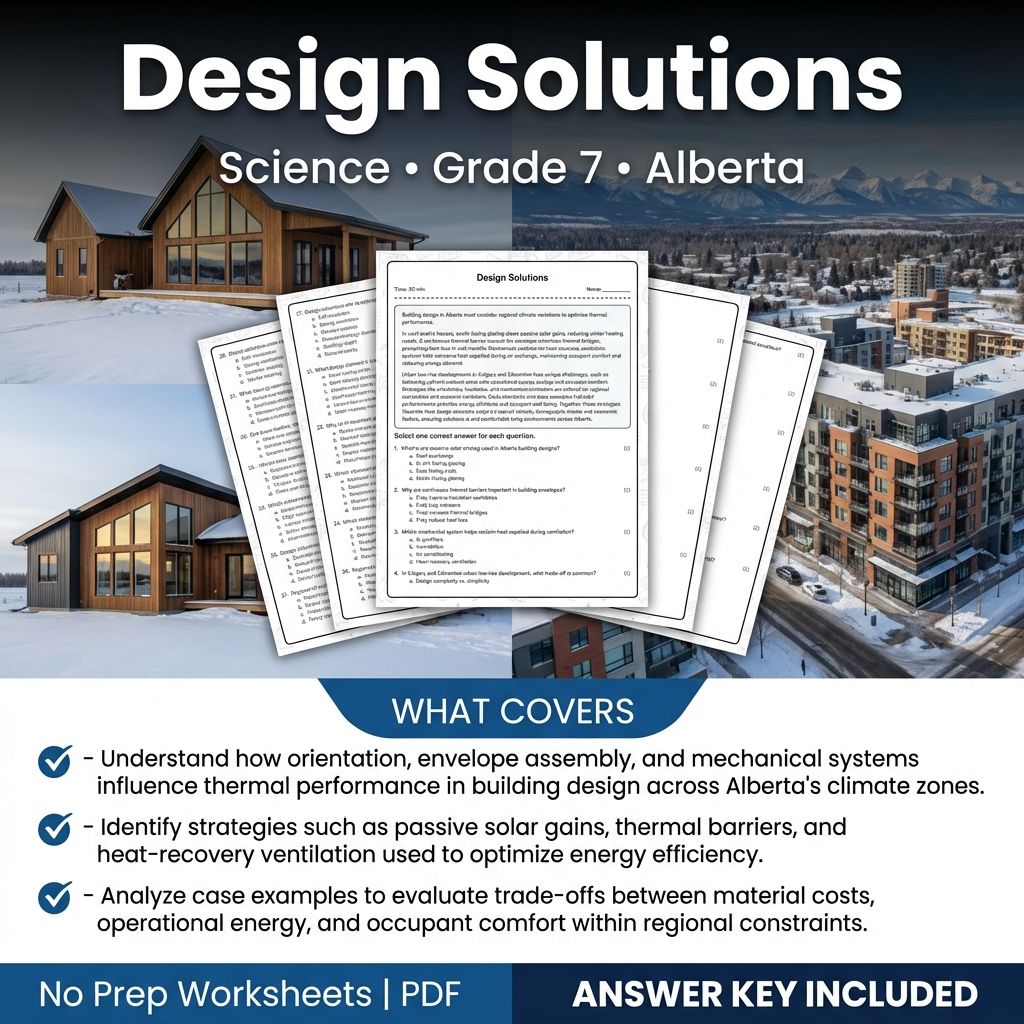
Grade 7 Science Worksheet on Design Solutions | Alberta Standards
 Created byCoral Reef Learning
Learning Objectives
- Understand how orientation, envelope assembly, and mechanical systems influence thermal performance in building design across Alberta's climate zones.
- Identify strategies such as passive solar gains, thermal barriers, and heat-recovery ventilation used to optimize energy efficiency.
- Analyze case examples to evaluate trade-offs between material costs, operational energy, and occupant comfort within regional constraints.
Instant download

Grade 7 Science Worksheet on Closed Systems (PDF) – BC Standards
 Created byEvergreen Desk Education
Learning Objectives
- Identify the system boundary in real-world examples and explain what it includes.
- Distinguish closed systems from open systems based on matter crossing the boundary.
- Predict how mass changes (or does not change) when matter transfers occur.
Instant download
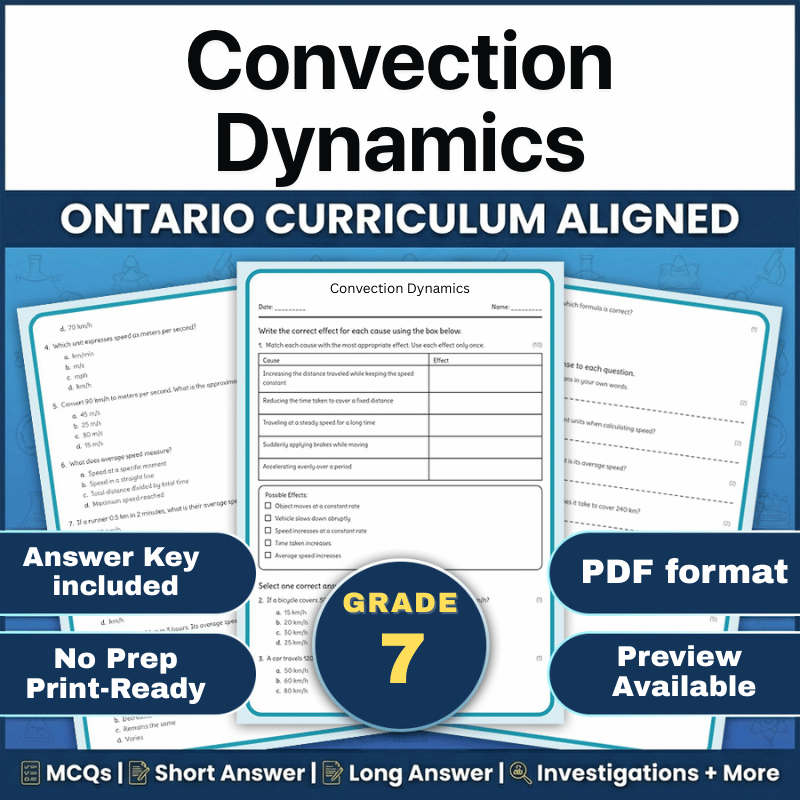
Grade 7 Science – Convection Dynamics Worksheet (Ontario) (PDF)
 Created byBright Mind Resources
Learning Objectives
- Understand the principles of convective heat transfer in fluids.
- Identify how buoyancy and density variations drive convection currents.
- Relate convection mechanisms to environmental phenomena such as sea breezes and lake overturning.
Instant download

Grade 7 Science | Fair Testing Measurements in Science - Daily Reading Comprehension
Created byCoral Reef LearningLearning Objectives
- Understand the concept of fair testing in scientific experiments.
- Identify the key conditions that ensure a test is fair.
- Recognize the importance of controlling variables during testing.
Instant download

Net Force Effects Worksheet | Standards-Aligned Grade 7 Science Practice
JCreated byJ.S SheetsLearning Objectives
- Understand how forces have both magnitude and direction and how they combine to form a net force.
- Explain how unbalanced forces change an object's velocity by altering speed and/or direction.
- Differentiate between balanced and unbalanced forces and their effects on objects.
Also included in: Grade 7 Forces and Matter Science lesson bundle – California Standards +1 more
Instant download
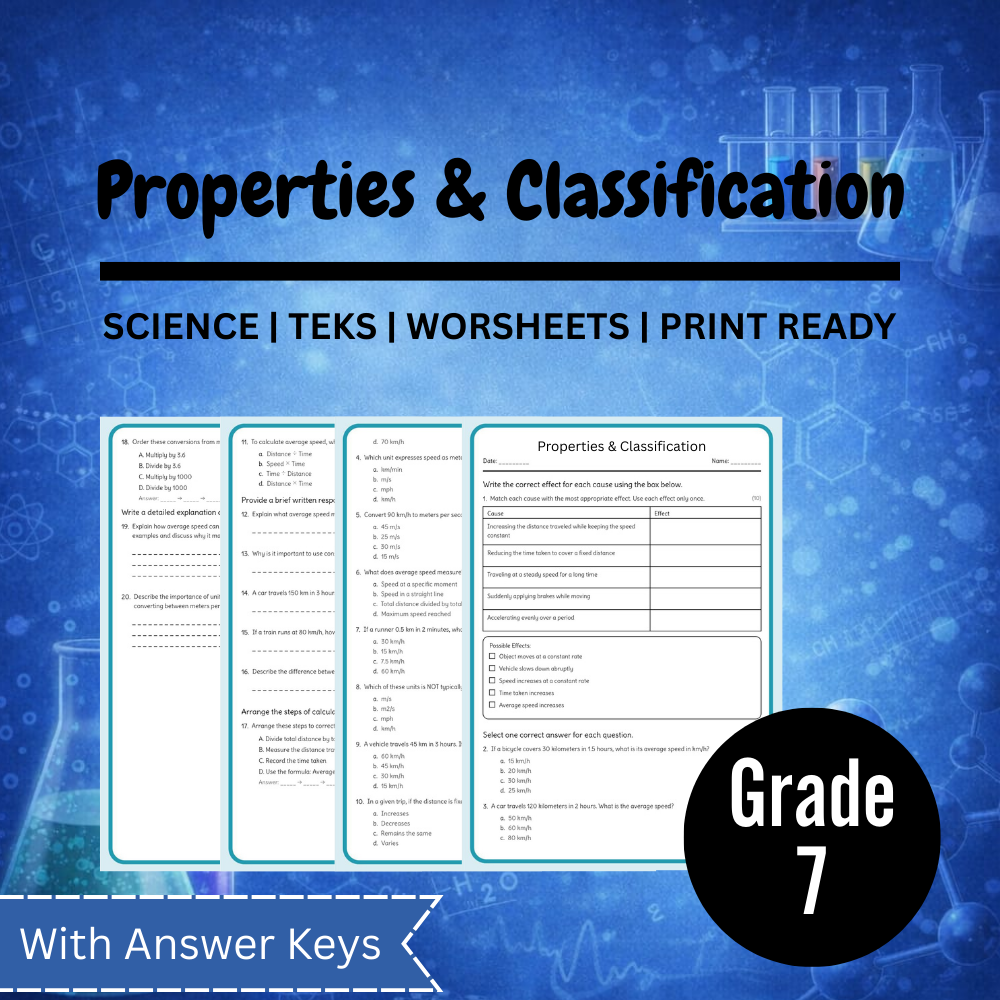
Grade 7 Science | Properties and Classification Worksheet (PDF) – TEKS Standards
Created byBright Mind ResourcesLearning Objectives
- Identify different physical and chemical properties used to classify substances.
- Distinguish between elements, compounds, and mixtures based on measurable attributes.
- Apply classification techniques such as density measurement, solubility testing, and magnetic separation.
Also included in: Grade 7 Science Unit Bundle | States of Matter & Atomic Structure Worksheets +2 more
Instant download

Wind and Load Safety Worksheets | Forces & Structures Grade 7
 Created bySunny Desk Resources
Learning Objectives
- Explain how integrated systems analysis links forces, machine function, and structure safety when evaluating design options.
- Use simple quantitative ideas (such as mechanical advantage and load distribution) to compare competing designs.
- Justify a design choice using criteria related to motion data and structural performance under realistic wind, snow, and load conditions.
Also included in: Forces, Structures & Motion Grade 7 Science Bundle | Alberta +1 more
Instant download

Grade 7 Science – Forces & Motion | Daily Reading Worksheet
Created byBright Mind ResourcesLearning Objectives
- Identify different types of forces such as gravity, friction, air resistance, and applied forces.
- Understand how forces can change the motion of objects.
- Differentiate between balanced and unbalanced forces.
Also included in: Energy Transfer, Sound & Motion Lesson Bundle | Grade 7 Science | General +1 more
Instant download
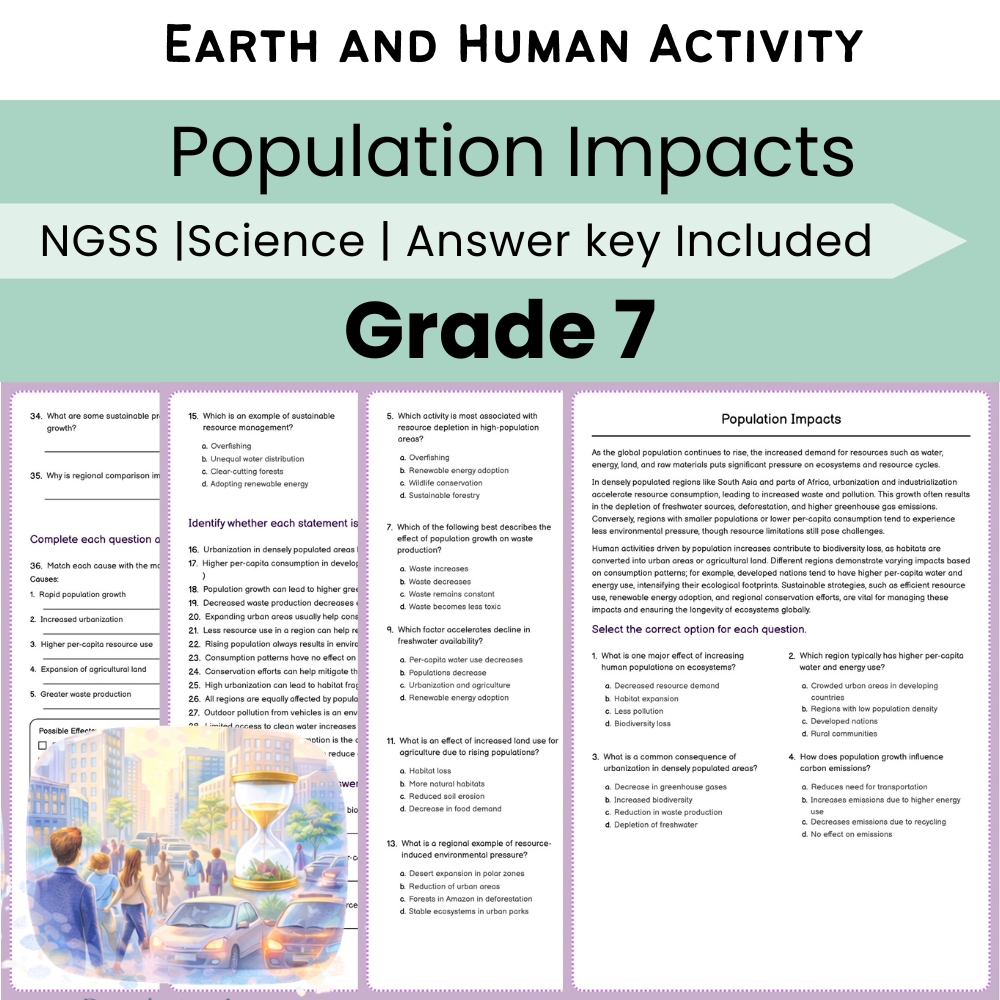
Population Impacts Worksheet | Grade 7 Science Assessment & Student Practice
Learning Objectives
- Analyze how increases in human population and per-capita consumption affect demand for water, energy, land, and raw materials.
- Evaluate the environmental consequences of population growth on biodiversity, freshwater resources, and carbon emissions.
- Compare regional examples to understand how consumption patterns influence environmental pressures.
Also included in: Grade 7 Science Lesson Bundle | Earth and Human Activity NGSS +1 more
Instant download

Grade 7 Forces and Change Worksheet | NGSS Practice PDF
 Created byClear Sky Classroom
Learning Objectives
- Explain how net force affects an object's change in velocity over time
- Distinguish balanced forces from unbalanced forces and predict the resulting motion
- Describe how friction, air resistance, and gravity influence motion near Earth
Instant download
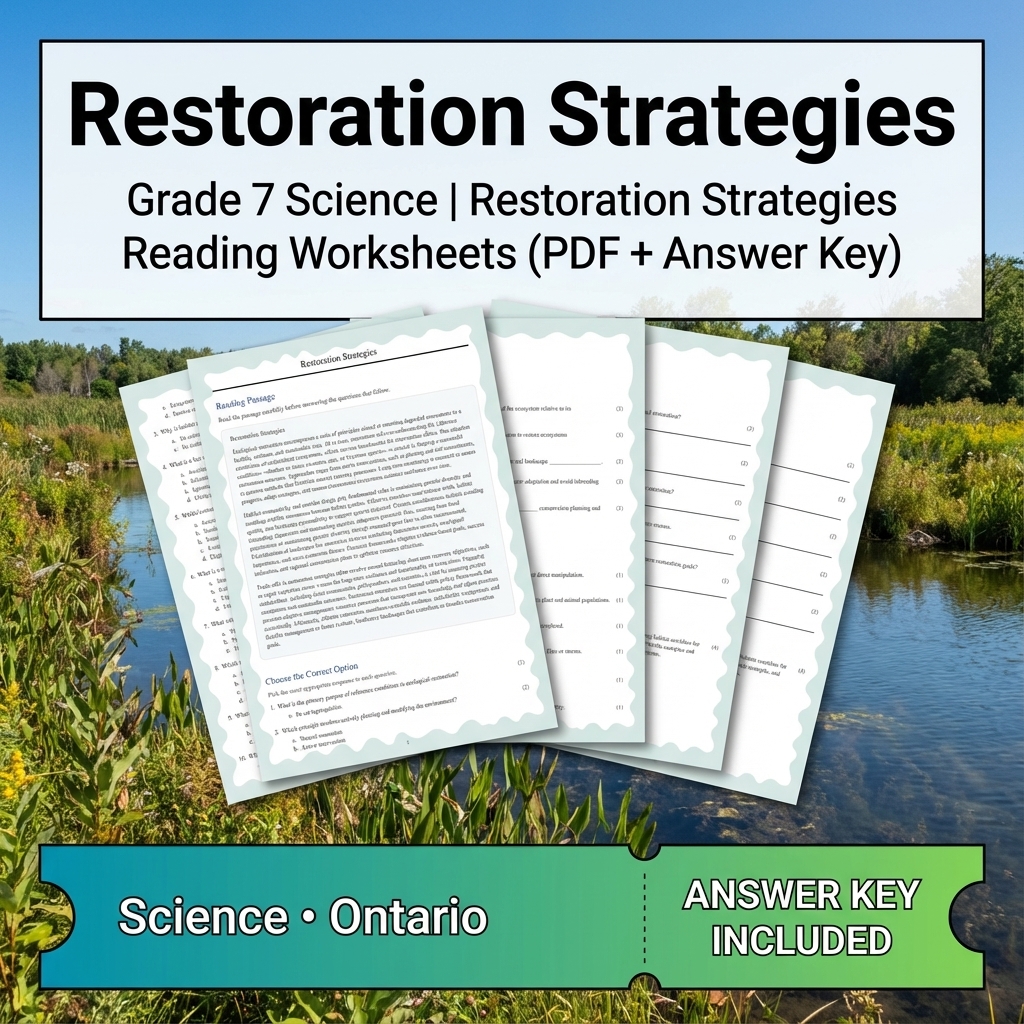
Grade 7 Science | Restoration Strategies Reading Worksheets (PDF + Answer Key)
JCreated byJ.S SheetsLearning Objectives
- Understand the key principles of ecological restoration, including reference conditions and species selection.
- Analyze different approaches to restoration, such as active versus passive strategies, and their implications.
- Evaluate long-term monitoring, habitat connectivity, and prioritization criteria in restoration projects.
Also included in: Grade 7 Science | Ecosystems, Biodiversity & Environmental Stewardship +1 more
Instant download
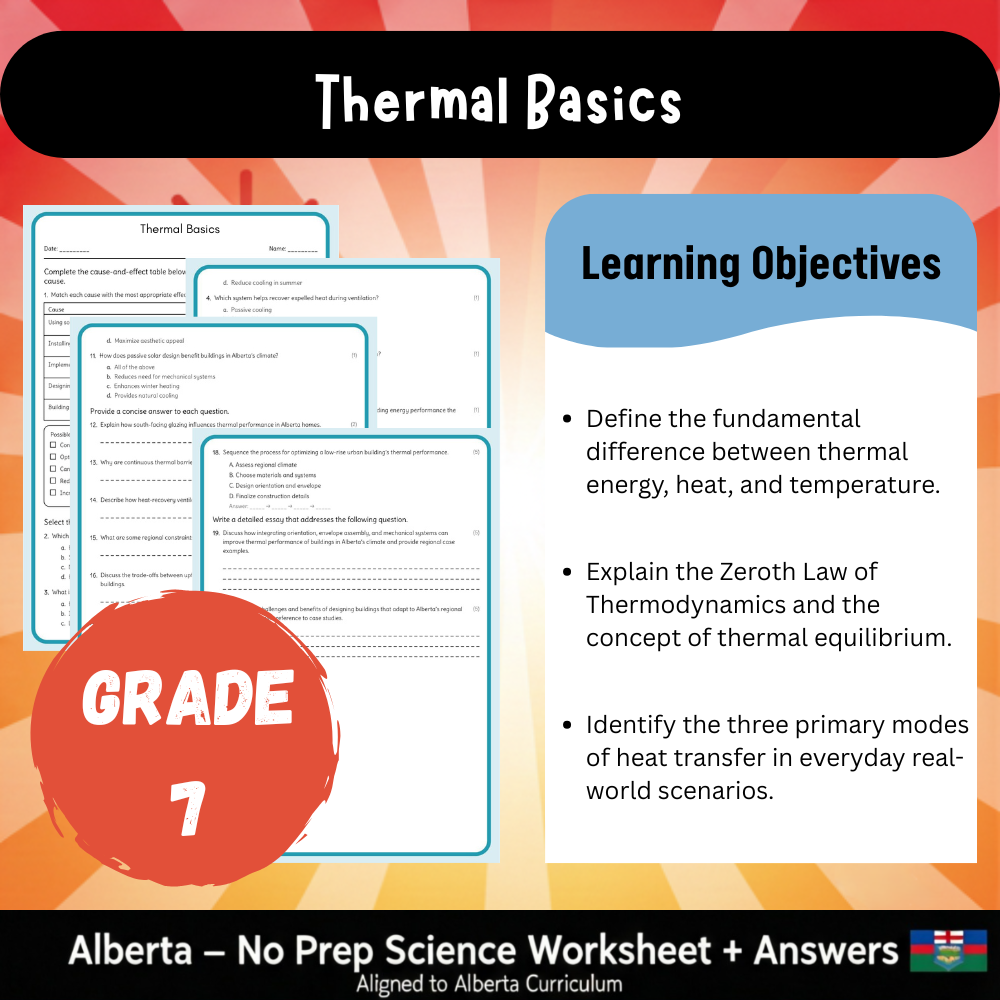
Grade 7 Science – Thermal Basics Worksheet (PDF) Aligned with Alberta Standards
Created byBright Mind ResourcesLearning Objectives
- Understand the kinetic motion of particles and its relation to thermal phenomena.
- Explain the difference between temperature and heat in thermal systems.
- Identify methods of heat transfer: conduction, convection, and radiation.
Instant download
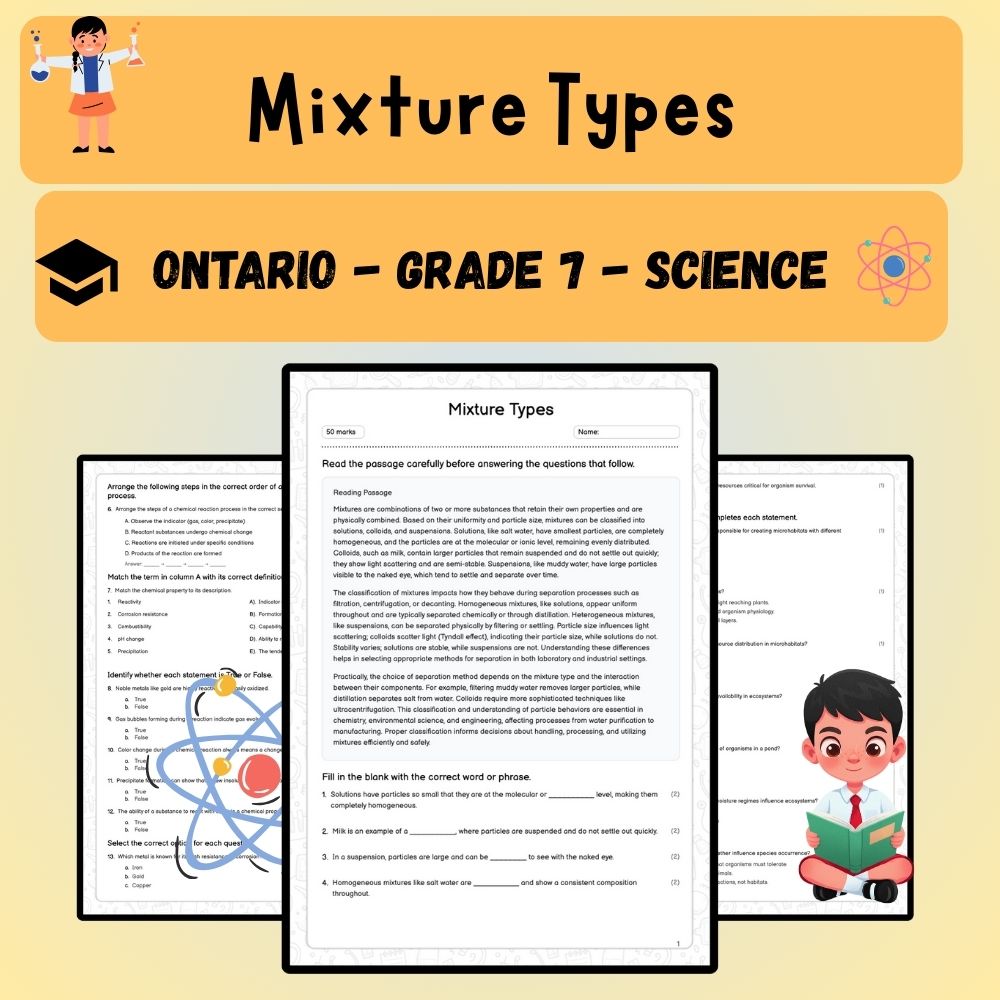
Grade 7 Science | Mixture Types Worksheet (PDF) – Ontario Standards
 Created byPrism Point Learning
Learning Objectives
- Understand the classification of mixtures into solutions, colloids, and suspensions.
- Identify examples of different mixture types based on their particle size and uniformity.
- Describe the properties and practical implications of homogeneous and heterogeneous mixtures.
Also included in: Grade 7 Science Unit Bundle | Substances, Mixtures & Properties Worksheets +1 more
Instant download
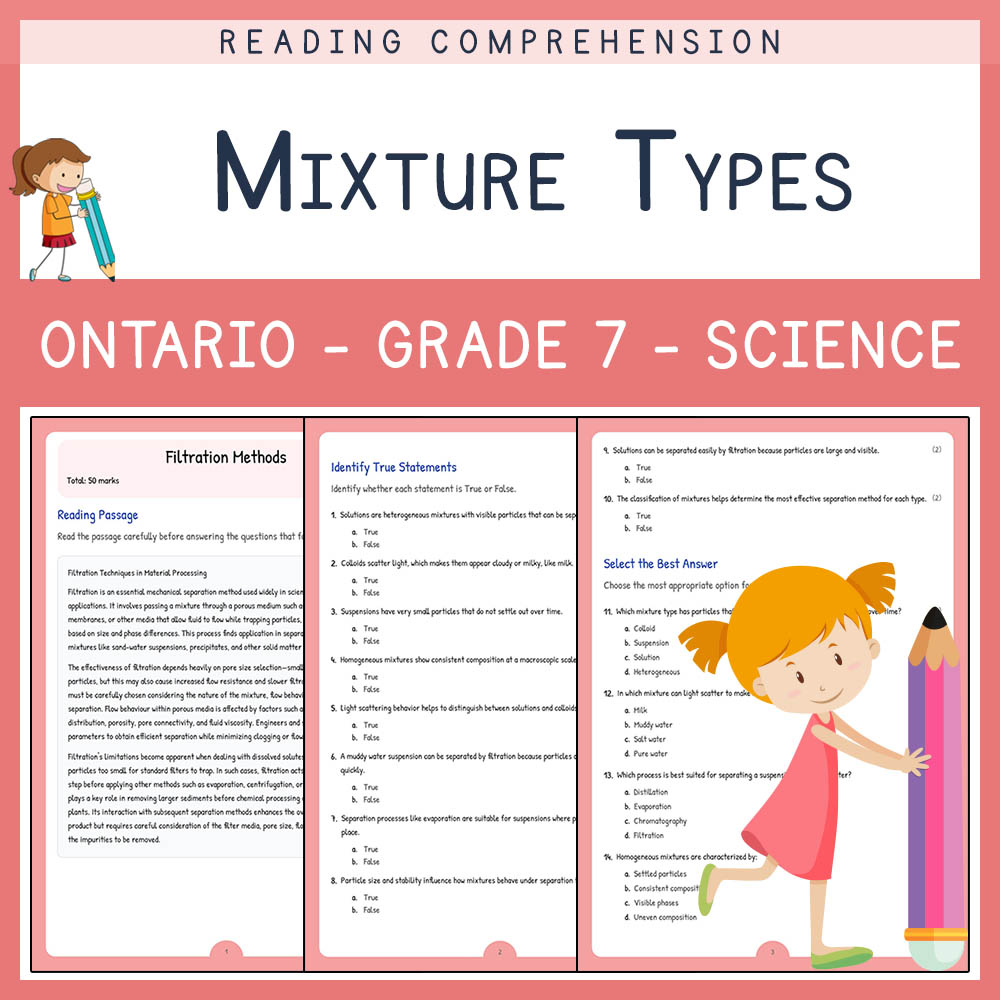
Grade 7 Science | Mixture Types Worksheet Elena | Ontario Standard
 Created byLumora Learning
Learning Objectives
- Understand the classification of mixtures into solutions, colloids, and suspensions based on uniformity and particle size.
- Identify examples of each mixture type such as salt water, milk, and muddy water.
- Explain the concepts of homogeneous and heterogeneous mixtures and their observable characteristics.
Also included in: Grade 7 Science | Pure Substances and Mixtures Unit Bundle | Ontario
Instant download

Forces And Motion Assessment | Florida NGSSS Grade 7 Science Worksheet
Created byPrism Point LearningLearning Objectives
- Explain how forces (pushes and pulls) can change an object’s motion.
- Differentiate balanced forces from unbalanced forces using the idea of net force.
- Use examples such as friction to predict how an object’s speed or direction will change.
Also included in: Grade 7 Matter, Forces & Energy Science Lesson Bundle | Florida NGSSS
Instant download
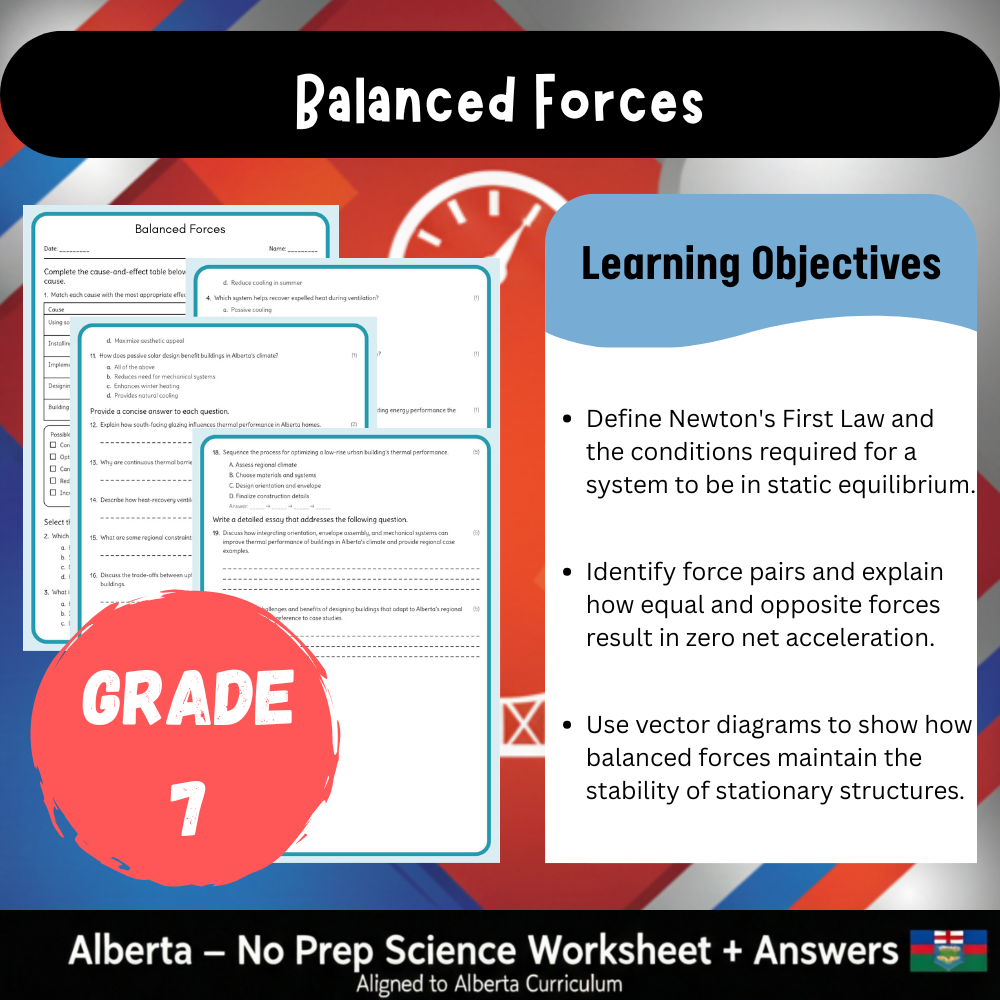
Grade 7 Science – Balanced Forces Worksheet (PDF) | Alberta Standards
Created byBright Mind ResourcesLearning Objectives
- Understand the concept of equilibrium and how forces balance to produce static and dynamic stability.
- Interpret graphical and qualitative representations of force pairs and their effects on structures.
Instant download

Grade 7 Science | Population Models in Science - Daily Reading Comprehension
Created byCoral Reef LearningLearning Objectives
- Understand the concept of exponential population growth
- Identify the characteristics of exponential growth models
- Distinguish between exponential and logistic growth
Instant download

Hydrocarbons to Polyethylene and PET Worksheets | Grade 7 Science
 Created byTeachers Club
Learning Objectives
- Describe how synthetic materials begin with natural resources and feedstocks
- Explain how refining steps change the chemical composition of materials
- Explain how polymerization changes chemical composition
Also included in: Grade 7 Science Worksheets | NGSS Matter & Its Interactions Bundle +2 more
Instant download
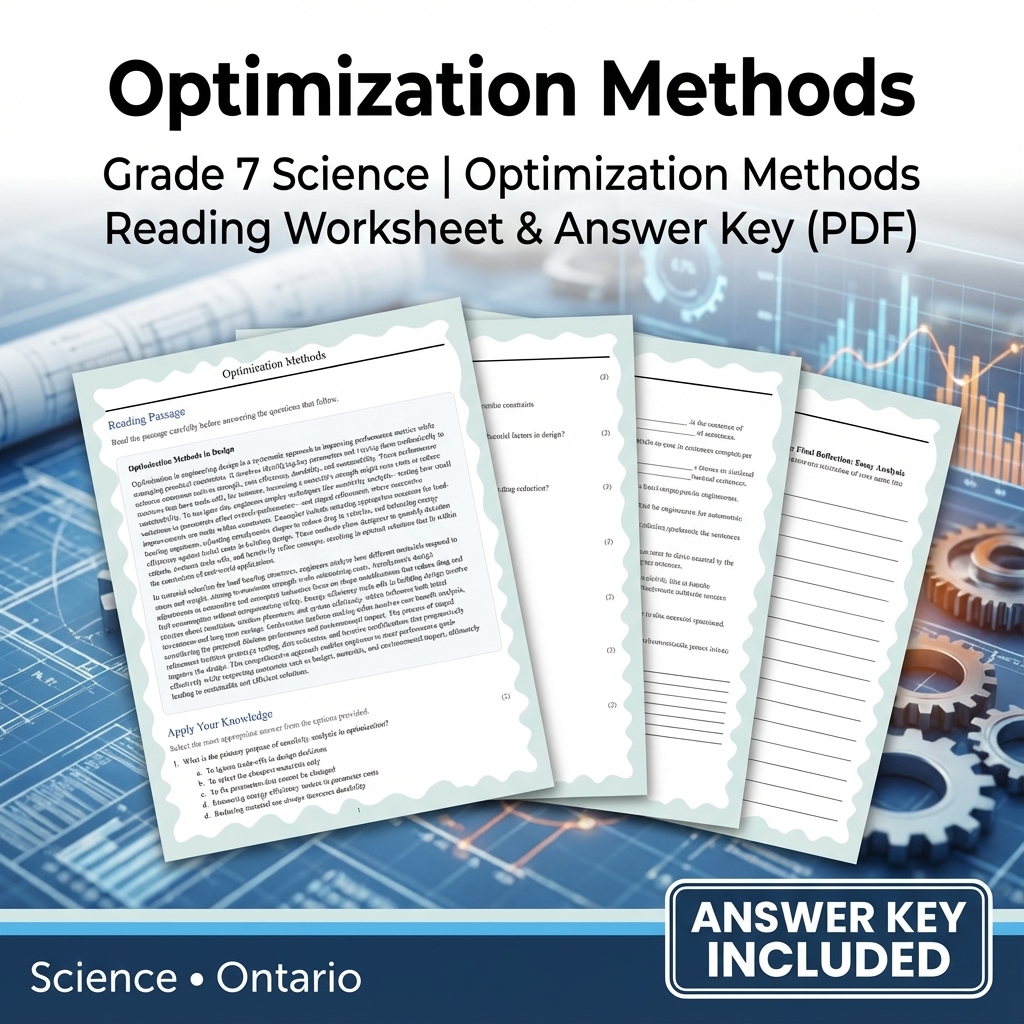
Grade 7 Science Reading | Optimization Methods for Ontario (PDF + Answer Key)
JCreated byJ.S SheetsLearning Objectives
- Understand the key concepts of optimization in design processes.
- Identify and evaluate performance metrics, constraints, and trade-offs.
- Learn methods such as parameter variation and sensitivity analysis to improve performance.
Also included in: Grade 7 Science Unit Bundle | Inquiry, Data & Modeling Skills +1 more
Instant download

Mole Ratios & Mass Relationships in Stoichiometry Worksheets Grade 7
Created byTeachers ClubLearning Objectives
- Construct mole ratios from balanced chemical equations
- Calculate mass relationships using moles and molar mass
- Predict reactant and product amounts using proportional reasoning
Also included in: Grade 7 Science Worksheets | NGSS Matter & Its Interactions Bundle +2 more
Instant download
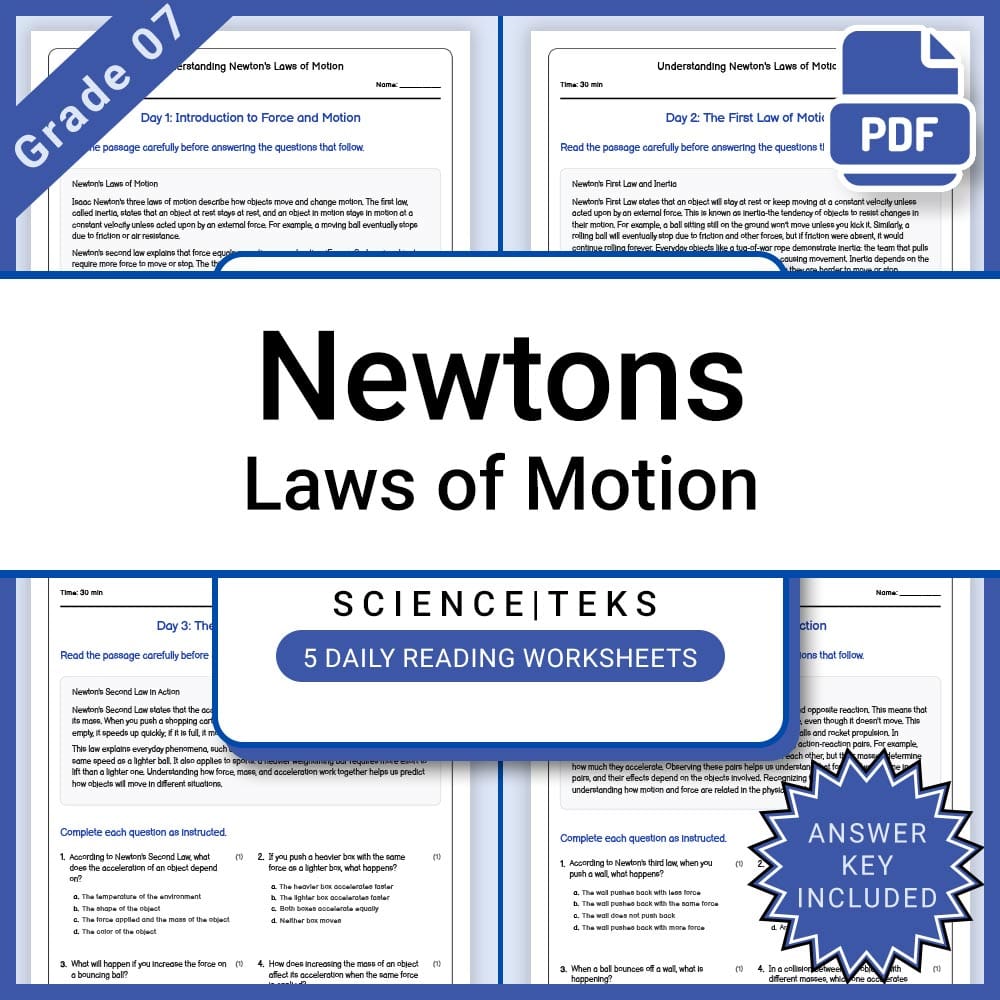
Grade 7 Science – Newton's Laws Daily Reading Worksheet with Answer Key
JCreated byJ.S SheetsLearning Objectives
- Explain the basic principles of Newton's Laws
- Identify examples of inertia, acceleration, and action-reaction pairs in everyday life
- Describe how force and mass affect the motion of objects
Also included in: Grade 7 Science Lesson Group Bundle with TEKS Framework +1 more
Instant download

Physical vs Chemical Properties Worksheets for Grade 7 Science
Created byTeachers ClubLearning Objectives
- Distinguish physical properties from chemical properties using observable evidence
- Compare materials using density, melting point, and solubility
- Classify substances using reactivity, flammability, and conductivity
Also included in: Grade 7 Science Worksheets | NGSS Matter & Its Interactions Bundle +2 more
Instant download

Grade 7 Inclined Planes Worksheet | Alberta Use Practice PDF
Created byClear Sky ClassroomLearning Objectives
- Explain how an inclined plane changes the relationship between input force and distance traveled.
- Describe the parallel and perpendicular force components relative to a slope.
- Calculate and interpret mechanical advantage for inclined-plane situations.
Instant download
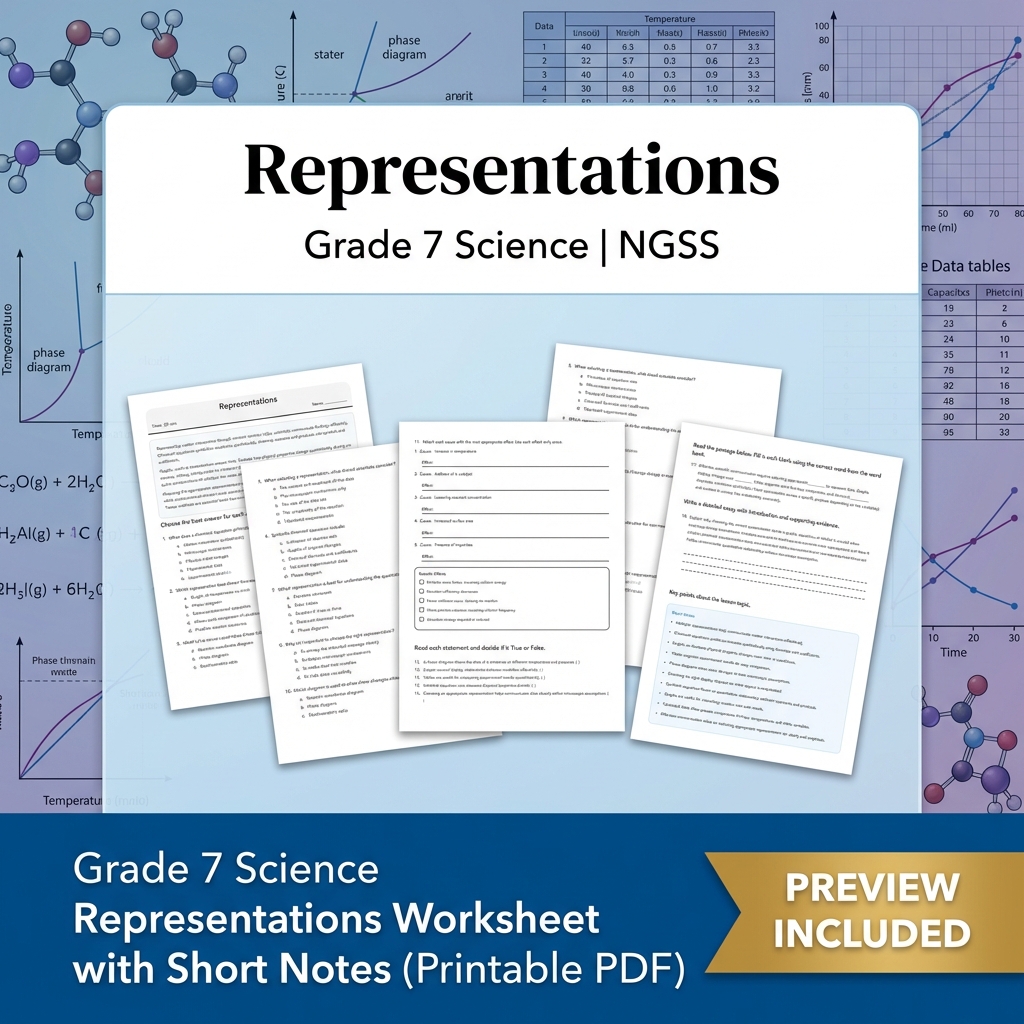
Grade 7 Science Representations Worksheet with Short Notes (Printable PDF)
 Created byMeadowlark Worksheets
Learning Objectives
- Understand various representations of matter interactions, including symbolic equations, graphs, and tables.
- Interpret reaction rate graphs and phase diagrams to analyze state changes.
- Apply appropriate representation formats for quantitative comparison of variables.
Also included in: Grade 7 Science | Matter and Its Interactions NGSS Worksheet Collection +1 more
Instant download

Rock Types Worksheet for Grade 7 Science | Standards-Aligned Practice PDF
JCreated byJ.S SheetsLearning Objectives
- Identify and describe the three main types of rocks: igneous, sedimentary, and metamorphic.
- Explain how rocks are formed through different processes such as cooling, accumulation, and alteration.
- Analyze mineral content, grain size, and structures to distinguish between rock types.
Instant download
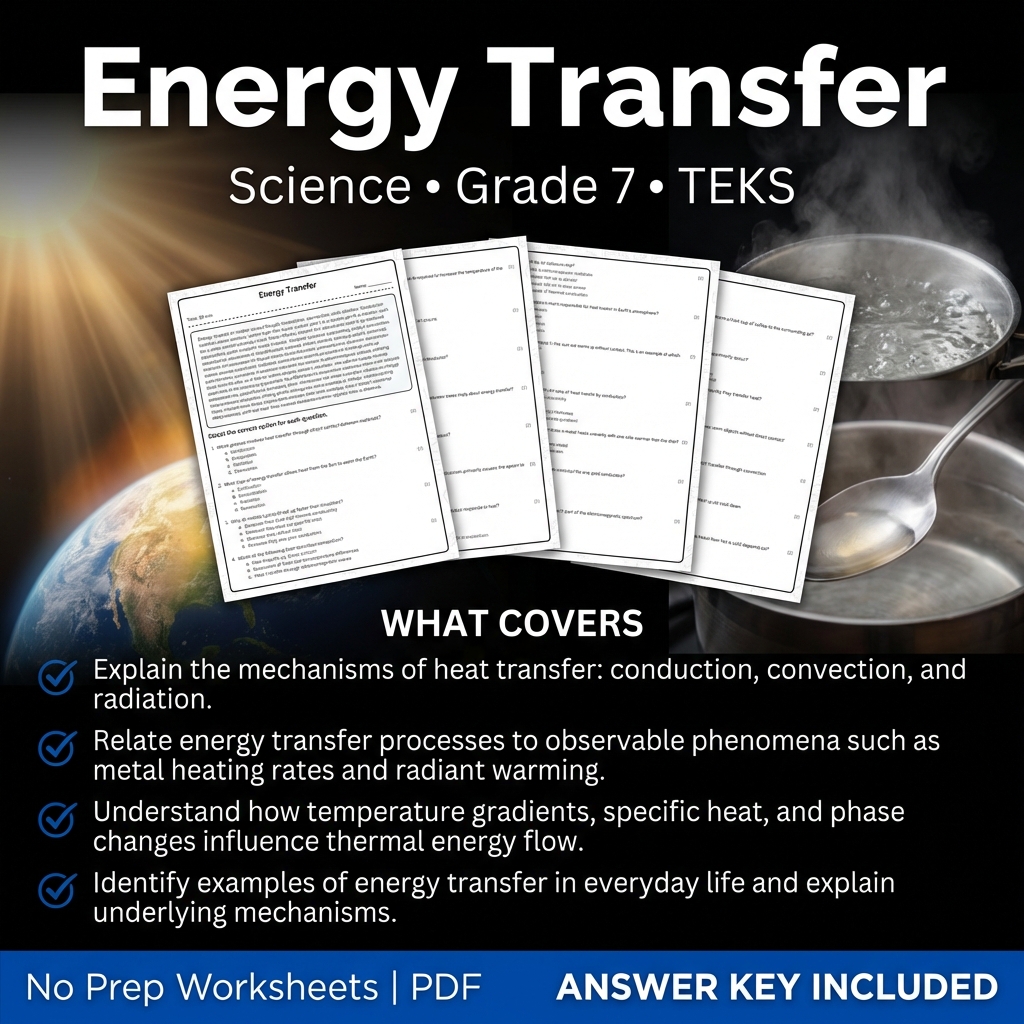
Grade 7 Science Worksheet on Energy Transfer | TEKS Aligned
Created byCoral Reef LearningLearning Objectives
- Explain the mechanisms of heat transfer: conduction, convection, and radiation.
- Relate energy transfer processes to observable phenomena such as metal heating rates and radiant warming.
- Understand how temperature gradients, specific heat, and phase changes influence thermal energy flow.
Instant download
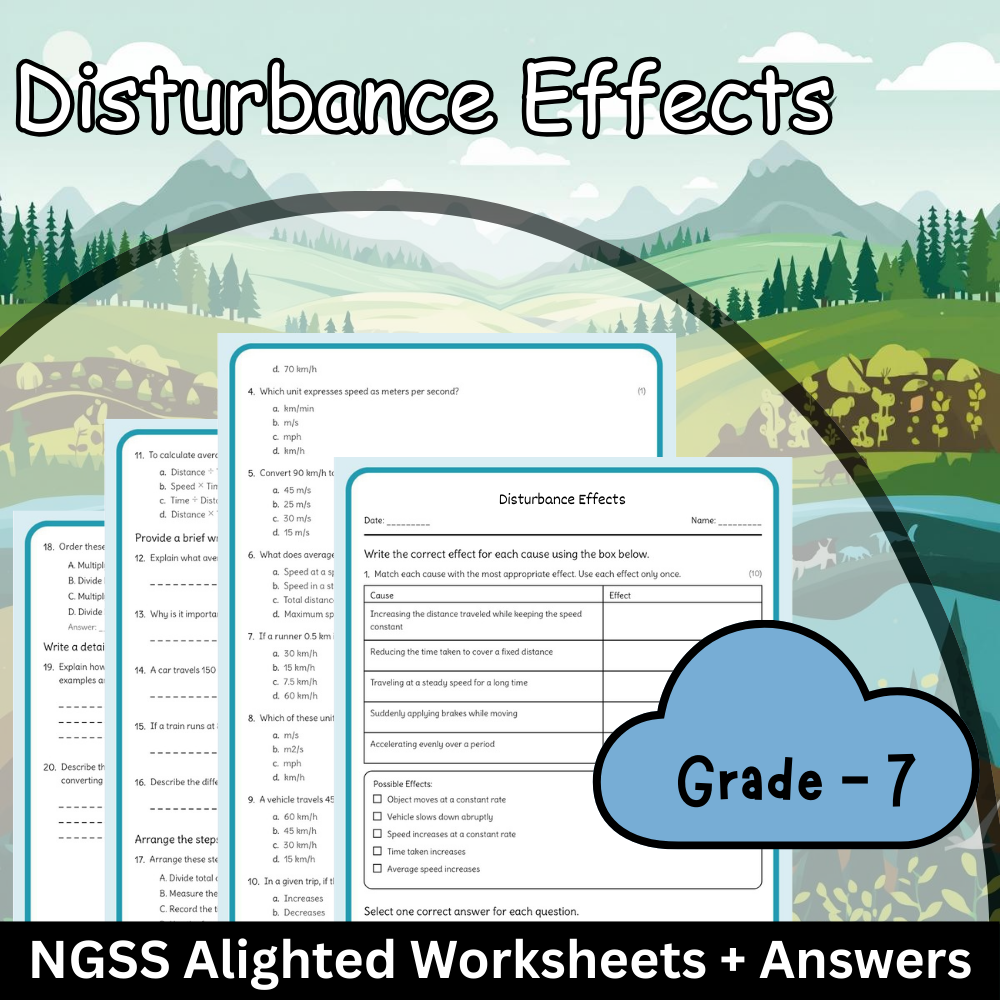
Grade 7 Science | Disturbance Effects Worksheet (NGSS Aligned, PDF)
Created byBright Mind ResourcesLearning Objectives
- Understand how physical and biological disturbances impact ecosystems.
- Identify mechanisms of ecosystem resilience, resistance, and succession.
- Interpret empirical observations and data to analyze population changes.
Instant download

Kinetic Energy Graphs and Proportions Worksheet | NGSS Grade 7 Science
 Created bySkylark Worksheets
Learning Objectives
- Explain how kinetic energy depends on mass and speed using proportional reasoning.
- Interpret graphs that compare kinetic energy to mass and to the square of speed.
- Calculate kinetic energy from given values and justify changes when mass or speed doubles.
Also included in: Grade 7 Energy Transformations Science Lesson Bundle for Worksheets (NGSS) +1 more
Instant download

Ecosystem Resilience Assessment | Standards-Aligned Grade 7 Science Test
Created byPrism Point LearningLearning Objectives
- Understand the concept of ecosystem resilience and its importance.
- Identify factors that influence how ecosystems recover from disturbances.
- Analyze patterns in population changes following environmental disruptions.
Instant download

Grade 7 Science | Density Particle View Worksheet | California Standards
Created byLumora LearningLearning Objectives
- Explain density using the particle view (mass per unit volume and particle spacing).
- Predict how density changes when temperature changes and particles spread out or come closer together.
- Use particle reasoning to explain sinking and floating based on density differences.
Instant download

Population Change Worksheet | TEKS Grade 7 Science Assessment PDF
JCreated byJ.S SheetsLearning Objectives
- Explain how birth, death, immigration, and emigration influence population size and distribution
- Differentiate exponential growth from logistic growth using carrying capacity and limiting factors
- Describe how predators and prey can influence each other through oscillating population patterns
Instant download

Beam Loading, Bending, Shear & Deflection Worksheets Grade 7 Science
Created bySunny Desk ResourcesLearning Objectives
- Describe how beam bending, shear, and deflection relate to loads and supports
- Identify how span-to-depth ratio and material stiffness affect beam performance
- Use service load ideas to judge whether a beam meets stability and comfort needs
Also included in: Forces, Structures & Motion Grade 7 Science Bundle | Alberta +1 more
Instant download

Grade 7 Science – Bitumen Separation Worksheet (Alberta Standards & Practice) (PDF)
 Created bySilver Birch Teaching
Learning Objectives
- Classify processes used to extract bitumen from oil sands as physical separation or chemical change
- Explain how density, particle size, temperature, and additives affect mixture behavior during processing
- Identify evidence of emulsions, dissolved organics, and product separation in real-world separation steps
Also included in: Grade 7 Matter, Concentration & Reactions Science Lesson Bundle - Alberta +1 more
Instant download

Grade 7 Science | Convection Systems in Science - Daily Reading Comprehension
Created byCoral Reef LearningLearning Objectives
- Understand the concept of convection and how it transports heat in fluids.
- Identify real-world examples of convection in nature and engineering.
- Differentiate convection from conduction and radiation.
Also included in: Energy, Heat and Thermal Processes Lesson Bundle: Grade 7 Science Alberta +1 more
Instant download

Technical Communication Worksheet Pack | Grade 7 Science Activities
Created byPrism Point LearningLearning Objectives
- Identify key conventions in technical communication, including labels, units, and unambiguous dimensioning
- Use standardized notation to interpret and create clear diagrams and schematic information
- Explain how specification documents support replication, evaluation, and cross-discipline collaboration
Also included in: Grade 7 Technology & Engineering Design in Science: Lesson Bundle TEKS
Instant download
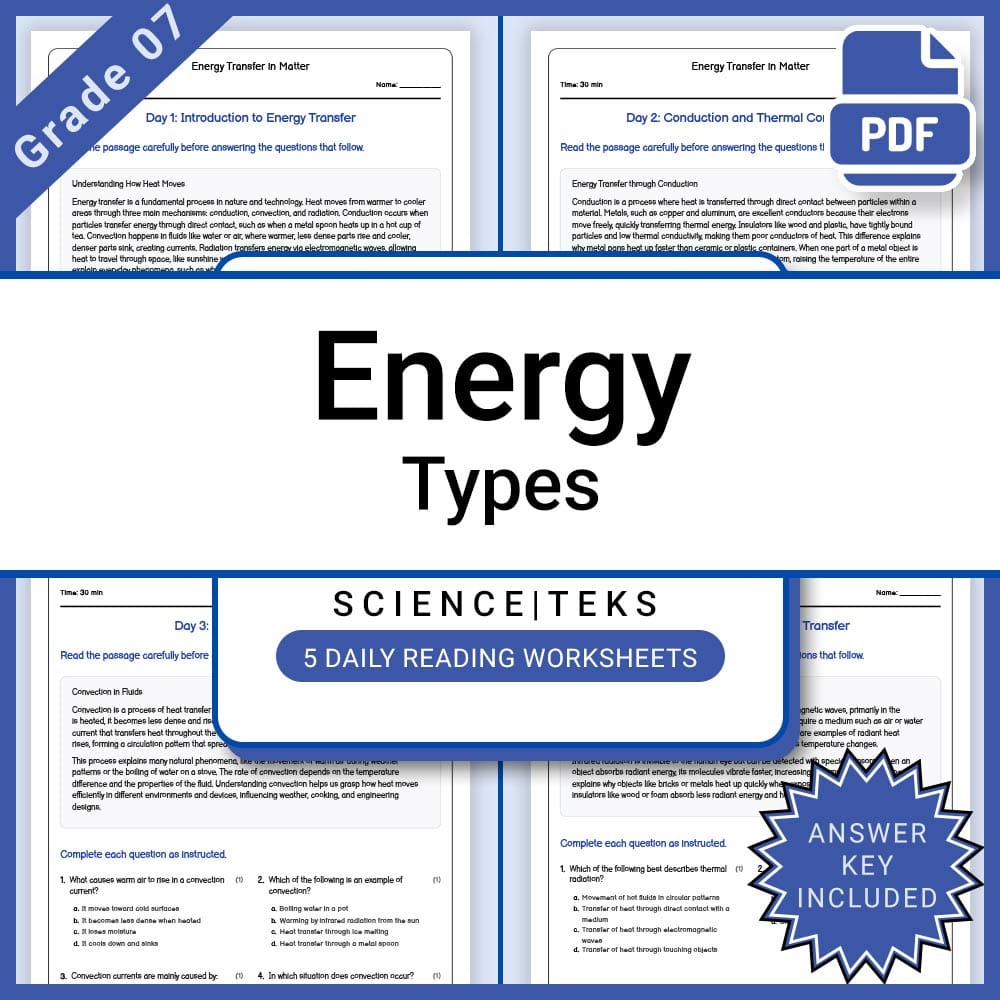
Grade 7 Science – Energy Types Daily Reading Worksheet + Answer Key
JCreated byJ.S SheetsLearning Objectives
- Understand key concepts related to Science
- Apply knowledge through practice questions
- Demonstrate comprehension of the material
Also included in: Grade 7 Science Lesson Group Bundle with TEKS Framework +1 more
Instant download

Collisions Worksheet | NGSS Science Practice for Grade 7
JCreated byJ.S SheetsLearning Objectives
- Understand the principles of momentum conservation during collisions.
- Differentiate between elastic and inelastic collisions.
- Apply quantitative examples to analyze collision outcomes based on mass and velocity.
Also included in: Grade 7 Forces and Interactions Science Lesson Bundle: NGSS Practice Set +1 more
Instant download
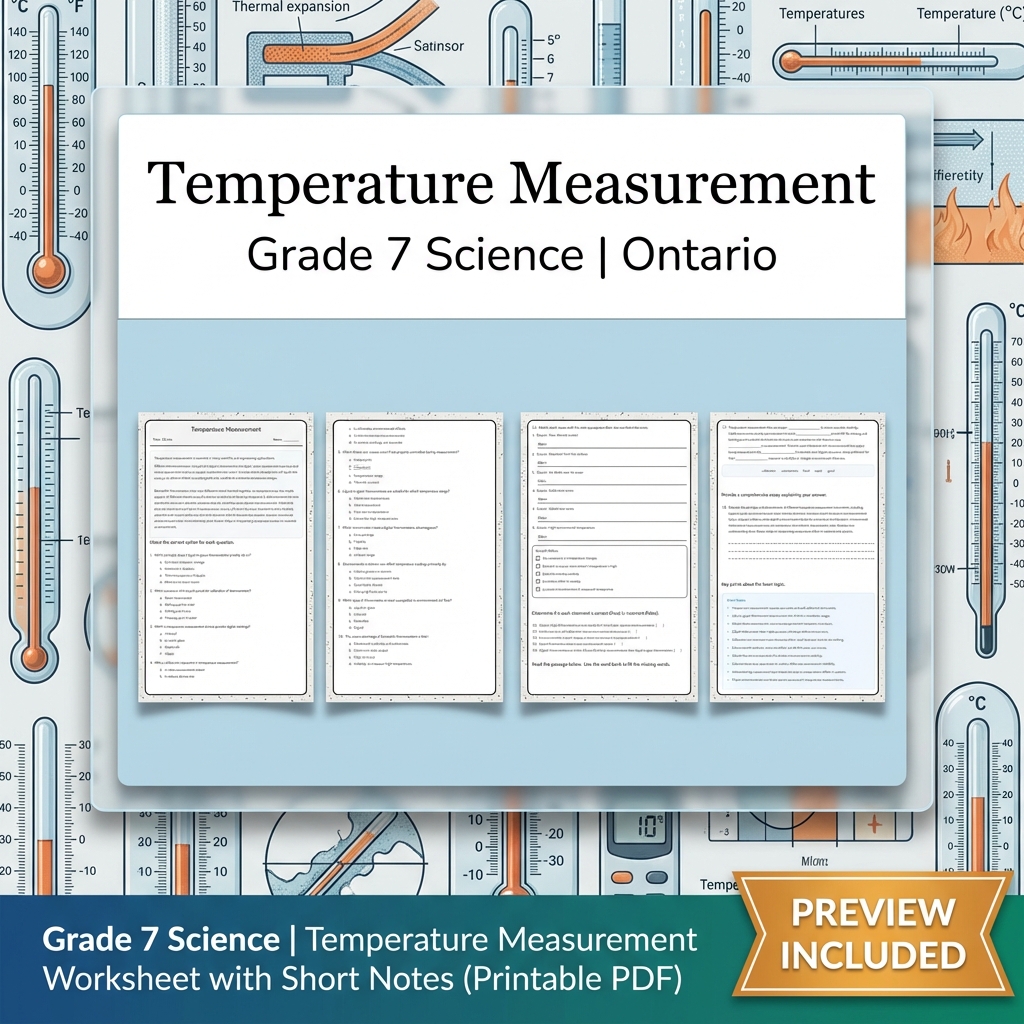
Grade 7 Science | Temperature Measurement Worksheet with Short Notes (PDF)
Created byMeadowlark WorksheetsLearning Objectives
- Understand the principles of temperature measurement and instrument characteristics.
- Differentiate between liquid-in-glass, bimetallic, and digital thermometers.
- Explain the significance of calibration, fixed points, and thermal contact for accurate readings.
Also included in: Grade 7 Science Lesson Group | Thermal Effects and Heat Transfer Worksheets +1 more
Instant download
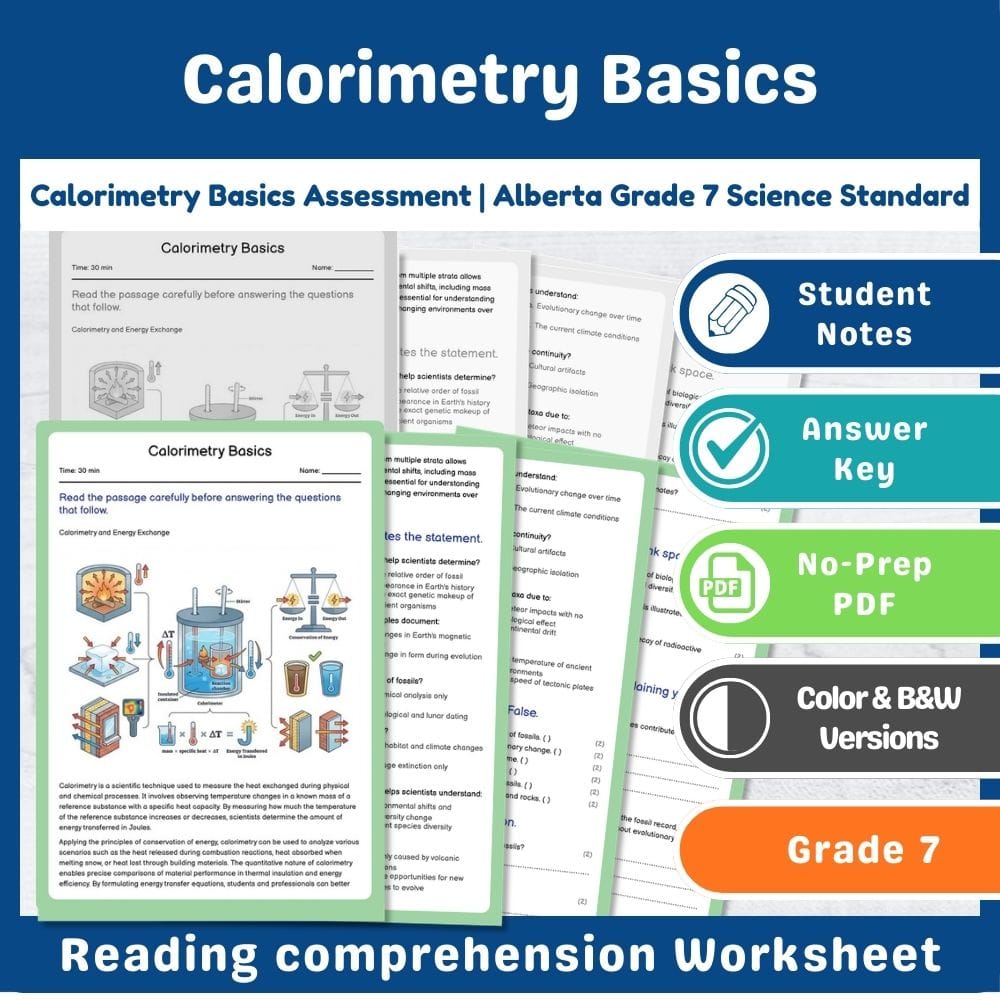
Calorimetry Basics Assessment | Alberta Grade 7 Science Standard
Created byPrism Point LearningLearning Objectives
- Explain the principles of calorimetry and how temperature changes relate to energy exchange.
- Apply energy conservation equations to quantitative heat transfer calculations.
- Describe real-world scenarios involving calorimetric reasoning in thermal performance of materials.
Also included in: Lesson Grade 7 Science Mini Bundle | Energy, Heat & Thermal Processes +1 more
Instant download

Grade 7 Biodiversity Measures Worksheet | Alberta Use Practice PDF
Created byClear Sky ClassroomLearning Objectives
- Explain biodiversity as genetic, species, and ecosystem diversity
- Describe how richness, evenness, and habitat heterogeneity help measure biodiversity
- Interpret what biodiversity metrics can reveal about ecosystem resilience and ecosystem function
Instant download

Cell Evidence from Microscopy: Grade 7 Science Worksheets & Review
Created byTeachers ClubLearning Objectives
- Describe how microscopy reveals cells in living things
- Compare unicellular and multicellular organization using biological examples
- Explain cell walls and plasma membranes in microscopy observations
Also included in: From Molecules to Organisms Grade 7 Science NGSS Worksheets Bundle +2 more
Instant download
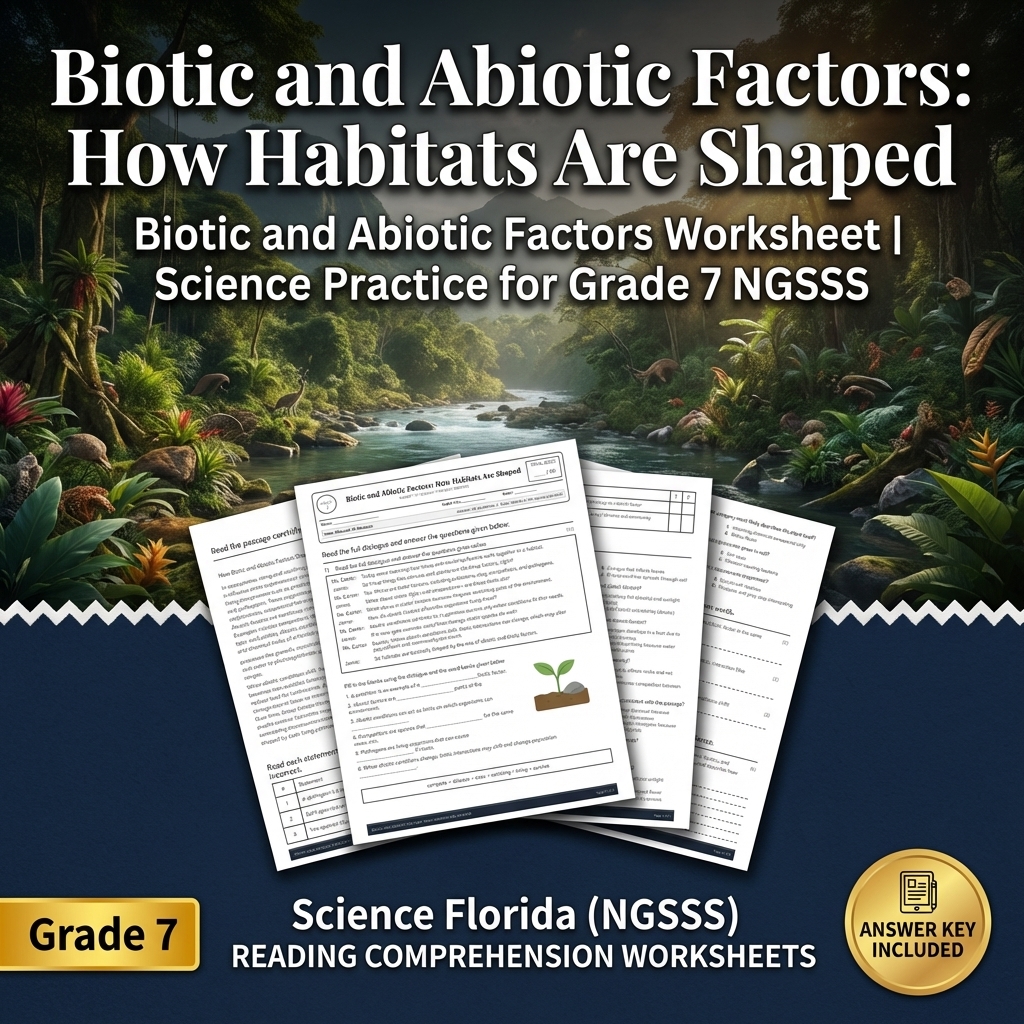
Biotic and Abiotic Factors Worksheet | Science Practice for Grade 7 NGSSS
JCreated byJ.S SheetsLearning Objectives
- Differentiate biotic factors and abiotic factors in an ecosystem.
- Explain how abiotic conditions influence which organisms can survive.
- Describe how changes in abiotic factors can affect biotic interactions and population sizes.
Also included in: Grade 7 Evolution and Population Dynamics Science Lesson Bundle – Florida NGSSS +1 more
Instant download

Environmental Change Impacts Assessment | General Grade 7 Science Standards
Created byPrism Point LearningLearning Objectives
- Understand how environmental changes influence ecosystems and organism survival.
- Identify different types of environmental alterations and their effects on resources and species.
- Analyze how shifts in species populations affect ecosystem interactions and patterns.
Instant download
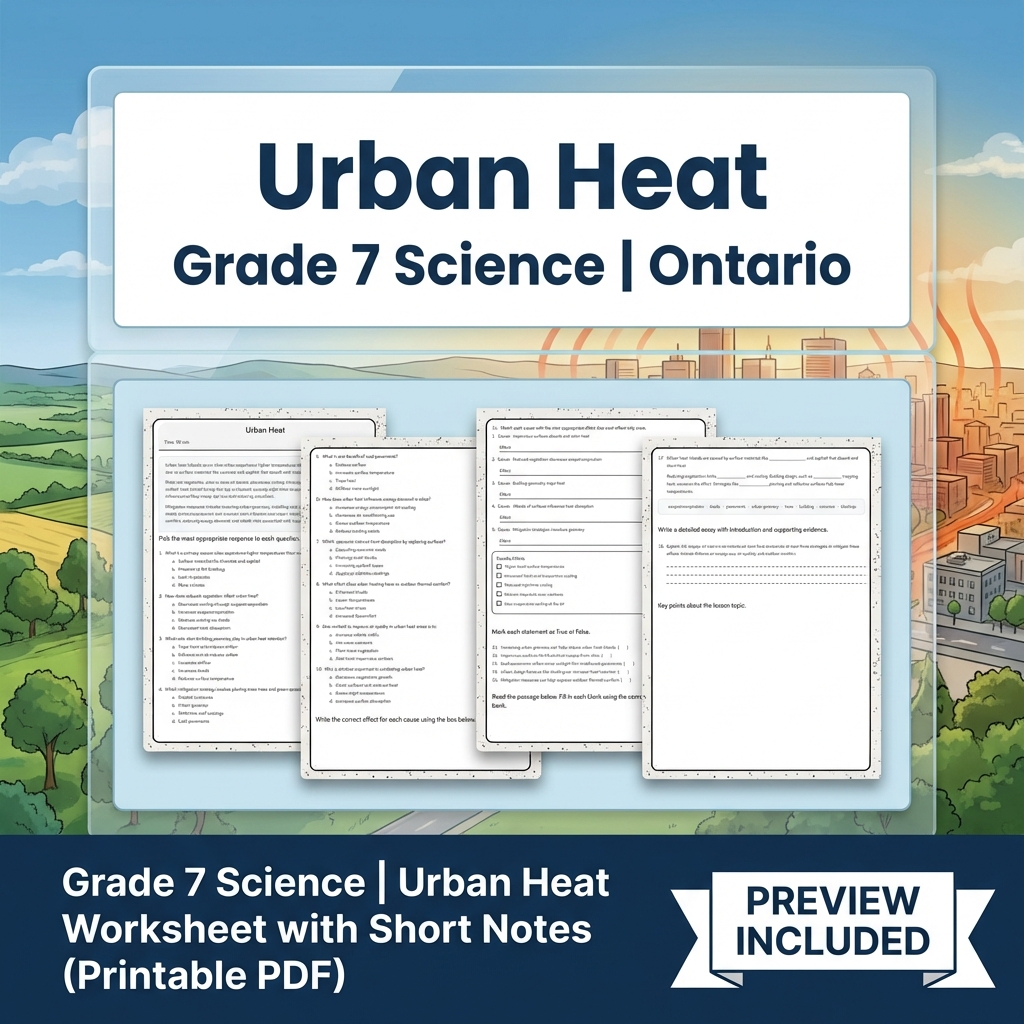
Grade 7 Science | Urban Heat Worksheet with Short Notes (Printable PDF)
Created byMeadowlark WorksheetsLearning Objectives
- Understand the causes and effects of urban heat islands on city environments.
- Identify surface materials and urban features that contribute to heat retention.
- Analyze mitigation strategies to reduce urban heat effects.
Also included in: Grade 7 Science Lesson Group | Thermal Effects and Heat Transfer Worksheets +1 more
Instant download

Integrated Design Worksheet | Grade 7 Science Practice
Created byPrism Point LearningLearning Objectives
- Use integrated systems analysis to compare design options using mechanical advantage, materials, and structural safety.
- Connect force and motion data to machine function and structural evaluation in real-world scenarios (wind, snow, and load).
- Justify a design choice using evidence from mechanical calculations and safety criteria.
Instant download

Grade 7 Science – Connection Design Worksheet (Ontario) (PDF)
Created byEvergreen Desk EducationLearning Objectives
- Explain how bolted, welded, and bearing connections help create continuous load paths in structures
- Describe shear, bearing, and slip at connections and how these behaviors affect structural performance
- Compare how connection stiffness and detailing (gusset plates and base plates) influence capacity and failure modes
Also included in: Grade 7 Engineering Design & Materials Science Lesson Bundle Ontario +1 more
Instant download

Net Force Effects Worksheet Grade 7 Science | Balanced & Unbalanced Forces
Created byPrism Point LearningLearning Objectives
- Explain how the net force (magnitude and direction) affects an object's motion
- Distinguish between balanced and unbalanced forces using changes in velocity
- Describe how everyday pushes and pulls relate to net force and motion
Instant download
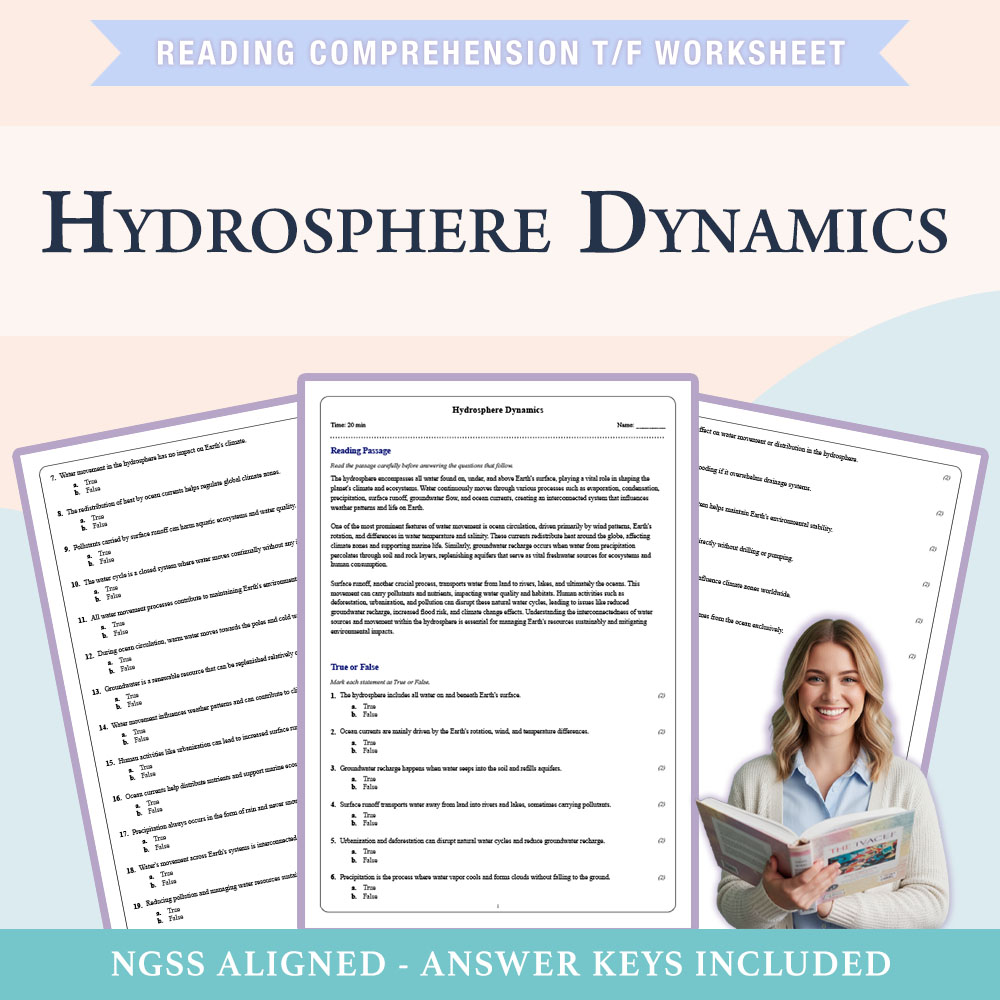
Grade 7 Science | Hydrosphere Dynamics Worksheet (PDF +Answer Key)
 Created byCopper Leaf Classroom
Learning Objectives
- Describe the movement of water across Earth's systems.
- Explain the processes of groundwater flow, surface runoff, and ocean circulation.
- Understand the impact of water movement on climate, ecosystems, and human activity.
Instant download
About Grade 7 Science Worksheets
Browse 6,039 printable Grade 7 Science worksheets — ready-to-print PDFs with answer keys where available.
Every worksheet on MyTeachingSheets is created by independent teacher-authors and reviewed before publication. All resources download as printable PDFs for classroom, homework, or at-home practice, and many include answer keys. Preview any worksheet free before buying.