
Grade 7 Science Worksheets
6,039 worksheets
Fossil Evidence Assessment | Florida NGSSS Standards Grade 7 Science
 Created byPrism Point Learning
Learning Objectives
- Explain how fossils form and what conditions help preserve remains, traces, and imprints
- Use fossil assemblages to infer past environments and relate rock layers to Earth’s history
- Differentiate among body fossils, trace fossils, and imprints and describe what each can reveal
Also included in: Grade 7 Earth and Climate Systems Science Lesson Bundle: Florida NGSSS
Instant download

Climate Drivers Worksheet | Grade 7 Climate & Earth Science Assessment
Created byPrism Point LearningLearning Objectives
- Explain how latitude affects the angle of incoming sunlight and regional heating patterns.
- Describe how elevation, distance from water, and ocean currents influence temperature and precipitation.
- Use climate drivers to justify differences between deserts, rain forests, and seasonal weather patterns.
Also included in: Grade 7 Weather & Climate Science Lesson Bundle | Florida NGSSS
Instant download

Grade 7 Freshwater Stratification & Seasonal Oxygen Cycles Science Worksheet
 Created byTeacher's Corner
Learning Objectives
- Describe how light penetration, temperature, and oxygen change with depth in lakes and ponds.
- Explain how abiotic gradients shape vertical zonation and community composition.
- Compare how seasonal thermal turnover affects nutrient mixing, dissolved oxygen, and habitat suitability.
Instant download

Surface Changes Over Time Worksheet | Grade 7 Earth Science Assessment
Created byPrism Point LearningLearning Objectives
- Explain how water, storms, and Earth forces can change the surface of land over time
- Describe the roles of erosion and deposition in shaping local landforms
- Compare rapid changes (storms, earthquakes, volcanic eruptions) with slower landscape change
Also included in: Grade 7 Weather & Climate Science Lesson Bundle | Florida NGSSS
Instant download
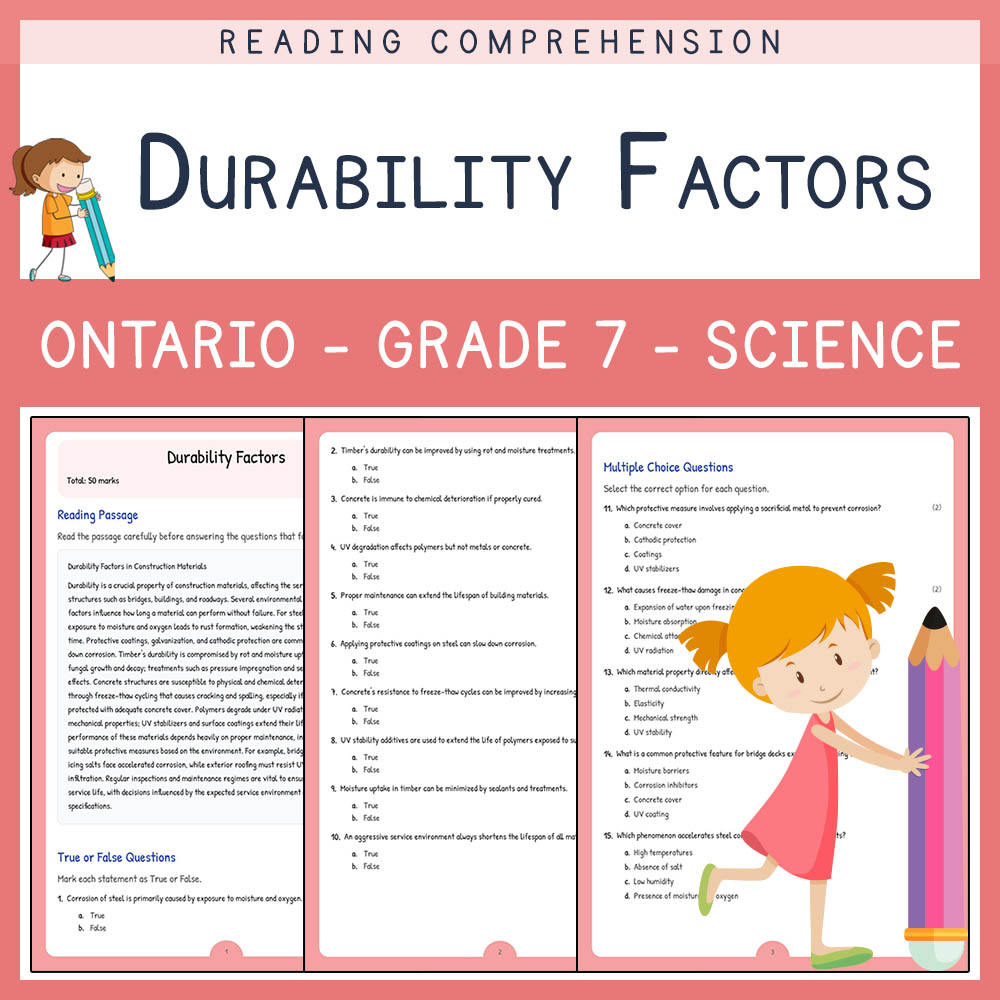
Grade 7 Science | Durability Factors Worksheet (Answer Key) - Ontario Standard
 Created byLumora Learning
Learning Objectives
- Identify key factors affecting the durability of materials over time.
- Explain the mechanisms of corrosion, rot, freeze–thaw cycling, and UV degradation.
- Analyze protective measures such as coatings, cathodic protection, and concrete cover.
Also included in: Grade 7 Science | Form Function Design Structures Unit Bundle | Ontario
Instant download

Interpreting Data Worksheet for Grade 7 Science | NGSSS Activities
Created byPrism Point LearningLearning Objectives
- Interpret patterns and relationships in scientific graphs such as scatter plots, histograms, and line graphs.
- Compare groups of data using summary measures like range and averages, and explain what those measures suggest.
- Evaluate claims by considering outliers, inconsistencies, and possible measurement uncertainty.
Instant download

Grade 7 Understanding Design Problems Worksheet | NGSS Engineering Science
 Created byBRIGHT PATH RESOURCES
Learning Objectives
- Define what constitutes a design problem by identifying clear criteria and constraints.
- Recognize real-world examples of specifying success measures and limitations.
- Translate societal and environmental needs into measurable targets for project development.
Also included in: Bridge Engineering Grade 7 Science Daily Reading Worksheets Lesson Bundle | NGSS +2 more
Instant download

Grade 7 Science – Human Stewardship in Ecosystems | Daily Reading Worksheet
 Created byBright Mind Resources
Learning Objectives
- Understand human impacts on ecosystems, including habitat alteration, pollution, resource extraction, and species introduction.
- Analyze the consequences of human activities on biodiversity and ecosystem functions.
- Identify principles of stewardship such as mitigation, habitat protection, restoration, and monitoring.
Also included in: Grade 7 Ecosystem Stewardship Science Daily Reading lesson bundle | Ontario +1 more
Instant download
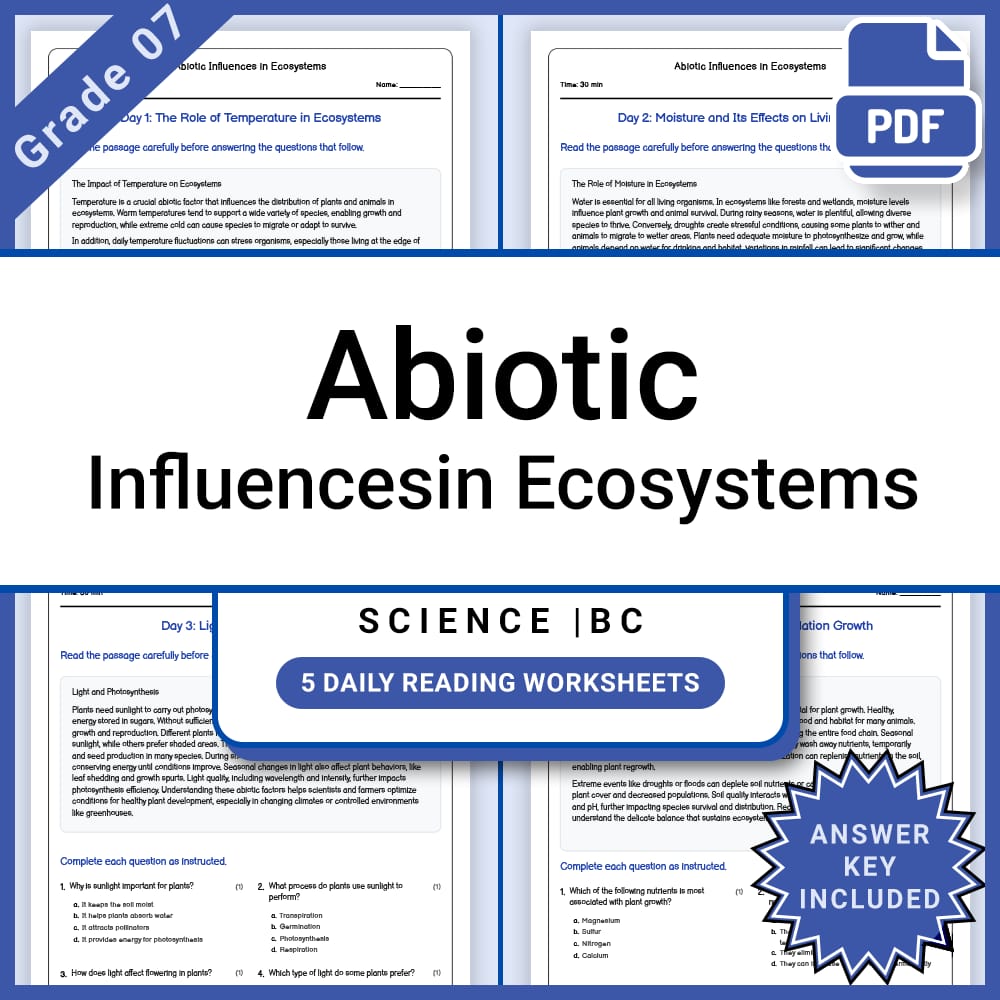
Grade 7 Science – Abiotic Influences in Ecosystems Daily Worksheet + Answer Key
JCreated byJ.S SheetsLearning Objectives
- Understand how temperature affects plant and animal survival
- Identify the effects of temperature variations on ecosystems
- Analyze the interactions between abiotic and biotic factors
Also included in: Grade 7 Science Lesson Group: Ecosystems and Population Framework +1 more
Instant download
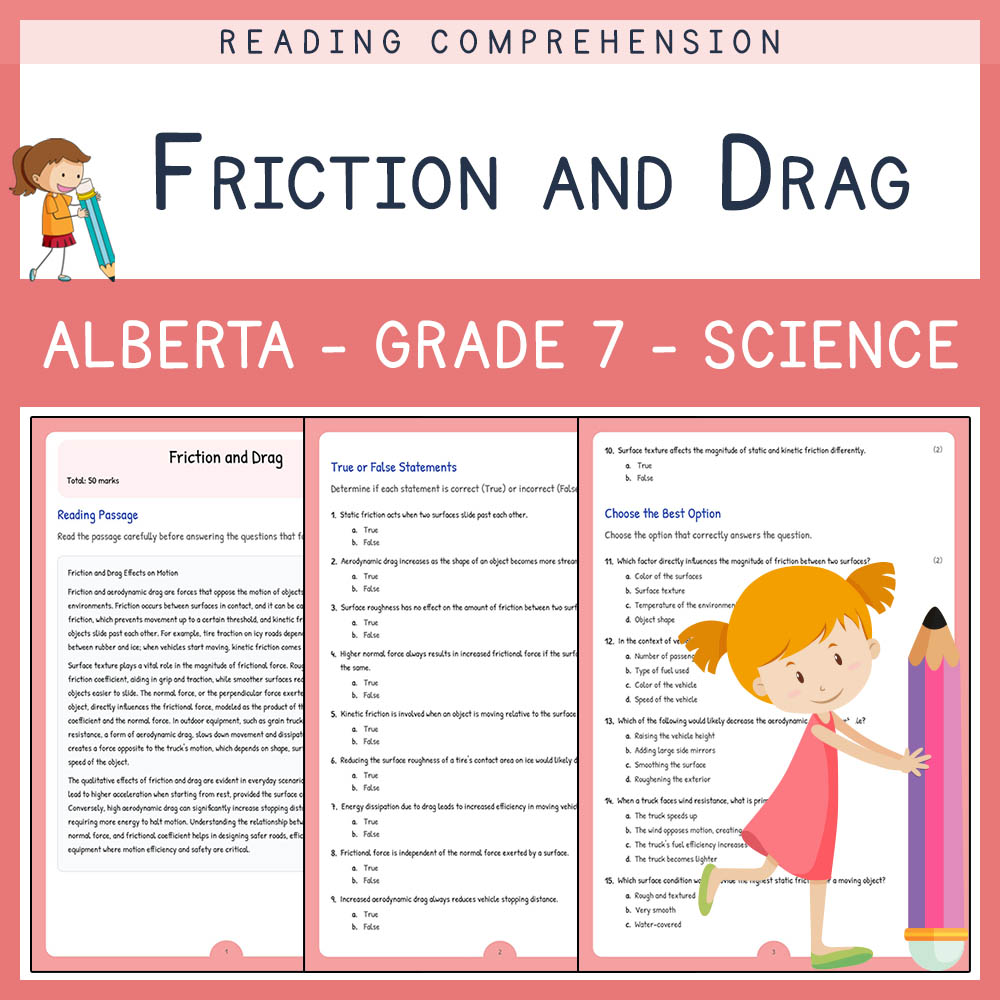
Grade 7 Science | Friction and Drag Worksheet | Alberta Standard
Created byLumora LearningLearning Objectives
- Explain the concepts of static and kinetic friction and how surface texture affects them.
- Describe how aerodynamic drag influences motion in vehicles and outdoor equipment.
- Relate the relationship between normal force, surface texture, and frictional coefficient.
Instant download

Grade 7 Science – Interpreting Data & Graphs | Daily Reading Worksheet
Created byBright Mind ResourcesLearning Objectives
- Understand how to read and interpret line graphs
- Identify patterns and trends in scientific data
- Evaluate the significance of outliers and measurement uncertainty
Also included in: Grade 7 Variables Science lesson-bundle daily reading worksheets | Florida NGSSS +1 more
Instant download
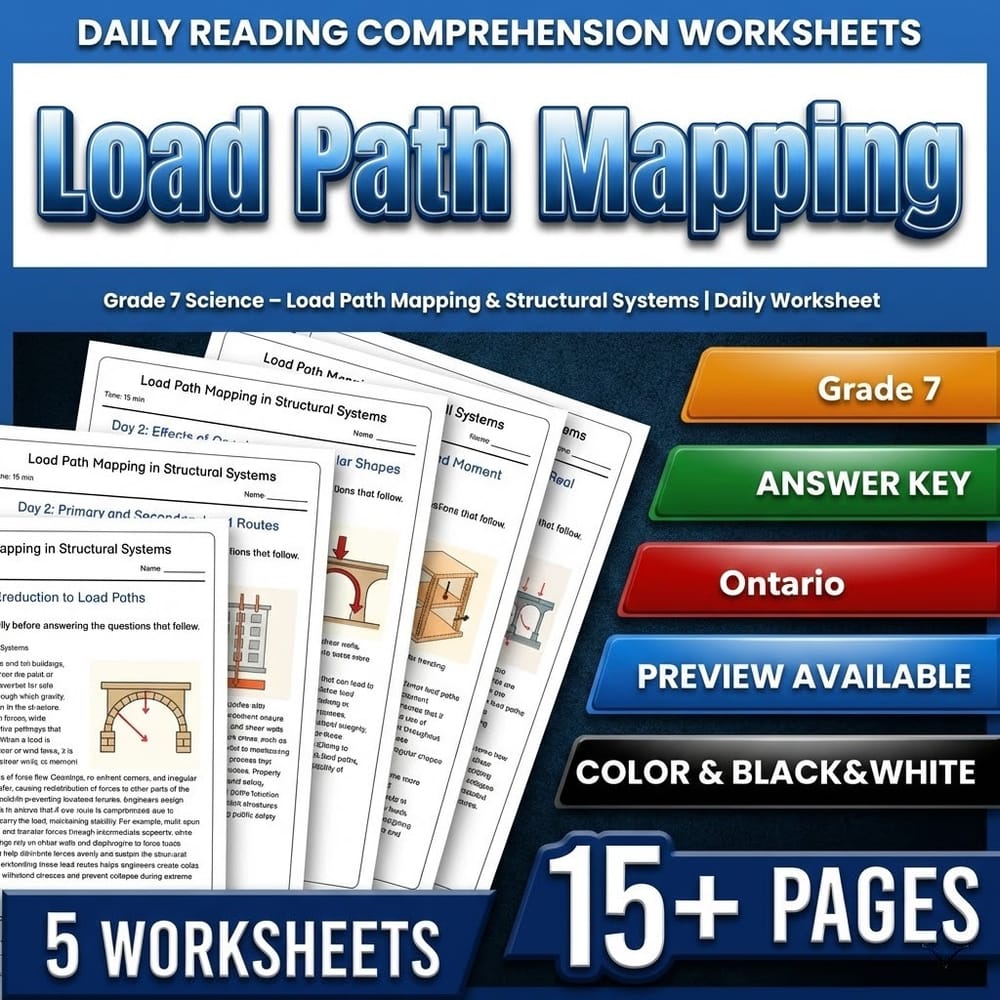
Grade 7 Science – Load Path Mapping & Structural Systems | Daily Worksheet
 Created byQuiet Forest Education
Learning Objectives
- Understand the concept of load paths in buildings and bridges
- Identify primary vs. secondary load transfer routes
- Learn how openings, corners, and irregular geometries affect load redistribution
Also included in: Structural Engineering Grade 7 Science Daily Reading Worksheets Bundle | Ontario +1 more
Instant download
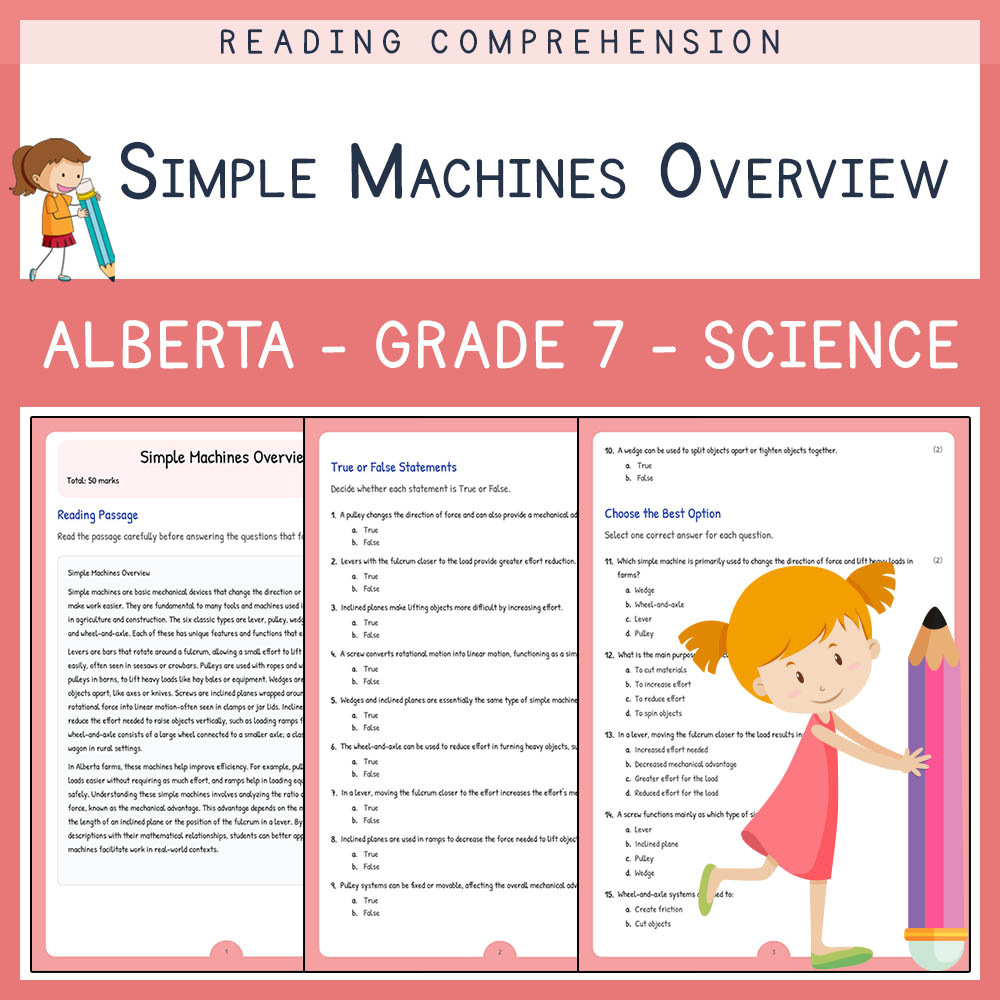
Grade 7 Science | Simple Machines Overview Worksheet | Alberta
Created byLumora LearningLearning Objectives
- Describe the six types of simple machines and their functions.
- Explain how mechanical advantage is calculated and its importance in using simple machines.
- Identify examples of simple machines used in Alberta's farms and loading equipment.
Instant download

Grade 7 Science | Design Principles in Scientific Experiments - Comprehension
 Created byCoral Reef Learning
Learning Objectives
- Understand the concept of variables in experiments
- Identify independent, dependent, and controlled variables
- Learn how to establish operational definitions
Instant download

Digital Data Tools Practice Worksheets | Grade 7 Science Assessment
Created byPrism Point LearningLearning Objectives
- Identify common digital data formats and organize sensor data for analysis
- Use spreadsheet ideas to clean simple datasets and prepare them for comparison
- Explain how timestamps, sampling rates, and metadata support data integrity and reproducibility
Instant download
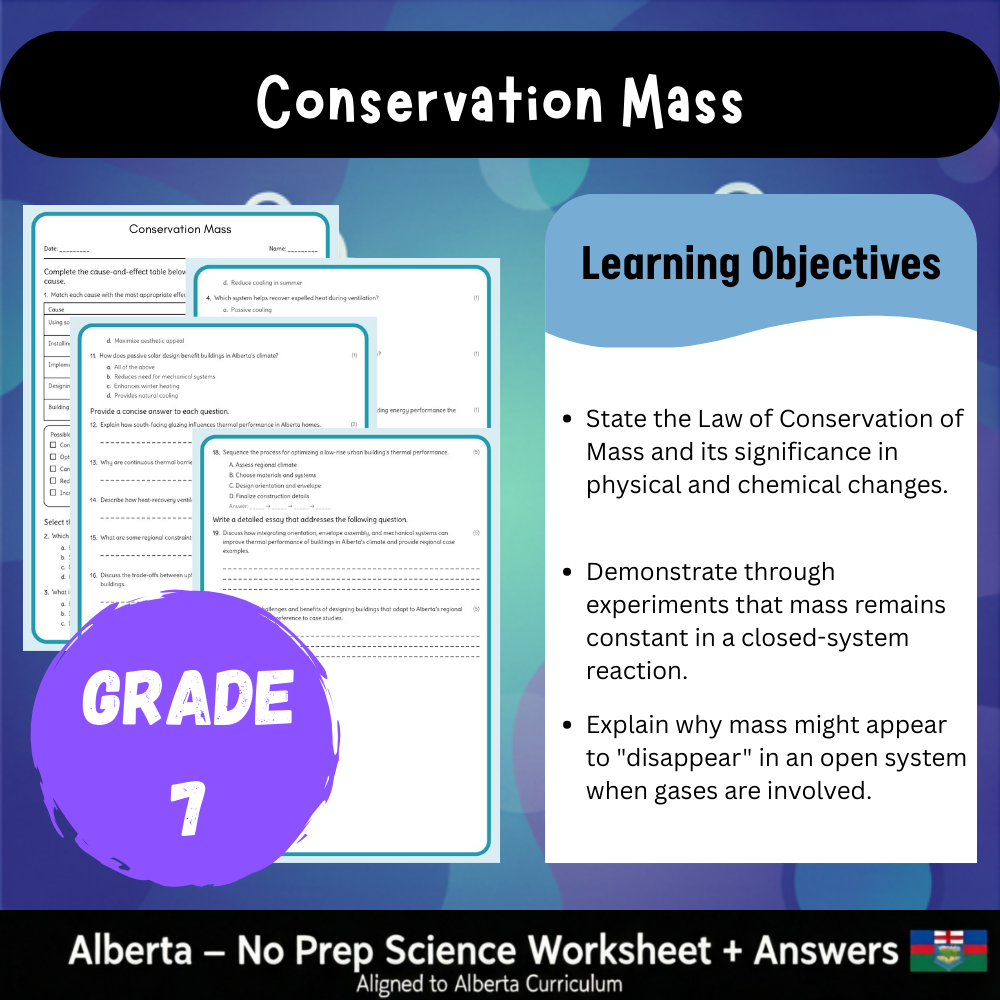
Grade 7 Science – Conservation of Mass Worksheet (Worksheet + Answer Key) – Alberta Standards
Created byBright Mind ResourcesLearning Objectives
- Describe the principle of conservation of mass in physical and chemical changes.
- Explain how mass remains constant in closed systems during reactions.
- Identify real-world observations that demonstrate mass conservation in sealed containers.
Instant download
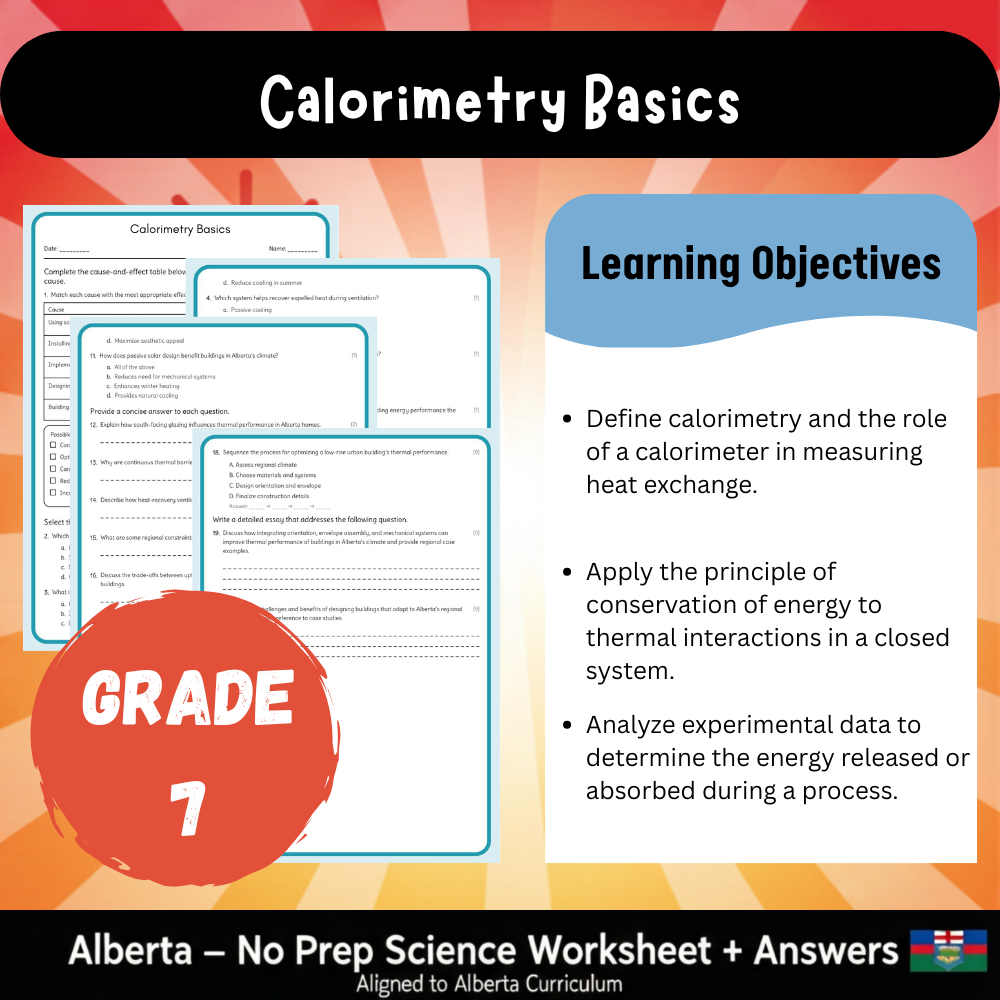
Grade 7 Science | Calorimetry Basics Worksheet (PDF)
Created byBright Mind ResourcesLearning Objectives
- Understand the principles of calorimetry and how temperature changes relate to energy transfer.
- Apply calorimetric reasoning to real-world thermal scenarios such as combustion and melting.
- Use energy conservation equations to connect observed temperature changes with energy in Joules.
Instant download
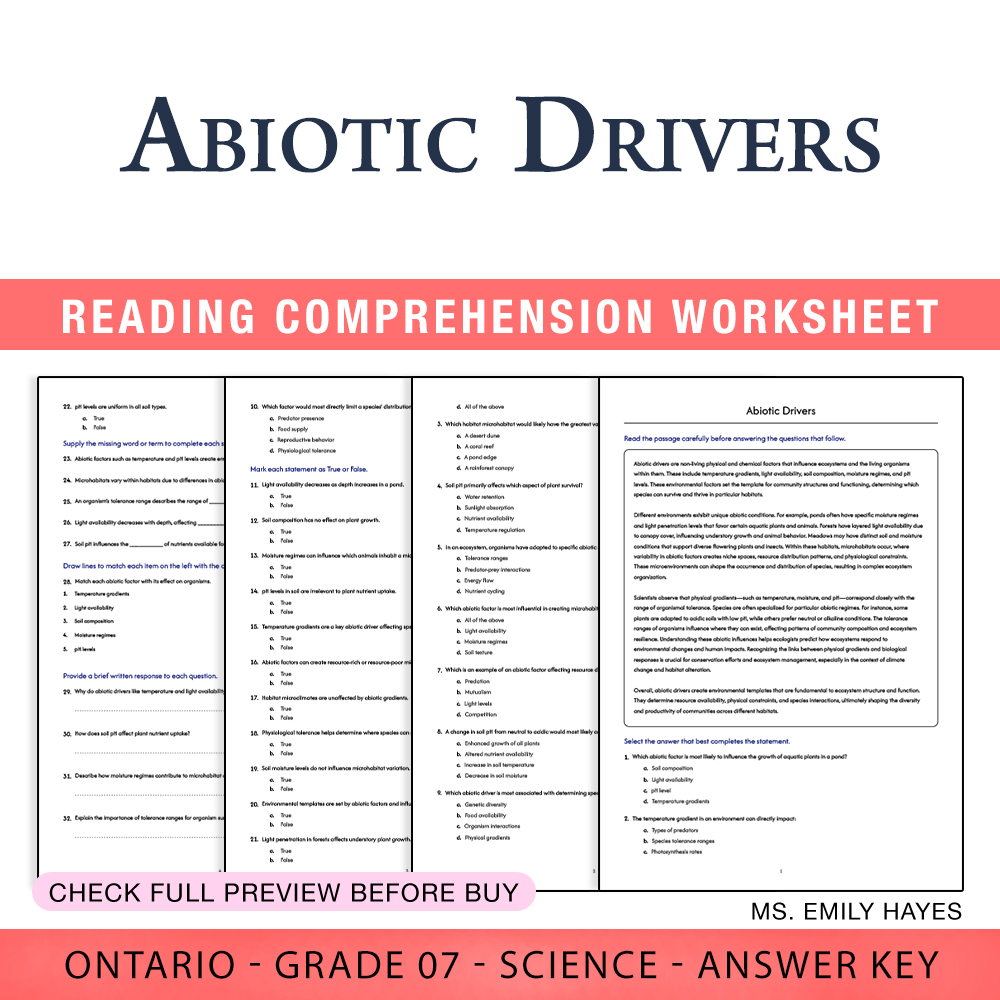
Grade 7 Science | Abiotic Drivers Worksheet (PDF+ Answer Key)
 Created byCopper Leaf Classroom
Learning Objectives
- Explain what abiotic drivers are and identify examples such as temperature, light, soil, moisture, and pH.
- Describe how abiotic factors influence the types of communities and microhabitats within different environments.
- Analyze the relationship between environmental gradients and species tolerance ranges.
Instant download

Grade 7 Science | Newton's Laws of Motion - Daily Reading Comprehension
Created byCoral Reef LearningLearning Objectives
- Understand the basic principles of inertia and Newton's First Law
- Identify how force affects motion in everyday objects
- Recognize action–reaction pairs and their effects
Instant download

Grade 7 Science Worksheet | Rock Record & Geology Concepts (PDF)
 Created byEvergreen Desk Education
Learning Objectives
- Explain how the rock cycle preserves evidence of Earth’s past surface changes in rocks and fossils.
- Use sedimentary stratigraphy, index fossils, and radiometric decay to determine relative and absolute ages.
- Interpret depositional environments, climates, and tectonic settings from rock and fossil assemblages.
Instant download

Reaction Evidence Test Prep Printable | Grade 7 Science
Created byPrism Point LearningLearning Objectives
- Identify observable indicators that show a chemical reaction has occurred, such as gas production, precipitate formation, color change, and temperature change.
- Explain why mass measurements in sealed systems support the conservation of mass during chemical reactions.
- Distinguish chemical changes from physical changes by linking evidence to changes in composition and reversibility.
Also included in: Grade 7 Matter & Atomic Models Science Lesson Bundle Review | NGSS
Instant download

Science Worksheet Elements Versus Compounds Grade 7 | Ontario Standards
JCreated byJ.S SheetsLearning Objectives
- Distinguish elements from compounds using atomic composition and chemical formulas.
- Explain how bonding and fixed atomic ratios affect macroscopic properties such as conductivity and melting point.
- Use particle-level reasoning to classify matter and predict outcomes of chemical combination.
Instant download
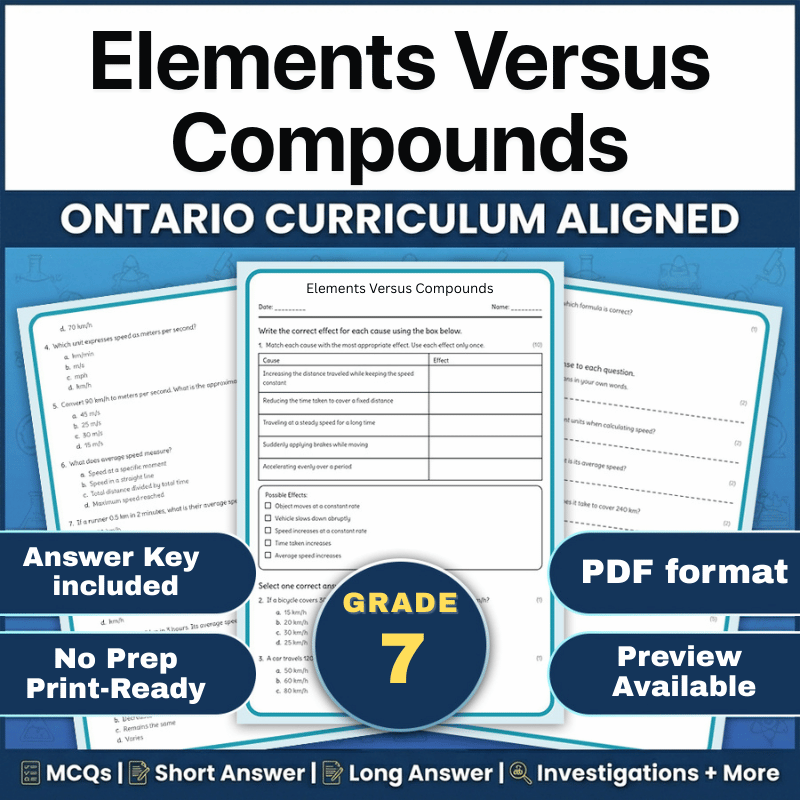
Grade 7 Science – Elements vs Compounds Worksheet (Ontario Standards) (PDF)
Created byBright Mind ResourcesLearning Objectives
- Distinguish between elements and compounds based on atomic composition and properties.
- Understand how chemical bonding affects the characteristics of substances.
- Identify examples of elements and compounds and describe their features.
Instant download
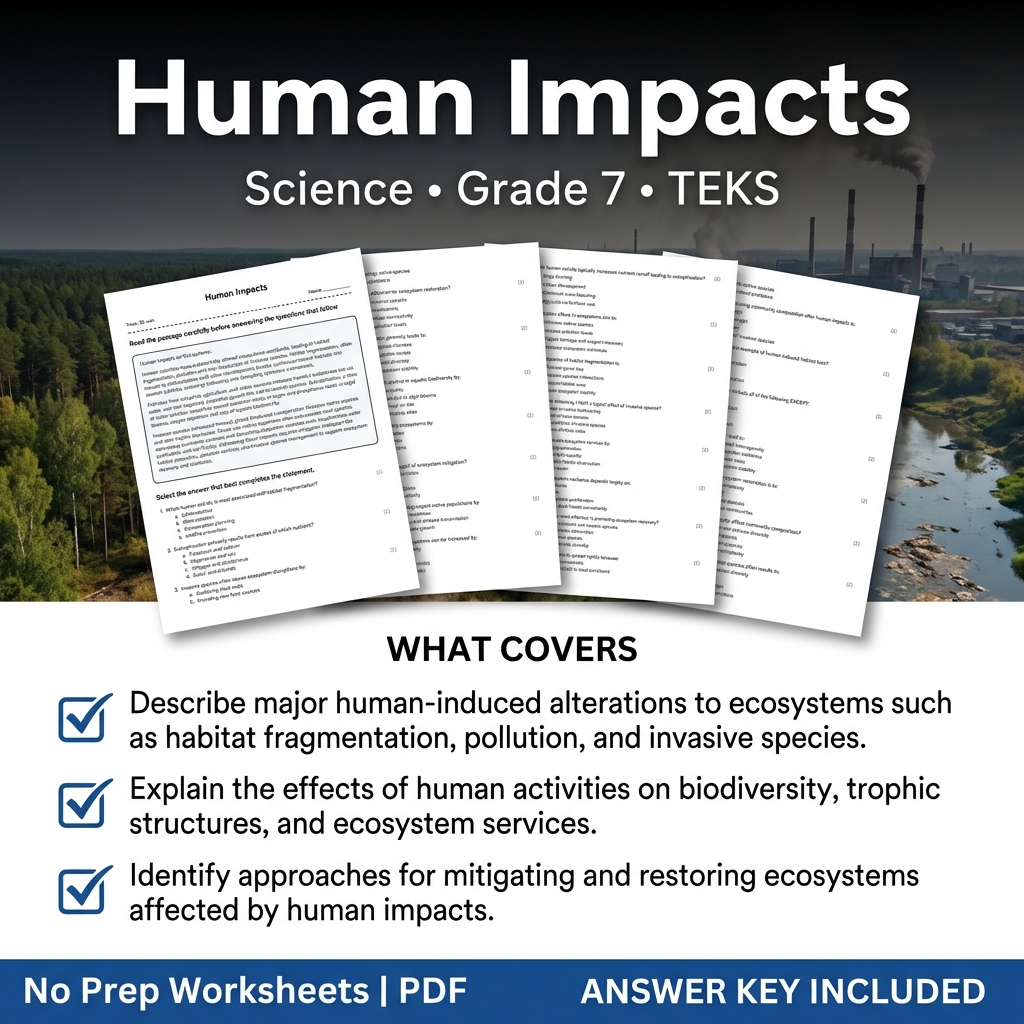
Grade 7 Science Worksheet on Human Impacts | TEKS Aligned Practice
Created byCoral Reef LearningLearning Objectives
- Describe major human-induced alterations to ecosystems such as habitat fragmentation, pollution, and invasive species.
- Explain the effects of human activities on biodiversity, trophic structures, and ecosystem services.
- Identify approaches for mitigating and restoring ecosystems affected by human impacts.
Instant download

Particle Model Worksheet | Matter, Diffusion & Pressure | Grade 7 Science
Created byEvergreen Desk EducationLearning Objectives
- Explain the particle model of matter using the ideas of tiny particles and constant motion
- Relate temperature to average particle motion and predict how changes in temperature affect observable behavior
- Connect macroscopic properties such as pressure and diffusion to particle collisions and spacing
Instant download
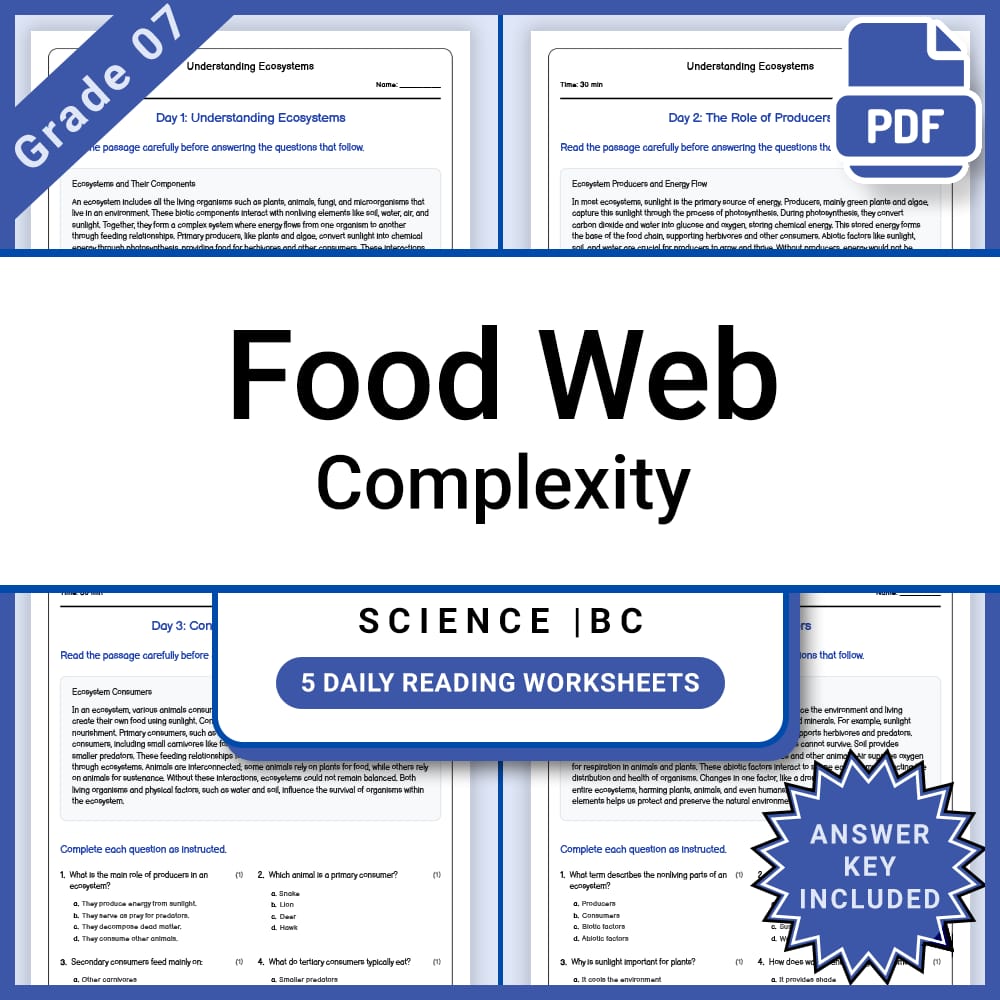
Grade 7 Science – Food Web Complexity | Daily Reading Worksheet + Answer Key
JCreated byJ.S SheetsLearning Objectives
- Identify and describe different components of a food web, including producers, consumers, and decomposers.
- Understand how interconnected feeding relationships form a food web.
- Explain the importance of network structure in ecosystem resilience.
Also included in: Grade 7 Science Lesson Group: Ecosystems and Population Framework +1 more
Instant download
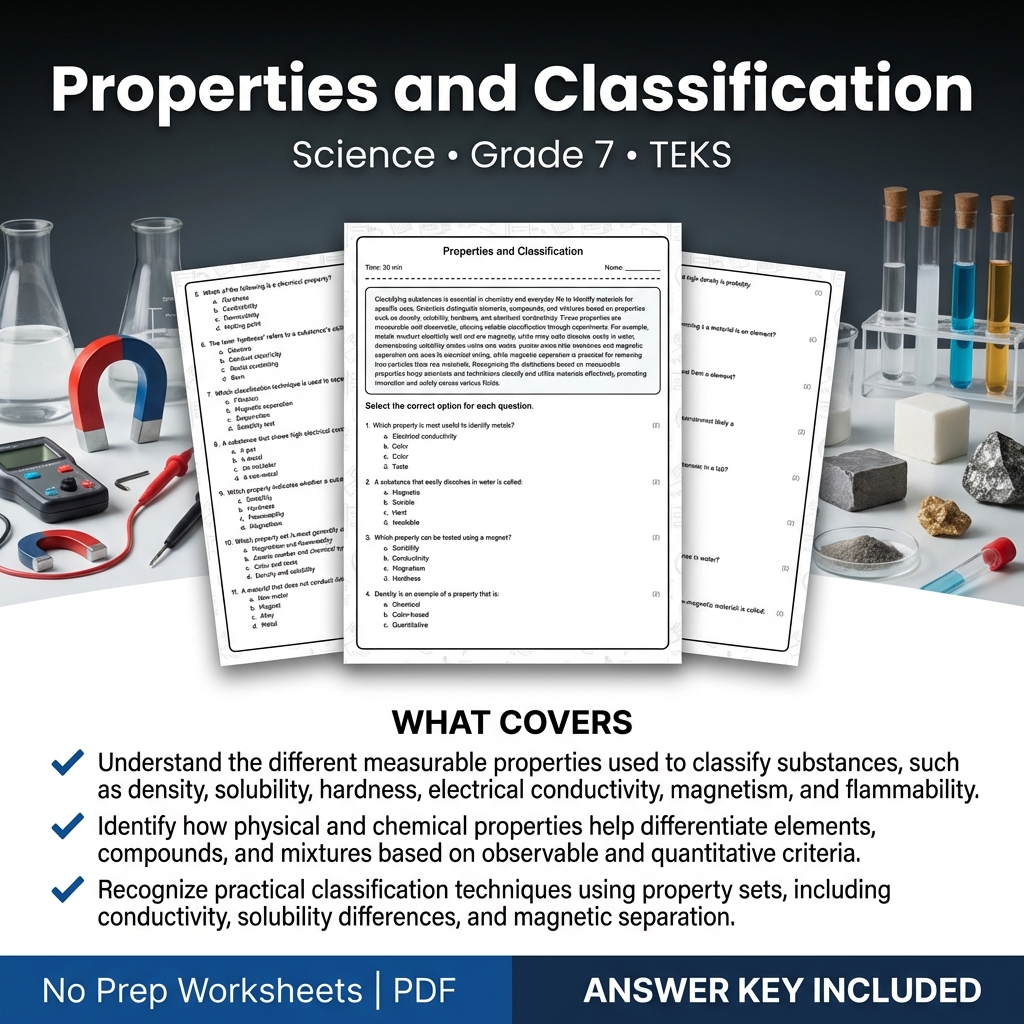
Grade 7 Science Properties and Classification Worksheet | TEKS Aligned PDF
Created byCoral Reef LearningLearning Objectives
- Understand the different measurable properties used to classify substances, such as density, solubility, hardness, electrical conductivity, magnetism, and flammability.
- Identify how physical and chemical properties help differentiate elements, compounds, and mixtures based on observable and quantitative criteria.
- Recognize practical classification techniques using property sets, including conductivity, solubility differences, and magnetic separation.
Instant download

Energy Transfer Mechanisms & Forms Worksheet Pack | Grade 7 Science
Created byPrism Point LearningLearning Objectives
- Explain how conduction, convection, and radiation transfer energy in everyday situations
- Compare energy transfer mechanisms and identify how energy can change from one form to another
- Use evidence from real-world examples to justify which transfer mechanism is occurring
Also included in: Physical Science Lesson Bundle | Grade 7 Science | Florida NGSSS
Instant download

Grade 7 Science | Design Process in Science - Daily Reading Comprehension
Created byCoral Reef LearningLearning Objectives
- Understand the steps involved in the design process
- Identify functional requirements and constraints for design
- Learn how to generate and evaluate different concept options
Instant download
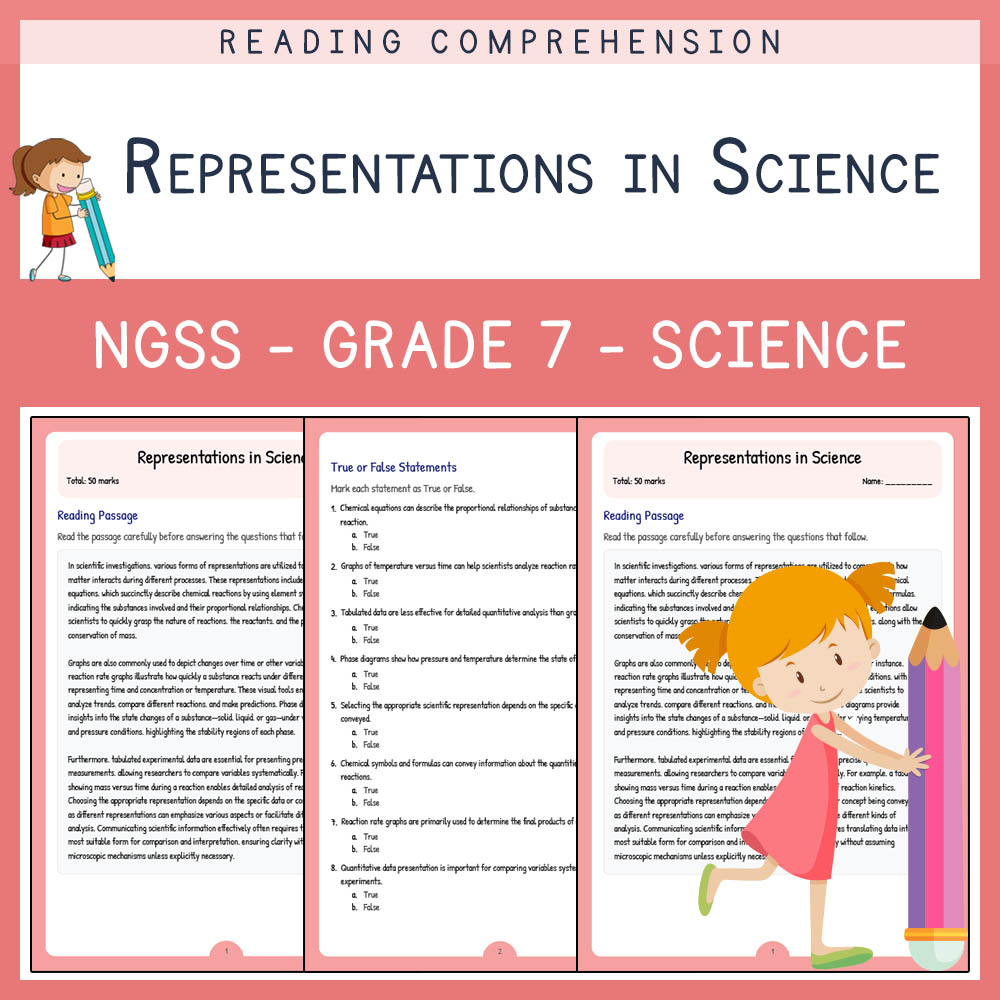
Grade 7 Science | Representations in Science Worksheet (Answer Key & Rubric)
Created byLumora LearningLearning Objectives
- Explain how different representations such as chemical equations, graphs, and tables convey matter interactions.
- Interpret scientific graphs, such as reaction rate graphs and phase diagrams.
- Identify appropriate representations for comparing quantitative data in scientific contexts.
Instant download

Grade 7 Science – Carrying Capacity & Ecosystem Factors | Reading Worksheet
Created byBright Mind ResourcesLearning Objectives
- Define carrying capacity and explain its significance in ecology.
- Identify limiting factors that influence population sizes.
- Analyze how resource availability affects populations over time.
Also included in: Grade 7 Ecosystems & Population Ecology Science Lesson Bundle | BC +1 more
Instant download

Adaptation Function Worksheet | Grade 7 Science Practice
Created byPrism Point LearningLearning Objectives
- Explain how structural, behavioral, and physiological adaptations help organisms survive and perform life processes.
- Match adaptations to their functions, such as protection, exchange, and water regulation.
- Describe trade-offs and how improving one ability can limit another.
Instant download

Integration And Homeostasis Test Prep Worksheets | Grade 7 Science
Created byPrism Point LearningLearning Objectives
- Explain how transport processes and cellular structures help maintain homeostasis in the body.
- Describe how hormones and transport proteins regulate nutrient levels, ions, and water balance.
- Connect disruptions at the cellular or tissue level to changes in whole-organism stability.
Also included in: Cellular Structure & Function Lesson Bundle | Grade 7 Science | Bc +1 more
Instant download

Effects of Disturbance on Ecosystems Worksheet | NGSS Grade 7 Science
JCreated byJ.S SheetsLearning Objectives
- Understand how physical and biological disturbances impact population sizes and community composition.
- Identify mechanisms like resilience, resistance, and succession that influence ecosystem recovery.
- Interpret empirical observations and longitudinal data to attribute ecosystem changes to specific disturbances.
Also included in: Grade 7 Ecosystem Dynamics Science Lesson Bundle Worksheets – NGSS +1 more
Instant download

Grade 7 Science | Gas Behavior - Daily Reading Comprehension
Created byCoral Reef LearningLearning Objectives
- Understand the basic properties of gases
- Learn how pressure, volume, and temperature interrelate in gases
- Describe phenomena such as diffusion and compressibility in gases
Instant download
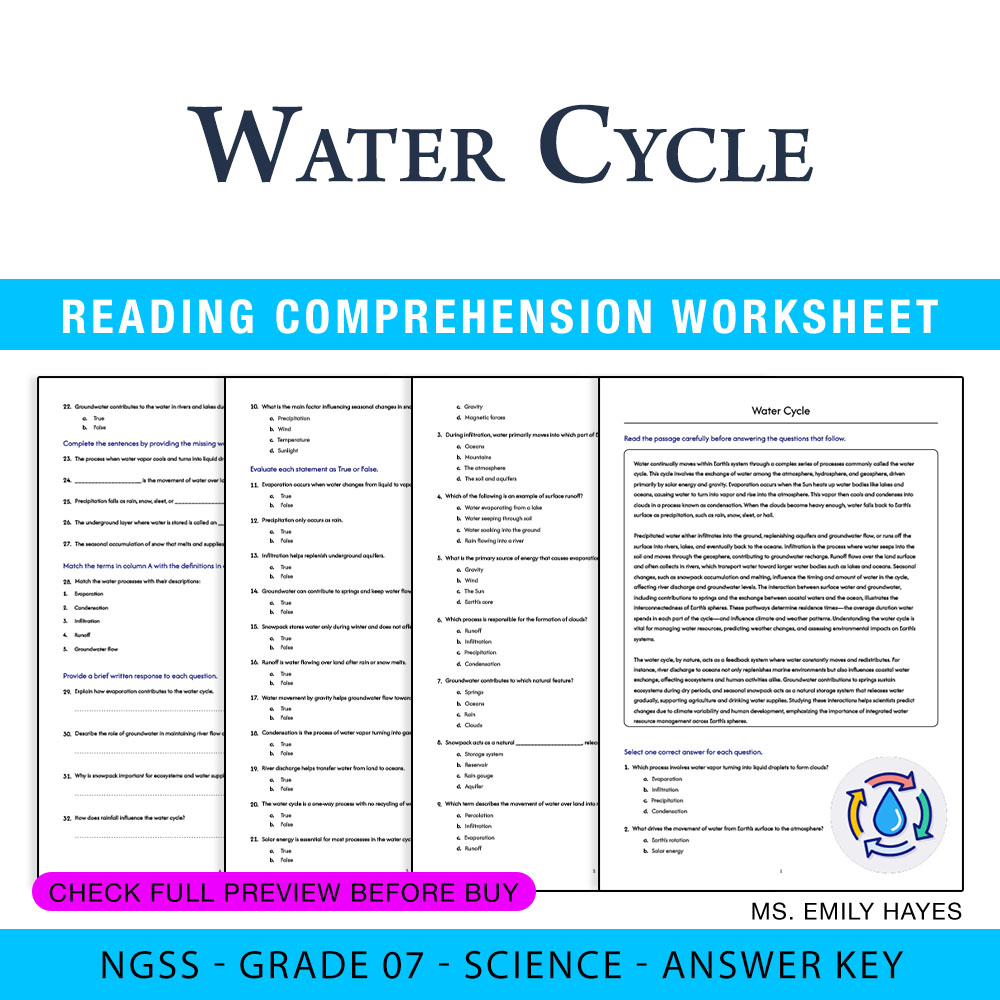
7th Grade Science | Water Cycle Worksheet (PDF+ Answer Key)
Created byCopper Leaf ClassroomLearning Objectives
- Describe the processes involved in the water cycle, including evaporation, condensation, precipitation, infiltration, runoff, and groundwater flow.
- Explain how solar energy and gravity drive water movement among Earth's spheres.
- Identify interactions such as river discharge to oceans, groundwater contributions to springs, and seasonal changes in snowpack.
Instant download
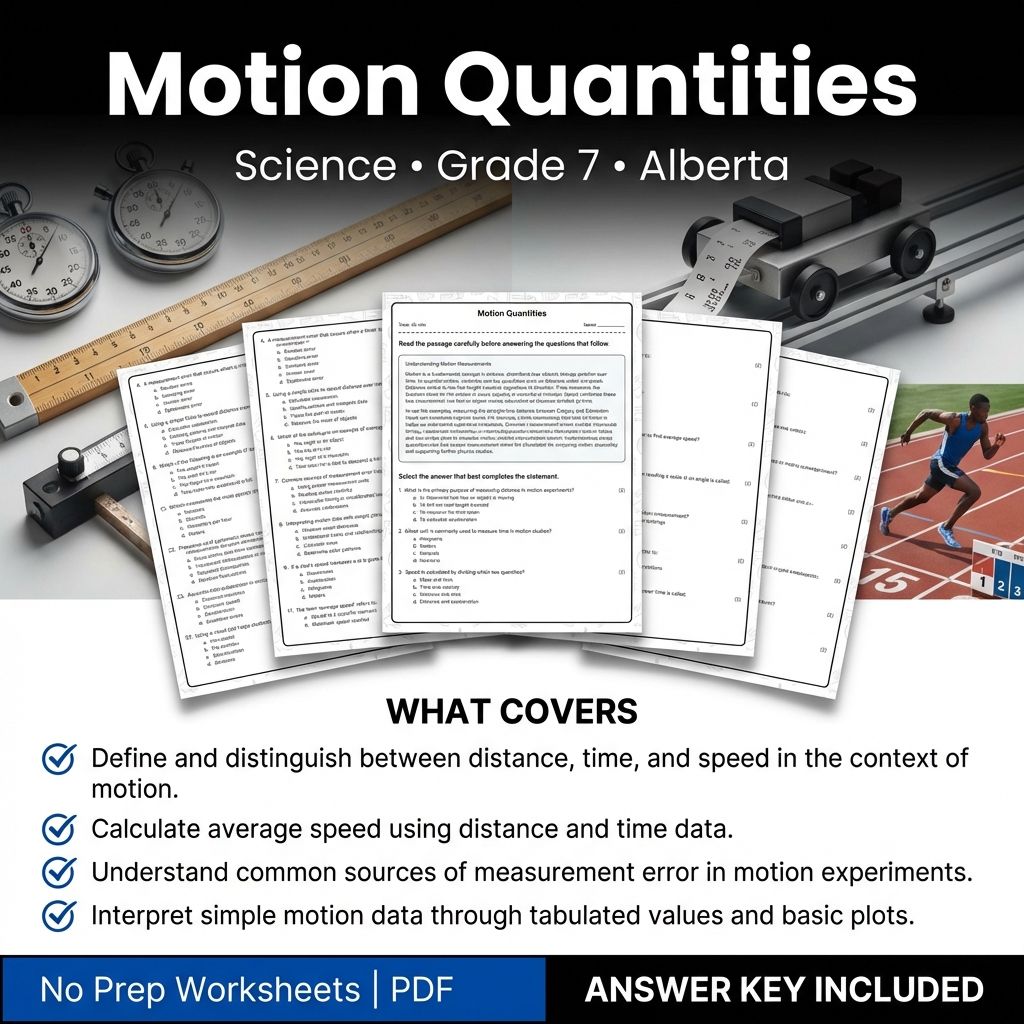
Motion Quantities Worksheet | Grade 7 Science Alberta Standards
Created byCoral Reef LearningLearning Objectives
- Define and distinguish between distance, time, and speed in the context of motion.
- Calculate average speed using distance and time data.
- Understand common sources of measurement error in motion experiments.
Instant download
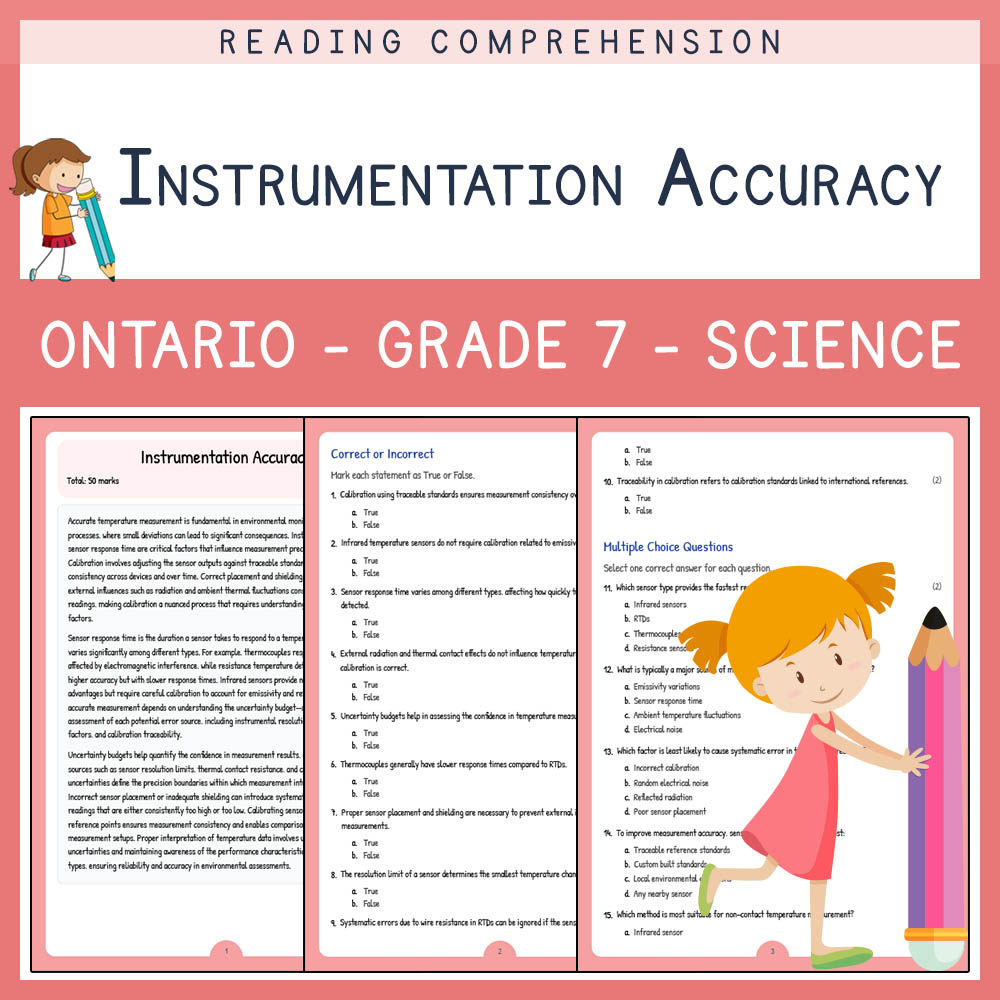
Grade 7 Science Assessment | Instrumentation Accuracy Worksheet | Ontario
Created byLumora LearningLearning Objectives
- Analyze the concepts of sensor response time, spatial placement, and shielding in temperature measurement accuracy.
- Evaluate the differences between thermocouples, resistance temperature detectors, and infrared sensors.
- Understand the role of uncertainty budgets, resolution limits, and error sources in calibration.
Instant download
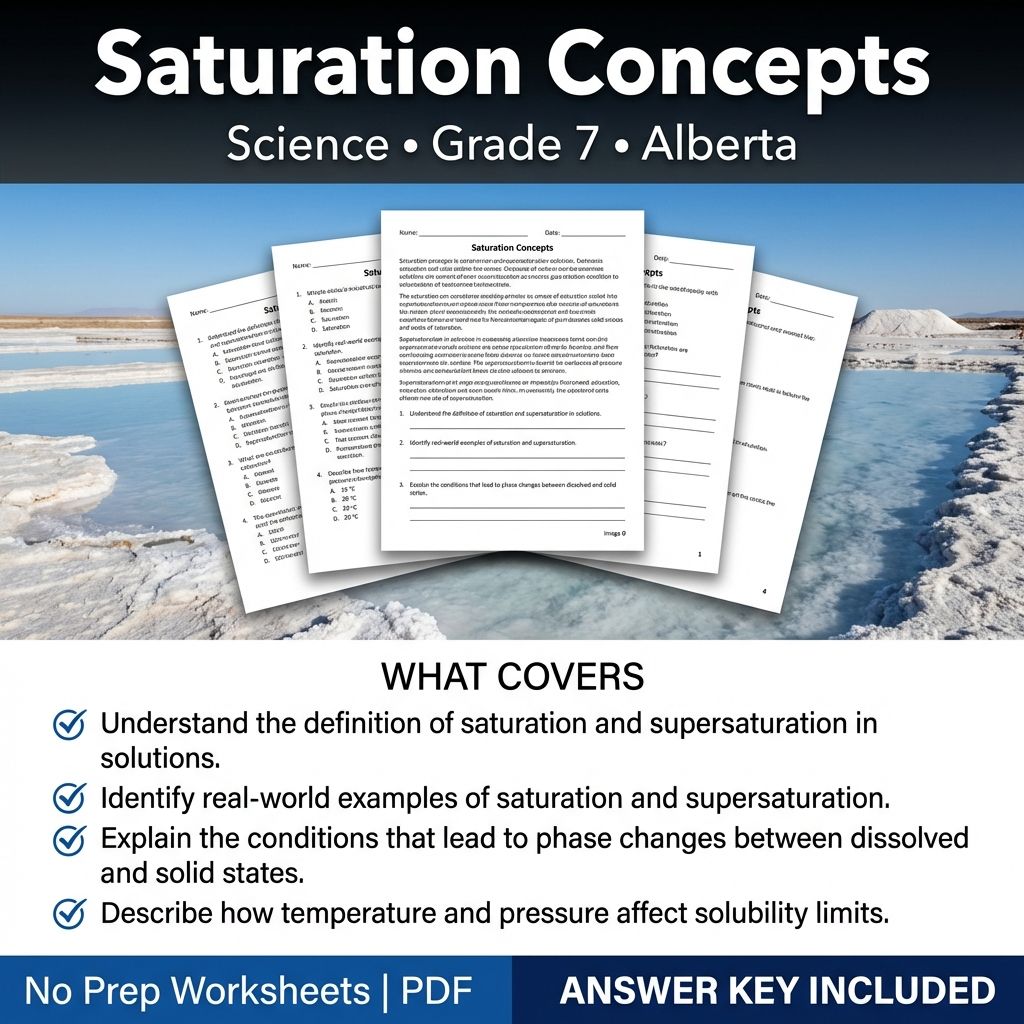
Saturation Concepts Worksheet for Grade 7 Science | Alberta Standards
Created byCoral Reef LearningLearning Objectives
- Understand the definition of saturation and supersaturation in solutions.
- Identify real-world examples of saturation and supersaturation.
- Explain the conditions that lead to phase changes between dissolved and solid states.
Instant download
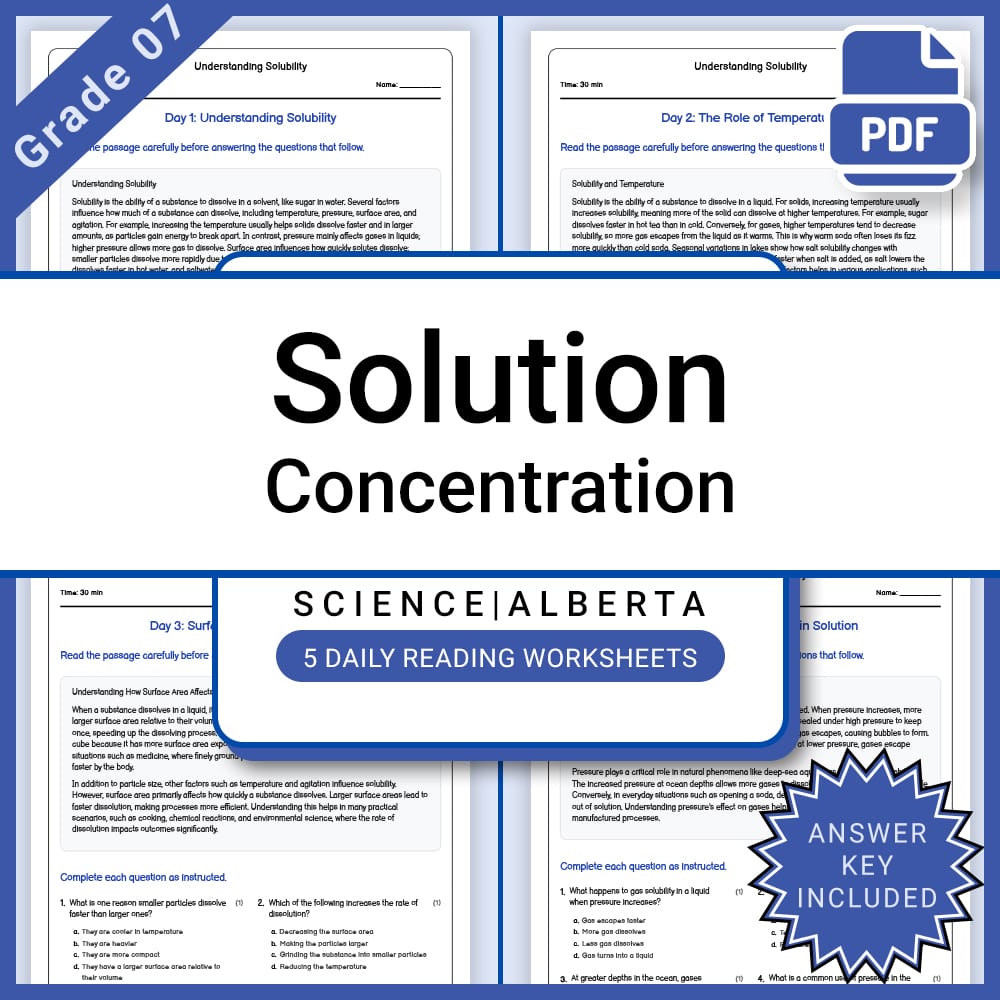
Grade 7 Science – Solution Concentration Daily Reading Worksheet & Answer Key
JCreated byJ.S SheetsLearning Objectives
- Define solution concentration and recognize common measurement units.
- Identify how concentration affects physical properties of solutions.
- Understand real-world examples of solution concentration in environmental and municipal contexts.
Also included in: Grade 7 Science Lesson Bundle | Alberta Framework for Classroom Use +1 more
Instant download
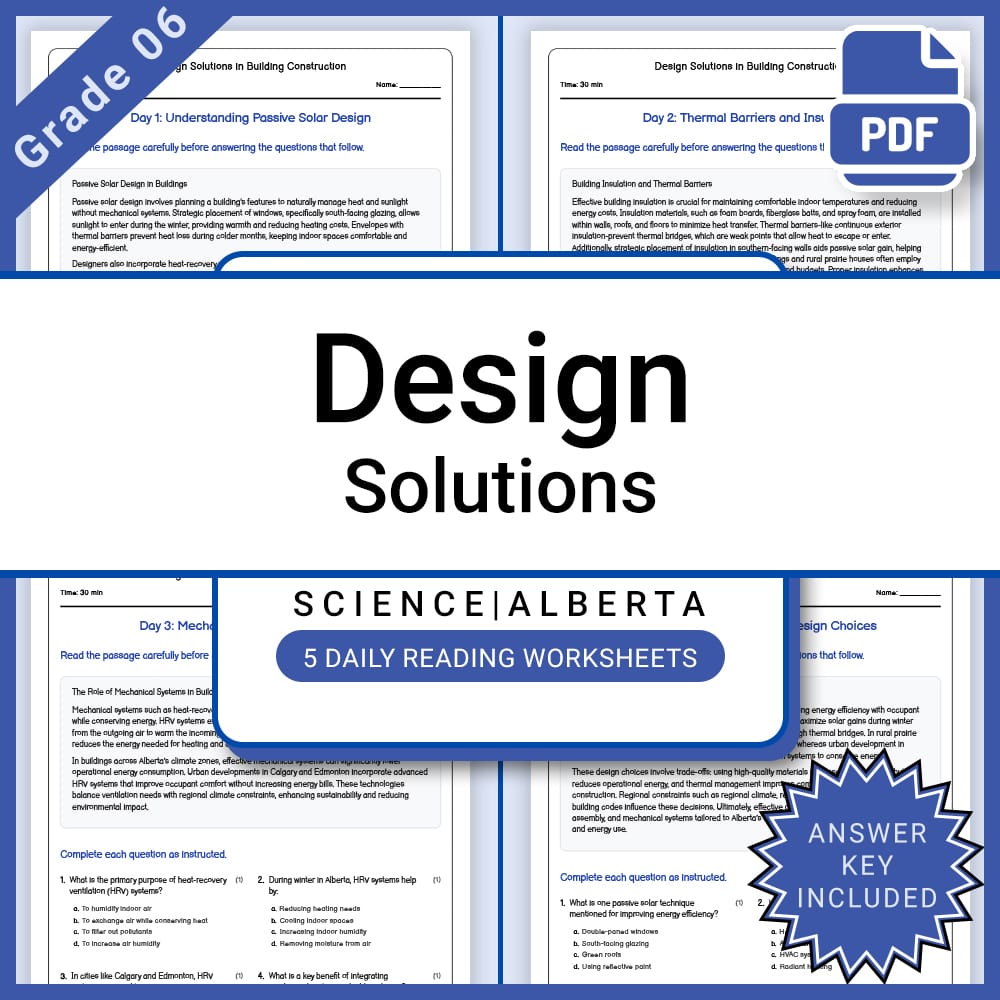
Grade 7 – Design Solutions in Building Construction Daily Worksheet + Answer Key
JCreated byJ.S SheetsLearning Objectives
- Understand passive solar design strategies
- Identify components that improve thermal performance
- Analyze how design choices affect energy efficiency
Also included in: Grade 7 Science Lesson Bundle | Thermal Energy and Systems Alberta Framework +1 more
Instant download

Grade 7 Science – Design Solutions & Building Science Daily Reading Worksheet
Created byBright Mind ResourcesLearning Objectives
- Understand how building orientation influences energy efficiency
- Identify passive solar gain strategies
- Recognize the importance of thermal barriers and ventilation systems
Also included in: Grade 7 Heat Transfer Science Daily Reading Worksheets Lesson Bundle | Alberta +2 more
Instant download

Data Representation Worksheet | Grade 7 Science Practice TEKS
Created byPrism Point LearningLearning Objectives
- Select appropriate graph types to represent quantitative and categorical data and justify the choice.
- Interpret graphs by reading axis labels, using proper scaling, and identifying patterns such as trends and outliers.
- Compute and compare summary statistics (mean and median) to support evidence-based conclusions.
Also included in: Grade 7 Scientific Data & Argumentation Science Lesson Bundle (TEKS)
Instant download
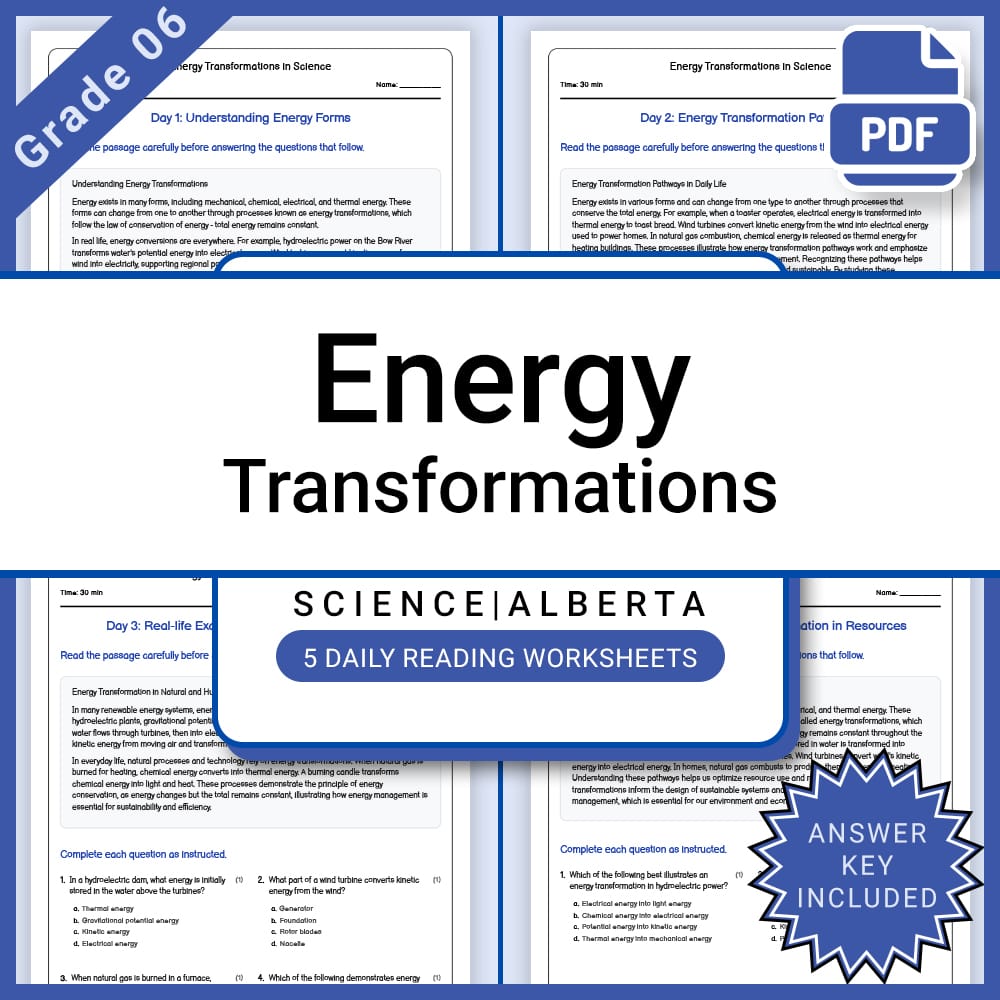
Grade 7 Science – Energy Transformations Daily Reading Worksheet + Answer Key
JCreated byJ.S SheetsLearning Objectives
- Identify different types of energy: mechanical, chemical, electrical, and thermal.
- Understand how energy changes from one form to another during various processes.
- Recognize real-world examples of energy transformations, such as hydroelectric power, wind turbines, and natural gas combustion.
Also included in: Grade 7 Science Lesson Bundle | Thermal Energy and Systems Alberta Framework +1 more
Instant download
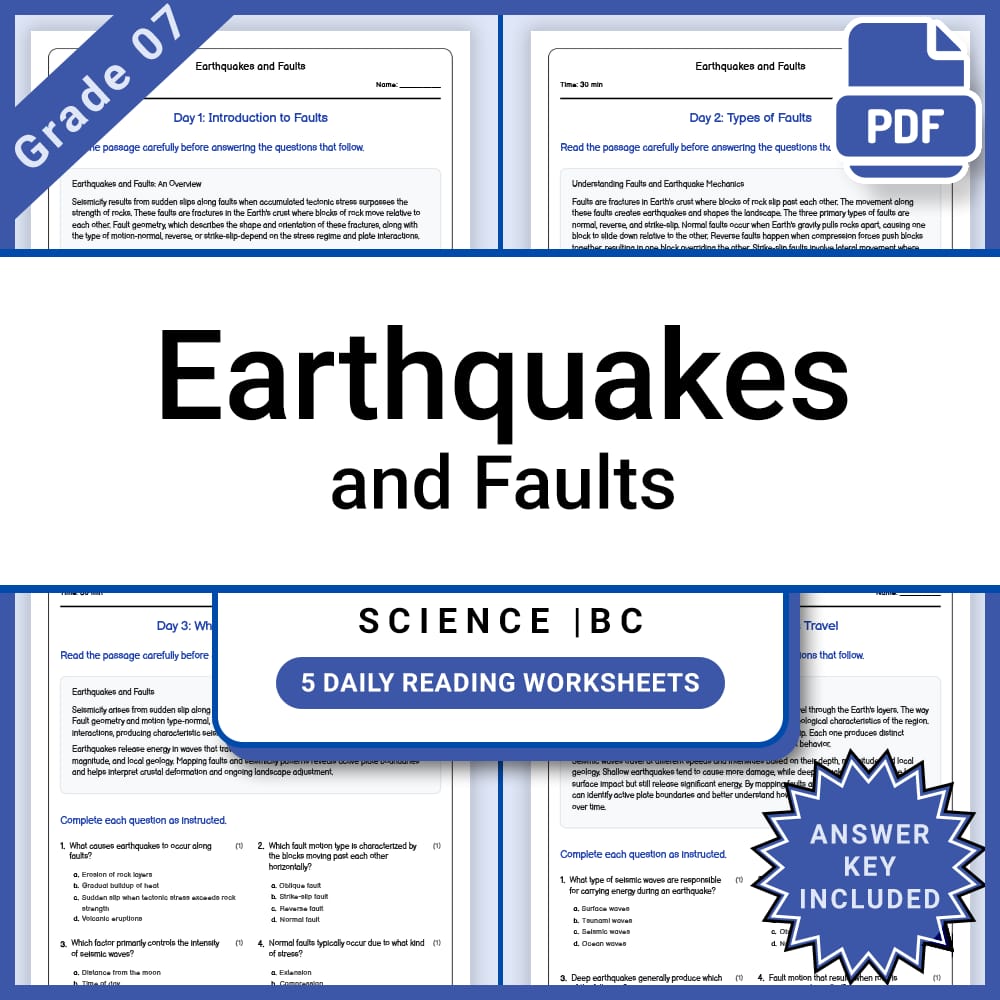
Grade 7 Science – Earthquakes and Faults Daily Reading Worksheet + Answer Key
JCreated byJ.S SheetsLearning Objectives
- Understand the basic concepts of faults and seismic activity
- Learn the different types of fault movement: normal, reverse, strike-slip
- Identify how faults influence earthquake characteristics and patterns
Also included in: Grade 7 Science Lesson Group: Earth Processes & Landforms Bundle +1 more
Instant download

Grade 7 Heat Transfer Models Worksheet | NGSS Practice PDF
 Created byClear Sky Classroom
Learning Objectives
- Explain how thermal energy moves using models of conduction, convection, and radiation
- Use temperature differences to predict the direction of heat transfer
- Describe how energy transfer can change the temperature of materials over time
Instant download

Groundwater Storage Worksheet Grade 7 Science | Water Resources Activity
Created byPrism Point LearningLearning Objectives
- Explain how infiltration and aquifers store groundwater within Earth’s subsurface.
- Describe how gravity and pressure differences influence groundwater movement and baseflow.
- Identify factors that control recharge and how pumping can change groundwater levels and quality.
Instant download

Grade 7 Science – Friction & Gravity Daily Reading Worksheet | TEKS Aligned
Created byBright Mind ResourcesLearning Objectives
- Understand key concepts related to Science
- Apply knowledge through practice questions
- Demonstrate comprehension of the material
Also included in: Grade 7 Motion & Energy Science Daily Reading Worksheets Lesson Bundle | TEKS +2 more
Instant download
About Grade 7 Science Worksheets
Browse 6,039 printable Grade 7 Science worksheets — ready-to-print PDFs with answer keys where available.
Every worksheet on MyTeachingSheets is created by independent teacher-authors and reviewed before publication. All resources download as printable PDFs for classroom, homework, or at-home practice, and many include answer keys. Preview any worksheet free before buying.