
Grade 7 Science Worksheets
6,039 worksheets
Grade 7 Science | Rock Types Worksheet | BC Aligned
 Created byLumora Learning
Learning Objectives
- Understand the different types of rocks and how they are formed.
- Identify key features that distinguish igneous, sedimentary, and metamorphic rocks.
- Explore the processes involved in the formation and classification of rocks.
Instant download

Grade 7 Science – Levels Of Organization & Ecology | Daily Reading Worksheet
 Created byBright Mind Resources
Learning Objectives
- Understand the concept of individual organisms and their traits.
- Identify different levels of ecological organization from individuals to ecosystems.
- Recognize examples of ecological levels in Alberta, such as trout and river ecosystems.
Also included in: Grade 7 Ecosystems Science Lesson Bundle for Daily Reading Worksheets | Alberta +2 more
Instant download

Science Worksheet Nutrient Cycles | Grade 7 Science | Practice & Assessment
JCreated byJ.S SheetsLearning Objectives
- Explain how matter moves through ecosystems using nutrient cycles (carbon, nitrogen, and phosphorus).
- Describe the roles of photosynthesis, respiration, decomposition, and bacteria in nutrient transformations.
- Use nutrient-cycle ideas to explain how limiting nutrients affect ecosystem productivity.
Also included in: Grade 7 Ecosystem Dynamics Science Lesson Bundle Worksheets – General +1 more
Instant download

Tradeoff Mapping Worksheet Grade 7 Science | Engineering Design & Decision Making
 Created byPrism Point Learning
Learning Objectives
- Explain what a tradeoff is when comparing competing engineering design options.
- Identify how criteria and constraints guide which design improvements are acceptable.
- Use tradeoff mapping to justify a design choice using evidence and limits.
Instant download
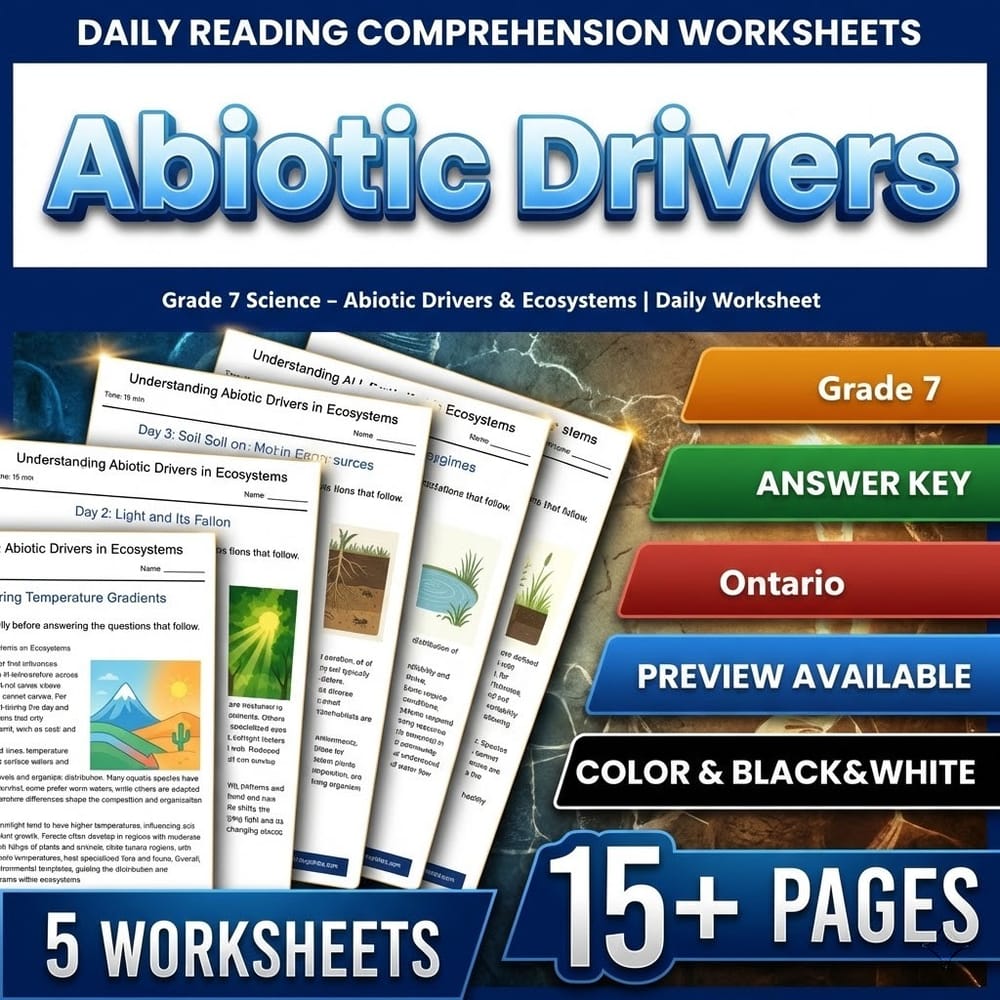
Grade 7 Science – Abiotic Drivers & Ecosystems | Daily Worksheet
 Created byQuiet Forest Education
Learning Objectives
- Explain how temperature gradients influence different environments.
- Identify the role of light, soil, moisture, and pH in shaping ecosystems.
- Describe microhabitats within ponds, forests, and meadows based on abiotic factors.
Also included in: Ecosystem Dynamics Grade 7 Science Daily Reading Worksheets Bundle | Ontario +1 more
Instant download

Population Dynamics Worksheet | Grade 7 Ecology & Ecosystems Activity
Created byPrism Point LearningLearning Objectives
- Explain how births, deaths, immigration, and emigration change population size over time
- Describe limiting factors and how they can slow or speed population growth
- Connect predator-prey relationships to changes (oscillations) in population numbers
Also included in: Grade 7 Evolution, Genetics & Ecosystems Lesson Bundle | Florida NGSSS
Instant download
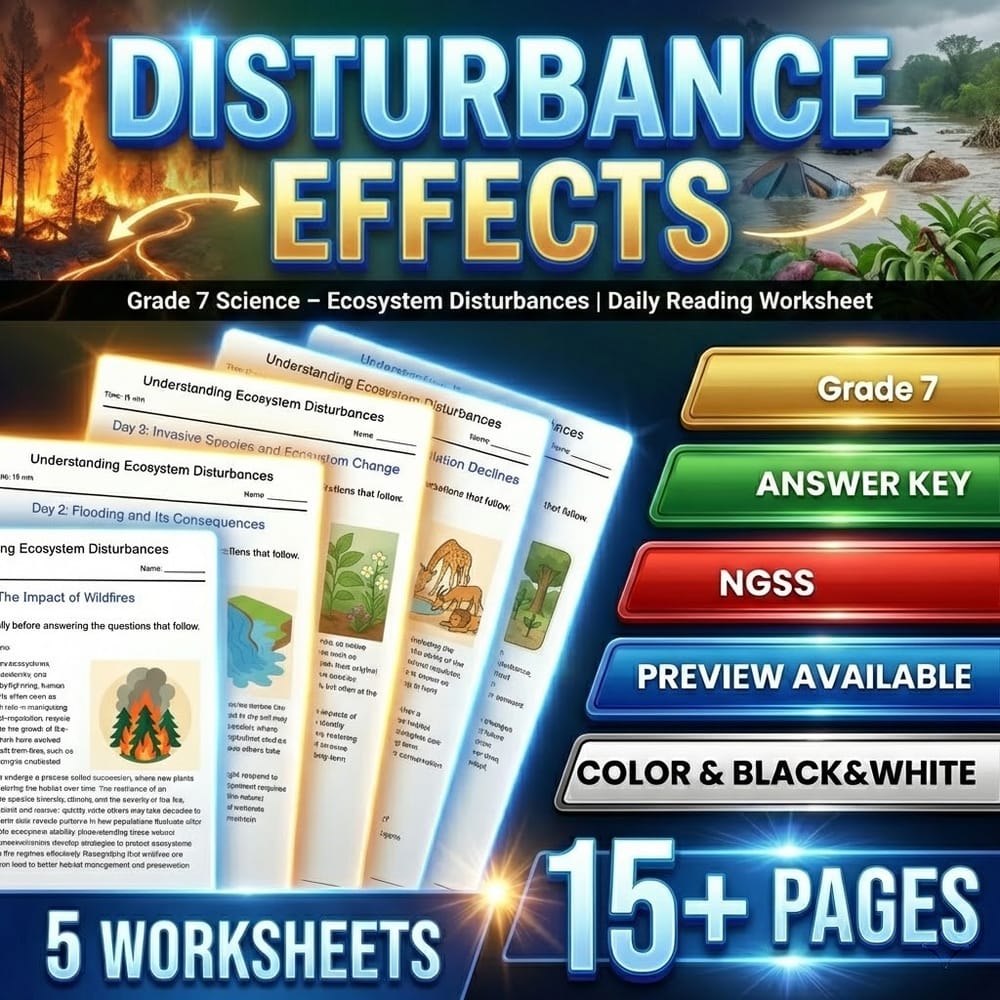
Grade 7 Science – Ecosystem Disturbances Daily Reading Worksheet
 Created byElena Brooks
Learning Objectives
- Explain how wildfires impact plant and animal populations.
- Identify mechanisms by which ecosystems recover after disturbances.
- Interpret empirical data related to ecosystem responses to disturbances.
Also included in: Ecosystems Grade 7 Science Daily Reading Worksheets Bundle | NGSS +1 more
Instant download

Grade 7 Science | Separating Matter - Daily Reading Comprehension
 Created byCoral Reef Learning
Learning Objectives
- Understand different methods to separate mixtures based on properties
- Identify properties such as density and solubility that influence separation techniques
- Distinguish between physical changes and chemical changes in matter
Instant download

Grade 7 Pure Substances Worksheet | Alberta Practice PDF
 Created byClear Sky Classroom
Learning Objectives
- Explain how pure substances have uniform composition and characteristic physical and chemical properties.
- Differentiate elements and compounds based on composition and how they can be identified.
- Use physical and chemical test ideas to interpret how mixtures may show deviations from pure-substance benchmarks.
Instant download

Climate Drivers Worksheet | Grade 7 Earth Science Climate Systems
 Created byEvergreen Desk Education
Learning Objectives
- Explain how the Sun’s energy, atmospheric circulation, and water distribution contribute to Earth’s climate.
- Describe how ocean processes can modify regional climate by changing how heat is stored and released.
- Use cause-and-effect reasoning to predict how changes in climate drivers can shift patterns like drought or wet seasons.
Instant download
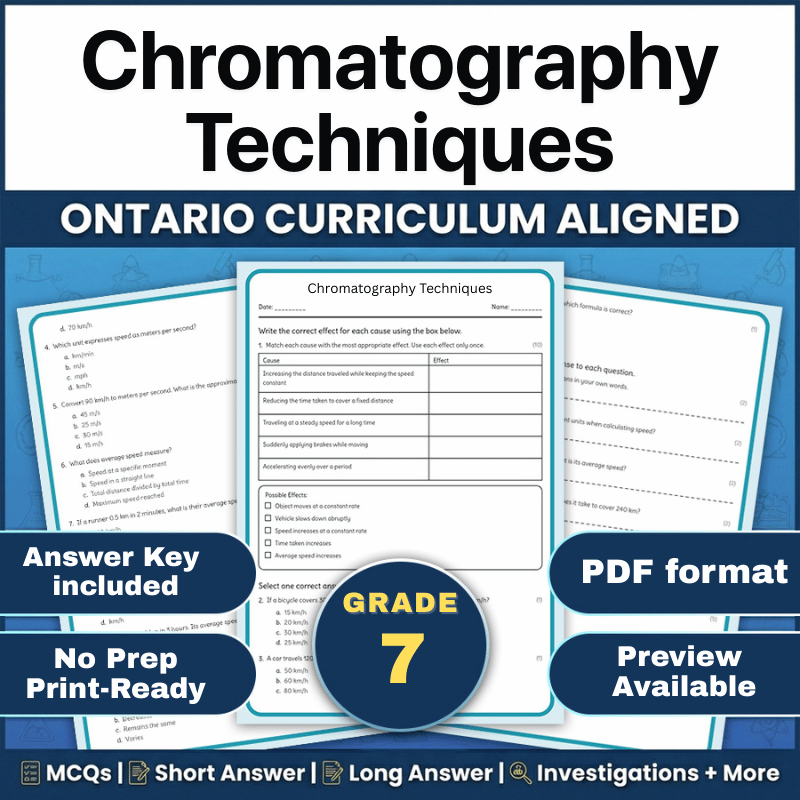
Grade 7 Science | Chromatography Techniques Worksheet (Ontario, PDF)
Created byBright Mind ResourcesLearning Objectives
- Understand the principles of chromatographic separation based on differential partitioning, stationary and mobile phases, and molecular polarity.
- Identify different types of chromatography such as paper and thin-layer chromatography and interpret retention factors.
- Analyze chromatography patterns for component separation, resolution, and limitations in purification.
Instant download

Rock Cycles Practice Test | Grade 7 Science NGSS Worksheet & Review
Created byPrism Point LearningLearning Objectives
- Explain how igneous, sedimentary, and metamorphic rocks can transform through the rock cycle.
- Describe how energy and material flow drive processes like melting, crystallization, weathering, and metamorphism.
- Use canonical examples (magma at subduction zones, sediment layers in river basins, contact metamorphism) to trace pathways and timescales.
Also included in: Grade 7 Earth Systems Science Lesson Bundle: NGSS Review Worksheets
Instant download
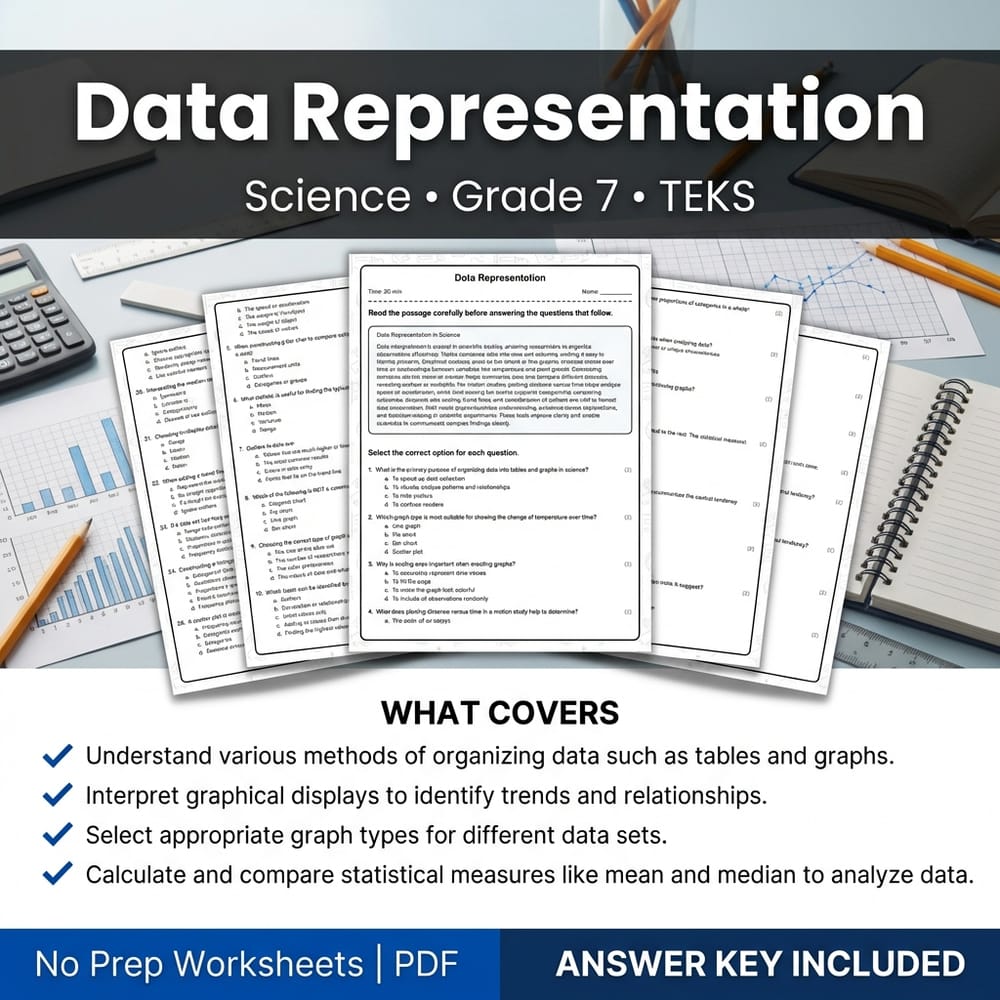
Data Representation Worksheet for Grade 7 Science TEKS Aligned
Created byCoral Reef LearningLearning Objectives
- Understand various methods of organizing data such as tables and graphs.
- Interpret graphical displays to identify trends and relationships.
- Select appropriate graph types for different data sets.
Instant download

Grade 7 Science – Understanding Gravity & Orbits | Daily Reading Worksheet
Created byBright Mind ResourcesLearning Objectives
- Define gravity and explain its role in the solar system.
- Describe how gravity influences the orbit of planets and other celestial bodies.
- Identify examples of gravitational effects on objects on Earth and in space.
Also included in: Water Cycle & Weather Grade 7 Science Daily Reading Lesson Bundle | CA Standards +1 more
Instant download

Grade 7 Science | Understanding Evaporation - Daily Reading Comprehension
Created byCoral Reef LearningLearning Objectives
- Define evaporation and crystallization processes
- Identify key factors influencing crystal formation
- Explain how impurities affect crystal purity
Instant download

Biodiversity Stability Worksheet | Florida NGSSS Grade 7 Science
JCreated byJ.S SheetsLearning Objectives
- Understand the concept of biodiversity and its importance in ecosystems.
- Identify factors that threaten biodiversity and ecosystem stability.
- Analyze how different species contribute to ecosystem processes and stability.
Also included in: Grade 7 Evolution and Population Dynamics Science Lesson Bundle – Florida NGSSS +1 more
Instant download
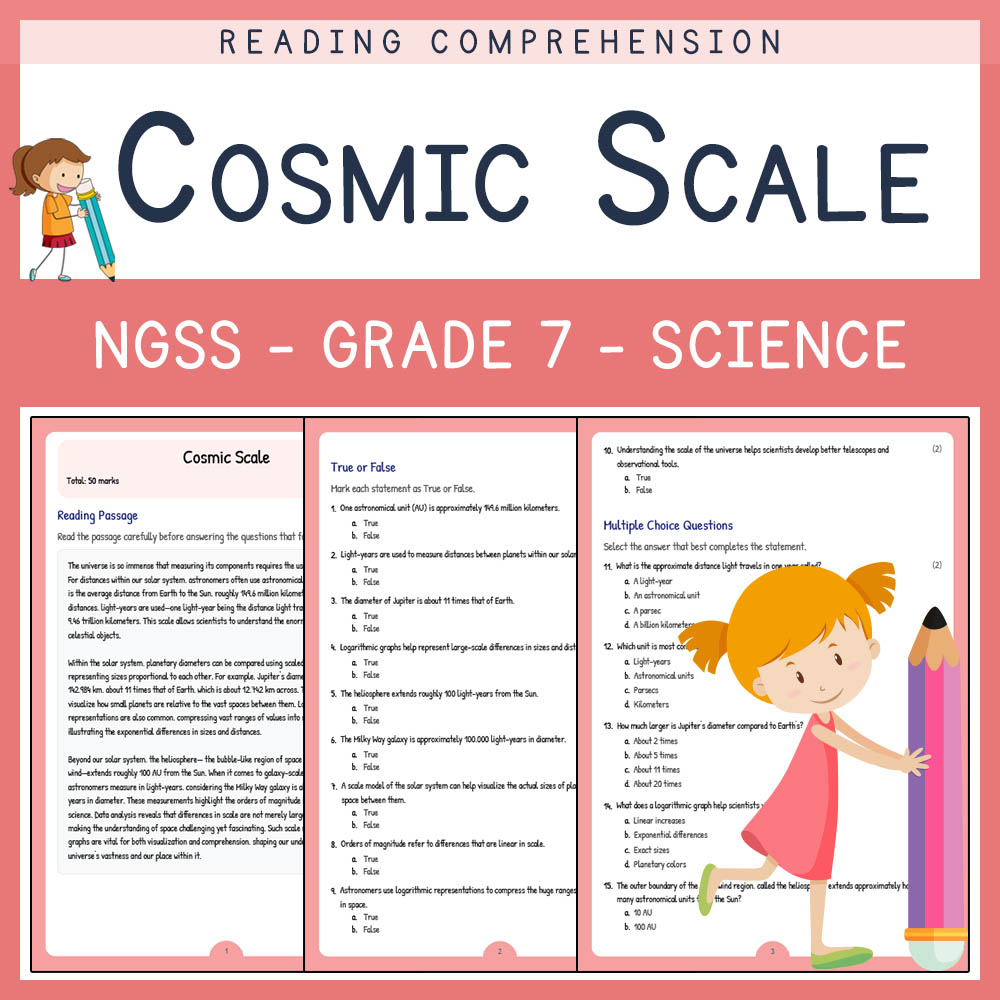
Grade 7 Science | Cosmic Scale Worksheet & Answer Key – NGSS Aligned
Created byLumora LearningLearning Objectives
- Understand the concept of astronomical units, light-years, and planetary diameters as measures of scale in the solar system and beyond.
- Interpret scaled diagrams and logarithmic representations showing planetary positions, distances, and the extent of the heliosphere.
- Analyze data to comprehend orders of magnitude differences and how scale influences observational capabilities and apparent motion in space.
Instant download

Grade 7 Science – Adaptation Forms & Types | Daily Reading Worksheet
Created byBright Mind ResourcesLearning Objectives
- Understand different types of morphological adaptations in animals.
- Identify examples of physical traits that enhance survival in specific environments.
- Explain how adaptations differ from acclimations and their importance for survival.
Also included in: Grade 7 Ecosystems & Adaptations Science Daily Reading Lesson Bundle | TEKS +2 more
Instant download

Grade 7 Science – Understanding Particles & Motion | Daily Reading Worksheet
Created byBright Mind ResourcesLearning Objectives
- Define the particle model of matter
- Describe how particle motion relates to temperature
- Explain macroscopic properties like pressure and diffusion in terms of particles
Also included in: Grade 7 Matter & Forces Science Reading Lesson Bundle | California Standards +1 more
Instant download

Heat Capacity Worksheet | Science Practice and Standards-Aligned Grade 7
JCreated byJ.S SheetsLearning Objectives
- Understand the concept of specific heat capacity and its significance in thermal processes.
- Perform calculations involving mass, specific heat, and temperature change to estimate energy transfer.
- Recognize units used in heat capacity calculations and convert between Joules, kilojoules, grams, and degrees Celsius.
Instant download

Population Factors and Range Changes Worksheets Grade 7 Science
 Created bySunny Desk Resources
Learning Objectives
- Explain how birth rate, death rate, immigration, and emigration affect population size over time.
- Describe how resource availability and abiotic constraints influence where populations can persist.
- Interpret population trend ideas to explain local extirpations or expansions.
Also included in: Interactions & Ecosystems Grade 7 Alberta Science Worksheets Bundle +1 more
Instant download
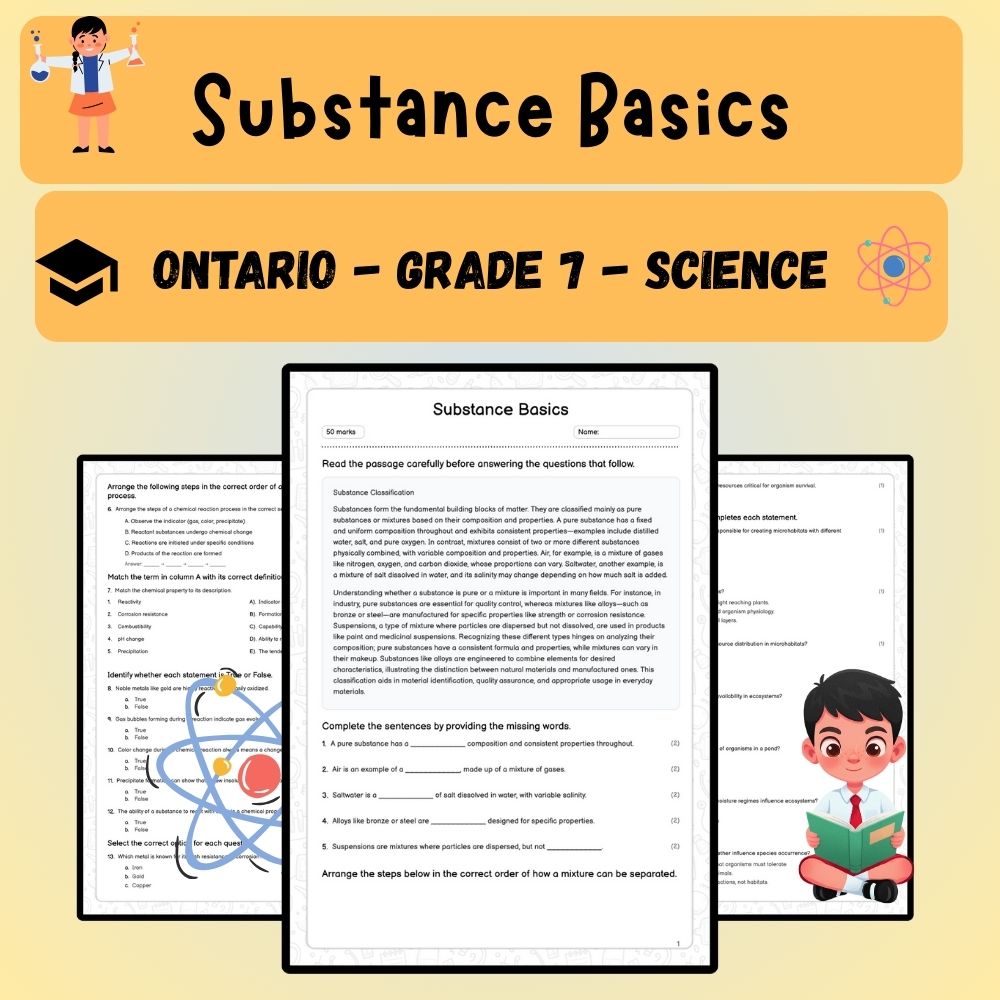
Grade 7 Science | Substances Fundamentals Worksheet (PDF )
Created byPrism Point LearningLearning Objectives
- Understand the classification of substances as elements, compounds, or mixtures based on their composition.
- Identify characteristics of pure substances and mixtures, including their properties and examples.
- Distinguish between natural and manufactured materials such as alloys and suspensions.
Also included in: Grade 7 Science Unit Bundle | Substances, Mixtures & Properties Worksheets +1 more
Instant download

Grade 7 Optimization Methods Worksheet | Engineering Design & Science
 Created byChalk and Compass
Learning Objectives
- Identify performance metrics and constraints in an engineering design problem
- Use basic trade-off reasoning to compare options using cost, durability, strength, and sustainability
- Explain how parameter variation and sensitivity analysis help improve a design
Also included in: Grade 7 Science Scientific Inquiry & Data Analysis Lesson Bundle | Ontario +1 more
Instant download
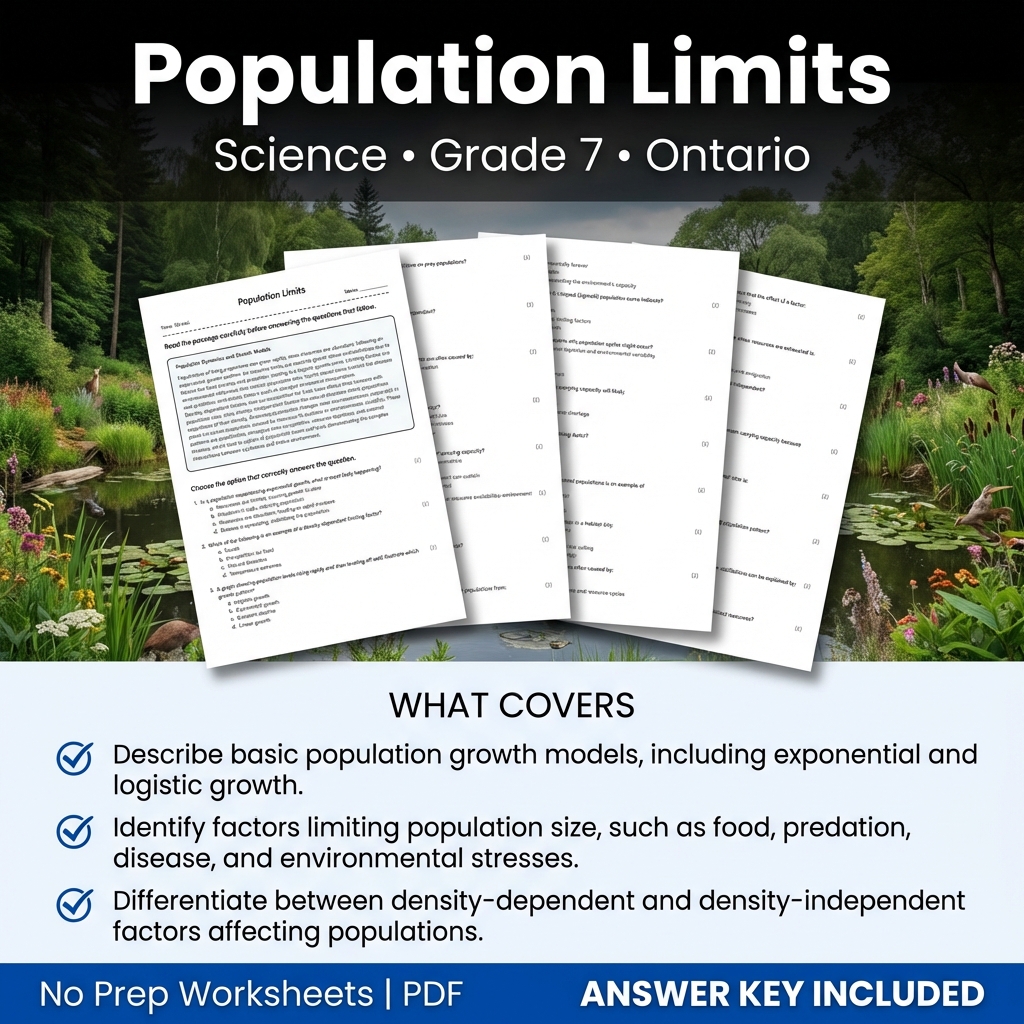
Grade 7 Science Worksheet on Population Limits | Ontario Standards
Created byCoral Reef LearningLearning Objectives
- Describe basic population growth models, including exponential and logistic growth.
- Identify factors limiting population size, such as food, predation, disease, and environmental stresses.
- Differentiate between density-dependent and density-independent factors affecting populations.
Instant download

Grade 7 Science Worksheet Variable Control for Fair Tests | Ontario Standards
JCreated byJ.S SheetsLearning Objectives
- Identify independent, dependent, and controlled variables in an investigation and describe how they relate to cause-and-effect claims.
- Use operational definitions to explain exactly how variables will be measured.
- Design a fair test by controlling confounding factors and using control groups and replication.
Instant download
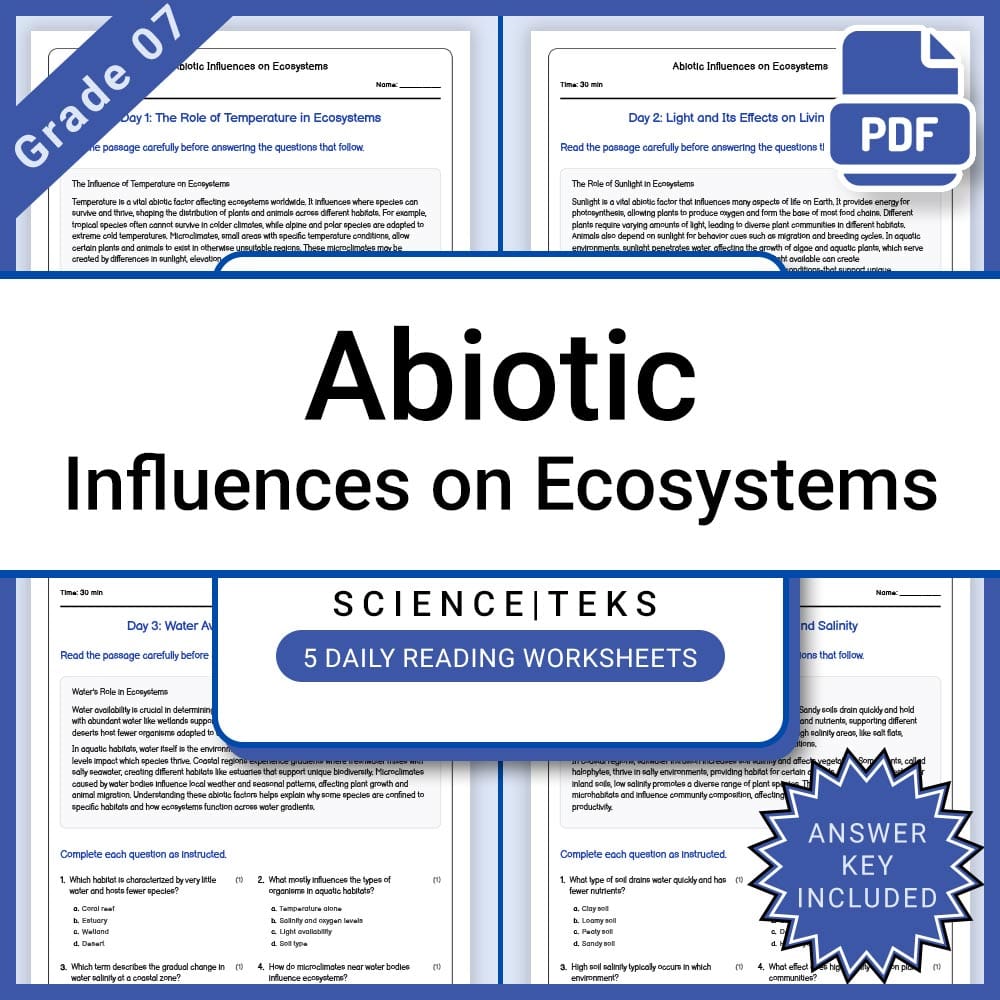
Grade 7 Science – Abiotic Influences on Ecosystems Worksheet + Answer Key
JCreated byJ.S SheetsLearning Objectives
- Understand how temperature impacts species distribution and ecosystem health.
- Identify the effects of abiotic factors like temperature on plant and animal habitats.
- Analyze gradients and microclimates related to temperature variations.
Also included in: Grade 7 Science Lesson Bundle | Ecosystems, Cell Structure & Adaptations +1 more
Instant download

Quantitative Models Worksheet | Grade 7 Science NGSS Genetics Activity
 Created byAmber Owl Education
Learning Objectives
- Explain how allele frequencies change over time using simple quantitative models.
- Use probability and basic population-genetics ideas to interpret patterns of inheritance and selection.
- Analyze fitness differences with graphs or frequency tables to predict population responses.
Also included in: Grade 7 Science Evolution & Biodiversity Lesson Bundle – NGSS +1 more
Instant download

Grade 7 Science | Collisions & Momentum - Daily Reading Comprehension
Created byCoral Reef LearningLearning Objectives
- Understand the concept of momentum and how mass and velocity influence it.
- Differentiate between elastic and inelastic collisions.
- Explain the conservation of momentum during collisions.
Instant download

Grade 7 Kinetic Energy Worksheet | Motion & Energy Activity | NGSS Science
 Created byBRIGHT PATH RESOURCES
Learning Objectives
- Explain what kinetic energy is and how it relates to motion.
- Identify factors like mass and speed that affect kinetic energy.
- Interpret graphs showing the relationship between kinetic energy, mass, and speed.
Also included in: Energy & Heat Transfer Grade 7 Science Lesson Bundle Daily Reading | NGSS +2 more
Instant download

Grade 7 Conservation of Mass & Mass Accounting Science Worksheet Alberta
Created byBRIGHT PATH RESOURCESLearning Objectives
- Explain conservation of mass in a sealed system using cause-and-effect language.
- Identify how inputs and outputs relate to total mass in a closed container.
- Use mass accounting ideas to predict what should happen to product mass when no matter can enter or leave.
Also included in: Grade 7 Alberta Science Matter and Chemical Change Worksheet Bundle +1 more
Instant download

Grade 7 Science | Boundary Types & Landforms in Plate Tectonics - Comprehension
Created byCoral Reef LearningLearning Objectives
- Identify features associated with divergent boundaries.
- Understand the processes that create mid-ocean ridges and rift valleys.
- Recognize the role of magma upwelling in landform development.
Instant download

Ecological Inquiry and Evidence-Based Conclusions Worksheets Grade 7
Created bySunny Desk ResourcesLearning Objectives
- Explain how to frame an ecological question and form a testable hypothesis
- Identify measurable variables and describe how data supports or challenges a hypothesis
- Interpret ecological data while accounting for natural variability
Also included in: Interactions & Ecosystems Grade 7 Alberta Science Worksheets Bundle +1 more
Instant download
Grade 7 Science | Material Properties Reading Worksheet (Answer Key Included)
JCreated byJ.S SheetsLearning Objectives
- Understand the properties of timber, steel, and reinforced concrete under different load conditions.
- Compare material behavior under compression, tension, and bending in structural applications.
- Analyze how environmental factors like frost and snow affect material performance in load-bearing structures.
Also included in: Grade 7 Science | Forces, Motion & Structural Concepts (Answer Keys Included) +1 more
Instant download

Grade 7 Science | Energy Conversion - Daily Reading Comprehension
Created byCoral Reef LearningLearning Objectives
- Understand the basic principles of energy conversion devices
- Identify different types of energy transfers in common devices
- Explain the concept of energy conservation during transformation
Instant download

Grade 7 Science – Graphing Motion Worksheet (Alberta Standards) (PDF)
 Created bySilver Birch Teaching
Learning Objectives
- Translate distance–time and speed–time data into correctly labeled graphs and interpret what the curves mean
- Use slope to explain changes in motion, including how faster speeds relate to steeper lines on graphs
- Determine average and instantaneous rates from motion graphs and connect these to real situations
Also included in: Grade 7 Simple Machines and Forces Science Lesson Bundle: Alberta +1 more
Instant download

Grade 7 Science – Climate Drivers & Natural Records | Daily Reading Worksheet
Created byBright Mind ResourcesLearning Objectives
- Identify natural records that show past climate changes
- Understand how ice cores, sediment layers, and tree rings reflect climate history
- Explore how long-term drivers influence Earth's climate system
Also included in: Weather, Earth Systems & Human Feedbacks Grade 7 Science Lesson Bundle | General +1 more
Instant download
Grade 7 Science Worksheet on Ethics and Communication in STEM | Ontario
Created byCoral Reef LearningLearning Objectives
- Understand the importance of ethical considerations in scientific reporting and data sharing.
- Identify conventions for transparent and responsible communication of scientific findings.
- Recognize the role of community involvement and reflection on unintended consequences in STEM practices.
Instant download

Grade 7 Science – Invasive Species & Ecosystem Impact | Daily Reading Worksheet
Created byBright Mind ResourcesLearning Objectives
- Define invasive species and describe their characteristics.
- Explain how invasive species affect native ecosystems.
- Identify ecological consequences caused by invasive species.
Also included in: Grade 7 Ecosystems & Population Ecology Science Lesson Bundle | BC +1 more
Instant download
Grade 7 Science | Design Principles Reading Worksheet + Answer Key (PDF)
JCreated byJ.S SheetsLearning Objectives
- Understand the key components of experiment design, including variables and controls.
- Learn how to establish operational definitions and select appropriate control conditions.
- Recognize the importance of reproducibility, sample size, and ethical considerations in experiments.
Instant download

Species Adaptations Worksheet | Ontario Grade 7 Science Assessment
 Created byCedar Grove Learning
Learning Objectives
- Explain how structural, physiological, and behavioral adaptations help organisms survive in specific habitats.
- Describe how selective pressures such as temperature, moisture, predation, and resource availability can shape adaptations.
- Identify adaptive trade-offs and how adaptations influence where organisms can live.
Also included in: Grade 7 Ecosystem Dynamics Science worksheets lesson bundle Ontario +1 more
Instant download

Wave Energy Transfer Assessment for Grade 7 Science | Standards-Aligned
Created byPrism Point LearningLearning Objectives
- Understand how waves transfer energy without moving matter permanently.
- Differentiate between transverse and longitudinal waves based on particle motion.
- Explain the relationship between amplitude, wavelength, and energy in waves.
Also included in: Grade 7 Physical Science Science Lesson Bundle: General Framework
Instant download

Grade 7 Science – Digital Data Tools & Data Collection | Daily Reading Worksheet
Created byBright Mind ResourcesLearning Objectives
- Understand what digital tools are used by scientists for data collection and analysis
- Identify and explain formats like CSV, timestamps, and metadata tags
- Recognize the advantages and limitations of automated data logging
Also included in: Grade 7 Modeling & Simulation Science Daily Reading Lesson Bundle | Ontario +1 more
Instant download

Grade 7 Science | Scientific Variables - Daily Reading Comprehension
Created byCoral Reef LearningLearning Objectives
- Understand the different types of variables in scientific experiments.
- Learn how to identify independent and dependent variables in a scientific investigation.
- Recognize the importance of controlled variables for fair testing.
Instant download

Matter Cycling Worksheet | Standards-Aligned Grade 7 Science Practice
JCreated byJ.S SheetsLearning Objectives
- Describe how matter cycles through ecosystems involving living and nonliving components.
- Identify the pathways of carbon, nitrogen, and other elements through processes like photosynthesis, respiration, and decomposition.
- Explain how decomposers return nutrients to the environment and support plant growth.
Also included in: Grade 7 Ecosystem Energy & Matter Cycles Science Lesson Bundle +1 more
Instant download

Scientific Arguments: Evidence to Claim Worksheets Grade 7 Science
Created byBRIGHT PATH RESOURCESLearning Objectives
- Explain how observations and data support a scientific claim using a clear reasoning chain.
- Identify evidence that includes specific values, graph features, or direct observations.
- Revise an argument to reduce unsupported cause-and-effect claims and address limitations.
Also included in: Grade 7 Science Worksheets Bundle | Models, Variables & Evidence +2 more
Instant download

Measurement Accuracy and Uncertainty Science Worksheets Grade 7
Created byBRIGHT PATH RESOURCESLearning Objectives
- Explain how measurement tool resolution and repeated trials affect uncertainty in data.
- Identify when two results are meaningfully different based on overlap of uncertainty ranges.
- Use uncertainty ideas to support whether a conclusion is strong or tentative.
Also included in: Grade 7 Science Worksheets Bundle | Models, Variables & Evidence +2 more
Instant download

Lunar Phases Model-Based Predictions Worksheet | Grade 7 Science
Created byBRIGHT PATH RESOURCESLearning Objectives
- Explain how different types of models help make predictions about natural phenomena
- Use a diagram model to describe what an observer on Earth can see during lunar phases
- Apply model assumptions to predict outcomes under new conditions
Also included in: Grade 7 Science Worksheets Bundle | Models, Variables & Evidence +2 more
Instant download

Control and Comparison in Experiments Worksheets Grade 7 Science
Created byBRIGHT PATH RESOURCESLearning Objectives
- Define a control and a comparison condition in an experiment
- Explain why multiple variables must be kept the same except the targeted variable
- Describe how consistent timing, calibration, and standardized handling support credible data
Also included in: Grade 7 Science Worksheets Bundle | Models, Variables & Evidence +2 more
Instant download
About Grade 7 Science Worksheets
Browse 6,039 printable Grade 7 Science worksheets — ready-to-print PDFs with answer keys where available.
Every worksheet on MyTeachingSheets is created by independent teacher-authors and reviewed before publication. All resources download as printable PDFs for classroom, homework, or at-home practice, and many include answer keys. Preview any worksheet free before buying.