
Grade 7 Science Worksheets
6,039 worksheets
Grade 7 Science | Interaction Types in Ecology - Daily Reading Comprehension
 Created byCoral Reef Learning
Learning Objectives
- Understand different types of organism interactions such as competition, predation, and symbiosis
- Identify examples of competition, predation, and symbiosis in nature
- Analyze how these interactions influence populations and resource availability
Instant download
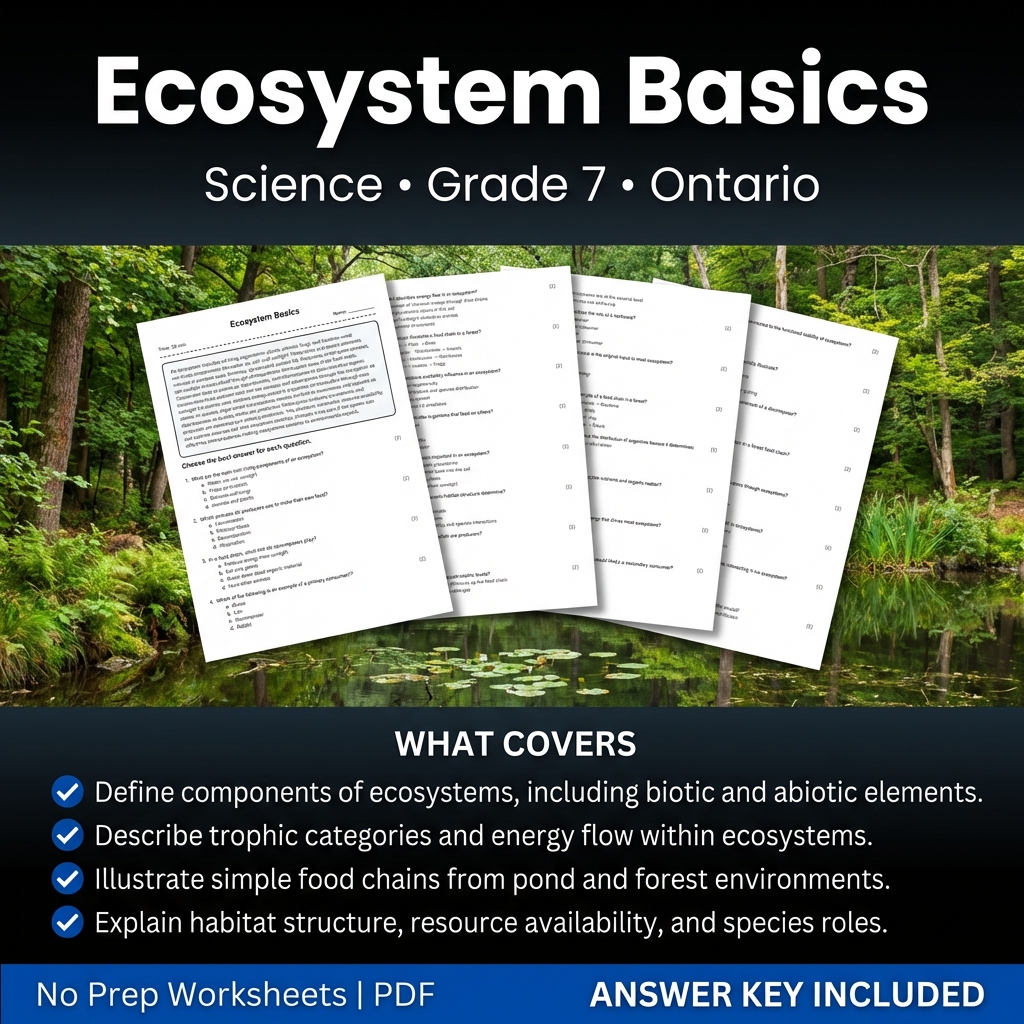
Ecosystem Basics Worksheet for Grade 7 Science | Ontario Standards
Created byCoral Reef LearningLearning Objectives
- Define components of ecosystems, including biotic and abiotic elements.
- Describe trophic categories and energy flow within ecosystems.
- Illustrate simple food chains from pond and forest environments.
Instant download

Science Worksheet Evolutionary Change Grade 7 | Standards-Aligned Practice
JCreated byJ.S SheetsLearning Objectives
- Explain how evolutionary change happens at the population level over many generations
- Distinguish between traits inherited by offspring and changes that occur in individuals during their lifetimes
- Describe how variation and heritability provide the raw material for evolution
Also included in: Grade 7 Evolution and Population Dynamics Science Lesson Bundle – Florida NGSSS +1 more
Instant download

Grade 7 Energy Types Science Daily Reading Worksheet | TEKS Activity
 Created byBRIGHT PATH RESOURCES
Learning Objectives
- Define kinetic energy as energy of motion and potential energy as stored energy due to position or height.
- Identify the main idea of a science passage about energy in a swinging motion.
- Use key vocabulary words (kinetic energy, motion) to explain what changes as an object swings.
Also included in: Forces & Energy Grade 7 Science Daily Reading Worksheets Lesson Bundle | TEKS +1 more
Instant download

States Of Matter Worksheet | Grade 7 Science Activities
 Created byPrism Point Learning
Learning Objectives
- Explain states of matter using a particle model and describe phase changes between states.
- Relate temperature and pressure to when phase changes occur and to measurable properties such as density and viscosity.
- Use water as an example to connect molecular energy to observable behavior, including how boiling point changes with atmospheric pressure.
Also included in: Grade 7 Matter, States, and Reactions in Science Lesson Bundle TEKS
Instant download

Energy Types Worksheet | Grade 7 Science Activities
Created byPrism Point LearningLearning Objectives
- Explain kinetic energy and potential energy using everyday examples.
- Describe how height and motion affect whether energy is stored or moving.
- Use qualitative reasoning to compare energy in different situations.
Also included in: Grade 7 Motion, Forces & Energy Science Lesson Bundle for TEKS Practice
Instant download

Grade 7 Science | Matter Properties Worksheet Elena | Florida NGSSS
 Created byLumora Learning
Learning Objectives
- Identify physical properties of matter and describe how they can be observed or quantified.
- Differentiate chemical properties from physical properties using reaction-based examples.
- Explain how properties support classifying and identifying substances under consistent conditions.
Instant download

Grade 7 Science – States of Matter Worksheet (BC Standard) PDF
 Created byEvergreen Desk Education
Learning Objectives
- Explain how particle arrangement, spacing, and motion differ in solids, liquids, and gases.
- Predict how temperature and pressure can cause substances to change state.
- Use observable properties to classify common materials by state of matter.
Instant download

Cell Structure Worksheet | Grade 7 Science Activities
Created byPrism Point LearningLearning Objectives
- Identify major cell organelles and describe their main functions in living things
- Compare how the nucleus, mitochondria, chloroplasts, and cell membrane support survival and energy needs
- Connect cellular structures to how tissues and organs function in multicellular organisms
Also included in: Ecosystems & Adaptations Grade 7 Science Lesson Bundle TEKS Worksheets
Instant download

Grade 7 Water Cycle Worksheet | NGSS Earth Science Activity with Answer Key
 Created byNorthstar Worksheets
Learning Objectives
- Explain how solar energy and gravity drive the water cycle through evaporation, condensation, and precipitation.
- Describe how water moves between the atmosphere, hydrosphere, and geosphere using infiltration, runoff, and groundwater flow.
- Connect river discharge, groundwater recharge, and seasonal snowpack changes to the cycling and residence time of water.
Also included in: Grade 7 Earth Systems Processes Lesson Bundle | NGSS Earth Science +1 more
Instant download

Design Criteria and Trade-Offs Worksheets | Grade 7 Engineering Science
Created byBRIGHT PATH RESOURCESLearning Objectives
- Identify measurable design criteria and explicit constraints in a design problem.
- Explain how trade-offs can affect multiple requirements in engineering design.
- Connect a solution plan to goals, constraints, and evidence of improvement.
Also included in: Grade 7 Science Engineering Worksheets Bundle | Design & Data +2 more
Instant download

Grade 7 Science | Statistical Reasoning Worksheet (TEKS) Practice Set
Created byEvergreen Desk EducationLearning Objectives
- Interpret variability and reliability by comparing range, mean, and median in experimental data.
- Read graphical displays (box plots and histograms) to describe spread, center, and potential skew.
- Identify misleading representations caused by scale choices, missing information, or non-comparable data.
Instant download
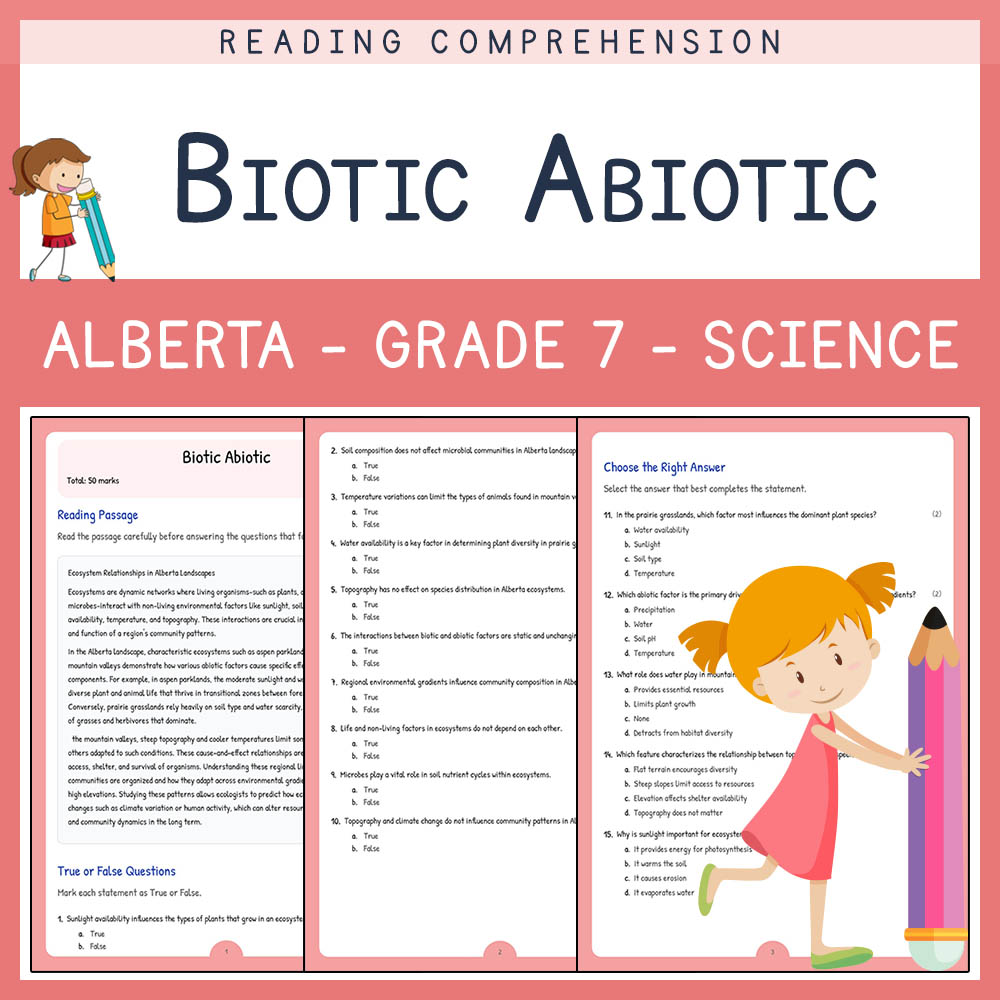
Grade 7 Science Assessment | Biotic Abiotic Worksheet Elena | Alberta
Created byLumora LearningLearning Objectives
- Understand the relationship between living organisms and non-living elements in ecosystems.
- Identify how sunlight, soil, water, temperature, and topography influence plant and animal communities.
- Explain cause-and-effect links that shape ecosystem structure across regional environments.
Also included in: Grade 7 Science | Interactions & Ecosystems Custom Bundle | Alberta
Instant download

Grade 7 Environment and Traits Worksheet | NGSS Genetics Activity Pack
 Created byAmber Owl Education
Learning Objectives
- Explain how phenotype can be influenced by both genes and environmental factors.
- Identify examples of environmental effects on traits, such as nutrition, ultraviolet light, and temperature.
- Distinguish inherited genetic contributions from environmental modulation using evidence-based reasoning.
Also included in: Grade 7 Science NGSS Genetics Lesson Bundle | Punnett Squares & DNA (NGSS) +1 more
Instant download
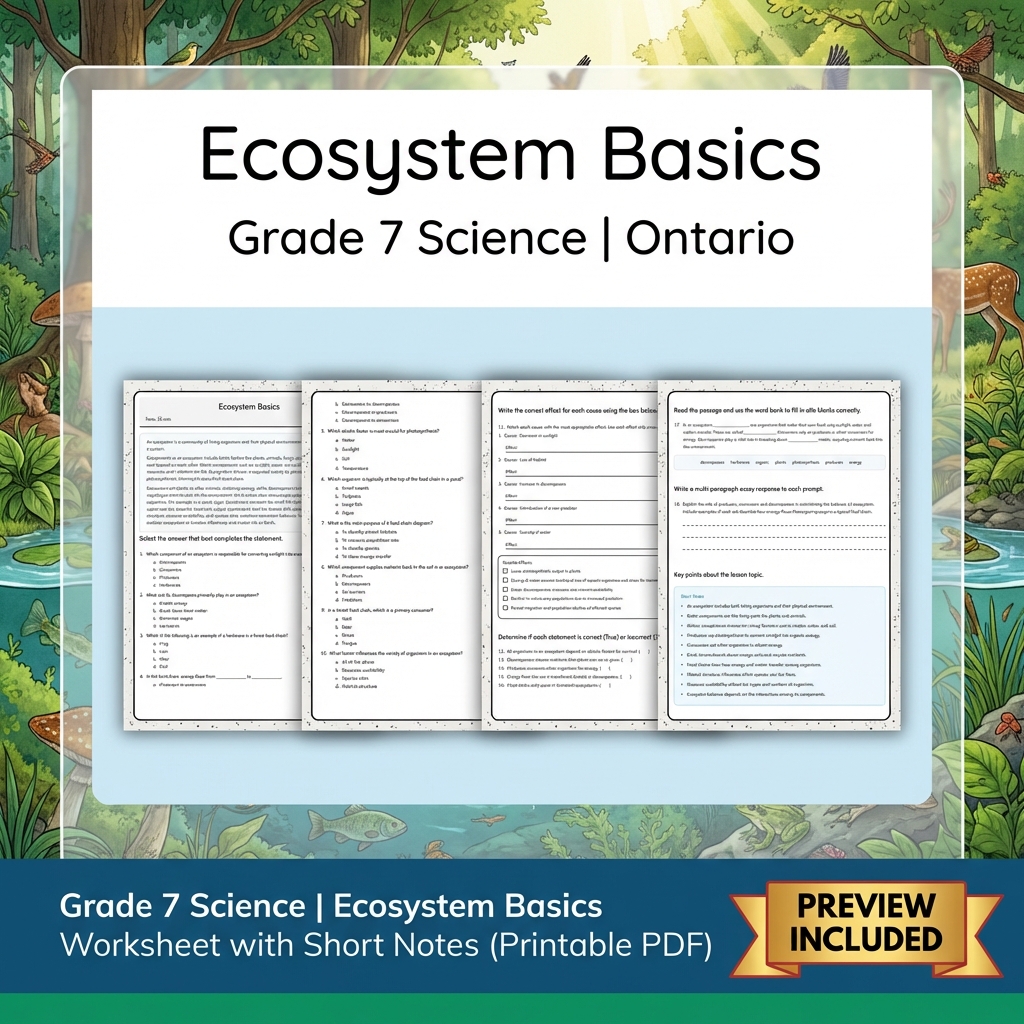
Grade 7 Science | Ecosystem Basics Worksheet with Short Notes (Printable PDF)
 Created byMeadowlark Worksheets
Learning Objectives
- Define components of ecosystems, including biotic and abiotic elements.
- Describe trophic categories such as producers, consumers, and decomposers.
- Explain energy flow from sunlight to organic matter in ecosystems.
Also included in: Grade 7 Science Lesson Bundle with Ontario Framework | Ecosystems & Biodiversity +1 more
Instant download

Grade 7 Science | Biodiversity Stability Worksheet | NGSSS Aligned
Created byLumora LearningLearning Objectives
- Explain how biodiversity contributes to ecosystem stability
- Describe how overlapping ecological roles can buffer ecosystems against disturbances
- Identify ways habitat loss and invasive species can reduce biodiversity and increase vulnerability
Instant download

Grade 7 Science | Decomposer Recycling Worksheet | California Standards
Created byLumora LearningLearning Objectives
- Explain how decomposers (fungi and bacteria) break down dead organisms and waste
- Describe how decomposition returns nutrients to soil and water for producers to use
- Analyze how environmental conditions affect the rate of decomposition
Instant download

Matter Cycling Assessment for Grade 7 Science | California Standards
Created byPrism Point LearningLearning Objectives
- Explain how matter (atoms of elements like carbon and nitrogen) cycles through ecosystems between living and nonliving components.
- Describe major pathways for matter cycling, including photosynthesis, respiration, feeding, decomposition, and transport in soil and water.
- Differentiate energy flow from matter cycling by recognizing that energy moves mainly one direction from the Sun.
Also included in: Grade 7 Energy Flow and Matter Cycling Science lesson bundle – California Standards +1 more
Instant download
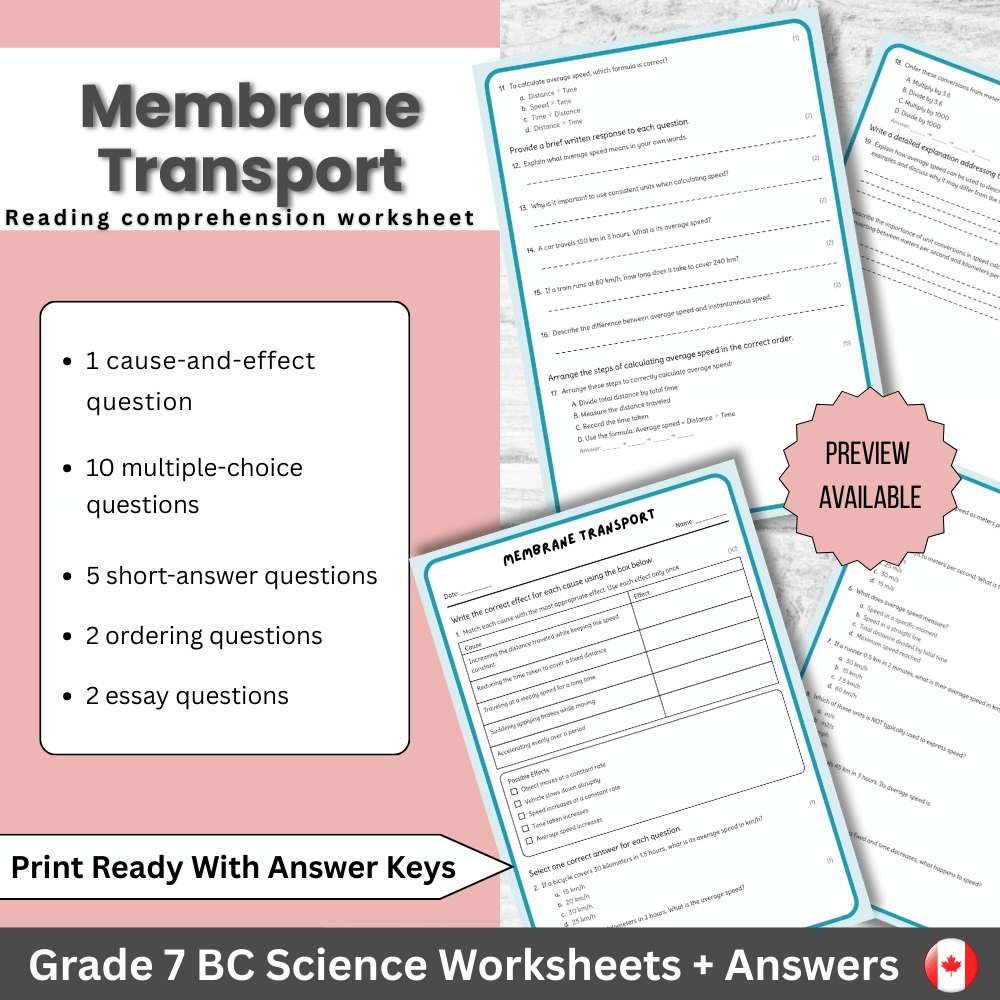
Grade 7 Science | Membrane Transport Worksheet (Answer Key) – BC Standards
 Created byBright Mind Resources
Learning Objectives
- Describe the functions of the cell membrane in regulating substance movement.
- Differentiate between passive and active transport mechanisms.
- Explain the roles of membrane proteins in maintaining ion balances and facilitating transport.
Instant download

Resource Distribution Practice Worksheet | Grade 7 Science NGSS Review
Created byPrism Point LearningLearning Objectives
- Explain how plate tectonics, sedimentation, and weathering can create uneven distributions of Earth resources.
- Connect past biological activity and geologic time to the locations of fossil fuel deposits and mineral resources.
- Describe how groundwater systems form and why extraction can affect regional sustainability.
Also included in: Grade 7 Human Impacts & Climate Earth Science Lesson Bundle | NGSS
Instant download

Grade 7 Science | Climate Drivers Over Time Worksheet | Assessment
Created byLumora LearningLearning Objectives
- Describe how natural climate records (ice cores, sediment layers, and tree rings) can be used to infer past temperature and precipitation.
- Explain how modern instruments provide evidence of recent climate trends.
- Identify major climate drivers over time and describe how they can change Earth’s energy balance and circulation.
Instant download

Rock Record Assessment | TEKS Grade 7 Science Standards-Aligned
Created byPrism Point LearningLearning Objectives
- Understand the processes involved in the rock cycle, including lithification, metamorphism, and magmatism.
- Identify methods of relative and absolute dating used to interpret Earth's history.
- Analyze stratigraphic sequences and depositional environments to infer past tectonic and climatic conditions.
Also included in: Grade 7 Earth and Space Systems Science Lesson Bundle TEKS Worksheets
Instant download

Grade 7 Science | Sedimentary & Surface Processes - Daily Reading Comprehension
Created byCoral Reef LearningLearning Objectives
- Understand how weathering breaks down rocks into sediments.
- Identify different depositional environments.
- Describe the process of lithification.
Instant download

Mechanical Advantage: Levers and Pulleys Worksheets | Grade 7 Science
 Created bySunny Desk Resources
Learning Objectives
- Describe how a fulcrum position changes effort distance in a lever
- Explain how pulley systems can change effort and direction to produce mechanical advantage
- Calculate ideal mechanical advantage using simple ratios for common lever and pulley setups
Also included in: Forces, Structures & Motion Grade 7 Science Bundle | Alberta +1 more
Instant download

Grade 7 Science | Photosynthesis Capture - Daily Reading Comprehension
Created byCoral Reef LearningLearning Objectives
- Understand the process of photosynthesis and how plants convert sunlight into chemical energy.
- Identify the key components involved in photosynthesis such as light, carbon dioxide, water, and sugars.
- Recognize the importance of photosynthesis in supporting ecosystems and energy transfer among organisms.
Instant download
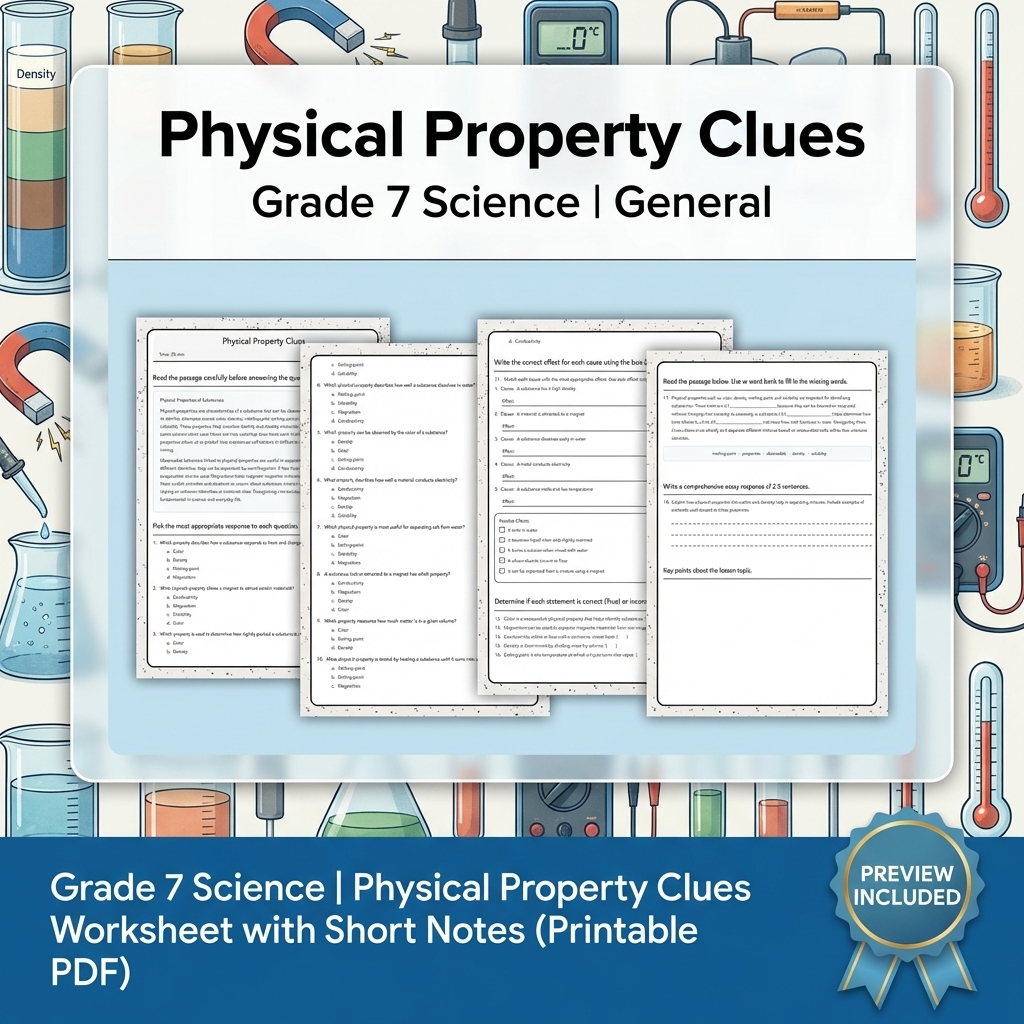
Grade 7 Science | Physical Property Clues Worksheet with Short Notes
Created byMeadowlark WorksheetsLearning Objectives
- Identify and describe various physical properties of substances.
- Understand how properties like density, melting point, and solubility help characterize materials.
- Use observable behaviors to infer properties of unknown substances.
Also included in: Grade 7 Energy Transfer and Motion Science Lesson Bundle | General +1 more
Instant download
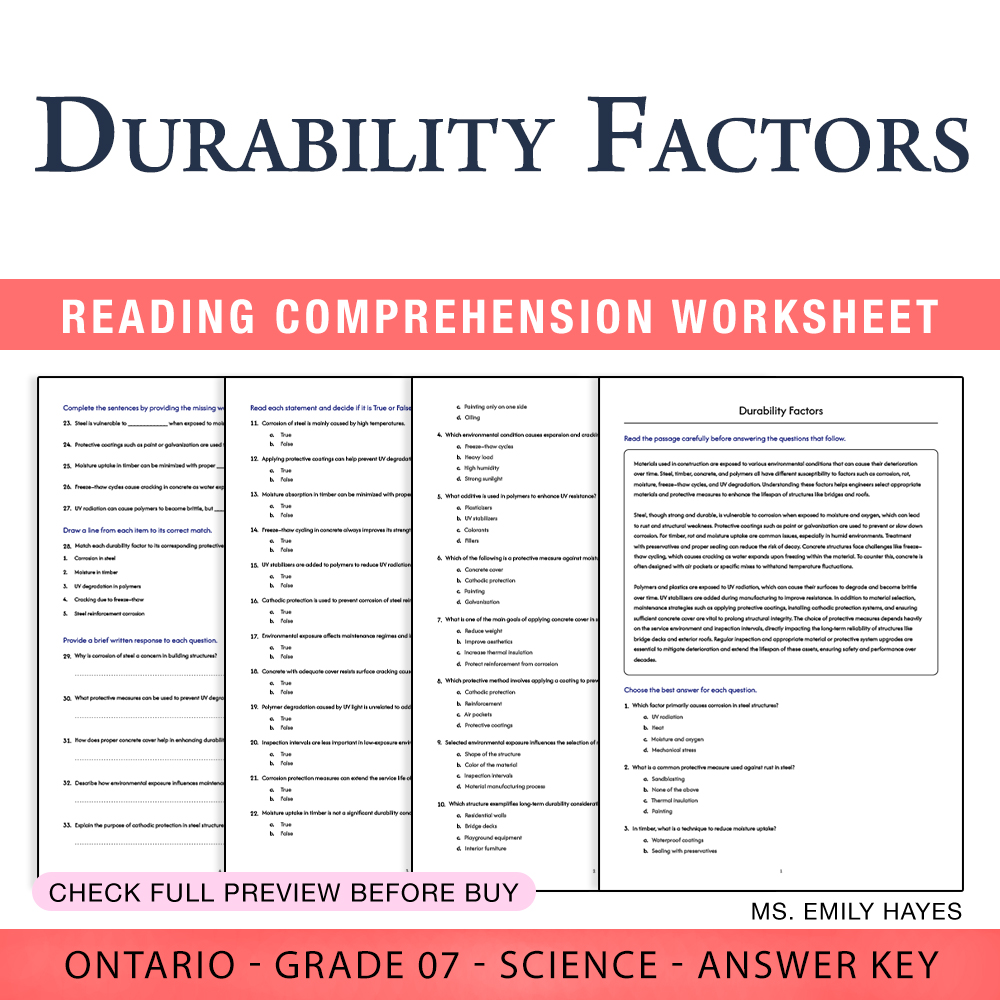
Grade 7 Science | Durability Factors Worksheet (PDF+ Answer Key)
 Created byCopper Leaf Classroom
Learning Objectives
- Understand the main factors that affect the long-term durability of construction materials.
- Identify and explain the protective measures used to prevent material degradation over time.
- Analyze how environmental conditions influence the lifespan of materials like steel, timber, concrete, and polymers.
Instant download
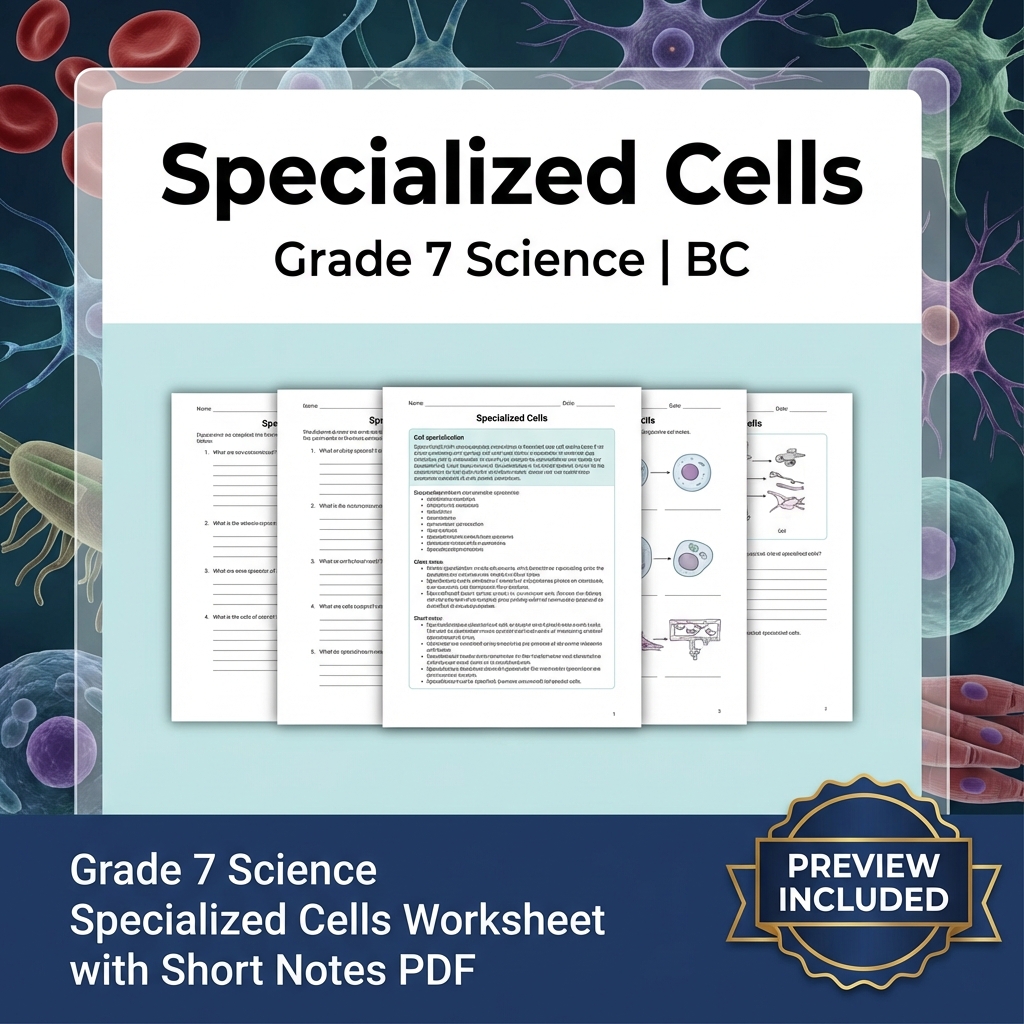
Grade 7 Science Specialized Cells Worksheet with Short Notes PDF
Created byMeadowlark WorksheetsLearning Objectives
- Understand the structural differences among specialized cells and their roles.
- Describe how morphological differences enable cells to perform specific functions.
- Identify examples of cell specialization in tissues and organs.
Also included in: Grade 7 Science Lesson Bundle | Cell Structures & Functions Worksheets +1 more
Instant download

Grade 7 Science – Load Path Mapping Daily Reading Worksheet | Ontario Standards
Created byBright Mind ResourcesLearning Objectives
- Understand the concept of load paths in structural systems
- Identify primary and secondary load routes in simple structures
- Recognize how openings and irregular geometry affect load redistribution
Also included in: Structural Eng. Grade 7 Science Daily Reading Worksheets Lesson Bundle | Ontario +1 more
Instant download

Heat Transfer Models Assessment Grade 7 | Science Standards-Aligned
Created byPrism Point LearningLearning Objectives
- Explain the different methods of heat transfer: conduction, convection, and radiation.
- Identify real-world examples of heat transfer processes.
- Describe how temperature differences drive heat flow.
Also included in: Grade 7 Physical Science Science Lesson Bundle: General Framework
Instant download

Grade 7 Science | Organ System Roles Worksheet | BC Standard
Created byLumora LearningLearning Objectives
- Identify the functions of key organ systems such as circulatory, respiratory, and digestive.
- Explain how tissues and organs work together within organ systems to perform vital life functions.
- Describe the specialized structures that increase efficiency in gas exchange and nutrient absorption.
Instant download

Cell Communication Worksheet | Science Assessment for Grade 7 BC Standards
JCreated byJ.S SheetsLearning Objectives
- Describe how receptor proteins in cell membranes detect signals like hormones and neurotransmitters.
- Explain the roles of gap junctions and plasmodesmata in direct cell communication.
- Understand the processes of signal amplification and feedback regulation in cells.
Instant download
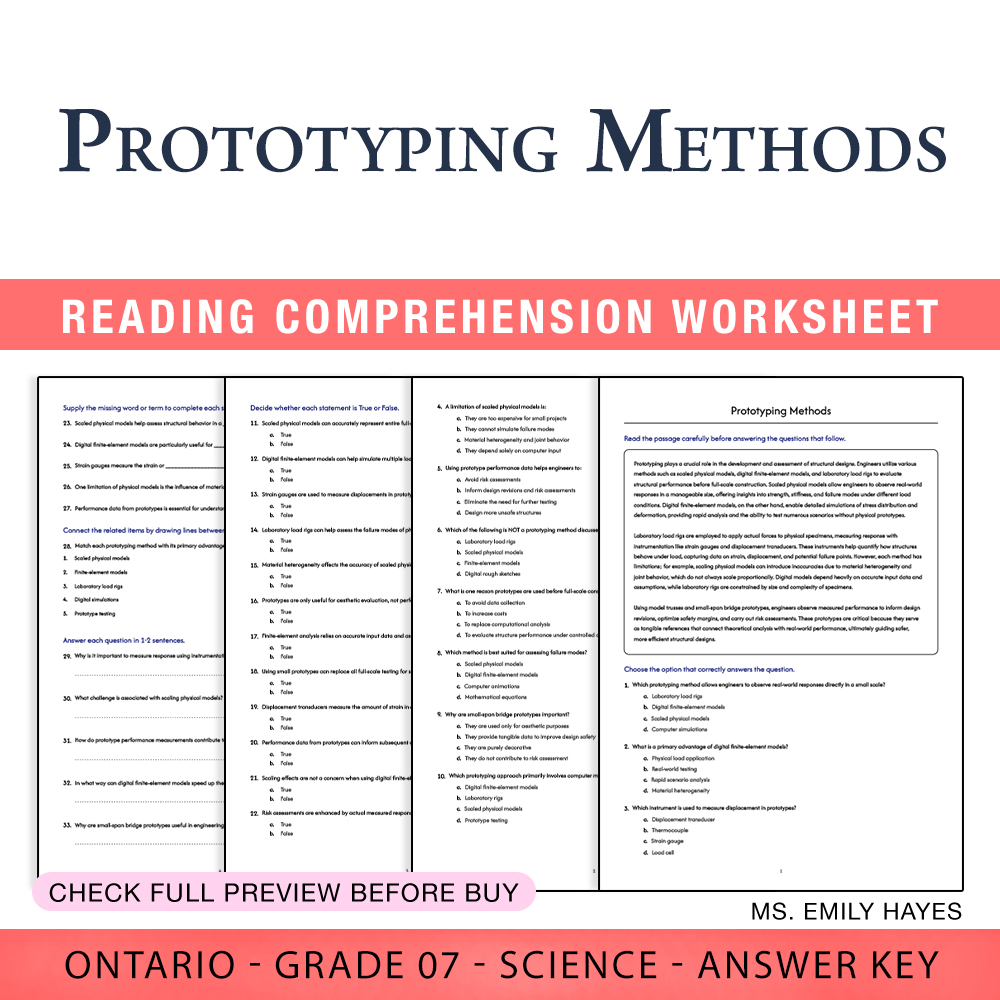
Grade 7 Science | Prototyping Methods Worksheet (PDF+ Answer Key)
Created byCopper Leaf ClassroomLearning Objectives
- Understand different prototyping approaches including scaled physical models, digital finite-element models, and laboratory load rigs.
- Compare advantages and limitations of each prototyping method for assessing strength, stiffness, and failure modes.
- Learn about instrumentation such as strain gauges and displacement transducers used to measure response.
Instant download

Grade 7 Model Evaluation Worksheet | Practice & Assessment PDF
 Created byClear Sky Classroom
Learning Objectives
- Explain how model evaluation compares predictions to evidence
- Identify common reasons a model may fail, such as incorrect assumptions or missing factors
- Describe how changing input parameters in a simulation can reveal which assumptions matter most
Instant download
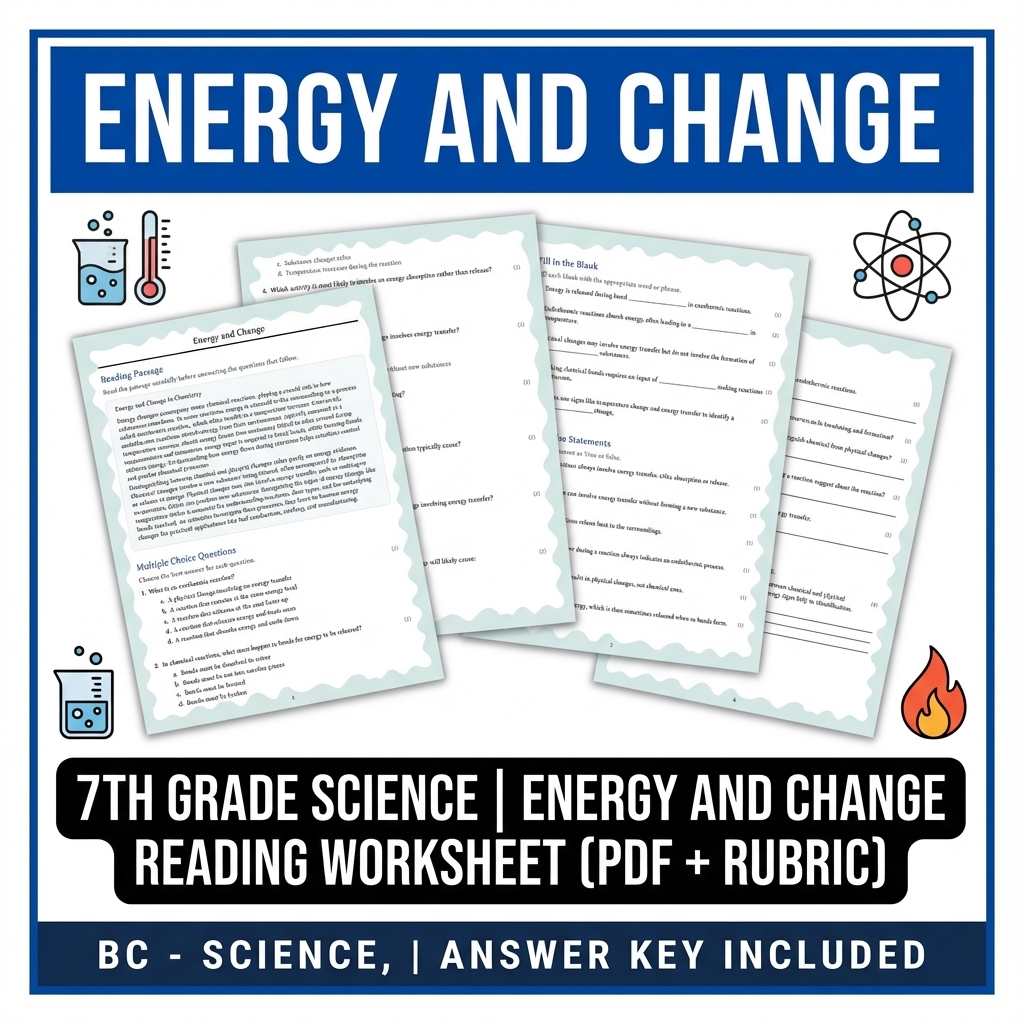
7th Grade Science | Energy and Change Reading Worksheet (PDF + Rubric)
JCreated byJ.S SheetsLearning Objectives
- Describe how energy is involved in chemical reactions.
- Differentiate between exothermic and endothermic reactions based on energy changes.
- Explain the link between energy transfer and bond formation or breaking in chemical processes.
Instant download

Grade 7 Action-Reaction Forces Worksheet | California Standards Practice PDF
Created byClear Sky ClassroomLearning Objectives
- Explain Newton’s third law: forces in interactions are equal in magnitude and opposite in direction.
- Differentiate between action-reaction force pairs and effects on acceleration for objects of different masses.
- Identify action-reaction pairs in everyday contact and noncontact situations, including gravity.
Instant download

Energy Flow in Ecosystems Worksheets | Grade 7 Science Review
 Created byTeachers Club
Learning Objectives
- Explain how energy moves through producers, consumers, and decomposers
- Describe photosynthesis and cellular respiration as energy mechanisms
- Model an energy budget across trophic levels
Also included in: Grade 7 Science Ecosystems Worksheets | NGSS Unit Bundle +2 more
Instant download

Grade 7 Science | Matter Cycling Worksheet | California Standards
Created byLumora LearningLearning Objectives
- Explain how atoms move through an ecosystem via processes like photosynthesis, feeding, respiration, and decomposition.
- Describe how decomposers return nutrients to soil and water and how this supports new plant growth.
- Distinguish matter cycling from energy flow in ecosystems, emphasizing that energy moves one direction from the Sun.
Instant download

Design Optimization Practice Worksheet | Grade 7 Science NGSS Review
Created byPrism Point LearningLearning Objectives
- Use test data to refine design parameters and improve performance within given constraints.
- Explain how iterative changes and recalibrated predictions can reduce error and increase effectiveness.
- Justify design modifications using quantitative comparisons (before-and-after results).
Instant download

Science Worksheet Interpreting Data | Standards-Aligned Grade 7 Assessment
JCreated byJ.S SheetsLearning Objectives
- Explain how to interpret patterns and relationships shown in common graphs (scatter plots, line graphs, and histograms).
- Use measures such as range and average to compare data sets while recognizing limits and uncertainty.
- Identify how outliers and measurement issues can affect conclusions and confidence.
Also included in: Grade 7 Scientific Variables, Data, and Models Science Lesson Bundle +1 more
Instant download

Grade 7 Solubility Principles Worksheet | Ontario Science with Answer Key
Created byClear Sky ClassroomLearning Objectives
- Explain solubility, saturation, and supersaturation using particle-level ideas.
- Describe how temperature, solvent polarity, and pressure affect dissolution.
- Use solubility concepts to predict concentration changes and crystallization outcomes.
Instant download

Integrated Analysis Worksheet for Grade 7 Science | Standards-Aligned
JCreated byJ.S SheetsLearning Objectives
- Understand how material properties, transfer modes, and conservation principles combine to evaluate energy performance.
- Analyze energy budgets including conduction, convection, radiation, storage, and conversion losses.
- Interpret numerical and graphical data to compare system efficiencies and responses.
Instant download

Grade 7 Energy Conversion Worksheet | NGSS Practice & PDF
Created byClear Sky ClassroomLearning Objectives
- Understand the principles of energy transfer and conservation in devices.
- Identify different types of energy conversions such as mechanical to electrical, light to electrical, and electrical to thermal.
- Explain the concept of energy efficiency and dissipative processes in energy transformations.
Also included in: Grade 7 Energy Transfer Science Lesson Bundle | NGSS +1 more
Instant download

Grade 7 Science – Introduction to Density Separation | Daily Reading Worksheet
Created byBright Mind ResourcesLearning Objectives
- Understand the principles behind density-based separation techniques.
- Identify methods such as decanting, floatation, and centrifugation.
- Explain how buoyant force, sedimentation, and centrifugal force influence separation.
Also included in: Grade 7 Matter Science Daily Reading Worksheets Lesson Bundle | Ontario +1 more
Instant download

Atmospheric Systems Assessment | TEKS Grade 7 Science Standards
Created byPrism Point LearningLearning Objectives
- Understand how energy transfer influences atmospheric processes.
- Describe large-scale circulation patterns and their effects on climate.
- Identify key phenomena such as fronts, jet streams, and greenhouse gases.
Also included in: Grade 7 Earth and Space Systems Science Lesson Bundle TEKS Worksheets
Instant download

Grade 7 Science | Motion Graphs - Daily Reading Comprehension
Created byCoral Reef LearningLearning Objectives
- Understand how to interpret distance–time graphs.
- Identify different types of motion from graphs (uniform, speeding up, slowing down, rest).
- Relate the slope of a distance–time graph to speed.
Instant download
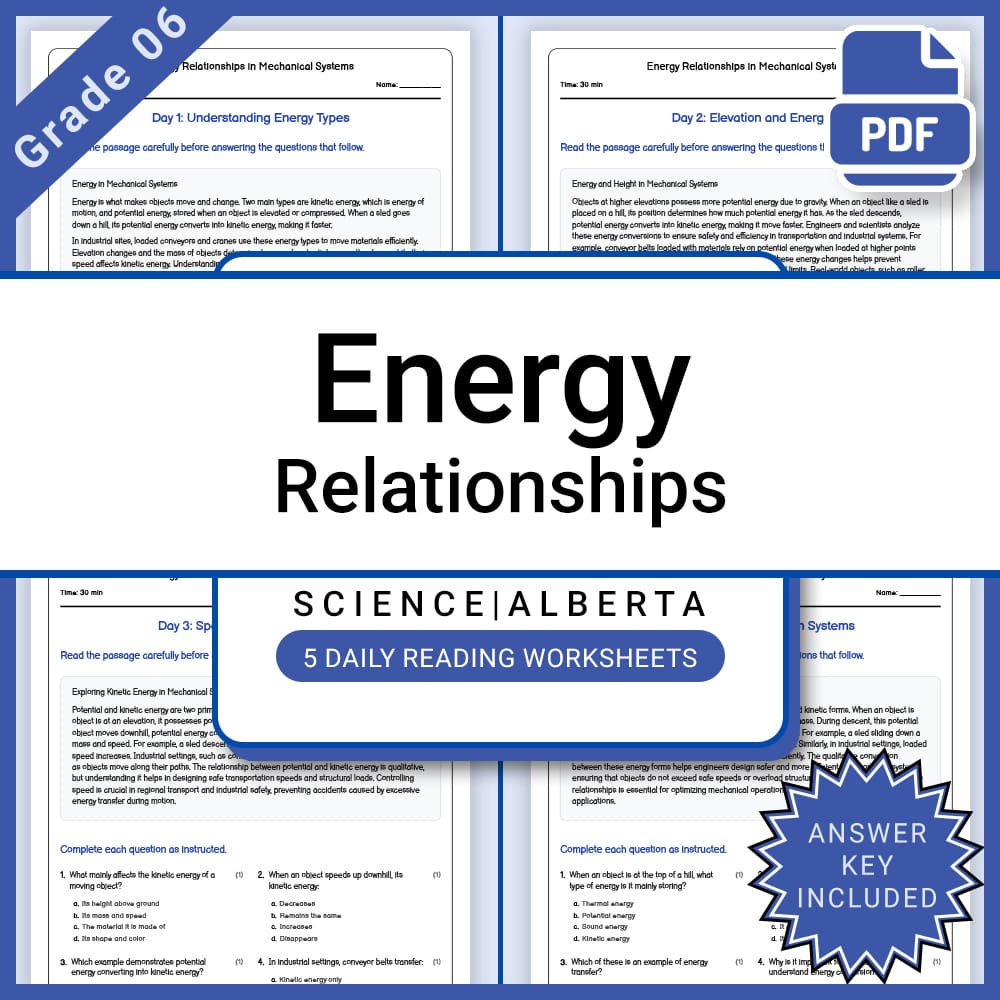
Grade 7 – Energy Relationships in Mechanical Daily Worksheet + Answer Key
JCreated byJ.S SheetsLearning Objectives
- Identify examples of kinetic and potential energy in everyday scenarios
- Understand how elevation, mass, and speed influence mechanical energy
- Analyze the conversion between potential and kinetic energy
Also included in: Grade 7 Science Lesson Group | Structural Engineering & Motion Worksheets +1 more
Instant download

Gravity Motion Test Prep Printable Worksheet | Grade 7 Science
Created byPrism Point LearningLearning Objectives
- Explain how gravitational attraction provides the centripetal effect needed for orbital motion.
- Describe how orbital speed and orbital period relate to a planet or moon’s distance from the central body.
- Use observational evidence (trajectories and repeating orbital patterns) to support claims about stable orbits.
Also included in: Grade 7 Earth and Space Science Lesson Bundle NGSS Test Prep Worksheets
Instant download
About Grade 7 Science Worksheets
Browse 6,039 printable Grade 7 Science worksheets — ready-to-print PDFs with answer keys where available.
Every worksheet on MyTeachingSheets is created by independent teacher-authors and reviewed before publication. All resources download as printable PDFs for classroom, homework, or at-home practice, and many include answer keys. Preview any worksheet free before buying.