
Grade 7 Science Worksheets
6,039 worksheets
Plate Tectonics Worksheet | NGSS-Aligned Grade 7 Science Practice PDF
JCreated byJ.S SheetsLearning Objectives
- Understand the geological evidence supporting plate tectonics and continental movement.
- Identify features such as seafloor structures, earthquakes, and volcanoes that indicate plate activity.
- Explain how fossil distributions and rock types record past continental positions.
Also included in: Grade 7 Earth Systems Science Worksheet Set Print Lesson Bundle – NGSS +1 more
Instant download

Grade 7 Building Envelope Worksheet | Ontario Science Activity PDF
 Created byClear Sky Classroom
Learning Objectives
- Explain how walls, roofs, windows, and foundations contribute to a building’s thermal performance.
- Describe how thermal bridging and air infiltration affect heat loss and heat gain.
- Identify how insulation placement, continuous barriers, and ventilation work together to manage energy use.
Instant download

Design Process Test Prep Printable Worksheet | Grade 7 Science Ontario
 Created byPrism Point Learning
Learning Objectives
- Explain how functional requirements and constraints guide design choices.
- Use performance objectives (such as load capacity and stiffness) to compare solution options.
- Apply decision matrices and sketching to select preferred designs using criteria and trade-offs.
Instant download

Grade 7 Science | Survival Structures Worksheet | General Standard Aligned
 Created byLumora Learning
Learning Objectives
- Explain how internal structures and external features help organisms survive, grow, and reproduce
- Identify how different traits increase an organism’s chance of obtaining resources and avoiding danger
- Use functional relationships to describe how structures support transport, digestion, and coordination
Instant download

Grade 7 Specialized Cells Worksheet | BC Practice & Assessment PDF
Created byClear Sky ClassroomLearning Objectives
- Explain how specialized cell structures help cells perform specific functions in the body
- Match common specialized cells (red blood cells, neurons, root hair cells) to their main roles
- Describe how cell specialization supports tissue and organ function in organisms
Instant download

Grade 7 Science | Insulation Principles - Daily Reading Comprehension
 Created byCoral Reef Learning
Learning Objectives
- Understand key concepts related to Science
- Apply knowledge through practice questions
- Demonstrate comprehension of the material
Also included in: Energy, Heat and Thermal Processes Lesson Bundle: Grade 7 Science Alberta +1 more
Instant download

Grade 7 Science – Cell Organization & Tissues | Daily Reading Worksheet
 Created byBright Mind Resources
Learning Objectives
- Understand how cells group together to form tissues.
- Identify different types of tissues and their functions.
- Explain how tissues combine to create organs.
Also included in: Cell Function & Transport Grade 7 Science Daily Reading Worksheets Bundle | BC +1 more
Instant download

Grade 7 Conservation Mass Worksheet | Practice & Assessment PDF
Created byClear Sky ClassroomLearning Objectives
- Explain conservation of mass in a closed system during physical and chemical changes.
- Use reactants and products to predict mass relationships in sealed-container reactions.
- Interpret experimental observations to support the idea that atoms are conserved.
Instant download

Grade 7 Science – Monitoring Methods & Ecology | Daily Reading Worksheet
Created byBright Mind ResourcesLearning Objectives
- Understand different ecological monitoring techniques
- Recognize the importance of consistent data collection
- Learn how monitoring data is used to track ecological changes
Also included in: Grade 7 Ecosystems Science Lesson Bundle for Daily Reading Worksheets | Alberta +2 more
Instant download
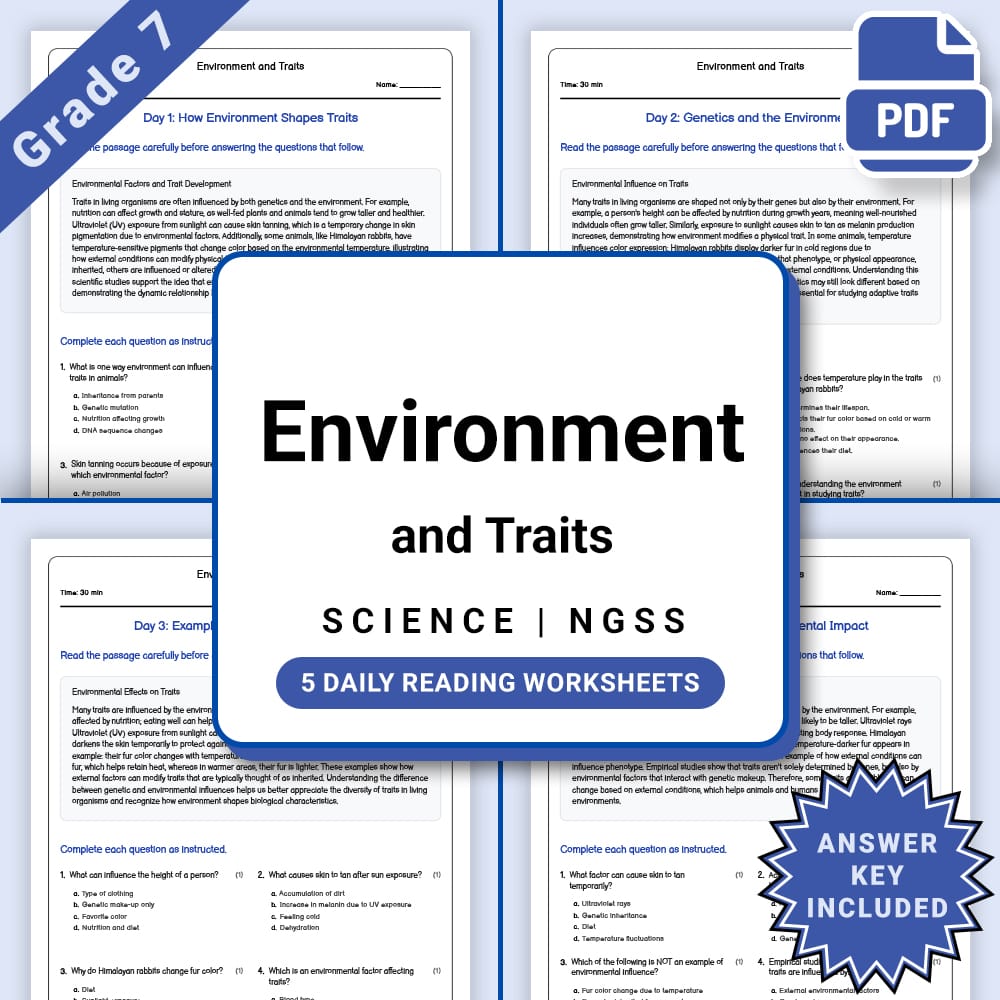
Grade 7 Science – Environment and Traits Daily Reading Worksheet(PDF + Answers)
 Created byCopper Leaf Classroom
Learning Objectives
- Understand how environmental factors influence phenotypic traits
- Identify examples of environmental effects on traits
- Distinguish between inherited traits and environmentally influenced traits
Instant download

Elements Versus Compounds Worksheet | Grade 7 Science Standard Ontario
 Created byCedar Grove Learning
Learning Objectives
- Distinguish elements from compounds using atomic composition and bonding
- Explain how chemical formulas represent fixed ratios of atoms in compounds
- Predict how macroscopic properties (like conductivity and melting point) can change when elements form compounds
Also included in: Grade 7 Matter: Mixtures and Separation Science Lesson Bundle | Ontario +1 more
Instant download
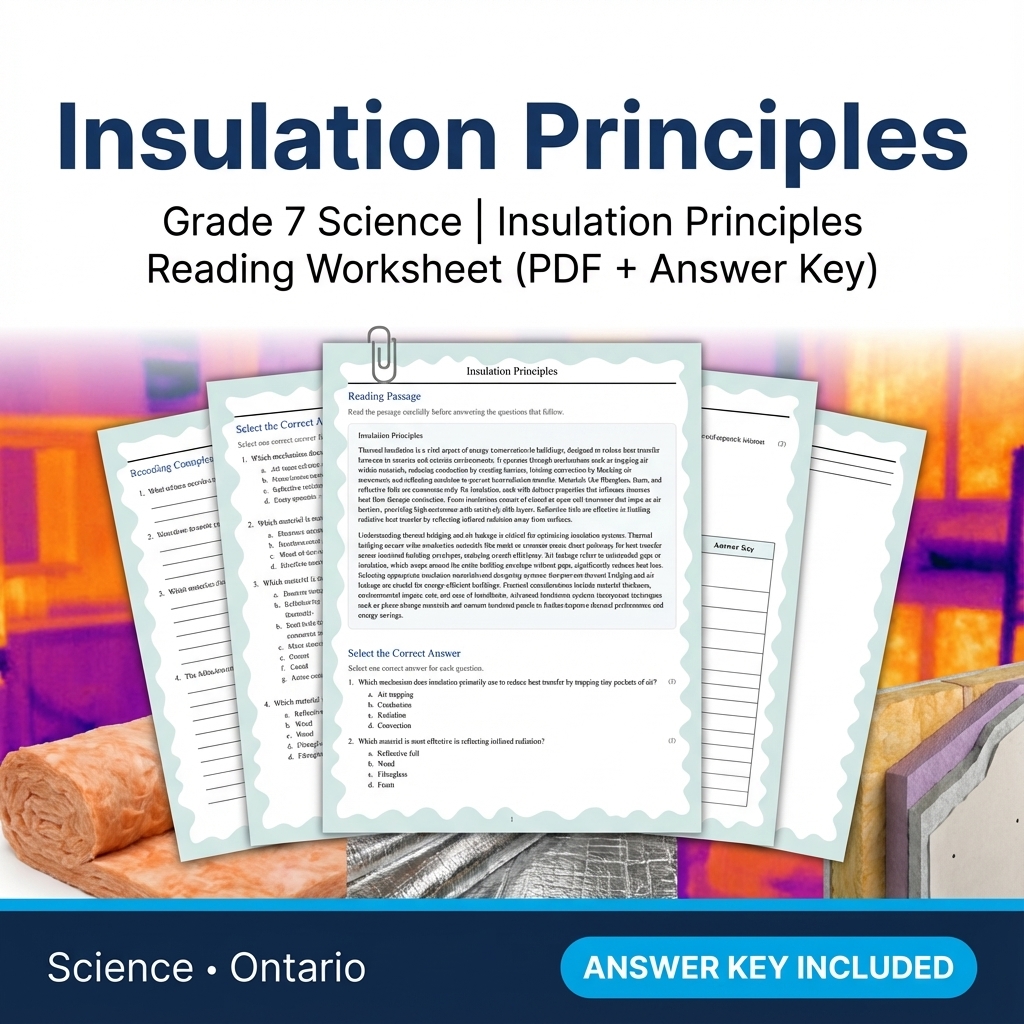
Grade 7 Science | Insulation Principles Reading Worksheet (PDF + Answer Key)
JCreated byJ.S SheetsLearning Objectives
- Understand the mechanisms by which various materials reduce heat transfer in buildings.
- Identify different insulating materials and compare their thermal resistance and practical usage.
- Explain concepts such as thermal bridging, air leakage, and continuous insulation in building design.
Also included in: Grade 7 Science | Thermal Energy & Transfer Worksheet Bundle +1 more
Instant download

Grade 7 Sound Perception Worksheet | General Use Practice PDF
Created byClear Sky ClassroomLearning Objectives
- Explain how sound waves affect loudness and how distance changes perceived intensity.
- Describe how reflection and absorption of sound influence echoes and intensity.
- Connect amplitude and frequency to the brain’s perception of volume (loudness) and pitch.
Instant download

Grade 7 Science – Ecosystem Dynamics & Food Webs Daily Reading Worksheet
Created byBright Mind ResourcesLearning Objectives
- Identify energy flow within food chains
- Understand the roles of producers, consumers, and decomposers
- Describe how energy transfer affects ecosystem stability
Also included in: Grade 7 Ecosystems & Adaptations Science Daily Reading Lesson Bundle | TEKS +2 more
Instant download

Grade 7 Science Worksheet | Pollution Effects & Environmental Impact (PDF)
 Created bySilver Birch Teaching
Learning Objectives
- Explain how common anthropogenic pollutants (nutrient runoff, hydrocarbons, and airborne deposition) move through terrestrial and aquatic ecosystems.
- Describe measurable ecological effects of pollution, including organism health changes and food web disruption.
- Use cause-and-effect reasoning to connect pollutant sources to ecosystem chemistry and community-level outcomes.
Also included in: Grade 7 Ecosystems & Biodiversity Science Lesson Bundle for Alberta Framework +1 more
Instant download

Grade 7 Diffusion And Mixing Worksheet | California Standards Use PDF
Created byClear Sky ClassroomLearning Objectives
- Explain diffusion using the particle model and concentration gradients
- Describe how mixing occurs without chemical change and without stopping particle motion
- Predict how temperature affects the rate of diffusion
Instant download

Igneous Processes Worksheet | Grade 7 Science | Standards-Aligned Practice
JCreated byJ.S SheetsLearning Objectives
- Describe how magma forms through different geological processes such as decompression, heat transfer, and volatile addition.
- Explain how cooling rates influence the texture and mineral composition of igneous rocks.
- Identify the roles of fractional crystallization and magma mixing in producing diverse igneous rock types.
Instant download

Grade 7 Science | States Of Matter - Daily Reading Comprehension
Created byCoral Reef LearningLearning Objectives
- Understand the basic states of matter: solid, liquid, gas.
- Identify phase changes such as melting, freezing, vaporization, condensation, and sublimation.
- Relate temperature and pressure to phase transition points.
Instant download

Grade 7 Science – Volcanic Landforms & Landform Types | Daily Reading Worksheet
Created byBright Mind ResourcesLearning Objectives
- Understand the formation of shield volcanoes and their features.
- Identify different types of volcanic landforms based on magma composition and eruption style.
- Learn how tectonic settings influence volcanic activity and landform creation.
Also included in: Grade 7 Earth Processes Science Daily Reading Worksheets Lesson Bundle | BC +1 more
Instant download

Friction And Stability Assessment | California Standards Grade 7 Science
Created byPrism Point LearningLearning Objectives
- Explain how friction opposes relative motion and how it affects whether forces balance or not.
- Predict how changes in surface texture (roughness/smoothness) change the size of friction and the resulting motion.
- Use the idea of net force to describe when an object speeds up, slows down, or moves at constant velocity.
Also included in: Grade 7 Forces and Matter Science Lesson Bundle: California Standards +1 more
Instant download

Engineering Design Criteria & Constraints Worksheets Grade 7 Science
 Created byTeachers Club
Learning Objectives
- Define a design problem using clear criteria for success
- Identify measurable constraints involving cost, safety, and materials
- Translate real-world needs into quantitative design targets
Also included in: Grade 7 Science Engineering Design Worksheets | NGSS Bundle +2 more
Instant download
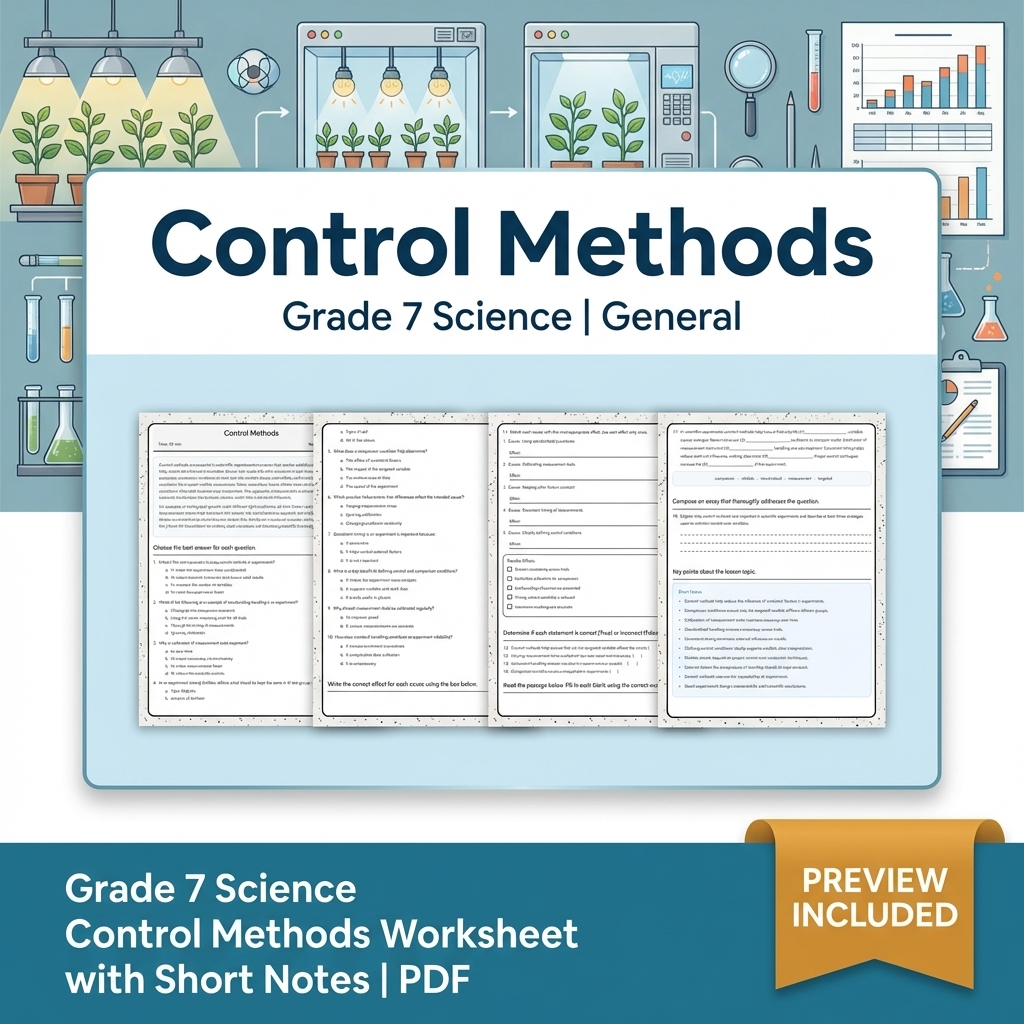
Grade 7 Science Control Methods Worksheet with Short Notes | PDF
 Created byMeadowlark Worksheets
Learning Objectives
- Understand the purpose of control methods in experiments.
- Identify different strategies used to reduce external influences.
- Explain how comparison conditions improve experiment credibility.
Also included in: Grade 7 Science Scientific Modeling & Evidence Lesson Bundle: General Framework +1 more
Instant download

Mixtures and Solutions Worksheet | Grade 7 Science NGSS Activity Pack
 Created byAmber Owl Education
Learning Objectives
- Differentiate homogeneous mixtures from heterogeneous mixtures based on particle distribution and observable properties
- Describe solubility and concentration using the concepts of unsaturated, saturated, and supersaturated solutions
- Explain how particle size relates to solutions, colloids, and suspensions and how separation methods depend on those differences
Also included in: Grade 7 Science Stoichiometry, Mixtures & Material Properties Lesson Bundle | NGSS +1 more
Instant download
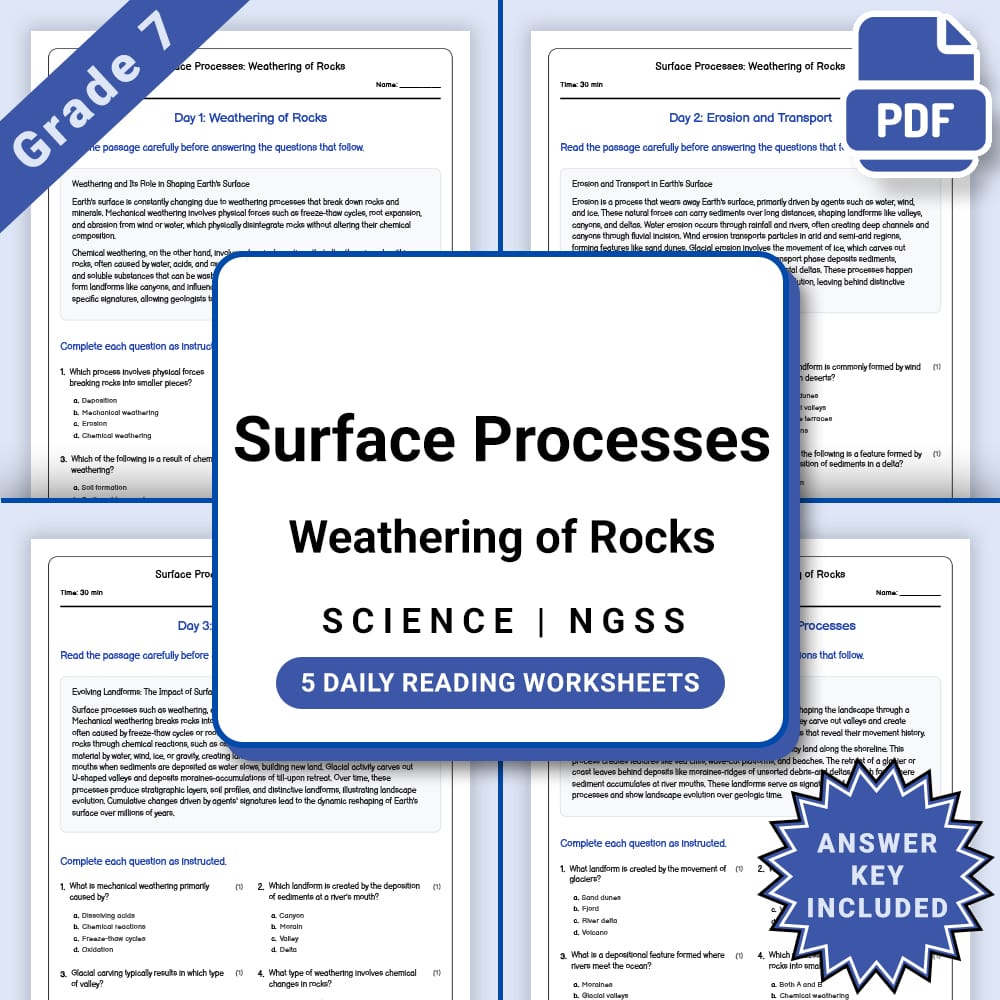
Grade 7 Science – Weathering of Rocks Worksheet(PDF + Answer Key)
Created byCopper Leaf ClassroomLearning Objectives
- Understand the difference between mechanical and chemical weathering.
- Identify agents responsible for weathering processes.
- Recognize how weathering influences landscape formation over time.
Instant download

Grade 7 Science – Meiosis & Genetic Variation | Daily Reading Worksheet
Created byBright Mind ResourcesLearning Objectives
- Describe the process of meiosis and its purpose.
- Understand how meiosis leads to genetic variation.
- Recognize the significance of genetic diversity for species survival.
Also included in: Populations & Traits Grade 7 Science Daily Reading Lesson Bundle | Florida NGSSS +1 more
Instant download
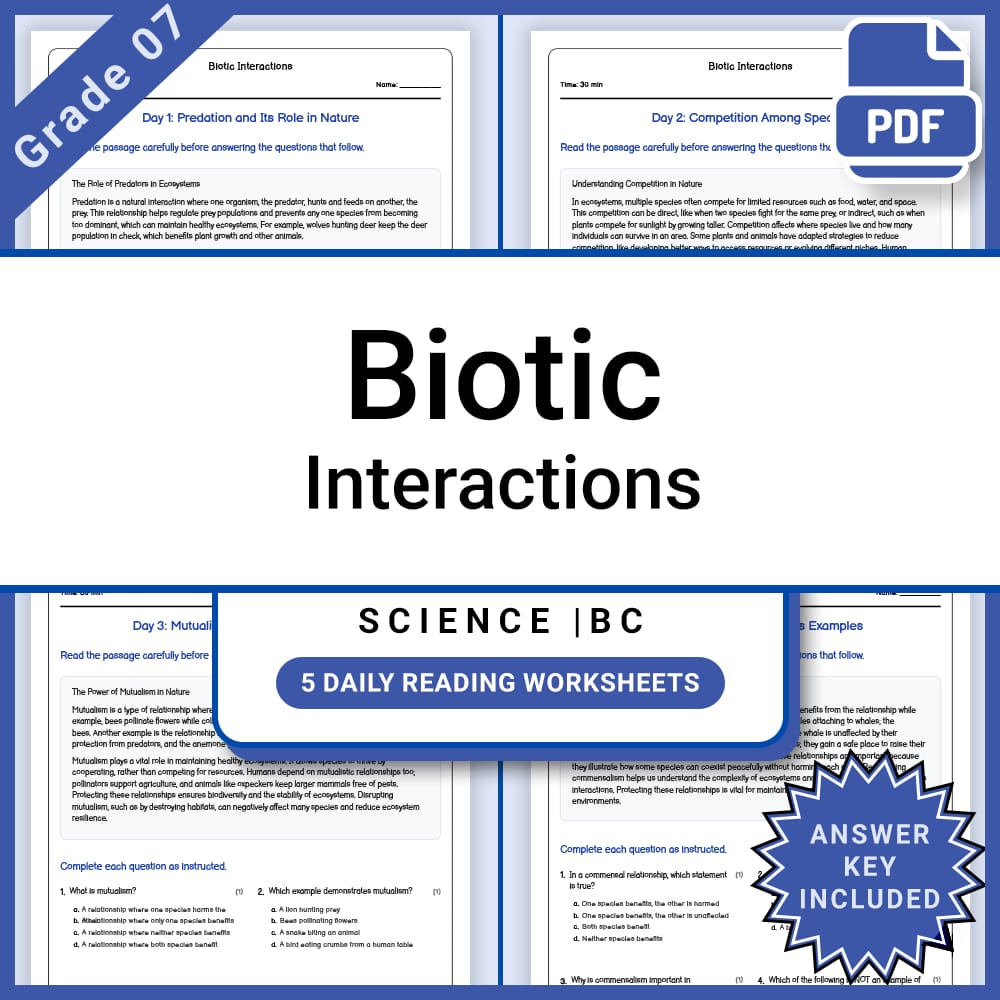
Grade 7 Science – Biotic Interactions Daily Reading Worksheet + Answer Key
JCreated byJ.S SheetsLearning Objectives
- Identify examples of predation in nature
- Understand the impact of predation on populations
- Recognize the role of predators in maintaining ecosystem balance
Also included in: Grade 7 Science Lesson Group: Ecosystems and Population Framework +1 more
Instant download

Science Grade 7 Worksheet Interactions Long-Range Forces | NGSS Grade 7 Science
 Created bySkylark Worksheets
Learning Objectives
- Explain how gravity, electric forces, and magnetic forces can act over a distance without direct contact.
- Describe how mass and distance qualitatively affect gravitational attraction.
- Differentiate electric and magnetic interactions by predicting attraction vs. repulsion using evidence.
Also included in: Grade 7 Forces & Motion Science Lesson Bundle: NGSS Worksheets +1 more
Instant download

Ecosystem Dynamics Worksheet Grade 7 Science Activities | Food Webs & Ecosystems
Created byPrism Point LearningLearning Objectives
- Explain how energy flow and matter cycling work together to support organisms in an ecosystem
- Predict how changes in nutrients, decomposition conditions, or plant growth can affect populations over time
- Describe how ecosystem stability depends on continued cycling of matter and persistent energy availability
Also included in: Life Science - Grade 7 Bundle
Instant download

Grade 7 Science | Evidence From Data Worksheet | NGSSS Aligned
Created byLumora LearningLearning Objectives
- Differentiate direct observations from interpretations in scientific explanations
- Use data features such as units, scales, and graphs to support claims
- Explain how independent trials and evidence agreement increase confidence in conclusions
Instant download

Material Testing Worksheet | Ontario Grade 7 Science Assessment
Created byCedar Grove LearningLearning Objectives
- Explain how tensile, compression, and bending tests reveal key material properties and how these properties guide engineering decisions.
- Describe non-destructive testing (NDT) methods such as ultrasonic testing and hardness measurements and why they are useful.
- Identify sources of variability in materials (e.g., anisotropy and strain localization) and explain how design codes and safety factors address them.
Also included in: Grade 7 Materials Testing & Prototyping Science Lesson Bundle – Ontario +1 more
Instant download

Reaction Evidence Assessment | NGSSS Standard Grade 7 Science
Created byPrism Point LearningLearning Objectives
- Identify macroscopic evidence that indicates a chemical reaction is occurring.
- Differentiate chemical changes from physical changes using observable and irreversible signs.
- Explain how particle rearrangement connects to observations such as gas production, color change, and precipitate formation.
Also included in: Grade 7 Matter, Forces & Energy Science Lesson Bundle | Florida NGSSS
Instant download

Population Interactions Assessment – California Standards Grade 7 Science
Created byPrism Point LearningLearning Objectives
- Explain how predation and competition change access to resources and affect survival and reproduction
- Describe how mutualism can increase persistence of both species through shared benefits
- Connect changes in survival and reproduction rates to population size trends over time
Also included in: Grade 7 Energy Flow and Matter Cycling Science lesson bundle – California Standards +1 more
Instant download

Grade 7 Science | Density Separation in Science - Daily Reading Comprehension
Created byCoral Reef LearningLearning Objectives
- Understand the concept of density and how it relates to separation techniques.
- Identify common methods of density separation, such as decanting, floatation, and centrifugation.
- Explain how buoyant force, sedimentation rate, and centrifugal acceleration depend on particle size and density contrast.
Instant download

Principles of Relative Dating in Rock Strata Worksheets | Grade 7
Created byTeachers ClubLearning Objectives
- Explain how superposition determines relative ages of rock layers
- Identify fossils and unconformities used to correlate rock strata
- Interpret cross-cutting relationships and intrusive contacts in strata
Also included in: Grade 7 Science Earth's Place in the Universe NGSS Worksheets Bundle +2 more
Instant download
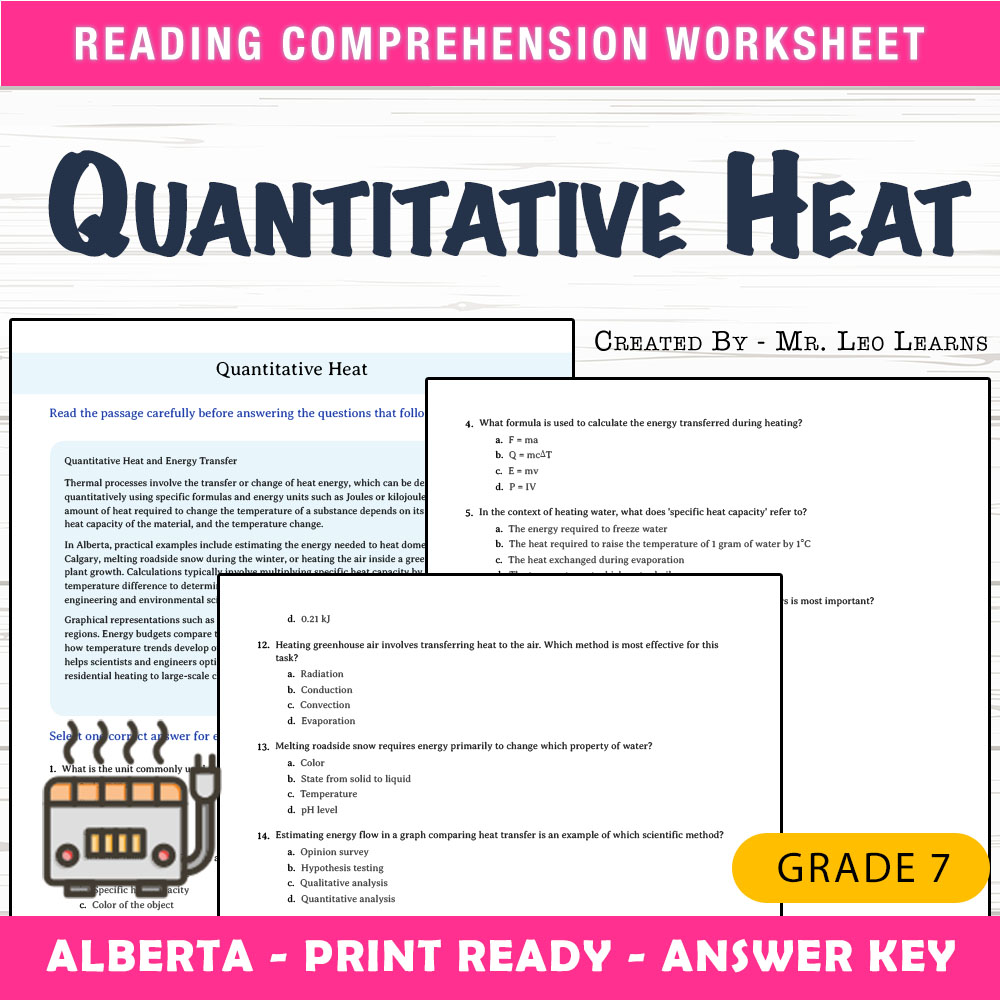
Grade 7 Science — Quantitative Heat Worksheet MCQ Paper for Mastery
 Created byThe Resource Hub
Learning Objectives
- Understand how to express thermal processes through numerical representations of energy transfer.
- Calculate energy transfer using specific heat, mass, and temperature change in Joules and kilojoules.
- Recognize practical examples of heat transfer, such as heating water, melting snow, and warming air in greenhouses.
Also included in: Grade 7 Science Alberta Energy Heat Thermal Processes Worksheet Bundle +1 more
Instant download

Ecosystem Resilience Worksheet for Grade 7 Science | Standards-Aligned Practice
JCreated byJ.S SheetsLearning Objectives
- Define ecosystem resilience and describe how disturbances change ecosystems
- Explain how population changes and community relationships can indicate stability
- Predict how recovery may differ when key species or nutrient cycles are disrupted
Also included in: Grade 7 Ecosystem Dynamics Science Lesson Bundle Worksheets – General +1 more
Instant download

Grade 7 Science | Forces & Unbalanced Forces - Daily Reading Practice
Created byCoral Reef LearningLearning Objectives
- Define what a force is
- Explain the difference between balanced and unbalanced forces
- Identify real-life examples of balanced and unbalanced forces
Instant download
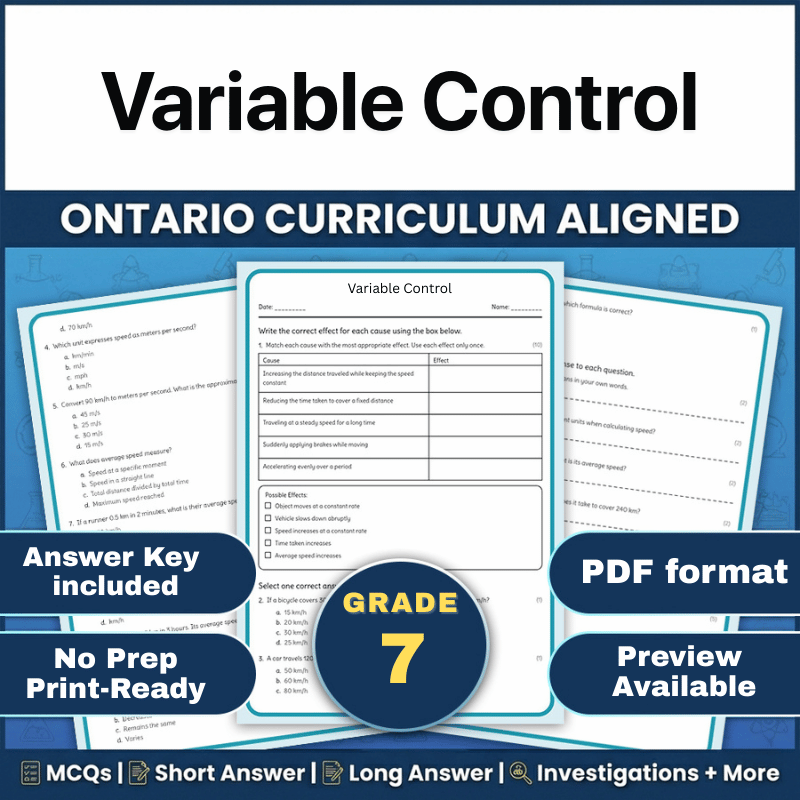
Grade 7 Science | Variable Control Worksheet (Ontario) (PDF)
Created byBright Mind ResourcesLearning Objectives
- Understand the concepts of independent, dependent, and controlled variables.
- Learn how to develop operational definitions for variables.
- Identify sources of confounding and design fair tests to establish causal relationships.
Instant download
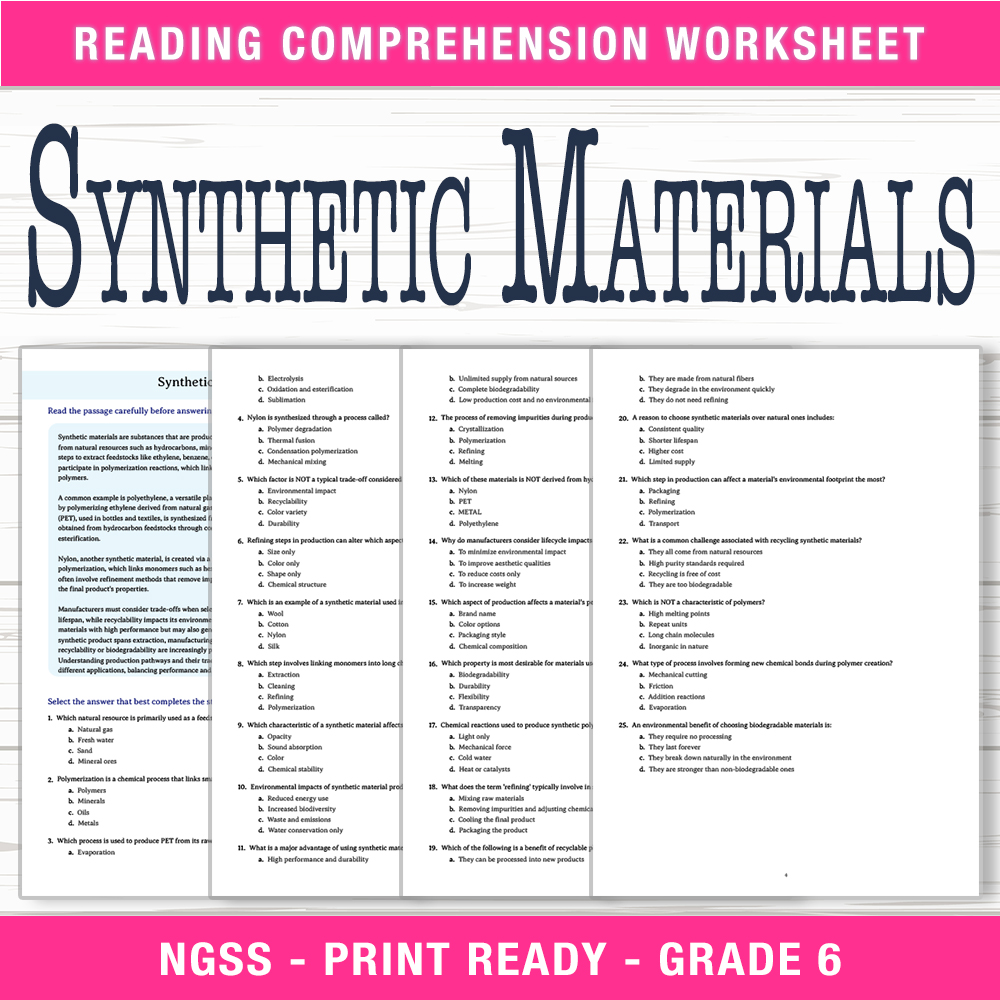
Grade 7 Science | Synthetic Materials Worksheet (PDF + Answer Key)
 Created byRiverstone Classroom
Learning Objectives
- Describe production pathways from natural resources to common synthetic materials, including feedstocks, polymerization, and refining steps.
- Identify examples of synthetic materials such as polyethylene, PET, nylon, and metals derived from ores.
- Analyze trade-offs involved in material choices, including durability, recyclability, and environmental impacts.
Instant download

Grade 7 Science – Design Thinking & Engineering | Daily Reading Worksheet
Created byBright Mind ResourcesLearning Objectives
- Understand the fundamentals of engineering design processes.
- Identify problem constraints and define clear specifications.
- Learn how to evaluate solutions using trade-off considerations.
Also included in: Grade 7 Modeling & Simulation Science Daily Reading Lesson Bundle | Ontario +1 more
Instant download

Food Webs Worksheet | Grade 7 Science Activities
Created byPrism Point LearningLearning Objectives
- Explain how energy flows through interconnected feeding relationships in a food web
- Identify producers, consumers, and decomposers and describe their roles in trophic connections
- Predict how adding or removing a species can change dependencies and stability in an ecosystem
Also included in: Grade 7 Ecosystems & Biodiversity Science Lesson Bundle | Alberta
Instant download

Grade 7 Science | Equilibrium in Physics - Daily Reading Comprehension
Created byCoral Reef LearningLearning Objectives
- Define equilibrium as the state where the net force on an object is zero.
- Differentiate between static and dynamic equilibrium.
- Identify forces such as normal, gravitational, and tension in objects at equilibrium.
Instant download

Seasonal Sun Patterns Worksheet Grade 7 Science | Earth-Sun System Activity
Created byPrism Point LearningLearning Objectives
- Explain how Earth’s axial tilt and orbit change the Sun’s apparent height and daylight length over the year.
- Describe how seasonal patterns differ between the Northern and Southern hemispheres.
- Use evidence-based reasoning to connect solar energy distribution to summer and winter temperatures.
Instant download

Grade 7 Science | Mass Measurements Worksheet | BC Aligned
Created byLumora LearningLearning Objectives
- Understand the concept of mass conservation in closed systems during chemical changes.
- Identify factors that influence the accuracy of mass measurements and their impact on conservation assessments.
- Recognize the importance of including all phases and accounting for gases or dissolved species when measuring mass.
Also included in: Grade 7 Science | Matter & Chemical Change Unit Bundle | BC Aligned
Instant download

Grade 7 Science | Conservation Status of Species - Daily Reading Comprehension
Created byCoral Reef LearningLearning Objectives
- Understand how conservation status is assessed for different species.
- Identify key criteria used in evaluating conservation risk.
- Interpret information about threats, recovery potential, and population trends.
Also included in: Interactions and Ecosystems Lesson Bundle Grade 7 Science – Alberta +1 more
Instant download
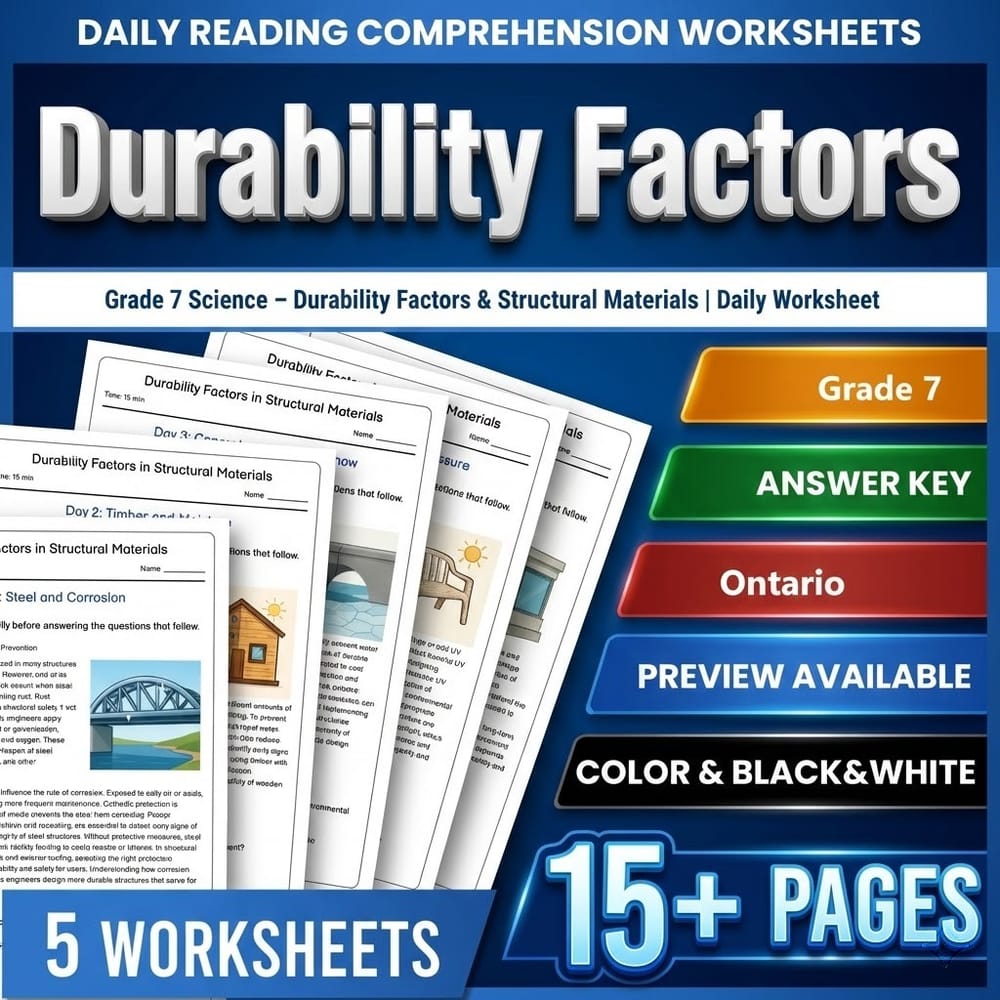
Grade 7 Science – Durability Factors & Structural Materials | Daily Worksheet
 Created byQuiet Forest Education
Learning Objectives
- Understand the causes of steel corrosion and its effects on structure longevity
- Identify protective measures such as coatings for steel and methods to prevent degradation
- Recognize how environmental factors influence material durability over time
Also included in: Structural Engineering Grade 7 Science Daily Reading Worksheets Bundle | Ontario +1 more
Instant download

Grade 7 Science | Solution Comparison in Structural Design - Comprehension
Created byCoral Reef LearningLearning Objectives
- Understand the concept of comparing different bridge truss designs systematically.
- Learn to evaluate architectural options based on performance, cost, durability, and manufacturability.
- Use modeling and comparison techniques to analyze structural solutions.
Instant download

Grade 7 Forming Testable Ecological Questions Science Worksheet Alberta
 Created byBRIGHT PATH RESOURCES
Learning Objectives
- Identify the main idea and key details about ecological inquiry.
- Explain what makes an ecological question testable.
- Describe measurable variables and how evidence supports conclusions.
Also included in: Grade 7 Alberta Science Interactions and Ecosystems Worksheet Bundle +1 more
Instant download
About Grade 7 Science Worksheets
Browse 6,039 printable Grade 7 Science worksheets — ready-to-print PDFs with answer keys where available.
Every worksheet on MyTeachingSheets is created by independent teacher-authors and reviewed before publication. All resources download as printable PDFs for classroom, homework, or at-home practice, and many include answer keys. Preview any worksheet free before buying.