
Grade 7 Science Worksheets
6,039 worksheets
Grade 7 Surface Processes Worksheet | NGSS Earth Science Activity with Answer Key
 Created byNorthstar Worksheets
Learning Objectives
- Explain how weathering, erosion, transport, and deposition change Earth’s surface over short and long timescales.
- Differentiate mechanical and chemical weathering and identify their likely effects on landforms and soils.
- Describe how water, wind, ice, and gravity contribute to shaping features such as canyons, coastal cliffs, moraines, and deltas.
Also included in: Grade 7 Earth Systems Processes Lesson Bundle | NGSS Earth Science +1 more
Instant download

Quantitative Heat Worksheet for Grade 7 Science | Ontario Standards
JCreated byJ.S SheetsLearning Objectives
- Use the heat equation Q = mcΔT to calculate the thermal energy needed to change a substance’s temperature.
- Explain how specific heat capacity relates heat energy, mass, and temperature change.
- Describe how heat-transfer rate depends on area, temperature gradient, and time.
Instant download

Gravity and Weight Worksheet for Grade 7 Science | Standards-Aligned Practice
JCreated byJ.S SheetsLearning Objectives
- Explain how gravity is a force that attracts objects and affects motion near Earth
- Differentiate between mass and weight and describe how weight depends on gravity
- Predict and interpret changes in an object’s motion as gravity accelerates it
Also included in: Grade 7 Matter, Energy & Forces Science Lesson Bundle – Florida NGSSS +1 more
Instant download

Nucleus Function Worksheet | Standards-Aligned Grade 7 Science Practice
JCreated byJ.S SheetsLearning Objectives
- Describe the role of the nucleus in a cell's activities.
- Explain how chromosomes and DNA relate to gene expression.
- Identify the functions of the nuclear envelope and nuclear pores.
Instant download

Grade 7 Science – Convection Systems Worksheet (Alberta Standard) (PDF)
 Created byEvergreen Desk Education
Learning Objectives
- Explain how convection transports heat through fluid motion driven by density changes
- Compare natural convection and forced convection using real-world examples (atmosphere, reservoirs, HVAC)
- Use boundary layer and buoyancy ideas to describe flow patterns and seasonal temperature changes
Instant download

Grade 7 Science | Nucleus Function Worksheet | BC Aligned
 Created byLumora Learning
Learning Objectives
- Understand the role of the nucleus in cellular activities.
- Identify the components of the nucleus and their functions.
- Explain how nuclear processes influence cell growth and response.
Instant download

Grade 7 Erosion And Transport Worksheet | BC Practice & PDF
 Created byClear Sky Classroom
Learning Objectives
- Explain how erosion detaches sediment and how transport moves sediment by water, wind, ice, and gravity
- Describe how transport energy and distance affect grain size and sorting in sedimentary records
- Interpret landscape history using clues such as graded bedding, till, moraines, loess, and dunes
Instant download

Chemical Properties Worksheet Grade 7 Science | Reactions & Evidence
 Created byChalk and Compass
Learning Objectives
- Describe how chemical properties determine how substances behave during chemical changes.
- Identify observable indicators of chemical reactions, including gas evolution, color change, and precipitate formation.
- Explain relationships among reactivity, combustion, oxidation/corrosion, and pH-related transformations.
Also included in: Separation of Mixtures & Matter Properties Lesson Bundle – Grade 7 Science +1 more
Instant download

Weathering Mechanisms Practice Test Prep Worksheet | Grade 7 Science
 Created byPrism Point Learning
Learning Objectives
- Explain how physical, chemical, and biological weathering break down rock at Earth’s surface.
- Describe how freeze-thaw cycles, thermal expansion, and abrasion contribute to physical weathering.
- Connect oxidation, hydrolysis, and dissolution to chemical changes in minerals.
Also included in: Earth's Systems & Processes Lesson Bundle | Grade 7 Science | BC +1 more
Instant download

Science Grade 7: Material Properties Worksheet | NGSS Alignment Grade 7 Science
 Created bySkylark Worksheets
Learning Objectives
- Distinguish physical properties from chemical properties using qualitative and quantitative descriptors.
- Use measurable property data (density, melting point, solubility, conductivity) to compare and identify materials.
- Explain how reactivity and flammability indicate chemical change risk during temperature or contact.
Also included in: Grade 7 Matter, Reactions & Atomic Models Science Lesson Bundle (NGSS) +1 more
Instant download

Grade 7 Science – Geologic Change Hazards | Daily Reading Worksheet
 Created byBright Mind Resources
Learning Objectives
- Understand how plate tectonics cause earthquakes and volcanic activity.
- Identify evidence of geologic processes like faults and lava flows.
- Explain how Earth's surface changes over time through natural processes.
Also included in: Weather, Earth Systems & Human Feedbacks Grade 7 Science Lesson Bundle | General +1 more
Instant download

Energy Accounting Practice Worksheet | Grade 7 Science NGSS Review
Created byPrism Point LearningLearning Objectives
- Use energy bookkeeping to track how motion energy changes during real events
- Explain energy transfers into and out of an object using qualitative and quantitative reasoning
- Connect changes in kinetic energy to thermal, sound, and other energy forms
Also included in: Grade 7 Energy Transfer and Conversion Science Lesson Bundle (NGSS)
Instant download
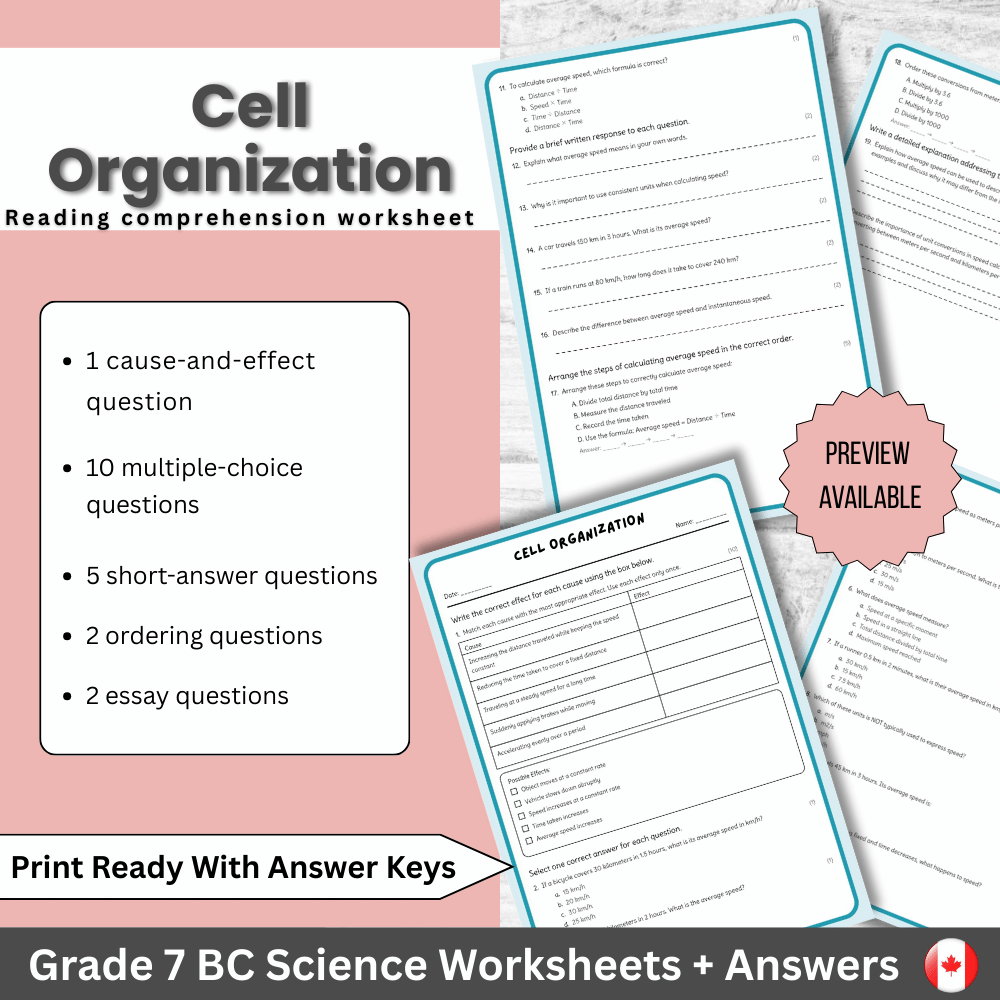
Grade 7 Science | Cell Organization Worksheet + Answer Key – BC Standards
Created byBright Mind ResourcesLearning Objectives
- Understand how cells group into tissues, organs, and systems.
- Identify the functions of different tissue types such as epithelial, muscle, and nervous tissue.
- Describe how multicellular organization supports organism functions and specialization.
Instant download

Grade 7 Science – Data Organization & Analysis | Daily Reading Worksheet
Created byBright Mind ResourcesLearning Objectives
- Understand different types of data used in scientific studies (categorical and numerical).
- Learn how to organize data systematically using tables and logs.
- Recognize standards for metadata, timestamps, and documentation to ensure data credibility.
Also included in: Grade 7 Modeling & Simulation Science Daily Reading Lesson Bundle | Ontario +1 more
Instant download

Energy Flow and Conservation Worksheets | Grade 7 Science
 Created bySunny Desk Resources
Learning Objectives
- Explain how system models show energy inputs, useful outputs, and waste heat using energy flow diagrams or Sankey-style arrows.
- Use energy accounting ideas to describe conservation of energy in mechanical and industrial systems.
- Identify major sources of energy loss and describe how conversion efficiency is determined from an energy flow.
Also included in: Energy, Heat & Thermal Processes Grade 7 Science Alberta Bundle +1 more
Instant download

Adaptation Evidence Worksheet | Standards-Aligned Grade 7 Science Practice
JCreated byJ.S SheetsLearning Objectives
- Understand what adaptations are and how they improve survival.
- Identify different types of evidence that support the existence of adaptations.
- Analyze how environmental changes influence traits in populations.
Also included in: Grade 7 Evolution and Population Dynamics Science Lesson Bundle – Florida NGSSS +1 more
Instant download

Material Properties Worksheets: Structural Performance Grade 7 Science
Created byPrism Point LearningLearning Objectives
- Define density, strength, stiffness, ductility, toughness, and thermal expansion
- Distinguish tensile strength from compressive strength in structural materials
- Compare wood, steel, and reinforced concrete properties
Also included in: Grade 7 Structural Performance Lesson Bundle | Ontario Science +1 more
Instant download

Rock Record Worksheet | Grade 7 Science Activities
Created byPrism Point LearningLearning Objectives
- Explain how the rock cycle creates different rock types and how each can be preserved in the rock record.
- Use sedimentary stratigraphy and fossil evidence to interpret relative changes in Earth’s surface and environments.
- Compare relative and absolute dating methods, including index fossils and radiometric decay.
Also included in: Grade 7 Earth and Space Systems Science Lesson Bundle TEKS Worksheets
Instant download

Grade 7 Heat Transfer Worksheet | NGSS Practice PDF
Created byClear Sky ClassroomLearning Objectives
- Describe the mechanisms of heat transfer: conduction, convection, and radiation.
- Identify examples of heat transfer in real-world situations.
- Explain measurable evidence of energy transfer such as temperature change and rate differences.
Also included in: Grade 7 Energy Transfer Science Lesson Bundle | NGSS +1 more
Instant download

Grade 7 Science | Biodiversity Indices - Daily Reading Comprehension
 Created byCoral Reef Learning
Learning Objectives
- Understand different measures of biodiversity such as species richness and evenness.
- Learn how to interpret diversity values in various habitats.
- Recognize the ecological implications of high and low biodiversity.
Instant download

Grade 7 Science Resource Availability Worksheet | CA Standards PDF
Created byEvergreen Desk EducationLearning Objectives
- Explain how limited resources affect survival and reproduction in ecosystems
- Describe how changes in food, water, space, and shelter can change population size over time
- Connect resource availability to why organisms do not maintain the same numbers in every habitat
Instant download

Grade 7 Science | Climate Drivers and Latitude - Daily Reading Comprehension
Created byCoral Reef LearningLearning Objectives
- Understand how latitude influences Earth's climate patterns.
- Identify the impact of Earth's tilt and position relative to the equator.
- Explain the connection between latitude and temperature variations.
Instant download

Grade 7 Evaporation & Crystallization Worksheet | Ontario Science PDF
Created byClear Sky ClassroomLearning Objectives
- Explain how evaporation and cooling lead to crystallization and the formation of crystals from solution.
- Describe nucleation and crystal growth and how they affect crystal size and shape.
- Identify how impurities and process conditions (evaporation rate and cooling profile) influence crystal purity and yield.
Instant download

Cell Evidence Worksheet | NGSS Grade 7 Science Assessment Practice
JCreated byJ.S SheetsLearning Objectives
- Understand how microscopy reveals cellular structures in plant and animal tissues.
- Identify differences between unicellular and multicellular organisms based on microscopic evidence.
- Compare cellular features such as cell boundaries, plasma membranes, and cell walls in different organisms.
Also included in: Grade 7 Cellular and Organ Systems Science Lesson Bundle: NGSS Practice +1 more
Instant download

Grade 7 Predicting Reactions Worksheet | BC Practice & PDF
Created byClear Sky ClassroomLearning Objectives
- Use physical and chemical properties to predict whether a substance is likely to react in a given situation.
- Identify evidence of chemical change (new substances formed) and relate it to energy changes.
- Apply property trends such as reactivity with oxygen, acid–base behavior, flammability, and solubility to anticipate products.
Instant download
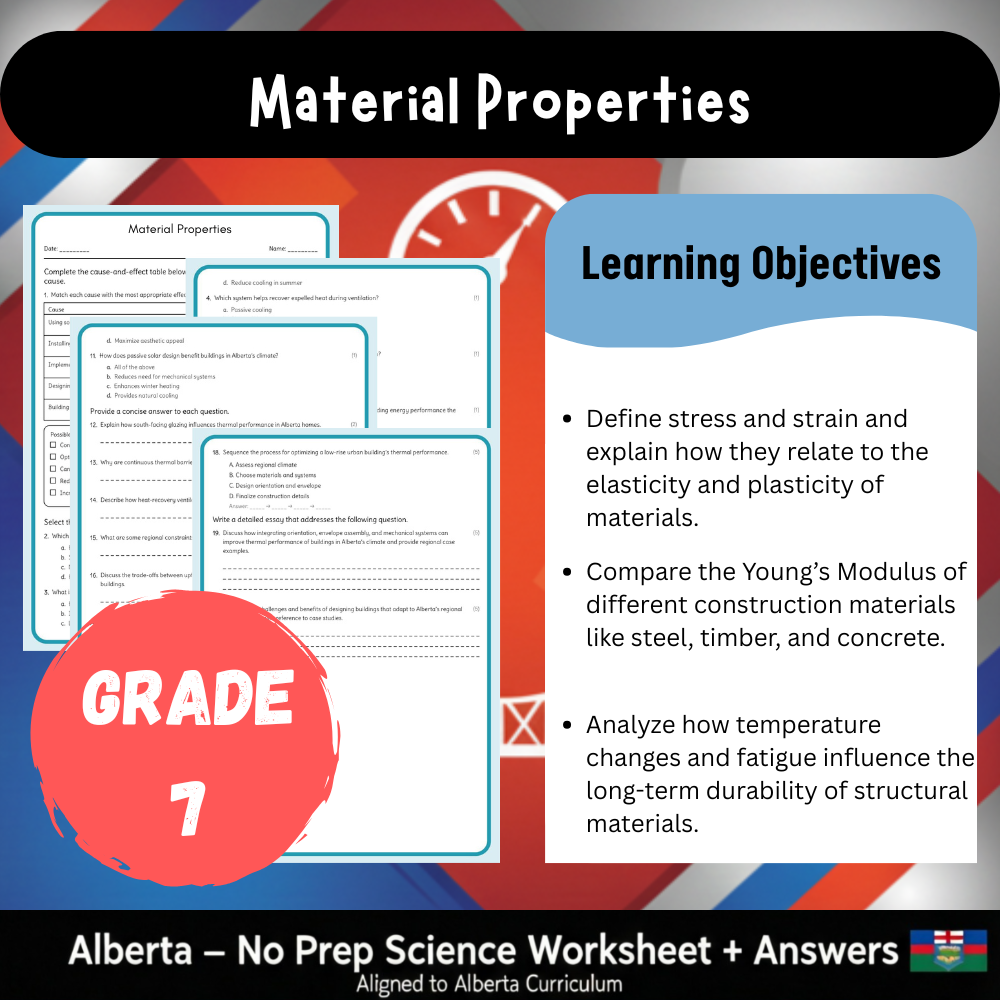
Grade 7 Science – Material Properties Worksheet (PDF) – Alberta Standards
Created byBright Mind ResourcesLearning Objectives
- Understand how different building materials behave under compression, tension, and bending.
- Compare timber, steel, and reinforced concrete regarding strength, stiffness, and environmental resilience.
- Analyze how material behavior influences long-term performance and maintenance in local climates.
Instant download

Grade 7 Climate Patterns Temperature Gradients Worksheet | NGSS Science
 Created byBRIGHT PATH RESOURCES
Learning Objectives
- Understand key concepts related to Science
- Apply knowledge through practice questions
- Demonstrate comprehension of the material
Also included in: Earth Systems Grade 7 Science Daily Reading Worksheets Lesson Bundle | NGSS +2 more
Instant download

Grade 7 Relative Geologic Time Worksheet | NGSS Practice PDF
Created byClear Sky ClassroomLearning Objectives
- Explain how superposition can be used to order rock layers by relative age.
- Use cross-cutting relationships to determine whether a feature formed before or after another feature.
- Construct a relative geologic history using multiple lines of rock evidence.
Instant download

Grade 7 Science | Fitness and Survival - Daily Reading Comprehension
Created byCoral Reef LearningLearning Objectives
- Understand what fitness means in biological terms
- Identify traits that support survival and reproduction in specific environments
- Recognize how changing environments influence trait selection
Instant download
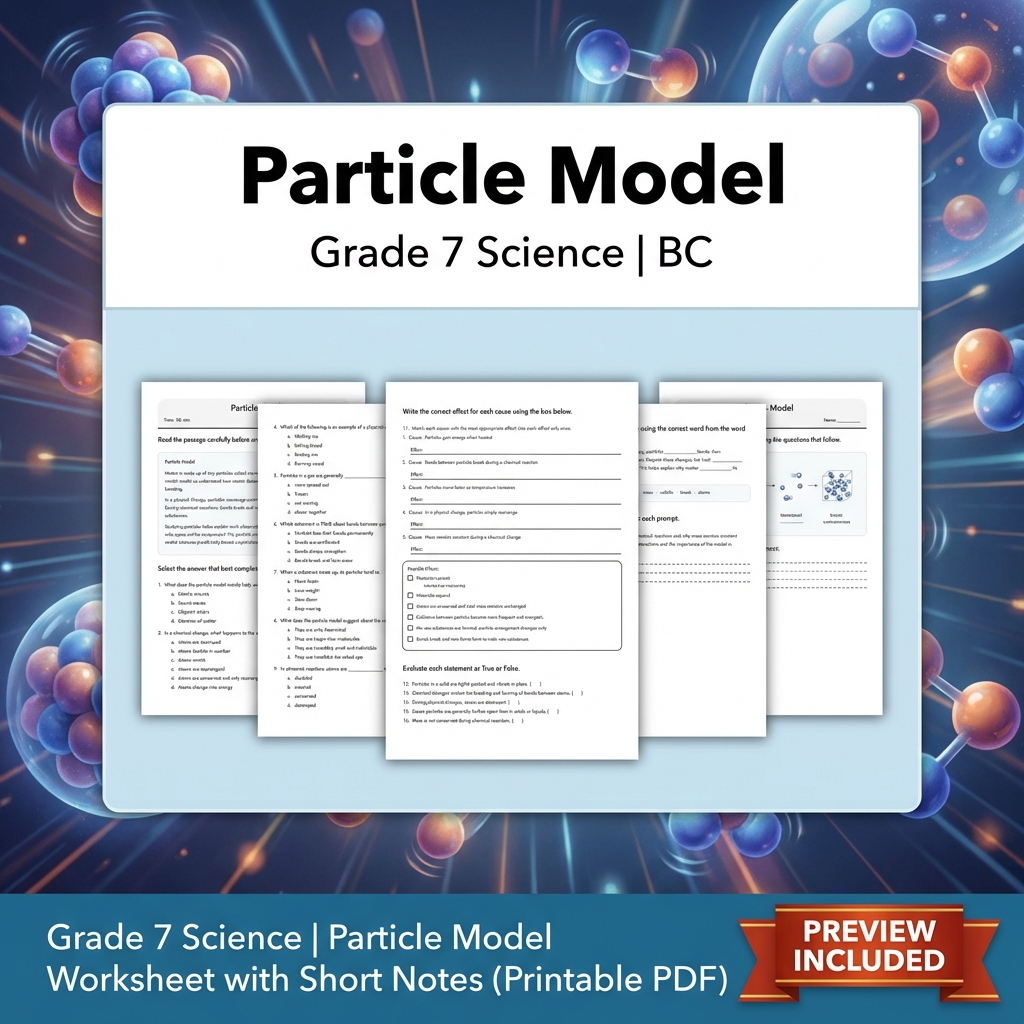
Grade 7 Science | Particle Model Worksheet with Short Notes (Printable PDF)
 Created byMeadowlark Worksheets
Learning Objectives
- Understand the particle model as a representation of matter.
- Explain how bonds between particles change during chemical reactions.
- Describe why mass remains constant during chemical changes.
Also included in: Grade 7 Science Lesson Bundle | BC Framework on Matter & Reactions Worksheets +1 more
Instant download

Grade 7 Science – Scientific Variables & Data Analysis | Daily Reading Worksheet
Created byBright Mind ResourcesLearning Objectives
- Identify independent and dependent variables in experiments
- Understand the importance of controlled variables
- Interpret data from tables and graphs using the concepts of variables
Also included in: Grade 7 Variables Science lesson-bundle daily reading worksheets | Florida NGSSS +1 more
Instant download
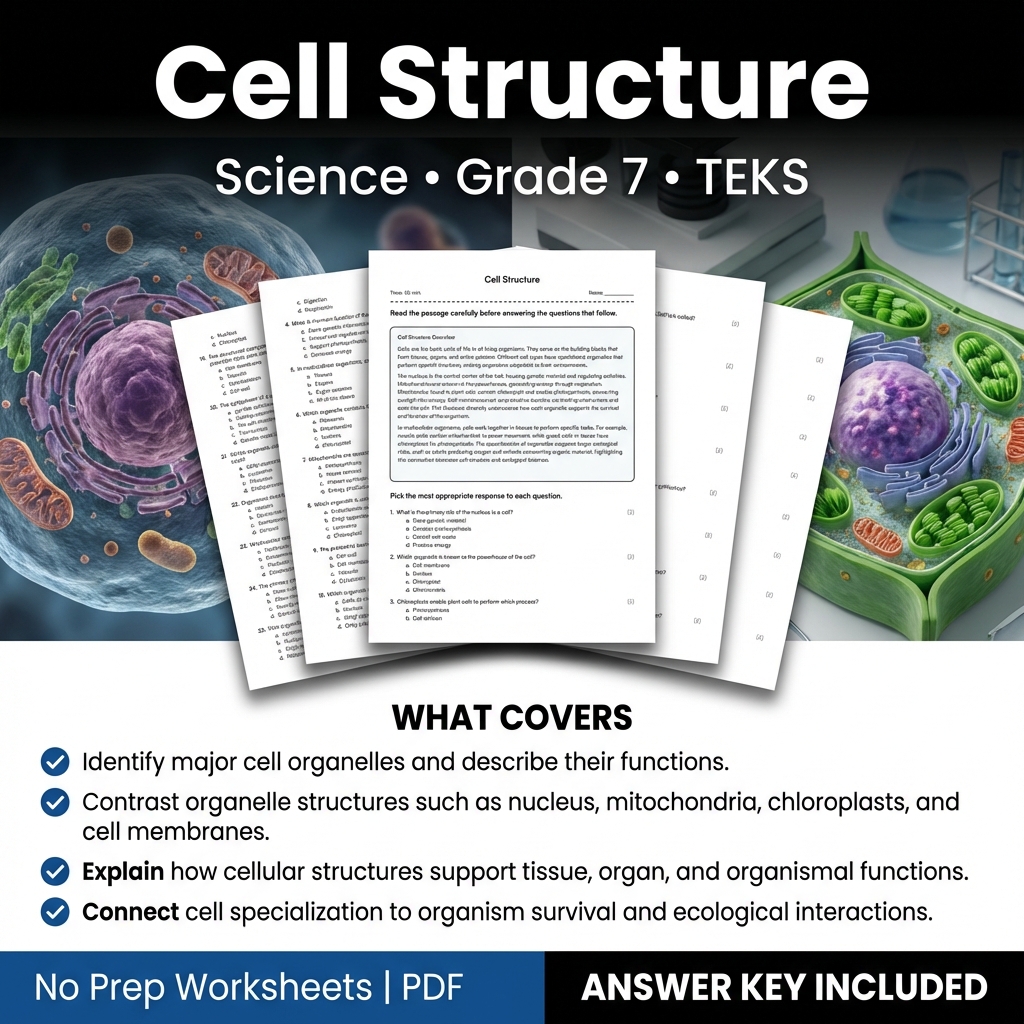
Grade 7 Science Worksheet on Cell Structure | TEKS Aligned Practice
Created byCoral Reef LearningLearning Objectives
- Identify major cell organelles and describe their functions.
- Contrast organelle structures such as nucleus, mitochondria, chloroplasts, and cell membranes.
- Explain how cellular structures support tissue, organ, and organismal functions.
Instant download
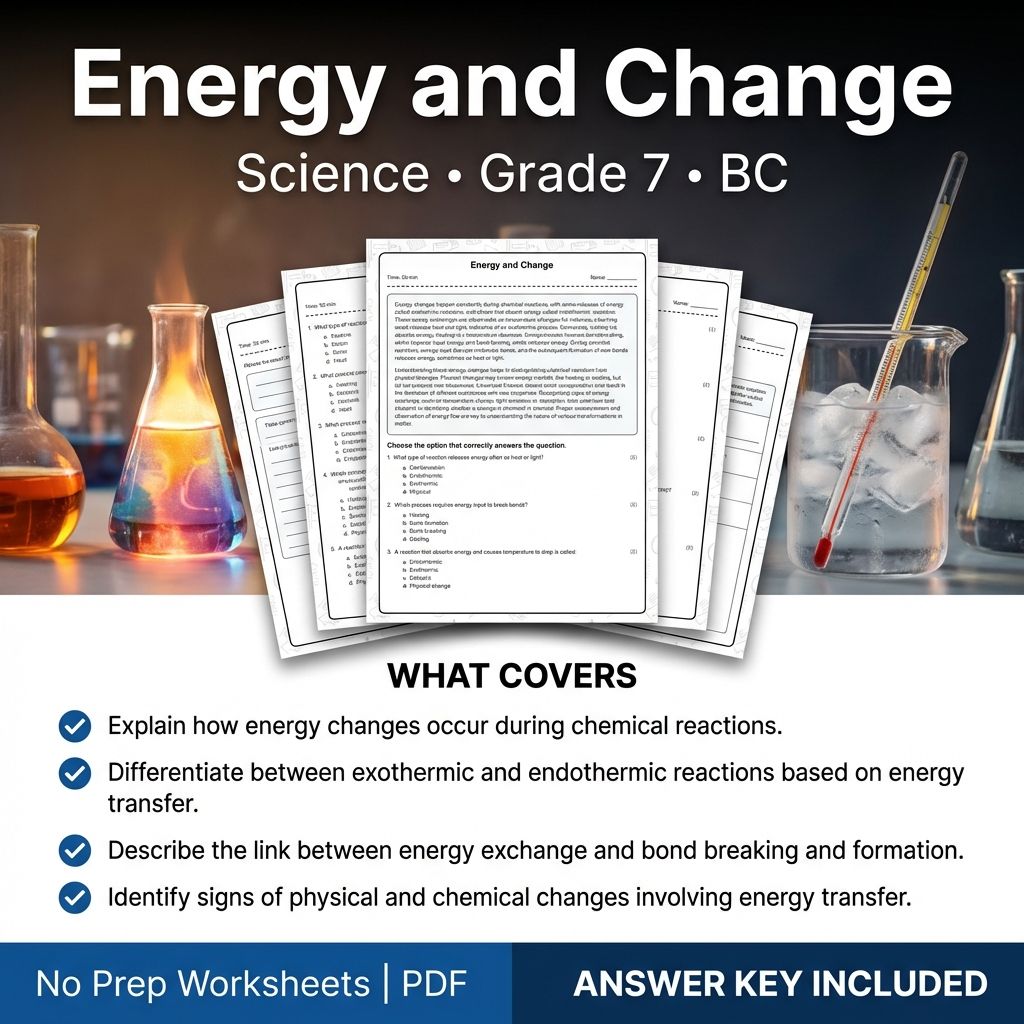
Grade 7 Science Worksheet | Energy and Change Practice + Answer Key (Printable PDF)
Created byCoral Reef LearningLearning Objectives
- Explain how energy changes occur during chemical reactions.
- Differentiate between exothermic and endothermic reactions based on energy transfer.
- Describe the link between energy exchange and bond breaking and formation.
Instant download

Grade 7 Science – Resource Availability & Ecosystems | Daily Reading Worksheet
Created byBright Mind ResourcesLearning Objectives
- Understand the importance of water as a vital resource in ecosystems.
- Identify how resource availability affects organism survival and reproduction.
- Analyze the relationship between resource abundance/scarcity and population changes.
Also included in: Grade 7 Energy Transfer Science Daily Reading: Lesson Bundle | California Std. +1 more
Instant download

Grade 7 Science – Insulation Principles Worksheet (Ontario Standard) (PDF)
Created byEvergreen Desk EducationLearning Objectives
- Explain how insulation reduces heat transfer by limiting conduction, convection, and radiation.
- Compare insulating materials (fibreglass, foam, and reflective foils) based on their thermal resistance and practical thickness.
- Describe how thermal bridging, air leakage, and continuous insulation affect the total heat loss of building envelopes.
Also included in: Grade 7 Thermal Heat Transfer Science Lesson Bundle: Ontario Framework +1 more
Instant download

Plate Tectonics Worksheet | NGSS-Aligned Grade 7 Science Practice PDF
JCreated byJ.S SheetsLearning Objectives
- Understand the geological evidence supporting plate tectonics and continental movement.
- Identify features such as seafloor structures, earthquakes, and volcanoes that indicate plate activity.
- Explain how fossil distributions and rock types record past continental positions.
Also included in: Grade 7 Earth Systems Science Worksheet Set Print Lesson Bundle – NGSS +1 more
Instant download

Grade 7 Building Envelope Worksheet | Ontario Science Activity PDF
Created byClear Sky ClassroomLearning Objectives
- Explain how walls, roofs, windows, and foundations contribute to a building’s thermal performance.
- Describe how thermal bridging and air infiltration affect heat loss and heat gain.
- Identify how insulation placement, continuous barriers, and ventilation work together to manage energy use.
Instant download

Design Process Test Prep Printable Worksheet | Grade 7 Science Ontario
Created byPrism Point LearningLearning Objectives
- Explain how functional requirements and constraints guide design choices.
- Use performance objectives (such as load capacity and stiffness) to compare solution options.
- Apply decision matrices and sketching to select preferred designs using criteria and trade-offs.
Instant download

Grade 7 Science | Survival Structures Worksheet | General Standard Aligned
Created byLumora LearningLearning Objectives
- Explain how internal structures and external features help organisms survive, grow, and reproduce
- Identify how different traits increase an organism’s chance of obtaining resources and avoiding danger
- Use functional relationships to describe how structures support transport, digestion, and coordination
Instant download

Grade 7 Specialized Cells Worksheet | BC Practice & Assessment PDF
Created byClear Sky ClassroomLearning Objectives
- Explain how specialized cell structures help cells perform specific functions in the body
- Match common specialized cells (red blood cells, neurons, root hair cells) to their main roles
- Describe how cell specialization supports tissue and organ function in organisms
Instant download

Grade 7 Science | Insulation Principles - Daily Reading Comprehension
Created byCoral Reef LearningLearning Objectives
- Understand key concepts related to Science
- Apply knowledge through practice questions
- Demonstrate comprehension of the material
Also included in: Energy, Heat and Thermal Processes Lesson Bundle: Grade 7 Science Alberta +1 more
Instant download

Grade 7 Science – Cell Organization & Tissues | Daily Reading Worksheet
Created byBright Mind ResourcesLearning Objectives
- Understand how cells group together to form tissues.
- Identify different types of tissues and their functions.
- Explain how tissues combine to create organs.
Also included in: Cell Function & Transport Grade 7 Science Daily Reading Worksheets Bundle | BC +1 more
Instant download

Grade 7 Conservation Mass Worksheet | Practice & Assessment PDF
Created byClear Sky ClassroomLearning Objectives
- Explain conservation of mass in a closed system during physical and chemical changes.
- Use reactants and products to predict mass relationships in sealed-container reactions.
- Interpret experimental observations to support the idea that atoms are conserved.
Instant download

Grade 7 Science – Monitoring Methods & Ecology | Daily Reading Worksheet
Created byBright Mind ResourcesLearning Objectives
- Understand different ecological monitoring techniques
- Recognize the importance of consistent data collection
- Learn how monitoring data is used to track ecological changes
Also included in: Grade 7 Ecosystems Science Lesson Bundle for Daily Reading Worksheets | Alberta +2 more
Instant download
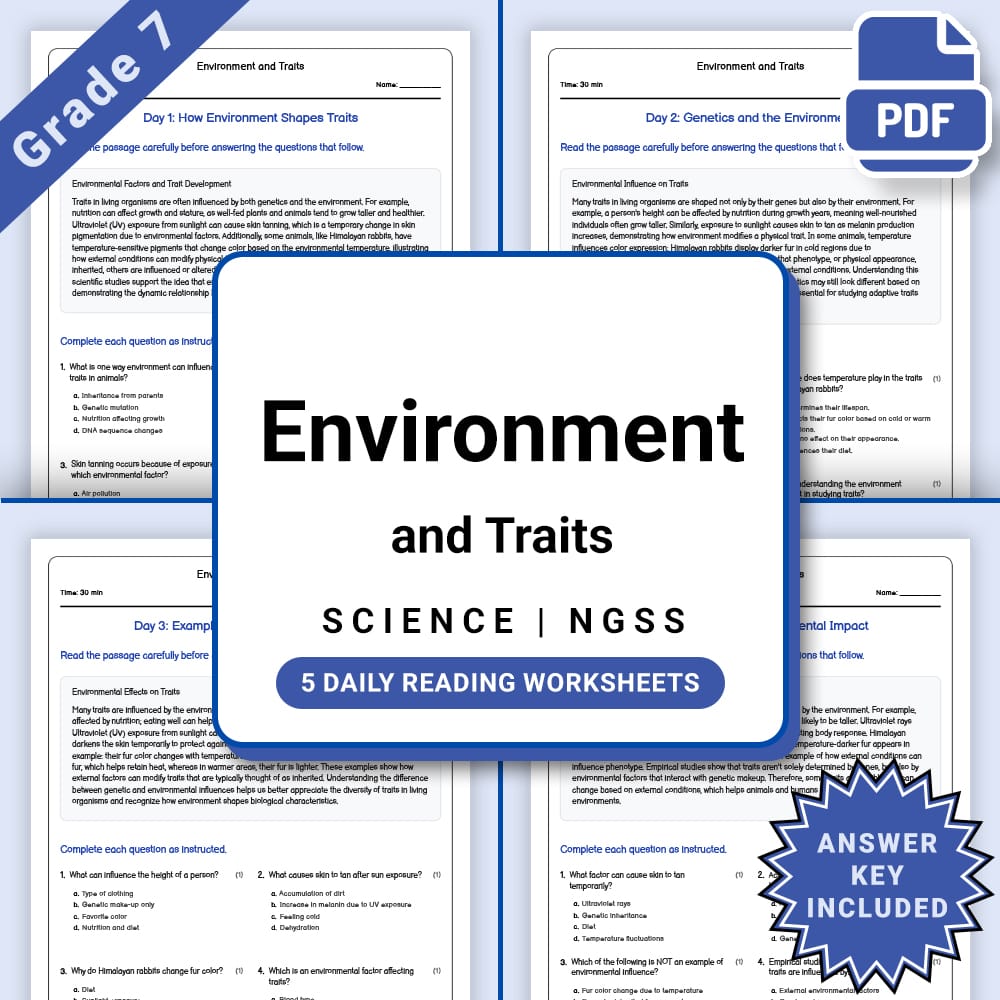
Grade 7 Science – Environment and Traits Daily Reading Worksheet(PDF + Answers)
 Created byCopper Leaf Classroom
Learning Objectives
- Understand how environmental factors influence phenotypic traits
- Identify examples of environmental effects on traits
- Distinguish between inherited traits and environmentally influenced traits
Instant download

Elements Versus Compounds Worksheet | Grade 7 Science Standard Ontario
 Created byCedar Grove Learning
Learning Objectives
- Distinguish elements from compounds using atomic composition and bonding
- Explain how chemical formulas represent fixed ratios of atoms in compounds
- Predict how macroscopic properties (like conductivity and melting point) can change when elements form compounds
Also included in: Grade 7 Matter: Mixtures and Separation Science Lesson Bundle | Ontario +1 more
Instant download
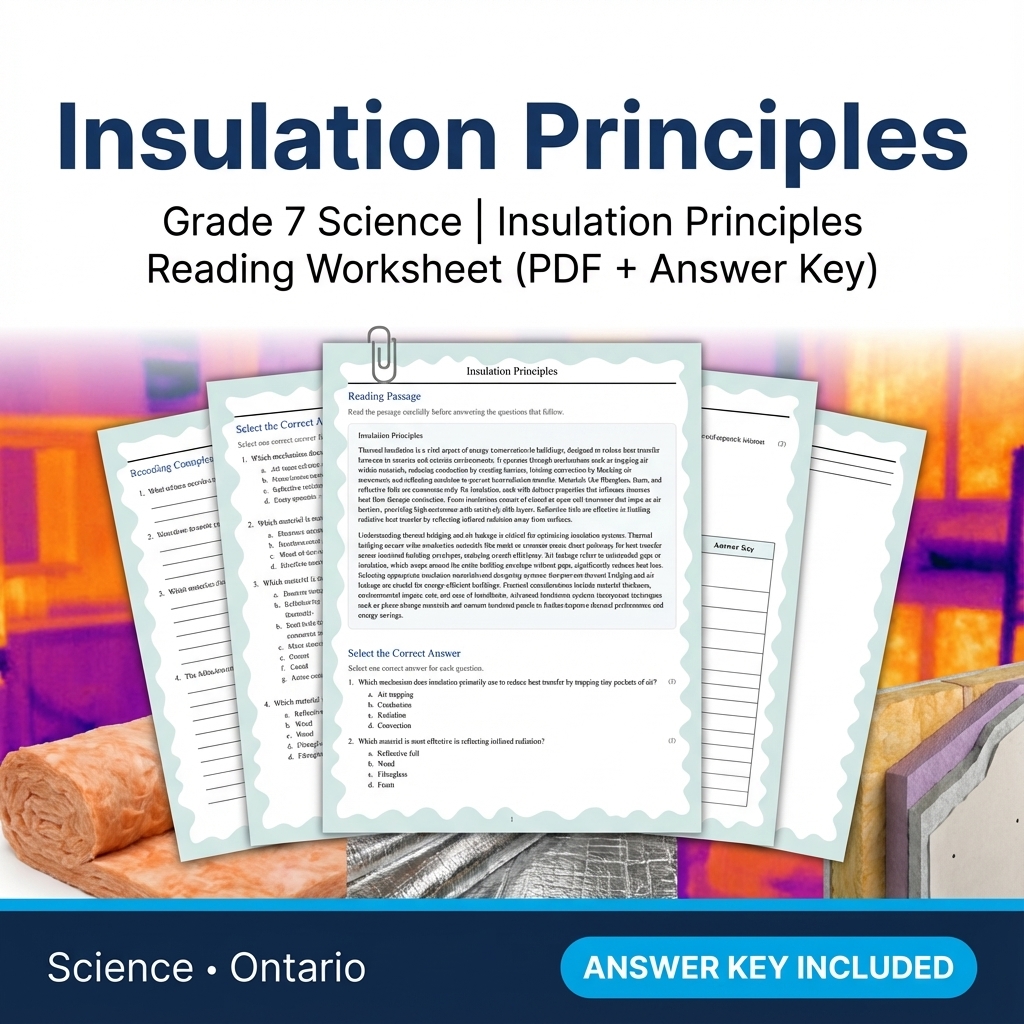
Grade 7 Science | Insulation Principles Reading Worksheet (PDF + Answer Key)
JCreated byJ.S SheetsLearning Objectives
- Understand the mechanisms by which various materials reduce heat transfer in buildings.
- Identify different insulating materials and compare their thermal resistance and practical usage.
- Explain concepts such as thermal bridging, air leakage, and continuous insulation in building design.
Also included in: Grade 7 Science | Thermal Energy & Transfer Worksheet Bundle +1 more
Instant download

Grade 7 Sound Perception Worksheet | General Use Practice PDF
Created byClear Sky ClassroomLearning Objectives
- Explain how sound waves affect loudness and how distance changes perceived intensity.
- Describe how reflection and absorption of sound influence echoes and intensity.
- Connect amplitude and frequency to the brain’s perception of volume (loudness) and pitch.
Instant download
About Grade 7 Science Worksheets
Browse 6,039 printable Grade 7 Science worksheets — ready-to-print PDFs with answer keys where available.
Every worksheet on MyTeachingSheets is created by independent teacher-authors and reviewed before publication. All resources download as printable PDFs for classroom, homework, or at-home practice, and many include answer keys. Preview any worksheet free before buying.