
Grade 7 Science Worksheets
6,039 worksheets
Physical Properties Worksheet | Ontario Grade 7 Science Assessment
 Created byCedar Grove Learning
Learning Objectives
- Define physical properties and explain how they are measured without changing a substance into a new one
- Use measurements such as mass, volume, density, and phase-change temperatures to identify and compare materials
- Relate physical descriptors like electrical conductivity and optical clarity to how substances behave in real applications
Also included in: Grade 7 Matter: Mixtures and Separation Science Lesson Bundle | Ontario +1 more
Instant download

Grade 7 Science Decomposer Recycling Worksheet | Ecosystem Cycle PDF
 Created byEvergreen Desk Education
Learning Objectives
- Explain how decomposers (fungi and bacteria) break down dead organisms and waste and return nutrients to the ecosystem.
- Describe how decomposition supports plant growth and the continuity of matter in food chains.
- Compare how decomposers affect living and nonliving components of an ecosystem.
Instant download

Levels of Organization Worksheet for Grade 7 Science | TEKS Aligned Practice
JCreated byJ.S SheetsLearning Objectives
- Describe the hierarchy of ecological organization from individual organisms to biospheres (organism → population → community → ecosystem → biosphere).
- Identify the roles of producers, consumers, and decomposers and explain how energy moves through trophic levels.
- Explain how structural features at each level can help ecosystems resist change and recover after disturbances.
Instant download

Grade 7 Science Material Testing Worksheet | Standards-Aligned Practice
JCreated byJ.S SheetsLearning Objectives
- Describe how tensile, compression, and bending tests reveal different material behaviors.
- Explain how non-destructive testing (ultrasonic and hardness) helps detect material variability and defects.
- Identify how anisotropy, strain localization, and safety factors influence design decisions for real structures.
Instant download
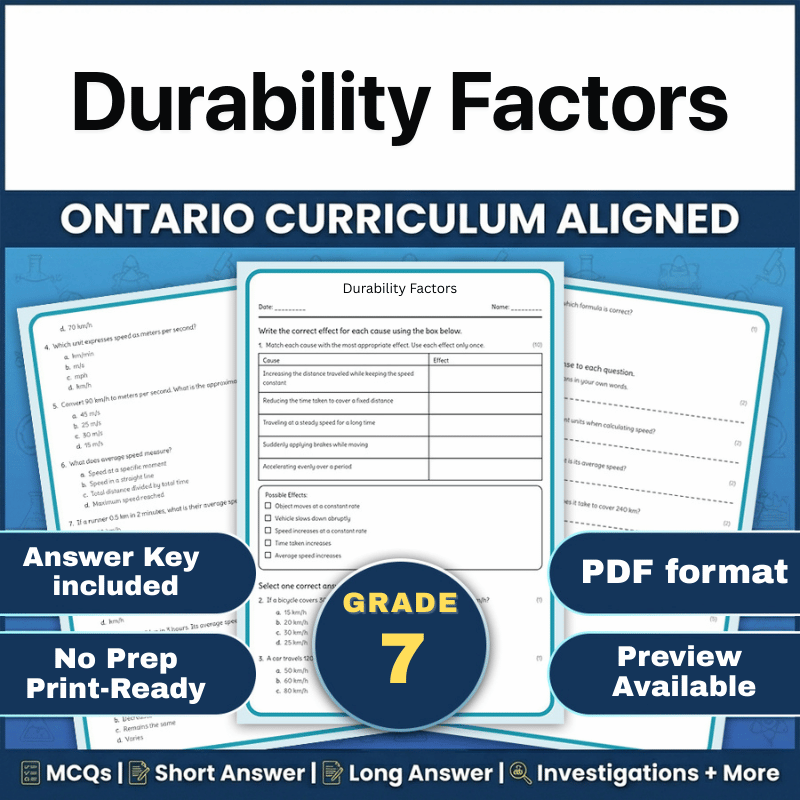
Grade 7 Science – Durability Factors Worksheet (Ontario, PDF)
 Created byBright Mind Resources
Learning Objectives
- Identify factors that affect the durability of materials in structural applications.
- Understand protective measures such as coatings, cathodic protection, and concrete cover.
- Recognize environmental influences like corrosion, rot, freeze–thaw, and UV degradation.
Instant download

Argumentation Models Assessment | TEKS Grade 7 Science Standards-Aligned
 Created byPrism Point Learning
Learning Objectives
- Understand the components of evidence-based arguments, including claims, evidence, and reasoning.
- Evaluate the logical coherence and clarity of constructed arguments.
- Construct and critique arguments using quantitative data, graphical representations, and models.
Also included in: Scientific Inquiry Reasoning Grade 7 Science Lesson Bundle TEKS Unit
Instant download

Grade 7 Member Behaviour Worksheet | Forces, Loads & Structural Response
 Created byChalk and Compass
Learning Objectives
- Describe how structural members respond to applied loads through bending, shear, axial force, and torsion
- Connect bending moment and shear force to deflection and serviceability in beams and cantilevers
- Contrast bending-dominated members with axial-dominated members such as columns and truss bars
Also included in: Grade 7 Science Structural Engineering Design & Materials Lesson Bundle |Ontario +1 more
Instant download

Grade 7 Science – Data Representations Worksheet (PDF) Standard-Aligned
Created byEvergreen Desk EducationLearning Objectives
- Explain how data tables use consistent units and meaningful labels to communicate measurements clearly.
- Read and interpret graphs by using axis labels, scale, and category information to identify patterns.
- Compare groups and describe relationships using trends, clusters, and the direction/shape of patterns rather than isolated values.
Also included in: Grade 7 Model-Based Scientific Reasoning Science Lesson Bundle (General) +1 more
Instant download

Grade 7 Conduction in Solids & Thermal Energy Transfer Science Worksheet
 Created byBRIGHT PATH RESOURCES
Learning Objectives
- Explain the main idea of conduction in solids
- Describe how particle motion transfers kinetic energy during conduction
- Use key vocabulary (kinetic energy, particles, conductivity, interface) to answer questions about heat flow
Also included in: Grade 7 Alberta Science Energy Heat and Thermal Processes Worksheet Bundle +1 more
Instant download
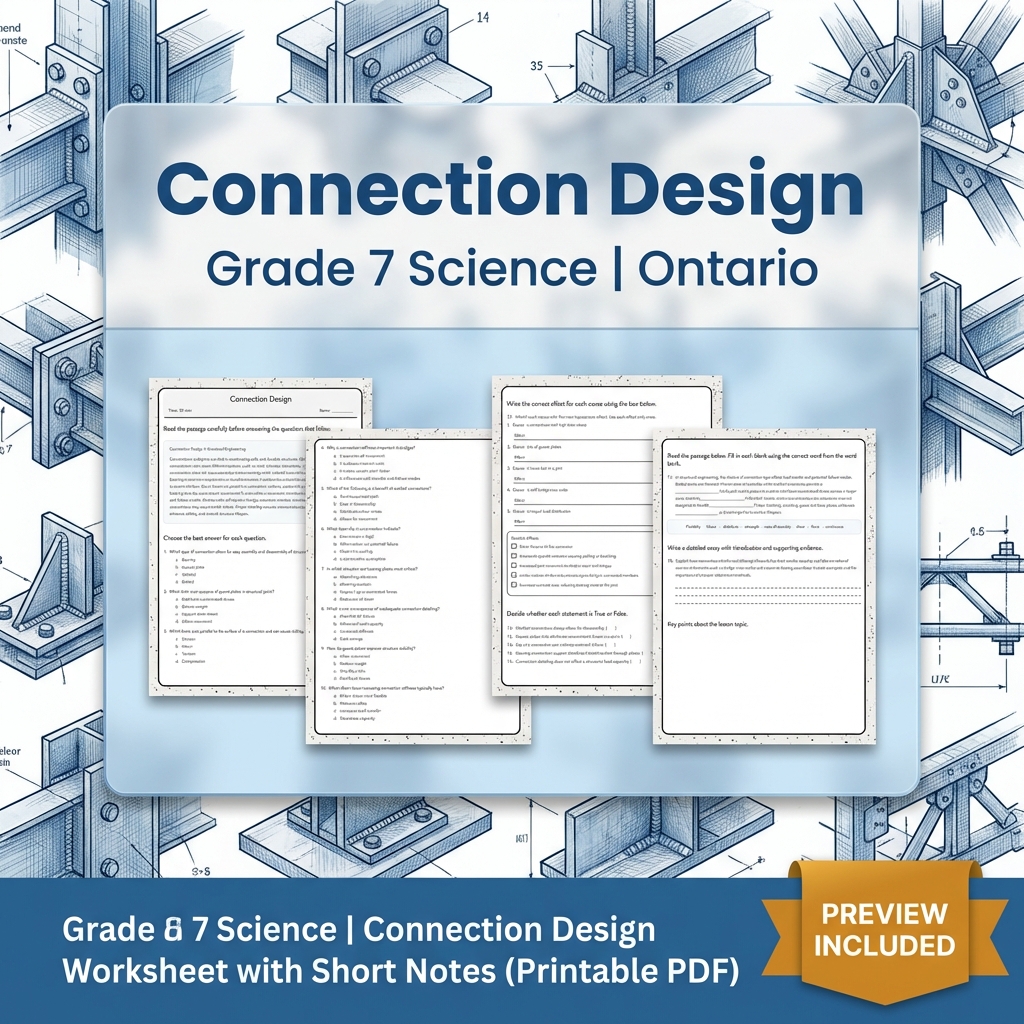
Grade 7 Science | Connection Design Worksheet with Short Notes (Printable PDF)
 Created byMeadowlark Worksheets
Learning Objectives
- Understand the roles of different types of connections and joints in maintaining structural integrity.
- Identify the effects of shear, bearing, and slip at connection points.
- Analyze how gusset plates and base plates distribute forces in structures.
Also included in: Grade 7 Science Lesson Group | Ontario Curriculum Worksheets Bundle +1 more
Instant download

Grade 7 Science | Mitochondria and Cell Energy - Daily Reading Comprehension
 Created byCoral Reef Learning
Learning Objectives
- Describe the structure of mitochondria and explain how it relates to their function.
- Explain the process of cellular respiration in mitochondria and how ATP is produced.
- Identify the role of mitochondria in different cell types with high energy demands.
Instant download

Grade 7 Science – System Models Worksheet (Alberta Standards) (PDF)
 Created bySilver Birch Teaching
Learning Objectives
- Explain how system models trace energy pathways and transformations in mechanical and industrial contexts.
- Use energy accounting to identify inputs, useful outputs, and waste (thermal) losses in a system.
- Interpret energy flow diagrams (including Sankey-style ideas) to calculate and compare conversion efficiencies.
Also included in: Grade 7 Thermal Systems Models and Heat Transfer Science Lesson Bundle – Alberta +1 more
Instant download

Grade 7 Science – Separation Methods Worksheet (PDF) Alberta Standards
Created bySilver Birch TeachingLearning Objectives
- Explain how separation methods use differences in physical properties to separate mixtures
- Identify which separation method best matches a mixture based on properties such as size, solubility, magnetism, and boiling point
- Connect observable outcomes (what remains or what collects) to the underlying classification of the mixture components
Also included in: Grade 7 Matter, Concentration & Reactions Science Lesson Bundle - Alberta +1 more
Instant download

Environment And Traits Test Prep Worksheets | Grade 7 Science
Created byPrism Point LearningLearning Objectives
- Explain how phenotype can result from interactions between inherited genes and environmental conditions.
- Use evidence examples (nutrition, ultraviolet exposure, temperature) to support claims about trait variability.
- Distinguish inherited genetic contributions from environmental modulation when describing observed traits.
Also included in: Grade 7 Genetics Science Lesson Bundle NGSS: Inheritance, Traits, DNA
Instant download

Grade 7 Science | Material Properties in Construction - Reading Comprehension
Created byCoral Reef LearningLearning Objectives
- Understand different material properties such as strength, stiffness, and density.
- Identify how timber, steel, and concrete behave under various forces.
- Analyze the importance of material choice in construction, especially in cold climates.
Also included in: Forces, Structures and Motion Lesson Bundle | Grade 7 Science Alberta +1 more
Instant download

Grade 7 Science | Natural Hazards - Daily Reading Comprehension
Created byCoral Reef LearningLearning Objectives
- Analyze historical earthquake data to identify patterns of frequency and magnitude.
- Interpret hazard maps and recurrence intervals to assess earthquake risk.
- Understand how probabilistic forecasting informs hazard mitigation strategies.
Instant download

Grade 7 Bonding Patterns Science Daily Reading Worksheet | TEKS
Created byBRIGHT PATH RESOURCESLearning Objectives
- Describe how electron transfer can form ions
- Distinguish ionic and covalent bonding using electron behavior
- Connect bonding patterns to observable properties
Also included in: Matter-Energy Grade 7 Science Daily Reading Worksheets Lesson Bundle | TEKS +1 more
Instant download

Grade 7 Science | Revision From Results Worksheet | General Standards
 Created byLumora Learning
Learning Objectives
- Explain how test results guide specific design revisions using success criteria and evidence.
- Identify examples of design changes that improve performance while respecting constraints (safety, materials, and cost).
- Describe how to justify revisions by linking measurements to the cause of failure and expected improvement.
Instant download

Species Adaptations Test Prep Worksheet | Grade 7 Science Ontario
Created byPrism Point LearningLearning Objectives
- Explain how structural, physiological, and behavioral adaptations help organisms survive in specific habitats.
- Describe how selective pressures (temperature, moisture, predation, and resource availability) can shape adaptations.
- Use examples to identify adaptive trade-offs and how different habitats can favor different traits.
Also included in: Grade 7 Ecosystem Science Lesson Bundle | Ontario Test Prep Worksheets
Instant download

Conservation of Mass Worksheet | Grade 7 Science Assessment & Practice
JCreated byJ.S SheetsLearning Objectives
- Understand the principle of conservation of mass in physical and chemical changes.
- Identify observations that demonstrate mass remains constant in sealed systems.
- Explain how atoms are conserved during chemical reactions and phase changes.
Instant download

Energy Flow Worksheet for Grade 7 Science | NGSS-Aligned Practice
JCreated byJ.S SheetsLearning Objectives
- Explain how energy is transferred through different trophic levels in ecosystems.
- Describe the roles of producers, consumers, and decomposers in energy pyramids and food webs.
- Understand the processes of photosynthesis and cellular respiration as mechanisms for energy capture and release.
Also included in: Grade 7 Ecosystem Dynamics Science Lesson Bundle Worksheets – NGSS +1 more
Instant download

Newton's Laws Worksheet | Grade 7 Science Practice & Review
Created byPrism Point LearningLearning Objectives
- Explain how inertia affects motion when forces change.
- Describe the relationship between net force, mass, and acceleration using qualitative reasoning.
- Use action–reaction pairs to predict motion in everyday interactions.
Also included in: Grade 7 Motion, Forces & Energy Science Lesson Bundle for TEKS Practice
Instant download

Mass Relationships Worksheet | Grade 7 Science Activities
Created byPrism Point LearningLearning Objectives
- Explain how conservation of mass applies to closed-system chemical reactions.
- Use mass accounting to relate reactant masses to product masses.
- Interpret theoretical vs. measured mass distributions to assess reaction completeness.
Instant download

Grade 7 Digital Data Tools Worksheet | Ontario Science + Answer Key
 Created byClear Sky Classroom
Learning Objectives
- Identify key components of digital data tools, including sensors, timestamps, sampling rates, and metadata tags
- Use spreadsheet ideas to organize experimental data from CSV-formatted logs
- Apply basic data-cleaning techniques such as handling missing values and correcting formatting issues
Instant download
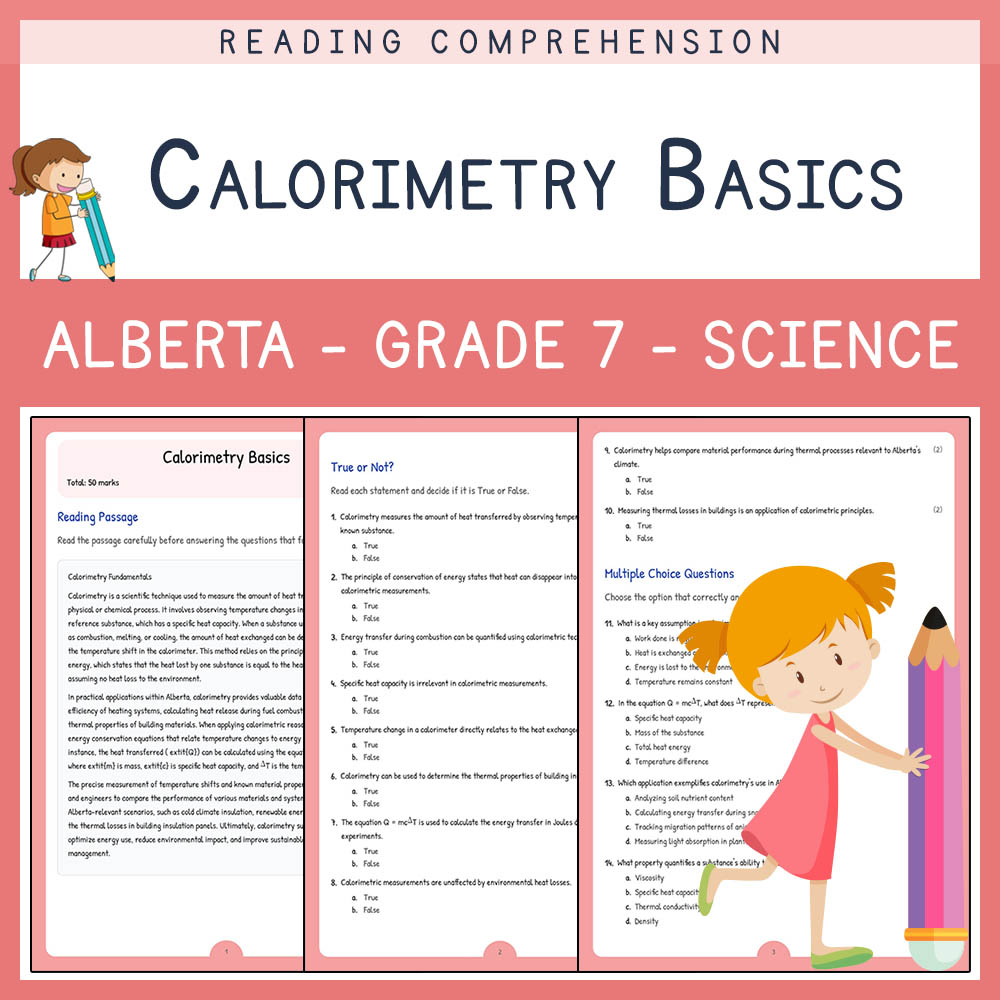
Grade 7 Science | Calorimetry Basics Worksheet | Alberta Standard
Created byLumora LearningLearning Objectives
- Understand the principle of calorimetry and how it measures energy exchange.
- Explain how temperature changes relate to heat transfer in calorimetric experiments.
- Identify real-world applications of calorimetry in thermal scenarios relevant to Alberta.
Instant download

Building Envelope Worksheet Grade 7 Science | Ontario Resource
Created byChalk and CompassLearning Objectives
- Explain how walls, roofs, windows, and foundations of a building envelope affect heat loss and heat gain
- Describe how thermal bridging and air infiltration can reduce a building’s thermal performance
- Identify common measurement indicators used to assess building envelope performance
Also included in: Grade 7 Science Heat Transfer and Thermal Energy Lesson Bundle | Ontario +1 more
Instant download

Air Masses and Fronts Assessment for Grade 7 Science | NGSSS Standards
Created byPrism Point LearningLearning Objectives
- Explain what air masses are and how their temperature and moisture properties affect weather.
- Describe how fronts form when air masses with different properties meet.
- Compare typical weather changes caused by cold fronts versus warm fronts.
Also included in: Grade 7 Earth and Climate Systems Science Lesson Bundle: Florida NGSSS
Instant download

Energy Accounting Worksheet | Grade 7 NGSS Science Energy Transfer Activity
 Created byAmber Owl Education
Learning Objectives
- Connect changes in an object’s motion energy to energy transfers into or out of the object.
- Use energy bookkeeping (accounting for motion energy changes and transferred energy types) to explain real scenarios.
- Interpret qualitative and quantitative examples of energy conversion during braking, collisions, and bouncing.
Also included in: Energy Transfer Worksheets Lesson Bundle – Grade 7 Science NGSS +1 more
Instant download

Grade 7 Science – Indigenous Knowledge Worksheet (PDF) Alberta Standards
Created bySilver Birch TeachingLearning Objectives
- Explain how traditional ecological knowledge (TEK) is based on long-term observations and community learning.
- Describe how oral histories and place-based knowledge can support understanding of species interactions and seasonal cycles.
- Identify examples of stewardship that help maintain healthy ecosystems in Alberta and beyond.
Also included in: Grade 7 Ecosystems & Biodiversity Science Lesson Bundle for Alberta Framework +1 more
Instant download

Grade 7 Balanced Forces Worksheet | Practice & Assessment PDF
Created byClear Sky ClassroomLearning Objectives
- Explain equilibrium as having zero net force and describe how it affects an object’s motion
- Identify common force pairs (such as gravity and normal force) and state whether they are balanced or unbalanced
- Interpret and describe free-body diagrams using arrow direction and relative length
Instant download

Grade 7 Science – Technology Impacts & Society | Daily Reading Worksheet
Created byBright Mind ResourcesLearning Objectives
- Analyze how urban transportation influences city development
- Evaluate environmental, economic, and social impacts of transportation systems
- Develop critical thinking about trade-offs and ethical considerations in technological choices
Also included in: Grade 7 Technology & Engineering Science Lesson Bundle: Daily Reading | TEKS +2 more
Instant download

Grade 7 Earth System Interactions Worksheet | NGSS Practice PDF
Created byClear Sky ClassroomLearning Objectives
- Explain how matter and energy move among the geosphere, hydrosphere, atmosphere, and biosphere
- Describe how a change in one Earth system can trigger changes in other systems
- Use examples to predict how Earth system interactions can affect landforms and water availability
Instant download

Grade 7 Science Worksheet – Data Reasoning & Reliability (PDF)
Created byEvergreen Desk EducationLearning Objectives
- Explain how patterns, variability, and measurement quality affect interpretations of test data.
- Describe what reliability means and how repeated measurements reduce uncertainty.
- Identify common sources of error (tool limits, inconsistent starting conditions, human reading errors) and how they change confidence in conclusions.
Also included in: Grade 7 Investigation & Engineering Science Lesson Bundle: General Framework +1 more
Instant download

Photosynthesis Capture Assessment | California Standards Grade 7 Science
Created byPrism Point LearningLearning Objectives
- Explain how producers use light, carbon dioxide, and water to make sugars during photosynthesis
- Describe how the products of photosynthesis store energy in chemical bonds within biomass
- Connect photosynthesis to energy flow and matter transfer through food chains
Also included in: Grade 7 Energy Flow and Matter Cycling Science lesson bundle – California Standards +1 more
Instant download
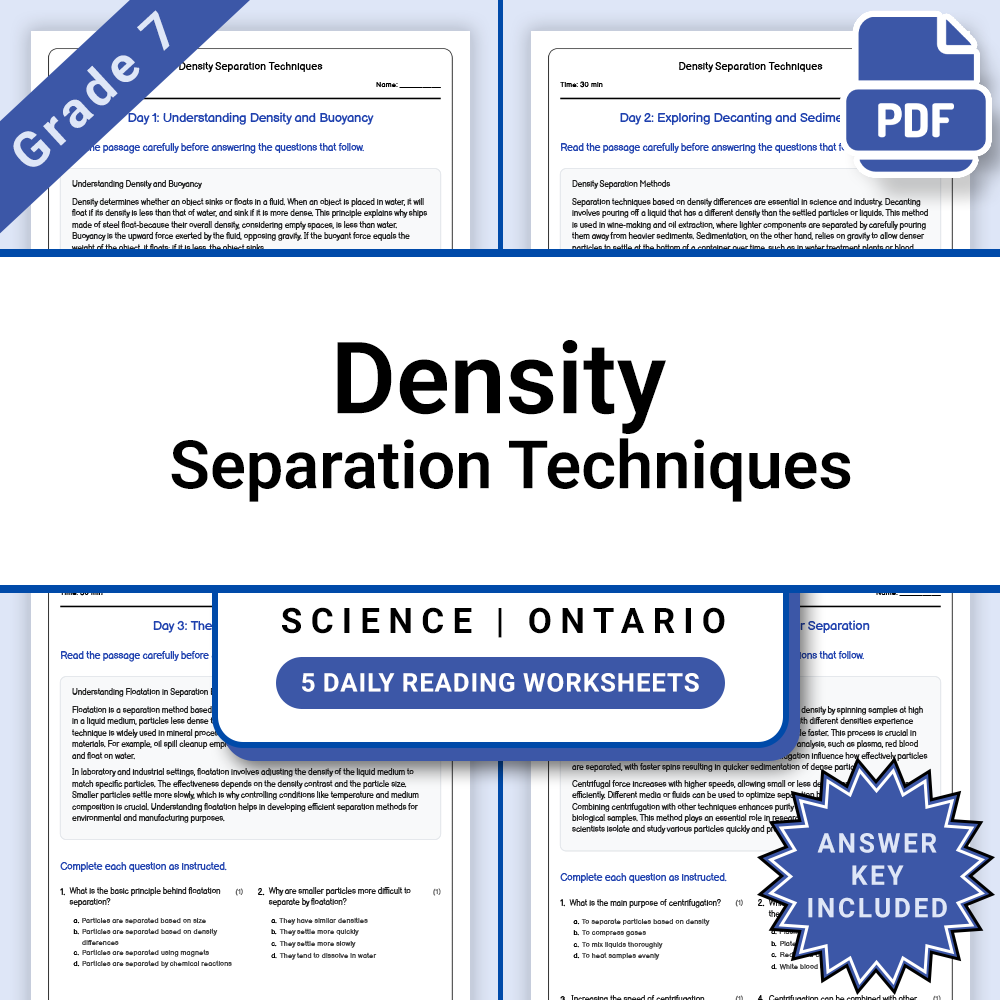
Grade 7 Science – Density Separation Techniques | Worksheet + Answer Key
JCreated byJ.S SheetsLearning Objectives
- Understand key concepts related to Science
- Apply knowledge through practice questions
- Demonstrate comprehension of the material
Also included in: Grade 7 Science Lesson Group | Ontario Framework Worksheets Bundle +1 more
Instant download

Grade 7 Science | Gravity on Objects Worksheet | California Standards
Created byLumora LearningLearning Objectives
- Explain how gravity produces weight and affects the motion of objects near Earth
- Relate gravitational force and acceleration using the role of mass and inertia
- Describe how support forces (normal forces) balance weight when objects are at rest
Instant download

Science Worksheet: Synthetic Materials Assessment | NGSS Grade 7 Science
 Created bySkylark Worksheets
Learning Objectives
- Explain how feedstocks from natural resources can be transformed into synthetic materials through processing steps.
- Describe how polymerization and refining change chemical composition and functional performance.
- Use examples (polyethylene, PET, nylon, and metals) to compare production pathways.
Also included in: Grade 7 Matter, Reactions & Atomic Models Science Lesson Bundle (NGSS) +1 more
Instant download
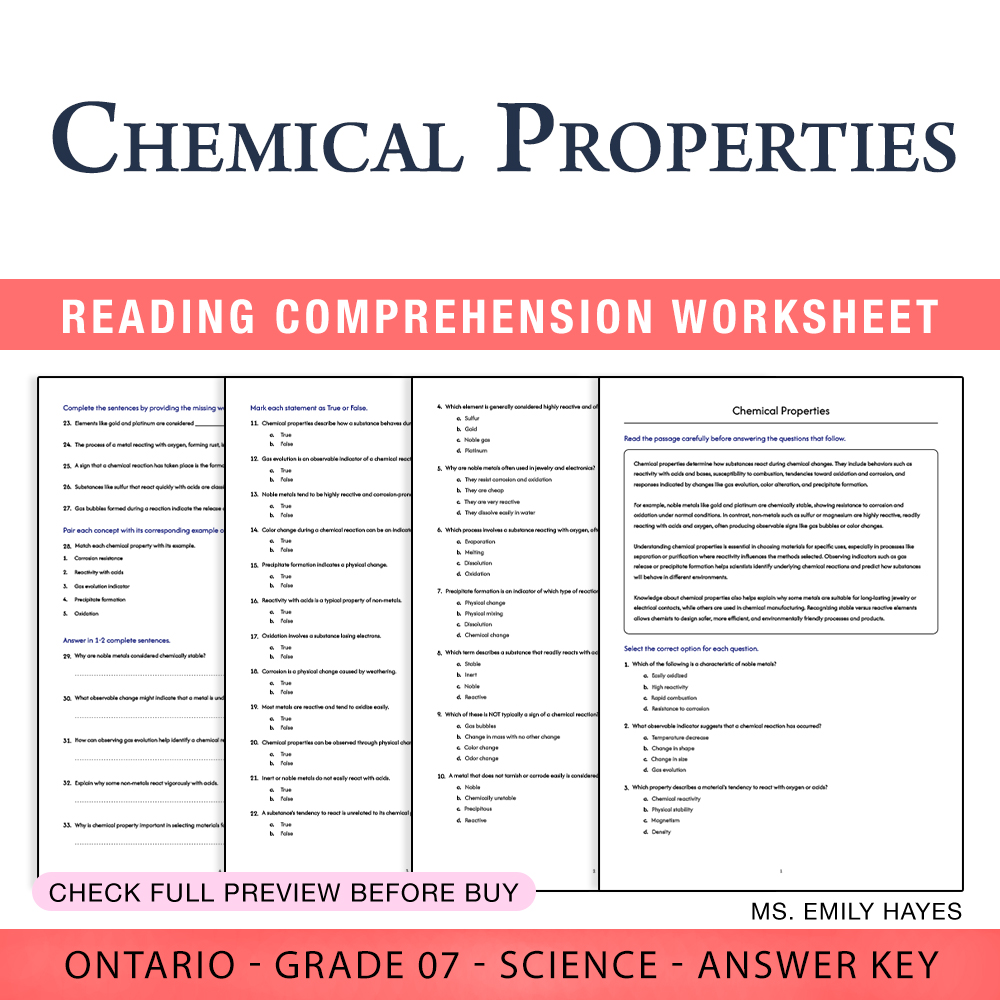
7th Grade Science | Chemical Properties Worksheet (PDF+ Answer Key)
 Created byCopper Leaf Classroom
Learning Objectives
- Understand the concept of chemical properties and how they describe behavior during chemical changes.
- Identify observable indicators of chemical reactions such as gas evolution, color change, and precipitate formation.
- Compare chemical stability of noble metals with reactive non-metals.
Instant download

Grade 7 Population Interactions Worksheet | BC Practice PDF
Created byClear Sky ClassroomLearning Objectives
- Explain how competition, predation, and mutualism affect population sizes and community composition.
- Describe how niches and resource use influence whether species coexist or face competitive exclusion.
- Use evidence from scenarios to identify interaction types and predict possible outcomes.
Instant download

Grade 7 Producers And Consumers Worksheet | BC Practice PDF
Created byClear Sky ClassroomLearning Objectives
- Explain how producers capture energy through photosynthesis and form the base of energy pyramids.
- Distinguish between primary, secondary, and tertiary consumers based on what they eat.
- Describe why energy transfer between trophic levels is inefficient and how this limits population sizes.
Instant download

Grade 7 Science – Energy Relationships Worksheet (Alberta Standards) (PDF)
Created byEvergreen Desk EducationLearning Objectives
- Explain how kinetic and potential energy are related through energy transfer in mechanical systems.
- Use conservation of mechanical energy to predict how changes in height, mass, and speed affect motion (ignoring friction).
- Describe how safety and structural loading depend on how energy changes with speed and elevation.
Instant download

Grade 7 Science | Conservation Applications Worksheet (PDF) – Alberta Standards
Created byEvergreen Desk EducationLearning Objectives
- Explain how the law of conservation of mass applies to closed or near-closed systems
- Use mass budgeting ideas to relate reactants, products, and measurable masses in reaction and environmental contexts
- Interpret differences between measured and expected mass outcomes using conservation-based reasoning
Instant download

Physical & Chemical Changes Worksheet Grade 7 Science Practice Activity
Created byPrism Point LearningLearning Objectives
- Differentiate between physical and chemical changes based on whether new substances form
- Identify evidence of chemical changes such as gas production, precipitate formation, color change, and temperature change
- Classify common everyday examples as physical or chemical changes
Also included in: Physical Science Lesson Bundle | Grade 7 Science | Florida NGSSS
Instant download

Load Path Mapping Worksheets: Structural Redundancy Grade 7 Science
Created byPrism Point LearningLearning Objectives
- Explain primary and secondary load paths in structural systems
- Describe how diaphragms, shear walls, and moment frames affect stiffness
- Explain how structural redundancy provides alternative load routes
Also included in: Grade 7 Structural Performance Lesson Bundle | Ontario Science +1 more
Instant download

Reaction Types Test Prep Printable Worksheet | Grade 7 Science
Created byPrism Point LearningLearning Objectives
- Identify and describe major reaction types (synthesis, decomposition, displacement, acid–base neutralization, and combustion).
- Explain how atoms and mass are conserved when reactants form products.
- Match common chemical reactions to their correct reaction type using particle-level reasoning.
Also included in: Matter & Chemical Change Lesson Bundle — Grade 7 Science British Columbia +1 more
Instant download

Population Limits Worksheet | Ontario Grade 7 Science PDF Assessment
Created byCedar Grove LearningLearning Objectives
- Explain how exponential and logistic growth models differ and identify which one matches given scenarios or graphs.
- Describe limiting factors (food availability, predation, disease, and abiotic stress) and how they affect population size.
- Distinguish density-dependent from density-independent influences and predict effects on population curves.
Also included in: Grade 7 Ecosystem Dynamics Science worksheets lesson bundle Ontario +1 more
Instant download

Grade 7 Science Energy Transfer Worksheet (TEKS) | PDF
Created byEvergreen Desk EducationLearning Objectives
- Explain how energy transfers through conduction, convection, and radiation
- Use temperature gradients to predict the direction and relative rate of heat flow
- Relate specific heat and phase changes to observable temperature and energy changes
Instant download

Grade 7 Meiosis Variation Worksheet | NGSS Practice & PDF
Created byClear Sky ClassroomLearning Objectives
- Explain how meiosis creates genetic variation through chromosome segregation and independent assortment.
- Describe how recombination and the mixing of alleles can lead to differences among siblings.
- Connect genetic variation to survival and reproduction in changing environments.
Instant download
About Grade 7 Science Worksheets
Browse 6,039 printable Grade 7 Science worksheets — ready-to-print PDFs with answer keys where available.
Every worksheet on MyTeachingSheets is created by independent teacher-authors and reviewed before publication. All resources download as printable PDFs for classroom, homework, or at-home practice, and many include answer keys. Preview any worksheet free before buying.