
Grade 7 Science Worksheets
6,039 worksheets
Science Worksheet Trophic Energy Flow Grade 7 | Ontario Standards Printable
JCreated byJ.S SheetsLearning Objectives
- Explain how solar energy becomes chemical energy in producers and then flows through trophic levels.
- Use trophic efficiency ideas to predict how energy availability changes from one level to the next.
- Interpret simple biomass pyramid patterns and describe why higher trophic levels have less energy and biomass.
Instant download

Grade 7 Elements vs Compounds Worksheet | Ontario Science PDF & Answer Key
 Created byClear Sky Classroom
Learning Objectives
- Differentiate elements and compounds by describing their atomic composition and bonding.
- Explain how chemical formulas reflect fixed atomic ratios in compounds.
- Connect macroscopic properties (melting point and conductivity) to the difference between elements and compounds.
Instant download

Grade 7 Science – Forces & Motion | Daily Reading Worksheet
 Created byBright Mind Resources
Learning Objectives
- Understand what forces are and how they act on objects
- Identify different types of forces such as push, pull, friction, and gravity
- Learn how forces affect the motion of objects, including speed, direction, and rest
Also included in: Grade 7 Daily Reading Science Worksheets Lesson Bundle | Florida NGSSS +1 more
Instant download
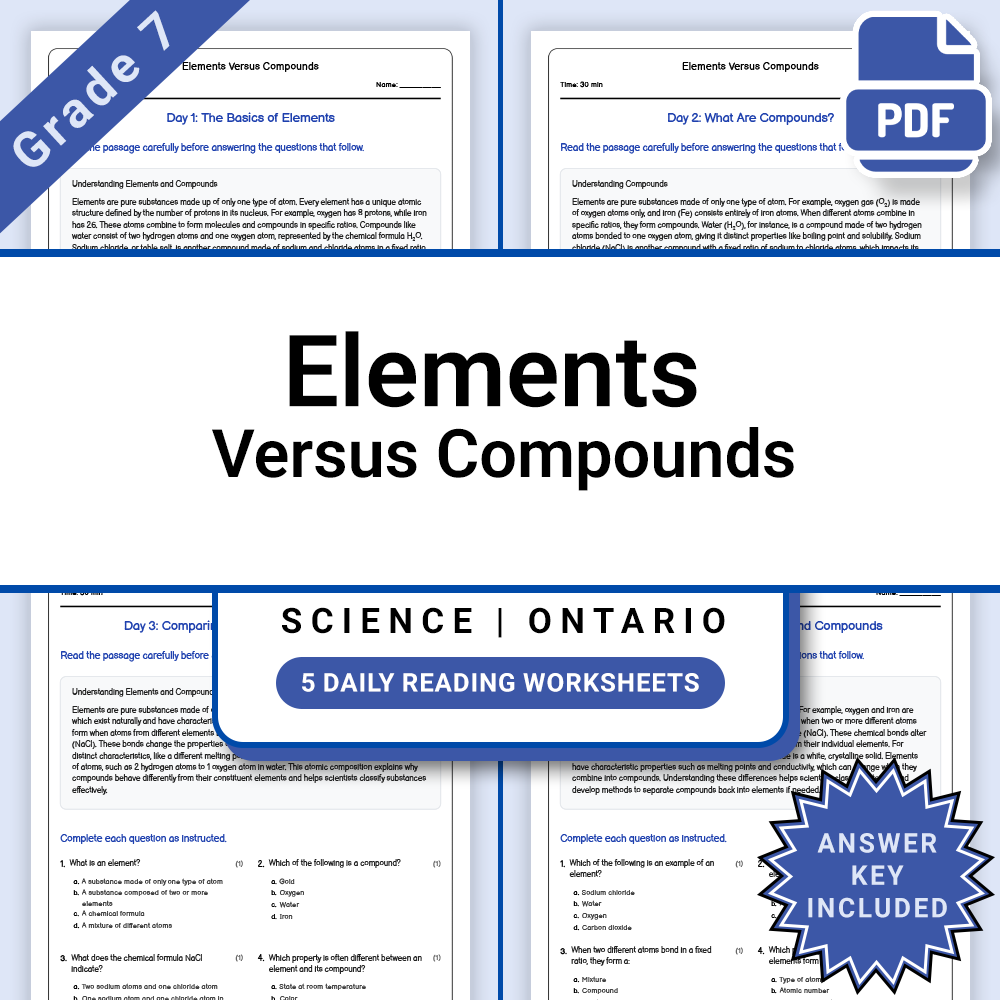
Grade 7 Science – Elements Versus Compounds Daily Reading Worksheet + Answer Key
JCreated byJ.S SheetsLearning Objectives
- Identify and define what elements are, based on atomic composition.
- Differentiate between elements and compounds by their properties and composition.
- Understand the significance of chemical formulas and fixed atomic ratios in compounds.
Also included in: Grade 7 Science Lesson Group | Ontario Framework Worksheets Bundle +1 more
Instant download

Grade 7 Science | Population Interactions in Ecosystems - Reading Comprehension
 Created byCoral Reef Learning
Learning Objectives
- Understand different types of population interactions such as competition, predation, and mutualism.
- Identify examples of competition in natural environments.
- Explain how competition influences species survival and community composition.
Instant download

Grade 7 Science | Energy Transformations - Daily Reading Comprehension
Created byCoral Reef LearningLearning Objectives
- Identify different forms of energy such as mechanical, chemical, electrical, and thermal
- Understand how energy transforms from one form to another
- Recognize real-world examples of energy transformation
Also included in: Energy, Heat and Thermal Processes Lesson Bundle: Grade 7 Science Alberta +1 more
Instant download

Grade 7 Science | Material Selection Worksheet | BC Standards
 Created byLumora Learning
Learning Objectives
- Understand how observable physical and chemical properties influence material selection for specific applications.
- Learn to match material properties such as corrosion resistance, hardness, melting point, solubility, and reactivity to application requirements.
- Recognize the importance of chemical stability, density, and strength in structural and environmental decision-making.
Also included in: Grade 7 Science | Matter & Chemical Change Unit Bundle | BC Aligned
Instant download

Insulation Principles Worksheet | Grade 7 Science Activities
 Created byPrism Point Learning
Learning Objectives
- Explain how insulation reduces heat transfer between inside and outside environments.
- Relate R-value, thickness, and construction details to thermal resistance and comfort.
- Describe how thermal bridges and air leaks can increase heat flow even when insulation is present.
Instant download

Grade 7 Plate Basics Worksheet | BC Practice PDF
Created byClear Sky ClassroomLearning Objectives
- Describe lithospheric plates and how they move on the mantle
- Explain how divergent, convergent, and transform boundaries differ
- Connect plate boundary interactions to earthquakes, volcanoes, and mountain building
Instant download

Net Force Worksheet for Grade 7 Science | Standards-Aligned Practice
JCreated byJ.S SheetsLearning Objectives
- Explain what net force means and how its direction affects motion
- Use vector addition ideas (with 1D sign conventions) to find net force
- Interpret equilibrium and free-body diagrams in real-world systems
Instant download

Solution Comparison Test Prep Worksheet | Grade 7 Science NGSS
Created byPrism Point LearningLearning Objectives
- Use consistent metrics to compare two competing solution designs.
- Identify and quantify trade-offs among performance, cost, durability, and manufacturability.
- Use simple models and prototypes to predict and evaluate observed behavior.
Instant download

7th Grade Science – Physical Change Worksheet (PDF) | BC Standards
 Created byEvergreen Desk Education
Learning Objectives
- Define physical change and explain how it differs from chemical change at the particle level.
- Classify common physical changes, including phase changes and shape/appearance changes.
- Use reversible evidence (changing conditions) to justify why a change is physical.
Instant download

Biodiversity Indices & Community Stability Worksheets Grade 7
Created byPrism Point LearningLearning Objectives
- Explain what species richness and evenness measure in communities
- Interpret biodiversity values when comparing contrasting habitats
- Describe how habitat heterogeneity relates to niche diversity
Also included in: Interactions in the Environment Lesson Bundle | Grade 7 Science | Ontario +1 more
Instant download

Grade 7 Food Building Blocks Worksheet | NGSS Practice PDF
Created byClear Sky ClassroomLearning Objectives
- Explain how food molecules are broken down and rearranged in the body for growth, repair, and maintenance.
- Describe how chemical energy in food becomes usable energy for life processes.
- Use evidence from food and digestion to connect eating habits with changes in body condition over time.
Instant download

Grade 7 Science Worksheet on Physical Change | BC Standards Practice
JCreated byJ.S SheetsLearning Objectives
- Define and identify physical changes in matter.
- Differentiate between physical and chemical changes.
- Recognize common examples of physical changes.
Instant download

Grade 7 Science – Population Factors & Water Availability | Reading Worksheet
Created byBright Mind ResourcesLearning Objectives
- Understand key concepts related to Science
- Apply knowledge through practice questions
- Demonstrate comprehension of the material
Also included in: Grade 7 Ecosystems Science Lesson Bundle for Daily Reading Worksheets | Alberta +2 more
Instant download

Grade 7 Science | Surface Process Evidence Worksheet | General Standard
Created byLumora LearningLearning Objectives
- Explain how internal processes (uplift, deformation, earthquakes, volcanism) can change Earth’s surface
- Describe how external processes (erosion and deposition by water and wind) shape landforms
- Identify evidence of past surface processes using rock strata, landform patterns, and hazard history
Instant download

Grade 7 Science – Newton's Laws of Motion & Inertia Daily Reading Worksheet
Created byBright Mind ResourcesLearning Objectives
- Understand the concept of inertia and Newton's First Law
- Identify real-world examples of inertia and force
- Describe the relationship between mass, force, and acceleration
Also included in: Grade 7 Motion & Energy Science Daily Reading Worksheets Lesson Bundle | TEKS +2 more
Instant download

Modeling and Simulation Worksheet | Grade 7 Science Review & Practice
Created byPrism Point LearningLearning Objectives
- Explain how abstraction and assumptions are used to build useful models of real-world systems
- Describe how parameter choices and units affect the predictions of a model
- Use evidence from observations to validate model outputs and recognize limits of predictions
Instant download
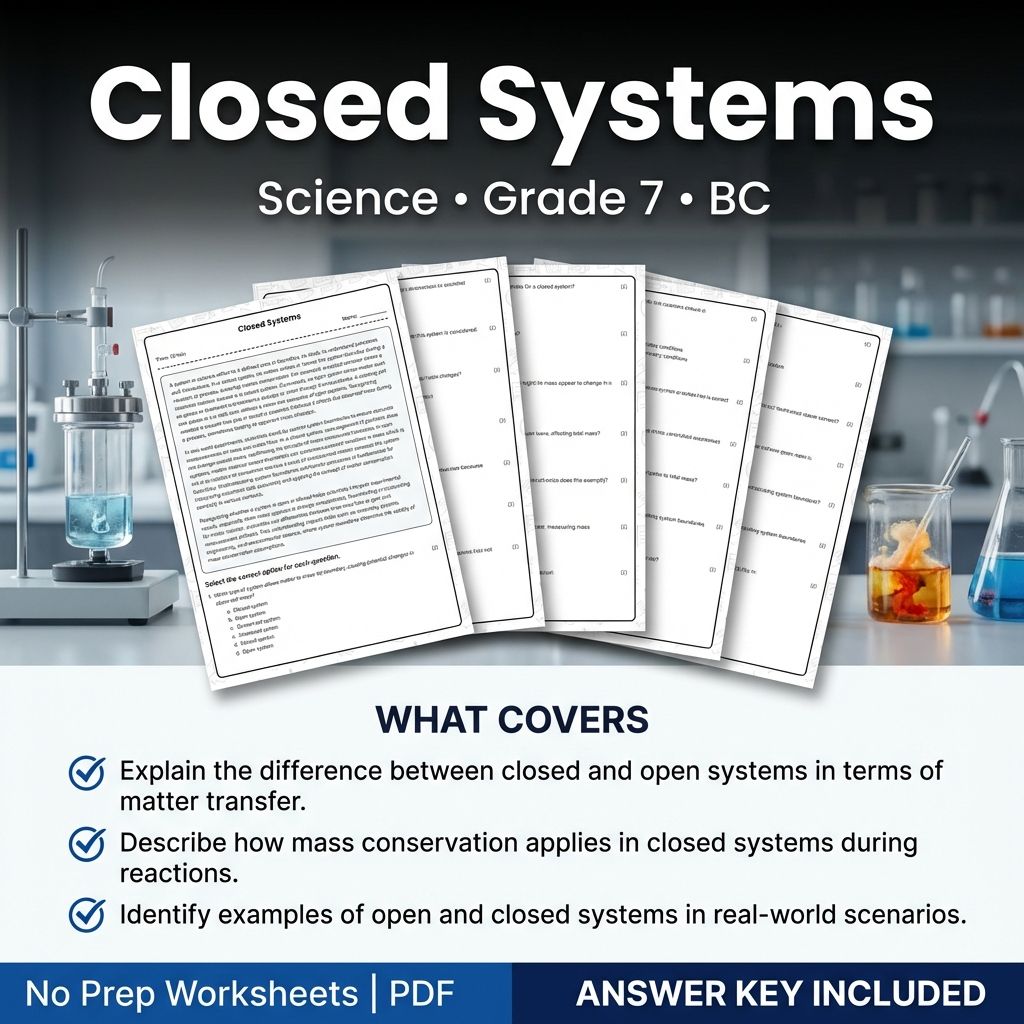
Grade 7 Science | Closed Systems Worksheet & Answer Key (Print-Friendly PDF)
Created byCoral Reef LearningLearning Objectives
- Explain the difference between closed and open systems in terms of matter transfer.
- Describe how mass conservation applies in closed systems during reactions.
- Identify examples of open and closed systems in real-world scenarios.
Instant download

Conservation of Mass in Closed Systems Worksheets Grade 7 Science
 Created bySunny Desk Resources
Learning Objectives
- Explain that mass is conserved in a closed system during physical or chemical changes
- Use reactants and products to predict that total mass before and after remains equal
- Interpret sealed-container observations to support conservation of mass
Also included in: Matter and Chemical Change Grade 7 Alberta Science Worksheets Bundle +1 more
Instant download

Heating Curve Phases Worksheet | Standards-Based Science Practice Grade 7
JCreated byJ.S SheetsLearning Objectives
- Describe the different phases of matter and their particle arrangements during heating.
- Explain how temperature changes relate to phase transitions like melting and boiling.
- Identify patterns in temperature-time graphs during phase changes.
Also included in: Grade 7 Forces and Matter Science lesson bundle – California Standards +1 more
Instant download

Science Grade 7 Energy Accounting Worksheet | NGSS-aligned Assessment
 Created bySkylark Worksheets
Learning Objectives
- Explain how changes in an object’s motion energy relate to energy transferred into or out of the object.
- Use energy accounting to track where kinetic energy goes during braking, collisions, and bouncing.
- Distinguish quantitative (numerical) and qualitative evidence when reasoning about energy transfers.
Also included in: Grade 7 Energy Transformations Science Lesson Bundle for Worksheets (NGSS) +1 more
Instant download

Grade 7 Science – Mass Relationships Worksheet (Alberta Standards) (PDF)
 Created bySilver Birch Teaching
Learning Objectives
- Explain how conservation of mass applies to reactions occurring in a closed system
- Use mass accounting ideas to connect the masses of reactants to the masses of products
- Identify sources of error when measured masses do not match conservation of mass expectations
Also included in: Grade 7 Matter, Concentration & Reactions Science Lesson Bundle - Alberta +1 more
Instant download

Grade 7 Science – Symbiosis Types & Relationships | Daily Reading Worksheet
Created byBright Mind ResourcesLearning Objectives
- Identify different types of symbiotic relationships in ecosystems.
- Describe mutualism, commensalism, and parasitism using regional examples.
- Understand ecological impacts of these relationships on community dynamics.
Also included in: Grade 7 Ecosystems Science Lesson Bundle for Daily Reading Worksheets | Alberta +2 more
Instant download

Grade 7 Science | Erosion & Transport - Daily Reading Comprehension
Created byCoral Reef LearningLearning Objectives
- Understand the processes of erosion by water and how it shapes landscapes.
- Identify the distinctive features caused by water erosion such as valleys and graded beds.
- Recognize the agents involved in erosion and the patterns they produce.
Instant download

Grade 7 Science – Human Impacts on Ecosystems | Daily Reading Worksheet
Created byBright Mind ResourcesLearning Objectives
- Understand the causes and effects of deforestation and habitat loss
- Identify human activities that lead to habitat fragmentation
- Explain how habitat destruction impacts biodiversity and ecosystem functions
Also included in: Grade 7 Ecosystems & Adaptations Science Daily Reading Lesson Bundle | TEKS +2 more
Instant download

Model Limits Assessment | Florida NGSSS Grade 7 Science Printable Assessment
Created byPrism Point LearningLearning Objectives
- Explain how assumptions and simplifications create limits in scientific models.
- Use evidence from observations to identify where a model may need revision.
- Describe how discrepancies can lead scientists to change parameters, add processes, or restructure a model.
Instant download

Grade 7 Load Path Basics Worksheet | Ontario Science Assessment PDF
Created byClear Sky ClassroomLearning Objectives
- Define a load path and identify the primary structural elements it connects (slabs/decks to beams/columns/trusses to foundations).
- Distinguish dead loads from live loads and explain why both matter for design.
- Identify how tension, compression, and shear commonly occur in structural members and why connections matter.
Instant download

Grade 7 Science | Chloroplast Role Worksheet | BC Standards
Created byLumora LearningLearning Objectives
- Understand how chloroplasts capture light energy and convert it into chemical energy during photosynthesis.
- Identify the structures within chloroplasts responsible for absorbing light and generating energy.
- Explain the process of carbon fixation in the stroma and its importance for plant growth.
Instant download

Organ System Roles Practice Worksheet | Grade 7 Science Review
Created byPrism Point LearningLearning Objectives
- Explain how the circulatory, respiratory, and digestive systems work together to support homeostasis.
- Describe how specialized structures (capillaries and alveoli) increase the efficiency of exchange.
- Use accurate science vocabulary to identify roles of organs and systems in transporting and processing materials.
Also included in: Cellular Structure & Function Lesson Bundle | Grade 7 Science | Bc +1 more
Instant download

Grade 7 Action-Reaction Forces Worksheet | Newton’s Third Law Practice
Created byEvergreen Desk EducationLearning Objectives
- Explain Newton’s third law using the action-reaction force pair idea
- Identify action-reaction forces in contact and noncontact situations (including gravity)
- Use force and mass reasoning to predict acceleration direction and relative size
Instant download

Science Grade 7 Load Path Basics Worksheet | Ontario Standards Assessment
JCreated byJ.S SheetsLearning Objectives
- Explain what a load path is and describe how loads transfer from slabs or decks to beams, columns, trusses, and foundations
- Differentiate between dead loads and live loads and identify how they affect structures
- Identify where tension, compression, and shear typically occur in common structural members
Instant download

Grade 7 Science | Thermal Basics in Science - Daily Reading Comprehension
Created byCoral Reef LearningLearning Objectives
- Understand how particle movement relates to temperature
- Identify different ways heat is transferred
- Recognize environmental examples of thermal exchange
Also included in: Energy, Heat and Thermal Processes Lesson Bundle: Grade 7 Science Alberta +1 more
Instant download

Durability Factors Test Prep Worksheet | Grade 7 Science
Created byPrism Point LearningLearning Objectives
- Explain how corrosion, rot, moisture uptake, freeze–thaw cycling, and UV degradation reduce material performance over time
- Describe protective measures (coatings, cathodic protection, and concrete cover) and how they slow deterioration
- Relate service environment and inspection/maintenance choices to expected lifespan of bridge decks and exterior roofing
Instant download
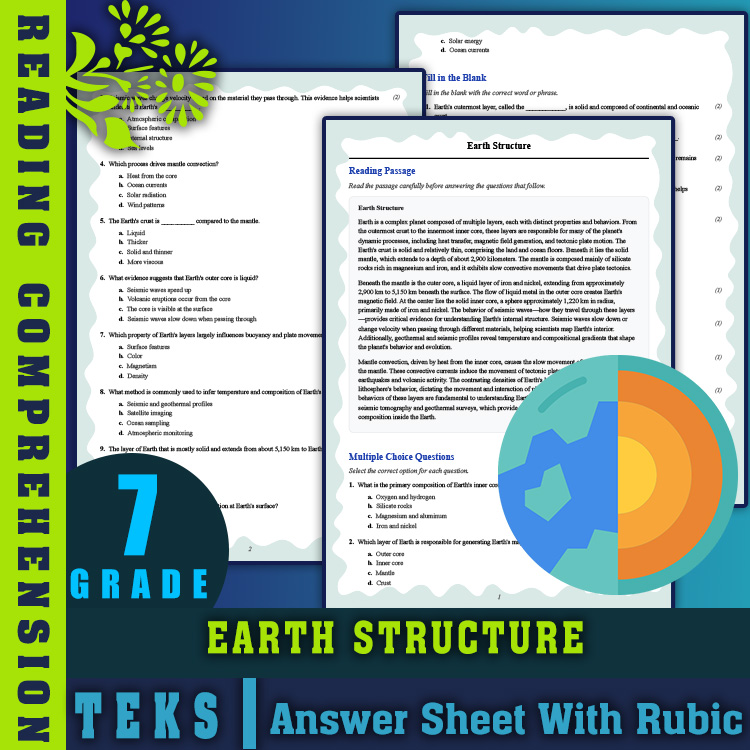
Grade 7 Science | Earth Structure Reading Worksheet (PDF + Rubric)
JCreated byJ.S SheetsLearning Objectives
- Describe Earth's internal layers and their properties.
- Explain how seismic waves provide evidence for Earth's internal structure.
- Understand mantle convection and its role in plate movement.
Instant download

Grade 7 Cell Evidence Worksheet | NGSS Practice & PDF
Created byClear Sky ClassroomLearning Objectives
- Observe plant epidermis and protists using microscopy to identify cellular structures.
- Differentiate between unicellular and multicellular organisms based on microscopic observations.
- Understand the hierarchical organization from cells to tissues and organs.
Also included in: Grade 7 Cell Systems Science Lesson Bundle: NGSS Worksheet B +1 more
Instant download

Grade 7 Representations in Science Worksheet | NGSS Scientific Models Activity
 Created byBRIGHT PATH RESOURCES
Learning Objectives
- Understand different ways to represent matter interactions
- Interpret symbolic chemical equations
- Read and analyze graphs of mass or temperature versus time
Also included in: Chemical Reactions Grade 7 Science Daily Reading Worksheets Lesson Bundle | NGSS +2 more
Instant download

Grade 7 Science Worksheet | Durability Factors and Material Performance (PDF)
Created byEvergreen Desk EducationLearning Objectives
- Explain how environmental conditions (water, salts, freeze–thaw, and UV) lead to material degradation over time.
- Identify protective measures (coatings, cathodic protection, concrete cover, sealers, and detailing) that improve durability.
- Relate maintenance schedules and inspection intervals to expected lifespan and long-term structural reliability.
Also included in: Grade 7 Engineering Design & Materials Science Lesson Bundle Ontario +1 more
Instant download

Grade 7 Science Levels Of Organization Worksheet (PDF) – Alberta Standards
Created bySilver Birch TeachingLearning Objectives
- Identify and describe ecological levels of organization from individuals to ecosystems
- Explain how higher-level patterns (population, community, ecosystem) can’t be predicted from individual traits alone
- Use examples (such as trout in Alberta waters) to distinguish levels by their properties and processes
Also included in: Grade 7 Ecosystems & Biodiversity Science Lesson Bundle for Alberta Framework +1 more
Instant download

Grade 7 Science – Fitness & Survival | Daily Reading Worksheet
Created byBright Mind ResourcesLearning Objectives
- Understand what traits contribute to an organism's survival
- Learn how environment influences which traits are advantageous
- Explore the concept of fitness in different habitats
Also included in: Populations & Traits Grade 7 Science Daily Reading Lesson Bundle | Florida NGSSS +1 more
Instant download

Levers and Pulleys Worksheet for Grade 7 Science Alberta Standards
JCreated byJ.S SheetsLearning Objectives
- Understand how lever classes and pulley systems modify effort and direction of applied forces.
- Explain the concepts of torque, fulcrum placement, and mechanical advantage in simple terms.
- Calculate ideal mechanical advantage for common lever and pulley setups using basic arithmetic.
Instant download

Phase Energy Assessment | Alberta Standards for Grade 7 Science
Created byPrism Point LearningLearning Objectives
- Explain the concepts of particle kinetic and potential energy during phase changes.
- Describe how latent heat phenomena are involved in melting, freezing, evaporation, and condensation.
- Interpret microscopic particle interactions in terms of macroscopic energy changes.
Also included in: Lesson Grade 7 Science Mini Bundle | Matter and Chemical Change +1 more
Instant download

Grade 7 Solution Concentration Worksheet | Practice & Assessment PDF
Created byClear Sky ClassroomLearning Objectives
- Define solution concentration as the amount of solute relative to solvent and explain why concentration matters.
- Use and interpret concentration measures such as mass percent and grams per litre.
- Predict how changing concentration can affect physical properties like freezing point and boiling point.
Instant download
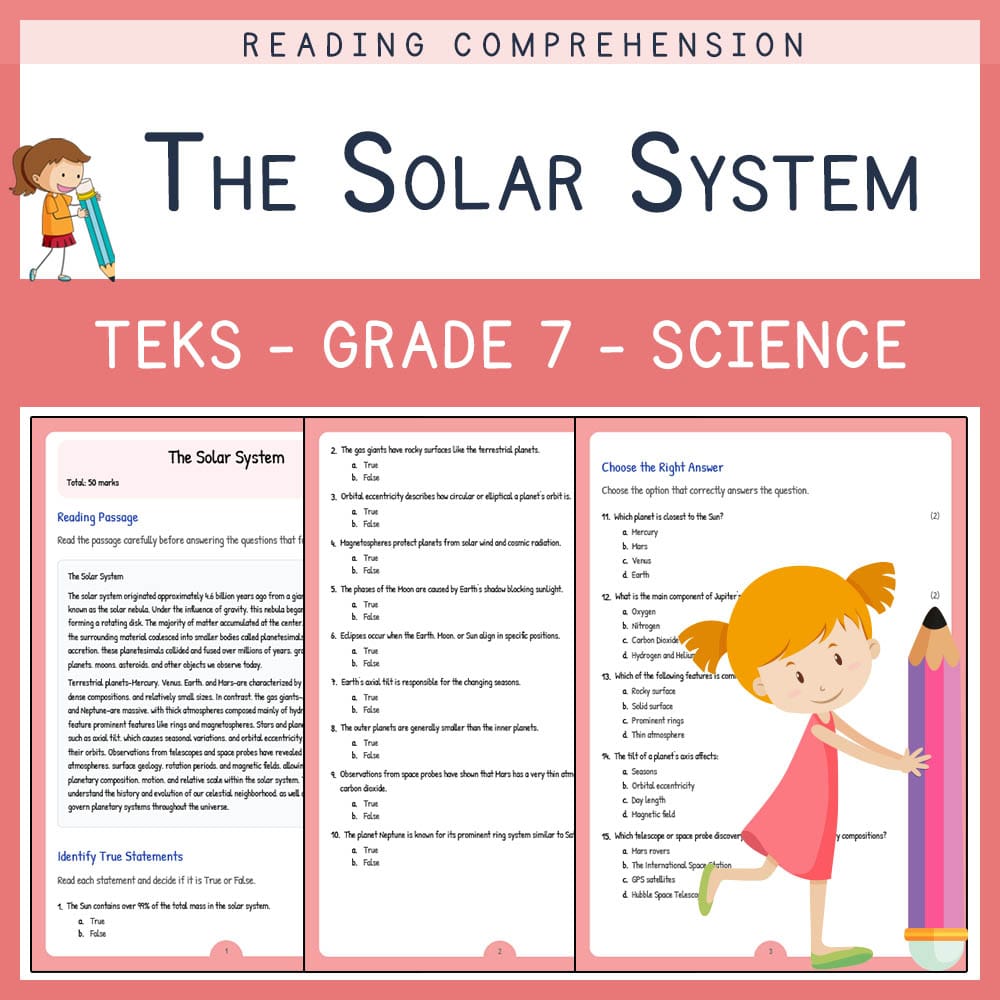
Grade 7 Science | The Solar System Worksheet | TEKS-Aligned
Created byLumora LearningLearning Objectives
- Understand the origins and formation of the solar system.
- Identify key properties and features of planets and other celestial bodies.
- Compare and contrast terrestrial and gas giant planets.
Also included in: Grade 7 Science | Earth and Space Systems Unit Bundle | TEKS Standard
Instant download

Grade 7 Science Worksheet | Evidence Arguments and Scientific Reasoning (PDF)
Created byEvergreen Desk EducationLearning Objectives
- Explain how scientific claims are supported by evidence using a clear chain from observations to reasoning.
- Evaluate arguments for consistency between stated quantities and what data actually show.
- Use scientific principles to justify why evidence supports a claim while avoiding unsupported cause-and-effect.
Also included in: Grade 7 Model-Based Scientific Reasoning Science Lesson Bundle (General) +1 more
Instant download

Grade 7 Net Force Worksheet | NGSS Practice & PDF
Created byClear Sky ClassroomLearning Objectives
- Define net force as the vector sum of all forces acting on an object.
- Explain how unbalanced forces cause changes in motion.
- Describe the relationship between net force, mass, and acceleration using diagrams and reasoning.
Also included in: Grade 7 Net Force, Interactions, Collisions Science Lesson Bundle (NGSS) +1 more
Instant download

Grade 7 Calorimetry Basics Worksheet | Alberta Use Practice PDF
Created byClear Sky ClassroomLearning Objectives
- Explain the role of calorimetry and energy conservation in predicting heat transfer.
- Use q = m · c · ΔT to relate temperature changes to energy transfer in joules.
- Identify how heat flows during melting, heating, and heat losses in real-world thermal scenarios.
Instant download
About Grade 7 Science Worksheets
Browse 6,039 printable Grade 7 Science worksheets — ready-to-print PDFs with answer keys where available.
Every worksheet on MyTeachingSheets is created by independent teacher-authors and reviewed before publication. All resources download as printable PDFs for classroom, homework, or at-home practice, and many include answer keys. Preview any worksheet free before buying.