
Grade 7 Science Worksheets
6,039 worksheets
System Structure Assessment | California Standards Grade 7 Science
 Created byPrism Point Learning
Learning Objectives
- Explain how living organisms function as interconnected systems with specialized structures
- Describe how body systems process inputs (food, oxygen, water) into forms cells can use
- Use cause-and-effect reasoning to connect structure function to organism survival
Also included in: Grade 7 Energy Flow and Matter Cycling Science lesson bundle – California Standards +1 more
Instant download

Water Availability and Resources Worksheet Grade 7 Science | California Standards
Created byPrism Point LearningLearning Objectives
- Explain how natural processes and human use affect the availability of land, water, and air resources.
- Describe how precipitation patterns and groundwater storage influence access to freshwater.
- Evaluate how droughts, floods, and human demand can change ecosystem stress and resource availability.
Instant download

Sound Perception Worksheet | Grade 7 Science Activities
Created byPrism Point LearningLearning Objectives
- Explain how sound waves affect perceived loudness and pitch as they travel through space
- Describe how reflection and absorption by materials change the intensity of sound
- Connect frequency and amplitude to pitch and volume
Instant download

Grade 7 Data Reasoning And Reliability Worksheet | Practice & PDF
 Created byClear Sky Classroom
Learning Objectives
- Explain how reliability and variability affect the confidence of scientific conclusions.
- Identify common sources of measurement and interpretation error in experimental data.
- Use patterns in repeated measurements to decide whether evidence supports design changes.
Instant download
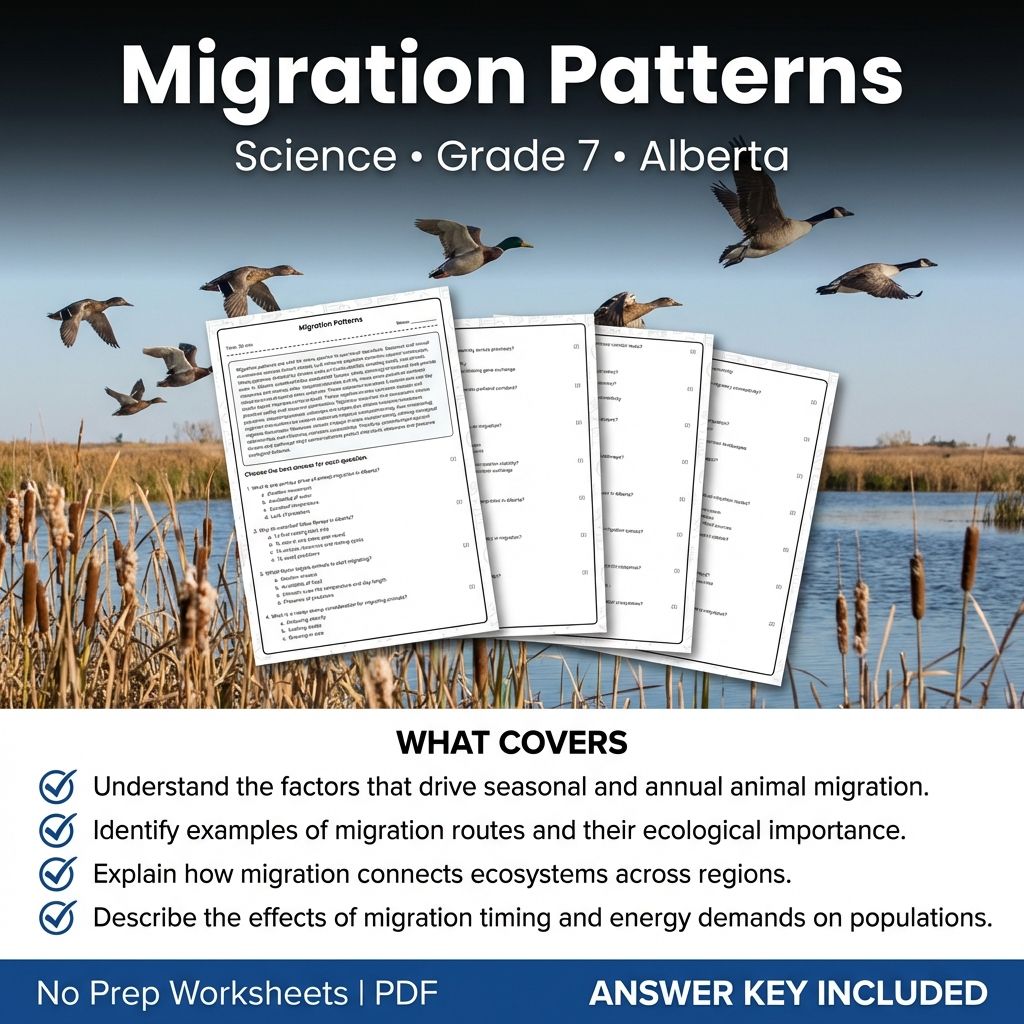
Migration Patterns Worksheet for Grade 7 Science | Alberta Standards
 Created byCoral Reef Learning
Learning Objectives
- Understand the factors that drive seasonal and annual animal migration.
- Identify examples of migration routes and their ecological importance.
- Explain how migration connects ecosystems across regions.
Instant download

Grade 7 Torque and Levers Worksheet | Alberta Science Simple Machines
 Created byBRIGHT PATH RESOURCES
Learning Objectives
- Explain how torque depends on force and lever arm distance
- Identify how moving the fulcrum changes which direction and size of force is produced
- Use simple arithmetic to relate input force to output force in lever situations
Also included in: Grade 7 Alberta Science Forces Structures and Motion Worksheet Bundle +1 more
Instant download
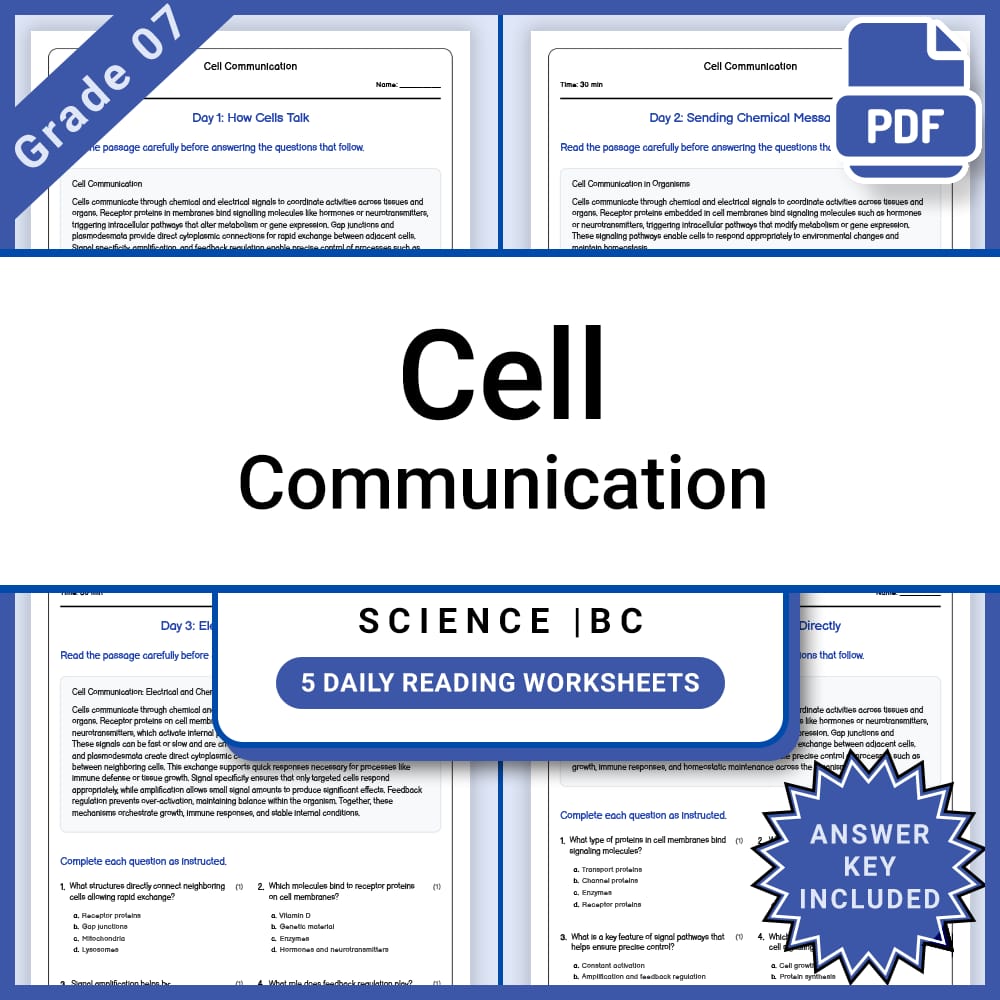
Grade 7 Science – Cell Communication Daily Reading Worksheet + Answer Key
JCreated byJ.S SheetsLearning Objectives
- Understand how cells communicate through chemical and electrical signals.
- Identify the role of receptor proteins, gap junctions, and plasmodesmata in cell communication.
- Explain the importance of signal specificity, amplification, and feedback in biological processes.
Also included in: Grade 7 Science Lesson Group Bundle | Cell Structures and Processes +1 more
Instant download

Grade 7 Science | Reaction Types Worksheet | BC Aligned
 Created byLumora Learning
Learning Objectives
- Describe different reaction types such as synthesis, decomposition, single and double displacement, acid–base neutralization, and combustion.
- Explain how bonds are broken and formed during reaction types at the particle level.
- Identify reaction types based on chemical equations and particle explanations.
Also included in: Grade 7 Science | Matter & Chemical Change Unit Bundle | BC Aligned
Instant download

Resource Availability Science Worksheet | California Standards Grade 7
JCreated byJ.S SheetsLearning Objectives
- Understand how natural processes and human activities affect Earth's land, water, and air resources.
- Identify factors that influence resource availability, such as precipitation, geological storage, and ecosystem capacity.
- Analyze how natural events like droughts and floods impact resource access.
Also included in: Grade 7 Engineering Tradeoffs & Optimization Science Lesson Bundle +1 more
Instant download

Grade 7 Trophic Energy Flow Worksheet | Ontario Science Ecosystems
Created byClear Sky ClassroomLearning Objectives
- Explain how energy moves through trophic levels from primary producers to higher consumers
- Use quantitative ideas like trophic efficiency (e.g., ~10%) to predict how much energy is available at higher levels
- Describe how respiration and heat conversion limit energy availability and shape biomass pyramids
Instant download

Scientific Inquiry Basics Worksheet | Standards-Aligned Grade 7 Science
JCreated byJ.S SheetsLearning Objectives
- Identify criteria for strong scientific questions and use them to form testable hypotheses.
- Explain how operational definitions, variables, and reproducibility improve the reliability of results.
- Apply measurement precision and clear documentation practices to support valid comparisons across trials.
Instant download

Grade 7 Science Worksheet – Chemical Properties (BC Standard) Practice PDF
 Created byEvergreen Desk Education
Learning Objectives
- Explain what chemical properties are and how they help predict reactions.
- Identify observable evidence (gas, color change, heat) that indicates chemical changes.
- Describe how flammability, reactivity with acids or bases, oxidation, and pH behavior are chemical properties.
Instant download

Grade 7 Science | Population Variation in Animals - Daily Reading Comprehension
Created byCoral Reef LearningLearning Objectives
- Understand how traits vary within animal populations
- Identify examples of traits such as body size, coloration, and disease resistance
- Learn about the sources of variation including inheritance and recombination
Instant download

Grade 7 Keystone Species Worksheet | BC Practice PDF
Created byClear Sky ClassroomLearning Objectives
- Explain what a keystone species is and why its impact is disproportionate to its abundance
- Describe how removing a keystone species can cause trophic cascades and change ecosystem structure
- Identify keystone species using evidence from food webs and species interactions
Instant download

Biotic Interactions Practice Worksheet | Grade 7 Science Review Assessment
Created byPrism Point LearningLearning Objectives
- Explain how different biotic interactions (predation, competition, mutualism, commensalism, and parasitism) affect survival and reproduction.
- Describe how changes to one species can spread through a community and alter biodiversity.
- Predict how human actions (habitat alteration, overharvesting, and species introductions) may disrupt ecological relationships.
Also included in: Ecosystems & Interactions Lesson Bundle – Grade 7 Science BC Framework +1 more
Instant download

Energy Transfer Overview Assessment | Florida NGSSS Grade 7 Science
Created byPrism Point LearningLearning Objectives
- Explain how energy transfers from higher-energy systems to lower-energy systems
- Identify common forms of energy involved in energy transfer (heat, light, motion, sound)
- Describe energy transformations and how they relate to observable changes (temperature, motion, light)
Also included in: Grade 7 Matter, Forces & Energy Science Lesson Bundle | Florida NGSSS
Instant download

Grade 7 Science | Migration Patterns Worksheet (Alberta Standards) (PDF)
Created byEvergreen Desk EducationLearning Objectives
- Explain how food availability and breeding needs can drive migration patterns.
- Identify timing cues and energetic demands that influence when animals migrate.
- Describe how migratory connectivity links ecosystems across habitats and provinces.
Instant download

Population Interactions Worksheet for Grade 7 Science
JCreated byJ.S SheetsLearning Objectives
- Understand the different types of population interactions: competition, predation, and mutualism.
- Identify how resource use and niche partitioning influence community stability.
- Explain mechanisms that allow species to coexist and how interactions affect biodiversity.
Instant download

Wave Energy Transfer Worksheet | Grade 7 Science Activities
Created byPrism Point LearningLearning Objectives
- Explain how waves transfer energy without permanently moving matter.
- Differentiate transverse and longitudinal waves using particle motion and wave patterns.
- Relate amplitude and wavelength to the energy and spacing of a wave pattern.
Instant download
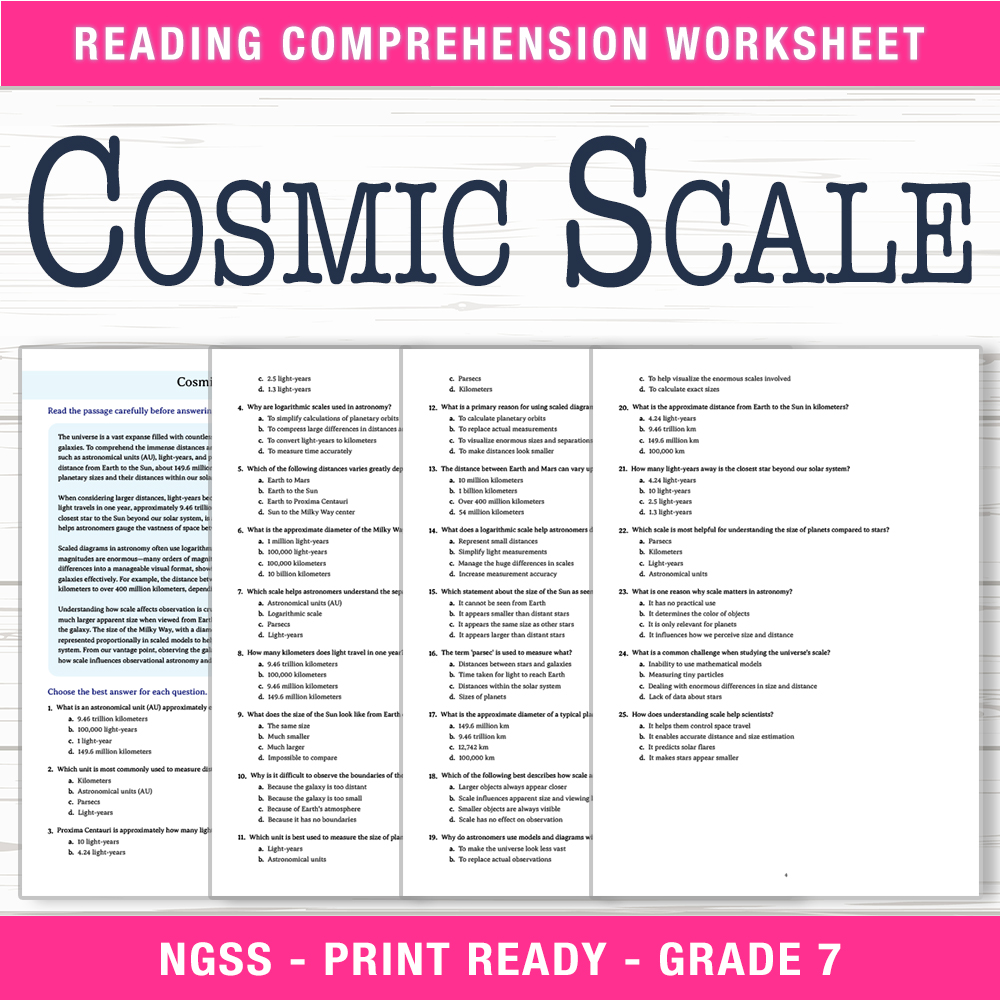
Grade 7 Science | Cosmic Scale Worksheet (PDF + Answer Key)
 Created byRiverstone Classroom
Learning Objectives
- Understand the concept of astronomical units, planetary diameters, and light-years used to express cosmic distances and sizes.
- Interpret scaled diagrams and logarithmic representations illustrating the separation between celestial objects.
- Analyze orders of magnitude differences to comprehend how scale affects observation and measurement in astronomy.
Instant download
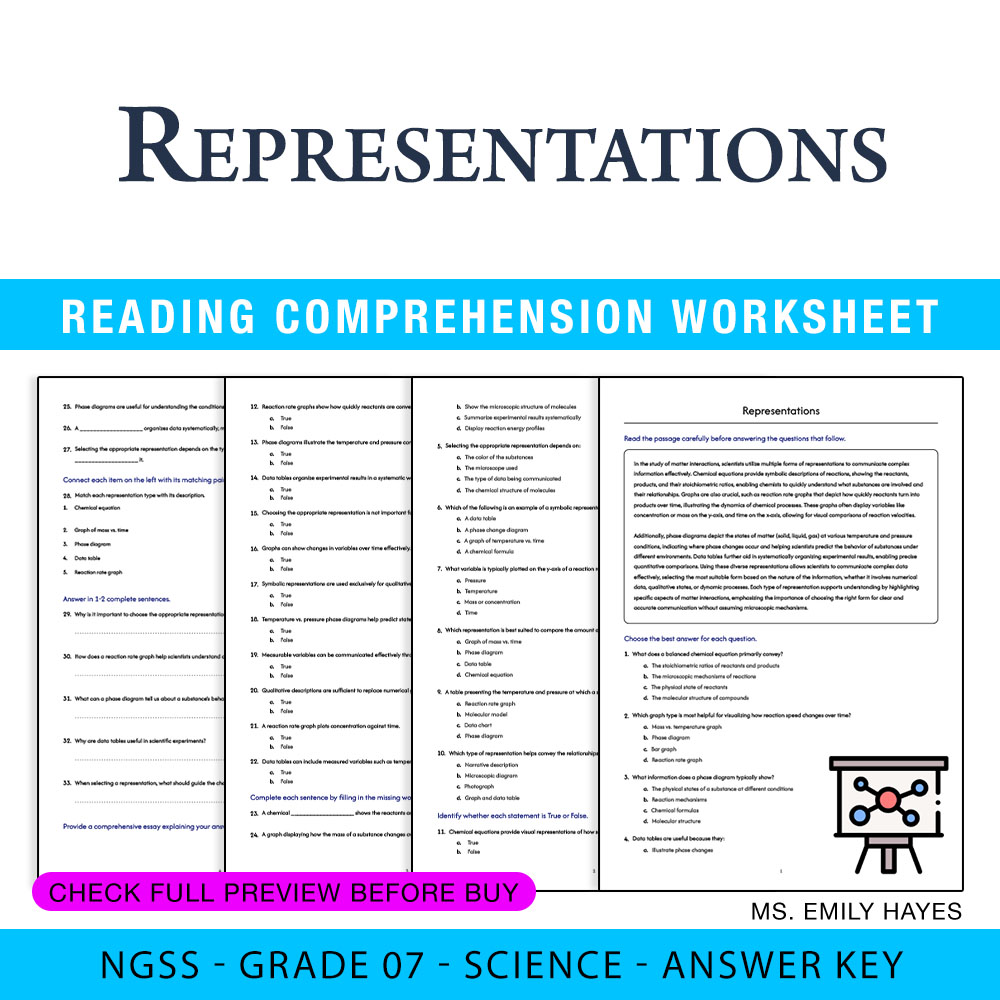
7th Grade Science | Representations Worksheet (PDF +Answer Key)
 Created byCopper Leaf Classroom
Learning Objectives
- Understand different types of representations used to convey matter interactions, including chemical equations, graphs, and data tables.
- Interpret and analyze various representations such as reaction rate graphs, stoichiometric ratios, and phase diagrams.
- Select appropriate representations for quantitative comparison and communicate relationships among measurable variables.
Instant download

Grade 7 Advanced Materials Worksheet | Ontario Science PDF + Answer Key
Created byClear Sky ClassroomLearning Objectives
- Explain how the manufacturing process and microstructure of advanced materials influence strength, stiffness, and durability
- Compare advanced construction materials by considering cost, fabrication complexity, and performance trade-offs
- Describe how prefabrication and connections enable tall timber buildings and bridge retrofits using novel materials
Instant download

Grade 7 Measurement Uncertainty Worksheet | Ontario Science + Answer Key
Created byClear Sky ClassroomLearning Objectives
- Explain the meaning of accuracy, precision, and measurement uncertainty using examples from real instruments.
- Read instrument scales and apply significant-figure and rounding conventions when reporting measurements.
- Distinguish between systematic error and random error and identify common sources of each.
Instant download
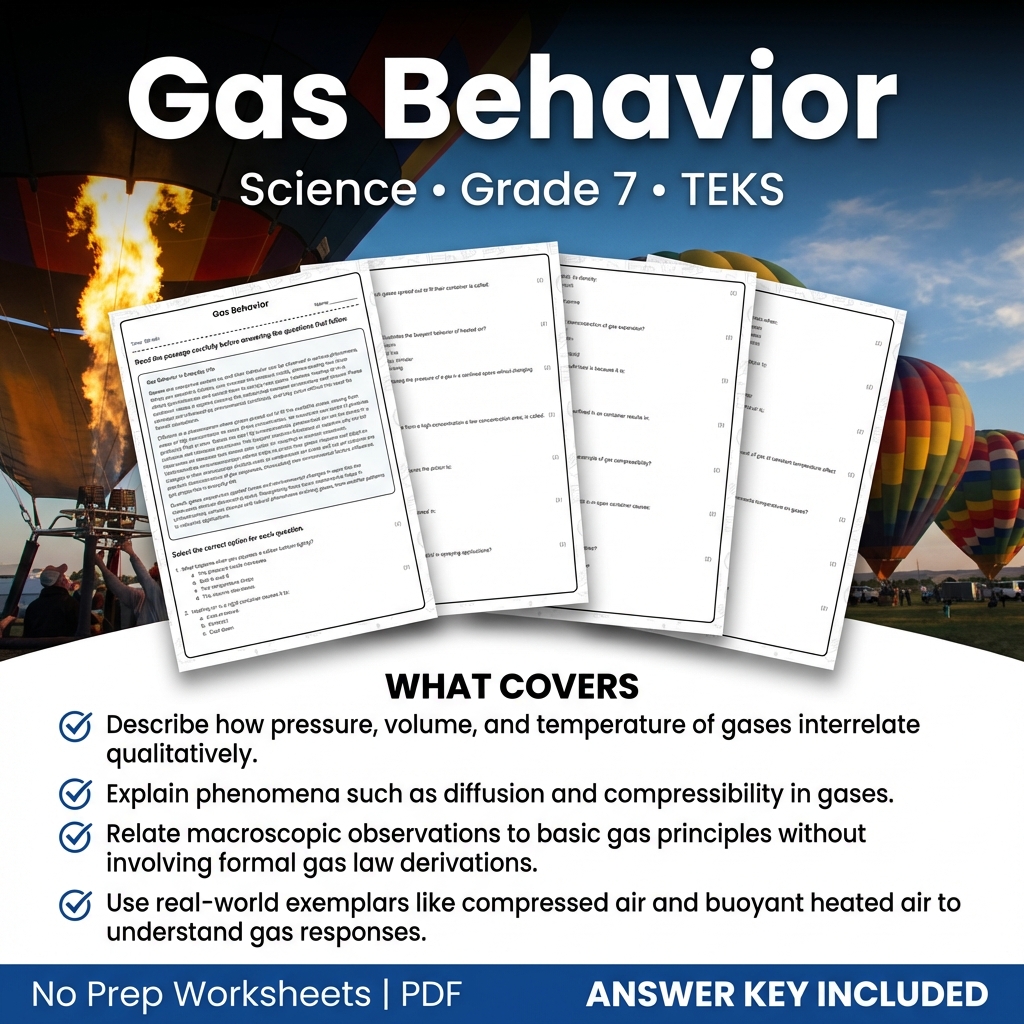
Gas Behavior Worksheet for Grade 7 Science | TEKS-Aligned PDF & Answer Key
Created byCoral Reef LearningLearning Objectives
- Describe how pressure, volume, and temperature of gases interrelate qualitatively.
- Explain phenomena such as diffusion and compressibility in gases.
- Relate macroscopic observations to basic gas principles without involving formal gas law derivations.
Instant download
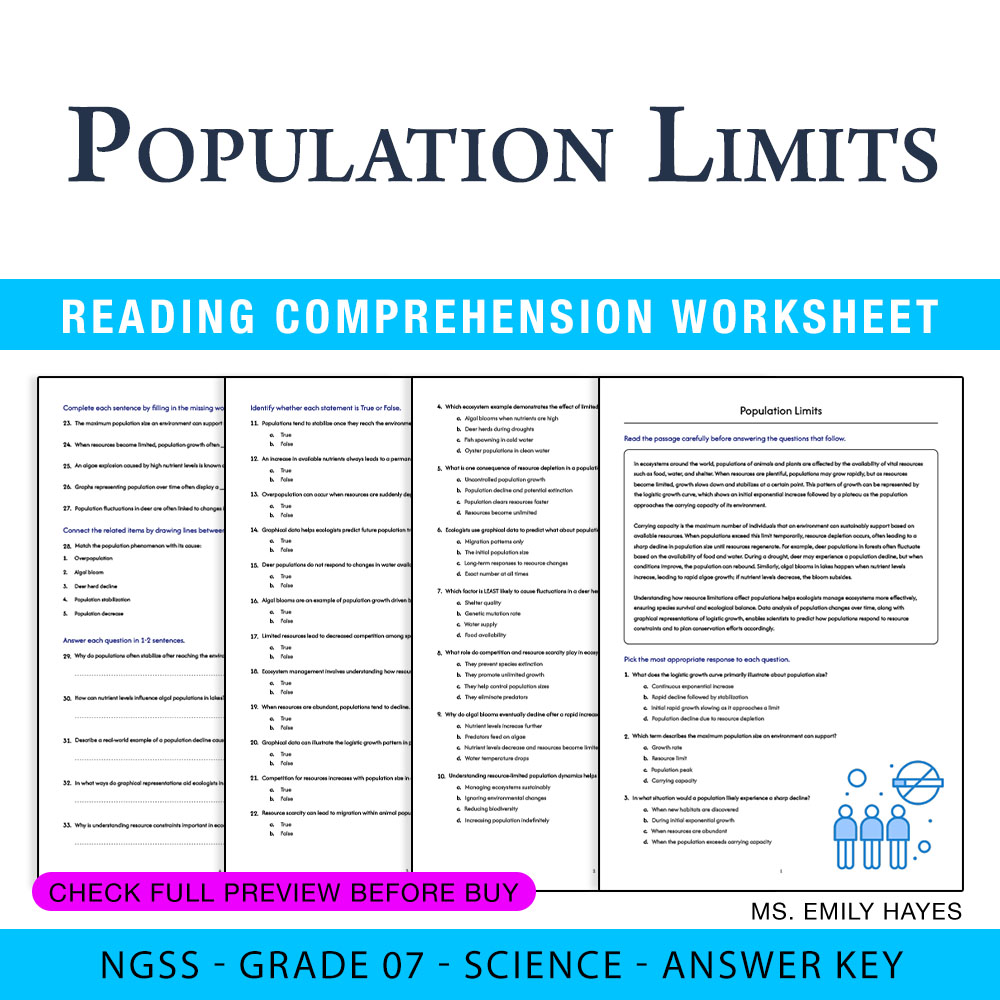
7th Grade Science | Population Limits Worksheet (PDF +Answer Key)
Created byCopper Leaf ClassroomLearning Objectives
- Understand how resource availability influences population growth and stability.
- Analyze graphical data representing population responses to environmental constraints.
- Interpret quantitative data sets related to ecosystem resource limits.
Instant download

Nutrient Cycles Worksheets: Matter Cycling | Grade 7 Science
Created byBRIGHT PATH RESOURCESLearning Objectives
- Describe how carbon cycles between air, organisms, and soils.
- Explain the roles of bacteria in the nitrogen cycle.
- Trace how phosphorus moves through water, soil, and organisms.
Also included in: Grade 7 Science Ecosystems & Food Webs Worksheets Bundle +2 more
Instant download

Grade 7 Science – Advanced Materials in Construction | Daily Reading Worksheet
 Created byBright Mind Resources
Learning Objectives
- Understand the properties and applications of engineered timber in modern construction
- Identify different advanced construction materials such as fibre-reinforced polymers and high-performance concrete
- Explain how manufacturing processes and microstructure influence the strength, stiffness, and durability of materials
Also included in: Structural Eng. Grade 7 Science Daily Reading Worksheets Lesson Bundle | Ontario +1 more
Instant download

Cell Energy Use Worksheet | Standards-Aligned Grade 7 Science Practice
JCreated byJ.S SheetsLearning Objectives
- Understand how cells convert food molecules into usable energy.
- Identify internal processes involved in cellular energy transfer.
- Explain the conservation of matter during energy transformation in cells.
Also included in: Grade 7 Ecosystem Energy & Matter Cycles Science Lesson Bundle +1 more
Instant download

Grade 7 Technology Impacts Science Daily Reading Worksheet | TEKS Activity
Created byBRIGHT PATH RESOURCESLearning Objectives
- Identify cause-and-effect impacts of a technology in a real-world system.
- Explain how transportation technology can create both benefits and unintended consequences.
- Suggest a mitigation strategy to reduce an identified negative impact.
Also included in: Engineering Design Grade 7 Science Daily Reading Worksheets Lesson Bundle | TEKS +1 more
Instant download

Grade 7 Science – Matter Basics Worksheet (PDF) Aligned to Alberta Standards
Created byEvergreen Desk EducationLearning Objectives
- Classify matter as a pure substance (element or compound), a mixture, or a solution based on composition and uniformity.
- Describe how measurable properties (like melting point) help distinguish pure substances from mixtures.
- Explain, with particle ideas, why solutions are homogeneous while mixtures can be separated by physical methods.
Instant download

DNA, Genes & Chromosome Inheritance Worksheets Grade 7 Science
 Created byTeachers Club
Learning Objectives
- Explain how DNA is organized into genes and chromosomes
- Describe chromosome segregation during gamete formation
- Predict genetic inheritance using models of meiosis and fertilization
Also included in: Heredity Inheritance & Variation Grade 7 Science NGSS Bundle +2 more
Instant download

Grade 7 Phase Changes Worksheet | Practice & Assessment PDF
Created byClear Sky ClassroomLearning Objectives
- Explain how energy transfer causes phase changes between solid, liquid, and gas
- Identify examples of melting, freezing, vaporization, condensation, sublimation, and deposition
- Use particle motion and arrangement to describe temperature and pressure effects on phases
Instant download

Climate Change Drivers & Impacts Worksheets | Grade 7 Science
Created byTeachers ClubLearning Objectives
- Explain how greenhouse gases alter Earth's energy balance over time
- Analyze temperature and CO2 records for trends and variability
- Predict climate impacts on agriculture, communities, and infrastructure
Also included in: Grade 7 Earth & Human Activity Science Worksheets | NGSS Bundle +2 more
Instant download

Geologic Processes & Resource Distribution Grade 7 Science Worksheets
Created byTeachers ClubLearning Objectives
- Explain how plate tectonics affects mineral and energy resource distribution
- Describe how weathering and sedimentation shape resource locations
- Explain how fossils reveal past environments linked to resource deposits
Also included in: Grade 7 Earth & Human Activity Science Worksheets | NGSS Bundle +2 more
Instant download

Grade 7 Organ Interactions in the Human Body Worksheet | NGSS Science
Created byBRIGHT PATH RESOURCESLearning Objectives
- Understand how the circulatory system transports nutrients and gases.
- Identify the different organ systems involved in maintaining homeostasis.
- Explain the cooperation between the lungs, heart, and blood in gas exchange.
Also included in: Living Systems Grade 7 Science Daily Reading Worksheets Lesson Bundle | NGSS +2 more
Instant download
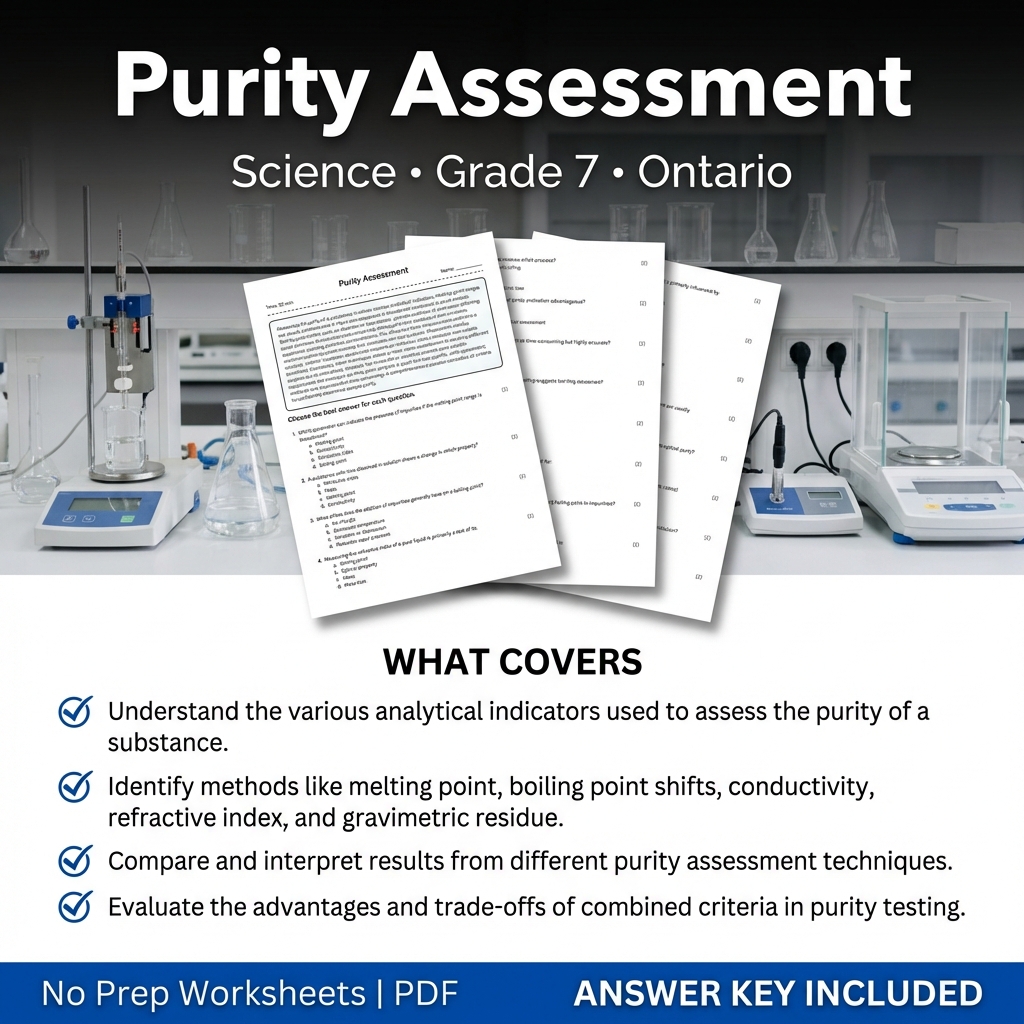
Grade 7 Science Worksheet on Purity Assessment | Ontario Standards
Created byCoral Reef LearningLearning Objectives
- Understand the various analytical indicators used to assess the purity of a substance.
- Identify methods like melting point, boiling point shifts, conductivity, refractive index, and gravimetric residue.
- Compare and interpret results from different purity assessment techniques.
Instant download

Heat Energy Transfer Worksheets | Grade 7 Science Calculations & Practice
 Created bySunny Desk Resources
Learning Objectives
- Calculate energy transfer using specific heat, mass, and temperature change
- Convert between Joules and kilojoules and use units correctly
- Interpret simple thermal process situations and represent energy change numerically or in graphs
Also included in: Energy, Heat & Thermal Processes Grade 7 Science Alberta Bundle +1 more
Instant download

Failure Modes Worksheet Grade 7 Science Engineering Design Ontario
 Created byChalk and Compass
Learning Objectives
- Explain how common structural failure modes (buckling, fatigue, shear/bending fracture, and connection/foundation failure) relate to geometry, material, and loading.
- Describe the limit states design philosophy and how safety factors reduce the risk of structural failure.
- Use redundancy and proper detailing to reduce the chance of progressive collapse.
Also included in: Grade 7 Science Structural Engineering Design & Materials Lesson Bundle |Ontario +1 more
Instant download

Grade 7 Connection Design Worksheet | Structural Connections & Loads
Created byChalk and CompassLearning Objectives
- Explain how bolted, welded, and bearing connections help create continuous load paths in structures.
- Describe how shear, bearing, and slip can affect connection performance and structural capacity.
- Use truss-node and column-to-footing examples to predict how connection stiffness and detailing influence failure modes.
Also included in: Grade 7 Science Structural Engineering Design & Materials Lesson Bundle |Ontario +1 more
Instant download
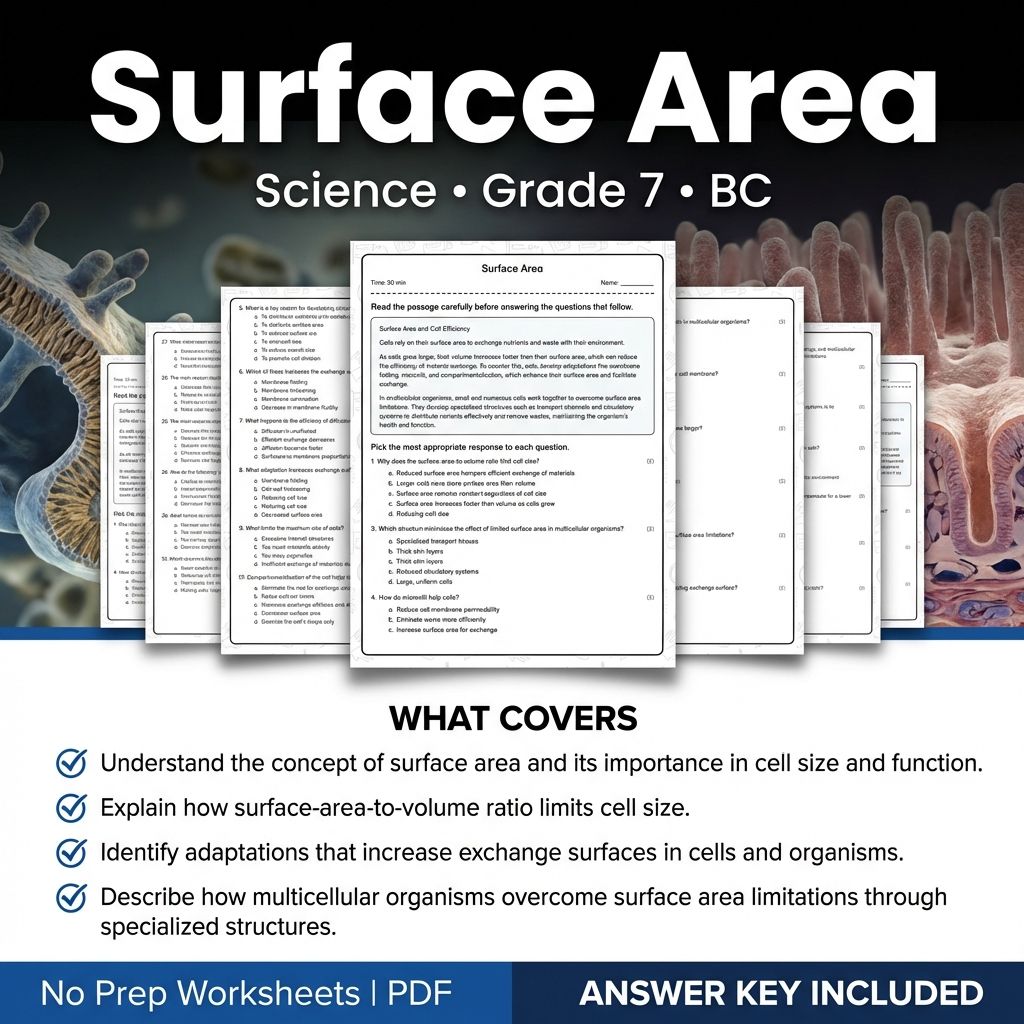
Grade 7 Science Surface Area Worksheet | Classroom Practice & Answer Key (PDF)
Created byCoral Reef LearningLearning Objectives
- Understand the concept of surface area and its importance in cell size and function.
- Explain how surface-area-to-volume ratio limits cell size.
- Identify adaptations that increase exchange surfaces in cells and organisms.
Instant download
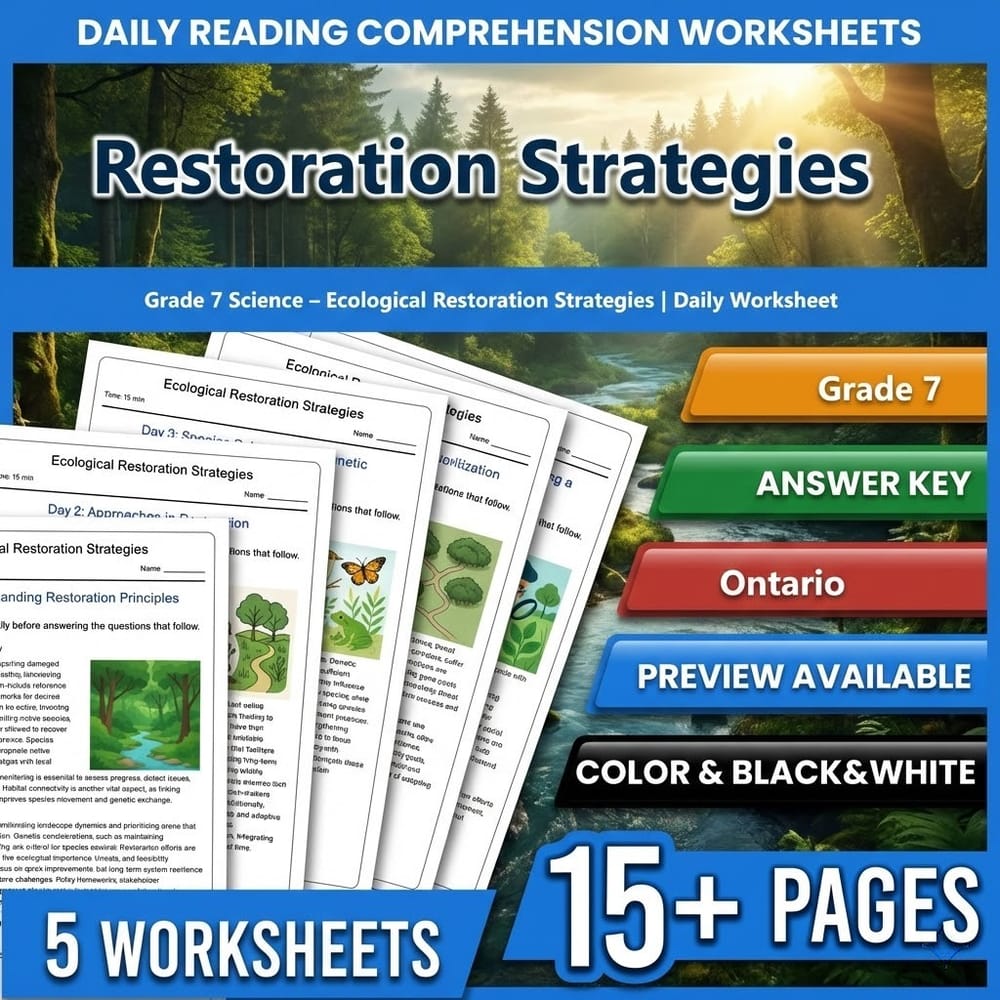
Grade 7 Science – Ecological Restoration Strategies | Daily Worksheet
 Created byQuiet Forest Education
Learning Objectives
- Understand the principles of ecological restoration
- Identify different approaches in habitat restoration
- Recognize key factors in successful restoration projects
Also included in: Ecosystem Dynamics Grade 7 Science Daily Reading Worksheets Bundle | Ontario +1 more
Instant download

Grade 7 Science | Action-Reaction Forces Worksheet | California Standards
Created byLumora LearningLearning Objectives
- Explain Newton’s third law using the idea of equal and opposite force pairs between two interacting objects
- Distinguish between the action-reaction forces on different objects and relate them to motion using mass and acceleration
- Apply action-reaction reasoning to both contact forces and noncontact forces such as gravity
Instant download
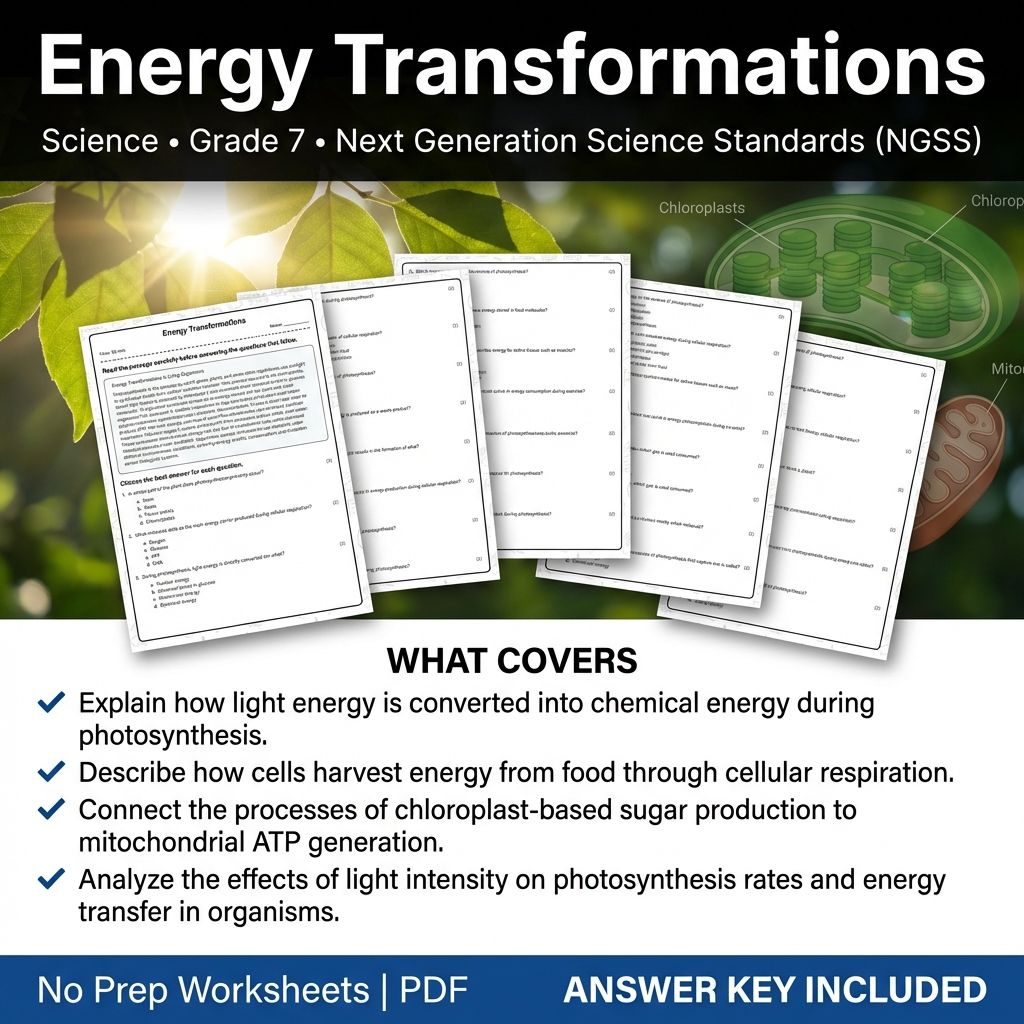
7th Grade Science | Energy Transformations Worksheet & Answer Key (Printable PDF)
Created byCoral Reef LearningLearning Objectives
- Explain how light energy is converted into chemical energy during photosynthesis.
- Describe how cells harvest energy from food through cellular respiration.
- Connect the processes of chloroplast-based sugar production to mitochondrial ATP generation.
Instant download
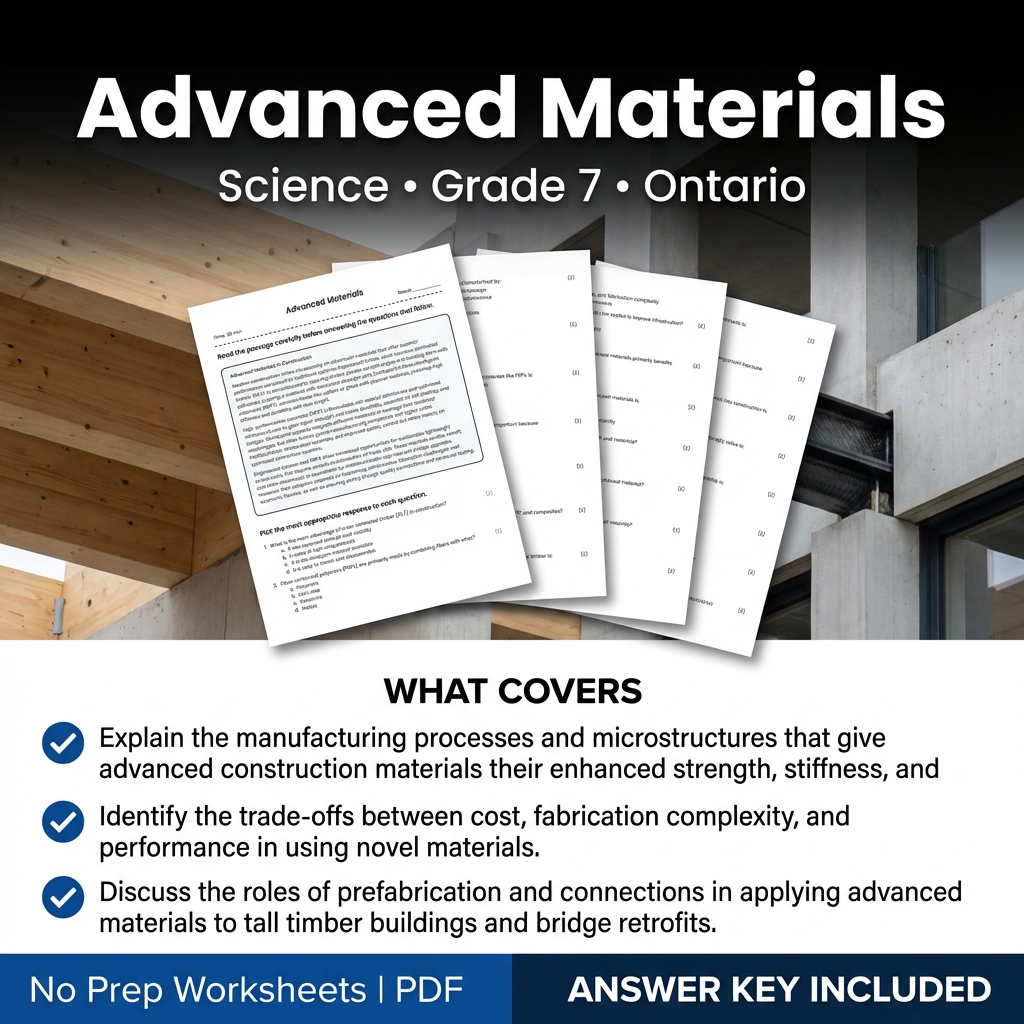
Grade 7 Science Worksheet on Advanced Materials – Ontario Standards
Created byCoral Reef LearningLearning Objectives
- Explain the manufacturing processes and microstructures that give advanced construction materials their enhanced strength, stiffness, and durability.
- Identify the trade-offs between cost, fabrication complexity, and performance in using novel materials.
- Discuss the roles of prefabrication and connections in applying advanced materials to tall timber buildings and bridge retrofits.
Instant download

Grade 7 Science | Understanding Predator & Prey Relationships - Daily Reading
Created byCoral Reef LearningLearning Objectives
- Explain how predator and prey populations influence each other.
- Identify cause-and-effect relationships in ecological systems.
- Analyze cycles in predator-prey dynamics.
Instant download

Science Revision From Results Worksheet | Standards-Aligned Grade 7 Science
JCreated byJ.S SheetsLearning Objectives
- Explain how test data can reveal a mismatch between a design and the criteria for success.
- Describe how specific design changes can improve performance while meeting safety, materials, and cost constraints.
- Use evidence-based reasoning to justify revisions and predict how a new version may perform.
Also included in: Grade 7 Science Fair Testing, Design, and Data Reliability Science Lesson Bundle +1 more
Instant download

Particle Model States of Matter Worksheets Grade 7 Science
Created bySunny Desk ResourcesLearning Objectives
- Describe matter as made of discrete particles with spaces and motion
- Use the particle model to explain diffusion, compressibility, and density changes
- Relate particle kinetic energy and particle spacing to the properties of solids, liquids, and gases
Also included in: Matter and Chemical Change Grade 7 Alberta Science Worksheets Bundle +1 more
Instant download

Grade 7 Science – Understanding Food Webs & Ecosystems | Daily Reading Worksheet
Created byBright Mind ResourcesLearning Objectives
- Define a food web and identify its key components.
- Explain the flow of energy among organisms in an ecosystem.
- Distinguish between producers, consumers, and decomposers.
Also included in: Grade 7 Ecosystems Science Lesson Bundle for Daily Reading Worksheets | Alberta +2 more
Instant download
About Grade 7 Science Worksheets
Browse 6,039 printable Grade 7 Science worksheets — ready-to-print PDFs with answer keys where available.
Every worksheet on MyTeachingSheets is created by independent teacher-authors and reviewed before publication. All resources download as printable PDFs for classroom, homework, or at-home practice, and many include answer keys. Preview any worksheet free before buying.