
Grade 7 Science Worksheets
6,039 worksheets
Grade 7 Science | Biodiversity Solutions - Daily Reading Comprehension
 Created byCoral Reef Learning
Learning Objectives
- Understand the importance of wetlands for biodiversity and ecosystem services.
- Identify management strategies used to protect and restore wetlands.
- Analyze trade-offs and potential unintended consequences of conservation methods.
Instant download

Grade 7 Science | Water Cycle - Daily Reading Comprehension
Created byCoral Reef LearningLearning Objectives
- Identify key parts of the water cycle
- Explain the processes of evaporation, condensation, precipitation, infiltration, runoff, and groundwater flow
- Describe how water moves through Earth's atmosphere, hydrosphere, and geosphere
Instant download

Hazard Patterns and Risk Assessment Worksheets for Grade 7 Science
 Created byTeachers Club
Learning Objectives
- Describe how hazard magnitude influences risk
- Compare hazard frequency and geographic distribution across areas
- Interpret hazard maps to compare patterns of risk
Also included in: Grade 7 Earth & Human Activity Science Worksheets | NGSS Bundle +2 more
Instant download

Membrane Transport Worksheet | Science Practice for Grade 7 BC Standards
JCreated byJ.S SheetsLearning Objectives
- Describe the different mechanisms of membrane transport, including passive and active processes.
- Explain the roles of membrane proteins in maintaining cell function and homeostasis.
- Differentiate between diffusion, osmosis, and active transport in terms of energy use and movement direction.
Instant download

Grade 7 Science | Insulation Principles Worksheet (Alberta Standard, PDF)
 Created bySilver Birch Teaching
Learning Objectives
- Explain how insulation reduces heat transfer between a warm and a cool environment
- Describe how material properties and construction details affect thermal resistance and comfort
- Use R-values and ideas about thermal bridges to make energy-efficiency decisions
Also included in: Grade 7 Thermal Systems Models and Heat Transfer Science Lesson Bundle – Alberta +1 more
Instant download
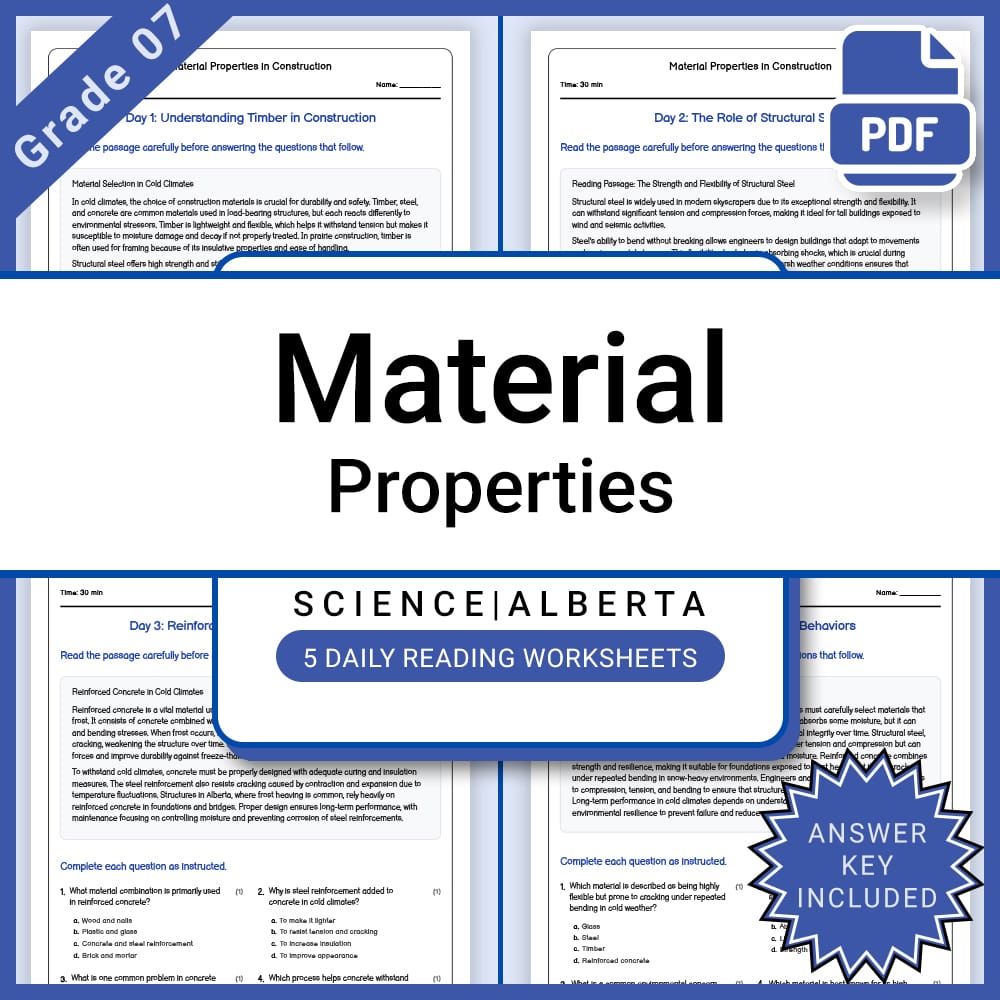
Grade 7 Science – Material Properties in Construction Worksheet + Answer Key
JCreated byJ.S SheetsLearning Objectives
- Understand the different material properties that influence construction choices.
- Compare the strengths, stiffness, and environmental resilience of timber, steel, and concrete.
- Recognize how material behavior under stress affects long-term performance in cold climates.
Also included in: Grade 7 Science Lesson Group | Structural Engineering & Motion Worksheets +1 more
Instant download

Grade 7 Material Properties Worksheet | Ontario Science Activity
 Created byChalk and Compass
Learning Objectives
- Define and compare key material properties (density, tensile/compressive strength, stiffness, ductility, toughness, and thermal expansion).
- Explain how material properties affect structural behavior such as deformation, cracking, and failure modes.
- Relate property selection to loading conditions and structural performance using wood, steel, and reinforced concrete examples.
Also included in: Grade 7 Science Structural Engineering Design & Materials Lesson Bundle |Ontario +1 more
Instant download

Grade 7 Science Worksheet | Food Building Blocks & Energy Use
 Created byEvergreen Desk Education
Learning Objectives
- Explain how food molecules are broken down and rearranged into new molecules needed for growth and repair.
- Describe how chemical energy in food becomes usable energy for life processes.
- Connect nutrition choices to changes in body condition over time.
Instant download

Science Grade 7 Worksheet: Restoration Strategies | Standards-Aligned Practice
JCreated byJ.S SheetsLearning Objectives
- Explain how ecological restoration uses reference conditions and evidence-based success indicators.
- Compare active and passive restoration approaches and describe trade-offs between short-term recovery and long-term resilience.
- Identify factors that affect restoration planning, including habitat connectivity, corridor design, and genetic considerations.
Instant download

Grade 7 Science Worksheet on Modes of Thermal Energy Transfer
JCreated byJ.S SheetsLearning Objectives
- Identify the three primary modes of thermal energy transfer: conduction, convection, and radiation.
- Describe the molecular mechanisms that underlie conduction and convection, and explain why radiation does not require a medium.
- Compare typical media (solids, fluids, and space) and relative behavior (how quickly and through what) for each mode using everyday examples.
Instant download

Grade 7 Science | Deposition and Landforms Worksheet | BC Aligned
 Created byLumora Learning
Learning Objectives
- Understand how deposition shapes various landforms such as deltas, beaches, and glacial features.
- Identify characteristics of depositional processes and their geological evidence.
- Explain the formation of stratigraphic layers and their significance in interpreting past environments.
Instant download
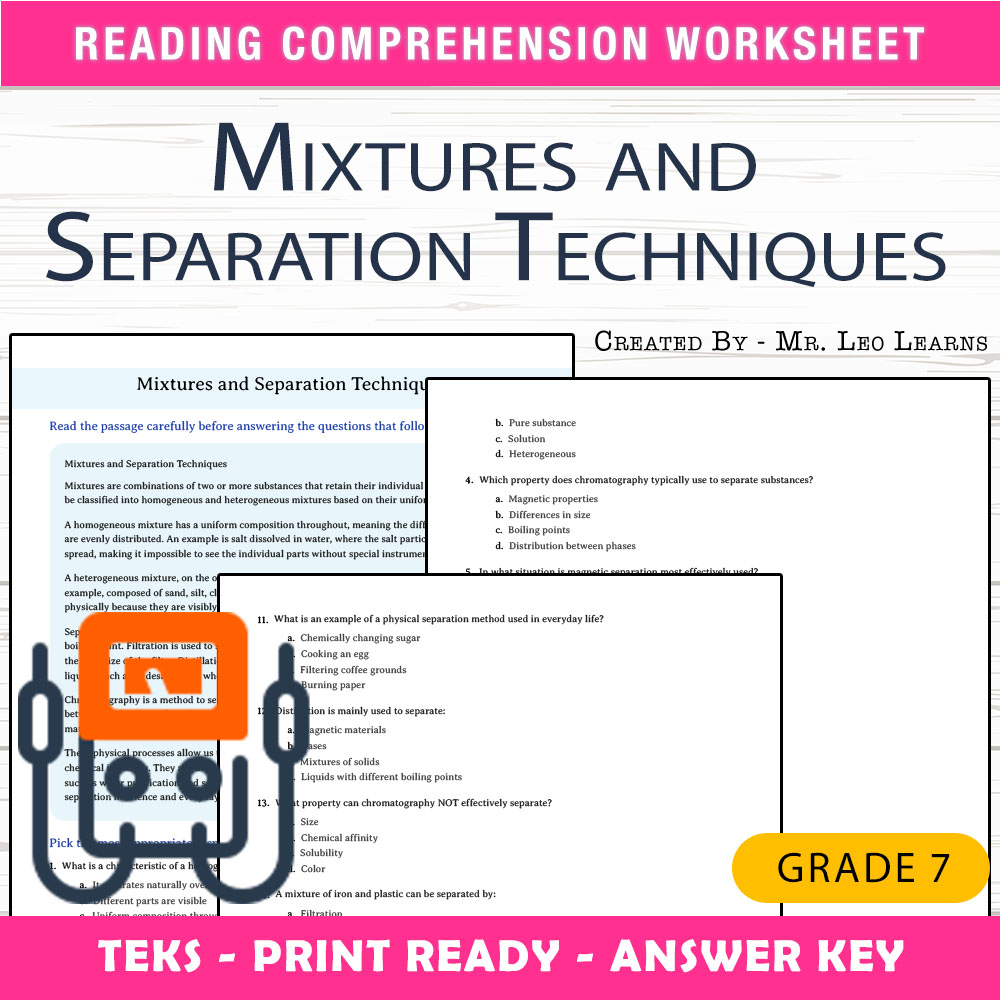
Grade 7 Science — Mixtures & Separation Techniques Worksheet
 Created byThe Resource Hub
Learning Objectives
- Identify and distinguish between homogeneous and heterogeneous mixtures.
- Describe common physical separation methods such as filtration, distillation, chromatography, and magnetic separation.
- Explain how differences in properties like solubility, particle size, and boiling points influence separation techniques.
Also included in: Grade 7 Science Unit Bundle – States, Reactions & Atomic Structure Worksheets +1 more
Instant download

Grade 7 Water Cycle Worksheet | NGSS Practice & PDF
 Created byClear Sky Classroom
Learning Objectives
- Describe the processes involved in the water cycle, including evaporation, condensation, precipitation, infiltration, runoff, and groundwater flow.
- Explain how water moves among Earth's atmosphere, hydrosphere, and geosphere driven by solar energy and gravity.
- Identify interactions such as river discharge to oceans and groundwater contributions to springs.
Also included in: Grade 7 Earth Systems Science Lesson Bundle NGSS: 6 Worksheets +1 more
Instant download

Grade 7 Science | Rock Cycle Integration - Daily Reading Comprehension
Created byCoral Reef LearningLearning Objectives
- Understand the processes involved in the rock cycle
- Identify how rocks change and transform through different geological processes
- Recognize the roles of tectonics, magmatism, weathering, and erosion in rock formation
Instant download

Mixture Types Practice Worksheet | Grade 7 Science | Review
 Created byPrism Point Learning
Learning Objectives
- Classify mixtures as solutions, colloids, or suspensions based on particle size and visible uniformity.
- Explain how light scattering and stability help distinguish colloids from solutions and suspensions.
- Choose an appropriate separation method by predicting how mixture components behave.
Also included in: Grade 7 Substance & Mixture Properties Science Lesson Bundle (Ontario)
Instant download

Grade 7 Science | Bonding Patterns in Science - Daily Reading Comprehension
Created byCoral Reef LearningLearning Objectives
- Identify and distinguish ionic and covalent bonds based on descriptions and examples.
- Understand how bonding types influence properties like melting point, solubility, and electrical conductivity.
- Describe the formation of binary ionic salts and molecular compounds using empirical formulas.
Instant download
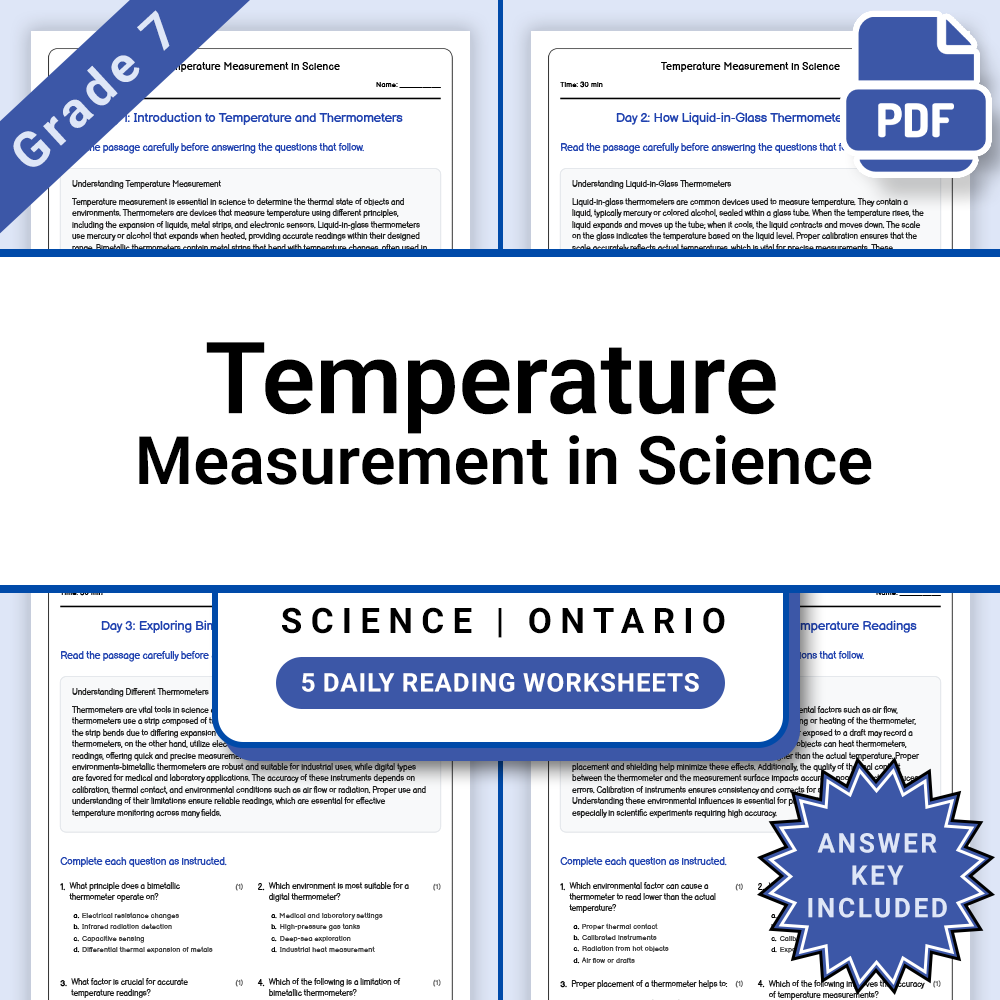
Grade 7 Science – Temperature Measurement Daily Worksheet with Answer Key
JCreated byJ.S SheetsLearning Objectives
- Identify different types of thermometers and their uses
- Explain basic principles of temperature measurement
- Understand the characteristics of liquid-in-glass, bimetallic, and digital thermometers
Also included in: Grade 7 Science Lesson Group: Ontario Curriculum | Thermal & Heat Transfer +1 more
Instant download

Grade 7 Stoichiometry Worksheet | Practice & NGSS PDF
Created byClear Sky ClassroomLearning Objectives
- Understand the concept of mole ratios and how they relate to balanced chemical equations.
- Apply ratio reasoning to calculate amounts of reactants and products in chemical reactions.
- Use conservation principles to predict reagent needs and product yields.
Also included in: Grade 7 Matter and Its Interactions Science Lesson Bundle NGSS Worksheets +1 more
Instant download

Grade 7 States of Matter Worksheet | NGSS Practice PDF
Created byClear Sky ClassroomLearning Objectives
- Explain how energy transfer affects particle motion and arrangement during phase changes
- Use the particle model to describe why temperature can stay nearly constant during a phase change
- Differentiate melting, freezing, evaporation, and condensation using solid–liquid–gas relationships
Instant download

Grade 7 Specific Heat Capacity & Thermal Energy Science Worksheet Alberta
 Created byBRIGHT PATH RESOURCES
Learning Objectives
- Define specific heat capacity using the idea of energy per unit mass per degree Celsius
- Identify how temperature change depends on mass and specific heat capacity
- Use correct units for thermal energy calculations and explanations
Also included in: Grade 7 Alberta Science Energy Heat and Thermal Processes Worksheet Bundle +1 more
Instant download
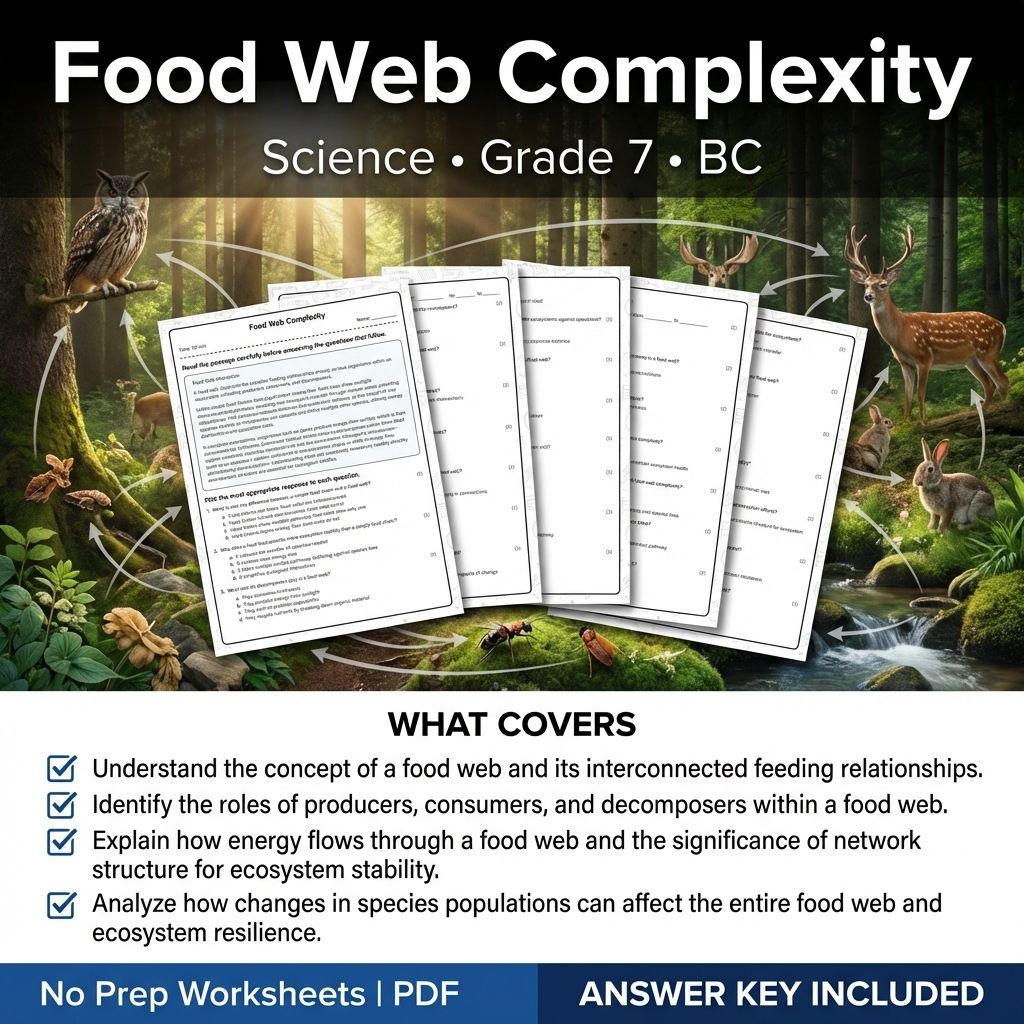
7th Grade Science | Food Web Complexity Worksheet with Answer Key (Printable PDF)
Created byCoral Reef LearningLearning Objectives
- Understand the concept of a food web and its interconnected feeding relationships.
- Identify the roles of producers, consumers, and decomposers within a food web.
- Explain how energy flows through a food web and the significance of network structure for ecosystem stability.
Instant download

Grade 7 Science | Innovation History - Daily Reading Comprehension
Created byCoral Reef LearningLearning Objectives
- Understand the causes that lead to technological innovation.
- Identify how needs, materials, and incremental improvements contribute to invention and innovation.
- Recognize examples of historical innovations and their development processes.
Instant download
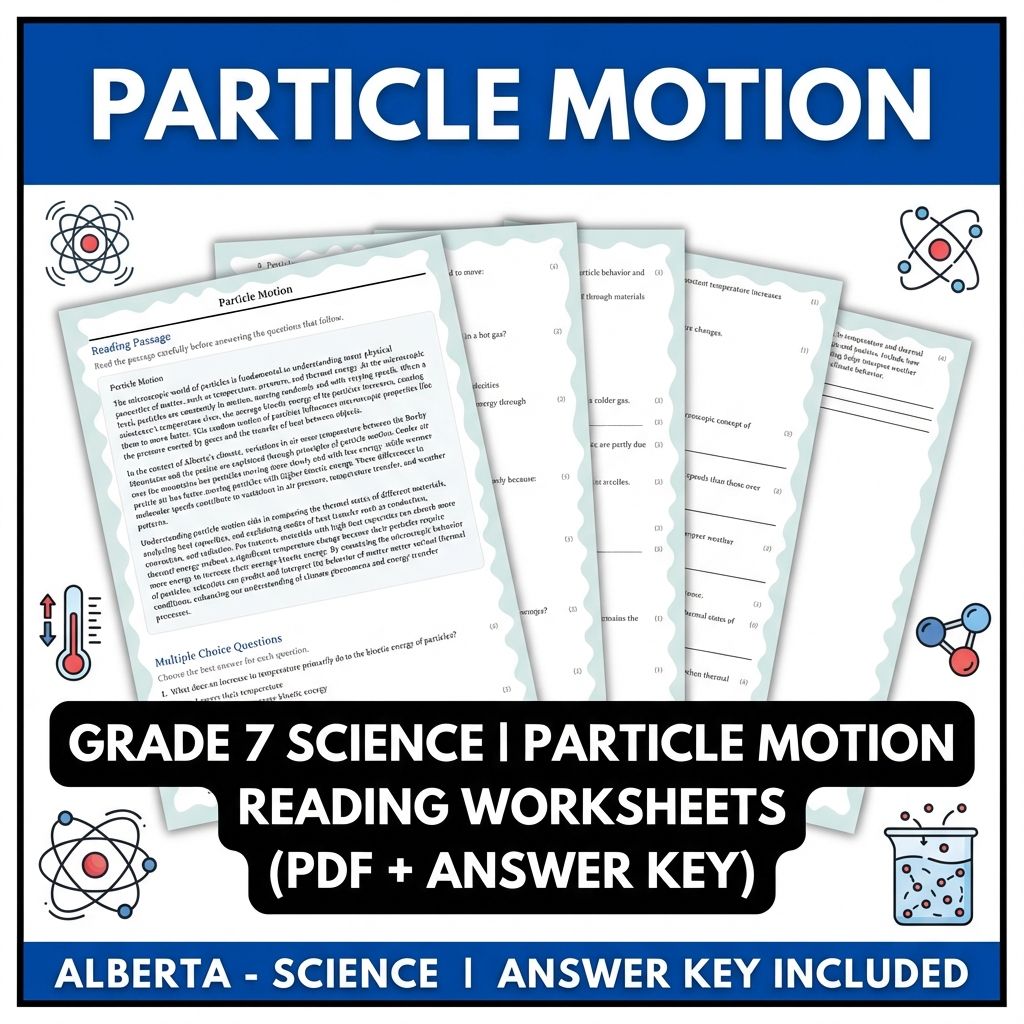
Grade 7 Science | Particle Motion Reading Worksheets (PDF + Answer Key)
JCreated byJ.S SheetsLearning Objectives
- Understand microscopic particle motion and its relation to temperature, thermal energy, and pressure.
- Explain how microscopic particle behavior relates to macroscopic properties like heat transfer.
- Describe the distribution of molecular speeds in different temperature conditions.
Instant download

Grade 7 Science Worksheet | Population Factors & Trends (Alberta Standards)
Created byEvergreen Desk EducationLearning Objectives
- Explain how birth rate, death rate, immigration, and emigration affect population size and distribution
- Describe how resource availability and abiotic constraints can limit population growth in ecosystems
- Use examples from different biomes to predict how populations may fluctuate over time
Instant download
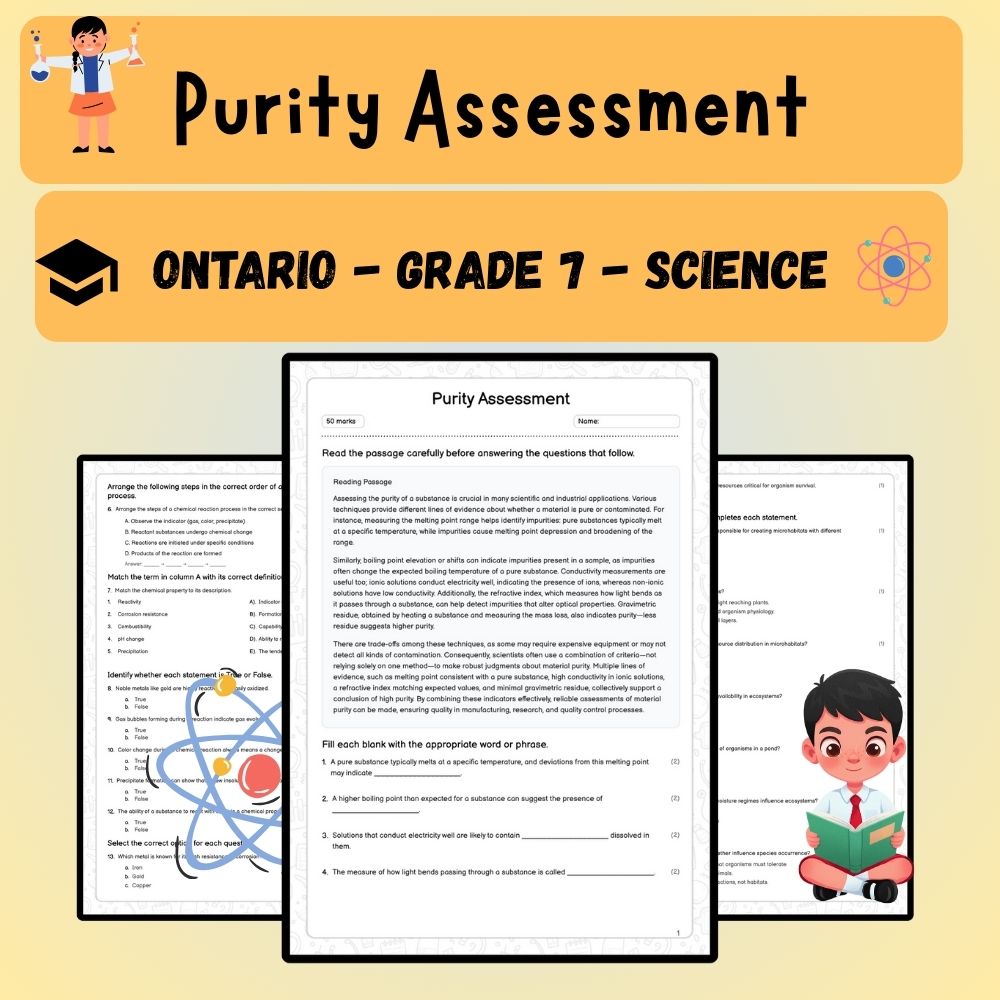
Grade 7 Science Worksheet – Assessing Substance Purity (PDF)
Created byPrism Point LearningLearning Objectives
- Understand the different analytical indicators used to assess material purity.
- Learn methods such as melting point, boiling point, conductivity, refractive index, and gravimetric residue to evaluate purity.
- Interpret examples and data to determine the purity of samples based on multiple criteria.
Also included in: Grade 7 Science Unit Bundle | Substances, Mixtures & Properties Worksheets +1 more
Instant download
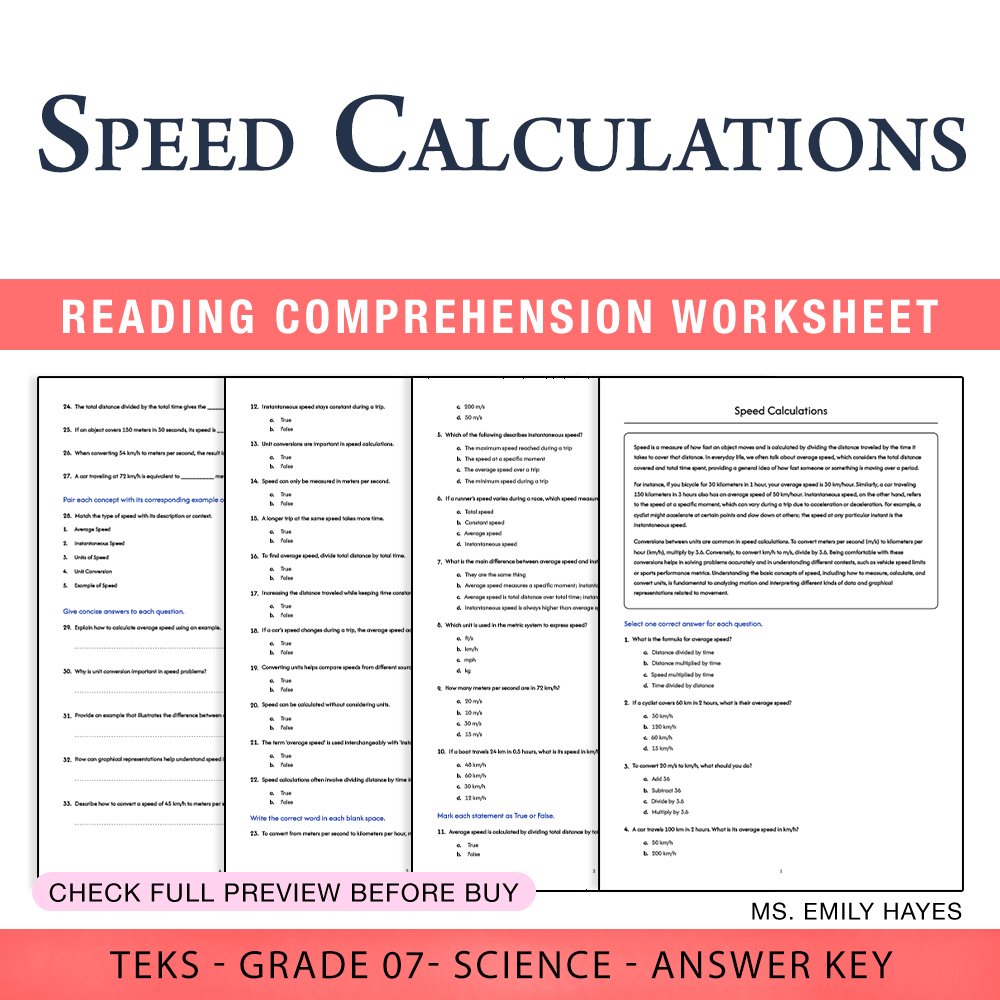
7th Grade Science | Speed Calculations Worksheet (PDF+ Answer Key)
 Created byCopper Leaf Classroom
Learning Objectives
- Understand the concept of average speed and how to calculate it using distance and time.
- Distinguish between average speed and instantaneous speed with numerical examples.
- Apply unit conversions between meters per second and kilometers per hour.
Instant download

Specific Heat Capacity and Thermal Energy Worksheets | Grade 7
 Created bySunny Desk Resources
Learning Objectives
- Explain what specific heat capacity means in terms of energy and temperature change.
- Calculate thermal energy using mass, specific heat, and temperature change.
- Use and convert between grams, kilojoules, and degrees Celsius in heat-capacity problems.
Also included in: Energy, Heat & Thermal Processes Grade 7 Science Alberta Bundle +1 more
Instant download

Grade 7 Science – System Structure & Organs | Daily Reading Worksheet
 Created byBright Mind Resources
Learning Objectives
- Identify the main parts of the digestive system
- Describe the functions of digestive organs
- Understand how internal structures support organism survival
Also included in: Grade 7 Energy Transfer Science Daily Reading: Lesson Bundle | California Std. +1 more
Instant download

Natural Selection Worksheet | Grade 7 Evolution Science Activity
Created byPrism Point LearningLearning Objectives
- Explain how natural selection changes the frequency of traits in a population over many generations.
- Distinguish inherited variation from traits gained during an individual’s lifetime.
- Use evidence from examples (like antibiotic resistance) to describe survival and reproduction differences.
Also included in: Grade 7 Evolution, Genetics & Ecosystems Lesson Bundle | Florida NGSSS
Instant download

Grade 7 Abiotic Influences Science Daily Reading Worksheet | TEKS Activity
Created byBRIGHT PATH RESOURCESLearning Objectives
- Identify abiotic factors and explain how they limit where organisms can live.
- Describe how light and temperature shape habitat suitability along gradients.
Also included in: Grade 7 Ecosystems Science Daily Reading Worksheets Bundle | TEKS +1 more
Instant download

Grade 7 Science | Population Change - Daily Reading Comprehension
Created byCoral Reef LearningLearning Objectives
- Identify the main factors that influence population size and distribution.
- Explain the concepts of exponential and logistic growth patterns.
- Understand how predator-prey relationships affect population dynamics.
Instant download

Grade 7 Biodiversity Solutions Worksheet | NGSS Life Science Activity
Created byBRIGHT PATH RESOURCESLearning Objectives
- Understand the importance of wetlands for biodiversity
- Learn management strategies like wetland restoration and habitat corridors
- Evaluate benefits and potential unintended consequences of conservation methods
Also included in: Ecosystems & Biodiversity Grade 7 Science Daily Reading Lesson Bundle | NGSS +2 more
Instant download

Seasonal Energy Storage and Fluxes Worksheets | Grade 7 Science
Created bySunny Desk ResourcesLearning Objectives
- Explain how solar energy, albedo, and snow cover affect seasonal heating and cooling.
- Describe how phase changes store and release energy through latent heat.
- Model how radiative, latent, and sensible heat fluxes influence soil and water temperatures across seasons.
Also included in: Energy, Heat & Thermal Processes Grade 7 Science Alberta Bundle +1 more
Instant download

Grade 7 Statistical Reasoning Science Daily Reading Worksheet | TEKS
Created byBRIGHT PATH RESOURCESLearning Objectives
- Identify and compare measures of center (mean and median).
- Describe data spread using range and simple graphical cues.
- Explain what center and spread suggest about consistency and reliability of results.
Also included in: Scientific Inquiry Grade 7 Science Daily Reading Worksheets Lesson Bundle | Teks +1 more
Instant download

Grade 7 Science | Calorimetry Basics Worksheet (PDF) – Alberta Standards
Created byEvergreen Desk EducationLearning Objectives
- Explain how calorimetry uses temperature change and known properties to determine heat energy transferred in Joules.
- Apply the heat equation conceptually to predict whether a process absorbs or releases energy.
- Use energy conservation ideas to reason about heating, melting, and heat losses in real-world scenarios.
Instant download

Insulation Principles Worksheet for Grade 7 Science | Alberta Standards
JCreated byJ.S SheetsLearning Objectives
- Understand how material properties influence heat flow and energy efficiency in buildings.
- Identify regional examples of insulation strategies used in Alberta.
- Quantify the impact of R-values and thermal bridges on building performance.
Instant download

Energy Budgets for Passive Heating Systems Worksheets | Grade 7
Created bySunny Desk ResourcesLearning Objectives
- Describe how conduction, convection, and radiation affect heat transfer in a heating system.
- Use energy-budget ideas to compare net heat gain, required fuel energy, and temperature change predictions.
- Apply conservation of energy to identify where energy is stored and where losses occur.
Also included in: Energy, Heat & Thermal Processes Grade 7 Science Alberta Bundle +1 more
Instant download

Climate Drivers Worksheet | Standards-Aligned Practice for Grade 7 Science
JCreated byJ.S SheetsLearning Objectives
- Understand the key factors that influence Earth's climate patterns.
- Differentiate between weather and climate and their long-term significance.
- Identify how ocean processes and atmospheric circulation affect regional climate.
Also included in: Grade 7 Engineering Tradeoffs & Optimization Science Lesson Bundle +1 more
Instant download

Net Force Effects Worksheet | Balanced & Unbalanced Forces | Grade 7 Science
Created byEvergreen Desk EducationLearning Objectives
- Explain how forces can be added as a net force using magnitude and direction.
- Distinguish between balanced and unbalanced net forces and predict their effects on velocity.
- Use everyday examples (cart, ball, friction) to describe how changing forces change speed and/or direction.
Instant download

Genotype and Phenotype Assessment | NGSSS Standards-Aligned Grade 7 Science
Created byPrism Point LearningLearning Objectives
- Explain the difference between genotype and phenotype in terms of genes and observable traits.
- Describe how dominance and recessiveness help determine phenotypes from genotype combinations.
- Predict possible phenotypes using given alleles and simple genotype information.
Instant download

Grade 7 Science | Nutrient Cycles Worksheet | General Standards
Created byLumora LearningLearning Objectives
- Explain how matter cycles through ecosystems using carbon, nitrogen, and phosphorus examples.
- Describe the key processes that move nutrients between air, living things, and soil (photosynthesis, respiration, decomposition, and bacterial transformations).
- Analyze how nutrient availability can limit plant growth and affect ecosystem productivity.
Instant download

Heat Transfer Test Prep Worksheet | Grade 7 Science NGSS Review
Created byPrism Point LearningLearning Objectives
- Describe how heat energy transfers between objects through conduction, convection, and radiation.
- Explain how temperature change and rate differences provide evidence of heat transfer.
- Connect heat transfer to real-world examples such as air currents, lamps, and electrical circuits.
Also included in: Grade 7 Energy Transfer and Conversion Science Lesson Bundle (NGSS)
Instant download

Food Web Flows Worksheet Pack | Grade 7 Science Activities
Created byPrism Point LearningLearning Objectives
- Explain how energy flows from producers to consumers through trophic levels in a food web.
- Describe how decomposition helps cycle matter by returning nutrients to the environment.
- Use vocabulary such as producers, consumers, decomposers, and nutrients to interpret food web diagrams.
Instant download

Truss Force Paths and Efficient Design Worksheets Grade 7 Science
Created bySunny Desk ResourcesLearning Objectives
- Describe how truss members transfer loads through triangular frameworks
- Identify when truss members are in tension or compression using qualitative reasoning
- Compare truss forms by discussing efficiency, redundancy, and load path clarity
Also included in: Forces, Structures & Motion Grade 7 Science Bundle | Alberta +1 more
Instant download

Grade 7 Science | Speciation Processes - Daily Reading Comprehension
Created byCoral Reef LearningLearning Objectives
- Understand the key processes leading to speciation.
- Identify examples of different speciation mechanisms in nature.
- Describe how geographical and reproductive barriers contribute to biodiversity.
Instant download
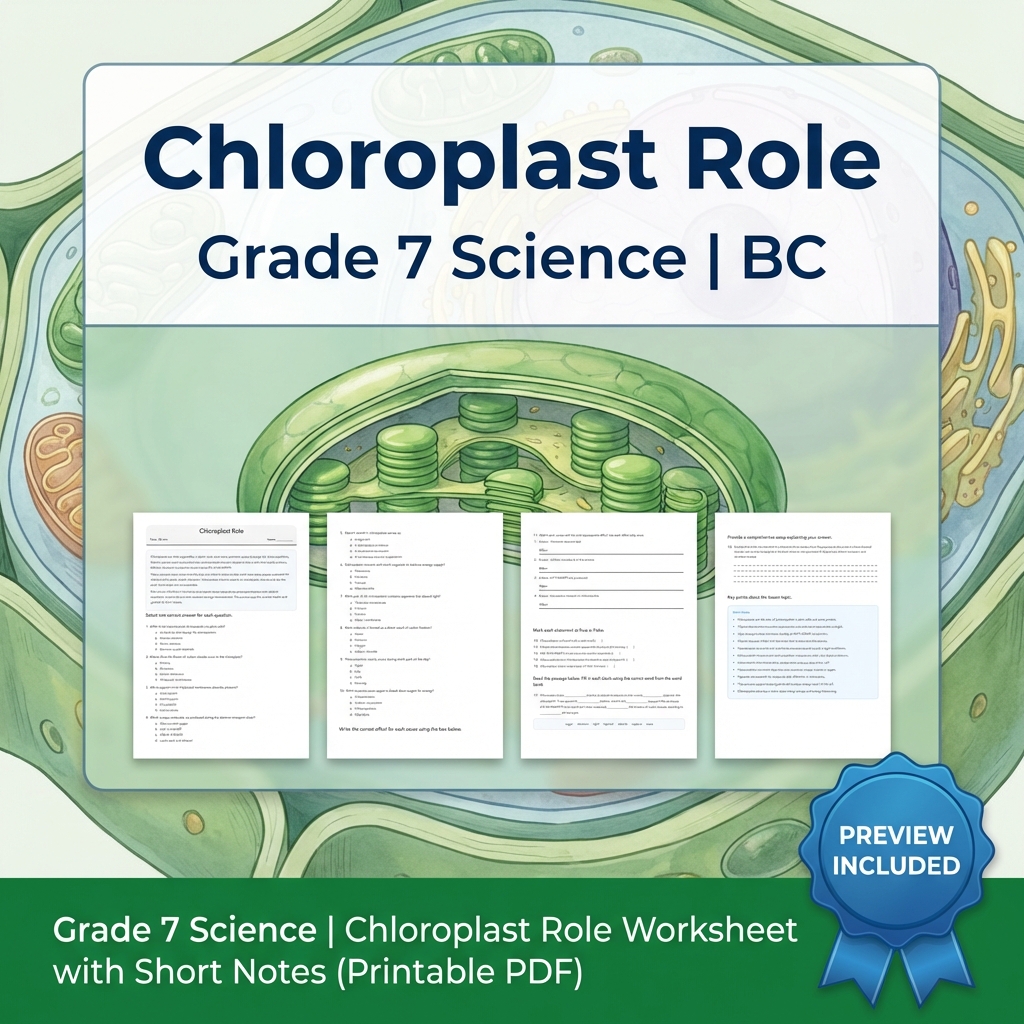
Grade 7 Science | Chloroplast Role Worksheet with Short Notes (Printable PDF)
 Created byMeadowlark Worksheets
Learning Objectives
- Understand the function of chloroplasts in photosynthesis.
- Identify the processes that occur within the chloroplast.
- Explain how chloroplasts store and interact with other cell organelles.
Also included in: Grade 7 Science Lesson Bundle | Cell Structures & Functions Worksheets +1 more
Instant download

Grade 7 Science – Cellular Transport & Homeostasis Daily Reading Worksheet
Created byBright Mind ResourcesLearning Objectives
- Explain how cells regulate water balance through transport mechanisms.
- Identify cellular components involved in homeostasis.
- Describe the importance of membrane pumps, transport proteins, and hormone signaling in maintaining internal stability.
Also included in: Cell Function & Transport Grade 7 Science Daily Reading Worksheets Bundle | BC +1 more
Instant download

Grade 7 Science Atomic Models Worksheet | NGSS Assessment for Science
 Created bySkylark Worksheets
Learning Objectives
- Compare particle, ball-and-stick, and lattice representations of atoms and how they relate to molecular vs extended structures.
- Explain how subatomic particles and atomic number connect to atomic notation and bonding patterns.
- Predict how bonding patterns (covalent vs ionic/extended networks) influence properties such as melting point and electrical behavior.
Also included in: Grade 7 Matter, Reactions & Atomic Models Science Lesson Bundle (NGSS) +1 more
Instant download
About Grade 7 Science Worksheets
Browse 6,039 printable Grade 7 Science worksheets — ready-to-print PDFs with answer keys where available.
Every worksheet on MyTeachingSheets is created by independent teacher-authors and reviewed before publication. All resources download as printable PDFs for classroom, homework, or at-home practice, and many include answer keys. Preview any worksheet free before buying.