
Grade 7 Science Worksheets
6,039 worksheets
Grade 7 Surface Area Worksheet | BC Practice PDF
 Created byClear Sky Classroom
Learning Objectives
- Explain how surface area and volume affect the ability of cells to exchange materials.
- Describe how increasing surface area-to-volume ratio improves diffusion and transport.
- Identify examples of structural adaptations that increase exchange surfaces in cells and organisms.
Instant download

Grade 7 Science – Friction & Drag Daily Reading Worksheet | Alberta Standards
 Created byBright Mind Resources
Learning Objectives
- Understand the different types of friction: static and kinetic.
- Identify examples of friction in everyday life.
- Explain how surface texture and normal force affect friction.
Also included in: Grade 7 Structures & Forces Science Lesson Bundle Daily Reading | Alberta +2 more
Instant download

Balanced vs Unbalanced Forces Worksheet Grade 7 Science NGSSS
 Created byEvergreen Desk Education
Learning Objectives
- Explain how balanced forces produce zero net force and constant velocity
- Describe how unbalanced forces produce nonzero net force and acceleration
- Use real-world examples (such as tug-of-war) to predict motion outcomes
Instant download
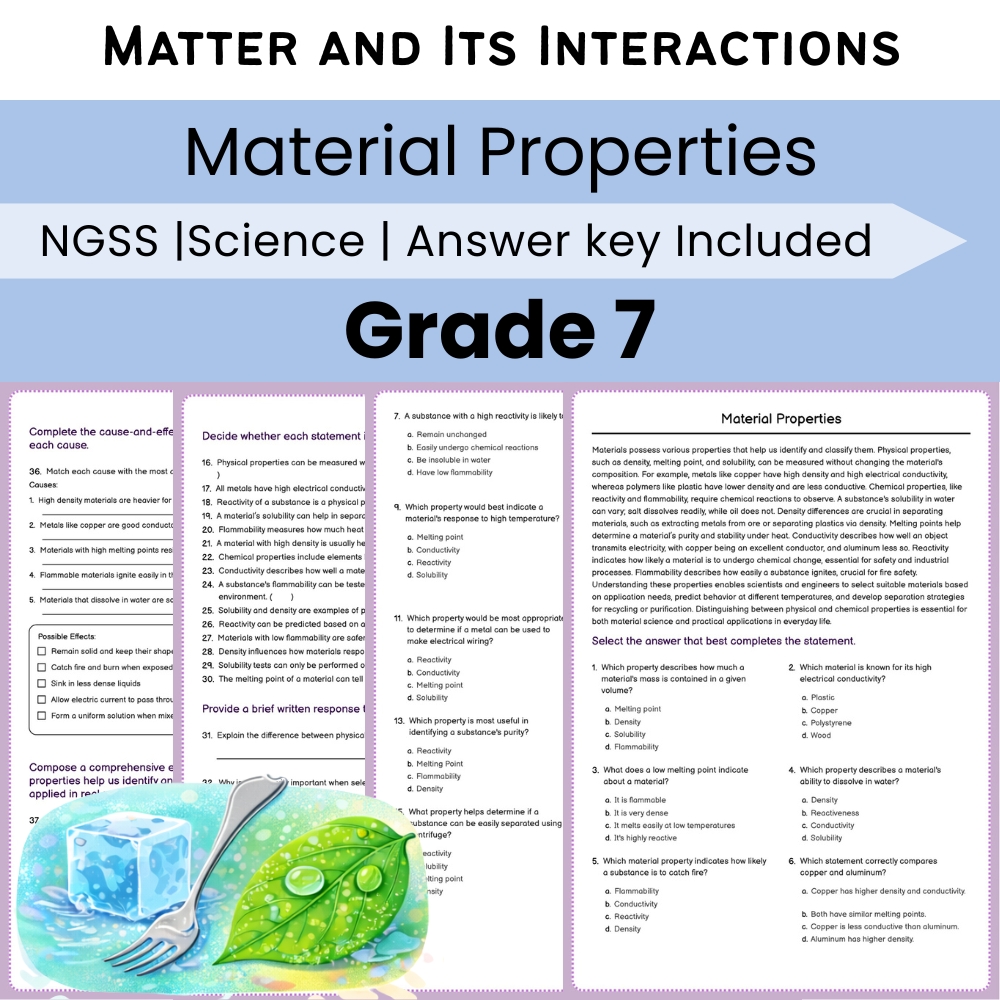
Material Properties Worksheet | Grade 7 Science Printable PDF Assessment
Learning Objectives
- Distinguish between physical and chemical properties of materials.
- Identify measurable descriptors such as density, melting point, solubility, and conductivity.
- Analyze property data to determine substance identification and separation methods.
Also included in: Grade 7 Science Lesson Bundle – Matter and Its Interactions NGSS-Aligned +1 more
Instant download

Grade 7 Mixture Types Worksheet | Homogeneous & Heterogeneous | Ontario
Created byClear Sky ClassroomLearning Objectives
- Classify mixtures as homogeneous or heterogeneous using particle behavior and visible phases.
- Distinguish solutions, colloids, and suspensions based on particle size and light-scattering behavior.
- Choose appropriate separation methods by predicting how mixture components interact.
Instant download

Grade 7 Wave Energy Transfer Worksheet | Practice & General PDF
Created byClear Sky ClassroomLearning Objectives
- Explain how waves transfer energy without permanently moving matter.
- Differentiate transverse and longitudinal waves using motion and patterns.
- Connect amplitude and wavelength to energy and pattern spacing.
Instant download
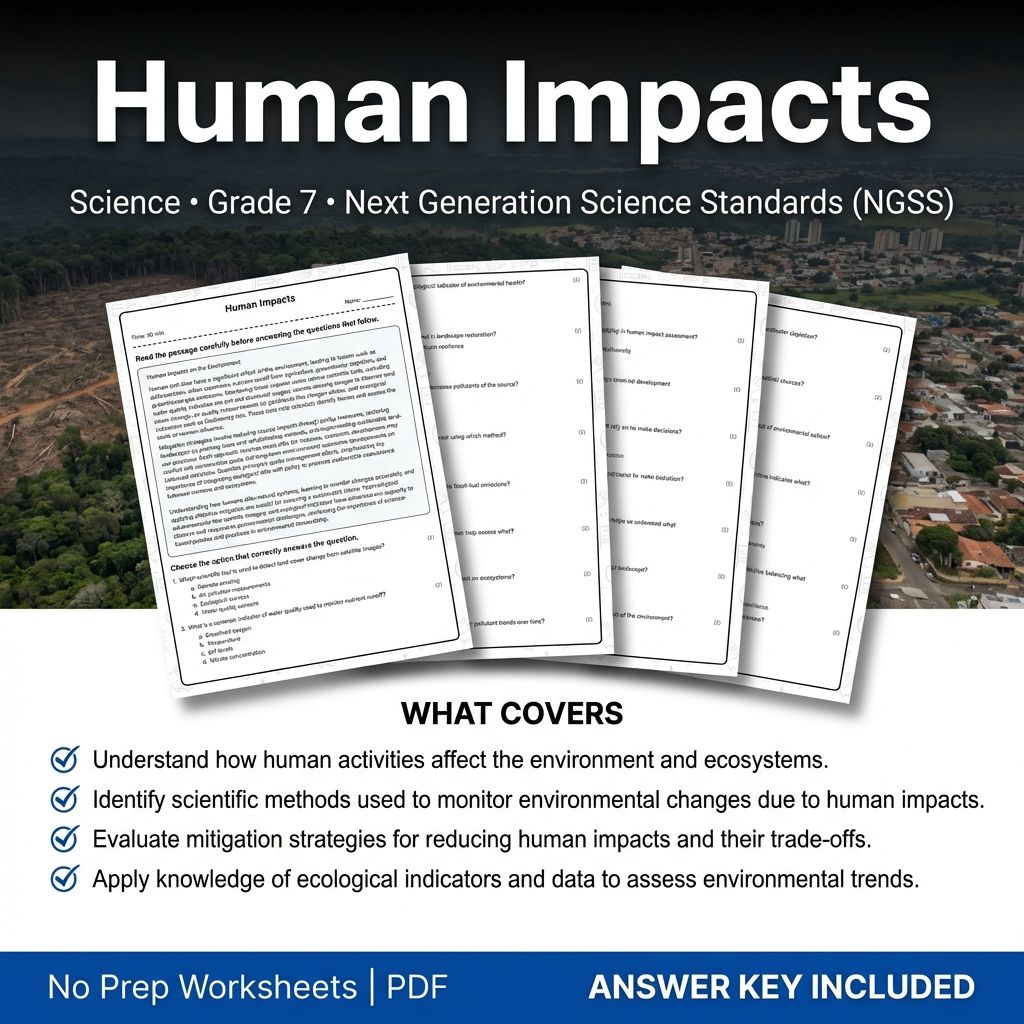
7th Grade Science | Human Impacts Worksheet & Answer Key (Printable PDF)
 Created byCoral Reef Learning
Learning Objectives
- Understand how human activities affect the environment and ecosystems.
- Identify scientific methods used to monitor environmental changes due to human impacts.
- Evaluate mitigation strategies for reducing human impacts and their trade-offs.
Instant download

Grade 7 Modes of Transfer Worksheet | Ontario Science with Answer Key
Created byClear Sky ClassroomLearning Objectives
- Identify and characterize conduction, convection, and radiation as three modes of thermal energy transfer.
- Explain the molecular/mechanism-level process behind each mode and contrast the media and typical rate differences.
- Use examples from everyday and environmental contexts to predict how heat moves.
Instant download

Grade 7 Science – Net Force Worksheet (TEKS) with Answer Key (PDF)
Created byEvergreen Desk EducationLearning Objectives
- Explain how net force is found by combining forces with vector direction using sign conventions in one dimension
- Interpret free-body diagrams to determine the direction and magnitude of net force for real systems (elevator, tug-of-war, cart on a ramp)
- Describe what it means for a system to be in equilibrium and predict motion when net force is zero or nonzero
Instant download

Reflective Surfaces Worksheet | Ontario Grade 7 Science Assessment
 Created byCedar Grove Learning
Learning Objectives
- Explain how albedo and emissivity affect radiative heat exchange between surfaces and the environment
- Predict how surface color and coatings influence solar gain and heat loss
- Describe how low-emissivity glazing and reflective roofs modify net radiative flux
Also included in: Grade 7 Thermal Energy & Heat Transfer Science Lesson Bundle: Ontario +1 more
Instant download

Species Interactions and Food Webs Worksheets | Grade 7 Science
 Created byTeachers Club
Learning Objectives
- Explain how predation changes population size over time
- Explain how competition changes population size over time
- Distinguish parasitism, mutualism, and commensalism using evidence
Also included in: Grade 7 Science Ecosystems Worksheets | NGSS Unit Bundle +2 more
Instant download
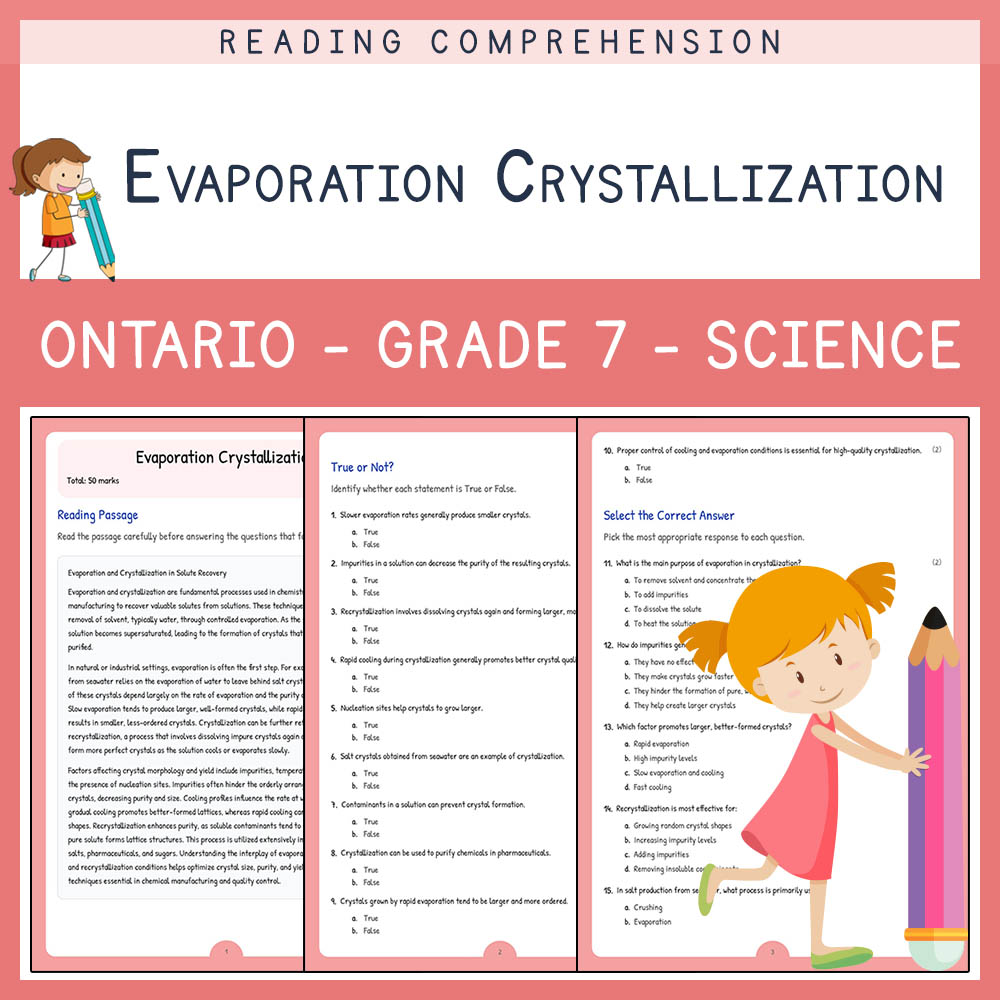
Grade 7 Science | Evaporation Crystallization Worksheet | Ontario Standards
 Created byLumora Learning
Learning Objectives
- Understand the processes of evaporation and controlled crystallization used to recover solutes.
- Identify factors influencing crystal growth, size, and purity, such as evaporation rate and impurities.
- Describe examples like salt production and sugar crystallization.
Also included in: Grade 7 Science | Pure Substances and Mixtures Unit Bundle | Ontario
Instant download
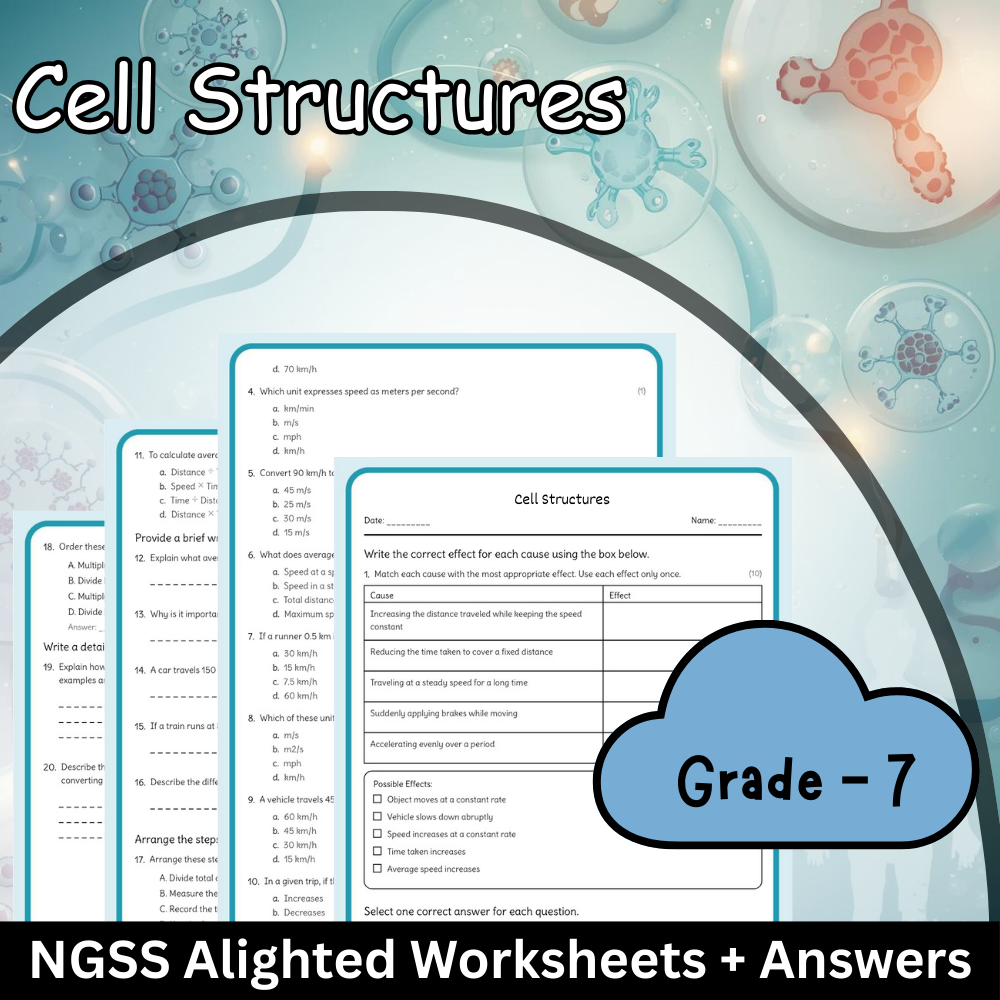
Grade 7 Science | Cell Structures Worksheet (Answer Key) aligned with NGSS
Created byBright Mind ResourcesLearning Objectives
- Identify and describe the functions of key organelles in plant and animal cells.
- Understand the differences between eukaryotic and prokaryotic cells.
- Connect cell structure features with their roles in processes like transport, synthesis, and compartmentalization.
Instant download

Monohybrid Genetic Crosses Probability Worksheets | Grade 7 Science
Created byTeachers ClubLearning Objectives
- Calculate expected genotype ratios from a monohybrid cross
- Predict phenotype ratios using dominant and recessive alleles
- Interpret Punnett square outcomes as inheritance probabilities
Also included in: Heredity Inheritance & Variation Grade 7 Science NGSS Bundle +2 more
Instant download

Abiotic Influences Worksheet for Grade 7 Science | Standards-Aligned Practice
JCreated byJ.S SheetsLearning Objectives
- Explain how nonliving abiotic factors (temperature, light, water availability, soil characteristics, and salinity) limit where organisms can live
- Describe how environmental gradients and microclimates influence species tolerances and seasonal patterns
- Connect abiotic variability to habitat suitability, ecosystem productivity, and community composition
Instant download

Grade 7 Science Worksheet – Biotic Interactions (PDF) BC Standards
Created byEvergreen Desk EducationLearning Objectives
- Explain how different types of biotic interactions affect survival and reproduction in an ecosystem
- Distinguish between mutualism, commensalism, parasitism, predation, and competition using examples
- Analyze how human actions can disrupt biotic relationships and change community structure
Instant download

Grade 7 Science | Forces and Change Worksheet | General Standard
Created byLumora LearningLearning Objectives
- Explain how net force affects acceleration and changes in velocity (speed and direction).
- Distinguish between balanced and unbalanced forces using real-world examples.
- Identify how friction, air resistance, and gravity influence motion near Earth.
Instant download
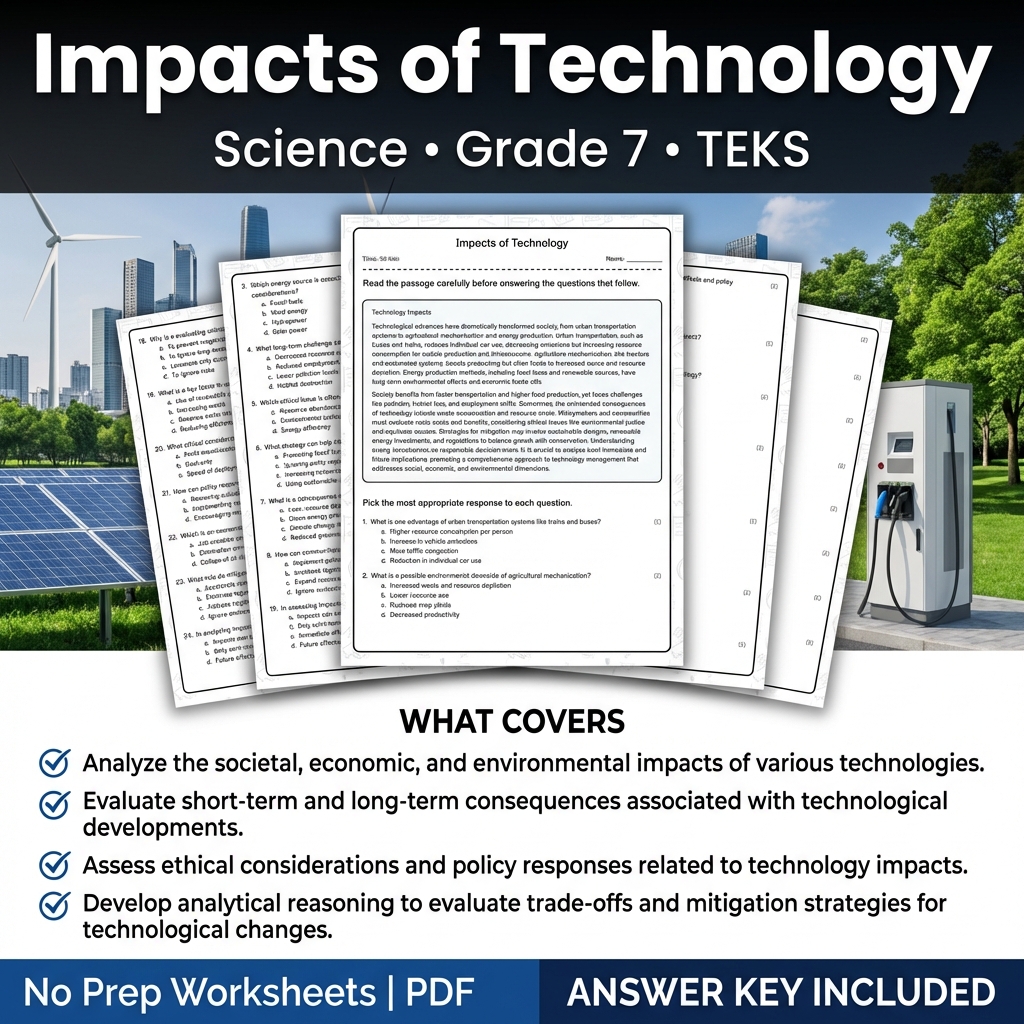
Impacts of Technology Grade 7 Science Worksheet | TEKS aligned assessment
Created byCoral Reef LearningLearning Objectives
- Analyze the societal, economic, and environmental impacts of various technologies.
- Evaluate short-term and long-term consequences associated with technological developments.
- Assess ethical considerations and policy responses related to technology impacts.
Instant download
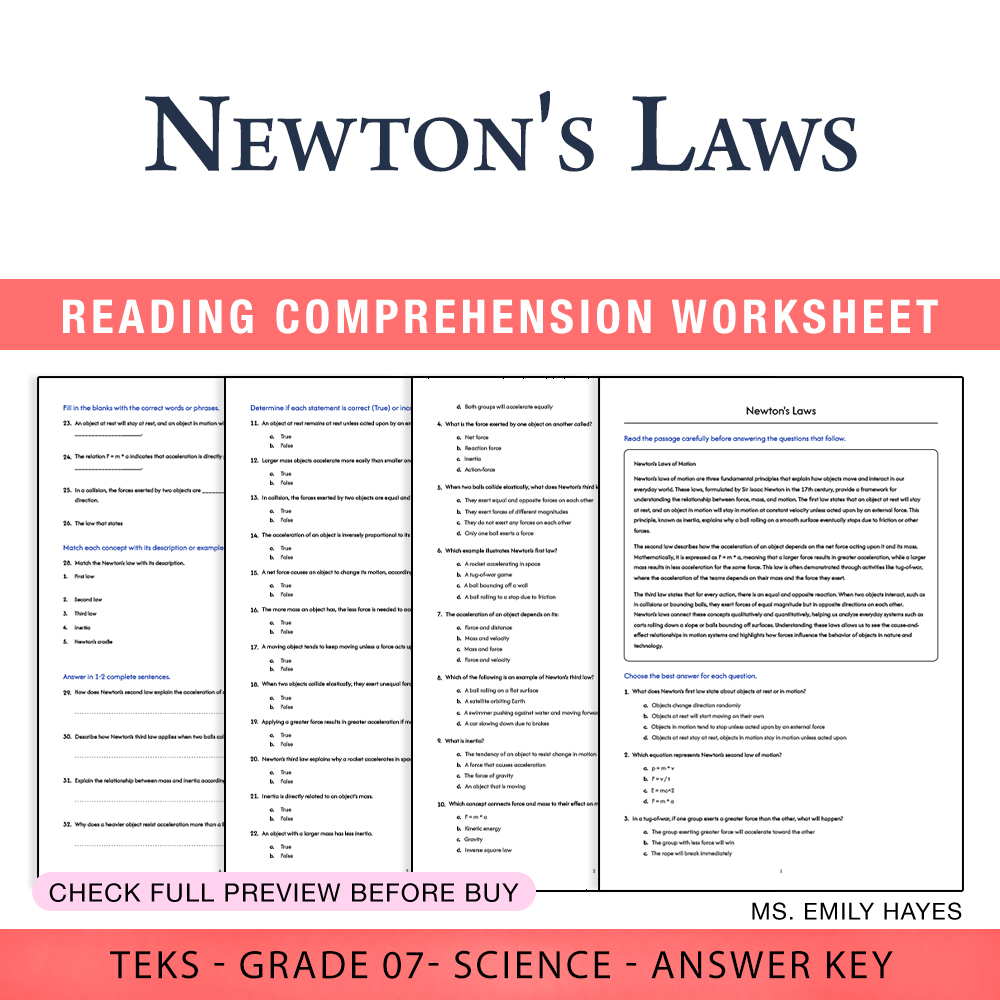
7th Grade Science | Newton's Laws Worksheet (PDF+ Answer Key)
 Created byCopper Leaf Classroom
Learning Objectives
- Understand the three fundamental principles described by Newton's laws of motion.
- Identify real-world phenomena that exemplify Newton's laws, such as collisions and tug-of-war.
- Explain the relationship between mass, force, and acceleration in everyday systems.
Instant download

Grade 7 Science | Understanding Solubility - Daily Reading Comprehension
Created byCoral Reef LearningLearning Objectives
- Define what solubility means in science.
- Identify factors that affect the solubility of substances.
- Recognize examples of solubility in real-world situations.
Also included in: Matter and Chemical Change Lesson Bundle: Grade 7 Science Alberta +1 more
Instant download

Climate Patterns Worksheet for Grade 7 Science | NGSS Alignment
JCreated byJ.S SheetsLearning Objectives
- Understand how uneven solar heating influences regional climates.
- Identify key atmospheric and oceanic circulation patterns and their effects.
- Analyze how topography and ocean currents modify local climate conditions.
Also included in: Grade 7 Earth Systems Science Worksheet Set Print Lesson Bundle – NGSS +1 more
Instant download
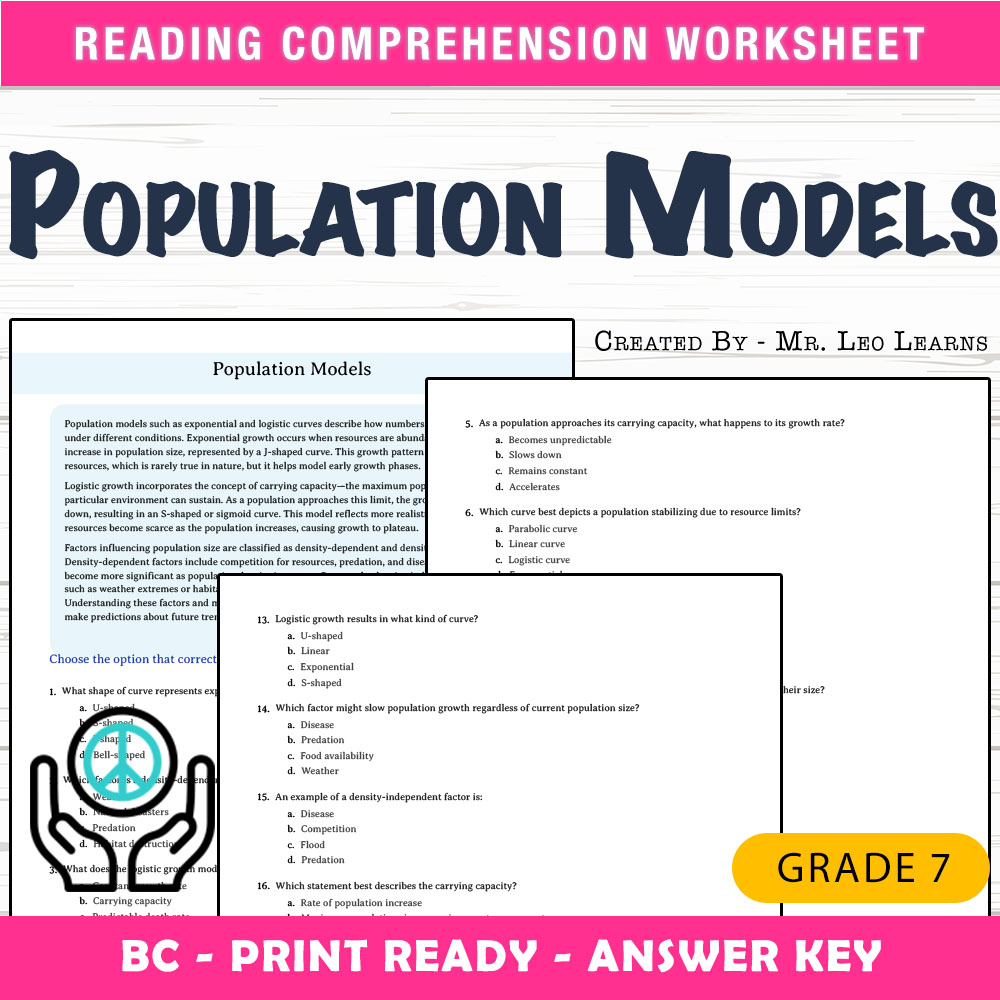
Grade 7 Science — Population Models Worksheet for Mastery
 Created byThe Resource Hub
Learning Objectives
- Understand the differences between exponential and logistic population growth models.
- Identify factors that influence population dynamics, including density-dependent and density-independent factors.
- Interpret how models help predict changes in populations across ecosystems.
Also included in: Grade 7 Science Ecosystems & Interactions Worksheet Bundle +1 more
Instant download

Grade 7 Science – Speed Calculations Worksheet (TEKS) | PDF
Created byEvergreen Desk EducationLearning Objectives
- Calculate average speed using distance and time with correct units
- Convert between meters per second (m/s) and kilometers per hour (km/h)
- Distinguish average speed from instantaneous rate and explain the difference using examples
Instant download

Prototyping for Structural Performance Worksheets Grade 7 Science
 Created byPrism Point Learning
Learning Objectives
- Compare physical, digital, and laboratory prototyping methods
- Explain how strain gauges measure structural strain
- Describe how displacement transducers measure structural movement
Also included in: Grade 7 Structural Performance Lesson Bundle | Ontario Science +1 more
Instant download

Grade 7 Material Properties and Heat Transfer Worksheet | Alberta Science
 Created byBRIGHT PATH RESOURCES
Learning Objectives
- Identify key ideas about thermal conductivity and specific heat capacity from a science text
- Use evidence from a text to explain how material properties affect heat flow
- Compare material choices using vocabulary such as density, porosity, and phase change
Also included in: Grade 7 Alberta Science Energy Heat and Thermal Processes Worksheet Bundle +1 more
Instant download

Grade 7 Science | Levels Of Organization Worksheet (Alberta Standards) (PDF)
Created byEvergreen Desk EducationLearning Objectives
- Describe ecological organization from individuals to ecosystems using accurate terms (organism, population, community, ecosystem).
- Explain how properties and patterns at higher levels cannot be predicted only from individual traits or behaviours.
- Use Alberta examples (trout, Bow River communities, water chemistry, sediment) to distinguish among ecological levels.
Instant download

Grade 7 Understanding Equilibrium in Science Worksheet | NGSS Activity
Created byBRIGHT PATH RESOURCESLearning Objectives
- Define equilibrium and identify conditions under which it occurs.
- Differentiate between static and dynamic equilibrium.
- Recognize forces such as normal, gravitational, and tension forces acting on objects.
Also included in: Forces & Motion Grade 7 Science Daily Reading Worksheets Lesson Bundle | NGSS +2 more
Instant download

Grade 7 Science – Climate Drivers & Factors Reading Worksheet | NGSSS Aligned
Created byBright Mind ResourcesLearning Objectives
- Understand how latitude influences sunlight exposure and temperature
- Describe how Earth's position affects climate patterns
- Recognize the significance of latitude in regional climate differences
Also included in: Grade 7 Earth Science Daily Reading Worksheets Lesson Bundle | Florida NGSSS +1 more
Instant download

Grade 7 Science | Atomic Models - Daily Reading Comprehension
Created byCoral Reef LearningLearning Objectives
- Understand the basic components of an atom: protons, neutrons, and electrons.
- Learn how atomic structure influences the properties of elements and molecules.
- Differentiate between simple molecular models and extended lattice structures.
Instant download

Grade 7 Science Worksheet – Mixture Types (Ontario Standards) (PDF)
Created byEvergreen Desk EducationLearning Objectives
- Classify mixtures as solutions, colloids, or suspensions using particle size and uniformity.
- Explain how light scattering and stability help distinguish mixture types at the macroscopic scale.
- Predict how different mixtures behave during separation methods such as filtration and settling.
Also included in: Grade 7 Substances and Mixtures Science Lesson Bundle Worksheet (Ontario) +1 more
Instant download

Biodiversity Management Trade-Offs Science Worksheets Grade 7 NGSS
Created byTeachers ClubLearning Objectives
- Compare biodiversity management strategies across ecosystem constraints
- Evaluate effects of management choices on ecosystem services
- Use case evidence to justify biodiversity management decisions
Also included in: Grade 7 Science Ecosystems Worksheets | NGSS Unit Bundle +2 more
Instant download

Grade 7 Science – Resource Availability | Daily Reading Worksheet
Created byBright Mind ResourcesLearning Objectives
- Understand natural water sources and their limitations
- Identify factors that affect water availability such as natural events and human use
- Analyze how environmental conditions influence resource access and societal responses
Also included in: Water Cycle & Weather Grade 7 Science Daily Reading Lesson Bundle | CA Standards +1 more
Instant download

Grade 7 Science | Ethics and Communication Worksheet (Ontario) (PDF)
Created byEvergreen Desk EducationLearning Objectives
- Explain how ethical practices like data integrity, proper attribution, and intellectual property protect scientific communities.
- Apply communication conventions for technical reporting, including clear claims about reliability and appropriate graphical annotation.
- Evaluate responsible data sharing and equitable access in STEM projects.
Also included in: Grade 7 Science Inquiry & Data Lesson Bundle: Ontario Worksheet Set +1 more
Instant download

Solar System Patterns: Phases, Eclipses & Seasons Worksheets Grade 7
Created byTeachers ClubLearning Objectives
- Describe how Sun-Earth-Moon positions create regular lunar phases
- Explain why eclipses occur at specific points in the Moon's orbit
- Use axial tilt to explain seasonal changes on Earth
Also included in: Grade 7 Science Earth's Place in the Universe NGSS Worksheets Bundle +2 more
Instant download

Matter Classification Worksheet for Grade 7 Science | Elements & Mixtures
Created byPrism Point LearningLearning Objectives
- Classify samples of matter as elements, compounds, or mixtures based on composition.
- Distinguish homogeneous mixtures from heterogeneous mixtures using visible uniformity.
- Use particle/combination ideas to predict how materials behave during physical and chemical changes.
Also included in: Physical Science Lesson Bundle | Grade 7 Science | Florida NGSSS
Instant download

Grade 7 Science Worksheet: Matter Classification (Pure Substances & Mixtures)
JCreated byJ.S SheetsLearning Objectives
- Differentiate between elements, compounds, and mixtures based on particle composition.
- Classify mixtures as homogeneous or heterogeneous using visual uniformity clues.
- Use observations about uniformity to predict what may happen during physical or chemical changes.
Also included in: Grade 7 Matter, Energy & Forces Science Lesson Bundle – Florida NGSSS +1 more
Instant download

Grade 7 Science | Adaptation Evidence - Daily Reading Comprehension
Created byCoral Reef LearningLearning Objectives
- Understand what adaptation is and how it improves survival or reproduction.
- Identify different types of evidence used to support the study of adaptation.
- Analyze real-world examples of adaptations, such as changes in coloration.
Instant download

Systems Modeling Worksheet | Grade 7 Science Practice TEKS Aligned
Created byPrism Point LearningLearning Objectives
- Explain how diagrams, scale models, and quantitative representations can be used to predict system behavior
- Identify assumptions, simplifications, and scaling effects that affect model accuracy
- Interpret model outputs and describe limitations of models for understanding complex interactions
Also included in: Grade 7 Technology & Engineering Design in Science: Lesson Bundle TEKS
Instant download

Evidence of Chemical Reactions Worksheets | Grade 7 Science
Created byTeachers ClubLearning Objectives
- Identify observable evidence that a chemical reaction has occurred
- Explain how reaction evidence indicates a change in composition
- Use sealed-system mass measurements to support conservation of mass
Also included in: Grade 7 Science Worksheets | NGSS Matter & Its Interactions Bundle +2 more
Instant download

Grade 7 Science | Geologic Processes Worksheet | Florida NGSSS Aligned
Created byLumora LearningLearning Objectives
- Explain how tectonic activity, weathering, erosion, and deposition work together to shape Earth’s surface
- Identify how different agents (water, wind, ice, and gravity) transport weathered material
- Use evidence from landforms and rock layers to describe how landscapes can appear stable while still changing
Instant download

Grade 7 Gravity Motion Worksheet | NGSS Forces and Motion Science Activity
Created byBRIGHT PATH RESOURCESLearning Objectives
- Understand the concept of gravity and how it affects objects in motion.
- Identify real-world examples of gravitational effects.
- Explain the importance of gravity in the solar system and galaxies.
Also included in: Earth & Space Patterns and Gravity Lesson Bundle | Grade 7 Science | NGSS +2 more
Instant download

Tissue Types Practice Worksheet | Grade 7 Science Review and Assessment
Created byPrism Point LearningLearning Objectives
- Describe the four main tissue types and the role each plays in the body.
- Compare how epithelial, connective, muscle, and nervous tissues contribute to organ function.
- Use tissue vocabulary (e.g., epithelial, connective, muscle, nervous, extracellular matrix) to explain real-world examples.
Also included in: Cellular Structure & Function Lesson Bundle | Grade 7 Science | Bc +1 more
Instant download

Grade 7 Science | Food Web Complexity - Daily Reading Comprehension
Created byCoral Reef LearningLearning Objectives
- Understand the concept of a food web and how it illustrates interconnected feeding relationships.
- Differentiate between simple food chains and complex food webs.
- Recognize the importance of network structure in ecological resilience.
Instant download
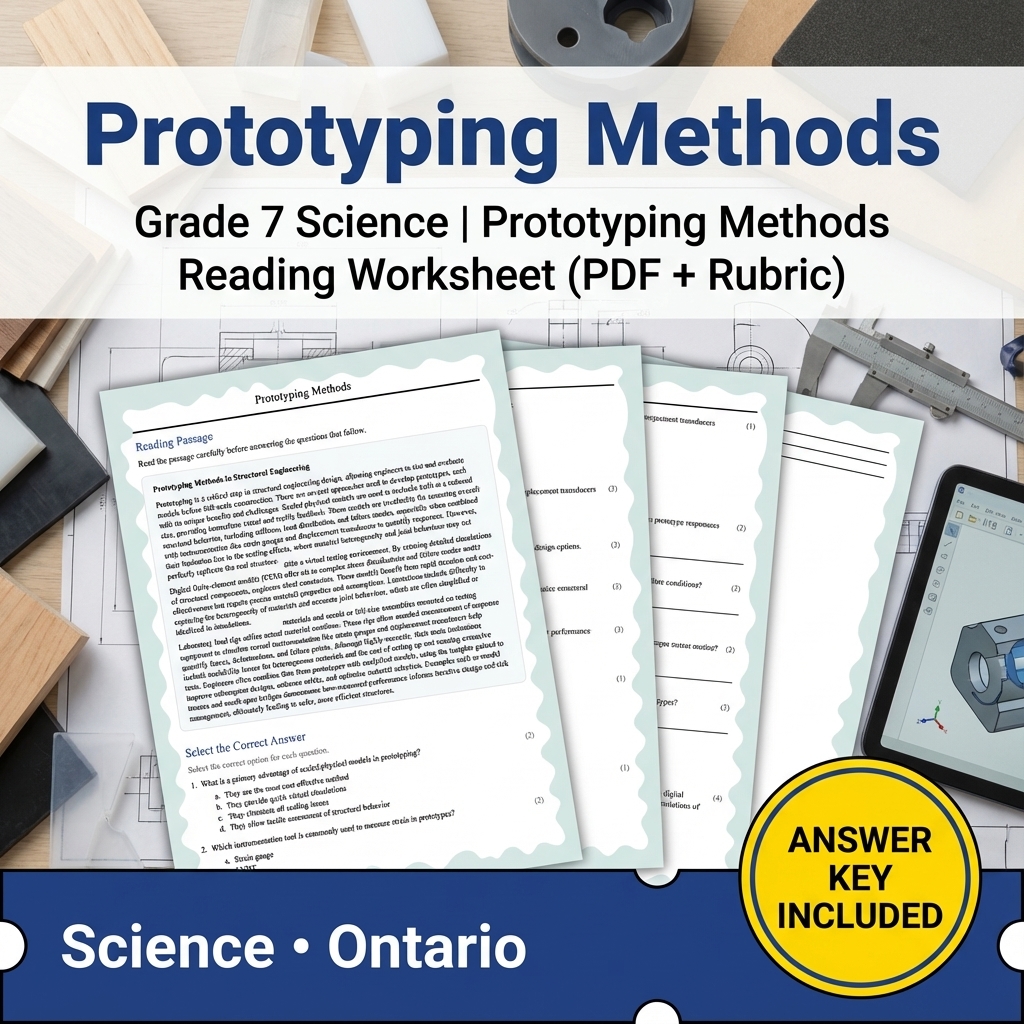
Grade 7 Science | Prototyping Methods Reading Worksheet (PDF + Rubric)
JCreated byJ.S SheetsLearning Objectives
- Understand different prototyping approaches including scaled physical models, digital finite-element models, and laboratory load rigs.
- Compare the advantages and limitations of each prototyping method for assessing strength, stiffness, and failure modes.
- Identify instrumentation techniques such as strain gauges and displacement transducers used to quantify structural responses.
Also included in: Grade 7 Science Unit Bundle – Structural Engineering & Material Testing +1 more
Instant download

Grade 7 Science | The Rock Record - Daily Reading Comprehension
Created byCoral Reef LearningLearning Objectives
- Understand the processes that form different types of rocks within the rock cycle
- Identify the main stages of sedimentary stratigraphy
- Explain how fossils serve as evidence of Earth's history
Instant download
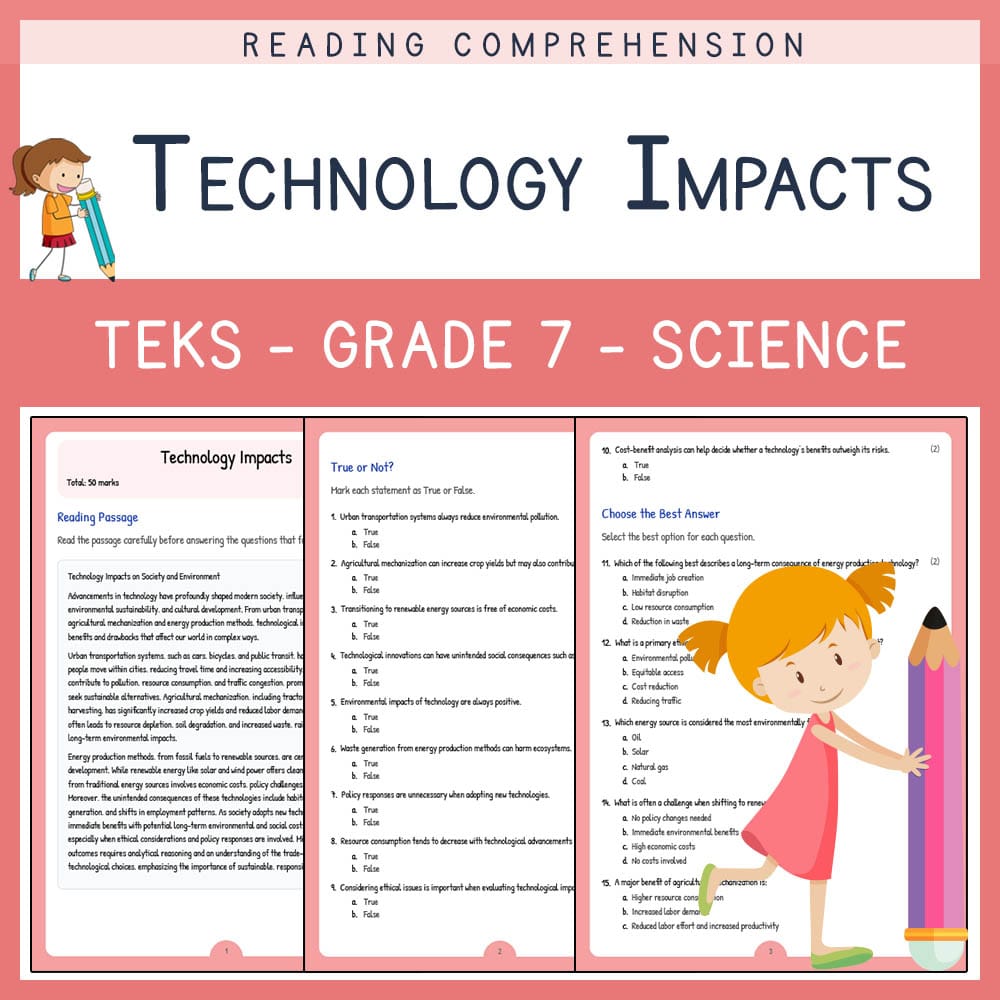
Grade 7 Science | Technology Impacts Worksheet | TEKS Aligned
Created byLumora LearningLearning Objectives
- Analyze the societal, economic, and environmental impacts of various technologies.
- Evaluate short- and long-term consequences of technological development.
- Identify ethical considerations and trade-offs involved in implementing new technologies.
Instant download

Monitoring Methods Worksheet | Grade 7 Science Activities
Created byPrism Point LearningLearning Objectives
- Explain how standardized sampling protocols and consistent data recording support long-term ecological monitoring.
- Describe how temporal replication helps detect trends in species and habitat conditions over time.
- Compare monitoring methods such as fixed-site surveys, point counts, remote sensing, and water quality sampling.
Also included in: Grade 7 Ecosystems & Biodiversity Science Lesson Bundle | Alberta
Instant download

Material Properties Worksheet | Standards-Aligned Grade 7 Science Practice
JCreated byJ.S SheetsLearning Objectives
- Understand how material behavior under compression, tension, and bending affects long-term performance.
- Compare timber, steel, and reinforced concrete regarding strength, stiffness, density, and environmental resilience.
- Analyze how environmental factors like frost and snow influence material selection for construction.
Instant download
About Grade 7 Science Worksheets
Browse 6,039 printable Grade 7 Science worksheets — ready-to-print PDFs with answer keys where available.
Every worksheet on MyTeachingSheets is created by independent teacher-authors and reviewed before publication. All resources download as printable PDFs for classroom, homework, or at-home practice, and many include answer keys. Preview any worksheet free before buying.