
Grade 7 Science Worksheets
6,039 worksheets
Grade 7 Science – Photosynthesis & Photosynthesis Capture | Reading Worksheet
 Created byBright Mind Resources
Learning Objectives
- Understand the process of photosynthesis and its significance
- Identify the key components involved in photosynthesis
- Recognize the importance of light and water for plant growth
Also included in: Grade 7 Energy Transfer Science Daily Reading: Lesson Bundle | California Std. +1 more
Instant download
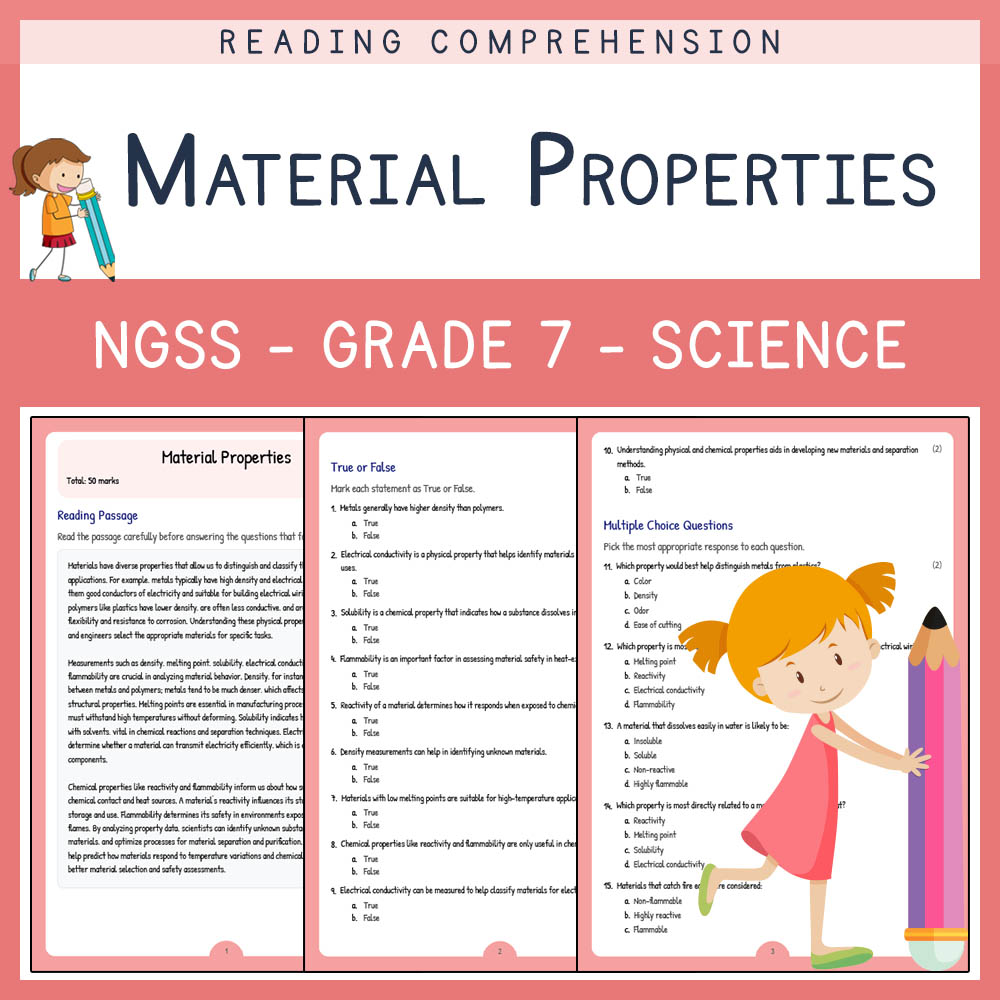
Grade 7 Science | Material Properties Worksheet & Answer Key (NGSS Aligned)
 Created byLumora Learning
Learning Objectives
- Identify and differentiate between physical and chemical properties of materials.
- Quantitatively and qualitatively describe properties such as density, melting point, solubility, electrical conductivity, reactivity, and flammability.
- Analyze property data to classify substances and determine appropriate separation strategies.
Instant download

Grade 7 Filtration Methods Worksheet | Separation of Mixtures Science
 Created byChalk and Compass
Learning Objectives
- Explain how filtration and sedimentation separate mixtures using particle size, shape, and phase differences.
- Describe how porous media and pore size affect flow behavior during filtration.
- Identify the limitations of filtration for dissolved solutes and fine particles like colloids.
Also included in: Separation of Mixtures & Matter Properties Lesson Bundle – Grade 7 Science +1 more
Instant download

Grade 7 Science | Understanding Motion Principles - Daily Reading Comprehension
 Created byCoral Reef Learning
Learning Objectives
- Understand key concepts related to Science
- Apply knowledge through practice questions
- Demonstrate comprehension of the material
Instant download

Grade 7 Biotic and Abiotic Factors Worksheet | NGSS Practice PDF
 Created byClear Sky Classroom
Learning Objectives
- Differentiate between biotic factors and abiotic factors in ecosystems.
- Explain how abiotic conditions influence which organisms can survive.
- Describe how changes in abiotic factors can shift biotic interactions and population sizes.
Instant download

Survival Structures Worksheet | Grade 7 Science Practice and Review
 Created byPrism Point Learning
Learning Objectives
- Identify external and internal structures that help organisms survive in their environments.
- Explain how adaptations improve feeding, protection, movement, and reproduction.
- Use functional relationships to describe how traits support balance and resource acquisition.
Instant download
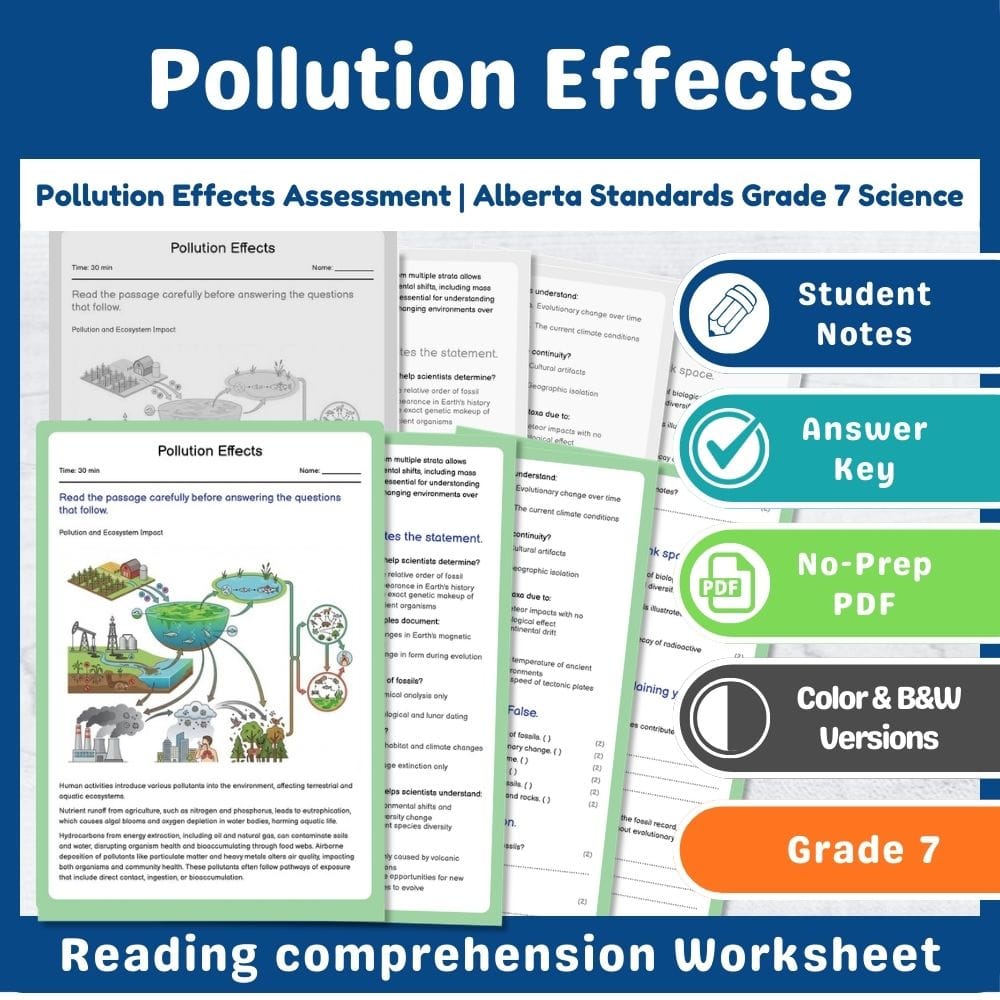
Pollution Effects Assessment | Alberta Standards Grade 7 Science
Created byPrism Point LearningLearning Objectives
- Describe basic types of pollutants affecting terrestrial and aquatic ecosystems.
- Explain how pollutants travel pathways lead to bioaccumulation and community impacts.
- Identify measurable ecological effects caused by different pollutants.
Also included in: Lesson Bundle Grade 7 Science - Interactions and Ecosystems +1 more
Instant download

Grade 7 Biotic Abiotic Worksheet | Practice & Assessment PDF
Created byClear Sky ClassroomLearning Objectives
- Explain how abiotic factors (sunlight, water, temperature, soil, topography) affect living organisms in an ecosystem.
- Describe cause-and-effect relationships between abiotic conditions and biotic community patterns.
- Identify how plants, animals, and microbes respond to non-living environmental gradients in Alberta landscapes.
Instant download

Grade 7 Science – Gas Behavior & Pressure Response | Daily Reading Worksheet
Created byBright Mind ResourcesLearning Objectives
- Explain how pressure in a gas changes when force is applied to the container.
- Describe how temperature and volume influence gas pressure and movement.
- Identify phenomena like diffusion and compressibility in gases through observation.
Also included in: 7th Grade States of Matter Science Daily Reading Lesson Bundle | TEKS +2 more
Instant download
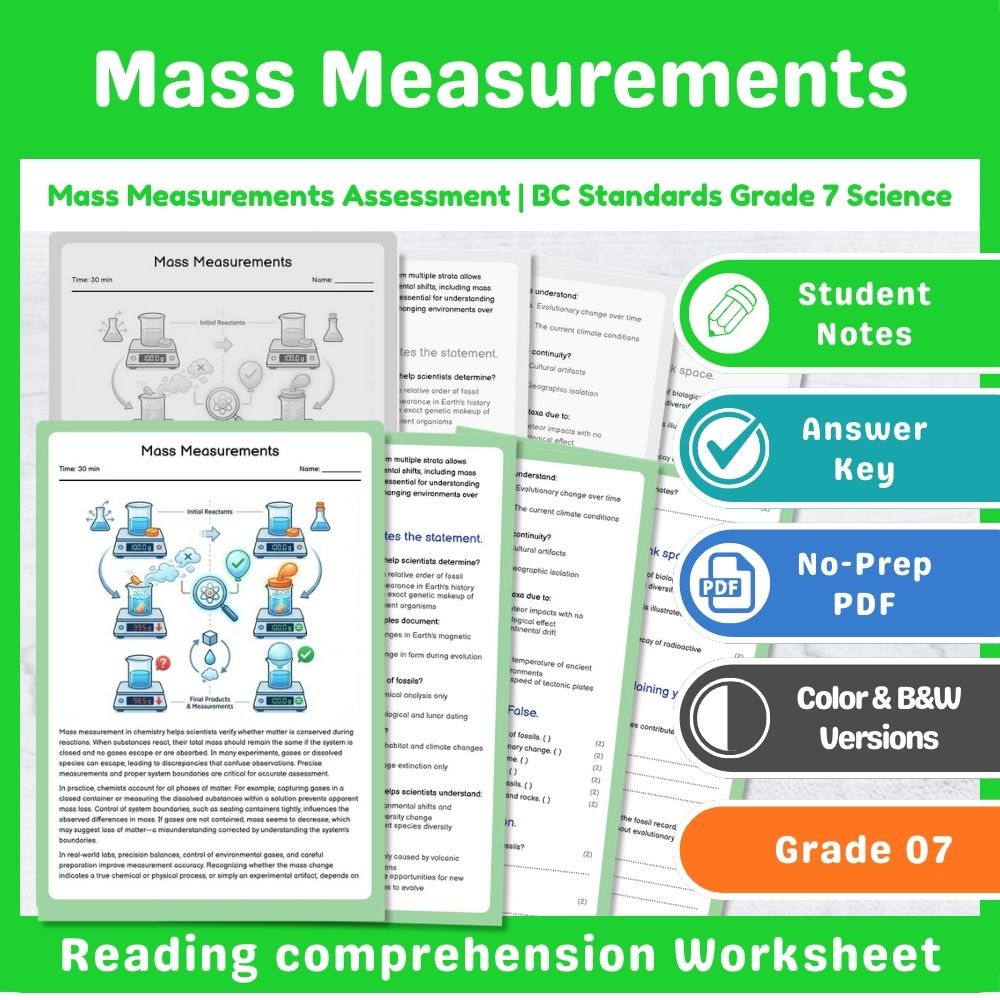
Mass Measurements Assessment | BC Standards Grade 7 Science
Created byPrism Point LearningLearning Objectives
- Understand the concept of conservation of mass during chemical changes.
- Identify factors that influence the accuracy of mass measurements.
- Apply knowledge of measurement techniques to real-world laboratory situations.
Instant download

Grade 7 Thermal Basics Worksheet | Practice & Assessment PDF
Created byClear Sky ClassroomLearning Objectives
- Distinguish between temperature and heat using the particle kinetic-energy model.
- Describe thermal transfer using conduction, convection, and radiation.
- Apply thermal-transfer ideas to explain real-world examples in Alberta’s climates.
Instant download

Reading and Interpreting Graphs and Tables Worksheets Grade 7 Science
 Created byBRIGHT PATH RESOURCES
Learning Objectives
- Organize measurement data into tables using consistent units and clear labels.
- Describe patterns in graphs by using axis direction, scale, and category comparisons.
- Interpret relationships by reading trends, clusters, and differences between groups.
Also included in: Grade 7 Science Worksheets Bundle | Models, Variables & Evidence +2 more
Instant download

Grade 7 Science Solution Comparison Worksheet | NGSS Engineering Design Activity
 Created byNorthstar Worksheets
Learning Objectives
- Use models to predict how alternative design solutions will behave.
- Compare solutions using consistent metrics such as performance, cost, durability, and manufacturability.
- Identify and quantify trade-offs between competing design choices.
Also included in: ngss engineering design Grade 7 science Lesson Bundle | Solution & Optimization +1 more
Instant download

Rock Cycle Worksheet Grade 7 NGSSS Earth Science Activities
 Created byEvergreen Desk Education
Learning Objectives
- Explain how the rock cycle shows that rocks can change types through natural geologic processes
- Describe how igneous, sedimentary, and metamorphic rocks form and how those pathways connect surface and subsurface environments
- Use evidence and key terms (weathering, compaction, cementation, heat, pressure) to compare rock-formation processes
Instant download
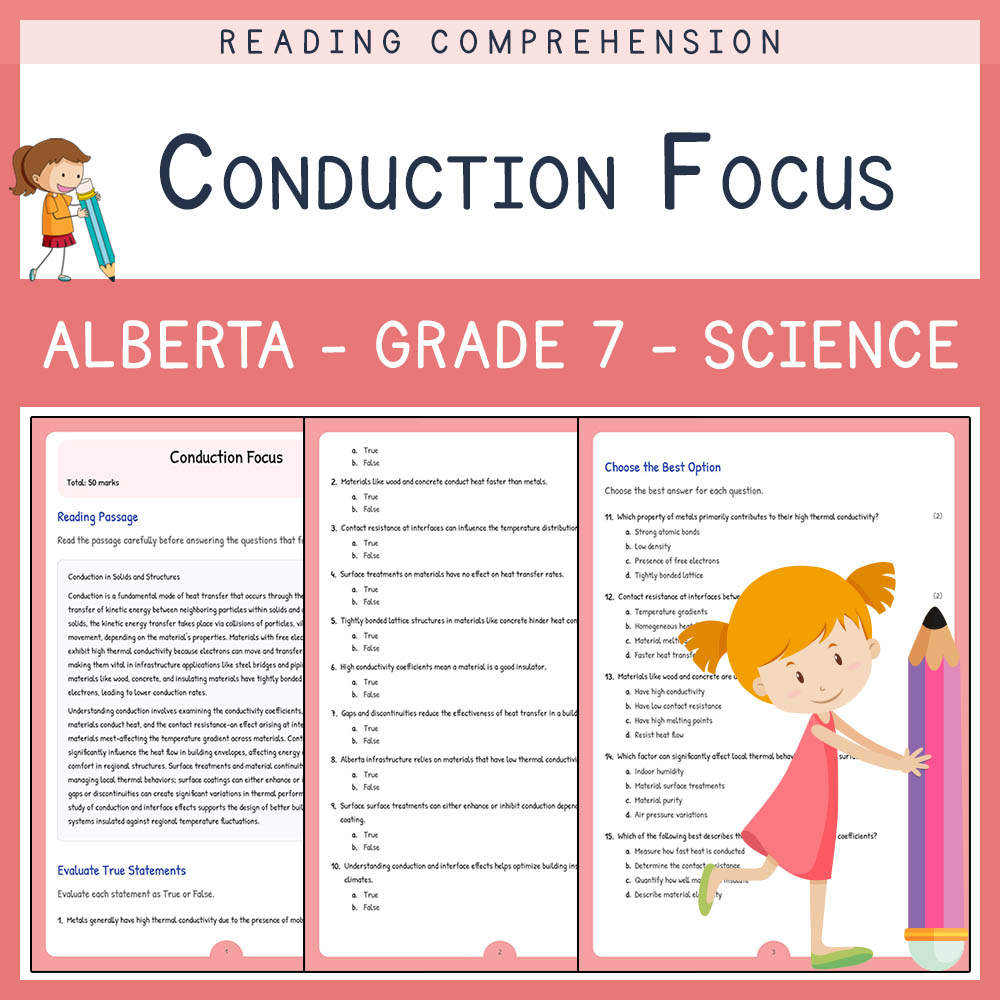
Grade 7 Science | Conduction Focus Worksheet | Alberta Standard
Created byLumora LearningLearning Objectives
- Understand the process of heat conduction and how it occurs in solids
- Identify materials with high and low thermal conductivity
- Explain how contact resistance and surface treatments affect heat transfer
Instant download

Rock Cycle Transformations and Energy Flow Worksheets Grade 7
 Created byTeachers Club
Learning Objectives
- Describe how three major rock types transform through the rock cycle
- Explain how melting and cooling form igneous rocks
- Identify processes that transform material into sedimentary rocks
Also included in: Grade 7 Science Worksheets | Earth's Systems NGSS Bundle +2 more
Instant download

Grade 7 Net Force and Equilibrium Worksheet | Alberta Science Forces
Created byBRIGHT PATH RESOURCESLearning Objectives
- Define net force and equilibrium using key vocabulary from a text.
- Distinguish static equilibrium from dynamic equilibrium in simple situations.
- Explain how balanced force pairs affect motion using qualitative reasoning.
Also included in: Grade 7 Alberta Science Forces Structures and Motion Worksheet Bundle +1 more
Instant download

Grade 7 Science | Energy Transfer Overview Worksheet | Florida NGSSS Aligned
Created byLumora LearningLearning Objectives
- Explain how energy transfers from higher-energy systems to lower-energy systems.
- Identify ways energy can transform (such as thermal, kinetic, and light energy) during everyday events.
- Connect energy transfer to observable effects like temperature change, motion, and light emission.
Instant download

Grade 7 Cell Organization Worksheet | Practice & Assessment PDF
Created byClear Sky ClassroomLearning Objectives
- Explain how cells are organized into tissues and how tissues form organs
- Describe the roles of major tissue types (epithelial, muscle, nervous) in the body
- Use evidence from text to identify the main idea of organism-level cell organization
Instant download

Grade 7 Science | Matter Energy Flow Worksheet | California Standards
Created byLumora LearningLearning Objectives
- Explain how energy captured by producers flows through food chains and webs to consumers and decomposers.
- Describe how matter is recycled in ecosystems through decomposition and nutrient return.
- Distinguish between energy transfer (with energy loss as heat) and matter cycling (with elements reused).
Instant download

Predator-Prey Feedbacks in Communities | Grade 7 Science Worksheet
Created byBRIGHT PATH RESOURCESLearning Objectives
- Explain how predator and prey populations can change over time through cause-and-effect feedbacks.
- Describe how changes in one population can ripple to affect other organisms in a community.
- Use models or scenarios to predict what happens when predators increase or decrease.
Also included in: Grade 7 Science Ecosystems & Food Webs Worksheets Bundle +2 more
Instant download

Grade 7 Science | Density And Volume Worksheet | NGSSS Aligned
Created byLumora LearningLearning Objectives
- Explain how density relates mass and volume using the equation density = mass ÷ volume.
- Identify the intensive property of density and predict how it changes (or does not) when sample amount changes.
- Compare and interpret densities of different materials using qualitative and quantitative reasoning.
Instant download

Nutrient Transport Worksheet Grade 7 Science Activities | California Standards
Created byPrism Point LearningLearning Objectives
- Explain how internal transport moves materials from where they are obtained to where cells need them.
- Describe how the body removes unusable materials to prevent harmful buildup.
- Use models and vocabulary to connect digestion, circulation, and waste removal.
Also included in: Life Science - Grade 7 Bundle
Instant download

Physical Changes in Matter: Signs and Evidence Worksheets Grade 7
 Created bySunny Desk Resources
Learning Objectives
- Identify indicators of physical changes in matter, such as phase changes and dissolving without new substances.
- Explain how particle rearrangement and energy transfer can change a substance’s form without changing its chemical identity.
- Use mass evidence from closed systems to support claims about physical change.
Also included in: Matter and Chemical Change Grade 7 Alberta Science Worksheets Bundle +1 more
Instant download

Mechanical Energy Transfer and Conservation Worksheets Grade 7
Created bySunny Desk ResourcesLearning Objectives
- Explain the difference between kinetic energy and potential energy in mechanical systems
- Describe how changes in height, mass, and speed relate to mechanical energy
- Use conservation of mechanical energy to predict how energy forms change during motion
Also included in: Forces, Structures & Motion Grade 7 Science Bundle | Alberta +1 more
Instant download

Migration Drivers and Connectivity Worksheets Grade 7 Science Ecosystems
Created bySunny Desk ResourcesLearning Objectives
- Explain how food availability and breeding needs influence migration timing and routes
- Describe how migration connects distant habitats and affects population dynamics
- Identify timing cues and energetic demands that shape migratory movement
Also included in: Interactions & Ecosystems Grade 7 Alberta Science Worksheets Bundle +1 more
Instant download

Plate Tectonics and Continental Drift Evidence Worksheets Grade 7
Created byTeachers ClubLearning Objectives
- Explain how fossils and rocks support past continental positions
- Match continental features to related tectonic processes
- Use earthquakes and volcanoes to infer relative plate motion
Also included in: Grade 7 Science Worksheets | Earth's Systems NGSS Bundle +2 more
Instant download

Grade 7 Science Worksheet on Bitumen Separation | Alberta Standards Practice
JCreated byJ.S SheetsLearning Objectives
- Understand the physical and chemical processes involved in separating bitumen from oil sands.
- Identify the differences between physical separation techniques and chemical treatments in mixture processing.
- Explain how temperature, density, and additives influence mixture separation.
Instant download

Homogeneous vs. Heterogeneous Mixtures & Solutions Worksheets Grade 7
Created byTeachers ClubLearning Objectives
- Classify mixtures using homogeneous and heterogeneous particle distribution.
- Explain solubility, concentration, and saturation using solute-solvent relationships.
- Differentiate solutions, colloids, and suspensions by particle behavior.
Also included in: Grade 7 Science Worksheets | NGSS Matter & Its Interactions Bundle +2 more
Instant download

Grade 7 Science – Invasive Species Worksheet (PDF) BC Standards
Created byEvergreen Desk EducationLearning Objectives
- Explain how invasive species are introduced beyond their native range and why they can spread rapidly.
- Describe at least three ecological impacts of invasive species on food webs and nutrient cycles.
- Use cause-and-effect reasoning to predict how an ecosystem’s community composition may change over time.
Instant download

Environmental Change & Ecosystems Worksheets | Grade 7 Science
Created byBRIGHT PATH RESOURCESLearning Objectives
- Explain how changes in temperature, rainfall, light, and habitat structure can alter resource availability in an ecosystem.
- Describe how pollution or poor water quality can affect organism growth and survival.
- Use examples to show how changes in one species can alter predation, competition, and symbiosis.
Also included in: Grade 7 Science Ecosystems & Food Webs Worksheets Bundle +2 more
Instant download

Calorimetry and Energy Conservation Grade 7 Science Worksheets
Created bySunny Desk ResourcesLearning Objectives
- Explain how calorimetry uses temperature change to determine energy transfer
- Calculate and compare heat energy changes using specific heat and mass
- Describe how heat moves during melting, heating, and combustion scenarios
Also included in: Energy, Heat & Thermal Processes Grade 7 Science Alberta Bundle +1 more
Instant download

Science Succession Patterns Worksheet | PDF Practice for Grade 7 Ontario
JCreated byJ.S SheetsLearning Objectives
- Explain ecological succession as predictable change in community composition after a disturbance
- Distinguish primary succession from secondary succession using examples
- Identify key drivers of succession, including soil development, seed dispersal, competition, and facilitation
Instant download

Indigenous Knowledge & Environmental Stewardship Worksheets Grade 7
Created bySunny Desk ResourcesLearning Objectives
- Describe how traditional ecological knowledge (TEK) helps people understand seasonal cycles and ecological relationships
- Identify examples of place-based indicators and oral histories used to observe species and habitats over time
- Explain why multiple knowledge systems can complement each other when interpreting long-term environmental patterns
Also included in: Interactions & Ecosystems Grade 7 Alberta Science Worksheets Bundle +1 more
Instant download

Science Grade 7 Modeling and Simulation Worksheet | Ontario Standards
JCreated byJ.S SheetsLearning Objectives
- Explain how models use abstraction and assumptions to represent real-world systems
- Identify parameters, units, and scaling choices in simple numerical models
- Evaluate a model by comparing predictions with empirical observations and recognizing limits
Instant download

Grade 7 Modelling Ecosystems Worksheet | Practice & Assessment PDF
Created byClear Sky ClassroomLearning Objectives
- Explain how ecological models represent relationships among components in an ecosystem
- Distinguish between conceptual and quantitative modelling approaches
- Identify important model inputs and limitations, including uncertainty
Instant download

Grade 7 Seasonal Cycles Worksheet | Practice & Assessment PDF
Created byClear Sky ClassroomLearning Objectives
- Explain how solar input, albedo, and phase changes drive seasonal energy budgets.
- Describe how stored energy is released through radiative, sensible, and latent heat pathways.
- Relate seasonal thermal cycling to soil freeze–thaw, snowpack insulation, and lake stratification.
Instant download

Population Limits and Carrying Capacity Worksheets | Grade 7 Science
Created byTeachers ClubLearning Objectives
- Interpret logistic growth curves to describe population changes over time
- Explain carrying capacity in populations with limited resources
- Describe how birth and death affect population growth
Also included in: Grade 7 Science Ecosystems Worksheets | NGSS Unit Bundle +2 more
Instant download

Grade 7 Science | Diffusion & Mixing - Daily Reading Comprehension
Created byCoral Reef LearningLearning Objectives
- Understand the process of diffusion and how particles move from high to low concentration.
- Explain how temperature affects the rate of diffusion.
- Describe how mixing occurs without particles stopping their motion.
Instant download

Grade 7 Science | States of Matter - Daily Reading Comprehension
Created byCoral Reef LearningLearning Objectives
- Understand how particles are arranged in solids and liquids.
- Explain how energy transfer causes changes of state.
- Describe the properties of solids and liquids based on particle behavior.
Instant download

Energy Conversion and Efficiency Worksheets | Grade 7 Science
Created byTeachers ClubLearning Objectives
- Explain how devices convert energy while obeying energy conservation
- Track input, output, and losses in energy transformations
- Describe why thermal energy losses occur during energy conversions
Also included in: Grade 7 Science Energy Worksheets Bundle | NGSS Aligned +2 more
Instant download

Beam Behavior Worksheet | Grade 7 Science Practice
Created byPrism Point LearningLearning Objectives
- Explain how beams bend, shear, and deflect when loads are applied
- Describe how span, support conditions, and load types affect beam performance
- Use span-to-depth ratio, material stiffness, and service load ideas to judge stability and comfort
Instant download

Grade 7 Energy Transformations Worksheet | Practice & Assessment PDF
Created byClear Sky ClassroomLearning Objectives
- Explain how energy transforms between forms while total energy is conserved.
- Identify examples of mechanical, chemical, electrical, and thermal energy in real systems.
- Describe energy pathways using a cause-and-effect reasoning approach.
Instant download

Science Grade 7 Separating Matter Worksheet | Standards-Aligned Practice
JCreated byJ.S SheetsLearning Objectives
- Explain how differences in physical properties such as density and solubility can be used to separate mixtures.
- Distinguish physical changes from chemical changes by describing whether new substances form.
- Predict how matter will separate or change form when conditions like heating or dissolving are applied.
Also included in: Grade 7 Energy Transfer and Change Science Lesson Bundle – General Framework +1 more
Instant download

Phenotype and Environment Worksheets: Grade 7 Heredity Science
Created byTeachers ClubLearning Objectives
- Explain how genetic makeup and environment influence phenotype
- Identify environmental conditions that influence visible traits
- Distinguish inherited traits from environmentally modified traits
Also included in: Heredity Inheritance & Variation Grade 7 Science NGSS Bundle +2 more
Instant download

Friction and Air Resistance Worksheet for Grade 7 Science Activities
Created byPrism Point LearningLearning Objectives
- Explain how friction and air resistance oppose motion and reduce an object's speed.
- Describe how surface texture and contact between surfaces affect the strength of resistive forces.
- Use the idea of resistive forces acting opposite motion to predict how quickly objects slow down.
Also included in: Physical Science Lesson Bundle | Grade 7 Science | Florida NGSSS
Instant download

Grade 7 Science | Scientific Inquiry Basics Worksheet (PDF+ Answer Key)
 Created byCopper Leaf Classroom
Learning Objectives
- Understand the fundamental components of a scientific inquiry, including questions, hypotheses, and variables.
- Recognize the importance of measurement precision, documentation, and safety procedures in laboratory settings.
- Identify ethical considerations in data reporting and the role of peer review in ensuring reliability.
Instant download

Grade 7 Science | Purity Assessment Worksheet (Ontario Standards) (PDF)
Created byEvergreen Desk EducationLearning Objectives
- Explain how melting point, boiling point, conductivity, refractive index, and gravimetric residue can indicate purity or contamination.
- Use “multiple lines of evidence” to justify whether a sample is likely pure.
- Compare how different tests respond to different kinds of impurities and describe trade-offs.
Also included in: Grade 7 Substances and Mixtures Science Lesson Bundle Worksheet (Ontario) +1 more
Instant download
About Grade 7 Science Worksheets
Browse 6,039 printable Grade 7 Science worksheets — ready-to-print PDFs with answer keys where available.
Every worksheet on MyTeachingSheets is created by independent teacher-authors and reviewed before publication. All resources download as printable PDFs for classroom, homework, or at-home practice, and many include answer keys. Preview any worksheet free before buying.