
Grade 7 Science Worksheets
6,039 worksheets
Friction and Air Resistance Worksheet for Grade 7 Science Activities
 Created byPrism Point Learning
Learning Objectives
- Explain how friction and air resistance oppose motion and reduce an object's speed.
- Describe how surface texture and contact between surfaces affect the strength of resistive forces.
- Use the idea of resistive forces acting opposite motion to predict how quickly objects slow down.
Also included in: Physical Science Lesson Bundle | Grade 7 Science | Florida NGSSS
Instant download

Grade 7 Science | Scientific Inquiry Basics Worksheet (PDF+ Answer Key)
 Created byCopper Leaf Classroom
Learning Objectives
- Understand the fundamental components of a scientific inquiry, including questions, hypotheses, and variables.
- Recognize the importance of measurement precision, documentation, and safety procedures in laboratory settings.
- Identify ethical considerations in data reporting and the role of peer review in ensuring reliability.
Instant download

Grade 7 Science | Purity Assessment Worksheet (Ontario Standards) (PDF)
 Created byEvergreen Desk Education
Learning Objectives
- Explain how melting point, boiling point, conductivity, refractive index, and gravimetric residue can indicate purity or contamination.
- Use “multiple lines of evidence” to justify whether a sample is likely pure.
- Compare how different tests respond to different kinds of impurities and describe trade-offs.
Also included in: Grade 7 Substances and Mixtures Science Lesson Bundle Worksheet (Ontario) +1 more
Instant download

Climate Drivers Assessment for Grade 7 Science | California Standards
Created byPrism Point LearningLearning Objectives
- Distinguish weather from climate and explain how climate is influenced by long-term drivers.
- Describe how solar energy, atmospheric circulation, and the distribution of water shape regional climate.
- Explain how ocean processes affect heat storage and heat release and how that can shift precipitation patterns over time.
Also included in: Grade 7 Earth Systems Science Lesson Bundle Assessments | California Standards +1 more
Instant download

Grade 7 Science | Thermal Conductivity - Daily Reading Comprehension
 Created byCoral Reef Learning
Learning Objectives
- Identify different materials and their properties related to heat transfer.
- Explain how atomic structure affects thermal conductivity.
- Compare metals, ceramics, polymers, and composites in terms of heat transfer efficiency.
Instant download

DNA and Chromosomes Worksheet | Standards-Aligned Grade 7 Science Practice
JCreated byJ.S SheetsLearning Objectives
- Describe how DNA molecules are organized into chromosomes and how they encode genes that influence traits.
- Explain the process of chromosome segregation during gamete formation and fusion.
- Understand how genetic material is inherited from both parents through chromosomal transmission.
Also included in: Grade 7 Genetics and Heredity Science Lesson Bundle – NGSS Framework +1 more
Instant download

Global Atmospheric & Oceanic Circulation Cells Worksheets Grade 7
 Created byTeachers Club
Learning Objectives
- Explain how unequal solar heating drives global wind patterns
- Describe how Earth’s rotation influences global atmospheric circulation
- Identify roles of Hadley, Ferrel, and polar circulation cells
Also included in: Grade 7 Science Worksheets | Earth's Systems NGSS Bundle +2 more
Instant download

Grade 7 Science | Rock Cycles for Grade - Daily Reading Comprehension
Created byCoral Reef LearningLearning Objectives
- Understand key concepts related to Science
- Apply knowledge through practice questions
- Demonstrate comprehension of the material
Instant download

Particle Motion Worksheet | Grade 7 Science Activities
Created byPrism Point LearningLearning Objectives
- Explain how average particle kinetic energy is related to temperature.
- Describe how thermal energy depends on both particle motion and number of particles.
- Use the particle model to connect microscopic motion to pressure and thermal changes.
Instant download

Grade 7 Particle Motion Worksheet | Practice & Assessment PDF
 Created byClear Sky Classroom
Learning Objectives
- Explain how temperature relates to the average random kinetic energy of particles
- Describe how microscopic particle motion and particle number influence thermal energy
- Use molecular speed ideas to interpret differences in air mass temperatures
Instant download

Population Growth Worksheets: Carrying Capacity Grade 7 Science
Created byPrism Point LearningLearning Objectives
- Explain how limiting factors affect population size over time
- Compare exponential and logistic growth using carrying capacity
- Interpret population graphs for density-dependent influences
Also included in: Interactions in the Environment Lesson Bundle | Grade 7 Science | Ontario +1 more
Instant download

Comparative Anatomical Evidence for Evolution Worksheets Grade 7 Science
Created byTeachers ClubLearning Objectives
- Explain how homologous structures provide evidence of shared ancestry
- Compare homologous and analogous structures by evolutionary relatedness
- Interpret anatomical evidence from modern organisms
Also included in: Biological Evolution Grade 7 Science NGSS Unit Bundle +2 more
Instant download

Grade 7 Science Worksheet | Analyzing Weather Data Patterns (PDF)
Created byEvergreen Desk EducationLearning Objectives
- Explain how weather data (temperature, wind, humidity, and precipitation) can reveal patterns across time and location
- Differentiate weather from climate and describe how climate change can occur over long periods
- Use examples of air pressure and air mass movement to interpret weather data patterns
Also included in: Earth & Weather Systems: Grade 7 Science Lesson Bundle (General Framework) +1 more
Instant download

Biodiversity Indices Worksheets | Grade 7 Ecosystems Science
 Created bySunny Desk Resources
Learning Objectives
- Define biodiversity in terms of genetic, species, and ecosystem diversity.
- Compare biodiversity richness, evenness, and habitat heterogeneity and explain what each can indicate.
- Use biodiversity metrics to interpret patterns related to ecosystem resilience and function.
Also included in: Interactions & Ecosystems Grade 7 Alberta Science Worksheets Bundle +1 more
Instant download
Grade 7 Science — Population Change Worksheet for Mastery
 Created byThe Resource Hub
Learning Objectives
- Understand factors that influence population size and distribution.
- Explain patterns of exponential and logistic growth in populations.
- Analyze how predator-prey relationships and limiting factors affect community dynamics.
Also included in: Grade 7 Science Unit Bundle – Ecosystems, Cells & Adaptations Worksheet Pack +1 more
Instant download

Grade 7 Separating Bitumen from Oil Sands Worksheet | Alberta Science
 Created byBRIGHT PATH RESOURCES
Learning Objectives
- Identify parts of a mixture in oil sands using physical properties.
- Distinguish physical separation steps from chemical changes during processing.
- Explain how density, particle size, temperature, and additives affect mixture behavior.
Also included in: Grade 7 Alberta Science Matter and Chemical Change Worksheet Bundle +1 more
Instant download

Grade 7 Science Worksheet Natural Selection | Standards-Aligned Practice
JCreated byJ.S SheetsLearning Objectives
- Describe how natural selection changes trait frequencies in a population over many generations
- Explain why natural selection does not require organisms to develop traits during their lifetime
- Use examples (like antibiotic resistance) to connect heritable variation to survival and reproduction
Also included in: Grade 7 Evolution and Population Dynamics Science Lesson Bundle – Florida NGSSS +1 more
Instant download

Solution Concentration Worksheets | Grade 7 Science Matter Practice
Created bySunny Desk ResourcesLearning Objectives
- Explain how solution concentration describes the amount of solute compared with solvent
- Identify how concentration changes boiling point elevation and freezing point depression
- Use concentration measures such as mass percent and grams per litre to describe dilution or saturation
Also included in: Matter and Chemical Change Grade 7 Alberta Science Worksheets Bundle +1 more
Instant download

Grade 7 Science Worksheet | Erosion and Transport BC Standard (PDF)
Created byEvergreen Desk EducationLearning Objectives
- Explain how running water, glaciers, wind, and gravity erode rocks and transport sediment
- Describe how transport energy and distance affect sediment grain size and sorting
- Interpret clues from sedimentary signatures to reconstruct past environments
Instant download

Wetland Functions and Ecosystem Services Worksheets Grade 7 Science
Created bySunny Desk ResourcesLearning Objectives
- Describe how wetlands store water and help regulate water flow across a landscape.
- Explain how wetlands cycle nutrients and filter sediments in water.
- Identify how wetland habitats support amphibians and migratory birds.
Also included in: Interactions & Ecosystems Grade 7 Alberta Science Worksheets Bundle +1 more
Instant download

Grade 7 Science | Integration and Homeostasis Worksheet (PDF)
Created byEvergreen Desk EducationLearning Objectives
- Explain how cells, tissues, and organ systems work together to maintain homeostasis in the human body.
- Describe how transport proteins and membrane pumps regulate nutrient levels, ion concentrations, and water balance.
- Connect hormone signaling and coordinated transport processes to maintaining stable internal conditions (such as blood glucose).
Instant download

Grade 7 Science – Model Evaluation Worksheet (PDF) | General Standards
Created byEvergreen Desk EducationLearning Objectives
- Explain how model evaluation compares predictions to evidence.
- Identify assumptions that may be wrong when model outputs do not match data.
- Describe how computational simulations and input changes help test assumptions.
Also included in: Grade 7 Model-Based Scientific Reasoning Science Lesson Bundle (General) +1 more
Instant download

Purity Assessment Worksheet | Grade 7 Science Review & Practice
Created byPrism Point LearningLearning Objectives
- Explain how physical properties such as melting point, boiling point, conductivity, and refractive index indicate whether a substance is pure or contaminated.
- Use multiple lines of evidence to judge purity and describe why one single test can be misleading.
- Compare techniques by discussing trade-offs such as temperature precision, sample size, and suitability for ionic versus non-ionic substances.
Also included in: Grade 7 Substance & Mixture Properties Science Lesson Bundle (Ontario)
Instant download
Grade 7 Science Worksheet | Cell Communication Practice with Answer Key PDF
Created byCoral Reef LearningLearning Objectives
- Describe how cells communicate using chemical and electrical signals.
- Identify the structures involved in cell communication, such as receptor proteins and gap junctions.
- Explain the importance of signal specificity, amplification, and feedback in regulating physiological processes.
Instant download

Grade 7 Material Properties: Strength and Bending in Structures Worksheet
Created byBRIGHT PATH RESOURCESLearning Objectives
- Identify material properties such as strength, stiffness, density, and environmental resilience
- Explain how compression, tension, and bending affect long-term performance of common materials
- Use evidence from a passage to support maintenance and design choices in cold, snowy climates
Also included in: Grade 7 Alberta Science Forces Structures and Motion Worksheet Bundle +1 more
Instant download

Ecological Monitoring Worksheets: Detecting Change | Grade 7 Science
Created bySunny Desk ResourcesLearning Objectives
- Describe how standardized ecological monitoring protocols help detect trends over time.
- Identify appropriate methods for collecting habitat and species data (e.g., fixed-site surveys, point counts, remote sensing, water quality sampling).
- Explain why temporal replication and data quality checks improve the reliability of results.
Also included in: Interactions & Ecosystems Grade 7 Alberta Science Worksheets Bundle +1 more
Instant download

Adaptation Traits and Selective Pressures Worksheets Grade 7 Science
Created bySunny Desk ResourcesLearning Objectives
- Describe how adaptation traits can improve survival and reproduction in specific environments.
- Explain how selective pressures change which traits become more common in a population over generations.
- Identify examples of structural, physiological, and behavioural adaptations from an Alberta habitat context.
Also included in: Interactions & Ecosystems Grade 7 Alberta Science Worksheets Bundle +1 more
Instant download

Building Envelope Worksheet | Ontario Grade 7 Science | Assessment PDF
 Created byCedar Grove Learning
Learning Objectives
- Explain how walls, roofs, windows, and foundations work together to affect a building’s thermal performance.
- Identify how thermal bridging and air infiltration influence heat loss and heat gain.
- Describe how insulation placement and continuous air/thermal barriers can reduce energy use.
Also included in: Grade 7 Thermal Energy & Heat Transfer Science Lesson Bundle: Ontario +1 more
Instant download

Trophic Energy Flow Worksheets: Energy Transfer Grade 7 Science
Created byPrism Point LearningLearning Objectives
- Explain how energy moves from producers through successive trophic levels
- Calculate trophic efficiency using percent-based energy transfer examples
- Interpret how respiration and heat reduce available energy
Also included in: Interactions in the Environment Lesson Bundle | Grade 7 Science | Ontario +1 more
Instant download

DNA and Chromosome Inheritance of Traits Worksheets Grade 7
Created byTeachers ClubLearning Objectives
- Explain how DNA is organized into chromosomes and genes
- Model chromosome segregation during gamete formation
- Describe how DNA sequence differences create trait variation
Also included in: Grade 7 Science Worksheets | Full Year NGSS Bundle +1 more
Instant download

Variable Control Practice Worksheets | Grade 7 Science Review and Assessment
Created byPrism Point LearningLearning Objectives
- Identify independent, dependent, and controlled variables in real experimental scenarios.
- Use operational definitions to measure variables in a fair test.
- Design fair comparisons using controls, consistent timing, and replication to support valid causal claims.
Instant download

Heat Transfer and Temperature Worksheets | Grade 7 Science Thermal Energy
Created bySunny Desk ResourcesLearning Objectives
- Explain the difference between temperature and heat using particle motion and energy transfer
- Identify how conduction, convection, and radiation move thermal energy
- Use real-world examples to predict how thermal exchanges affect environments
Also included in: Energy, Heat & Thermal Processes Grade 7 Science Alberta Bundle +1 more
Instant download
Grade 7 Science — Producers and Consumers Worksheet MCQ Paper
Created byThe Resource HubLearning Objectives
- Understand the roles of producers and consumers within an ecosystem.
- Identify the energy transfer process and its limitations among trophic levels.
- Describe how energy flow influences population structure in communities.
Also included in: Grade 7 Science Ecosystems & Interactions Worksheet Bundle +1 more
Instant download

Energy Transfer Worksheet | Grade 7 Science Activities
Created byPrism Point LearningLearning Objectives
- Explain how conduction, convection, and radiation transfer thermal energy and give real-world examples.
- Relate temperature differences to the direction of heat flow and to measurable effects like warming rates.
- Describe how specific heat and phase changes affect thermal energy transfer without always changing temperature.
Also included in: Grade 7 Matter, States, and Reactions in Science Lesson Bundle TEKS
Instant download

Engineering Design Optimization Using Test Data Worksheets Grade 7
Created byTeachers ClubLearning Objectives
- Analyze test data to identify design parameters that improve performance
- Compare design performance quantitatively under material and cost constraints
- Justify iterative design changes using quantitative test evidence
Also included in: Grade 7 Science Engineering Design Worksheets | NGSS Bundle +2 more
Instant download

Net Force and Free-Body Diagrams Grade 7 Science Worksheets
Created bySunny Desk ResourcesLearning Objectives
- Draw and interpret free-body diagrams to represent all relevant forces acting on an object.
- Resolve forces into perpendicular components and use them to find net force magnitude and direction.
- Use vector addition ideas to predict how net force relates to acceleration down an incline.
Also included in: Forces, Structures & Motion Grade 7 Science Bundle | Alberta +1 more
Instant download
Grade 7 Science | The Solar System Reading Worksheet (PDF + Answer Key)
JCreated byJ.S SheetsLearning Objectives
- Understand the origins and formation of the solar system.
- Identify key properties and features of planets and other celestial bodies.
- Describe orbital relationships and phenomena such as eclipses and phases.
Instant download

Grade 7 Science | Change Indicators Worksheet (BC Standards) (PDF)
Created byEvergreen Desk EducationLearning Objectives
- Explain how chemical change indicators (gas, color change, temperature change, precipitate, and irreversibility) provide evidence that new substances formed.
- Compare chemical vs. physical changes using observed and measured evidence.
- Use multiple indicators and basic data to support a claim that a chemical change occurred.
Instant download

Energy Transformations Worksheet | Alberta Grade 7 Science Practice PDF
JCreated byJ.S SheetsLearning Objectives
- Understand the different forms of energy and how they transform from one to another.
- Identify real-world examples of energy transformations in Alberta's resource use.
- Explain the law of conservation of energy during various energy processes.
Instant download
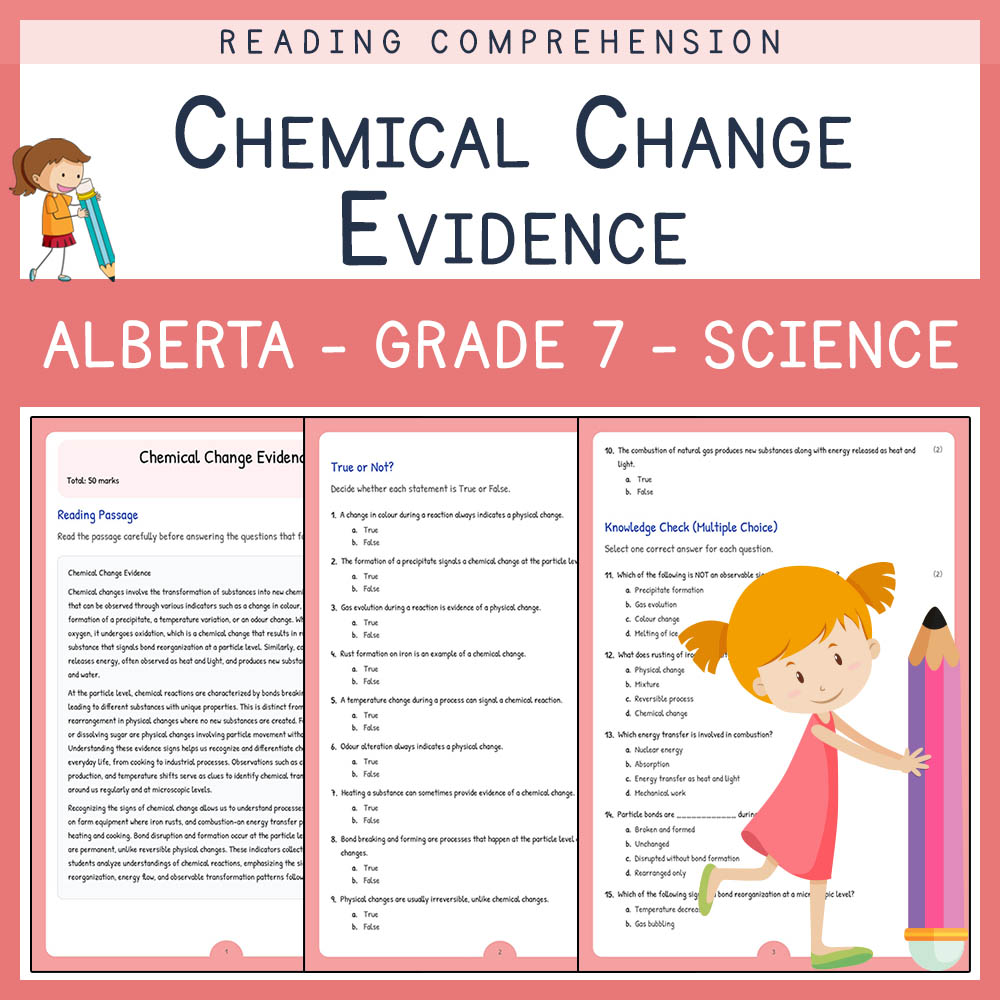
Grade 7 Science Assessment | Chemical Change Evidence Worksheet | Alberta
 Created byLumora Learning
Learning Objectives
- Identify observable signs of chemical changes such as colour change, gas evolution, and temperature change.
- Explain at particle level how bonds are broken and formed during a chemical reaction.
- Differentiate between physical and chemical changes based on evidence provided.
Instant download

Grade 7 Science – Food Webs Worksheet (Alberta Standard) (PDF)
Created byEvergreen Desk EducationLearning Objectives
- Describe how energy flows through a food web using trophic levels (producers, consumers, decomposers).
- Interpret how dependencies among organisms form chains and webs.
- Explain how removing or adding a species can change trophic connections and ecological stability.
Instant download

Quantitative Models in Evolution: Grade 7 Science Worksheets
Created byTeachers ClubLearning Objectives
- Describe trait changes in populations using allele frequency models
- Interpret selection and drift using probability and quantitative reasoning
- Calculate expected genotype frequencies from allele frequencies
Also included in: Biological Evolution Grade 7 Science NGSS Unit Bundle +2 more
Instant download

Grade 7 Matter Cycling Worksheet | NGSS Practice PDF
Created byClear Sky ClassroomLearning Objectives
- Explain how atoms move through an ecosystem via photosynthesis, respiration, feeding, decomposition, and soil/water transport
- Identify how decomposers return nutrients to the environment and support new plant growth
- Differentiate matter cycling (recycling atoms) from energy flow (one-way movement with heat loss)
Instant download

Insulation Principles and Heat Transfer Worksheets | Grade 7 Science
Created bySunny Desk ResourcesLearning Objectives
- Explain how thermal resistance reduces heat flow between two environments
- Use R-values and material thickness to compare insulation performance
- Identify where thermal bridges happen and why they matter
Also included in: Energy, Heat & Thermal Processes Grade 7 Science Alberta Bundle +1 more
Instant download

Adaptive Traits Analysis Assessment | TEKS Grade 7 Science Worksheet
Created byPrism Point LearningLearning Objectives
- Understand how adaptive traits become common in populations through natural selection.
- Identify factors such as variation, heritability, and environmental pressures that influence trait distribution.
- Apply examples like camouflage and pesticide resistance to illustrate the process of selection.
Instant download

Classifying Matter: Elements, Compounds & Mixtures Worksheets Grade 7
Created bySunny Desk ResourcesLearning Objectives
- Classify matter as an element, a compound, a mixture, or a solution based on properties and composition
- Distinguish mixtures from solutions using evidence of uniformity and separability
- Explain why temperature and observable behavior can differ for road salt and dissolved salts in water
Also included in: Matter and Chemical Change Grade 7 Alberta Science Worksheets Bundle +1 more
Instant download

Thermal Performance and Material Properties Worksheets Grade 7 Science
Created bySunny Desk ResourcesLearning Objectives
- Explain how thermal conductivity and specific heat capacity affect heat transfer and temperature change.
- Compare how density, porosity, and moisture content influence effective thermal conductivity in building materials.
- Describe why phase change materials can change thermal behavior during heating or cooling.
Also included in: Energy, Heat & Thermal Processes Grade 7 Science Alberta Bundle +1 more
Instant download

Grade 7 Global Circulation Worksheet | NGSS Practice PDF
Created byClear Sky ClassroomLearning Objectives
- Understand the basic components and flow of Earth's atmospheric and oceanic circulation.
- Identify the roles of different circulation cells and their impact on climate.
- Explain the Coriolis effect and its influence on wind and ocean current directions.
Also included in: Grade 7 Earth Systems Science Lesson Bundle NGSS: 6 Worksheets +1 more
Instant download
About Grade 7 Science Worksheets
Browse 6,039 printable Grade 7 Science worksheets — ready-to-print PDFs with answer keys where available.
Every worksheet on MyTeachingSheets is created by independent teacher-authors and reviewed before publication. All resources download as printable PDFs for classroom, homework, or at-home practice, and many include answer keys. Preview any worksheet free before buying.