
Grade 7 Science Worksheets
6,039 worksheets
Acceleration and Net Force Worksheets | Grade 7 Physical Science
 Created byBRIGHT PATH RESOURCES
Learning Objectives
- Define acceleration as the rate of change of velocity, including direction changes
- Explain how inertia relates mass to acceleration when the same net force is applied
- Interpret velocity-time patterns to determine whether acceleration is constant or changing
Also included in: Grade 7 Physical Science Worksheets Bundle | Energy, Waves & Motion +2 more
Instant download

Interpreting Motion Graphs Science Worksheets Grade 7
Created byBRIGHT PATH RESOURCESLearning Objectives
- Explain how slope on a position-time graph relates to velocity
- Explain how slope on a velocity-time graph relates to acceleration
- Interpret patterns on motion graphs to describe constant versus changing motion
Also included in: Grade 7 Physical Science Worksheets Bundle | Energy, Waves & Motion +2 more
Instant download

Grade 7 Science | Landscape Evolution - Daily Reading Comprehension
 Created byCoral Reef Learning
Learning Objectives
- Understand the role of tectonic uplift in shaping mountains.
- Identify volcanic activity as a surface process influencing landscape change.
- Explain how climate and weathering contribute to landscape features.
Instant download

Chromatography Separation Worksheets: Retention & Purity Grade 7
 Created byPrism Point Learning
Learning Objectives
- Explain how stationary and mobile phases cause chromatographic separation
- Describe how molecular polarity influences movement through chromatography
- Calculate retention factors using compound and solvent distances
Also included in: Pure Substances, Mixtures & Separation Lesson Bundle | Grade 7 Science | Ontario +1 more
Instant download

Grade 7 Science Worksheet | Food Web Complexity (PDF) BC Standards
 Created byEvergreen Desk Education
Learning Objectives
- Explain how producers, consumers, and decomposers are connected in a food web.
- Describe how energy flows through multiple pathways in a food web.
- Evaluate how species changes can cascade through a food web and affect ecosystem stability.
Instant download

Trophic Energy Transfer Worksheet Grade 7 Science Food Web Activity
Created byPrism Point LearningLearning Objectives
- Explain how energy transfers through trophic levels in a food web.
- Describe why only a few trophic levels can be supported by available energy and biomass.
- Distinguish between producers, consumers, and how energy transfer efficiency affects predator populations.
Also included in: Life Science - Grade 7 Bundle
Instant download

Grade 7 Science Surface Area Worksheet (BC) | Cell Exchange & Diffusion (PDF)
Created byEvergreen Desk EducationLearning Objectives
- Explain why surface-area-to-volume ratio limits how large cells can be
- Describe how diffusion and transport depend on exchange surfaces
- Identify adaptations that increase exchange efficiency in cells and organisms
Instant download

Wetland Water Storage and Flood Control Worksheet | Grade 7 Alberta Science
Created byBRIGHT PATH RESOURCESLearning Objectives
- Identify the main idea of how wetlands help manage water across a landscape
- Describe hydrological functions of wetlands using supporting details from the passage
- Explain how wetland water storage can reduce flooding after heavy rainfall
Also included in: Grade 7 Alberta Science Interactions and Ecosystems Worksheet Bundle +1 more
Instant download

Mass Measurements Worksheet | BC Standards Grade 7 Science Practice
JCreated byJ.S SheetsLearning Objectives
- Understand the concept of conservation of mass in chemical and physical changes.
- Identify factors that influence mass measurements and their accuracy.
- Differentiate between precise and accurate mass measurements in experiments.
Instant download

Grade 7 Science | Quantitative Heat - Daily Reading Comprehension
Created byCoral Reef LearningLearning Objectives
- Understand the relationship between heat, mass, and temperature change.
- Learn about specific heat capacity and how to calculate heat energy using Q=mcΔT.
- Identify units of heat such as joules and watts.
Instant download

Grade 7 Science Worksheet | Earth Sun Cycles (PDF) – Standard General
Created byEvergreen Desk EducationLearning Objectives
- Explain how Earth’s axial tilt and yearly orbit affect seasons and day length.
- Describe how Earth’s rotation creates the Sun’s apparent daily motion.
- Use Earth-Sun cycle concepts to interpret calendar and timekeeping ideas.
Also included in: Earth & Weather Systems: Grade 7 Science Lesson Bundle (General Framework) +1 more
Instant download

States of Matter Assessment | California Standards Grade 7 Science
Created byPrism Point LearningLearning Objectives
- Explain how energy transfer affects particle motion and arrangement during changes of state.
- Describe and compare melting, freezing, evaporation, and condensation using the particle model.
- Predict how temperature changes (or stays steady) during a phase change and explain why.
Also included in: Grade 7 Forces and Matter Science Lesson Bundle: California Standards +1 more
Instant download

Grade 7 Science – Conduction Worksheet (Alberta Standards) (PDF)
 Created bySilver Birch Teaching
Learning Objectives
- Explain how conduction transfers thermal energy through particle collisions and electron movement in solids
- Compare thermal conductivity of common building materials and predict heat-flow direction
- Use contact resistance and material interfaces to describe temperature gradients in real structures
Also included in: Grade 7 Thermal Systems Models and Heat Transfer Science Lesson Bundle – Alberta +1 more
Instant download

Grade 7 Levers and Pulleys Worksheet | Alberta NGSS Practice PDF
 Created byClear Sky Classroom
Learning Objectives
- Explain the basic parts of a lever (fulcrum, effort, load) and how torque relates to lever action
- Describe how pulley systems change effort and direction of force
- Calculate ideal mechanical advantage for simple lever and pulley setups using basic arithmetic
Instant download
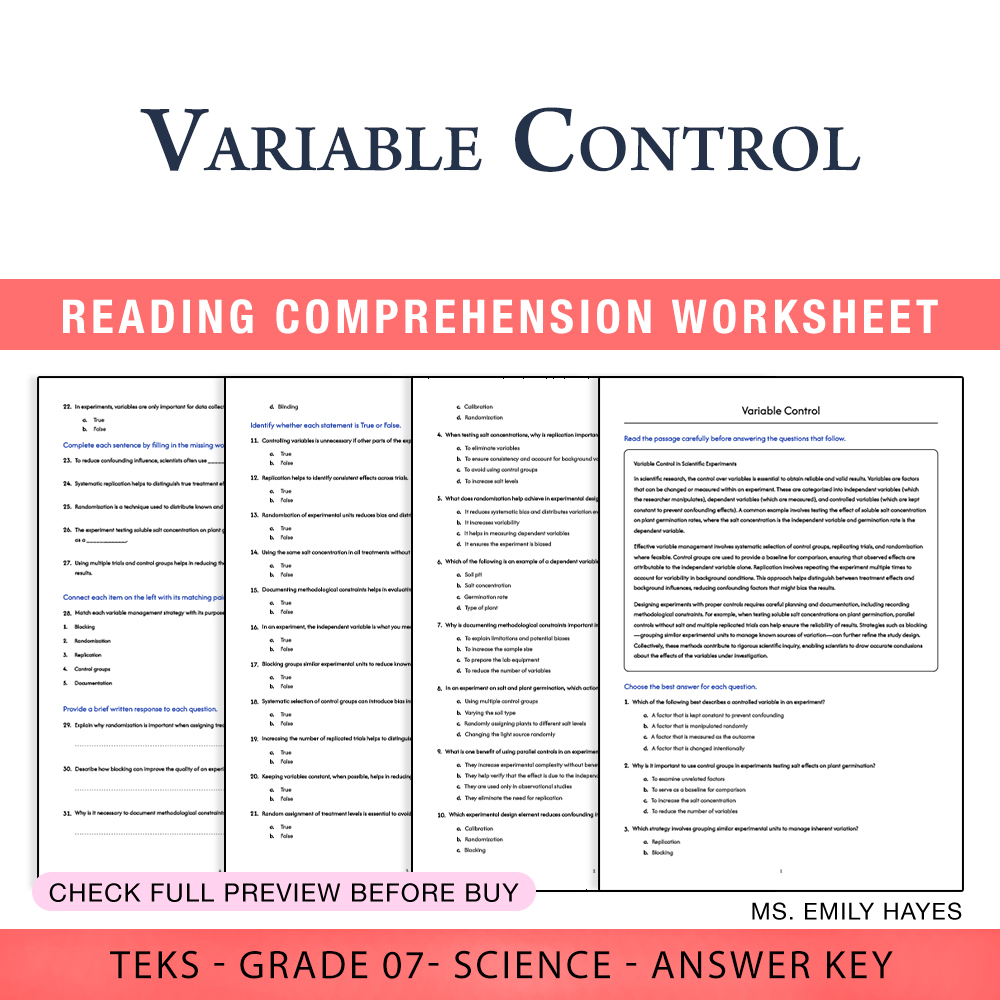
7th Grade Science | Variable Control Worksheet (PDF+ Answer Key)
 Created byCopper Leaf Classroom
Learning Objectives
- Identify different types of variables in controlled experiments.
- Understand strategies for managing variables to ensure valid results.
- Recognize the importance of control groups and replication in scientific testing.
Instant download

Energy Transformations and Conservation Worksheets Grade 7 Science
 Created bySunny Desk Resources
Learning Objectives
- Explain that energy can change forms while total energy is conserved
- Identify examples of mechanical, electrical, chemical, and thermal energy transformations
- Use energy pathways to describe how devices convert energy in real systems
Also included in: Energy, Heat & Thermal Processes Grade 7 Science Alberta Bundle +1 more
Instant download

Grade 7 Trophic Efficiency Worksheet | Practice & BC Standards PDF
Created byClear Sky ClassroomLearning Objectives
- Define trophic efficiency and explain why energy decreases between trophic levels.
- Interpret how energy pyramids represent available energy at higher trophic levels.
- Use evidence from examples to predict how many consumer levels can be supported.
Instant download

Thermal Energy and Temperature Worksheets Grade 7 Science Practice
Created byPrism Point LearningLearning Objectives
- Distinguish temperature from internal energy using the kinetic particle model
- Identify thermal energy sources in natural and built environments
- Explain heat flow from higher internal energy to lower internal energy
Also included in: Thermal Energy & Heat Transfer Lesson Bundle | Grade 7 Science | Ontario +1 more
Instant download

Temperature Measurement Accuracy Worksheets Grade 7 Science
Created byPrism Point LearningLearning Objectives
- Explain how calibration and uncertainty affect temperature measurement accuracy
- Describe how sensor response time affects changing temperature measurements
- Explain how spatial placement changes the temperature a sensor reports
Also included in: Thermal Energy & Heat Transfer Lesson Bundle | Grade 7 Science | Ontario +1 more
Instant download

Thermal Conduction Worksheets: Conductivity in Materials Grade 7 Science
Created byPrism Point LearningLearning Objectives
- Compare thermal conductivity across metals, ceramics, polymers, and composites
- Explain how free electrons contribute to heat conduction in metals
- Explain how lattice vibrations transfer energy through non-metal solids
Also included in: Thermal Energy & Heat Transfer Lesson Bundle | Grade 7 Science | Ontario +1 more
Instant download

Solubility Principles & Saturation Worksheets Grade 7 Science
Created byPrism Point LearningLearning Objectives
- Explain how temperature affects solubility of solids and gases
- Predict solution changes using solubility and saturation principles
- Explain how solvent polarity affects dissolution in water
Also included in: Pure Substances, Mixtures & Separation Lesson Bundle | Grade 7 Science | Ontario +1 more
Instant download

Chemical Properties & Evidence of Chemical Change Worksheets Grade 7
Created byPrism Point LearningLearning Objectives
- Identify observable evidence that indicates a chemical change
- Explain how chemical properties affect reactions with acids and bases
- Interpret how pH influences chemical transformation conditions
Also included in: Pure Substances, Mixtures & Separation Lesson Bundle | Grade 7 Science | Ontario +1 more
Instant download

Physical Properties for Identifying Substances Worksheets Grade 7
Created byPrism Point LearningLearning Objectives
- Define physical properties and describe how they are measured
- Use density measurements to help identify and classify substances
- Interpret melting point ranges as evidence of sample purity
Also included in: Pure Substances, Mixtures & Separation Lesson Bundle | Grade 7 Science | Ontario +1 more
Instant download

Filtration and Separation of Mixtures Worksheets Grade 7 Science
Created byPrism Point LearningLearning Objectives
- Describe how pore size determines particle retention during filtration
- Compare filtration and sedimentation using particle settling behaviour
- Identify why dissolved solutes pass through typical filter media
Also included in: Pure Substances, Mixtures & Separation Lesson Bundle | Grade 7 Science | Ontario +1 more
Instant download

Elements and Compounds Worksheets Grade 7 Science
Created byPrism Point LearningLearning Objectives
- Compare elements and compounds using atomic composition
- Interpret chemical formulas to identify fixed atomic ratios
- Explain how bonding influences observable properties of compounds
Also included in: Pure Substances, Mixtures & Separation Lesson Bundle | Grade 7 Science | Ontario +1 more
Instant download

Purity Assessment Worksheets: Physical Property Evidence Grade 7
Created byPrism Point LearningLearning Objectives
- Interpret melting point ranges as evidence of possible contamination
- Explain how boiling point behavior can indicate sample contamination
- Relate ionic contamination to increased conductivity in solutions
Also included in: Pure Substances, Mixtures & Separation Lesson Bundle | Grade 7 Science | Ontario +1 more
Instant download

Grade 7 Science | Predator Prey Dynamics Worksheet | General Standard-Aligned
 Created byLumora Learning
Learning Objectives
- Explain how predator and prey populations influence each other through feedback loops over time
- Describe how predator-prey changes can ripple through a community and alter ecosystem interactions
- Use cause-and-effect reasoning to predict what may happen when one population increases or decreases
Instant download

Science Grade 7:Population Limits and Carrying Capacity Worksheet
 Created bySkylark Worksheets
Learning Objectives
- Explain how resource availability and competition affect population growth rates
- Interpret logistic growth curves and identify the carrying capacity concept
- Relate birth, death, immigration, and emigration to population change within an ecosystem
Also included in: Grade 7 Ecosystem Dynamics Science Lesson Bundle (NGSS) Worksheets +1 more
Instant download

Population Limits Test Prep Printable | Grade 7 Science
Created byPrism Point LearningLearning Objectives
- Explain the difference between exponential growth and logistic growth using the idea of carrying capacity.
- Identify limiting factors that can reduce or regulate population size, including biotic and abiotic factors.
- Distinguish density-dependent from density-independent influences on population growth.
Also included in: Grade 7 Ecosystem Science Lesson Bundle | Ontario Test Prep Worksheets
Instant download

Food Web Energy Flow Worksheets | Trophic Levels Grade 7 Science
Created bySunny Desk ResourcesLearning Objectives
- Describe how energy moves through a food web from producers to consumers and decomposers
- Identify trophic levels and dependency chains in an interconnected food web
- Explain how adding or removing a species can change trophic connections and network stability
Also included in: Interactions & Ecosystems Grade 7 Alberta Science Worksheets Bundle +1 more
Instant download

Grade 7 Science | Solubility Principles - Daily Reading Comprehension
Created byCoral Reef LearningLearning Objectives
- Understand the concept of solubility and what it indicates about a substance.
- Identify common examples of solubility in everyday life.
- Explain how temperature, solvent polarity, and pressure influence solubility.
Instant download
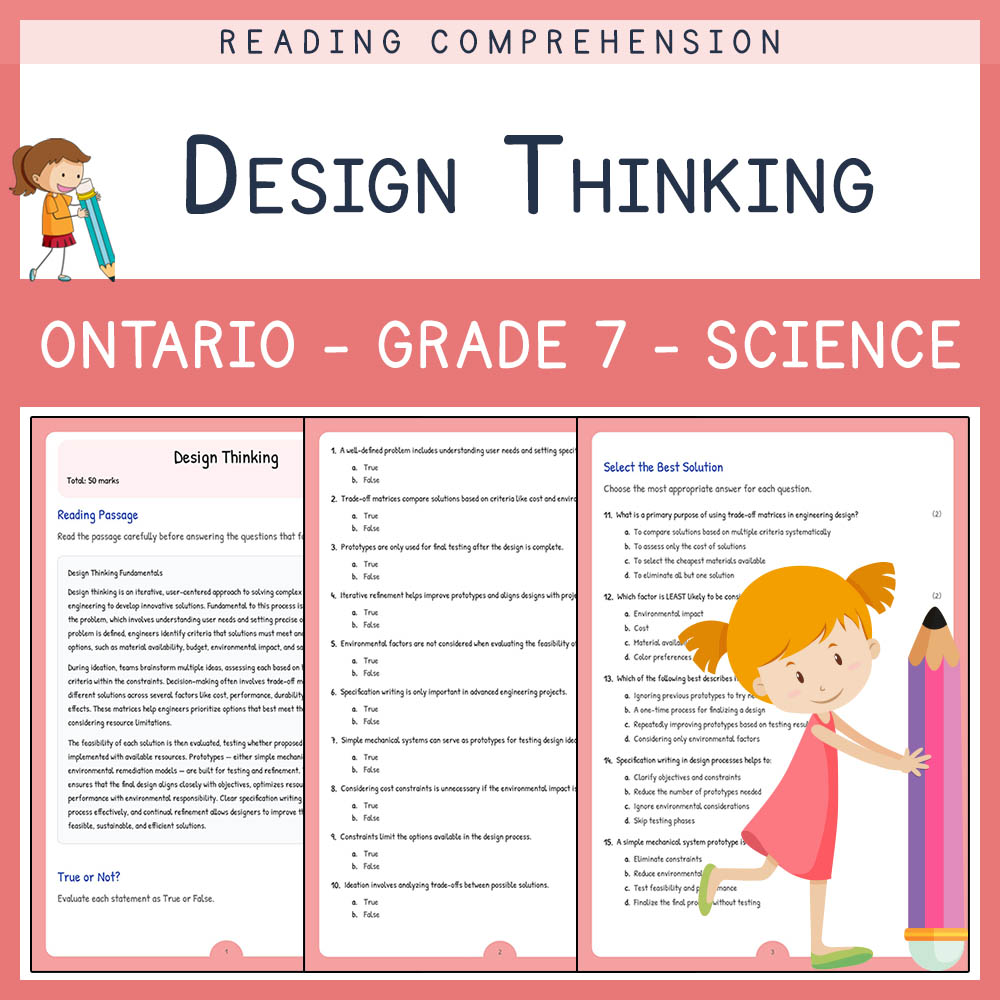
Grade 7 Science | Design Thinking Worksheet | Ontario Standards
Created byLumora LearningLearning Objectives
- Understand the fundamental steps of engineering design processes, including problem framing, criteria, and constraints.
- Learn how to write clear specifications, use trade-off matrices, and evaluate feasibility for materials, costs, and environmental factors.
- Analyze simple mechanical systems and environmental remediation prototypes to see how problem constraints influence solution selection.
Also included in: Grade 7 Science | STEM Skills and Connections Custom Bundle | Ontario
Instant download

Net Forces and Changes in Motion Worksheets | Grade 7 Science
Created byBRIGHT PATH RESOURCESLearning Objectives
- Explain how net force affects an object's velocity over time.
- Differentiate between balanced and unbalanced forces and predict motion outcomes.
- Identify how friction, air resistance, and gravity change motion near Earth.
Also included in: Grade 7 Physical Science Worksheets Bundle | Energy, Waves & Motion +2 more
Instant download

Net Force and Motion Changes Worksheets for Grade 7 Science NGSS
 Created byTeachers Club
Learning Objectives
- Define net force as the vector sum of forces acting on an object
- Identify balanced and unbalanced forces using free-body diagrams
- Explain how force and mass relate to acceleration
Also included in: Grade 7 Science Worksheets NGSS Forces and Motion Bundle +2 more
Instant download
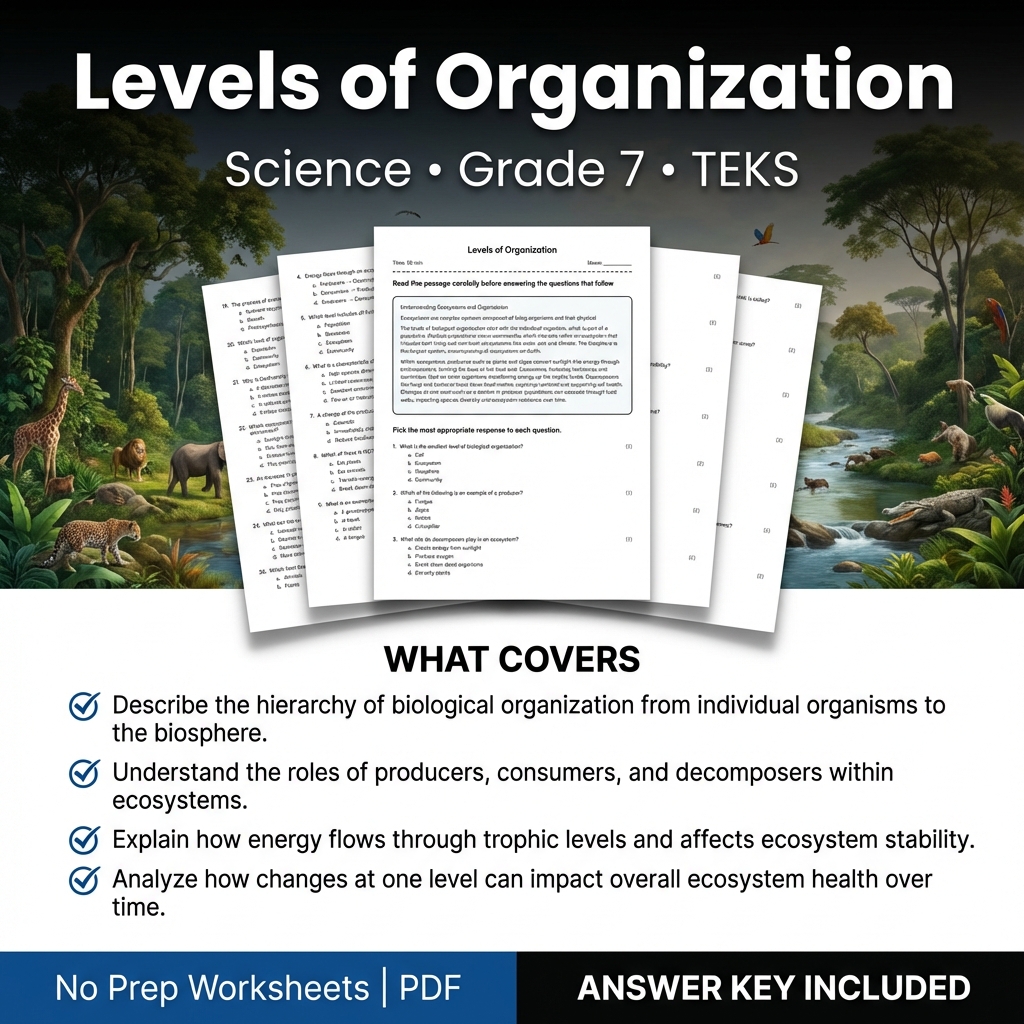
Levels of Organization Worksheet | TEKS Grade 7 Science Practice PDF
Created byCoral Reef LearningLearning Objectives
- Describe the hierarchy of biological organization from individual organisms to the biosphere.
- Understand the roles of producers, consumers, and decomposers within ecosystems.
- Explain how energy flows through trophic levels and affects ecosystem stability.
Instant download

Pollution Effects Worksheet | Grade 7 Science | Alberta Standards
JCreated byJ.S SheetsLearning Objectives
- Understand how different pollutants impact ecosystems and organisms.
- Identify sources and pathways of environmental contamination.
- Analyze ecological consequences of nutrient runoff, hydrocarbons, and airborne deposition.
Instant download

Surface Process Evidence Worksheet | Grade 7 Science Standards
JCreated byJ.S SheetsLearning Objectives
- Explain how internal and external processes shape Earth’s surface
- Identify surface-process evidence such as rock strata, landforms, and hazard-history patterns
- Use relationships between rock layers and landforms to infer past events
Also included in: Grade 7 Earth Systems, Cycles & Feedbacks Science lesson bundle – General +1 more
Instant download

Grade 7 Science | Geologic Change Hazards Worksheet | General Standards
Created byLumora LearningLearning Objectives
- Explain how plate tectonics can cause rapid geologic hazards such as earthquakes and volcanic eruptions
- Describe how weathering, erosion, and deposition gradually reshape Earth’s surface
- Use geologic evidence (fault features, lava flows, and ash or sediment layers) to connect past processes to present landforms
Instant download

Grade 7 Human Impacts Science Daily Reading Worksheet | TEKS Activity
Created byBRIGHT PATH RESOURCESLearning Objectives
- Identify the main idea of a passage about human impacts on ecosystems
- Describe key human actions that change habitats and affect biodiversity
- Use vocabulary from the passage to answer reading questions
Also included in: Grade 7 Ecosystems Science Daily Reading Worksheets Bundle | TEKS +1 more
Instant download

Rock Types Test Prep Printables | Grade 7 Science
Created byPrism Point LearningLearning Objectives
- Classify rocks as igneous, sedimentary, or metamorphic based on origin and observable features.
- Use evidence such as mineral content, grain size, and rock structures to support a rock-type identification.
- Explain how heat, pressure, and fluids change existing rocks into metamorphic rocks.
Also included in: Earth's Systems & Processes Lesson Bundle | Grade 7 Science | BC +1 more
Instant download

Grade 7 Understanding the Rock Cycle Worksheet | NGSS Earth Science
Created byBRIGHT PATH RESOURCESLearning Objectives
- Understand key concepts related to Science
- Apply knowledge through practice questions
- Demonstrate comprehension of the material
Also included in: Earth Systems Grade 7 Science Daily Reading Worksheets Lesson Bundle | NGSS +2 more
Instant download

Weather and Climate Data Patterns Worksheet | Grade 7 Science
Created byBRIGHT PATH RESOURCESLearning Objectives
- Compare how weather patterns and climate differ using time scales and data variability
- Describe how pressure changes and air mass movement can influence weather at different locations
- Interpret weather data examples to identify patterns across time and location
Also included in: Grade 7 Earth Science Worksheets Bundle | Weather, Climate & Earth Systems +2 more
Instant download

Earth System Spheres Worksheets | Grade 7 Earth Science
Created byBRIGHT PATH RESOURCESLearning Objectives
- Identify the atmosphere, hydrosphere, geosphere, and biosphere and describe what each includes.
- Explain how matter and energy move between spheres (for example, water and gases).
- Describe how changes in one Earth system sphere can affect other spheres.
Also included in: Grade 7 Earth Science Worksheets Bundle | Weather, Climate & Earth Systems +2 more
Instant download

Human Activities and Earth System Feedbacks Worksheet Grade 7
Created byBRIGHT PATH RESOURCESLearning Objectives
- Explain how greenhouse gases can alter temperature and precipitation patterns over time.
- Describe how land clearing can change water storage, evaporation, and the biosphere.
- Model how changes in the geosphere can affect erosion and sediment flow into waterways.
Also included in: Grade 7 Earth Science Worksheets Bundle | Weather, Climate & Earth Systems +2 more
Instant download

Climate Change Drivers and Evidence Worksheet | Grade 7 Science
Created byBRIGHT PATH RESOURCESLearning Objectives
- Explain how natural records and modern instruments provide evidence for climate patterns over time.
- Identify major climate drivers that can change Earth’s energy balance and circulation.
- Describe how scientists distinguish past conditions using ice cores, sediment layers, and tree rings.
Also included in: Grade 7 Earth Science Worksheets Bundle | Weather, Climate & Earth Systems +2 more
Instant download

Grade 7 Science | Surface Area Worksheet | BC Aligned
Created byLumora LearningLearning Objectives
- Understand why surface-area-to-volume ratio limits cell size and how it affects cell efficiency.
- Explain adaptations like membrane folding, microvilli, and compartmentalization that increase exchange surfaces.
- Describe how multicellular organisms develop specialized structures and systems to overcome surface area limitations.
Instant download

Grade 7 Science Worksheet on Biodiversity Measures
JCreated byJ.S SheetsLearning Objectives
- Understand different methods of measuring biodiversity, including richness, evenness, and habitat heterogeneity.
- Interpret what various biodiversity metrics reveal about ecosystem resilience and health.
- Evaluate the relationship between habitat complexity and species assemblages.
Instant download

Grade 7 Science – Filtration Methods & Applications | Daily Reading Worksheet
 Created byBright Mind Resources
Learning Objectives
- Understand the different types of filtration techniques used in science.
- Identify various filtration materials and pore sizes.
- Explain how filtration separates heterogeneous mixtures like suspensions and precipitates.
Also included in: Grade 7 Matter Science Daily Reading Worksheets Lesson Bundle | Ontario +1 more
Instant download
About Grade 7 Science Worksheets
Browse 6,039 printable Grade 7 Science worksheets — ready-to-print PDFs with answer keys where available.
Every worksheet on MyTeachingSheets is created by independent teacher-authors and reviewed before publication. All resources download as printable PDFs for classroom, homework, or at-home practice, and many include answer keys. Preview any worksheet free before buying.