
Grade 7 Science Worksheets
6,039 worksheets
Grade 7 Science – Fair Testing & Measurements | Daily Reading Worksheet
 Created byBright Mind Resources
Learning Objectives
- Understand the concept of fair tests in scientific experiments.
- Identify variables that influence experimental fairness.
- Learn to use appropriate measurement tools and units.
Also included in: Design & Tech Grade 7 Science Daily Reading Worksheets Lesson Bundle | General +1 more
Instant download

Biotic Abiotic Worksheet | Grade 7 Science Activities
 Created byPrism Point Learning
Learning Objectives
- Distinguish biotic factors from abiotic factors in an ecosystem.
- Explain cause-and-effect relationships between abiotic conditions and resource access, shelter, and survival for organisms.
- Describe how gradients in abiotic factors can shape patterns in plant, animal, and microbe communities.
Also included in: Grade 7 Ecosystems & Biodiversity Science Lesson Bundle | Alberta
Instant download
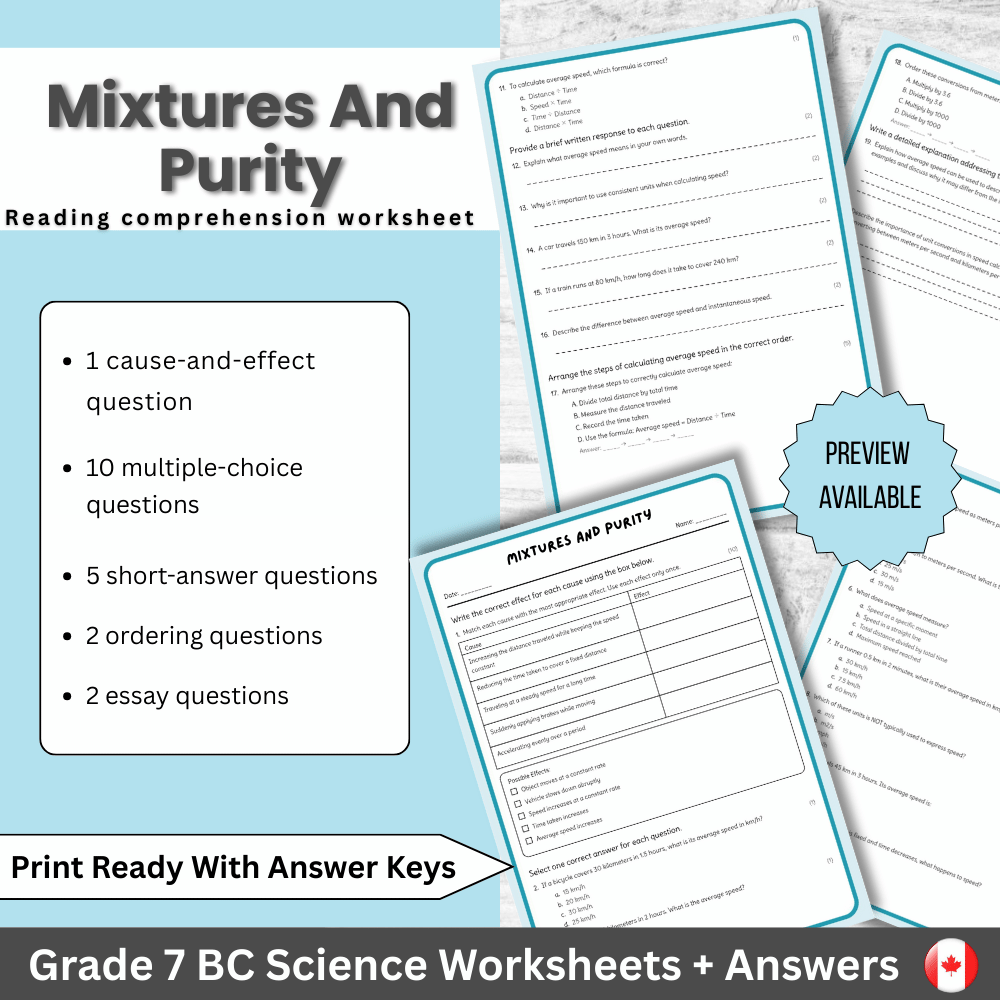
Grade 7 Science | Mixtures and Purity Worksheet (PDF) for BC Standard
Created byBright Mind ResourcesLearning Objectives
- Describe the difference between mixtures and pure substances.
- Identify characteristics of heterogeneous and homogeneous mixtures.
- Understand separation methods based on physical properties.
Instant download

Science: Rock Cycles Grade 7 Worksheet | NGSS-Aligned Science Assessment
 Created bySkylark Worksheets
Learning Objectives
- Explain how energy drives changes between igneous, sedimentary, and metamorphic rocks in the rock cycle
- Describe key processes in the rock cycle, including melting, crystallization, weathering, deposition, burial, and metamorphism
- Trace how Earth materials move through the cycle using a pathway from magma to rocks and back again
Also included in: Grade 7 Earth Systems Science Worksheet Lesson Bundle for NGSS Assessment +1 more
Instant download

Grade 7 Science | Global Circulation - Daily Reading Comprehension
 Created byCoral Reef Learning
Learning Objectives
- Understand the basic atmospheric and oceanic cells involved in global circulation
- Identify the locations and characteristics of Hadley, Ferrel, and Polar cells
- Describe the role of jet streams and ocean gyres in climate regulation
Instant download

Technology Impacts and Ethics Assessment for Grade 7 Science | Standards-Aligned
Created byPrism Point LearningLearning Objectives
- Understand how technology affects society and the environment through benefits and costs.
- Identify ethical considerations related to technology, including fairness, privacy, and responsibility.
- Analyze trade-offs involved in technological development and use.
Also included in: Grade 7 Science Assessment Practices Lesson Bundle | General Framework
Instant download

Natural Selection Test Prep Printable | Grade 7 Science Assessment
Created byPrism Point LearningLearning Objectives
- Explain how heritable variation and environmental pressures lead to natural selection.
- Describe how differential survival and reproduction change trait frequencies over generations.
- Use examples (such as antibiotic resistance or island finches) to connect adaptation to selective pressures.
Also included in: Grade 7 Evolution, Natural Selection Science Lesson Bundle for NGSS
Instant download

Synthetic Materials Worksheet | NGSS Grade 7 Science Practice PDF
JCreated byJ.S SheetsLearning Objectives
- Describe production pathways from natural resources to common synthetic materials, including feedstocks, polymerization, and refining steps.
- Identify examples of synthetic materials such as polyethylene, PET, and nylon, and understand their manufacturing processes.
- Analyze trade-offs related to durability, recyclability, and environmental impacts of different synthetic materials.
Also included in: Grade 7 Structure and Properties of Matter Science Lesson Bundle: NGSS +1 more
Instant download

Thermal Insulation Worksheets: Heat Transfer Reduction Grade 7 Science
Created byPrism Point LearningLearning Objectives
- Explain how insulation reduces conduction, convection, and radiation
- Compare insulating materials using thermal resistance and thickness
- Identify thermal bridges and explain their effect on heat loss
Also included in: Thermal Energy & Heat Transfer Lesson Bundle | Grade 7 Science | Ontario +1 more
Instant download

Science Grade 7 Density and Volume Worksheet | NGSSS Aligned Practice
JCreated byJ.S SheetsLearning Objectives
- Explain how density relates mass to volume using the idea of density = mass ÷ volume
- Classify density as an intensive property and justify why it does not depend on the amount of material
- Use density ideas to predict sinking and floating and to distinguish materials with similar shapes
Also included in: Grade 7 Matter, Energy & Forces Science Lesson Bundle – Florida NGSSS +1 more
Instant download

Grade 7 Science | Nucleus Function - Daily Reading Comprehension
Created byCoral Reef LearningLearning Objectives
- Understand the structure and role of the nucleus in a cell.
- Identify key features such as nuclear envelope, nuclear pores, and chromosomes.
- Explain how the nucleus controls growth, development, and protein synthesis.
Instant download

Population Limits Test Prep Printable | Grade 7 Science NGSS
Created byPrism Point LearningLearning Objectives
- Explain how resource availability sets limits on population size using carrying capacity.
- Interpret logistic growth ideas by connecting population growth rate to birth, death, immigration, and emigration.
- Use graphs and quantitative reasoning to predict how limiting factors change population trajectories.
Also included in: Grade 7 Biodiversity & Ecosystem Stability Science Lesson Bundle | NGSS
Instant download

Energy Transformations and Conservation Worksheet | Grade 7 Alberta Science
 Created byBRIGHT PATH RESOURCES
Learning Objectives
- Describe common forms of energy and how they change in everyday systems
- Explain energy transformations while conserving total energy
- Identify where energy appears as mechanical, electrical, chemical, and thermal energy in a real-world example
Also included in: Grade 7 Alberta Science Energy Heat and Thermal Processes Worksheet Bundle +1 more
Instant download

Ethics And Communication Grade 7 Science Worksheet | Ontario Standards
 Created byCedar Grove Learning
Learning Objectives
- Explain how data integrity, attribution, and intellectual property shape ethical communication in STEM
- Use conventions for technical reporting, including clear methods descriptions and accurate graphical annotation
- Describe how peer review and responsible data sharing improve reliability and public understanding of scientific findings
Also included in: Grade 7 Scientific Inquiry and Data Analysis Science Lesson Bundle - Ontario +1 more
Instant download

Technology Impacts Assessment | TEKS Grade 7 Science Standards
Created byPrism Point LearningLearning Objectives
- Analyze societal, economic, and environmental impacts of various technologies.
- Evaluate short-term and long-term consequences of technological development.
- Assess ethical considerations and policy responses related to technology.
Instant download

Grade 7 Matter Cycling in Living Things Worksheet | NGSS Life Science
Created byBRIGHT PATH RESOURCESLearning Objectives
- Understand how carbon atoms move through organisms and the environment
- Describe the processes of digestion, biosynthesis, and respiration that involve matter transformation
- Explain how matter is conserved and recycled within ecosystems
Also included in: Living Systems Grade 7 Science Daily Reading Worksheets Lesson Bundle | NGSS +2 more
Instant download
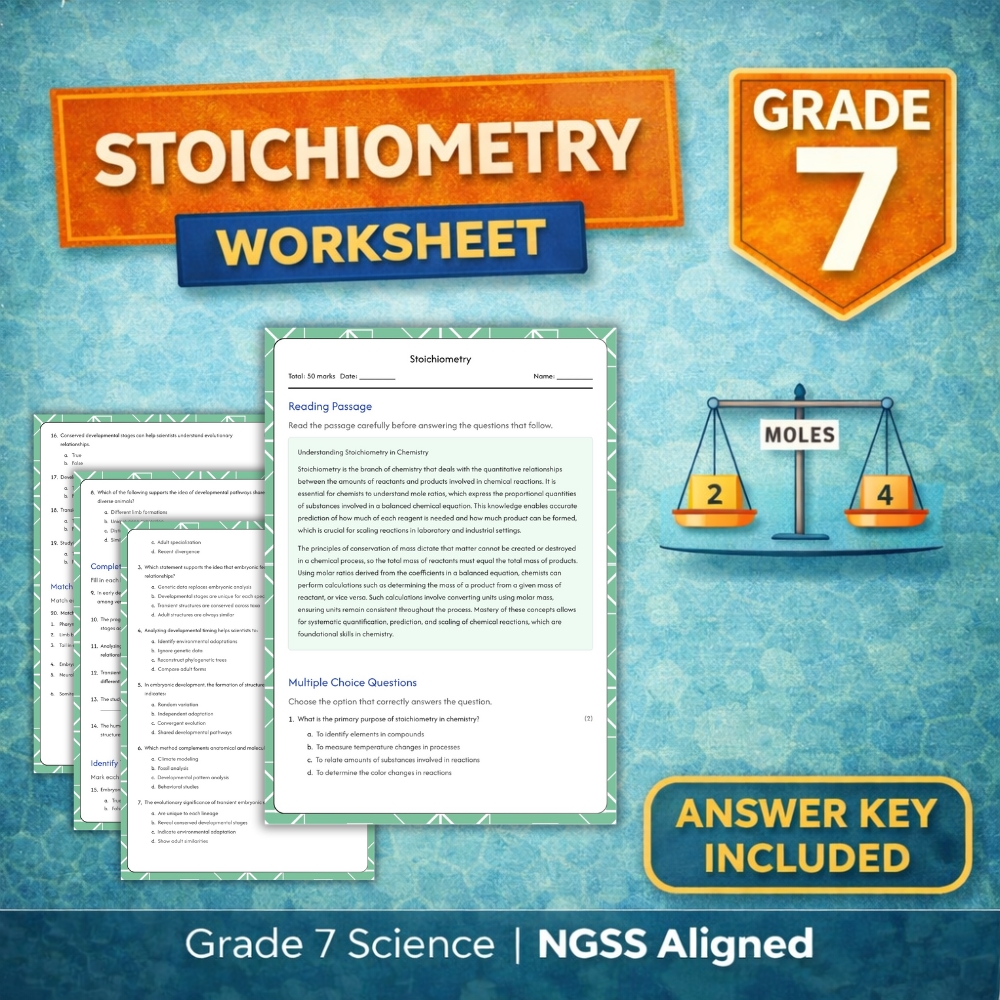
Grade 7 Science | Stoichiometry Practice Worksheet (NGSS Aligned, PDF)
Created byCedar Grove LearningLearning Objectives
- Describe quantitative relationships in chemical transformations using balanced symbolic equations and ratio reasoning.
- Perform mole-ratio calculations to determine relative mass relations among reactants and products.
- Apply conservation principles in proportional calculations to predict reagent needs and product yields.
Instant download

Saturation Concepts Worksheet for Grade 7 Science | Alberta Standards
JCreated byJ.S SheetsLearning Objectives
- Explain the concept of saturation and supersaturation in solutions.
- Identify real-world examples of saturation and supersaturation.
- Describe the conditions that lead to crystallization and phase change.
Instant download
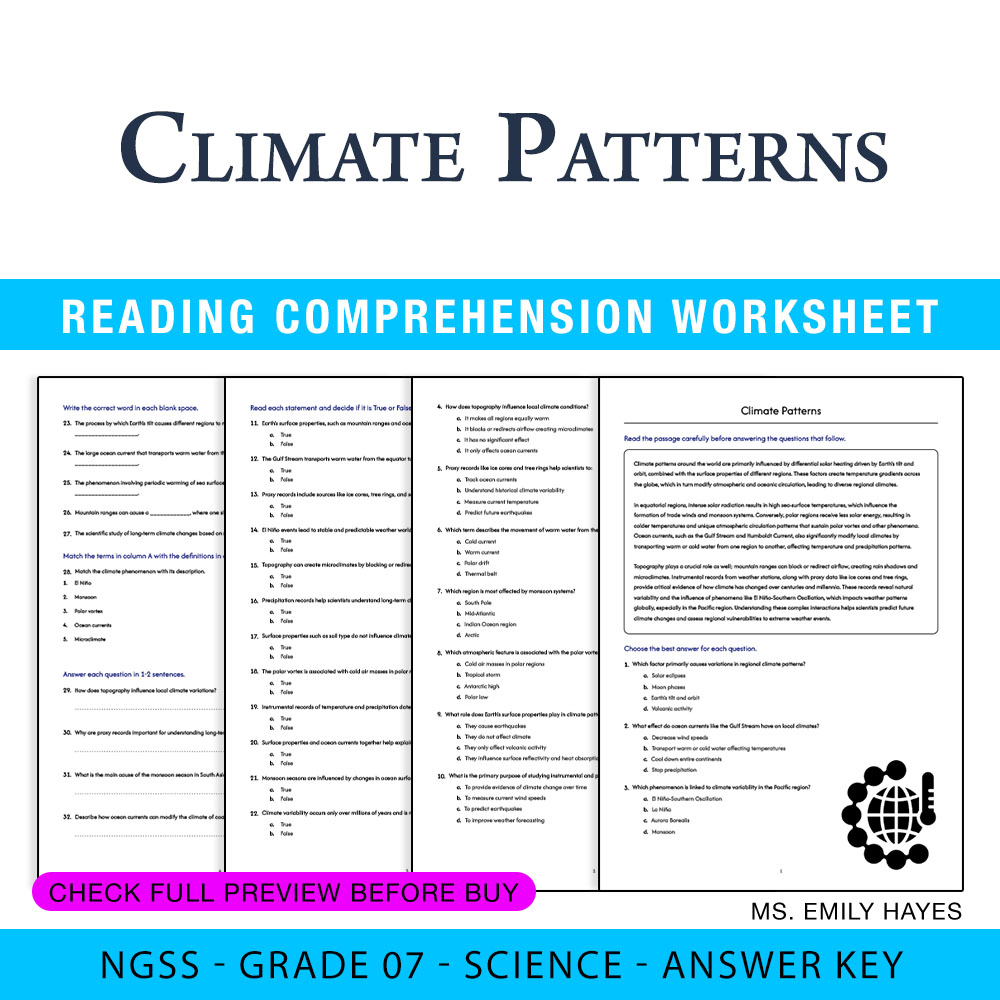
7th Grade Science | Climate Patterns Worksheet (PDF+ Answer Key)
 Created byCopper Leaf Classroom
Learning Objectives
- Describe how variations in solar heating influence regional climate patterns.
- Explain the role of ocean currents and topography in modifying local climates.
- Identify key phenomena such as El Niño, monsoon regimes, and prevailing wind belts.
Instant download
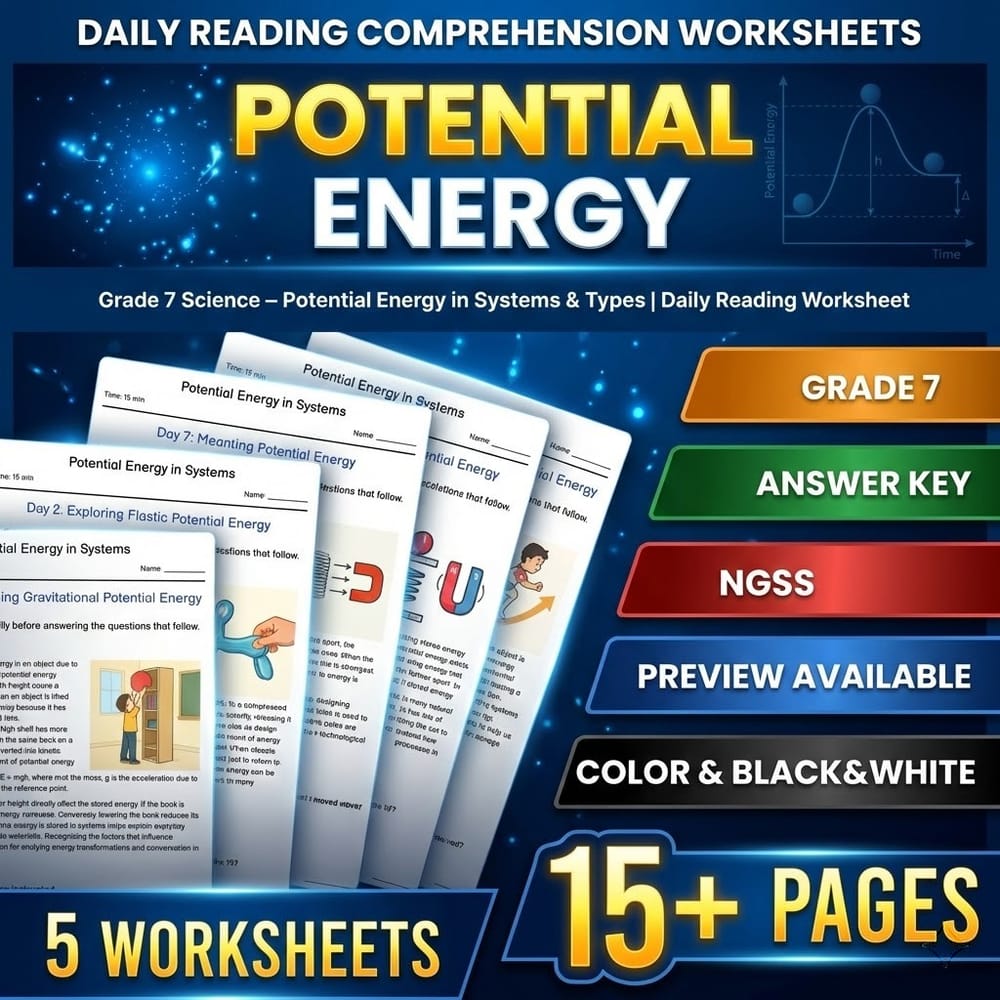
Grade 7 Science – Potential Energy in Systems & Types | Daily Reading Worksheet
 Created byElena Brooks
Learning Objectives
- Understand the concept of gravitational potential energy
- Identify factors that affect potential energy such as height and mass
- Recognize different models representing potential energy in physical systems
Also included in: Energy Grade 7 Science Daily Reading Worksheets Bundle | NGSS +1 more
Instant download

Grade 7 Science – Optimization Metrics & Engineering | Daily Reading Worksheet
Created byBright Mind ResourcesLearning Objectives
- Understand the concept of optimization in engineering contexts
- Identify various criteria used for optimization tasks
- Analyze how different optimization goals influence design decisions
Also included in: Grade 7 Engineering Tradeoff Mapping Science Lesson Bundle California Standards +1 more
Instant download

Grade 7 Synthetic Materials Worksheet | NGSS Practice PDF
 Created byClear Sky Classroom
Learning Objectives
- Describe the production pathways from natural resources to common synthetic materials.
- Explain the processes of polymerization, refining, and chemical alteration in manufacturing.
- Identify examples of synthetic materials like polyethylene, PET, and nylon and their production steps.
Also included in: Grade 7 Matter and Its Interactions Science Lesson Bundle NGSS Worksheets +1 more
Instant download

Grade 7 Conservation Mass Worksheet | BC Practice & PDF
Created byClear Sky ClassroomLearning Objectives
- Explain the law of conservation of mass using particle-level reasoning (atoms rearrange but are not created or destroyed).
- Use the idea of a closed system to predict whether total mass will stay the same before and after a chemical reaction.
- Identify reactants and products at the particle level and describe what happens to bonds during a reaction.
Instant download

Science Worksheet Digital Data Tools | Standard-Aligned Grade 7 Assessment
JCreated byJ.S SheetsLearning Objectives
- Explain how digital tools capture, store, and format data for scientific investigation
- Identify key metadata elements such as timestamps, sampling rates, and tags that improve data interoperability
- Use spreadsheet-based thinking to describe basic data organization and preliminary cleaning steps
Instant download

Invasive Species Worksheets: Ecosystem Impacts Grade 7 Science
Created byPrism Point LearningLearning Objectives
- Explain how invasive species cause competitive displacement of native species
- Describe how invasive species alter trophic relationships and nutrient dynamics
- Identify pathways and factors that support invasive species establishment
Also included in: Interactions in the Environment Lesson Bundle | Grade 7 Science | Ontario +1 more
Instant download

Temperature Measurement and Calibration Worksheets Grade 7 Science
Created byPrism Point LearningLearning Objectives
- Compare thermometer types by sensing method and accuracy limits
- Explain why Celsius fixed points support thermometer calibration
- Identify random and systematic sources of measurement uncertainty
Also included in: Thermal Energy & Heat Transfer Lesson Bundle | Grade 7 Science | Ontario +1 more
Instant download

Crystallization and Purity Worksheets Grade 7 Science
Created byPrism Point LearningLearning Objectives
- Describe how evaporation increases concentration and enables crystallization
- Explain nucleation and crystal growth during crystal formation
- Predict how cooling and evaporation rates affect crystal size
Also included in: Pure Substances, Mixtures & Separation Lesson Bundle | Grade 7 Science | Ontario +1 more
Instant download

Ecological Restoration Worksheets: Resilience Strategies Grade 7 Science
Created byPrism Point LearningLearning Objectives
- Explain how reference conditions guide evidence-based restoration goals
- Compare active and passive restoration approaches
- Describe how species selection supports long-term ecological resilience
Also included in: Interactions in the Environment Lesson Bundle | Grade 7 Science | Ontario +1 more
Instant download
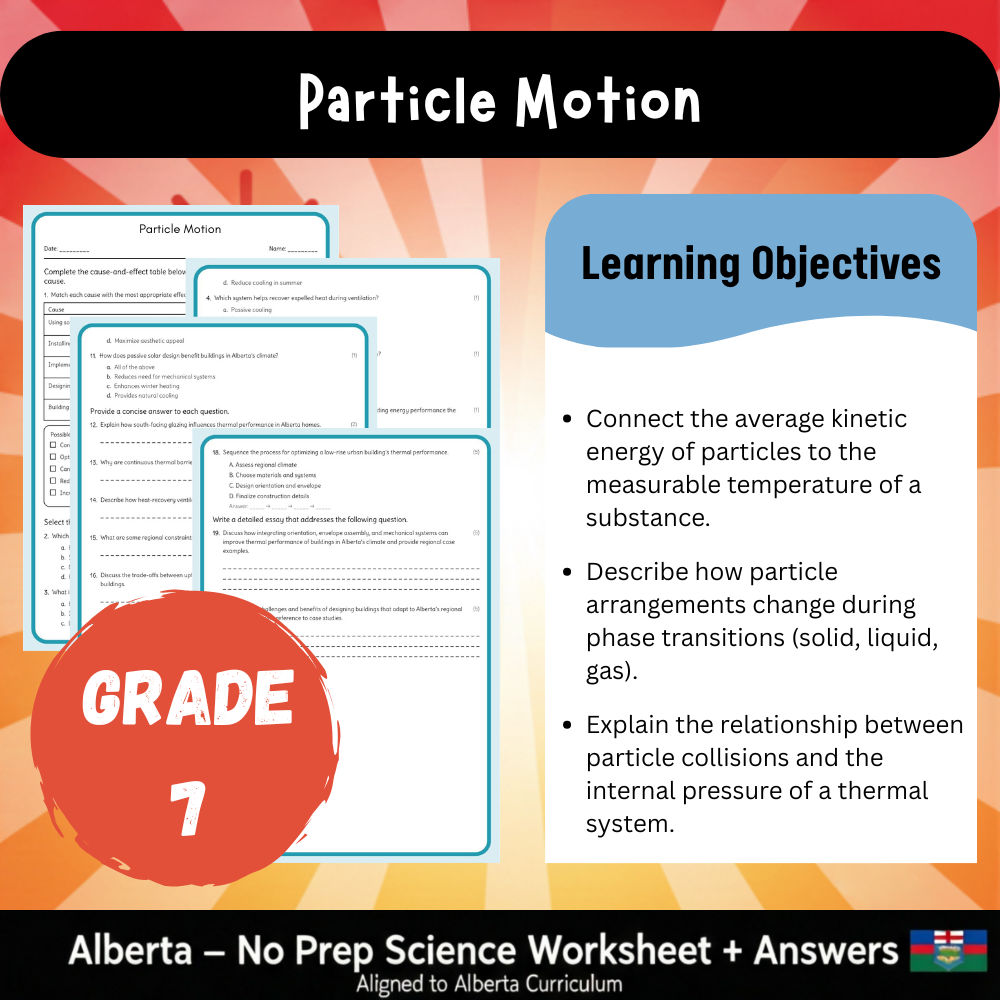
Grade 7 Science | Particle Motion Worksheet (PDF) - Alberta Standards
Created byBright Mind ResourcesLearning Objectives
- Understand how microscopic particle motion relates to temperature, thermal energy, and pressure.
- Explain how particle speed distributions vary with temperature and phase.
- Analyze molecular motion to compare thermal states and material heat capacities.
Instant download
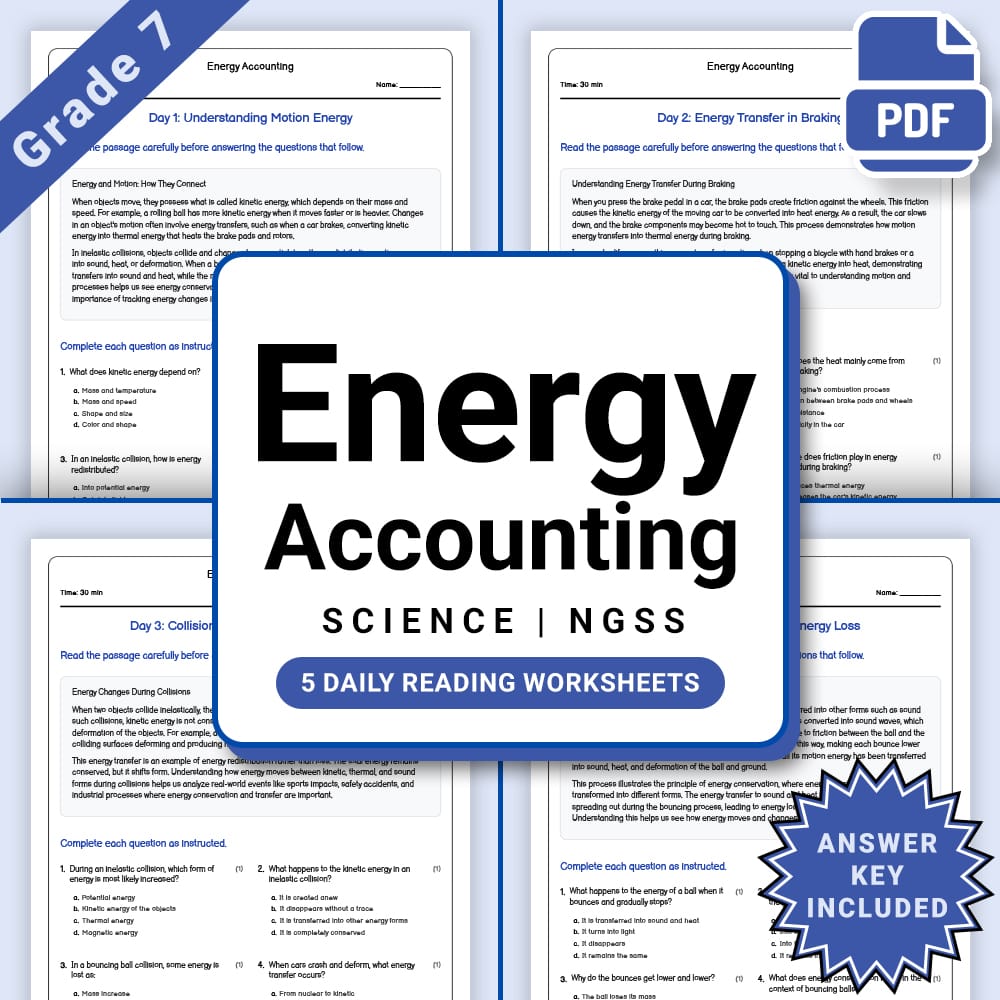
Grade 7 Science – Energy Accounting Worksheet(PDF + Answer Key)
Created byCopper Leaf ClassroomLearning Objectives
- Understand how an object's motion energy changes during different activities.
- Identify energy transfers in scenarios like braking, collisions, and bouncing balls.
- Articulate reasoning linking changes in motion energy to energy transfers in real-world examples.
Instant download

Potential Energy Test Prep Printables | Grade 7 Science
Created byPrism Point LearningLearning Objectives
- Explain how potential energy depends on an object’s arrangement or position in a system.
- Describe examples of gravitational, elastic, and magnetic potential energy.
- Connect changes in spatial arrangement to energy transfer into motion or work.
Also included in: Grade 7 Energy Transfer and Conversion Science Lesson Bundle (NGSS)
Instant download

Chemical Properties Test Prep Printables | Grade 7 Science
Created byPrism Point LearningLearning Objectives
- Explain how chemical properties describe how substances react and transform.
- Identify observable evidence (such as gas, color change, or pH shift) that indicates a chemical property.
- Predict likely outcomes of reactions using flammability, oxidation tendency, and acid-base behavior.
Also included in: Matter & Chemical Change Lesson Bundle — Grade 7 Science British Columbia +1 more
Instant download

Grade 7 Science | Conservation of Matter - Daily Reading Comprehension
Created byCoral Reef LearningLearning Objectives
- Understand the principle that matter is conserved during physical and chemical changes.
- Identify examples of physical vs. chemical processes that conserve matter.
- Explain how atoms are rearranged during reactions without altering total mass.
Instant download

Grade 7 Science – Understanding Scientific Models | Daily Reading Worksheet
Created byBright Mind ResourcesLearning Objectives
- Define what a scientific model is and describe its purpose.
- Identify different types of models used in science.
- Explain how models help in understanding and predicting natural phenomena.
Also included in: Grade 7 Variables Science lesson-bundle daily reading worksheets | Florida NGSSS +1 more
Instant download

Grade 7 Science | Balanced Vs Unbalanced Forces Worksheet | Florida NGSSS
 Created byLumora Learning
Learning Objectives
- Distinguish balanced and unbalanced forces using the idea of net force
- Explain how balanced forces lead to constant velocity and unbalanced forces lead to acceleration
- Use tug-of-war scenarios to predict motion outcomes based on force strength and direction
Instant download

Grade 7 Science | Diffusion and Mixing Worksheet | California Standards
Created byLumora LearningLearning Objectives
- Explain diffusion using the particle model and concentration differences
- Describe how mixing occurs without particles stopping or transforming
- Predict how temperature affects the rate of diffusion
Instant download
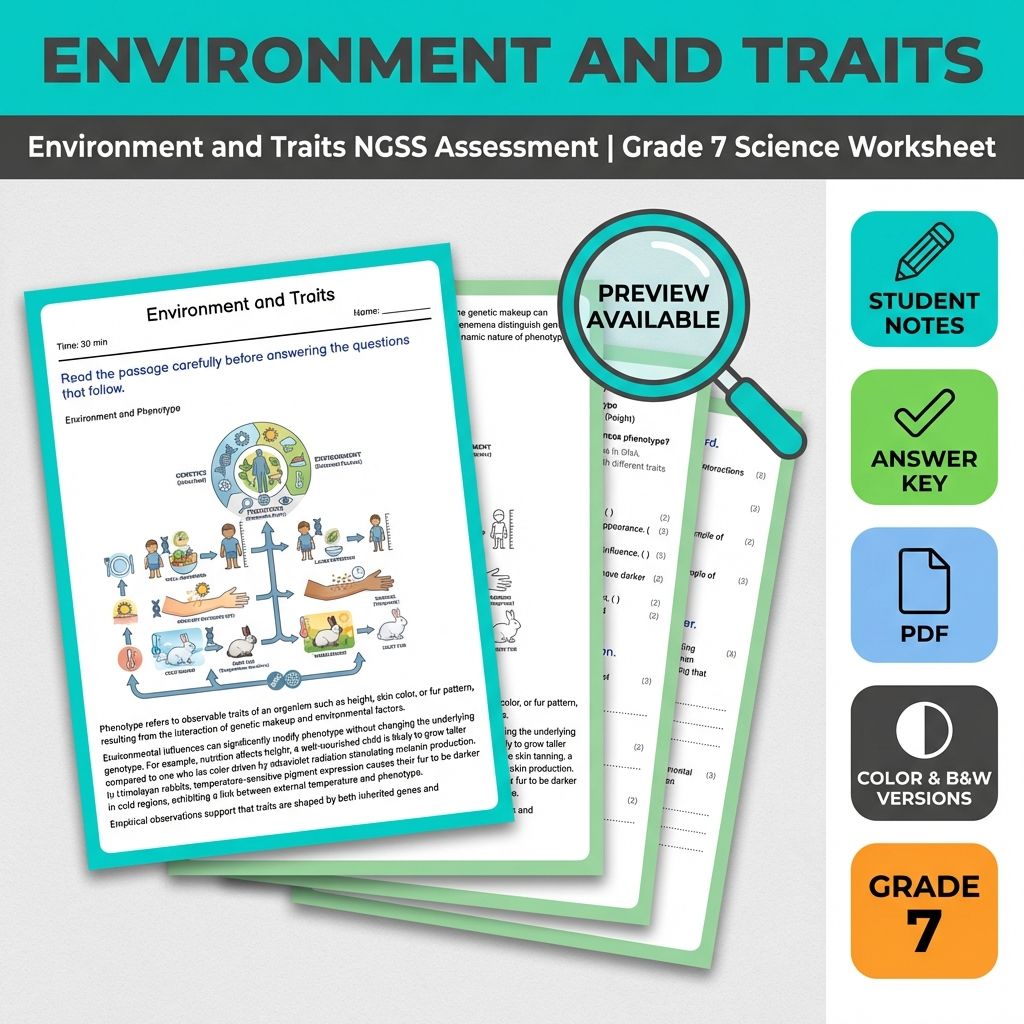
Environment and Traits NGSS Assessment | Grade 7 Science Worksheet
Created byPrism Point LearningLearning Objectives
- Understand how phenotype results from interactions between genetics and environment.
- Identify examples illustrating environmental influence on traits.
- Distinguish inherited genetic traits from environmentally modulated traits.
Also included in: Grade 7 Science Mini Bundle – Heredity: Inheritance and Variation of Traits +1 more
Instant download

Science Grade 7 Worksheet: Resource Distribution | NGSS aligned Science
Created bySkylark WorksheetsLearning Objectives
- Explain how plate tectonics, weathering, and sedimentation can concentrate minerals, fuels, and groundwater in specific locations.
- Use geologic maps and cross sections to connect Earth history to where resources are found.
- Evaluate how extraction affects the environment and how renewable and nonrenewable resources differ for sustainability.
Also included in: Grade 7 Ecosystems & Climate Interactions Science Lesson Bundle: NGSS +1 more
Instant download

Grade 7 Trophic Energy Limits Worksheet | General Practice PDF
Created byClear Sky ClassroomLearning Objectives
- Explain how energy moves through trophic levels in a food web.
- Describe why only a fraction of energy becomes available at the next trophic level.
- Use the idea of trophic energy limits to predict effects on food-chain length and biomass.
Instant download

Grade 7 Science | Understanding Net Force Diagrams - Daily Reading Comprehension
Created byCoral Reef LearningLearning Objectives
- Understand key concepts related to Science
- Apply knowledge through practice questions
- Demonstrate comprehension of the material
Also included in: Forces, Structures and Motion Lesson Bundle | Grade 7 Science Alberta +1 more
Instant download

Grade 7 Science Simple Systems and Mechanisms Worksheet
JCreated byJ.S SheetsLearning Objectives
- Explain how an input energy in a simple mechanism system can transfer motion or force to produce an output performance
- Describe how gears, pulleys, levers, and linkages change speed, force, and direction of motion
- Use evidence from a mechanism’s components to predict how design constraints affect performance
Also included in: Grade 7 Science Fair Testing, Design, and Data Reliability Science Lesson Bundle +1 more
Instant download

System Structure Worksheet Grade 7 Science Body Systems Practice
Created byPrism Point LearningLearning Objectives
- Explain how organisms function as systems made of internal structures with specific roles.
- Identify how different body systems process inputs like food, oxygen, and water.
- Describe how the coordinated functions of structures help the organism use matter for life processes.
Also included in: Life Science - Grade 7 Bundle
Instant download

Grade 7 Chemical Properties Worksheet | Ontario Science Activity & Answer Key
Created byClear Sky ClassroomLearning Objectives
- Explain how chemical properties help predict what happens during chemical changes.
- Identify indicators of chemical reactions such as gas evolution, color change, and precipitate formation.
- Describe how chemical properties relate to reactivity with acids and bases, combustion, oxidation, corrosion, and pH changes.
Instant download
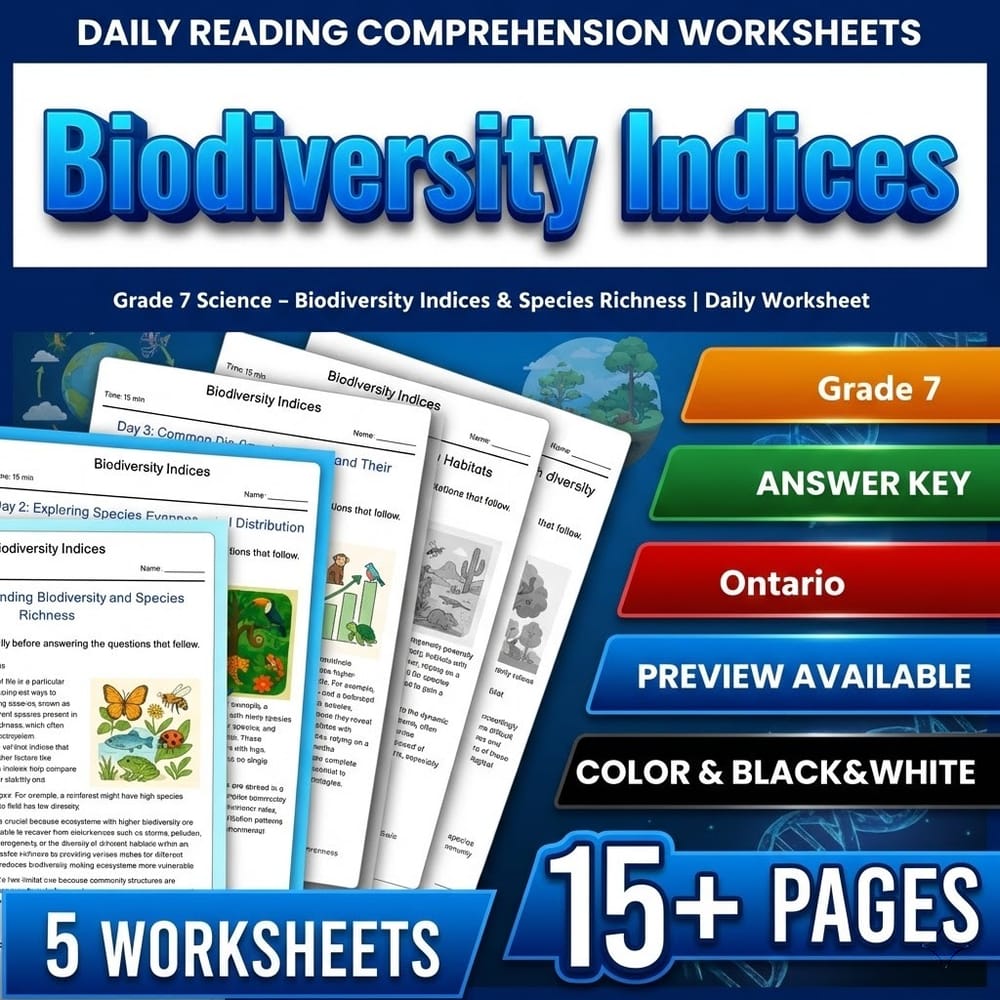
Grade 7 Science – Biodiversity Indices & Species Richness | Daily Worksheet
 Created byQuiet Forest Education
Learning Objectives
- Define species richness as a measure of biodiversity.
- Understand how biodiversity is quantified using various indices.
- Identify the importance of biodiversity in ecological stability.
Also included in: Ecosystem Dynamics Grade 7 Science Daily Reading Worksheets Bundle | Ontario +1 more
Instant download
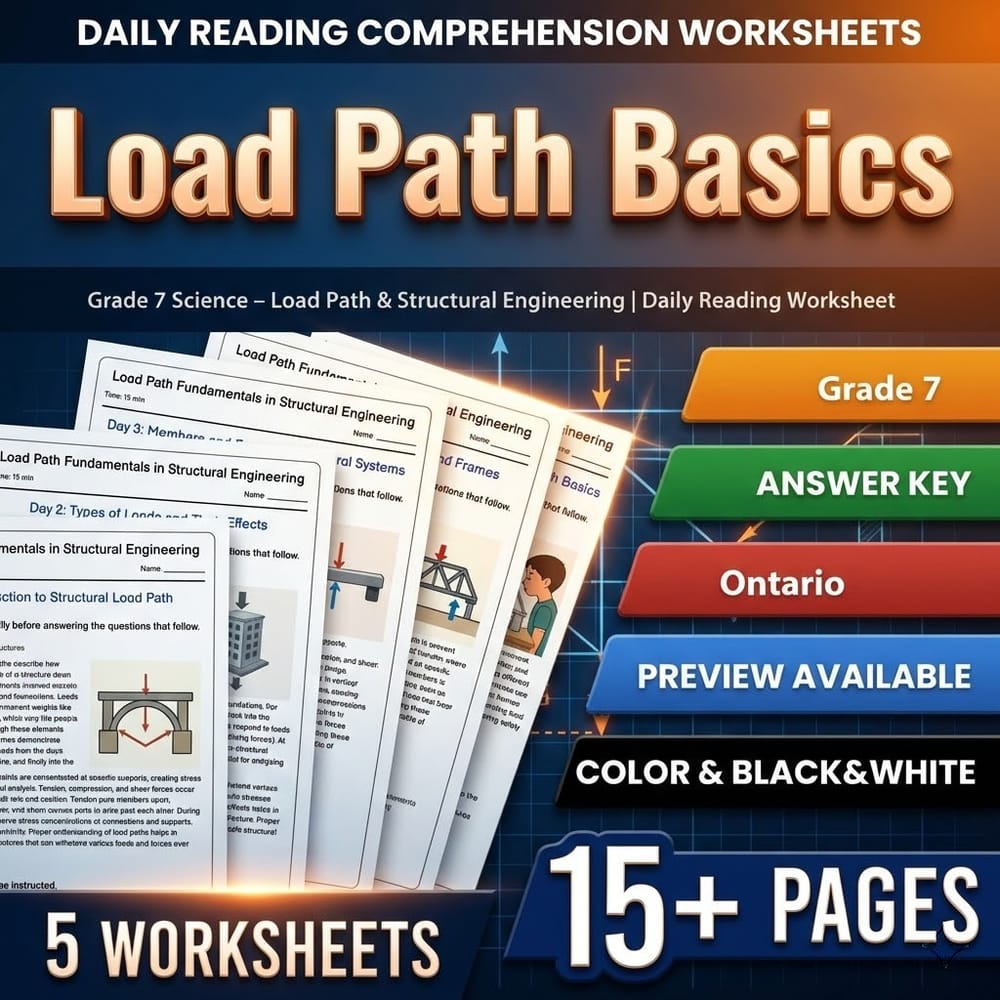
Grade 7 Science – Load Path & Structural Engineering | Daily Reading Worksheet
Created byQuiet Forest EducationLearning Objectives
- Understand the basic elements of structural load paths
- Describe how loads transfer from slabs to foundations
- Distinguish between dead and live loads
Also included in: Structural Engineering Grade 7 Science Daily Reading Worksheets Bundle | Ontario +1 more
Instant download

Phase Energy Worksheet | Standard-Aligned Practice for Grade 7 Science
JCreated byJ.S SheetsLearning Objectives
- Understand how phase changes involve energy absorption or release related to particle kinetic and potential energy.
- Explain latent heat phenomena and how microscopic particle interactions connect to macroscopic energy changes.
- Identify examples of phase energy processes in Alberta, such as snowmelt and evaporation from wetlands.
Instant download

Grade 7 Science | Technology Impacts & Ethics - Daily Reading Comprehension
Created byCoral Reef LearningLearning Objectives
- Understand the concept of renewable energy sources
- Identify the environmental benefits of renewable energy
- Analyze the ethical considerations related to technology use
Instant download

Separating Matter Worksheet | Grade 7 Science Activities
Created byPrism Point LearningLearning Objectives
- Explain how differences in properties help scientists separate matter without changing substances into new ones.
- Use the ideas of density and solubility to predict how mixtures can separate into layers or dissolved parts.
- Distinguish physical changes used for separation (melting, boiling, freezing, dissolving) from chemical changes that form new substances.
Instant download
About Grade 7 Science Worksheets
Browse 6,039 printable Grade 7 Science worksheets — ready-to-print PDFs with answer keys where available.
Every worksheet on MyTeachingSheets is created by independent teacher-authors and reviewed before publication. All resources download as printable PDFs for classroom, homework, or at-home practice, and many include answer keys. Preview any worksheet free before buying.