
Grade 7 Science Worksheets
6,039 worksheets
Grade 7 Science | Understanding Heat Capacity - Daily Reading Comprehension
 Created byCoral Reef Learning
Learning Objectives
- Define heat capacity and specific heat capacity.
- Explain how heat capacity affects heating processes.
- Calculate energy needed to heat a substance using specific heat capacity data.
Also included in: Energy, Heat and Thermal Processes Lesson Bundle: Grade 7 Science Alberta +1 more
Instant download
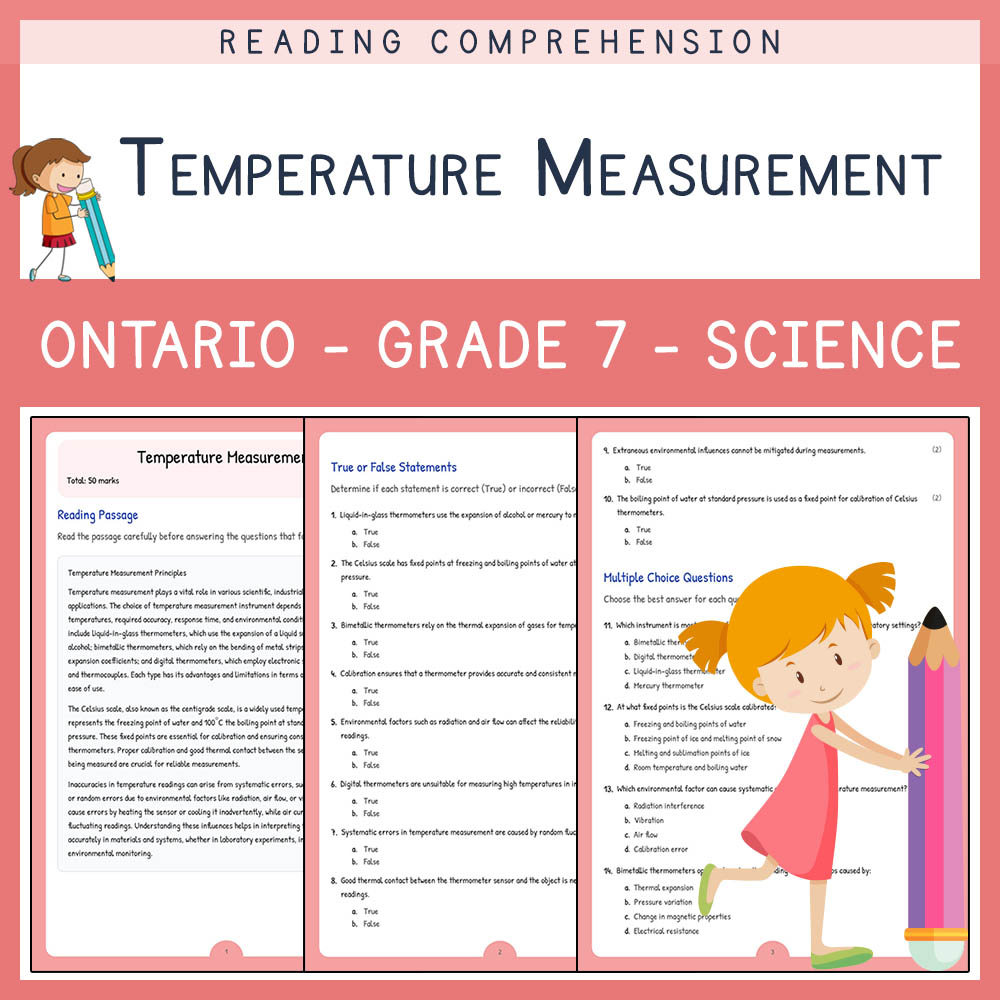
Grade 7 Science | Temperature Measurement Worksheet Elena | Ontario
 Created byLumora Learning
Learning Objectives
- Understand different types of thermometers and their appropriate ranges and uses.
- Explain the principles behind Celsius scale conventions and fixed points.
- Recognize factors affecting temperature measurement accuracy and reliability.
Instant download

Grade 7 Science – Matter & Energy Flow in Ecosystems Daily Reading Worksheet
 Created byBright Mind Resources
Learning Objectives
- Understand how producers capture sunlight and convert it into chemical energy.
- Identify the roles of consumers and decomposers in ecosystems.
- Explain the flow of energy through food chains and webs.
Also included in: Grade 7 Energy Transfer Science Daily Reading: Lesson Bundle | California Std. +1 more
Instant download
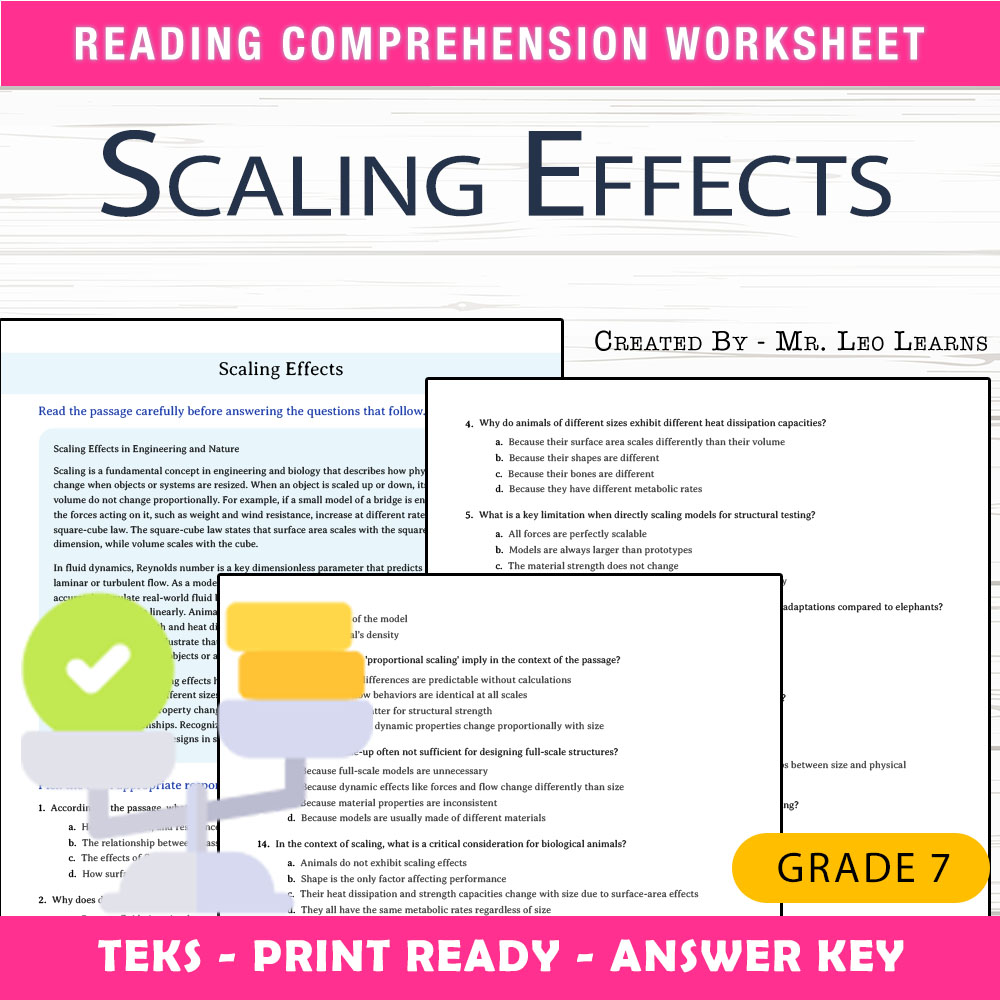
Grade 7 Science — Scaling Effects Worksheet for Mastery
 Created byThe Resource Hub
Learning Objectives
- Understand how scaling impacts the physical properties of structures and objects.
- Analyze the relationships between surface area, volume, and forces in different scales.
- Explain how fluid flow behaviors such as Reynolds number change with scale.
Also included in: Grade 7 Science Unit | Engineering, Technology & Innovation Worksheet Bundle +1 more
Instant download

Science Grade 7: Statistical Reasoning Worksheet | Ontario Standards
JCreated byJ.S SheetsLearning Objectives
- Identify and interpret measures of center (mean, median, mode) and spread (IQR, variance) in data about natural phenomena.
- Choose appropriate visual summaries (histograms and box plots) to describe distribution and outliers.
- Explain how sample size and outliers affect uncertainty and confidence in statistical conclusions.
Instant download

Science Worksheet Convection Dynamics Heat Transfer Fluids | Grade 7
JCreated byJ.S SheetsLearning Objectives
- Explain how buoyancy and density variations cause convective circulation in air and water
- Describe how temperature gradients influence the strength and heat-transport rate of convection
- Connect convection to real-world phenomena such as sea and land breezes, thermals, and lake overturning
Instant download

Grade 7 Empirical Knowledge Science Worksheet | NGSSS Inquiry Practice
 Created byEvergreen Desk Education
Learning Objectives
- Explain how empirical investigations (observations and measurements) help build scientific knowledge.
- Describe how evidence and peer community evaluation can support, refine, or replace scientific explanations.
- Use the idea of uncertainty to explain why scientific models can change when new data appear.
Instant download
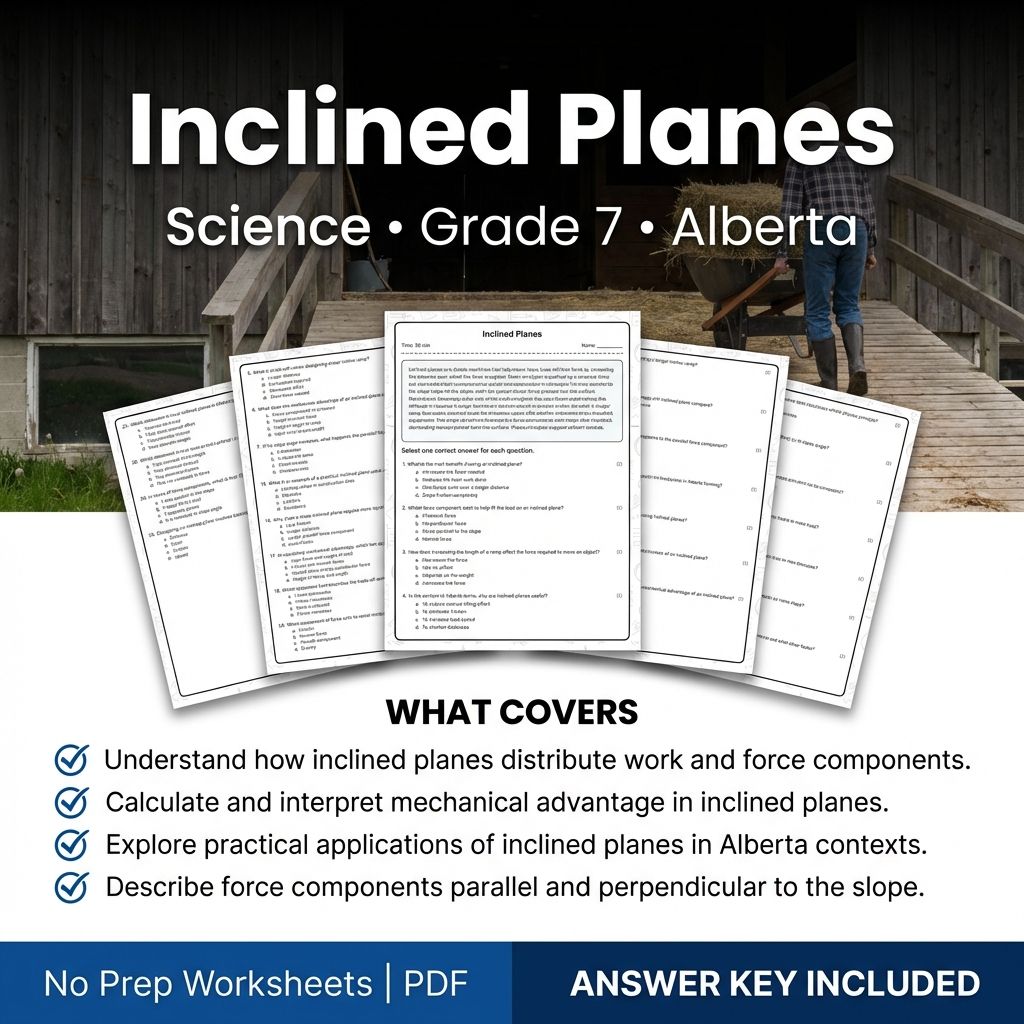
Grade 7 Science Worksheet on Inclined Planes | Alberta Standards
Created byCoral Reef LearningLearning Objectives
- Understand how inclined planes distribute work and force components.
- Calculate and interpret mechanical advantage in inclined planes.
- Explore practical applications of inclined planes in Alberta contexts.
Instant download

Grade 7 Science | States Of Matter - Daily Reading Comprehension
Created byCoral Reef LearningLearning Objectives
- Understand the properties of solids, liquids, and gases.
- Explain why particles in solids are tightly packed and how this affects their shape.
- Identify characteristics that distinguish solids from liquids and gases.
Instant download
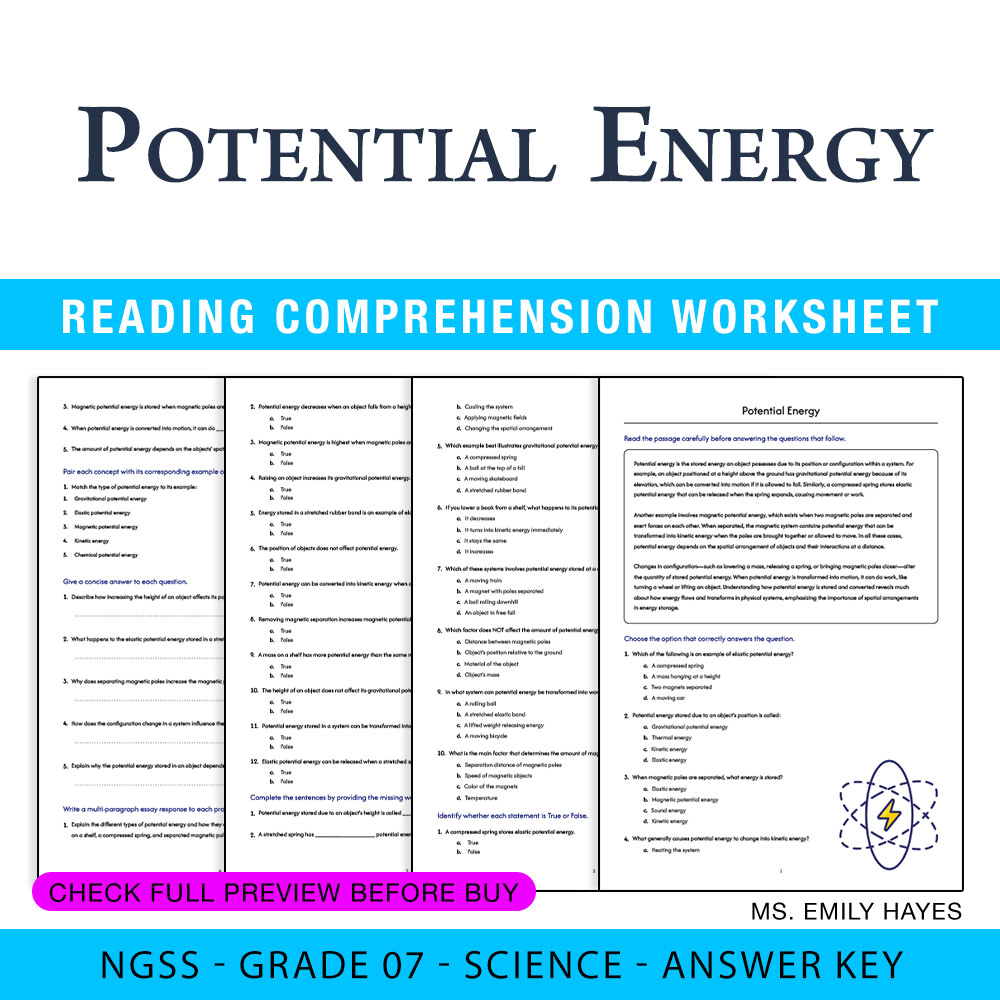
7th Grade Science | Potential Energy Worksheet (PDF+ Answer Key)
 Created byCopper Leaf Classroom
Learning Objectives
- Explain the concept of potential energy and how it is stored in different systems.
- Identify and describe examples of gravitational, elastic, and magnetic potential energy.
- Analyze how changes in the arrangement of objects affect stored potential energy.
Instant download

Grade 7 Conservation Status Worksheet | Alberta Practice PDF
 Created byClear Sky Classroom
Learning Objectives
- Explain how conservation status is determined using population trends, threats, and recovery potential
- Interpret evidence about species vulnerability by connecting land use, genetic diversity, and habitat connectivity
- Use conservation-status concepts to describe how assessments support regional conservation priorities
Instant download

Human System Feedbacks Assessment for Grade 7 Science | Standard General
 Created byPrism Point Learning
Learning Objectives
- Understand how human activities impact Earth's spheres and create feedback loops.
- Identify examples of human activities that influence the atmosphere, biosphere, and geosphere.
- Explain how feedback mechanisms can amplify or reduce environmental changes.
Also included in: Grade 7 Earth & Space Science Lesson Bundle: General Science Framework
Instant download

Conservation of Energy Assessment for Grade 7 Science | Standards-Aligned
Created byPrism Point LearningLearning Objectives
- Explain how energy transfers during physical processes such as heating and motion.
- Describe how energy conservation applies in real-world phenomena like friction.
- Identify different forms of energy and how they can be redistributed without being lost.
Also included in: Grade 7 Physical Science Science Lesson Bundle: General Framework
Instant download
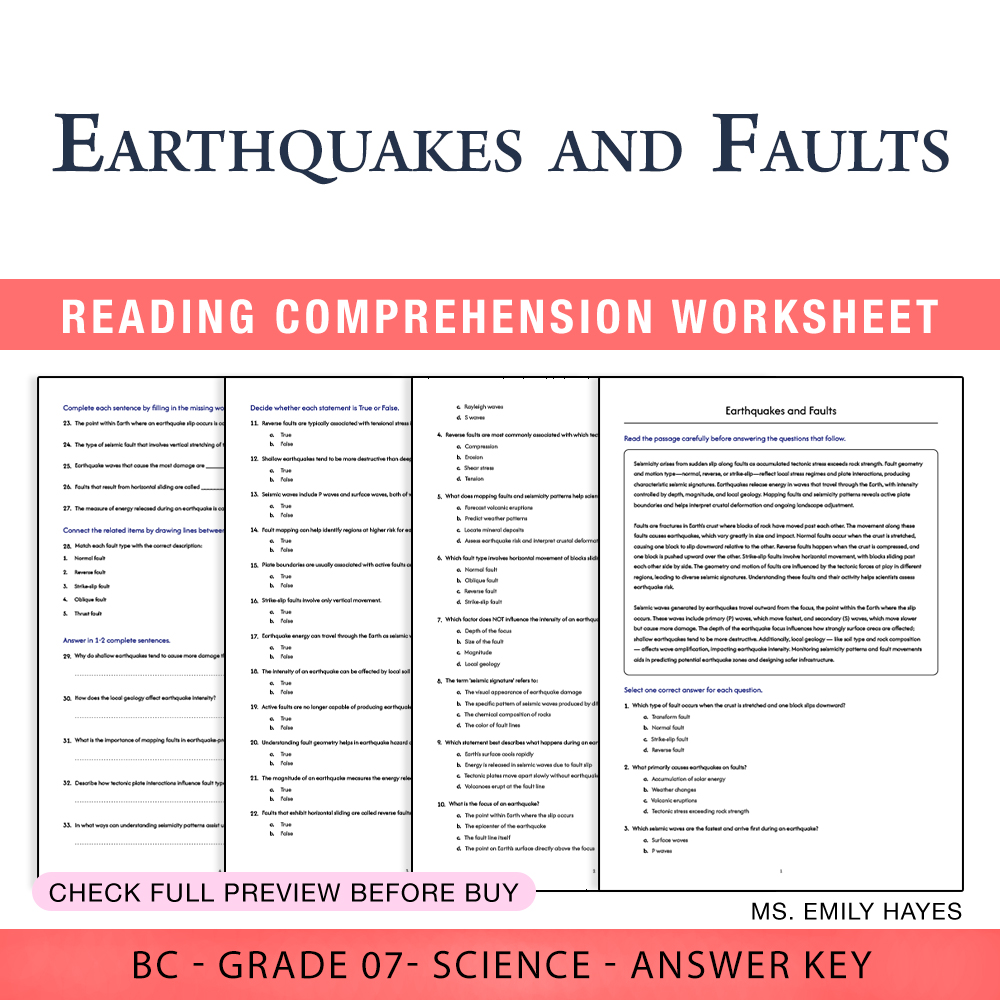
Grade 7 Science | Earthquakes and Faults Worksheet (PDF+ Answer Key)
Created byCopper Leaf ClassroomLearning Objectives
- Describe how seismic activity is related to fault movement and tectonic stress.
- Identify the different types of faults and their seismic signatures.
- Explain how earthquake energy propagates through the Earth and factors influencing earthquake intensity.
Also included in: Grade 7 Science | Earth Systems & Geology Unit (PDF+ Answer Keys) +1 more
Instant download

Grade 7 Science – Thermal Effects & Materials | Daily Reading Worksheet
Created byBright Mind ResourcesLearning Objectives
- Understand how materials expand and contract when heated or cooled
- Identify examples of phase changes due to temperature variations
- Explain how microscopic particle motion influences macroscopic properties
Also included in: Heat Transfer Grade 7 Science Daily Reading Worksheets Lesson Bundle | Ontario +1 more
Instant download

Grade 7 Science | Traditional Ecological Knowledge - Reading Comprehension
Created byCoral Reef LearningLearning Objectives
- Identify key concepts of indigenous ecological practices
- Recognize the importance of oral histories in ecological understanding
- Understand how place-based knowledge influences land stewardship
Also included in: Interactions and Ecosystems Lesson Bundle Grade 7 Science – Alberta +1 more
Instant download

Grade 7 Succession Patterns Worksheet | Ontario Science Practice PDF
Created byClear Sky ClassroomLearning Objectives
- Explain ecological succession as predictable changes in community composition after a disturbance.
- Distinguish primary succession from secondary succession and describe typical stages in each.
- Describe how abiotic changes (such as soil development) and biotic interactions (such as competition and facilitation) drive species turnover.
Instant download

Grade 7 Science | Elements & Compounds - Daily Reading Comprehension
Created byCoral Reef LearningLearning Objectives
- Understand the differences between elements and compounds.
- Identify examples of elements and compounds.
- Learn about atomic composition, bonding, and properties of elements and compounds.
Instant download

Fair Tests and Variables Science Worksheets Grade 7
Created byPrism Point LearningLearning Objectives
- Identify independent, dependent, and controlled variables in investigations
- Construct operational definitions for measurable dependent variables
- Design fair tests by selecting appropriate measurement criteria
Also included in: Scientific Inquiry & Data Practices Lesson Bundle | Grade 7 Science | Ontario +1 more
Instant download

Diffusion And Osmosis Practice Worksheet | Grade 7 Science Review
Created byPrism Point LearningLearning Objectives
- Explain how diffusion and osmosis are passive transport processes driven by concentration differences
- Describe how semipermeable membranes affect the movement of water during osmosis
- Predict how factors like temperature, surface area, and concentration gradient can change transport rate
Also included in: Cellular Structure & Function Lesson Bundle | Grade 7 Science | Bc +1 more
Instant download

Speciation and Biodiversity Worksheets | Grade 7 Science
 Created byTeachers Club
Learning Objectives
- Explain how reproductive isolation can contribute to speciation
- Describe how geographic separation can drive lineage splitting
- Explain how polyploidy can create new plant species
Also included in: Biological Evolution Grade 7 Science NGSS Unit Bundle +2 more
Instant download

Matter Cycling in Organisms: Grade 7 Science Worksheets & Review
Created byTeachers ClubLearning Objectives
- Explain how atoms are conserved during digestion and biosynthesis
- Describe carbon cycling through digestion, biosynthesis, and respiration
- Describe nitrogen cycling through organisms and nitrogenous waste
Also included in: From Molecules to Organisms Grade 7 Science NGSS Worksheets Bundle +2 more
Instant download

Atomic Models and Particle Representations Worksheets Grade 7 Science
Created byTeachers ClubLearning Objectives
- Compare particle, ball-and-stick, and lattice models of matter
- Relate subatomic particles to atomic number and formula notation
- Explain covalent and ionic bonding patterns
Also included in: Grade 7 Science Worksheets | NGSS Matter & Its Interactions Bundle +2 more
Instant download

Surface Processes and Landscape Change Worksheets | Grade 7 Science
Created byTeachers ClubLearning Objectives
- Explain how weathering, erosion, transport, and deposition change Earth's surface
- Compare mechanical and chemical weathering effects on rocks and soil
- Describe how rivers, coasts, and glaciers change landforms over time
Also included in: Grade 7 Science Worksheets | Earth's Systems NGSS Bundle +2 more
Instant download

Gravitational, Elastic & Magnetic Potential Energy Worksheets Grade 7
Created byTeachers ClubLearning Objectives
- Explain how potential energy depends on position or arrangement
- Identify gravitational potential energy in physical systems
- Identify elastic potential energy in arranged or compressed objects
Also included in: Grade 7 Science Energy Worksheets Bundle | NGSS Aligned +2 more
Instant download

Forces and Equilibrium Worksheets: Static & Dynamic Systems Grade 7
Created byTeachers ClubLearning Objectives
- Describe equilibrium using a vector sum of forces equal to zero
- Differentiate static and dynamic equilibrium using net force
- Relate net force and acceleration to motion outcomes
Also included in: Grade 7 Science Worksheets NGSS Forces and Motion Bundle +2 more
Instant download

Heat Transfer Mechanisms Worksheets: Conduction, Convection & Radiation
Created byTeachers ClubLearning Objectives
- Describe thermal energy transfer through conduction, convection, and radiation
- Identify evidence of heat transfer from temperature changes
- Compare heat transfer rates across different materials and modes
Also included in: Grade 7 Science Energy Worksheets Bundle | NGSS Aligned +2 more
Instant download

Grade 7 Science | Chemical Properties - Daily Reading Comprehension
Created byCoral Reef LearningLearning Objectives
- Understand what chemical properties are and how they differ from physical properties.
- Recognize common chemical reactions such as reactivity with acids and bases, combustion, and corrosion.
- Identify indicators of chemical change, including gas evolution, color change, and precipitate formation.
Instant download
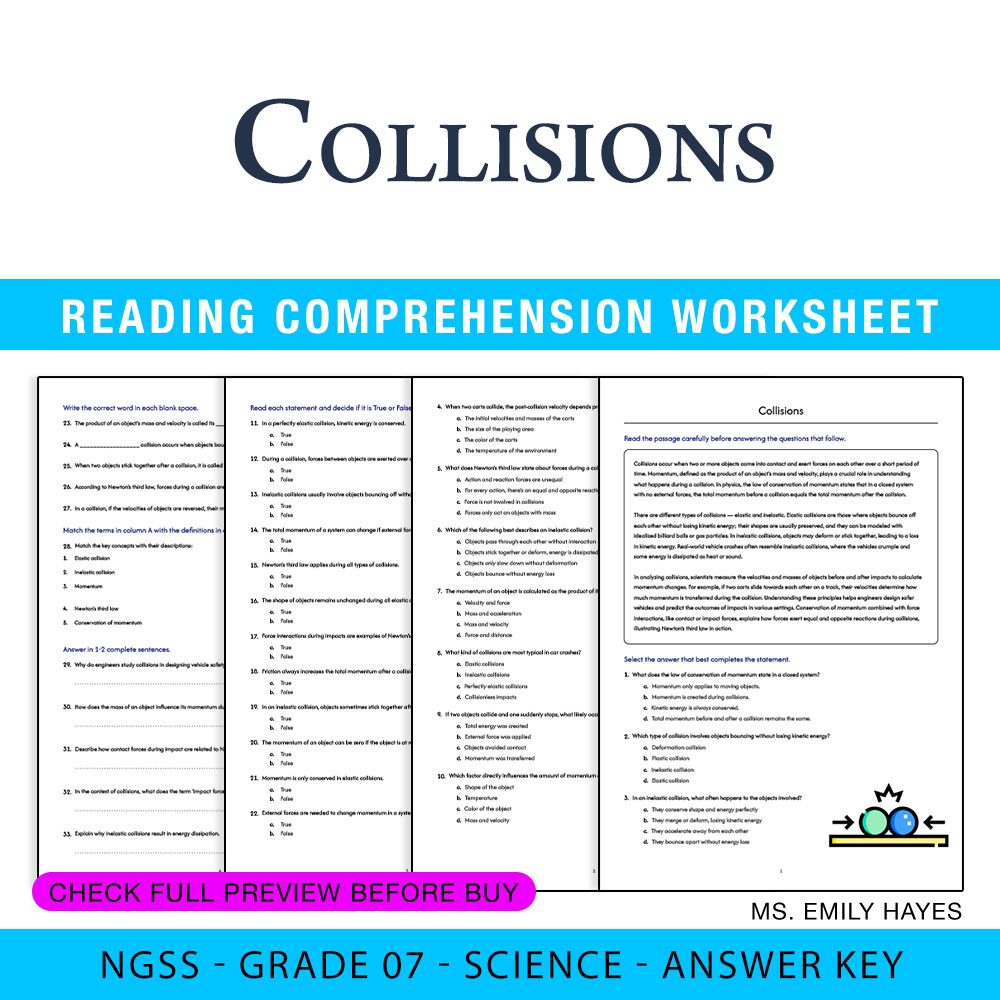
Grade 7 Science | Collisions Worksheet (PDF+ Answer Key)
Created byCopper Leaf ClassroomLearning Objectives
- Understand the principles of momentum conservation during collisions.
- Differentiate between elastic and inelastic collisions and their effects on moving objects.
- Apply quantitative concepts to analyze motion changes during collisions involving mass and velocity.
Instant download
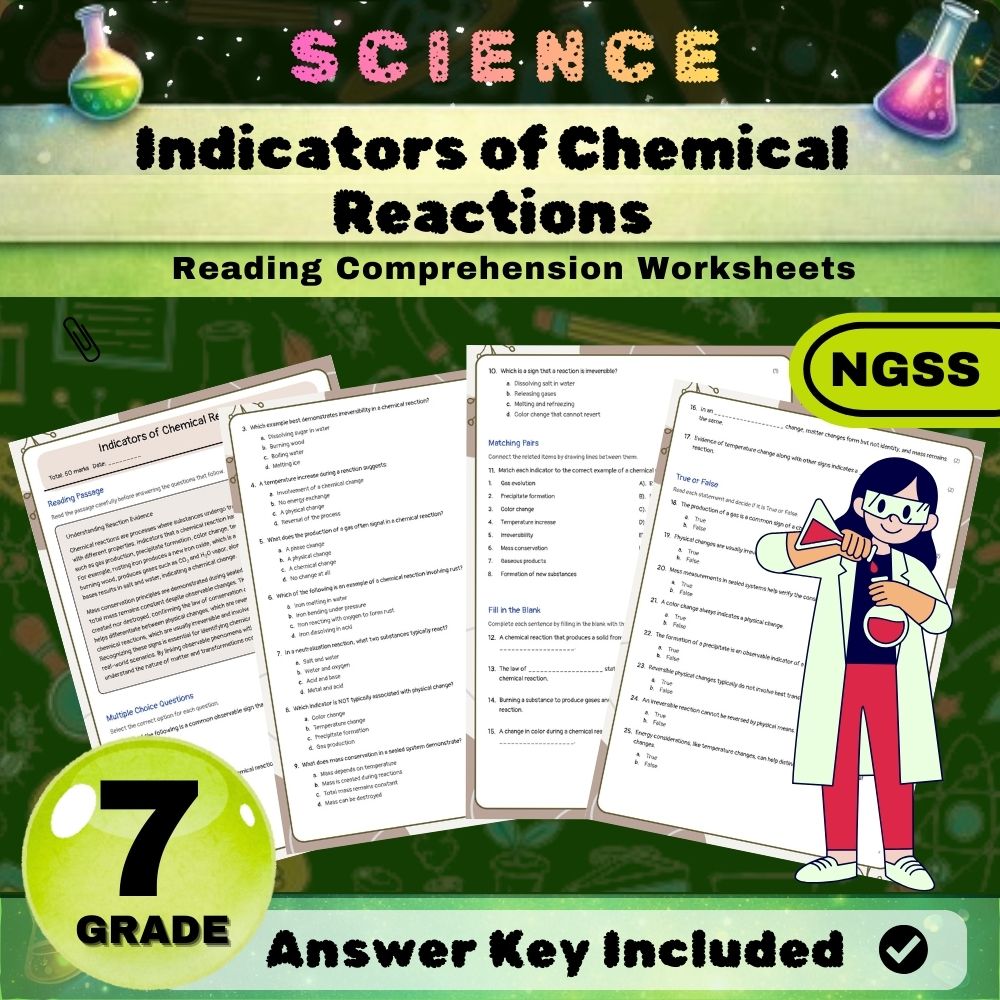
Grade 7 Science | Indicators of Chemical Reactions Worksheet (PDF)
 Created byMaple Path Learning
Learning Objectives
- Identify observable signs that indicate a chemical reaction has occurred.
- Describe examples of chemical reactions demonstrating indicators like gas production, precipitate formation, and color change.
- Understand the principles of mass conservation in chemical processes.
Instant download

Grade 7 Science | Population Variation Worksheet | NGSSS Aligned
Created byLumora LearningLearning Objectives
- Define population variation and trait frequency using measurable examples
- Explain how inherited differences and recombination contribute to differences among individuals
- Describe how environmental pressures can change trait frequencies across generations
Instant download

Physical Properties of Matter Science Worksheets Grade 7
 Created byBRIGHT PATH RESOURCES
Learning Objectives
- Identify physical properties such as melting point, boiling point, density, magnetism, conductivity, solubility, and color as observable characteristics of matter.
- Explain how different physical properties can help distinguish components in mixtures.
- Use measured changes in behavior (heat response and dissolving) to support reasoning about substances.
Also included in: Grade 7 Physical Science Worksheets Bundle | Energy, Waves & Motion +2 more
Instant download
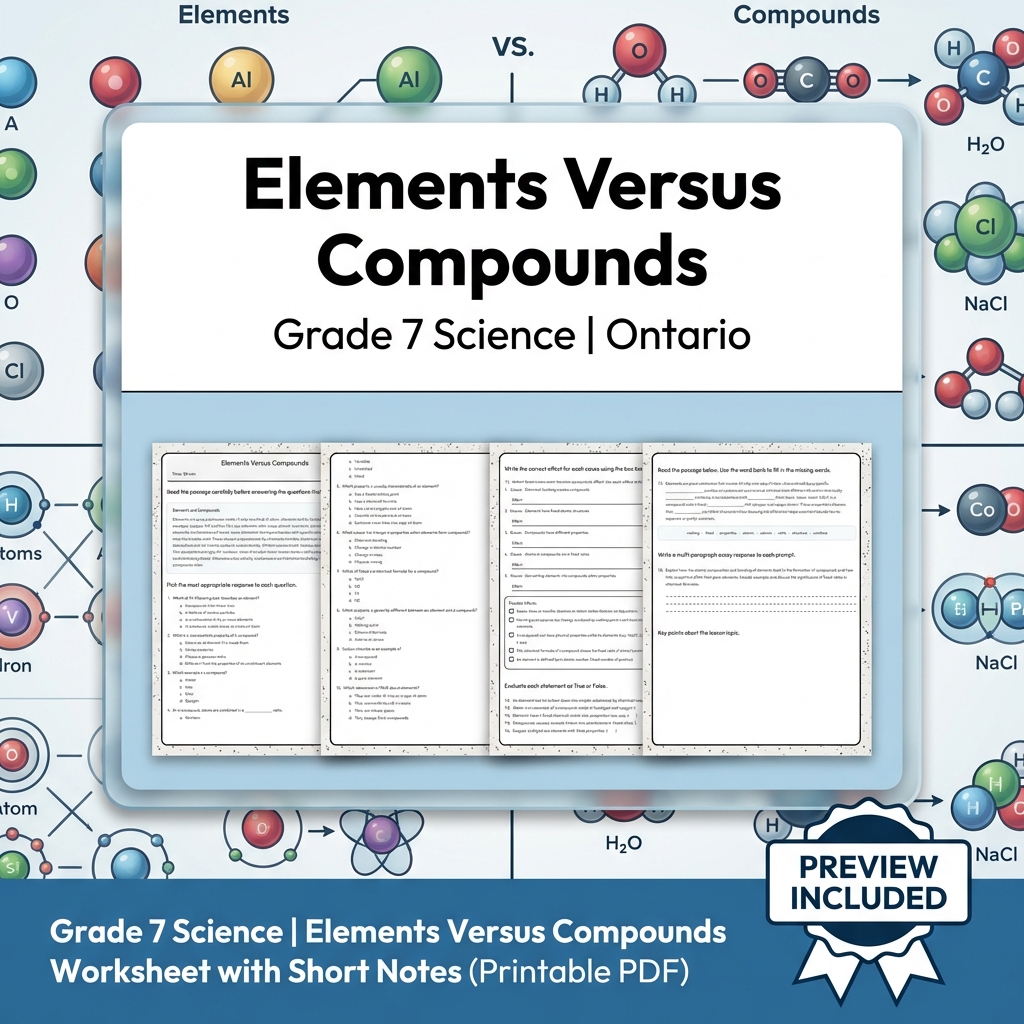
Grade 7 Science | Elements Versus Compounds Worksheet with Short Notes (PDF)
 Created byMeadowlark Worksheets
Learning Objectives
- Understand the difference between elements and compounds based on atomic composition and properties.
- Identify characteristic features such as melting point, conductivity, and fixed ratios of atoms in compounds.
- Explain how chemical bonding and composition affect the properties of substances.
Also included in: Grade 7 Science Lesson Group Bundle – Ontario Curriculum Worksheets +1 more
Instant download
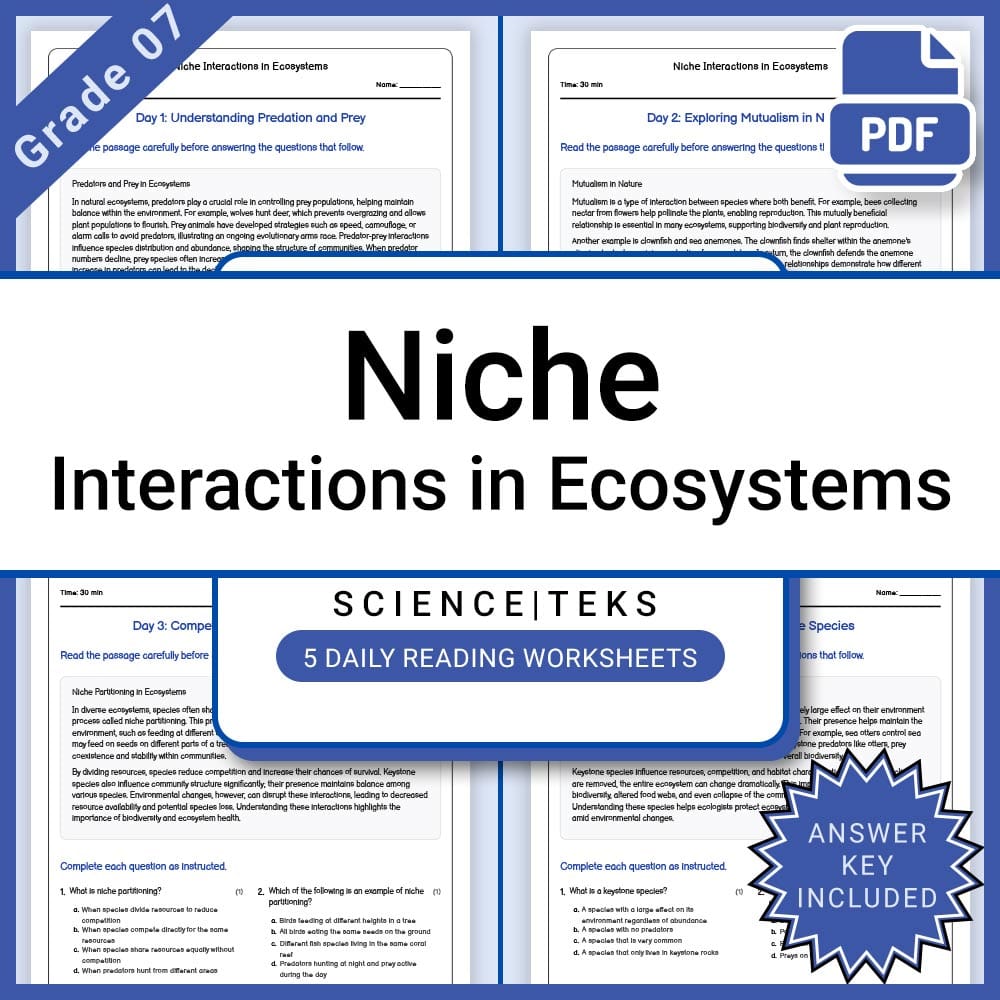
Grade 7 Science – Niche Interactions in | Daily Reading Worksheet + Answer Key
JCreated byJ.S SheetsLearning Objectives
- Understand predator-prey relationships and their role in ecosystems
- Identify examples of mutualism, parasitism, competition, and predation
- Learn how niche partitioning reduces competition among species
Also included in: Grade 7 Science Lesson Bundle | Ecosystems, Cell Structure & Adaptations +1 more
Instant download

Explanatory Models Worksheet Pack for Grade 7 Science | NGSSS Activities
Created byPrism Point LearningLearning Objectives
- Explain how scientific models represent natural phenomena using relationships like cause-and-effect or energy transfer.
- Evaluate how well a model matches observations and whether its predictions agree with new evidence.
- Distinguish models from exact replicas and describe how models guide scientific reasoning.
Instant download

Grade 7 Science | Simple Systems and Mechanisms Worksheet | General Standards
Created byLumora LearningLearning Objectives
- Explain how simple mechanisms transfer motion or force from an input to an output
- Use relationships like gear ratio and mechanical advantage to predict changes in speed and force
- Compare mechanisms (gears, pulleys, levers, linkages) based on design criteria and constraints
Instant download

Grade 7 Science | Urban Heat Worksheet (Ontario Standards) (PDF)
Created byEvergreen Desk EducationLearning Objectives
- Explain how urban heat island effects raise night-time temperatures and alter local microclimates.
- Describe how surface materials, vegetation, evapotranspiration, and building geometry influence heat retention and airflow.
- Evaluate mitigation strategies such as cool pavements, added urban greenery, and strategic shading.
Also included in: Grade 7 Thermal Heat Transfer Science Lesson Bundle: Ontario Framework +1 more
Instant download
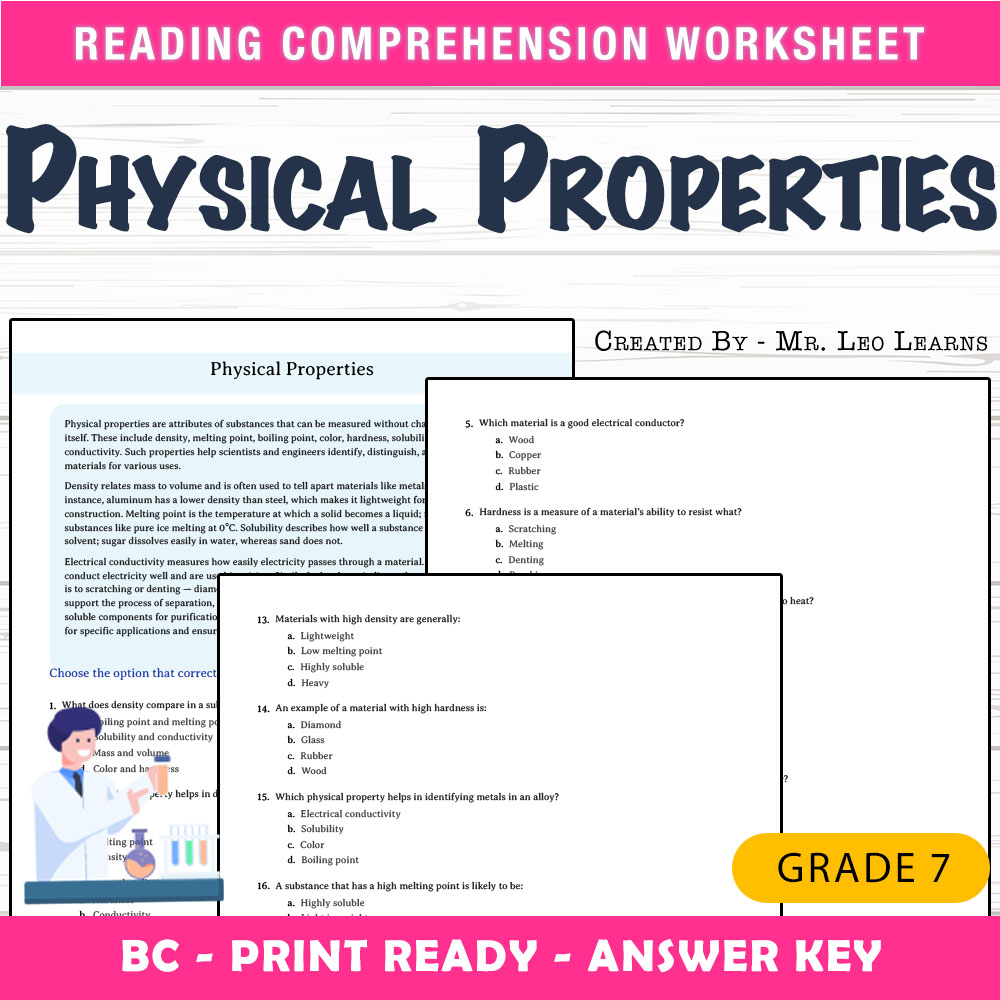
Grade 7 Science — Physical Properties Worksheet MCQ Paper
Created byThe Resource HubLearning Objectives
- Understand and identify different measurable physical properties of substances.
- Describe how properties like density, melting point, and solubility help in material identification.
- Compare and analyze the importance of physical properties in separating mixtures and selecting materials.
Also included in: Grade 7 Science | Matter & Chemical Change Worksheet Bundle – BC Framework +1 more
Instant download

Grade 7 Science – Energy Types in Daily Life | Daily Reading Worksheet
Created byBright Mind ResourcesLearning Objectives
- Understand the concepts of potential and kinetic energy.
- Identify examples of stored energy and moving energy in everyday objects.
- Explain how height influences stored energy in objects.
Also included in: Grade 7 Motion & Energy Science Daily Reading Worksheets Lesson Bundle | TEKS +2 more
Instant download

Grade 7 Science – Statistical Reasoning & Data Analysis | Reading Worksheet
Created byBright Mind ResourcesLearning Objectives
- Understand measures of central tendency: mean, median, mode
- Interpret variability through range and interquartile range
- Compare data sets visually using graphs like histograms and box plots
Also included in: Grade 7 Variables & Exp Design Science Lesson Bundle Daily Reading | TEKS +2 more
Instant download
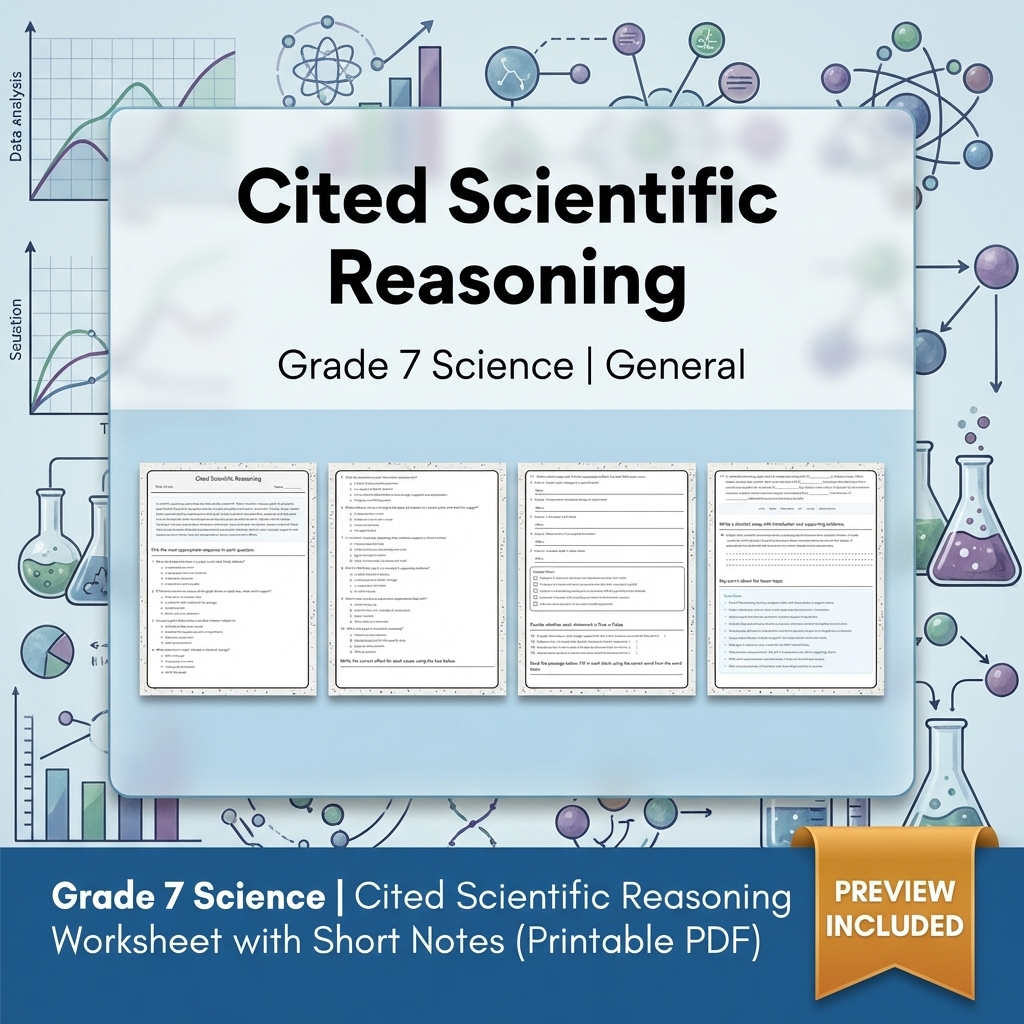
Grade 7 Science | Cited Scientific Reasoning Worksheet with Short Notes
Created byMeadowlark WorksheetsLearning Objectives
- Understand how to interpret data and observations to support scientific claims.
- Learn to identify changes in data curves and compare values to evaluate evidence.
- Explain why certain evidence supports specific scientific explanations over others.
Also included in: Grade 7 Science Scientific Modeling & Evidence Lesson Bundle: General Framework +1 more
Instant download

Grade 7 Science Worksheet | Predicting Reactions (PDF) – BC Standards
Created byEvergreen Desk EducationLearning Objectives
- Explain how physical and chemical properties help predict whether substances will react.
- Use evidence of chemical change (new substances, gas, color change, temperature change) to justify predictions.
- Identify likely reaction outcomes by applying trends in reactivity, acid–base behavior, flammability, and solubility.
Instant download

Grade 7 Indicators of Chemical Reactions Worksheet | NGSS Physical Science
Created byBRIGHT PATH RESOURCESLearning Objectives
- Identify the signs indicating a chemical reaction has occurred
- Understand examples of chemical indicators such as gas production and precipitate formation
- Explain how energy changes and mass measurements relate to chemical reactions
Also included in: Chemical Reactions Grade 7 Science Daily Reading Worksheets Lesson Bundle | NGSS +2 more
Instant download

Grade 7 Air Masses and Fronts Worksheet | Florida NGSS Practice PDF
Created byClear Sky ClassroomLearning Objectives
- Explain what air masses are and how their temperature and moisture affect weather.
- Describe how fronts form when air masses with different properties meet.
- Compare cold fronts and warm fronts based on lifting, timing, and precipitation patterns.
Instant download

Grade 7 Material Testing Worksheet | Ontario Science Assessment PDF
Created byClear Sky ClassroomLearning Objectives
- Explain how tensile, compression, and bending tests describe material behavior under different forces.
- Identify non-destructive testing methods and describe what they detect or measure.
- Describe how anisotropy and strain localization can change material performance in timber and composite materials.
Instant download

Grade 7 Science – Surface Area & Cells | Daily Reading Worksheet
Created byBright Mind ResourcesLearning Objectives
- Identify structures that increase surface area in cells
- Understand how surface area influences cell efficiency
- Explore adaptations that enhance material exchange in cells
Also included in: Cell Function & Transport Grade 7 Science Daily Reading Worksheets Bundle | BC +1 more
Instant download
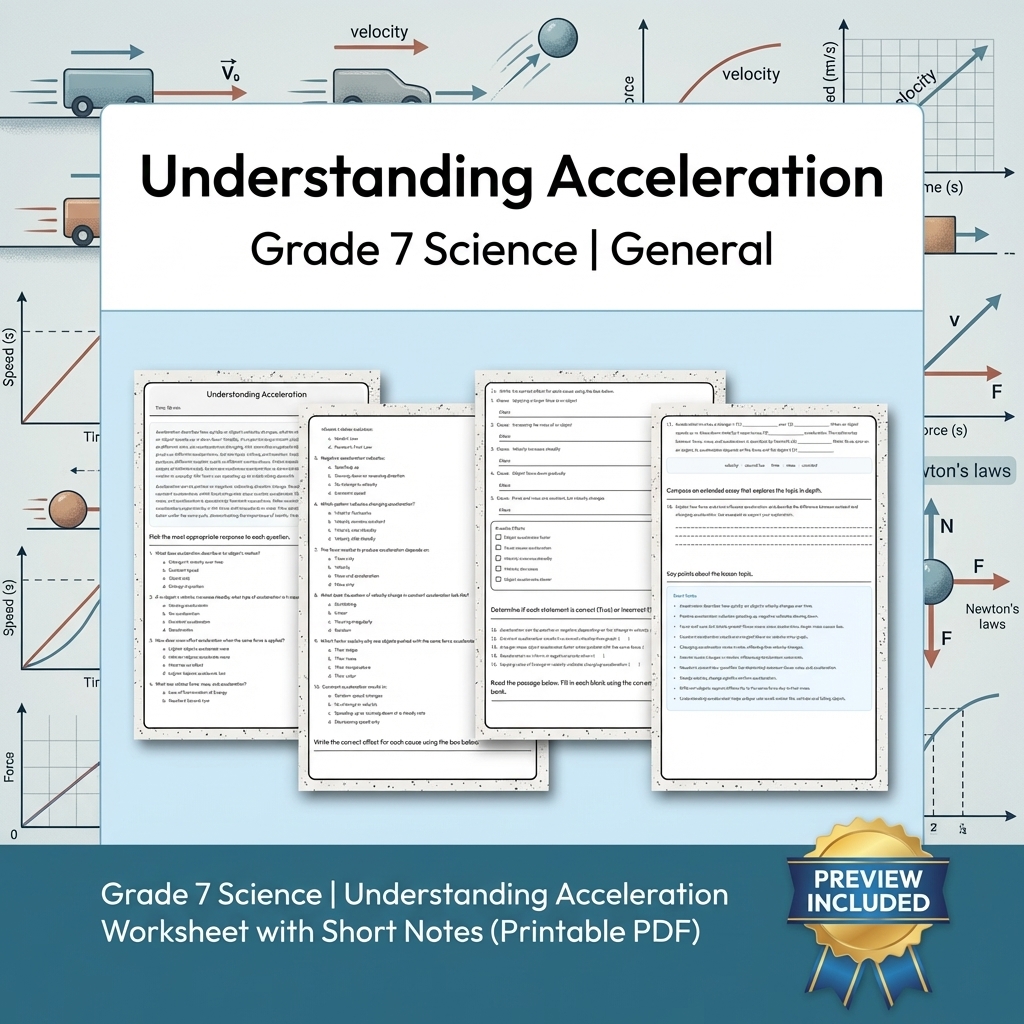
Grade 7 Science | Understanding Acceleration Worksheet with Short Notes
Created byMeadowlark WorksheetsLearning Objectives
- Define acceleration and explain how velocity changes over time.
- Describe how force and mass influence acceleration.
- Identify patterns of constant and changing acceleration.
Also included in: Grade 7 Energy Transfer and Motion Science Lesson Bundle | General +1 more
Instant download

Graphing Motion Worksheet | Standards-Aligned Grade 7 Science Practice
JCreated byJ.S SheetsLearning Objectives
- Understand how to interpret distance–time and speed–time graphs.
- Learn how to determine slope meanings, area under curves, and rates from graphs.
- Apply graphing techniques to real-world motion scenarios, such as downhill runs.
Instant download
About Grade 7 Science Worksheets
Browse 6,039 printable Grade 7 Science worksheets — ready-to-print PDFs with answer keys where available.
Every worksheet on MyTeachingSheets is created by independent teacher-authors and reviewed before publication. All resources download as printable PDFs for classroom, homework, or at-home practice, and many include answer keys. Preview any worksheet free before buying.