
Grade 7 Science Worksheets
6,039 worksheets
Grade 7 Forces and Motion Worksheet | Motion, Forces & NGSSS Science
 Created byEvergreen Desk Education
Learning Objectives
- Explain how forces (pushes and pulls) can change an object's motion.
- Describe net force and how balanced vs. unbalanced forces affect acceleration, speed, and direction.
- Use everyday examples (bicycle, skateboard, friction) to predict changes in motion.
Instant download
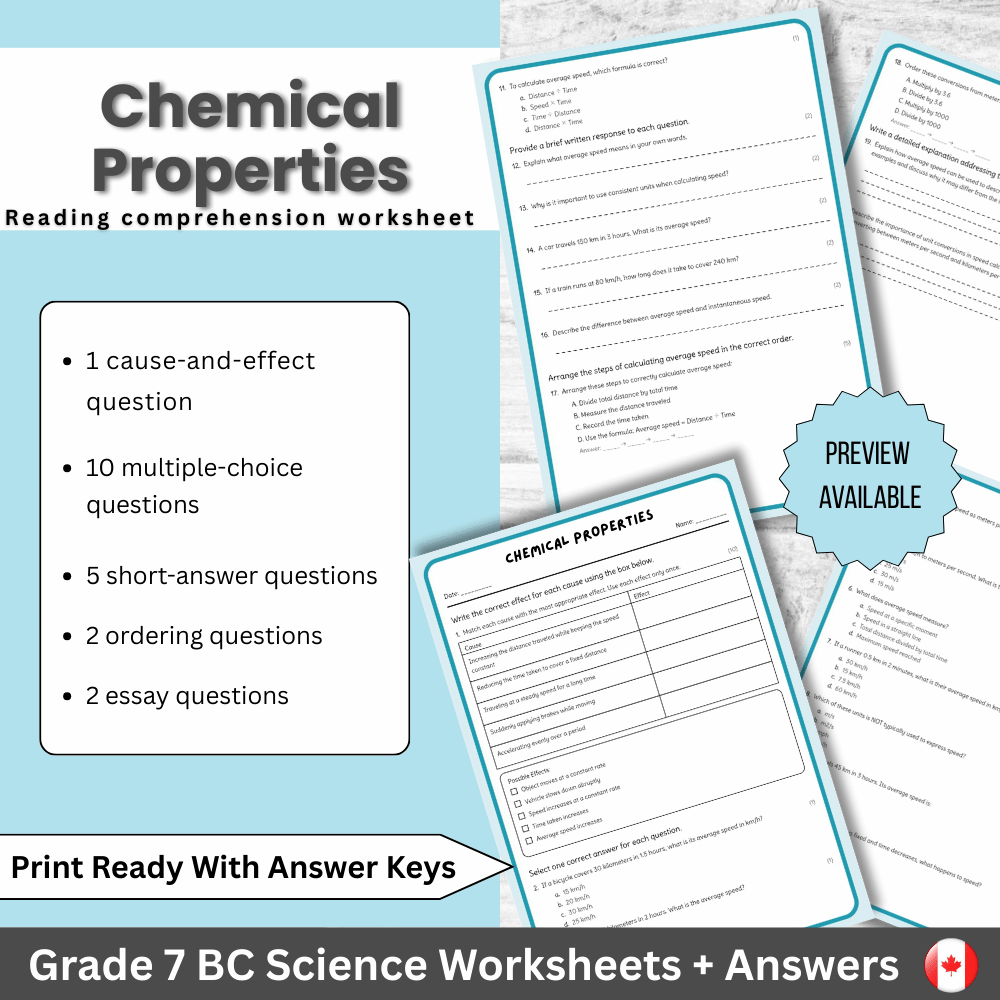
Grade 7 Science | Chemical Properties Worksheet (PDF) Aligned with BC Standards
 Created byBright Mind Resources
Learning Objectives
- Identify different chemical properties of substances and their observable outcomes.
- Describe how substances react with acids, bases, and other compounds.
- Predict reaction outcomes based on chemical properties such as flammability and reactivity.
Instant download

Grade 7 Science | Mountain Building Worksheet | BC Standard
 Created byLumora Learning
Learning Objectives
- Understand the geological processes involved in orogeny and mountain formation.
- Identify the effects of tectonic convergence, crustal deformation, and surface erosion on mountain architecture.
- Describe how different surface processes contribute to shaping mountain landscapes over time.
Instant download

Erosion and Transport Worksheet | Standards-Aligned Grade 7 Science Practice
JCreated byJ.S SheetsLearning Objectives
- Understand the agents responsible for erosion and how they transport sediment.
- Identify distinctive sedimentary signatures produced by different agents.
- Explain how grain size and sorting help interpret landscape evolution and paleoenvironment.
Instant download
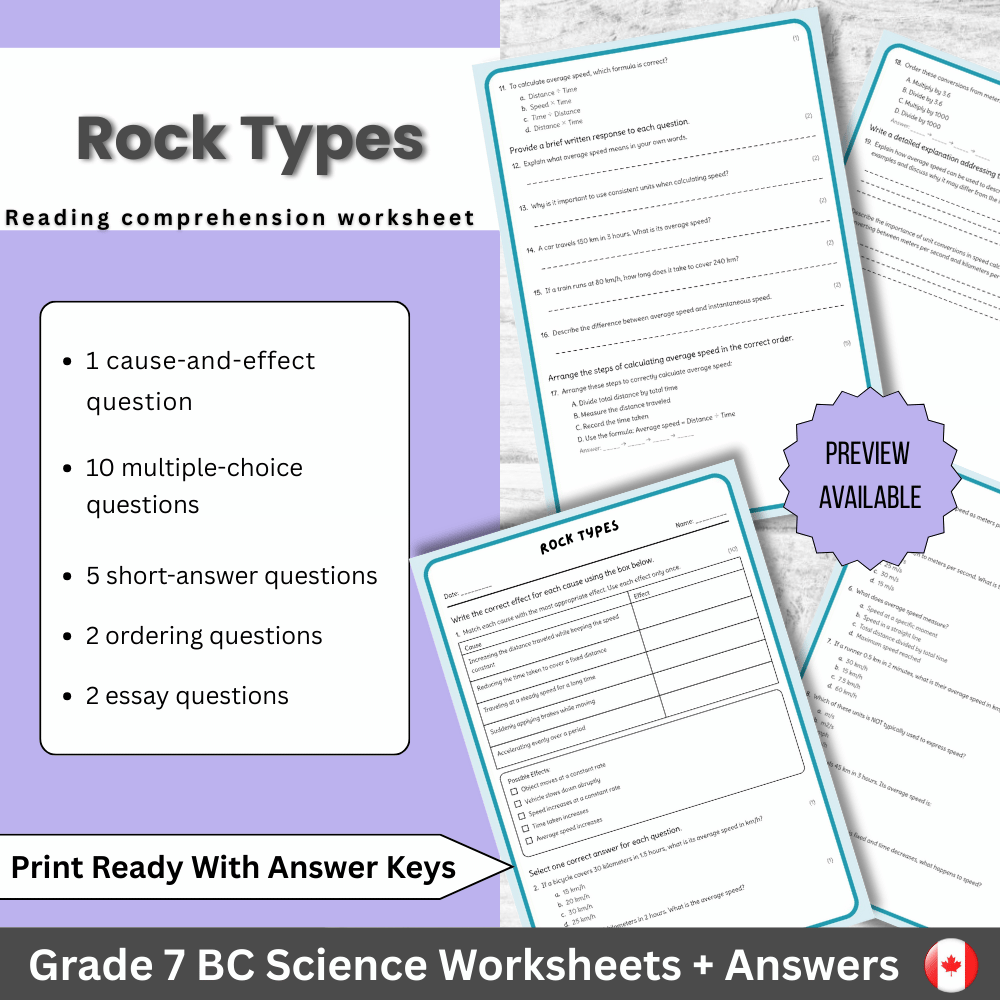
Grade 7 Science | Rock Types Worksheet (Worksheet + Answer Key) BC Standard
Created byBright Mind ResourcesLearning Objectives
- Identify and describe the three main types of rocks: igneous, sedimentary, and metamorphic.
- Explain the process of how each rock type forms.
- Analyze mineral content, textures, and structures to distinguish between rock types.
Instant download

Grade 7 Science | Human Impacts on Ecosystems - Daily Reading Comprehension
 Created byCoral Reef Learning
Learning Objectives
- Understand how deforestation and habitat loss affect ecosystems.
- Identify human activities that lead to habitat fragmentation.
- Recognize the consequences of habitat loss for biodiversity.
Instant download

Grade 7 Inheritance Probability Worksheet | NGSS Practice PDF
 Created byClear Sky Classroom
Learning Objectives
- Understand how probability concepts predict genetic variation among offspring.
- Apply Punnett squares to determine genotype and phenotype ratios.
- Interpret probability outcomes in monohybrid crosses and larger populations.
Also included in: Grade 7 Inheritance, DNA & Traits Science Lesson Bundle NGSS Worksheets +1 more
Instant download
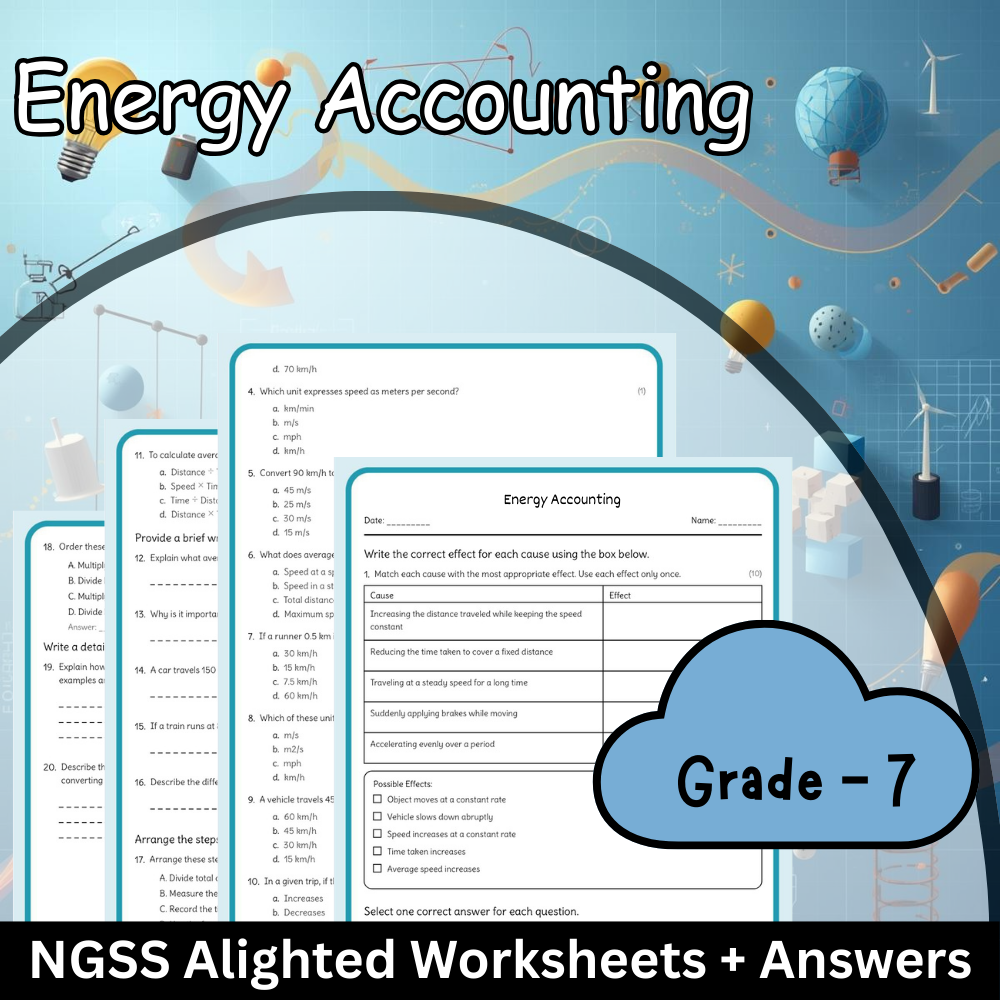
Grade 7 Science – Energy Accounting Worksheet + Answer Key | NGSS Aligned
Created byBright Mind ResourcesLearning Objectives
- Explain how energy transfers affect an object's motion energy.
- Identify examples of energy transfer in scenarios like braking, collisions, and bouncing balls.
- Describe the concept of energy bookkeeping and how it helps account for energy changes.
Instant download

Grade 7 Science | Understanding Net Force - Daily Reading Comprehension
Created byCoral Reef LearningLearning Objectives
- Define net force and explain its effects on objects.
- Differentiate between balanced and unbalanced forces.
- Recognize examples of net force in everyday life.
Instant download

Grade 7 Physical Properties Worksheet | Ontario Science PDF + Answer Key
Created byClear Sky ClassroomLearning Objectives
- Define physical properties and distinguish them from chemical changes
- Use measurements of density, mass, volume, and phase-change temperatures to identify materials
- Explain how molecular structure and intermolecular forces influence observable physical properties
Instant download

Grade 7 Design Criteria Worksheet | General Practice PDF
Created byClear Sky ClassroomLearning Objectives
- Explain how design criteria and constraints work together in a science/engineering design problem.
- Identify measurable or observable criteria that can be used to judge whether a solution improves performance.
- Describe how trade-offs can happen when meeting one requirement affects another.
Instant download
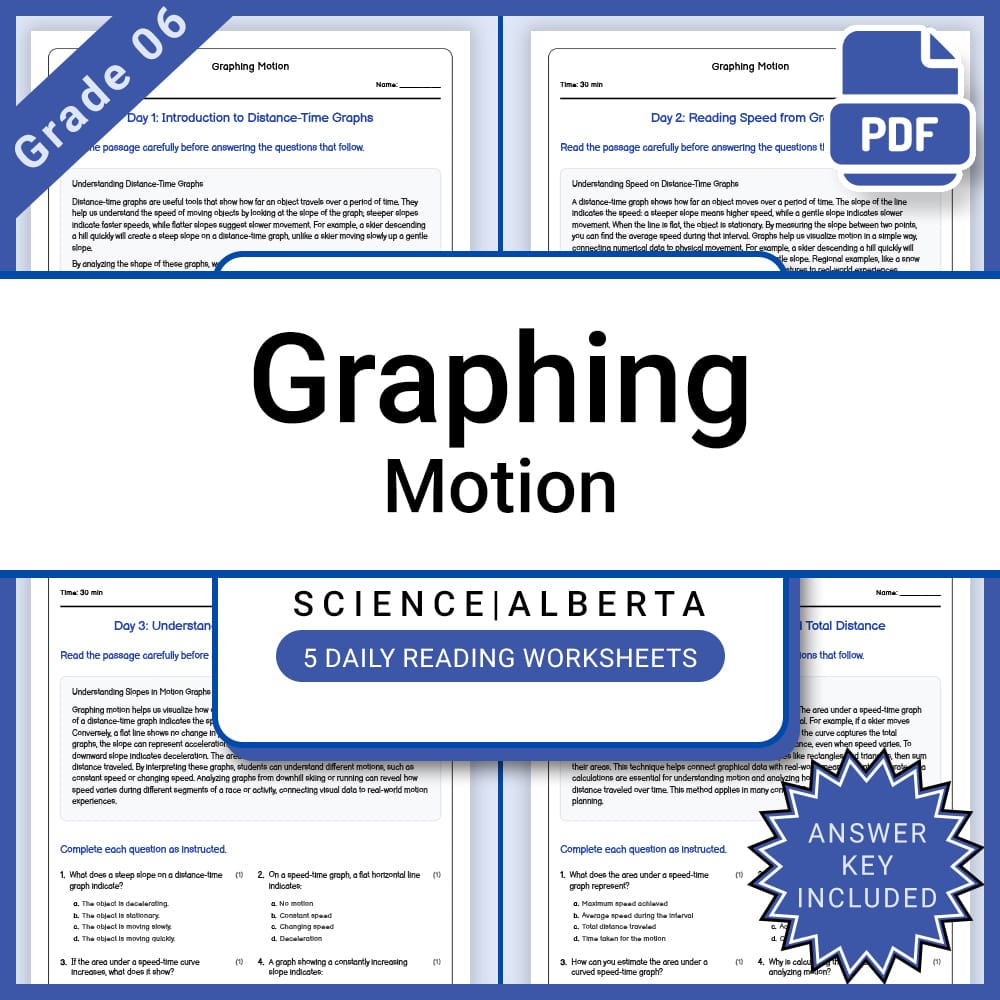
Grade 7 Science – Graphing Motion Daily Reading Worksheet + Answer Key
JCreated byJ.S SheetsLearning Objectives
- Understand how to interpret distance-time graphs.
- Identify the meaning of different slopes in graphs.
- Learn how to determine average and instantaneous speed from graphs.
Also included in: Grade 7 Science Lesson Group | Structural Engineering & Motion Worksheets +1 more
Instant download

Grade 7 DNA and Chromosomes Worksheet | NGSS Practice PDF
Created byClear Sky ClassroomLearning Objectives
- Explain how DNA molecules are organized into chromosomes and how they encode genes.
- Describe the process of chromosome segregation during gamete formation and fusion.
- Understand how genetic variation in DNA sequences leads to observable traits.
Also included in: Grade 7 Inheritance, DNA & Traits Science Lesson Bundle NGSS Worksheets +1 more
Instant download

Grade 7 Science | Cited Scientific Reasoning - Daily Reading Comprehension
Created byCoral Reef LearningLearning Objectives
- Understand how to interpret data from graphs and observations in scientific contexts.
- Learn to support scientific claims with specific data references.
- Explain how evidence justifies scientific reasoning.
Instant download

Grade 7 Science | Conservation of Matter Worksheet | NGSSS Aligned
Created byLumora LearningLearning Objectives
- Explain the conservation of matter principle for chemical reactions.
- Use mass measurements to predict whether total mass changes during a reaction.
- Describe how atoms are reorganized during chemical reactions without being created or destroyed.
Instant download

Variable Control Worksheet Grade 7 Science Fair Test Variables Ontario
 Created byChalk and Compass
Learning Objectives
- Explain independent, dependent, and controlled variables using operational definitions.
- Design a fair test by identifying variables, using consistent measurement criteria and timing, and minimizing bias.
- Describe how replication and control groups help reduce confounding and improve causal conclusions.
Also included in: Grade 7 Science Scientific Inquiry & Data Analysis Lesson Bundle | Ontario +1 more
Instant download

Science Worksheet Purity Assessment Grade 7 | Ontario Standards Practice
JCreated byJ.S SheetsLearning Objectives
- Identify how melting point, boiling point, conductivity, refractive index, and gravimetric residue can indicate purity
- Explain how impurities can shift physical properties and widen melting ranges
- Use more than one line of evidence to support a claim about whether a sample is pure
Instant download

Grade 7 Science – Matter Cycling & Ecosystems | Daily Reading Worksheet
Created byBright Mind ResourcesLearning Objectives
- Understand how matter such as carbon and nitrogen move through ecosystems
- Identify pathways like photosynthesis, respiration, decomposition, and nutrient transport
- Explain the role of decomposers in nutrient recycling
Also included in: Grade 7 Energy Transfer Science Daily Reading: Lesson Bundle | California Std. +1 more
Instant download

Grade 7 Science | Trophic Energy Flow - Daily Reading Comprehension
Created byCoral Reef LearningLearning Objectives
- Understand the concept of trophic levels in an ecosystem.
- Identify primary producers, consumers, and decomposers in energy transfer.
- Explain how energy moves from one trophic level to the next.
Instant download

Conduction Focus Worksheet | Grade 7 Science Practice
 Created byPrism Point Learning
Learning Objectives
- Explain how conduction transfers kinetic energy in solids through particle-to-particle collisions
- Compare how different materials conduct heat using conductivity ideas
- Describe how interfaces, material contact, and contact resistance influence heat flow and temperature gradients
Instant download

Matter Properties Worksheet Grade 7 Science Activities | Physical & Chemical Properties
Created byPrism Point LearningLearning Objectives
- Identify physical and chemical properties of matter using everyday examples.
- Explain how properties help classify and distinguish substances under consistent conditions.
- Determine whether statements about matter properties are true or false.
Also included in: Physical Science Lesson Bundle | Grade 7 Science | Florida NGSSS
Instant download
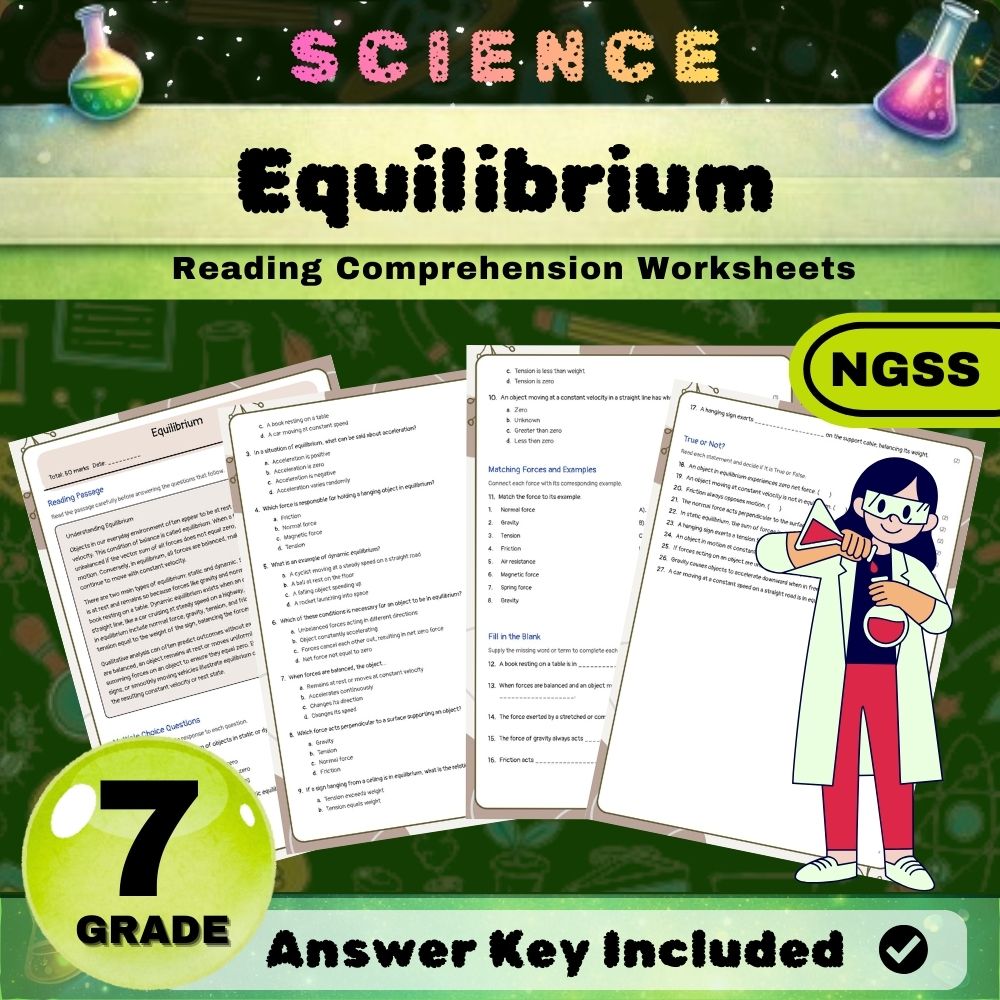
Grade 7 Science | Equilibrium NGSS Worksheet (Answer Key) - PDF
 Created byMaple Path Learning
Learning Objectives
- Define equilibrium as the condition where the vector sum of forces equals zero.
- Distinguish between static and dynamic equilibrium through examples and analysis.
- Describe roles of forces such as normal, gravitational, tension, and net force in achieving equilibrium.
Instant download

Separating Matter Assessment | General Grade 7 Science Standards
Created byPrism Point LearningLearning Objectives
- Understand different methods of separating matter based on properties.
- Identify physical changes that do not produce new substances.
- Distinguish between physical separation and chemical change.
Also included in: Grade 7 Physical Science Science Lesson Bundle: General Framework
Instant download
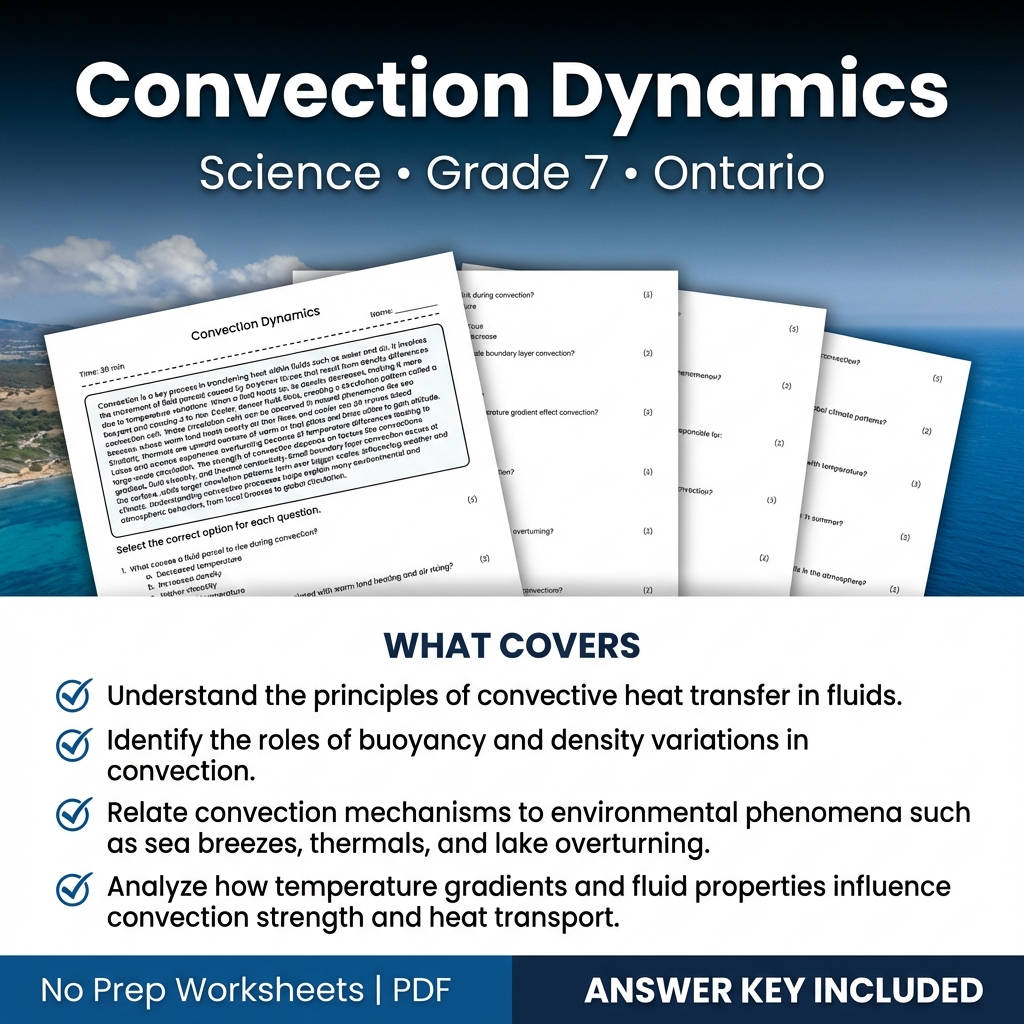
Convection Dynamics Grade 7 Science Worksheet | Ontario Standards
Created byCoral Reef LearningLearning Objectives
- Understand the principles of convective heat transfer in fluids.
- Identify the roles of buoyancy and density variations in convection.
- Relate convection mechanisms to environmental phenomena such as sea breezes, thermals, and lake overturning.
Instant download

Grade 7 Cell Structures Worksheet | NGSS Plant & Animal Cells Activity
 Created byNorthstar Worksheets
Learning Objectives
- Identify major organelles in eukaryotic cells and describe their functions in cell processes such as transport and synthesis.
- Explain how cell compartments (membranes) help maintain specialized conditions for different activities.
- Compare structural features of plant and animal cells and relate those features to their functions.
Also included in: Grade 7 Cell Structures, Interactions, and Energy Transformations Lesson Bundle | NGSS +1 more
Instant download

Grade 7 Science Worksheet | Conservation Strategies (PDF) – BC Standards
Created byEvergreen Desk EducationLearning Objectives
- Explain how habitat protection, restoration, and species management reduce human impacts on ecosystems
- Use ideas from food webs, population dynamics, and abiotic factors to predict the effects of conservation actions
- Describe how monitoring and adaptive policies help conservation strategies improve over time
Instant download

Science Motion Graphs Worksheet Grade 7 | Standards-Aligned Practice
JCreated byJ.S SheetsLearning Objectives
- Interpret position–time and velocity–time graphs to describe motion patterns
- Use graph slope to identify velocity or acceleration appropriately
- Connect data tables with graph shapes to explain constant and changing motion
Also included in: Grade 7 Energy Transfer and Change Science Lesson Bundle – General Framework +1 more
Instant download

Friction and Gravity Worksheet | Grade 7 Science Practice
Created byPrism Point LearningLearning Objectives
- Explain how friction affects the motion of objects on different surfaces using qualitative evidence.
- Describe gravity as a force that produces acceleration and changes apparent weight on slopes.
- Differentiate between contact forces (like friction and normal force) and long-range forces (like gravity).
Also included in: Grade 7 Motion, Forces & Energy Science Lesson Bundle for TEKS Practice
Instant download

Energy Transfer Overview Worksheet Grade 7 Science NGSSS Activity
Created byEvergreen Desk EducationLearning Objectives
- Explain how energy transfers from a higher-energy object or system to a lower-energy one.
- Describe how energy can change form (transform) during an energy transfer.
- Connect energy transfers to observable effects such as temperature change, motion, or light emission.
Instant download

Grade 7 Climate Interactions Worksheet | NGSS Practice PDF
Created byClear Sky ClassroomLearning Objectives
- Identify key drivers of climate change such as greenhouse gases, land-use change, and natural variability.
- Analyze temperature and CO2 records to understand climate trends.
- Assess impacts of climate change on sea levels, precipitation, and agriculture.
Also included in: Grade 7 Ecosystems & Human Impacts Science Lesson Bundle Worksheet B (NGSS) +1 more
Instant download

Grade 7 Science | Matter Basics - Daily Reading Comprehension
Created byCoral Reef LearningLearning Objectives
- Identify different types of matter: pure substances, mixtures, and solutions.
- Understand the properties of pure substances and how they differ from mixtures.
- Explain what makes a solution homogeneous and how solute particles disperse.
Also included in: Matter and Chemical Change Lesson Bundle: Grade 7 Science Alberta +1 more
Instant download

Integrated Design Worksheet | Standards-Aligned Science Practice Grade 7
JCreated byJ.S SheetsLearning Objectives
- Analyze and compare different design options using quantitative motion data and structural assessments.
- Evaluate the impact of material choices, mechanical advantage, and safety considerations in regional applications.
- Synthesize information from mechanical calculations and structural criteria to support reasoned design selections.
Instant download
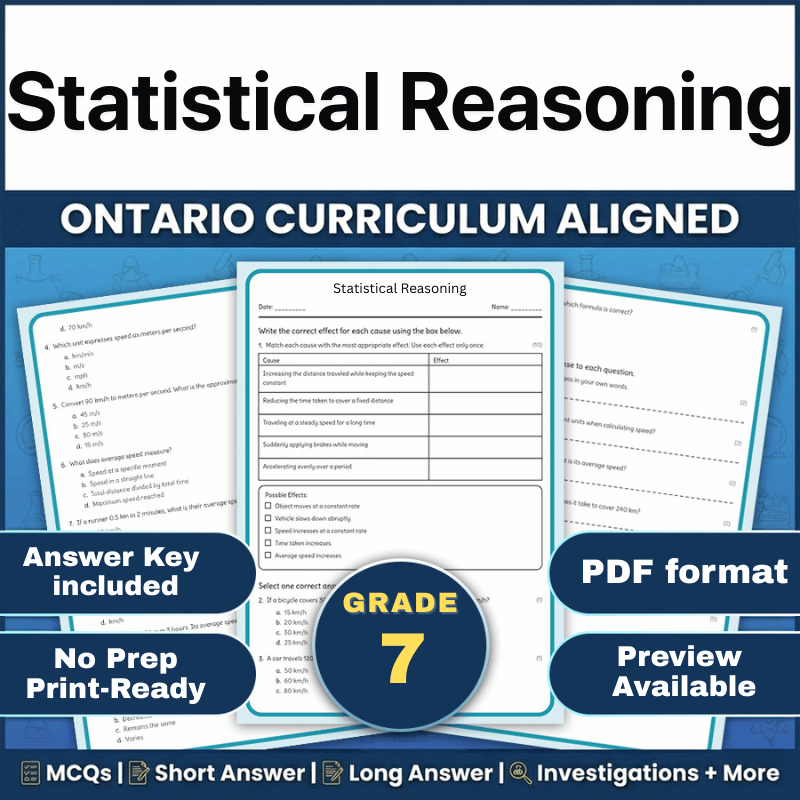
Grade 7 Science – Statistical Reasoning Worksheet (Ontario) (PDF)
Created byBright Mind ResourcesLearning Objectives
- Understand descriptive statistics such as mean, median, and mode.
- Interpret measures of dispersion including interquartile range and variance.
- Recognize the role of outliers and limitations of small samples.
Instant download

Earth Resources Assessment | TEKS Grade 7 Science Printable Worksheet
Created byPrism Point LearningLearning Objectives
- Understand the distribution and significance of natural resources in Earth systems.
- Describe the processes of groundwater flow, aquifer recharge, and soil formation.
- Differentiate between renewable and nonrenewable resources in various geologic settings.
Also included in: Grade 7 Earth and Space Systems Science Lesson Bundle TEKS Worksheets
Instant download

Grade 7 Energy Flow Worksheet | NGSS Practice PDF
Created byClear Sky ClassroomLearning Objectives
- Explain the transfer of energy through trophic levels in ecosystems.
- Identify the roles of producers, consumers, and decomposers in energy pyramids.
- Describe how photosynthesis and cellular respiration are mechanisms for energy capture and release.
Also included in: Grade 7 Ecosystems Interactions Energy Dynamics Science Lesson Bundle: NGSS +1 more
Instant download

Grade 7 Science | Model-Based Predictions Worksheet | General Standard
Created byLumora LearningLearning Objectives
- Explain how models help scientists make predictions from observations
- Differentiate physical, diagrammatic, and computational models and give an example of each
- Use a diagram of lunar phases to predict what the Moon will look like from Earth
Instant download

Grade 7 Human Impacts on the Environment Worksheet | NGSS Science Activity
 Created byBRIGHT PATH RESOURCES
Learning Objectives
- Understand the causes of deforestation and its impact on ecosystems.
- Identify human activities that contribute to environmental degradation.
- Analyze the consequences of deforestation for biodiversity and climate.
Also included in: Earth Systems Grade 7 Science Daily Reading Worksheets Lesson Bundle | NGSS +2 more
Instant download

Grade 7 Physical Properties Worksheet | BC Practice & PDF
Created byClear Sky ClassroomLearning Objectives
- Define physical properties and explain how they help identify and sort substances
- Describe density and solubility and connect each property to measurable observations
- Use evidence from measurements to separate mixtures and make material choices
Instant download

Trophic Efficiency Practice Worksheet | Grade 7 Science Review
Created byPrism Point LearningLearning Objectives
- Explain what trophic efficiency means and how energy changes between trophic levels
- Describe why energy pyramids shrink toward higher trophic levels
- Use the ideas of losses (heat, respiration, waste) to predict how many consumer levels can exist
Also included in: Ecosystems & Interactions Lesson Bundle – Grade 7 Science BC Framework +1 more
Instant download
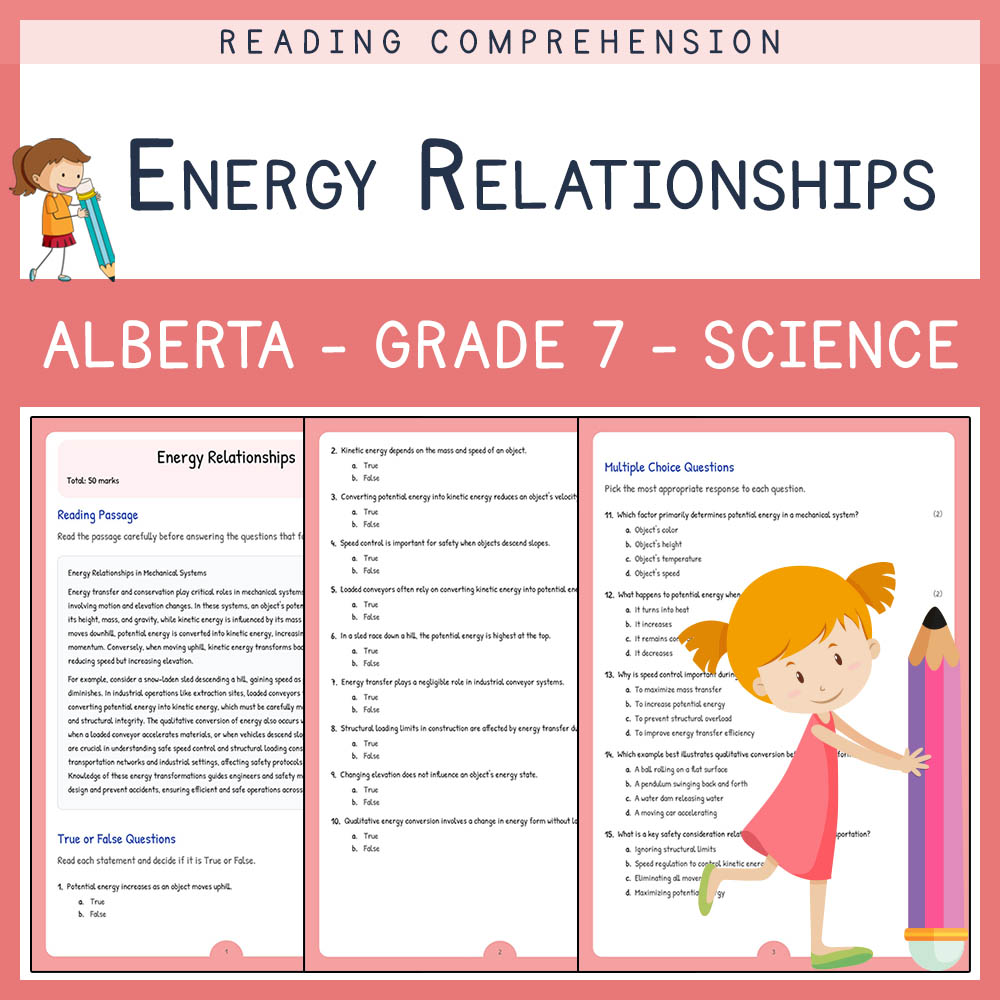
Grade 7 Science | Energy Relationships Worksheet | Alberta Standard
Created byLumora LearningLearning Objectives
- Explain the concepts of kinetic and potential energy and how they relate to forces and motion.
- Describe how elevation, mass, and speed influence mechanical energy in systems like sled descents and conveyors.
- Illustrate qualitative conversion between potential and kinetic energy in mechanical systems.
Instant download

Grade 7 Science | Wave Energy Transfer Worksheet | General Standards
Created byLumora LearningLearning Objectives
- Explain how waves transfer energy without permanently moving matter
- Distinguish transverse waves from longitudinal waves using particle motion
- Identify how amplitude and wavelength relate to energy and spacing in a wave pattern
Instant download

Meiosis Variation Worksheet | Genetics & Heredity Grade 7 Science
Created byPrism Point LearningLearning Objectives
- Explain how chromosome segregation and independent assortment during meiosis create genetic variation.
- Describe how genetic differences among siblings arise even when parents are the same.
- Connect genetic variation to possible differences in survival and reproduction over generations.
Also included in: Grade 7 Evolution, Genetics & Ecosystems Lesson Bundle | Florida NGSSS
Instant download

Grade 7 Science | Plate Mechanisms Worksheet | BC Aligned
Created byLumora LearningLearning Objectives
- Understand the various force systems driving Earth's plate motion, including mantle convection, slab pull, and ridge push.
- Explain how mantle convection creates convection cells that transfer momentum to the lithosphere.
- Identify the roles of slab pull and ridge push in tectonic plate movements.
Instant download

Grade 7 Insulation Principles Worksheet | Ontario Science PDF & Key
Created byClear Sky ClassroomLearning Objectives
- Explain how insulation reduces heat transfer by addressing conduction, convection, and radiation
- Compare insulating materials (fibreglass, foam, and reflective foils) in terms of how they slow heat flow
- Describe how air leakage, thermal bridging, and continuous insulation affect overall heat loss
Instant download

Science Worksheet Matter Properties Grade 7 | Standards-Aligned Practice
JCreated byJ.S SheetsLearning Objectives
- Describe how physical properties of matter (including state, color, texture, and density) can be observed or measured.
- Explain how chemical properties describe how substances behave during chemical reactions.
- Use properties to classify substances and justify grouping with evidence from observations or data.
Also included in: Grade 7 Matter, Energy & Forces Science Lesson Bundle – Florida NGSSS +1 more
Instant download
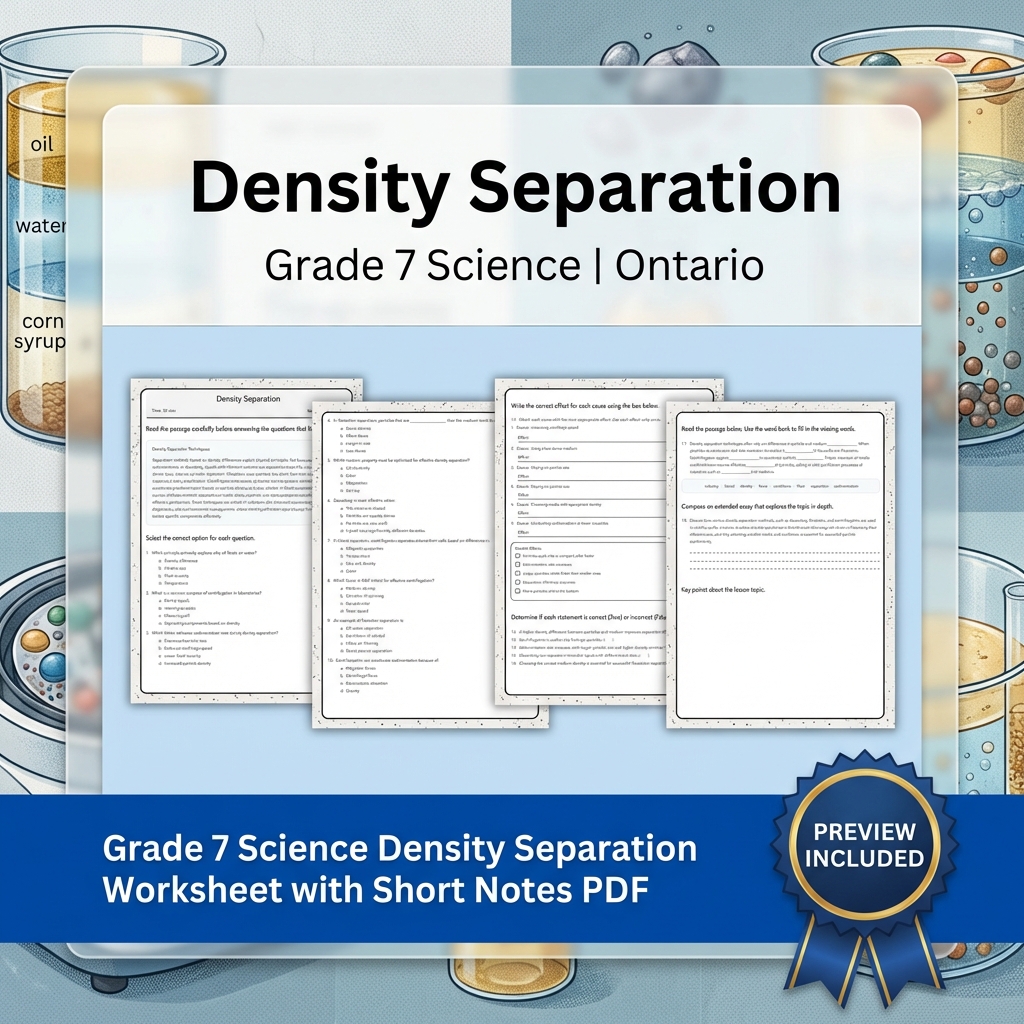
Grade 7 Science Density Separation Worksheet with Short Notes PDF
 Created byMeadowlark Worksheets
Learning Objectives
- Understand the principles of density-driven separation techniques such as decanting, floatation, and centrifugation.
- Identify examples of density separation in real-world applications like oil-water separation and blood fractionation.
- Explain how buoyant force, sedimentation rate, and centrifugal acceleration influence particle separation based on density and size.
Also included in: Grade 7 Science Lesson Group Bundle – Ontario Curriculum Worksheets +1 more
Instant download

Grade 7 Science | Thermal Expansion Worksheet | California Standards
Created byLumora LearningLearning Objectives
- Explain how heating and cooling affect the spacing and motion of particles in solids, liquids, and gases.
- Describe how thermal expansion leads to changes in length, volume, and pressure in real-world situations.
- Use the particle model to predict contraction and expansion when temperature changes.
Instant download

Grade 7 Science | Weather & Climate - Daily Reading Comprehension
Created byCoral Reef LearningLearning Objectives
- Understand the difference between weather and climate.
- Identify key weather variables such as temperature, precipitation, humidity, and wind.
- Describe how climate involves long-term patterns and averages of weather variables.
Instant download
About Grade 7 Science Worksheets
Browse 6,039 printable Grade 7 Science worksheets — ready-to-print PDFs with answer keys where available.
Every worksheet on MyTeachingSheets is created by independent teacher-authors and reviewed before publication. All resources download as printable PDFs for classroom, homework, or at-home practice, and many include answer keys. Preview any worksheet free before buying.