
Grade 7 Science Worksheets
6,039 worksheets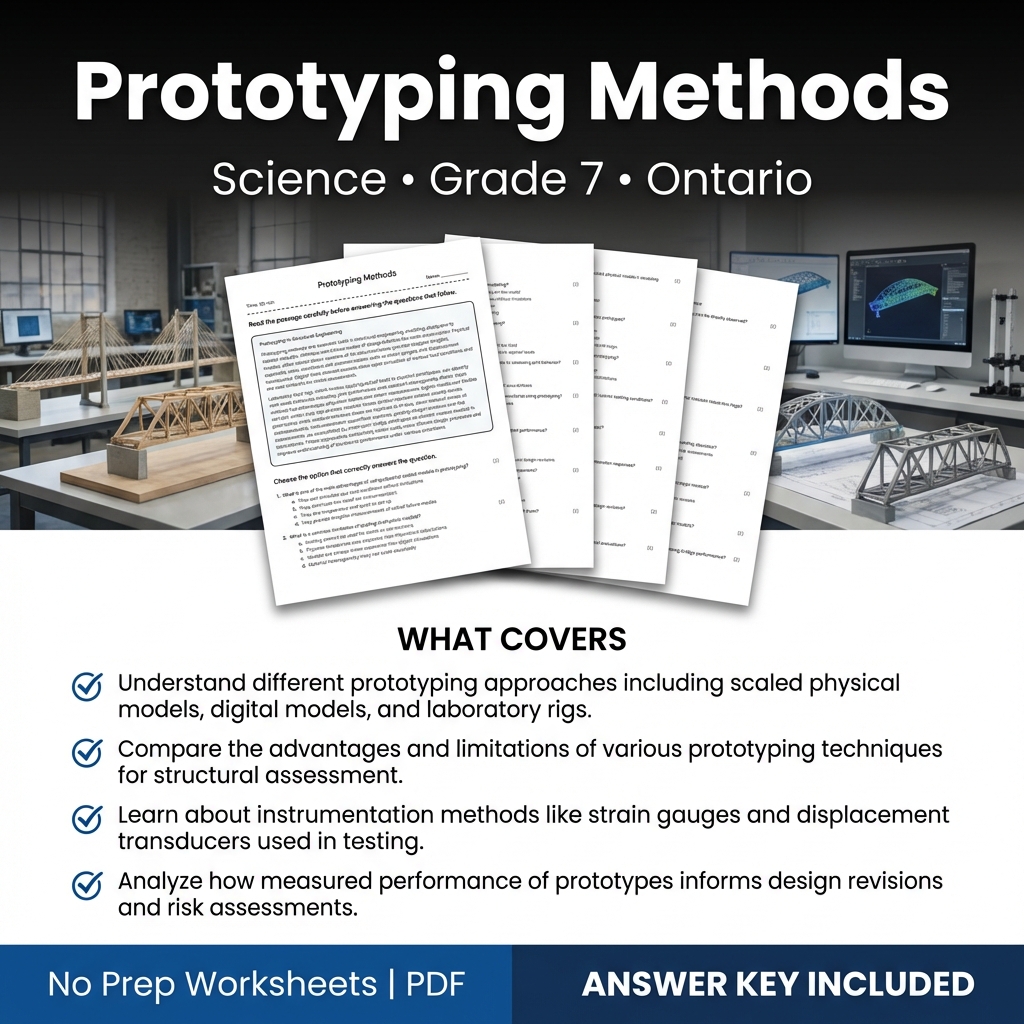
Prototyping Methods Science Worksheet Grade 7 | Ontario Standards
 Created byCoral Reef Learning
Learning Objectives
- Understand different prototyping approaches including scaled physical models, digital models, and laboratory rigs.
- Compare the advantages and limitations of various prototyping techniques for structural assessment.
- Learn about instrumentation methods like strain gauges and displacement transducers used in testing.
Instant download

Mixture Types Worksheet | Ontario Grade 7 Science Assessment
 Created byCedar Grove Learning
Learning Objectives
- Classify mixtures as solutions, colloids, or suspensions based on particle size and observable behavior
- Distinguish homogeneous from heterogeneous mixtures using uniformity and visible phases
- Use evidence such as light scattering and stability to predict how mixtures behave during separation
Also included in: Grade 7 Matter: Mixtures and Separation Science Lesson Bundle | Ontario +1 more
Instant download

Grade 7 Science – Choosing the Best Solution in Engineering Reading Worksheet
 Created byBright Mind Resources
Learning Objectives
- Understand how to compare different solutions based on specific criteria.
- Learn to justify design choices through observed outcomes and trade-offs.
- Recognize the importance of iterative refinement in engineering design.
Also included in: Grade 7 Engineering Tradeoff Mapping Science Lesson Bundle California Standards +1 more
Instant download

Biodiversity Indices Worksheet | Species Richness & Evenness Grade 7
 Created byChalk and Compass
Learning Objectives
- Explain what species richness and evenness mean and how they contribute to biodiversity
- Interpret common biodiversity index values when comparing habitats
- Describe how habitat heterogeneity and niche diversity can affect species turnover
Also included in: Grade 7 Science Ecosystems & Sustainability Lesson Bundle | Ontario +1 more
Instant download

Choosing Best Solution Worksheet Grade 7 Science Decision-Making Activity
 Created byPrism Point Learning
Learning Objectives
- Compare design alternatives using clear criteria and constraints.
- Justify a final design choice by linking each criterion to expected outcomes.
- Explain how tradeoffs and iterative refinement help keep constraints satisfied.
Instant download

Grade 7 Science – Technical Communication & Reading Practices | Worksheet
Created byBright Mind ResourcesLearning Objectives
- Understand the purpose and importance of schematic symbols and diagrams.
- Identify standardized units and labels used in technical drawings.
- Interpret various types of technical documents like circuit diagrams, blueprints, and datasheets.
Also included in: Grade 7 Technology & Engineering Science Lesson Bundle: Daily Reading | TEKS +2 more
Instant download

Surface Changes Over Time Worksheet Grade 7 Science | NGSSS Aligned
JCreated byJ.S SheetsLearning Objectives
- Explain how heavy rainfall, runoff, and flooding can rapidly change Earth’s surface by eroding banks and depositing sediment
- Describe how storms, including coastal storms, reshape dunes and beaches
- Compare gradual processes (weathering, erosion, deposition) with sudden processes (earthquakes and volcanic activity)
Also included in: Grade 7 Weather, Climate, and Earth Processes Science Lesson Bundle +1 more
Instant download

Grade 7 Science | Energy and Change Worksheet | BC Standards
 Created byLumora Learning
Learning Objectives
- Understand the different types of energy changes in chemical reactions.
- Distinguish between exothermic and endothermic reactions based on energy transfer.
- Explain how bond breaking and formation relate to energy absorption and release.
Also included in: Grade 7 Science | Matter & Chemical Change Unit Bundle | BC Aligned
Instant download

Science Worksheet Conservation of Energy Grade 7 | Standards-Aligned Practice
JCreated byJ.S SheetsLearning Objectives
- Explain conservation of energy using the idea that energy is transferred and changes form but is not lost
- Identify evidence of energy transfer using temperature changes and changes in motion
- Use energy models to describe how friction can convert mechanical energy into thermal energy
Also included in: Grade 7 Energy Transfer and Change Science Lesson Bundle – General Framework +1 more
Instant download

Levers and Pulleys Worksheet | Grade 7 Science Practice
Created byPrism Point LearningLearning Objectives
- Explain how a lever changes force and direction of a push or pull using fulcrum placement and lever arms.
- Describe how pulley systems can increase mechanical advantage and change the direction of force.
- Calculate and compare input (effort) and output (load) forces using simple mechanical advantage relationships.
Instant download

Grade 7 Science | Evolutionary Change Worksheet | Florida NGSSS Aligned
Created byLumora LearningLearning Objectives
- Explain how evolutionary change involves shifts in heritable traits across generations rather than individual lifetime changes
- Use the ideas of variation, heredity, and differential survival/reproduction to describe population-level evolution
- Distinguish between adaptation within a lifetime and evolutionary change over long time scales
Instant download

Grade 7 Science Graphing Motion Worksheet – Alberta Standards (PDF)
 Created byEvergreen Desk Education
Learning Objectives
- Translate distance–time and speed–time data into motion graphs and interpret what the graph shows.
- Explain how slope relates to rate of change in motion graphs and how to find average speed from distance–time graphs.
- Use graphs to estimate instantaneous speed and to compare two motions using quantitative evidence.
Instant download

Grade 7 Science | Understanding Inherited Traits - Daily Reading Comprehension
Created byCoral Reef LearningLearning Objectives
- Define inherited traits and distinguish them from learned behaviors.
- Identify examples of traits passed from parents to offspring.
- Understand the genetic basis of traits such as fur color, seed shape, and blood type.
Instant download

Grade 7 Science | Convection Systems Worksheet (Alberta Standards PDF)
 Created bySilver Birch Teaching
Learning Objectives
- Explain how temperature changes create density differences that drive convection in fluids
- Differentiate natural convection from forced convection using real-world examples
- Identify key features of convection systems such as buoyancy and boundary layers
Also included in: Grade 7 Thermal Systems Models and Heat Transfer Science Lesson Bundle – Alberta +1 more
Instant download

Grade 7 Cell Evidence Worksheet | NGSS Cell Theory & Microscopy Activity
 Created byNorthstar Worksheets
Learning Objectives
- Explain how microscopy provides evidence that organisms are made of discrete cells.
- Differentiate unicellular and multicellular organization using examples such as protists and onion epidermis.
- Identify major cell boundaries (plasma membrane and cell wall) and describe how they appear in images.
Also included in: Grade 7 Cell Structures, Interactions, and Energy Transformations Lesson Bundle | NGSS +1 more
Instant download

Evidence Arguments Assessment for Grade 7 Science | Standards-Aligned
Created byPrism Point LearningLearning Objectives
- Understand how to connect evidence to reasoning in scientific arguments.
- Identify specific data values, graph features, or direct observations that support claims.
- Evaluate the strength of scientific arguments, including addressing limitations and avoiding unsupported cause-and-effect claims.
Also included in: Grade 7 Scientific Inquiry Practices Science Lesson Bundle: General
Instant download

Friction and Drag Grade 7 Science Worksheet | Standards-Aligned Practice
JCreated byJ.S SheetsLearning Objectives
- Understand the concepts of static and kinetic friction and their effects on motion.
- Identify examples of friction and aerodynamic drag in real-world scenarios.
- Describe how surface texture and normal force influence the coefficient of friction.
Instant download

Grade 7 Assessment | Abiotic Influences Worksheet | BC Aligned
Created byLumora LearningLearning Objectives
- Describe how abiotic factors such as temperature, moisture, light, soil nutrients, and pH influence species distributions.
- Explain how seasonal and daily fluctuations affect populations and ecosystems.
- Identify the impact of extreme environmental events on species survival and resilience.
Instant download
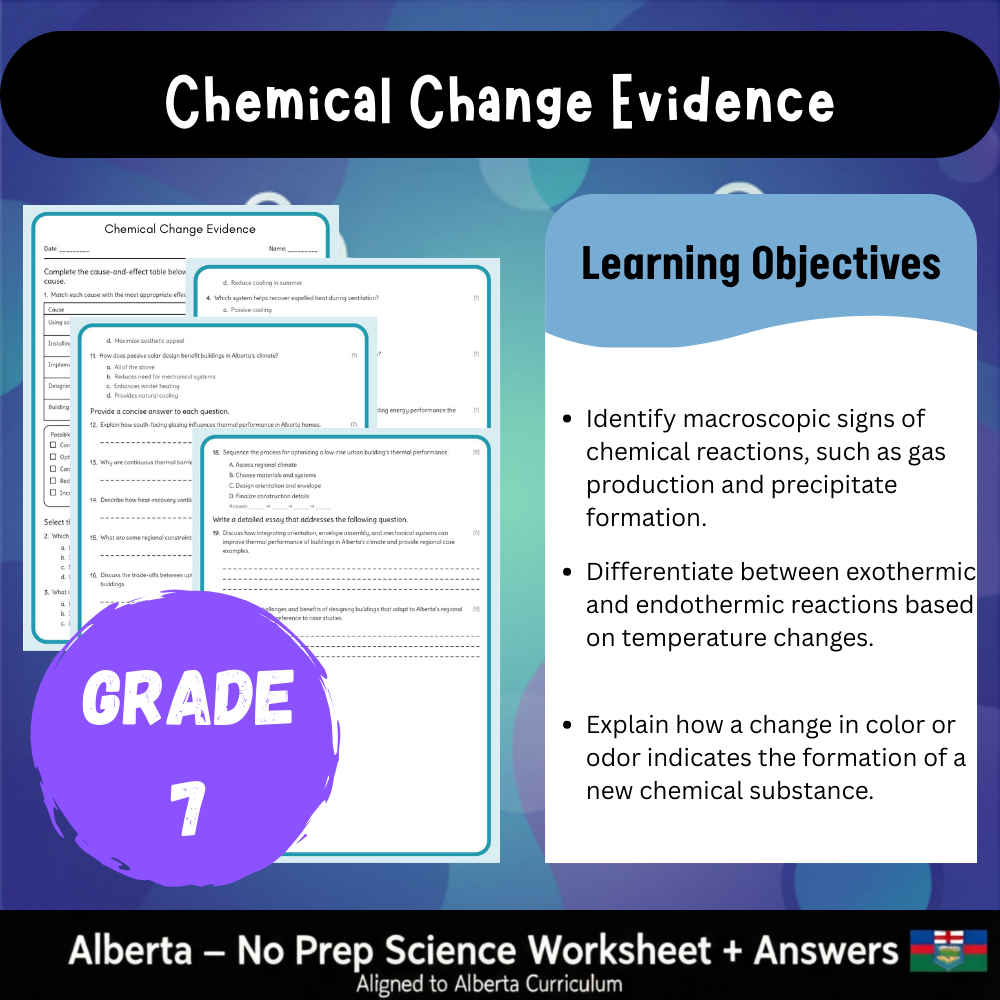
Grade 7 Science – Evidence of Chemical Change Worksheet (PDF) – Alberta Standard
Created byBright Mind ResourcesLearning Objectives
- Identify observable signs of chemical changes such as colour change, gas evolution, precipitate formation, temperature change, or odour alteration.
- Differentiate between physical and chemical changes at the particle level, focusing on bond reorganization and energy transfer.
- Understand real-world examples of chemical changes, including oxidation and combustion, and interpret their processes at the particle level.
Instant download

Grade 7 Science Worksheet | Pure Substances & Properties (PDF)
Created byEvergreen Desk EducationLearning Objectives
- Explain what makes a pure substance different from a mixture in terms of uniform composition and characteristic properties.
- Differentiate elements and compounds and identify examples using chemical and physical evidence.
- Use fixed melting/boiling points and other properties to distinguish pure substances from substances with impurities.
Instant download

Biodiversity Stability Assessment | Florida NGSSS Grade 7 Science
Created byPrism Point LearningLearning Objectives
- Explain how biodiversity supports ecosystem stability through overlapping ecological functions.
- Describe how disturbances such as habitat loss and invasive species can reduce biodiversity and weaken ecosystem processes.
- Use evidence from a passage to answer questions about nutrient cycling and ecosystem resilience.
Instant download

Grade 7 Organ Interactions Worksheet | NGSS Practice PDF
 Created byClear Sky Classroom
Learning Objectives
- Describe the functions and interactions of circulatory, respiratory, digestive, and nervous systems in multicellular animals.
- Explain system-level dependencies such as oxygen transport and nutrient absorption.
- Compare human mammalian organ systems with plant vascular transport interactions.
Also included in: Grade 7 Cell Systems Science Lesson Bundle: NGSS Worksheet B +1 more
Instant download

DNA and Chromosomes How Traits Are Inherited Worksheet | NGSS Grade 7 Science
 Created bySkylark Worksheets
Learning Objectives
- Explain how DNA sequences are organized into genes and how genes influence observable traits.
- Describe how chromosomes package many genes and how gametes receive chromosomes during meiosis.
- Use models of chromosome segregation and fertilization to predict how offspring inherit genetic material from both parents.
Also included in: Grade 7 Genetics: Traits Inheritance Science Lesson Bundle for NGSS +1 more
Instant download

Grade 7 Science | Sound Perception Worksheet (Worksheet + Answer Key)
Created byEvergreen Desk EducationLearning Objectives
- Explain how sound wave behavior (amplitude, frequency, and spreading with distance) affects what we hear as loudness and pitch.
- Describe how reflection, echo formation, and absorption depend on the surfaces and materials sound waves encounter.
- Connect physical sound wave properties to the brain’s interpretation of sound perception.
Also included in: Grade 7 Energy Transfer & Motion Science Lesson Bundle Worksheets (General) +1 more
Instant download

Cited Scientific Reasoning Worksheets: Data-Based Arguments Grade 7
 Created byBRIGHT PATH RESOURCES
Learning Objectives
- Identify a claim and the specific data or observation used as evidence.
- Explain how evidence supports a claim using correct relationships and units.
- Compare alternative explanations and choose which is supported more strongly by the evidence.
Also included in: Grade 7 Science Worksheets Bundle | Models, Variables & Evidence +2 more
Instant download

Grade 7 Science – Fair Testing & Measurements | Daily Reading Worksheet
Created byBright Mind ResourcesLearning Objectives
- Understand the concept of fair tests in scientific experiments.
- Identify variables that influence experimental fairness.
- Learn to use appropriate measurement tools and units.
Also included in: Design & Tech Grade 7 Science Daily Reading Worksheets Lesson Bundle | General +1 more
Instant download

Biotic Abiotic Worksheet | Grade 7 Science Activities
Created byPrism Point LearningLearning Objectives
- Distinguish biotic factors from abiotic factors in an ecosystem.
- Explain cause-and-effect relationships between abiotic conditions and resource access, shelter, and survival for organisms.
- Describe how gradients in abiotic factors can shape patterns in plant, animal, and microbe communities.
Also included in: Grade 7 Ecosystems & Biodiversity Science Lesson Bundle | Alberta
Instant download
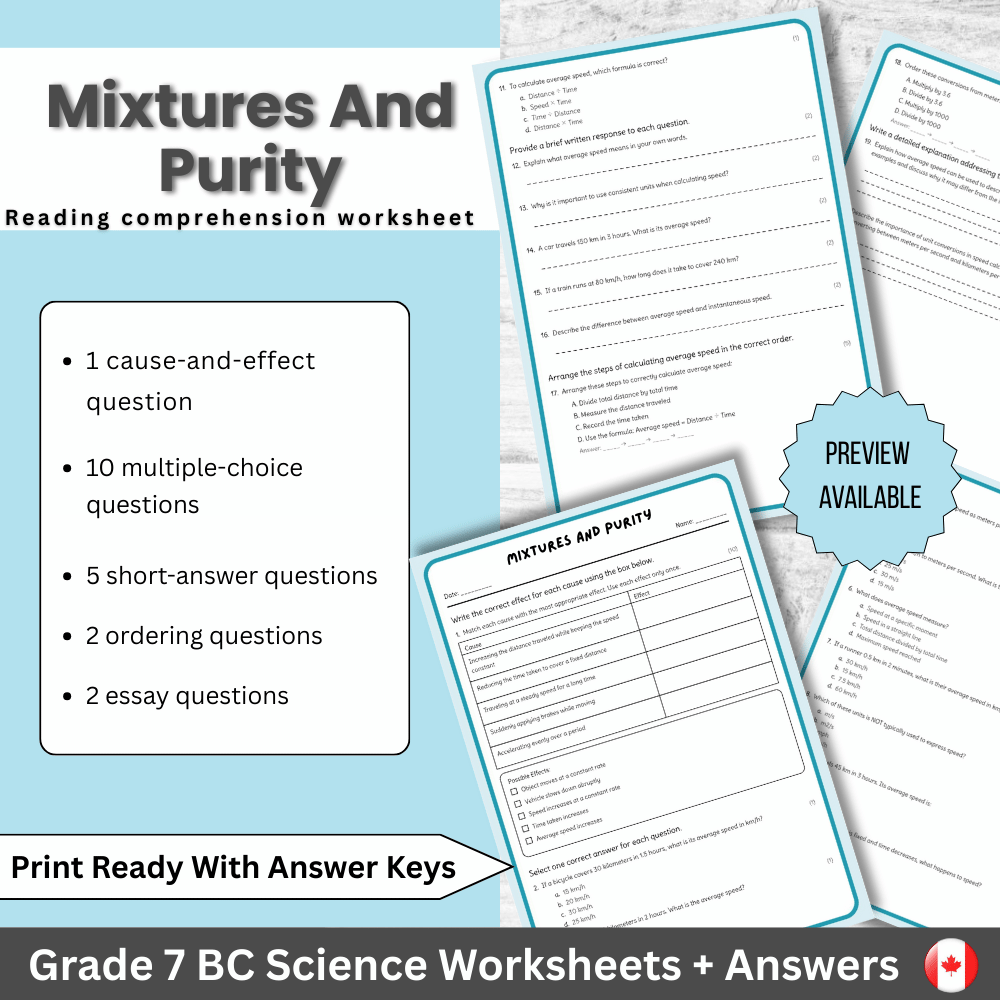
Grade 7 Science | Mixtures and Purity Worksheet (PDF) for BC Standard
Created byBright Mind ResourcesLearning Objectives
- Describe the difference between mixtures and pure substances.
- Identify characteristics of heterogeneous and homogeneous mixtures.
- Understand separation methods based on physical properties.
Instant download

Science: Rock Cycles Grade 7 Worksheet | NGSS-Aligned Science Assessment
Created bySkylark WorksheetsLearning Objectives
- Explain how energy drives changes between igneous, sedimentary, and metamorphic rocks in the rock cycle
- Describe key processes in the rock cycle, including melting, crystallization, weathering, deposition, burial, and metamorphism
- Trace how Earth materials move through the cycle using a pathway from magma to rocks and back again
Also included in: Grade 7 Earth Systems Science Worksheet Lesson Bundle for NGSS Assessment +1 more
Instant download

Grade 7 Science | Global Circulation - Daily Reading Comprehension
Created byCoral Reef LearningLearning Objectives
- Understand the basic atmospheric and oceanic cells involved in global circulation
- Identify the locations and characteristics of Hadley, Ferrel, and Polar cells
- Describe the role of jet streams and ocean gyres in climate regulation
Instant download

Technology Impacts and Ethics Assessment for Grade 7 Science | Standards-Aligned
Created byPrism Point LearningLearning Objectives
- Understand how technology affects society and the environment through benefits and costs.
- Identify ethical considerations related to technology, including fairness, privacy, and responsibility.
- Analyze trade-offs involved in technological development and use.
Also included in: Grade 7 Science Assessment Practices Lesson Bundle | General Framework
Instant download

Natural Selection Test Prep Printable | Grade 7 Science Assessment
Created byPrism Point LearningLearning Objectives
- Explain how heritable variation and environmental pressures lead to natural selection.
- Describe how differential survival and reproduction change trait frequencies over generations.
- Use examples (such as antibiotic resistance or island finches) to connect adaptation to selective pressures.
Also included in: Grade 7 Evolution, Natural Selection Science Lesson Bundle for NGSS
Instant download

Synthetic Materials Worksheet | NGSS Grade 7 Science Practice PDF
JCreated byJ.S SheetsLearning Objectives
- Describe production pathways from natural resources to common synthetic materials, including feedstocks, polymerization, and refining steps.
- Identify examples of synthetic materials such as polyethylene, PET, and nylon, and understand their manufacturing processes.
- Analyze trade-offs related to durability, recyclability, and environmental impacts of different synthetic materials.
Also included in: Grade 7 Structure and Properties of Matter Science Lesson Bundle: NGSS +1 more
Instant download

Thermal Insulation Worksheets: Heat Transfer Reduction Grade 7 Science
Created byPrism Point LearningLearning Objectives
- Explain how insulation reduces conduction, convection, and radiation
- Compare insulating materials using thermal resistance and thickness
- Identify thermal bridges and explain their effect on heat loss
Also included in: Thermal Energy & Heat Transfer Lesson Bundle | Grade 7 Science | Ontario +1 more
Instant download

Science Grade 7 Density and Volume Worksheet | NGSSS Aligned Practice
JCreated byJ.S SheetsLearning Objectives
- Explain how density relates mass to volume using the idea of density = mass ÷ volume
- Classify density as an intensive property and justify why it does not depend on the amount of material
- Use density ideas to predict sinking and floating and to distinguish materials with similar shapes
Also included in: Grade 7 Matter, Energy & Forces Science Lesson Bundle – Florida NGSSS +1 more
Instant download

Grade 7 Science | Nucleus Function - Daily Reading Comprehension
Created byCoral Reef LearningLearning Objectives
- Understand the structure and role of the nucleus in a cell.
- Identify key features such as nuclear envelope, nuclear pores, and chromosomes.
- Explain how the nucleus controls growth, development, and protein synthesis.
Instant download

Population Limits Test Prep Printable | Grade 7 Science NGSS
Created byPrism Point LearningLearning Objectives
- Explain how resource availability sets limits on population size using carrying capacity.
- Interpret logistic growth ideas by connecting population growth rate to birth, death, immigration, and emigration.
- Use graphs and quantitative reasoning to predict how limiting factors change population trajectories.
Also included in: Grade 7 Biodiversity & Ecosystem Stability Science Lesson Bundle | NGSS
Instant download

Energy Transformations and Conservation Worksheet | Grade 7 Alberta Science
Created byBRIGHT PATH RESOURCESLearning Objectives
- Describe common forms of energy and how they change in everyday systems
- Explain energy transformations while conserving total energy
- Identify where energy appears as mechanical, electrical, chemical, and thermal energy in a real-world example
Also included in: Grade 7 Alberta Science Energy Heat and Thermal Processes Worksheet Bundle +1 more
Instant download

Ethics And Communication Grade 7 Science Worksheet | Ontario Standards
Created byCedar Grove LearningLearning Objectives
- Explain how data integrity, attribution, and intellectual property shape ethical communication in STEM
- Use conventions for technical reporting, including clear methods descriptions and accurate graphical annotation
- Describe how peer review and responsible data sharing improve reliability and public understanding of scientific findings
Also included in: Grade 7 Scientific Inquiry and Data Analysis Science Lesson Bundle - Ontario +1 more
Instant download

Technology Impacts Assessment | TEKS Grade 7 Science Standards
Created byPrism Point LearningLearning Objectives
- Analyze societal, economic, and environmental impacts of various technologies.
- Evaluate short-term and long-term consequences of technological development.
- Assess ethical considerations and policy responses related to technology.
Instant download

Grade 7 Matter Cycling in Living Things Worksheet | NGSS Life Science
Created byBRIGHT PATH RESOURCESLearning Objectives
- Understand how carbon atoms move through organisms and the environment
- Describe the processes of digestion, biosynthesis, and respiration that involve matter transformation
- Explain how matter is conserved and recycled within ecosystems
Also included in: Living Systems Grade 7 Science Daily Reading Worksheets Lesson Bundle | NGSS +2 more
Instant download
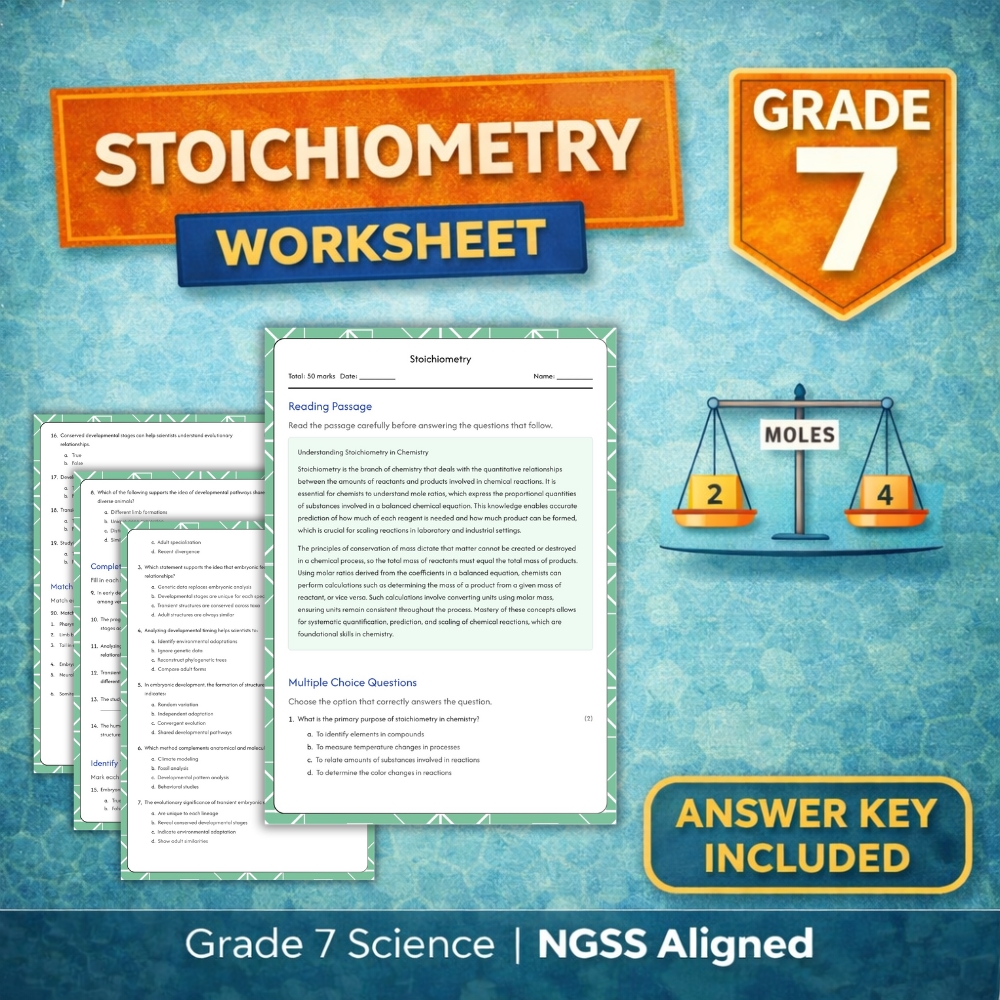
Grade 7 Science | Stoichiometry Practice Worksheet (NGSS Aligned, PDF)
Created byCedar Grove LearningLearning Objectives
- Describe quantitative relationships in chemical transformations using balanced symbolic equations and ratio reasoning.
- Perform mole-ratio calculations to determine relative mass relations among reactants and products.
- Apply conservation principles in proportional calculations to predict reagent needs and product yields.
Instant download

Saturation Concepts Worksheet for Grade 7 Science | Alberta Standards
JCreated byJ.S SheetsLearning Objectives
- Explain the concept of saturation and supersaturation in solutions.
- Identify real-world examples of saturation and supersaturation.
- Describe the conditions that lead to crystallization and phase change.
Instant download
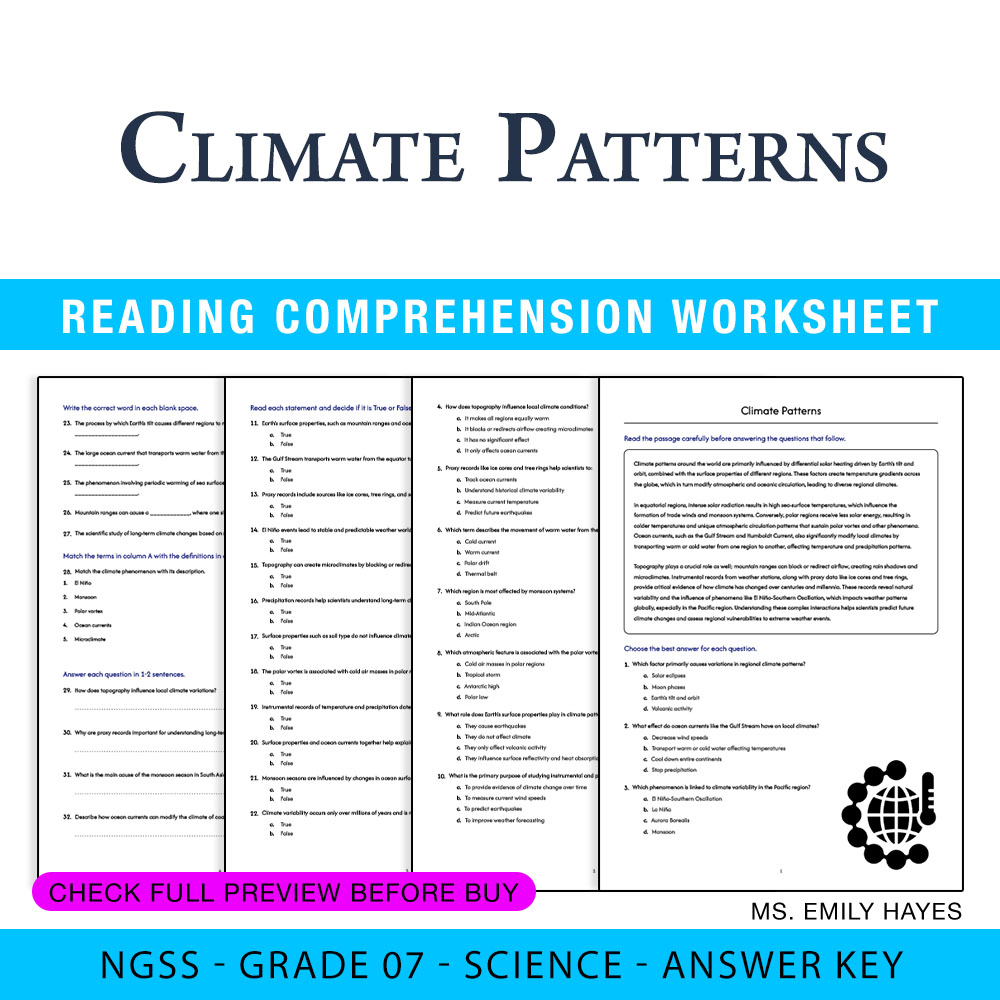
7th Grade Science | Climate Patterns Worksheet (PDF+ Answer Key)
 Created byCopper Leaf Classroom
Learning Objectives
- Describe how variations in solar heating influence regional climate patterns.
- Explain the role of ocean currents and topography in modifying local climates.
- Identify key phenomena such as El Niño, monsoon regimes, and prevailing wind belts.
Instant download
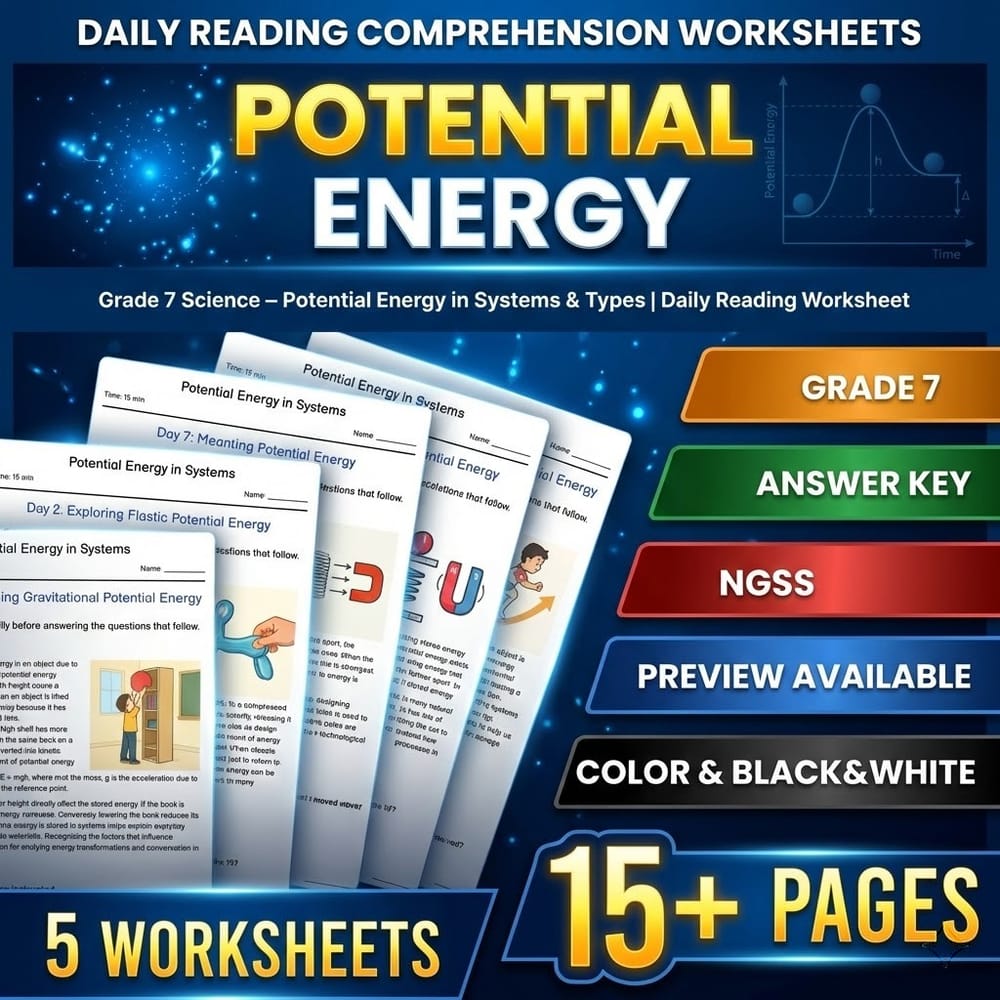
Grade 7 Science – Potential Energy in Systems & Types | Daily Reading Worksheet
 Created byElena Brooks
Learning Objectives
- Understand the concept of gravitational potential energy
- Identify factors that affect potential energy such as height and mass
- Recognize different models representing potential energy in physical systems
Also included in: Energy Grade 7 Science Daily Reading Worksheets Bundle | NGSS +1 more
Instant download

Grade 7 Science – Optimization Metrics & Engineering | Daily Reading Worksheet
Created byBright Mind ResourcesLearning Objectives
- Understand the concept of optimization in engineering contexts
- Identify various criteria used for optimization tasks
- Analyze how different optimization goals influence design decisions
Also included in: Grade 7 Engineering Tradeoff Mapping Science Lesson Bundle California Standards +1 more
Instant download

Grade 7 Synthetic Materials Worksheet | NGSS Practice PDF
Created byClear Sky ClassroomLearning Objectives
- Describe the production pathways from natural resources to common synthetic materials.
- Explain the processes of polymerization, refining, and chemical alteration in manufacturing.
- Identify examples of synthetic materials like polyethylene, PET, and nylon and their production steps.
Also included in: Grade 7 Matter and Its Interactions Science Lesson Bundle NGSS Worksheets +1 more
Instant download

Grade 7 Conservation Mass Worksheet | BC Practice & PDF
Created byClear Sky ClassroomLearning Objectives
- Explain the law of conservation of mass using particle-level reasoning (atoms rearrange but are not created or destroyed).
- Use the idea of a closed system to predict whether total mass will stay the same before and after a chemical reaction.
- Identify reactants and products at the particle level and describe what happens to bonds during a reaction.
Instant download
About Grade 7 Science Worksheets
Browse 6,039 printable Grade 7 Science worksheets — ready-to-print PDFs with answer keys where available.
Every worksheet on MyTeachingSheets is created by independent teacher-authors and reviewed before publication. All resources download as printable PDFs for classroom, homework, or at-home practice, and many include answer keys. Preview any worksheet free before buying.