
Grade 7 Science Worksheets
6,039 worksheets
Speed Calculations Assessment for Grade 7 Science | TEKS Standards
 Created byPrism Point Learning
Learning Objectives
- Understand how to calculate average speed using distance and time data.
- Distinguish between average speed and instantaneous speed through examples.
- Convert speed units between meters per second and kilometers per hour.
Also included in: Grade 7 Motion and Energy Science: Lesson Bundle TEKS Unit Assessment
Instant download

Fitness and Survival Assessment | NGSSS Standards Grade 7 Science
Created byPrism Point LearningLearning Objectives
- Explain how fitness relates to survival and reproduction in a specific environment
- Describe how natural selection can favor different traits when selection pressures change
- Connect heritable variation to how populations can change over time
Instant download
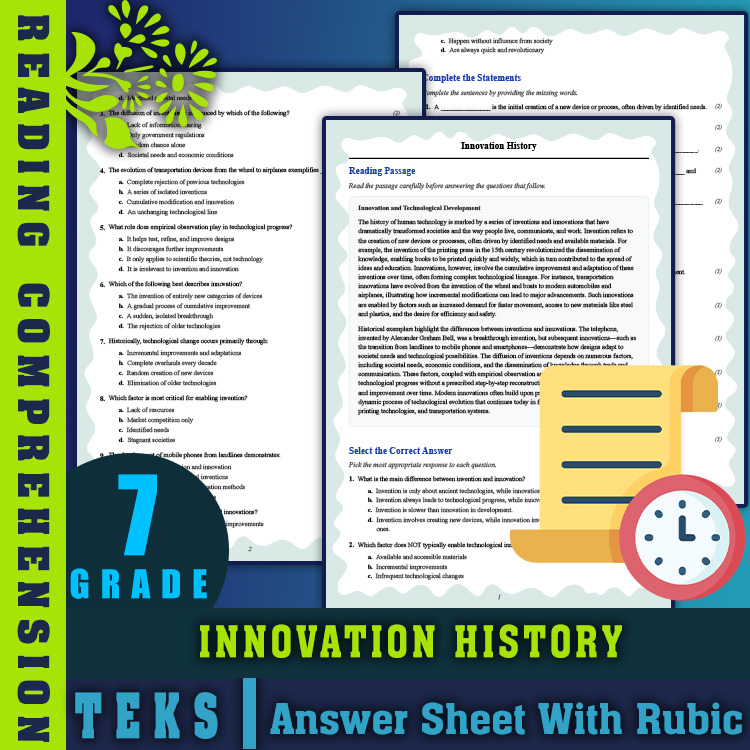
Grade 7 Science Reading Worksheets | Innovation History TEKS Practice (PDF)
JCreated byJ.S SheetsLearning Objectives
- Understand the process of technological innovation and its historical development.
- Identify factors that facilitate invention and innovation across different technological lineages.
- Analyze the causes and diffusion of inventions and innovations over time.
Instant download

Population Impacts Test Prep Worksheet | Grade 7 Science NGSS Review
Created byPrism Point LearningLearning Objectives
- Explain how population growth and increased per-capita consumption change demand for water, energy, land, and raw materials
- Describe how these demands can affect ecosystems, biodiversity, and freshwater availability
- Use quantitative relationships (population, urbanization, waste, and resource use) to predict environmental impacts
Also included in: Grade 7 Human Impacts & Climate Earth Science Lesson Bundle | NGSS
Instant download

Disturbance Effects Ecosystems Worksheet | NGSS Grade 7 Science
 Created byAmber Owl Education
Learning Objectives
- Explain how abiotic and biotic disturbances can change population sizes and community composition
- Compare resistance, resilience, and succession as mechanisms that shape ecosystem recovery
- Interpret longitudinal observations to connect population trends to specific disturbance causes
Also included in: Grade 7 Science Ecosystems and Food Webs Lesson Bundle | NGSS +1 more
Instant download

Grade 7 Substance Basics Worksheet | Elements, Compounds & Mixtures
 Created byChalk and Compass
Learning Objectives
- Classify substances as elements, compounds, or mixtures based on composition and uniformity
- Distinguish pure substances from mixtures using fixed composition and consistent properties versus variable composition and properties
- Explain how identifying a material helps with everyday selection and safe use
Also included in: Separation of Mixtures & Matter Properties Lesson Bundle – Grade 7 Science +1 more
Instant download

Science Worksheet Air Masses and Fronts Grade 7 | Standards-Aligned Practice
JCreated byJ.S SheetsLearning Objectives
- Explain what an air mass is and how its temperature and moisture affect weather
- Describe how fronts form when different air masses meet
- Compare cold fronts and warm fronts in terms of lifting, clouds, and precipitation
Also included in: Grade 7 Weather, Climate, and Earth Processes Science Lesson Bundle +1 more
Instant download

Density Separation Worksheet Grade 7 Science | Ontario Curriculum
Created byChalk and CompassLearning Objectives
- Explain how density differences allow mixtures to be separated using decanting, flotation, and centrifugation.
- Describe how buoyant force, sedimentation rate, and centrifugal acceleration relate to particle size and density contrast.
- Choose an appropriate density-separation method by comparing what each method uses (gravity, buoyancy, or acceleration).
Also included in: Separation of Mixtures & Matter Properties Lesson Bundle – Grade 7 Science +1 more
Instant download

Mixtures Separation Worksheet | Standards-Aligned Science Practice for Grade 7
JCreated byJ.S SheetsLearning Objectives
- Distinguish between homogeneous and heterogeneous mixtures using observable evidence
- Select appropriate separation methods (filtration, distillation, chromatography, magnetic separation) based on property differences
- Explain how solubility, particle size, and boiling point differences lead to observable separated fractions
Instant download

Trophic Efficiency Worksheet for Grade 7 Science | Standards-Aligned Practice
JCreated byJ.S SheetsLearning Objectives
- Understand the concept of trophic efficiency and its significance in ecosystems.
- Explain how energy is transferred between trophic levels and why energy diminishes at higher levels.
- Interpret energy pyramids and relate them to biomass and energy flow in ecological communities.
Instant download
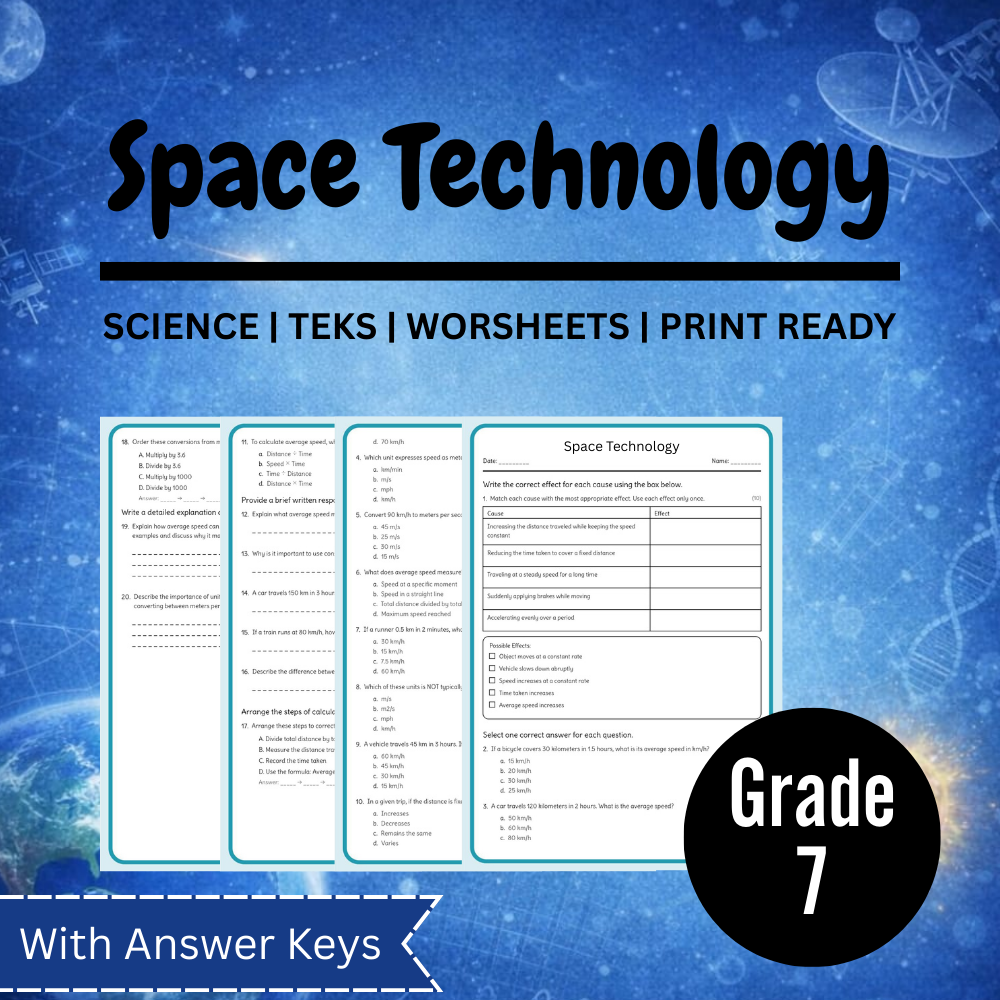
Grade 7 Science | Space Technology Worksheet (Worksheet + Answer Key) - TEKS Aligned
 Created byBright Mind Resources
Learning Objectives
- Understand key technologies used in space exploration such as telescopes, satellites, and spacecraft propulsion.
- Identify historical missions and their contributions to space science.
- Explain how robotic missions and space stations gather data about extraterrestrial environments.
Also included in: Grade 7 Science Unit Bundle | Earth's Processes, Space & Resources TEKS Aligned +2 more
Instant download

Grade 7 Science | Understanding Friction - Daily Reading Comprehension
 Created byCoral Reef Learning
Learning Objectives
- Define static and kinetic friction and identify examples of each.
- Explain how surface texture and normal force affect friction.
- Describe how friction and drag influence motion in everyday situations.
Also included in: Forces, Structures and Motion Lesson Bundle | Grade 7 Science Alberta +1 more
Instant download

Grade 7 Science | Natural Selection Worksheet | NGSSS Aligned
 Created byLumora Learning
Learning Objectives
- Explain how natural selection works using the ideas of heritable variation and differential survival and reproduction
- Describe how natural selection changes allele frequencies over many generations
- Use real-world examples (such as antibiotic resistance) to illustrate natural selection
Instant download

Grade 7 Science | Matter Properties - Daily Reading Comprehension
Created byCoral Reef LearningLearning Objectives
- Understand key concepts related to Science
- Apply knowledge through practice questions
- Demonstrate comprehension of the material
Instant download

Bonding Patterns Worksheet for Grade 7 Science | Standards-Aligned Practice
JCreated byJ.S SheetsLearning Objectives
- Distinguish ionic and covalent bonding using particle-level evidence (ions vs. electron sharing).
- Relate bonding type to macroscopic properties such as melting point, solubility, and electrical conductivity.
- Use empirical formula ideas to explain simple formation of binary ionic salts and molecular compounds.
Instant download

Model Evaluation Assessment for Grade 7 Science | Standards-Aligned
Created byPrism Point LearningLearning Objectives
- Understand how to evaluate scientific models and compare predicted outcomes with evidence.
- Identify assumptions in models that may be oversimplified or incomplete.
- Learn how computational simulations can reveal the impact of input changes on model outputs.
Also included in: Grade 7 Scientific Inquiry Practices Science Lesson Bundle: General
Instant download

Grade 7 Science – Understanding Saturation & Liquids | Daily Reading Worksheet
Created byBright Mind ResourcesLearning Objectives
- Define saturation and supersaturation in liquids.
- Identify examples of saturation in everyday life.
- Explain the process of phase change between dissolved and solid states.
Also included in: Grade 7 Solutions Science Daily Reading Worksheets Lesson Bundle | Alberta +2 more
Instant download

Grade 7 Science Worksheet | Predator-Prey Dynamics (PDF)
 Created byEvergreen Desk Education
Learning Objectives
- Explain how predator and prey populations can change over time through feedback loops.
- Use cause-and-effect reasoning to predict what happens when predators increase or decrease.
- Describe how predator-prey dynamics can influence other organisms in a community.
Also included in: Grade 7 Ecosystem Energy Flows Science Lesson Bundle - General Framework +1 more
Instant download

Trophic Energy Transfer Worksheet | Standards-Based Practice for Grade 7 Science
JCreated byJ.S SheetsLearning Objectives
- Understand how energy is transferred through food webs and the limitations of energy transfer between trophic levels.
- Explain why food chains typically have only a few trophic levels due to energy loss.
- Describe the role of biomass and energy transfer efficiency in predator-prey relationships.
Also included in: Grade 7 Ecosystem Energy & Matter Cycles Science Lesson Bundle +1 more
Instant download
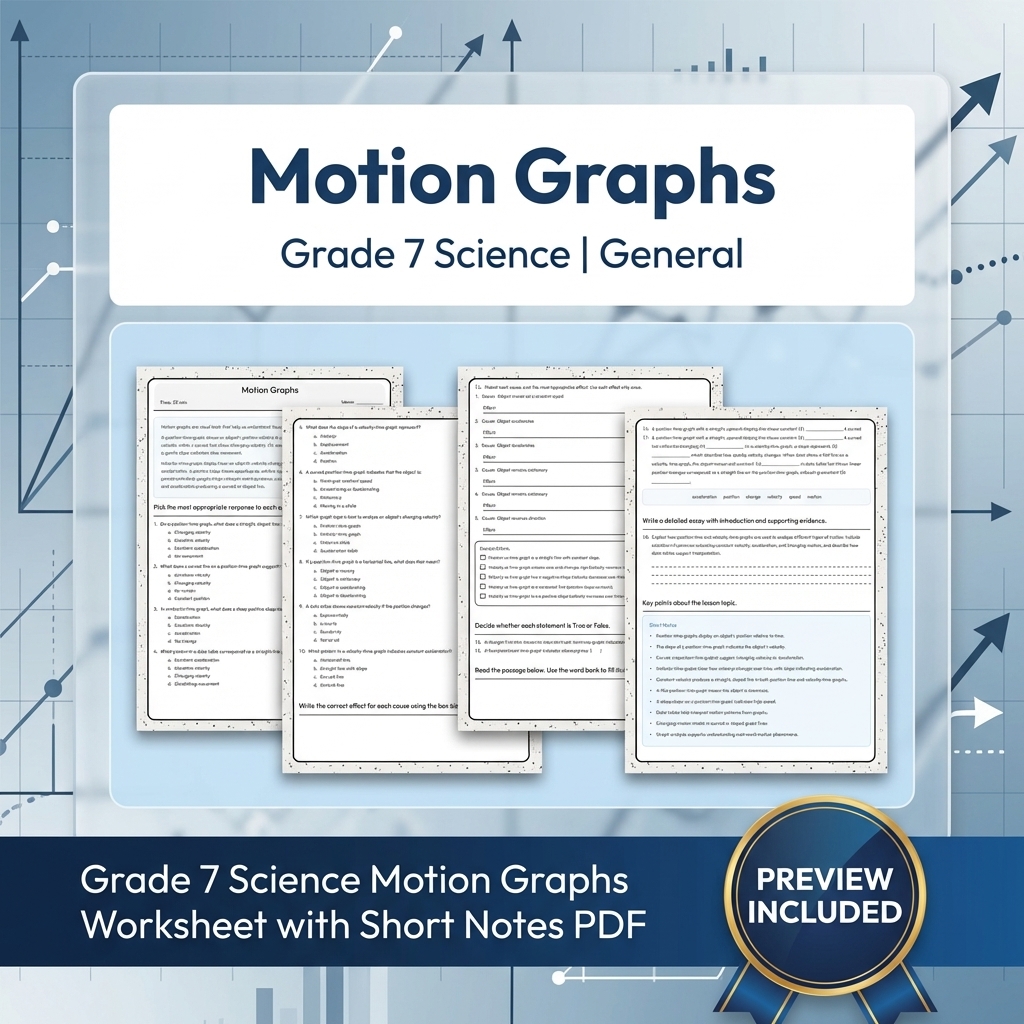
Grade 7 Science Motion Graphs Worksheet with Short Notes PDF
 Created byMeadowlark Worksheets
Learning Objectives
- Understand how position-time graphs represent motion patterns.
- Interpret slope and curvature in position-time and velocity-time graphs.
- Relate data tables to graphical motion representations.
Also included in: Grade 7 Energy Transfer and Motion Science Lesson Bundle | General +1 more
Instant download

Thermal Effects on Materials Worksheets Grade 7 Science
Created byPrism Point LearningLearning Objectives
- Explain how particle motion changes material size with temperature
- Describe how thermal expansion affects structural design and safety
- Explain melting and freezing as temperature-dependent phase changes
Also included in: Thermal Energy & Heat Transfer Lesson Bundle | Grade 7 Science | Ontario +1 more
Instant download

Material Properties for Structures Worksheets | Grade 7 Science
 Created bySunny Desk Resources
Learning Objectives
- Compare how timber, structural steel, and reinforced concrete behave under compression, tension, and bending.
- Identify material properties such as strength, stiffness, and density that affect design choices.
- Explain how environmental factors like frost and snow influence long-term maintenance needs.
Also included in: Forces, Structures & Motion Grade 7 Science Bundle | Alberta +1 more
Instant download

Photosynthesis Capture Worksheet | Standards-Aligned Grade 7 Science Practice
JCreated byJ.S SheetsLearning Objectives
- Understand the process by which producers convert light energy into chemical energy during photosynthesis.
- Identify the key components and reactants involved in photosynthesis.
- Explain how energy and matter flow through ecosystems via photosynthesis and food chains.
Also included in: Grade 7 Ecosystem Energy & Matter Cycles Science Lesson Bundle +1 more
Instant download

Quantitative Heat Worksheet Pack | Grade 7 Science Activities
Created byPrism Point LearningLearning Objectives
- Use specific heat, mass, and temperature change to quantify energy transfer in Joules and kilojoules.
- Explain how thermal energy calculations connect to practical situations and energy budgets.
- Interpret basic claims about heating, melting, and energy units using quantitative reasoning.
Instant download

Population Limits Worksheet | Grade 7 NGSS Ecosystems Activity Pack
Created byAmber Owl EducationLearning Objectives
- Explain how resource availability and competition influence population growth rates
- Interpret logistic growth curves and the concept of carrying capacity
- Relate birth, death, immigration, and emigration to changes in population size
Also included in: Grade 7 Science Ecosystems and Food Webs Lesson Bundle | NGSS +1 more
Instant download
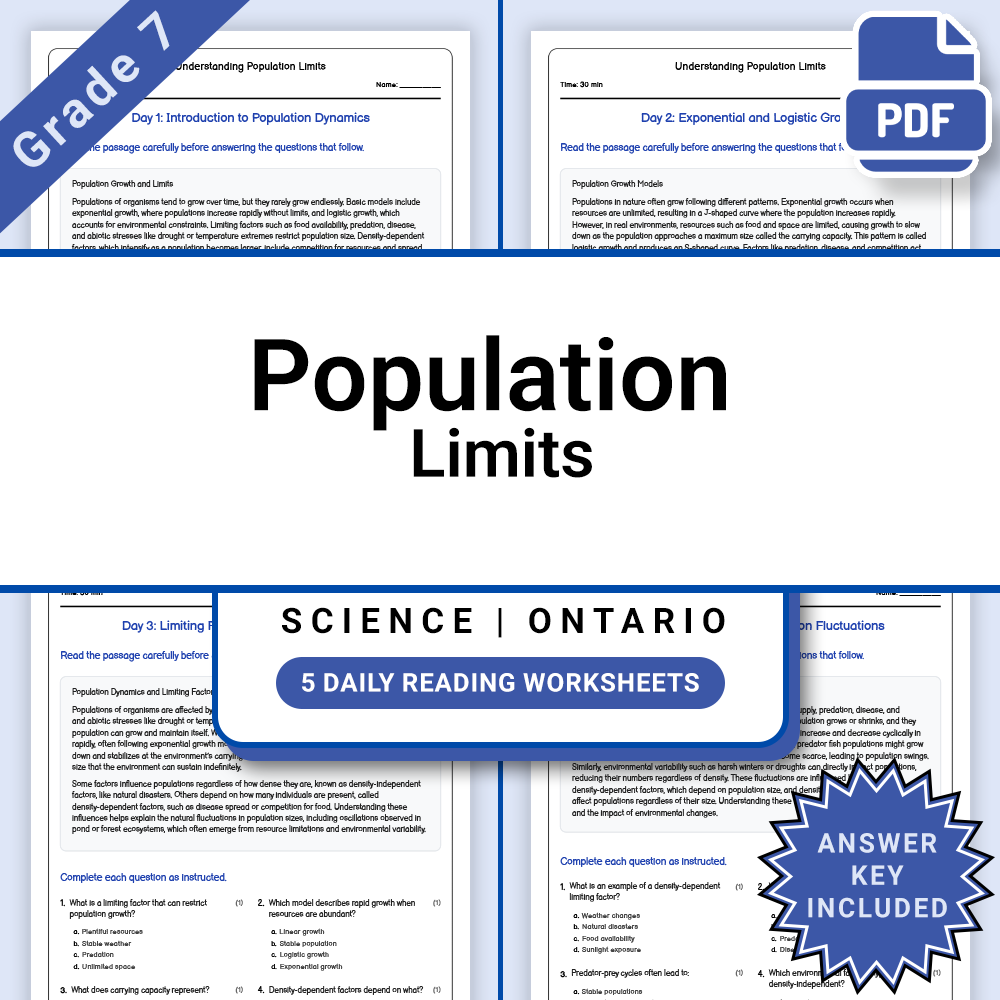
Grade 7 Science – Population Limits Daily Reading Worksheet + Answer Key
JCreated byJ.S SheetsLearning Objectives
- Define population dynamics and growth models
- Identify factors that limit population growth
- Differentiate between density-dependent and density-independent factors
Also included in: Grade 7 Science Lesson Group Bundle | Ecology & Ecosystems Framework +1 more
Instant download

Grade 7 Science - Energy Types Worksheet (TEKS) (PDF)
Created byEvergreen Desk EducationLearning Objectives
- Define kinetic energy and potential energy using everyday examples.
- Explain how height and motion relate to stored energy and moving energy.
- Describe energy transfer between objects in a system using qualitative reasoning.
Instant download

Science Impacts and Ethics Worksheet for Grade 7 | Standards-Aligned Assessment
JCreated byJ.S SheetsLearning Objectives
- Explain how technologies can create benefits and costs through real-world trade-offs.
- Identify ethical considerations in technology, including fairness, privacy, and responsibility across a product’s life cycle.
- Describe how engineering choices can affect people and ecosystems over time.
Also included in: Grade 7 Science Fair Testing, Design, and Data Reliability Science Lesson Bundle +1 more
Instant download
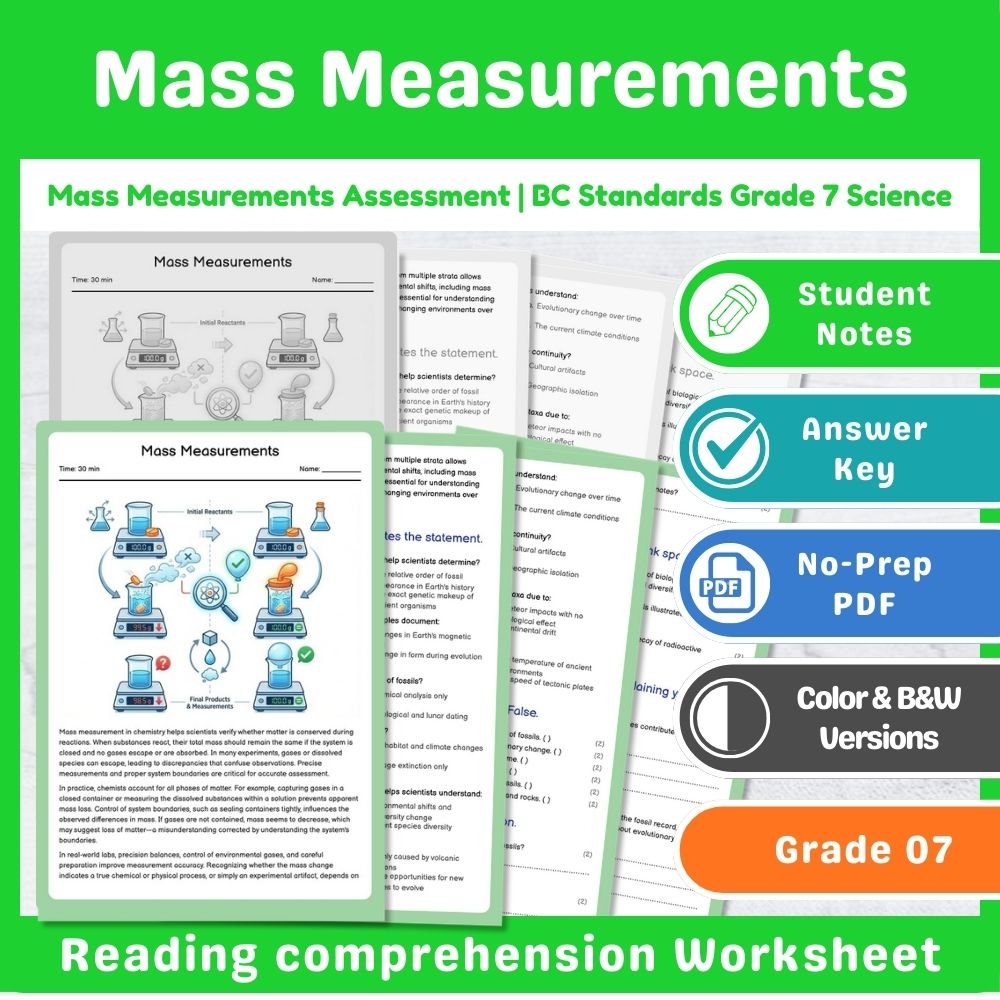
Conservation of Mass Assessment | BC Standards 7th Grade Science PDF
Created byPrism Point LearningLearning Objectives
- Understand the principle of conservation of mass in chemical reactions.
- Identify how atoms are conserved and rearranged during reactions.
- Explain the concept of closed systems and their importance in mass measurement.
Instant download

Grade 7 Science – Variable Control Worksheet (TEKS) (PDF)
Created byEvergreen Desk EducationLearning Objectives
- Identify independent, dependent, and controlled (constant) variables in a science investigation.
- Select appropriate control groups and explain why they are necessary for valid comparisons.
- Describe how replication, randomization, and blocking reduce confounding influences.
Instant download

Grade 7 Science | Geologic Processes - Daily Reading Comprehension
Created byCoral Reef LearningLearning Objectives
- Identify different landforms created by tectonic activity
- Understand how tectonic movements shape Earth's surface
- Learn about the processes of weathering, erosion, and deposition
Instant download

Grade 7 Gravity On Objects Worksheet | California Standards Practice PDF
 Created byClear Sky Classroom
Learning Objectives
- Explain how gravitational force, weight, and inertia relate to motion near Earth
- Differentiate gravity from support forces (normal forces) and describe when they balance or do not balance
- Use Newton’s ideas of net force to predict how objects move when support forces change
Instant download

Grade 7 Science | Thermal Performance & Components - Daily Reading Comprehension
Created byCoral Reef LearningLearning Objectives
- Identify the key components of a building envelope: walls, roofs, windows, and foundations.
- Understand the role of insulation and barriers in maintaining thermal efficiency.
- Recognize the importance of ventilation and sealing techniques in reducing heat loss.
Instant download

Conservation of Energy Worksheet | Grade 7 Science Practice
Created byPrism Point LearningLearning Objectives
- Explain the conservation of energy using the ideas of energy transfer between a system and its surroundings.
- Identify how friction and other forces change motion and temperature by redistributing energy.
- Use energy models to distinguish between different forms of energy and understand that energy is not lost.
Instant download

Grade 7 Science | Control Methods in Science - Daily Reading Comprehension
Created byCoral Reef LearningLearning Objectives
- Understand the concept of control variables in experiments.
- Identify control methods used to reduce bias in scientific studies.
- Explain why having control and comparison conditions is essential for credible results.
Instant download
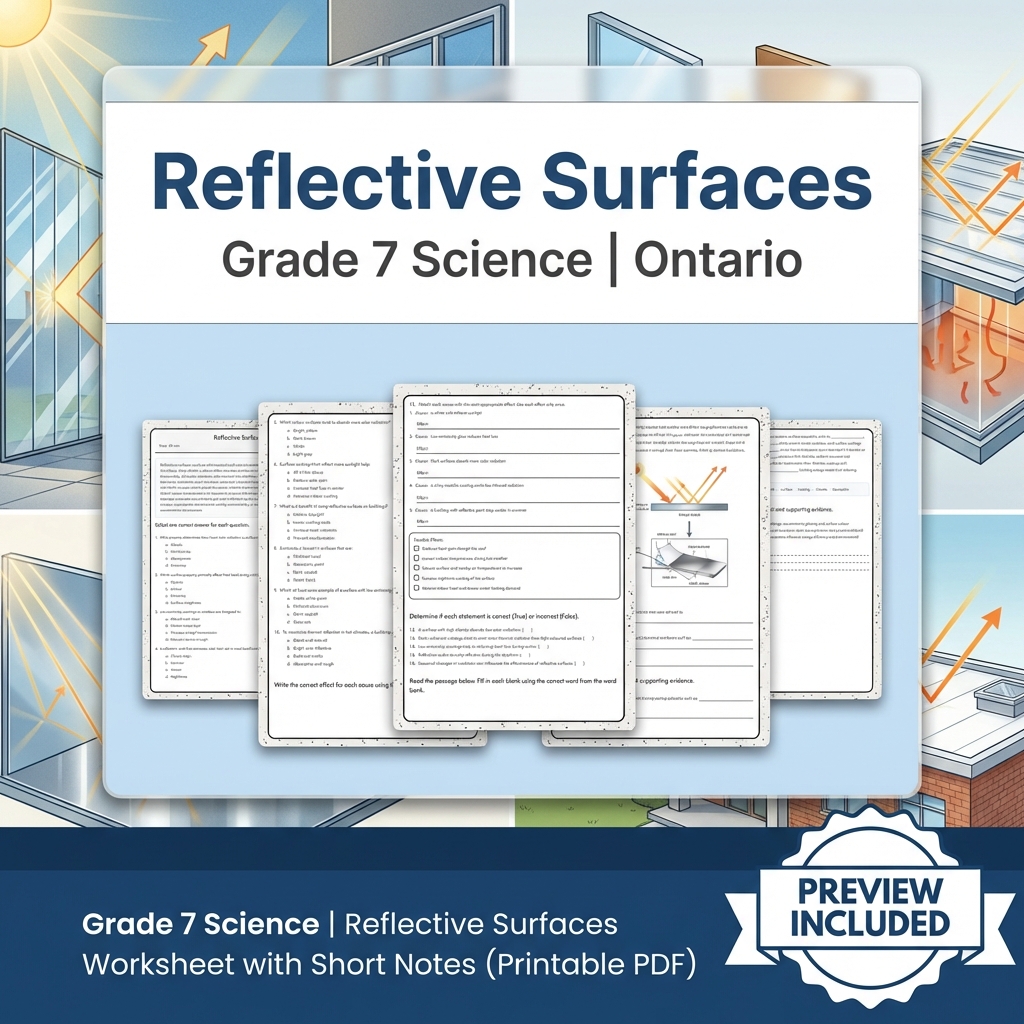
Grade 7 Science | Reflective Surfaces Worksheet with Short Notes (Printable PDF)
Created byMeadowlark WorksheetsLearning Objectives
- Explain the role of reflective and emissive surface properties in managing radiative heat exchange.
- Describe how surface albedo and emissivity affect solar heat gain and loss.
- Identify examples of low-emissivity glazing and reflective roofs and their impact on building energy efficiency.
Also included in: Grade 7 Science Lesson Group | Thermal Effects and Heat Transfer Worksheets +1 more
Instant download

Graphical Representation in Science Worksheet | Ontario Grade 7 Science
 Created byCedar Grove Learning
Learning Objectives
- Select an appropriate graph type for categorical and continuous data and explain why it fits the data.
- Construct and interpret graphs using correct axis scaling, proportional representation, and clear labeling.
- Analyze patterns in graphs by reading slope, correlation, and trends while avoiding claims of causation.
Also included in: Grade 7 Scientific Inquiry and Data Analysis Science Lesson Bundle - Ontario +1 more
Instant download

Grade 7 Science Worksheet | Food Web Flows – General Standards (PDF)
Created byEvergreen Desk EducationLearning Objectives
- Explain how energy moves through a food web from producers to higher trophic levels.
- Describe how matter cycles through ecosystems using decomposition.
- Interpret how changes to one species can affect other trophic levels.
Also included in: Grade 7 Ecosystem Energy Flows Science Lesson Bundle - General Framework +1 more
Instant download

Grade 7 Population Limits Worksheet | NGSS Practice PDF
Created byClear Sky ClassroomLearning Objectives
- Understand how resource availability influences population growth and decline.
- Interpret logistic growth curves and concepts of carrying capacity.
- Analyze how competition affects ecosystem populations using real-world examples.
Also included in: Grade 7 Ecosystems Interactions Energy Dynamics Science Lesson Bundle: NGSS +1 more
Instant download
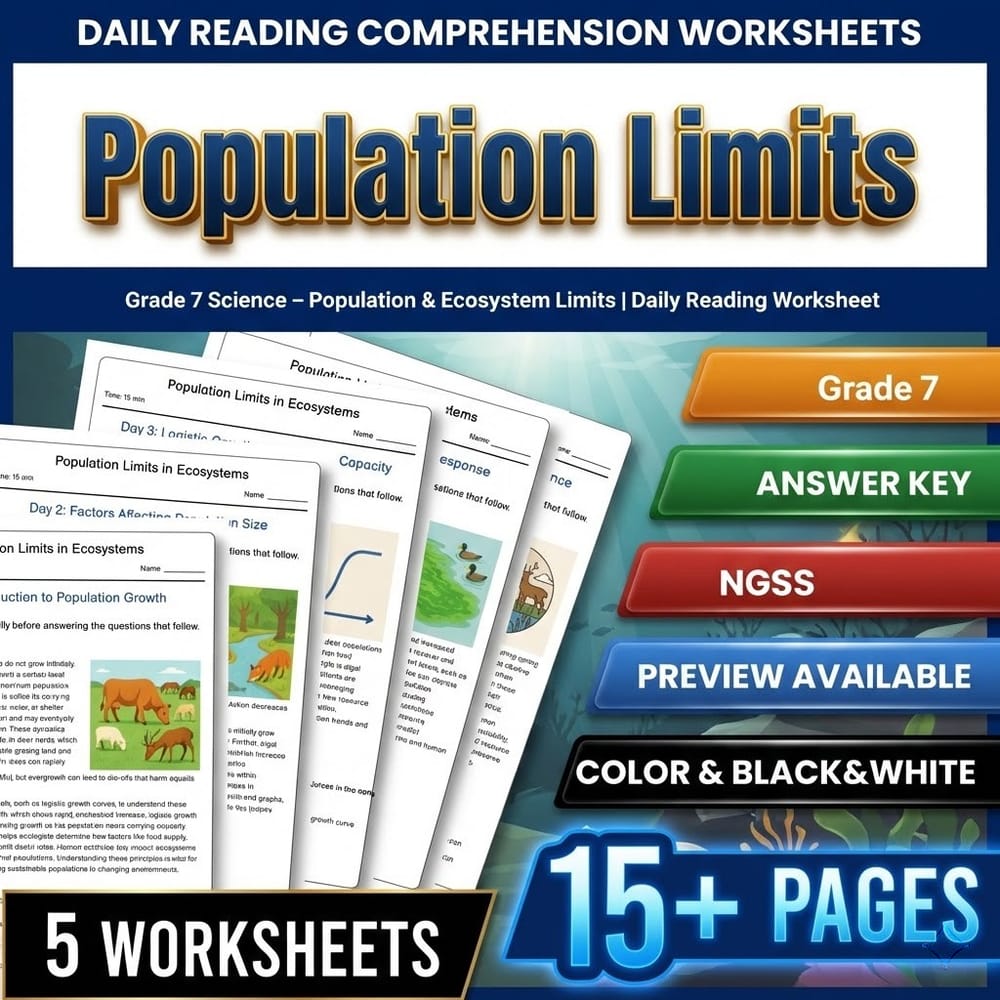
Grade 7 Science – Population & Ecosystem Limits | Daily Reading Worksheet
 Created byElena Brooks
Learning Objectives
- Understand the concept of carrying capacity and how resources influence population growth.
- Interpret data graphs showing population changes over time.
- Identify the effects of limited food, water, and shelter on animal populations.
Also included in: Ecosystems Grade 7 Science Daily Reading Worksheets Bundle | NGSS +1 more
Instant download

Grade 7 Science Worksheet | Conservation of Energy (PDF)
Created byEvergreen Desk EducationLearning Objectives
- Explain conservation of energy using the idea of energy transfer between system and surroundings.
- Describe how friction can convert mechanical energy into thermal energy and affect motion.
- Identify and use energy models to show how energy changes form without being lost.
Also included in: Grade 7 Energy Transfer & Motion Science Lesson Bundle Worksheets (General) +1 more
Instant download
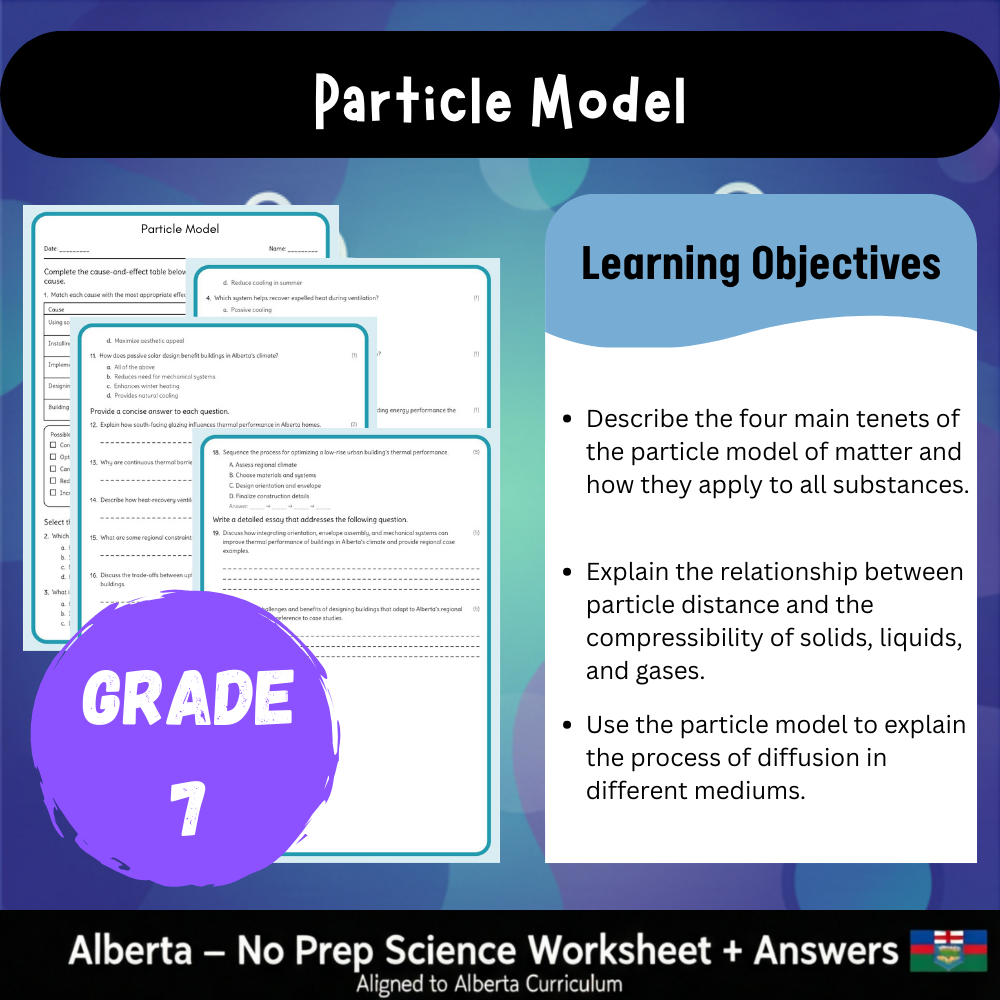
Grade 7 Science | Particle Model Worksheet (PDF) – Alberta Standards
Created byBright Mind ResourcesLearning Objectives
- Explain the particle model of matter and how it describes the arrangement and motion of particles.
- Relate microscopic particle behavior to macroscopic properties such as states of matter, diffusion, and density changes.
- Differentiate between physical rearrangements and chemical transformations in terms of particle interactions.
Instant download

Durability Factors Worksheet | Ontario Grade 7 Science Assessment
Created byCedar Grove LearningLearning Objectives
- Explain how environmental exposure affects the durability of steel, timber, concrete, and polymers over time
- Describe protective measures that slow down corrosion, rot, freeze–thaw damage, and UV degradation
- Connect maintenance and inspection intervals to expected service lifespan in bridge decks and exterior roofing
Also included in: Grade 7 Materials Testing & Prototyping Science Lesson Bundle – Ontario +1 more
Instant download

Technology Impacts And Ethics Worksheet | Grade 7 Science Practice
Created byPrism Point LearningLearning Objectives
- Explain how technologies create both benefits and costs for people and ecosystems.
- Identify key ethical issues related to technology, including fairness in access, privacy, and product responsibility across the life cycle.
- Make connections between engineering choices and real-world consequences.
Instant download

Science Grade 7 Worksheet Data Organization | Standards-Aligned Practice
JCreated byJ.S SheetsLearning Objectives
- Distinguish categorical data from numerical data and organize both in clear tables
- Use metadata, column headings, units, and timestamps to support credible scientific reporting
- Document sampling frames, replication, and annotated raw data so results can be validated later
Instant download
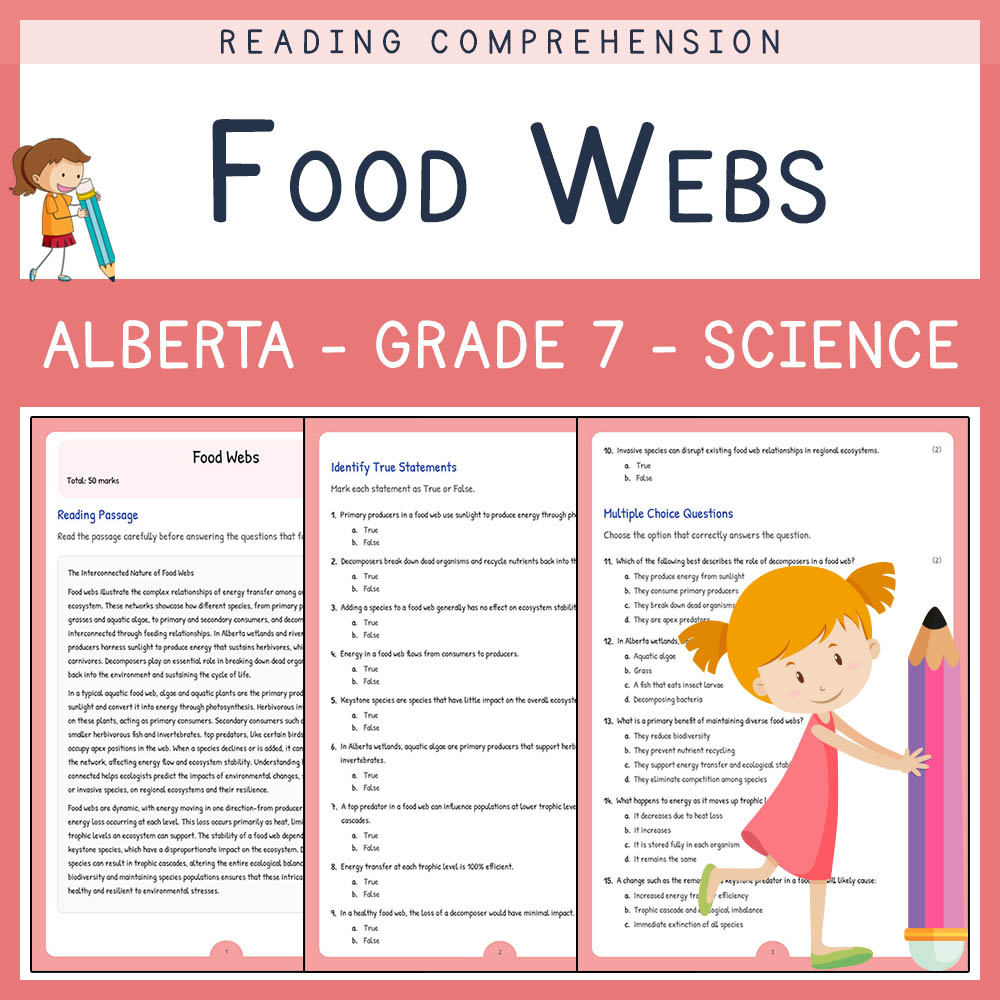
Grade 7 Science | Food Webs Worksheet Elena | Alberta Standard
Created byLumora LearningLearning Objectives
- Describe the components of a food web, including producers, consumers, and decomposers.
- Explain the flow of energy among different organisms within a food web.
- Identify regional examples of food webs in Alberta wetlands and river systems.
Also included in: Grade 7 Science | Interactions & Ecosystems Custom Bundle | Alberta
Instant download

Organ Interactions Worksheet | NGSS-Aligned Grade 7 Science Practice
JCreated byJ.S SheetsLearning Objectives
- Describe the functions of circulatory, respiratory, digestive, and nervous systems in multicellular animals.
- Explain how organ systems cooperate to support gas exchange, nutrient distribution, and homeostasis.
- Identify system-level dependencies and feedback mechanisms in animal and plant transport systems.
Also included in: Grade 7 Cellular and Organ Systems Science Lesson Bundle: NGSS Practice +1 more
Instant download

Grade 7 Science | Understanding Groundwater & Water Cycle - Daily Reading
Created byCoral Reef LearningLearning Objectives
- Define what groundwater is and describe its location beneath Earth's surface.
- Explain how groundwater contributes to the water cycle.
- Identify factors that influence groundwater recharge and movement.
Instant download
About Grade 7 Science Worksheets
Browse 6,039 printable Grade 7 Science worksheets — ready-to-print PDFs with answer keys where available.
Every worksheet on MyTeachingSheets is created by independent teacher-authors and reviewed before publication. All resources download as printable PDFs for classroom, homework, or at-home practice, and many include answer keys. Preview any worksheet free before buying.