
Grade 7 Science Worksheets
6,039 worksheets
Grade 7 Science – Pollution Effects on Ecosystems & Sources | Reading Worksheet
 Created byBright Mind Resources
Learning Objectives
- Identify various sources of pollution relevant to Alberta ecosystems.
- Understand how pollutants enter and impact terrestrial and aquatic environments.
- Recognize pathways of exposure and associated ecological consequences.
Also included in: Grade 7 Ecosystems Science Lesson Bundle for Daily Reading Worksheets | Alberta +2 more
Instant download

Grade 7 Science | Biodiversity Measures - Daily Reading Comprehension
 Created byCoral Reef Learning
Learning Objectives
- Understand the concept of biodiversity and its different components.
- Learn about indices used to measure biodiversity, such as richness, evenness, and habitat heterogeneity.
- Interpret what various biodiversity metrics reveal about ecosystem resilience and health.
Also included in: Interactions and Ecosystems Lesson Bundle Grade 7 Science – Alberta +1 more
Instant download

Grade 7 Science | Ecosystem Basics Worksheet (Ontario Standards) (PDF)
 Created byEvergreen Desk Education
Learning Objectives
- Identify biotic and abiotic components of an ecosystem and describe their roles
- Explain trophic categories (producers, consumers, decomposers) and how energy flows from sunlight
- Use food chains from pond and forest settings to describe connections, matter cycling, and ecosystem balance
Also included in: Grade 7 Ecosystem Dynamics Science Lesson Bundle (Ontario) Worksheets +1 more
Instant download
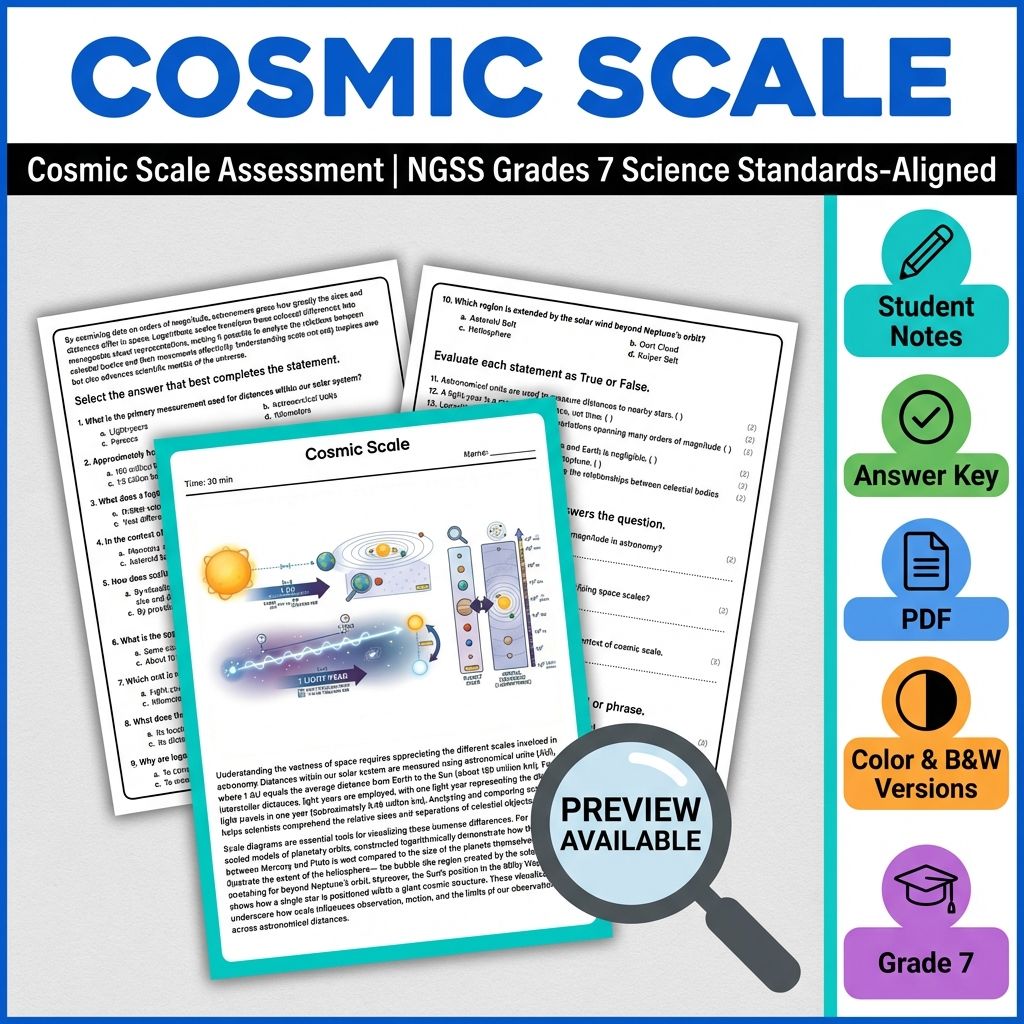
Cosmic Scale Assessment | NGSS Grades 7 Science Standards-Aligned
 Created byPrism Point Learning
Learning Objectives
- Understand the methods used to compare sizes and distances in the solar system and beyond.
- Recognize the significance of astronomical units, light-years, and logarithmic representations.
- Analyze how scale affects observations, motion, and observational limits.
Also included in: Grade 7 Science Mini Bundle – Earth's Place in the Universe | NGSS Standards +1 more
Instant download
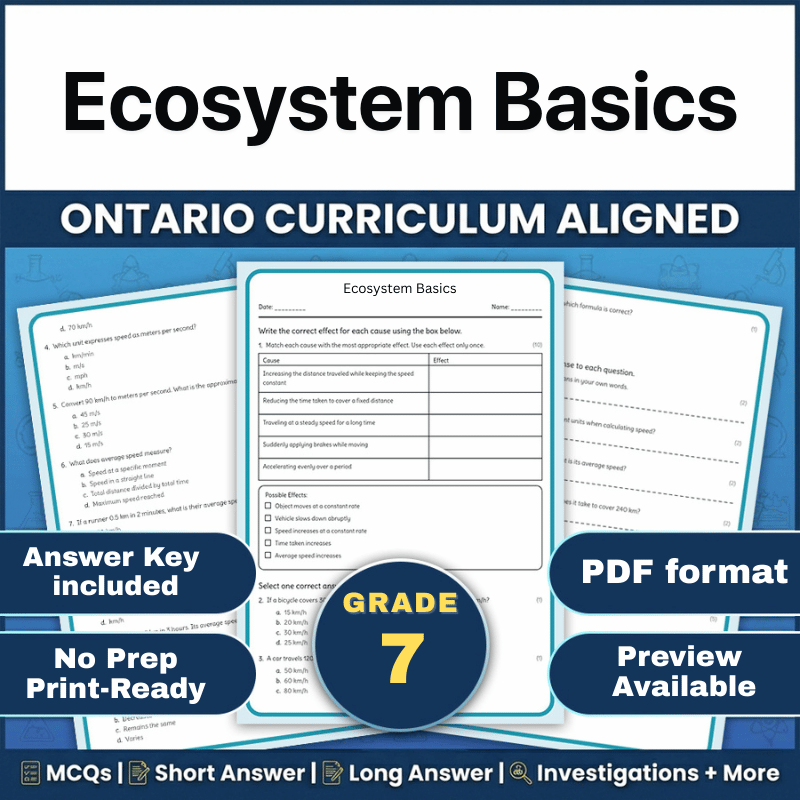
Grade 7 Science | Ecosystem Basics Worksheet (Ontario) (PDF)
Created byBright Mind ResourcesLearning Objectives
- Define components of ecosystems, including biotic and abiotic elements.
- Describe the roles of producers, consumers, and decomposers in energy flow.
- Identify examples of simple food chains in pond and forest habitats.
Instant download

Design Criteria California Standards Assessment | Grade 7 Science
Created byPrism Point LearningLearning Objectives
- Explain how design criteria and constraints guide the success of a science/engineering solution.
- Identify examples of measurable criteria and relevant constraints in everyday design problems.
- Use criteria and constraints to evaluate whether a proposed solution is acceptable.
Also included in: Grade 7 Science Engineering Assessment Lesson Bundle: California Standards +1 more
Instant download

Quantitative Heat Worksheet | Ontario Grade 7 Science Assessment
 Created byCedar Grove Learning
Learning Objectives
- Use the quantitative heat equation Q = mcΔT to calculate thermal energy changes for common materials
- Identify and apply appropriate units for heat (joules) and power (watts)
- Explain how heat-transfer rate depends on temperature gradient, surface area, and time
Also included in: Grade 7 Thermal Energy & Heat Transfer Science Lesson Bundle: Ontario +1 more
Instant download

Grade 7 Science – Biodiversity Indices Worksheet (Ontario) PDF
Created byEvergreen Desk EducationLearning Objectives
- Explain how species richness and evenness help describe biodiversity in an ecosystem.
- Interpret common biodiversity indices (including the idea of how diversity changes across habitats).
- Connect habitat heterogeneity and niche diversity to species turnover and community differences.
Also included in: Grade 7 Ecosystem Dynamics Science Lesson Bundle (Ontario) Worksheets +1 more
Instant download

Grade 7 Science | Data Reasoning and Reliability Worksheet | General Standard
 Created byLumora Learning
Learning Objectives
- Interpret experimental data using patterns, variability, and measurement quality
- Explain how reliability increases when repeated measurements are similar
- Identify common sources of error and how they affect confidence in conclusions
Instant download

Grade 7 Mass Relationships Worksheet | Practice & Assessment PDF
 Created byClear Sky Classroom
Learning Objectives
- Explain how the conservation of mass applies to closed-system chemical and physical changes
- Use mass accounting to relate reactant masses to product masses in sealed systems
- Distinguish theoretical yield from measured yield using evidence about incomplete reactions or measurement differences
Instant download
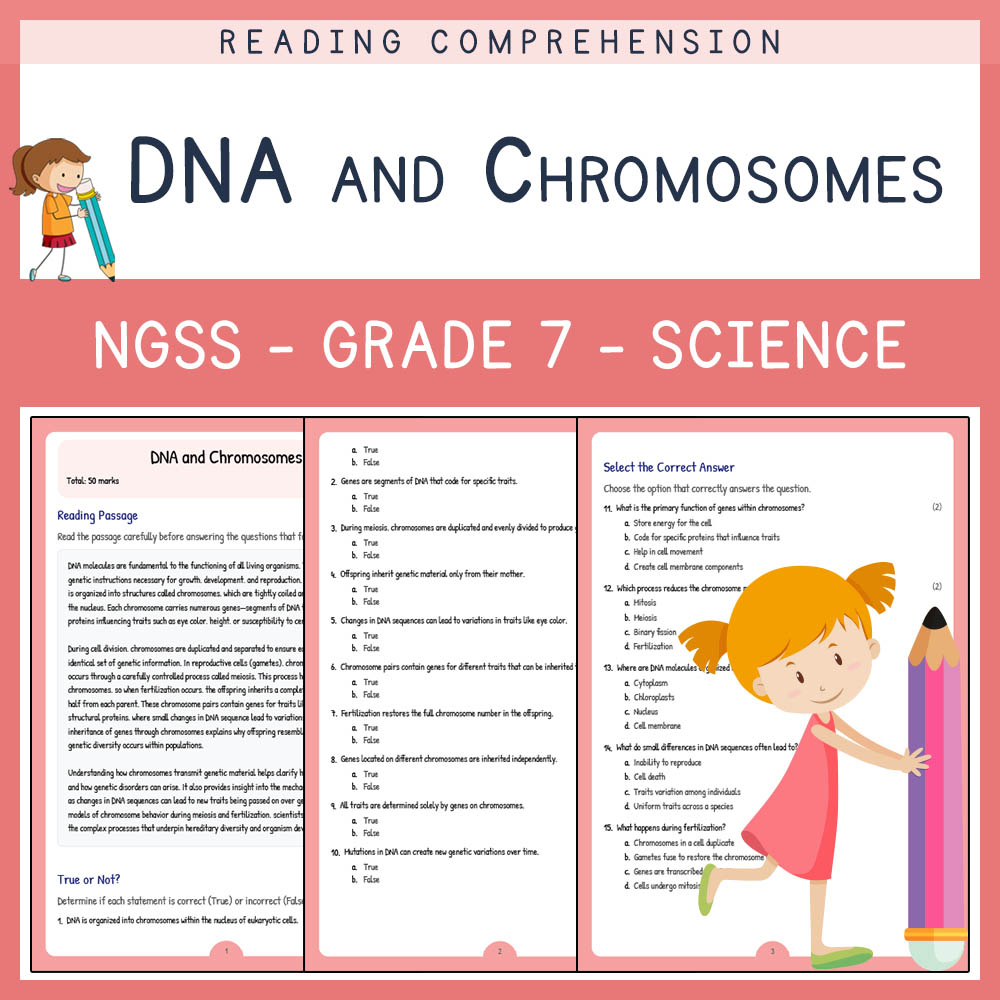
Grade 7 Science | DNA and Chromosomes Worksheet (Answer Key + Rubric)
Created byLumora LearningLearning Objectives
- Understand how DNA molecules are organized into chromosomes and how they encode genes.
- Describe the process of chromosome segregation during gamete formation and fusion.
- Explain how genetic variation influences observable traits through differences in DNA sequences.
Instant download

Science Grade 7 Organ Interactions Worksheet | NGSS-Aligned Grade 7 Science
 Created bySkylark Worksheets
Learning Objectives
- Explain how circulatory, respiratory, digestive, and nervous systems work together to support homeostasis.
- Describe how oxygen and nutrients move from their sources to body cells using interdependent system processes.
- Use evidence from human mammalian systems and plant vascular transport to compare how organisms distribute needed materials.
Also included in: Grade 7 Cell Interactions and Energy Science Lesson Bundle | NGSS +1 more
Instant download
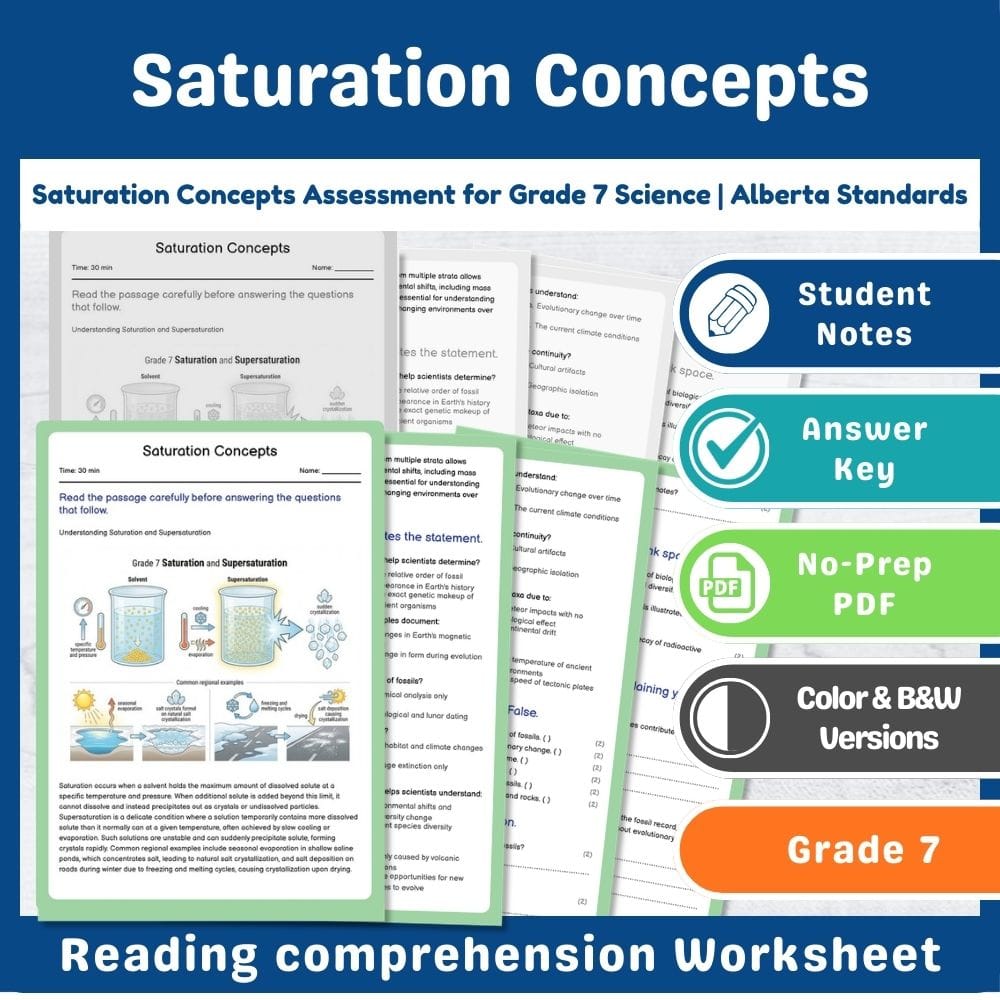
Saturation Concepts Assessment for Grade 7 Science | Alberta Standards
Created byPrism Point LearningLearning Objectives
- Understand the concept of saturation and how it relates to solubility limits.
- Identify conditions that lead to supersaturation and phase change.
- Recognize regional examples of saturation phenomena, such as evaporation and crystallization.
Also included in: Lesson Grade 7 Science Mini Bundle | Matter and Chemical Change +1 more
Instant download
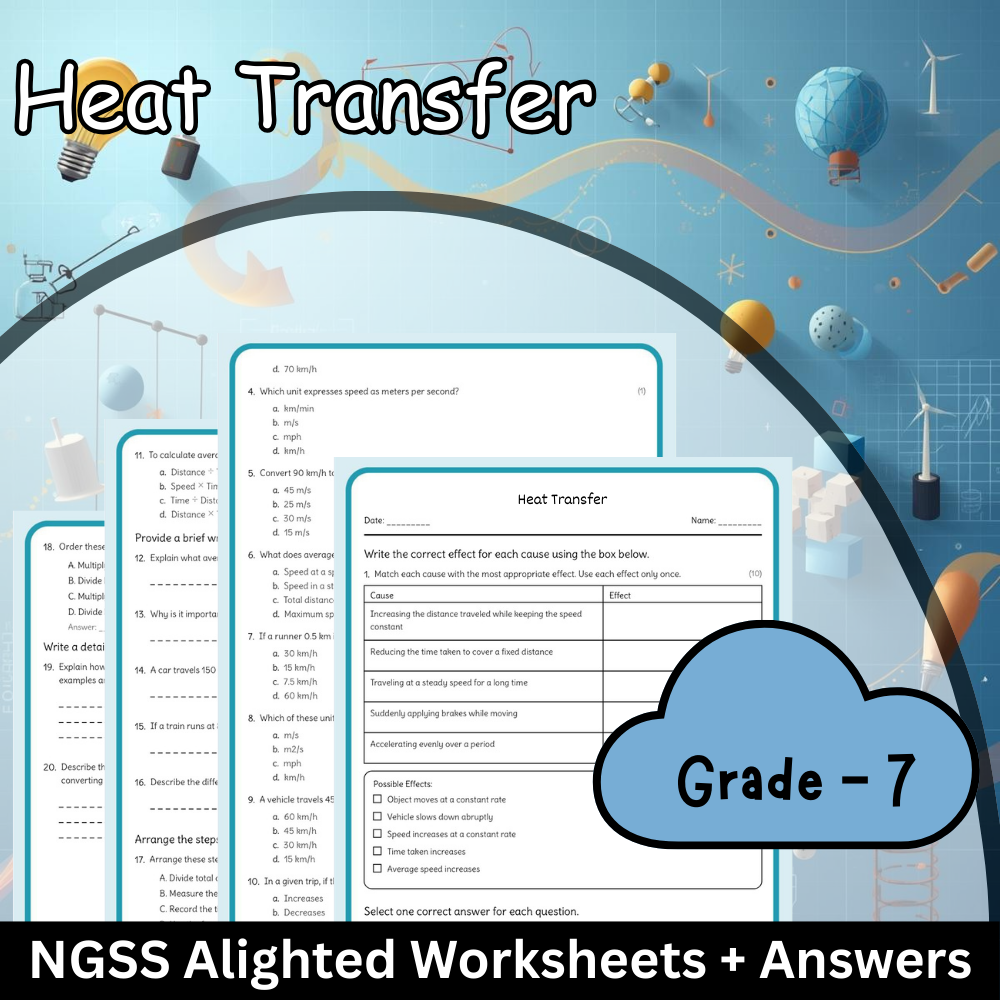
Grade 7 Science – Heat Transfer Worksheet (NGSS Aligned) with Answer Key
Created byBright Mind ResourcesLearning Objectives
- Understand the mechanisms of heat transfer: conduction, convection, radiation, sound, and electric current.
- Identify examples and measurable evidence of different heat transfer modes.
- Explain the factors affecting rates of heat transfer and temperature changes.
Instant download

Science Survival Structures Worksheet | Grade 7 Science Standards-Aligned
JCreated byJ.S SheetsLearning Objectives
- Identify how internal systems (transport, digestion, coordination) help organisms survive and function.
- Describe how external structures (shells, spines, coloration, beak forms) support protection, feeding, and movement.
- Explain functional relationships between traits and increased chances of obtaining resources, maintaining balance, and reproducing.
Also included in: Grade 7 Ecosystem Dynamics Science Lesson Bundle Worksheets – General +1 more
Instant download

Quantitative Heat Worksheet Grade 7 Science | Heat Energy & Specific Heat
 Created byChalk and Compass
Learning Objectives
- Use the relationship Q = mcΔT to estimate the thermal energy needed to change a substance’s temperature.
- Explain how specific heat capacity links material identity to temperature change for a given mass and added heat.
- Describe how heat-transfer rate depends on area, temperature gradient, and time.
Also included in: Grade 7 Science Heat Transfer and Thermal Energy Lesson Bundle | Ontario +1 more
Instant download

Grade 7 Organ System Roles Worksheet | Practice & Assessment PDF
Created byClear Sky ClassroomLearning Objectives
- Explain how the circulatory, respiratory, and digestive systems work together to support life functions
- Describe how specialized structures (capillaries and alveoli) increase the efficiency of gas and nutrient exchange
- Use scientific vocabulary to connect organ system roles to cellular needs for oxygen, nutrients, and removal of wastes
Instant download

Grade 7 Science | Understanding Mass & Measurement - Daily Reading Comprehension
Created byCoral Reef LearningLearning Objectives
- Learn what mass is and how it differs from weight.
- Identify common tools used to measure mass.
- Understand the importance of accuracy in mass measurement.
Instant download
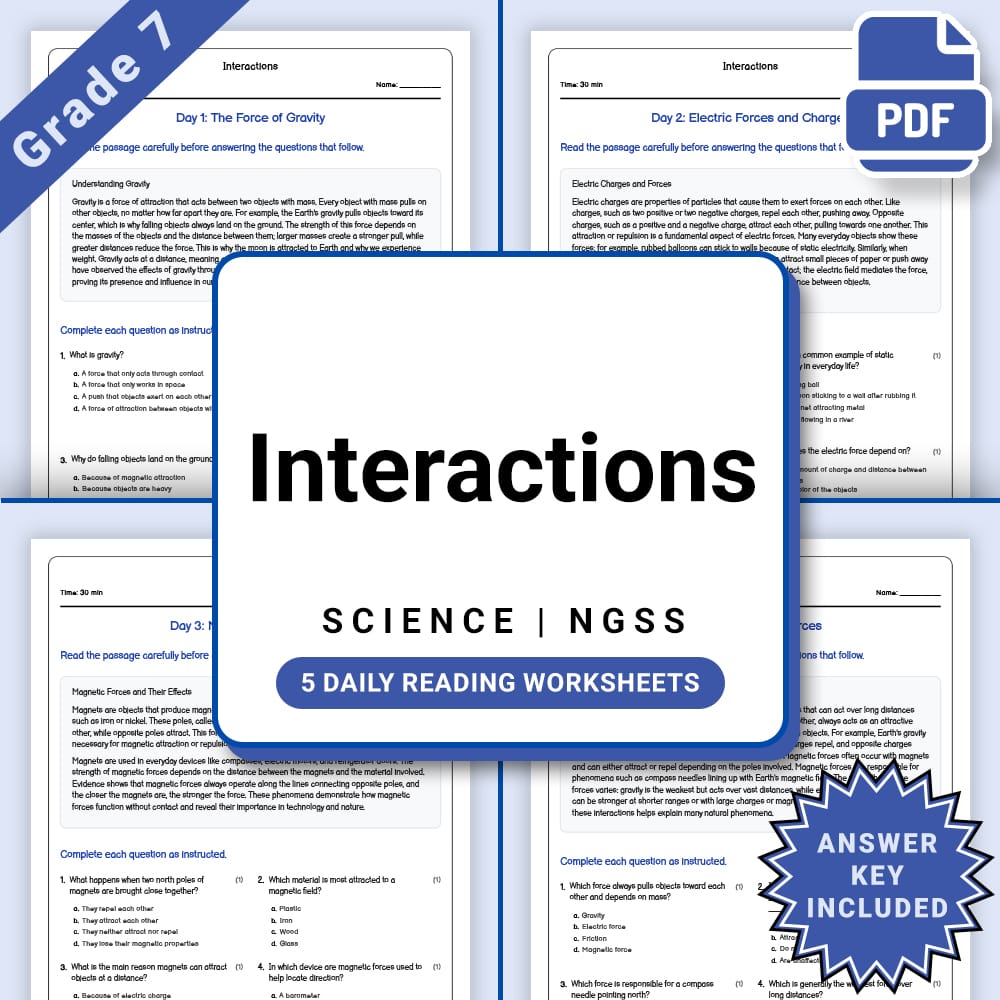
Grade 7 Science – Interactions Daily Reading Worksheet(PDF + Answer Key)
 Created byCopper Leaf Classroom
Learning Objectives
- Understand the concept of gravity as a long-range force that acts without contact.
- Identify examples of gravitational, electric, and magnetic interactions in everyday life.
- Describe how mass and distance influence gravitational attraction.
Instant download

Grade 7 Science Worksheet on Acceleration Meaning | Standards-Aligned Practice
JCreated byJ.S SheetsLearning Objectives
- Explain what acceleration means in terms of changes in velocity over time and the direction (positive or negative).
- Identify whether acceleration is constant or changing by analyzing patterns of velocity over equal time intervals.
- Connect acceleration to net force and mass to describe inertia and predict motion outcomes.
Also included in: Grade 7 Energy Transfer and Change Science Lesson Bundle – General Framework +1 more
Instant download

Tradeoff Mapping Assessment | California Standards Grade 7 Science
Created byPrism Point LearningLearning Objectives
- Explain how tradeoffs occur when improving one design criterion can worsen another due to constraints
- Map competing design options to criteria and constraints to decide which tradeoffs are acceptable
- Use intended function and acceptable limits (such as safety and feasibility) to justify design choices
Also included in: Grade 7 Science Engineering Assessment Lesson Bundle: California Standards +1 more
Instant download

Grade 7 Material Properties Worksheet | NGSS Practice PDF
Created byClear Sky ClassroomLearning Objectives
- Distinguish between physical and chemical properties of materials.
- Identify measurable descriptors such as density, melting point, and solubility.
- Analyze data to classify materials and predict responses to temperature and chemical contact.
Also included in: Grade 7 Matter and Its Interactions Science Lesson Bundle NGSS Worksheets +1 more
Instant download

Grade 7 Science | Erosion and Transport Worksheet | BC Aligned
Created byLumora LearningLearning Objectives
- Understand how agents like water, glaciers, wind, and gravity detach and move Sediment.
- Identify the distinctive sedimentary signatures produced by different agents of erosion.
- Describe how transport distance and energy influence grain size and sorting of sediments.
Instant download

Interactions Worksheet | Grade 7 Science | Review & Practice
Created byPrism Point LearningLearning Objectives
- Explain gravitational, electric, and magnetic interactions as long-range forces that act without contact.
- Relate gravitational attraction to mass and distance in qualitative terms.
- Use evidence-based reasoning to describe how force direction depends on charges or magnetic poles.
Also included in: Grade 7 Forces & Interactions Science Lesson Bundle for NGSS Review
Instant download

Grade 7 Science | Digital Data Tools in Science - Daily Reading Comprehension
Created byCoral Reef LearningLearning Objectives
- Understand how sensors collect data
- Learn about data formats like CSV and timestamps
- Identify the advantages and limitations of automated data logging
Instant download
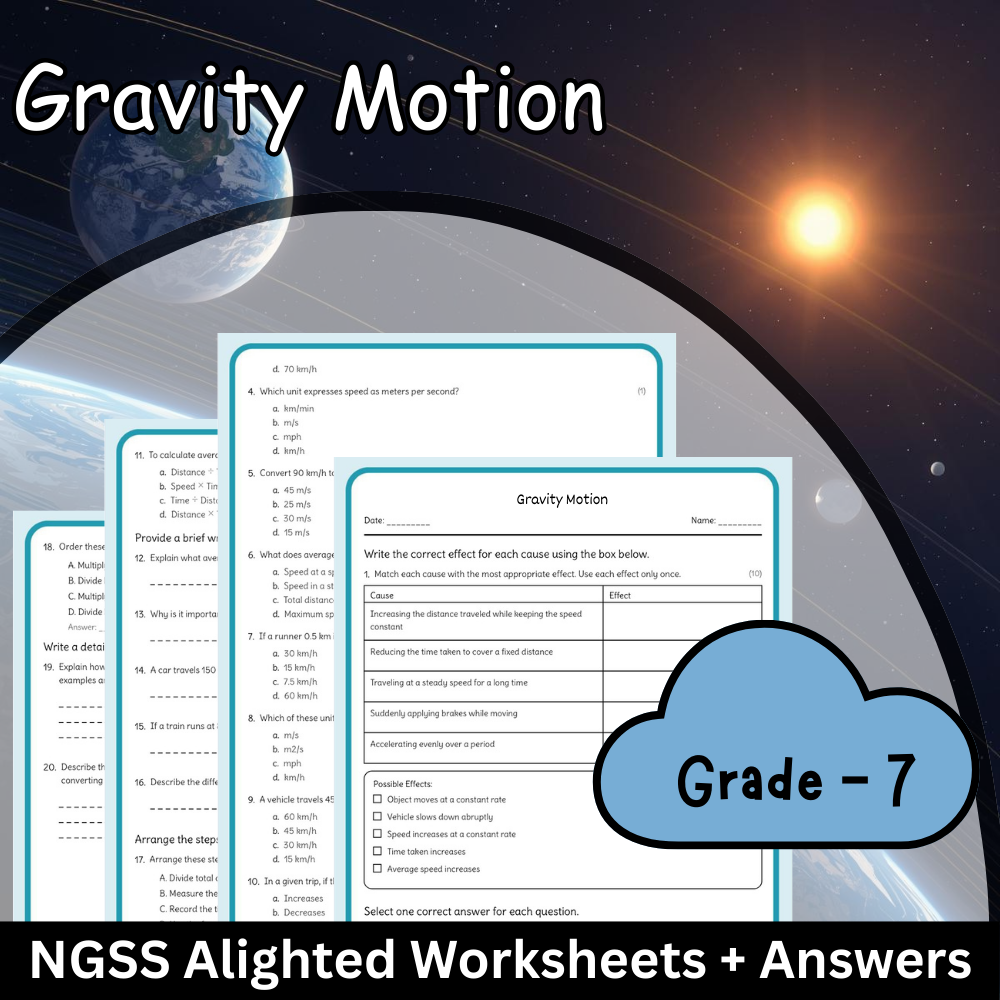
Grade 7 Science | Gravity and Orbital Motion Worksheet(Answer Key)– NGSS Aligned
Created byBright Mind ResourcesLearning Objectives
- Understand how gravity influences orbital motion within the solar system and across galaxies.
- Describe elliptical orbits and how they are affected by mass and distance.
- Apply mathematical relationships to explain orbital velocity and centripetal effects in planetary systems.
Instant download

Climate Patterns Worksheet Grade 7 NGSS | Ocean Currents & Weather
 Created byAmber Owl Education
Learning Objectives
- Explain how uneven solar heating and surface conditions influence atmospheric and ocean circulation
- Use temperature gradients, sea-surface temperature patterns, wind vectors, and precipitation records to interpret climate phenomena
- Describe how topography and ocean currents can cause regional climate differences
Also included in: Earth's Systems Lesson Bundle | Grade 7 Science | Next-Gen Science Standards +1 more
Instant download

Grade 7 Mixtures and Solutions Worksheet | NGSS Practice PDF
Created byClear Sky ClassroomLearning Objectives
- Differentiate between homogeneous and heterogeneous mixtures
- Identify examples of solutions, colloids, and suspensions
- Understand solubility, saturation, and concentration concepts
Also included in: Grade 7 Matter and Its Interactions Science Lesson Bundle NGSS Worksheets +1 more
Instant download

Science Grade 7: Gravity Motion Worksheet | NGSS Aligned Grade 7 Science
Created bySkylark WorksheetsLearning Objectives
- Explain how gravitational attraction creates and shapes orbital motion in the solar system and beyond
- Use centripetal-force ideas to describe why orbiting objects move in curved paths without falling straight down
- Relate orbital speed and orbital period to mass and distance using qualitative mathematical relationships
Also included in: Grade 7 Space, Gravity & Earth Processes Science Lesson Bundle (NGSS) +1 more
Instant download

Gravity and Weight Worksheet for Grade 7 Science Activities & Review
Created byPrism Point LearningLearning Objectives
- Explain how gravity affects the motion of objects near Earth.
- Distinguish mass from weight using the role of gravitational force.
- Describe how falling objects gain speed over time due to a net downward force.
Also included in: Physical Science Lesson Bundle | Grade 7 Science | Florida NGSSS
Instant download
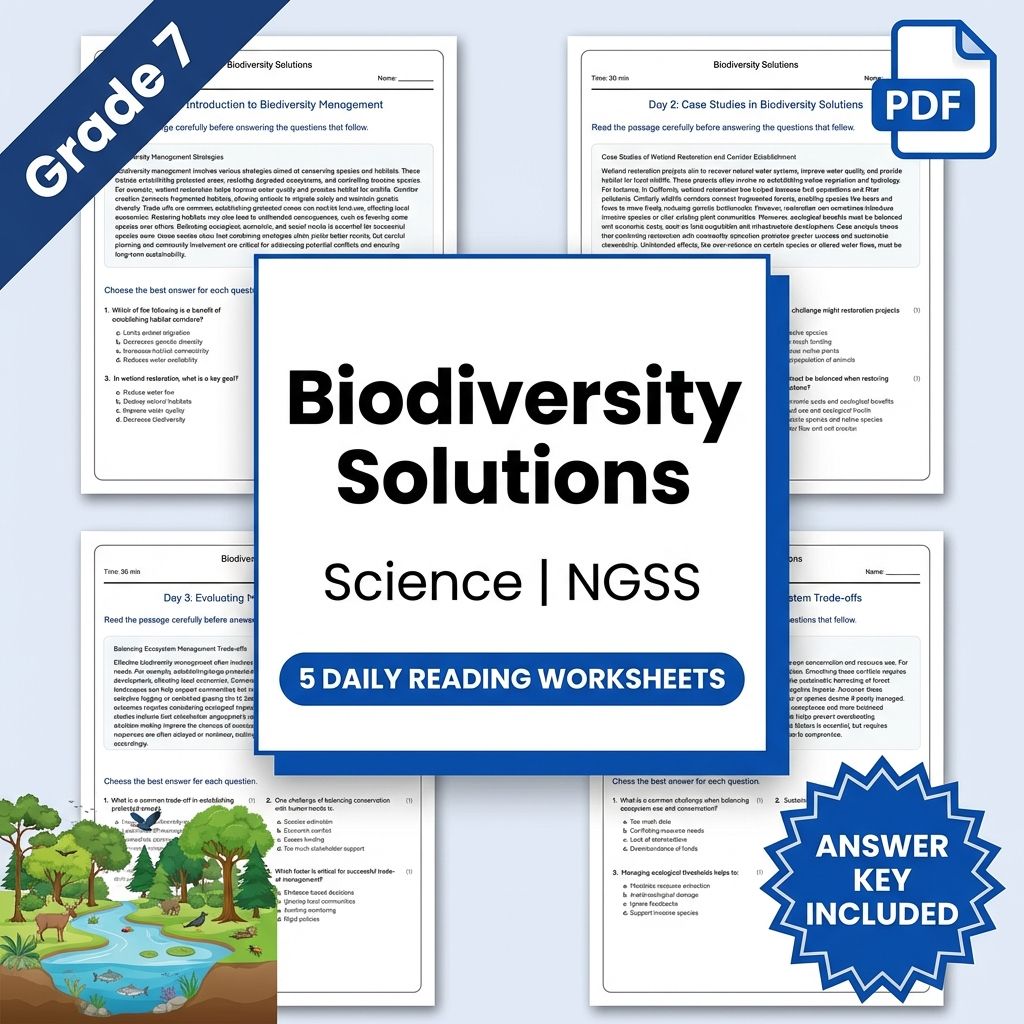
Grade 7 Science – Biodiversity Solutions Worksheet(PDF + Answer Key)
Created byCopper Leaf ClassroomLearning Objectives
- Understand management strategies for maintaining biodiversity and ecosystem health.
- Compare trade-offs and consequences of different biodiversity management approaches.
- Evaluate case examples such as wetland restoration and corridor creation.
Instant download
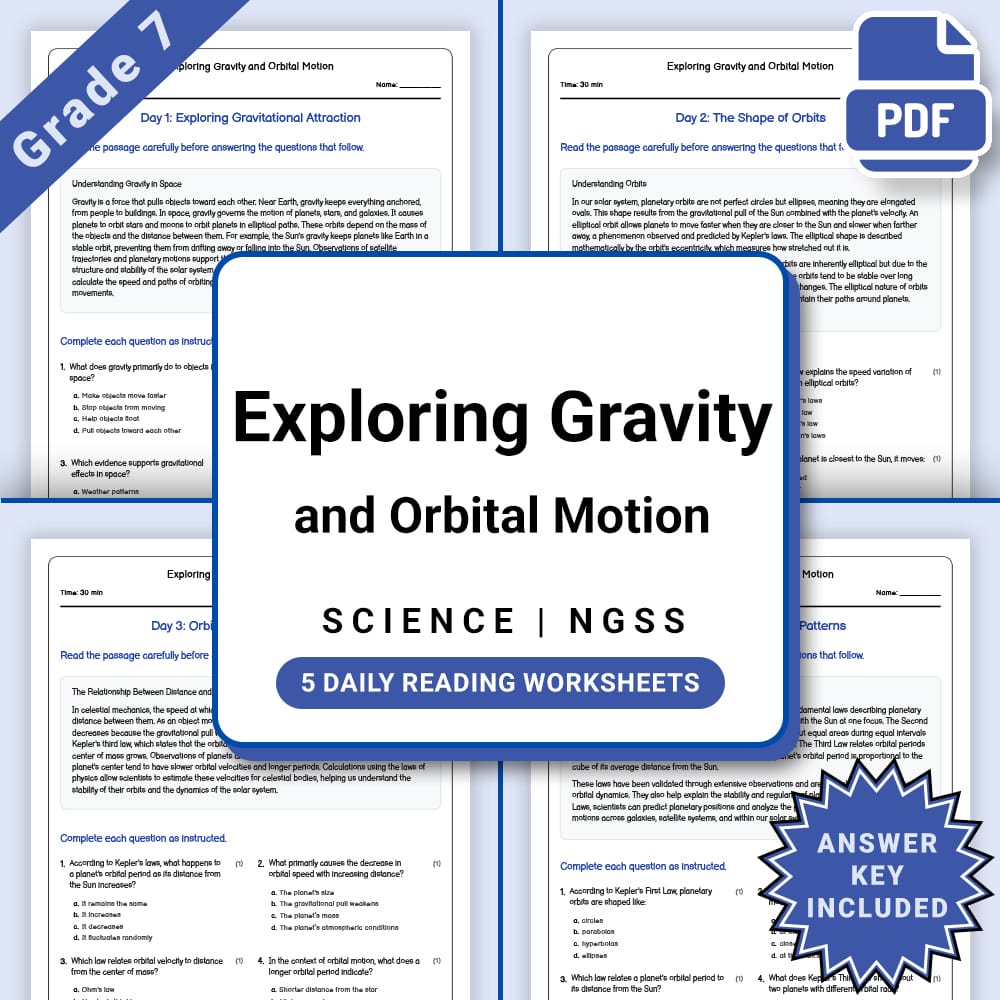
Grade 7 Science – Exploring Gravity and Orbital Motion (PDF + Answer Key)
Created byCopper Leaf ClassroomLearning Objectives
- Understand the concept of gravitational attraction.
- Explain how gravity influences the motion of planets and moons.
- Identify observational evidence supporting gravitational theories.
Instant download
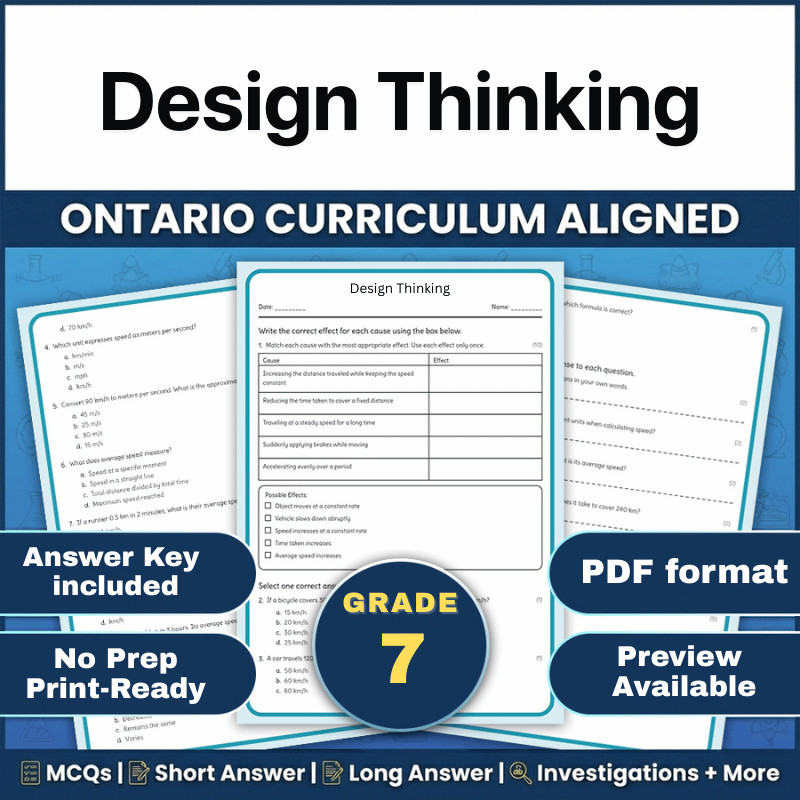
Grade 7 Science | Design Thinking Worksheet (Ontario, PDF)
Created byBright Mind ResourcesLearning Objectives
- Understand the fundamentals of engineering design, including problem definition and criteria setting.
- Learn how to create specification documents, trade-off matrices, and evaluate feasibility based on materials, cost, and environmental factors.
- Recognize the importance of iterative refinement to improve design solutions aligned with objectives and available resources.
Instant download
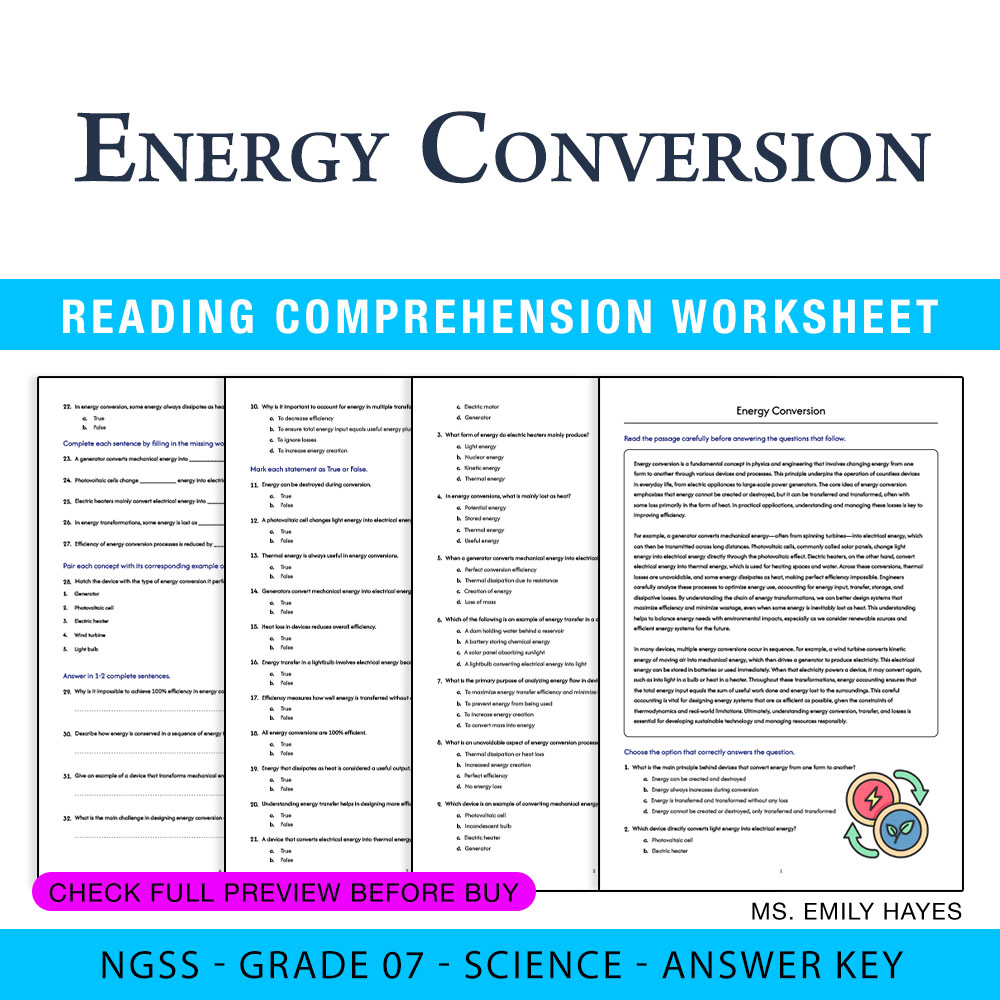
7th Grade Science | Energy Conversion Worksheet (PDF+ Answer Key)
Created byCopper Leaf ClassroomLearning Objectives
- Explain the principles of energy conversion and transfer in different devices.
- Identify examples of devices that transform energy from one form to another.
- Understand the concept of energy conservation and the effects of thermal losses.
Instant download
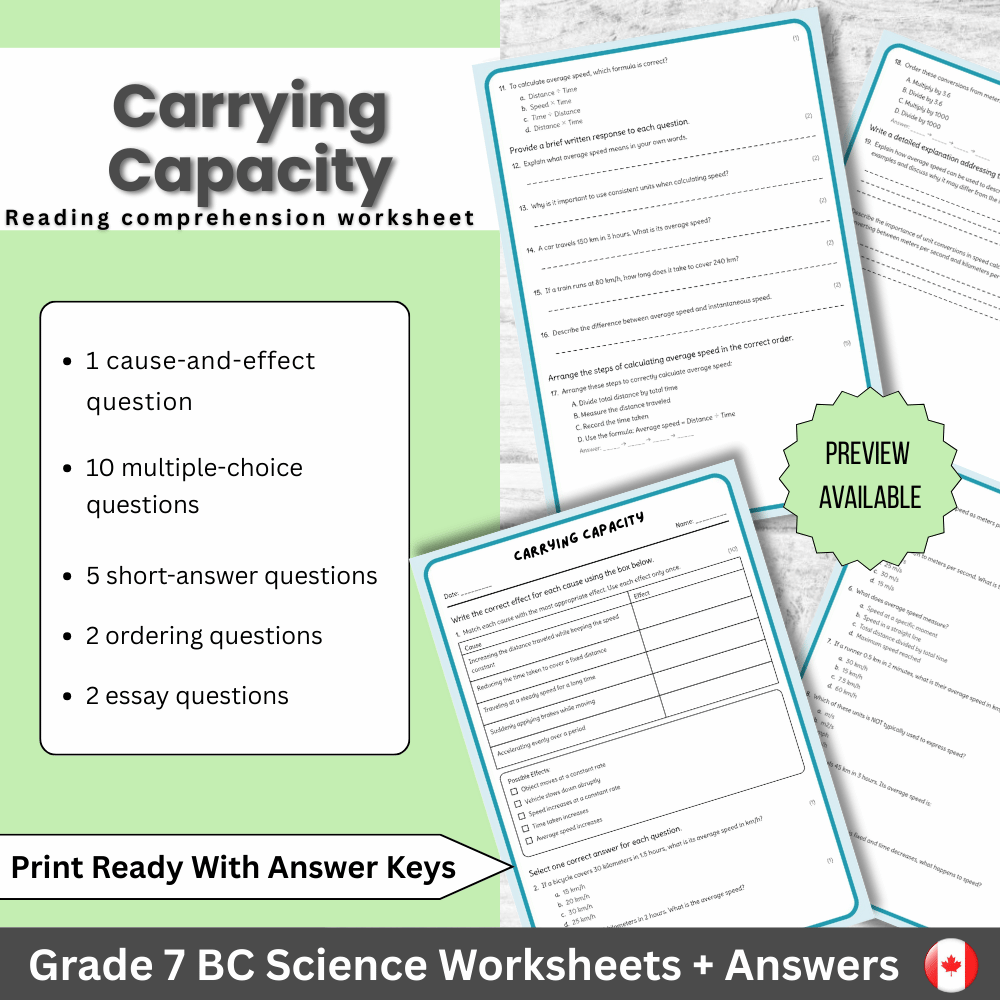
Grade 7 Science | Carrying Capacity Worksheet (PDF) for BC Standards
Created byBright Mind ResourcesLearning Objectives
- Define carrying capacity and explain its significance in ecosystems.
- Identify limiting factors that influence population sizes.
- Understand how populations stabilize at carrying capacity through resource regulation.
Instant download

Science Speciation Processes Biodiversity Worksheet | NGSS Grade 7 Science
Created bySkylark WorksheetsLearning Objectives
- Explain how reproductive isolation and geographic separation can lead to speciation.
- Describe how founder effects, polyploidy, and adaptive radiation increase biodiversity.
- Use biogeographic and time-based patterns to interpret how new species form.
Also included in: Grade 7 Speciation and Evolution Evidence Science Lesson Bundle NGSS +1 more
Instant download
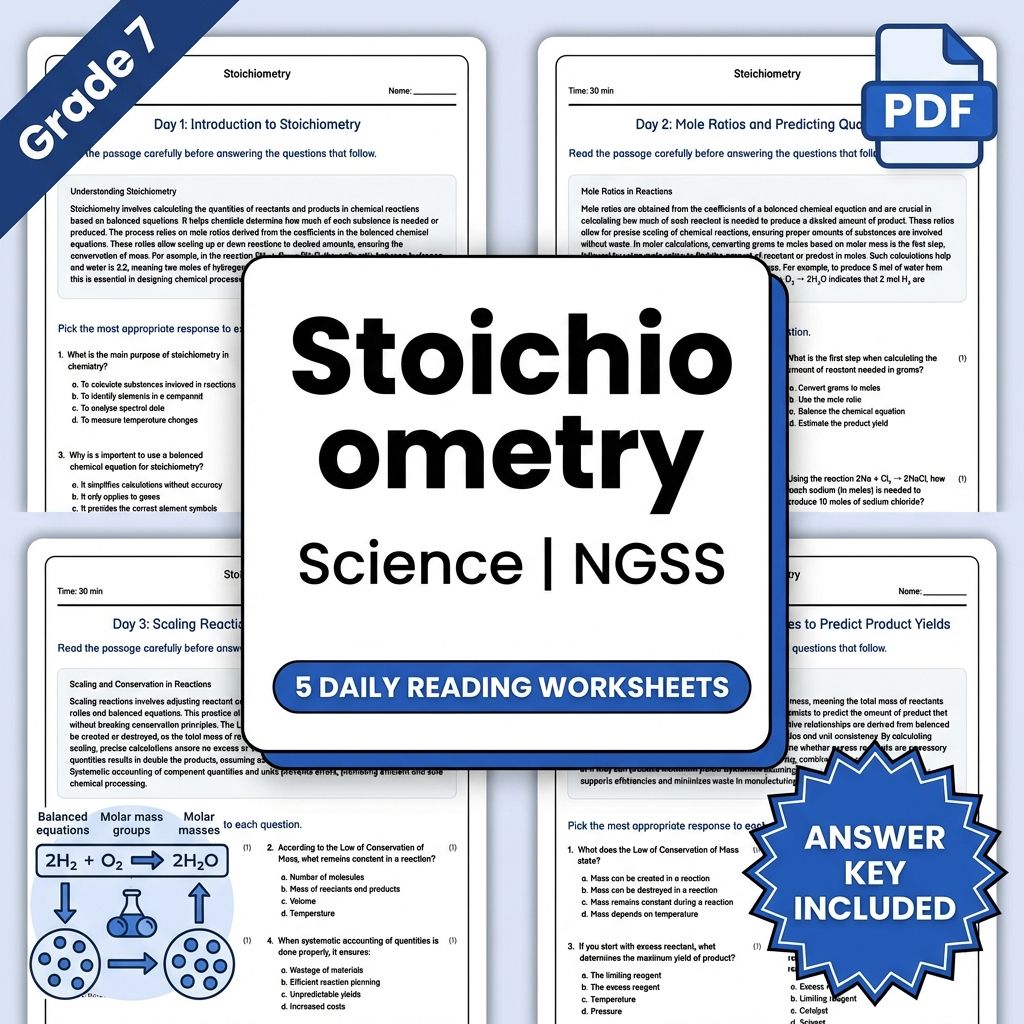
Grade 7 Science – Stoichiometry Daily Reading Worksheet(PDF + Answer Key)
Created byCopper Leaf ClassroomLearning Objectives
- Describe the concept of stoichiometry and its role in chemical reactions.
- Use balanced chemical equations to determine mole ratios of reactants and products.
- Apply ratio reasoning to predict quantities of substances involved in reactions.
Instant download
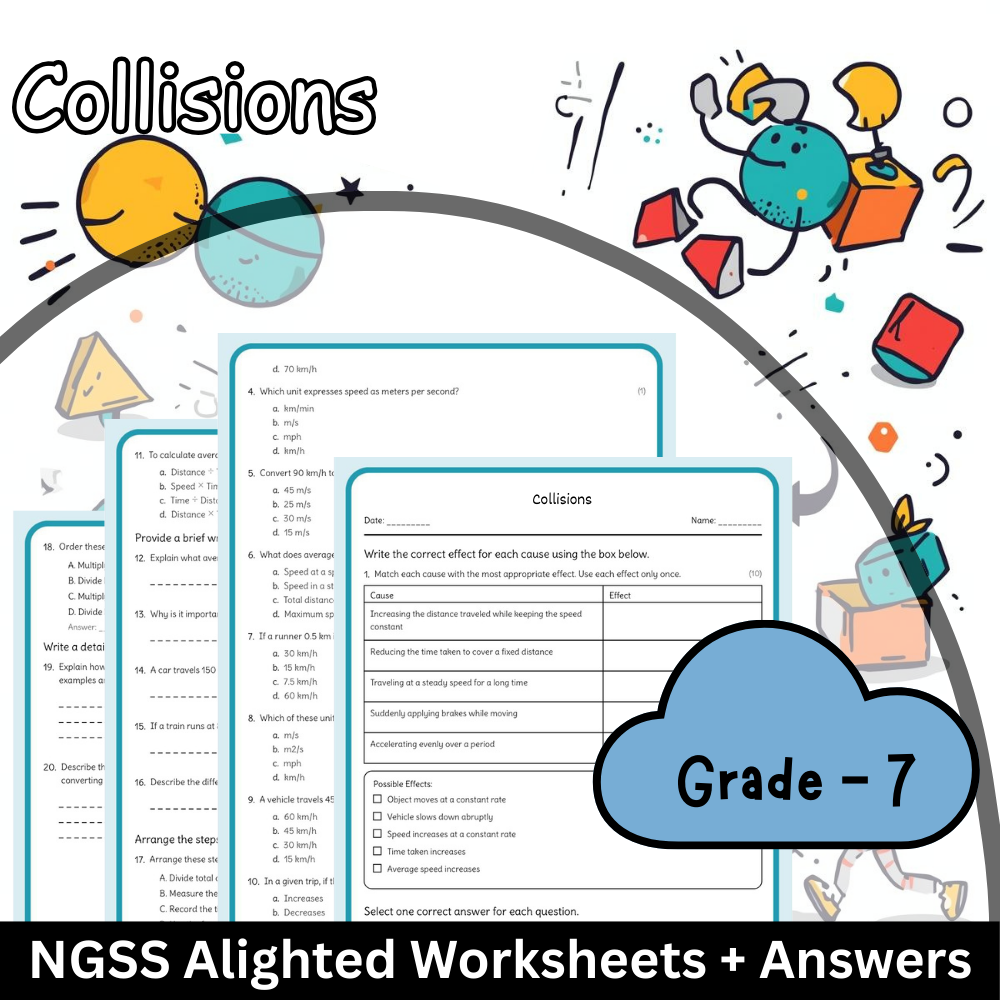
Grade 7 Science | Collisions Worksheet (Worksheet + Answer Key) NGSS
Created byBright Mind ResourcesLearning Objectives
- Understand the principles of momentum conservation during collisions.
- Differentiate between elastic and inelastic collisions.
- Calculate post-collision velocities using mass, velocity, and momentum concepts.
Instant download

Grade 7 Science | Understanding Meiosis & Genetic Variation - Reading Practice
Created byCoral Reef LearningLearning Objectives
- Define meiosis and understand its role in producing reproductive cells.
- Explain how genetic variation arises during meiosis.
- Recognize why siblings are genetically different despite having the same parents.
Instant download

Grade 7 Material Properties Worksheet | Practice & Assessment PDF
Created byClear Sky ClassroomLearning Objectives
- Explain how thermal conductivity, specific heat capacity, density, and phase change affect heat transfer in materials.
- Compare common Alberta construction materials using their thermal and moisture-related properties.
- Describe how porosity and moisture content change effective thermal conductivity in building assemblies.
Instant download

Grade 7 Science – Changes in Matter & Chemical Changes | Daily Reading Worksheet
Created byBright Mind ResourcesLearning Objectives
- Understand the differences between physical changes and chemical changes in matter
- Identify examples of physical changes in everyday life
- Recognize indicators of chemical changes such as color change, gas production, precipitates, and temperature change
Also included in: Grade 7 Daily Reading Science Worksheets Lesson Bundle | Florida NGSSS +1 more
Instant download
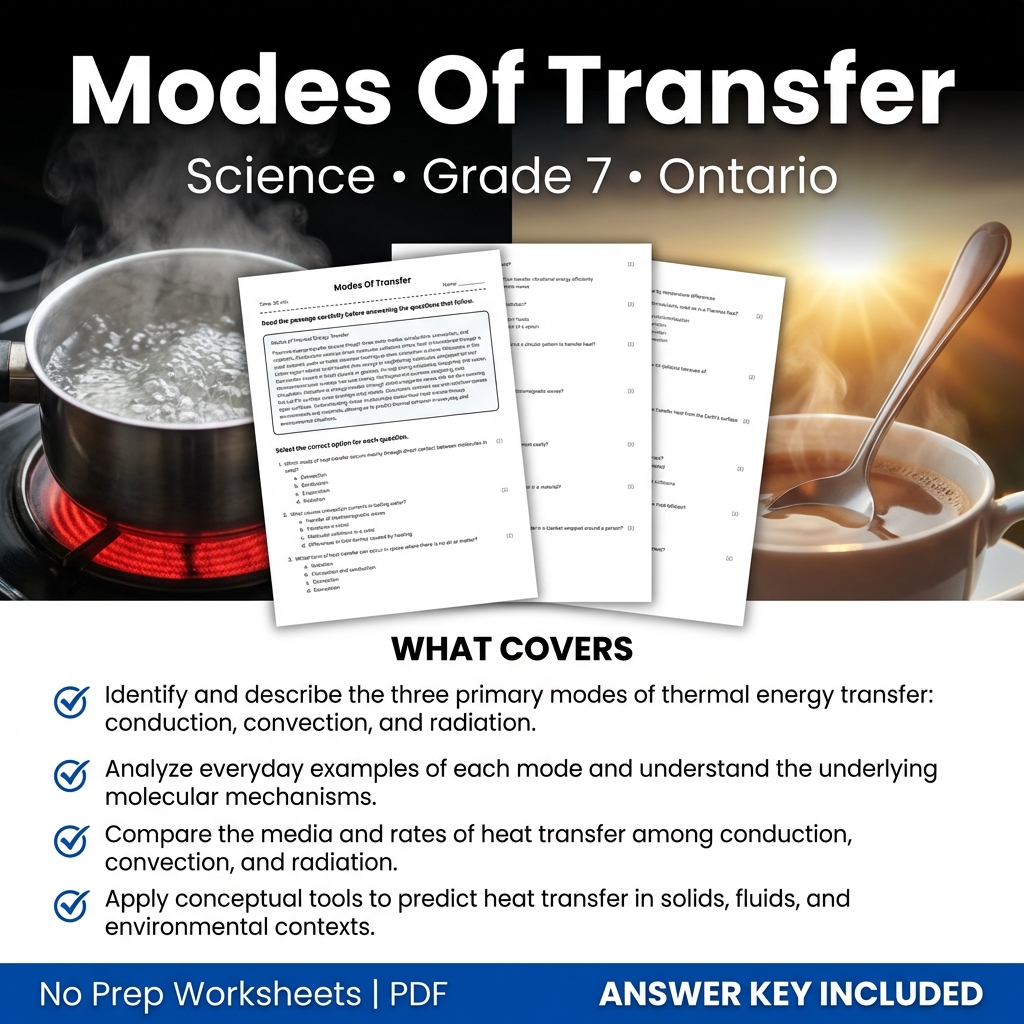
Modes Of Transfer Grade 7 Science Worksheet | Ontario | Printable PDF
Created byCoral Reef LearningLearning Objectives
- Identify and describe the three primary modes of thermal energy transfer: conduction, convection, and radiation.
- Analyze everyday examples of each mode and understand the underlying molecular mechanisms.
- Compare the media and rates of heat transfer among conduction, convection, and radiation.
Instant download
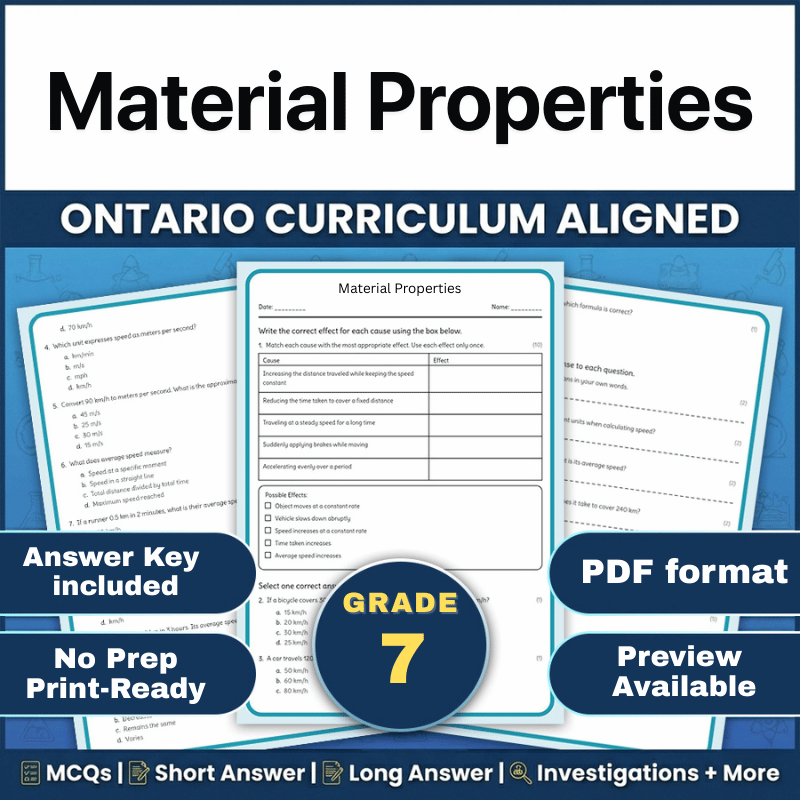
Grade 7 Science | Material Properties Worksheet (Ontario, PDF)
Created byBright Mind ResourcesLearning Objectives
- Define key material properties such as density, tensile and compressive strength, stiffness, ductility, toughness, and thermal expansion.
- Explain how these properties influence structural performance and failure modes.
- Contrast common construction materials—wood, steel, and reinforced concrete—in terms of strength-to-weight ratio, deformation, and failure.
Instant download

Action-Reaction Forces Worksheet | Standards-Based Practice for Grade 7 Science
JCreated byJ.S SheetsLearning Objectives
- Understand the principle of action-reaction forces and how they occur in interactions.
- Identify examples of action-reaction pairs in everyday situations.
- Explain how force pairs are equal in magnitude and opposite in direction.
Also included in: Grade 7 Forces and Matter Science lesson bundle – California Standards +1 more
Instant download

Scientific Modeling, Assumptions & Validation Worksheets Grade 7
Created byPrism Point LearningLearning Objectives
- Describe how abstraction represents essential features of real-world systems
- Identify parameters, units, and scaling choices in numerical models
- Explain how assumptions affect the usefulness of scientific models
Also included in: Scientific Inquiry & Data Practices Lesson Bundle | Grade 7 Science | Ontario +1 more
Instant download

Grade 7 Science | Conservation of Matter Worksheet | California Standards
Created byLumora LearningLearning Objectives
- Explain conservation of matter in a closed system using the atomic model
- Distinguish between physical changes and chemical changes in terms of atoms and mass
- Use mass measurements of reactants and products to support the law of conservation of matter
Instant download

Forces and Change Assessment | General Standards Grade 7 Science
Created byPrism Point LearningLearning Objectives
- Understand how forces act as causes of motion changes.
- Differentiate between balanced and unbalanced forces.
- Explain how friction, air resistance, and gravity influence motion.
Also included in: Grade 7 Physical Science Science Lesson Bundle: General Framework
Instant download

Symbiosis Types Worksheet | Grade 7 Science | Alberta Standards
JCreated byJ.S SheetsLearning Objectives
- Define and distinguish among mutualism, commensalism, and parasitism.
- Identify regional examples of different symbiosis types in Alberta ecosystems.
- Explain ecological consequences of inter-species relationships on population dynamics and resource distribution.
Instant download
About Grade 7 Science Worksheets
Browse 6,039 printable Grade 7 Science worksheets — ready-to-print PDFs with answer keys where available.
Every worksheet on MyTeachingSheets is created by independent teacher-authors and reviewed before publication. All resources download as printable PDFs for classroom, homework, or at-home practice, and many include answer keys. Preview any worksheet free before buying.