
Grade 7 Science Worksheets
6,039 worksheets
Grade 7 Science – Understanding Mixture Types | Daily Reading Worksheet
 Created byQuiet Forest Education
Learning Objectives
- Define solutions, colloids, and suspensions
- Identify examples of each mixture type
- Describe the properties and differences of mixture categories
Also included in: Elements & Compounds Grade 7 Science Daily Reading Worksheets Bundle | Ontario +1 more
Instant download

Biotic and Abiotic Factors Ecosystems Worksheets Grade 7 Science
 Created bySunny Desk Resources
Learning Objectives
- Identify abiotic factors and explain how they affect living organisms in an ecosystem.
- Describe cause-and-effect relationships between resource availability and community patterns.
- Classify examples as biotic or abiotic and use evidence from a passage to support answers.
Also included in: Interactions & Ecosystems Grade 7 Alberta Science Worksheets Bundle +1 more
Instant download

Grade 7 Clouds and Precipitation Worksheet | California Standards Practice PDF
 Created byClear Sky Classroom
Learning Objectives
- Explain how clouds form when air cools and water vapor condenses into tiny droplets or ice crystals
- Describe how temperature and moisture conditions affect the type of clouds and precipitation
- Connect phase changes and energy transfer to the water cycle and local weather patterns
Instant download

Clouds and Precipitation Worksheet Grade 7 Science | Weather Systems
 Created byPrism Point Learning
Learning Objectives
- Explain how air cooling and water vapor turning into tiny droplets or ice crystals form clouds.
- Describe how temperature and moisture conditions affect whether clouds produce low clouds, tall storm clouds, or persistent precipitation.
- Connect phase changes and energy transfer to the water cycle and local weather patterns.
Instant download

Grade 7 Sedimentary Processes Worksheet | BC Practice PDF
Created byClear Sky ClassroomLearning Objectives
- Explain how weathering, transport, deposition, and lithification work together to form sedimentary rocks.
- Compare mechanical and chemical weathering and describe how each contributes to sediment production.
- Interpret how depositional environments influence bedding, fossils, and sedimentary structures.
Instant download

Science Grade 7 Trophic Energy Limits Worksheet | Standards-Aligned Practice
JCreated byJ.S SheetsLearning Objectives
- Explain how energy availability decreases across trophic levels in a food web.
- Describe why only a fraction of ingested energy becomes biomass for the next consumer level.
- Interpret energy-flow ideas to predict patterns in food chain length and biomass.
Also included in: Grade 7 Ecosystem Dynamics Science Lesson Bundle Worksheets – General +1 more
Instant download

Grade 7 Science | Density Particle View - Daily Reading Comprehension
 Created byCoral Reef Learning
Learning Objectives
- Understand the concept of density as mass per unit volume.
- Describe how particles are arranged in materials with different densities.
- Explain how temperature changes can affect the density of a substance.
Instant download

Grade 7 Bridge Design Solution Comparison Worksheet | NGSS Engineering STEM
 Created byBRIGHT PATH RESOURCES
Learning Objectives
- Understand how various bridge truss designs are modeled and compared.
- Analyze trade-offs among performance, cost, durability, and manufacturability.
- Develop skills to evaluate design options using models and prototypes.
Also included in: Bridge Engineering Grade 7 Science Daily Reading Worksheets Lesson Bundle | NGSS +2 more
Instant download
Grade 7 Science — Invasive Species Worksheet MCQ Paper for Mastery
 Created byThe Resource Hub
Learning Objectives
- Understand what invasive species are and how they impact ecosystems
- Identify mechanisms by which invasive species spread and establish
- Examine ecological consequences of invasive species on native biodiversity
Also included in: Grade 7 Science Ecosystems & Interactions Worksheet Bundle +1 more
Instant download

Scientific Inquiry Basics Practice Test | Grade 7 Science Review
Created byPrism Point LearningLearning Objectives
- Define the criteria for scientific questions and explain why testability matters.
- Write hypotheses and describe how operational definitions and variables guide investigations.
- Use measurement precision, documentation, and reproducibility to support reliable conclusions.
Instant download

Science Grade 7 Worksheet Invasive Species Impacts | Standards-Aligned Practice
JCreated byJ.S SheetsLearning Objectives
- Explain how invasive (non-native) species can disrupt ecosystems through competitive displacement, altered trophic relationships, and habitat structure changes.
- Describe pathways by which non-native species are introduced and factors that help them establish and spread.
- Analyze how invasive species can cause long-term ecological and economic consequences, including reduced native diversity, altered nutrient dynamics, and increased management costs.
Instant download

Density and Volume Worksheet | Grade 7 Science Activity & Practice
Created byPrism Point LearningLearning Objectives
- Explain how density relates mass and volume and why it helps distinguish substances.
- Calculate or compare density using the relationship between mass and volume.
- Identify how intensive properties like density do not depend on the amount of material.
Also included in: Physical Science Lesson Bundle | Grade 7 Science | Florida NGSSS
Instant download

Grade 7 Science – Sedimentary Processes & Rock Cycle | Daily Reading Worksheet
 Created byBright Mind Resources
Learning Objectives
- Understand how weathering breaks down rocks into sediments.
- Identify transport and depositional environments for sediments.
- Describe the processes of lithification that turn sediments into sedimentary rocks.
Also included in: Grade 7 Earth Processes Science Daily Reading Worksheets Lesson Bundle | BC +1 more
Instant download

Evidence of Chemical Changes Worksheets Grade 7 Science
Created bySunny Desk ResourcesLearning Objectives
- Identify observable evidence that a chemical change has occurred.
- Explain particle-level bond changes during chemical reactions.
- Distinguish chemical changes from physical changes using observations and reasoning.
Also included in: Matter and Chemical Change Grade 7 Alberta Science Worksheets Bundle +1 more
Instant download
Grade 7 Science | Interactions in Physics Worksheet (PDF + Answer Key)
 Created byRiverstone Classroom
Learning Objectives
- Explain the concept of long-range forces such as gravity, electric, and magnetic interactions.
- Describe how gravity is universally attractive and its qualitative relationship with mass and distance.
- Identify examples of electric and magnetic phenomena in everyday life and planetary motion.
Instant download

Grade 7 Science – Species Adaptations Reading Worksheet | Ontario Standards
Created byBright Mind ResourcesLearning Objectives
- Identify key structural features of organisms that aid in survival
- Describe how physical traits are adapted to specific habitats
- Explain how natural selection influences adaptations
Also included in: Grade 7 Ecosystem Stewardship Science Daily Reading lesson bundle | Ontario +1 more
Instant download

Climate Drivers Over Time Worksheet | Grade 7 Science Practice
Created byPrism Point LearningLearning Objectives
- Explain how natural climate records (ice cores, sediment layers, tree rings) help scientists infer past temperature and precipitation.
- Describe how modern measurements provide evidence of recent climate trends.
- Identify major long-term climate drivers and explain how they can affect Earth’s energy balance and circulation.
Instant download

Environment and Traits Grade 7 Science Worksheet | NGSS Aligned Practice
JCreated byJ.S SheetsLearning Objectives
- Understand how phenotype results from interactions between genetics and environment.
- Identify examples of environmental influence on traits such as height, skin color, and temperature-sensitive pigmentation.
- Distinguish inherited genetic traits from environmentally modulated traits.
Also included in: Grade 7 Genetics and Heredity Science Lesson Bundle – NGSS Framework +1 more
Instant download

Grade 7 Science | Understanding Heat Transfer - Daily Reading Comprehension
Created byCoral Reef LearningLearning Objectives
- Describe the different types of heat transfer: conduction, convection, and radiation.
- Explain how energy transfers between objects during heating and cooling processes.
- Use scientific units like Joules and kilojoules to quantify energy changes.
Also included in: Energy, Heat and Thermal Processes Lesson Bundle: Grade 7 Science Alberta +1 more
Instant download

Mountain Building Science Worksheet | Grade 7 Standards-Aligned Practice
JCreated byJ.S SheetsLearning Objectives
- Understand the processes involved in orogeny and mountain formation.
- Identify key features of mountain belts and related geological processes.
- Describe the roles of crustal shortening, uplift, and erosion in mountain evolution.
Instant download

Optimization Methods Practice Worksheet | Grade 7 Science Ontario Review
Created byPrism Point LearningLearning Objectives
- Identify performance metrics and constraints when improving a design
- Use parameter variation and sensitivity analysis to estimate how changes affect outcomes
- Evaluate trade-offs using simple quantitative cost-benefit reasoning
Instant download

Grade 7 Science | Cell Membrane Structure Worksheet | BC Aligned
 Created byLumora Learning
Learning Objectives
- Describe the basic organization of the cell membrane as a fluid mosaic model.
- Identify the functions of phospholipids, proteins, cholesterol, and carbohydrates in the membrane.
- Explain how the structure of the cell membrane regulates transport and communication.
Instant download
Grade 7 Science | Inquiry Foundations Worksheet | TEKS-Aligned
Created byLumora LearningLearning Objectives
- Define scientific inquiry as systematic observation, question formulation, hypothesis development, and measurement.
- Distinguish between quantitative and qualitative observations and identify appropriate measurement units.
- Recognize sources of error in scientific experiments and data collection.
Instant download

Chemical Properties Worksheet | Grade 7 Science Printable PDF Ontario
 Created byCedar Grove Learning
Learning Objectives
- Explain what chemical properties are and how they describe behaviour during chemical change
- Use observable evidence (gas, colour change, precipitate formation) to infer chemical reactions
- Relate reactivity with acids and bases, combustion potential, oxidation, corrosion, and pH changes to material suitability
Also included in: Grade 7 Matter: Mixtures and Separation Science Lesson Bundle | Ontario +1 more
Instant download

Symbiosis and Ecological Effects Worksheets | Grade 7 Science
Created bySunny Desk ResourcesLearning Objectives
- Identify the defining features of mutualism, commensalism, and parasitism.
- Use examples to explain how different symbiosis types affect populations over time.
- Describe how symbiotic relationships can change resource distribution and drive coevolution.
Also included in: Interactions & Ecosystems Grade 7 Alberta Science Worksheets Bundle +1 more
Instant download
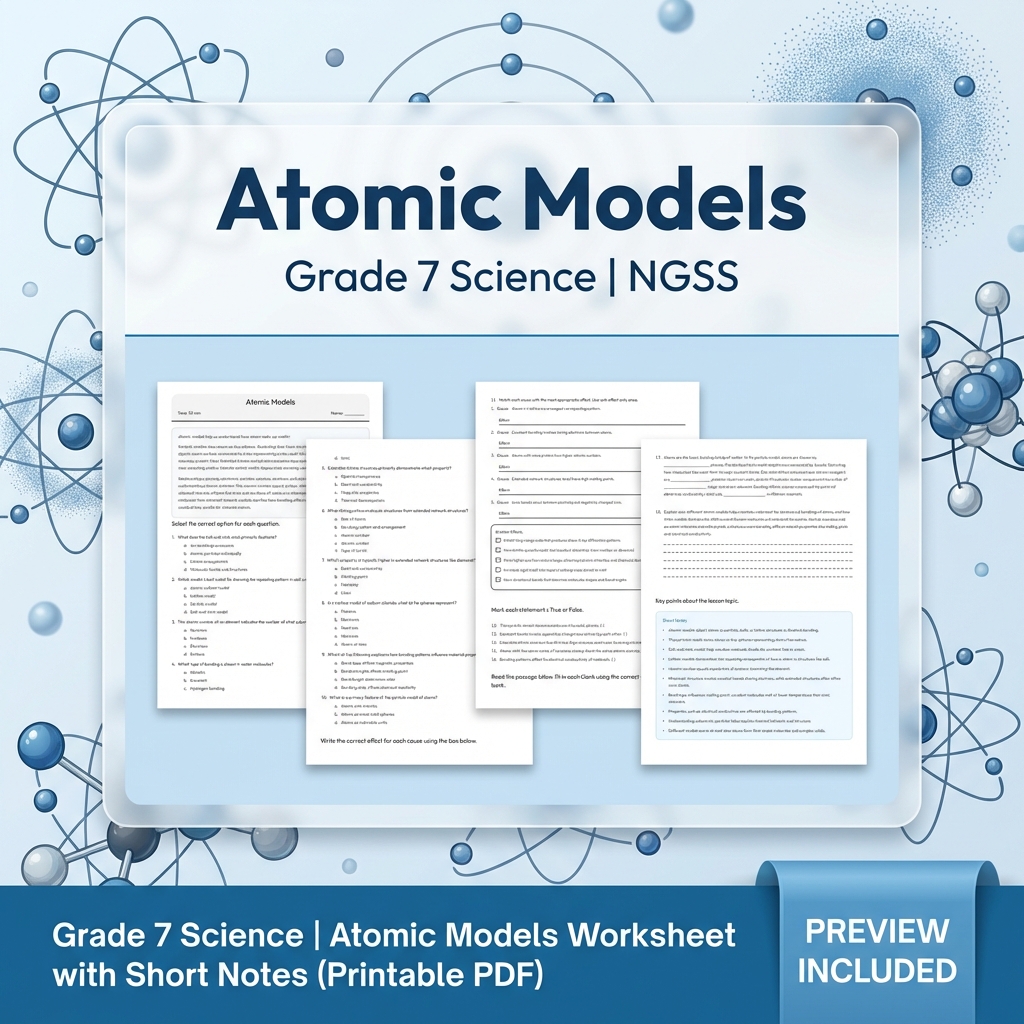
Grade 7 Science | Atomic Models Worksheet with Short Notes (Printable PDF)
 Created byMeadowlark Worksheets
Learning Objectives
- Describe different atomic models including particle, ball-and-stick, and lattice representations.
- Explain how atoms form molecules and extended structures like water molecules and crystal lattices.
- Connect subatomic particle relationships with atomic number and chemical formula notation.
Also included in: Grade 7 Science | Matter and Its Interactions NGSS Worksheet Collection +1 more
Instant download

Forces Introduction Worksheet | Grade 7 Science Activities
Created byPrism Point LearningLearning Objectives
- Explain how push and pull interactions create forces that can change an object's motion
- Differentiate between contact forces and non-contact forces using examples
- Describe how net force influences acceleration (speeding up, slowing down, or changing direction)
Instant download

Grade 7 Cell Energy Use Worksheet | California Standards Practice PDF
Created byClear Sky ClassroomLearning Objectives
- Explain how cells convert chemical energy from food into usable energy for life processes.
- Describe how ATP stores and transfers energy inside cells.
- Use the idea of matter conservation to explain what happens to nutrients during energy use.
Instant download

Convection Systems Worksheet | Grade 7 Science Activities
Created byPrism Point LearningLearning Objectives
- Explain how convection transports heat through fluid motion caused by temperature and density differences.
- Distinguish natural convection from forced convection and describe real-world examples.
- Use boundary-layer and buoyancy ideas to predict how heat transfer patterns can change with conditions.
Instant download

Grade 7 Science | Population Models Worksheet | BC Standards
Created byLumora LearningLearning Objectives
- Understand the differences between exponential and logistic population growth models.
- Identify factors that influence population dynamics, including density-dependent and density-independent factors.
- Interpret how models predict changes in populations under various environmental conditions.
Instant download

Grade 7 Science – Elements & Compounds | Daily Reading Worksheet
Created byBright Mind ResourcesLearning Objectives
- Understand the basic differences between elements and compounds
- Identify features such as atomic composition, bonding, and properties
- Learn examples of elements and compounds and their characteristics
Also included in: Grade 7 Matter Science Daily Reading Worksheets Lesson Bundle | Ontario +1 more
Instant download

Statistical Reasoning Practice Worksheets | Grade 7 Science Review
Created byPrism Point LearningLearning Objectives
- Interpret descriptive statistics such as mean, median, mode, and interquartile range in context.
- Explain how outliers and variance affect the interpretation of data sets.
- Distinguish between descriptive summaries and basic inferential ideas such as confidence and sample size.
Instant download

Grade 7 Science Worksheet on Reflective Surfaces and Radiative Heat Exchange
JCreated byJ.S SheetsLearning Objectives
- Explain how surface albedo affects solar gain when sunlight strikes a material.
- Describe how emissivity influences radiative heat transfer through infrared emission.
- Compare reflective roofs and low-emissivity glazing as real-world strategies to manage heat exchange.
Instant download

Scaling Effects Assessment | TEKS Grade 7 Science Standards-Aligned
Created byPrism Point LearningLearning Objectives
- Understand how physical forces and properties change when prototypes are scaled to full size.
- Explain the concepts of square-cube law, surface-to-volume ratio, and Reynolds number in relation to scaling.
- Analyze examples such as models, turbines, and animal physiology to predict performance differences.
Instant download

Ecosystem Dynamics Assessment | California Standards Grade 7 Science
Created byPrism Point LearningLearning Objectives
- Explain how matter cycling and energy flow affect ecosystem responses to changing conditions.
- Describe how changes in nutrient availability and decomposition can alter biomass and population sizes.
- Predict cascading effects in food webs when resource inputs or energy availability change.
Also included in: Grade 7 Energy Flow and Matter Cycling Science lesson bundle – California Standards +1 more
Instant download

Grade 7 Organ Interactions Worksheet | Human Body Systems NGSS
 Created byAmber Owl Education
Learning Objectives
- Explain how the circulatory, respiratory, digestive, and nervous systems interact to support homeostasis in multicellular animals
- Describe how oxygen and nutrients move through organ systems and how feedback helps maintain stable internal conditions
- Compare organ-system interactions in animals (human mammalian systems) and relate them to plant vascular transport
Also included in: Grade 7 Science Matter Cycling & Energy Transformations Lesson Bundle | NGSS +1 more
Instant download

Understanding Acceleration Assessment for Grade 7 Science | Standards-Aligned
Created byPrism Point LearningLearning Objectives
- Define acceleration and explain how it relates to changes in velocity.
- Describe how force and mass influence acceleration in objects.
- Identify patterns of constant and changing acceleration from velocity data.
Also included in: Grade 7 Physical Science Science Lesson Bundle: General Framework
Instant download

Separation Methods Worksheet for Grade 7 Science | Standards-Aligned Practice
JCreated byJ.S SheetsLearning Objectives
- Understand various physical separation techniques such as filtration, decanting, evaporation, and magnetic separation.
- Identify the physical properties exploited by different separation methods.
- Analyze regional examples of separation processes and their effectiveness.
Instant download
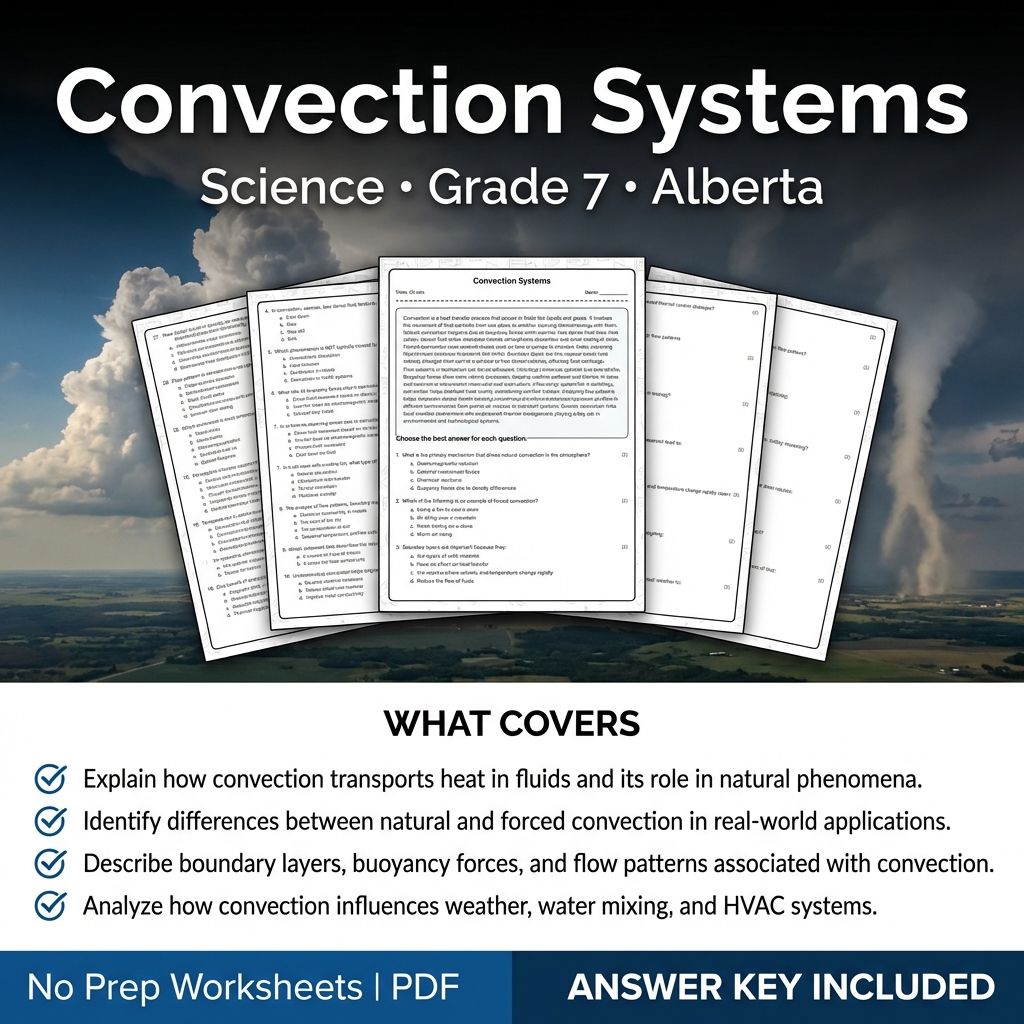
Convection Systems Worksheet for Grade 7 Science | Alberta Standards
Created byCoral Reef LearningLearning Objectives
- Explain how convection transports heat in fluids and its role in natural phenomena.
- Identify differences between natural and forced convection in real-world applications.
- Describe boundary layers, buoyancy forces, and flow patterns associated with convection.
Instant download

Grade 7 Science Worksheet – Evidence of Chemical Reactions (TEKS) (PDF)
 Created byEvergreen Desk Education
Learning Objectives
- Identify common evidence that a chemical reaction occurred (gas, precipitate, color change, and temperature change).
- Connect observable evidence to how reactants transform into new substances and how mass is conserved.
- Use simple symbolic formulas to describe reactant-to-product changes.
Instant download

Grade 7 Science – Truss Analysis & Structures | Daily Reading Worksheet
Created byBright Mind ResourcesLearning Objectives
- Identify basic components of trusses and their functions
- Outline the principles of internal force distribution within truss structures
- Recognize common truss forms used in bridges and roofs
Also included in: Grade 7 Structures & Forces Science Lesson Bundle Daily Reading | Alberta +2 more
Instant download

Grade 7 Science | Structural Failures in Engineering - Reading Comprehension
Created byCoral Reef LearningLearning Objectives
- Understand key concepts related to Science
- Apply knowledge through practice questions
- Demonstrate comprehension of the material
Instant download
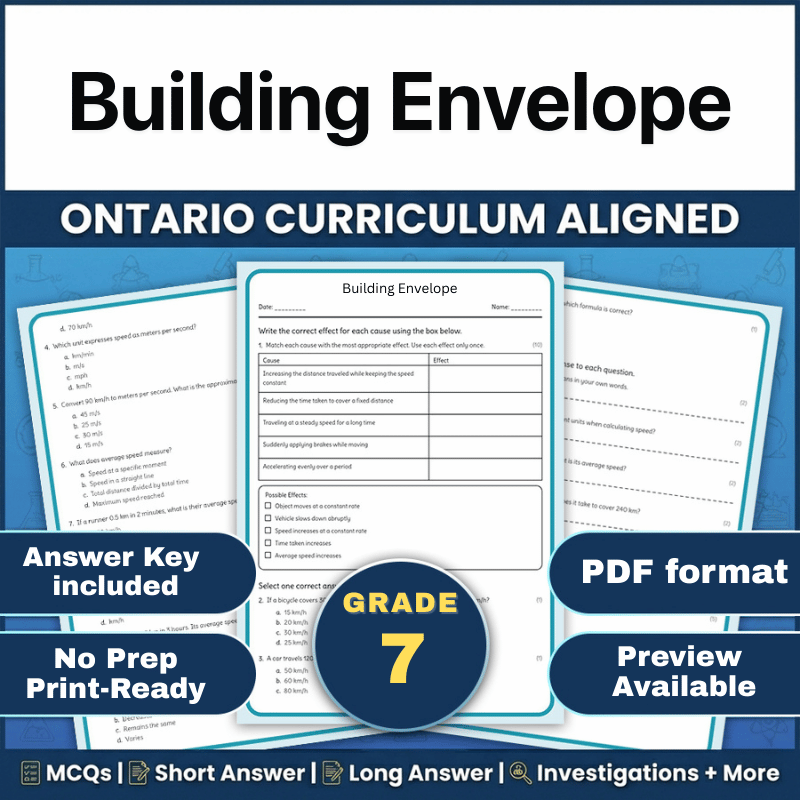
Grade 7 Science | Building Envelope Worksheet (Ontario, PDF)
Created byBright Mind ResourcesLearning Objectives
- Understand how walls, roofs, windows, and foundations contribute to thermal performance.
- Identify the impacts of interfaces, thermal bridging, and air infiltration on energy efficiency.
- Compare insulation placement, continuous barriers, and ventilation strategies in managing heat transfer.
Instant download

Rock Cycle Integration Worksheet | Grade 7 Science Review & Practice
Created byPrism Point LearningLearning Objectives
- Explain how tectonic processes and magmatism connect to weathering, erosion, burial, and metamorphism in the rock cycle.
- Describe how uplift and surface processes can expose rocks and restart recycling of Earth materials.
- Use the rock cycle vocabulary to interpret how regional geology and stratigraphic records form over time.
Also included in: Earth's Systems & Processes Lesson Bundle | Grade 7 Science | BC +1 more
Instant download

Grade 7 Science | Habitat Fragmentation Worksheet | BC Standards
Created byLumora LearningLearning Objectives
- Understand what habitat fragmentation is and how it affects ecosystems.
- Identify the consequences of habitat fragmentation on biodiversity and species survival.
- Explain the concept of landscape connectivity and its importance in ecosystems.
Instant download

Solar Patterns Test Prep Worksheet | Grade 7 Science NGSS
Created byPrism Point LearningLearning Objectives
- Explain how relative motion of the Sun, Earth, and Moon creates predictable lunar phases.
- Use the ideas of axial tilt and orbital geometry to describe day-night and seasonal patterns.
- Connect position changes to eclipses and to repeating cycles in the solar system.
Also included in: Grade 7 Earth and Space Science Lesson Bundle NGSS Test Prep Worksheets
Instant download

Mass Wasting and Coasts Worksheet | Grade 7 Earth Science Activity
Created byPrism Point LearningLearning Objectives
- Explain how gravity and water can move Earth materials downslope and across coastlines.
- Describe how saturation and slope instability can lead to landslides.
- Identify ways waves and storm surge reshape beaches, dunes, and shorelines.
Also included in: Grade 7 Weather & Climate Science Lesson Bundle | Florida NGSSS
Instant download

Geologic Hazards and Plate Motion Worksheet | Grade 7 Science
Created byBRIGHT PATH RESOURCESLearning Objectives
- Explain how plate tectonics can cause earthquakes along faults and drive volcanic activity.
- Describe how weathering, erosion, and deposition change Earth’s surface over time.
- Use evidence such as fault features, lava flows, and sediment layers to connect geologic processes to landforms.
Also included in: Grade 7 Earth Science Worksheets Bundle | Weather, Climate & Earth Systems +2 more
Instant download
About Grade 7 Science Worksheets
Browse 6,039 printable Grade 7 Science worksheets — ready-to-print PDFs with answer keys where available.
Every worksheet on MyTeachingSheets is created by independent teacher-authors and reviewed before publication. All resources download as printable PDFs for classroom, homework, or at-home practice, and many include answer keys. Preview any worksheet free before buying.