
Grade 7 Science Worksheets
6,039 worksheets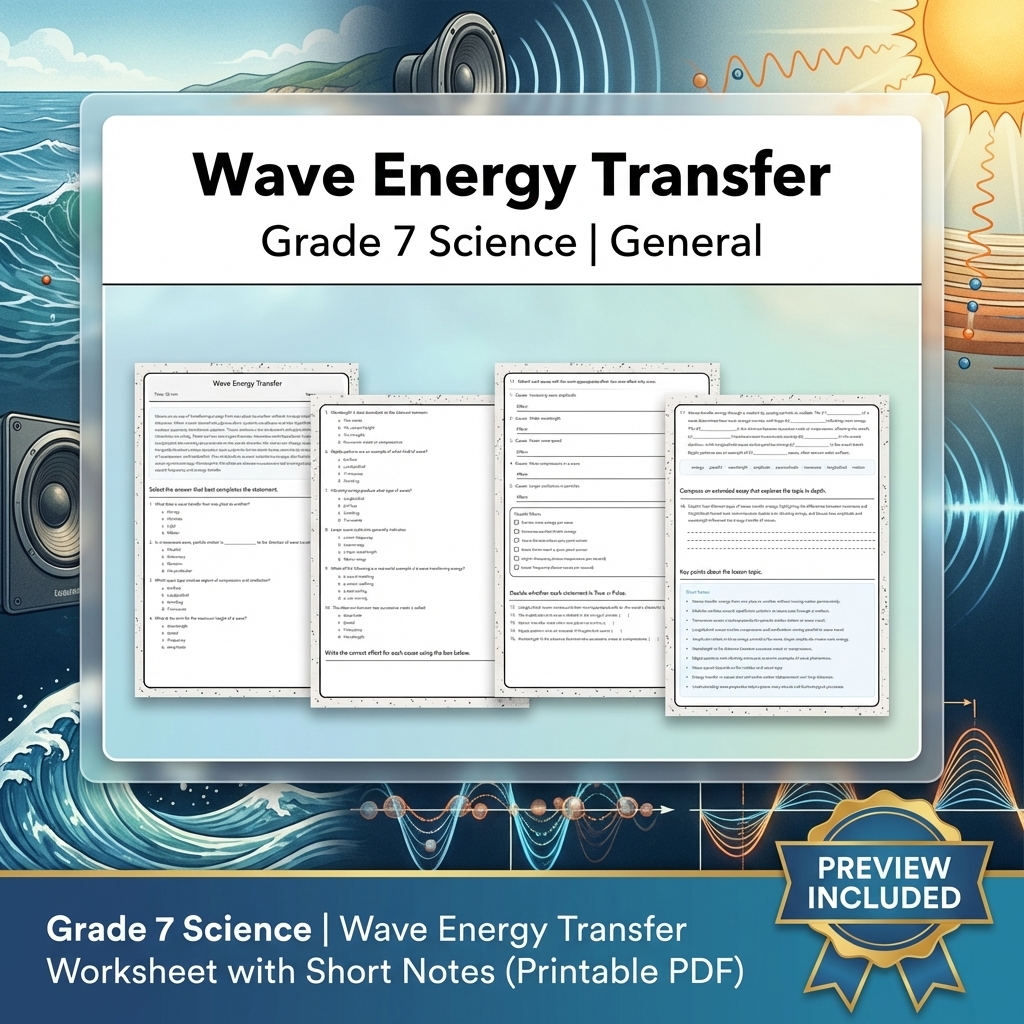
Grade 7 Science | Wave Energy Transfer Worksheet with Short Notes
 Created byMeadowlark Worksheets
Learning Objectives
- Understand how waves transfer energy without moving matter permanently.
- Differentiate between transverse and longitudinal waves.
- Explain the significance of amplitude and wavelength in wave energy.
Also included in: Grade 7 Energy Transfer and Motion Science Lesson Bundle | General +1 more
Instant download

Embryonic Patterns Practice Worksheet | Grade 7 Science NGSS Review
 Created byPrism Point Learning
Learning Objectives
- Compare embryonic development across animal groups to identify conserved stages and transient structures.
- Explain how developmental timing and patterning can support evolutionary relationships.
- Use embryology evidence (e.g., pharyngeal pouches and limb buds) to make claims about shared developmental pathways.
Also included in: Grade 7 Evolution, Natural Selection Science Lesson Bundle for NGSS
Instant download

Evidence From Data Worksheet for Grade 7 Science | Standards-Aligned Practice
JCreated byJ.S SheetsLearning Objectives
- Explain how scientific claims are supported by measurable evidence from data
- Distinguish direct observations from interpretations when analyzing results
- Use appropriate scales, units, and comparisons to reason from data patterns
Also included in: Grade 7 Scientific Variables, Data, and Models Science Lesson Bundle +1 more
Instant download
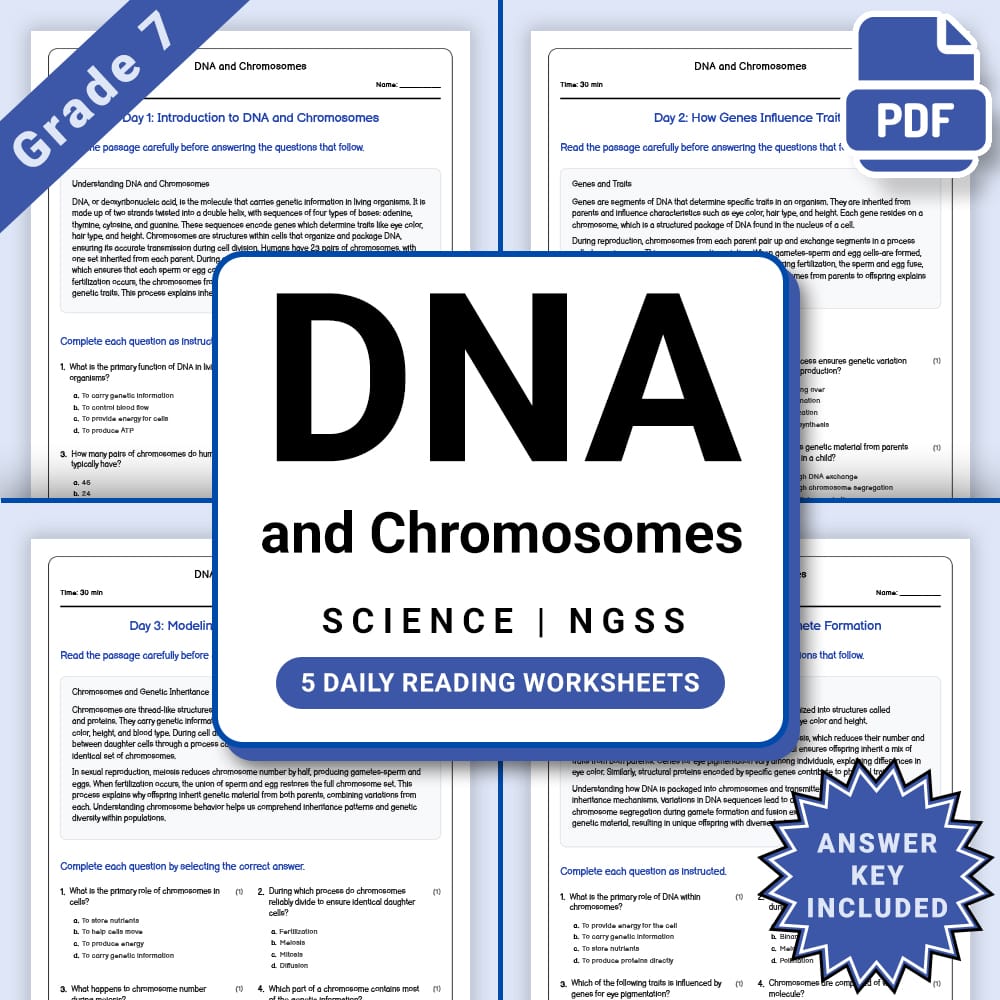
Grade 7 Science – DNA and Chromosomes Worksheet(PDF + Answer Key)
 Created byCopper Leaf Classroom
Learning Objectives
- Identify the components of DNA and chromosomes
- Understand how genes are encoded within DNA molecules
- Explain the process of chromosome segregation during gamete formation
Instant download

Grade 7 Science – Indigenous Knowledge & Ecology | Daily Reading Worksheet
 Created byBright Mind Resources
Learning Objectives
- Understand the importance of oral histories in ecological knowledge.
- Identify how traditional place-based knowledge informs environmental understanding.
- Recognize examples of stewardship practices in Indigenous communities.
Also included in: Grade 7 Ecosystems Science Lesson Bundle for Daily Reading Worksheets | Alberta +2 more
Instant download

Prototyping Methods Test Prep Worksheet | Grade 7 Science | Ontario
Created byPrism Point LearningLearning Objectives
- Compare scaled physical models, digital finite-element models, and laboratory load rigs for evaluating strength, stiffness, and failure modes.
- Explain how instrumentation such as strain gauges and displacement transducers help quantify structural response.
- Identify limitations of scaling, especially material heterogeneity and joint behavior, when using prototypes to guide design revisions.
Instant download

System Models Worksheet for Grade 7 Science | Alberta Standards Practice
JCreated byJ.S SheetsLearning Objectives
- Understand how energy pathways and transformations are represented in system models.
- Identify the principles of energy conservation in mechanical and industrial systems.
- Analyze energy flow diagrams, including Sankey diagrams, to determine efficiencies and losses.
Instant download

Grade 7 Science Worksheet | Quantitative Heat Practice with Standards Alignment
JCreated byJ.S SheetsLearning Objectives
- Understand how to represent thermal energy changes numerically using units of energy and temperature scales.
- Apply formulas involving specific heat, mass, and temperature change to calculate energy transfer in Joules and kilojoules.
- Interpret practical examples of heat calculations such as heating water, melting snow, or warming air in Alberta contexts.
Instant download

Grade 7 Science | Understanding the Cell Membrane - Daily Reading Comprehension
 Created byCoral Reef Learning
Learning Objectives
- Describe the structure of the cell membrane as a phospholipid bilayer.
- Identify the roles of embedded proteins, cholesterol, and carbohydrates in the cell membrane.
- Explain how the fluid mosaic model contributes to the membrane's functions.
Instant download

Grade 7 Material Properties Density Worksheet | NGSS Physical Science
 Created byBRIGHT PATH RESOURCES
Learning Objectives
- Understand what density is and how it relates to material properties.
- Compare the density of different materials using observations and data.
- Learn how density helps identify and classify materials in everyday life.
Also included in: Chemical Reactions Grade 7 Science Daily Reading Worksheets Lesson Bundle | NGSS +2 more
Instant download

Grade 7 Human Impacts Worksheet | NGSS Environmental Science Activity with Answer Key
 Created byNorthstar Worksheets
Learning Objectives
- Explain how scientists use environmental indicators to monitor human impacts on land, water, and air.
- Describe how remote sensing and land-cover data can reveal changes over time.
- Evaluate mitigation strategies and trade-offs between economic needs and long-term ecosystem resilience.
Also included in: Earth & Environmental Systems: Grade 7 Science Lesson Bundle | NGSS +1 more
Instant download

Food Building Blocks Worksheet for Grade 7 Science | Standards-Aligned Practice
JCreated byJ.S SheetsLearning Objectives
- Understand the molecules in food and their roles as building materials and energy sources.
- Describe how food molecules are broken down and used for growth, repair, and energy.
- Explain the process of how food provides energy for body functions over time.
Also included in: Grade 7 Ecosystem Energy & Matter Cycles Science Lesson Bundle +1 more
Instant download

Material Selection Test Prep Worksheet | Grade 7 Science BC Standards
Created byPrism Point LearningLearning Objectives
- Identify physical and chemical properties used to choose materials for specific applications
- Explain how chemical stability helps prevent unwanted reactions such as rusting and acid attack
- Use material properties (density, strength, solubility, reactivity) to justify material selection decisions
Also included in: Matter & Chemical Change Lesson Bundle — Grade 7 Science British Columbia +1 more
Instant download

Cosmic Scale Worksheet | Grade 7 NGSS Astronomy Distances & Space Size
 Created byAmber Owl Education
Learning Objectives
- Use astronomical units, planetary diameters, and light-years to compare distances in and beyond the solar system
- Explain how orders of magnitude and logarithmic scaling help scientists represent extreme size differences
- Interpret how scale affects what we can observe, such as apparent motion and observational limits
Also included in: Grade 7 Science Space, Gravity, and Earth History Lesson Bundle | NGSS +1 more
Instant download

Grade 7 DNA and Chromosomes Worksheet | NGSS Genetics Science Activity
Created byBRIGHT PATH RESOURCESLearning Objectives
- Understand the structure and function of DNA molecules and chromosomes
- Learn how chromosomes organize genetic material within cells
- Explore how DNA sequences encode traits and influence observable characteristics
Also included in: Grade 7 Genetics Science Lesson Bundle Daily Reading Worksheets | NGSS +2 more
Instant download

Grade 7 Cosmic Scale Worksheet | NGSS Practice PDF
 Created byClear Sky Classroom
Learning Objectives
- Understand how astronomical units, planetary diameters, and light-years are used to compare cosmic distances and sizes.
- Interpret scaled diagrams and logarithmic representations of the solar system and galaxy.
- Analyze orders of magnitude differences and their effects on observational limits and apparent motion.
Also included in: Grade 7 Space Science NGSS Lesson Bundle for Science: Worksheet B +1 more
Instant download

Gravity And Weight Assessment | Florida NGSSS Standards Grade 7 Science
Created byPrism Point LearningLearning Objectives
- Explain how gravity acts as a force and how it affects the motion of objects near Earth
- Differentiate between mass and weight and describe how weight depends on gravity strength
- Interpret how acceleration due to gravity relates to falling objects, especially when air resistance is minimal
Also included in: Grade 7 Matter, Forces & Energy Science Lesson Bundle | Florida NGSSS
Instant download

Grade 7 Data Representations Worksheet | Practice & PDF
Created byClear Sky ClassroomLearning Objectives
- Use consistent units, labels, and scales to organize measurement data in tables and graphs.
- Interpret graphs by describing trends, clusters, and comparisons between groups.
- Use relationships (direction and shape) to explain what the data suggest, not just single values.
Instant download

Grade 7 Earth Sun Cycles Worksheet | Practice & Review PDF
Created byClear Sky ClassroomLearning Objectives
- Explain how Earth’s axial tilt and revolution around the Sun produce seasonal changes and variations in day length.
- Describe how the daily apparent motion of the Sun supports timekeeping and calendar conventions.
- Use models and vocabulary (axial tilt, hemisphere, day length, equinox, solstice) to make evidence-based claims about Earth-Sun cycles.
Instant download

Environmental Impacts Worksheet Grade 7 Science | Engineering Design & Sustainability
Created byPrism Point LearningLearning Objectives
- Explain how design constraints can include environmental and human health impacts
- Evaluate whether a solution is both technically feasible and socially/environmentally responsible
- Use science ideas (pollutants, weathering, durability) to justify constraint choices
Instant download

Thermal Performance of Building Envelopes Worksheets Grade 7 Science
Created byPrism Point LearningLearning Objectives
- Explain how building components affect heat transfer
- Describe how thermal bridging reduces envelope performance
- Explain how air infiltration affects building energy use
Also included in: Thermal Energy & Heat Transfer Lesson Bundle | Grade 7 Science | Ontario +1 more
Instant download

Abiotic Influences Practice Worksheet | Grade 7 Science Assessment
Created byPrism Point LearningLearning Objectives
- Explain how abiotic factors (temperature, moisture, light, nutrients, and pH) affect where organisms live and how well they survive.
- Describe how daily and seasonal changes in abiotic conditions can create stress or opportunities for populations.
- Use cause-and-effect reasoning to predict how extreme abiotic events can change population size and carrying capacity.
Also included in: Ecosystems & Interactions Lesson Bundle – Grade 7 Science BC Framework +1 more
Instant download
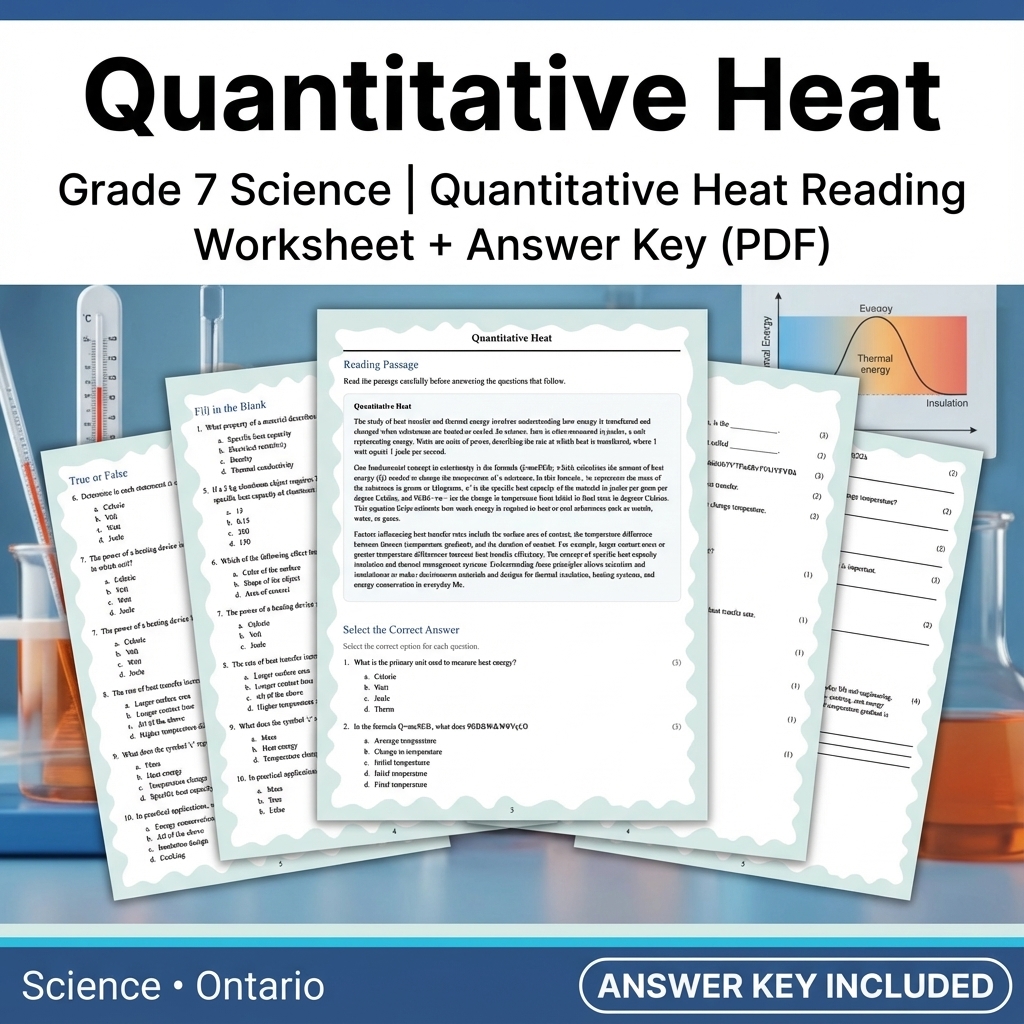
Grade 7 Science | Quantitative Heat Reading Worksheet + Answer Key (PDF)
JCreated byJ.S SheetsLearning Objectives
- Understand the relationship between heat, mass, and temperature change using the formula Q=mcΔT
- Identify and explain units such as joules and watts used in heat calculations
- Apply basic heat calculation skills to practical scenarios involving specific heat capacity
Also included in: Grade 7 Science | Thermal Energy & Transfer Worksheet Bundle +1 more
Instant download

Radiant Energy Transfer Worksheets | Grade 7 Science Heat & Energy
 Created bySunny Desk Resources
Learning Objectives
- Explain how radiant transfer moves energy using electromagnetic waves
- Describe how solar intensity, absorptivity, and emissivity affect net radiative heating
- Compare how different surfaces (roofs, vegetation, snow) can change daytime warming and nighttime cooling
Also included in: Energy, Heat & Thermal Processes Grade 7 Science Alberta Bundle +1 more
Instant download

Ecological Inquiry Worksheet | Science Practice for Grade 7 | Alberta
JCreated byJ.S SheetsLearning Objectives
- Understand the systematic approaches used in ecological inquiry.
- Identify key components such as hypothesis framing and variable selection.
- Recognize the importance of evidence and data interpretation in ecology.
Instant download

Grade 7 Science | Understanding Ecological Niches - Daily Reading Comprehension
Created byCoral Reef LearningLearning Objectives
- Understand key concepts related to Science
- Apply knowledge through practice questions
- Demonstrate comprehension of the material
Instant download
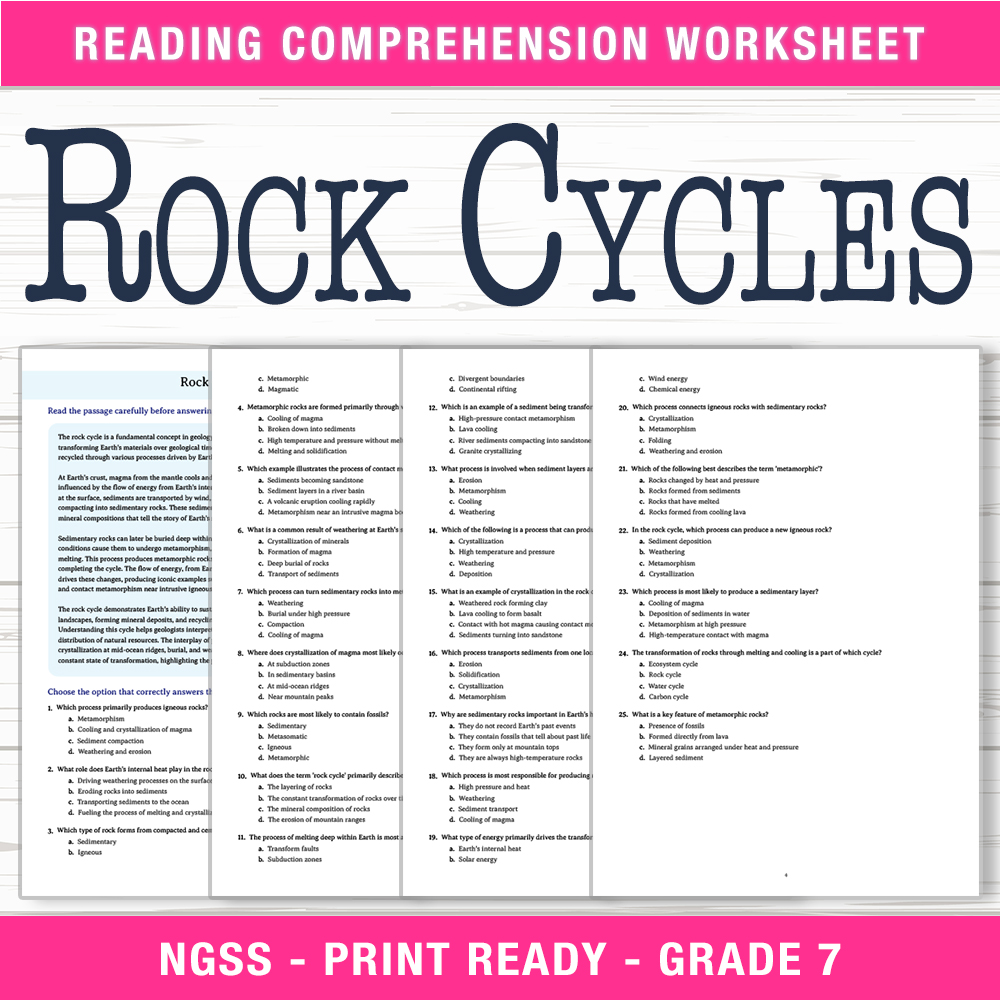
Grade 7 Science – Rock Cycles Worksheet (PDF + Answer Key)
 Created byRiverstone Classroom
Learning Objectives
- Describe the processes involved in the cycling of Earth's rocks, including melting, crystallization, sedimentation, and metamorphism.
- Identify the various types of rocks—igneous, sedimentary, and metamorphic—and their formation pathways.
- Explain the role of energy flow in transforming rocks within the Earth's crust and mantle.
Instant download

7th Grade Science Worksheet | Newton's Laws TEKS (PDF) – Assessment for Forces & Motion
 Created byEvergreen Desk Education
Learning Objectives
- Explain inertia using Newton’s First Law and predict how motion changes when a net force acts
- Use Newton’s Second Law to describe how acceleration depends on net force and mass
- Identify action–reaction pairs and predict how forces between objects affect motion
Instant download

Sound Waves: Pitch and Loudness Science Worksheet Grade 7
Created byBRIGHT PATH RESOURCESLearning Objectives
- Explain how vibrating objects produce pressure waves in a medium
- Describe how frequency affects pitch and amplitude affects loudness
- Interpret how sound transmission depends on a medium such as air
Also included in: Grade 7 Physical Science Worksheets Bundle | Energy, Waves & Motion +2 more
Instant download

Science Grade 7 Worksheet: Meiosis Variation | Standards-Aligned Practice
JCreated byJ.S SheetsLearning Objectives
- Explain how chromosome segregation during meiosis produces genetically different reproductive cells
- Describe how crossing over and independent assortment increase genetic variation
- Connect meiotic genetic variation to why siblings are not identical and to how selection can act over generations
Also included in: Grade 7 Evolution and Population Dynamics Science Lesson Bundle – Florida NGSSS +1 more
Instant download

Grade 7 Science – Understanding Accuracy & Uncertainty | Daily Reading Worksheet
Created byBright Mind ResourcesLearning Objectives
- Define measurement accuracy and explain its importance in science.
- Identify factors that contribute to measurement uncertainty.
- Describe how tool resolution limits measurement precision.
Also included in: Scientific Models & Evidence Grade 7 Science Reading Lesson Bundle | General +1 more
Instant download

Grade 7 Simple Systems And Mechanisms Worksheet | General Practice PDF
Created byClear Sky ClassroomLearning Objectives
- Identify common simple mechanisms (gears, pulleys, levers, and linkages) and describe how they transfer motion or force.
- Explain how an engineered system connects input energy to output performance using cause-and-effect reasoning.
- Use evidence from a mechanism (like gear ratio or lever position) to predict changes in speed and torque.
Instant download

7th Grade Science Worksheet | Mixtures Separation TEKS (PDF)
Created byEvergreen Desk EducationLearning Objectives
- Distinguish homogeneous mixtures from heterogeneous mixtures using observable properties.
- Select an appropriate separation method based on differences in solubility, particle size, and boiling point.
- Explain how physical separation can produce distinct fractions without changing chemical identities.
Instant download

Grade 7 Science – Cell Structure & Function | Daily Reading Worksheet
Created byBright Mind ResourcesLearning Objectives
- Identify major cell components and their functions.
- Differentiate between organelles such as nucleus, mitochondria, chloroplasts, and cell membrane.
- Explain how cellular structures support organismal roles and ecological interactions.
Also included in: Grade 7 Ecosystems & Adaptations Science Daily Reading Lesson Bundle | TEKS +2 more
Instant download

Weather vs. Climate Worksheet for Grade 7 Science | NGSSS Standards Aligned
JCreated byJ.S SheetsLearning Objectives
- Differentiate between weather and climate using timescales
- Identify key weather variables (temperature, precipitation, humidity, wind)
- Explain how climate depends on long-term patterns and geography
Also included in: Grade 7 Weather, Climate, and Earth Processes Science Lesson Bundle +1 more
Instant download
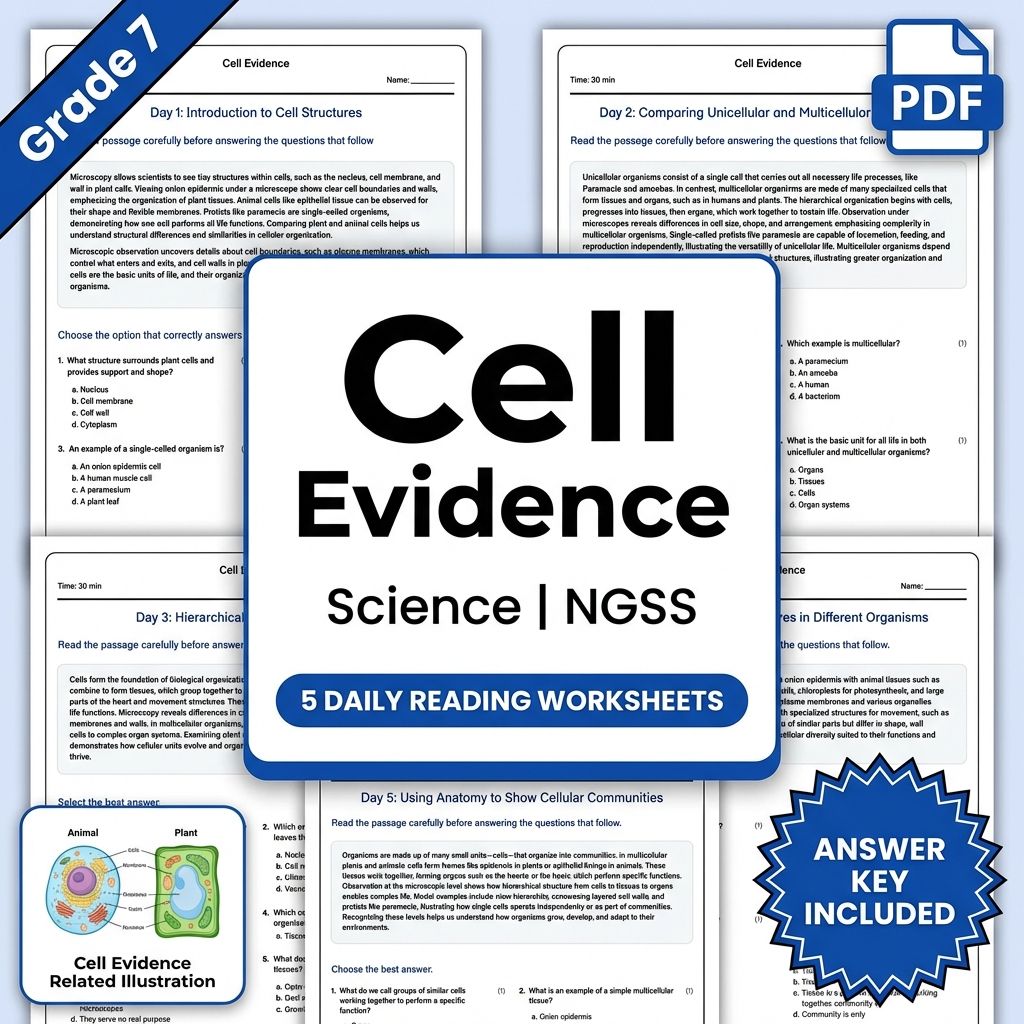
Grade 7 Science – Cell Evidence Daily Reading Worksheet(PDF + Answer Key)
Created byCopper Leaf ClassroomLearning Objectives
- Understand how microscopy reveals basic cellular structures in plants and animals.
- Identify differences between unicellular and multicellular organisms using examples.
- Describe key cellular features such as cell boundaries, plasma membranes, and cell walls.
Instant download

Grade 7 Science – Earth Resources Worksheet (TEKS) (PDF)
Created byEvergreen Desk EducationLearning Objectives
- Explain how freshwater reservoirs and watersheds influence water availability using key hydrologic ideas.
- Describe how groundwater moves through aquifers and how porosity and permeability affect flow and recharge.
- Connect soil formation and mineral deposits to Earth processes and depositional or igneous settings.
Instant download

Fossil Patterns Worksheet | Fossil Record Evidence Activity Grade 7
Created byAmber Owl EducationLearning Objectives
- Identify how stratigraphic layers and index fossils help scientists interpret the fossil record over geologic time.
- Explain how transitional fossils provide evidence for anatomical change and lineage continuity.
- Compare evidence for macroevolutionary patterns such as radiation events and mass extinctions.
Also included in: Grade 7 Science Evolution & Biodiversity Lesson Bundle – NGSS +1 more
Instant download

Grade 7 Science – Design Criteria & Constraints Daily Reading Worksheet
Created byBright Mind ResourcesLearning Objectives
- Understand what design criteria are and why they are important.
- Identify various types of constraints that influence a design.
- Learn how to specify clear and precise design goals.
Also included in: Grade 7 Engineering Tradeoff Mapping Science Lesson Bundle California Standards +1 more
Instant download

Grade 7 Science | Fair Testing Measurements Worksheet | General Standards
 Created byLumora Learning
Learning Objectives
- Explain how fair tests isolate one design variable while keeping other conditions constant.
- Identify appropriate measurement tools, units, and scales for collecting performance data.
- Describe how consistent testing supports reliability and helps attribute results to design changes.
Instant download

Grade 7 Science Worksheet | Particle Model Explanation (PDF)
Created byEvergreen Desk EducationLearning Objectives
- Explain the particle model of matter and how it describes observable properties of substances.
- Describe how chemical change happens at the particle level (breaking bonds and forming new bonds).
- Use the particle model to reason why mass is conserved in a closed system during chemical reactions.
Instant download
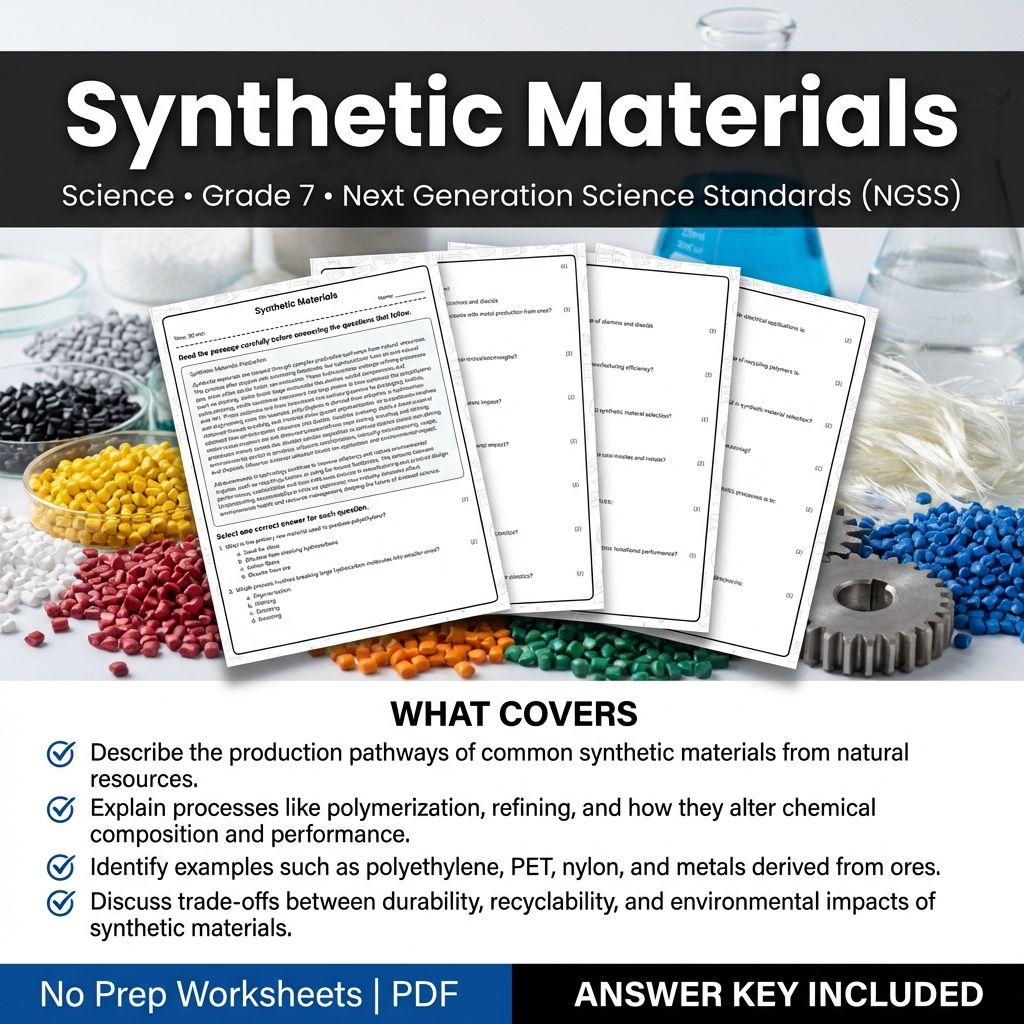
7th Grade Science | Synthetic Materials Worksheet & Answer Key (Printable PDF)
Created byCoral Reef LearningLearning Objectives
- Describe the production pathways of common synthetic materials from natural resources.
- Explain processes like polymerization, refining, and how they alter chemical composition and performance.
- Identify examples such as polyethylene, PET, nylon, and metals derived from ores.
Instant download
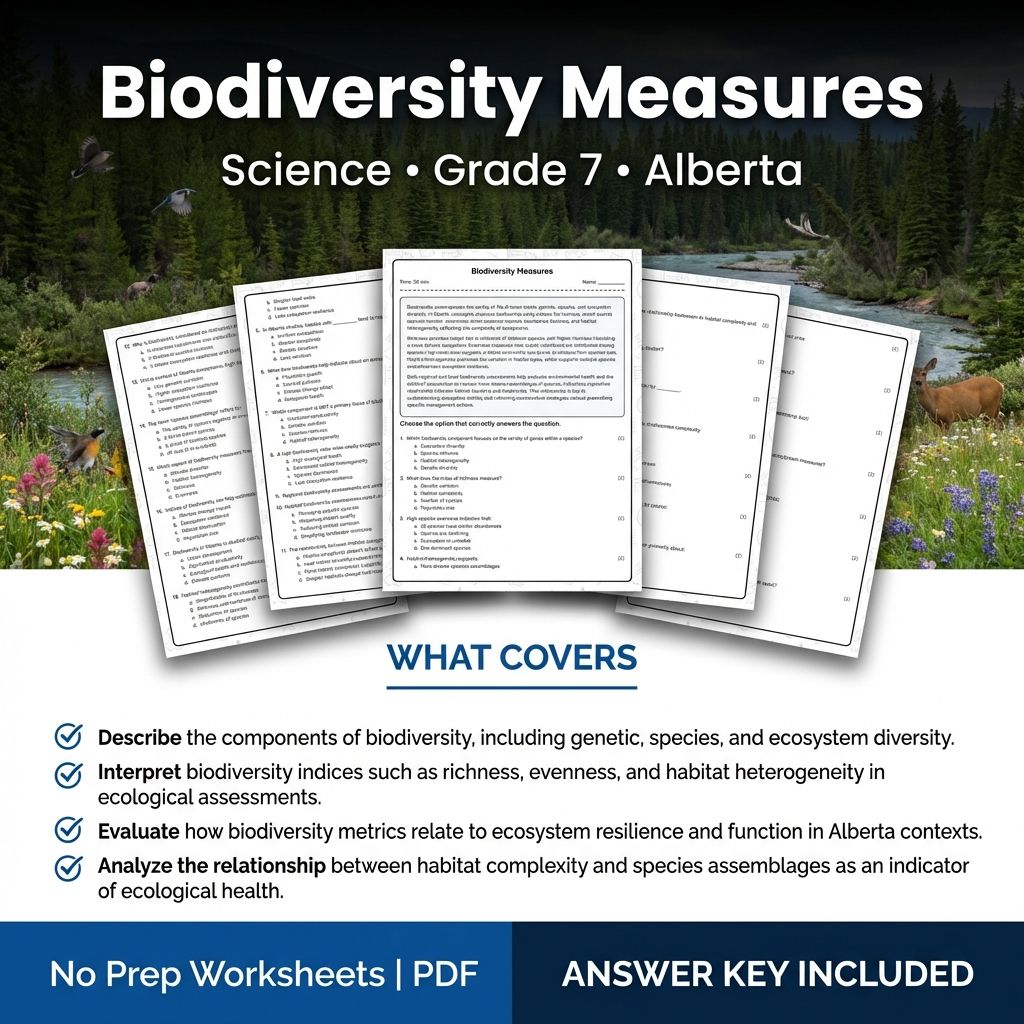
Grade 7 Science Worksheet on Biodiversity Measures for Classroom Practice
Created byCoral Reef LearningLearning Objectives
- Describe the components of biodiversity, including genetic, species, and ecosystem diversity.
- Interpret biodiversity indices such as richness, evenness, and habitat heterogeneity in ecological assessments.
- Evaluate how biodiversity metrics relate to ecosystem resilience and function in Alberta contexts.
Instant download

Grade 7 Science Worksheet | Conductive Materials & Heat Transfer (PDF)
Created byEvergreen Desk EducationLearning Objectives
- Compare thermal conductivity across metals, ceramics, polymers, and composites and explain how structure affects heat transfer.
- Describe how free electrons and lattice vibrations contribute to conduction in different materials.
- Predict how factors like density, porosity, and moisture can change a material’s effective thermal conductivity.
Also included in: Grade 7 Thermal Heat Transfer Science Lesson Bundle: Ontario Framework +1 more
Instant download

Grade 7 Science – Mixture Types & Properties | Daily Reading Worksheet
Created byBright Mind ResourcesLearning Objectives
- Understand the classification of mixtures into solutions, colloids, and suspensions.
- Identify the characteristics of homogeneous and heterogeneous mixtures.
- Recognize examples of different mixture types in everyday life.
Also included in: Grade 7 Matter Science Daily Reading Worksheets Lesson Bundle | Ontario +1 more
Instant download

Simple Distillation & Fractional Separation Worksheets Grade 7
Created byPrism Point LearningLearning Objectives
- Explain how boiling point differences enable simple distillation
- Describe how condensation collects separated liquid during distillation
- Explain how vapour pressure affects separation of volatile liquids
Also included in: Pure Substances, Mixtures & Separation Lesson Bundle | Grade 7 Science | Ontario +1 more
Instant download

Grade 7 Interaction Types Worksheet | Practice & Assessment PDF
Created byClear Sky ClassroomLearning Objectives
- Identify examples of competition, predation, and symbiosis in real ecosystems
- Explain how species interactions affect survival, growth, and population size over time
- Distinguish between mutualism, commensalism, and parasitism within symbiosis
Instant download

Grade 7 Science Worksheet – Motion Graphs TEKS Aligned (PDF)
Created byEvergreen Desk EducationLearning Objectives
- Interpret distance–time and velocity–time graphs to describe motion patterns (uniform motion, speeding up, slowing down, and rest).
- Use slope information on graphs to make qualitative claims about speed and direction.
- Connect the area under a velocity–time graph to the idea of displacement (conceptually).
Instant download
About Grade 7 Science Worksheets
Browse 6,039 printable Grade 7 Science worksheets — ready-to-print PDFs with answer keys where available.
Every worksheet on MyTeachingSheets is created by independent teacher-authors and reviewed before publication. All resources download as printable PDFs for classroom, homework, or at-home practice, and many include answer keys. Preview any worksheet free before buying.