
Grade 7 Science Worksheets
6,039 worksheets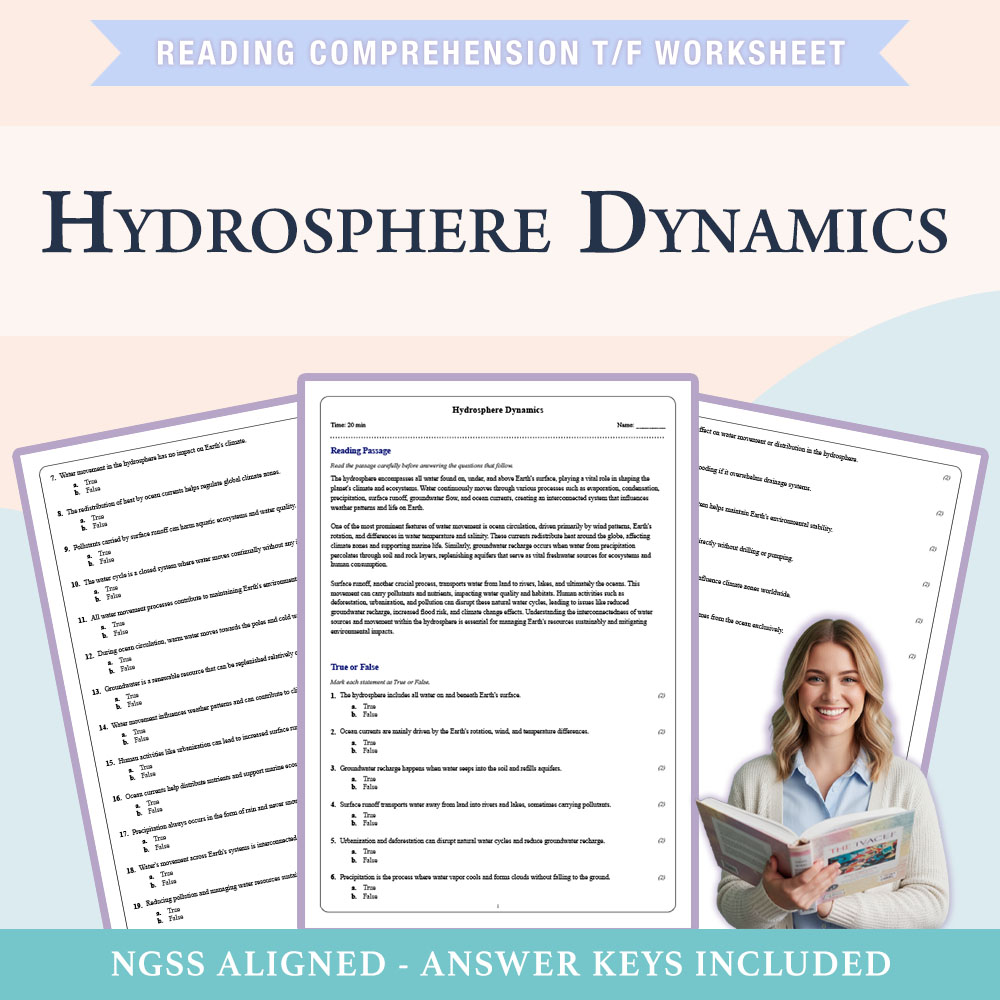
Grade 7 Science | Hydrosphere Dynamics Worksheet (PDF +Answer Key)
 Created byCopper Leaf Classroom
Learning Objectives
- Describe the movement of water across Earth's systems.
- Explain the processes of groundwater flow, surface runoff, and ocean circulation.
- Understand the impact of water movement on climate, ecosystems, and human activity.
Instant download

Grade 7 Motion Graphs Science Daily Reading Worksheet | TEKS Activity
 Created byBRIGHT PATH RESOURCES
Learning Objectives
- Read a distance–time graph to describe motion and rest intervals.
- Identify what different slopes mean for whether an object is moving or staying still.
- Use graph evidence to explain motion in simple real-world contexts.
Also included in: Forces & Energy Grade 7 Science Daily Reading Worksheets Lesson Bundle | TEKS +1 more
Instant download

Grade 7 Science Worksheet | Population Factors & Growth (PDF)
 Created bySilver Birch Teaching
Learning Objectives
- Explain how birth and death rates, immigration and emigration, and abiotic constraints affect population size and distribution
- Describe how regional factors (such as seasonal water, fire regimes, disease, and land-use change) can cause population fluctuations
- Use population trends to reason about local extirpations and expansions
Also included in: Grade 7 Ecosystems & Biodiversity Science Lesson Bundle for Alberta Framework +1 more
Instant download
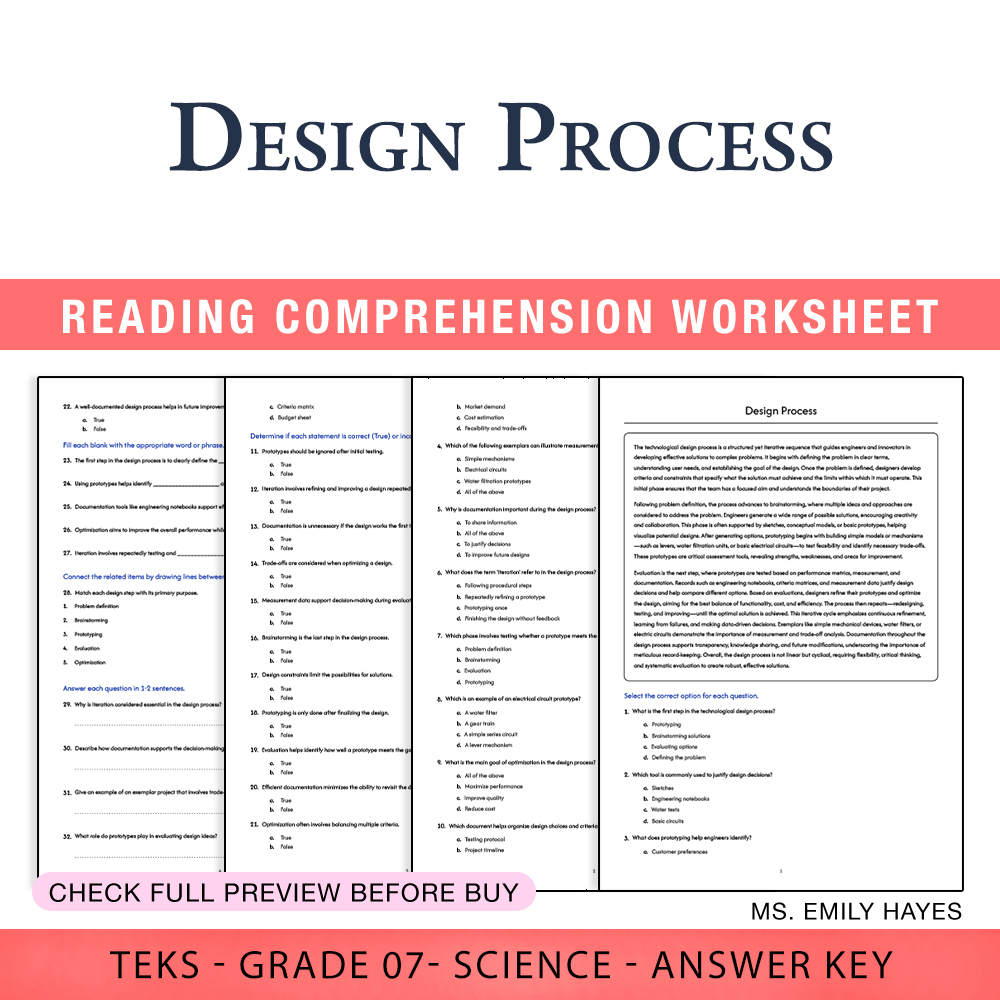
Grade 7 Science | Design Process Worksheet (PDF+ Answer Key)
Created byCopper Leaf ClassroomLearning Objectives
- Understand the iterative nature of the engineering design process and its main steps.
- Identify different methods and tools used to document and evaluate design decisions.
- Analyze exemplars such as mechanisms, water filtration prototypes, and electrical circuits to understand trade-offs and refinement.
Instant download

Grade 7 Science Problem Definition Worksheet | NGSS Engineering Design Activity
 Created byNorthstar Worksheets
Learning Objectives
- Define a design problem using clear criteria for success and measurable constraints.
- Translate real-world needs (societal, environmental, and safety) into quantitative targets and acceptable limits.
- Distinguish between criteria (what success looks like) and constraints (what limits the design).
Also included in: ngss engineering design Grade 7 science Lesson Bundle | Solution & Optimization +1 more
Instant download

Grade 7 Science – Interaction Types Worksheet (PDF) | General Standards
 Created byEvergreen Desk Education
Learning Objectives
- Identify and explain how competition, predation, and symbiosis affect organisms in a community
- Describe cause-and-effect relationships between interactions and population changes over time
- Differentiate major types of symbiosis: mutualism, commensalism, and parasitism
Also included in: Grade 7 Ecosystem Energy Flows Science Lesson Bundle - General Framework +1 more
Instant download

Grade 7 Science | Energy Accounting in Motion - Daily Reading Comprehension
 Created byCoral Reef Learning
Learning Objectives
- Understand how energy transfers occur during motion.
- Identify examples of energy conversion like thermal energy from braking.
- Explain the redistribution of energy in inelastic collisions.
Instant download
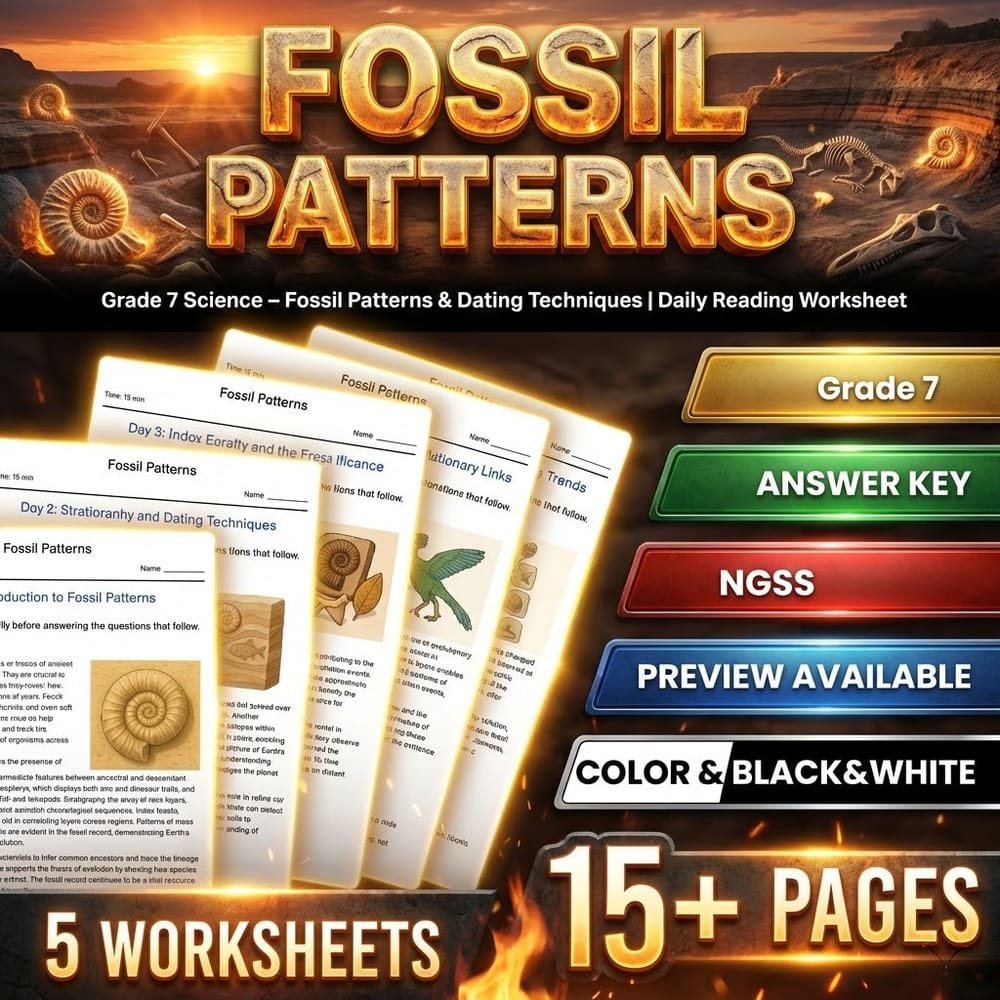
Grade 7 Science – Fossil Patterns & Dating Techniques | Daily Reading Worksheet
 Created byElena Brooks
Learning Objectives
- Understand how fossils provide evidence of ancient life and evolutionary patterns.
- Identify key features of fossil records, including transitional forms and stratigraphy.
- Analyze how fossils help infer common ancestry and macroevolutionary trends.
Also included in: Evolution and Natural Selection Grade 7 Science Worksheets Bundle | NGSS +1 more
Instant download

Grade 7 Science – Reaction Evidence & Gas Production | Daily Reading Worksheet
 Created byBright Mind Resources
Learning Objectives
- Identify signs of gas production in chemical reactions.
- Differentiate between physical changes and chemical changes involving gases.
- Use observable evidence to infer chemical reactions.
Also included in: Grade 7 Daily Reading Science Worksheets Lesson Bundle | Florida NGSSS +1 more
Instant download

Grade 7 Food Web Flows Worksheet | General Practice PDF
 Created byClear Sky Classroom
Learning Objectives
- Explain how energy transfers through a food web from producers to consumers.
- Describe how decomposition helps cycle matter (nutrients) within an ecosystem.
- Use evidence from food web relationships to predict how changes affect organisms.
Instant download
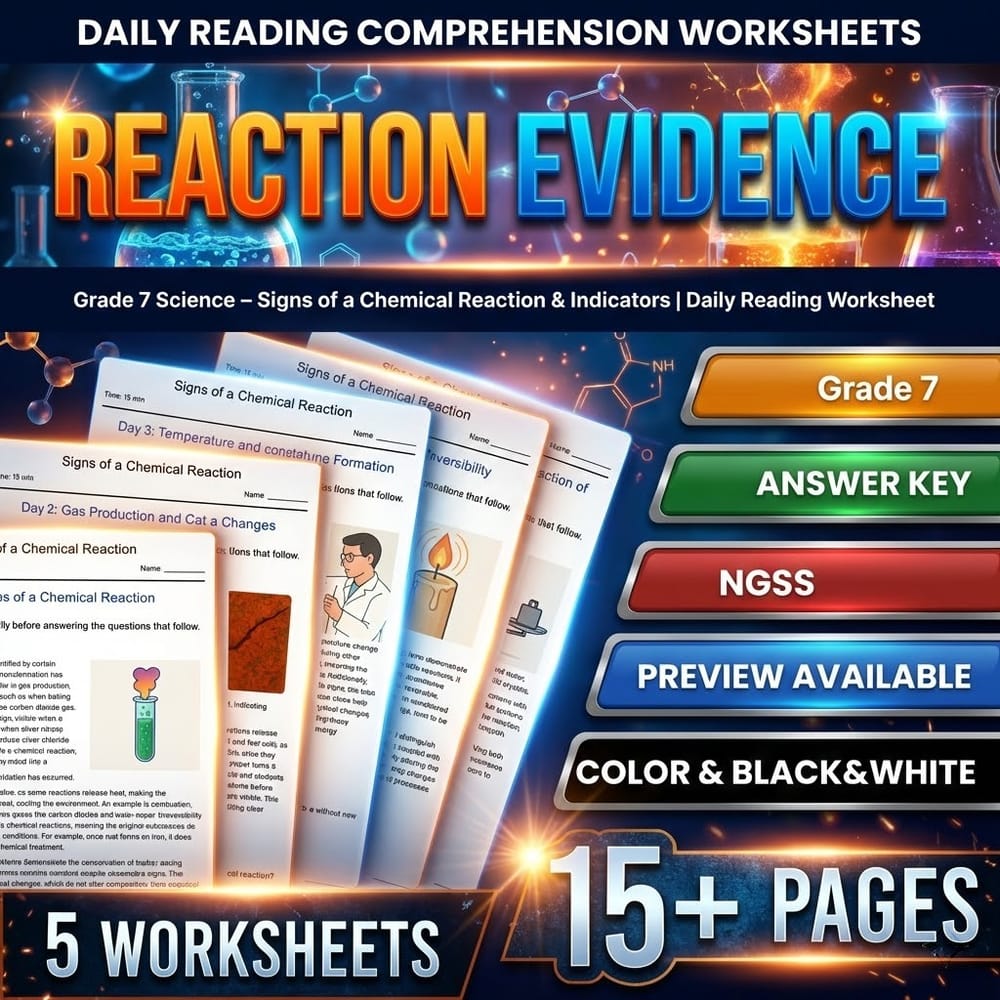
Grade 7 Science – Signs of a Chemical Reaction & Indicators | Daily Worksheet
Created byElena BrooksLearning Objectives
- Identify observable signs indicating a chemical reaction has occurred
- Differentiate between physical changes and chemical changes based on indicators
- Understand examples of chemical reactions such as rusting, combustion, and neutralization
Also included in: Materials and Chemical Reactions Grade 7 Science Worksheets Bundle | NGSS +1 more
Instant download

Grade 7 Science | Understanding Friction & Gravity - Daily Reading Comprehension
Created byCoral Reef LearningLearning Objectives
- Understand key concepts related to Science
- Apply knowledge through practice questions
- Demonstrate comprehension of the material
Instant download
Grade 7 Science – Understanding Design Problems Worksheet(PDF + Answer Key)
Created byCopper Leaf ClassroomLearning Objectives
- Define what constitutes a clear design problem in science.
- Identify measurable criteria and constraints in real-world scenarios.
- Translate societal and environmental needs into specific, quantitative targets.
Instant download
Grade 7 Science – Solution Comparison in Bridge Design Worksheet(PDF + Answers)
Created byCopper Leaf ClassroomLearning Objectives
- Understand the factors that influence bridge design durability and cost
- Model different bridge configurations to evaluate performance
- Analyze trade-offs between strength, expense, and manufacturability
Instant download
Grade 7 Science | Scientific Inquiry Basics Worksheet (PDF) Ontario Standards
Created byBright Mind ResourcesLearning Objectives
- Understand the key components of designing and conducting a scientific inquiry.
- Identify proper laboratory procedures and safety protocols.
- Recognize the importance of measurement accuracy and documentation in experiments.
Instant download

Grade 7 Science | Interpreting Data in Science - Daily Reading Comprehension
Created byCoral Reef LearningLearning Objectives
- Understand how to read and interpret line graphs
- Identify trends and patterns in scientific data
- Evaluate the significance of outliers in data sets
Instant download
Grade 7 Science – Species Adaptations Worksheet (Ontario) PDF
Created byBright Mind ResourcesLearning Objectives
- Identify structural, physiological, and behavioral adaptations of organisms.
- Explain how environmental pressures influence evolution and trait development.
- Describe adaptation strategies in different habitats such as wetlands, forests, and meadows.
Instant download

Grade 7 System Structure Worksheet | NGSS Practice PDF
Created byClear Sky ClassroomLearning Objectives
- Explain how organisms function as interacting systems made of internal structures with specific roles
- Describe how structures help process inputs such as food, oxygen, and water into forms the organism can use
- Use evidence to connect structure and function in body systems (digestive, respiratory, and excretory)
Instant download
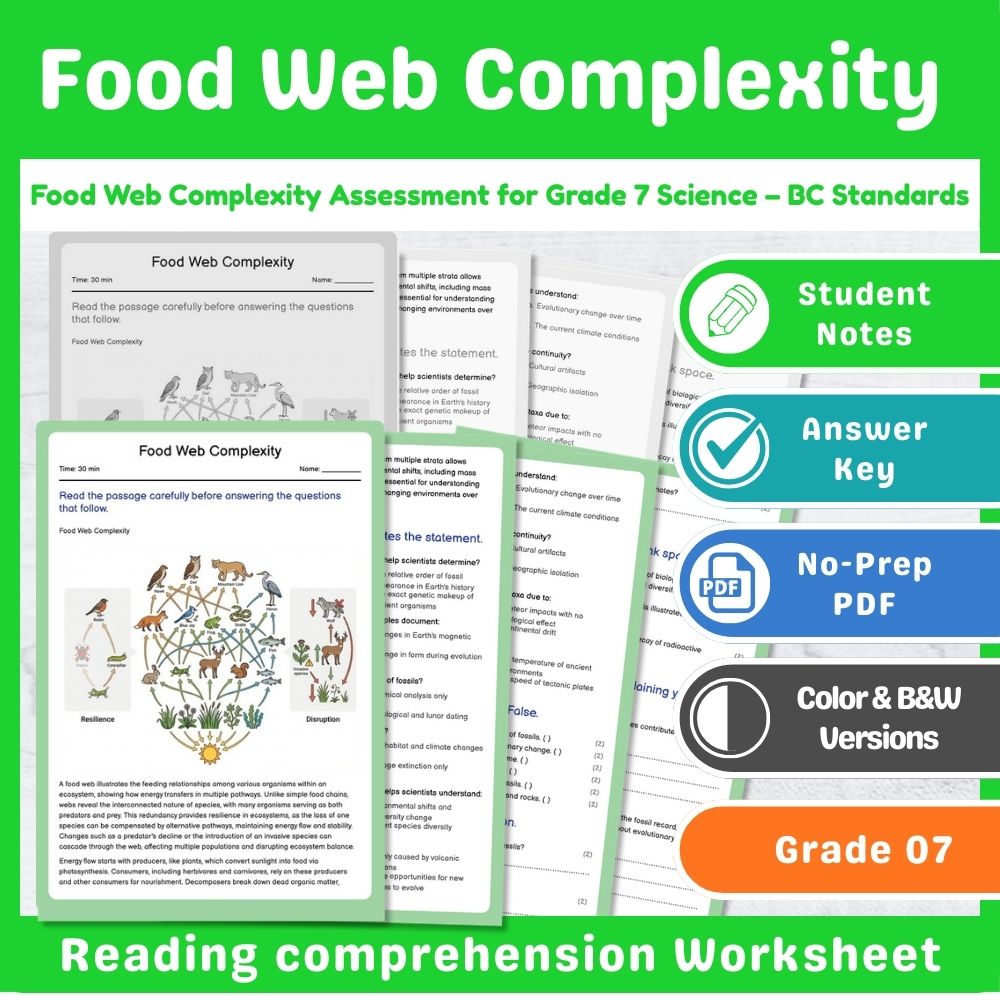
Food Web Complexity Assessment for Grade 7 Science – BC Standards
 Created byPrism Point Learning
Learning Objectives
- Understand the concept of a food web and its components.
- Identify the interconnected relationships among producers, consumers, and decomposers.
- Explain how energy flows through an ecosystem via a food web.
Instant download

Grade 7 Science – Surface Process Evidence | Daily Reading Worksheet
Created byBright Mind ResourcesLearning Objectives
- Identify evidence of internal geological processes that shape Earth's surface
- Understand how uplift and deformation contribute to landform formation
- Recognize signs of external processes like erosion and sediment transport
Also included in: Weather, Earth Systems & Human Feedbacks Grade 7 Science Lesson Bundle | General +1 more
Instant download

Technology Impacts Worksheet | Grade 7 Science TEKS Practice
Created byPrism Point LearningLearning Objectives
- Analyze how technology can create short- and long-term social, economic, and environmental impacts
- Evaluate trade-offs using cost-benefit reasoning and identify unintended consequences
- Explain how policies and ethical considerations can help reduce harmful impacts
Also included in: Grade 7 Technology & Engineering Design in Science: Lesson Bundle TEKS
Instant download

Evaporation Crystallization Practice Test | Grade 7 Science Worksheet
Created byPrism Point LearningLearning Objectives
- Explain how evaporation and cooling lead to crystallization, including nucleation and crystal growth.
- Describe how impurities and cooling/evaporation conditions affect crystal size, shape, and purity.
- Evaluate how recrystallization improves purity by forming well-ordered crystal lattices.
Also included in: Grade 7 Substance & Mixture Properties Science Lesson Bundle (Ontario)
Instant download

Grade 7 Science | Adaptation Evidence Worksheet | Florida NGSSS Aligned
 Created byLumora Learning
Learning Objectives
- Explain what adaptations are and how they relate to survival and reproduction in specific environments.
- Identify evidence for adaptation from population comparisons, fossil records, and observed environmental changes.
- Use scientific reasoning to connect environmental pressures to changes in trait frequencies over time.
Instant download
Grade 7 Science | Seasonal Cycles Reading Worksheet (PDF + Answer Key)
JCreated byJ.S SheetsLearning Objectives
- Explain how seasonal thermal cycles influence climate and ecosystems.
- Identify the key energy pathways involved in seasonal environmental changes.
- Describe the roles of solar input, albedo variation, and latent heat in regional climate patterns.
Also included in: Grade 7 Science UNIT Bundle | Heat Transfer, Convection & Energy Worksheets +1 more
Instant download

Science Worksheet: Disturbance Effects on Ecosystems Grade 7 | NGSS
 Created bySkylark Worksheets
Learning Objectives
- Explain how abiotic (physical) and biotic (living) disturbances can change population sizes and community composition.
- Describe mechanisms of resistance, resilience, and succession that help ecosystems recover after disturbances.
- Use empirical observations and longitudinal (over-time) data to infer likely causes of population increases or declines.
Also included in: Grade 7 Ecosystem Dynamics Science Lesson Bundle (NGSS) Worksheets +1 more
Instant download

Resource Availability Worksheet | California Standards Grade 7 Science Practice
JCreated byJ.S SheetsLearning Objectives
- Understand how resource availability affects population size in ecosystems.
- Identify examples of resources that limit organism survival and reproduction.
- Explain the relationship between environmental resources and habitat health.
Also included in: Grade 7 Ecosystem Energy & Matter Cycles Science Lesson Bundle +1 more
Instant download

Grade 7 Science Tissue Types Worksheet (PDF) BC Standards Practice
Created byEvergreen Desk EducationLearning Objectives
- Identify the four main tissue types and describe their primary functions in the body.
- Match tissue types to specific examples of where they are found and what they do.
- Explain how the arrangement of tissues in organs supports movement, protection, communication, and repair.
Instant download
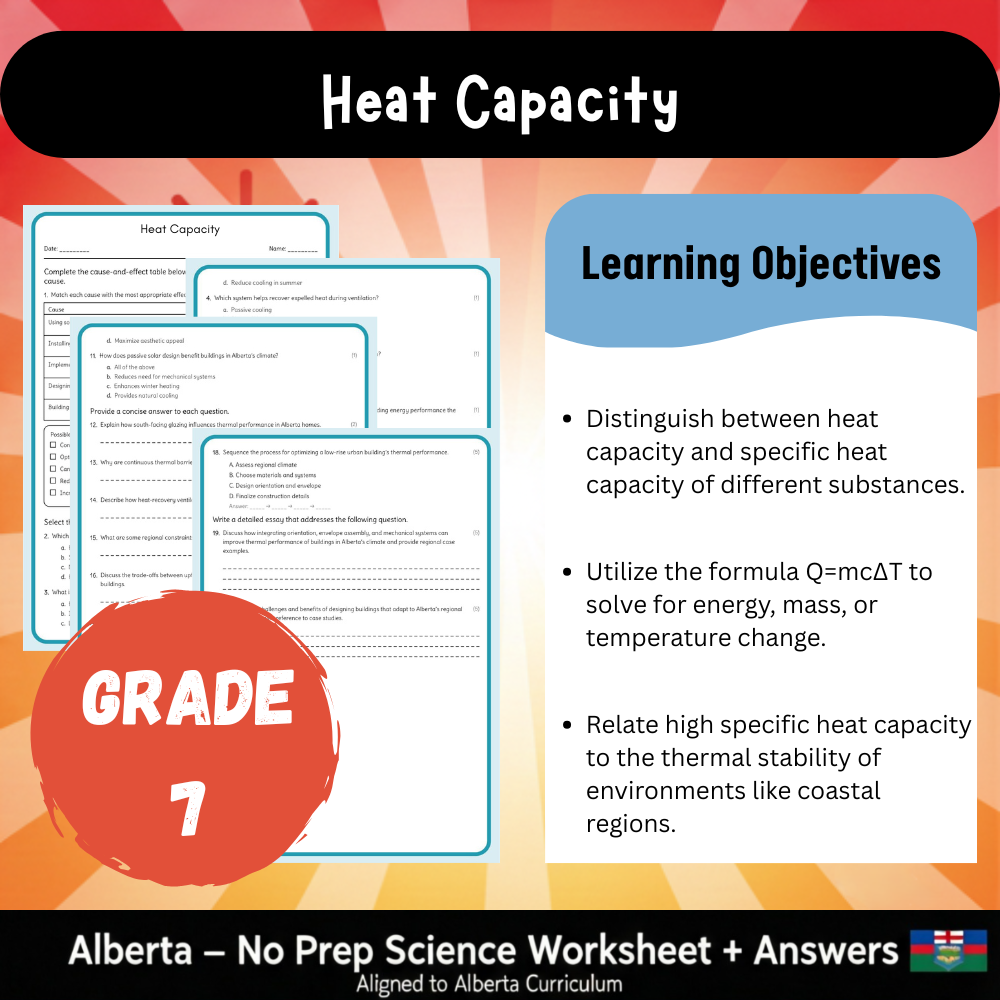
Grade 7 Science – Heat Capacity Worksheet (PDF) | Alberta Standards
Created byBright Mind ResourcesLearning Objectives
- Define specific heat capacity and understand its role in thermal energy transfer.
- Calculate the amount of energy required to heat substances using mass, specific heat, and temperature change.
- Convert between units such as Joules and kilojoules, grams and kilograms, and Celsius and Kelvin.
Instant download

Grade 7 Science – Metric Reasoning & Measurement Practice | Reading Worksheet
Created byBright Mind ResourcesLearning Objectives
- Understand key concepts related to Science
- Apply knowledge through practice questions
- Demonstrate comprehension of the material
Also included in: Grade 7 Variables & Exp Design Science Lesson Bundle Daily Reading | TEKS +2 more
Instant download

Grade 7 Science | Understanding Population Limits - Daily Reading Comprehension
Created byCoral Reef LearningLearning Objectives
- Define what is meant by population limits and carrying capacity.
- Describe how resource availability affects population growth.
- Analyze examples of population fluctuations due to resource constraints.
Instant download

Grade 7 Science | Variables in Scientific Experiments - Reading Comprehension
Created byCoral Reef LearningLearning Objectives
- Define independent, dependent, and controlled variables.
- Explain the importance of operational definitions in experiments.
- Identify sources of confounding variables in research.
Instant download

Grade 7 Science – Ecosystem Components Worksheet (PDF) | BC Standards
Created byEvergreen Desk EducationLearning Objectives
- Identify biotic and abiotic components of an ecosystem and give examples of each
- Explain how energy flows from primary producers to consumers through feeding relationships
- Describe how abiotic factors influence growth, reproduction, and survival of organisms
Instant download

Grade 7 Ethics and Communication Science Worksheet | Ontario Curriculum
Created byClear Sky ClassroomLearning Objectives
- Explain how ethical responsibilities such as data integrity and proper attribution support trustworthy STEM work.
- Identify communication practices for technical reports, including clear claims and reliable visual annotations.
- Describe how equitable access and responsible data sharing can reduce harm and improve community benefit.
Instant download
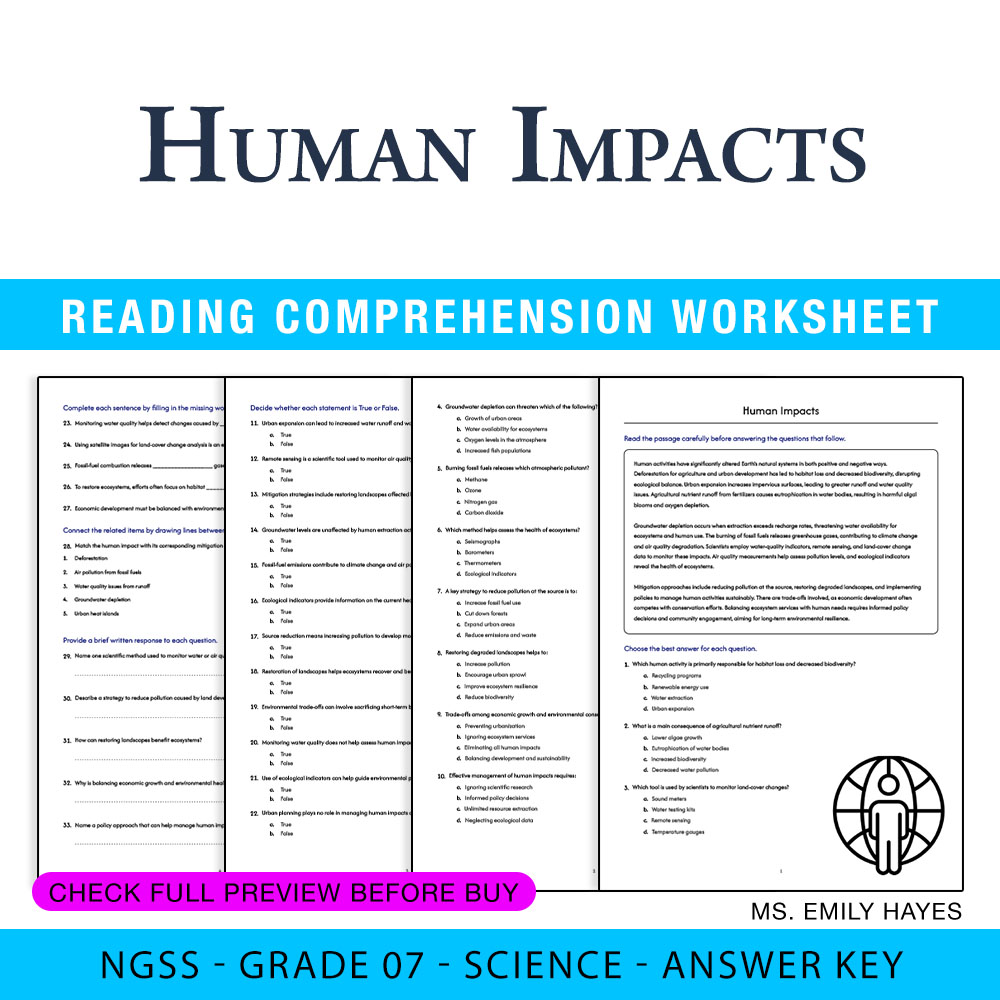
7th Grade Science | Human Impacts Worksheet (PDF+ Answer Key)
Created byCopper Leaf ClassroomLearning Objectives
- Understand how human activities such as deforestation, urban expansion, and fossil-fuel use impact the environment.
- Identify scientific tools and methods used to monitor environmental changes caused by humans.
- Evaluate mitigation strategies to reduce negative human impacts on ecosystems.
Instant download

Grade 7 Science | Signs of a Chemical Reaction - Daily Reading Comprehension
Created byCoral Reef LearningLearning Objectives
- Understand key concepts related to Science
- Apply knowledge through practice questions
- Demonstrate comprehension of the material
Instant download

Grade 7 Science | Gravity On Objects - Daily Reading Comprehension
Created byCoral Reef LearningLearning Objectives
- Understand what gravity is and how it pulls objects downward.
- Recognize how mass affects gravitational force.
- Learn why different objects accelerate at the same rate near Earth.
Instant download

Grade 7 Rock Cycle Integration Worksheet | BC Practice PDF
Created byClear Sky ClassroomLearning Objectives
- Explain how tectonics, magmatism, weathering, erosion, burial, and metamorphism connect within the rock cycle.
- Use rock cycle terms to describe how rocks change forms over geologic time.
- Interpret how uplift and plate motion create the conditions for recycling crustal materials.
Instant download

Grade 7 Conduction Focus Worksheet | Practice & Assessment PDF
Created byClear Sky ClassroomLearning Objectives
- Explain how conduction transfers kinetic energy through solids and across interfaces
- Compare thermal conductivity of common materials and relate it to temperature gradients
- Use ideas of conductivity coefficients and contact resistance to predict heat-flow behavior
Instant download

Density Separation Worksheet for Grade 7 Science | Standards-Aligned Practice
JCreated byJ.S SheetsLearning Objectives
- Explain how buoyant force and sedimentation depend on particle density and size during density separation.
- Describe how decanting, floatation, and centrifugation separate mixtures using density differences.
- Predict which separation method is most suitable for particles with different densities based on real-world constraints.
Instant download
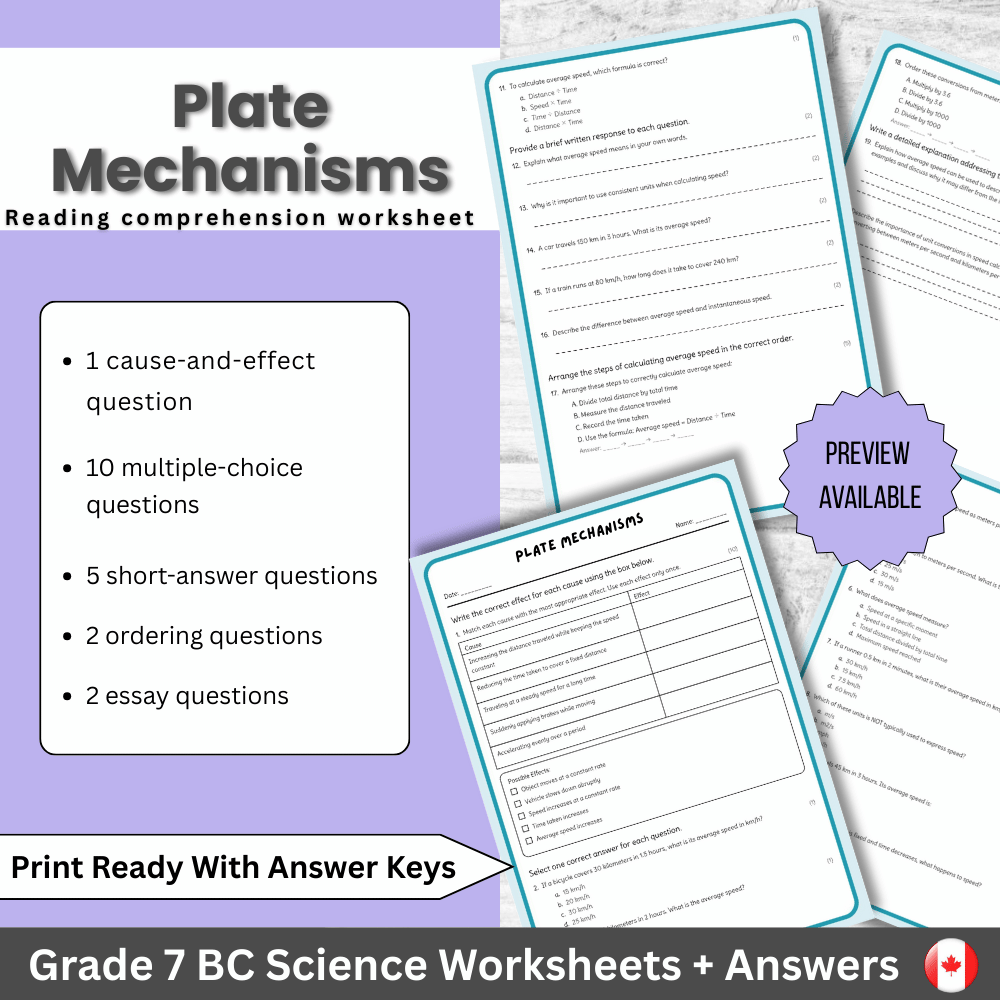
Grade 7 Science | Plate Mechanisms Worksheet + Answer Key (PDF)
Created byBright Mind ResourcesLearning Objectives
- Describe the forces involved in plate tectonics such as mantle convection, slab pull, and ridge push.
- Explain how mantle convection drives plate motion through circulation of mantle material.
- Identify the roles of slab pull and ridge push in plate movement.
Instant download

Grade 7 Science – Ecosystems Daily Reading Worksheet | Ontario Standards
Created byBright Mind ResourcesLearning Objectives
- Identify the components of an ecosystem including biotic and abiotic elements.
- Distinguish between biotic and abiotic factors and understand their roles.
- Understand the different trophic categories: producers, consumers, decomposers.
Also included in: Grade 7 Ecosystem Stewardship Science Daily Reading lesson bundle | Ontario +1 more
Instant download

Grade 7 Prototyping Methods Worksheet | Ontario Science PDF & Key
Created byClear Sky ClassroomLearning Objectives
- Compare scaled physical models, digital finite-element models, and laboratory load rigs for evaluating strength, stiffness, and failure modes.
- Explain how instrumentation such as strain gauges and displacement transducers measures structural response.
- Describe limitations of prototyping, especially scaling effects on joints and material heterogeneity.
Instant download

Grade 7 science | Control Methods Worksheet | General Standards
Created byLumora LearningLearning Objectives
- Define control conditions and comparison conditions in a scientific investigation.
- Explain how controlling variables increases the credibility of evidence.
- Describe why consistent timing, tool calibration, and standardized handling support fair tests.
Instant download

Evolutionary Change Assessment for Grade 7 Science | NGSSS Standards
Created byPrism Point LearningLearning Objectives
- Explain how evolutionary change occurs at the population level through changes in allele frequency over generations
- Connect inherited variation and differential survival/reproduction to long-term shifts in traits
- Differentiate evolution from individual organisms changing within their lifetimes
Instant download
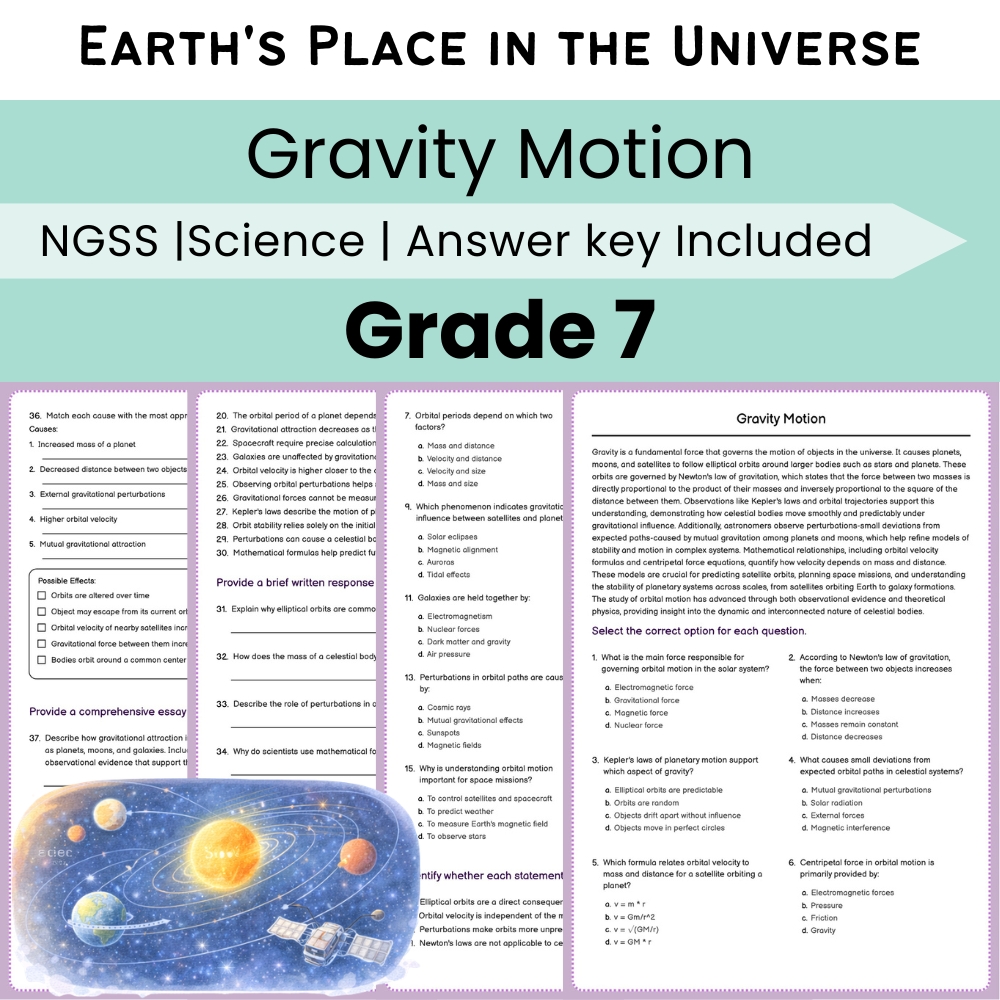
Gravity Motion Worksheet | Grade 7 Science Printable PDF Assessment
Learning Objectives
- Explain how gravitational attraction influences orbital motion within the solar system.
- Understand the mathematical relationships that describe orbital velocity and centripetal force.
- Identify observational evidence supporting theories of orbital motion, stability, and perturbations.
Also included in: Grade 7 Science NGSS Lesson Bundle – Earth's Place in the Universe Worksheets +1 more
Instant download
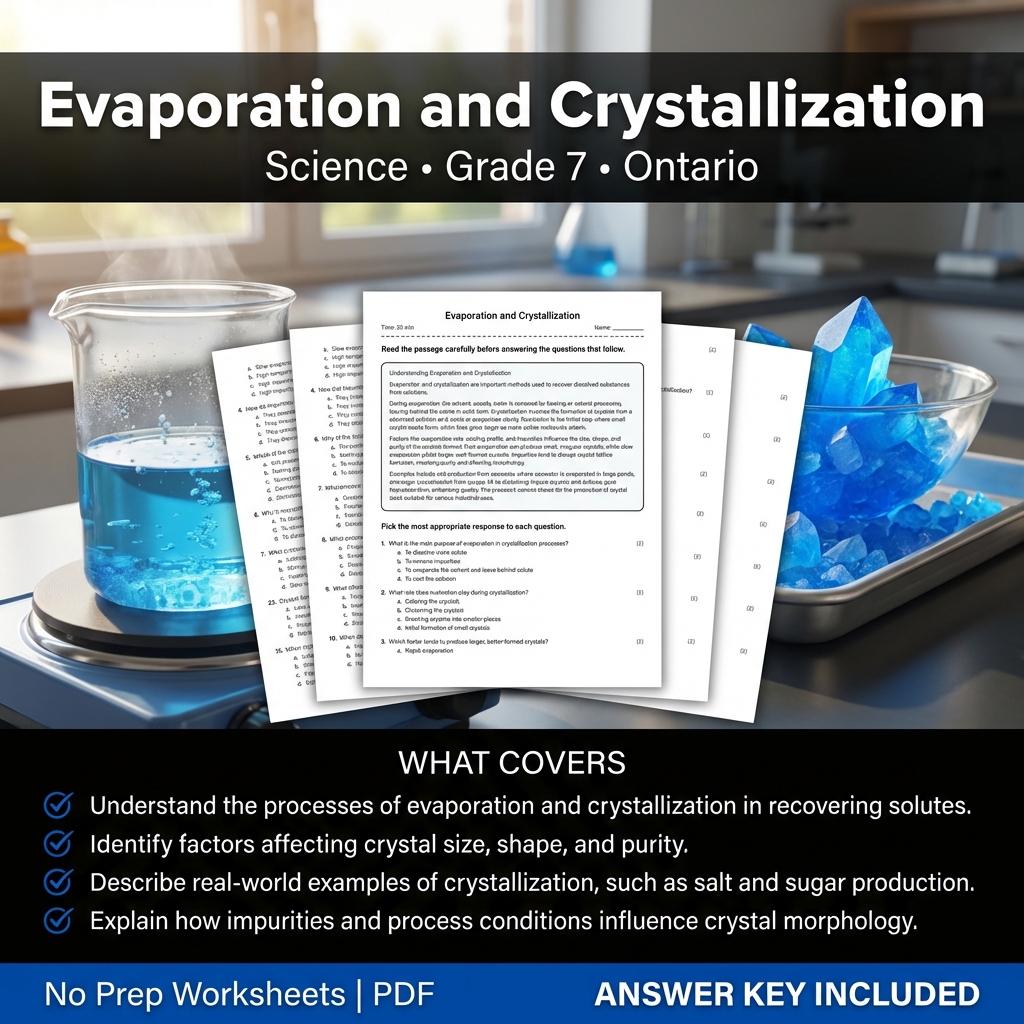
Grade 7 Science Worksheet on Evaporation and Crystallization | Ontario Standard
Created byCoral Reef LearningLearning Objectives
- Understand the processes of evaporation and crystallization in recovering solutes.
- Identify factors affecting crystal size, shape, and purity.
- Describe real-world examples of crystallization, such as salt and sugar production.
Instant download

Grade 7 Science Worksheet | Mechanical Energy & Conservation (PDF)
Created byEvergreen Desk EducationLearning Objectives
- Explain how mechanical energy transfers between kinetic and potential energy in moving systems such as pendulums and springs.
- Use qualitative energy bookkeeping to describe conservation of mechanical energy in a closed system and energy loss to nonmechanical forms in an open system.
- Interpret motion outcomes (speed, height, and amplitude) as evidence of energy redistribution and inefficiencies.
Instant download

Biodiversity Measures Worksheet | Grade 7 Science Practice
Created byPrism Point LearningLearning Objectives
- Describe how biodiversity includes genetic, species, and ecosystem diversity.
- Explain how richness, evenness, and habitat heterogeneity are used to measure regional biodiversity.
- Interpret what biodiversity metrics can suggest about ecosystem resilience and function.
Also included in: Grade 7 Ecosystems & Biodiversity Science Lesson Bundle | Alberta
Instant download
About Grade 7 Science Worksheets
Browse 6,039 printable Grade 7 Science worksheets — ready-to-print PDFs with answer keys where available.
Every worksheet on MyTeachingSheets is created by independent teacher-authors and reviewed before publication. All resources download as printable PDFs for classroom, homework, or at-home practice, and many include answer keys. Preview any worksheet free before buying.