
Grade 8 Science Worksheets
5,999 worksheets
Grade 8 Science – Circular Motion & Centripetal Force | Daily Reading Worksheet
 Created byBright Mind Resources
Learning Objectives
- Define what constitutes circular motion.
- Explain the role of centripetal force in circular motion.
- Identify everyday examples of circular motion and centripetal force.
Also included in: Grade 8 Science Systems Forces Daily Reading Worksheets Lesson Bundle | Alberta +2 more
Instant download

Grade 8 Science – Braking Distance & Factors | Daily Reading Worksheet
Created byBright Mind ResourcesLearning Objectives
- Define braking distance and identify the forces involved
- Explain how tire-road friction affects stopping distance
- Analyze the influence of environmental and mechanical factors such as winter conditions and brake systems
Also included in: Grade 8 Science Systems Forces Daily Reading Worksheets Lesson Bundle | Alberta +2 more
Instant download
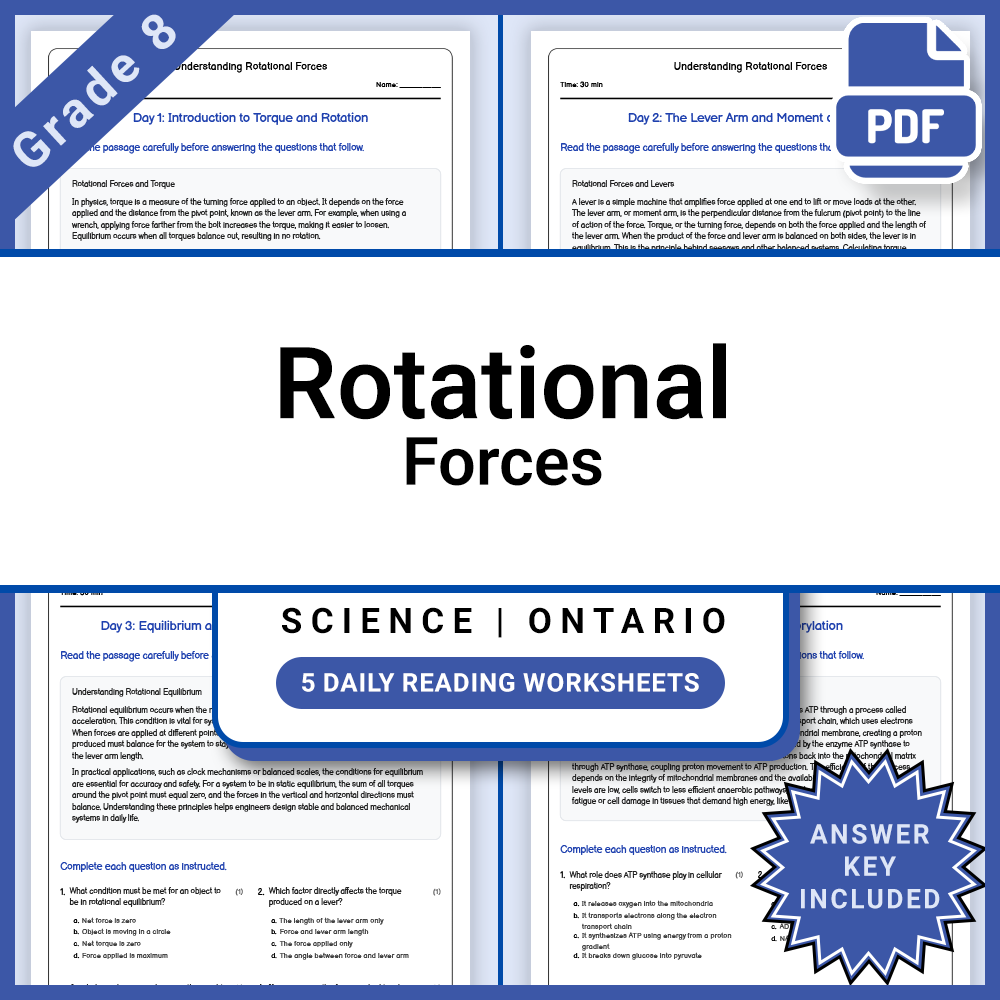
Grade 8 Science – Rotational Forces Daily Reading Worksheet + Answer Key
JCreated byJ.S SheetsLearning Objectives
- Understand key concepts related to Science
- Apply knowledge through practice questions
- Demonstrate comprehension of the material
Also included in: Grade 8 Science Lesson Group Bundle – Mechanical Systems and Energy +1 more
Instant download
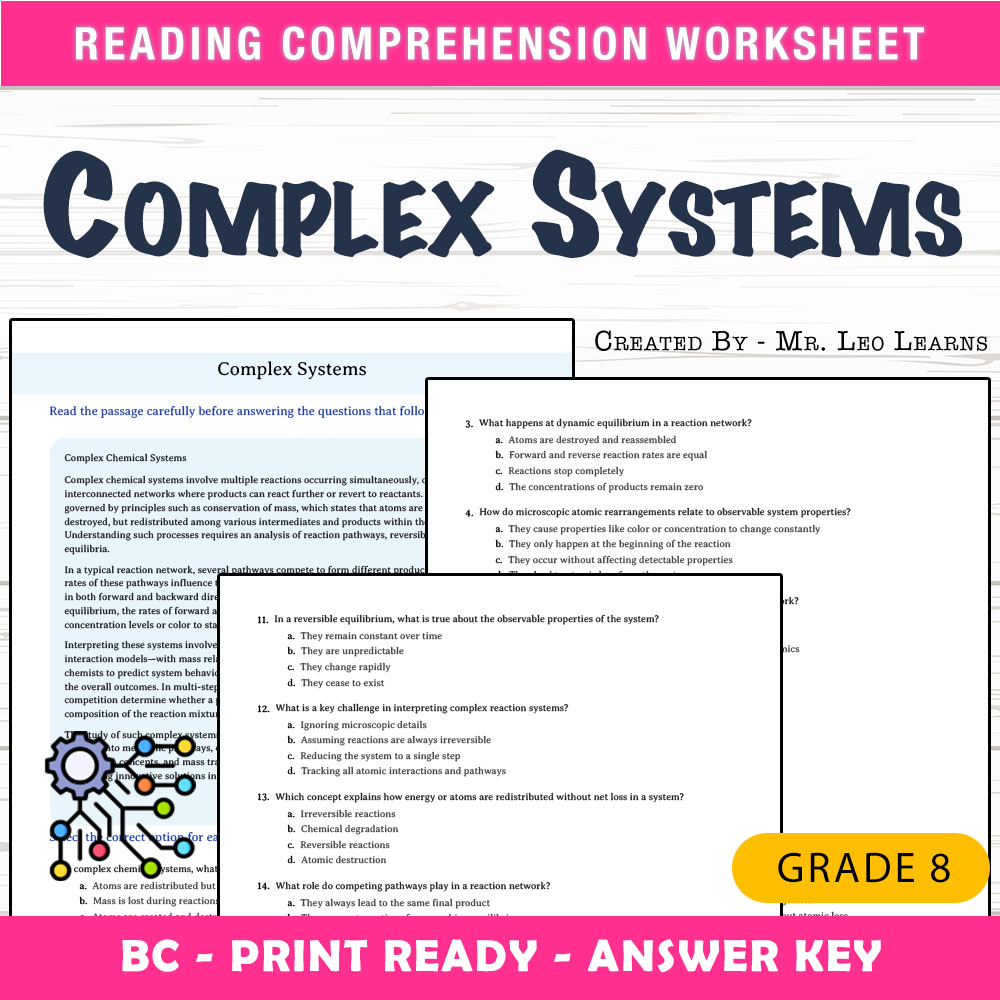
Grade 8 Science — Worksheet MCQ Paper for Mastering Complex Systems
 Created byThe Resource Hub
Learning Objectives
- Understand the principles of reaction networks and conservation of mass in complex chemical systems.
- Explain how reversible equilibria influence observable properties without net atomic loss.
- Apply microscopic models and mass relationships to interpret outcomes in multi-step reactions.
Also included in: Grade 8 Science | Matter & Chemical Change UNIT Worksheet Pack (BC Framework) +1 more
Instant download

Grade 8 Science – Measuring Density & Properties | Daily Reading Worksheet
 Created byQuiet Forest Education
Learning Objectives
- Understand the concept of density and its significance in science
- Learn methods to measure density accurately
- Identify sources of measurement errors and uncertainties
Also included in: Fluid Dynamics Grade 8 Science Daily Reading Worksheets Bundle | Ontario +1 more
Instant download

Pascal Principle Worksheet Grade 8 Science | Hydraulics Doodle Notes Ontario
 Created byChalk and Compass
Learning Objectives
- Explain Pascal’s principle and how pressure transmits through confined fluids
- Use hydraulic relationships to connect force output to piston area and input force
- Interpret diagrams and statements about hydraulic systems, including real-world limitations
Also included in: Fluids, Pressure & Flow Lesson Bundle — Grade 8 Science Ontario +1 more
Instant download
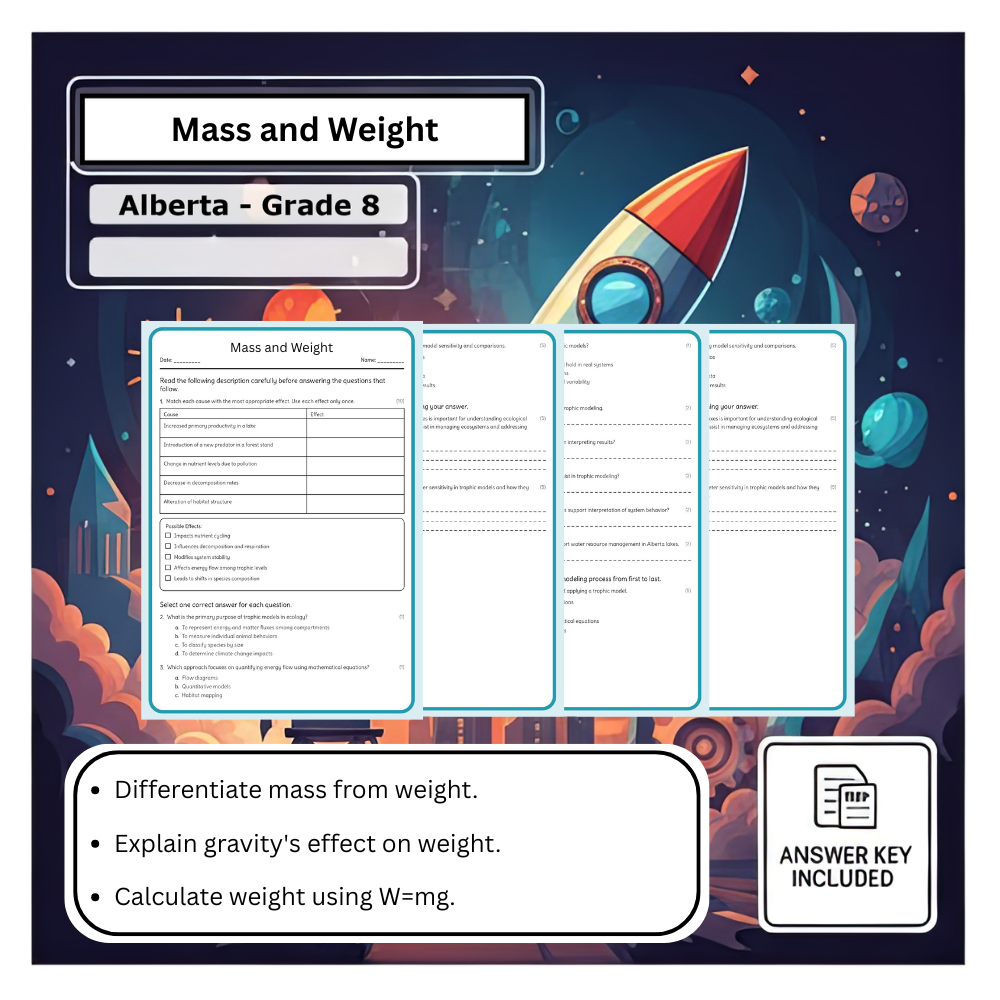
Grade 8 Science | Mass and Weight Concept Worksheet (PDF)
Created byBright Mind ResourcesLearning Objectives
- Differentiate between mass and weight and understand their intrinsic properties and external influences.
- Explain how gravitational acceleration affects weight and why identical masses experience the same gravitational force.
Instant download
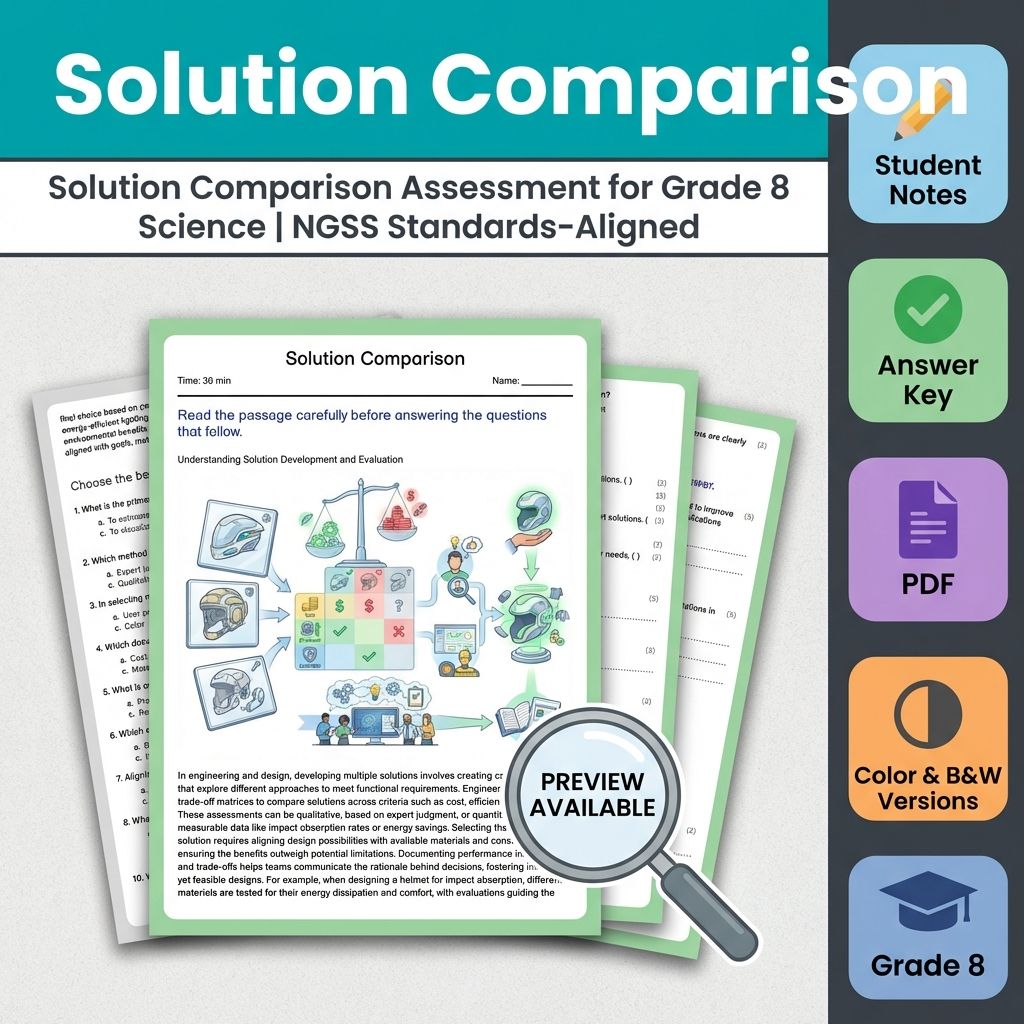
Solution Comparison Assessment for Grade 8 Science | NGSS Standards-Aligned
 Created byPrism Point Learning
Learning Objectives
- Understand the principles of designing and evaluating multiple solutions based on criteria and constraints.
- Learn to develop concept sketches, trade-off matrices, and compare solutions qualitatively and quantitatively.
- Identify key performance indicators and document benefits and limitations of design concepts.
Also included in: Grade 8 Science Mini Bundle – Engineering Design Unit & Assessments +1 more
Instant download
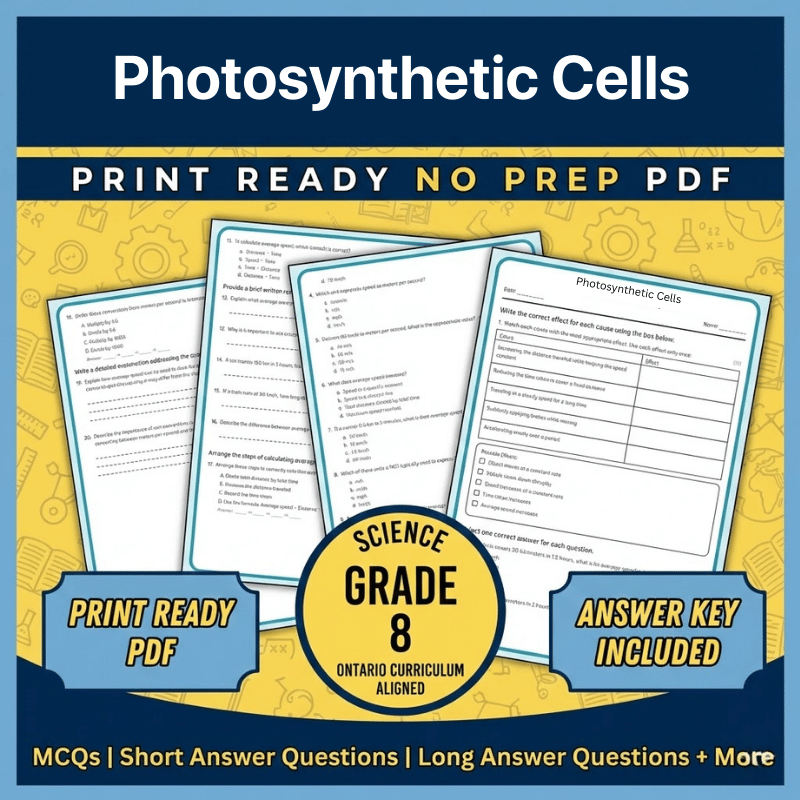
Grade 8 Science | Photosynthetic Cells Worksheet (Ontario) PDF
Created byBright Mind ResourcesLearning Objectives
- Describe the structure and function of chloroplasts in photosynthetic cells.
- Explain light-dependent reactions and the Calvin cycle involved in photosynthesis.
- Identify environmental factors affecting photosynthetic efficiency.
Instant download
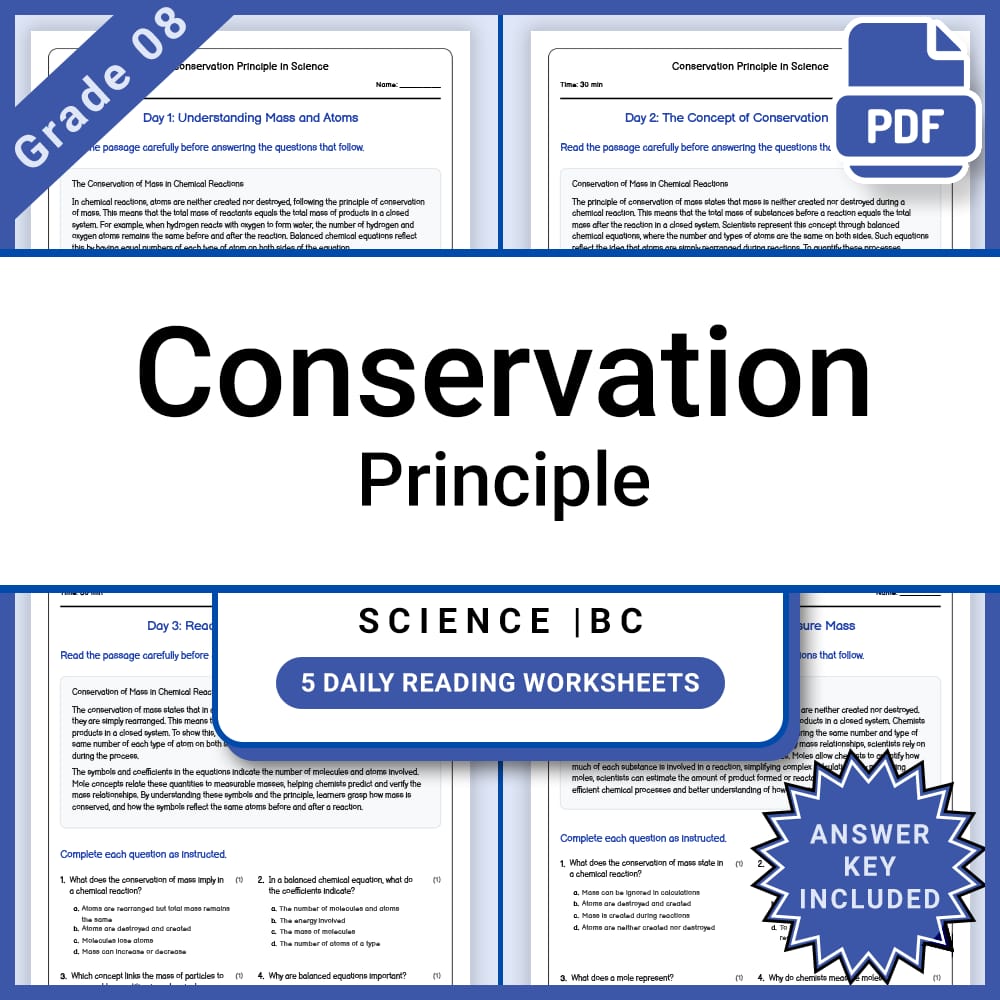
Grade 8 | Conservation Applications in Mass Daily Worksheet with Answer Key
JCreated byJ.S SheetsLearning Objectives
- Understand the concept of closed systems in mass conservation.
- Identify differences between open and closed systems during chemical reactions.
- Apply the principle of mass conservation to real-world examples.
Also included in: Grade 8 Science Lesson Group | Physical Changes and Chemical Reactions +1 more
Instant download
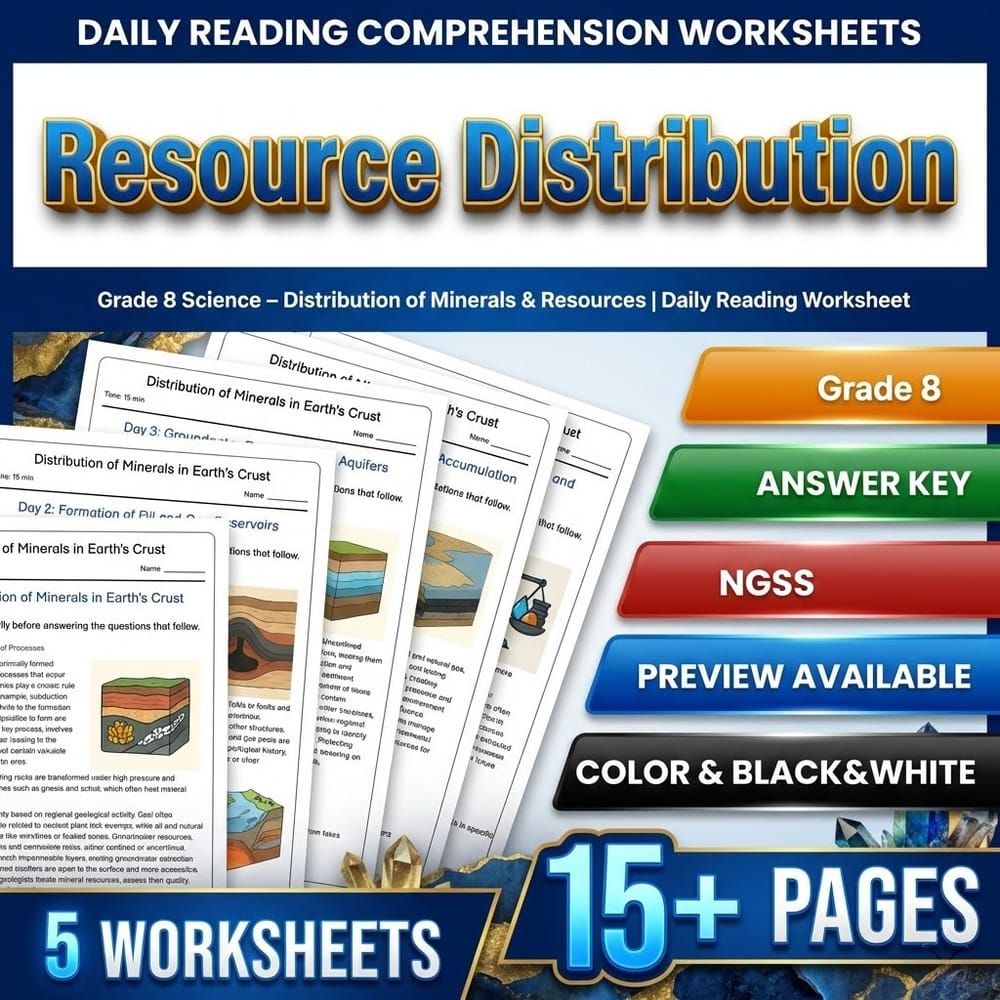
Grade 8 Science – Distribution of Minerals & Resources | Daily Reading Worksheet
 Created byElena Brooks
Learning Objectives
- Understand geological processes that lead to mineral formation and distribution
- Identify different types of mineral deposits and their characteristics
- Analyze regional differences in mineral resources and their implications for sustainable extraction
Instant download
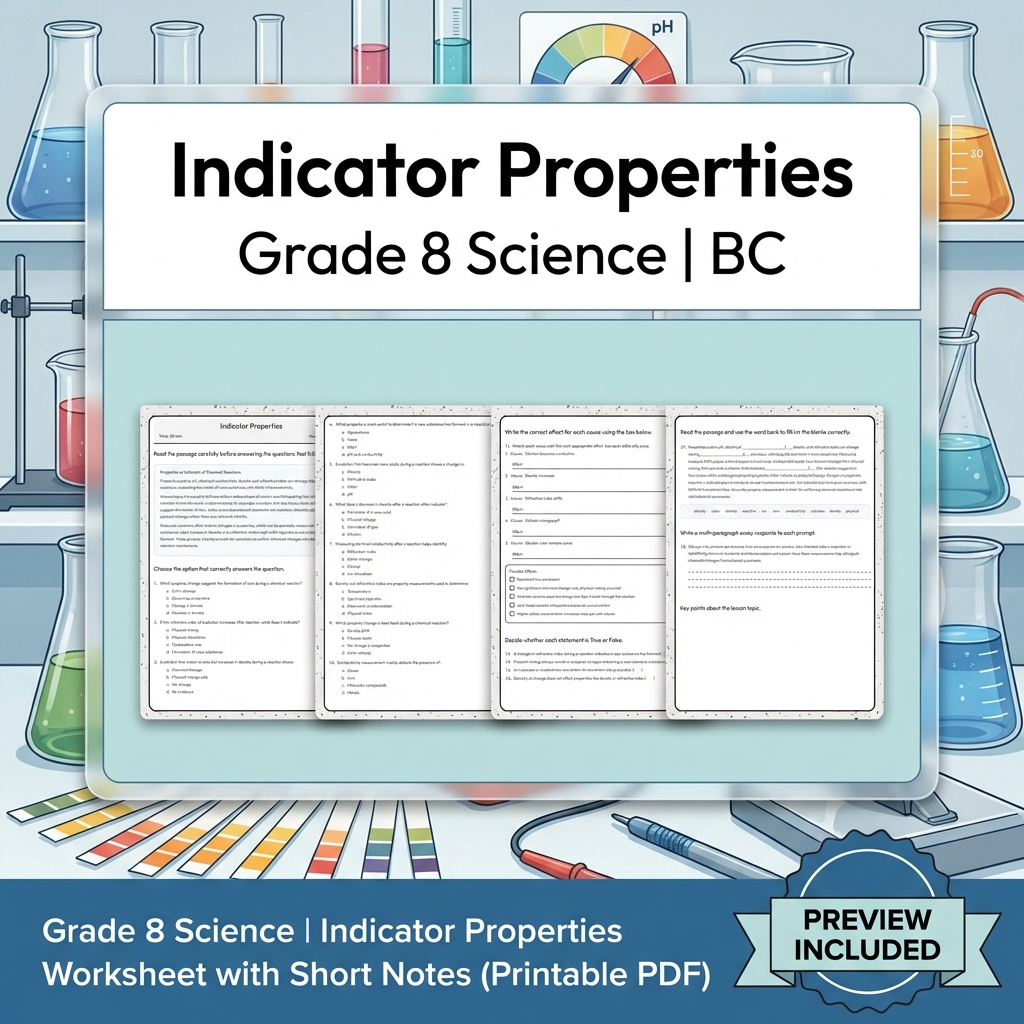
Grade 8 Science | Indicator Properties Worksheet with Short Notes (PDF)
 Created byMeadowlark Worksheets
Learning Objectives
- Understand how properties like pH, conductivity, density, and refractive index change during chemical reactions.
- Identify how property shifts indicate the formation of new substances.
- Distinguish between physical and chemical changes based on property measurements.
Also included in: Grade 8 Science Lesson Bundle | BC Reaction Types & Conservation Worksheets +1 more
Instant download
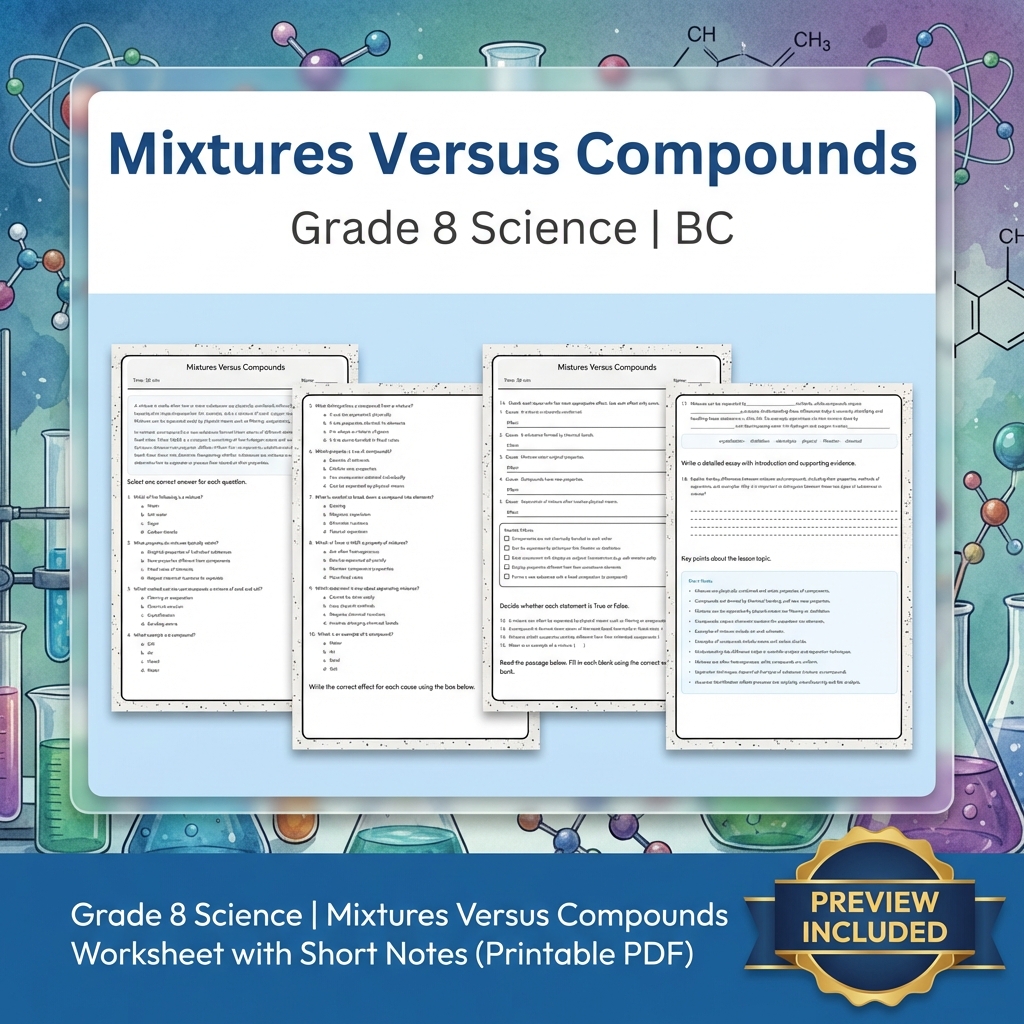
Grade 8 Science | Mixtures Versus Compounds Worksheet with Short Notes (PDF)
Created byMeadowlark WorksheetsLearning Objectives
- Understand the difference between mixtures and compounds.
- Identify examples of mixtures and compounds in everyday life.
- Describe properties that distinguish mixtures from compounds.
Also included in: Grade 8 Science Lesson Bundle | BC Reaction Types & Conservation Worksheets +1 more
Instant download
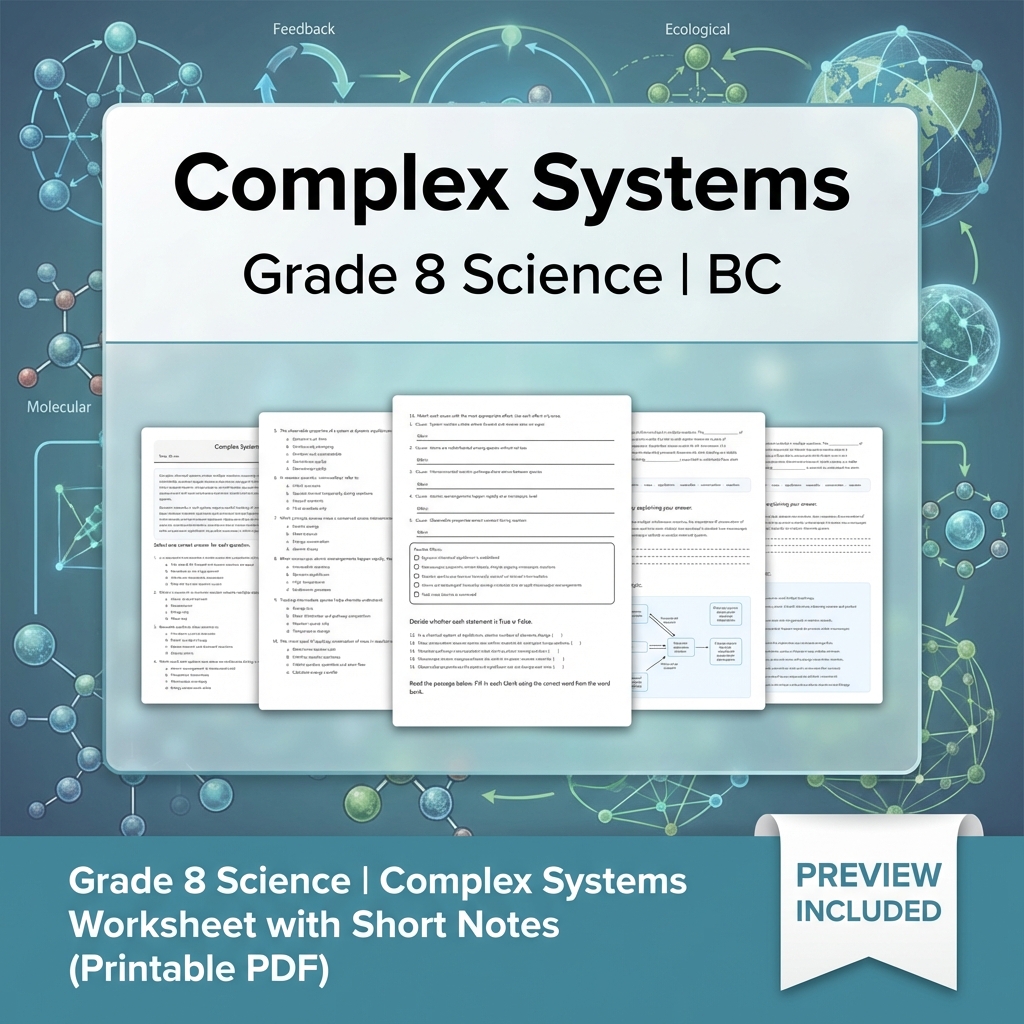
Grade 8 Science | Complex Systems Worksheet with Short Notes (Printable PDF)
Created byMeadowlark WorksheetsLearning Objectives
- Understand the concept of chemical reaction networks involving multiple simultaneous reactions.
- Apply conservation of mass principles across interconnected chemical steps.
- Explain how reversible equilibria in reaction systems establish dynamic balance without net atomic loss.
Also included in: Grade 8 Science Lesson Bundle | BC Reaction Types & Conservation Worksheets +1 more
Instant download
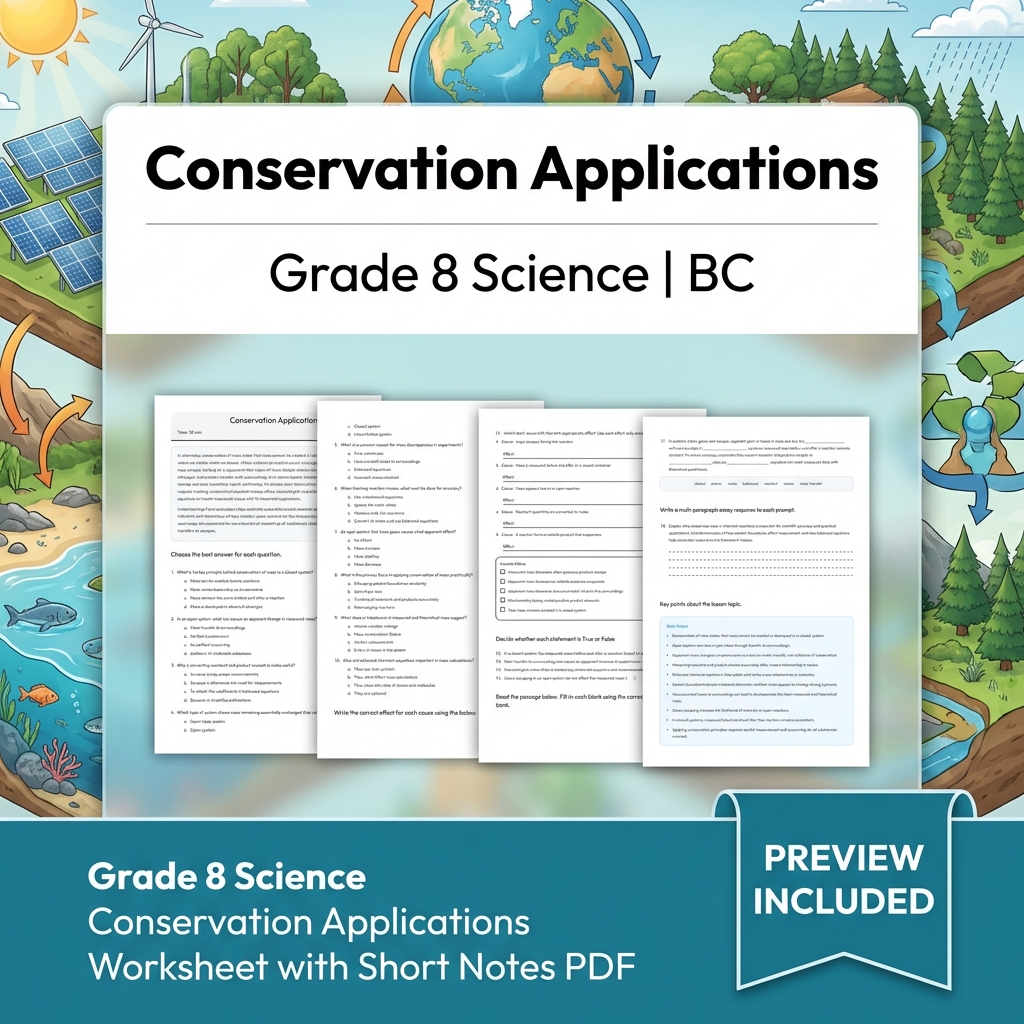
Grade 8 Science Conservation Applications Worksheet with Short Notes PDF
Created byMeadowlark WorksheetsLearning Objectives
- Understand the principle of mass conservation in closed and open systems.
- Apply quantitative methods to track reactants and products in chemical systems.
- Recognize factors that can cause apparent mass changes in open systems.
Also included in: Grade 8 Science Lesson Bundle | BC Reaction Types & Conservation Worksheets +1 more
Instant download
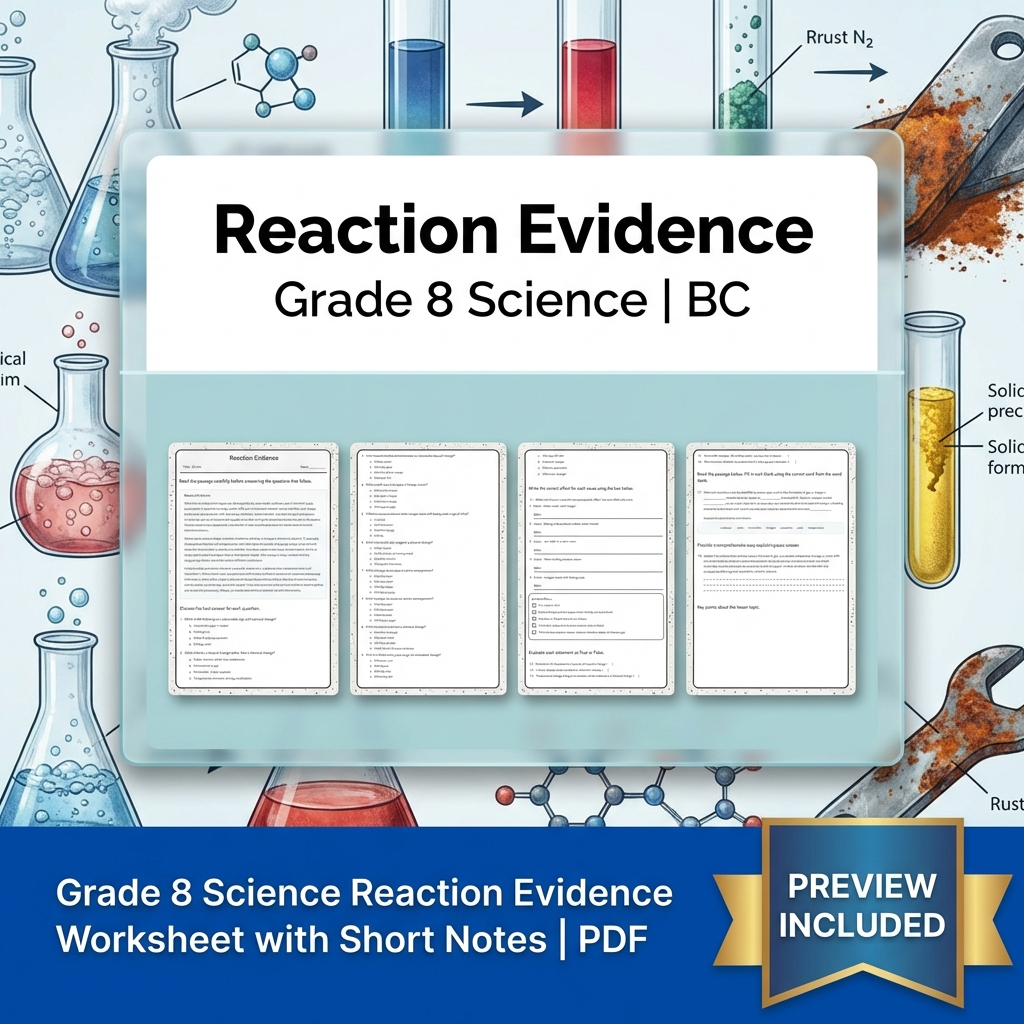
Grade 8 Science Reaction Evidence Worksheet with Short Notes | PDF
Created byMeadowlark WorksheetsLearning Objectives
- Identify observable evidence of chemical and physical changes.
- Differentiate between chemical and physical changes based on evidence.
- Recognize examples of chemical and physical reactions in real life.
Also included in: Grade 8 Science Lesson Bundle | BC Reaction Types & Conservation Worksheets +1 more
Instant download
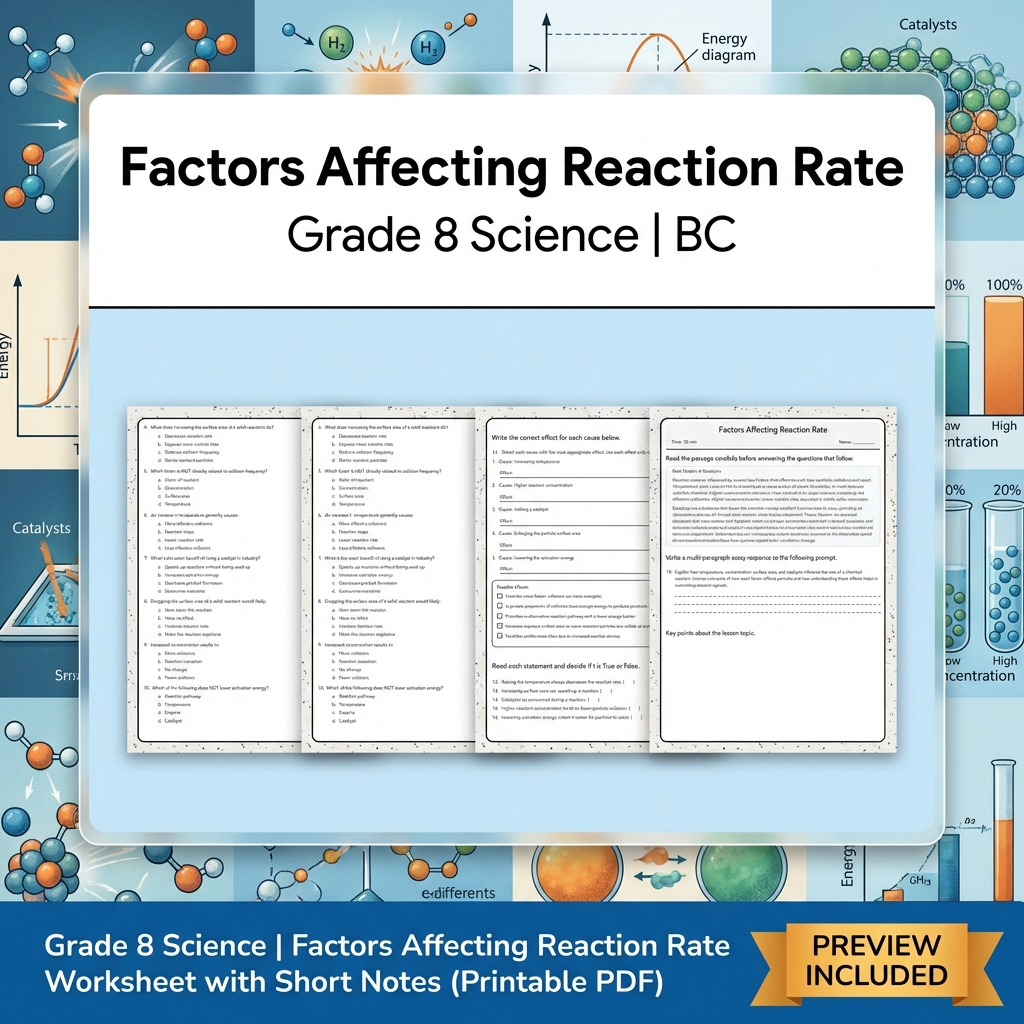
Grade 8 Science | Factors Affecting Reaction Rate Worksheet (PDF)
Created byMeadowlark WorksheetsLearning Objectives
- Understand how temperature, concentration, surface area, and catalysts influence reaction rates.
- Identify and explain factors that change how particles collide and react.
- Relate microscopic particle behavior to the macroscopic speed of reactions.
Also included in: Grade 8 Science Lesson Bundle | BC Reaction Types & Conservation Worksheets +1 more
Instant download
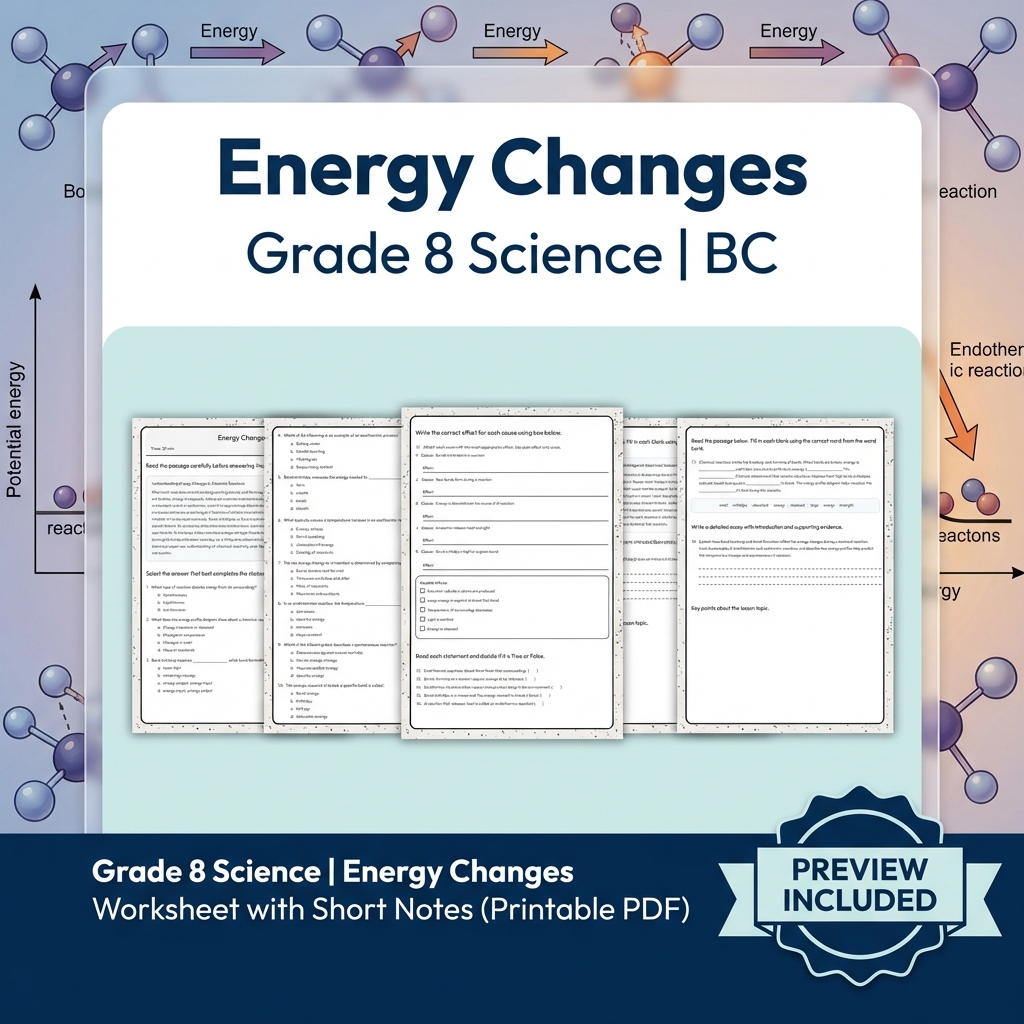
Grade 8 Science | Energy Changes Worksheet with Short Notes (Printable PDF)
Created byMeadowlark WorksheetsLearning Objectives
- Understand the concept of energy changes during chemical reactions.
- Identify endothermic and exothermic reactions based on energy profiles.
- Explain how bond breaking and formation affect heat absorption or release.
Also included in: Grade 8 Science Lesson Bundle | BC Reaction Types & Conservation Worksheets +1 more
Instant download
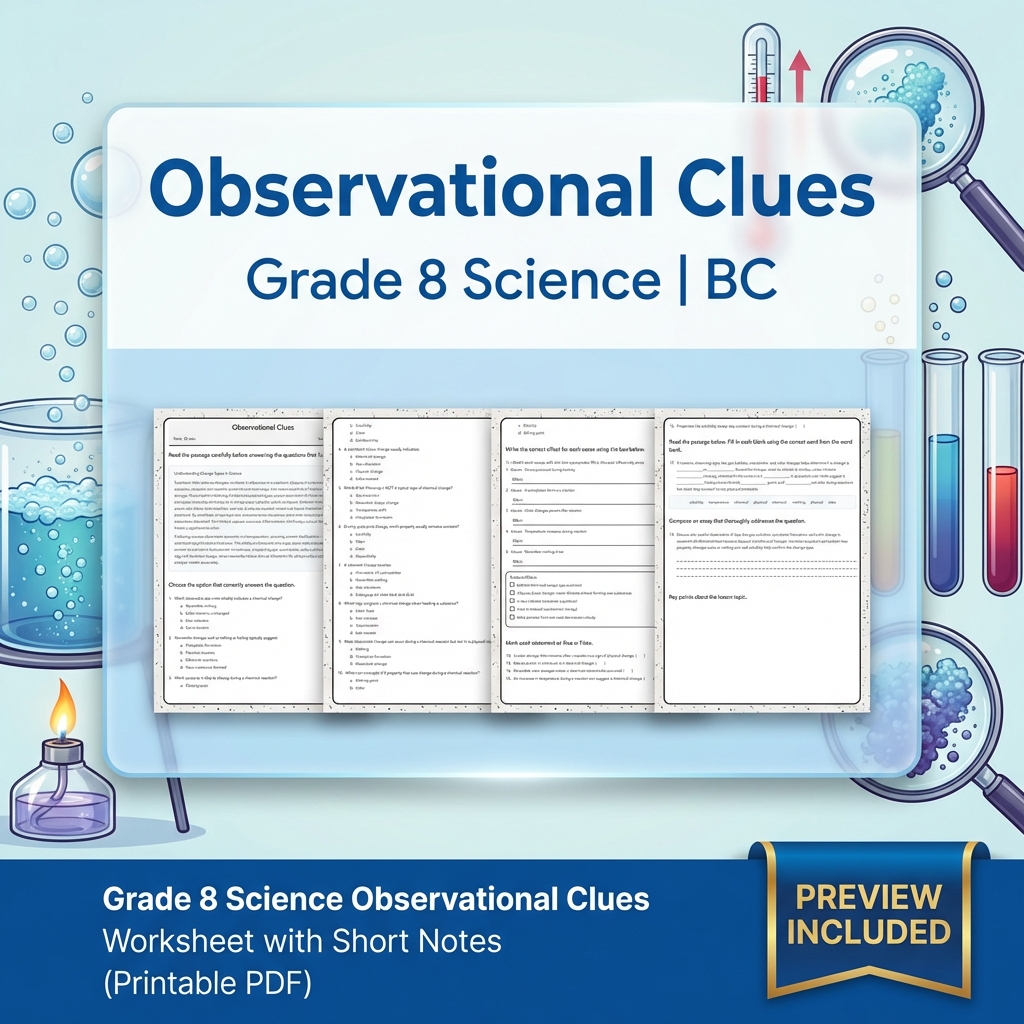
Grade 8 Science Observational Clues Worksheet with Short Notes (Printable PDF)
Created byMeadowlark WorksheetsLearning Objectives
- Identify physical and chemical changes based on observable clues.
- Distinguish between properties that change during chemical reactions and those that remain constant.
- Apply proper observational indicators to differentiate change types without atomic-level assumptions.
Also included in: Grade 8 Science Lesson Bundle | BC Reaction Types & Conservation Worksheets +1 more
Instant download
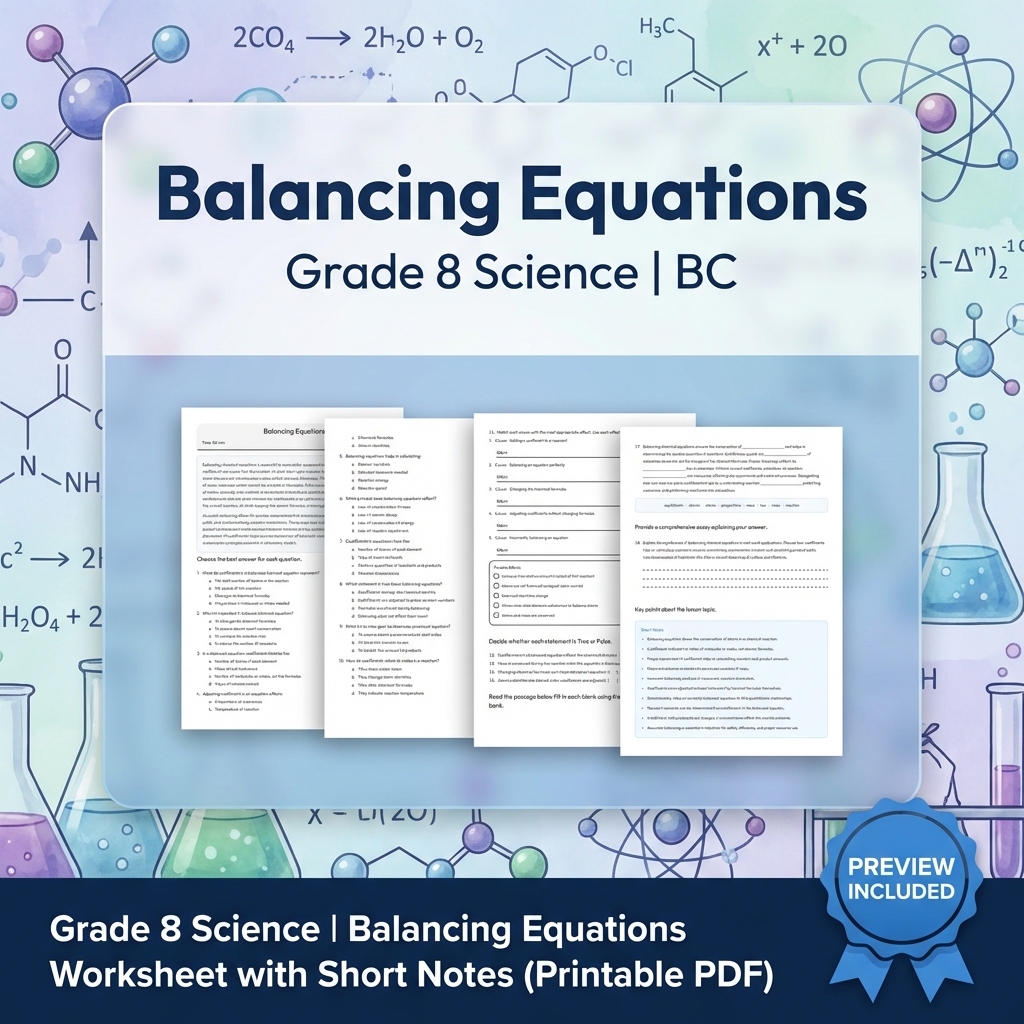
Grade 8 Science | Balancing Equations Worksheet with Short Notes (Printable PDF)
Created byMeadowlark WorksheetsLearning Objectives
- Understand the purpose of balancing chemical equations using coefficients.
- Identify how coefficients reflect mole ratios without changing chemical formulas.
- Learn how to interpret and balance chemical equations to conserve atoms and mass.
Also included in: Grade 8 Science Lesson Bundle | BC Reaction Types & Conservation Worksheets +1 more
Instant download
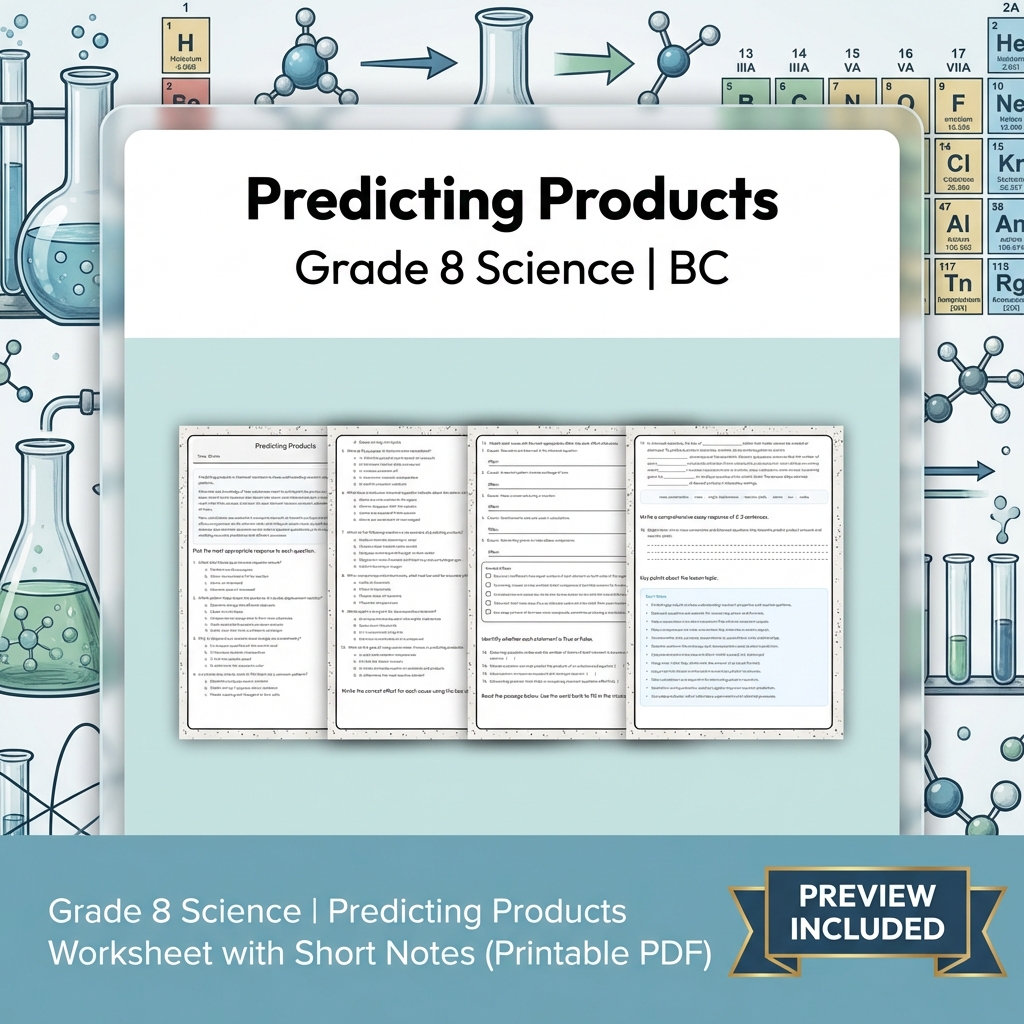
Grade 8 Science | Predicting Products Worksheet with Short Notes (Printable PDF)
Created byMeadowlark WorksheetsLearning Objectives
- Explain how to predict reaction products based on reactant identities and reaction patterns.
- Understand the importance of balancing chemical equations to conserve atoms and determine formulas.
- Perform mole-to-mass conversions to compare quantities and estimate yields in reactions.
Also included in: Grade 8 Science Lesson Bundle | BC Reaction Types & Conservation Worksheets +1 more
Instant download
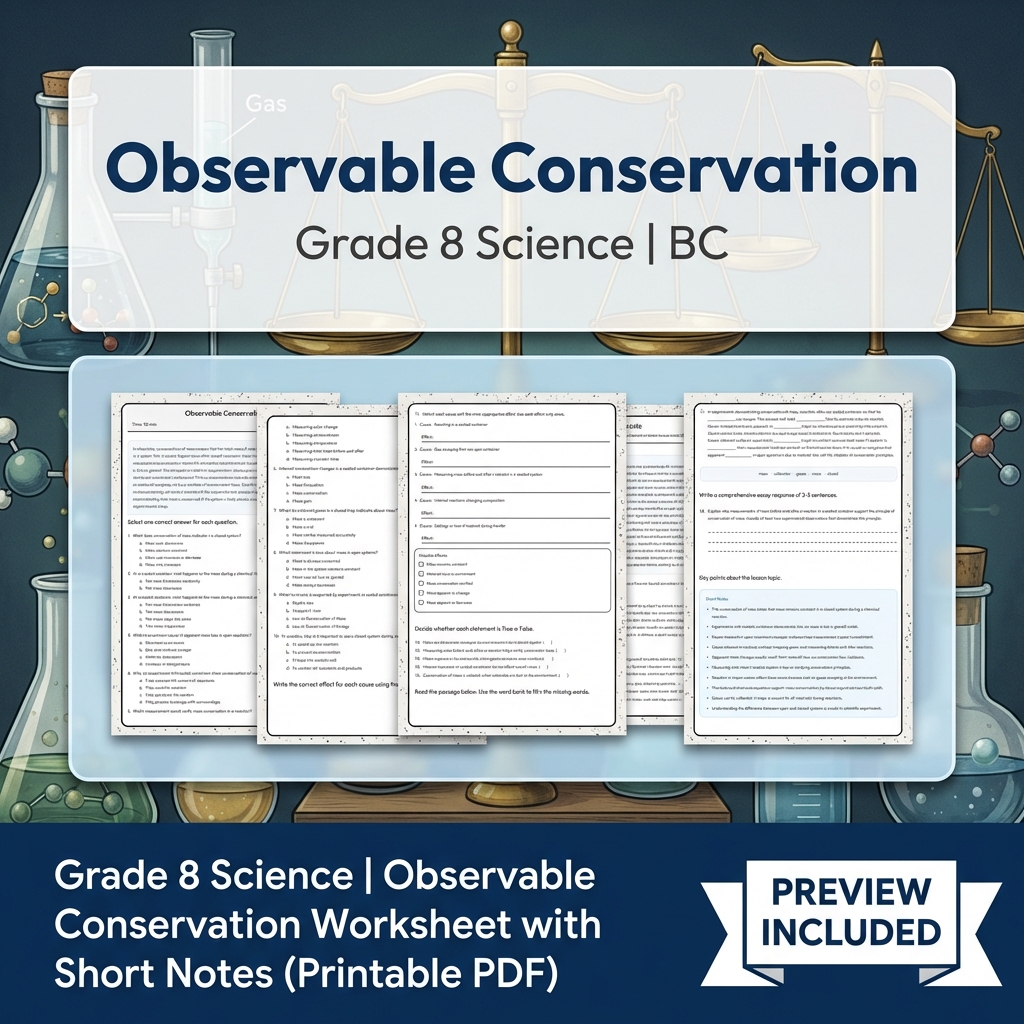
Grade 8 Science | Observable Conservation Worksheet with Short Notes (PDF)
Created byMeadowlark WorksheetsLearning Objectives
- Understand the principle of conservation of mass in closed systems during chemical reactions.
- Identify experimental methods that demonstrate mass conservation.
- Explain how measurements before and after reactions verify conservation principles.
Also included in: Grade 8 Science Lesson Bundle | BC Reaction Types & Conservation Worksheets +1 more
Instant download
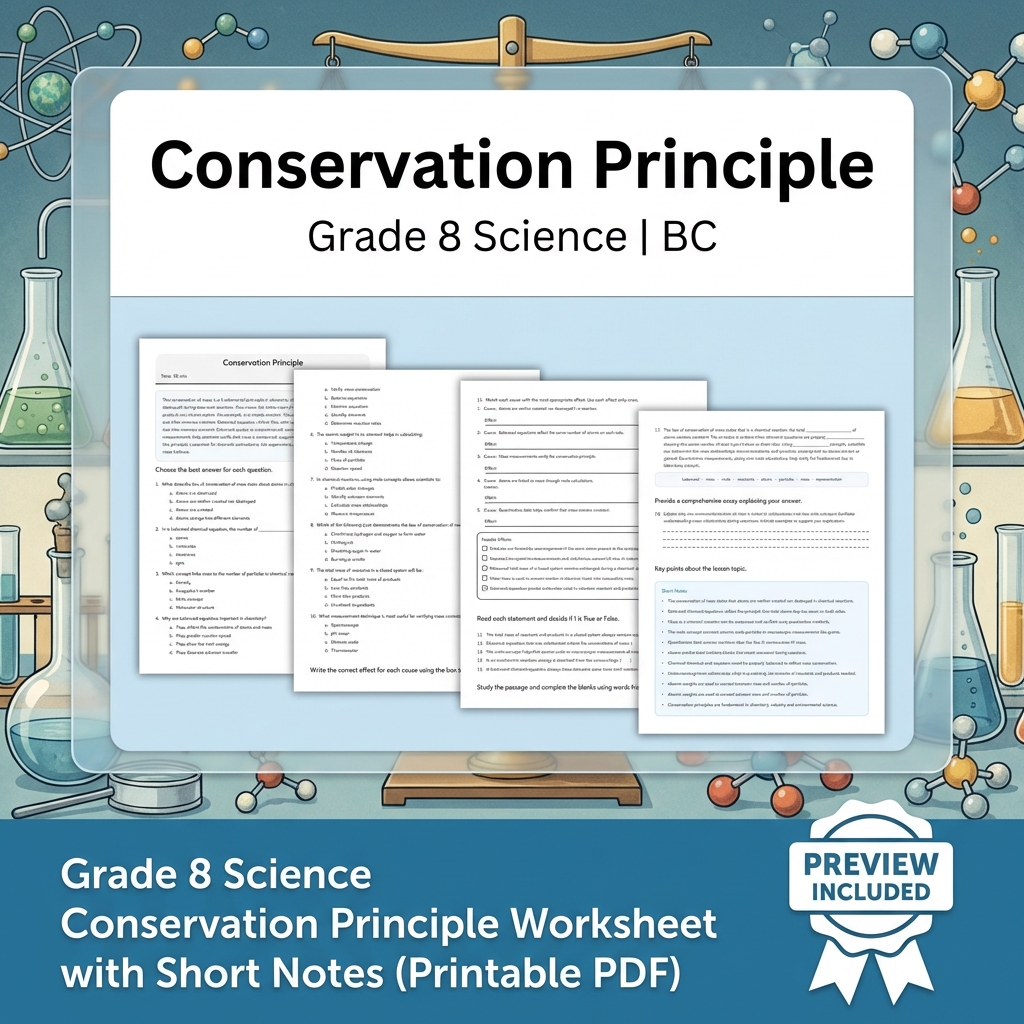
Grade 8 Science Conservation Principle Worksheet with Short Notes (PDF)
Created byMeadowlark WorksheetsLearning Objectives
- Understand the law of conservation of mass in chemical reactions.
- Explain how balanced chemical equations reflect mass conservation.
- Apply mole concepts to relate mass and number of particles in reactions.
Also included in: Grade 8 Science Lesson Bundle | BC Reaction Types & Conservation Worksheets +1 more
Instant download

Grade 8 Science | Particle Representations Worksheet with Short Notes (PDF)
Created byMeadowlark WorksheetsLearning Objectives
- Understand how particle models depict atoms and molecules during chemical reactions.
- Identify how particle diagrams illustrate bond-breaking and bond-forming processes.
- Explain how atomic identity and count are preserved in particle representations of reactions.
Also included in: Grade 8 Science Lesson Bundle | BC Reaction Types & Conservation Worksheets +1 more
Instant download
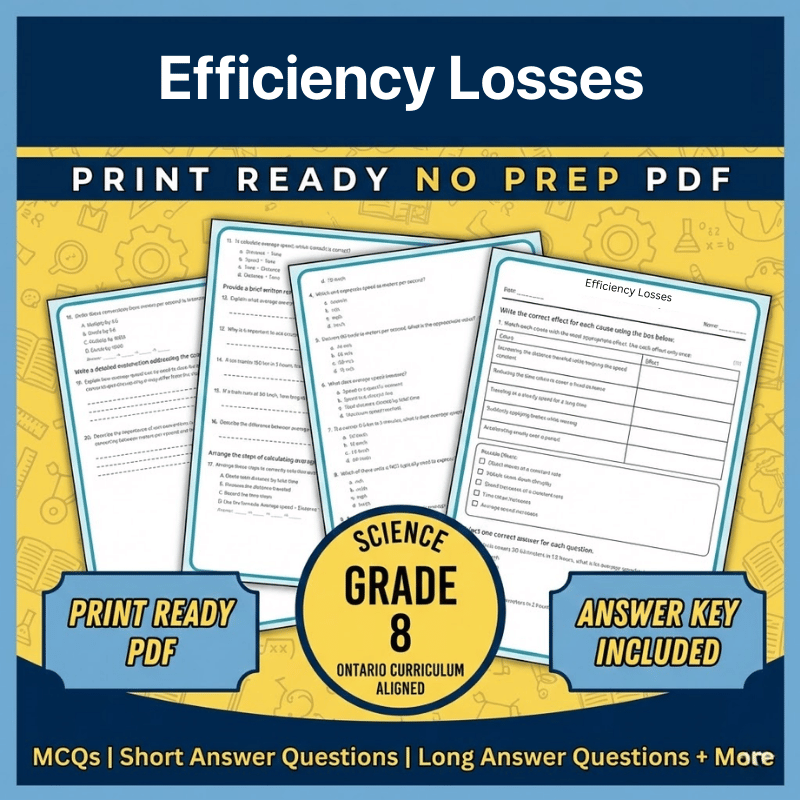
Grade 8 Science – Efficiency Losses Worksheet (Ontario) (PDF)
Created byBright Mind ResourcesLearning Objectives
- Explain the mechanisms of energy dissipation in mechanical systems such as frictional heating, sound emission, and hysteresis.
- Define mechanical efficiency and identify common causes of reduced efficiency in gears, bearings, and belt drives.
- Describe measurement approaches for quantifying energy losses in machines.
Instant download

Grade 8 Population Change Worksheet | NGSS Ecology Activity & Doodle Notes
 Created byAmber Owl Education
Learning Objectives
- Explain how biotic and abiotic factors affect population size over time
- Distinguish density-dependent from density-independent factors and predict their effects
- Use population graphs to describe exponential growth, carrying capacity, and long-term equilibrium
Also included in: Grade 8 Science Ecosystem Dynamics Lesson Bundle | NGSS +1 more
Instant download

Rock Cycle Earth Materials in Motion Worksheet | NGSSS Grade 8 Science
JCreated byJ.S SheetsLearning Objectives
- Explain how igneous, sedimentary, and metamorphic rocks connect through the rock cycle.
- Describe how weathering, erosion, deposition, heat, and pressure change Earth materials.
- Connect rock-cycle processes to tectonic plate movement and long time scales.
Also included in: Grade 8 Earth Systems and Climate Science Lesson Bundle – Florida NGSSS +1 more
Instant download
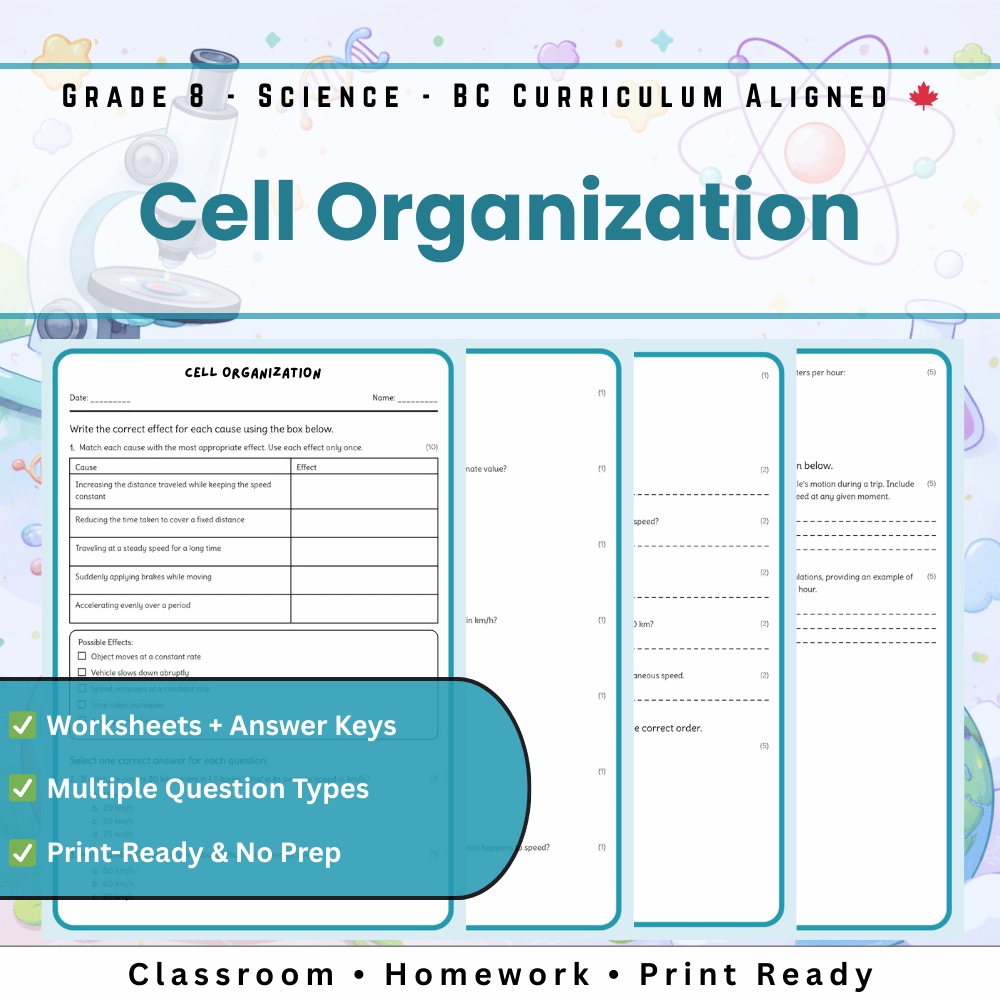
Grade 8 Science | Cell Organization Worksheet (PDF) Aligned with BC Standards
Created byBright Mind ResourcesLearning Objectives
- Describe the hierarchy of cell organization from cells to organ systems.
- Explain how similar cells form tissues with shared roles.
- Identify the functions of tissues, organs, and organ systems in maintaining life.
Instant download

Grade 8 Science | Net Force Effects Worksheet | California Standards
 Created byLumora Learning
Learning Objectives
- Explain how net force affects an object’s acceleration, including changes in speed and direction
- Identify when forces cancel (net force = 0) versus when they do not (unbalanced net force)
- Use the concepts of magnitude and direction to predict the direction of acceleration
Instant download

Grade 8 Science Worksheet | Molecules And States (PDF)
 Created byEvergreen Desk Education
Learning Objectives
- Describe how particles are arranged and how they move in solids, liquids, and gases.
- Explain how temperature relates to particle motion and energy.
- Predict what happens to particle spacing and motion during state changes.
Also included in: Grade 8 Matter, Forces, and Energy Science Lesson Bundle: General Framework +1 more
Instant download
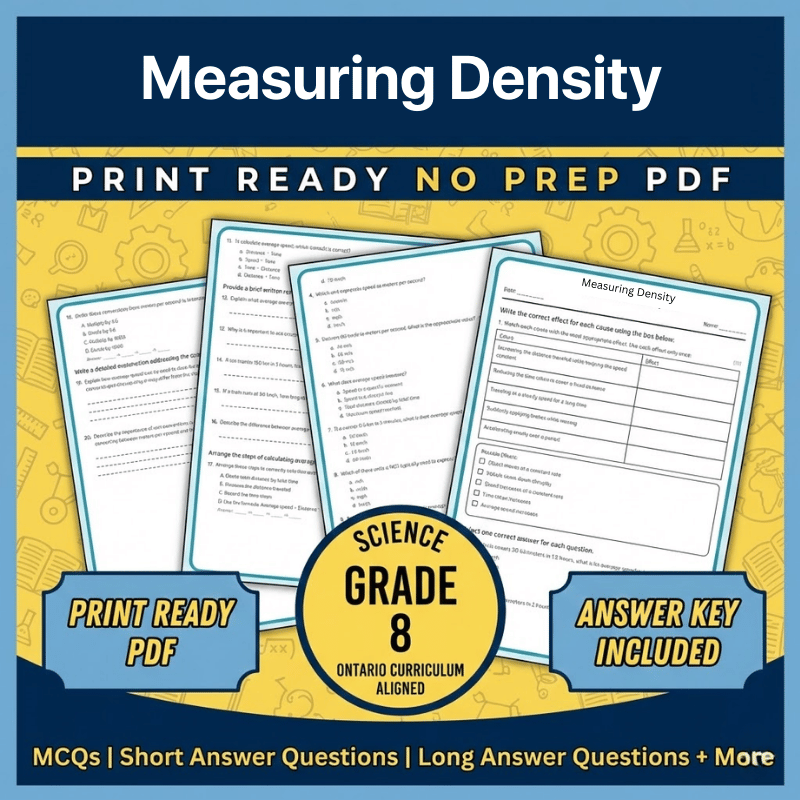
Grade 8 Science Worksheet – Measuring Density (PDF) Ontario Standards
Created byBright Mind ResourcesLearning Objectives
- Understand various methods to measure the density of solids and liquids.
- Learn to apply formulas for calculating density and interpret measurement discrepancies.
- Identify sources of errors affecting density measurements, such as trapped air and temperature effects.
Instant download
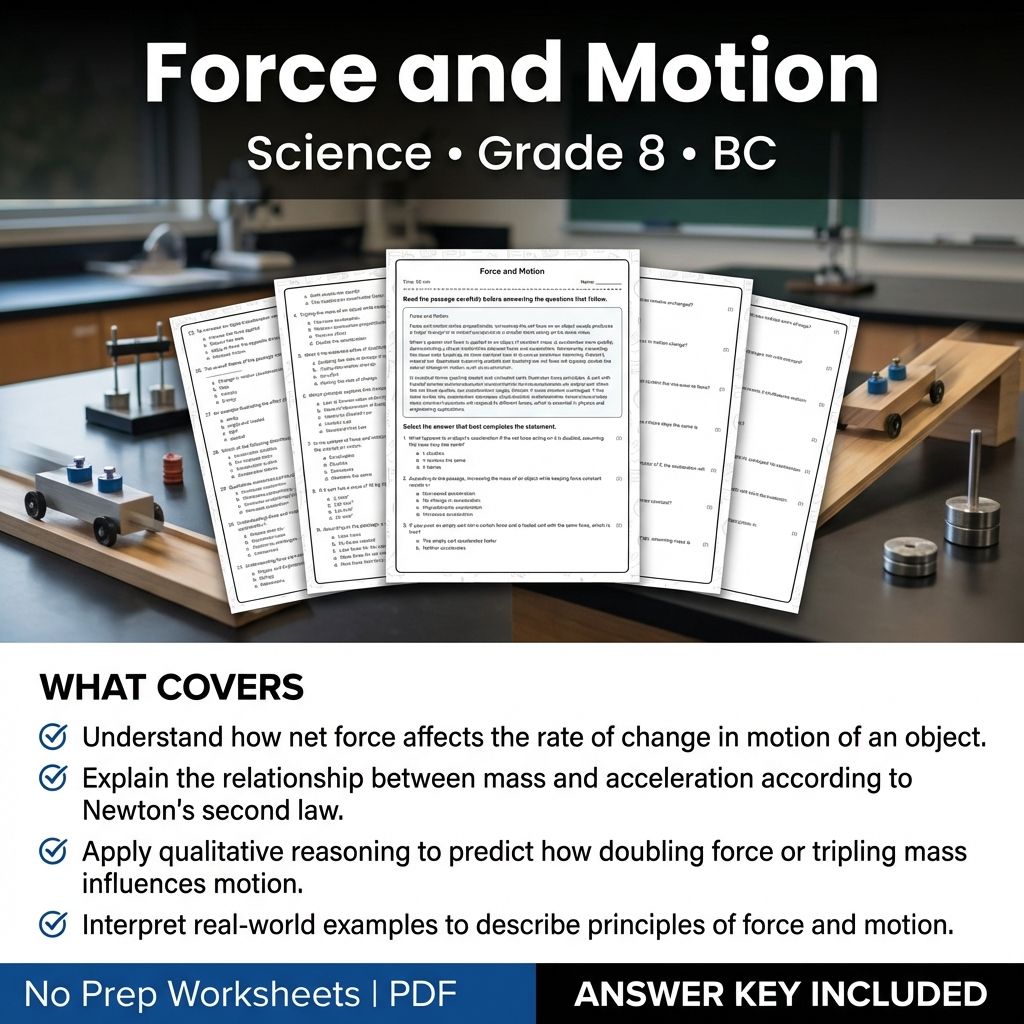
8th Grade Science | Force and Motion Worksheet & Answer Key (Printable PDF)
 Created byCoral Reef Learning
Learning Objectives
- Understand how net force affects the rate of change in motion of an object.
- Explain the relationship between mass and acceleration according to Newton's second law.
- Apply qualitative reasoning to predict how doubling force or tripling mass influences motion.
Instant download

Momentum Collisions Practice Worksheet | Grade 8 Science Review
Created byPrism Point LearningLearning Objectives
- Explain how momentum is conserved in a closed system during collisions
- Differentiate elastic and inelastic collisions using both momentum and kinetic energy
- Use impulse, contact time, and force ideas to predict velocity changes
Instant download

Grade 8 Collision Forces Worksheet | NGSS Practice PDF
 Created byClear Sky Classroom
Learning Objectives
- Explain how the magnitude of a force and the duration of contact affect changes in motion during collisions.
- Describe how structural deformation can absorb energy and reduce damage during impacts.
- Interpret observable outcomes (speed change, stopping distance, and deformation) using the relationship between force peaks and contact time.
Instant download
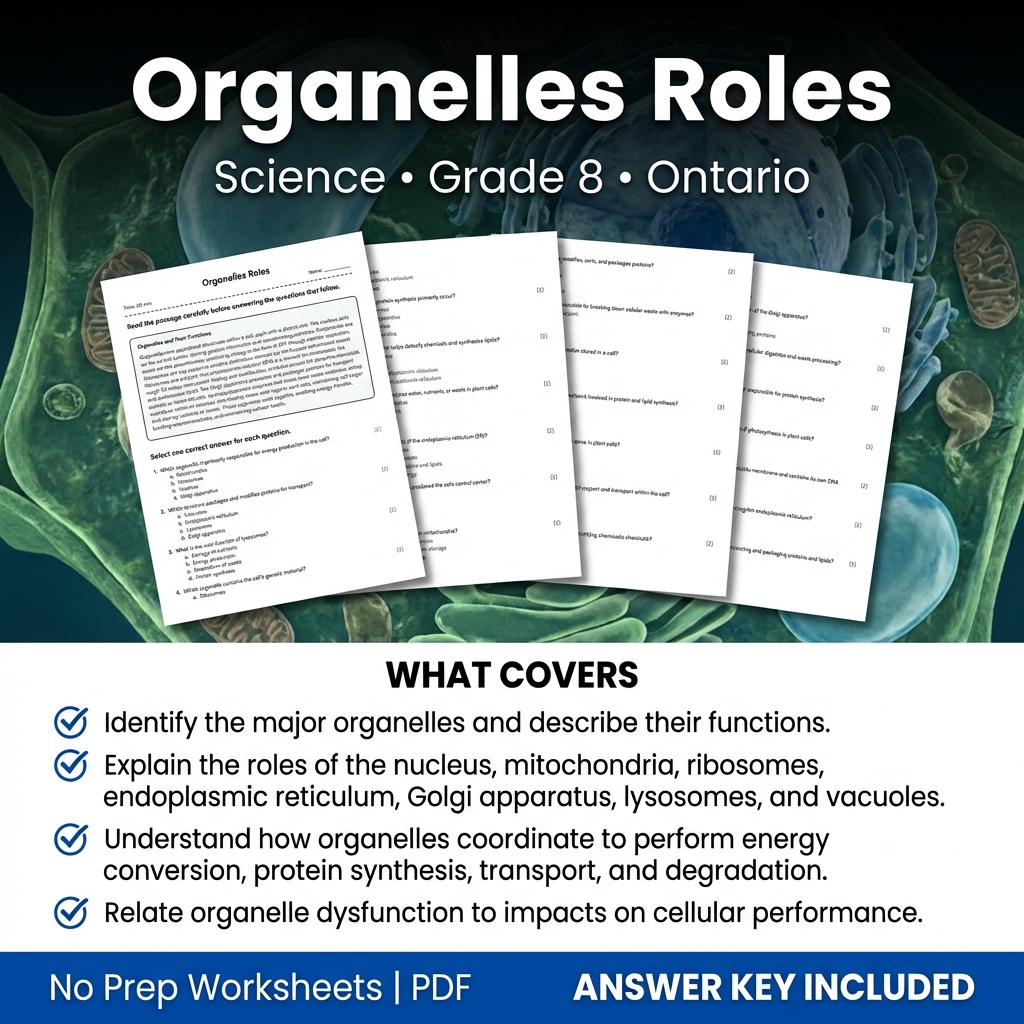
Grade 8 Science Worksheet on Organelles Roles | Ontario Standards
Created byCoral Reef LearningLearning Objectives
- Identify the major organelles and describe their functions.
- Explain the roles of the nucleus, mitochondria, ribosomes, endoplasmic reticulum, Golgi apparatus, lysosomes, and vacuoles.
- Understand how organelles coordinate to perform energy conversion, protein synthesis, transport, and degradation.
Instant download

Grade 8 Science | Atomic Structure Worksheet | TEKS-Aligned
Created byLumora LearningLearning Objectives
- Describe the basic components of an atom and their functions.
- Differentiate between elements, compounds, and mixtures.
- Explain how atomic arrangement influences the properties of substances.
Also included in: Grade 8 Science | Matter and Energy Lesson Bundle | TEKS Aligned
Instant download
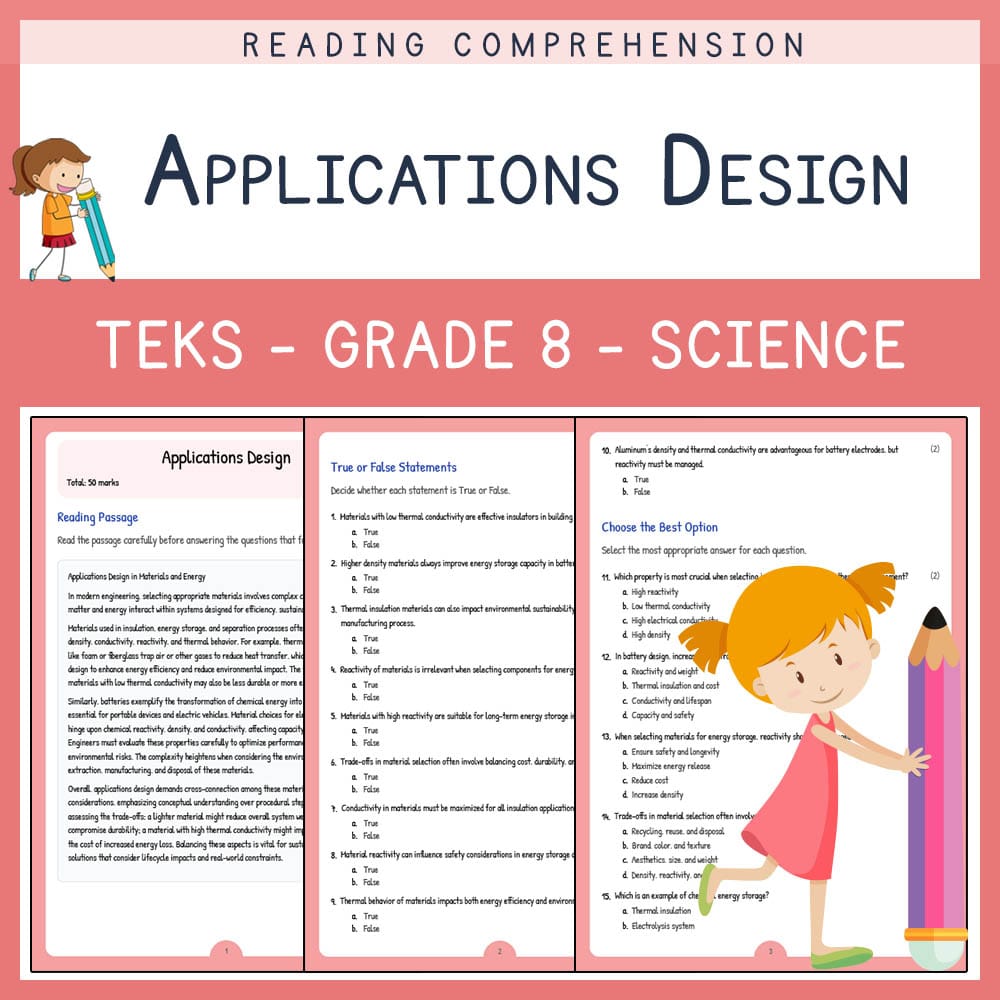
Grade 8 Science | Applications Design Worksheet | TEKS-Aligned
Created byLumora LearningLearning Objectives
- Understand how material properties influence energy efficiency and environmental impact.
- Evaluate trade-offs among density, conductivity, reactivity, and thermal behavior in engineering materials.
- Analyze examples of energy storage and delivery, such as batteries and thermal insulation.
Also included in: Grade 8 Science | Matter and Energy Lesson Bundle | TEKS Aligned
Instant download
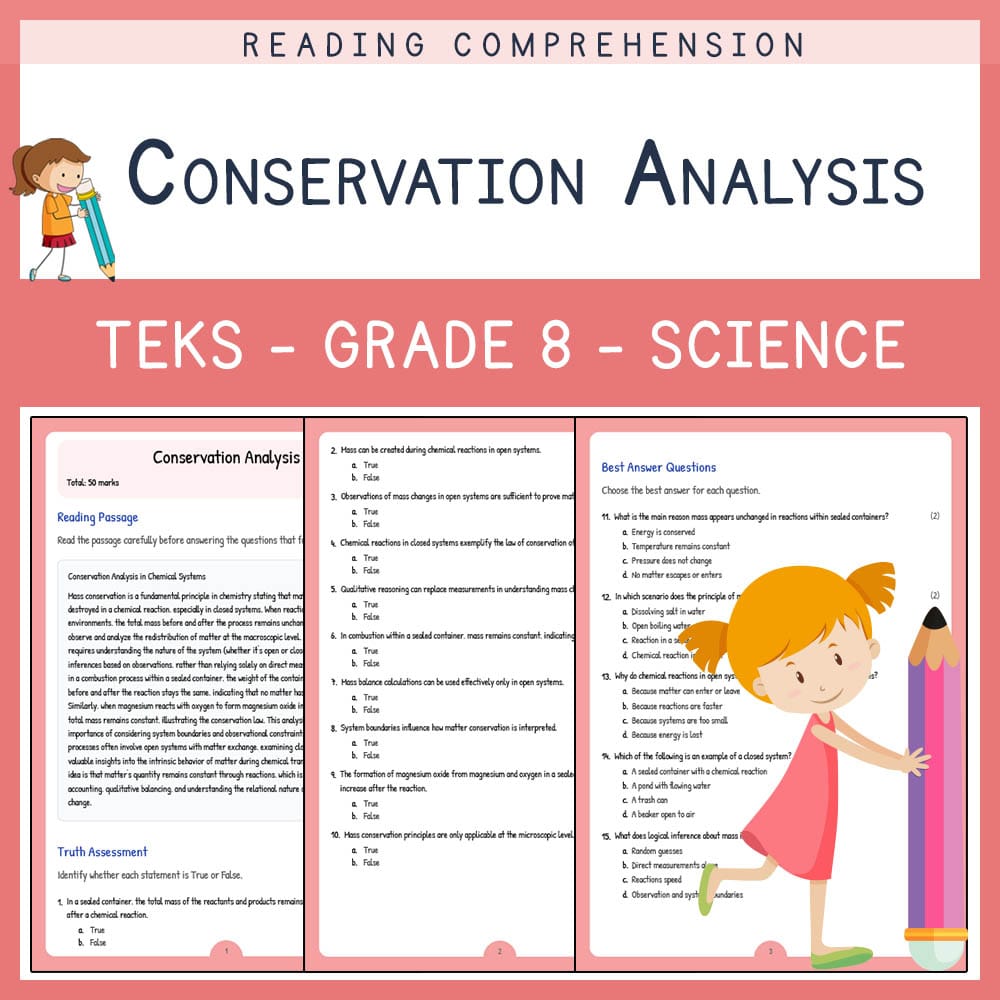
Grade 8 Science | Conservation Analysis Worksheet | TEKS Aligned
Created byLumora LearningLearning Objectives
- Understand the principle of mass conservation in chemical processes within closed systems.
- Analyze how observations in sealed environments relate to matter conservation.
- Differentiate between open and closed systems in chemical reactions.
Also included in: Grade 8 Science | Matter and Energy Lesson Bundle | TEKS Aligned
Instant download
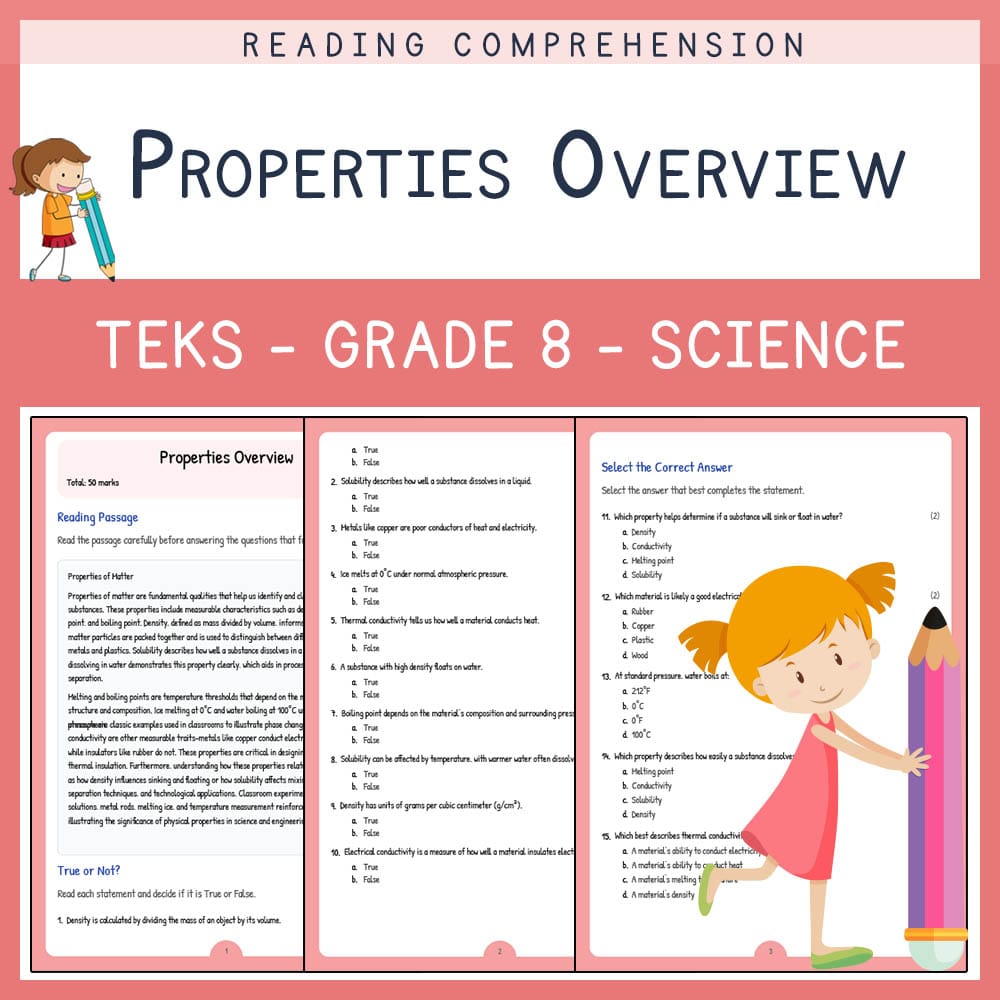
Grade 8 Science | Properties Overview Worksheet | TEKS Alligned
Created byLumora LearningLearning Objectives
- Describe physical properties of matter such as density, solubility, melting, and boiling points.
- Compare the electrical and thermal conductivity of different materials.
- Understand how physical properties are used to classify and separate substances.
Also included in: Grade 8 Science | Matter and Energy Lesson Bundle | TEKS Aligned
Instant download
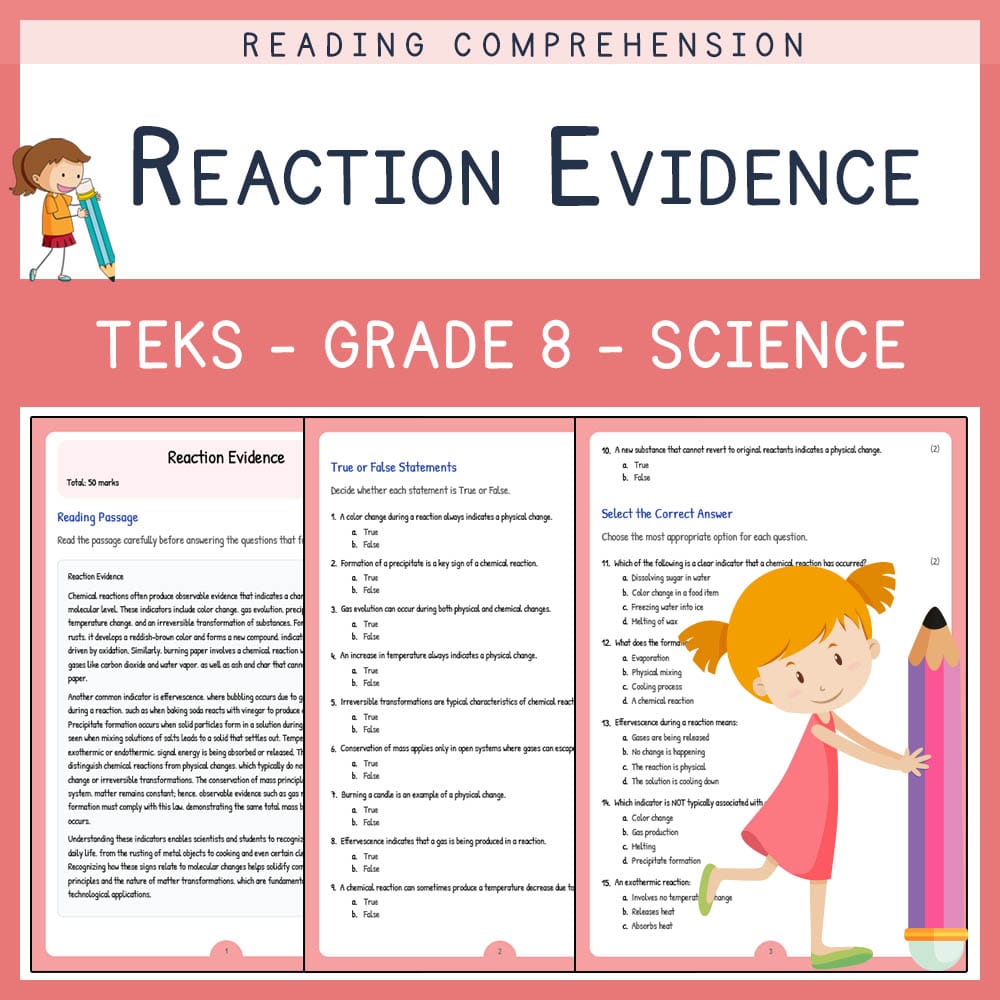
Grade 8 Science | Reaction Evidence Worksheet Elena | TEKS Aligned
Created byLumora LearningLearning Objectives
- Identify observable indicators of chemical reactions such as color change, gas evolution, and precipitate formation.
- Distinguish between chemical and physical changes based on evidence and indicators.
- Explain how conservation of mass applies in closed systems during chemical reactions.
Also included in: Grade 8 Science | Matter and Energy Lesson Bundle | TEKS Aligned
Instant download
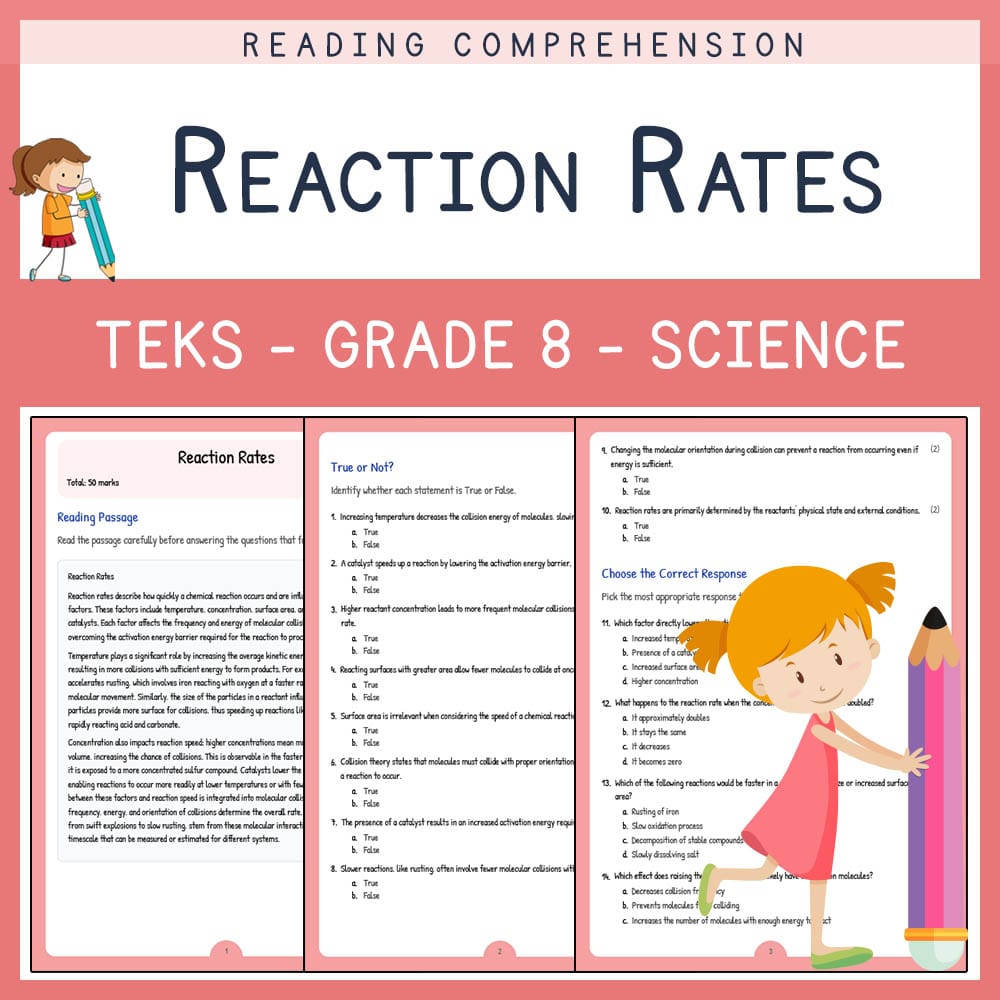
Grade 8 Science | Reaction Rates Worksheet | TEKS Aligned
Created byLumora LearningLearning Objectives
- Understand the factors that influence the speed of chemical reactions.
- Describe how temperature, concentration, surface area, and catalysts affect reaction rates.
- Explain molecular collision theory and activation energy in relation to reaction speed.
Also included in: Grade 8 Science | Matter and Energy Lesson Bundle | TEKS Aligned
Instant download
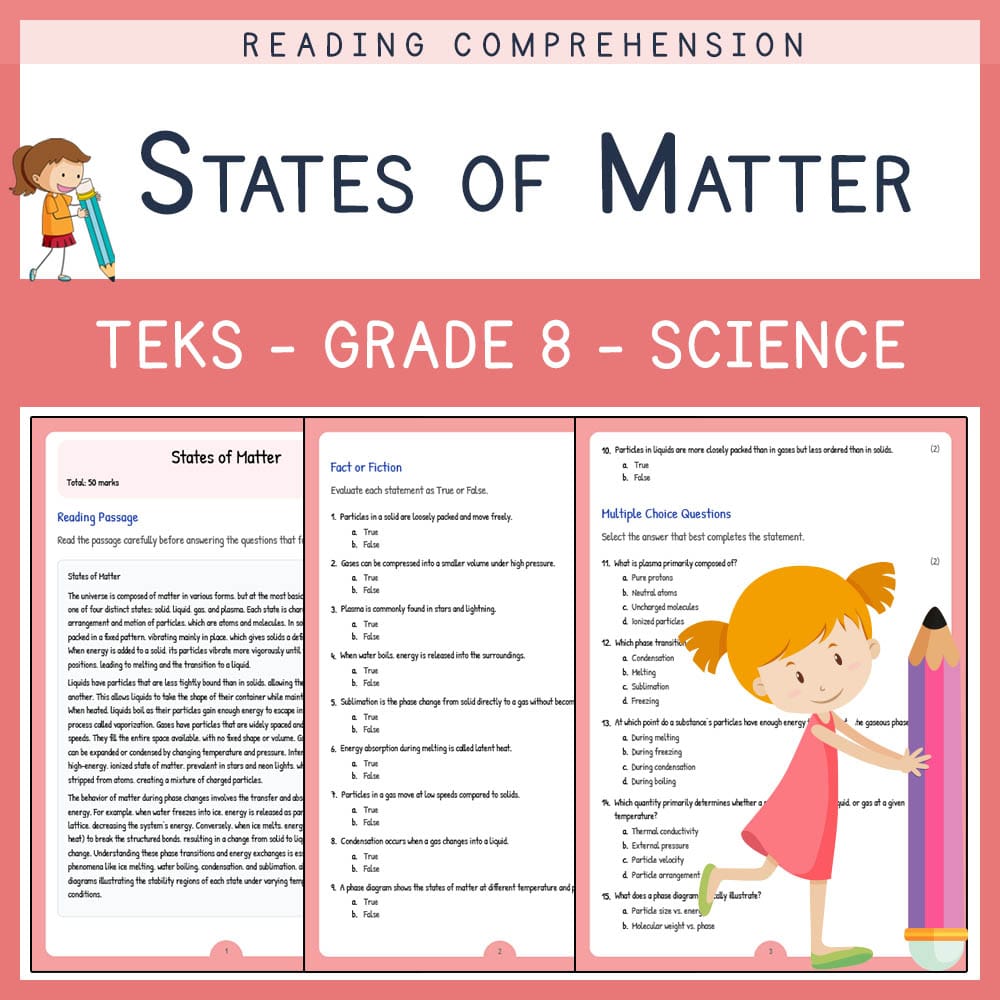
Grade 8 Science | States of Matter Worksheet Elena | TEKS-Aligned
Created byLumora LearningLearning Objectives
- Describe the different states of matter: solid, liquid, gas, and plasma.
- Explain the particle arrangement and motion in each state.
- Relate energy changes to phase transitions such as melting, boiling, condensation, and sublimation.
Also included in: Grade 8 Science | Matter and Energy Lesson Bundle | TEKS Aligned
Instant download
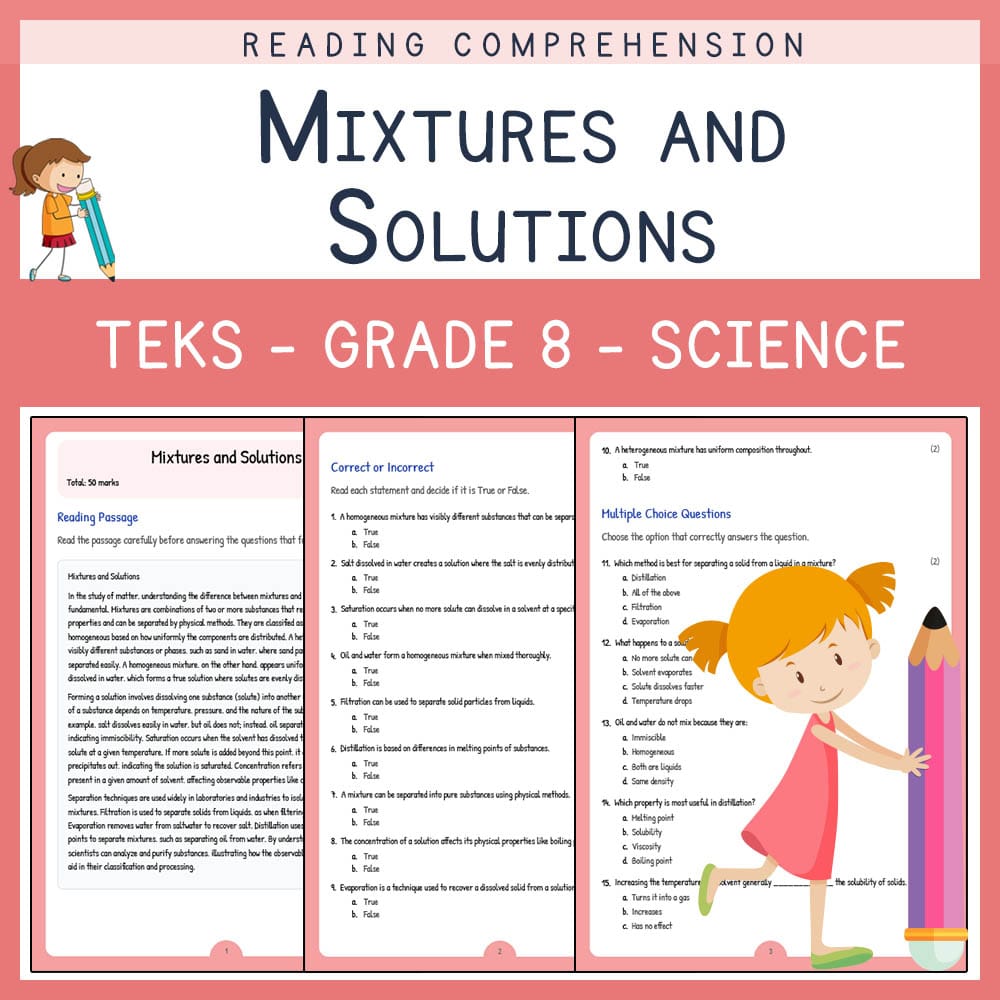
Grade 8 Science | Mixtures and Solutions Worksheet | TEKS Aligned
Created byLumora LearningLearning Objectives
- Differentiate between heterogeneous and homogeneous mixtures.
- Understand the formation and separation of solutions.
- Explain concepts of saturation, solubility, and concentration.
Also included in: Grade 8 Science | Matter and Energy Lesson Bundle | TEKS Aligned
Instant download
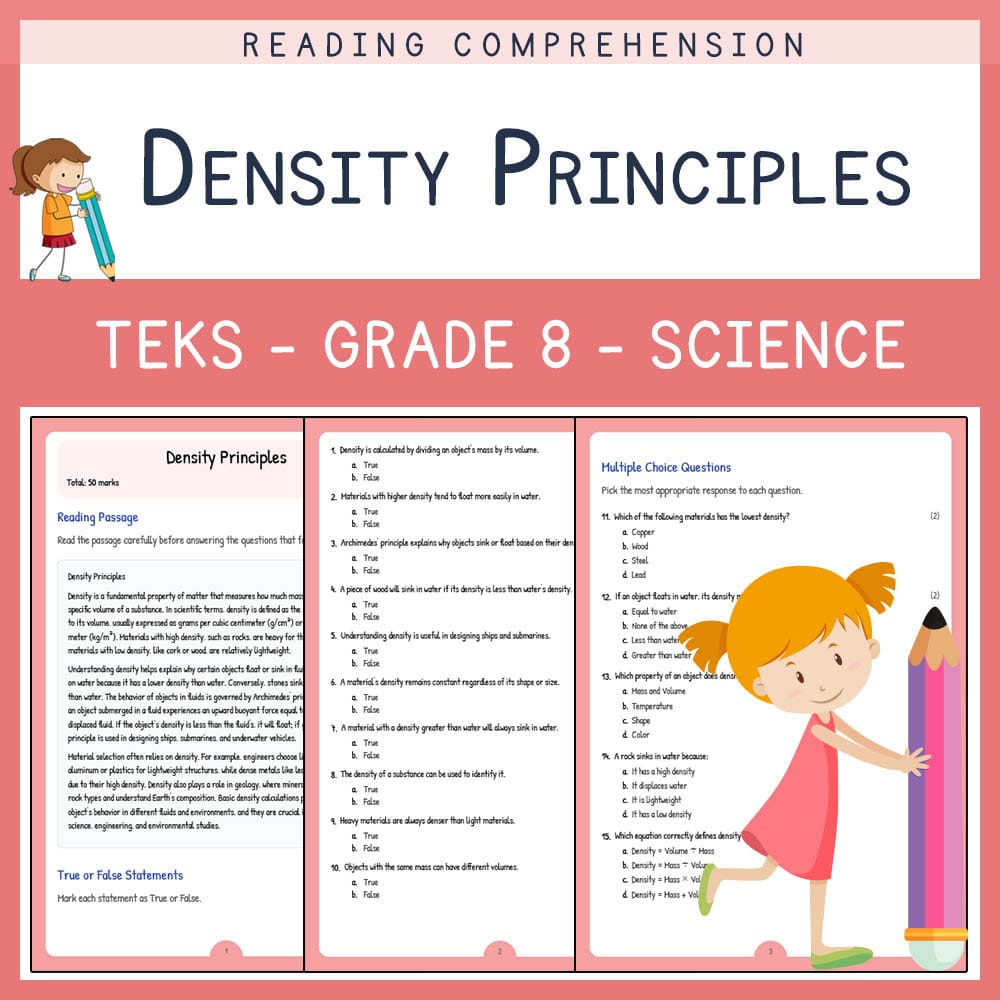
Grade 8 Science | Density Principles Worksheet | TEKS-Aligned
Created byLumora LearningLearning Objectives
- Understand the concept of density as a ratio of mass to volume.
- Explain how density affects the buoyancy of objects in fluids.
- Compare densities of different materials and predict their behavior in liquids.
Also included in: Grade 8 Science | Matter and Energy Lesson Bundle | TEKS Aligned
Instant download
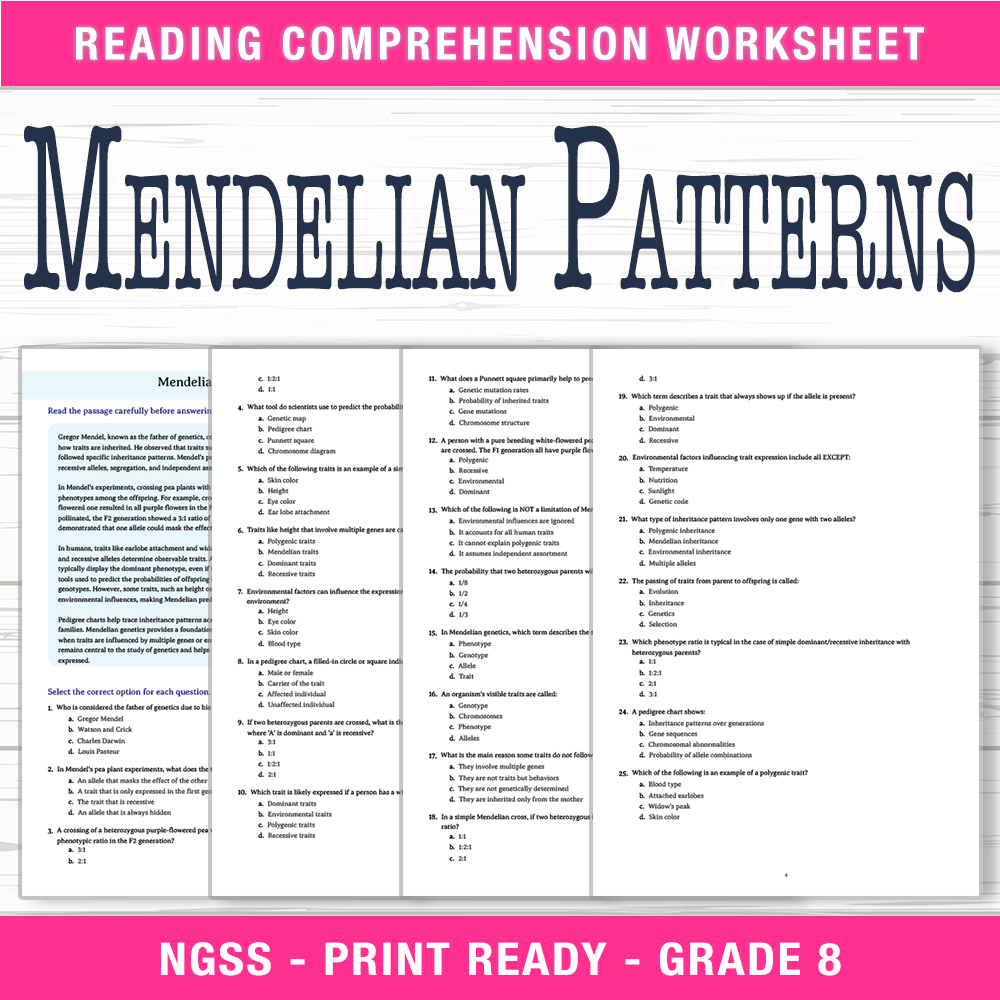
Grade 8 Science | Mendelian Patterns Worksheet (PDF + Answer Key)
 Created byRiverstone Classroom
Learning Objectives
- Explain how dominant and recessive alleles influence observable traits.
- Predict phenotypic and genotypic ratios using Punnett squares.
- Interpret basic pedigrees to determine inheritance patterns.
Instant download
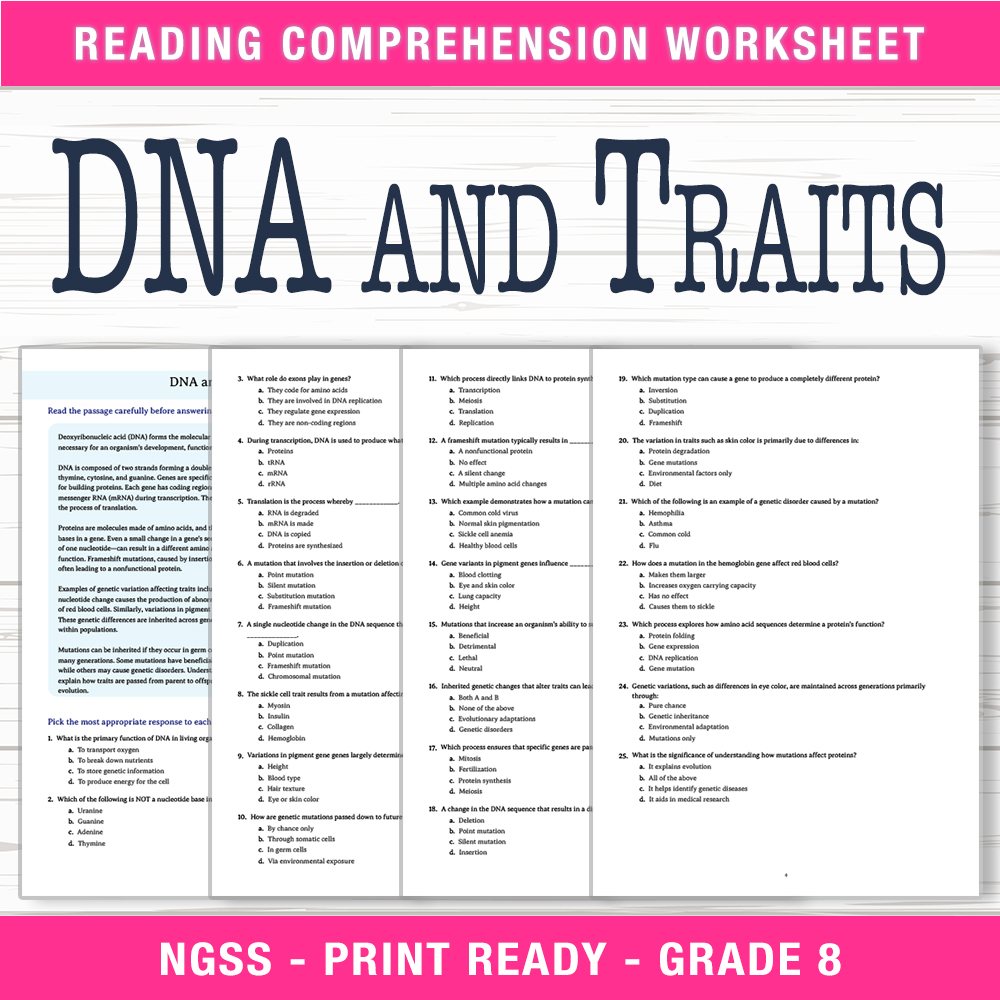
Grade 8 Science | DNA and Traits Worksheet (PDF + Answer Key)
Created byRiverstone ClassroomLearning Objectives
- Explain the molecular basis of inheritance by linking DNA sequences to proteins and observable traits.
- Describe the structure of genes, including coding sequences, and the processes of transcription and translation.
- Analyze how mutations such as point mutations and frameshifts affect amino acid sequences and protein function.
Instant download
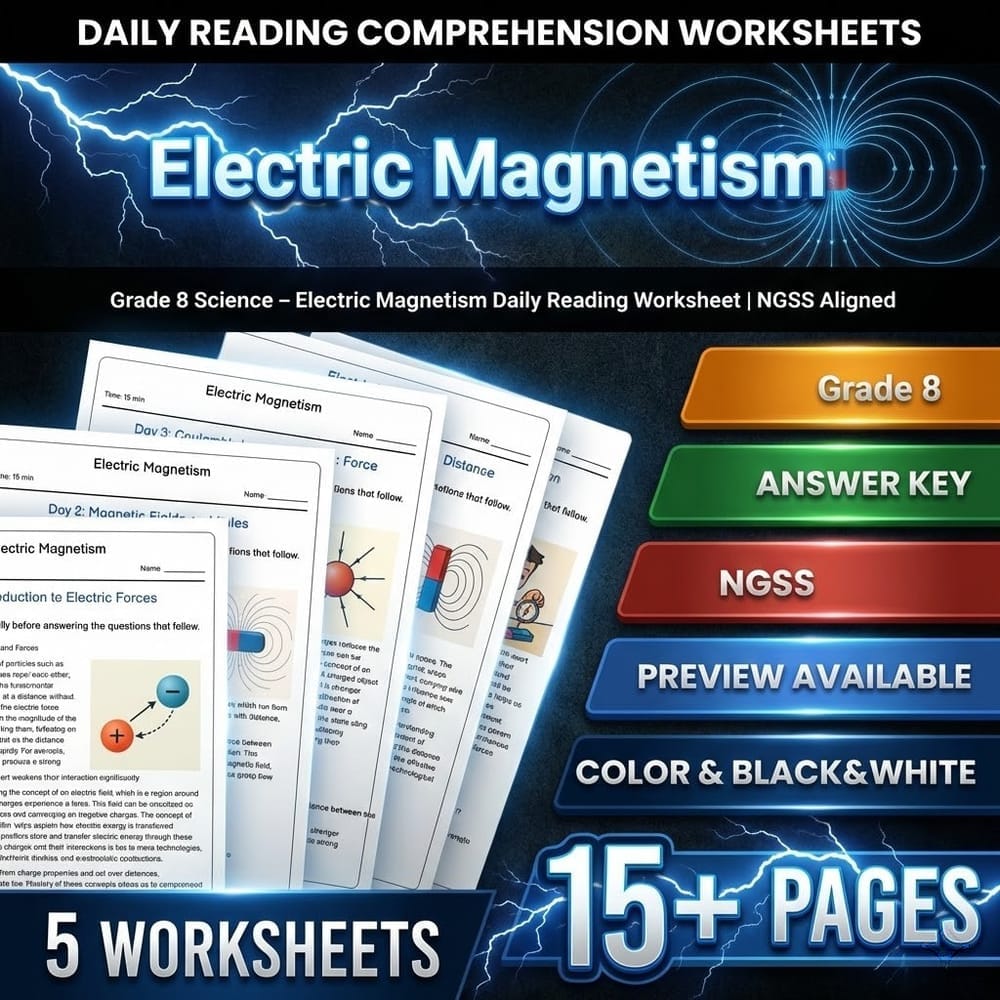
Grade 8 Science – Electric Magnetism Daily Reading Worksheet | NGSS Aligned
Created byElena BrooksLearning Objectives
- Understand key concepts related to Science
- Apply knowledge through practice questions
- Demonstrate comprehension of the material
Instant download
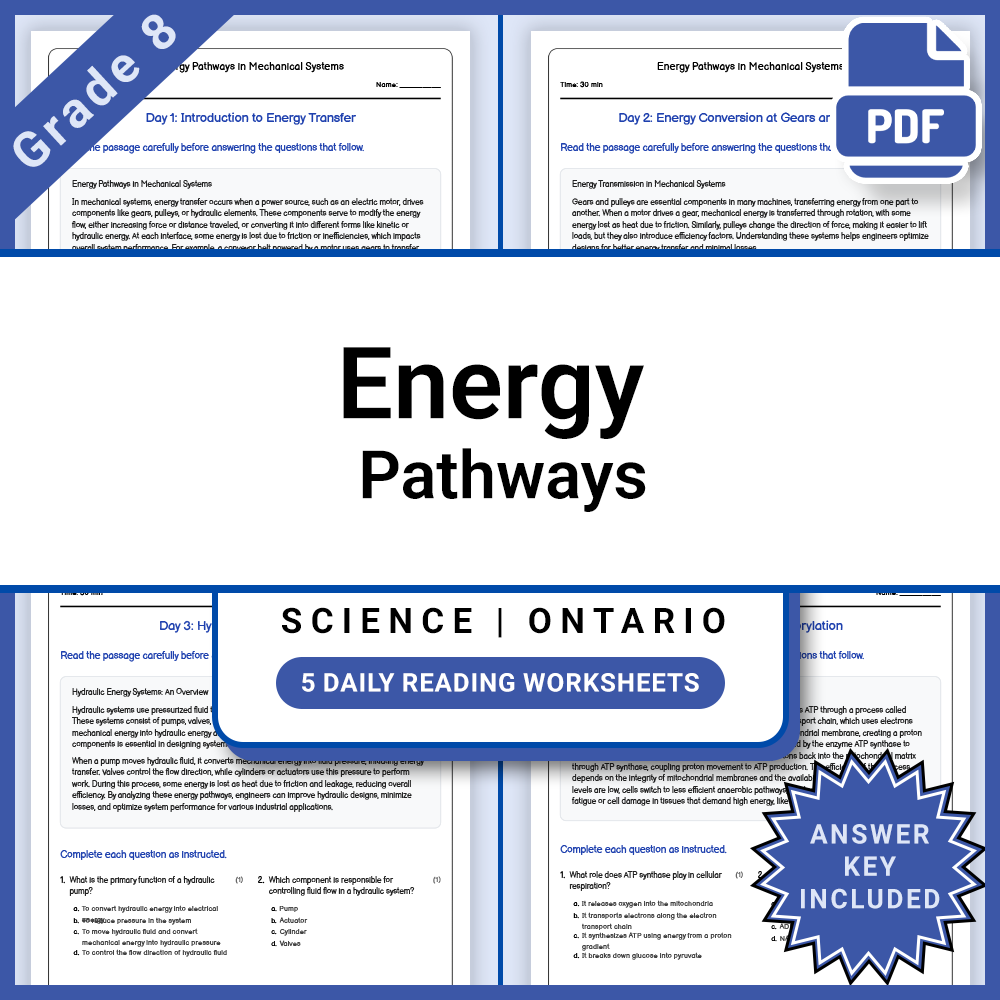
Grade 8 Science – Energy Pathways in Mechanical Systems Worksheet + Answer Key
JCreated byJ.S SheetsLearning Objectives
- Understand how energy transfers through mechanical subsystems such as gears, pulleys, and hydraulic elements.
- Identify points of energy conversion and quantify energy losses in various interfaces.
- Analyze case studies involving motor-driven conveyors and pump–actuator systems to determine net useful energy transfer.
Also included in: Grade 8 Science Lesson Group Bundle – Mechanical Systems and Energy +1 more
Instant download
About Grade 8 Science Worksheets
Explore Grade 8 Science worksheets for classwork, homework, or review. Our 5,999 printables download instantly as PDFs.
Each resource here is built by an independent educator and reviewed for quality. Worksheets print straight from PDF and suit classroom use, homework, or extra practice; most come with answer keys, and you can preview before purchasing.