
Grade 8 Science Worksheets
6,006 worksheets
Organ Systems Practice Worksheet | Grade 8 Science Assessment Ontario
 Created byPrism Point Learning
Learning Objectives
- Explain how specialized tissues form organs that perform coordinated functions in the circulatory, respiratory, and digestive systems.
- Describe how epithelial interfaces, transport mechanisms, and surface area affect the efficiency of organ system processes.
- Use examples from blood, alveoli, and intestinal villi to connect structure to function.
Also included in: Grade 8 Cell Organization & Homeostasis Science lesson bundle: Ontario
Instant download

Grade 8 Climate Patterns and Feedbacks Worksheet | NGSS Practice PDF
 Created byClear Sky Classroom
Learning Objectives
- Explain how long-term climate patterns are determined from many years of weather data.
- Differentiate natural variability from persistent climate change trends.
- Describe how feedback mechanisms such as ice-albedo and water-vapor can intensify climate impacts.
Instant download

Grade 8 Science – Climate Impacts Worksheet with Answer Key (PDF)
 Created byEvergreen Desk Education
Learning Objectives
- Explain how climate variability and change can shift precipitation patterns and affect water availability.
- Describe how changes in snowpack, evapotranspiration, and runoff timing influence floods, droughts, groundwater recharge, and reservoir storage.
- Connect land-use change and climate feedbacks to impacts on regional hydrology and aquatic ecosystems.
Also included in: Grade 8 Watershed and Water Quality Science Lesson Bundle (Ontario) +1 more
Instant download

8th Grade Science Mixtures and Solutions Worksheet with Short Notes (PDF)
 Created byMeadowlark Worksheets
Learning Objectives
- Understand the difference between mixtures and solutions.
- Identify examples of different types of mixtures and solutions.
- Describe methods used to separate mixtures.
Instant download

Grade 8 Science – Experimental Design Daily Reading Worksheet | TEKS Aligned
 Created byBright Mind Resources
Learning Objectives
- Understand the purpose of hypotheses in experiments
- Learn how to formulate testable hypotheses
- Identify components of an experimental hypothesis
Also included in: Experiments Grade 8 Science Daily Reading Worksheets Lesson Bundle | TEKS +2 more
Instant download
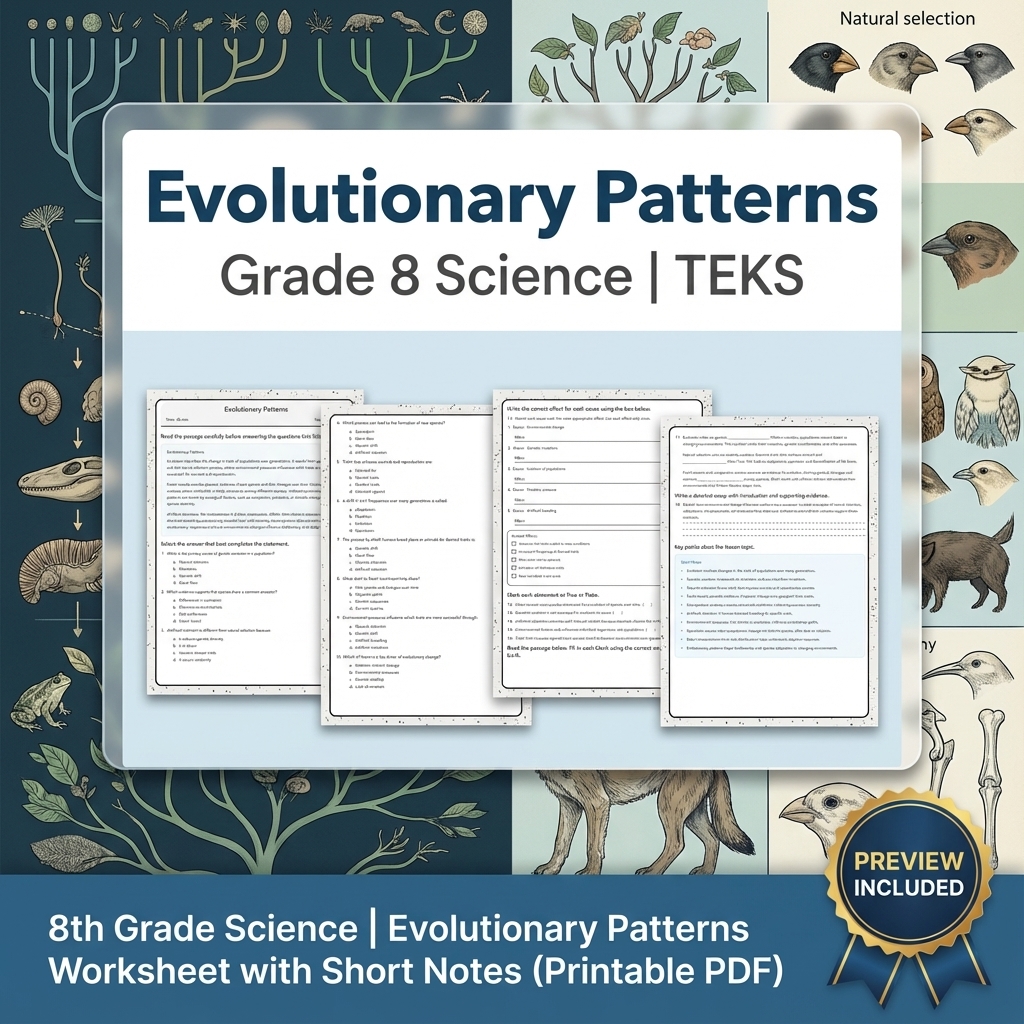
8th Grade Science Evolutionary Patterns Worksheet with Short Notes (PDF)
Created byMeadowlark WorksheetsLearning Objectives
- Identify key mechanisms driving microevolutionary change.
- Interpret data related to trait distribution and fitness comparisons.
- Differentiate between natural selection and artificial selection processes.
Instant download

Homeostatic Control Feedback and Set Points Worksheet for Grade 8 Science
JCreated byJ.S SheetsLearning Objectives
- Explain how negative feedback and positive feedback help maintain internal stability (homeostasis).
- Describe how sensors, control centers, and effectors work together to regulate variables at cellular and body levels.
- Use examples such as blood glucose, temperature, and water balance to connect signals to physiological responses.
Instant download

Material Origins Worksheet for Grade 8 Science | NGSS Printable PDF
Learning Objectives
- Understand how natural resources are transformed into synthetic materials.
- Identify examples of materials derived from natural sources and their properties.
- Analyze the relationship between molecular structure and material properties like strength, conductivity, and durability.
Also included in: Grade 8 Science Lesson Bundle on Matter and Its Interactions NGSS +1 more
Instant download
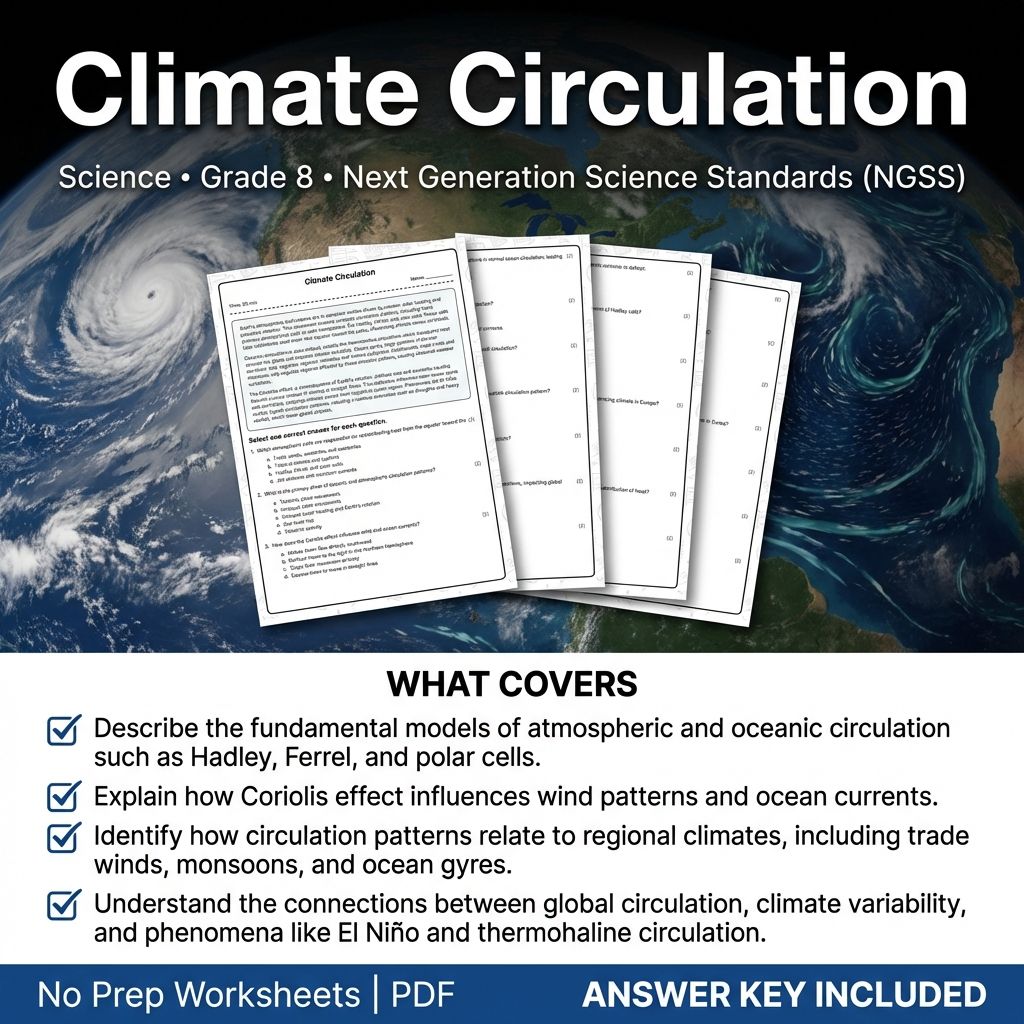
8th Grade Science | Climate Circulation Worksheet & Answer Key PDF
 Created byCoral Reef Learning
Learning Objectives
- Describe the fundamental models of atmospheric and oceanic circulation such as Hadley, Ferrel, and polar cells.
- Explain how Coriolis effect influences wind patterns and ocean currents.
- Identify how circulation patterns relate to regional climates, including trade winds, monsoons, and ocean gyres.
Instant download
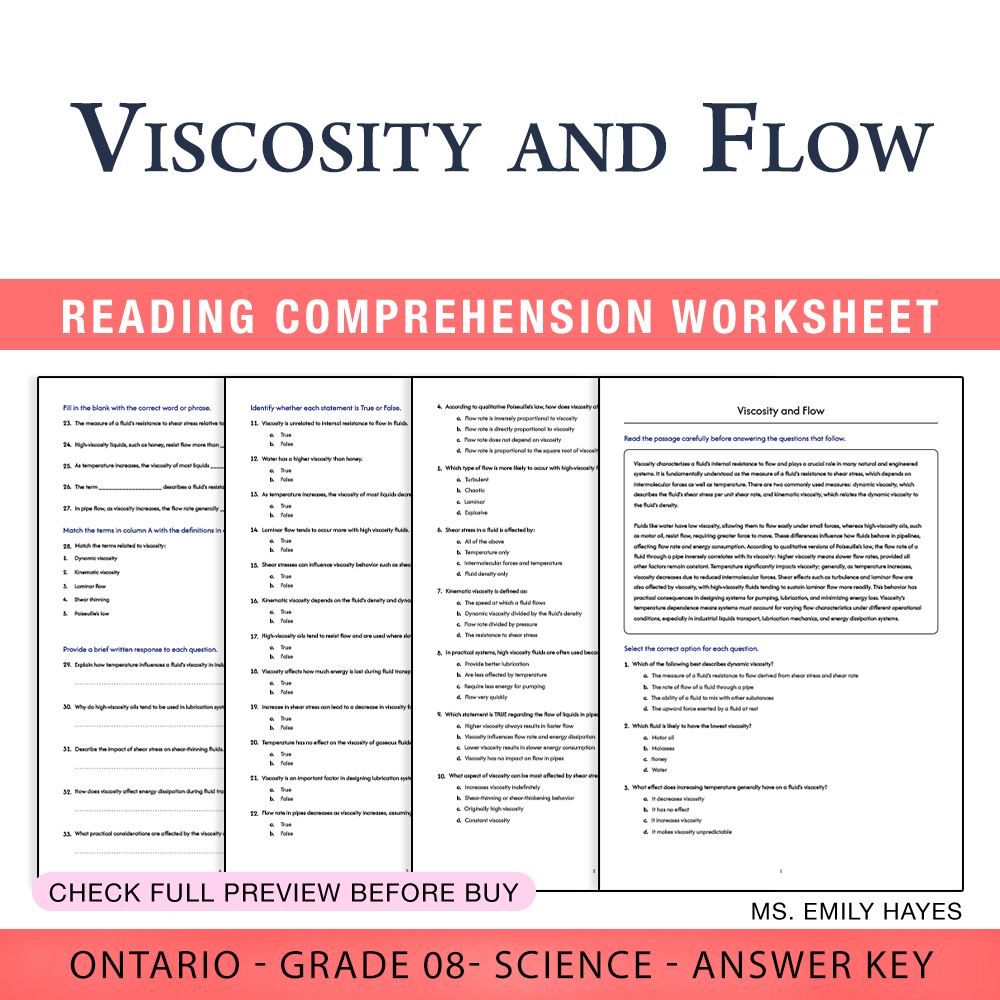
8th Grade Science | Viscosity and Flow Worksheet (PDF+ Answer Key)
 Created byCopper Leaf Classroom
Learning Objectives
- Define and explain the concepts of dynamic and kinematic viscosity.
- Compare low-viscosity fluids like water with high-viscosity oils.
- Describe how viscosity influences flow rates in pipes based on qualitative understanding of Poiseuille's law.
Instant download
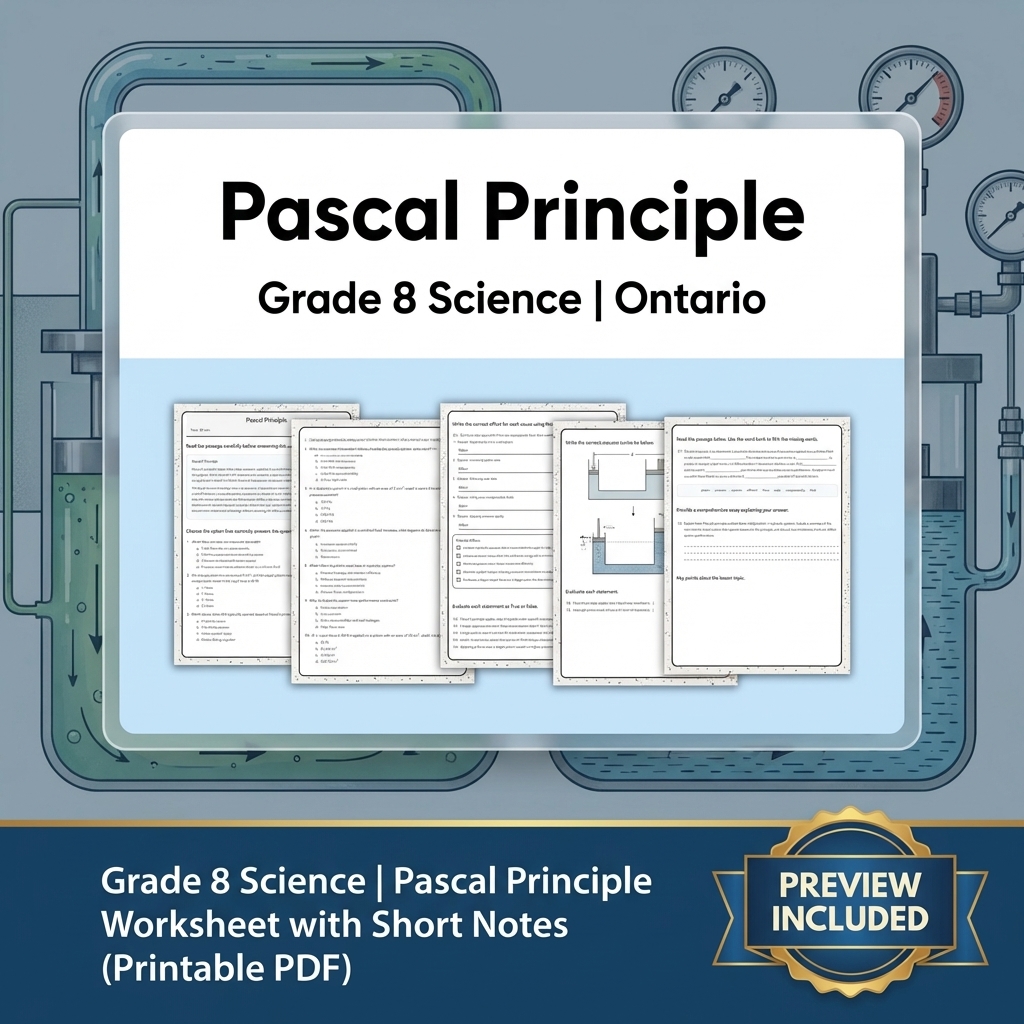
Grade 8 Science | Pascal Principle Worksheet with Short Notes (Printable PDF)
Created byMeadowlark WorksheetsLearning Objectives
- Explain how pressure is transmitted equally in a confined fluid according to Pascal's principle.
- Calculate the relationship between input and output forces based on piston areas and pressures.
- Identify real-world devices that utilize Pascal's principle, such as hydraulic presses and brakes.
Also included in: Grade 8 Science Lesson Group Bundle | Hydrostatics & Fluid Mechanics +1 more
Instant download

Grade 8 Science | Molecular Structure Worksheet with Short Notes (PDF)
Created byMeadowlark WorksheetsLearning Objectives
- Understand the atomic composition of simple molecules using particle models and formulas.
- Interpret structural diagrams and symbolic formulas of molecules like H2O, CO2, and NaCl.
- Distinguish between molecular units and extended solids based on microscopic arrangements.
Also included in: Grade 8 Science | Matter and Its Interactions NGSS Unit Bundle – Worksheets +1 more
Instant download

Grade 8 Science | Thermal Effects Worksheet with Short Notes (Printable PDF)
Created byMeadowlark WorksheetsLearning Objectives
- Understand how particle motion relates to temperature and phase changes.
- Identify the microscopic and macroscopic signs of heat transfer.
- Explain phase changes such as melting, boiling, and condensation in terms of energy transfer.
Also included in: Grade 8 Science | Matter and Its Interactions NGSS Unit Bundle – Worksheets +1 more
Instant download

Grade 8 Science | Mass Conservation Worksheet with Short Notes (Printable PDF)
Created byMeadowlark WorksheetsLearning Objectives
- Understand the principle of mass conservation in chemical reactions.
- Track atoms and mass before and after reactions in closed systems.
- Interpret symbolic chemical equations to demonstrate mass balance.
Also included in: Grade 8 Science | Matter and Its Interactions NGSS Unit Bundle – Worksheets +1 more
Instant download
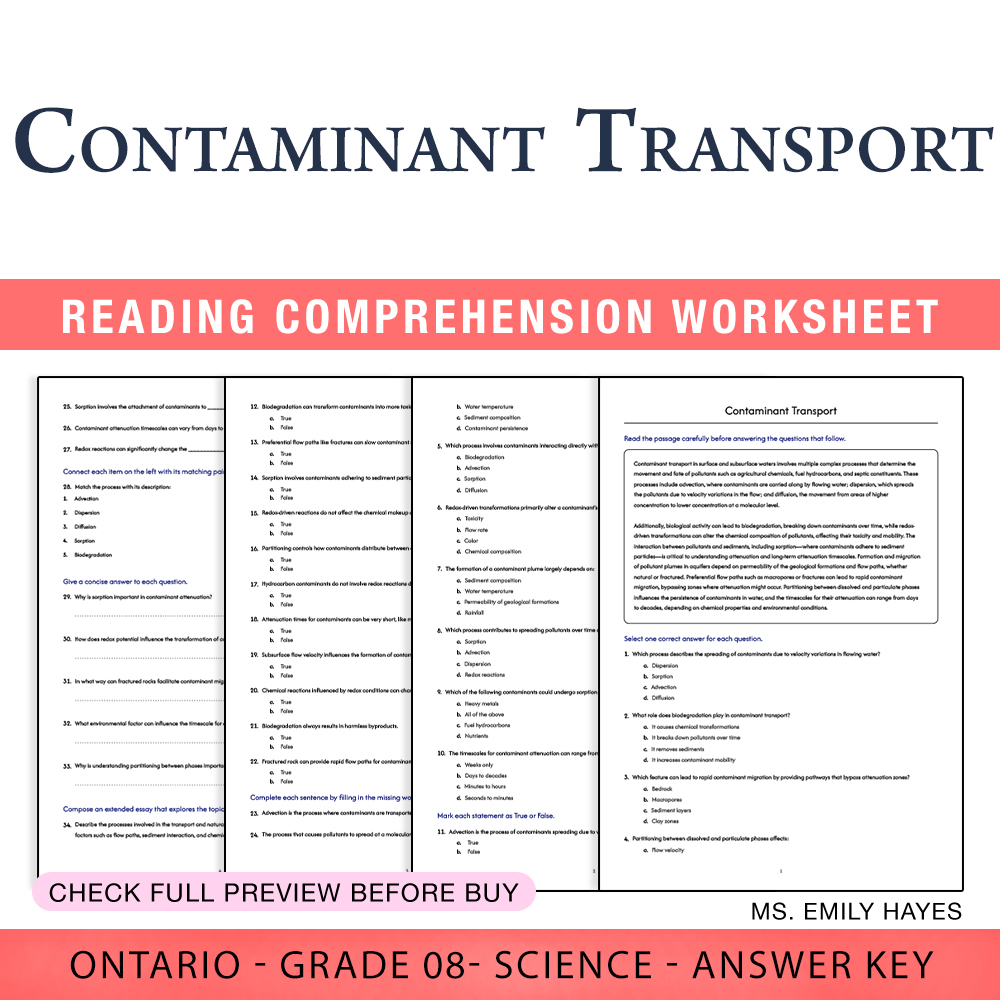
8th Grade Science | Contaminant Transport Worksheet (PDF+ Answer Key)
Created byCopper Leaf ClassroomLearning Objectives
- Describe the processes governing the movement of contaminants in surface and subsurface waters.
- Explain how factors like sorption, biodegradation, and redox transformations affect contaminant fate.
- Analyze how contaminant plumes form and migrate in aquifers and fractured rocks.
Instant download

Motors and Generators Worksheet | Grade 8 Science Activities
Created byPrism Point LearningLearning Objectives
- Explain how electric motors convert electrical energy into mechanical motion using magnetic fields and current-carrying conductors.
- Describe how generators convert mechanical motion into electrical energy using electromagnetic induction.
- Compare motors and generators as reciprocal devices and relate design parameters to efficiency and power output.
Also included in: Grade 8 Science Electricity & Electromagnetism Lesson Bundle | Alberta
Instant download
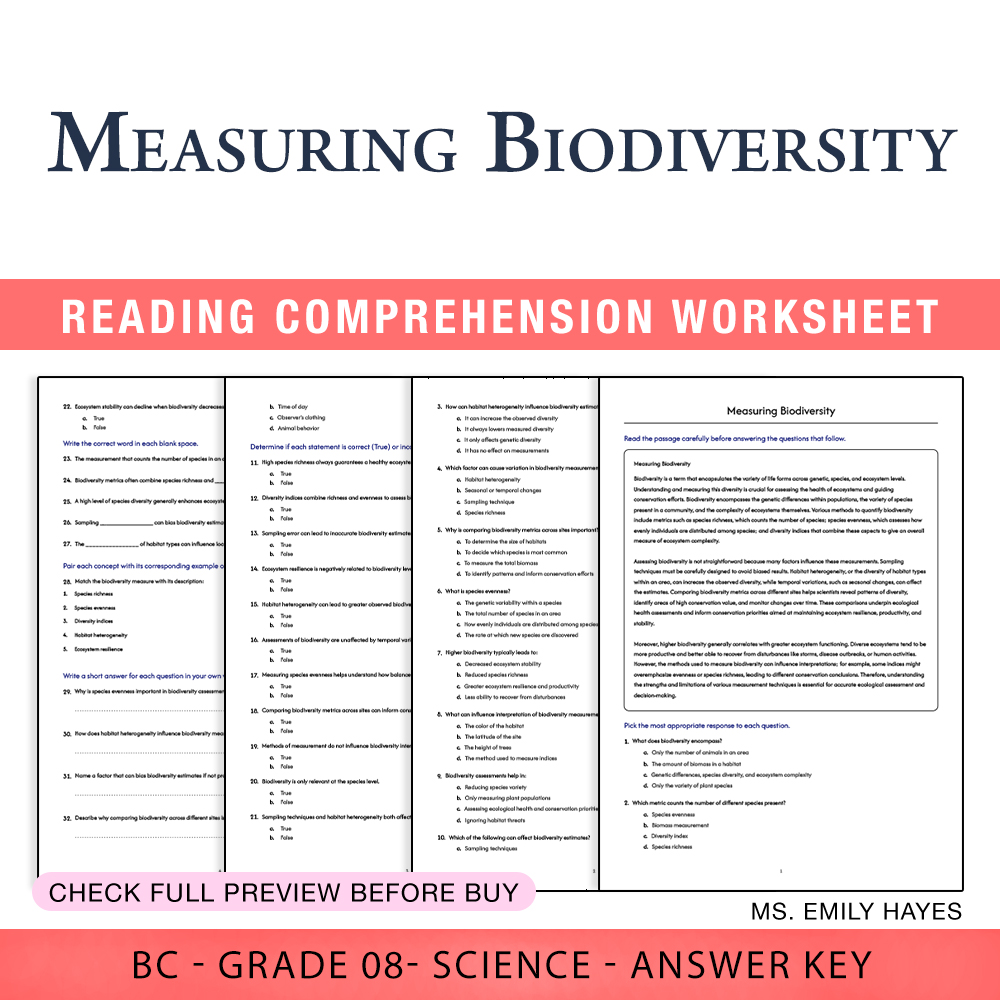
8th Grade Science | Measuring Biodiversity Worksheet (PDF+ Answer Key)
Created byCopper Leaf ClassroomLearning Objectives
- Understand the concept of biodiversity and its levels (genetic, species, ecosystem).
- Learn how biodiversity is measured using richness, evenness, and diversity indices.
- Recognize the importance of biodiversity for ecosystem stability and resilience.
Also included in: Grade 8 Science– Ecology, Biodiversity & Environmental Impact (PDF + Answer Key) +1 more
Instant download
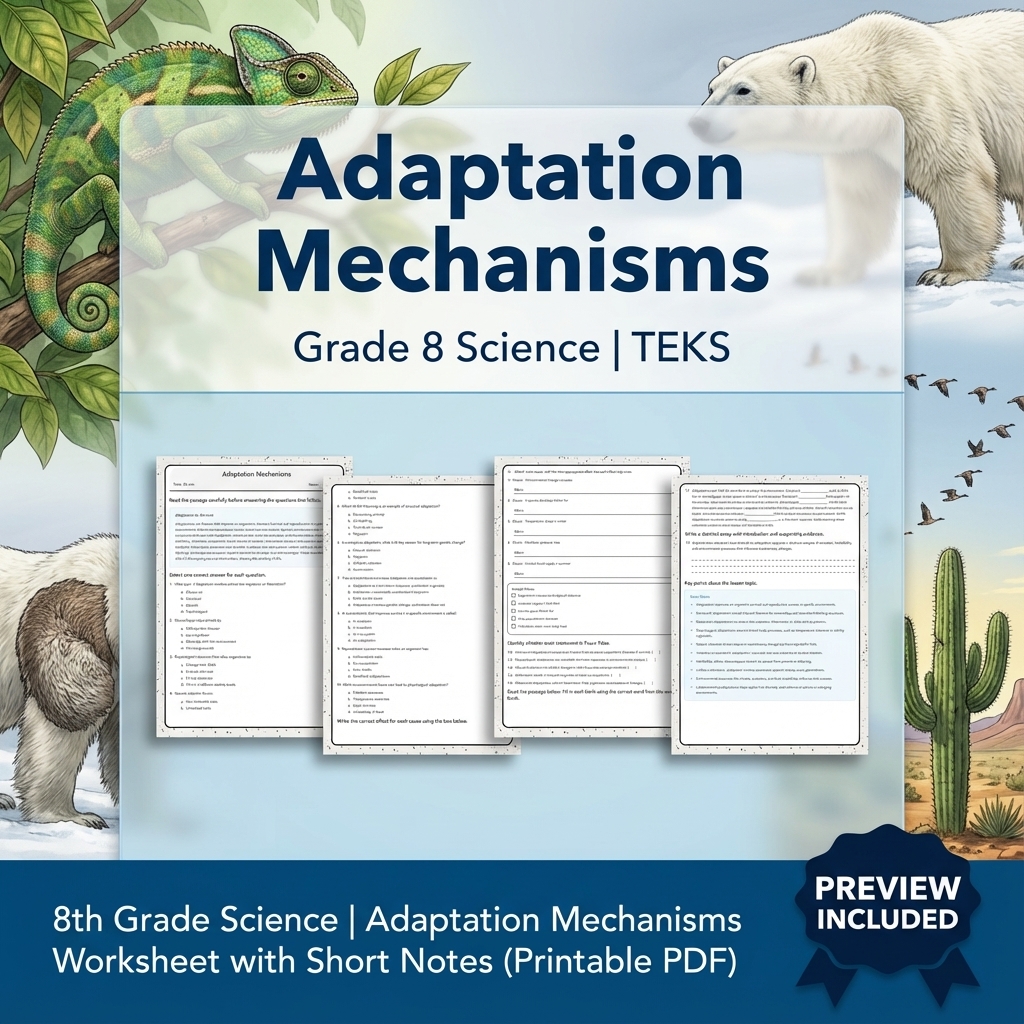
8th Grade Science | Adaptation Mechanisms Worksheet with Short Notes ( PDF)
Created byMeadowlark WorksheetsLearning Objectives
- Understand different types of adaptation—structural, behavioral, and physiological—and their role in survival.
- Identify examples of adaptations such as camouflage and specialized feeding structures.
- Explain the concept of natural selection and how it influences trait changes across generations.
Instant download

Gravity Components on Inclined Planes Worksheet | Grade 8 Alberta Science
 Created byBRIGHT PATH RESOURCES
Learning Objectives
- Identify the perpendicular and parallel components of gravity relative to a slope
- Explain how the parallel component relates to motion down the incline
- Describe how friction and gravity components affect whether an object tends to move
Also included in: Grade 8 Alberta Science Forces and Motion Physics Worksheet Bundle +1 more
Instant download
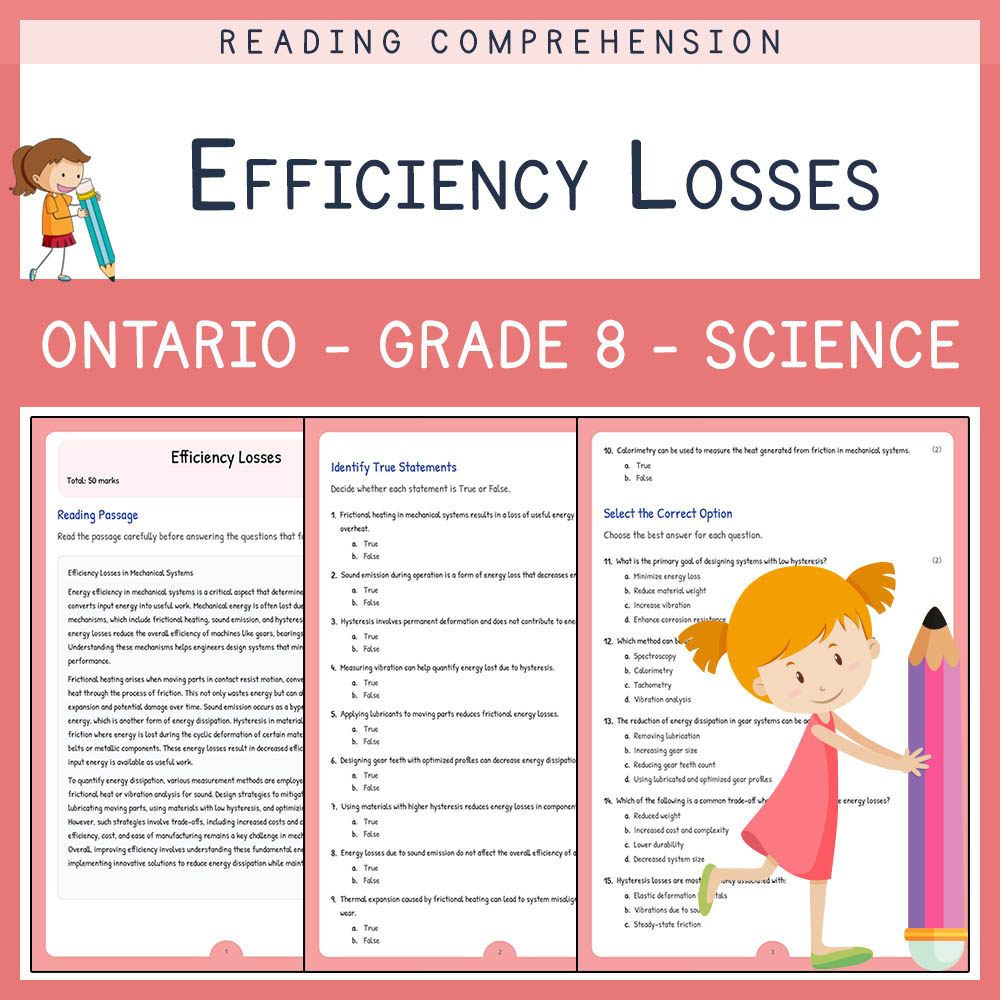
Grade 8 Science | Efficiency Losses Worksheet | Ontario Standards
 Created byLumora Learning
Learning Objectives
- Understand energy dissipation mechanisms such as frictional heating, sound emission, and hysteresis in mechanical systems.
- Define and calculate mechanical efficiency as useful output energy divided by input energy.
- Identify common causes of reduced efficiency in gears, bearings, and belt drives.
Also included in: Grade 8 Science | Systems in Action Lesson Bundle | Ontario Framework
Instant download
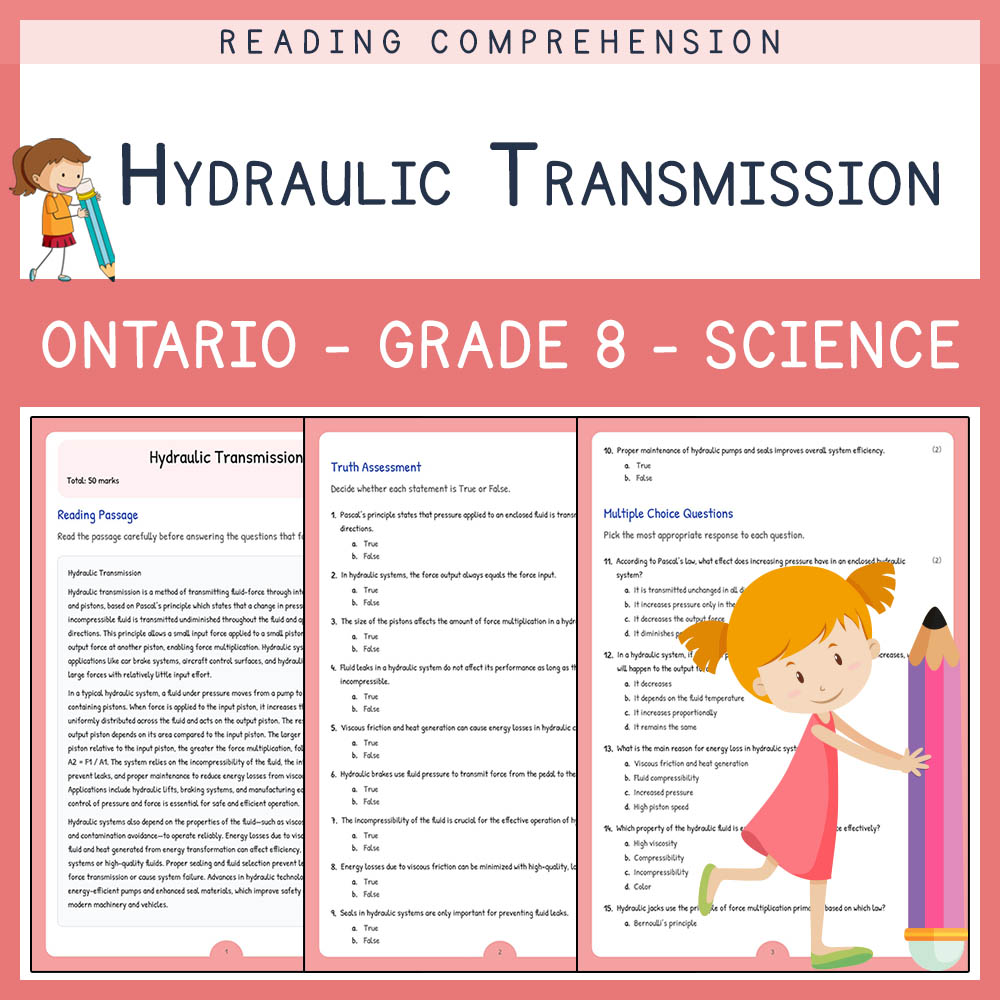
Grade 8 Science Assessment | Hydraulic Transmission Worksheet Elena | Ontario
Created byLumora LearningLearning Objectives
- Explain the basic principle of Pascal's law and how it relates to hydraulic systems.
- Describe how input force and piston area affect output force in hydraulics.
- Identify applications of hydraulic systems like jacks and brakes.
Also included in: Grade 8 Science | Systems in Action Lesson Bundle | Ontario Framework
Instant download
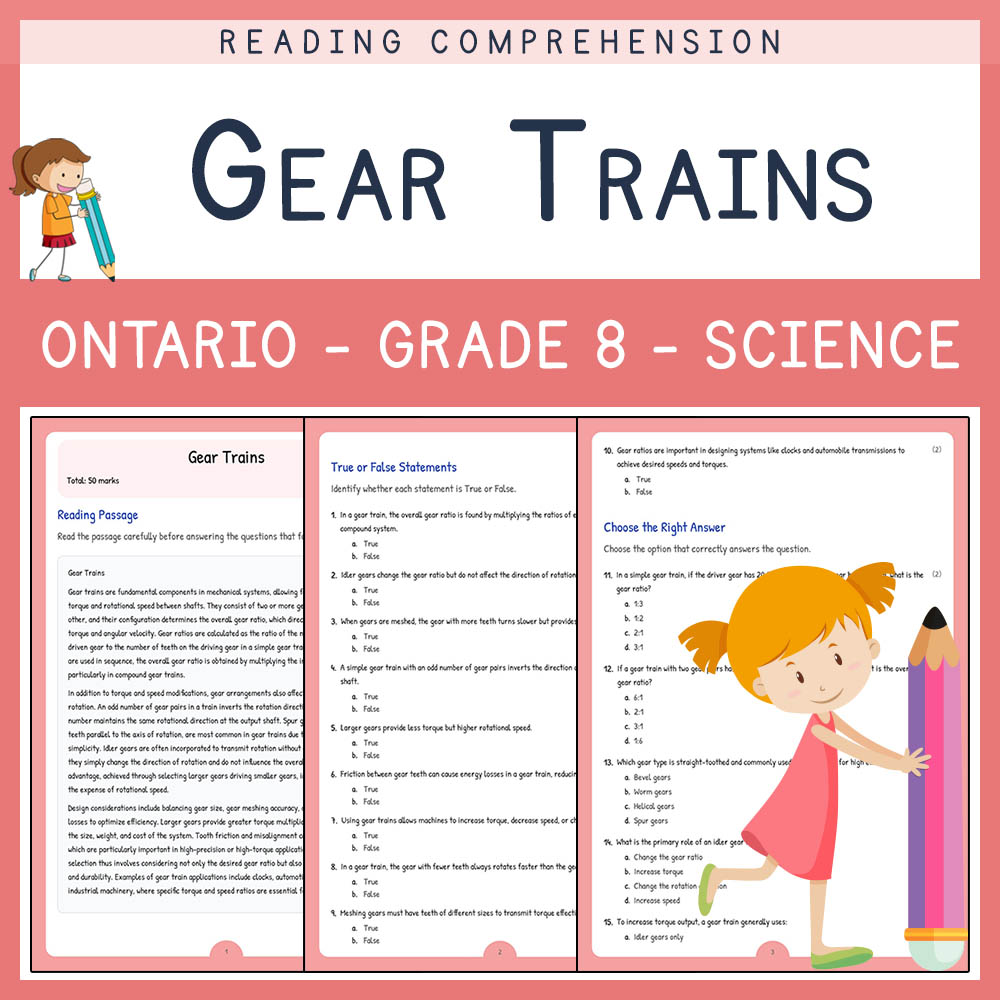
Grade 8 Science Assessment | Gear Trains Worksheet Elena | Ontario Standard
Created byLumora LearningLearning Objectives
- Understand the principles of gear ratios and how they affect torque and speed in gear trains.
- Calculate the overall gear ratio in simple and compound gear systems.
- Explain the roles of spur gears and idler gears in gear train configurations.
Also included in: Grade 8 Science | Systems in Action Lesson Bundle | Ontario Framework
Instant download
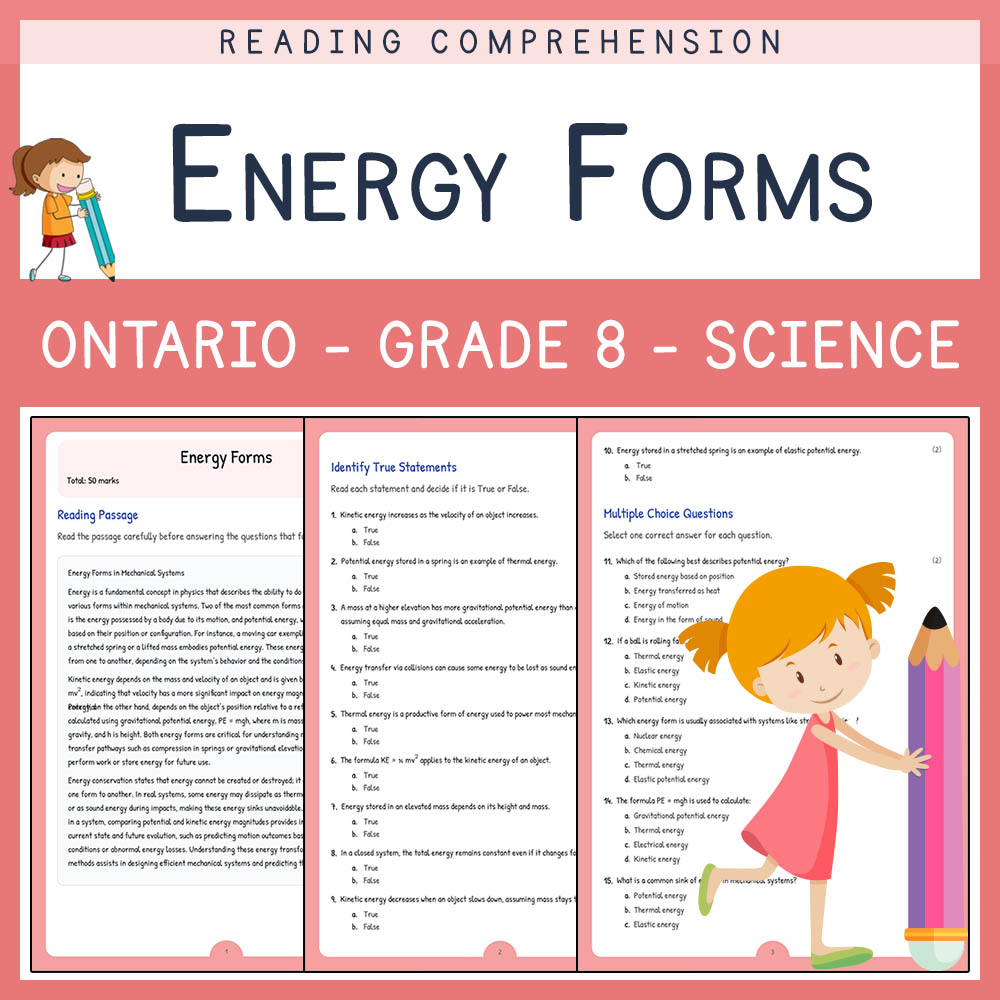
Grade 8 Science | Energy Forms Worksheet Elena | Ontario Standards
Created byLumora LearningLearning Objectives
- Understand different forms of energy present in mechanical systems.
- Recognize the roles of kinetic and potential energy in system behavior.
- Describe energy storage mechanisms in springs and elevated masses.
Also included in: Grade 8 Science | Systems in Action Lesson Bundle | Ontario Framework
Instant download
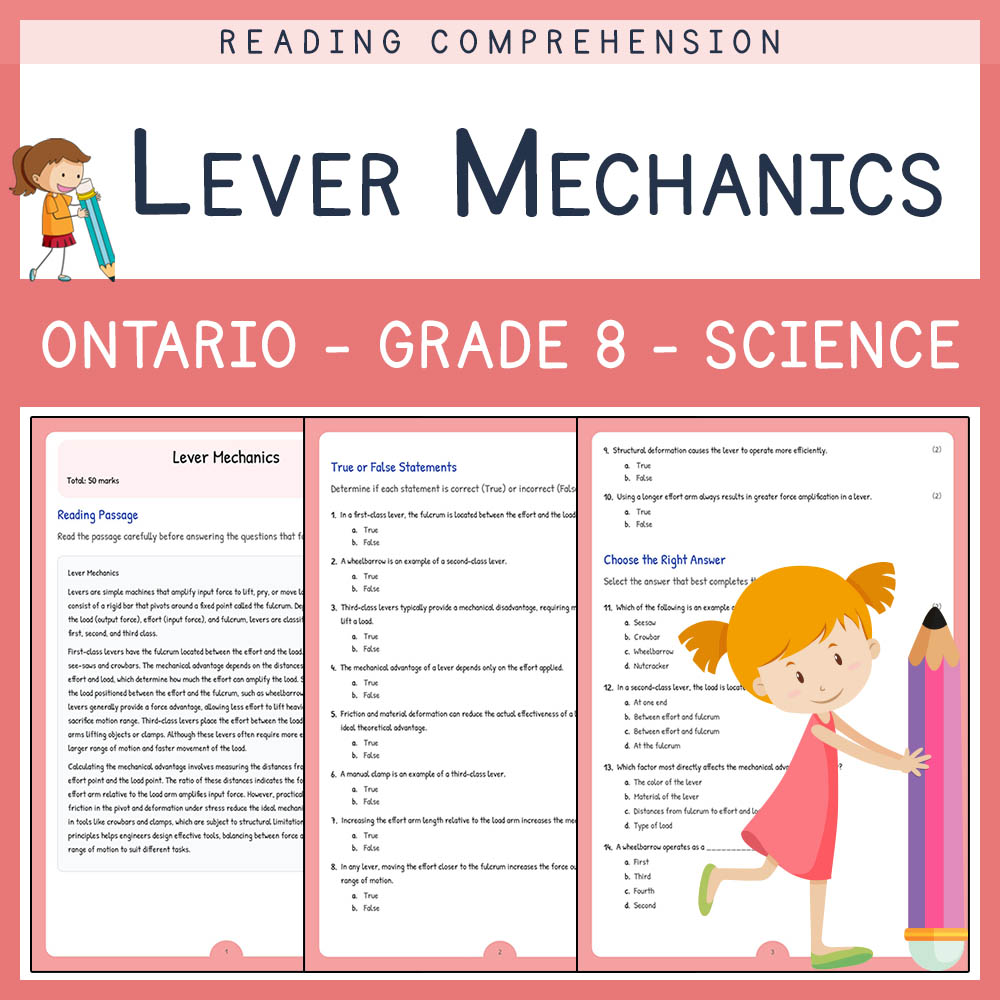
Grade 8 Science Assessment | Lever Mechanics Worksheet | Ontario Standard
Created byLumora LearningLearning Objectives
- Understand the principles of lever classes and fulcrum placement.
- Calculate the mechanical advantage of first-, second-, and third-class levers.
- Analyze the trade-offs between force amplification and range of motion in levers.
Also included in: Grade 8 Science | Systems in Action Lesson Bundle | Ontario Framework
Instant download
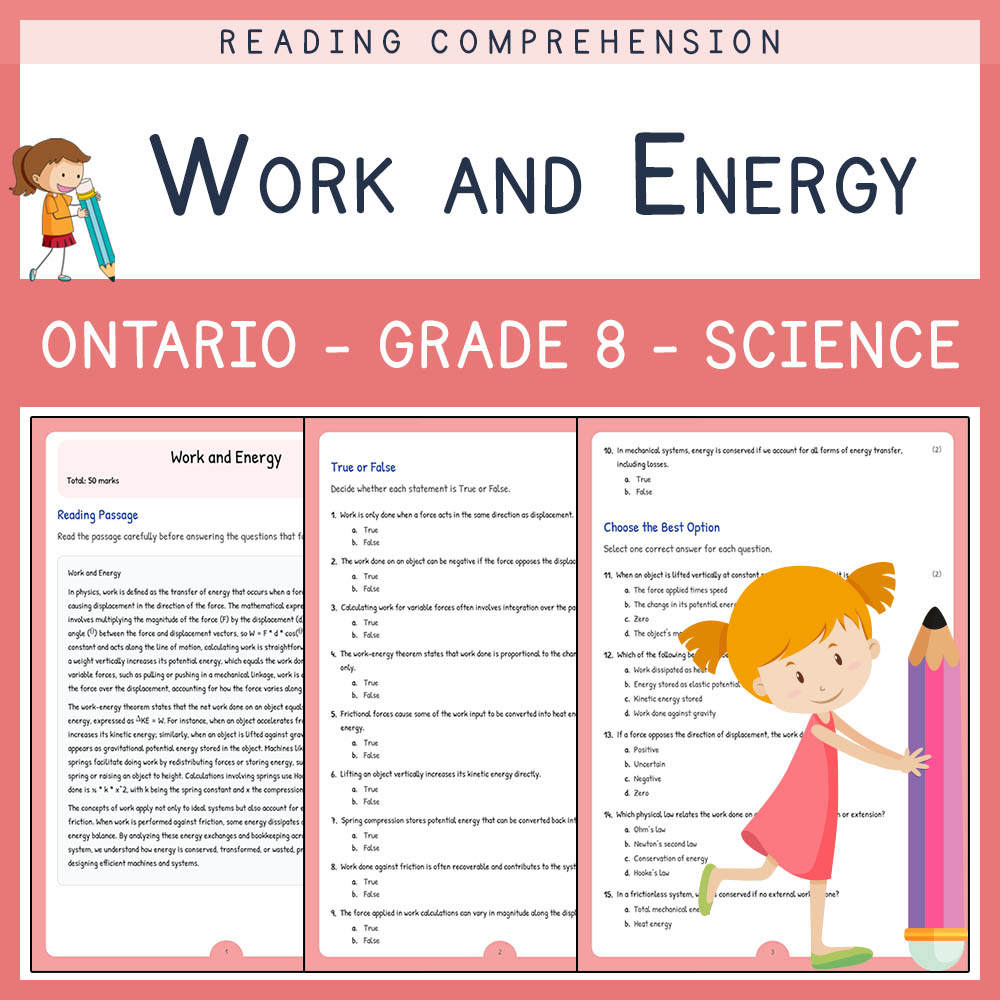
Grade 8 Science | Work and Energy Worksheet Elena | Ontario Standards
Created byLumora LearningLearning Objectives
- Understand the concept of work as force applied over a distance and its calculation.
- Connect work to changes in kinetic and potential energy through the work–energy theorem.
- Apply formulas to compute work in scenarios involving constant and variable forces such as lifting, spring compression, and friction.
Also included in: Grade 8 Science | Systems in Action Lesson Bundle | Ontario Framework
Instant download
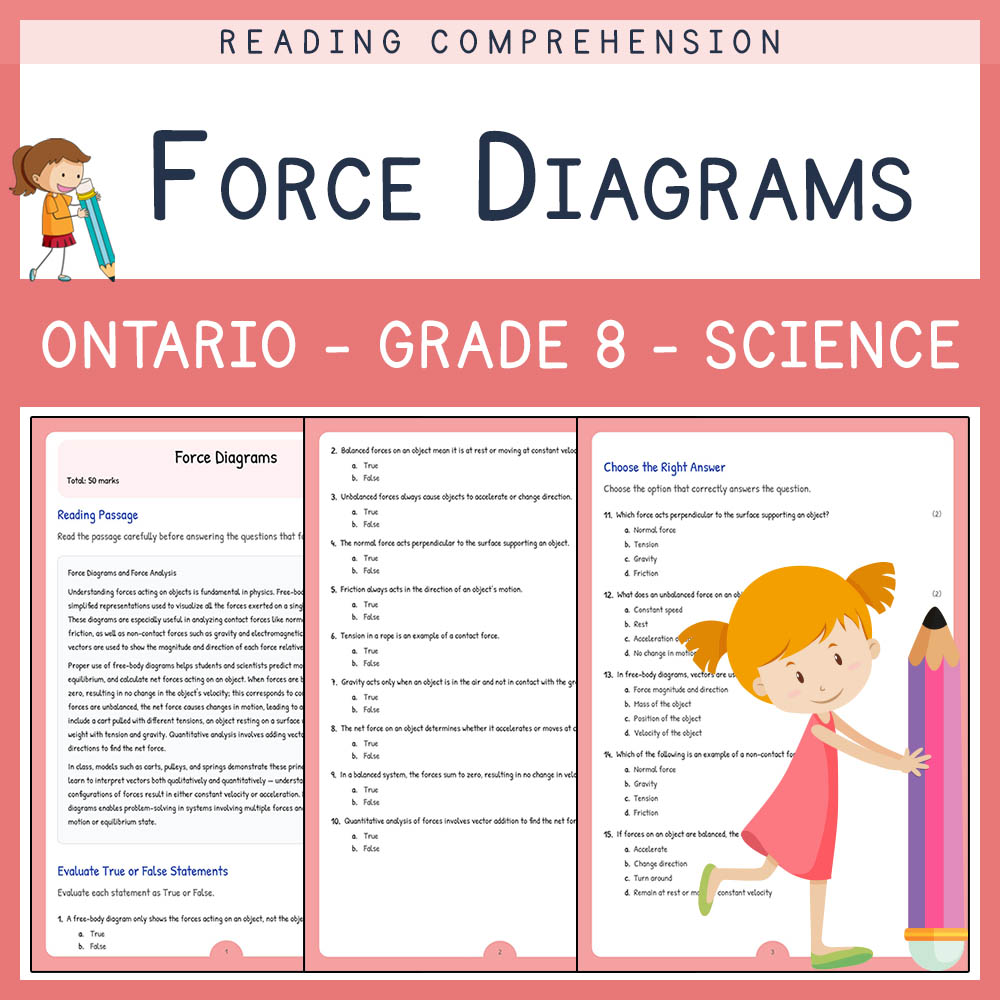
Grade 8 Science | Force Diagrams Worksheet | Ontario Standards
Created byLumora LearningLearning Objectives
- Understand the components and uses of free-body diagrams in representing forces.
- Identify contact and non-contact forces such as normal force, tension, friction, and gravity.
- Differentiate between balanced and unbalanced forces and relate this to motion in systems.
Also included in: Grade 8 Science | Systems in Action Lesson Bundle | Ontario Framework
Instant download

Grade 8 Science | Understanding Pendulum Energy - Daily Reading Comprehension
Created byCoral Reef LearningLearning Objectives
- Identify and describe the different types of energy involved in a pendulum's motion.
- Explain how energy converts from potential to kinetic and vice versa during a swing.
- Understand factors that influence the energy transfer and period of a pendulum.
Instant download

Grade 8 Membrane Transport Worksheet | Cell Transport Science PDF
Created byEvergreen Desk EducationLearning Objectives
- Explain how diffusion and osmosis move substances across a cell membrane using concentration gradients.
- Describe how active transport moves substances against gradients using energy and transport proteins.
- Connect selective membrane permeability to how cells maintain homeostasis.
Instant download
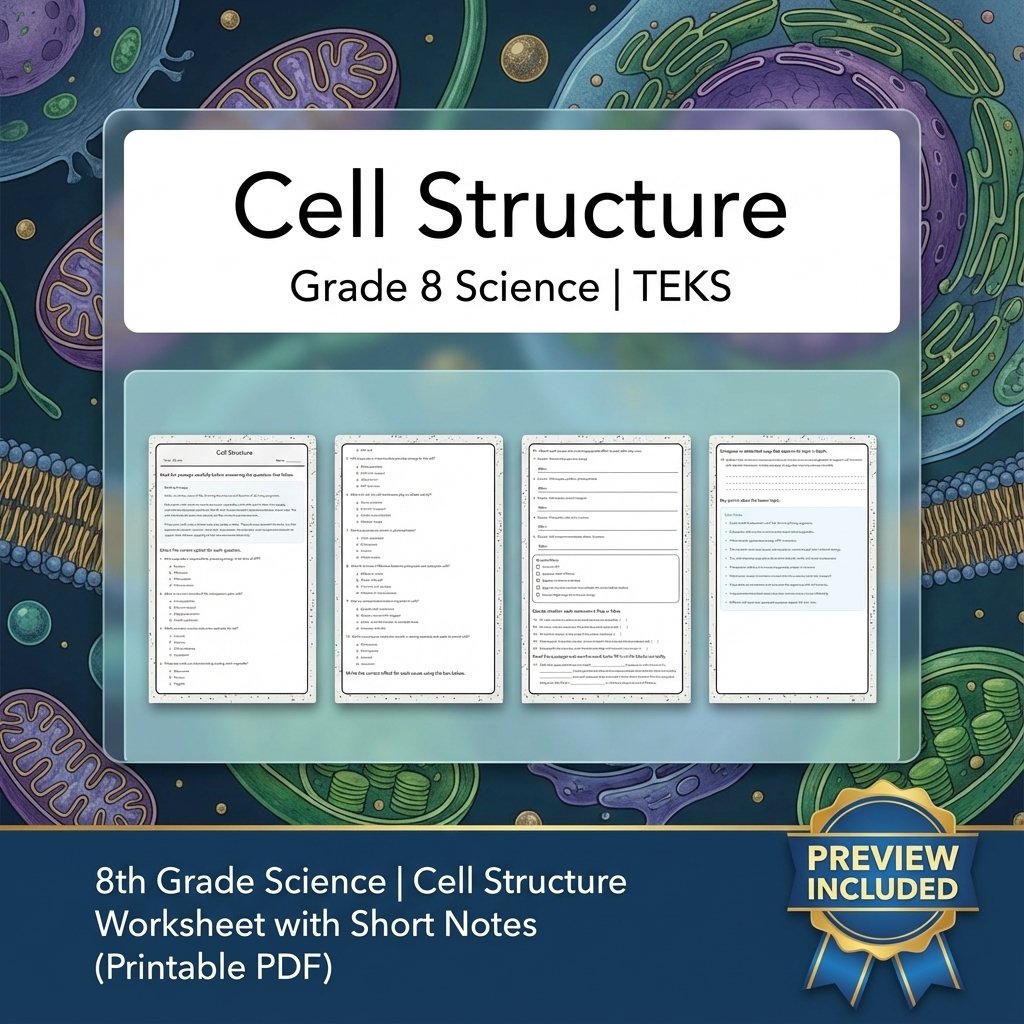
8th Grade Science | Cell Structure Worksheet with Short Notes (Printable PDF)
Created byMeadowlark WorksheetsLearning Objectives
- Describe the internal organization of cells, including membranes and organelles.
- Explain the functions of key organelles such as the nucleus, mitochondria, and chloroplasts.
- Understand the relationship between membrane transport, compartmentalization, and cellular activity.
Instant download
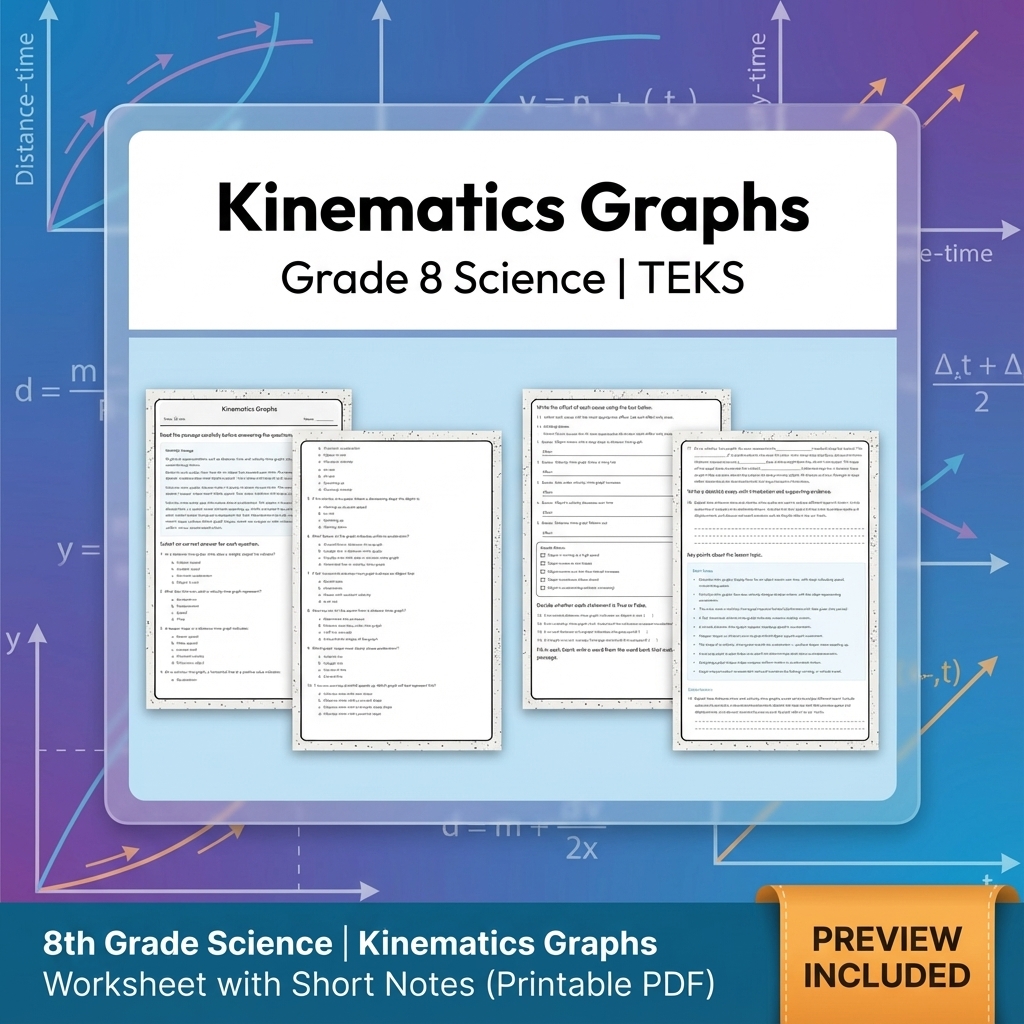
8th Grade Science | Kinematics Graphs Worksheet with Short Notes (Printable PDF)
Created byMeadowlark WorksheetsLearning Objectives
- Understand how to interpret and analyze distance–time and velocity–time graphs.
- Learn to calculate speed and acceleration from the slope of graphs.
- Use area under graphs to determine displacement and understand motion profiles.
Instant download
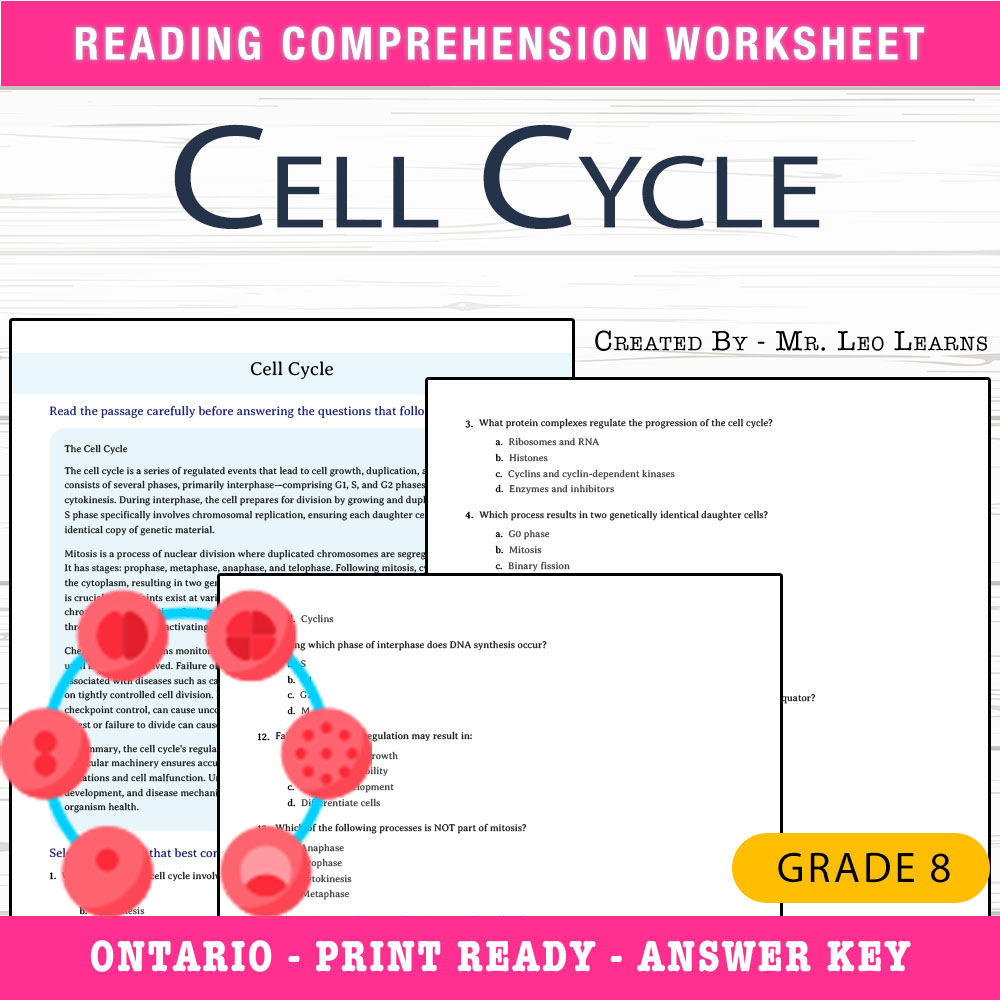
Grade 8 Science – Cell Cycle Worksheet for Mastering Cell Division
 Created byThe Resource Hub
Learning Objectives
- Explain the stages of the cell cycle, including interphase, mitosis, and cytokinesis.
- Describe the roles of cyclins, kinases, and checkpoint mechanisms in regulating cell division.
- Analyze the significance of proper cell cycle regulation in tissue growth, wound repair, and prevention of diseases such as cancer.
Also included in: Grade 8 Science | Cell Biology & Systems Unit Worksheet Bundle (Unlock Mastery) +1 more
Instant download
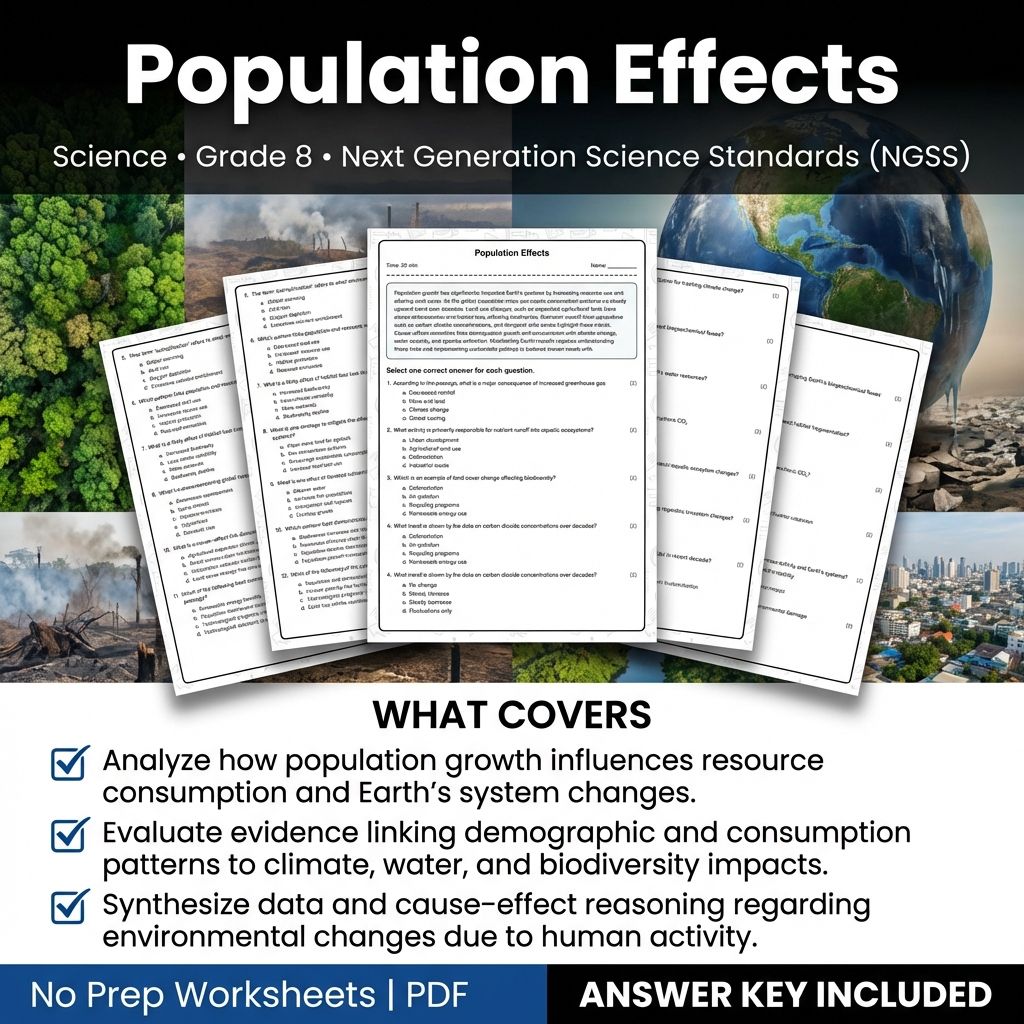
8th Grade Science Worksheet | Population Effects Practice & Answer Key PDF
Created byCoral Reef LearningLearning Objectives
- Analyze how population growth influences resource consumption and Earth's system changes.
- Evaluate evidence linking demographic and consumption patterns to climate, water, and biodiversity impacts.
- Synthesize data and cause–effect reasoning regarding environmental changes due to human activity.
Instant download

Grade 8 Science – Mixtures & Compounds | Daily Reading Worksheet
Created byBright Mind ResourcesLearning Objectives
- Understand the differences between mixtures and compounds.
- Identify unique properties of mixtures and compounds.
- Learn how to distinguish between physical and chemical changes.
Also included in: Grade 8 Chemical Reactions Science Lesson Bundle: Daily Reading | BC +1 more
Instant download
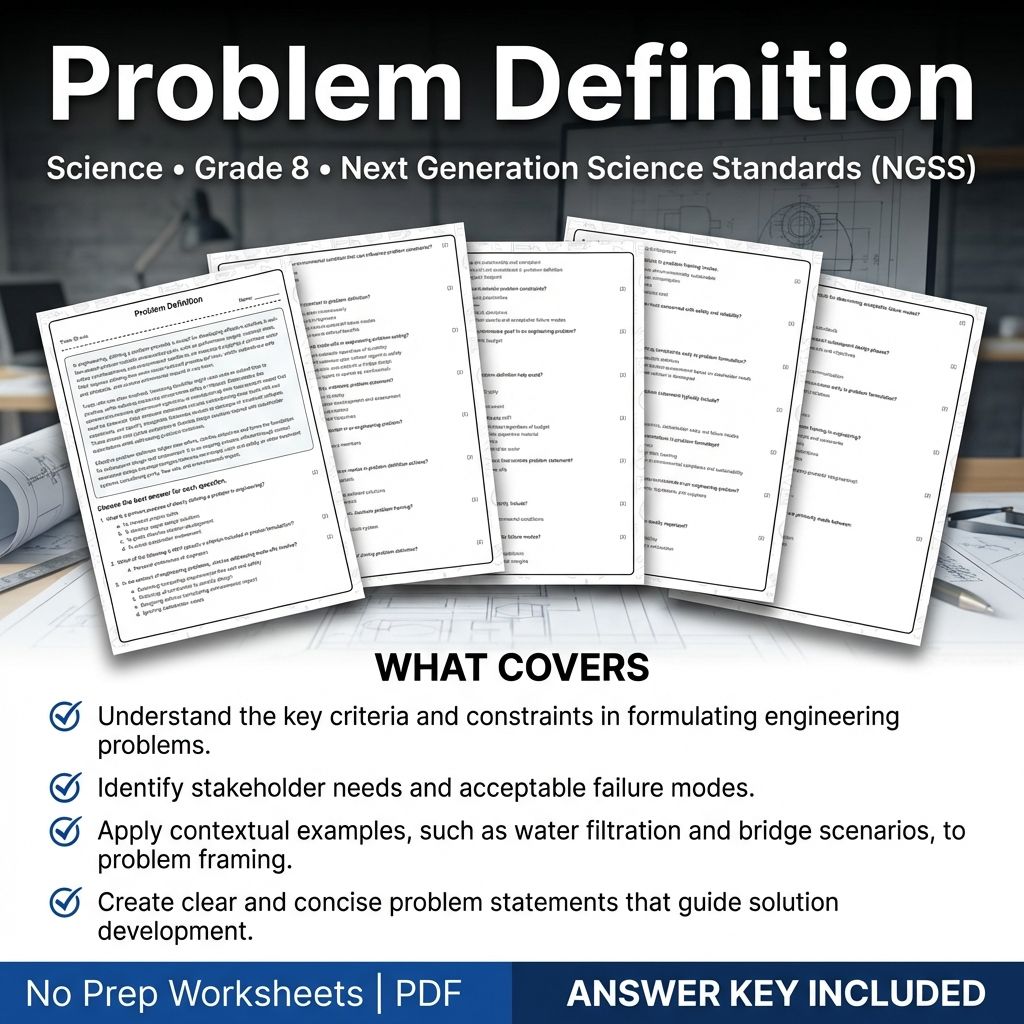
Grade 8 Science | Problem Definition Worksheet + Answer Key (Printable PDF)
Created byCoral Reef LearningLearning Objectives
- Understand the key criteria and constraints in formulating engineering problems.
- Identify stakeholder needs and acceptable failure modes.
- Apply contextual examples, such as water filtration and bridge scenarios, to problem framing.
Instant download

Grade 8 Science | Problem Definition Worksheet with Short Notes (Printable PDF)
Created byMeadowlark WorksheetsLearning Objectives
- Understand the criteria and constraints involved in defining engineering problems.
- Identify performance goals, material limits, cost considerations, safety, and environmental factors.
- Analyze trade-offs among time, cost, and durability in problem scenarios.
Also included in: Grade 8 Science Engineering Design Unit Bundle (NGSS Worksheets Collection) +1 more
Instant download
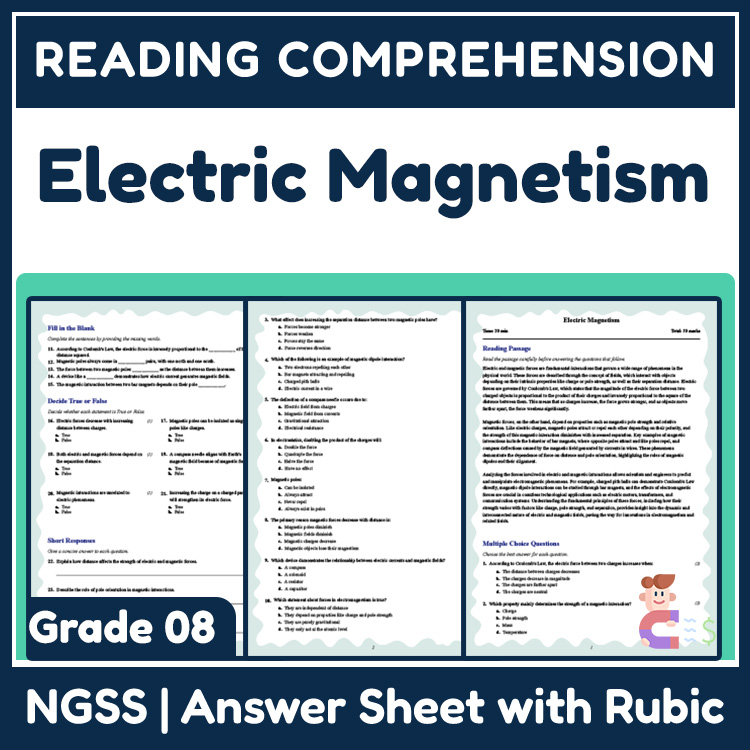
8th Grade Science | Electric Magnetism Reading Worksheet (Answer Key)
JCreated byJ.S SheetsLearning Objectives
- Describe electric and magnetic field interactions.
- Explain how force magnitude relates to charge, pole strength, and distance.
- Differentiate between electric and magnetic forces based on properties and interactions.
Instant download
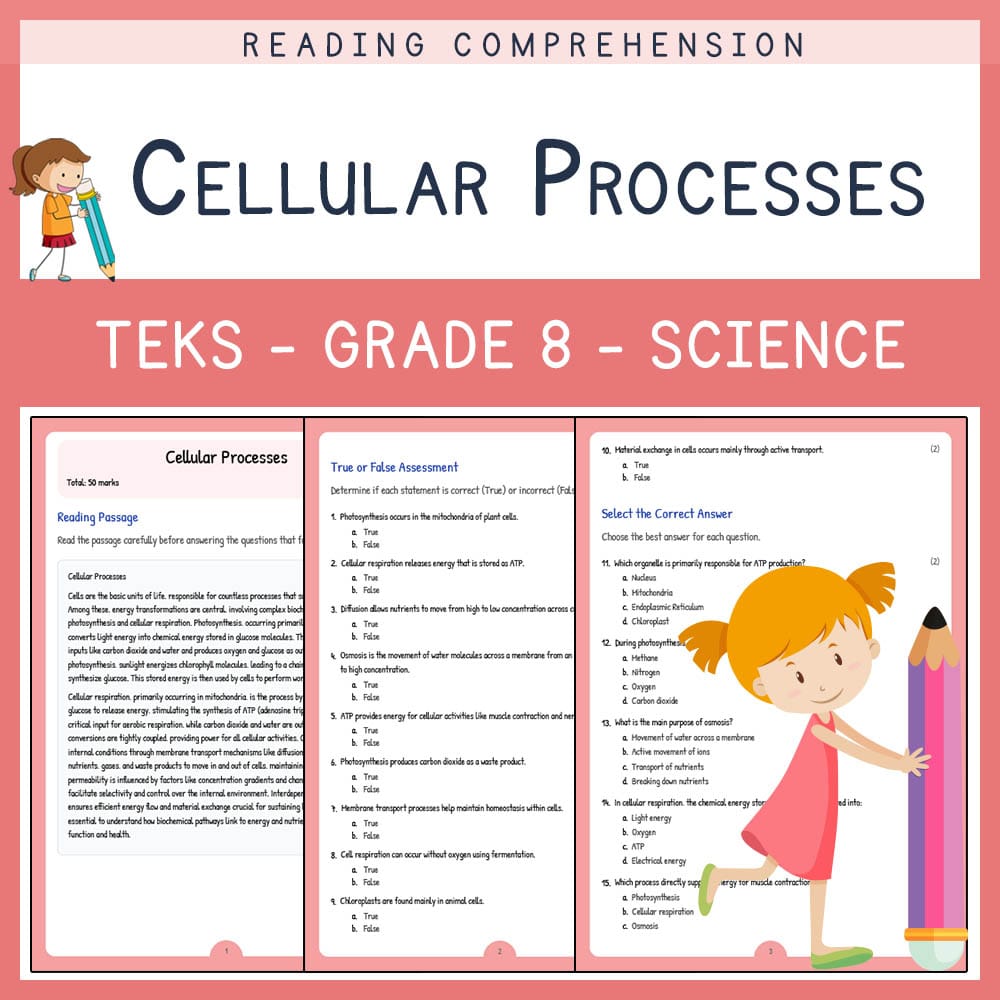
Grade 8 Science | Cellular Processes Worksheet | TEKS Aligned
Created byLumora LearningLearning Objectives
- Describe the energy transformations that occur during photosynthesis and cellular respiration.
- Explain how membrane transport processes like diffusion and osmosis regulate internal conditions in cells.
- Connect biochemical pathways to energy production, ATP synthesis, and organelle interdependence.
Also included in: Grade 8 Science | Organisms and Environments Unit Bundle | TEKS Aligned
Instant download

Grade 8 Natural Hazards Worksheet | NGSS Practice & PDF
Created byClear Sky ClassroomLearning Objectives
- Understand how historical data and instrumental records are used to assess natural hazard risks.
- Interpret patterns, frequency, and magnitude of natural hazards from data analysis.
- Identify different types of natural hazards and their indicators.
Also included in: Grade 8 Climate Drivers and Environmental Monitoring Science Lesson Bundle NGSS +1 more
Instant download

Grade 8 Resource Distribution Worksheet | NGSS Practice PDF
Created byClear Sky ClassroomLearning Objectives
- Understand geological processes that influence resource formation.
- Identify different types of mineral, energy, and groundwater resources.
- Analyze how resource accessibility and quality vary regionally.
Also included in: Grade 8 Climate Drivers and Environmental Monitoring Science Lesson Bundle NGSS +1 more
Instant download

Power Rates Worksheet | Ontario Grade 8 Science Printable PDF
 Created byCedar Grove Learning
Learning Objectives
- Explain power as the rate of doing work and as the rate of energy transfer
- Use SI units to measure power, including converting between watts and other common representations
- Relate motor specifications to mechanical output power using efficiency and losses
Instant download

Grade 8 Science | Introduction to Ecosystems - Daily Reading Comprehension
Created byCoral Reef LearningLearning Objectives
- Understand the basic components of ecosystems, including biotic and abiotic factors.
- Identify different biomes such as grassland, desert, and temperate forest and their climatic influences.
- Learn about trophic roles: producers, consumers, and decomposers.
Instant download
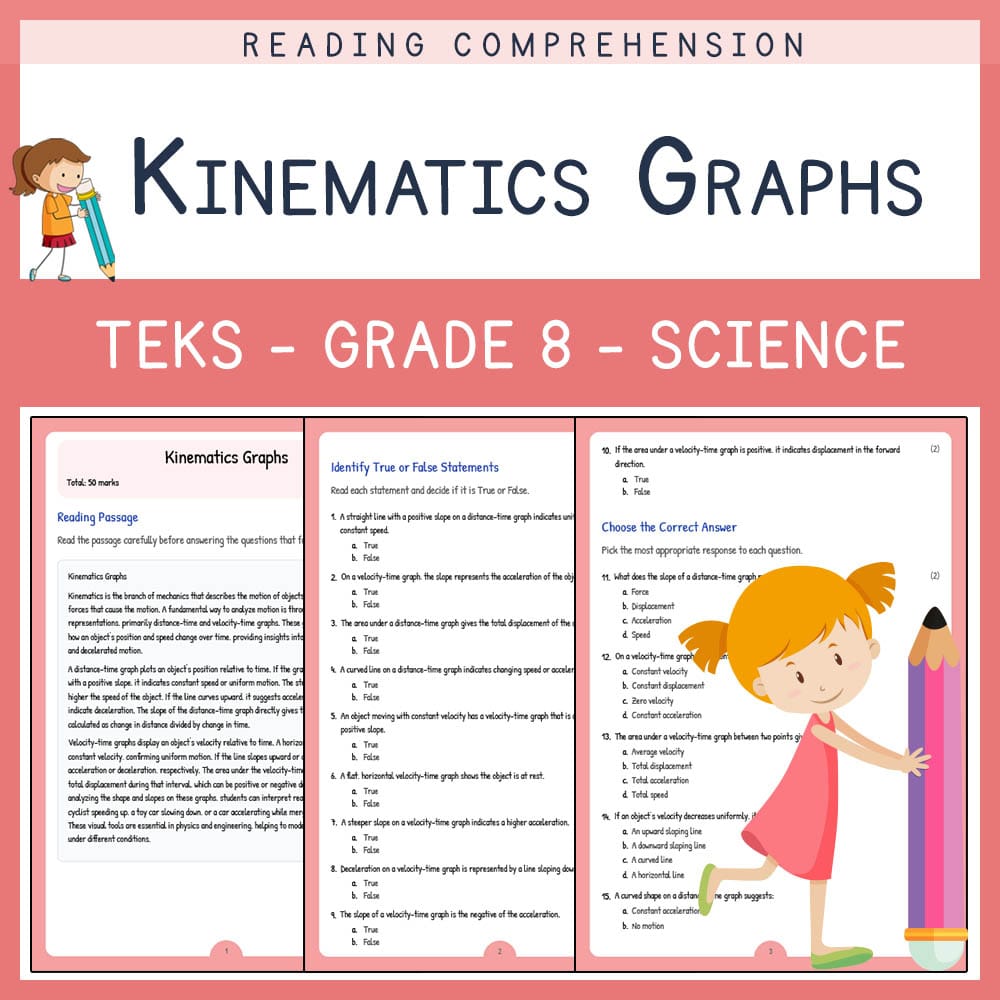
Grade 8 Science | Kinematics Graphs Worksheet Elena | TEKS-Aligned
Created byLumora LearningLearning Objectives
- Interpret motion through distance–time and velocity–time graphs, understanding the significance of slope and area.
- Analyze different types of motion such as uniform and uniformly accelerated motion using graphs.
- Extract speed and acceleration values from slopes of graphs and calculate displacement from areas.
Also included in: Grade 8 Science | Force, Motion, and Energy Lesson Bundle | TEKS-Aligned
Instant download
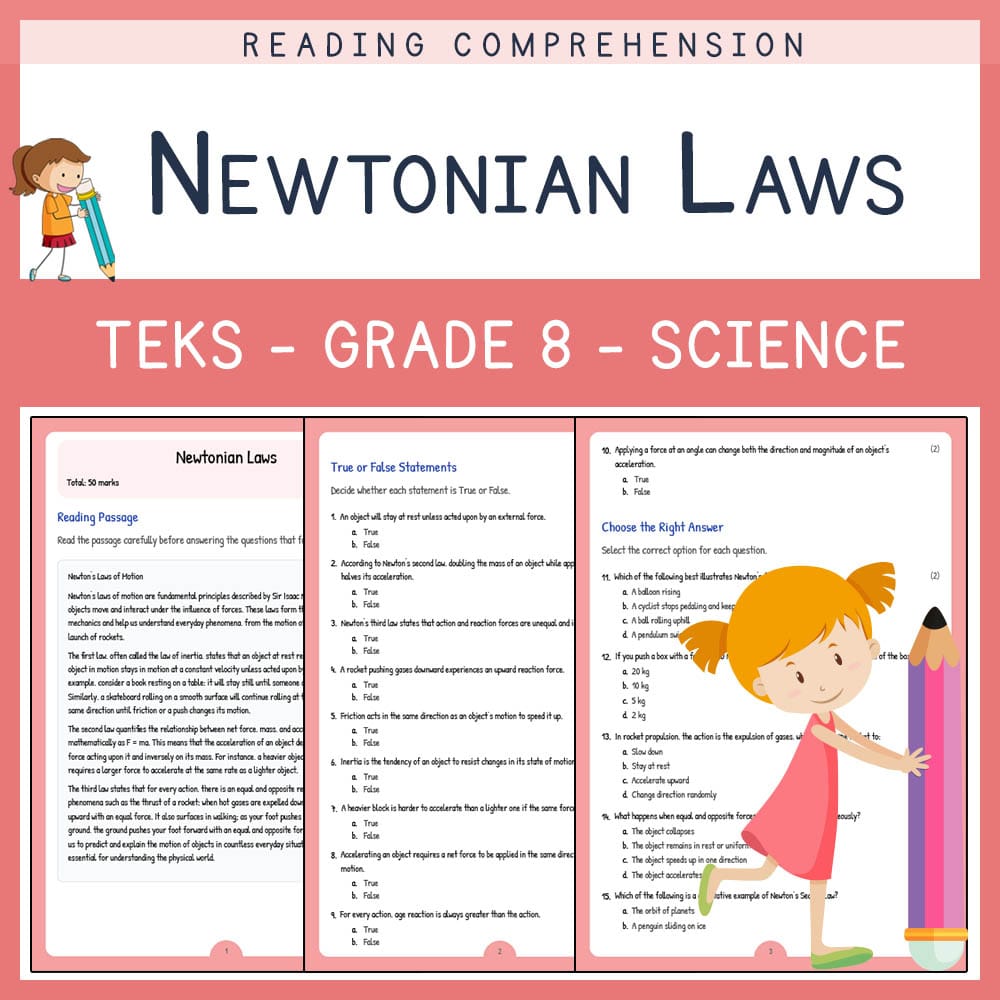
Grade 8 Science | Newtonian Laws Worksheet | TEKS-Aligned
Created byLumora LearningLearning Objectives
- Understand the three laws formulated by Sir Isaac Newton and how they relate force and motion.
- Analyze real-world examples to illustrate each of Newton's laws.
- Apply proportional reasoning to relate force, mass, and acceleration in different contexts.
Also included in: Grade 8 Science | Force, Motion, and Energy Lesson Bundle | TEKS-Aligned
Instant download

Grade 8 Science | Mechanical Advantage Worksheet | TEKS-Aligned
Created byLumora LearningLearning Objectives
- Understand how to calculate theoretical and real mechanical advantage of simple machines.
- Apply algebraic formulas to analyze forces, distances, and work in machine systems.
- Differentiate between ideal and actual efficiencies in machines considering frictional losses.
Also included in: Grade 8 Science | Force, Motion, and Energy Lesson Bundle | TEKS-Aligned
Instant download

Grade 8 Science | Simple Machines Worksheet Elena | TEKS Aligned
Created byLumora LearningLearning Objectives
- Understand the functions and types of simple machines including levers, pulleys, inclined planes, wheel and axle, wedges, and screws.
- Describe how simple machines modify force and distance in mechanical systems.
- Analyze the concept of mechanical advantage in different simple machine configurations.
Also included in: Grade 8 Science | Force, Motion, and Energy Lesson Bundle | TEKS-Aligned
Instant download
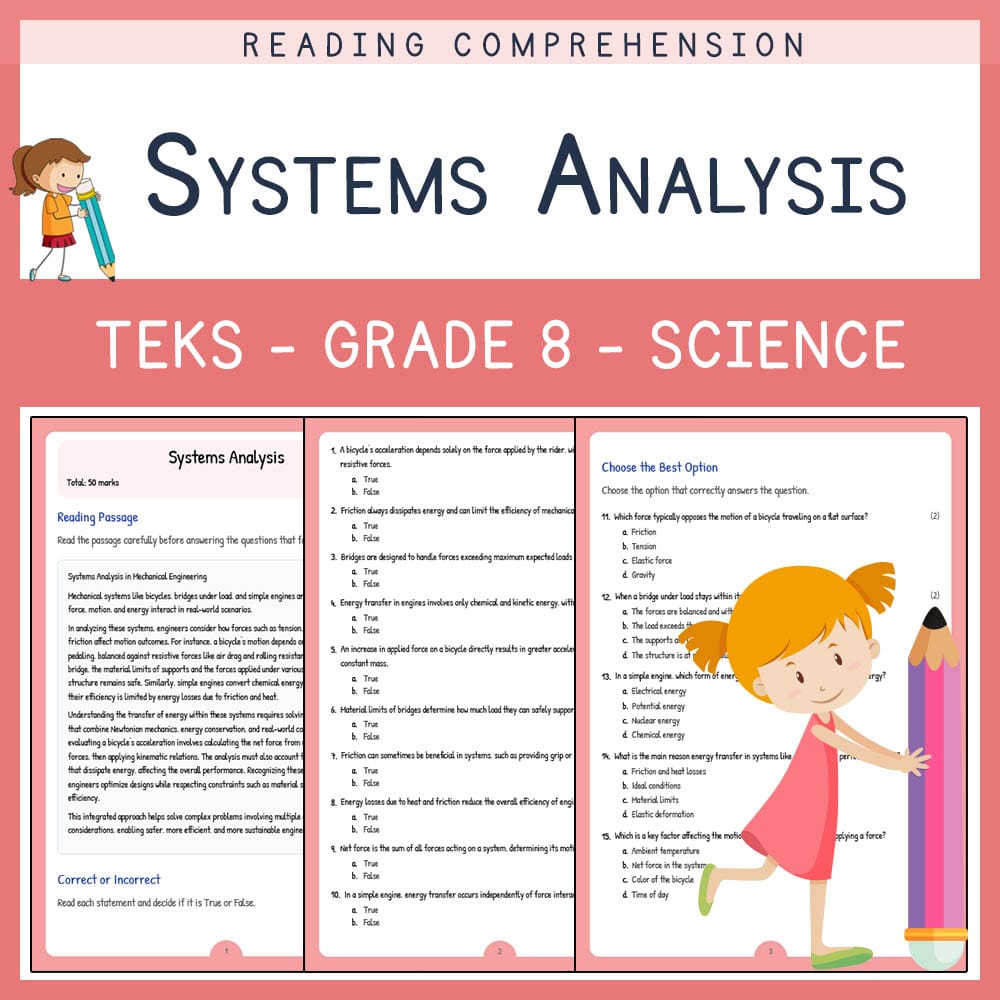
Grade 8 Science | Systems Analysis Worksheet | TEKS Aligned
Created byLumora LearningLearning Objectives
- Understand the principles of force, motion, and energy in mechanical systems.
- Apply combined concepts of net force, energy transfer, and motion to analyze real-world systems.
- Solve multi-step problems involving kinematic relations, force summations, and energy comparisons.
Also included in: Grade 8 Science | Force, Motion, and Energy Lesson Bundle | TEKS-Aligned
Instant download

Grade 8 Science | Energy Conservation Worksheet | TEKS-Aligned
Created byLumora LearningLearning Objectives
- Explain the principle of energy conservation in near-ideal systems involving gravity and motion.
- Differentiate between potential and kinetic energy in real-world scenarios.
- Describe how energy is lost due to friction and air resistance and understand the limits of energy conservation assumptions.
Also included in: Grade 8 Science | Force, Motion, and Energy Lesson Bundle | TEKS-Aligned
Instant download
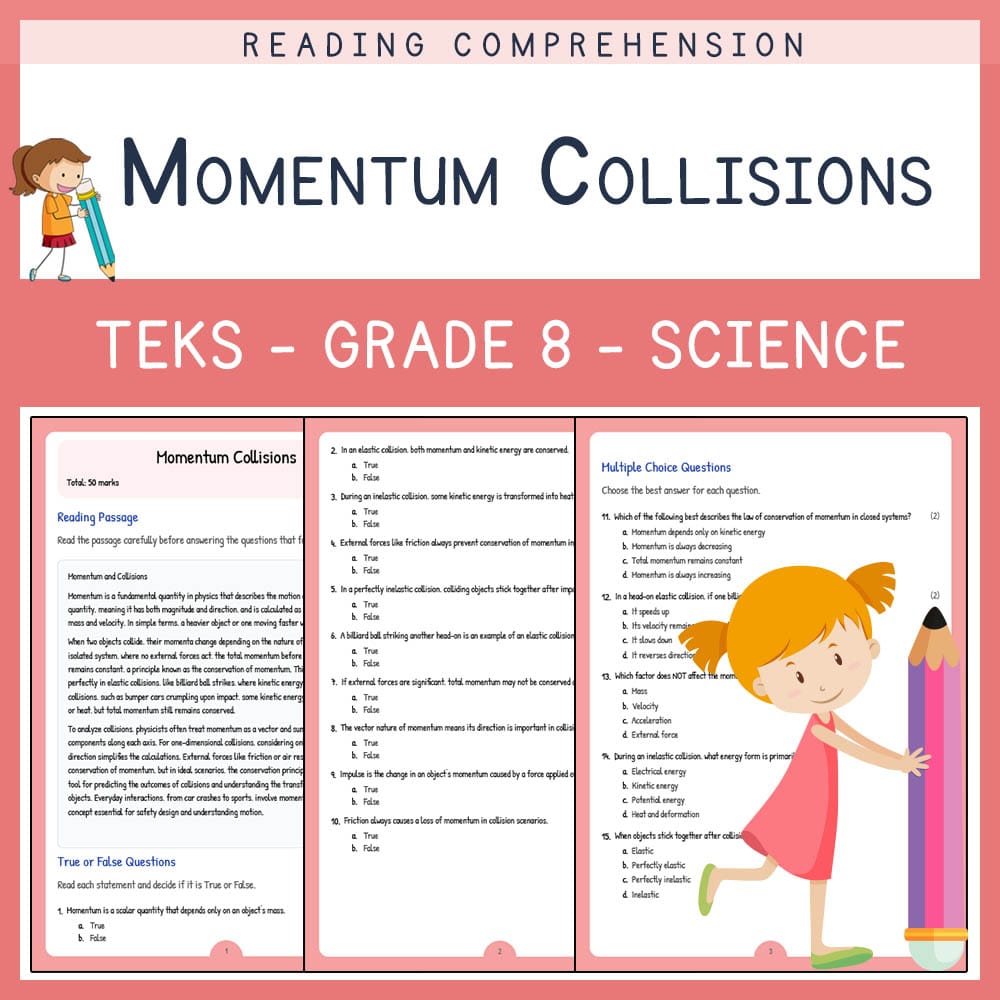
Grade 8 Science | Momentum Collisions Worksheet | TEKS-Aligned
Created byLumora LearningLearning Objectives
- Explain the concept of linear momentum and its conservation in isolated systems.
- Distinguish between elastic and inelastic collisions using real-world examples.
- Apply vector treatment to analyze momentum in one-dimensional collisions.
Also included in: Grade 8 Science | Force, Motion, and Energy Lesson Bundle | TEKS-Aligned
Instant download
About Grade 8 Science Worksheets
Explore Grade 8 Science worksheets for classwork, homework, or review. Our 6,006 printables download instantly as PDFs.
Each resource here is built by an independent educator and reviewed for quality. Worksheets print straight from PDF and suit classroom use, homework, or extra practice; most come with answer keys, and you can preview before purchasing.