
Grade 8 Science Worksheets
6,006 worksheets
Cell Specialization Worksheet | Standards-Aligned Grade 8 Science Practice
JCreated byJ.S SheetsLearning Objectives
- Understand the concept of cell specialization and its importance in biology.
- Identify different types of specialized cells and their unique structures.
- Explain how structural modifications support specific cellular functions.
Instant download

Weathering and Erosion Worksheet | Standards-Aligned Grade 8 Science
JCreated byJ.S SheetsLearning Objectives
- Distinguish between physical weathering and chemical weathering and give examples of each.
- Explain how erosion transports materials using wind, moving water, ice, and gravity.
- Describe how deposition and lithification can form new sedimentary rock layers.
Also included in: Grade 8 Earth Systems and Climate Science Lesson Bundle – Florida NGSSS +1 more
Instant download
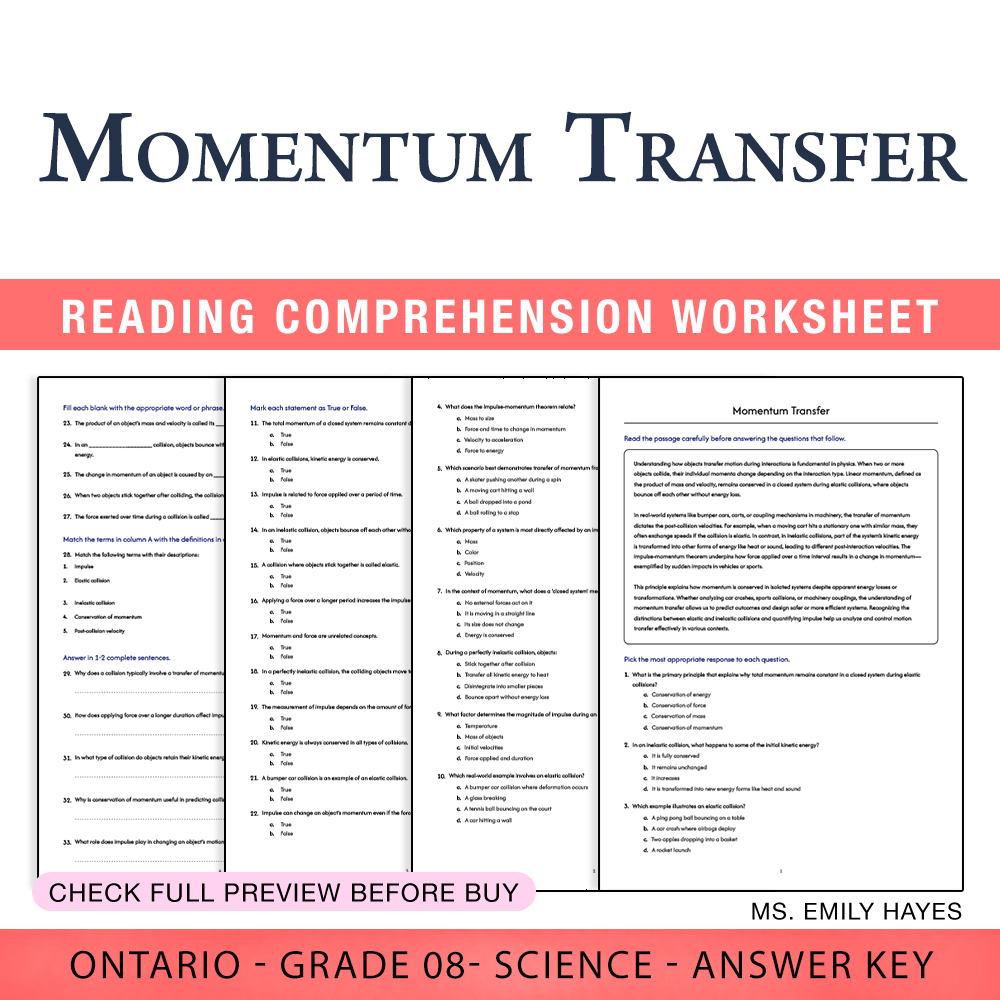
8th Grade Science | Momentum Transfer Worksheet (PDF+ Answer Key)
 Created byCopper Leaf Classroom
Learning Objectives
- Understand the concept of linear momentum and its conservation in collisions
- Differentiate between elastic and inelastic collisions in real-world scenarios
- Apply impulse-momentum theorem to relate force, time, and change in momentum
Instant download

Grade 8 Science – Energy Transfer & Systems | Daily Reading Worksheet
 Created byBright Mind Resources
Learning Objectives
- Understand key concepts related to Science
- Apply knowledge through practice questions
- Demonstrate comprehension of the material
Also included in: Grade 8 Science Systems Forces Daily Reading Worksheets Lesson Bundle | Alberta +2 more
Instant download

Grade 8 Science | Life-Cycle Tradeoffs Worksheet | General Standards
 Created byLumora Learning
Learning Objectives
- Explain how life-cycle thinking compares impacts from materials and manufacturing to maintenance and end-of-life disposal.
- Identify trade-offs between different stages of a product’s life cycle (before use, during use, after use).
- Use system-level evaluation to make fair comparisons among design options under real constraints.
Instant download

Grade 8 Science | Cell Specialization Worksheet | BC Standards
Created byLumora LearningLearning Objectives
- Understand how cells develop unique structures and functions through specialization.
- Identify examples of specialized cells and their unique features.
- Explain how structural modifications support specific cellular functions.
Also included in: Grade 8 Science | Cell Organization & Systems Custom Bundle | BC Aligned
Instant download

Grade 8 Abiotic Influences Worksheet | BC Practice & PDF
 Created byClear Sky Classroom
Learning Objectives
- Explain how abiotic factors (light, temperature, water, soil, and nutrients) affect where organisms live and how well they function.
- Describe how seasonal and microhabitat changes create different niches within the same ecosystem.
- Analyze how changes in abiotic conditions can shift community composition and ecosystem function over time.
Instant download

Grade 8 Microscopy Basics Worksheet | Ontario Science + Doodle Notes
 Created byChalk and Compass
Learning Objectives
- Explain how magnification, resolution, and contrast affect what can be seen in micrographs.
- Compare light microscopy, stereomicroscopy, and electron imaging for viewing cells.
- Identify common sample-preparation artifacts and interpret two-dimensional images accurately.
Also included in: Grade 8 Science Cell Organization, Transport & Homeostasis Lesson Bundle – Ontario +1 more
Instant download

Limiting Factors Assessment | Florida NGSSS Standards Grade 8 Science
 Created byPrism Point Learning
Learning Objectives
- Explain how limiting factors affect population growth, survival, and reproduction
- Describe carrying capacity and how populations behave when resources change
- Use evidence from scenarios to predict whether a population will grow, stabilize, or decline
Also included in: Grade 8 Evolution and Genetics Science Lesson Bundle | Florida NGSSS
Instant download

Grade 8 Science – Factors Affecting Reaction Rates & Daily Reading Worksheet
Created byBright Mind ResourcesLearning Objectives
- Understand how temperature influences the speed of chemical reactions.
- Identify the microscopic effects of increasing temperature on particles.
- Relate macroscopic changes in reaction speed to particle energy and collision frequency.
Also included in: Grade 8 Chemical Reactions Science Lesson Bundle: Daily Reading | BC +1 more
Instant download

Grade 8 Science Worksheet | Energy Flow Trophic Levels (PDF)
 Created byEvergreen Desk Education
Learning Objectives
- Explain how energy moves through trophic levels in a one-way flow from the Sun to producers and then to consumers
- Describe why energy decreases at each trophic level and how heat loss limits ecosystem productivity
- Compare how food chains and food webs show single vs. multiple pathways for energy flow
Also included in: Grade 8 Ecosystems & Genetics Science Lesson Bundle - General Framework +1 more
Instant download

Grade 8 Membrane Structure Worksheet | Ontario Science Cell Biology
Created byClear Sky ClassroomLearning Objectives
- Describe the phospholipid bilayer and explain how it creates selective permeability.
- Compare the functions of integral proteins, peripheral proteins, cholesterol, and carbohydrate components.
- Explain how membrane proteins support transport and cell communication through receptors and channels.
Instant download

Pollution Sources Test Prep Worksheet | Grade 8 Science Ontario
Created byPrism Point LearningLearning Objectives
- Differentiate between point sources and nonpoint sources of pollution and describe how each enters water bodies.
- Explain how nutrient enrichment leads to eutrophication and oxygen depletion in aquatic systems.
- Connect land-use patterns and landscape practices to pollutant transport pathways and reservoir vulnerability.
Also included in: Grade 8 Water Systems Science Lesson Bundle for Ontario Framework
Instant download

Grade 8 Science | Population Dynamics - Daily Reading Comprehension
 Created byCoral Reef Learning
Learning Objectives
- Understand key concepts related to Science
- Apply knowledge through practice questions
- Demonstrate comprehension of the material
Instant download

Predictive Models Worksheet | Grade 8 Science Practice
Created byPrism Point LearningLearning Objectives
- Explain how scientific models connect variables to observed phenomena.
- Identify the assumptions and predicted outcomes in a predictive model.
- Use a model’s structure to make and test expectations about data patterns.
Instant download

Factors Influencing Reaction Rate Worksheet | Grade 8 Science BC Standards
JCreated byJ.S SheetsLearning Objectives
- Understand how temperature, concentration, surface area, and catalysts affect reaction rates.
- Analyze the microscopic factors that influence how quickly reactions occur.
- Relate macroscopic changes in reaction speed to atomic and molecular interactions.
Instant download
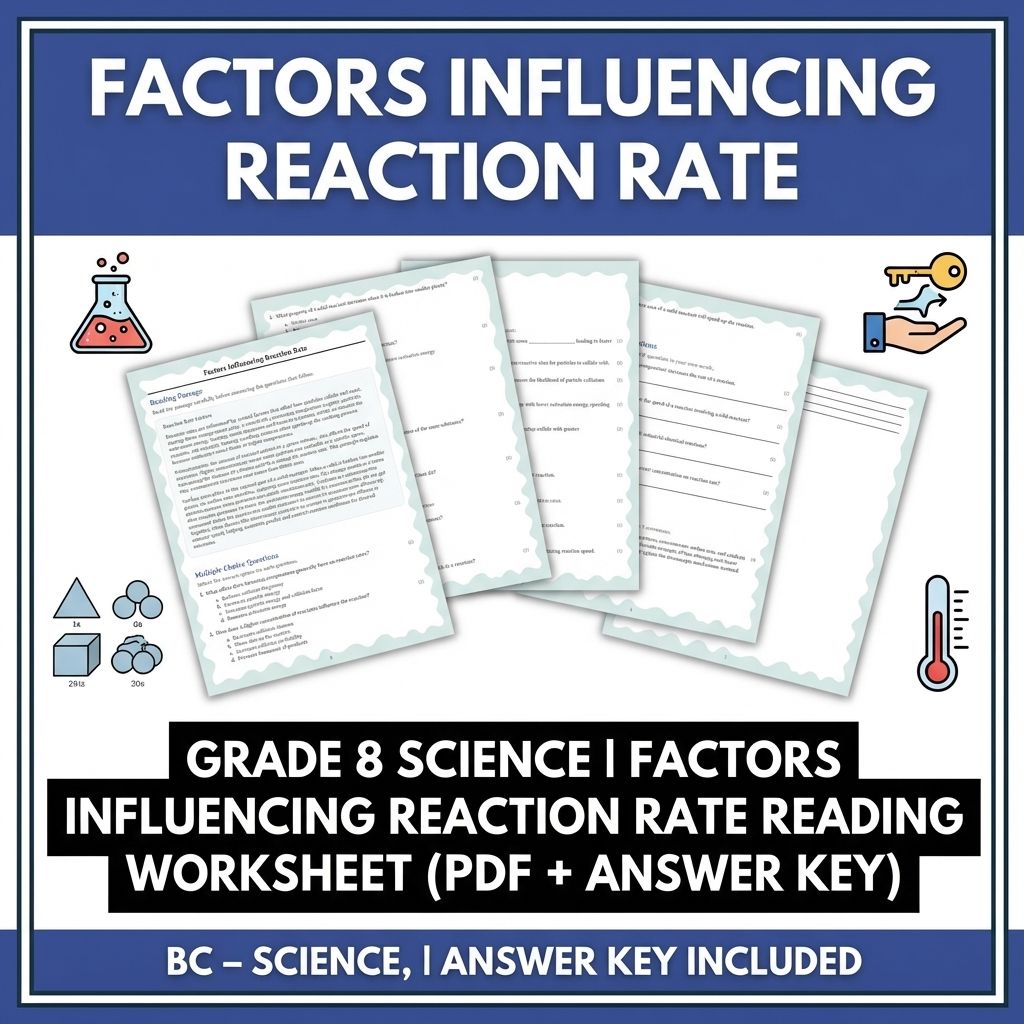
Grade 8 Science | Factors Influencing Reaction Rate Worksheet (PDF + Answer Key)
JCreated byJ.S SheetsLearning Objectives
- Understand how temperature affects the speed of a chemical reaction.
- Identify the impact of concentration on how quickly reactions occur.
- Explain how surface area influences reaction rates.
Instant download
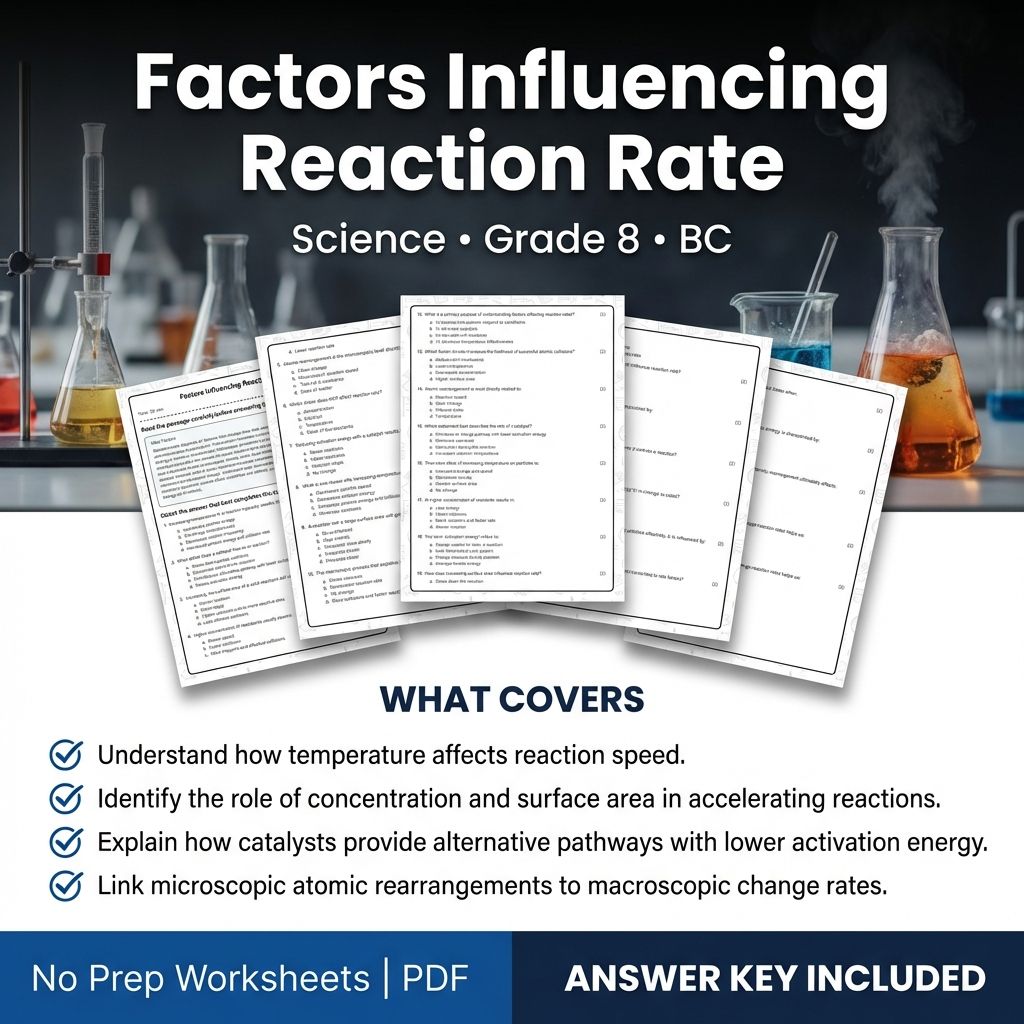
Grade 8 Science | Factors Influencing Reaction Rate Worksheet & Answer Key (PDF)
Created byCoral Reef LearningLearning Objectives
- Understand how temperature affects reaction speed.
- Identify the role of concentration and surface area in accelerating reactions.
- Explain how catalysts provide alternative pathways with lower activation energy.
Instant download

Newtonian Laws Worksheet | Grade 8 Science Practice
Created byPrism Point LearningLearning Objectives
- Describe inertia using Newton’s First Law and apply it to everyday situations.
- Use Newton’s Second Law to relate net force, mass, and acceleration (qualitatively and with simple proportional reasoning).
- Explain action–reaction pairs from Newton’s Third Law and identify them in scenarios.
Also included in: Grade 8 Force, Motion & Energy Science Lesson Bundle for TEKS Practice +1 more
Instant download

Grade 8 Homeostasis Worksheet | Practice & Assessment PDF
Created byClear Sky ClassroomLearning Objectives
- Explain how negative feedback helps maintain homeostasis in the body
- Identify how sensors, control centers, and effectors work together to restore internal balance
- Describe how cellular and organ-system processes support stable internal conditions
Instant download

Homeostasis Feedback Worksheet | Grade 8 Science Practice
Created byPrism Point LearningLearning Objectives
- Explain how homeostasis uses feedback to keep internal conditions stable
- Identify the roles of receptors, control centers, and effectors in feedback systems
- Describe how disruptions to homeostasis can affect survival and reproduction
Instant download

Grade 8 Osmotic Balance Worksheet | Ontario Science Cells & Transport
Created byClear Sky ClassroomLearning Objectives
- Explain how water potential and tonicity determine the direction of water movement across cell membranes
- Compare how plant cells and animal cells respond to hypotonic, isotonic, and hypertonic environments
- Describe osmoregulatory adaptations (contractile vacuoles, membrane pumps, and buffering of extracellular fluid) and why they help cells survive
Instant download

Grade 8 Energy Transfer Worksheet | Practice & Assessment PDF
Created byClear Sky ClassroomLearning Objectives
- Explain how work done by forces changes a system’s kinetic and potential energy during motion
- Describe qualitatively how the direction of force relative to displacement affects whether mechanical energy increases or decreases
- Use examples (elevators, skiing, braking) to connect energy transfer to everyday physical situations
Instant download

Organ Systems: How Tissues Build Functions Worksheet | Grade 8 Science
JCreated byJ.S SheetsLearning Objectives
- Explain how specialized tissues combine to form organs with coordinated functions in the circulatory, respiratory, and digestive systems.
- Describe how epithelial surfaces and blood support transport of gases, nutrients, and wastes efficiently.
- Connect surface area and transport mechanisms to system-level performance and robustness.
Instant download
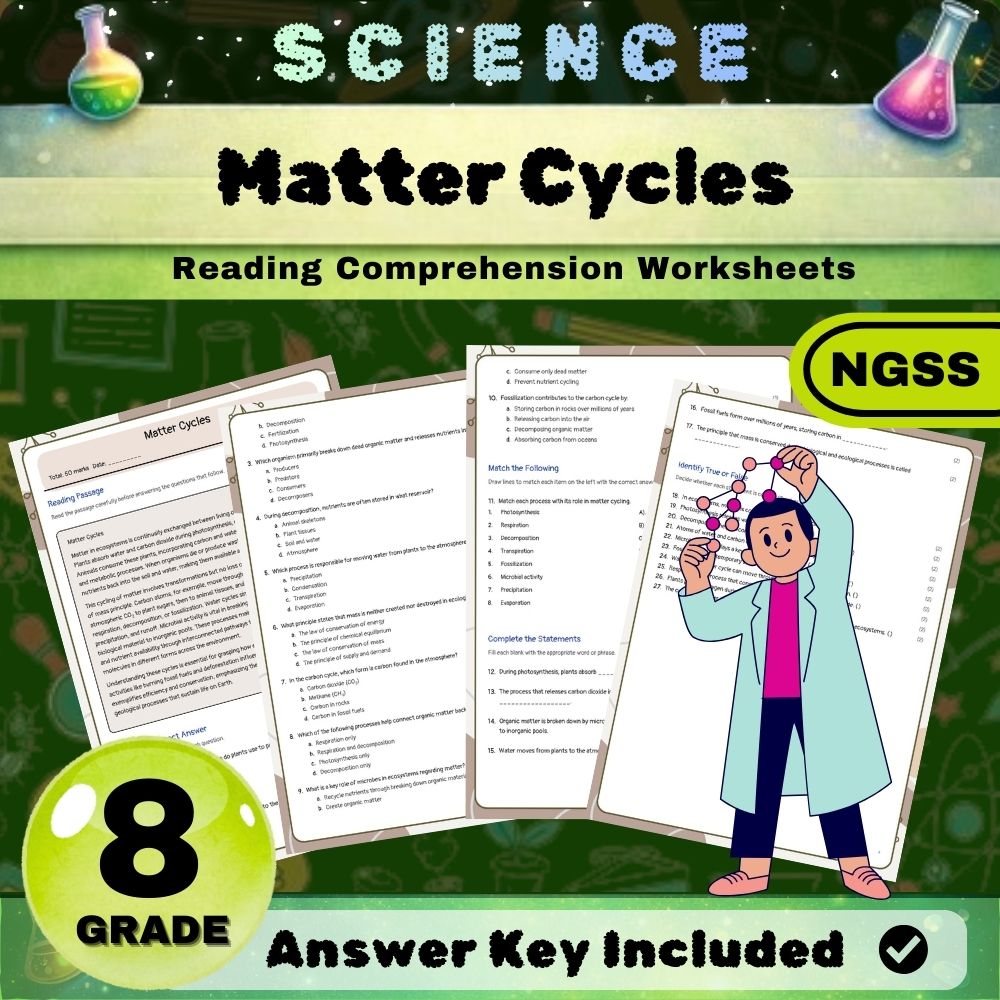
Grade 8 Science | Matter Cycles NGSS Worksheet (PDF)
 Created byMaple Path Learning
Learning Objectives
- Understand the processes involved in the cycling of matter between living organisms and the environment.
- Describe the roles of photosynthesis, respiration, decomposition, and microbial activity in matter transfer.
- Trace atoms of carbon and water through ecosystems from producers to decomposers and reservoirs.
Also included in: Grade 8 Science Ecosystems Unit Bundle | Interactions, Energy & Dynamics (NGSS) +1 more
Instant download

Grade 8 Science | Kinetic & Potential Energy - Reading Comprehension
Created byCoral Reef LearningLearning Objectives
- Identify the differences between kinetic energy and potential energy.
- Explain how energy shifts between kinetic and potential forms in real-world objects.
- Describe gravitational potential energy and kinetic energy using examples.
Instant download

Grade 8 Science Worksheet – Immune Response (Ontario) Practice Set (PDF)
Created byEvergreen Desk EducationLearning Objectives
- Describe how the innate immune system responds quickly to pathogens using cells like neutrophils and macrophages.
- Explain how the adaptive immune system recognizes specific antigens and creates targeted defenses.
- Connect immune cell actions (phagocytosis, antibody production, and cytotoxic killing) to tissue-level protection.
Also included in: Grade 8 Cell Structure & Homeostasis Science Lesson Bundle (Ontario) +1 more
Instant download
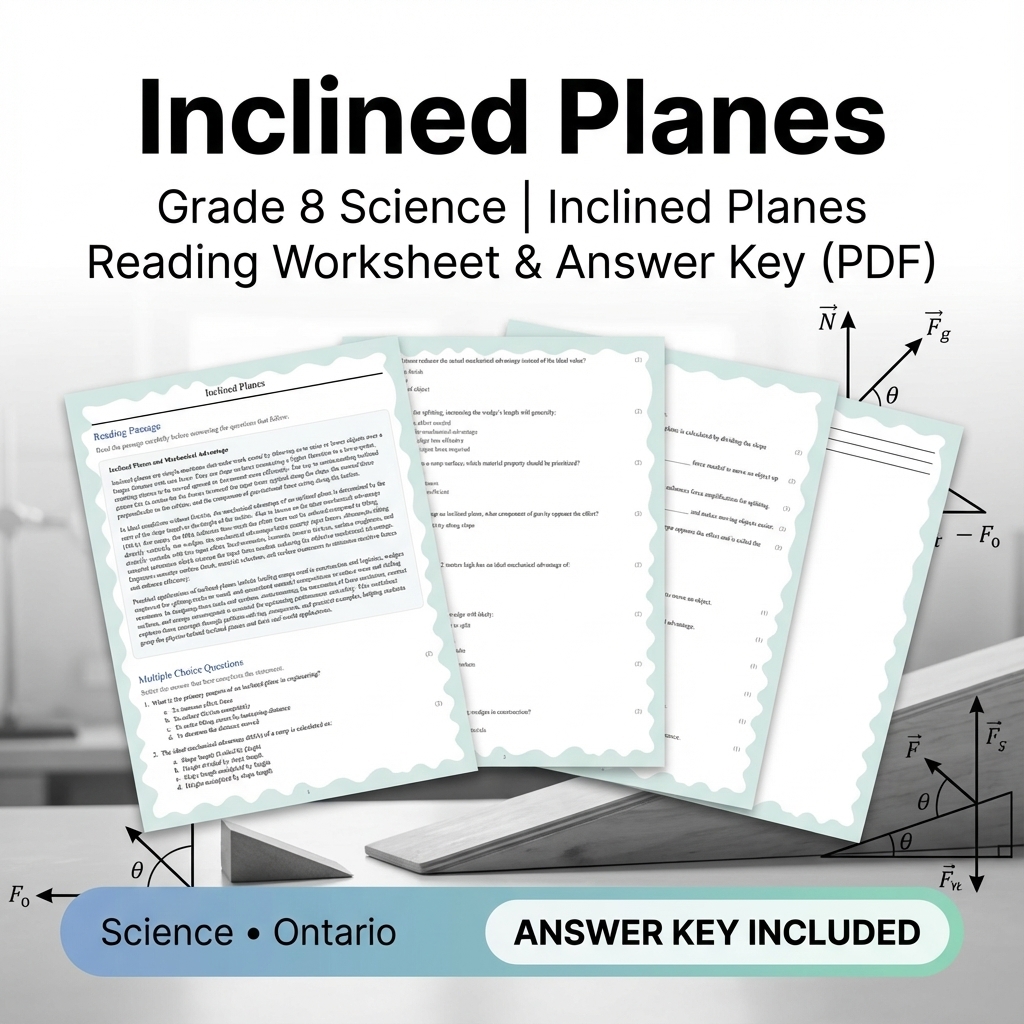
Grade 8 Science | Inclined Planes Reading Worksheet & Answer Key (PDF)
JCreated byJ.S SheetsLearning Objectives
- Understand how inclined planes provide mechanical advantage in performing tasks.
- Calculate ideal and actual mechanical advantages of ramps and wedges.
- Identify frictional effects on the input force required to move objects on inclined surfaces.
Also included in: Grade 8 Science | Energy & Forces Unit Worksheet Pack (Answer Keys Included) +1 more
Instant download
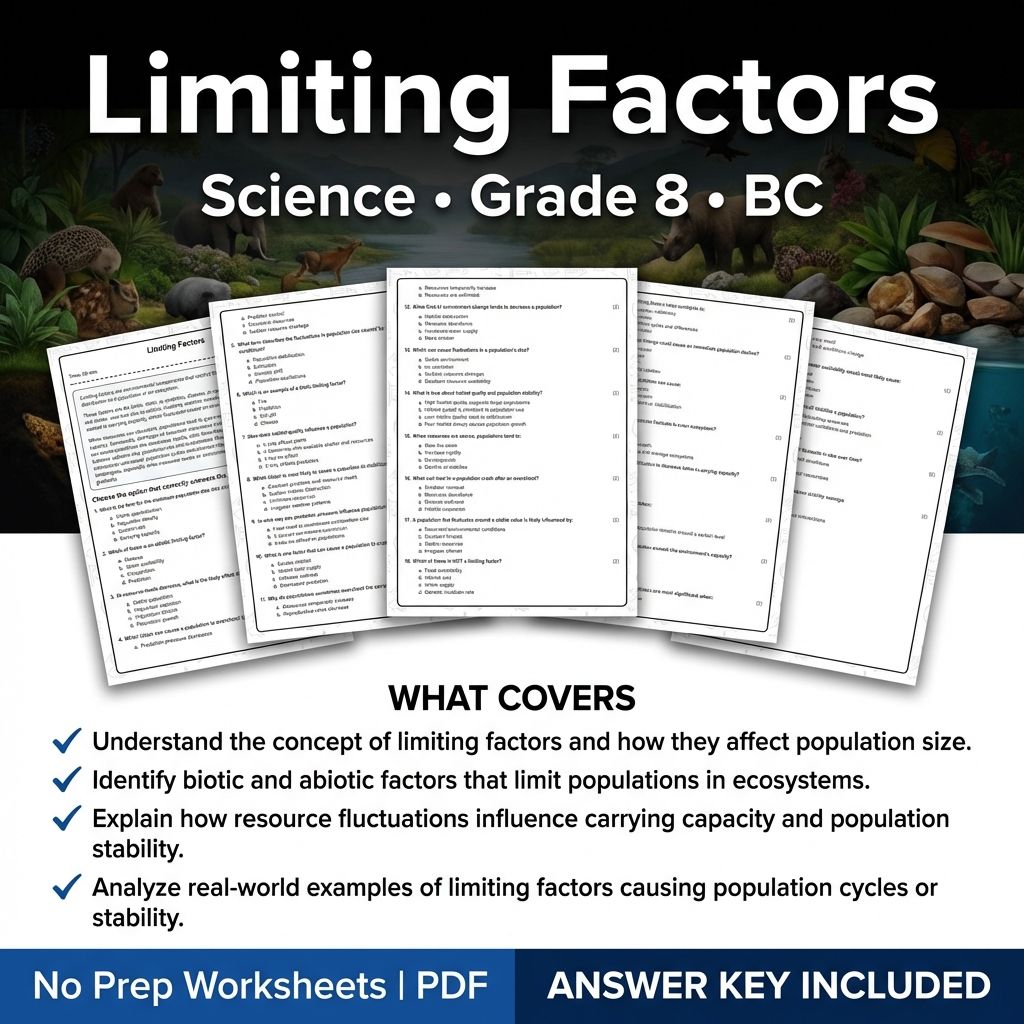
Grade 8 Science | Limiting Factors Printable Worksheet & Answer Key
Created byCoral Reef LearningLearning Objectives
- Understand the concept of limiting factors and how they affect population size.
- Identify biotic and abiotic factors that limit populations in ecosystems.
- Explain how resource fluctuations influence carrying capacity and population stability.
Instant download
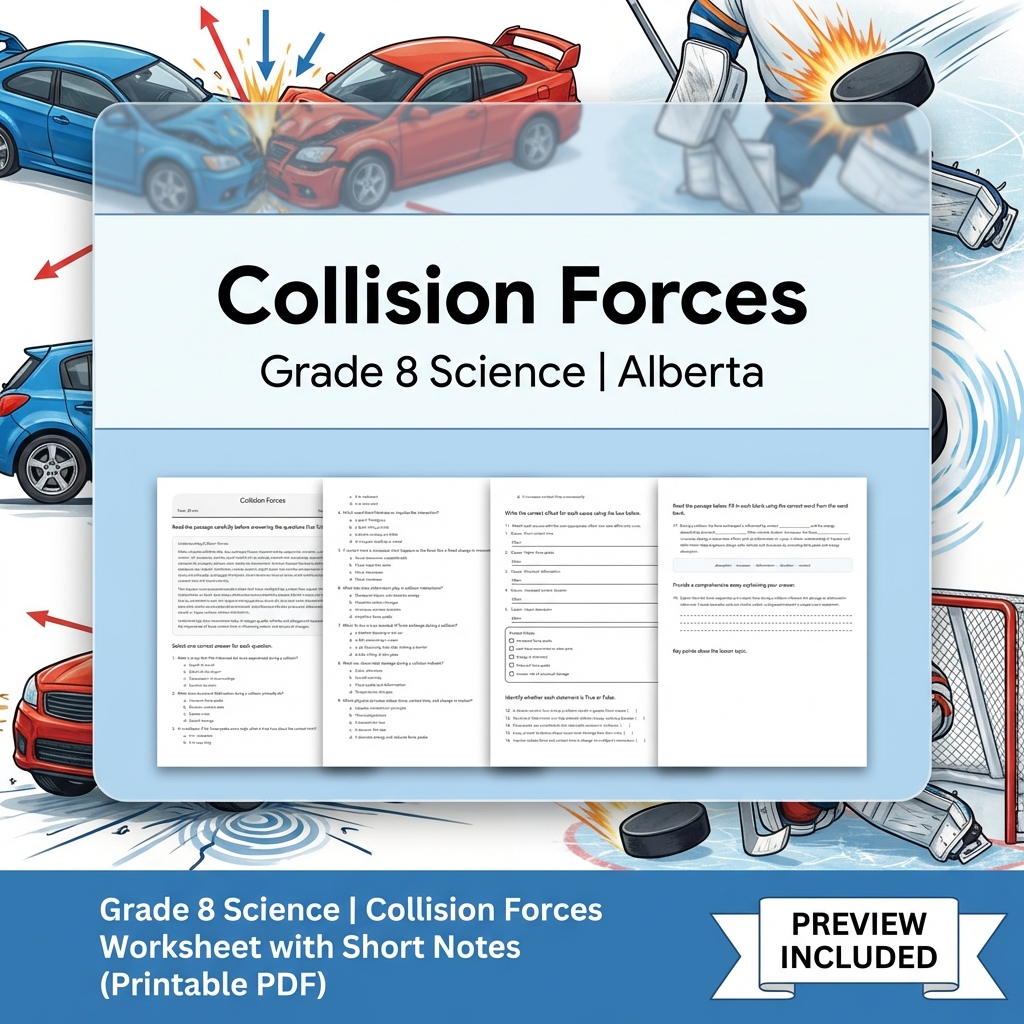
Grade 8 Science | Collision Forces Worksheet with Short Notes (Printable PDF)
 Created byMeadowlark Worksheets
Learning Objectives
- Understand how forces exchanged during brief contact events influence motion.
- Describe the relationship between force magnitude and contact duration in impacting objects.
- Explain structural deformation as an energy absorption process during collisions.
Also included in: Grade 8 Science Forces & Motion UNIT Bundle – Alberta Curriculum +1 more
Instant download
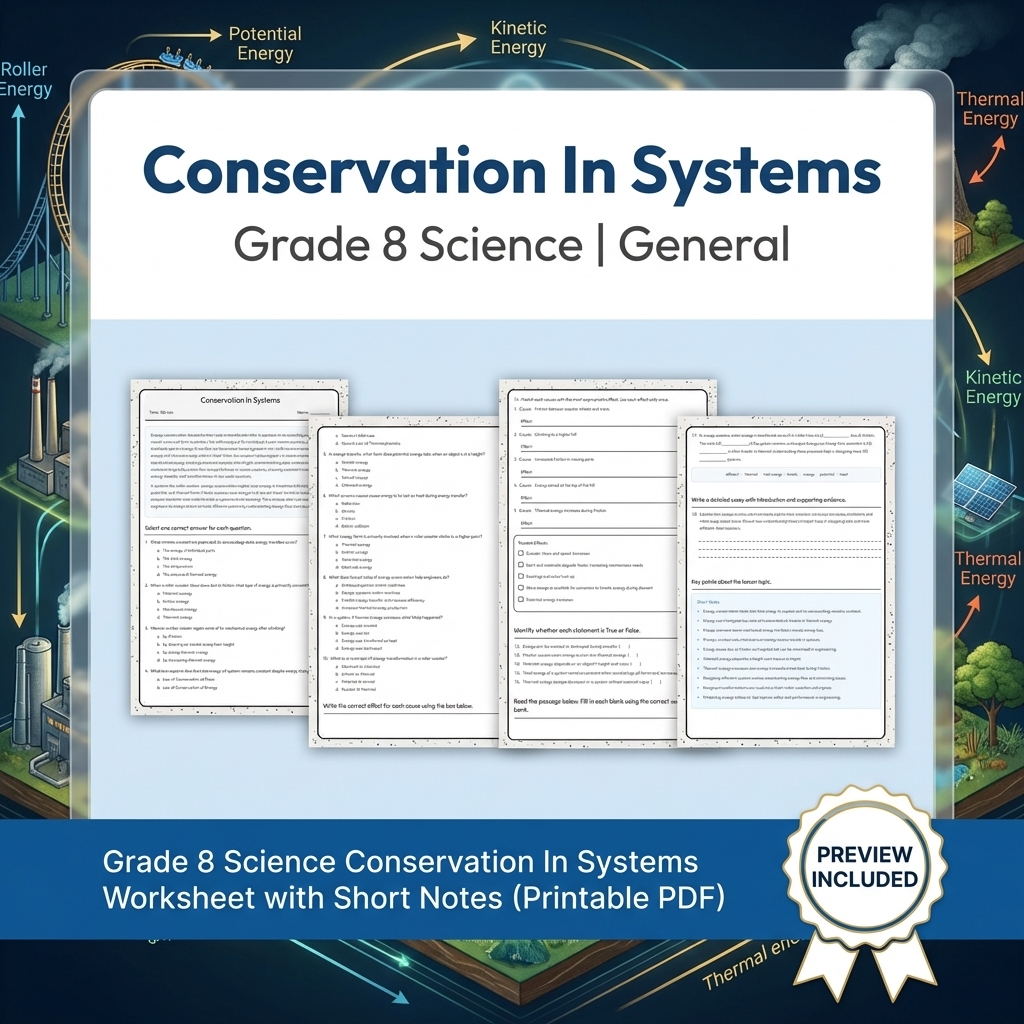
Grade 8 Science Conservation In Systems Worksheet with Short Notes
Created byMeadowlark WorksheetsLearning Objectives
- Understand the concept of energy conservation within a system and its surroundings.
- Describe how energy transfers occur during mechanical and thermal processes.
- Predict energy behavior in systems like roller coasters based on energy conservation principles.
Also included in: Grade 8 Matter and Chemical Reactions Science lesson bundle +1 more
Instant download

Grade 8 Science | Motors and Generators Worksheet (Alberta Standards) (PDF)
Created byEvergreen Desk EducationLearning Objectives
- Explain how electric motors convert electrical energy into mechanical motion using magnetic fields and current-carrying conductors.
- Explain how generators convert mechanical motion into electrical energy using electromagnetic induction.
- Describe how design parameters (coil turns and magnetic flux) affect motor/generator output and efficiency.
Instant download

Grade 8 Science Water Quality Indicators Worksheet (Ontario) – PDF
Created byBright Mind ResourcesLearning Objectives
- Identify physical, chemical, and biological water quality indicators.
- Interpret indicator ranges for aquatic health and uses.
- Understand sources of variability and limitations in water assessment.
Instant download
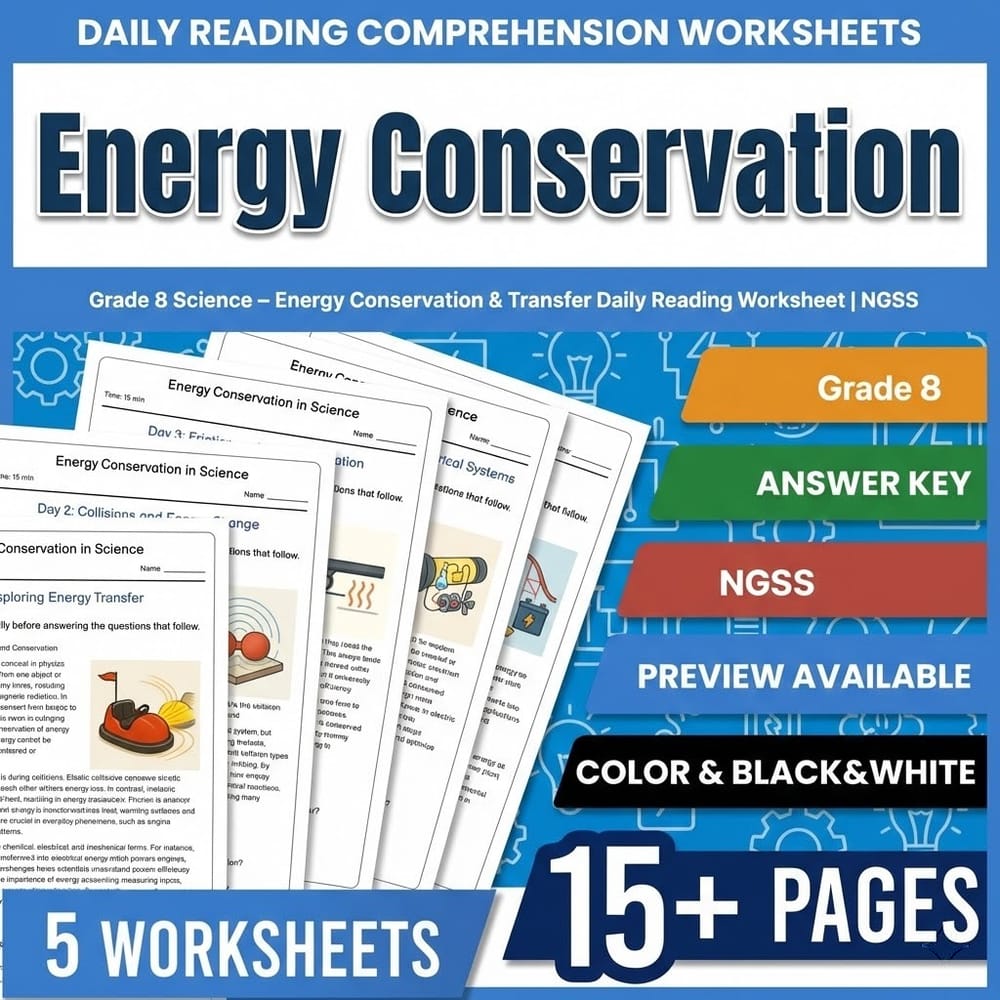
Grade 8 Science – Energy Conservation & Transfer Daily Reading Worksheet | NGSS
 Created byElena Brooks
Learning Objectives
- Understand the different forms of energy transfer such as kinetic, potential, thermal, chemical, and electrical.
- Explain how energy is conserved in closed systems during collisions and other interactions.
- Identify real-world examples of energy transfer like frictional heating and energy conversions.
Instant download

Grade 8 Science | Force Balance Worksheet (Alberta) PDF
Created byEvergreen Desk EducationLearning Objectives
- Explain the difference between balanced and unbalanced forces using net force and resulting motion
- Use force vector ideas to predict whether an object stays at rest, stays moving at constant speed, or accelerates
- Apply equilibrium concepts to real-life examples such as suspension bridges, supported pipelines, and parked vehicles
Instant download

Heredity And Variation Worksheet | Grade 8 Science Practice
Created byPrism Point LearningLearning Objectives
- Explain how genetic information is passed from parents to offspring and why this leads to variation
- Describe how recombination and changes in genetic material create differences among individuals
- Use evidence from families and populations to support claims about inherited variation
Instant download

Grade 8 Force Balance Worksheet | Alberta Use Practice PDF
Created byClear Sky ClassroomLearning Objectives
- Explain how net force determines whether an object stays at rest, moves at constant speed, or accelerates.
- Distinguish balanced forces (equilibrium) from unbalanced forces using force directions and magnitudes.
- Analyze real-world systems (bridges, pipelines, parked vehicles) to predict static or changing motion.
Instant download

Grade 8 Systems Analysis Science Daily Reading Worksheet | TEKS
 Created byBRIGHT PATH RESOURCES
Learning Objectives
- Identify how net force changes an object’s motion using evidence from a scenario.
- Explain the relationship between net force and changes in speed for a simple push.
- Use given values to reason about balanced vs. unbalanced forces.
Also included in: Grade 8 Force Motion and Energy Science Reading Worksheets Bundle | TEKS +1 more
Instant download

Material Origins and Properties Worksheet | NGSS Grade 8 Science Assessment
 Created byCedar Grove Learning
Learning Objectives
- Understand how natural resources are transformed into synthetic materials.
- Identify the factors influencing material properties such as strength, conductivity, and durability.
- Compare properties of natural versus synthetic materials used in everyday products.
Instant download
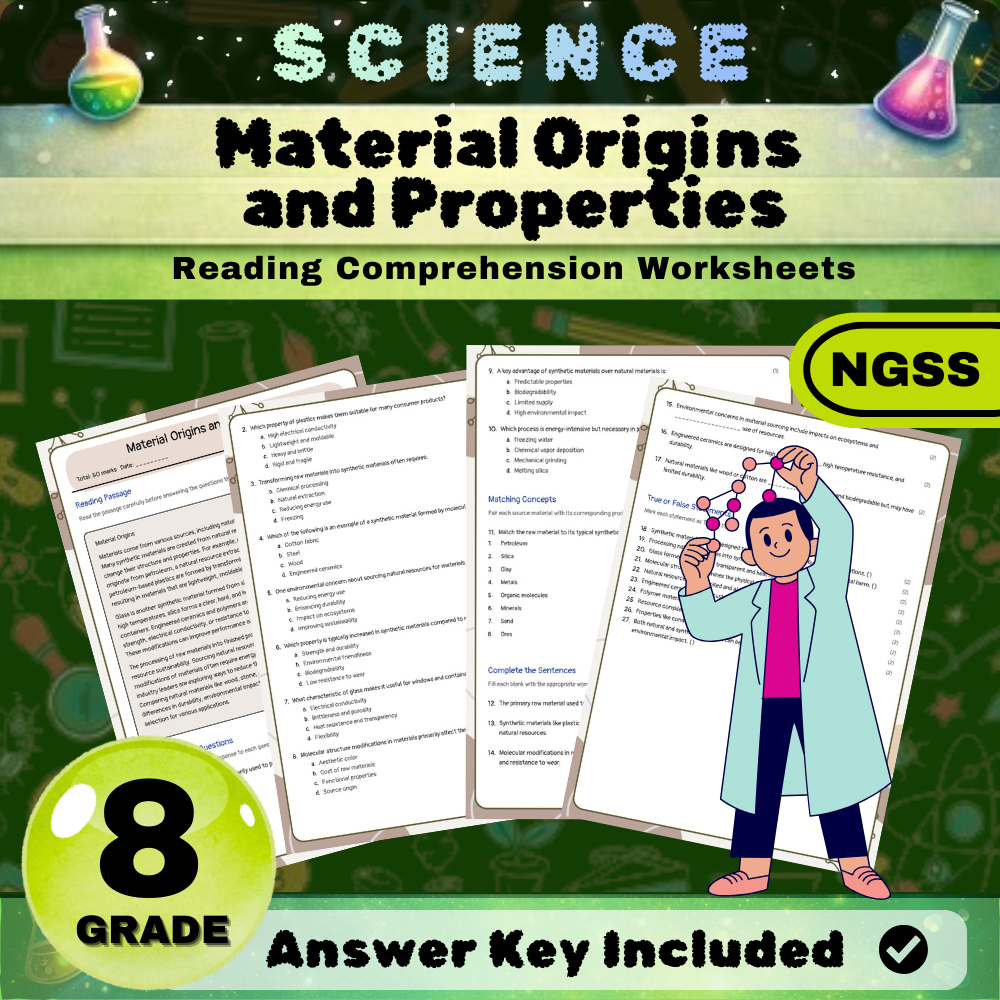
Grade 8 Science – Material Origins & Properties Worksheet (NGSS PDF)
Created byMaple Path LearningLearning Objectives
- Explain how natural resources are transformed into synthetic materials such as plastics, glass, and ceramics.
- Describe how the source materials and their molecular structures influence their physical and functional properties.
- Evaluate environmental and resource considerations involved in sourcing and modifying materials.
Also included in: Grade 8 Science | Matter and Its Interactions NGSS Unit Bundle (Worksheet Pack) +1 more
Instant download

Grade 8 Science | Layered Fluids Worksheet (PDF+ Answer Key)
Created byCopper Leaf ClassroomLearning Objectives
- Explain how temperature and salinity influence fluid density gradients and stratification.
- Analyze the impact of density differences on buoyant exchange and stability regimes in layered fluids.
- Interpret buoyancy frequency and density profiles to assess mixing and overturning conditions.
Instant download
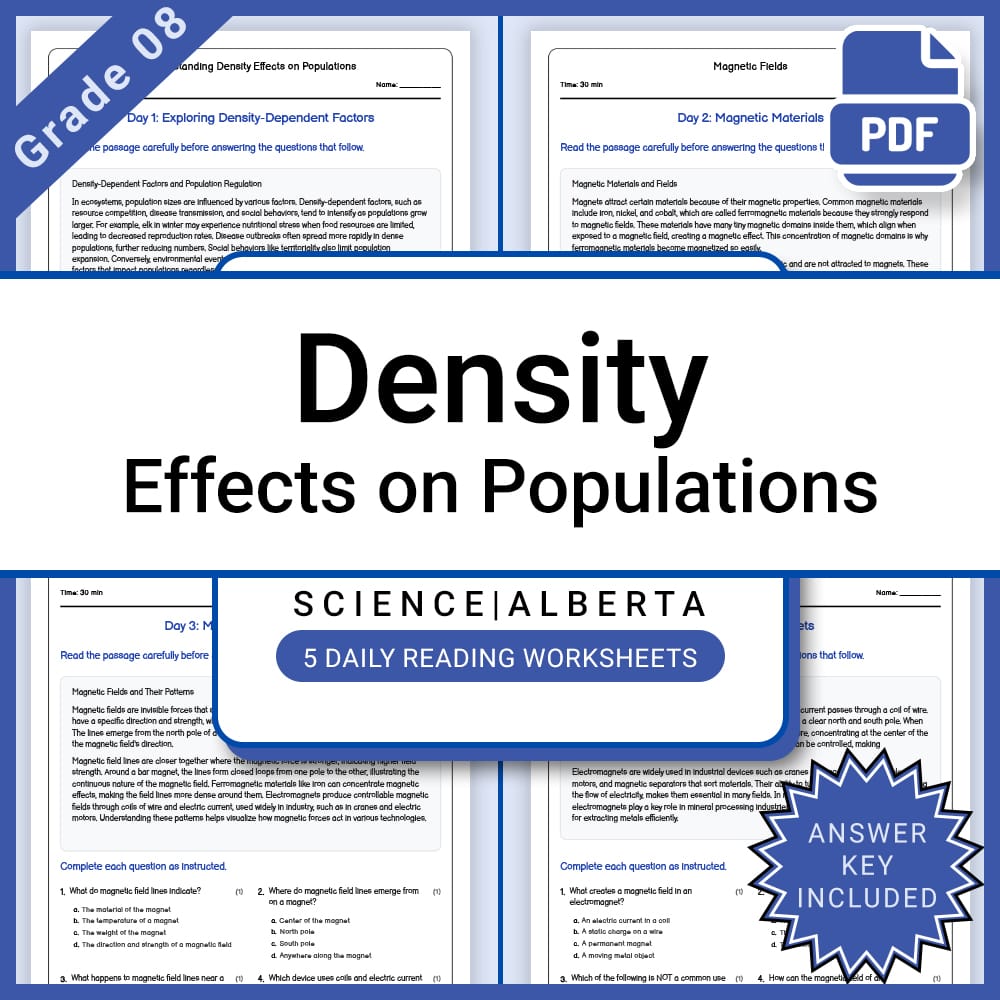
Grade 8 Science – Density Effects on Populations Daily Worksheet Answer Key
JCreated byJ.S SheetsLearning Objectives
- Identify and explain density-dependent factors affecting populations.
- Differentiate between resource competition, disease transmission, social behaviors, and environmental events.
- Understand how human activities like barriers influence population density and dispersal.
Also included in: Grade 8 Science Lesson Bundle | Ecosystems, Energy, and Environmental Impact +1 more
Instant download

Grade 8 Science Worksheet | Ecosystem Resilience After Change (CA Standards)
Created byEvergreen Desk EducationLearning Objectives
- Explain how ecosystems respond to disturbances and how stability can include change.
- Describe how species survival, persistence, and recolonization help communities recover.
- Analyze how changes in population size affect resource availability and ecosystem interactions.
Instant download

Grade 8 Science | Energy Conservation - Daily Reading Comprehension
Created byCoral Reef LearningLearning Objectives
- Understand the concept of mechanical energy conservation in ideal systems.
- Analyze energy transformations between potential and kinetic forms in pendulums.
- Recognize factors like friction and air resistance that cause energy dissipation.
Instant download

Design Problem Parameters Assessment | Standards-Aligned Grade 8 Science
Created byPrism Point LearningLearning Objectives
- Understand the key components of defining design problem parameters, including success criteria and constraints.
- Learn how to clearly articulate measurable outcomes and limitations for engineering solutions.
- Analyze how precise problem statements enhance the evaluation and comparison of different designs.
Instant download

Energy Conservation Worksheet | Grade 8 Science Practice & Assessment
Created byCoral Reef LearningLearning Objectives
- Explain the principle of conservation of mechanical energy in ideal systems.
- Differentiate between kinetic and potential energy and their interconversion in systems like pendulums and roller coasters.
- Recognize how energy is dissipated to thermal forms due to friction and air resistance.
Instant download

Momentum Collisions Worksheet | Grade 8 Science Activities
Created byPrism Point LearningLearning Objectives
- Explain linear momentum and impulse in one-dimensional collisions using vector ideas (direction and sign).
- Use conservation of momentum for an isolated system to predict post-collision velocities.
- Distinguish elastic and inelastic collisions and describe how external forces affect momentum conservation.
Also included in: Grade 8 Force, Motion & Energy Science Lesson Bundle for TEKS Practice +1 more
Instant download

Grade 8 Newtonian Motion Worksheet | Ontario Science Forces & Motion
Created byChalk and CompassLearning Objectives
- Explain Newton’s three laws using cause-and-effect language between forces and motion.
- Use F = ma to relate force, mass, and acceleration in simple one- and two-object systems.
- Apply inertia and action–reaction pairs to everyday mechanical examples and identify common assumptions.
Also included in: Grade 8 Science Mechanical Systems Lesson Bundle | Ontario +1 more
Instant download
About Grade 8 Science Worksheets
Explore Grade 8 Science worksheets for classwork, homework, or review. Our 6,006 printables download instantly as PDFs.
Each resource here is built by an independent educator and reviewed for quality. Worksheets print straight from PDF and suit classroom use, homework, or extra practice; most come with answer keys, and you can preview before purchasing.