
Grade 8 Science Worksheets
6,006 worksheets
Force Diagrams Review Worksheet | Grade 8 Science Ontario
 Created byPrism Point Learning
Learning Objectives
- Explain how to draw and interpret free-body diagrams for objects experiencing both contact and non-contact forces
- Determine whether the net force on a system is balanced or unbalanced and relate it to constant velocity versus acceleration
- Calculate the net force magnitude and direction for simple one-dimensional force diagrams
Also included in: Grade 8 Work, Energy & Forces Science Lesson Bundle – Ontario Test Prep
Instant download

Motion Basics Assessment | TEKS Grade 8 Science Standard-Aligned
Created byPrism Point LearningLearning Objectives
- Understand the fundamental concepts of motion including position, distance, speed, velocity, and acceleration.
- Differentiate between scalar and vector quantities related to motion.
- Interpret and analyze distance-time and velocity-time graphs.
Also included in: Grade 8 Force, Motion, and Energy Science Lesson Bundle TEKS Standards
Instant download
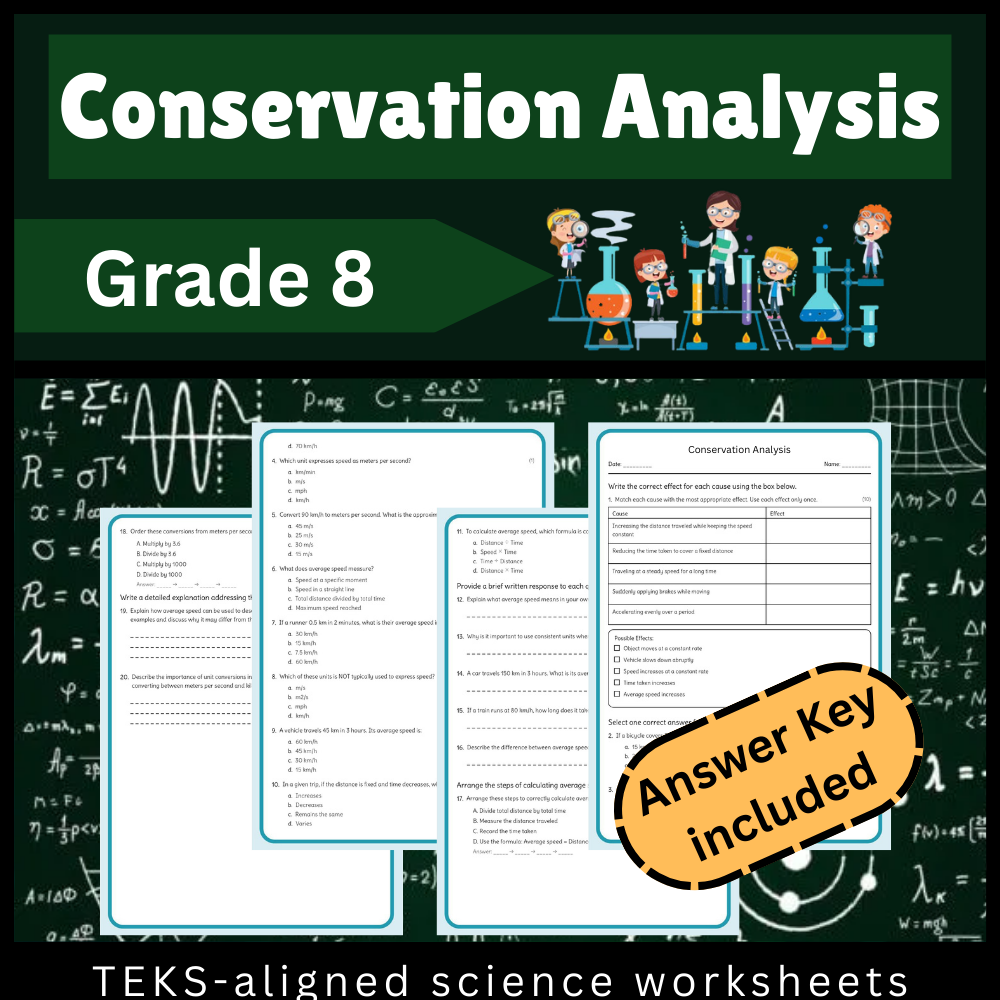
Grade 8 Science – Conservation Analysis Worksheet (PDF) | TEKS Standards
 Created byBright Mind Resources
Learning Objectives
- Understand the principle of mass conservation in closed chemical systems.
- Analyze how mass relates between reactants and products in chemical reactions.
- Differentiate between open and closed systems regarding matter exchange.
Also included in: Grade 8 Science Unit Bundle | States of Matter & Reaction Rates Worksheets- TEKS +1 more
Instant download

Gravitational Force and Motion Worksheets | Grade 8 Science
 Created bythe curious pencil
Learning Objectives
- Explain how mass affects the strength of gravitational force
- Describe how distance changes gravitational force using an inverse-square pattern
- Compare gravitational effects using mass and separation distance
Also included in: Motion and Stability Forces Grade 8 Science NGSS Worksheets Bundle +2 more
Instant download

Science Explanations Evidence to Cause-and-Effect Worksheet Grade 8
JCreated byJ.S SheetsLearning Objectives
- Explain how scientific explanations connect evidence and patterns to causal mechanisms or cause-and-effect relationships.
- Distinguish correlation from causation when developing explanations.
- Use ideas from models and multiple lines of evidence to strengthen scientific reasoning.
Also included in: Grade 8 Evidence-Based Scientific Inquiry Science Lesson Bundle | Florida NGSSS +1 more
Instant download

Applications Design Worksheet | Grade 8 Science Practice TEKS
Created byPrism Point LearningLearning Objectives
- Explain how matter properties (density, conductivity, reactivity) affect material selection for energy-related systems
- Compare how chemical energy storage and electrical delivery differ in real devices like batteries and insulated buildings
- Evaluate trade-offs between thermal performance, safety, and environmental impact in engineering choices
Also included in: Grade 8 Matter & Reactions Science Lesson Bundle (TEKS Worksheets) +1 more
Instant download
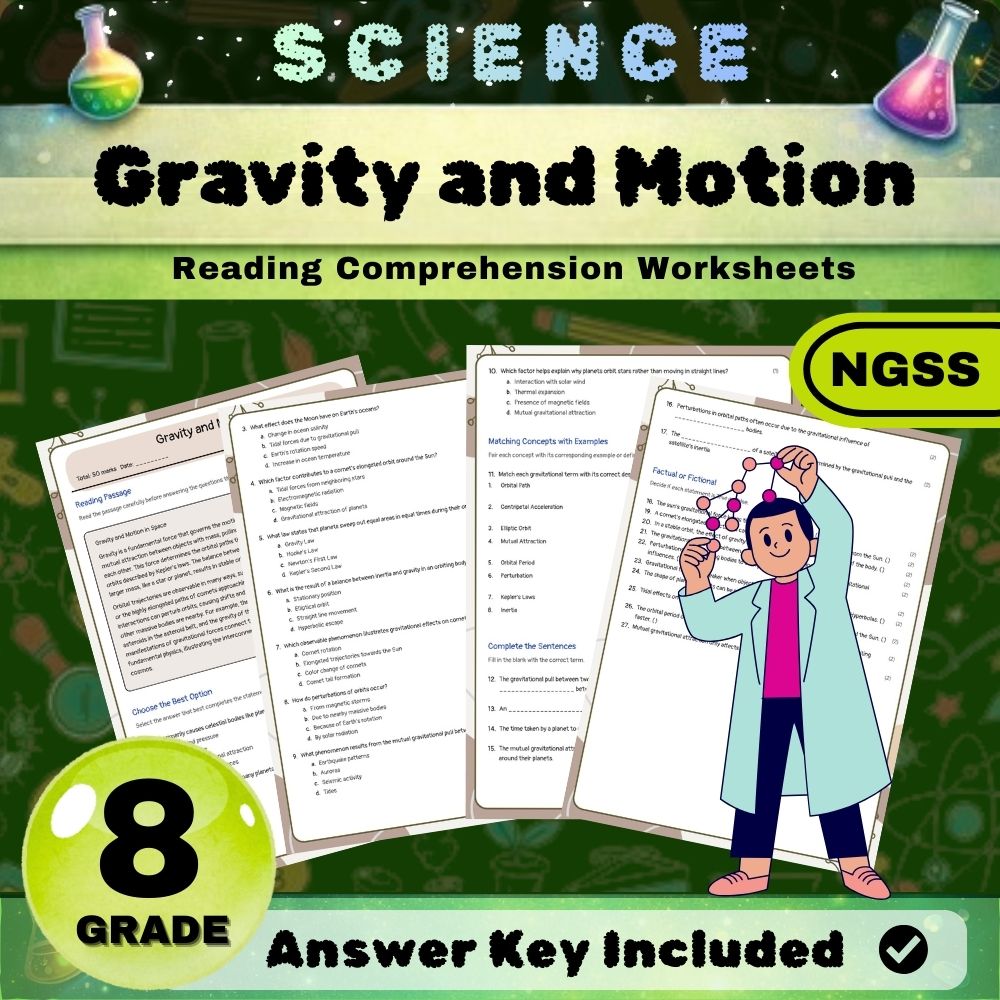
Grade 8 Science | Gravity and Motion NGSS Worksheet (PDF) (Assessment)
 Created byMaple Path Learning
Learning Objectives
- Explain how gravity governs the orbital motions of planets, moons, comets, and asteroids within the solar system.
- Describe the concept of gravitational attraction and how it affects celestial body trajectories.
- Identify the relationship between inertia, gravity, and orbital paths such as ellipses.
Also included in: Grade 8 Science | Earth's Place in the Universe NGSS Unit Bundle – Worksheets +1 more
Instant download
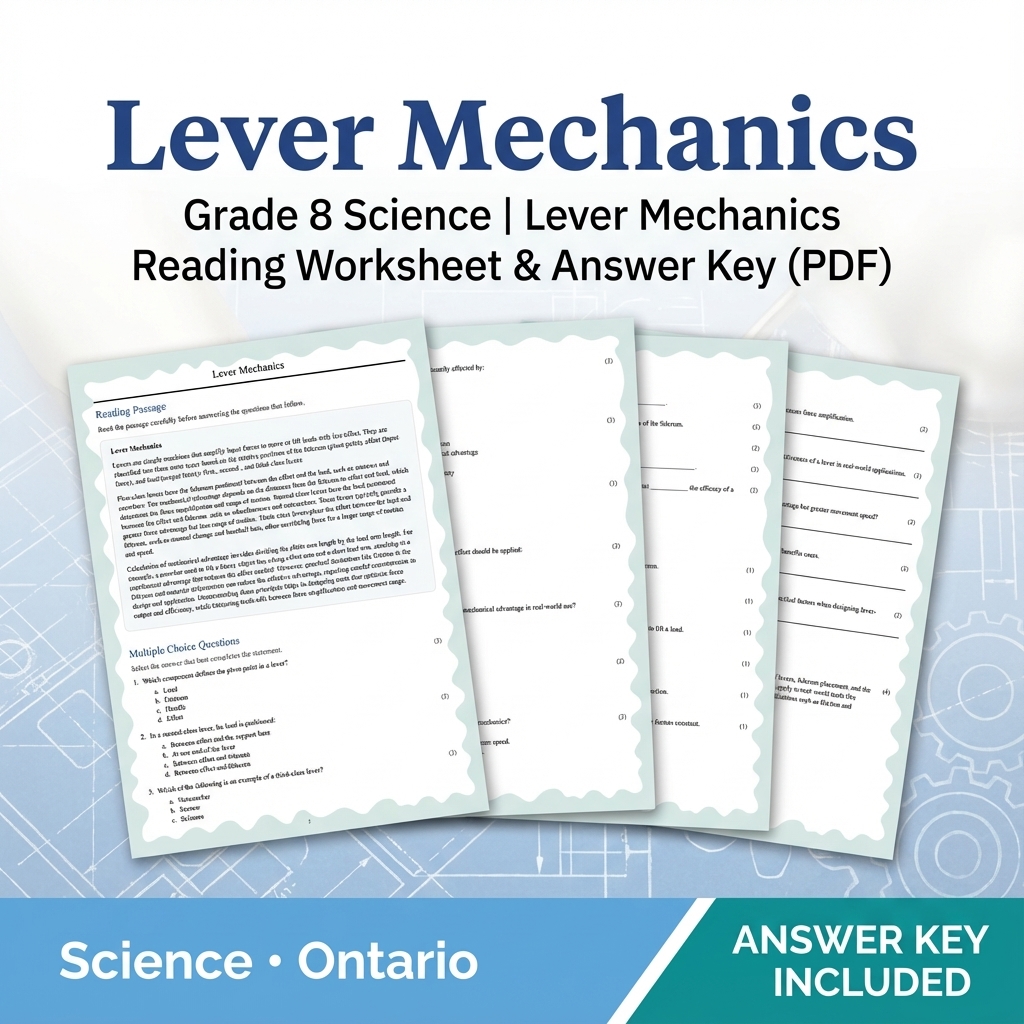
Grade 8 Science | Lever Mechanics Reading Worksheet & Answer Key (PDF)
JCreated byJ.S SheetsLearning Objectives
- Understand the classification of levers and their components.
- Explain how fulcrum placement affects mechanical advantage.
- Calculate the mechanical advantage of different lever classes.
Also included in: Grade 8 Science | Energy & Forces Unit Worksheet Pack (Answer Keys Included) +1 more
Instant download

Grade 8 Science – Introduction to Green Infrastructure | Daily Worksheet
 Created byQuiet Forest Education
Learning Objectives
- Understand what green infrastructure is and its purpose
- Identify different types of nature-based solutions for stormwater management
- Learn the functions and benefits of green infrastructure techniques
Also included in: Grade 8 Science Full Year Bundle Ontario Daily Reading Worksheets
Instant download

Grade 8 Force Relationships and Motion Worksheet | NGSS Science Activity
 Created byBRIGHT PATH RESOURCES
Learning Objectives
- Understand the basic concepts of force and motion
- Analyze how net force affects acceleration
- Recognize the relationship between mass, force, and acceleration using simple examples
Also included in: Forces & Electromagnetism Grade 8 Science Daily Reading Lesson Bundle | NGSS +2 more
Instant download

Grade 8 Science – Design Optimization & Test Data Analysis | Reading Worksheet
Created byBright Mind ResourcesLearning Objectives
- Interpret graphical data to identify performance trends in design tests.
- Analyze statistical summaries to determine effective design modifications.
- Evaluate trade-offs between performance metrics like strength, efficiency, and durability.
Also included in: Grade 8 Tradeoff Analysis Science Daily Reading Worksheets Lesson Bundle | NGSS +1 more
Instant download

Science Grade 8 Heredity and Variation Worksheet | Standards-Aligned Practice
JCreated byJ.S SheetsLearning Objectives
- Explain how inheritance from parents leads to variation in offspring
- Describe how recombination and mutations contribute to genetic diversity
- Connect inherited variation to natural selection and survival in different environments
Also included in: Grade 8 Biology Systems & Ecosystem Adaptations Science Lesson Bundle – General +1 more
Instant download

Grade 8 Science | Invasive Species Worksheet | BC Aligned
 Created byLumora Learning
Learning Objectives
- Understand what invasive species are and how they establish in new ecosystems.
- Identify ecological traits that contribute to the success of invasive species.
- Analyze the ecological and environmental impacts of invasive species on native communities.
Instant download
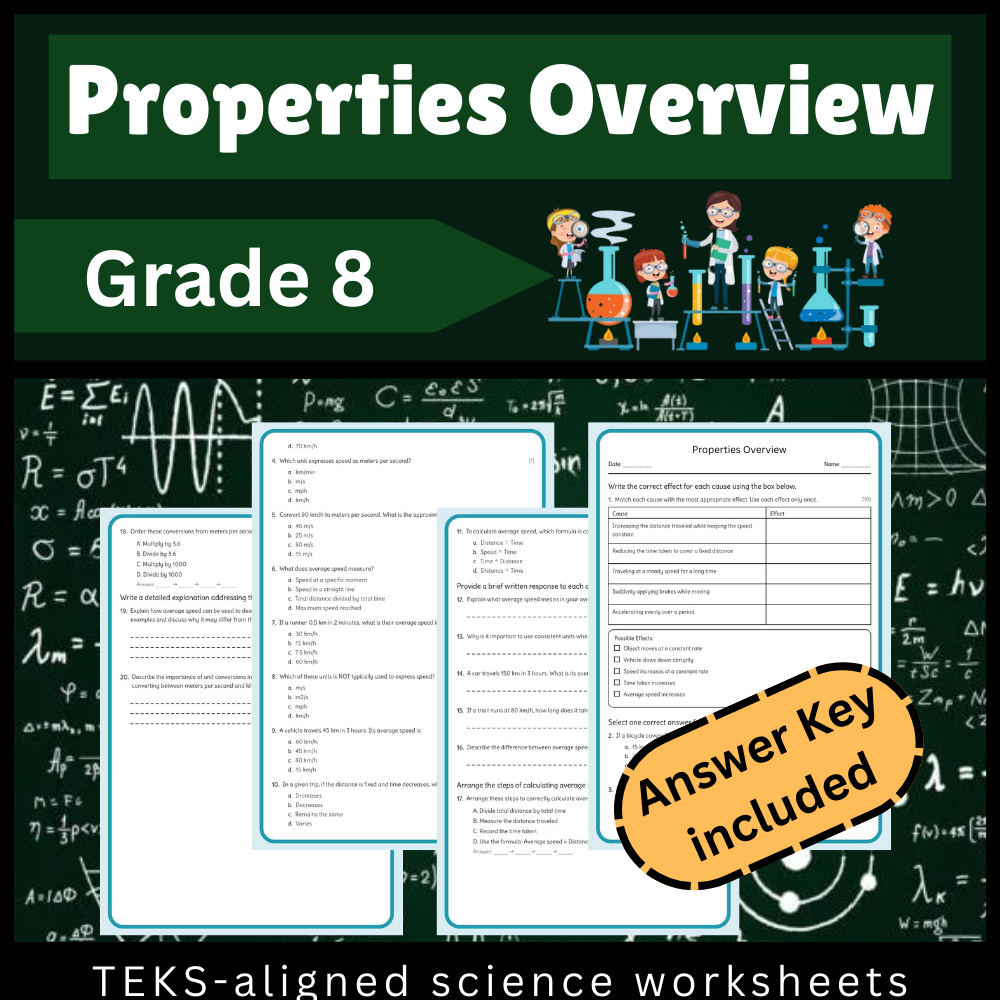
Grade 8 Science – Properties Overview Worksheets (Worksheet + Answer Key) | TEKS Standard
Created byBright Mind ResourcesLearning Objectives
- Identify and distinguish measurable physical characteristics of matter such as density, solubility, melting and boiling points.
- Compare the electrical and thermal conductivity of different materials.
- Understand how physical properties inform classification and separation techniques.
Also included in: Grade 8 Science Unit Bundle | States of Matter & Reaction Rates Worksheets- TEKS +1 more
Instant download

Predictive Models Assessment | General Grade 8 Science Standards
Created byPrism Point LearningLearning Objectives
- Understand the purpose and function of scientific models as tools for explaining phenomena.
- Identify different types of models used in science, such as diagrams, equations, and conceptual frameworks.
- Explain how models make testable predictions based on assumptions about data patterns.
Also included in: Grade 8 Scientific Inquiry & Practices Science Lesson Bundle: General
Instant download

Grade 8 TEKS States of Matter Science Daily Reading Worksheet & Notes
Created byBRIGHT PATH RESOURCESLearning Objectives
- Identify the distinguishing properties of solids, liquids, gases, and plasma.
- Explain how particle motion and arrangement relate to changes in state.
- Connect thermal energy to melting, boiling, condensation, and sublimation at a conceptual level.
Also included in: Grade 8 Matter and Energy Science Reading Worksheets Bundle | TEKS +1 more
Instant download

Grade 8 Organ Systems Worksheet | NGSS Practice PDF
 Created byClear Sky Classroom
Learning Objectives
- Describe how body systems interact to maintain homeostasis.
- Identify the functions of circulatory, respiratory, digestive, nervous, and endocrine systems.
- Explain feedback mechanisms like insulin-glucagon signaling and thermoregulation.
Also included in: Grade 8 Cell Modeling & Organ Systems Science Lesson Bundle | NGSS +1 more
Instant download
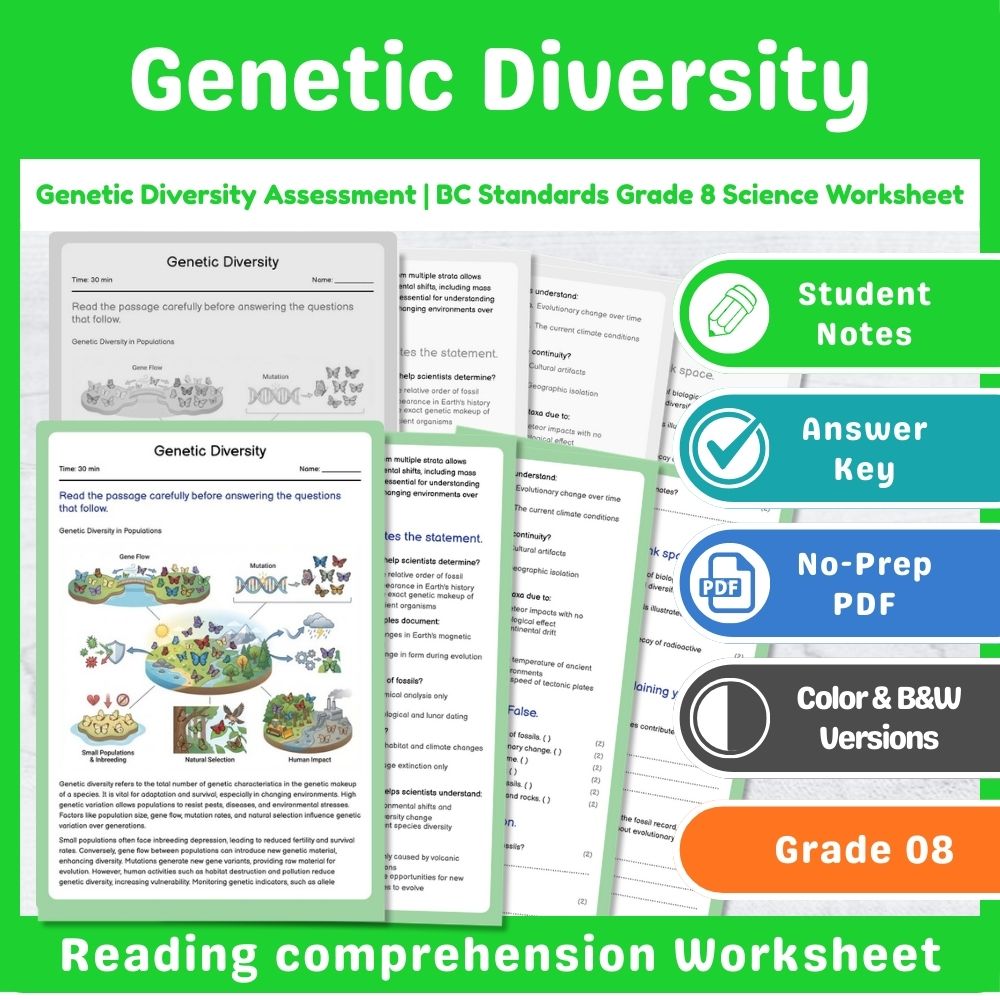
Genetic Diversity Assessment | BC Standards Grade 8 Science Worksheet
Created byPrism Point LearningLearning Objectives
- Understand the concept of genetic diversity and its importance for species survival.
- Identify factors that influence genetic variation within and among populations.
- Analyze how low genetic diversity affects population resilience and vulnerability.
Instant download

Organ Systems Worksheet | NGSS Grade 8 Science Assessment
 Created bySkylark Worksheets
Learning Objectives
- Explain how feedback mechanisms help maintain homeostasis in the body
- Describe how circulatory, respiratory, digestive, nervous, and endocrine systems work together
- Use examples (insulin–glucagon signaling, thermoregulation, and coordinated organ responses) to predict system-level effects
Also included in: Grade 8 Molecules to Organisms Structures & Processes Science Lesson Bundle NGSS +1 more
Instant download

Grade 8 Science – Data Analysis & Interpretation | Daily Reading Worksheet
Created byBright Mind ResourcesLearning Objectives
- Understand the concept of averages: mean, median, and mode
- Interpret datasets to find central tendencies
- Apply averaging techniques to real-world scientific data
Also included in: Experiments Grade 8 Science Daily Reading Worksheets Lesson Bundle | TEKS +2 more
Instant download
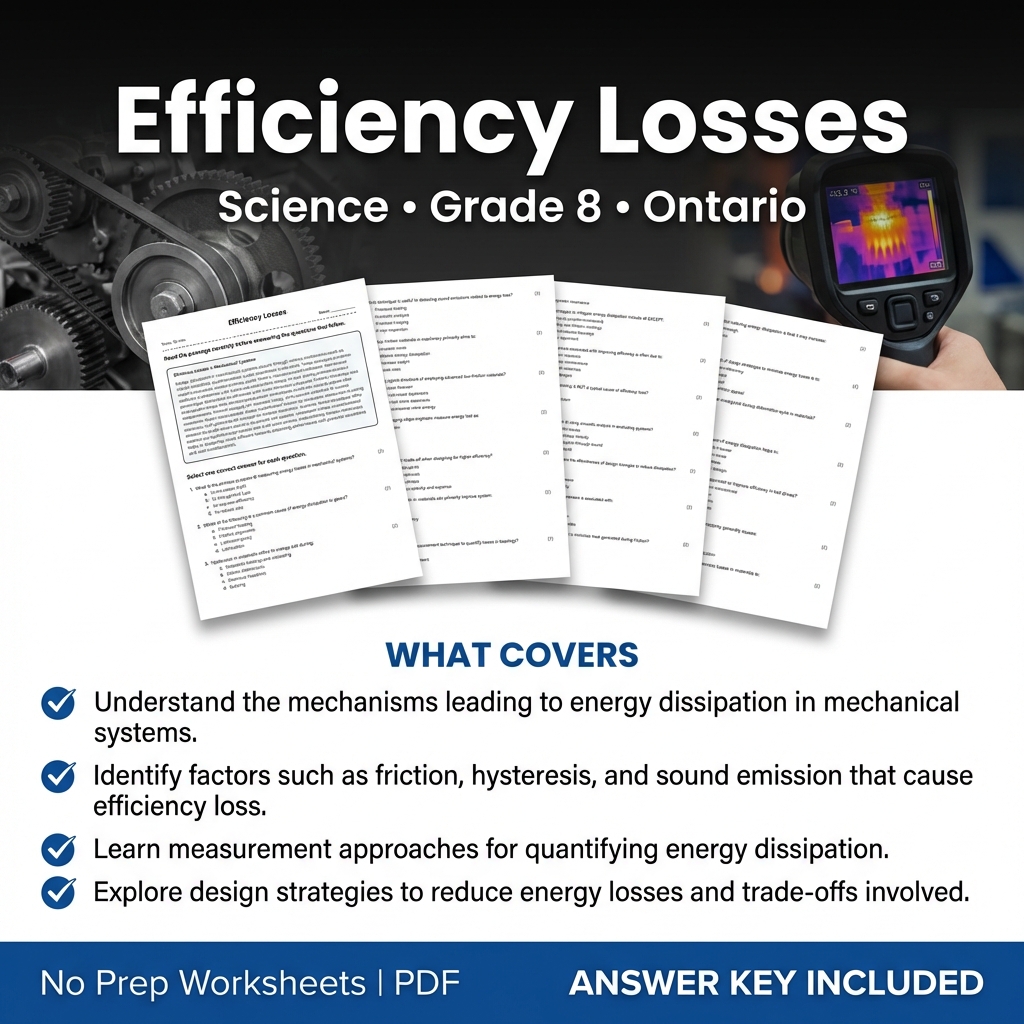
Efficiency Losses Science Worksheet | Grade 8 Ontario Standards
 Created byCoral Reef Learning
Learning Objectives
- Understand the mechanisms leading to energy dissipation in mechanical systems.
- Identify factors such as friction, hysteresis, and sound emission that cause efficiency loss.
- Learn measurement approaches for quantifying energy dissipation.
Instant download

Density Concept Practice Worksheets | Grade 8 Science Ontario
Created byPrism Point LearningLearning Objectives
- Define density as mass per unit volume and describe how SI units are used.
- Use density to predict whether objects will float or sink in water.
- Differentiate relative density and specific gravity and explain what they compare.
Instant download

Newton’s First and Second Laws Worksheet | Grade 8 Alberta Science
Created byBRIGHT PATH RESOURCESLearning Objectives
- Identify inertia as an object’s tendency to keep its motion or rest unless a net force acts.
- Explain how net force relates to acceleration in terms of direction and magnitude.
- Use Newton’s laws to predict how motion changes when forces change.
Also included in: Grade 8 Alberta Science Forces and Motion Physics Worksheet Bundle +1 more
Instant download
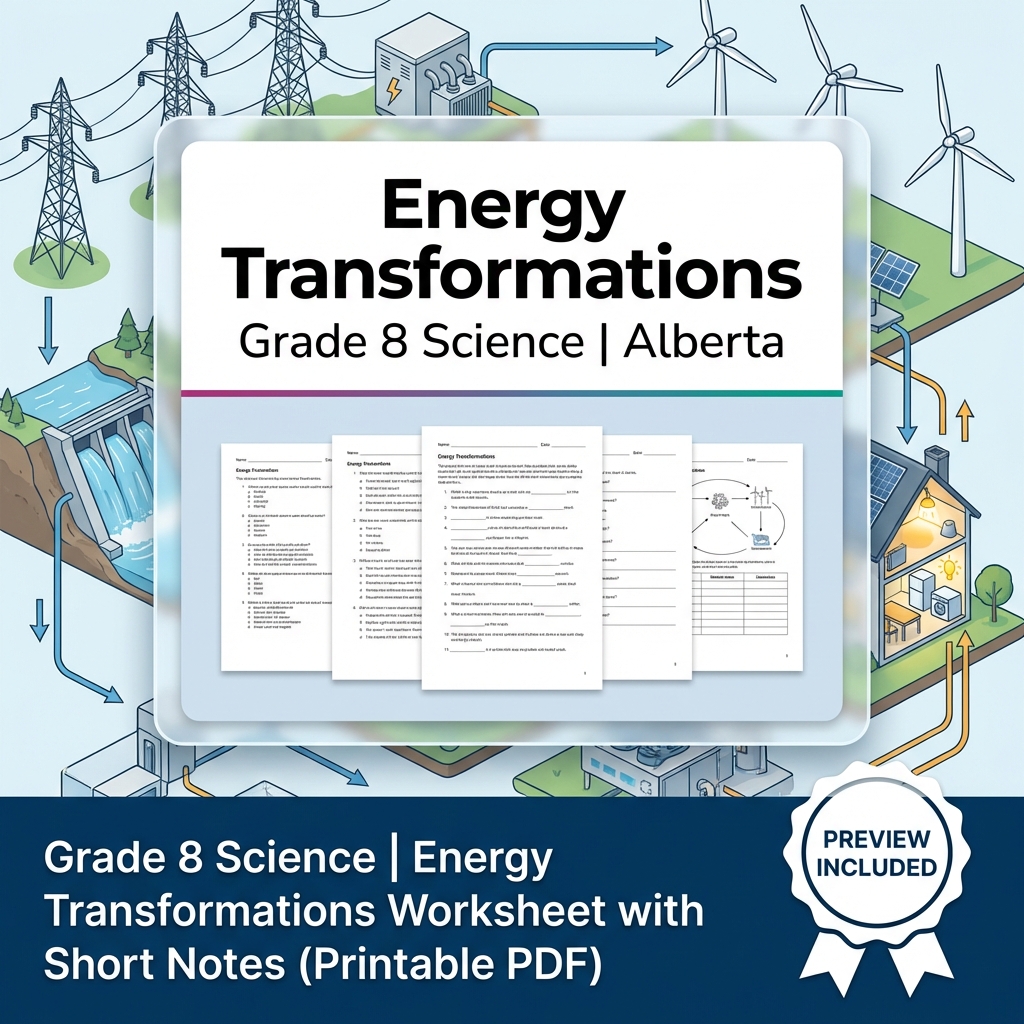
Grade 8 Science | Energy Transformations Worksheet with Short Notes ( PDF)
 Created byMeadowlark Worksheets
Learning Objectives
- Describe various energy transformation processes in electrical systems.
- Identify common examples of energy conversions such as heat, light, and motion.
- Understand the concepts of power and efficiency in energy systems.
Also included in: Grade 8 Science | Electricity & Magnetism UNIT Worksheet Bundle +1 more
Instant download

Grade 8 Science – Cell Structure & Function | Daily Reading Worksheet
Created byBright Mind ResourcesLearning Objectives
- Understand key concepts related to Science
- Apply knowledge through practice questions
- Demonstrate comprehension of the material
Also included in: Grade 8 Circulatory & Cell Function Science Daily Reading Lesson Bundle | NGSS +1 more
Instant download
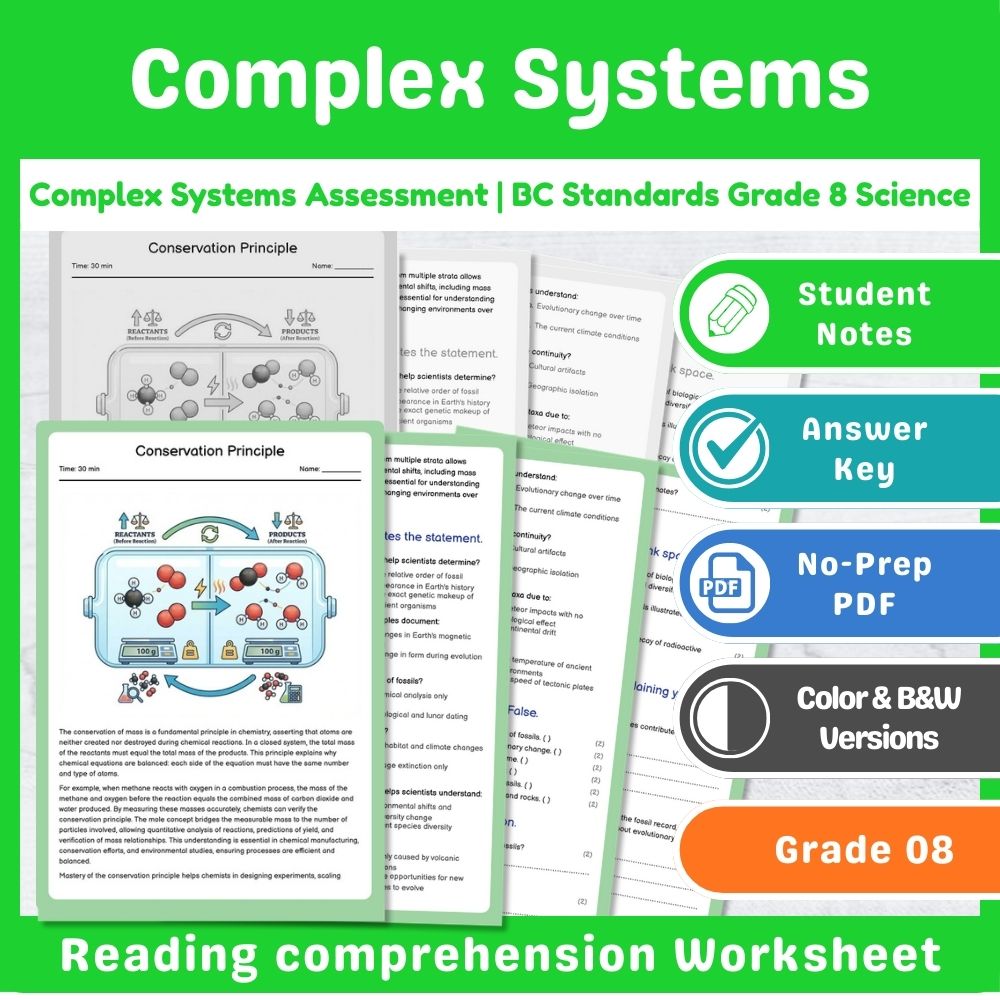
Complex Systems Assessment | BC Standards Grade 8 Science
Created byPrism Point LearningLearning Objectives
- Understand how multiple reactions in chemical systems are interconnected and governed by conservation of mass.
- Explain the concepts of reversible equilibria and dynamic balance in chemical reactions.
- Interpret complex reaction networks by analyzing microscopic rearrangements and mass relationships.
Also included in: Grade 8 Science Lesson – Reaction Types & Evidence Assessment Bundle
Instant download

Grade 8 Science | Newton's Laws Worksheet (Alberta Standard, PDF)
 Created bySilver Birch Teaching
Learning Objectives
- Explain Newton’s three laws using the relationships between force, motion, and mass.
- Predict how the direction and magnitude of motion change when net force changes.
- Use action–reaction ideas to describe forces in everyday Alberta-related scenarios.
Also included in: Grade 8 Forces, Motion, and Energy Science Lesson Bundle for Alberta +1 more
Instant download

Grade 8 Science – Energy & Reactions | Daily Reading Worksheet
Created byBright Mind ResourcesLearning Objectives
- Explain the concepts of endothermic and exothermic reactions.
- Describe how bonds are broken and formed during chemical reactions.
- Interpret energy profiles and bond enthalpies to determine heat absorption or release.
Also included in: Grade 8 Chemical Reactions Science Lesson Bundle: Daily Reading | BC +1 more
Instant download

Graphing Relationships Assessment Grade 8 | Science Standards-Aligned
Created byPrism Point LearningLearning Objectives
- Understand how to represent data visually using different types of graphs.
- Interpret patterns and trends from scatter plots, line graphs, and bar graphs.
- Learn to label axes accurately and choose appropriate scales for data clarity.
Also included in: Grade 8 Scientific Inquiry & Practices Science Lesson Bundle: General
Instant download

Grade 8 Science – Predicting Products & Chemical Reactions | Reading Worksheet
Created byBright Mind ResourcesLearning Objectives
- Understand how to identify reactants in a chemical reaction.
- Learn methods to predict possible products based on reactant types and patterns.
- Apply the principles of conservation of atoms to formulate balanced chemical equations.
Also included in: Grade 8 Chemical Reactions Science Lesson Bundle: Daily Reading | BC +1 more
Instant download

Closed Systems Worksheet | Grade 8 Science Activities
Created byPrism Point LearningLearning Objectives
- Explain what a closed system is and how it differs from open and isolated systems
- Apply the law of conservation of mass to analyze reactants and products in closed chemical changes
- Identify appropriate measurements (mass, gas volume/pressure) that provide evidence in closed-system experiments
Also included in: Grade 8 Matter & Chemical Change Lesson Bundle | Alberta Science
Instant download

Grade 8 Matter Cycles Worksheet | Carbon & Water Cycles | NGSS Science
 Created byAmber Owl Education
Learning Objectives
- Explain how atoms of matter cycle between living organisms and the abiotic environment using carbon and water examples.
- Describe how photosynthesis, respiration, and decomposition transform matter and reconnect organic and inorganic pools.
- Use conservation of mass to justify why matter is not created or destroyed in matter-cycle processes.
Also included in: Grade 8 Science Ecosystem Dynamics Lesson Bundle | NGSS +1 more
Instant download
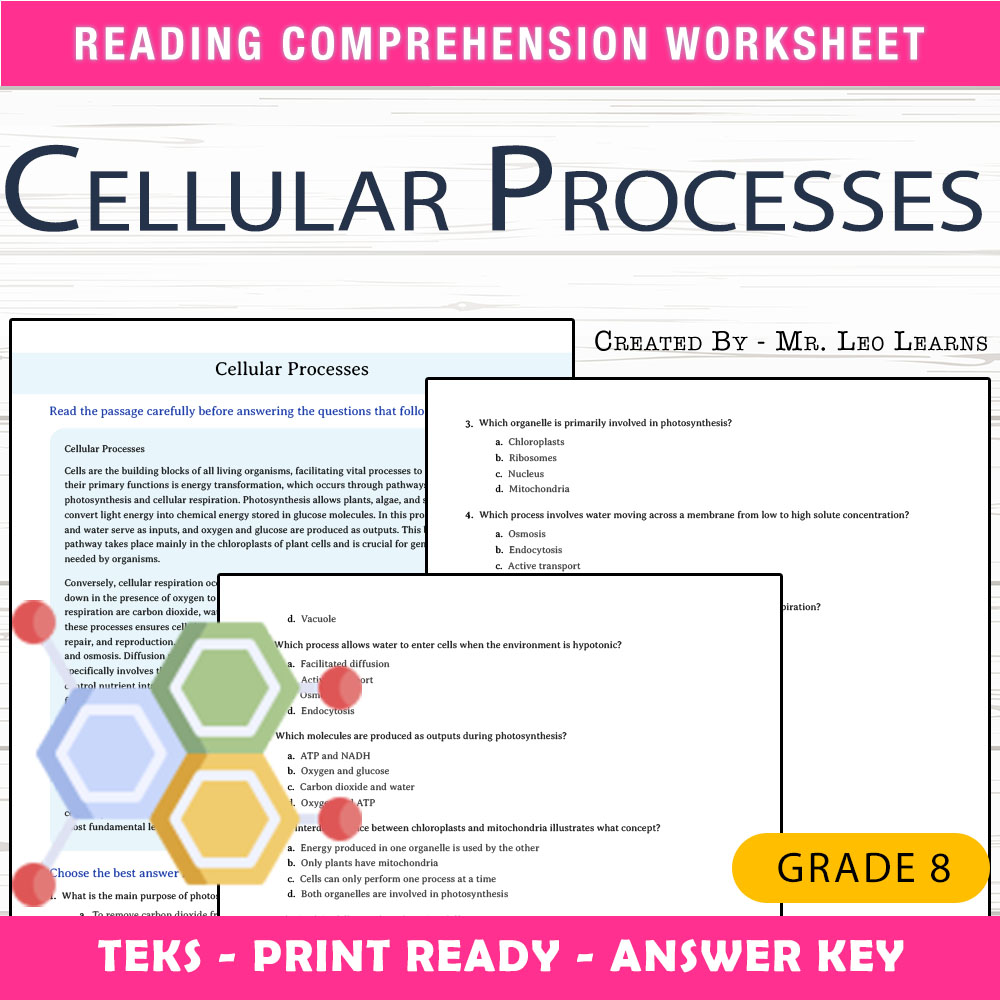
Grade 8 Science – Cellular Processes Worksheet for Mastery | PDF + Answer Key
 Created byThe Resource Hub
Learning Objectives
- Describe the energy transformations involved in photosynthesis and cellular respiration.
- Explain membrane transport processes such as diffusion and osmosis in maintaining cellular homeostasis.
- Connect biochemical pathways to energy production and material exchange within the cell.
Also included in: Grade 8 Science Unit | Ecosystems, Evolution & Cell Processes Worksheet Pack +1 more
Instant download

Aquifer Dynamics Worksheet | Grade 8 Science Review & Practice
Created byPrism Point LearningLearning Objectives
- Explain how porosity and permeability affect groundwater storage and flow in aquifers.
- Differentiate confined and unconfined aquifers and identify recharge and discharge zones.
- Use the idea of hydraulic head to describe how groundwater moves through sediment and bedrock.
Also included in: Grade 8 Water Systems Science Lesson Bundle for Ontario Framework
Instant download

Grade 8 Magnetic Force and Current Conductors Worksheet | Alberta Science
Created byBRIGHT PATH RESOURCESLearning Objectives
- Explain how a magnetic field and current in a wire can create a force.
- Describe the motor principle: electrical energy becomes mechanical motion.
- Connect key ideas from electromagnetism to everyday devices that move.
Also included in: Grade 8 Alberta Science Electricity and Magnetism Worksheet Bundle +1 more
Instant download

Mendelian Patterns Worksheet | NGSS Grade 8 Science Assessment
Created bySkylark WorksheetsLearning Objectives
- Explain how allele combinations (dominant and recessive) determine observable phenotypes in Mendelian inheritance.
- Use Punnett squares to predict genotype and phenotype ratios for simple monohybrid crosses.
- Interpret basic pedigrees to infer likely inheritance patterns (dominant vs. recessive).
Also included in: Grade 8 Heredity: Inheritance and Variation of Traits Science Lesson Bundle NGSS +1 more
Instant download

Density Principles Assessment | TEKS Grade 8 Science Standards
Created byPrism Point LearningLearning Objectives
- Understand the concept of density as a ratio of mass to volume.
- Identify the behavior of materials with different densities in fluids.
- Calculate density using mass and volume measurements.
Also included in: Grade 8 Matter, Energy, and Reactions Science Lesson Bundle (TEKS)
Instant download

Water Cycle Systems Worksheet for Grade 8 Science | Standards-Aligned Practice
JCreated byJ.S SheetsLearning Objectives
- Explain how evaporation, condensation, precipitation, runoff, and infiltration move water through Earth systems.
- Describe how temperature and energy affect evaporation and precipitation patterns.
- Evaluate how human activities can change local water availability and environmental impacts.
Also included in: Grade 8 Earth Systems and Climate Science Lesson Bundle – Florida NGSSS +1 more
Instant download

Understanding Thermal Transfer Worksheet | Grade 8 NGSS Physical Science
Created byBRIGHT PATH RESOURCESLearning Objectives
- Identify different methods of heat transfer: conduction, convection, and radiation.
- Explain basic principles behind each heat transfer method.
- Recognize how material properties influence heat transfer.
Also included in: Thermal Energy Grade 8 Science Daily Reading Worksheets Lesson Bundle | NGSS +2 more
Instant download
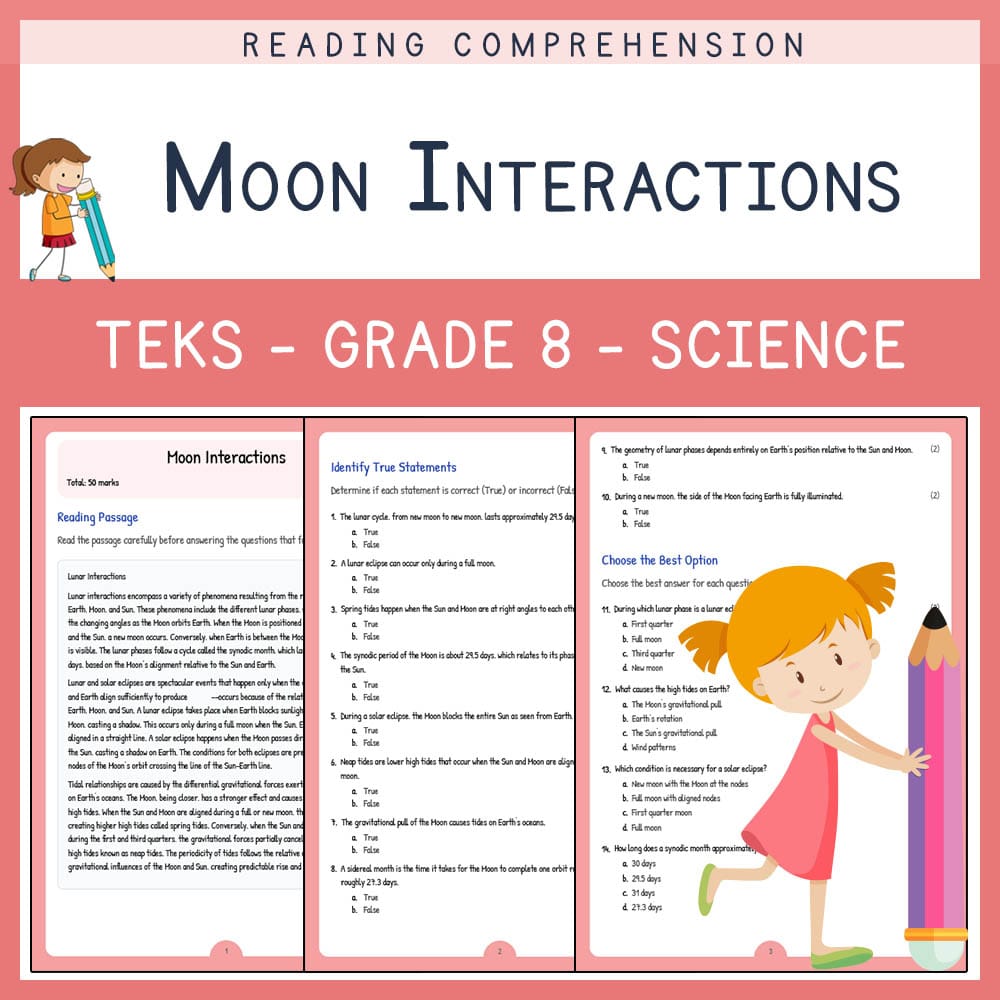
Grade 8 Science | Moon Interactions Worksheet | TEKS Aligned
Created byLumora LearningLearning Objectives
- Explain the phases of the Moon and how relative positions affect these phases.
- Describe the causes and conditions of lunar and solar eclipses based on orbital alignment.
- Understand the gravitational forces exerted by the Moon and Sun and how they influence Earth's tides.
Also included in: Grade 8 Science | Earth and Space Systems Lesson Bundle | TEKS Aligned
Instant download

Grade 8 Science – Organ Systems & Circulatory Daily Reading Worksheet
Created byBright Mind ResourcesLearning Objectives
- Understand how the circulatory system functions to distribute blood throughout the body.
- Identify the major components of the heart and blood vessels and their roles.
- Explain how tissues and organs work together within the circulatory system.
Also included in: Grade 8 Life Systems Science Daily Reading Worksheets Lesson Bundle | Ontario +1 more
Instant download

Grade 8 Science – Measuring Density & Measurement Tools | Reading Worksheet
Created byBright Mind ResourcesLearning Objectives
- Understand the concept of density and why it is important in science.
- Identify different tools used for measuring mass and volume.
- Learn methods for measuring density, including direct calculation and displacement techniques.
Also included in: Grade 8 Fluid Mechanics & Pressure Science Lesson Bundle | Ontario +1 more
Instant download

Grade 8 Science – Human Effects on Ecosystems | Daily Reading Worksheet
Created byBright Mind ResourcesLearning Objectives
- Understand how human land use changes impact habitats and species.
- Identify different types of human activities that modify ecosystems.
- Analyze the effects of resource extraction and urban expansion on biodiversity.
Also included in: Grade 8 Ecosystems Science Daily Reading Worksheets Lesson Bundle | Alberta +2 more
Instant download

Grade 8 Science – Organ Formation & Tissues | Daily Reading Worksheet
Created byBright Mind ResourcesLearning Objectives
- Understand how tissues interact to form organs
- Recognize the structure and function of different tissue layers
- Explain how organs are specialized for their physiological tasks
Also included in: Grade 8 Body Systems & Cell Structure Science Daily Reading Lesson Bundle | BC +1 more
Instant download

Grade 8 Science | Trophic Modeling Worksheet (Alberta Standards) (PDF)
Created bySilver Birch TeachingLearning Objectives
- Explain how trophic models track energy and matter across compartments and environmental pools.
- Use mass-balance ideas to interpret production, respiration, and decomposition in ecosystems.
- Identify common assumptions and parameter sensitivities in simple trophic models.
Also included in: Grade 8 Trophic Modeling & Ecosystems Science Lesson Bundle for Alberta Standards +1 more
Instant download

Grade 8 Science – Complex Chemical Systems & Reaction Networks | Worksheet
Created byBright Mind ResourcesLearning Objectives
- Define reaction networks and the concept of conservation of mass.
- Identify how forward and reverse reactions reach equilibrium.
- Explain the importance of tracking intermediate species in complex reactions.
Instant download
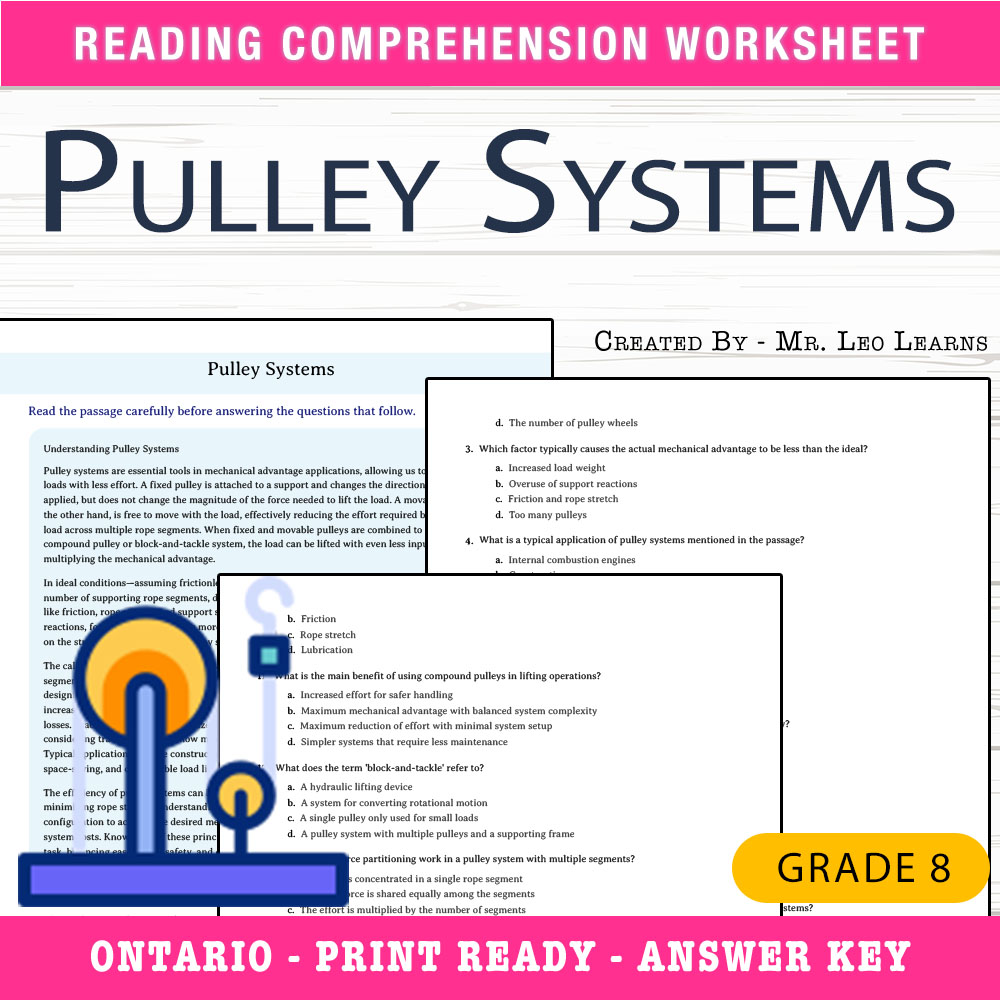
Grade 8 Science — Pulley Systems Worksheet for Mastering Mechanical Advantage
Created byThe Resource HubLearning Objectives
- Explain the different types of pulley arrangements, including fixed, movable, and compound pulleys.
- Calculate the mechanical advantage in pulley systems considering ideal and real-world conditions.
- Analyze force distribution and support reactions in pulley configurations for lifting loads.
Also included in: Grade 8 Science | Mechanical Systems & Energy Mastery Unit Worksheet Pack +1 more
Instant download
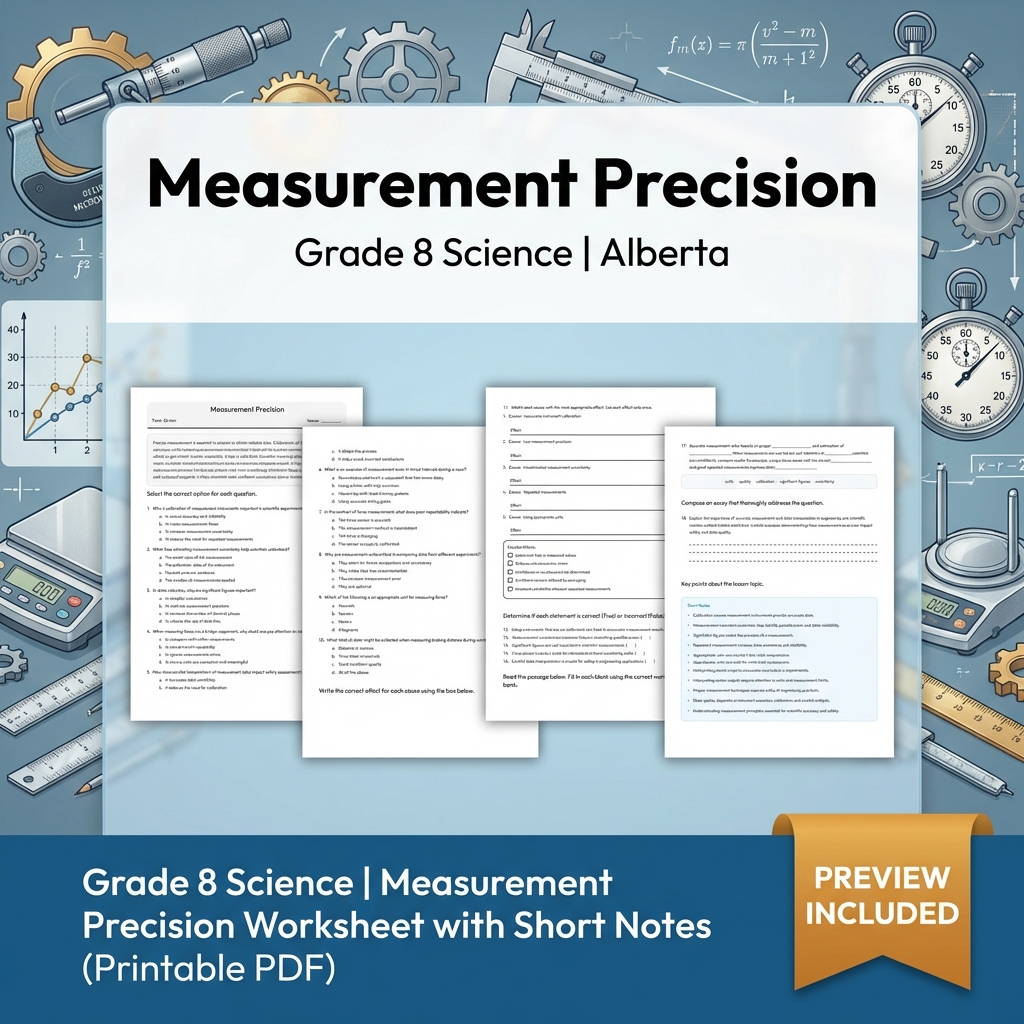
Grade 8 Science | Measurement Precision Worksheet with Short Notes (PDF)
Created byMeadowlark WorksheetsLearning Objectives
- Understand principles of measurement including calibration and uncertainty estimation.
- Interpret measurement data in contexts such as braking distance and force readings.
- Apply concepts of significant figures and measurement error to quantitative data.
Also included in: Grade 8 Science Forces & Motion UNIT Bundle – Alberta Curriculum +1 more
Instant download
About Grade 8 Science Worksheets
Explore Grade 8 Science worksheets for classwork, homework, or review. Our 6,006 printables download instantly as PDFs.
Each resource here is built by an independent educator and reviewed for quality. Worksheets print straight from PDF and suit classroom use, homework, or extra practice; most come with answer keys, and you can preview before purchasing.