
Grade 8 Science Worksheets
6,006 worksheets
Grade 8 Science – Variables & Controls in Scientific Experiments | Worksheet
 Created byBright Mind Resources
Learning Objectives
- Understand the difference between independent, dependent, and controlled variables.
- Identify variables in various experimental contexts.
- Learn the importance of controlling variables to ensure fair tests.
Also included in: Experiments Grade 8 Science Daily Reading Worksheets Lesson Bundle | TEKS +2 more
Instant download

Science Worksheet Ecosystem Shifts | NGSS Aligned Grade 8 Assessment
JCreated byJ.S SheetsLearning Objectives
- Explain how natural disturbances and long-term environmental changes can shift ecosystem conditions.
- Describe succession and how species composition can change over time after disruption.
- Analyze how human activities can influence ecosystem shifts through land use, pollution, or harvesting.
Also included in: Grade 8 Evolution and Ecosystems Science Lesson Bundle | Florida NGSSS +1 more
Instant download
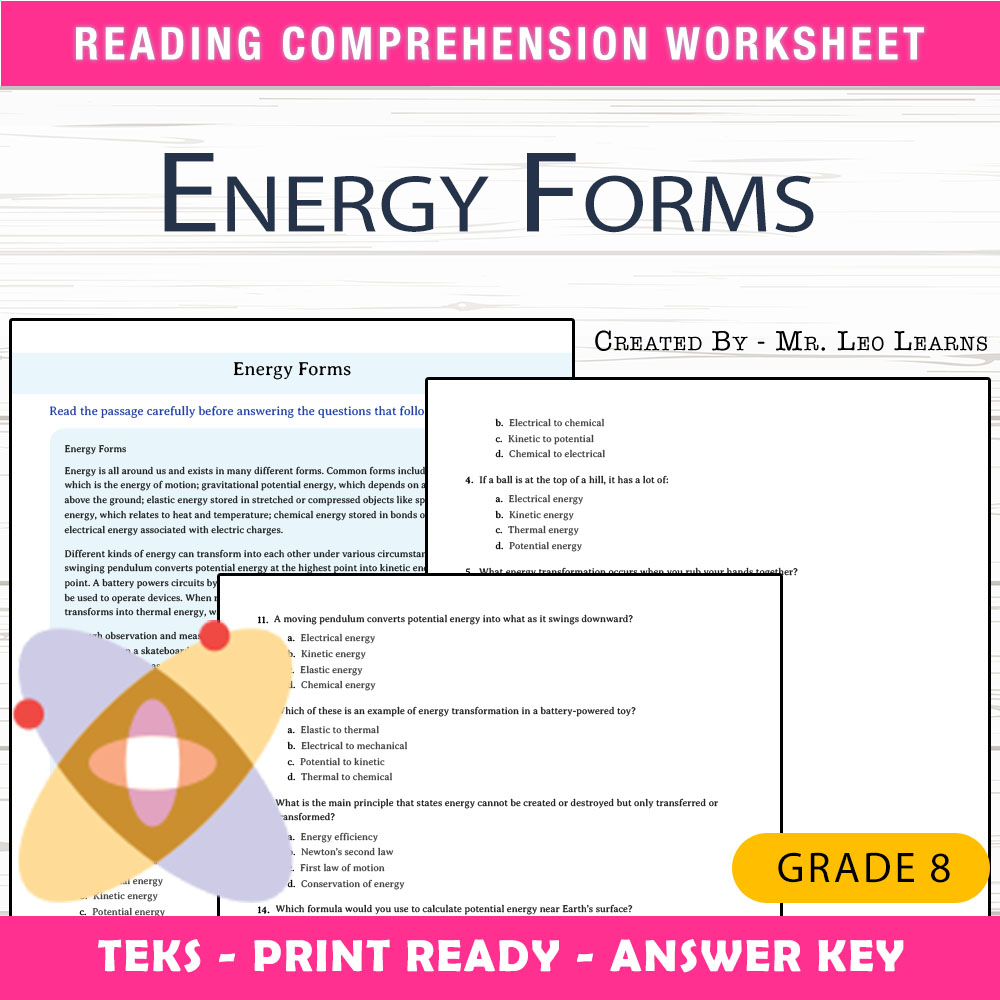
Grade 8 Science – Energy Forms Worksheet for Mastering Energy Types
 Created byThe Resource Hub
Learning Objectives
- Identify and describe different forms of energy including kinetic, gravitational potential, elastic, thermal, chemical, and electrical.
- Explain common transformations among energy types using real-world examples such as swinging pendulums, batteries, and heating.
- Understand the concept of energy conservation in everyday systems and relate observable effects to energy transfer and storage.
Also included in: Grade 8 Science Unit Bundle | Motion, Forces & Energy Mastery Worksheets +1 more
Instant download

Integrated Management Worksheet | Grade 8 Science Assessment Practice Ontario
 Created byPrism Point Learning
Learning Objectives
- Explain how integrated water resources management balances municipal, agricultural, and ecological water needs
- Describe how monitoring and adaptive management support better water decisions over time
- Identify examples of governance instruments used to coordinate water use across a watershed and borders
Also included in: Grade 8 Water Systems Science Lesson Bundle for Ontario Framework
Instant download
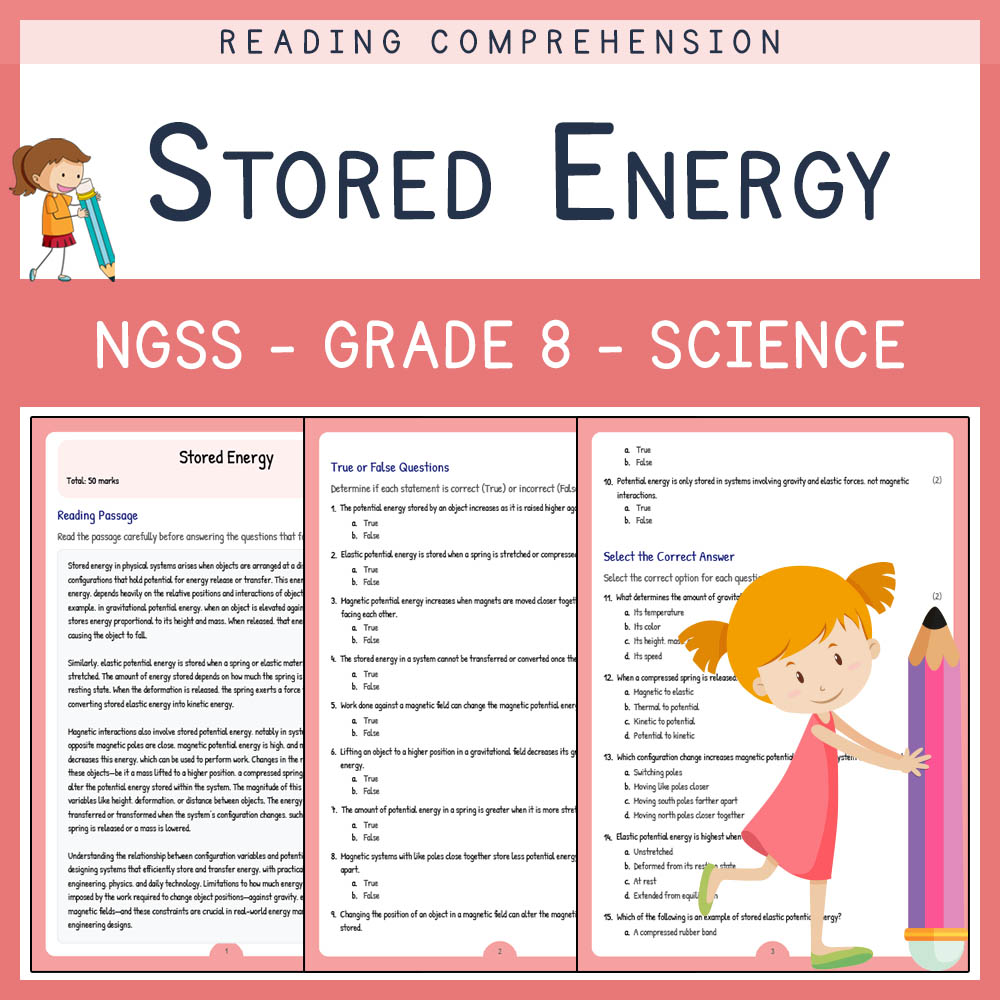
Grade 8 Science | Stored Energy Worksheet & Answer Key (NGSS Aligned)
 Created byLumora Learning
Learning Objectives
- Understand the concept of potential energy stored through objects interacting at a distance, including gravitational, elastic, and magnetic energy.
- Identify how changes in the relative positions of objects affect their stored energy and the work done during these changes.
- Apply the principles of stored energy to real-world systems such as springs, elevated masses, and magnets.
Instant download
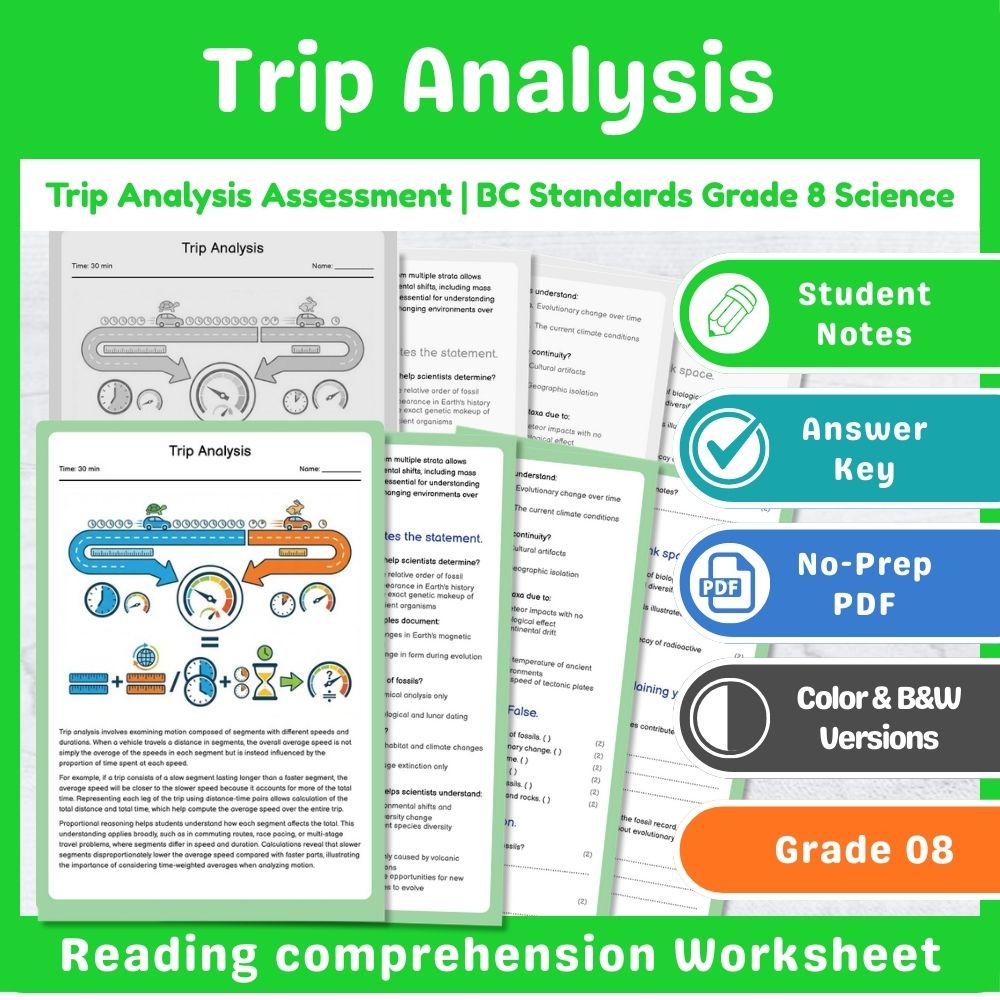
Trip Analysis Assessment | BC Standards Grade 8 Science
Created byPrism Point LearningLearning Objectives
- Understand how to compute average speed in multi-segment trips using proportional reasoning.
- Analyze how varying speeds and durations in different trip segments affect overall average speed.
- Apply distance-time relationships to represent and interpret complex motion scenarios.
Instant download
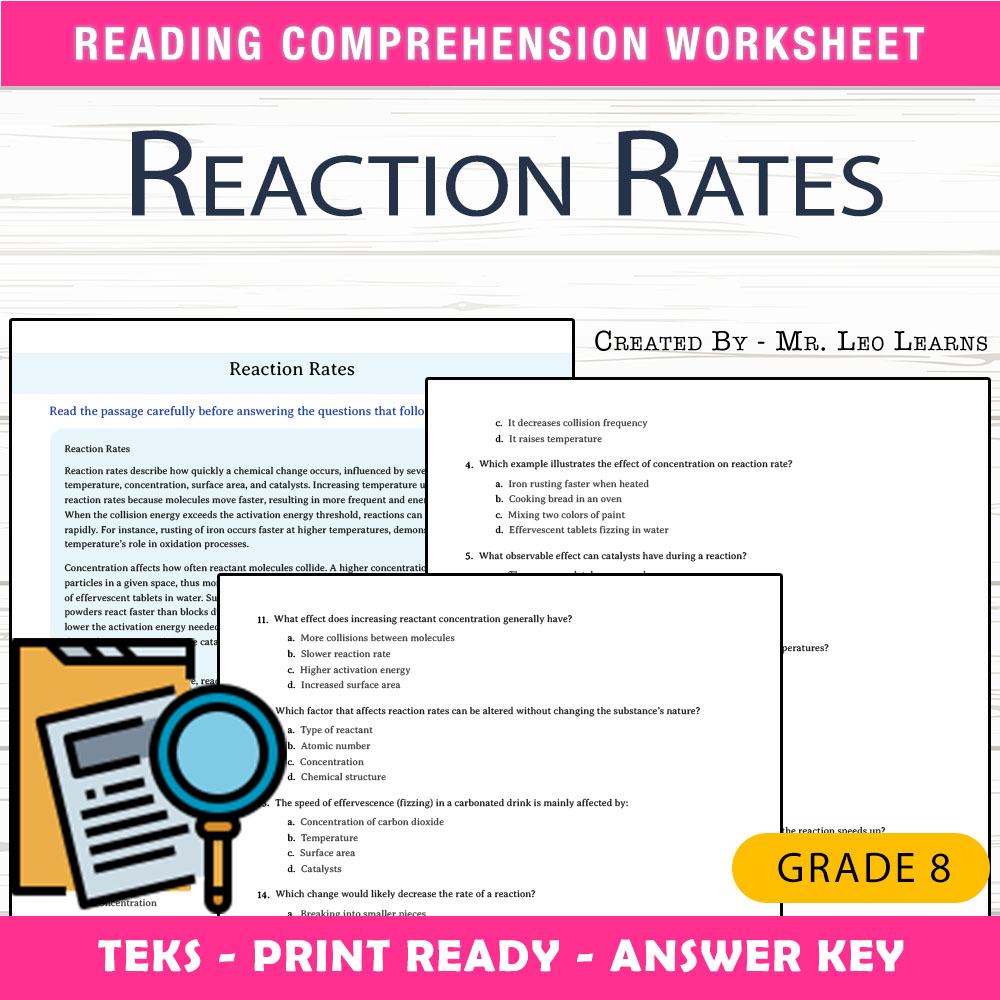
Grade 8 Science — Reaction Rates Worksheet for Mastery | PDF + Answer Key
Created byThe Resource HubLearning Objectives
- Identify factors that influence the speed of chemical reactions.
- Explain how temperature, concentration, surface area, and catalysts affect reaction rates.
- Connect molecular collision concepts to observable reaction changes.
Also included in: Grade 8 Science Unit Bundle – Matter, Reaction Rates & Energy Mastery Worksheets +1 more
Instant download

Grade 8 Science | Reaction Types Worksheet | BC Aligned
Created byLumora LearningLearning Objectives
- Recognize and categorize different reaction types such as synthesis, decomposition, single and double displacement, and combustion.
- Describe characteristic bond-making and bond-breaking patterns in each reaction type.
- Predict possible products based on the type of chemical reaction.
Instant download

Reaction Quantities Worksheet | Alberta Grade 8 Science Practice
JCreated byJ.S SheetsLearning Objectives
- Understand how to connect measurable masses of reactants and products using proportional reasoning.
- Learn to interpret observed changes in closed systems based on mass conservation principles.
- Apply stoichiometric thinking to predict relative amounts in chemical reactions.
Also included in: Grade 8 Matter and Chemical Change Science Lesson Bundle – Alberta Framework +1 more
Instant download
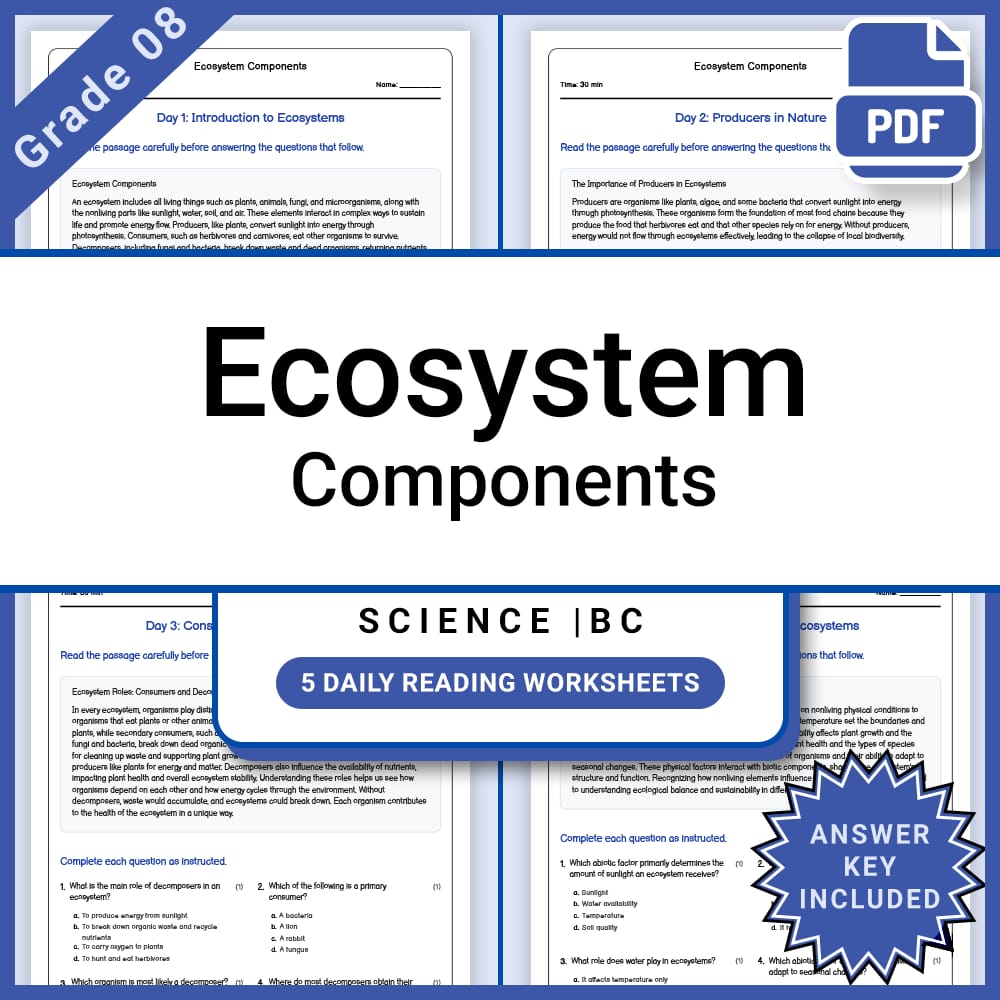
Grade 8 Science – Ecosystem Components Daily Reading Worksheet with Answer Key
JCreated byJ.S SheetsLearning Objectives
- Identify the main components of an ecosystem
- Differentiate between living and nonliving elements
- Understand how energy flows through ecosystems
Also included in: Grade 8 Science Lesson Bundle: Ecosystems, Biodiversity & Environmental Impacts +1 more
Instant download

Grade 8 Science | Magnetic Fields Worksheet (Alberta Standards) (PDF)
 Created bySilver Birch Teaching
Learning Objectives
- Explain how magnetic fields are produced by magnets and moving electric charges.
- Interpret magnetic field lines to describe direction, polarity, and relative strength.
- Compare how ferromagnetic materials affect magnetic fields and how electromagnets are controlled by current.
Also included in: Grade 8 Electricity & Circuits Science Lesson Bundle: Alberta Framework +1 more
Instant download

Grade 8 Science Worksheet | Total Energy Balance | California Standards
JCreated byJ.S SheetsLearning Objectives
- Understand the principle of energy conservation in systems.
- Identify different forms of energy transfer and conversion.
- Explain how energy changes affect motion, temperature, and speed.
Also included in: Grade 8 Forces, Energy & Matter Science Lesson Bundle | California Standards +1 more
Instant download

Grade 8 Science | Predator–Prey Balance - Daily Reading Comprehension
 Created byCoral Reef Learning
Learning Objectives
- Explain the concept of predator-prey relationships in ecosystems.
- Identify examples of predator-prey interactions such as wolf–elk and raptor–rodent.
- Describe how predator presence or absence affects community structure and population dynamics.
Also included in: Interactions and Ecosystems Lesson Bundle Grade 8 Science – Alberta +1 more
Instant download
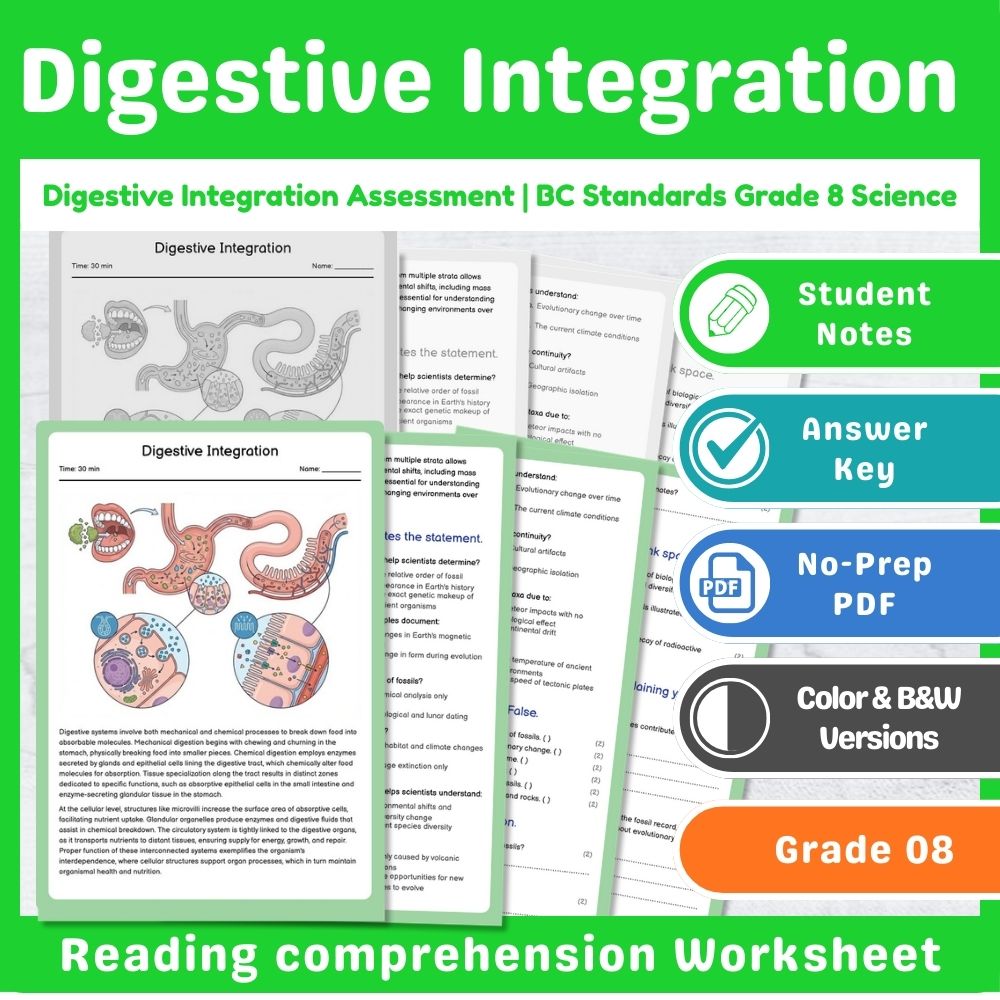
Digestive Integration Assessment | BC Standards Grade 8 Science
Created byPrism Point LearningLearning Objectives
- Describe how the digestive system combines mechanical and chemical processes to break down food.
- Explain the role of tissue specialization in different zones of the digestive tract.
- Understand how the circulatory system transports nutrients from the digestive organs to cells.
Instant download

Grade 8 Science | Limiting Factors Worksheet | BC Standards
Created byLumora LearningLearning Objectives
- Understand the concept of limiting factors and their role in populations.
- Identify biotic and abiotic factors that influence population size and stability.
- Explain how resource availability and environmental conditions affect carrying capacity.
Instant download

Natural Hazards Worksheet | NGSS Grade 8 Science | Assessment
JCreated byJ.S SheetsLearning Objectives
- Analyze patterns, frequency, and magnitude of natural hazards using data and records.
- Interpret historical observations, instrumental data, and recurrence intervals for risk assessment.
- Understand how hazard mapping and early-warning systems help reduce disaster impact.
Also included in: Grade 8 Climate Drivers and Environmental Systems Science Lesson Bundle – NGSS +1 more
Instant download

Grade 8 Science Energy Metabolism Worksheet – Ontario Standards (PDF)
 Created byEvergreen Desk Education
Learning Objectives
- Explain how aerobic respiration converts glucose into ATP through glycolysis, the Krebs cycle, and oxidative phosphorylation.
- Describe the role of mitochondria and proton gradients in ATP production using chemiosmosis.
- Compare aerobic respiration with anaerobic fermentation and predict how oxygen availability affects cellular energy output.
Also included in: Grade 8 Cell Structure & Homeostasis Science Lesson Bundle (Ontario) +1 more
Instant download
Grade 8 Science | Cell Cycle Reading Worksheets (PDF + Answer Key)
JCreated byJ.S SheetsLearning Objectives
- Describe the stages of the cell cycle and their key features.
- Explain the roles of molecular regulators such as cyclins and kinases during cell division.
- Understand how checkpoints maintain genomic stability during the cell cycle.
Also included in: Grade 8 Science Unit Bundle – Cell Structure & Function (Answer Keys Included) +1 more
Instant download

Grade 8 Science Scale and Patterns in the Solar System Worksheet | NGSS
 Created byBRIGHT PATH RESOURCES
Learning Objectives
- Understand and interpret scale relationships among solar system objects.
- Compare sizes and distances using astronomical units and relative scaling.
- Analyze data related to planetary diameters, orbital distances, and periods.
Also included in: Solar System Scale Patterns Grade 8 Science Daily Reading Worksheets Bundle|NGSS +2 more
Instant download
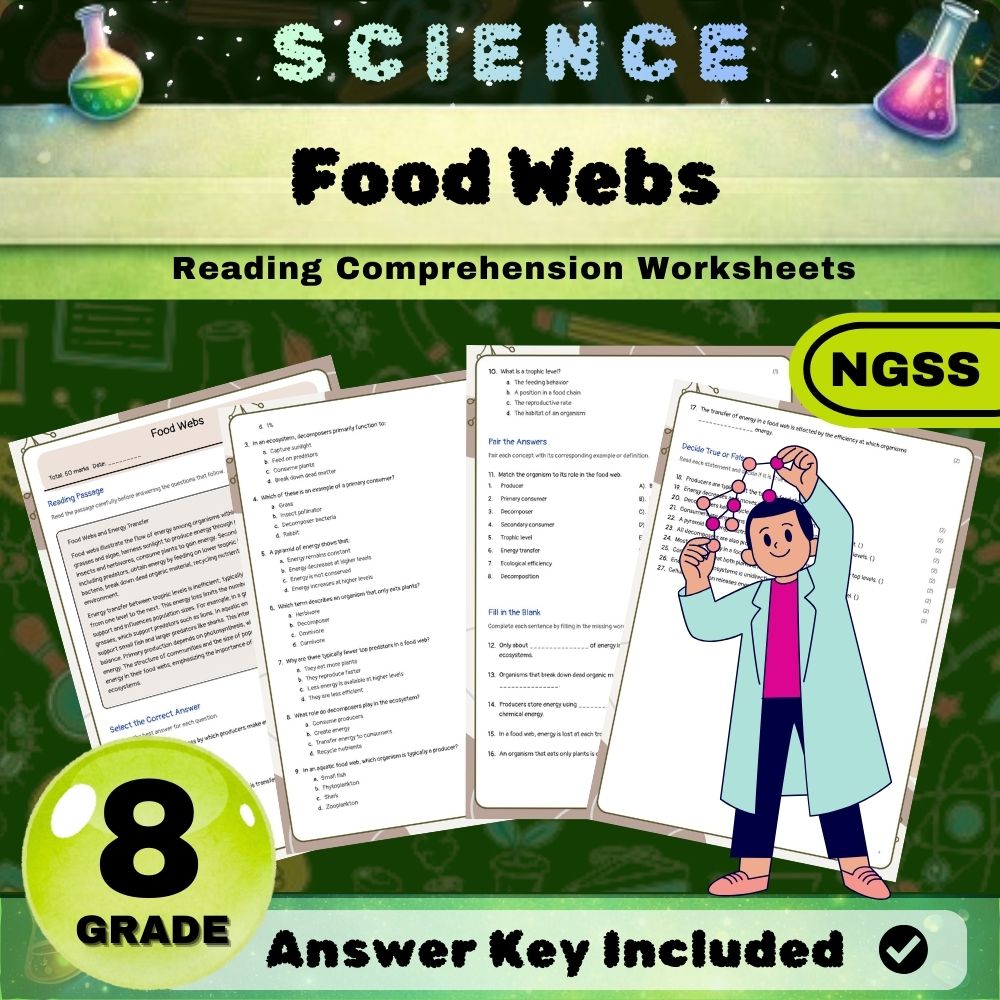
Grade 8 Science – Food Webs Worksheet (NGSS) (PDF)
 Created byMaple Path Learning
Learning Objectives
- Explain the transfer of energy within terrestrial and aquatic food webs.
- Identify producers, consumers, and decomposers and their roles in ecosystems.
- Describe trophic levels and how energy decreases at each level.
Also included in: Grade 8 Science Ecosystems Unit Bundle | Interactions, Energy & Dynamics (NGSS) +1 more
Instant download

Grade 8 Immune Response Worksheet | Ontario Science + Doodle Notes Pack
 Created byChalk and Compass
Learning Objectives
- Explain how innate and adaptive immune responses work together to defend the body
- Describe key immune cells and their roles, including macrophages, neutrophils, and lymphocytes
- Distinguish between phagocytosis, antibody production, and cell-mediated cytotoxicity
Also included in: Grade 8 Science Cell Organization, Transport & Homeostasis Lesson Bundle – Ontario +1 more
Instant download
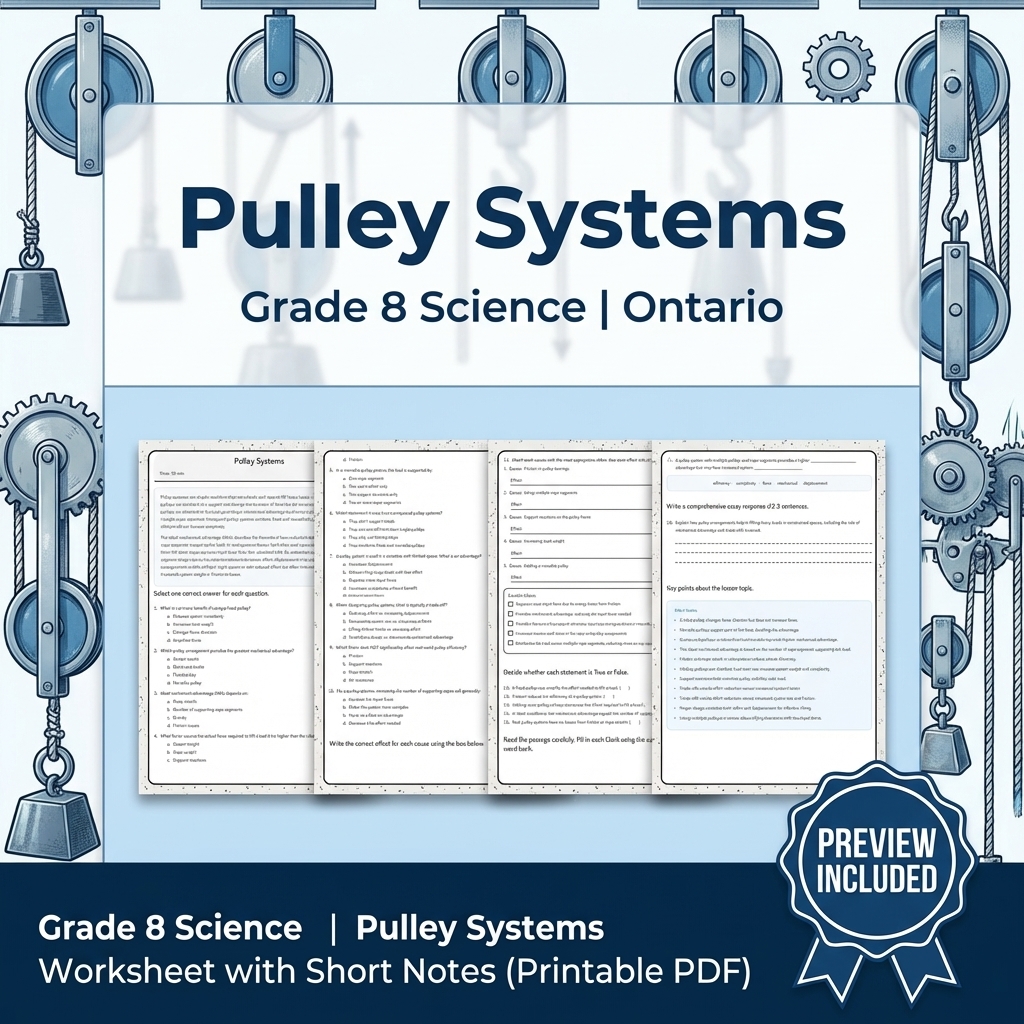
Grade 8 Science | Pulley Systems Worksheet with Short Notes (Printable PDF)
 Created byMeadowlark Worksheets
Learning Objectives
- Understand the different types of pulley arrangements and their mechanical advantages.
- Identify the forces acting in fixed, movable, and compound pulleys.
- Calculate ideal and real-world mechanical advantage of pulley systems.
Also included in: Grade 8 Science Lesson Group Bundle for Ontario Curriculum +1 more
Instant download
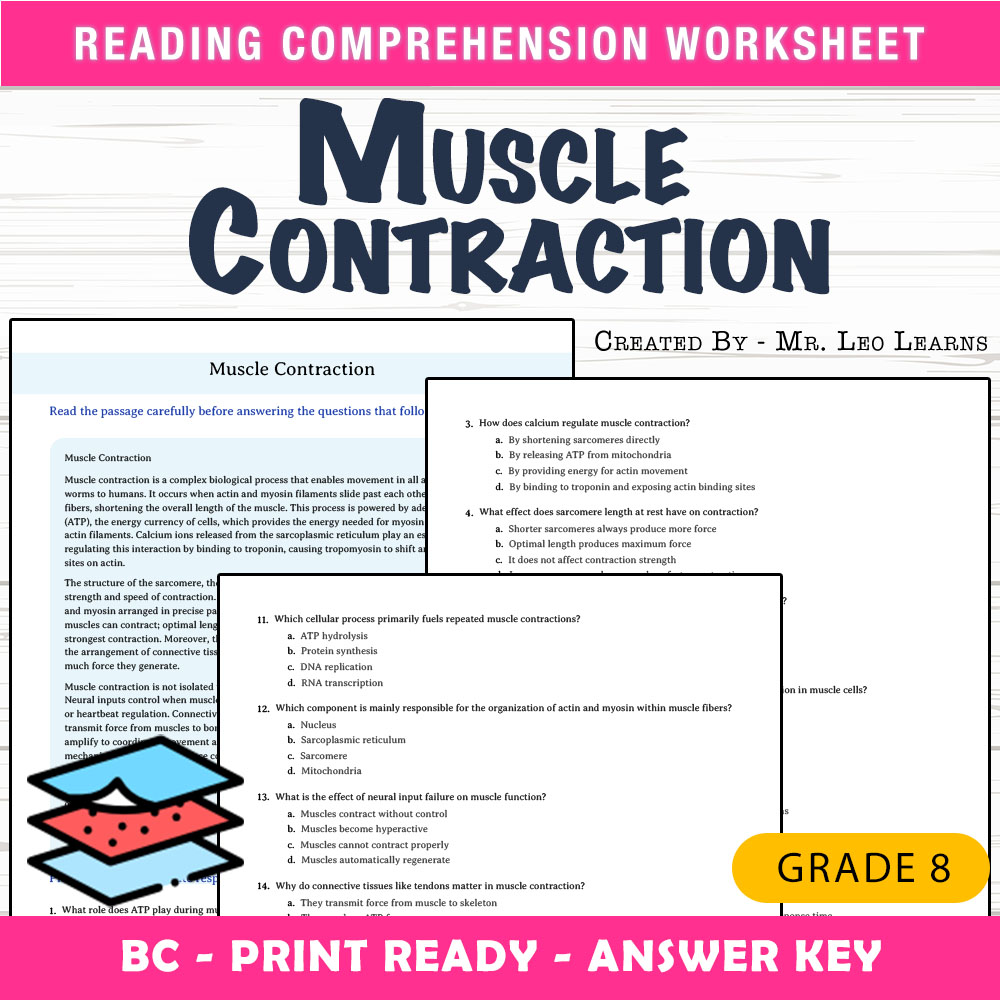
Grade 8 Science — Worksheet MCQ Paper for Mastering Muscle Contraction
Created byThe Resource HubLearning Objectives
- Understand the biochemical process of muscle contraction involving actin, myosin, ATP, and calcium.
- Describe how sarcomere organization influences contraction strength and speed.
- Explain how cellular and tissue structures coordinate to produce movement across organs and systems.
Also included in: Grade 8 Science UNIT | Multicellular Structure & Function Worksheet Bundle +1 more
Instant download
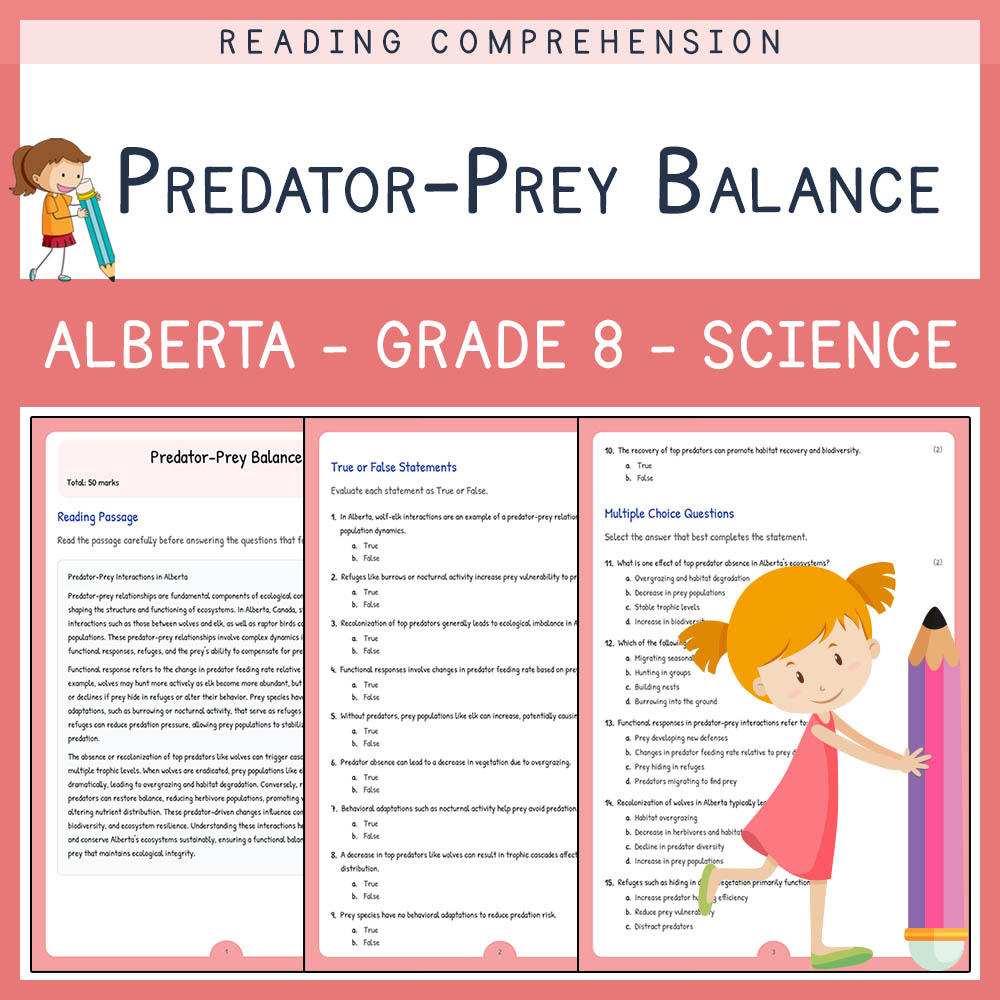
Grade 8 Science Worksheet | Predator–Prey Balance | Alberta Standards
Created byLumora LearningLearning Objectives
- Understand how predator-prey relationships influence population dynamics.
- Identify behavioral and community adaptations resulting from predation.
- Explain cascading effects caused by changes in top predator presence or recolonization.
Instant download
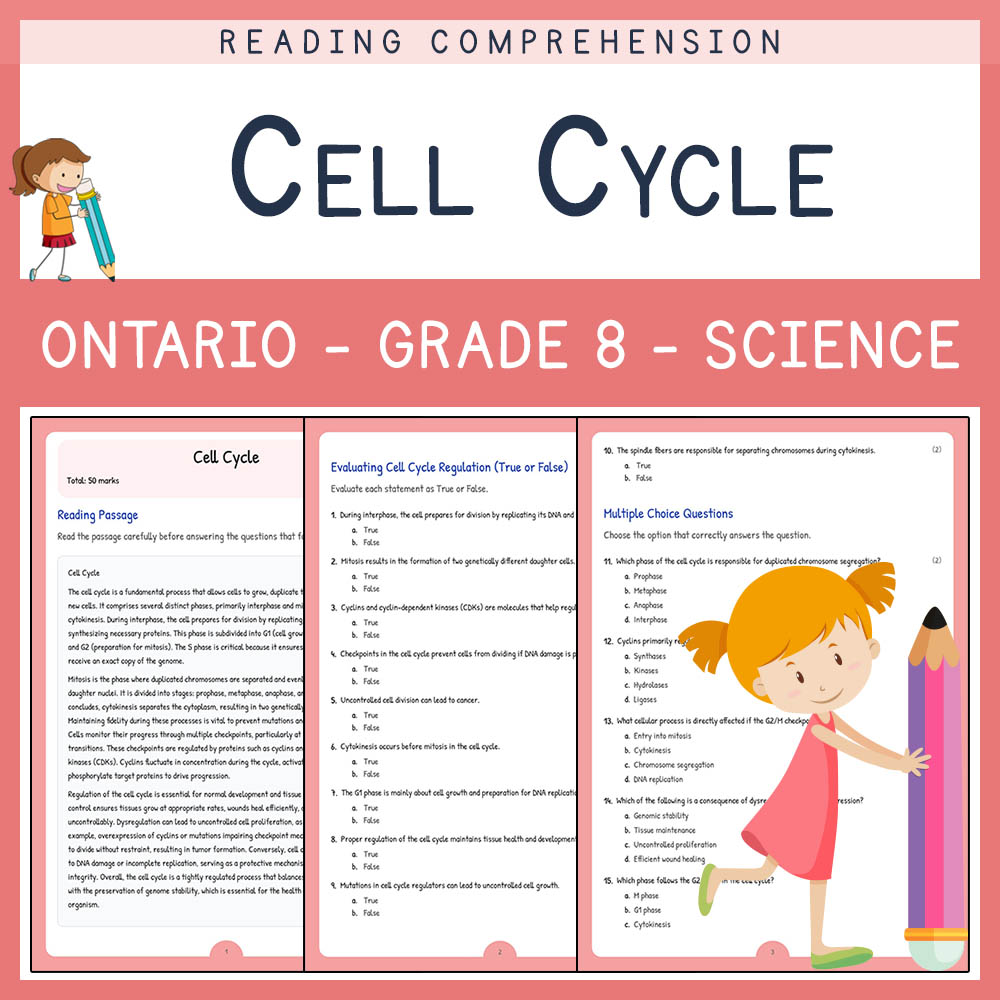
Grade 8 Science Assessment | Cell Cycle Worksheet Elena | Ontario
Created byLumora LearningLearning Objectives
- Describe the stages of the cell cycle including interphase, mitosis, and cytokinesis.
- Explain the roles of cyclins, kinases, and checkpoints in regulating cell division.
- Understand the importance of proper cell cycle regulation for tissue growth, wound repair, and prevention of genomic instability.
Instant download

Science Worksheet: Plate Motion and Surfaces Grade 8 | Standards Practice
JCreated byJ.S SheetsLearning Objectives
- Explain how plate boundaries (divergent, convergent, and transform) reshape Earth’s surface.
- Describe how earthquakes, volcanism, uplift, and erosion provide evidence of plate interactions.
- Use models of plate motion to connect surface features with tectonic processes.
Also included in: Grade 8 Earth and Space Systems Science Lesson Bundle – General Framework +1 more
Instant download
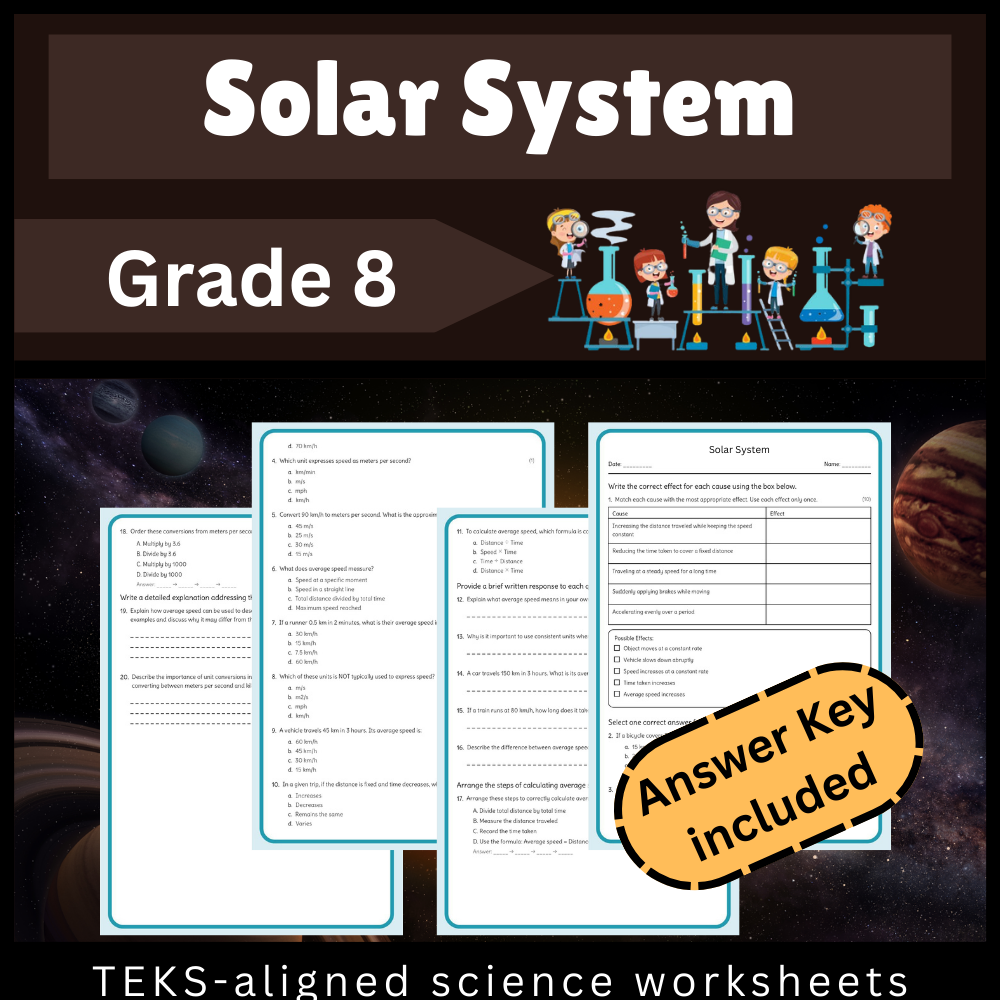
Grade 8 Science | The Solar System Worksheet (Worksheet + Answer Key) – TEKS Aligned
Created byBright Mind ResourcesLearning Objectives
- Describe the major components of the solar system including planets, moons, asteroids, and comets.
- Compare the properties of terrestrial and gas giant planets.
- Explain the role of gravity and solar energy in planetary orbits and environments.
Also included in: Grade 8 Science UNIT Bundle | Weather, Solar System & Earth - TEKS Aligned +1 more
Instant download

Grade 8 Science – Submarine Ballast System & Buoyancy | Daily Reading Worksheet
Created byBright Mind ResourcesLearning Objectives
- Understand how ballast tanks influence buoyancy in submarines
- Describe the process of water intake and ejection to control depth
- Analyze factors affecting submarine stability during depth adjustments
Also included in: Grade 8 Fluid Mechanics & Pressure Science Lesson Bundle | Ontario +1 more
Instant download

Grade 8 Science – Flotation & Stability | Daily Reading Worksheet
 Created byQuiet Forest Education
Learning Objectives
- Understand key concepts related to Science
- Apply knowledge through practice questions
- Demonstrate comprehension of the material
Also included in: Fluid Dynamics Grade 8 Science Daily Reading Worksheets Bundle | Ontario +1 more
Instant download
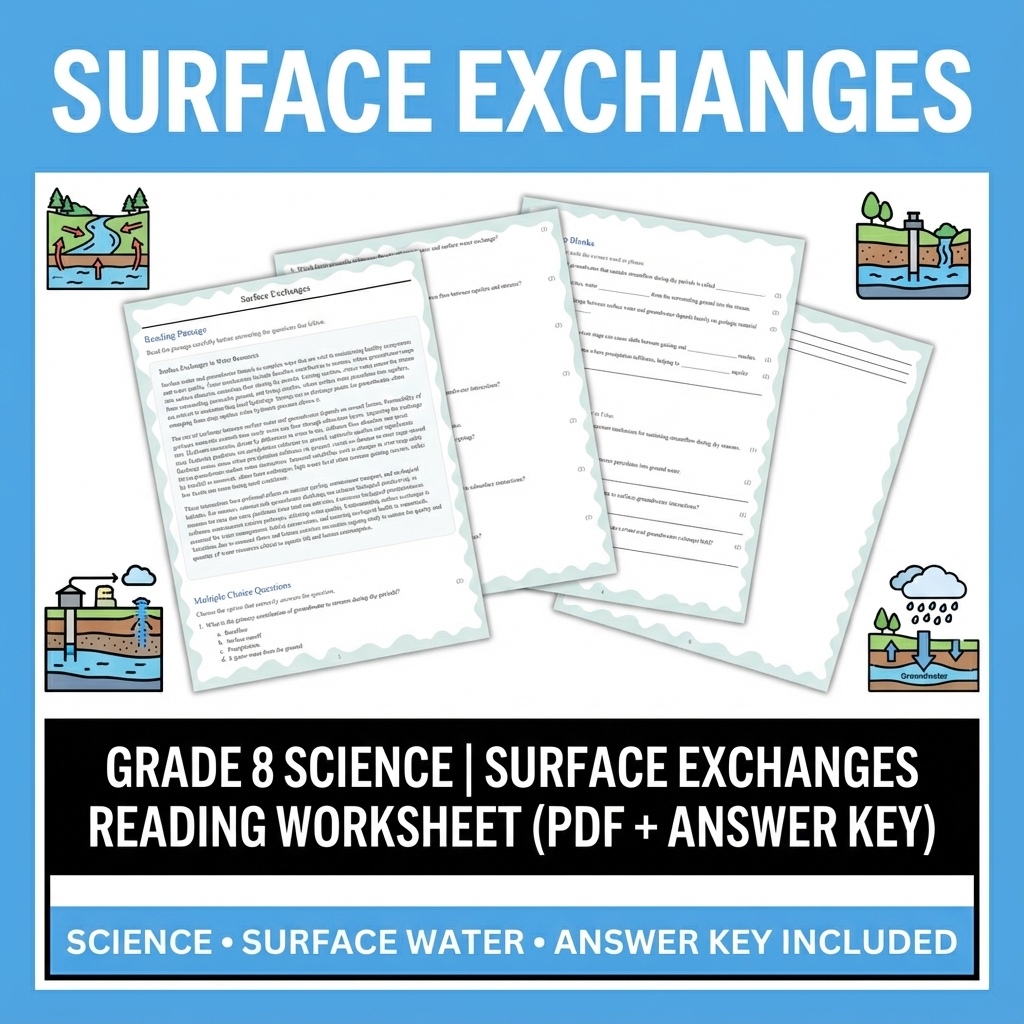
Grade 8 Science | Surface Exchanges Reading Worksheet (PDF + Answer Key)
JCreated byJ.S SheetsLearning Objectives
- Describe the mechanisms of surface water and groundwater interactions
- Identify factors influencing exchange rates such as permeability and hydraulic gradients
- Explain the impact of river stage and seasonal variability on surface and groundwater exchanges
Also included in: Grade 8 Science Bundle | Water Systems Hydrology Concepts (Answer Key Included) +1 more
Instant download

Grade 8 Science | Power and Efficiency Worksheet (Alberta Standards) (PDF)
Created bySilver Birch TeachingLearning Objectives
- Explain the relationship between power, energy transfer, and time in everyday electrical systems.
- Calculate and interpret efficiency as a ratio of useful output to input energy in devices.
- Identify common loss mechanisms (resistive heating, transformer losses, transmission dissipation) and how they reduce delivered power.
Also included in: Grade 8 Electricity & Circuits Science Lesson Bundle: Alberta Framework +1 more
Instant download

Grade 8 Science – Adaptation Mechanisms | Daily Reading Worksheet + Answer Key
JCreated byJ.S SheetsLearning Objectives
- Understand different types of adaptation: structural, behavioral, physiological.
- Identify examples of each adaptation type in animals and plants.
- Explain the purpose of adaptations for survival and reproduction.
Also included in: Grade 8 Science Lesson Bundle – TEKS-aligned Reading Worksheets +1 more
Instant download
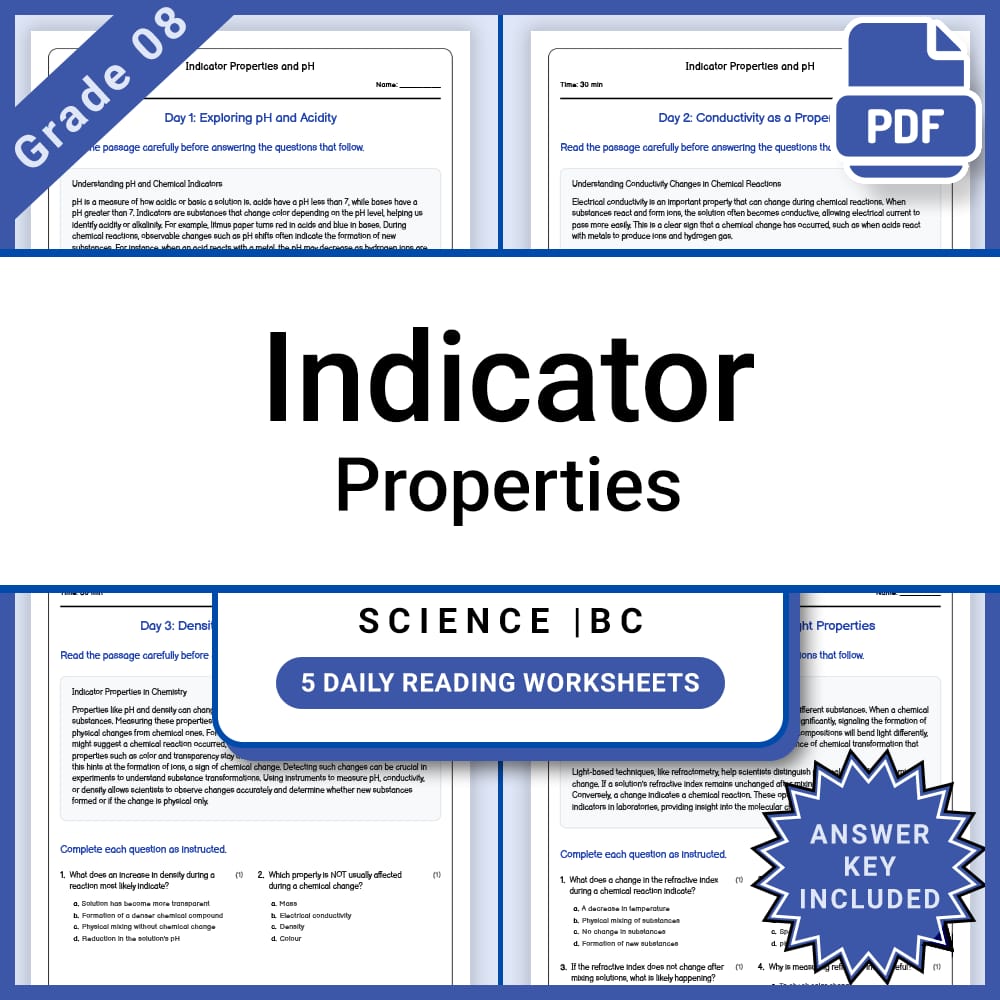
Grade 8 Science – Indicator Properties and pH Daily Worksheet + Answer Key
JCreated byJ.S SheetsLearning Objectives
- Understand how pH indicates acidity or alkalinity
- Recognize how chemical reactions can alter physical properties
- Identify changes in indicator properties during chemical changes
Also included in: Grade 8 Science Lesson Group | Physical Changes and Chemical Reactions +1 more
Instant download
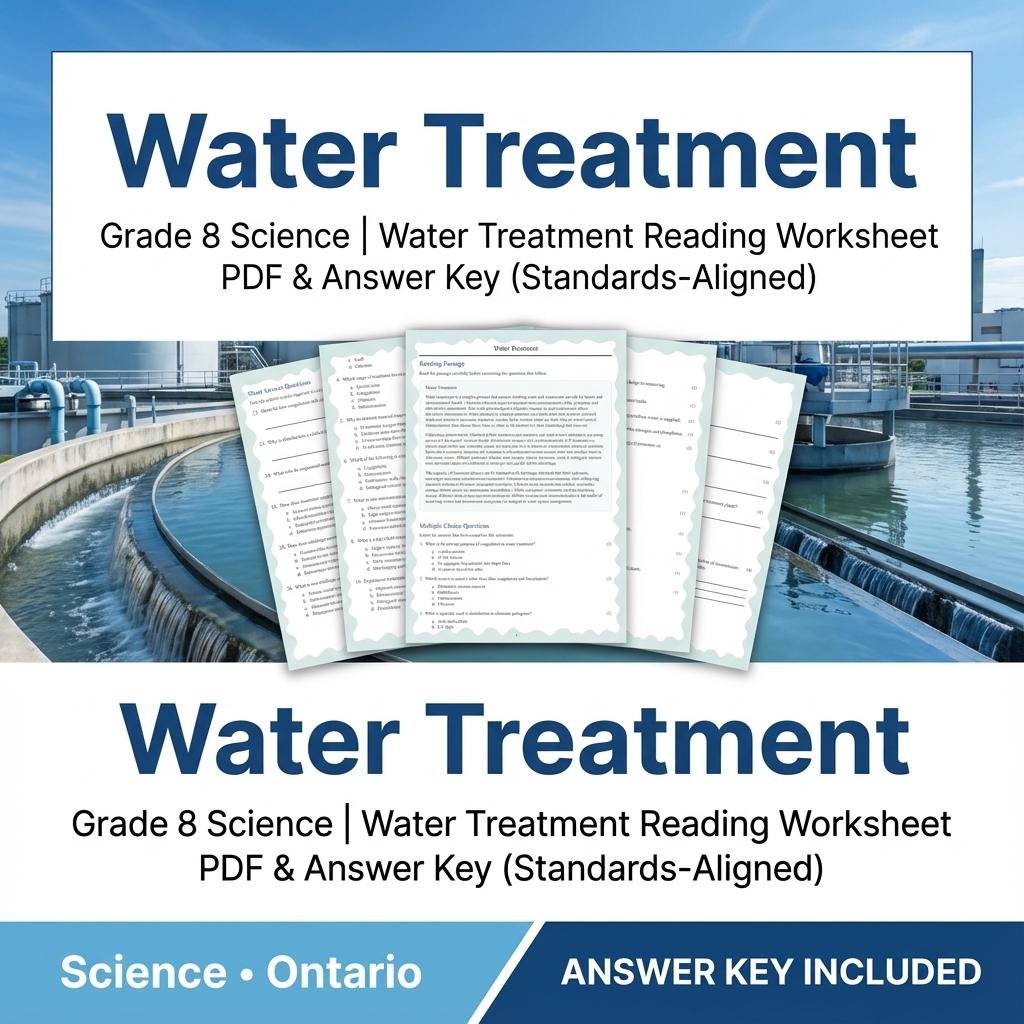
Grade 8 Science | Water Treatment Reading Worksheet PDF & Answer Key
JCreated byJ.S SheetsLearning Objectives
- Understand the principal stages involved in water and wastewater treatment.
- Identify mechanisms for removal of suspended solids, pathogens, and dissolved contaminants.
- Explain the processes of coagulation, flocculation, sedimentation, filtration, and disinfection.
Also included in: Grade 8 Science Bundle | Water Systems Hydrology Concepts (Answer Key Included) +1 more
Instant download
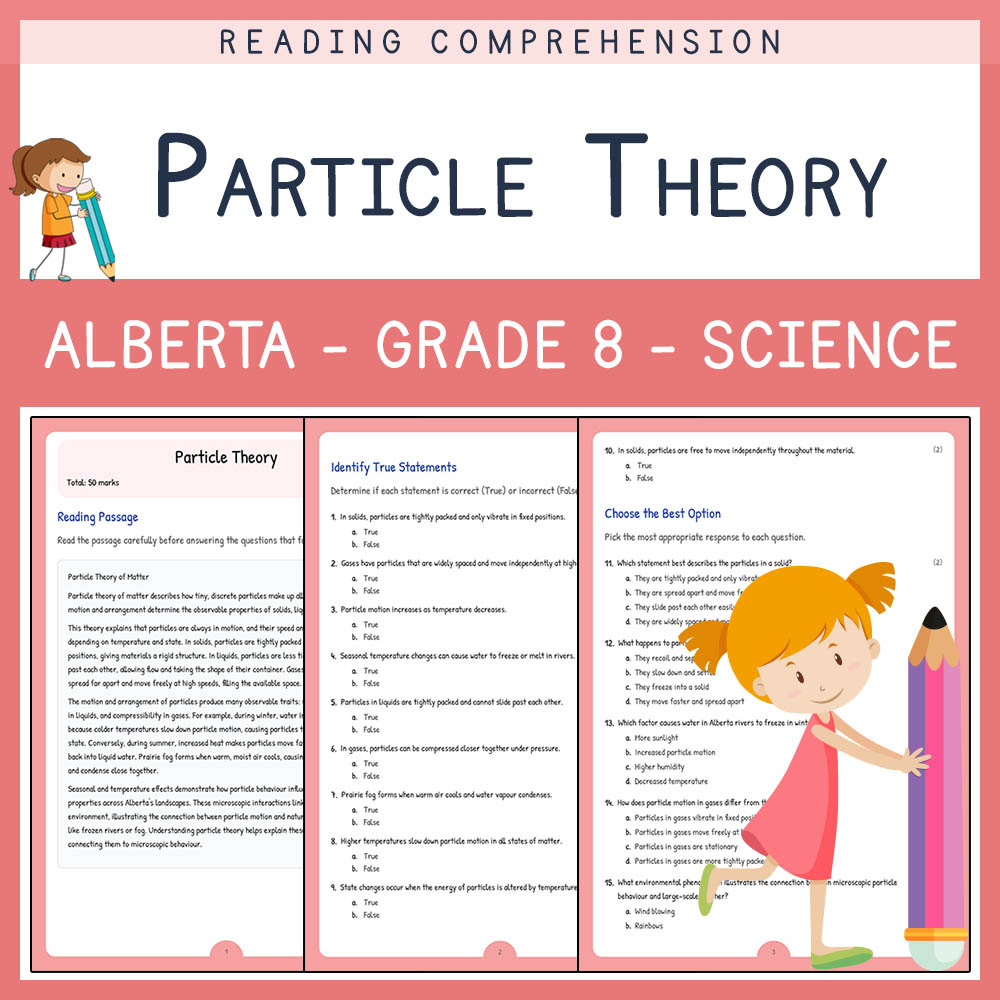
Grade 8 Science | Particle Theory Worksheet | Alberta Standard
Created byLumora LearningLearning Objectives
- Explain the basic concepts of particle theory of matter and how particles behave in solids, liquids, and gases.
- Connect microscopic particle behaviour to observable properties such as rigidity, flow, and compressibility.
- Describe how temperature and seasonal changes affect particle motion and state transitions.
Instant download
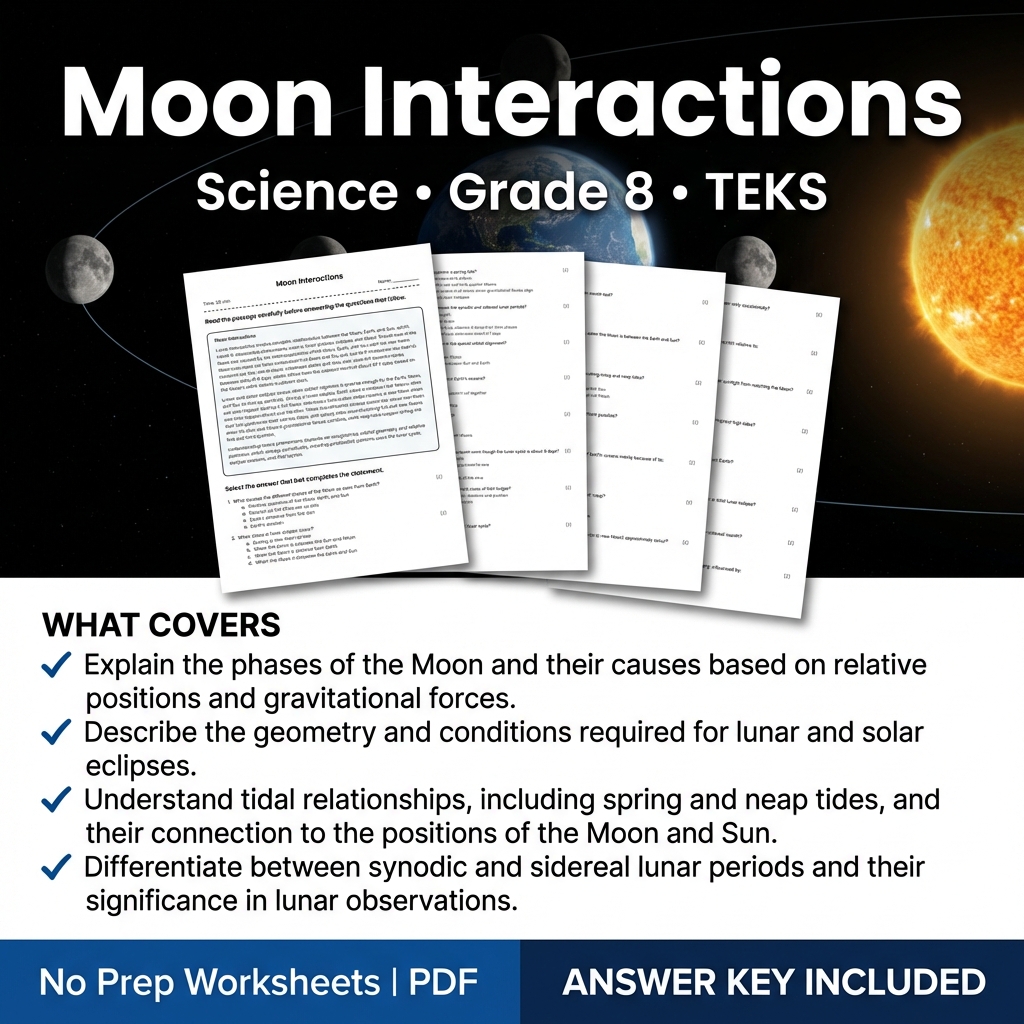
Grade 8 Science Moon Interactions Worksheet | TEKS Aligned Practice
Created byCoral Reef LearningLearning Objectives
- Explain the phases of the Moon and their causes based on relative positions and gravitational forces.
- Describe the geometry and conditions required for lunar and solar eclipses.
- Understand tidal relationships, including spring and neap tides, and their connection to the positions of the Moon and Sun.
Instant download
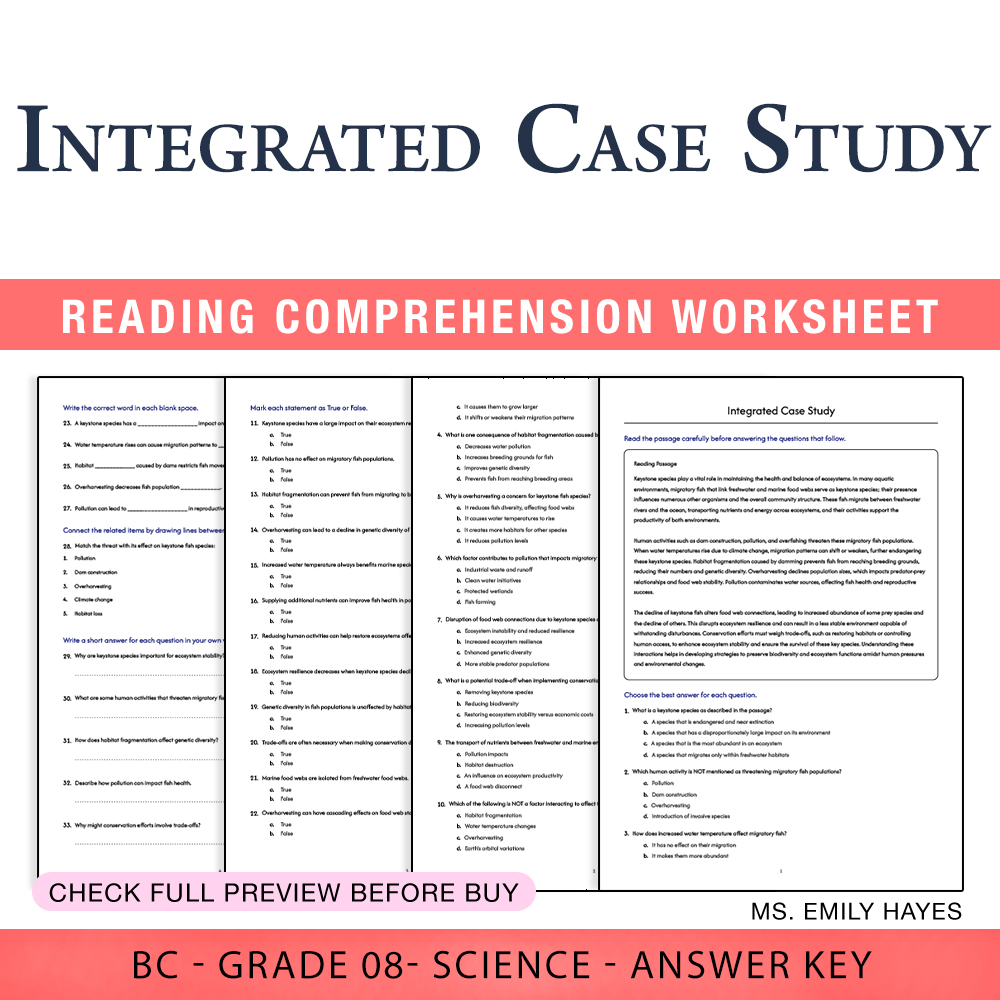
Grade 8 Science | Integrated Case Study Worksheet (PDF+ Answer Key)
 Created byCopper Leaf Classroom
Learning Objectives
- Understand the interactions among organisms, abiotic factors, and human activities in ecosystems.
- Explain how changes like water temperature, habitat fragmentation, overharvesting, and pollution affect keystone species and food webs.
- Evaluate trade-offs involved in conservation decisions to restore ecosystem stability.
Also included in: Grade 8 Science– Ecology, Biodiversity & Environmental Impact (PDF + Answer Key) +1 more
Instant download

Grade 8 – Conservation Analysis in Chemical Processes Worksheet + Answer Key
JCreated byJ.S SheetsLearning Objectives
- Understand the principle of mass conservation in closed chemical systems
- Identify examples of mass relationships between reactants and products
- Explain the difference between closed and open systems in chemical reactions
Also included in: Grade 8 Science Lesson Bundle | TEKS Standards for Classroom Success +1 more
Instant download
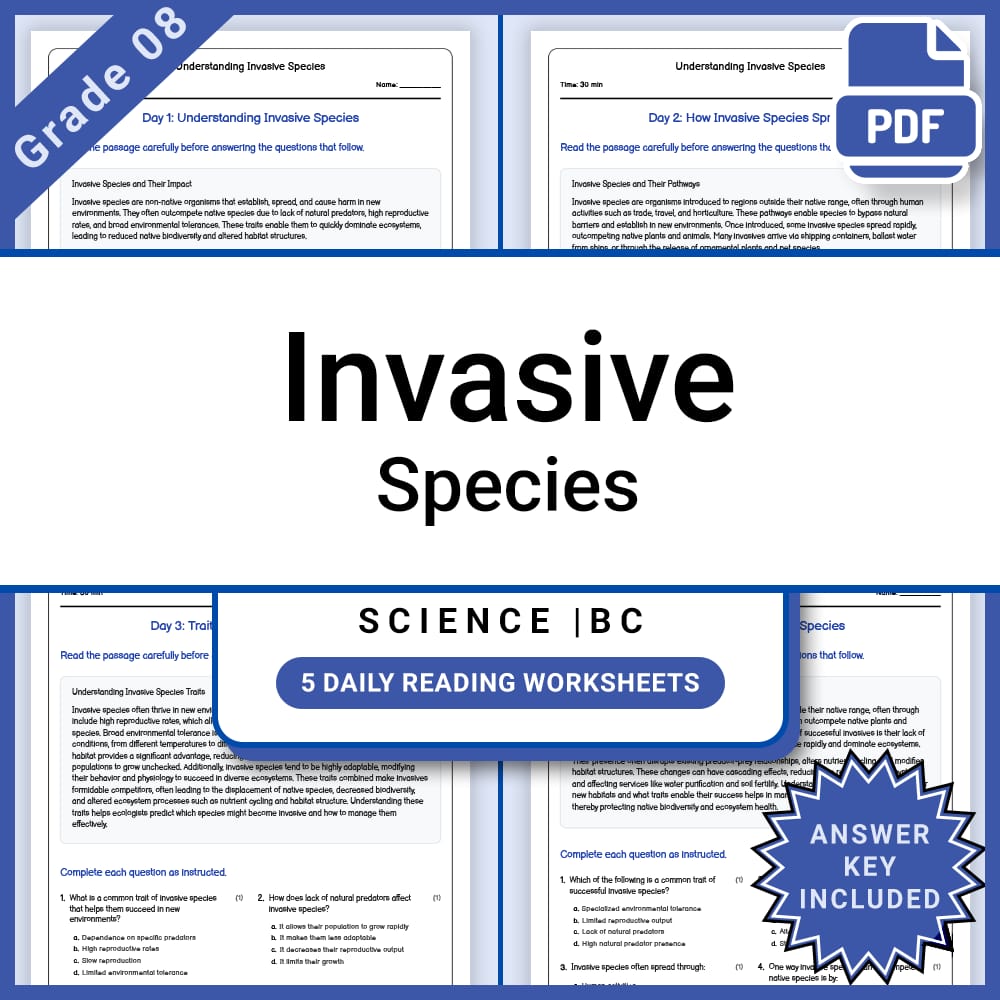
Grade 8 Science – Invasive Species Daily Reading Worksheet with Answer Key
JCreated byJ.S SheetsLearning Objectives
- Identify characteristics that make species invasive
- Understand the ecological impacts of invasive species
- Recognize pathways through which species become invasive
Also included in: Grade 8 Science Lesson Bundle: Ecosystems, Biodiversity & Environmental Impacts +1 more
Instant download

Grade 8 Science – Hydrostatic Pressure & Fluid Power | Daily Reading Worksheet
Created byQuiet Forest EducationLearning Objectives
- Explain the concept of hydrostatic pressure and its relation to fluid depth.
- Interpret the formula p = ρgh and identify each component.
- Apply the principles of hydrostatics to real-world scenarios such as dams, tanks, and underwater structures.
Also included in: Fluid Dynamics Grade 8 Science Daily Reading Worksheets Bundle | Ontario +1 more
Instant download
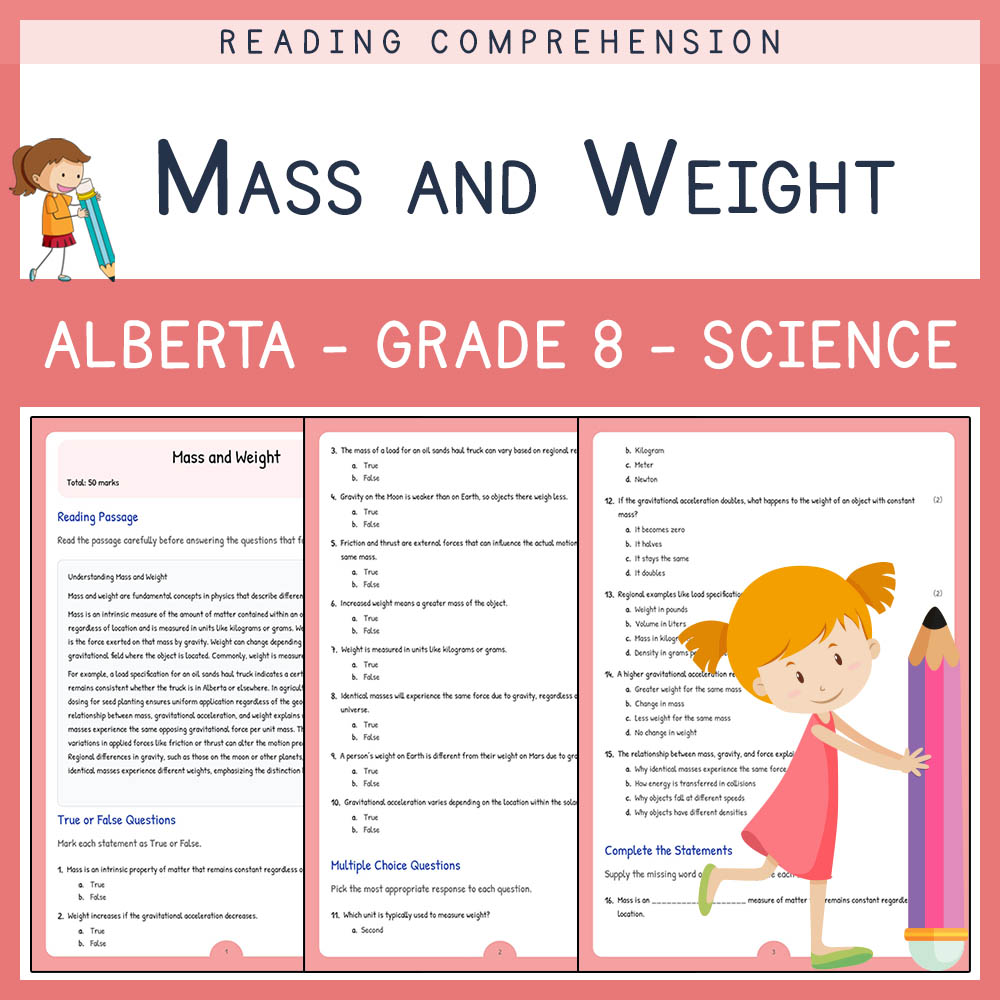
Grade 8 Science | Mass and Weight Worksheet Elena | Alberta Standards
Created byLumora LearningLearning Objectives
- Differentiate between mass and weight as concepts in physics.
- Explain how gravitational acceleration affects weight.
- Apply regional examples to understand mass and weight differences.
Instant download
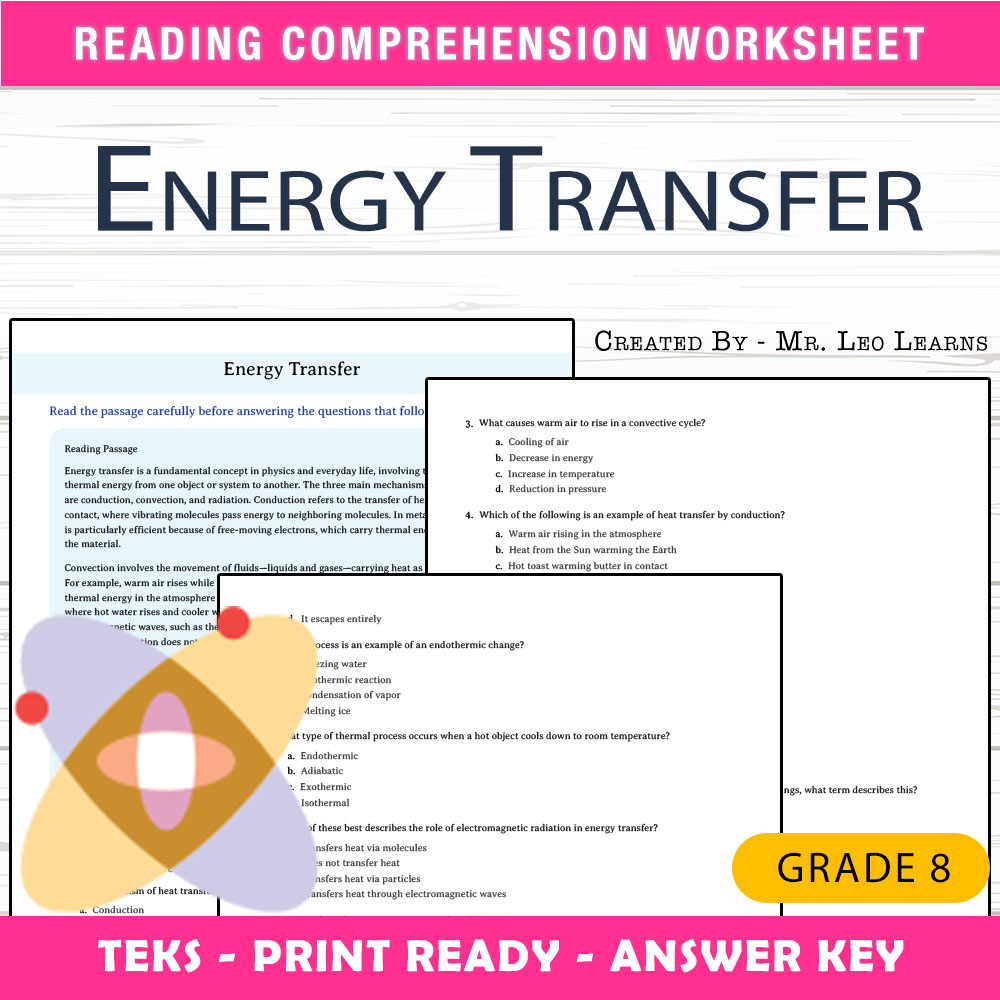
Grade 8 Science – Energy Transfer Worksheet for Mastery | PDF + Answer Key
Created byThe Resource HubLearning Objectives
- Describe the mechanisms of heat transfer: conduction, convection, and radiation.
- Explain how energy transfer affects temperature changes and phase transitions.
- Identify examples of energy transfer processes in real-world contexts.
Also included in: Grade 8 Science Unit Bundle – Matter, Reaction Rates & Energy Mastery Worksheets +1 more
Instant download
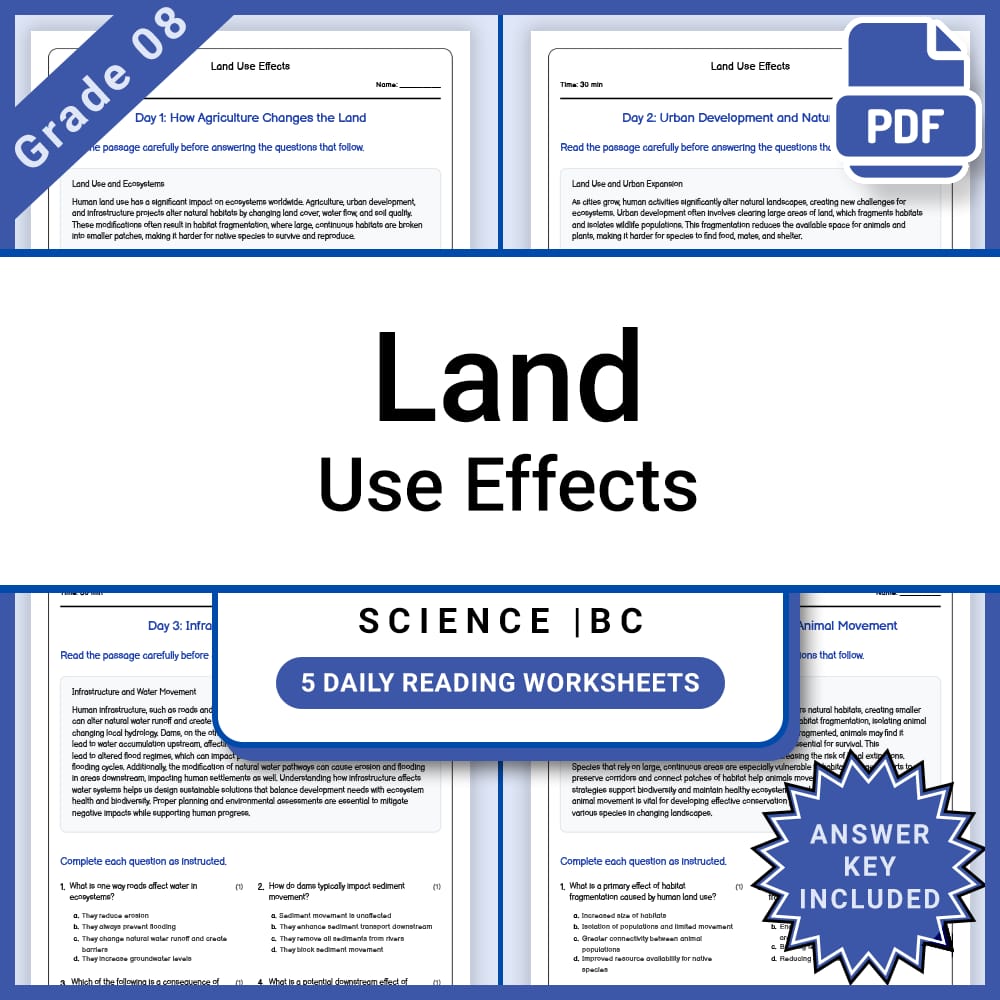
Grade 8 Science – Land Use Effects Daily Reading Worksheet + Answer Key
JCreated byJ.S SheetsLearning Objectives
- Understand how human land use, such as agriculture and urban development, impacts habitat structure
- Identify the effects of habitat fragmentation on native species and ecosystems
- Analyze the long-term consequences of land use changes for biodiversity and ecosystem stability
Also included in: Grade 8 Science Lesson Bundle: Ecosystems, Biodiversity & Environmental Impacts +1 more
Instant download

Cell Modeling Worksheet | NGSS-Aligned Grade 8 Science Practice
JCreated byJ.S SheetsLearning Objectives
- Understand how models represent cellular processes and structures.
- Identify the roles of organelles and membrane systems in cell function.
- Interpret diagrams, physical, and computational models linking structure to function.
Also included in: Grade 8 Cell Modeling and Organ Systems Science Lesson Bundle – NGSS +1 more
Instant download

Grade 8 Science – Atmospheric Effects & Pressure | Daily Reading Worksheet
Created byQuiet Forest EducationLearning Objectives
- Understand how atmospheric pressure is measured and its role in weather
- Explain how pressure influences boiling points and fluid systems
- Identify pressure differences and their mechanical impacts
Also included in: Fluid Dynamics Grade 8 Science Daily Reading Worksheets Bundle | Ontario +1 more
Instant download
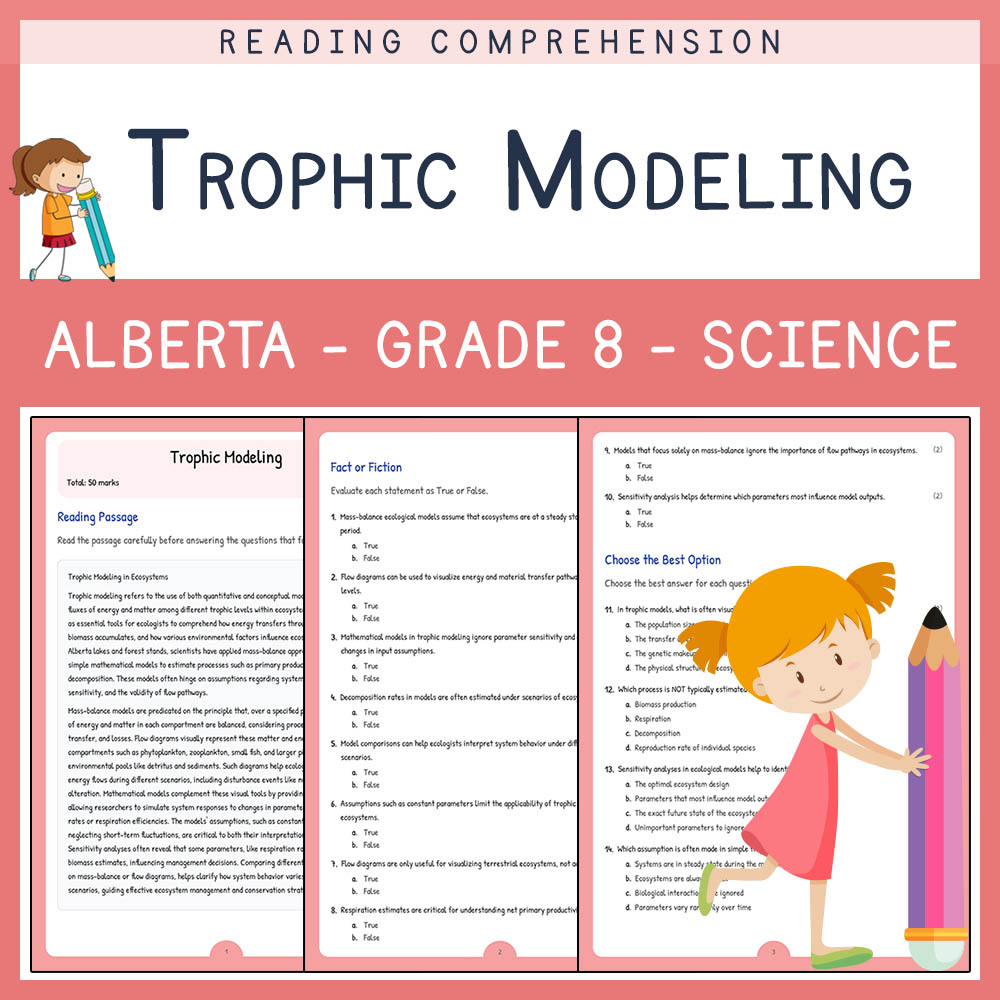
Grade 8 Science | Trophic Modeling Worksheet | Alberta Standards
Created byLumora LearningLearning Objectives
- Understand the basic concepts of trophic modeling and energy fluxes in ecosystems.
- Identify different approaches used for quantifying matter and energy flow among trophic compartments.
- Explain the assumptions and sensitivities of simple mathematical models in ecological systems.
Instant download
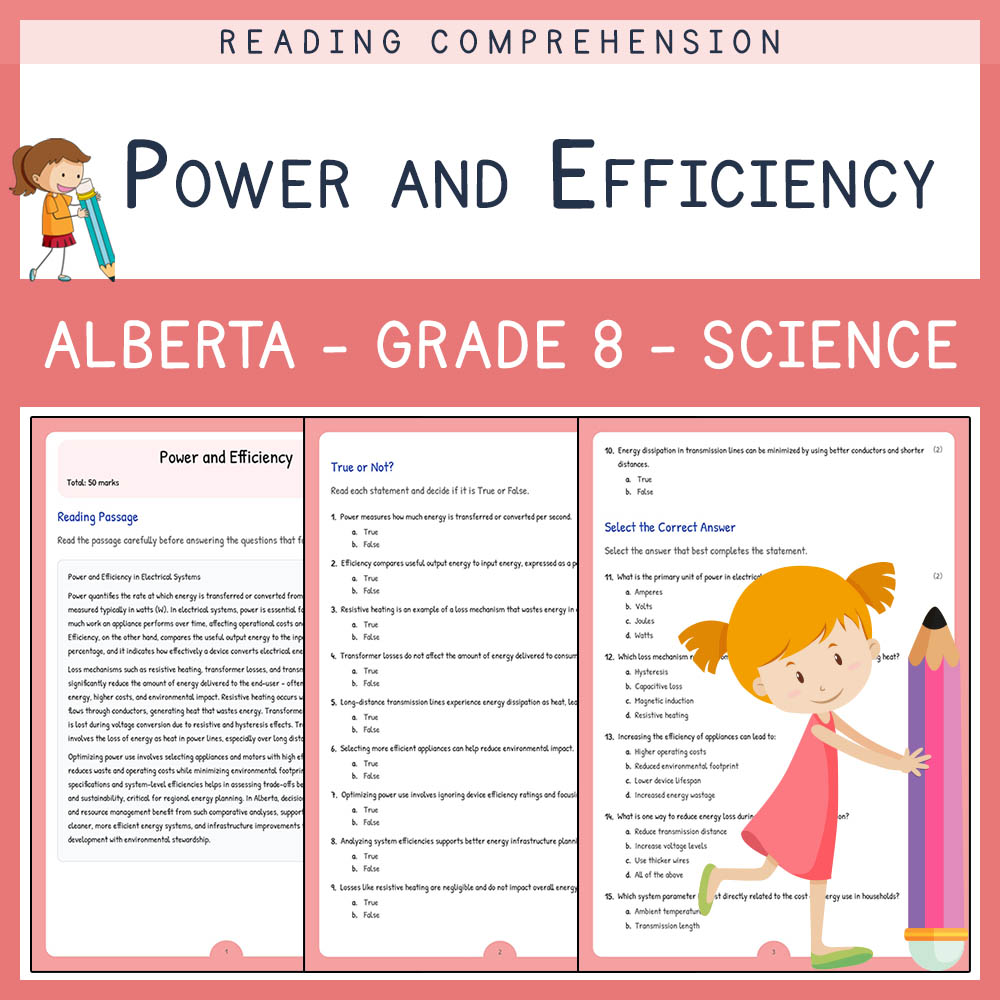
Grade 8 Science | Power and Efficiency Worksheet | Alberta Standards
Created byLumora LearningLearning Objectives
- Define power as energy transfer per unit time and explain its significance in electrical systems.
- Describe the concept of efficiency and identify common loss mechanisms in electrical devices.
- Analyze how optimization and selection of appliances influence energy consumption, cost, and environmental impact.
Instant download

Grade 8 Science Systems Analysis Worksheet (Alberta Standards) PDF
Created bySilver Birch TeachingLearning Objectives
- Identify components and interactions in a complex physical system by separating internal from external forces
- Use vector addition ideas to reason about the net force and whether a system is in equilibrium or accelerating
- Apply systematic force accounting to predict static vs. dynamic behavior in real-world engineering examples
Also included in: Grade 8 Forces, Motion, and Energy Science Lesson Bundle for Alberta +1 more
Instant download
About Grade 8 Science Worksheets
Explore Grade 8 Science worksheets for classwork, homework, or review. Our 6,006 printables download instantly as PDFs.
Each resource here is built by an independent educator and reviewed for quality. Worksheets print straight from PDF and suit classroom use, homework, or extra practice; most come with answer keys, and you can preview before purchasing.