
Grade 8 Science Worksheets
6,006 worksheets
Grade 8 Science – Organ Formation & Tissues | Daily Reading Worksheet
 Created byBright Mind Resources
Learning Objectives
- Understand how tissues interact to form organs
- Recognize the structure and function of different tissue layers
- Explain how organs are specialized for their physiological tasks
Also included in: Grade 8 Body Systems & Cell Structure Science Daily Reading Lesson Bundle | BC +1 more
Instant download

Grade 8 Science | Trophic Modeling Worksheet (Alberta Standards) (PDF)
 Created bySilver Birch Teaching
Learning Objectives
- Explain how trophic models track energy and matter across compartments and environmental pools.
- Use mass-balance ideas to interpret production, respiration, and decomposition in ecosystems.
- Identify common assumptions and parameter sensitivities in simple trophic models.
Also included in: Grade 8 Trophic Modeling & Ecosystems Science Lesson Bundle for Alberta Standards +1 more
Instant download

Grade 8 Science – Complex Chemical Systems & Reaction Networks | Worksheet
Created byBright Mind ResourcesLearning Objectives
- Define reaction networks and the concept of conservation of mass.
- Identify how forward and reverse reactions reach equilibrium.
- Explain the importance of tracking intermediate species in complex reactions.
Instant download
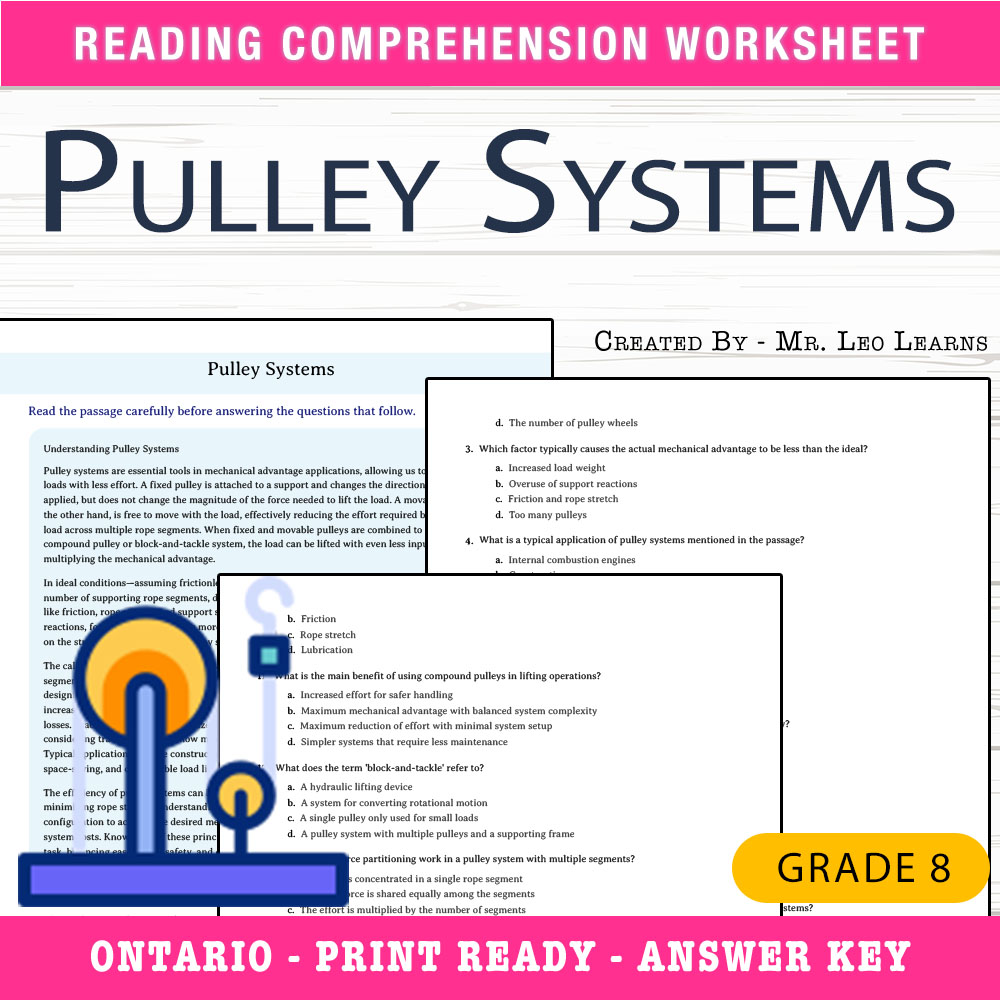
Grade 8 Science — Pulley Systems Worksheet for Mastering Mechanical Advantage
 Created byThe Resource Hub
Learning Objectives
- Explain the different types of pulley arrangements, including fixed, movable, and compound pulleys.
- Calculate the mechanical advantage in pulley systems considering ideal and real-world conditions.
- Analyze force distribution and support reactions in pulley configurations for lifting loads.
Also included in: Grade 8 Science | Mechanical Systems & Energy Mastery Unit Worksheet Pack +1 more
Instant download
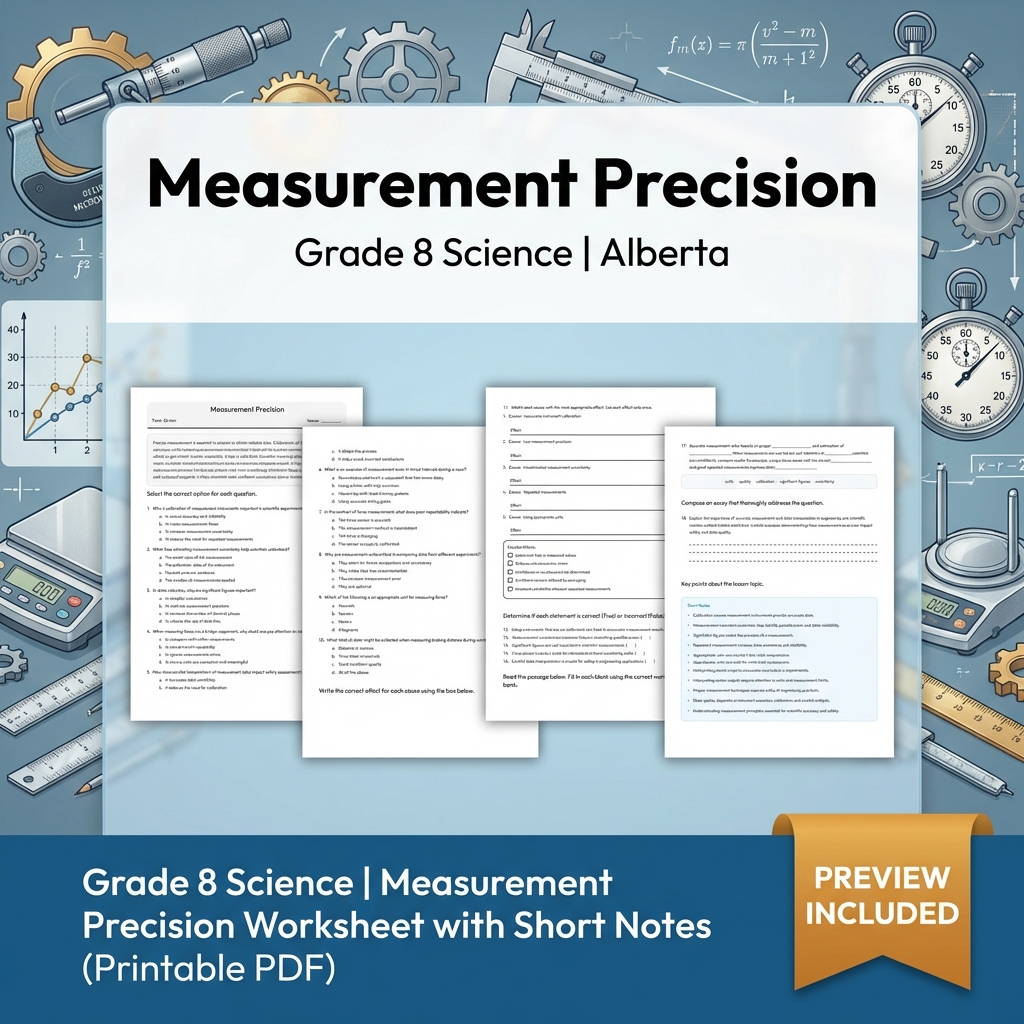
Grade 8 Science | Measurement Precision Worksheet with Short Notes (PDF)
 Created byMeadowlark Worksheets
Learning Objectives
- Understand principles of measurement including calibration and uncertainty estimation.
- Interpret measurement data in contexts such as braking distance and force readings.
- Apply concepts of significant figures and measurement error to quantitative data.
Also included in: Grade 8 Science Forces & Motion UNIT Bundle – Alberta Curriculum +1 more
Instant download
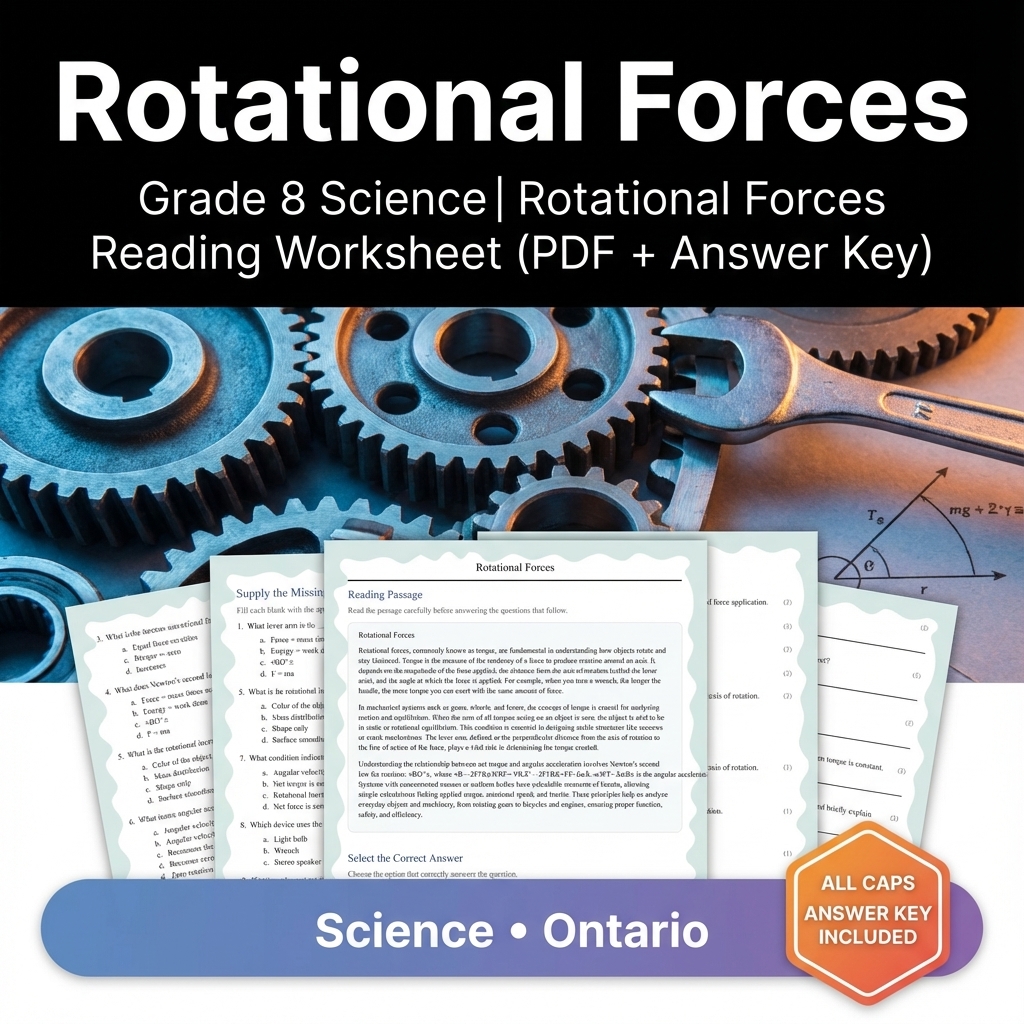
Grade 8 Science | Rotational Forces Reading Worksheet (PDF + Answer Key)
JCreated byJ.S SheetsLearning Objectives
- Explain the concepts of torque, lever arm, and moment of force in rotational systems.
- Identify conditions for rotational equilibrium in gears, levers, and wheels.
- Connect net torque to angular acceleration and relate rotational inertia, applied torque, and rotational speed.
Also included in: Grade 8 Science | Energy & Forces Unit Worksheet Pack (Answer Keys Included) +1 more
Instant download

Grade 8 Filtration and Clarification Worksheet | Separation by Particle Size
 Created byBRIGHT PATH RESOURCES
Learning Objectives
- Explain how filtration separates mixtures using particle size.
- Describe clarification as a cause-and-effect process that reduces suspended solids in water.
- Use evidence from a passage to support claims about separation methods.
Also included in: Grade 8 Alberta Science Matter and Chemical Change Worksheet Bundle +1 more
Instant download

Grade 8 Science – Decomposer Recycling Reading Worksheet | Standards-Aligned
Created byBright Mind ResourcesLearning Objectives
- Understand key concepts related to Science
- Apply knowledge through practice questions
- Demonstrate comprehension of the material
Also included in: Grade 8 Science Daily Reading Worksheets Lesson Bundle | California Standards +1 more
Instant download

Grade 8 Cell Modeling NGSS Science Worksheet | Life Science Activity
Created byBRIGHT PATH RESOURCESLearning Objectives
- Understand key concepts related to Science
- Apply knowledge through practice questions
- Demonstrate comprehension of the material
Also included in: Cells & Circulatory System Grade 8 Science Lesson Bundle | NGSS Daily Reading +2 more
Instant download
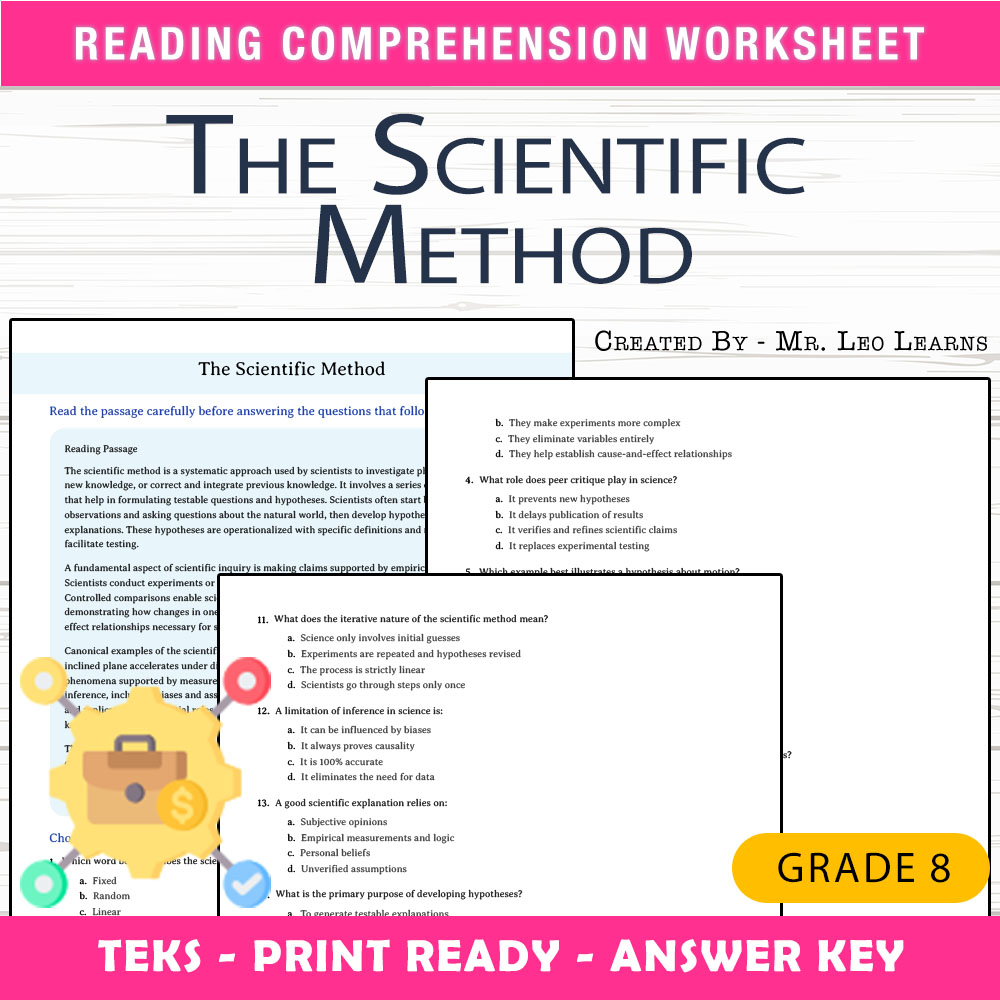
Grade 8 Science – The Scientific Method Worksheet for Mastery
Created byThe Resource HubLearning Objectives
- Describe the iterative nature of the scientific method and inquiry.
- Identify key components such as hypotheses, operational definitions, and predictions.
- Understand the importance of empirical evidence and controlled comparisons in scientific reasoning.
Also included in: Grade 8 Science Unit Bundle | Scientific Inquiry & Data Skills Worksheet Pack +1 more
Instant download

Grade 8 Science – Measurement & Units | Daily Reading Worksheet
Created byBright Mind ResourcesLearning Objectives
- Understand the SI units commonly used in scientific measurements.
- Learn measurement conventions, including accuracy and precision.
- Recognize appropriate instruments for measuring mass, volume, length, and temperature.
Also included in: Experiments Grade 8 Science Daily Reading Worksheets Lesson Bundle | TEKS +2 more
Instant download

Grade 8 TEKS Population Dynamics Science Daily Reading Worksheet
Created byBRIGHT PATH RESOURCESLearning Objectives
- Identify the main idea and key vocabulary related to population size.
- Explain how limiting resources affect carrying capacity.
- Describe how births, deaths, immigration, and emigration influence population change.
Also included in: Grade 8 Organisms & Environments Science Reading Worksheets Bundle | TEKS +1 more
Instant download

Grade 8 Food Webs & Trophic Modeling Science Worksheet | Alberta
Created byBRIGHT PATH RESOURCESLearning Objectives
- Identify trophic compartments in a food web and describe how energy flows among them.
- Explain why models use assumptions and mass balance to estimate energy transformations.
- Use key terms to interpret production, respiration, and decomposition in a simple energy-flow model.
Also included in: Grade 8 Alberta Science Interactions and Ecosystems Worksheet Bundle +1 more
Instant download

Earth Materials Worksheet | NGSS Grade 8 Science Assessment
 Created bySkylark Worksheets
Learning Objectives
- Model how Earth’s rock cycle transfers mass and changes rock types through melting, crystallization, weathering, transport, and deposition.
- Explain how Earth’s internal heat and gravitational energy drive energy flows in the geosphere, hydrosphere, and atmosphere.
- Compare fast and slow Earth material changes using time scales such as landslides and continental drift.
Also included in: Grade 8 Earth's Systems Science Lesson Bundle with NGSS Worksheets +1 more
Instant download
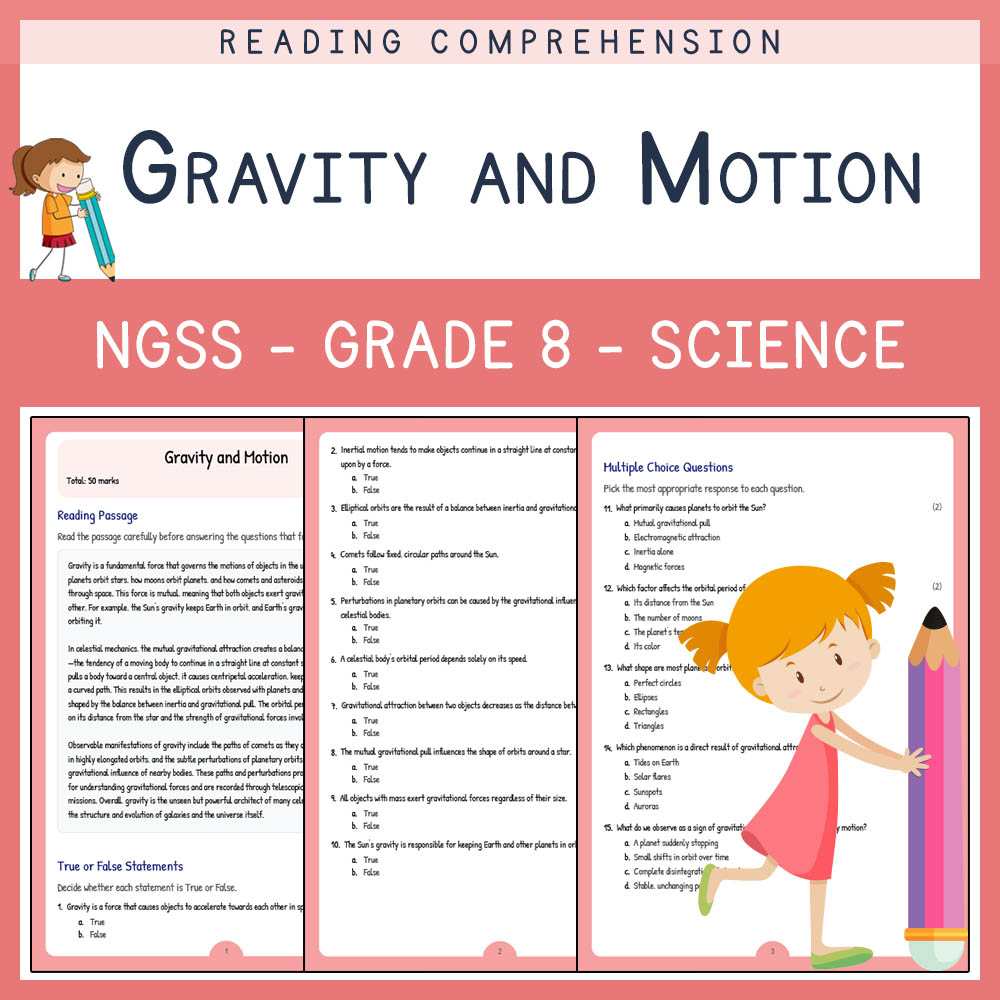
Grade 8 Science | Gravity and Motion Worksheet (PDF Answer Key & Rubric)
 Created byLumora Learning
Learning Objectives
- Understand how gravity influences the orbital motions of celestial bodies within the solar system and galaxies.
- Explain the concepts of mutual gravitational attraction and centripetal acceleration.
- Describe how the balance between inertia and gravity results in elliptical orbits.
Instant download

Biotech Considerations Practice Worksheet | Grade 8 Science Review and Assessment
 Created byPrism Point Learning
Learning Objectives
- Explain how cell culture, controlled differentiation, and scaffold interactions are used to guide tissue repair in biotech.
- Describe how molecular markers help track stem cell differentiation toward specific cell types.
- Evaluate ethical, safety, and regulatory trade-offs in therapies that manipulate cells and tissues.
Also included in: Grade 8 Cell Organization & Homeostasis Science lesson bundle: Ontario
Instant download

Grade 8 Science – Microscopy Basics Daily Reading Worksheet | Ontario Standards
Created byBright Mind ResourcesLearning Objectives
- Understand the different types of microscopes and their uses
- Explain key concepts such as magnification, resolution, and contrast
- Describe sample preparation techniques and artifacts
Also included in: Grade 8 Life Systems Science Daily Reading Worksheets Lesson Bundle | Ontario +1 more
Instant download

Water Cycle Models Assessment | General Grade 8 Science
Created byPrism Point LearningLearning Objectives
- Describe the main processes involved in Earth's water cycle.
- Identify different reservoirs and pathways that transfer water across Earth systems.
- Explain how modeling water flow helps understand Earth's environment.
Also included in: Lesson Bundle: Grade 8 Earth & Space Science Science General Framework
Instant download

Grade 8 Science – Photosynthesis Worksheet (Ontario Standard) (PDF)
 Created byEvergreen Desk Education
Learning Objectives
- Explain how chloroplast structure supports photosynthesis, including the roles of thylakoid membranes and the stroma.
- Describe the light-dependent reactions and how they produce ATP and NADPH.
- Explain the Calvin cycle and how CO2 is fixed to support biomass production.
Also included in: Grade 8 Cell Structure & Homeostasis Science Lesson Bundle (Ontario) +1 more
Instant download

Grade 8 Circuit Fundamentals Worksheet | Electrical Components Alberta
Created byBRIGHT PATH RESOURCESLearning Objectives
- Identify key parts of a simple electric circuit and describe their roles.
- Match common circuit components to what they do in an energy-conversion process.
- Use accurate vocabulary (source, conductor, load, switch) to explain how circuits operate.
Also included in: Grade 8 Alberta Science Electricity and Magnetism Worksheet Bundle +1 more
Instant download
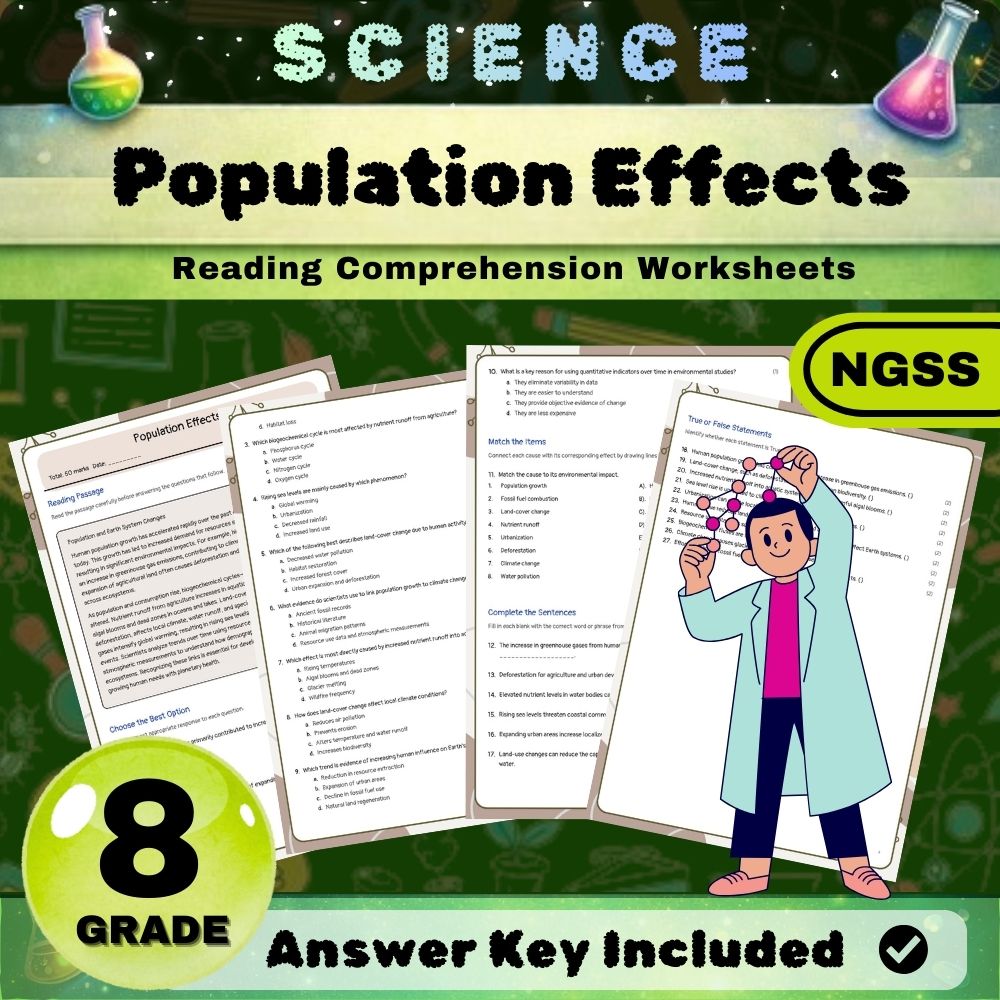
Grade 8 Science | Population Effects Worksheet (NGSS) – PDF
 Created byMaple Path Learning
Learning Objectives
- Analyze how population growth and per-capita consumption influence Earth system changes.
- Evaluate evidence related to resource use trends, land cover change, and biogeochemical fluxes.
- Understand the relationships between demographic patterns, climate change, water availability, and biodiversity.
Also included in: Grade 8 Science | Earth and Human Activity NGSS Unit Bundle +1 more
Instant download

Grade 8 Science – Evidence & Testing | Daily Reading Worksheet
Created byBright Mind ResourcesLearning Objectives
- Understand the importance of evidence in scientific testing.
- Identify various types of evidence, including observations and measurements.
- Differentiate between qualitative and quantitative evidence.
Also included in: Tech Tradeoffs Grade 8 Science Daily Reading Worksheets Lesson Bundle | General +1 more
Instant download

Science Worksheet Technology and Impacts Grade 8 | Standards-Aligned Practice
JCreated byJ.S SheetsLearning Objectives
- Explain how technology choices can affect people and the environment beyond a product’s immediate performance.
- Analyze trade-offs in technology, including impacts on air quality, resource use, noise, safety, and waste.
- Use evidence and systems thinking to judge whether a technology solution is more responsible over its life cycle.
Also included in: Grade 8 Engineering Design Testing Tradeoffs Science Lesson Bundle - General Framework +1 more
Instant download

Grade 8 Science – Chemical Reaction Models & Concept Review | Reading Worksheet
Created byBright Mind ResourcesLearning Objectives
- Understand how particle models explain chemical reactions.
- Identify changes in atom bonding during reactions.
- Describe how energy changes are related to observable evidence.
Also included in: Reaction Evidence & Matter Grade 8 Science Lesson Bundle | General Framework +1 more
Instant download

Hydrologic Cycle and Water Reservoir Balance Worksheets Grade 8
Created byPrism Point LearningLearning Objectives
- Describe major processes that move water through the hydrologic cycle
- Explain how solar energy and gravity drive water movement
- Compare reservoir storage and residence times across water systems
Also included in: Water Treatment Stages & Water Systems Lesson Bundle | Grade 8 Science | Ontario +1 more
Instant download

Grade 8 Gear Trains Worksheet | Gear Ratio, Torque & Ontario Science
 Created byChalk and Compass
Learning Objectives
- Explain how gear ratio connects the angular velocity of driving and driven gears
- Describe torque multiplication and the speed trade-off in simple and compound gear trains
- Identify how idler gears change direction without changing the overall gear ratio
Also included in: Grade 8 Science Mechanical Systems Lesson Bundle | Ontario +1 more
Instant download

Grade 8 Science | Understanding Closed Systems - Daily Reading Comprehension
 Created byCoral Reef Learning
Learning Objectives
- Define what a closed system is in scientific experiments.
- Identify examples of closed systems in real-world applications.
- Explain why closed systems are significant for mass conservation.
Also included in: Matter and Chemical Change Lesson Bundle – Alberta Grade 8 Science +1 more
Instant download
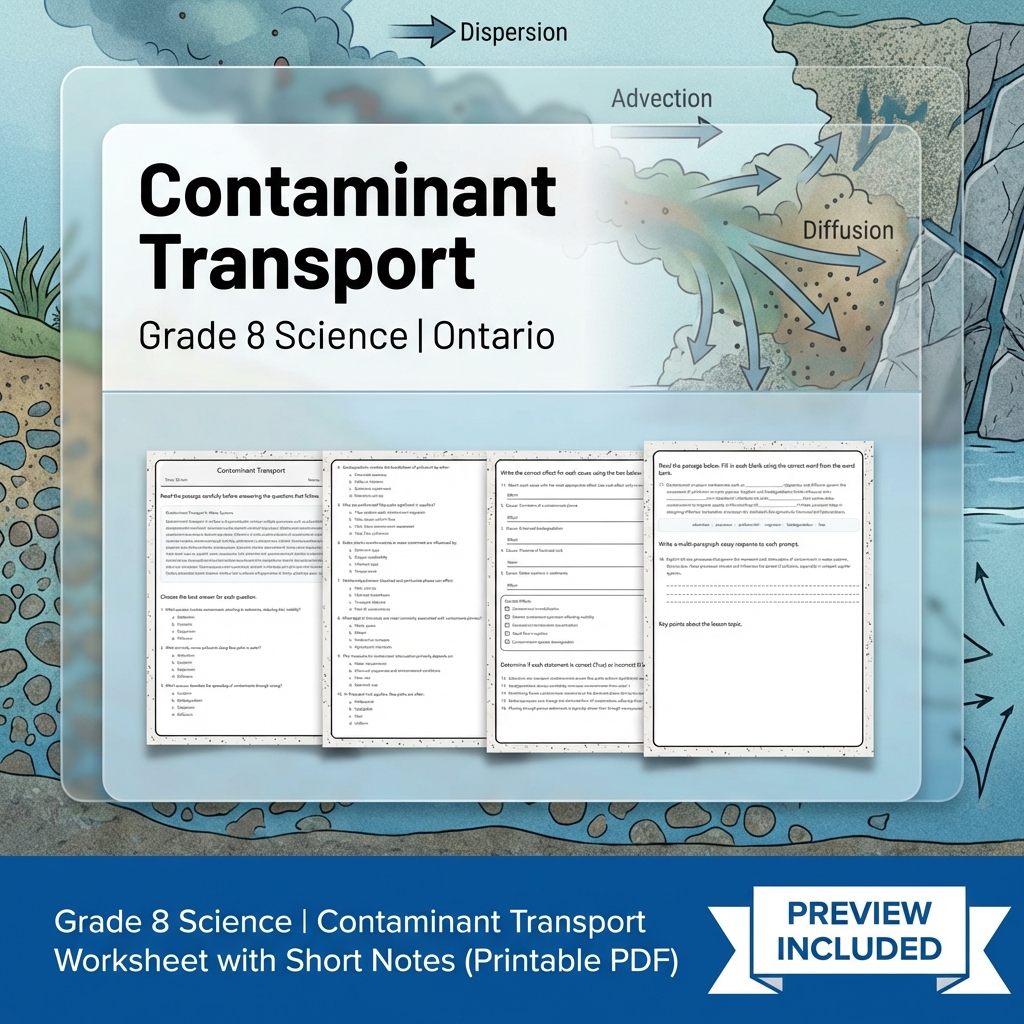
Grade 8 Science | Contaminant Transport Worksheet with Short Notes
Created byMeadowlark WorksheetsLearning Objectives
- Understand the processes governing movement of contaminants in water systems.
- Identify how different mechanisms affect contaminant fate.
- Analyze the formation and migration of contaminant plumes in aquifers.
Also included in: Grade 8 Science Watershed and Water Systems Lesson Group – Ontario Framework +1 more
Instant download

Grade 8 Understanding Fossil Evidence Worksheet | NGSS Evolution Science
Created byBRIGHT PATH RESOURCESLearning Objectives
- Learn to interpret fossil progression and identify transitional fossils.
- Understand how fossil records reveal patterns of evolution.
- Develop skills to analyze scientific evidence supporting common ancestry.
Also included in: Speciation Patterns Grade 8 Science Daily Reading Worksheets Bundle | ngss +2 more
Instant download
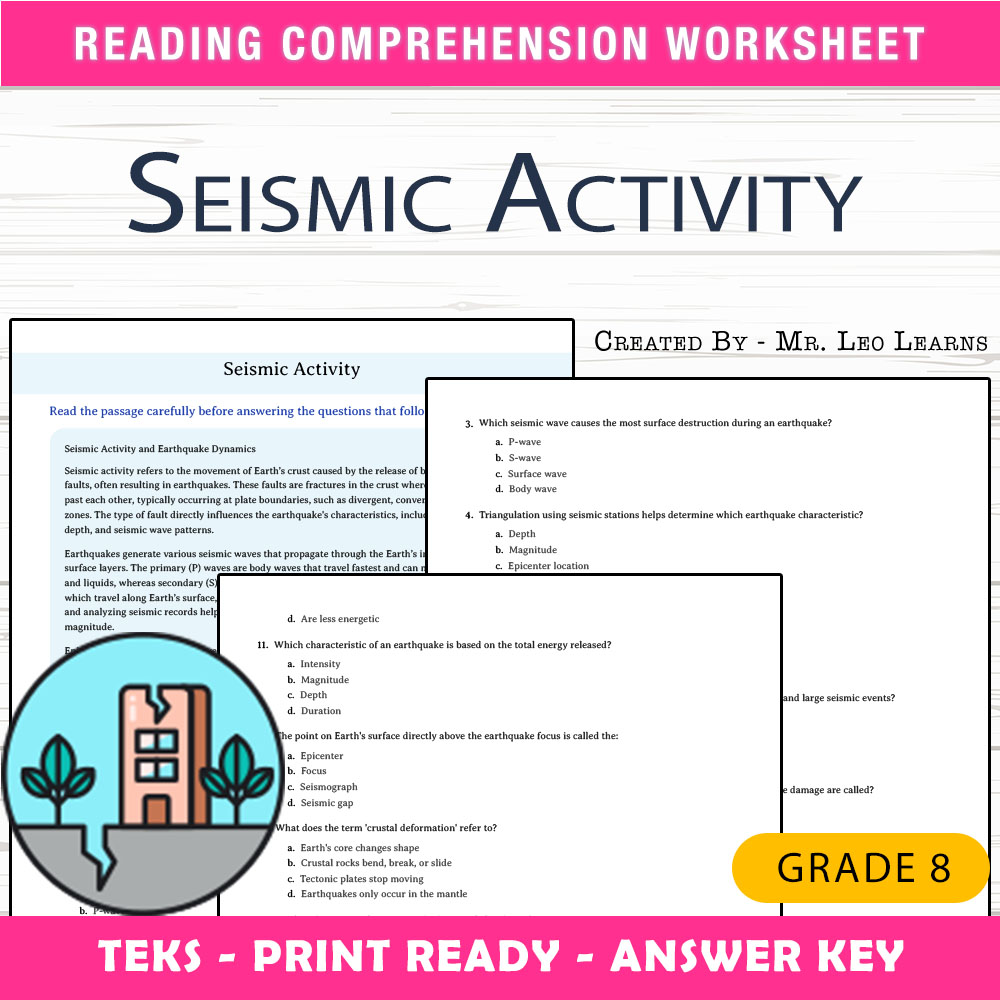
Grade 8 Science — Seismic Activity Worksheet for Mastery
Created byThe Resource HubLearning Objectives
- Understand the mechanisms of earthquake generation at faults and plate boundaries.
- Identify the types of seismic waves and their propagation characteristics.
- Interpret seismic records to locate epicenters and assess earthquake intensity and magnitude.
Also included in: Grade 8 Science UNIT Bundle – Weather, Solar System & Geological Processes +1 more
Instant download
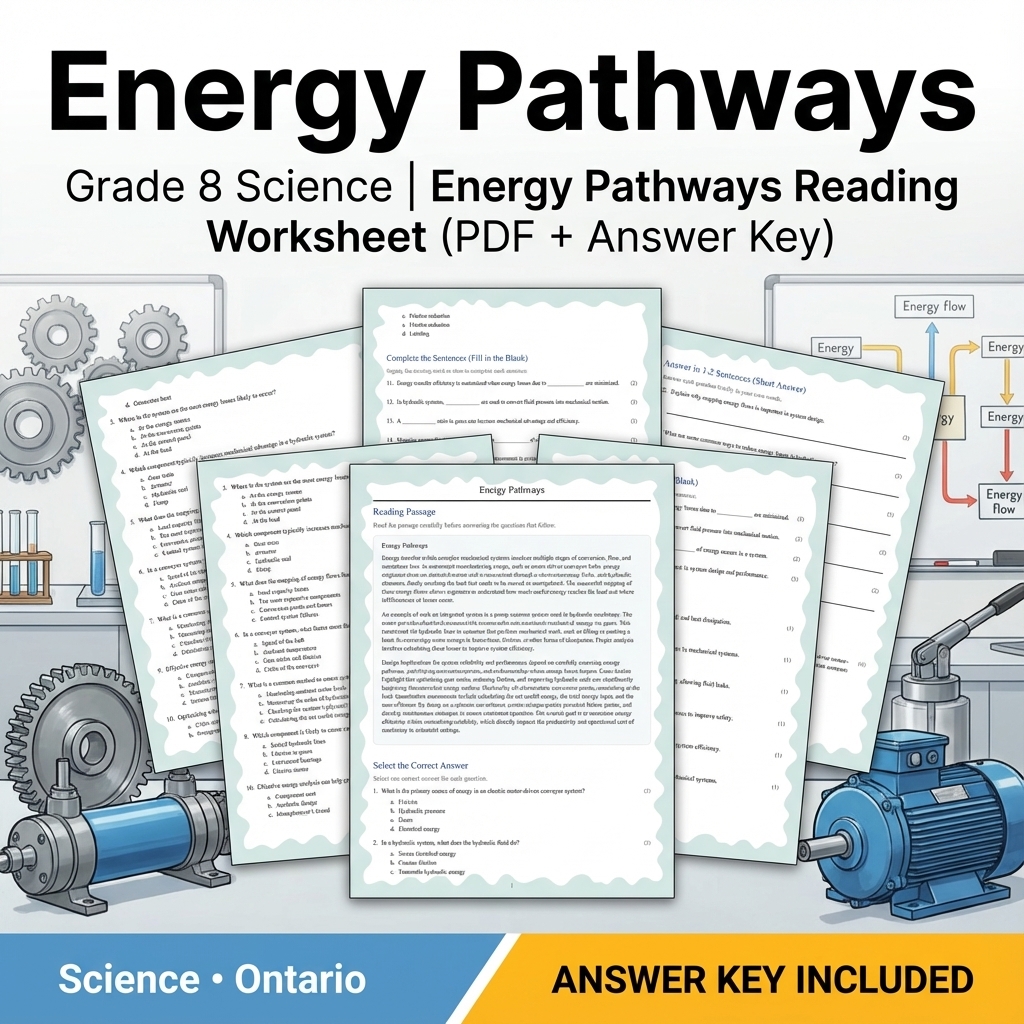
Grade 8 Science | Energy Pathways Reading Worksheet (PDF + Answer Key)
JCreated byJ.S SheetsLearning Objectives
- Analyze energy transfer through mechanical subsystems such as gears, pulleys, and hydraulics.
- Trace and map energy flows from input sources to loads, identifying conversion points.
- Quantify energy losses at various interfaces within coupled systems.
Also included in: Grade 8 Science | Energy & Forces Unit Worksheet Pack (Answer Keys Included) +1 more
Instant download
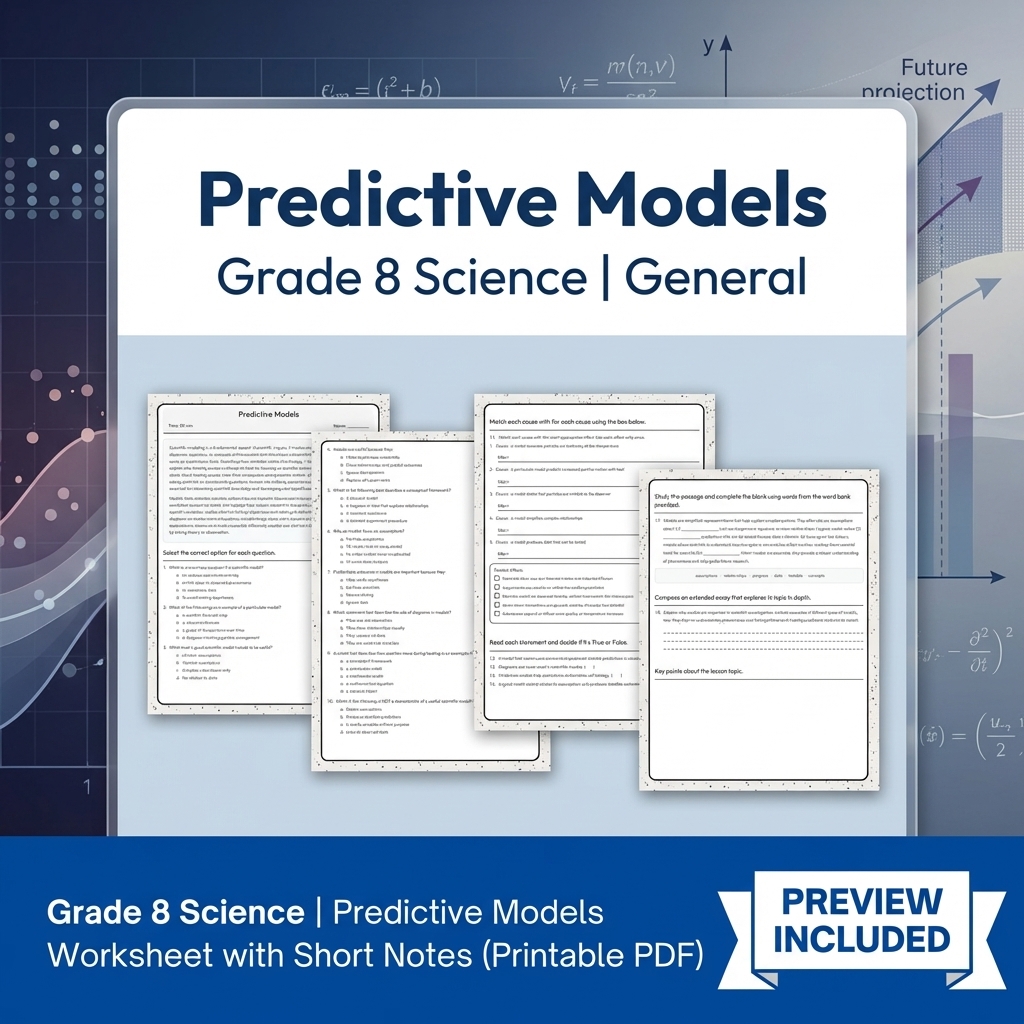
Grade 8 Science | Predictive Models Worksheet with Short Notes (Printable PDF)
Created byMeadowlark WorksheetsLearning Objectives
- Understand the purpose and function of scientific models in explaining phenomena.
- Identify different types of models used in scientific investigations.
- Explain how models make testable predictions about data patterns.
Also included in: Grade 8 Scientific Reasoning Science Lesson Bundle: General Framework +1 more
Instant download

Science Grade 8 Failure Trade-Offs Worksheet | Standards-Aligned Assessment
JCreated byJ.S SheetsLearning Objectives
- Explain how identifying failure points can guide design improvements
- Connect failure causes to specific design features using evidence
- Evaluate design trade-offs between competing constraints (e.g., strength vs. weight)
Also included in: Grade 8 Engineering Design Testing Tradeoffs Science Lesson Bundle - General Framework +1 more
Instant download

Thermal Transfer Worksheet | NGSS Grade 8 Science Assessment
Created bySkylark WorksheetsLearning Objectives
- Explain how conduction, convection, and radiation move thermal energy and how they differ.
- Use material thermal properties (thermal conductivity, specific heat, and insulation thickness) to predict heat flow.
- Describe how geometry and contact area influence the rate of thermal energy transfer in real systems.
Also included in: Grade 8 Energy Science Lesson Bundle: NGSS Assessment & Practice Worksheets +1 more
Instant download
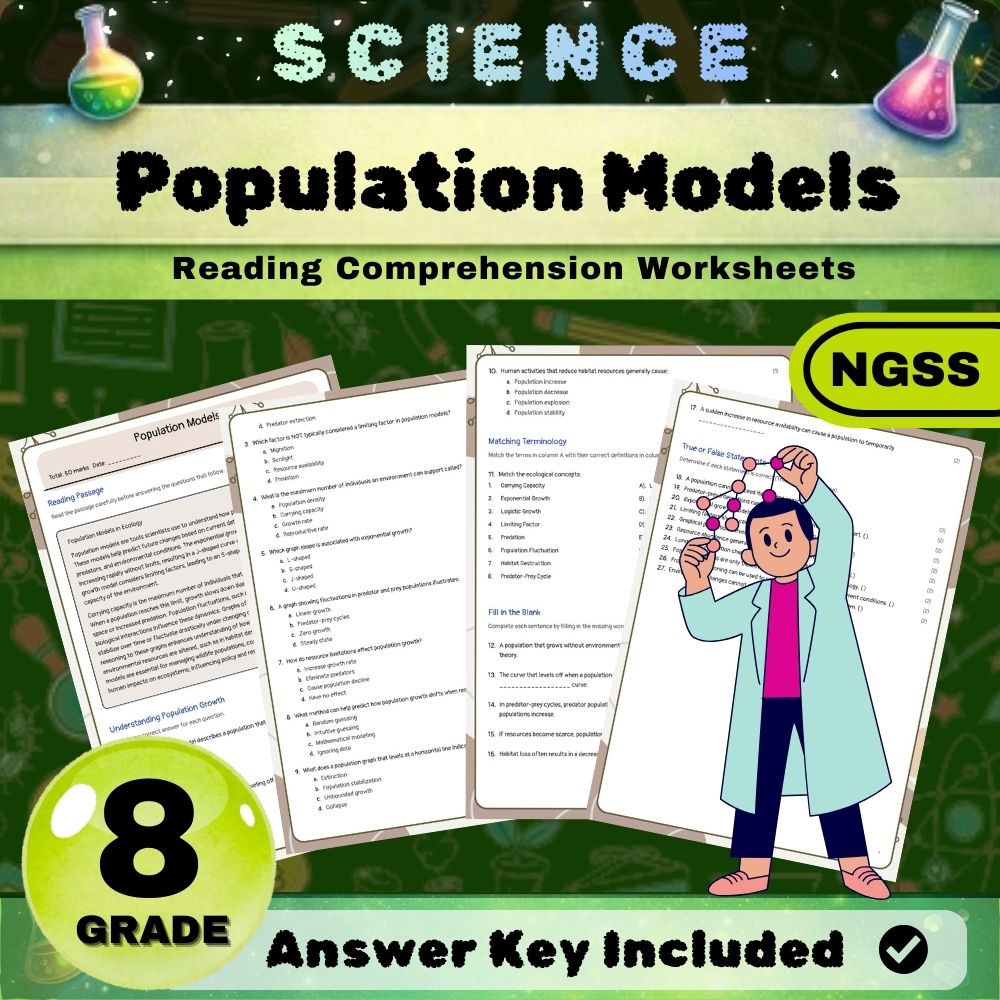
Grade 8 Science | Population Models Worksheet (NGSS) PDF
Created byMaple Path LearningLearning Objectives
- Understand different types of population growth models such as exponential and logistic models.
- Interpret graphical population data to identify fluctuations, steady states, and carrying capacity.
- Apply arithmetic and proportional reasoning to analyze factors influencing population changes.
Also included in: Grade 8 Science NGSS | Biological Evolution: Unity & Diversity Worksheet Bundle +1 more
Instant download

Grade 8 Science – Particle Theory & States of Matter | Daily Reading Worksheet
Created byBright Mind ResourcesLearning Objectives
- Understand the basic concepts of the particle theory of matter.
- Identify how particle arrangements differ in solids, liquids, and gases.
- Explain how particle motion relates to observable properties of matter.
Also included in: Matter Change Grade 8 Science Daily Reading Worksheets Lesson Bundle | Alberta +2 more
Instant download

Grade 8 Science | Energy Flow Worksheet | BC Aligned
Created byLumora LearningLearning Objectives
- Explain how energy enters and moves through ecosystems via photosynthesis and food chains.
- Identify the process of energy transfer and energy loss at each trophic level.
- Describe why top predators are fewer in number within an ecosystem.
Instant download

Consumers Hierarchy Worksheet | Grade 8 Science Activities
Created byPrism Point LearningLearning Objectives
- Explain how consumers occupy trophic positions that determine feeding relationships in food chains
- Differentiate herbivores, omnivores, and carnivores and describe how omnivory can blur trophic levels
- Describe how trophic position influences energy transfer and vulnerability when environmental conditions change
Instant download

Climate Feedbacks & Climate Data Worksheets Grade 8 Science
Created byBRIGHT PATH RESOURCESLearning Objectives
- Explain how long-term climate patterns differ from short-term weather variability
- Identify how feedbacks can amplify or dampen climate change
- Use evidence from temperature and precipitation records to support climate-based explanations
Also included in: Grade 8 Earth & Space Science Worksheets Bundle | Weather & Climate +2 more
Instant download

Systems Analysis Assessment for Grade 8 Science | TEKS Standards
Created byPrism Point LearningLearning Objectives
- Analyze mechanical systems by applying force, motion, and energy concepts.
- Solve multi-step problems involving net force, energy transfer, and motion outcomes.
- Evaluate real-world constraints such as friction and material limits in system performance.
Also included in: Grade 8 Force, Motion, and Energy Science Lesson Bundle TEKS Standards
Instant download

Grade 8 Science – Momentum & Collisions | Daily Reading Worksheet
Created byBright Mind ResourcesLearning Objectives
- Define linear momentum and understand its physical significance.
- Explain the principle of conservation of momentum in isolated systems.
- Differentiate between elastic and inelastic collisions.
Also included in: Grade 8 Energy & Motion Science Daily Reading Worksheets Lesson Bundle | TEKS +2 more
Instant download

Grade 8 Science – Closed Systems & Daily Reading Worksheet | Alberta Standards
Created byBright Mind ResourcesLearning Objectives
- Define what a closed system is in scientific contexts.
- Identify characteristics that distinguish closed systems from open systems.
- Explain the significance of mass conservation in closed-system analysis.
Also included in: Matter Change Grade 8 Science Daily Reading Worksheets Lesson Bundle | Alberta +2 more
Instant download
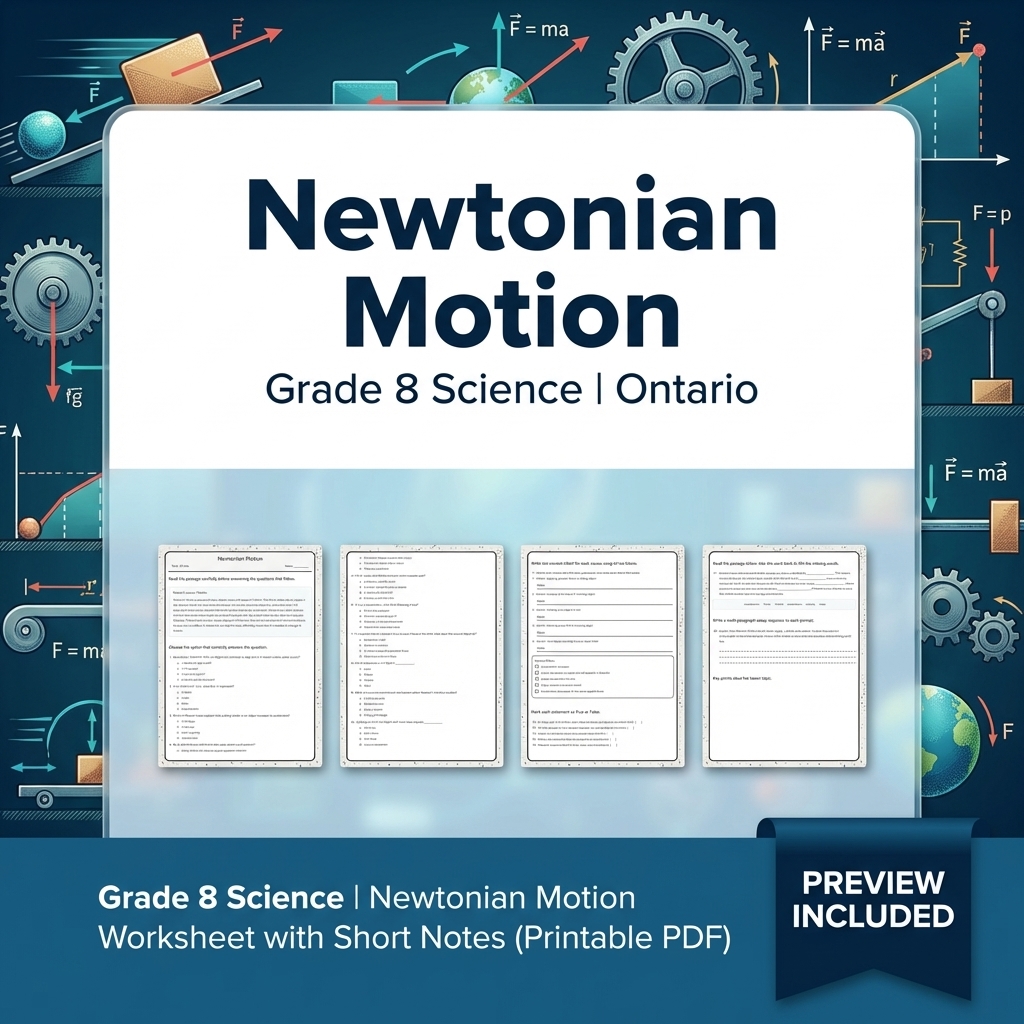
Grade 8 Science | Newtonian Motion Worksheet with Short Notes (Printable PDF)
Created byMeadowlark WorksheetsLearning Objectives
- Describe Newton’s three laws of motion and their applications in mechanical systems.
- Explain the quantitative relationship between force, mass, and acceleration using F = ma.
- Identify cause-and-effect relationships in motion scenarios involving forces.
Also included in: Grade 8 Science Lesson Group Bundle for Ontario Curriculum +1 more
Instant download

Grade 8 Science – Factors Affecting Reaction Speed Worksheet + Answer Key
JCreated byJ.S SheetsLearning Objectives
- Identify the main factors that influence how quickly a chemical reaction occurs.
- Explain how temperature, concentration, surface area, and catalysts affect reaction speed.
- Connect observable reaction changes to molecular collision theories.
Also included in: Grade 8 Science Lesson Bundle | TEKS Standards for Classroom Success +1 more
Instant download

Inherited Traits Worksheet | California Standards Grade 8 Science Practice
JCreated byJ.S SheetsLearning Objectives
- Understand how genes influence physical and behavioral traits passed from parents to offspring.
- Describe the difference between dominant and recessive alleles and how they affect traits.
- Explain how variation in traits supports the idea of inherited factors contributing to survival and function.
Also included in: Grade 8 Adaptation and Ecosystem Change Science Lesson Bundle +1 more
Instant download
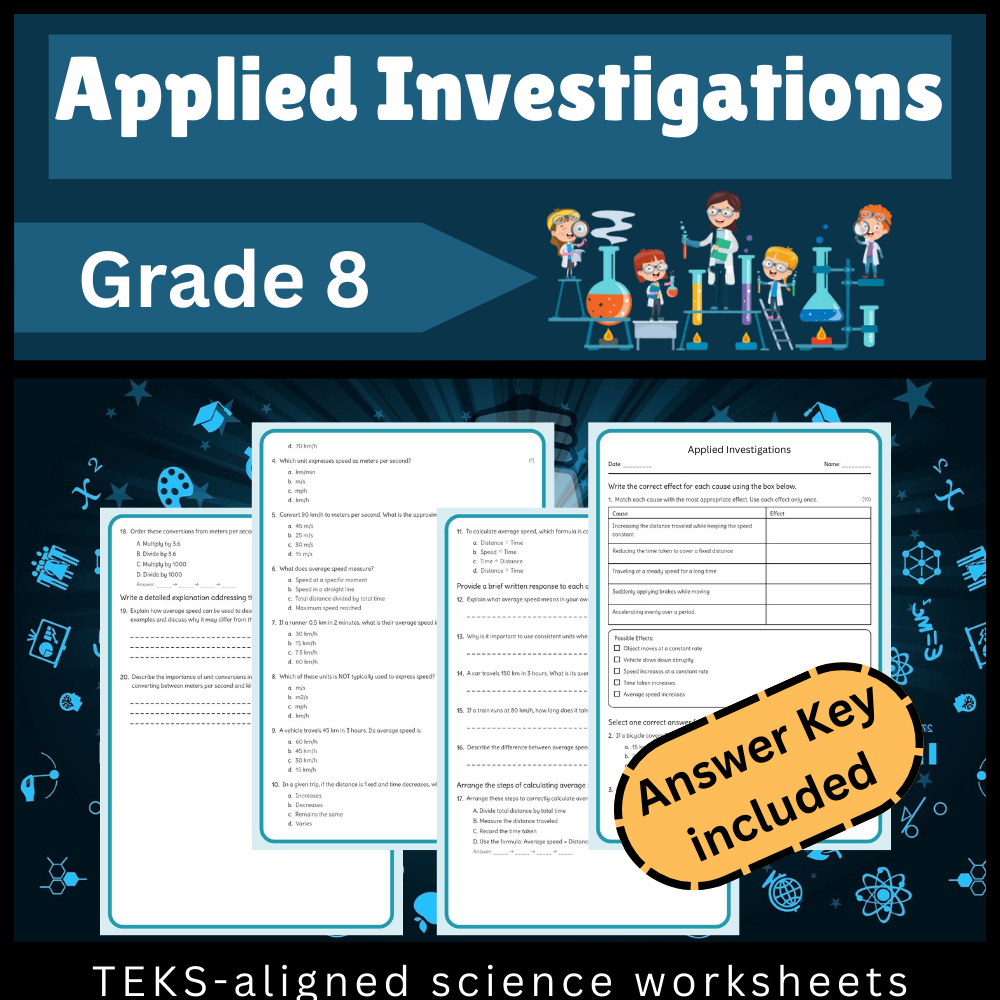
8th Grade Science | Applied Investigations Worksheet (PDF) – TEKS Aligned
Created byBright Mind ResourcesLearning Objectives
- Understand how to select variables and design experiments for real-world phenomena.
- Analyze data using graphical and statistical summaries to draw conclusions.
- Apply ethical, safety, and transparent practices in conducting investigations.
Also included in: Grade 8 Science Unit Bundle | Scientific Inquiry, Data & Measurement Skills +1 more
Instant download

Science Theory Revision Worksheet | Standards-Aligned Grade 8 Science Practice
JCreated byJ.S SheetsLearning Objectives
- Explain how scientific theories change when new evidence or improved measurements become available.
- Use evidence to compare competing explanations and decide which one best fits observations.
- Describe how theories are used to make predictions while remaining open to revision.
Also included in: Grade 8 Evidence-Based Scientific Inquiry Science Lesson Bundle | Florida NGSSS +1 more
Instant download
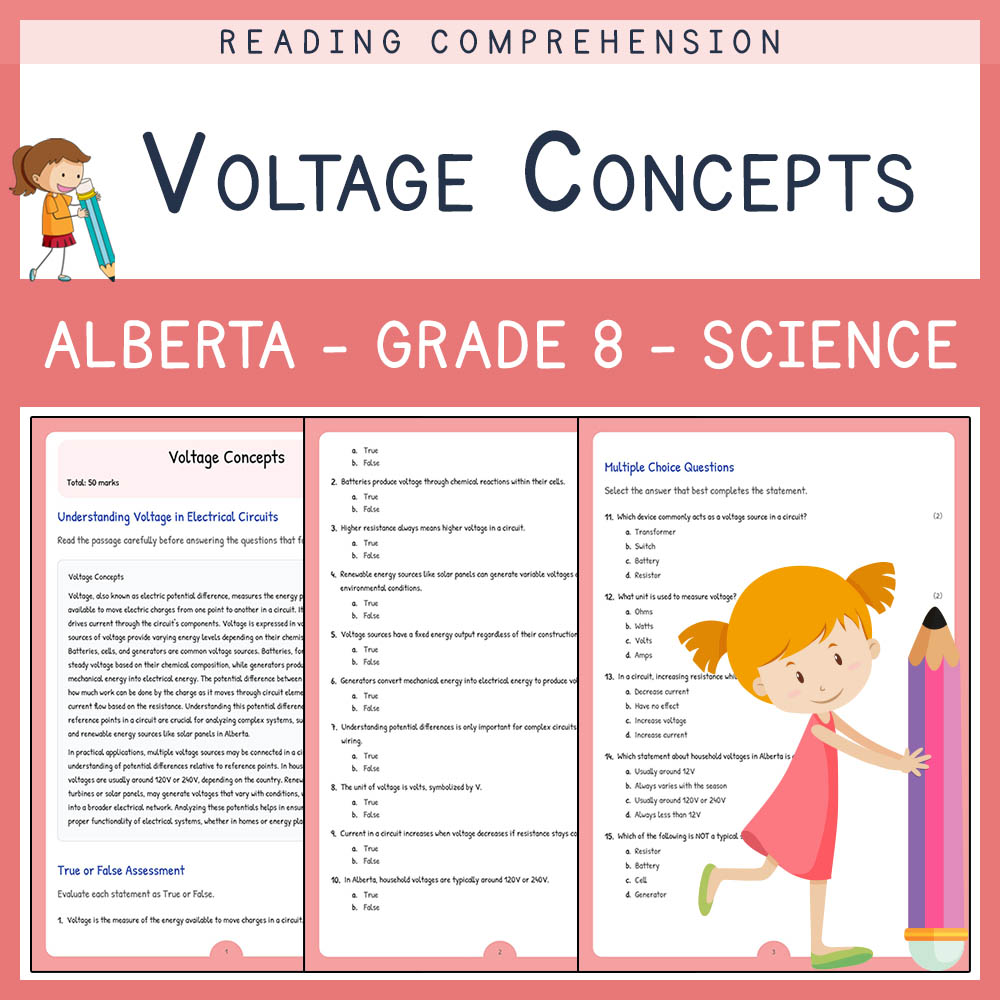
Grade 8 Science | Voltage Concepts Worksheet | Alberta Standards
Created byLumora LearningLearning Objectives
- Explain the concept of voltage and its role in electrical circuits.
- Identify different sources of voltage such as batteries, cells, and generators.
- Understand the relationship between voltage, current, and resistance in a circuit.
Instant download
About Grade 8 Science Worksheets
Explore Grade 8 Science worksheets for classwork, homework, or review. Our 6,006 printables download instantly as PDFs.
Each resource here is built by an independent educator and reviewed for quality. Worksheets print straight from PDF and suit classroom use, homework, or extra practice; most come with answer keys, and you can preview before purchasing.