
Grade 8 Science Worksheets
6,006 worksheets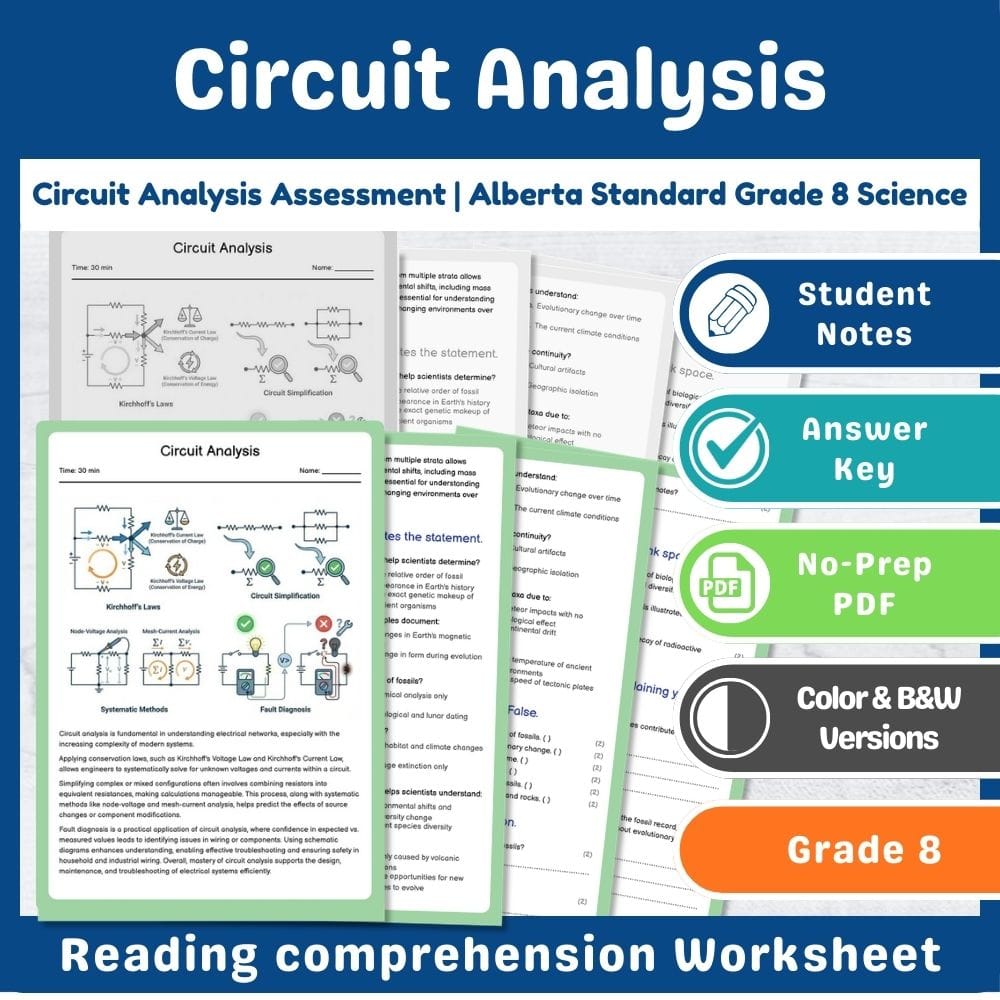
Circuit Analysis Assessment | Alberta Standard Grade 8 Science
 Created byPrism Point Learning
Learning Objectives
- Understand the principles of circuit analysis and conservation laws.
- Apply systematic methods to determine voltages, currents, and power in electrical networks.
- Use schematic diagrams and equivalent resistance reduction to simplify complex circuits.
Instant download
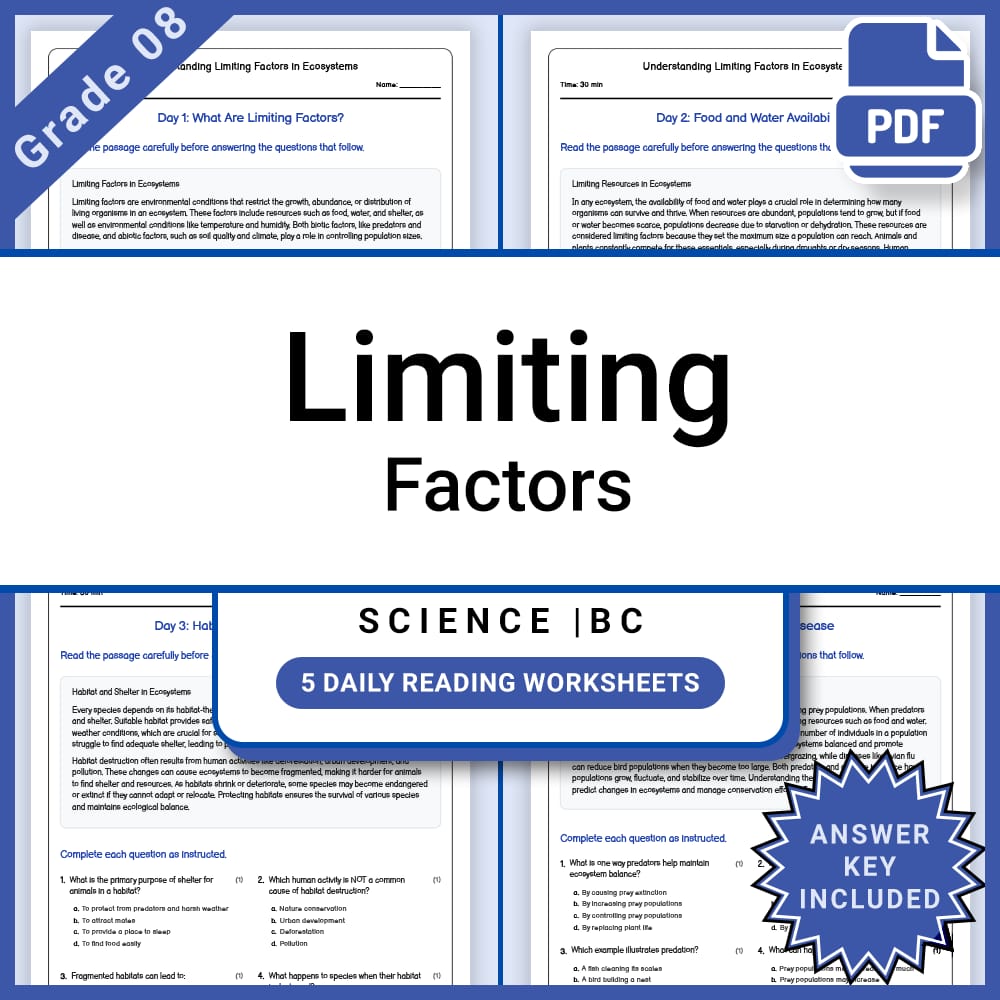
Grade 8 Science – Limiting Factors Daily Reading Worksheet + Answer Key
JCreated byJ.S SheetsLearning Objectives
- Define what limiting factors are in an ecosystem.
- Identify various biotic and abiotic factors that limit population growth.
- Explain how limiting factors influence population cycles and stability.
Also included in: Grade 8 Science Lesson Bundle: Ecosystems, Biodiversity & Environmental Impacts +1 more
Instant download

Grade 8 Science | Energy Efficiency in Ecosystems - Daily Reading Comprehension
 Created byCoral Reef Learning
Learning Objectives
- Understand how energy transfers through trophic levels in food chains
- Identify the efficiency ranges of energy transfer between organisms
- Explain why predators need large territories based on energy transfer limitations
Also included in: Interactions and Ecosystems Lesson Bundle Grade 8 Science – Alberta +1 more
Instant download

Grade 8 Science – Energy Metabolism & Cellular Respiration | Daily Worksheet
 Created byQuiet Forest Education
Learning Objectives
- Understand the steps of glycolysis in cellular respiration
- Identify where glycolysis occurs in the cell
- Explain the importance of ATP production during glycolysis
Also included in: Cell Biology Grade 8 Science Daily Reading Worksheets Bundle | Ontario +1 more
Instant download

Phase Transitions Worksheet Grade 8 Science Activities | Alberta Standards
Created byPrism Point LearningLearning Objectives
- Explain how energy changes and particle motion relate to phase transitions between solid, liquid, and gas.
- Identify examples of melting, freezing, vaporization, and condensation in everyday and Alberta-based contexts.
- Describe how phase transitions affect temperature, pressure-related behavior, and natural systems like rivers and watersheds.
Also included in: Grade 8 Matter & Chemical Change Lesson Bundle | Alberta Science
Instant download

Grade 8 Science – Moon's Phases Daily Reading Worksheet + Answer Key
JCreated byJ.S SheetsLearning Objectives
- Describe the different phases of the Moon
- Explain how the relative positions of the Earth, Moon, and Sun create lunar phases
- Identify the characteristics of each lunar phase
Also included in: Grade 8 Science Lesson Bundle | TEKS Standards Worksheets for Earth & Space +1 more
Instant download

Grade 8 Balanced Equations Reaction Quantities Worksheet | Alberta Science
 Created byBRIGHT PATH RESOURCES
Learning Objectives
- Identify mole ratios from coefficients in a balanced chemical equation
- Use mole ratios to predict relative mass amounts of reactants and products
- Explain how mass conservation helps interpret changes in a closed system
Also included in: Grade 8 Alberta Science Matter and Chemical Change Worksheet Bundle +1 more
Instant download

Grade 8 Science – Work & Energy in Physics | Daily Reading Worksheet
 Created byBright Mind Resources
Learning Objectives
- Understand that work is done when a force is applied to move an object over a distance.
- Relate work to changes in kinetic and potential energy within mechanical systems.
- Calculate work for constant and variable forces, including lifting objects and compressing springs.
Also included in: Grade 8 Mechanical Systems Science Reading Worksheets – Lesson Bundle | Ontario +1 more
Instant download

Grade 8 Science– Motors & Generators Daily Reading Worksheet | Alberta Standards
Created byBright Mind ResourcesLearning Objectives
- Understand the basic principles of electromagnetic energy conversion in motors and generators
- Identify the differences and similarities between motors and generators
- Recognize practical applications of motors and generators in regional infrastructure
Also included in: Grade 8 Electricity Science Daily Reading Worksheets Lesson Bundle | Alberta +2 more
Instant download

Grade 8 Inclined Planes Worksheet | Mechanical Advantage Science Ontario
 Created byChalk and Compass
Learning Objectives
- Explain how an inclined plane changes the direction and magnitude of the force needed to move a load using force components.
- Calculate ideal mechanical advantage (IMA) using the ratio of slope length to height.
- Describe how friction affects the required input force compared with ideal conditions.
Also included in: Grade 8 Science Mechanical Systems Lesson Bundle | Ontario +1 more
Instant download

Grade 8 Science – Genes & Traits | Daily Reading Worksheet
Created byBright Mind ResourcesLearning Objectives
- Understand key concepts related to Science
- Apply knowledge through practice questions
- Demonstrate comprehension of the material
Also included in: Genetics Grade 8 Science Daily Reading Worksheets lesson bundle | Florida NGSSS +1 more
Instant download
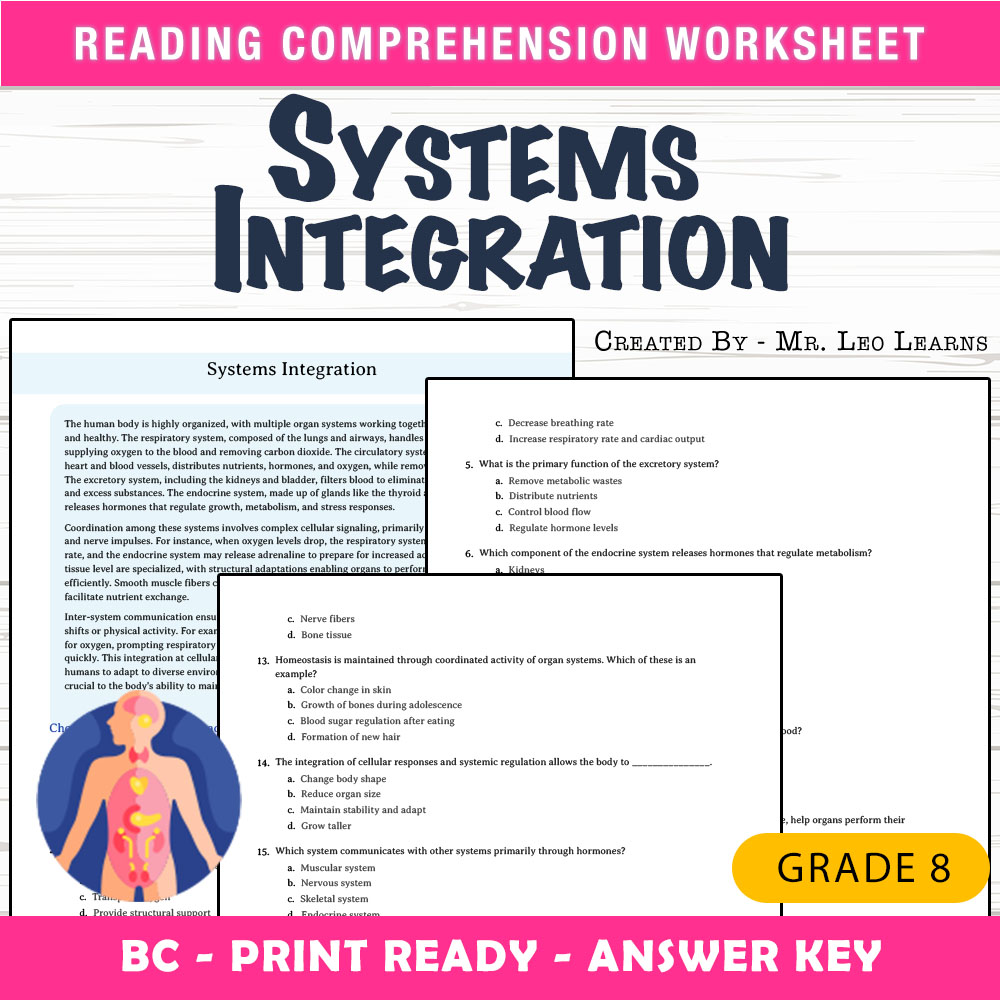
Grade 8 Science — Worksheet MCQ Paper for Mastering Systems Integration
 Created byThe Resource Hub
Learning Objectives
- Understand how multiple organ systems work together to maintain homeostasis.
- Identify the roles of respiratory, circulatory, excretory, and endocrine systems.
- Explain how cellular and tissue structures support system functions.
Also included in: Grade 8 Science UNIT | Multicellular Structure & Function Worksheet Bundle +1 more
Instant download

Science Designing Studies with Control Variables Worksheet | Grade 8
JCreated byJ.S SheetsLearning Objectives
- Identify the independent, dependent, and controlled variables in a study and explain how they relate to the question being tested
- Choose data collection methods that match the outcome being measured using consistent tools, units, and procedures
- Design a fair comparison by controlling common confounding causes (such as temperature, material type, or exposure time)
Also included in: Grade 8 Scientific Reasoning and CER Science Lesson Bundle | General +1 more
Instant download

Grade 8 Science | Energy Transformations Worksheet (PDF) (General Standard)
 Created byEvergreen Desk Education
Learning Objectives
- Explain how energy can change form during physical processes without being created or destroyed.
- Identify examples of energy transformations involving mechanical, thermal, electrical, and light energy.
- Use observable evidence (like warming and slowed motion) to connect effects to energy changes.
Also included in: Grade 8 Matter, Forces, and Energy Science Lesson Bundle: General Framework +1 more
Instant download
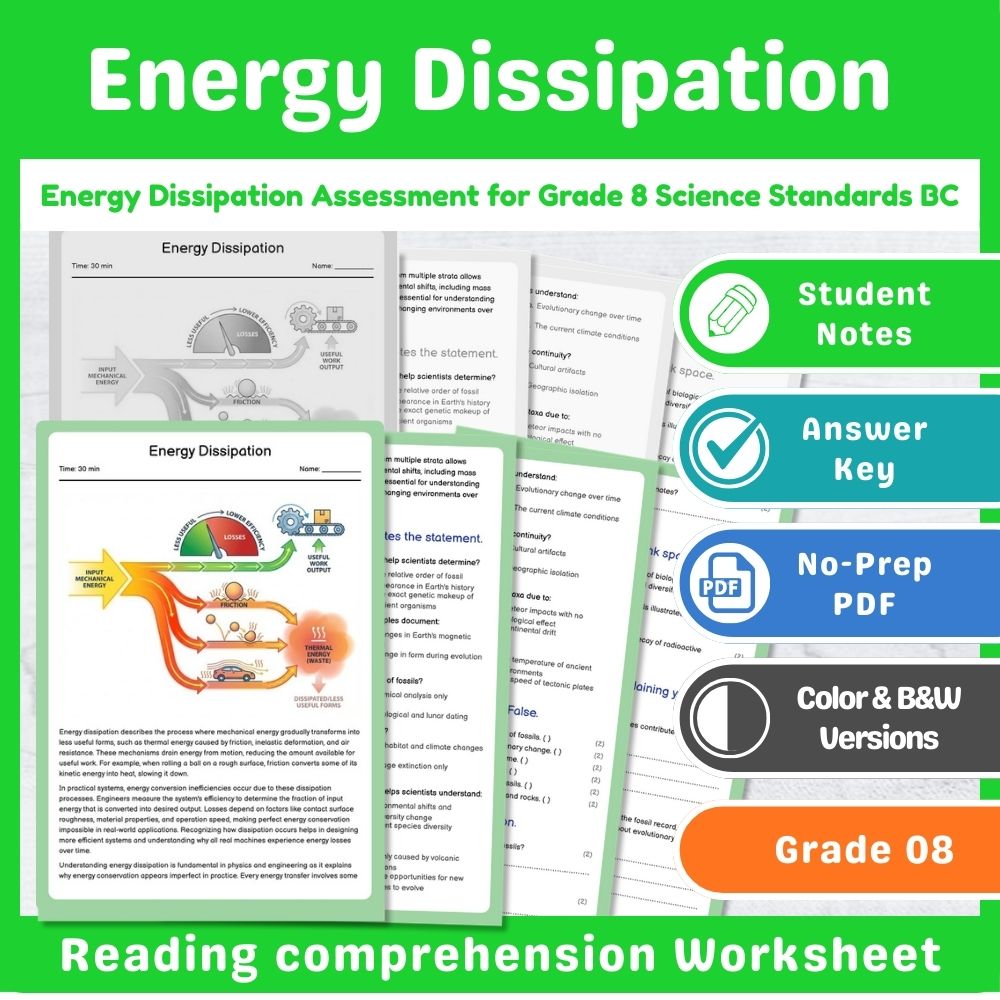
Energy Dissipation Assessment for Grade 8 Science Standards BC
Created byPrism Point LearningLearning Objectives
- Explain how mechanical energy is transformed into other forms such as thermal energy through various dissipation mechanisms.
- Identify common energy dissipation processes like friction, air resistance, and inelastic deformation.
- Describe the concept of efficiency and how losses occur in mechanical systems due to energy dissipation.
Instant download
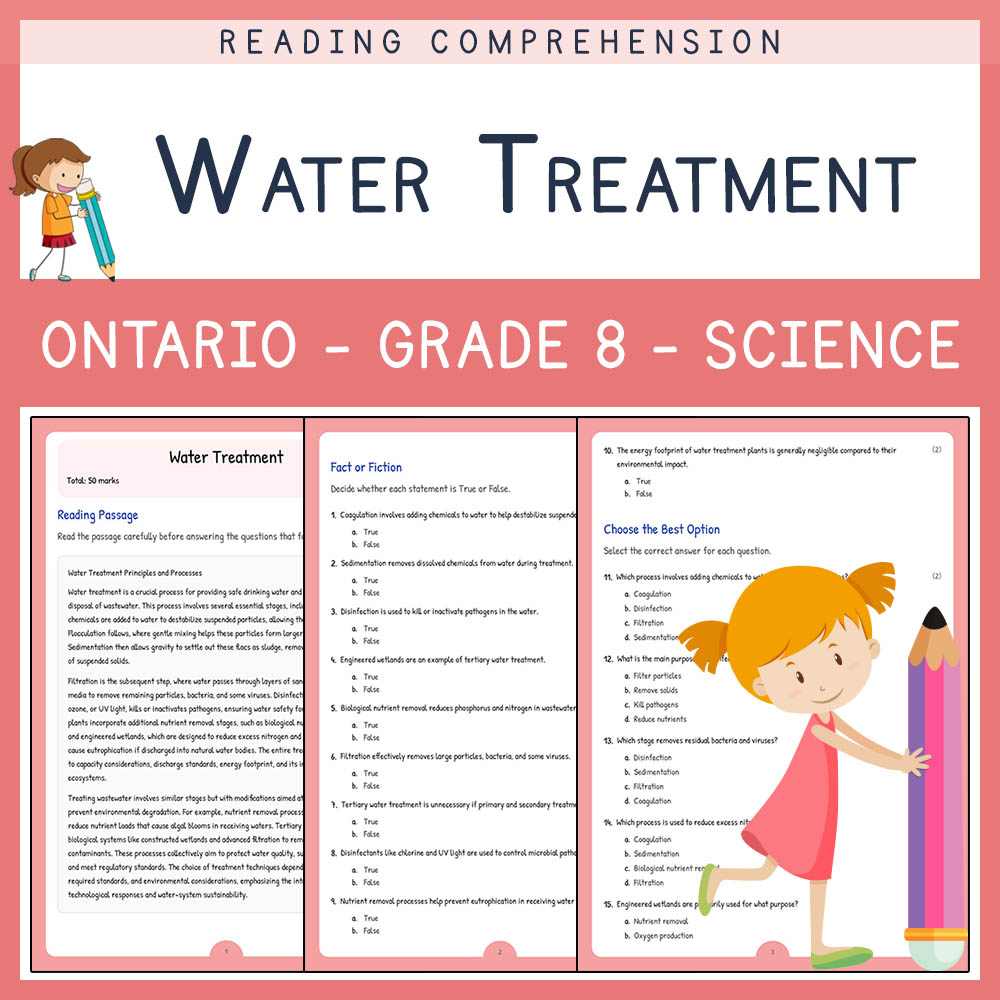
Grade 8 Science Assessment | Water Treatment Worksheet Elena | Ontario
 Created byLumora Learning
Learning Objectives
- Understand the principles and stages involved in drinking-water and wastewater treatment.
- Identify mechanisms used for removal of solids, pathogens, and contaminants.
- Explain advanced processes like biological nutrient removal and engineered wetlands.
Instant download

Energy in Motion Worksheet Grade 8 Science Review & Practice Activity
Created byPrism Point LearningLearning Objectives
- Explain how gravitational potential energy and kinetic energy change as an object moves up or down.
- Use conservation reasoning to predict how an object's speed changes during vertical motion in a system.
- Interpret energy transfer on a roller coaster model to describe speed and height at key points.
Instant download

Critical Evaluation Assessment for Grade 8 Science TEKS Standards
Created byPrism Point LearningLearning Objectives
- Develop skills to evaluate the credibility of scientific claims.
- Distinguish between correlation and causation in scientific data.
- Identify logical fallacies and assess evidence quality in arguments.
Also included in: Grade 8 Scientific Inquiry & Data Analysis Science Lesson Bundle TEKS
Instant download

Grade 8 Science – Climate Patterns & Feedbacks | Daily Reading Worksheet
Created byBright Mind ResourcesLearning Objectives
- Understand how climate data is collected and summarized into patterns.
- Identify the difference between natural variability and persistent climate change.
- Learn about feedback mechanisms such as ice-albedo effects and water vapor influence.
Also included in: Earth & Space Grade 8 Science Daily Reading Worksheets Lesson Bundle | General +1 more
Instant download

Momentum Collisions Worksheet for Grade 8 Science | NGSS Practice
JCreated byJ.S SheetsLearning Objectives
- Understand the principles of momentum exchange during collisions.
- Differentiate between elastic and inelastic collisions based on energy conservation.
- Analyze real-world collision scenarios using impulse and momentum concepts.
Also included in: Grade 8 Forces and Electromagnetism Science Lesson Bundle NGSS Worksheets +1 more
Instant download
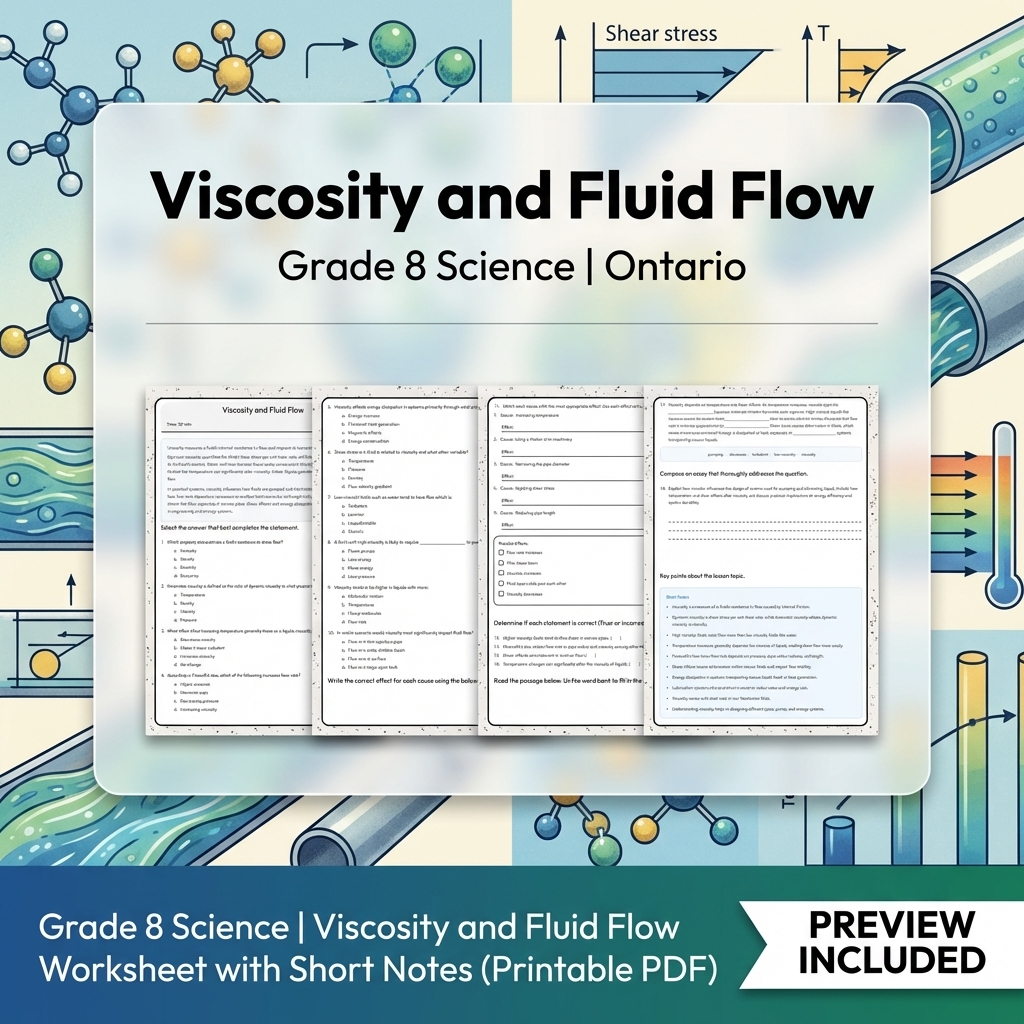
Grade 8 Science | Viscosity and Fluid Flow Worksheet with Short Notes (PDF)
 Created byMeadowlark Worksheets
Learning Objectives
- Define and distinguish between dynamic and kinematic viscosity.
- Describe how viscosity affects flow rates of liquids in pipes.
- Identify factors such as temperature and shear that influence viscosity.
Also included in: Grade 8 Science Lesson Group Bundle | Hydrostatics & Fluid Mechanics +1 more
Instant download

Grade 8 Science – Scientific Method & Inquiry | Daily Reading Worksheet
Created byBright Mind ResourcesLearning Objectives
- Understand the steps involved in the scientific method
- Identify key elements like hypotheses, operational definitions, and predictions
- Recognize examples of scientific inquiry related to motion and measurement
Also included in: Experiments Grade 8 Science Daily Reading Worksheets Lesson Bundle | TEKS +2 more
Instant download

Causal Reasoning Assessment | General Grade 8 Science Standards-Aligned
Created byPrism Point LearningLearning Objectives
- Understand how to evaluate whether evidence supports a causal claim or only shows correlation.
- Identify variables, potential causes, and patterns across different conditions or trials.
- Assess the strength and limitations of data when interpreting media-like statements about causality.
Also included in: Grade 8 Scientific Inquiry & Practices Science Lesson Bundle: General
Instant download

Life-Cycle Tradeoffs Assessment | General Standards-Aligned Grade 8 Science
Created byPrism Point LearningLearning Objectives
- Understand how system-level evaluation considers interdependent parts and full use periods.
- Identify how materials, manufacturing, maintenance, and disposal impact environmental outcomes.
- Evaluate trade-offs in product design, such as reusability versus energy use.
Instant download

Grade 8 Science – Ecosystem Models & Components | Daily Reading Worksheet
Created byBright Mind ResourcesLearning Objectives
- Identify biotic and abiotic components in ecosystems
- Understand how energy and resources flow within ecosystems
- Interpret simple system diagrams related to ecosystems
Also included in: Ecosystem Dynamics Grade 8 Science Daily Reading Worksheets Bundle | NGSS +1 more
Instant download
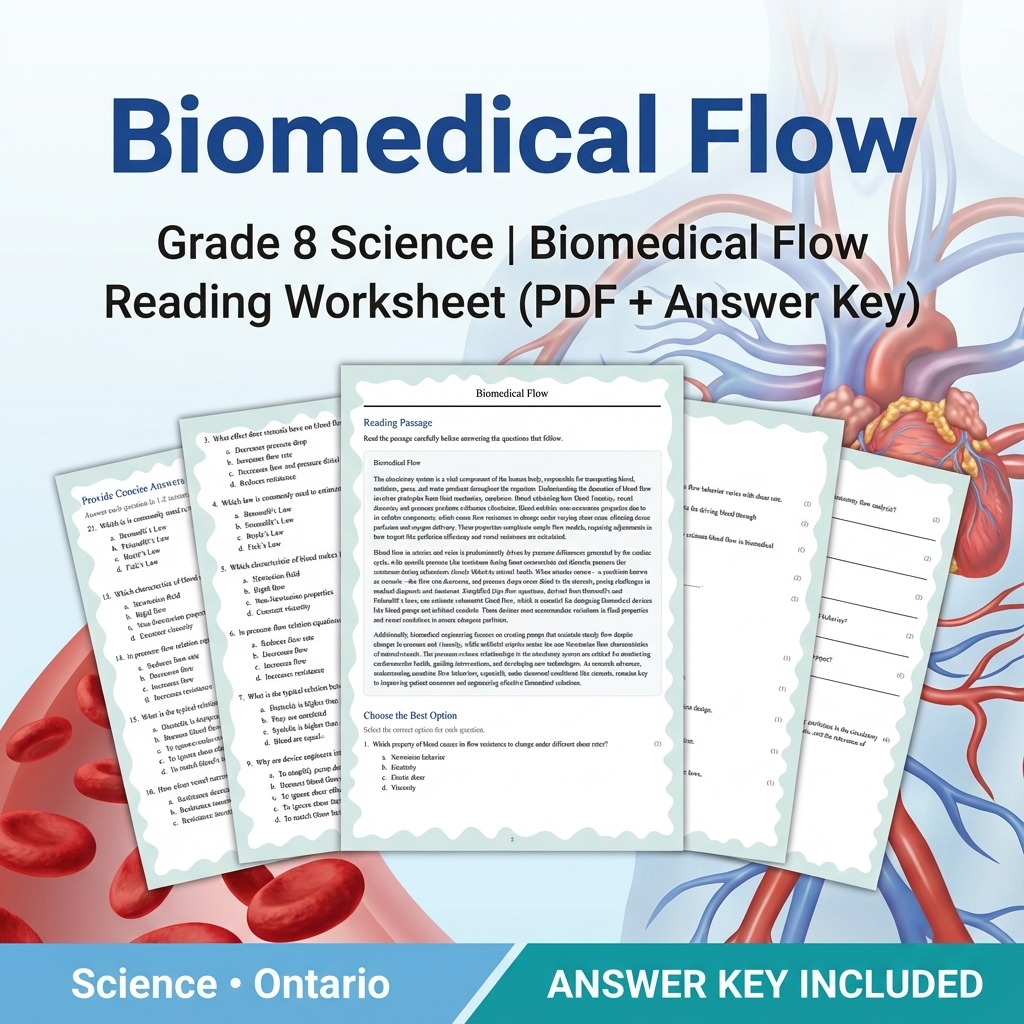
Grade 8 Science | Biomedical Flow Reading Worksheet (PDF + Answer Key)
JCreated byJ.S SheetsLearning Objectives
- Explain how blood flow is affected by viscosity, vessel diameter, and pressure gradients.
- Describe the effects of non-Newtonian blood properties on circulation and perfusion.
- Relate systolic and diastolic pressures to arterial function and health.
Also included in: Grade 8 Science Unit Bundle – Density, Pressure & Fluid Mechanics Worksheets +1 more
Instant download

DNA and Traits Assessment Worksheet | Grade 8 Science NGSS Review
Created byPrism Point LearningLearning Objectives
- Explain how DNA sequence information becomes proteins and then observable traits.
- Describe gene structure and the roles of coding sequences, transcription, and translation.
- Predict how point mutations and frameshifts can change amino acids and protein function.
Also included in: Grade 8 Genetics Lesson Bundle: Mendelian Patterns & DNA Traits (NGSS)
Instant download

Density Effects Worksheet | Grade 8 Science Practice
Created byPrism Point LearningLearning Objectives
- Explain how density-dependent factors can change population growth as population density increases
- Differentiate density-independent factors (such as weather events) from density-dependent factors
- Describe how habitat fragmentation and human barriers can alter density effects and dispersal
Instant download

Grade 8 Science | Energy Changes Worksheet | BC Standards
Created byLumora LearningLearning Objectives
- Understand how chemical bonds involve energy changes during reactions.
- Distinguish between endothermic and exothermic reactions based on energy flow.
- Explain how energy profiles and bond enthalpies relate to temperature changes observed during reactions.
Instant download

Grade 8 Science – Contaminant Transport & Water Pollution | Reading Worksheet
Created byBright Mind ResourcesLearning Objectives
- Understand the processes governing the movement of contaminants in surface and subsurface water.
- Identify common sources of water contaminants and their pathways.
- Learn about the formation of contaminant plumes and flow paths in aquifers and fractured rocks.
Also included in: Grade 8 Water Systems Science Daily Reading Worksheets Lesson Bundle | Ontario +1 more
Instant download
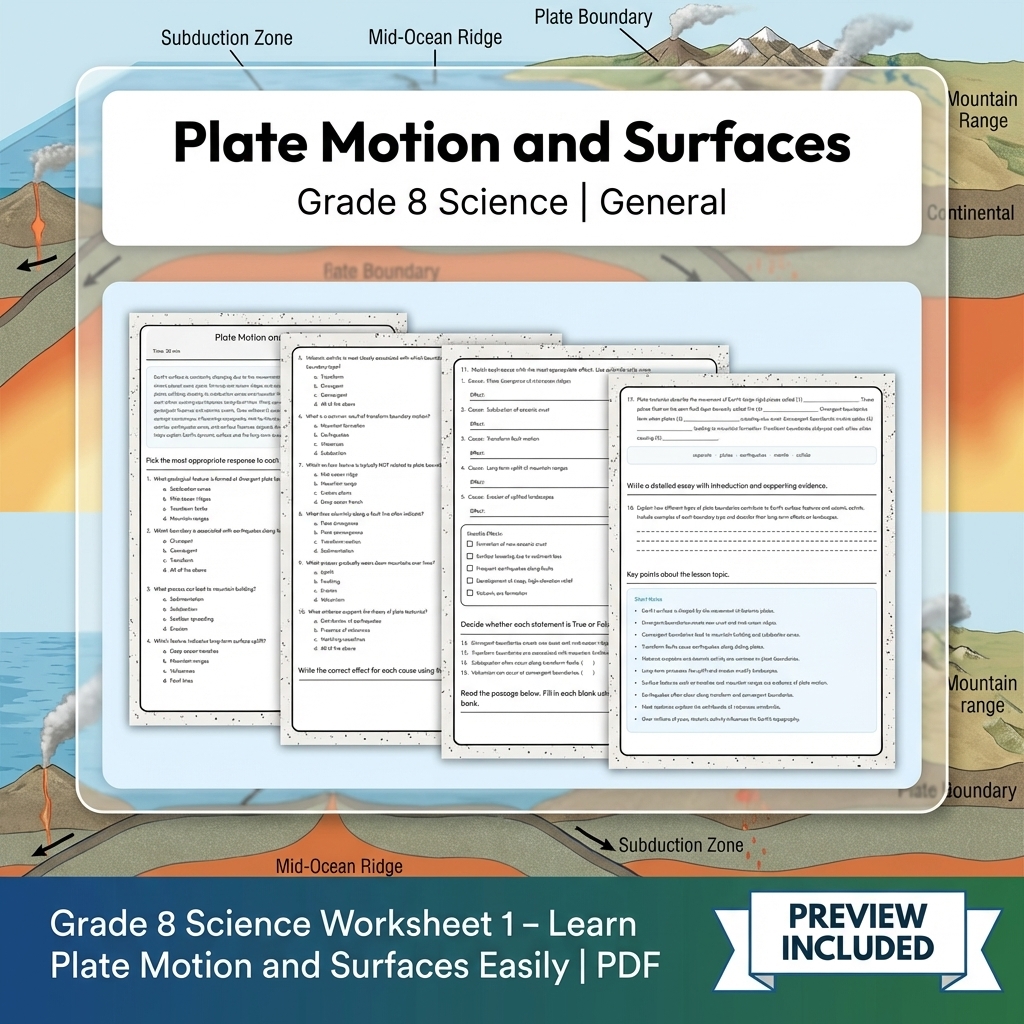
Grade 8 Science WorksheetLearn Plate Motion and Surfaces Easily | PDF
Created byMeadowlark WorksheetsLearning Objectives
- Understand how tectonic plate boundaries shape Earth's surface.
- Identify different types of plate boundaries and their effects.
- Explain how geological features like mountains, ridges, and earthquakes relate to plate movements.
Also included in: Grade 8 Weather and Climate Science Lesson Bundle: General Framework +1 more
Instant download

Grade 8 Science | Biotech Considerations Worksheet (Ontario Standards) (PDF)
Created byEvergreen Desk EducationLearning Objectives
- Explain how cell culture, stem cell differentiation, and tissue engineering are used to repair or replace damaged tissues.
- Describe how molecular markers and scaffold interactions help researchers control cell behavior in biotech applications.
- Identify major safety, ethical, and regulatory considerations involved in manipulating cells and tissues.
Also included in: Grade 8 Cell Structure & Homeostasis Science Lesson Bundle (Ontario) +1 more
Instant download

Grade 8 Science | Water Cycle Models Worksheet (Practice Set)
Created byEvergreen Desk EducationLearning Objectives
- Describe the main components of the water cycle (atmosphere, surface water, and groundwater) in terms of moving water.
- Explain how key processes—evaporation, condensation, precipitation, infiltration, runoff, and storage—transfer water between reservoirs.
- Use a simple model to predict how changes in one part of the water cycle affect other parts.
Also included in: Grade 8 Earth and Space Science Lesson Bundle - General Framework +1 more
Instant download

Energy Transformations Assessment for Grade 8 Science | NGSSS Standards
Created byPrism Point LearningLearning Objectives
- Explain how energy can change forms within a system while following energy conservation.
- Identify examples of transformations between potential, kinetic, electrical, and thermal energy.
- Use key terms and cause-effect reasoning to describe how energy transfers affect motion and temperature.
Instant download
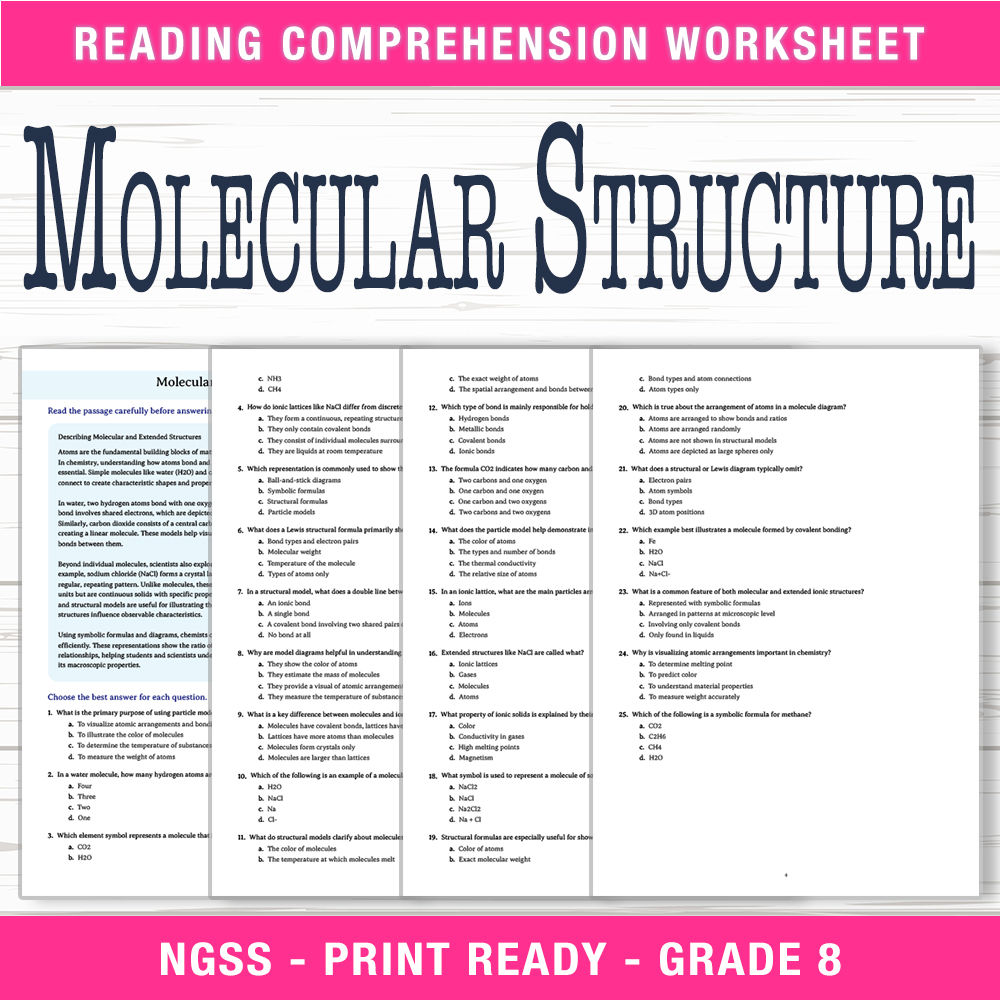
Grade 8 Science – Molecular Structure Worksheet (PDF + Answer Key)
 Created byRiverstone Classroom
Learning Objectives
- Understand the basic atomic composition of simple molecules such as water and carbon dioxide.
- Interpret particle models and symbolic formulas to represent molecules and extended structures.
- Distinguish between molecular units and extended solids through structural diagrams.
Instant download

Force Balance Worksheet for Grade 8 Science | Alberta Standards Practice PDF
JCreated byJ.S SheetsLearning Objectives
- Understand the concept of balanced and unbalanced forces and how they affect object motion.
- Analyze force vectors and support reactions in static systems.
- Differentiate between equilibrium and motion caused by net force.
Also included in: Grade 8 Forces & Motion Science Lesson Bundle – Alberta framework worksheets +1 more
Instant download
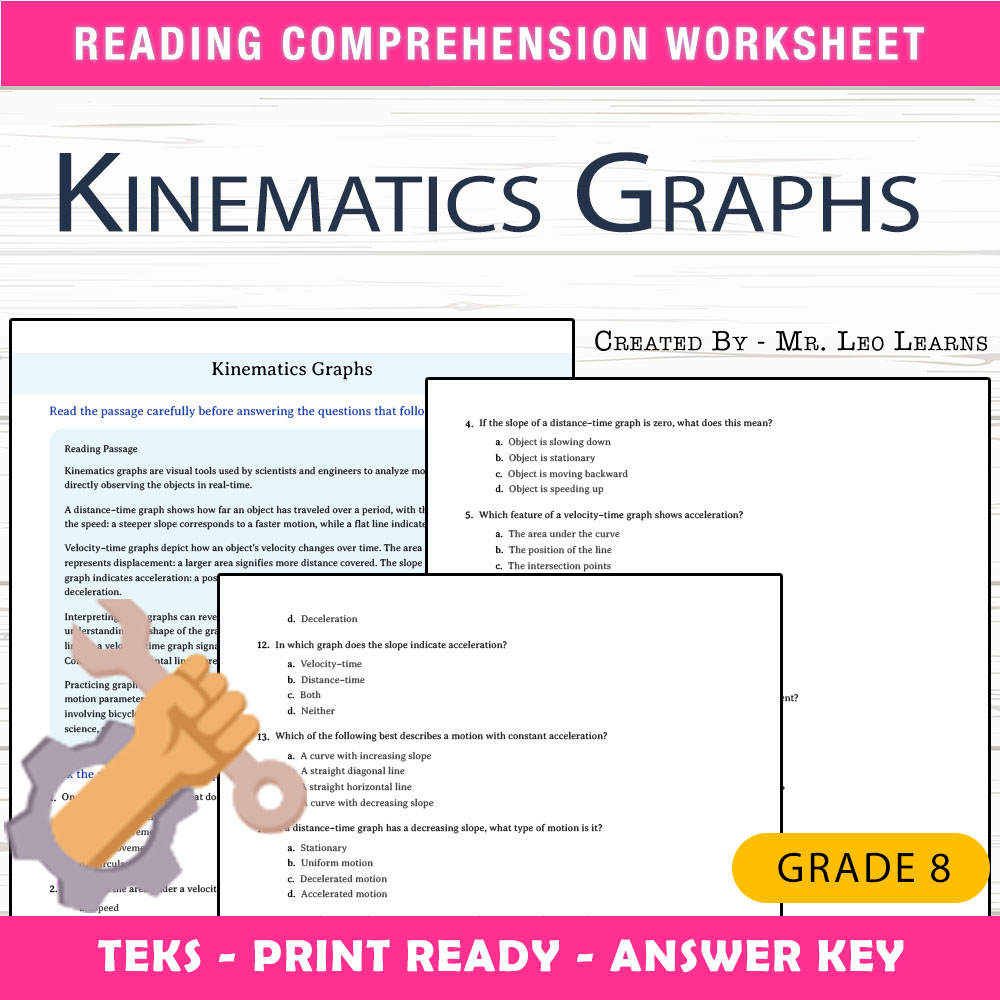
Grade 8 Science — Kinematics Graphs Worksheet for Mastery
Created byThe Resource HubLearning Objectives
- Understand how to interpret the slope and area on distance–time and velocity–time graphs.
- Learn to extract speed and acceleration from graphical features.
- Apply graph analysis techniques to real-world motion scenarios, such as bicycles and toy cars.
Also included in: Grade 8 Science Unit Bundle | Motion, Forces & Energy Mastery Worksheets +1 more
Instant download
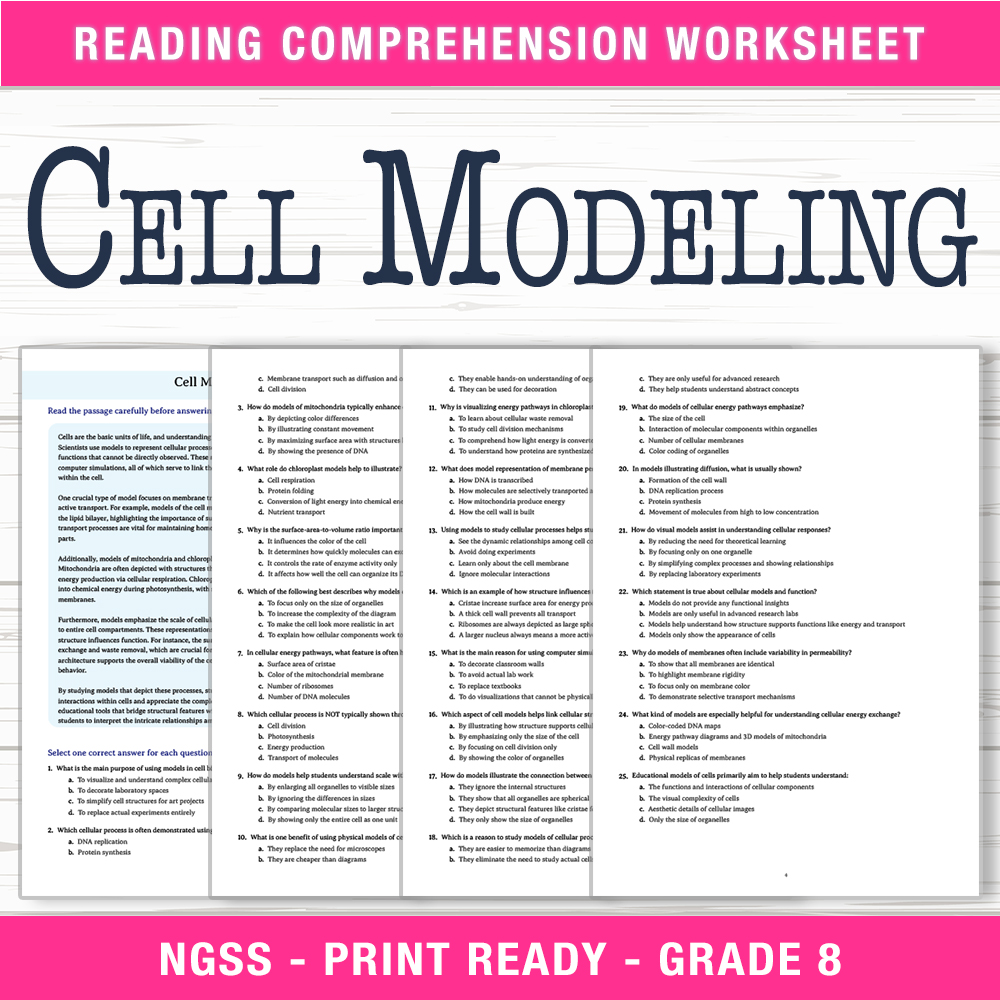
Grade 8 Science | Cell Modeling Worksheet (PDF + Answer Key)
Created byRiverstone ClassroomLearning Objectives
- Explain the purpose of cellular models in understanding cell structure and functions.
- Describe how models link the structure of organelles to their roles in cellular processes.
- Analyze the relationships between cellular components and overall cell viability.
Instant download

Grade 8 Science | Friction Concepts in Science - Daily Reading Comprehension
Created byCoral Reef LearningLearning Objectives
- Identify and describe static and kinetic friction
- Explain how friction opposes relative motion
- Recognize real-world examples of static and kinetic friction
Also included in: Forces and Motion Lesson Bundle | Grade 8 Science Alberta +1 more
Instant download

Science Grade 8 Mixtures and Changes Worksheet | NGSSS Standards Practice
JCreated byJ.S SheetsLearning Objectives
- Explain what a mixture is and how its properties depend on its components
- Differentiate solute and solvent in a solution and describe how dissolving differs from chemical change
- Distinguish physical changes from chemical changes using particle-level ideas
Also included in: Grade 8 Energy, Motion, and Matter Changes Science Lesson Bundle: Florida NGSSS +1 more
Instant download

Fossil Record Clues Worksheet | Standards-Aligned Grade 8 Science Practice
JCreated byJ.S SheetsLearning Objectives
- Understand how fossils provide evidence for Earth's geological history.
- Identify different types of fossils and their significance in reconstructing past environments.
- Explain how sedimentary layers and rock characteristics help interpret past climate changes and plate movements.
Also included in: Grade 8 Earth & Space Science Lesson Bundle | California Standards +1 more
Instant download

Particle Models of Matter States Worksheets | Grade 8 Science
 Created bySunny Desk Resources
Learning Objectives
- Describe how particle arrangement and motion differ in solids, liquids, and gases
- Explain how bonding strength and particle energy relate to changes in state
- Use examples to identify whether a material behaves more like a solid, liquid, or gas
Also included in: Matter & Chemical Change Grade 8 Science Bundle | Alberta Worksheets +1 more
Instant download

Grade 8 Net Force Effects Worksheet | Motion & Forces Science Review
Created byPrism Point LearningLearning Objectives
- Explain how net force determines whether an object speeds up, slows down, changes direction, or stays at constant velocity
- Use force magnitude and direction to predict the effect of multiple forces on an object
- Describe what happens when forces cancel and the net force is zero
Instant download

Reversible Versus Chemical Changes Worksheet | Grade 8 Science Standards
JCreated byJ.S SheetsLearning Objectives
- Differentiate between physical and chemical changes based on reversibility.
- Identify observable signs of chemical changes.
- Understand how matter's properties determine whether a change is reversible or not.
Also included in: Grade 8 Forces, Energy & Matter Science Lesson Bundle | California Standards +1 more
Instant download

Force Diagrams Review Worksheet | Grade 8 Science Ontario
Created byPrism Point LearningLearning Objectives
- Explain how to draw and interpret free-body diagrams for objects experiencing both contact and non-contact forces
- Determine whether the net force on a system is balanced or unbalanced and relate it to constant velocity versus acceleration
- Calculate the net force magnitude and direction for simple one-dimensional force diagrams
Also included in: Grade 8 Work, Energy & Forces Science Lesson Bundle – Ontario Test Prep
Instant download

Motion Basics Assessment | TEKS Grade 8 Science Standard-Aligned
Created byPrism Point LearningLearning Objectives
- Understand the fundamental concepts of motion including position, distance, speed, velocity, and acceleration.
- Differentiate between scalar and vector quantities related to motion.
- Interpret and analyze distance-time and velocity-time graphs.
Also included in: Grade 8 Force, Motion, and Energy Science Lesson Bundle TEKS Standards
Instant download
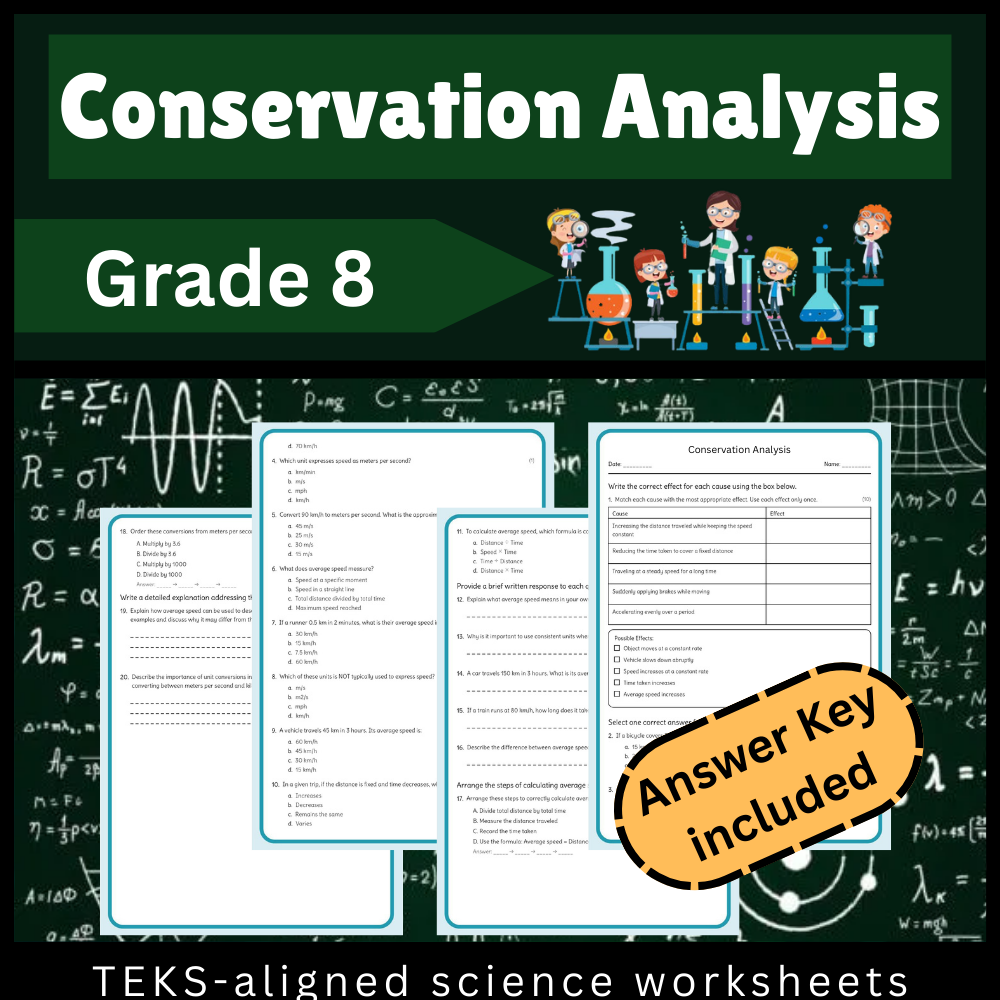
Grade 8 Science – Conservation Analysis Worksheet (PDF) | TEKS Standards
Created byBright Mind ResourcesLearning Objectives
- Understand the principle of mass conservation in closed chemical systems.
- Analyze how mass relates between reactants and products in chemical reactions.
- Differentiate between open and closed systems regarding matter exchange.
Also included in: Grade 8 Science Unit Bundle | States of Matter & Reaction Rates Worksheets- TEKS +1 more
Instant download

Gravitational Force and Motion Worksheets | Grade 8 Science
 Created bythe curious pencil
Learning Objectives
- Explain how mass affects the strength of gravitational force
- Describe how distance changes gravitational force using an inverse-square pattern
- Compare gravitational effects using mass and separation distance
Also included in: Motion and Stability Forces Grade 8 Science NGSS Worksheets Bundle +2 more
Instant download
About Grade 8 Science Worksheets
Explore Grade 8 Science worksheets for classwork, homework, or review. Our 6,006 printables download instantly as PDFs.
Each resource here is built by an independent educator and reviewed for quality. Worksheets print straight from PDF and suit classroom use, homework, or extra practice; most come with answer keys, and you can preview before purchasing.