
Grade 8 Science Worksheets
5,999 worksheets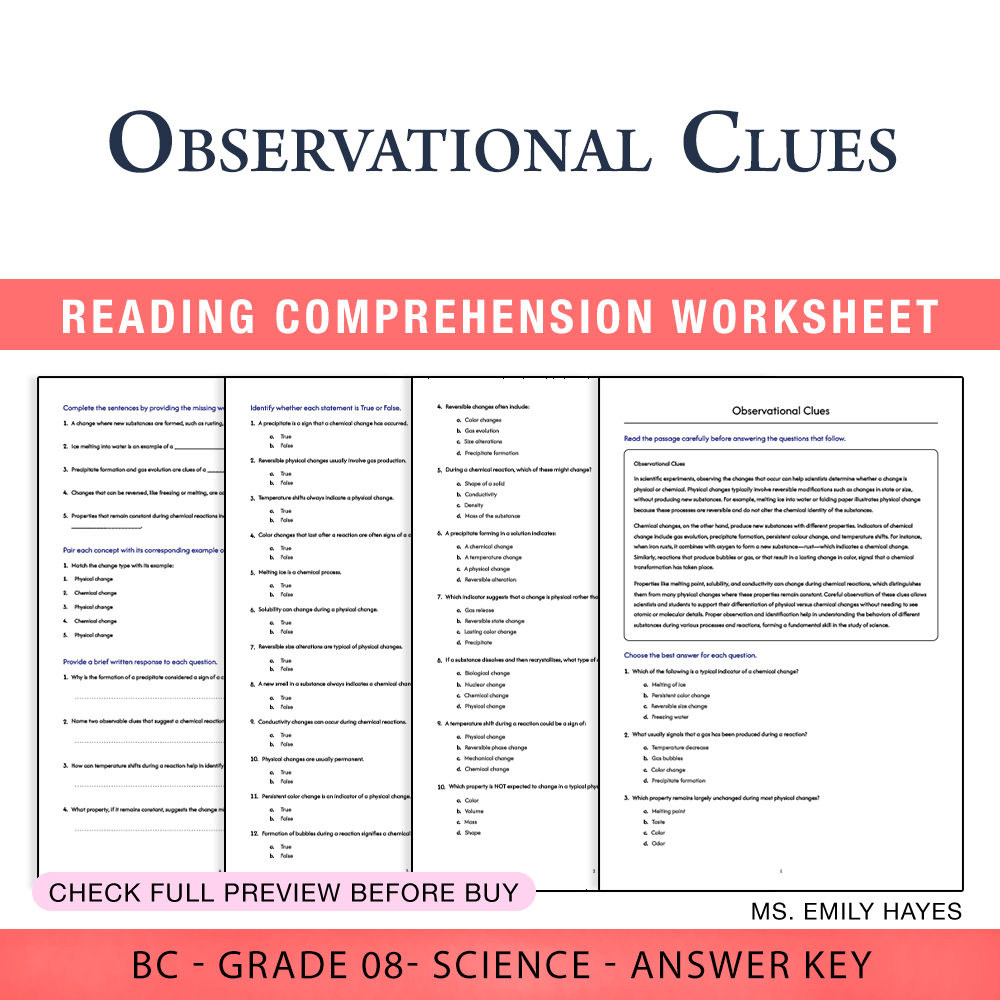
Grade 8 Science | Observational Clues Worksheet (PDF+ Answer Key)
 Created byCopper Leaf Classroom
Learning Objectives
- Identify physical and chemical changes based on observable clues.
- Differentiate between properties that change and those that remain constant during physical and chemical processes.
- Apply observation skills to classify different types of changes in experiments.
Also included in: Grade 8 Science Bundle – Reaction Types, Conservation & More (PDF + Answer Key) +1 more
Instant download
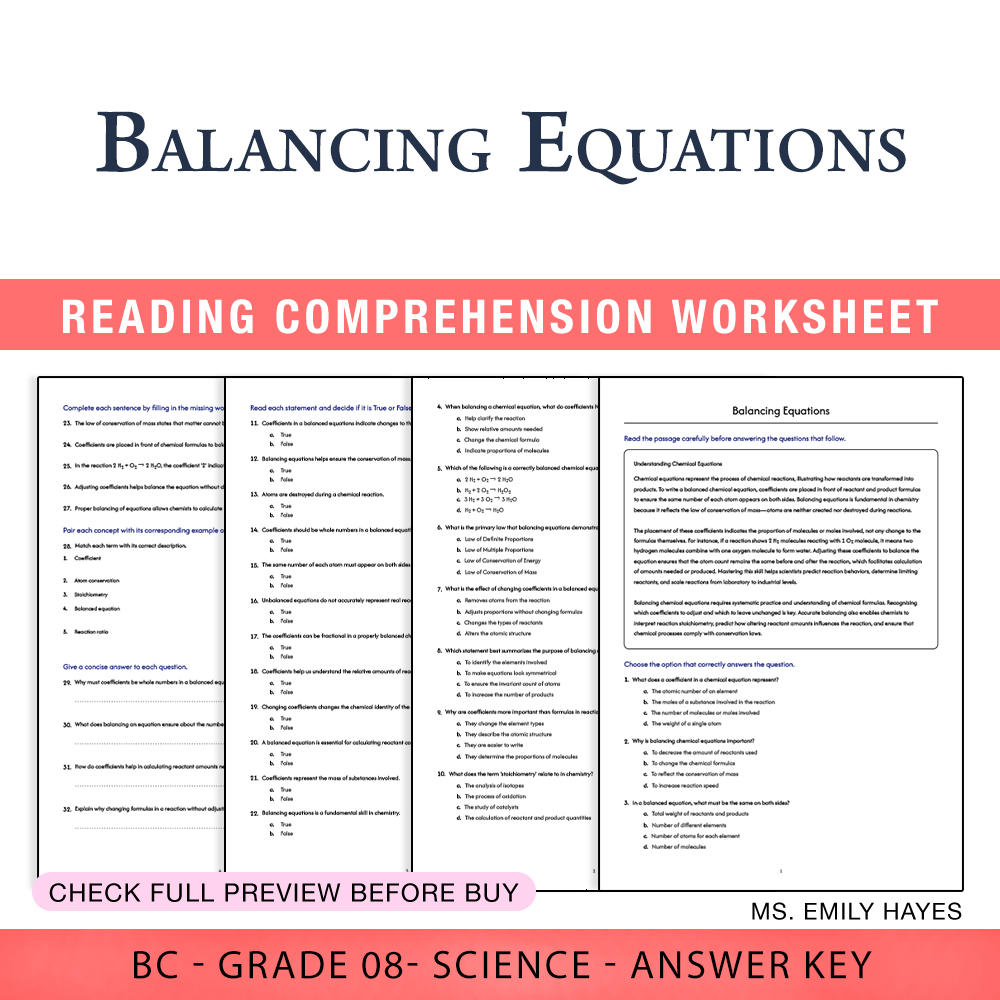
8th Grade Science | Balancing Equations Worksheet (PDF+ Answer Key)
Created byCopper Leaf ClassroomLearning Objectives
- Understand the concept of coefficients in chemical equations and their role in balancing reactions.
- Learn how to appropriately place coefficients to balance chemical equations while conserving atom counts.
- Identify the importance of coefficients in predicting reaction outcomes and calculating reactant quantities.
Also included in: Grade 8 Science Bundle – Reaction Types, Conservation & More (PDF + Answer Key) +1 more
Instant download
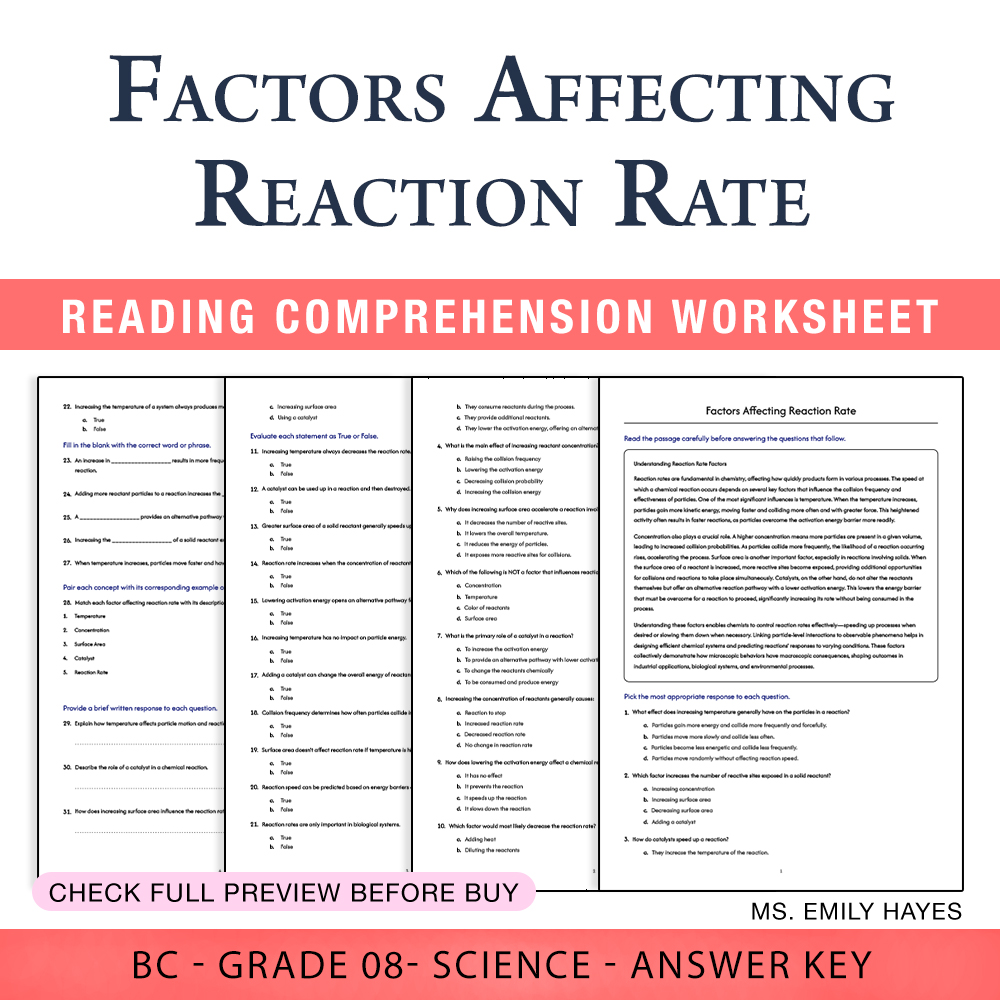
8th Grade Science | Factors Affecting Reaction Rate Worksheet (PDF+ Answer Key)
Created byCopper Leaf ClassroomLearning Objectives
- Identify the key factors that influence the rate of chemical reactions.
- Explain how temperature, concentration, surface area, and catalysts impact reaction speed.
- Relate microscopic particle interactions to macroscopic changes in reaction rates.
Also included in: Grade 8 Science Bundle – Reaction Types, Conservation & More (PDF + Answer Key) +1 more
Instant download
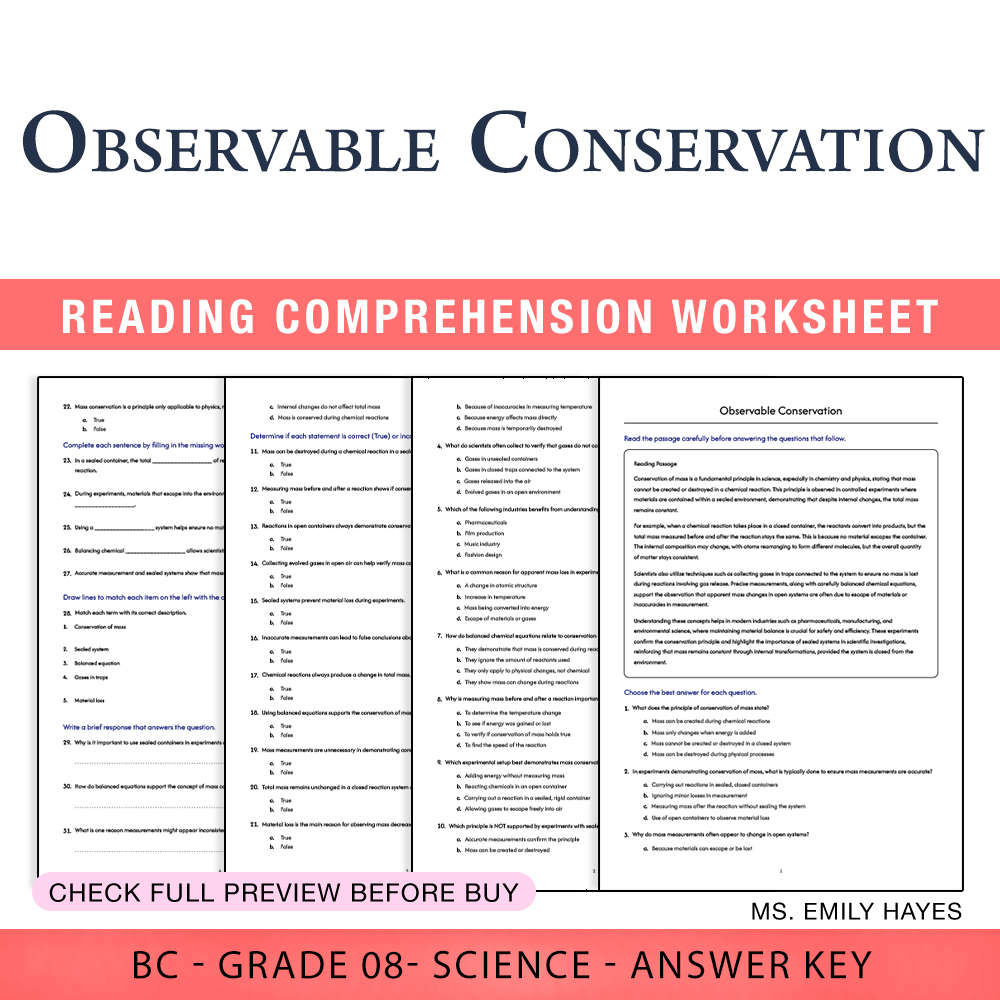
8th Grade Science | Conservation of Mass Worksheet (PDF+ Answer Key)
Created byCopper Leaf ClassroomLearning Objectives
- Understand how conservation of mass is demonstrated in closed systems.
- Explain the importance of balanced equations and accurate measurements in conservation experiments.
- Identify real-world applications of the conservation of mass principle.
Also included in: Grade 8 Science Bundle – Reaction Types, Conservation & More (PDF + Answer Key) +1 more
Instant download
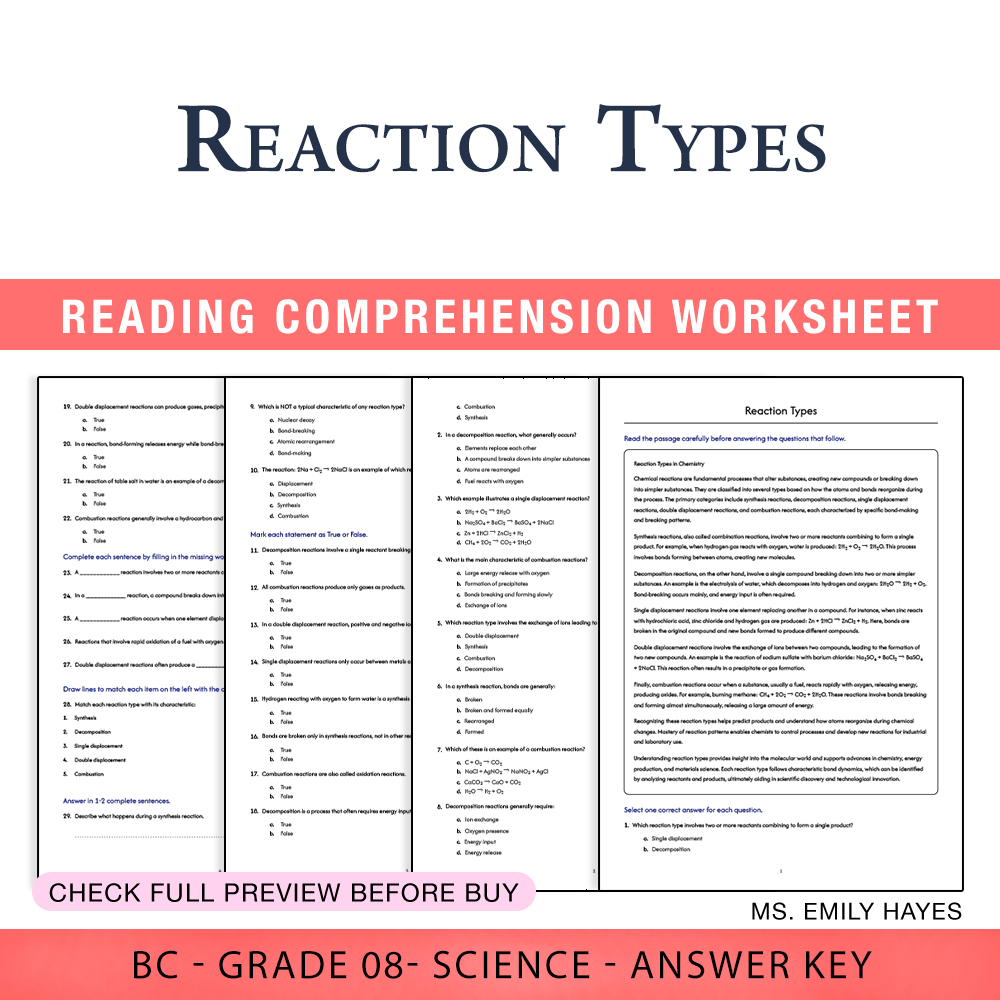
8th Grade Science | Reaction Types Worksheet (PDF+ Answer Key)
Created byCopper Leaf ClassroomLearning Objectives
- Identify and describe the main types of chemical reactions including synthesis, decomposition, single displacement, double displacement, and combustion.
- Understand the characteristic bond-making and bond-breaking patterns in different reaction categories.
- Recognize examples of each reaction type and predict products based on reaction patterns.
Also included in: Grade 8 Science Bundle – Reaction Types, Conservation & More (PDF + Answer Key) +1 more
Instant download
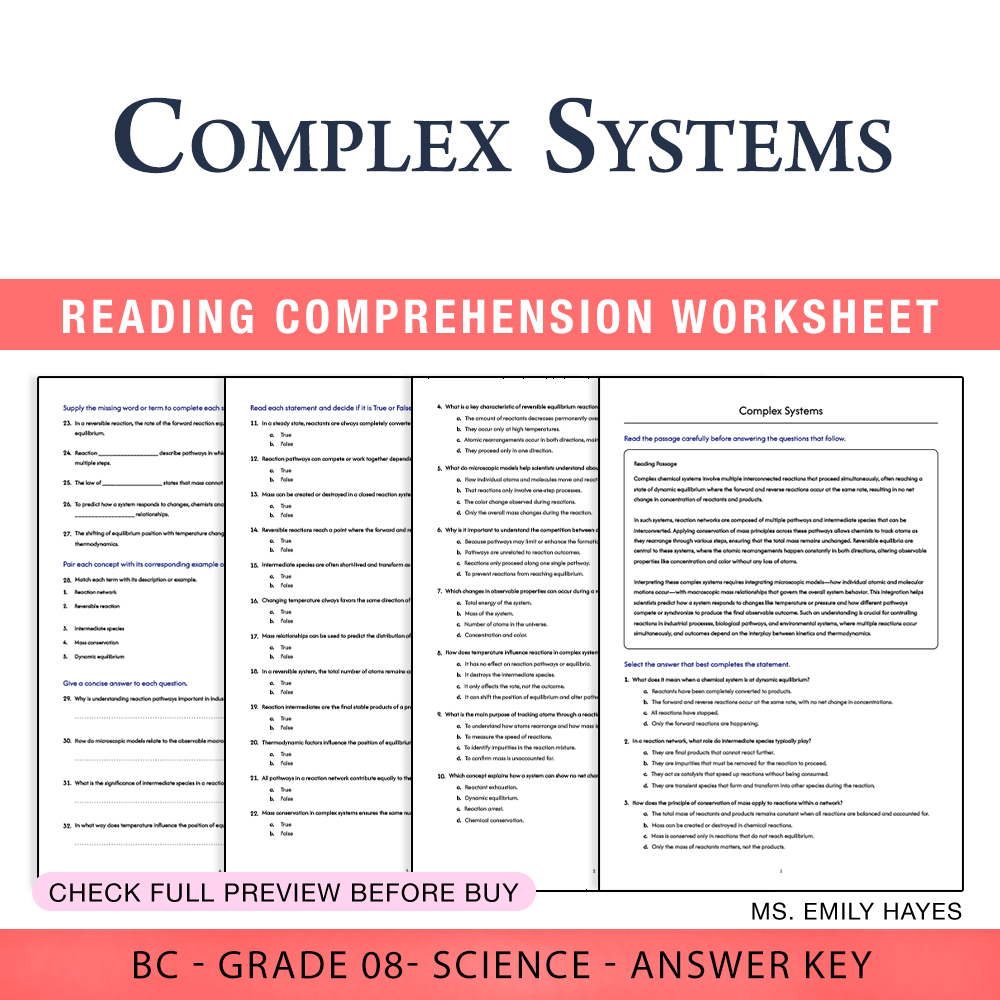
8th Grade Science | Complex Systems Worksheet (PDF+ Answer Key)
Created byCopper Leaf ClassroomLearning Objectives
- Explain how multiple reactions in complex chemical systems are interconnected and how mass conservation applies across them.
- Describe the concept of chemical equilibrium and how forward and reverse reactions balance each other in dynamic systems.
- Identify and interpret reaction networks including intermediates, reversible steps, and competing pathways.
Also included in: Grade 8 Science Bundle – Reaction Types, Conservation & More (PDF + Answer Key) +1 more
Instant download
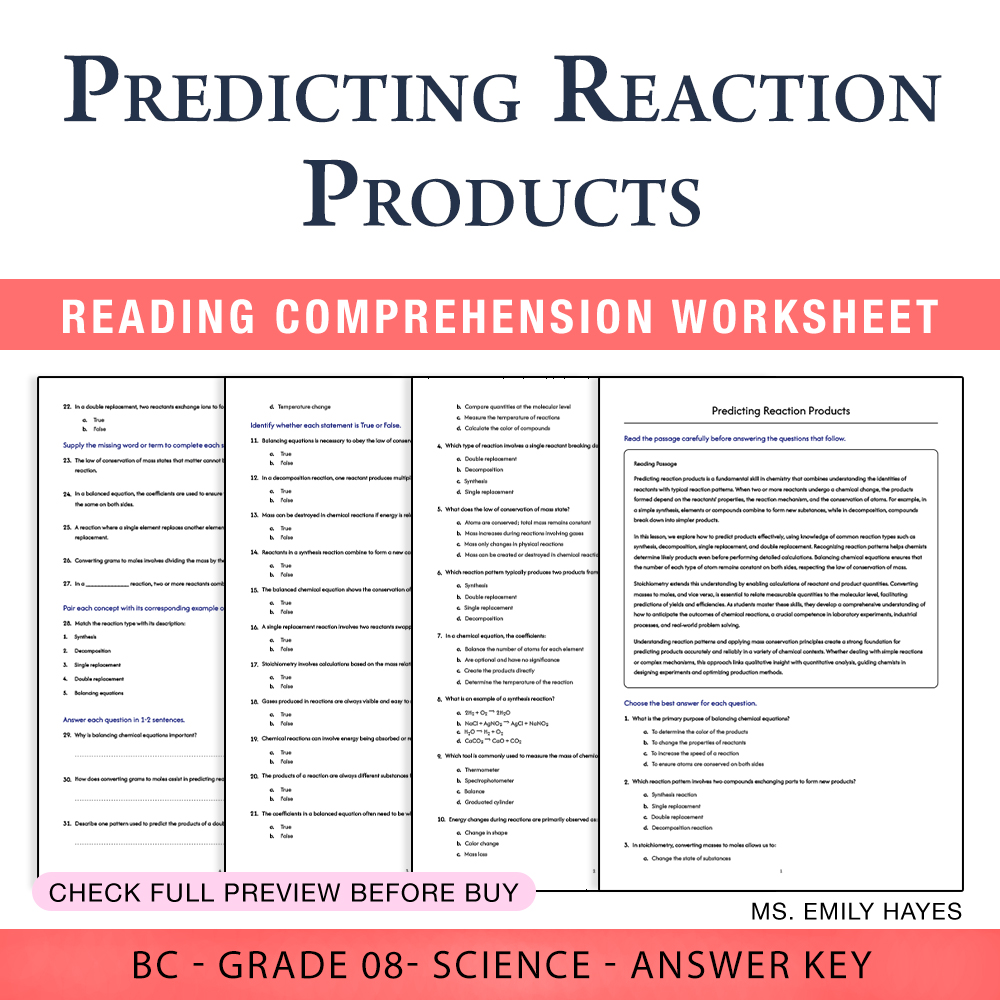
8th Grade Science | Predicting Reaction Products Worksheet (PDF+ Answer Key)
Created byCopper Leaf ClassroomLearning Objectives
- Understand how to predict products of chemical reactions using reactant identities and reaction patterns.
- Apply the law of conservation of atoms to balance chemical equations.
- Use stoichiometry to compare quantities of reactants and products and estimate reaction yields.
Also included in: Grade 8 Science Bundle – Reaction Types, Conservation & More (PDF + Answer Key) +1 more
Instant download
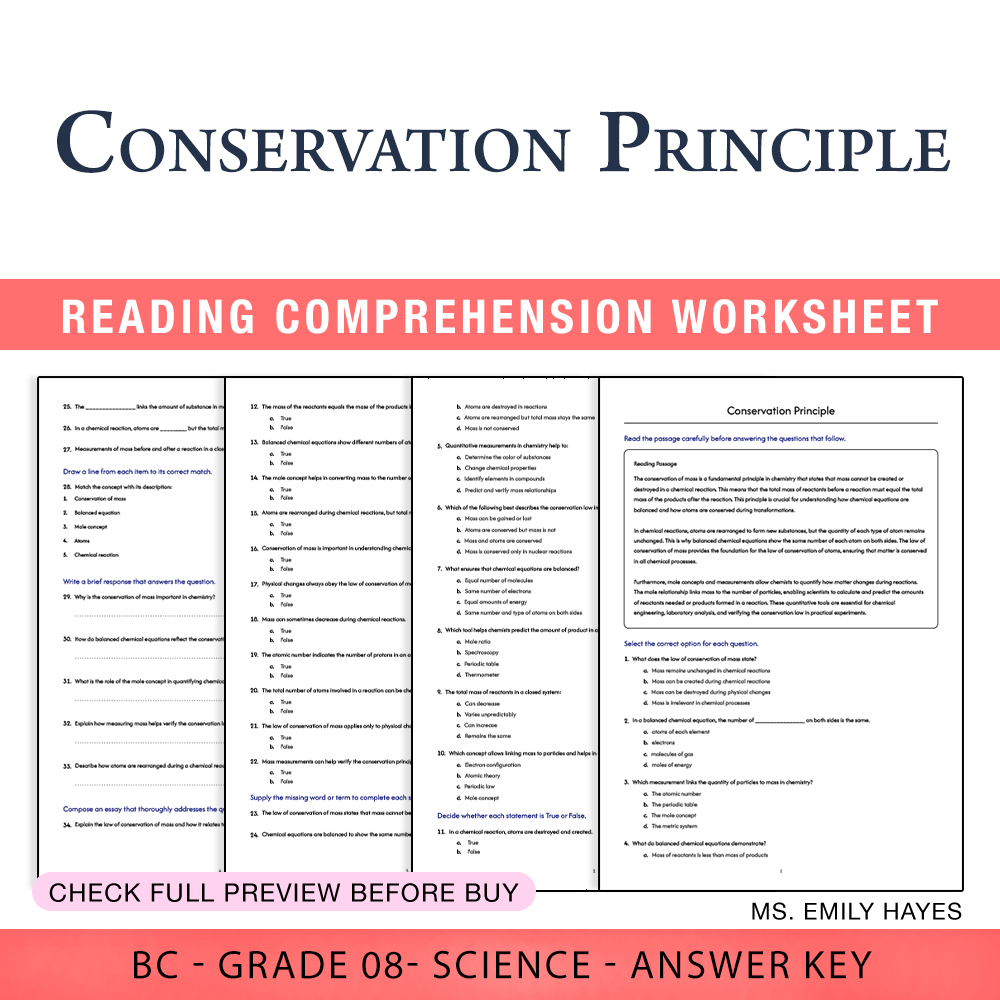
8th Grade Science | Conservation Principle Worksheet (PDF+ Answer Key)
Created byCopper Leaf ClassroomLearning Objectives
- Understand the law of conservation of mass and its significance in chemical reactions.
- Interpret balanced chemical equations to identify the conservation of atoms and mass.
- Apply mole concepts and quantitative measurements to predict mass relationships in chemical processes.
Also included in: Grade 8 Science Bundle – Reaction Types, Conservation & More (PDF + Answer Key) +1 more
Instant download
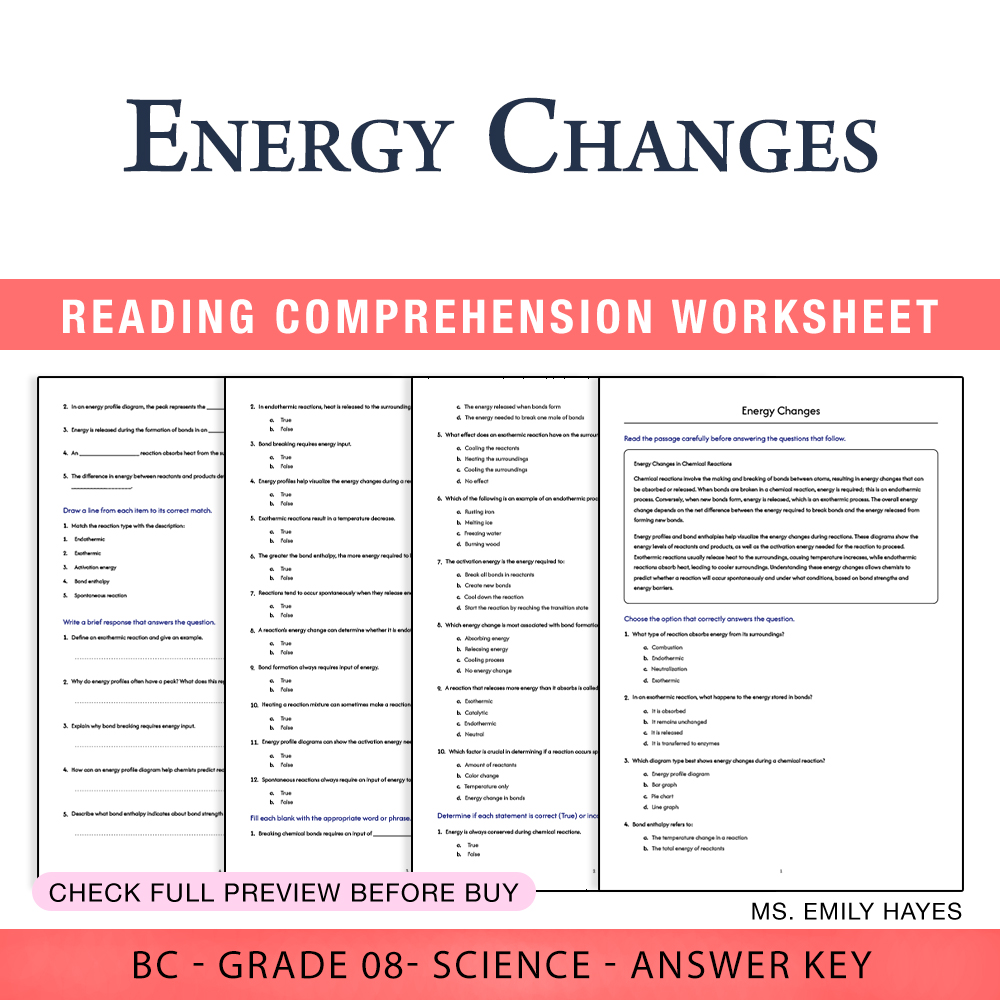
Grade 8 Science | Energy Changes Worksheet (PDF+ Answer Key)
Created byCopper Leaf ClassroomLearning Objectives
- Understand the concepts of endothermic and exothermic reactions and how energy is exchanged during chemical reactions.
- Explain how bond breaking and bond forming influence the energy changes observed in reactions.
- Interpret energy profiles and bond enthalpy diagrams to predict whether a reaction absorbs or releases heat.
Also included in: Grade 8 Science Bundle – Reaction Types, Conservation & More (PDF + Answer Key) +1 more
Instant download
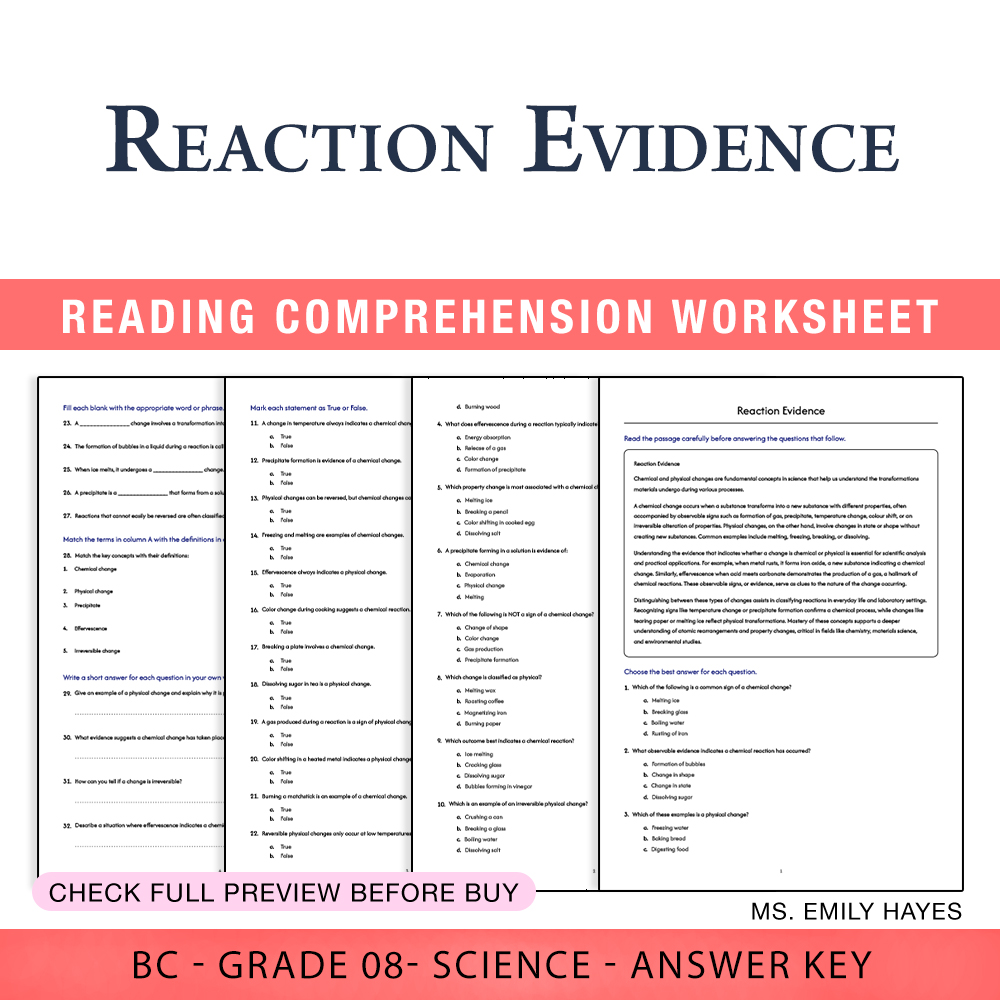
8th Grade Science | Reaction Evidence Worksheet (PDF + Answer Key)
Created byCopper Leaf ClassroomLearning Objectives
- Identify observable evidence of chemical and physical changes.
- Differentiate between chemical and physical changes based on evidence.
- Recognize examples of chemical and physical transformations from observations.
Also included in: Grade 8 Science Bundle – Reaction Types, Conservation & More (PDF + Answer Key) +1 more
Instant download
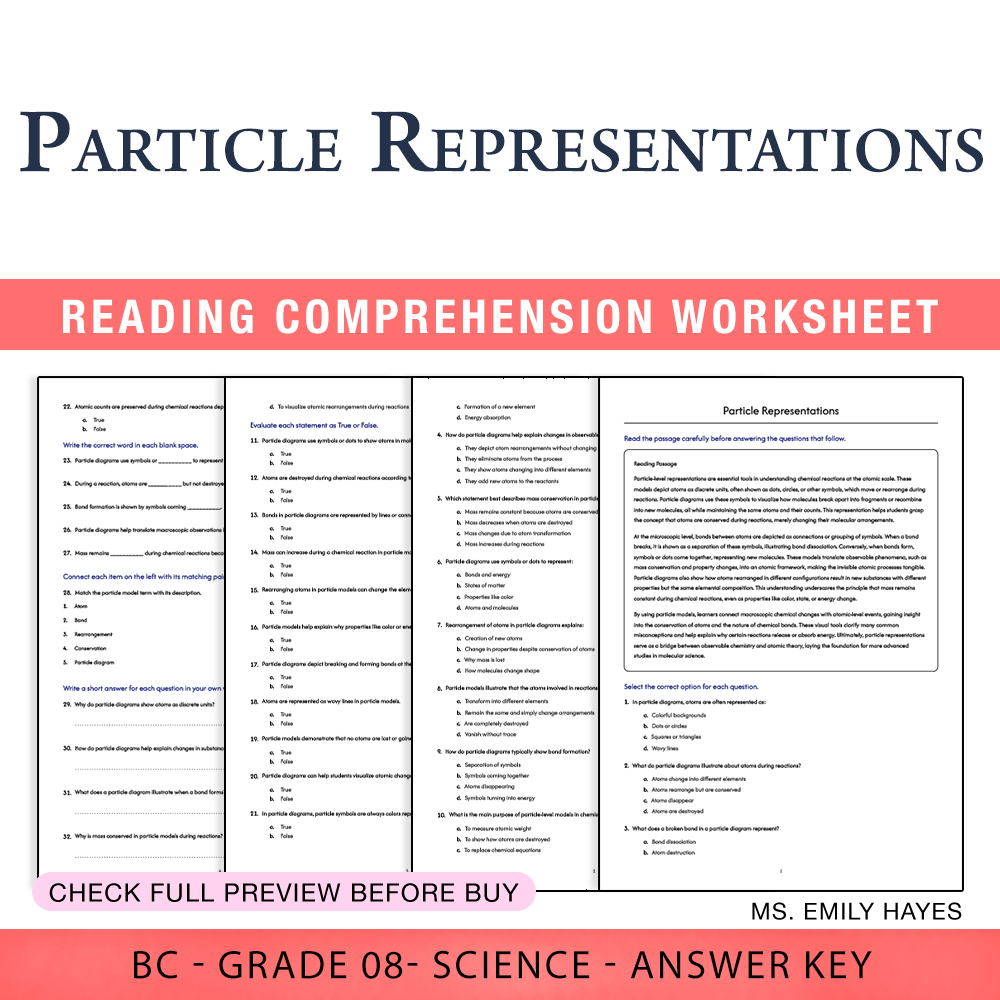
8th Grade Science | Particle Representations Worksheet (PDF+ Answer Key)
Created byCopper Leaf ClassroomLearning Objectives
- Understand how particle diagrams illustrate atoms as discrete units that rearrange during reactions while preserving their identity and count.
- Describe how particle-level models translate macroscopic observations into atomic explanations, particularly in the context of bond breaking and formation.
- Identify different symbols and representations used in particle diagrams to depict reactants and products.
Also included in: Grade 8 Science Bundle – Reaction Types, Conservation & More (PDF + Answer Key) +1 more
Instant download
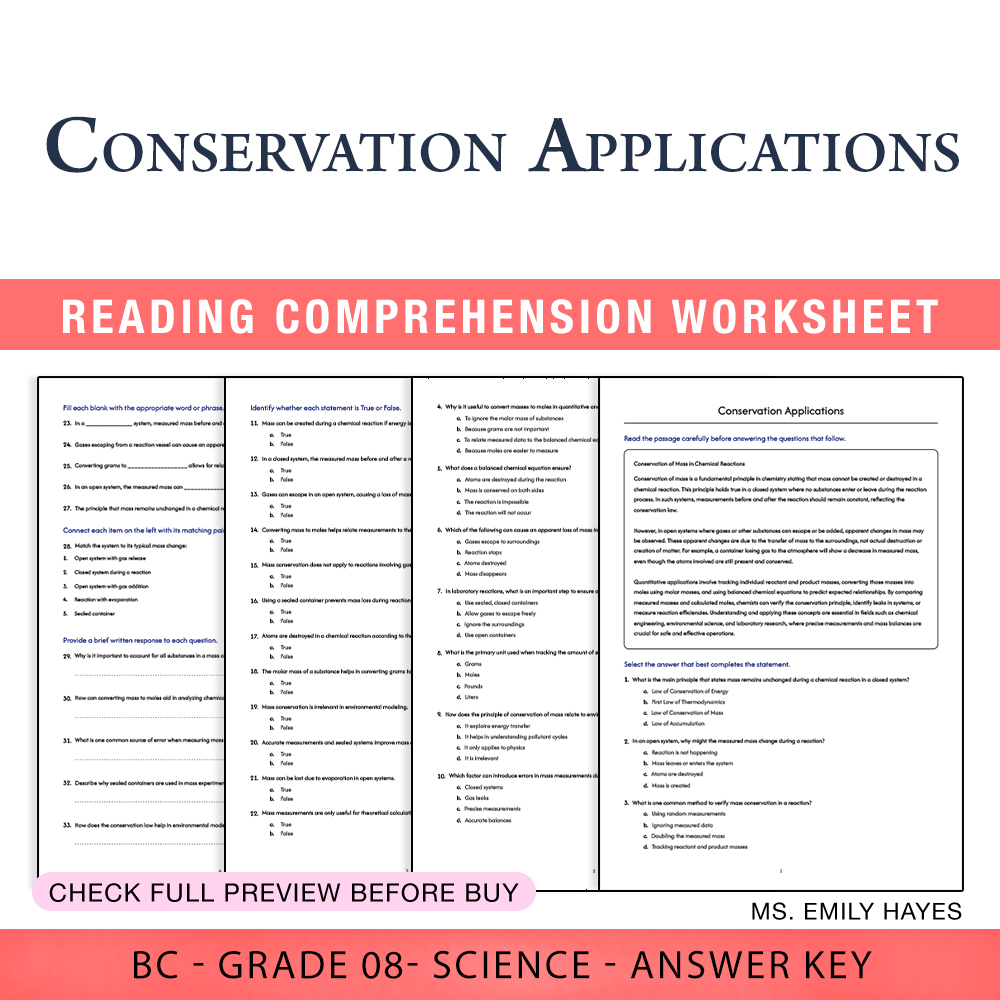
8th Grade Science | Conservation Applications Worksheet (PDF+ Answer Key)
Created byCopper Leaf ClassroomLearning Objectives
- Understand how conservation of mass applies to open and closed systems in chemical reactions.
- Learn to track reactant and product masses and convert measurements to moles for quantitative analysis.
- Apply balanced chemical equations to reconcile measured data with theoretical mass conservation.
Also included in: Grade 8 Science Bundle – Reaction Types, Conservation & More (PDF + Answer Key) +1 more
Instant download

Grade 8 Science | Control Variables Design - Daily Reading Comprehension
 Created byCoral Reef Learning
Learning Objectives
- Understand the concept of independent, dependent, and control variables in scientific studies.
- Learn how to identify different types of variables in an experiment.
- Recognize the importance of controlling variables to ensure fair and reliable results.
Instant download
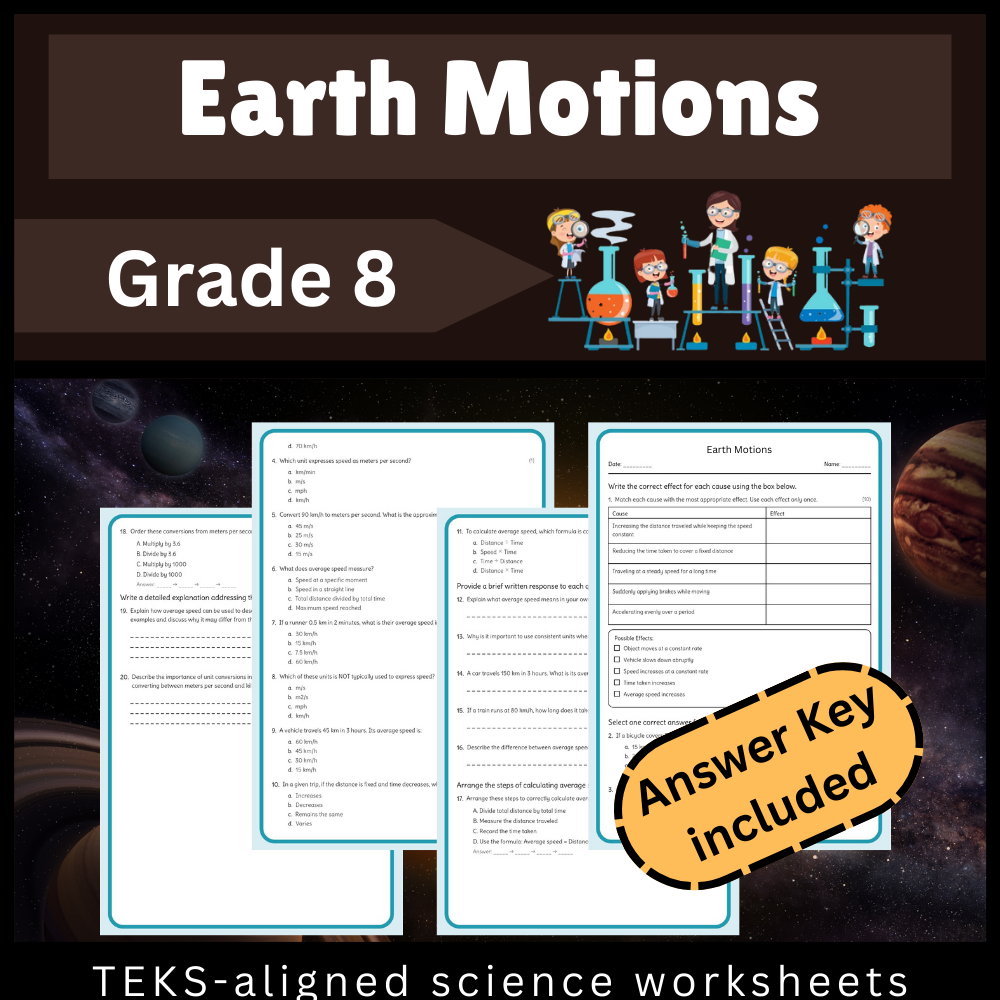
Grade 8 Science | Earth's Motions TEKS Worksheet (Answer Key) – Comprehensive Practice
 Created byBright Mind Resources
Learning Objectives
- Explain Earth's rotation and revolution and how they cause day and night, as well as seasonal changes.
- Identify the effects of axial tilt and Earth's orbit on sunlight distribution, seasons, and observable phenomena.
- Connect observable phenomena such as constellations, sunrise and sunset times, and solstices/equinoxes to Earth's motions.
Also included in: Grade 8 Science UNIT Bundle | Weather, Solar System & Earth - TEKS Aligned +1 more
Instant download

Grade 8 Science – Ecosystem Stability & Response | Daily Reading Worksheet
Created byBright Mind ResourcesLearning Objectives
- Define ecosystem stability and understand its features.
- Identify how ecosystems recover from disturbances.
- Recognize key interactions and processes that maintain stable ecosystems.
Also included in: Grade 8 Science Daily Reading Worksheets Lesson Bundle | California Standards +1 more
Instant download

Grade 8 Science – Population & Ecosystem Stability | Daily Reading Worksheet
Created byBright Mind ResourcesLearning Objectives
- Identify different types of interactions among organisms in an ecosystem.
- Understand how predation, competition, disease, and mutualism affect populations.
- Recognize how changes in interactions can alter community structure and ecosystem stability.
Also included in: Grade 8 Science Daily Reading Worksheets Lesson Bundle | California Standards +1 more
Instant download

Grade 8 Science – Adaptation & Evolution | Daily Reading Worksheet
Created byBright Mind ResourcesLearning Objectives
- Understand basic concepts of adaptation and natural selection
- Identify how traits help organisms survive environmental pressures
- Recognize the role of heritability and variation in evolutionary change
Also included in: Grade 8 Science Daily Reading Worksheets Lesson Bundle | California Standards +1 more
Instant download

Grade 8 Science – Internal Structures & Circulatory System | Reading Worksheet
Created byBright Mind ResourcesLearning Objectives
- Understand the function of the heart in pumping blood throughout the body.
- Identify key components of the circulatory system.
- Explain how the circulatory system supports survival and growth.
Also included in: Grade 8 Science Daily Reading Worksheets Lesson Bundle | California Standards +1 more
Instant download

Grade 8 Science – Homeostasis & Regulatory Systems | Daily Reading Worksheet
Created byBright Mind ResourcesLearning Objectives
- Define homeostasis and explain its significance in maintaining internal stability.
- Describe how negative feedback mechanisms regulate body temperature and other internal conditions.
- Identify examples of homeostatic processes in the human body.
Also included in: Grade 8 Science Daily Reading Worksheets Lesson Bundle | California Standards +1 more
Instant download

Grade 8 Science – Organ System Coordination & Functions | Reading Worksheet
Created byBright Mind ResourcesLearning Objectives
- Understand how the circulatory system transports oxygen, nutrients, and wastes throughout the body.
- Identify the main functions of the circulatory, respiratory, digestive, nervous, and endocrine systems.
- Explain how different organ systems work together to maintain homeostasis.
Also included in: Grade 8 Science Daily Reading Worksheets Lesson Bundle | California Standards +1 more
Instant download

Grade 8 Science – Biogeochemical Cycling & Water Cycle | Daily Reading Worksheet
Created byBright Mind ResourcesLearning Objectives
- Understand the stages of the water cycle and their roles
- Explain how water moves through evaporation and condensation
- Describe the importance of water cycling in maintaining ecosystems
Also included in: Grade 8 Science Daily Reading Worksheets Lesson Bundle | California Standards +1 more
Instant download

8th Grade Science | Molecular Structure Worksheet with Answer Key (Printable PDF)
Created byCoral Reef LearningLearning Objectives
- Describe how atoms combine to form simple molecules using particle models and formulas.
- Identify different types of bonds and how they influence molecular structures.
- Interpret molecular diagrams and formulas to understand atom types and arrangements.
Instant download

Grade 8 Science – Gear Trains Daily Reading Worksheet | Ontario Standards
Created byBright Mind ResourcesLearning Objectives
- Understand what gear trains are and how gears interact.
- Identify different types of gears such as spur gears.
- Explain how gear ratios affect torque and speed.
Also included in: Grade 8 Mechanical Systems Science Reading Worksheets – Lesson Bundle | Ontario +1 more
Instant download

Reaction Types Worksheet | Standards-Aligned Grade 8 Science Practice
JCreated byJ.S SheetsLearning Objectives
- Identify and describe the main types of chemical reactions: synthesis, decomposition, single displacement, double displacement, and combustion.
- Understand characteristic bond-making and bond-breaking patterns in different reaction types.
- Recognize examples of each reaction type and predict possible products based on reaction patterns.
Instant download
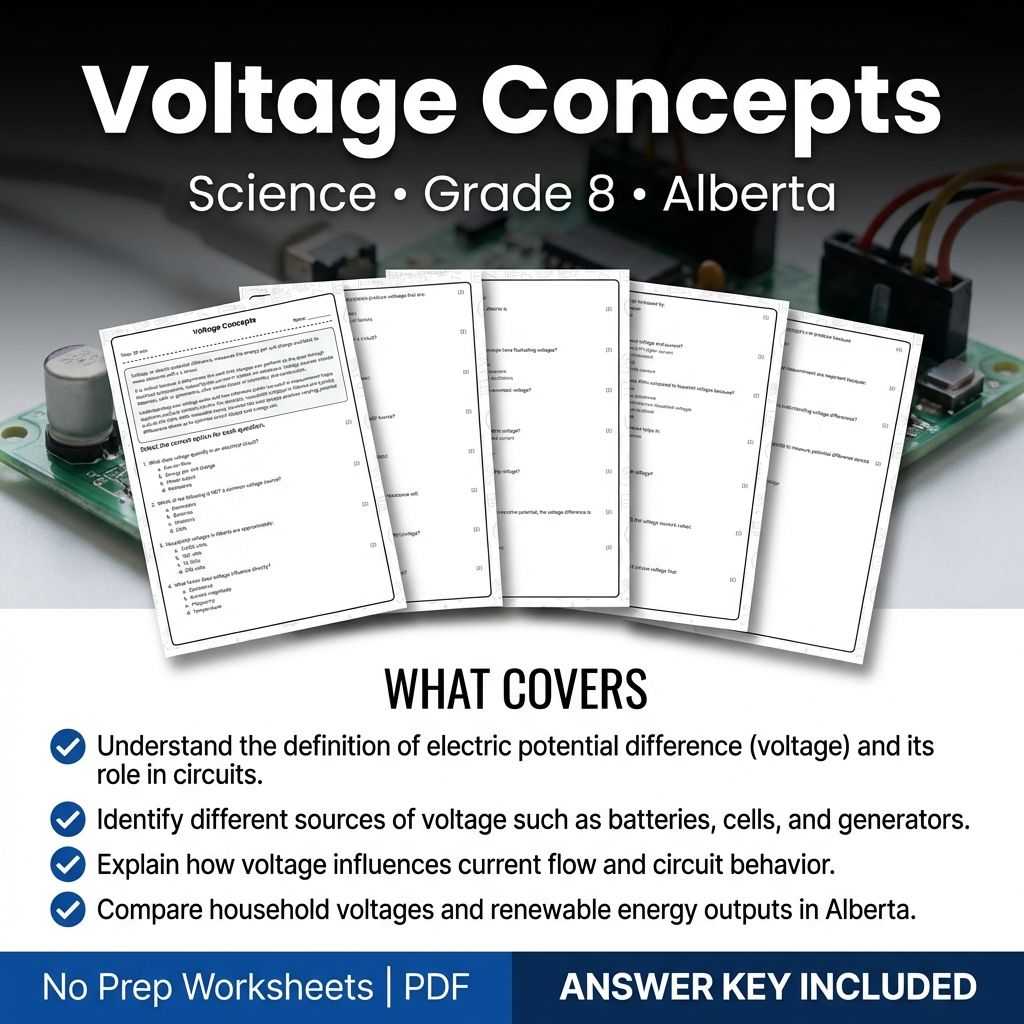
Voltage Concepts Grade 8 Science Worksheet | Alberta Standards
Created byCoral Reef LearningLearning Objectives
- Understand the definition of electric potential difference (voltage) and its role in circuits.
- Identify different sources of voltage such as batteries, cells, and generators.
- Explain how voltage influences current flow and circuit behavior.
Instant download

Grade 8 Science – Understanding the Water Cycle & Daily Reading Worksheet
 Created byQuiet Forest Education
Learning Objectives
- Identify and describe the main stages of the water cycle.
- Understand the roles of evaporation, condensation, precipitation, infiltration, and runoff.
- Recognize the impact of the water cycle on weather, climate, and freshwater availability.
Also included in: Grade 8 Science Full Year Bundle Ontario Daily Reading Worksheets
Instant download

Grade 8 Buoyant Force Worksheet | Ontario Science with Doodle Notes
 Created byChalk and Compass
Learning Objectives
- Explain Archimedes’ principle and relate buoyant force to the weight of displaced fluid
- Compare apparent weight in air versus when an object is submerged
- Use density relationships to predict floating, sinking, and neutral buoyancy
Also included in: Fluids, Pressure & Flow Lesson Bundle — Grade 8 Science Ontario +1 more
Instant download

Grade 8 Surface Forces Worksheet | Hydrostatic Pressure & Center of Pressure
Created byChalk and CompassLearning Objectives
- Explain how hydrostatic pressure varies with depth and how that creates a resultant force on a submerged surface
- Determine the center of pressure conceptually (and qualitatively) for planar versus curved surfaces
- Connect surface-force ideas to real engineering designs such as dam faces and bulkheads
Also included in: Fluids, Pressure & Flow Lesson Bundle — Grade 8 Science Ontario +1 more
Instant download

Motion Basics Worksheet for Grade 8 Science | Standards-Aligned Practice
JCreated byJ.S SheetsLearning Objectives
- Explain the difference between position, distance, speed, velocity, and acceleration
- Classify quantities as scalars or vectors and justify why velocity is a vector
- Interpret distance–time and velocity–time graphs using basic features like slope and straight-line behavior
Instant download
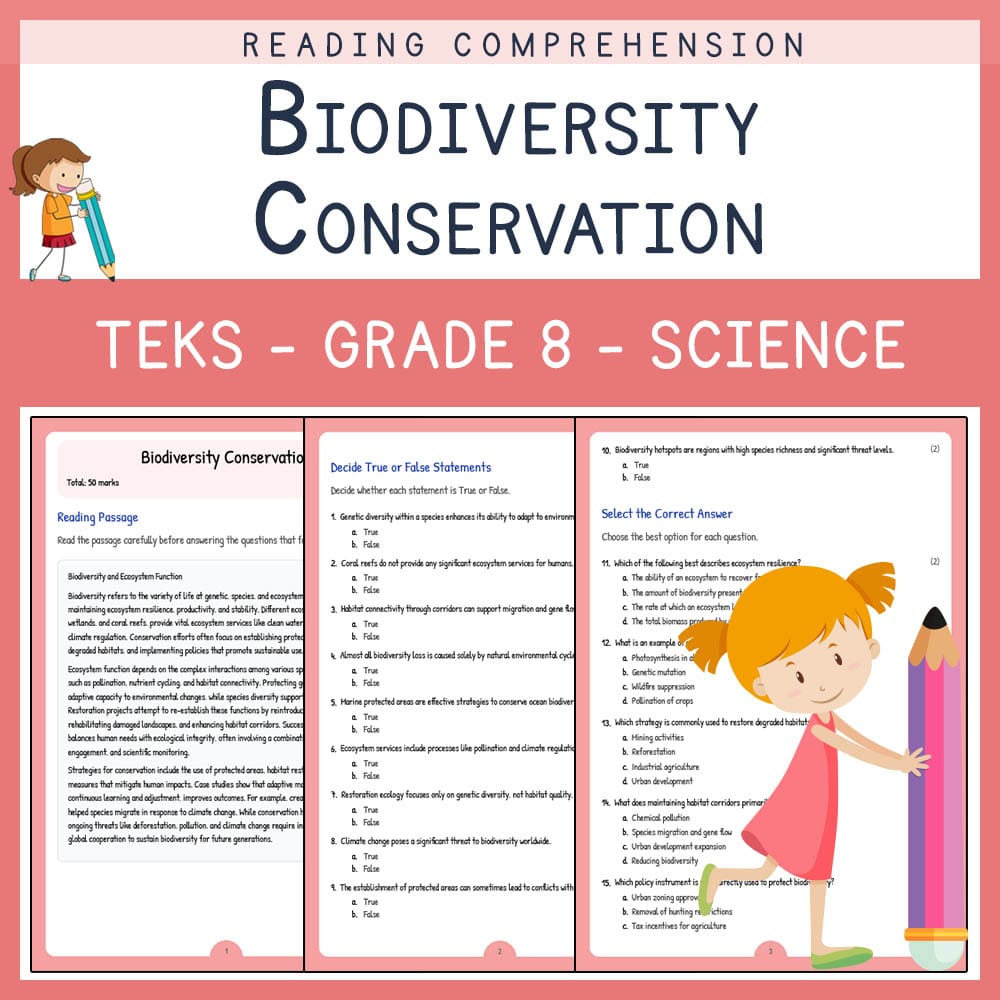
Grade 8 Science | Biodiversity Conservation Worksheet | TEKS Aligned
 Created byLumora Learning
Learning Objectives
- Understand the concept of biodiversity and its measurement.
- Identify ecological functions and ecosystem services.
- Evaluate strategies for species and habitat conservation.
Also included in: Grade 8 Science | Organisms and Environments Unit Bundle | TEKS Aligned
Instant download
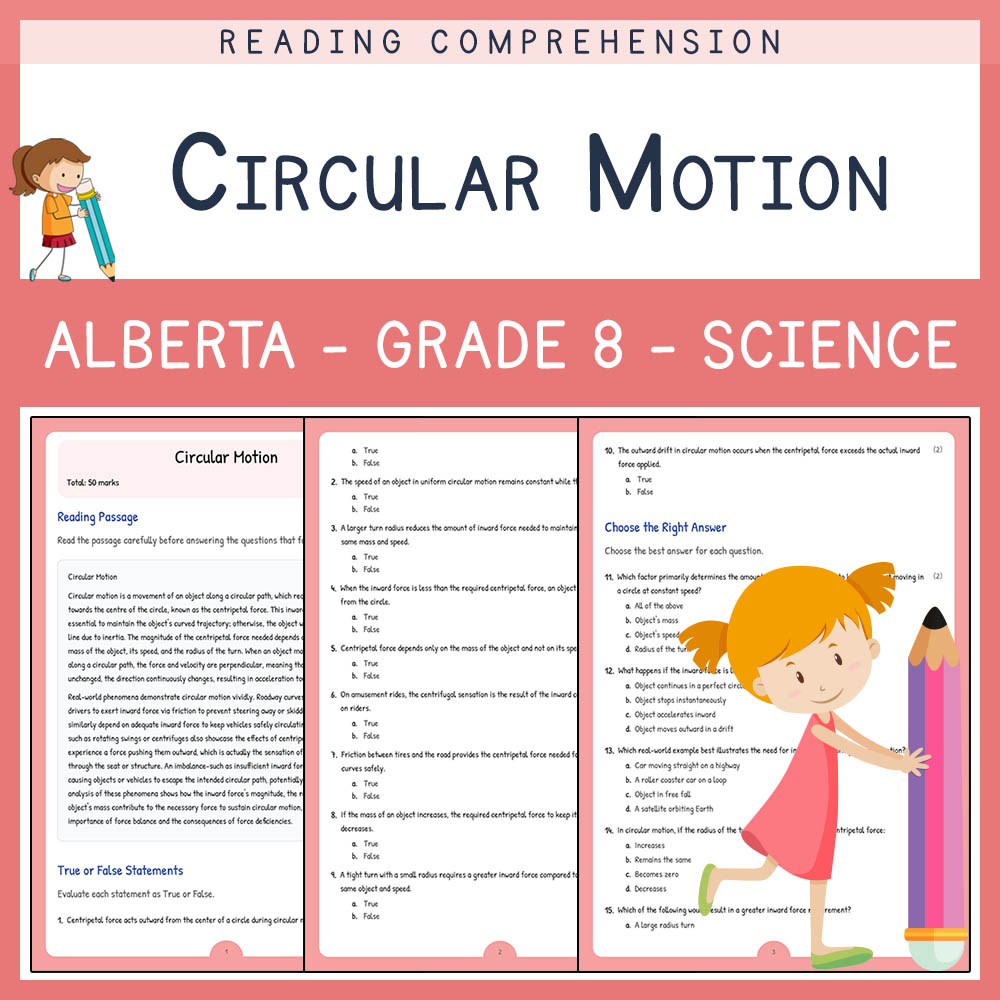
Grade 8 Science | Circular Motion Worksheet Elena | Alberta
Created byLumora LearningLearning Objectives
- Explain the concept of centripetal force and its role in circular motion.
- Analyze how turn radius, mass, and force affect the required centripetal force.
- Describe real-world examples of circular motion such as road curves, roundabouts, and amusement rides.
Instant download

Grade 8 Science – Observational Clues & Changes | Daily Reading Worksheet
Created byBright Mind ResourcesLearning Objectives
- Identify physical and chemical changes based on observable clues
- Differentiate between physical and chemical change indicators
- Apply observation skills to real-life science scenarios
Also included in: Grade 8 Chemical Reactions Science Lesson Bundle: Daily Reading | BC +1 more
Instant download
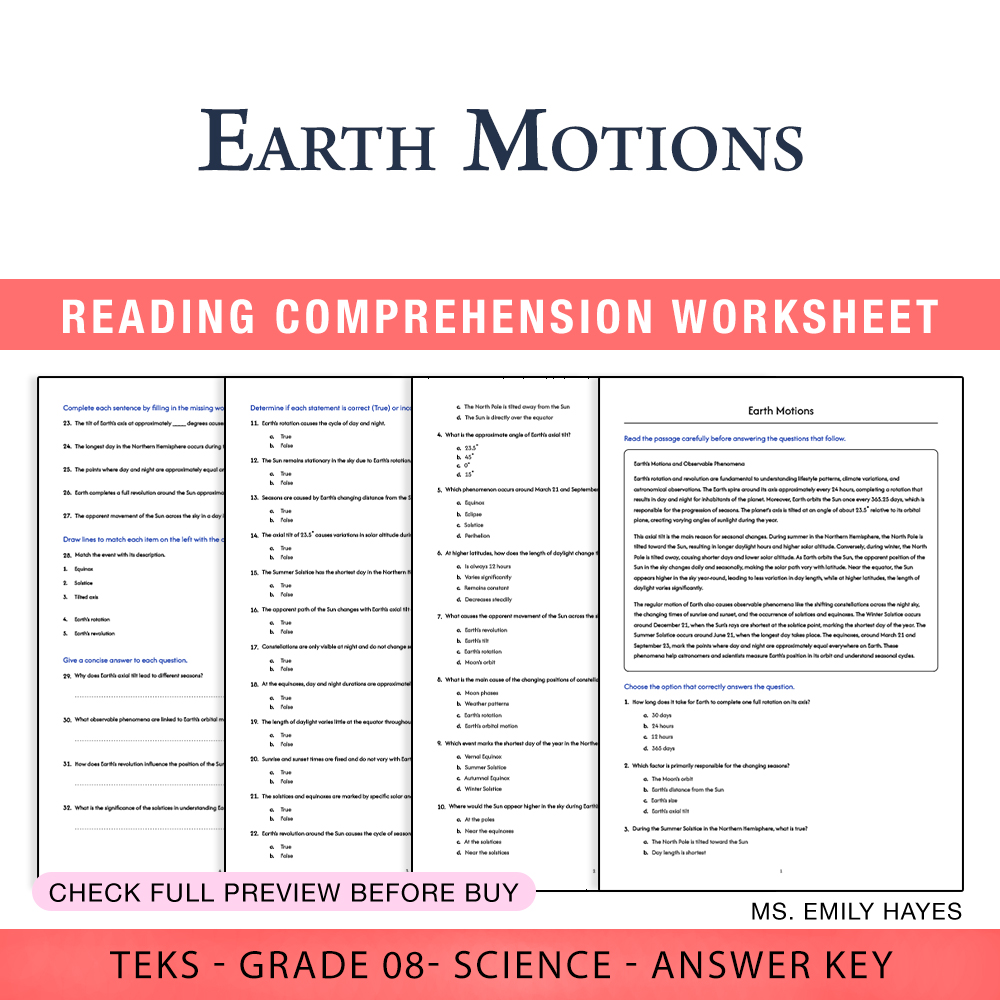
8th Grade Science | Earth Motions Worksheet (PDF+ Answer Key)
Created byCopper Leaf ClassroomLearning Objectives
- Describe Earth's rotation and its role in day and night cycles.
- Explain Earth's revolution around the Sun and how it causes seasons.
- Identify how Earth's axial tilt affects the Sun's altitude and length of days at different latitudes.
Instant download

Intermolecular Forces Worksheet | Grade 8 Science | Alberta Standards
JCreated byJ.S SheetsLearning Objectives
- Understand how intermolecular forces influence melting point, boiling point, and solubility.
- Explain the regional implications of molecular interactions, such as Alberta's freeze–thaw cycles and oil sands volatility.
- Relate the strength of intermolecular forces to regional phenomena like evaporation rates and hydrocarbon volatility.
Also included in: Grade 8 Matter and Chemical Change Science Lesson Bundle – Alberta Framework +1 more
Instant download
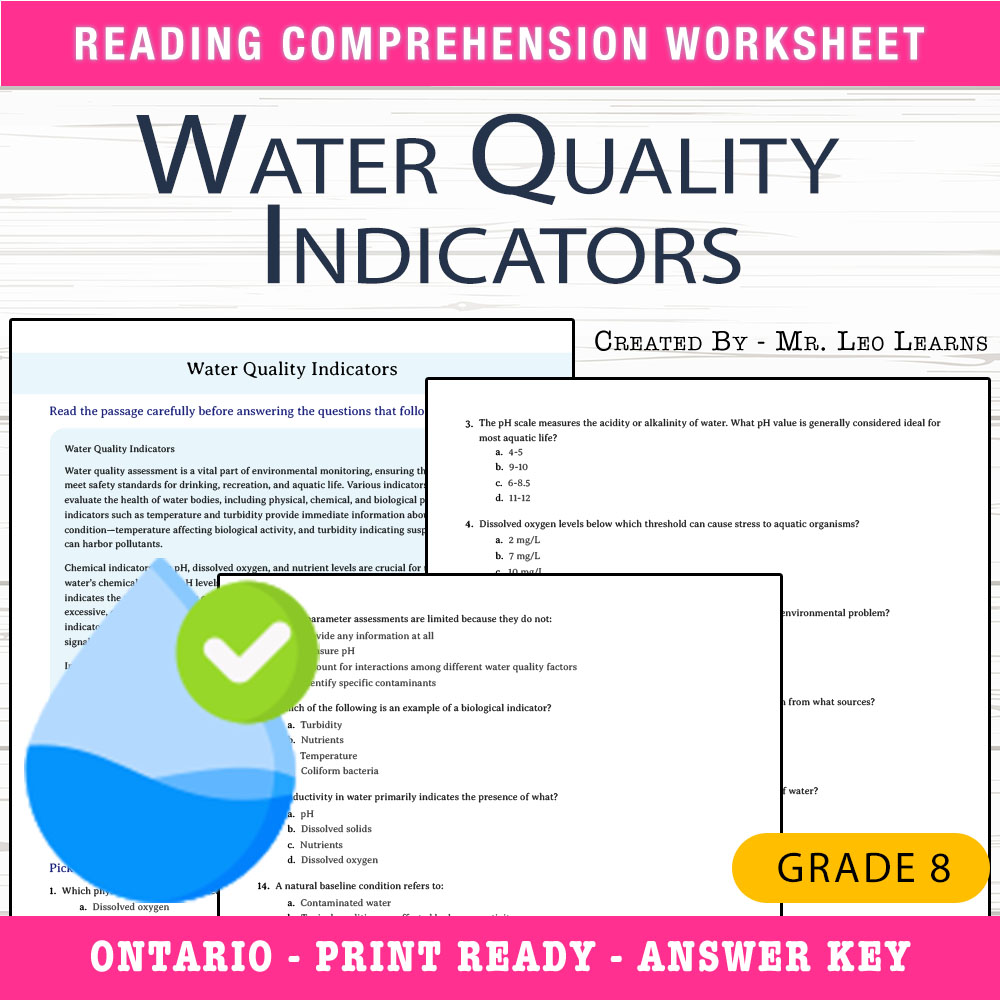
Grade 8 Science — Water Quality Indicators Worksheet for Mastery
 Created byThe Resource Hub
Learning Objectives
- Understand the physical, chemical, and biological indicators used to assess water quality.
- Interpret ranges of water quality parameters for different aquatic health conditions.
- Recognize the importance of integrated assessments over single-parameter evaluations.
Also included in: Grade 8 Science Water Systems UNIT Bundle – Hydrology & Conservation Worksheets +1 more
Instant download
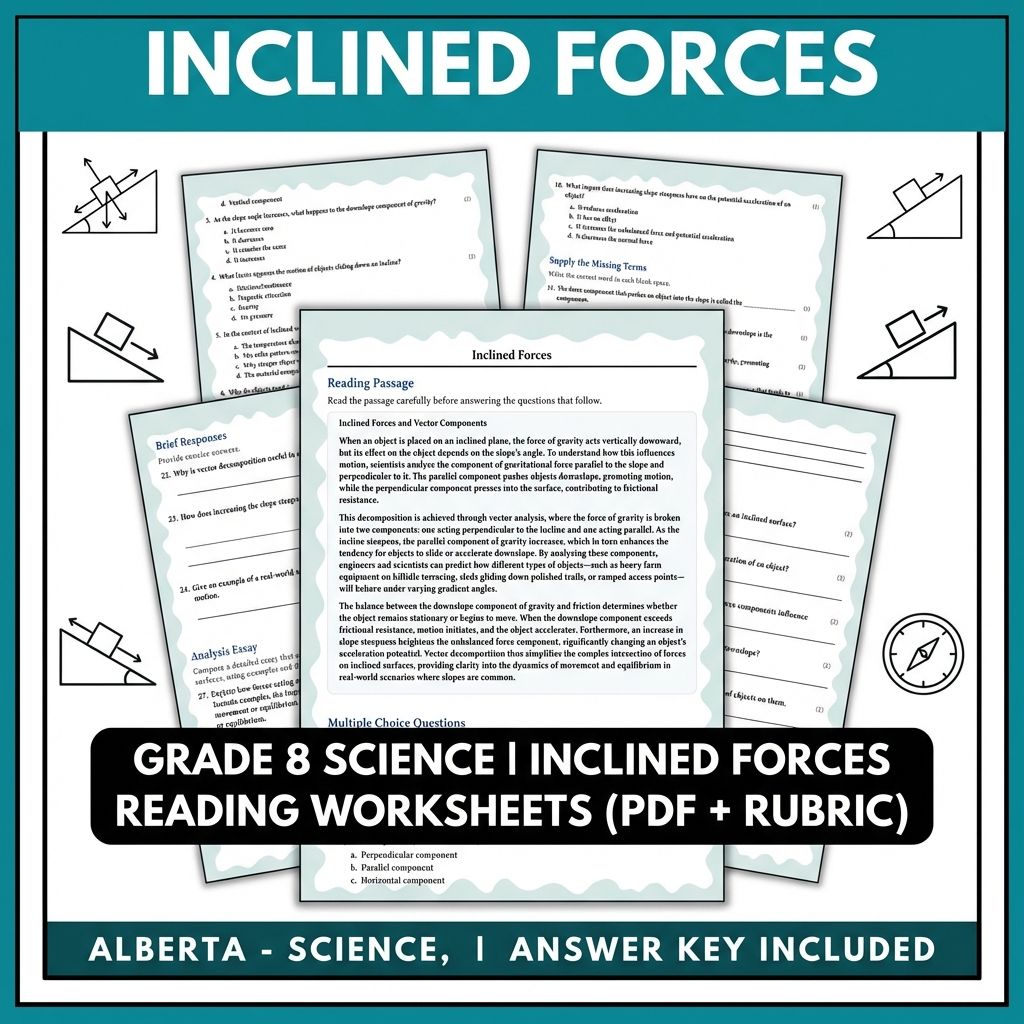
Grade 8 Science | Inclined Forces Reading Worksheets (PDF + Rubric)
JCreated byJ.S SheetsLearning Objectives
- Understand how force components are resolved on slopes through vector decomposition.
- Identify how the angle of inclination affects the unbalanced force and acceleration potential.
- Apply concepts of parallel and perpendicular force components in real-world scenarios such as farm equipment on hills and sled descents.
Also included in: Grade 8 Science Bundle – Forces, Motion & Energy Worksheets (PDF & Answer Key) +1 more
Instant download
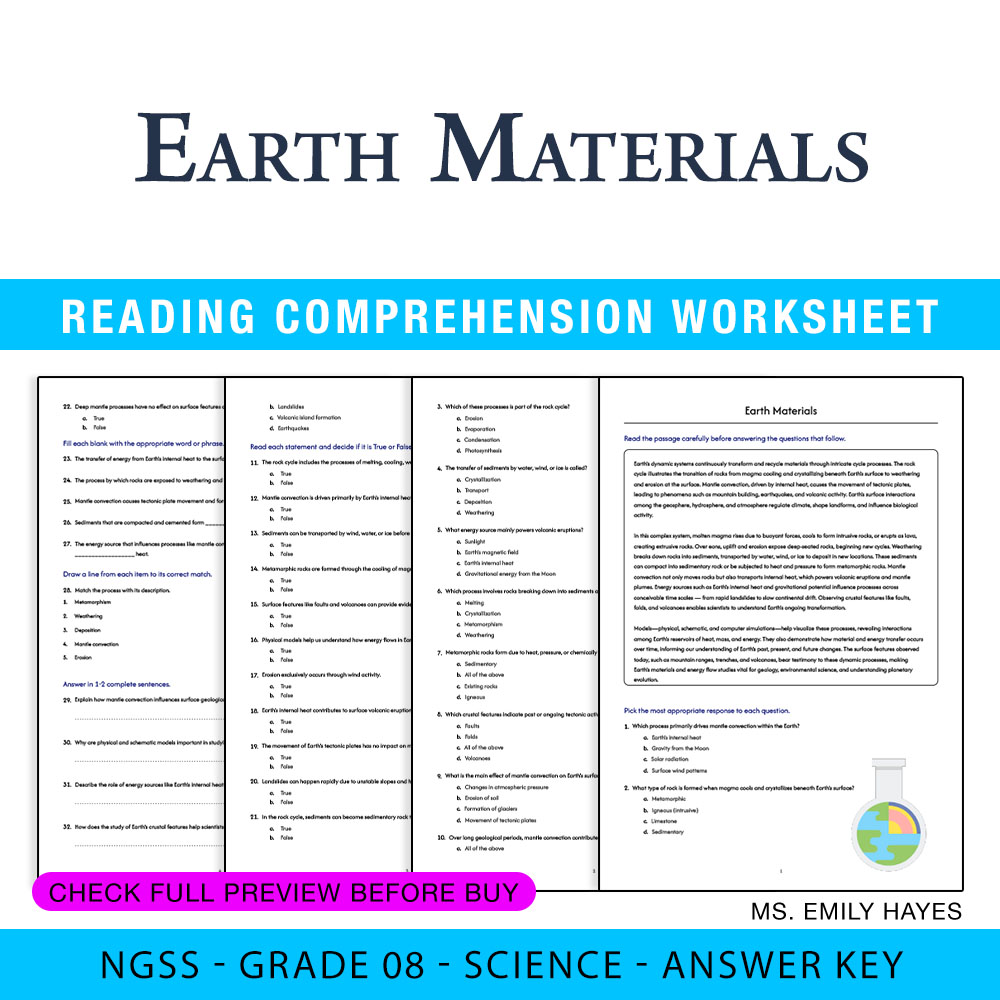
Grade 8 Science | Earth Materials Worksheet (PDF + Answer Key)
Created byCopper Leaf ClassroomLearning Objectives
- Understand and describe the processes involved in Earth's rock cycle, including melting, crystallization, uplift, weathering, transport, and deposition.
- Explain how mantle convection affects Earth's surface features and materials flow within the geosphere.
- Identify the interactions among the geosphere, hydrosphere, and atmosphere in Earth's material and energy exchanges.
Instant download
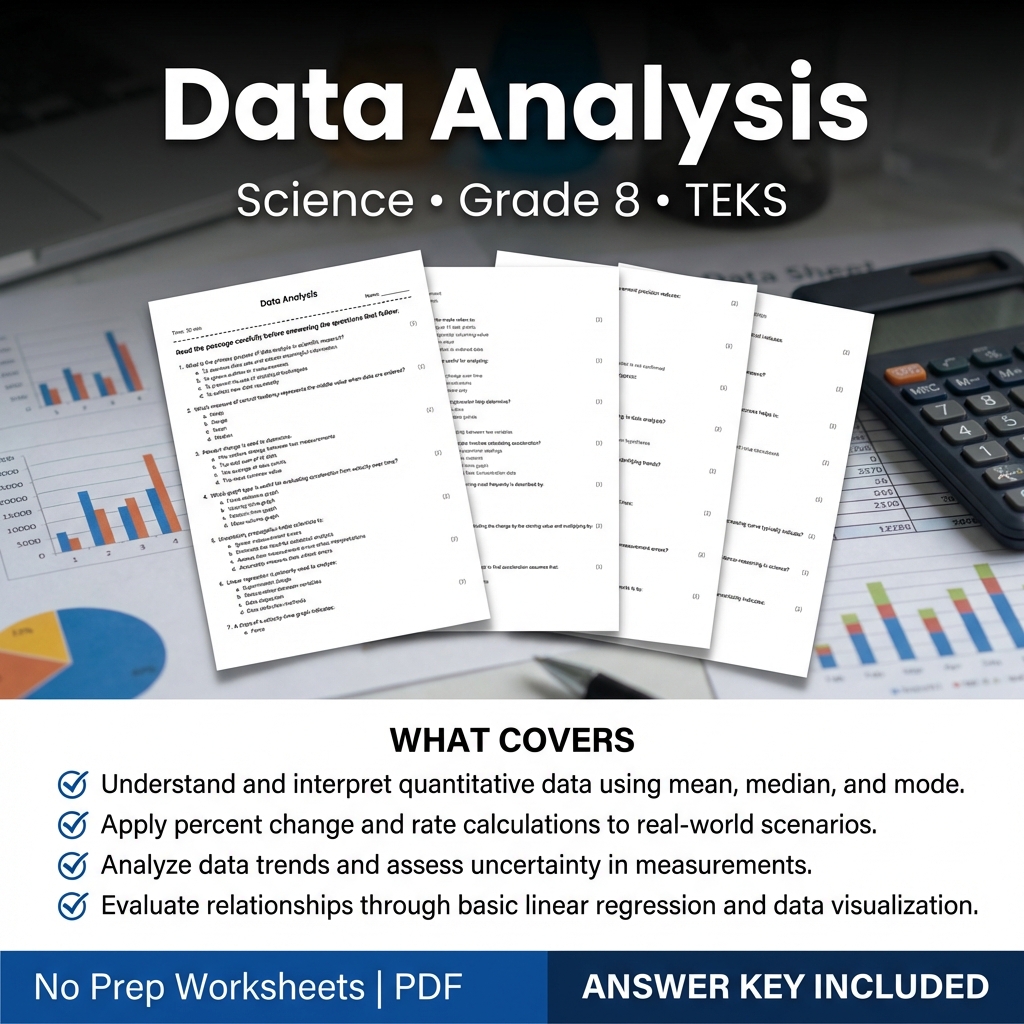
Grade 8 Data Analysis Worksheet | Science Assessment & Practice PDF
Created byCoral Reef LearningLearning Objectives
- Understand and interpret quantitative data using mean, median, and mode.
- Apply percent change and rate calculations to real-world scenarios.
- Analyze data trends and assess uncertainty in measurements.
Instant download
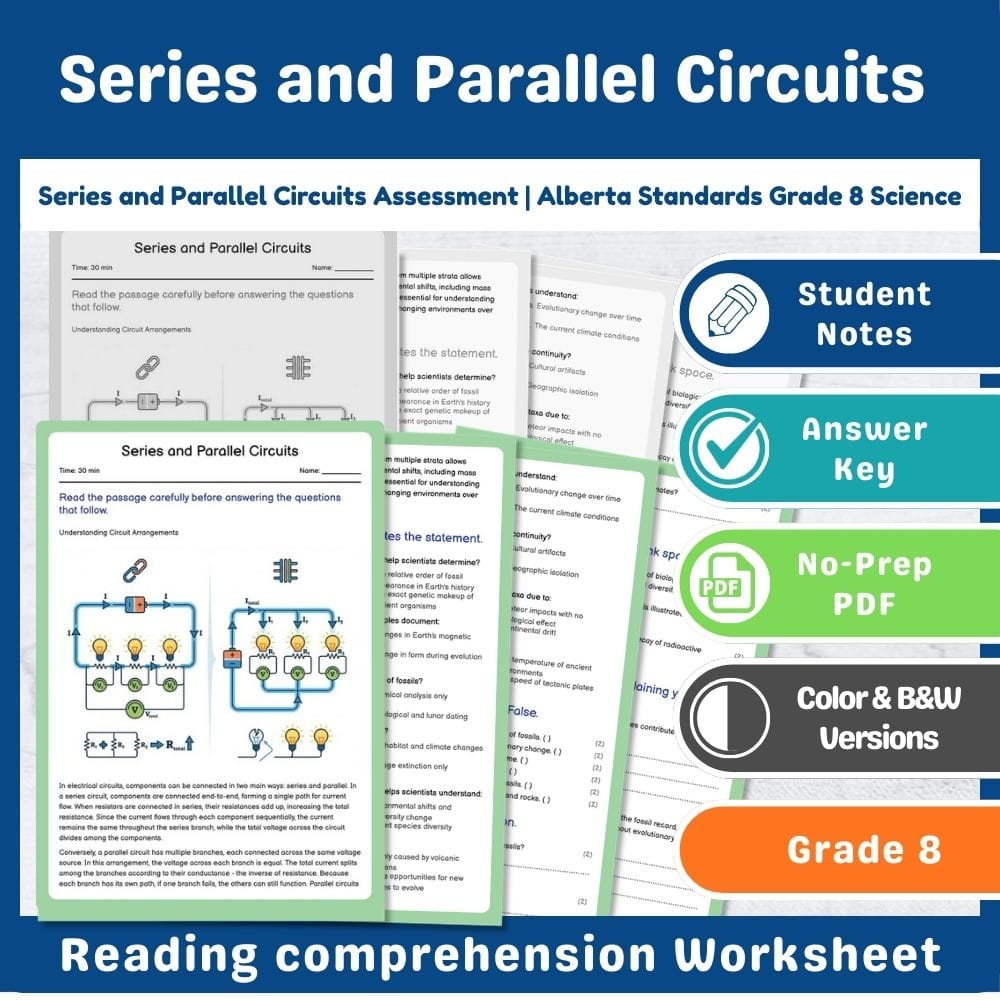
Series and Parallel Circuits Assessment | Alberta Standards Grade 8 Science
 Created byPrism Point Learning
Learning Objectives
- Understand the differences between series and parallel circuit arrangements.
- Predict how circuit behavior changes in series and parallel configurations.
- Compare resistances, current distribution, and voltages in series and parallel circuits.
Instant download
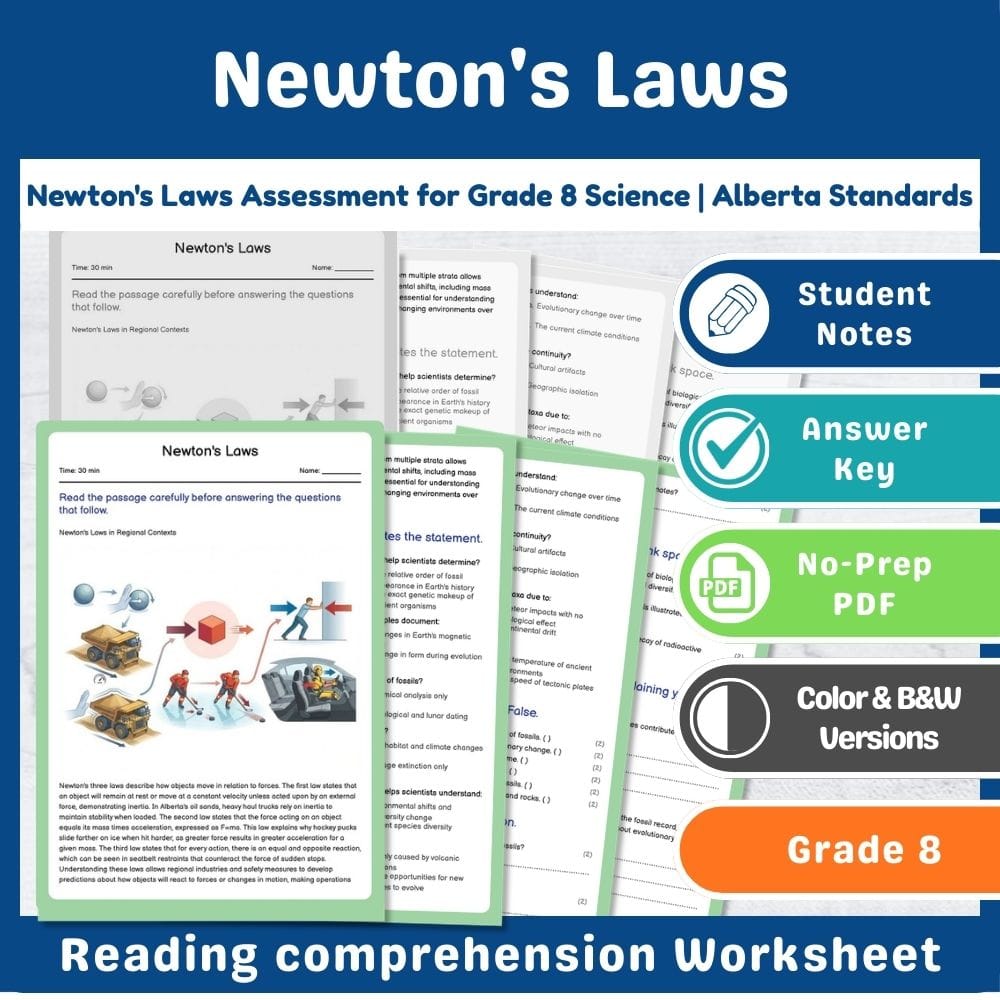
Newton's Laws Assessment for Grade 8 Science | Alberta Standards
Created byPrism Point LearningLearning Objectives
- Explain Newton's three laws of motion and how they relate to force, mass, and acceleration.
- Apply Newton's laws to regional scenarios such as heavy haul trucks, hockey puck motion, and seatbelt restraints.
- Predict the direction and magnitude of objects' motion based on applied forces.
Also included in: Lesson Grade 8 Science Mini Bundle | Forces and Motion Alberta Standards
Instant download
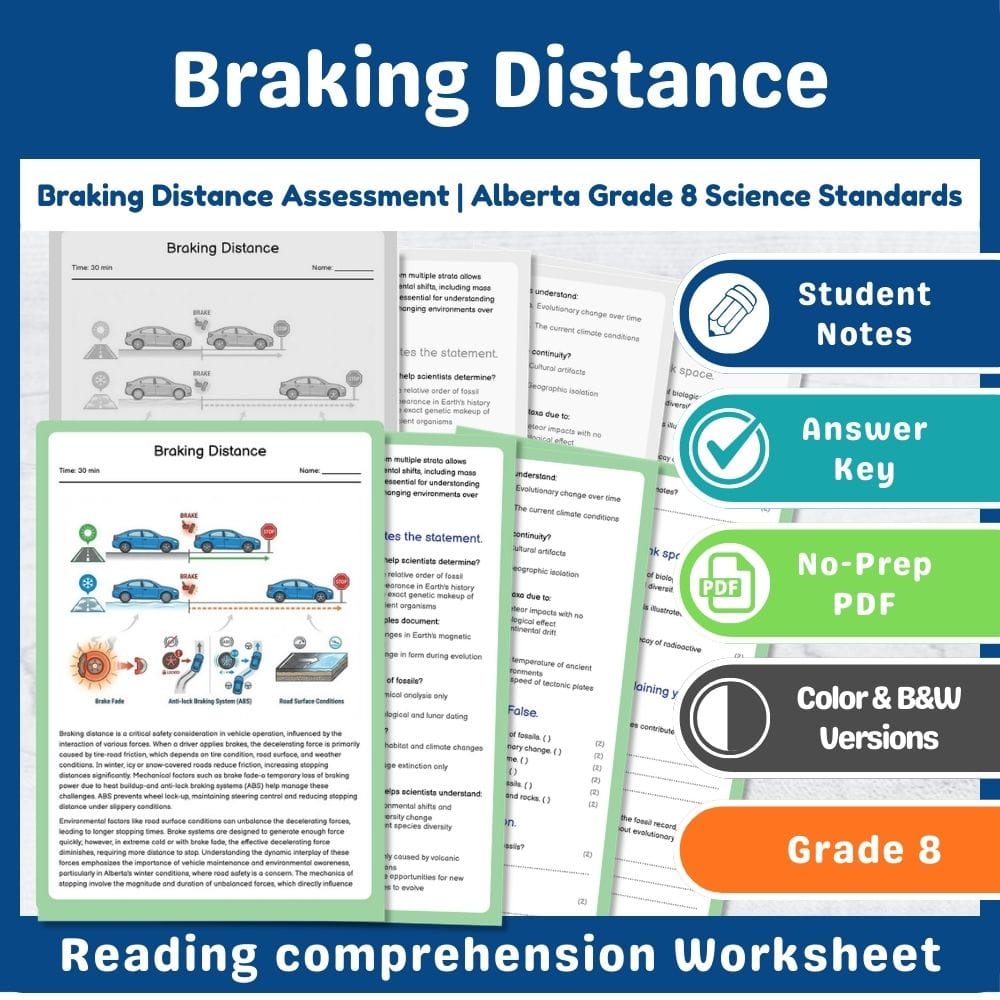
Braking Distance Assessment | Alberta Grade 8 Science Standards
Created byPrism Point LearningLearning Objectives
- Understand the factors affecting stopping distance during braking.
- Explain the role of tire-road friction and mechanical systems in deceleration.
- Analyze how environmental conditions influence braking effectiveness.
Also included in: Lesson Grade 8 Science Mini Bundle | Forces and Motion Alberta Standards
Instant download
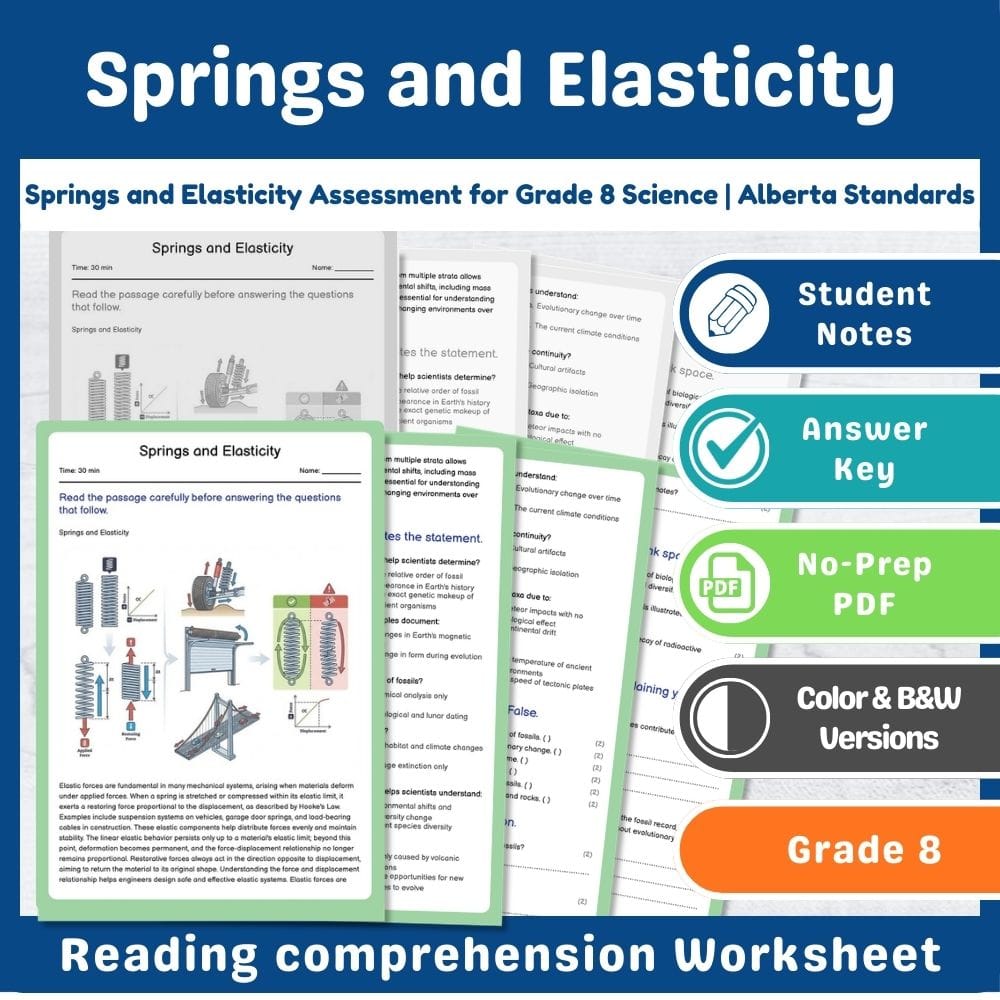
Springs and Elasticity Assessment for Grade 8 Science | Alberta Standards
Created byPrism Point LearningLearning Objectives
- Understand how elastic forces depend on deformation of materials.
- Identify examples of springs and elastic components in real-world systems.
- Explain the concept of linear elastic behavior limits and force direction.
Also included in: Lesson Grade 8 Science Mini Bundle | Forces and Motion Alberta Standards
Instant download
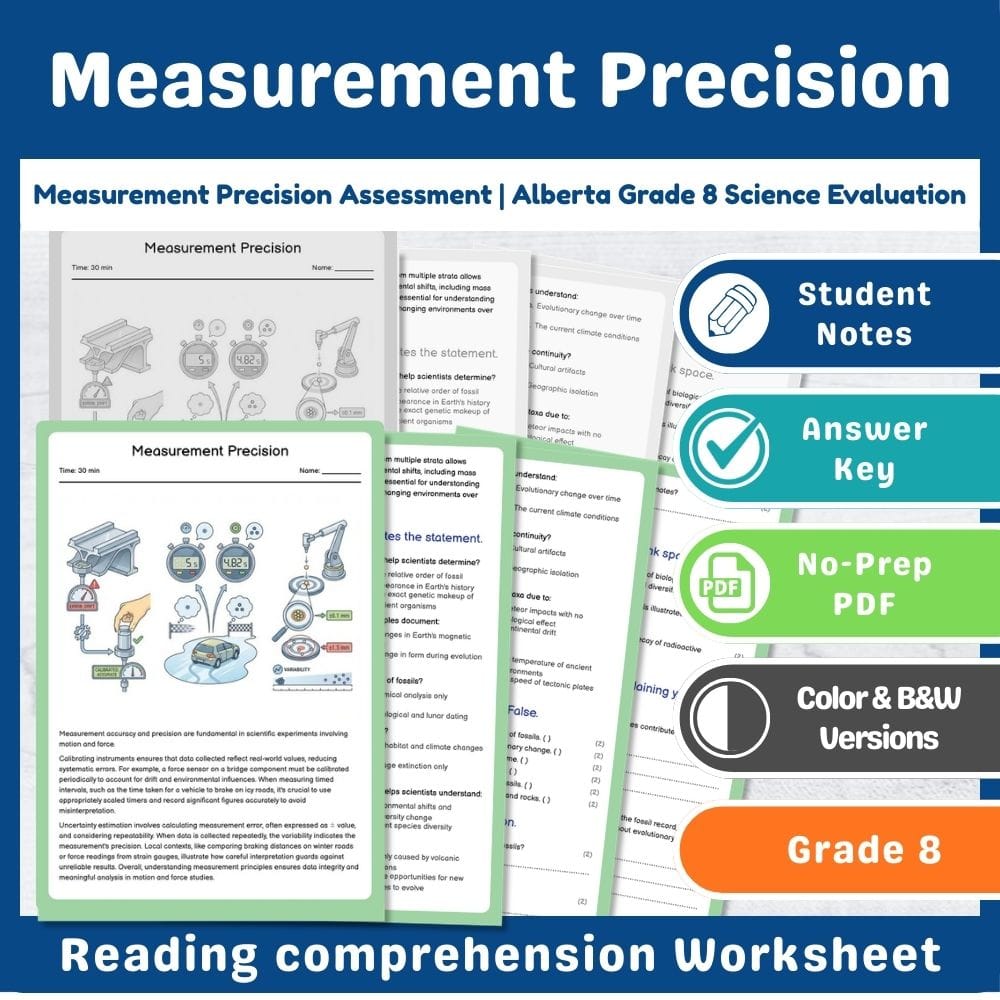
Measurement Precision Assessment | Alberta Grade 8 Science Evaluation
Created byPrism Point LearningLearning Objectives
- Understand the principles of instrument calibration and measurement uncertainty.
- Interpret measurement data considering significant figures and error estimates.
- Apply measurement concepts to real-world contexts, such as braking distances and force readings.
Also included in: Lesson Grade 8 Science Mini Bundle | Forces and Motion Alberta Standards
Instant download
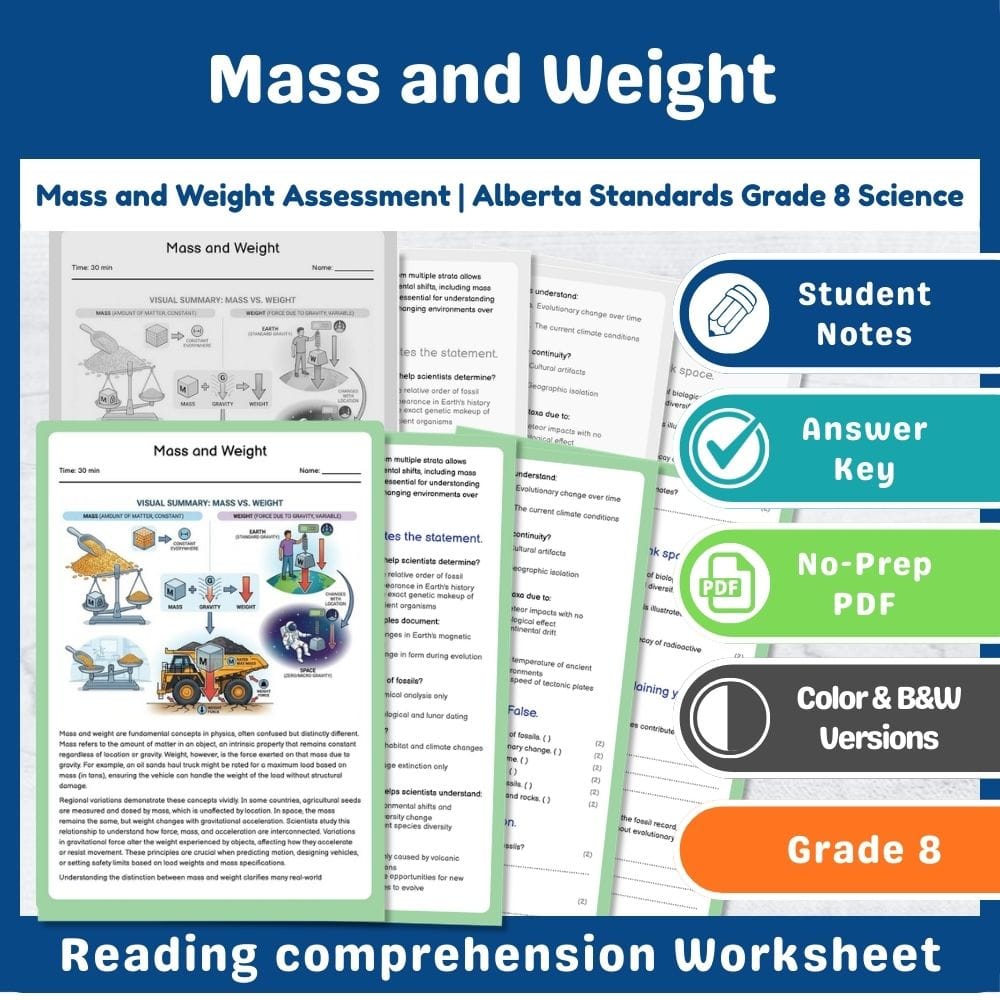
Mass and Weight Assessment | Alberta Standards Grade 8 Science
Created byPrism Point LearningLearning Objectives
- Distinguish between mass as an intrinsic property of matter and weight as the gravitational force on that mass.
- Understand how regional examples illustrate mass and weight concepts, such as load specifications and dosing.
- Explain the relationship between mass, gravitational acceleration, and weight.
Also included in: Lesson Grade 8 Science Mini Bundle | Forces and Motion Alberta Standards
Instant download
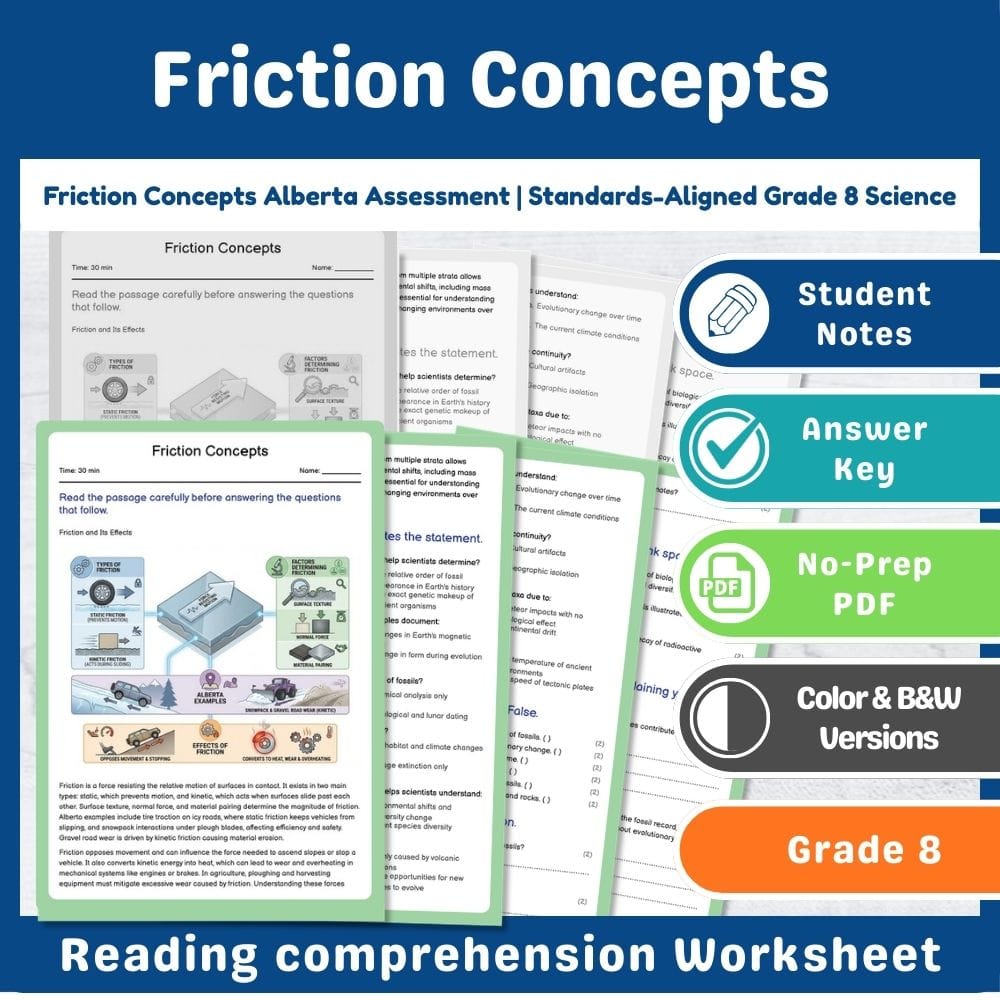
Friction Concepts Alberta Assessment | Standards-Aligned Grade 8 Science
Created byPrism Point LearningLearning Objectives
- Explain the difference between static and kinetic friction.
- Identify factors affecting the strength of frictional forces.
- Describe real-world examples of friction in transportation and agriculture.
Also included in: Lesson Grade 8 Science Mini Bundle | Forces and Motion Alberta Standards
Instant download
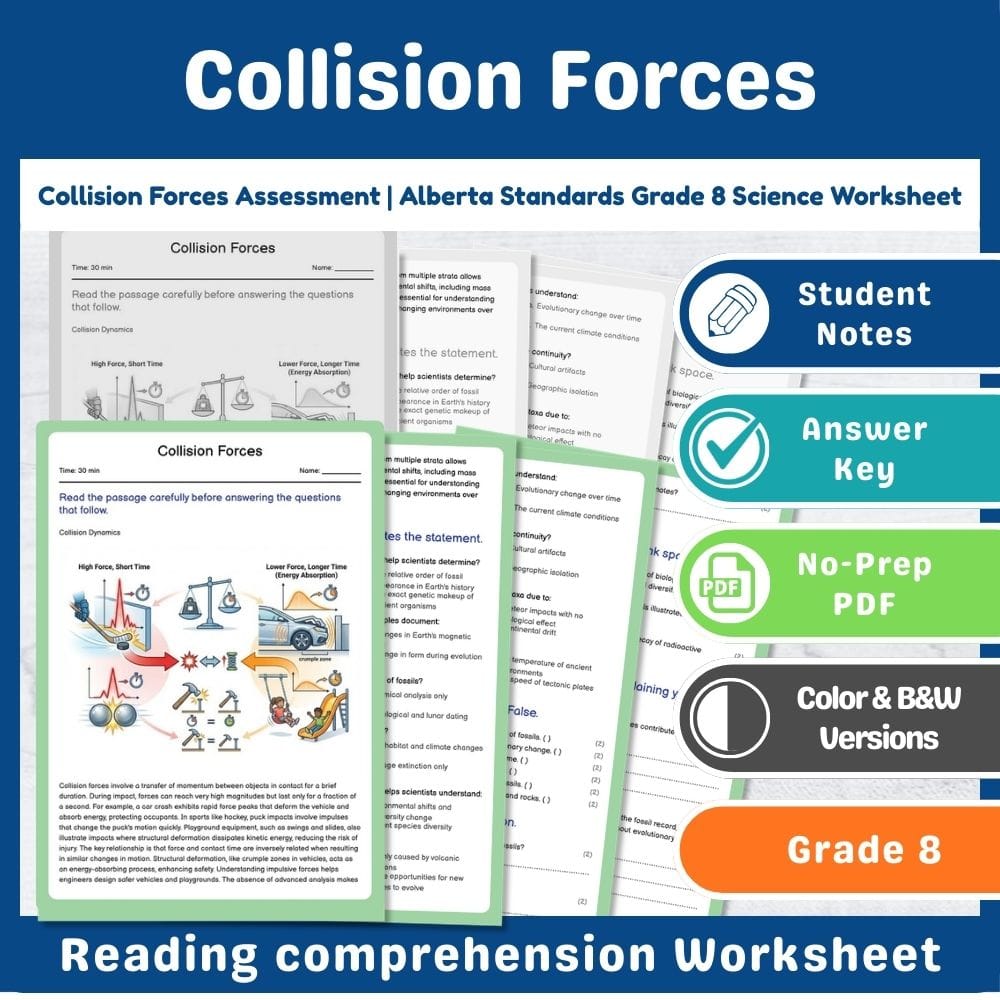
Collision Forces Assessment | Alberta Standards Grade 8 Science Worksheet
Created byPrism Point LearningLearning Objectives
- Understand the relationship between force magnitude and contact time during collisions.
- Explain how structural deformation absorbs energy in impact events.
- Analyze real-world collision scenarios to identify impulse effects and observable outcomes.
Also included in: Lesson Grade 8 Science Mini Bundle | Forces and Motion Alberta Standards
Instant download
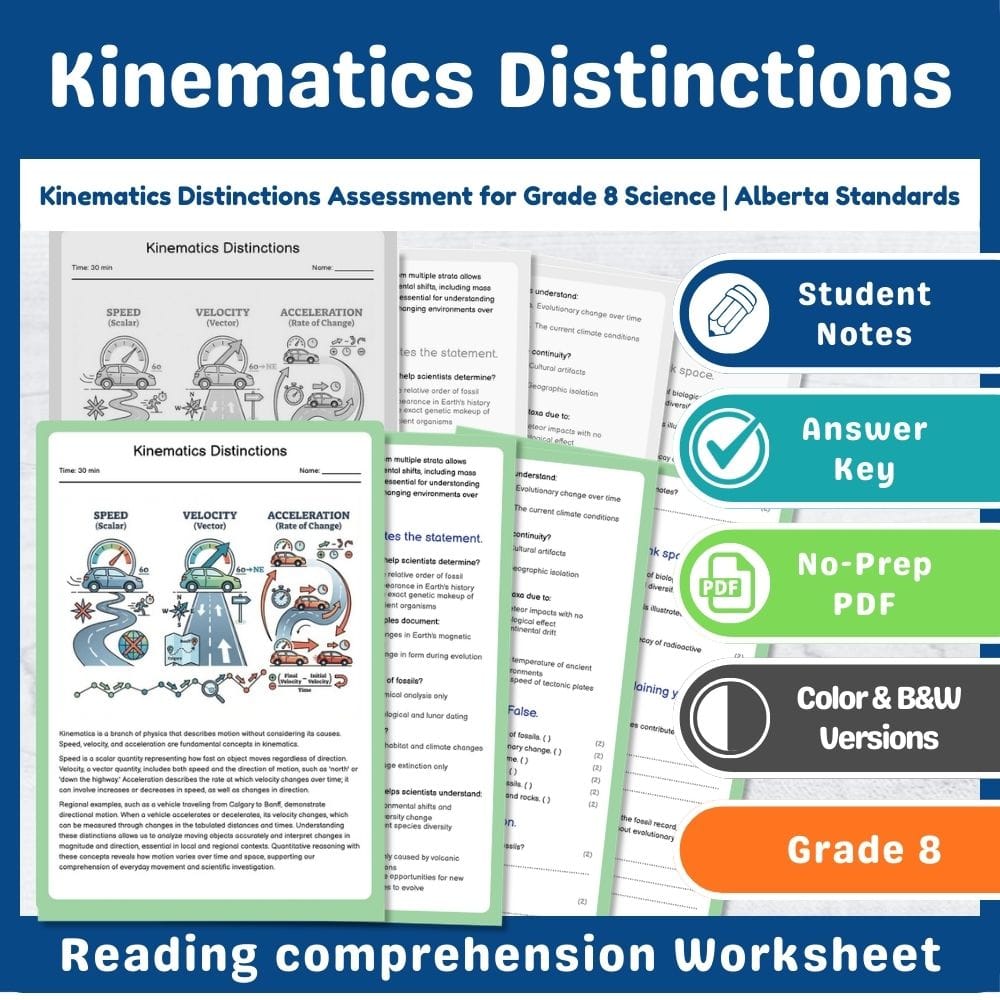
Kinematics Distinctions Assessment for Grade 8 Science | Alberta Standards
Created byPrism Point LearningLearning Objectives
- Define speed, velocity, and acceleration with precision and clarity.
- Differentiate between scalar and vector quantities in motion.
- Interpret real-world examples of directional motion in the context of regions such as Calgary and Banff.
Also included in: Lesson Grade 8 Science Mini Bundle | Forces and Motion Alberta Standards
Instant download
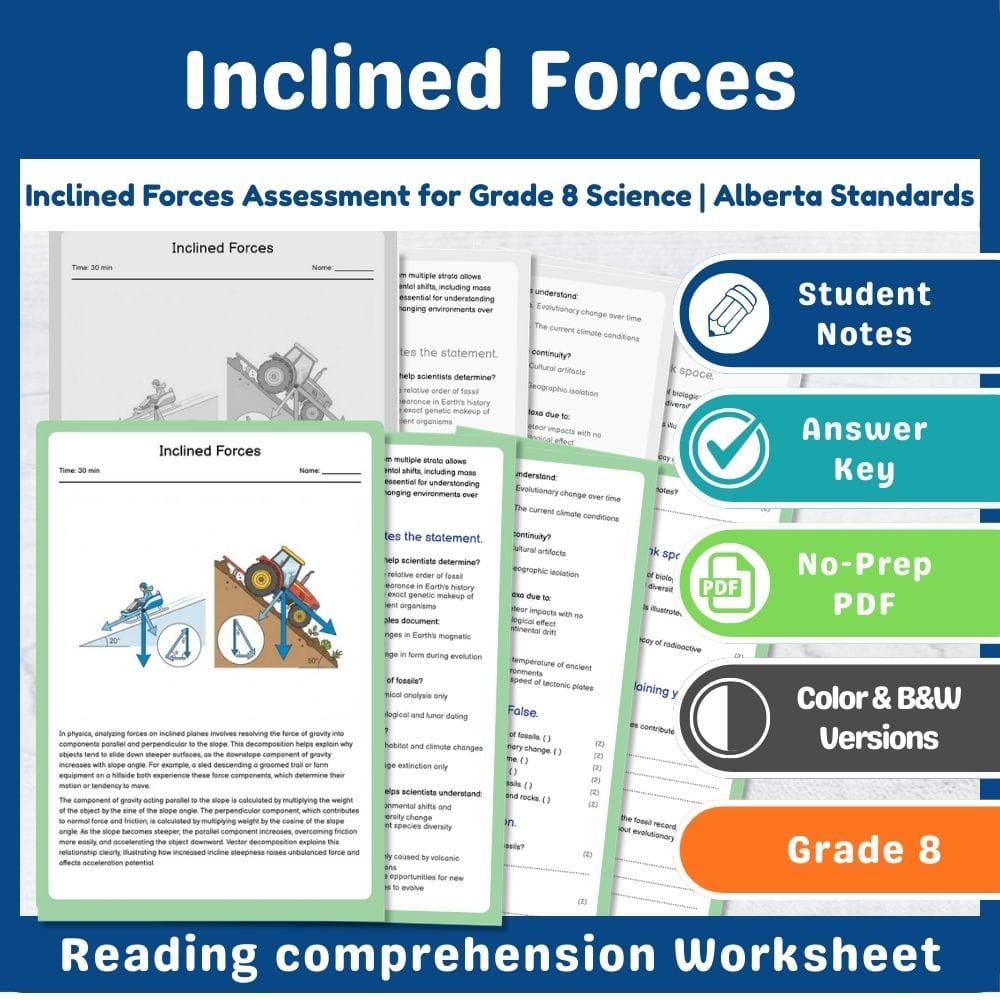
Inclined Forces Assessment for Grade 8 Science | Alberta Standards
Created byPrism Point LearningLearning Objectives
- Understand how to resolve gravitational force into components on an inclined plane.
- Analyze the effect of slope steepness on unbalanced forces and potential acceleration.
- Apply vector decomposition to real-world inclined force scenarios and analyze frictional resistance.
Also included in: Lesson Grade 8 Science Mini Bundle | Forces and Motion Alberta Standards
Instant download
About Grade 8 Science Worksheets
Explore Grade 8 Science worksheets for classwork, homework, or review. Our 5,999 printables download instantly as PDFs.
Each resource here is built by an independent educator and reviewed for quality. Worksheets print straight from PDF and suit classroom use, homework, or extra practice; most come with answer keys, and you can preview before purchasing.