
Grade 9 Science Worksheets
6,926 worksheets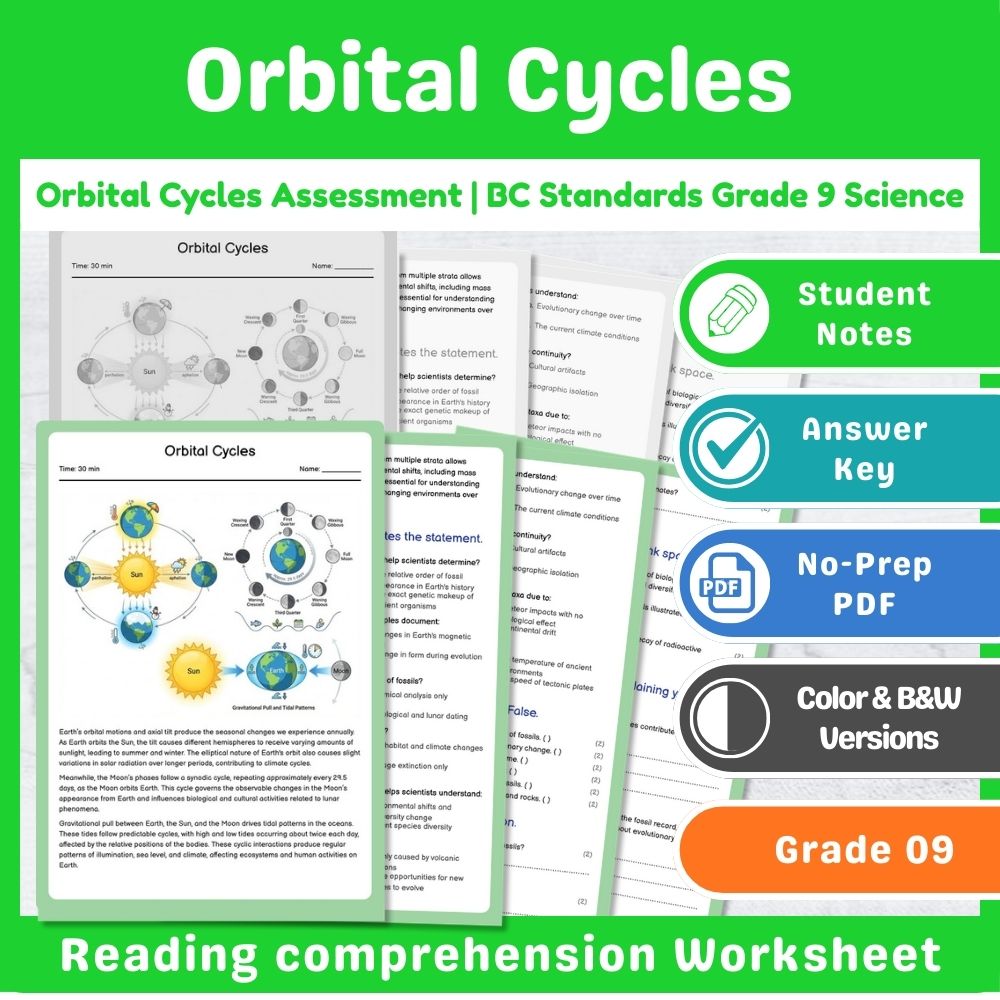
Orbital Cycles Assessment | BC Standards Grade 9 Science
 Created byPrism Point Learning
Learning Objectives
- Understand how Earth's orbital relationships influence seasons and climate patterns.
- Identify the Moon's phases and the cycles that determine lunar illumination.
- Explain how gravitational interactions between Earth, Moon, and Sun drive tides and cyclic phenomena.
Also included in: Grade 9 Science Mini Bundle – Earth & Space Assessment & Activities
Instant download
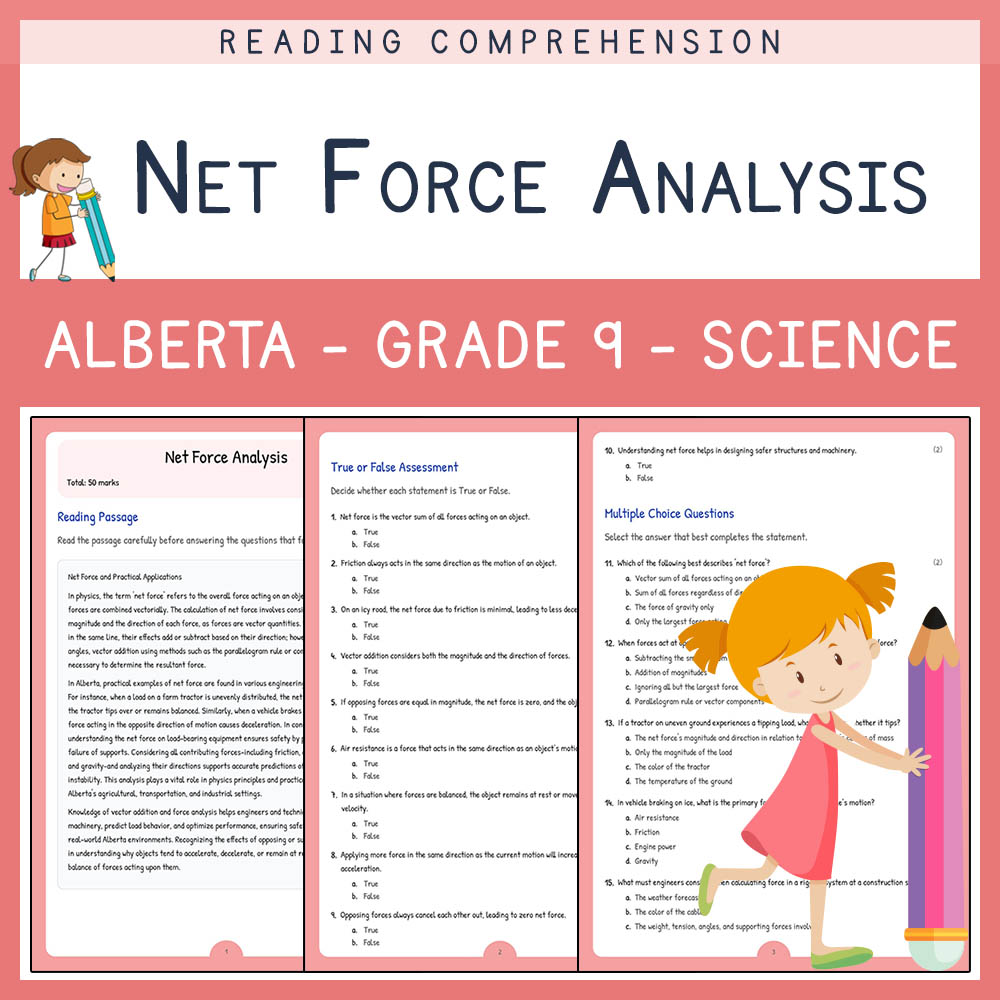
Grade 9 Science | Net Force Analysis Worksheet | Alberta Standards
 Created byLumora Learning
Learning Objectives
- Understand the concept of net force and how vector addition determines the resultant acceleration of objects.
- Analyze real-world scenarios involving opposing forces such as friction, air resistance, and applied loads.
- Calculate net force through vector analysis in practical Alberta situations like load tipping, vehicle deceleration, and rigging.
Instant download
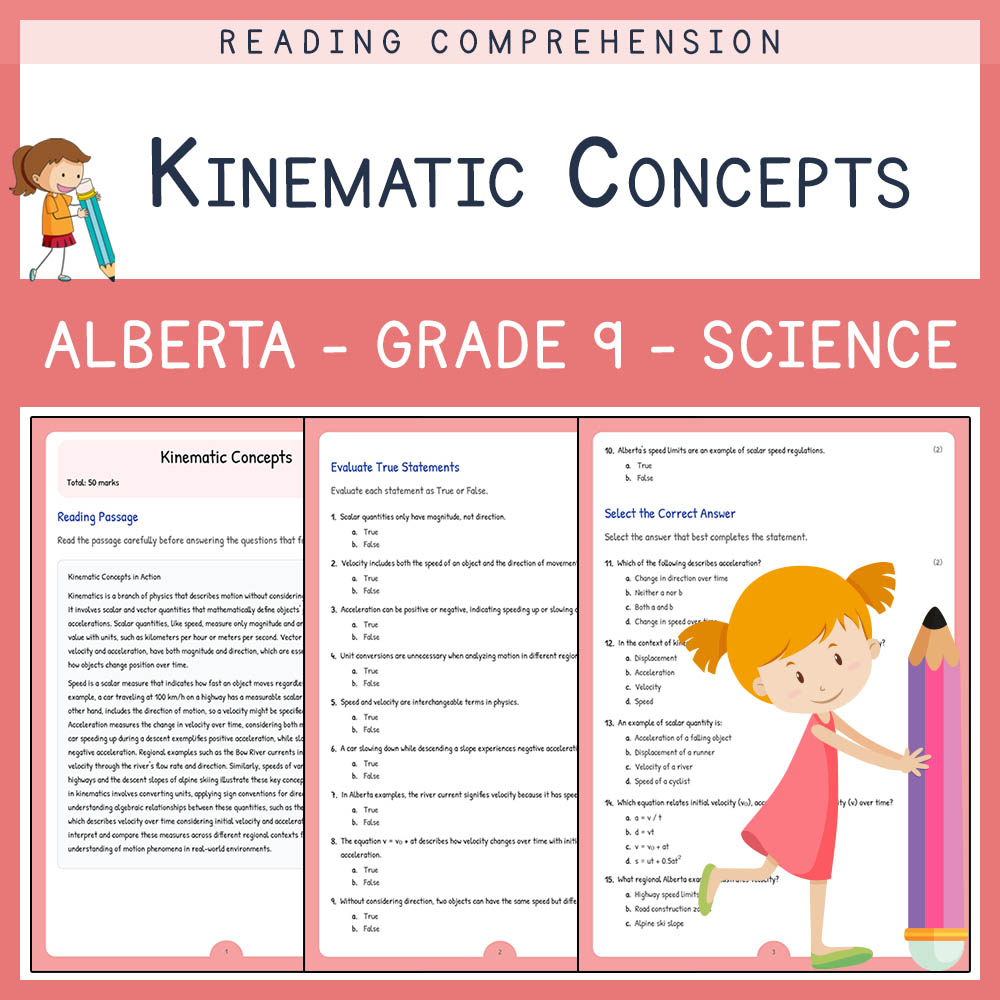
Grade 9 Science | Kinematic Concepts Worksheet | Alberta Standards
Created byLumora LearningLearning Objectives
- Understand how scalar and vector measures describe object motion.
- Identify and differentiate between speed, velocity, and acceleration.
- Apply unit conversions and sign conventions to analyze motion data.
Instant download
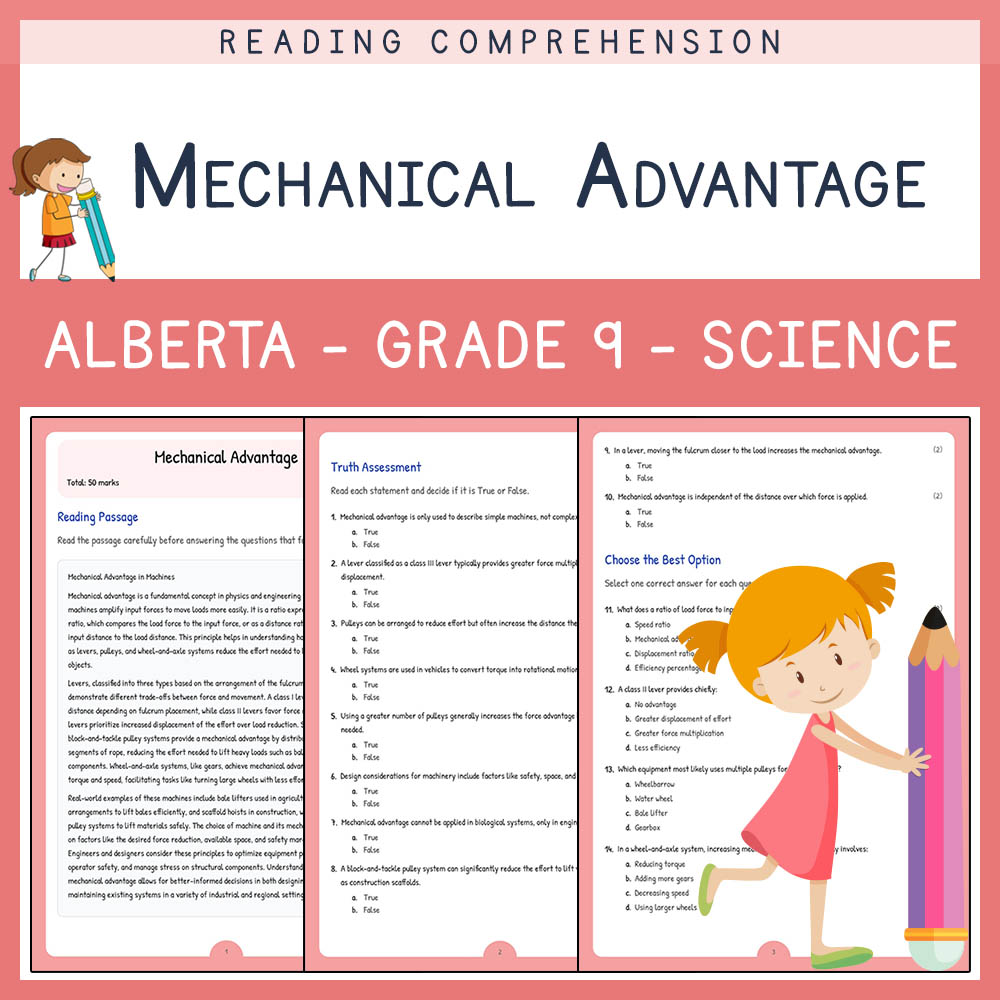
Grade 9 Science | Mechanical Advantage Worksheet | Alberta Standards
Created byLumora LearningLearning Objectives
- Explain the concept of mechanical advantage and how it is used in different machines.
- Calculate mechanical advantage for levers, pulleys, and wheel systems.
- Analyze trade-offs between force reduction and displacement in mechanical systems.
Instant download
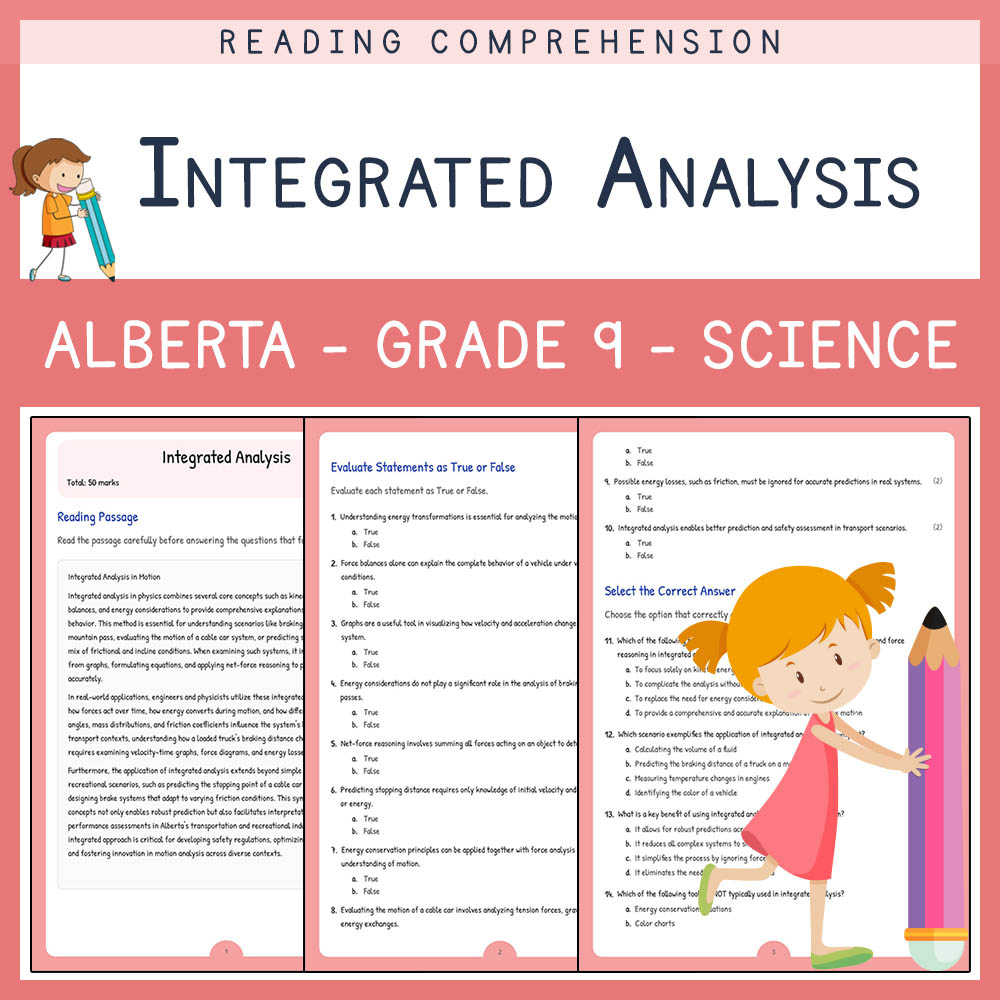
Grade 9 Science Worksheet | Integrated Analysis | Alberta Standards
Created byLumora LearningLearning Objectives
- Understand how to synthesize kinematic descriptions, force balances, and energy considerations in analyzing motion.
- Apply graphs, equations, and net-force reasoning to complex dynamic scenarios.
- Interpret integrated data to predict motion in transport and recreational contexts.
Instant download
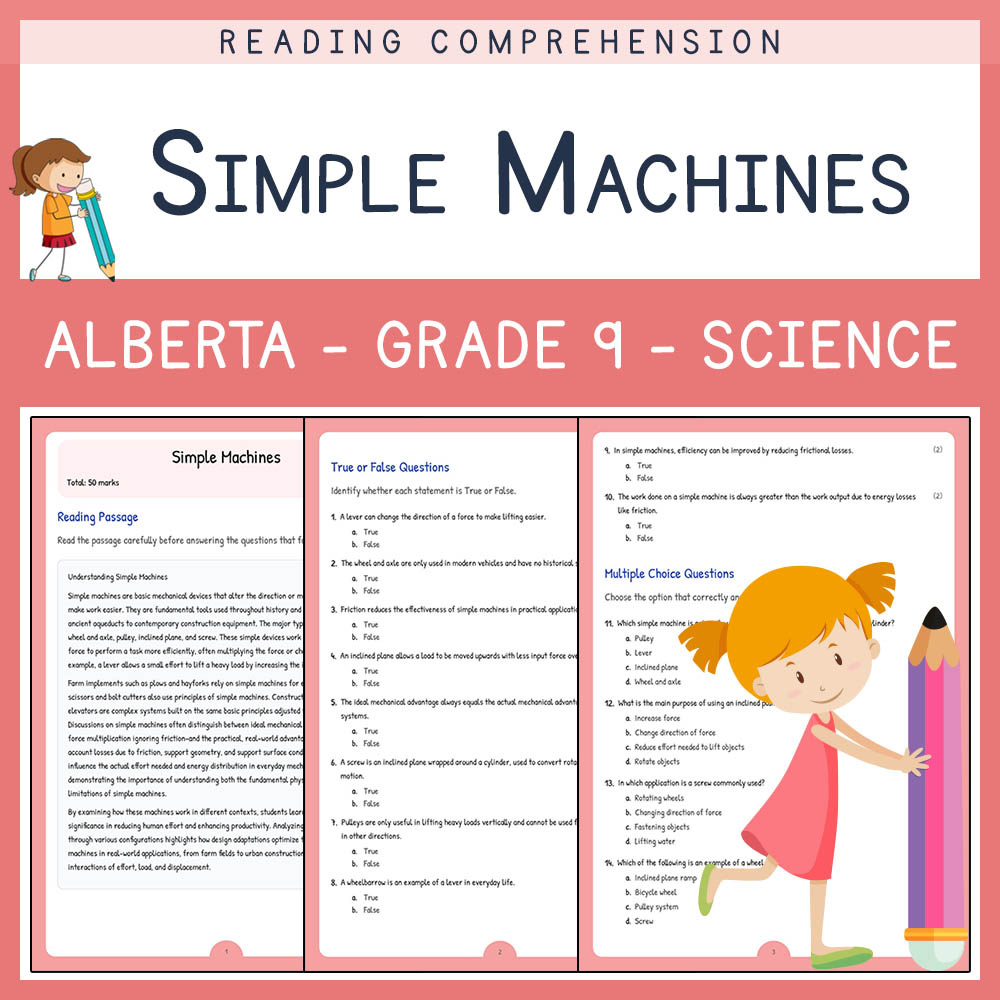
Grade 9 Science | Simple Machines Worksheet | Alberta Standards
Created byLumora LearningLearning Objectives
- Understand the fundamental concepts of simple machines and how they reduce effort.
- Identify common examples and applications of lever, wheel and axle, pulley, inclined plane, and screw.
- Explain the difference between ideal mechanical advantage and actual mechanical advantage considering friction and support geometry.
Instant download
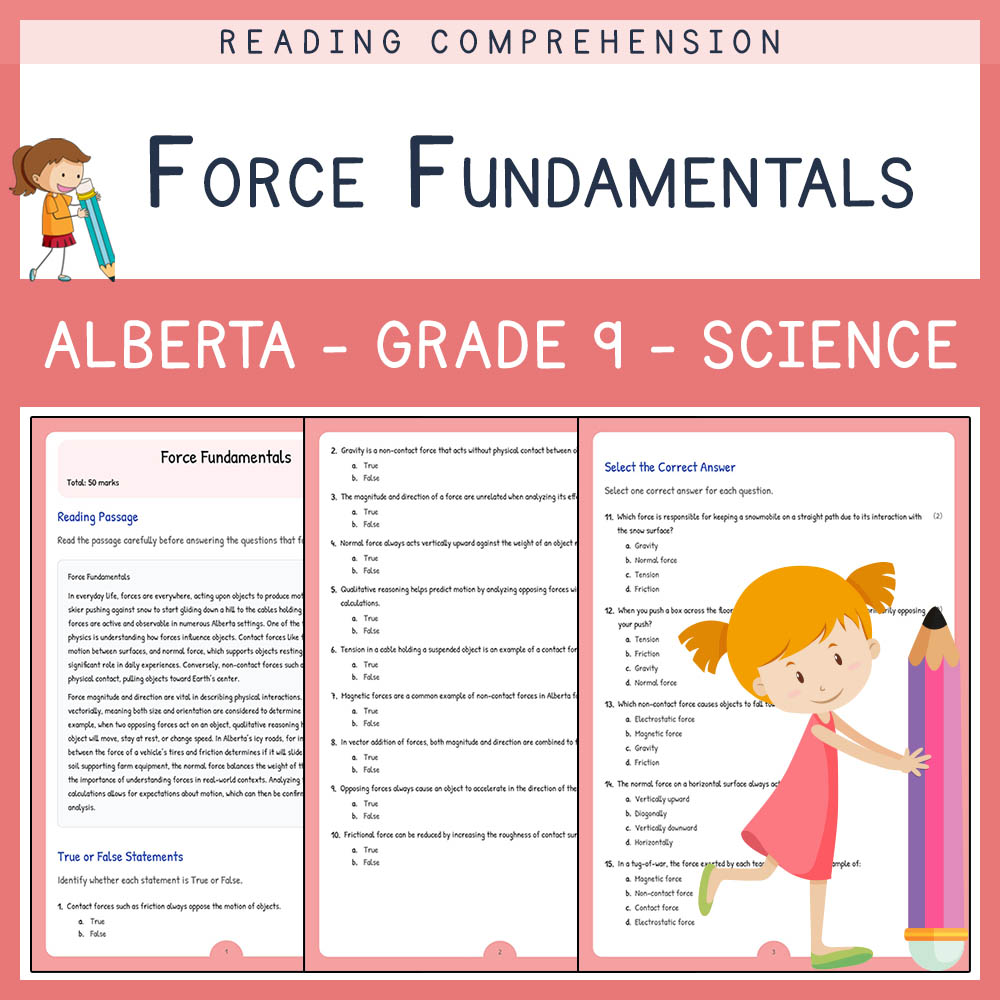
Grade 9 Science | Force Fundamentals Worksheet | Alberta Standards
Created byLumora LearningLearning Objectives
- Explain the concept of force as an interaction capable of changing an object's motion.
- Identify and differentiate between contact and non-contact forces in real-world Alberta settings.
- Describe how magnitude and direction combine vectorially to represent forces.
Instant download
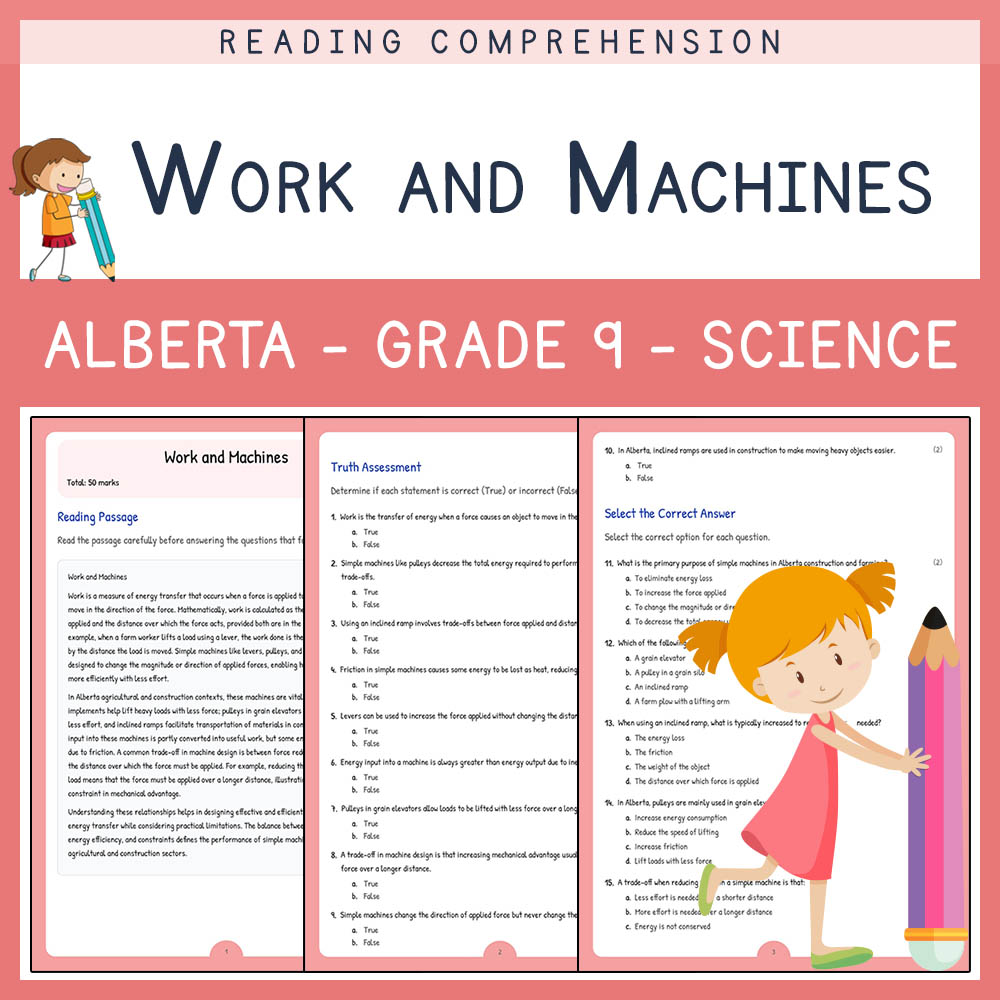
Grade 9 Science | Work and Machines Worksheet | Alberta Standards
Created byLumora LearningLearning Objectives
- Explain how work quantifies energy transfer through force and distance.
- Describe how simple machines modify force and distance to improve work efficiency.
- Identify real-world examples of levers, pulleys, and inclined ramps in Alberta contexts.
Instant download
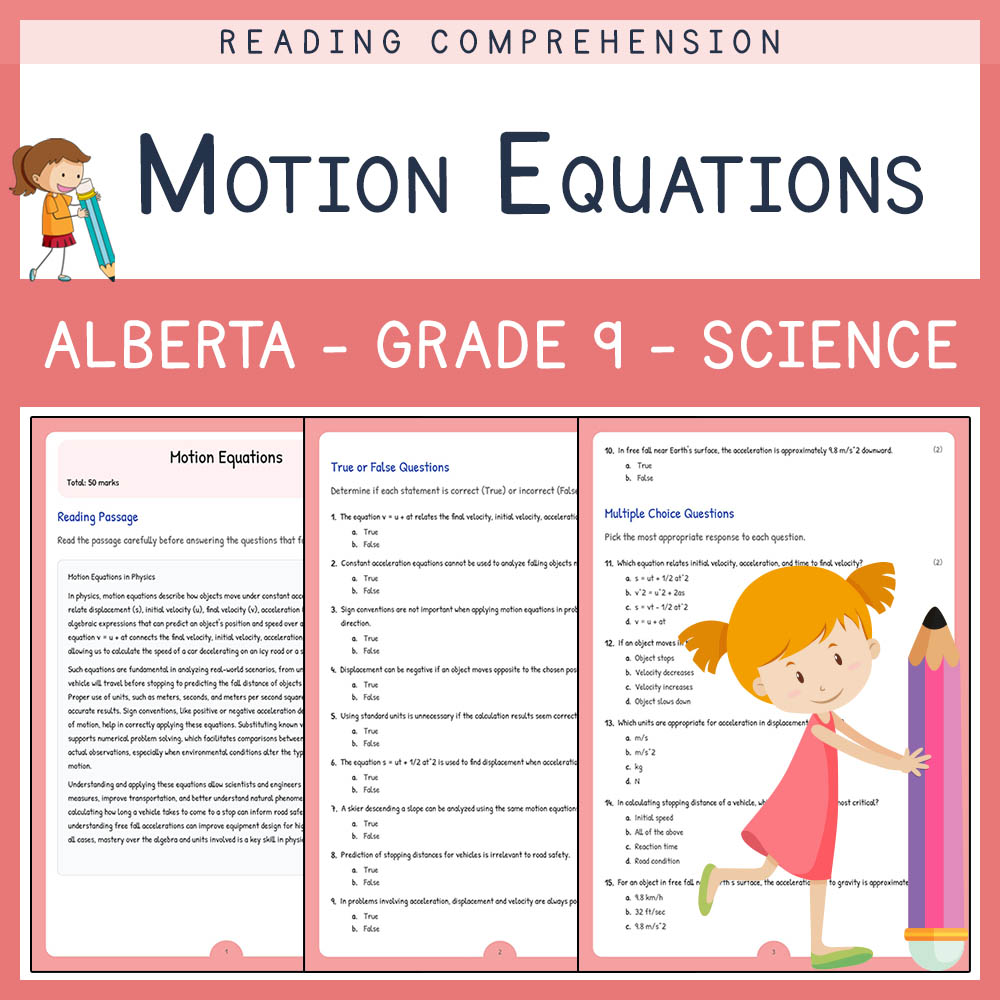
Grade 9 Science | Motion Equations Worksheet | Alberta Standards
Created byLumora LearningLearning Objectives
- Explain the relationship between displacement, velocity, acceleration, and time using constant-acceleration equations.
- Apply standard motion equations to solve numerical problems involving vehicle stopping, ski descents, and falling objects.
- Use proper units and sign conventions when substituting values into motion equations.
Instant download
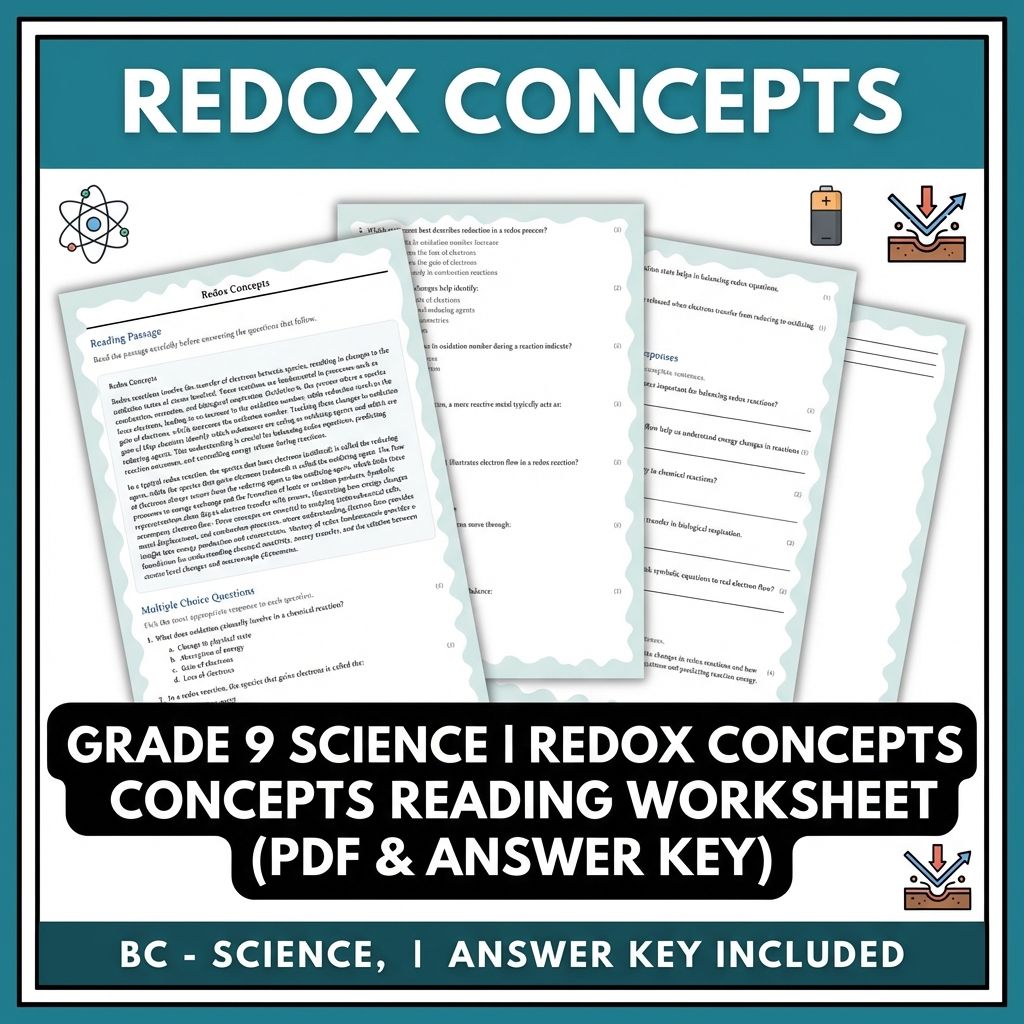
Grade 9 Science | Redox Concepts Reading Worksheet (PDF & Answer Key)
JCreated byJ.S SheetsLearning Objectives
- Understand the fundamental principles of oxidation and reduction in chemical reactions.
- Identify how electron transfer affects oxidation states in redox reactions.
- Track changes in oxidation numbers to determine oxidizing and reducing agents.
Instant download

Grade 9 Net Acceleration Worksheet | California Standards Practice PDF
 Created byClear Sky Classroom
Learning Objectives
- Explain Newton’s second law using net force, mass, and acceleration
- Predict the direction and magnitude of acceleration from unbalanced forces
- Apply vector ideas to describe how multiple forces combine to produce net acceleration
Instant download

Grade 9 Glucose Regulation Science Daily Reading TEKS Biology Worksheet
 Created byBRIGHT PATH RESOURCES
Learning Objectives
- Identify how insulin and glucagon change blood glucose levels.
- Explain the negative feedback loop idea using hormones and body tissues.
- Use key terms (insulin, glucagon, glycogenolysis, gluconeogenesis, beta cells, alpha cells) in context.
Also included in: Grade 9 Homeostasis and Body Systems Biology Worksheets Bundle | TEKS +1 more
Instant download
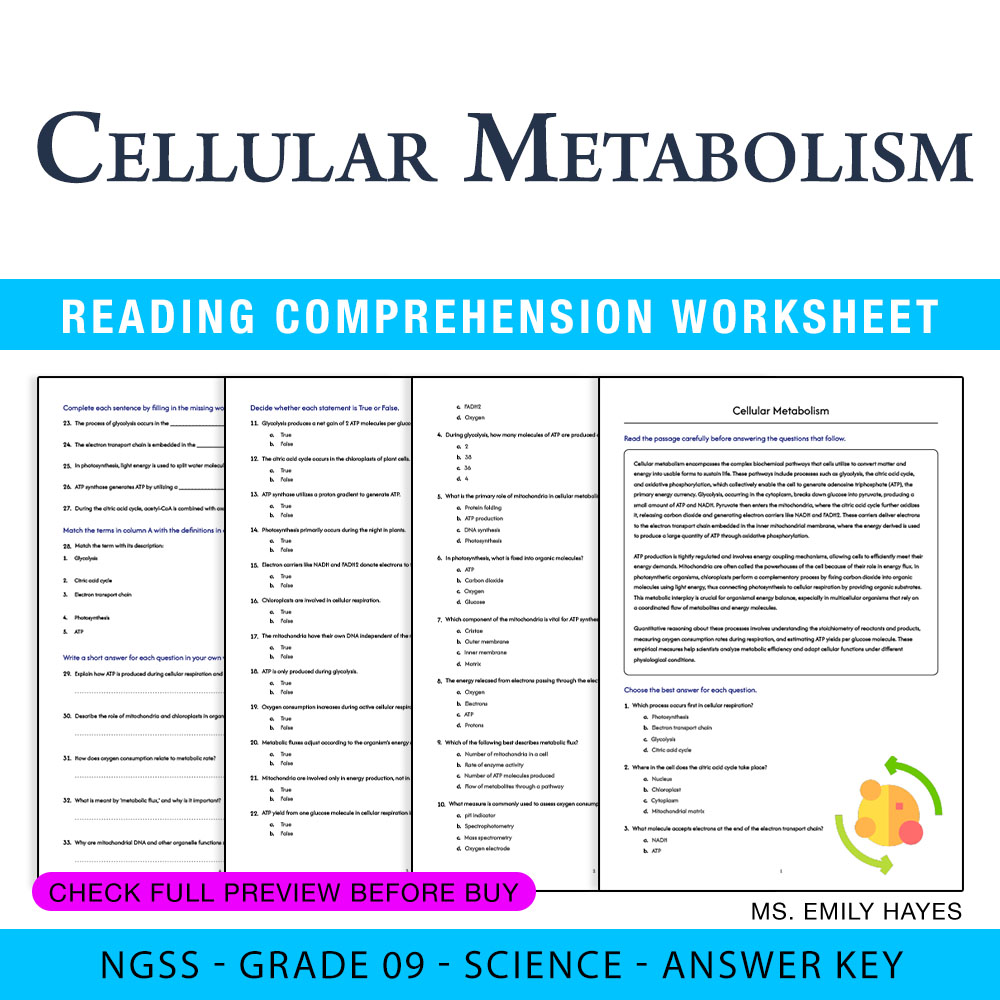
Grade 9 Science | Cellular Metabolism Worksheet (PDF+ Answer Key)
 Created byCopper Leaf Classroom
Learning Objectives
- Describe the biochemical pathways involved in cellular respiration, including glycolysis, the citric acid cycle, and electron transport chain.
- Explain the role of ATP in energy coupling within cells.
- Relate mitochondrial and chloroplast functions to metabolic fluxes and organismal energy balance.
Instant download
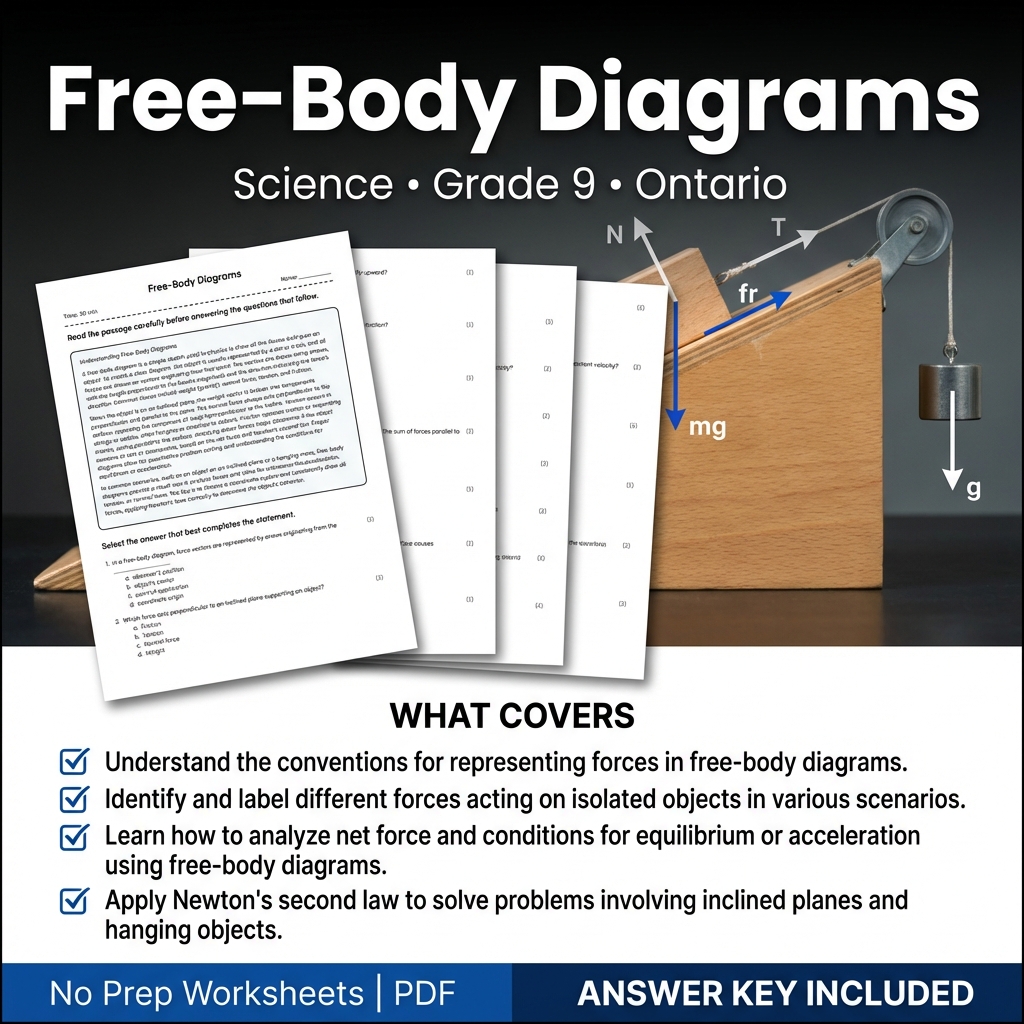
Grade 9 Science Worksheet on Free-Body Diagrams – Ontario Standards
 Created byCoral Reef Learning
Learning Objectives
- Understand the conventions for representing forces in free-body diagrams.
- Identify and label different forces acting on isolated objects in various scenarios.
- Learn how to analyze net force and conditions for equilibrium or acceleration using free-body diagrams.
Instant download
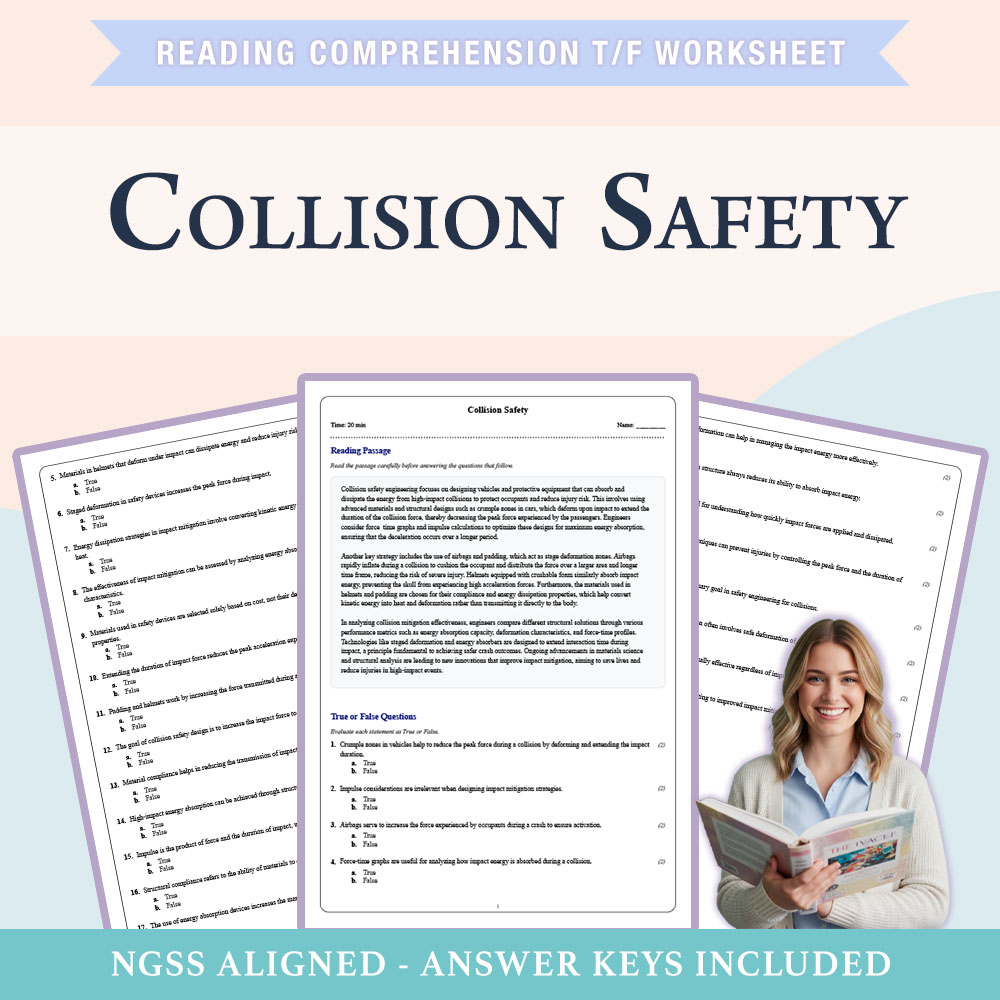
Grade 9 Science | Collision Safety Worksheet (PDF + Answer Key)
Created byCopper Leaf ClassroomLearning Objectives
- Understand the engineering strategies used to minimize peak force during collisions.
- Analyze force‑time graphs and impulse to evaluate impact mitigation methods.
- Identify various collision mitigation techniques like crumple zones, airbags, and padding.
Also included in: Grade 9 Science Bundle | Motion, Forces & Magnetism Worksheets (PDF +Answer Key) +1 more
Instant download
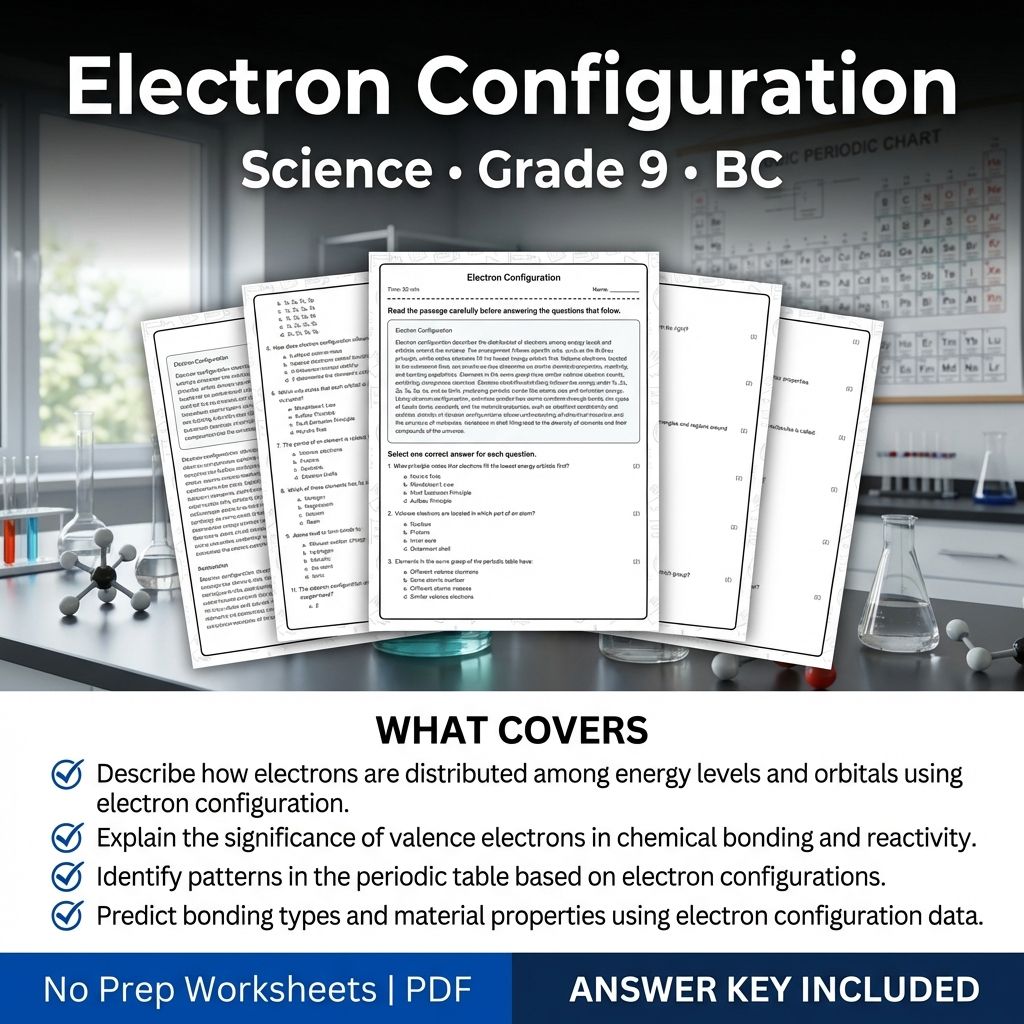
Grade 9 Science | Electron Configuration Worksheet & Answer Key (Printable PDF)
Created byCoral Reef LearningLearning Objectives
- Describe how electrons are distributed among energy levels and orbitals using electron configuration.
- Explain the significance of valence electrons in chemical bonding and reactivity.
- Identify patterns in the periodic table based on electron configurations.
Instant download
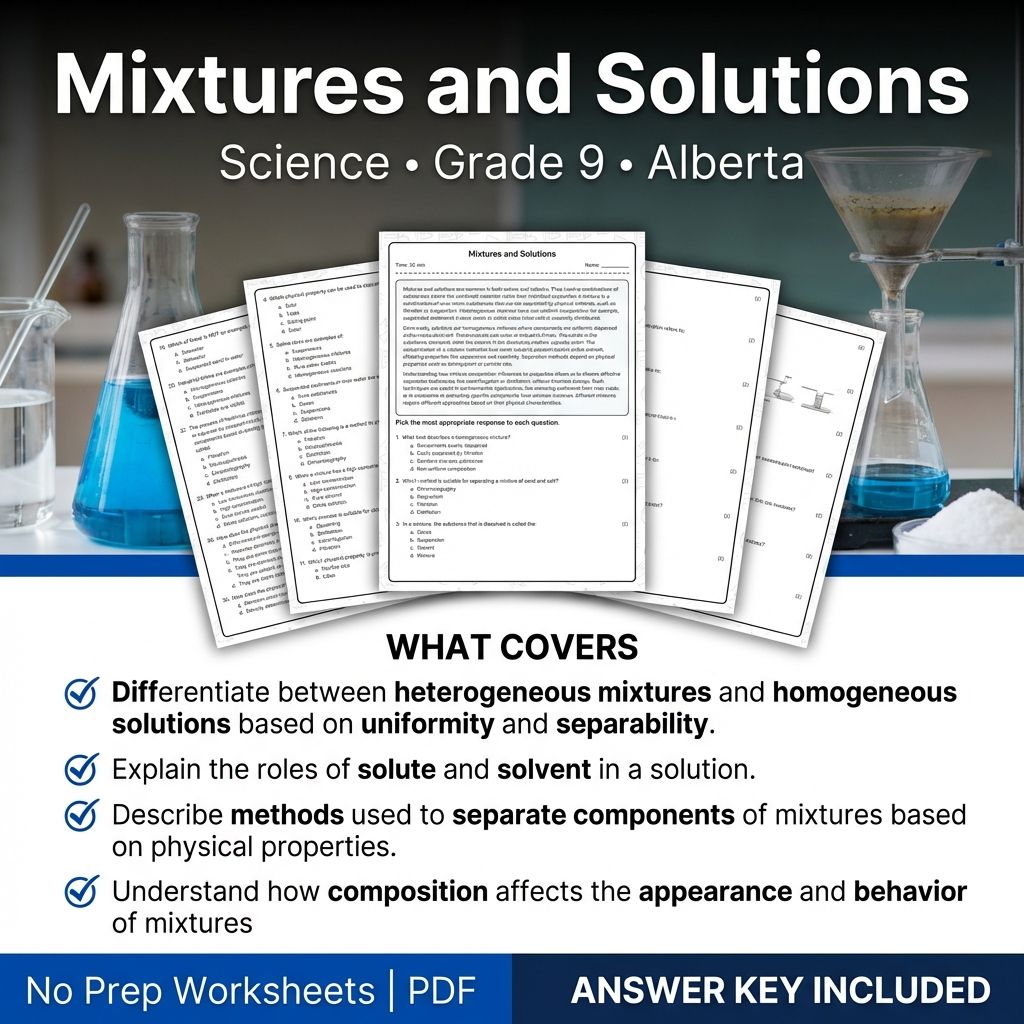
Grade 9 Science Worksheet on Mixtures and Solutions | Alberta Standards
Created byCoral Reef LearningLearning Objectives
- Differentiate between heterogeneous mixtures and homogeneous solutions based on uniformity and separability.
- Explain the roles of solute and solvent in a solution.
- Describe methods used to separate components of mixtures based on physical properties.
Instant download
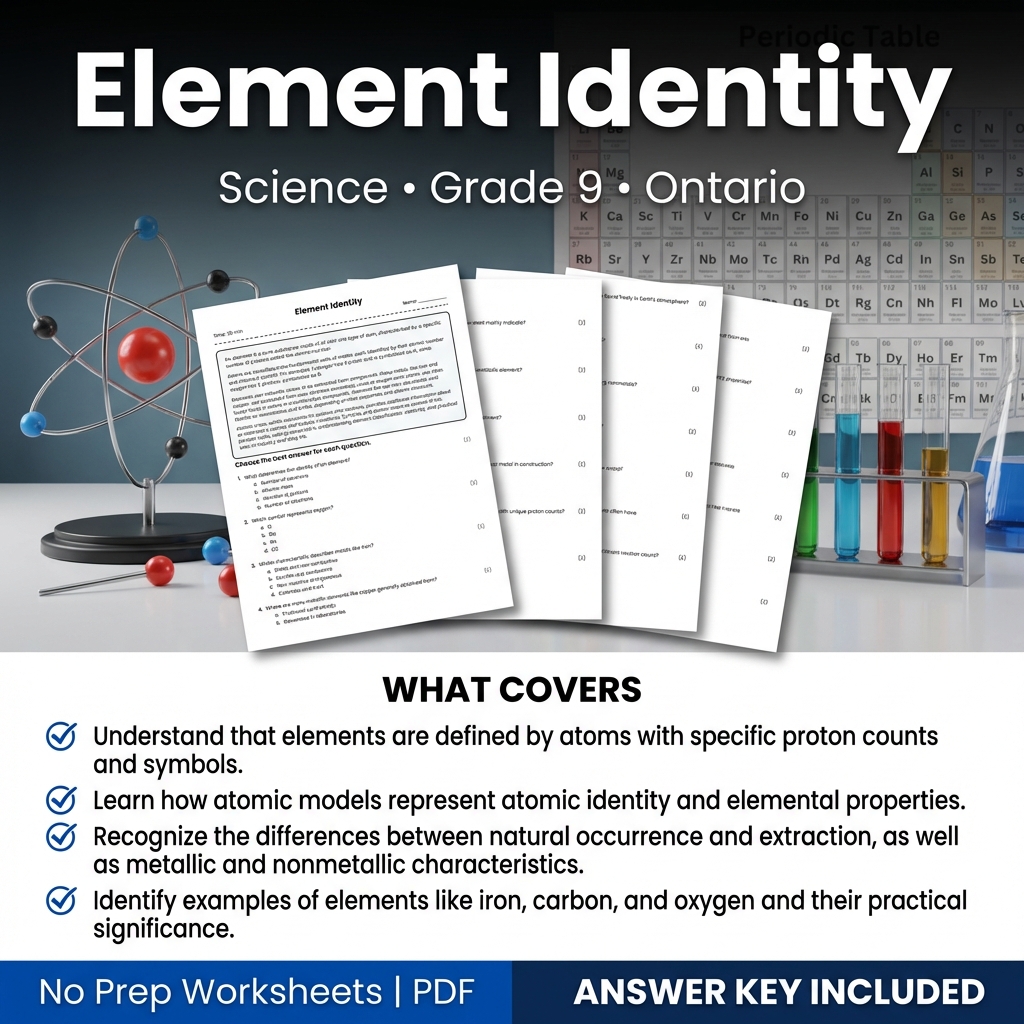
Element Identity Worksheet for Grade 9 Science | Ontario Standards
Created byCoral Reef LearningLearning Objectives
- Understand that elements are defined by atoms with specific proton counts and symbols.
- Learn how atomic models represent atomic identity and elemental properties.
- Recognize the differences between natural occurrence and extraction, as well as metallic and nonmetallic characteristics.
Instant download

Grade 9 Science – Solution Behaviour Worksheet (Ontario Standard) PDF
 Created byEvergreen Desk Education
Learning Objectives
- Describe dissolution using solute–solvent interactions and explain how these interactions influence solubility.
- Differentiate saturated, unsaturated, and supersaturated solutions using qualitative examples such as sugar and salt in water.
- Explain how temperature and agitation affect solubility and relate these to practical methods like evaporation and crystallization.
Also included in: Grade 9 States & Energy to Chemical Reactions Science Lesson Bundle (Ontario) +1 more
Instant download
Grade 9 Science | Pedigree Analysis Worksheet (Answer Key) – TEKS Aligned
 Created byBright Mind Resources
Learning Objectives
- Understand how pedigree charts illustrate inheritance patterns across generations.
- Identify signs of autosomal dominant, autosomal recessive, X-linked, and mitochondrial inheritance in pedigrees.
- Interpret segregation patterns, penetrance, and how they affect inheritance analysis.
Also included in: Grade 9 Science Genetics & Biotechnology Unit - TEKS - Aligned (Answer Keys) +3 more
Instant download

Grade 9 Science – Power Analysis in Household Systems | Daily Reading Worksheet
Created byBright Mind ResourcesLearning Objectives
- Understand how to interpret power ratings on household appliances.
- Differentiate between energy and power, and their units of measurement.
- Apply basic calculations to estimate energy consumption based on power and usage time.
Also included in: Energy Grade 9 Science Daily Reading Worksheets Lesson Bundle | NGSS +2 more
Instant download

Grade 9 Science – Energy Conservation & Systems | Daily Reading Worksheet
Created byBright Mind ResourcesLearning Objectives
- Understand the principles of energy conservation in closed and open systems.
- Identify energy flow and system boundaries in different energy systems.
- Apply mathematical representations to trace energy transfer and reservoirs.
Also included in: Energy Grade 9 Science Daily Reading Worksheets Lesson Bundle | NGSS +2 more
Instant download

Grade 9 Science – Heat & Thermal Energy | Daily Reading Worksheet
Created byBright Mind ResourcesLearning Objectives
- Understand the concept of thermal energy and heat transfer
- Recognize the different modes of heat transfer: conduction, convection, radiation
- Apply formulas involving specific heat capacity, mass, and temperature change to calculate heat transfer
Also included in: Energy Grade 9 Science Daily Reading Worksheets Lesson Bundle | NGSS +2 more
Instant download

Grade 9 Science – Mechanical Energy & Energy Types | Daily Reading Worksheet
Created byBright Mind ResourcesLearning Objectives
- Understand the concept of kinetic energy and how it depends on mass and velocity.
- Calculate kinetic energy using the formula KE = 1/2 m v^2.
- Recognize examples of kinetic energy in real-world systems.
Also included in: Energy Grade 9 Science Daily Reading Worksheets Lesson Bundle | NGSS +2 more
Instant download

Grade 9 Science – Calvin Cycle Daily Worksheet & Answer Key
JCreated byJ.S SheetsLearning Objectives
- Identify the main components involved in the Calvin cycle
- Describe the sequence of steps in the Calvin cycle
- Explain the role of enzymes and energy carriers in carbon fixation
Also included in: Grade 9 Science Lesson Group: Photosynthesis & Metabolism TEKS Bundle +1 more
Instant download
Grade 9 Science | Collision Safety Concepts Worksheet (NGSS) – PDF
Created byBright Mind ResourcesLearning Objectives
- Understand how impulse and force-time tradeoffs reduce peak impact forces.
- Analyze force-time graphs to evaluate energy dissipation strategies.
- Identify design features like crumple zones, airbags, and padding that mitigate collisions.
Instant download
Grade 9 Science | Climate Drivers Worksheet (PDF + Answer Key)
 Created byRiverstone Classroom
Learning Objectives
- Understand the key factors influencing Earth's climate, including solar flux, albedo, greenhouse gases, and ocean heat transport.
- Interpret data and models related to Earth's energy budget and surface-atmosphere interactions.
- Analyze how variations in climate drivers lead to phenomena such as ice-sheet changes, El Niño events, and seasonal monsoons.
Also included in: Grade 9 Science Unit | Earth Processes & Climate Worksheet Bundle
Instant download
Grade 9 Science | Inclined Planes Worksheet + Answer Key – BC Standards (PDF)
Created byBright Mind ResourcesLearning Objectives
- Understand how inclined planes decompose gravitational force into components
- Calculate the mechanical advantage of inclined planes
- Analyze how friction and slope angle affect motion and energy transfer
Instant download
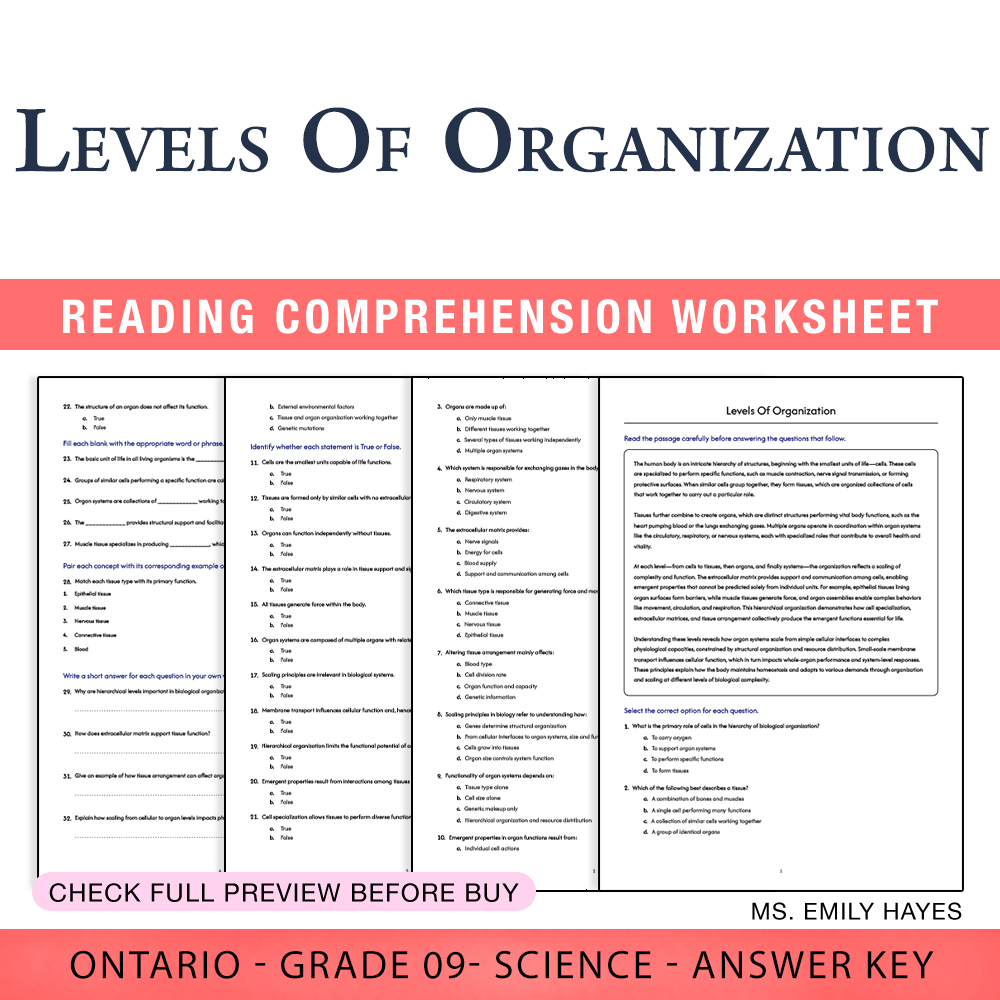
9th Grade Science | Levels Of Organization Worksheet (PDF + Answer Key)
Created byCopper Leaf ClassroomLearning Objectives
- Explain the hierarchical levels from cells to organ systems in the human body.
- Describe how different tissue types contribute to organ functions and systems.
- Understand the principles of scaling from cellular interfaces to whole organ systems in physiology.
Instant download
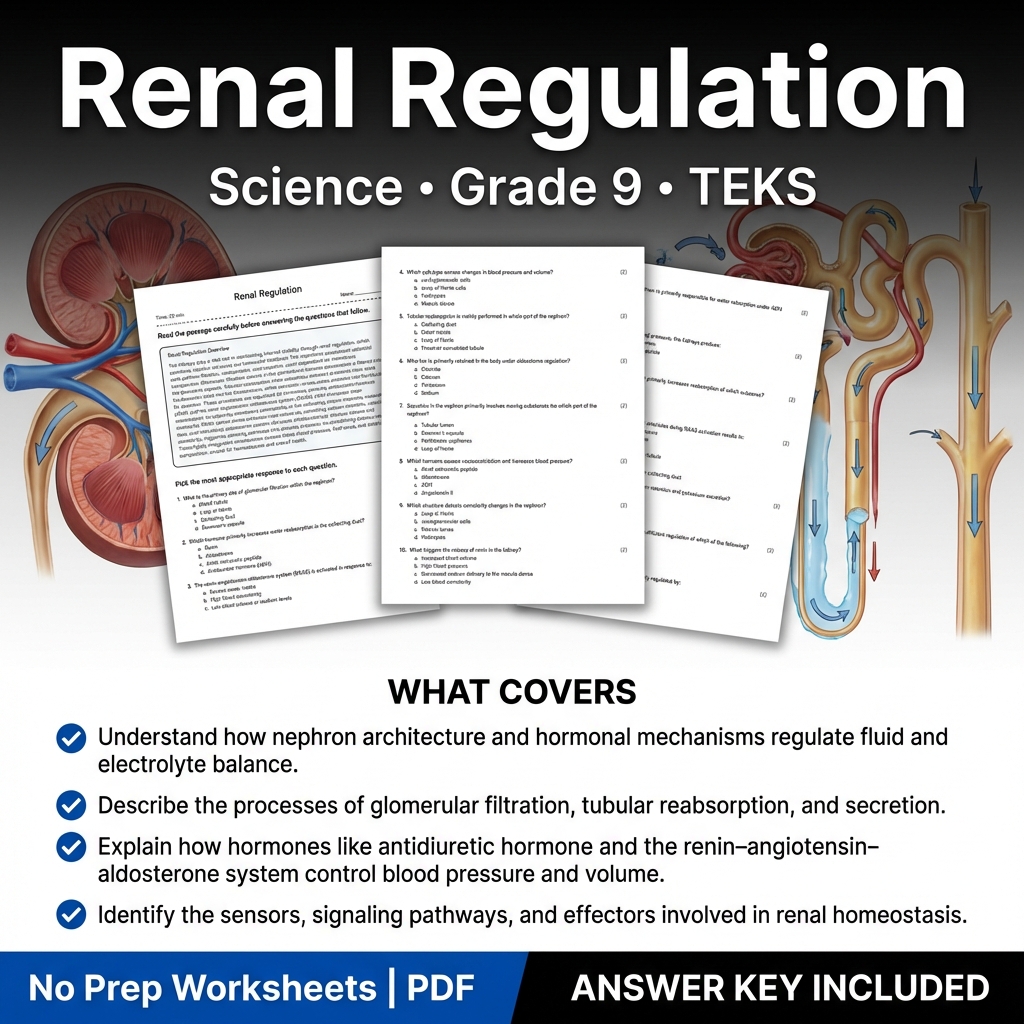
Renal Regulation Worksheet for Grade 9 Science | TEKS Aligned
Created byCoral Reef LearningLearning Objectives
- Understand how nephron architecture and hormonal mechanisms regulate fluid and electrolyte balance.
- Describe the processes of glomerular filtration, tubular reabsorption, and secretion.
- Explain how hormones like antidiuretic hormone and the renin–angiotensin–aldosterone system control blood pressure and volume.
Instant download
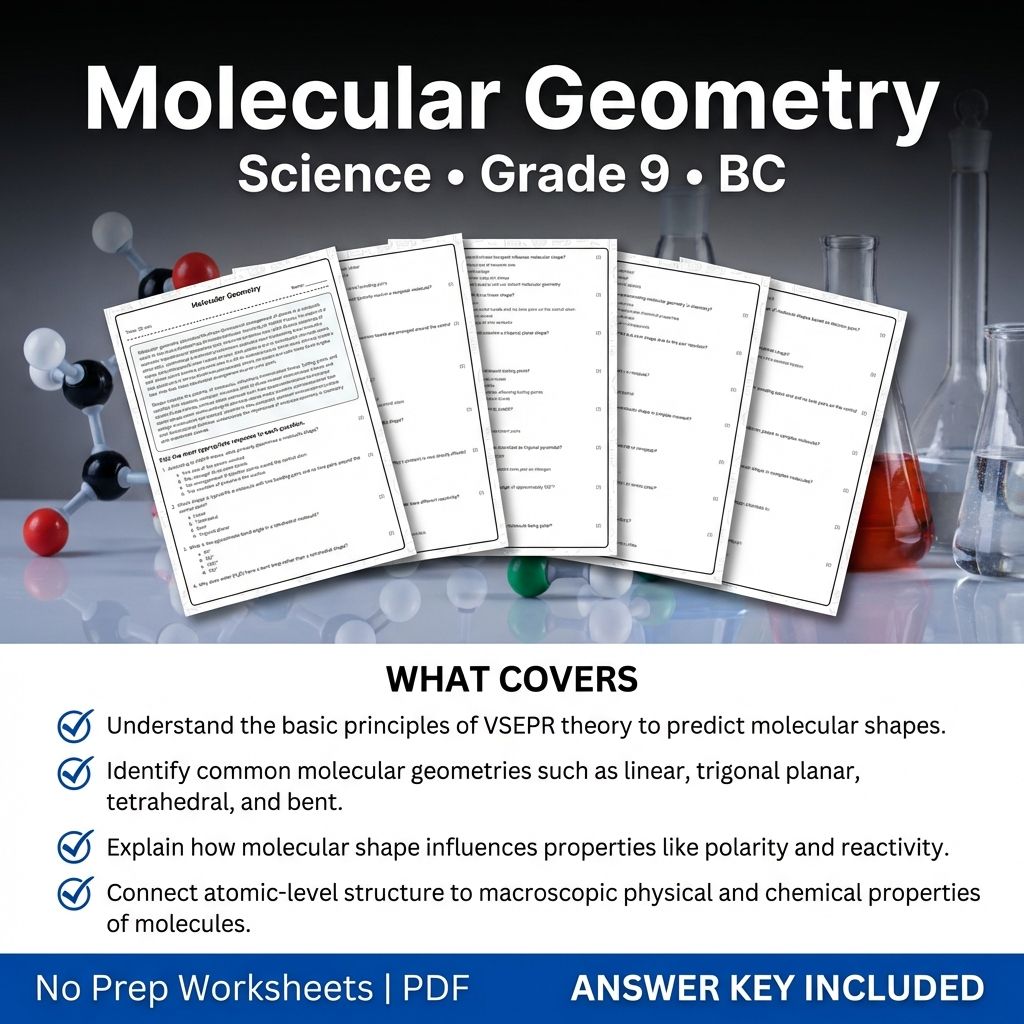
Grade 9 Science | Molecular Geometry Worksheet & Answer Key (Printable PDF)
Created byCoral Reef LearningLearning Objectives
- Understand the basic principles of VSEPR theory to predict molecular shapes.
- Identify common molecular geometries such as linear, trigonal planar, tetrahedral, and bent.
- Explain how molecular shape influences properties like polarity and reactivity.
Instant download
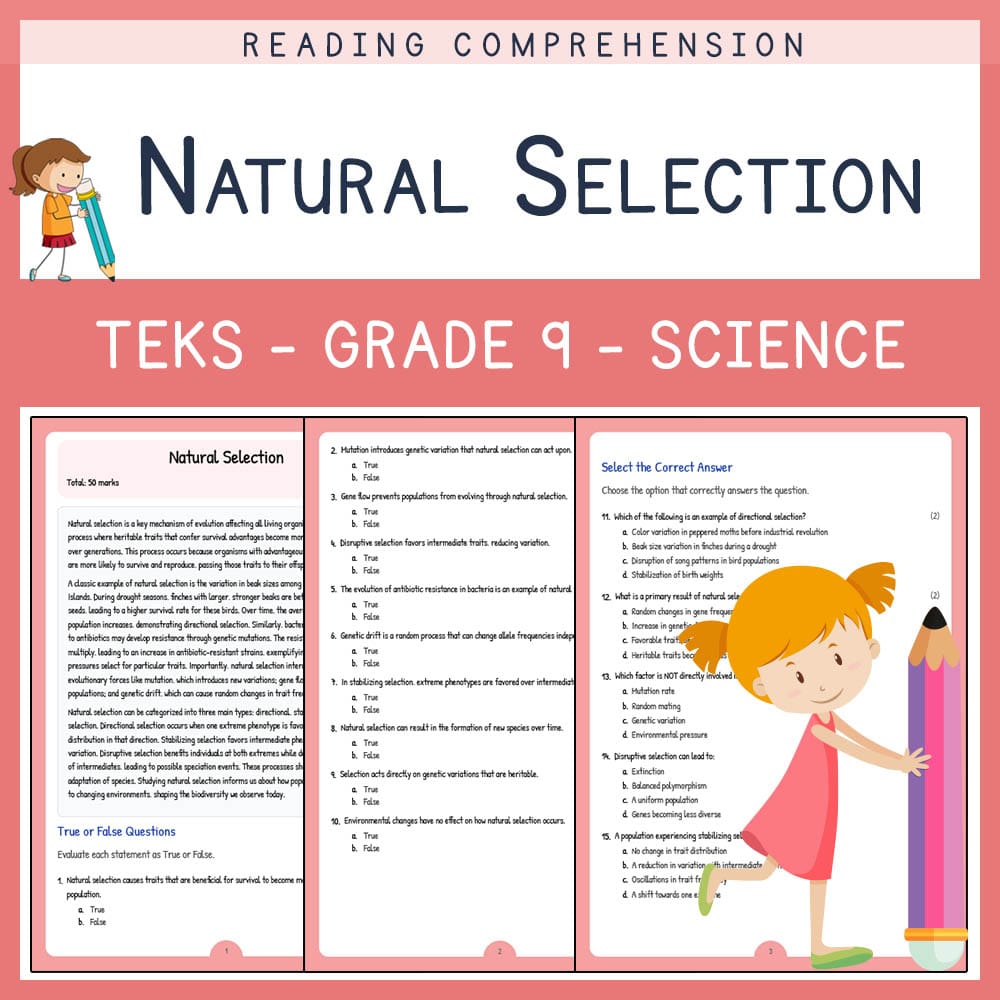
Grade 9 Science | Natural Selection Worksheet | TEKS Aligned
Created byLumora LearningLearning Objectives
- Understand the fundamental principles of natural selection and how it drives evolution.
- Identify examples of natural selection in nature, such as beak variation and antibiotic resistance.
- Describe different types of selection: directional, stabilizing, and disruptive.
Instant download
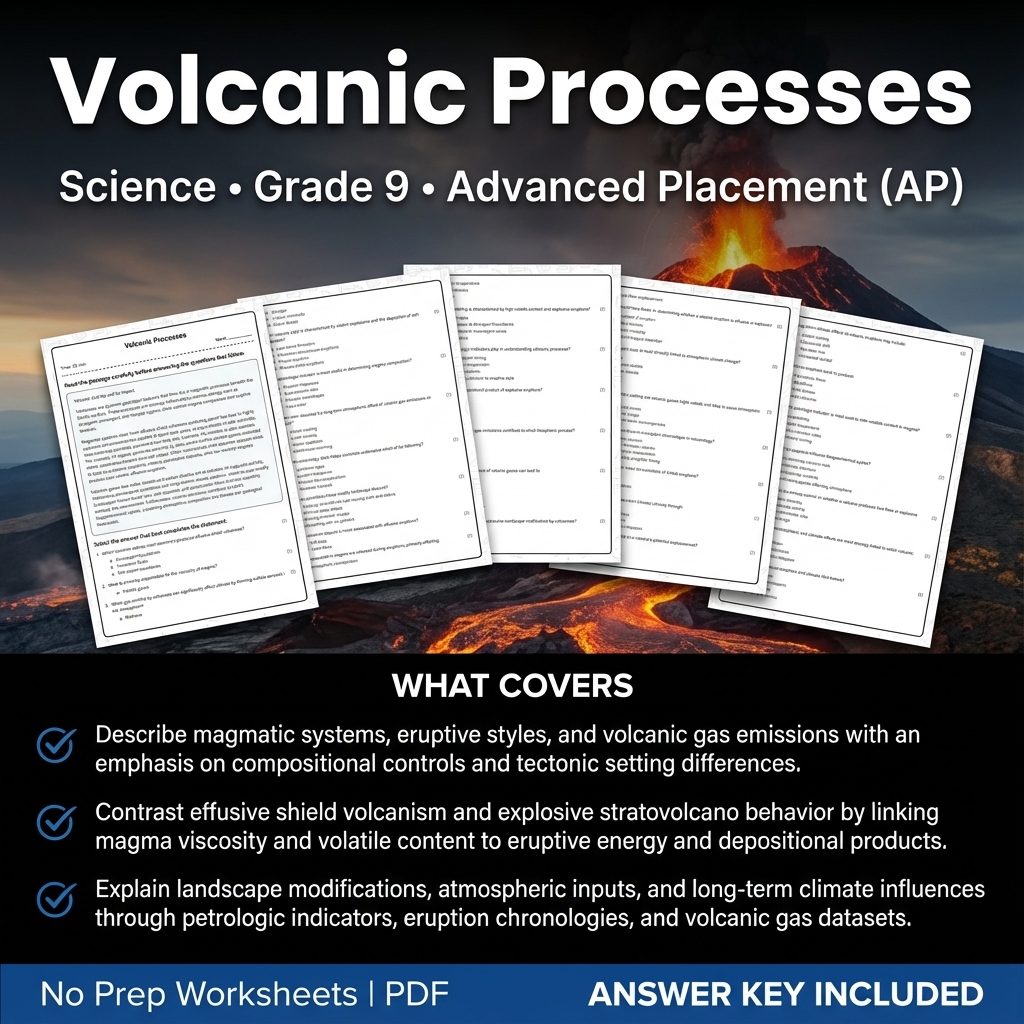
Grade 9 Science | Volcanic Processes Worksheet (Printable PDF + Answer Key)
Created byCoral Reef LearningLearning Objectives
- Describe magmatic systems, eruptive styles, and volcanic gas emissions with an emphasis on compositional controls and tectonic setting differences.
- Contrast effusive shield volcanism and explosive stratovolcano behavior by linking magma viscosity and volatile content to eruptive energy and depositional products.
- Explain landscape modifications, atmospheric inputs, and long-term climate influences through petrologic indicators, eruption chronologies, and volcanic gas datasets.
Also included in: Grade 9 Science Unit | Earth Processes & Climate Worksheets Pack (PDF & Answer Keys) +2 more
Instant download
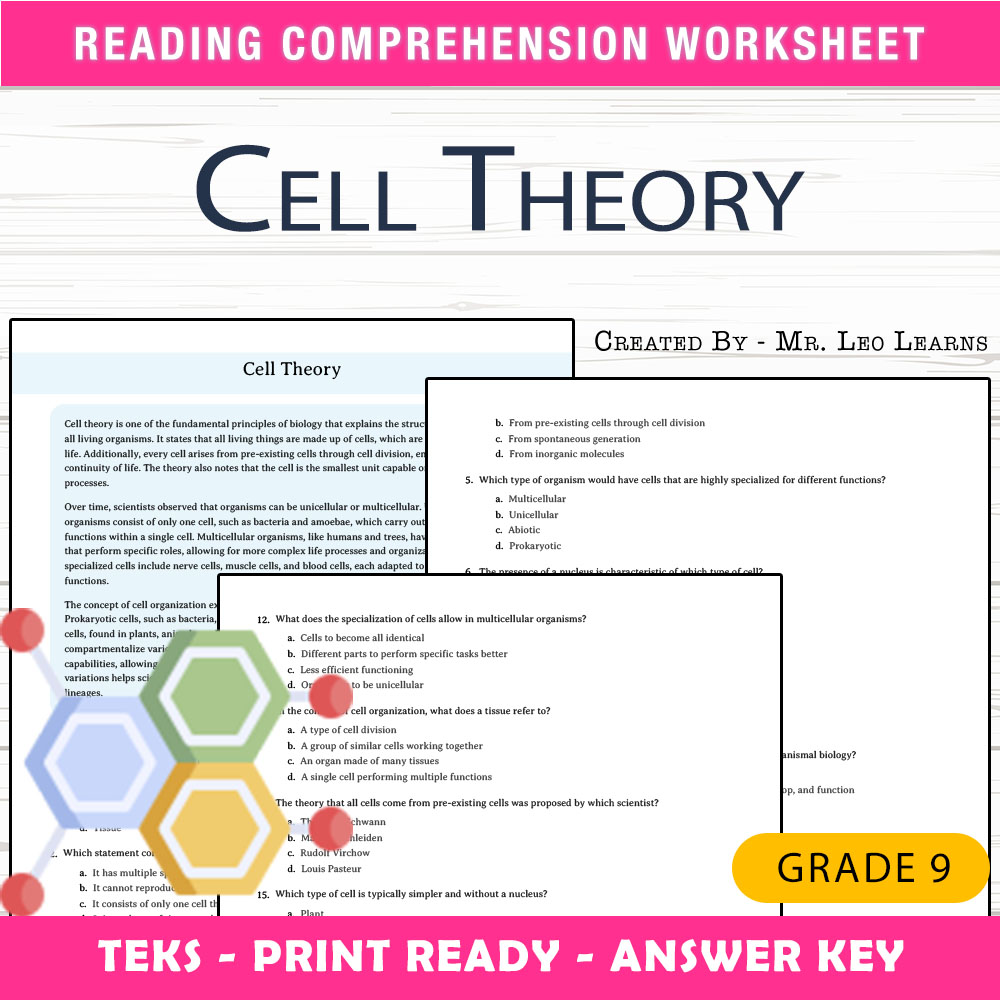
Grade 9 Science — Cell Theory Worksheet for Mastery | PDF + Answer Key
 Created byThe Resource Hub
Learning Objectives
- Describe the fundamental principles of cell theory and their significance in biology.
- Differentiate between unicellular and multicellular organisms based on cellular organization.
- Explain how cell structure relates to cellular function across diverse taxa.
Also included in: Grade 9 Science Unit Bundle | Cell Structures & Transport Mechanisms Worksheets +1 more
Instant download

Grade 9 Science | Force Fundamentals - Daily Reading Comprehension
Created byCoral Reef LearningLearning Objectives
- Understand the concept of force and how it affects object motion.
- Identify different types of forces, including contact and non-contact forces.
- Recognize real-world examples of forces in Alberta settings.
Also included in: Forces and Motion Mechanical Systems Lesson Bundle | Grade 9 Science Alberta +1 more
Instant download

Grade 9 Science | Graph Interpretation in Science - Daily Reading Comprehension
Created byCoral Reef LearningLearning Objectives
- Understand the relationship between displacement, velocity, and acceleration through graphs.
- Identify constant and non-uniform motion from graph slopes.
- Calculate velocity and interpret its significance from displacement–time graphs.
Also included in: Forces and Motion Mechanical Systems Lesson Bundle | Grade 9 Science Alberta +1 more
Instant download

Grade 9 Science | Mechanical Advantage in Science - Daily Reading Comprehension
Created byCoral Reef LearningLearning Objectives
- Understand the concept of mechanical advantage and its significance in machines
- Identify different types of levers and describe their properties
- Calculate mechanical advantage for various lever classes
Also included in: Forces and Motion Mechanical Systems Lesson Bundle | Grade 9 Science Alberta +1 more
Instant download
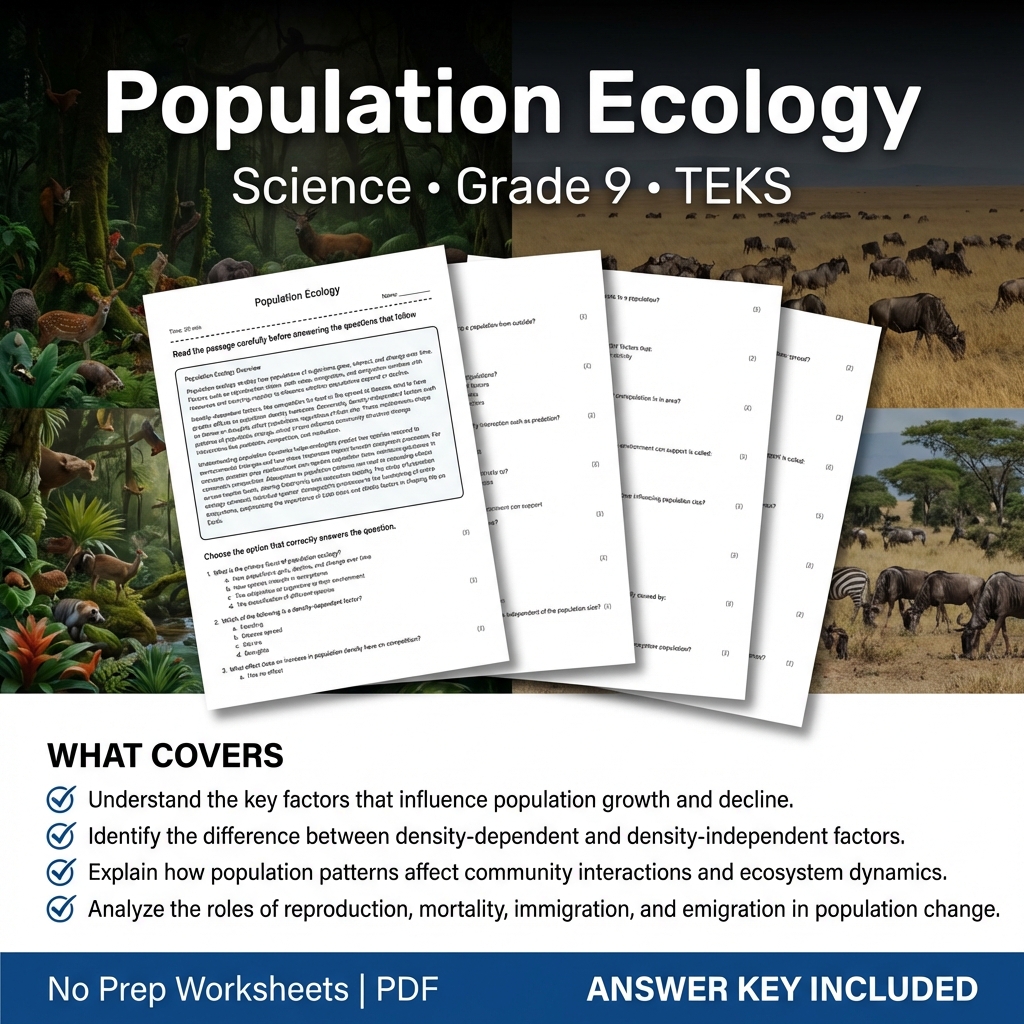
Population Ecology Worksheet for Grade 9 Science | TEKS Aligned
Created byCoral Reef LearningLearning Objectives
- Understand the key factors that influence population growth and decline.
- Identify the difference between density-dependent and density-independent factors.
- Explain how population patterns affect community interactions and ecosystem dynamics.
Instant download
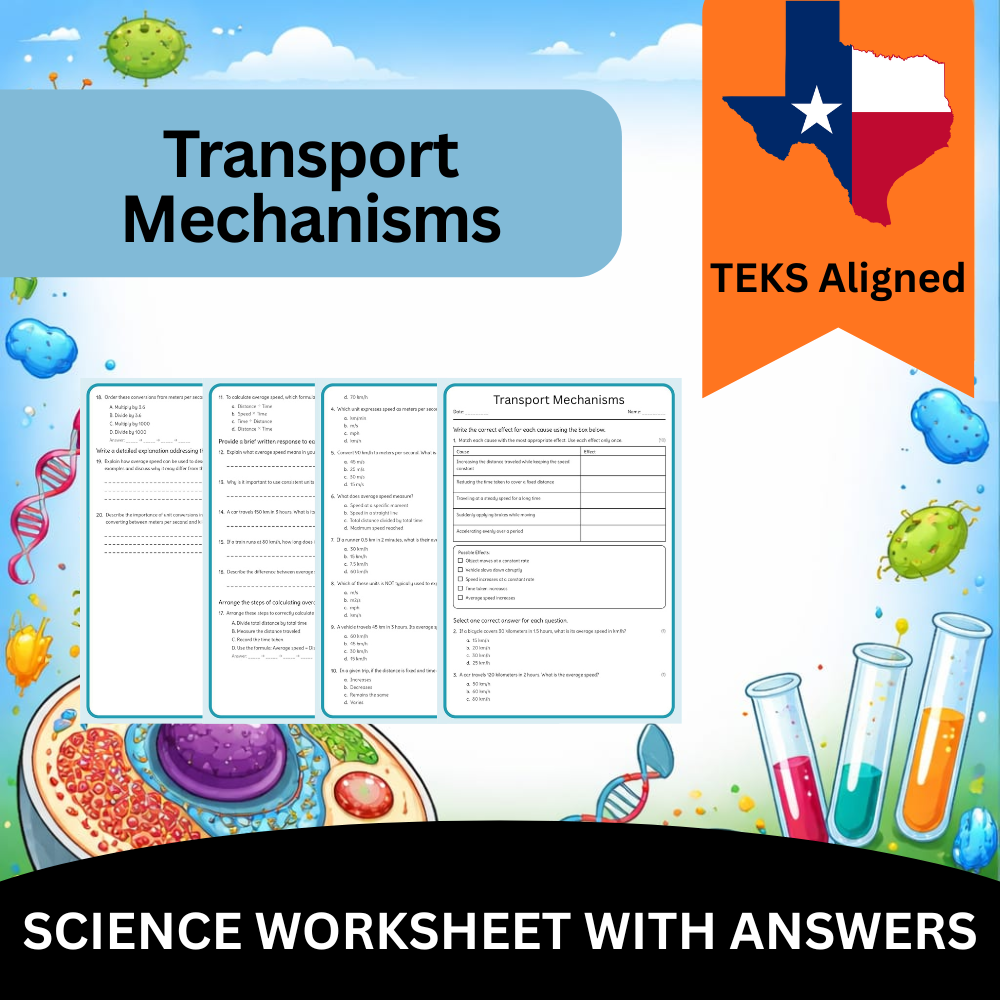
Grade 9 Science | Transport Mechanisms Worksheet (Answer Key) aligned with TEKS
Created byBright Mind ResourcesLearning Objectives
- Describe how molecules move across cell membranes through passive and active transport.
- Explain the processes of diffusion, facilitated diffusion, and osmosis.
- Identify mechanisms such as active transport and vesicular transport like endocytosis and exocytosis.
Also included in: Grade 9 Science Unit | Cell Structures & Transport Mechanisms Pack(TEKS-Aligned) +3 more
Instant download
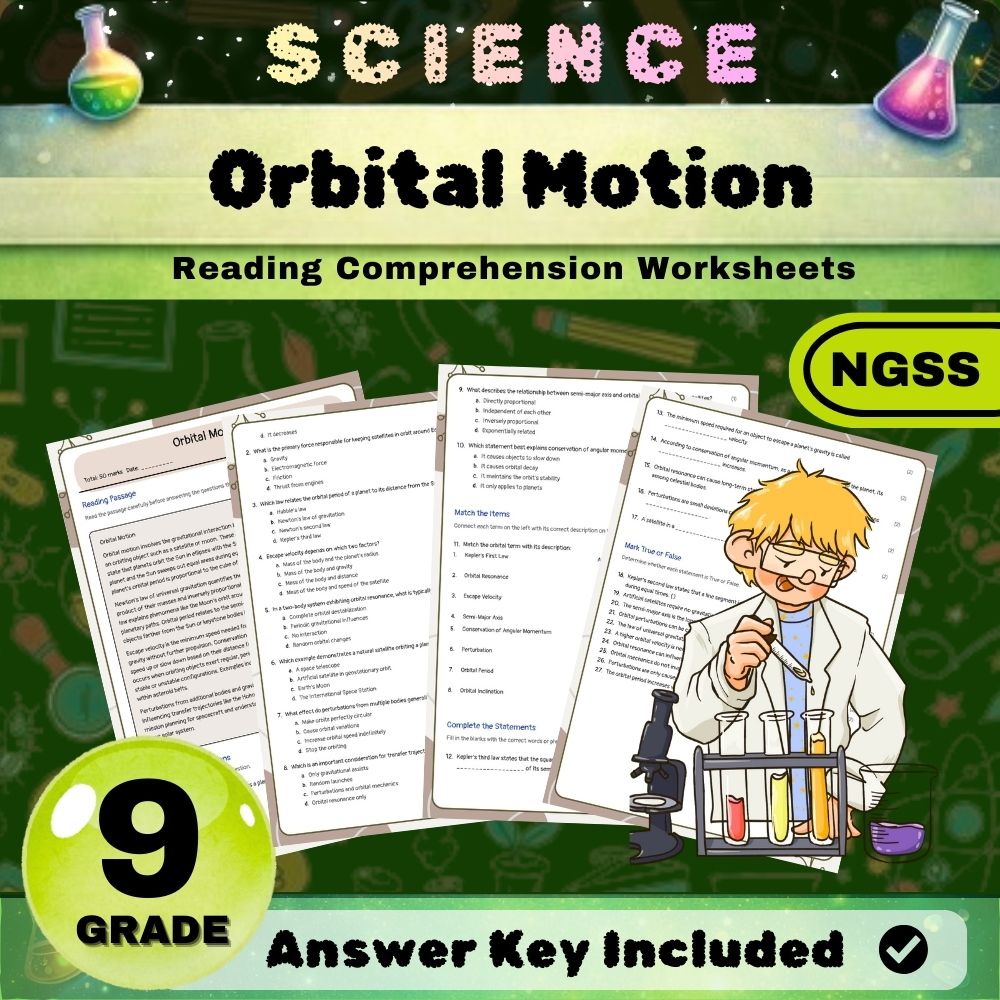
Grade 9 Science – Orbital Motion Worksheet (NGSS Alignment) (PDF)
 Created byMaple Path Learning
Learning Objectives
- Explain gravitational interactions that govern planetary and satellite trajectories.
- Describe Kepler's laws and their implications for orbital motion.
- Apply Newton's law of universal gravitation to orbital phenomena.
Also included in: Grade 9 Science NGSS | Earth's Place in the Universe UNIT Worksheet Bundle +1 more
Instant download
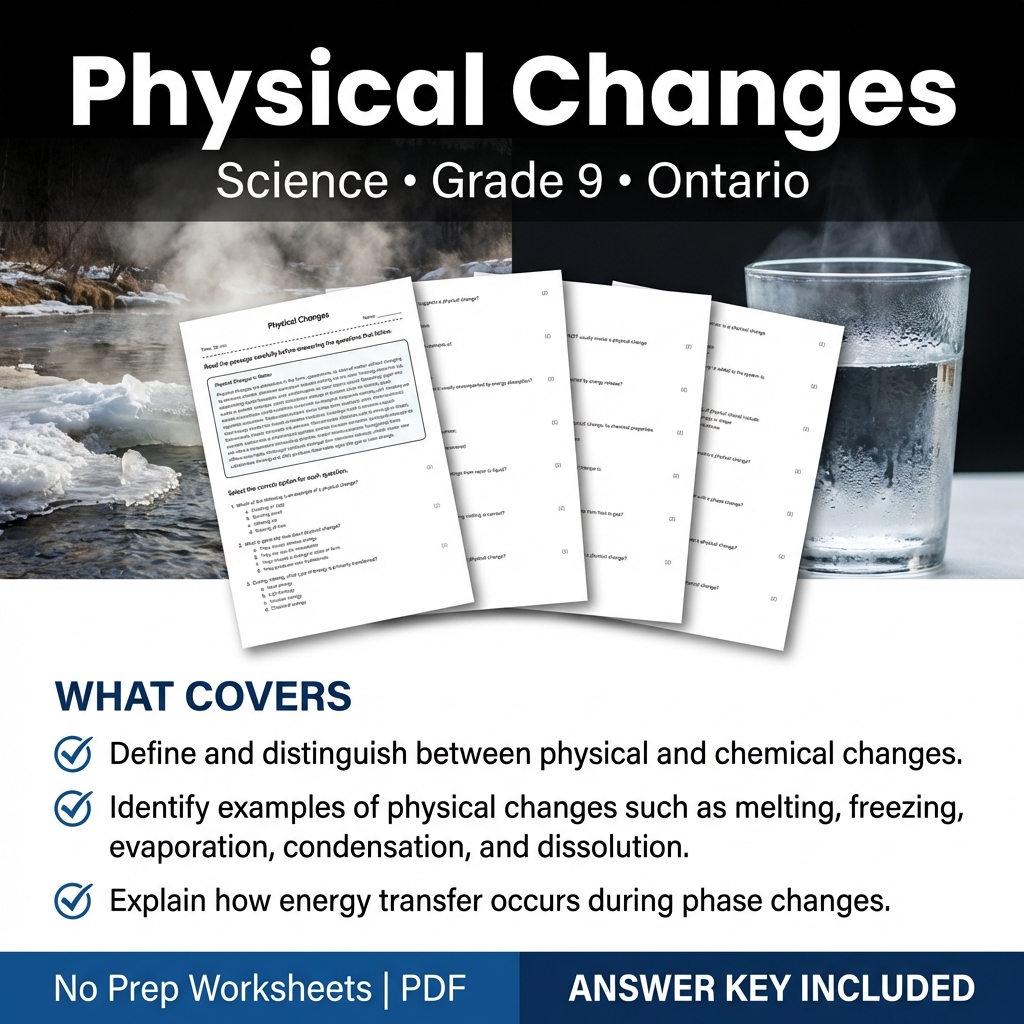
Physical Changes Worksheet Grade 9 Science Ontario Standards PDF
Created byCoral Reef LearningLearning Objectives
- Define and distinguish between physical and chemical changes.
- Identify examples of physical changes such as melting, freezing, evaporation, condensation, and dissolution.
- Explain how energy transfer occurs during phase changes.
Instant download

Grade 9 Science – Cell Division & Processes | Daily Reading Worksheet
Created byBright Mind ResourcesLearning Objectives
- Understand the differences between mitosis and meiosis
- Identify the phases of cell division
- Explain the significance of chromosome pairing, segregation, and errors
Also included in: Grade 9 Genetics & Inheritance Science Daily Reading Lesson Bundle | Alberta +1 more
Instant download
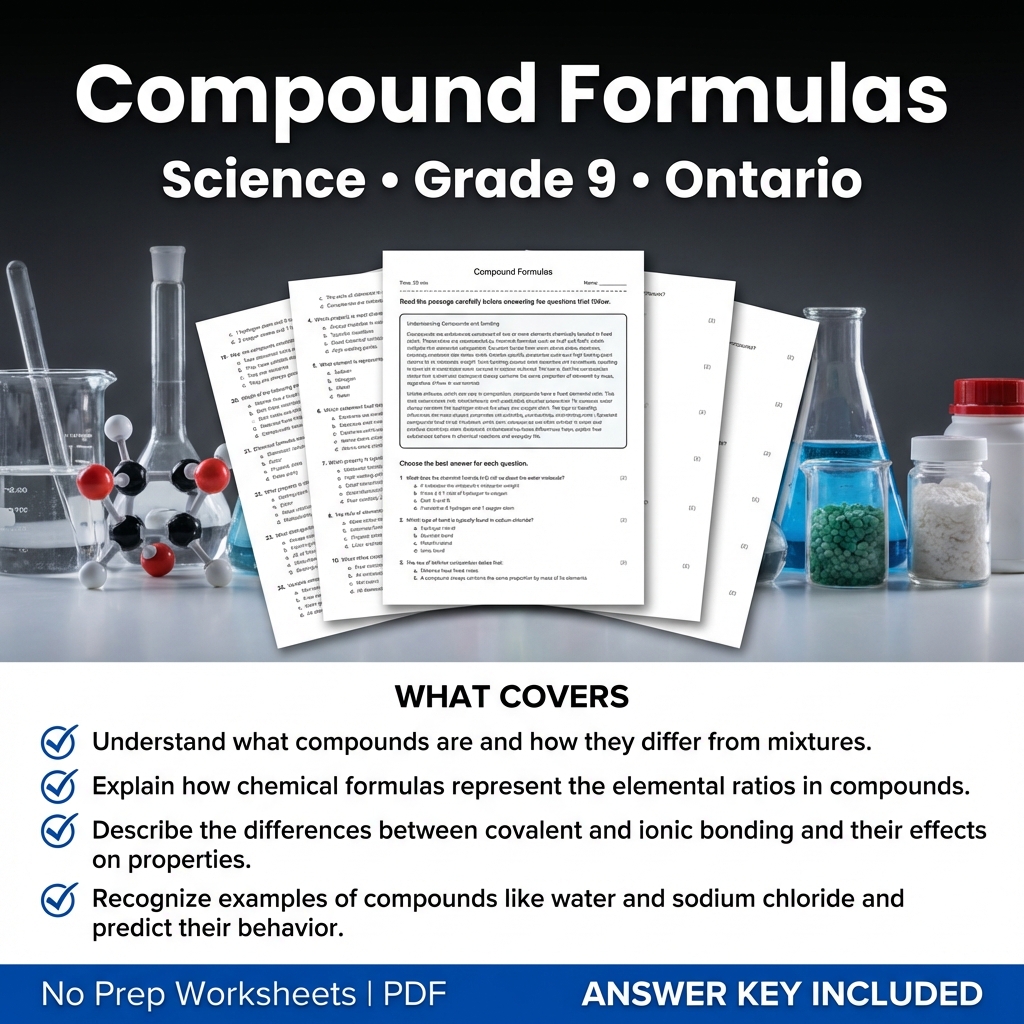
Grade 9 Science Worksheet on Compound Formulas | Ontario Standards
Created byCoral Reef LearningLearning Objectives
- Understand what compounds are and how they differ from mixtures.
- Explain how chemical formulas represent the elemental ratios in compounds.
- Describe the differences between covalent and ionic bonding and their effects on properties.
Instant download
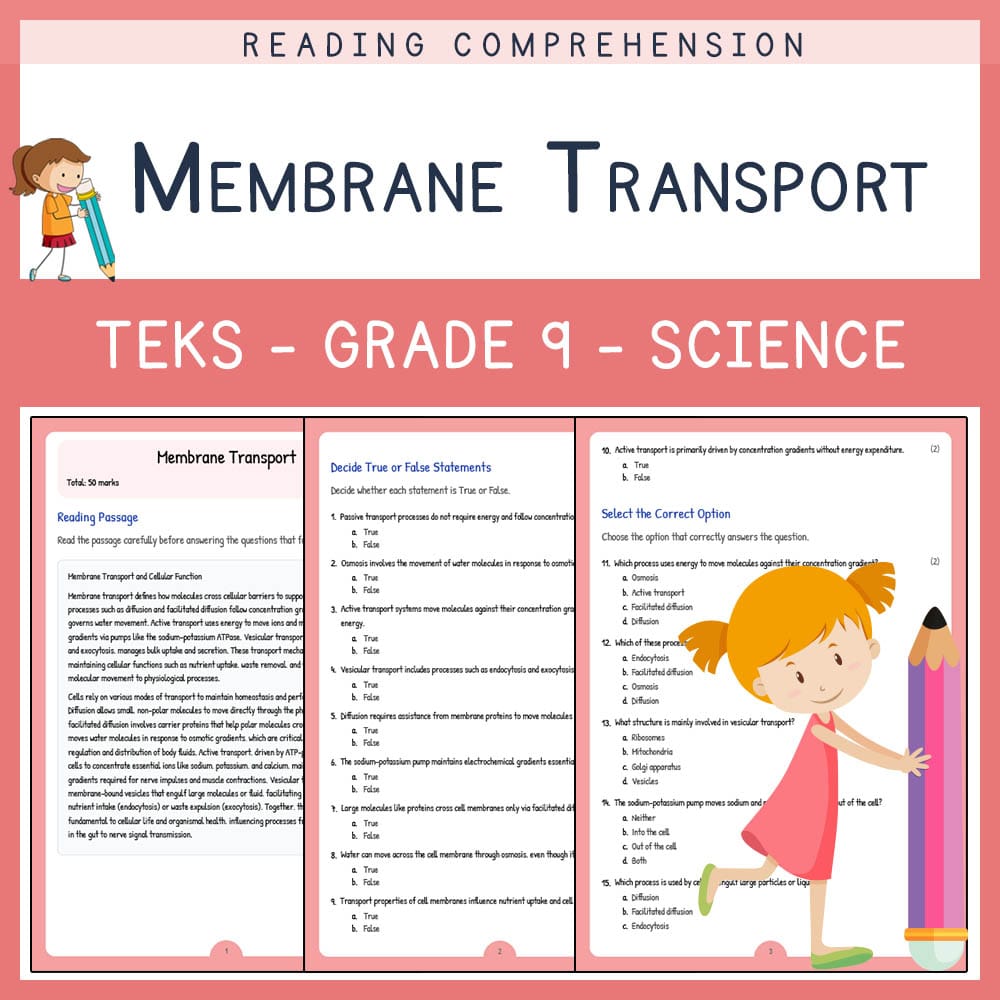
Grade 9 Science | Membrane Transport Worksheet | TEKS Aligned
Created byLumora LearningLearning Objectives
- Describe various mechanisms of membrane transport including passive and active processes.
- Differentiate between diffusion, facilitated diffusion, osmosis, and active transport.
- Explain the role of vesicular transport in cellular processes such as endocytosis and exocytosis.
Instant download

Grade 9 Science | Hydrologic Fluxes Worksheet | AP Aligned
Created byLumora LearningLearning Objectives
- Quantify surface and subsurface water flows using water-budget frameworks and hydrographs.
- Relate precipitation, evapotranspiration, and human withdrawals to streamflow variability.
- Analyze connections between altered hydrologic fluxes and geomorphic responses.
Also included in: Grade 9 Science | Earth and Space Science Custom Bundle | AP Aligned
Instant download
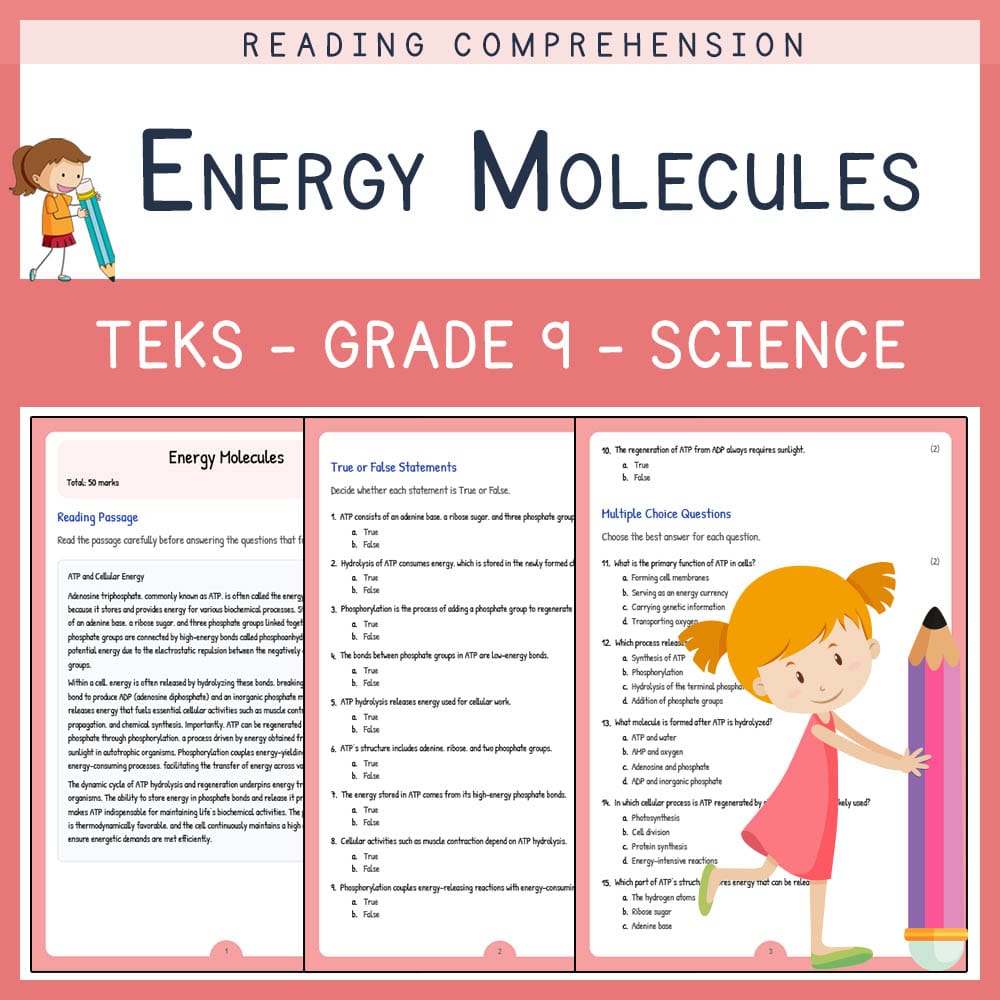
Grade 9 Science | Energy Molecules Worksheet | TEKS-Aligned
Created byLumora LearningLearning Objectives
- Describe the structure and function of ATP as the cell's energy currency.
- Explain the process of hydrolysis of ATP and how it releases energy.
- Understand the role of phosphorylation in regenerating ATP and coupling biochemical reactions.
Instant download
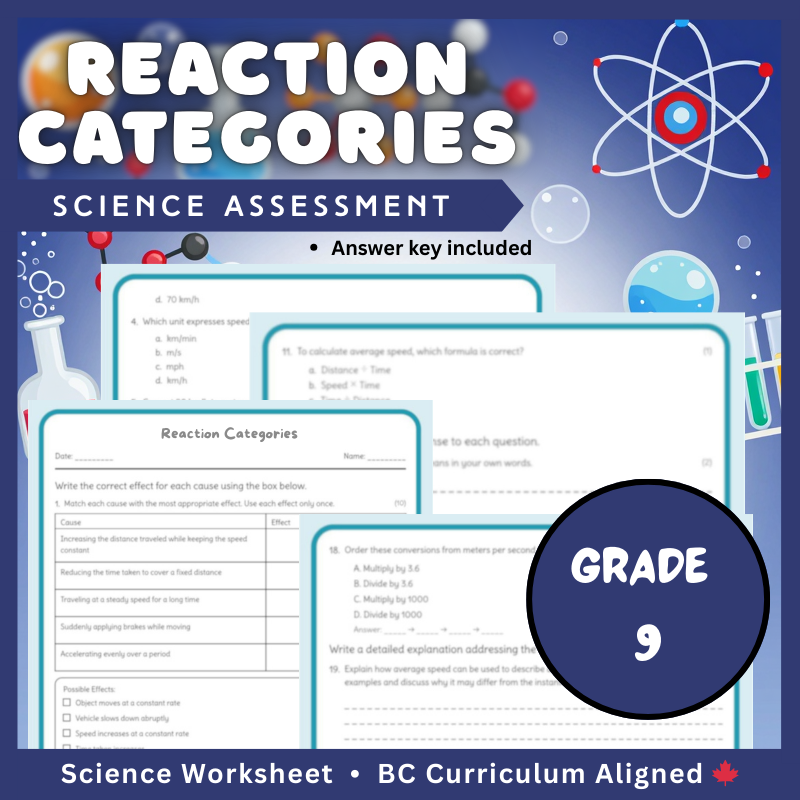
Grade 9 Science | Reaction Essentials Worksheet (PDF) – BC Standards & Practice
Created byBright Mind ResourcesLearning Objectives
- Understand how reactants transform into products during chemical reactions.
- Learn to represent reactions using chemical formulas and symbolic equations.
- Identify the roles of bond breaking and forming in energy changes during reactions.
Instant download
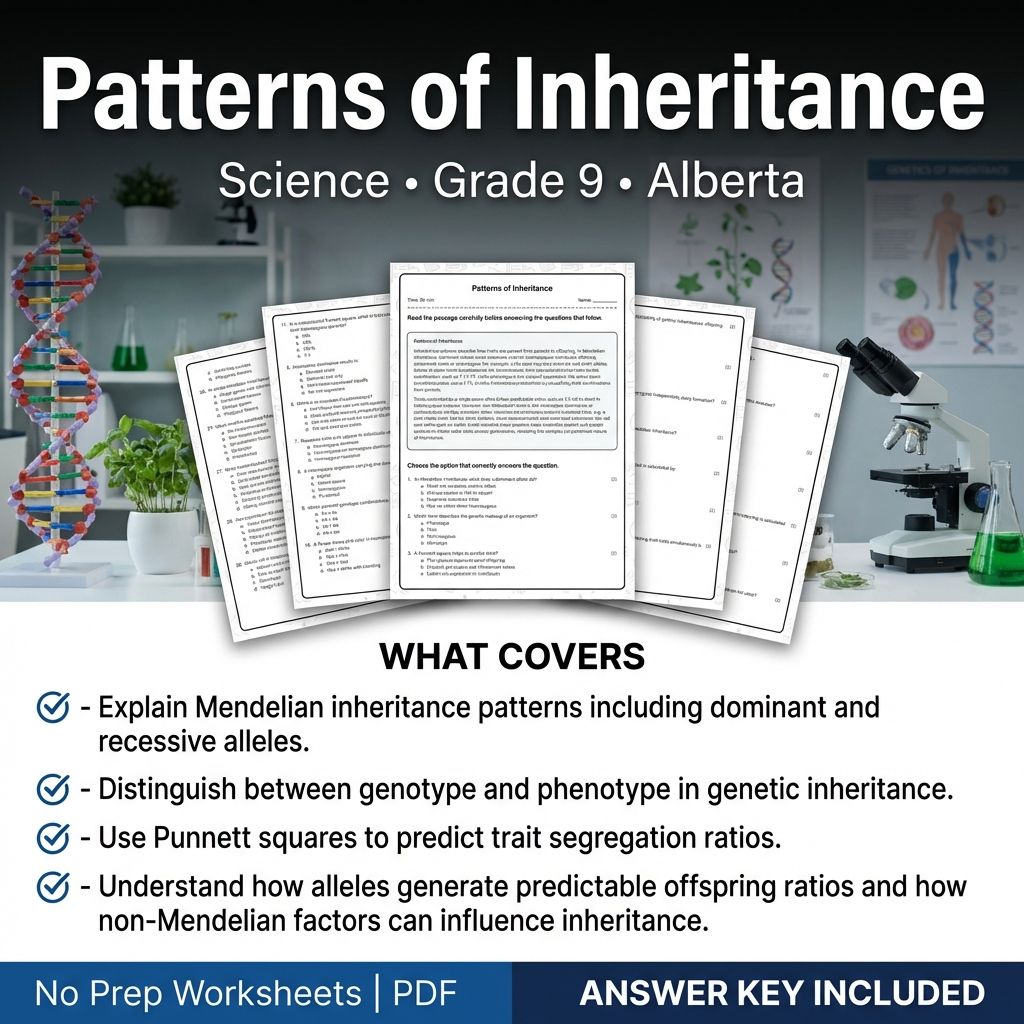
Patterns of Inheritance Worksheet Grade 9 Science Alberta Standards PDF
Created byCoral Reef LearningLearning Objectives
- Explain Mendelian inheritance patterns including dominant and recessive alleles.
- Distinguish between genotype and phenotype in genetic inheritance.
- Use Punnett squares to predict trait segregation ratios.
Instant download
About Grade 9 Science Worksheets
Find Science worksheets built for Grade 9. All 6,926 cover core skills, practice, and review, each an instant PDF download.
Every worksheet on MyTeachingSheets is created by independent teacher-authors and reviewed before publication. All resources download as printable PDFs for classroom, homework, or at-home practice, and many include answer keys. Preview any worksheet free before buying.