
Grade 9 Science Worksheets
6,926 worksheets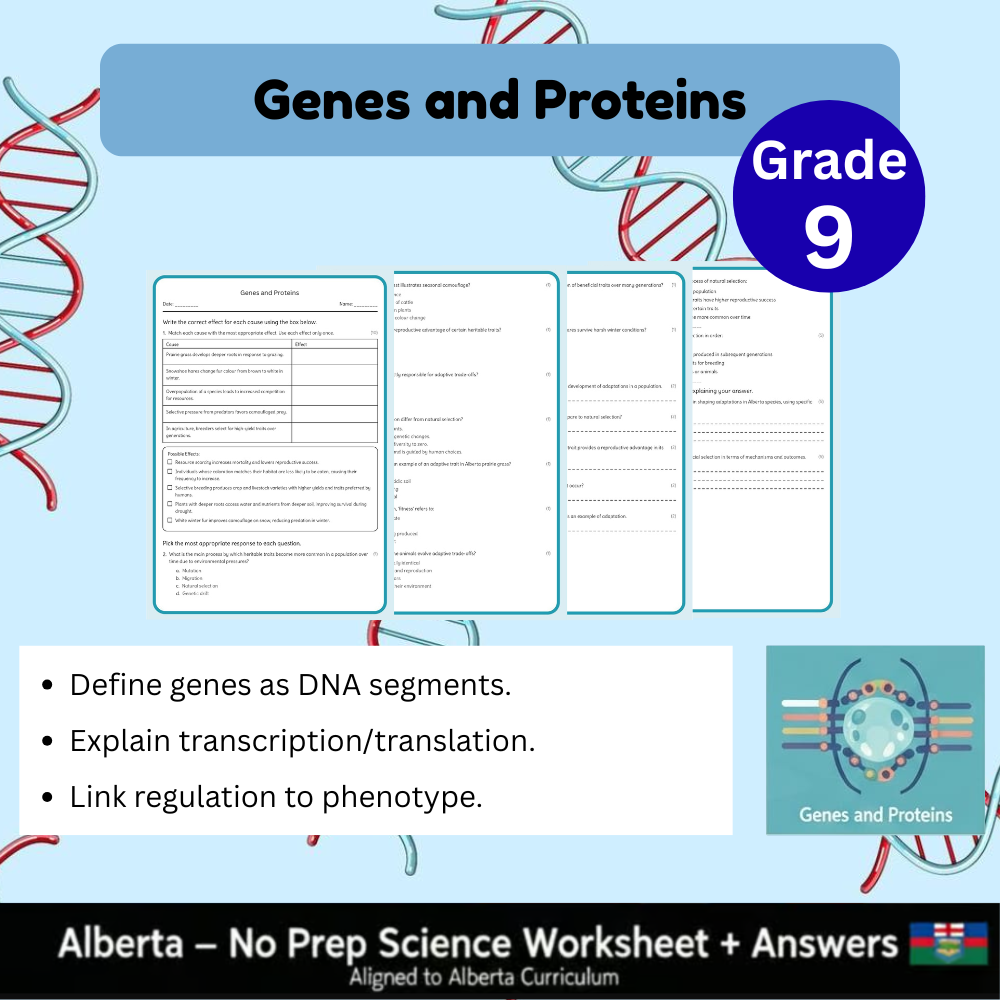
Grade 9 Science | Genes and Proteins Worksheet (PDF) - Alberta Standards
 Created byBright Mind Resources
Learning Objectives
- Describe the role of genes as segments of DNA that encode proteins and regulatory elements.
- Explain the processes of transcription and translation in gene expression.
- Understand how gene regulation affects phenotype and trait variation.
Instant download

Grade 9 Science | Producers & Consumers - Daily Reading Comprehension
 Created byCoral Reef Learning
Learning Objectives
- Explain how photosynthesis converts light energy into chemical energy in plants.
- Describe the role of autotrophs as producers in ecosystems.
- Identify the process of cellular respiration and its importance for energy release.
Instant download

Biodiversity Change Worksheet Grade 9 Science Activity | NGSSS
 Created byPrism Point Learning
Learning Objectives
- Explain how biodiversity supports ecosystem stability and resilience.
- Describe how environmental change and human activities can alter biodiversity.
- Connect shifts in biodiversity to changes in ecosystem functions like matter and energy cycles.
Also included in: Grade 9 Evolution, Genetics & Ecology Lesson Bundle | Florida NGSSS
Instant download

Grade 9 Science - Atomic Particles Worksheet (BC Standard) PDF
 Created byEvergreen Desk Education
Learning Objectives
- Explain how protons, neutrons, and electrons form an atom’s structure and determine atomic identity and behavior.
- Differentiate atomic number, atomic mass, and isotopes using the roles of nucleons (protons and neutrons).
- Use electron energy regions to predict why atoms form different bonding patterns.
Instant download

Grade 9 Element Identity Worksheet | Atomic Structure & Elements | Ontario
 Created byClear Sky Classroom
Learning Objectives
- Explain how the number of protons determines an element’s identity and relates to its chemical symbol.
- Describe how atomic models represent atomic identity, including the meaning of subatomic particles in those models.
- Differentiate metallic and nonmetallic characteristics using representative elements (iron, carbon, oxygen).
Instant download
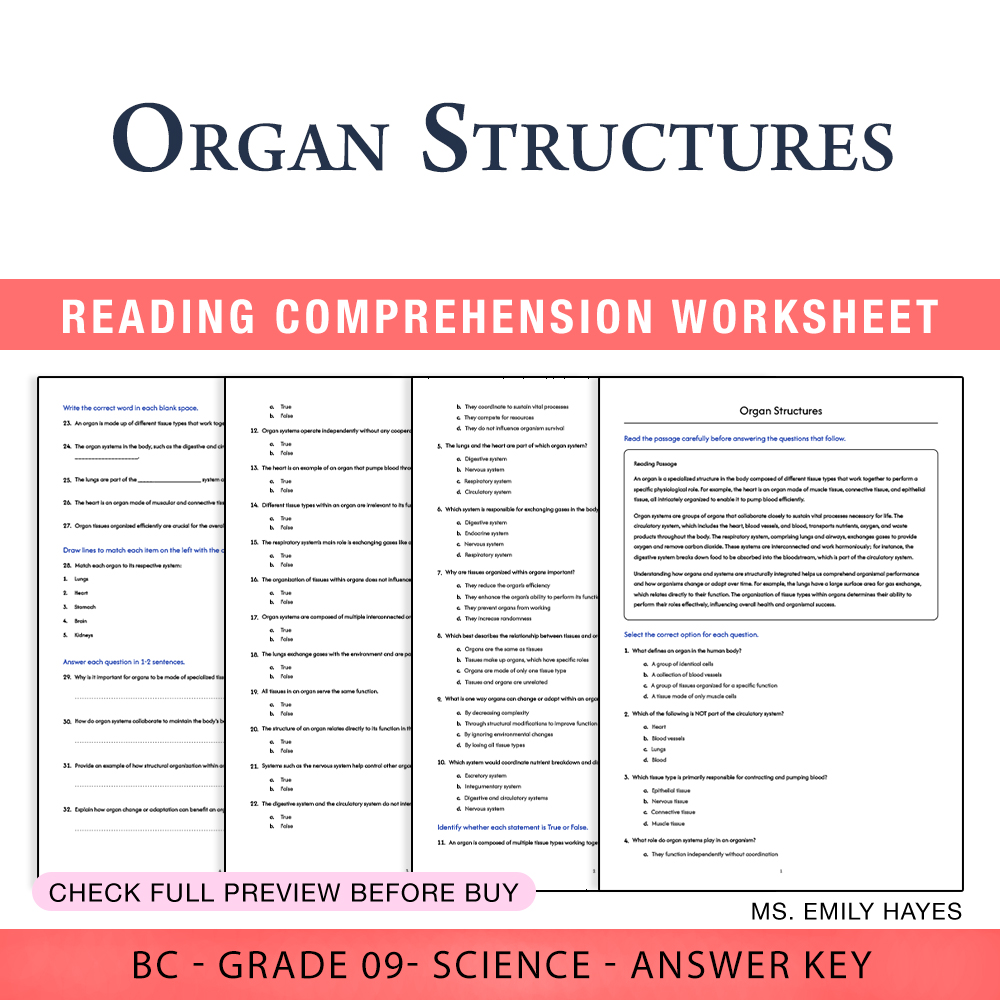
Grade 9 Science | Organ Structures Worksheet (PDF+ Answer Key)
 Created byCopper Leaf Classroom
Learning Objectives
- Describe what makes up an organ and its tissue organization
- Explain the purpose of different organ systems and their coordination
- Identify examples of organs and system functions in humans
Also included in: Grade 9 Science Worksheet Pack | Biology & Cell Structures (PDF+ Answer Keys) +1 more
Instant download

Molecular Inheritance Worksheet for Grade 9 Science | AP Biology Practice
Created byPrism Point LearningLearning Objectives
- Explain how DNA sequence information flows to phenotype through replication, transcription, RNA processing, and translation.
- Predict how point mutations and regulatory changes can alter gene expression and protein function.
- Compare the likely effects of coding-region vs regulatory-region mutations in single-gene and polygenic contexts.
Instant download
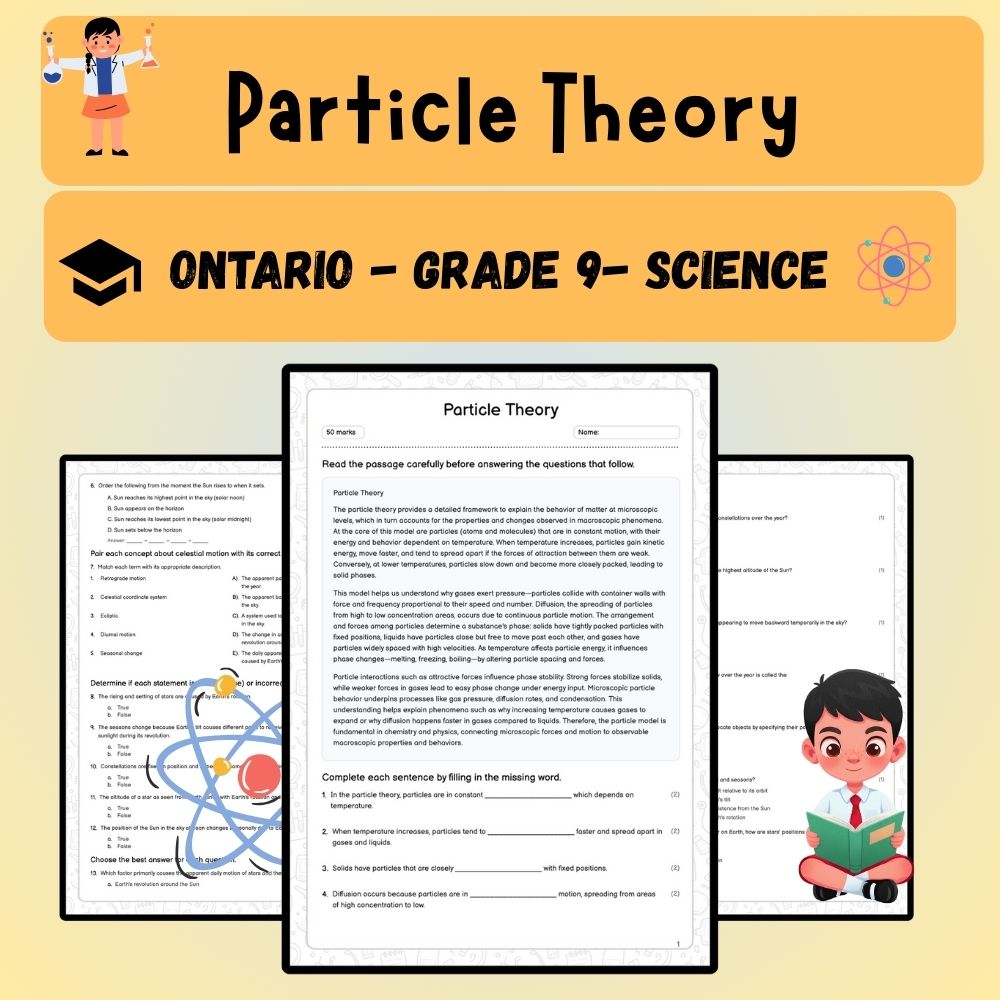
Grade 9 Science | Particle Theory Worksheet (Answer Key) – Ontario Standard
Created byPrism Point LearningLearning Objectives
- Explain the particle model as a framework for understanding states of matter, diffusion, and temperature effects.
- Relate microscopic particle motion to observable macroscopic phenomena such as gas pressure and diffusion rate.
- Describe how particle arrangement and interactions determine phase stability and response to energy changes.
Also included in: Grade 9 Science UNIT Worksheet Pack | Chemical Properties, Energy & Reactions +1 more
Instant download
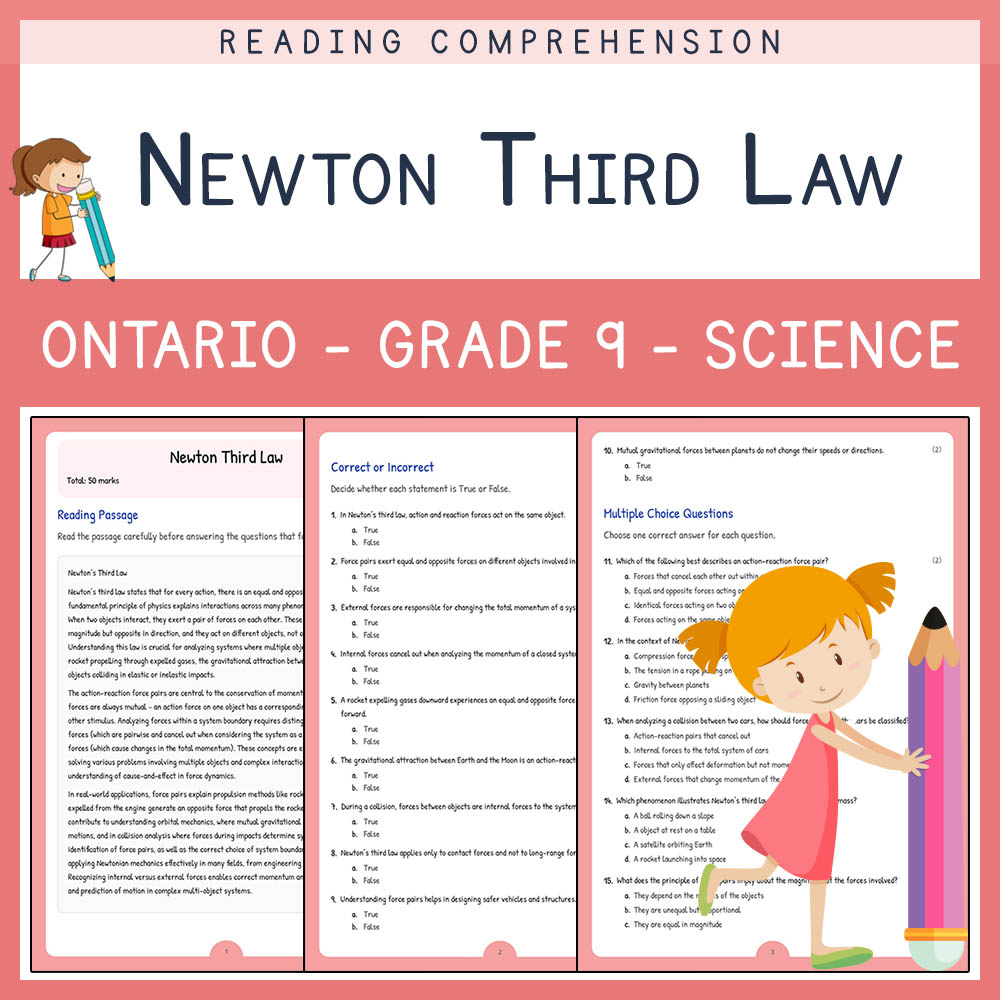
Grade 9 Science Assessment | Newton Third Law Worksheet Elena | Ontario
 Created byLumora Learning
Learning Objectives
- Understand the concept of action–reaction force pairs in Newton's third law.
- Identify equal magnitude and opposite direction forces in various interactions.
- Analyze phenomena such as propulsion, gravitational attraction, and collisions through force pairs.
Instant download
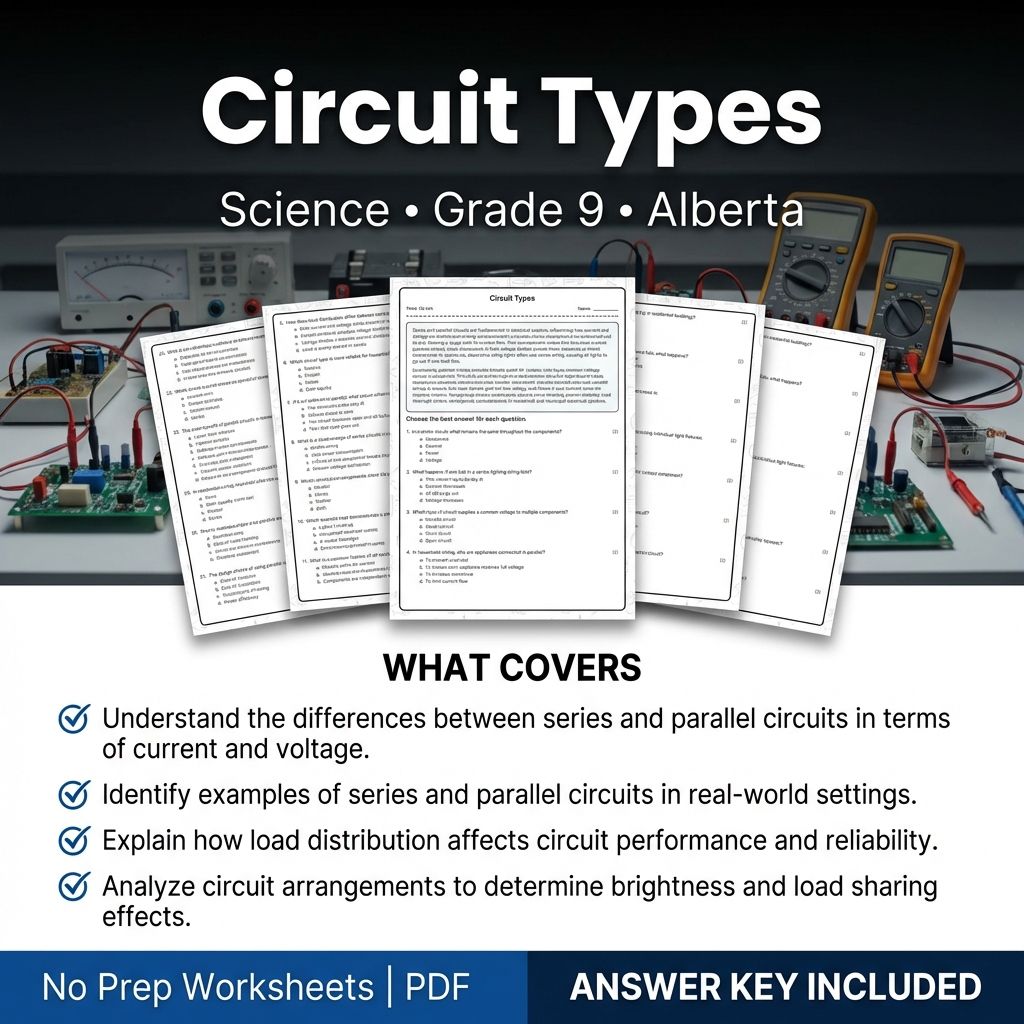
Circuit Types Worksheet for Grade 9 Science | Alberta Standards Practice
Created byCoral Reef LearningLearning Objectives
- Understand the differences between series and parallel circuits in terms of current and voltage.
- Identify examples of series and parallel circuits in real-world settings.
- Explain how load distribution affects circuit performance and reliability.
Instant download

Grade 9 Integrated Analysis Worksheet | Alberta Practice & PDF
Created byClear Sky ClassroomLearning Objectives
- Use kinematics, net-force reasoning, and energy ideas together to explain motion in Grade 9 physics problems.
- Connect free-body diagrams and force balances to acceleration and motion graphs.
- Apply energy and friction/grade effects to predict quantities such as stopping distance or speed.
Instant download

Organelle Interactions Worksheet | TEKS Science Assessment Grade 9
JCreated byJ.S SheetsLearning Objectives
- Explain how organelles coordinate to move genetic information and proteins through the cell.
- Describe how mitochondria, lysosomes, and peroxisomes contribute to energy use, recycling, and detoxification.
- Use cause-and-effect reasoning to connect organelle functions to cellular homeostasis.
Instant download
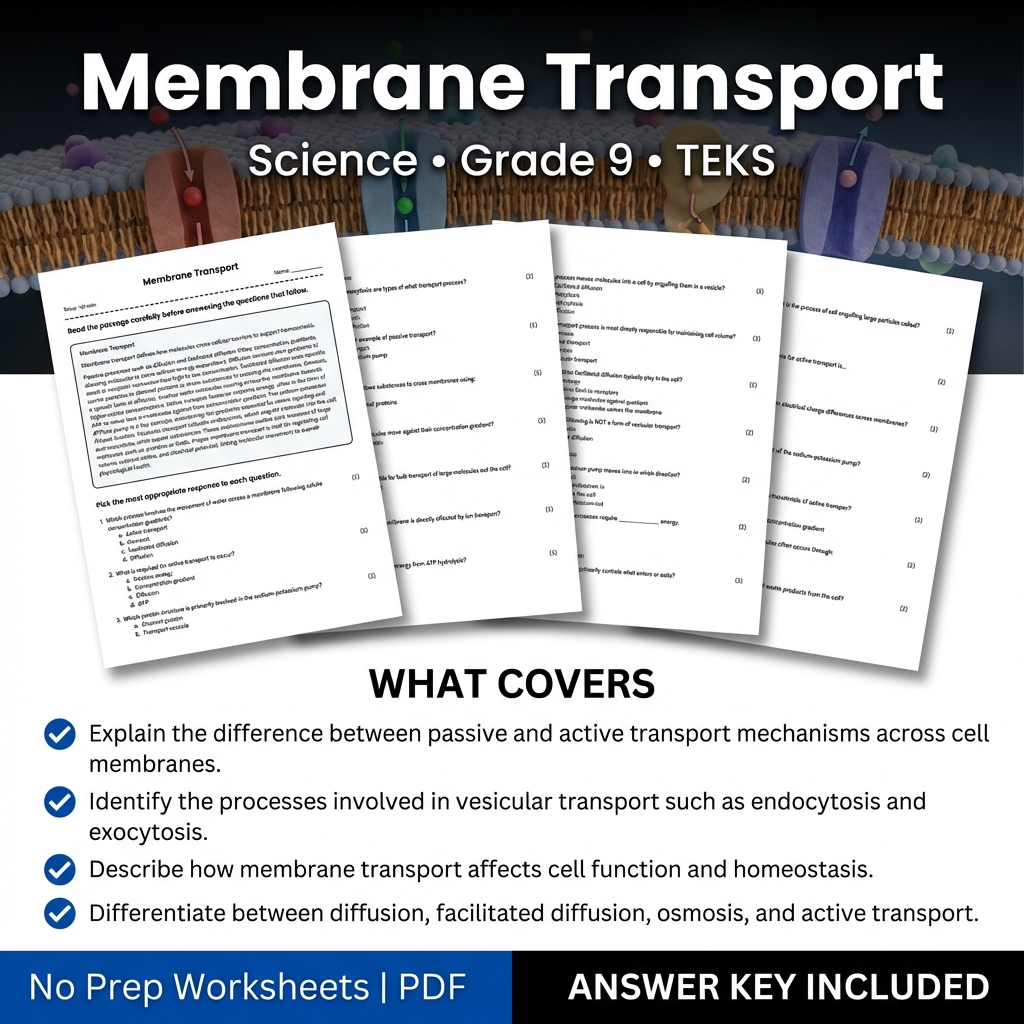
Membrane Transport Worksheet for Grade 9 Science | TEKS Standards
Created byCoral Reef LearningLearning Objectives
- Explain the difference between passive and active transport mechanisms across cell membranes.
- Identify the processes involved in vesicular transport such as endocytosis and exocytosis.
- Describe how membrane transport affects cell function and homeostasis.
Instant download

Grade 9 Science | Biotech Ethics Worksheet | TEKS Aligned
Created byLumora LearningLearning Objectives
- Understand key ethical considerations in biotechnology, including privacy, consent, and ecological impact.
- Analyze societal implications and regulatory frameworks related to genetic manipulation.
- Evaluate risks and benefits associated with biotechnological advancements.
Also included in: Grade 9 Science | Genetics & Biotechnology Lesson Bundle | TEKS Aligned
Instant download

Comparative Structures Worksheet | TEKS Grade 9 Science Practice
JCreated byJ.S SheetsLearning Objectives
- Explain how differences in organelle form and abundance relate to specialized cellular functions
- Use examples (smooth ER, mitochondria, vacuoles, cilia/flagella) to connect structure to function
- Compare cell adaptations in animals and plants using evidence from organelle structure
Instant download
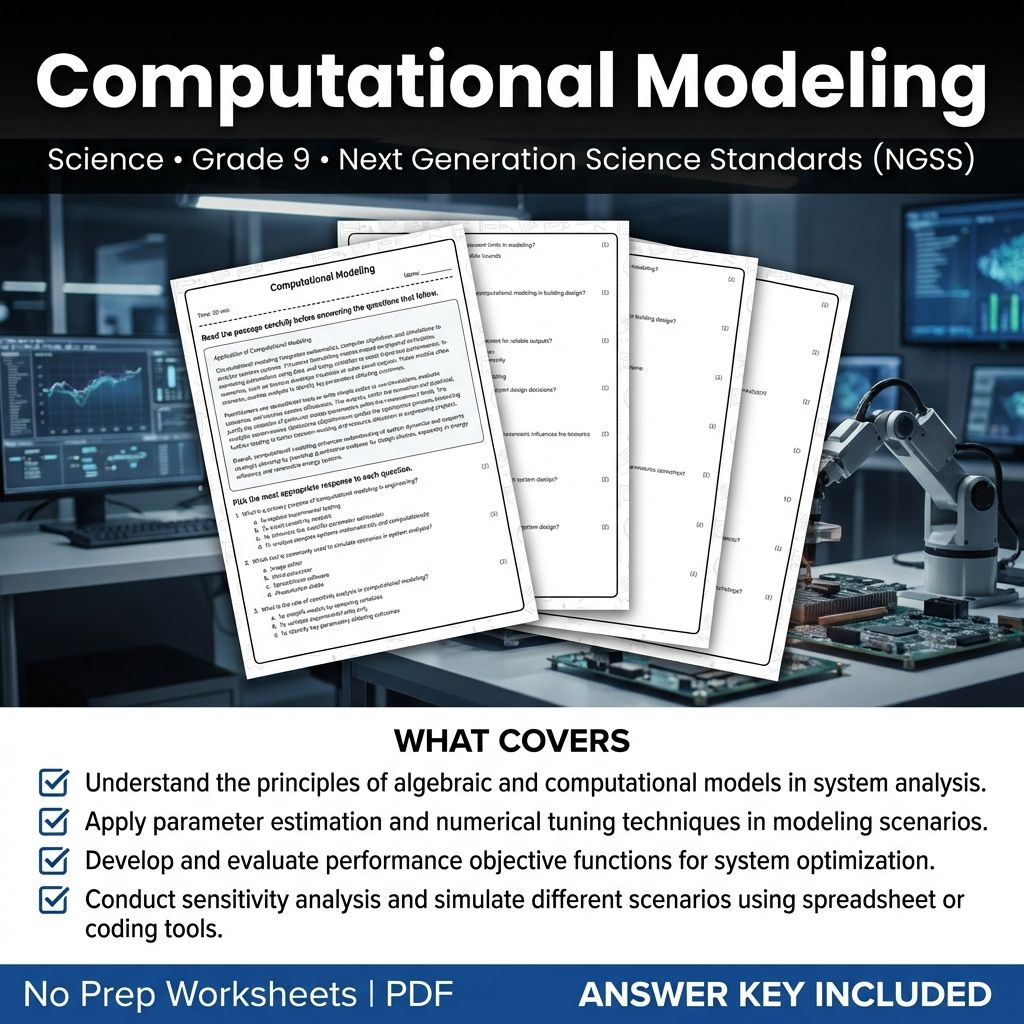
9th Grade Science Worksheet | Computational Modeling Practice & Answer Key
Created byCoral Reef LearningLearning Objectives
- Understand the principles of algebraic and computational models in system analysis.
- Apply parameter estimation and numerical tuning techniques in modeling scenarios.
- Develop and evaluate performance objective functions for system optimization.
Also included in: Grade 9 Science Unit Bundle | Prototyping, Constraints & Modeling Worksheets +1 more
Instant download
Grade 9 Science – Environmental Health Worksheet (Ontario | PDF)
Created byBright Mind ResourcesLearning Objectives
- Understand how environmental exposures influence health outcomes.
- Identify key pollutants and their effects on cellular and organ systems.
- Explain dose-response relationships and vulnerability factors in environmental health.
Instant download

Grade 9 Science | Environmental Health Worksheet (Ontario Standards) (PDF)
Created byEvergreen Desk EducationLearning Objectives
- Evaluate how environmental exposures and lifestyle choices can increase risk for chronic diseases using mechanistic and epidemiological reasoning.
- Explain how dose–response relationships and vulnerability factors influence the likelihood and severity of health outcomes.
- Analyze how pollutants and chemical toxicants can affect cellular and organ-system functions such as DNA integrity, endocrine signaling, and transport processes.
Also included in: Grade 9 Human Body Systems & Cellular Processes Science Lesson Bundle: Ontario +1 more
Instant download

Grade 9 Science Planetary Origins Worksheet | NGSS Space Science Activity
 Created byBRIGHT PATH RESOURCES
Learning Objectives
- Understand the formation of the solar system from a protoplanetary disk.
- Identify evidence supporting planetary formation theories.
- Describe the differences between inner rocky planets and outer gas giants.
Also included in: Space Science Evolution & Timescales Daily Reading Grade 9 Lesson Bundle | NGSS +1 more
Instant download

Grade 9 Science | Simple Machines Worksheet – Ontario Standards (PDF)
Created byEvergreen Desk EducationLearning Objectives
- Explain how simple machines change input force and displacement to achieve mechanical advantage
- Classify levers by fulcrum, effort, and load positions and predict how motion direction changes
- Compare ideal mechanical advantage with real performance by accounting for friction and deformation
Also included in: Grade 9 Forces, Motion & Energy Science Lesson Bundle (Ontario) +1 more
Instant download

Grade 9 Science | Apparent Motion of Celestial Objects - Reading Comprehension
Created byCoral Reef LearningLearning Objectives
- Describe the daily and seasonal apparent movement of the Sun and stars in the sky.
- Identify the causes of diurnal and annual motion observed from Earth.
- Use celestial coordinate concepts such as altitude and azimuth to explain the position of celestial objects.
Instant download
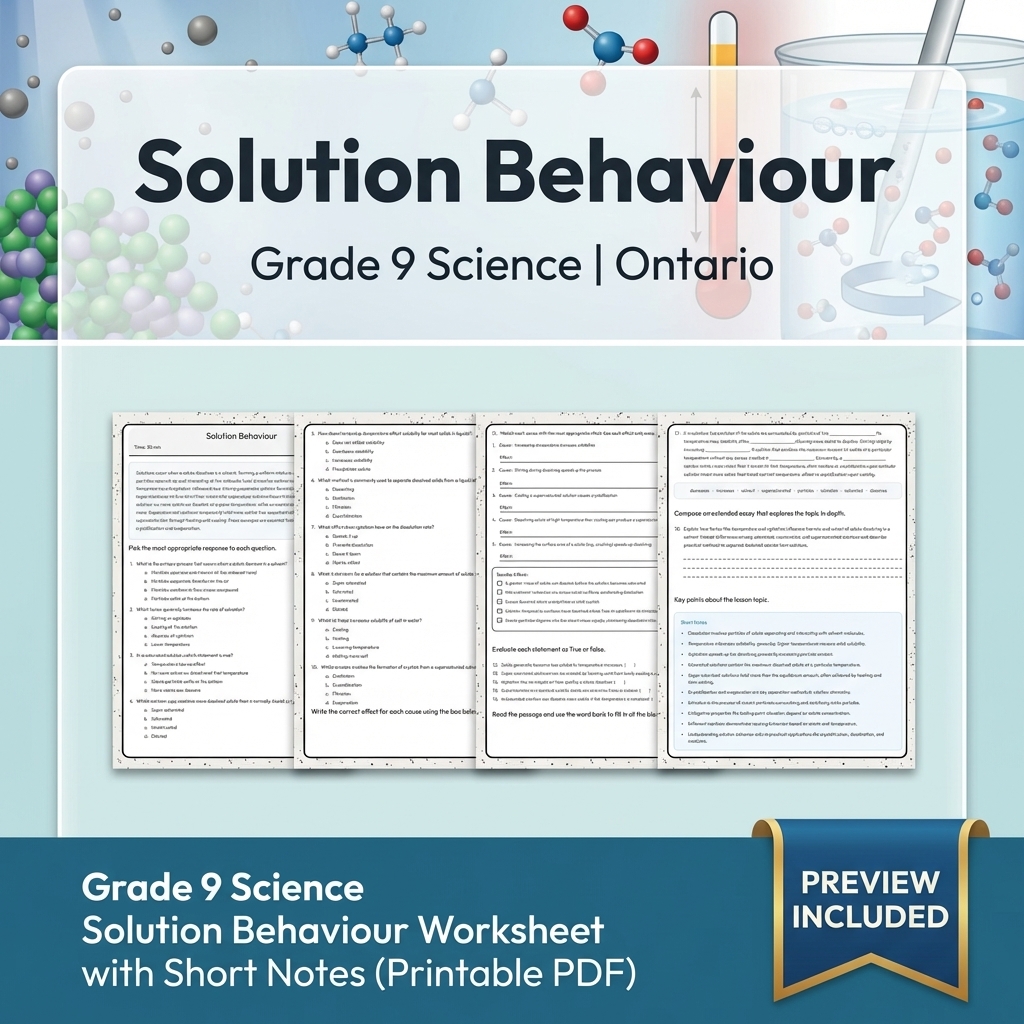
Grade 9 Science Solution Behaviour Worksheet with Short Notes (Printable PDF)
 Created byMeadowlark Worksheets
Learning Objectives
- Describe the processes involved in solution formation and dissolution.
- Identify factors that affect solubility, such as temperature and agitation.
- Differentiate between saturated, unsaturated, and supersaturated solutions with examples.
Also included in: Grade 9 Science Lesson Group Bundle | Ontario Curriculum Worksheets
Instant download
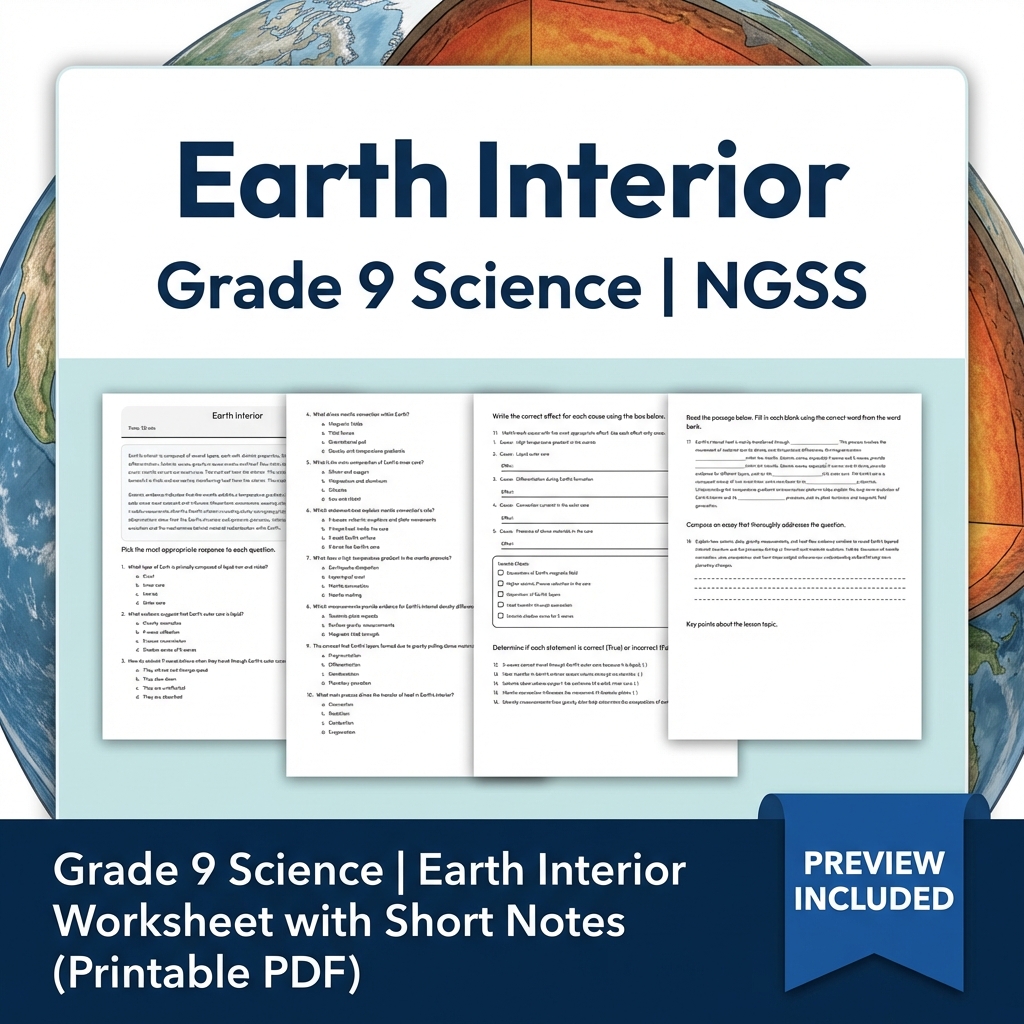
Grade 9 Science | Earth Interior Worksheet with Short Notes (Printable PDF)
Created byMeadowlark WorksheetsLearning Objectives
- Describe the layered structure of Earth's interior based on seismic, gravity, and heat-flow evidence.
- Interpret the behavior of P-waves and S-waves to understand Earth's internal composition.
- Explain how density contrasts and temperature gradients influence mantle convection and material cycling.
Also included in: Grade 9 Science | Earth's Systems Unit Bundle NGSS 7 Worksheets (Resource Pack) +1 more
Instant download

Circular Motion Worksheet for Grade 9 Science | Standards-Aligned Practice
JCreated byJ.S SheetsLearning Objectives
- Understand the concept of centripetal force and its role in circular motion.
- Identify the relationship between speed, radius, and acceleration in uniform circular motion.
- Analyze how tension, friction, and normal force contribute to maintaining curved trajectories.
Instant download

Evidence Change Worksheet for Grade 9 Science | Alberta Standards Practice
JCreated byJ.S SheetsLearning Objectives
- Identify observable signs that indicate a chemical change has occurred.
- Distinguish between physical and chemical changes based on evidence.
- Recognize real-world examples of chemical change in environmental and industrial contexts.
Also included in: Grade 9: Chemical Reactions and Matter Science lesson bundle Alberta
Instant download
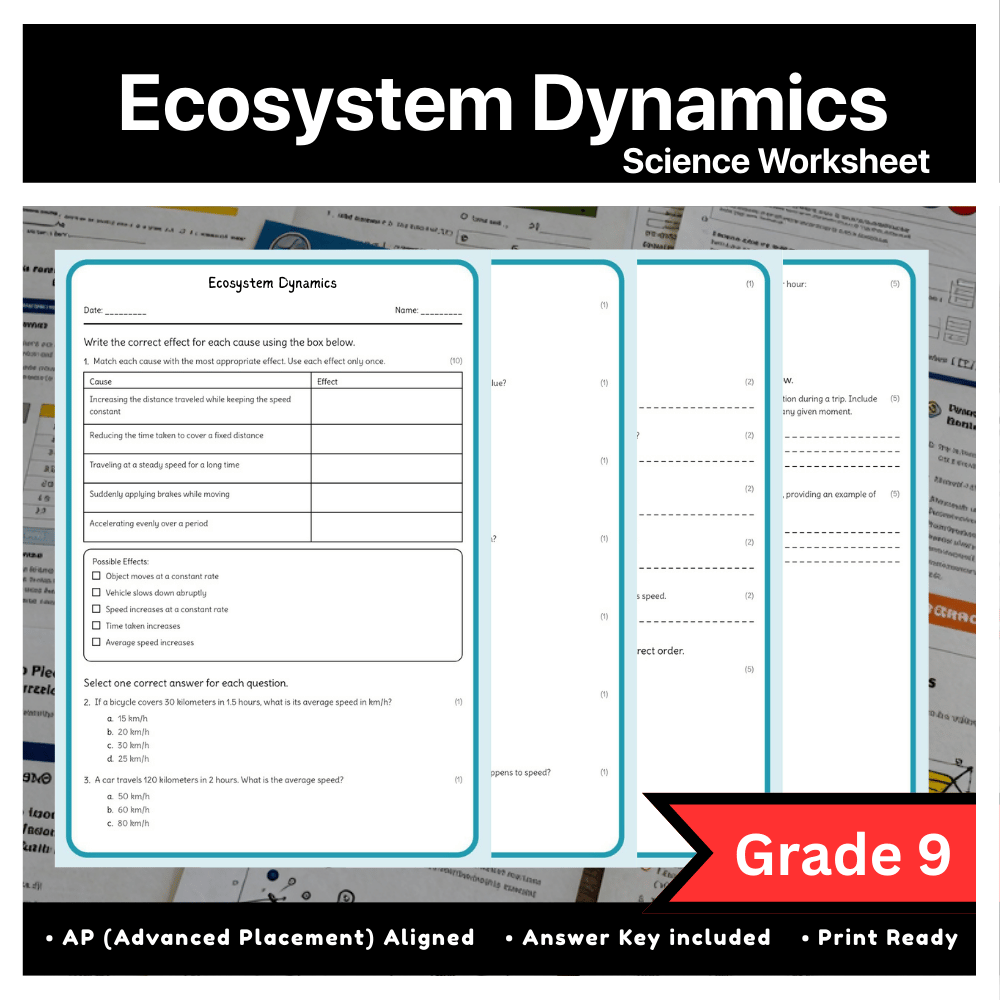
Grade 9 Science | Ecosystem Dynamics Worksheet - AP Standards (PDF)
Created byBright Mind ResourcesLearning Objectives
- Analyze how multiple factors influence ecosystem responses and stability.
- Understand trophic interactions, feedback loops, and material fluxes in ecosystems.
- Evaluate the impacts of climate variability, land-use change, and species introductions.
Instant download
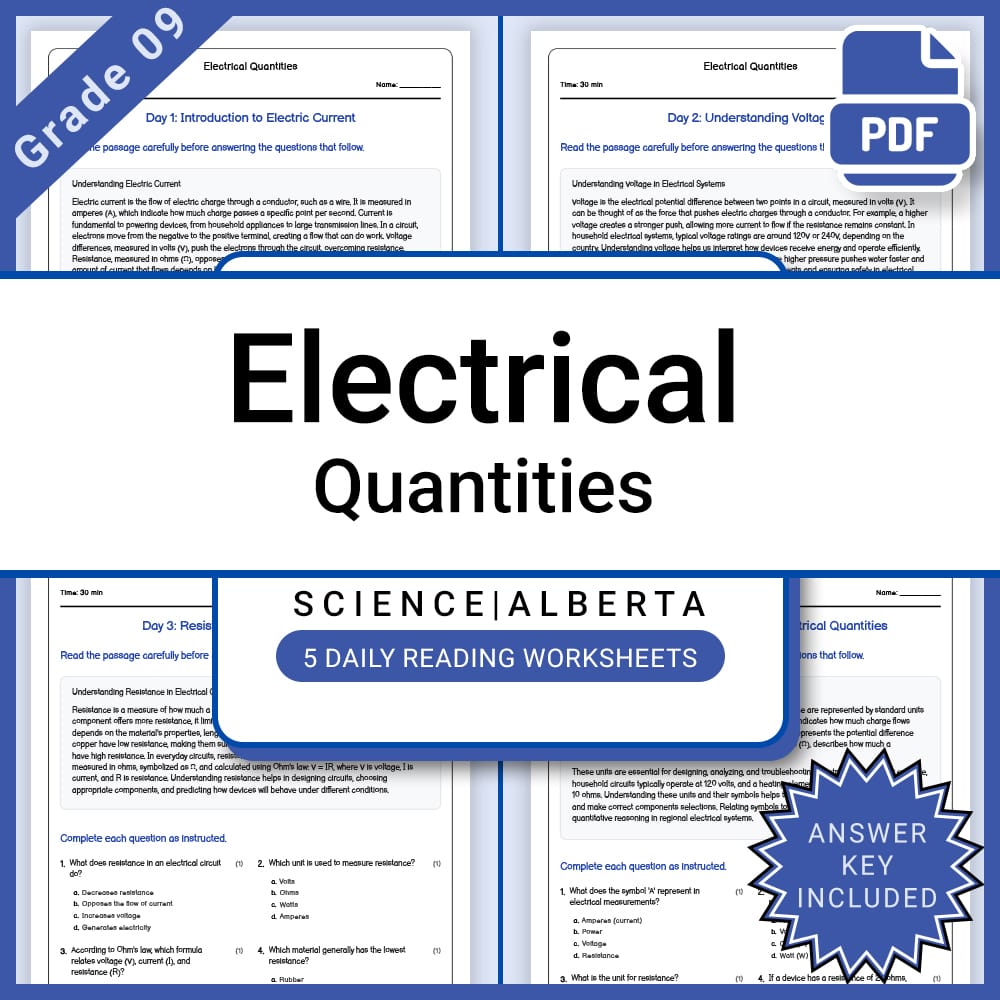
Grade 9 Science – Electrical Quantities Daily Reading Worksheet + Answer Key
JCreated byJ.S SheetsLearning Objectives
- Understand the concepts of electric current, voltage, and resistance
- Identify units and symbols associated with electrical quantities
- Relate electrical quantities to real-world household and regional electrical systems
Also included in: Grade 9 Science Lesson Bundle: Electrical Systems and Energy Concepts +1 more
Instant download
Grade 9 Science – Inheritance Patterns Worksheet (PDF) | TEKS Standards
Created byBright Mind ResourcesLearning Objectives
- Identify different inheritance patterns including Mendelian and non-Mendelian types.
- Understand how single-gene and complex traits are inherited and expressed.
- Differentiate between dominant, recessive, incomplete dominance, codominance, and other patterns.
Also included in: Grade 9 Science Genetics & Biotechnology Unit - TEKS - Aligned (Answer Keys) +3 more
Instant download
Inertia Explained Assessment | BC Standards Grade 9 Science
Created byPrism Point LearningLearning Objectives
- Define inertia and explain its relation to an object's mass.
- Describe real-world examples of inertia in everyday life.
- Analyze how forces overcome inertia to change an object's motion.
Instant download

Grade 9 Science | Energy Transformations - Daily Reading Comprehension
Created byCoral Reef LearningLearning Objectives
- Understand how mechanical energy converts into thermal energy through friction and air resistance.
- Identify examples of energy transformation in real-world scenarios.
- Explain the role of energy conservation in different systems.
Instant download

Grade 9 Science – Compound Machines & Simple Machines | Daily Reading Worksheet
Created byBright Mind ResourcesLearning Objectives
- Understand the concept of compound machines and how they are made of simple machines.
- Identify different types of simple machines such as gears, pulleys, levers, and inclined planes.
- Calculate the mechanical advantage of compound machines using force and displacement relationships.
Also included in: Grade 9 Work, Energy & Forces Science Daily Reading Lesson Bundle | Ontario +1 more
Instant download
Magnetic Fields Worksheet for Grade 9 Science | Alberta Standards Practice
Created byCoral Reef LearningLearning Objectives
- Understand the origin and basic properties of magnetic fields.
- Identify the relationship between electric current and magnetic field orientation.
- Explain real-world applications of magnetic fields in navigation and industry.
Instant download
Grade 9 – Circuit Diagrams Recognizing Symbols and Notation
JCreated byJ.S SheetsLearning Objectives
- Understand key concepts related to Science
- Apply knowledge through practice questions
- Demonstrate comprehension of the material
Also included in: Grade 9 Science Lesson Bundle: Electrical Systems and Energy Concepts +1 more
Instant download

Grade 9 Science Worksheet on Work and Energy (PDF) – BC Standards
Created byEvergreen Desk EducationLearning Objectives
- Explain what work is as an energy transfer caused by a force acting through a displacement
- Determine the sign of work (positive, zero, or negative) based on the direction of force and displacement
- Use the relationship between work and changes in kinetic and potential energy to analyze real situations
Instant download
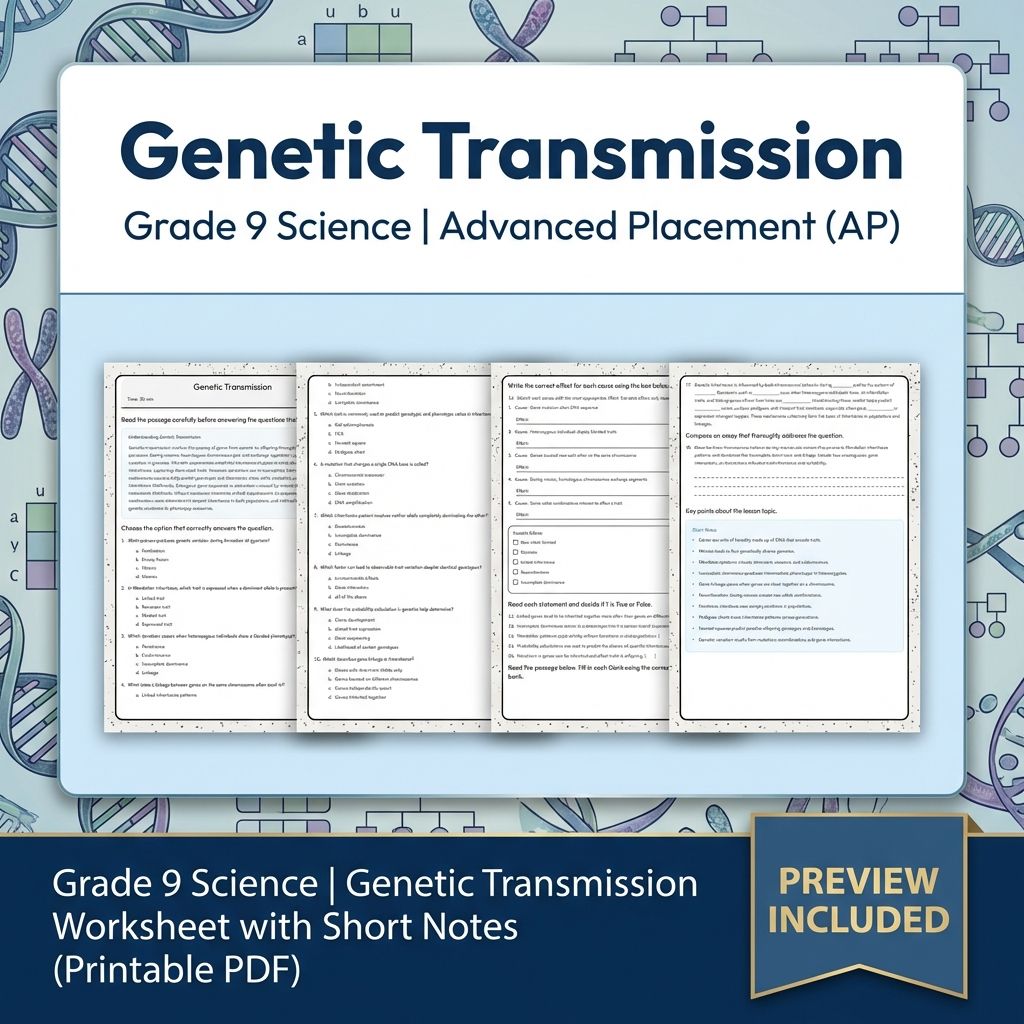
Grade 9 Science | Genetic Transmission Worksheet with Short Notes (PDF)
Created byMeadowlark WorksheetsLearning Objectives
- Explain the mechanisms of inheritance including meiosis, Mendelian patterns, and deviations.
- Use Punnett squares, pedigree analysis, and probability calculations to predict genotypic and phenotypic ratios.
- Understand how alterations in genes influence observable traits through dominance, penetrance, and gene interactions.
Also included in: Grade 9 Science Unit | Cellular Processes & Ecosystems Worksheet Pack (PDF) +1 more
Instant download
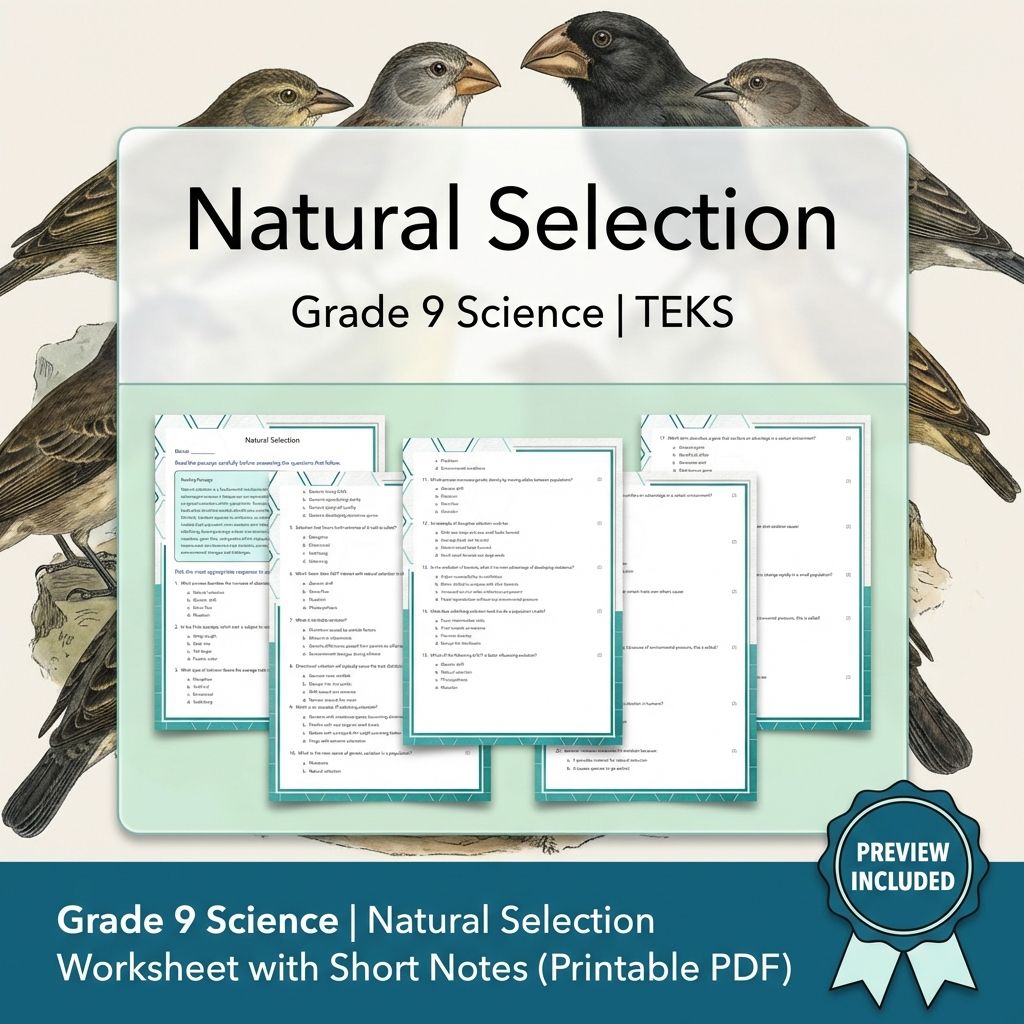
Grade 9 Science | Natural Selection Worksheet with Short Notes (Printable PDF)
Created byMeadowlark WorksheetsLearning Objectives
- Explain the concept of natural selection and its role in evolution.
- Identify examples of natural selection in nature.
- Differentiate between types of selection: directional, stabilizing, and disruptive.
Instant download
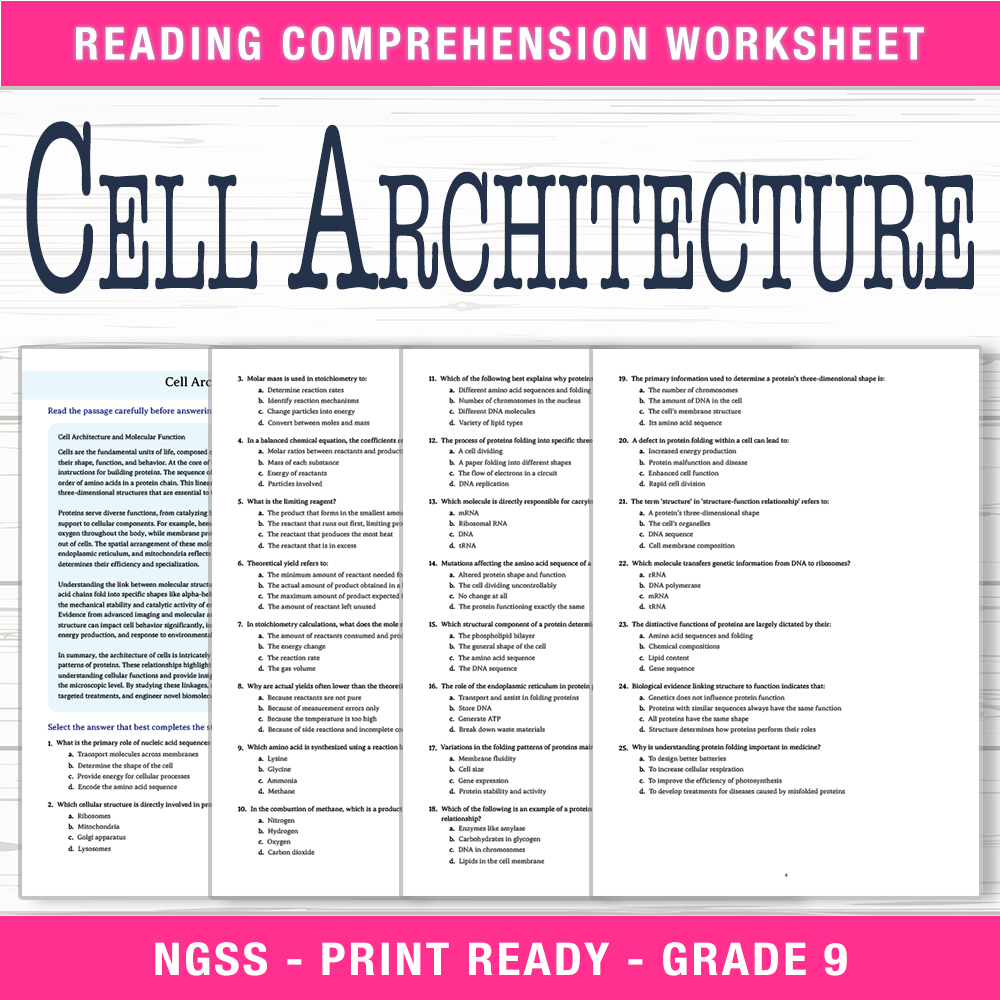
Grade 9 Science | Cell Architecture Worksheet (PDF + Answer Key)
 Created byRiverstone Classroom
Learning Objectives
- Understand how nucleic acid sequences determine amino acid chains and protein structures.
- Explain how macromolecular structures influence organelle architecture and cellular functions.
- Connect molecular coding and folding to specific cellular components like ribosomes, endoplasmic reticulum, and mitochondria.
Also included in: Grade 9 Science Unit | Cell Structure & Function Worksheets
Instant download

Grade 9 Science – Crystal Lattices & Structures | Daily Reading Worksheet
Created byBright Mind ResourcesLearning Objectives
- Define what a crystal lattice is and explain its significance.
- Identify the different types of lattice structures such as ionic, metallic, and covalent networks.
- Understand how atomic arrangements influence the properties of solids.
Also included in: Grade 9 Chemical Reactions Science Lesson Bundle: Daily Reading (BC) +1 more
Instant download

Grade 9 Science | Solar System Scales Worksheet | California Standards
Created byLumora LearningLearning Objectives
- Explain how scale models help connect observable features of the night sky to real distances and sizes in the solar system.
- Describe how perspective affects apparent motion and brightness of planets as Earth orbits the Sun.
- Use relative reasoning about orbital periods and repeating patterns to interpret sky observations.
Instant download
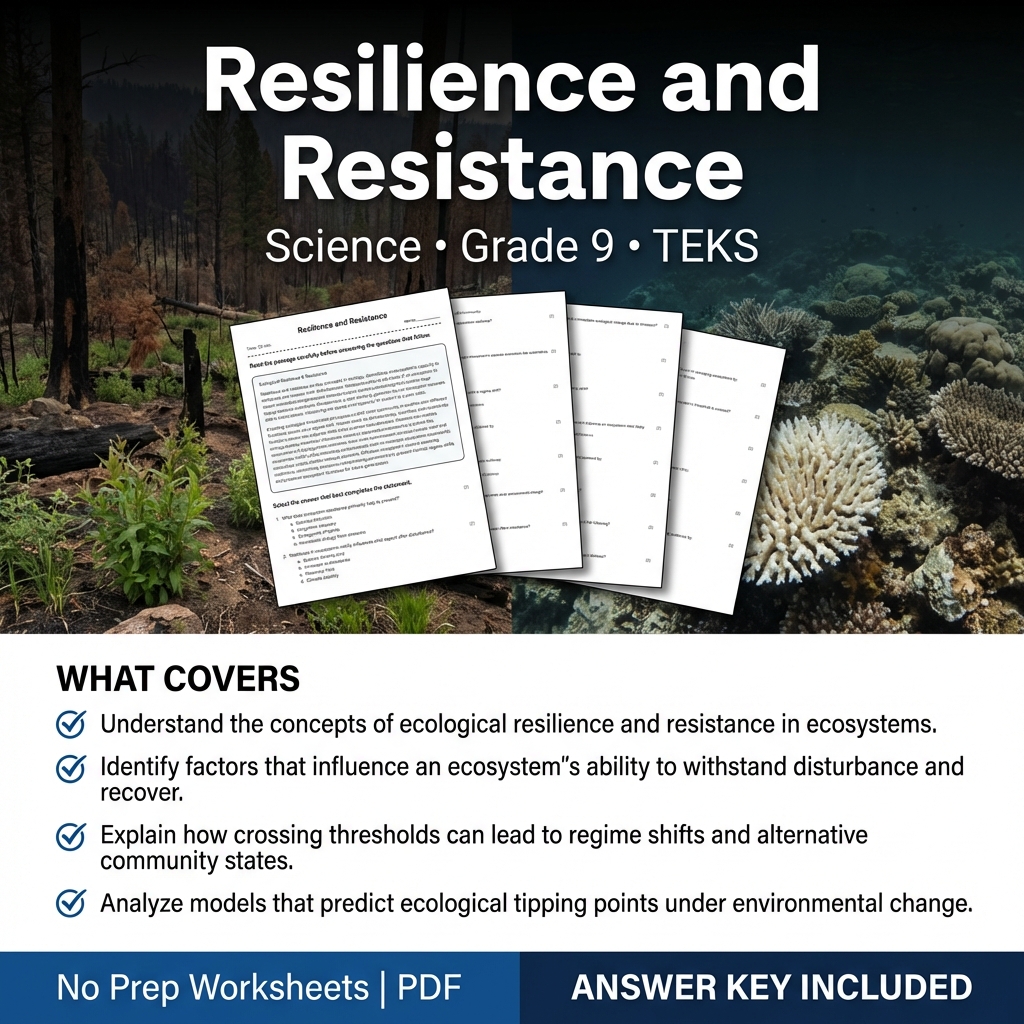
Grade 9 Science Worksheet on Resilience and Resistance | TEKS Standard
Created byCoral Reef LearningLearning Objectives
- Understand the concepts of ecological resilience and resistance in ecosystems.
- Identify factors that influence an ecosystem's ability to withstand disturbance and recover.
- Explain how crossing thresholds can lead to regime shifts and alternative community states.
Instant download

Grade 9 Force Interactions Worksheet | Practice & Assessment NGSS PDF
Created byClear Sky ClassroomLearning Objectives
- Explain how net external force relates to acceleration using Newton’s second law
- Use free-body diagrams to identify and sum all forces acting on an object
- Predict changes in motion for scenarios involving contact forces and field forces (including tension and friction)
Also included in: Motion & Forces Grade 9 Science Lesson Bundle: Advanced Placement (AP) +1 more
Instant download

Grade 9 Power Distribution System Architecture Worksheet | Alberta Science
Created byBRIGHT PATH RESOURCESLearning Objectives
- Explain the main stages in moving electricity from generation to consumers.
- Describe how voltage transformation supports long-distance power transmission.
- Use a simple sequence to predict how faults can spread through a network.
Instant download

Grade 9 Light Dual Nature Worksheet | California Science Physics + Answer Key
Created byEvergreen Desk EducationLearning Objectives
- Explain how light can behave as a wave and as a stream of particles, depending on the interaction being observed.
- Describe how interference and diffraction support the wave model of electromagnetic radiation.
- Describe how the photoelectric effect supports the particle model of light energy.
Instant download

Grade 9 Science | Free-Body Diagrams - Daily Reading Comprehension
Created byCoral Reef LearningLearning Objectives
- Understand the purpose and components of free-body diagrams
- Identify forces acting on an object in different scenarios
- Learn the conventions for drawing force vectors including size, direction, and point of application
Instant download
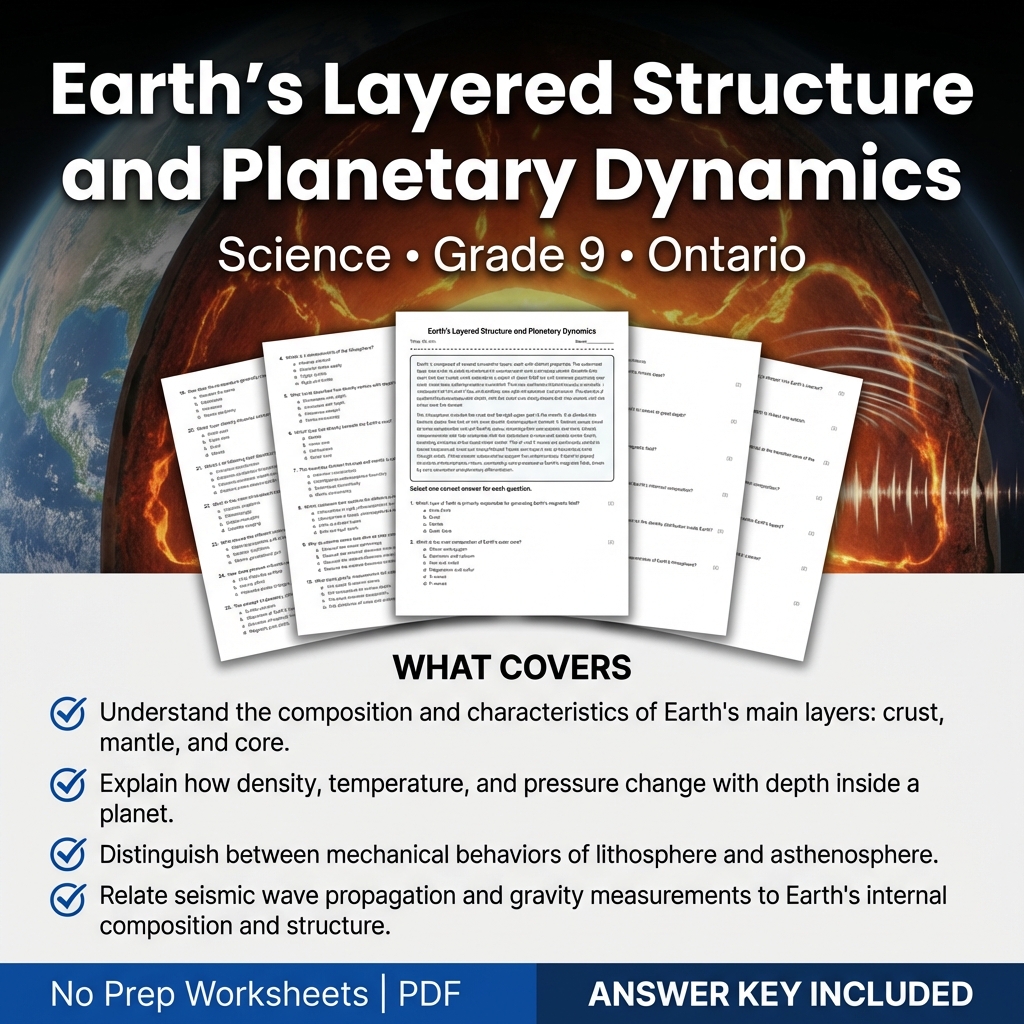
Earth's Layered Structure and Planetary Dynamics Worksheet | Ontario Grade 9
Created byCoral Reef LearningLearning Objectives
- Understand the composition and characteristics of Earth's main layers: crust, mantle, and core.
- Explain how density, temperature, and pressure change with depth inside a planet.
- Distinguish between mechanical behaviors of lithosphere and asthenosphere.
Instant download
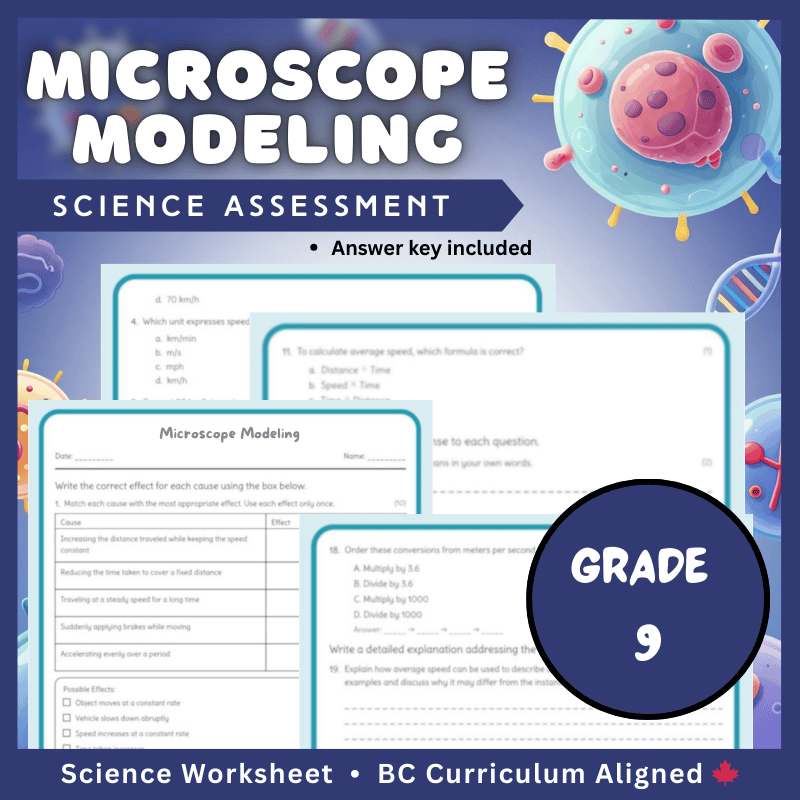
Grade 9 Science| Microscope Modeling Worksheet (PDF) for Cell Structure Analysis
Created byBright Mind ResourcesLearning Objectives
- Understand how microscopes provide visual models of cell structures and scales.
- Identify different types of microscopes and their uses in cell observation.
- Explain how diagrammatic and physical models help interpret microscopic observations.
Instant download

Grade 9 Science | Environmental Health - The Impact of Air Pollution on Humans
Created byCoral Reef LearningLearning Objectives
- Understand how air pollutants affect cellular health.
- Identify common air pollutants and their sources.
- Recognize the health risks associated with air pollution exposure.
Instant download
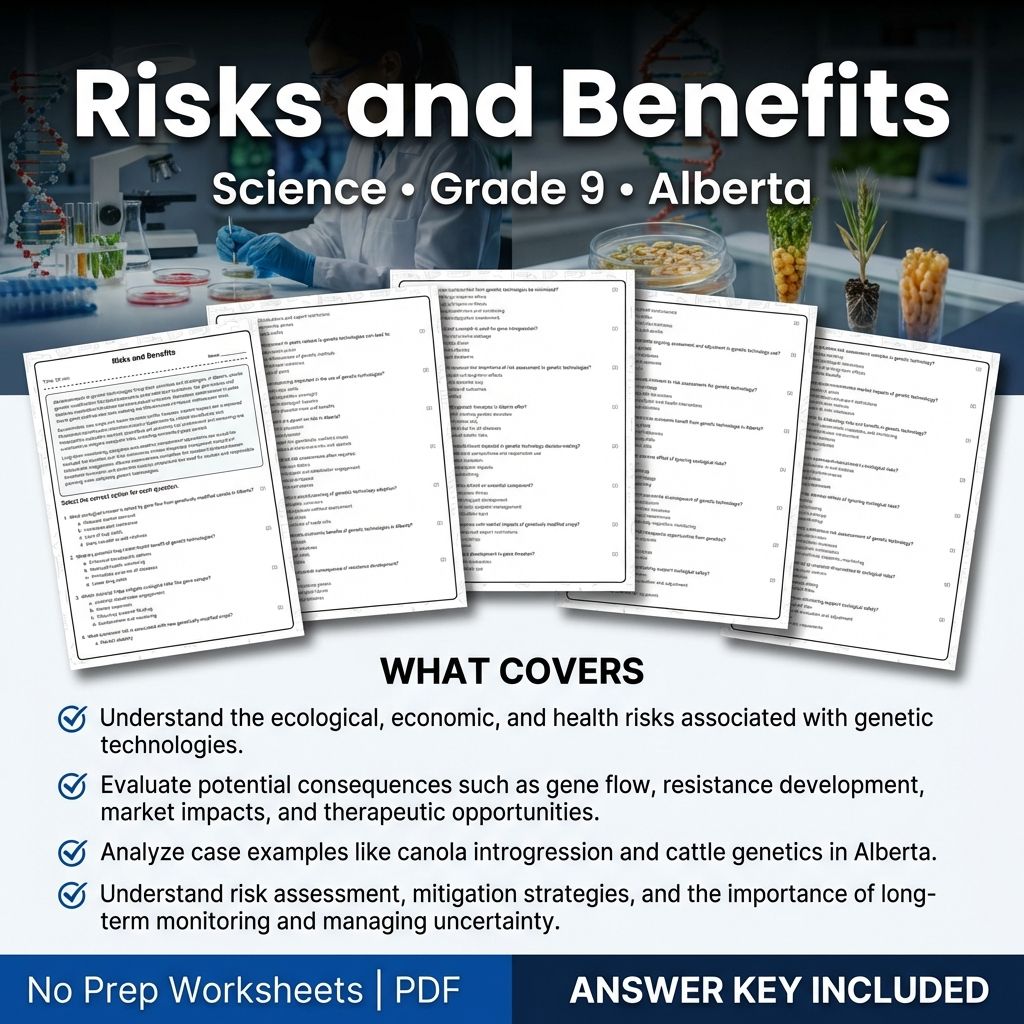
Risks and Benefits Worksheet | Alberta Grade 9 Science Practice
Created byCoral Reef LearningLearning Objectives
- Understand the ecological, economic, and health risks associated with genetic technologies.
- Evaluate potential consequences such as gene flow, resistance development, market impacts, and therapeutic opportunities.
- Analyze case examples like canola introgression and cattle genetics in Alberta.
Instant download
About Grade 9 Science Worksheets
Find Science worksheets built for Grade 9. All 6,926 cover core skills, practice, and review, each an instant PDF download.
Every worksheet on MyTeachingSheets is created by independent teacher-authors and reviewed before publication. All resources download as printable PDFs for classroom, homework, or at-home practice, and many include answer keys. Preview any worksheet free before buying.