
Grade 9 Science Worksheets
6,926 worksheets
Grade 9 Science | Milankovitch Cycles Worksheet | BC Standards
 Created byLumora Learning
Learning Objectives
- Understand the concept of Milankovitch cycles and their influence on Earth's climate.
- Identify the three main orbital parameters that vary in Milankovitch theory.
- Explain how variations in Earth's orbit affect glacial and interglacial periods.
Also included in: Grade 9 Science | Earth Systems Unit Bundle | BC Aligned Worksheets
Instant download
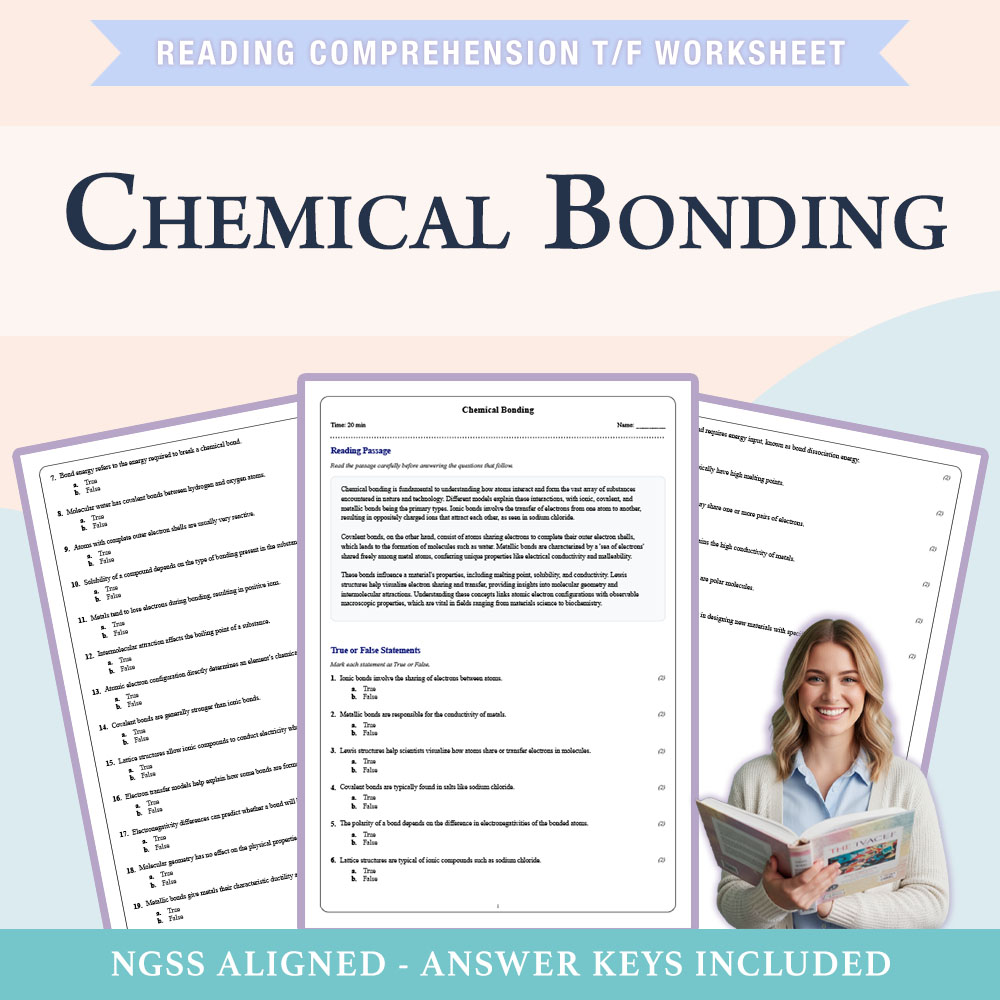
9th Grade Science | Chemical Bonding Worksheet (PDF + Answer Key)
 Created byCopper Leaf Classroom
Learning Objectives
- Understand the different types of chemical bonds: ionic, covalent, and metallic.
- Recognize how bonding influences molecular structure and properties.
- Interpret Lewis structures and models of electron sharing and transfer.
Also included in: Grade 9 Science | Reaction & Atomic Structure Unit Bundle (PDF + Answer Key) +1 more
Instant download
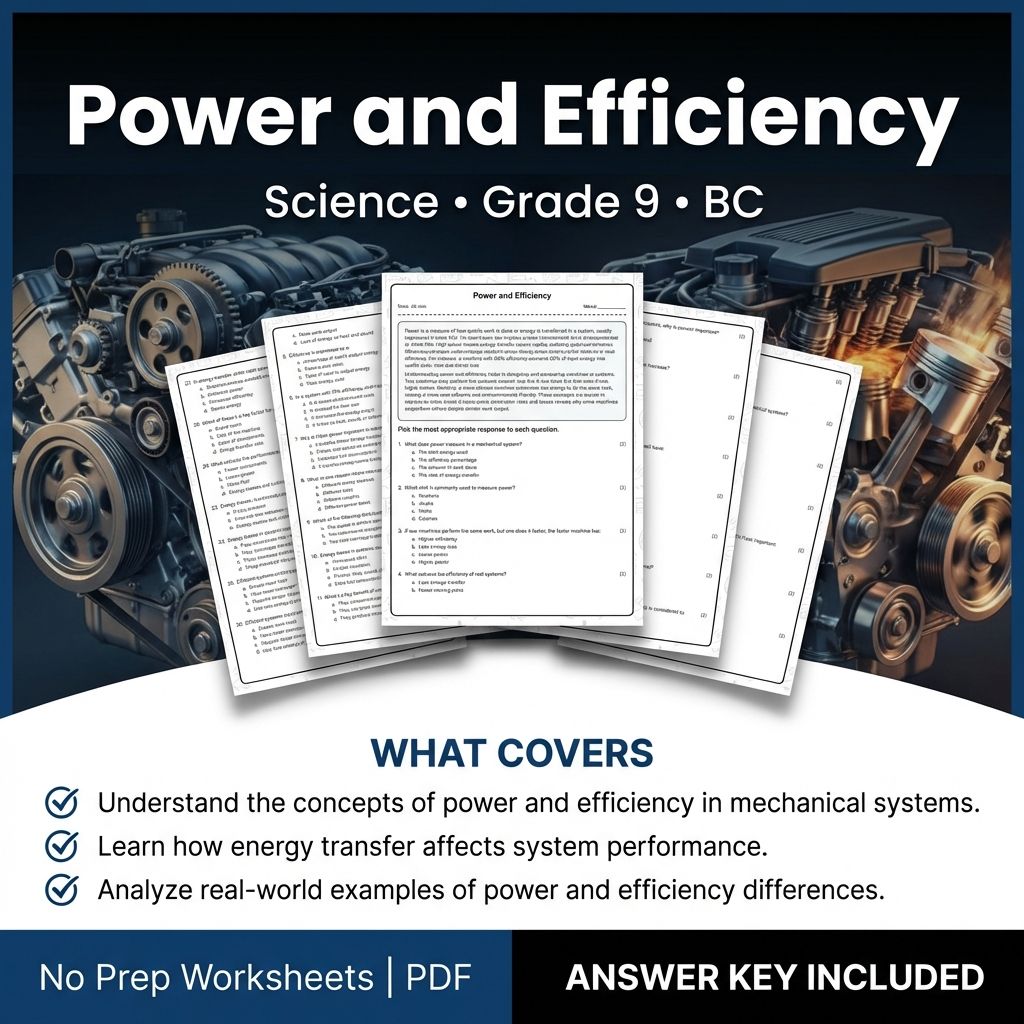
Power and Efficiency Grade 9 Science Worksheet | BC Standards
 Created byCoral Reef Learning
Learning Objectives
- Understand the concepts of power and efficiency in mechanical systems.
- Learn how energy transfer affects system performance.
- Analyze real-world examples of power and efficiency differences.
Instant download

Grade 9 Science – Wave Boundary Behavior & Reflection | Daily Reading Worksheet
 Created byBright Mind Resources
Learning Objectives
- Understand different types of wave interactions at boundaries
- Identify characteristics of reflection, refraction, transmission, absorption, diffraction, and interference
- Apply wave models to explain observed wave behaviors at boundaries
Also included in: Science Grade 9 Science Daily Reading Worksheets lesson-bundle | Calif. Stds +1 more
Instant download
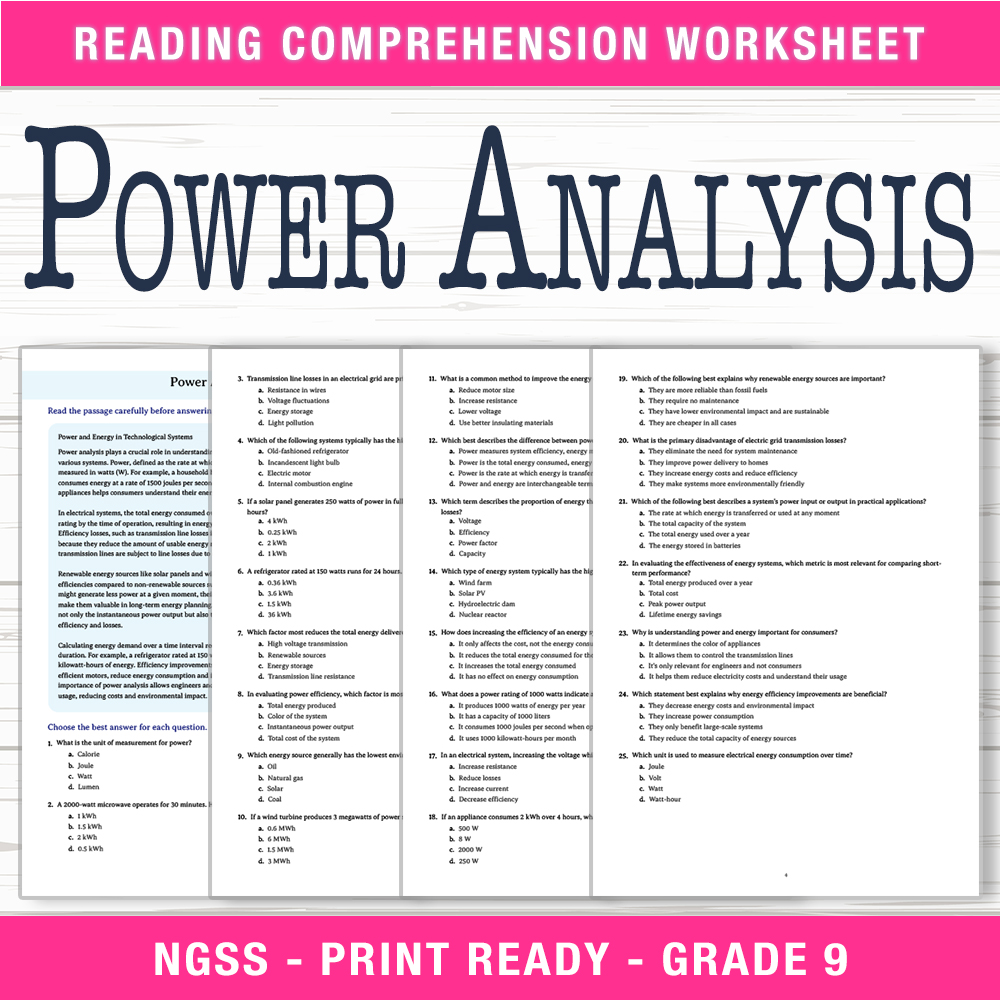
Grade 9 Science | Power Analysis Worksheet (PDF + Answer Key)
 Created byRiverstone Classroom
Learning Objectives
- Understand the concept of power as the rate of energy transfer or conversion per unit time.
- Identify and compare the energy demand and efficiency of various systems, including household appliances and electrical grids.
- Calculate and analyze power ratings, energy consumption over time, and system losses in different contexts.
Instant download
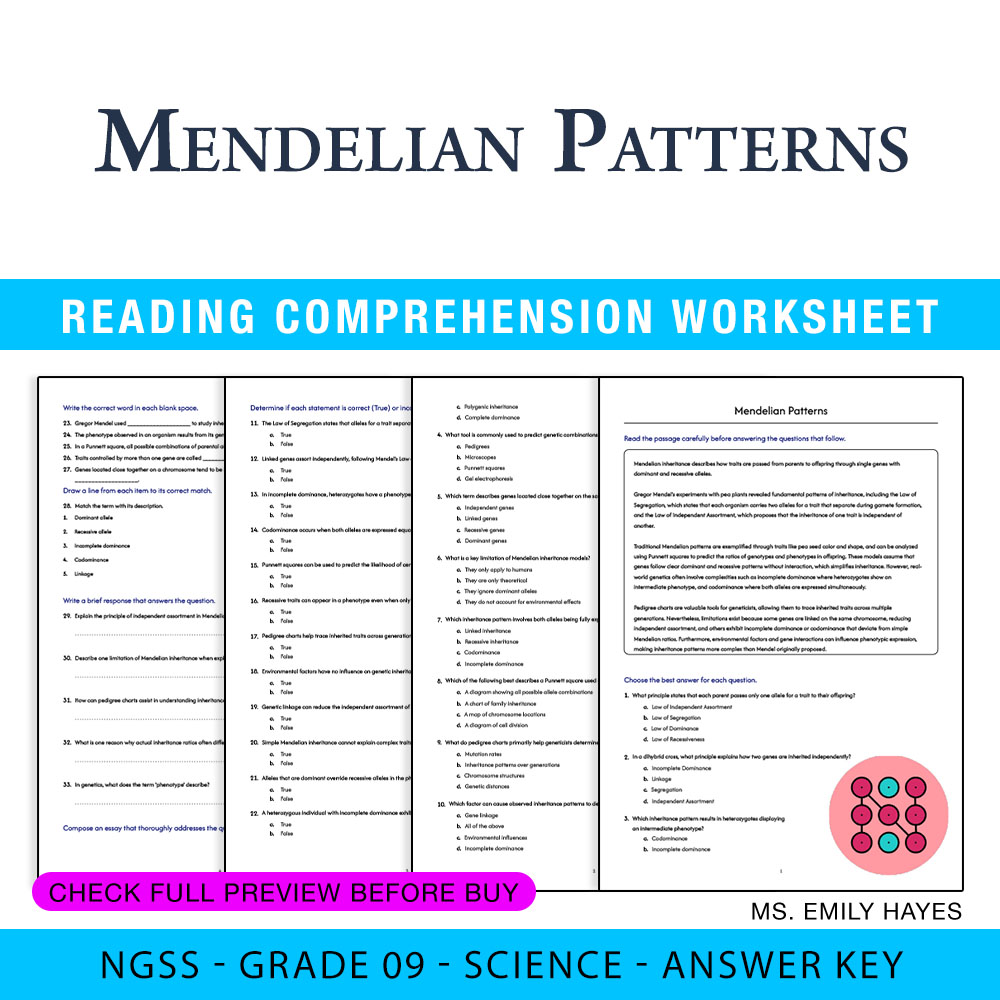
9th Grade Science | Mendelian Patterns Worksheet (PDF+ Answer Key)
Created byCopper Leaf ClassroomLearning Objectives
- Understand the principles of Mendelian inheritance including dominance, segregation, and independent assortment.
- Apply Punnett square analysis to predict genotype and phenotype ratios in monohybrid and dihybrid crosses.
- Interpret pedigrees and analyze inheritance patterns considering incomplete dominance, codominance, and linked loci.
Instant download
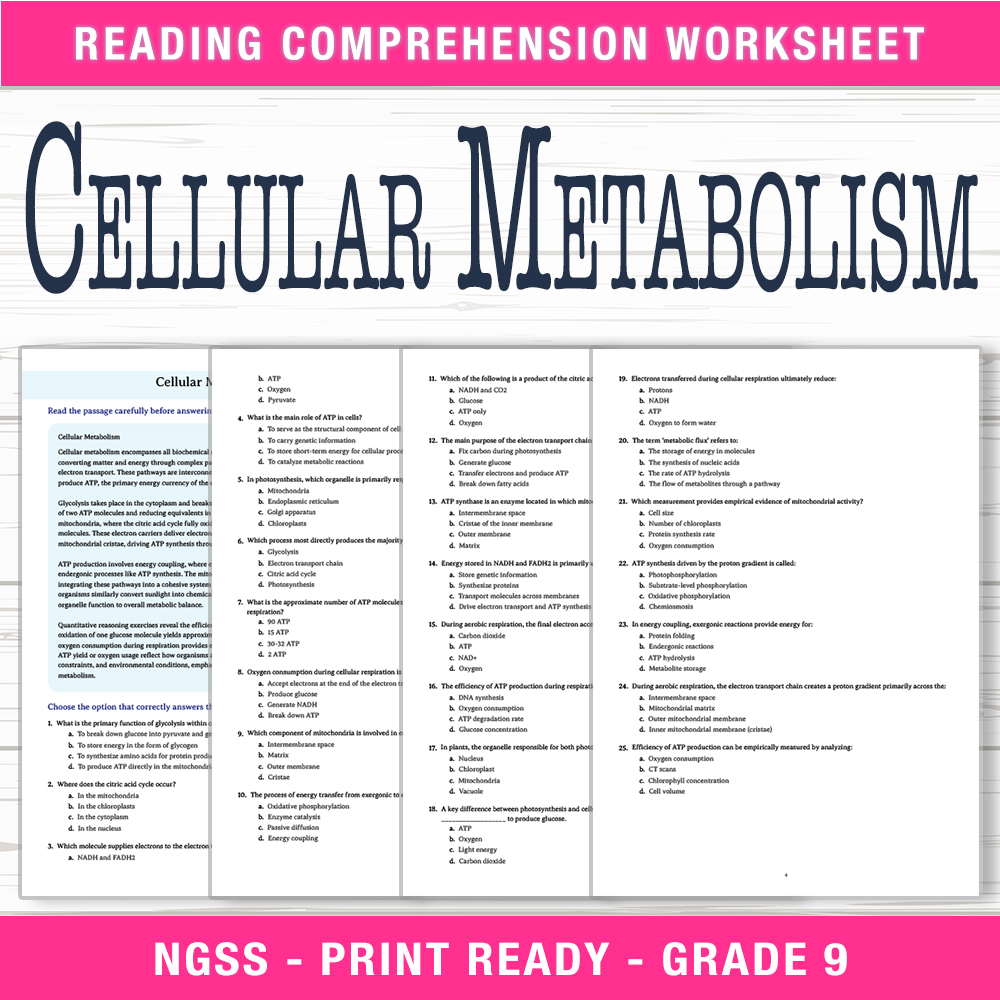
Grade 9 Science | Cellular Metabolism Worksheet (PDF + Answer Key)
Created byRiverstone ClassroomLearning Objectives
- Describe the biochemical pathways involved in cellular respiration, including glycolysis, the citric acid cycle, and electron transport.
- Explain how ATP is produced and energy is coupled within cells.
- Relate the function of mitochondria and chloroplasts to metabolic fluxes and organismal energy balance.
Also included in: Grade 9 Science Unit | Cell Structure & Function Worksheets
Instant download
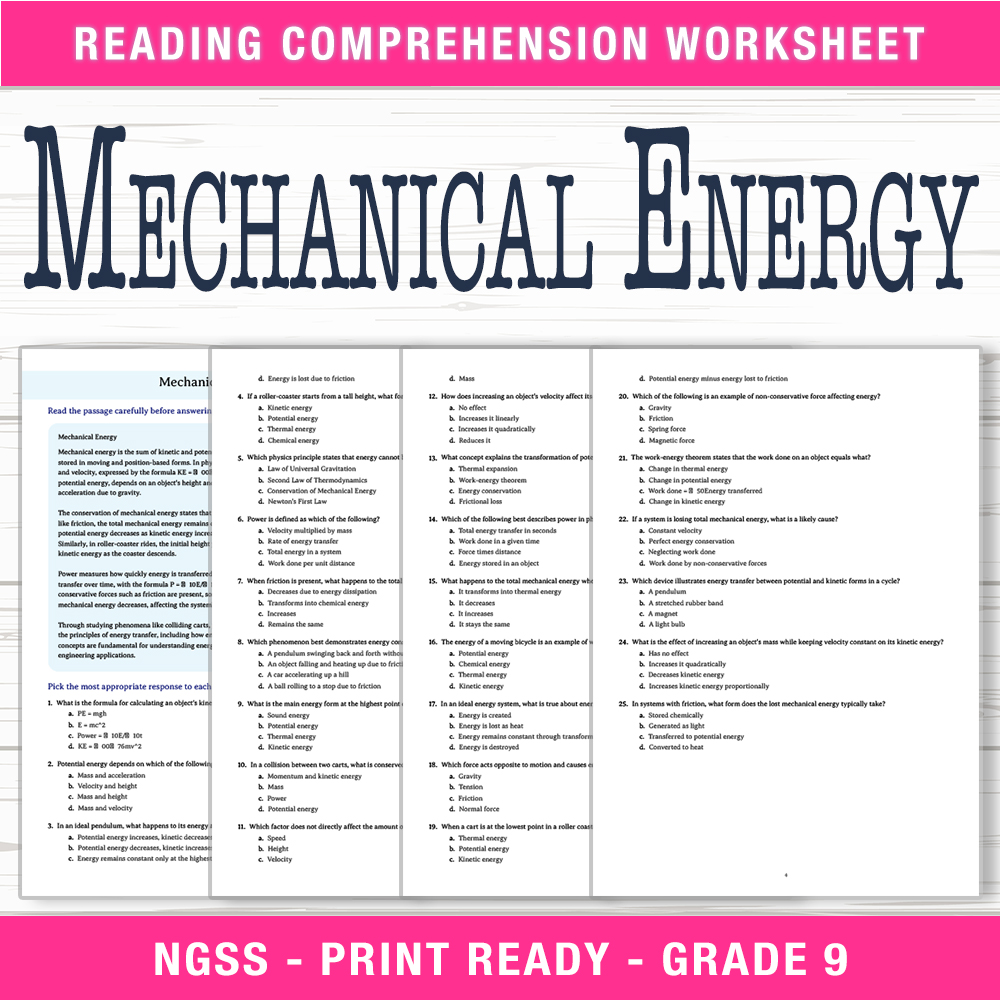
Grade 9 Science | Mechanical Energy Worksheet (PDF + Answer Key)
Created byRiverstone ClassroomLearning Objectives
- Define and differentiate between kinetic and potential energy in mechanical systems.
- Apply the work-energy theorem to analyze energy transfer in near-ideal systems.
- Calculate mechanical energy, power, and analyze the effects of non-conservative forces like friction.
Instant download
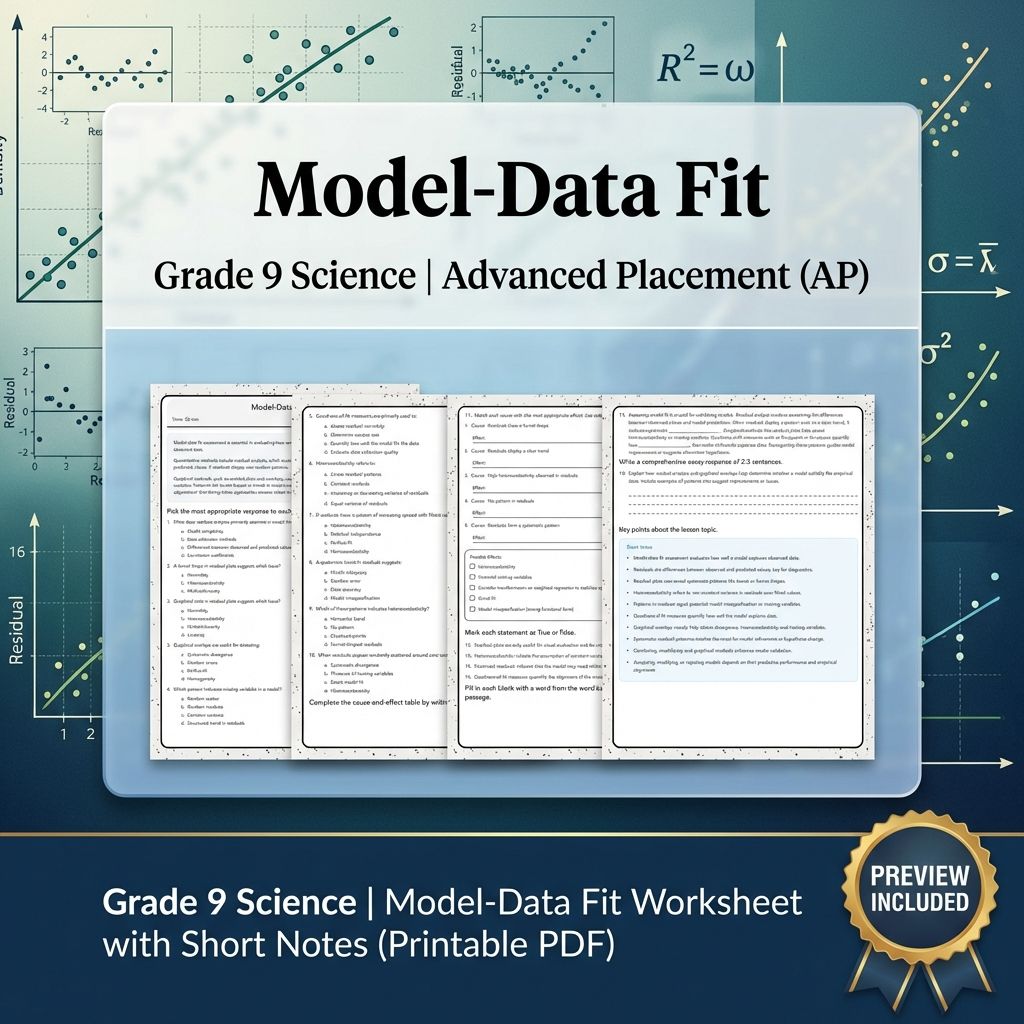
Grade 9 Science | Model-Data Fit Worksheet with Short Notes (Printable PDF)
 Created byMeadowlark Worksheets
Learning Objectives
- Understand the methods for assessing the fit of models to empirical data.
- Identify diagnostic patterns that indicate model inadequacies.
- Explain how residual analysis and goodness-of-fit measures inform model refinement.
Also included in: Grade 9 Science | Critical Thinking & Data Analysis Unit Bundle (Worksheets) +1 more
Instant download
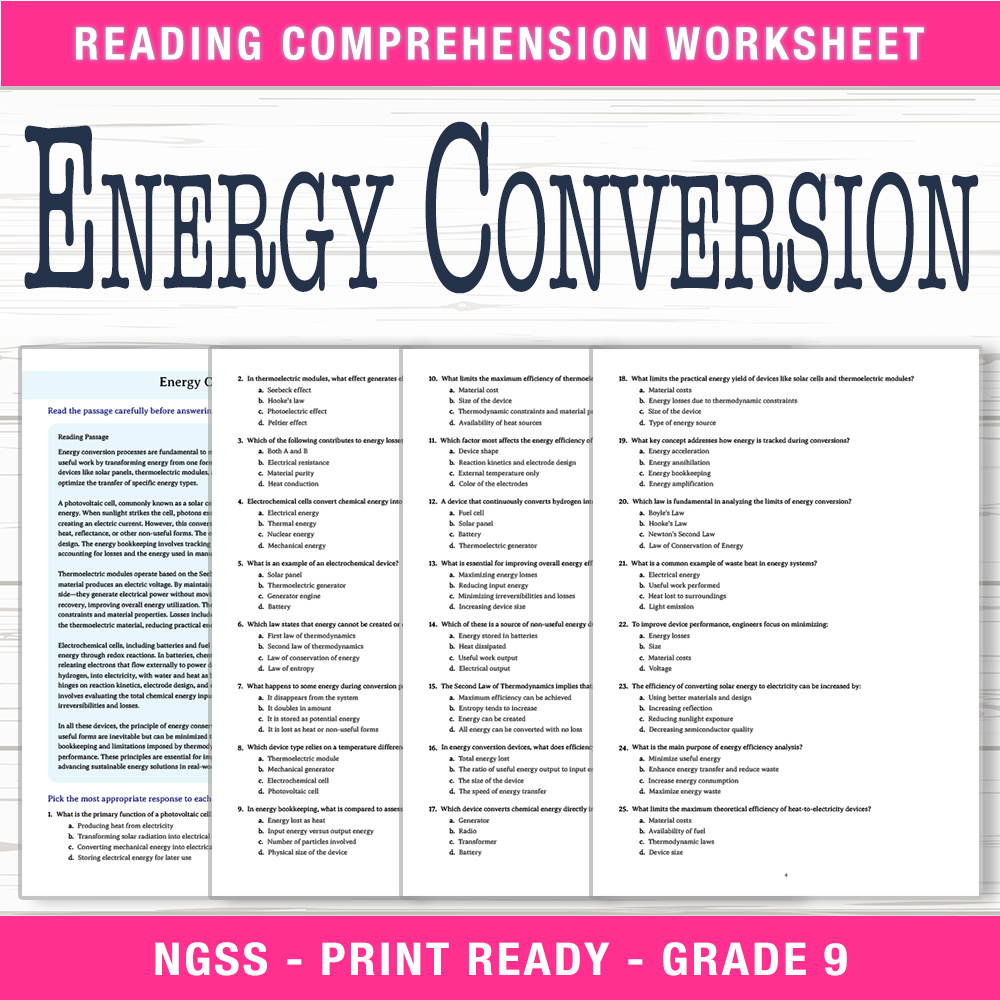
Grade 9 Science | Energy Conversion Worksheet (PDF + Answer Key)
Created byRiverstone ClassroomLearning Objectives
- Explain the principles of energy conversion in various devices.
- Identify examples of energy transfer and associated efficiencies.
- Analyze energy losses during conversion processes.
Instant download
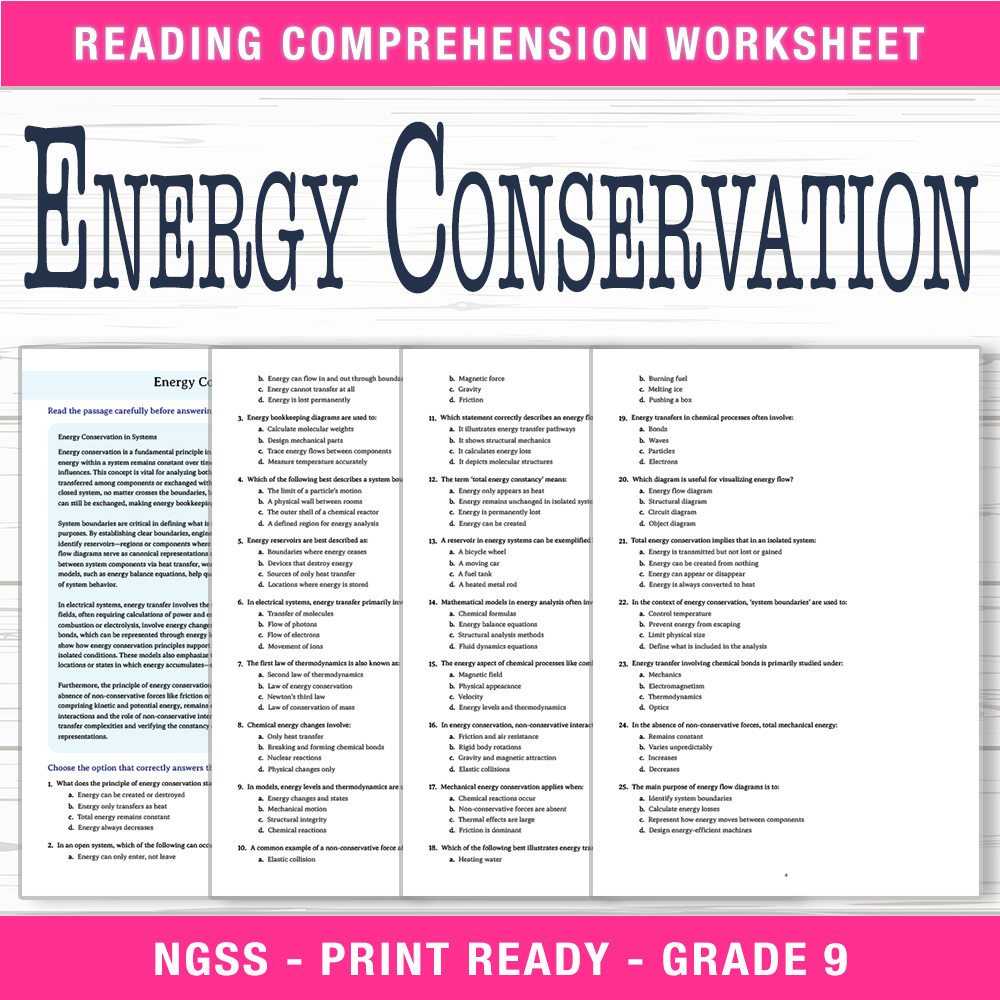
Grade 9 Science – Energy Conservation Worksheet (PDF + Answer Key)
Created byRiverstone ClassroomLearning Objectives
- Understand the concept of energy conservation in closed and open systems.
- Recognize how energy transfer is represented using diagrams and mathematical models.
- Analyze energy reservoirs and verify constancy of energy in isolated systems.
Instant download

Natural Selection Worksheet for Grade 9 Science | Classroom PDF & Answer Key
Created byCoral Reef LearningLearning Objectives
- Understand the basic principles of natural selection and how it leads to evolution.
- Identify examples of natural selection in real-world scenarios.
- Distinguish between different types of selection: directional, stabilizing, and disruptive.
Instant download

Grade 9 Science – Electromagnetic Radiation & Spectrum | Daily Reading Worksheet
Created byBright Mind ResourcesLearning Objectives
- Identify different types of electromagnetic waves and their order in the spectrum
- Understand the relationship between frequency, wavelength, and energy of electromagnetic waves
- Recognize characteristic phenomena such as atomic emission/absorption lines and spectral attenuation
Also included in: Grade 9 Wave and Signal Science Daily Reading Lesson Bundle | NGSS +2 more
Instant download
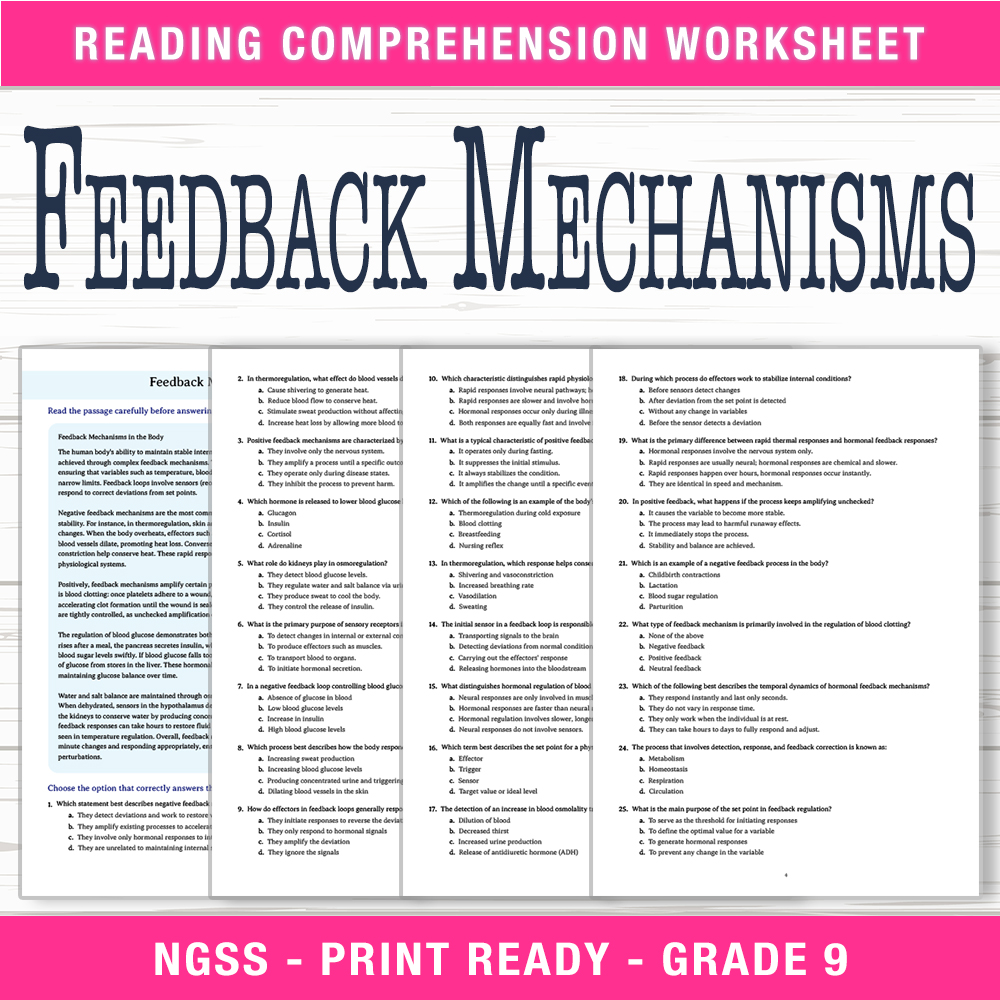
Grade 9 Science | Feedback Mechanisms Worksheet (PDF + Answer Key)
Created byRiverstone ClassroomLearning Objectives
- Explain the concepts of negative and positive feedback in maintaining internal stability.
- Identify physiological examples of feedback mechanisms, including thermoregulation, blood glucose regulation, and osmoregulation.
- Differentiate between rapid corrective responses and slower hormonal adjustments in feedback processes.
Also included in: Grade 9 Science Unit | Cell Structure & Function Worksheets
Instant download
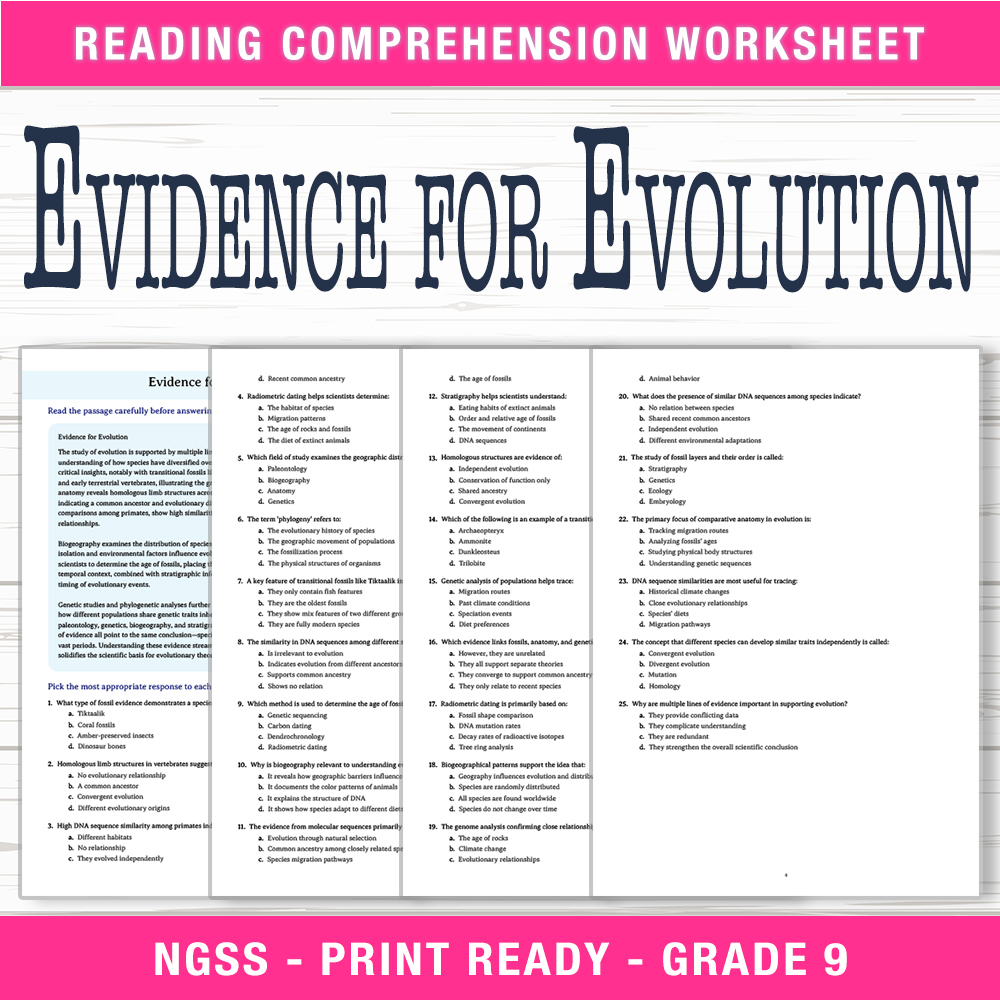
Grade 9 Science – Evidence for Evolution Worksheet (PDF + Answer Key)
Created byRiverstone ClassroomLearning Objectives
- Identify the key types of empirical evidence that support the theory of evolution.
- Explain how fossil records, comparative anatomy, and molecular sequences provide evidence for common ancestry.
- Understand the significance of transitional fossils, homologous structures, and DNA similarities among species.
Also included in: Grade 9 Science Unit | Evolution & Phylogenetics Worksheet Pack
Instant download
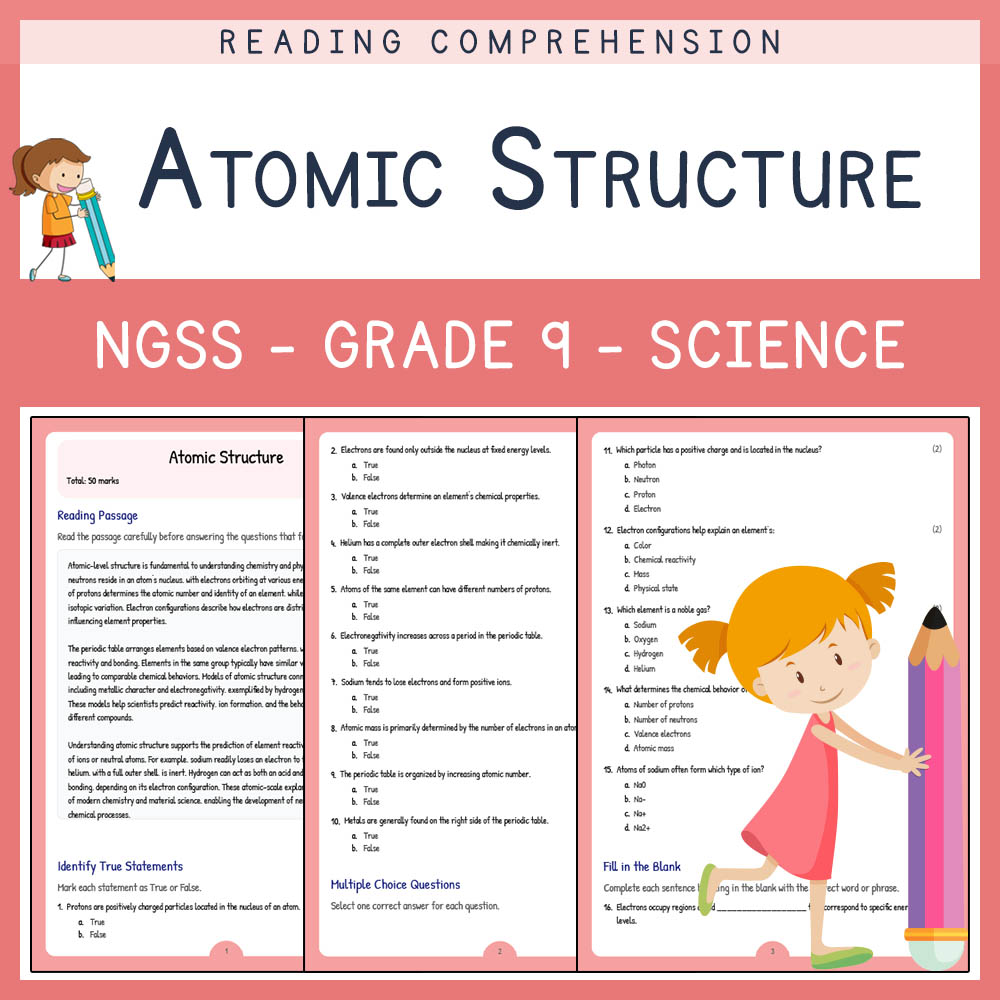
Grade 9 Science | Atomic Structure Worksheet (PDF + Answer Key) – NGSS Aligned
Created byLumora LearningLearning Objectives
- Describe the components of an atom, including protons, neutrons, and electrons.
- Explain how electron configurations relate to element properties.
- Identify patterns in the periodic table based on valence electrons.
Instant download
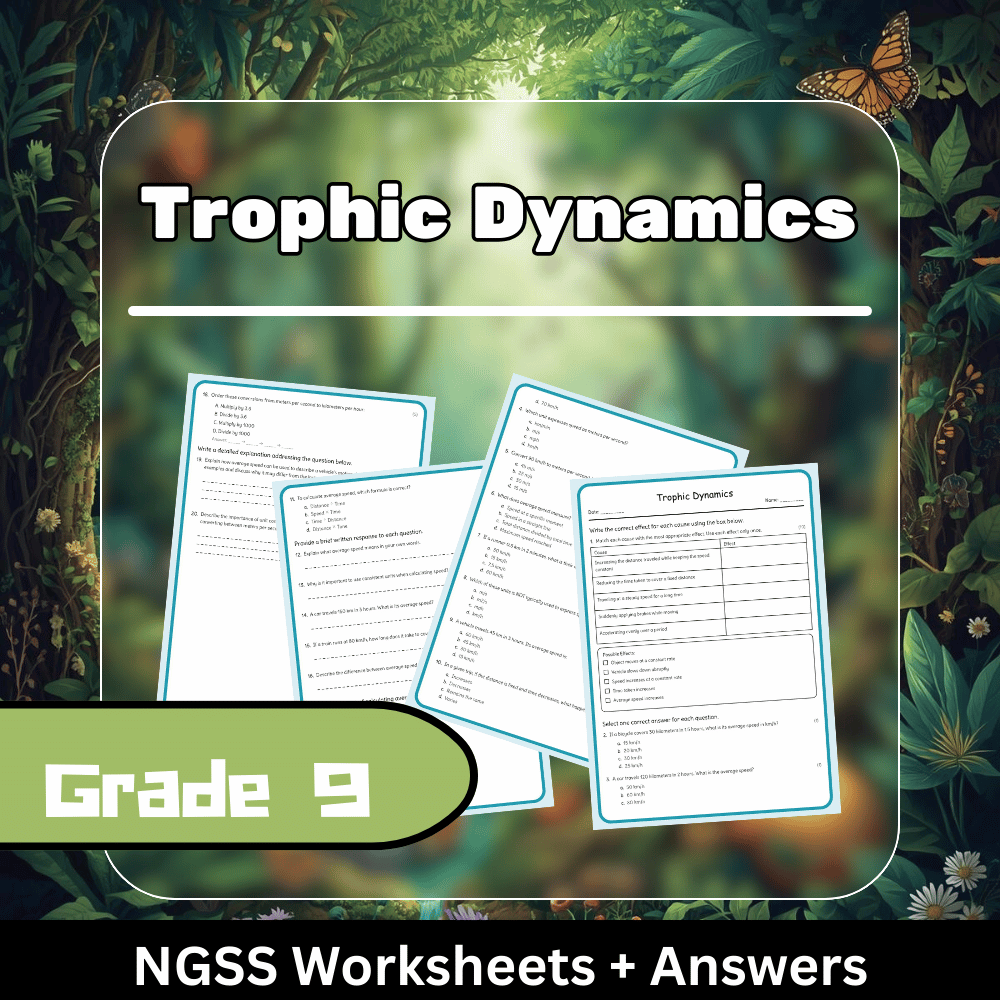
Grade 9 Science – Trophic Dynamics Worksheet (Answer Key) | NGSS Aligned
Created byBright Mind ResourcesLearning Objectives
- Explain energy transfer across trophic levels in ecosystems.
- Identify components of food webs and trophic pyramids.
- Demonstrate understanding of biomass distribution and ecological efficiency.
Instant download
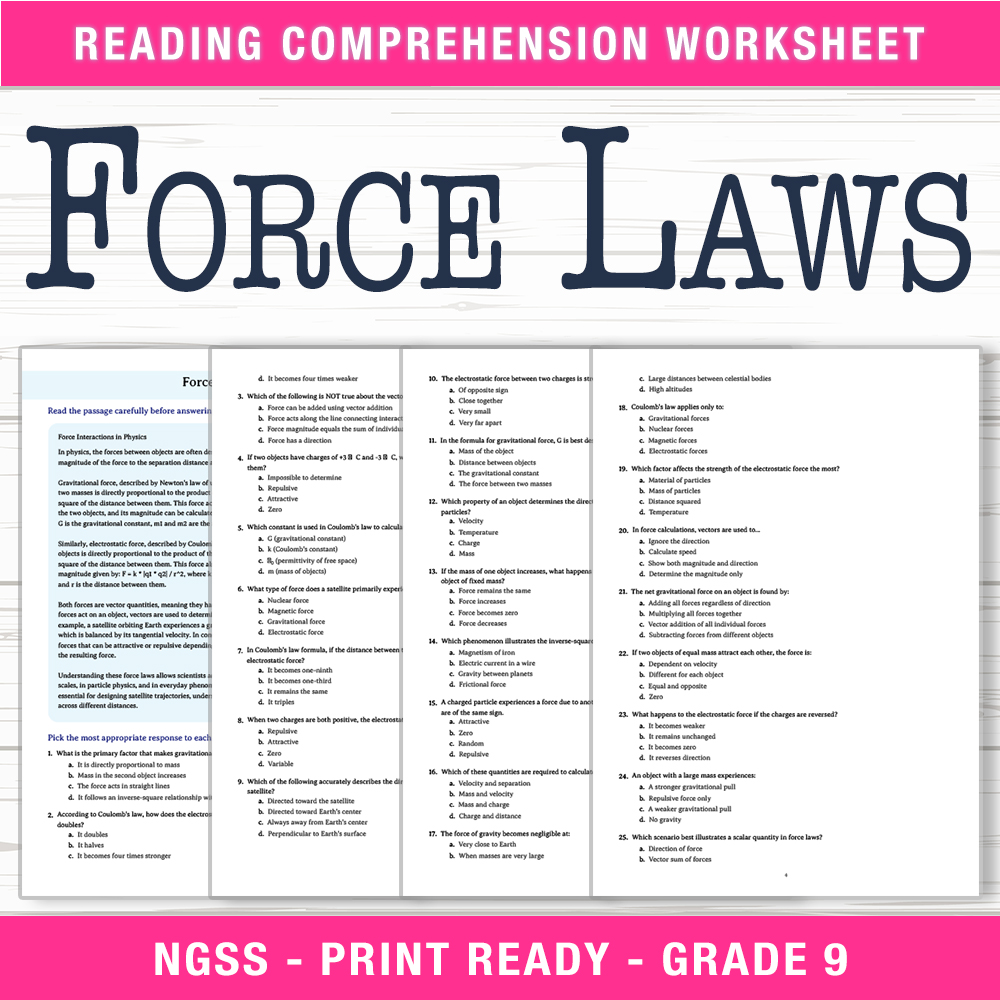
Grade 9 Science – Force Laws Worksheet (PDF + Answer Key)
Created byRiverstone ClassroomLearning Objectives
- Understand the inverse-square relationship in gravitational and electrostatic forces.
- Apply mathematical formulas to calculate magnitudes and directions of forces between objects.
- Differentiate between gravitational and electrostatic force interactions.
Instant download
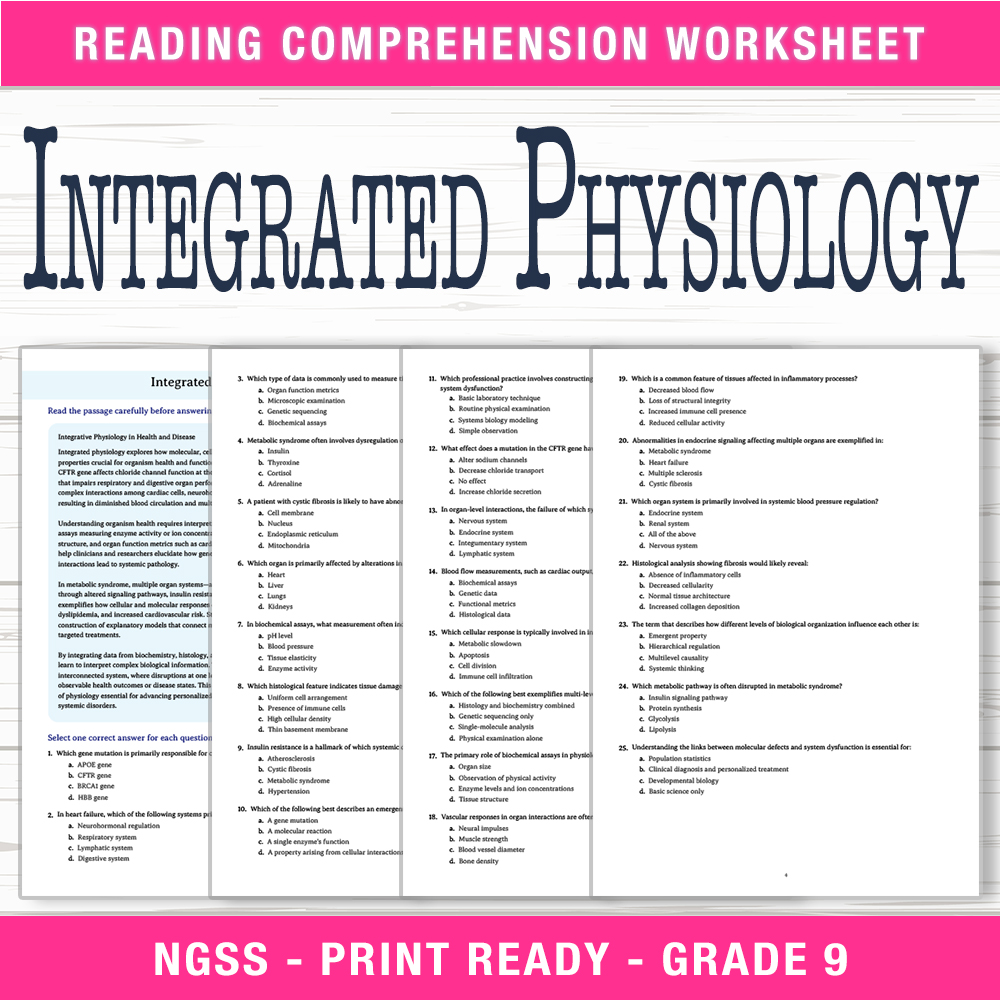
Grade 9 Science | Integrated Physiology Worksheet (PDF + Answer Key)
Created byRiverstone ClassroomLearning Objectives
- Describe how molecular and cellular interactions contribute to organ system functions.
- Analyze clinical exemplars such as cystic fibrosis, heart failure, and metabolic syndrome to connect genetic and physiological factors.
- Interpret biochemical assays, histology, and organ function metrics to explain organismal health and disease.
Also included in: Grade 9 Science Unit | Cell Structure & Function Worksheets
Instant download
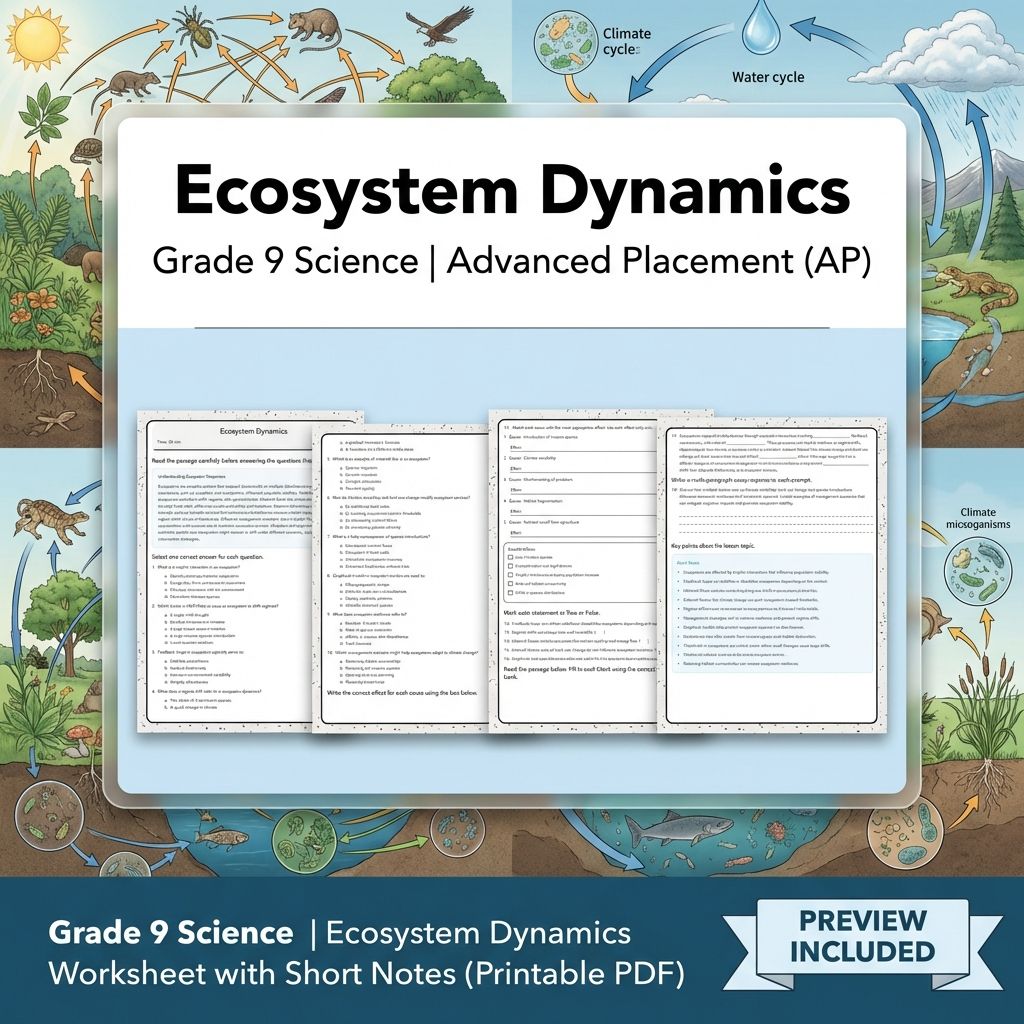
Grade 9 Science | Ecosystem Dynamics Worksheet with Short Notes (Printable PDF)
Created byMeadowlark WorksheetsLearning Objectives
- Understand the impact of multiple factors on ecosystem responses and stability.
- Identify trophic interactions, feedback mechanisms, and material fluxes within ecosystems.
- Evaluate the effects of climate variability, land-use change, and species introductions.
Also included in: Grade 9 Science Unit | Cellular Processes & Ecosystems Worksheet Pack (PDF) +1 more
Instant download

Greenhouse Effect Worksheet | Grade 9 Science Practice & Review
 Created byPrism Point Learning
Learning Objectives
- Explain how greenhouse gases trap outgoing longwave radiation and affect Earth’s energy balance
- Identify common greenhouse gases and describe both natural and human sources
- Interpret statements about greenhouse effect processes and measurable climate responses
Also included in: Earth and Space Systems Lesson Bundle | Grade 9 Science | BC Framework +1 more
Instant download
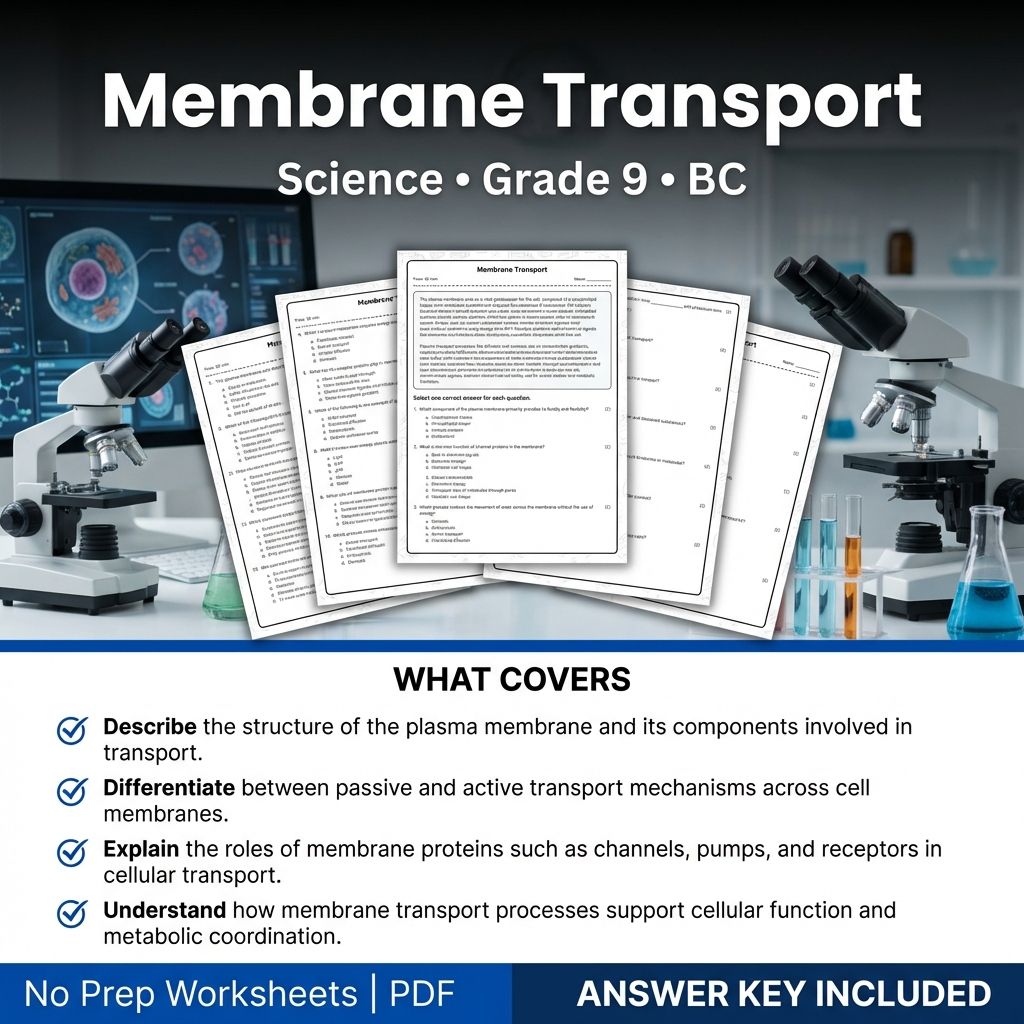
Membrane Transport Science Worksheet Grade 9 | BC Standards PDF
Created byCoral Reef LearningLearning Objectives
- Describe the structure of the plasma membrane and its components involved in transport.
- Differentiate between passive and active transport mechanisms across cell membranes.
- Explain the roles of membrane proteins such as channels, pumps, and receptors in cellular transport.
Instant download
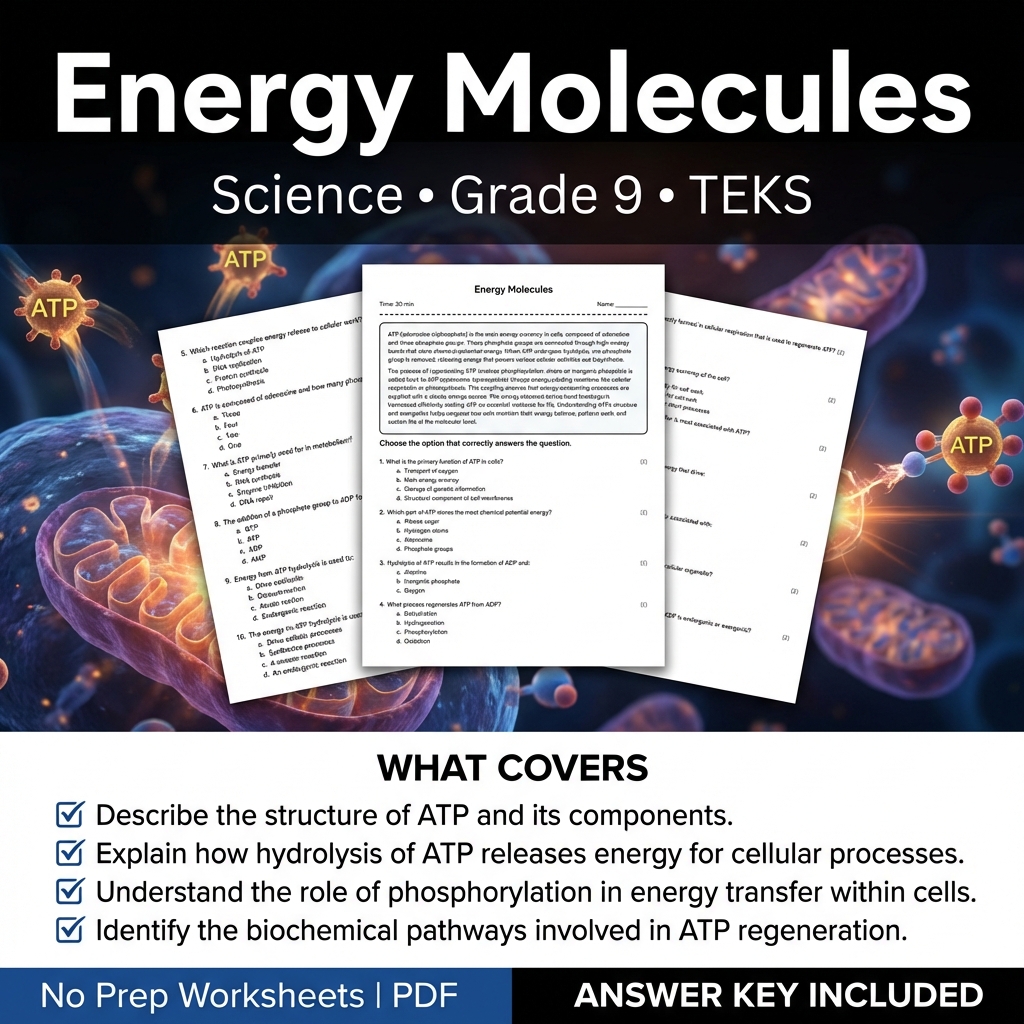
Grade 9 Science Worksheet on Energy Molecules | TEKS Aligned
Created byCoral Reef LearningLearning Objectives
- Describe the structure of ATP and its components.
- Explain how hydrolysis of ATP releases energy for cellular processes.
- Understand the role of phosphorylation in energy transfer within cells.
Instant download

Rock Cycle Worksheet for Grade 9 Science | AP Earth Science Activity
Created byPrism Point LearningLearning Objectives
- Explain how melting, crystallization, weathering, transport, deposition, and metamorphism transform rocks over geologic time.
- Identify physical and chemical mechanisms that drive rock changes and describe how these connect to tectonic settings.
- Use rock-cycle ideas and evidence from rock types to connect rock histories to landscape evolution and resource occurrence.
Also included in: Earth Systems & Climate Evidence Lesson Bundle | Grade 9 Science | AP
Instant download
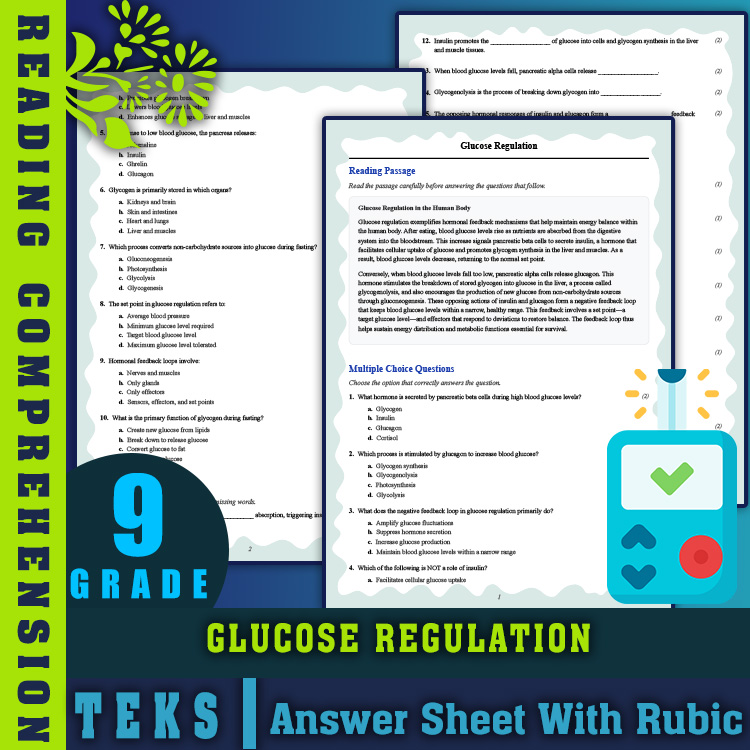
9th Grade Science | Glucose Regulation Reading Worksheets (PDF + Rubric)
JCreated byJ.S SheetsLearning Objectives
- Understand the hormonal feedback mechanisms involved in glucose regulation
- Describe how insulin and glucagon maintain blood glucose levels within a set range
- Explain the roles of pancreatic beta and alpha cells in energy homeostasis
Instant download

Cellular Metabolism Practice Assessment | Grade 9 Science NGSS
Created byPrism Point LearningLearning Objectives
- Explain how cellular respiration and photosynthetic carbon fixation connect to organelles and energy needs
- Describe key stages of cellular respiration (glycolysis, citric acid cycle, and electron transport) and how they contribute to ATP production
- Use quantitative reasoning to interpret reactants/products and relate oxygen consumption and ATP yield to metabolic flux
Also included in: Grade 9 Cell Systems Regulation Science Lesson Bundle – NGSS Practice
Instant download
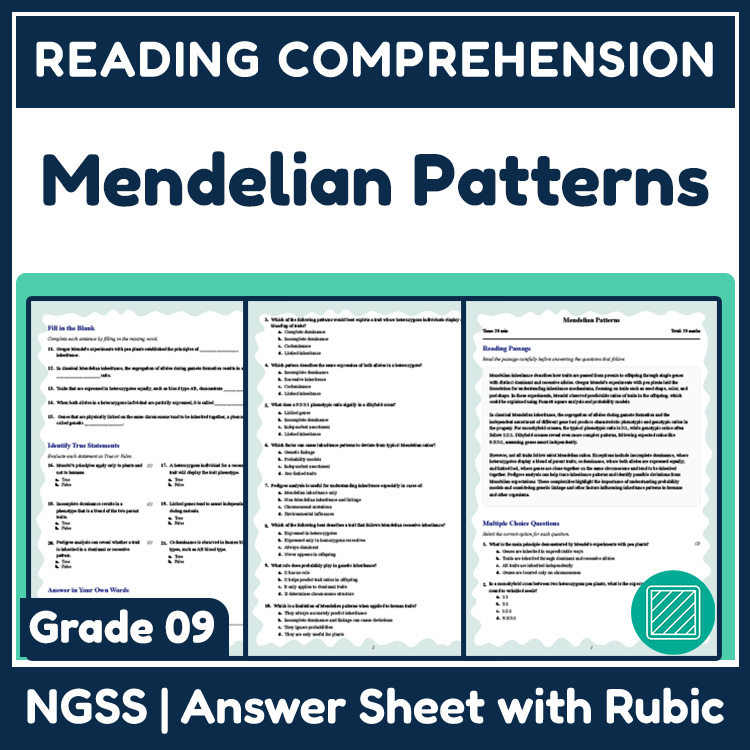
9th Grade Science | Mendelian Patterns Reading Worksheet (PDF + Answer Key)
JCreated byJ.S SheetsLearning Objectives
- Explain the principles of Mendelian inheritance, including dominant and recessive alleles.
- Interpret Punnett squares to predict genotype and phenotype ratios.
- Distinguish between simple Mendelian inheritance and inheritance patterns influenced by linkage, incomplete dominance, and codominance.
Also included in: Grade 9 Science Unit | Heritable Diversity & Inheritance Worksheets
Instant download

Grade 9 Science | Milankovitch Cycles Worksheet (PDF) BC Standards
 Created byEvergreen Desk Education
Learning Objectives
- Explain how eccentricity, axial tilt, and precession affect Earth’s incoming solar energy (insolation).
- Describe why Milankovitch cycles operate on timescales of tens to hundreds of thousands of years.
- Interpret how climate feedbacks and geological evidence connect orbital changes to glacial and interglacial periods.
Instant download

Grade 9 Science Worksheet – Crystal Lattices (PDF) BC Standards
Created byEvergreen Desk EducationLearning Objectives
- Explain how unit cells and repeating 3D arrangements form crystal lattices.
- Compare ionic, metallic, and covalent network lattices using structure-property relationships.
- Predict how lattice type affects properties such as brittleness, electrical conductivity, and melting point.
Instant download

Grade 9 Science | Natural Hazards - Daily Reading Comprehension
Created byCoral Reef LearningLearning Objectives
- Identify atmospheric indicators associated with hurricanes.
- Understand how flooding risks are assessed in different regions.
- Evaluate the effects of atmospheric conditions on natural hazard occurrence.
Instant download
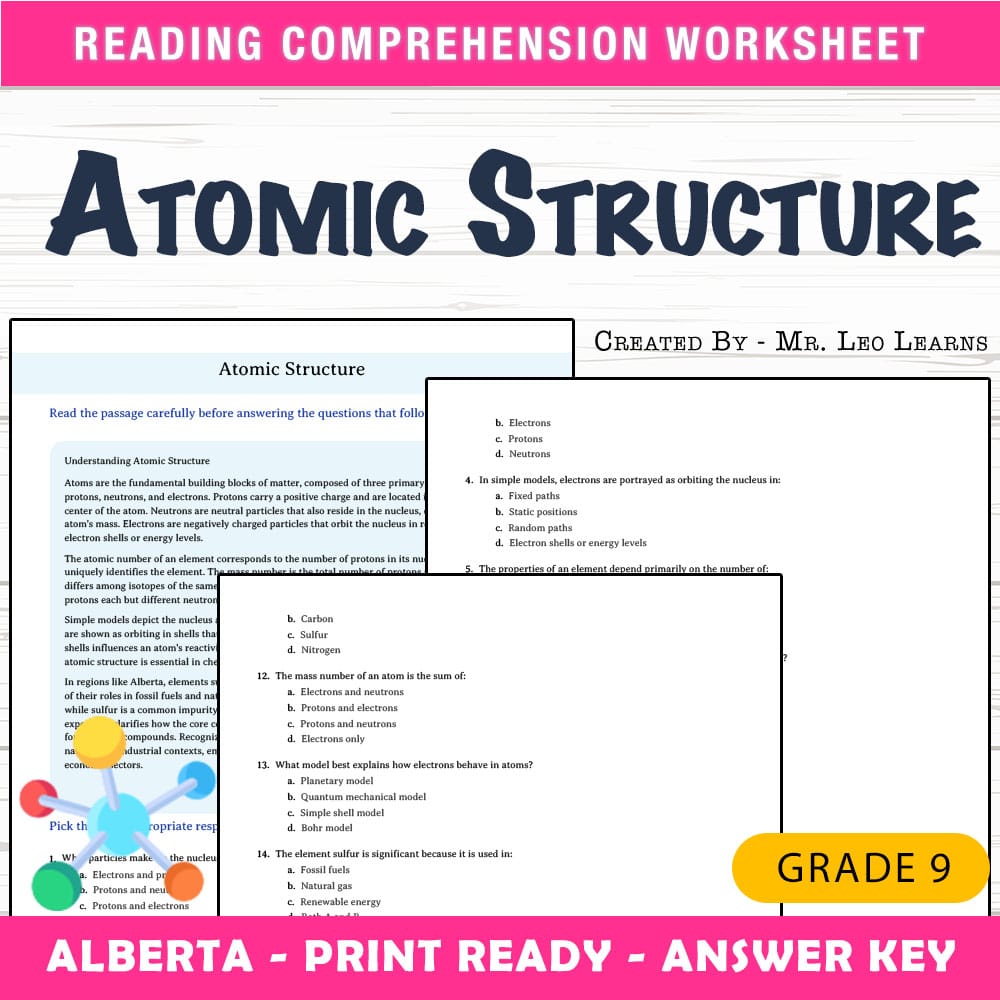
Grade 9 Science — Worksheet MCQ Paper for Atomic Structure
 Created byThe Resource Hub
Learning Objectives
- Understand the basic components of an atom: protons, neutrons, and electrons.
- Explain how atomic number and mass number relate to isotopes and element identity.
- Describe simple models of nuclei and electron shells to interpret chemical behavior.
Also included in: Grade 9 Science Bundle | Matter and Chemical Change Worksheets Pack +1 more
Instant download

Grade 9 Science | Force Interactions Worksheet | AP Aligned
Created byLumora LearningLearning Objectives
- Explain how net external forces influence the motion of objects using Newtonian dynamics.
- Interpret force diagrams and free-body diagrams to analyze force interactions.
- Apply quantitative concepts to calculate acceleration resulting from various force scenarios.
Also included in: Grade 9 Science | Physics Principles Science Custom Bundle | AP Aligned
Instant download

Mechanical Energy Conservation Worksheets Grade 9 Physics
Created byPrism Point LearningLearning Objectives
- Explain when total mechanical energy remains constant in an ideal system.
- Describe kinetic and potential energy transformations during motion.
- Explain how friction changes mechanical energy through negative work.
Also included in: Physics: Forces and Energy Lesson Bundle | Grade 9 Science | Ontario +1 more
Instant download

Grade 9 Science Reaction Essentials Worksheet (BC Standards) – PDF
Created byEvergreen Desk EducationLearning Objectives
- Explain how chemical bonds break and form during reactions and how this relates to energy changes.
- Interpret symbolic chemical equations using states, subscripts, and stoichiometric coefficients.
- Use the relative amounts indicated by coefficients to reason about reactants and products in simple reactions.
Instant download
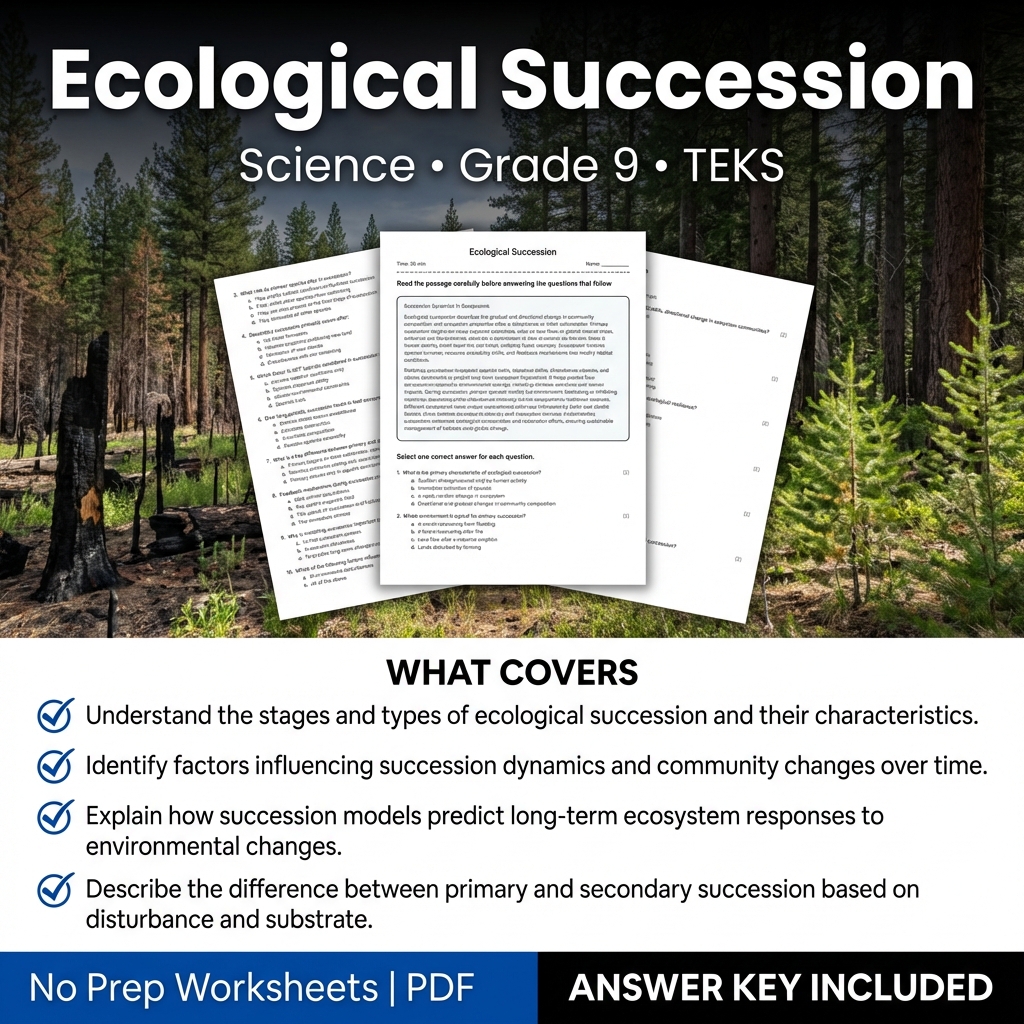
Ecological Succession Worksheet for Grade 9 Science | TEKS Aligned
Created byCoral Reef LearningLearning Objectives
- Understand the stages and types of ecological succession and their characteristics.
- Identify factors influencing succession dynamics and community changes over time.
- Explain how succession models predict long-term ecosystem responses to environmental changes.
Instant download
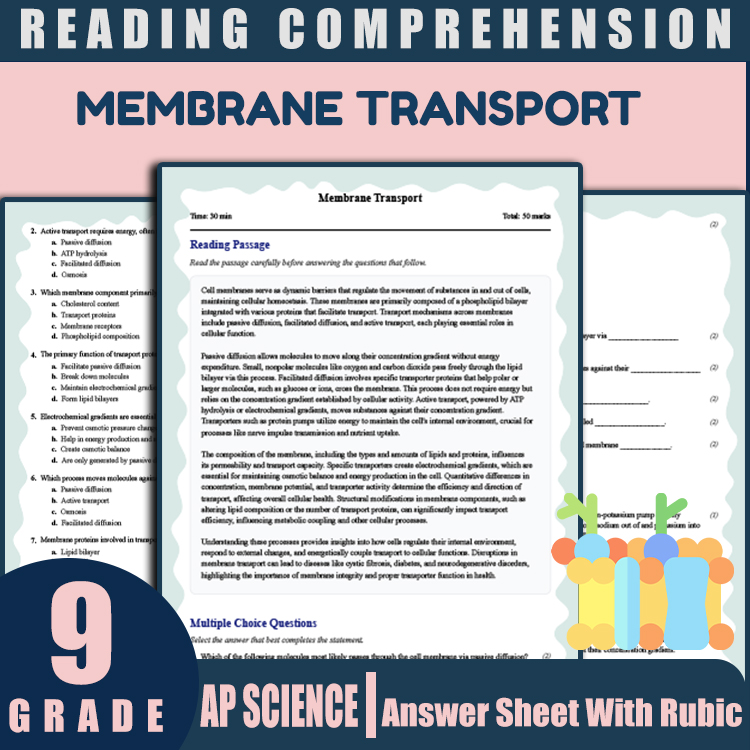
9th Grade Science | Membrane Transport Reading Worksheet & Answer Key PDF
JCreated byJ.S SheetsLearning Objectives
- Describe the mechanisms of transmembrane movement including passive diffusion, facilitated transport, and active transport.
- Explain the role of membrane composition and transporters in establishing electrochemical gradients and osmotic balance.
- Use quantitative reasoning to connect transport processes to cellular homeostasis and predict effects of structural modifications on transport efficiency.
Instant download

Grade 9 Energy Conservation Worksheet | Alberta Use Practice PDF
 Created byClear Sky Classroom
Learning Objectives
- Explain how mechanical energy conservation relates kinetic and gravitational potential energy
- Use energy bookkeeping to predict feasible motion considering non-conservative losses like friction
- Identify energy transfers and dissipation in real Alberta contexts (hydroelectric dams and skiers)
Instant download
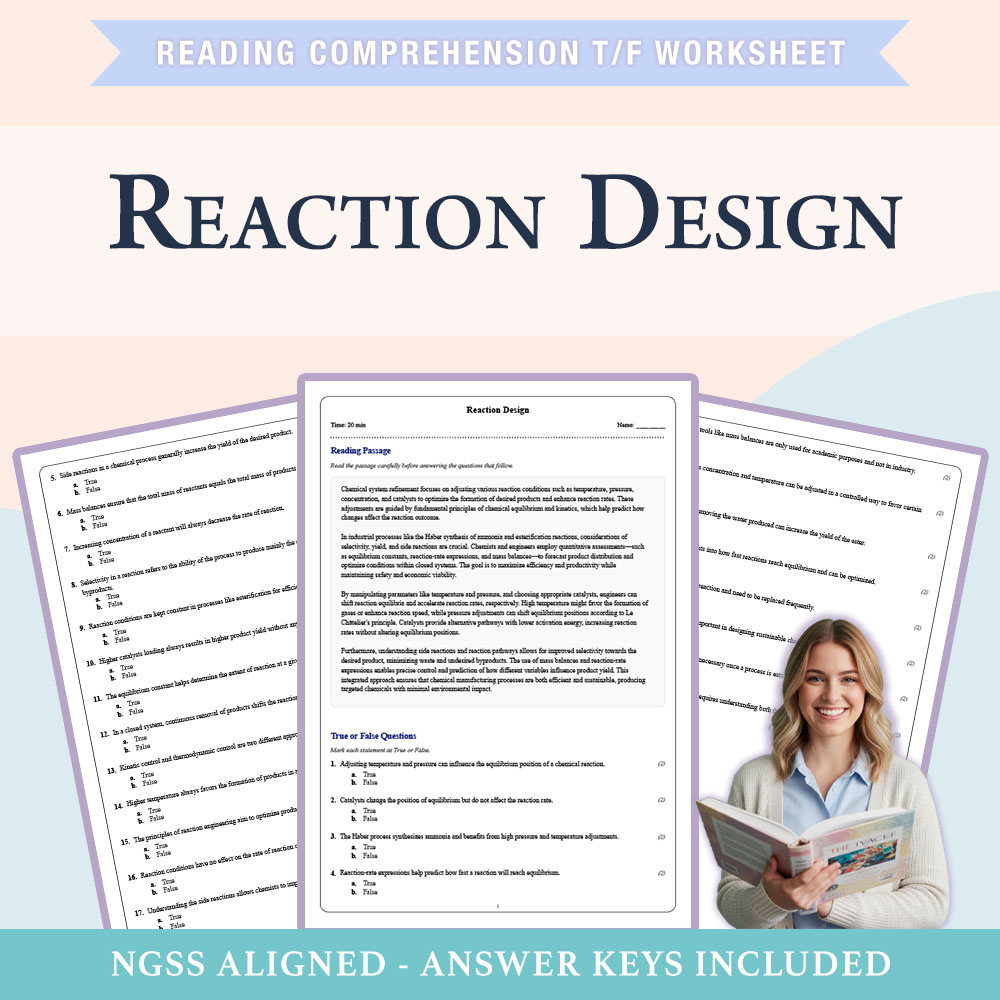
Grade 9 Science | Reaction Design Worksheet (PDF + Answer Key)
Created byCopper Leaf ClassroomLearning Objectives
- Understand how temperature, pressure, concentration, and catalysts influence chemical reactions in system refinement.
- Recognize the principles of equilibrium and kinetics in designing chemical processes.
- Apply quantitative tools like equilibrium constants and reaction-rate expressions to predict product distribution.
Also included in: Grade 9 Science | Reaction & Atomic Structure Unit Bundle (PDF + Answer Key) +1 more
Instant download
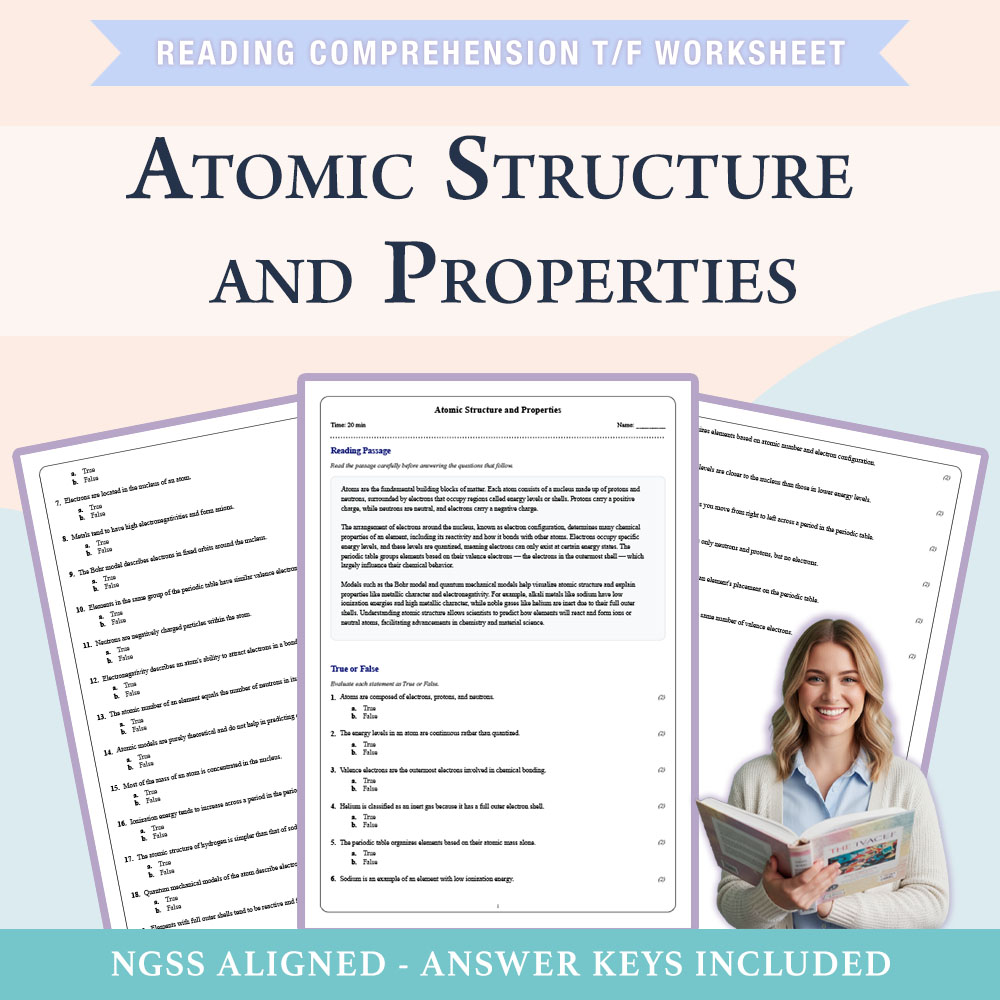
9th Grade Science | Atomic Structure and Properties Worksheet (PDF + Answer Key)
Created byCopper Leaf ClassroomLearning Objectives
- Understand the fundamental particles that make up atoms and their roles in atomic structure.
- Describe how electron configurations and energy levels influence chemical behavior.
- Explain how the periodic table organizes elements based on valence electrons and properties.
Also included in: Grade 9 Science | Reaction & Atomic Structure Unit Bundle (PDF + Answer Key) +1 more
Instant download
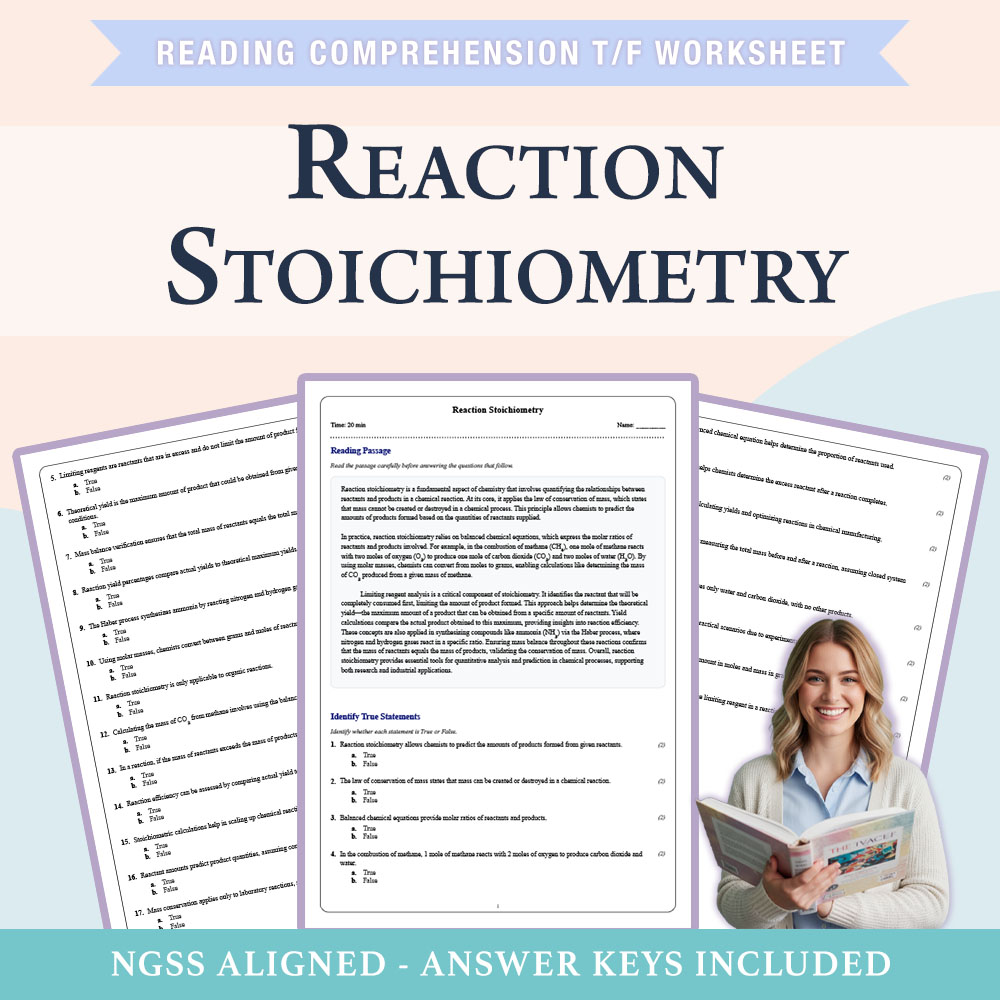
9th Grade Science | Reaction Stoichiometry Worksheet (PDF + Answer Key)
Created byCopper Leaf ClassroomLearning Objectives
- Understand the principles of conservation of mass in chemical reactions.
- Interpret balanced chemical equations to relate moles, mass, and particle counts.
- Explain limiting reagent concepts and calculate theoretical yields.
Also included in: Grade 9 Science | Reaction & Atomic Structure Unit Bundle (PDF + Answer Key) +1 more
Instant download
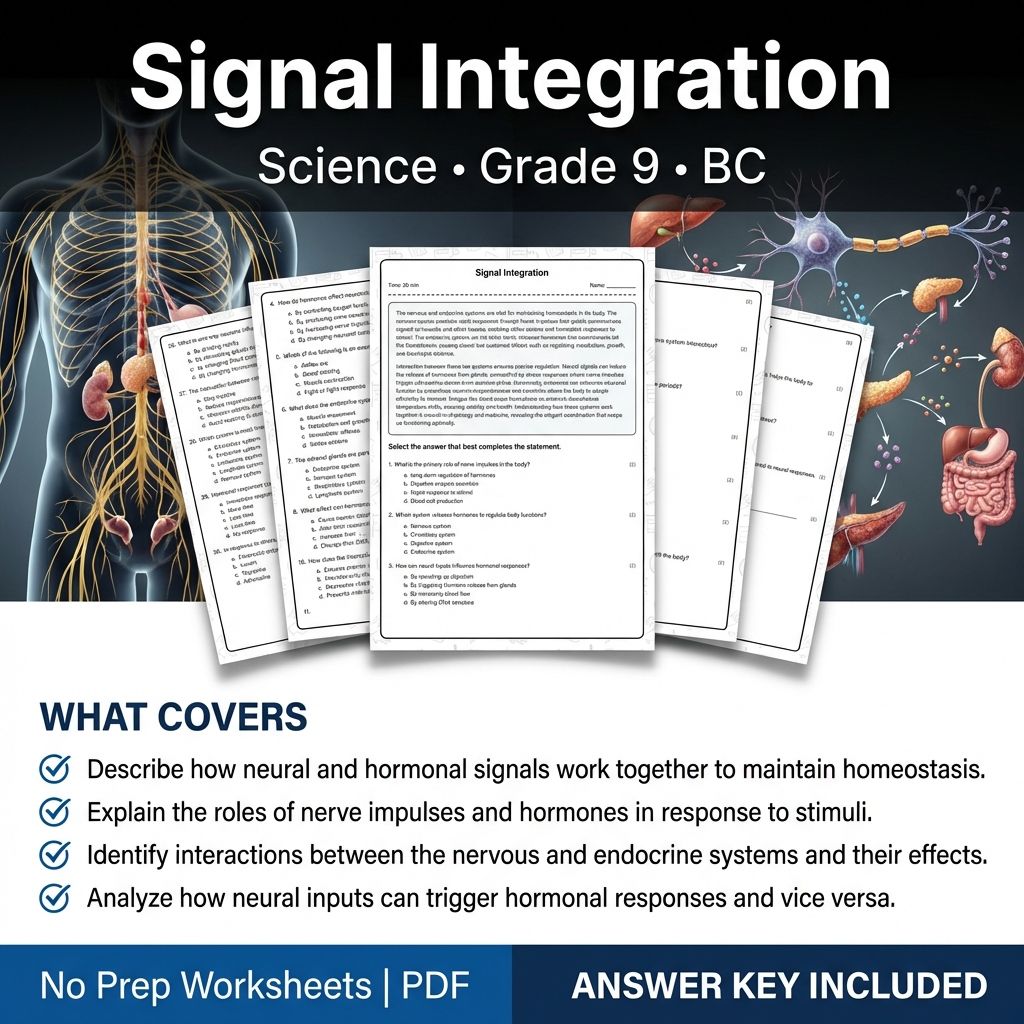
Signal Integration Grade 9 Science Worksheet | BC Standards Practice
Created byCoral Reef LearningLearning Objectives
- Describe how neural and hormonal signals work together to maintain homeostasis.
- Explain the roles of nerve impulses and hormones in response to stimuli.
- Identify interactions between the nervous and endocrine systems and their effects.
Instant download
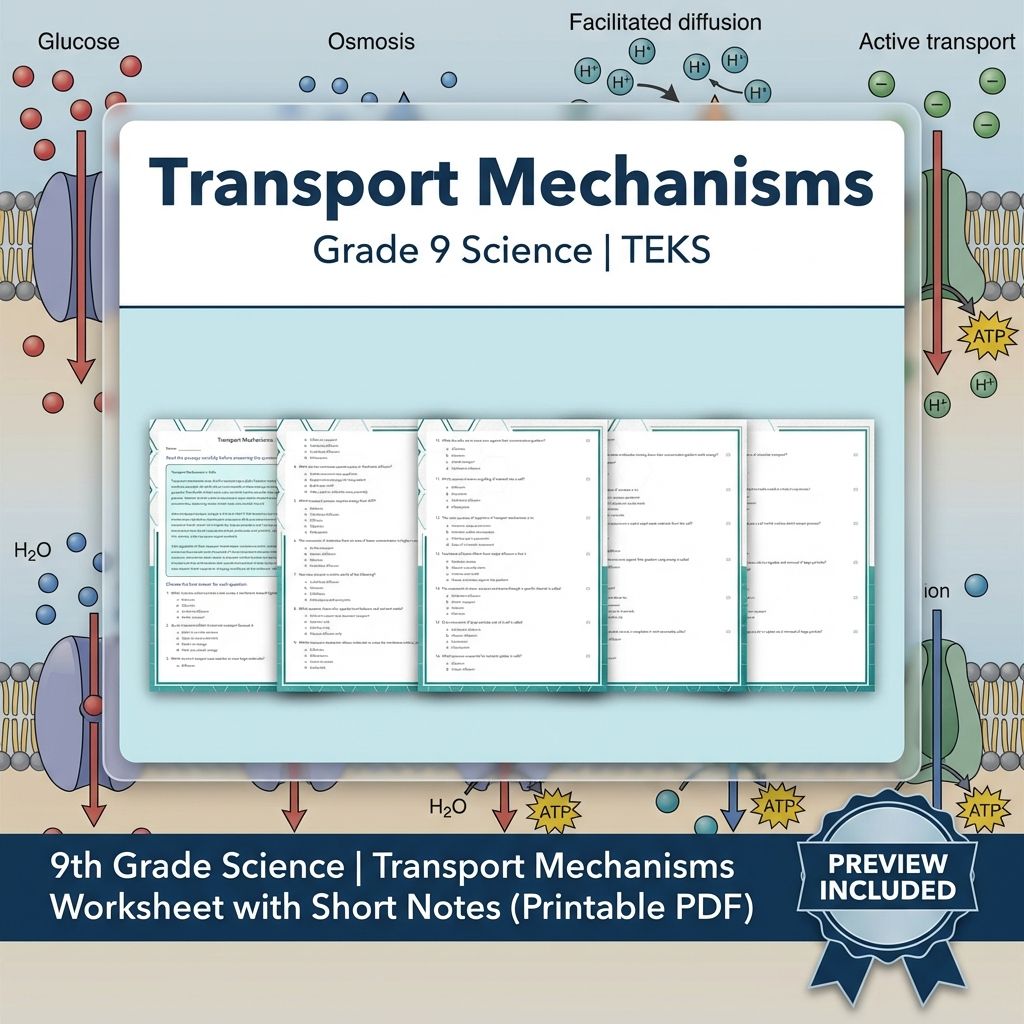
9th Grade Science Transport Mechanisms Worksheet with Short Notes (PDF)
Created byMeadowlark WorksheetsLearning Objectives
- Explain how molecules move across cellular membranes through passive and active processes.
- Differentiate between diffusion, facilitated diffusion, osmosis, and active transport.
- Describe vesicular transport mechanisms such as endocytosis and exocytosis.
Instant download

Framing Constraints Worksheet | NGSS Grade 9 Science Assessment
 Created bySkylark Worksheets
Learning Objectives
- Identify functional requirements and distinguish them from constraints in an engineering problem frame.
- Analyze competing constraints (social, economic, regulatory, environmental, and safety) to prioritize design choices.
- Use qualitative reasoning and basic quantitative bounds to judge feasibility of a conceptual solution.
Also included in: Grade 9 Engineering Design Prototyping & Modeling Lesson Bundle | NGSS +1 more
Instant download
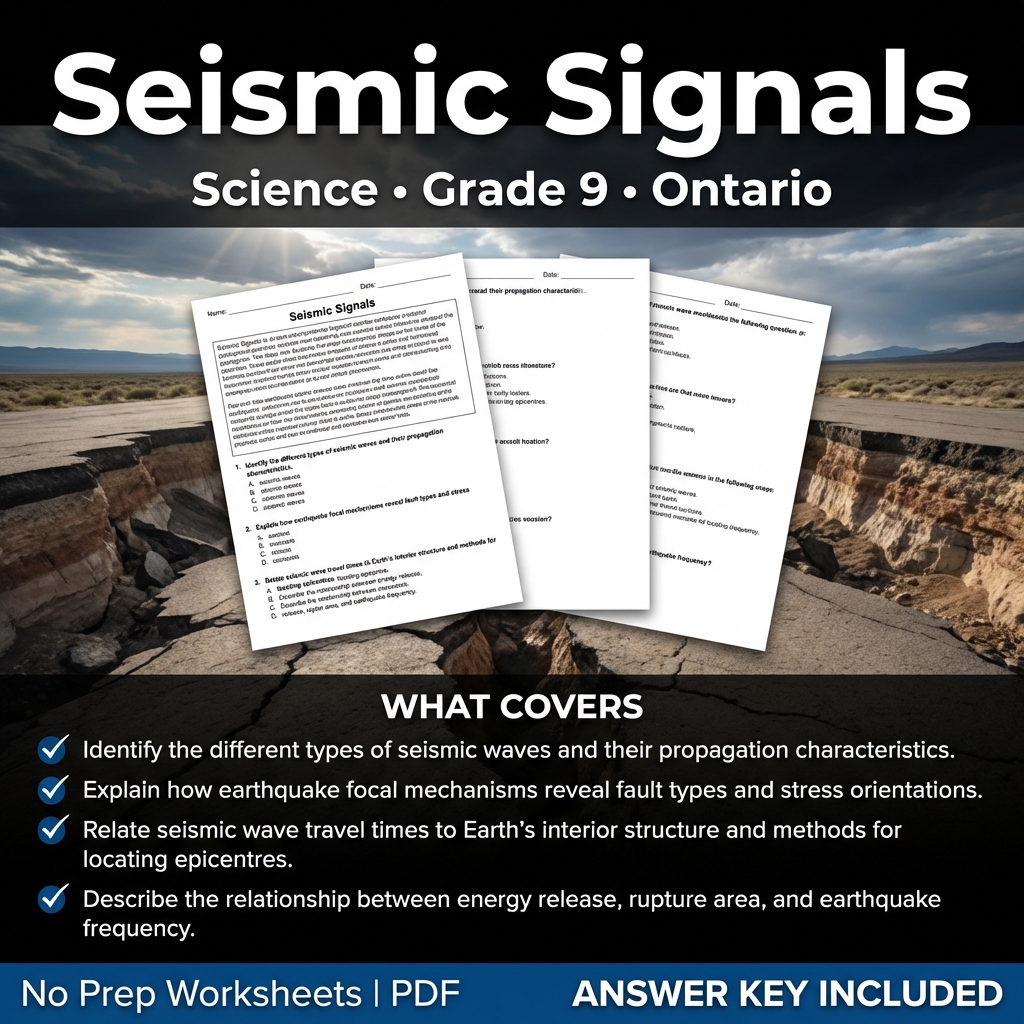
Seismic Signals Science Worksheet | Grade 9 Ontario Standard Practice
Created byCoral Reef LearningLearning Objectives
- Identify the different types of seismic waves and their propagation characteristics.
- Explain how earthquake focal mechanisms reveal fault types and stress orientations.
- Relate seismic wave travel times to Earth's interior structure and methods for locating epicentres.
Instant download
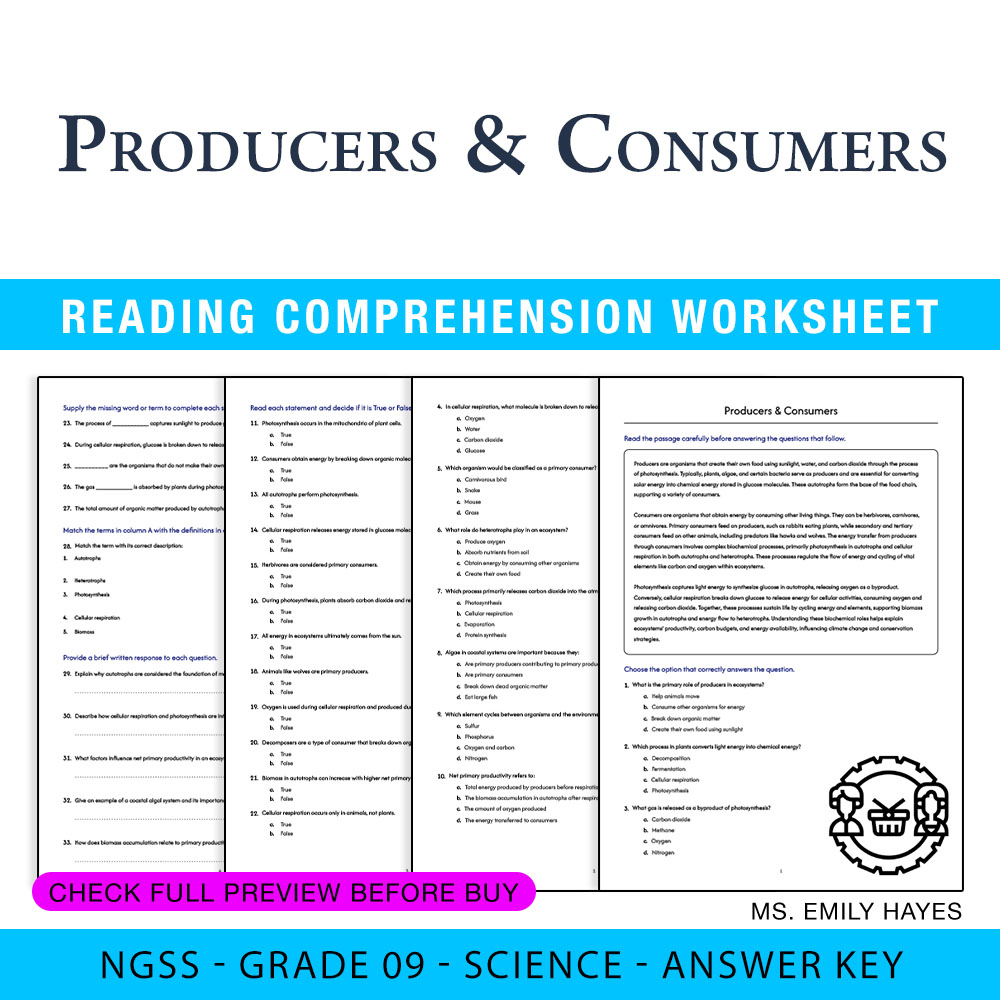
9th Grade Science | Producers & Consumers Printable Worksheet (PDF+ Answer Key)
Created byCopper Leaf ClassroomLearning Objectives
- Explain the roles of producers and consumers in ecosystems.
- Describe the processes of photosynthesis and cellular respiration.
- Analyze how energy is transferred and cycling of carbon and oxygen occurs between organisms and their environment.
Instant download

Power and Efficiency Worksheet Pack | Grade 9 Science Activities
Created byPrism Point LearningLearning Objectives
- Explain how power describes the rate of energy transfer and relate it to how quickly work is done.
- Calculate and interpret efficiency as the fraction of input energy that becomes useful output energy.
- Analyze how energy losses (heat, sound, deformation) reduce efficiency in real machines.
Also included in: Forces and Motion Lesson Bundle – Grade 9 Science Framework BC +1 more
Instant download
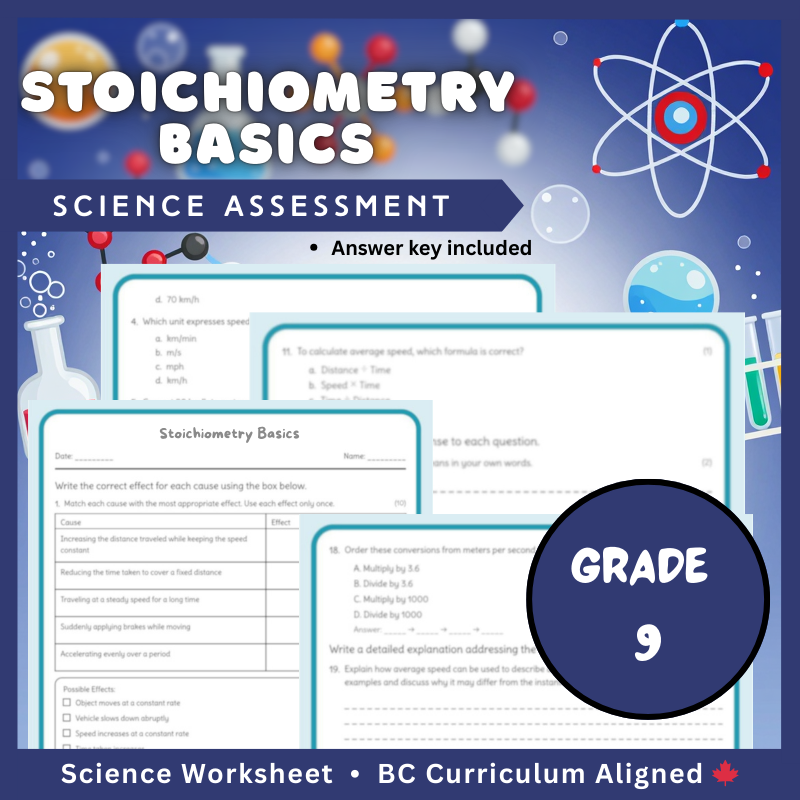
Grade 9 Science | Mastering Stoichiometry Basics Worksheet (PDF)
Created byBright Mind ResourcesLearning Objectives
- Understand the concept of mole relationships in chemical reactions.
- Use molar mass to convert between mass and moles of substances.
- Interpret coefficients in balanced equations to determine mole ratios.
Instant download
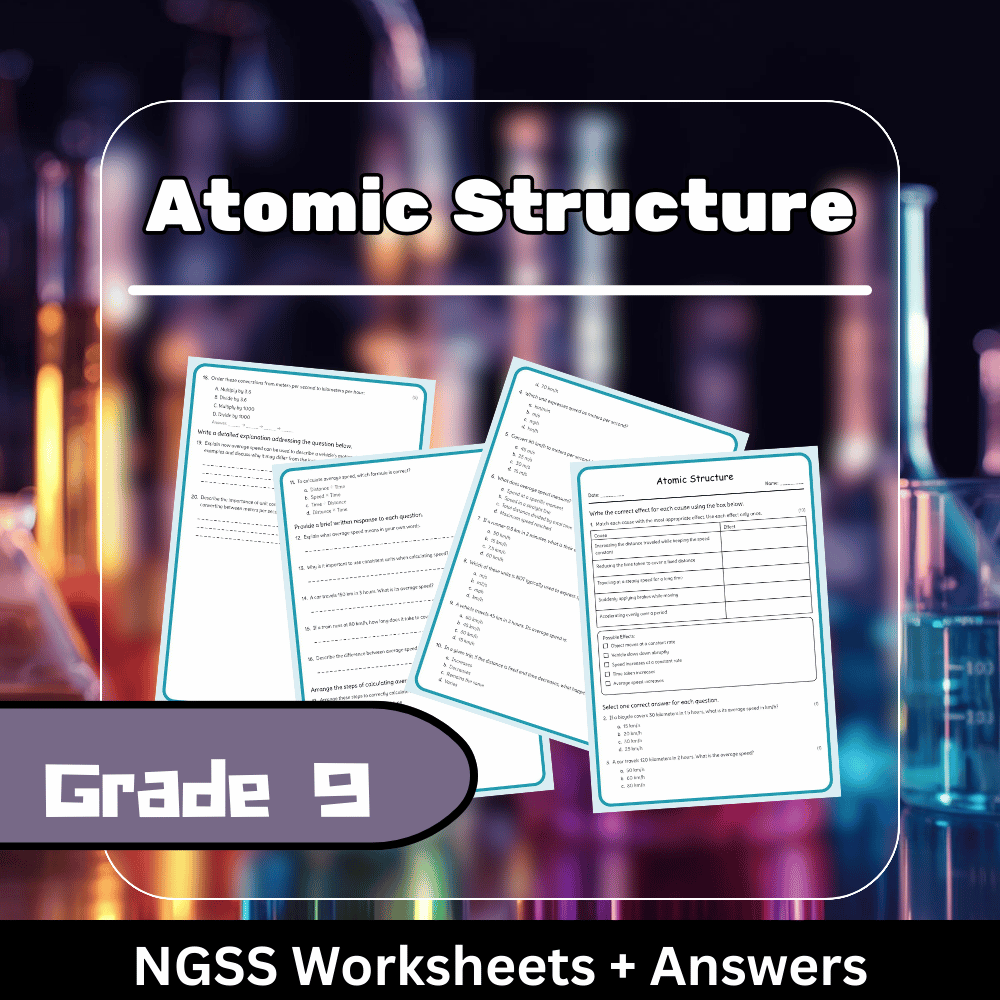
Grade 9 Science | Atomic Structure Worksheet (Answer Key) aligned with NGSS
Created byBright Mind ResourcesLearning Objectives
- Describe the fundamental particles of atoms: protons, neutrons, and electrons.
- Explain electron configurations and their significance in atomic behavior.
- Organize elements using the periodic table based on valence electrons.
Instant download
About Grade 9 Science Worksheets
Find Science worksheets built for Grade 9. All 6,926 cover core skills, practice, and review, each an instant PDF download.
Every worksheet on MyTeachingSheets is created by independent teacher-authors and reviewed before publication. All resources download as printable PDFs for classroom, homework, or at-home practice, and many include answer keys. Preview any worksheet free before buying.