
Grade 9 Science Worksheets
6,926 worksheets
Mass Measurement Worksheet | Grade 9 Science Activities
 Created byPrism Point Learning
Learning Objectives
- Explain how conservation of mass relates to measurable changes during chemical reactions within a defined system
- Distinguish between open and closed systems and predict how gas escape can affect measured mass
- Identify measurement factors (buoyancy and instrument sensitivity) that can change readings without changing total atomic conservation
Also included in: Grade 9 Matter and Chemical Change Lesson Bundle | Science | BC +1 more
Instant download
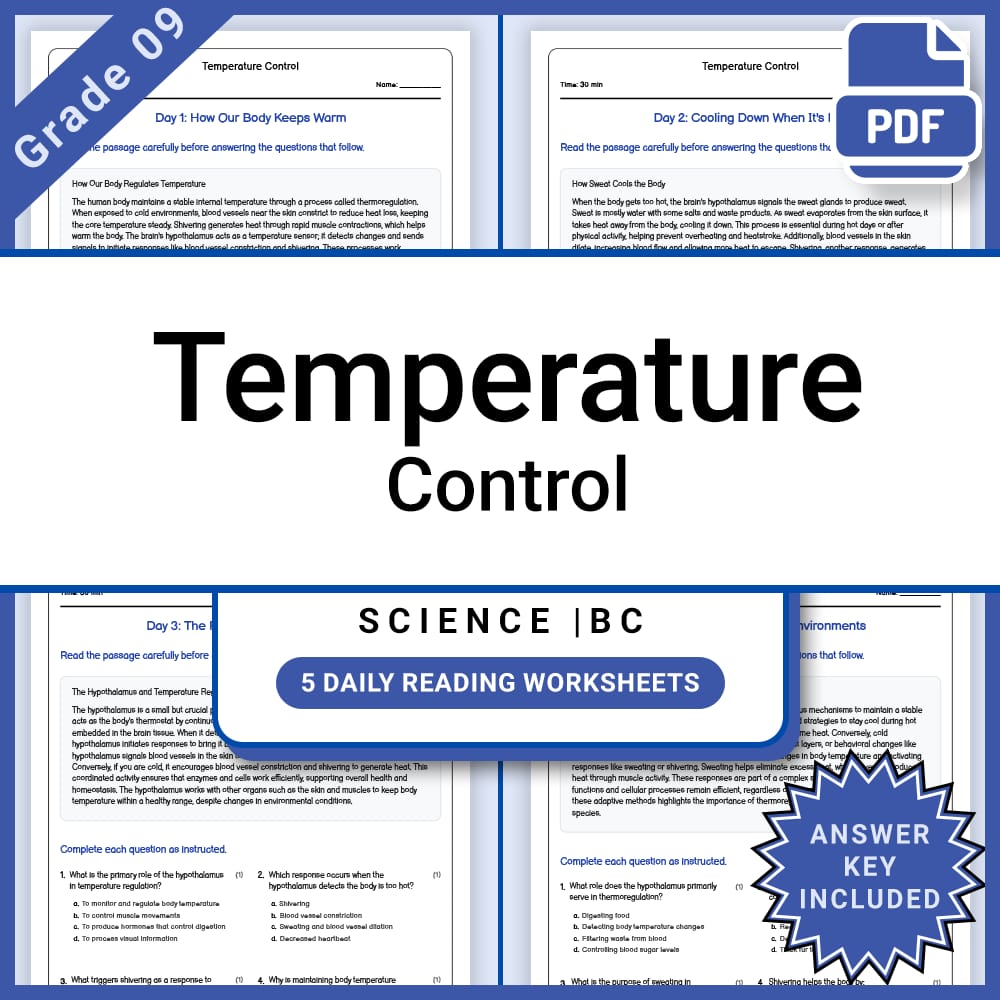
Grade 9 Science – Temperature Control Daily Reading Worksheet + Answer Key
JCreated byJ.S SheetsLearning Objectives
- Understand how skin blood flow helps regulate internal body temperature.
- Explain the role of shivering in maintaining warmth.
- Describe how the hypothalamus detects temperature changes and activates responses.
Also included in: Grade 9 Science Lesson Group Bundle | BC Framework Activities & Worksheets +1 more
Instant download
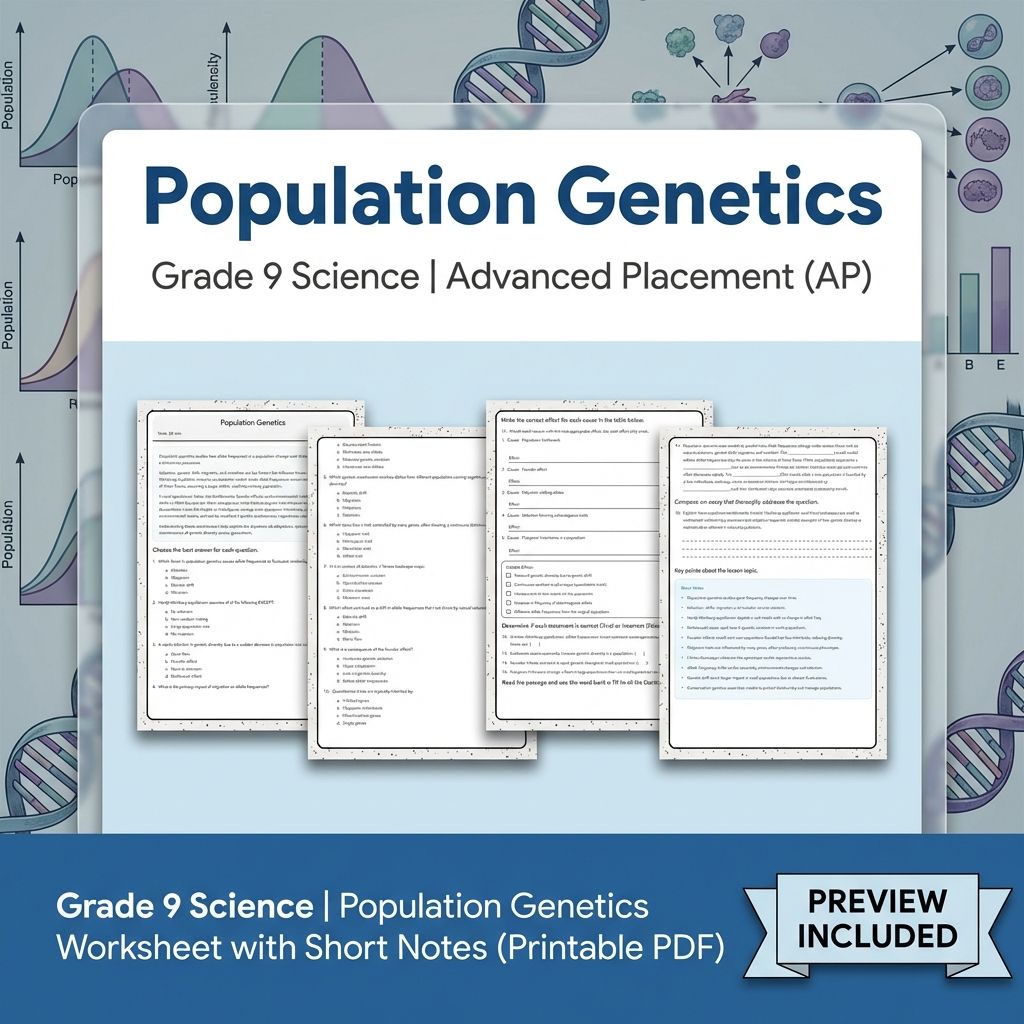
Grade 9 Science | Population Genetics Worksheet with Short Notes (PDF)
 Created byMeadowlark Worksheets
Learning Objectives
- Understand how allele frequencies change under different evolutionary forces such as selection, drift, migration, and mutation.
- Explain the concept of Hardy-Weinberg equilibrium as a null model in population genetics.
- Describe the emergence of quantitative traits from polygenic inheritance and environmental interactions.
Also included in: Grade 9 Science Unit | Cellular Processes & Ecosystems Worksheet Pack (PDF) +1 more
Instant download
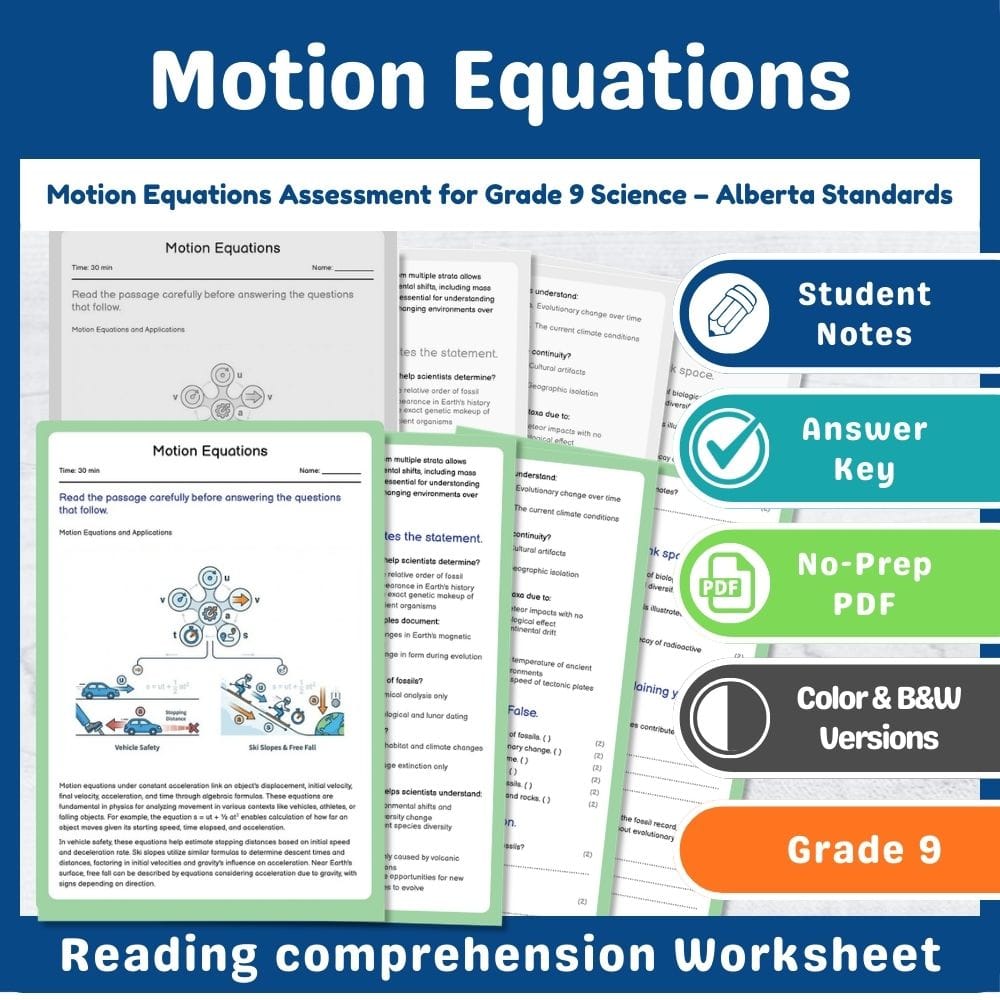
Motion Equations Assessment for Grade 9 Science – Alberta Standards
Created byPrism Point LearningLearning Objectives
- Understand and apply constant-acceleration equations in various motion scenarios.
- Solve numerical problems involving displacement, velocity, acceleration, and time.
- Analyze real-world situations such as stopping distances and free fall using motion equations.
Also included in: Grade 9 Forces and Motion Science Lesson Bundle Alberta Framework +1 more
Instant download

Grade 9 Science | Natural Selection Worksheet (TEKS) Practice Set
 Created byEvergreen Desk Education
Learning Objectives
- Explain how natural selection acts on heritable variation within a population to change allele frequencies over generations.
- Identify and distinguish directional, stabilizing, and disruptive selection using trait distributions and real-world examples.
- Analyze how mutation, gene flow, and genetic drift interact with selection to influence evolutionary outcomes.
Instant download
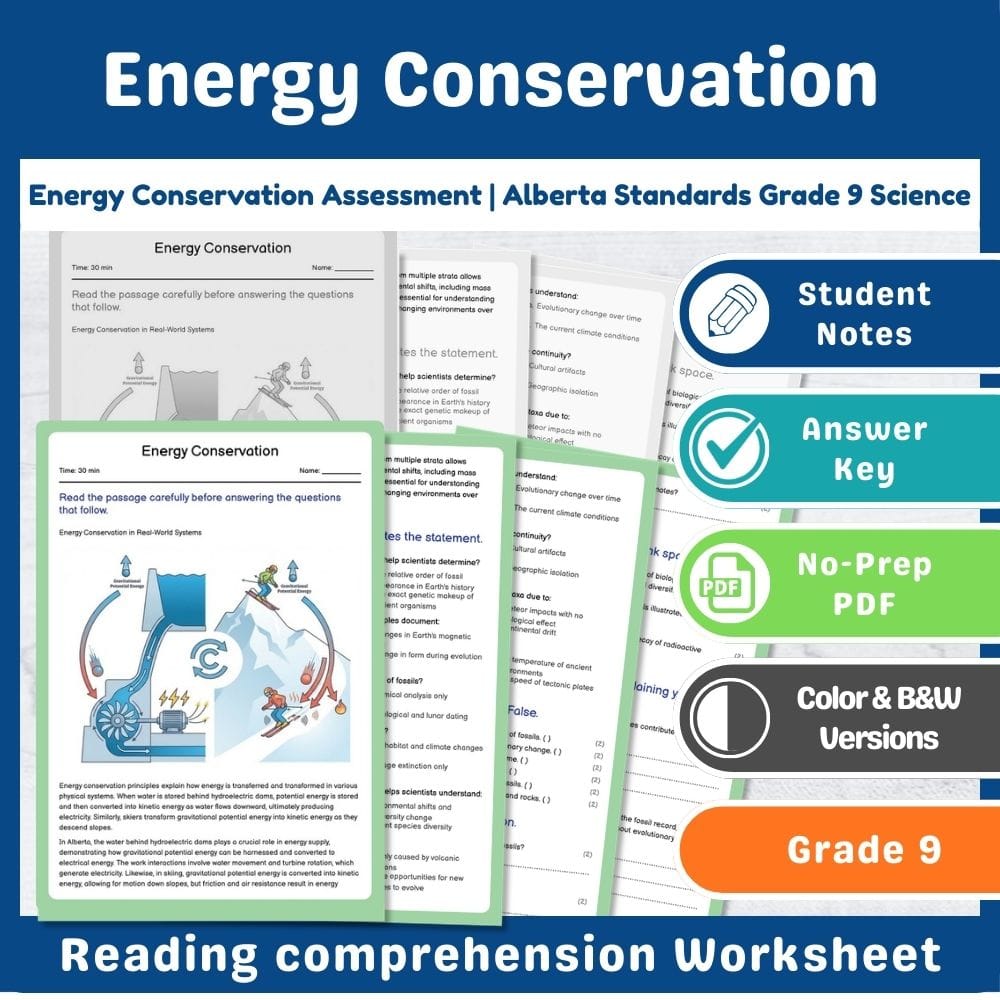
Energy Conservation Assessment | Alberta Standards Grade 9 Science
Created byPrism Point LearningLearning Objectives
- Understand the principles of mechanical energy conservation and energy transfer mechanisms.
- Analyze real-world examples involving potential and kinetic energy conversions.
- Evaluate the impact of non-conservative forces, such as friction, on energy systems.
Also included in: Grade 9 Forces and Motion Science Lesson Bundle Alberta Framework +1 more
Instant download

Cell Components Worksheet | Grade 9 Science Ontario Biology Organelles
 Created byClear Sky Classroom
Learning Objectives
- Identify major organelles in eukaryotic cells and describe how their structures support their functions
- Explain how membrane composition, compartmentalization, and folding affect transport and metabolic efficiency
- Connect processes like protein synthesis, ATP production, and intracellular transport to specific cell components
Instant download
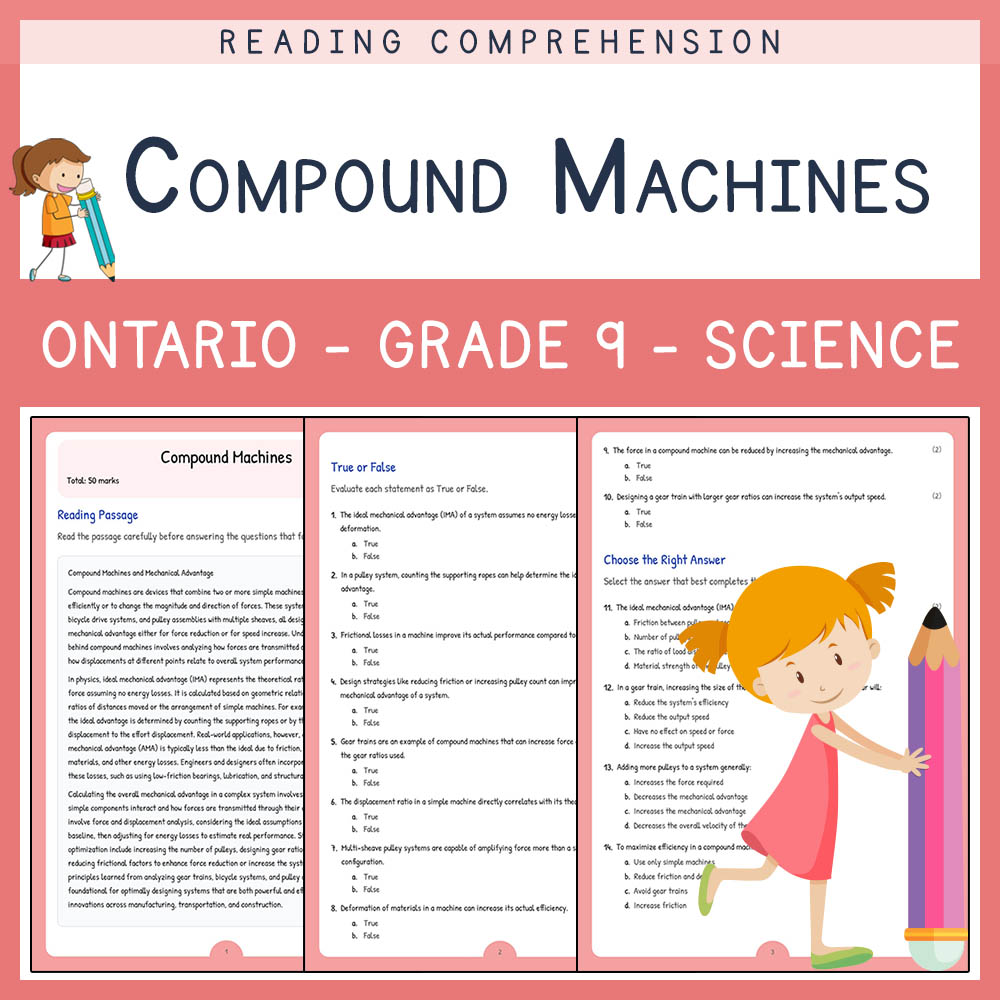
Grade 9 Science | Compound Machines Worksheet Elena | Ontario Standards
 Created byLumora Learning
Learning Objectives
- Explain how to determine the mechanical advantage of compound machines by combining simple machine principles.
- Differentiate between ideal and actual mechanical advantage, considering friction and deformation.
- Apply force and displacement relationships to calculate overall mechanical advantage in various systems.
Instant download
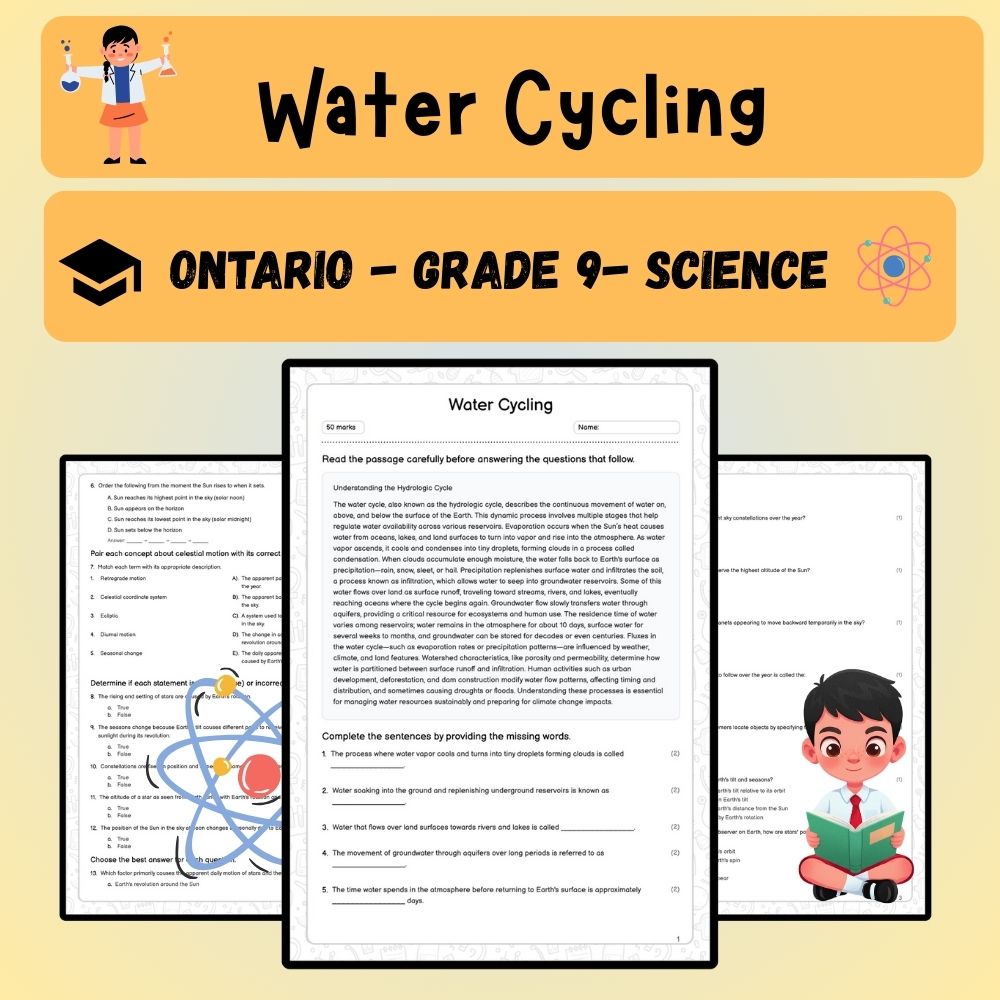
Grade 9 Science Water Cycling Worksheet – Hydrologic Cycle & Standard Ontario (PDF)
Created byPrism Point LearningLearning Objectives
- Describe the processes of evaporation, condensation, and precipitation in the water cycle.
- Explain how infiltration, runoff, and groundwater flow transfer water among different reservoirs.
- Analyze how watershed characteristics, porosity, and permeability influence water movement.
Also included in: Grade 9 Science Unit Bundle | Earth, Weather, Energy & Tectonics +1 more
Instant download

Grade 9 Seismic Waves Worksheet | Earth Structure & Hazards Ontario
 Created byChalk and Compass
Learning Objectives
- Describe how P, S, and surface seismic waves propagate and what their travel-time patterns indicate.
- Explain how focal mechanisms reveal fault types and stress orientations.
- Use travel-time ideas to understand epicentre location and relate magnitude to energy release.
Also included in: Earth Systems & Space Lesson Bundle – Grade 9 Science Ontario Framework +1 more
Instant download

Ethical Decision-Making in Genetic Technologies Worksheet Grade 9
 Created bySunny Desk Resources
Learning Objectives
- Explain how privacy, consent, and labeling raise ethical issues in genetic technologies
- Compare trade-offs between innovation, public benefit, and potential harms
- Identify stakeholder responsibilities and policy roles in responsible genetic science
Also included in: Genetics & Heredity Lesson Bundle | Grade 9 Science | Alberta Framework +1 more
Instant download
Grade 9 Science – Digestive Absorption Worksheet (Ontario) (PDF)
 Created byBright Mind Resources
Learning Objectives
- Describe the mechanical and chemical processes involved in digestion and nutrient absorption.
- Explain how villi and microvilli increase surface area for absorption across the intestinal epithelium.
- Identify the roles of enzymes, transport mechanisms, bile, and micelles in nutrient uptake.
Instant download

Microscopy Analysis Assessment | TEKS Grade 9 Science Standards
Created byPrism Point LearningLearning Objectives
- Interpret visual data from microscopy images to identify cellular structures.
- Understand the principles of resolution, contrast, and staining in microscopy.
- Compare electron and fluorescence microscopy techniques and their applications.
Instant download

Grade 9 Atmospheric Energy Worksheet | California Standards Practice PDF
Created byClear Sky ClassroomLearning Objectives
- Explain how unequal heating by the Sun creates temperature and pressure differences that drive atmospheric circulation.
- Describe how energy transfer between Earth’s surface and the atmosphere influences humidity, clouds, and precipitation.
- Connect local weather patterns to interactions among temperature, humidity, and Earth–atmosphere energy balance.
Instant download
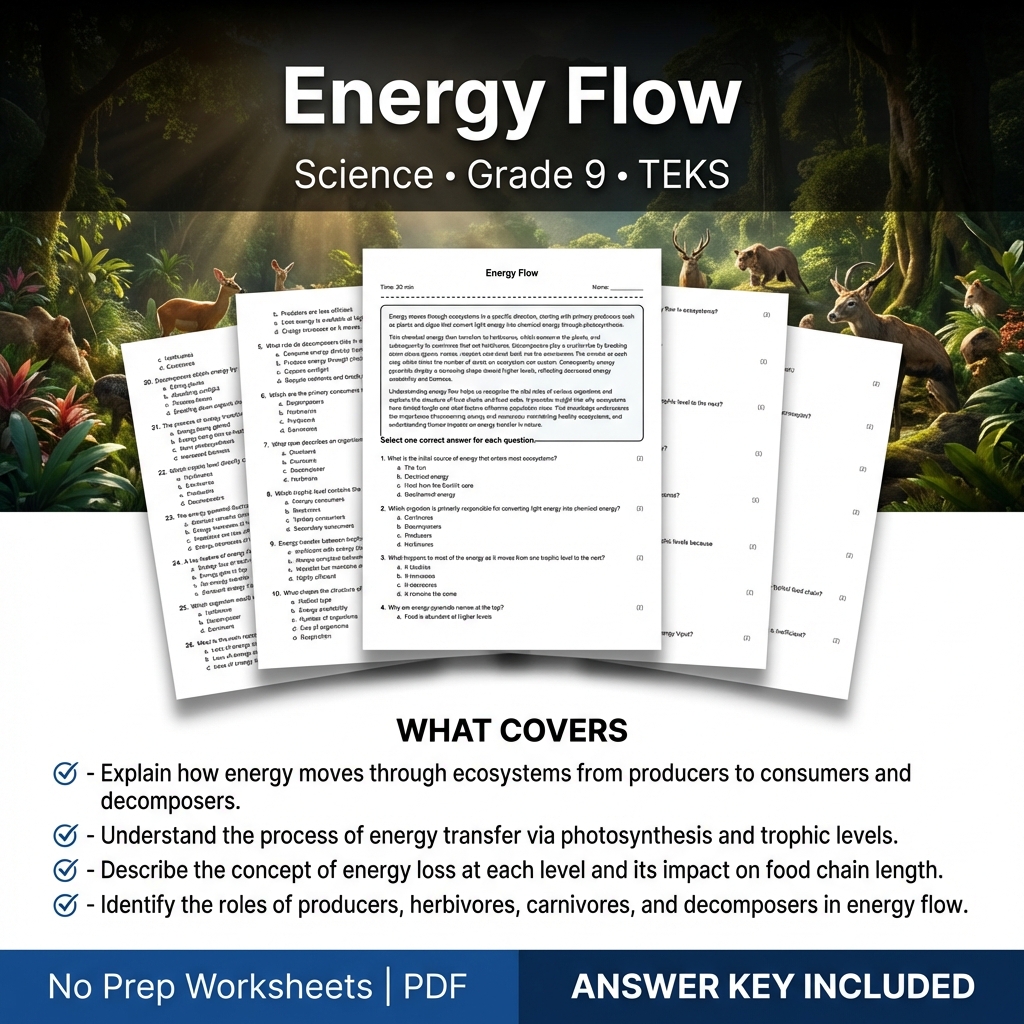
Energy Flow Worksheet for Grade 9 Science | Standard Practice and Assessment
 Created byCoral Reef Learning
Learning Objectives
- Explain how energy moves through ecosystems from producers to consumers and decomposers.
- Understand the process of energy transfer via photosynthesis and trophic levels.
- Describe the concept of energy loss at each level and its impact on food chain length.
Instant download
Grade 9 Science – Seismic Records and Earthquake Waves | Worksheet + Answer Key
JCreated byJ.S SheetsLearning Objectives
- Identify different types of seismic waves and their features
- Understand how seismic waveforms and travel-time curves are used to infer Earth's subsurface structure
- Compare P- and S-wave characteristics to determine earthquake depth and fault behavior
Also included in: Grade 9 Science Lesson Bundle – AP Framework Daily Reading Worksheets +1 more
Instant download

Biotech Applications Worksheet | TEKS-Aligned Science Practice for Grade 9
JCreated byJ.S SheetsLearning Objectives
- Explain how common biotechnology tools (PCR, gel electrophoresis, DNA sequencing, and CRISPR) are used to analyze and modify genetic material.
- Describe real-world applications of biotechnology in medicine, agriculture, and forensics.
- Evaluate ethical, legal, and societal implications of biotechnology, including privacy, ecological risk, and equitable access.
Instant download

Grade 9 Science Worksheet: Physical Changes | Standards-Aligned Practice
JCreated byJ.S SheetsLearning Objectives
- Characterize physical changes as alterations in state or form that do not change a substance’s chemical identity.
- Differentiate reversible and seemingly irreversible physical transformations using examples.
- Explain how energy transfer accompanies phase changes such as melting, freezing, evaporation, condensation, and dissolution.
Instant download
9th Grade Science | Ecosystem Cycling Worksheet (Printable PDF + Answer Key)
Created byCoral Reef LearningLearning Objectives
- Describe the interactions among organisms and abiotic components that drive material cycling and energy flow in ecosystems.
- Explain the roles of the carbon and nitrogen cycles in maintaining ecosystem health.
- Analyze how perturbations such as nutrient enrichment and invasive species affect community structure and ecosystem function.
Also included in: Grade 9 Science Unit Worksheet Bundle | Cell Function to Ecosystem Dynamics +2 more
Instant download

Grade 9 Science – Humidity & Cloud Formation | Daily Reading Worksheet
Created byBright Mind ResourcesLearning Objectives
- Explain how water vapor condenses into clouds.
- Identify factors affecting cloud types and formation.
- Describe the role of humidity and atmospheric stability in weather patterns.
Also included in: Earth Systems Grade 9 Science Daily Reading Worksheets Bundle | Florida NGSSS +1 more
Instant download

Adaptation and Selection Worksheet | Grade 9 Science Activities
Created byPrism Point LearningLearning Objectives
- Explain how natural selection works using the ideas of variation, heritability, selective pressure, and reproductive success.
- Define fitness and describe how it depends on environmental conditions.
- Compare natural selection and artificial selection and predict how populations may change over generations.
Instant download

Grade 9 Science Integrated Case Worksheet | Practice Alberta Standards
Created byPrism Point LearningLearning Objectives
- Explain how sexual and asexual reproduction affect genetic diversity in breeding programs.
- Trace how inheritance patterns can be linked to chromosomes and Mendelian rules.
- Analyze how selection changes trait frequencies and why variation matters for adaptation.
Instant download

Asexual Strategies Worksheet | Grade 9 Science Activities
Created byPrism Point LearningLearning Objectives
- Describe major mechanisms of asexual reproduction, including fission, budding, spore formation, and vegetative propagation
- Explain how producing genetically identical offspring affects variation, spread rate, and resilience
- Connect asexual strategies to real-world examples such as aspen groves, bacterial growth in environments, and horticultural propagation
Instant download
Grade 9 Science | Energy Transfer Worksheet (Ontario) – Science (PDF)
Created byBright Mind ResourcesLearning Objectives
- Understand sources of energy within Earth systems, including solar radiation and geothermal heat flow.
- Describe mechanisms of energy transfer such as conduction, convection, and radiation.
- Explain how energy gradients drive atmospheric and oceanic circulation and tectonic processes.
Instant download

Grade 9 Science | Power Analysis Worksheet with Short Notes (Printable PDF)
Created byMeadowlark WorksheetsLearning Objectives
- Understand the differences between power and energy in systems.
- Learn methods to calculate energy consumption over time.
- Evaluate efficiency and system losses in energy systems.
Also included in: Grade 9 Science NGSS Energy UNIT Bundle – Power, Heat, & Conversion Worksheets +1 more
Instant download

Grade 9 Science | Mechanical Energy Worksheet with Short Notes (Printable PDF)
Created byMeadowlark WorksheetsLearning Objectives
- Understand the concept of mechanical energy and its types.
- Identify different forms of energy involved in mechanical systems.
- Explain how energy is transferred and conserved in mechanical processes.
Also included in: Grade 9 Science NGSS Energy UNIT Bundle – Power, Heat, & Conversion Worksheets +1 more
Instant download
Grade 9 Science | Population Regulation Worksheet with Short Notes (PDF)
Created byMeadowlark WorksheetsLearning Objectives
- Understand factors affecting population size and dynamics, including carrying capacity, competition, predation, disease, and resource limitations.
- Analyze mathematical models such as logistic growth and predator-prey cycles.
- Evaluate human impacts on population regulation and the implications for conservation and ecosystem management.
Also included in: Grade 9 Science | Ecosystems: Interactions, Energy & Dynamics NGSS UNIT Bundle +2 more
Instant download

Grade 9 Science | Heat Quantification Worksheet with Short Notes (Printable PDF)
Created byMeadowlark WorksheetsLearning Objectives
- Understand the mathematical representations and principles of heat transfer and internal energy change.
- Apply formulas involving specific heat capacity, mass, and temperature change to real-world scenarios.
- Differentiate between conduction, convection, and radiation as modes of heat transfer.
Also included in: Grade 9 Science NGSS Energy UNIT Bundle – Power, Heat, & Conversion Worksheets +1 more
Instant download

Grade 9 Science | Energy Conversion Worksheet with Short Notes (Printable PDF)
Created byMeadowlark WorksheetsLearning Objectives
- Analyze various device mechanisms that convert energy from one form to another.
- Understand energy accounting including losses and efficiency constraints.
- Identify canonical examples such as photovoltaic cells, thermoelectric modules, and electrochemical cells.
Also included in: Grade 9 Science NGSS Energy UNIT Bundle – Power, Heat, & Conversion Worksheets +1 more
Instant download

Producers & Consumers Review & Practice Worksheet | Grade 9 Science
Created byPrism Point LearningLearning Objectives
- Explain how photosynthesis and cellular respiration transfer energy through ecosystems.
- Analyze how net primary productivity (NPP) and biomass accumulation affect food availability for consumers.
- Describe how organisms cycle carbon and oxygen through photosynthesis and respiration.
Also included in: Grade 9 Ecosystem Dynamics Science Lesson Bundle: NGSS Review Worksheets
Instant download

Human Impacts Practice Worksheet | Grade 9 Science NGSS Review
Created byPrism Point LearningLearning Objectives
- Explain how land-use change, invasive species, pollution, and resource extraction can reduce biodiversity.
- Interpret evidence from real-world examples (deforestation, coral reef degradation, agricultural runoff) to evaluate ecosystem impacts.
- Describe trade-offs between conservation goals, provisioning services, and socioecological outcomes.
Also included in: Grade 9 Ecosystem Dynamics Science Lesson Bundle: NGSS Review Worksheets
Instant download
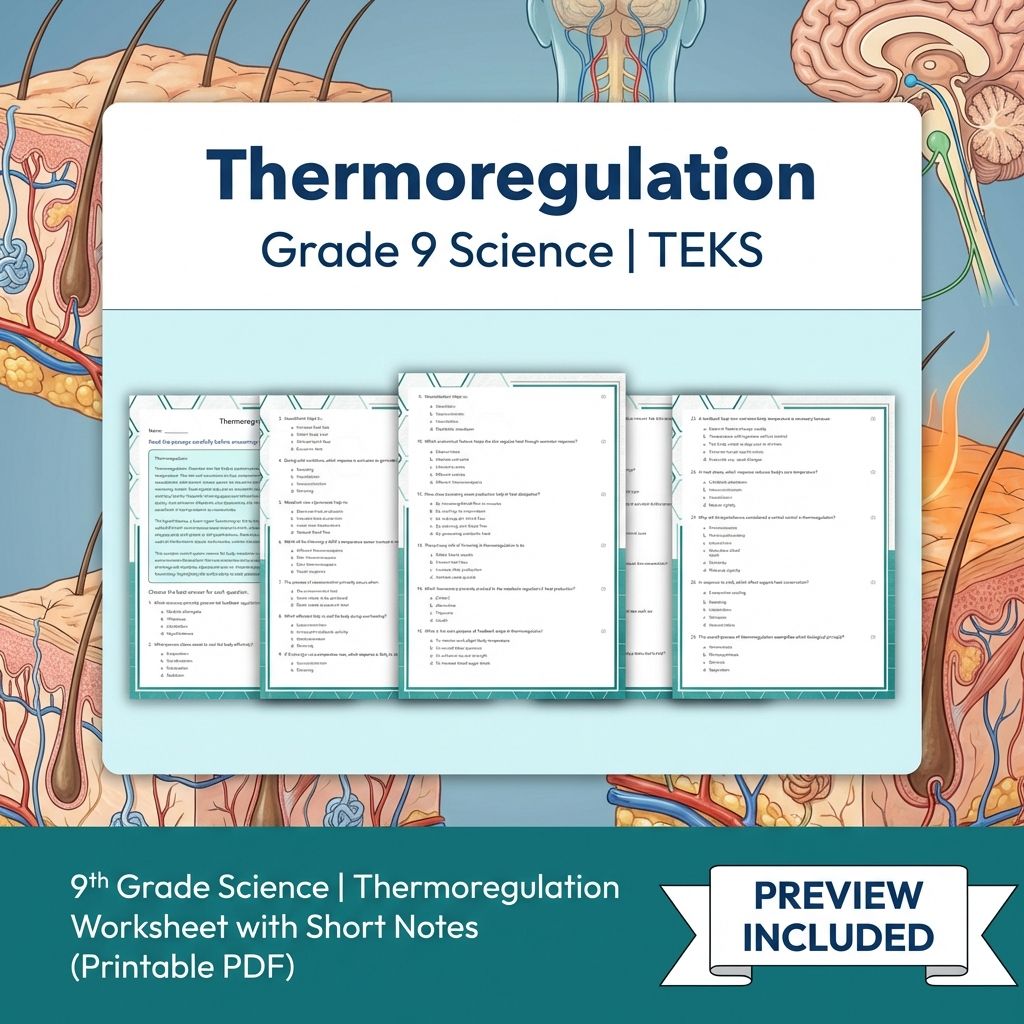
9th Grade Science | Thermoregulation Worksheet with Short Notes (Printable PDF)
Created byMeadowlark WorksheetsLearning Objectives
- Understand the mechanisms involved in human body temperature regulation.
- Identify the roles of skin, vasculature, sweat glands, muscles, and the hypothalamus in thermoregulation.
- Explain how feedback loops maintain thermal homeostasis under varying environmental conditions.
Instant download
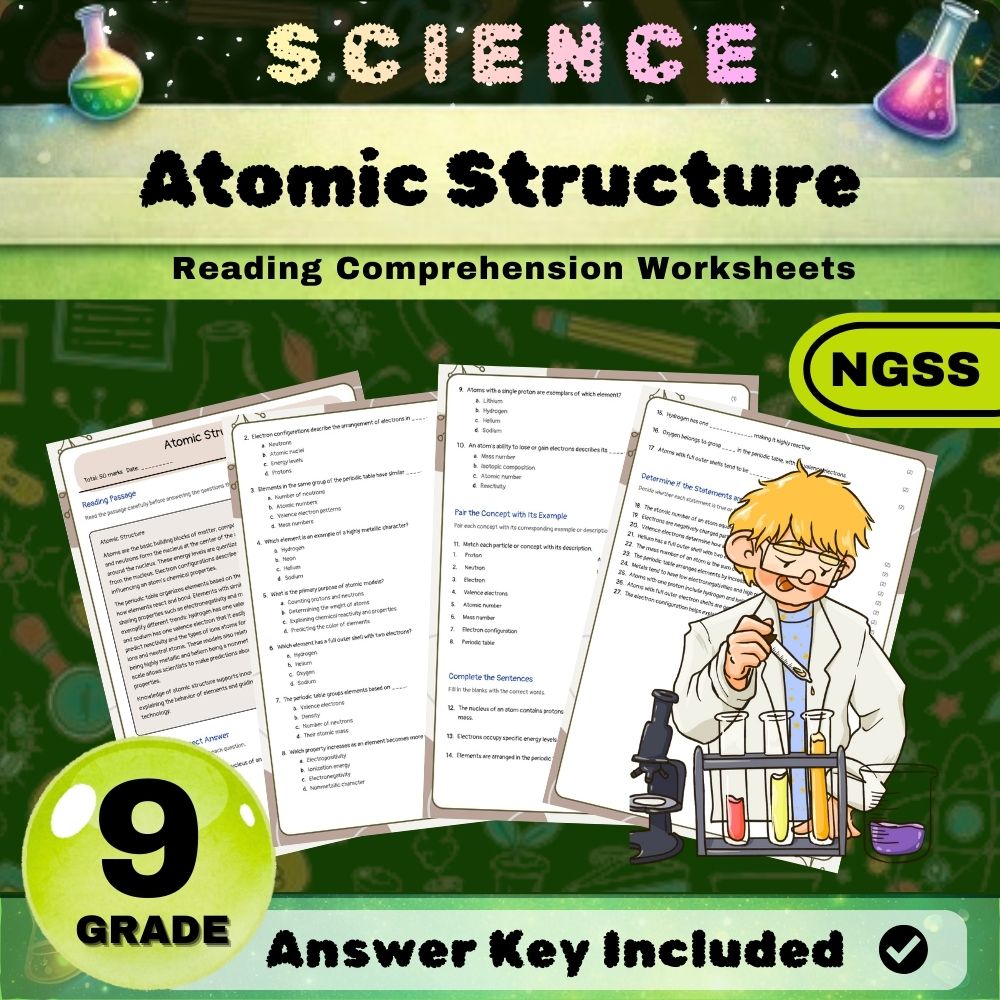
Grade 9 Science - Atomic Structure Worksheet (NGSS) PDF (Practice Set)
 Created byMaple Path Learning
Learning Objectives
- Understand the fundamental particles composing atoms, including protons, neutrons, and electrons.
- Describe electron configurations and their relation to energy levels.
- Explain how the periodic table organization reflects valence electrons and chemical behavior.
Also included in: Grade 9 Science | Matter and Its Interactions NGSS Unit Bundle – Worksheets +1 more
Instant download
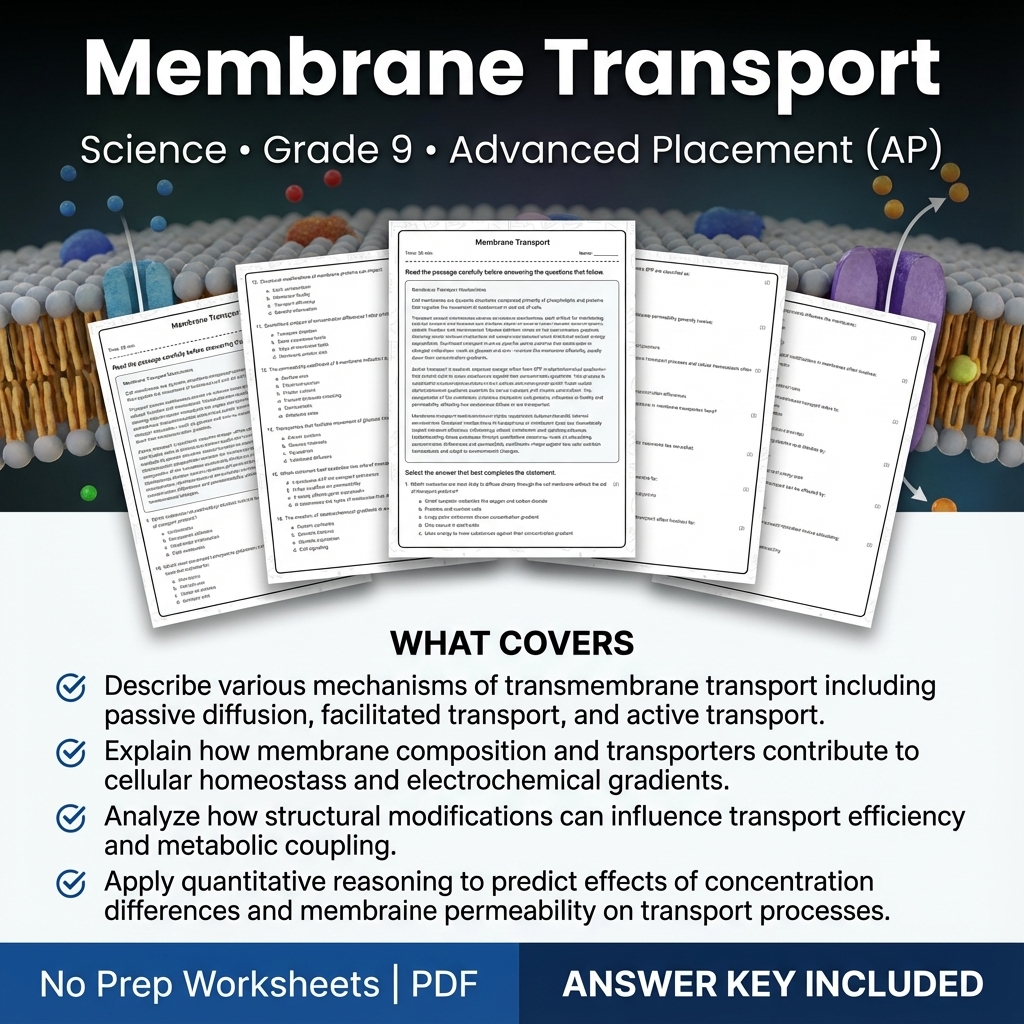
9th Grade Science | Membrane Transport Worksheet (Printable PDF + Answer Key)
Created byCoral Reef LearningLearning Objectives
- Describe various mechanisms of transmembrane transport including passive diffusion, facilitated transport, and active transport.
- Explain how membrane composition and transporters contribute to cellular homeostasis and electrochemical gradients.
- Analyze how structural modifications can influence transport efficiency and metabolic coupling.
Also included in: Grade 9 Science Unit Worksheet Bundle | Cell Function to Ecosystem Dynamics +2 more
Instant download

Volcanic Processes Worksheet for Grade 9 Science | AP Earth Science
Created byPrism Point LearningLearning Objectives
- Explain how magma composition and tectonic setting influence volcanic eruption style and hazard potential.
- Compare effusive shield volcanism and explosive stratovolcano behavior using magma viscosity and volatile content.
- Use volcanic gas emissions and basic eruption timelines to describe how volcanoes modify landscapes and can affect climate.
Also included in: Earth Systems & Climate Evidence Lesson Bundle | Grade 9 Science | AP
Instant download
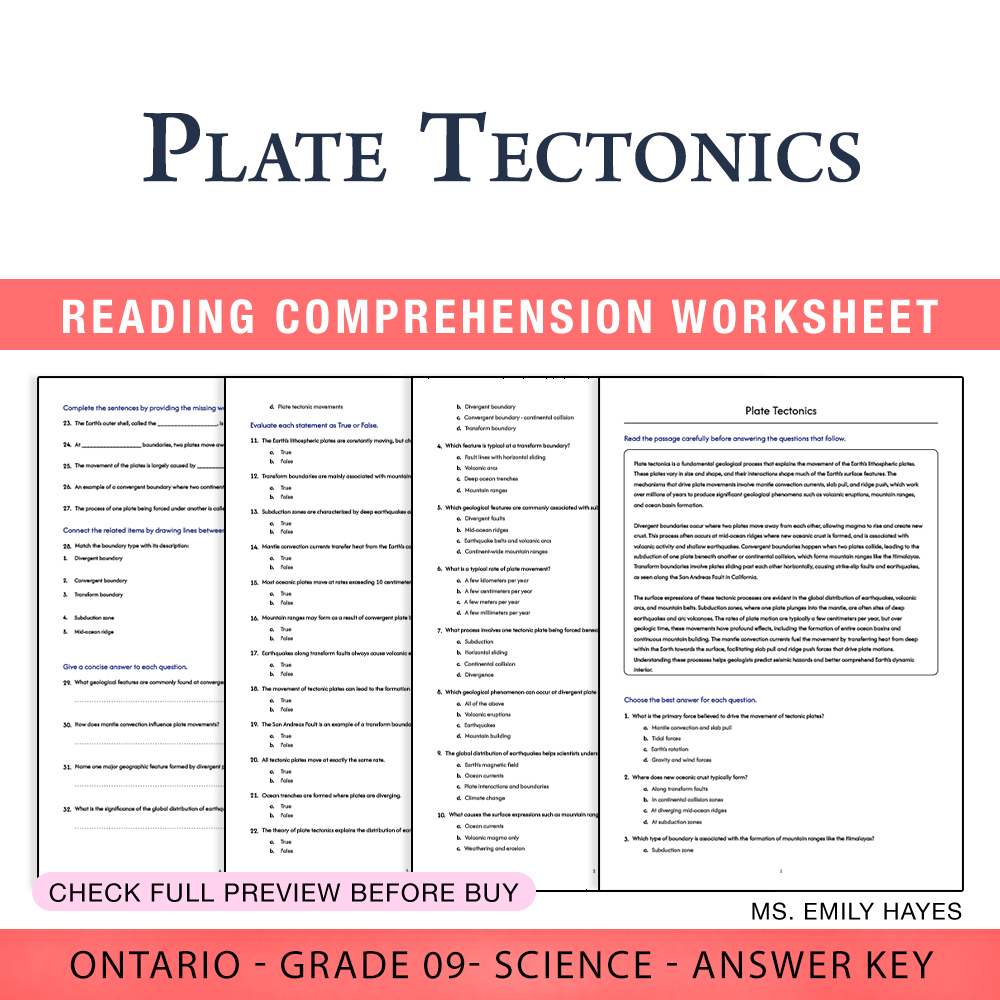
9th Grade Science | Plate Tectonics Worksheet (PDF + Answer Key)
 Created byCopper Leaf Classroom
Learning Objectives
- Explain the mechanisms driving plate tectonics, including divergent, convergent, and transform boundaries.
- Describe the surface expression of plate movements, such as volcanic activity, mountain building, and ocean basin formation.
- Link mantle convection and slab pull to the forces that move tectonic plates over geological time.
Instant download
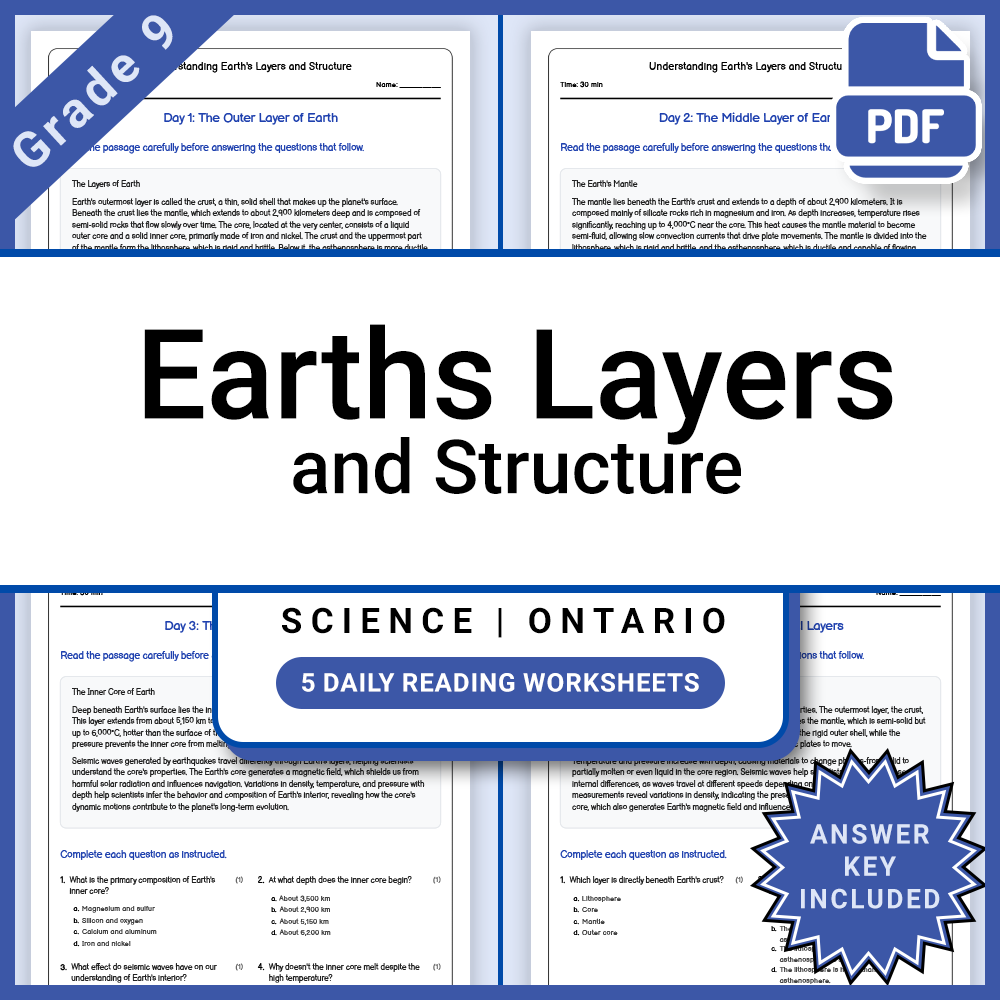
Grade 9 Science – Earth's Layers Daily Reading Worksheet + Answer Key
JCreated byJ.S SheetsLearning Objectives
- Identify the different layers of Earth and describe their characteristics.
- Explain the differences between the lithosphere and asthenosphere.
- Understand how seismic waves help scientists learn about Earth's interior.
Also included in: Grade 9 Science Lesson Group Bundle – Earth Systems & Planetary Concepts +1 more
Instant download

Energy Molecules Assessment | TEKS Grade 9 Science Standards
Created byPrism Point LearningLearning Objectives
- Understand the structure and role of ATP in cellular energy transfer.
- Explain how hydrolysis of ATP releases energy for cellular activities.
- Describe the process of ATP regeneration through phosphorylation.
Instant download
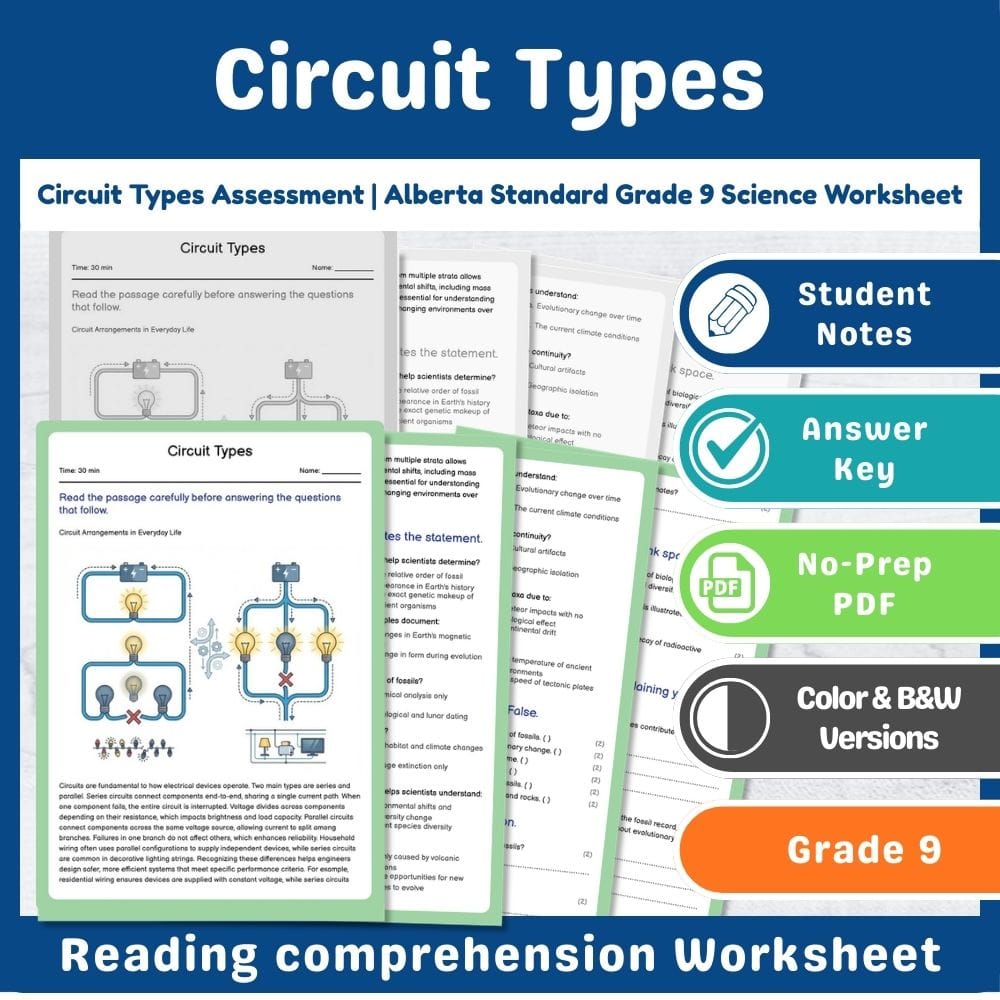
Circuit Types Assessment | Alberta Standard Grade 9 Science Worksheet
Created byPrism Point LearningLearning Objectives
- Understand the difference between series and parallel circuits.
- Identify the behavior of current and voltage in different circuit arrangements.
- Analyze the effects of circuit configuration on brightness, reliability, and performance.
Also included in: Grade 9 Electricity and Magnetism Science Lesson Bundle | Alberta Framework +1 more
Instant download
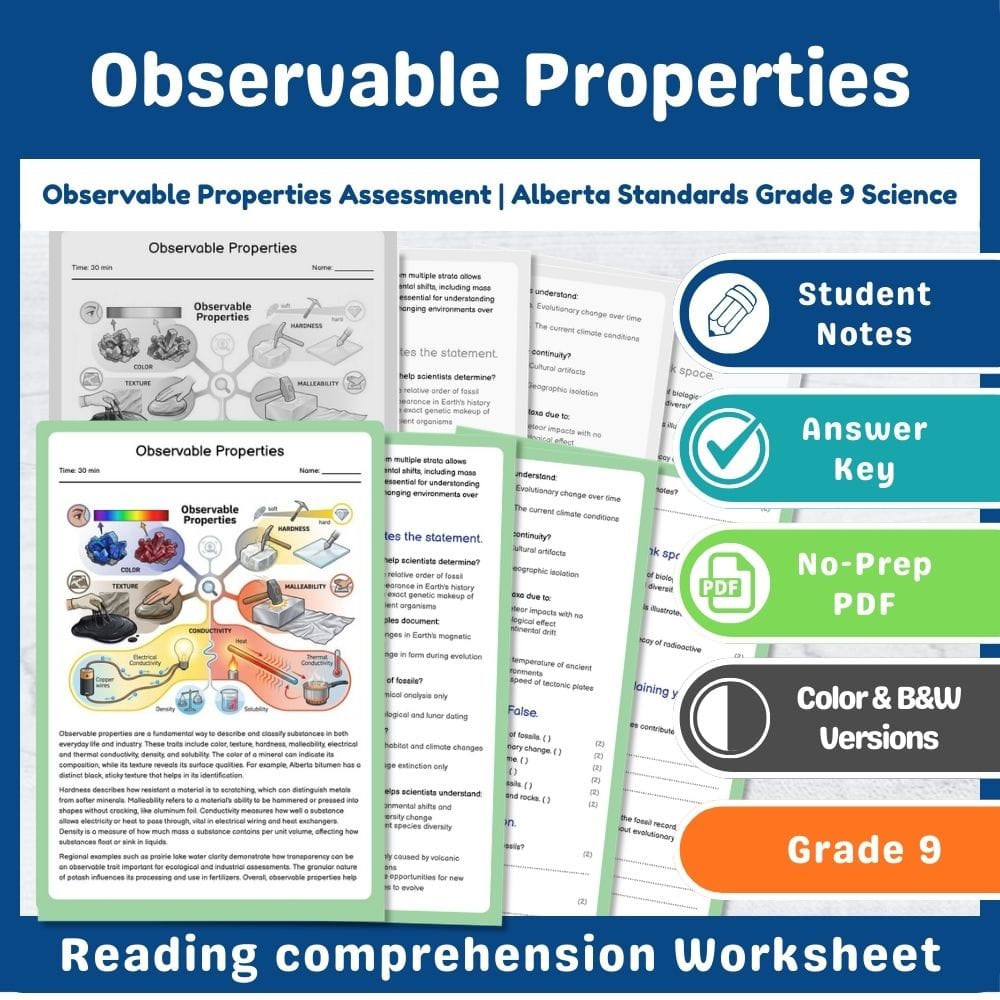
Observable Properties Assessment | Alberta Standards Grade 9 Science
Created byPrism Point LearningLearning Objectives
- Identify and describe various observable properties of substances.
- Understand how observable traits help classify different materials.
- Recognize regional examples illustrating material properties.
Also included in: Grade 9 Matter and Chemical Change Science Lesson Bundle | Alberta +1 more
Instant download
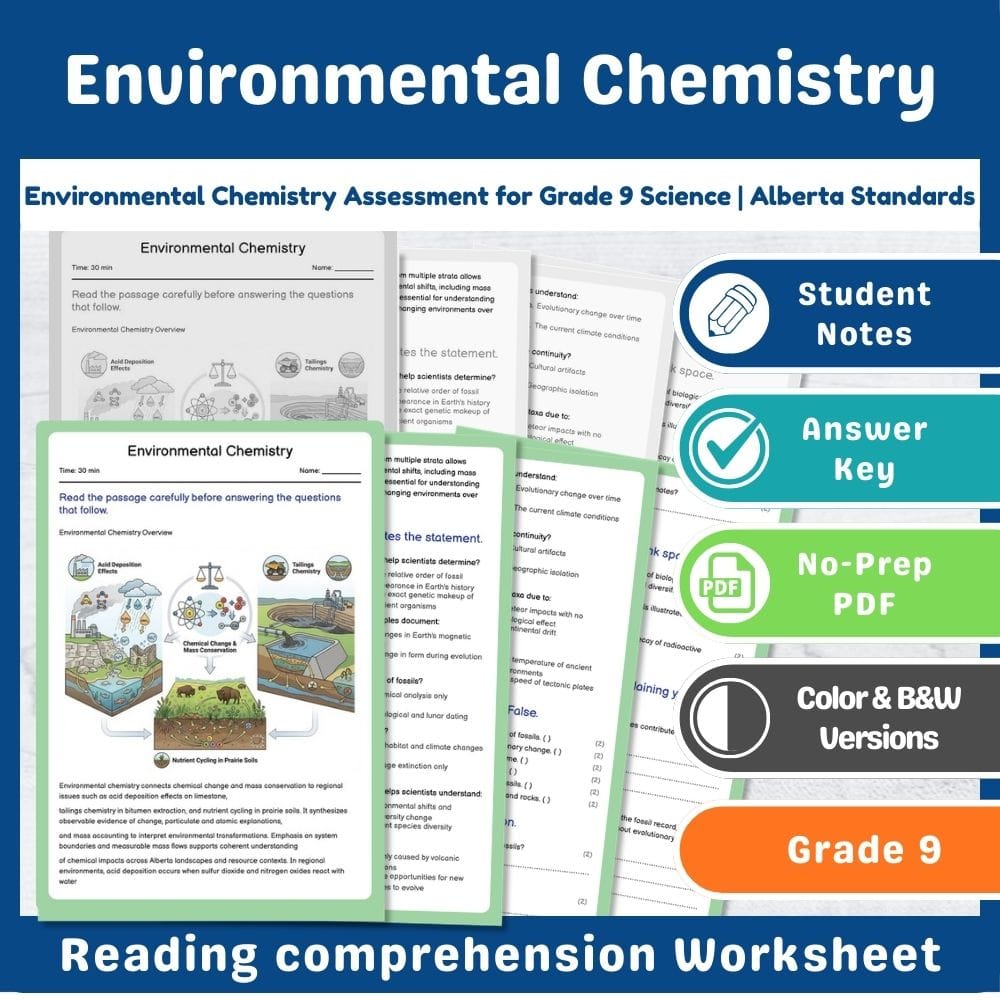
Environmental Chemistry Assessment for Grade 9 Science | Alberta Standards
Created byPrism Point LearningLearning Objectives
- Understand how chemical change and mass conservation relate to environmental issues.
- Analyze regional environmental impacts such as acid deposition and nutrient cycling.
- Interpret observable evidence of environmental transformations through particulate and atomic explanations.
Also included in: Grade 9 Matter and Chemical Change Science Lesson Bundle | Alberta +1 more
Instant download
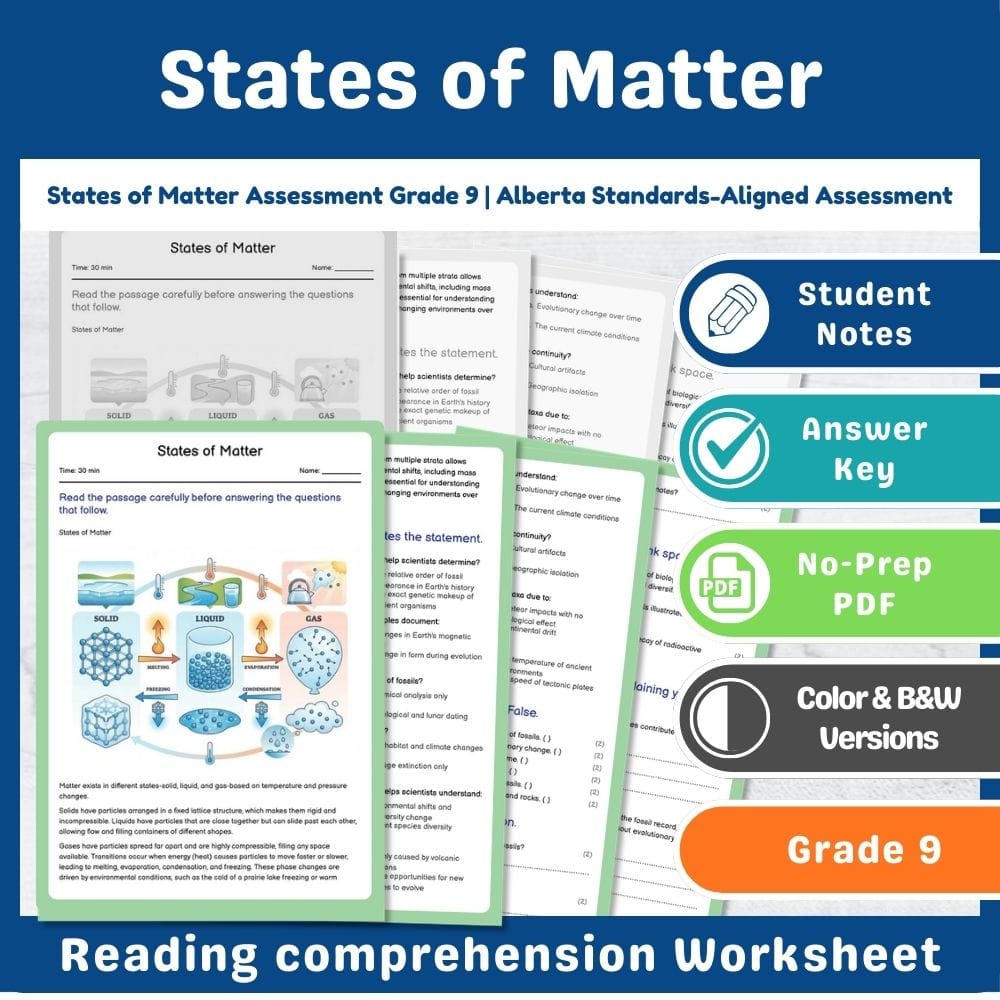
States of Matter Assessment Grade 9 | Alberta Standards-Aligned Assessment
Created byPrism Point LearningLearning Objectives
- Describe the three main states of matter: solid, liquid, and gas.
- Explain how temperature and pressure influence phase transitions.
- Identify the behaviors and properties characteristic of each state of matter.
Also included in: Grade 9 Matter and Chemical Change Science Lesson Bundle | Alberta +1 more
Instant download
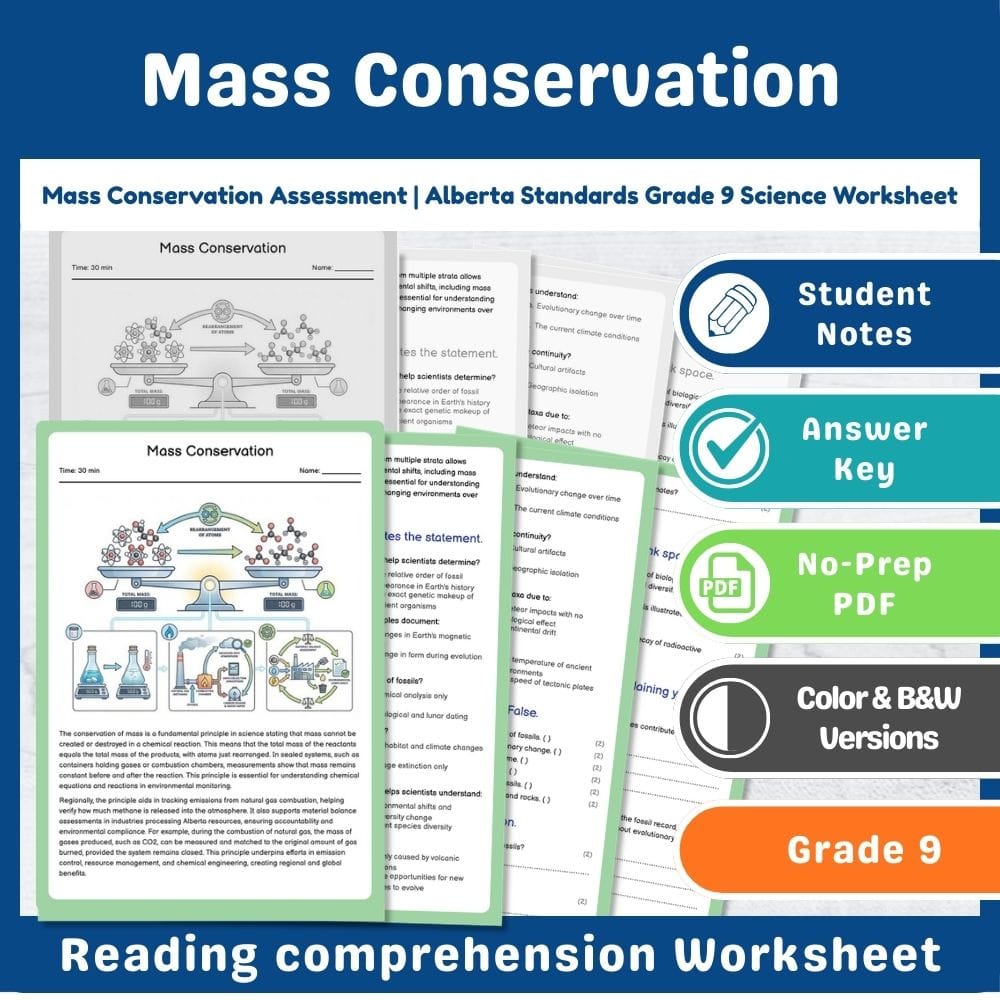
Mass Conservation Assessment | Alberta Standards Grade 9 Science Worksheet
Created byPrism Point LearningLearning Objectives
- Explain the principle of mass conservation in chemical reactions.
- Describe how mass remains constant in closed systems despite chemical changes.
- Identify regional applications of mass conservation in environmental and industrial contexts.
Also included in: Grade 9 Matter and Chemical Change Science Lesson Bundle | Alberta +1 more
Instant download
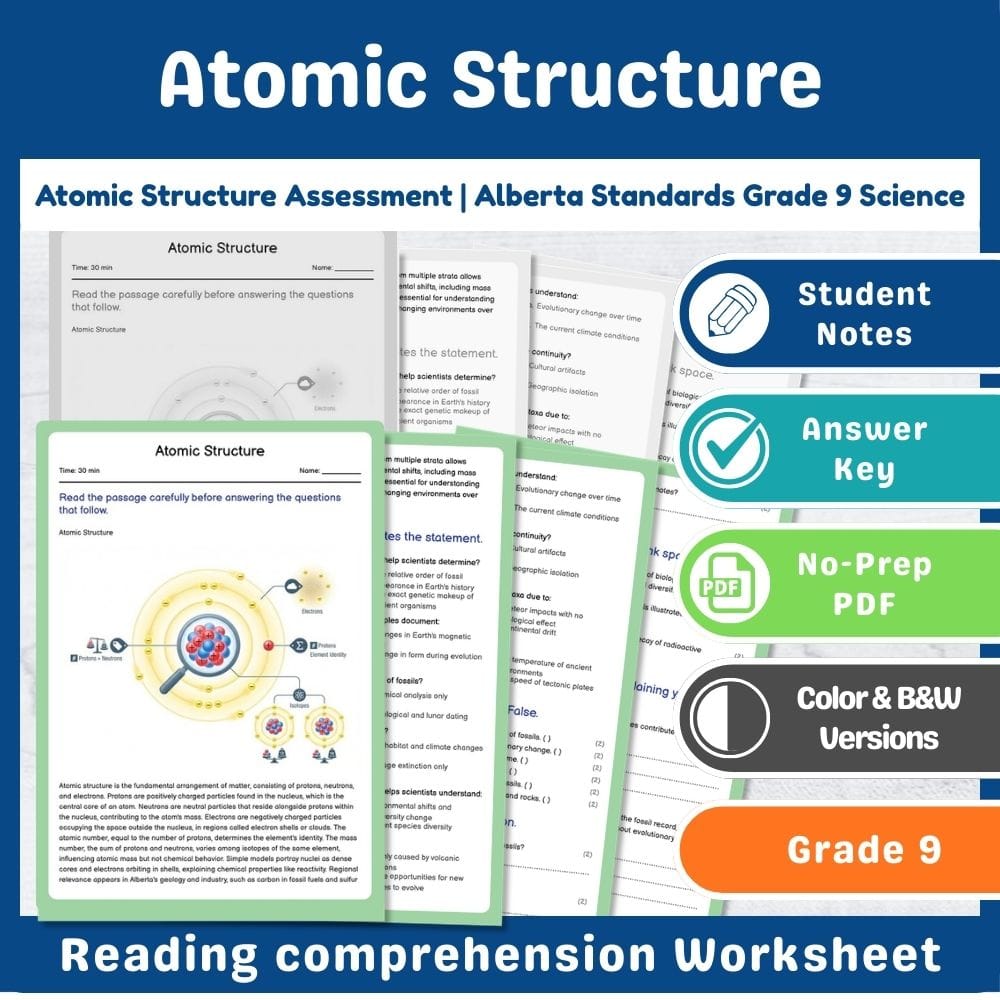
Atomic Structure Assessment | Alberta Standards Grade 9 Science
Created byPrism Point LearningLearning Objectives
- Describe the basic components of an atom: protons, neutrons, and electrons.
- Explain how atomic number and mass number define isotopes and element identity.
- Illustrate simple models of nuclei and electron shells to understand chemical behavior.
Also included in: Grade 9 Matter and Chemical Change Science Lesson Bundle | Alberta +1 more
Instant download
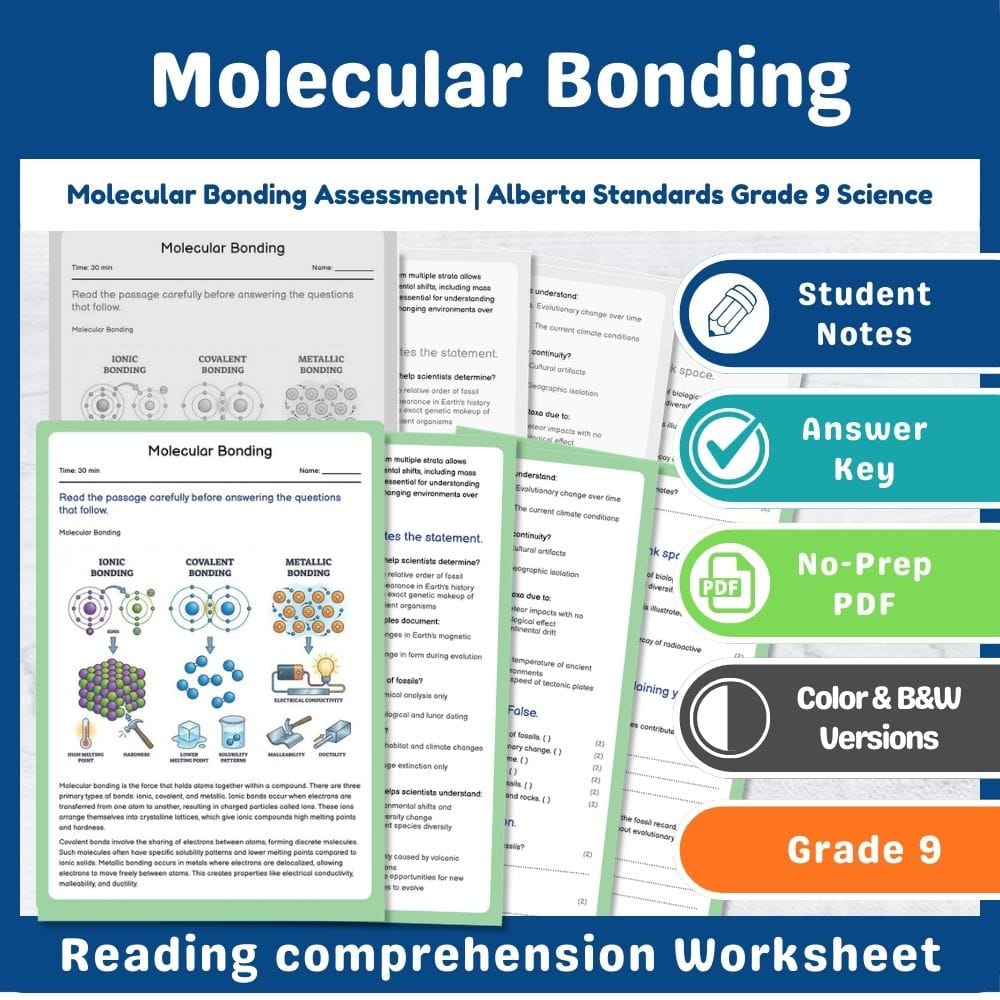
Molecular Bonding Assessment | Alberta Standards Grade 9 Science
Created byPrism Point LearningLearning Objectives
- Describe the different types of chemical bonds: ionic, covalent, and metallic.
- Identify properties of compounds based on their bonding type.
- Explain how bonding influences material properties and applications.
Also included in: Grade 9 Matter and Chemical Change Science Lesson Bundle | Alberta +1 more
Instant download

Mixtures and Solutions Assessment | Alberta Standards Grade 9 Science
Created byPrism Point LearningLearning Objectives
- Differentiate between heterogeneous mixtures and homogeneous solutions.
- Explain the roles of solute and solvent in a solution.
- Describe methods of separating mixture components based on physical properties.
Also included in: Grade 9 Matter and Chemical Change Science Lesson Bundle | Alberta +1 more
Instant download
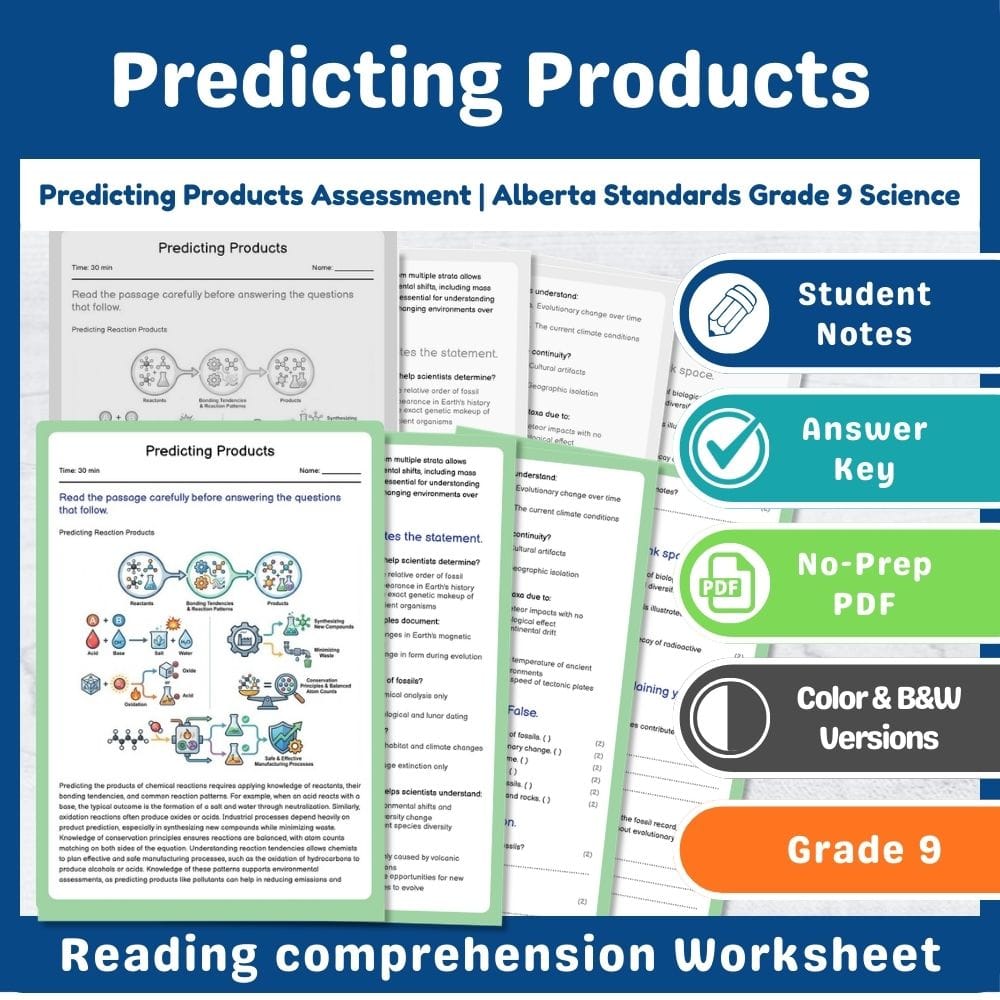
Predicting Products Assessment | Alberta Standards Grade 9 Science
Created byPrism Point LearningLearning Objectives
- Understand patterns of chemical reactions to predict likely products.
- Apply conservation principles and reactant identities in product prediction.
- Analyze industrial examples such as oxidation of hydrocarbons and neutralization reactions.
Also included in: Grade 9 Matter and Chemical Change Science Lesson Bundle | Alberta +1 more
Instant download
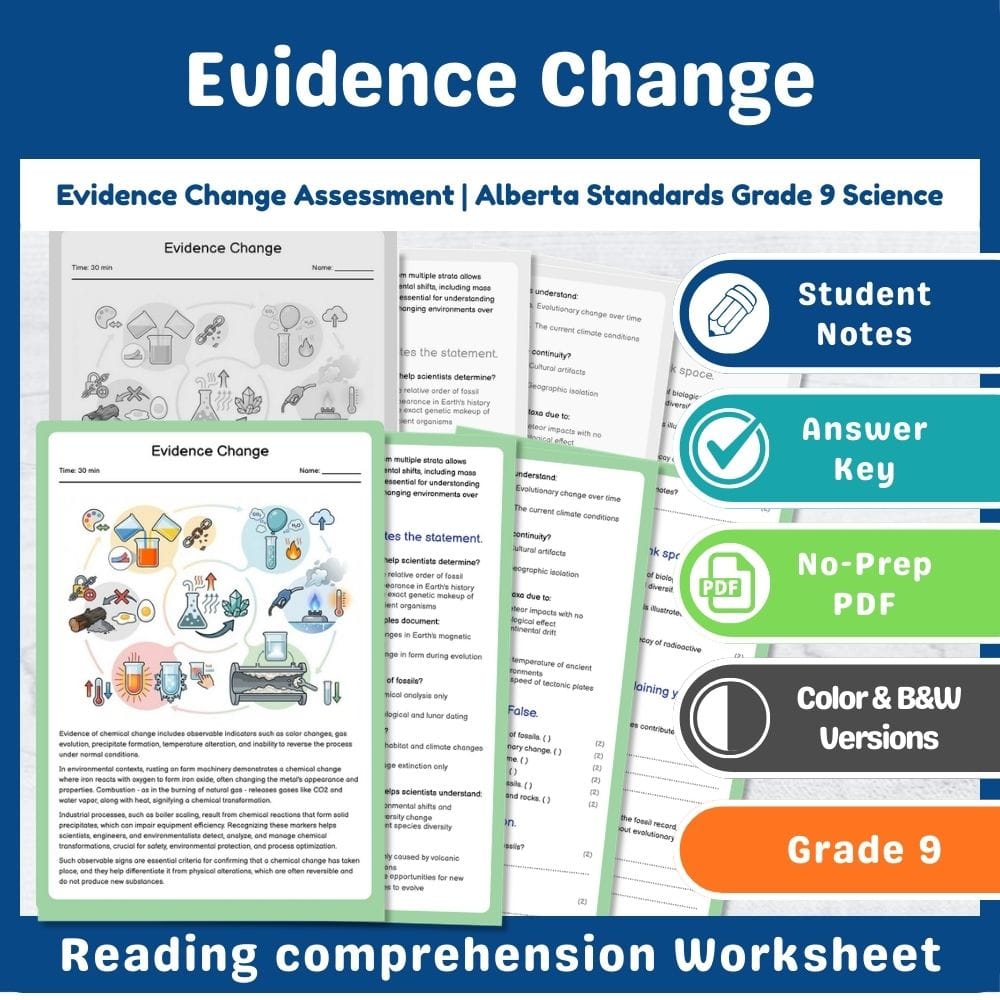
Evidence Change Assessment | Alberta Standards Grade 9 Science
Created byPrism Point LearningLearning Objectives
- Identify observable signs that indicate a chemical change has occurred.
- Distinguish between physical and chemical change markers in environmental and industrial contexts.
- Understand examples of chemical change such as rusting, combustion, and scale formation.
Also included in: Grade 9 Matter and Chemical Change Science Lesson Bundle | Alberta +1 more
Instant download
About Grade 9 Science Worksheets
Find Science worksheets built for Grade 9. All 6,926 cover core skills, practice, and review, each an instant PDF download.
Every worksheet on MyTeachingSheets is created by independent teacher-authors and reviewed before publication. All resources download as printable PDFs for classroom, homework, or at-home practice, and many include answer keys. Preview any worksheet free before buying.