
Science Worksheets
44,628 subject resources
Human Stewardship Worksheet Grade 7 Science | Ecosystems & Sustainability
 Created byChalk and Compass
Learning Objectives
- Summarize how human activities can alter ecosystems, including habitat loss, pollution, resource extraction, and invasive species.
- Explain how these impacts can change species composition, disrupt ecosystem functions, and reduce long-term resilience.
- Describe stewardship principles such as mitigation, habitat protection, restoration priorities, and evidence-based monitoring.
Also included in: Grade 7 Science Ecosystems & Sustainability Lesson Bundle | Ontario +1 more
Instant download

Decomposition Cycles Worksheet | Nutrient Cycling Science Grade 7
Created byChalk and CompassLearning Objectives
- Explain how detritivores, fungi, and bacteria break down organic matter and how abiotic factors affect decomposition rates.
- Describe carbon and nitrogen transformations that occur during decomposition and nutrient cycling.
- Connect decomposition rate to soil fertility and ecosystem productivity across wetlands, forests, and grasslands.
Also included in: Grade 7 Science Ecosystems & Sustainability Lesson Bundle | Ontario +1 more
Instant download

Ecosystem Basics Worksheet Grade 7 Science | Food Chains & Habitats
Created byChalk and CompassLearning Objectives
- Identify biotic and abiotic components of an ecosystem and explain how they affect organisms.
- Classify organisms as producers, consumers, or decomposers and describe their roles.
- Explain energy flow from sunlight to organic matter and how matter cycles through ecosystems.
Also included in: Grade 7 Science Ecosystems & Sustainability Lesson Bundle | Ontario +1 more
Instant download

Succession Patterns Worksheet Grade 7 Science | Ontario Curriculum
Created byChalk and CompassLearning Objectives
- Explain how ecological succession changes a community after disturbance
- Distinguish primary and secondary succession and identify common stages
- Describe drivers of succession, including soil development, seed dispersal, competition, and facilitation
Also included in: Grade 7 Science Ecosystems & Sustainability Lesson Bundle | Ontario +1 more
Instant download
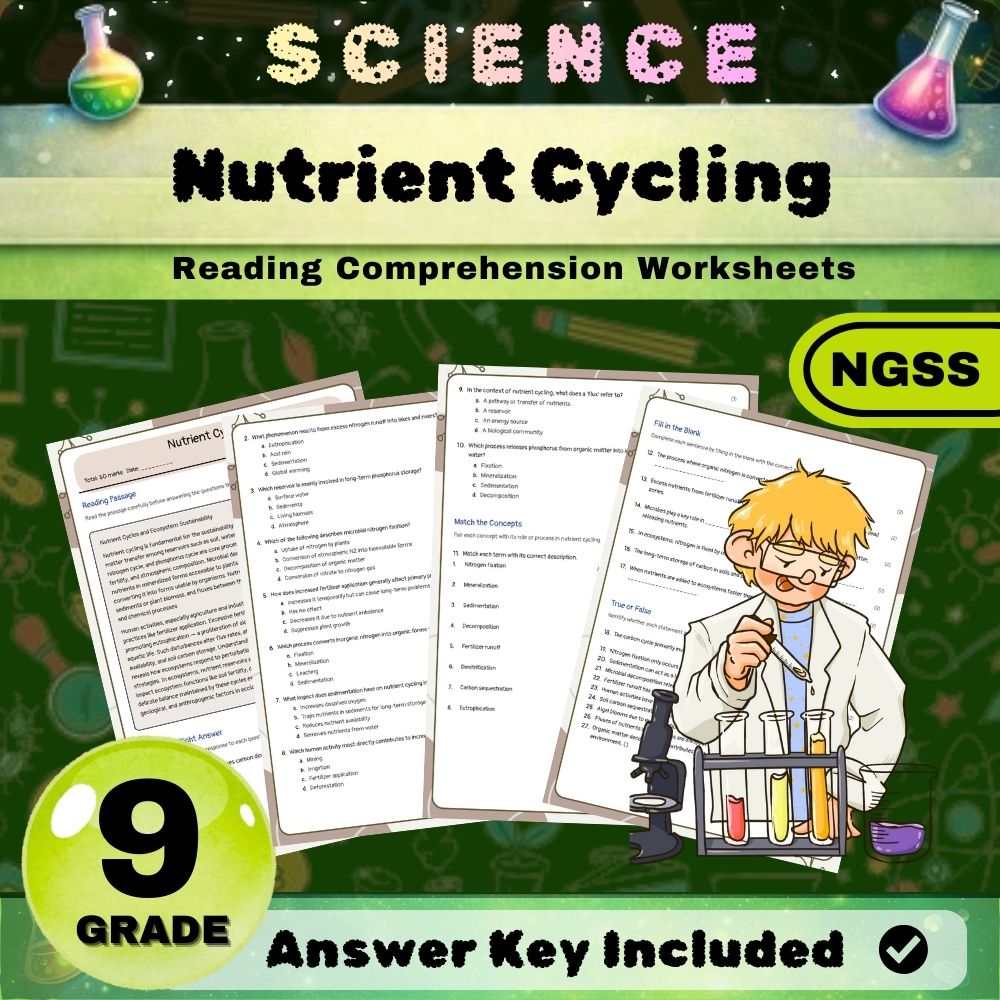
Grade 9 Science | Nutrient Cycling Worksheet (NGSS) PDF
 Created byMaple Path Learning
Learning Objectives
- Understand the pathways and processes involved in nutrient cycling within ecosystems.
- Explain human impacts, such as fertilizer runoff, on nutrient fluxes and ecosystem health.
- Describe the roles of microbes in decomposition, fixation, and mineralization in nutrient cycles.
Also included in: Grade 9 Science Ecosystems Lesson Bundle | NGSS Interactions & Energy +1 more
Instant download
Grade 7 Science | Indigenous Knowledge Reading Worksheet (PDF & Answer Key)
JCreated byJ.S SheetsLearning Objectives
- Understand the concept of traditional ecological knowledge and its role in land management.
- Identify how oral histories and place-based knowledge contribute to ecological understanding.
- Explore examples of stewardship and land practices in Alberta communities.
Also included in: Grade 7 Science Bundle | Ecology, Ecosystems & Environmental Topics (Pack) +1 more
Instant download
Grade 7 Science | Biodiversity Measures Reading Worksheets PDF (Answer Key)
JCreated byJ.S SheetsLearning Objectives
- Understand different methods of measuring biodiversity, including richness, evenness, and habitat heterogeneity.
- Interpret what biodiversity metrics reveal about ecosystem resilience and function.
- Explore the relationship between habitat complexity and species assemblages in Alberta contexts.
Also included in: Grade 7 Science Bundle | Ecology, Ecosystems & Environmental Topics (Pack) +1 more
Instant download
Grade 7 Science | Conservation Status Reading Worksheet with Answer Key (PDF)
JCreated byJ.S SheetsLearning Objectives
- Understand the criteria used to assess species' conservation risk.
- Interpret evidence such as population trends and threats to determine conservation status.
- Recognize examples of species at risk, including provincial cases like the swift fox and at-risk plants.
Also included in: Grade 7 Science Bundle | Ecology, Ecosystems & Environmental Topics (Pack) +1 more
Instant download
Grade 7 Science | Levels Of Organization Reading Worksheet & Answer Key (PDF)
JCreated byJ.S SheetsLearning Objectives
- Understand the different levels of ecological organization from individual organisms to ecosystems.
- Identify examples of each level within Alberta's environment.
- Recognize how patterns emerge at higher levels that are not obvious from individual traits.
Also included in: Grade 7 Science Bundle | Ecology, Ecosystems & Environmental Topics (Pack) +1 more
Instant download
7th Grade Science | Biotic & Abiotic Interactions Worksheet (PDF + Answer Key)
JCreated byJ.S SheetsLearning Objectives
- Understand the roles of biotic and abiotic components within ecosystems.
- Describe how environmental factors like sunlight, water, and soil influence living organisms.
- Explain cause-and-effect relationships between non-living elements and community patterns across regional landscapes.
Also included in: Grade 7 Science Bundle | Ecology, Ecosystems & Environmental Topics (Pack) +1 more
Instant download
7th Grade Science | Ecological Inquiry Reading Worksheet & Answer Key (PDF)
JCreated byJ.S SheetsLearning Objectives
- Understand the process of ecological inquiry including hypothesis framing and data interpretation.
- Recognize the role of measurable variables and evidence in ecological studies.
- Apply critical thinking to analyze ecological data and consider natural variability.
Also included in: Grade 7 Science Bundle | Ecology, Ecosystems & Environmental Topics (Pack) +1 more
Instant download
Grade 7 Science | Wetland Functions Reading Worksheet & Answer Key (PDF)
JCreated byJ.S SheetsLearning Objectives
- Identify the key hydrological, chemical, and biological functions of wetlands.
- Understand how wetlands contribute to ecosystem services like water storage, nutrient cycling, and habitat provision.
- Differentiate among various wetland types such as peatlands and marshes and their specific functions.
Also included in: Grade 7 Science Bundle | Ecology, Ecosystems & Environmental Topics (Pack) +1 more
Instant download
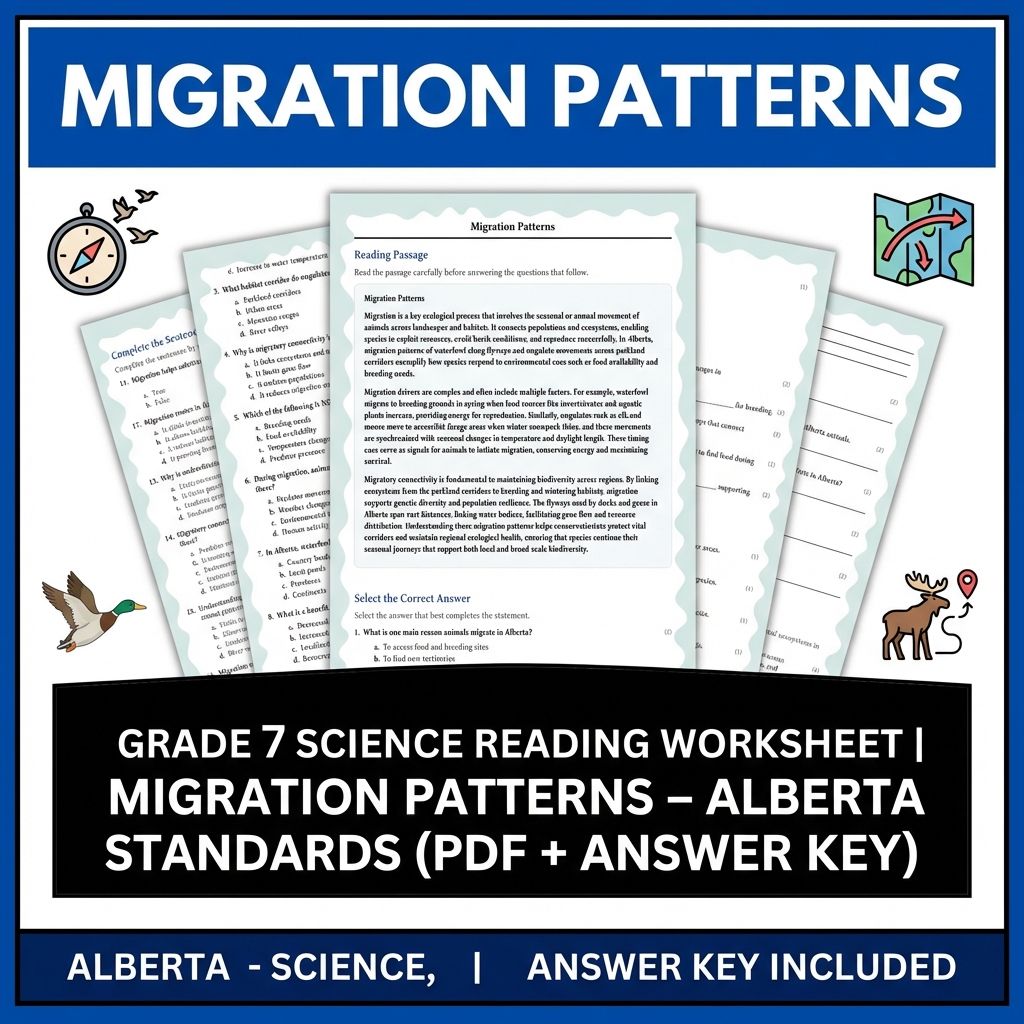
Grade 7 Science | Migration Patterns – Alberta Standards (PDF + Answer Key)
JCreated byJ.S SheetsLearning Objectives
- Understand the drivers and influences behind seasonal and annual migration patterns.
- Identify examples of migration routes and behaviors in Alberta wildlife.
- Explain the factors such as food availability, breeding needs, and timing cues that trigger migration.
Also included in: Grade 7 Science Bundle | Ecology, Ecosystems & Environmental Topics (Pack) +1 more
Instant download
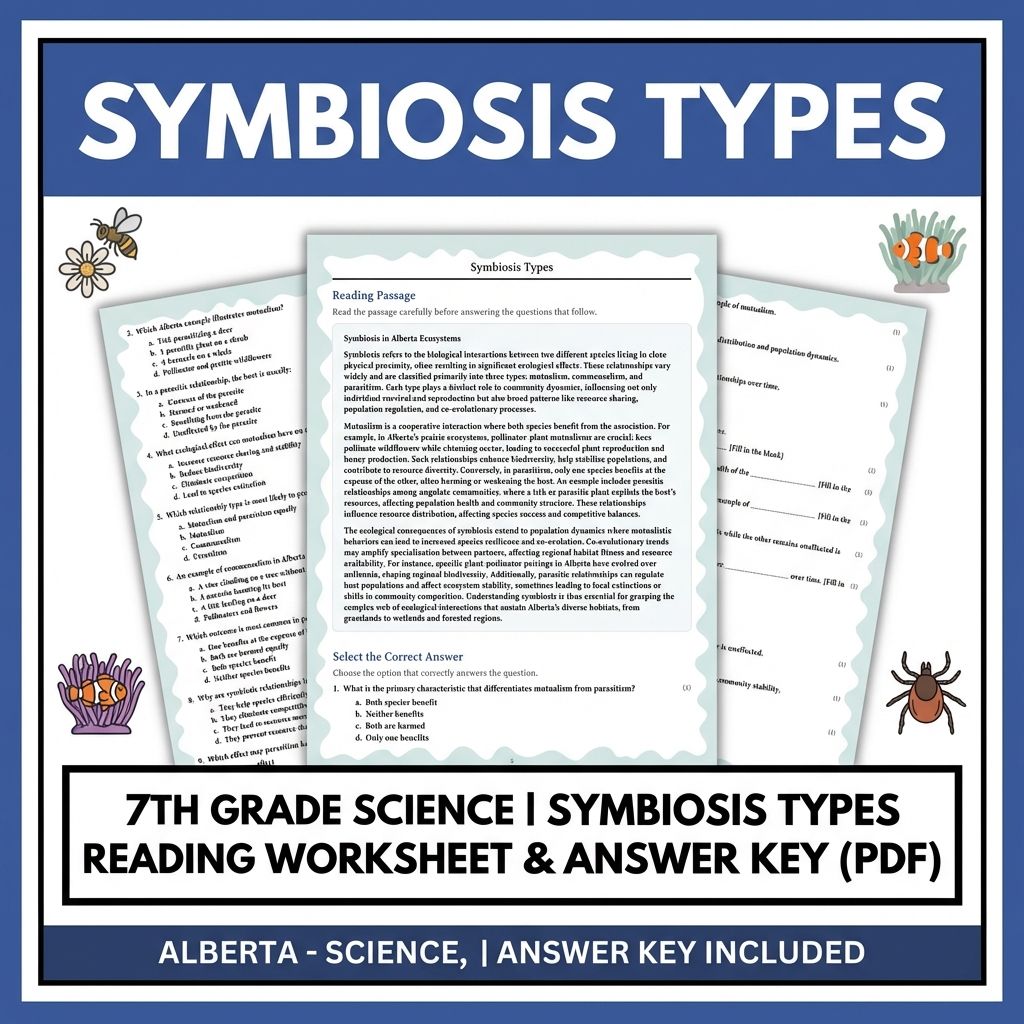
7th Grade Science | Symbiosis Types Reading Worksheet & Answer Key (PDF)
JCreated byJ.S SheetsLearning Objectives
- Identify and distinguish between mutualism, commensalism, and parasitism in ecosystems.
- Describe regional examples of symbiotic relationships, including Alberta-specific environments.
- Analyze the ecological consequences of different symbiosis types on community structure and species success.
Also included in: Grade 7 Science Bundle | Ecology, Ecosystems & Environmental Topics (Pack) +1 more
Instant download
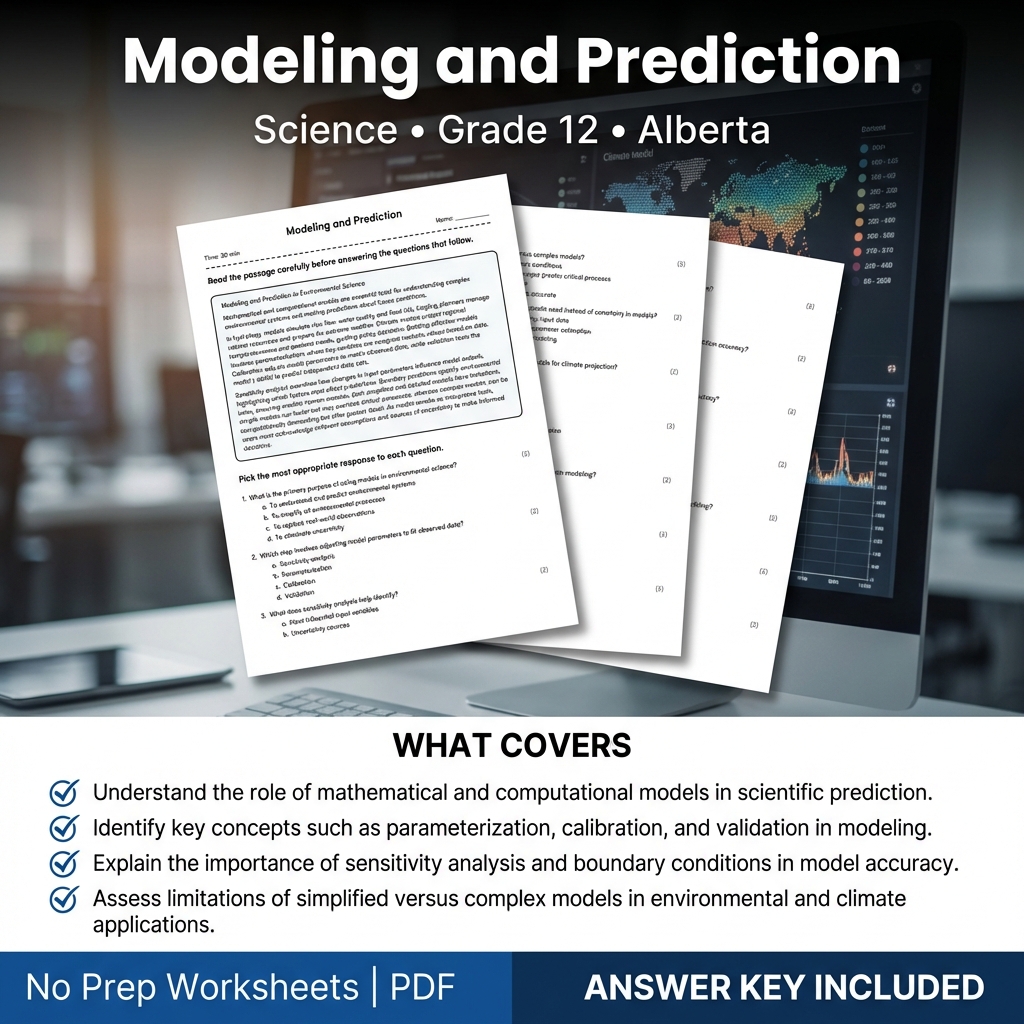
Modeling and Prediction Worksheet | Science Grade 12 | Alberta Standards
 Created byCoral Reef Learning
Learning Objectives
- Understand the role of mathematical and computational models in scientific prediction.
- Identify key concepts such as parameterization, calibration, and validation in modeling.
- Explain the importance of sensitivity analysis and boundary conditions in model accuracy.
Instant download
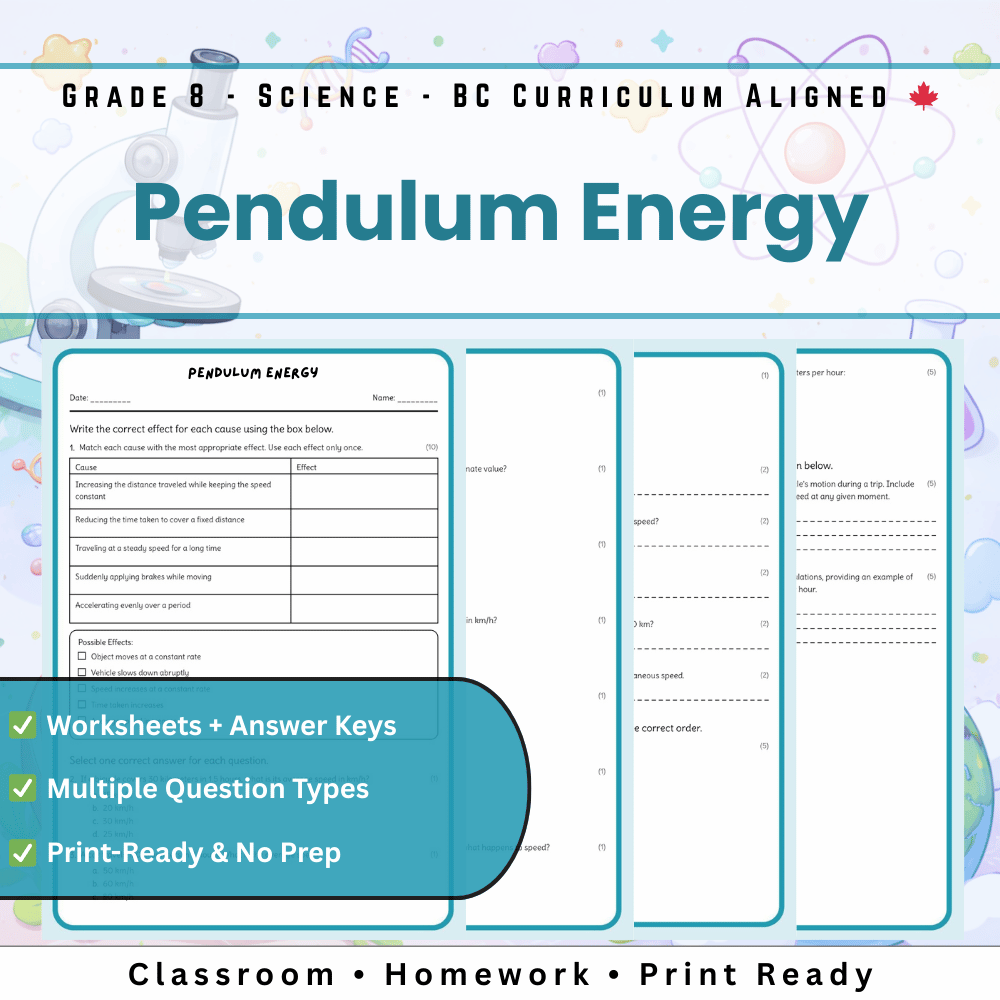
Grade 8 Science | Pendulum Energy Worksheet (Answer Key) – Motion & Energy
 Created byBright Mind Resources
Learning Objectives
- Understand the energy transformations occurring in a pendulum system.
- Identify factors that influence the period and energy distribution of a pendulum.
- Explain the concept of conservation of mechanical energy in ideal systems.
Instant download
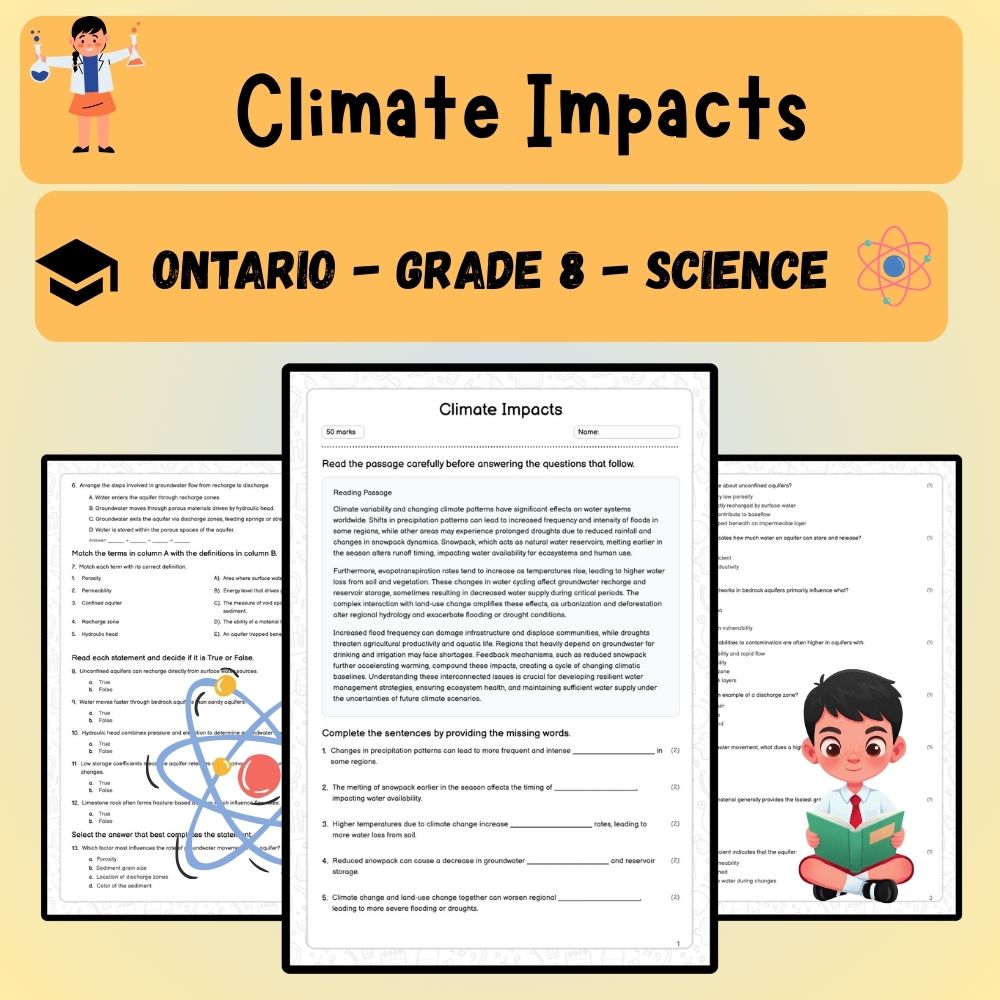
Grade 8 Science | Climate Impacts Worksheet (PDF ) – Ontario Standards
 Created byPrism Point Learning
Learning Objectives
- Understand how climate variability affects water systems such as precipitation and snowpack.
- Analyze the consequences of climate change on flood frequency, drought, and water availability.
- Examine interactions between climate impacts and land-use change on regional hydrology.
Also included in: Grade 8 Science Water Management Unit Watershed and Water Resources +1 more
Instant download
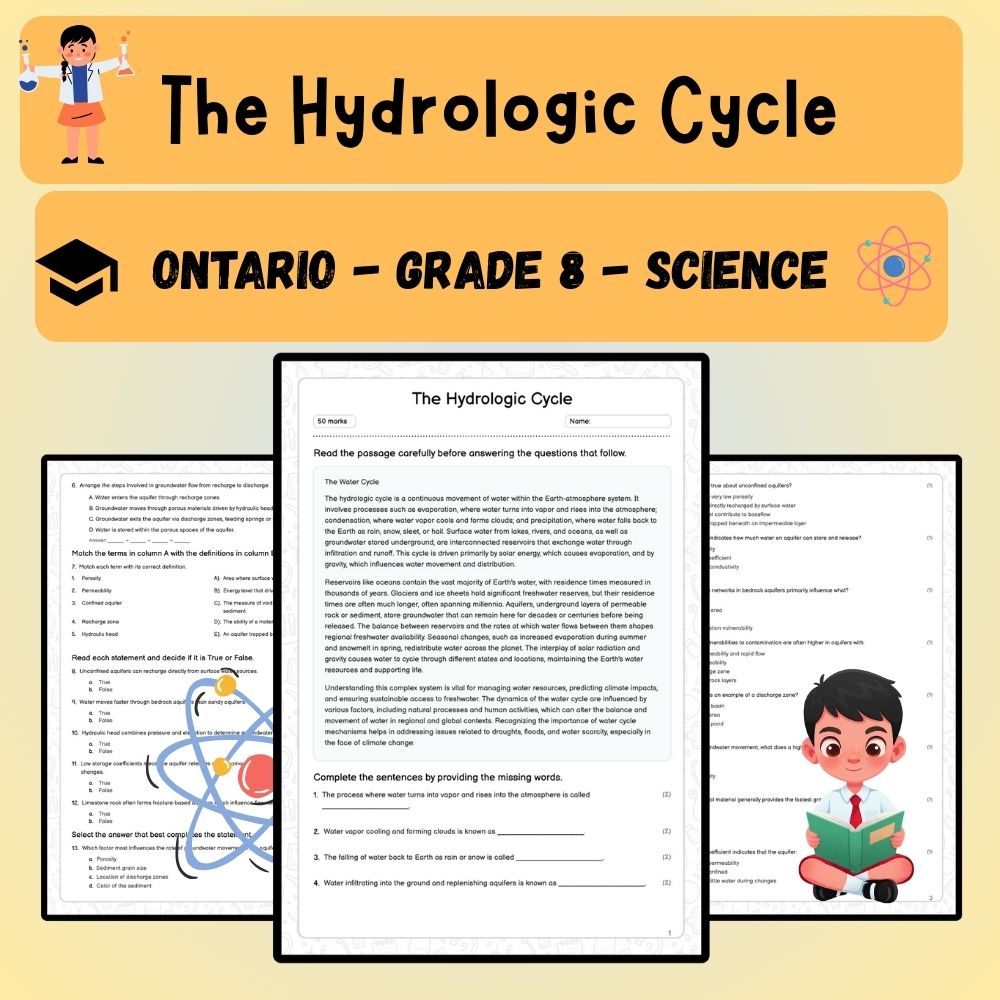
Grade 8 Science | The Hydrologic Cycle Worksheet (PDF)
Created byPrism Point LearningLearning Objectives
- Describe the key processes involved in the water cycle, including evaporation, condensation, precipitation, infiltration, and runoff.
- Explain the concepts of reservoirs, residence times, and the influence of solar energy and gravity on water movement.
- Analyze the importance of water redistribution for freshwater availability at regional scales.
Also included in: Grade 8 Science Water Management Unit Watershed and Water Resources +1 more
Instant download
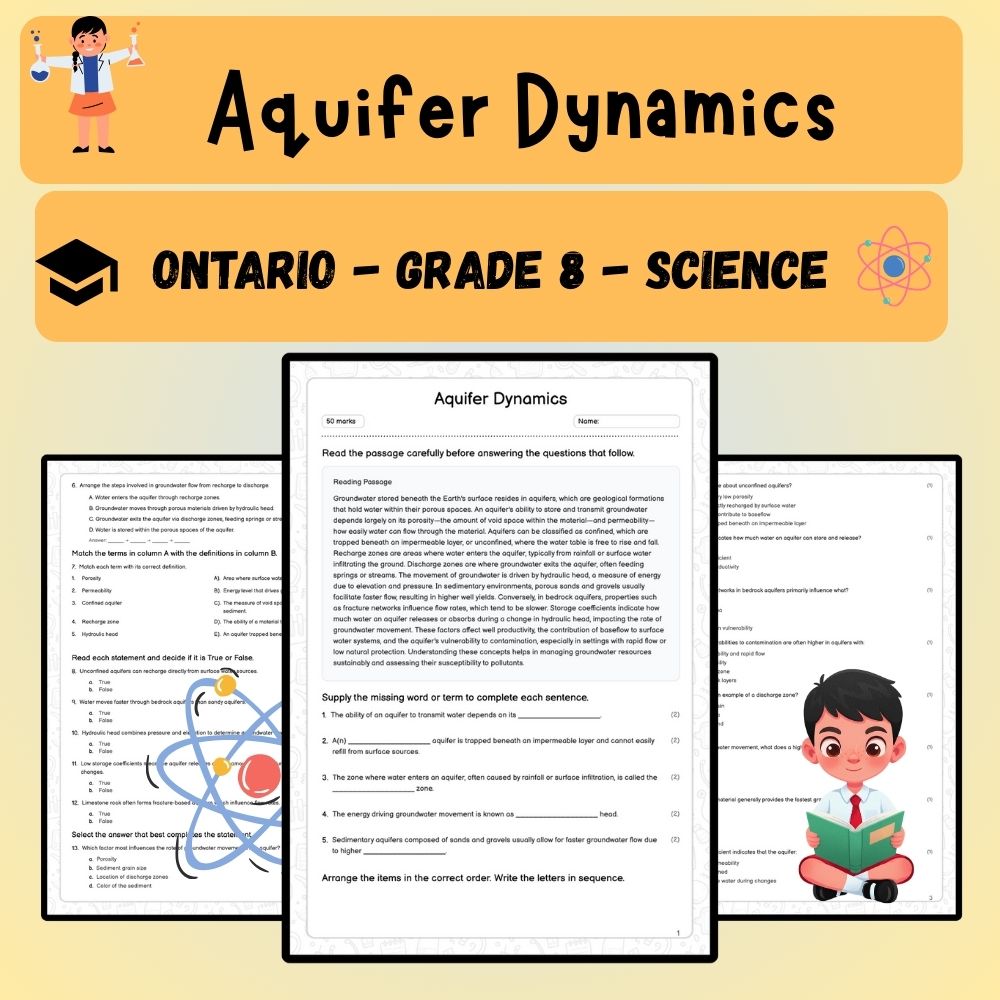
Grade 8 Science | Aquifer Dynamics Worksheet (PDF ) for Ontario Standards
Created byPrism Point LearningLearning Objectives
- Understand the structure and function of aquifers and groundwater flow systems.
- Identify key concepts such as porosity, permeability, confined and unconfined aquifers, recharge and discharge zones.
- Explain how sediment and bedrock properties affect groundwater movement and well yield.
Also included in: Grade 8 Science Water Management Unit Watershed and Water Resources +1 more
Instant download
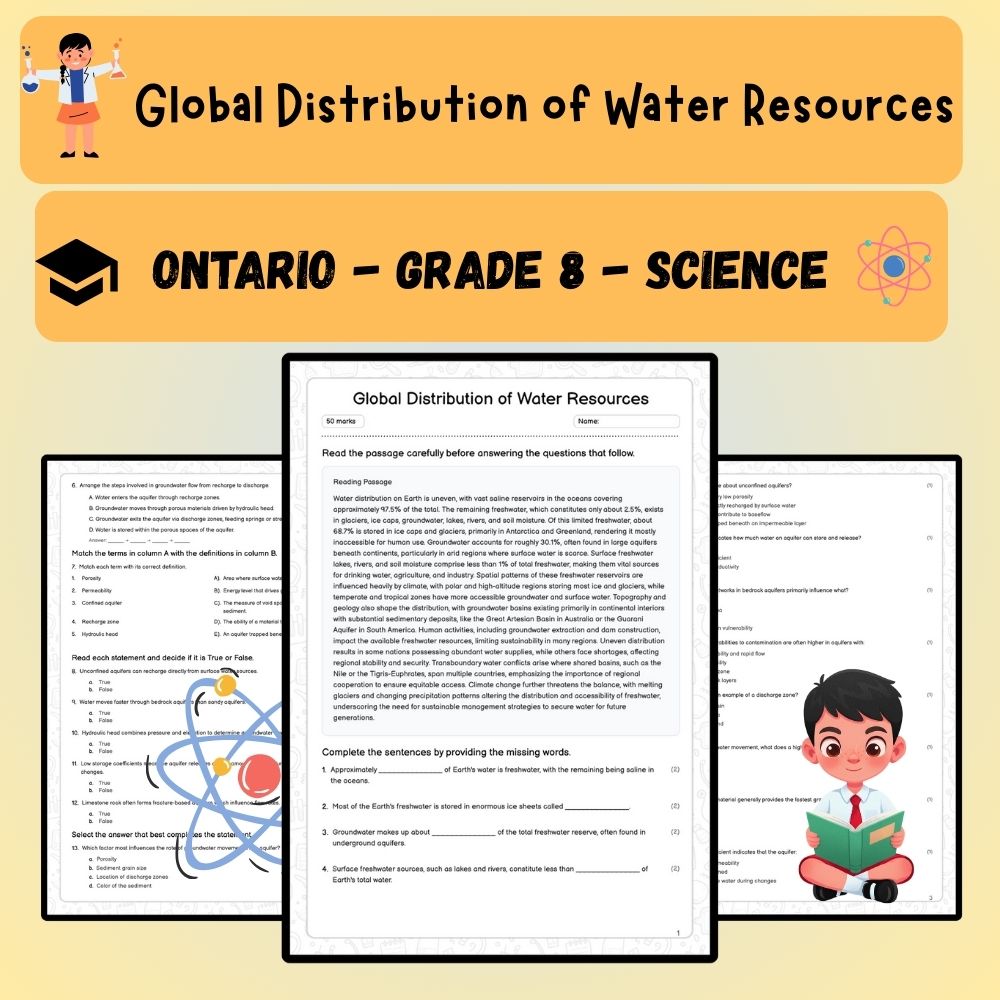
Grade 8 Science | Global Water Resources Distribution Worksheet (PDF)
Created byPrism Point LearningLearning Objectives
- Understand the distribution of freshwater and saline reservoirs globally
- Analyze how climate, topography, and geology influence water storage and access
- Evaluate the implications of uneven water distribution for human use and regional security
Also included in: Grade 8 Science Water Management Unit Watershed and Water Resources +1 more
Instant download
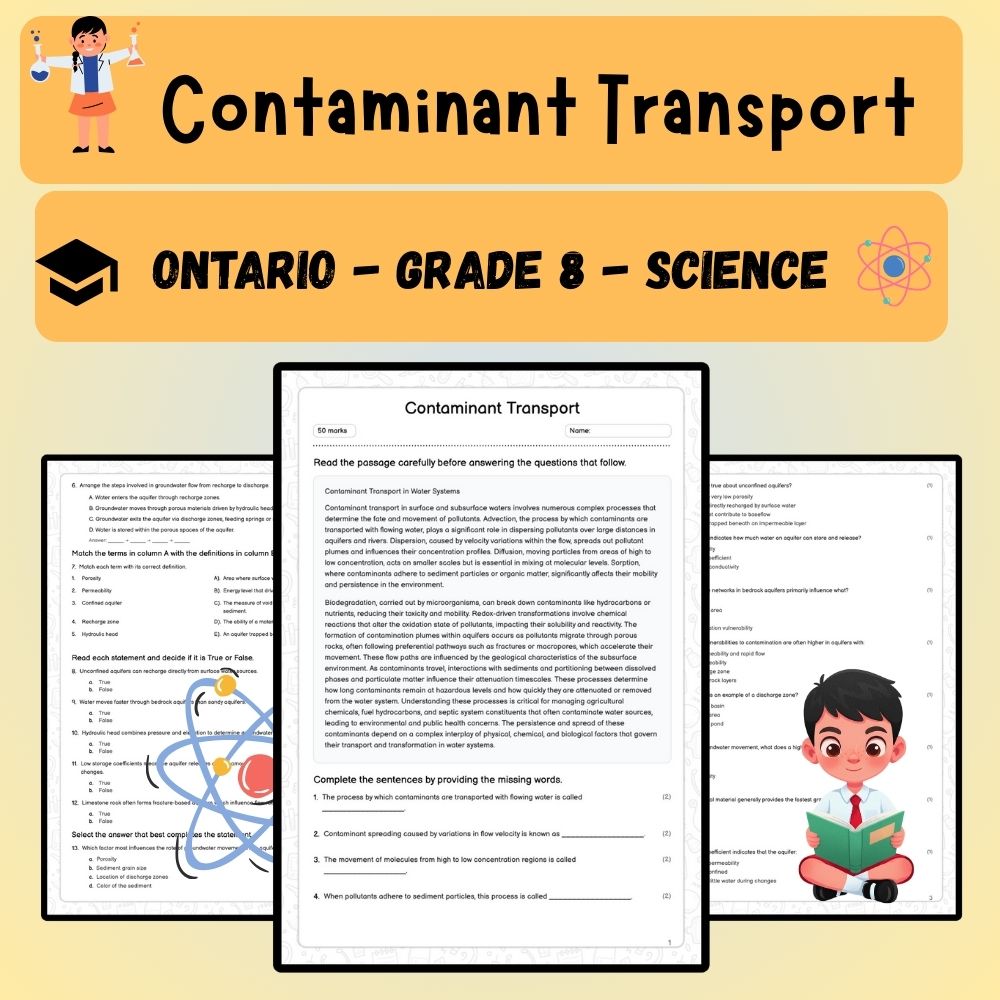
Grade 8 Science | Contaminant Transport Worksheet (PDF ) – Ontario Standards
Created byPrism Point LearningLearning Objectives
- Explain the processes involved in the movement of contaminants in surface and subsurface waters.
- Identify and differentiate between mechanisms such as advection, dispersion, diffusion, sorption, and biodegradation.
- Describe how contaminant plumes form and migrate in aquifers and fractured rock.
Also included in: Grade 8 Science Water Management Unit Watershed and Water Resources +1 more
Instant download

Grade 8 Science | Hydrologic Measurement Worksheet (PDF )
Created byPrism Point LearningLearning Objectives
- Understand the methods used for measuring water quantity and quality in hydrology.
- Identify various instruments and techniques used in stream gauging, sensor monitoring, and remote sensing.
- Explain conceptual factors such as precision, temporal resolution, and sampling frequency in water data collection.
Also included in: Grade 8 Science Water Management Unit Watershed and Water Resources +1 more
Instant download
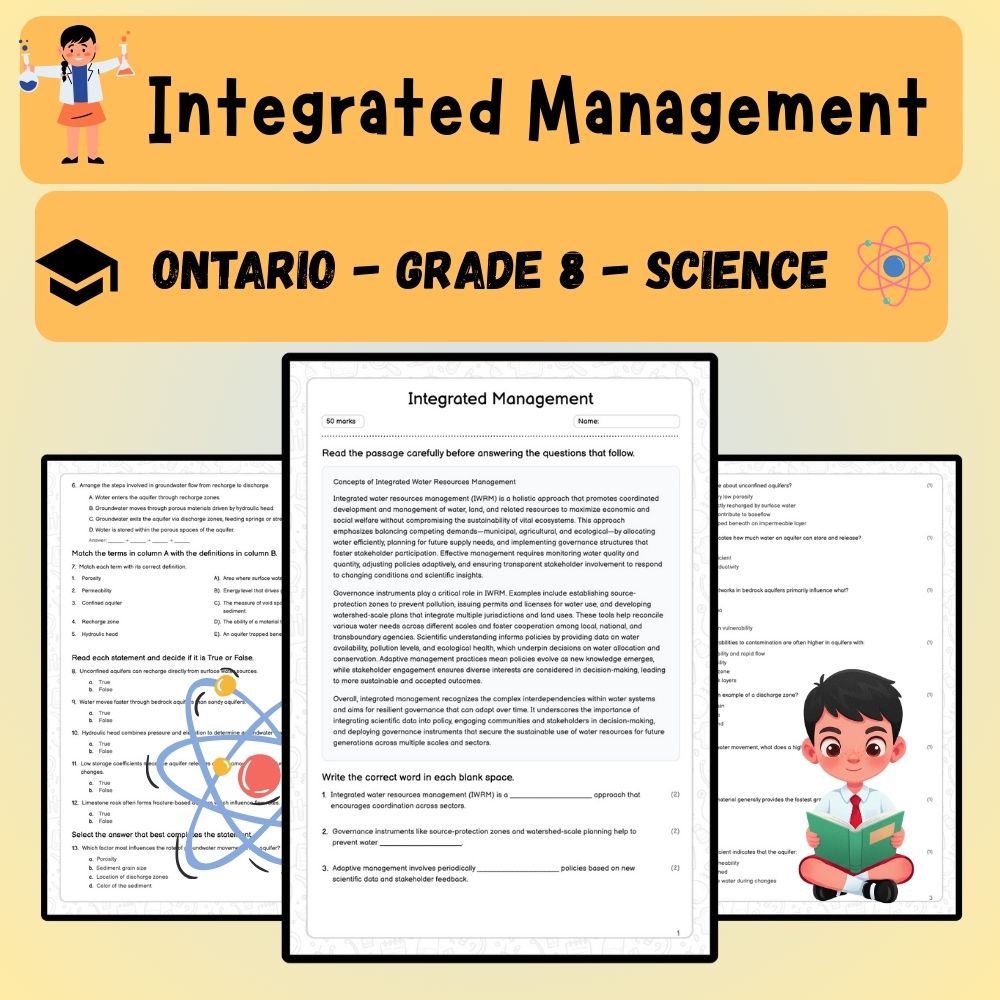
Grade 8 Science – Integrated Water Management Worksheet (PDF )
Created byPrism Point LearningLearning Objectives
- Understand the key concepts of integrated water resources management, including allocation, supply planning, and governance.
- Apply knowledge of governance instruments and stakeholder roles in managing water resources.
Also included in: Grade 8 Science Water Management Unit Watershed and Water Resources +1 more
Instant download

Two-Dimensional Motion Worksheet Pack | Grade 9 AP Science Practice
 Created byBright Quill Resources
Learning Objectives
- Decompose two-dimensional motion into independent perpendicular components and use them to predict projectile behavior
- Use component kinematics equations to find time-of-flight, maximum height (apex), and range for projectile motion
- Translate between component equations and combined motion descriptions using vector addition
Instant download

Mutation Effects Worksheet | Grade 8 Science NGSSS Genetics + Answer Key
 Created byEvergreen Desk Education
Learning Objectives
- Explain how mutations in DNA can change proteins and affect traits.
- Identify different sources of mutations and describe how they impact populations over generations.
- Distinguish between harmful, neutral, and sometimes beneficial mutation effects under environmental conditions.
Instant download
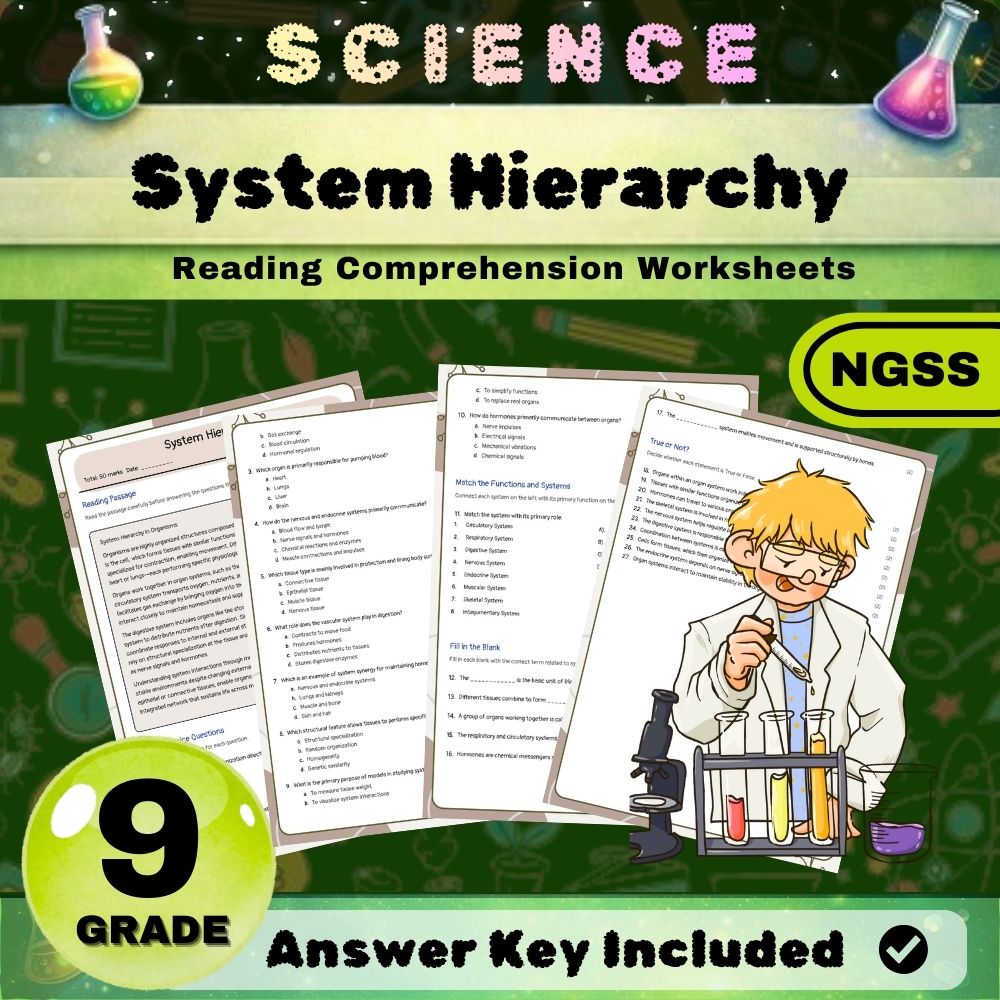
Grade 9 Science | System Hierarchy Worksheet (NGSS) – PDF
Created byMaple Path LearningLearning Objectives
- Describe how cells organize into tissues, organs, and organ systems.
- Explain the interactions between different organ systems such as circulatory-respiratory coupling and digestive-vascular transport.
- Analyze the structural specialization of tissues and organs in supporting organism functions.
Also included in: Grade 9 Science NGSS| From Molecules to Organisms: Structures & Processes Bundle +1 more
Instant download

Grade 9 Science | Feedback Mechanisms Worksheet (NGSS) (PDF)
Created byMaple Path LearningLearning Objectives
- Describe the roles of negative and positive feedback in maintaining internal stability.
- Identify physiological processes involved in thermoregulation, blood glucose regulation, and osmoregulation.
- Distinguish between rapid responses and slower hormonal adjustments in feedback control.
Also included in: Grade 9 Science NGSS| From Molecules to Organisms: Structures & Processes Bundle +1 more
Instant download
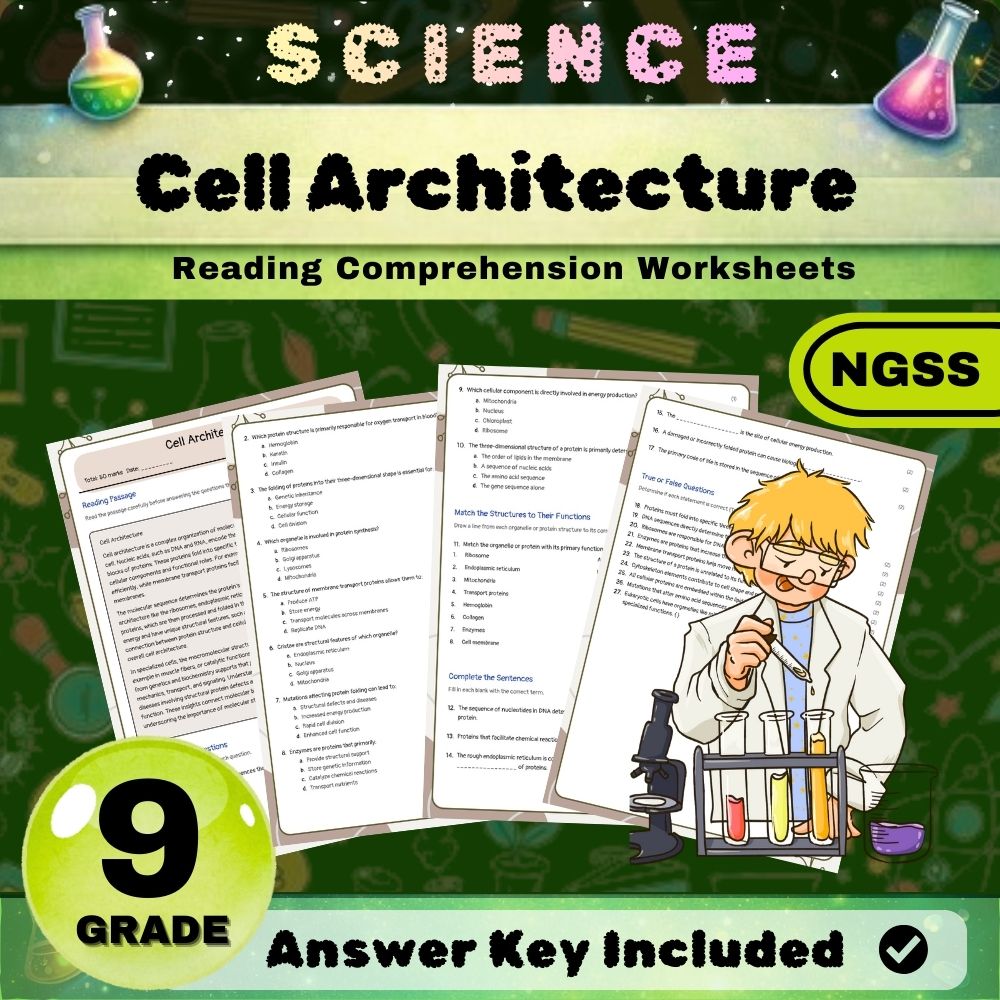
Grade 9 Science | Cell Architecture Worksheet (NGSS) (PDF)
Created byMaple Path LearningLearning Objectives
- Explain how nucleic acid sequences determine amino acid chains and three-dimensional protein structures.
- Connect molecular coding and folding to organelle architecture such as ribosomes, endoplasmic reticulum, and mitochondria.
- Understand how protein structure relates to cellular functions like transport and catalysis.
Also included in: Grade 9 Science NGSS| From Molecules to Organisms: Structures & Processes Bundle +1 more
Instant download
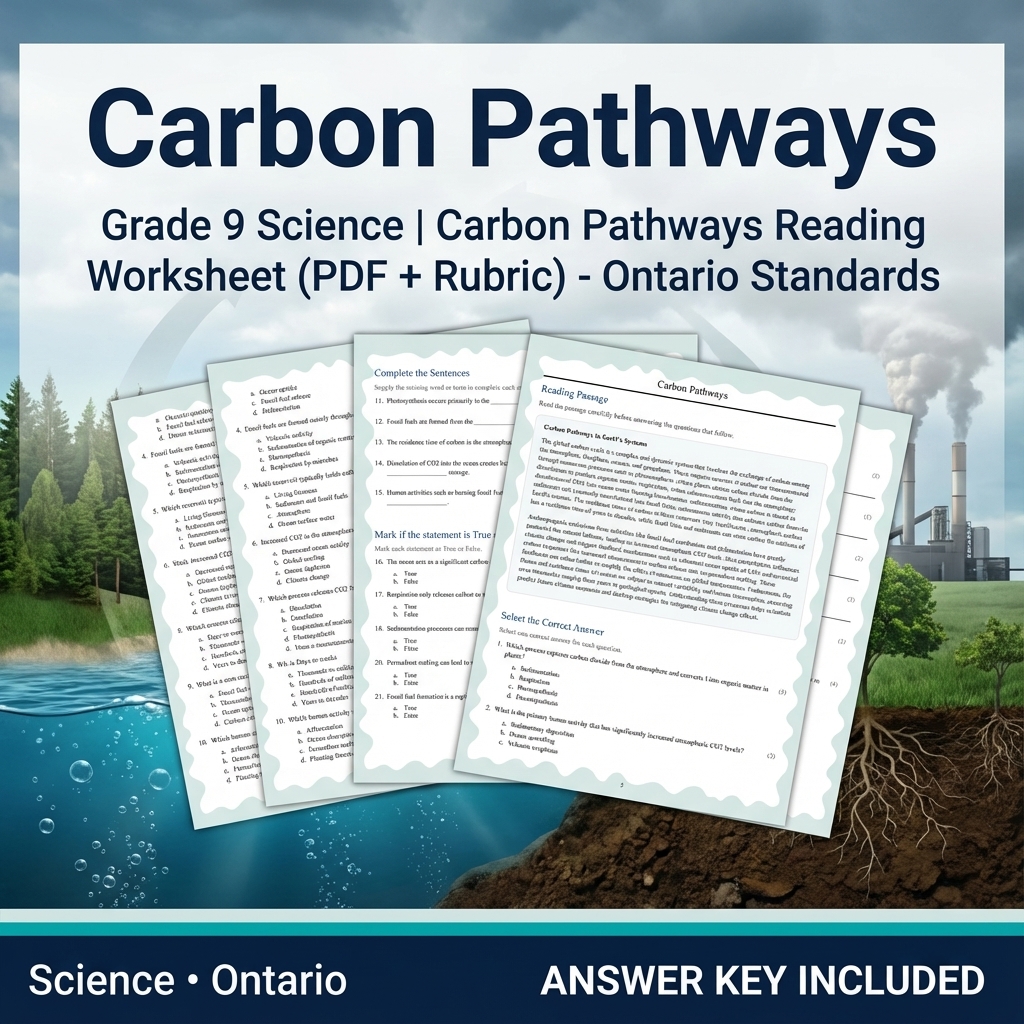
Grade 9 Science | Carbon Pathways Reading Worksheet (PDF + Rubric)
JCreated byJ.S SheetsLearning Objectives
- Identify major carbon reservoirs and understand the fluxes that move carbon among different Earth systems.
- Quantify the residence times of carbon in atmosphere, biosphere, oceans, and geosphere.
- Describe processes such as photosynthesis, respiration, dissolution, and sedimentation in the carbon cycle.
Also included in: Grade 9 Science | Earth Processes & Celestial Phenomena Worksheets Collection +1 more
Instant download
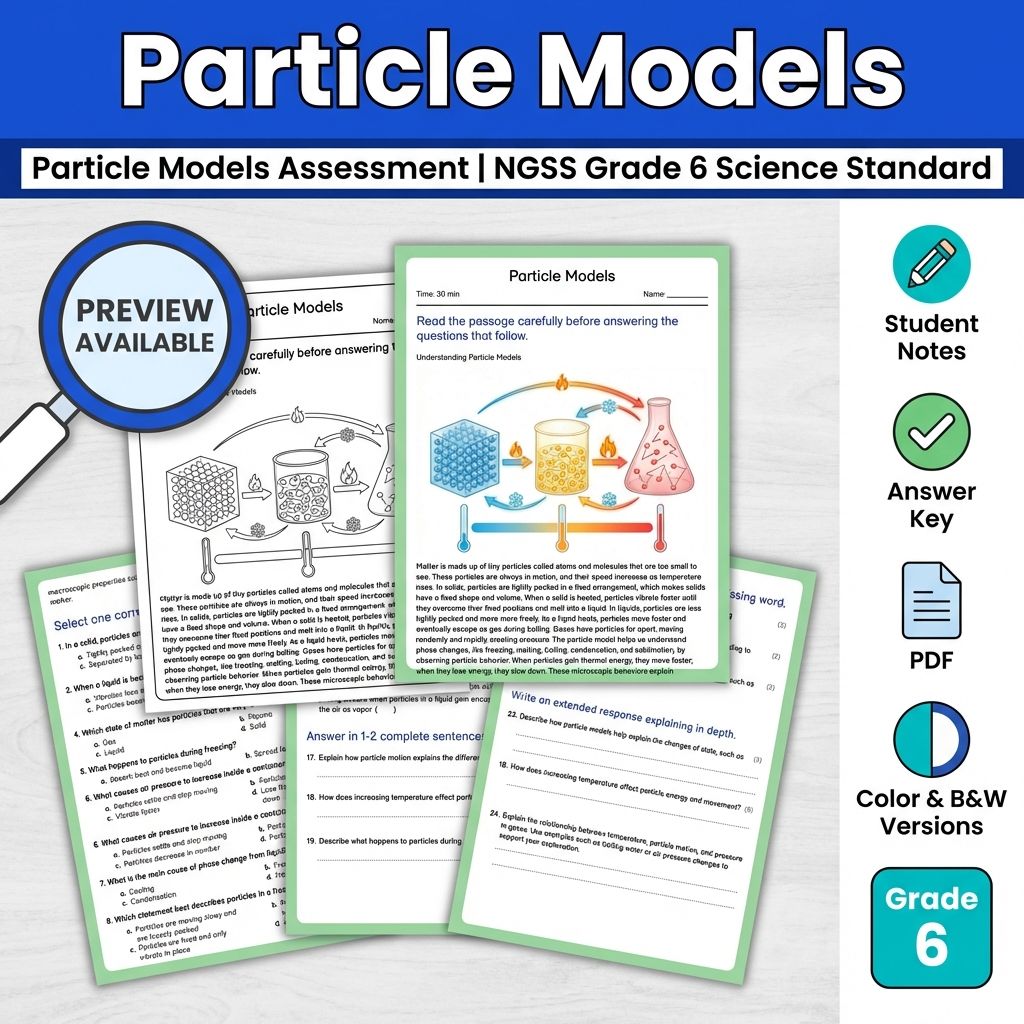
Particle Models Assessment | NGSS Grade 6 Science Standard
Created byPrism Point LearningLearning Objectives
- Explain matter as composed of particles too small to see using particle models.
- Describe how particle motion, collisions, and spacing relate to states of matter and phase changes.
- Relate temperature and thermal energy to particle kinetic energy and pressure in gases.
Also included in: Grade 6 Science Mini Bundle | Matter and Its Interactions NGSS Not Specified +1 more
Instant download
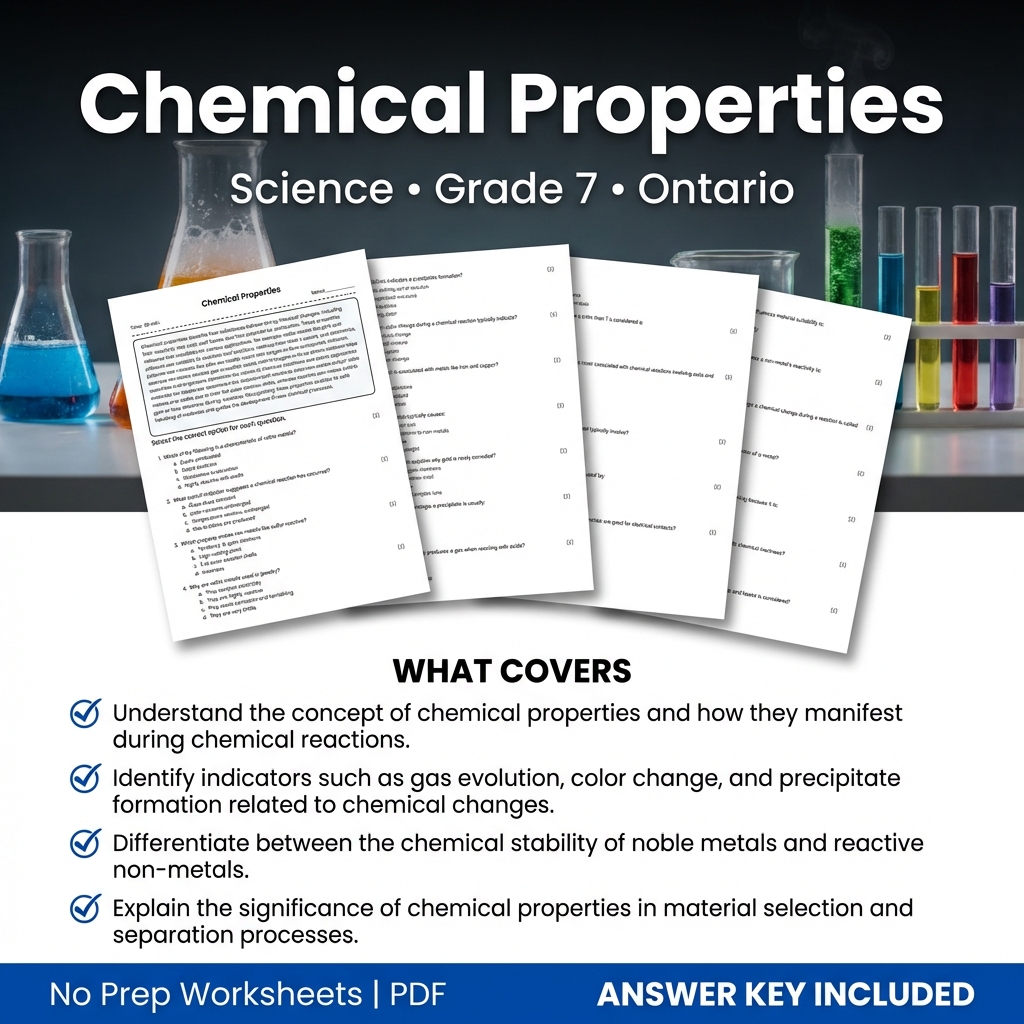
Grade 7 Science Worksheet on Chemical Properties | Classroom Printable PDF
Created byCoral Reef LearningLearning Objectives
- Understand the concept of chemical properties and how they manifest during chemical reactions.
- Identify indicators such as gas evolution, color change, and precipitate formation related to chemical changes.
- Differentiate between the chemical stability of noble metals and reactive non-metals.
Instant download
Grade 7 Science | Energy Transformations Worksheet (Answer Key) NGSS Aligned
Created byBright Mind ResourcesLearning Objectives
- Understand how light energy is converted into chemical energy during photosynthesis.
- Describe how cellular respiration releases stored energy for cellular processes.
- Connect the processes occurring in chloroplasts and mitochondria across different organisms.
Instant download

Mechanical Energy Test Prep Worksheets | Grade 9 Science Assessment
Created byPrism Point LearningLearning Objectives
- Calculate kinetic energy and gravitational potential energy and relate them to mechanical energy in real situations.
- Explain how work and power are connected to energy transfer and energy conservation.
- Interpret how friction and other non-conservative forces change a mechanical energy budget.
Also included in: Grade 9 Energy Test Prep Science Lesson Bundle Worksheets – NGSS Review
Instant download
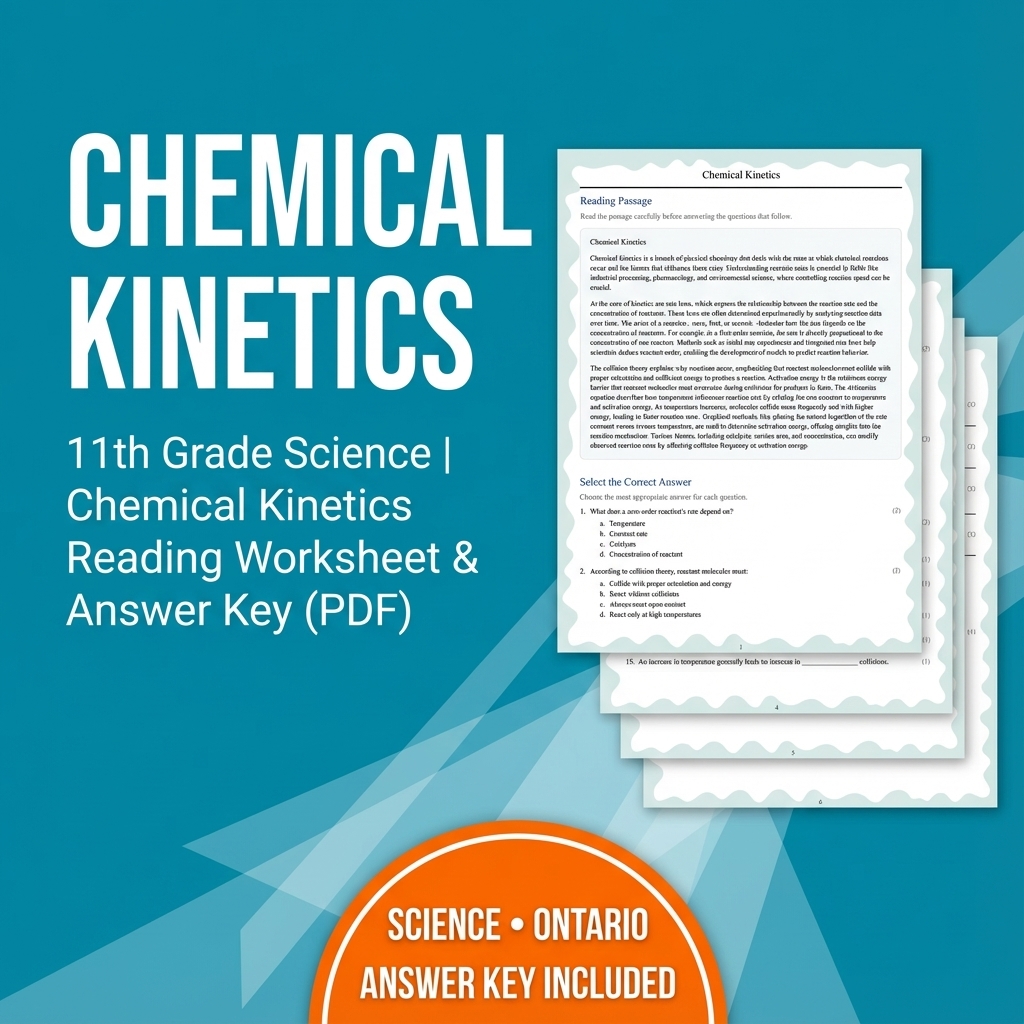
11th Grade Science | Chemical Kinetics Reading Worksheet & Answer Key (PDF)
JCreated byJ.S SheetsLearning Objectives
- Explain the concept of rate laws and how they characterize the speed of chemical reactions.
- Determine reaction order from experimental rate data.
- Describe the collision theory and the role of activation energy in reaction rates.
Also included in: Grade 11 Science Unit Bundle | Chemical Bonding & Reaction Energetics +1 more
Instant download
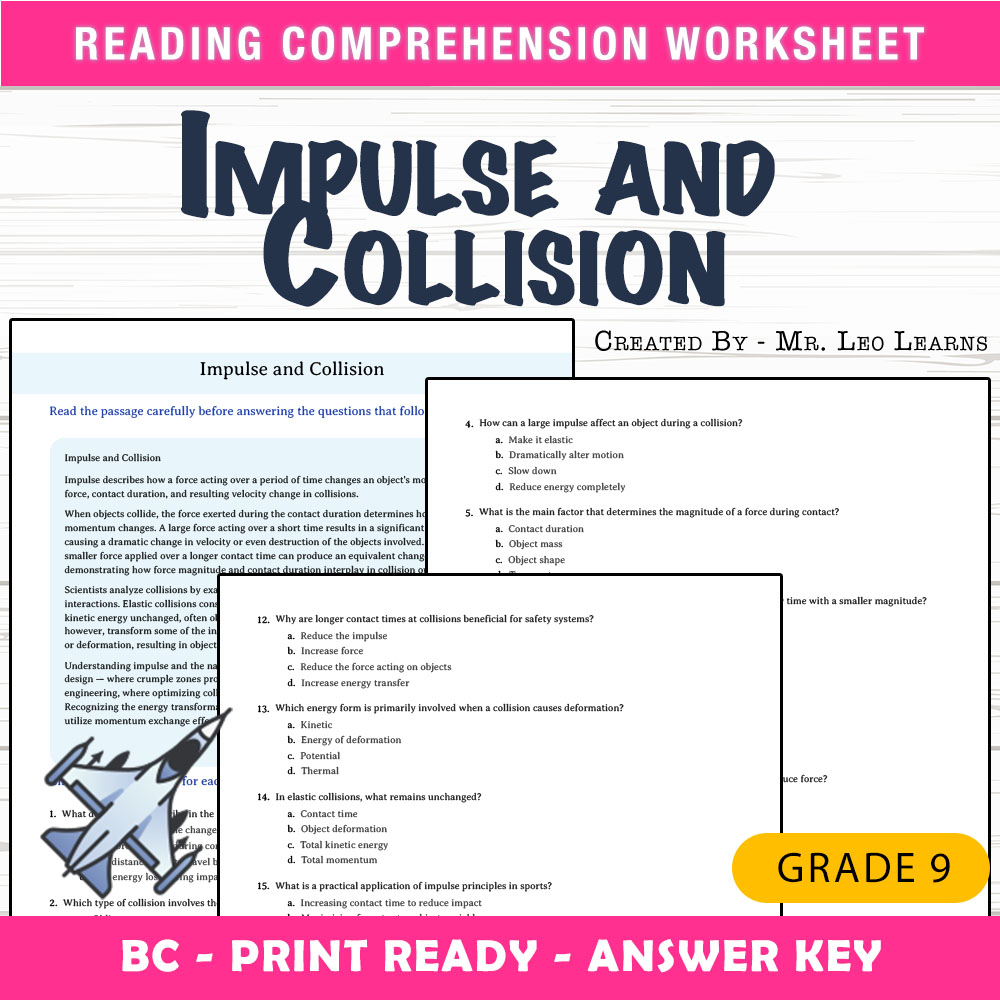
Grade 9 Science — Worksheet MCQ Paper for Mastering Impulse and Collision
 Created byThe Resource Hub
Learning Objectives
- Understand how impulse relates force, contact time, and change in momentum during collisions.
- Differentiate between elastic and inelastic collisions and their energy transformations.
- Apply the impulse-momentum principle to analyze collision scenarios.
Also included in: Grade 9 Science Forces & Motion Worksheet Bundle – BC Curriculum (15 Worksheets) +1 more
Instant download

Grade 9 Science | Gravity and Orbits Worksheet (PDF) for Standard Mastery
Created byEvergreen Desk EducationLearning Objectives
- Explain how gravity supplies the centripetal force that keeps planets and moons in curved orbits
- Compare how orbital speed and distance change across elliptical and circular paths
- Use orbital motion to predict recurring sky patterns over time
Also included in: Grade 9 Earth and Space Science Lesson Bundle (General) Science Worksheets +1 more
Instant download

Grade 8 Mass and Weight in Gravity Science Worksheet | Alberta
 Created byBRIGHT PATH RESOURCES
Learning Objectives
- Define mass and weight using correct scientific meaning
- Explain how weight depends on mass and gravitational acceleration
- Use examples to distinguish mass (matter) from weight (gravity force)
Also included in: Grade 8 Alberta Science Forces and Motion Physics Worksheet Bundle +1 more
Instant download

Projectile Motion Worksheet for Grade 11 Science | Ontario Standards
Created byCoral Reef LearningLearning Objectives
- Understand the independence of orthogonal components in two-dimensional projectile motion.
- Apply kinematic equations and trigonometric relations to solve problems involving launch angle and initial speed.
- Calculate time of flight, maximum height, and range for projectile trajectories.
Instant download

Grade 8 Science Worksheet | Gravity and Orbits Space Systems Activity (CA Standards)
Created byEvergreen Desk EducationLearning Objectives
- Explain how gravitational attraction provides the centripetal acceleration that keeps an orbiting object moving on a curved path
- Compare how orbital speed and orbital period change with distance from a massive body
- Describe how satellites and moons follow repeating orbital patterns due to gravity and inertia
Instant download

Equilibrium Practice Worksheet | Grade 7 Science NGSS Review
Created byPrism Point LearningLearning Objectives
- Explain equilibrium as a condition where the vector sum of forces is zero, resulting in constant velocity or rest
- Differentiate static equilibrium and dynamic equilibrium using examples involving normal and gravitational forces
- Use qualitative reasoning to predict how motion changes when net force and net acceleration are (or are not) zero
Also included in: Grade 7 Forces & Interactions Science Lesson Bundle for NGSS Review
Instant download
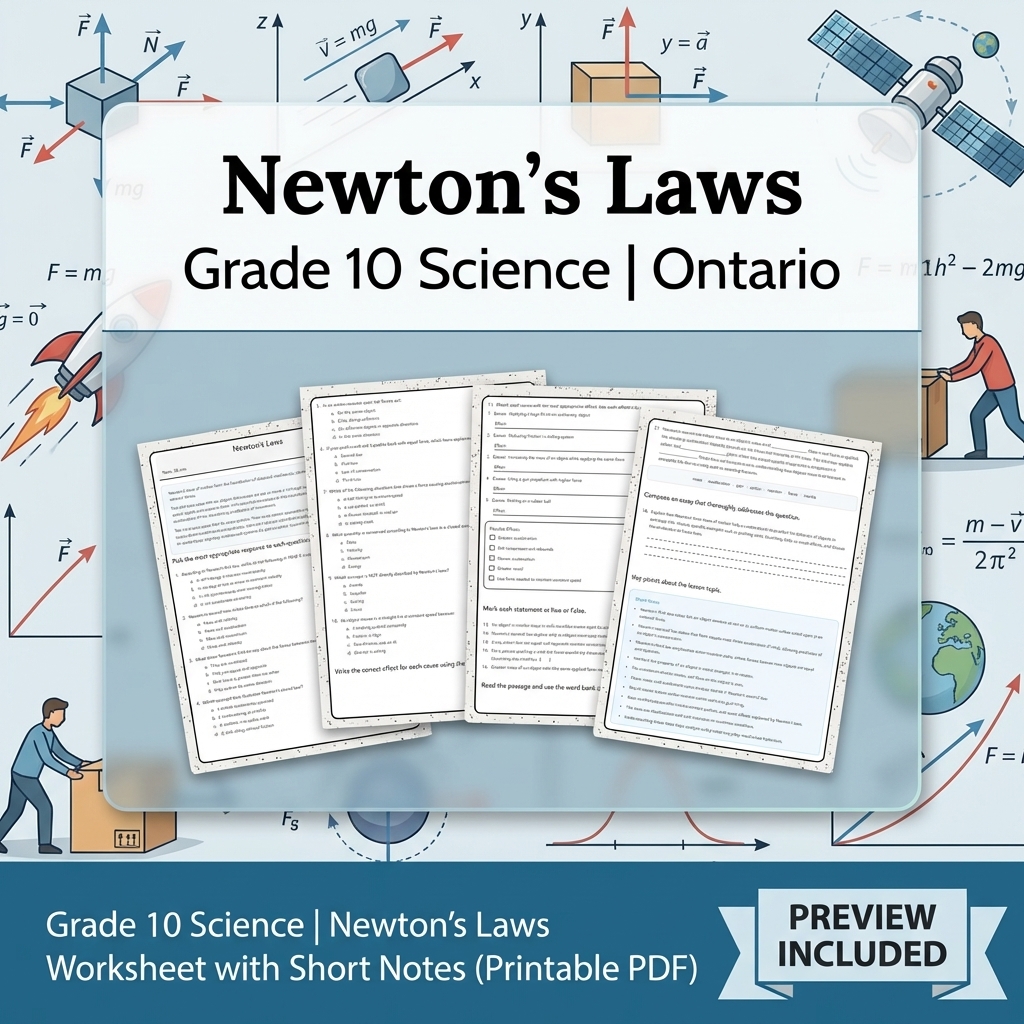
Grade 10 Science | Newton's Laws Worksheet with Short Notes (Printable PDF)
 Created byMeadowlark Worksheets
Learning Objectives
- Understand the three laws of motion and their conceptual significance.
- Apply Newton's second law to predict motion outcomes in various systems.
- Explain action-reaction pairs and conservation principles related to Newton's third law.
Also included in: Grade 10 Science Lesson Group: Motion & Forces Ontario Curriculum Bundle +1 more
Instant download
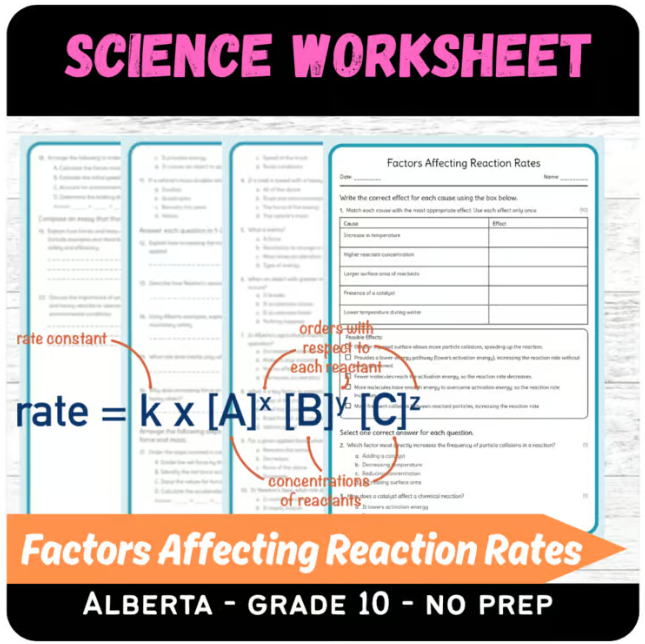
Grade 10 Science | Factors Affecting Reaction Rates Worksheet (PDF)
Created byBright Mind ResourcesLearning Objectives
- Identify variables that influence the speed of chemical reactions.
- Explain how temperature, concentration, surface area, and catalysts modify reaction rates in different contexts.
- Analyze practical examples of reaction rate modifications in Alberta's industry and environment.
Instant download

Grade 8 Particle Theory Worksheet | Alberta Practice PDF
 Created byClear Sky Classroom
Learning Objectives
- Explain how particle motion and arrangement relate to solids, liquids, and gases
- Use particle theory to predict changes of state when temperature changes
- Describe observable properties such as rigidity, flow, and compressibility using particle-level ideas
Instant download

High School Biology | Genetic Code Worksheet (AP Standards) (PDF)
Created byEvergreen Desk EducationLearning Objectives
- Explain how the structure of nucleic acids and base-pairing rules encode hereditary information
- Describe how DNA information is copied (replication), transferred (transcription), and converted to protein (translation)
- Evaluate how mutations, recombination, and reading frames can change gene expression and phenotype
Also included in: Grade 11 Biology and Ecosystems Science Lesson Bundle (AP) +1 more
Instant download

Material Properties and Structural Trade-Offs Worksheets Grade 3
Created byPrism Point LearningLearning Objectives
- Compare common building materials using density, stiffness, and strength properties.
- Explain how brittleness, corrosion resistance, and load type affect structural stability.
- Choose suitable materials for a simple construction scenario based on trade-offs.
Instant download

Grade 9 Science | Metabolic Regulation - Daily Reading Comprehension
Created byCoral Reef LearningLearning Objectives
- Understand the key regulatory mechanisms in metabolism, including allosteric enzyme control, covalent modification, and compartment-specific regulation.
- Explain feedback inhibition and the hormonal signals that influence metabolic flux between catabolism and anabolism.
- Model how enzyme kinetics and substrate concentrations affect pathway rates.
Also included in: Biology and Ecosystems Lesson Bundle – Grade 9 Science AP Daily Reading +1 more
Instant download
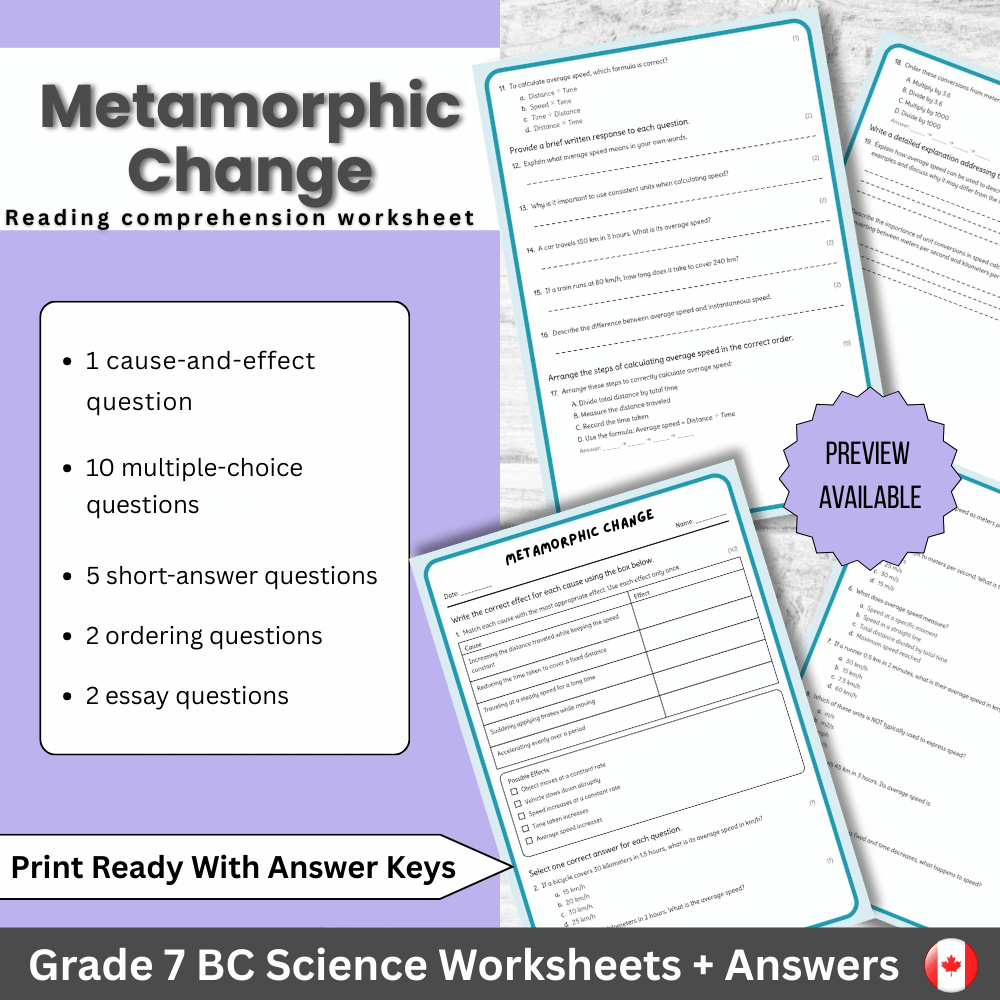
Grade 7 Science | Metamorphic Change Worksheet (Answer Key) | BC Standards
Created byBright Mind ResourcesLearning Objectives
- Describe the process of metamorphism and how it alters rocks.
- Differentiate between contact and regional metamorphism.
- Identify mineral assemblages that indicate metamorphic grade and history.
Instant download

Food Webs Worksheet for Grade 6 Science | Standards-Aligned Assessment
JCreated byJ.S SheetsLearning Objectives
- Understand the concept of a food web and its interconnected feeding relationships.
- Identify how changes in one species can affect the entire ecosystem.
- Recognize the importance of biodiversity and connectivity in ecosystem stability.
Instant download
Browse more categories
About Science Worksheets
Find Science worksheets spanning core skills, practice, and review. All 44,628 resources are instant PDF downloads for the classroom or home.
Every worksheet on MyTeachingSheets is created by independent teacher-authors and reviewed before publication. All resources download as printable PDFs for classroom, homework, or at-home practice, and many include answer keys. Preview any worksheet free before buying.