
Science Worksheets
44,628 subject resources
Grade 10 Science – Homeostasis Basics Worksheet (TEKS) PDF
 Created byEvergreen Desk Education
Learning Objectives
- Explain how homeostasis maintains stable internal conditions using set points, sensors, and effectors
- Describe how negative feedback loops counteract changes in temperature, fluid balance, or blood glucose
- Connect organs and body systems (nervous, endocrine, renal, and digestive) to biochemical equilibrium
Instant download
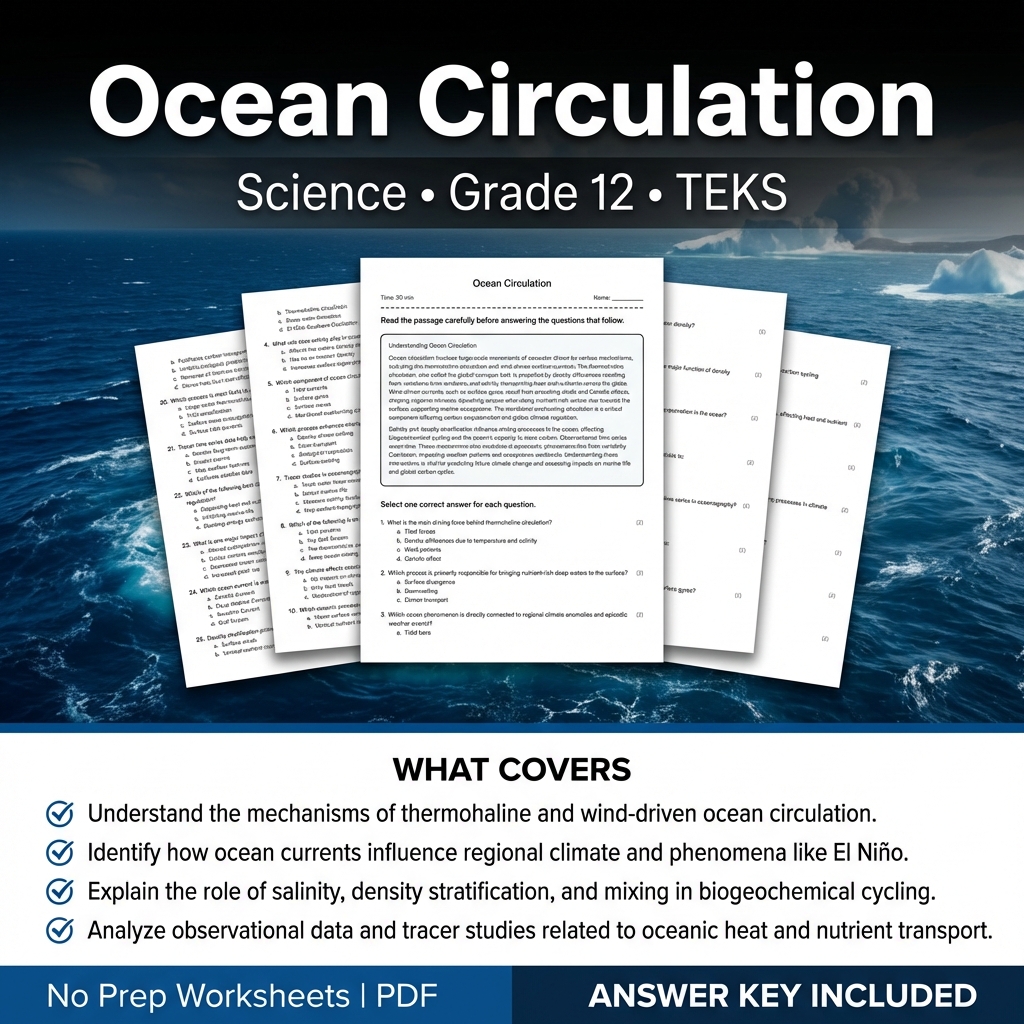
Ocean Circulation Science Worksheet Grade 12 | TEKS Alignment
 Created byCoral Reef Learning
Learning Objectives
- Understand the mechanisms of thermohaline and wind-driven ocean circulation.
- Identify how ocean currents influence regional climate and phenomena like El Niño.
- Explain the role of salinity, density stratification, and mixing in biogeochemical cycling.
Instant download

Atomic Models Worksheet | NGSS-Aligned Grade 7 Science Practice PDF
JCreated byJ.S SheetsLearning Objectives
- Understand different types of atomic models and their representations.
- Identify the relationship between subatomic particles, atomic number, and chemical formulas.
- Distinguish between molecular structures and extended network structures based on bonding patterns.
Also included in: Grade 7 Structure and Properties of Matter Science Lesson Bundle: NGSS +1 more
Instant download

Grade 10 Science – Reaction Types & Chemistry | Daily Reading Worksheet
 Created byBright Mind Resources
Learning Objectives
- Understand the different types of chemical reactions: synthesis, decomposition, single and double displacement, and combustion.
- Identify reaction patterns and characteristic reactant-product relationships.
- Recognize the conservation of atoms and use symbolic representation in reactions.
Also included in: Grade 10 Chemistry Science Daily Reading Worksheets Lesson Bundle | Ontario +1 more
Instant download
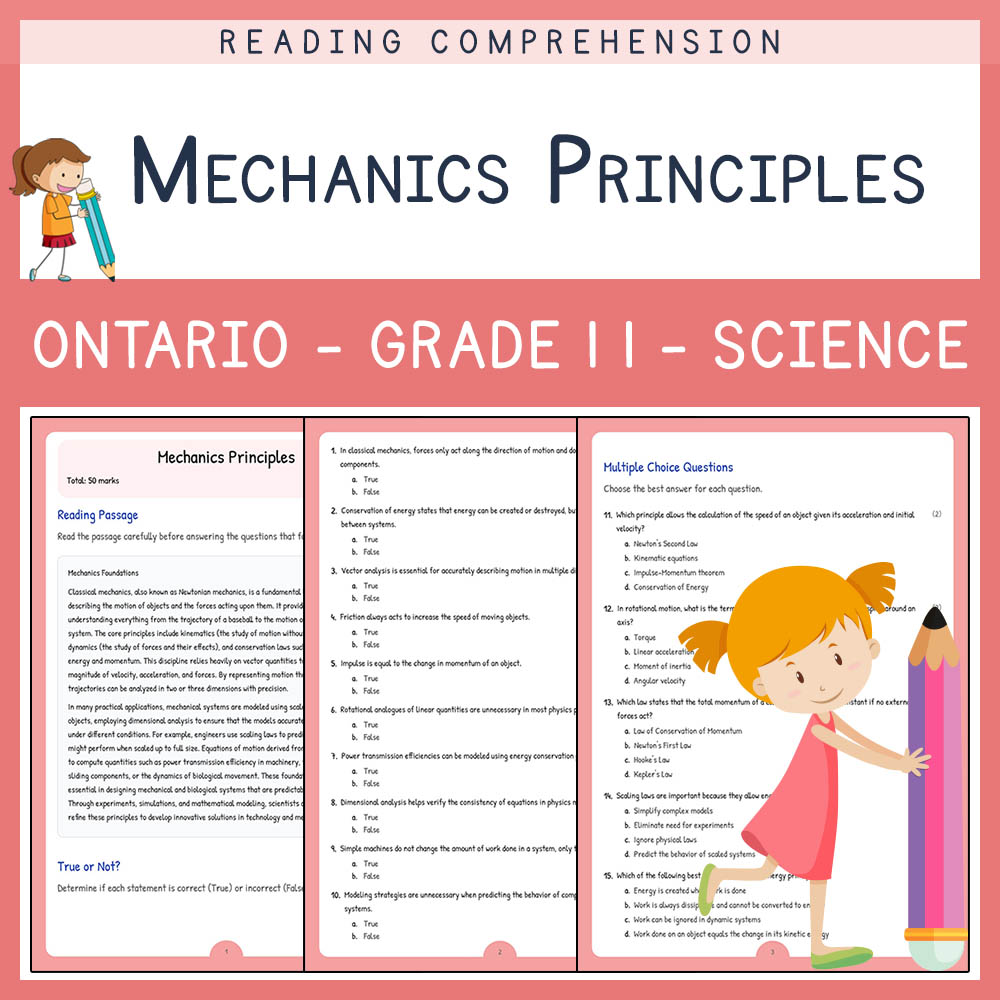
Grade 11 Science Assessment | Mechanics Principles Worksheet Elena | Ontario
 Created byLumora Learning
Learning Objectives
- Explain key concepts of classical mechanics including kinematics, dynamics, and conservation laws.
- Apply vector analysis to describe motion in physical systems.
- Solve problems related to forces, energy, impulse, and momentum in real-world contexts.
Instant download
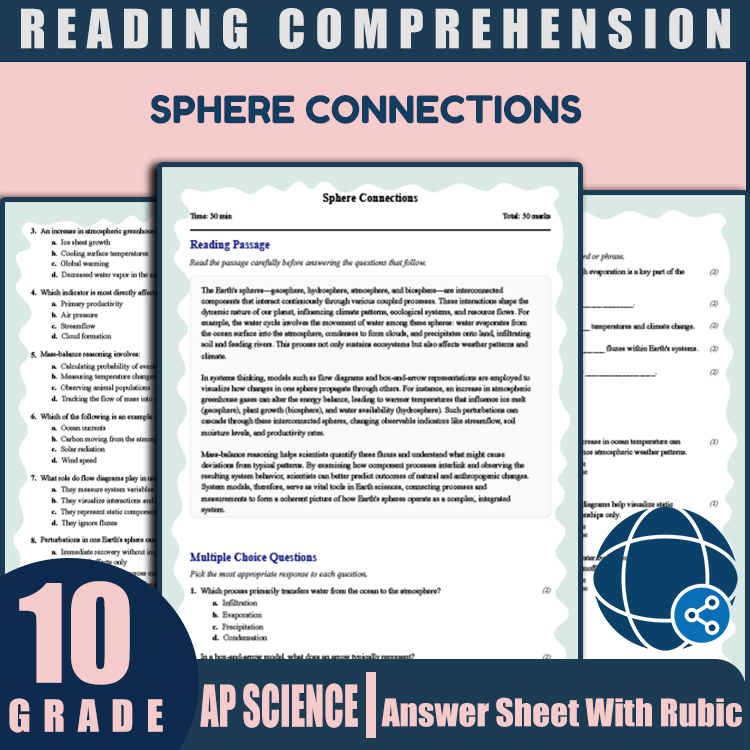
10th Grade Science | Sphere Connections Reading Worksheet (PDF + Answer Key)
JCreated byJ.S SheetsLearning Objectives
- Understand the interactions among the geosphere, hydrosphere, atmosphere, and biosphere through coupled processes such as the water cycle, biogeochemical fluxes, and ocean-atmosphere exchange.
- Use systems thinking tools like box-and-arrow models, flow diagrams, and mass-balance reasoning to analyze how perturbations propagate across Earth's spheres and influence observable indicators.
- Establish conceptual links between component processes and measurable system behaviors such as streamflow, soil moisture, and primary productivity.
Also included in: Grade 10 Science Unit | Earth Processes & Climate Worksheets (PDF + Answer Key) +1 more
Instant download
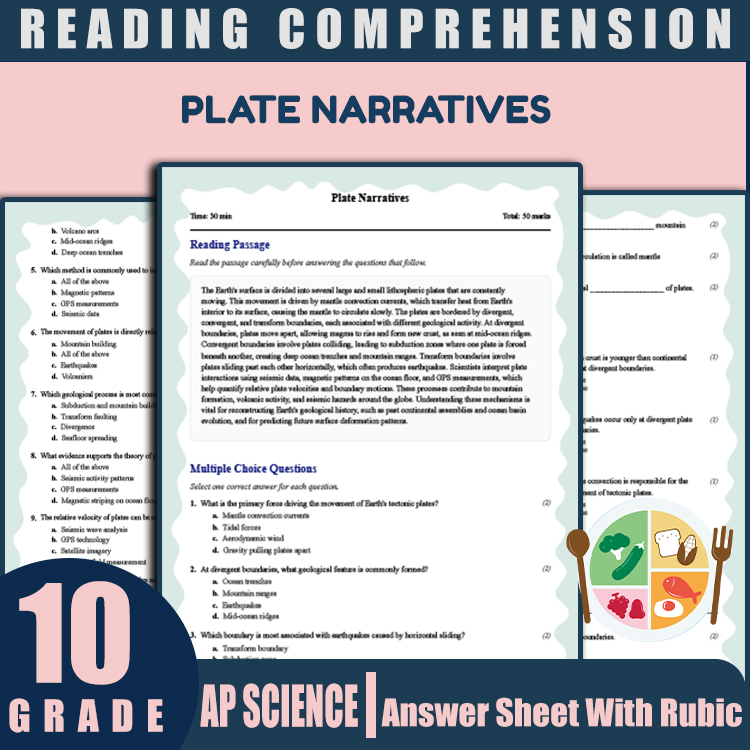
10th Grade Science | Plate Narratives Reading Worksheet (PDF + Answer Key)
JCreated byJ.S SheetsLearning Objectives
- Describe the mechanisms of plate motion, including mantle convection and subduction.
- Interpret tectonic settings using maps, cross-sections, and seismic evidence.
- Connect plate interactions to geological phenomena such as mountain building, volcanism, and earthquakes.
Also included in: Grade 10 Science Unit | Earth Processes & Climate Worksheets (PDF + Answer Key) +1 more
Instant download
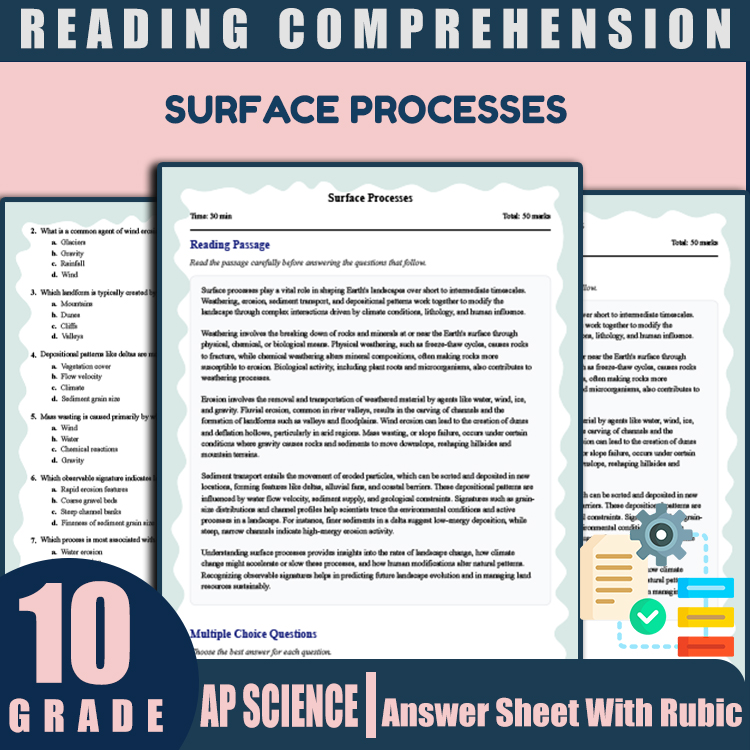
10th Grade Science | Surface Processes Reading Worksheet & Answer Key (PDF)
JCreated byJ.S SheetsLearning Objectives
- Describe the key surface processes such as weathering, erosion, sediment transport, and deposition.
- Interpret morphological changes in landscapes due to surface processes.
- Relate surface process patterns to climate, lithology, and human activities.
Also included in: Grade 10 Science Unit | Earth Processes & Climate Worksheets (PDF + Answer Key) +1 more
Instant download
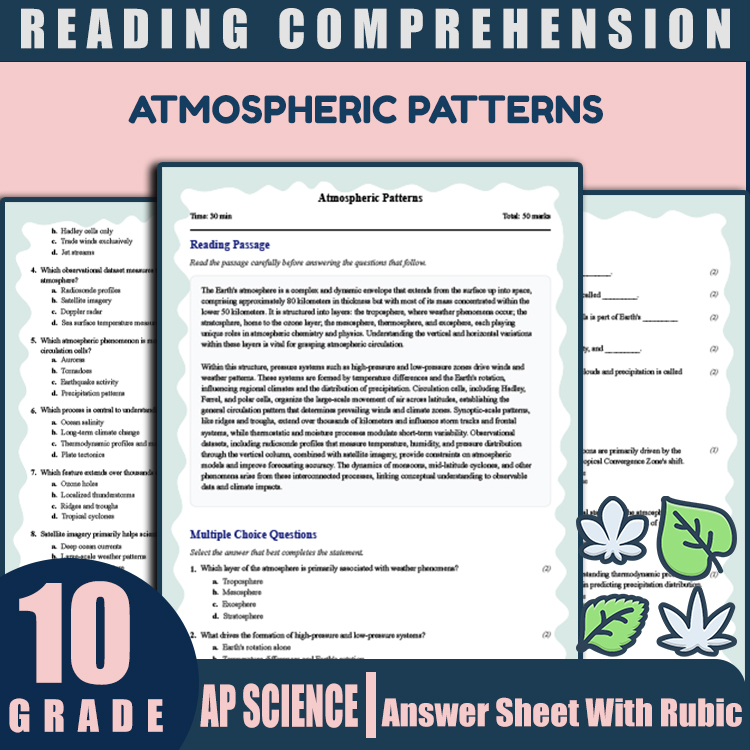
Grade 10 Science | Atmospheric Patterns Reading Worksheet (PDF + Rubric)
JCreated byJ.S SheetsLearning Objectives
- Describe the basic structure and components of Earth's atmosphere.
- Explain how pressure systems and circulation cells influence regional weather patterns.
- Understand how synoptic-scale atmospheric patterns relate to phenomena such as monsoons and cyclones.
Also included in: Grade 10 Science Unit | Earth Processes & Climate Worksheets (PDF + Answer Key) +1 more
Instant download
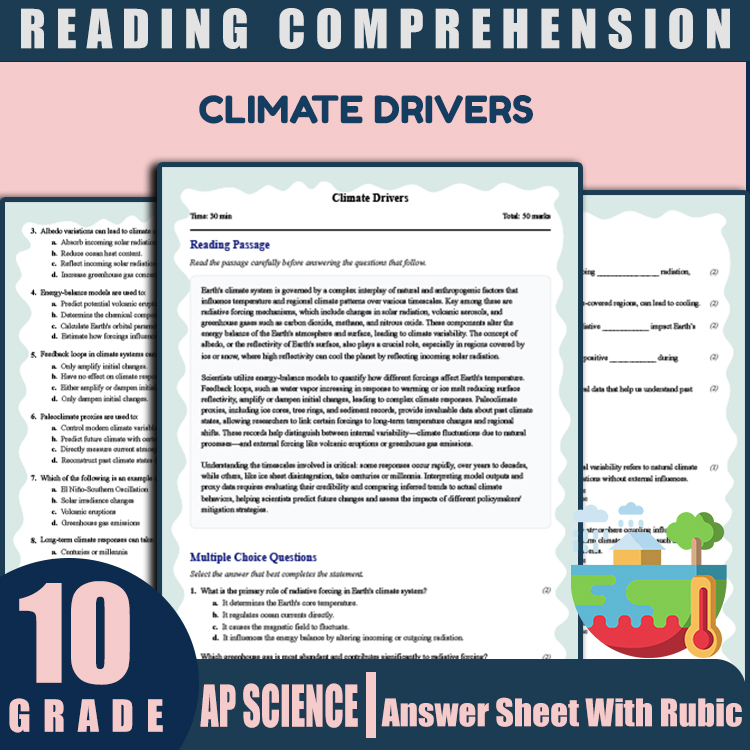
Grade 10 Science | Climate Drivers Reading Worksheet (PDF + Rubric)
JCreated byJ.S SheetsLearning Objectives
- Understand the key factors that influence Earth's climate, including radiative forcing, greenhouse gases, albedo variations, and ocean-atmosphere interactions.
- Analyze how energy-balance models and feedback mechanisms help explain climate variability and change.
- Interpret proxy records and model outputs to assess long-term climate trends and regional shifts.
Also included in: Grade 10 Science Unit | Earth Processes & Climate Worksheets (PDF + Answer Key) +1 more
Instant download

Adaptive Radiation Worksheet | Standards-Based Science Practice for Grade 9
JCreated byJ.S SheetsLearning Objectives
- Define adaptive radiation and describe how a single ancestral lineage can diversify into multiple species.
- Explain the roles of ecological niches, key innovations, and selective pressures in driving diversification.
- Use evidence and models to describe how gene flow, genetic drift, and natural selection shape evolutionary patterns.
Instant download
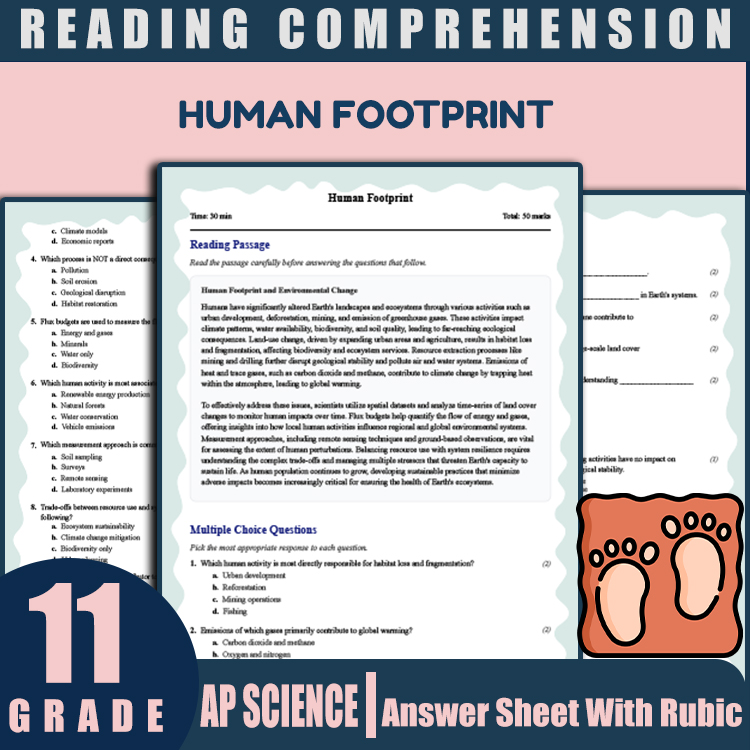
11th Grade Science | Human Footprint Reading Worksheet (PDF + Answer Key)
JCreated byJ.S SheetsLearning Objectives
- Understand the various ways human activities impact Earth's systems such as land use, resource extraction, and emissions.
- Analyze spatial data and time-series datasets to identify links between local human actions and regional environmental changes.
- Evaluate measurement approaches for quantifying human-induced perturbations and consider trade-offs between resource use and ecosystem resilience.
Also included in: Grade 11 Science Unit Bundle | Earth Systems & Climate Change Worksheets +1 more
Instant download

Grade 12 Science – Electron Configuration & Quantum Mechanics | Worksheet
Created byBright Mind ResourcesLearning Objectives
- Understand the principles of quantum numbers and their significance in electron placement.
- Identify the shapes and orientations of different atomic orbitals.
- Apply the Aufbau principle, Pauli exclusion principle, and Hund’s rule to determine electron configurations.
Also included in: Grade 12 Chemistry Science Lesson Bundle, Daily Reading Worksheets | TEKS +2 more
Instant download
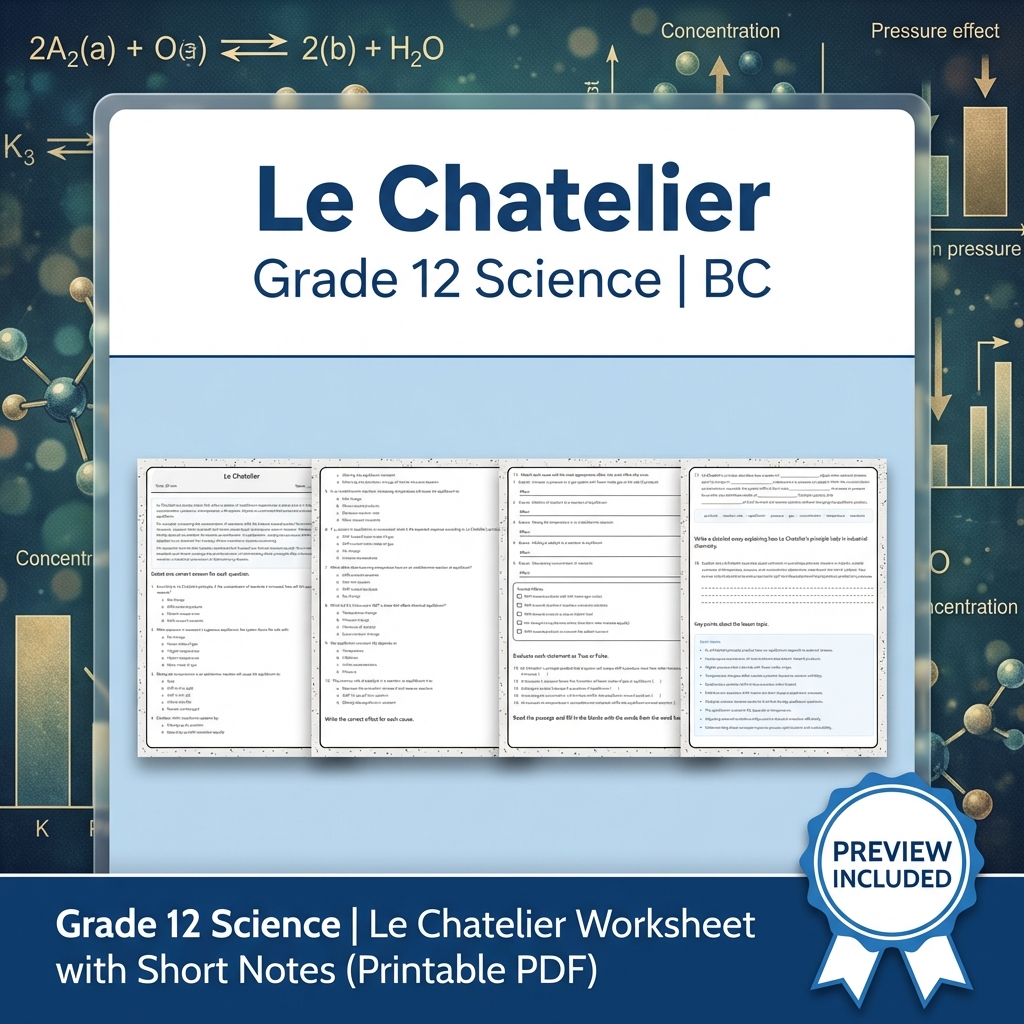
Grade 12 Science | Le Chatelier Worksheet with Short Notes (Printable PDF)
 Created byMeadowlark Worksheets
Learning Objectives
- Understand how Le Chatelier’s principle predicts the response of equilibrium systems to external stresses.
- Identify how changes in concentration, pressure, and temperature affect chemical equilibria.
- Explain the effect of catalysts on equilibrium systems without altering the position.
Also included in: Grade 12 Science Lesson Bundle | BC Framework Thermochemistry & More +1 more
Instant download

Grade 8 Science – Climate Drivers & Earth's Surface | Daily Reading Worksheet
Created byBright Mind ResourcesLearning Objectives
- Understand how the Sun’s radiation influences Earth's climate depending on latitude.
- Identify the role of surface reflectivity in climate variations.
- Explain how solar energy distribution affects regional climate patterns.
Also included in: Grade 8 Earth Science Daily Reading Worksheets Lesson Bundle | Florida NGSSS +1 more
Instant download
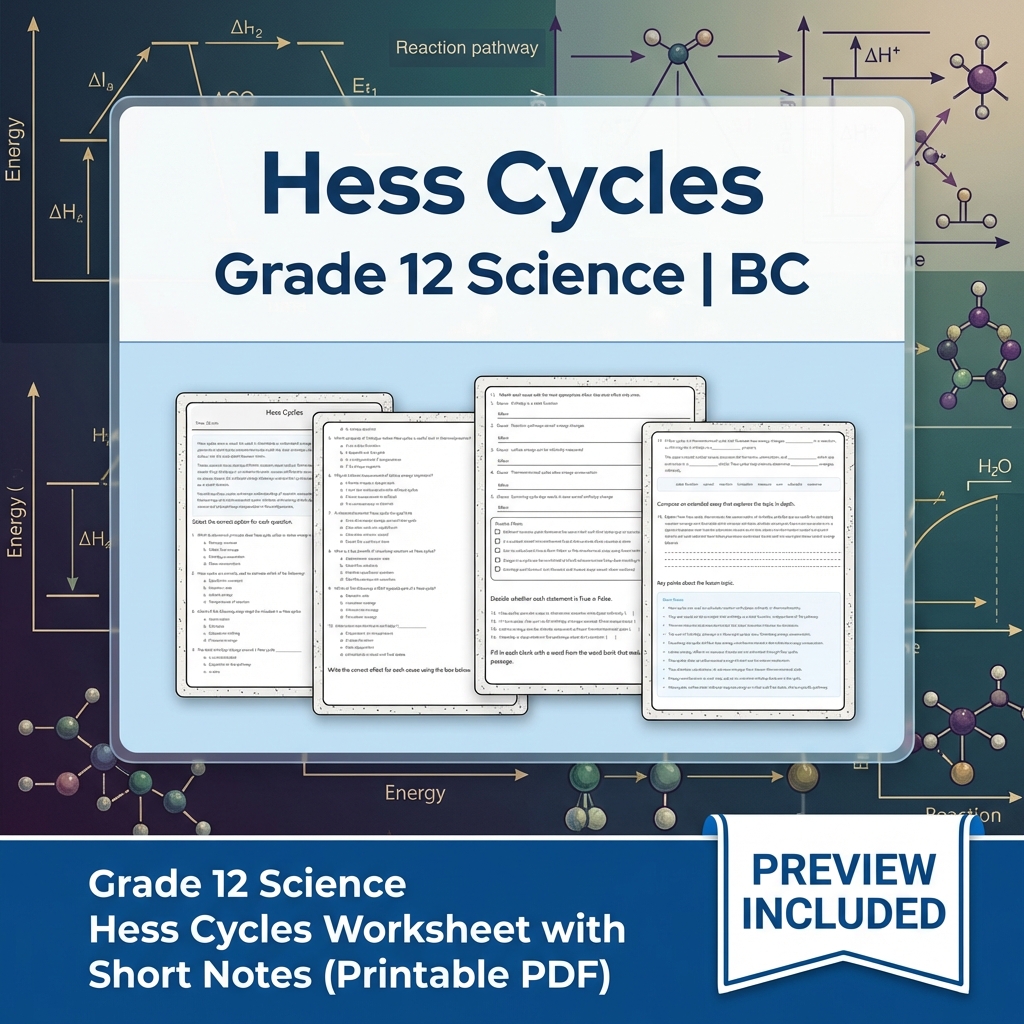
Grade 12 Science Hess Cycles Worksheet with Short Notes (Printable PDF)
Created byMeadowlark WorksheetsLearning Objectives
- Understand the principle of enthalpy conservation in Hess cycles.
- Explain how Hess cycles utilize chemical reaction pathways to determine enthalpy changes.
- Identify the components involved in thermochemical cycles such as formation, atomization, and ionization.
Also included in: Grade 12 Science Lesson Bundle | BC Framework Thermochemistry & More +1 more
Instant download

Grade 7 Science | Matter Classification Worksheet | NGSSS Aligned
Created byLumora LearningLearning Objectives
- Classify matter as an element, compound, or mixture based on composition and particle relationships.
- Distinguish homogeneous mixtures from heterogeneous mixtures using observable uniformity or visible parts.
- Use classification to predict what may happen during physical and chemical changes in matter.
Instant download
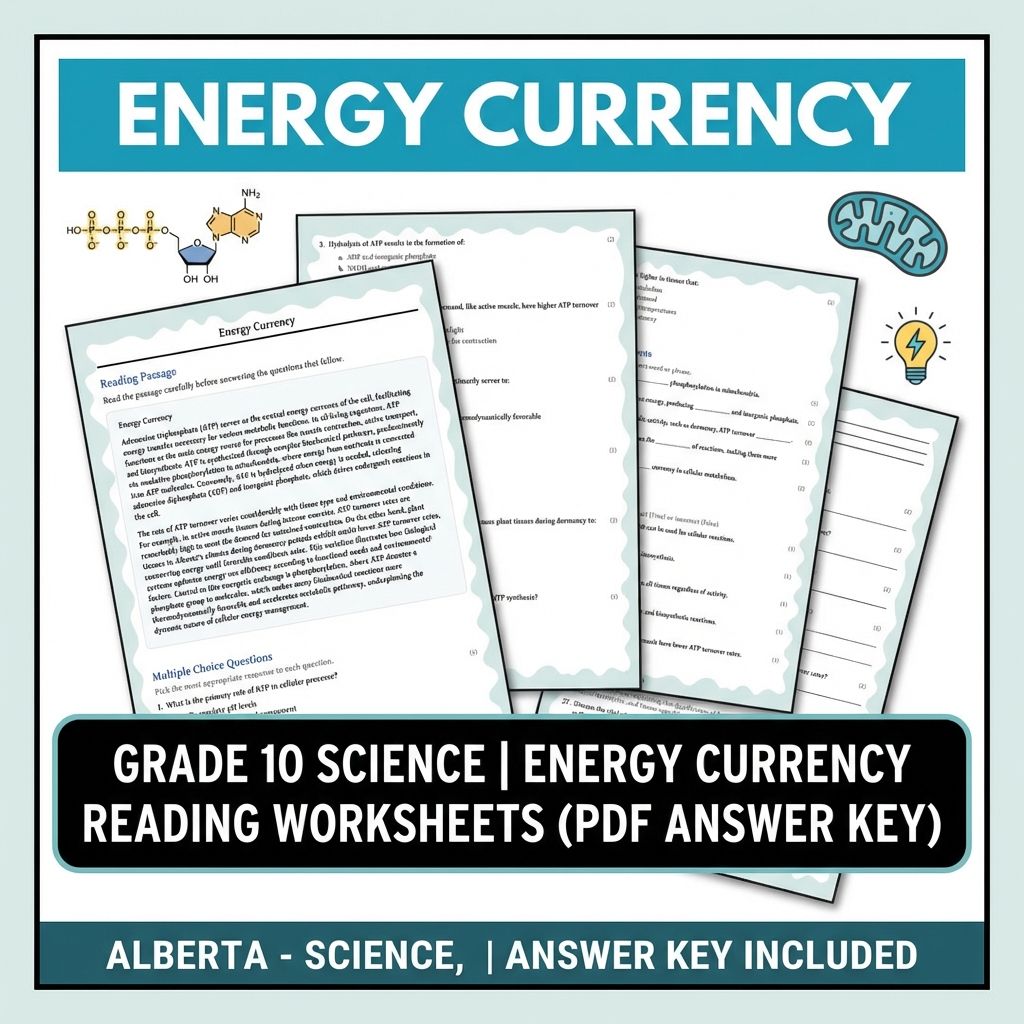
Grade 10 Science | Energy Currency Reading Worksheets (PDF Answer Key)
JCreated byJ.S SheetsLearning Objectives
- Understand the role of ATP as the primary energy currency in cellular processes.
- Explain how ATP synthesis and hydrolysis power metabolic reactions.
- Compare ATP turnover rates across different tissues and environmental contexts.
Also included in: Grade 10 Science | Cell Systems, Energy, & Homeostasis (Standards-Aligned) +1 more
Instant download
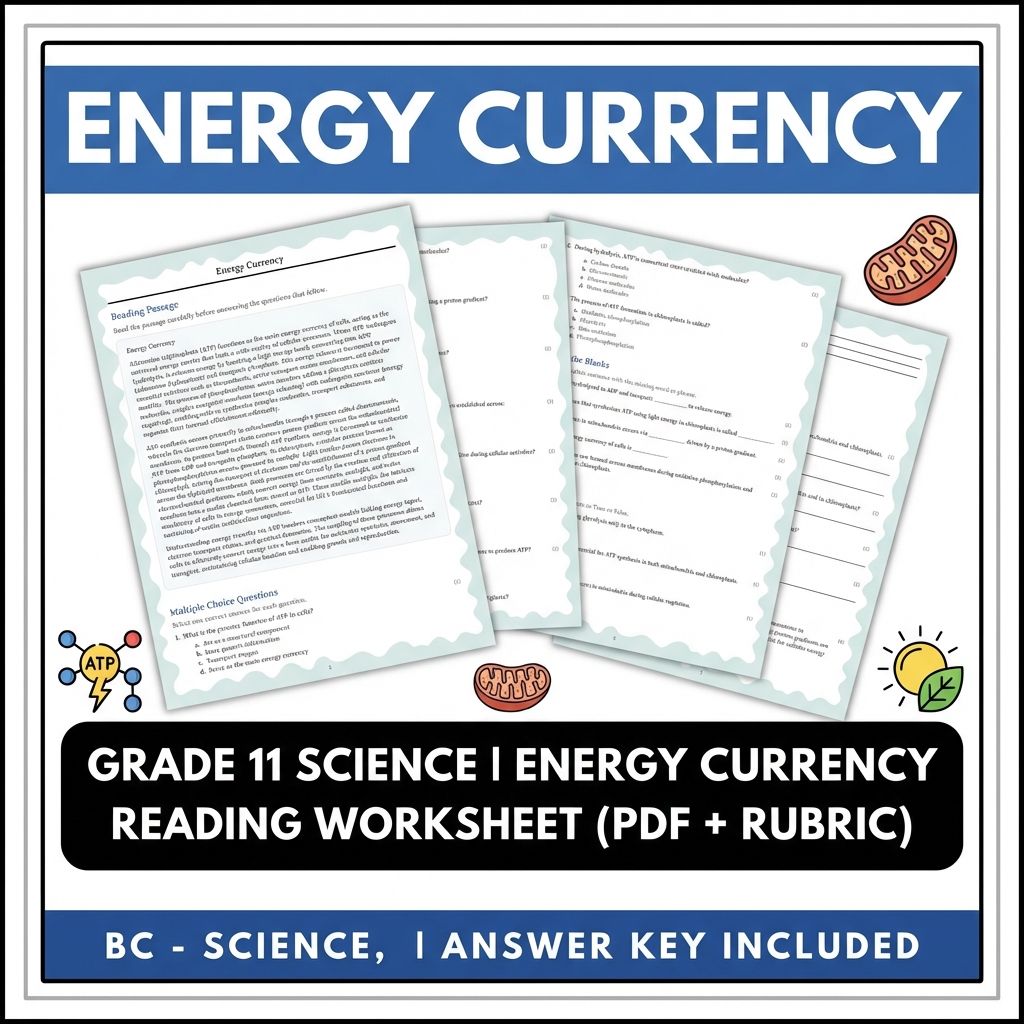
Grade 11 Science | Energy Currency Reading Worksheet (PDF + Rubric)
JCreated byJ.S SheetsLearning Objectives
- Describe the role of ATP as the primary energy currency in cells.
- Explain how ATP is hydrolyzed to release energy for biosynthesis, transport, and movement.
- Identify the processes of ATP synthesis in mitochondria and chloroplasts.
Instant download
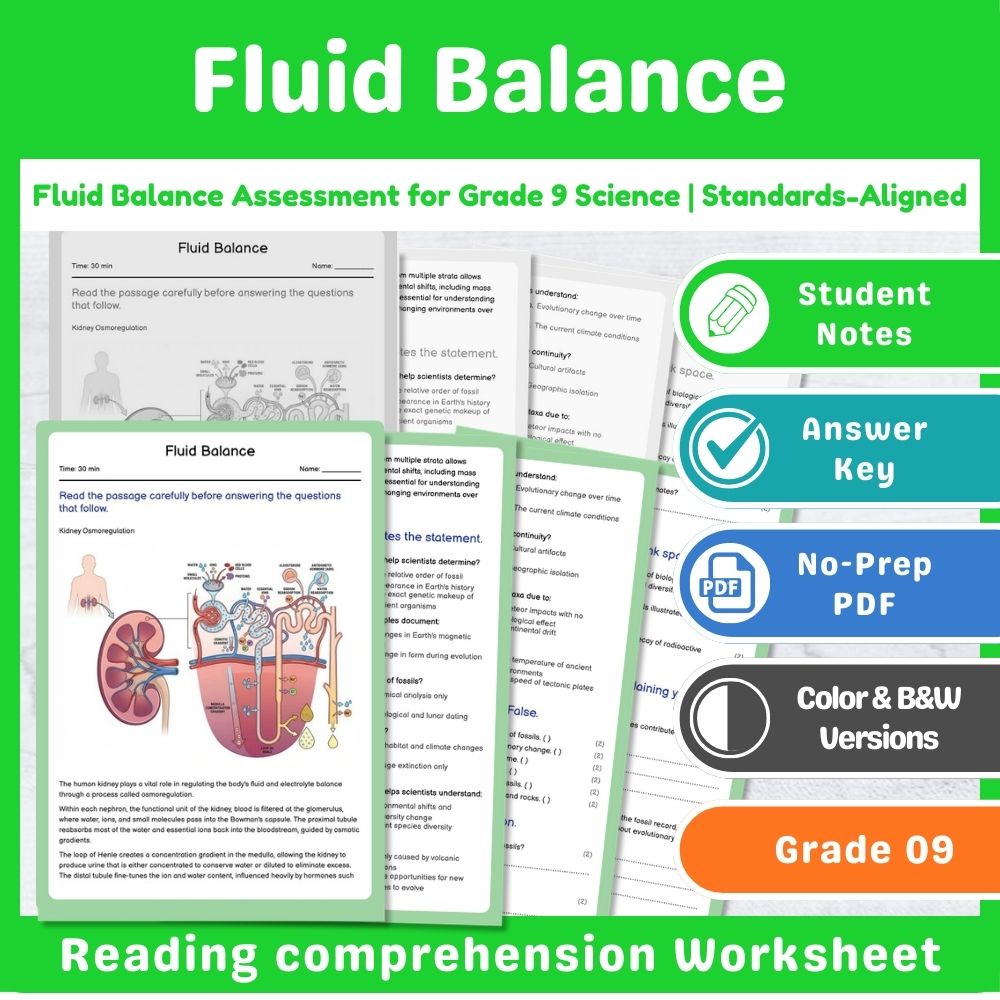
Fluid Balance Assessment for Grade 9 Science | Standards-Aligned
 Created byPrism Point Learning
Learning Objectives
- Understand the process of kidney osmoregulation and its role in maintaining water and ion balance.
- Identify the functions of filtration, reabsorption, secretion, and concentration in nephrons.
- Explain how hormones like antidiuretic hormone (ADH) and aldosterone regulate fluid and electrolyte balance.
Instant download

Chemical Reactions Worksheet Grade 6 NGSS | Doodle Notes & Guide
 Created byAmber Owl Education
Learning Objectives
- Identify chemical reactions by analyzing quantitative and qualitative evidence such as gas production, precipitate formation, color change, and temperature change.
- Compare measurements taken before and after a reaction to determine whether new substances (new chemical species) formed.
- Use data reasoning to interpret evidence from typical reactions such as acid–carbonate reactions and metal oxidation.
Also included in: Grade 6 Science Matter and Chemical Reactions Lesson Bundle | NGSS +1 more
Instant download
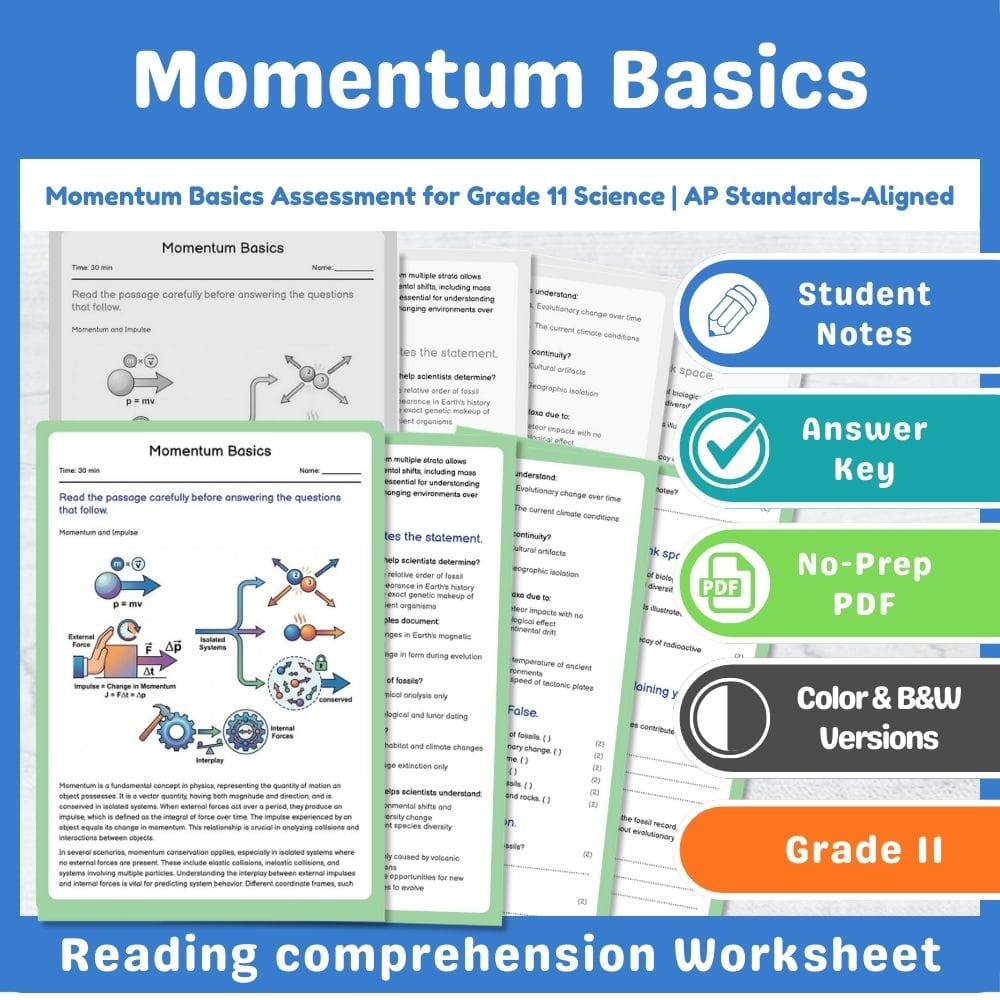
Momentum Basics Assessment for Grade 11 Science | AP Standards-Aligned
Created byPrism Point LearningLearning Objectives
- Understand linear momentum as a conserved vector quantity.
- Explain impulse as the time integral of force and relate it to changes in momentum.
- Apply algebraic conservation relations for isolated systems.
Instant download
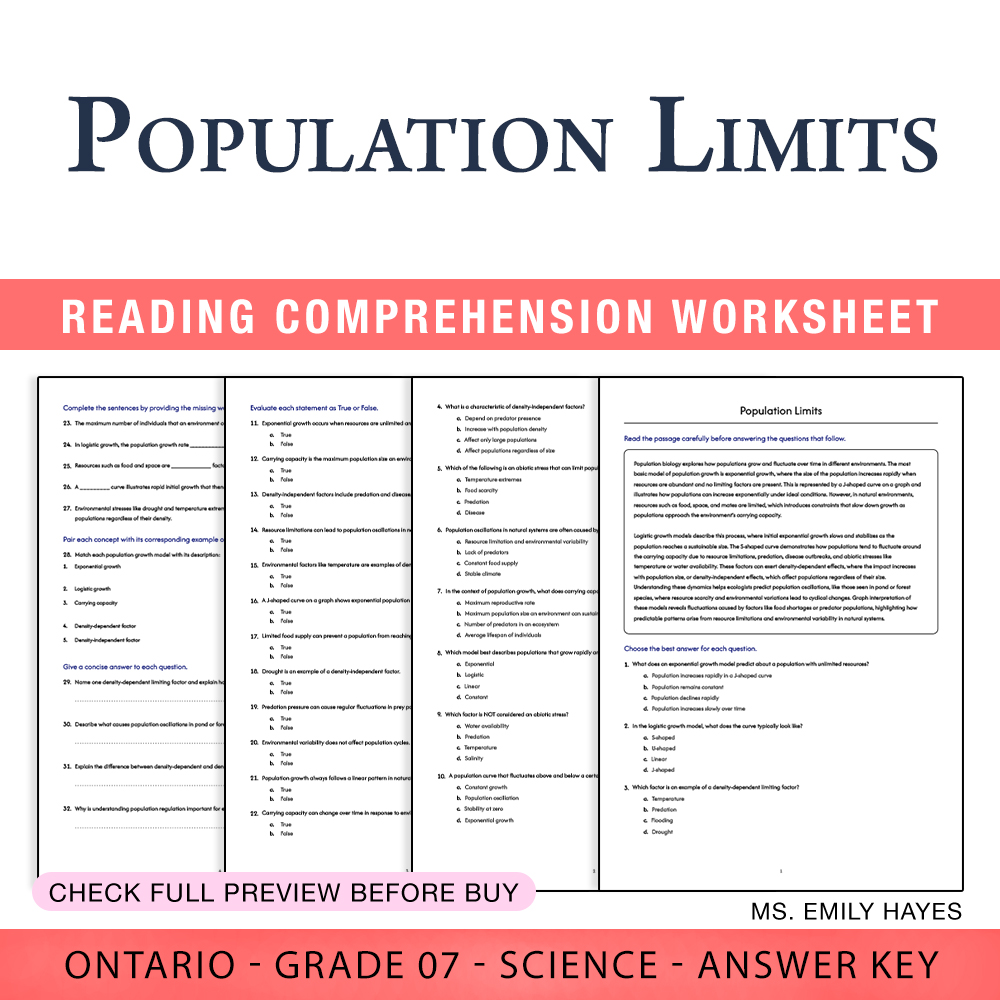
Grade 7 Science | Population Limits Worksheet (PDF+ Answer Key)
 Created byCopper Leaf Classroom
Learning Objectives
- Describe the basic concepts of population growth, including exponential and logistic models.
- Identify factors that limit population size, such as food, predation, and disease.
- Differentiate between density-dependent and density-independent limiting factors.
Instant download
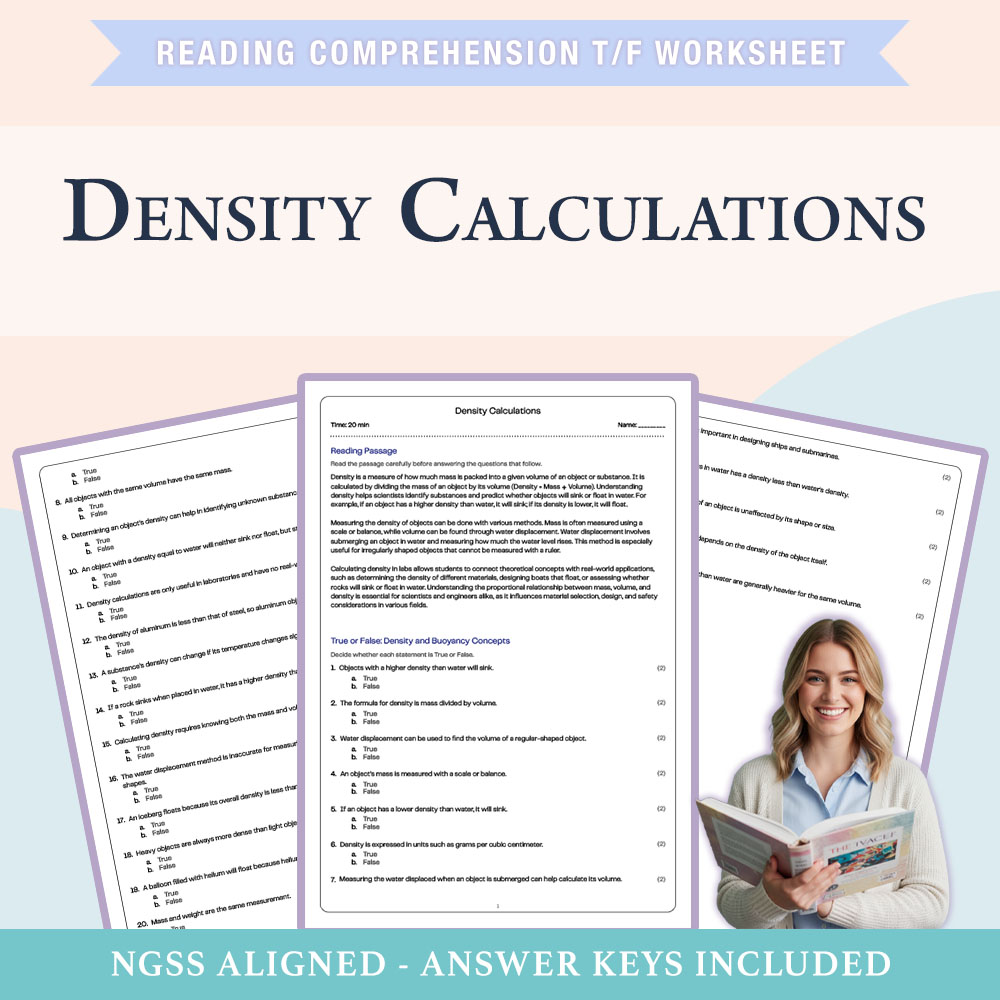
6th Grade Science | Density Calculations Worksheet (PDF +Answer Key)
Created byCopper Leaf ClassroomLearning Objectives
- Understand how to calculate the density of objects and substances
- Learn to use water displacement and weighing methods to measure volume and mass
- Apply density concepts to determine if objects will sink or float
Instant download
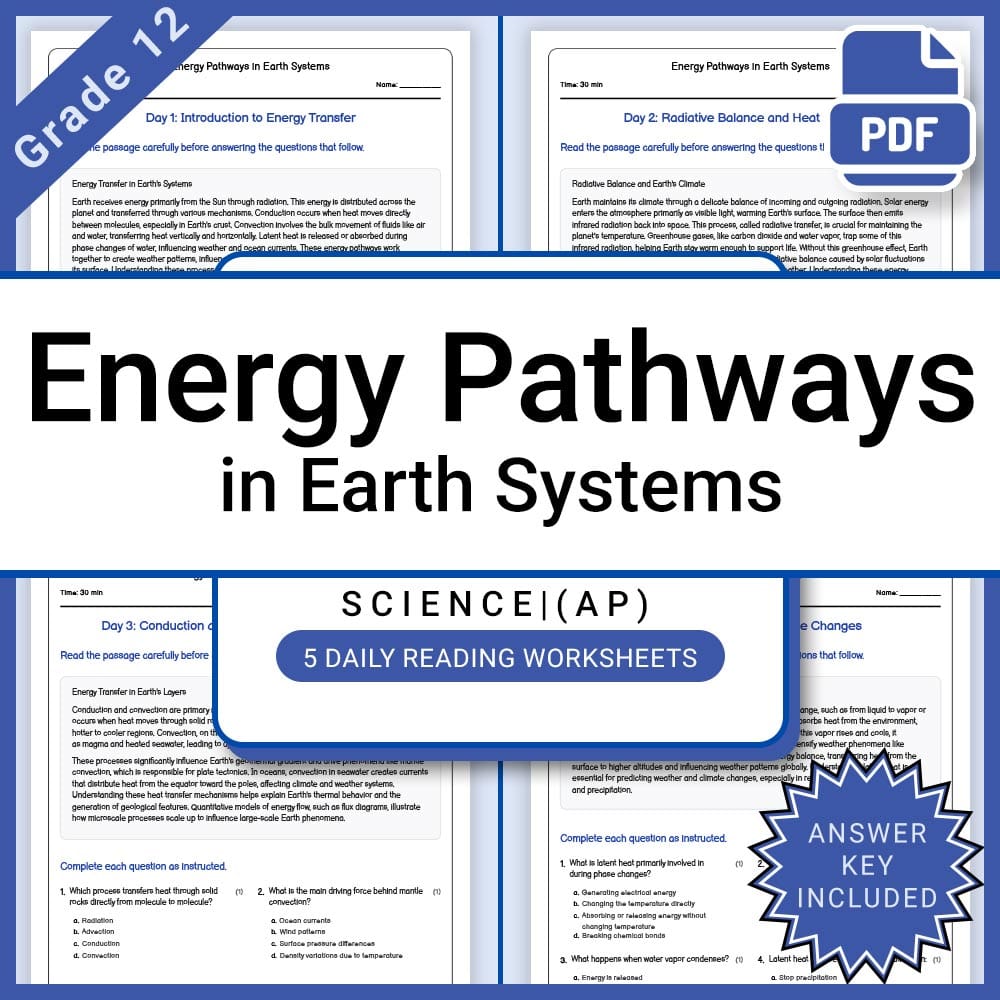
Grade 12 Science – Energy Pathways in Earth Daily Reading Worksheet + Answer Key
JCreated byJ.S SheetsLearning Objectives
- Understand the mechanisms of energy transfer such as radiative balance, conduction, convection, and latent heat.
- Relate energy pathways to weather patterns, ocean currents, and geothermal processes.
- Analyze simple energy budgets, flux diagrams, and block models to connect micro- and macro-scale phenomena.
Also included in: Grade 12 Earth and Space Sciences Lesson Bundle for AP Curriculum +1 more
Instant download
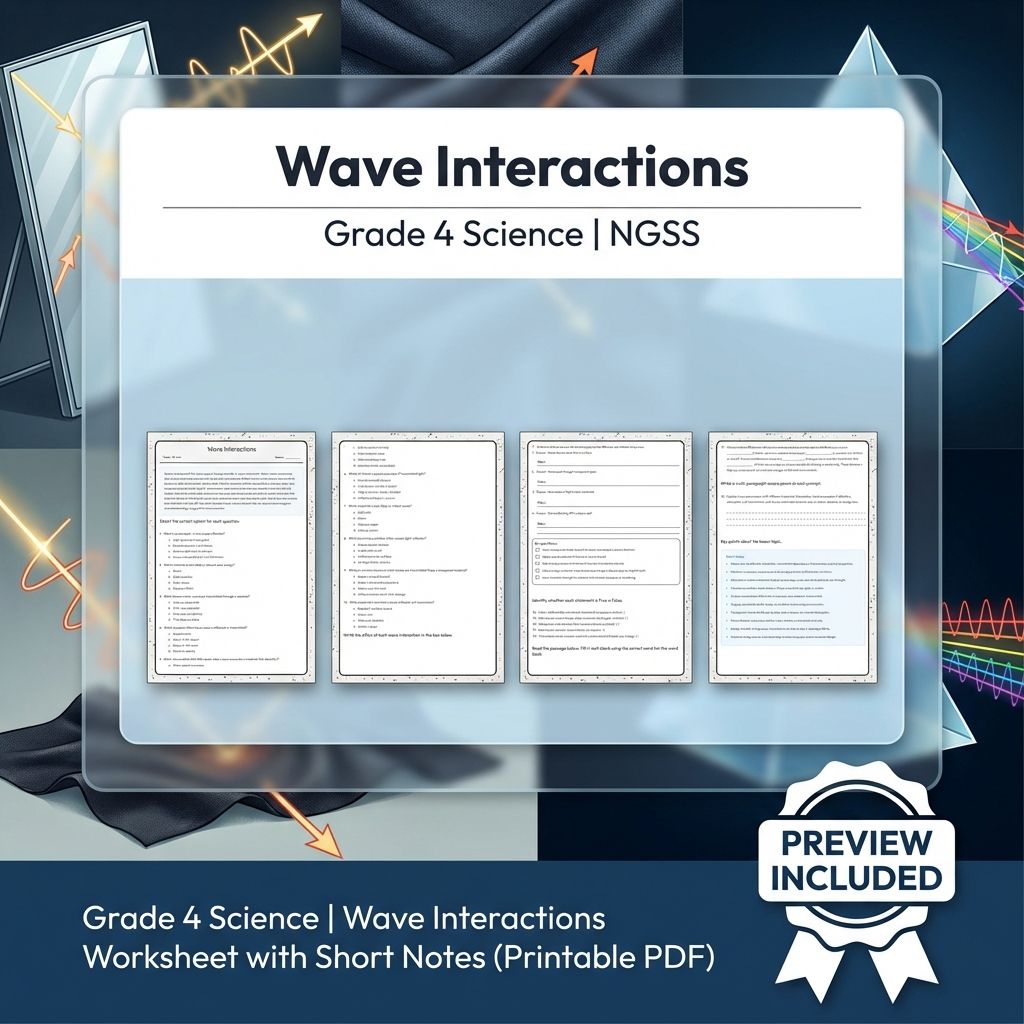
Grade 4 Science | Wave Interactions Worksheet with Short Notes (Printable PDF)
Created byMeadowlark WorksheetsLearning Objectives
- Understand how waves are reflected, absorbed, or transmitted at boundaries between materials.
- Identify observable outcomes of wave interactions such as diminished intensity or redirected wave paths.
- Compare different materials based on their interaction with waves.
Also included in: Grade 4 Science NGSS Waves and Information Transfer Unit Bundle +1 more
Instant download
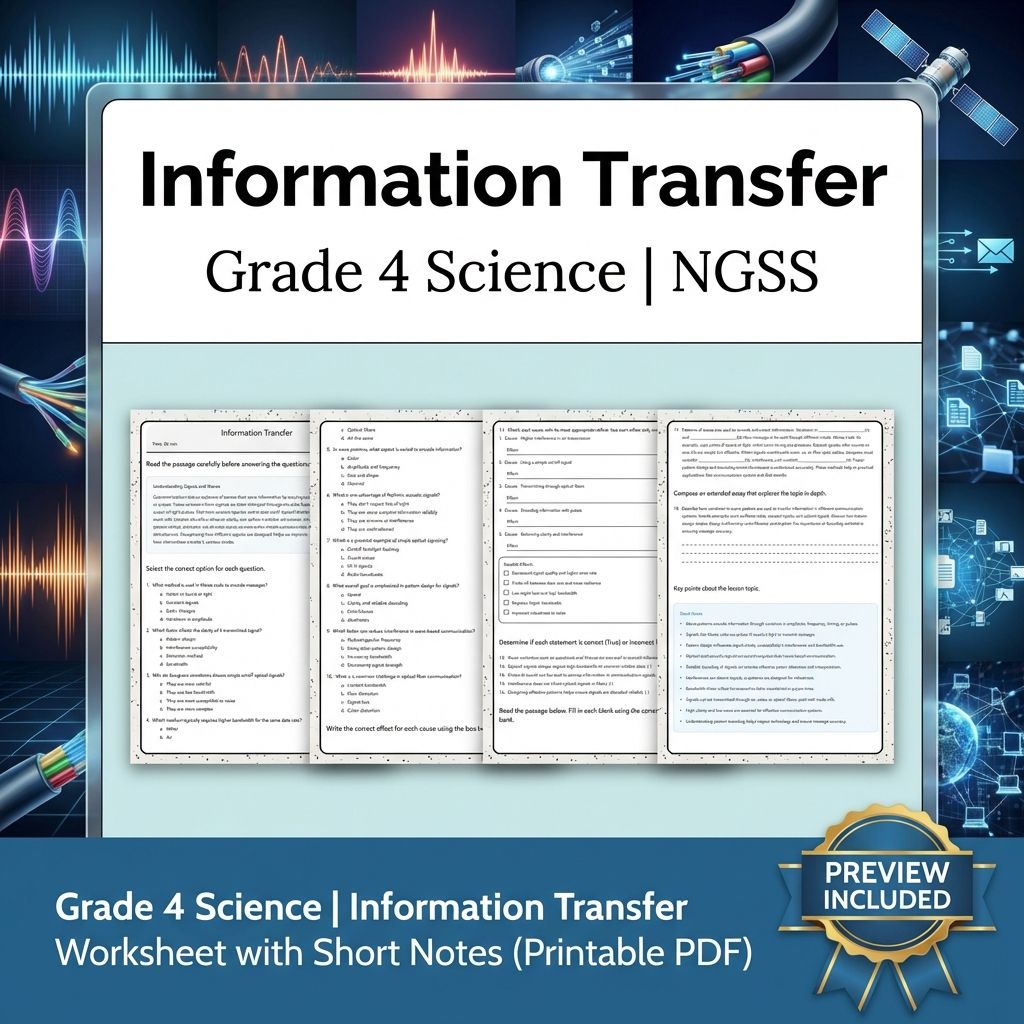
Grade 4 Science | Information Transfer Worksheet with Short Notes (PDF)
Created byMeadowlark WorksheetsLearning Objectives
- Understand how patterns of waves encode and transmit information.
- Identify different types of signals such as Morse code, rhythmic sounds, and optical signals.
- Compare signal clarity, interference susceptibility, and bandwidth requirements across media.
Also included in: Grade 4 Science NGSS Waves and Information Transfer Unit Bundle +1 more
Instant download
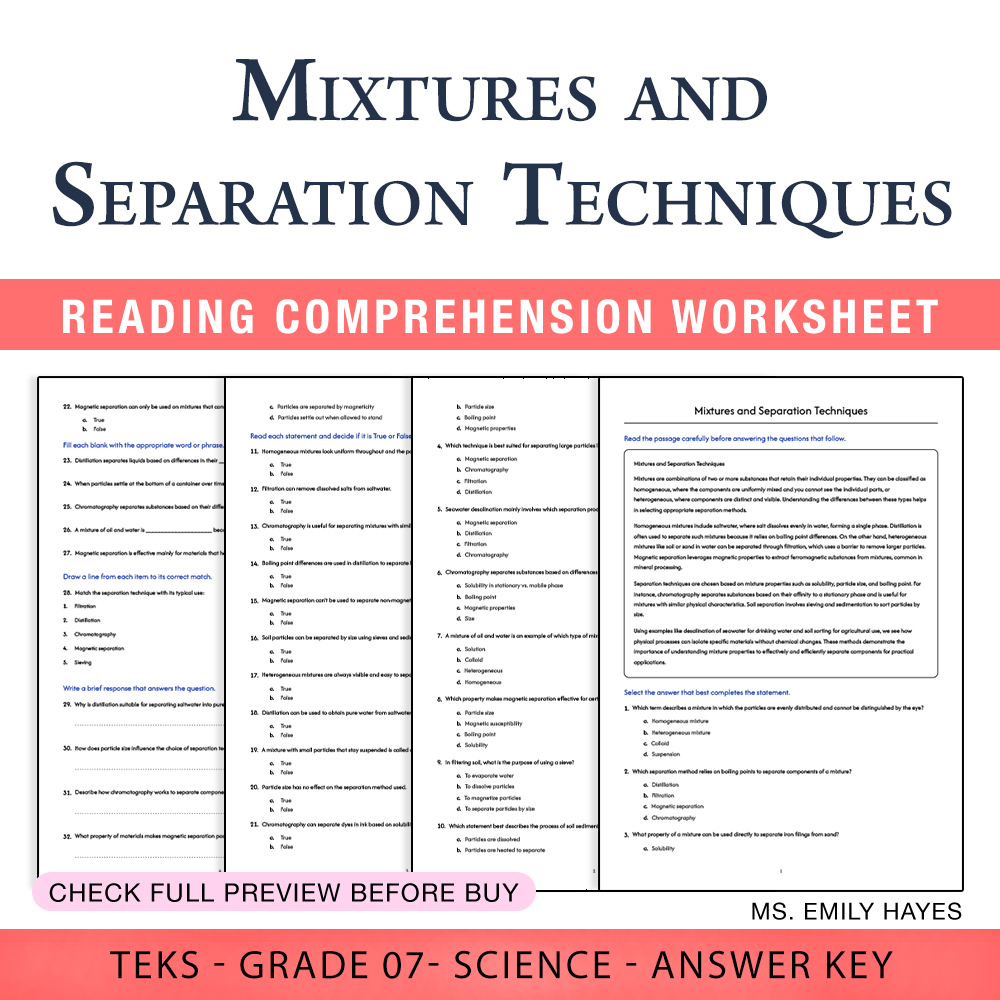
7th Grade Science | Mixtures & Separation Techniques Worksheet(PDF + Answer Key)
Created byCopper Leaf ClassroomLearning Objectives
- Distinguish between homogeneous and heterogeneous mixtures.
- Describe various separation techniques such as filtration, distillation, chromatography, and magnetic separation.
- Relate properties like solubility, particle size, and boiling point to the choice of separation methods.
Instant download
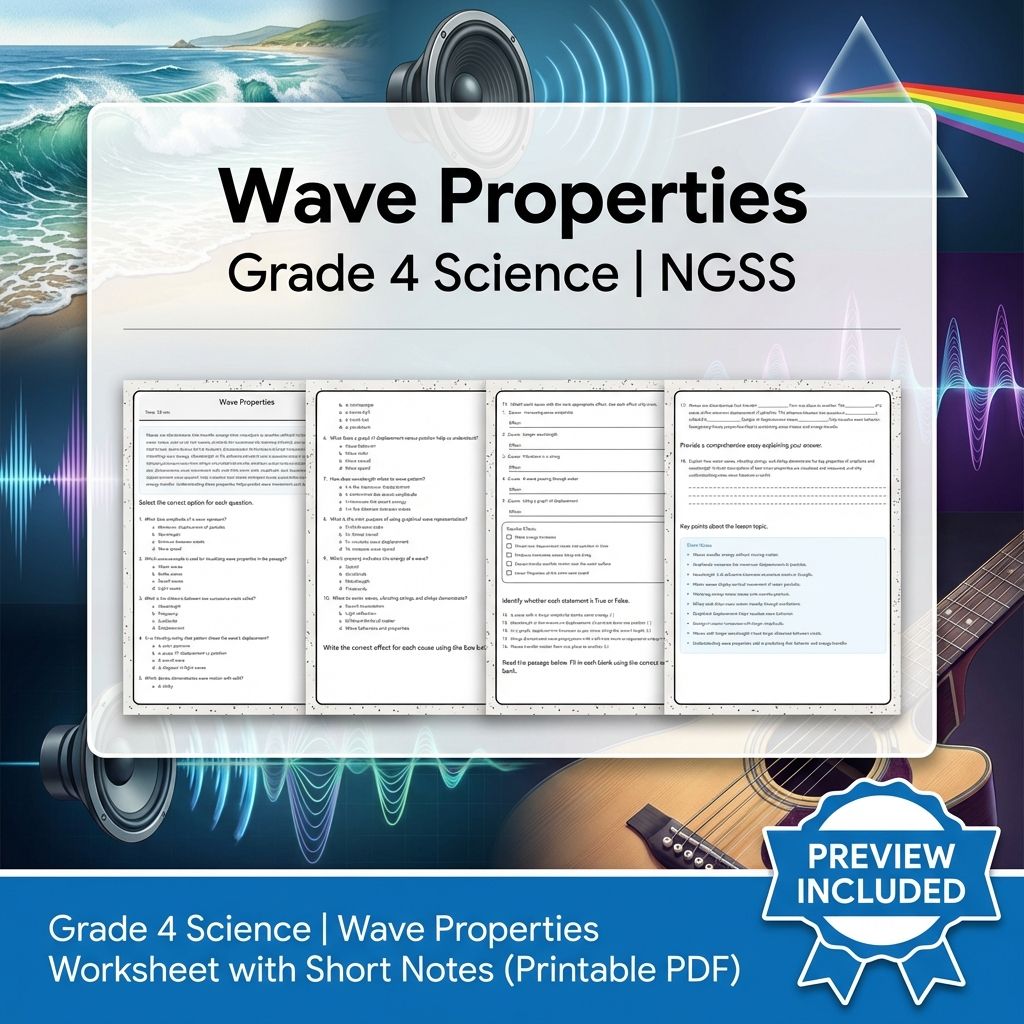
Grade 4 Science | Wave Properties Worksheet with Short Notes (Printable PDF)
Created byMeadowlark WorksheetsLearning Objectives
- Describe how amplitude and wavelength characterize wave behavior.
- Identify examples of waves such as water waves, vibrating strings, and slinkys.
- Interpret graphical displacement vs. position representations of waves.
Also included in: Grade 4 Science NGSS Waves and Information Transfer Unit Bundle +1 more
Instant download

Equilibrium Concepts Worksheet | BC Standards Grade 12 Science Practice
JCreated byJ.S SheetsLearning Objectives
- Understand the fundamental principles of chemical equilibrium in reversible reactions.
- Explain how reaction conditions influence the position of equilibrium.
- Interpret the meaning and significance of the equilibrium constant in chemical reactions.
Instant download
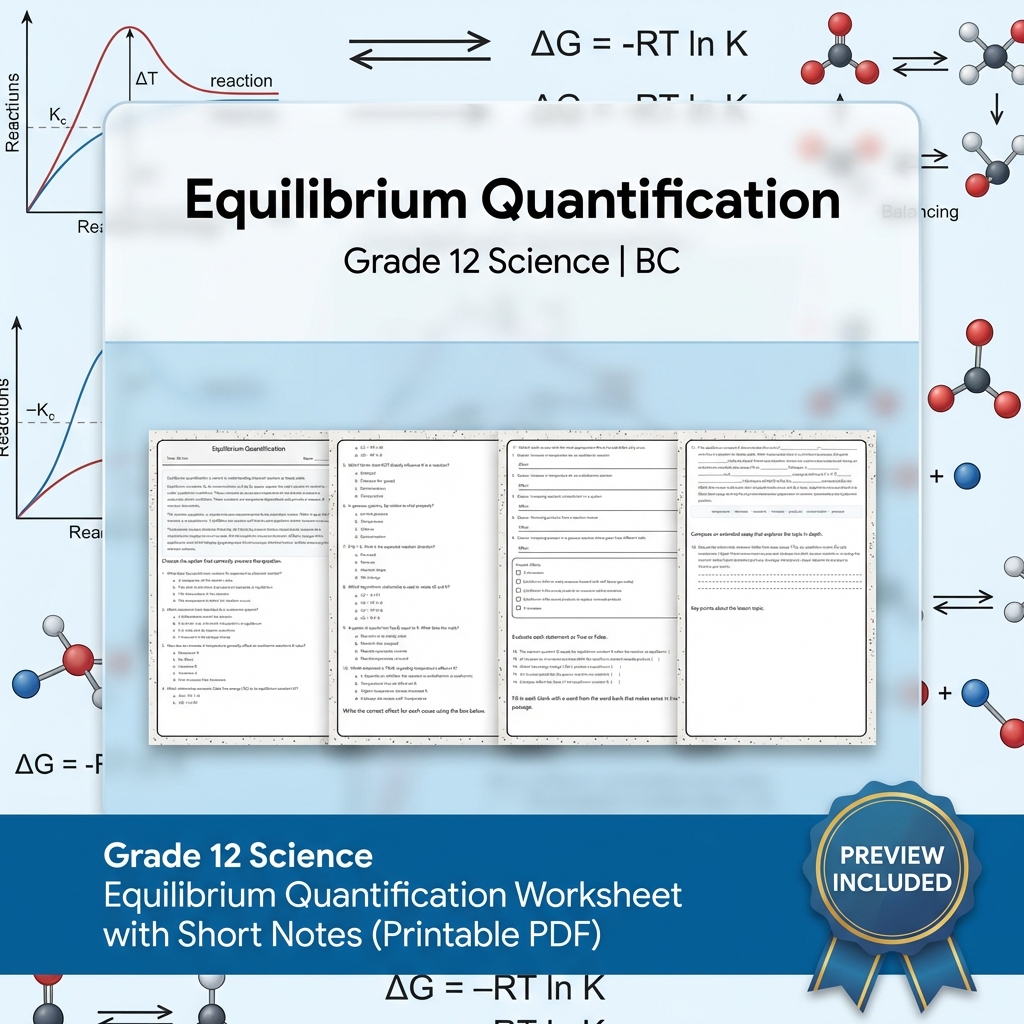
Grade 12 Science Equilibrium Quantification Worksheet with Short Notes (PDF)
Created byMeadowlark WorksheetsLearning Objectives
- Understand the concept of equilibrium constants and their applications.
- Differentiate between the reaction quotient Q and the equilibrium constant K.
- Explain how temperature influences equilibrium and Gibbs free energy relationships.
Also included in: Grade 12 Science Lesson Bundle | BC Framework Thermochemistry & More +1 more
Instant download

Grade 10 Science — Worksheet MCQ Paper for Mastering Work Concepts
 Created byThe Resource Hub
Learning Objectives
- Define work as the product of force component along displacement.
- Understand the scalar nature of work in various contexts.
- Connect work done to changes in kinetic energy via the work-energy theorem.
Also included in: Grade 10 Science AP Bundle – Comprehensive Curriculum with 60 Worksheets
Instant download
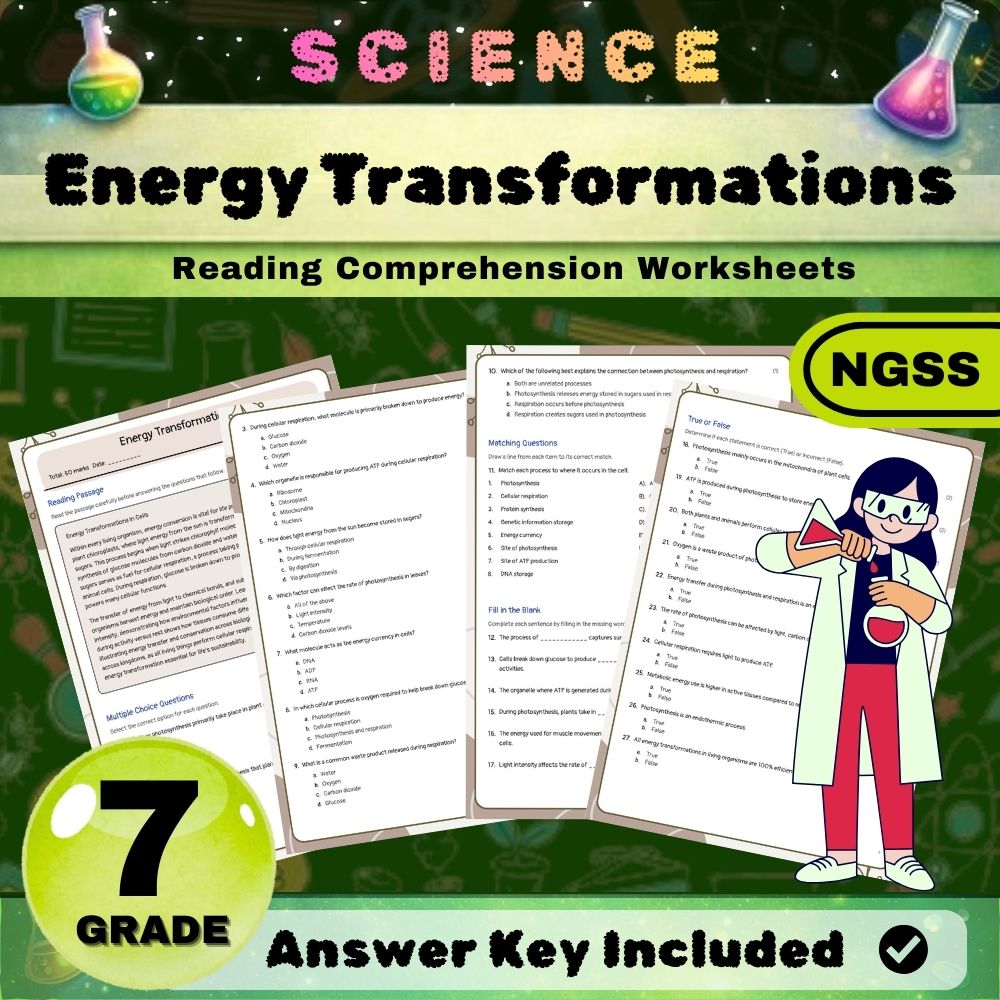
Grade 7 Science – Energy Transformations Worksheet (PDF + NGSS)
 Created byMaple Path Learning
Learning Objectives
- Explain how energy is transferred and transformed during photosynthesis and cellular respiration.
- Describe the connection between chloroplast activity in plants and mitochondria in various organisms.
- Analyze phenomena such as leaf photosynthesis rates and energy use differences in tissues.
Instant download

Grade 10 Science — Worksheet MCQ Paper for Mastering Computational Concepts
Created byThe Resource HubLearning Objectives
- Understand basic computational approaches for representing dynamic systems.
- Recognize assumptions and limitations in numerical simulations.
- Interpret simulation outputs in relation to analytical models.
Also included in: Grade 10 Science Bundle: Master Scientific Modeling & Data Analysis +1 more
Instant download
10th Grade Science | Comparative Anatomy Mastery (PDF + Answer Key)
JCreated byJ.S SheetsLearning Objectives
- Understand the concept of homologous and analogous structures in different organisms.
- Identify vestigial organs and explain their significance in evolution.
- Connect anatomical similarities with embryological and molecular data.
Instant download
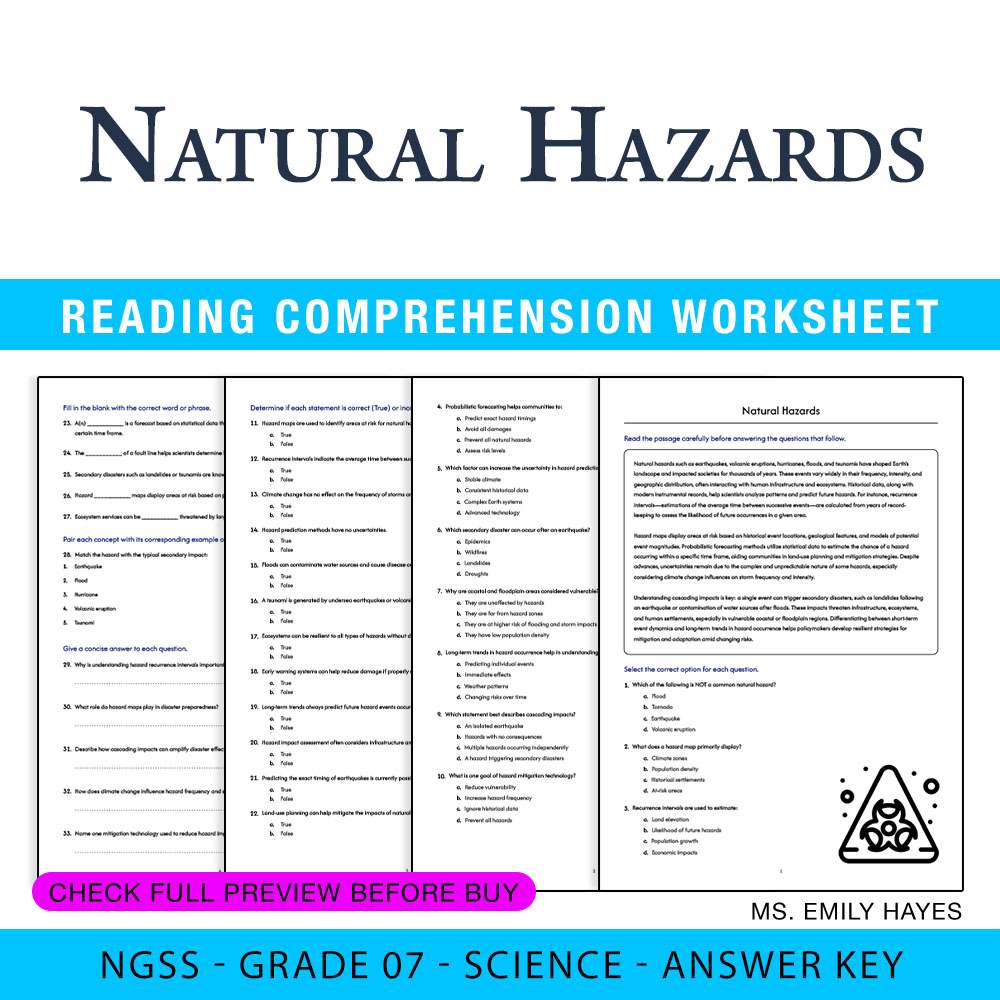
7th Grade Science | Natural Hazards Worksheet (PDF+ Answer Key)
Created byCopper Leaf ClassroomLearning Objectives
- Analyze patterns of frequency and magnitude for different natural hazards.
- Interpret hazard maps, recurrence intervals, and probabilistic data to assess risk.
- Understand the cascading impacts of hazards on infrastructure, ecosystems, and communities.
Instant download
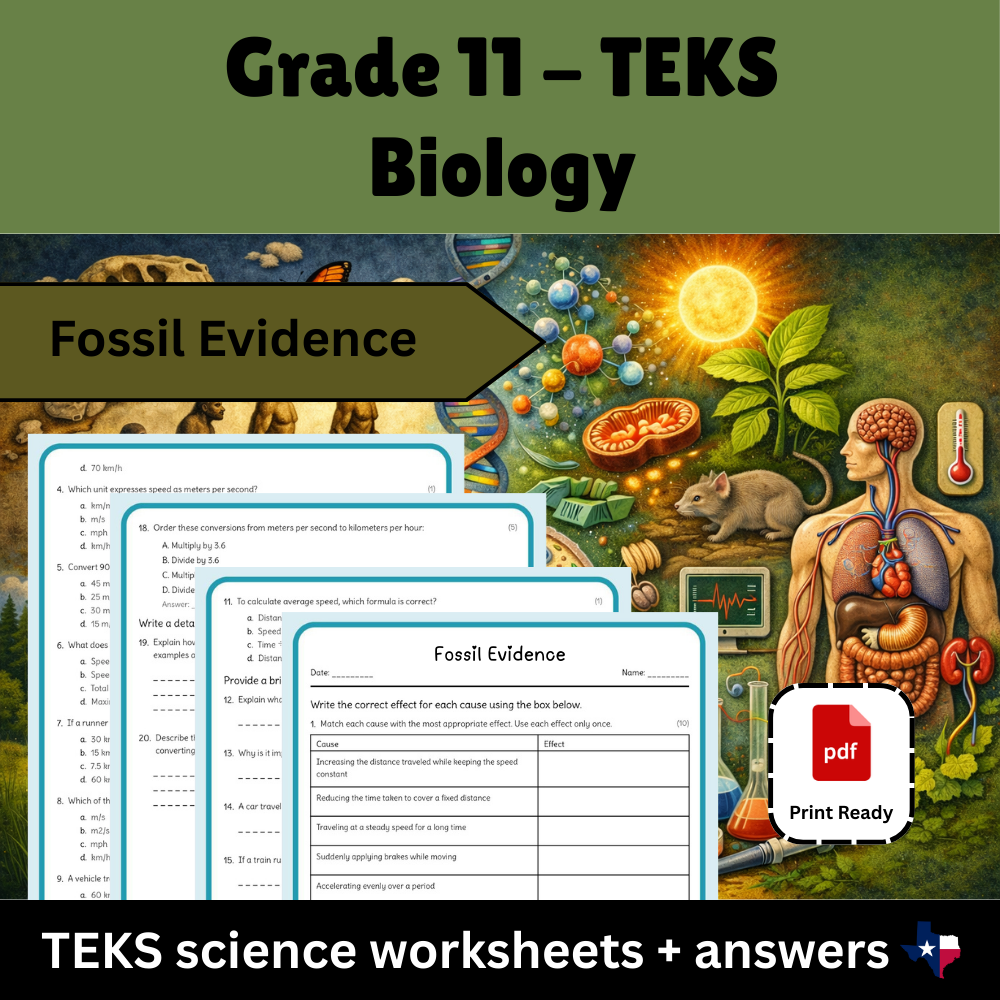
Grade 11 Science | Fossil Evidence Worksheet (Answer Key) - TEKS Aligned
Created byBright Mind ResourcesLearning Objectives
- Understand how fossils record morphological change over geological time.
- Identify methods used to establish the ages of fossils, such as stratigraphy and radiometric dating.
- Recognize patterns in the fossil record and their implications for evolution, extinction, and diversification.
Also included in: Grade 11 Science | Evolution & Phylogenetics Worksheet Bundle (TEKS Aligned) +2 more
Instant download
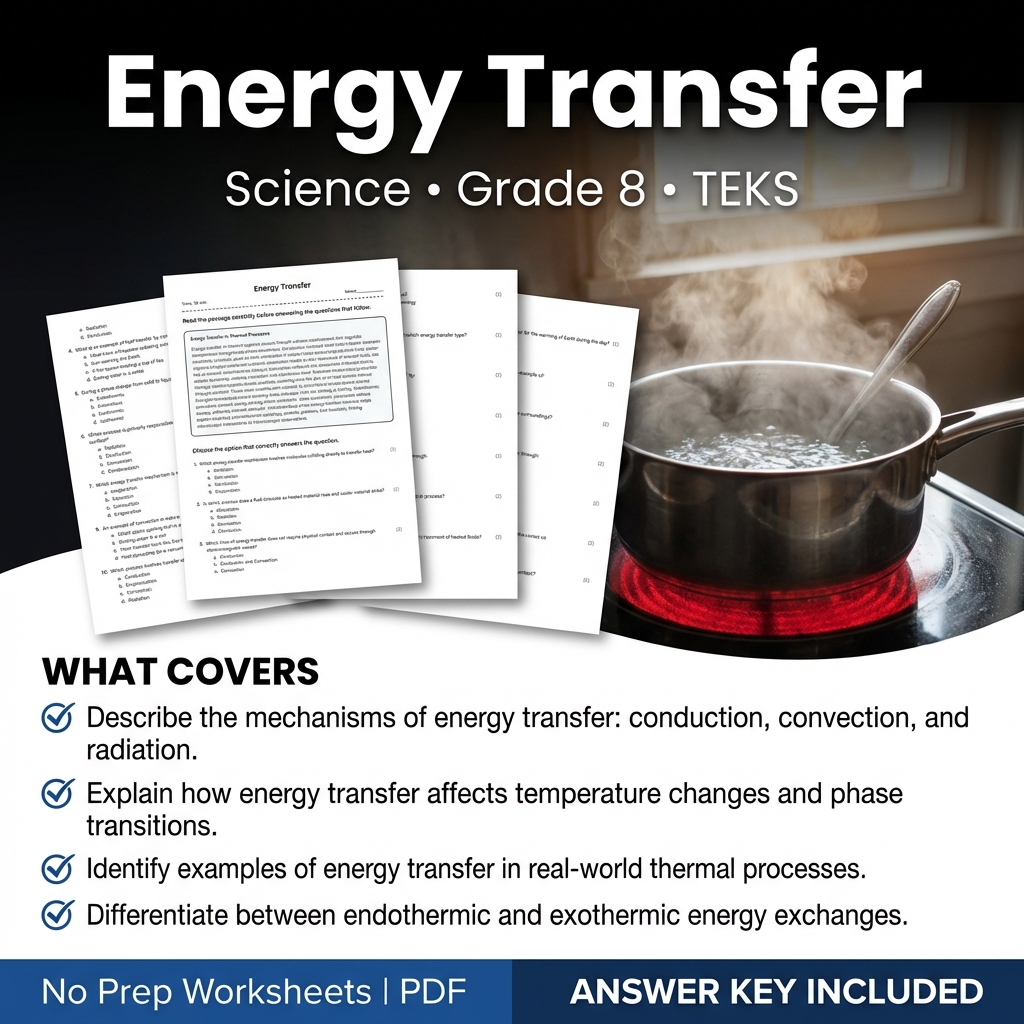
Energy Transfer Worksheet for Grade 8 Science | TEKS Aligned
Created byCoral Reef LearningLearning Objectives
- Describe the mechanisms of energy transfer: conduction, convection, and radiation.
- Explain how energy transfer affects temperature changes and phase transitions.
- Identify examples of energy transfer in real-world thermal processes.
Instant download
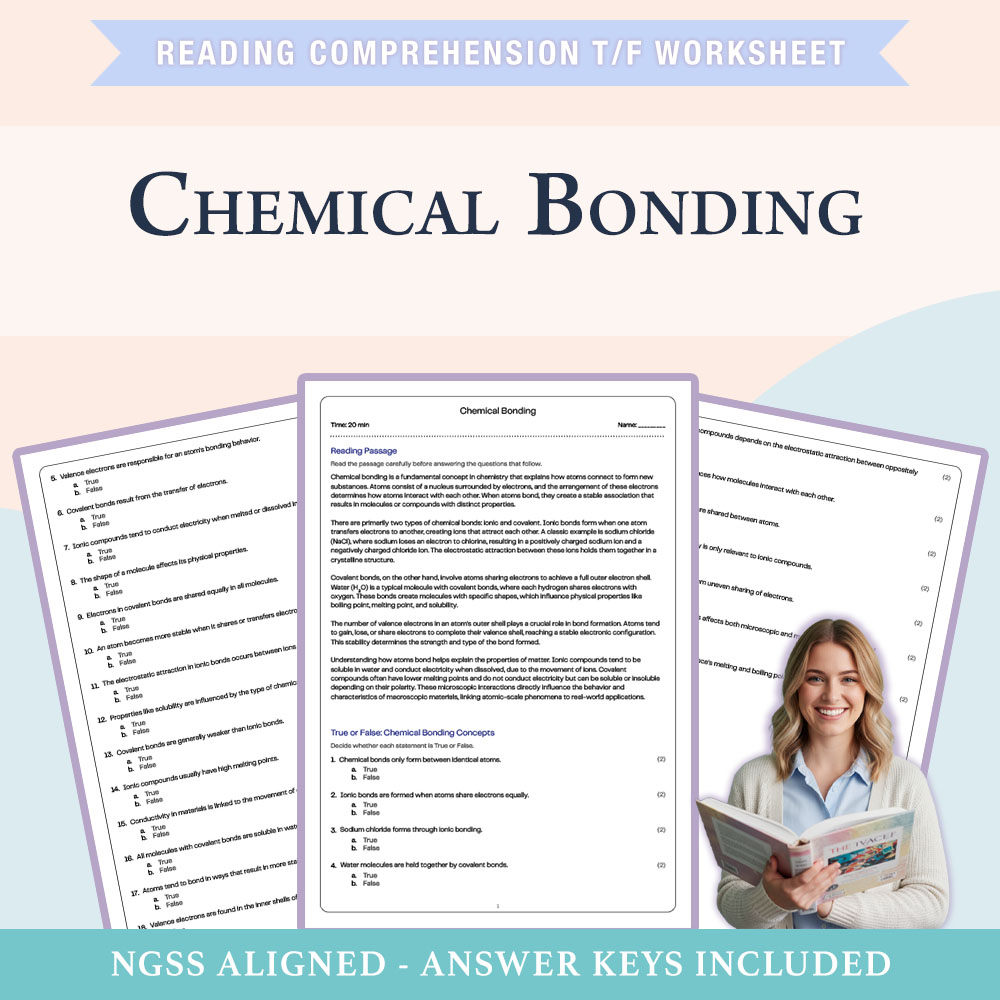
7th Grade Science | Chemical Bonding Worksheet (PDF +Answer Key)
Created byCopper Leaf ClassroomLearning Objectives
- Understand how atoms form chemical bonds through ionic and covalent interactions
- Recognize examples of chemical bonds like sodium chloride and water
- Explain the role of valence electrons in bond formation
Instant download
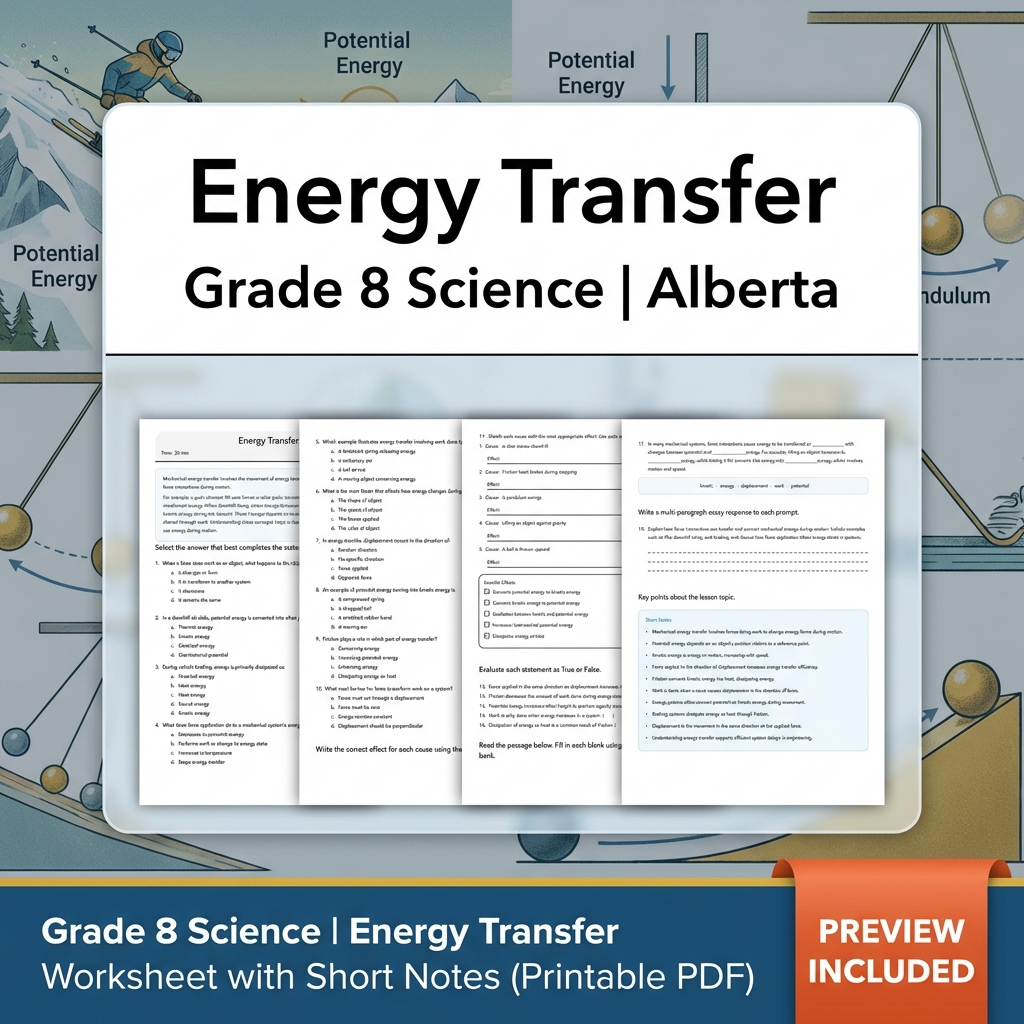
Grade 8 Science | Energy Transfer Worksheet with Short Notes (Printable PDF)
Created byMeadowlark WorksheetsLearning Objectives
- Understand how force interactions perform work to change mechanical energy states during motion.
- Identify examples illustrating the transfer between potential and kinetic energy.
- Analyze qualitative relationships between applied force, displacement, and energy change.
Also included in: Grade 8 Science Forces & Motion UNIT Bundle – Alberta Curriculum +1 more
Instant download
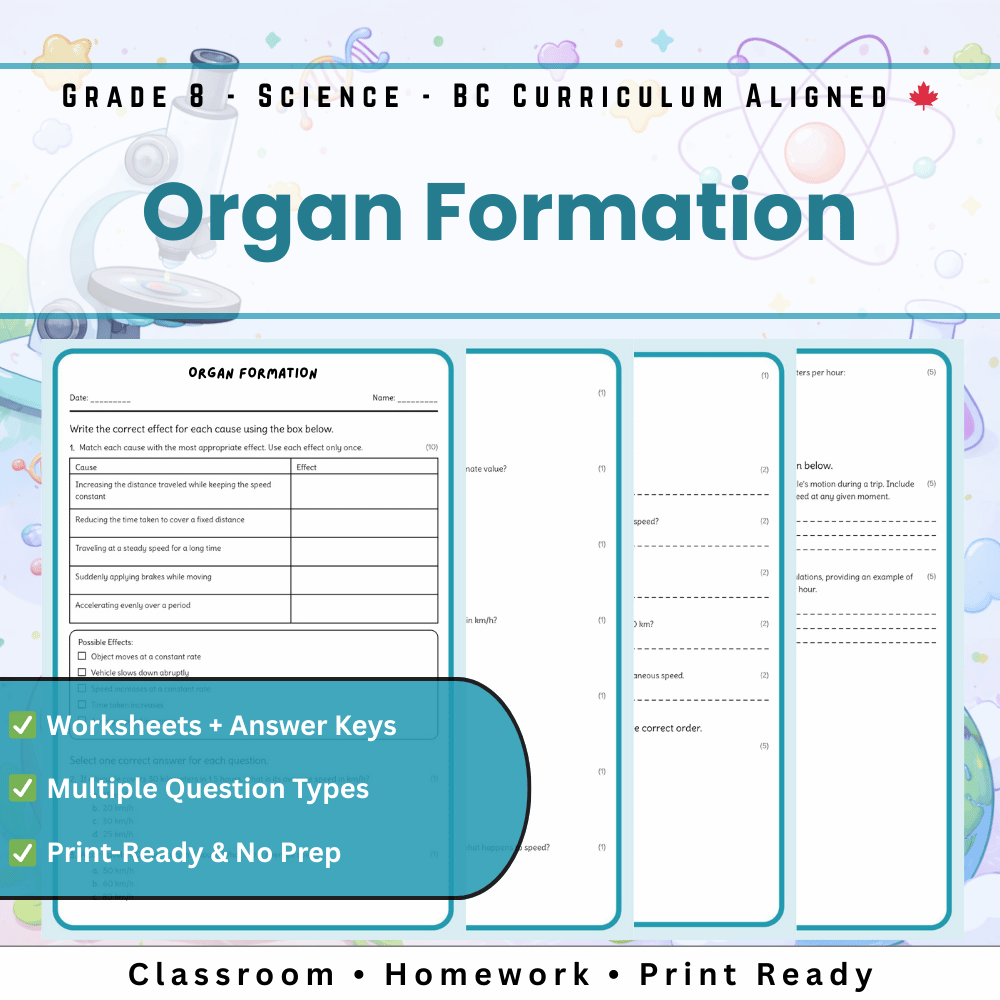
Grade 8 Science | Organ Formation Worksheet (PDF) for BC Standards
Created byBright Mind ResourcesLearning Objectives
- Describe how different tissue types integrate to form organs.
- Explain how organ architecture reflects functional and mechanical needs.
- Identify examples of organs and their tissue components.
Instant download
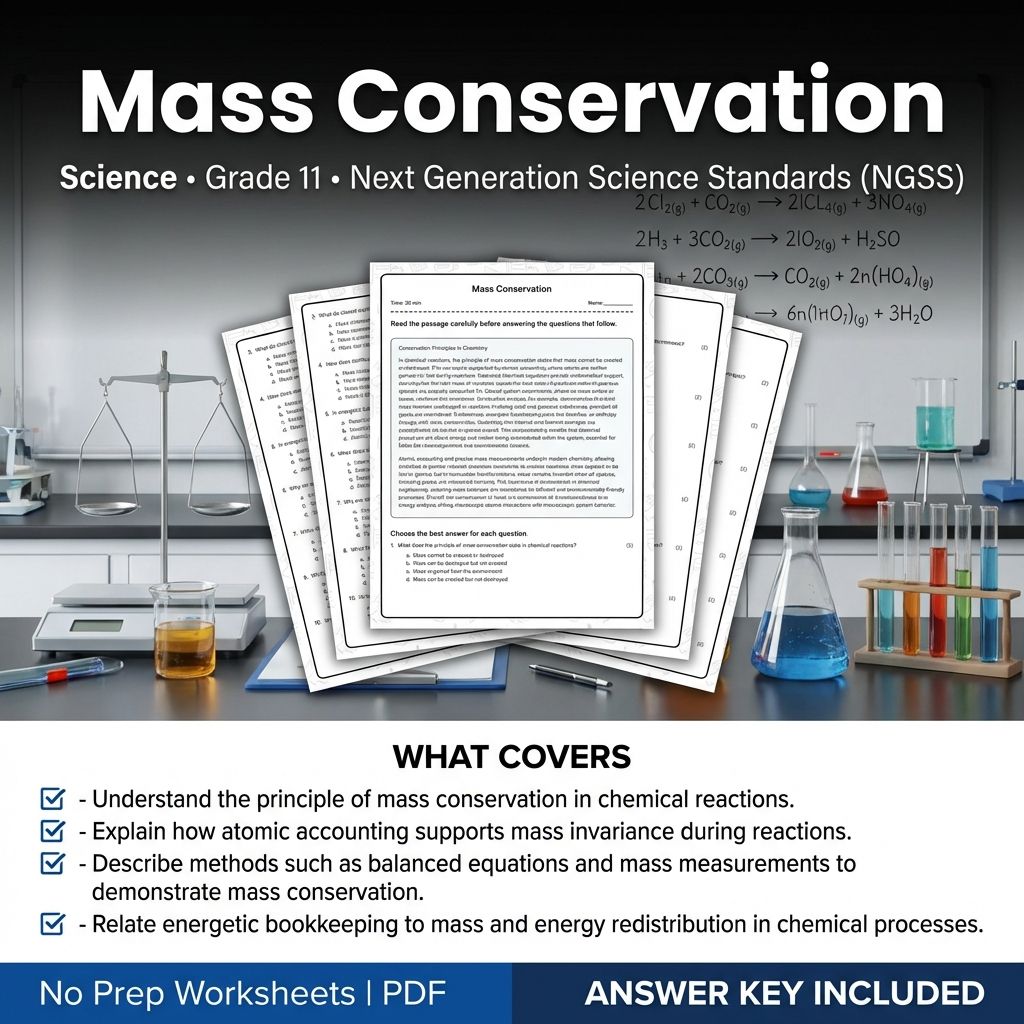
11th Grade Science | Mass Conservation Worksheet & Answer Key (Printable PDF)
Created byCoral Reef LearningLearning Objectives
- Understand the principle of mass conservation in chemical reactions.
- Explain how atomic accounting supports mass invariance during reactions.
- Describe methods such as balanced equations and mass measurements to demonstrate mass conservation.
Also included in: Grade 11 Science Unit Bundle – Chemical Reactions & Periodic Trends Worksheets +1 more
Instant download
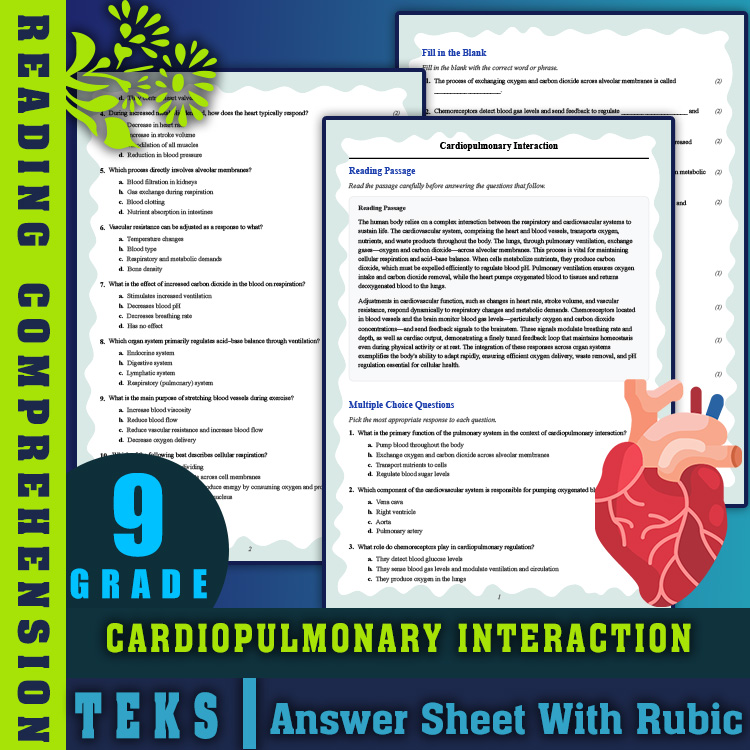
9th Grade Science | Cardiopulmonary Interaction Reading (PDF + Answer Key)
JCreated byJ.S SheetsLearning Objectives
- Explain how the heart and lungs work together to oxygenate blood and remove carbon dioxide.
- Describe the processes of pulmonary ventilation and cardiovascular transport of gases.
- Identify how the body adjusts heart rate, stroke volume, and vascular resistance during respiratory changes.
Instant download
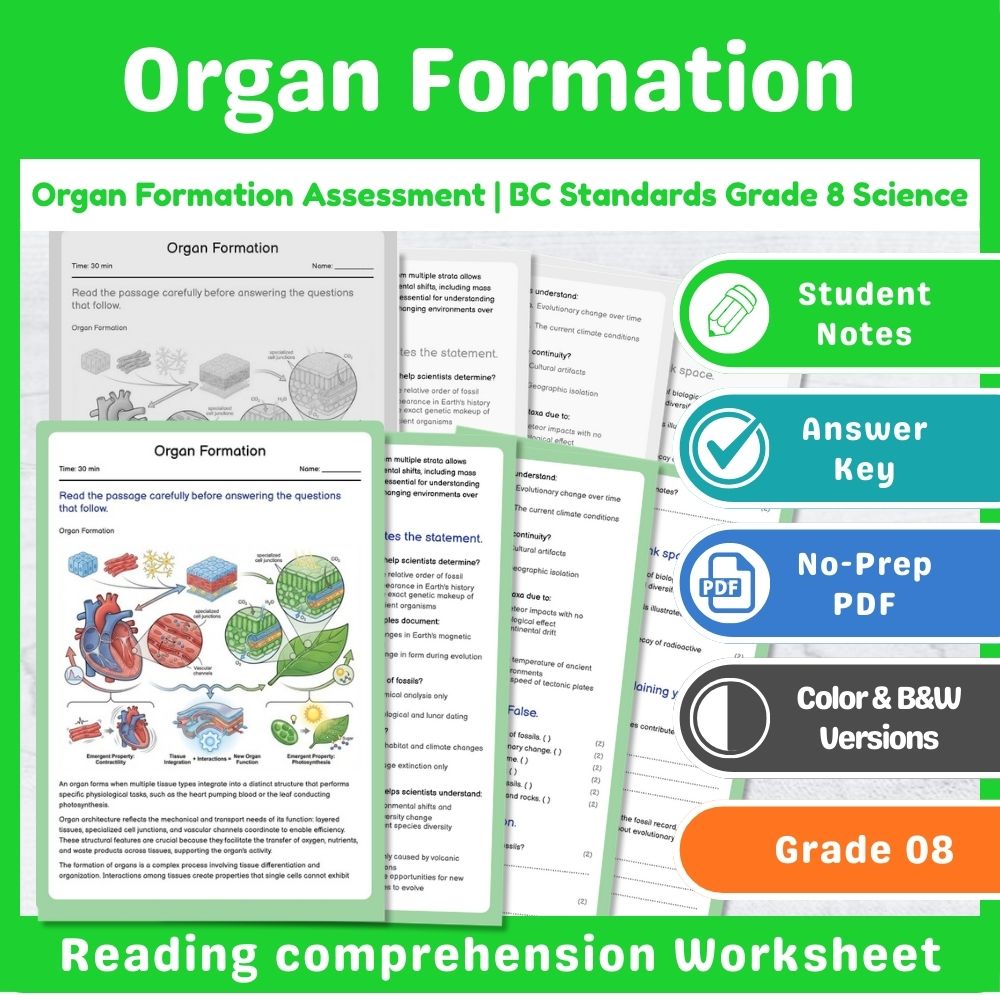
Organ Formation Assessment | BC Standards Grade 8 Science
Created byPrism Point LearningLearning Objectives
- Understand how tissues interact to form functional organs.
- Identify structural features of tissues that support organ function.
- Explain the relationship between tissue organization and organ efficiency.
Instant download
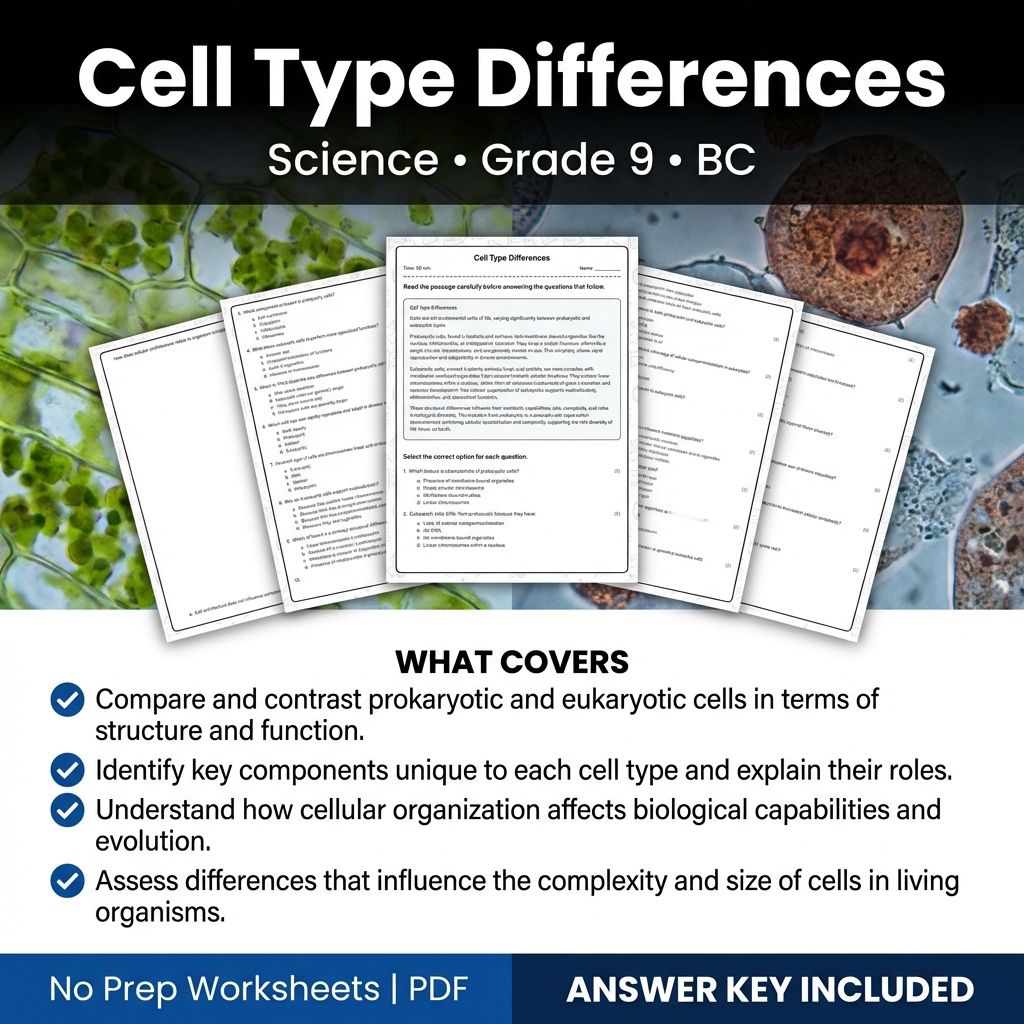
Cell Type Differences Worksheet for Grade 9 Science | BC Standards
Created byCoral Reef LearningLearning Objectives
- Compare and contrast prokaryotic and eukaryotic cells in terms of structure and function.
- Identify key components unique to each cell type and explain their roles.
- Understand how cellular organization affects biological capabilities and evolution.
Instant download
Grade 6 Science – Food Webs & Ecosystem Relationships | Daily Reading Worksheet
 Created byQuiet Forest Education
Learning Objectives
- Define what a food web is and explain its importance in ecosystems.
- Identify producers, consumers, and decomposers within a food web.
- Describe the flow of energy through different trophic levels in food webs.
Also included in: Ecosystems and Environment Grade 6 Science Daily Worksheets Bundle | Ontario +1 more
Instant download
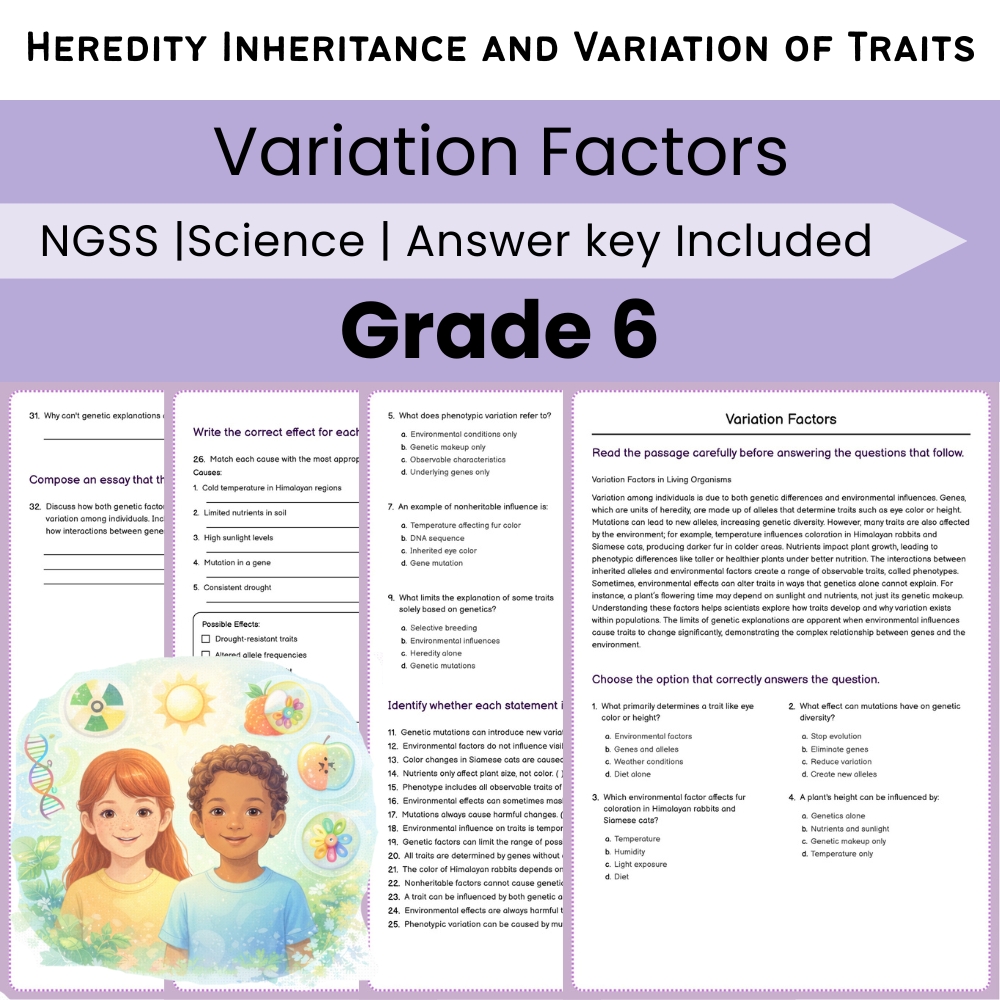
Variation Factors Worksheet | Grade 6 Science Printable PDF | NGSS
Learning Objectives
- Explain how genetic differences and environmental factors contribute to observable variations among individuals.
- Identify models of allele combinations and mutation impacts on traits.
- Describe nonheritable influences such as temperature-dependent coloration and nutrient effects on plants.
Also included in: Grade 6 Science INHERITANCE & VARIATION UNIT | Heredity NGSS Worksheet Bundle (2 Worksheets) +1 more
Instant download
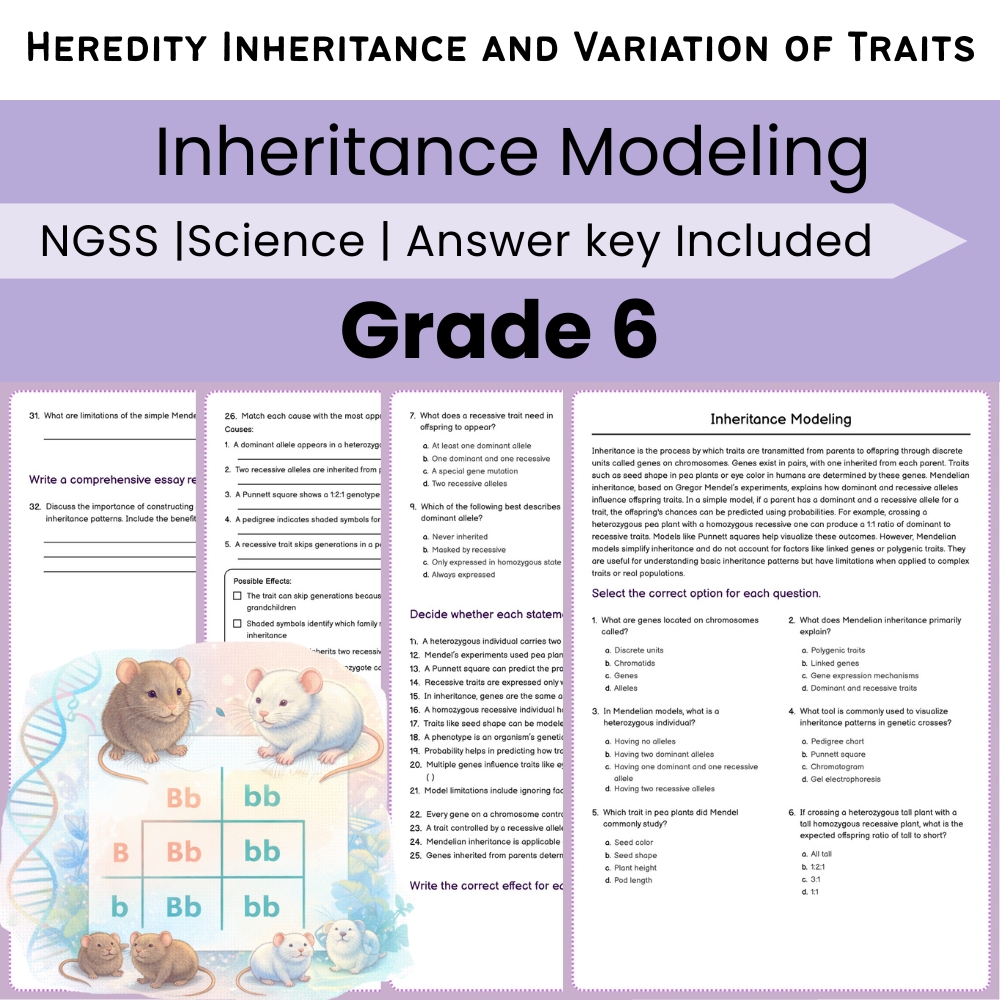
Inheritance Modeling Worksheet | Grade 6 Science Printable PDF NGSS
Learning Objectives
- Explain how traits are transmitted from parents to offspring using genes.
- Predict offspring trait ratios using Mendelian inheritance models.
- Construct and interpret simple models of dominant and recessive inheritance patterns.
Also included in: Grade 6 Science INHERITANCE & VARIATION UNIT | Heredity NGSS Worksheet Bundle (2 Worksheets) +1 more
Instant download
Browse more categories
About Science Worksheets
Find Science worksheets spanning core skills, practice, and review. All 44,628 resources are instant PDF downloads for the classroom or home.
Every worksheet on MyTeachingSheets is created by independent teacher-authors and reviewed before publication. All resources download as printable PDFs for classroom, homework, or at-home practice, and many include answer keys. Preview any worksheet free before buying.