
Science Worksheets
44,628 subject resources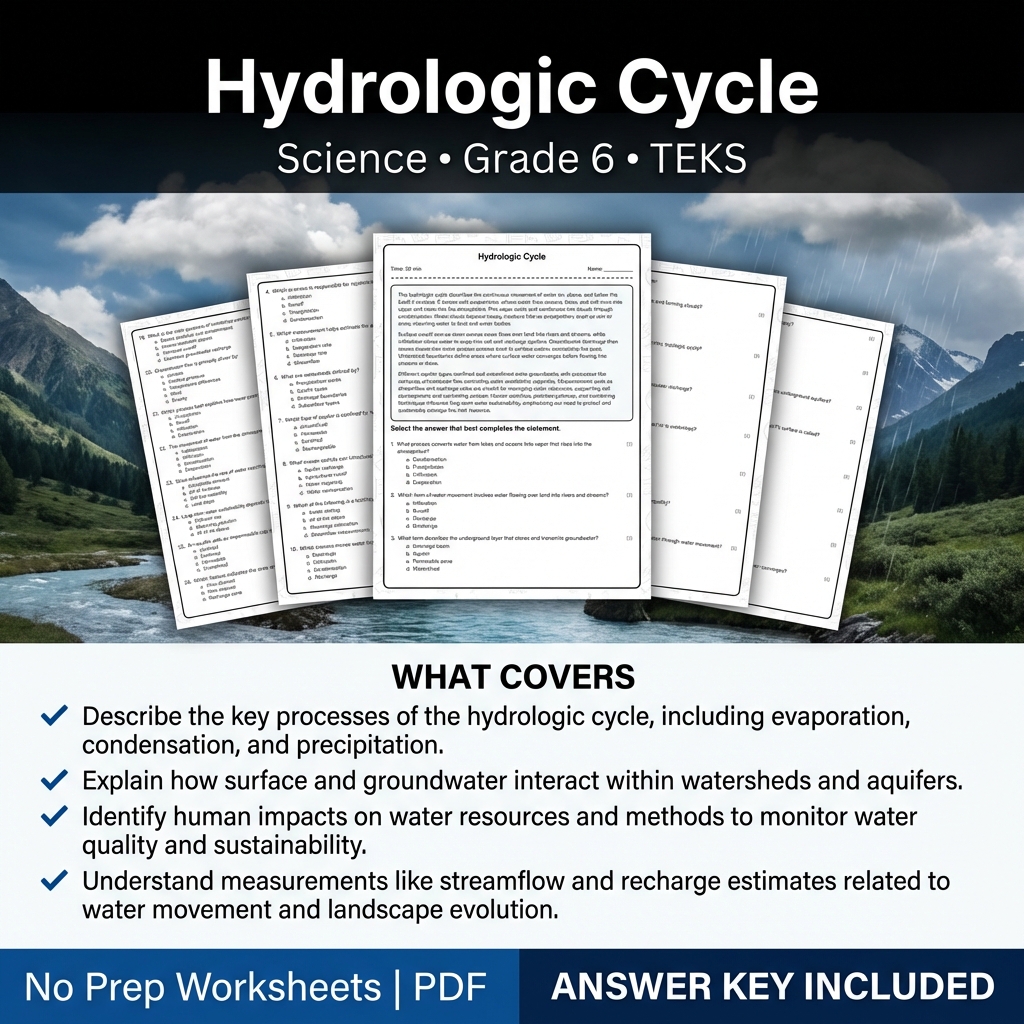
Hydrologic Cycle Science Worksheet for Grade 6 | TEKS Aligned
 Created byCoral Reef Learning
Learning Objectives
- Describe the key processes of the hydrologic cycle, including evaporation, condensation, and precipitation.
- Explain how surface and groundwater interact within watersheds and aquifers.
- Identify human impacts on water resources and methods to monitor water quality and sustainability.
Instant download

Growth Needs of Living Things Worksheets | Grade 4 Science Practice
 Created byBRIGHT PATH RESOURCES
Learning Objectives
- Explain how energy from food, water, and oxygen help organisms grow over time.
- Identify how temperature and habitat features affect organism growth and development.
- Describe what can happen to growth when basic needs are not met consistently.
Also included in: Grade 4 Science Life Cycles Ecosystems & Metamorphosis Worksheets Bundle +2 more
Instant download
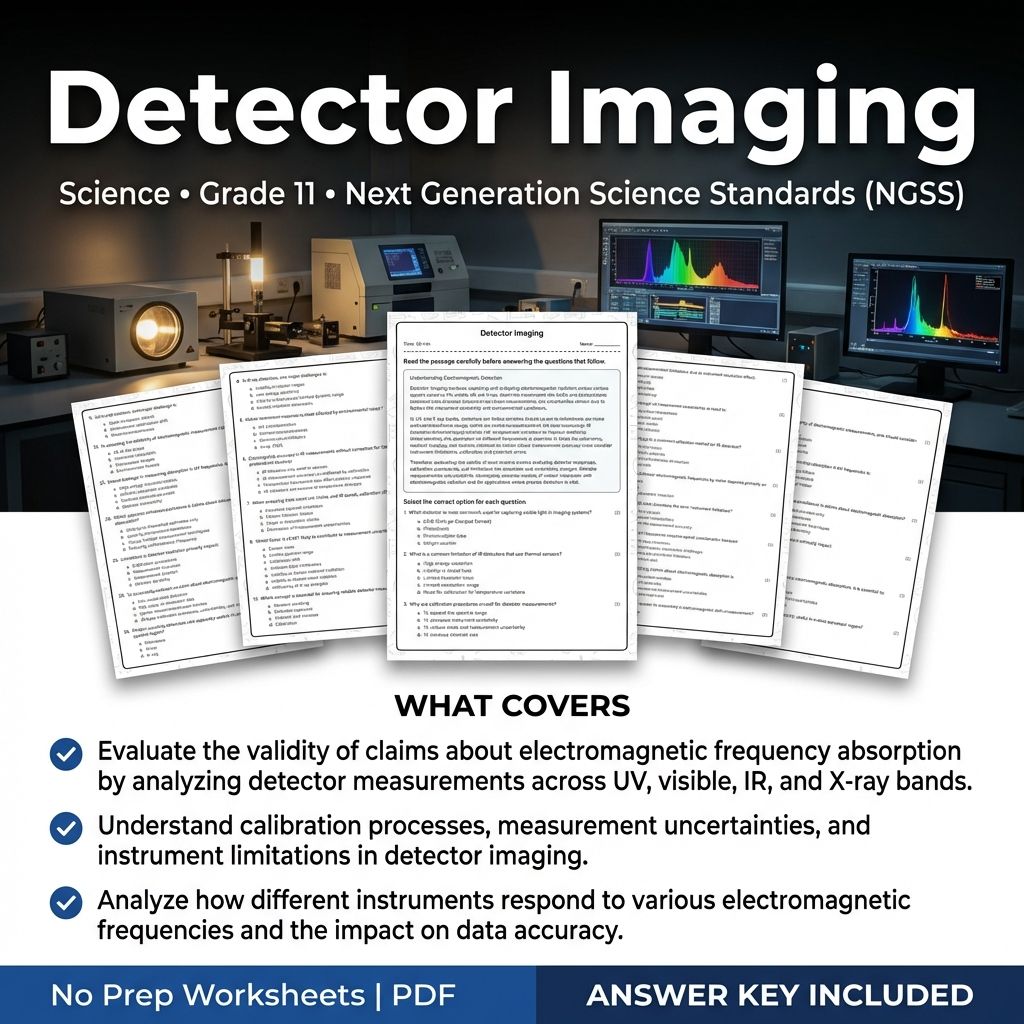
Grade 11 Science | Detector Imaging Worksheet & Answer Key (Printable PDF)
Created byCoral Reef LearningLearning Objectives
- Evaluate the validity of claims about electromagnetic frequency absorption by analyzing detector measurements across UV, visible, IR, and X-ray bands.
- Understand calibration processes, measurement uncertainties, and instrument limitations in detector imaging.
- Analyze how different instruments respond to various electromagnetic frequencies and the impact on data accuracy.
Also included in: Grade 11 Science Unit Bundle | Wave, Spectrum & Signal Encoding Worksheets +1 more
Instant download
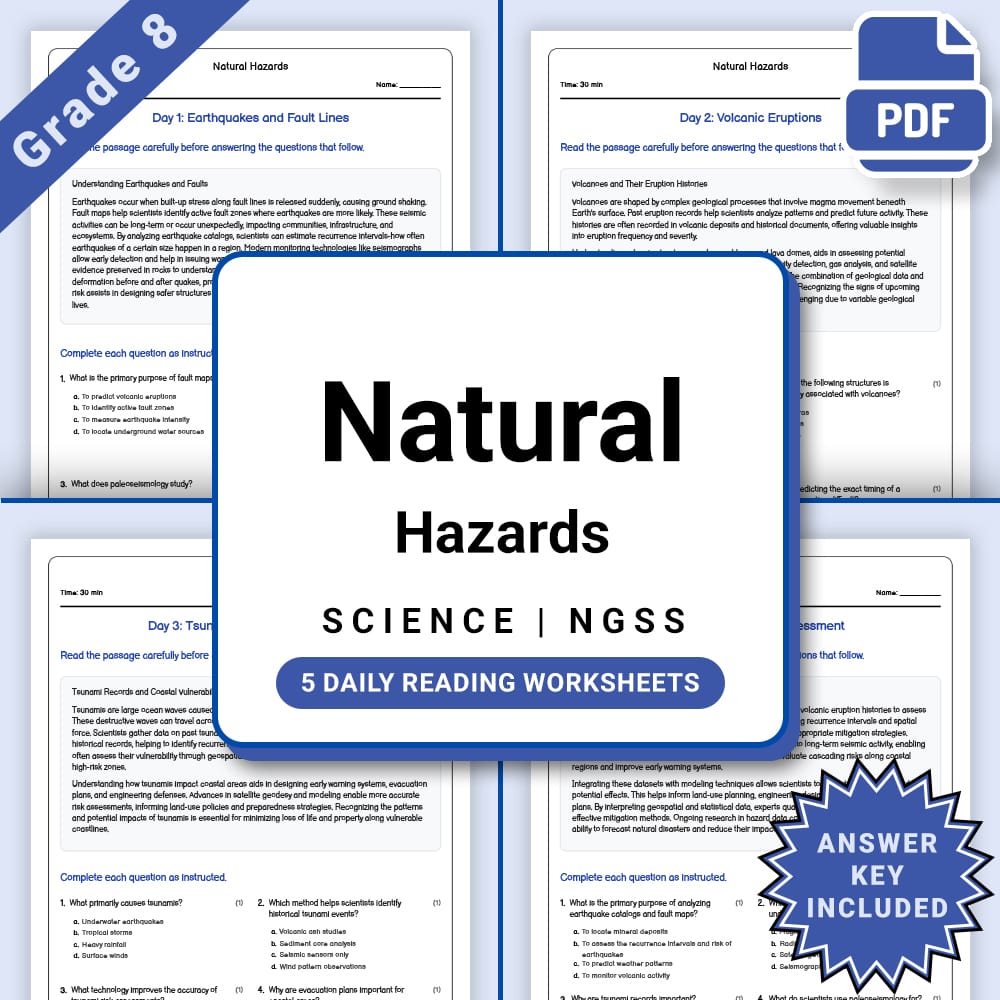
Grade 8 Science – Natural Hazards Daily Reading Worksheet(PDF + Answer Key)
 Created byCopper Leaf Classroom
Learning Objectives
- Understand how seismic data and fault maps help identify earthquake risks.
- Interpret geological and geospatial datasets related to natural hazards.
- Analyze the recurrence intervals and potential impacts of earthquakes and tsunamis.
Instant download

Spectrum Properties Test Prep Worksheets | Grade 11 Science NGSS Review
 Created byPrism Point Learning
Learning Objectives
- Evaluate evidence for the wave and particle models of electromagnetic radiation using interference, diffraction, and the photoelectric effect.
- Explain where each model works well and where it breaks down for different observed phenomena.
- Connect spectral observations (wavelength, frequency, energy) to the underlying behavior of light.
Also included in: Grade 11 Wave, Spectrum & Imaging Science Test Prep Lesson Bundle | NGSS
Instant download

Detector Imaging Test Prep Worksheet | Grade 11 Science NGSS Review
Created byPrism Point LearningLearning Objectives
- Evaluate claims about how detector response changes across electromagnetic frequency bands using evidence from measurements.
- Explain how calibration, uncertainty, and instrument limitations affect the validity and reliability of detector imaging results.
Also included in: Grade 11 Wave, Spectrum & Imaging Science Test Prep Lesson Bundle | NGSS
Instant download

Circuit Fundamentals Worksheet | Science | Standards-Aligned Grade 10
JCreated byJ.S SheetsLearning Objectives
- Define current, voltage, and resistance and understand their interrelationships in electrical circuits.
- Explain Ohm's law and apply it to simple circuit calculations.
- Differentiate between series and parallel circuit configurations and their effects on current and voltage.
Also included in: Grade 10 Science Practice Worksheets: Alberta Science Full-Year Bundle
Instant download
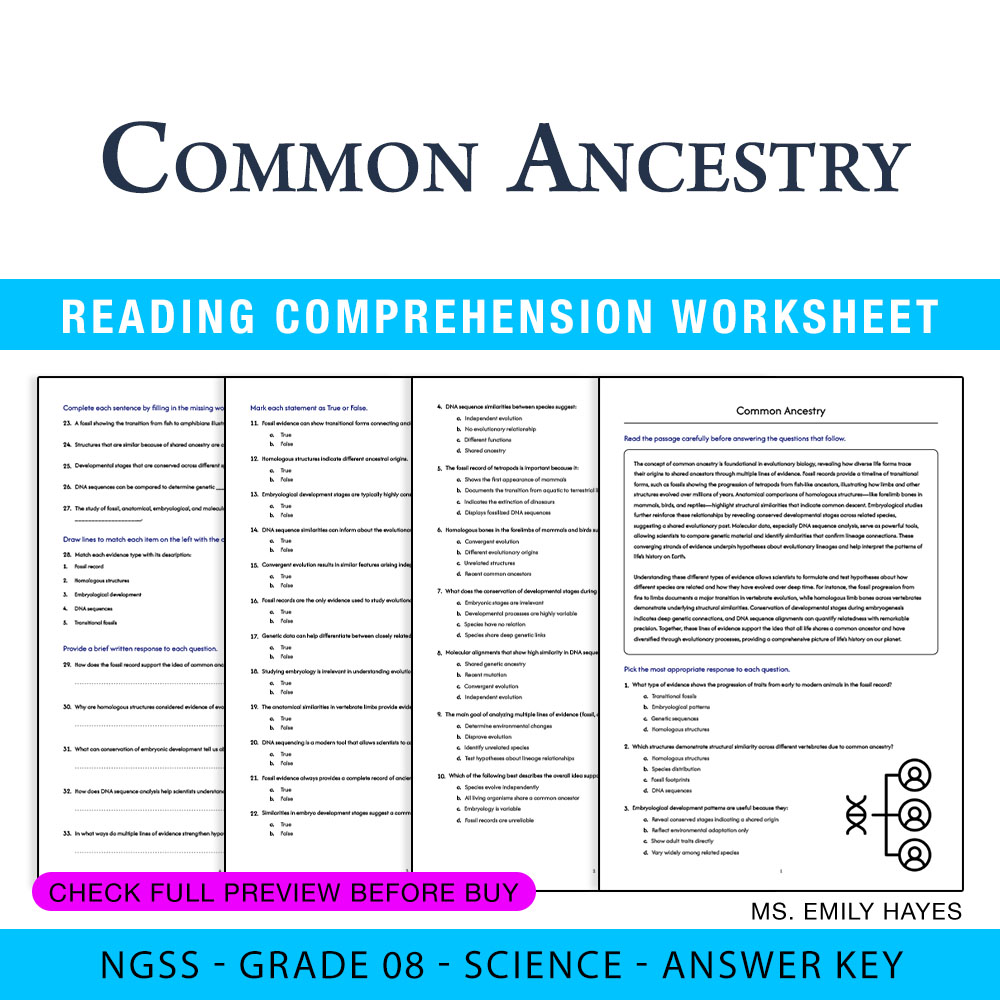
8th Grade Science | Common Ancestry Worksheet (PDF+ Answer Key)
Created byCopper Leaf ClassroomLearning Objectives
- Explain how fossil records show the progression of traits over time.
- Identify examples of homologous structures across different vertebrates.
- Interpret DNA sequence similarities to infer shared ancestry.
Instant download
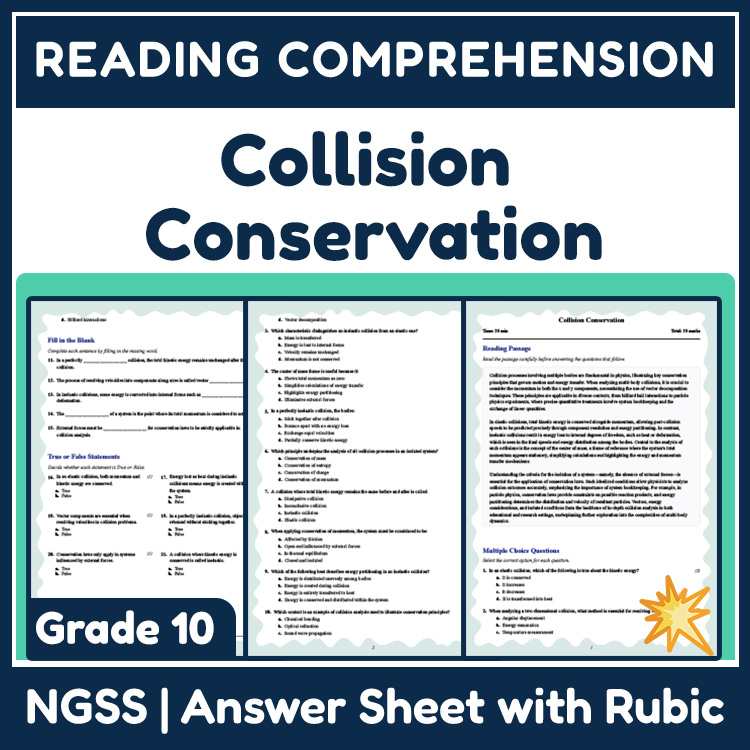
10th Grade Science | Collision Conservation Reading Worksheets (Answer Key)
JCreated byJ.S SheetsLearning Objectives
- Identify and explain the principles of conservation of momentum in multi-body collisions.
- Analyze two-dimensional collision problems using vector components and system bookkeeping.
- Distinguish between elastic and inelastic collisions based on energy and speed distributions.
Instant download

Grade 8 Science Worksheet | Water Routing & Landforms Practice (PDF)
 Created byEvergreen Desk Education
Learning Objectives
- Explain how runoff, erosion, transport, and deposition shape landforms such as valleys and deltas.
- Describe how groundwater influences features like springs and how weathering connects to water movement.
- Interpret how changes in gradient and drainage patterns affect where sediment accumulates.
Also included in: Grade 8 Earth and Space Science Lesson Bundle - General Framework +1 more
Instant download

Grade 8 Science Worksheet | Climate Patterns & Feedbacks (PDF)
Created byEvergreen Desk EducationLearning Objectives
- Explain the difference between weather and climate using long-term data patterns.
- Identify how natural variability can affect short-term observations versus long-term trends.
- Describe climate feedbacks (such as ice-albedo and water-vapor effects) and predict their impacts.
Also included in: Grade 8 Earth and Space Science Lesson Bundle - General Framework +1 more
Instant download

Grade 8 Science Worksheet | Cratered vs Resurfaced Worlds (PDF)
Created byEvergreen Desk EducationLearning Objectives
- Explain how crater density and surface texture help scientists infer the relative ages of planetary surfaces.
- Compare heavily cratered regions with smoother plains in terms of geologic activity and resurfacing history.
- Use evidence from impact craters and surrounding materials to support claims about past processes.
Also included in: Grade 8 Earth and Space Science Lesson Bundle - General Framework +1 more
Instant download
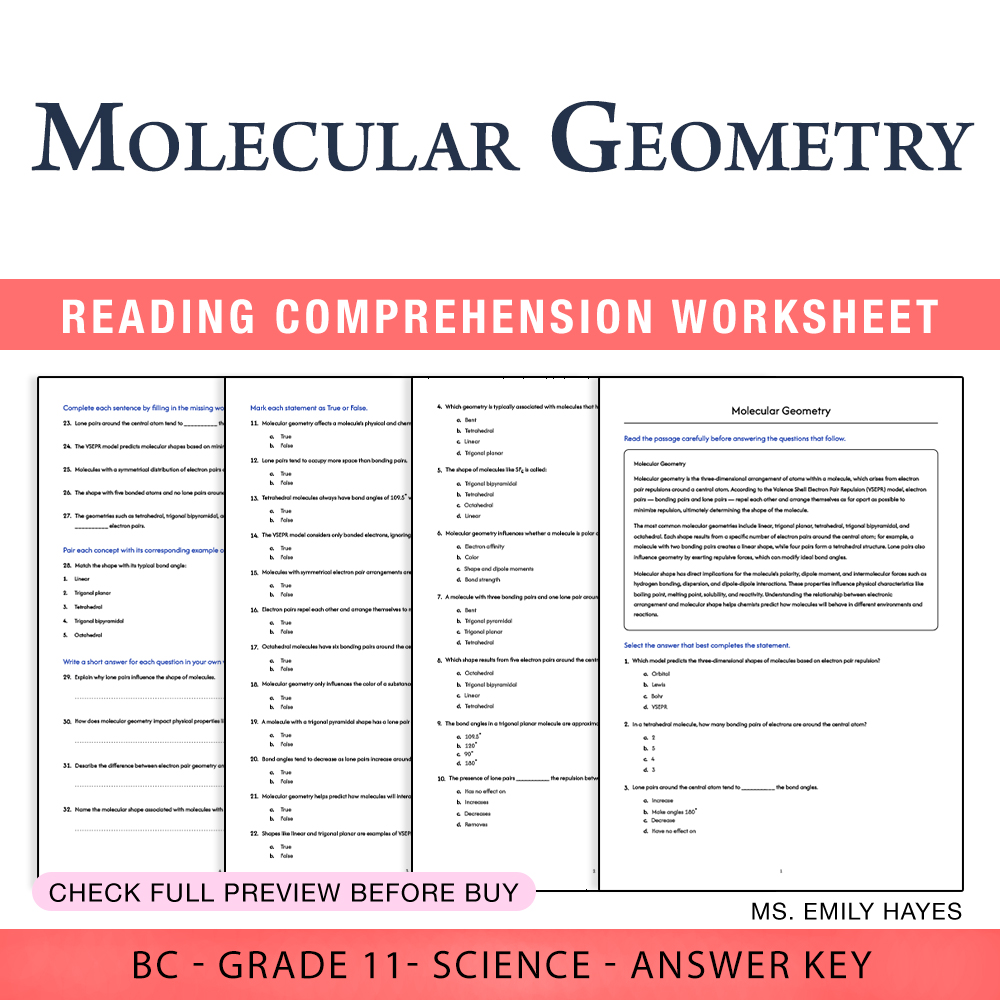
11th Grade Science | Molecular Geometry Worksheet (PDF + Answer Key)
Created byCopper Leaf ClassroomLearning Objectives
- Describe the VSEPR model and how electron pairs influence molecular shape.
- Identify common molecular geometries such as linear, trigonal planar, tetrahedral, trigonal bipyramidal, and octahedral.
- Explain how molecular geometry affects polarity, intermolecular forces, and physical properties.
Also included in: Grade 11 Science BC– Thermochemistry, Bonding & Reactions (PDF + Answer Key) +1 more
Instant download
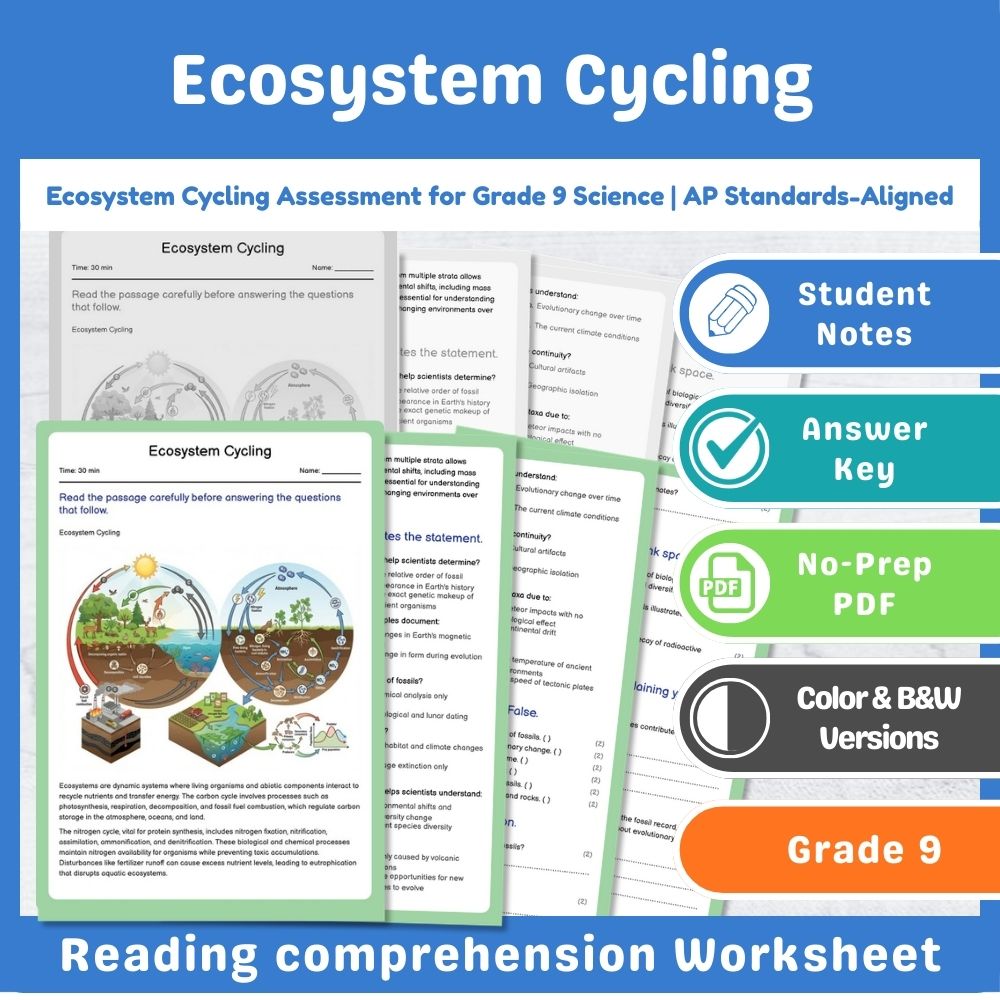
Ecosystem Cycling Assessment for Grade 9 Science | AP Standards-Aligned
Created byPrism Point LearningLearning Objectives
- Describe how organisms and abiotic components interact to drive material cycling and energy flow in ecosystems.
- Explain the roles of carbon and nitrogen cycles in maintaining ecosystem health.
- Analyze the impact of perturbations such as nutrient enrichment, habitat alteration, and invasive species on community structure and ecosystem function.
Also included in: Grade 9 Science Mini Bundle | Biology & Ecosystems Unit AP Standards
Instant download
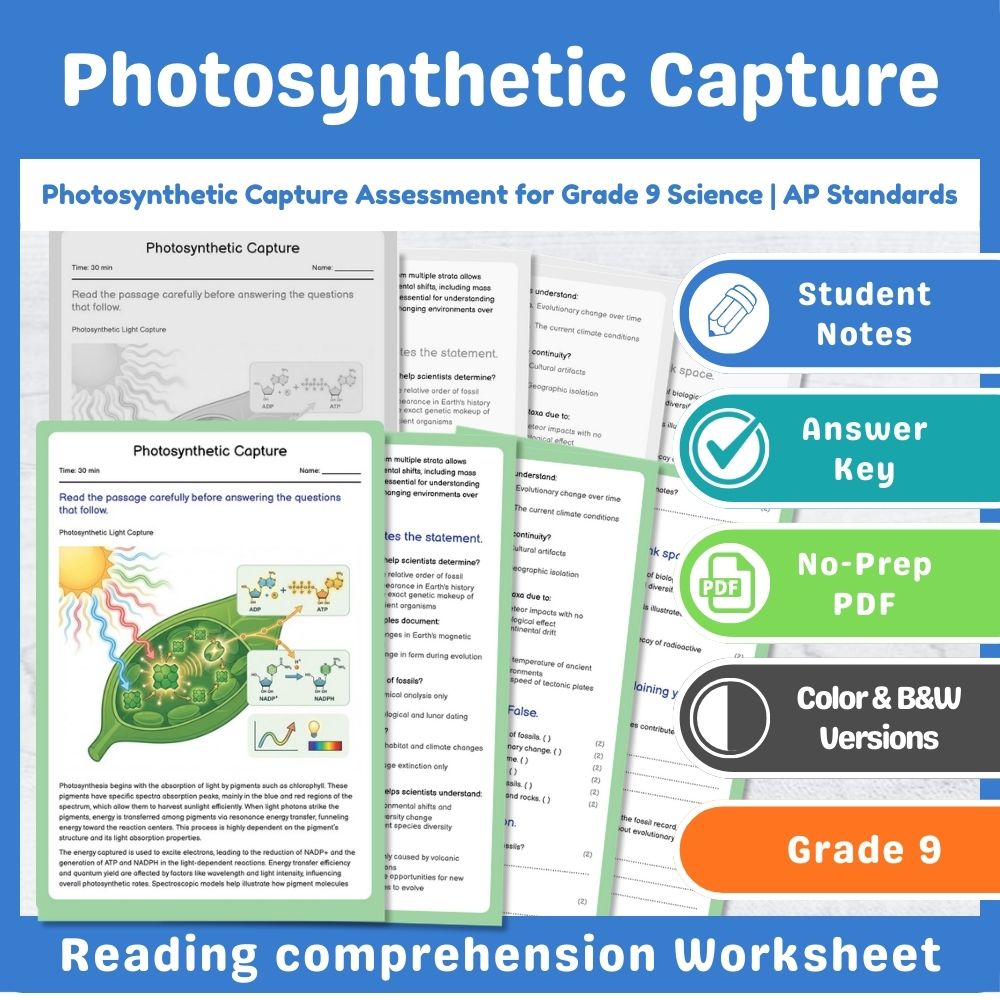
Photosynthetic Capture Assessment for Grade 9 Science | AP Standards
Created byPrism Point LearningLearning Objectives
- Describe how pigments absorb light and transfer energy in photosynthesis.
- Explain the relationship between light wavelength, energy transfer, and photosystem function.
- Analyze how environmental factors like light intensity influence photosynthetic rates.
Also included in: Grade 9 Science Mini Bundle | Biology & Ecosystems Unit AP Standards
Instant download
Ecosystem Dynamics Assessment for Grade 9 Science – AP Standards Aligned
Created byPrism Point LearningLearning Objectives
- Understand the concept of trophic interactions and feedback loops within ecosystems.
- Analyze how environmental factors influence ecosystem responses and resilience.
- Evaluate management scenarios affecting biodiversity and ecosystem services.
Also included in: Grade 9 Science Mini Bundle | Biology & Ecosystems Unit AP Standards
Instant download
Cell Components Assessment Worksheet | AP Standards-Aligned Assessment Grade 9 Science
Created byPrism Point LearningLearning Objectives
- Identify the key components of a cell and their functions.
- Explain the differences between plant and animal cell components.
- Analyze the structure and role of cell organelles in cellular processes.
Also included in: Grade 9 Science Mini Bundle | Biology & Ecosystems Unit AP Standards
Instant download
Membrane Transport Assessment for Grade 9 Science | AP Standards
Created byPrism Point LearningLearning Objectives
- Explain the mechanisms of passive diffusion, facilitated transport, and active transport across cell membranes.
- Describe how membrane composition and transporters influence cellular homeostasis and electrochemical gradients.
- Apply quantitative reasoning to predict the effects of structural modifications on membrane transport efficiency.
Also included in: Grade 9 Science Mini Bundle | Biology & Ecosystems Unit AP Standards
Instant download
Energy Pathways Assessment for Grade 9 Science | AP Standards-Aligned
Created byPrism Point LearningLearning Objectives
- Understand key concepts related to Science
- Apply knowledge through practice questions
- Demonstrate comprehension of the material
Also included in: Grade 9 Science Mini Bundle | Biology & Ecosystems Unit AP Standards
Instant download
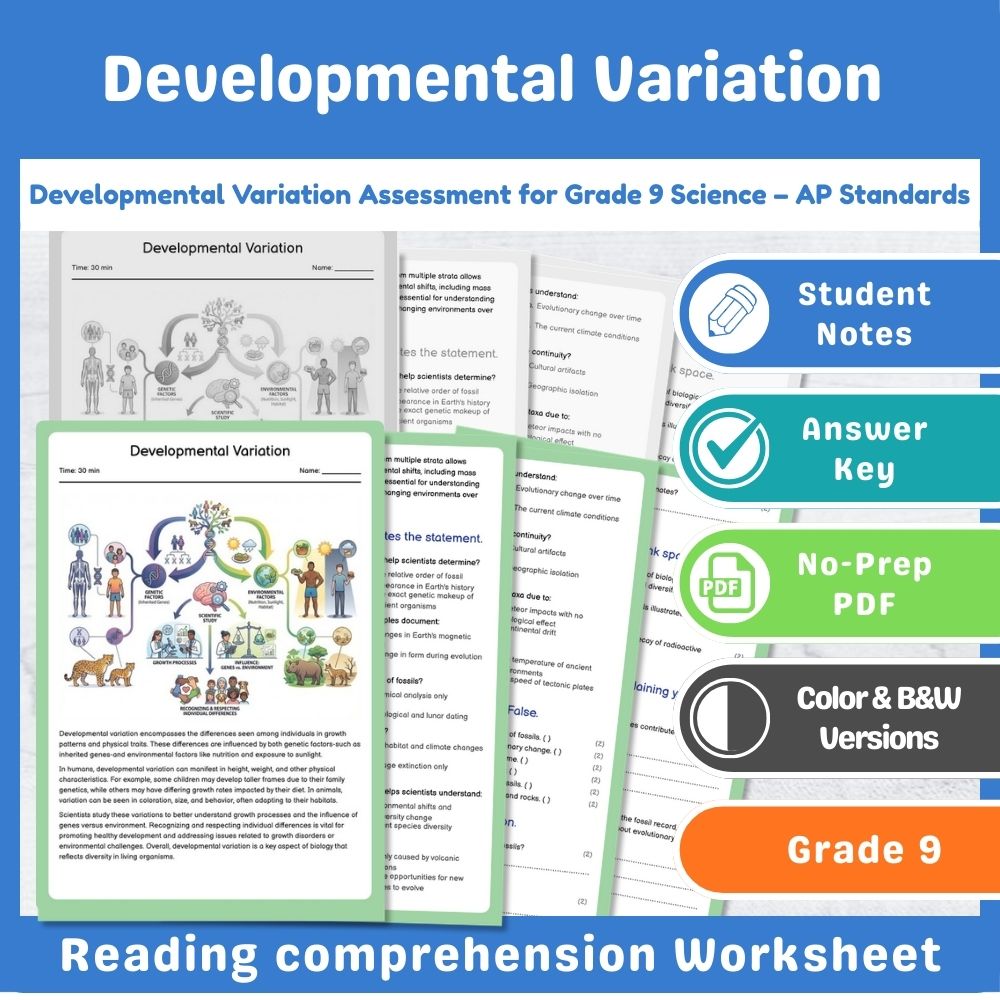
Developmental Variation Assessment for Grade 9 Science – AP Standards
Created byPrism Point LearningLearning Objectives
- Understand the concept of developmental variation in humans and animals.
- Identify factors that contribute to differences in development among individuals.
- Analyze how genetics and environment influence developmental traits.
Also included in: Grade 9 Science Mini Bundle | Biology & Ecosystems Unit AP Standards
Instant download
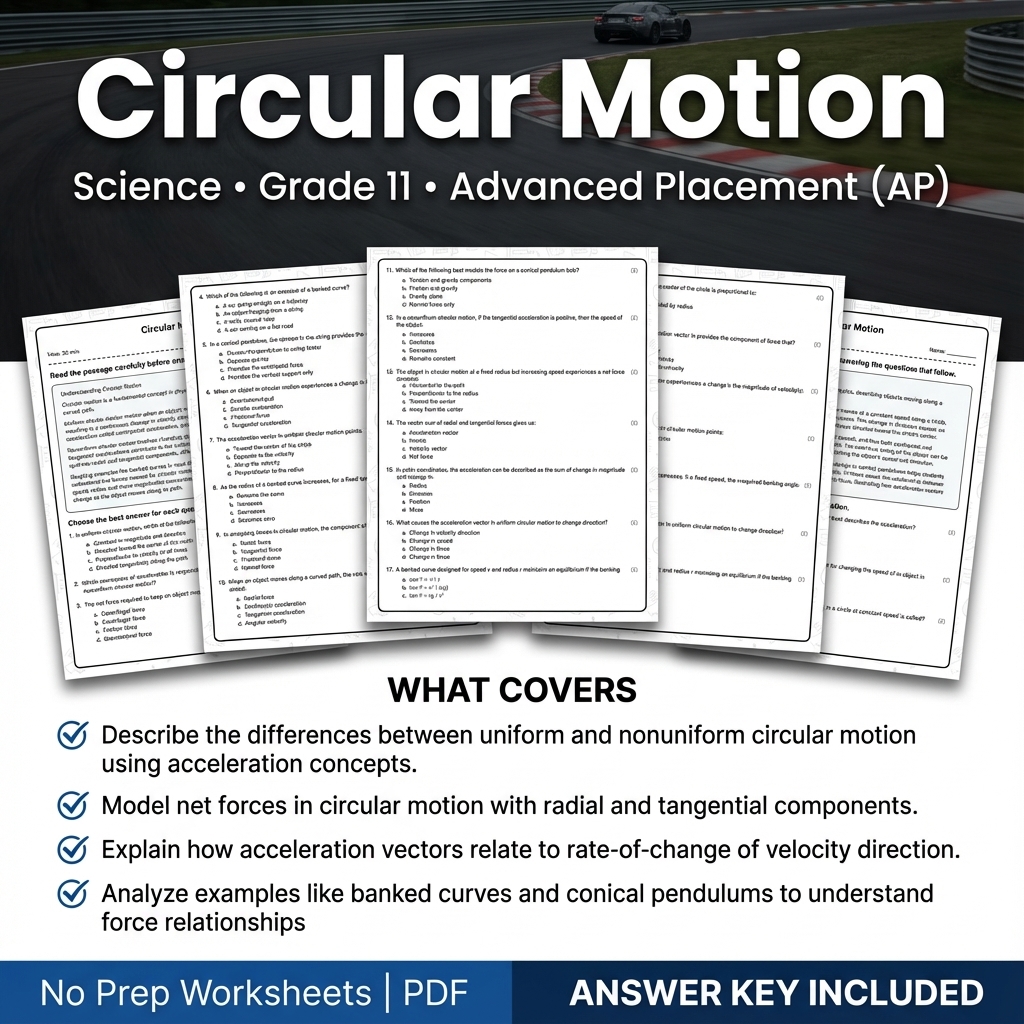
11th Grade Science | Circular Motion Worksheet (Printable PDF + Answer Key)
Created byCoral Reef LearningLearning Objectives
- Describe the differences between uniform and nonuniform circular motion using acceleration concepts.
- Model net forces in circular motion with radial and tangential components.
- Explain how acceleration vectors relate to rate-of-change of velocity direction.
Also included in: Grade 11 Science Unit | Physics Worksheets on Work, Power & Motion PDF Bundle +1 more
Instant download
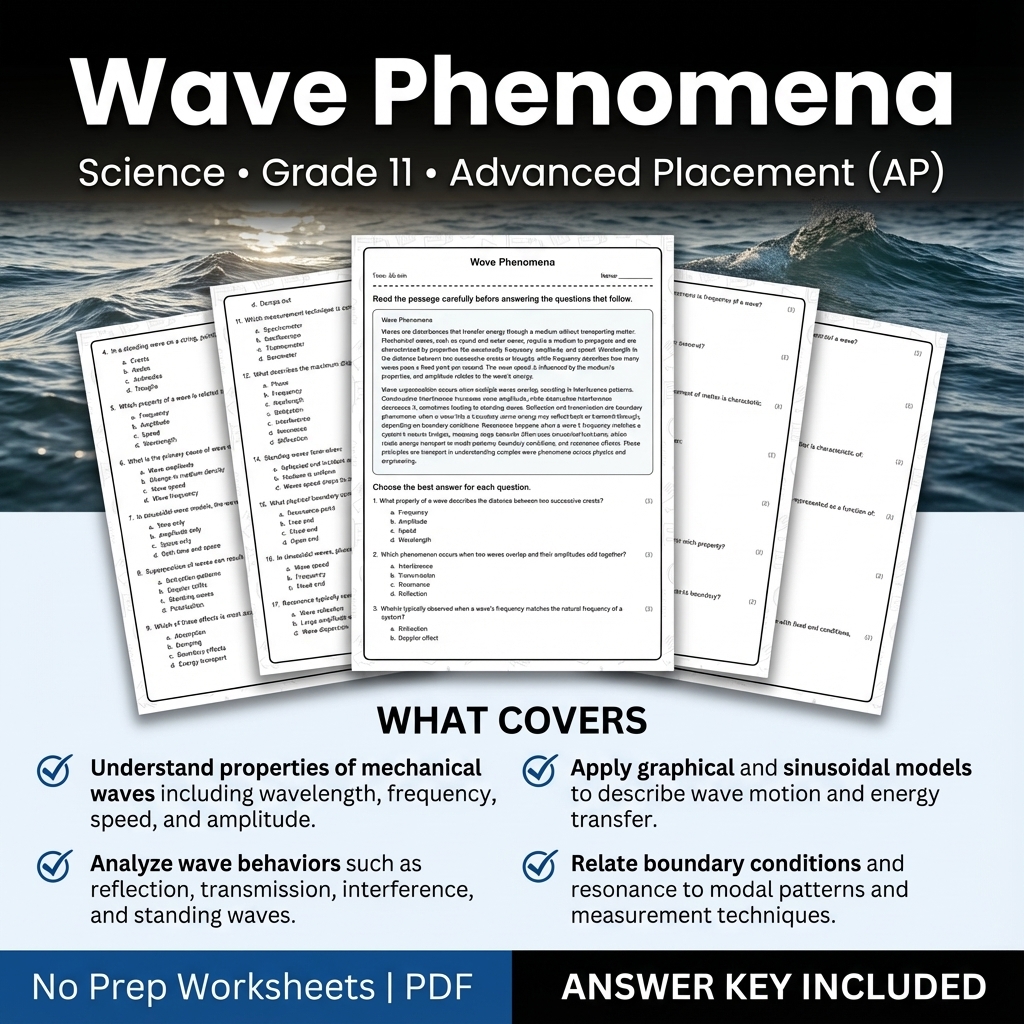
Grade 11 Science | Wave Phenomena Worksheet (Printable PDF + Answer Key)
Created byCoral Reef LearningLearning Objectives
- Understand properties of mechanical waves including wavelength, frequency, speed, and amplitude.
- Analyze wave behaviors such as reflection, transmission, interference, and standing waves.
- Apply graphical and sinusoidal models to describe wave motion and energy transfer.
Also included in: Grade 11 Science Unit | Physics Worksheets on Work, Power & Motion PDF Bundle +1 more
Instant download
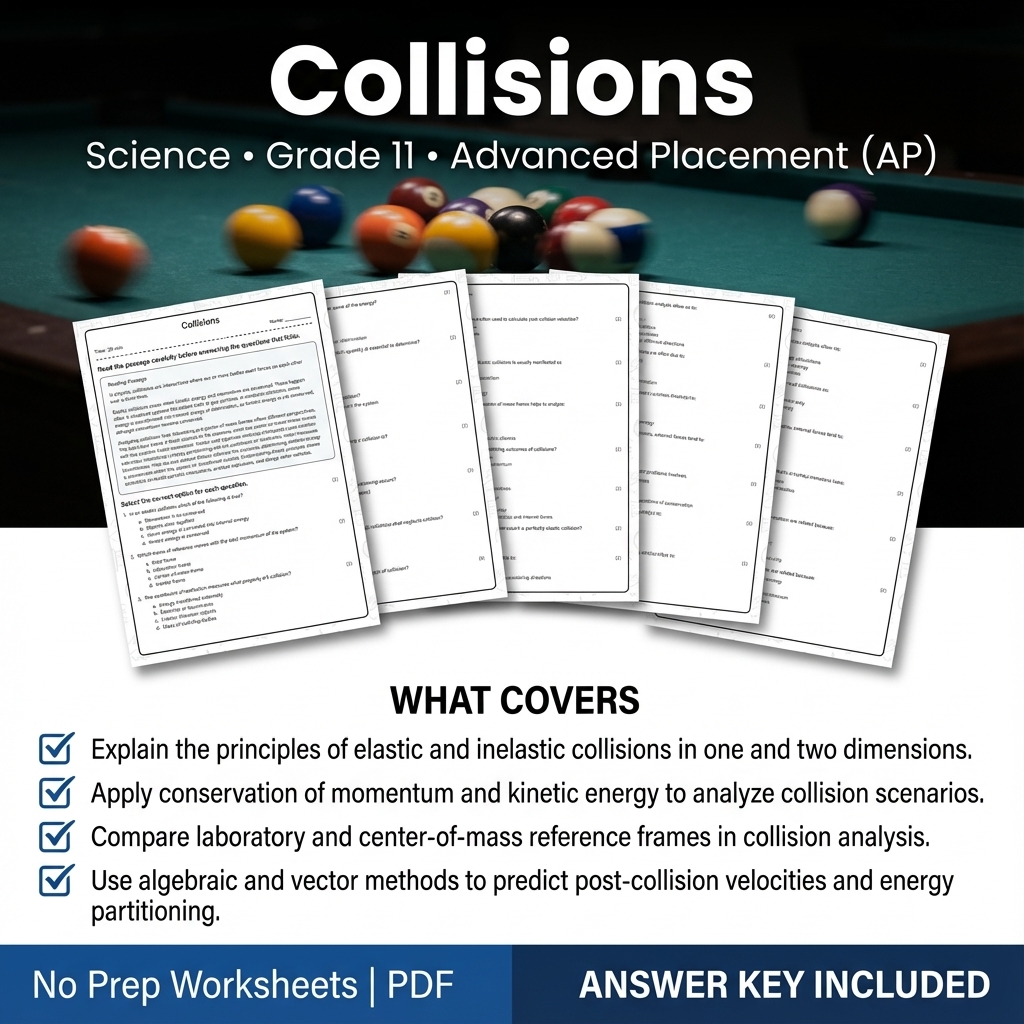
Grade 11 Science | Collisions Worksheet (Printable PDF + Answer Key)
Created byCoral Reef LearningLearning Objectives
- Explain the principles of elastic and inelastic collisions in one and two dimensions.
- Apply conservation of momentum and kinetic energy to analyze collision scenarios.
- Compare laboratory and center-of-mass reference frames in collision analysis.
Also included in: Grade 11 Science Unit | Physics Worksheets on Work, Power & Motion PDF Bundle +1 more
Instant download
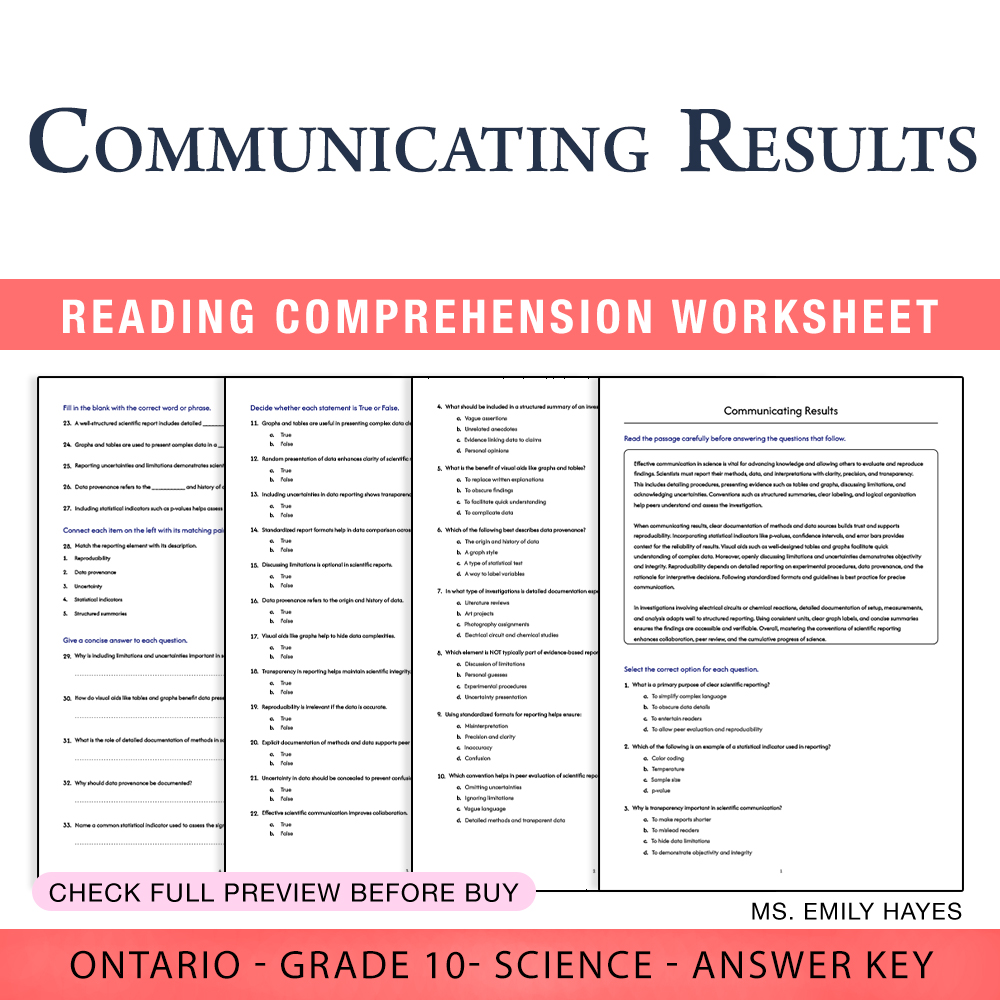
10th Grade Science | Communicating Results Worksheet (PDF + Answer Key)
Created byCopper Leaf ClassroomLearning Objectives
- Understand conventions for clear and evidence-based reporting of scientific investigations
- Learn to integrate tables, graphs, and statistical indicators to substantiate conclusions
- Develop skills for transparent presentation of data, limitations, and uncertainty
Instant download

Trophic Dynamics Test Prep Printable | Grade 9 Science NGSS Review
Created byPrism Point LearningLearning Objectives
- Explain how energy and biomass move through trophic levels in a food web
- Use ecological efficiency and production-to-biomass ideas to describe energy loss at each step
- Interpret trophic pyramids and connect top-down and bottom-up control to predator-prey outcomes
Also included in: Grade 9 Ecosystem Dynamics Science Lesson Bundle: NGSS Review Worksheets
Instant download
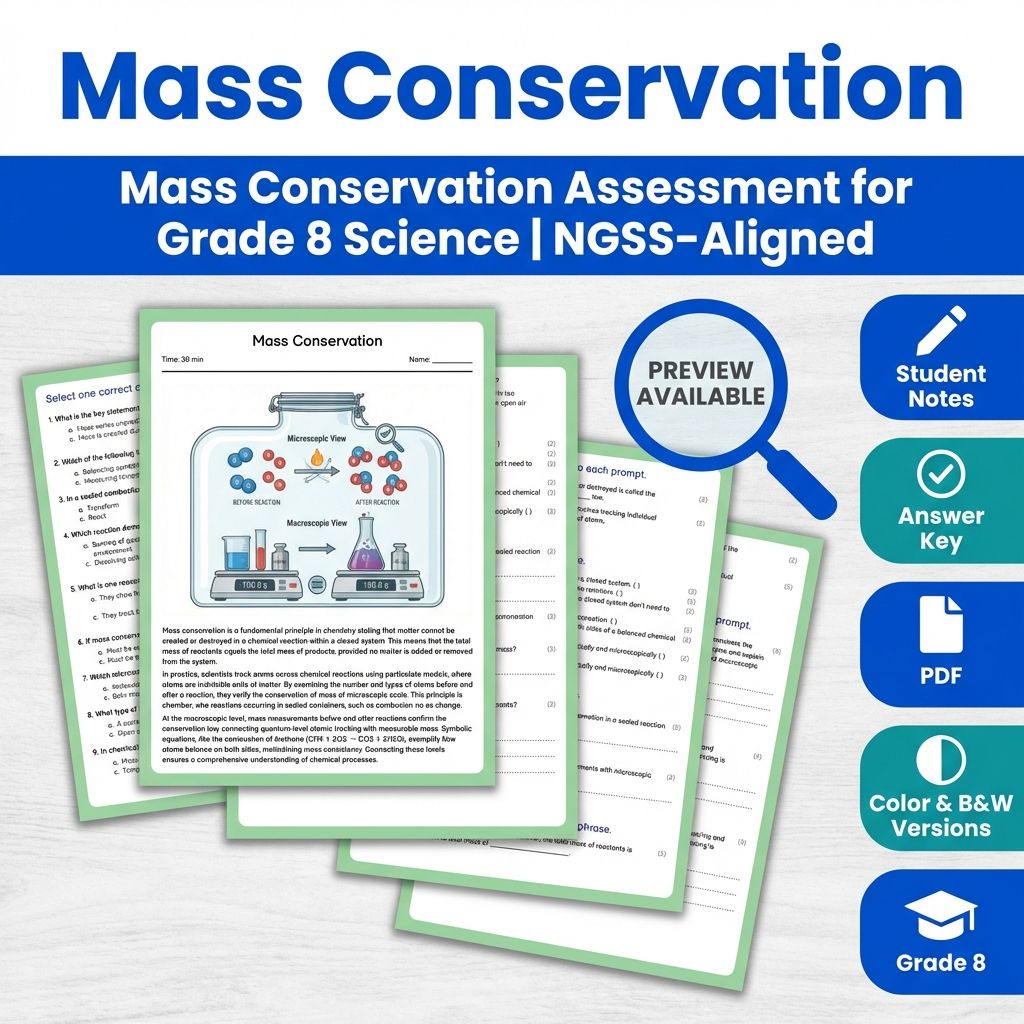
Mass Conservation Assessment for Grade 8 Science | NGSS-Aligned
Created byPrism Point LearningLearning Objectives
- Explain the principle of mass conservation in chemical reactions within closed systems.
- Track atoms across reactants and products at the particulate level to understand mass balance.
- Interpret symbolic chemical equations in terms of atomic and mass conservation.
Also included in: Grade 8 Science Mini Bundle | Matter and Its Interactions NGSS Not specified +1 more
Instant download
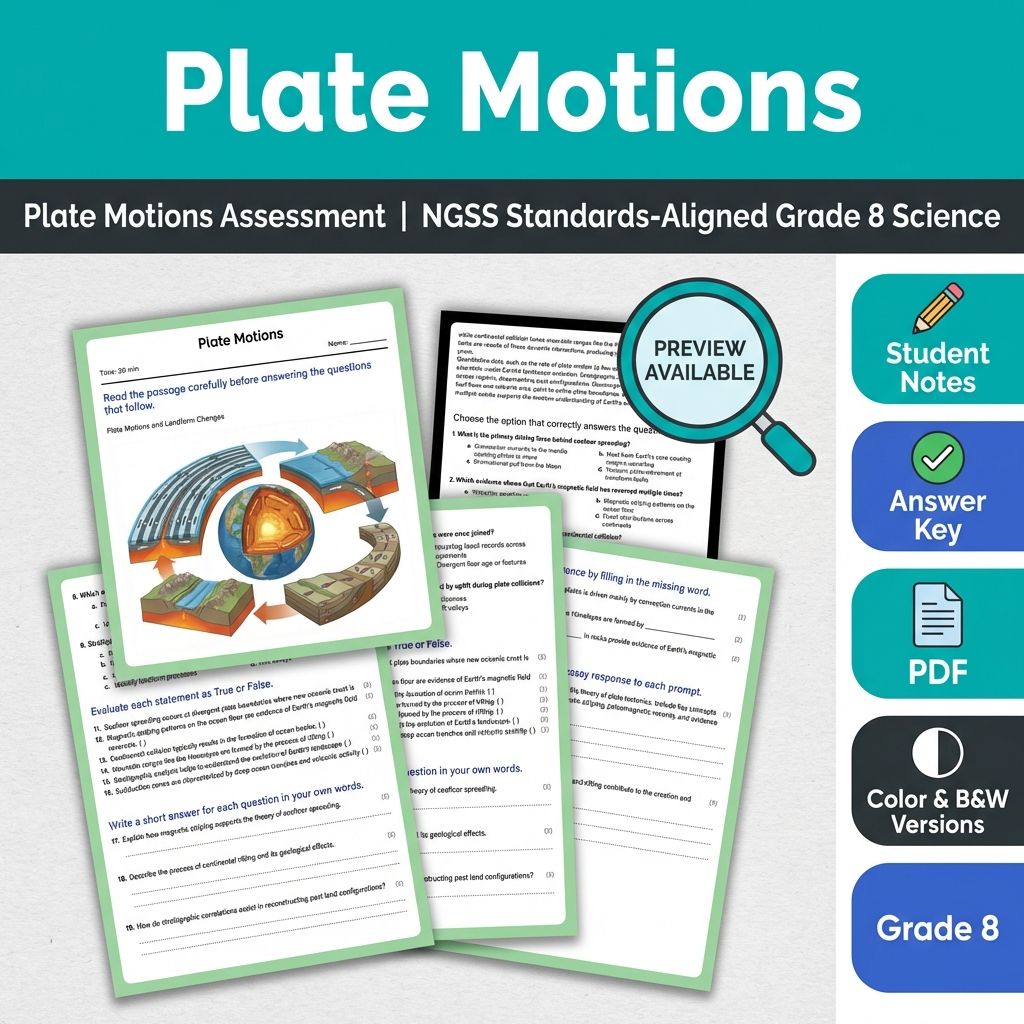
Plate Motions Assessment | NGSS Standards-Aligned Grade 8 Science
Created byPrism Point LearningLearning Objectives
- Understand the mechanisms of plate tectonics and how they shape Earth's landforms.
- Identify key evidence supporting theories of seafloor spreading, magnetic striping, and paleomagnetism.
- Explain processes such as subduction, rifting, continental collision, and uplift.
Also included in: Grade 8 Science Mini Bundle – Earth's Systems & NGSS Standards-Aligned +1 more
Instant download
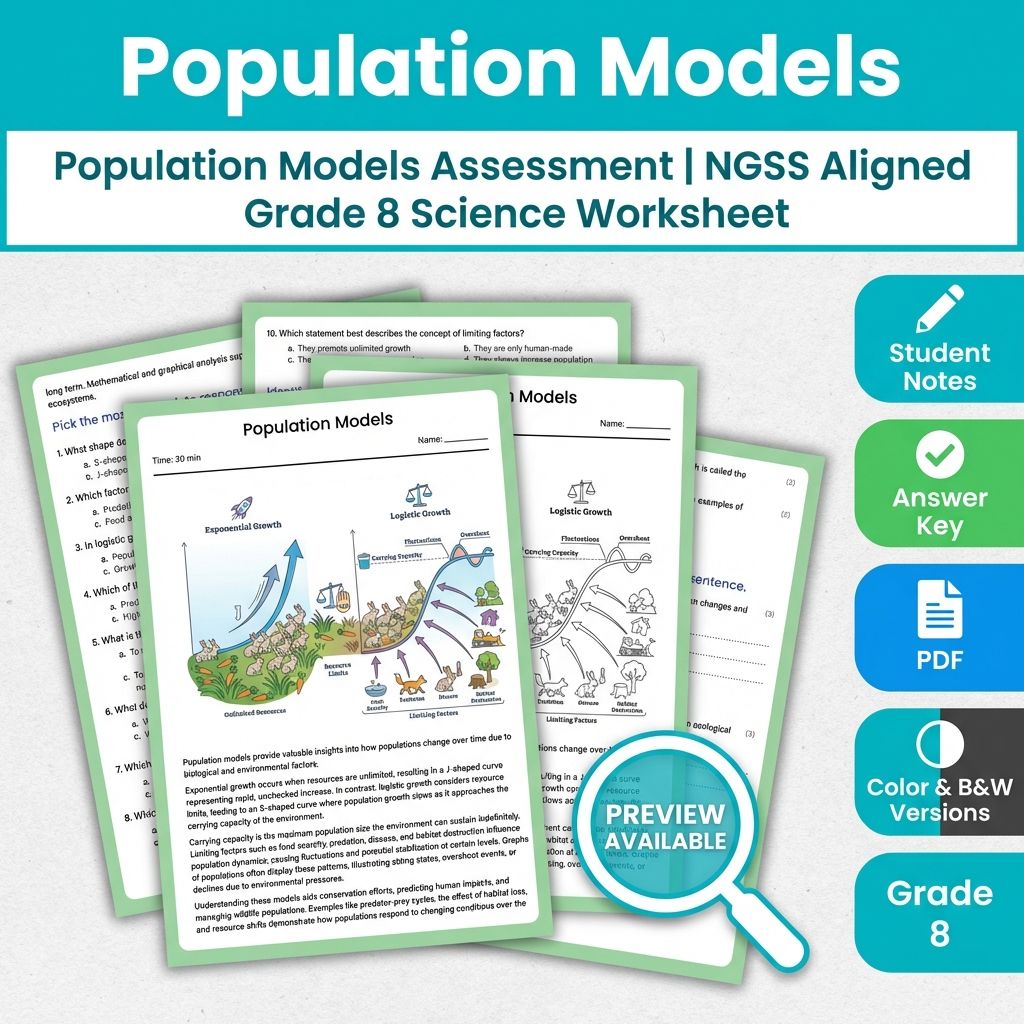
Population Models Assessment | NGSS Aligned Grade 8 Science Worksheet
Created byPrism Point LearningLearning Objectives
- Understand and interpret different types of population growth models such as exponential and logistic growth.
- Analyze factors like resource availability, predation, and carrying capacity that influence populations.
- Graphically interpret population curves to identify steady states, fluctuations, and growth patterns.
Also included in: Grade 8 Science Mini Bundle | Biological Evolution & Diversity Standards-Aligned +1 more
Instant download
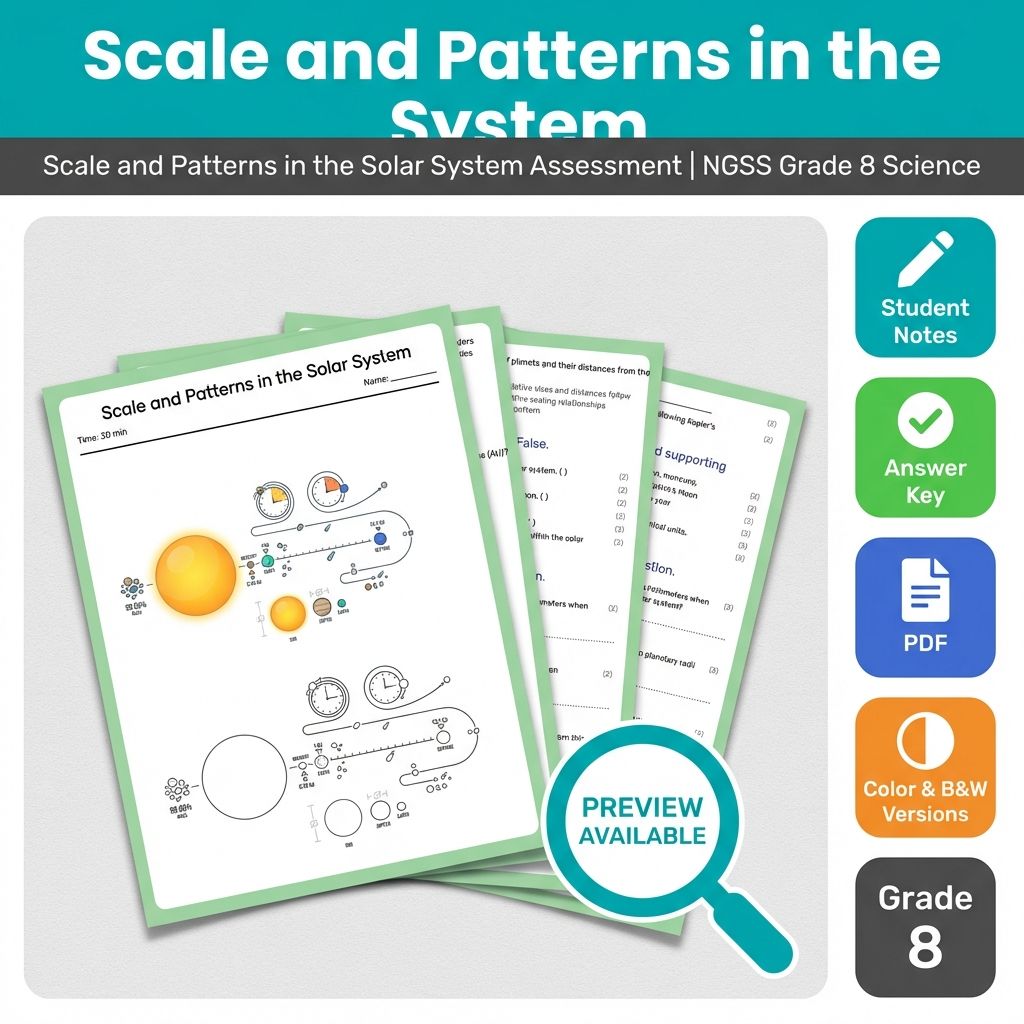
Scale and Patterns in the Solar System Assessment | NGSS Grade 8 Science
Created byPrism Point LearningLearning Objectives
- Interpret quantitative data related to solar system objects such as diameters, distances, and orbital periods.
- Compare and analyze patterns and relationships among planets, dwarf planets, moons, and the Sun using scaled data and astronomical units.
- Identify orders of magnitude differences in planetary radii and interplanetary distances.
Also included in: Grade 8 Science Mini Bundle | Earth's Place in the Universe – NGSS +1 more
Instant download
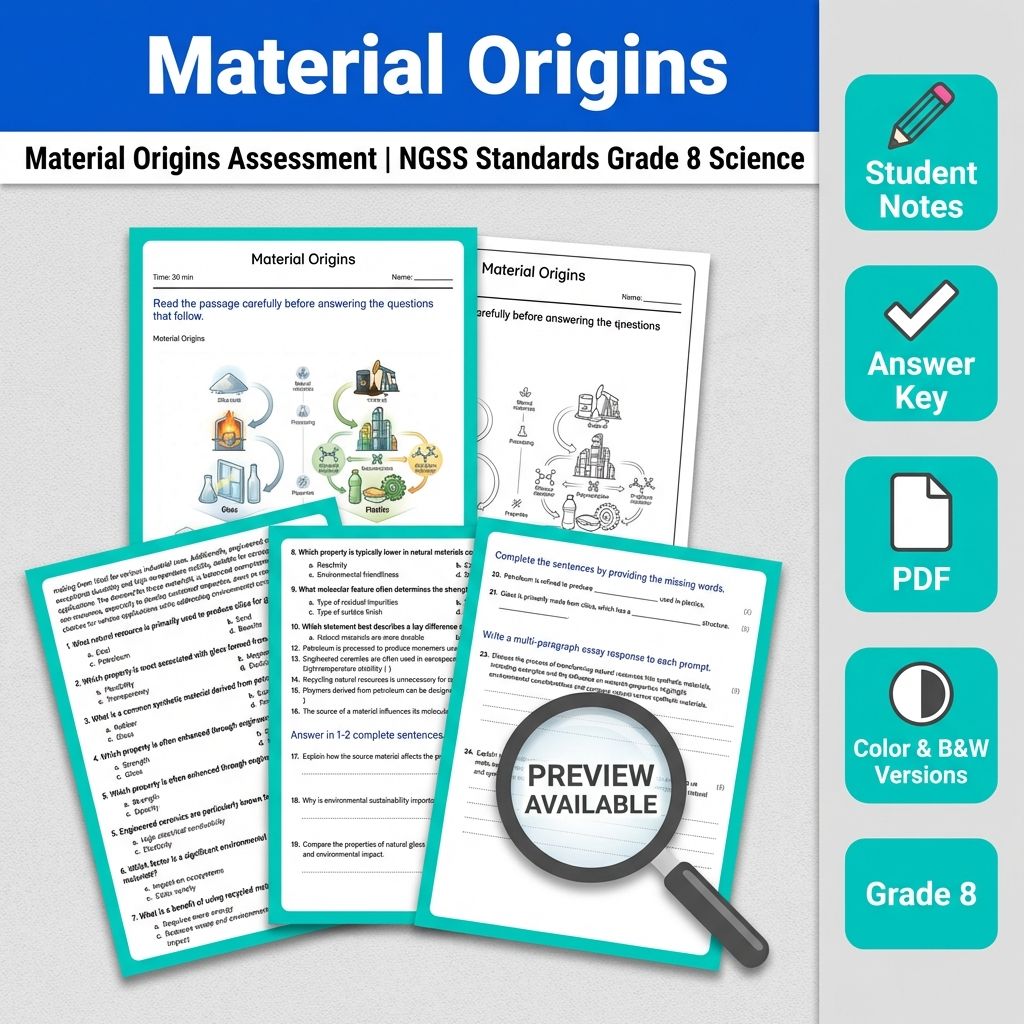
Material Origins Assessment | NGSS Standards Grade 8 Science
Created byPrism Point LearningLearning Objectives
- Explain how natural resources are transformed into synthetic materials.
- Describe the relationship between source materials, molecular structure, and material properties.
- Analyze environmental and resource considerations in sourcing and modifying materials.
Also included in: Grade 8 Science Mini Bundle | Matter and Its Interactions NGSS Not specified +1 more
Instant download
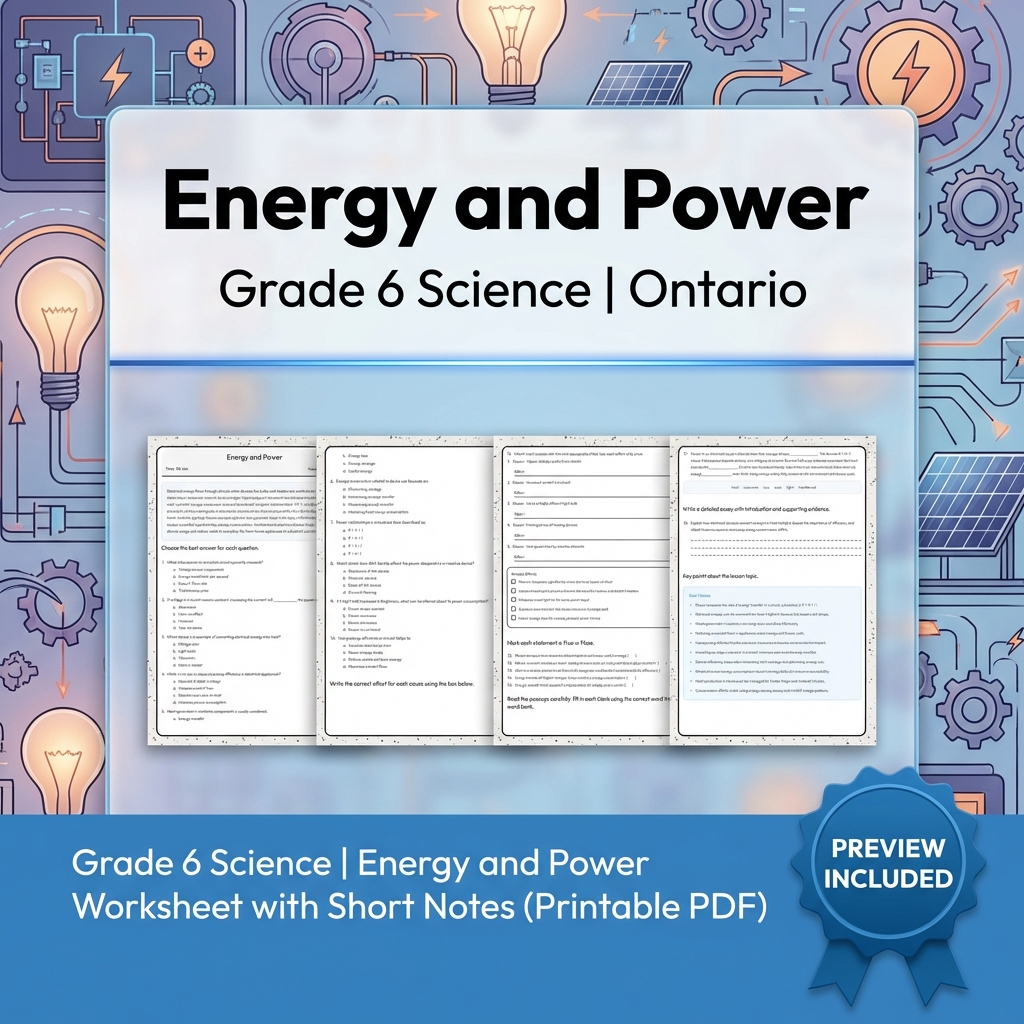
Grade 6 Science | Energy and Power Worksheet with Short Notes (Printable PDF)
 Created byMeadowlark Worksheets
Learning Objectives
- Understand the concept of energy transfer in electrical circuits.
- Explain how power is related to energy transfer rate, current, and voltage.
- Identify everyday examples of electrical power usage and heat generation.
Also included in: Grade 6 Science Lesson Group on Energy, Circuits & Properties +1 more
Instant download
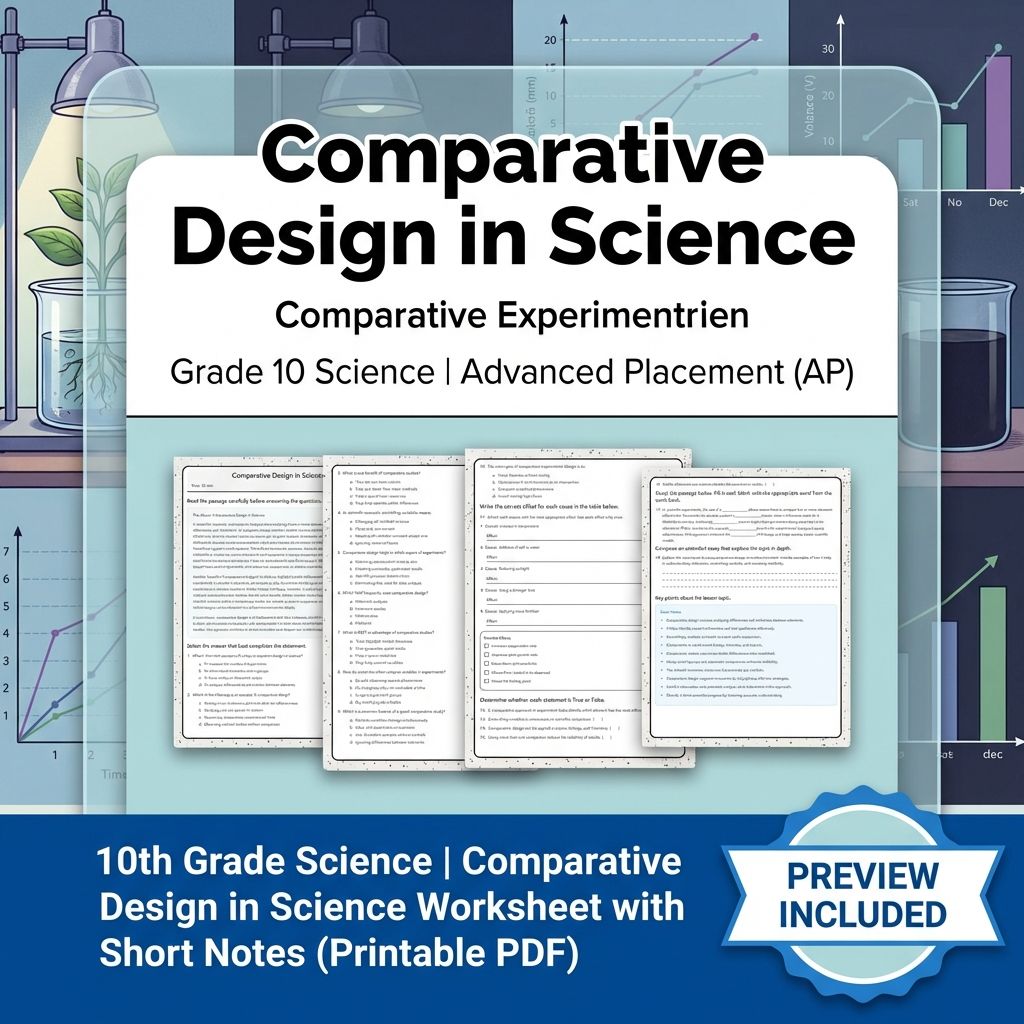
10th Grade Science | Comparative Design in Science Worksheet (PDF)
Created byMeadowlark WorksheetsLearning Objectives
- Understand the concept of comparative design and its applications in science.
- Identify differences and similarities between various scientific models and experiments.
- Analyze the advantages of using comparative methods in scientific investigations.
Also included in: Grade 10 Science Unit | Data Analysis, Modelling Worksheet Pack
Instant download
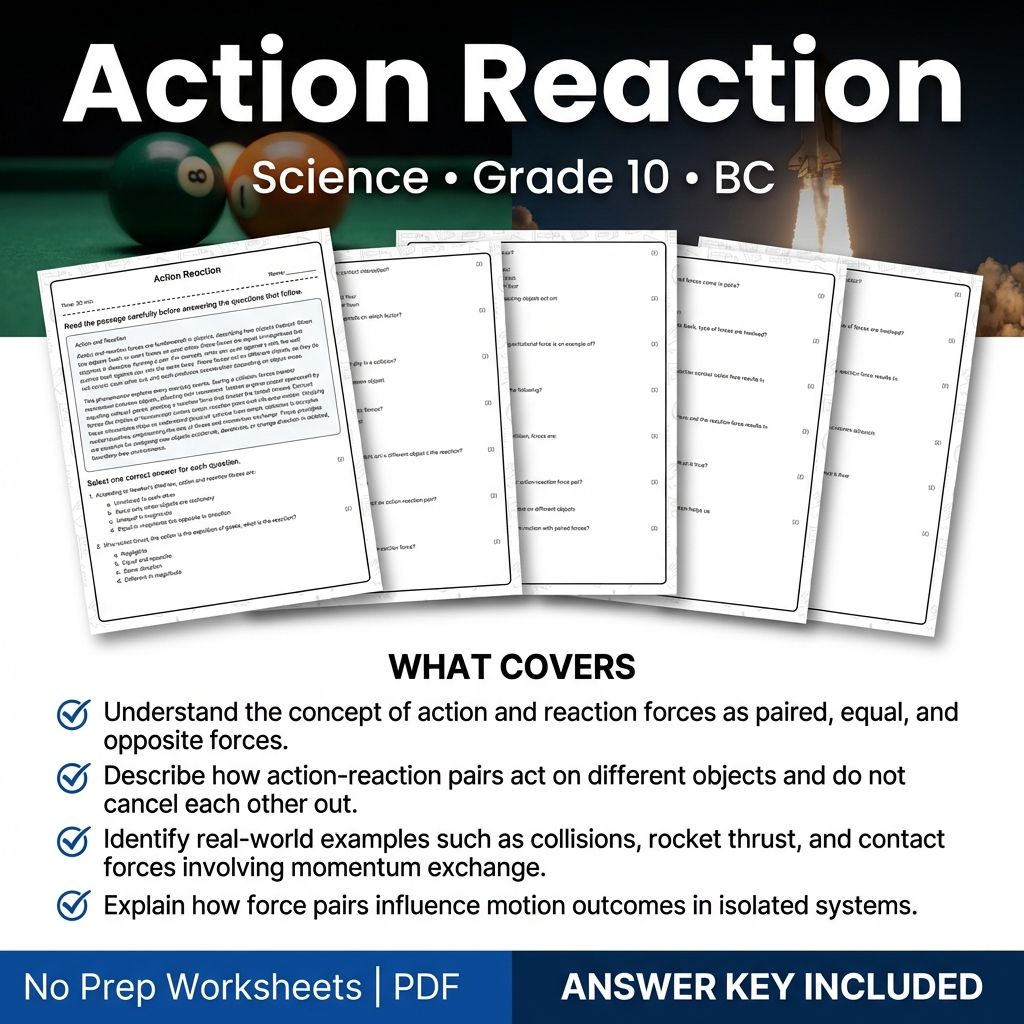
Grade 10 Science | Action and Reaction Forces Worksheet with Answer Key (PDF)
Created byCoral Reef LearningLearning Objectives
- Understand the concept of action and reaction forces as paired, equal, and opposite forces.
- Describe how action-reaction pairs act on different objects and do not cancel each other out.
- Identify real-world examples such as collisions, rocket thrust, and contact forces involving momentum exchange.
Instant download

Grade 9 Acceleration From Data Worksheet | Practice & PDF
 Created byClear Sky Classroom
Learning Objectives
- Interpret acceleration from speed–time and distance–time data graphs
- Determine whether acceleration is approximately constant or changing based on graph shape and slope
- Explain how the sign of acceleration relates to whether speed is increasing or decreasing
Instant download

Climate Change Drivers Worksheet | Grade 12 Environmental Science
Created byPrism Point LearningLearning Objectives
- Explain how natural and human factors shift Earth’s energy balance over different timescales
- Distinguish between greenhouse warming and cooling effects from aerosols and volcanic particles
- Describe how climate patterns such as El Niño influence weather and long-term trends
Instant download
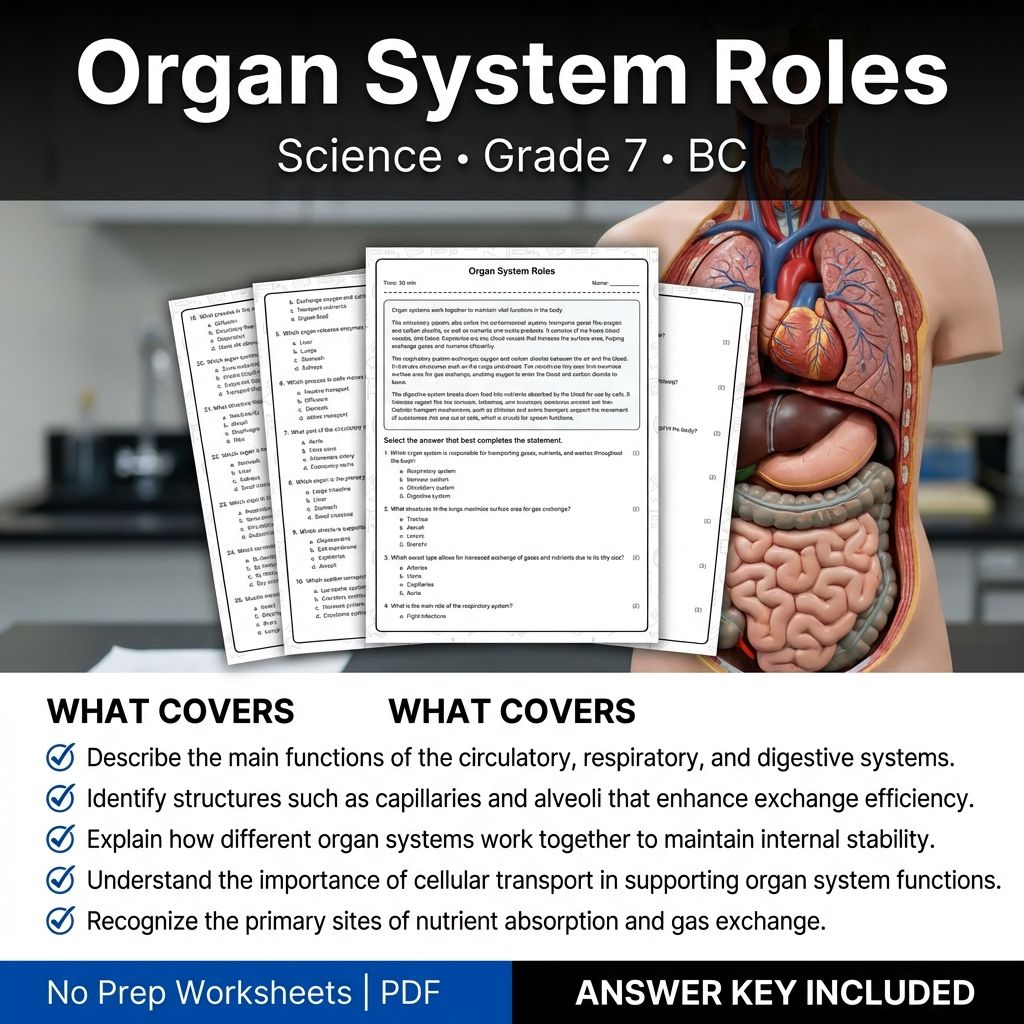
7th Grade Science | Organ System Roles Worksheet & Answer Key PDF
Created byCoral Reef LearningLearning Objectives
- Describe the main functions of the circulatory, respiratory, and digestive systems.
- Identify structures such as capillaries and alveoli that enhance exchange efficiency.
- Explain how different organ systems work together to maintain internal stability.
Instant download
Grade 8 Science | Population Models Worksheet (Answer Key) – NGSS Standards
 Created byBright Mind Resources
Learning Objectives
- Understand different mathematical models of population growth, including logistic and exponential models.
- Analyze factors influencing population size such as resources, predation, and environmental conditions.
- Interpret graphical population curves to identify fluctuations and steady states.
Also included in: Grade 8 Science | Evolution & Speciation Unit Bundle (NGSS-Aligned Worksheets) +2 more
Instant download
Grade 8 Science – Natural Selection Worksheet (Worksheet + Answer Key) | NGSS
Created byBright Mind ResourcesLearning Objectives
- Explain how heritable variation contributes to natural selection.
- Identify selective agents and their effects on populations.
- Describe how trait frequencies change over generations due to environmental pressures.
Also included in: Grade 8 Science | Evolution & Speciation Unit Bundle (NGSS-Aligned Worksheets) +2 more
Instant download
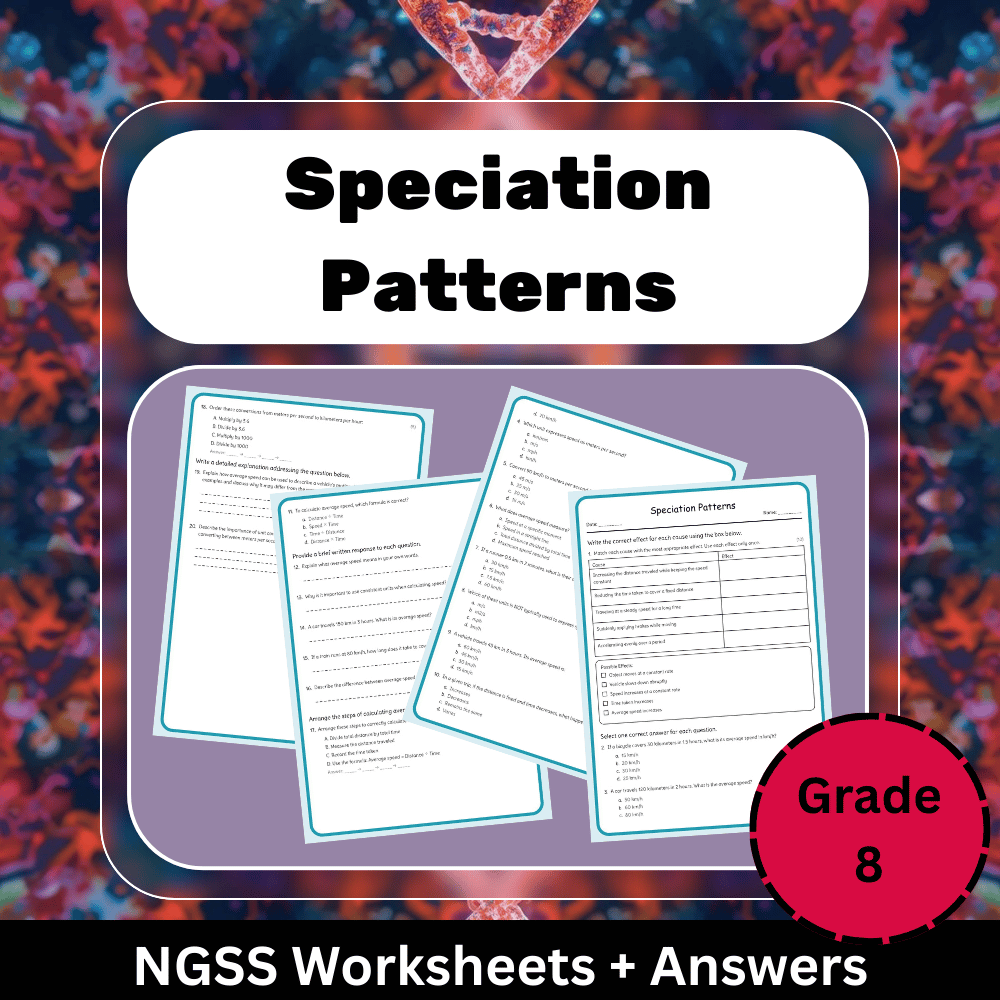
Grade 8 Science | Speciation Patterns Worksheet (Answer Key) – NGSS Aligned
Created byBright Mind ResourcesLearning Objectives
- Understand the processes that generate new species and lead to extinction.
- Identify types of speciation such as allopatric and adaptive radiation.
- Explain the evidence supporting episodes of diversification and mass extinctions.
Also included in: Grade 8 Science | Evolution & Speciation Unit Bundle (NGSS-Aligned Worksheets) +2 more
Instant download

Grade 8 Science | Conservation In Systems Worksheet | General Standards
 Created byLumora Learning
Learning Objectives
- Explain energy conservation using the idea of a system and its surroundings
- Identify how energy transfers and changes form during a friction or lifting process
- Use conservation to make predictions about how speed and height change over time
Instant download

Grade 12 Science | Electrostatic Bonding - Daily Reading Comprehension
Created byCoral Reef LearningLearning Objectives
- Understand the basic principles of electrostatic forces
- Identify charges on atoms and molecules
- Explain how electrostatic attractions and repulsions influence substance properties
Instant download

Grade 11 Wave Phenomena Worksheet | Practice & Assessment PDF
Created byClear Sky ClassroomLearning Objectives
- Explain how mechanical wave properties (wavelength, frequency, speed, and amplitude) relate mathematically and conceptually.
- Use superposition to predict patterns created by overlapping waves and identify constructive vs. destructive interference.
- Analyze reflection, transmission, and boundary conditions to describe standing-wave formation and resonance in strings and air columns.
Also included in: Grade 11 Physics Motion & Energy Science Lesson Bundle | Advanced Placement (AP) +1 more
Instant download
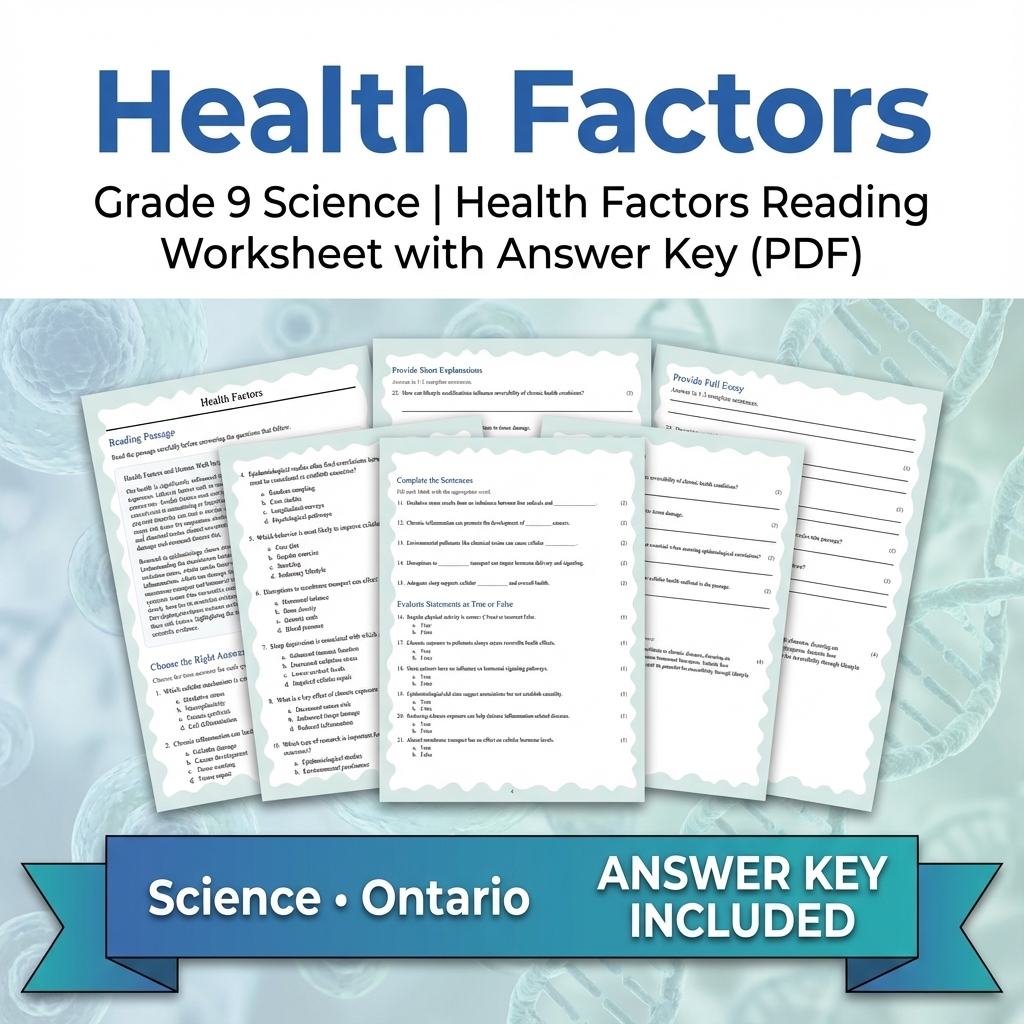
Grade 9 Science | Health Factors Reading Worksheet with Answer Key (PDF)
JCreated byJ.S SheetsLearning Objectives
- Understand how lifestyle and environmental factors impact human health.
- Interpret epidemiological data and physiological mechanisms related to chronic conditions.
- Analyze the effects of nutrition, activity, tobacco, pollutants, and sleep on cellular and systemic health.
Also included in: Grade 9 Science Unit Bundle | Human Body Systems & Cell Functions +1 more
Instant download

Levels Of Organization Worksheet Pack | Grade 7 Science Activities
Created byPrism Point LearningLearning Objectives
- Explain the ecological levels of organization from individual organisms to ecosystems
- Identify examples of individual, population, community, and ecosystem using Alberta-style scenarios
- Describe why patterns at higher levels cannot always be predicted from single organisms
Also included in: Grade 7 Ecosystems & Biodiversity Science Lesson Bundle | Alberta
Instant download

Biodiversity Patterns Worksheets: Richness, Turnover & Endemism Grade 6
 Created byWorld Paper Hub
Learning Objectives
- Explain how species richness and species occurrence can be used to describe biodiversity patterns.
- Compare biodiversity patterns across space (islands, latitudes, and habitat types) and time (community turnover).
- Identify ecological and historical factors that influence endemism and species composition.
Instant download
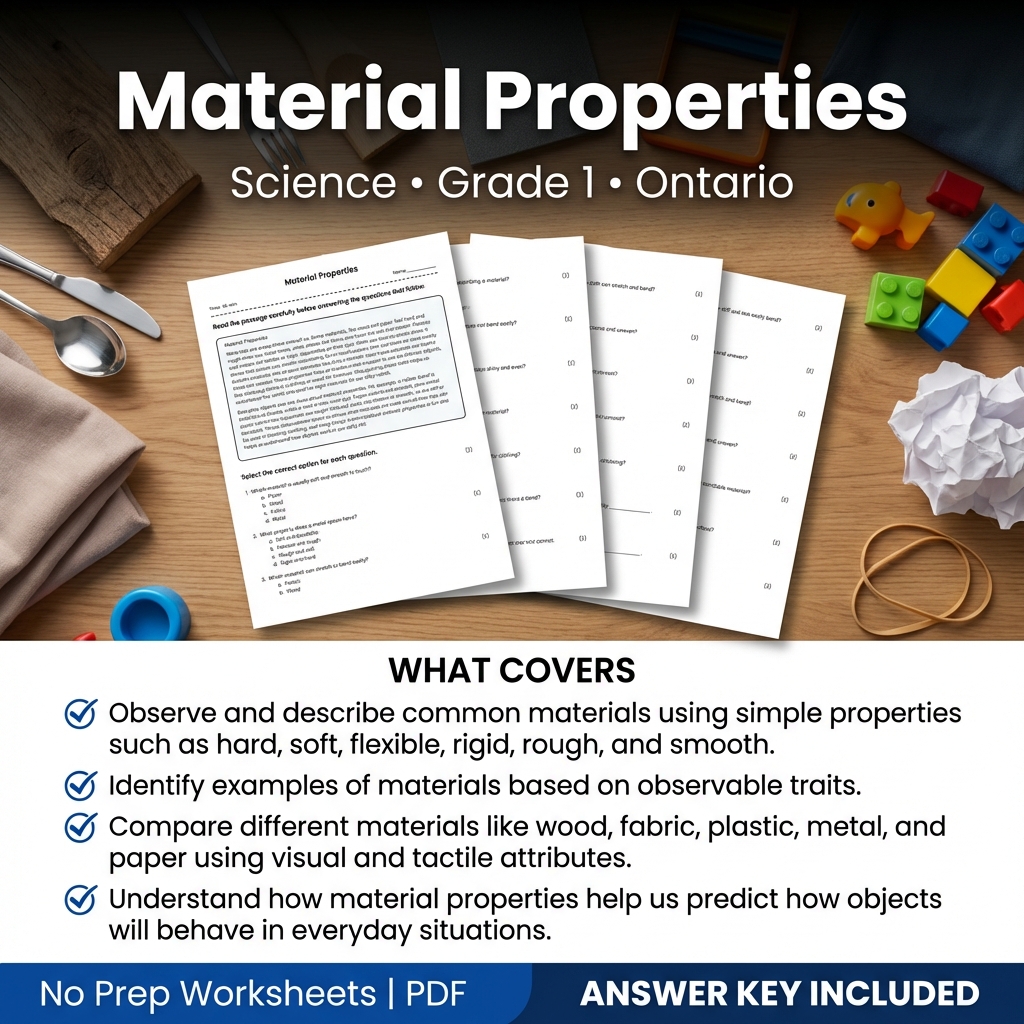
Material Properties Grade 1 Science Worksheet | Ontario Standards
Created byCoral Reef LearningLearning Objectives
- Observe and describe common materials using simple properties such as hard, soft, flexible, rigid, rough, and smooth.
- Identify examples of materials based on observable traits.
- Compare different materials like wood, fabric, plastic, metal, and paper using visual and tactile attributes.
Instant download
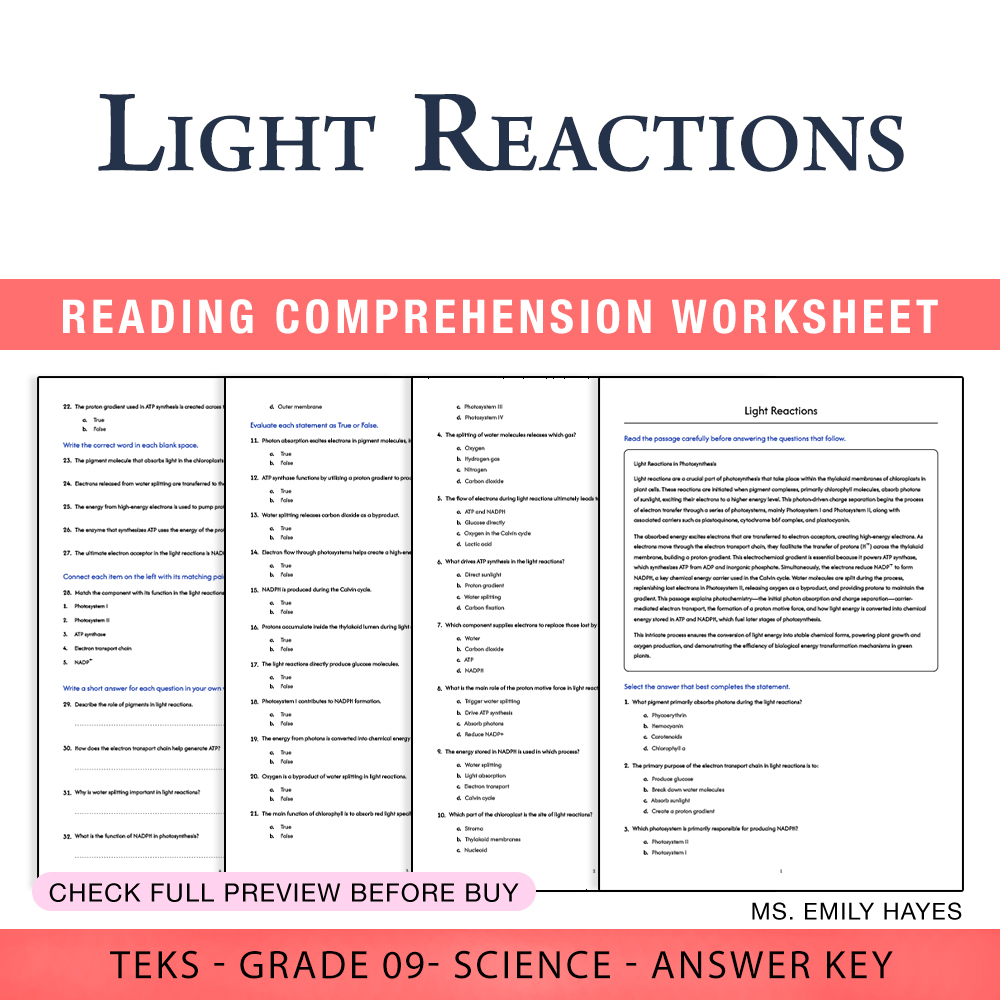
9th Grade Science | Light Reactions Worksheet (PDF+ Answer Key)
Created byCopper Leaf ClassroomLearning Objectives
- Explain the process occurring in the thylakoid membranes during light reactions.
- Identify the role of pigment complexes and photosystems in photon absorption.
- Describe how electron flow, proton gradient, and ATP/NADPH formation are interconnected.
Instant download
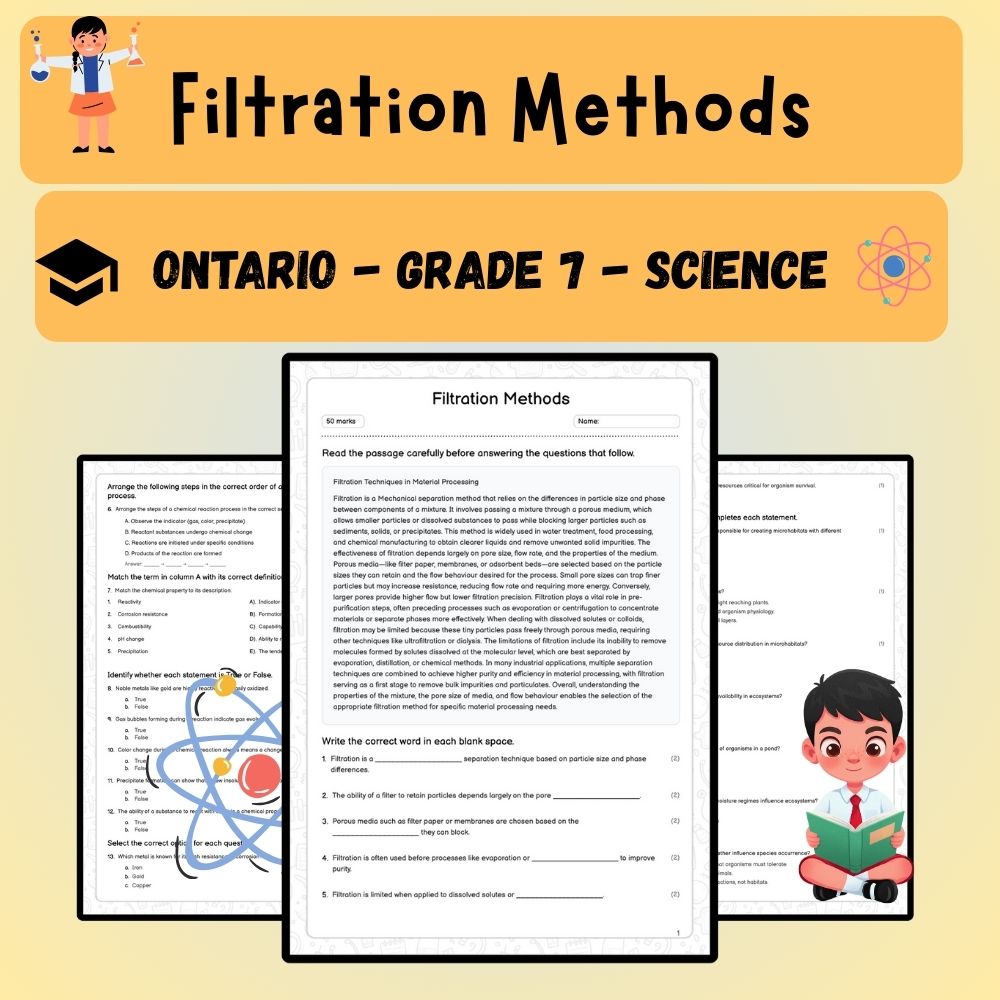
Grade 7 Science | Filtration Methods Worksheet (PDF ) – Ontario Standards
Created byPrism Point LearningLearning Objectives
- Understand the principles of mechanical separation techniques such as filtration and sedimentation.
- Identify the applications and limitations of filtration in separating heterogeneous mixtures.
- Describe the roles of pore size, flow behaviour, and media in filtration processes.
Also included in: Grade 7 Science Unit Bundle | Substances, Mixtures & Properties Worksheets +1 more
Instant download
Browse more categories
About Science Worksheets
Find Science worksheets spanning core skills, practice, and review. All 44,628 resources are instant PDF downloads for the classroom or home.
Every worksheet on MyTeachingSheets is created by independent teacher-authors and reviewed before publication. All resources download as printable PDFs for classroom, homework, or at-home practice, and many include answer keys. Preview any worksheet free before buying.