
Science Worksheets
44,628 subject resources
Biodiversity Patterns Worksheets: Richness, Turnover & Endemism Grade 6
 Created byWorld Paper Hub
Learning Objectives
- Explain how species richness and species occurrence can be used to describe biodiversity patterns.
- Compare biodiversity patterns across space (islands, latitudes, and habitat types) and time (community turnover).
- Identify ecological and historical factors that influence endemism and species composition.
Instant download
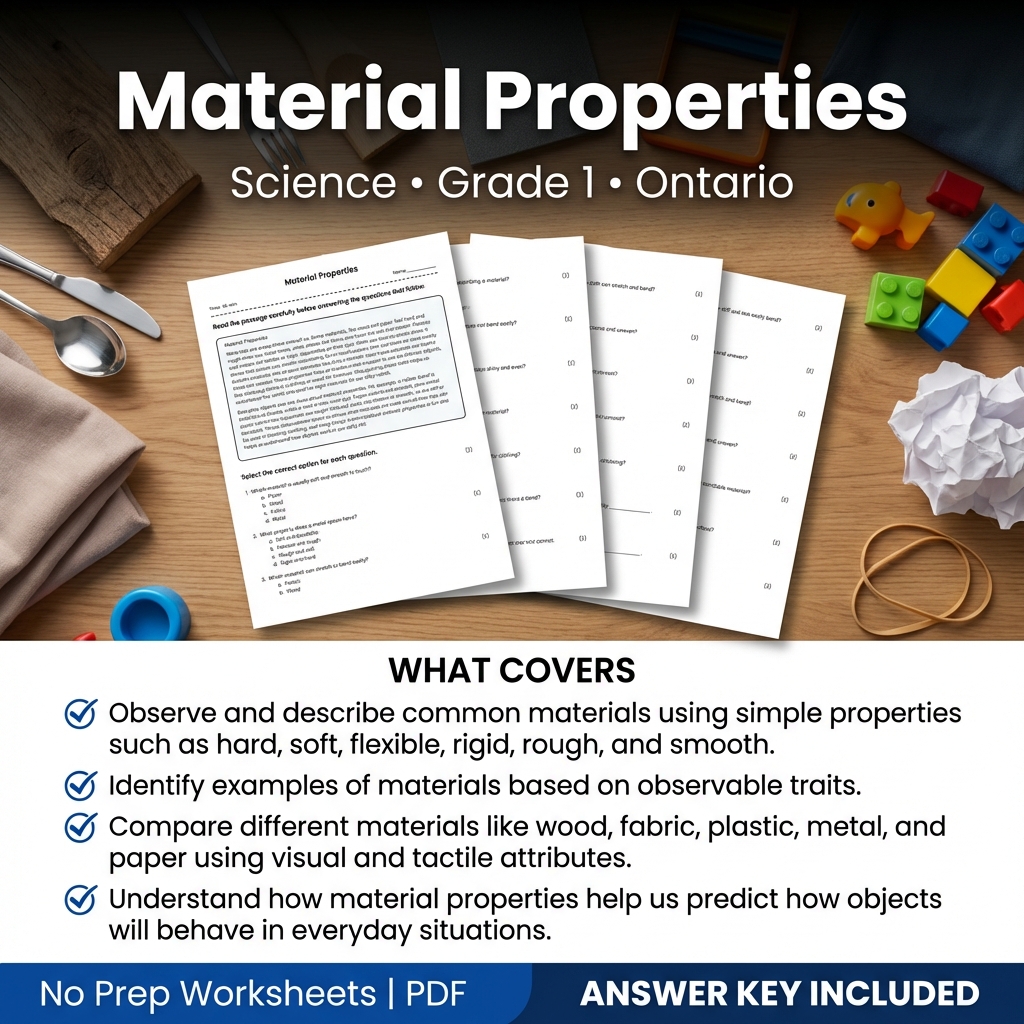
Material Properties Grade 1 Science Worksheet | Ontario Standards
 Created byCoral Reef Learning
Learning Objectives
- Observe and describe common materials using simple properties such as hard, soft, flexible, rigid, rough, and smooth.
- Identify examples of materials based on observable traits.
- Compare different materials like wood, fabric, plastic, metal, and paper using visual and tactile attributes.
Instant download
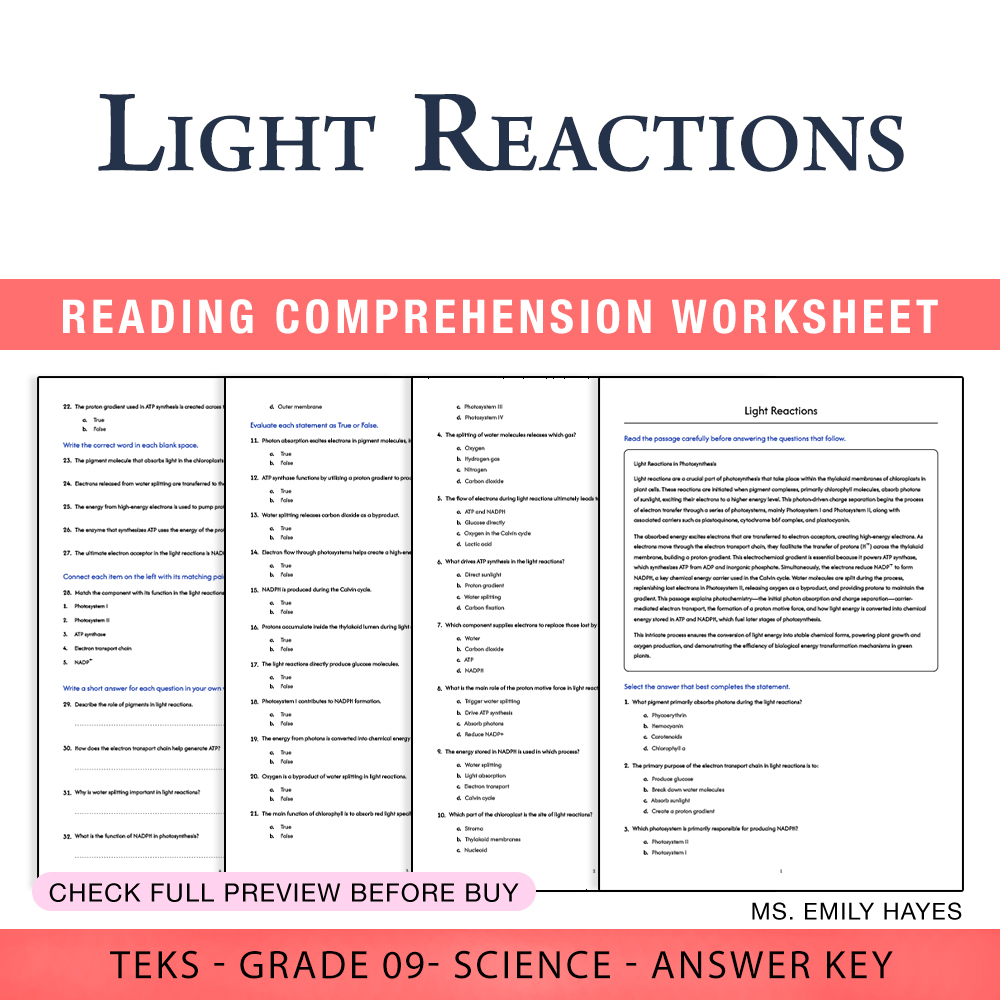
9th Grade Science | Light Reactions Worksheet (PDF+ Answer Key)
 Created byCopper Leaf Classroom
Learning Objectives
- Explain the process occurring in the thylakoid membranes during light reactions.
- Identify the role of pigment complexes and photosystems in photon absorption.
- Describe how electron flow, proton gradient, and ATP/NADPH formation are interconnected.
Instant download
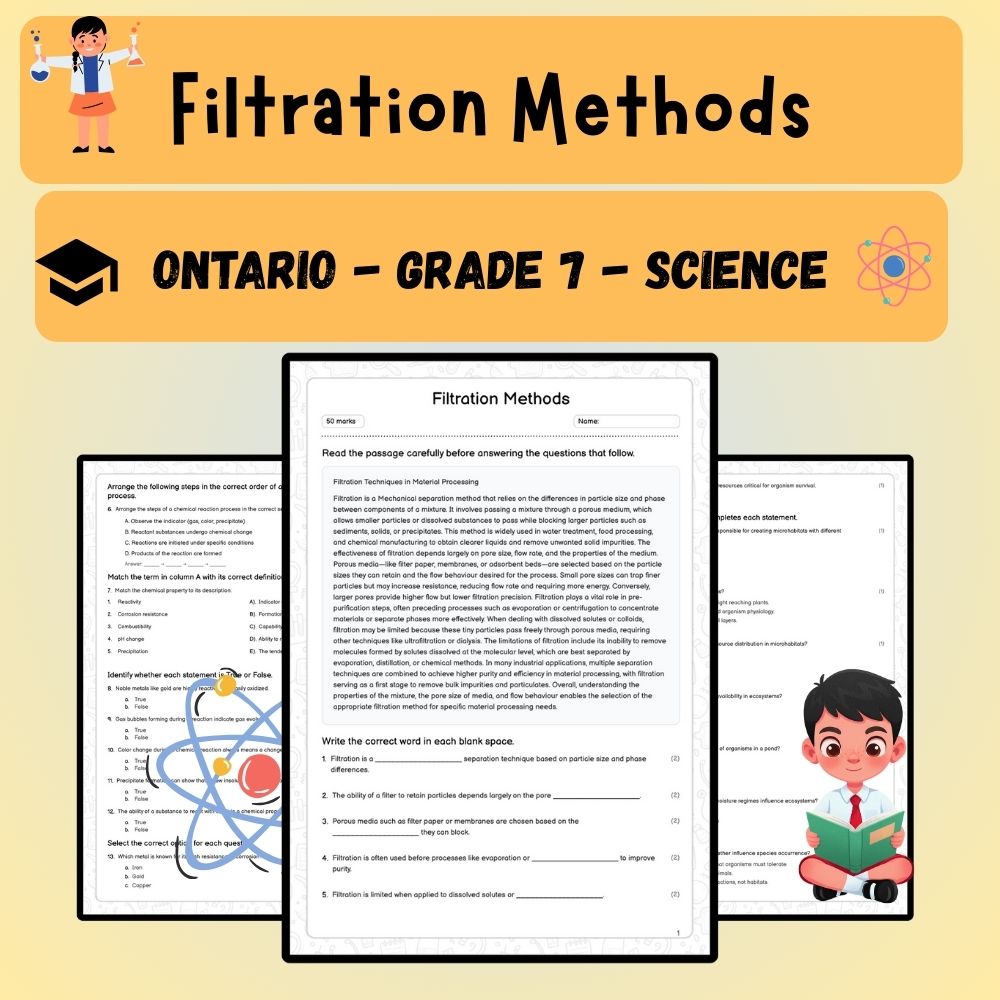
Grade 7 Science | Filtration Methods Worksheet (PDF ) – Ontario Standards
 Created byPrism Point Learning
Learning Objectives
- Understand the principles of mechanical separation techniques such as filtration and sedimentation.
- Identify the applications and limitations of filtration in separating heterogeneous mixtures.
- Describe the roles of pore size, flow behaviour, and media in filtration processes.
Also included in: Grade 7 Science Unit Bundle | Substances, Mixtures & Properties Worksheets +1 more
Instant download
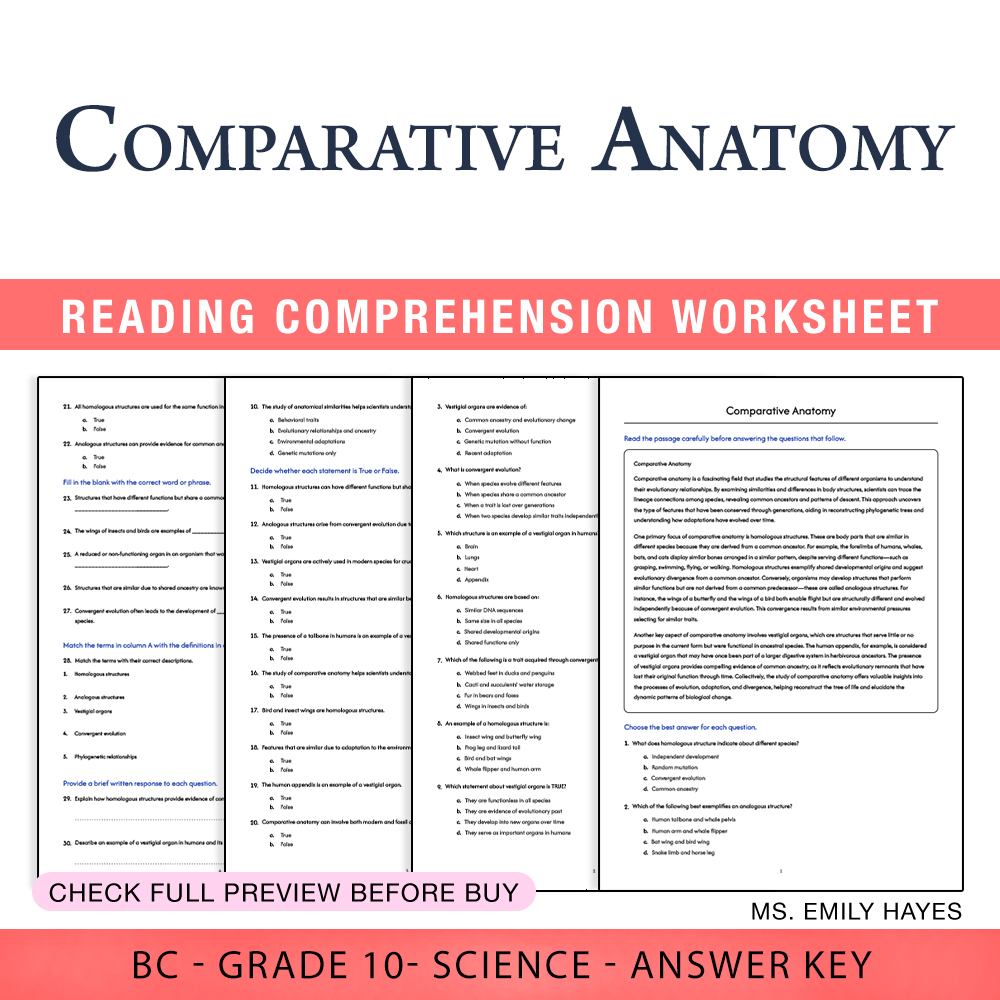
10th Grade Science | Comparative Anatomy Worksheet (PDF+ Answer Key)
Created byCopper Leaf ClassroomLearning Objectives
- Understand the concept of homologous and analogous structures and their significance in evolution.
- Differentiate between homologous, analogous, and vestigial structures in various organisms.
- Explain how comparative anatomy supports phylogenetic and evolutionary studies.
Also included in: Grade 10 Science BC | Evolution, Biodiversity & Ecology (PDF + Answer Key) +1 more
Instant download
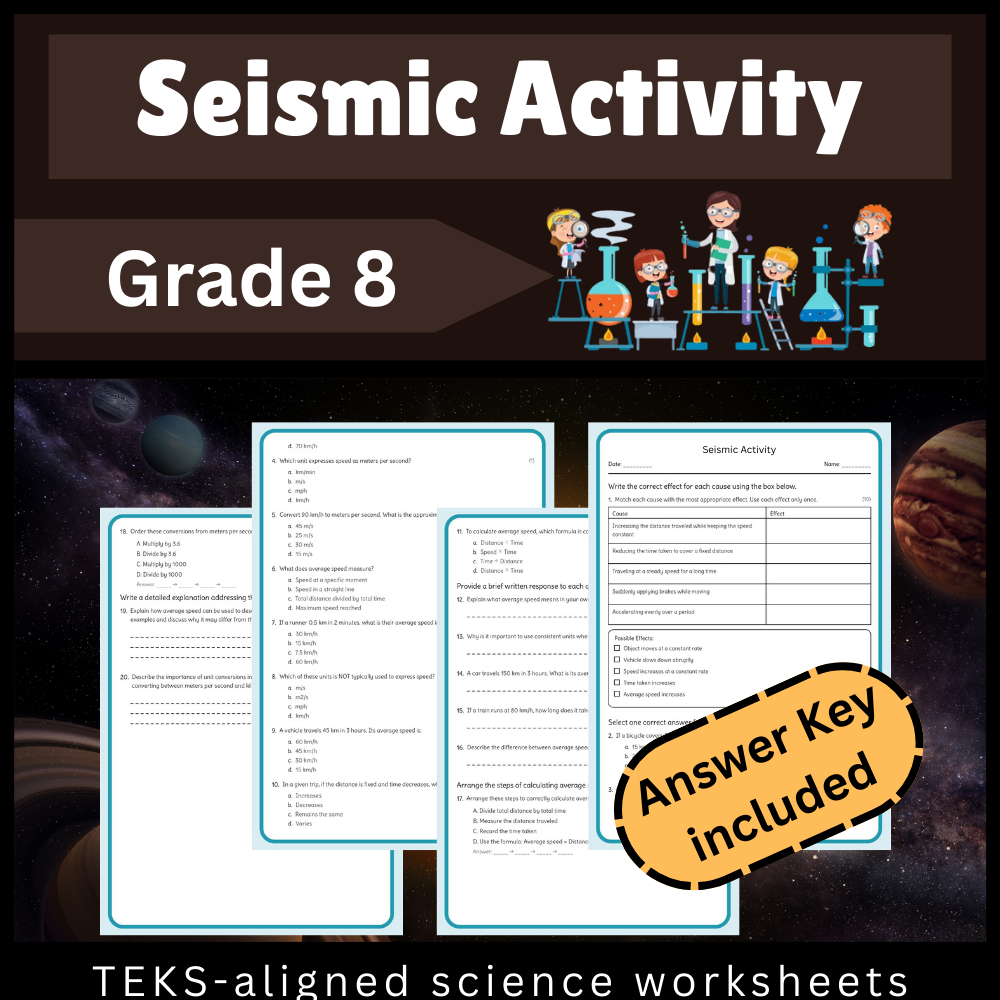
Grade 8 Science – Seismic Activity Worksheet (Answer Key) | TEKS-Aligned
 Created byBright Mind Resources
Learning Objectives
- Understand how faults and plate boundary interactions contribute to seismic activity.
- Identify and describe different types of seismic waves and their propagation.
- Interpret seismic records and locate earthquake epicenters.
Also included in: Grade 8 Science UNIT Bundle | Weather, Solar System & Earth - TEKS Aligned +1 more
Instant download

Surface Changes Over Time Science Worksheet Grade 7 NGSSS
 Created byEvergreen Desk Education
Learning Objectives
- Explain how runoff, erosion, and deposition can rapidly change Earth’s surface after heavy rainfall
- Describe how storms can reshape coastal landforms such as dunes and beaches
- Identify examples of sudden and gradual surface changes caused by earthquakes and volcanic activity
Instant download

Grade 8 Electrical Power & Efficiency Worksheet | Alberta Science
 Created byBRIGHT PATH RESOURCES
Learning Objectives
- Define power, energy, and time and identify the main idea of a scientific text.
- Explain how efficiency compares useful output to input using device examples.
- Describe how common loss mechanisms reduce delivered energy in electrical systems.
Also included in: Grade 8 Alberta Science Electricity and Magnetism Worksheet Bundle +1 more
Instant download

Grade 8 Science – Data Quality Controls & Measurement Practices | Worksheet
Created byBright Mind ResourcesLearning Objectives
- Understand the importance of calibration and measurement consistency
- Recognize how replication distinguishes random variation from real effects
- Learn how to manage outliers without compromising data integrity
Also included in: Scientific Thinking & Evidence Grade 8 Science Lesson Bundle | General +1 more
Instant download

Grade 8 Science – Graphing Relationships & Data Interpretation | Worksheet
Created byBright Mind ResourcesLearning Objectives
- Understand how scatter plots illustrate relationships between two variables.
- Interpret data points and identify trends on a scatter plot.
- Learn the importance of proper labeling and scaling in data representation.
Also included in: Scientific Thinking & Evidence Grade 8 Science Lesson Bundle | General +1 more
Instant download
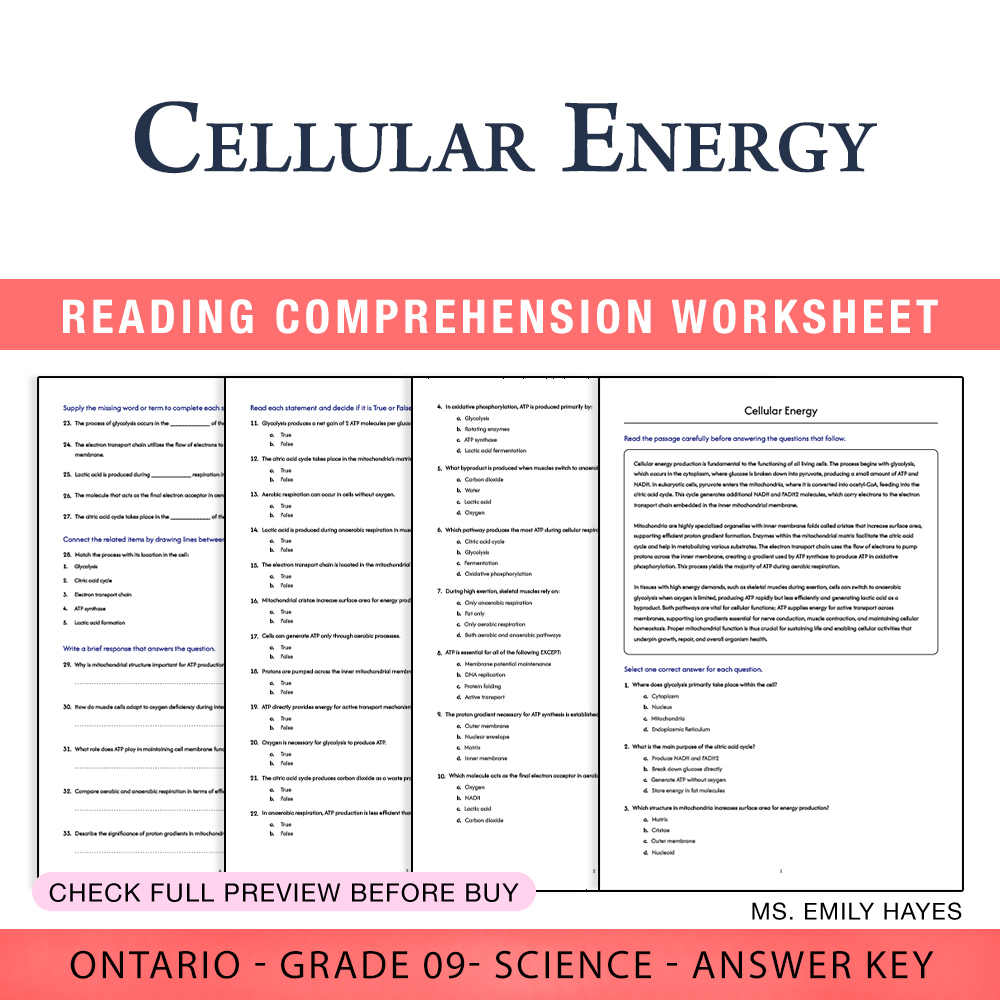
Grade 9 Science | Cellular Energy Worksheet (PDF + Answer Key)
Created byCopper Leaf ClassroomLearning Objectives
- Describe the processes of glycolysis, the citric acid cycle, and oxidative phosphorylation in cellular energy metabolism.
- Explain how mitochondrial structure supports ATP production, including the roles of inner membrane folds and enzymes in the matrix.
- Differentiate between aerobic and anaerobic pathways and their relevance in various tissues, such as skeletal muscle during exertion.
Instant download

Grade 11 Science — Rock Cycle Worksheet MCQ Paper for Mastery
 Created byThe Resource Hub
Learning Objectives
- Describe the processes involved in the formation, transformation, and destruction of rocks over geologic time.
- Explain the influence of plate tectonics on metamorphism, magma generation, and sedimentation.
- Identify the stratigraphic and geochemical tools used to study crustal material pathways and resource deposits.
Also included in: Grade 11 Science AP Custom Bundle | Core Concepts & Earth Systems +1 more
Instant download

Grade 10 Balancing Equations Worksheet | Practice & BC Standards PDF
 Created byClear Sky Classroom
Learning Objectives
- Explain why balancing chemical equations preserves the total number of each type of atom across reactants and products
- Use coefficients (not subscripts) to balance chemical equations and interpret what balanced ratios mean
- Connect balanced equations to conservation of mass and to quantitative ideas such as limiting reactants and theoretical yield
Instant download

Grade 12 Science | Signal Transmission Electromagnetics Worksheet | General
 Created byLumora Learning
Learning Objectives
- Explain how oscillating electric and magnetic fields transmit energy as electromagnetic waves through space and guided media
- Relate frequency and wavelength to wave behavior, including reflection and refraction at boundaries
- Analyze how attenuation and dispersion affect signal strength and bandwidth over distance
Instant download

Grade 8 Science – Graphical Reasoning in Motion Worksheet with Answer Key
JCreated byJ.S SheetsLearning Objectives
- Interpret slopes on velocity-time graphs as acceleration.
- Understand the relationship between the slope of a graph and physical quantities.
- Translate data from tables into graphical representations and vice versa.
Also included in: Grade 8 Science Lesson Group Bundle | TEKS Standards-Aligned Worksheets +1 more
Instant download

Grade 12 Science – Planetary Geology Exploration & Surface Features | Worksheet
Created byBright Mind ResourcesLearning Objectives
- Understand the surface features and processes shaping Mars
- Interpret remote sensing data related to planetary geology
- Differentiate between various volcanic, tectonic, and erosion features on Mars
Also included in: Grade 12 Earth & Space Science Daily Reading Worksheets Lesson Bundle | TEKS +2 more
Instant download

Grade 9 Science | Electrical Quantities in Science - Daily Reading Comprehension
Created byCoral Reef LearningLearning Objectives
- Understand the concept of electric current, voltage, and resistance.
- Learn the units and symbols used for electrical quantities.
- Recognize typical magnitudes of electrical quantities in regional systems.
Also included in: Electricity and Magnetism Lesson Bundle – Grade 9 Science Alberta +1 more
Instant download

Grade 11 Science | One-Dimensional Kinematics - Daily Reading Comprehension
Created byCoral Reef LearningLearning Objectives
- Understand and define displacement and velocity in one-dimensional motion.
- Calculate average displacement and velocity over a given time interval.
- Differentiate between displacement and total distance traveled.
Instant download
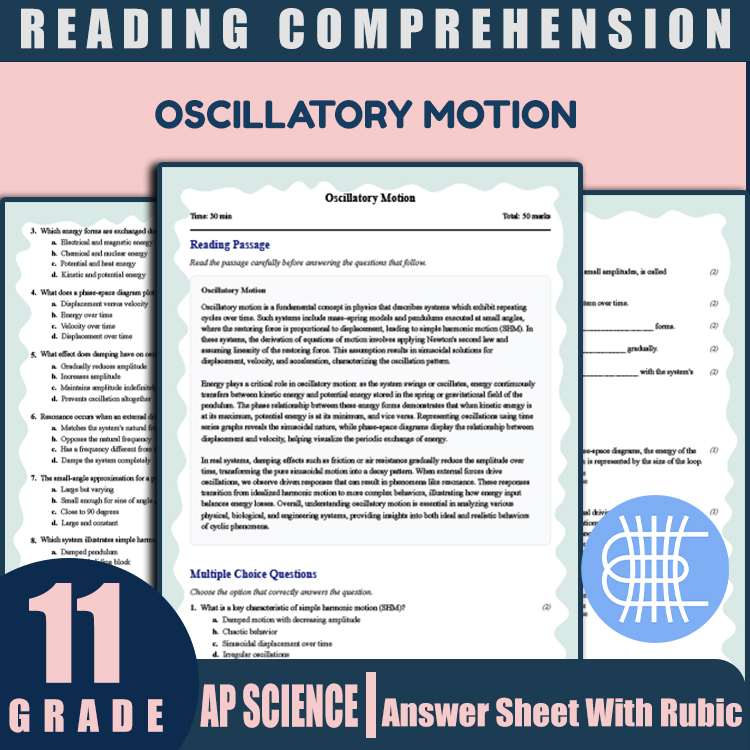
Grade 11 Science | Oscillatory Motion Reading Worksheet (PDF + Answer Key)
JCreated byJ.S SheetsLearning Objectives
- Understand the principles of simple harmonic motion and how it models mass–spring systems and small-angle pendula.
- Derive equations of motion for oscillatory systems and connect restoring force linearity to sinusoidal solutions.
- Analyze energy interchange between kinetic and potential forms during oscillations.
Also included in: Grade 11 Physics Unit | Motion, Waves & Energy Worksheets (PDF + Rubric Bundle) +1 more
Instant download
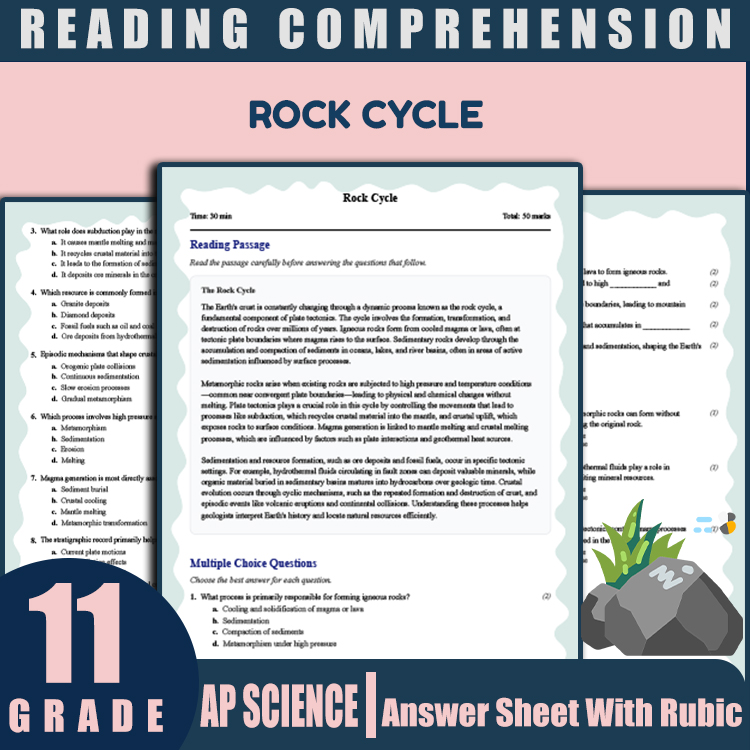
11th Grade Science | Rock Cycle Reading Worksheet & Answer Key (PDF)
JCreated byJ.S SheetsLearning Objectives
- Describe the processes involved in rock formation, transformation, and destruction over geologic time.
- Explain how plate tectonics influence metamorphism, magma generation, and sedimentation.
- Identify resources such as ore deposits and fossil fuels in the context of the rock cycle and crustal processes.
Also included in: Grade 11 Science Unit Bundle | Earth Systems & Climate Change Worksheets +1 more
Instant download
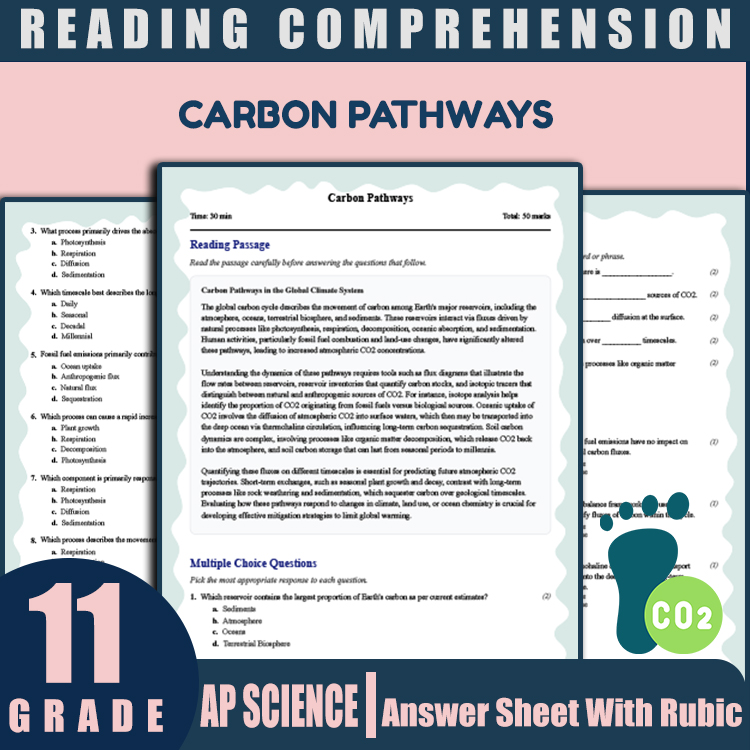
11th Grade Science | Carbon Pathways Reading Worksheet & Answer Key (PDF)
JCreated byJ.S SheetsLearning Objectives
- Describe the main components involved in carbon storage and flux among the atmosphere, oceans, terrestrial biosphere, and sediments.
- Explain the tools used to analyze carbon cycling, including flux diagrams, reservoir inventories, and isotopic tracers.
- Assess how natural and anthropogenic factors influence carbon pathways over different temporal scales.
Also included in: Grade 11 Science Unit Bundle | Earth Systems & Climate Change Worksheets +1 more
Instant download
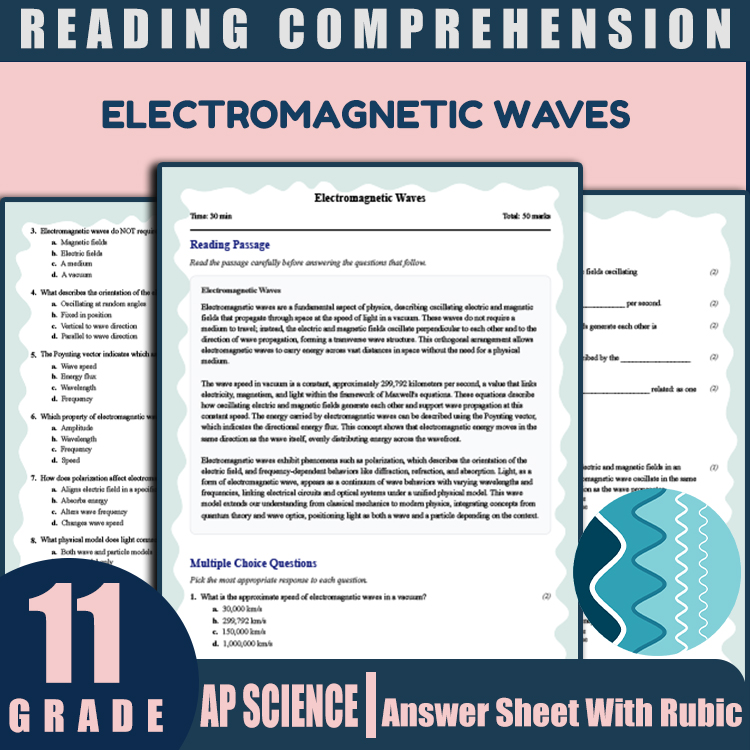
11th Grade Science | Electromagnetic Waves Reading Worksheet & Answer Key (PDF)
JCreated byJ.S SheetsLearning Objectives
- Explain the oscillating electric and magnetic fields in electromagnetic waves.
- Describe the orthogonal structure of electric and magnetic fields in wave propagation.
- Understand the relationship between wave frequency, wavelength, and energy transport.
Also included in: Grade 11 Physics Unit | Motion, Waves & Energy Worksheets (PDF + Rubric Bundle) +1 more
Instant download
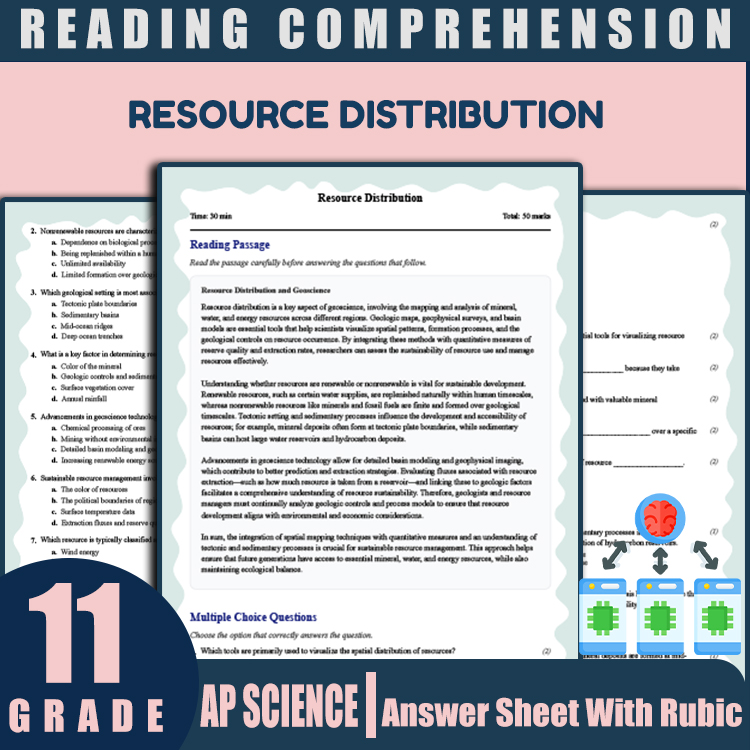
Grade 11 Science | Resource Distribution Reading Worksheet (PDF + Answer Key)
JCreated byJ.S SheetsLearning Objectives
- Understand the ways geologic maps, surveys, and basin models are used to map resource patterns.
- Differentiate between renewable and nonrenewable resources based on geologic and sedimentary processes.
- Assess the sustainability of resource extraction using quantitative measures such as reserve quality and extraction rates.
Also included in: Grade 11 Science Unit Bundle | Earth Systems & Climate Change Worksheets +1 more
Instant download
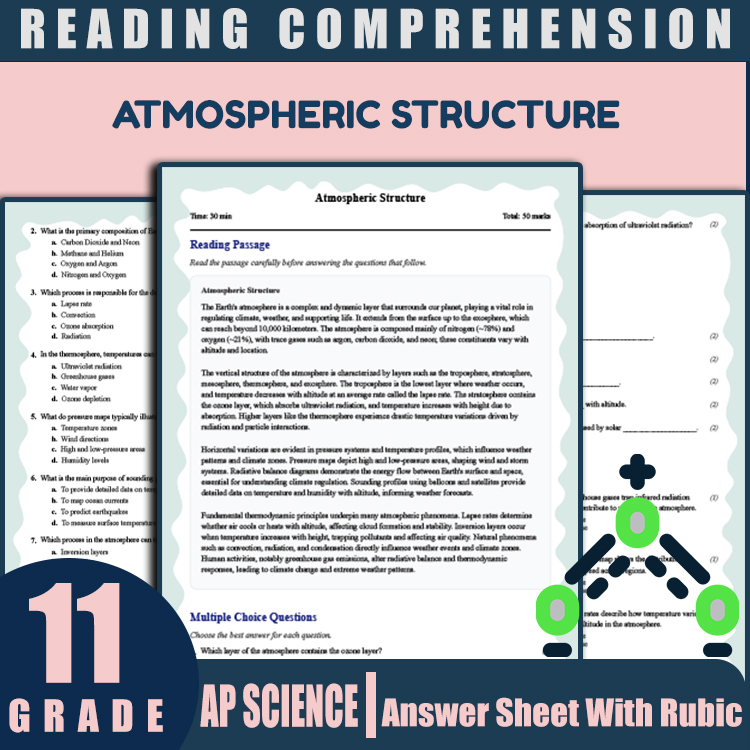
11th Grade Science | Atmospheric Structure Reading Worksheets (PDF & Rubric)
JCreated byJ.S SheetsLearning Objectives
- Understand the vertical and horizontal layers of Earth's atmosphere and their characteristics.
- Interpret different atmospheric representations such as sounding profiles, pressure maps, and radiative balance diagrams.
- Apply thermodynamic principles to explain phenomena like lapse rates and inversion layers.
Also included in: Grade 11 Science Unit Bundle | Earth Systems & Climate Change Worksheets +1 more
Instant download
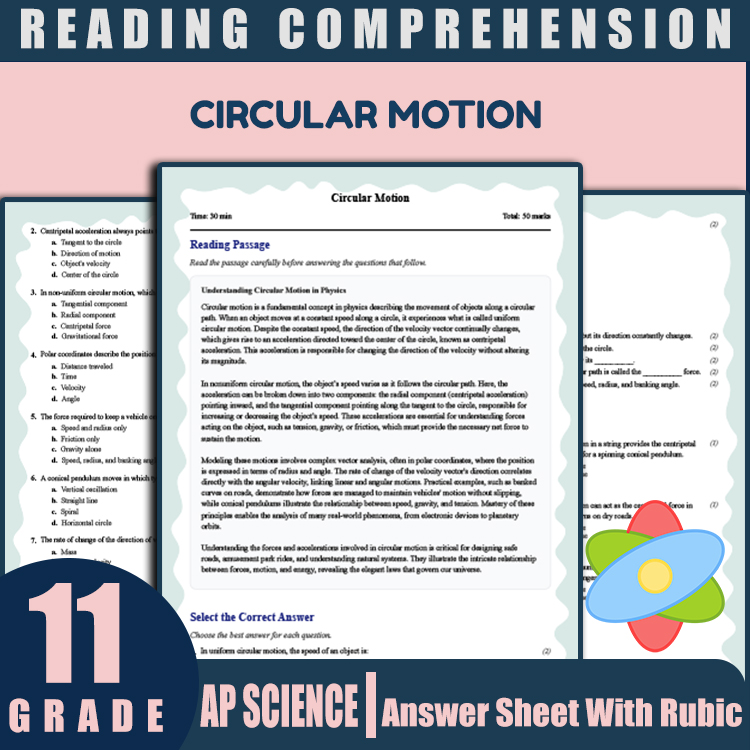
11th Grade Science | Circular Motion Reading Worksheet (PDF + Answer Key)
JCreated byJ.S SheetsLearning Objectives
- Explain the concepts of uniform and nonuniform circular motion, including centripetal and tangential accelerations.
- Model the forces involved in circular motion using radial and tangential components and understand their relationship.
- Describe motion in polar coordinates and connect acceleration vectors with the rate of change of velocity direction.
Also included in: Grade 11 Physics Unit | Motion, Waves & Energy Worksheets (PDF + Rubric Bundle) +1 more
Instant download
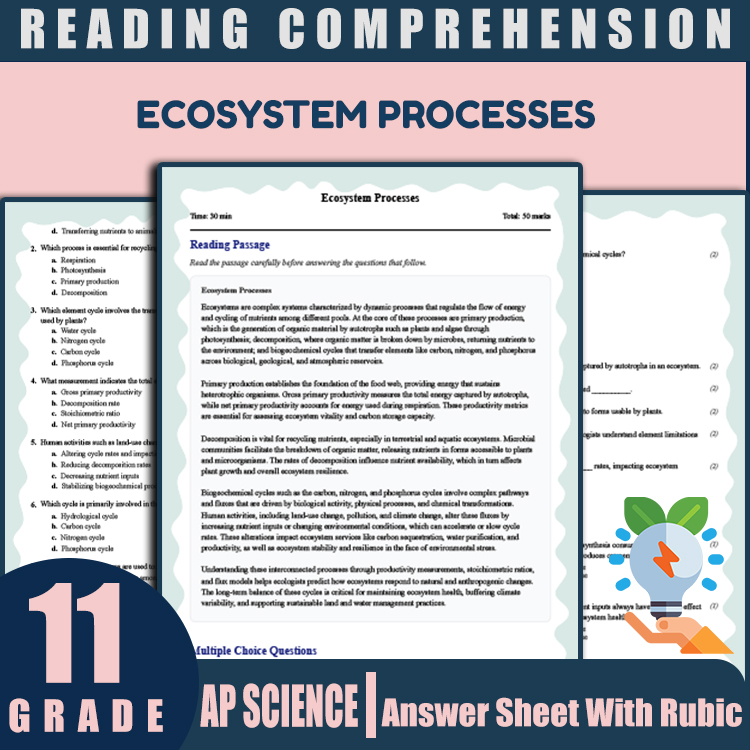
Grade 11 Science | Ecosystem Processes Reading Worksheet (PDF + Answer Key)
JCreated byJ.S SheetsLearning Objectives
- Understand the fundamental ecosystem-level processes that regulate energy flow and material cycling.
- Describe the roles of primary production, decomposition, and biogeochemical cycles of carbon, nitrogen, and phosphorus.
- Analyze how land-use change, nutrient inputs, and climate variability influence cycle rates and ecosystem functions.
Also included in: Grade 11 Science Unit Bundle – Cellular Systems, Genetics Ecosystems Worksheets +1 more
Instant download
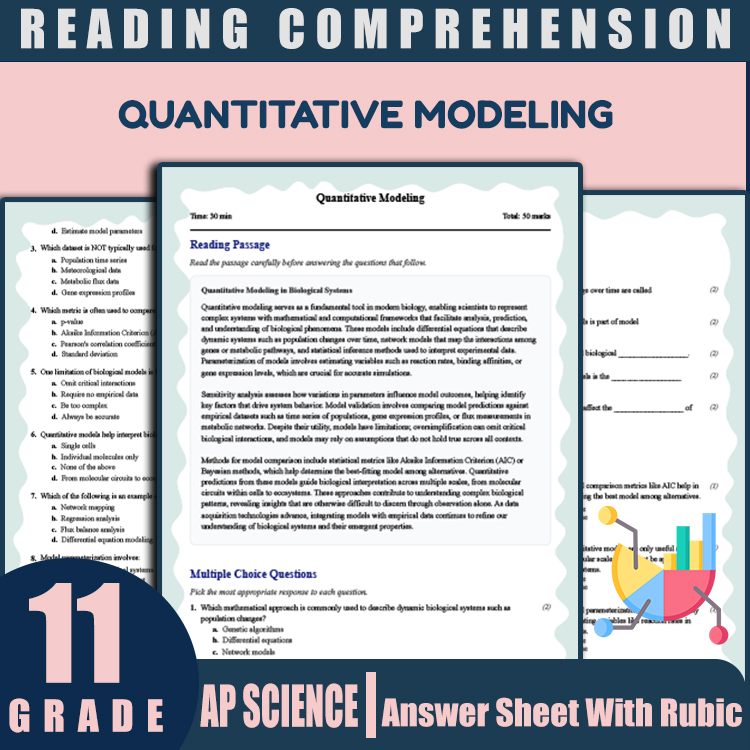
11th Grade Science | Population Patterns Reading Worksheet (PDF + Rubric)
JCreated byJ.S SheetsLearning Objectives
- Understand the principles of population dynamics, including exponential and logistic growth models.
- Interpret graphical models, life-history tables, and reproductive strategies to analyze population fluctuations.
- Examine case examples such as invasive species spread and predator-prey cycles to understand factors affecting population trajectories.
Also included in: Grade 11 Science Unit Bundle – Cellular Systems, Genetics Ecosystems Worksheets +1 more
Instant download

11th Grade Science | Equilibrium Systems Reading Worksheet & PDF Answer Key
JCreated byJ.S SheetsLearning Objectives
- Understand the concept of chemical equilibrium in homogeneous and heterogeneous systems.
- Learn to write and interpret equilibrium constants such as Kc and Kp.
- Apply reaction quotient (Q) calculations to predict the direction of shifts in equilibrium.
Also included in: Grade 11 Science Unit Worksheet Bundle – Chemical Bonding, Kinetics & More (PDF) +1 more
Instant download

Grade 10 Science Worksheet | Cell Theory TEKS Alignment (PDF)
Created byEvergreen Desk EducationLearning Objectives
- Explain the three main statements of cell theory
- Compare unicellular and multicellular organization in terms of structure and function
- Use evidence from microscopy to describe how cells differ across major groups of living organisms
Instant download
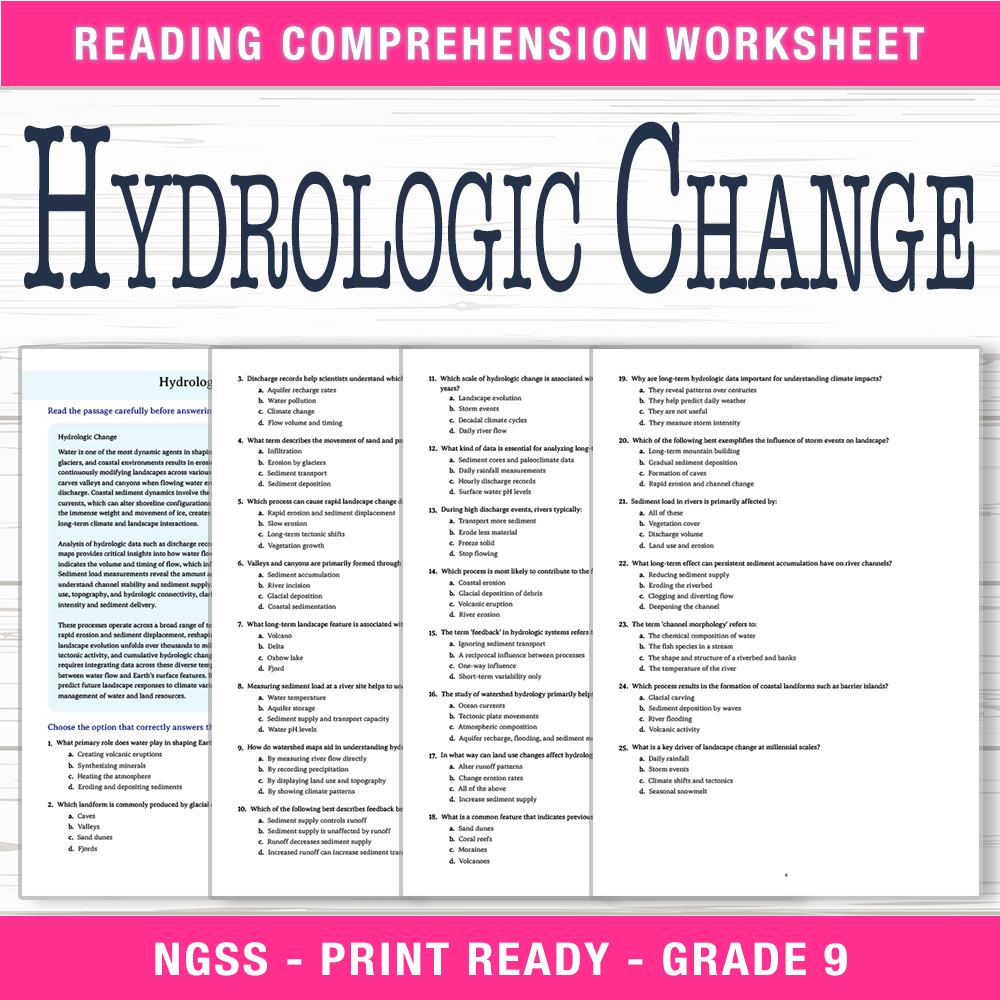
Grade 9 Science | Hydrologic Change Worksheet (PDF + Answer Key)
 Created byRiverstone Classroom
Learning Objectives
- Describe how water flow influences landscape features through erosion, transport, and deposition.
- Interpret hydrologic data such as discharge records and sediment measurements to assess landscape evolution.
- Explain the feedback mechanisms between runoff, sediment supply, and river channel morphology.
Also included in: Grade 9 Science Unit | Earth Processes & Climate Worksheet Bundle
Instant download
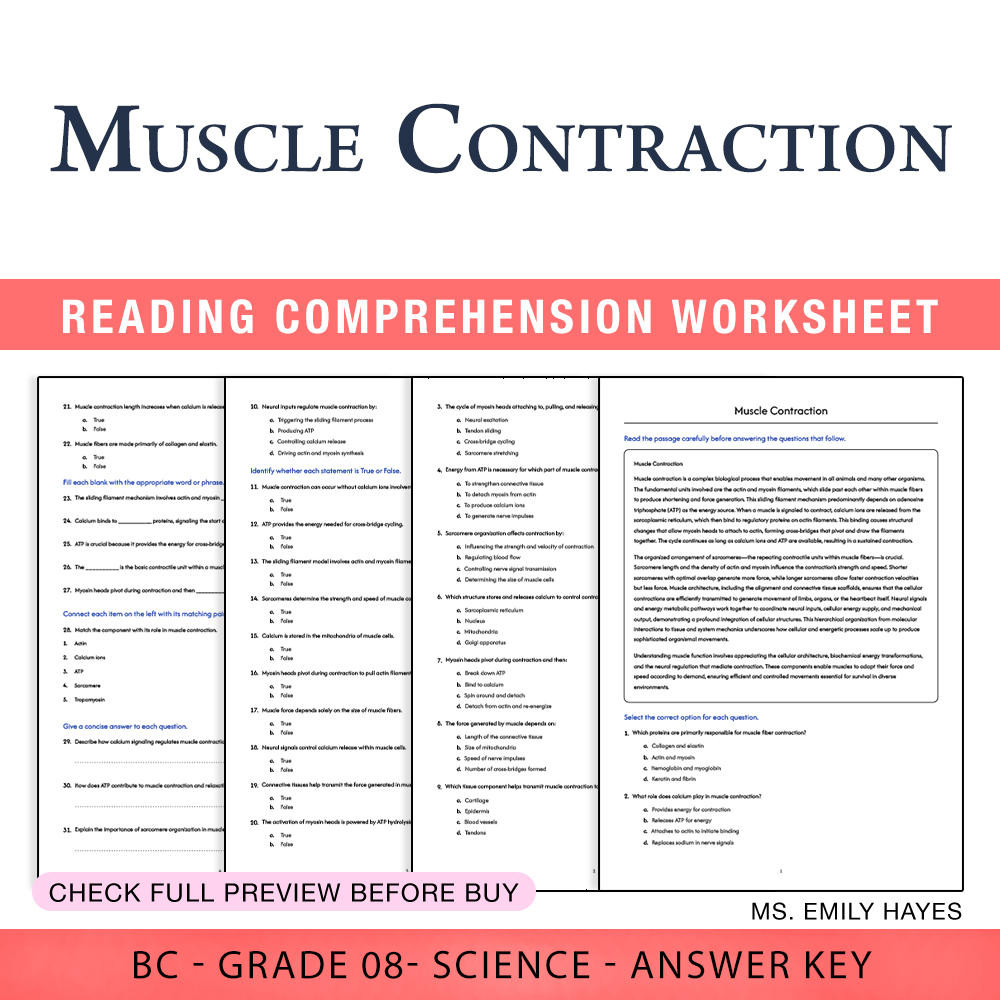
8th Grade Science | Muscle Contraction Worksheet (PDF+ Answer Key)
Created byCopper Leaf ClassroomLearning Objectives
- Describe the process of muscle contraction and the roles of actin, myosin, ATP, and calcium.
- Explain how sarcomere organization affects contraction strength and speed.
- Understand how cellular architecture and energetic processes contribute to coordinated muscle movements.
Also included in: Grade 8 Science Bundle – Cell Structure, Systems & Organisms (PDF + Answer Key) +1 more
Instant download
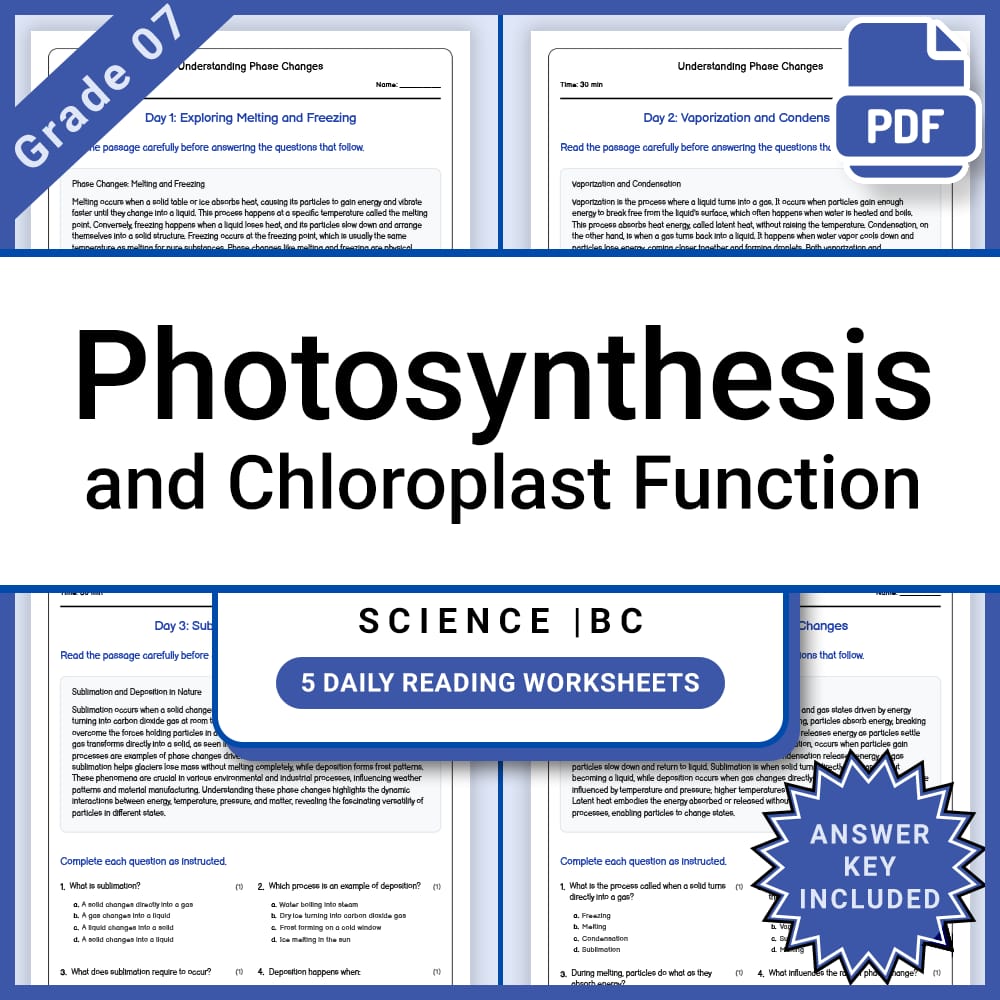
Grade 7 Science – Photosynthesis and Chloroplast Function | Daily Reading Worksheet + Answer Key
JCreated byJ.S SheetsLearning Objectives
- Explain the role of chloroplasts in photosynthesis.
- Identify key parts of the chloroplast and their functions.
- Describe the process by which light energy is converted into chemical energy.
Also included in: Grade 7 Science Lesson Group Bundle | Cell Structures and Processes +1 more
Instant download
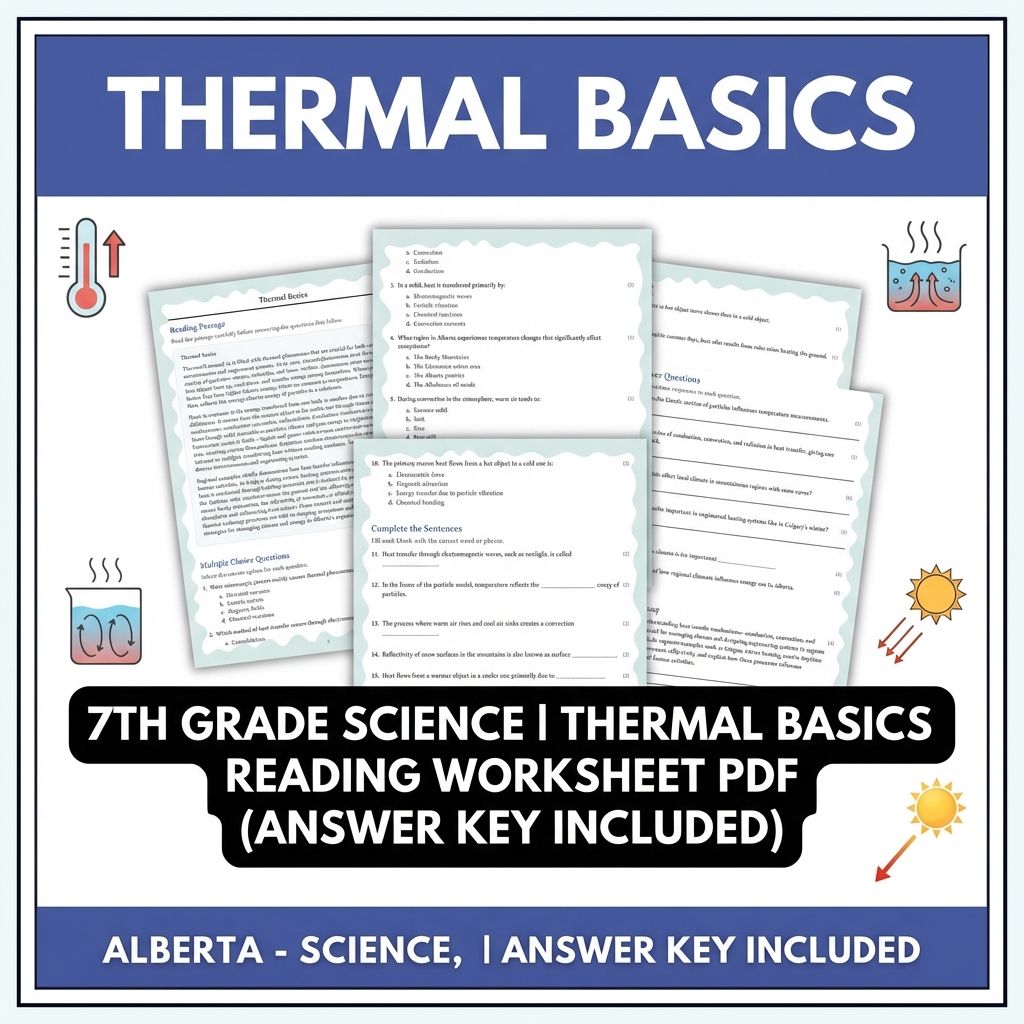
7th Grade Science | Thermal Basics Reading Worksheet PDF (Answer Key Included)
JCreated byJ.S SheetsLearning Objectives
- Understand the particle motion underlying thermal phenomena.
- Explain how temperature measures average kinetic energy of particles.
- Describe how heat energy is transferred through conduction, convection, and radiation.
Also included in: Grade 7 Science UNIT Bundle | Heat Transfer, Convection & Energy Worksheets +1 more
Instant download

Conservation of Mass: Reaction Accounting Worksheets Grade 7 Science
 Created bySunny Desk Resources
Learning Objectives
- Explain how conservation of mass applies to closed-system reactions.
- Use mass accounting to relate reactant masses to product masses.
- Compare theoretical and measured yields using completeness of a reaction.
Also included in: Matter and Chemical Change Grade 7 Alberta Science Worksheets Bundle +1 more
Instant download

Chemical Reactions Evidence Worksheets | Grade 7 Science
Created bySunny Desk ResourcesLearning Objectives
- Identify qualitative evidence of chemical reactions such as gas production, heat change, colour change, and precipitate formation
- Describe how the pattern of observations can help explain possible reaction types and reaction extent
- Use observation data to make and justify a claim about what likely happened at the particle level
Also included in: Matter and Chemical Change Grade 7 Alberta Science Worksheets Bundle +1 more
Instant download

Grade 7 Science | Forces Introduction Worksheet – Alberta (PDF)
 Created bySilver Birch Teaching
Learning Objectives
- Define forces as interactions that can change an object’s motion.
- Distinguish contact forces from non-contact forces using real examples.
- Explain how net force affects acceleration and motion.
Also included in: Grade 7 Simple Machines and Forces Science Lesson Bundle: Alberta +1 more
Instant download

Grade 10 Science – Homeostasis Basics Worksheet (TEKS) PDF
Created byEvergreen Desk EducationLearning Objectives
- Explain how homeostasis maintains stable internal conditions using set points, sensors, and effectors
- Describe how negative feedback loops counteract changes in temperature, fluid balance, or blood glucose
- Connect organs and body systems (nervous, endocrine, renal, and digestive) to biochemical equilibrium
Instant download
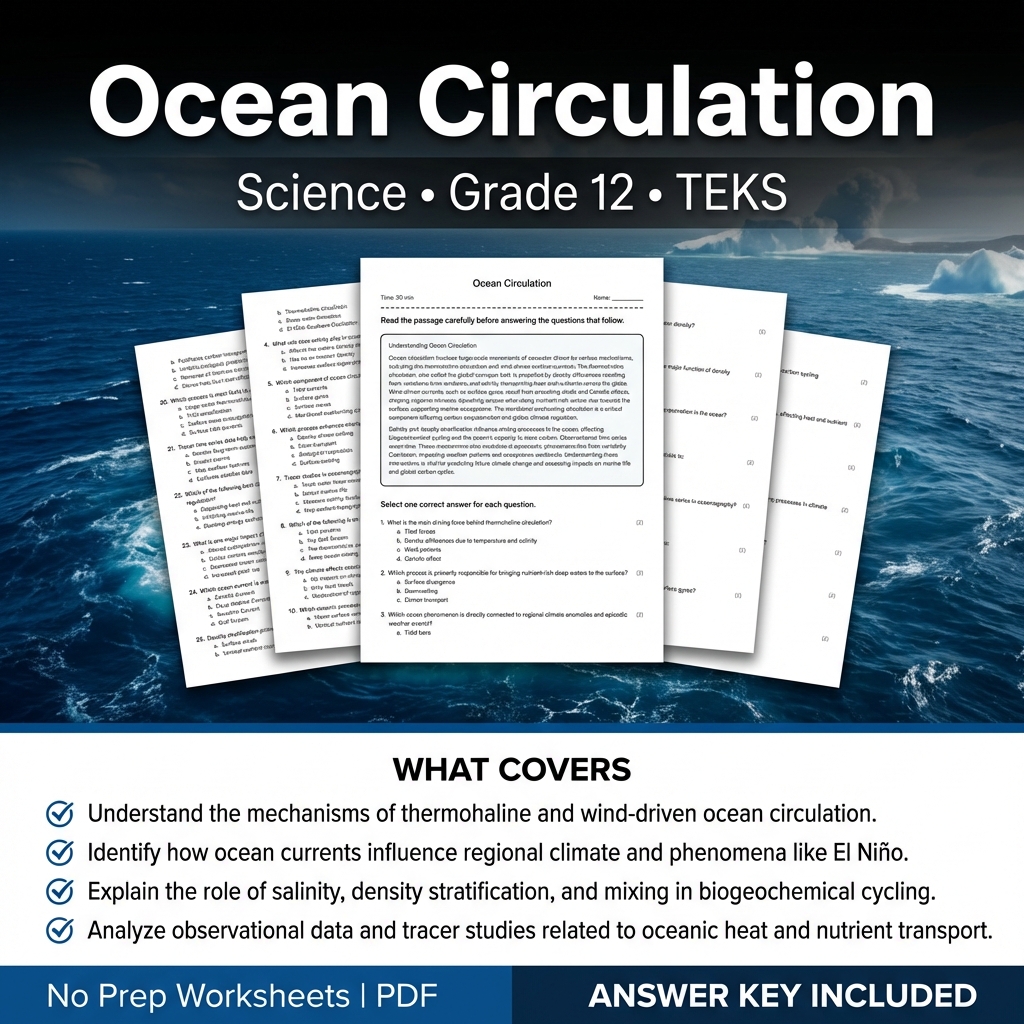
Ocean Circulation Science Worksheet Grade 12 | TEKS Alignment
Created byCoral Reef LearningLearning Objectives
- Understand the mechanisms of thermohaline and wind-driven ocean circulation.
- Identify how ocean currents influence regional climate and phenomena like El Niño.
- Explain the role of salinity, density stratification, and mixing in biogeochemical cycling.
Instant download

Atomic Models Worksheet | NGSS-Aligned Grade 7 Science Practice PDF
JCreated byJ.S SheetsLearning Objectives
- Understand different types of atomic models and their representations.
- Identify the relationship between subatomic particles, atomic number, and chemical formulas.
- Distinguish between molecular structures and extended network structures based on bonding patterns.
Also included in: Grade 7 Structure and Properties of Matter Science Lesson Bundle: NGSS +1 more
Instant download

Grade 10 Science – Reaction Types & Chemistry | Daily Reading Worksheet
Created byBright Mind ResourcesLearning Objectives
- Understand the different types of chemical reactions: synthesis, decomposition, single and double displacement, and combustion.
- Identify reaction patterns and characteristic reactant-product relationships.
- Recognize the conservation of atoms and use symbolic representation in reactions.
Also included in: Grade 10 Chemistry Science Daily Reading Worksheets Lesson Bundle | Ontario +1 more
Instant download
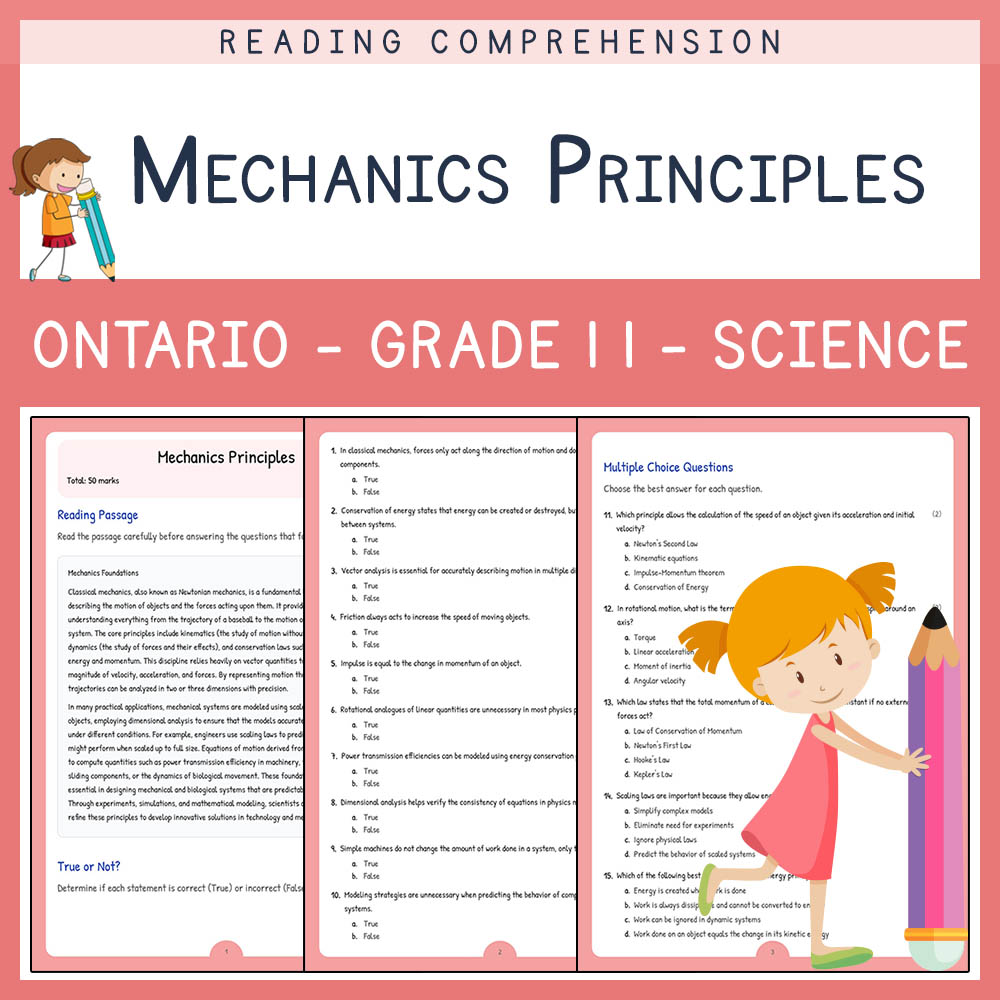
Grade 11 Science Assessment | Mechanics Principles Worksheet Elena | Ontario
Created byLumora LearningLearning Objectives
- Explain key concepts of classical mechanics including kinematics, dynamics, and conservation laws.
- Apply vector analysis to describe motion in physical systems.
- Solve problems related to forces, energy, impulse, and momentum in real-world contexts.
Instant download
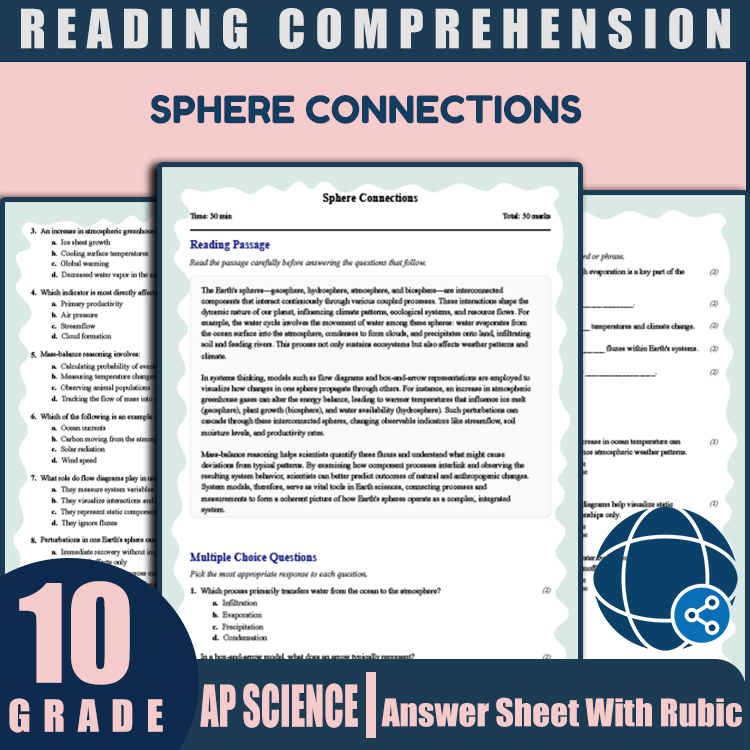
10th Grade Science | Sphere Connections Reading Worksheet (PDF + Answer Key)
JCreated byJ.S SheetsLearning Objectives
- Understand the interactions among the geosphere, hydrosphere, atmosphere, and biosphere through coupled processes such as the water cycle, biogeochemical fluxes, and ocean-atmosphere exchange.
- Use systems thinking tools like box-and-arrow models, flow diagrams, and mass-balance reasoning to analyze how perturbations propagate across Earth's spheres and influence observable indicators.
- Establish conceptual links between component processes and measurable system behaviors such as streamflow, soil moisture, and primary productivity.
Also included in: Grade 10 Science Unit | Earth Processes & Climate Worksheets (PDF + Answer Key) +1 more
Instant download
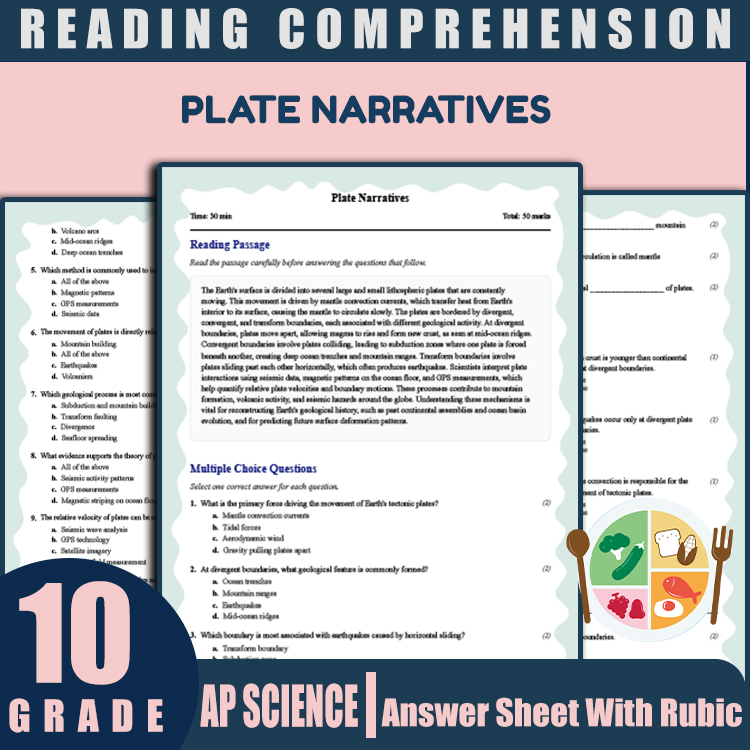
10th Grade Science | Plate Narratives Reading Worksheet (PDF + Answer Key)
JCreated byJ.S SheetsLearning Objectives
- Describe the mechanisms of plate motion, including mantle convection and subduction.
- Interpret tectonic settings using maps, cross-sections, and seismic evidence.
- Connect plate interactions to geological phenomena such as mountain building, volcanism, and earthquakes.
Also included in: Grade 10 Science Unit | Earth Processes & Climate Worksheets (PDF + Answer Key) +1 more
Instant download
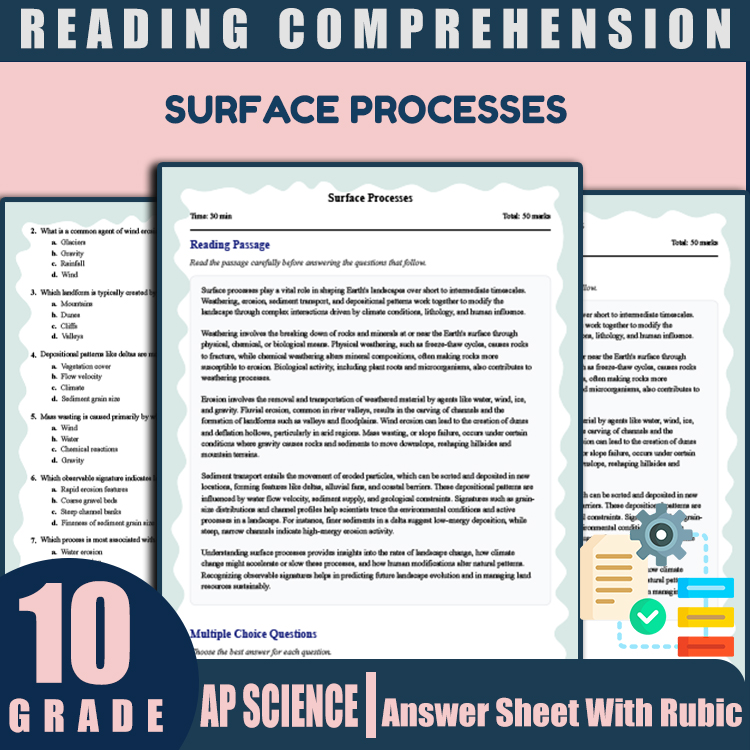
10th Grade Science | Surface Processes Reading Worksheet & Answer Key (PDF)
JCreated byJ.S SheetsLearning Objectives
- Describe the key surface processes such as weathering, erosion, sediment transport, and deposition.
- Interpret morphological changes in landscapes due to surface processes.
- Relate surface process patterns to climate, lithology, and human activities.
Also included in: Grade 10 Science Unit | Earth Processes & Climate Worksheets (PDF + Answer Key) +1 more
Instant download
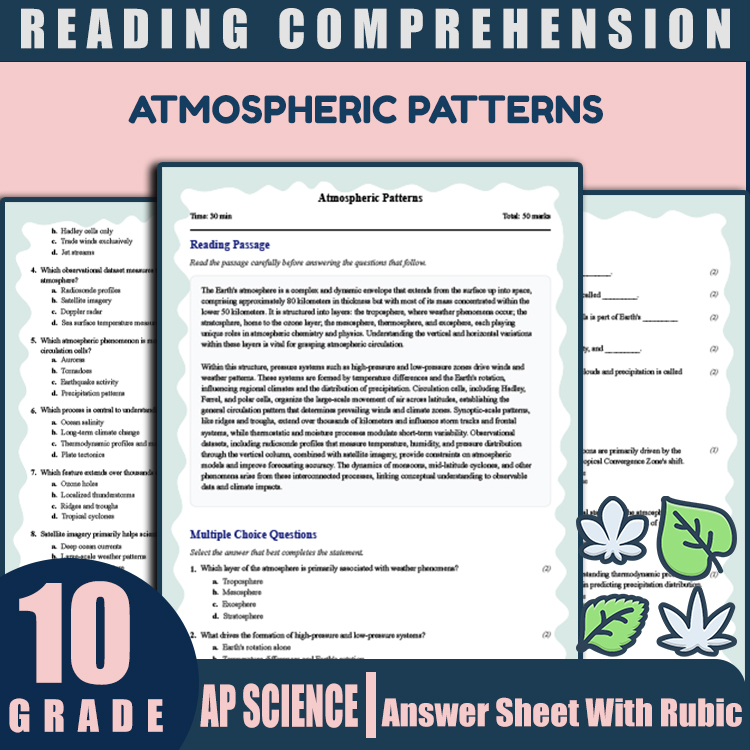
Grade 10 Science | Atmospheric Patterns Reading Worksheet (PDF + Rubric)
JCreated byJ.S SheetsLearning Objectives
- Describe the basic structure and components of Earth's atmosphere.
- Explain how pressure systems and circulation cells influence regional weather patterns.
- Understand how synoptic-scale atmospheric patterns relate to phenomena such as monsoons and cyclones.
Also included in: Grade 10 Science Unit | Earth Processes & Climate Worksheets (PDF + Answer Key) +1 more
Instant download
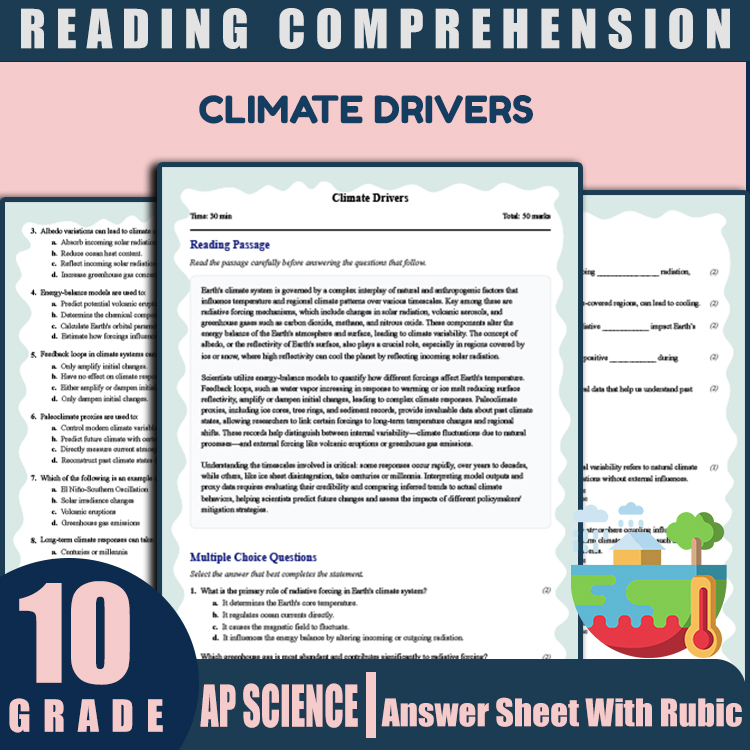
Grade 10 Science | Climate Drivers Reading Worksheet (PDF + Rubric)
JCreated byJ.S SheetsLearning Objectives
- Understand the key factors that influence Earth's climate, including radiative forcing, greenhouse gases, albedo variations, and ocean-atmosphere interactions.
- Analyze how energy-balance models and feedback mechanisms help explain climate variability and change.
- Interpret proxy records and model outputs to assess long-term climate trends and regional shifts.
Also included in: Grade 10 Science Unit | Earth Processes & Climate Worksheets (PDF + Answer Key) +1 more
Instant download

Adaptive Radiation Worksheet | Standards-Based Science Practice for Grade 9
JCreated byJ.S SheetsLearning Objectives
- Define adaptive radiation and describe how a single ancestral lineage can diversify into multiple species.
- Explain the roles of ecological niches, key innovations, and selective pressures in driving diversification.
- Use evidence and models to describe how gene flow, genetic drift, and natural selection shape evolutionary patterns.
Instant download
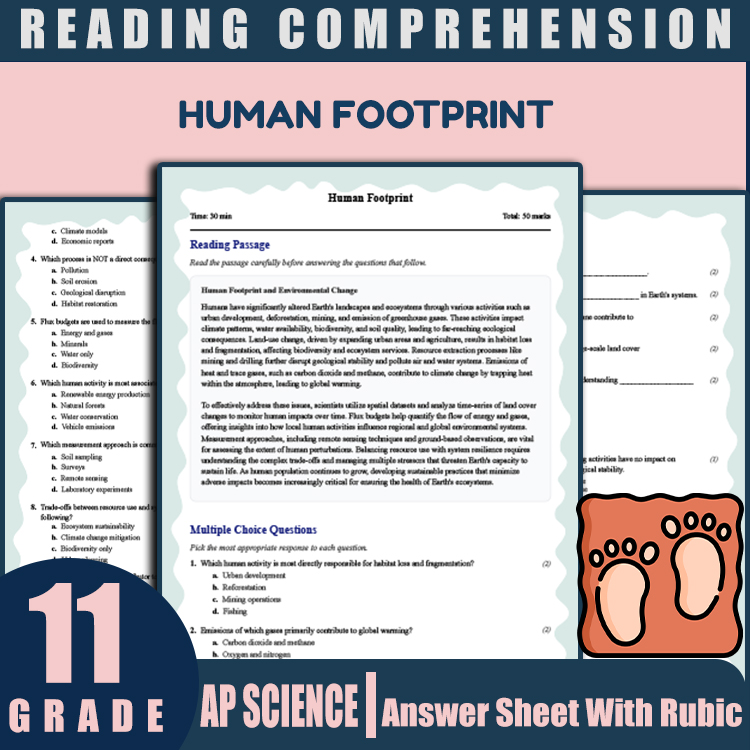
11th Grade Science | Human Footprint Reading Worksheet (PDF + Answer Key)
JCreated byJ.S SheetsLearning Objectives
- Understand the various ways human activities impact Earth's systems such as land use, resource extraction, and emissions.
- Analyze spatial data and time-series datasets to identify links between local human actions and regional environmental changes.
- Evaluate measurement approaches for quantifying human-induced perturbations and consider trade-offs between resource use and ecosystem resilience.
Also included in: Grade 11 Science Unit Bundle | Earth Systems & Climate Change Worksheets +1 more
Instant download
Browse more categories
About Science Worksheets
Find Science worksheets spanning core skills, practice, and review. All 44,628 resources are instant PDF downloads for the classroom or home.
Every worksheet on MyTeachingSheets is created by independent teacher-authors and reviewed before publication. All resources download as printable PDFs for classroom, homework, or at-home practice, and many include answer keys. Preview any worksheet free before buying.