
Science Worksheets
44,628 subject resources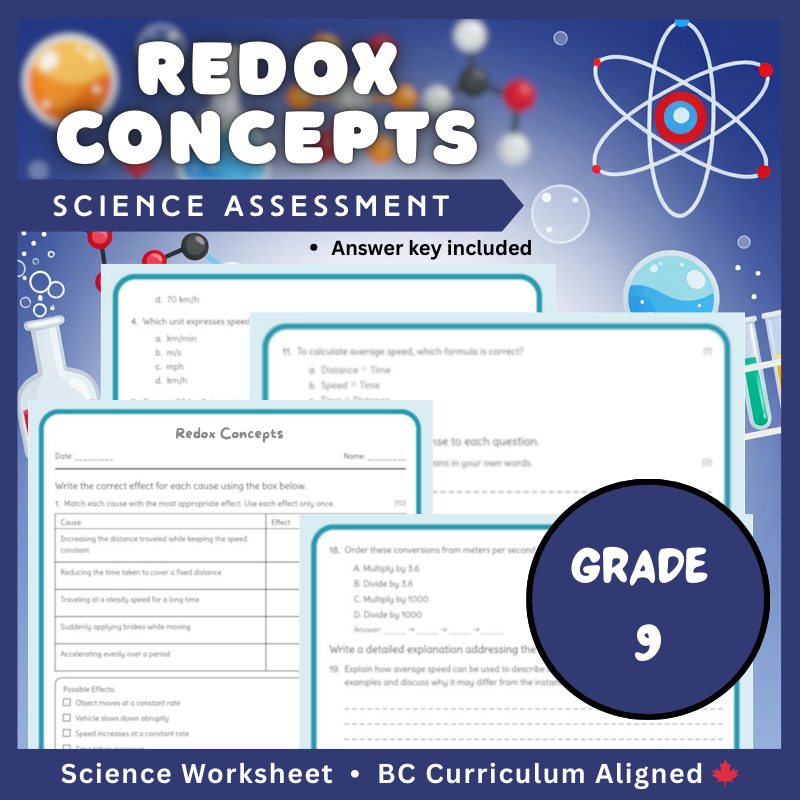
Grade 9 Science – Redox Concepts Worksheet (PDF) | BC Standard & Practice
 Created byBright Mind Resources
Learning Objectives
- Understand the electron transfer process in redox reactions.
- Identify oxidation and reduction by tracking oxidation states.
- Recognize oxidizing and reducing agents in various reactions.
Instant download

Speciation Processes Worksheet | Evolution & Biodiversity NGSS Grade 7
 Created byAmber Owl Education
Learning Objectives
- Explain how reproductive isolation and geographic separation can lead to speciation.
- Describe how polyploidy and adaptive radiation can increase biodiversity.
- Use examples to connect diversification rates and biogeographic patterns to environmental change.
Also included in: Grade 7 Science Evolution & Biodiversity Lesson Bundle – NGSS +1 more
Instant download

Speciation and Diversity Worksheet | Evolution Science Grade 10 NGSSS Activity
 Created byEvergreen Desk Education
Learning Objectives
- Explain how reproductive isolation can arise and how it limits gene flow between populations.
- Describe how divergent selection and genetic drift can accumulate differences over time.
- Connect mechanisms of speciation to patterns of biodiversity and lineage diversification.
Instant download
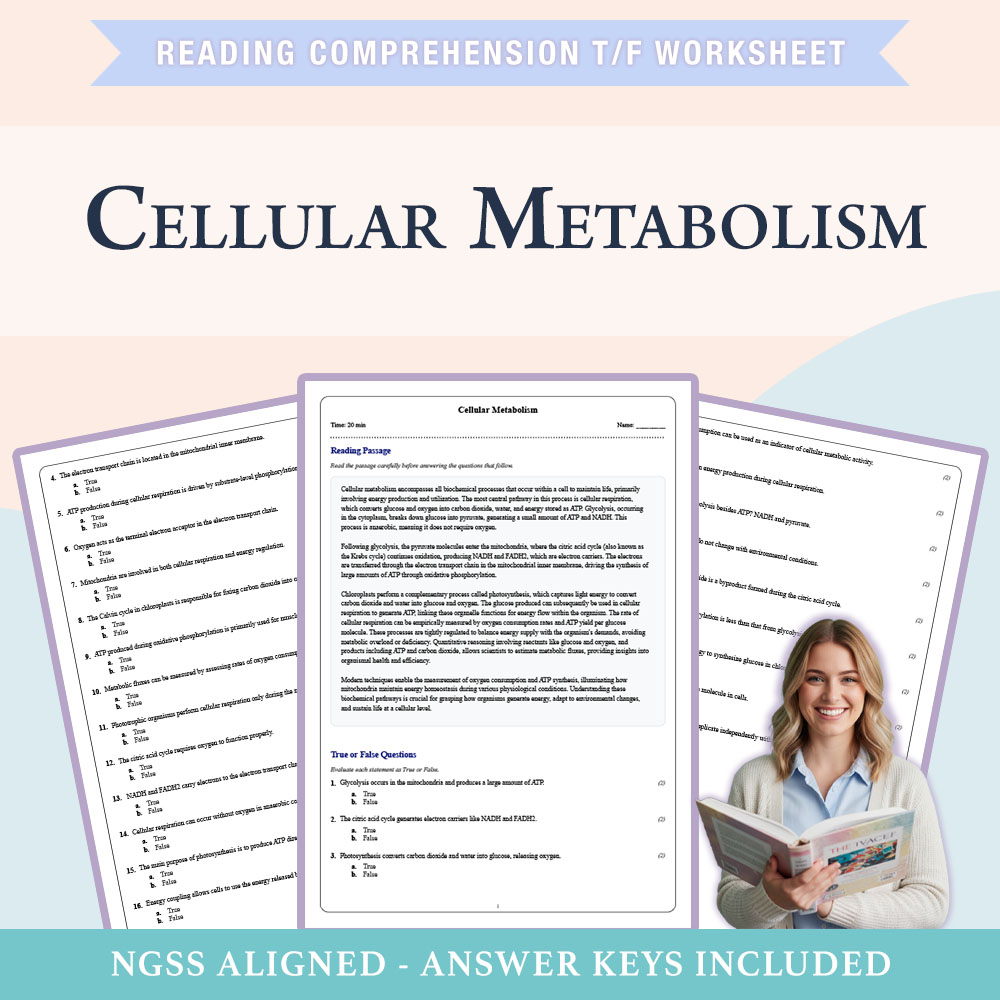
Grade 9 Science | Cellular Metabolism Worksheet (PDF + Answer Key)
 Created byCopper Leaf Classroom
Learning Objectives
- Understand the biochemical pathways involved in cellular respiration, including glycolysis, citric acid cycle, and electron transport chain.
- Explain how ATP is produced through energy coupling and the significance of ATP in cellular activities.
- Relate mitochondrial and chloroplast functions to overall organismal energy balance and metabolism.
Also included in: Grade 9 Science | Cellular Functions & Physiology Bundle (PDF + Answer Key) +1 more
Instant download

Cell Division Worksheet Assessment for Grade 10 Science
Learning Objectives
- Explain how the cell cycle supports growth and repair through regulated stages of DNA replication and division.
- Compare mitosis and meiosis in terms of chromosome behavior and the outcomes for cells and organisms.
- Describe how cell cycle checkpoints and apoptosis prevent damaged or incorrect cells from persisting.
Also included in: From Molecules to Organisms Lesson Bundle | Grade 10 Science | NGSS
Instant download
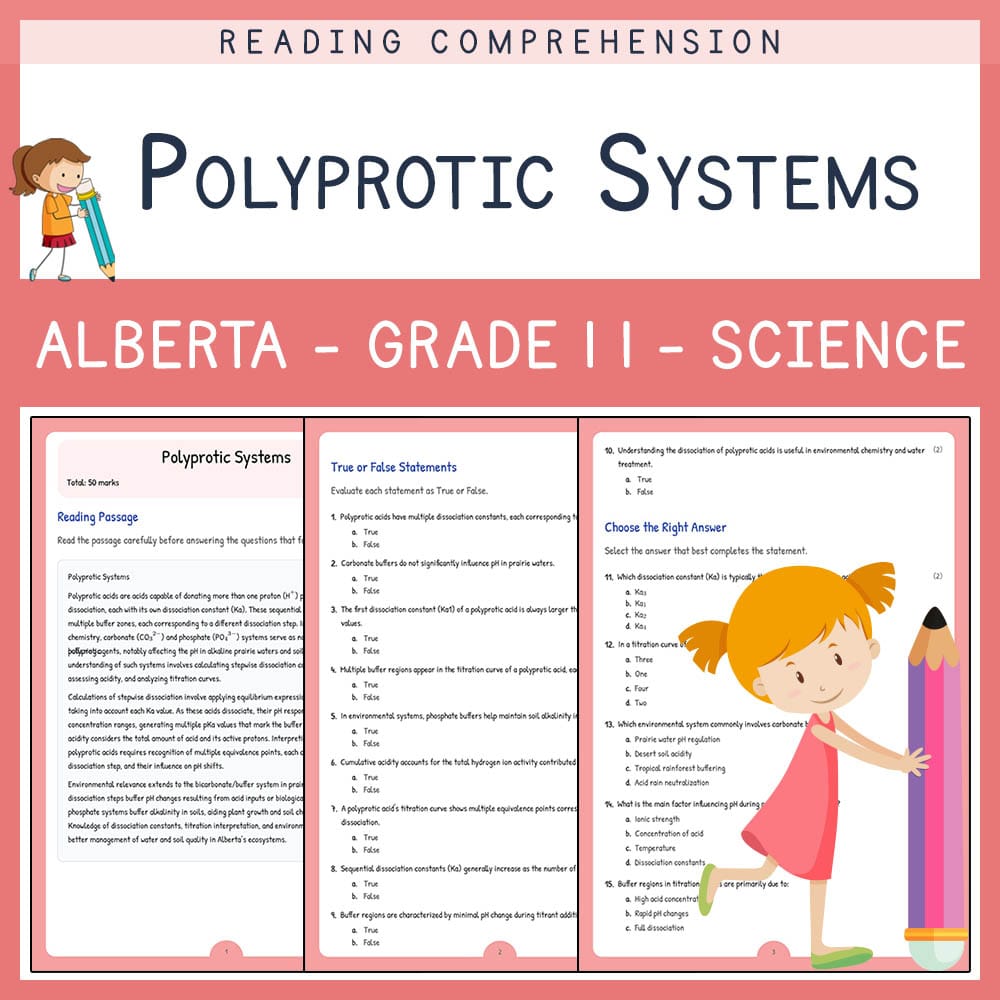
Grade 11 Science | Polyprotic Systems Worksheet | Alberta Standards
 Created byLumora Learning
Learning Objectives
- Understand the dissociation processes of polyprotic acids and their sequential dissociation constants.
- Learn how to calculate stepwise dissociation, cumulative acidity, and interpret titration curves of polyprotic acids.
- Explore environmental relevance of carbonate and phosphate buffer systems, especially in prairie waters and soils in Alberta.
Instant download

Grade 10 Science | Negative Feedback in Human Physiology - Reading Comprehension
 Created byCoral Reef Learning
Learning Objectives
- Define negative feedback and explain its purpose in the body.
- Identify the components involved in negative feedback mechanisms.
- Describe how negative feedback maintains physiological stability.
Instant download
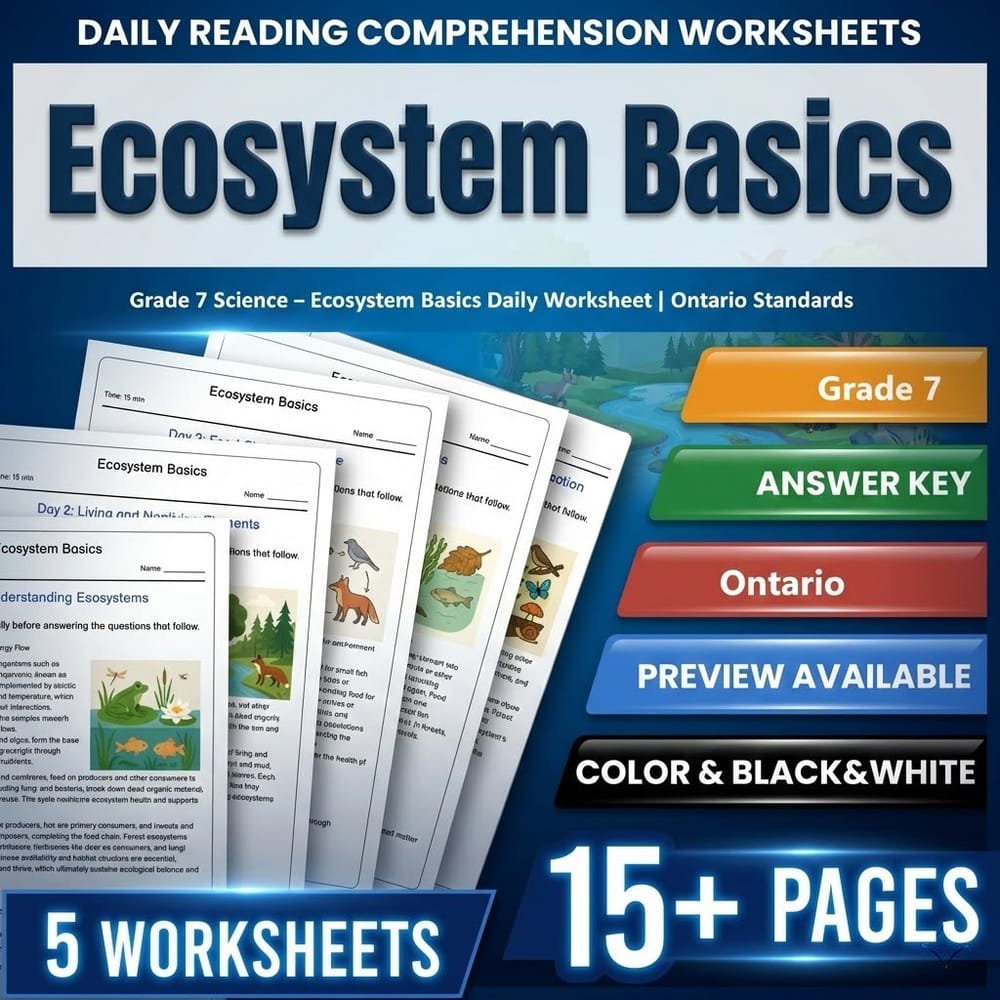
Grade 7 Science – Ecosystem Basics Daily Worksheet | Ontario Standards
 Created byQuiet Forest Education
Learning Objectives
- Identify components of ecosystems including biotic and abiotic factors.
- Understand the roles of producers, consumers, and decomposers.
- Describe energy flow within an ecosystem from sunlight to organic matter.
Also included in: Ecosystem Dynamics Grade 7 Science Daily Reading Worksheets Bundle | Ontario +1 more
Instant download
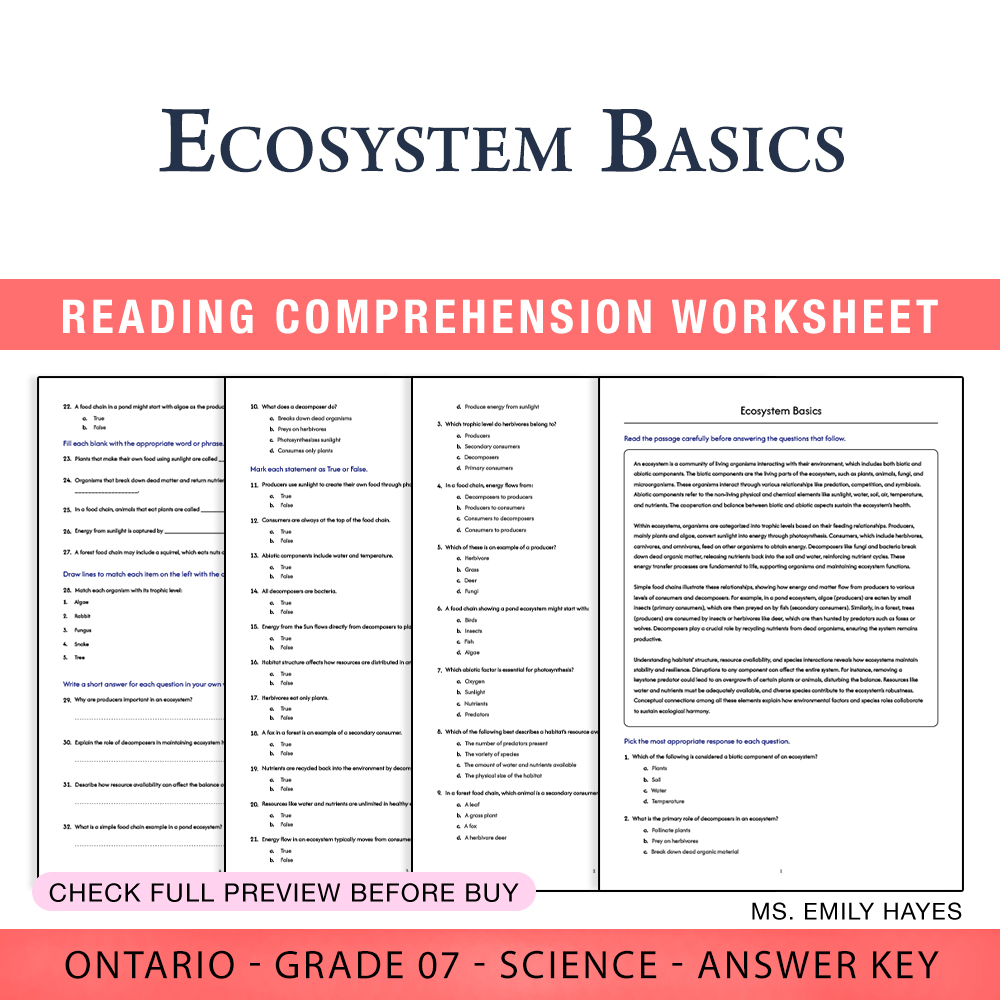
Grade 7 Science | Ecosystem Basics Worksheet (PDF+ Answer Key)
Created byCopper Leaf ClassroomLearning Objectives
- Define components of ecosystems, including biotic and abiotic elements.
- Explain the roles of producers, consumers, and decomposers in energy flow.
- Identify trophic levels and simple food chains in pond and forest settings.
Instant download

Fossil Evidence Assessment | NGSSS Standards Grade 8 Science Worksheet
 Created byPrism Point Learning
Learning Objectives
- Explain how the fossil record provides evidence that life changes over long periods
- Compare fossils from older versus younger rock layers to infer patterns of change
- Use anatomical similarities and differences to support evolutionary relationships
Also included in: Grade 8 Evolution and Genetics Science Lesson Bundle | Florida NGSSS
Instant download

Grade 12 DNA to Proteins Worksheet | Protein Synthesis Biology | CA Standards
Created byEvergreen Desk EducationLearning Objectives
- Explain how base pairing in DNA provides a stable sequence that can be copied into mRNA and translated into proteins.
- Describe the roles of transcription and translation in converting nucleotide information into amino acid sequences.
- Connect changes in DNA sequence (mutations) to changes in protein structure and function, and ultimately to traits.
Instant download
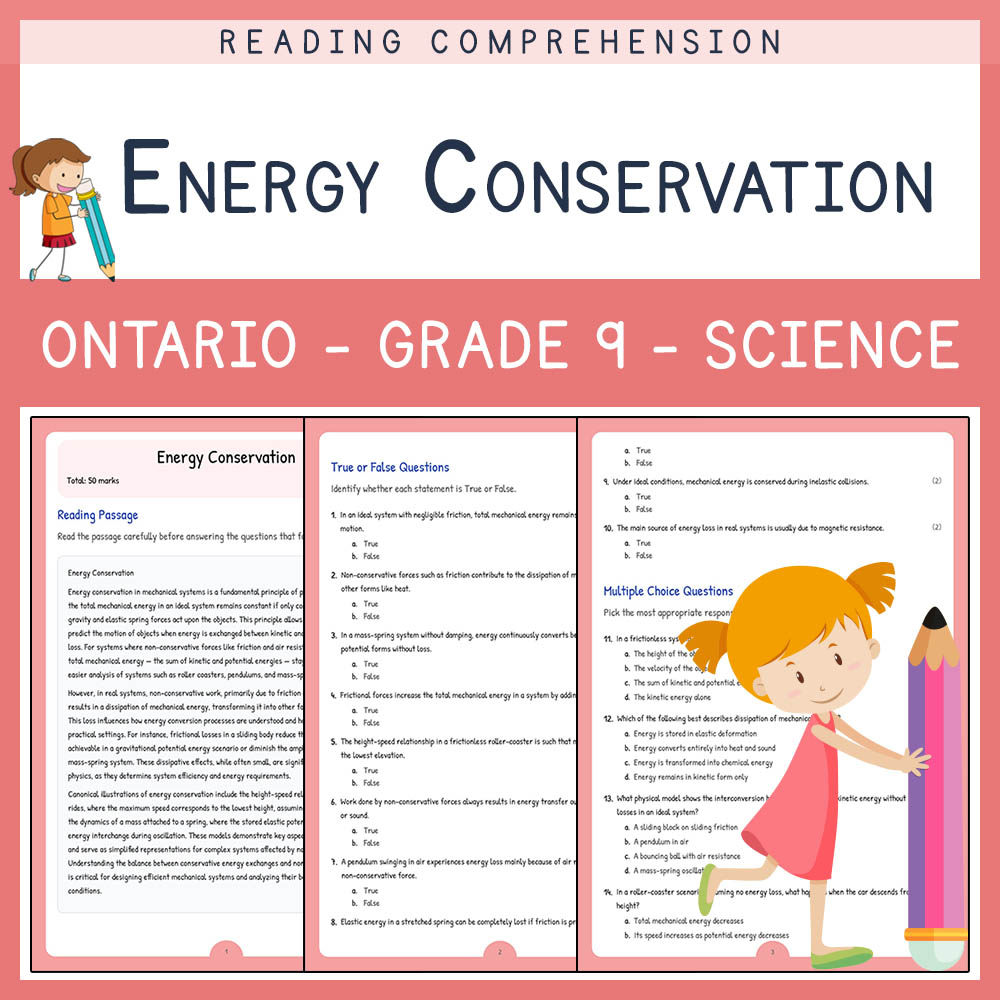
Grade 9 Science Assessment | Energy Conservation Worksheet Elena | Ontario
Created byLumora LearningLearning Objectives
- Understand the principles of conservation of mechanical energy in ideal systems.
- Identify how non-conservative forces affect energy transfer and dissipation.
- Analyze height–speed relationships in roller-coaster models under gravity.
Instant download

Cell Types & Gene Regulation Worksheet | Grade 10 Biology Practice
Created byPrism Point LearningLearning Objectives
- Explain how differential gene expression helps produce specialized cell types within the same organism.
- Describe how regulatory patterns change over time to support development and tissue maintenance.
- Connect gene regulation to differences in protein profiles between cells.
Also included in: Grade 10 Life Science Lesson Bundle | California Standards Framework
Instant download
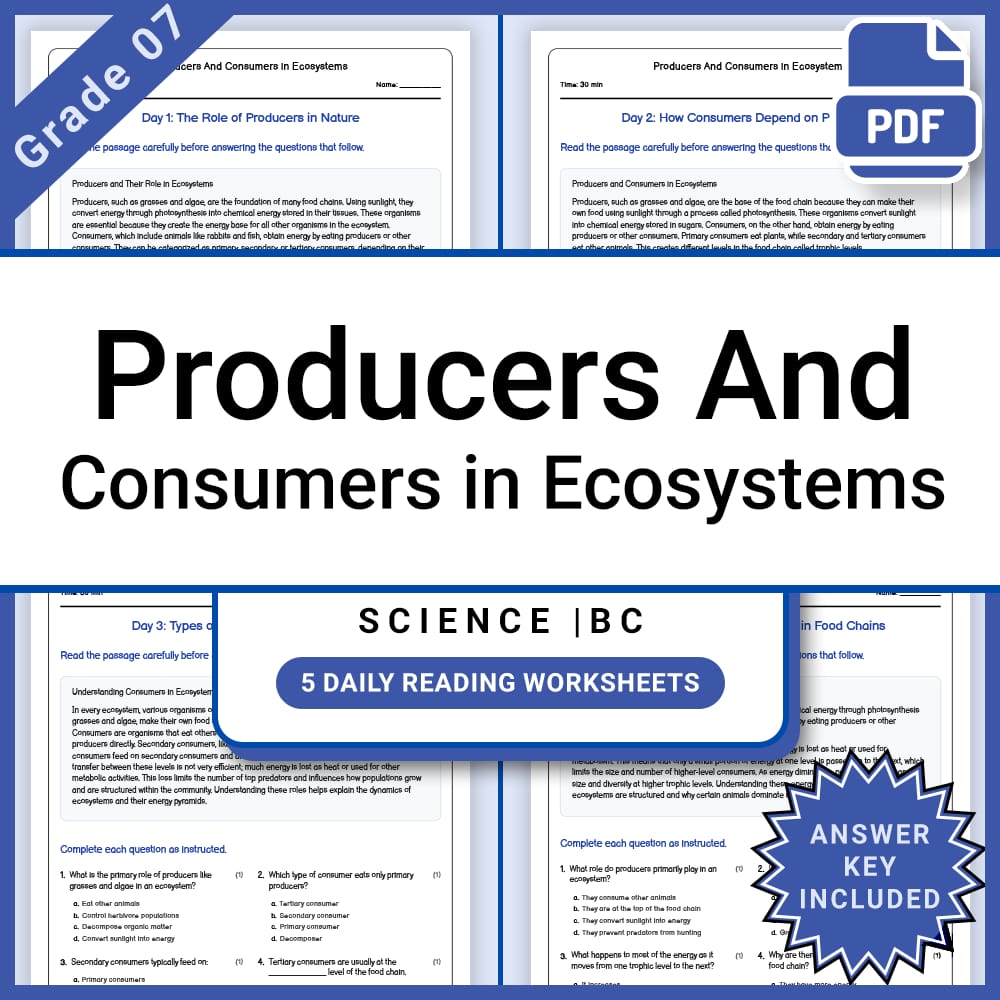
Grade 7 – Producers and Consumers Ecosystems Daily Worksheet + Answer Key
JCreated byJ.S SheetsLearning Objectives
- Understand the role of producers in ecosystems
- Identify different types of consumers
- Explain how energy transfers between trophic levels
Also included in: Grade 7 Science Lesson Group: Ecosystems and Population Framework +1 more
Instant download
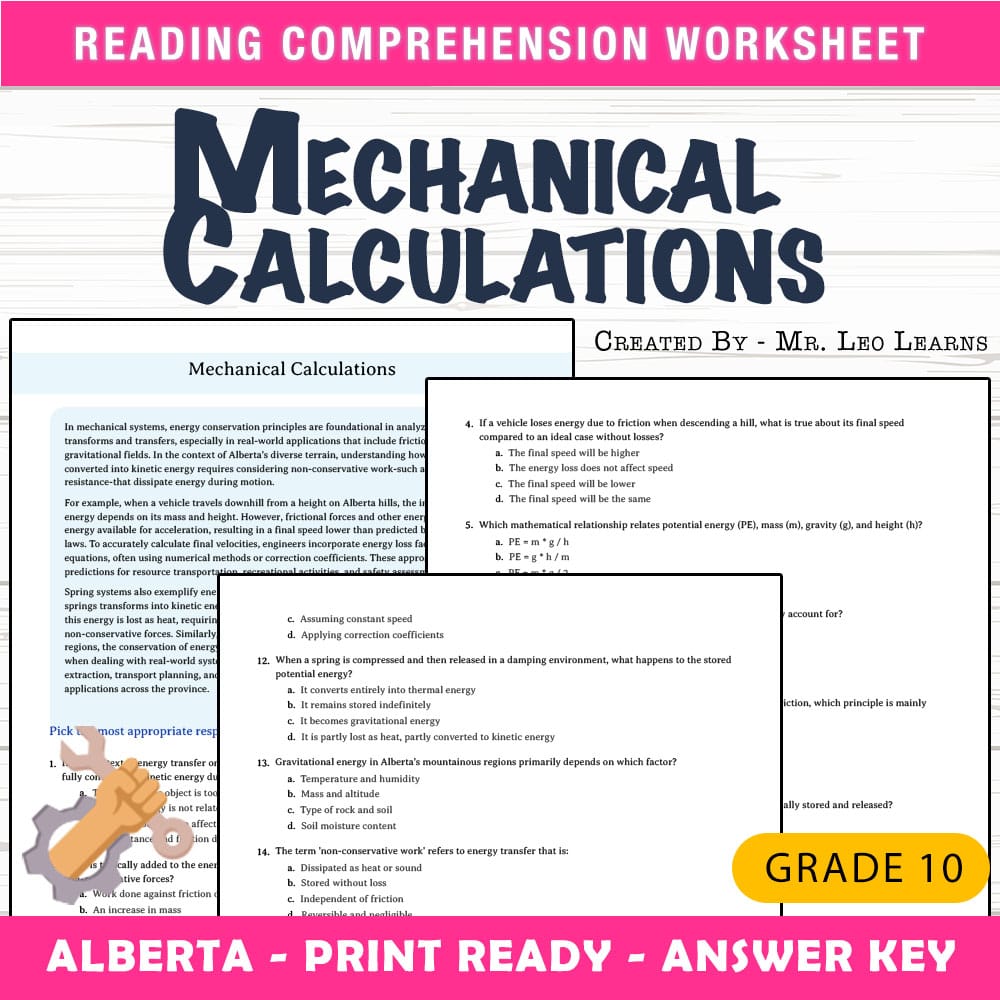
Grade 10 Science — Mechanical Calculations Worksheet MCQ Paper for Mastery
 Created byThe Resource Hub
Learning Objectives
- Understand the principles of energy conservation in mechanical systems
- Apply numerical methods to solve energy transfer problems involving friction, springs, and gravity
- Compute final speeds or heights from potential energy considering non-conservative work
Also included in: Grade 10 Science | Energy, Motion & Electricity Worksheet Bundle | Alberta +1 more
Instant download
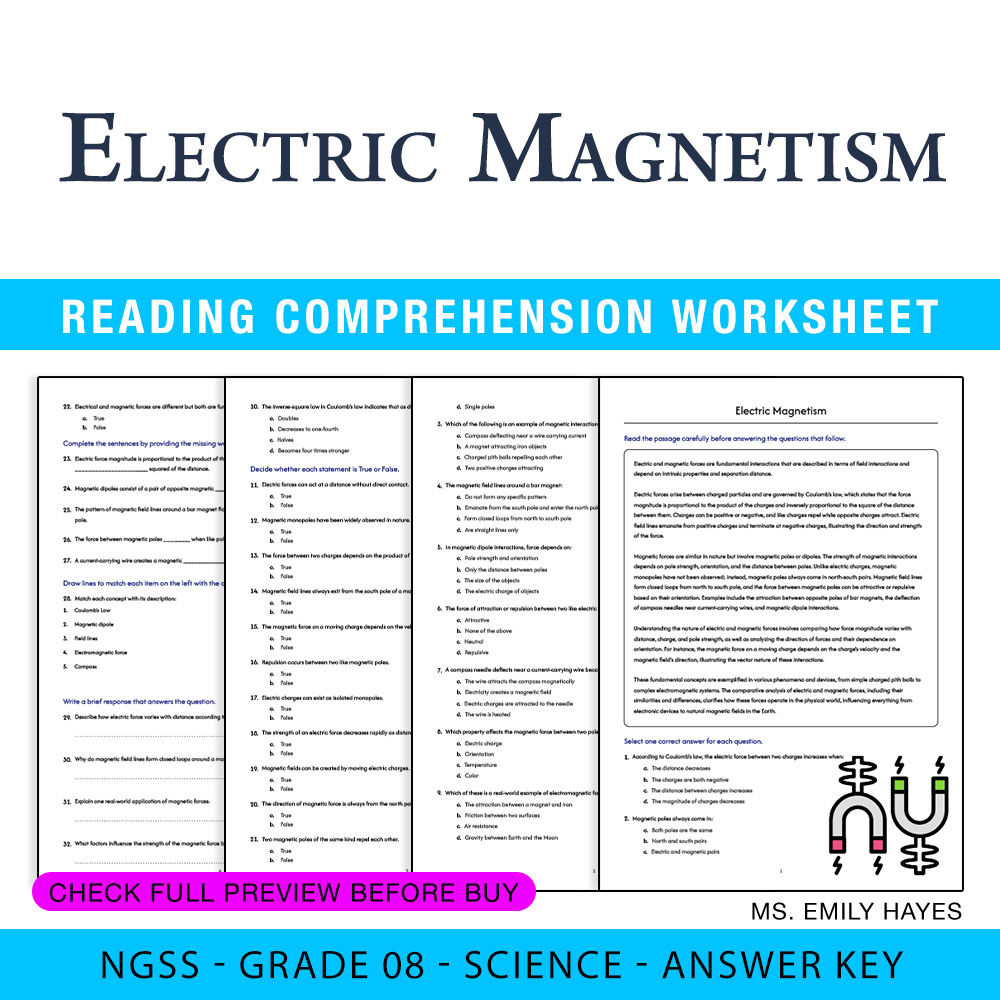
8th Grade Science | Electric Magnetism Worksheet (PDF+ Answer Key)
Created byCopper Leaf ClassroomLearning Objectives
- Understand the concepts of electric and magnetic forces and how they interact.
- Explain how electric and magnetic forces depend on properties such as charge, pole strength, and distance.
- Identify real-world examples of electric and magnetic interactions, including magnetic dipoles and currents.
Instant download
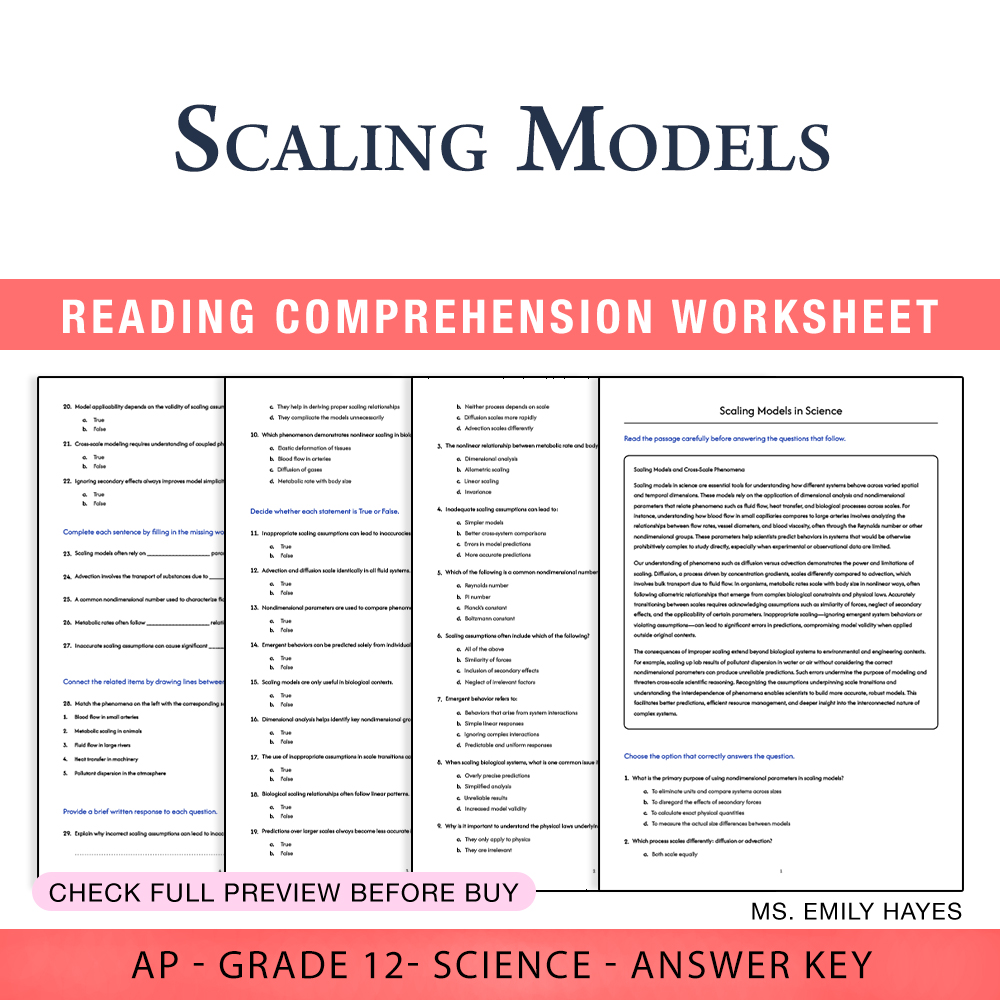
Grade 12 Science | Scaling Models Worksheet (PDF+ Answer Key)
Created byCopper Leaf ClassroomLearning Objectives
- Understand the principles of scaling relationships and dimensional analysis in scientific modeling.
- Apply nondimensional parameters to compare phenomena across different scales.
- Analyze the assumptions needed for scale transitions and their effects on model accuracy.
Also included in: Grade 12 Science AP | Data Analysis and Modeling Skills (PDF+ Answer Key) +1 more
Instant download

Science Worksheet Phases Mechanics Sun–Earth–Moon for Grade 6
JCreated byJ.S SheetsLearning Objectives
- Explain how lunar phases result from the changing relative positions of the Sun, Earth, and Moon.
- Describe how illumination geometry affects the visible fraction of the Moon (new, crescent, quarter, gibbous, full).
- Distinguish between lunar phases and eclipses by describing the alignment needed for eclipses.
Instant download
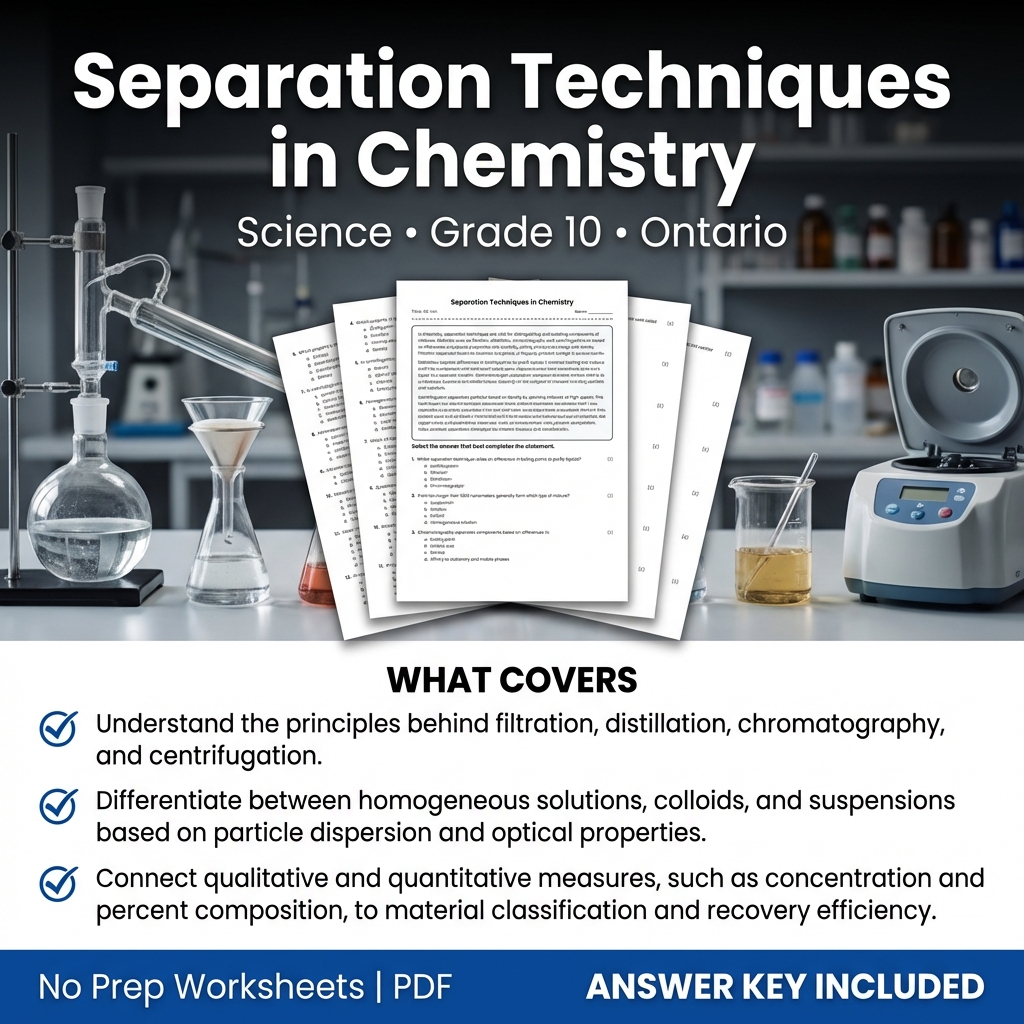
Separation Techniques in Chemistry Worksheet | Grade 10 Science Ontario
Created byCoral Reef LearningLearning Objectives
- Understand the principles behind filtration, distillation, chromatography, and centrifugation.
- Differentiate between homogeneous solutions, colloids, and suspensions based on particle dispersion and optical properties.
- Connect qualitative and quantitative measures, such as concentration and percent composition, to material classification and recovery efficiency.
Instant download

Grade 7 Science Simple Distillation Worksheet | Ontario Standards Practice
JCreated byJ.S SheetsLearning Objectives
- Explain how simple distillation separates miscible liquids using boiling-point differences and condensation.
- Describe the role of vapor pressure and how it relates to volatility and vapor composition.
- Compare simple distillation with fractional distillation and explain why separation can fail for close-boiling mixtures and azeotropes.
Instant download
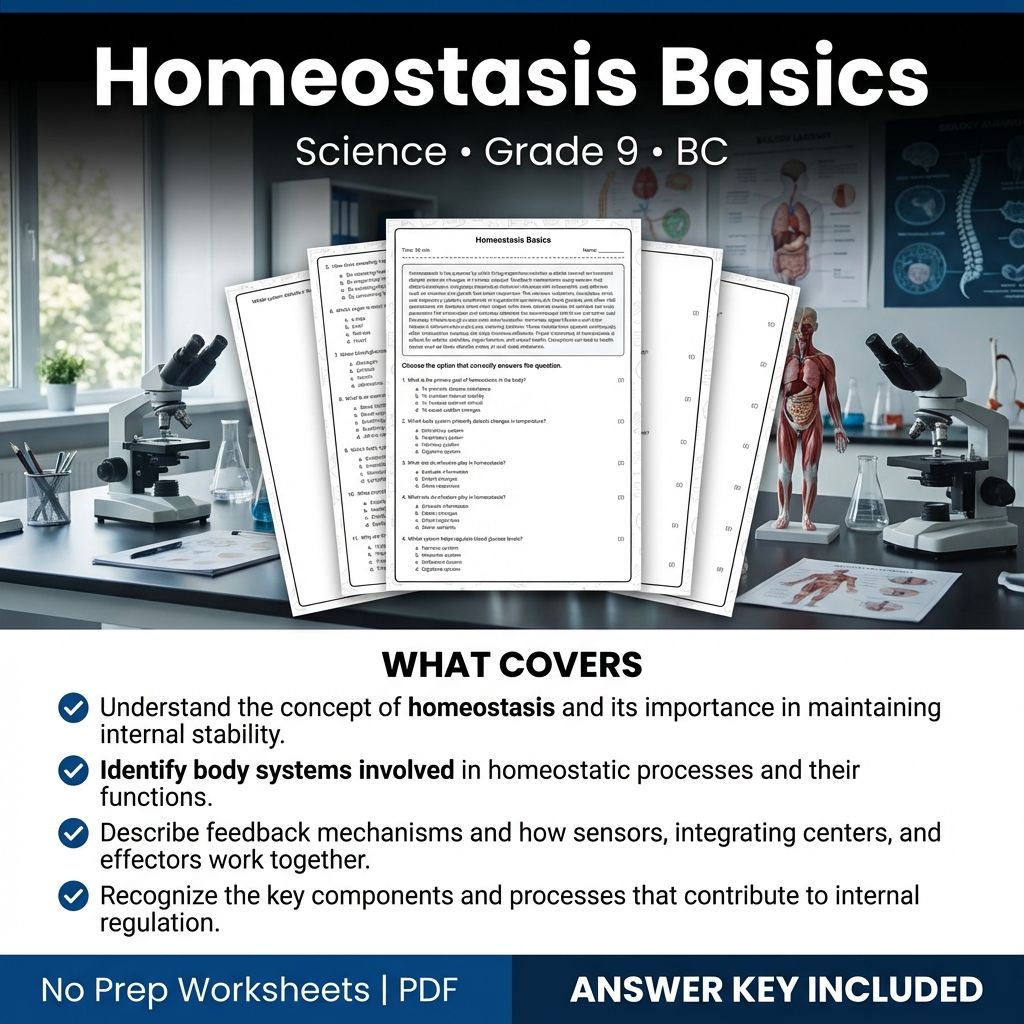
Homeostasis Basics Worksheet for Grade 9 Science | BC Standards
Created byCoral Reef LearningLearning Objectives
- Understand the concept of homeostasis and its importance in maintaining internal stability.
- Identify body systems involved in homeostatic processes and their functions.
- Describe feedback mechanisms and how sensors, integrating centers, and effectors work together.
Instant download
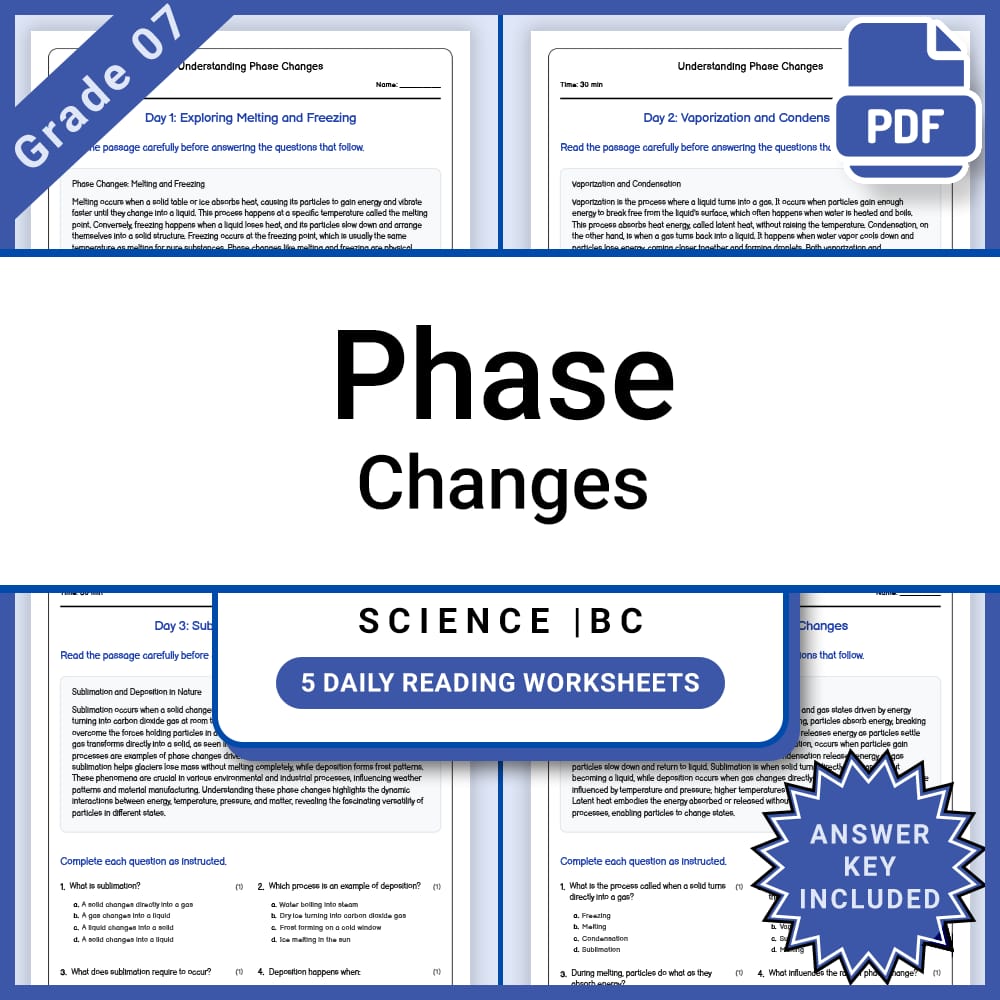
Grade 7 Science – Phase Changes Daily Reading Worksheet + Answer Key
JCreated byJ.S SheetsLearning Objectives
- Describe the processes of melting and freezing.
- Identify the energy transfer involved in phase changes.
- Explain how temperature and pressure influence phase transitions.
Also included in: Grade 7 Science Lesson Group Bundle | States, Reactions & Properties +1 more
Instant download
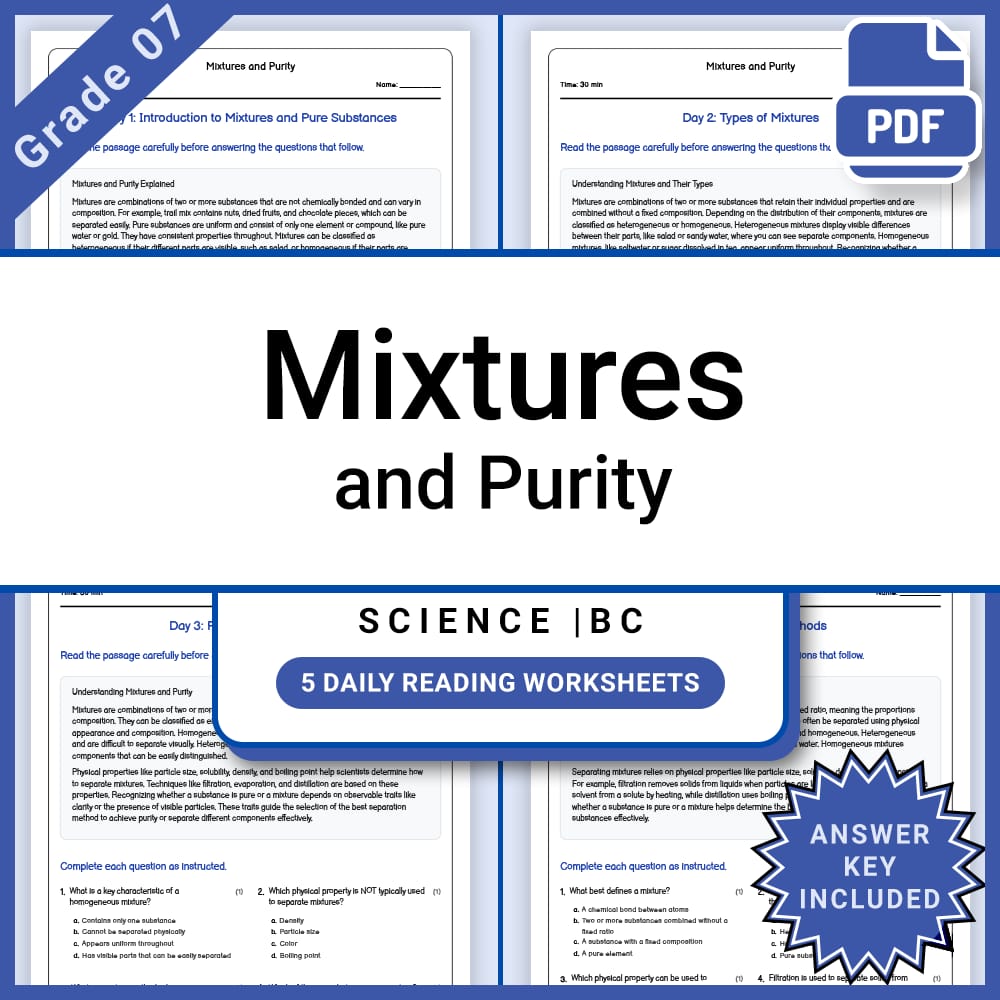
Grade 7 Science – Mixtures and Purity Daily Reading Worksheet + Answer Key
JCreated byJ.S SheetsLearning Objectives
- Understand the difference between mixtures and pure substances.
- Identify properties that distinguish heterogeneous and homogeneous mixtures.
- Learn physical methods used to separate different types of mixtures.
Also included in: Grade 7 Science Lesson Group Bundle | States, Reactions & Properties +1 more
Instant download
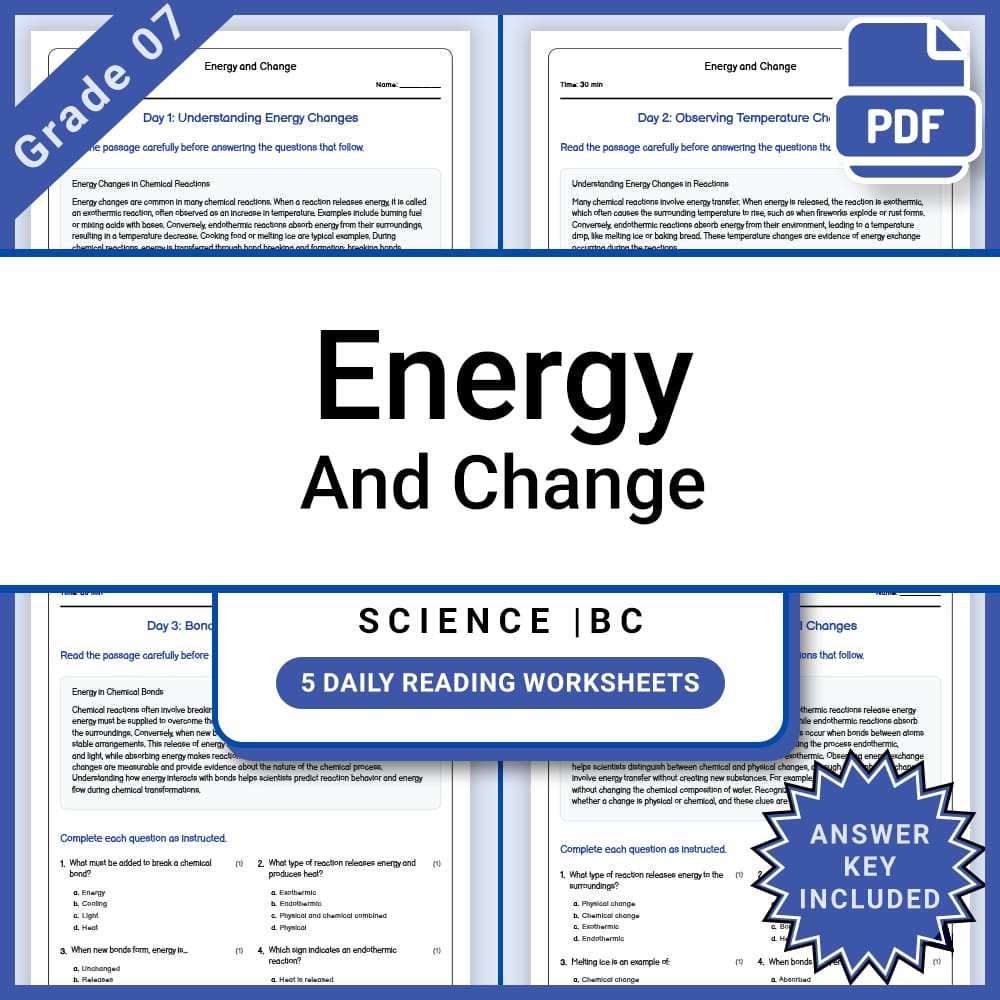
Grade 7 Science – Energy and Change Daily Reading Worksheet + Answer Key
JCreated byJ.S SheetsLearning Objectives
- Understand the differences between exothermic and endothermic reactions.
- Identify signs of energy change during chemical reactions.
- Describe how energy is absorbed or released during bond breaking and formation.
Also included in: Grade 7 Science Lesson Group Bundle | States, Reactions & Properties +1 more
Instant download
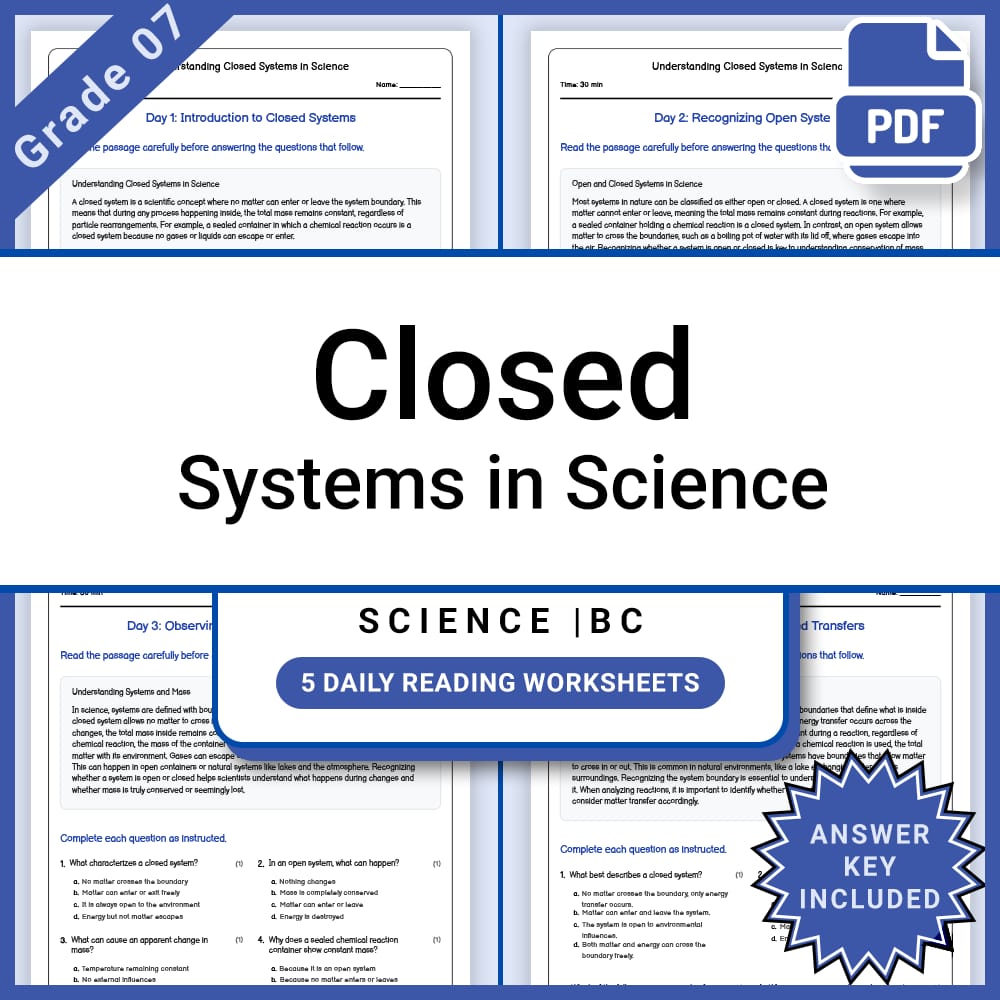
Grade 7 Science – Closed Systems Daily Reading Worksheet + Answer Key
JCreated byJ.S SheetsLearning Objectives
- Define what a closed system is.
- Identify examples of closed and open systems.
- Explain the significance of system boundaries in science.
Also included in: Grade 7 Science Lesson Group Bundle | States, Reactions & Properties +1 more
Instant download
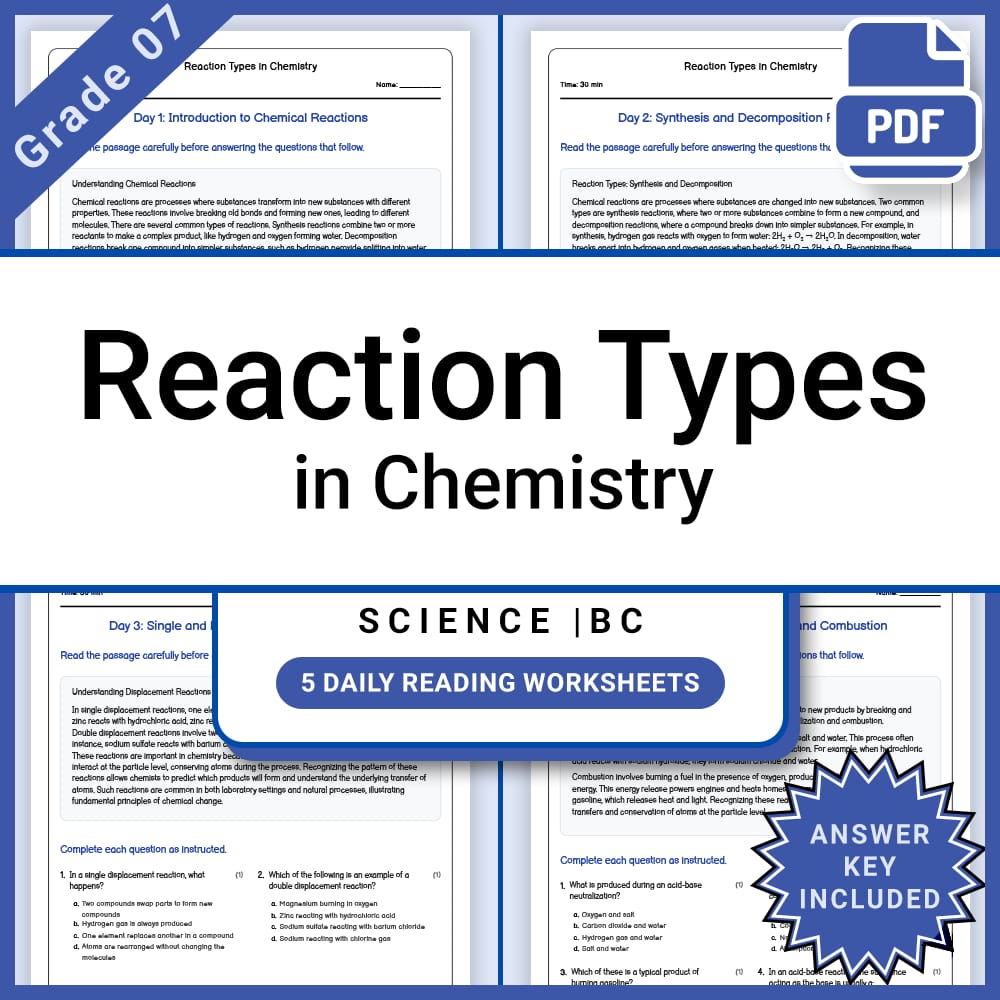
Grade 7 Science – Reaction Types in Chemistry Daily Worksheet + Answer Key
JCreated byJ.S SheetsLearning Objectives
- Understand the different types of chemical reactions: synthesis, decomposition, single and double displacement, acid–base neutralization, and combustion.
- Identify reaction types based on descriptions and examples.
- Explain how atoms rearrange during chemical reactions at the particle level.
Also included in: Grade 7 Science Lesson Group Bundle | States, Reactions & Properties +1 more
Instant download
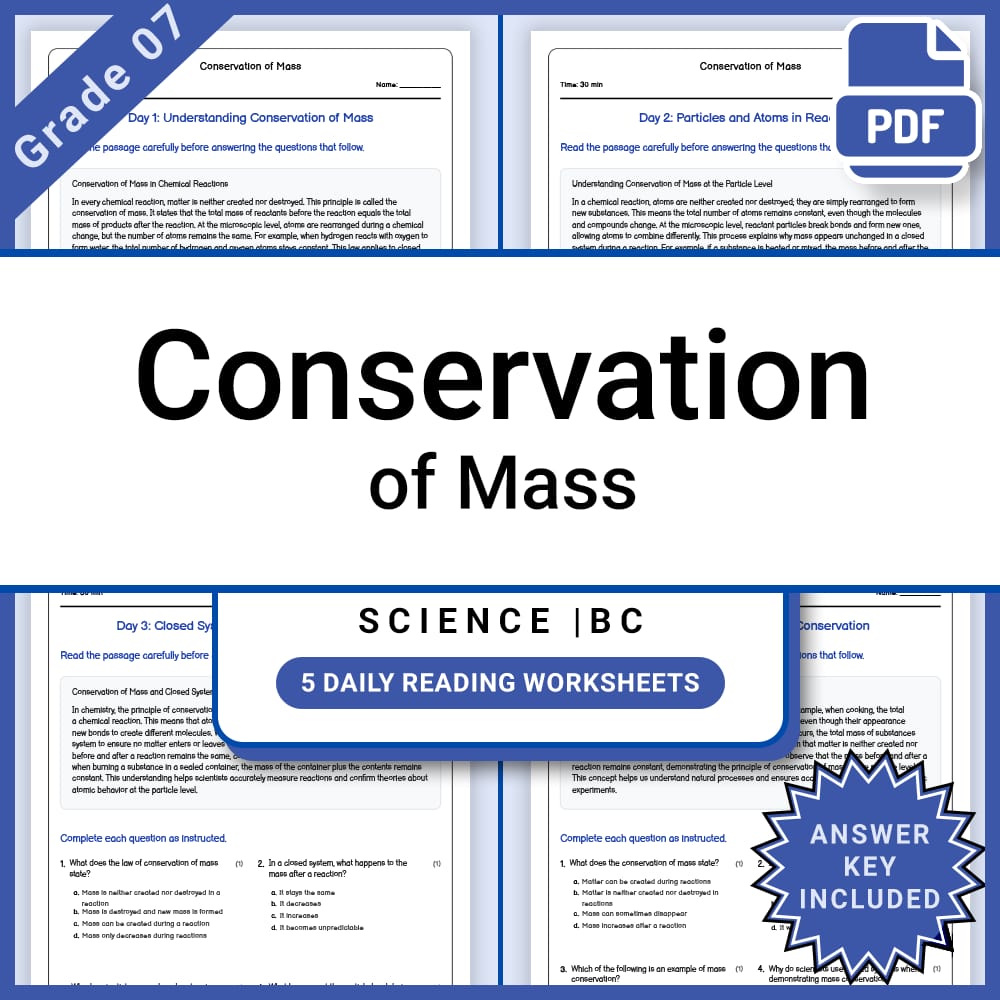
Grade 7 Science – Conservation of Mass Daily Reading Worksheet + Answer Key
JCreated byJ.S SheetsLearning Objectives
- Understand the principle of conservation of mass in chemical reactions.
- Explain how atoms are rearranged during reactions without creating or destroying matter.
- Identify real-world examples where the conservation of mass applies.
Also included in: Grade 7 Science Lesson Group Bundle | States, Reactions & Properties +1 more
Instant download
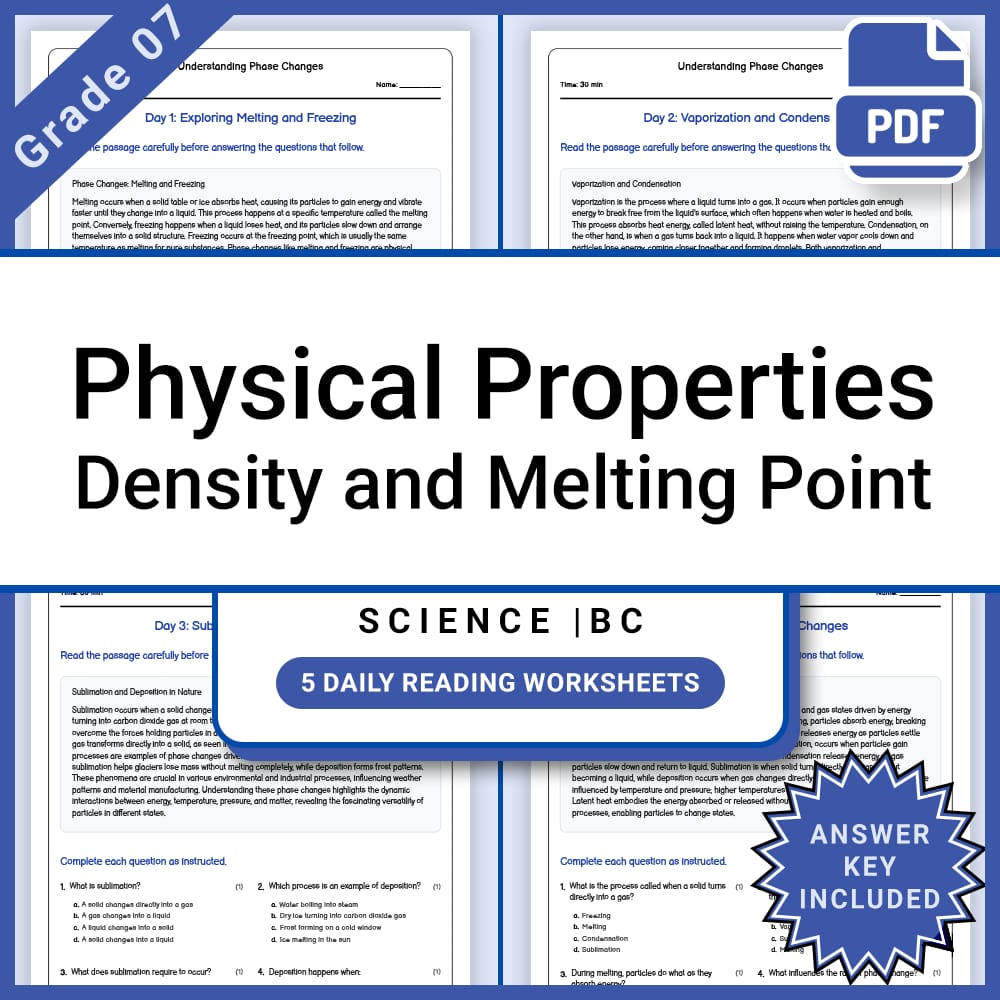
Grade 7 Science – Physical Properties Daily Reading Worksheet + Answer Key
JCreated byJ.S SheetsLearning Objectives
- Define and describe the concepts of density and melting point.
- Compare and contrast the physical properties of different substances based on density and melting point.
- Recognize the importance of physical properties in identifying and separating materials.
Also included in: Grade 7 Science Lesson Group Bundle | States, Reactions & Properties +1 more
Instant download
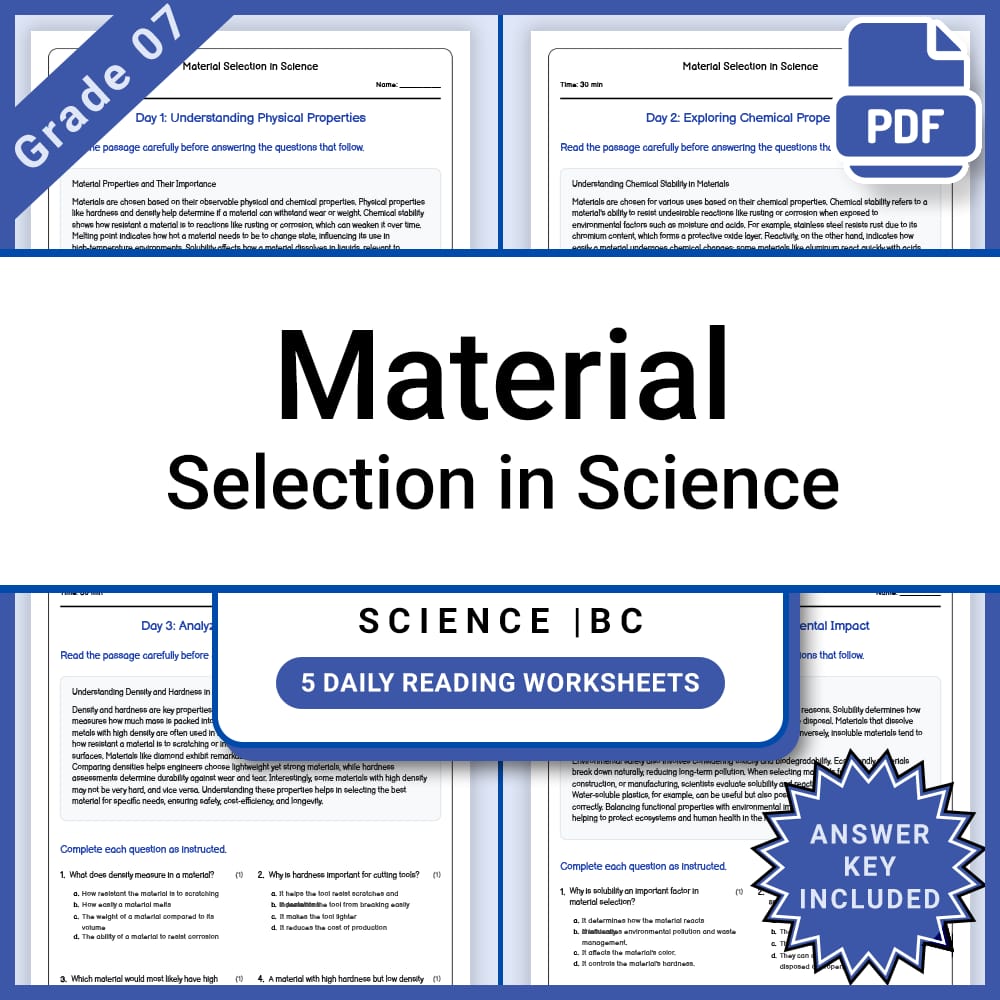
Grade 7 Science – Material Selection Daily Reading Worksheet + Answer Key
JCreated byJ.S SheetsLearning Objectives
- Understand how physical and chemical properties influence material suitability
- Identify observable properties such as corrosion resistance, hardness, melting point, solubility, and reactivity
- Explain the importance of chemical stability and environmental considerations in material choice
Also included in: Grade 7 Science Lesson Group Bundle | States, Reactions & Properties +1 more
Instant download
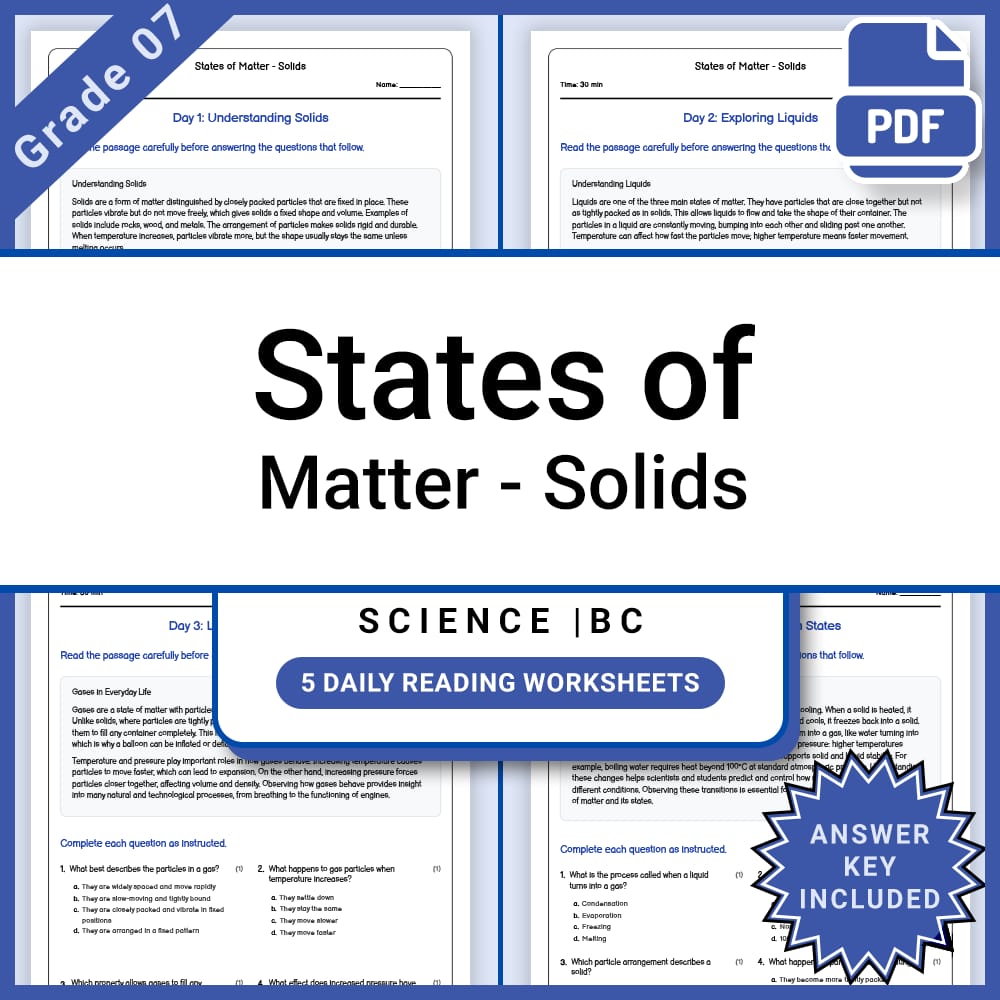
Grade 7 Science – States of Matter Solids Daily Reading Worksheet + Answer Key
JCreated byJ.S SheetsLearning Objectives
- Understand the physical properties of solids.
- Identify how particles are arranged in solids.
- Learn how temperature and pressure affect the state of matter.
Also included in: Grade 7 Science Lesson Group Bundle | States, Reactions & Properties +1 more
Instant download
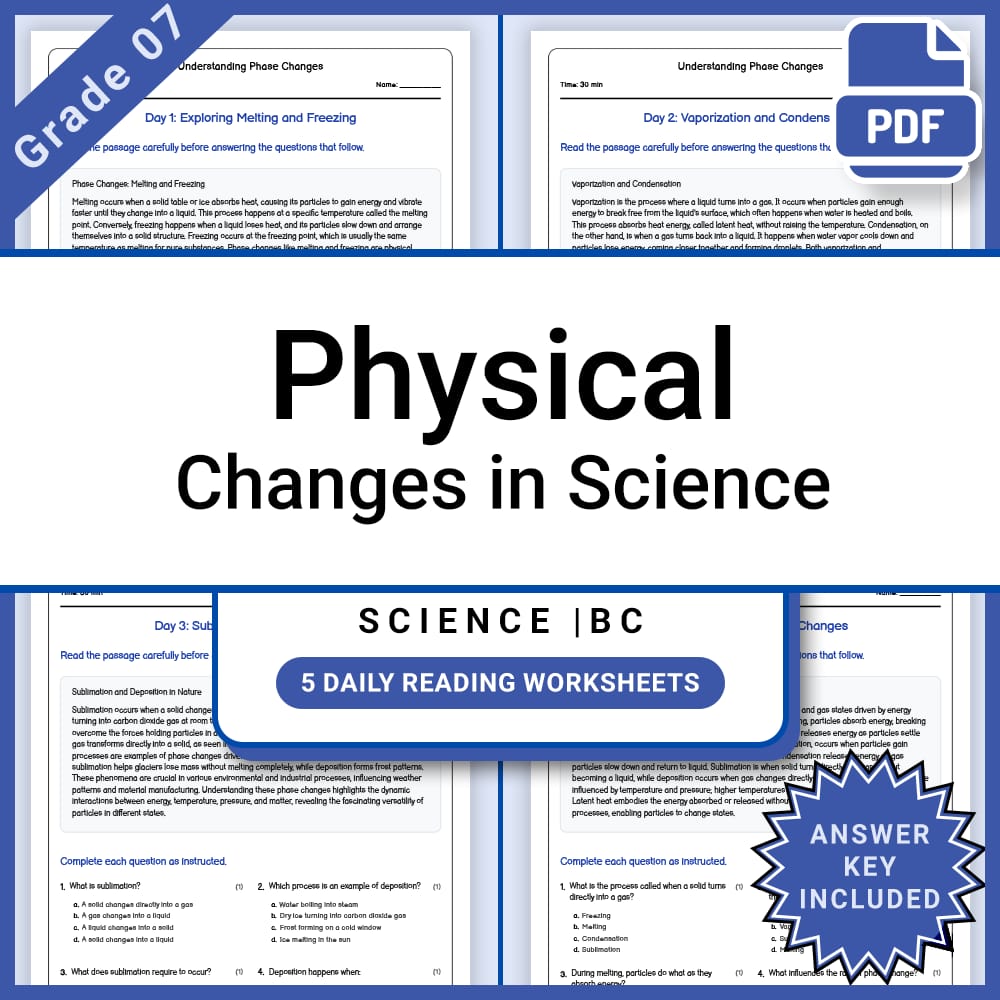
Grade 7 Science – Physical Changes | Daily Reading Worksheet + Answer Key
JCreated byJ.S SheetsLearning Objectives
- Define what a physical change is.
- Identify examples of physical changes in everyday life.
- Distinguish between physical and chemical changes.
Also included in: Grade 7 Science Lesson Group Bundle | States, Reactions & Properties +1 more
Instant download
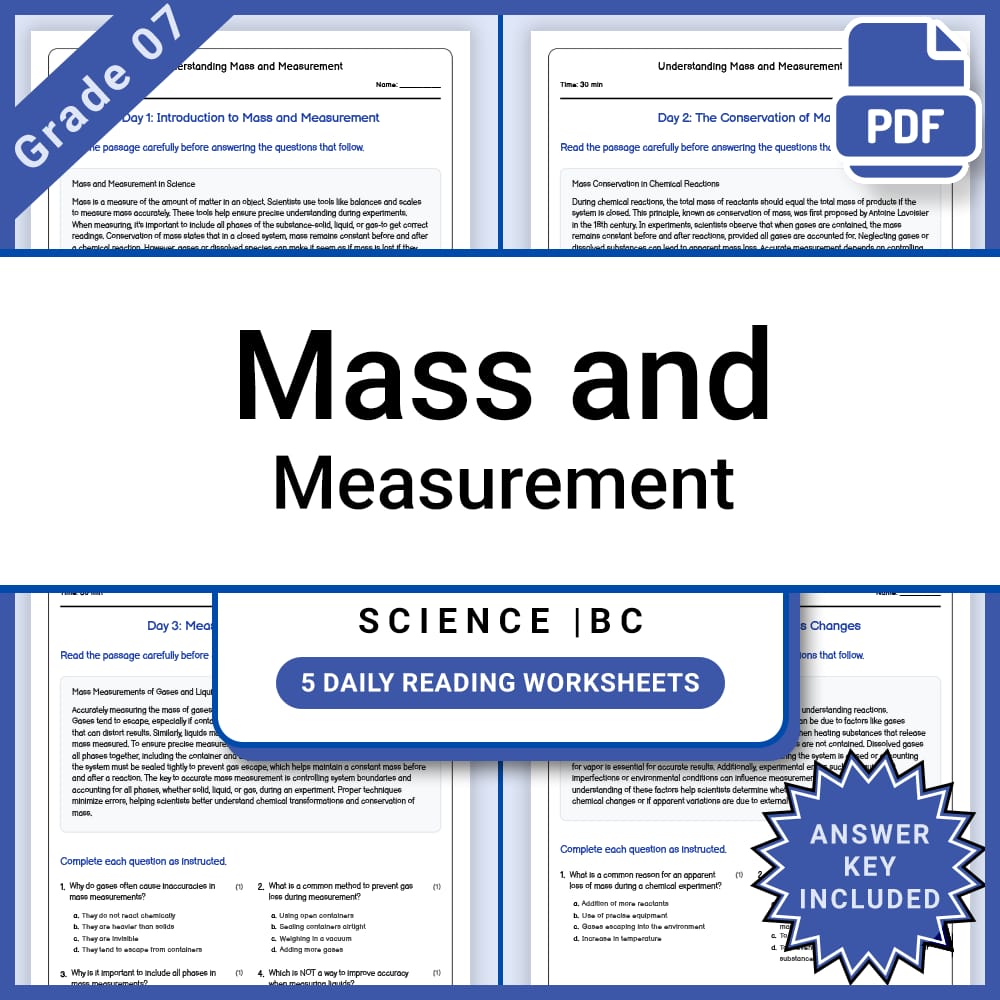
Grade 7 Science – Understanding Mass and Measurement Daily Reading Worksheet + Answer Key
JCreated byJ.S SheetsLearning Objectives
- Learn the basic concepts of mass and why accurate measurement is important in science.
- Identify different tools used to measure mass and understand their functions.
- Explore how conservation of mass applies during chemical changes and physical processes.
Also included in: Grade 7 Science Lesson Group Bundle | States, Reactions & Properties +1 more
Instant download
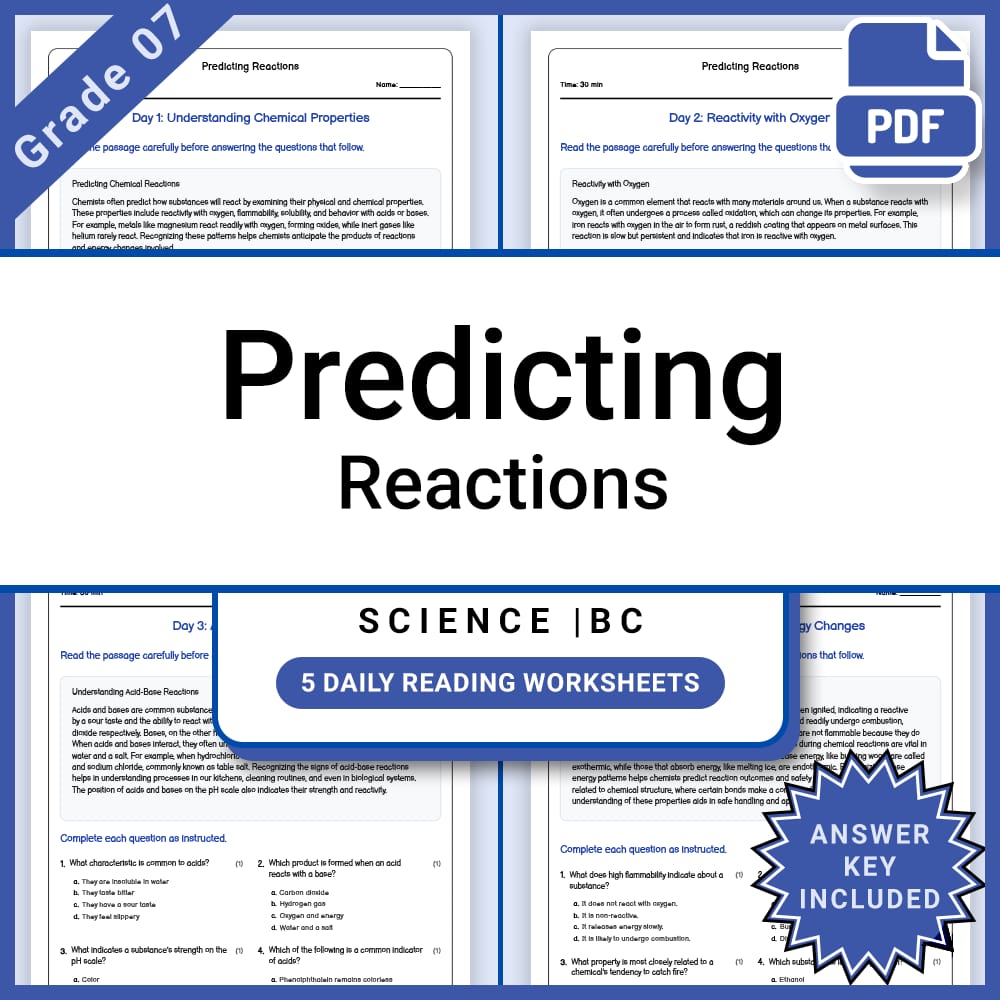
Grade 7 Science – Predicting Reactions Daily Reading Worksheet + Answer Key
JCreated byJ.S SheetsLearning Objectives
- Identify physical and chemical properties of substances
- Understand how properties indicate reactivity
- Predict possible chemical reactions based on properties
Also included in: Grade 7 Science Lesson Group Bundle | States, Reactions & Properties +1 more
Instant download
Grade 6 Science – Solar Motions Worksheet for Mastery
Created byThe Resource HubLearning Objectives
- Understand the orbital motions of planets and their effects on seasons and day length.
- Describe the phases of the Moon and the phenomena of eclipses.
- Explain how the relative motions of the Sun, Moon, and Earth influence tides and observable sky patterns.
Instant download
6th Grade Science | Solar Motions Worksheet (PDF+ Answer Key)
Created byCopper Leaf ClassroomLearning Objectives
- Describe the orbital motions and gravitational interactions within the solar system.
- Explain how axial tilt and Earth's revolution cause seasonal changes.
- Identify the phases of the Moon and understand their connection to lunar-solar geometry.
Instant download
7th Grade Science | Rock Strata Worksheet (PDF+ Answer Key)
Created byCopper Leaf ClassroomLearning Objectives
- Understand the principles of relative dating such as superposition, original horizontality, and cross-cutting relationships.
- Identify and interpret various stratigraphic markers including fossils, unconformities, and intrusions.
- Analyze field observations and stratigraphic data to establish the sequence of geological events.
Instant download

Grade 8 Science – Understanding Geological Processes | Daily Reading Worksheet
Created byBright Mind ResourcesLearning Objectives
- Identify and describe different types of plate boundaries.
- Explain the geological processes involved in plate tectonics.
- Recognize observable evidence of tectonic activity.
Also included in: Grade 8 Earth & Space Science Daily Reading Worksheets Lesson Bundle | TEKS +2 more
Instant download

Grade 8 Science – Reaction Types Worksheet (PDF) | BC Standards Alignment
Created byEvergreen Desk EducationLearning Objectives
- Identify major chemical reaction categories and describe how atoms reorganize in each.
- Use reaction patterns to predict possible products from given reactants.
- Distinguish between single and double displacement using characteristic bond changes.
Instant download

Geologic Time Worksheet | NGSS Aligned Science Practice for Grade 10
JCreated byJ.S SheetsLearning Objectives
- Understand the methods used to reconstruct Earth's geologic history, including stratigraphy and radiometric dating.
- Identify key concepts such as half-life decay, isotopic ratios, and cross-cutting relationships.
- Explain how terrestrial and lunar time scales are integrated to understand planetary evolution.
Also included in: Grade 10 Cosmic Origins Space Science lesson bundle – NGSS worksheet set
Instant download
11th Grade Science | Covalent Structure Worksheet (PDF+ Answer Key)
Created byCopper Leaf ClassroomLearning Objectives
- Explain the principles of molecular geometry, orbital overlap, hybridization, and resonance in covalent molecules.
- Use Lewis structures and VSEPR models to predict bond angles and molecular shapes.
- Describe how molecular orbital theory accounts for spectroscopic signatures and reactivity patterns in organic and inorganic molecules.
Also included in: Grade 11 Science | Chemistry Foundations AP Worksheet Bundle (PDF+ Answer Keys) +1 more
Instant download

Grade 6 Inheritance Modeling Worksheet | NGSS Genetics Activity & Answer Key
 Created byNorthstar Worksheets
Learning Objectives
- Explain how genes and alleles contribute to inheritance of traits from parents to offspring
- Use Mendelian cross models to predict expected offspring phenotype ratios
- Apply simple probability reasoning to dominant and recessive inheritance patterns
Also included in: Grade 6 Genetics Variation & Inheritance Lesson Bundle | NGSS +1 more
Instant download

Grade 6 Food Molecules and Digestion Worksheet | California Science PDF
Created byEvergreen Desk EducationLearning Objectives
- Explain how food molecules provide both chemical building materials and stored energy in the body
- Describe how digestion breaks large food molecules into smaller molecules that can be absorbed
- Connect specific food molecules to different cell needs, such as structure and quick energy
Instant download
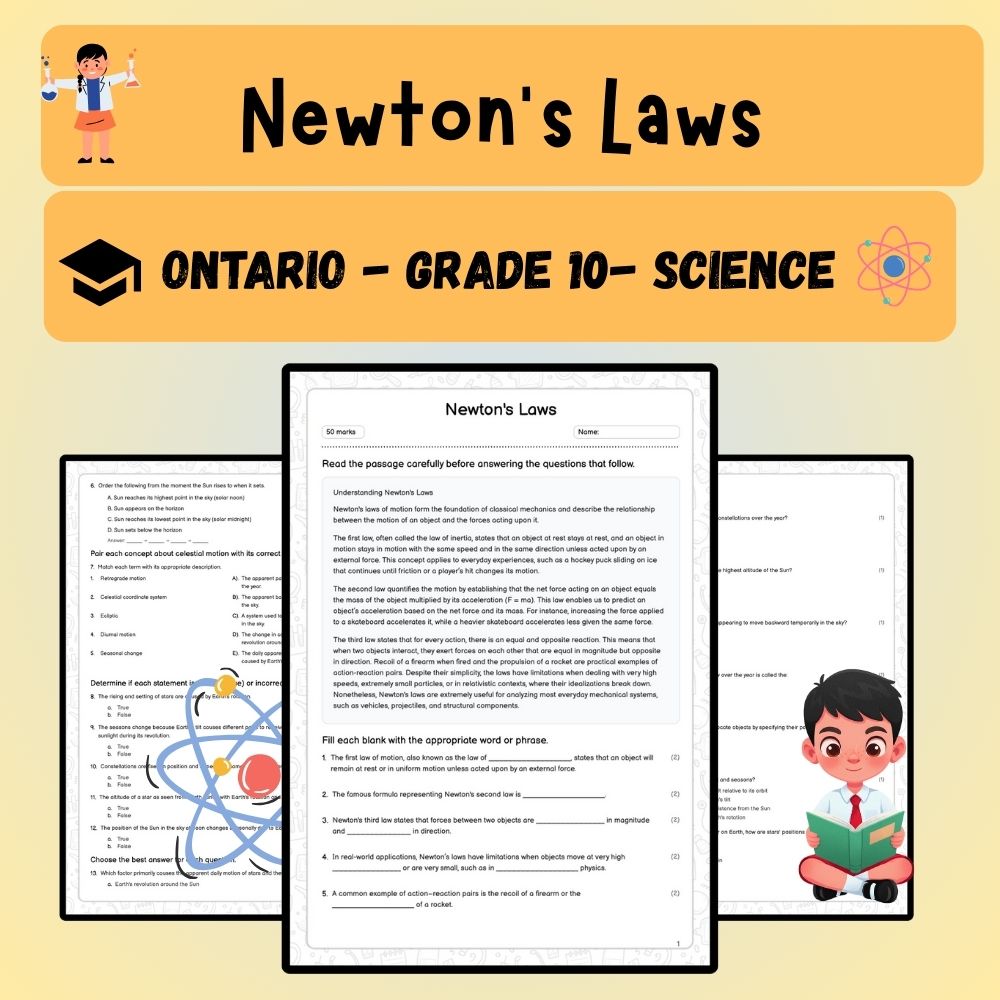
Grade 10 Science | Newton's Laws Worksheet (Answer Key) aligned with Ontario standards
Created byPrism Point LearningLearning Objectives
- Explain the three laws of motion and their conceptual significance.
- Apply Newton's second law to analyze forces and acceleration in various systems.
- Describe action-reaction pairs and their implications in physical interactions.
Also included in: Grade 10 Science Unit Bundle | Motion, Forces & Mechanics Worksheets (Ontario Standards) +1 more
Instant download

One-Dimensional Motion Worksheet Practice | Grade 9 AP Science
 Created byBright Quill Resources
Learning Objectives
- Interpret position–time and velocity–time graphs to determine slope, direction, and acceleration
- Use constant-acceleration equations to predict velocity and displacement from given initial conditions
- Connect graphical reasoning (slopes and areas) to algebraic models of displacement, velocity, and acceleration
Instant download

Energy Flow Trophic Levels Worksheet | Grade 8 Science Practice
Created byPrism Point LearningLearning Objectives
- Explain how energy moves through trophic levels in one direction from the Sun to producers and then to consumers
- Describe why energy decreases at each trophic level and how that limits population sizes
- Compare food chains and food webs to show how multiple pathways affect energy flow
Instant download

Grade 11 Wave Superposition, Interference & Resonance Worksheet | Ontario
 Created byChalk and Compass
Learning Objectives
- Explain how the superposition principle produces interference patterns and standing waves
- Identify nodes and antinodes and connect them to boundary conditions in strings and air columns
- Relate resonant frequencies to harmonics and the fundamental frequency in bounded systems
Also included in: Motion, Energy, Waves & DC Circuits Lesson Bundle – Grade 11 Science Ontario +1 more
Instant download
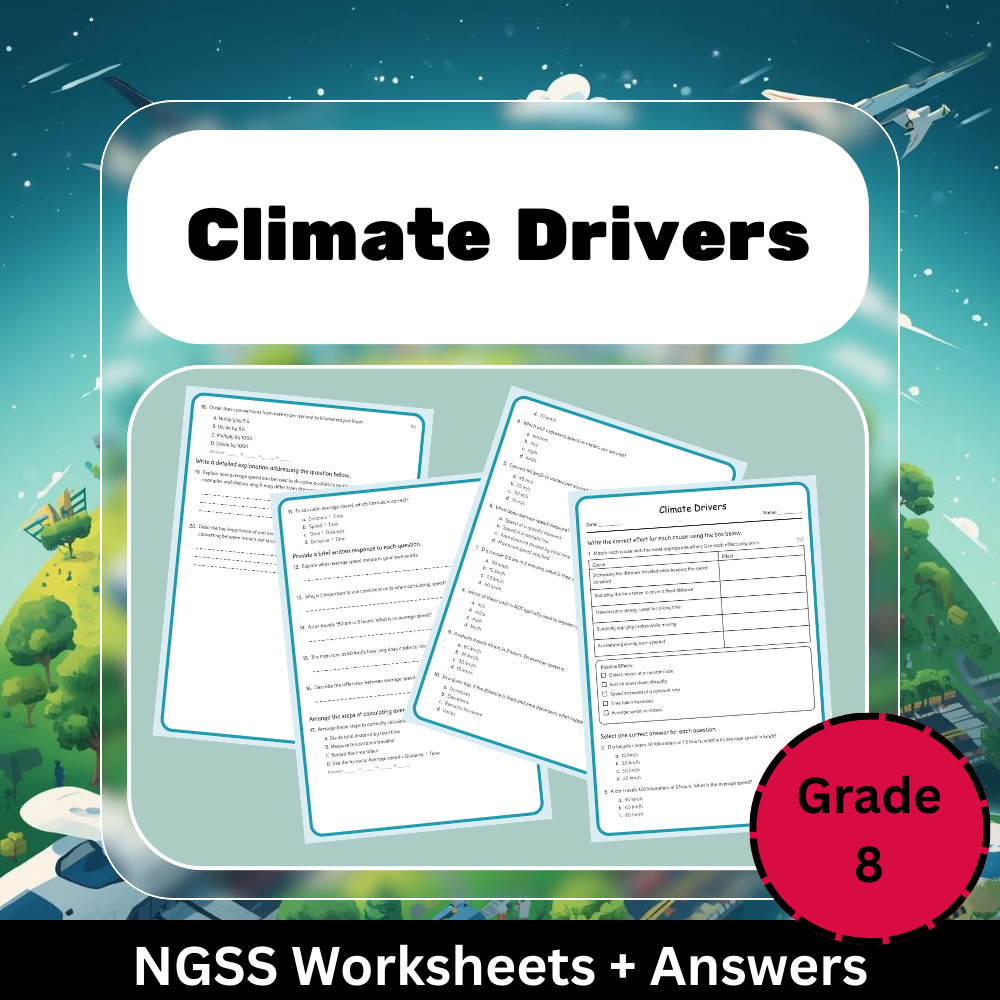
Grade 8 Science | Climate Drivers Worksheet (Answer Key) NGSS Aligned
Created byBright Mind ResourcesLearning Objectives
- Identify and describe key factors influencing Earth's climate over time.
- Assess multiple lines of evidence to determine dominant climate drivers.
- Compare natural and human influences on climate change.
Also included in: Grade 8 Science Unit | Climate & Environment NGSS Worksheets & Resources +2 more
Instant download
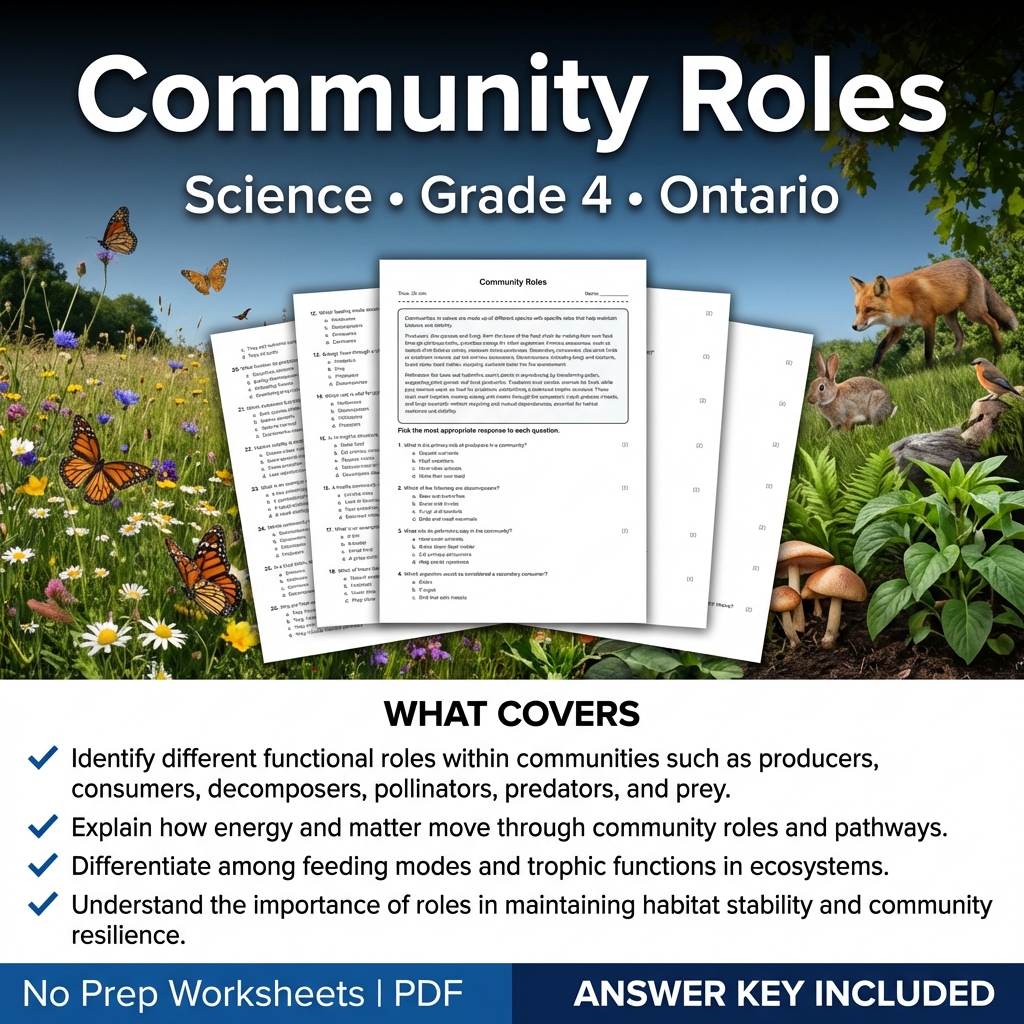
Community Roles Science Worksheet for Grade 4 | Ontario Standards
Created byCoral Reef LearningLearning Objectives
- Identify different functional roles within communities such as producers, consumers, decomposers, pollinators, predators, and prey.
- Explain how energy and matter move through community roles and pathways.
- Differentiate among feeding modes and trophic functions in ecosystems.
Instant download
Browse more categories
About Science Worksheets
Find Science worksheets spanning core skills, practice, and review. All 44,628 resources are instant PDF downloads for the classroom or home.
Every worksheet on MyTeachingSheets is created by independent teacher-authors and reviewed before publication. All resources download as printable PDFs for classroom, homework, or at-home practice, and many include answer keys. Preview any worksheet free before buying.