
Science Worksheets
44,628 subject resources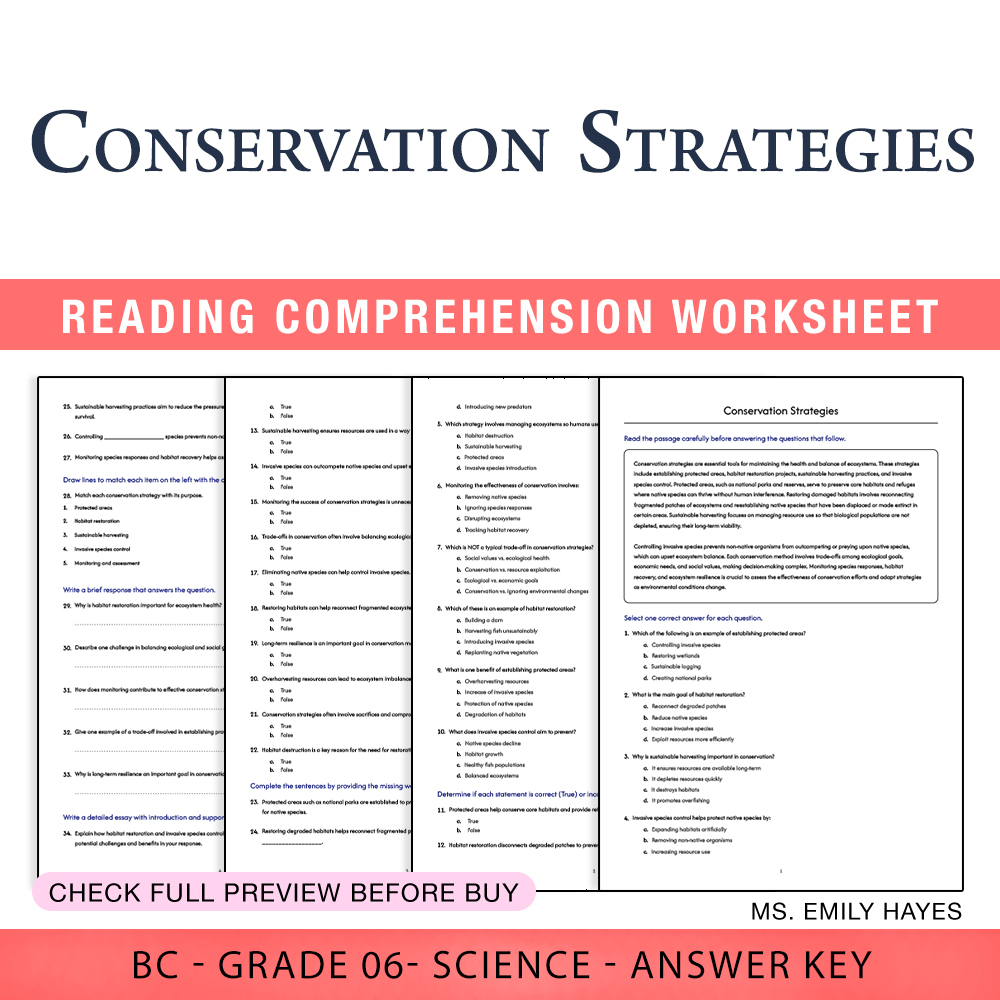
6th Grade Science | Conservation Strategies Worksheet (PDF+ Answer Key)
 Created byCopper Leaf Classroom
Learning Objectives
- Understand various conservation strategies used to protect ecosystems.
- Identify differences and applications of protected areas, habitat restoration, sustainable harvesting, and invasive species control.
- Evaluate the importance of monitoring and assessing the effectiveness of conservation efforts.
Also included in: Grade 6 Science BC | Ecosystems and Human Impact Unit (PDF + Answer Keys) +1 more
Instant download
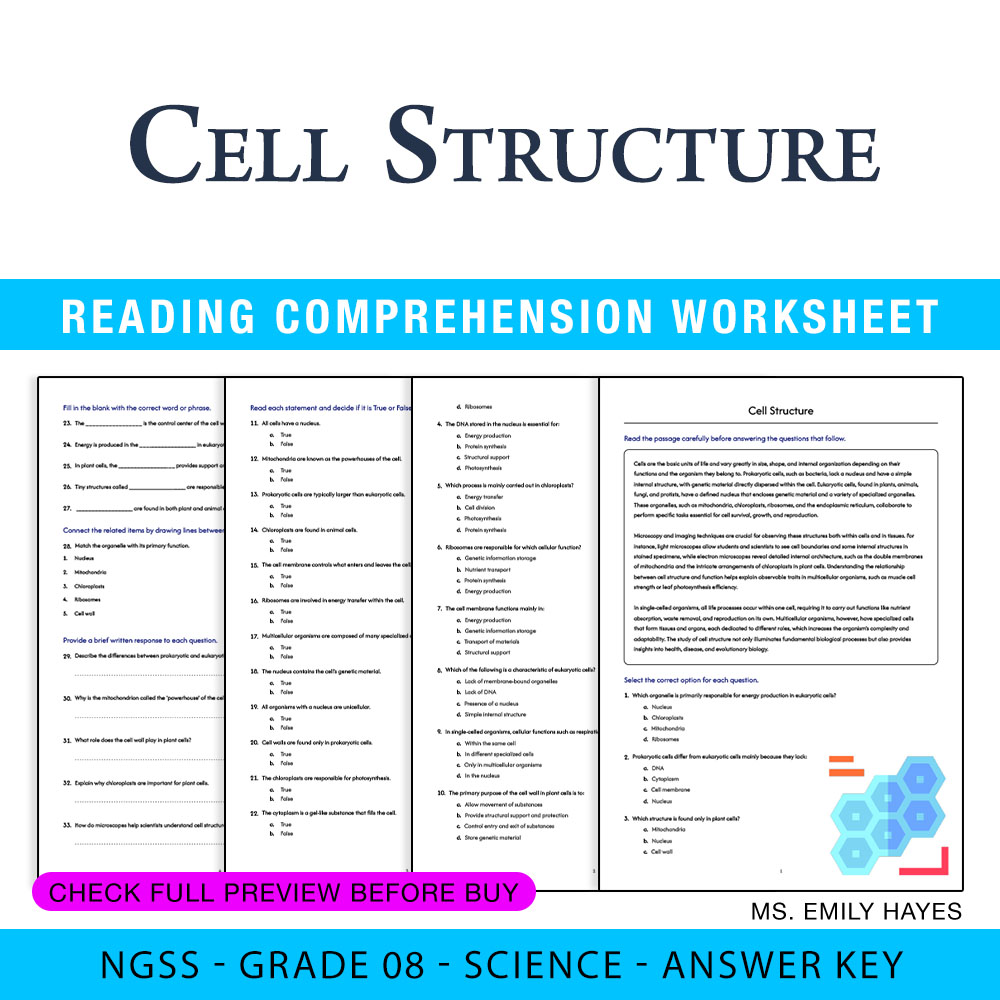
8th Grade Science | Cell Structure Worksheet (PDF + Answer Key)
Created byCopper Leaf ClassroomLearning Objectives
- Describe the key features and functions of cell organelles such as nucleus, mitochondria, chloroplasts, ribosomes, cell membrane, and cell wall.
- Compare prokaryotic and eukaryotic cells in terms of structure and function.
- Explain differences between single-celled and multicellular organisms in organismal organization.
Instant download
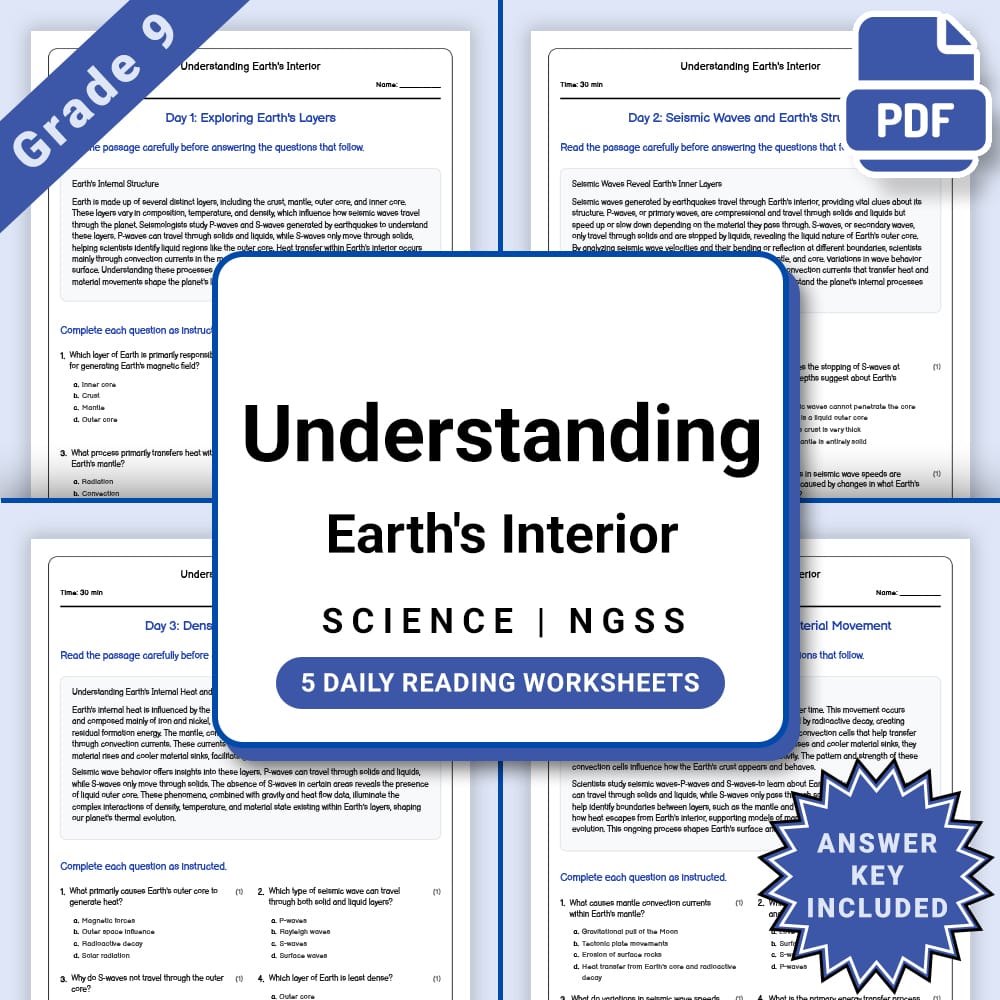
Grade 9 Science – Earth's Interior Worksheet(PDF + Answer Key)
Created byCopper Leaf ClassroomLearning Objectives
- Identify and describe the different layers of Earth's interior.
- Explain how seismic waves reveal information about Earth's internal structure.
- Understand the transfer of heat within Earth's layers and how it influences planetary processes.
Instant download
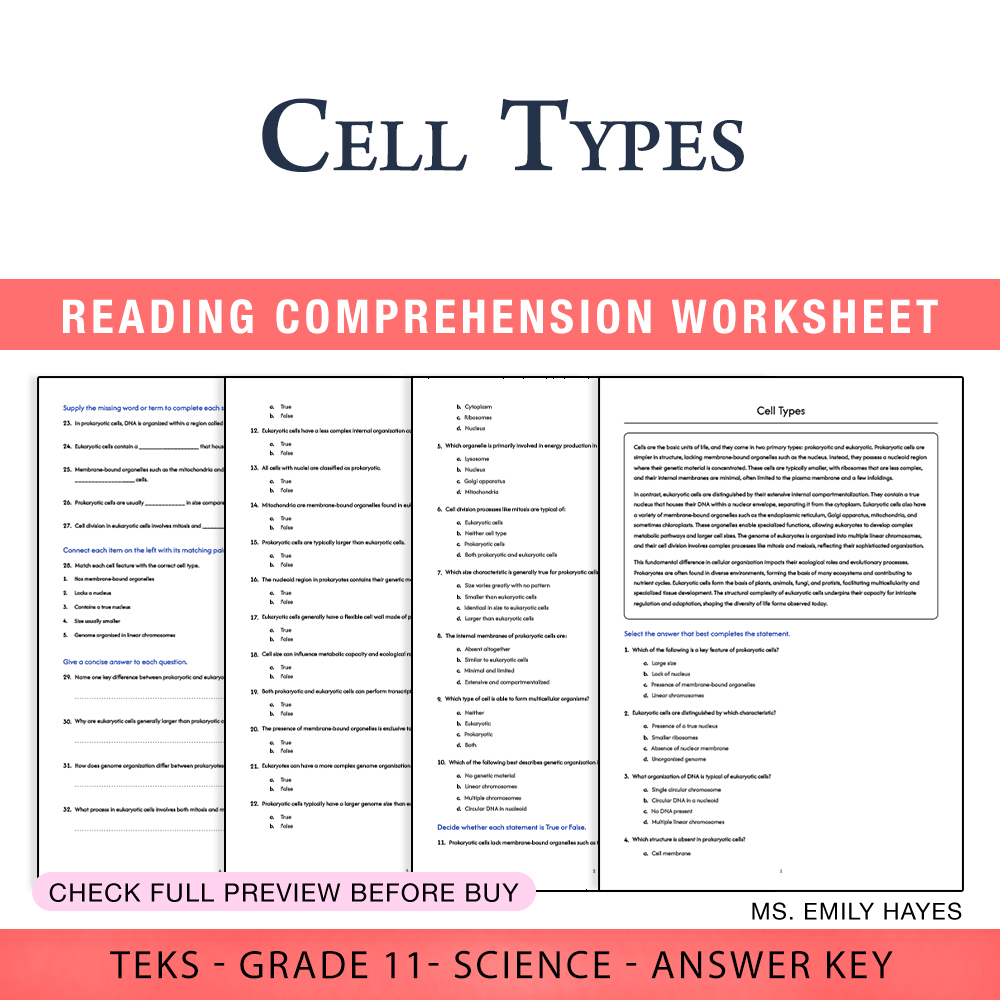
11th Grade Science | Cell Types Worksheet (PDF+ Answer Key)
Created byCopper Leaf ClassroomLearning Objectives
- Understand the structural differences between prokaryotic and eukaryotic cells.
- Identify key features of prokaryotic and eukaryotic cell organization.
- Compare genome organization and cell division mechanisms in different cell types.
Instant download

Feedback Mechanisms Science Worksheet | Grade 9 NGSS assessment printable PDF
Learning Objectives
- Explain the concept of negative and positive feedback in physiological regulation.
- Describe how feedback loops maintain internal stability within narrow limits.
- Identify mechanisms of thermoregulation and blood glucose control involving hormonal feedback.
Also included in: Grade 9 Science Lesson Bundle: From Molecules to Organisms NGSS Structures +1 more
Instant download
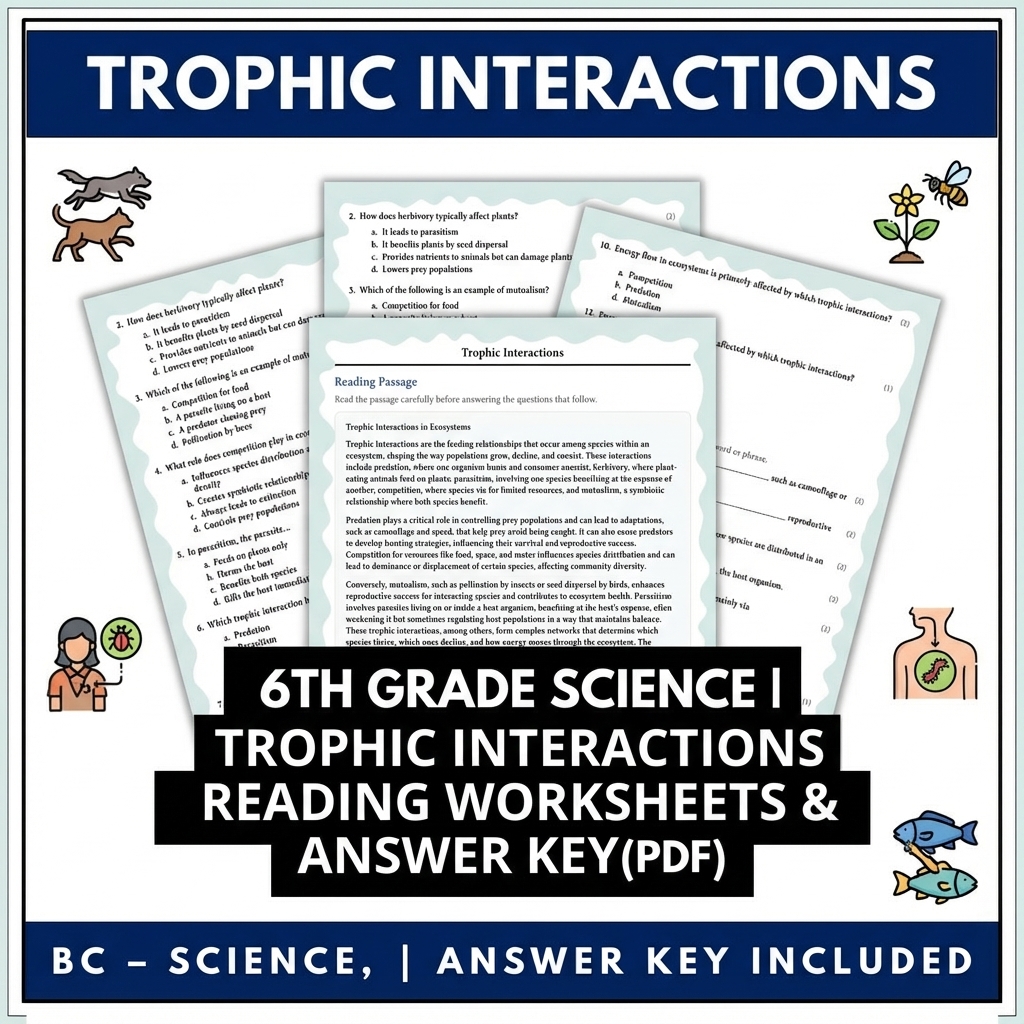
6th Grade Science | Trophic Interactions Reading Worksheets & Answer Key (PDF)
JCreated byJ.S SheetsLearning Objectives
- Define and identify different types of trophic interactions such as predation, herbivory, parasitism, competition, and mutualism.
- Explain how each trophic interaction influences survival, reproduction, and community structure.
- Analyze examples of trophic interactions in ecosystems and their effects on biodiversity.
Instant download

DNA Maintenance Worksheet for Grade 11 Science | AP Standards Practice
JCreated byJ.S SheetsLearning Objectives
- Explain the molecular mechanisms involved in DNA replication and repair.
- Describe how polymerase fidelity, proofreading, and repair pathways maintain genome stability.
- Identify causes and consequences of mutations and how repair failures affect cells.
Instant download

Grade 9 Science – Molecular Geometry & VSEPR Model | Daily Reading Worksheet
 Created byBright Mind Resources
Learning Objectives
- Identify basic molecular shapes based on descriptions
- Understand the principles of VSEPR theory
- Relate molecular shapes to properties like polarity and reactivity
Also included in: Grade 9 Chemical Reactions Science Lesson Bundle: Daily Reading (BC) +1 more
Instant download
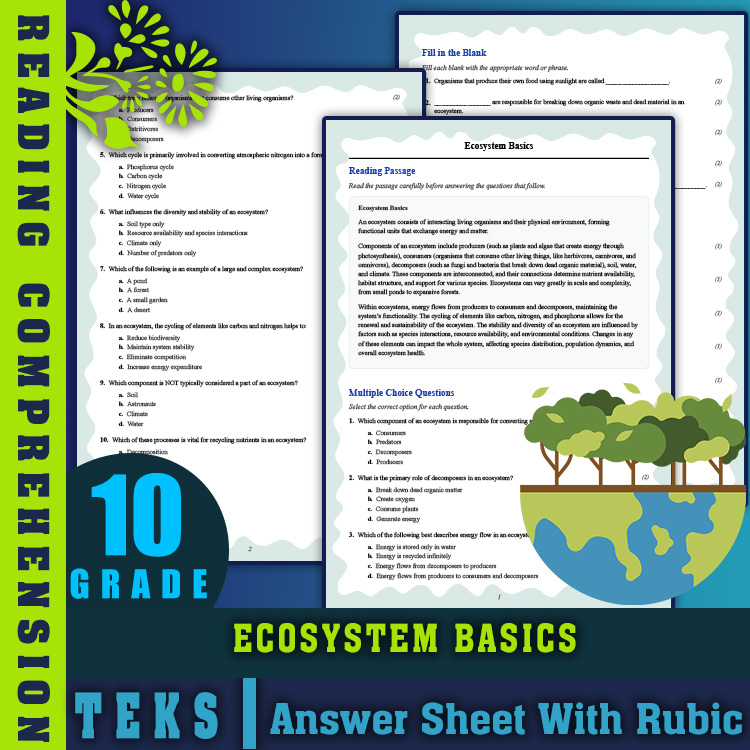
10th Grade Science | Ecosystem Basics Reading Worksheets (PDF + Rubric)
JCreated byJ.S SheetsLearning Objectives
- Understand the components and functions of an ecosystem.
- Explain how energy flows and matter cycles within different ecosystems.
- Identify factors that influence the stability and diversity of ecosystems.
Instant download
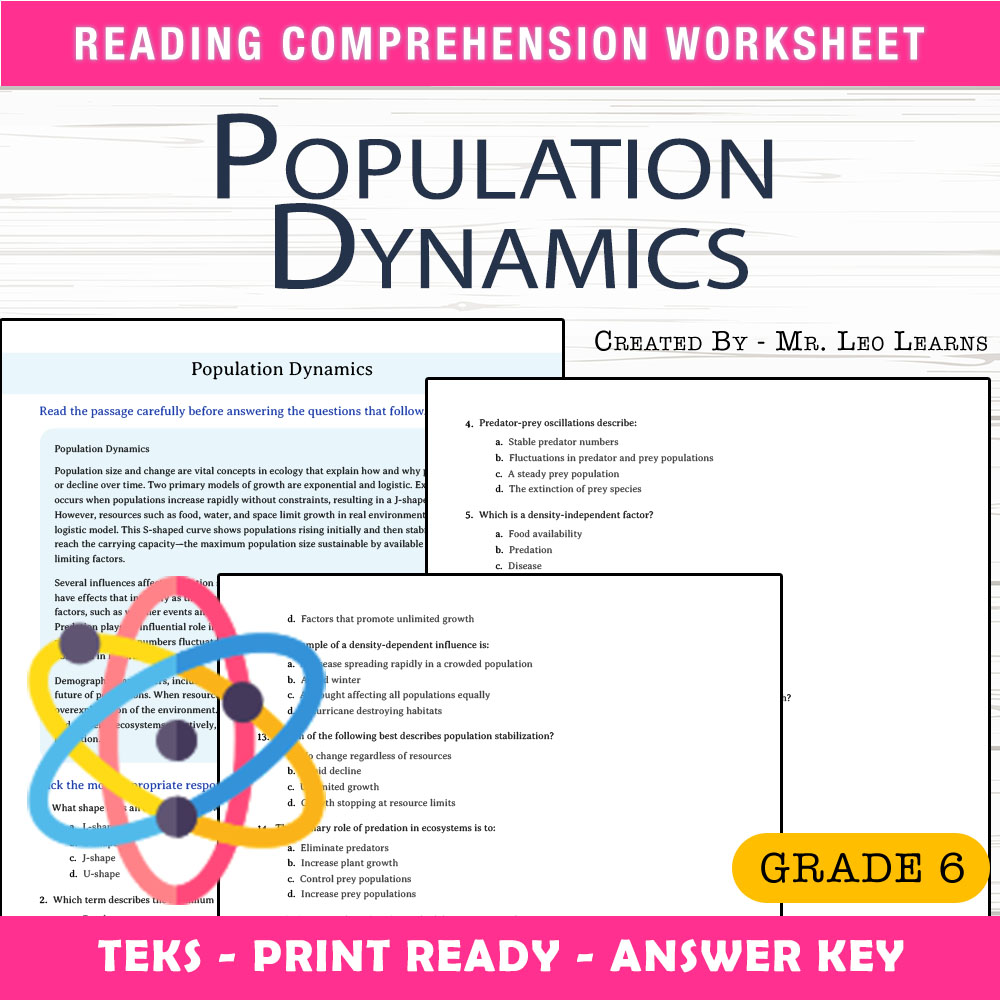
Grade 6 Science – Population Dynamics Worksheet for Mastery
 Created byThe Resource Hub
Learning Objectives
- Understand the concepts of exponential and logistic growth in populations.
- Identify factors that influence population size such as limiting resources, predation, and weather events.
- Distinguish between density-dependent and density-independent influences on populations.
Also included in: Grade 6 Science Unit Bundle | Ecosystems & Environmental Relationships
Instant download
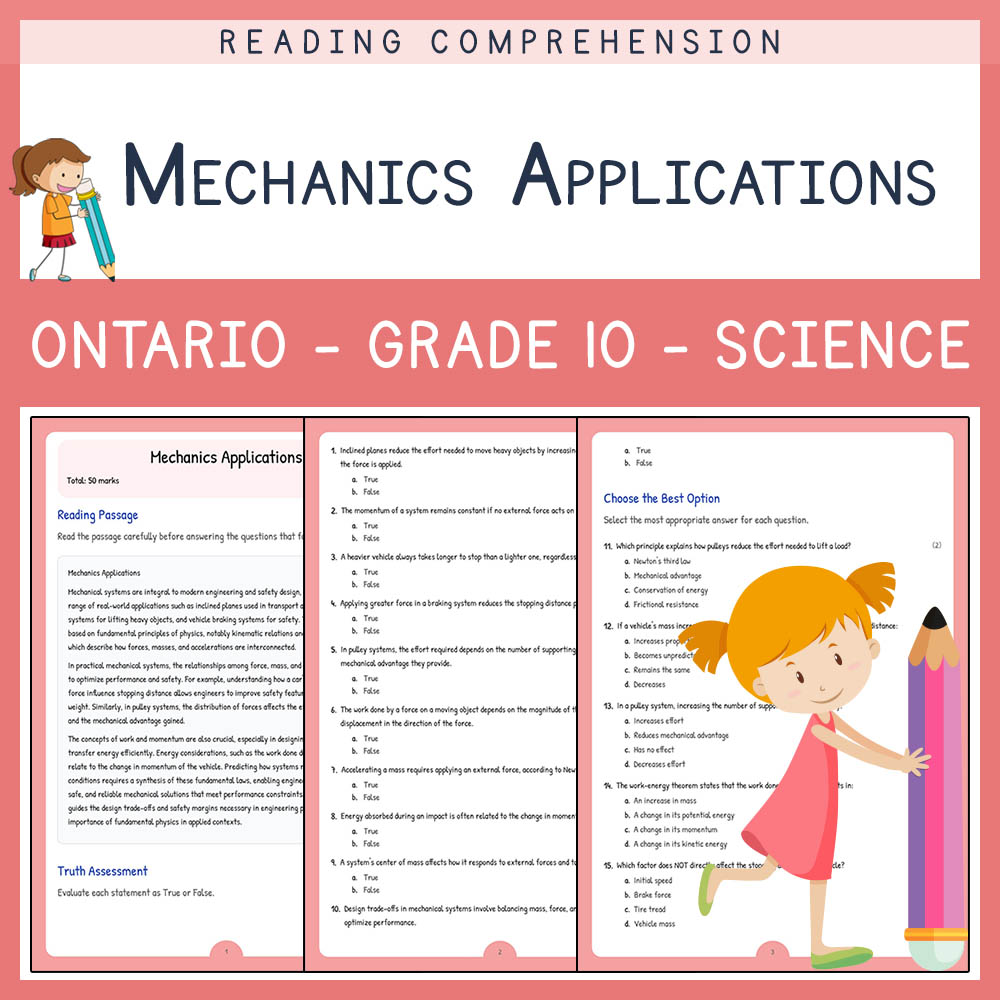
Grade 10 Science | Mechanics Applications Worksheet | Ontario Standards
 Created byLumora Learning
Learning Objectives
- Understand how kinematic relations and Newtonian dynamics apply to real-world mechanical systems.
- Analyze the connection between force, mass, acceleration, work, and momentum in practical contexts.
- Predict system behavior and interpret trade-offs between mass, force, and acceleration in engineering scenarios.
Also included in: Grade 10 Science | Motion & Forces Lesson Bundle | Ontario Standards
Instant download
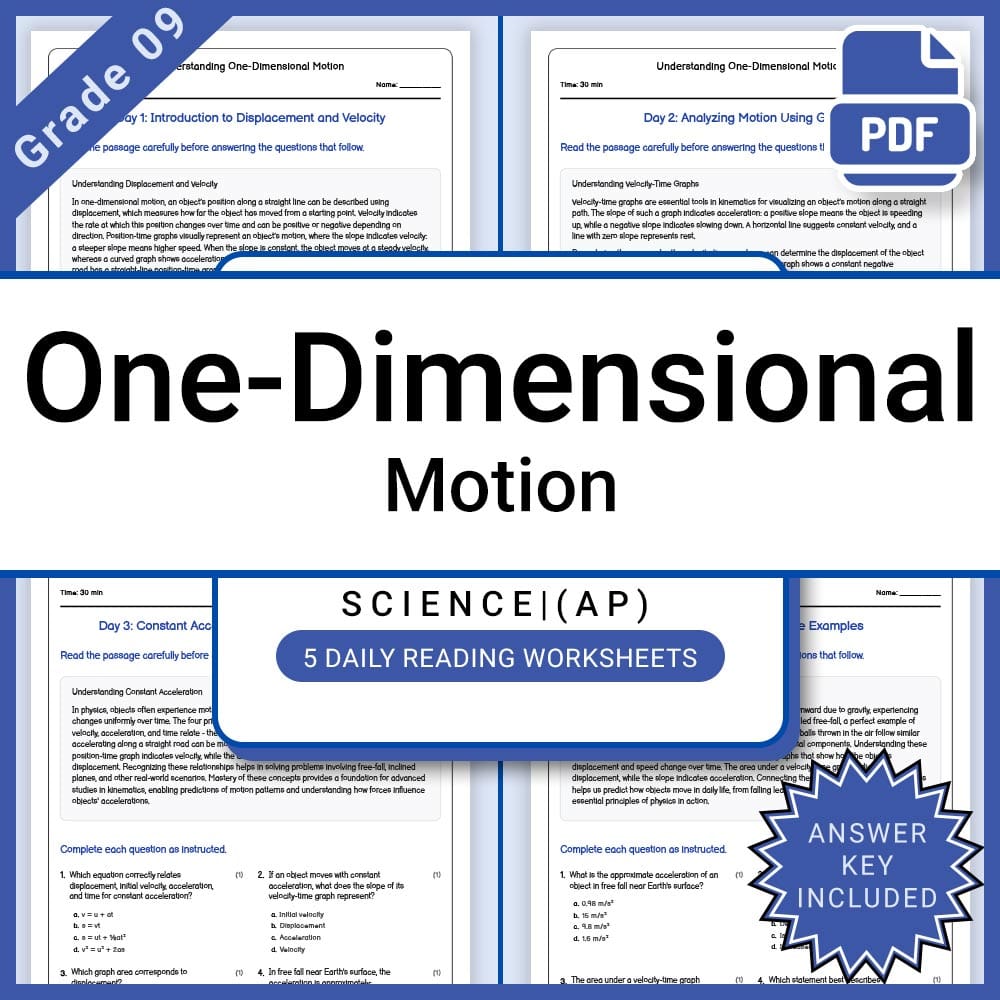
Grade 9 Science – One-Dimensional Motion Daily Reading Worksheet + Answer Key
JCreated byJ.S SheetsLearning Objectives
- Interpret position-time graphs to analyze motion along a straight line.
- Understand the basic concepts of displacement, velocity, and acceleration.
- Connect algebraic equations with graphical representations of motion.
Also included in: Grade 9 Science Lesson Group: AP Motion & Force Daily Reading Worksheets +1 more
Instant download
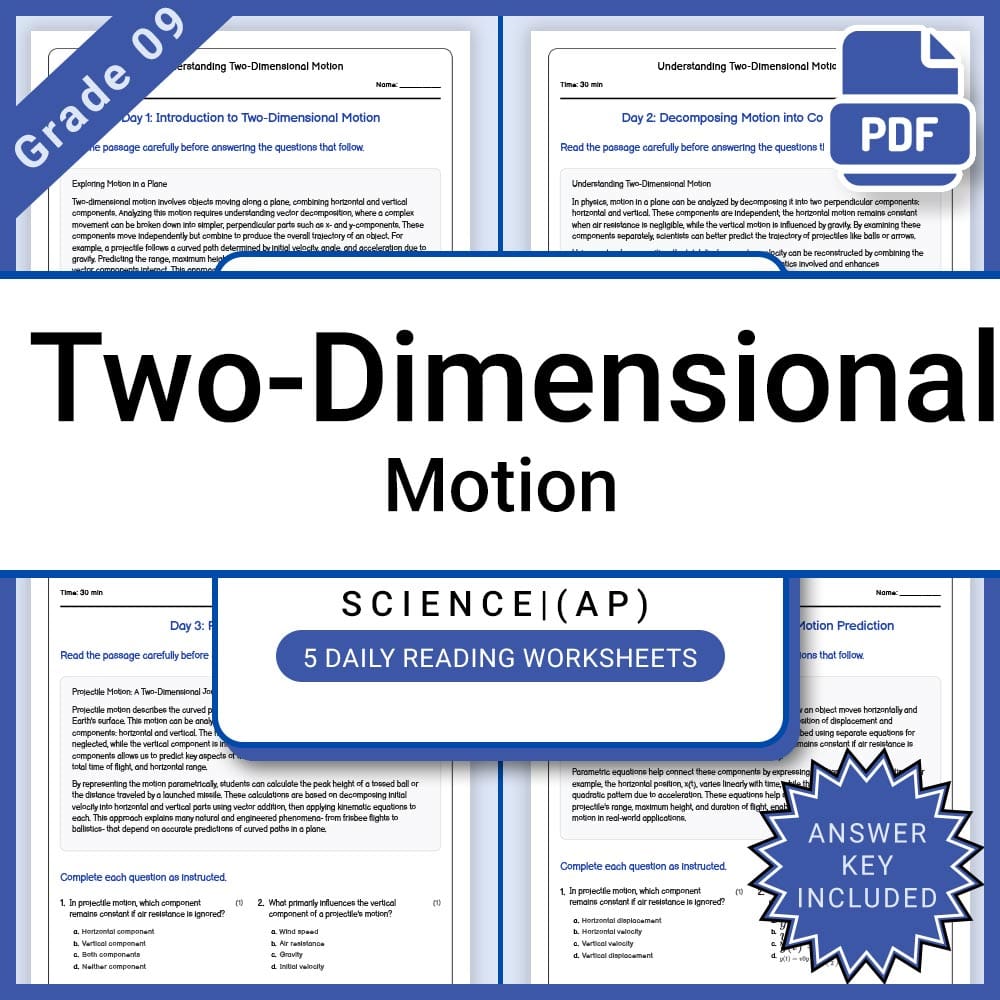
Grade 9 Science – Two-Dimensional Motion Daily Reading Worksheet + Answer Key
JCreated byJ.S SheetsLearning Objectives
- Understand key concepts related to Science
- Apply knowledge through practice questions
- Demonstrate comprehension of the material
Also included in: Grade 9 Science Lesson Group: AP Motion & Force Daily Reading Worksheets +1 more
Instant download

Grade 9 Science | Cell Components - Daily Reading Comprehension
 Created byCoral Reef Learning
Learning Objectives
- Understand key concepts related to Science
- Apply knowledge through practice questions
- Demonstrate comprehension of the material
Instant download
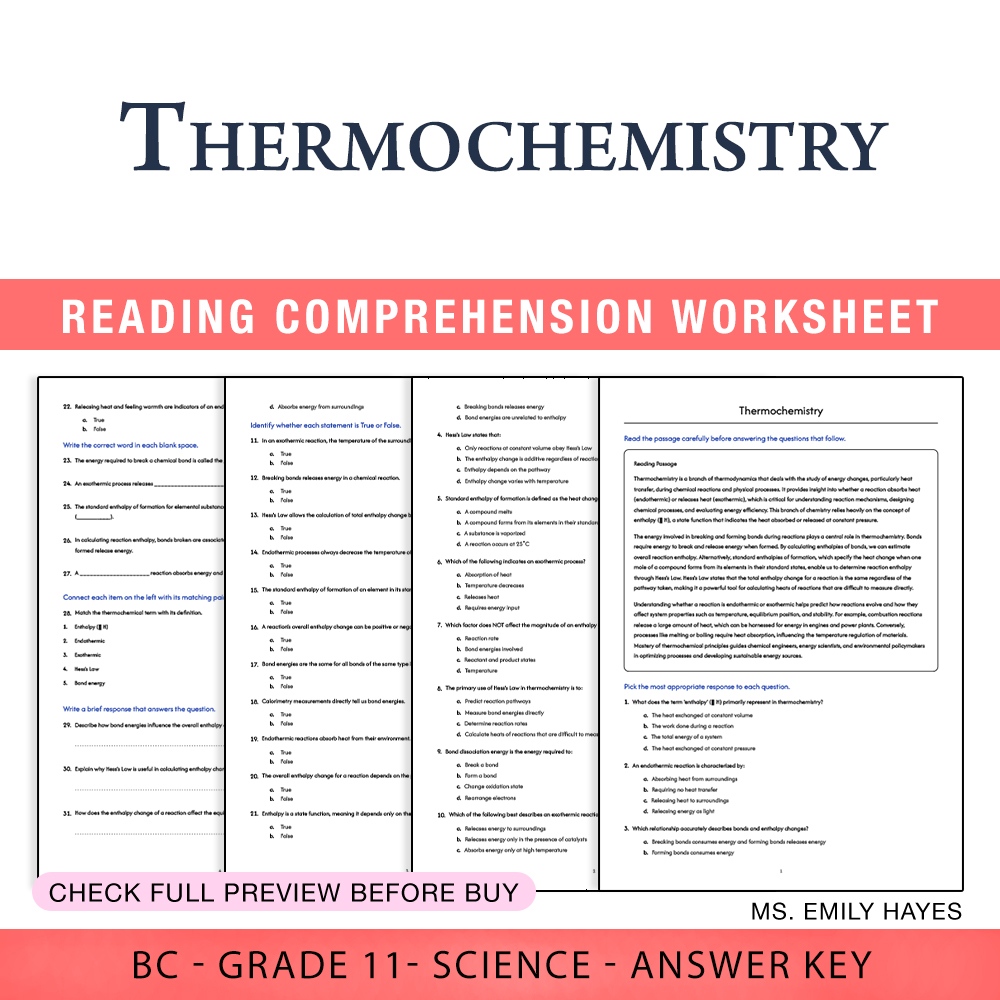
11th Grade Science | Thermochemistry Worksheet (PDF + Answer Key)
Created byCopper Leaf ClassroomLearning Objectives
- Understand the concept of energy changes in chemical reactions, including endothermic and exothermic processes.
- Describe how enthalpy and bond energies relate to reaction energetics.
- Apply Hess's Law and standard enthalpies of formation to calculate heat changes in reactions.
Also included in: Grade 11 Science BC– Thermochemistry, Bonding & Reactions (PDF + Answer Key) +1 more
Instant download
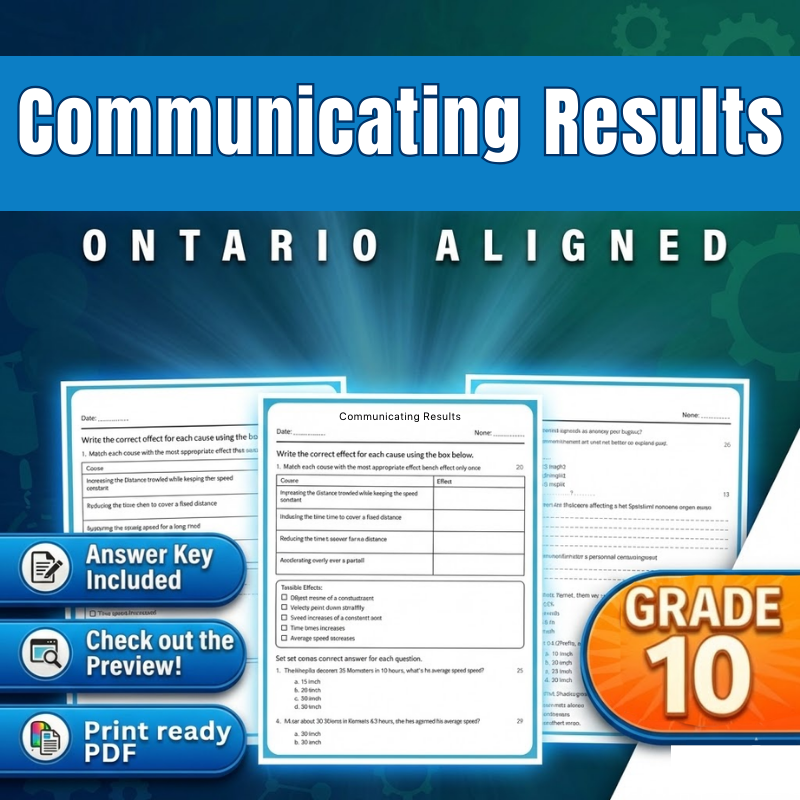
Grade 10 Science | Communicating Results Worksheet (Ontario, PDF)
Created byBright Mind ResourcesLearning Objectives
- Understand the conventions for clear, evidence-based reporting of scientific investigations.
- Learn how to structure summaries linking data to claims and discuss limitations.
- Gain skills in integrating tables, graphs, and statistical indicators to substantiate conclusions.
Instant download
8th Grade Science | Heating Curves Reading Worksheet
JCreated byJ.S SheetsLearning Objectives
- Understand how heating curves represent temperature changes of matter during heat absorption
- Identify phase changes such as melting and boiling on heating curves
- Explain the significance of plateaus in heating curves as phase transition points
Instant download
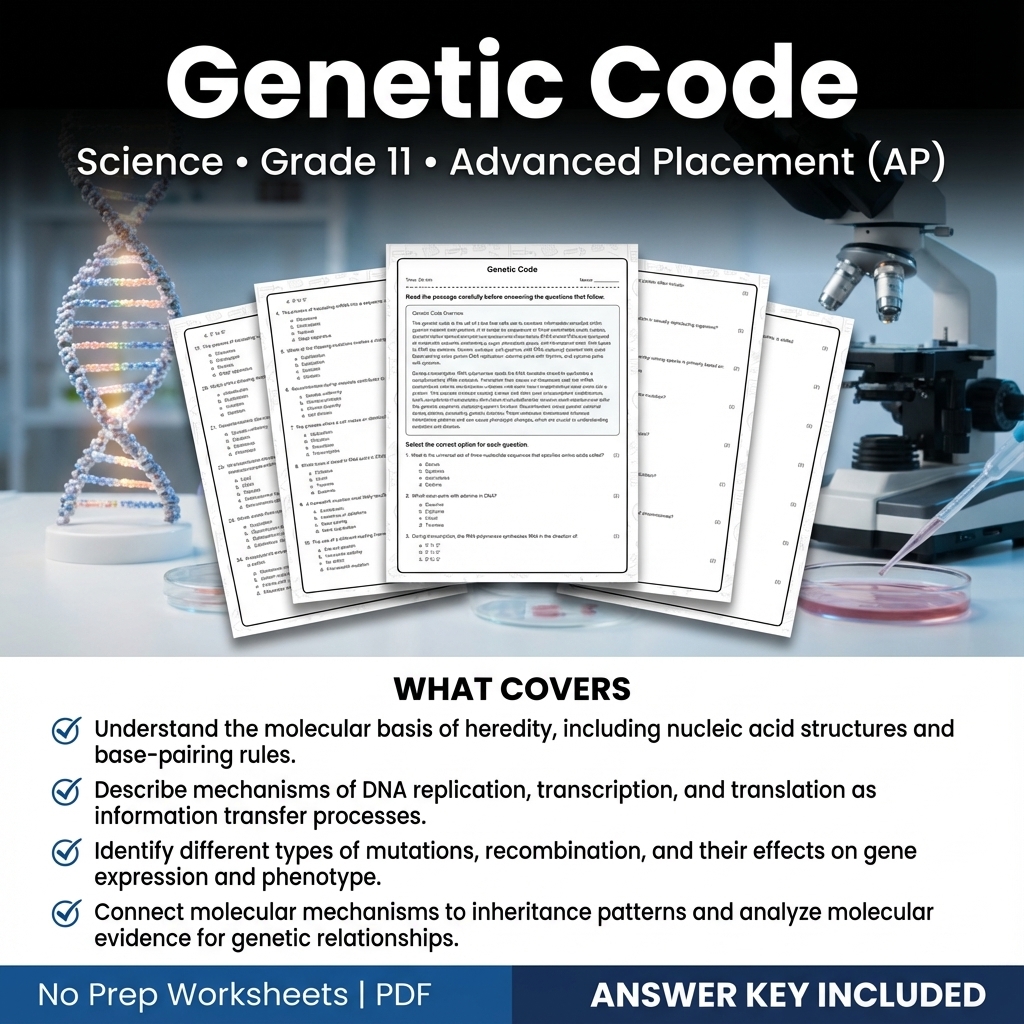
11th Grade Science | Genetic Code Worksheet (Printable PDF + Answer Key)
Created byCoral Reef LearningLearning Objectives
- Understand the molecular basis of heredity, including nucleic acid structures and base-pairing rules.
- Describe mechanisms of DNA replication, transcription, and translation as information transfer processes.
- Identify different types of mutations, recombination, and their effects on gene expression and phenotype.
Also included in: Grade 11 Science Unit Worksheet Bundle – Biological Systems & Molecular Concepts +1 more
Instant download
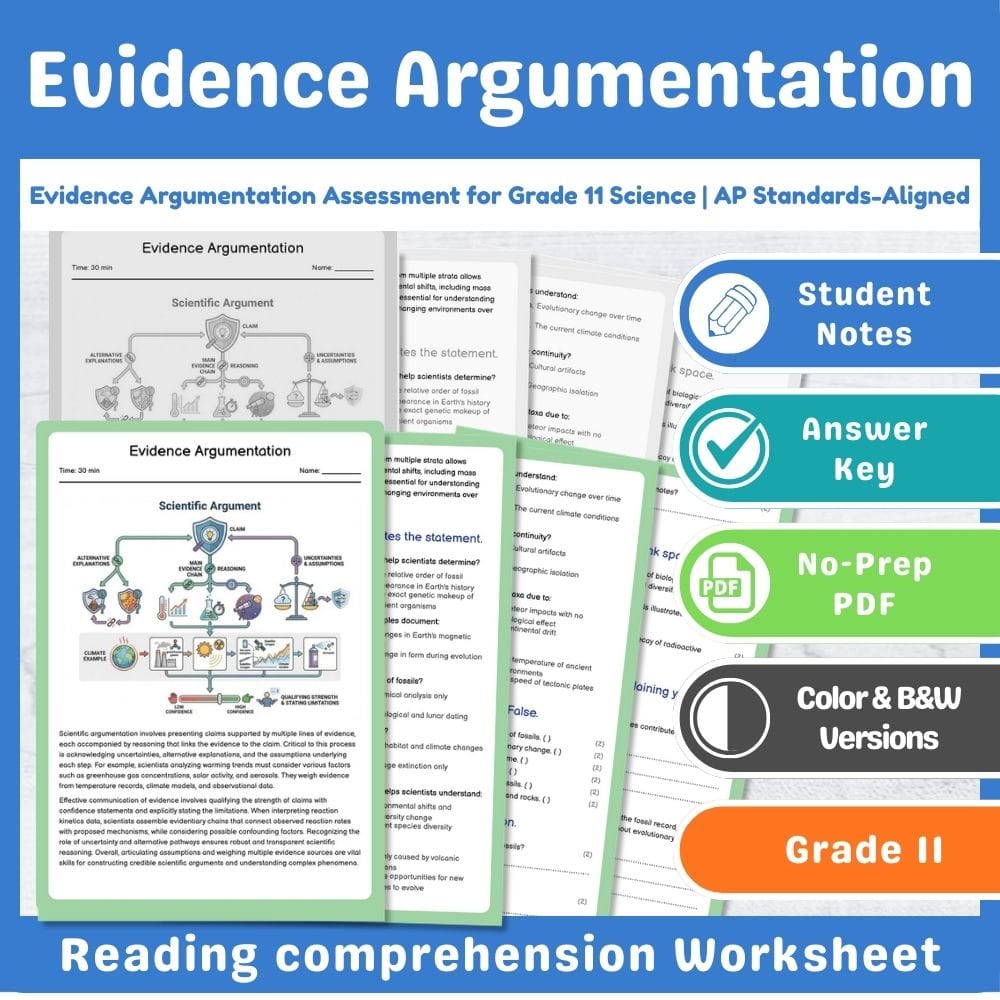
Evidence Argumentation Assessment for Grade 11 Science | AP Standards-Aligned
 Created byPrism Point Learning
Learning Objectives
- Understand the structure of scientific arguments connecting claims, evidence, and reasoning.
- Identify methods for articulating assumptions and qualifying claims with confidence statements.
- Assess various lines of evidence and interpret their implications for scientific hypotheses.
Also included in: Grade 11 Science Mini Bundle | AP Science Practices & Skills
Instant download
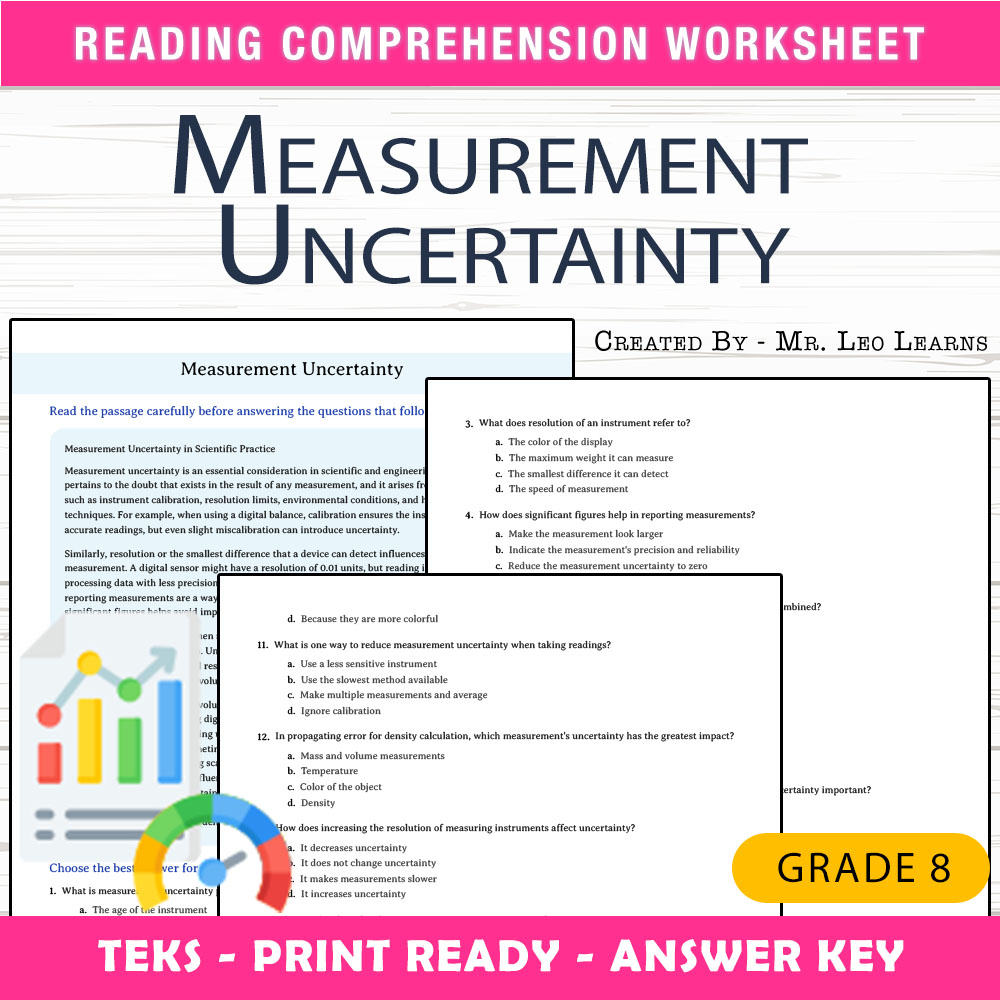
Grade 8 Science – Measurement Uncertainty Worksheet for Mastery
Created byThe Resource HubLearning Objectives
- Understand the concept of measurement uncertainty and its sources.
- Learn how to select appropriate instruments and reading techniques to minimize uncertainty.
- Evaluate the impact of uncertainty on calculated quantities such as density and acceleration.
Also included in: Grade 8 Science Unit Bundle | Scientific Inquiry & Data Skills Worksheet Pack +1 more
Instant download
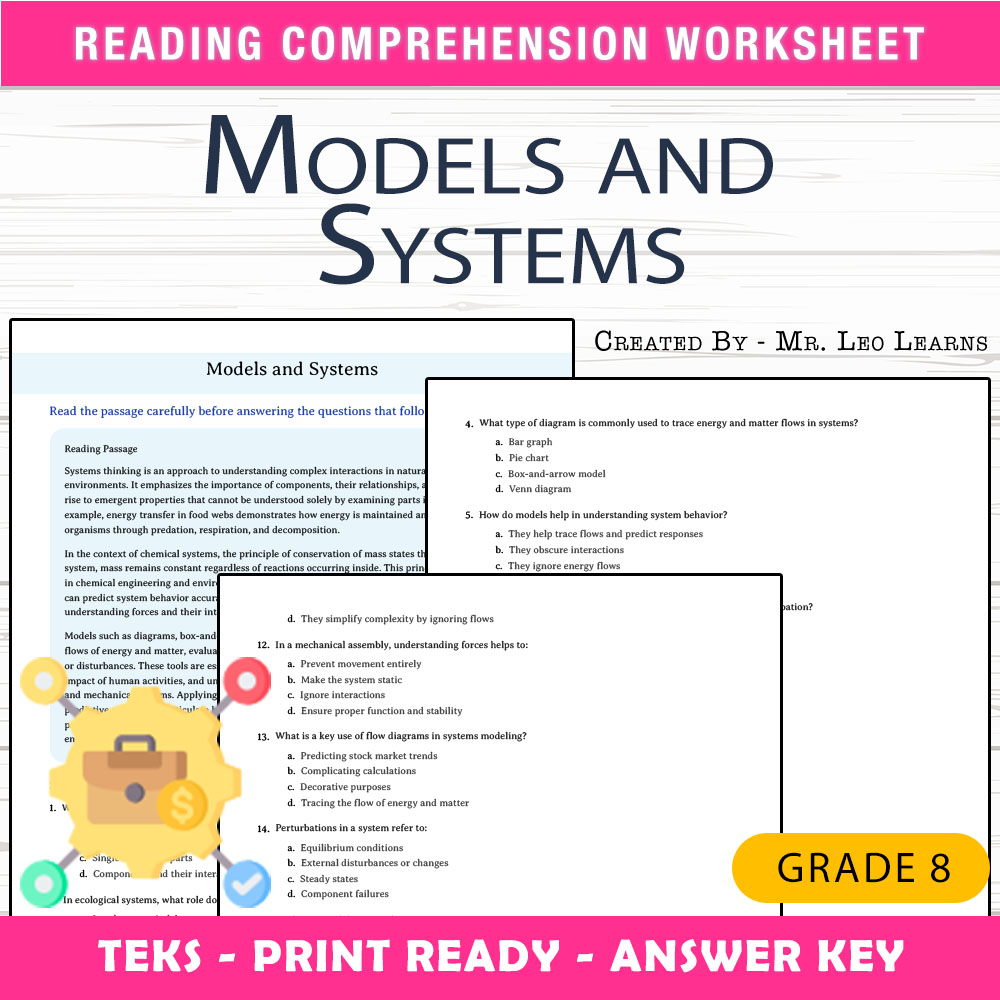
Grade 8 Science – Models and Systems Worksheet for Mastery
Created byThe Resource HubLearning Objectives
- Understand the components, interactions, and properties within physical and ecological systems.
- Identify the use of diagrams, models, and equations in representing and analyzing systems.
- Describe energy and matter flows in food webs and chemical systems.
Also included in: Grade 8 Science Unit Bundle | Scientific Inquiry & Data Skills Worksheet Pack +1 more
Instant download

Grade 9 Science – Energy Profiles Worksheet (PDF) BC Standards
 Created byEvergreen Desk Education
Learning Objectives
- Explain how energy profiles show activation energy (Ea), transition states, and enthalpy change (ΔH) for chemical reactions.
- Differentiate exothermic and endothermic reactions using the sign of ΔH and the relative energy levels of reactants and products.
- Interpret reaction-coordinate graphs to infer energy flow and predict how changing Ea affects reaction speed.
Instant download

Grade 10 Science | Fossil Formation - Daily Reading Comprehension
Created byCoral Reef LearningLearning Objectives
- Understand the processes involved in fossil formation
- Identify different methods of dating fossils
- Recognize the significance of fossils in studying Earth's history
Instant download
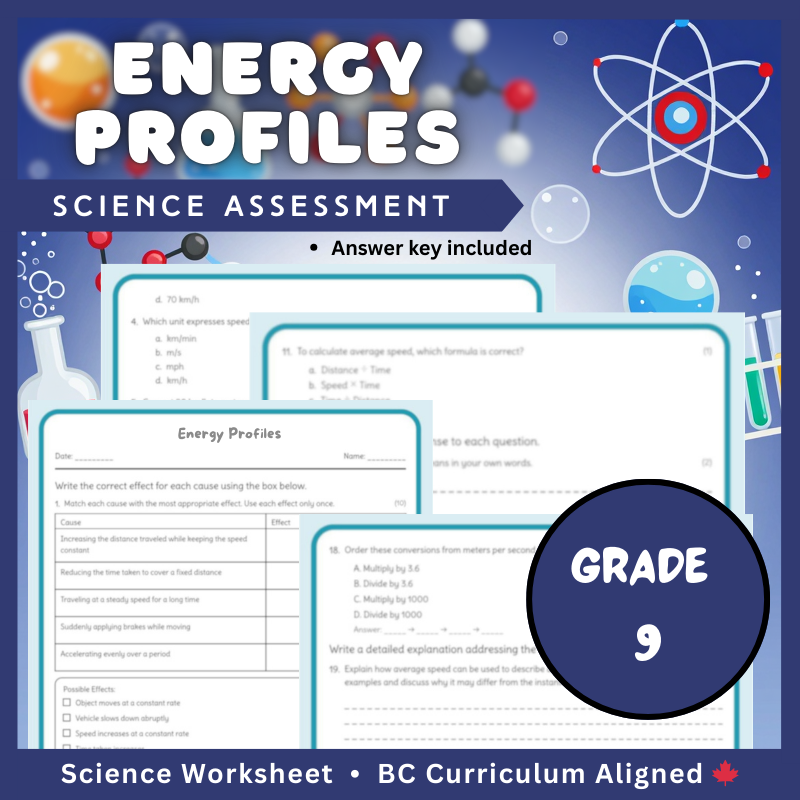
Grade 9 Science | Energy Profiles Worksheet + Answer Key (PDF) for BC Standards
Created byBright Mind ResourcesLearning Objectives
- Understand what energy profiles depict in relation to chemical reactions.
- Identify the differences between exothermic and endothermic reactions based on energy diagrams.
- Interpret the significance of transition states and activation energy barriers.
Instant download
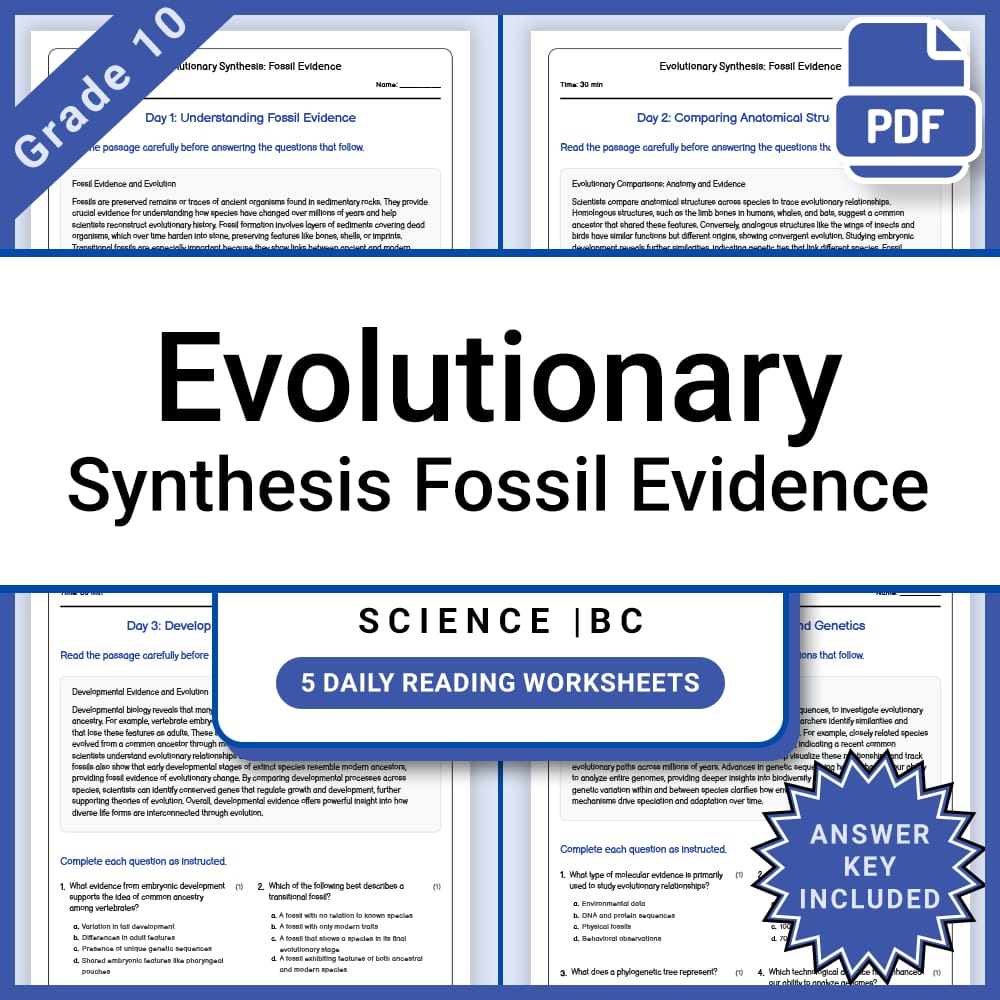
Grade 10 Science – Fossil Evidence Daily Reading Worksheet with Answer Key
JCreated byJ.S SheetsLearning Objectives
- Understand the role of fossils in studying evolutionary history
- Analyze fossil evidence to infer evolutionary relationships
- Evaluate how environmental factors influence fossil formation and preservation
Also included in: Grade 10 Science Lesson Bundle | Genetics, Evolution, Biodiversity & More +1 more
Instant download

Grade 12 Stoichiometry Basics Worksheet | Practice & PDF
 Created byClear Sky Classroom
Learning Objectives
- Define the mole concept and use it to convert between particles, moles, and mass
- Calculate molar mass and use it to perform mass–mole conversions
- Use balanced chemical equations to determine quantitative relationships between reactants and products
Instant download
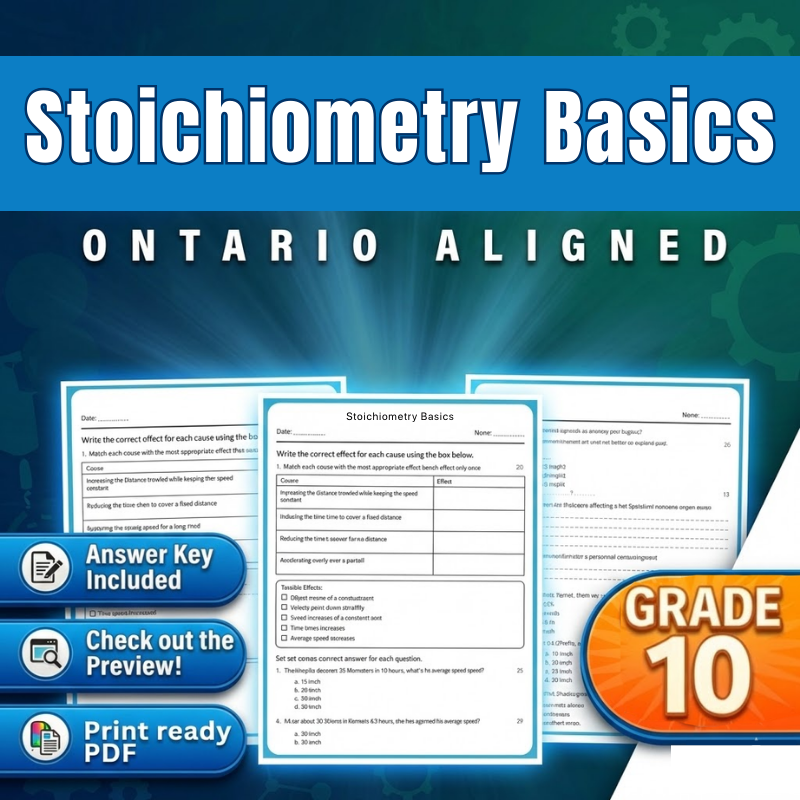
Grade 10 Science – Stoichiometry Basics Worksheet (Ontario Standard) (PDF)
Created byBright Mind ResourcesLearning Objectives
- Understand the mole concept and its application in chemical calculations.
- Use balanced chemical equations to determine molar ratios.
- Perform mass-to-mass conversions using molar mass and stoichiometric relationships.
Instant download

Stoichiometry Basics Grade 12 Chemistry Worksheet + Answer Key
Created byEvergreen Desk EducationLearning Objectives
- Explain the mole concept and use Avogadro’s number to convert between particles and moles.
- Calculate molar mass and perform mass↔mole conversions for chemical substances.
- Use balanced chemical equations to determine quantitative relationships between reactants and products.
Instant download
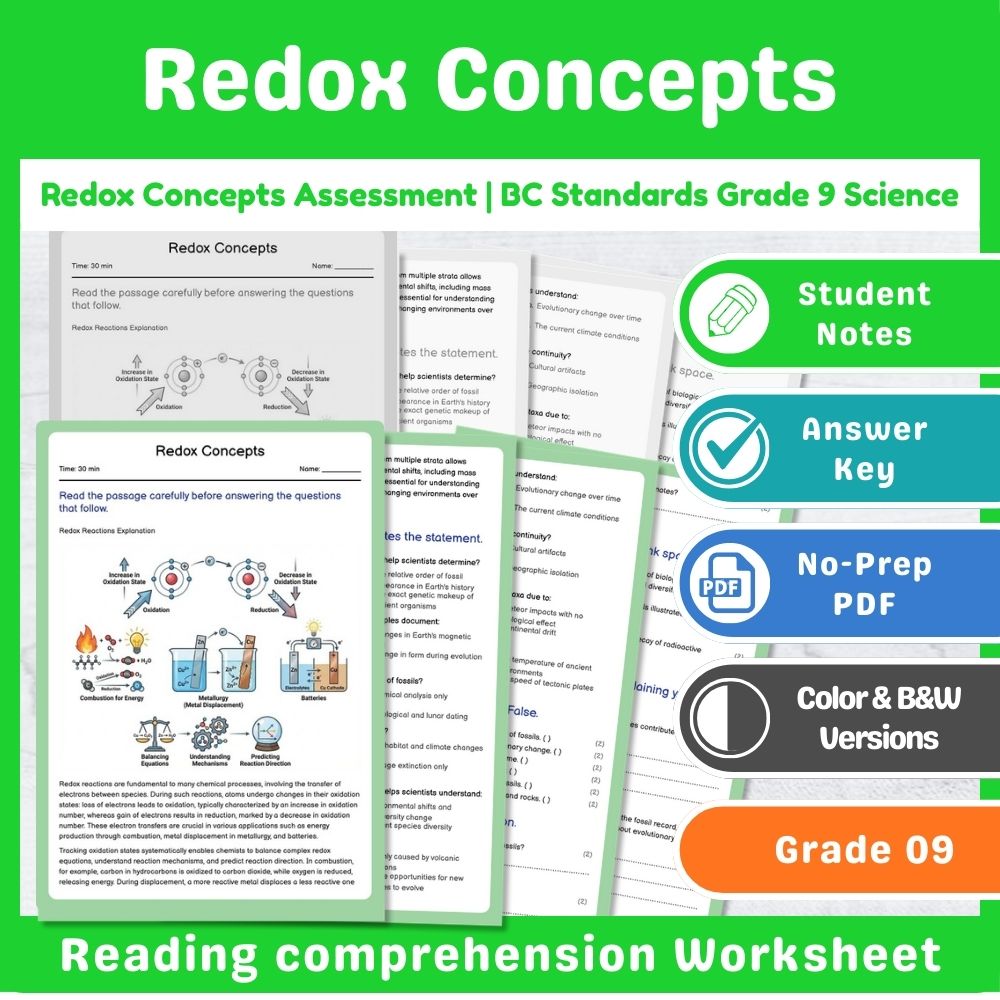
Redox Concepts Assessment | BC Standards Grade 9 Science
Created byPrism Point LearningLearning Objectives
- Explain the fundamental principles of oxidation and reduction in chemical reactions.
- Track changes in oxidation states to identify oxidizing and reducing agents.
- Balance redox equations involved in combustion and displacement reactions.
Instant download

Grade 9 Redox Concepts Worksheet | Practice & Assessment PDF
Created byClear Sky ClassroomLearning Objectives
- Explain oxidation and reduction in terms of electron transfer and oxidation-number change.
- Determine which species is oxidized or reduced and identify oxidizing and reducing agents.
- Track oxidation-state changes to help balance and interpret redox reactions, including combustion and displacement.
Instant download
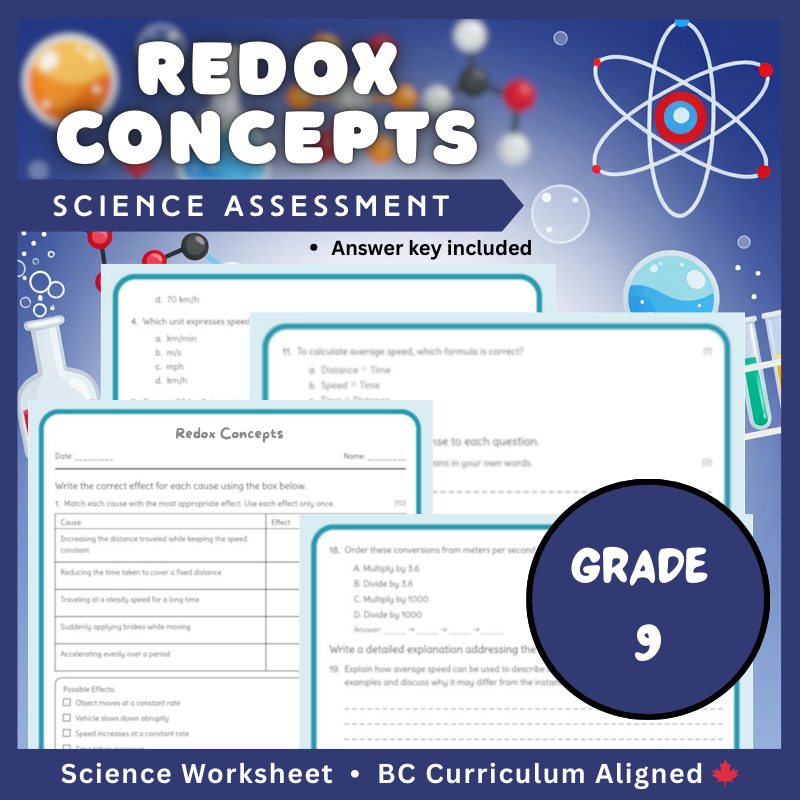
Grade 9 Science – Redox Concepts Worksheet (PDF) | BC Standard & Practice
Created byBright Mind ResourcesLearning Objectives
- Understand the electron transfer process in redox reactions.
- Identify oxidation and reduction by tracking oxidation states.
- Recognize oxidizing and reducing agents in various reactions.
Instant download

Speciation Processes Worksheet | Evolution & Biodiversity NGSS Grade 7
 Created byAmber Owl Education
Learning Objectives
- Explain how reproductive isolation and geographic separation can lead to speciation.
- Describe how polyploidy and adaptive radiation can increase biodiversity.
- Use examples to connect diversification rates and biogeographic patterns to environmental change.
Also included in: Grade 7 Science Evolution & Biodiversity Lesson Bundle – NGSS +1 more
Instant download

Speciation and Diversity Worksheet | Evolution Science Grade 10 NGSSS Activity
Created byEvergreen Desk EducationLearning Objectives
- Explain how reproductive isolation can arise and how it limits gene flow between populations.
- Describe how divergent selection and genetic drift can accumulate differences over time.
- Connect mechanisms of speciation to patterns of biodiversity and lineage diversification.
Instant download
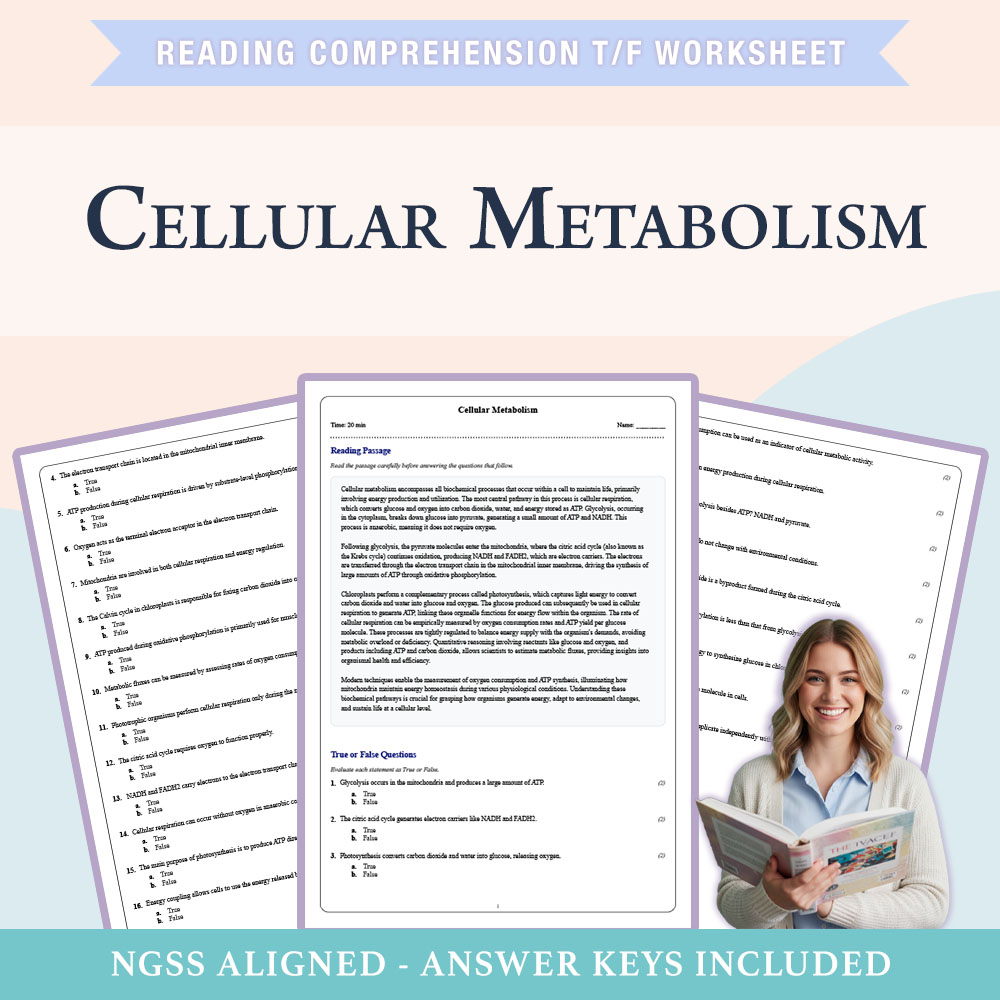
Grade 9 Science | Cellular Metabolism Worksheet (PDF + Answer Key)
Created byCopper Leaf ClassroomLearning Objectives
- Understand the biochemical pathways involved in cellular respiration, including glycolysis, citric acid cycle, and electron transport chain.
- Explain how ATP is produced through energy coupling and the significance of ATP in cellular activities.
- Relate mitochondrial and chloroplast functions to overall organismal energy balance and metabolism.
Also included in: Grade 9 Science | Cellular Functions & Physiology Bundle (PDF + Answer Key) +1 more
Instant download

Cell Division Worksheet Assessment for Grade 10 Science
Learning Objectives
- Explain how the cell cycle supports growth and repair through regulated stages of DNA replication and division.
- Compare mitosis and meiosis in terms of chromosome behavior and the outcomes for cells and organisms.
- Describe how cell cycle checkpoints and apoptosis prevent damaged or incorrect cells from persisting.
Also included in: From Molecules to Organisms Lesson Bundle | Grade 10 Science | NGSS
Instant download
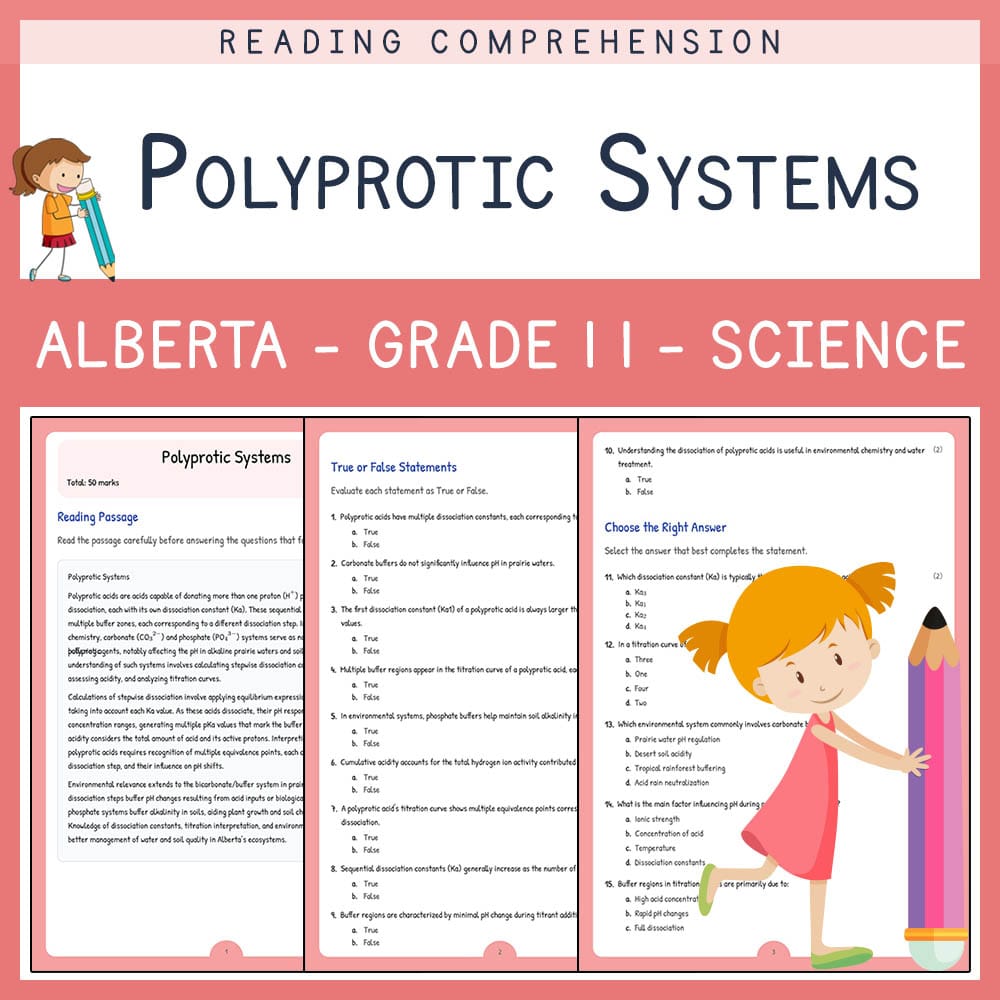
Grade 11 Science | Polyprotic Systems Worksheet | Alberta Standards
Created byLumora LearningLearning Objectives
- Understand the dissociation processes of polyprotic acids and their sequential dissociation constants.
- Learn how to calculate stepwise dissociation, cumulative acidity, and interpret titration curves of polyprotic acids.
- Explore environmental relevance of carbonate and phosphate buffer systems, especially in prairie waters and soils in Alberta.
Instant download

Grade 10 Science | Negative Feedback in Human Physiology - Reading Comprehension
Created byCoral Reef LearningLearning Objectives
- Define negative feedback and explain its purpose in the body.
- Identify the components involved in negative feedback mechanisms.
- Describe how negative feedback maintains physiological stability.
Instant download
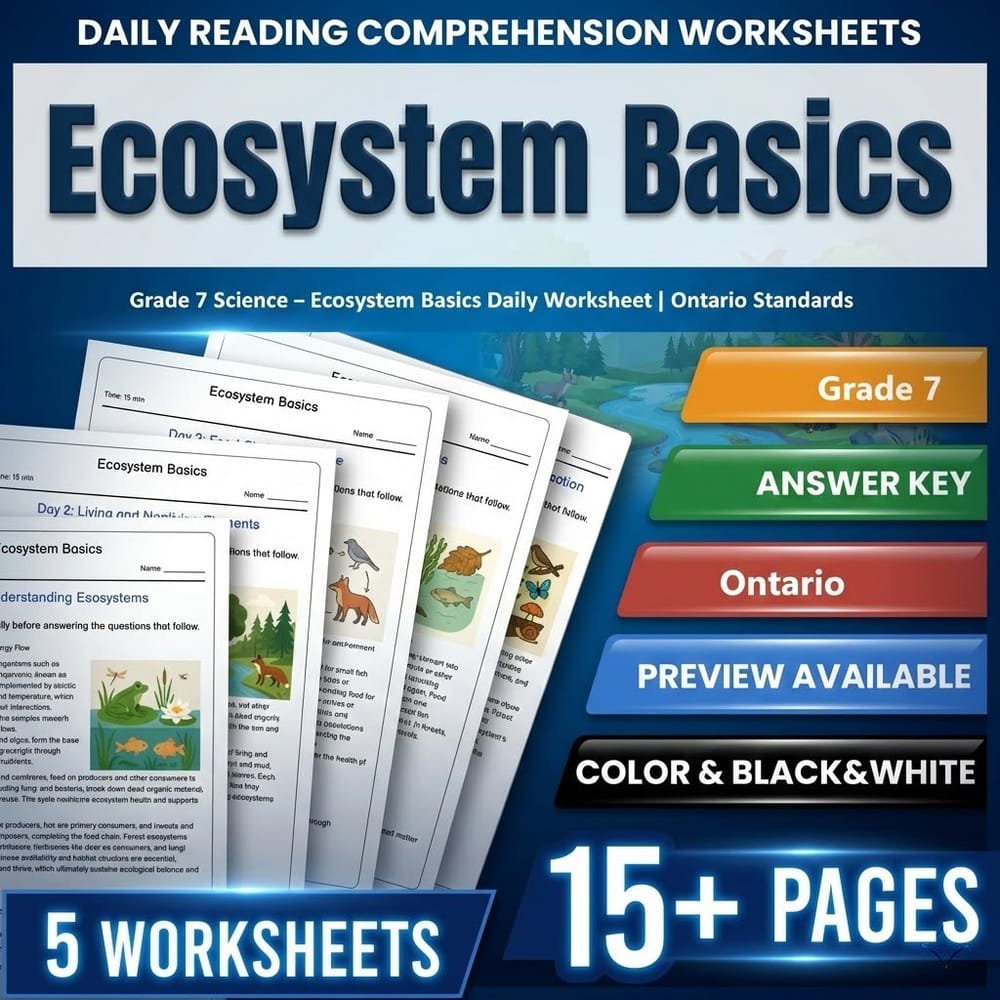
Grade 7 Science – Ecosystem Basics Daily Worksheet | Ontario Standards
 Created byQuiet Forest Education
Learning Objectives
- Identify components of ecosystems including biotic and abiotic factors.
- Understand the roles of producers, consumers, and decomposers.
- Describe energy flow within an ecosystem from sunlight to organic matter.
Also included in: Ecosystem Dynamics Grade 7 Science Daily Reading Worksheets Bundle | Ontario +1 more
Instant download
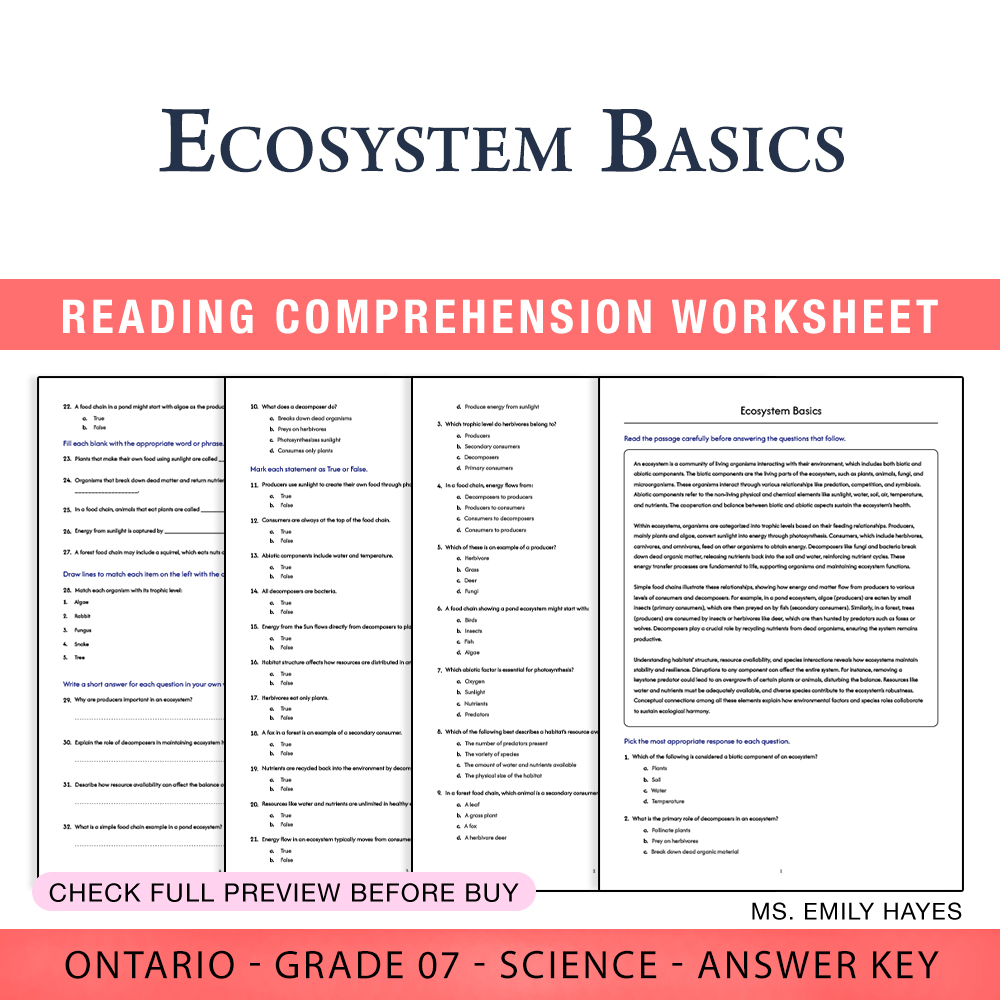
Grade 7 Science | Ecosystem Basics Worksheet (PDF+ Answer Key)
Created byCopper Leaf ClassroomLearning Objectives
- Define components of ecosystems, including biotic and abiotic elements.
- Explain the roles of producers, consumers, and decomposers in energy flow.
- Identify trophic levels and simple food chains in pond and forest settings.
Instant download

Fossil Evidence Assessment | NGSSS Standards Grade 8 Science Worksheet
Created byPrism Point LearningLearning Objectives
- Explain how the fossil record provides evidence that life changes over long periods
- Compare fossils from older versus younger rock layers to infer patterns of change
- Use anatomical similarities and differences to support evolutionary relationships
Also included in: Grade 8 Evolution and Genetics Science Lesson Bundle | Florida NGSSS
Instant download

Grade 12 DNA to Proteins Worksheet | Protein Synthesis Biology | CA Standards
Created byEvergreen Desk EducationLearning Objectives
- Explain how base pairing in DNA provides a stable sequence that can be copied into mRNA and translated into proteins.
- Describe the roles of transcription and translation in converting nucleotide information into amino acid sequences.
- Connect changes in DNA sequence (mutations) to changes in protein structure and function, and ultimately to traits.
Instant download
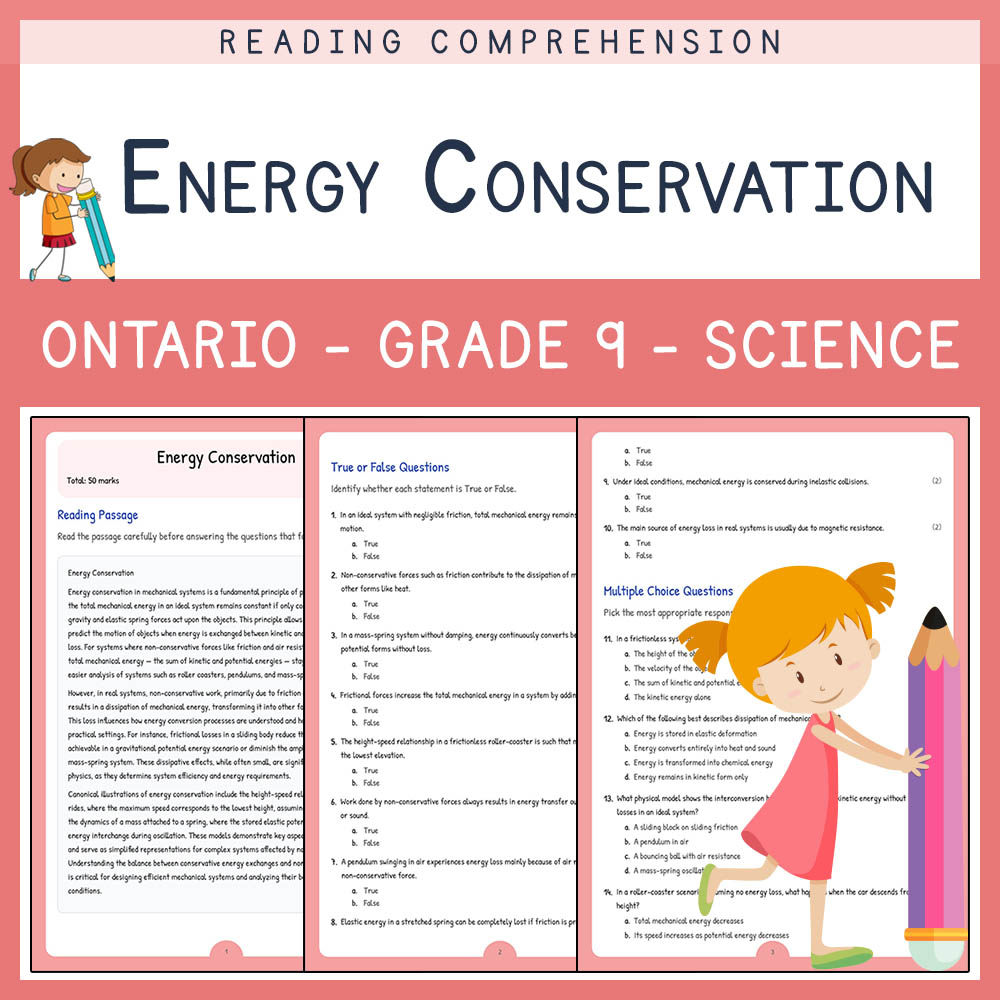
Grade 9 Science Assessment | Energy Conservation Worksheet Elena | Ontario
Created byLumora LearningLearning Objectives
- Understand the principles of conservation of mechanical energy in ideal systems.
- Identify how non-conservative forces affect energy transfer and dissipation.
- Analyze height–speed relationships in roller-coaster models under gravity.
Instant download

Cell Types & Gene Regulation Worksheet | Grade 10 Biology Practice
Created byPrism Point LearningLearning Objectives
- Explain how differential gene expression helps produce specialized cell types within the same organism.
- Describe how regulatory patterns change over time to support development and tissue maintenance.
- Connect gene regulation to differences in protein profiles between cells.
Also included in: Grade 10 Life Science Lesson Bundle | California Standards Framework
Instant download
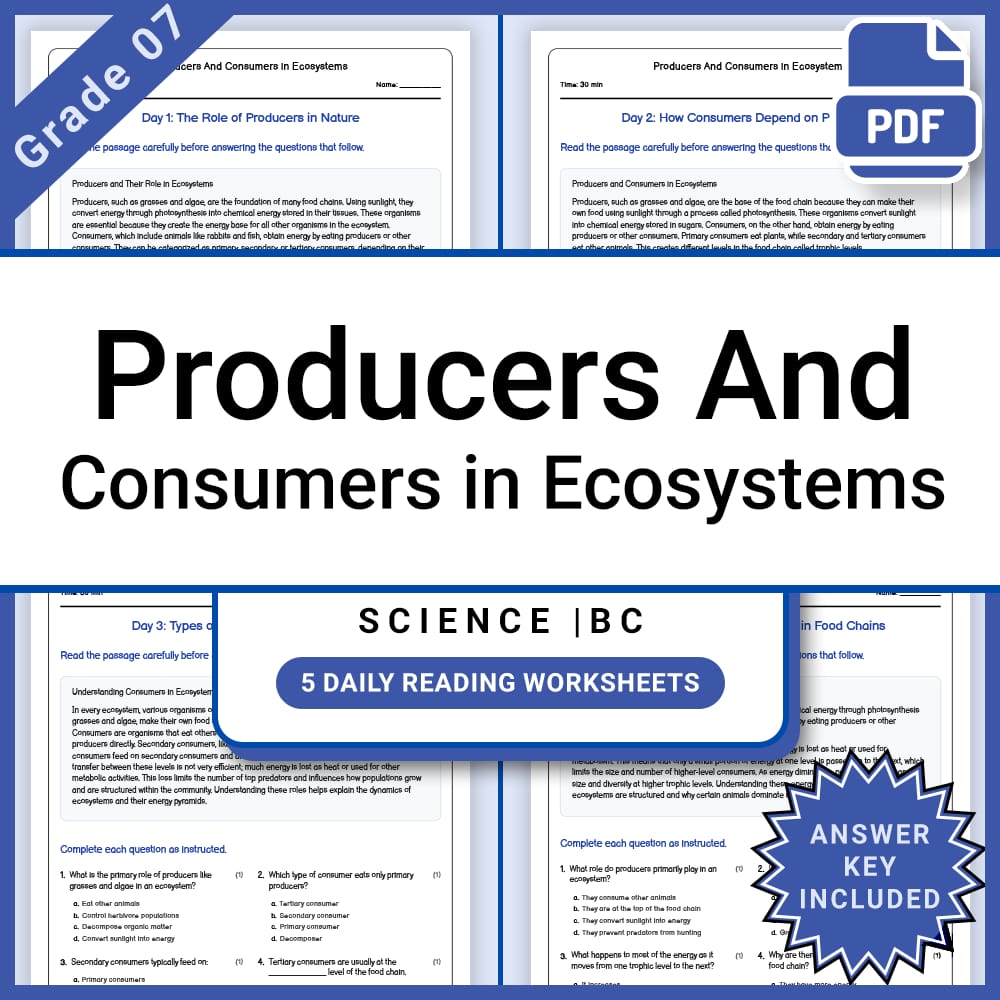
Grade 7 – Producers and Consumers Ecosystems Daily Worksheet + Answer Key
JCreated byJ.S SheetsLearning Objectives
- Understand the role of producers in ecosystems
- Identify different types of consumers
- Explain how energy transfers between trophic levels
Also included in: Grade 7 Science Lesson Group: Ecosystems and Population Framework +1 more
Instant download
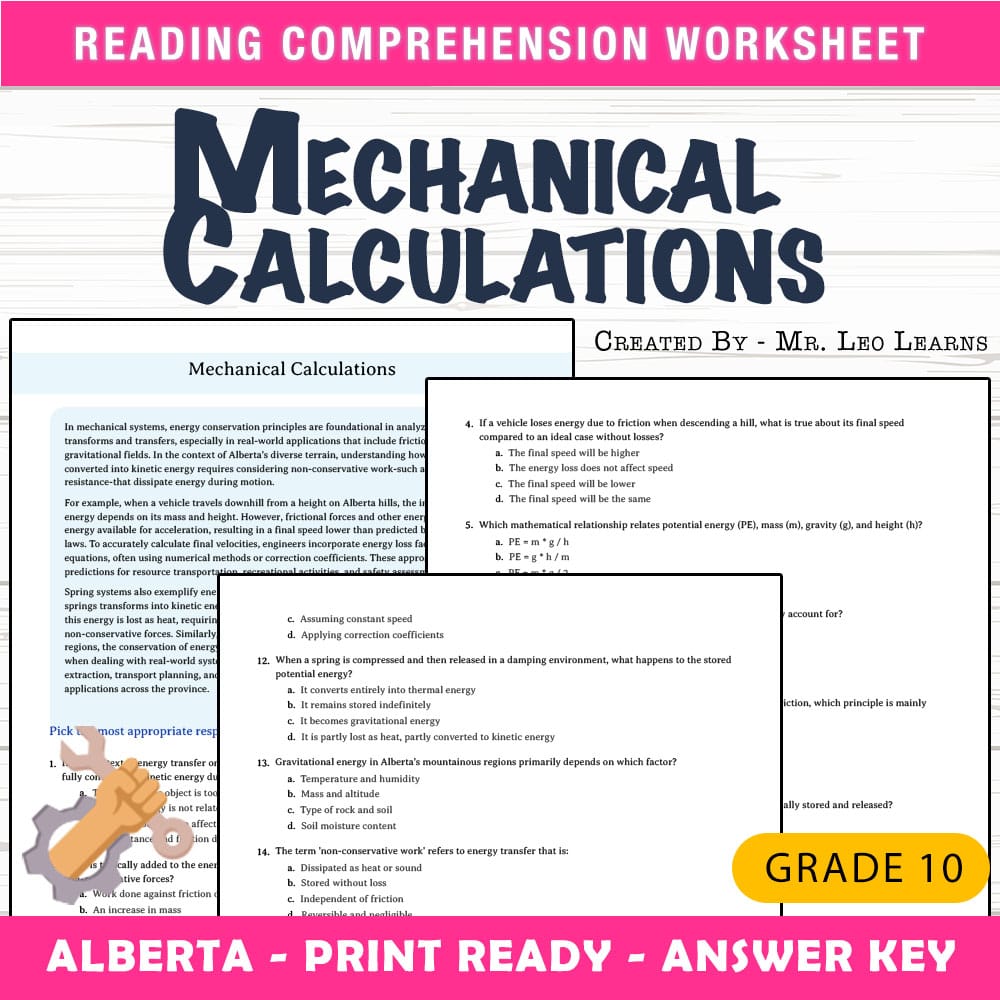
Grade 10 Science — Mechanical Calculations Worksheet MCQ Paper for Mastery
Created byThe Resource HubLearning Objectives
- Understand the principles of energy conservation in mechanical systems
- Apply numerical methods to solve energy transfer problems involving friction, springs, and gravity
- Compute final speeds or heights from potential energy considering non-conservative work
Also included in: Grade 10 Science | Energy, Motion & Electricity Worksheet Bundle | Alberta +1 more
Instant download
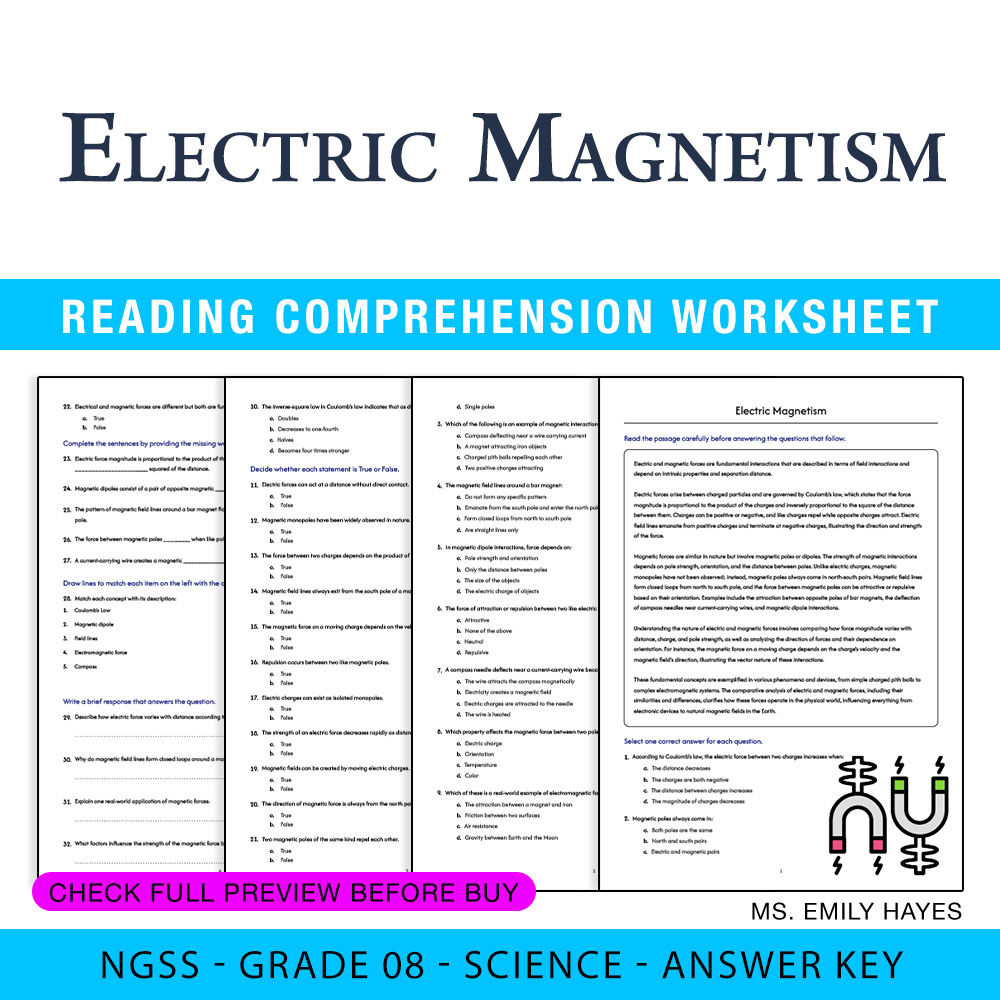
8th Grade Science | Electric Magnetism Worksheet (PDF+ Answer Key)
Created byCopper Leaf ClassroomLearning Objectives
- Understand the concepts of electric and magnetic forces and how they interact.
- Explain how electric and magnetic forces depend on properties such as charge, pole strength, and distance.
- Identify real-world examples of electric and magnetic interactions, including magnetic dipoles and currents.
Instant download
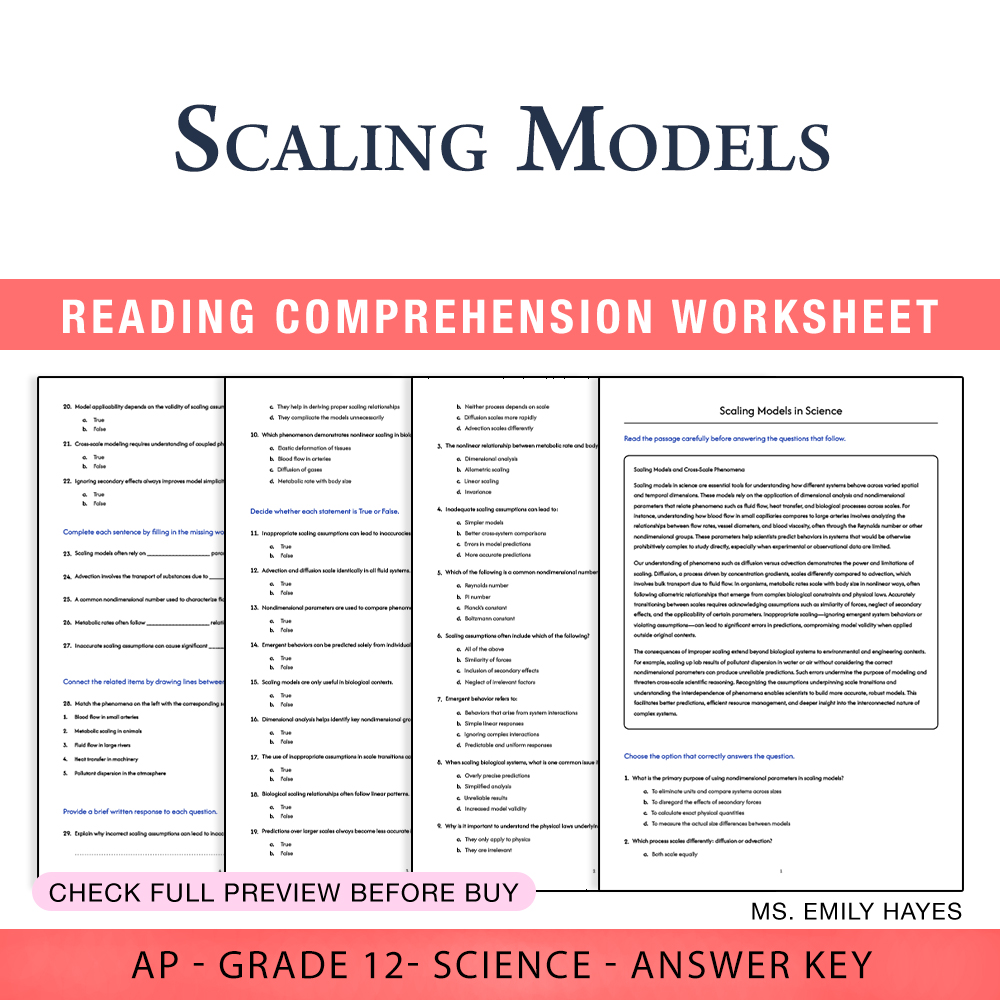
Grade 12 Science | Scaling Models Worksheet (PDF+ Answer Key)
Created byCopper Leaf ClassroomLearning Objectives
- Understand the principles of scaling relationships and dimensional analysis in scientific modeling.
- Apply nondimensional parameters to compare phenomena across different scales.
- Analyze the assumptions needed for scale transitions and their effects on model accuracy.
Also included in: Grade 12 Science AP | Data Analysis and Modeling Skills (PDF+ Answer Key) +1 more
Instant download

Science Worksheet Phases Mechanics Sun–Earth–Moon for Grade 6
JCreated byJ.S SheetsLearning Objectives
- Explain how lunar phases result from the changing relative positions of the Sun, Earth, and Moon.
- Describe how illumination geometry affects the visible fraction of the Moon (new, crescent, quarter, gibbous, full).
- Distinguish between lunar phases and eclipses by describing the alignment needed for eclipses.
Instant download
Browse more categories
About Science Worksheets
Find Science worksheets spanning core skills, practice, and review. All 44,628 resources are instant PDF downloads for the classroom or home.
Every worksheet on MyTeachingSheets is created by independent teacher-authors and reviewed before publication. All resources download as printable PDFs for classroom, homework, or at-home practice, and many include answer keys. Preview any worksheet free before buying.