
Science Worksheets
44,773 subject resources
Grade 7 Science | Conservation of Matter Worksheet | California Standards
 Created byLumora Learning
Learning Objectives
- Explain conservation of matter in a closed system using the atomic model
- Distinguish between physical changes and chemical changes in terms of atoms and mass
- Use mass measurements of reactants and products to support the law of conservation of matter
Instant download

Grade 7 Science | Conservation of Matter - Daily Reading Comprehension
 Created byCoral Reef Learning
Learning Objectives
- Understand the principle that matter is conserved during physical and chemical changes.
- Identify examples of physical vs. chemical processes that conserve matter.
- Explain how atoms are rearranged during reactions without altering total mass.
Instant download

Grade 7 Science – Conservation of Matter & Changes | Daily Reading Worksheet
 Created byBright Mind Resources
Learning Objectives
- Understand how matter is conserved during physical and chemical changes.
- Identify examples of physical vs. chemical changes.
- Explain the importance of mass conservation in scientific observations.
Also included in: Grade 7 Matter & Forces Science Reading Lesson Bundle | California Standards +1 more
Instant download

Grade 12 Science – Kinematic Foundations Daily Reading Worksheet | AP Standards
Created byBright Mind ResourcesLearning Objectives
- Understand the concepts of displacement, velocity, and acceleration as vector quantities.
- Interpret position–time and velocity–time graphs in the context of one-dimensional motion.
- Apply symbolic kinematic equations for constant acceleration to solve problems.
Also included in: AP Science Grade 12 Daily Reading Worksheets Lesson Bundle | AP +2 more
Instant download

Grade 12 Kinematic Foundations Worksheet | Practice & Assessment PDF
 Created byClear Sky Classroom
Learning Objectives
- Use sign conventions to describe one-dimensional motion with displacement, velocity, and acceleration as vector quantities.
- Interpret position–time and velocity–time graphs by relating slope and area to physical meaning.
- Apply constant-acceleration kinematic equations to solve for quantities in one dimension.
Also included in: Grade 12 Physics Science Lesson Bundle: Motion, Energy (Advanced Placement (AP)) +1 more
Instant download

Kinematic Foundations Worksheet Pack AP Physics Grade 12 Practice
 Created byPrism Point Learning
Learning Objectives
- Describe one-dimensional motion using displacement, velocity, and acceleration with correct sign conventions.
- Interpret position–time and velocity–time graphs by relating slope and area to physical quantities.
- Apply constant-acceleration kinematic equations to predict motion from initial conditions.
Also included in: AP Physics Grade 12 Science Mechanics & Electricity Lesson Bundle | AP
Instant download

Grade 12 Science | Kinematic Foundations - Daily Reading Comprehension
Created byCoral Reef LearningLearning Objectives
- Understand the concepts of displacement, velocity, and acceleration as vector quantities.
- Interpret position–time and velocity–time graphs.
- Apply symbolic kinematic equations for constant acceleration.
Also included in: Daily Reading Comprehension Skills Lesson Bundle | Grade 12 Science AP +1 more
Instant download
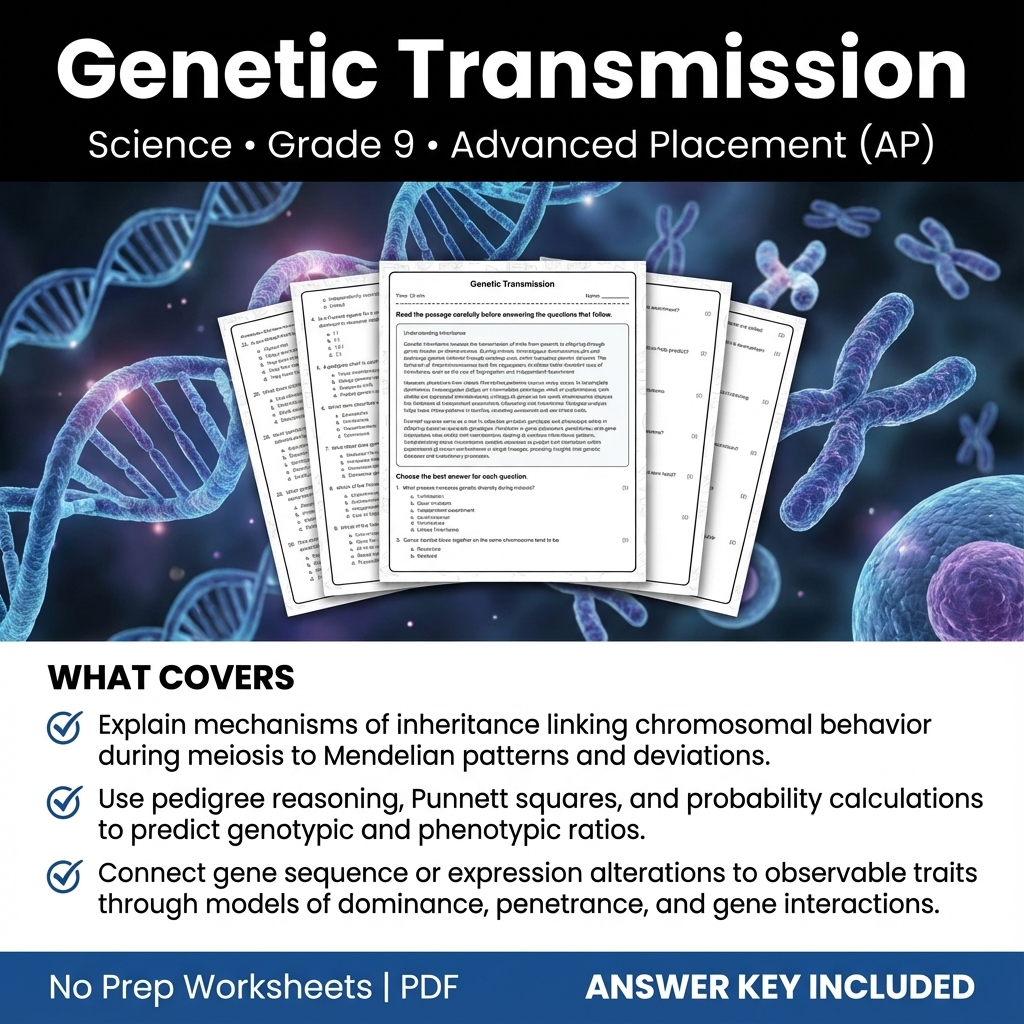
Grade 9 Science | Genetic Transmission Worksheet (Printable PDF + Answer Key)
Created byCoral Reef LearningLearning Objectives
- Explain mechanisms of inheritance linking chromosomal behavior during meiosis to Mendelian patterns and deviations.
- Use pedigree reasoning, Punnett squares, and probability calculations to predict genotypic and phenotypic ratios.
- Connect gene sequence or expression alterations to observable traits through models of dominance, penetrance, and gene interactions.
Also included in: Grade 9 Science Unit Worksheet Bundle | Cell Function to Ecosystem Dynamics +2 more
Instant download
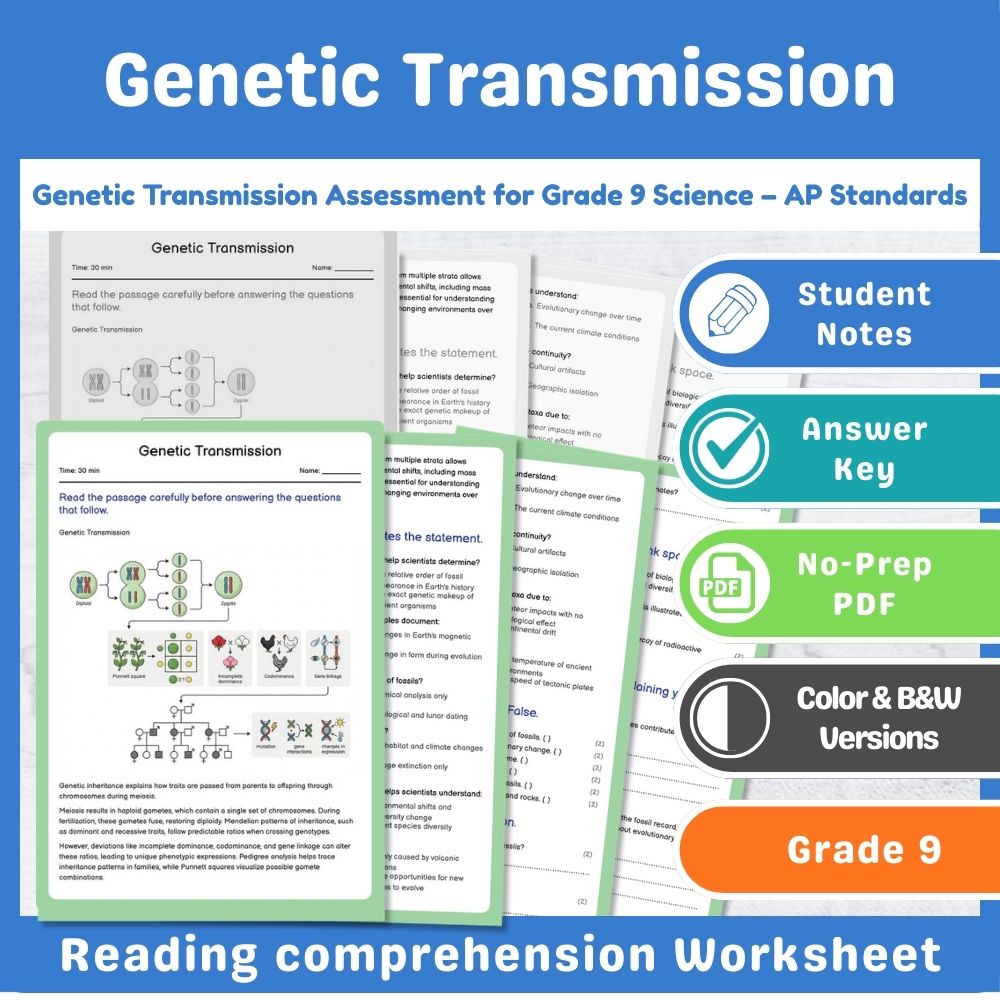
Genetic Transmission Assessment for Grade 9 Science – AP Standards
Created byPrism Point LearningLearning Objectives
- Explain the mechanisms of inheritance and link chromosomal behavior during meiosis to Mendelian patterns.
- Identify deviations such as incomplete dominance, codominance, and linkage, and interpret their effects on inheritance.
- Use pedigree reasoning, Punnett squares, and probability calculations to predict genotypic and phenotypic ratios.
Also included in: Grade 9 Science Mini Bundle | Biology & Ecosystems Unit AP Standards
Instant download

Genetic Transmission Worksheet | AP Science | Grade 9 Practice
JCreated byJ.S SheetsLearning Objectives
- Explain the mechanisms of inheritance, including chromosomal behavior during meiosis and Mendelian patterns.
- Identify deviations such as incomplete dominance, codominance, and linkage, and understand their effects on traits.
- Use pedigree analysis, Punnett squares, and probability calculations to predict genotypic and phenotypic ratios.
Also included in: Grade 9 Science | DNA and Ecosystems Lesson Group Bundle
Instant download

Grade 9 Genetic Transmission Worksheet | Practice & Assessment PDF
Created byClear Sky ClassroomLearning Objectives
- Explain how chromosomal behavior during meiosis leads to Mendelian inheritance patterns.
- Use Punnett frameworks and probability to predict genotypic and phenotypic ratios.
- Analyze inheritance deviations such as incomplete dominance, codominance, linkage, and penetrance.
Also included in: Grade 9 Biology and Ecosystems Science Lesson Bundle for Advanced Placement (AP) +1 more
Instant download

Grade 9 Science – Genetic Transmission & Mendelian Patterns | Reading Worksheet
Created byBright Mind ResourcesLearning Objectives
- Understand the process of chromosome separation during meiosis.
- Relate chromosomal behavior to inheritance patterns and Mendelian laws.
- Identify deviations such as incomplete dominance, codominance, and linkage.
Also included in: Grade 9 Daily Reading Science Worksheets Lesson Bundle | AP +2 more
Instant download
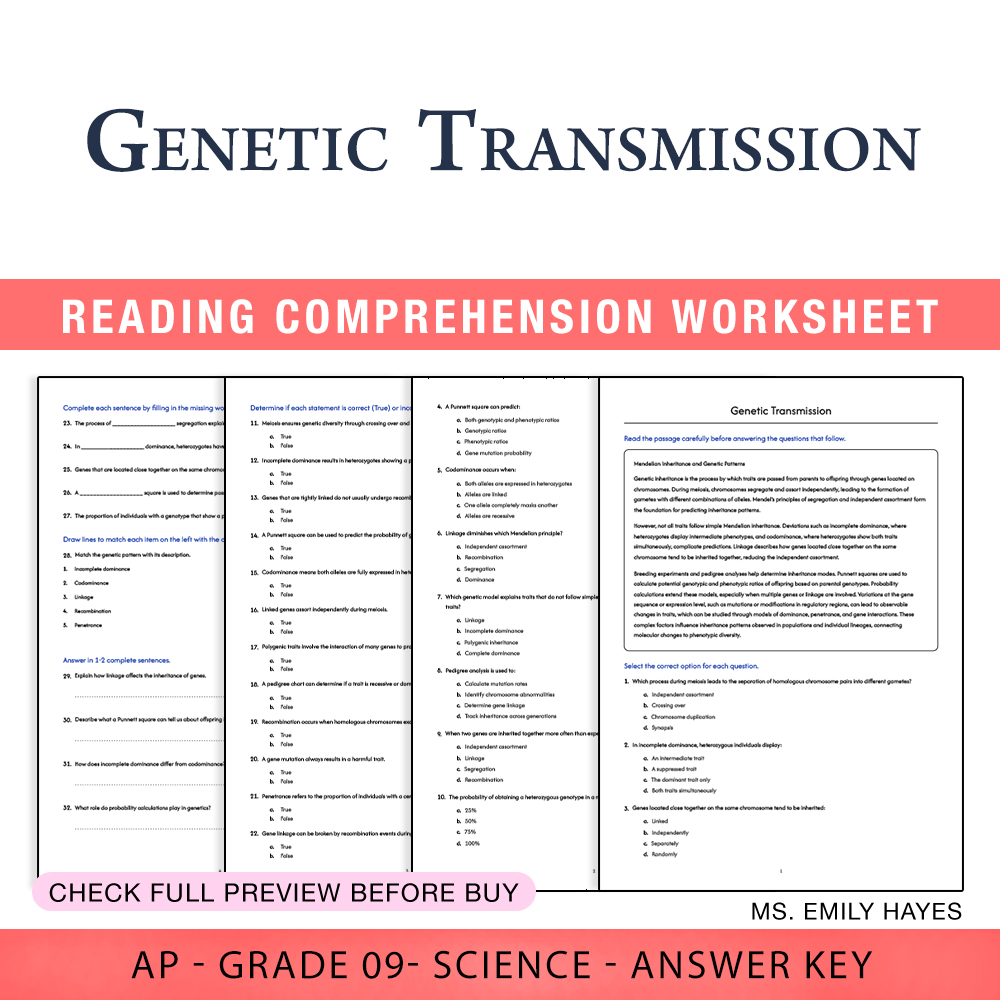
9th Grade Science | Genetic Transmission Worksheet (PDF+ Answer Key)
 Created byCopper Leaf Classroom
Learning Objectives
- Explain the mechanisms of inheritance including chromosomal behavior during meiosis.
- Analyze Mendelian patterns and deviations such as incomplete dominance, codominance, and linkage.
- Use Punnett squares, pedigrees, and probability to predict genotypic and phenotypic ratios.
Also included in: Grade 9 Science | Biology & Ecosystems AP Worksheet Bundle (PDF+ Answer Key) +1 more
Instant download

Grade 10 Mutation Driven Change Worksheet | California Science Standards
 Created byEvergreen Desk Education
Learning Objectives
- Explain how mutations can introduce new alleles and heritable genetic variation.
- Describe ways mutations can affect gene expression, protein structure, or regulatory timing.
- Evaluate how natural selection changes allele frequencies based on fitness in a specific environment.
Instant download

Net Force Direction Worksheet | Standards-Aligned Science Practice for Grade 10
JCreated byJ.S SheetsLearning Objectives
- Understand how the direction of net force influences the acceleration and motion of objects.
- Interpret force vectors and determine the net effect on an object's velocity.
- Compare multiple force vectors and identify the single net force governing motion changes.
Also included in: Grade 10 Energy, Forces, and Reactions Science Lesson Bundle +1 more
Instant download

Net Force Direction Worksheet | Grade 10 Physics Science CA Standards
Created byEvergreen Desk EducationLearning Objectives
- Explain how the direction of net force determines the direction of acceleration
- Use vector addition to predict how multiple forces combine into a single net effect
- Relate force diagrams to observed changes in velocity, including speeding up, slowing down, and turning
Instant download

Grade 10 Science | Net Force Direction Worksheet Elena | California Standards
Created byLumora LearningLearning Objectives
- Explain how net force direction determines the direction of acceleration.
- Use vector addition of multiple forces to predict the direction of an object’s changing velocity.
- Distinguish acceleration direction from the directions of individual forces.
Instant download

Grade 12 Science | Resource Management in Science - Daily Reading Comprehension
Created byCoral Reef LearningLearning Objectives
- Identify common renewable resources and analyze their role in sustainability
- Evaluate the advantages and limitations of renewable energy sources
- Understand water budgeting and water resource management strategies
Also included in: Grade 12 Science Daily Reading Worksheets Full-Year Bundle | TEKS
Instant download

Grade 12 Science – Resource Management Worksheet (TEKS) PDF
Created byEvergreen Desk EducationLearning Objectives
- Evaluate trade-offs in allocating renewable and nonrenewable resources using sustainability criteria
- Apply water budgeting and energy portfolio thinking to predict long-term resource reliability
- Use lifecycle assessment and carrying-capacity constraints to compare waste-handling strategies
Instant download

Resource Management Worksheet for Grade 12 Science | TEKS Aligned Assessment
JCreated byJ.S SheetsLearning Objectives
- Evaluate trade-offs in allocating renewable and nonrenewable resources using scientific constraints and sustainability goals.
- Apply water budgeting and carrying-capacity ideas to analyze groundwater depletion and urban water supply decisions.
- Compare energy portfolio and waste-handling strategies using lifecycle assessment and circular economy principles.
Instant download

Grade 12 Science Resource Management Concepts Daily Reading
JCreated byJ.S SheetsLearning Objectives
- Understand key concepts related to Science
- Apply knowledge through practice questions
- Demonstrate comprehension of the material
Also included in: Grade 12 Science Lesson Bundle | Environmental Systems & Human Impact +1 more
Instant download
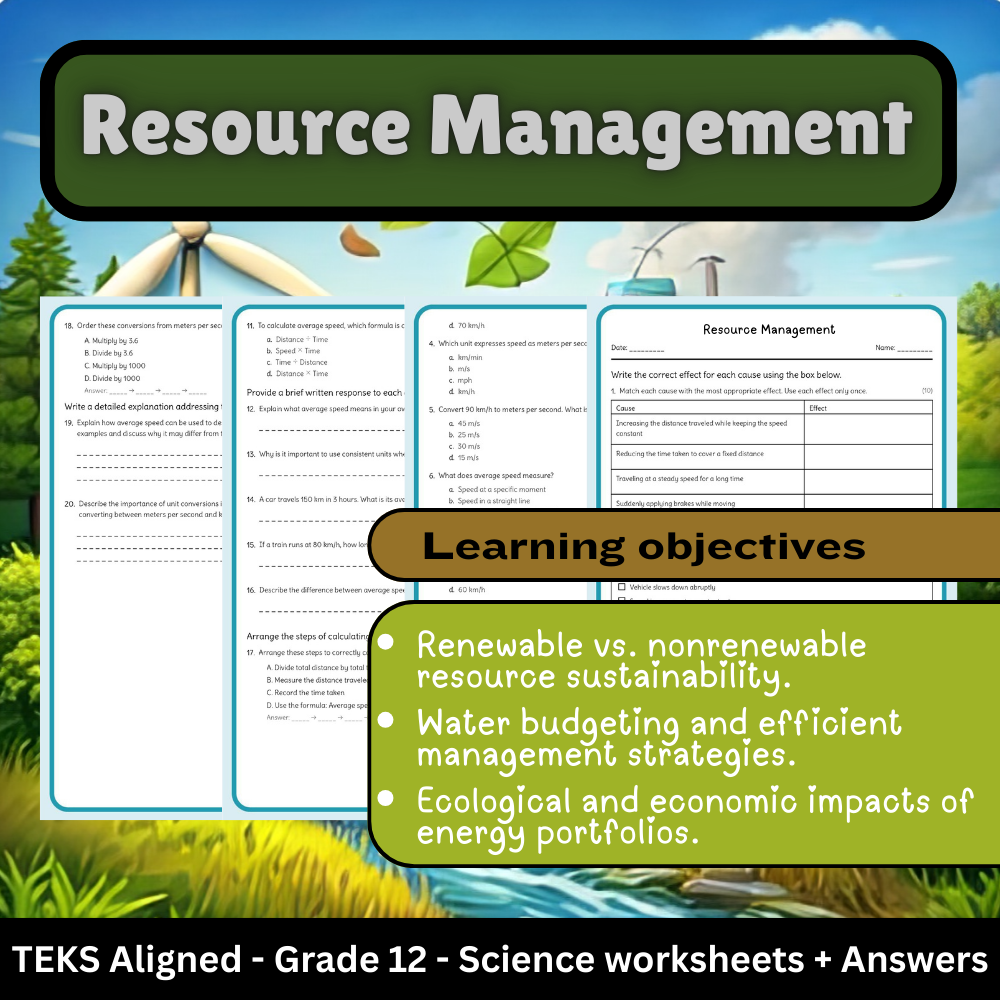
Grade 12 Science Resource Management Worksheet – TEKS Standards (PDF)
Created byBright Mind ResourcesLearning Objectives
- Evaluate the differences between renewable and nonrenewable resources and their sustainable use.
- Analyze water budgeting and identify strategies for efficient water management.
- Compare various energy portfolio options and their ecological and economic impacts.
Instant download
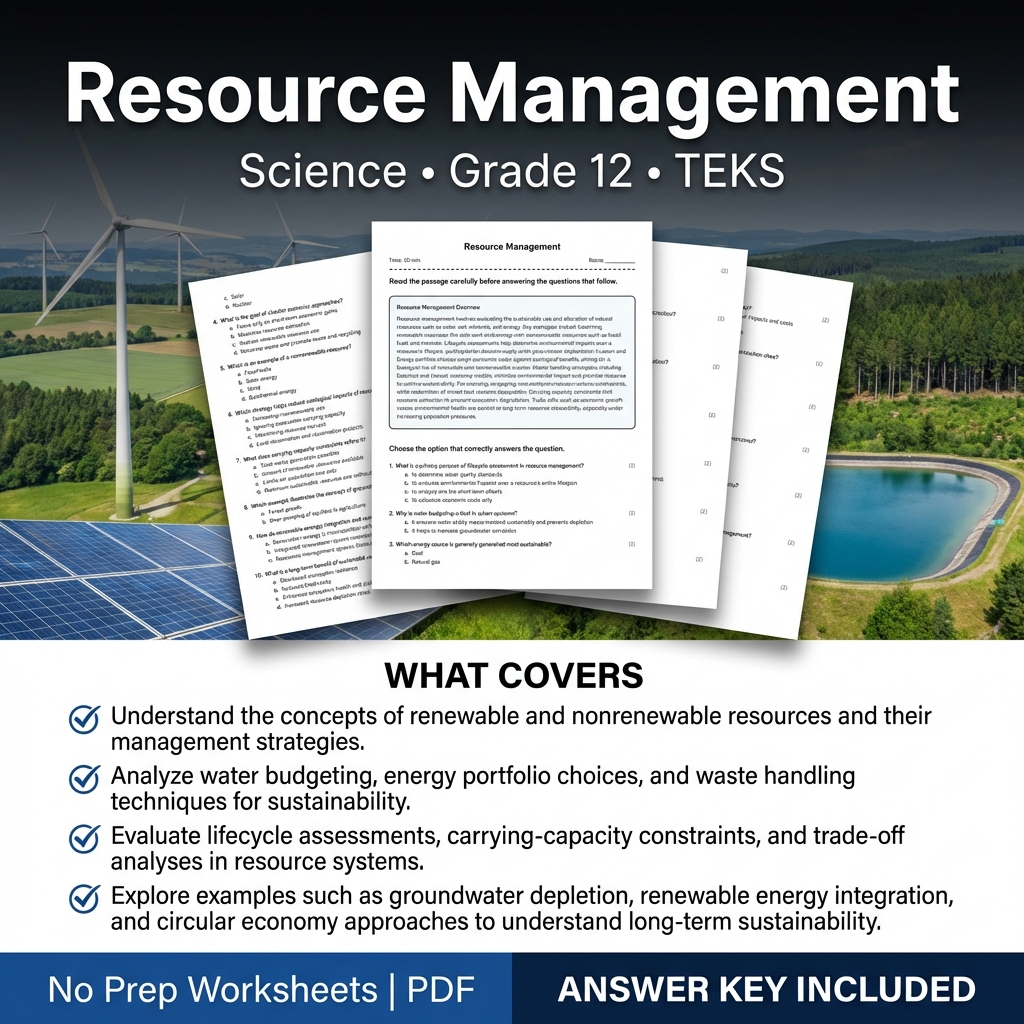
Grade 12 Science Resource Management Worksheet with Answer Key | TEKS Standards
Created byCoral Reef LearningLearning Objectives
- Understand the concepts of renewable and nonrenewable resources and their management strategies.
- Analyze water budgeting, energy portfolio choices, and waste handling techniques for sustainability.
- Evaluate lifecycle assessments, carrying-capacity constraints, and trade-off analyses in resource systems.
Instant download

Grade 9 Science | Resource Choices - Daily Reading Comprehension
Created byCoral Reef LearningLearning Objectives
- Understand the environmental impacts of coal energy production.
- Analyze trade-offs involved in different resource extraction methods.
- Recognize sustainable practices in resource management.
Instant download
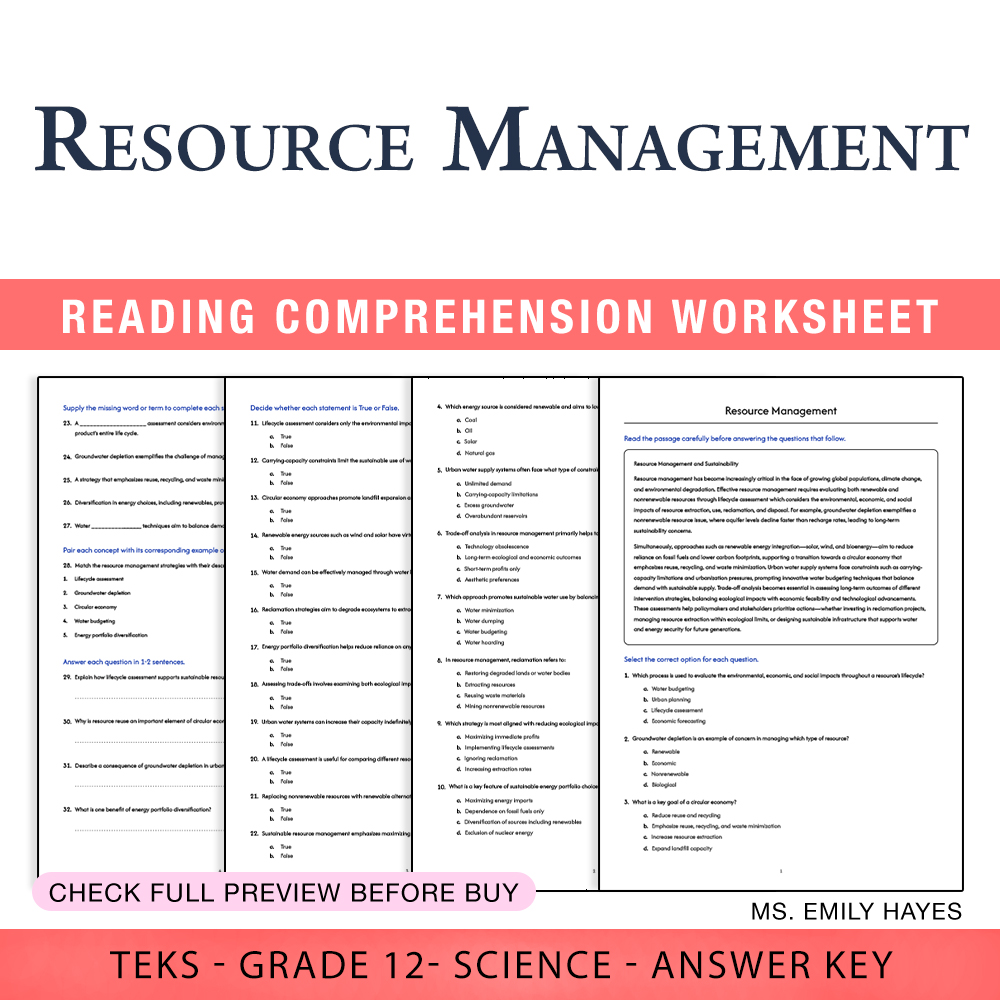
Grade 12 Science | Resource Management Worksheet (PDF+ Answer Key)
Created byCopper Leaf ClassroomLearning Objectives
- Evaluate the sustainability of renewable and nonrenewable resources using lifecycle assessment and carrying-capacity constraints.
- Analyze water budgeting and urban water supply strategies for sustainable resource management.
- Compare energy portfolio choices, waste handling, and circular economy approaches for long-term resource stewardship.
Instant download

Resource Management Worksheet | Grade 12 Science Activities
Created byPrism Point LearningLearning Objectives
- Evaluate trade-offs between renewable and nonrenewable resource allocation using sustainability criteria and data.
- Apply basic water budgeting and energy portfolio thinking to analyze long-term urban resource supply.
- Use lifecycle assessment and carrying-capacity constraints to compare extraction, reclamation, and waste-handling options.
Also included in: Human Impacts on Earth Systems Lesson Bundle | Grade 12 Science | TEKS
Instant download
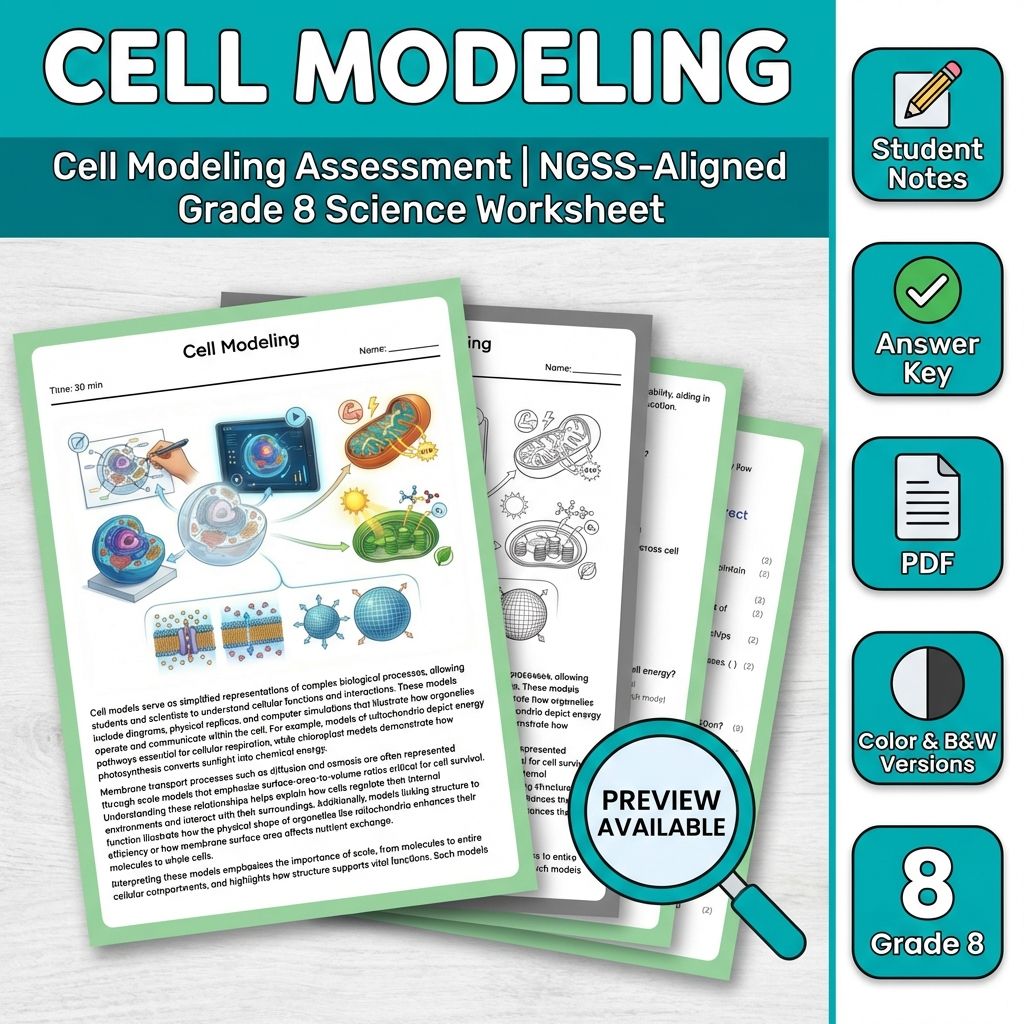
Cell Modeling Assessment | NGSS-Aligned Grade 8 Science Worksheet
Created byPrism Point LearningLearning Objectives
- Describe different models used to represent cellular processes and structures.
- Explain the roles of organelles like mitochondria and chloroplasts in cell function.
- Interpret how membrane transport mechanisms relate to cell viability and overall function.
Also included in: Grade 8 Science Mini Bundle – Structure & Processes Unit (NGSS Aligned) +1 more
Instant download

Mutation Driven Change Worksheet | Grade 10 Evolution Practice
Created byPrism Point LearningLearning Objectives
- Explain how mutations can create new alleles and provide variation for evolution.
- Describe how natural selection changes allele frequencies when traits affect fitness under current environmental conditions.
- Distinguish mutations that do not affect traits from mutations that can alter protein structure, gene regulation, or timing.
Also included in: Grade 10 Life Science Lesson Bundle | California Standards Framework
Instant download

Grade 10 Science | Mutation Driven Change Worksheet | California Standards
Created byLumora LearningLearning Objectives
- Explain how mutations create heritable variation in DNA and how that variation can affect alleles in a population
- Describe how mutations may or may not influence traits or survival depending on their effect on proteins and gene regulation
- Connect mutation and natural selection to predict how allele frequencies can change over generations
Instant download

Mutation Driven Change Worksheet | California Standards Grade 10 Science
JCreated byJ.S SheetsLearning Objectives
- Understand how mutations contribute to genetic variation and evolution.
- Identify different types of mutations and their effects on genes and traits.
- Analyze how mutations can influence natural selection and population adaptation.
Also included in: Grade 10 Genetic Variation and Evolution Science Lesson Bundle +1 more
Instant download

Earth's Internal Structure Worksheets: Grade 10 Science
Created byPrism Point LearningLearning Objectives
- Describe Earth's chemical layers using composition, density, and temperature
- Compare lithosphere and asthenosphere using mechanical behavior
- Explain how seismic waves support models of Earth's interior
Also included in: Earth and Space Systems Grade 10 Science Ontario Bundle
Instant download

Earth Layers Worksheet | Grade 10 Science | Ontario Standards Alignment
JCreated byJ.S SheetsLearning Objectives
- Describe Earth’s internal structure using both chemical and mechanical layering concepts (crust, mantle, core; lithosphere, asthenosphere).
- Explain how density, composition, and temperature gradients influence seismic wave behavior and models of Earth’s interior.
- Connect seismic evidence and mineral physics findings to ideas about isostasy and mantle convection.
Instant download
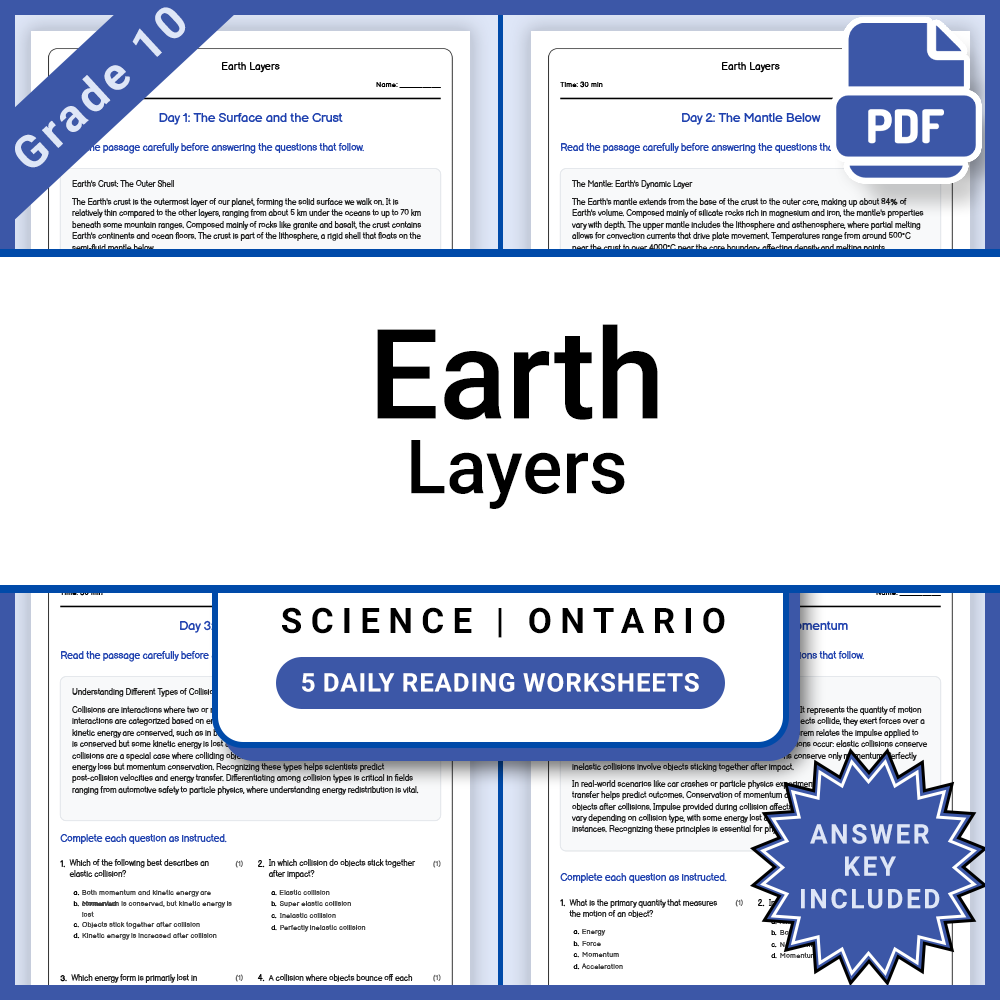
Grade 10 Science – Earth Layers Daily Reading Worksheet + Answer Key
JCreated byJ.S SheetsLearning Objectives
- Identify Earth's crust and distinguish it from other layers.
- Understand the composition and characteristics of Earth's crust.
- Learn how seismic waves inform scientists about Earth's internal structure.
Also included in: Grade 10 Science Lesson Bundle | Earth and Resource Management +1 more
Instant download

Grade 12 Plate Tectonic Time Worksheet | Practice & PDF
Created byClear Sky ClassroomLearning Objectives
- Explain how internal Earth processes and plate tectonics operate over geologic time to reshape Earth’s surface.
- Describe how surface processes (weathering, erosion, deposition) modify landforms after tectonic events.
- Interpret evidence that present-day features are linked to past geologic activity and evolving Earth structure.
Instant download

Earth Layers Worksheet Grade 10 Science | Ontario Curriculum Resource
Created byClear Sky ClassroomLearning Objectives
- Explain how Earth’s internal structure can be described using both chemical and mechanical layering.
- Compare crust, mantle, and core using key differences in density, composition, and temperature.
- Describe how lithosphere and asthenosphere relate to isostasy and long-term heat transport.
Instant download

Grade 11 Science | Periodic Trends - Daily Reading Comprehension
Created byCoral Reef LearningLearning Objectives
- Understand the organization and structure of the periodic table
- Learn how electron configurations influence element properties
- Identify trends in atomic size, ionization energy, electronegativity, and metallic character across periods and groups
Instant download

Grade 9 Resource Choices Worksheet | NGSS Practice PDF
Created byClear Sky ClassroomLearning Objectives
- Compare different energy and mineral resource options based on environmental, economic, and social factors.
- Analyze the impacts of resource extraction methods like coal combustion, mountaintop removal, hydraulic fracturing, and renewable energy installations.
- Evaluate trade-offs in resource management, considering life-cycle impacts, land use, water consumption, and emissions.
Also included in: Grade 9 Sustainability Decision Modeling Science Lesson Bundle NGSS +1 more
Instant download
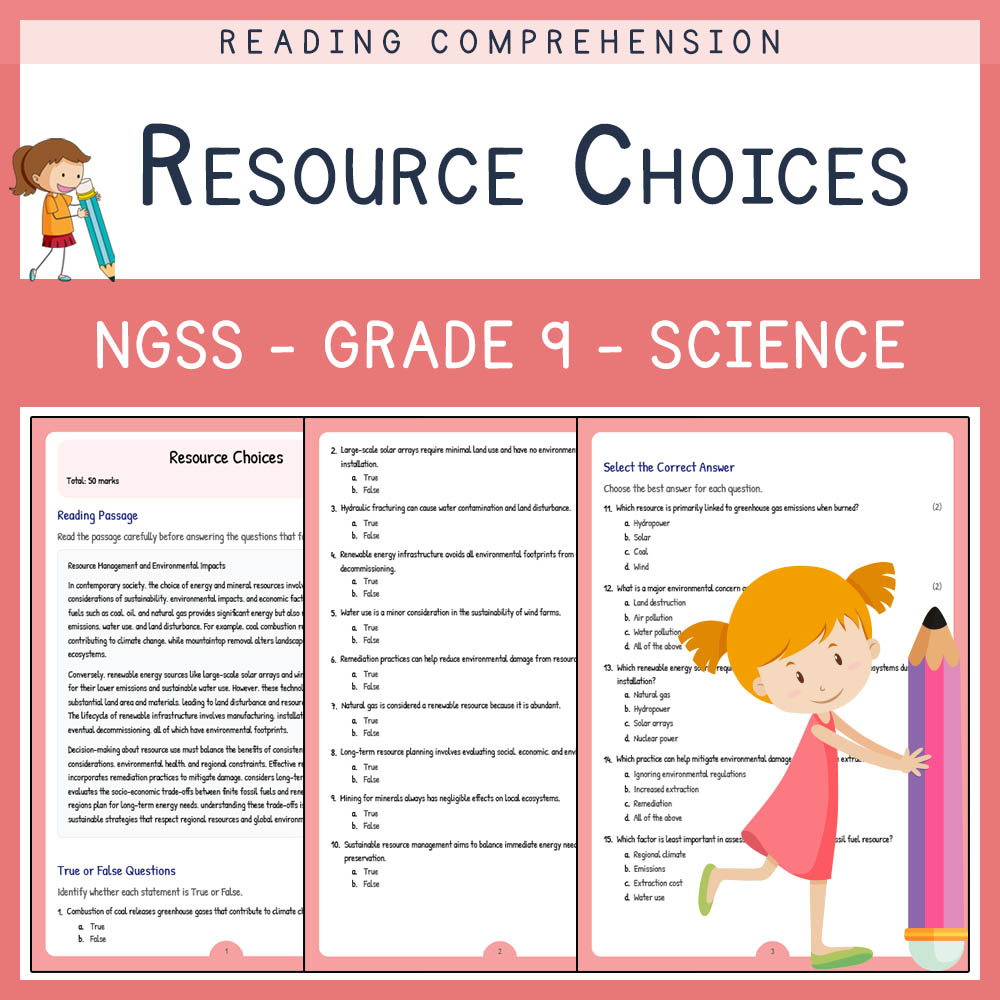
Grade 9 Science | Resource Choices Worksheet with Answer Key – NGSS Aligned
Created byLumora LearningLearning Objectives
- Analyze various energy and mineral resource options focusing on sustainability, environmental impact, and management.
- Compare life-cycle trade-offs, including extraction impacts, water use, land disturbance, and emissions for different resource types.
- Evaluate economic costs, supply constraints, and remediation practices to assess sustainable use of finite and renewable resources.
Instant download
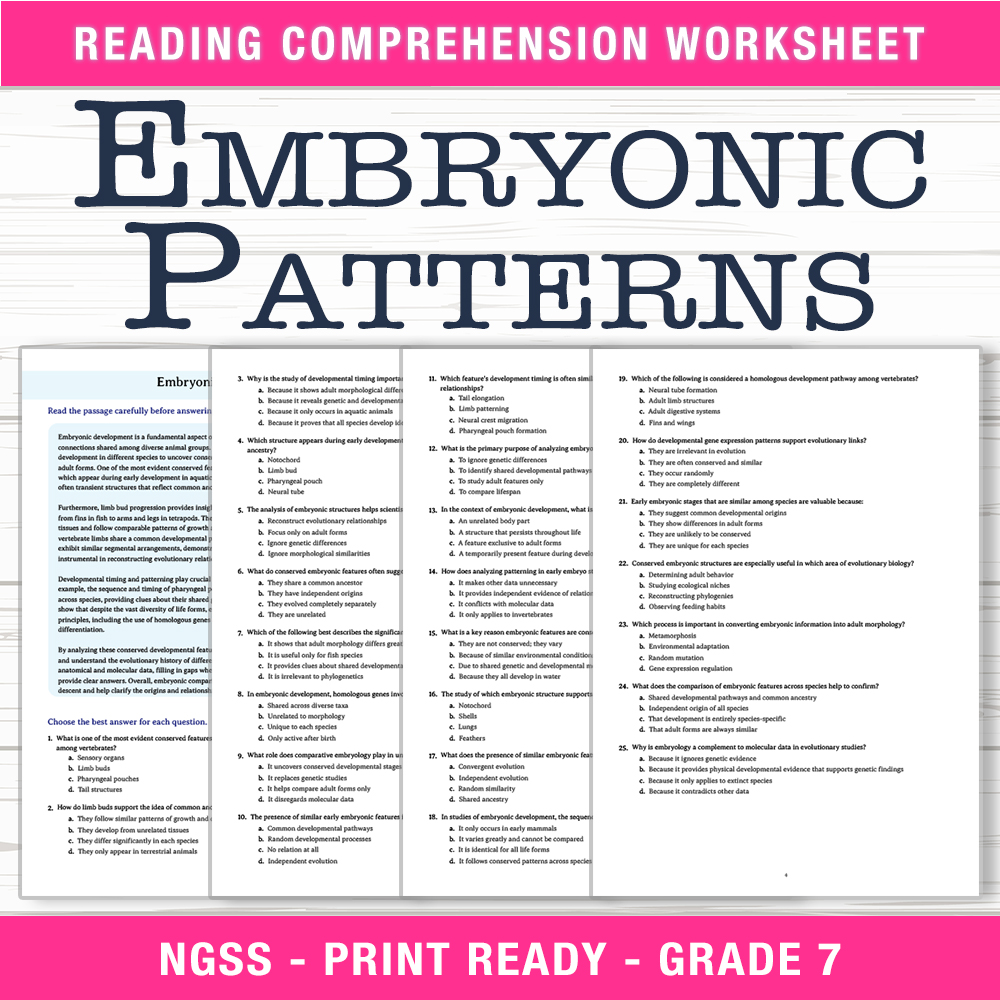
Grade 7 Science | Embryonic Patterns Worksheet (PDF + Answer Key)
 Created byRiverstone Classroom
Learning Objectives
- Understand the concept of conserved embryonic development stages across different taxa.
- Identify morphological similarities in early embryonic structures that reflect evolutionary relationships.
- Analyze how developmental timing and patterning support phylogenetic reconstruction.
Instant download
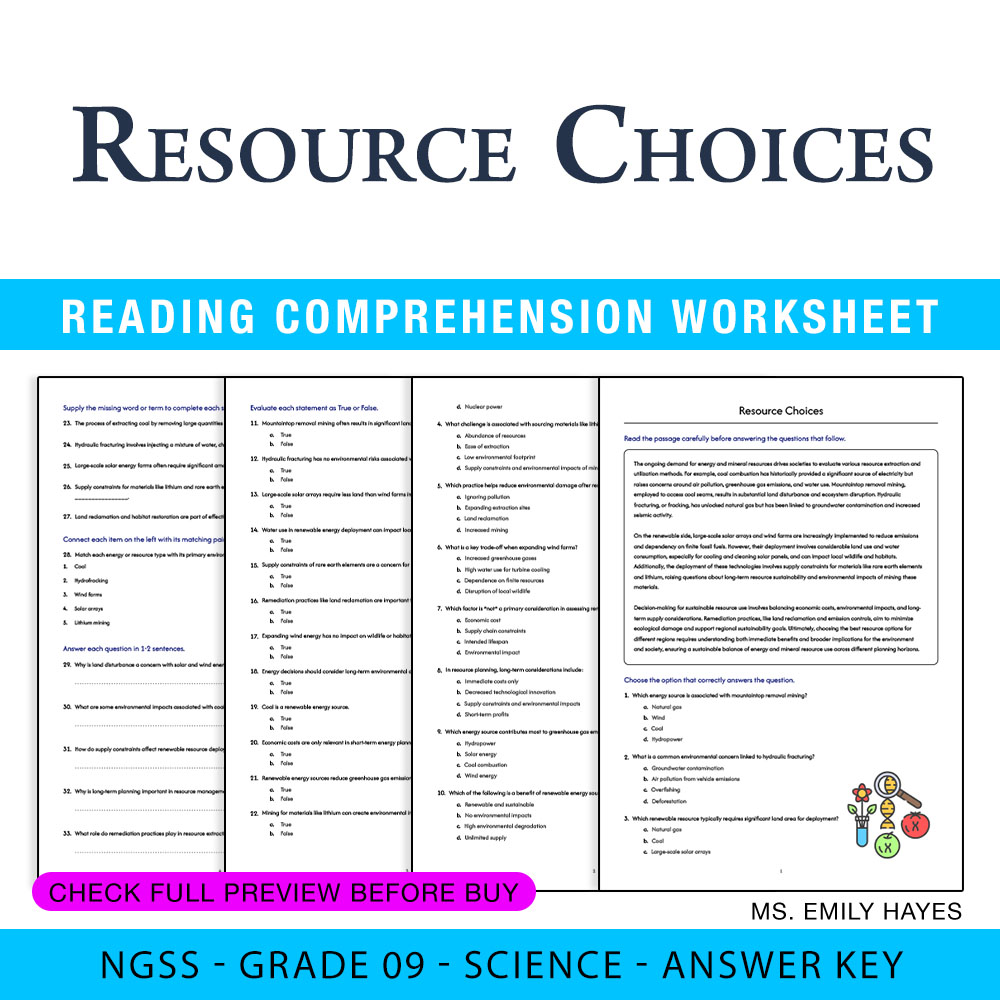
Grade 9 Science | Resource Choices Worksheet (PDF+ Answer Key)
Created byCopper Leaf ClassroomLearning Objectives
- Compare and analyze different energy and mineral resource options, considering their environmental, economic, and social impacts.
- Evaluate trade-offs involved in resource extraction, management, and sustainability within regional and long-term contexts.
- Understand the life-cycle considerations and environmental trade-offs of fossil fuels and renewable energy sources.
Instant download
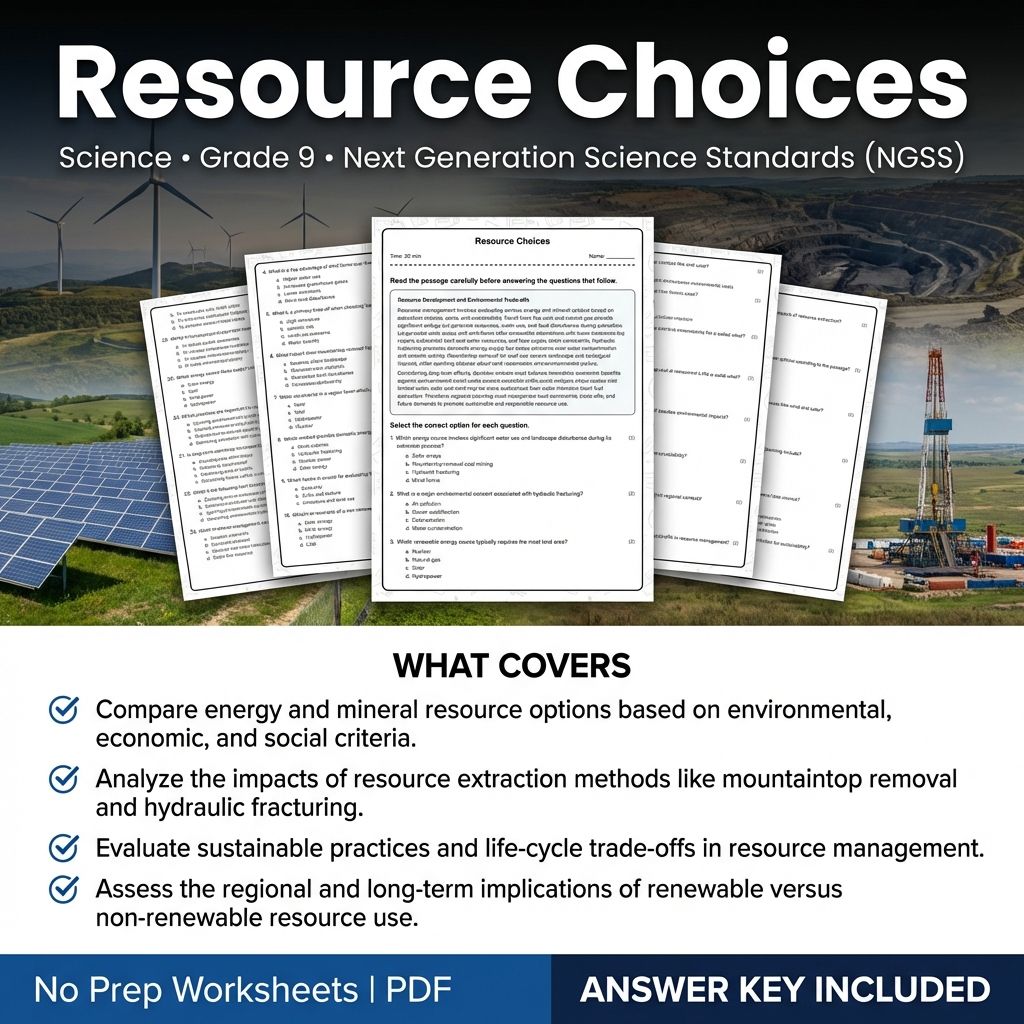
9th Grade Science | Resource Choices Worksheet + Answer Key (Printable PDF)
Created byCoral Reef LearningLearning Objectives
- Compare energy and mineral resource options based on environmental, economic, and social criteria.
- Analyze the impacts of resource extraction methods like mountaintop removal and hydraulic fracturing.
- Evaluate sustainable practices and life-cycle trade-offs in resource management.
Also included in: Grade 9 Science UNIT Worksheet Pack-Resource Management & Energy Decarbonization +1 more
Instant download

Natural Hazards Worksheet | NGSS Grade 9 Science Assessment
 Created bySkylark Worksheets
Learning Objectives
- Explain how geologic and atmospheric indicators are used to characterize the origin, frequency, and potential impacts of natural hazards.
- Analyze spatial patterns and triggering mechanisms to describe why some places experience higher hazard and risk.
- Evaluate how recurrence intervals and paleoevidence support risk assessment for human and ecological systems.
Also included in: Grade 9 Science Lesson Bundle Earth Systems & Tectonic Forces | NGSS +1 more
Instant download

Resource Choices & Energy-Material Trade-Offs Grade 9 Science Worksheets
 Created byTeachers Club
Learning Objectives
- Compare energy sources using emissions, land disturbance, and water use
- Evaluate life-cycle trade-offs between finite and renewable resources
- Identify criteria for sustainable resource management in regional contexts
Also included in: Earth and Human Activity Grade 9 Science NGSS Worksheets Bundle +1 more
Instant download
Grade 9 Science | Resource Choices Worksheet – NGSS Aligned (PDF)
Created byBright Mind ResourcesLearning Objectives
- Compare energy and mineral resource options based on environmental impacts and life-cycle costs.
- Evaluate the trade-offs involved in resource extraction methods and use.
- Analyze factors such as water use, land disturbance, emissions, and sustainability in resource decision-making.
Instant download

Chemical Reactions Evidence Worksheets: Conservation of Atoms Grade 10
Created byTeachers ClubLearning Objectives
- Identify observable evidence that indicates new substances formed
- Explain how conservation of atoms supports reaction outcomes
- Relate gas, color, temperature, and precipitate evidence to products
Also included in: Grade 10 Science Worksheets | NGSS Matter & Interactions Bundle +1 more
Instant download

Grade 6 Science | Earth Rotation - Daily Reading Comprehension
Created byCoral Reef LearningLearning Objectives
- Understand the concept of Earth's rotation on its axis.
- Recognize how Earth's rotation causes day and night.
- Identify the sequence of sunrise, solar noon, and sunset.
Also included in: Sky Science Lesson Bundle | Grade 6 Science Daily Reading | Alberta +1 more
Instant download

Grade 6 Science – Earth Rotation & Day/Night Cycle | Daily Reading Worksheet
Created byBright Mind ResourcesLearning Objectives
- Understand Earth's rotation and how it causes day and night
- Identify the effects of Earth's rotation on celestial observations
- Describe the sequence of sunrise, solar noon, and sunset
Also included in: Grade 6 Solar System & Seasons Science Daily Reading Lesson Bundle | Alberta +2 more
Instant download

Earth Rotation Worksheet | Grade 6 Science | Alberta Standards
JCreated byJ.S SheetsLearning Objectives
- Understand how Earth's rotation causes day and night cycles.
- Identify the sequence of sunrise, solar noon, and sunset across different time zones.
- Explain the mechanics of Earth's axial rotation and its effects on celestial observations.
Instant download
Browse more categories
About Science Worksheets
Find Science worksheets spanning core skills, practice, and review. All 44,773 resources are instant PDF downloads for the classroom or home.
Every worksheet on MyTeachingSheets is created by independent teacher-authors and reviewed before publication. All resources download as printable PDFs for classroom, homework, or at-home practice, and many include answer keys. Preview any worksheet free before buying.