
Science Worksheets
44,295 subject resources
Argumentation Models Worksheet | Grade 7 Science Activities
 Created byPrism Point Learning
Learning Objectives
- Construct evidence-based scientific arguments using claims, evidence, and reasoning that are logically coherent.
- Critique and compare argumentation models by evaluating data quality, graphical representations, and limits of inference.
- Use quantitative results and model-based explanations to support or refute a hypothesis while citing sources of information.
Also included in: Grade 7 Scientific Data & Argumentation Science Lesson Bundle (TEKS)
Instant download

Grade 11 Science – Force & Models in Physics Daily Reading Worksheet
 Created byBright Mind Resources
Learning Objectives
- Identify different types of forces such as contact and long-range forces
- Understand how forces interact and influence motion
- Distinguish between static equilibrium and accelerated motion
Also included in: Grade 11 Physics Daily Reading Lesson Bundle | AP Science Framework +2 more
Instant download

Grade 10 Science – Reaction Yield & Stoichiometry | Daily Reading Worksheet
 Created byQuiet Forest Education
Learning Objectives
- Understand the concept of limiting reagents in a chemical reaction.
- Differentiate between theoretical yield and actual yield.
- Calculate percent yield of a reaction.
Also included in: Matter and Chemical Change Grade 10 Science Daily Reading Bundle | Ontario +1 more
Instant download
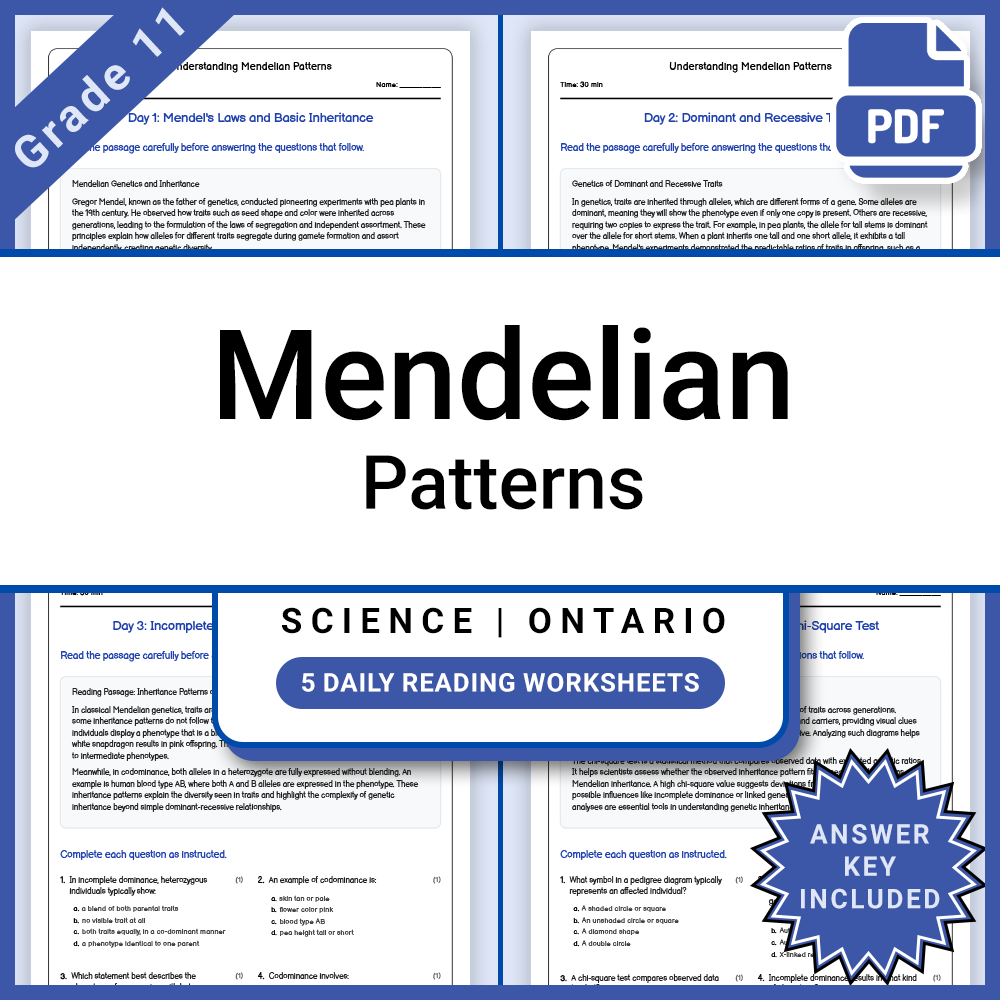
Grade 11 Science – Mendelian Patterns Daily Reading Worksheet + Answer Key
JCreated byJ.S SheetsLearning Objectives
- Describe Gregor Mendel's experiments and identify the basic laws of segregation and independent assortment.
- Differentiate between dominant, recessive, incomplete dominance, and codominance inheritance patterns.
- Interpret phenotypic ratios and use genetic notation to predict inheritance outcomes.
Also included in: Grade 11 Science Lesson Bundle | Ontario Standards for Biology and Chemistry +1 more
Instant download
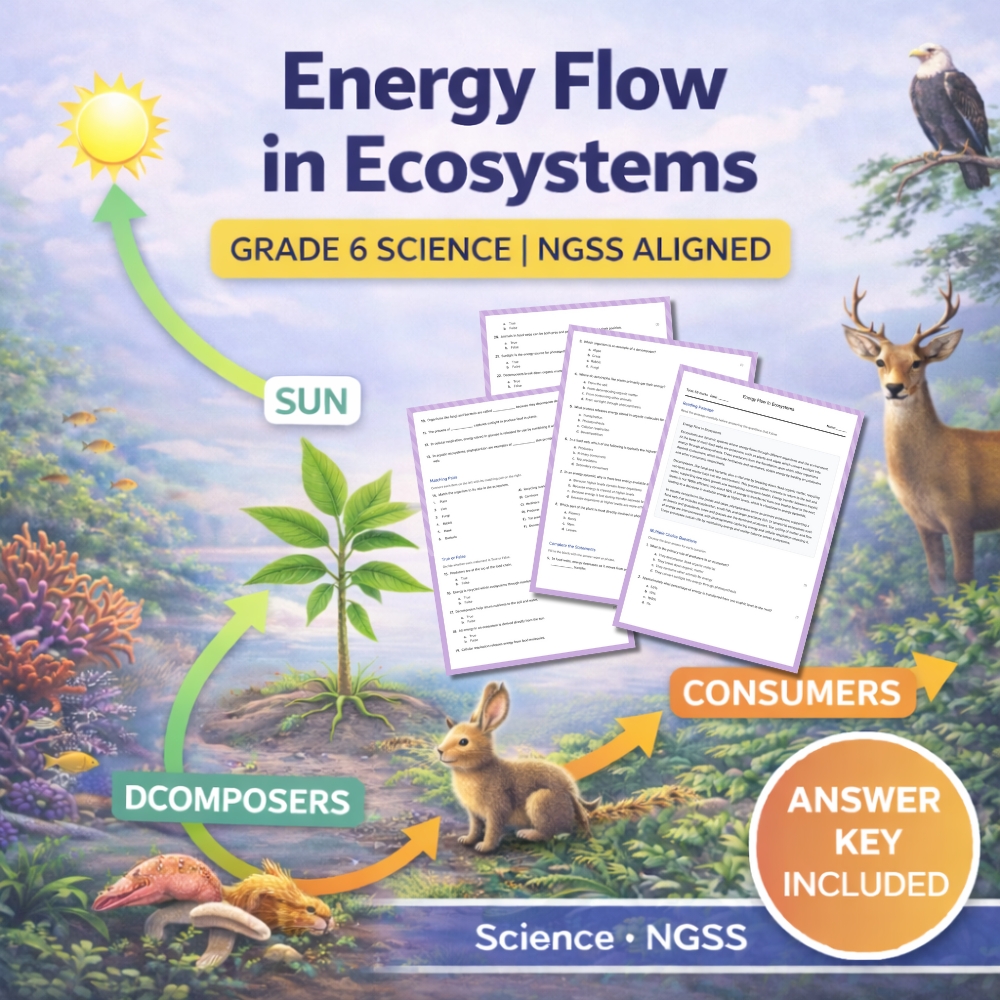
Grade 6 Science | Energy Flow in Ecosystems | NGSS (Worksheet + Answer Key)
 Created byCedar Grove Learning
Learning Objectives
- Describe the components of food webs and energy flow within terrestrial and aquatic ecosystems.
- Explain how energy diminishes across trophic levels in food pyramids.
- Identify the roles of producers, consumers, and decomposers in energy and matter cycling.
Also included in: Grade 6 Science | Ecosystem Interactions & Population Dynamics Worksheet Bundle +1 more
Instant download

Grade 8 Science – Electric Current & Resistance | Daily Reading Worksheet
Created byBright Mind ResourcesLearning Objectives
- Define electric current and resistance
- Explain factors affecting resistance in materials
- Describe the relationship between voltage, current, and resistance in circuits
Also included in: Grade 8 Electricity Science Daily Reading Worksheets Lesson Bundle | Alberta +2 more
Instant download
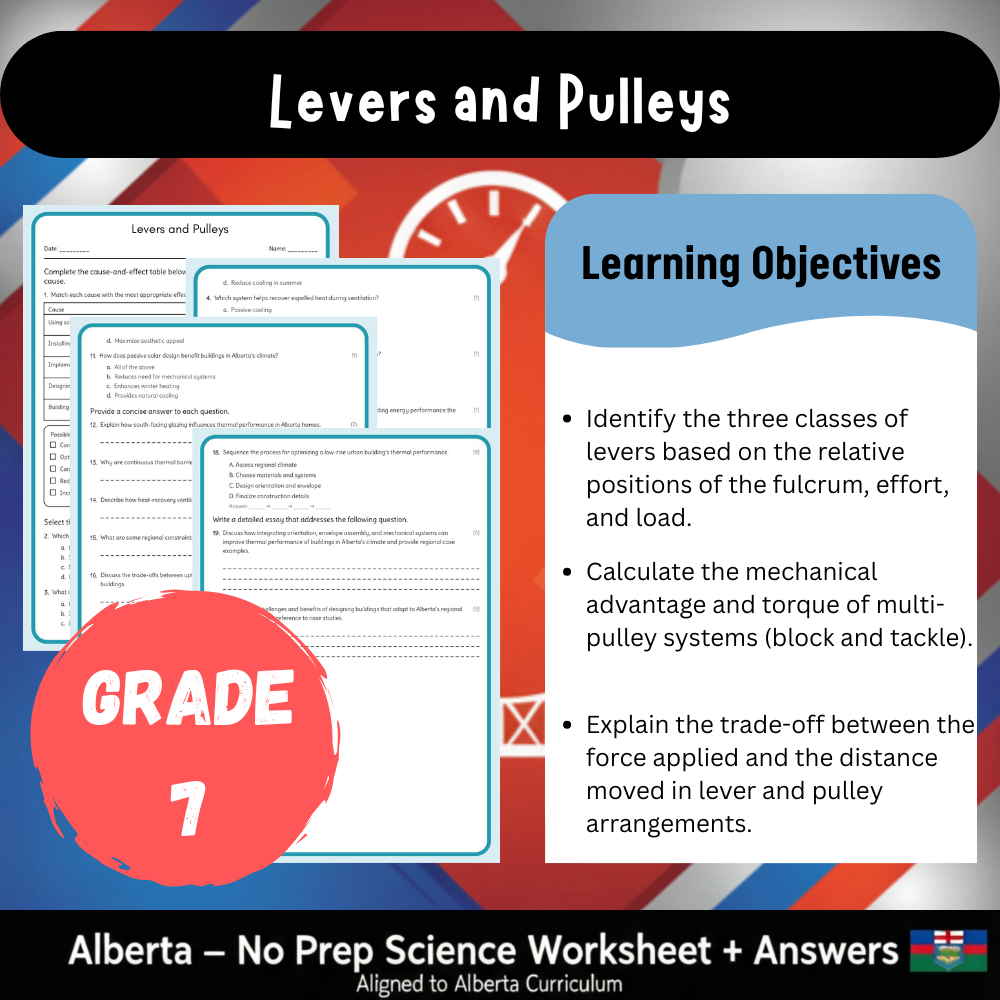
Grade 7 Science | Levers and Pulleys Worksheet (PDF) – Alberta Standard
Created byBright Mind ResourcesLearning Objectives
- Understand the basic principles of levers and pulley systems and how they modify effort and direction.
- Calculate torque and mechanical advantage in lever and pulley arrangements.
- Relate geometry and physics concepts to force multiplication in real-world examples.
Instant download
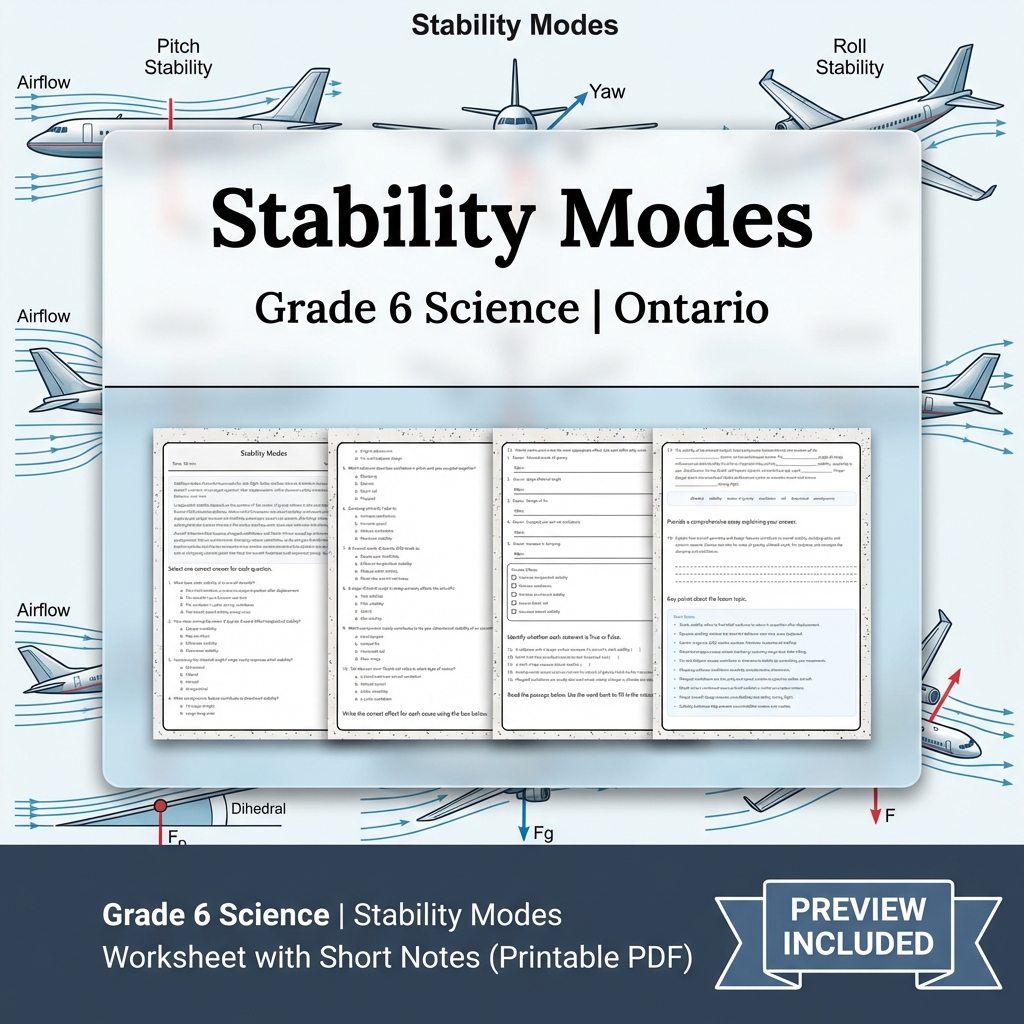
Grade 6 Science | Stability Modes Worksheet with Short Notes (Printable PDF)
 Created byMeadowlark Worksheets
Learning Objectives
- Understand static and dynamic stability types in aircraft.
- Explain how aircraft geometry influences longitudinal, lateral, and directional stability.
- Identify the effects of center of gravity location, dihedral angle, and fin design on stability.
Also included in: Grade 6 Science Lesson Group Bundle – Ontario Framework Worksheets +1 more
Instant download

Grade 12 Resource Systems Worksheet | AP Practice & PDF
 Created byClear Sky Classroom
Learning Objectives
- Analyze how mineral, groundwater, and hydrocarbon systems interact with geologic processes and societal demand
- Interpret ore deposit models, aquifer properties, and basin maturation to explain patterns of resource availability
- Evaluate sustainability constraints using reserve estimates and mass-balance reasoning
Also included in: Grade 12 Earth Systems and Climate Science Bundle – Advanced Placement (AP) +1 more
Instant download
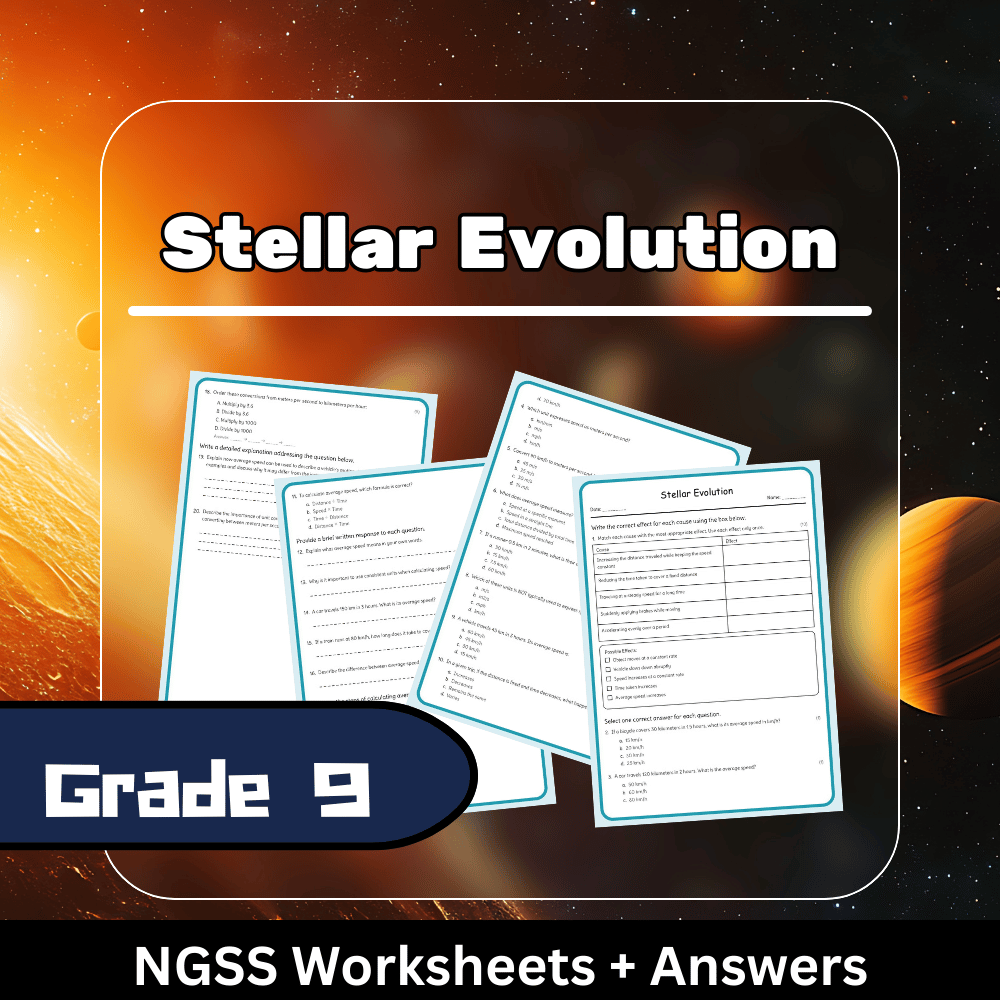
9th Grade Science | Stellar Evolution Worksheet (Answer Key) – NGSS Aligned
Created byBright Mind ResourcesLearning Objectives
- Describe the main stages of stellar evolution, including formation, main sequence, giant phases, and end states such as white dwarfs, neutron stars, and black holes.
- Understand how Hertzsprung-Russell diagrams and spectral classification illustrate stellar properties and evolutionary pathways.
- Explain the processes of nucleosynthesis within stars and how supernovae contribute to elemental enrichment of the interstellar medium.
Instant download

Grade 11 Atomic Structure Worksheet | Practice & Assessment PDF
Created byClear Sky ClassroomLearning Objectives
- Explain the roles of protons, neutrons, and electrons in determining atomic identity and charge
- Use emission spectra and mass spectrometry evidence to support quantized electron energy levels and isotopic variation
- Calculate atomic mass from isotopic abundances and interpret ions formed by electron changes
Also included in: Grade 11 AP Chemistry Science Lesson Bundle: Foundations & Models +1 more
Instant download
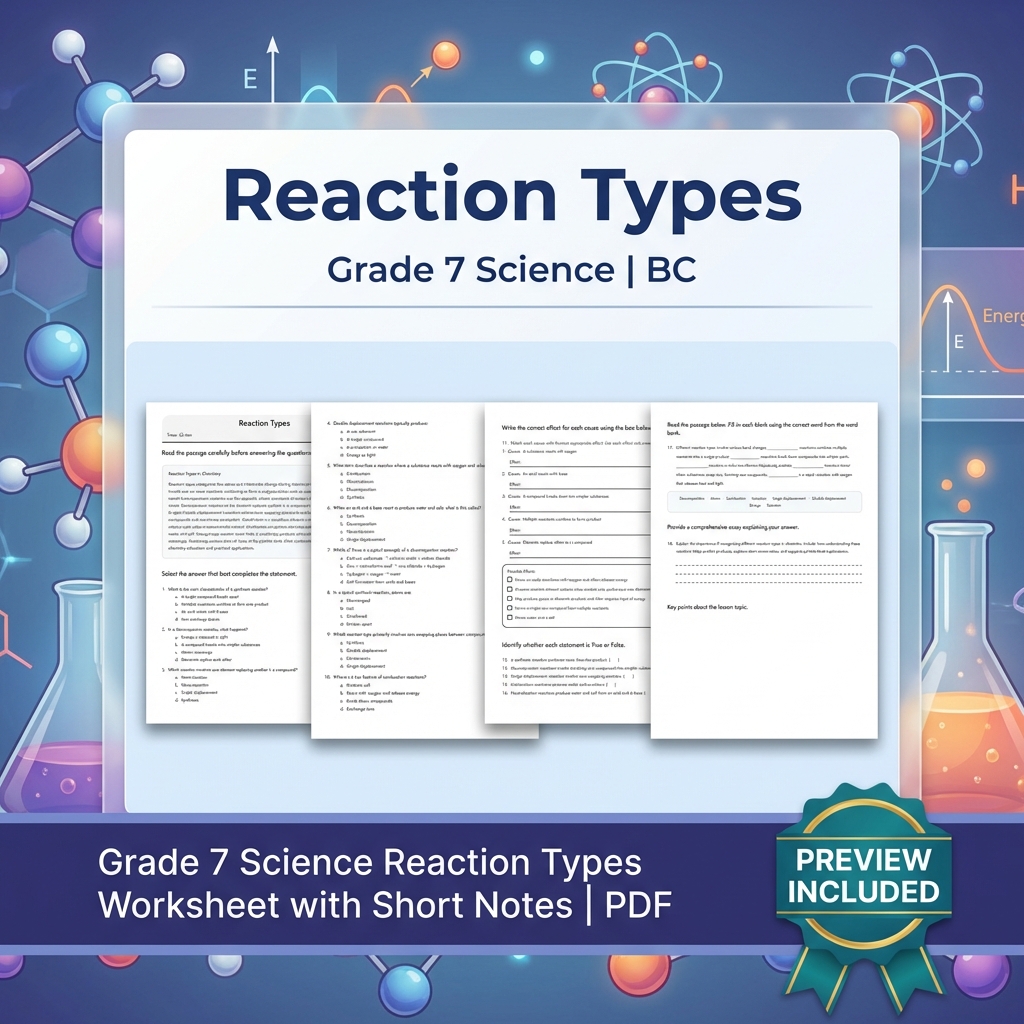
Grade 7 Science Reaction Types Worksheet with Short Notes | PDF
Created byMeadowlark WorksheetsLearning Objectives
- Understand the different categories of chemical reactions, including synthesis, decomposition, single and double displacement, acid–base neutralization, and combustion.
- Identify and classify reaction types based on given chemical equations and descriptions.
- Explain particle-level processes involved in various reaction types and how atoms rearrange during reactions.
Also included in: Grade 7 Science Lesson Bundle | BC Framework on Matter & Reactions Worksheets +1 more
Instant download

Grade 7 Science - Conservation Status Worksheet (Alberta Standard) (PDF)
 Created byEvergreen Desk Education
Learning Objectives
- Explain how conservation status assessments use population trends, threat severity, and recovery potential.
- Interpret evidence from examples (such as swift fox and at-risk plants) to identify why a species is vulnerable.
- Describe how land use, genetic diversity, and habitat connectivity affect species persistence.
Instant download

Energy Pathways Worksheet Pack | Grade 9 AP Science Activities
 Created byBright Quill Resources
Learning Objectives
- Explain how radiative balance, conduction, convection, and latent heat move energy through the atmosphere and oceans
- Interpret global energy budget ideas and flux comparisons to link differential heating with circulation patterns
- Connect energy partitioning to observable climate indicators such as surface temperature and sea surface temperature anomalies
Instant download
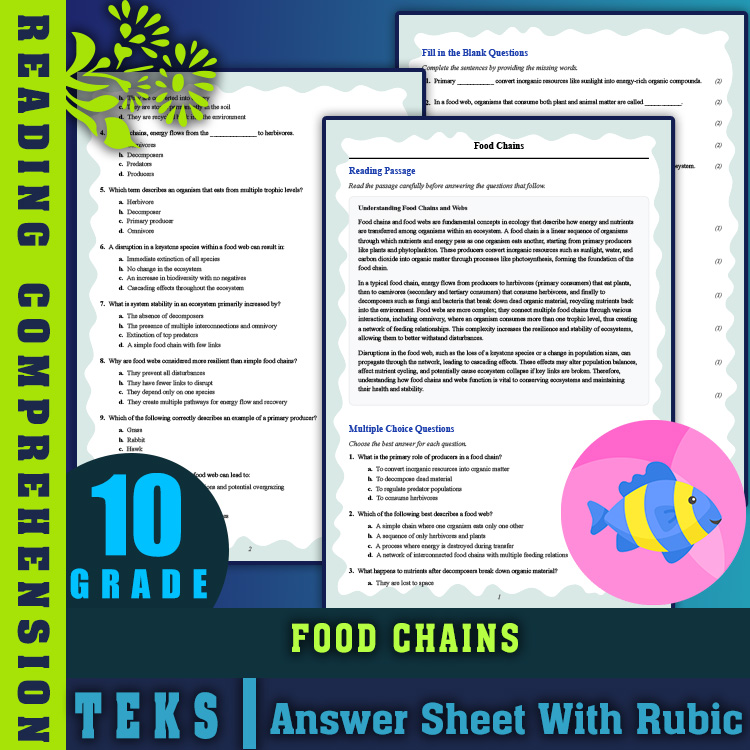
10th Grade Science | Food Chains Reading Worksheet (PDF + Answer Key)
JCreated byJ.S SheetsLearning Objectives
- Understand the concept of food chains and food webs and how energy flows through ecosystems.
- Identify the roles of producers, consumers, and decomposers in food chains.
- Explain the effects of disruptions in food webs on ecosystems.
Instant download

Engineering Problem Worksheet | California Standards Grade 10 Science
JCreated byJ.S SheetsLearning Objectives
- Understand how to define engineering problems in terms of success criteria and constraints.
- Learn how criteria and constraints influence engineering design decisions.
- Analyze real-world examples of engineering problems and solution pathways.
Also included in: Grade 10 Engineering Design Optimization Science Lesson Bundle +1 more
Instant download

Optimizing Design Worksheet | California Standards Grade 10 Science
JCreated byJ.S SheetsLearning Objectives
- Understand the principles of design optimization in engineering contexts.
- Identify criteria and constraints that influence structural design choices.
- Analyze trade-offs involved in selecting design parameters for bridges.
Also included in: Grade 10 Engineering Design Optimization Science Lesson Bundle +1 more
Instant download

Measurable Criteria Worksheet for Grade 10 Science | California Standards
JCreated byJ.S SheetsLearning Objectives
- Understand the difference between constraints and criteria in design processes.
- Identify measurable performance targets for projects.
- Distinguish between constraints that limit choices and criteria that define goals.
Also included in: Grade 10 Engineering Design Optimization Science Lesson Bundle +1 more
Instant download

Grade 12 Community Interactions Worksheet | Ecology STSE Activity
Created byEvergreen Desk EducationLearning Objectives
- Distinguish key interspecific interaction types (competition, predation, parasitism, mutualism, commensalism) and predict likely effects on populations.
- Explain how energy flow through food webs and trophic efficiency influence biomass distribution and ecosystem functioning.
- Apply ecological concepts to Alberta examples (aspen–mycorrhizal mutualism and wolf–elk–vegetation cascades) to reason about community resilience and biodiversity.
Instant download
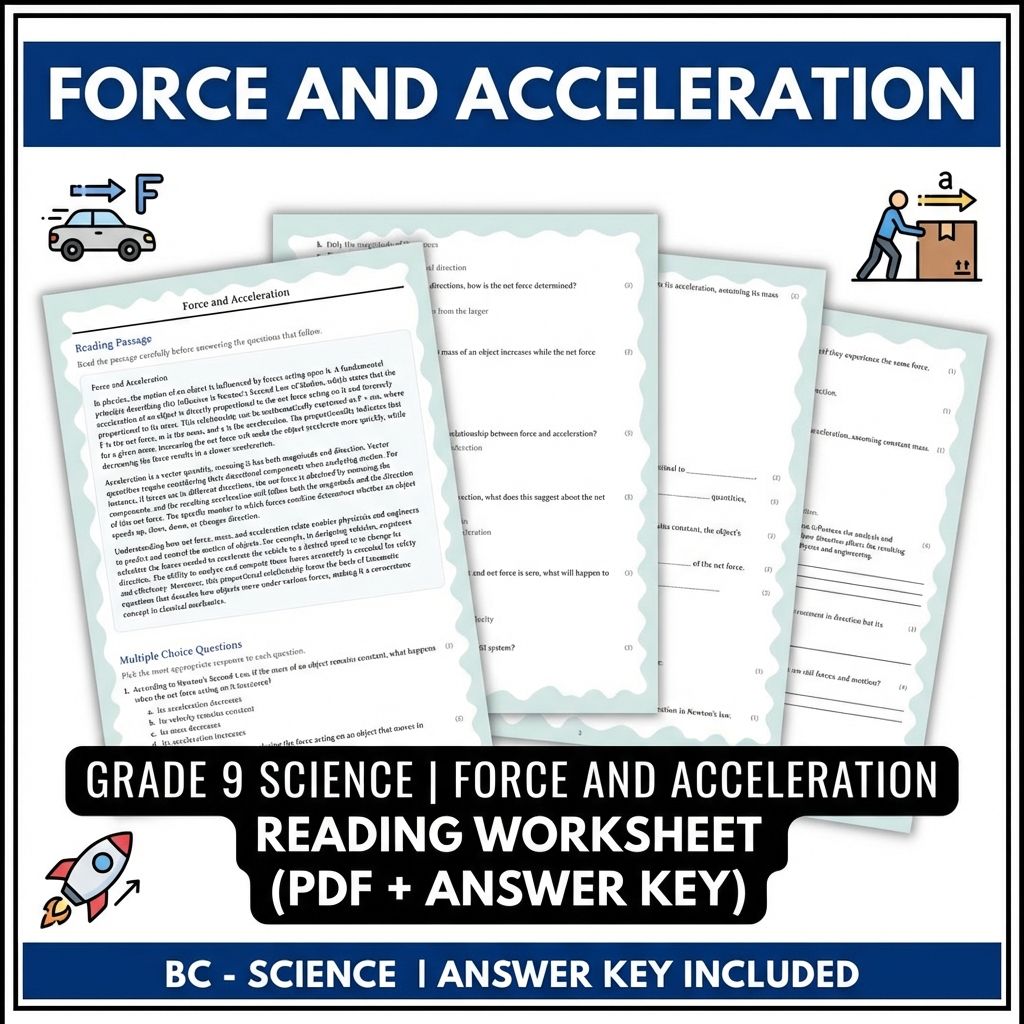
Grade 9 Science | Force and Acceleration Reading Worksheet (PDF + Answer Key)
JCreated byJ.S SheetsLearning Objectives
- Understand the relationship between net force, mass, and acceleration as described by Newton's second law.
- Analyze how vector quantities like force and acceleration affect an object's motion.
- Apply the proportionality rule to predict an object’s change in speed or direction under various forces.
Instant download
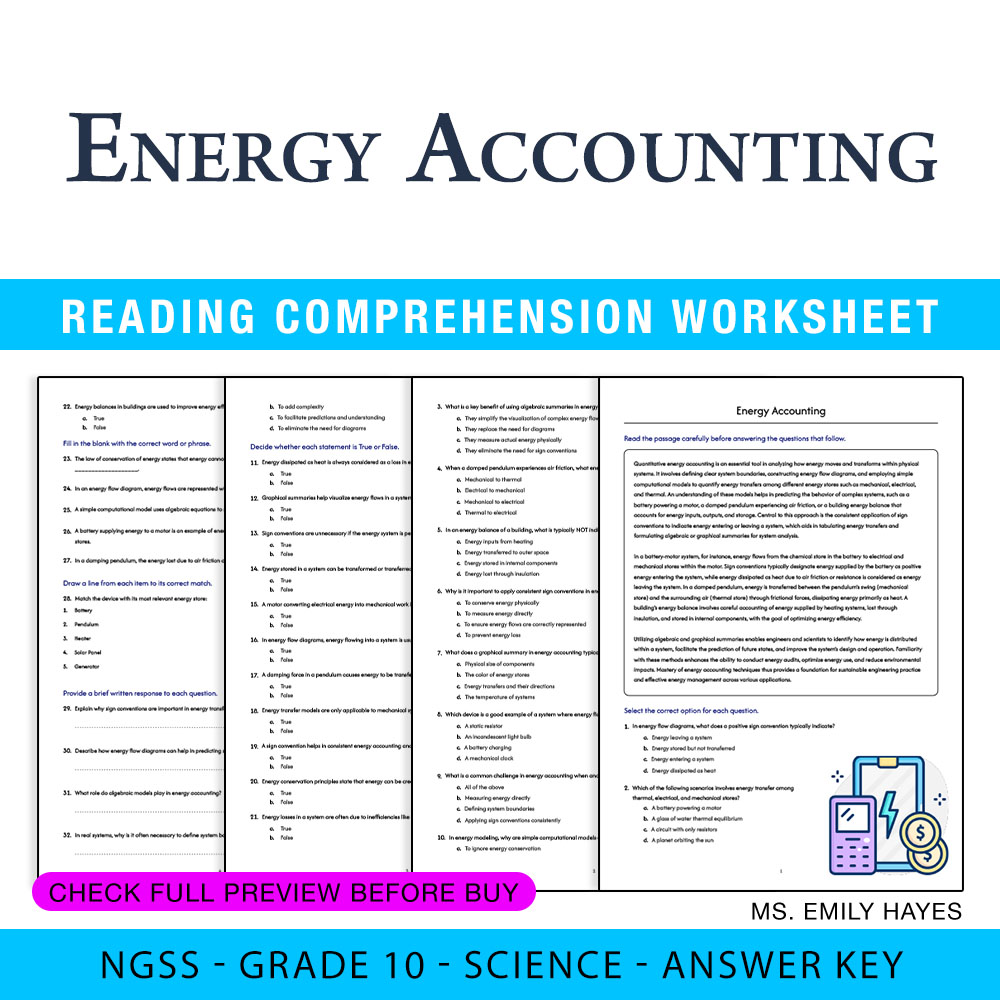
10th Grade Science | Energy Accounting Worksheet (PDF + Answer Key)
 Created byCopper Leaf Classroom
Learning Objectives
- Understand the principles of energy flow in physical systems using energy flow diagrams.
- Apply system boundary definitions and sign conventions effectively in energy calculations.
- Use algebraic and graphical methods to summarize energy transfers and predict energy distribution.
Instant download

Grade 10 Dynamic Equilibrium Worksheet | Practice & Assessment PDF
Created byClear Sky ClassroomLearning Objectives
- Explain why chemical equilibrium is dynamic using forward and reverse reaction rates
- Interpret equilibrium expressions and predict how equilibrium shifts under changes in concentration, pressure, or temperature
- Use Le Châtelier’s principle and K (equilibrium constant) reasoning to forecast net reaction trends
Instant download
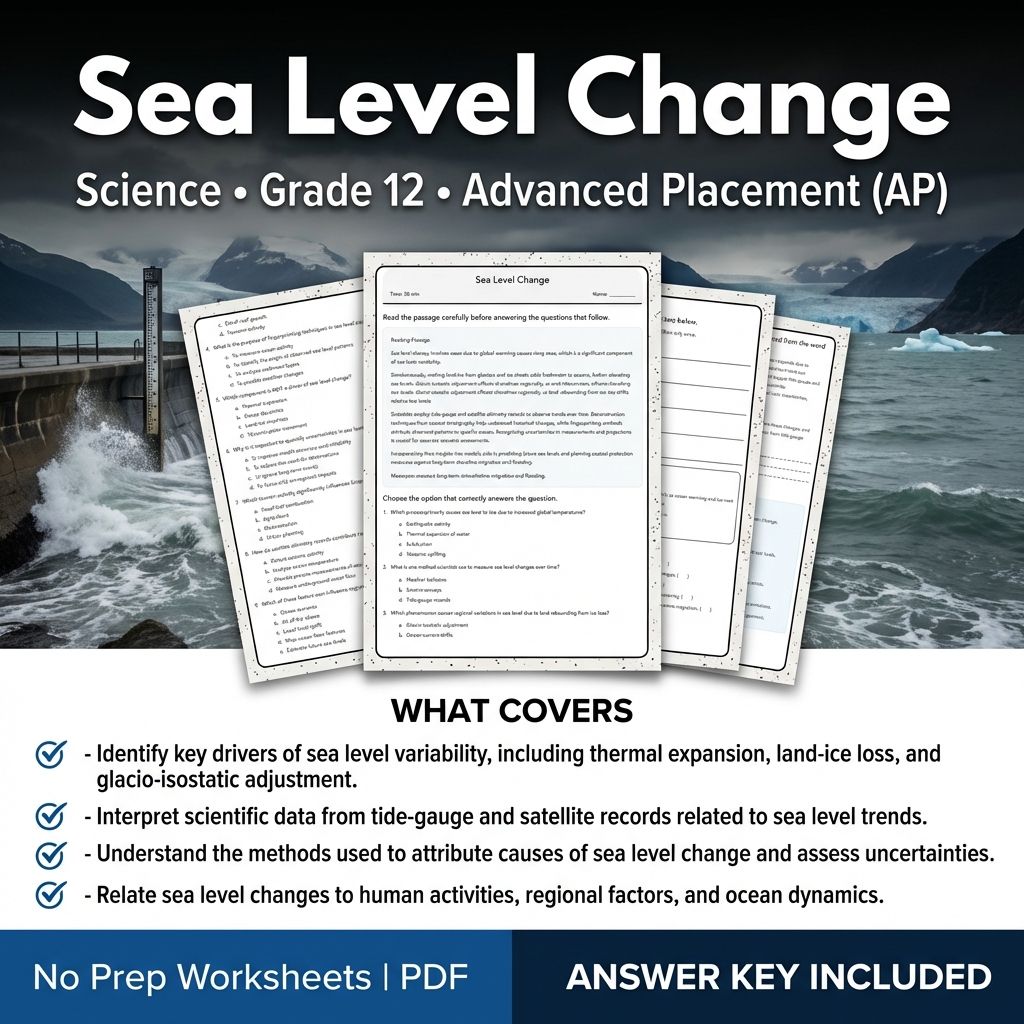
Grade 12 Science | Sea Level Change Worksheet & Answer Key (AP Standards)
 Created byCoral Reef Learning
Learning Objectives
- Identify key drivers of sea level variability, including thermal expansion, land-ice loss, and glacio-isostatic adjustment.
- Interpret scientific data from tide-gauge and satellite records related to sea level trends.
- Understand the methods used to attribute causes of sea level change and assess uncertainties.
Also included in: Grade 12 Science Unit Worksheets Pack | Earth's Systems & Surface Processes +1 more
Instant download

Grade 11 Science | Model Revision Worksheet | NGSSS Aligned
 Created byLumora Learning
Learning Objectives
- Explain why scientific models are revised when new evidence or better methods reveal mismatches.
- Describe the steps of model revision using predictions, evidence, and identification of gaps.
- Distinguish model revision from “starting over” in science.
Instant download
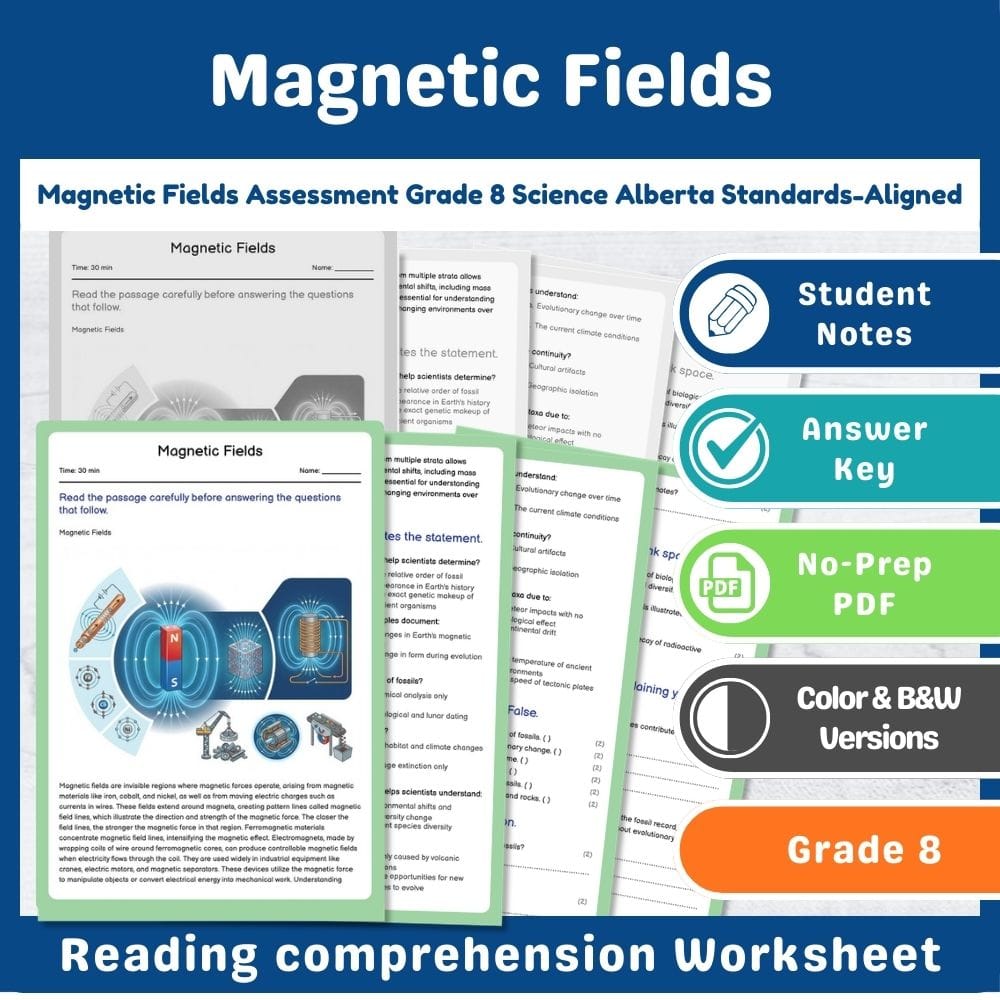
Magnetic Fields Assessment Grade 8 Science Alberta Standards-Aligned
Created byPrism Point LearningLearning Objectives
- Describe the origins and properties of magnetic fields from materials and moving charges.
- Identify the visual representation of magnetic field lines and interpret their significance.
- Explain the concept of ferromagnetic materials and how they concentrate magnetic effects.
Instant download
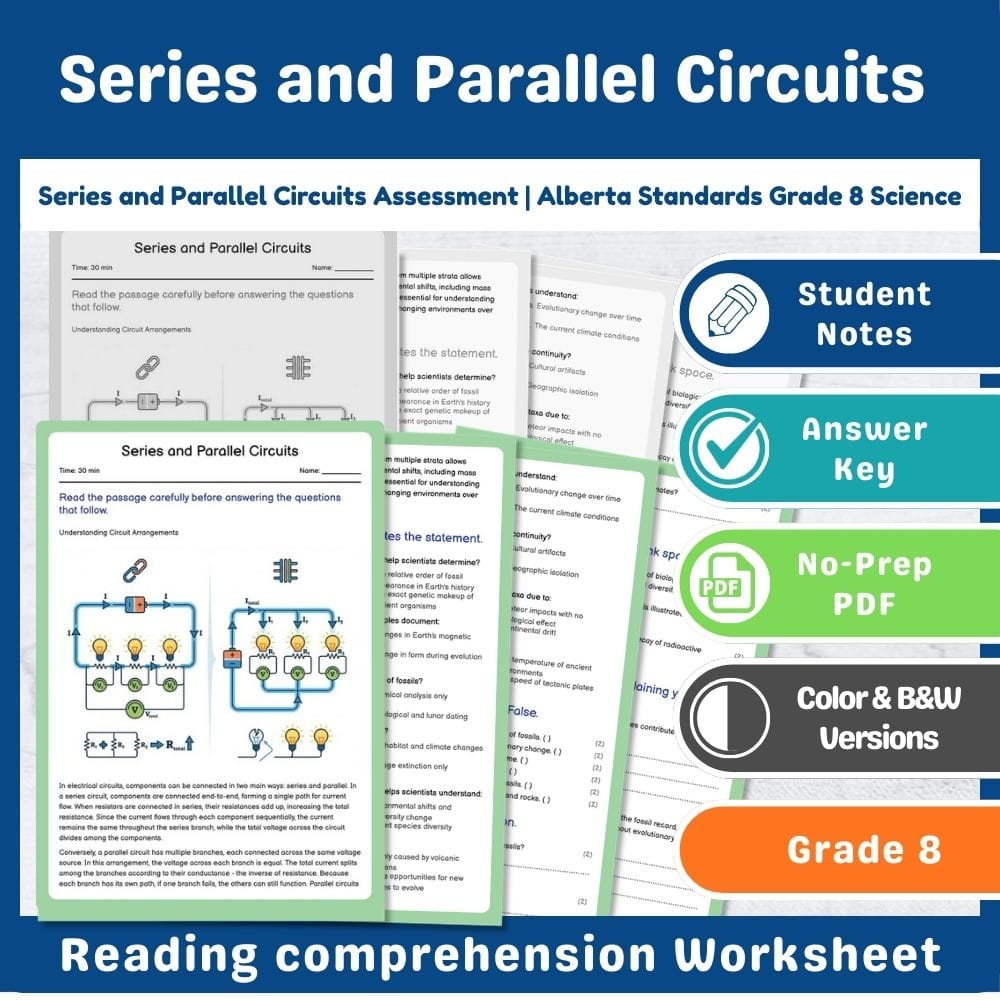
Series and Parallel Circuits Assessment | Alberta Standards Grade 8 Science
Created byPrism Point LearningLearning Objectives
- Understand the differences between series and parallel circuit arrangements.
- Predict how circuit behavior changes in series and parallel configurations.
- Compare resistances, current distribution, and voltages in series and parallel circuits.
Instant download
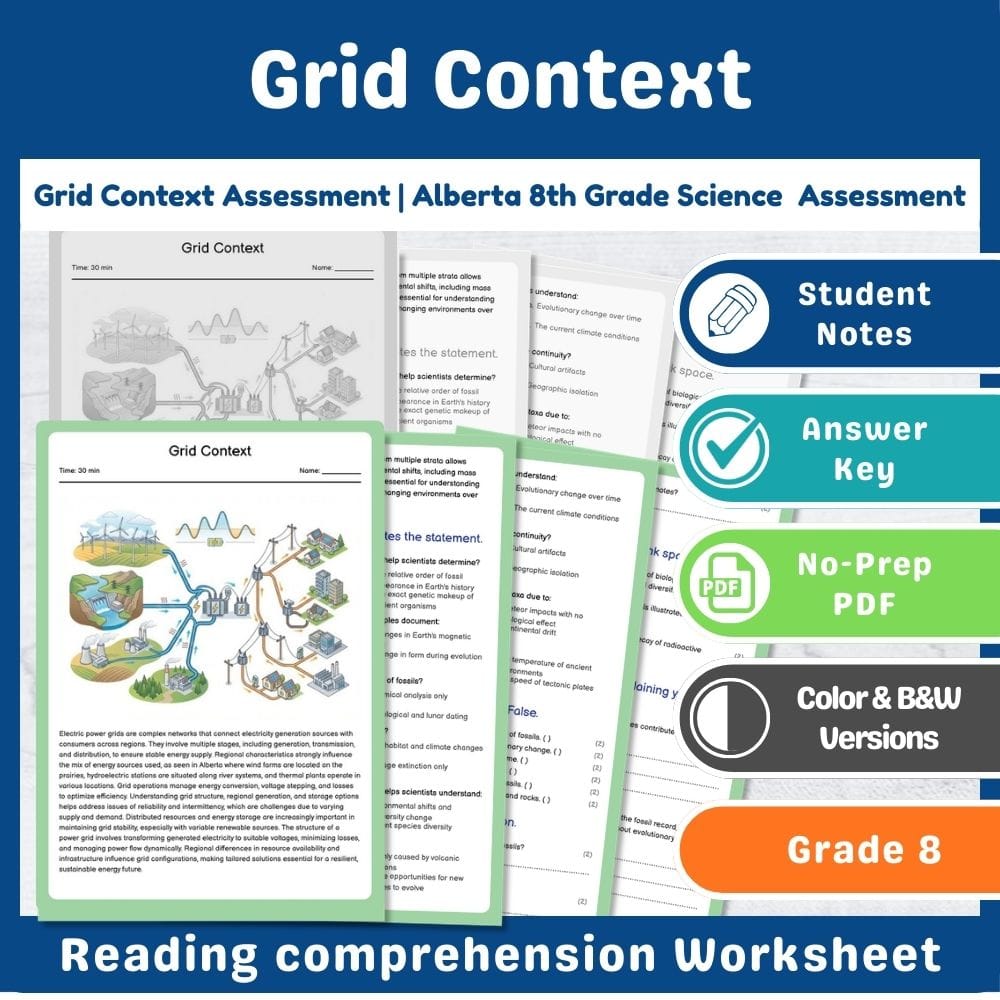
Grid Context Assessment | Alberta 8th Grade Science Standards-Aligned Assessment
Created byPrism Point LearningLearning Objectives
- Understand the components and functions of electric power grids.
- Identify regional characteristics influencing energy generation.
- Explain grid operations including conversion and voltage management.
Instant download
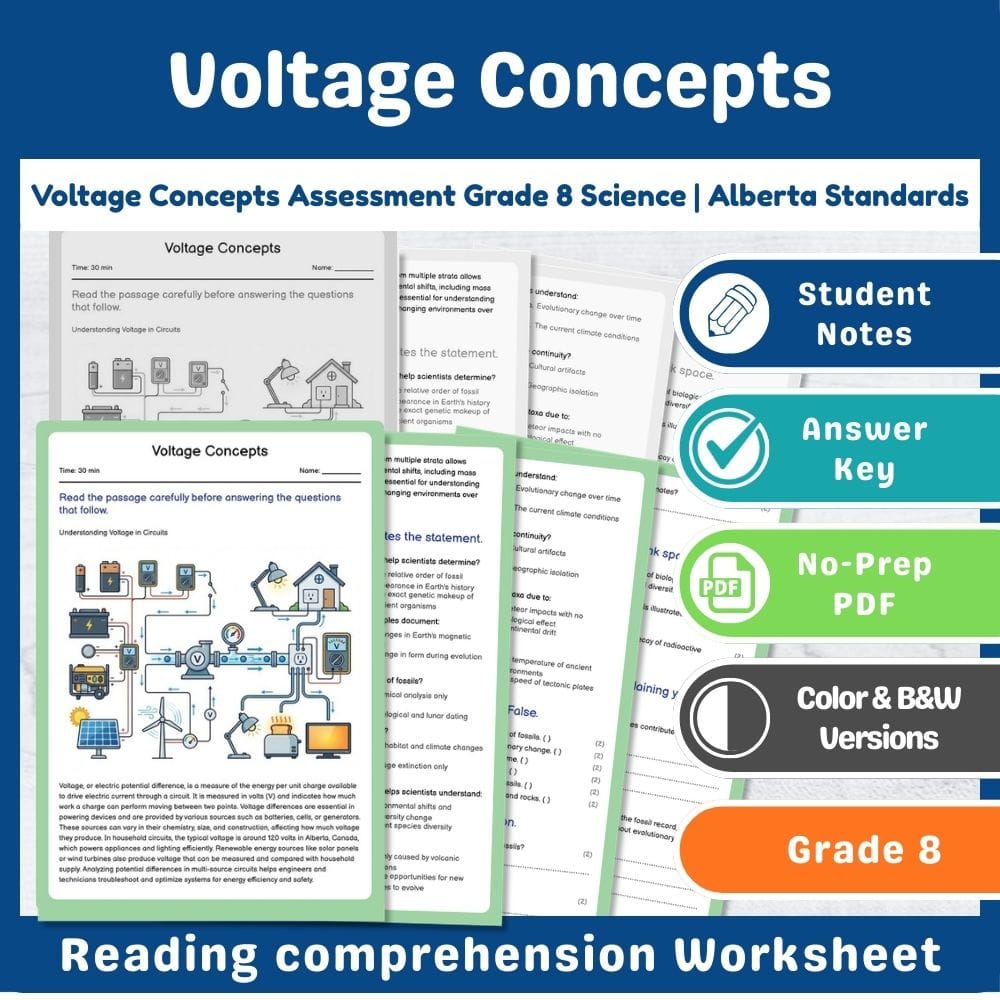
Voltage Concepts Assessment Grade 8 Science | Alberta Standards
Created byPrism Point LearningLearning Objectives
- Understand the concept of electric potential difference and its measurement units.
- Identify different sources of voltage and how they affect current flow in circuits.
- Compare household voltages and renewable energy outputs relevant to Alberta.
Instant download
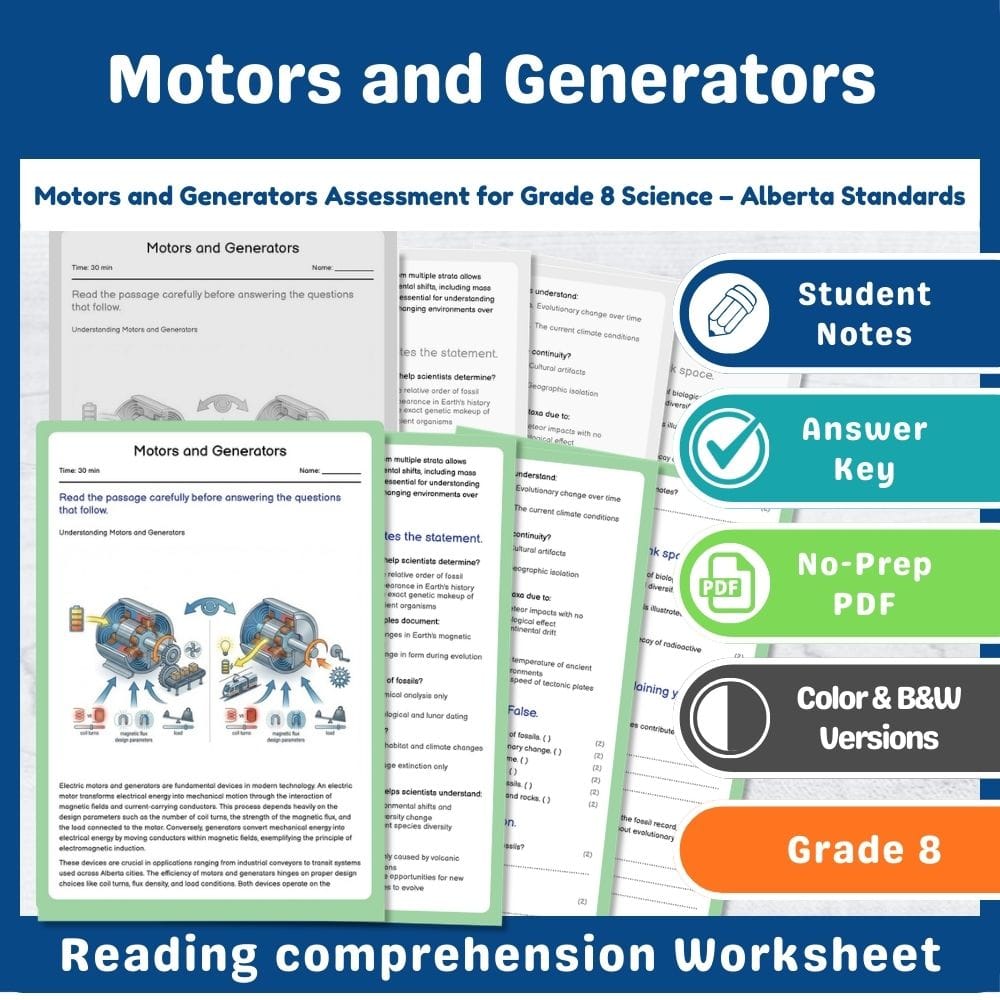
Motors and Generators Assessment for Grade 8 Science – Alberta Standards
Created byPrism Point LearningLearning Objectives
- Understand the principles of how electric motors convert electrical energy into mechanical motion.
- Explain how generators produce electrical energy from mechanical motion.
- Identify design parameters that influence the efficiency and power output of motors and generators.
Instant download
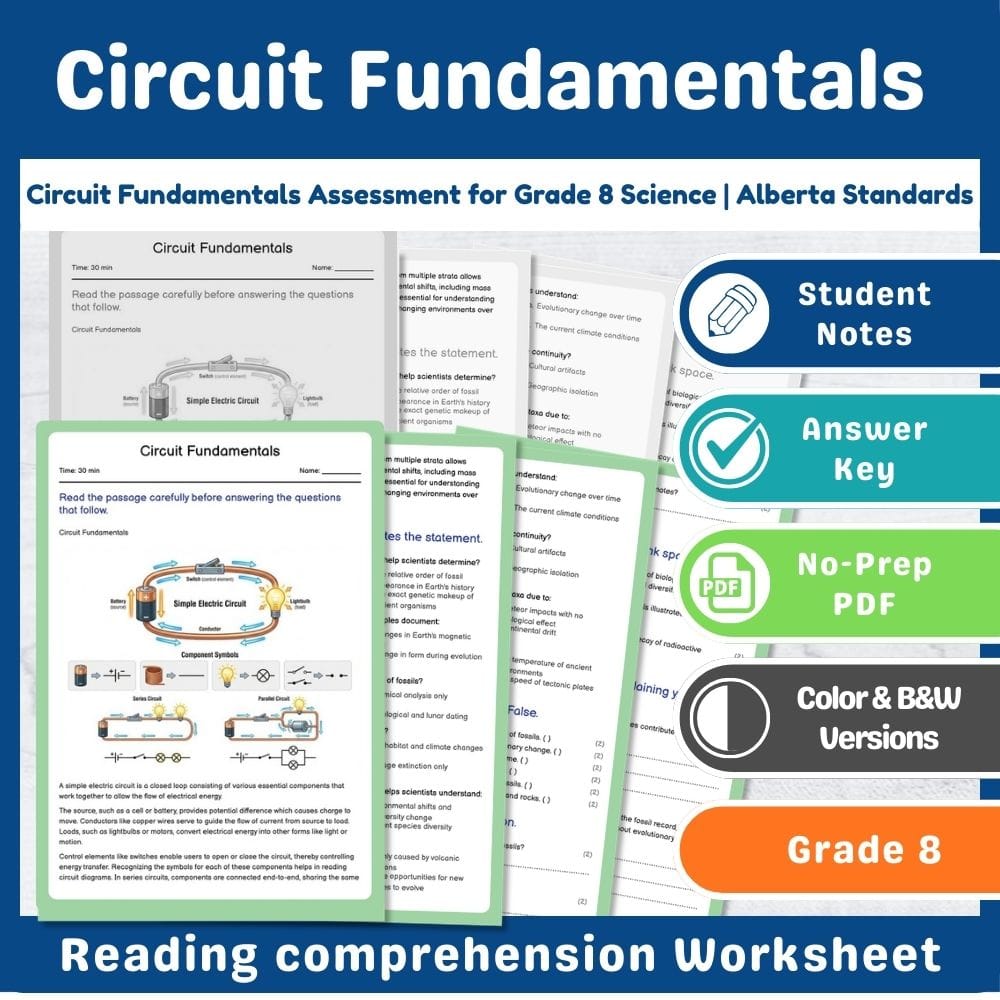
Circuit Fundamentals Assessment for Grade 8 Science | Alberta Standards
Created byPrism Point LearningLearning Objectives
- Identify the main components of a simple electric circuit.
- Explain the functions of sources, conductors, loads, and control elements.
- Recognize schematic symbols for common circuit components.
Instant download
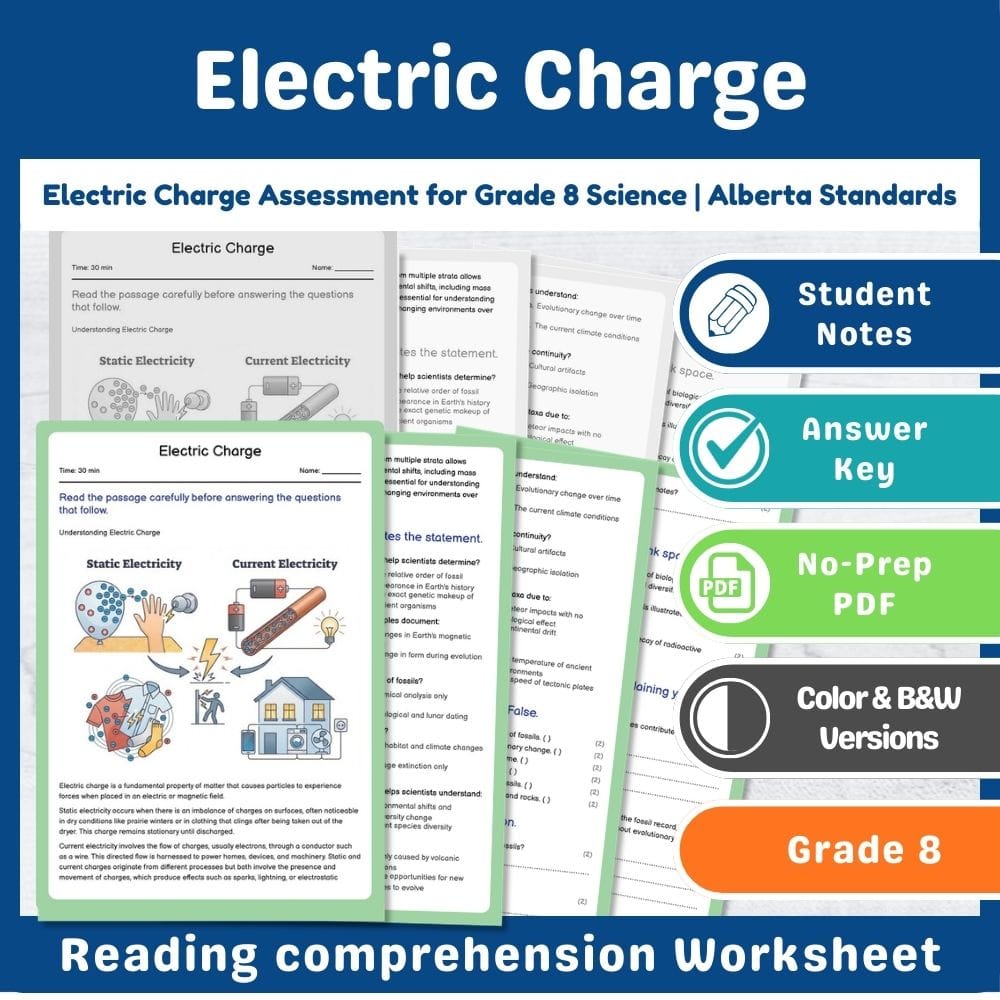
Electric Charge Assessment for Grade 8 Science | Alberta Standards
Created byPrism Point LearningLearning Objectives
- Describe the concept of electric charge and its intrinsic properties.
- Explain the differences between static electricity and current electricity.
- Identify real-world phenomena related to electrostatic effects and electric currents.
Instant download
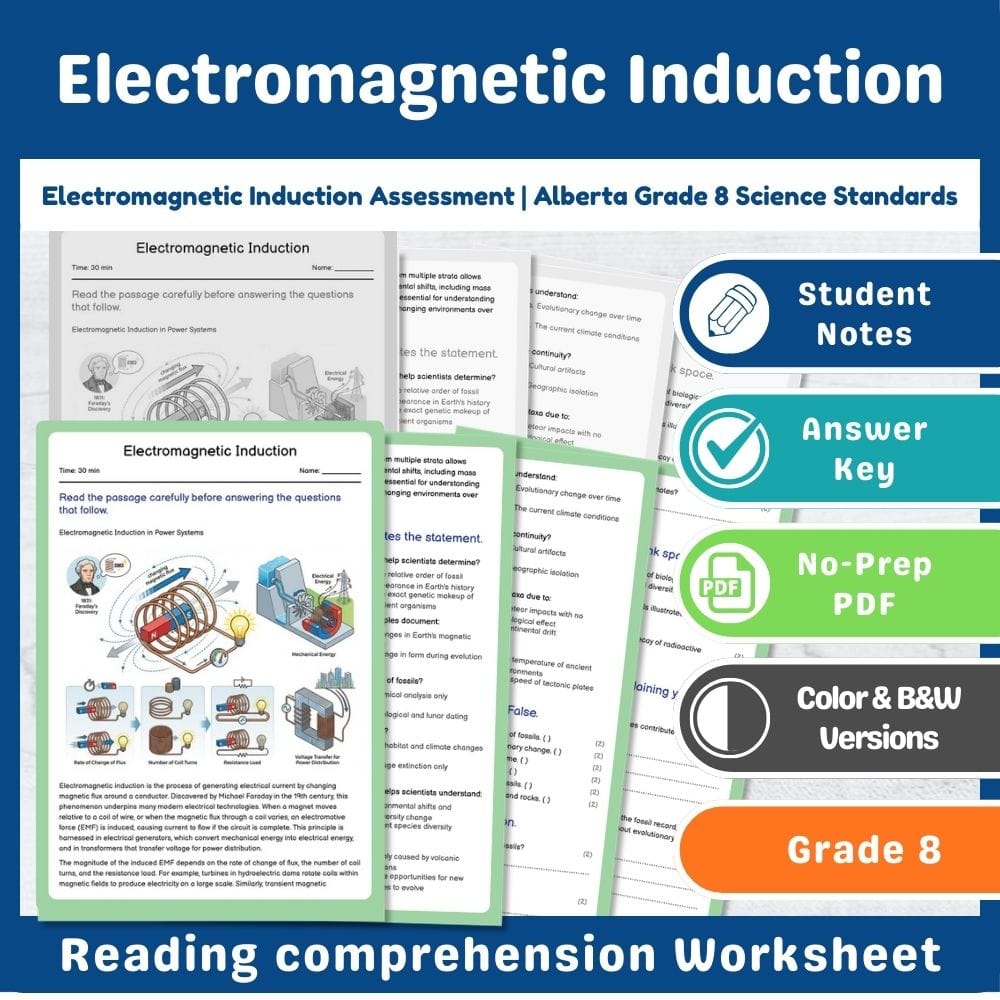
Electromagnetic Induction Assessment | Alberta Grade 8 Science Standards
Created byPrism Point LearningLearning Objectives
- Explain the principle of electromagnetic induction and how changing magnetic flux induces current.
- Identify applications of electromagnetic induction in power generation and renewable energy.
- Describe the factors affecting the magnitude of induced electromotive force in coils.
Instant download
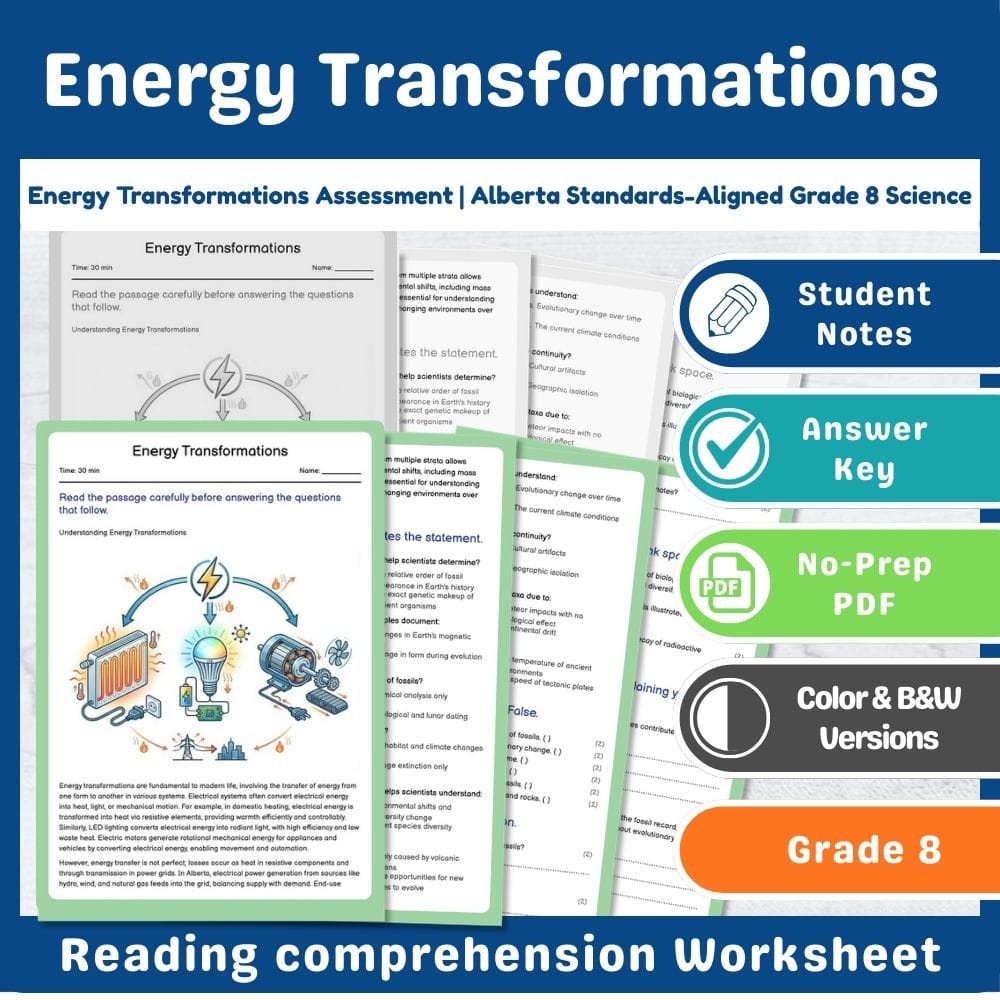
Energy Transformations Assessment | Alberta Standards-Aligned Grade 8 Science
Created byPrism Point LearningLearning Objectives
- Understand how electrical energy is transferred and transformed into thermal, radiant, and mechanical energy.
- Identify examples of energy conversions in domestic and industrial systems.
- Explain the concepts of power and efficiency in energy systems.
Instant download
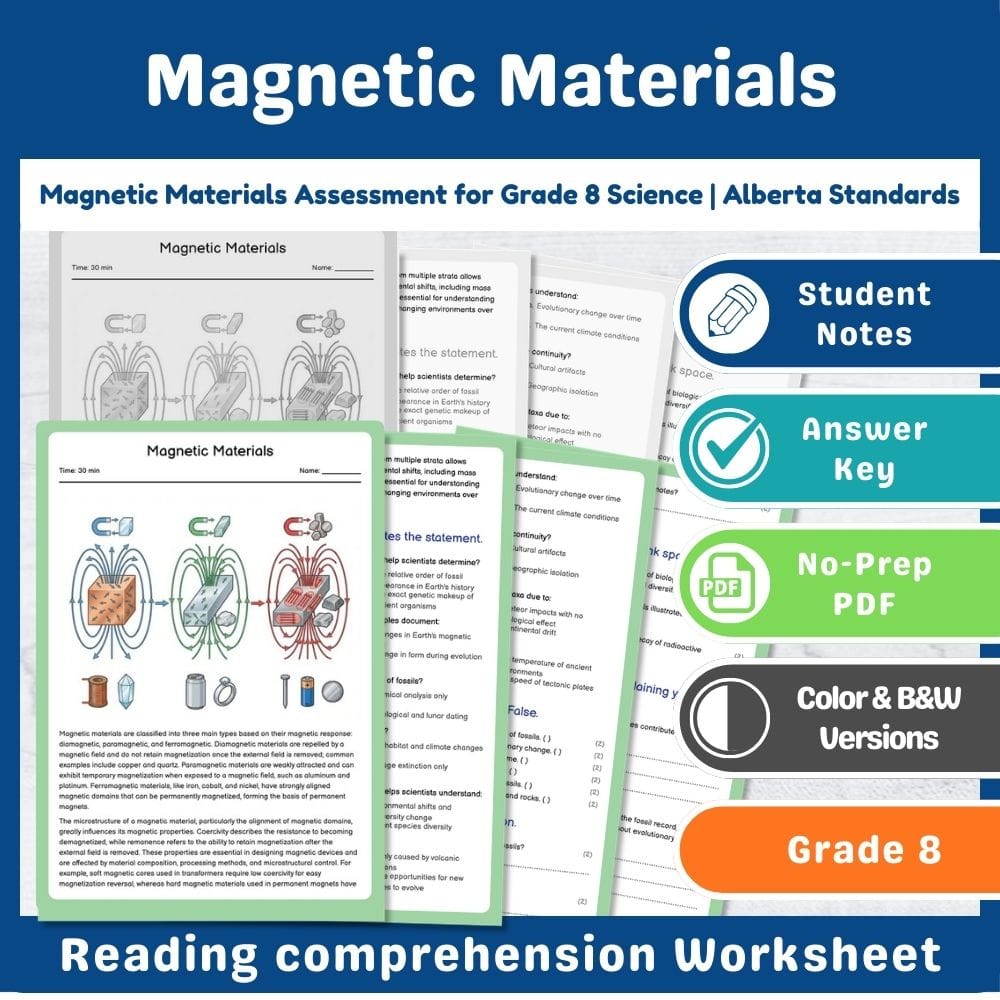
Magnetic Materials Assessment for Grade 8 Science | Alberta Standards
Created byPrism Point LearningLearning Objectives
- Describe the classification of materials based on their magnetic response.
- Explain how microstructural properties influence magnetic behavior such as coercivity and remanence.
- Identify practical applications of ferromagnetic, paramagnetic, and diamagnetic materials in industry.
Instant download
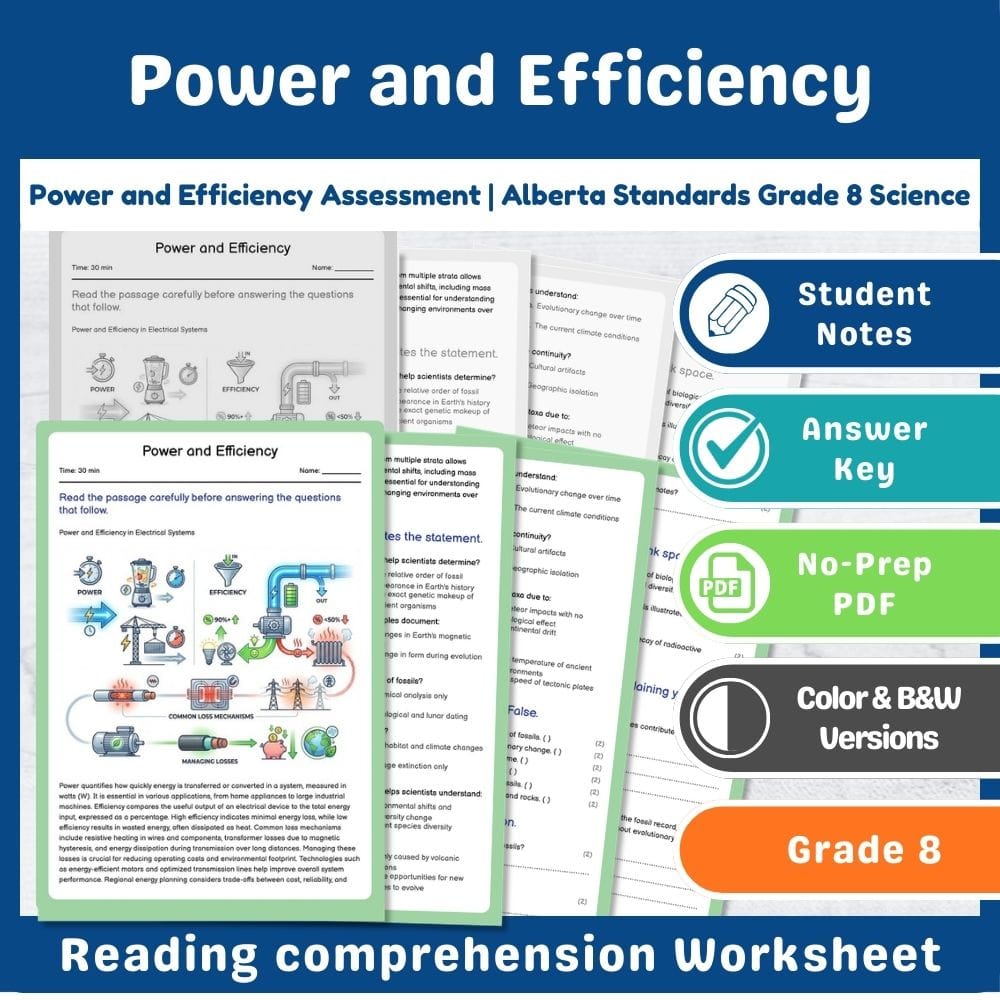
Power and Efficiency Assessment | Alberta Standards Grade 8 Science
Created byPrism Point LearningLearning Objectives
- Understand the concept of power as energy transfer per unit time.
- Identify factors affecting the efficiency of electrical devices.
- Analyze mechanisms of power loss such as resistive heating and transmission dissipation.
Instant download
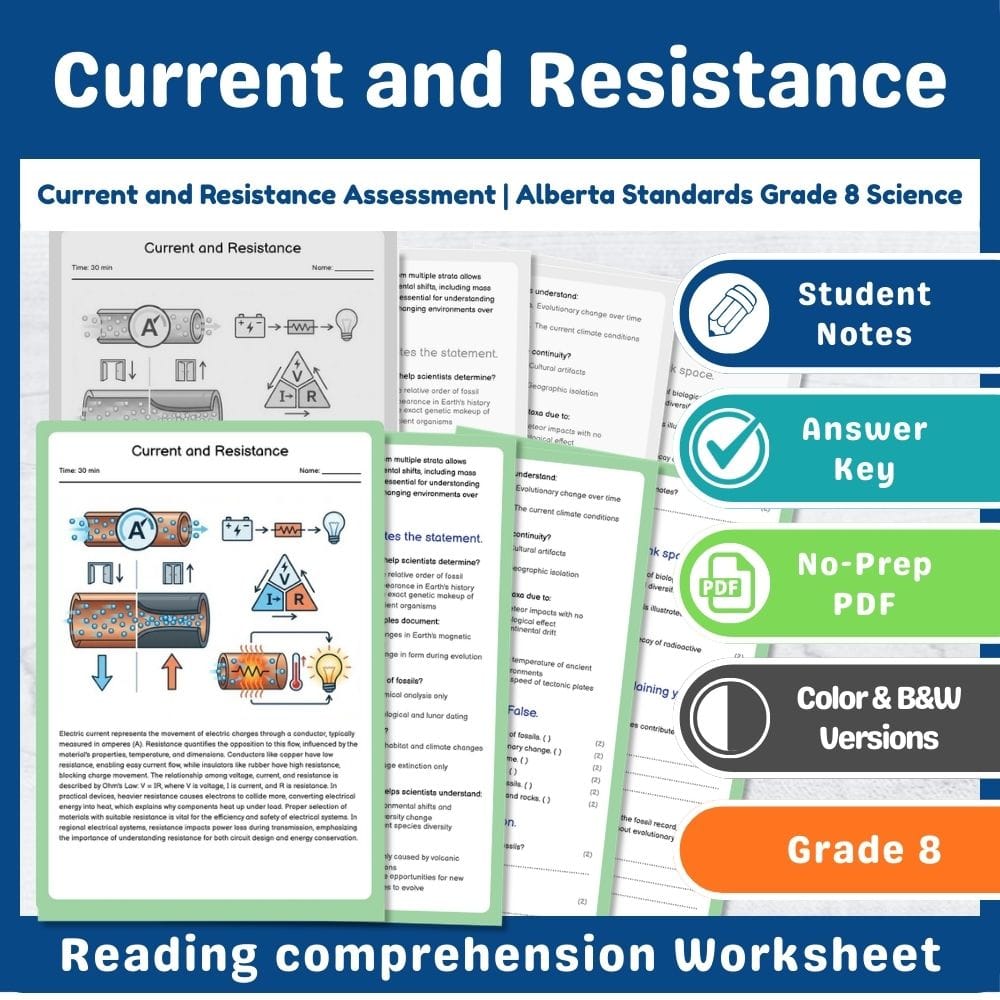
Current and Resistance Assessment | Alberta Standards Grade 8 Science
Created byPrism Point LearningLearning Objectives
- Explain the concept of electric current as the rate of charge flow in materials.
- Describe how resistance affects the flow of current in an electrical circuit.
- Identify factors such as material properties, temperature, and geometry that influence resistance.
Instant download

Electrical Safety and Environmental Implications Assessment for Grade 8 Science
Created byPrism Point LearningLearning Objectives
- Identify key safety considerations in electrical system design and operation.
- Understand environmental impacts related to energy sourcing and infrastructure.
- Recognize protective devices and proper component specifications to mitigate hazards.
Instant download

Measurement Practices Assessment | Florida NGSSS Grade 8 Science
Created byPrism Point LearningLearning Objectives
- Explain how accuracy and precision affect the credibility of scientific measurements.
- Use appropriate units, tools, and recording practices when measuring physical quantities.
- Identify how significant figures and consistent procedures improve data quality.
Instant download
Grade 9 Science | Adaptive Radiation Worksheet for Mastery
 Created byThe Resource Hub
Learning Objectives
- Define adaptive radiation and explain its significance in evolution.
- Describe the ecological and genetic factors that drive adaptive radiations.
- Identify examples of adaptive radiation in the natural world.
Also included in: Grade 9 Science Evolution & Classification Unit Worksheet Pack +1 more
Instant download
Grade 8 Science – Pollution Sources | Daily Reading Worksheet + Answer Key
JCreated byJ.S SheetsLearning Objectives
- Identify the different types of pollution sources: point and nonpoint
- Recognize examples of pollution sources such as industrial effluents, sewage discharges, and agricultural runoff
- Understand processes like eutrophication and oxygen depletion
Also included in: Grade 8 Science Lesson Group: Water Systems and Water Quality Framework +1 more
Instant download
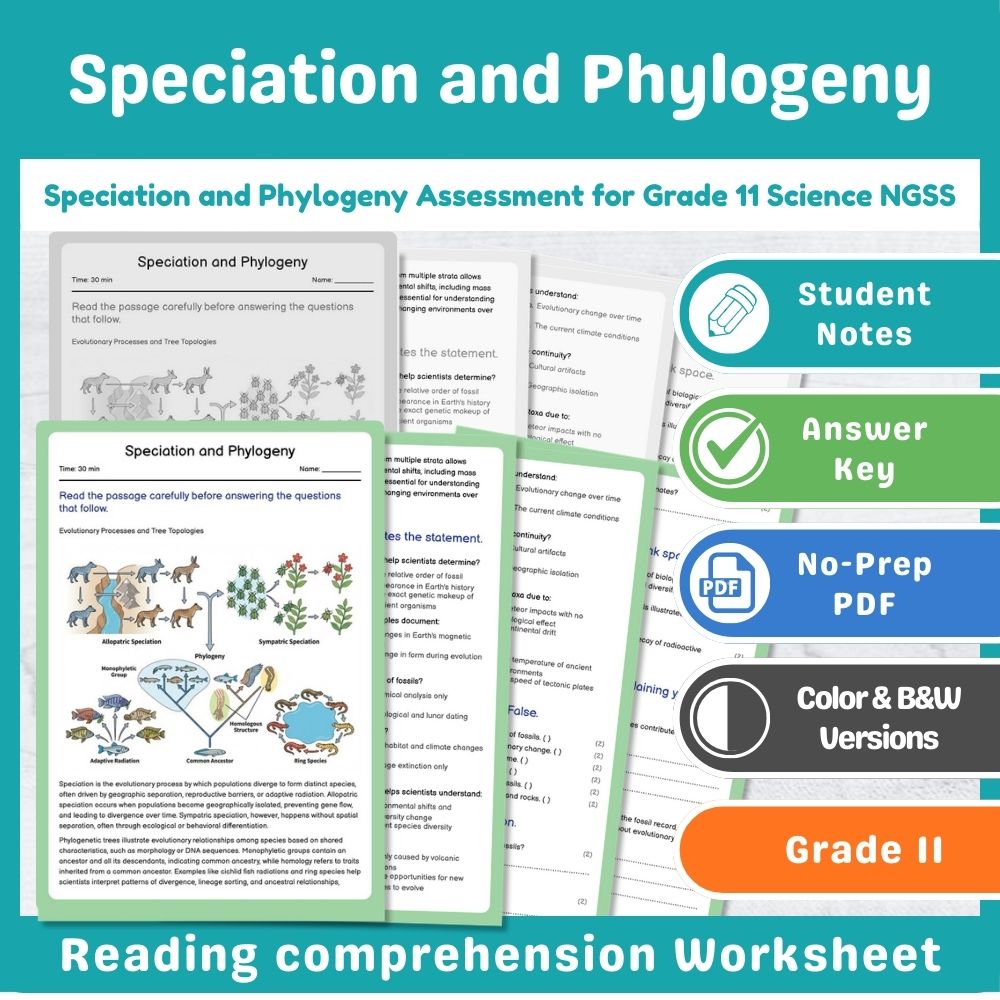
Speciation and Phylogeny Assessment for Grade 11 Science NGSS
Created byPrism Point LearningLearning Objectives
- Explain the mechanisms leading to the origin of new species, including geographic isolation and reproductive barriers.
- Describe different modes of speciation, such as allopatric and sympatric, and their implications.
- Interpret phylogenetic trees based on morphological and molecular data to understand evolutionary relationships.
Instant download
Grade 12 Science | DNA Replication (Worksheet + Answer Key) – Alberta Standards
Created byBright Mind ResourcesLearning Objectives
- Describe the semi-conservative nature of DNA replication.
- Identify the roles of key enzymes such as helicase, primase, and DNA polymerase in DNA replication.
- Explain mechanisms that ensure replication fidelity and repair for mutation control.
Instant download
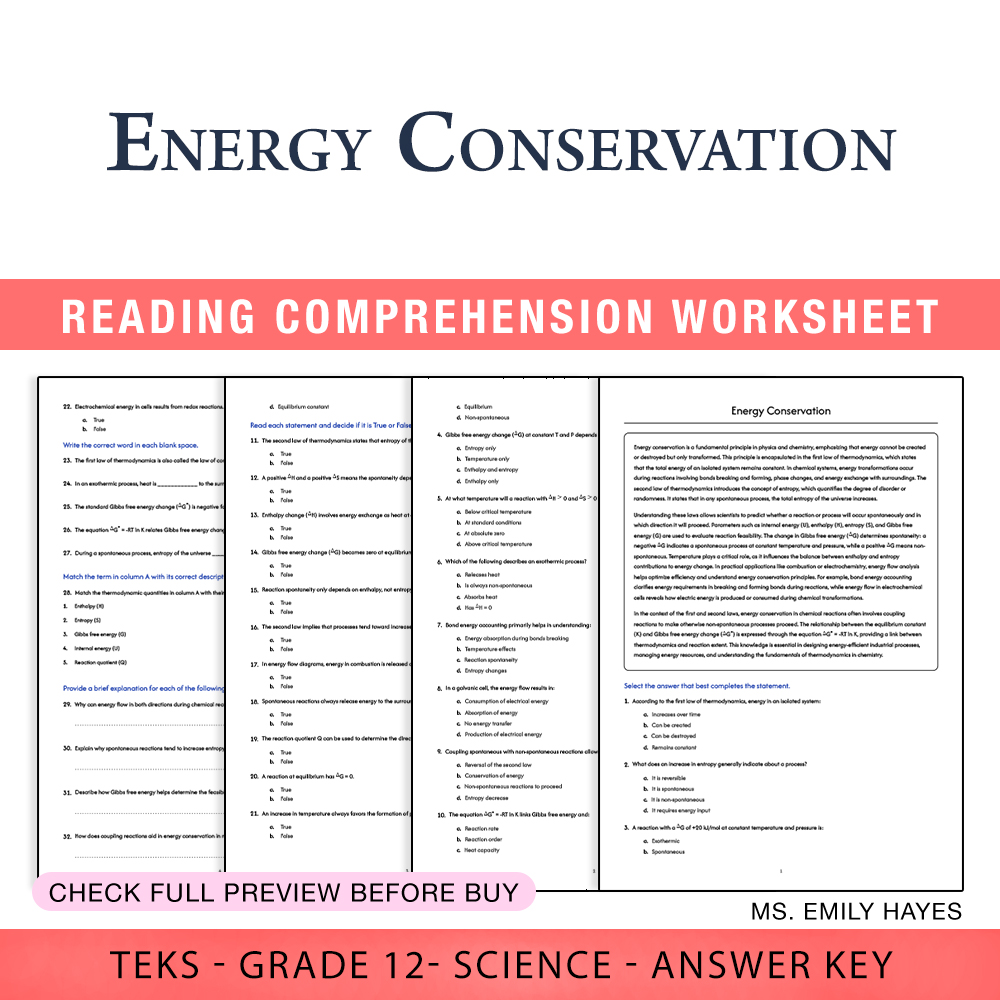
Grade 12 Science | Energy Conservation Worksheet (PDF+ Answer Key)
Created byCopper Leaf ClassroomLearning Objectives
- Explain the first and second laws of thermodynamics and their application to chemical systems.
- Analyze how internal energy, enthalpy, entropy, and Gibbs free energy predict reaction spontaneity and equilibrium.
- Interpret free energy changes from equilibrium constants in various processes.
Instant download

Grade 11 Evaluating Explanations Worksheet | Florida NGSSS Science Key
Created byEvergreen Desk EducationLearning Objectives
- Evaluate scientific explanations by analyzing the quality and limits of evidence.
- Distinguish correlation from cause by looking for mechanisms and testable predictions.
- Compare alternative explanations using the same evidence and propose observations that could discriminate between them.
Instant download

Atomic Structure Assessment for Grade 7 Science | TEKS Standards
Created byPrism Point LearningLearning Objectives
- Describe the basic subatomic particles of protons, neutrons, and electrons and their roles in atomic structure.
- Explain how atomic number and mass number define element identity and isotopic variation.
- Identify simple electron arrangements and relate them to element properties and periodic trends.
Also included in: Grade 7 Matter and Energy Science Lesson Bundle: TEKS assessments
Instant download

Population Models Test Prep Printables | Grade 7 Science
Created byPrism Point LearningLearning Objectives
- Explain how exponential and logistic population models describe population growth over time.
- Distinguish density-dependent and density-independent factors using real examples.
- Use population model ideas to interpret patterns in how populations change in ecosystems.
Also included in: Ecosystems & Interactions Lesson Bundle – Grade 7 Science BC Framework +1 more
Instant download
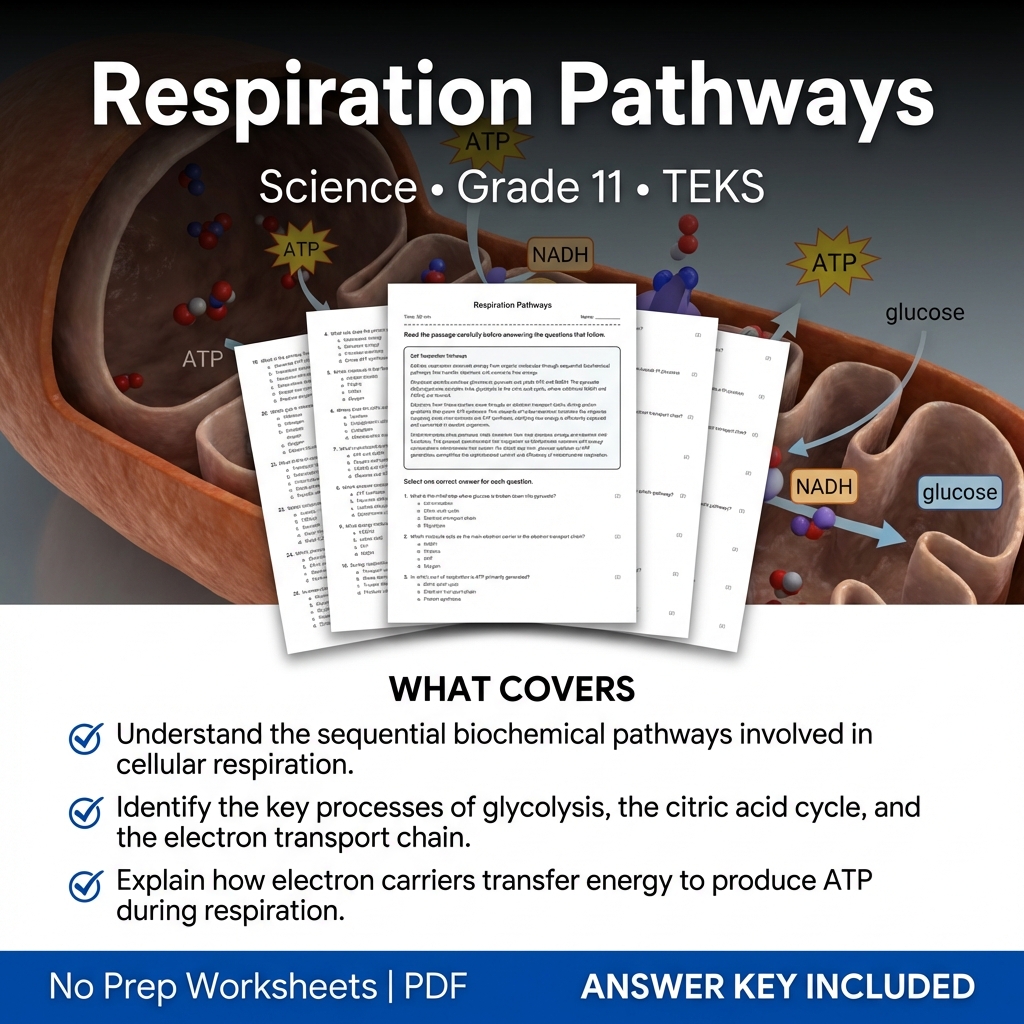
Respiration Pathways Worksheet for Grade 11 Science | TEKS-Aligned
Created byCoral Reef LearningLearning Objectives
- Understand the sequential biochemical pathways involved in cellular respiration.
- Identify the key processes of glycolysis, the citric acid cycle, and the electron transport chain.
- Explain how electron carriers transfer energy to produce ATP during respiration.
Instant download

Grade 9 Science – Endocrine Feedback Worksheet (Ontario Standard) (PDF)
Created byEvergreen Desk EducationLearning Objectives
- Explain how negative feedback helps maintain internal stability in hormone-regulated systems (e.g., glucose homeostasis and thyroid control).
- Describe how hormones are synthesized, transported in blood, and produce cellular effects through receptor-mediated mechanisms.
- Compare hormone half-life and feedback loop timing to predict how endocrine systems respond to changing conditions.
Also included in: Grade 9 Human Body Systems & Cellular Processes Science Lesson Bundle: Ontario +1 more
Instant download
Browse more categories
About Science Worksheets
Find Science worksheets spanning core skills, practice, and review. All 44,295 resources are instant PDF downloads for the classroom or home.
Every worksheet on MyTeachingSheets is created by independent teacher-authors and reviewed before publication. All resources download as printable PDFs for classroom, homework, or at-home practice, and many include answer keys. Preview any worksheet free before buying.