
Science Worksheets
44,295 subject resources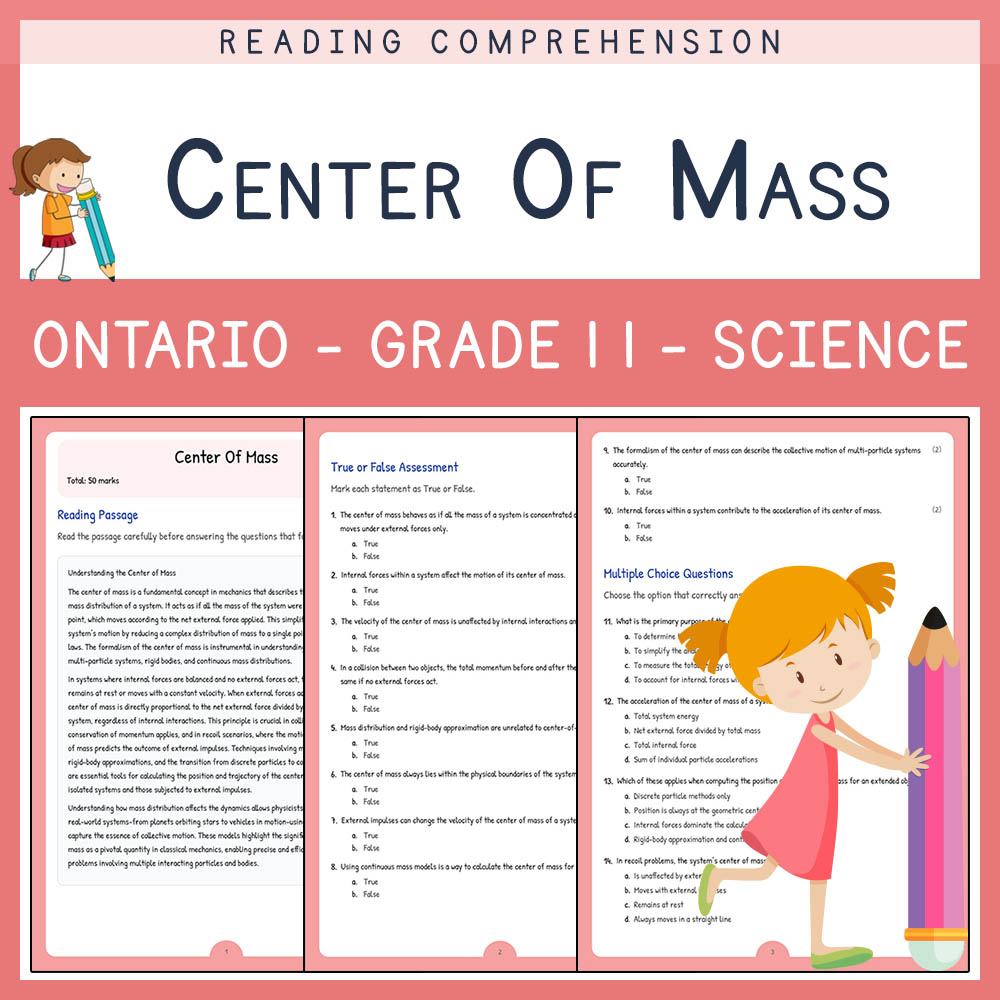
Grade 11 Science Assessment | Center Of Mass Worksheet Elena | Ontario
 Created byLumora Learning
Learning Objectives
- Understand the concept of center of mass and its importance in physics.
- Apply formalism relating external net force to the acceleration of the center of mass.
- Calculate system momentum and use it to solve collision and recoil problems.
Also included in: Grade 11 Science | Physics Lesson Bundle | Ontario Standard
Instant download

Grade 9 Science – Solution Behaviour Worksheet (Ontario Standard) PDF
 Created byEvergreen Desk Education
Learning Objectives
- Describe dissolution using solute–solvent interactions and explain how these interactions influence solubility.
- Differentiate saturated, unsaturated, and supersaturated solutions using qualitative examples such as sugar and salt in water.
- Explain how temperature and agitation affect solubility and relate these to practical methods like evaporation and crystallization.
Also included in: Grade 9 States & Energy to Chemical Reactions Science Lesson Bundle (Ontario) +1 more
Instant download
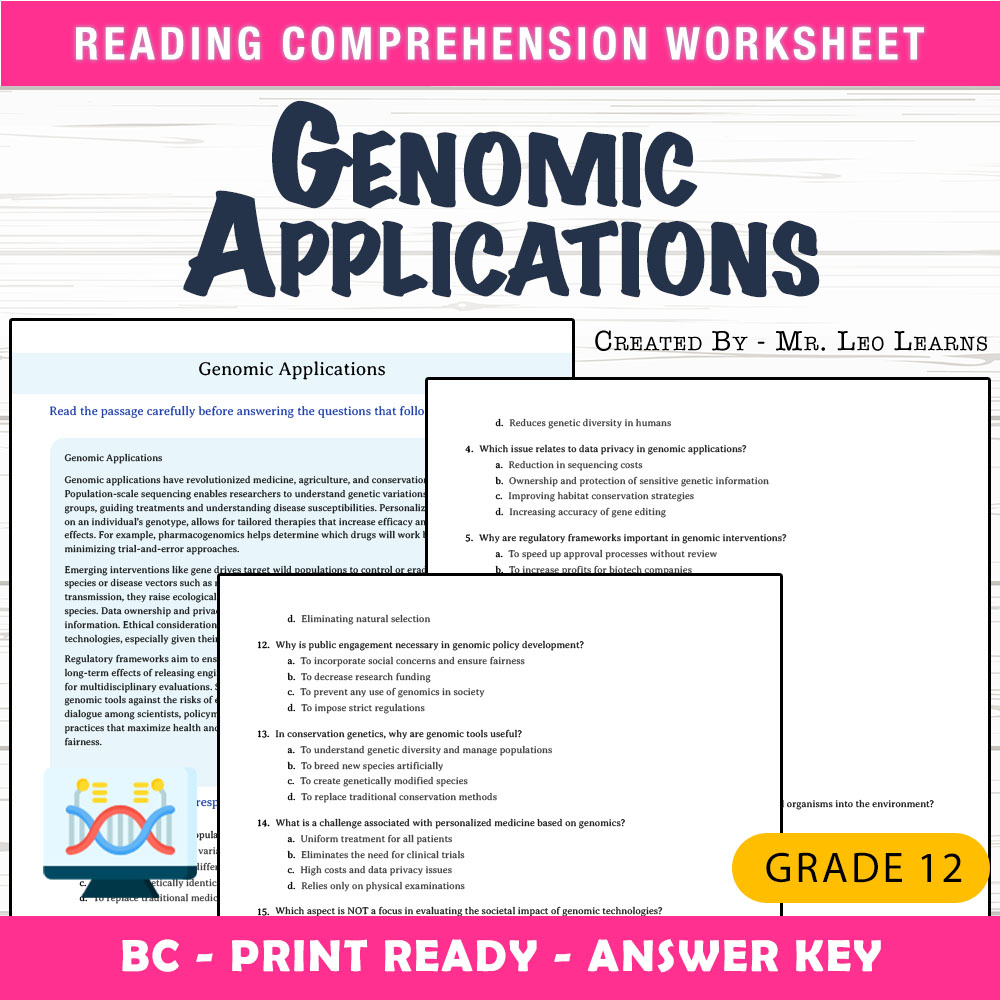
Grade 12 Science — Genomic Applications Worksheet MCQ Paper
 Created byThe Resource Hub
Learning Objectives
- Understand various applications of genomics in population health and conservation.
- Identify ethical and ecological considerations associated with genomic technologies.
- Analyze the benefits and risks of gene editing and personalized medicine.
Also included in: Grade 12 Science BC | Biology Unit Worksheet Pack with MCQs (15 Worksheets) +1 more
Instant download

Grade 10 Science – Trophic Efficiency Daily Reading Worksheet + Answer Key
JCreated byJ.S SheetsLearning Objectives
- Define trophic levels and describe their role in ecosystems.
- Explain the concept of energy transfer between trophic levels.
- Discuss factors that affect trophic efficiency and its ecological significance.
Also included in: Grade 10 Science Lesson Group – Ecosystems and Environmental Impact Worksheets +1 more
Instant download

Grade 10 Science – Energy Flow in Ecosystems Daily Worksheet + Answer Key
JCreated byJ.S SheetsLearning Objectives
- Understand how sunlight is captured by photosynthetic organisms
- Explain the role of producers in energy transfer
- Describe how energy moves through trophic levels
Also included in: Grade 10 Science Lesson Group – Ecosystems and Environmental Impact Worksheets +1 more
Instant download

Grade 10 Science – Ecological Succession Daily Reading Worksheet + Answer Key
JCreated byJ.S SheetsLearning Objectives
- Understand the concept of primary succession and its stages.
- Identify different features and processes involved in primary succession.
- Recognize environmental conditions that lead to primary succession.
Also included in: Grade 10 Science Lesson Group – Ecosystems and Environmental Impact Worksheets +1 more
Instant download

Grade 10 Science – Biodiversity Value Daily Reading Worksheet + Answer Key
JCreated byJ.S SheetsLearning Objectives
- Understand the concept of biodiversity and its types
- Identify the ecological benefits of biodiversity
- Recognize factors that threaten biodiversity
Also included in: Grade 10 Science Lesson Group – Ecosystems and Environmental Impact Worksheets +1 more
Instant download
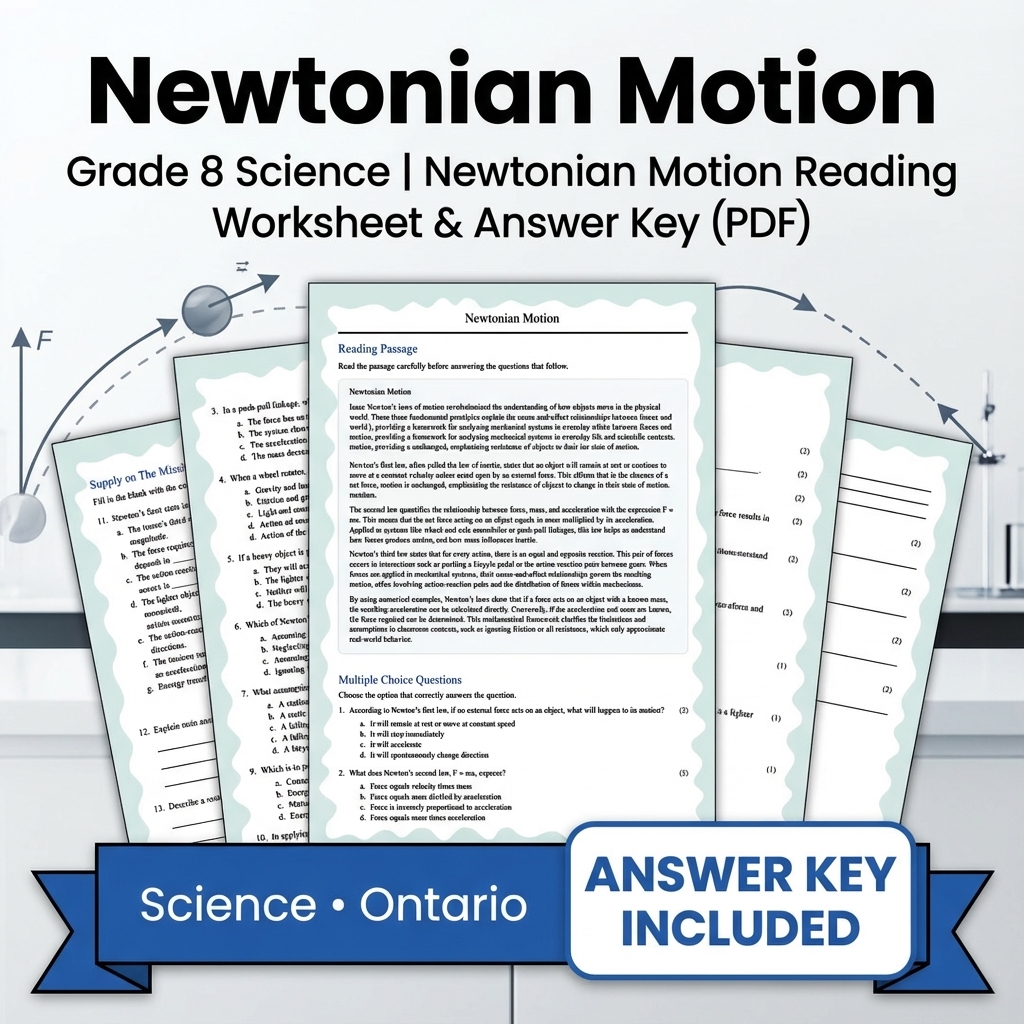
Grade 8 Science | Newtonian Motion Reading Worksheet & Answer Key (PDF)
JCreated byJ.S SheetsLearning Objectives
- Understand Newton's three laws of motion and how they apply to mechanical systems.
- Identify the relationships between force, mass, and acceleration using F = ma.
- Explain cause-and-effect relationships in motion and inertia.
Also included in: Grade 8 Science | Energy & Forces Unit Worksheet Pack (Answer Keys Included) +1 more
Instant download
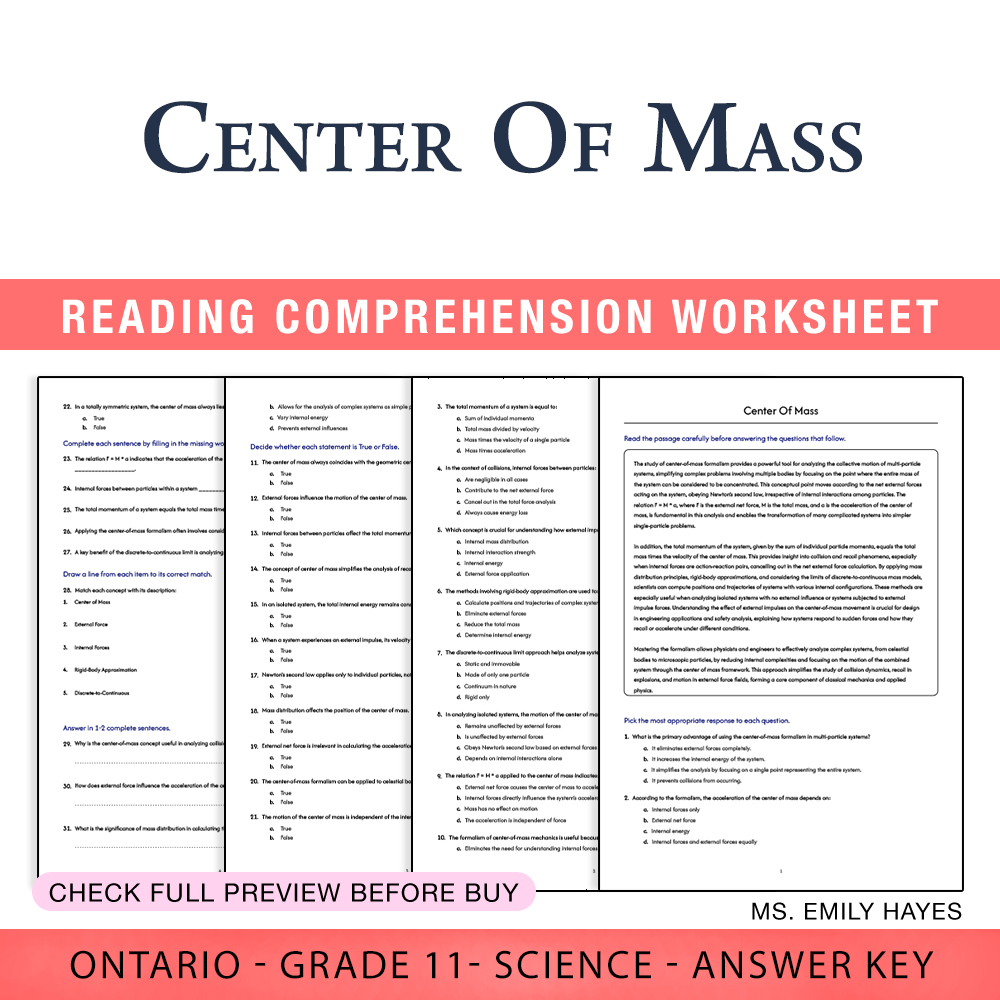
11th Grade Science | Center of Mass Worksheet (PDF + Answer Key)
 Created byCopper Leaf Classroom
Learning Objectives
- Understand the formalism of center-of-mass and its relevance to collective motion in multi-particle systems.
- Apply the concept of external net force and its relation to center-of-mass acceleration in various physical scenarios.
- Explain the methods used to compute mass distribution, positions, and trajectories in systems with different internal interactions.
Instant download

Natural Hazards Worksheet | NGSS Grade 6 Science Assessment
JCreated byJ.S SheetsLearning Objectives
- Analyze observational data related to natural hazards such as earthquakes, storms, and floods.
- Interpret instrumental records to identify patterns and recurrence intervals of hazards.
- Assess potential locations and magnitudes of natural events for risk management.
Also included in: Grade 6 Earth System Interactions Climate Science Lesson Bundle – NGSS +1 more
Instant download
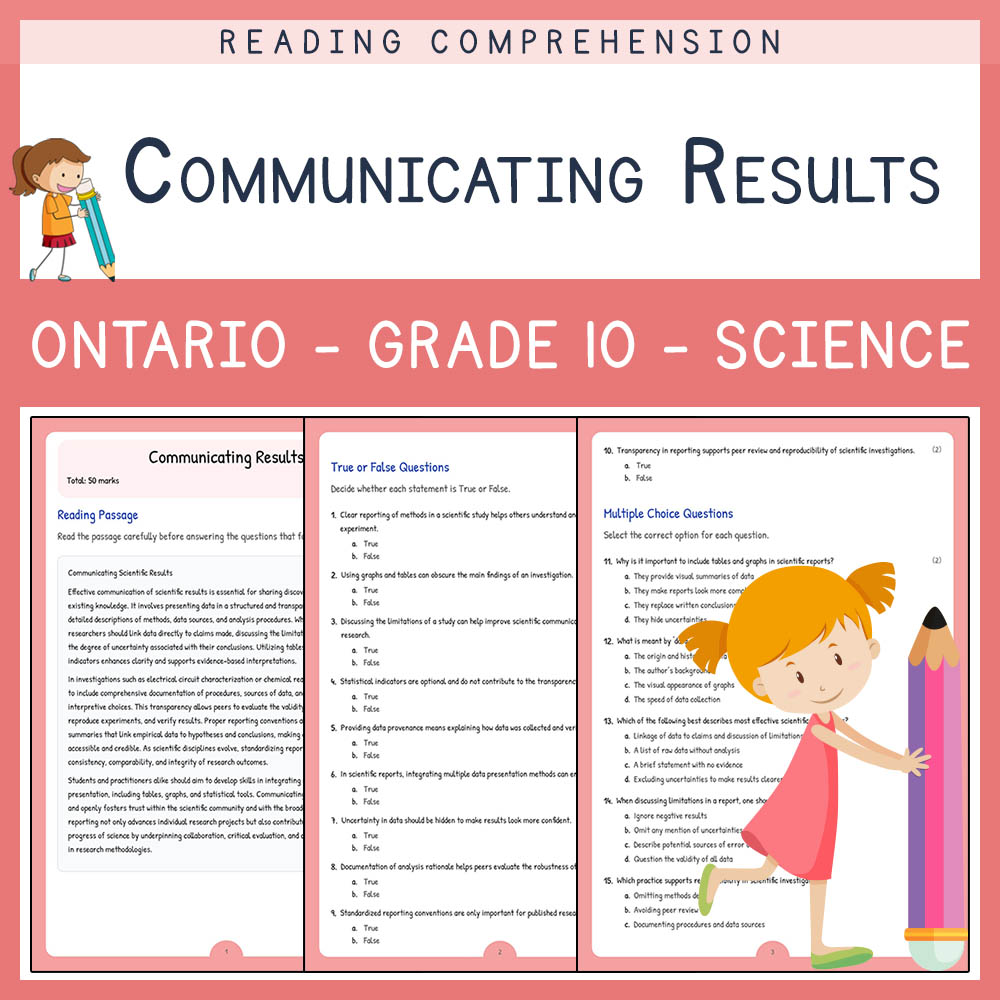
Grade 10 Science | Communicating Results Worksheet Elena | Ontario Standards
Created byLumora LearningLearning Objectives
- Understand and apply conventions for clear, evidence-based reporting of scientific investigations.
- Develop skills to integrate data tables, graphs, and statistical indicators into reports to support conclusions.
- Recognize the importance of documenting methods, data provenance, and interpretive rationale for peer evaluation and reproducibility.
Instant download
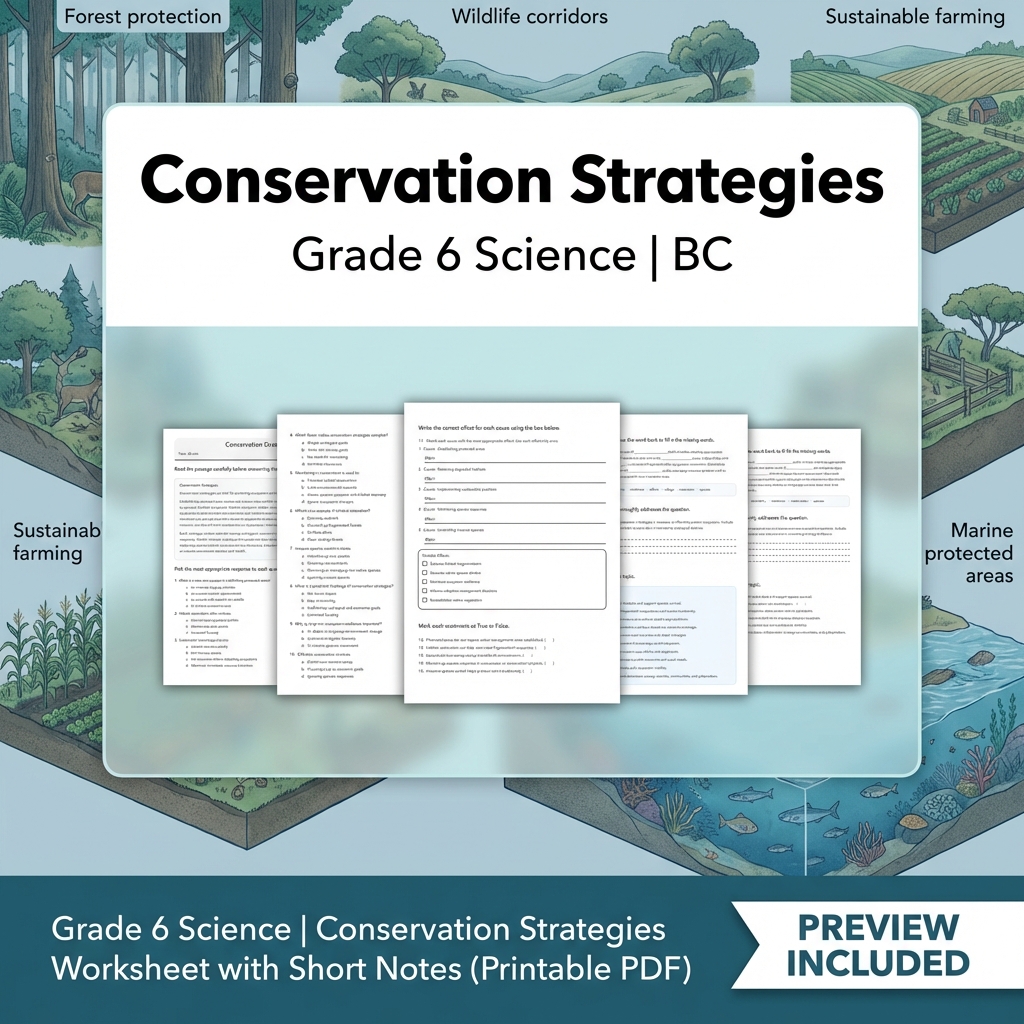
Grade 6 Science | Conservation Strategies Worksheet with Short Notes (PDF)
 Created byMeadowlark Worksheets
Learning Objectives
- Understand different conservation strategies used to maintain ecosystems.
- Identify the purpose and components of protected areas and habitat restoration.
- Explain the concept of sustainable harvesting and its benefits.
Also included in: Grade 6 Science | Ecosystems & Interdependence UNIT Worksheet Bundle +1 more
Instant download

Grade 10 Science – Atomic Structure & Periodic Trends | Daily Reading Worksheet
 Created byBright Mind Resources
Learning Objectives
- Identify the parts of an atom and their functions
- Describe electron configuration and nuclear composition
- Interpret periodic trends related to atomic structure
Also included in: Chemical Reactions Grade 10 Science Daily Reading Worksheets Bundle | NGSS +2 more
Instant download

Grade 10 Science – Bond Energetics & Chemical Reactions |Daily Reading Worksheet
Created byBright Mind ResourcesLearning Objectives
- Understand the concept of chemical bonds and their energy changes
- Differentiate between exothermic and endothermic processes
- Interpret potential energy diagrams and bond enthalpy values
Also included in: Chemical Reactions Grade 10 Science Daily Reading Worksheets Bundle | NGSS +2 more
Instant download

Grade 10 Science – Chemical Equilibrium & NGSS | Daily Reading Worksheet
Created byBright Mind ResourcesLearning Objectives
- Understand the concept of chemical equilibrium and how it reflects a balance in reversible reactions
- Identify factors that influence the position of equilibrium, such as pressure, concentration, and temperature
- Recognize how catalysts affect reaction rates without changing equilibrium position
Also included in: Chemical Reactions Grade 10 Science Daily Reading Worksheets Bundle | NGSS +2 more
Instant download
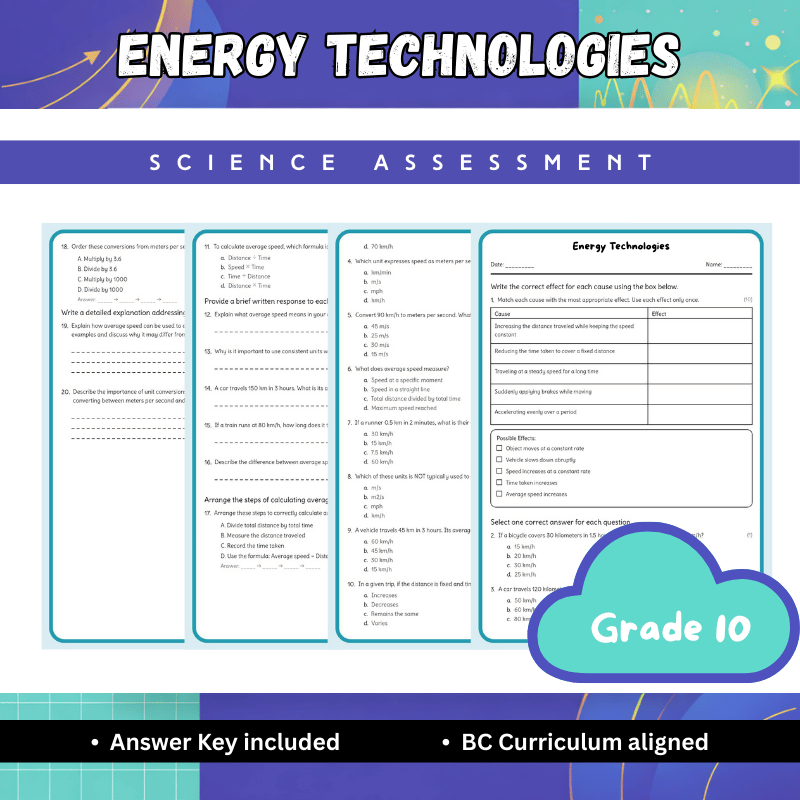
Grade 10 Science | Energy Forms Worksheet (Answer Key) – BC Standards
Created byBright Mind ResourcesLearning Objectives
- Identify and describe different forms of energy such as kinetic, potential, thermal, chemical, radiant, and nuclear.
- Explain how objects store and release energy during various processes like movement, respiration, and heating.
- Recognize examples of energy transformation in physical and biological systems.
Instant download

Grade 10 Science Metabolic Control Worksheet | Alberta Biology PDF
Created byEvergreen Desk EducationLearning Objectives
- Explain how enzyme kinetics influence cellular metabolism and metabolic flux
- Describe feedback inhibition and how regulatory motifs balance energy production and biosynthesis
- Evaluate how compartmentalization and environmental conditions affect enzyme activity in Alberta species
Instant download
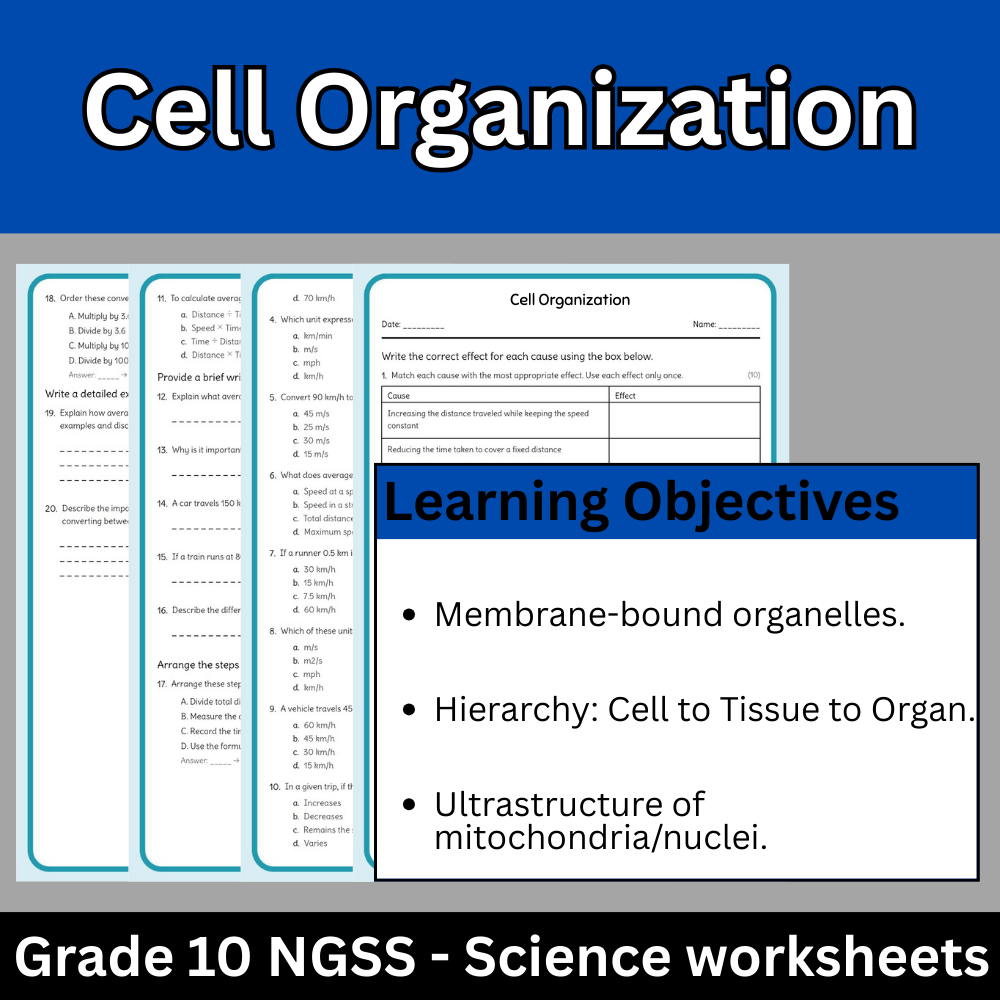
Grade 10 Science - Cell Organization Worksheet + Answer Key (NGSS Aligned)
Created byBright Mind ResourcesLearning Objectives
- Identify the structure and functions of membrane-bound organelles in eukaryotic and prokaryotic cells.
- Explain hierarchical organization from cells to tissues and organs, including examples like epithelial and muscle tissues.
- Compare ultrastructures of mitochondria, chloroplasts, endoplasmic reticulum, and nucleus with their metabolic and genetic functions.
Instant download
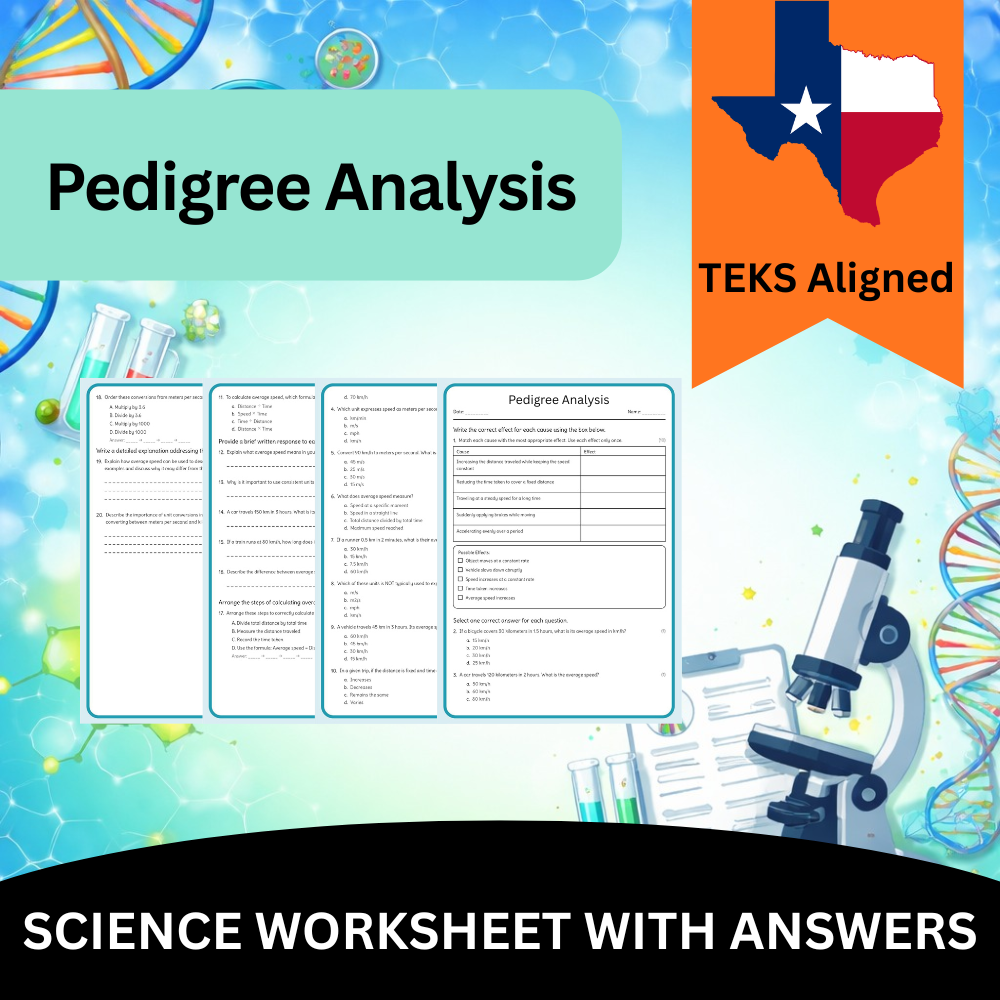
Grade 9 Science | Pedigree Analysis Worksheet (Answer Key) – TEKS Aligned
Created byBright Mind ResourcesLearning Objectives
- Understand how pedigree charts illustrate inheritance patterns across generations.
- Identify signs of autosomal dominant, autosomal recessive, X-linked, and mitochondrial inheritance in pedigrees.
- Interpret segregation patterns, penetrance, and how they affect inheritance analysis.
Also included in: Grade 9 Science Genetics & Biotechnology Unit - TEKS - Aligned (Answer Keys) +3 more
Instant download
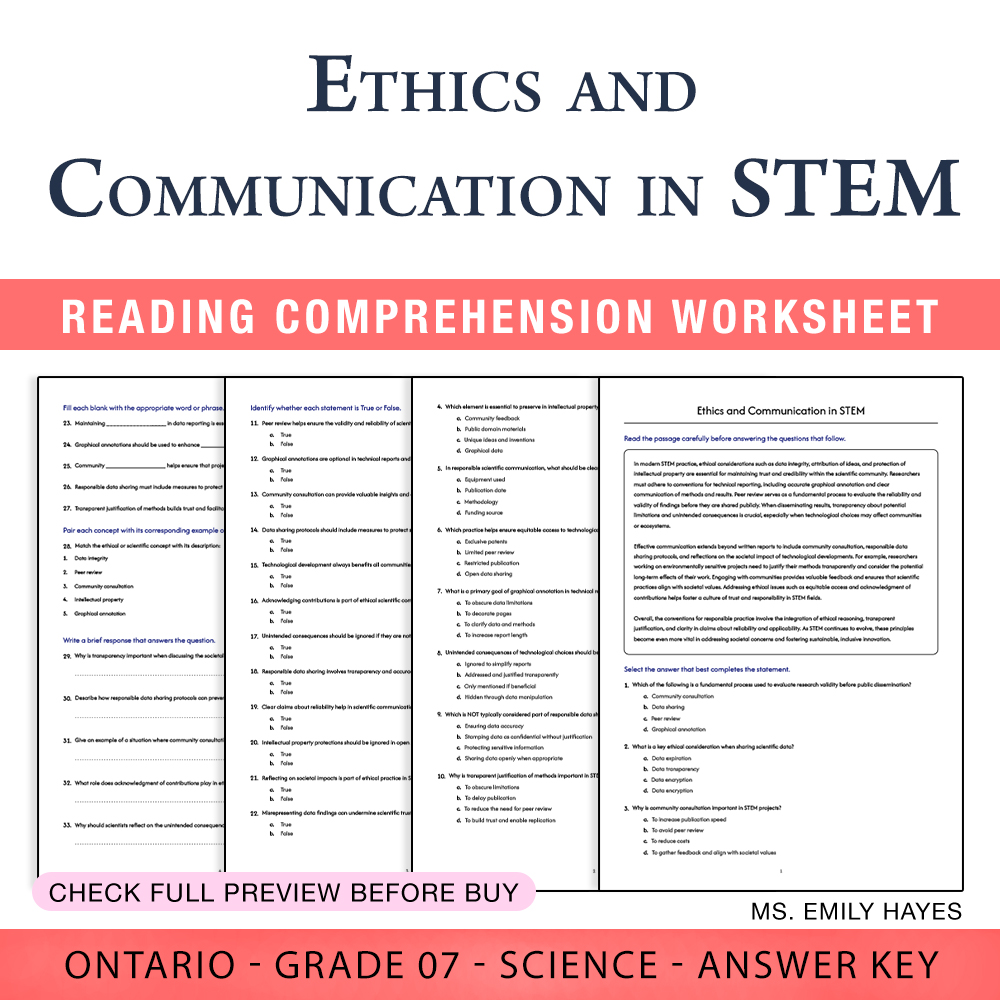
7th Grade Science | Ethics and Communication in STEM Worksheet (PDF+ Answer Key)
Created byCopper Leaf ClassroomLearning Objectives
- Understand the importance of ethical considerations such as data integrity, attribution, and intellectual property in STEM practice.
- Analyze effective communication practices including graphical annotation, peer review, and public presentation of findings.
- Evaluate scenarios involving responsible data sharing, community consultation, and reflection on technological impacts.
Instant download
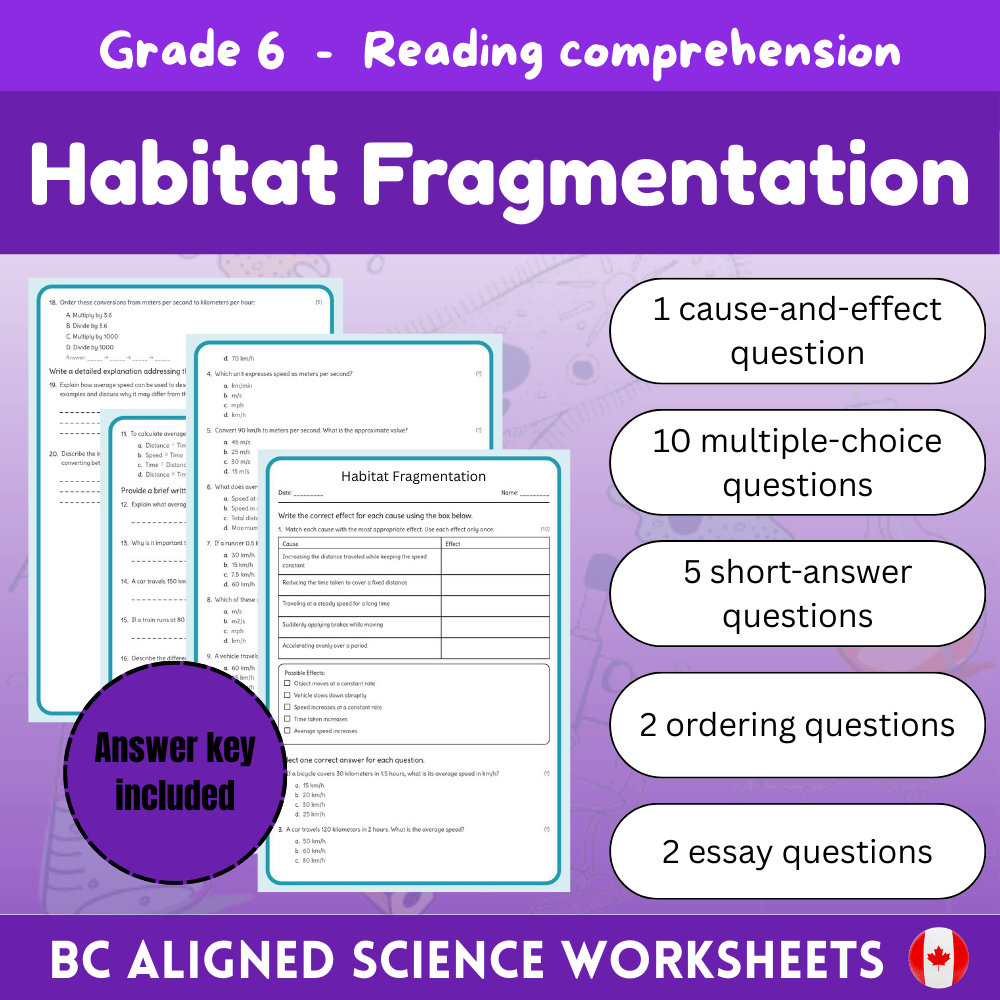
6th Grade Science | Habitat Fragmentation Worksheet (PDF) – BC Standards
Created byBright Mind ResourcesLearning Objectives
- Understand what habitat fragmentation is and how it affects ecosystems.
- Identify causes and effects of habitat fragmentation.
- Recognize strategies to mitigate habitat fragmentation impacts.
Instant download
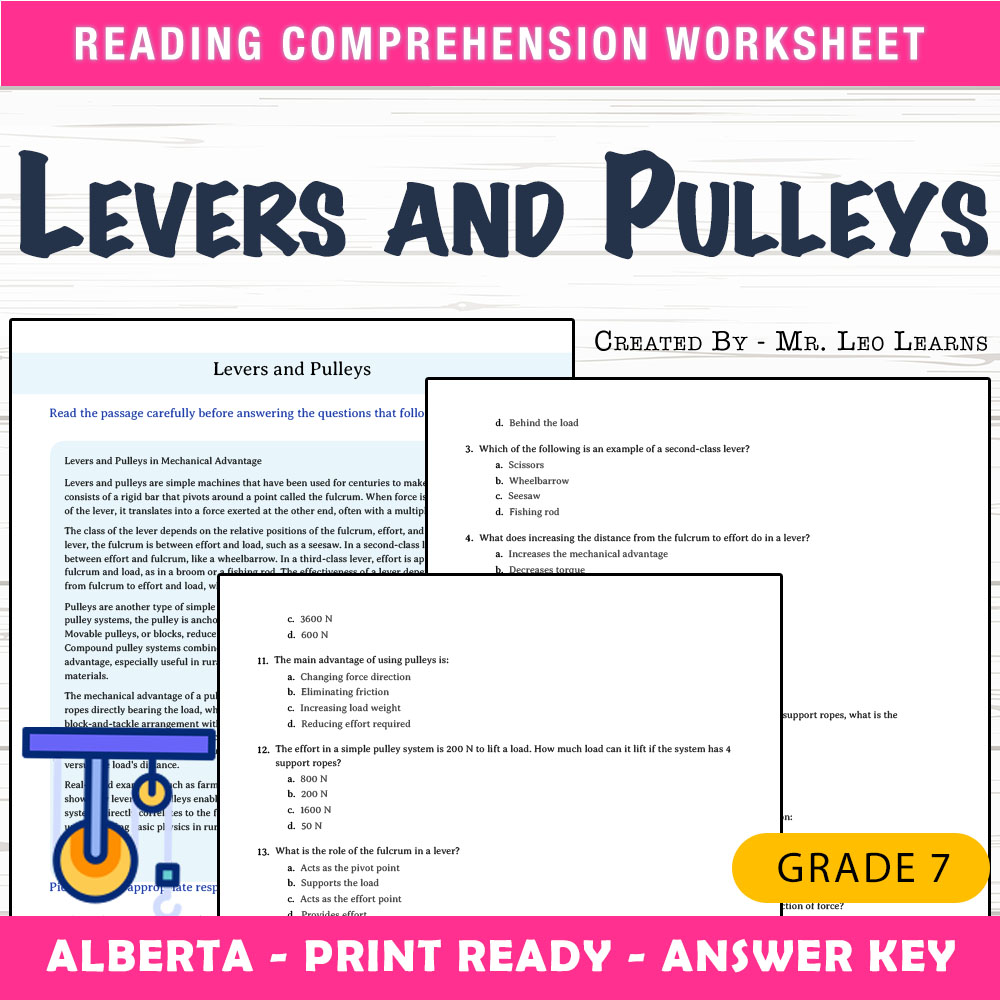
Grade 7 Science — Levers and Pulleys Worksheet MCQ Paper PDF + Answer Key
Created byThe Resource HubLearning Objectives
- Understand the principles of levers and pulley systems and how they provide mechanical advantage.
- Be able to calculate torque, effort, and load relationships in lever and pulley systems.
- Relate geometric arrangements to force multiplication in real-world examples like farm jacks and wheelbarrows.
Also included in: Grade 7 Science Alberta Forces Structures and Motion Worksheet Bundle +1 more
Instant download
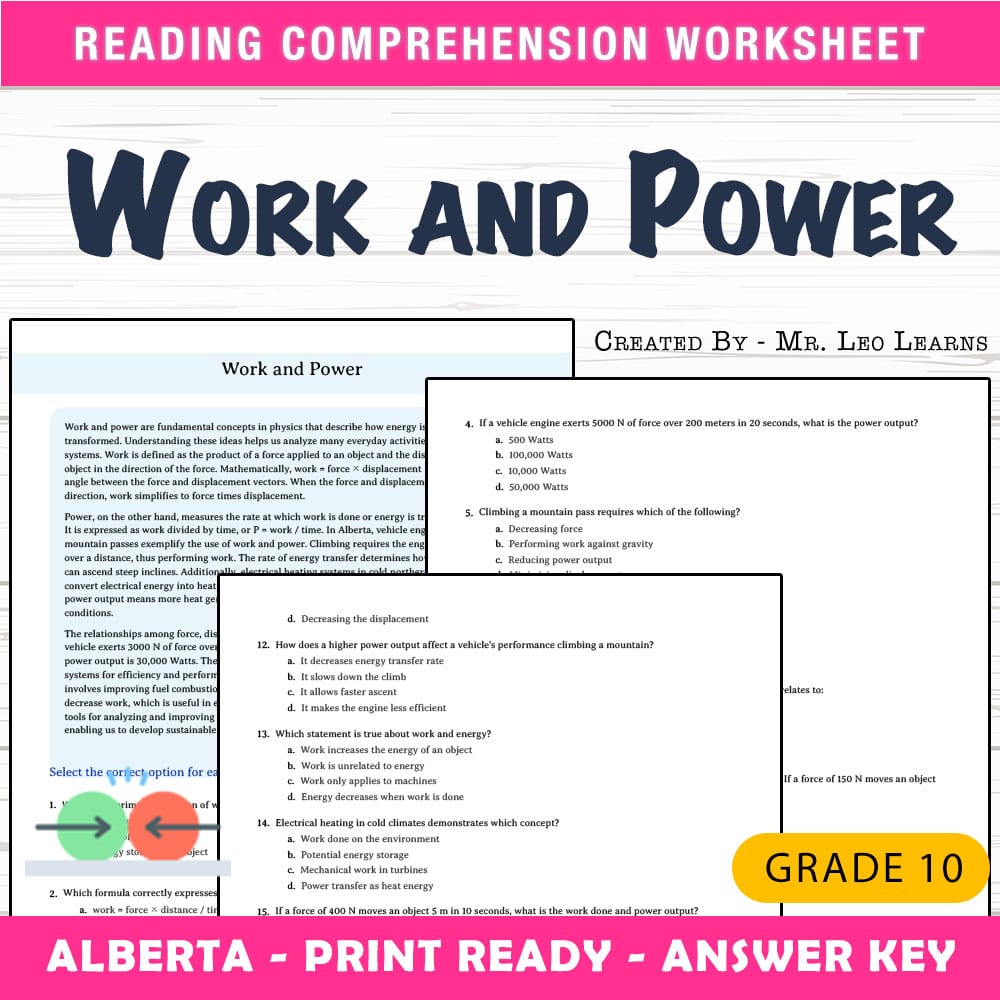
Grade 10 Science — Worksheet MCQ Paper for Mastering Work and Power
Created byThe Resource HubLearning Objectives
- Explain the concepts of work and power in mechanical contexts.
- Calculate work done using force and displacement measurements.
- Understand how power relates to energy transfer over time.
Also included in: Grade 10 Science | Energy, Motion & Electricity Worksheet Bundle | Alberta +1 more
Instant download
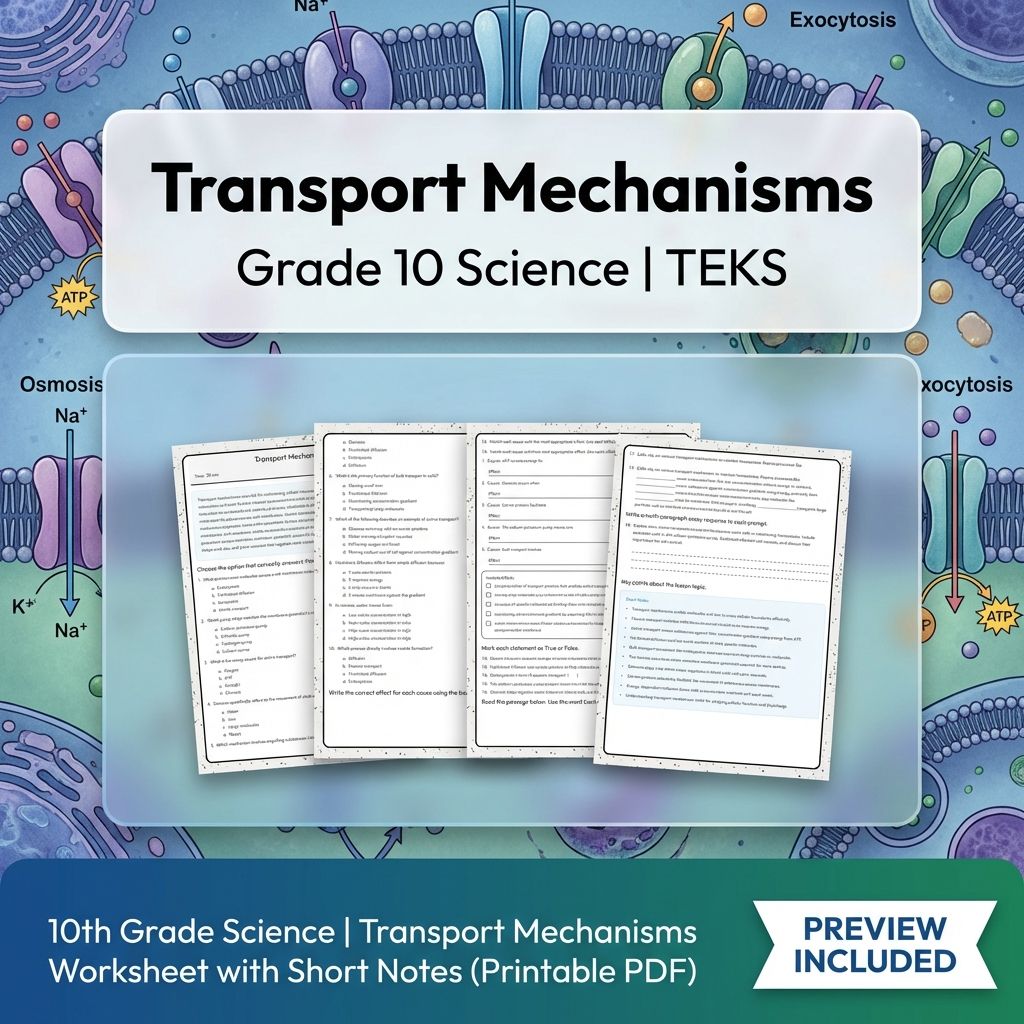
10th Grade Science | Transport Mechanisms Worksheet with Short Notes (PDF)
Created byMeadowlark WorksheetsLearning Objectives
- Describe different passive and active transport mechanisms across cell membranes.
- Explain the role of carrier proteins, pumps, and bulk transport in cellular function.
- Identify examples of transport mechanisms like the sodium–potassium pump and facilitated diffusion.
Instant download
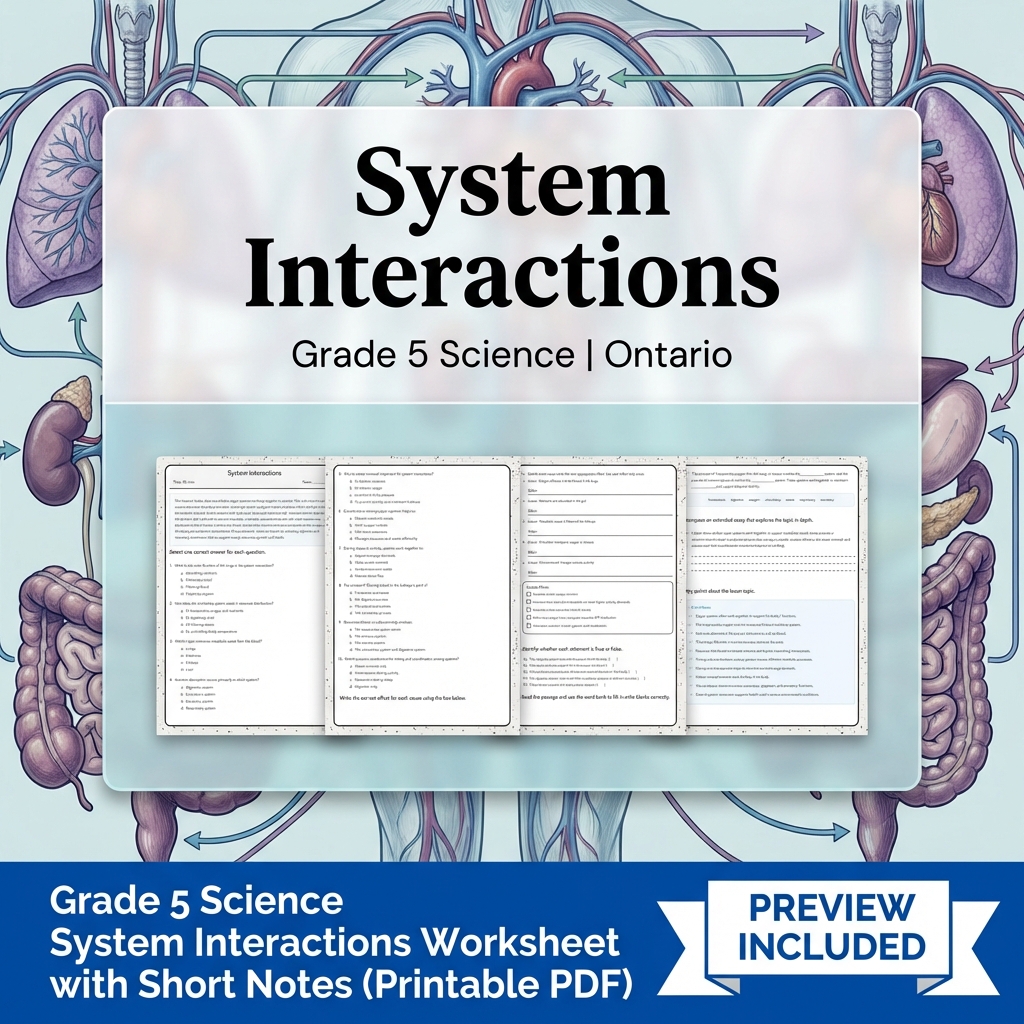
Grade 5 Science System Interactions Worksheet with Short Notes (Printable PDF)
Created byMeadowlark WorksheetsLearning Objectives
- Understand how different organ systems work together to support metabolic processes.
- Identify examples of resource distribution and waste removal in the body.
- Analyze how timing and coordination among systems ensure efficient functioning.
Also included in: Grade 5 Science Lesson Group – Ontario Curriculum Worksheets Bundle +1 more
Instant download

Grade 7 Science | Integrated Analysis - Daily Reading Comprehension
 Created byCoral Reef Learning
Learning Objectives
- Understand different modes of heat transfer: conduction, convection, radiation.
- Analyze how each transfer mode affects energy efficiency in systems.
- Apply principles of energy transfer to real-world systems like passive solar houses.
Also included in: Energy, Heat and Thermal Processes Lesson Bundle: Grade 7 Science Alberta +1 more
Instant download
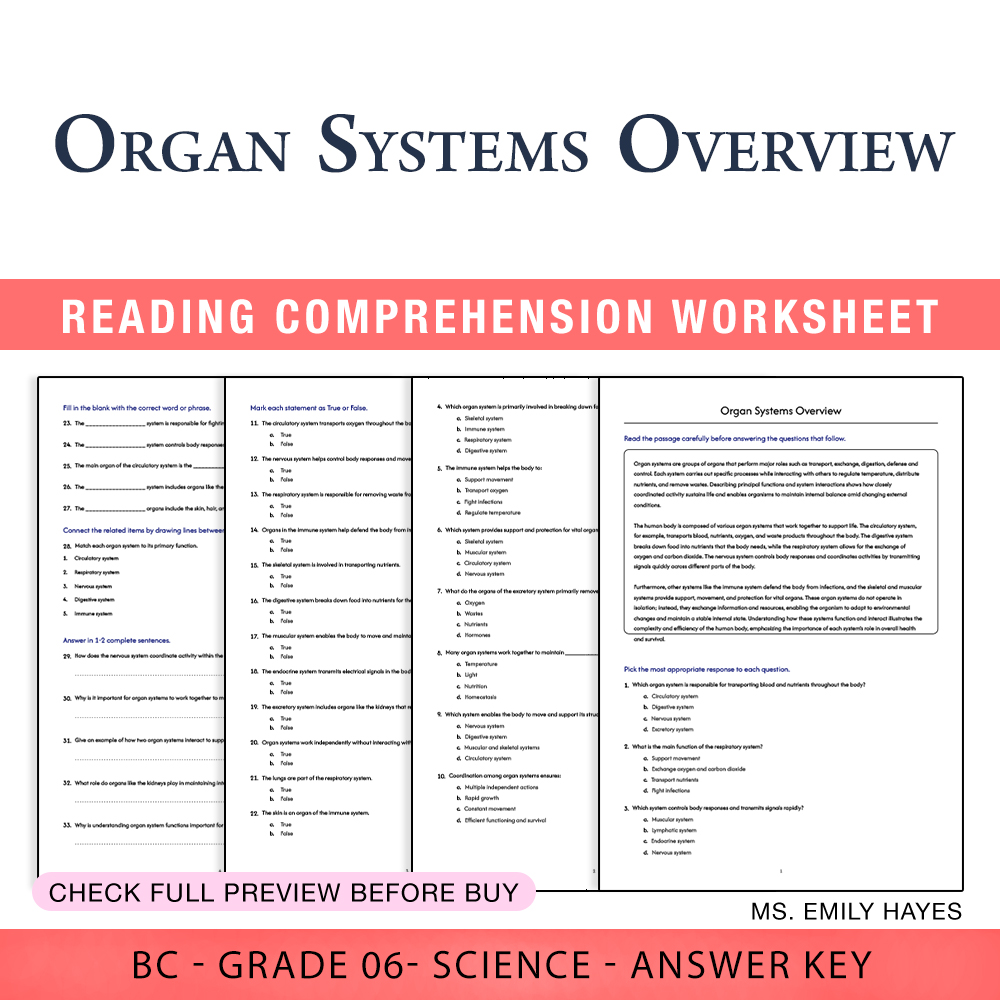
6th Grade Science | Organ Systems Overview Worksheet (PDF+ Answer Key)
Created byCopper Leaf ClassroomLearning Objectives
- Understand the principal functions of different human organ systems.
- Explain how multiple organ systems interact to maintain homeostasis.
- Describe examples of how organ systems work together to sustain life.
Also included in: Grade 6 Science BC | Human Body Systems & Adaptations (PDF+ Answer Keys) +1 more
Instant download

Grade 9 Science – Power Analysis in Household Systems | Daily Reading Worksheet
Created byBright Mind ResourcesLearning Objectives
- Understand how to interpret power ratings on household appliances.
- Differentiate between energy and power, and their units of measurement.
- Apply basic calculations to estimate energy consumption based on power and usage time.
Also included in: Energy Grade 9 Science Daily Reading Worksheets Lesson Bundle | NGSS +2 more
Instant download

Grade 9 Science – Energy Conservation & Systems | Daily Reading Worksheet
Created byBright Mind ResourcesLearning Objectives
- Understand the principles of energy conservation in closed and open systems.
- Identify energy flow and system boundaries in different energy systems.
- Apply mathematical representations to trace energy transfer and reservoirs.
Also included in: Energy Grade 9 Science Daily Reading Worksheets Lesson Bundle | NGSS +2 more
Instant download

Grade 9 Science – Heat & Thermal Energy | Daily Reading Worksheet
Created byBright Mind ResourcesLearning Objectives
- Understand the concept of thermal energy and heat transfer
- Recognize the different modes of heat transfer: conduction, convection, radiation
- Apply formulas involving specific heat capacity, mass, and temperature change to calculate heat transfer
Also included in: Energy Grade 9 Science Daily Reading Worksheets Lesson Bundle | NGSS +2 more
Instant download

Grade 9 Science – Mechanical Energy & Energy Types | Daily Reading Worksheet
Created byBright Mind ResourcesLearning Objectives
- Understand the concept of kinetic energy and how it depends on mass and velocity.
- Calculate kinetic energy using the formula KE = 1/2 m v^2.
- Recognize examples of kinetic energy in real-world systems.
Also included in: Energy Grade 9 Science Daily Reading Worksheets Lesson Bundle | NGSS +2 more
Instant download
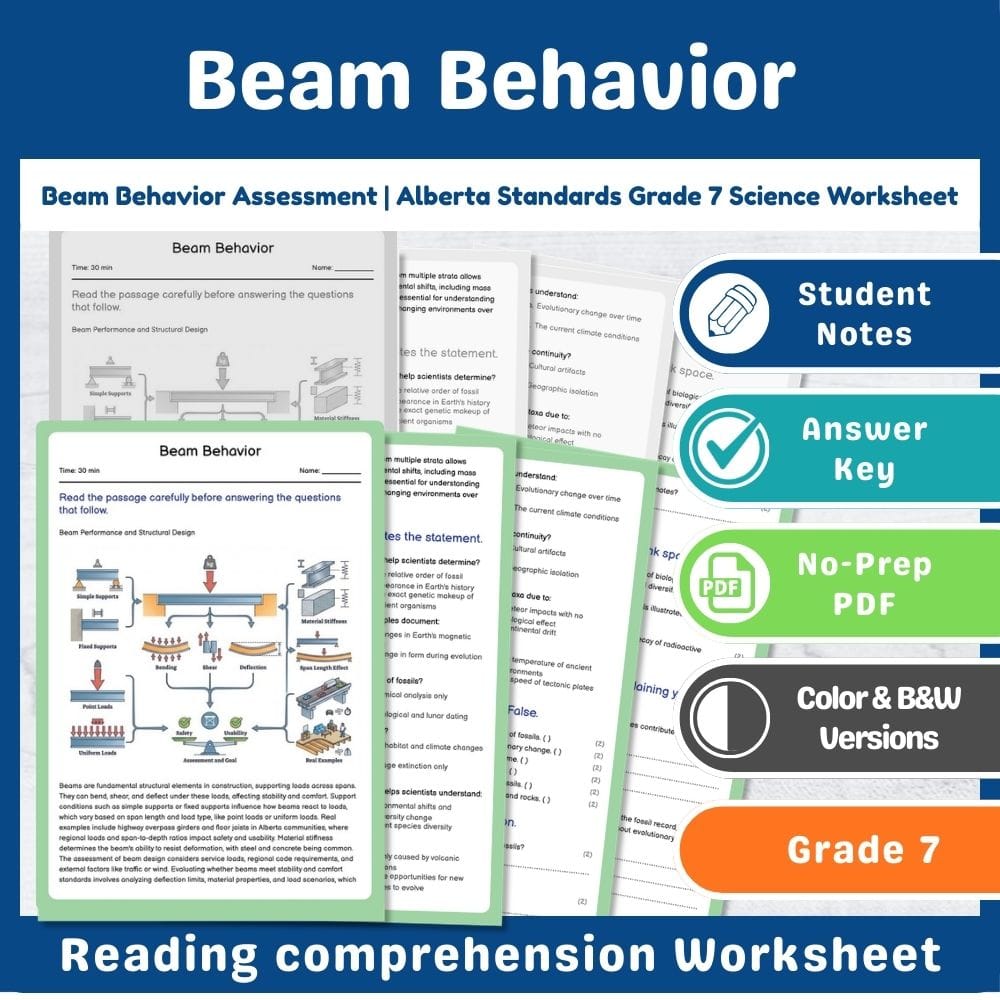
Beam Behavior Assessment | Alberta Standards Grade 7 Science Worksheet
 Created byPrism Point Learning
Learning Objectives
- Understand the key concepts of beam performance including bending, shear, and deflection.
- Relate support conditions, span, and load types to real-world structural examples.
- Evaluate criteria such as span-to-depth ratios and material stiffness for structural stability.
Also included in: Lesson Bundle Grade 7 Science Forces Structures and Motion | Alberta Standards +1 more
Instant download
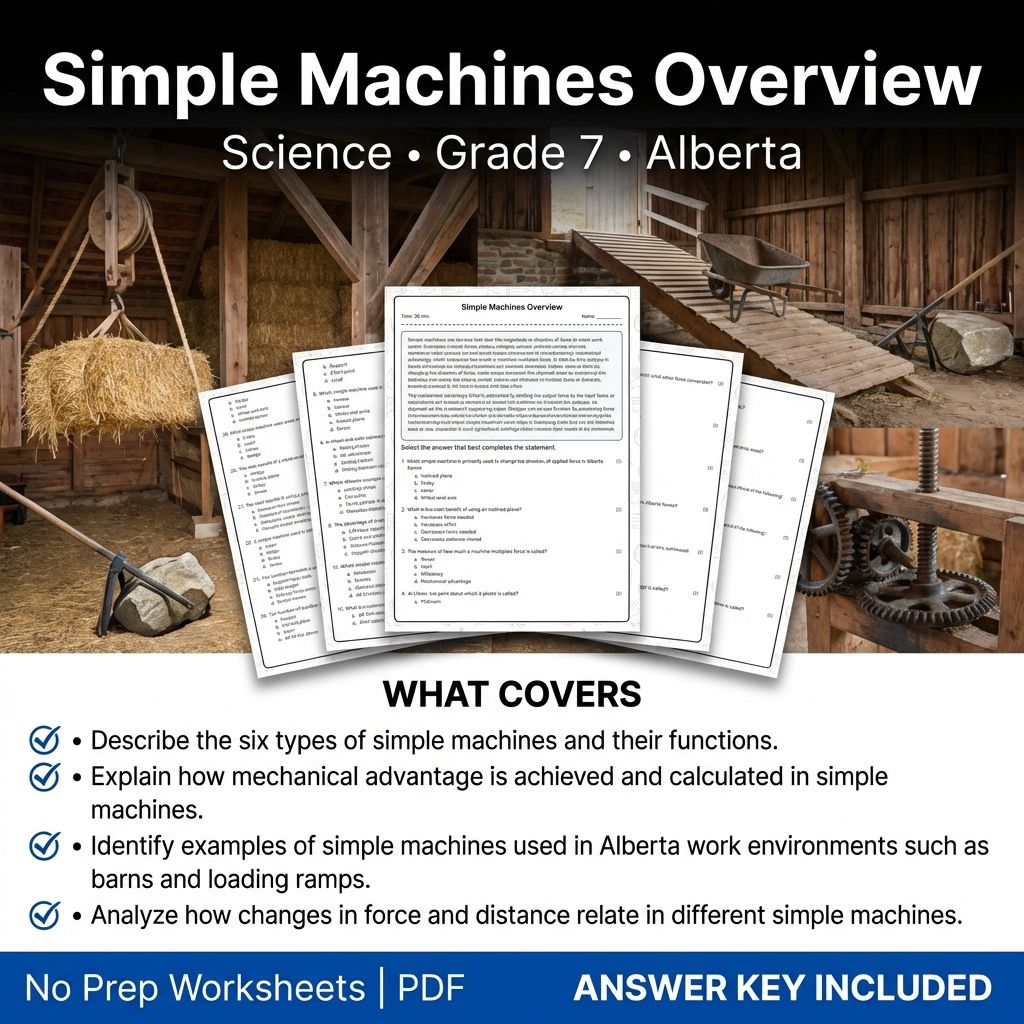
Grade 7 Science Worksheet | Simple Machines Overview | Alberta Standards
Created byCoral Reef LearningLearning Objectives
- Describe the six types of simple machines and their functions.
- Explain how mechanical advantage is achieved and calculated in simple machines.
- Identify examples of simple machines used in Alberta work environments such as barns and loading ramps.
Instant download
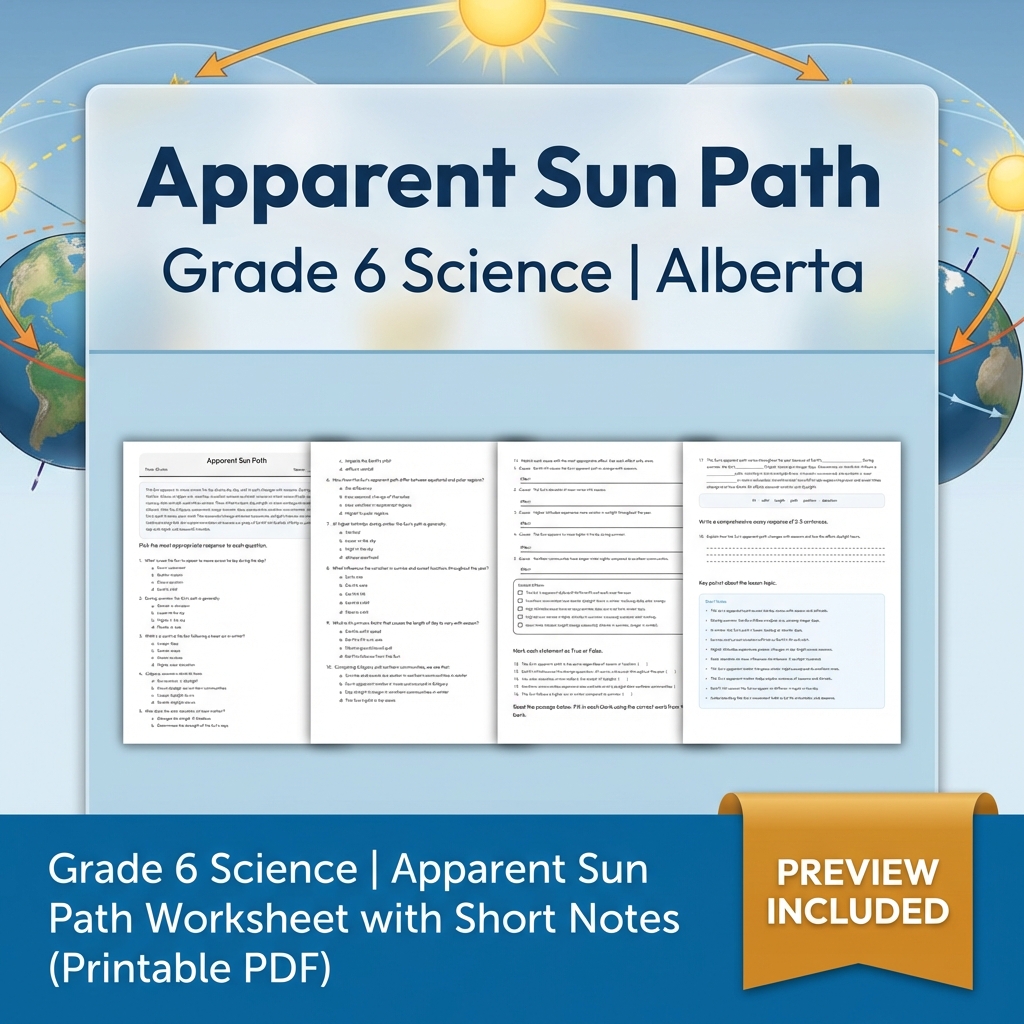
Grade 6 Science | Apparent Sun Path Worksheet with Short Notes (Printable PDF)
Created byMeadowlark WorksheetsLearning Objectives
- Understand how the Sun's apparent path varies with season and location.
- Describe how sunrise and sunset positions change throughout the year.
- Explain the variation of solar elevation at noon in different seasons and locations.
Also included in: Grade 6 Science Sky Science Unit Bundle | Alberta Curriculum Worksheets +1 more
Instant download
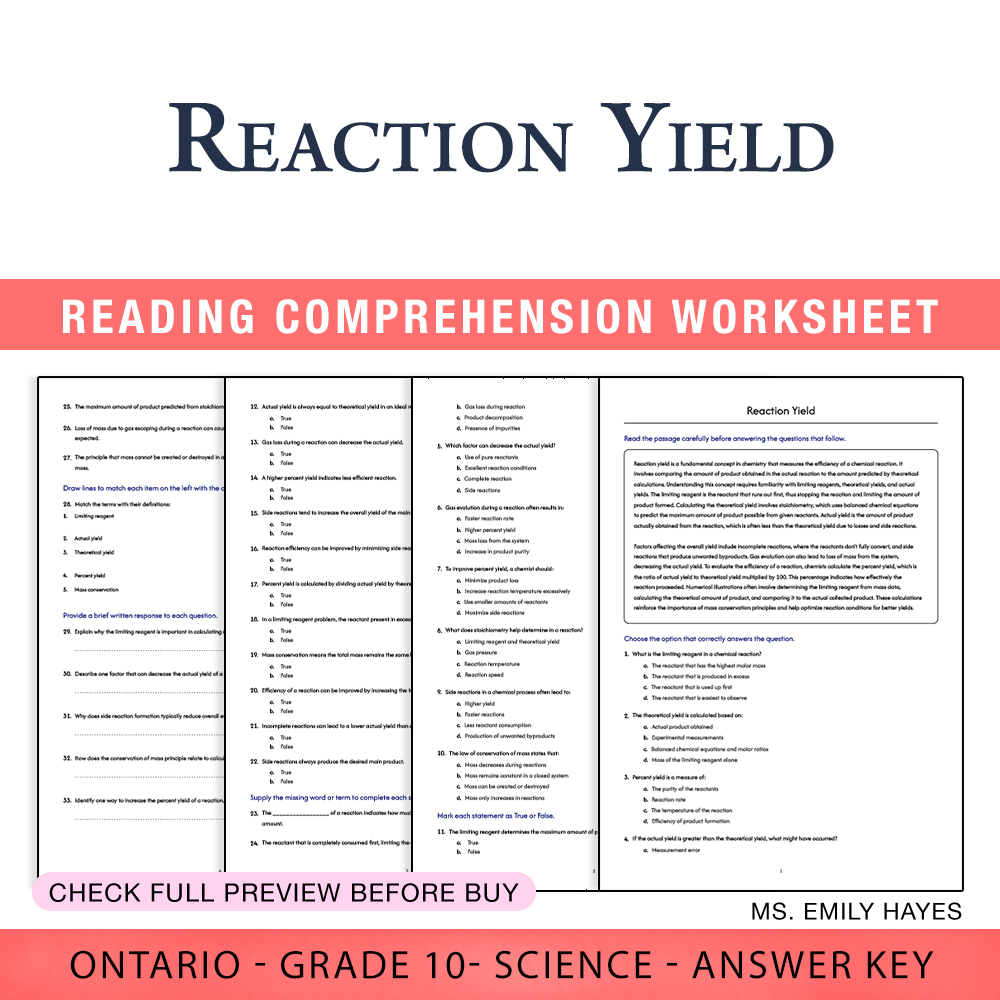
10th Grade Science | Reaction Yield Worksheet (PDF + Answer Key)
Created byCopper Leaf ClassroomLearning Objectives
- Understand the concept of limiting reagent in chemical reactions.
- Calculate theoretical, actual, and percent yields of products in chemical processes.
- Identify factors that affect reaction yield such as incomplete reactions, side reactions, and gas loss.
Instant download

Population Genetics Worksheet | Grade 12 Science Practice
Created byPrism Point LearningLearning Objectives
- Use Hardy–Weinberg equilibrium to connect allele and genotype frequencies to microevolutionary change
- Explain how selection, genetic drift, and migration alter allele and genotype frequencies over generations
- Interpret heterozygosity, effective population size, and fixation indices as measures of genetic variation
Also included in: Population Genetics & Evolution Lesson Bundle: Grade 12 Science TEKS
Instant download
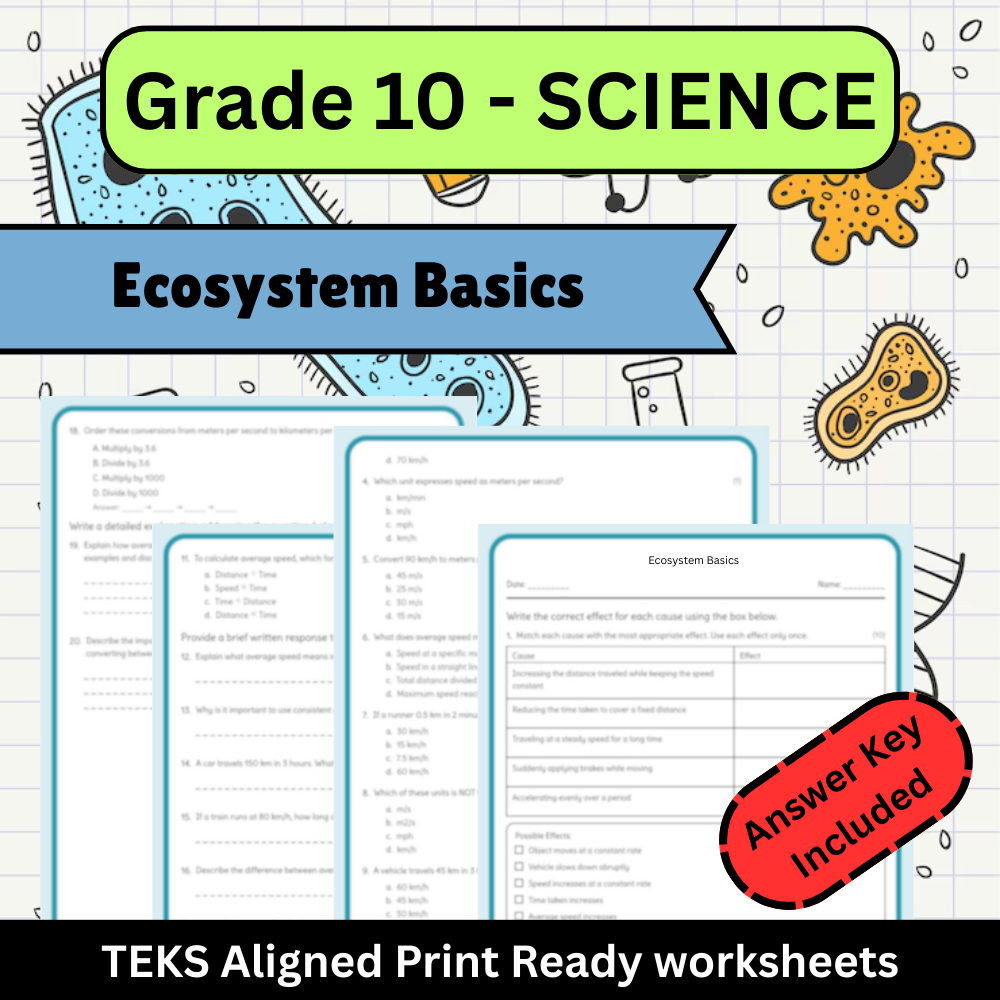
Grade 10 Science | Ecosystem Basics Worksheet (PDF) – TEKS-Aligned Activities
Created byBright Mind ResourcesLearning Objectives
- Define the key components and functions of an ecosystem.
- Identify various roles of producers, consumers, and decomposers within an ecosystem.
- Understand the flow of energy and cycling of matter in ecosystems.
Also included in: Grade 10 Science | Ecosystems & Biodiversity Unit Worksheet Bundle(TEKS-Aligned) +5 more
Instant download

Grade 10 Science – Reaction Types in Chemistry | Daily Reading Worksheet
Created byBright Mind ResourcesLearning Objectives
- Understand the different types of chemical reactions: synthesis, decomposition, single and double displacement, and combustion.
- Identify reaction types from chemical equations.
- Recognize the indicators of each reaction type.
Also included in: Grade 10 Chemistry Science Lesson Bundle Daily Reading Worksheets | Alberta +1 more
Instant download

Grade 8 Balancing Equations Worksheet | Practice & BC PDF
 Created byClear Sky Classroom
Learning Objectives
- Explain how coefficients in a balanced chemical equation represent relative amounts while conserving atoms.
- Use the idea of conservation of mass to balance simple chemical equations.
- Interpret how changing coefficients affects the relative quantities of reactants and products.
Instant download
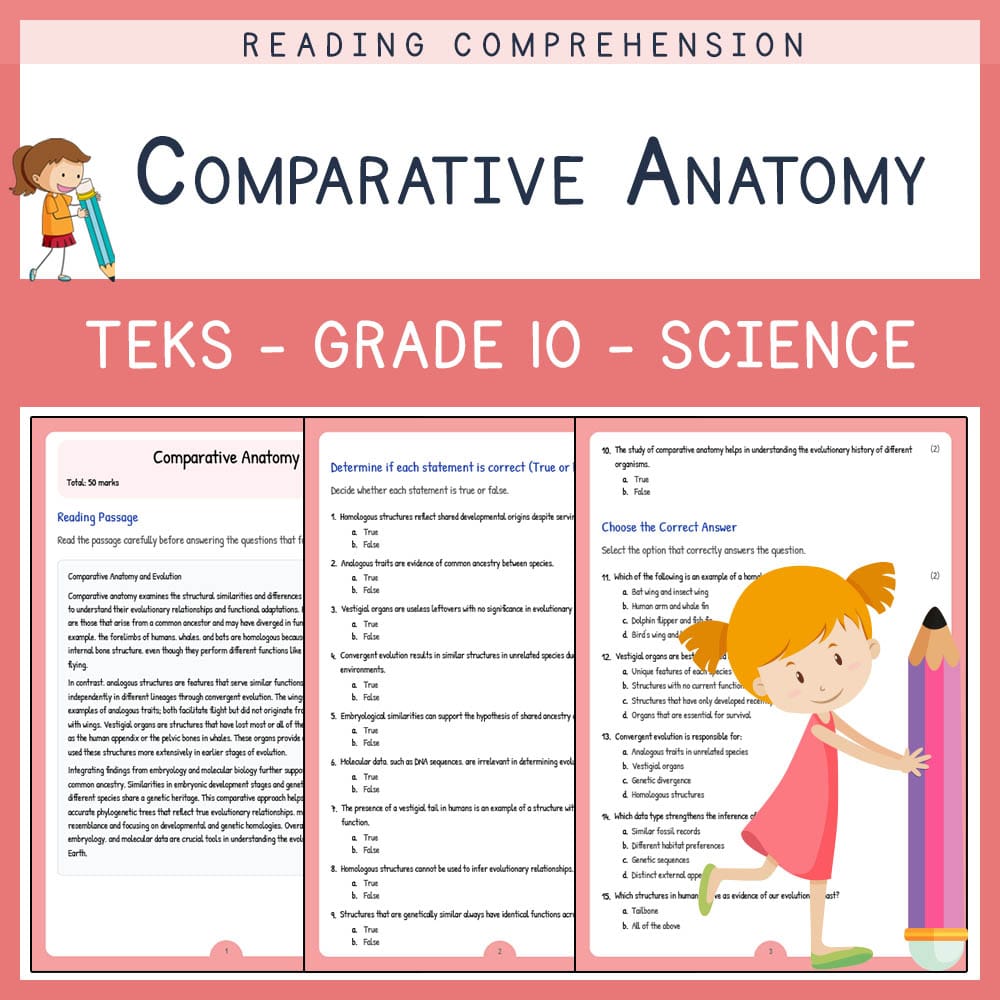
Grade 10 Science | Comparative Anatomy Worksheet | TEKS Aligned
Created byLumora LearningLearning Objectives
- Understand the concept of homologous and analogous structures and their significance in evolution.
- Identify vestigial organs and explain their importance as evidence of evolutionary change.
- Interpret anatomical, embryological, and molecular data to infer evolutionary relationships.
Also included in: Grade 10 Science | Evolution & Classification Lesson Bundle | TEKS Aligned +1 more
Instant download
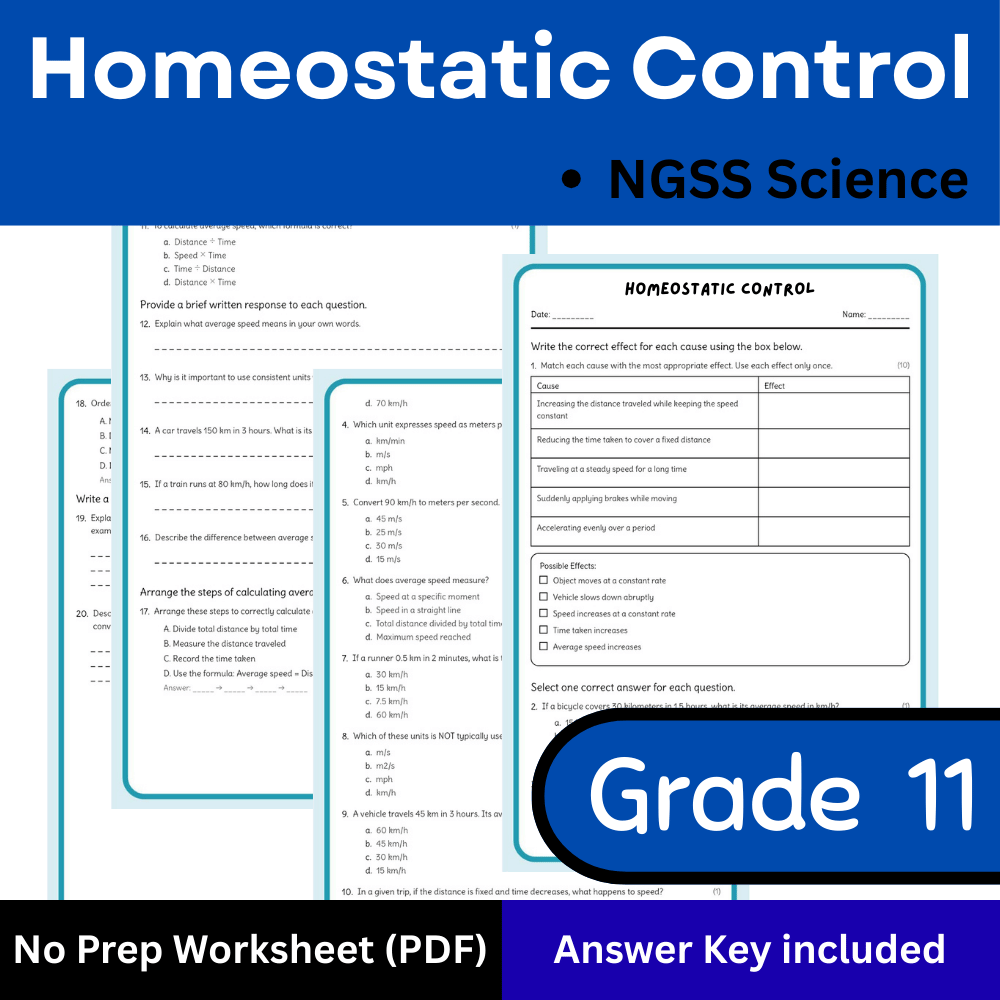
Grade 11 Science | Homeostatic Control Worksheet (Answer Key) – NGSS Aligned
Created byBright Mind ResourcesLearning Objectives
- Understand how feedback mechanisms regulate internal physiological variables.
- Identify examples of homeostasis such as blood glucose regulation and thermoregulation.
- Explain the role of cellular ion gradients and membrane pumps in maintaining internal stability.
Instant download
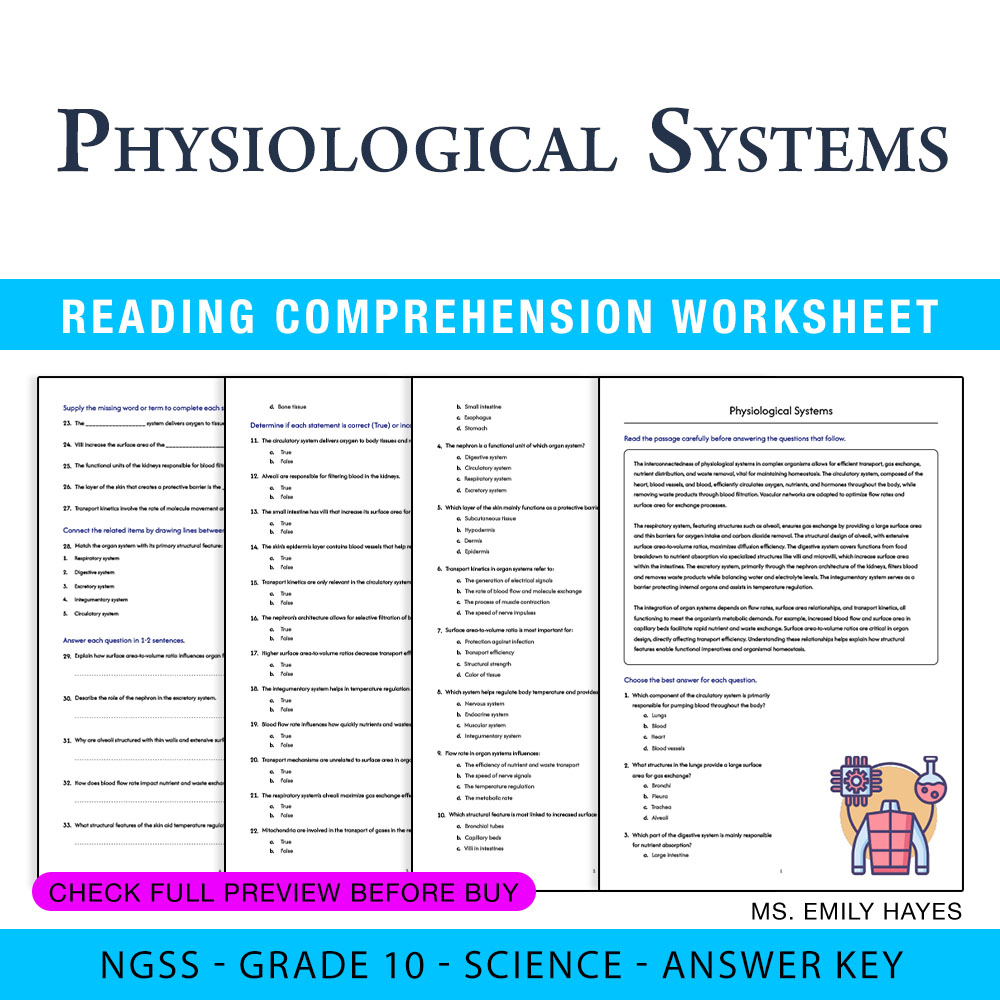
Grade 10 Science | Physiological Systems Worksheet (PDF+ Answer Key)
Created byCopper Leaf ClassroomLearning Objectives
- Describe the structural features and functions of the circulatory, respiratory, digestive, excretory, and integumentary systems.
- Analyze how different organ systems coordinate to meet organismal demands using flow rates, surface area relationships, and transport mechanisms.
- Compare and contrast structural adaptations and their functional implications across various physiological systems.
Instant download
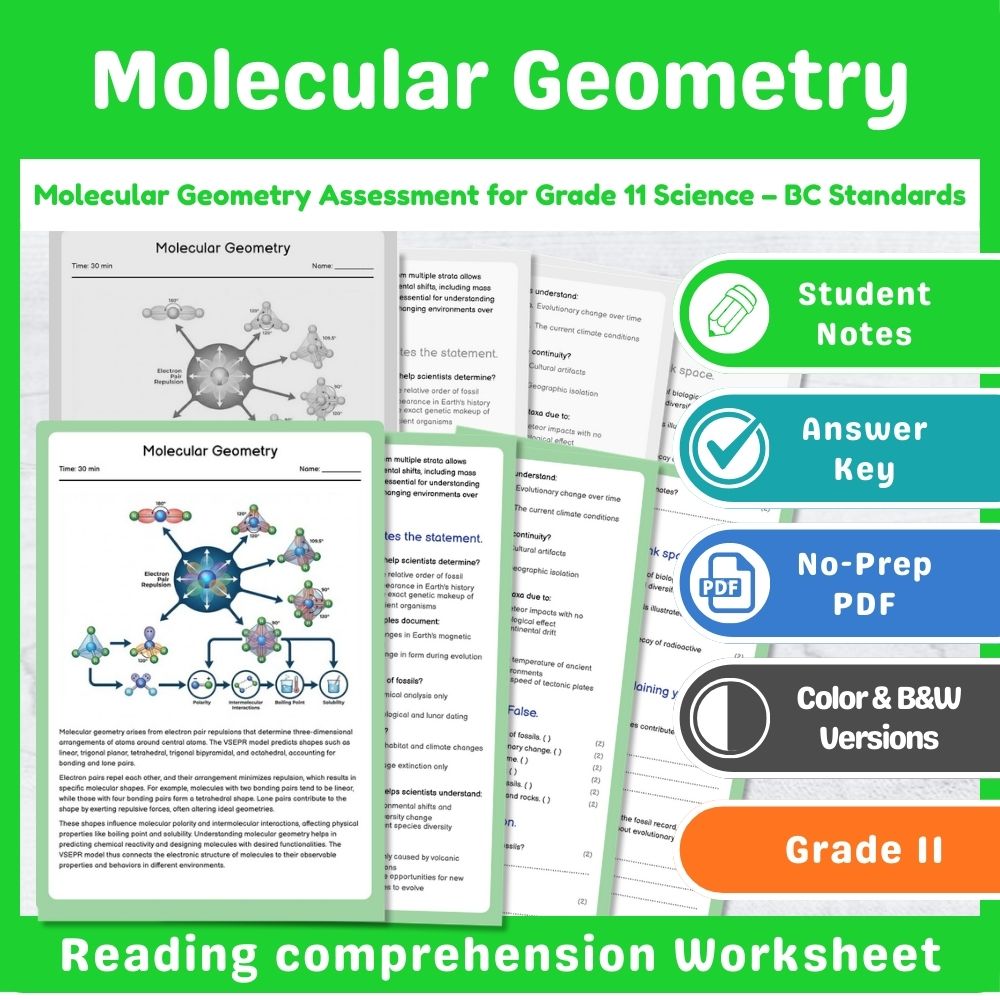
Molecular Geometry Assessment for Grade 11 Science – BC Standards
Created byPrism Point LearningLearning Objectives
- Explain the principles of VSEPR model and how electron pairs determine molecular shape.
- Identify and predict molecular geometries such as linear, trigonal planar, tetrahedral, trigonal bipyramidal, and octahedral.
- Understand how molecular shapes influence polarity, intermolecular forces, boiling points, and solubility.
Also included in: Grade 11 Science | Thermochemistry Assessment Bundle – Standards-Aligned
Instant download

Grade 6 Science – Recrystallization & Purifying Solids Daily Reading Worksheet
Created byBright Mind ResourcesLearning Objectives
- Understand the process of recrystallization and its purpose in purifying solids.
- Learn how temperature changes affect solubility and crystal formation.
- Recognize the importance of controlled cooling in producing pure crystals.
Also included in: Matter & Change Grade 6 Science Daily Reading Worksheets Lesson Bundle | BC +1 more
Instant download
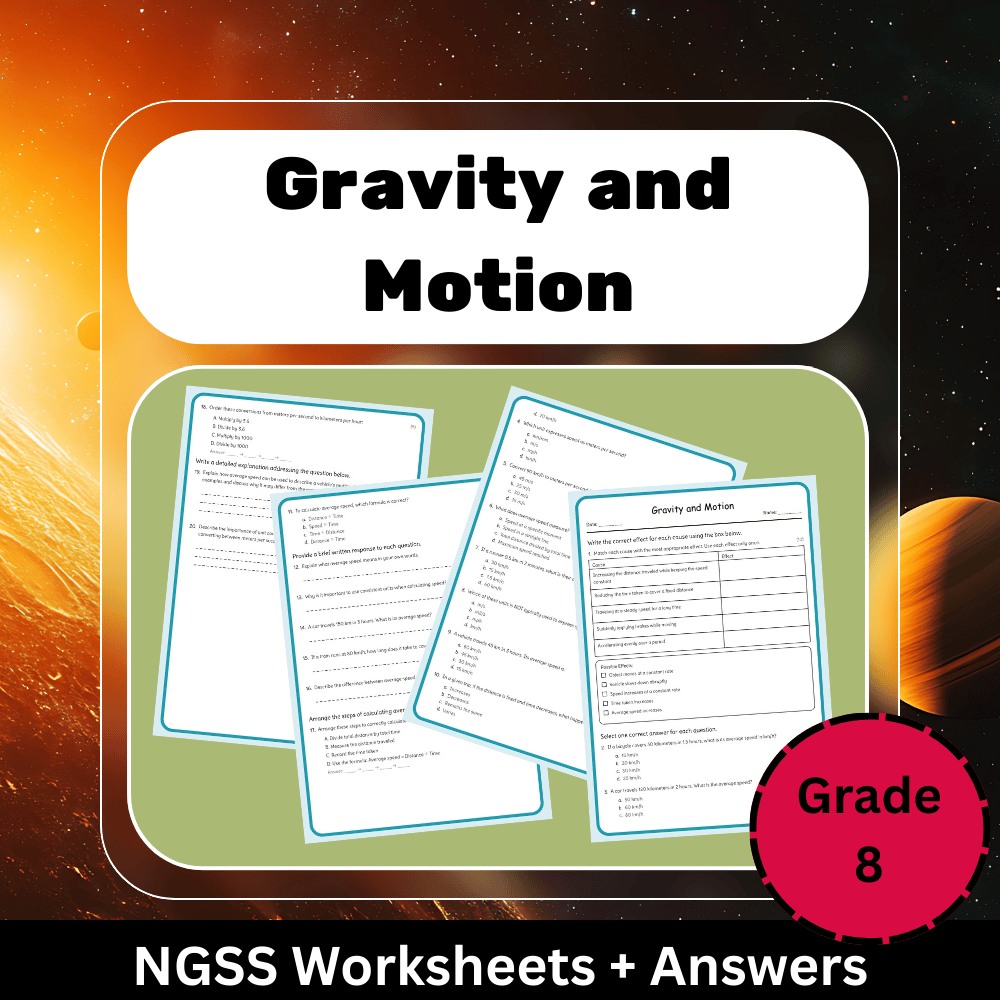
Grade 8 Science | Gravity and Motion Worksheet (Worksheet + Answer Key) NGSS
Created byBright Mind ResourcesLearning Objectives
- Explain how gravity influences the motion of celestial bodies within the solar system and galaxies.
- Describe the concept of orbital trajectories and how mutual gravitational attraction causes orbiting objects to follow elliptic paths.
- Analyze how the balance between inertia and gravity results in stable orbits and relates to orbital periods.
Also included in: Grade 8 Science Unit | Motion, Cycles & Patterns Worksheet Bundle (NGSS Aligned) +2 more
Instant download

Grade 12 Science | Lifecycle Impact Balance Worksheet | California Standards
Created byLumora LearningLearning Objectives
- Understand how full life cycle evaluation influences technological decision-making.
- Analyze the scientific mechanisms affecting battery degradation, thermal limits, and recovery efficiency.
- Compare electric vehicle battery management and recycling approaches considering resource extraction, emissions, and end-of-life recovery.
Instant download

Grade 3 Science – Force and Vibrations Worksheet (PDF) | General Standards
Created byEvergreen Desk EducationLearning Objectives
- Explain how a force can cause an object to vibrate
- Describe how vibration size affects the loudness of sound
- Identify how sound travels through a medium
Also included in: Grade 3 Science: Light, Sound & Matter Lesson Bundle for General Framework +1 more
Instant download

Grade 3 Science Worksheet | Material Properties and Descriptions (PDF)
Created byEvergreen Desk EducationLearning Objectives
- Identify observable material properties such as color, texture, size, shape, and how materials respond to light or touch.
- Compare two material samples by describing both similarities and differences in their properties.
- Use evidence from observations to explain why properties help people describe and identify materials.
Also included in: Grade 3 Science: Light, Sound & Matter Lesson Bundle for General Framework +1 more
Instant download
Browse more categories
About Science Worksheets
Find Science worksheets spanning core skills, practice, and review. All 44,295 resources are instant PDF downloads for the classroom or home.
Every worksheet on MyTeachingSheets is created by independent teacher-authors and reviewed before publication. All resources download as printable PDFs for classroom, homework, or at-home practice, and many include answer keys. Preview any worksheet free before buying.