
Science Worksheets
42,685 subject resources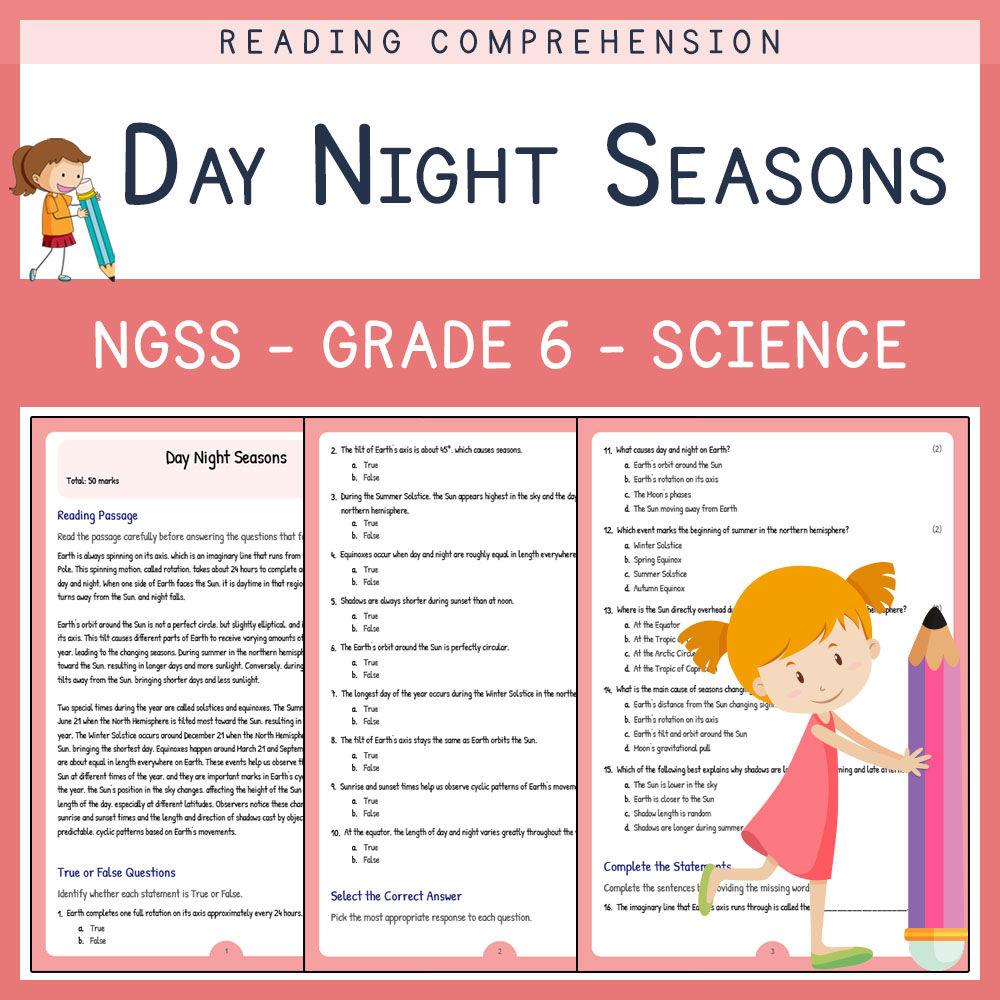
Grade 6 Science | Day, Night & Seasons Worksheet (PDF) | NGSS Aligned
 Created byLumora Learning
Learning Objectives
- Understand Earth's rotation and orbit
- Identify key phenomena like day and night, seasons, solstices, and equinoxes
- Explain how sunlight and shadow patterns relate to Earth's position
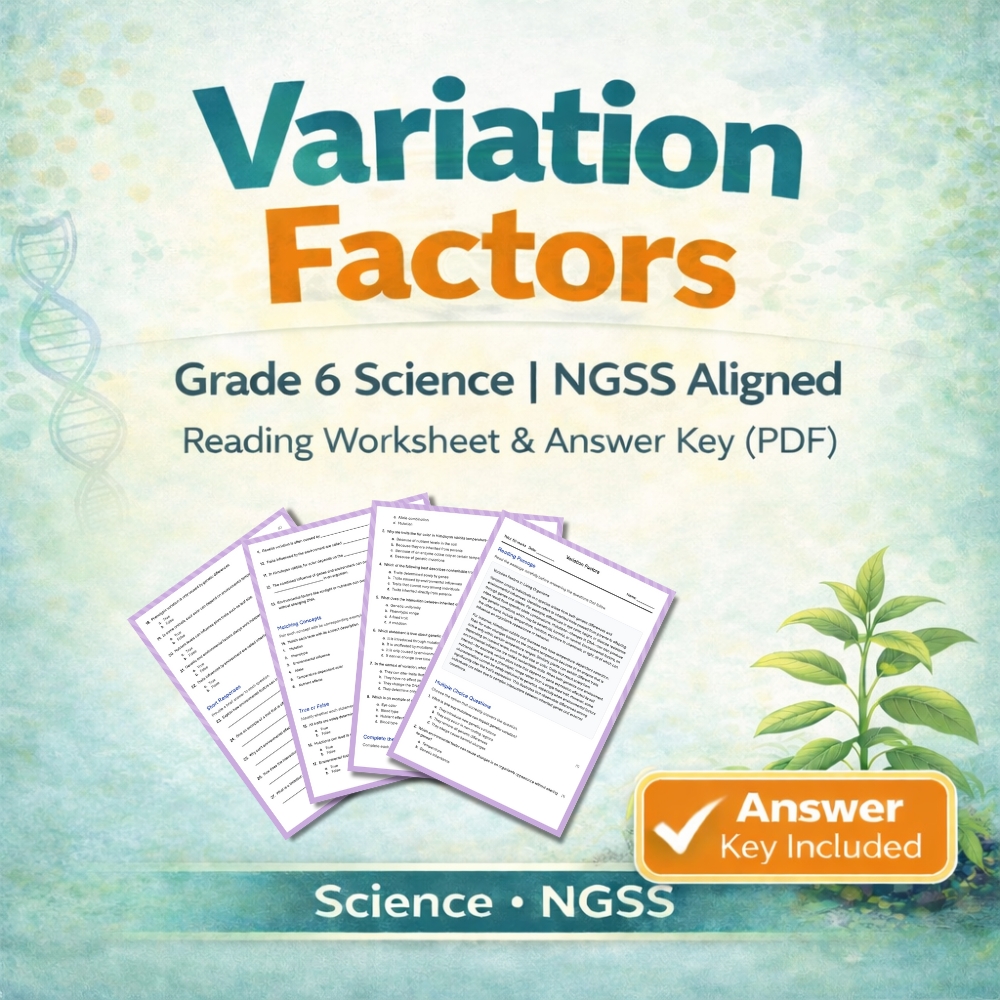
6th Grade Science | Variation Factors | NGSS Aligned ( Worksheet + Answer Key )
 Created byCedar Grove Learning
Learning Objectives
- Explain how genetic differences contribute to observable variation among individuals.
- Describe how environmental factors influence phenotypic traits in organisms.
- Analyze models of allele combinations, mutation impact, and environmental effects on traits.
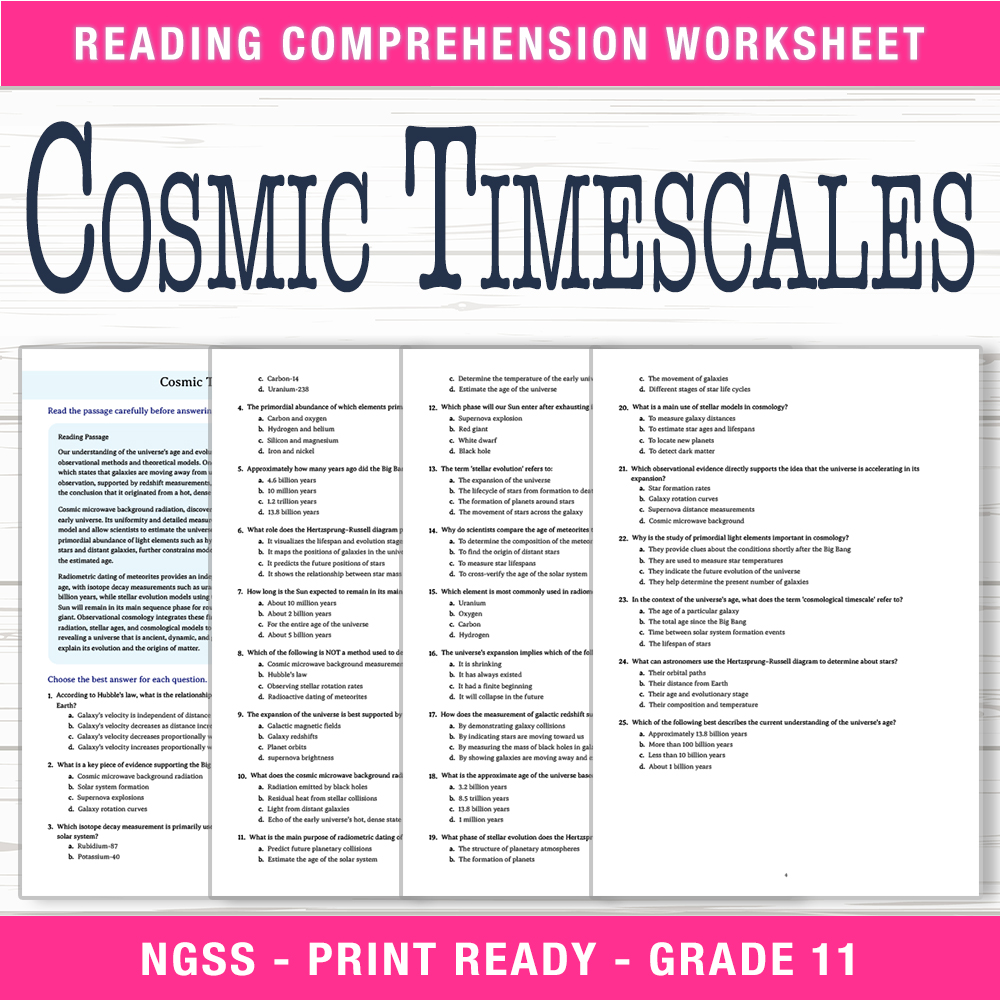
Grade 11 Science – Cosmic Timescales Worksheet (PDF + Answer Key)
 Created byRiverstone Classroom
Learning Objectives
- Understand how astronomical observations constrain the age and evolution of the universe and solar system.
- Learn about key methods such as Hubble's law, cosmic microwave background, and radiometric dating used in cosmology.
- Explore stellar evolution and how the Hertzsprung–Russell diagram contextualizes the lifespan of stars including the Sun.
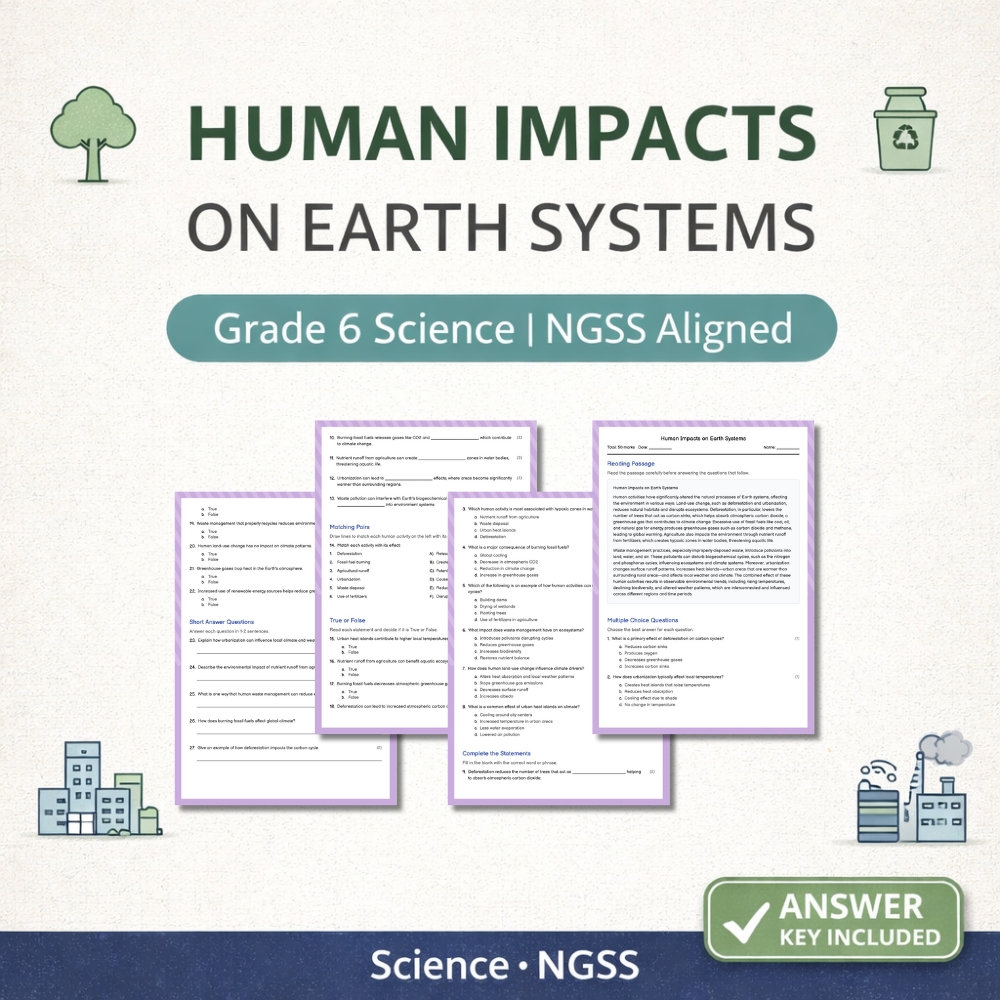
6th Grade Science | Human Impacts on Earth Systems | NGSS Worksheet
Created byCedar Grove LearningLearning Objectives
- Understand how human activities such as land-use change, fossil fuel combustion, agriculture, and waste management impact Earth's systems.
- Analyze causal links between human actions and environmental changes across different spatial and temporal scales.
- Identify examples of human modifications to biogeochemical cycles, climate drivers, and ecosystems.
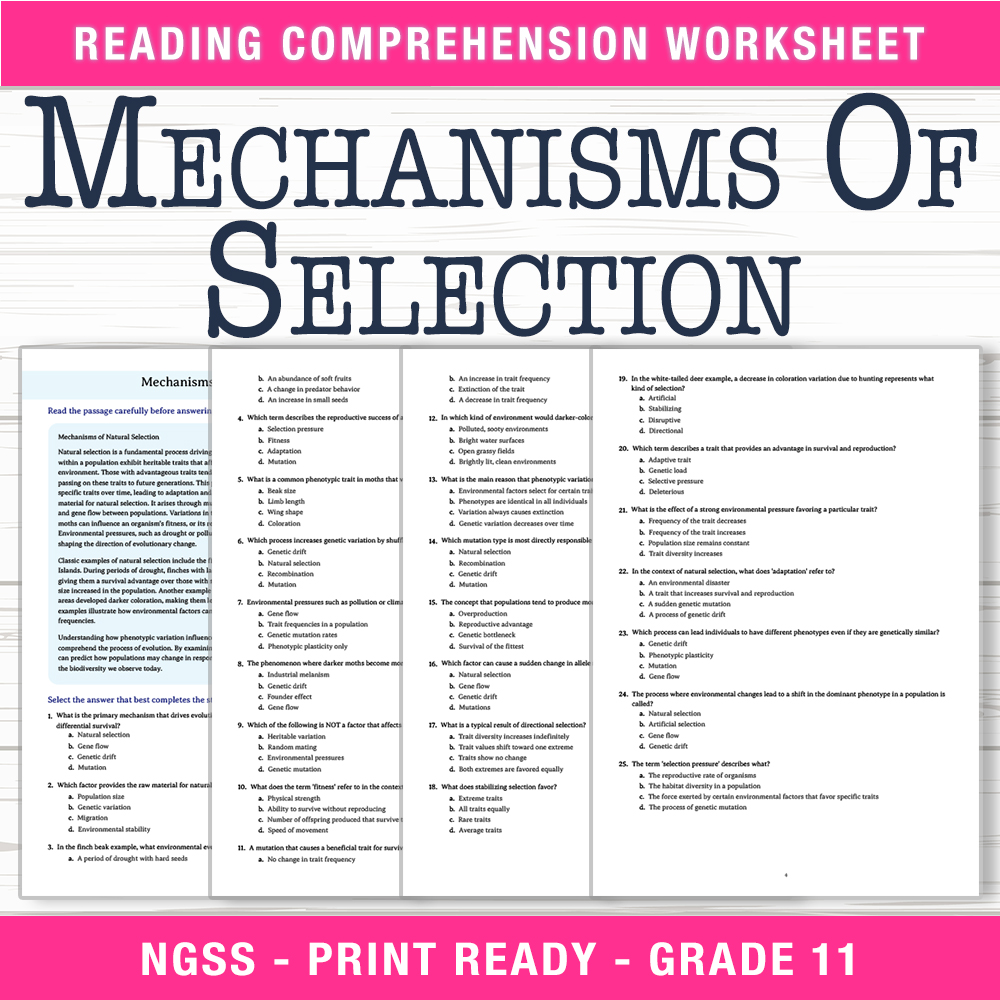
Grade 11 Science | Mechanisms of Selection Worksheet (PDF + Answer Key)
Created byRiverstone ClassroomLearning Objectives
- Explain the process of natural selection and its role in evolution.
- Identify factors that influence natural selection, such as genetic variation and environmental pressures.
- Describe classic examples of selection pressures like finch beak variation and industrial melanism.
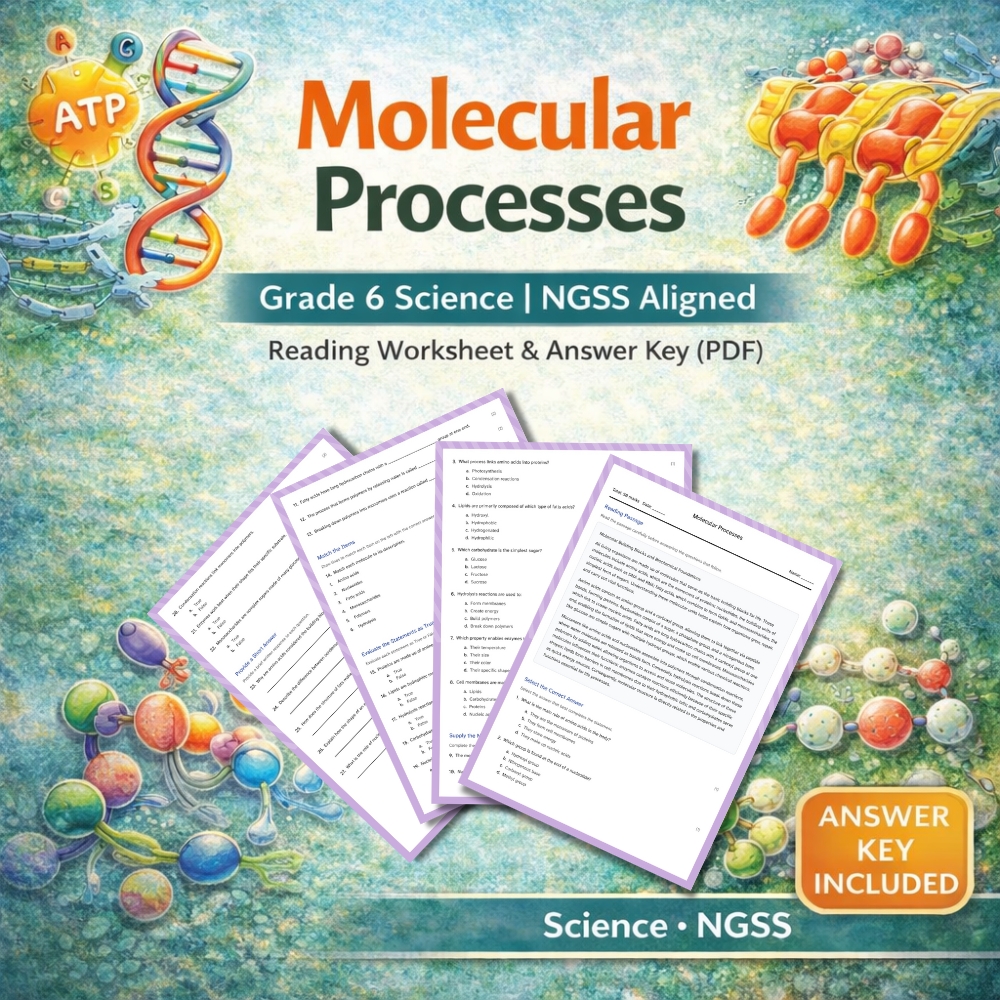
6th Grade Science | Molecular Processes | Worksheet (PDF + Answer Key) NGSS
Created byCedar Grove LearningLearning Objectives
- Understand the building blocks of molecules such as amino acids, nucleotides, fatty acids, and monosaccharides.
- Explain how monomers assemble into polymers through condensation reactions and are broken down by hydrolysis.
- Relate molecular structure to properties like enzyme catalysis, membrane transport, and polymerization during growth.
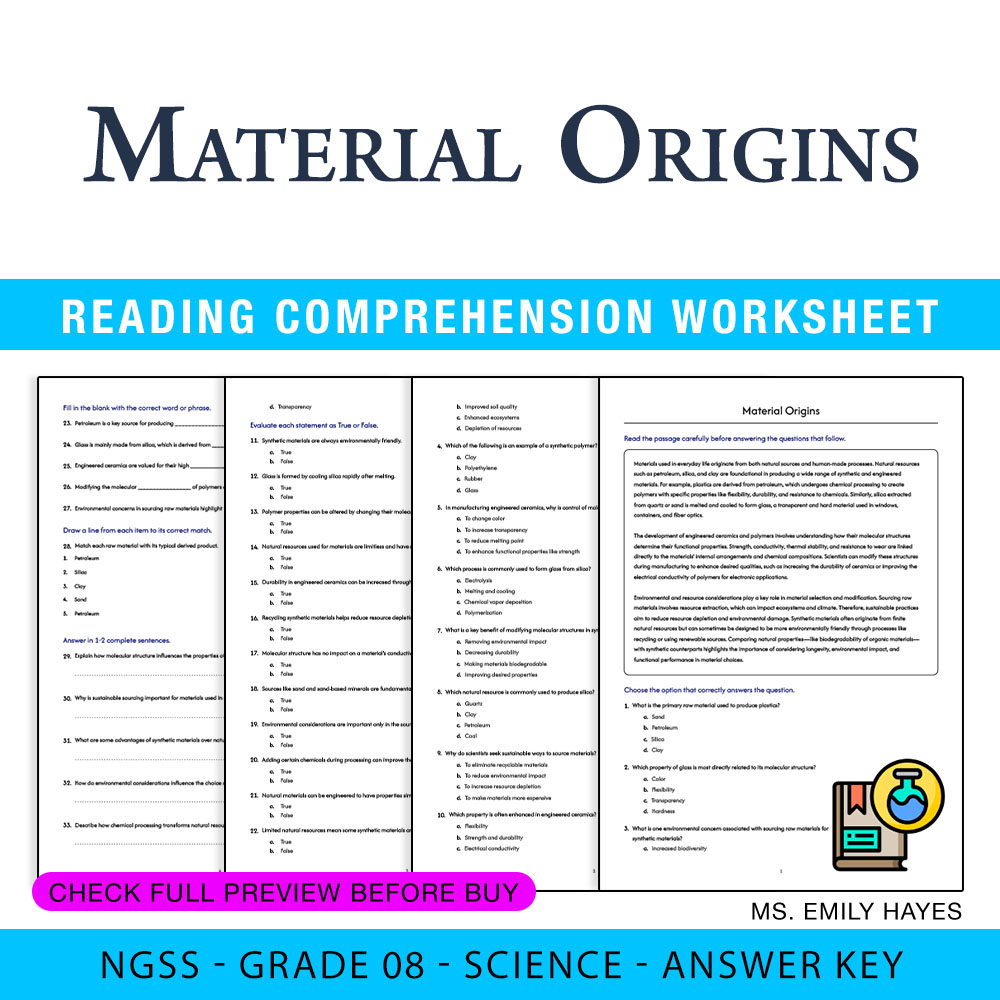
8th Grade Science | Material Origins Worksheet (PDF+ Answer Key)
 Created byCopper Leaf Classroom
Learning Objectives
- Understand how natural resources are transformed into synthetic materials.
- Recognize the influence of processing and molecular structure on material properties.
- Analyze environmental and resource considerations in sourcing and modifying materials.
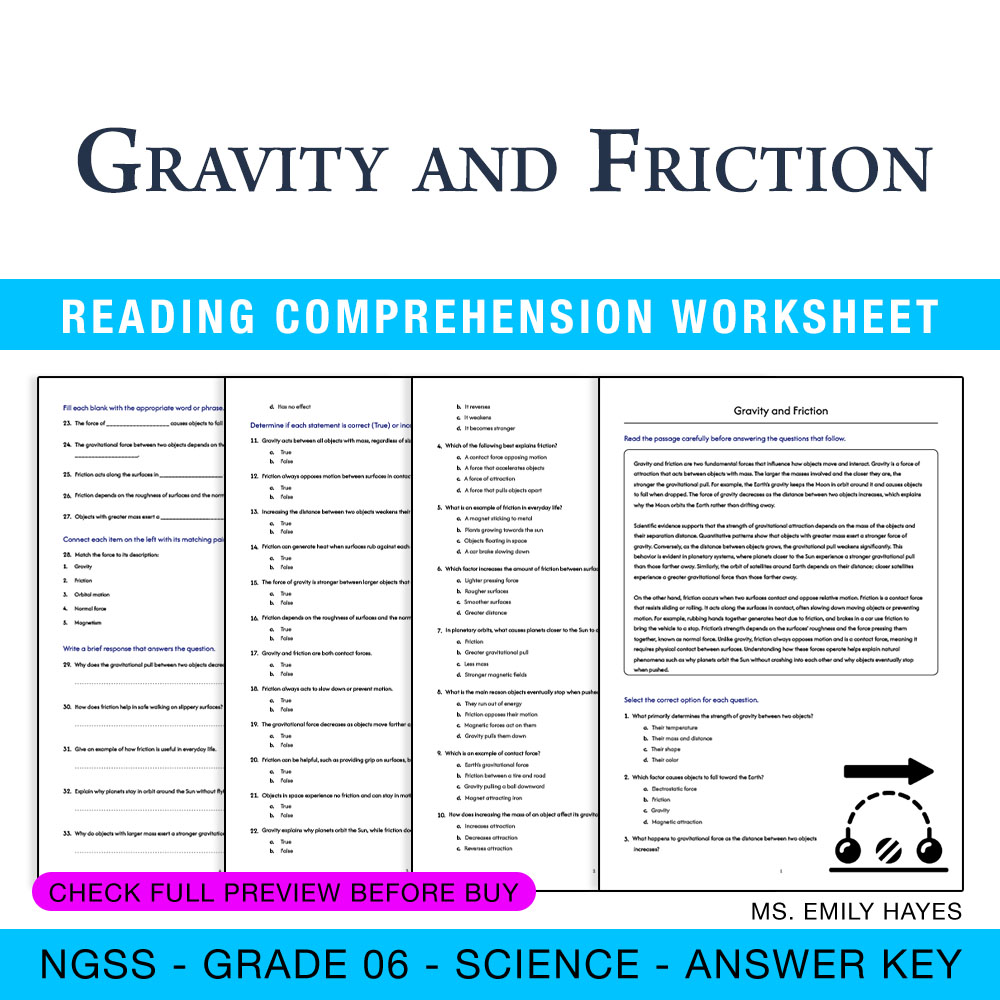
6th Grade Science | Gravity and Friction Worksheet (PDF + Answer Key)
Created byCopper Leaf ClassroomLearning Objectives
- Describe how gravity depends on mass and distance using examples like Earth-Moon system and planetary orbits.
- Explain the concept of friction as a contact force that resists motion along surfaces.
- Differentiate between gravitational forces and contact forces such as friction in how they affect motion and orbiting behavior.
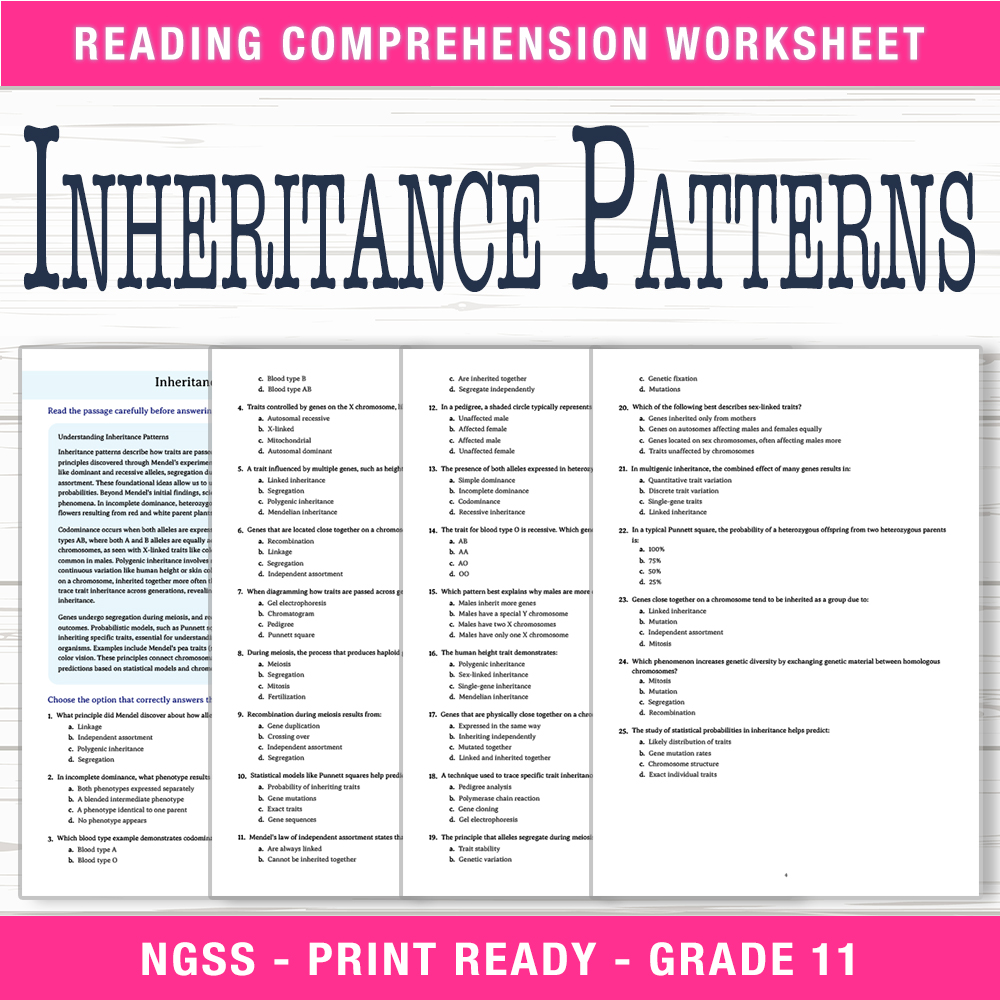
Grade 11 Science – Inheritance Patterns Worksheet (PDF + Answer Key)
Created byRiverstone ClassroomLearning Objectives
- Explain the principles of Mendelian inheritance and how they predict trait distribution.
- Describe patterns of inheritance beyond simple dominance, including incomplete dominance, codominance, sex linkage, polygenic inheritance, and linkage.
- Interpret pedigrees and understand how meiosis and recombination influence inheritance patterns.
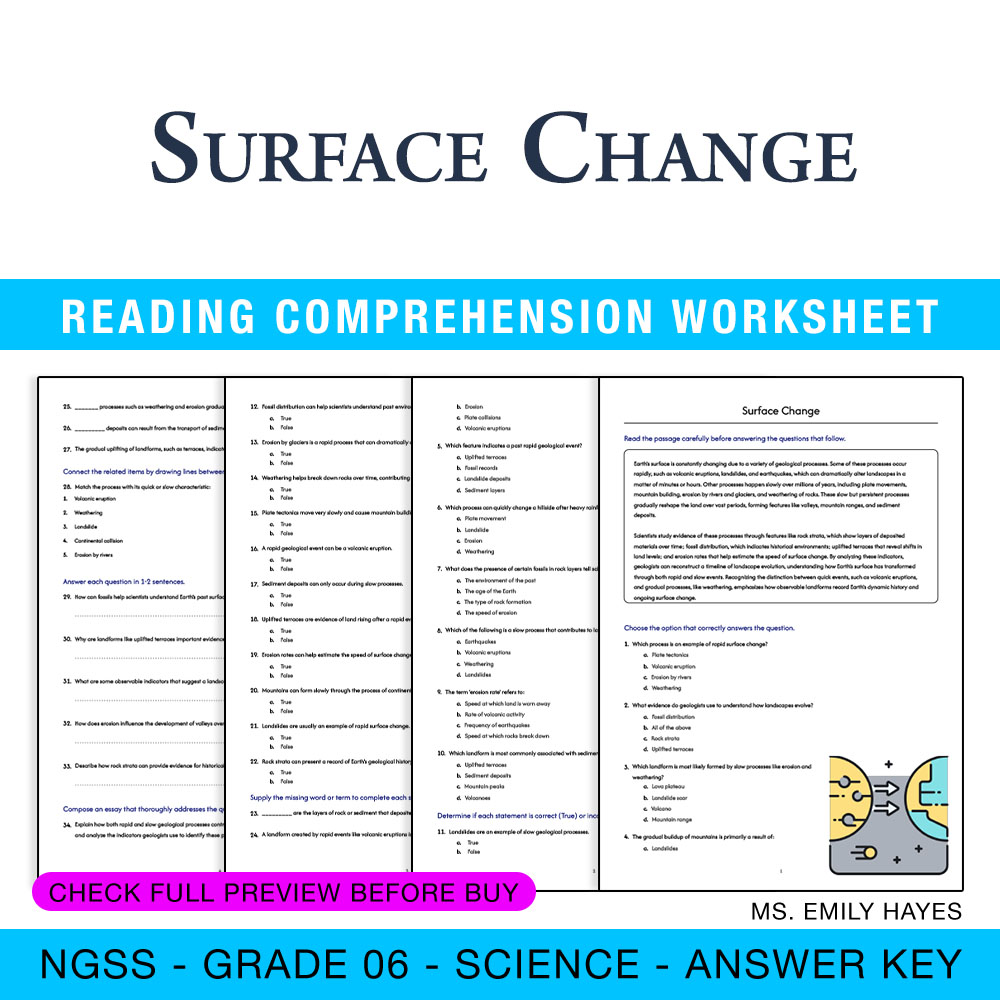
6th Grade Science | Surface Change Worksheet (PDF + Answer Key)
Created byCopper Leaf ClassroomLearning Objectives
- Explain the processes that modify Earth's surface, including both rapid and slow geological events.
- Identify evidence such as rock strata, fossil distribution, and landforms that help explain landscape evolution.
- Contrast the characteristics and effects of rapid surface change events like volcanic eruptions and landslides with slow processes like weathering and continental collision.
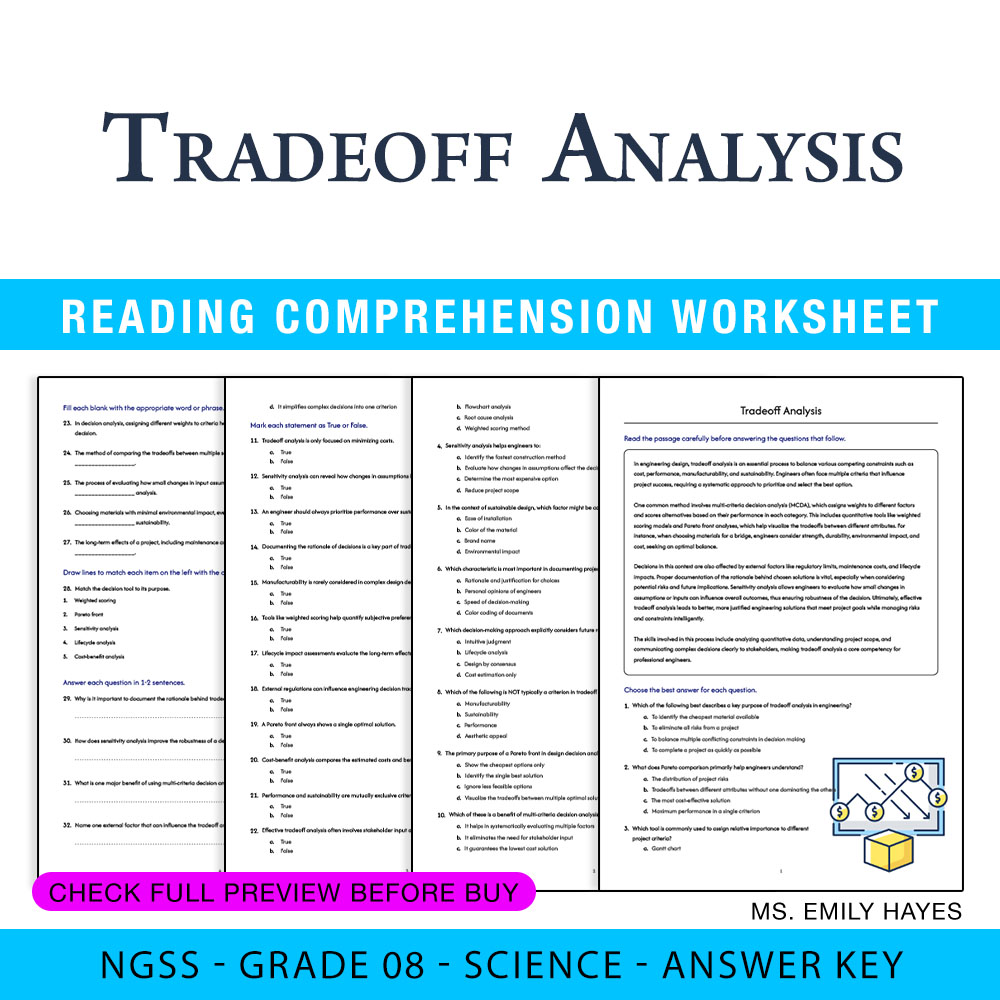
8th Grade Science | Tradeoff Analysis Worksheet (PDF+ Answer Key)
Created byCopper Leaf ClassroomLearning Objectives
- Understand how to prioritize competing constraints using multi-criteria decision methods.
- Apply cost-benefit estimation techniques to project choices.
- Utilize tools such as weighted scoring and pareto comparisons to analyze performance, manufacturability, and sustainability.
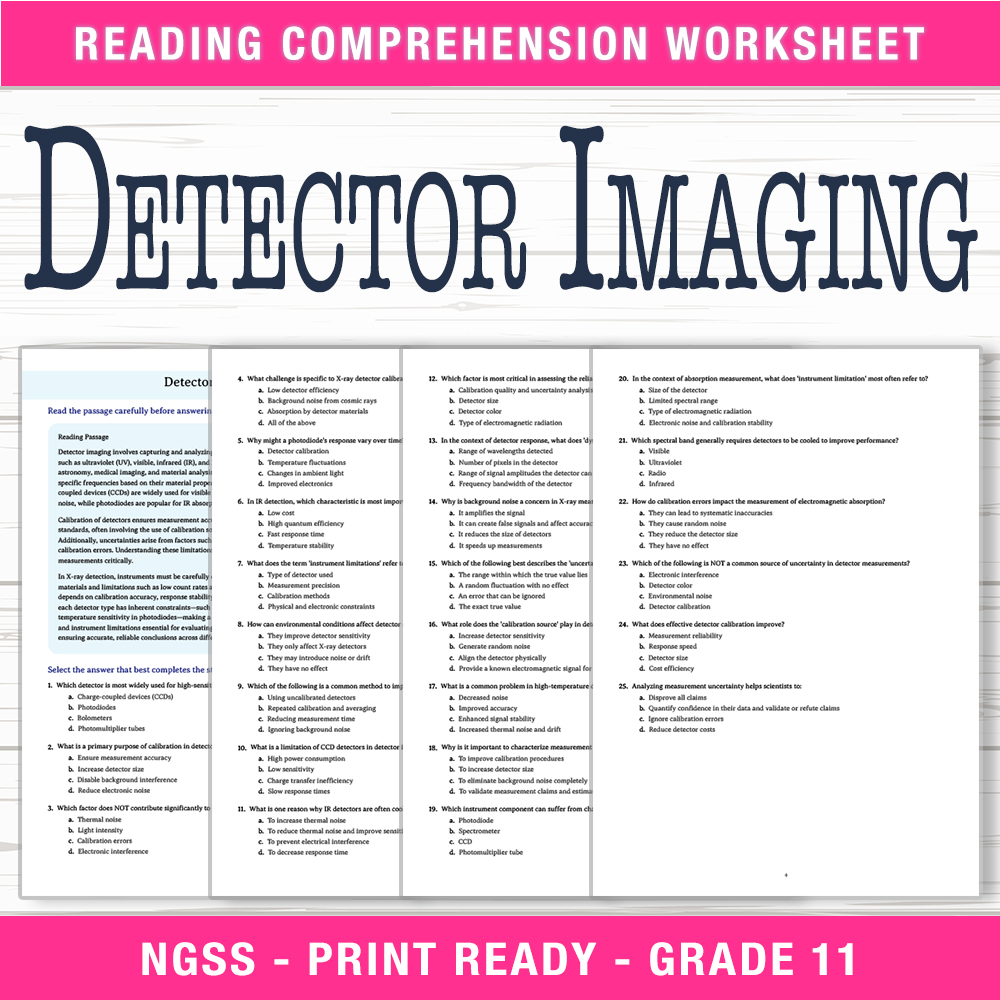
Grade 11 Science | Detector Imaging Worksheet (PDF + Answer Key)
Created byRiverstone ClassroomLearning Objectives
- Understand how electromagnetic radiation interacts with matter across UV, visible, IR, and X-ray bands.
- Evaluate the reliability and limitations of different detector types such as CCDs and photodiodes.
- Analyze calibration procedures, uncertainties, and instrument limitations in electromagnetic measurement.
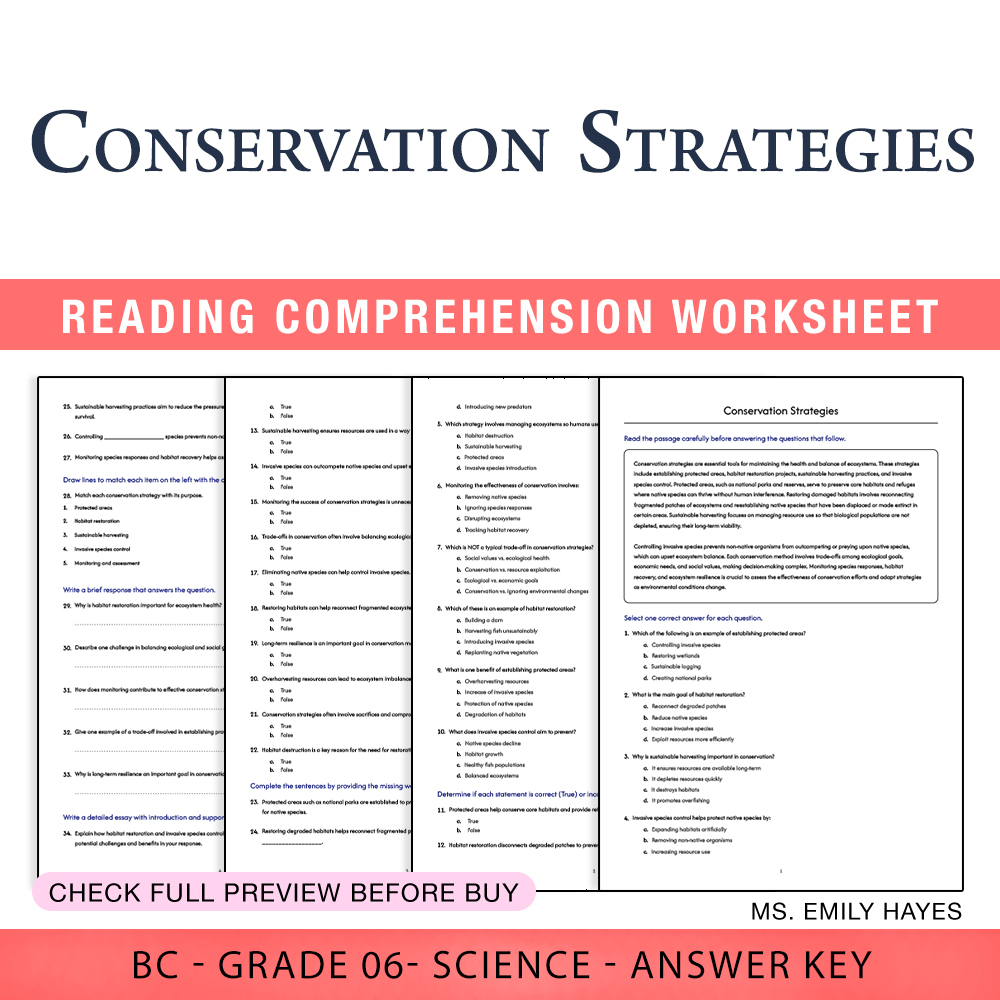
6th Grade Science | Conservation Strategies Worksheet (PDF+ Answer Key)
Created byCopper Leaf ClassroomLearning Objectives
- Understand various conservation strategies used to protect ecosystems.
- Identify differences and applications of protected areas, habitat restoration, sustainable harvesting, and invasive species control.
- Evaluate the importance of monitoring and assessing the effectiveness of conservation efforts.

11th Grade Science | Evidence of Evolution Worksheet (PDF+ Answer Key)
Created byCopper Leaf ClassroomLearning Objectives
- Understand how fossil evidence, comparative anatomy, molecular data, biogeography, and vestigial organs support common ancestry and evolution.
- Analyze different lines of empirical evidence and how they concordantly explain lineage relationships.
- Interpret data from fossils, anatomical structures, molecular sequences, and biogeographic patterns to draw evolutionary conclusions.
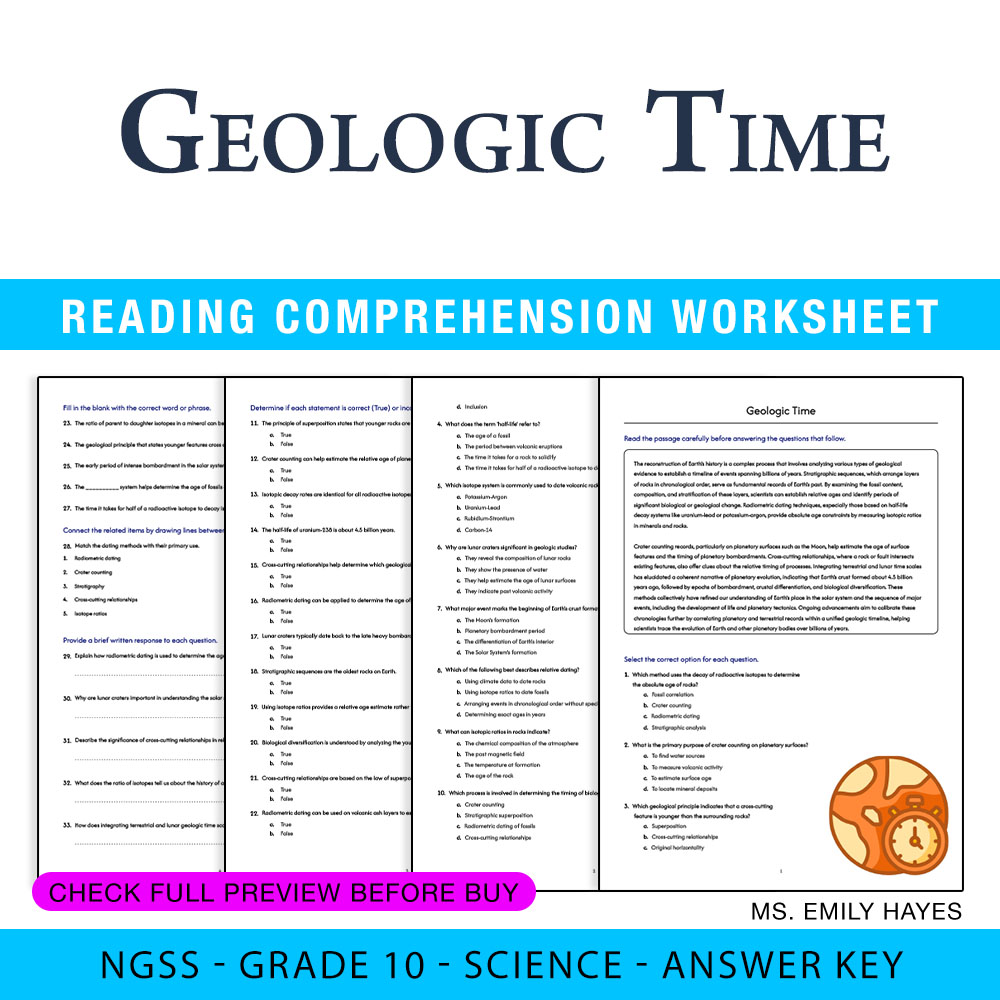
10th Grade Science | Geologic Time Worksheet (PDF+ Answer Key)
Created byCopper Leaf ClassroomLearning Objectives
- Understand methods used to reconstruct Earth's geologic history, including stratigraphy and radiometric dating.
- Describe the role of isotopic ratios, half-life decay, and crater counting in determining relative and absolute ages.
- Explain how terrestrial and lunar geologic time scales are integrated to understand Earth's history within the solar system context.
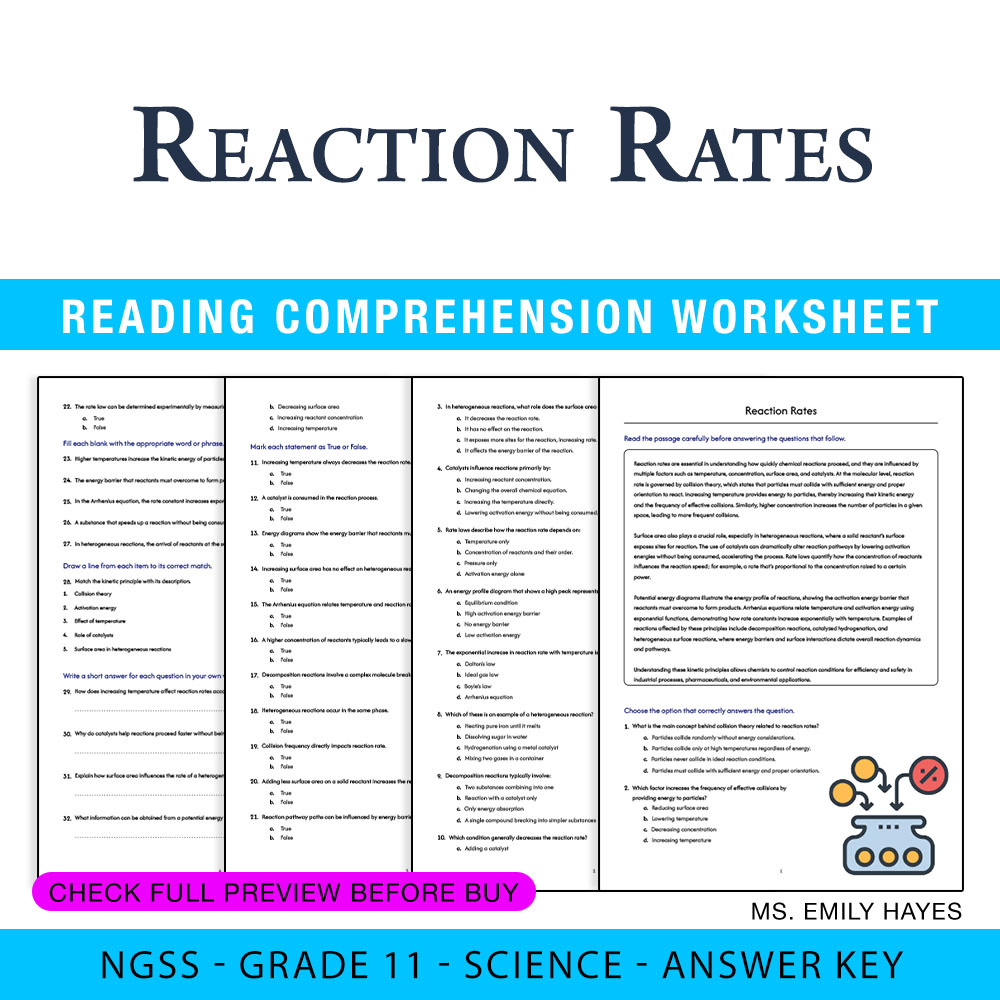
11th Grade Science | Reaction Rates Worksheet (PDF+ Answer Key)
Created byCopper Leaf ClassroomLearning Objectives
- Understand the factors affecting reaction rates including temperature, concentration, surface area, and catalysts.
- Explain how collision theory and activation energy influence reaction speed.
- Analyze rate laws and interpret their dependence on reactant concentrations.
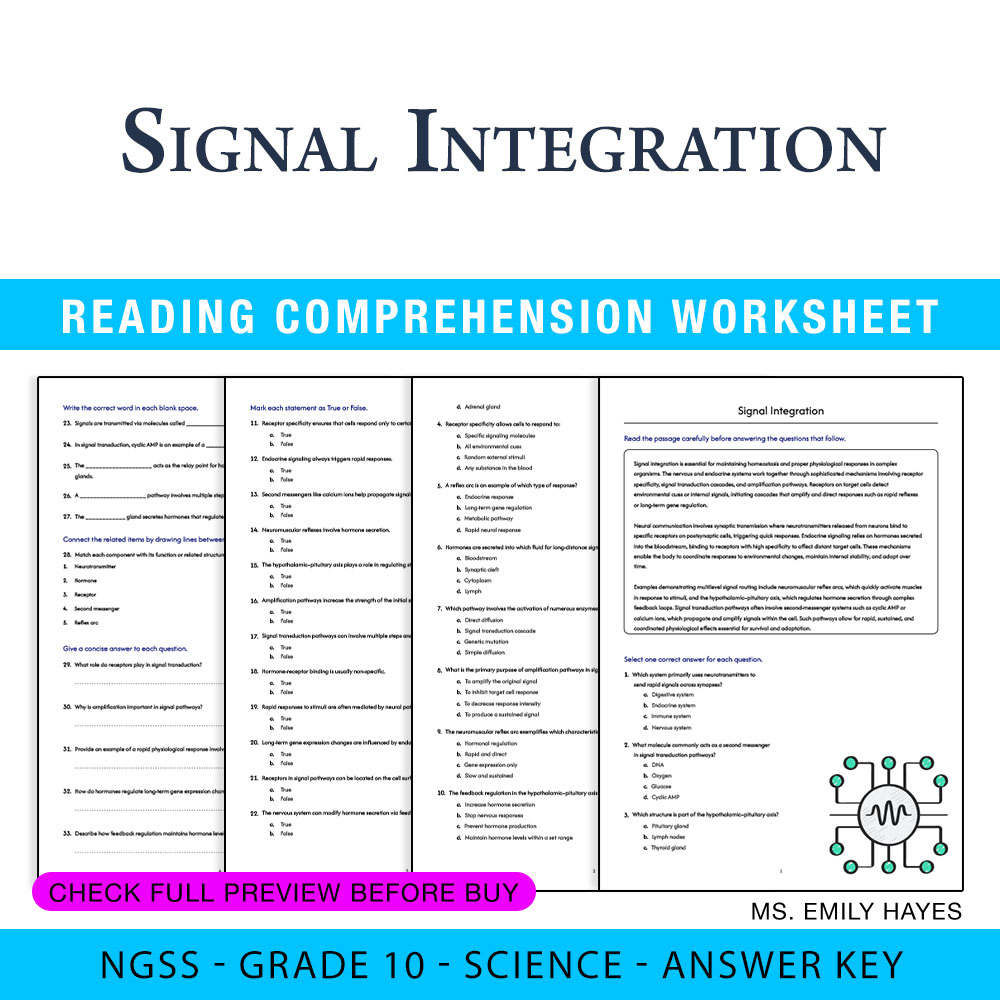
Grade 10 Science | Signal Integration Worksheet (PDF+ Answer Key)
Created byCopper Leaf ClassroomLearning Objectives
- Describe how nervous and endocrine systems coordinate responses through signal integration.
- Explain mechanisms such as receptor specificity, signal transduction cascades, and amplification pathways.
- Identify examples like neuromuscular reflex arcs and hypothalamic-pituitary axis communication.
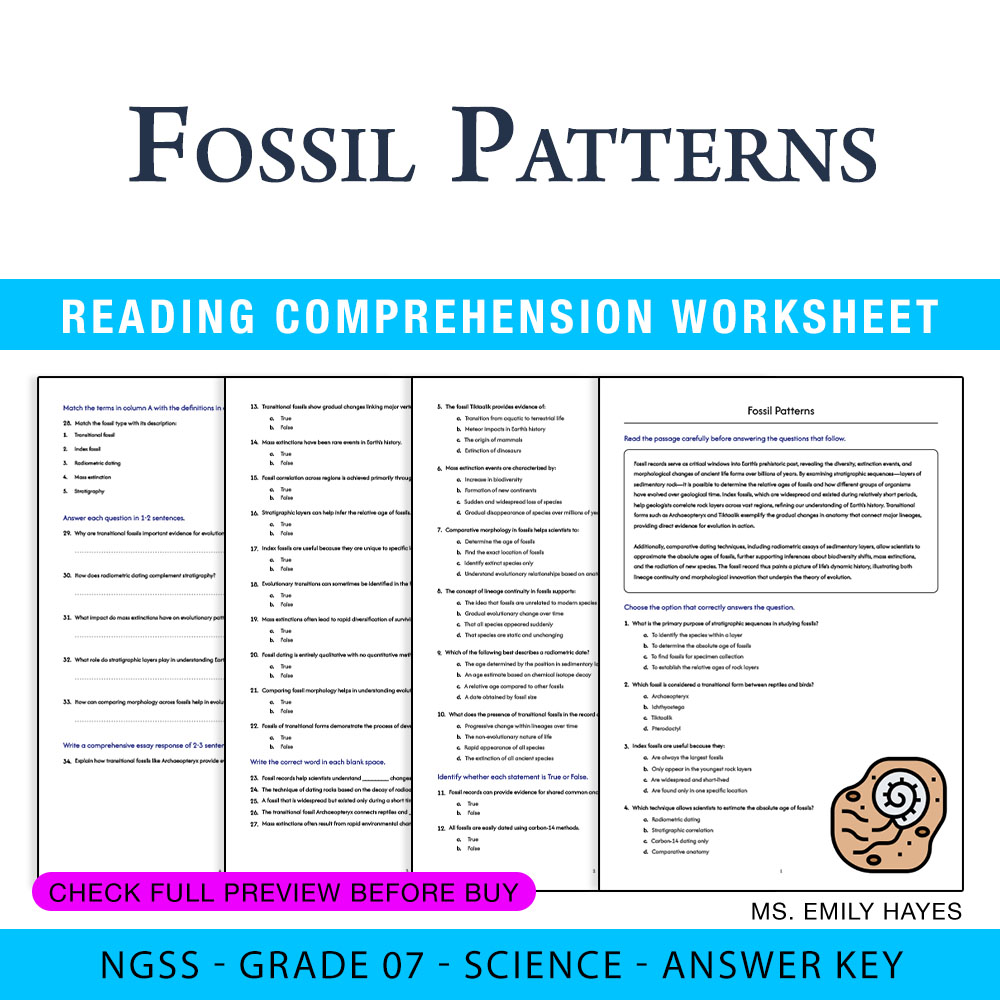
7th Grade Science | Fossil Patterns Worksheet (PDF + Answer Key)
Created byCopper Leaf ClassroomLearning Objectives
- Understand how fossil record patterns provide evidence for common ancestry and macroevolution.
- Identify key concepts such as stratigraphic sequences, index fossils, and transitional forms.
- Analyze how dating methods and fossil correlations support evolutionary theories.
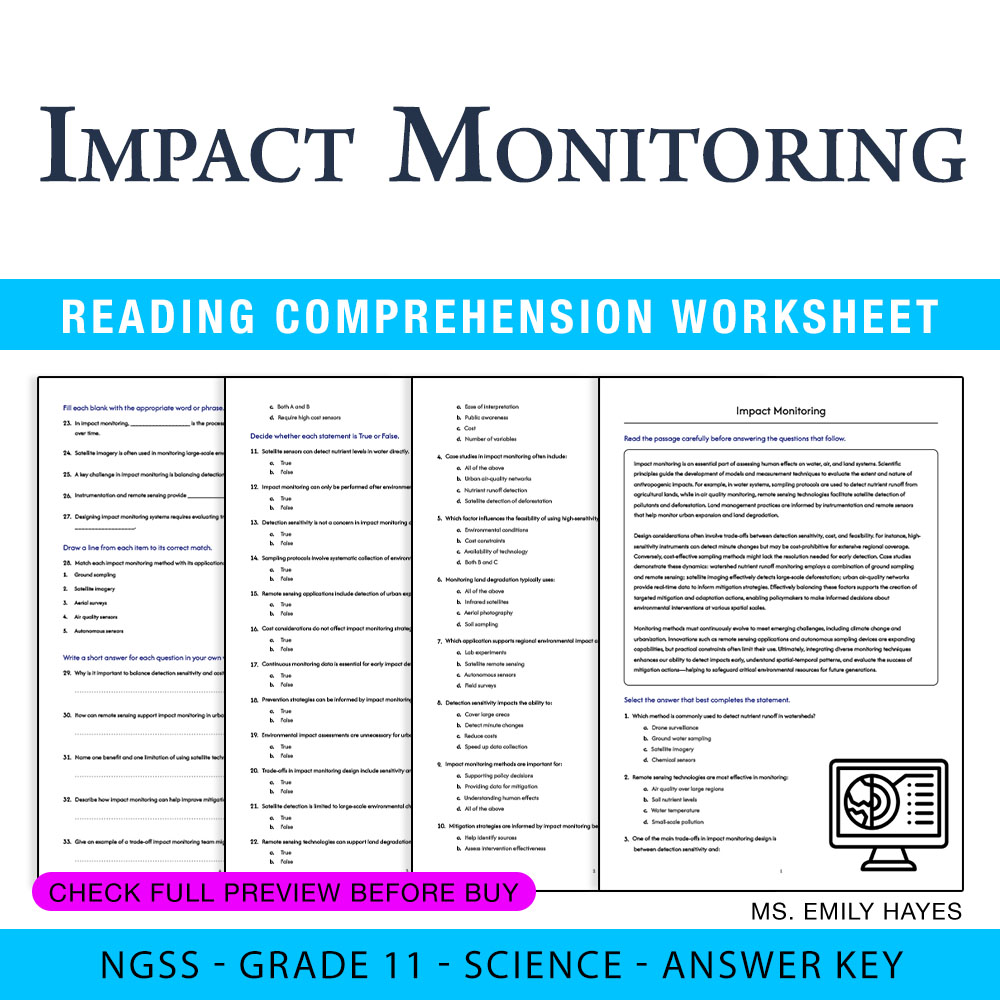
Grade 11 Science | Impact Monitoring Worksheet (PDF+ Answer Key)
Created byCopper Leaf ClassroomLearning Objectives
- Describe scientific principles used in monitoring environmental systems affected by human activity.
- Compare methods such as instrumentation, sampling protocols, and remote sensing for impact assessment.
- Analyze case studies involving water, air, and land monitoring to evaluate effectiveness and trade-offs.
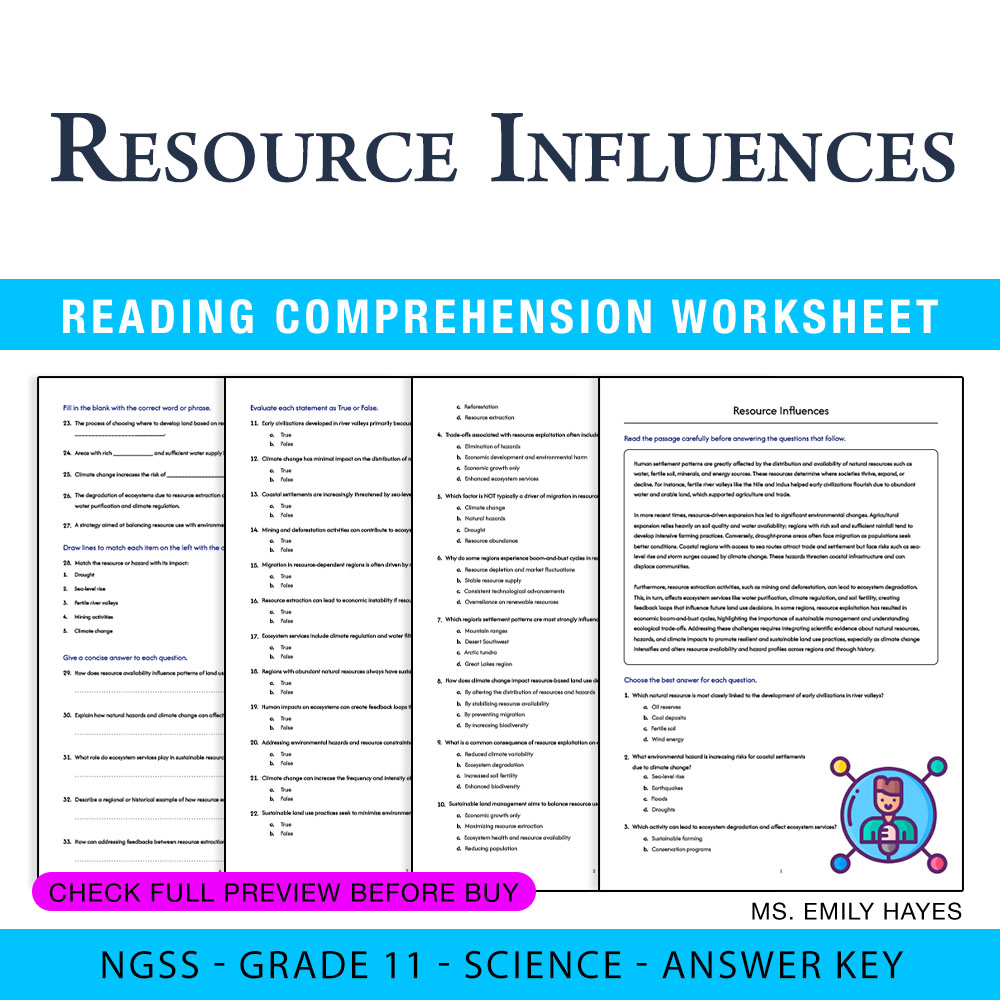
Grade 11 Science | Resource Influences Worksheet (PDF+ Answer Key)
Created byCopper Leaf ClassroomLearning Objectives
- Analyze how natural resource availability influences patterns of human settlement and land use.
- Evaluate the impacts of natural hazards and climate change on economic development and migration.
- Examine trade-offs between resource extraction, ecosystem services, and sustainability using regional case studies.
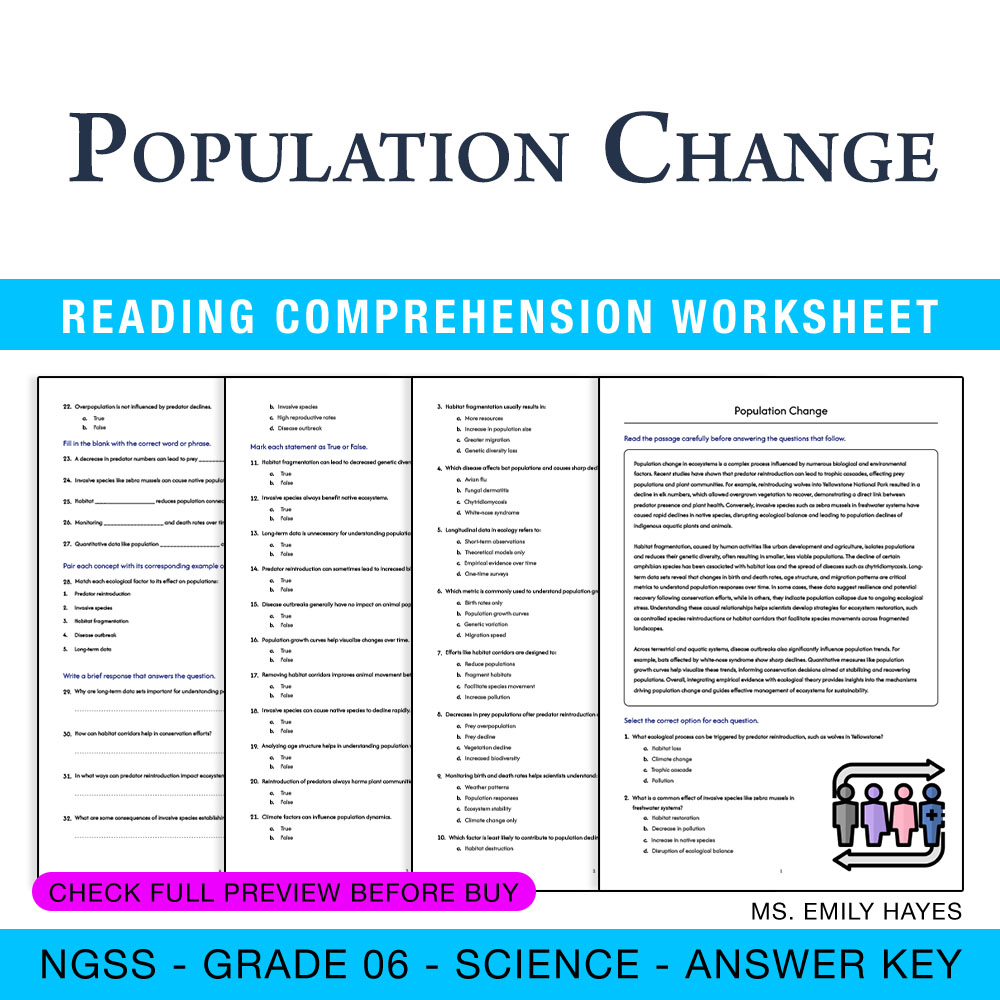
6th Grade Science | Population Change Worksheet (PDF+ Answer Key)
Created byCopper Leaf ClassroomLearning Objectives
- Construct evidence-based arguments relating ecosystem changes to population dynamics.
- Analyze case studies involving predator reintroduction, invasive species, habitat fragmentation, and disease outbreaks.
- Interpret empirical data sets and longitudinal observations to understand causes of population increase or decline.
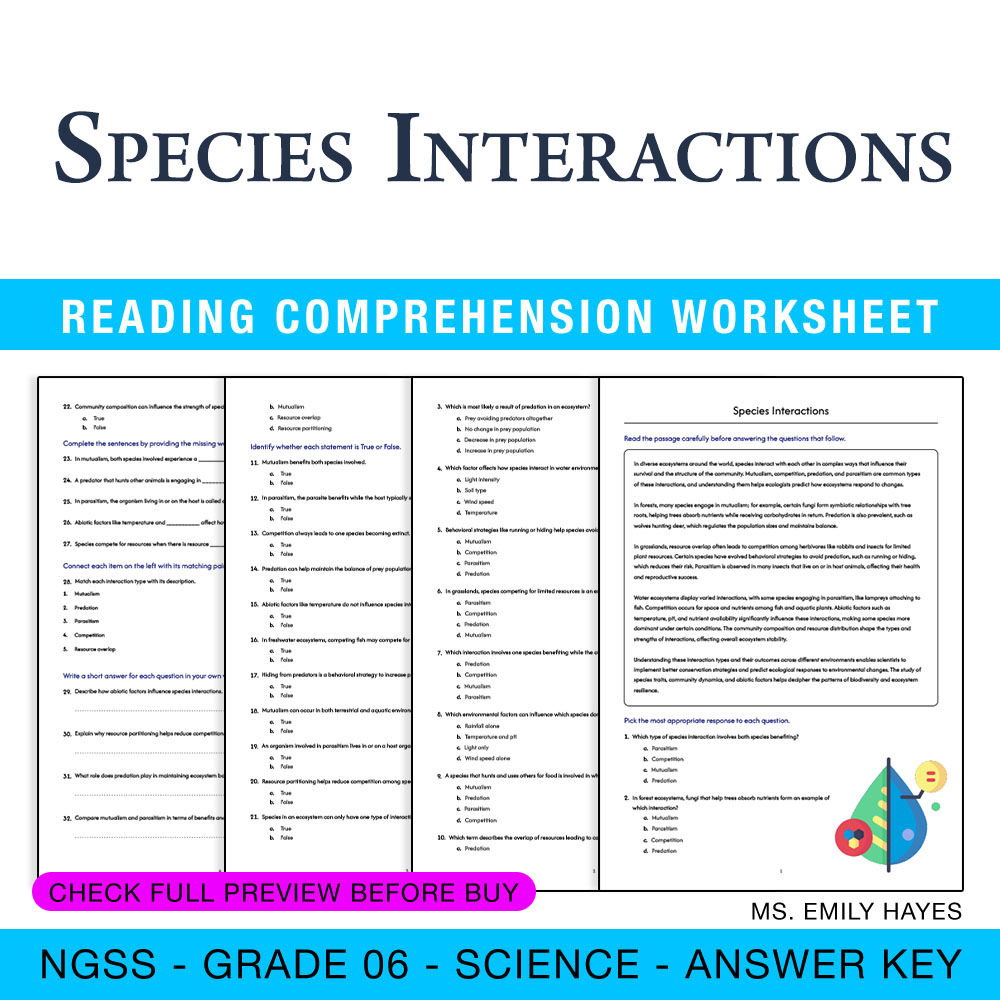
6th Grade Science | Species Interactions Worksheet (PDF +Answer Key)
Created byCopper Leaf ClassroomLearning Objectives
- Construct explanations predicting patterns of species interactions across ecosystems
- Identify key types of species interactions such as mutualism, competition, predation, and parasitism
- Compare interaction outcomes in forest, grassland, and freshwater environments
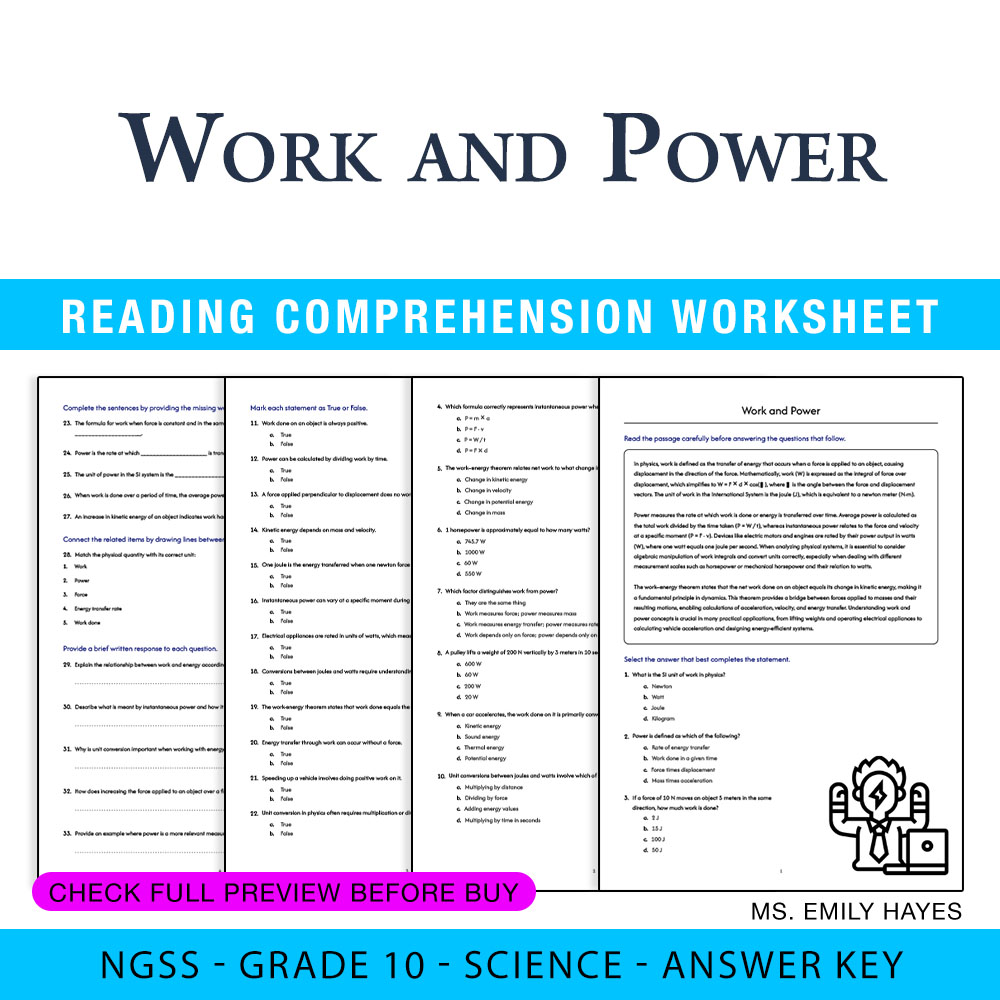
Grade 10 Science | Work and Power Worksheet (PDF+ Answer Key)
Created byCopper Leaf ClassroomLearning Objectives
- Understand the relationships among force, displacement, and energy through the work–energy theorem.
- Calculate work done and power in practical scenarios involving physical and mechanical systems.
- Apply algebraic manipulation of work integrals and perform unit conversions between joules, watts, and engineering units.
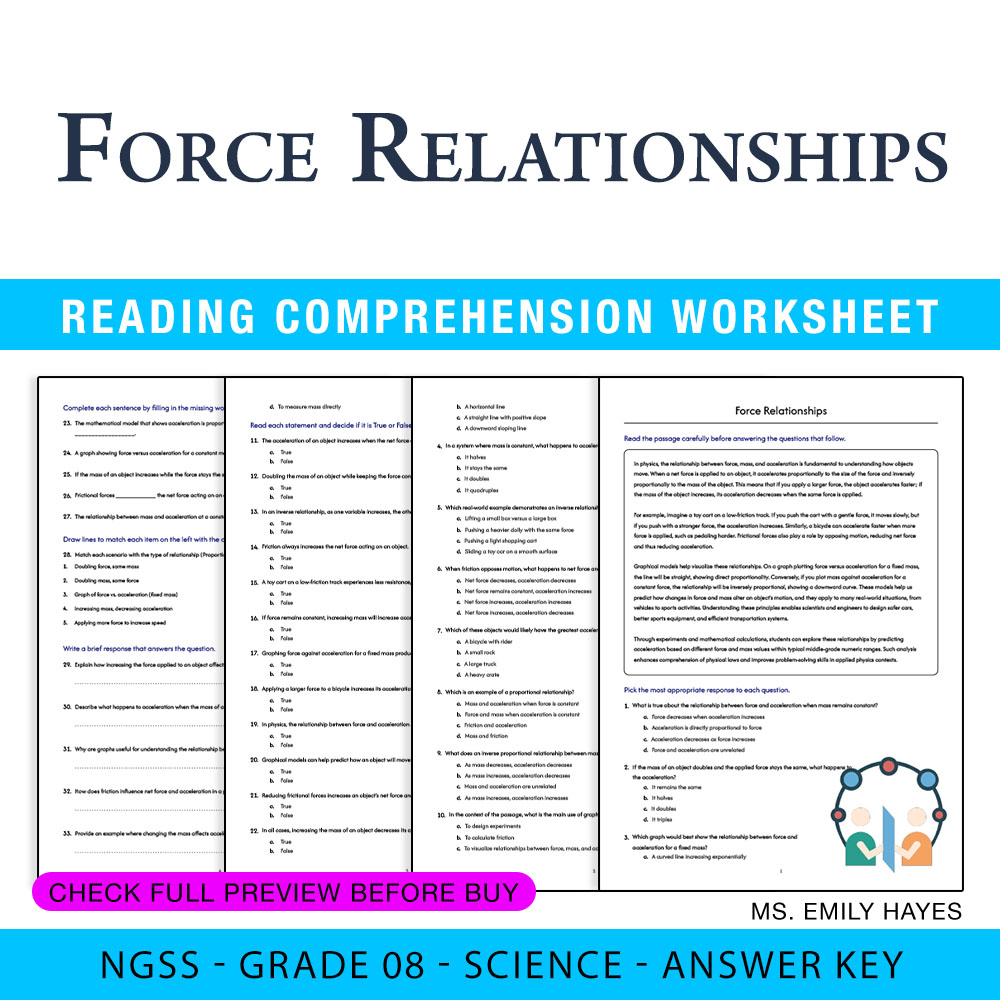
Grade 8 Science | Force Relationships Worksheet (PDF+ Answer Key)
Created byCopper Leaf ClassroomLearning Objectives
- Explain how net force, mass, and acceleration are mathematically related.
- Analyze how changes in force and mass affect an object's acceleration using models and graphs.
- Apply proportional and inverse relationships to predict motion in real-world scenarios.
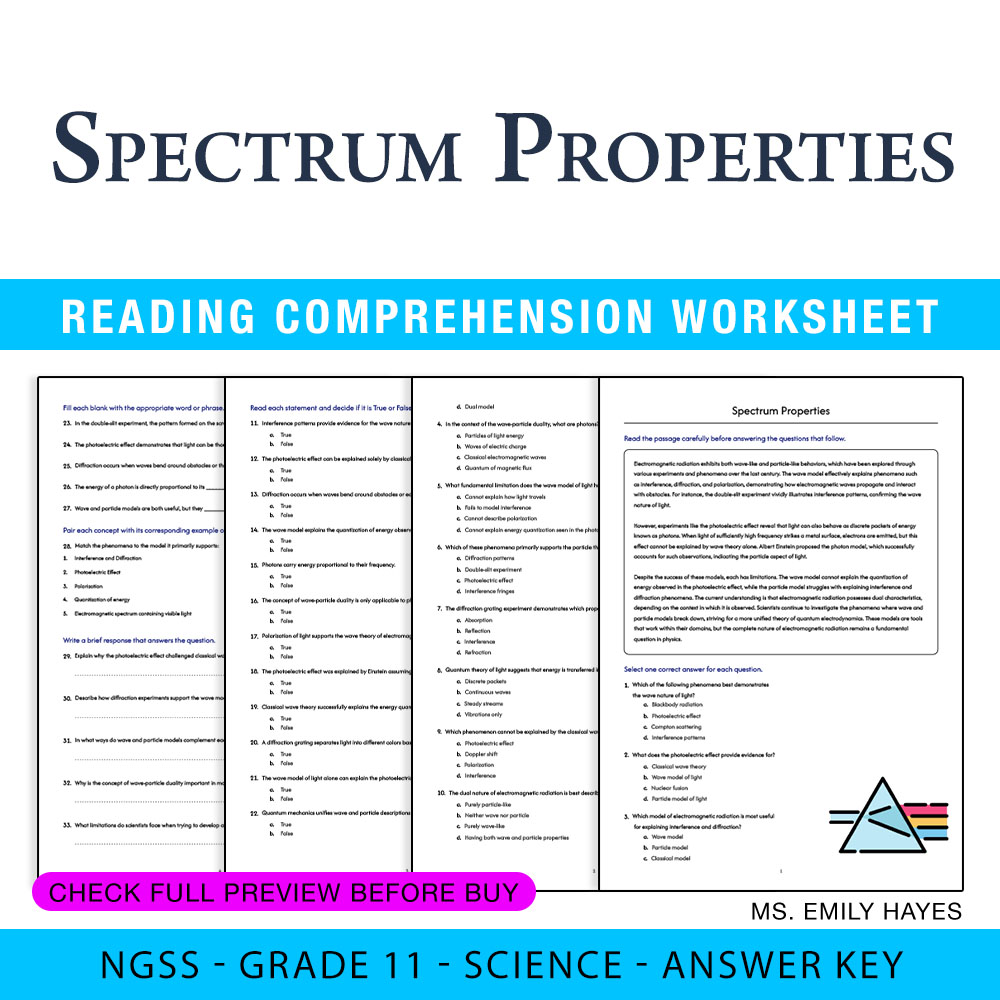
Grade 11 Science | Spectrum Properties Worksheet (PDF+ Answer Key)
Created byCopper Leaf ClassroomLearning Objectives
- Understand the evidence supporting wave and particle models of electromagnetic radiation.
- Explain how phenomena like interference, diffraction, and the photoelectric effect support different models.
- Evaluate where each model of electromagnetic radiation applies and where it breaks down.
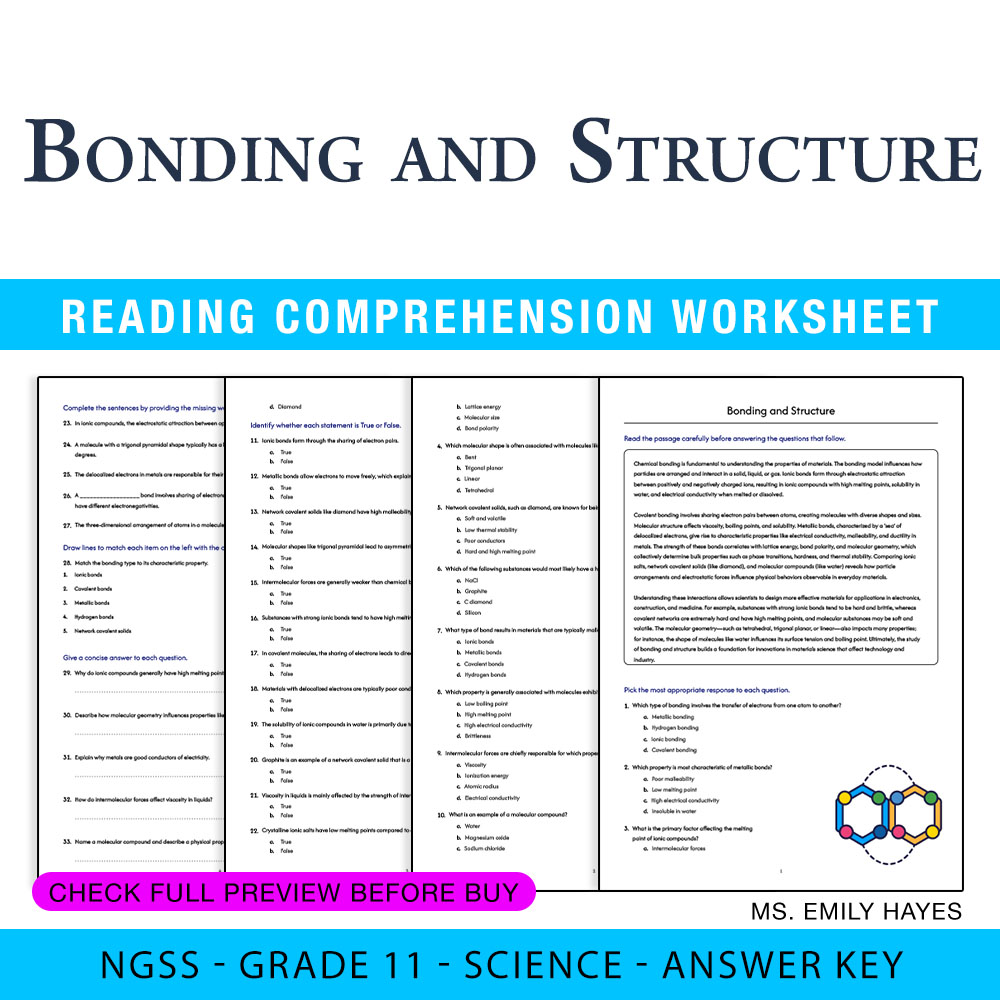
11th Grade Science | Bonding and Structure Worksheet (PDF+ Answer Key)
Created byCopper Leaf ClassroomLearning Objectives
- Explain the different types of chemical bonds (ionic, covalent, metallic) and their influence on material properties.
- Describe molecular geometries and their impact on physical properties such as melting point and solubility.
- Analyze how lattice energies and intermolecular forces determine the phase, hardness, and thermal behavior of substances.
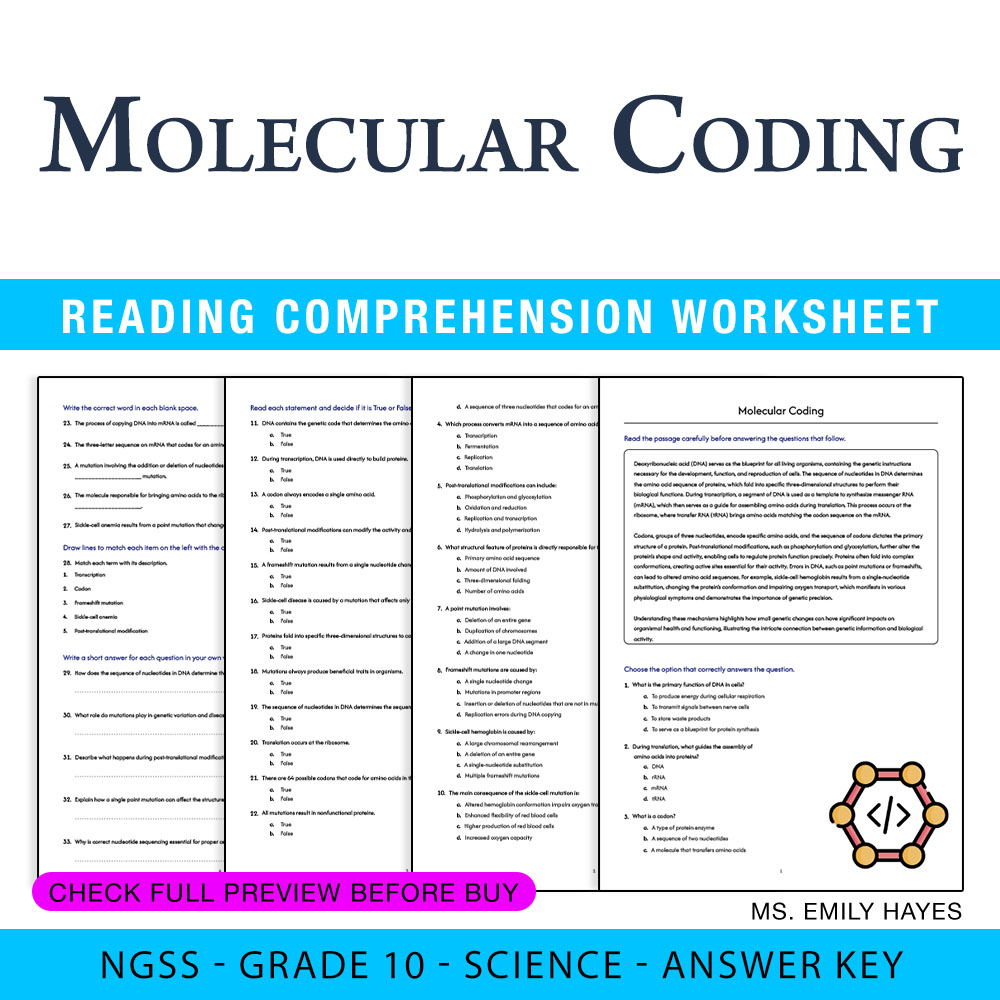
10th Grade Science | Molecular Coding Worksheet (PDF+ Answer Key)
Created byCopper Leaf ClassroomLearning Objectives
- Understand the relationship between DNA sequences and protein structure.
- Explain the processes of transcription and translation in protein synthesis.
- Identify how mutations can alter protein function, including sickle-cell hemoglobin.
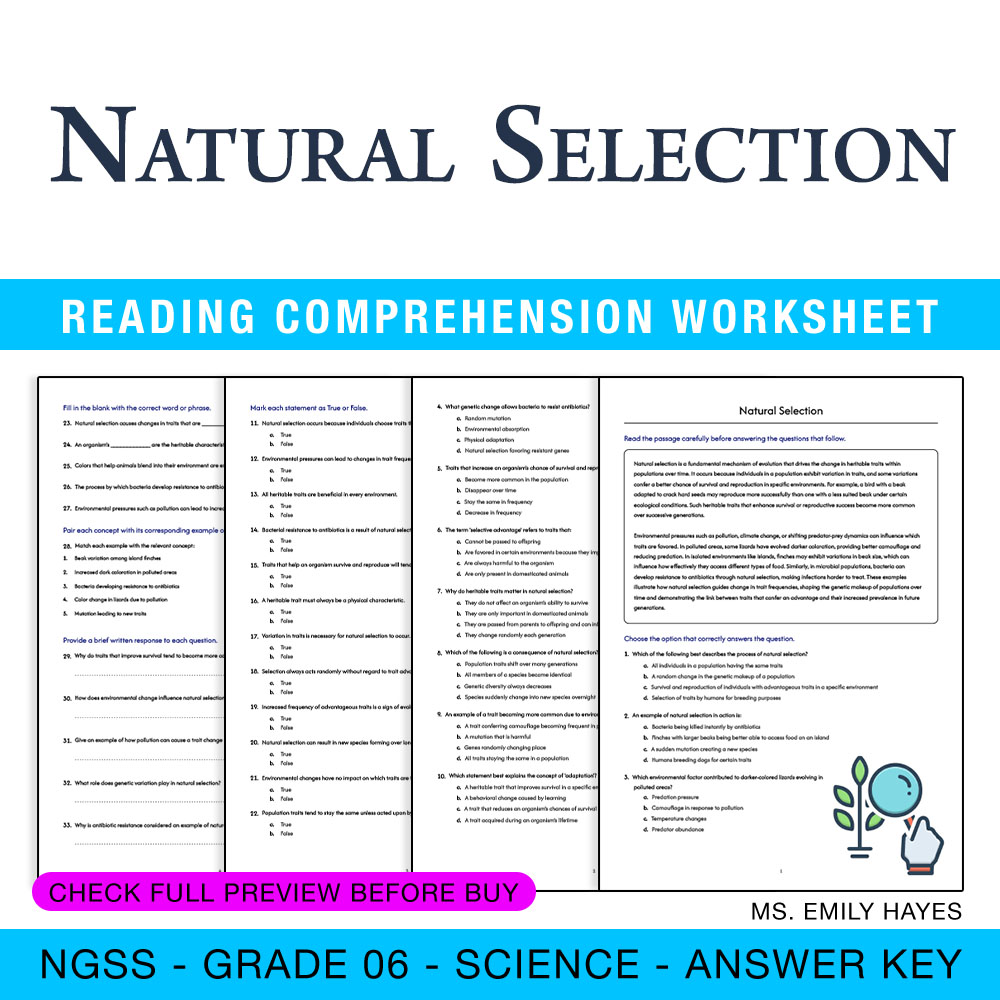
Grade 6 Science | Natural Selection Worksheet (PDF + Answer Key)
Created byCopper Leaf ClassroomLearning Objectives
- Describe how variation in heritable traits influences natural selection.
- Explain how environmental pressures can lead to changes in trait frequencies within populations.
- Identify real-world examples of selection-driven trait dynamics, such as coloration changes, beak variation, and antibiotic resistance.
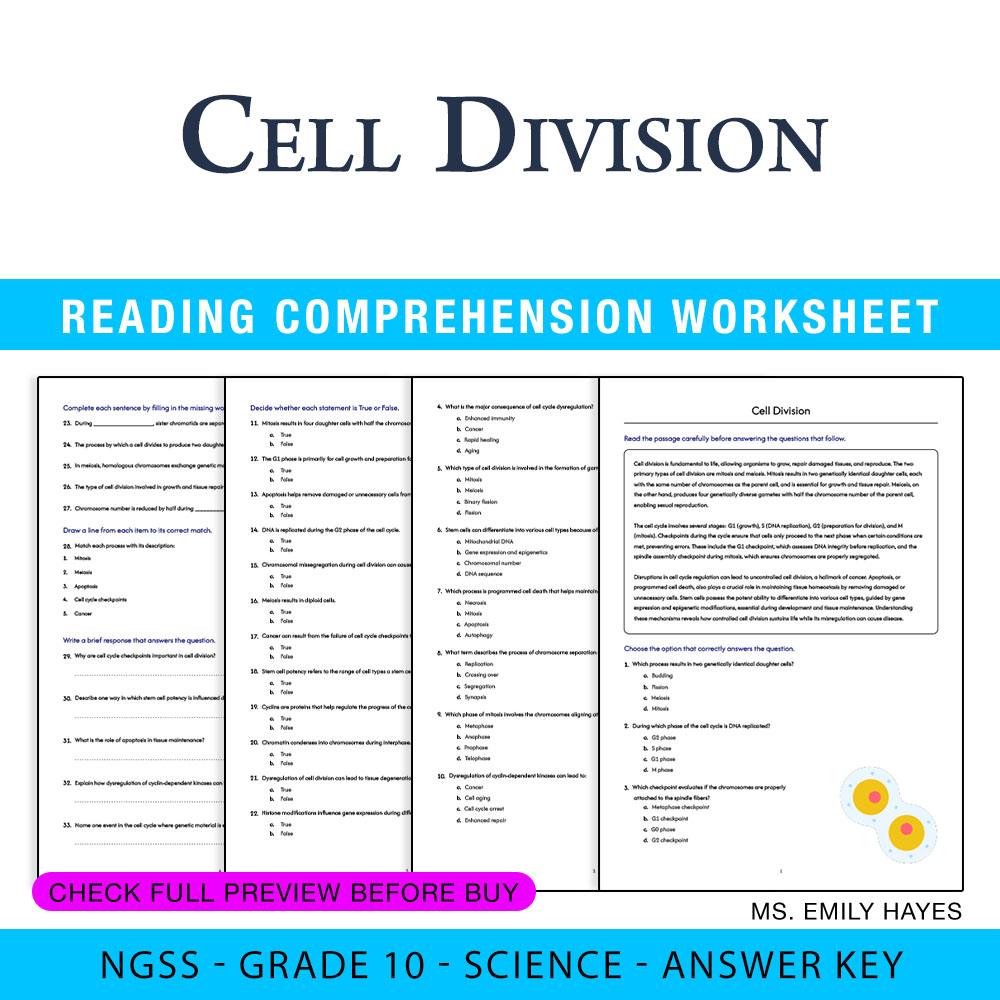
Grade 10 Science | Cell Division Worksheet (PDF+ Answer Key)
Created byCopper Leaf ClassroomLearning Objectives
- Explain the processes of mitosis and meiosis and their roles in cell division.
- Describe the cell cycle, including checkpoints and regulation mechanisms.
- Identify consequences of cell cycle dysregulation, such as cancer.
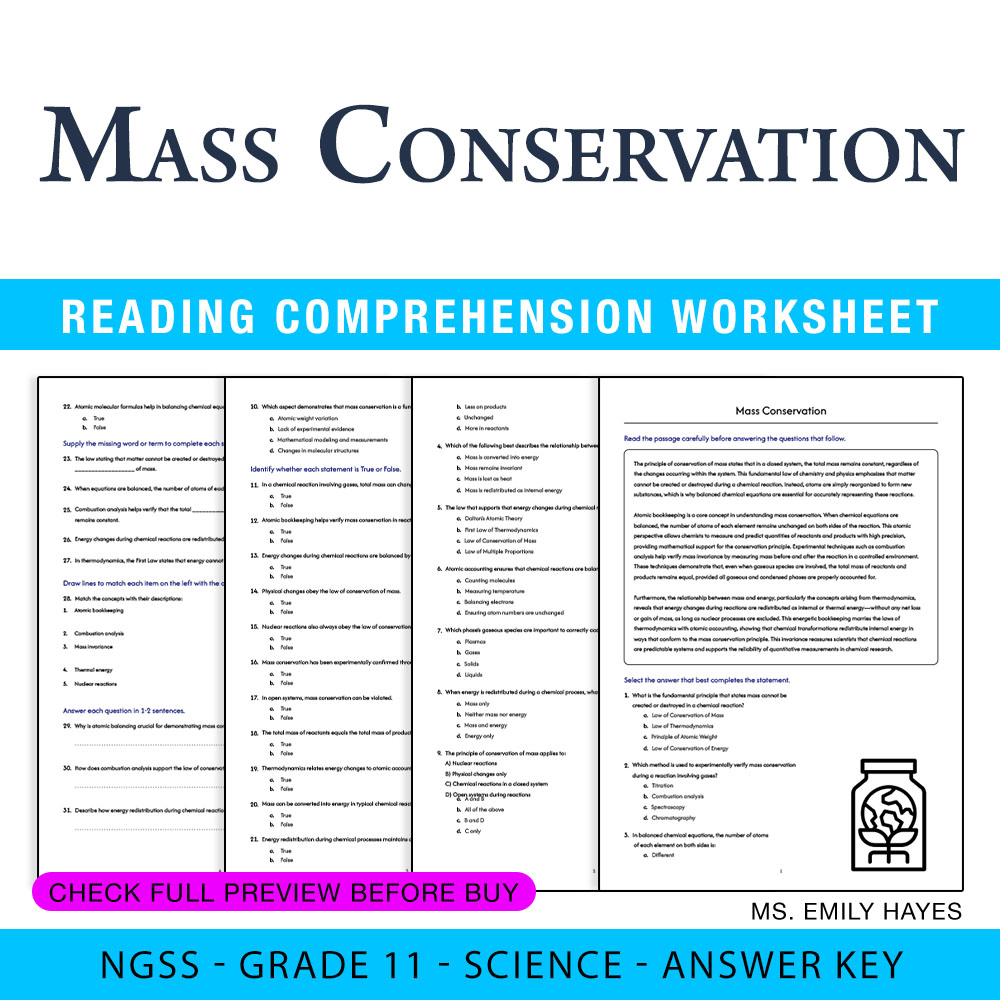
11th Grade Science | Mass Conservation Worksheet (PDF+ Answer Key)
Created byCopper Leaf ClassroomLearning Objectives
- Explain the principle of mass conservation in chemical reactions and how atomic accounting supports it.
- Analyze balanced chemical equations to understand mass invariance of reactants and products.
- Describe methods such as combustion analysis that demonstrate mass conservation in closed systems.
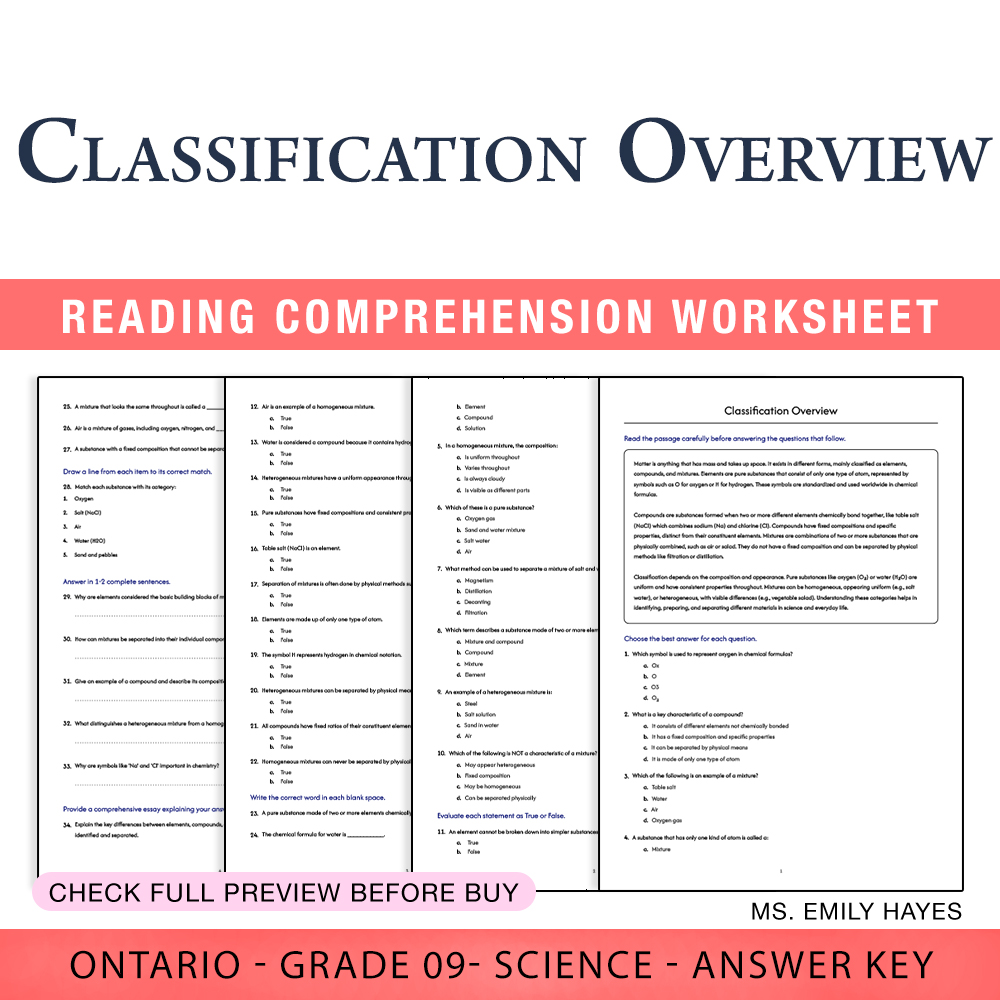
Grade 9 Science | Classification Overview Worksheet (PDF + Answer Key)
Created byCopper Leaf ClassroomLearning Objectives
- Define and distinguish between elements, compounds, and mixtures based on their composition and appearance.
- Identify examples of elements, compounds, and mixtures such as oxygen, salt, and air.
- Explain the criteria for classifying substances as pure substances or mixtures based on fixed composition and uniformity.
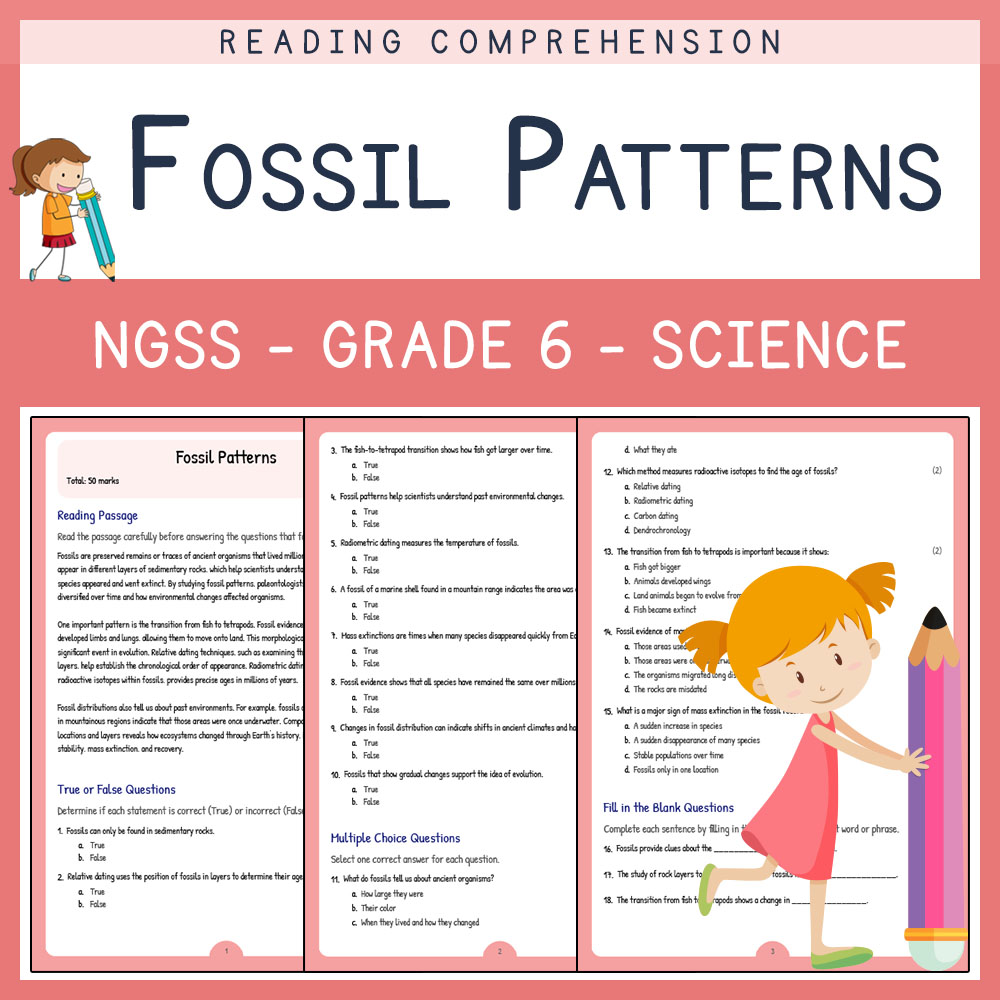
Grade 6 Science | Fossil Patterns Worksheet (PDF) | NGSS Aligned
Created byLumora LearningLearning Objectives
- Understand how fossils provide evidence of Earth's history
- Identify patterns of organism appearance, diversification, and extinction
- Recognize morphological changes in fossils, such as fish-to-tetrapod transition
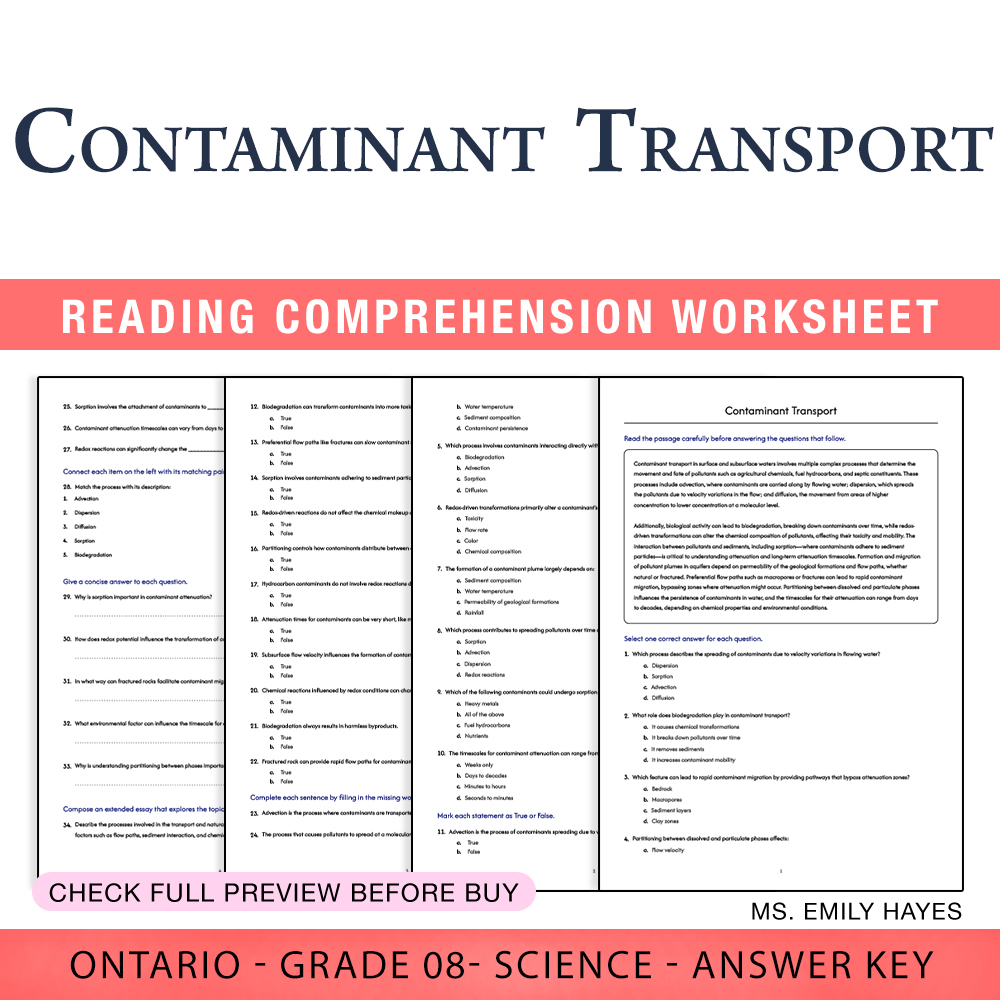
8th Grade Science | Contaminant Transport Worksheet (PDF+ Answer Key)
Created byCopper Leaf ClassroomLearning Objectives
- Describe the processes governing the movement of contaminants in surface and subsurface waters.
- Explain how factors like sorption, biodegradation, and redox transformations affect contaminant fate.
- Analyze how contaminant plumes form and migrate in aquifers and fractured rocks.
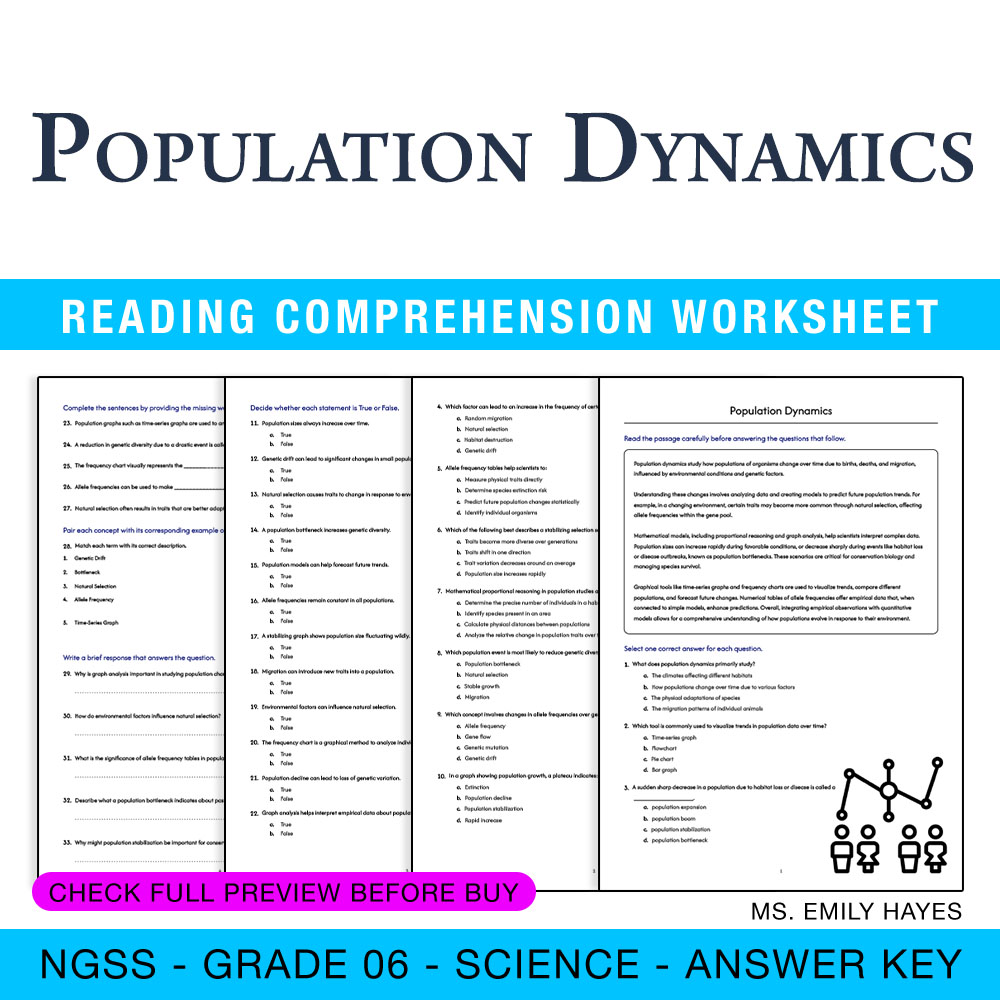
6th Grade Science | Population Dynamics Worksheet (PDF + Answer Key)
Created byCopper Leaf ClassroomLearning Objectives
- Understand how population sizes and trait frequencies change over generations due to environmental and demographic influences.
- Use mathematical models and graphical analysis to interpret changes in populations over time.
- Apply proportional reasoning to analyze data related to population change.
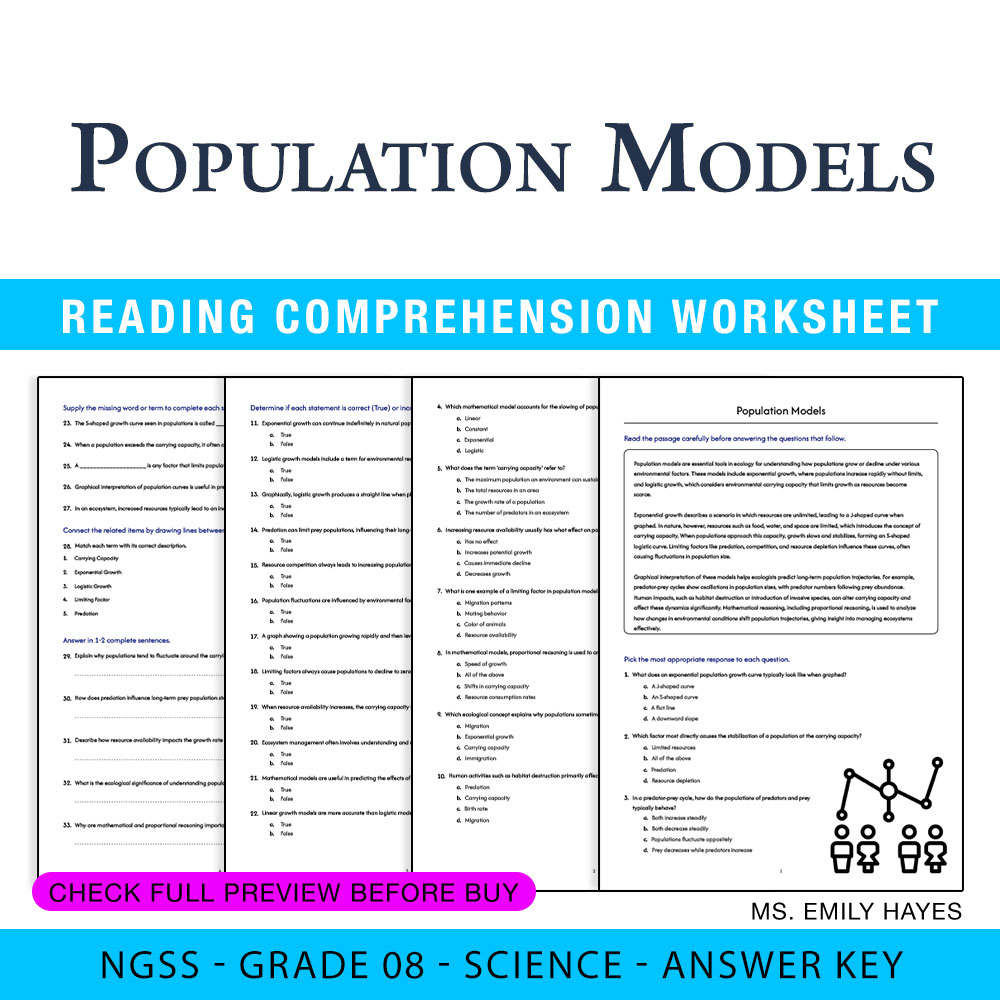
8th Grade Science | Population Models Worksheet (PDF+ Answer Key)
Created byCopper Leaf ClassroomLearning Objectives
- Understand the mathematical principles behind exponential and logistic growth models in populations.
- Interpret population growth graphs and relate them to real-world ecological scenarios.
- Explain factors such as carrying capacity, predation, and resource availability that influence population dynamics.
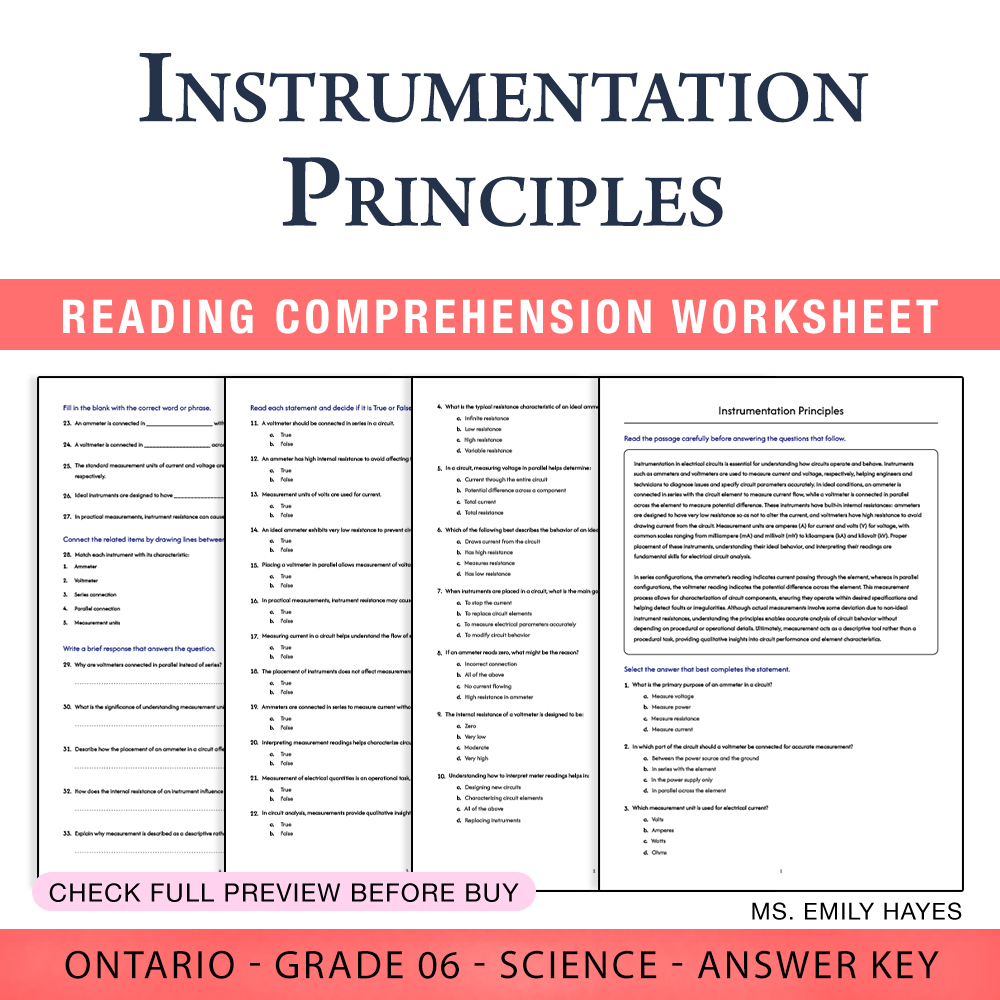
Grade 6 Science | Instrumentation Principles Worksheet (PDF + Answer Key)
Created byCopper Leaf ClassroomLearning Objectives
- Understand the roles of ammeters and voltmeters in electrical circuits.
- Learn measurement units of amperes (A) and volts (V).
- Explain the placement of measurement instruments in series and parallel circuits.
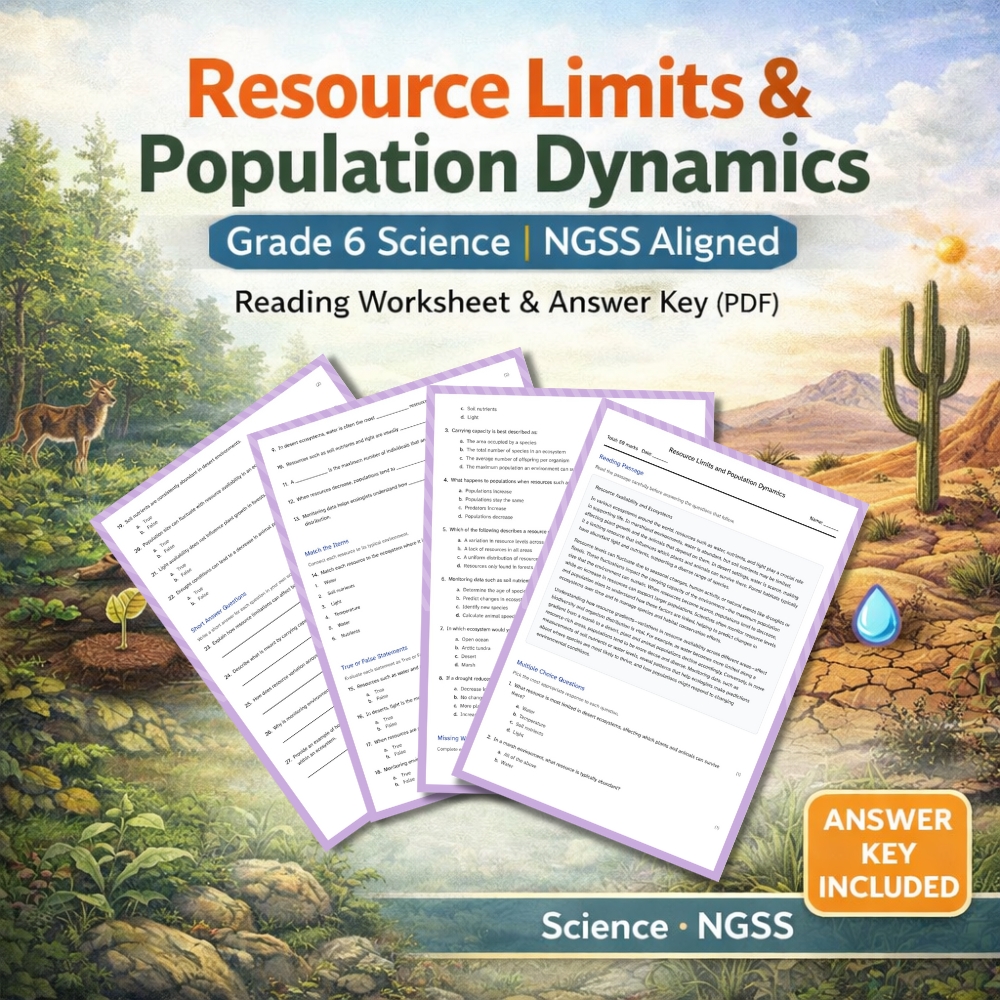
Grade 6 Science | Resource Limits & Population Dynamics | Worksheet (NGSS)
Created byCedar Grove LearningLearning Objectives
- Understand how resource availability affects individual organisms and population sizes.
- Interpret quantitative data related to resource distribution and population patterns.
- Identify limiting resources in different ecosystems such as marsh, desert, and forest habitats.
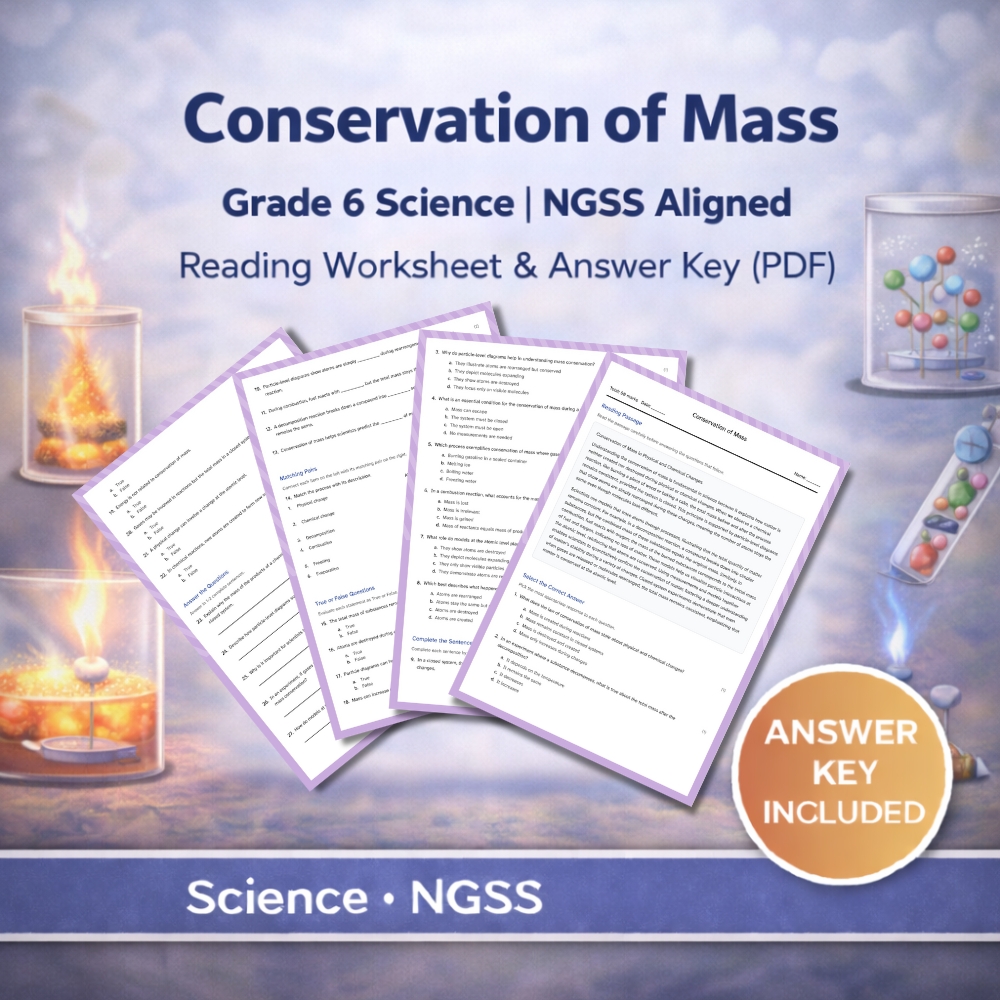
6th Grade Science | Conservation of Mass | Worksheet & Answer Key (NGSS Aligned)
Created byCedar Grove LearningLearning Objectives
- Develop and interpret models that demonstrate the conservation of mass during physical and chemical changes.
- Connect mass measurements before and after changes to atom counts and model particle-level diagrams.
- Explain how atoms are conserved even when molecules rearrange during processes like combustion and decomposition.
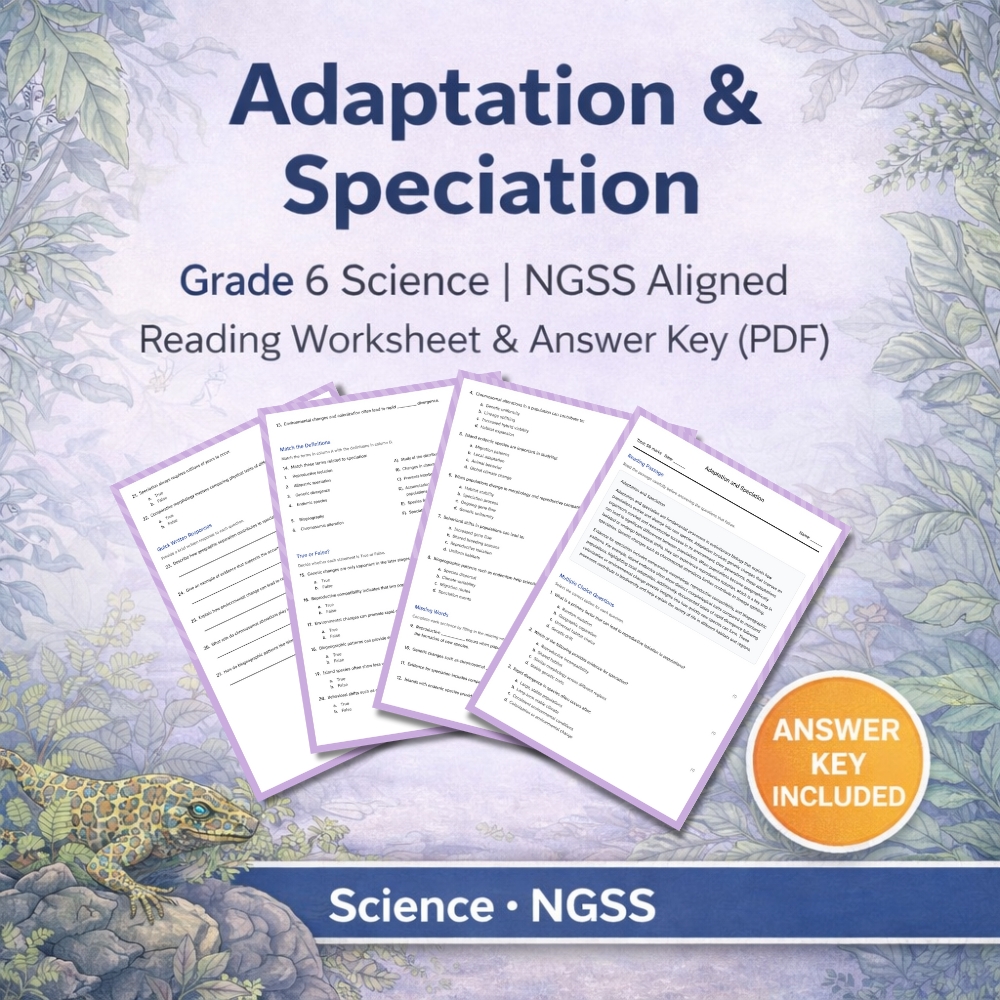
6th Grade Science | Adaptation and Speciation | NGSS Worksheets with Answer Key
Created byCedar Grove LearningLearning Objectives
- Explain the processes of adaptation and how they lead to speciation in populations.
- Describe evidence that supports the occurrence of speciation events in different environments.
- Identify factors such as geographic separation, behavioral shifts, and genetic changes that contribute to lineage divergence.
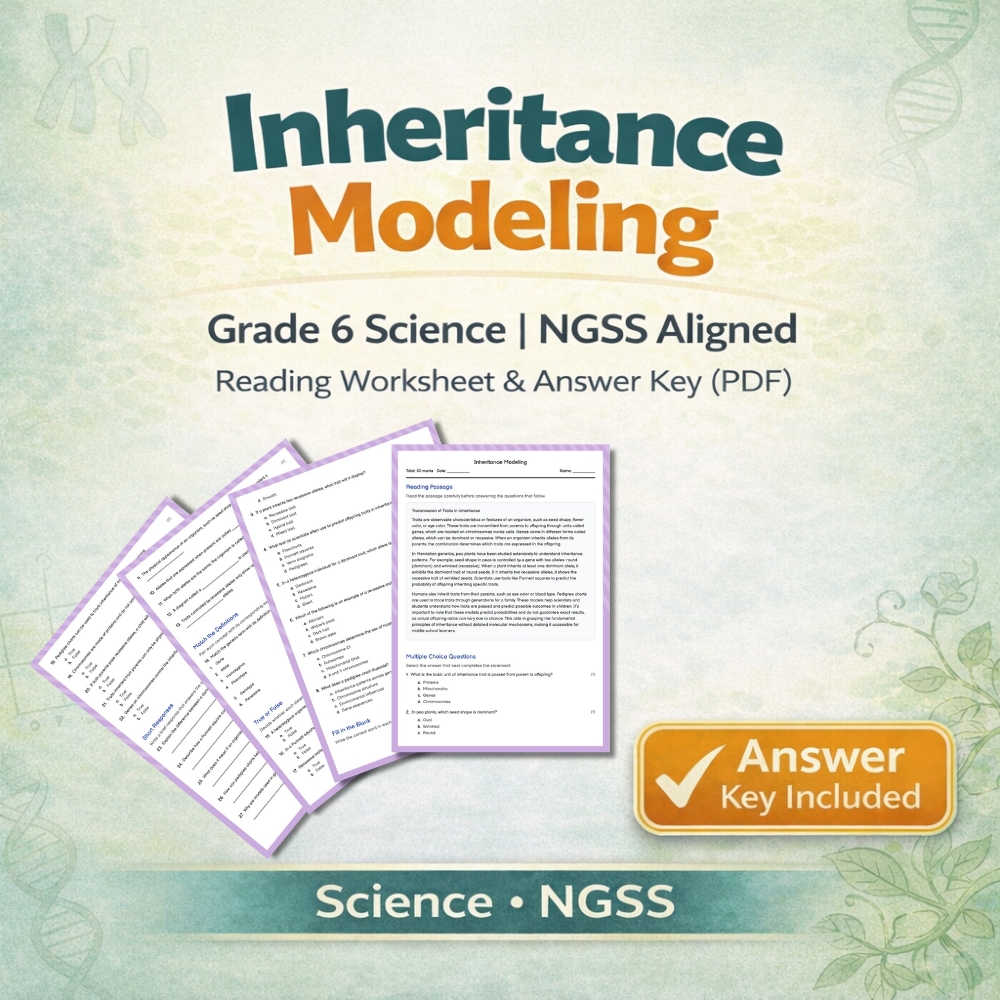
6th Grade Science | Inheritance Modeling | Worksheet & Answer Key (NGSS Aligned)
Created byCedar Grove LearningLearning Objectives
- Understand that traits are transmitted from parents to offspring through genes located on chromosomes.
- Model inheritance patterns using Punnett squares and simple probability.
- Distinguish between dominant and recessive traits through classical Mendelian examples.
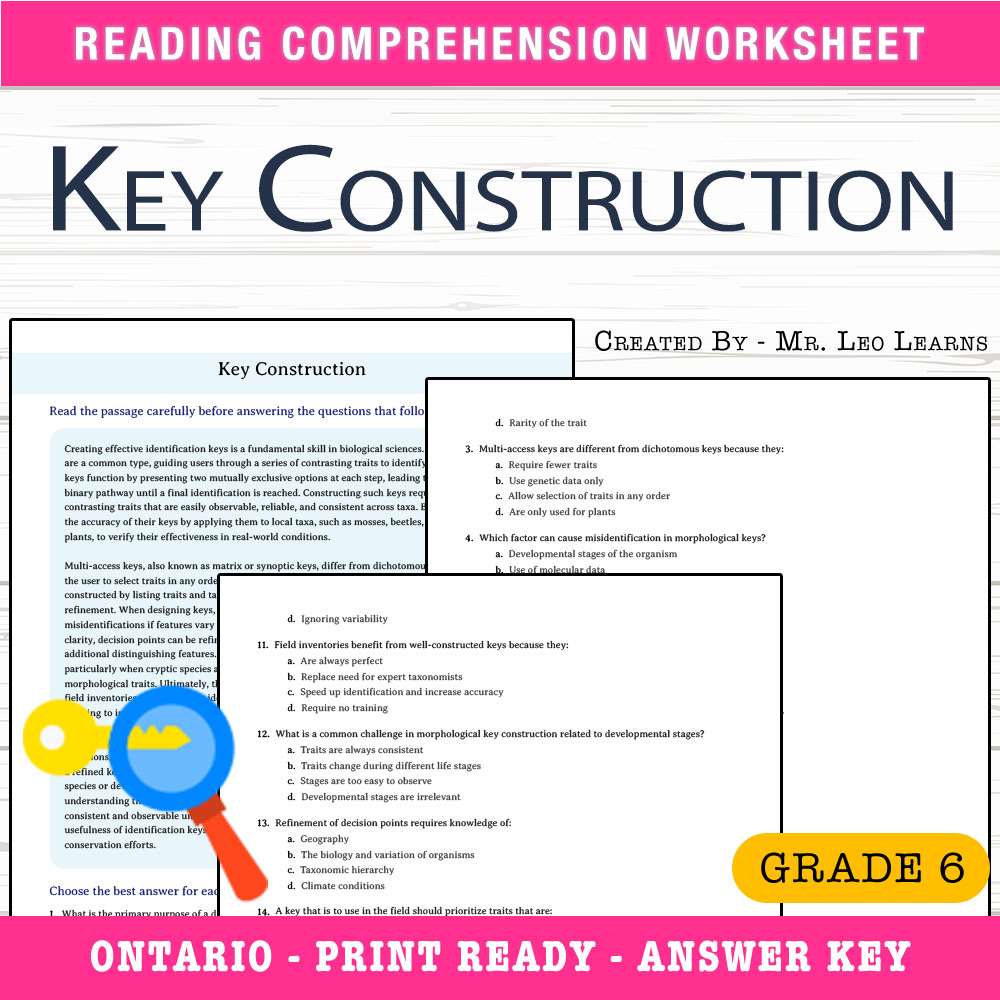
Grade 6 Science — Creating Identification Keys Worksheet for Mastery
 Created byThe Resource Hub
Learning Objectives
- Understand the principles of dichotomous and multi-access keys in biological classification.
- Learn procedures for selecting contrasting traits and constructing binary branches in keys.
- Test the accuracy of keys using local taxa such as mosses, beetles, and flowering plants.
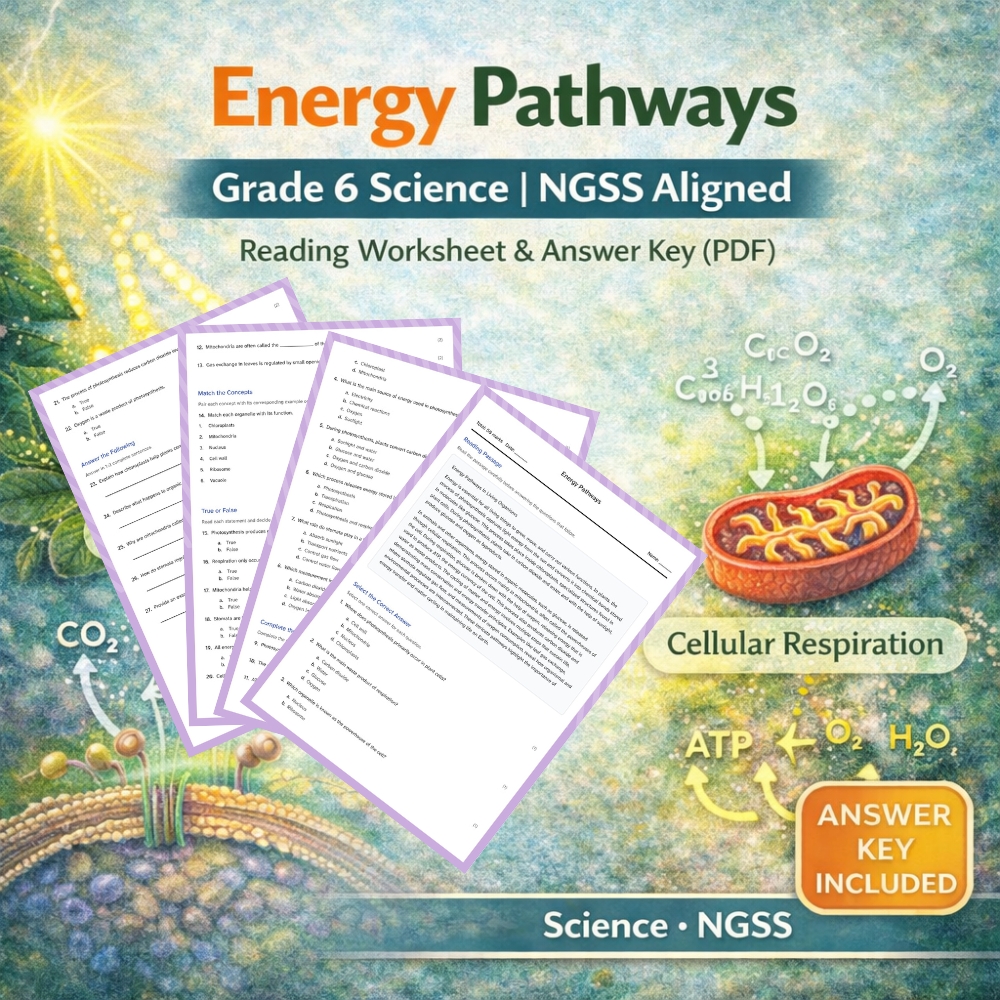
6th Grade Science | Energy Pathways | Worksheet & Answer Key ( NGSS )
Created byCedar Grove LearningLearning Objectives
- Understand how photosynthesis converts light energy into chemical energy in plants.
- Explain how organisms break down organic molecules to release energy through respiration.
- Identify the roles of chloroplasts and mitochondria in energy transfer processes.
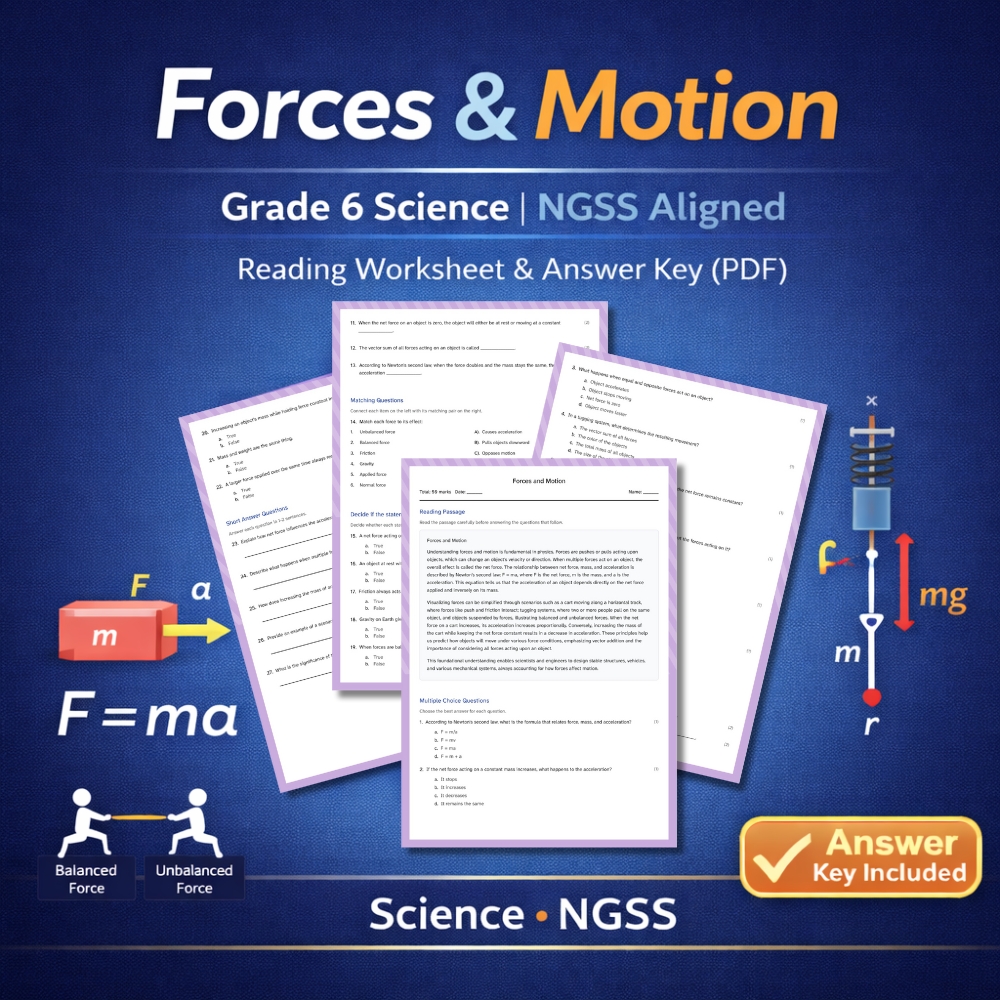
6th Grade Science | Forces and Motion Worksheet – NGSS Standards
Created byCedar Grove LearningLearning Objectives
- Explain how net force affects the motion of objects.
- Describe the relationship between force, mass, and acceleration using the equation F = ma.
- Identify scenarios illustrating the vector sum of forces and predict resulting motion.
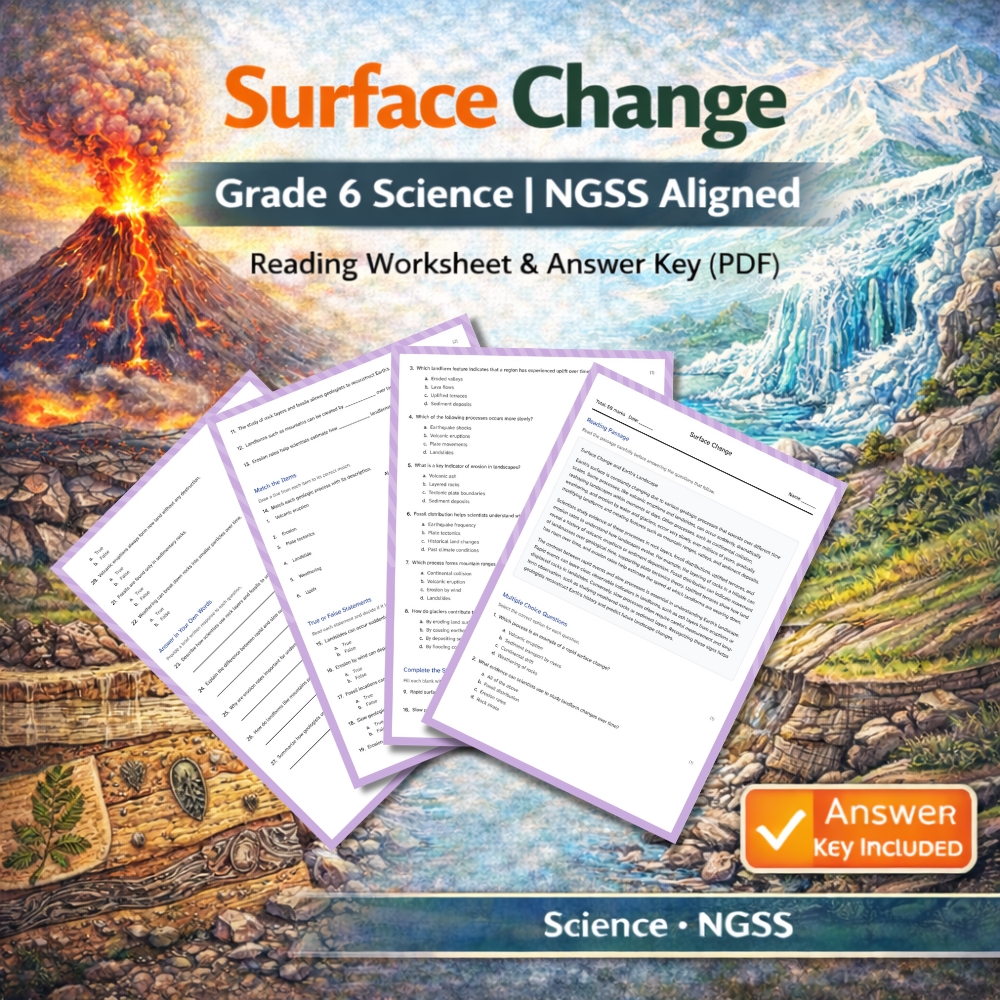
Grade 6 Science | Surface Change | NGSS ( Worksheet + Answer Key )
Created byCedar Grove LearningLearning Objectives
- Understand and describe geologic processes that modify Earth's surface over various time scales.
- Identify evidence such as rock strata, fossils, and landforms that indicate landscape evolution.
- Compare rapid and slow surface change events and their observable indicators.
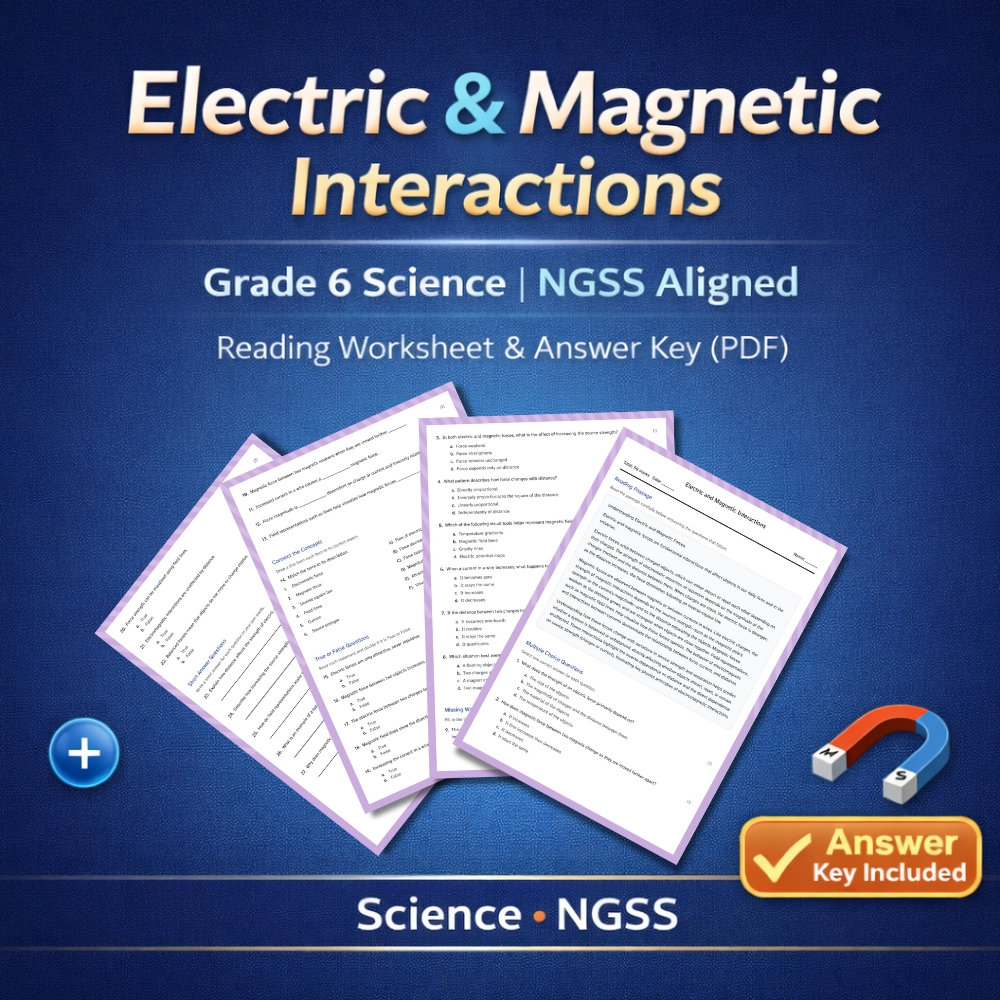
6th Grade Science | Electric & Magnetic Interaction | NGSS Worksheet
Created byCedar Grove LearningLearning Objectives
- Understand how force magnitude depends on source strength and separation in electric and magnetic interactions.
- Identify examples of electrostatic and magnetic forces, including attraction and repulsion.
- Describe how force strength varies inversely with distance and directly with charge or current.
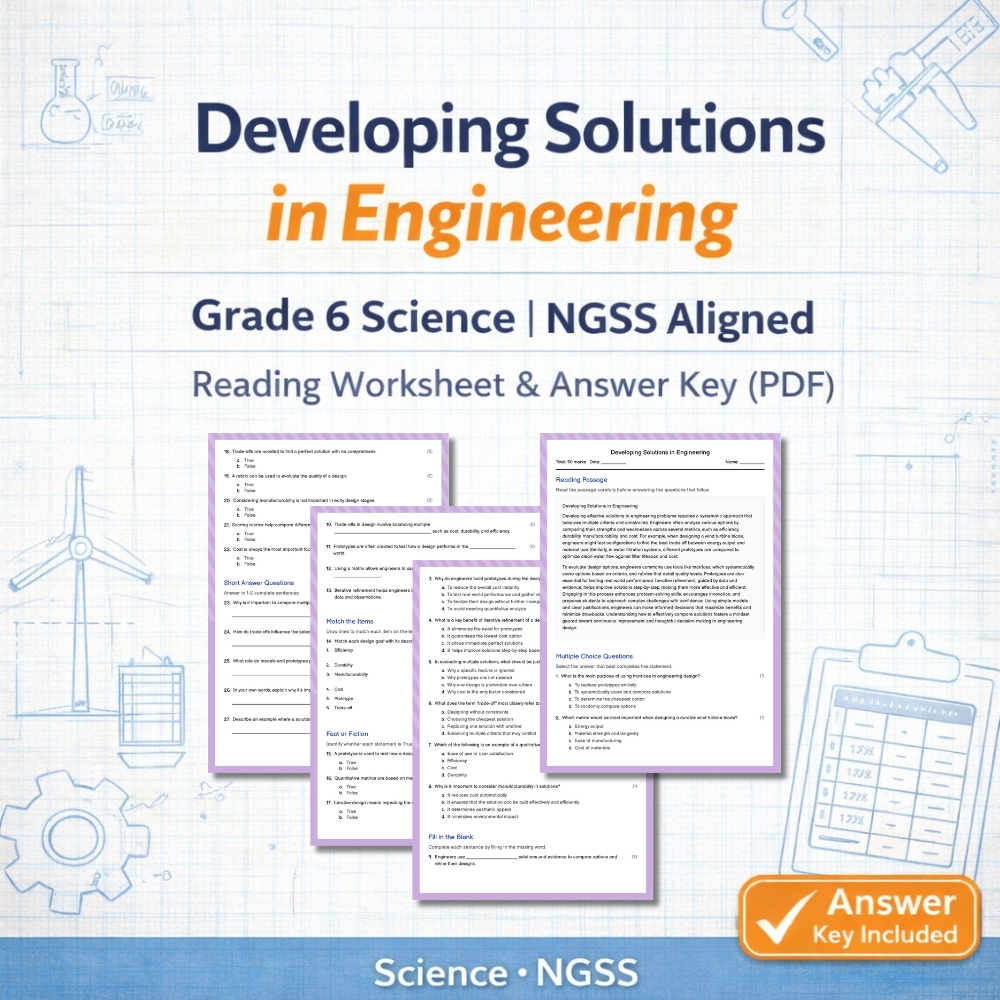
6th Grade Science | Developing Solutions in Engineering | NGSS aligned
Created byCedar Grove LearningLearning Objectives
- Compare multiple design solutions against established criteria and constraints using matrices and rubrics.
- Apply quantitative and qualitative metrics such as efficiency, durability, manufacturability, and cost during solution development.
- Use models and evidence-based justification to rank options and identify promising features for refinement.
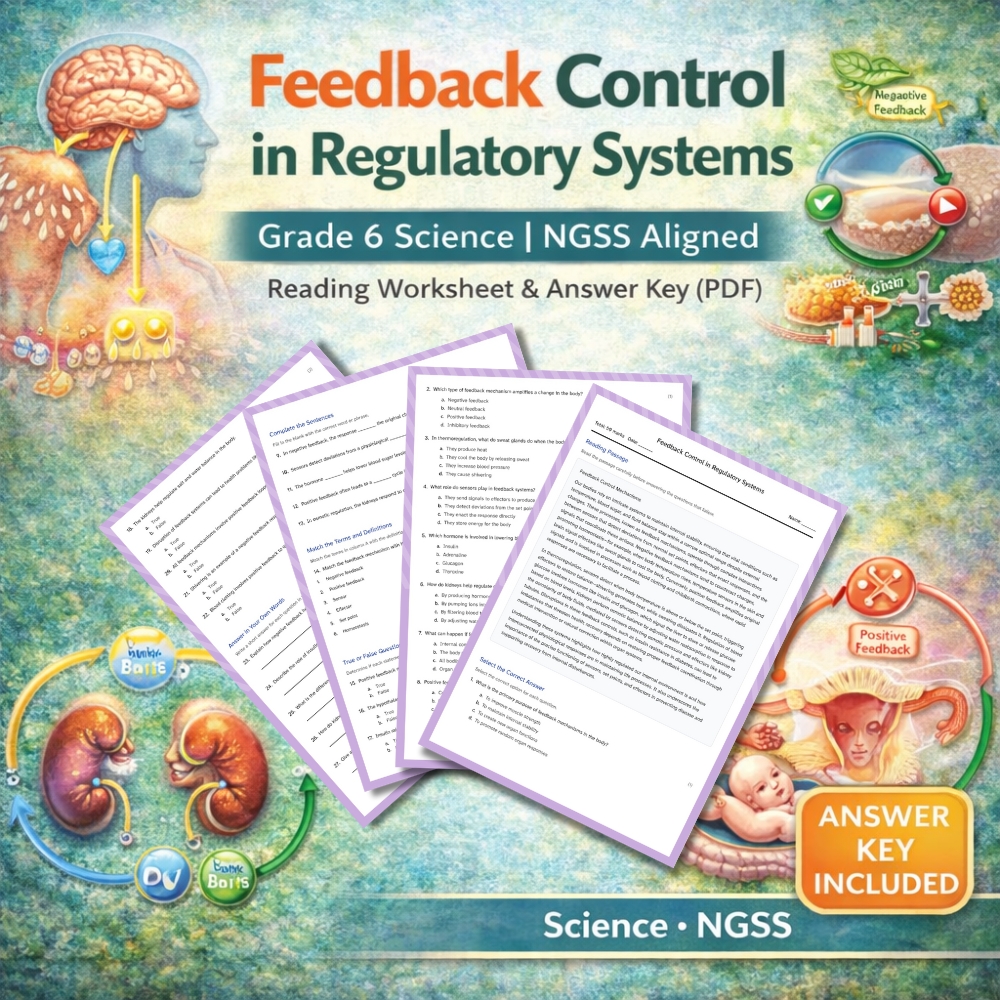
6th Grade Science | Feedback Control in Regulatory Systems | NGSS Worksheet
Created byCedar Grove LearningLearning Objectives
- Describe how negative and positive feedback mechanisms maintain internal stability in the body.
- Identify examples of feedback control such as thermoregulation, blood glucose regulation, and osmotic balance.
- Explain the roles of sensors, set points, and effectors in physiological feedback systems.
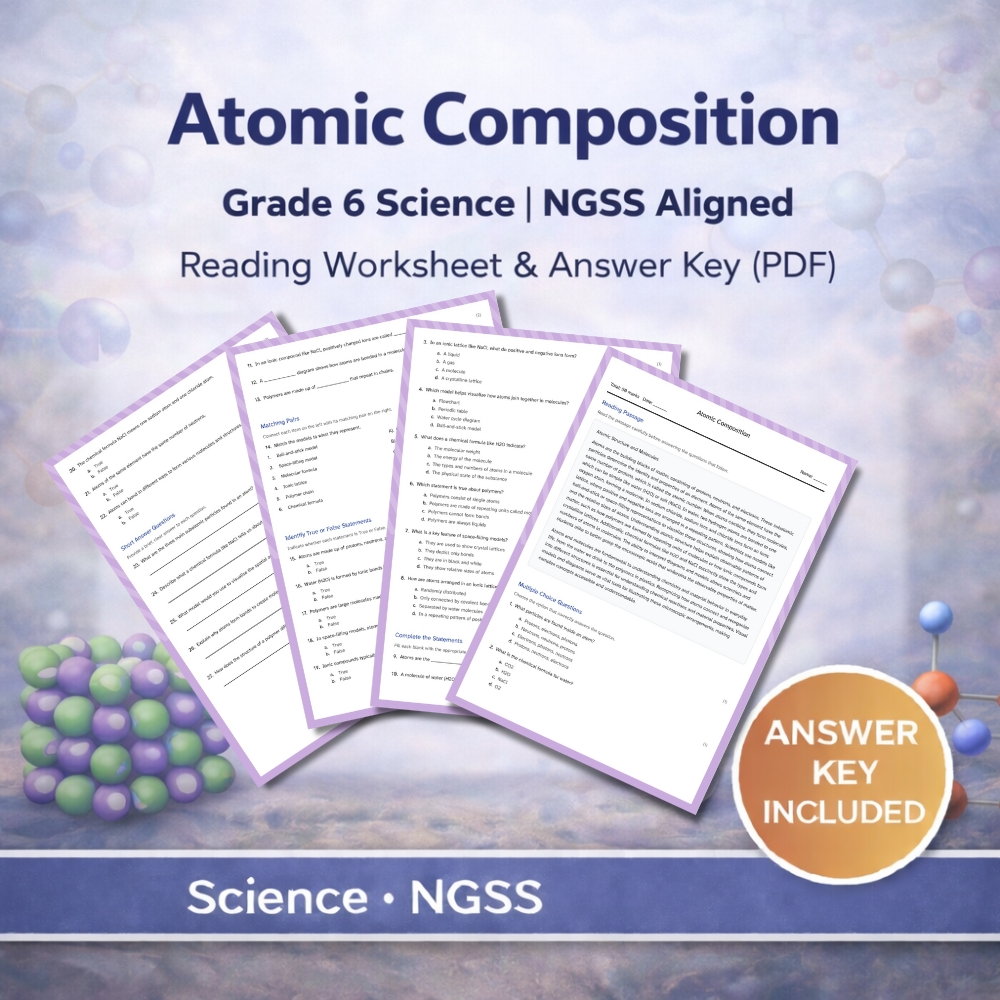
6th Grade Science | Atomic Composition | Worksheet & Answer Key (NGSS Aligned)
Created byCedar Grove LearningLearning Objectives
- Understand the basic structure of atoms and how they form molecules.
- Use models and representations to describe simple molecules like H2O and NaCl.
- Recognize patterns in the structure of polymers and ionic lattices.
Browse more categories
About Science Worksheets
Find Science worksheets spanning core skills, practice, and review. All 42,685 resources are instant PDF downloads for the classroom or home.
Every worksheet on MyTeachingSheets is created by independent teacher-authors and reviewed before publication. All resources download as printable PDFs for classroom, homework, or at-home practice, and many include answer keys. Preview any worksheet free before buying.