
Science Worksheets
44,295 subject resources
Friction And Drag Assessment | NGSSS Standards Grade 10 Science
 Created byPrism Point Learning
Learning Objectives
- Explain how nonconservative forces like friction and drag oppose motion and remove mechanical energy
- Analyze how friction and drag affect acceleration and velocity over time
- Relate real-world observations (slowing down, reaching terminal velocity) to the concept of net force
Also included in: Grade 10 Waves Energy Forces Science Lesson Mini Bundle | Florida NGSSS +1 more
Instant download
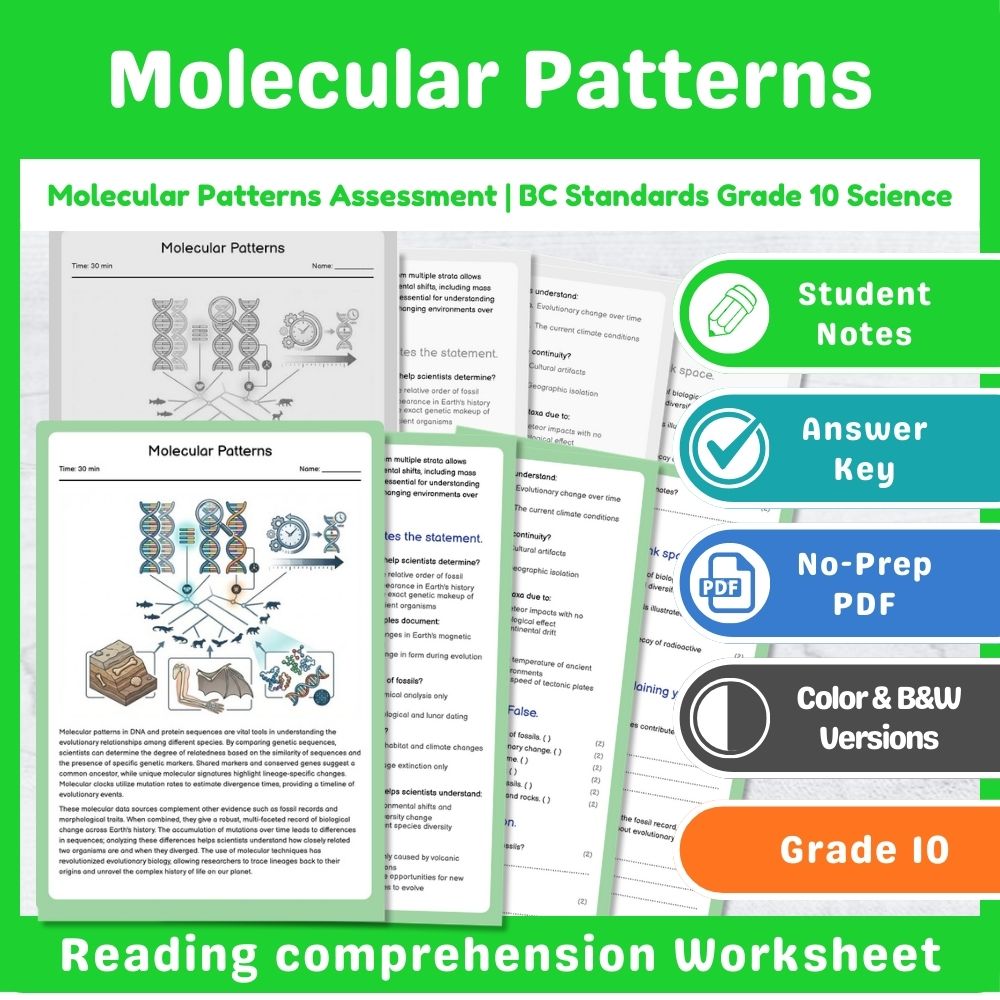
Molecular Patterns Assessment | BC Standards Grade 10 Science
Created byPrism Point LearningLearning Objectives
- Explain how molecular patterns in DNA and proteins reveal genetic relatedness among organisms.
- Describe how molecular clocks estimate divergence times and the significance of shared genetic markers.
- Identify conserved genes and lineage-specific molecular signatures as evidence of common ancestry.
Instant download

Population Regulation Assessment | NGSS Standards-Aligned Grade 9 Science
Created byPrism Point LearningLearning Objectives
- Understand the factors influencing population sizes, including carrying capacity and density-dependent effects.
- Analyze mathematical models like logistic growth and predator-prey cycles.
- Evaluate the impact of human activities on population dynamics and ecosystem resilience.
Instant download
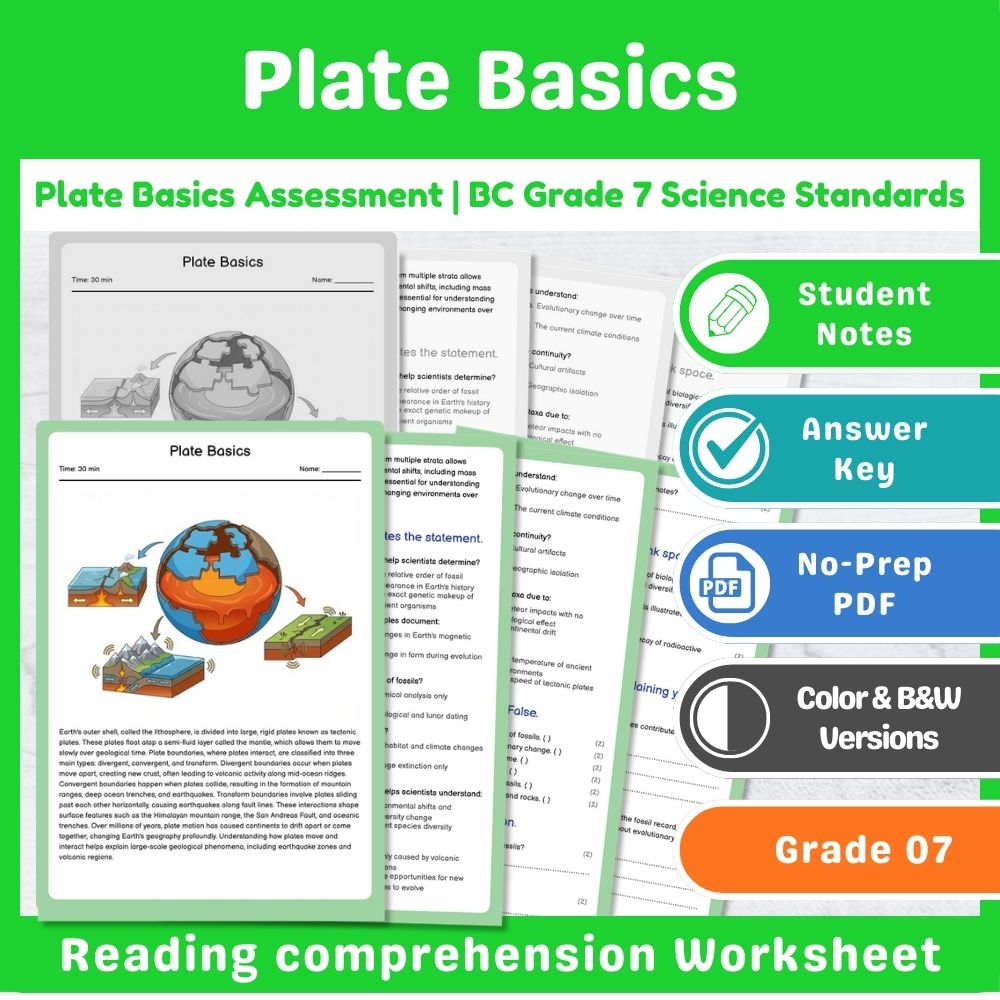
Plate Basics Assessment | BC Grade 7 Science Standards
Created byPrism Point LearningLearning Objectives
- Understand the structure and movement of Earth's lithospheric plates.
- Identify different types of plate boundaries and their effects on surface features.
- Explain how plate interactions influence geological activity such as earthquakes and volcanoes.
Also included in: Grade 7 Science Lesson – Earth Processes Assessment & Landforms Bundle
Instant download

Electron Configuration Assessment | BC Standards Grade 10 Science
Created byPrism Point LearningLearning Objectives
- Describe how electrons occupy energy levels and orbitals around an atomic nucleus.
- Explain the significance of valence electrons in bonding and chemical reactivity.
- Apply principles of quantized energy levels to determine electron distribution in elements.
Instant download
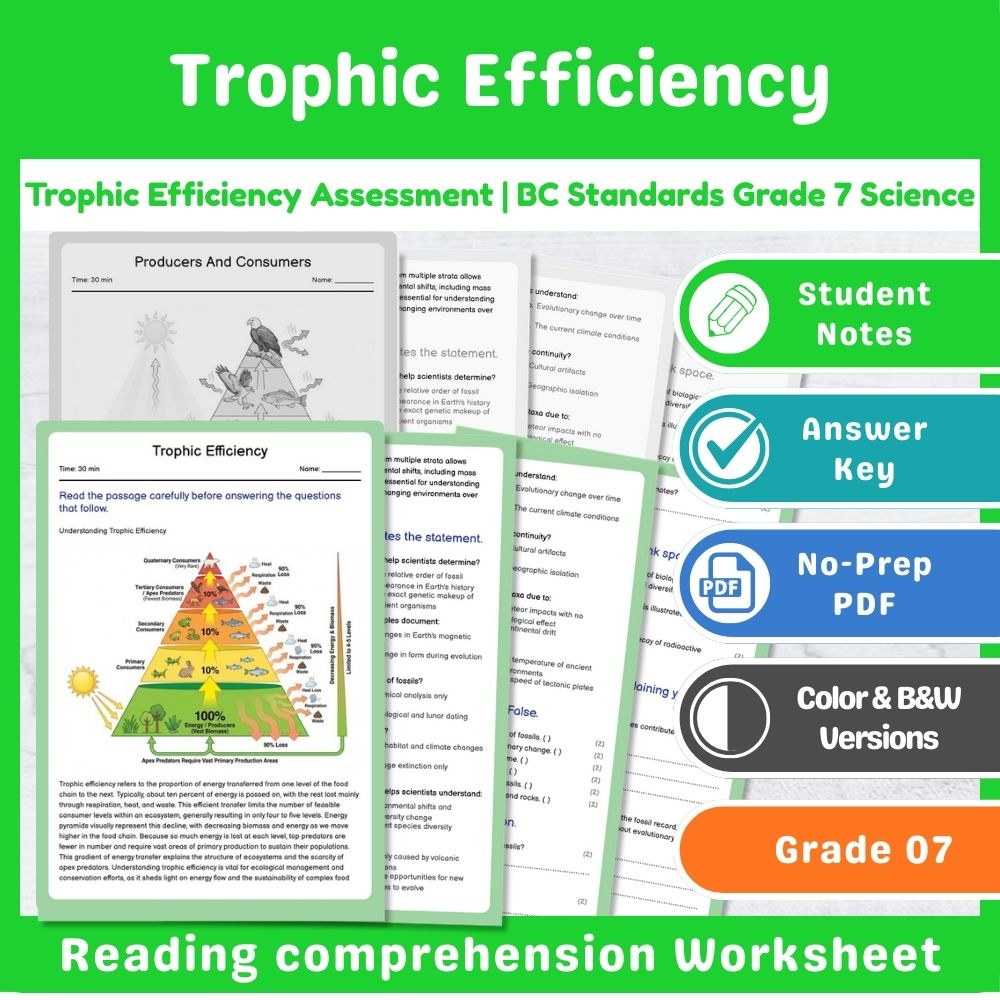
Trophic Efficiency Assessment | BC Standards Grade 7 Science
Created byPrism Point LearningLearning Objectives
- Explain the concept of trophic efficiency and its role in energy transfer within ecosystems.
- Describe how energy pyramids illustrate energy loss at each trophic level.
- Understand the factors limiting the number of trophic levels in ecological communities.
Instant download

Chromosomes and Inheritance Assessment | Florida NGSSS Grade 10 Science
Created byPrism Point LearningLearning Objectives
- Explain how chromosomes carry genes and how alleles at specific loci influence inherited traits.
- Describe how meiosis and fertilization connect chromosome transmission to offspring genotypes.
- Distinguish between simple dominance patterns and inheritance patterns involving multiple genes.
Also included in: Grade 10 Cells, Genetics & Evolution Science Lesson Bundle | Florida NGSSS +1 more
Instant download

Newtonian Forces Assessment for Grade 10 Science | Florida NGSSS
Created byPrism Point LearningLearning Objectives
- Explain how net force affects an object’s motion, including changes in velocity and constant velocity in the absence of net force.
- Use proportionality ideas to predict acceleration changes when net force or mass changes.
- Connect equilibrium to balanced forces and interpret outcomes using free-body diagram reasoning.
Also included in: Grade 10 Waves Energy Forces Science Lesson Mini Bundle | Florida NGSSS +1 more
Instant download
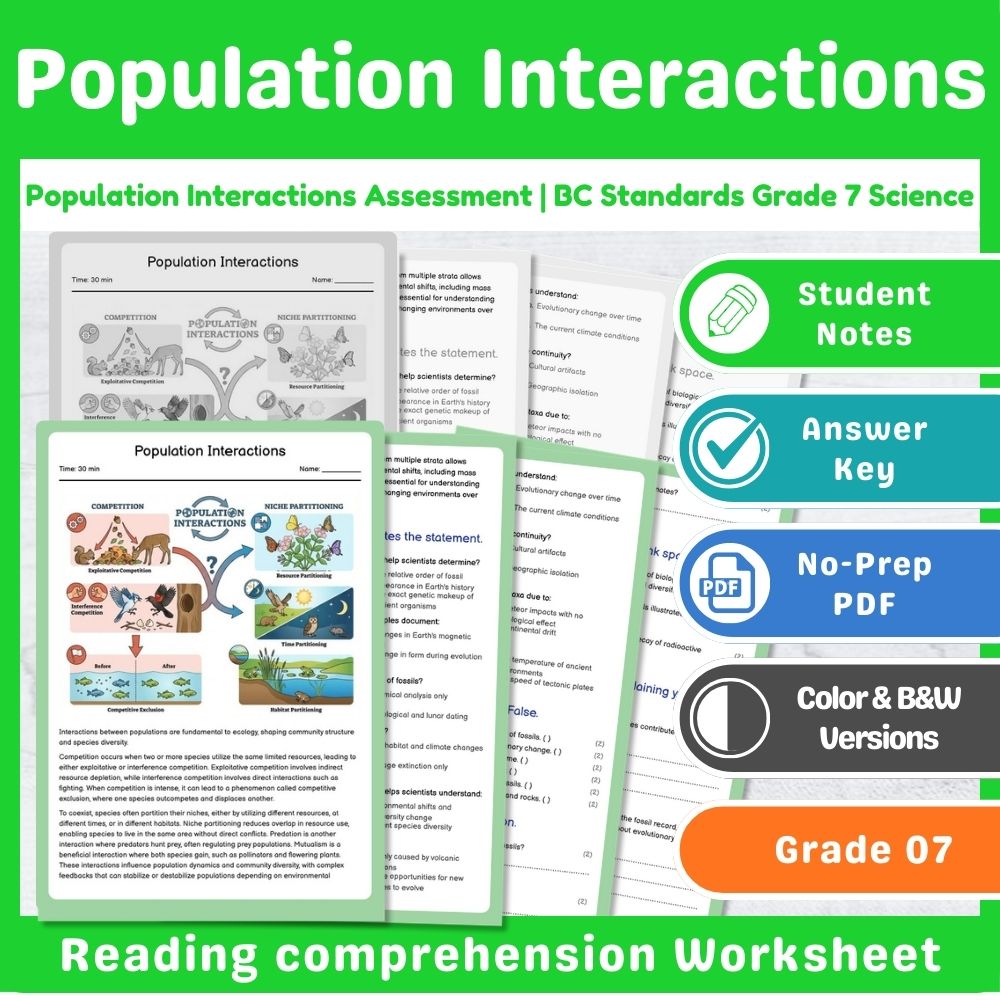
Population Interactions Assessment | BC Standards Grade 7 Science
Created byPrism Point LearningLearning Objectives
- Understand different types of population interactions including competition, predation, and mutualism.
- Identify mechanisms that allow species to coexist despite competition.
- Explain how interactions influence community composition and diversity.
Instant download
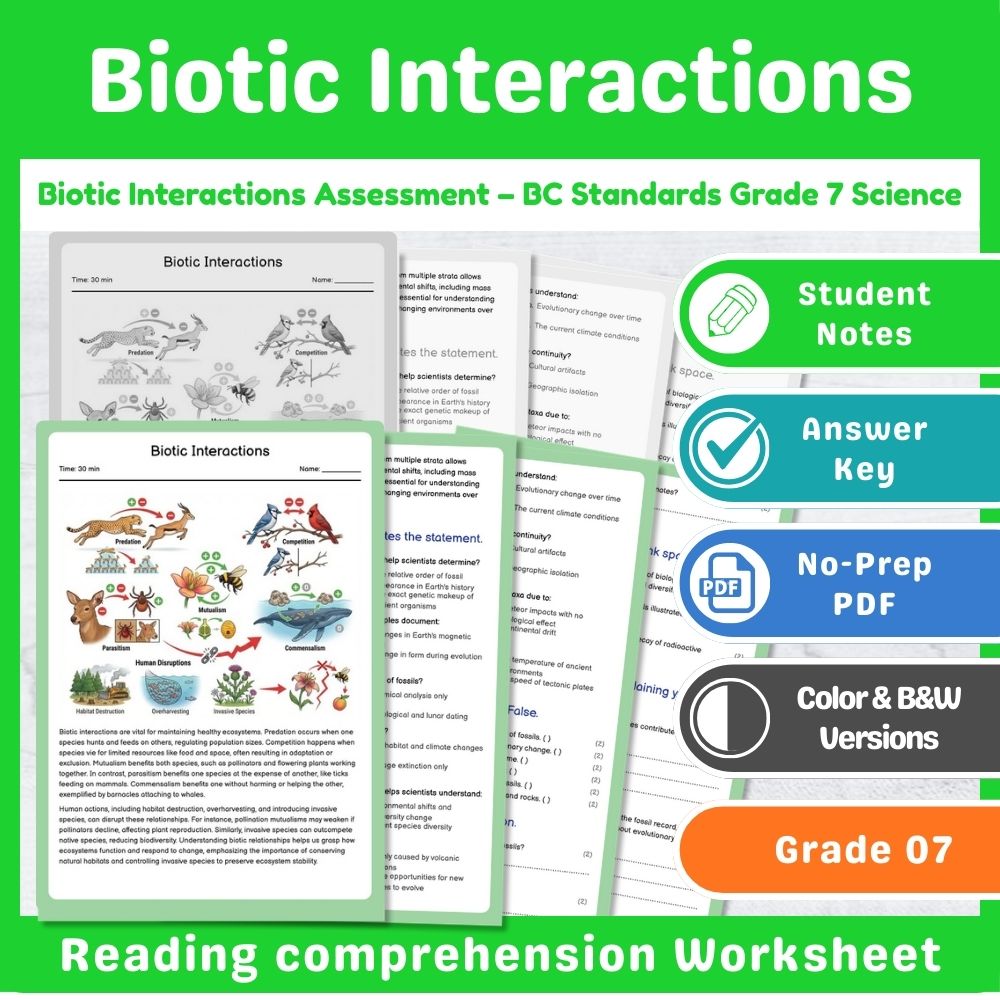
Biotic Interactions Assessment – BC Standards Grade 7 Science
Created byPrism Point LearningLearning Objectives
- Understand the different types of biotic interactions such as predation, competition, mutualism, commensalism, and parasitism.
- Explain how human activities can disrupt biotic relationships and affect ecosystems.
- Describe how changes in one species can influence community structure and biodiversity.
Instant download

Stellar Evolution Assessment | Florida NGSSS Grade 10 Science Worksheet
Created byPrism Point LearningLearning Objectives
- Explain how a star’s mass influences its main-sequence life and later evolutionary stages
- Describe how fusion changes as a star’s fuel supply decreases
- Connect stellar deaths (red giant, planetary nebula, supernova) to element production and enrichment of space
Also included in: Grade 10 Earth and Space Systems Science Lesson Bundle – Florida NGSSS +1 more
Instant download

Reaction Classification Assessment | BC Standards Grade 10 Science
Created byPrism Point LearningLearning Objectives
- Identify and classify different types of chemical reactions based on reactant and product characteristics.
- Understand the characteristic features and observable evidence of various reaction types.
- Relate reaction classes to the periodic properties of reactants to predict products and energy changes.
Instant download
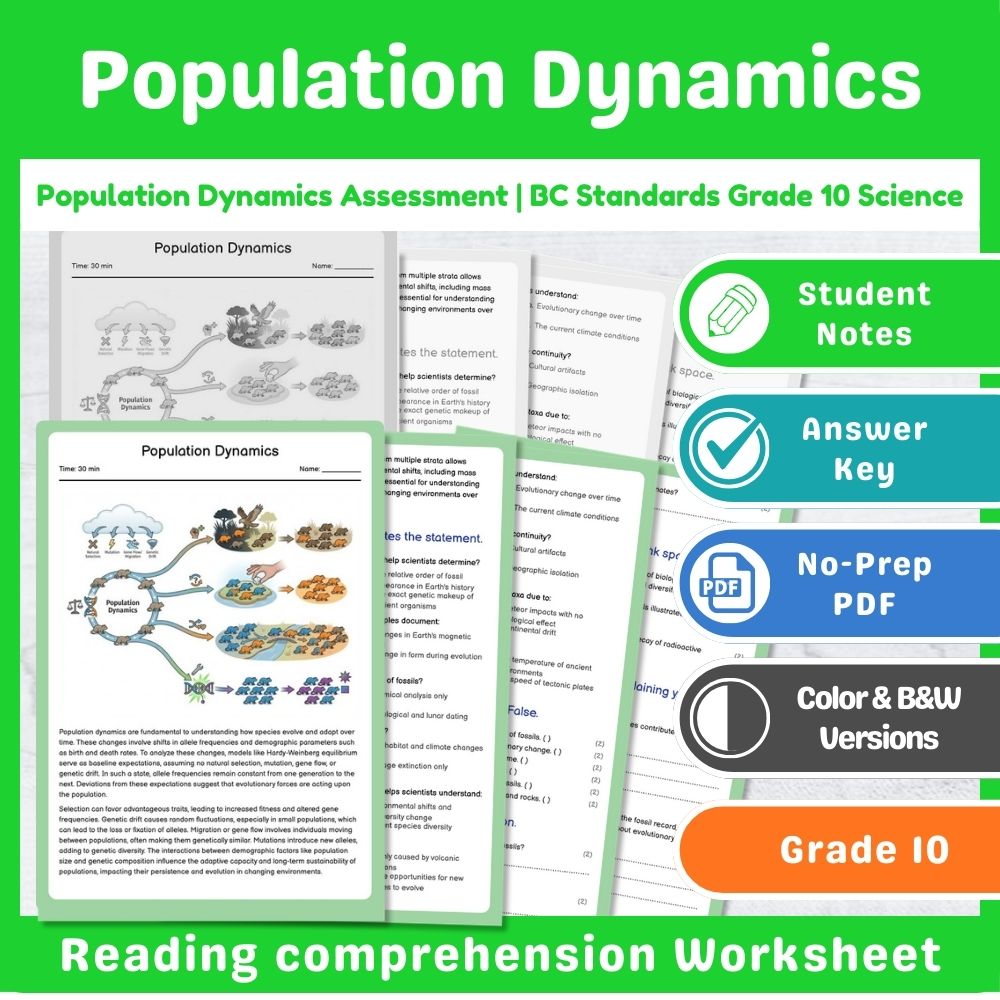
Population Dynamics Assessment | BC Standards Grade 10 Science
Created byPrism Point LearningLearning Objectives
- Understand basic concepts of population dynamics and evolutionary forces.
- Identify the role of models like Hardy-Weinberg equilibrium in population studies.
- Analyze how factors such as selection, mutation, migration, and drift influence genetic variation.
Instant download

Adaptation Evidence Assessment | Florida NGSSS Grade 7 Science
Created byPrism Point LearningLearning Objectives
- Explain what adaptations are and how they can improve survival or reproduction in specific environments
- Identify evidence for adaptation using observations of trait differences among populations, fossil records, and documented environmental changes
- Use examples (such as peppered moth coloration) to connect environmental pressures to changes in traits
Instant download

Climate Drivers Assessment | NGSSS Standards Grade 7 Science
Created byPrism Point LearningLearning Objectives
- Explain how latitude affects the angle of incoming sunlight and leads to regional temperature differences
- Describe how elevation, distance from water, and ocean currents influence climate and precipitation
- Use climate driver concepts to interpret how deserts, rain forests, and seasonal weather patterns form
Also included in: Grade 7 Earth and Climate Systems Science Lesson Bundle: Florida NGSSS
Instant download

Biotic and Abiotic Factors Assessment | Florida NGSSS Grade 7 Science
Created byPrism Point LearningLearning Objectives
- Differentiate between biotic factors and abiotic factors in an ecosystem.
- Explain how abiotic changes can affect biotic interactions and population sizes.
- Use evidence from an ecosystem scenario to predict changes in community composition.
Instant download
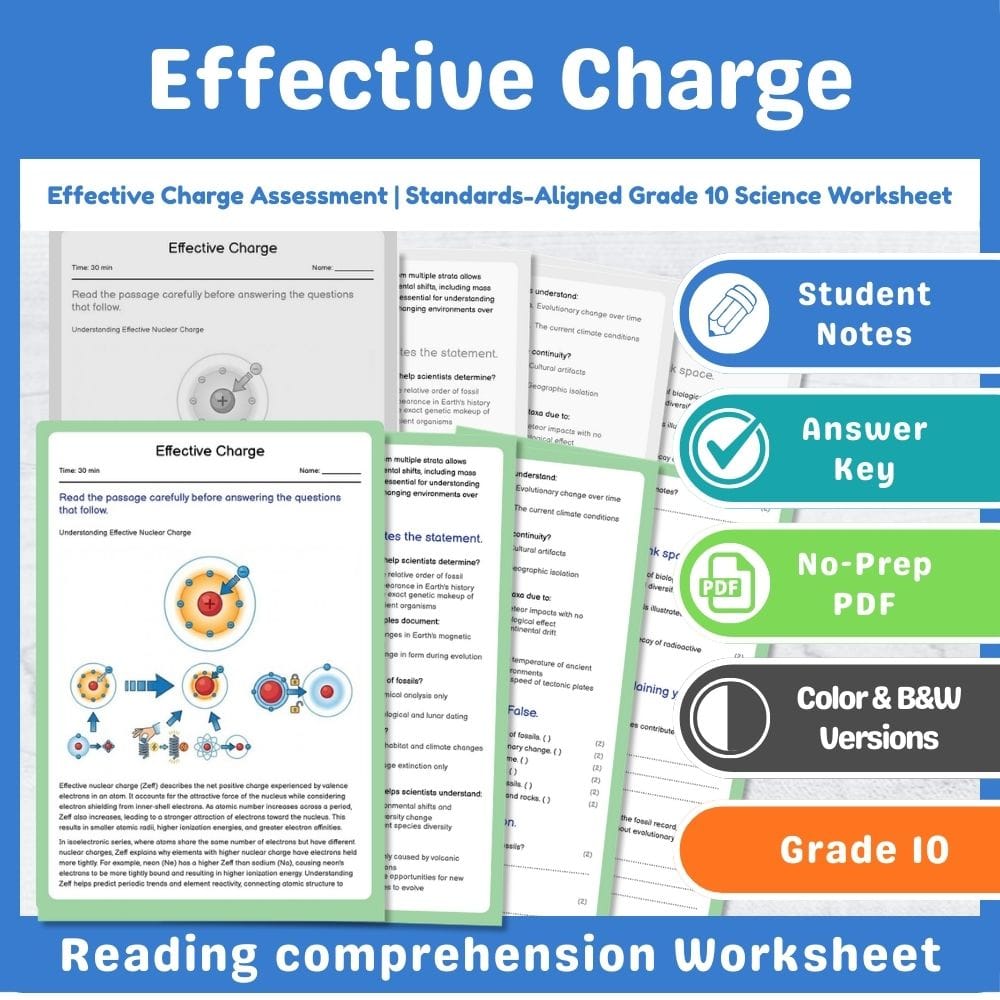
Effective Charge Assessment | Standards-Aligned Grade 10 Science Worksheet
Created byPrism Point LearningLearning Objectives
- Understand the concept of effective nuclear charge (Zeff) and its role in atomic structure.
- Analyze periodic trends such as atomic radius, ionization energy, and electron affinity in relation to Zeff.
- Compare isoelectronic series to see how nuclear charge and shielding affect valence electrons.
Also included in: Lesson Bundle | Grade 10 Science Assessment Paired with AP Standards
Instant download

Reaction Energetics Assessment | BC Standards Grade 10 Science
Created byPrism Point LearningLearning Objectives
- Understand the principles of energy changes during chemical reactions.
- Identify differences between exothermic and endothermic reactions.
- Relate bond energies to reaction thermodynamics and feasibility.
Instant download

Atomic Structure Assessment for Grade 9 Science NGSS Standards
Created byPrism Point LearningLearning Objectives
- Describe the subatomic particles involved in atomic structure including protons, neutrons, and electrons.
- Explain electron configurations and the concept of quantized energy levels.
- Understand how the periodic table arranges elements based on valence electrons and how this influences chemical behavior.
Instant download

Weather vs Climate Grade 7 Science Assessment | NGSSS Standards
Created byPrism Point LearningLearning Objectives
- Distinguish weather from climate using examples and evidence
- Identify key weather variables such as temperature, precipitation, humidity, and wind
- Explain how climate is influenced by geography and long-term energy patterns
Also included in: Grade 7 Earth and Climate Systems Science Lesson Bundle: Florida NGSSS
Instant download

Matter Classification Assessment for Grade 7 Science | Florida NGSSS
Created byPrism Point LearningLearning Objectives
- Distinguish elements, compounds, and mixtures based on composition and how particles are combined
- Classify mixtures as homogeneous or heterogeneous using visible and uniform properties
- Explain how matter classification helps predict what will happen during physical and chemical changes
Also included in: Grade 7 Matter, Forces & Energy Science Lesson Bundle | Florida NGSSS
Instant download

Population Dynamics Assessment for Grade 7 Science – NGSSS Standards
Created byPrism Point LearningLearning Objectives
- Explain how births, deaths, immigration, and emigration affect population size over time
- Identify limiting factors and predict how they influence population growth
- Use predator–prey relationships to describe how populations can fluctuate (oscillate)
Instant download

Conservation Of Matter Assessment | NGSSS Standards Grade 7 Science
Created byPrism Point LearningLearning Objectives
- Explain the conservation of matter principle using the idea that total mass is conserved in a closed system
- Identify evidence for conservation of matter, such as constant mass in sealed-container experiments
- Use particle/atom thinking to describe chemical reactions as rearrangements rather than creation or destruction
Also included in: Grade 7 Matter, Forces & Energy Science Lesson Bundle | Florida NGSSS
Instant download

Inherited Traits Assessment | NGSSS Florida Grade 7 Science Standards
Created byPrism Point LearningLearning Objectives
- Explain how inherited traits are passed from parents to offspring through genetic information in reproductive cells
- Identify how alleles influence traits and why offspring may differ from their parents
- Use observations to make predictions about inheritance patterns
Instant download

Physical Chemical Changes Assessment | Florida NGSSS Grade 7 Science
Created byPrism Point LearningLearning Objectives
- Differentiate between physical changes and chemical changes using evidence from observations.
- Identify indicators of chemical change such as gas production, precipitate formation, color change, or temperature change.
- Explain how matter can change form or state without creating a new substance.
Also included in: Grade 7 Matter, Forces & Energy Science Lesson Bundle | Florida NGSSS
Instant download

Battery Storage Assessment | BC Standards Grade 10 Science
Created byPrism Point LearningLearning Objectives
- Describe how chemical energy is converted to electrical energy in batteries.
- Explain the factors affecting the efficiency and longevity of battery storage.
- Analyze the energy flow during charge and discharge cycles and their impact on battery performance.
Also included in: Grade 10 Science | Energy Assessment - BC Standards-Aligned Mini Bundle
Instant download
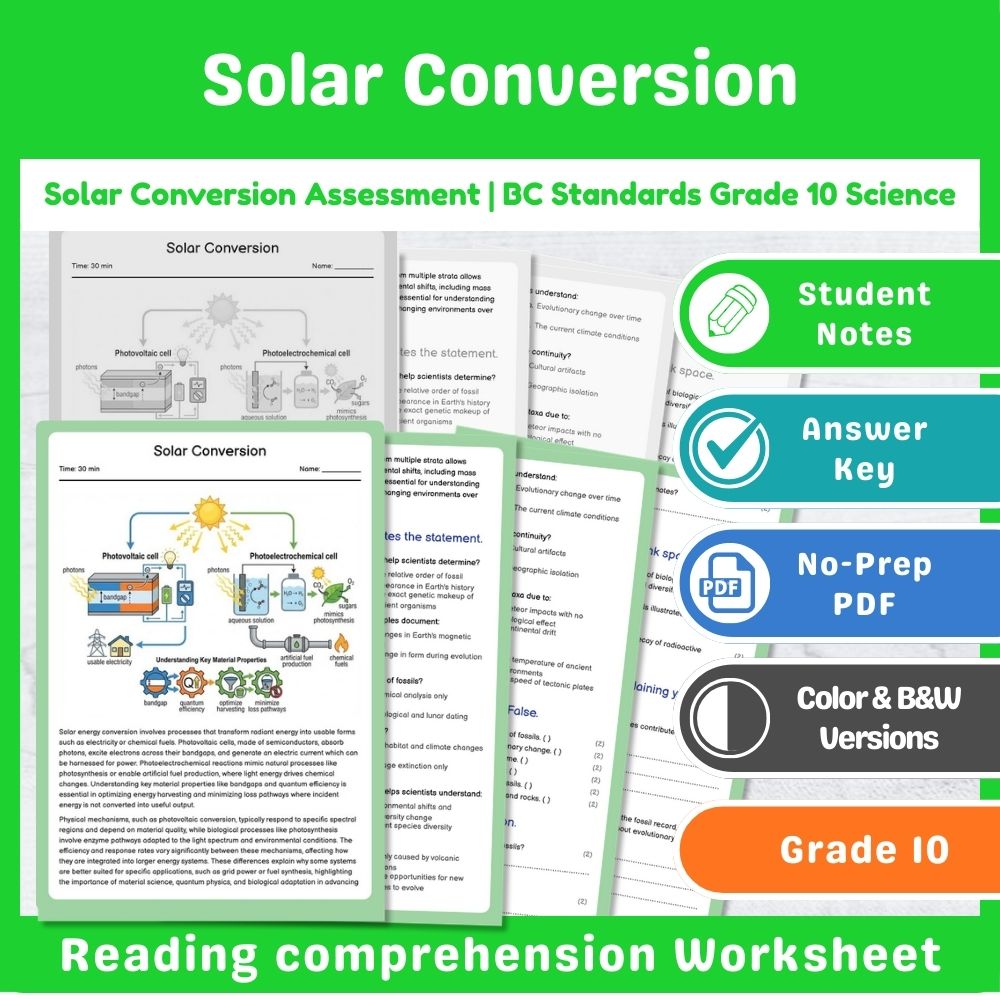
Solar Conversion Assessment Grade 10 Science | BC Standards-Aligned
Created byPrism Point LearningLearning Objectives
- Explain the processes involved in solar energy conversion, including photovoltaic and photoelectrochemical methods.
- Describe how semiconductors absorb photons and generate electrical current.
- Understand material properties such as bandgaps and quantum efficiency relevant to solar conversion.
Also included in: Grade 10 Science | Energy Assessment - BC Standards-Aligned Mini Bundle
Instant download
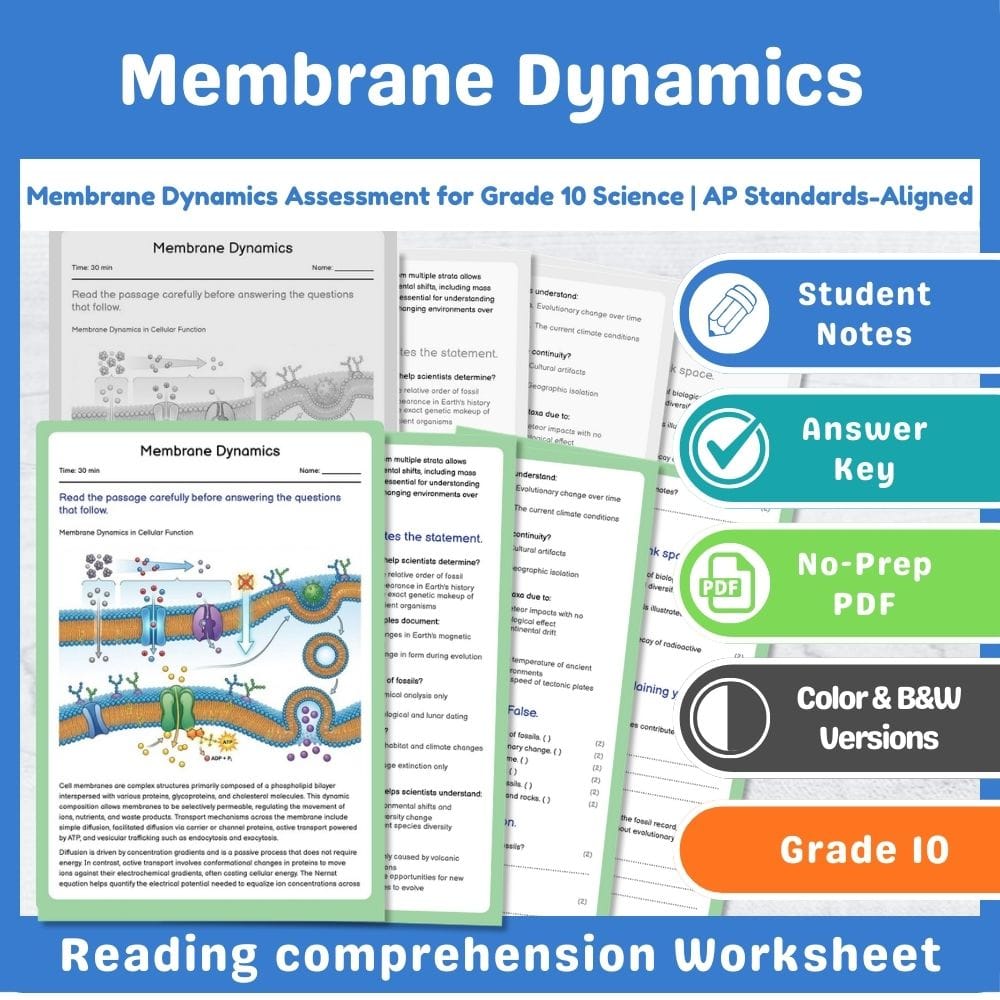
Membrane Dynamics Assessment for Grade 10 Science | AP Standards-Aligned
Created byPrism Point LearningLearning Objectives
- Understand key concepts related to Science
- Apply knowledge through practice questions
- Demonstrate comprehension of the material
Also included in: Lesson Grade 10 Science Assessment Bundle | AP Standards-Aligned
Instant download
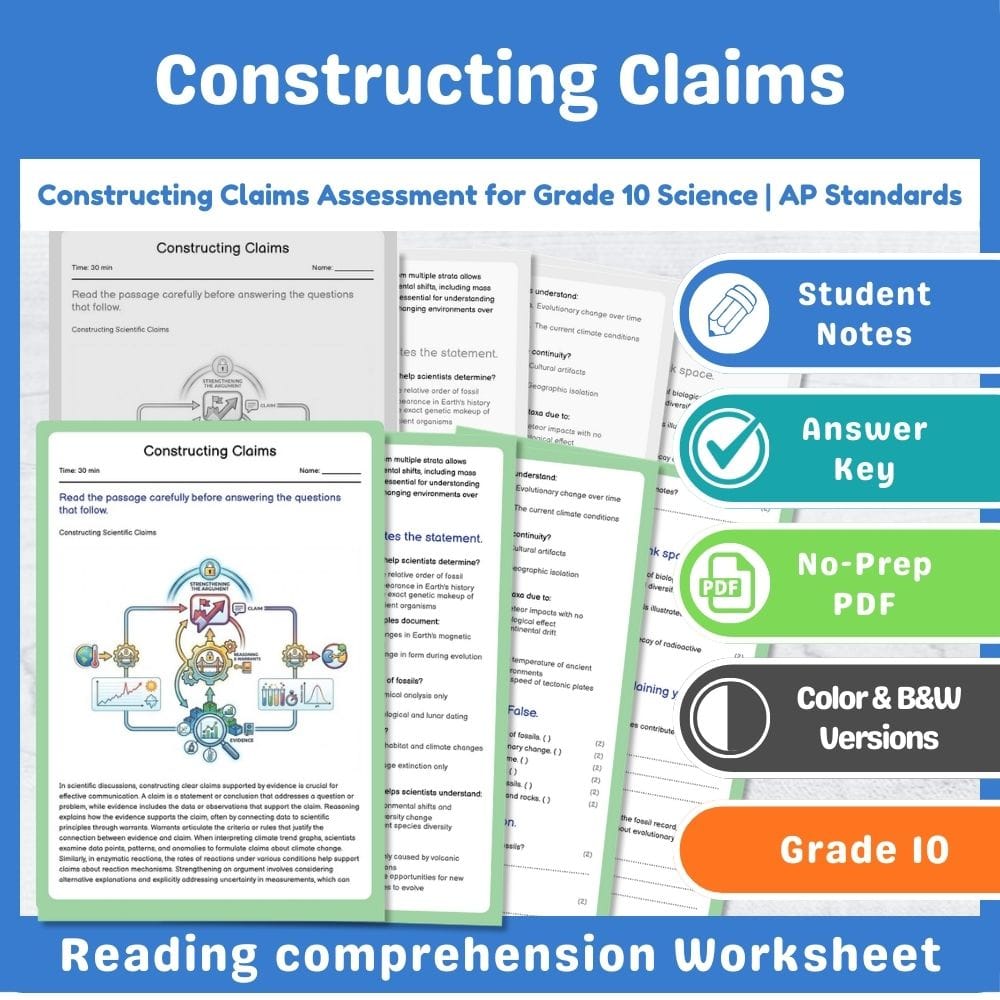
Constructing Claims Assessment for Grade 10 Science | AP Standards
Created byPrism Point LearningLearning Objectives
- Understand the structure and components of evidence-based claims, including claim, evidence, and reasoning.
- Distinguish between claim, evidence, and warrant in constructing scientific arguments.
- Apply the claim-evidence-reasoning framework to interpret data such as climate graphs and enzyme reaction rates.
Instant download

DNA Information Assessment for Grade 11 Science | NGSSS Standards
Created byPrism Point LearningLearning Objectives
- Explain how DNA stores genetic information and how that information leads to protein production
- Describe the structure of DNA and the importance of complementary base pairing
- Analyze how accurate DNA replication preserves inheritance during cell division
Also included in: Grade 11 Population, Genetics & Energy Systems Science Lesson Bundle: Florida NGSSS +1 more
Instant download
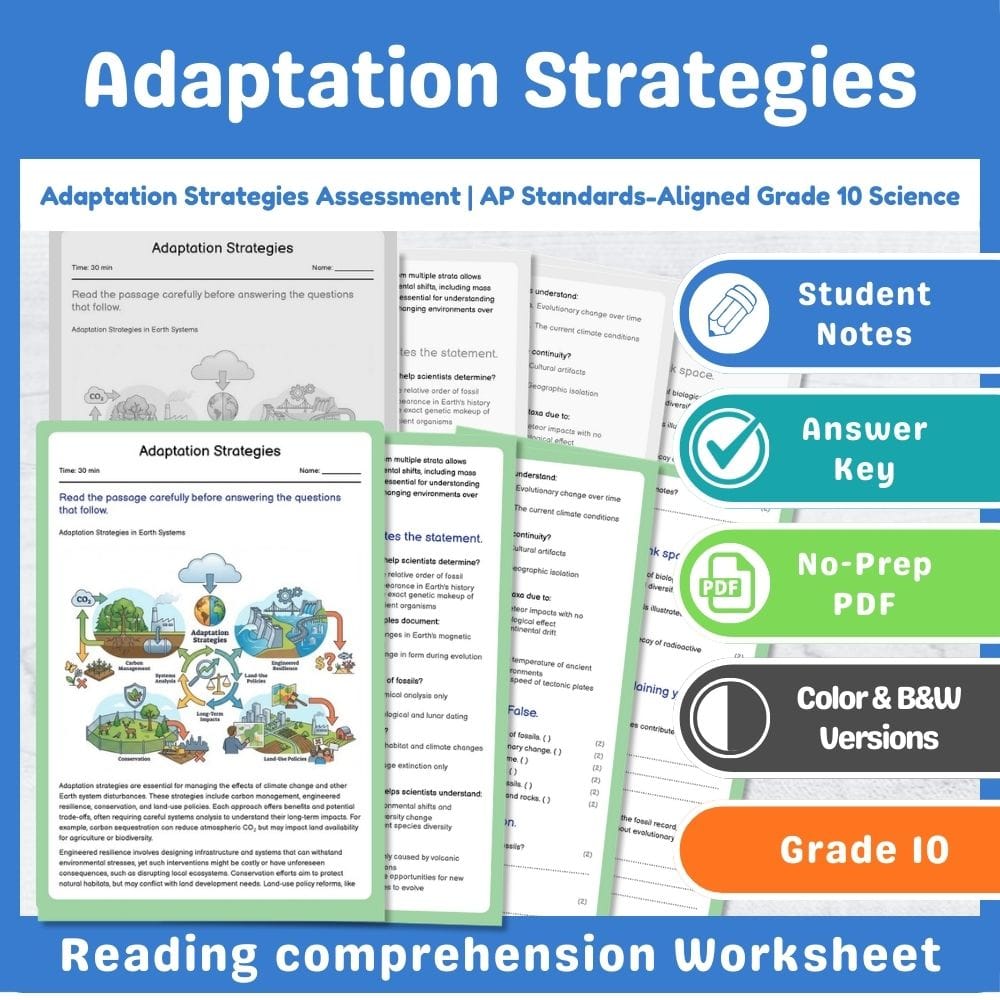
Adaptation Strategies Assessment for Grade 10 Science | Standards-Aligned
Created byPrism Point LearningLearning Objectives
- Understand different adaptation strategies in Earth systems.
- Assess trade-offs and potential effects of mitigation actions.
- Apply systems thinking and scenario analysis to evaluate intervention outcomes.
Also included in: Lesson Bundle | Grade 10 Science Earth and Space Standards-Aligned
Instant download

Earth Systems Assessment for Grade 11 Science | Florida NGSSS Standards
Created byPrism Point LearningLearning Objectives
- Explain how Earth’s geosphere, hydrosphere, atmosphere, and biosphere interact through energy flow and matter cycling
- Use cause-and-effect reasoning to describe how unequal heating drives atmospheric and ocean circulation
- Describe major processes such as the water cycle and biogeochemical cycling and connect them to regional or global patterns
Also included in: Lesson Bundle: Grade 11 Earth and Space Science Assessments | Florida NGSSS +1 more
Instant download

Carrying Capacity Assessment for Grade 11 Science | NGSSS Standards
Created byPrism Point LearningLearning Objectives
- Explain how birth rate, death rate, immigration, and emigration affect population change over time
- Define carrying capacity and describe how limiting factors slow population growth
- Interpret how competition, predation, and disease influence survival and reproduction
Also included in: Grade 11 Population, Genetics & Energy Systems Science Lesson Bundle: Florida NGSSS +1 more
Instant download

Conservation of Mass Assessment | Florida NGSSS Grade 11 Science
Created byPrism Point LearningLearning Objectives
- Explain the conservation of mass in terms of closed systems and atomic rearrangement.
- Use balanced chemical equations to connect reactant and product amounts to measurable mass.
- Apply conservation of mass to interpret evidence from experiments involving solids and gases.
Also included in: Lesson Grade 11 Forces Energy & Chemistry Science Assessment Lesson Bundle | Florida (NGSSS) +1 more
Instant download

Water Cycle Flux Assessment for Grade 11 Science | NGSSS Standards
Created byPrism Point LearningLearning Objectives
- Explain how water moves between the atmosphere and hydrosphere using the major processes of the water cycle flux.
- Analyze how ocean currents and sea surface temperature affect evaporation, humidity, and atmospheric stability.
- Evaluate how long-term and seasonal ocean-atmosphere interactions can change regional precipitation patterns, including El Niño and La Niña.
Also included in: Lesson Bundle: Grade 11 Earth and Space Science Assessments | Florida NGSSS +1 more
Instant download
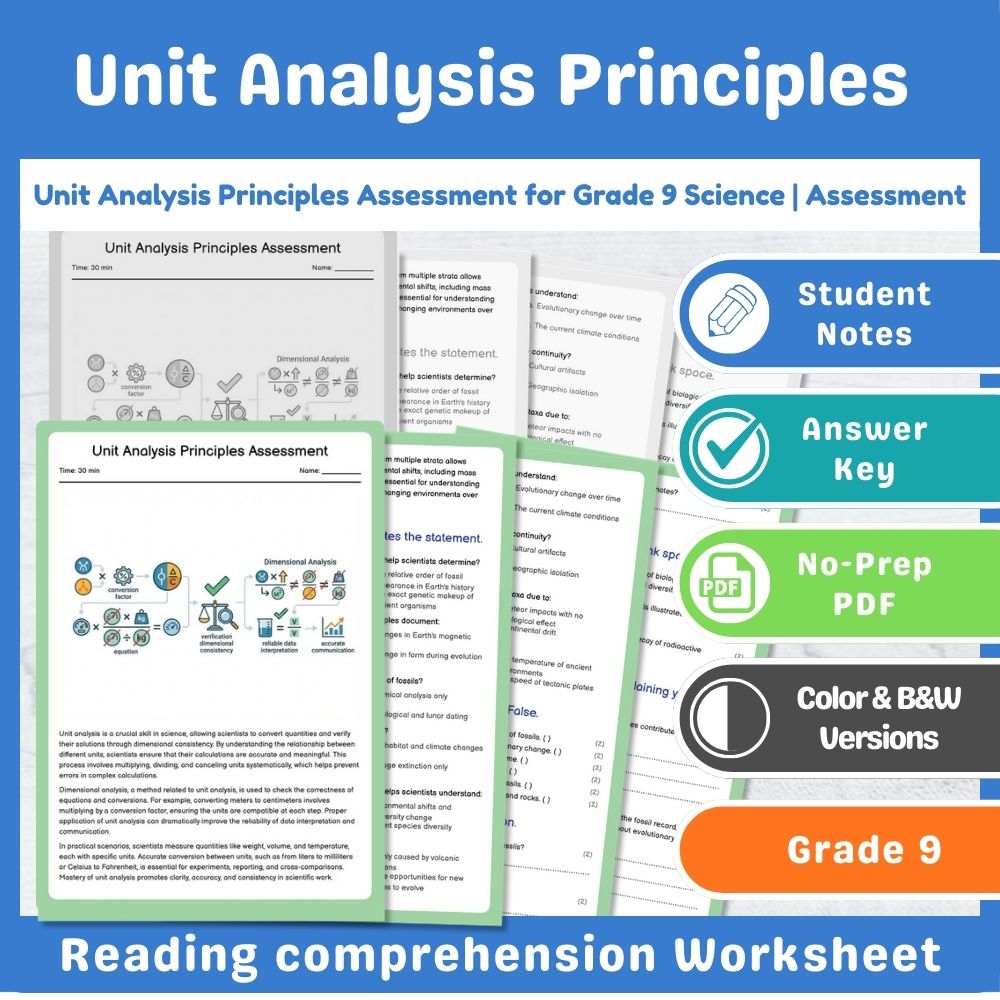
Unit Analysis Principles Assessment for Grade 9 Science | Assessment
Created byPrism Point LearningLearning Objectives
- Understand the fundamental principles of unit analysis in scientific measurements.
- Apply dimensional analysis to solve multi-step transformation problems.
- Evaluate the accuracy and precision of measurement results using unit conversions.
Instant download

Climate and Controls Assessment | Florida NGSSS Grade 9 Science
Created byPrism Point LearningLearning Objectives
- Differentiate climate from short-term weather and explain why climate is based on long-term patterns
- Describe how latitude, atmospheric circulation, and distance from water influence temperature and precipitation
- Explain how local factors (elevation and prevailing winds) shape regional climate and related ecosystems
Also included in: Grade 9 Earth Systems Science Lesson Bundle: Florida NGSSS Assessments
Instant download

Forces Overview Assessment | Florida NGSSS Grade 9 Science
Created byPrism Point LearningLearning Objectives
- Explain how forces change an object’s motion by causing acceleration and changing velocity
- Differentiate between contact forces and field forces and give relevant examples
- Describe how force direction and magnitude are represented using vectors
Also included in: Grade 9 Forces, Energy, and Matter Science Lesson Bundle | Florida NGSSS
Instant download

Ecological Niches Assessment for Grade 9 Science | NGSSS Standards
Created byPrism Point LearningLearning Objectives
- Explain the difference between an organism’s habitat and its ecological niche.
- Describe how resources, feeding relationships, and tolerance limits shape ecological niches.
- Analyze how competition and changing environmental conditions can reorganize communities.
Also included in: Grade 9 Evolution & Genetics Science Lesson Bundle – Florida NGSSS
Instant download

Adaptation Overview Assessment – BC Standard Grade 6 Science Worksheet
Created byPrism Point LearningLearning Objectives
- Understand the concept of adaptation and its importance for survival.
- Identify different types of adaptations in animals and plants.
- Analyze real-world examples of adaptations and their functions.
Instant download

Climate Variability Assessment | Florida NGSSS Standards Grade 9 Science
Created byPrism Point LearningLearning Objectives
- Explain how climate variability differs from short-term weather changes
- Describe how ocean-atmosphere interactions (El Niño and La Niña) can redistribute heat and moisture
- Analyze how long-term forcings can shift climate baselines using temperature and precipitation evidence
Also included in: Grade 9 Earth Systems Science Lesson Bundle: Florida NGSSS Assessments
Instant download

Respiratory System Assessment for Grade 6 Science | BC Standards
Created byPrism Point LearningLearning Objectives
- Describe the structure and function of the respiratory system and its role in gas exchange.
- Identify adaptations that increase respiratory efficiency in different organisms.
- Explain how respiratory and circulatory systems work together to maintain homeostasis.
Instant download

Net Force Acceleration Assessment | NGSSS Standards Grade 8 Science
Created byPrism Point LearningLearning Objectives
- Define net force and determine its direction when forces act in opposite directions
- Explain how a nonzero net force causes changes in velocity (speed and/or direction)
- Use force values to predict acceleration for a cart moving on a track
Instant download

Speciation And Change Assessment for Grade 8 Science | NGSSS Standards
Created byPrism Point LearningLearning Objectives
- Explain how reproductive isolation can lead to speciation over many generations
- Describe how geographic barriers, habitat changes, or behavioral differences reduce gene flow
- Use natural selection and genetic variation to predict how traits may diverge in separated populations
Also included in: Grade 8 Evolution and Genetics Science Lesson Bundle | Florida NGSSS
Instant download

Decomposers And Nutrients Assessment | BC Standards Grade 6 Science
Created byPrism Point LearningLearning Objectives
- Understand the role of decomposers in nutrient cycling and ecosystem health.
- Identify different types of decomposers including fungi, bacteria, and detritivores.
- Explain how environmental factors affect decomposer efficiency.
Instant download

Reaction Rates Assessment for Grade 6 Science BC Standards-Aligned
Created byPrism Point LearningLearning Objectives
- Understand the factors that influence the speed of chemical reactions.
- Identify how concentration, temperature, surface area, and catalysts affect reaction rates.
- Connect microscopic particle collisions to observable signs of chemical change.
Instant download
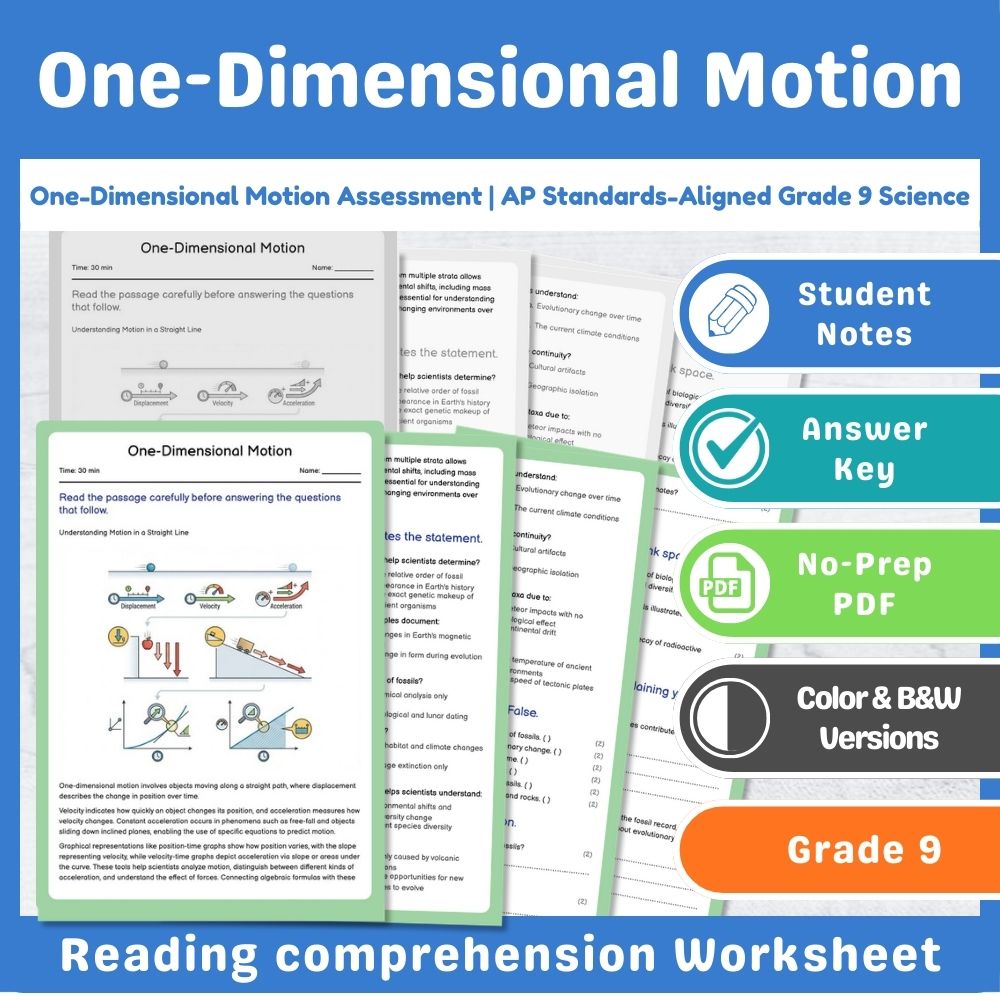
One-Dimensional Motion Assessment | AP Standards-Aligned Grade 9 Science
Created byPrism Point LearningLearning Objectives
- Understand and interpret position–time and velocity–time diagrams for motion along a straight line.
- Apply constant-acceleration equations to solve for displacement, velocity, and time.
- Connect algebraic models with graphical representations of motion such as slopes and areas under curves.
Also included in: Lesson Bundle | Grade 9 Science Assessment for Motion and Forces
Instant download
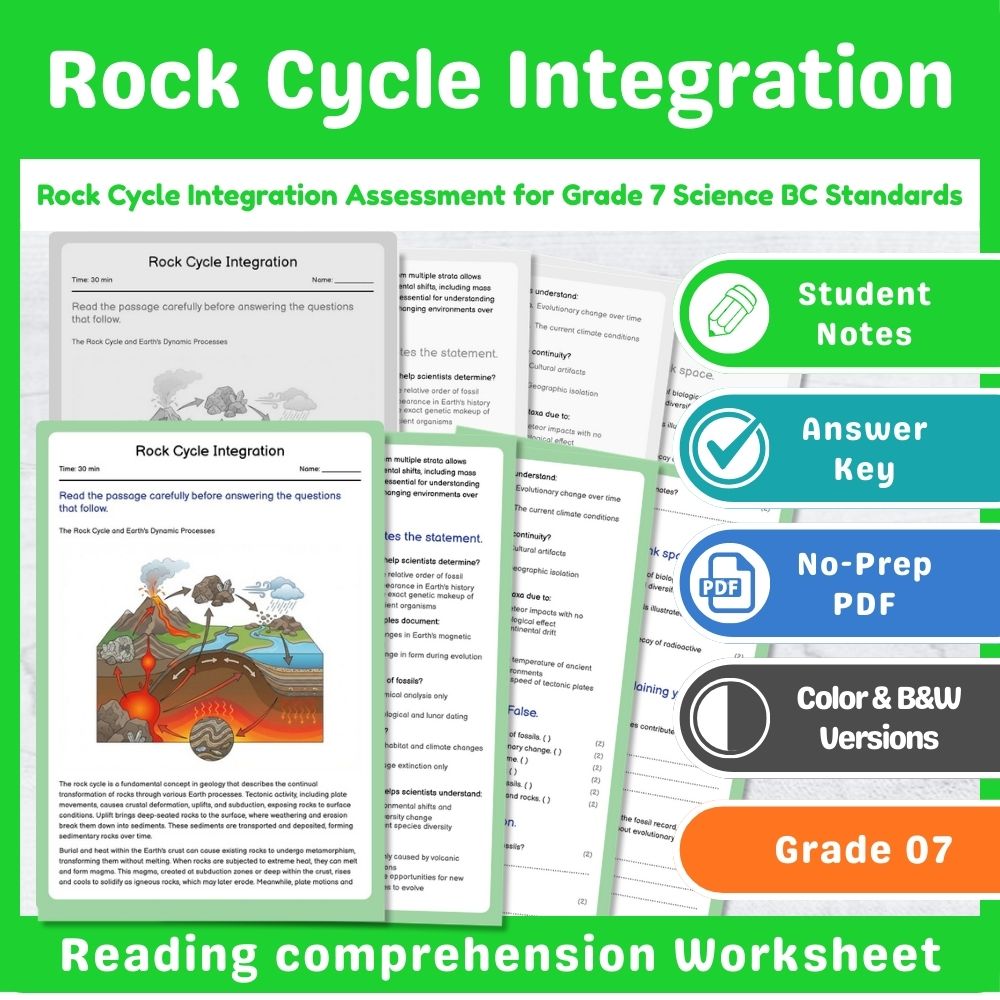
Rock Cycle Integration Assessment for Grade 7 Science BC Standards
Created byPrism Point LearningLearning Objectives
- Understand how the rock cycle links tectonics, magmatism, and surface processes.
- Identify the pathways of material transformation in the rock cycle.
- Explain how uplift, erosion, burial, and heat contribute to different rock types.
Also included in: Grade 7 Science Lesson – Earth Processes Assessment & Landforms Bundle
Instant download
Browse more categories
About Science Worksheets
Find Science worksheets spanning core skills, practice, and review. All 44,295 resources are instant PDF downloads for the classroom or home.
Every worksheet on MyTeachingSheets is created by independent teacher-authors and reviewed before publication. All resources download as printable PDFs for classroom, homework, or at-home practice, and many include answer keys. Preview any worksheet free before buying.