
Science Worksheets
44,295 subject resources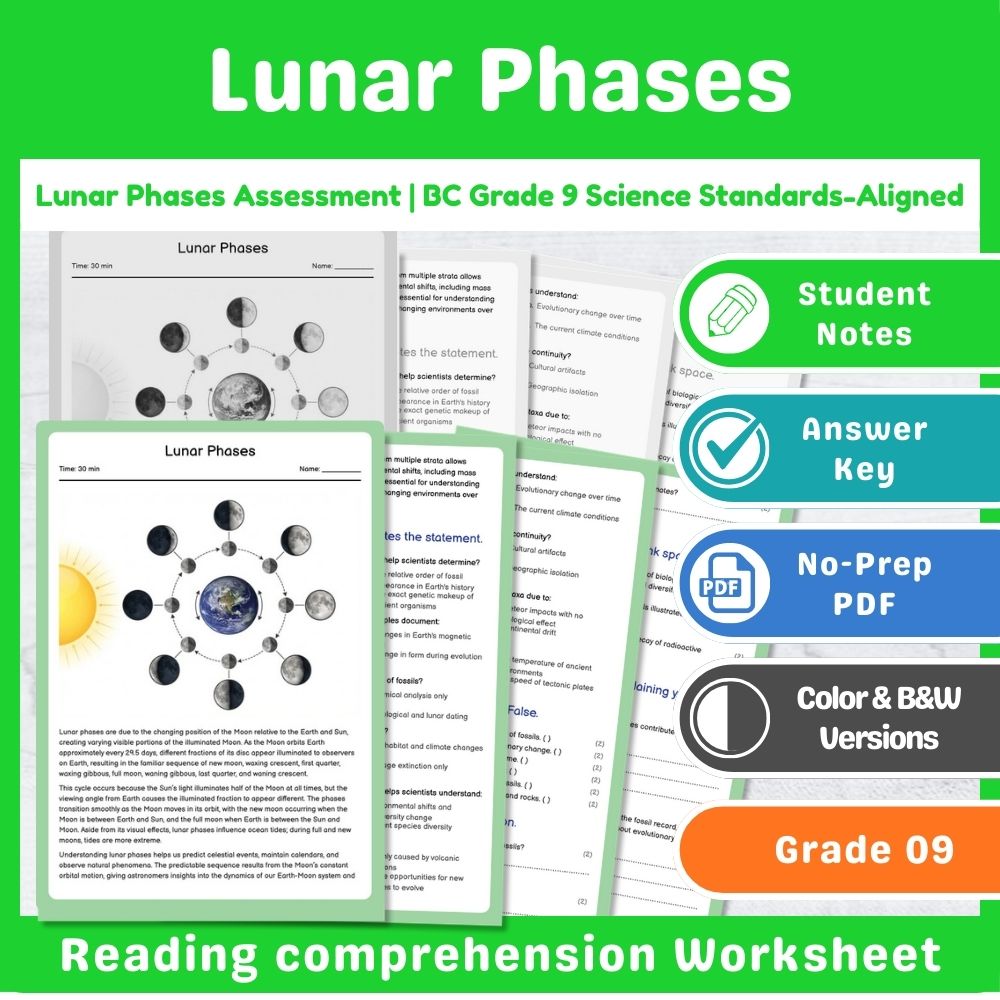
Lunar Phases Assessment | BC Grade 9 Science Standards-Aligned
 Created byPrism Point Learning
Learning Objectives
- Understand the sequence and causes of lunar phases.
- Identify the relationship between the Sun, Earth, and Moon in lunar cycles.
- Describe how lunar phases influence tides and nocturnal illumination.
Also included in: Grade 9 Science Mini Bundle – Earth & Space Assessment & Activities
Instant download
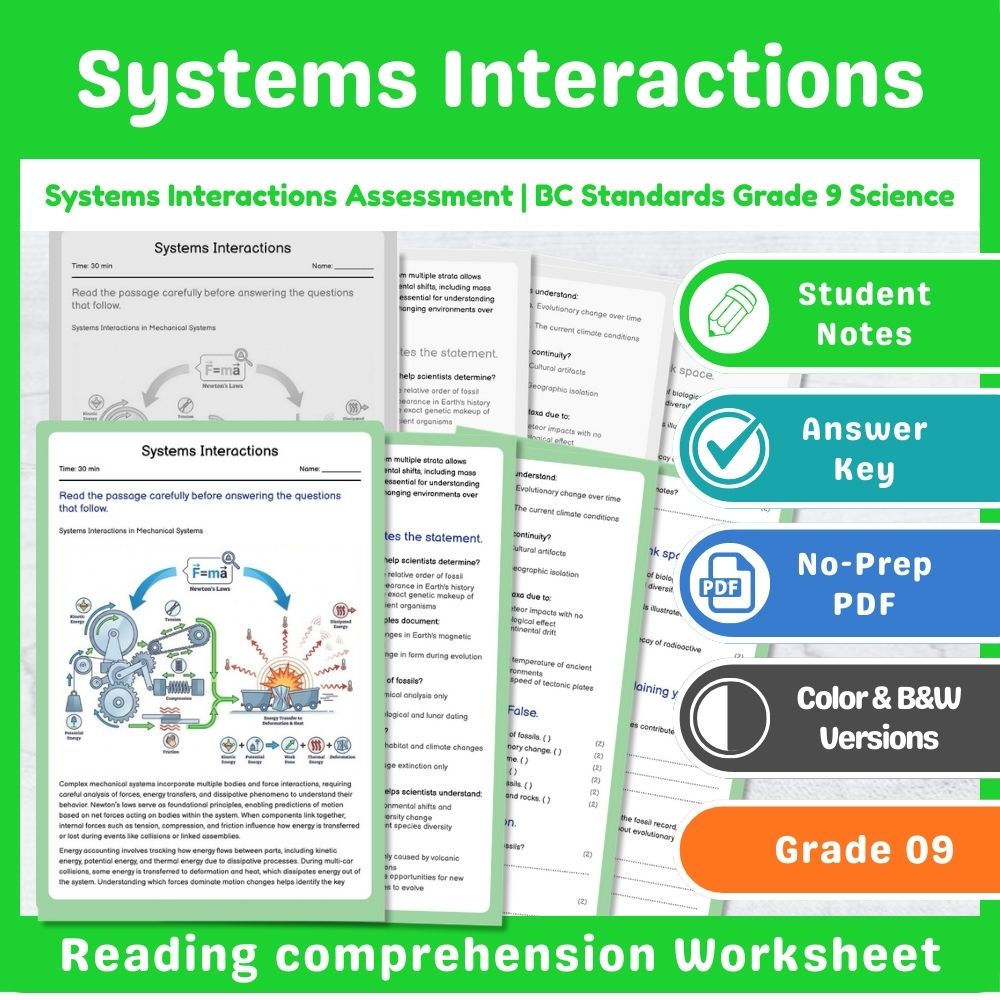
Systems Interactions Assessment | BC Standards Grade 9 Science
Created byPrism Point LearningLearning Objectives
- Understand how forces and energy interactions affect complex mechanical systems.
- Analyze net forces and predict system motion during collisions and assemblies.
- Evaluate energy transfers and dissipative forces within interconnected systems.
Instant download
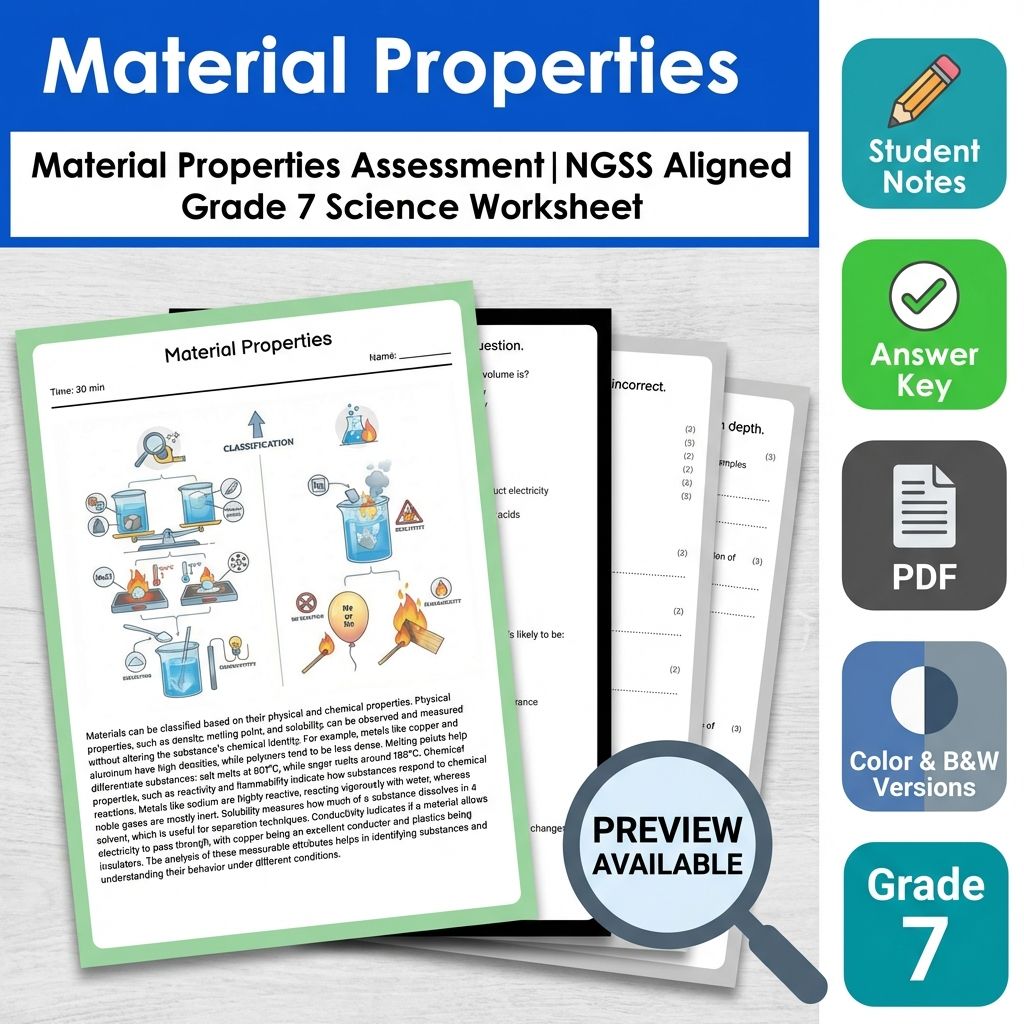
Material Properties Assessment | NGSS Aligned Grade 7 Science Worksheet
Created byPrism Point LearningLearning Objectives
- Distinguish between physical and chemical properties of materials.
- Identify measurable descriptors such as density, melting point, solubility, electrical conductivity, reactivity, and flammability.
- Analyze property data to classify materials and predict their responses to temperature and chemical contact.
Also included in: Grade 7 Science Lesson | Matter and Its Interactions Standards +1 more
Instant download

Testable Questions Assessment | General Grade 6 Science Standards-Aligned
Created byPrism Point LearningLearning Objectives
- Understand how to formulate scientific questions that can be tested with evidence.
- Identify measurable outcomes and observations that remain consistent in experiments.
- Differentiate between testable and non-testable questions in scientific inquiry.
Also included in: Grade 6 Data & Evidence Science Lesson Bundle | General Framework
Instant download
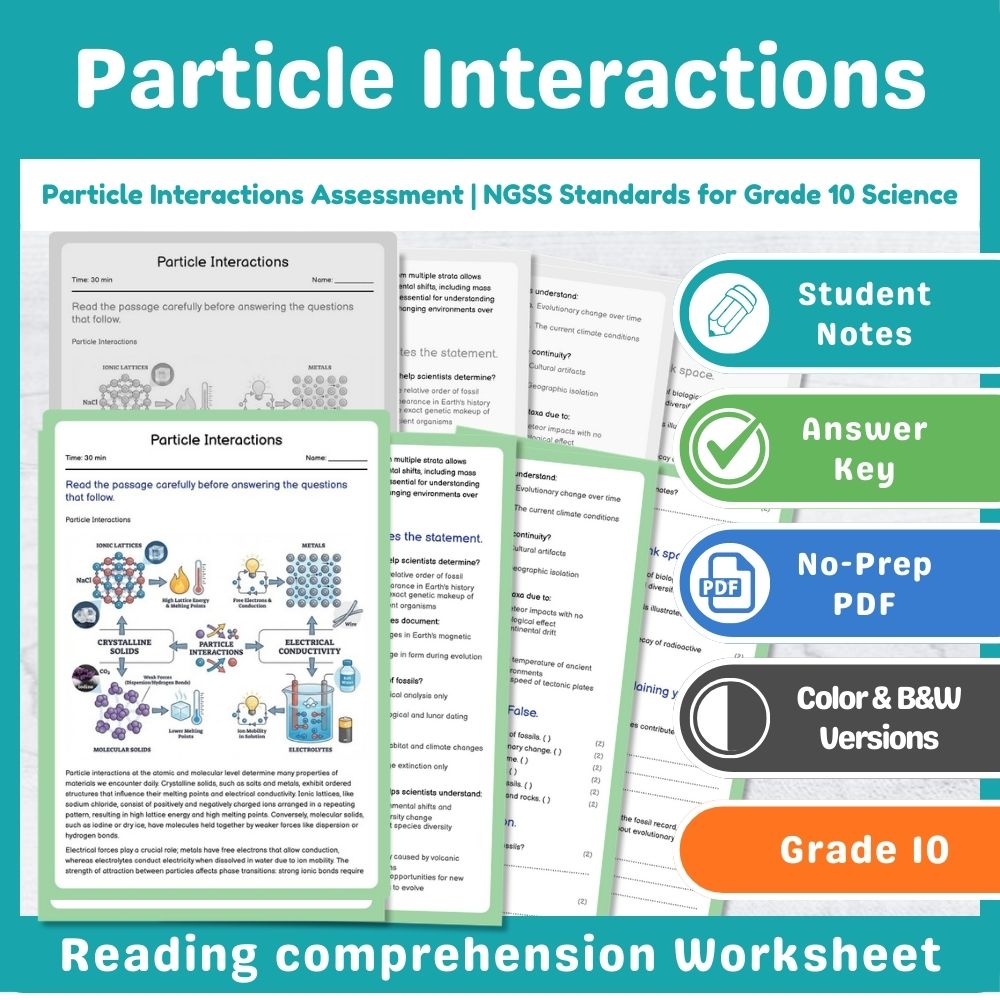
Particle Interactions Assessment | NGSS Standards for Grade 10 Science
Created byPrism Point LearningLearning Objectives
- Analyze how crystal structures, molecular interactions, and electrical forces influence bulk material properties.
- Differentiate between ionic lattices and molecular solids based on melting points, solubility, and electrical conductivity.
- Explain how lattice energy, dispersion forces, and hydrogen bonding affect phase transitions and physical properties.
Instant download
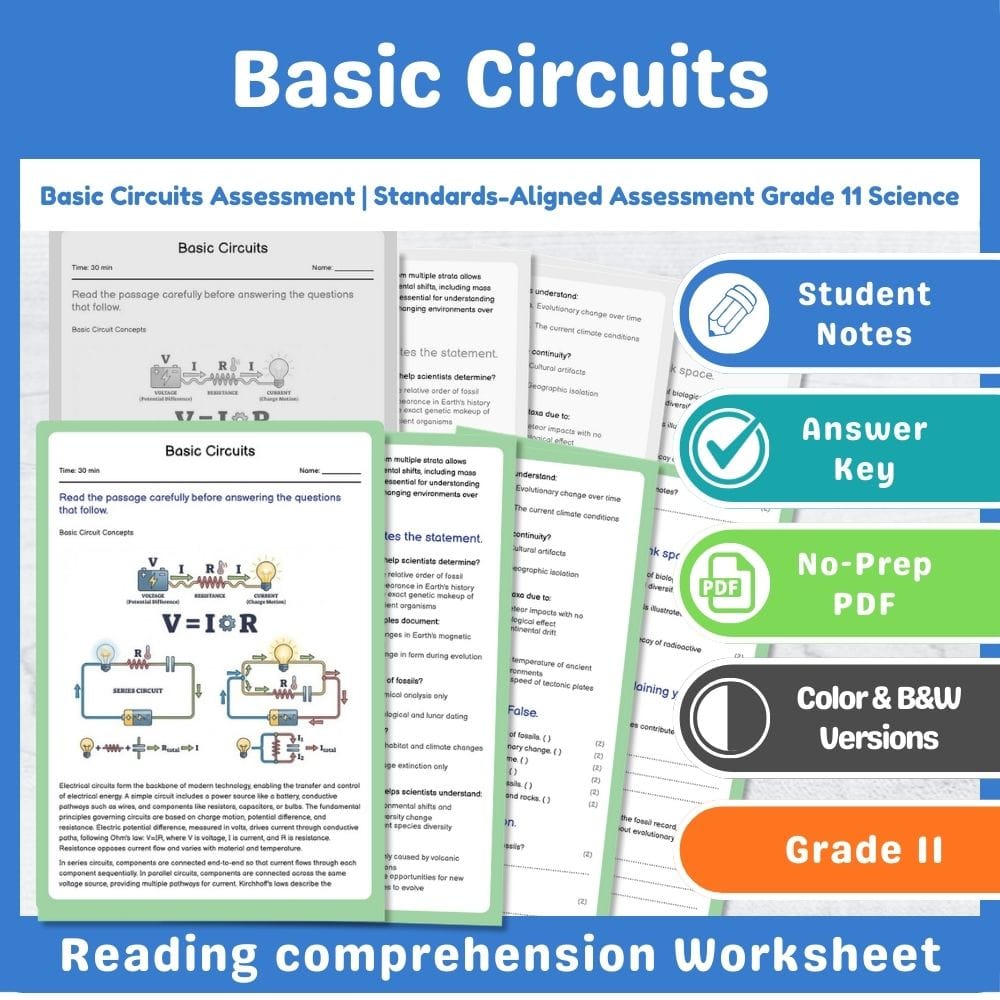
Basic Circuits Assessment | Standards-Aligned Assessment Grade 11 Science
Created byPrism Point LearningLearning Objectives
- Explain the concepts of electric potential difference, current, resistance, and energy transfer in DC circuits.
- Apply Ohm's law and Kirchhoff's laws to analyze series and parallel circuits.
- Calculate power dissipation and energy in simple electrical systems using algebraic methods.
Instant download
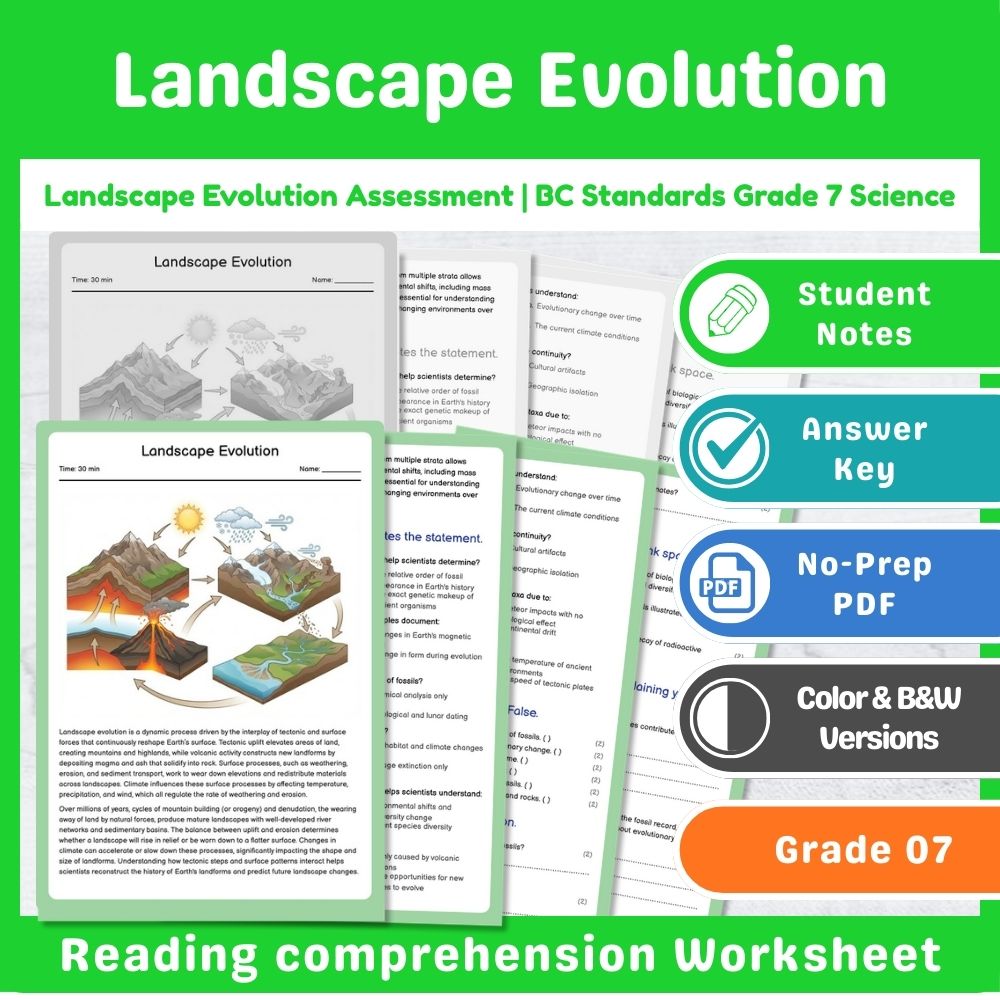
Landscape Evolution Assessment | BC Standards Grade 7 Science
Created byPrism Point LearningLearning Objectives
- Explain how tectonic uplift, volcanic construction, and surface processes influence landscape change.
- Analyze the balance between uplift and erosion in shaping landforms over time.
- Describe how climate variations affect weathering and material transport in landscapes.
Also included in: Grade 7 Science Lesson – Earth Processes Assessment & Landforms Bundle
Instant download
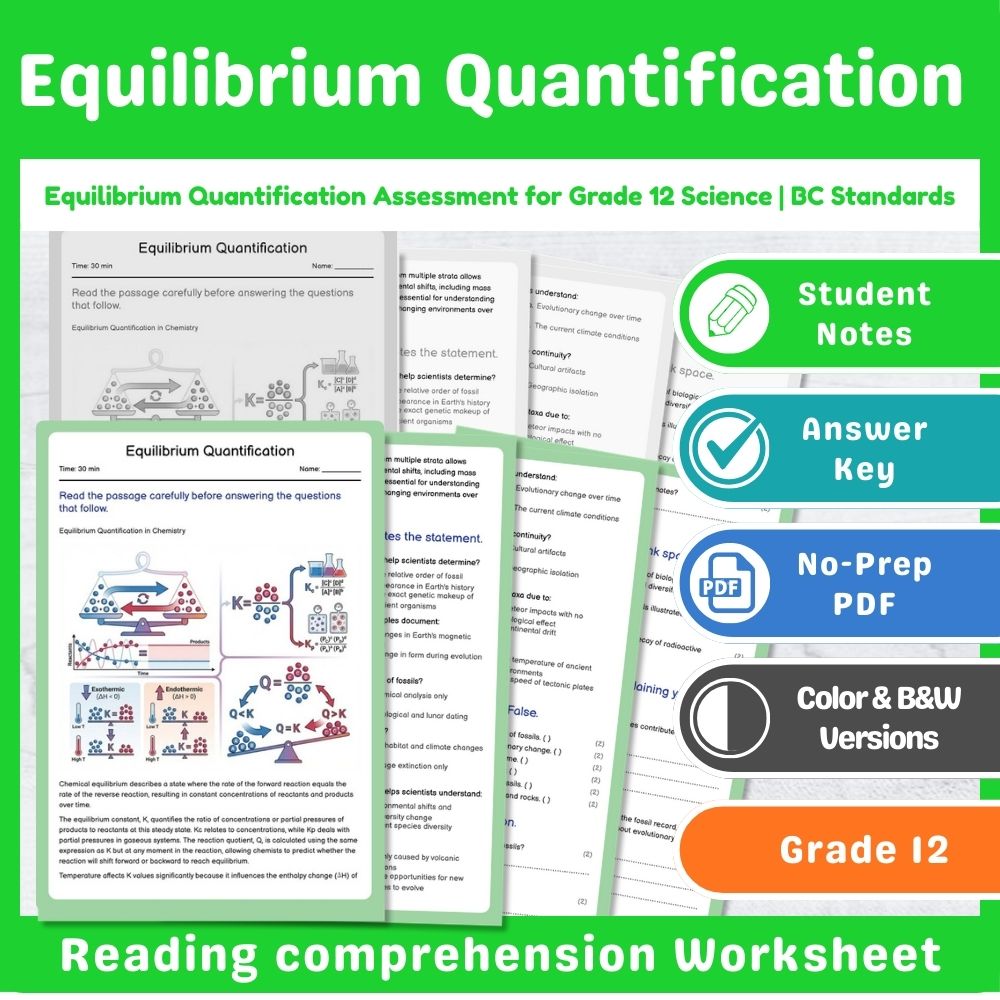
Equilibrium Quantification Assessment for Grade 12 Science | BC Standards
Created byPrism Point LearningLearning Objectives
- Explain the concept of equilibrium constants (Kc and Kp) and their significance in chemical reactions.
- Describe the role of the reaction quotient (Q) in predicting reaction direction and equilibrium state.
- Analyze how temperature influences equilibrium constants through enthalpy effects.
Also included in: Grade 12 Science Mini Bundle – Thermochemistry & Equilibrium Assessment
Instant download
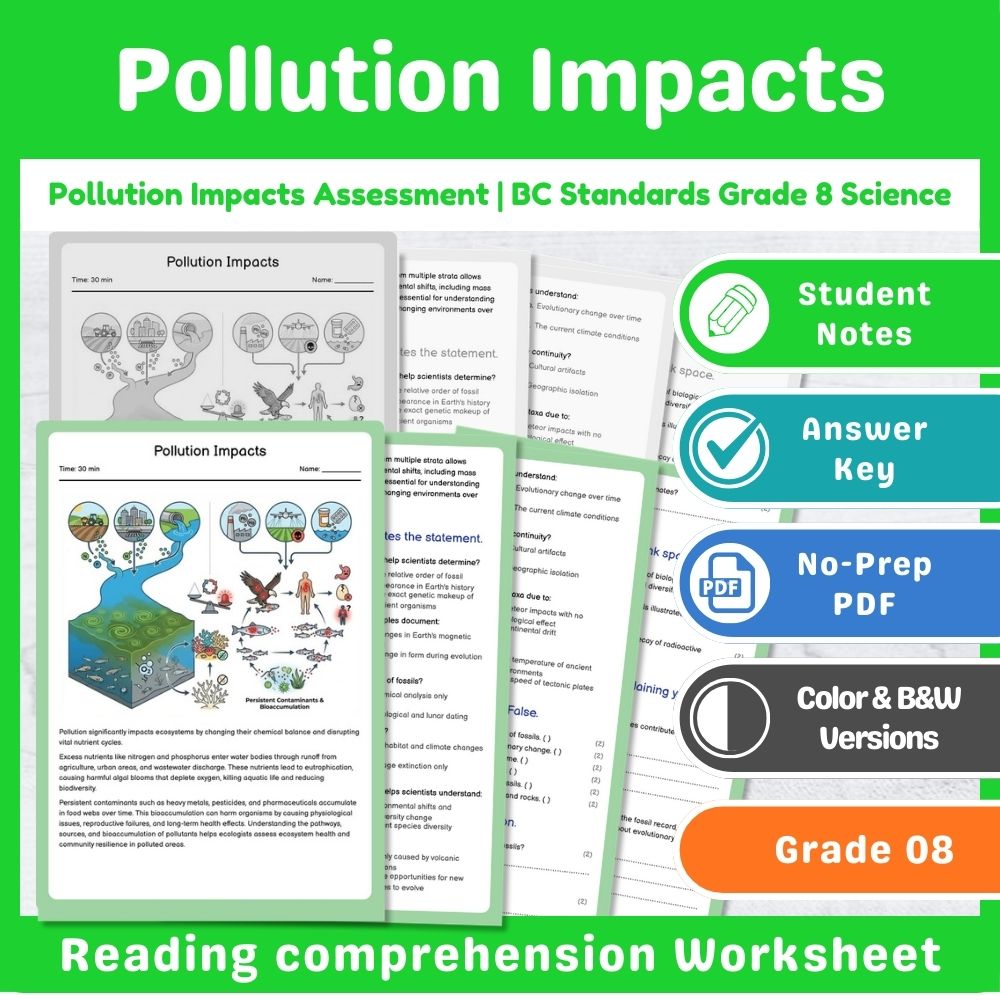
Pollution Impacts Assessment | BC Standards Grade 8 Science
Created byPrism Point LearningLearning Objectives
- Understand how pollution alters ecosystem chemistry and nutrient cycles.
- Identify the effects of excess nutrients and persistent contaminants on water, soil, and organisms.
- Explain the processes of eutrophication, bioaccumulation, and ecological resilience in polluted environments.
Instant download
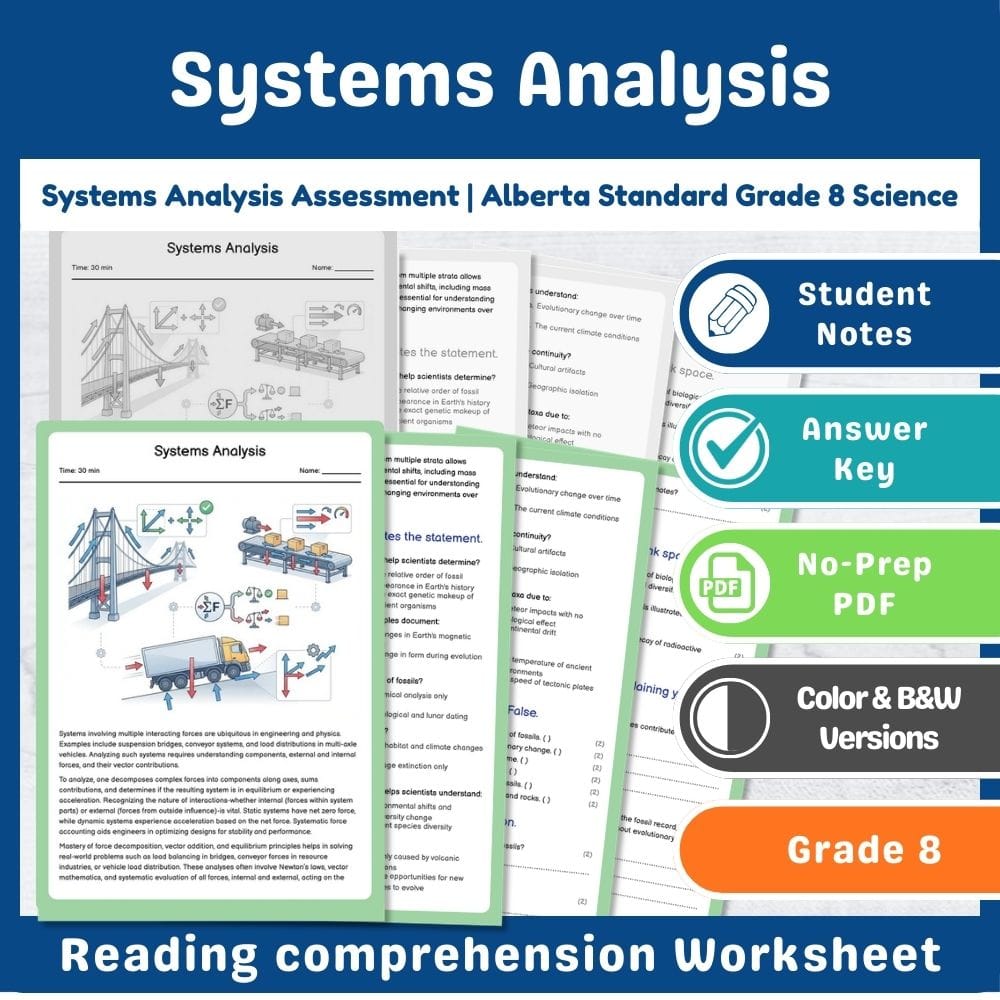
Systems Analysis Assessment | Alberta Standard Grade 8 Science
Created byPrism Point LearningLearning Objectives
- Identify the key components of complex systems involving multiple forces.
- Understand how to decompose system forces into vector components.
- Analyze static versus dynamic behavior by summing forces.
Also included in: Lesson Grade 8 Science Mini Bundle | Forces and Motion Alberta Standards
Instant download
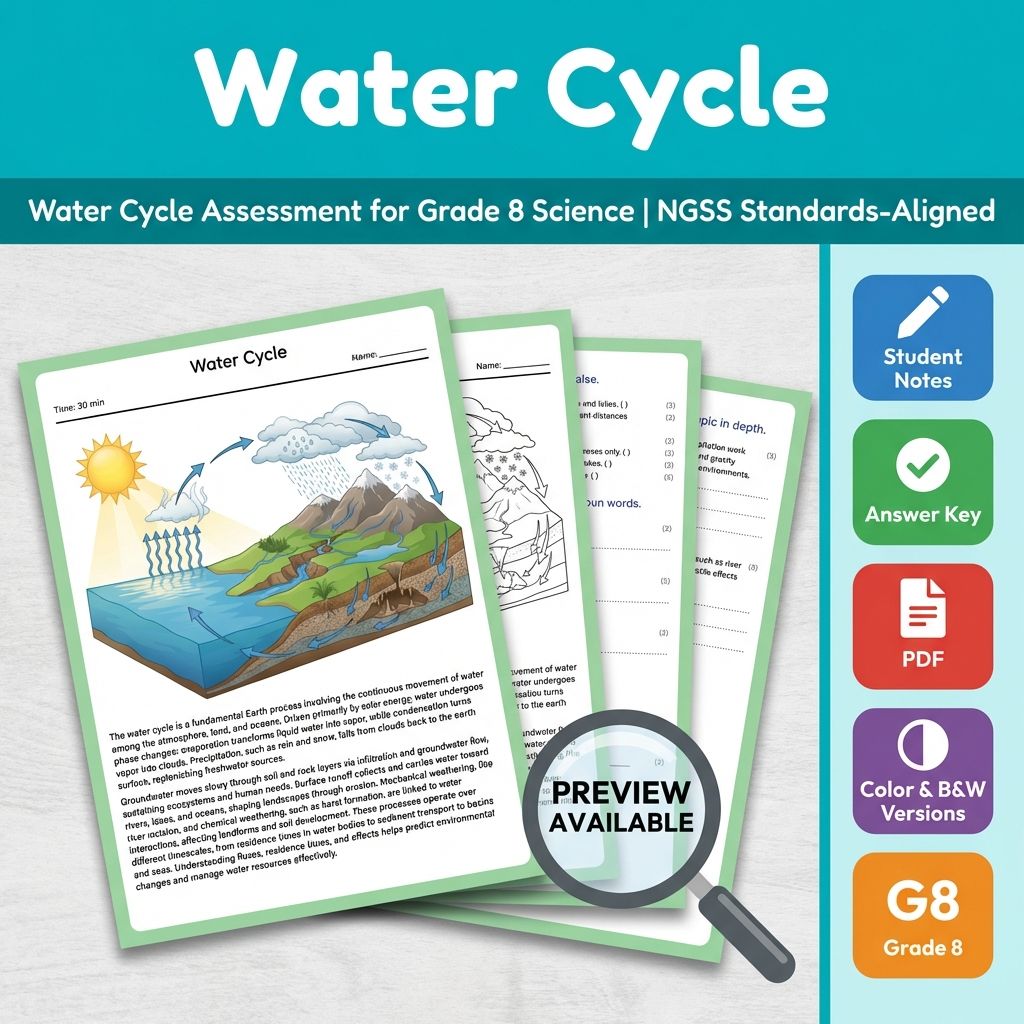
Water Cycle Assessment for Grade 8 Science | NGSS Standards-Aligned
Created byPrism Point LearningLearning Objectives
- Describe the processes involved in the global and local water cycle, including phase changes, evaporation, condensation, and precipitation.
- Explain the roles of sunlight and gravity in driving hydrologic processes such as infiltration, runoff, and groundwater flow.
- Connect processes of the water cycle to mechanical and chemical weathering phenomena like river incision, karst formation, and coastal erosion.
Also included in: Grade 8 Science Mini Bundle – Earth's Systems & NGSS Standards-Aligned +1 more
Instant download

Seasonal Tilt Assessment | Alberta Standards Grade 6 Science
Created byPrism Point LearningLearning Objectives
- Understand how Earth's axial tilt affects seasons and climate.
- Identify the differences in solar angle and daylight duration during seasons.
- Explain regional examples such as Alberta's temperature variations.
Also included in: Lesson Grade 6 Science Assessment | Celestial & Earth Movements
Instant download

Habitats and Niches Assessment | BC Standard Grade 6 Science Worksheet
Created byPrism Point LearningLearning Objectives
- Understand the difference between habitats and niches in ecosystems.
- Identify how species interact within shared habitats and niches.
- Explain how resource partitioning reduces competition among species.
Instant download

Producers & Energy Assessment | Alberta Standards Grade 8 Science
Created byPrism Point LearningLearning Objectives
- Explain the role of primary producers in ecological energy pathways.
- Compare photosynthetic efficiency among grasses, shrubs, and boreal trees in Alberta.
- Identify factors influencing primary productivity such as soil nutrients and light.
Also included in: Grade 8 Science Mini Bundle | Interactions and Ecosystems Curriculum
Instant download

Adaptive Radiation Assessment | TEKS Standards Grade 11 Science
Created byPrism Point LearningLearning Objectives
- Understand the concept of adaptive radiation and its role in biodiversity.
- Identify ecological factors that trigger adaptive radiation.
- Analyze morphological and behavioral adaptations in different species.
Also included in: Grade 11 Evolution, Speciation & Phylogeny Science Lesson Bundle | TEKS
Instant download

Chemical Equilibrium Assessment for Grade 11 Science | BC Standards
Created byPrism Point LearningLearning Objectives
- Understand the concept of chemical equilibrium and the factors that affect it.
- Learn how to write and interpret equilibrium constant expressions.
- Apply Le Chatelier’s principle to predict shifts in equilibrium in response to concentration, temperature, and pressure changes.
Also included in: Grade 11 Science | Thermochemistry Assessment Bundle – Standards-Aligned
Instant download
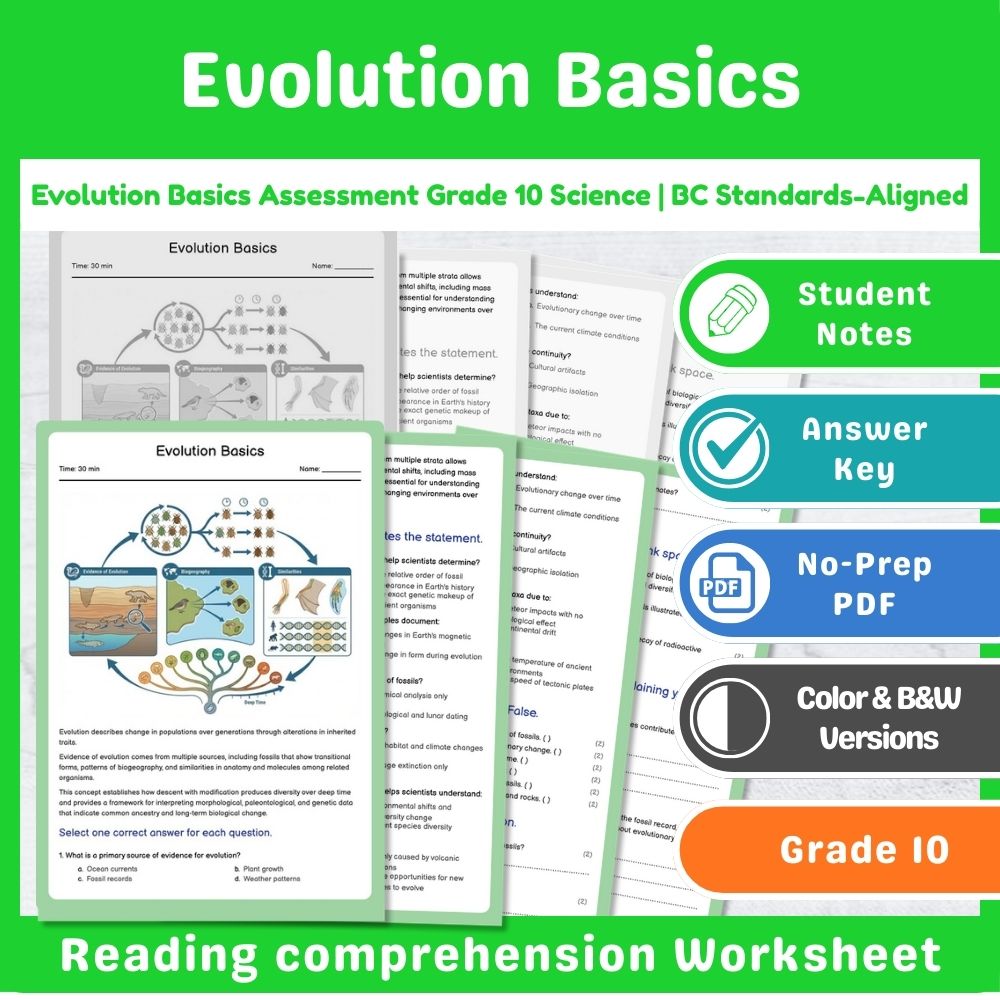
Evolution Basics Assessment Grade 10 Science | BC Standards-Aligned
Created byPrism Point LearningLearning Objectives
- Describe the concept of evolution and its importance in biological history.
- Identify sources of evidence that support the theory of evolution.
- Explain how morphological, paleontological, and genetic data demonstrate common ancestry.
Instant download
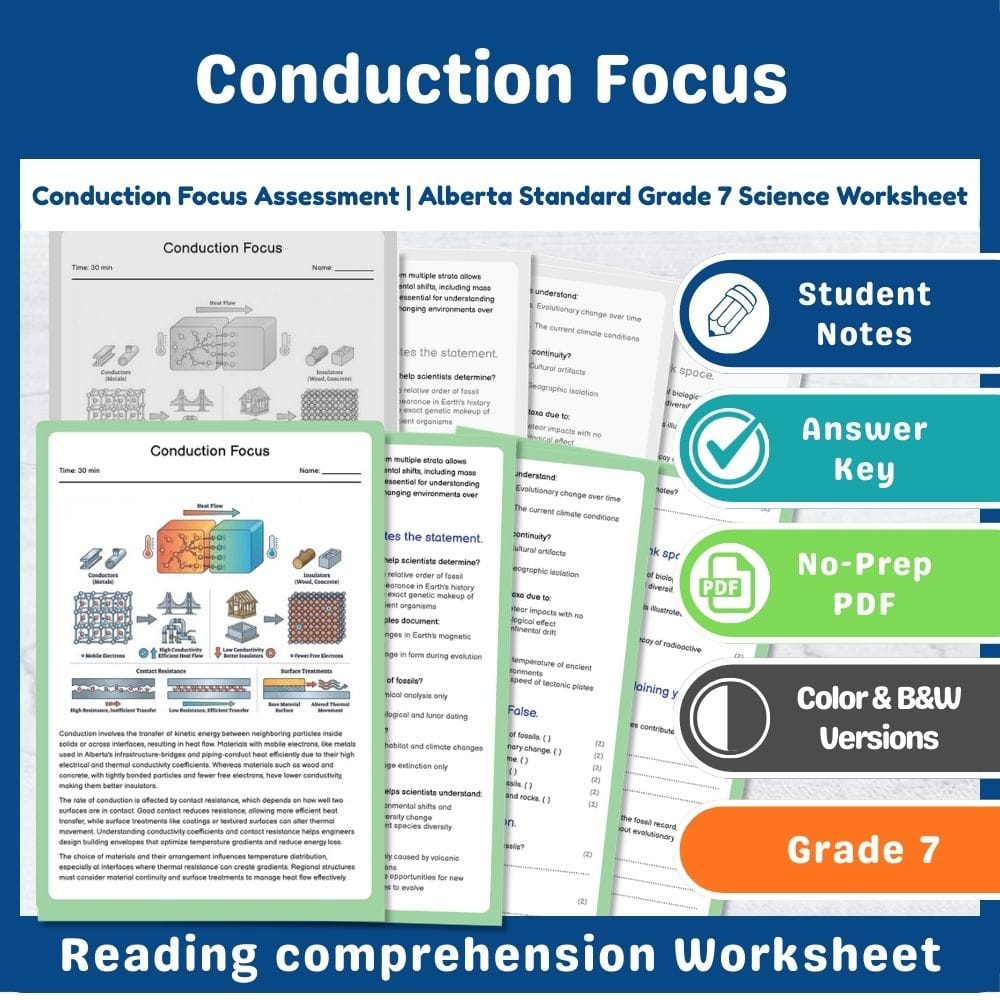
Conduction Focus Assessment | Alberta Standard Grade 7 Science Worksheet
Created byPrism Point LearningLearning Objectives
- Explain how energy is transferred through conduction in solids.
- Identify materials with high and low thermal conductivity and their applications.
- Describe the effects of contact resistance and surface treatments on heat flow in structures.
Also included in: Lesson Grade 7 Science Mini Bundle | Energy, Heat & Thermal Processes +1 more
Instant download

Energy System Efficiency Assessment | General Standards Grade 12 Science
Created byPrism Point LearningLearning Objectives
- Explain energy system efficiency and identify common loss pathways in real systems
- Evaluate how design choices (insulation, surface area, and control systems) affect useful energy output
- Apply the efficiency concept to a solar-thermal collector by linking absorber and surface properties to stored thermal energy
Instant download
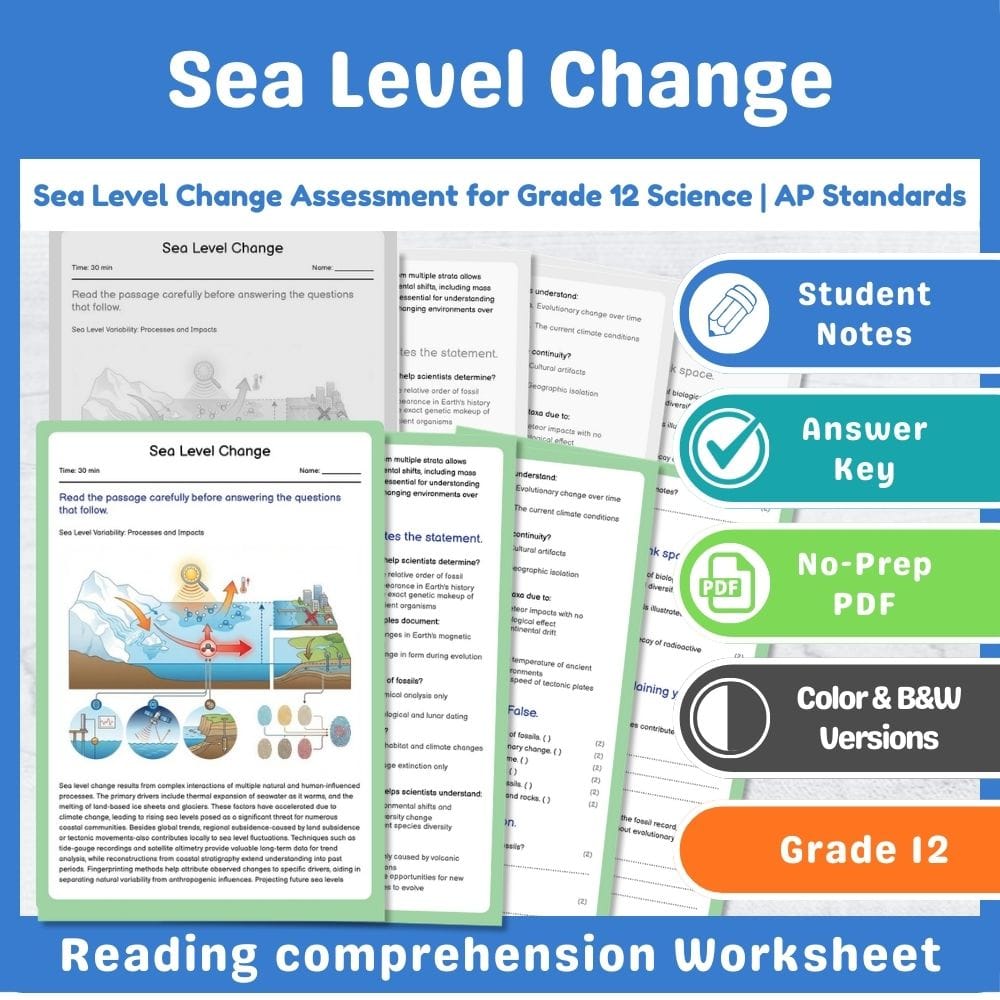
Sea Level Change Assessment for Grade 12 Science | AP Standards
Created byPrism Point LearningLearning Objectives
- Understand the key drivers that influence sea level variability, including thermal expansion, land-ice melt, and glacio-isostatic adjustment.
- Interpret data from tide gauges and satellite altimetry records to analyze sea level trends.
- Explain how human activities and regional factors affect sea level changes and coastal systems.
Instant download
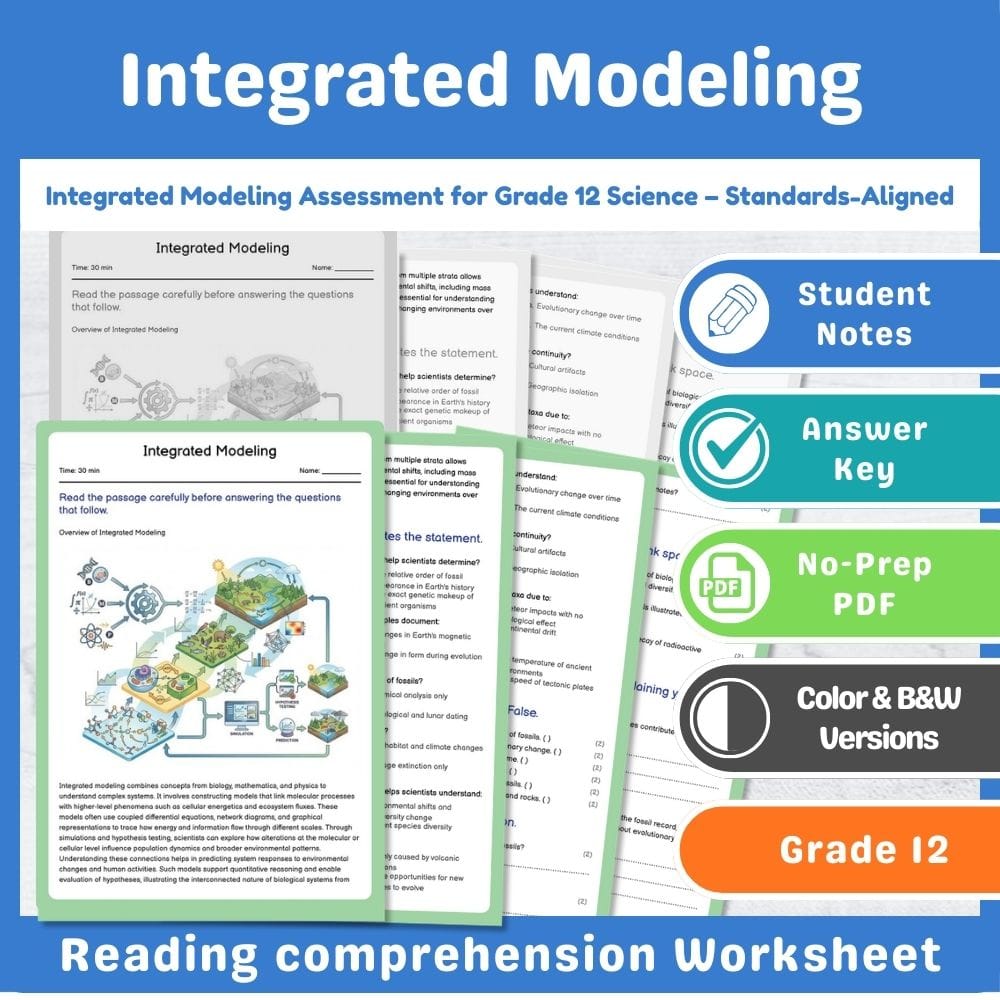
Integrated Modeling Assessment for Grade 12 Science – Standards-Aligned
Created byPrism Point LearningLearning Objectives
- Understand how molecular processes influence cellular energetics and genetic regulation.
- Describe the use of mathematical models such as differential equations and network diagrams in biological systems.
- Explain how changes at one biological level propagate to others within ecosystems.
Also included in: Grade 12 Science Mini Bundle | Biology and Ecosystems AP Standards
Instant download
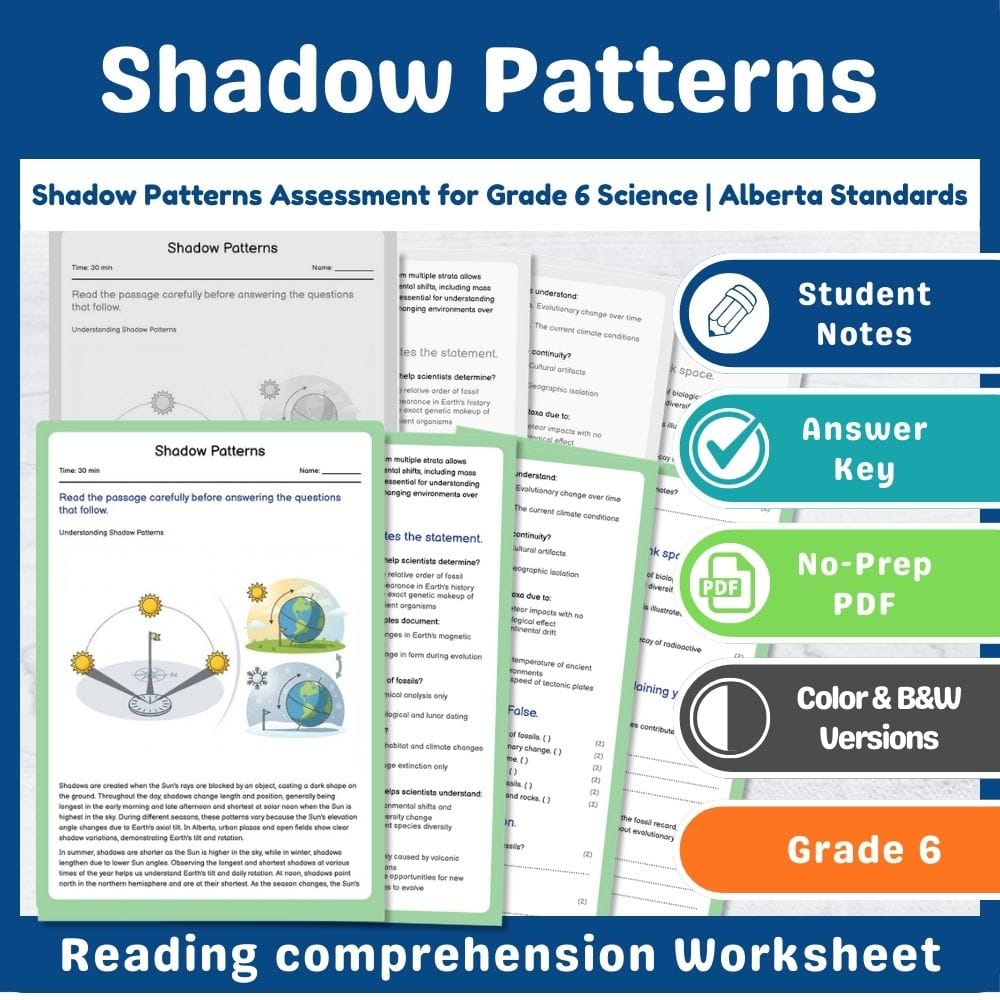
Shadow Patterns Assessment for Grade 6 Science | Alberta Standards
Created byPrism Point LearningLearning Objectives
- Describe how daily and seasonal changes in Sun angle affect shadow length and direction.
- Identify different shadow patterns such as noon shadows, longest shadows, and shortest shadows.
- Explain how Earth's motion and axial tilt influence shadow characteristics across seasons.
Also included in: Lesson Grade 6 Science Assessment | Celestial & Earth Movements
Instant download

Plate Motions Assessment | NGSSS Florida Standards Grade 12 Science
Created byPrism Point LearningLearning Objectives
- Explain how Earth’s internal energy drives long-term tectonic plate motion.
- Compare the main types of plate boundaries and the geologic processes associated with each.
- Interpret evidence for plate motion, including seafloor magnetic stripes, matching rock ages, and earthquake patterns.
Also included in: Grade 12 Science Assessment Lesson Bundle: Florida NGSSS Standards +1 more
Instant download
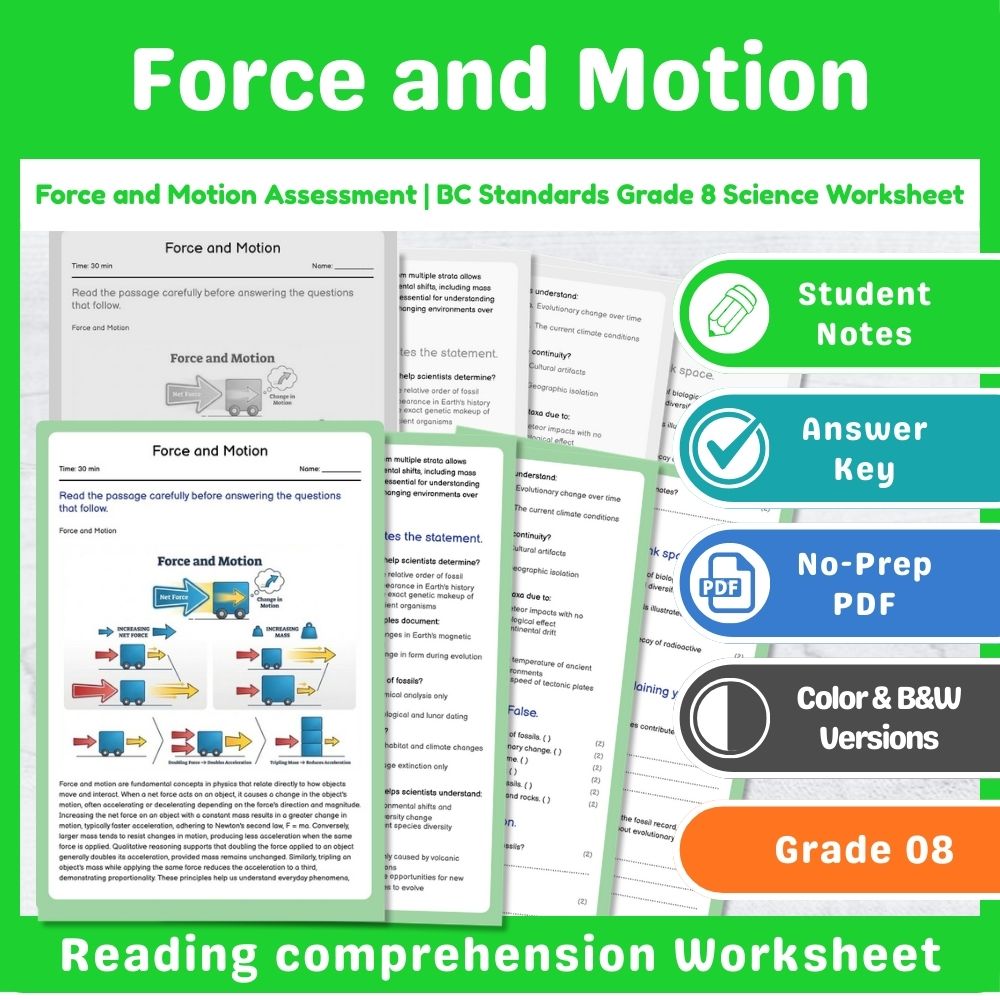
Force and Motion Assessment | BC Standards Grade 8 Science Worksheet
Created byPrism Point LearningLearning Objectives
- Understand the relationship between net force, mass, and acceleration.
- Explain qualitatively how increasing net force affects motion.
- Describe the effect of increased mass on acceleration under the same force.
Instant download

Evolving Knowledge Grade 9 Science Assessment | Florida NGSSS
Created byPrism Point LearningLearning Objectives
- Explain how scientific knowledge changes through new evidence, improved measurement, and revised models
- Identify how evidence, models, and measurement work together to support scientific conclusions
- Evaluate the role of transparency about assumptions and limitations in scientific reasoning
Also included in: Grade 9 Evidence & Uncertainty Science Lesson Bundle Florida NGSSS
Instant download

Interdependence Roles Assessment | Florida NGSSS Grade 6 Science
Created byPrism Point LearningLearning Objectives
- Explain how predators and prey are interdependent in an ecosystem
- Describe how competition and mutualism affect population changes
- Predict how changes in one population can ripple through a community
Also included in: Grade 6 Ecosystems Science Lesson Bundle | Florida NGSSS Assessment
Instant download

Force Balance Assessment for Grade 8 Science | Alberta Standards
Created byPrism Point LearningLearning Objectives
- Understand the concept of balanced and unbalanced forces and how they affect motion or equilibrium.
- Analyze force vectors, support reactions, and their role in static and dynamic systems.
- Identify real-world examples of force balance and describe their behavior.
Also included in: Lesson Grade 8 Science Mini Bundle | Forces and Motion Alberta Standards
Instant download
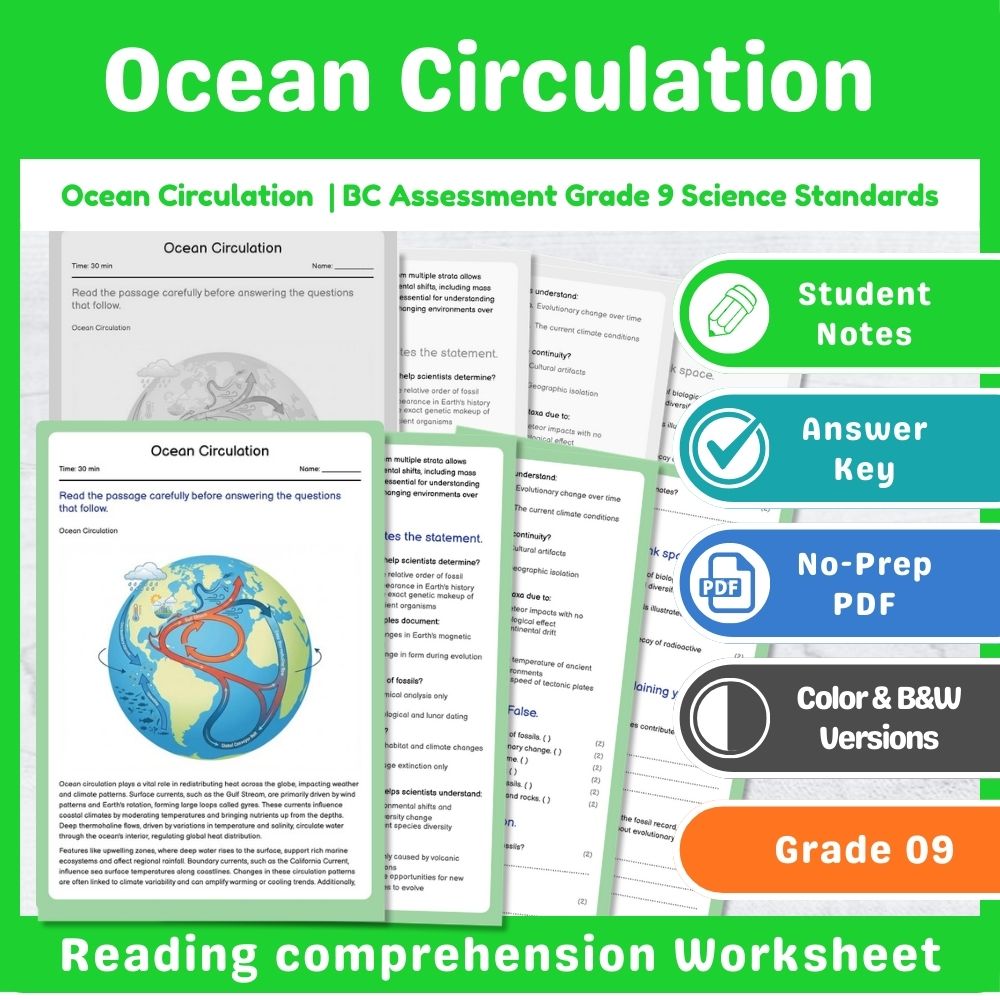
Ocean Circulation Quiz | BC Assessment Grade 9 Science Standards
Created byPrism Point LearningLearning Objectives
- Explain the mechanisms driving ocean surface and deep currents.
- Identify features like gyres, upwelling zones, and boundary currents.
- Assess the impact of ocean circulation on regional climates and weather patterns.
Also included in: Grade 9 Science Mini Bundle – Earth & Space Assessment & Activities
Instant download

Positive Feedback Assessment | TEKS Grade 10 Science Standards-Aligned
Created byPrism Point LearningLearning Objectives
- Understand the concept and mechanisms of positive feedback in biological systems.
- Identify examples of positive feedback mechanisms, such as childbirth and blood clotting.
- Differentiate between positive and negative feedback in physiology.
Also included in: Grade 10 Homeostasis and Feedback Science Lesson Bundle | TEKS
Instant download

Motion Graphs Assessment for Grade 10 Science | Standards-Aligned Assessment
Created byPrism Point LearningLearning Objectives
- Interpret position-time graphs to determine velocity from slope and identify changes in motion from curvature.
- Interpret velocity-time graphs to determine acceleration from slope and identify changes in acceleration from sign changes or curvature.
- Connect graph features (flat sections, straight lines, sign changes) to real physical motion over time.
Also included in: Grade 10 Waves Energy Forces Science Lesson Mini Bundle | Florida NGSSS +1 more
Instant download
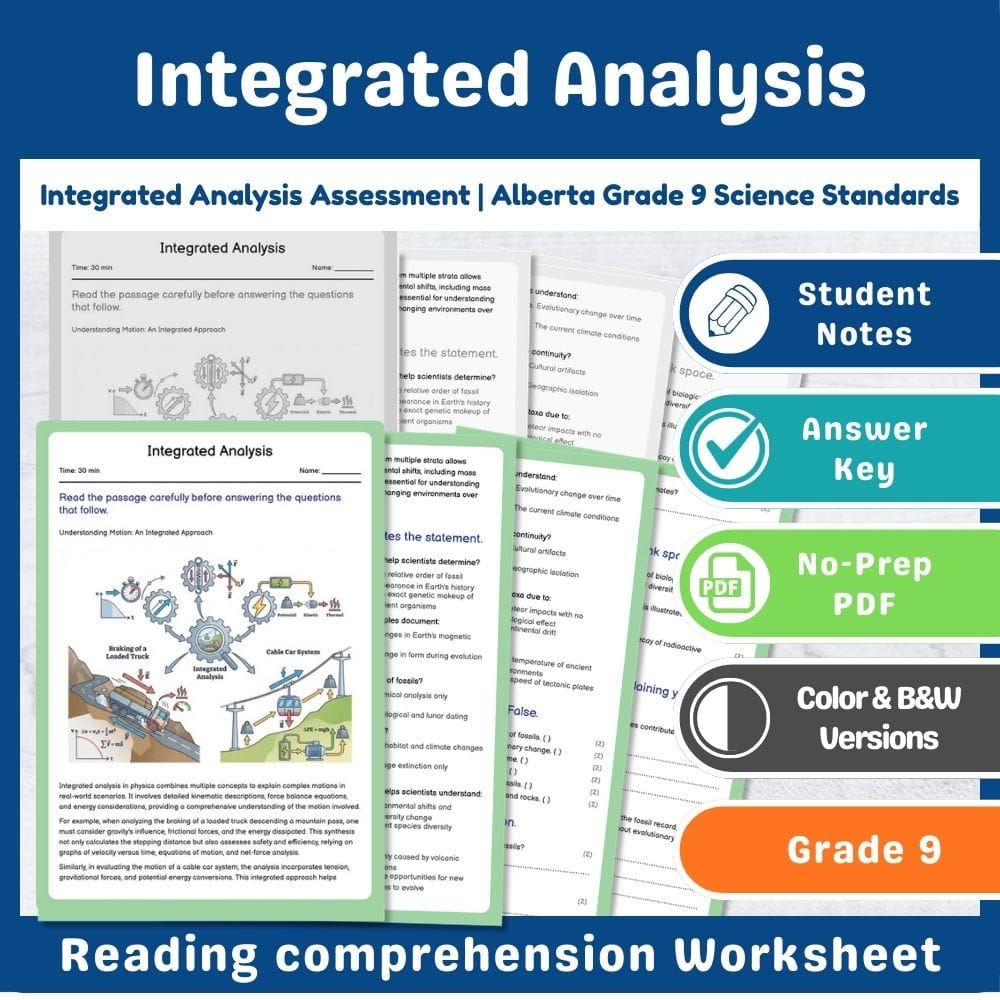
Integrated Analysis Assessment | Alberta Grade 9 Science Standards
Created byPrism Point LearningLearning Objectives
- Explain how kinematic descriptions, force balances, and energy considerations integrate to analyze complex motion scenarios.
- Apply graphs, equations, and net-force reasoning to predict motion outcomes in transport contexts.
- Interpret combined physical principles in real-world Alberta transportation and recreational situations.
Also included in: Grade 9 Forces and Motion Science Lesson Bundle Alberta Framework +1 more
Instant download

Power And Rates Assessment Grade 9 Science | Florida NGSSS
Created byPrism Point LearningLearning Objectives
- Explain power as the rate of energy transfer or work done over time
- Compare situations using the relationship between energy transferred and time
- Interpret everyday wattage ratings in terms of energy per second
Also included in: Grade 9 Forces, Energy, and Matter Science Lesson Bundle | Florida NGSSS
Instant download

Meiosis and Variation Assessment | Florida NGSSS Grade 10 Science
Created byPrism Point LearningLearning Objectives
- Explain how meiosis reduces chromosome number and produces gametes with half the genetic material
- Describe how homologous chromosome separation and genetic recombination generate variation among gametes
- Connect heritable genetic variation to natural selection and population change over time
Also included in: Grade 10 Cells, Genetics & Evolution Science Lesson Bundle | Florida NGSSS +1 more
Instant download
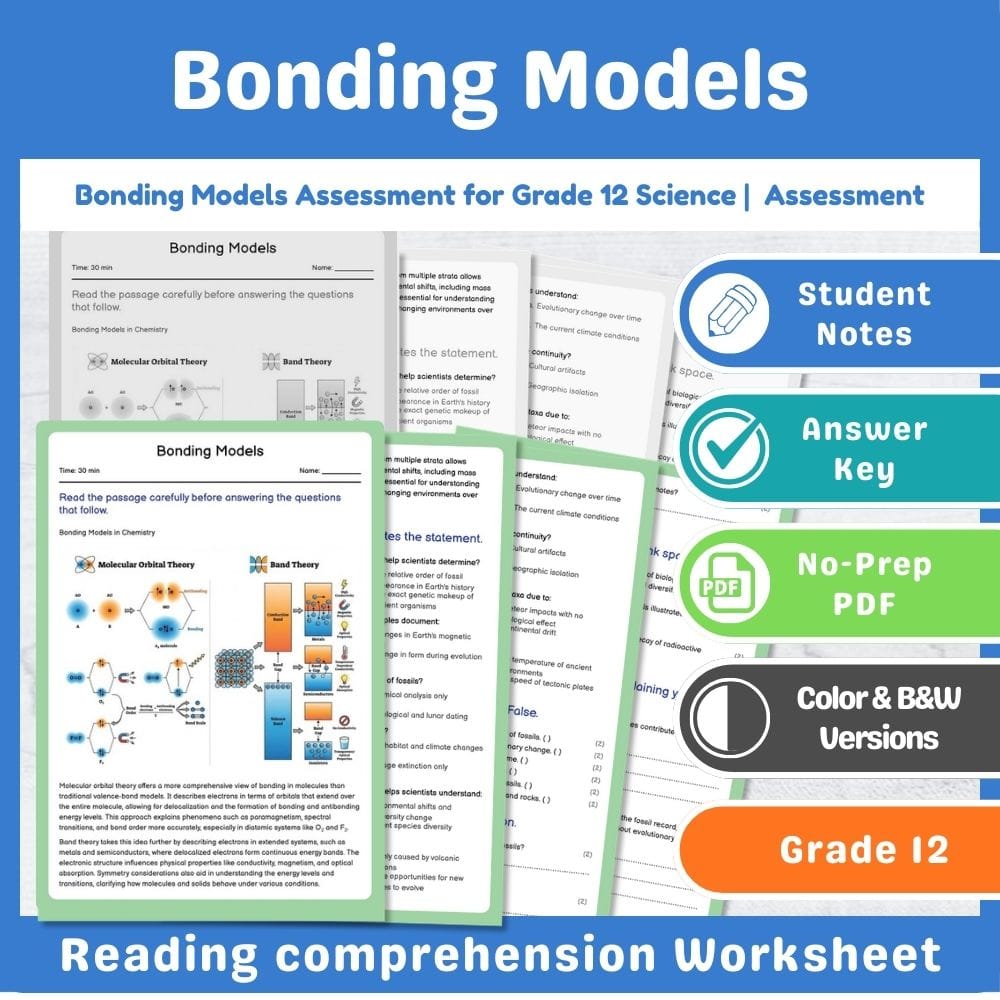
Bonding Models Assessment for Grade 12 Science | Standards-Aligned Assessment
Created byPrism Point LearningLearning Objectives
- Understand molecular orbital theory and how it extends valence-bond models.
- Explain bonding order, delocalization, and electronic structures in diatomic and extended systems.
- Use energy-level diagrams and symmetry considerations to predict magnetic, bonding, and electronic transition properties.
Instant download
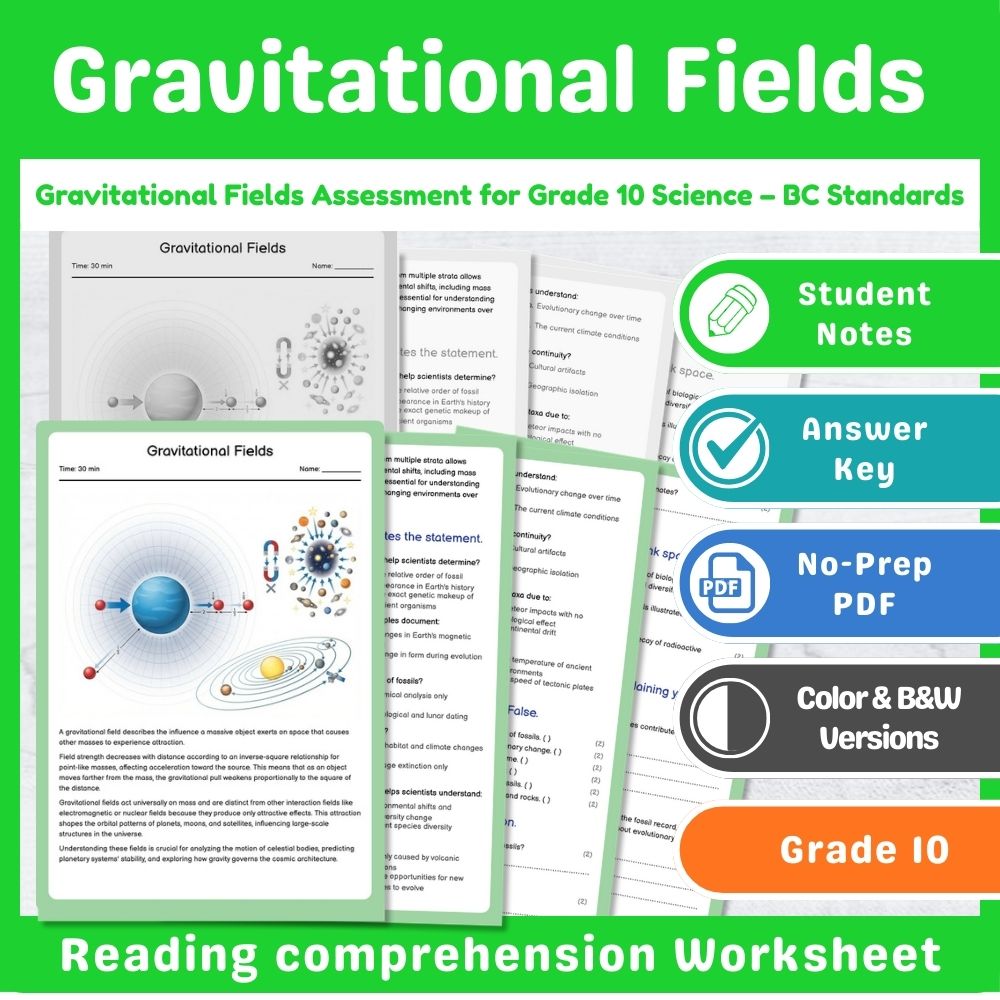
Gravitational Fields Assessment for Grade 10 Science – BC Standards
Created byPrism Point LearningLearning Objectives
- Understand the concept of gravitational fields and their influence.
- Explain how field strength varies with distance.
- Describe the effects of gravitational fields on objects in space.
Instant download
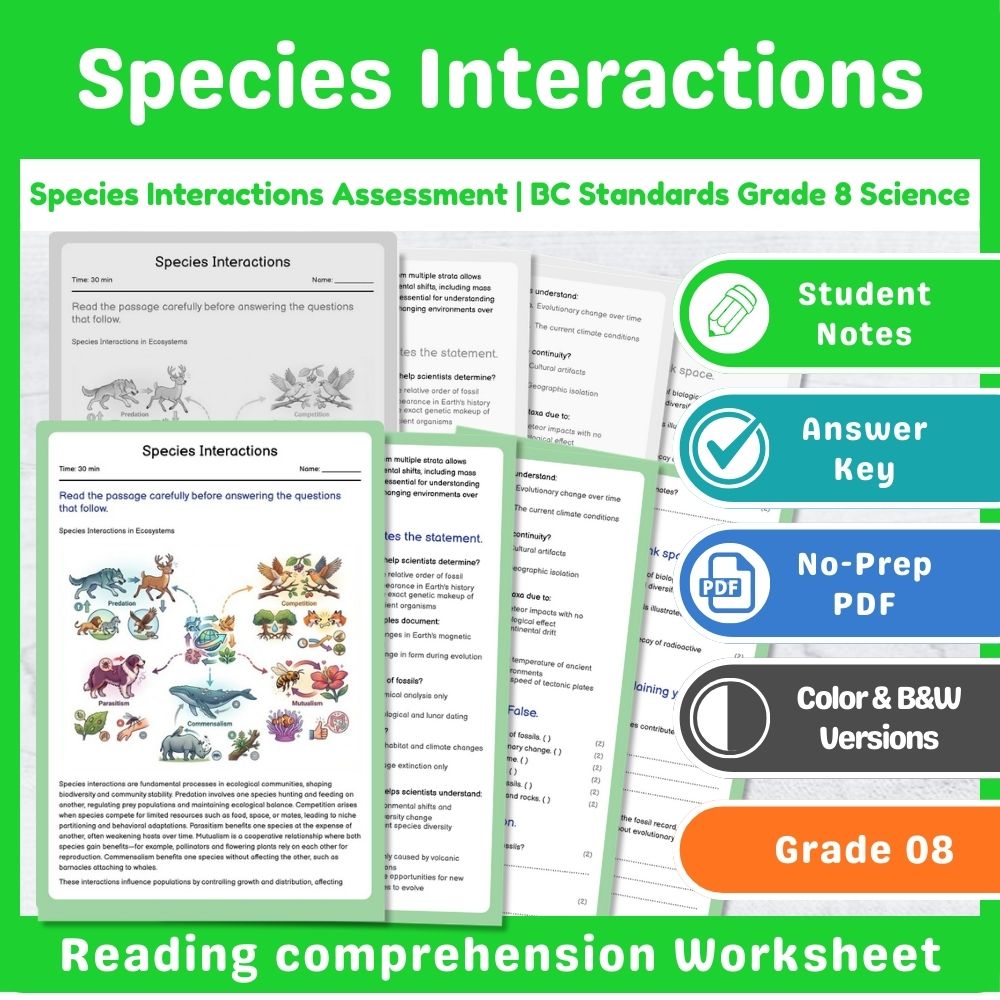
Species Interactions Assessment | BC Standards Grade 8 Science
Created byPrism Point LearningLearning Objectives
- Describe different types of species interactions such as predation, competition, parasitism, mutualism, and commensalism.
- Explain how species interactions influence population dynamics and community structure.
- Analyze the role of predation and mutualism in ecosystem regulation and species survival.
Instant download
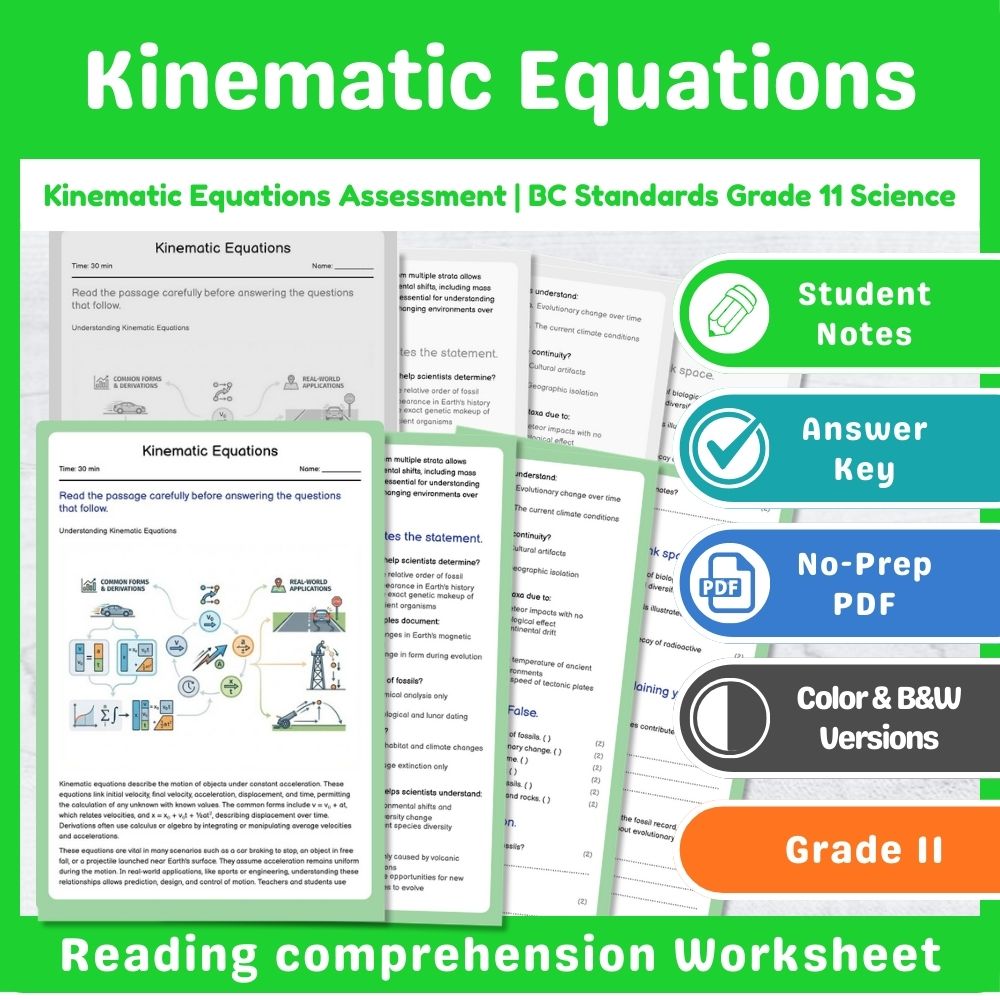
Kinematic Equations Assessment | BC Standards Grade 11 Science
Created byPrism Point LearningLearning Objectives
- Understand the fundamental kinematic equations used for constant acceleration motion.
- Apply the equations to solve for displacement, velocity, acceleration, and time in one-dimensional motion.
- Derive the equations using algebraic and calculus methods.
Also included in: Grade 11 Science Assessment Bundle | Classical Mechanics & Motion Topics
Instant download
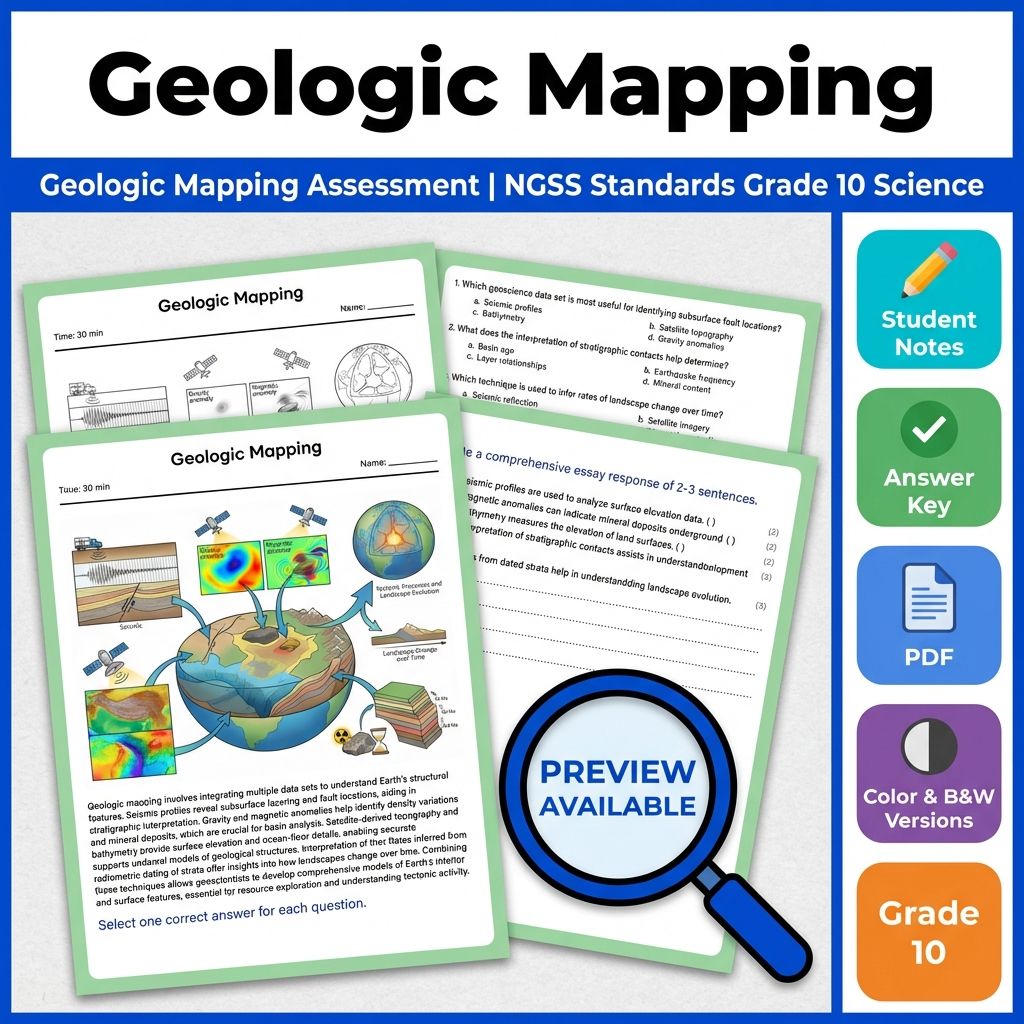
Geologic Mapping Assessment | NGSS Standards Grade 10 Science
Created byPrism Point LearningLearning Objectives
- Understand the components and data sources used in geologic mapping.
- Interpret stratigraphic contacts, fault systems, and basin structures from geological data.
- Explain how rates from geochronology support landscape evolution models.
Instant download

Survival Changes Assessment | NGSSS Grade 6 Science Standards
Created byPrism Point LearningLearning Objectives
- Explain how environmental conditions affect which traits help organisms survive and reproduce.
- Describe how changes in survival and reproduction can shift traits in a population over generations.
- Connect adaptation to ecosystem change and resilience when resources or conditions shift.
Also included in: Grade 6 Ecosystems Science Lesson Bundle | Florida NGSSS Assessment
Instant download
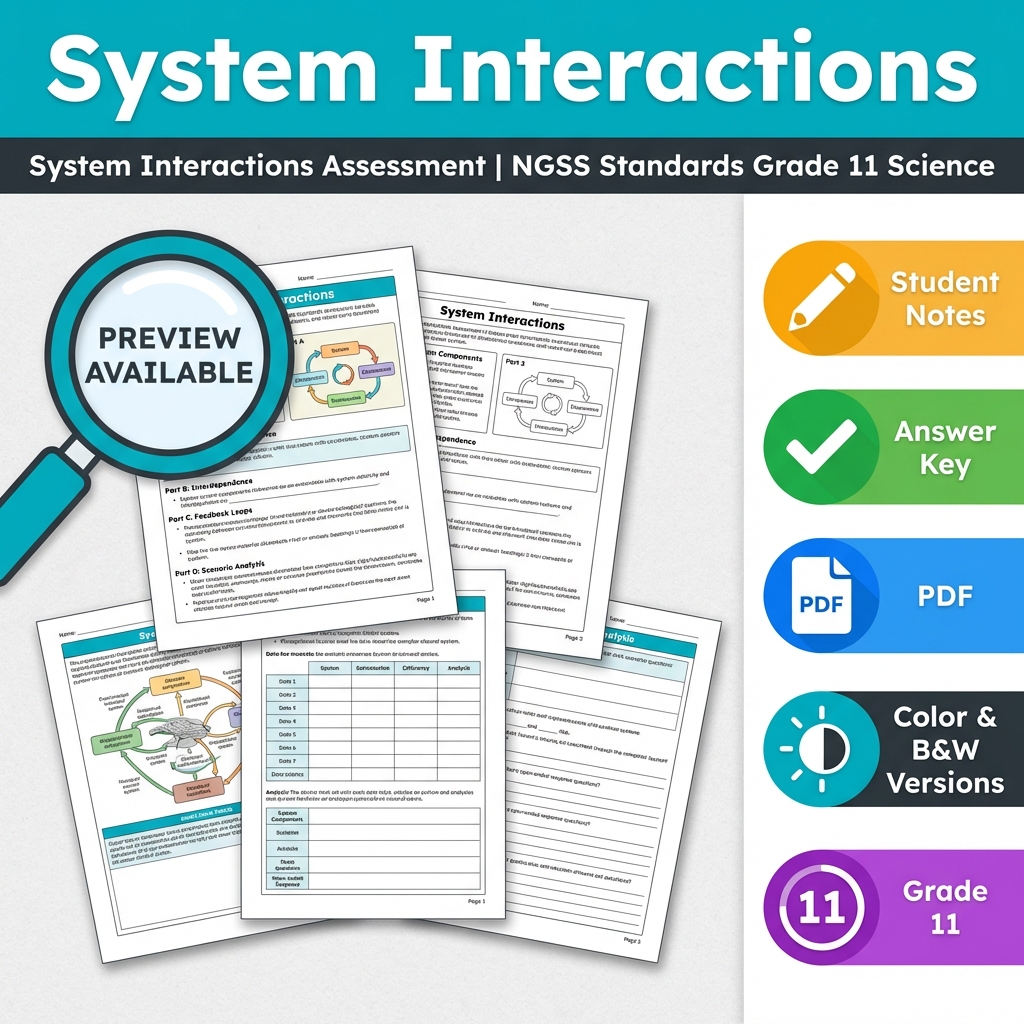
System Interactions Assessment | NGSS Standards Grade 11 Science
Created byPrism Point LearningLearning Objectives
- Understand Earth's major reservoirs and energy exchanges among atmosphere, hydrosphere, geosphere, and biosphere.
- Analyze the role of solar energy input and radiative balance in Earth's system.
- Describe mechanisms of heat transfer and feedbacks that influence system states over different timescales.
Instant download

Climate Data Trends Assessment for Grade 8 Science | NGSSS Standards
Created byPrism Point LearningLearning Objectives
- Interpret climate indicators by comparing temperature, precipitation, and storm-frequency data over time.
- Distinguish long-term climate trends from short-term weather variability and single extreme events.
- Explain how El Niño and La Niña can affect rainfall patterns using evidence from data records.
Also included in: Grade 8 Earth Systems Science Lesson Bundle: Florida NGSSS Assessment
Instant download
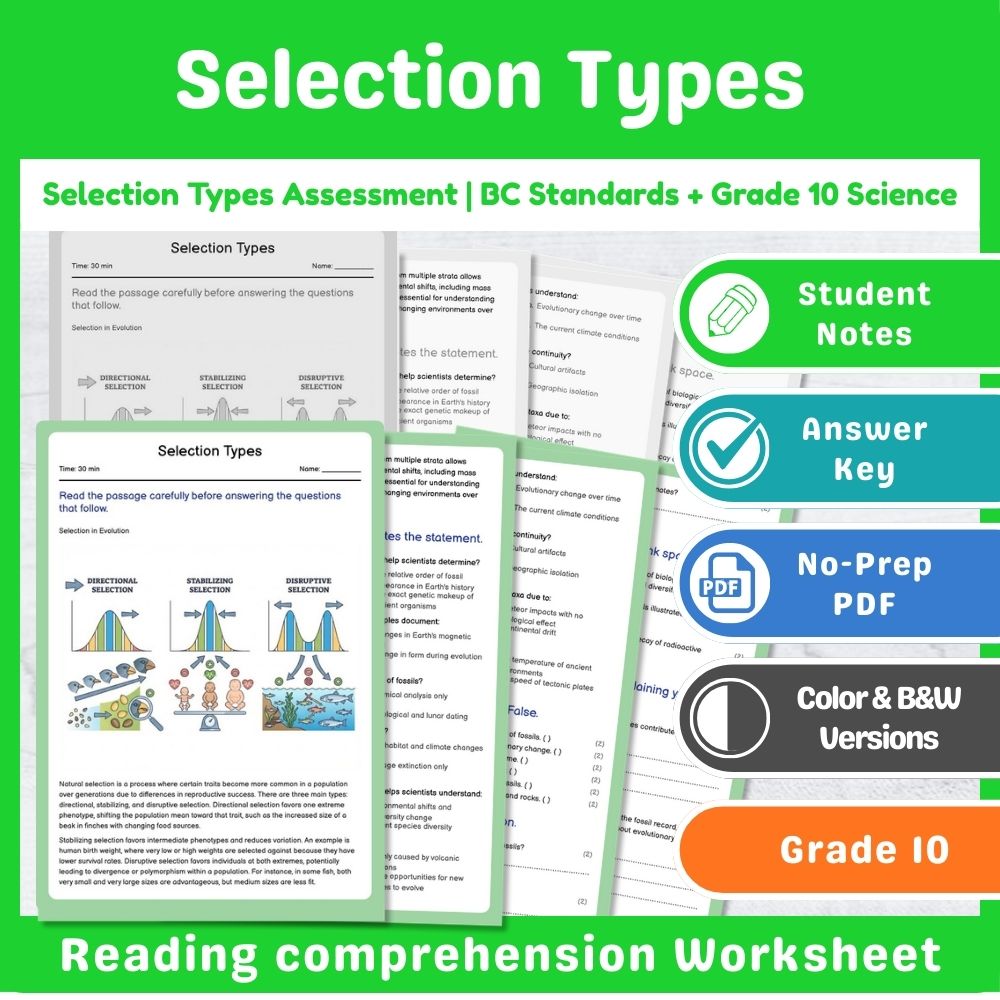
Selection Types Assessment | BC Standards + Grade 10 Science
Created byPrism Point LearningLearning Objectives
- Identify the different modes of natural selection and understand their effects on populations.
- Interpret how directional, stabilizing, and disruptive selection modify trait distributions over time.
- Explain the roles of frequency-dependent and sexual selection in evolution.
Instant download
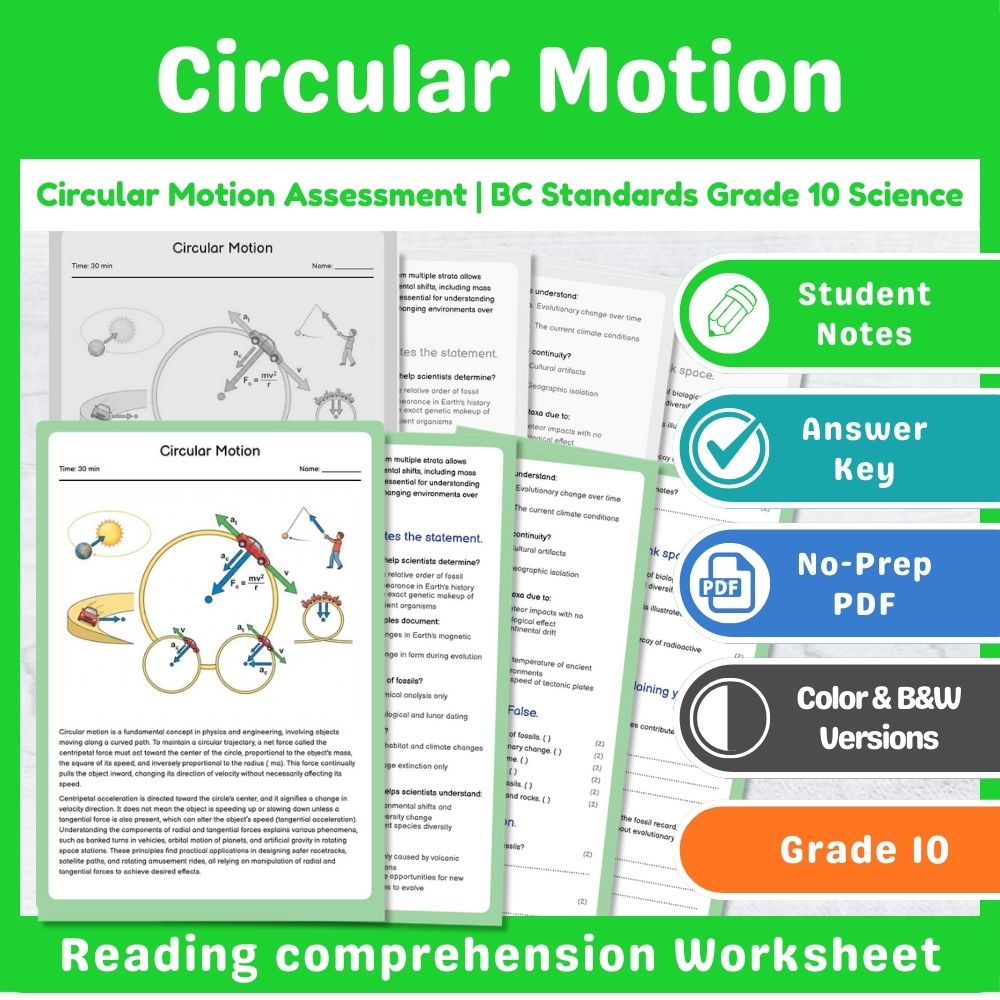
Circular Motion Assessment | BC Standards Grade 10 Science
Created byPrism Point LearningLearning Objectives
- Explain the concept of centripetal force and its role in circular motion.
- Differentiate between centripetal acceleration and tangential acceleration.
- Describe how radial and tangential components explain phenomena like banked turns and orbital motion.
Instant download
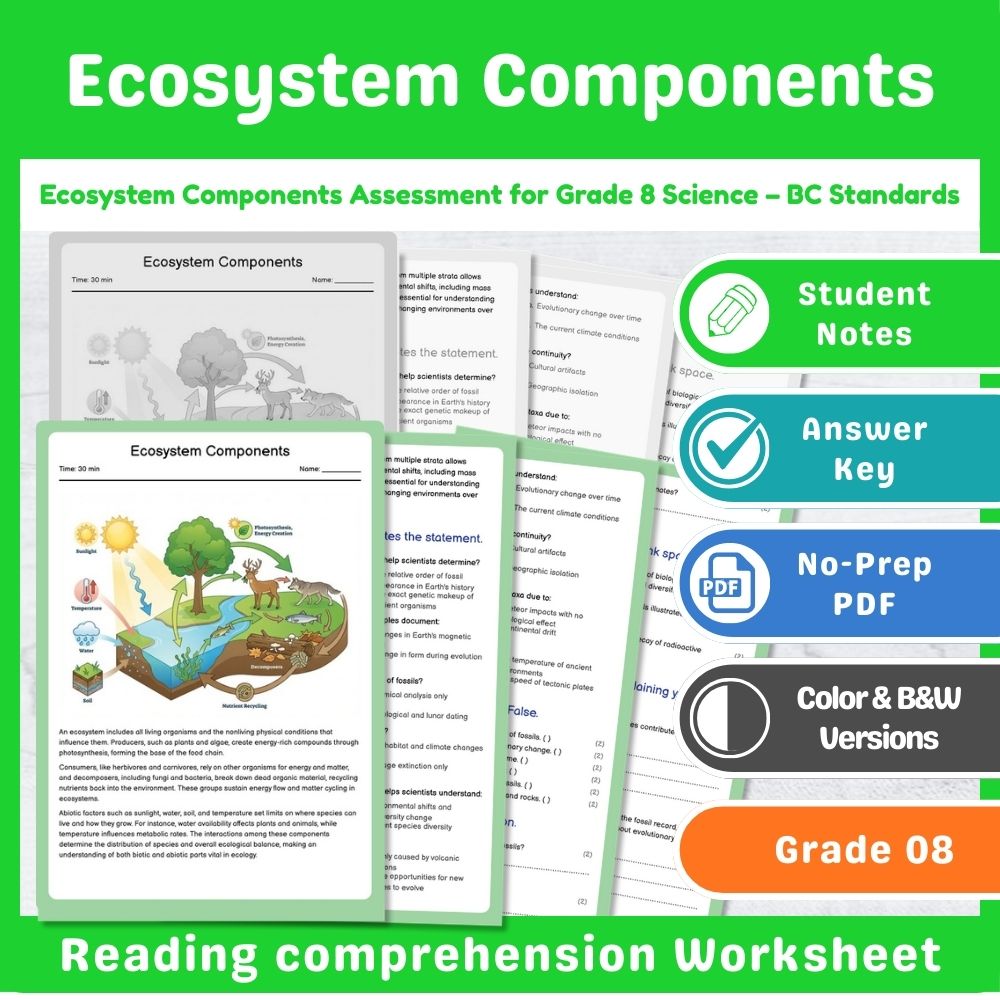
Ecosystem Components Assessment for Grade 8 Science – BC Standards
Created byPrism Point LearningLearning Objectives
- Identify the key parts of an ecosystem, including both living and nonliving elements.
- Explain the roles of producers, consumers, and decomposers in energy cycling.
- Describe how abiotic factors such as sunlight, water, soil, and temperature influence ecosystems.
Instant download
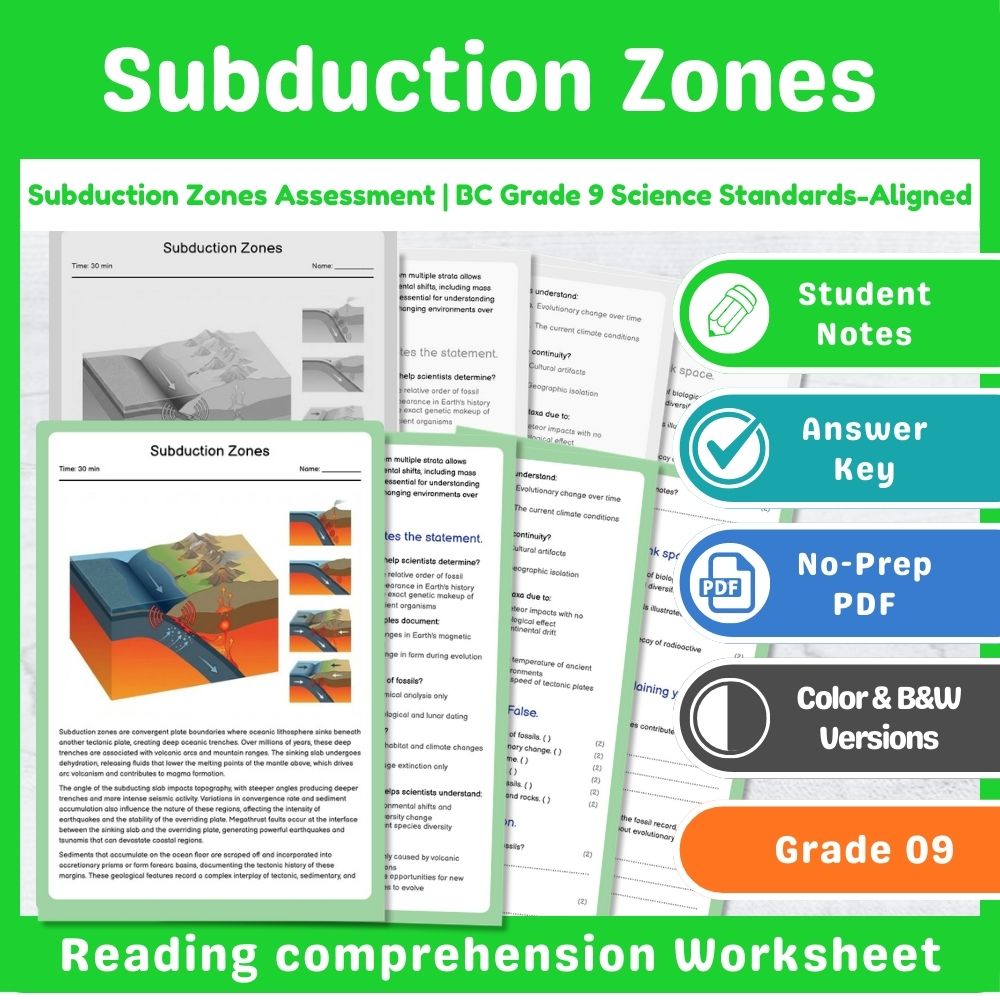
Subduction Zones Assessment | BC Grade 9 Science Standards-Aligned
Created byPrism Point LearningLearning Objectives
- Explain the formation and features of subduction zones.
- Describe the processes of slab dehydration and arc volcanism.
- Identify hazards associated with subduction zones, including earthquakes and tsunamis.
Also included in: Grade 9 Science Mini Bundle – Earth & Space Assessment & Activities
Instant download
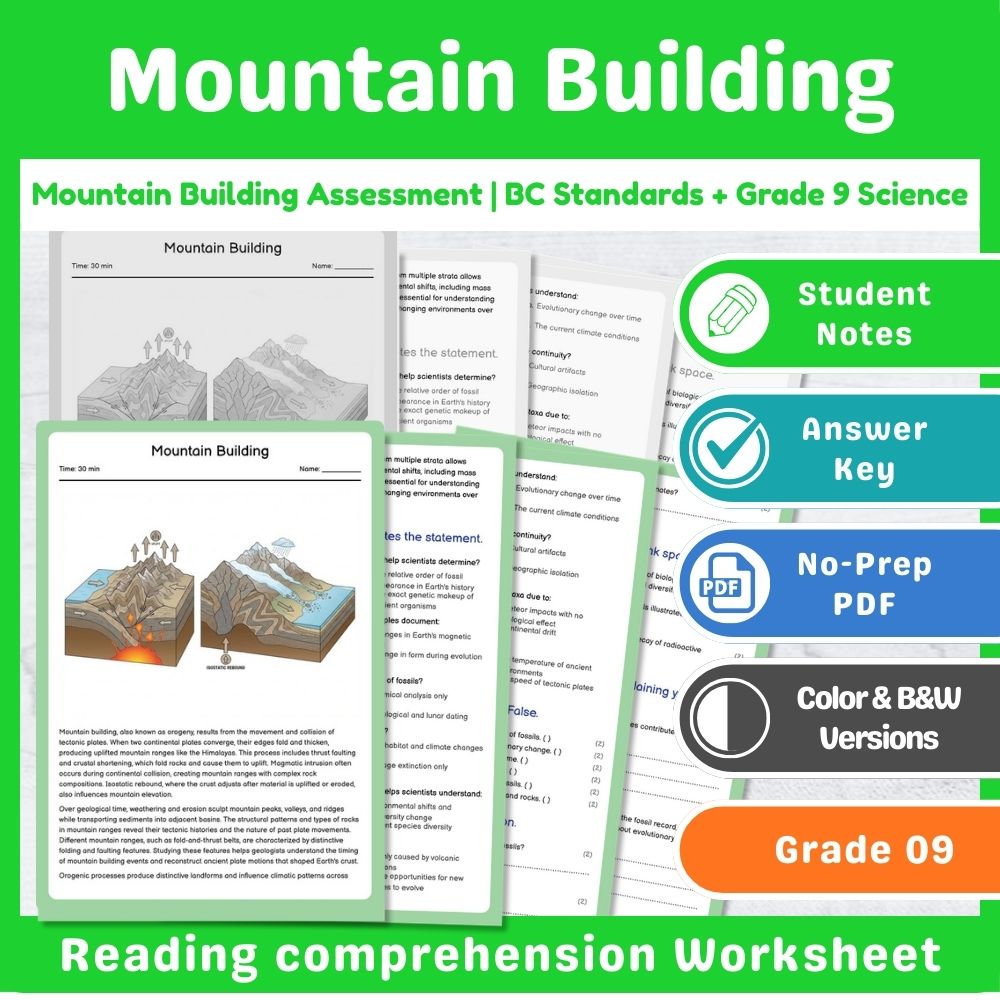
Mountain Building Assessment | BC Standards + Grade 9 Science
Created byPrism Point LearningLearning Objectives
- Explain the geological processes responsible for mountain formation, including plate convergence and continental collision.
- Identify the types of geological features produced by mountain building processes, such as fold-and-thrust belts.
- Describe the effects of weathering and erosion on mountain landscapes over time.
Also included in: Grade 9 Science Mini Bundle – Earth & Space Assessment & Activities
Instant download
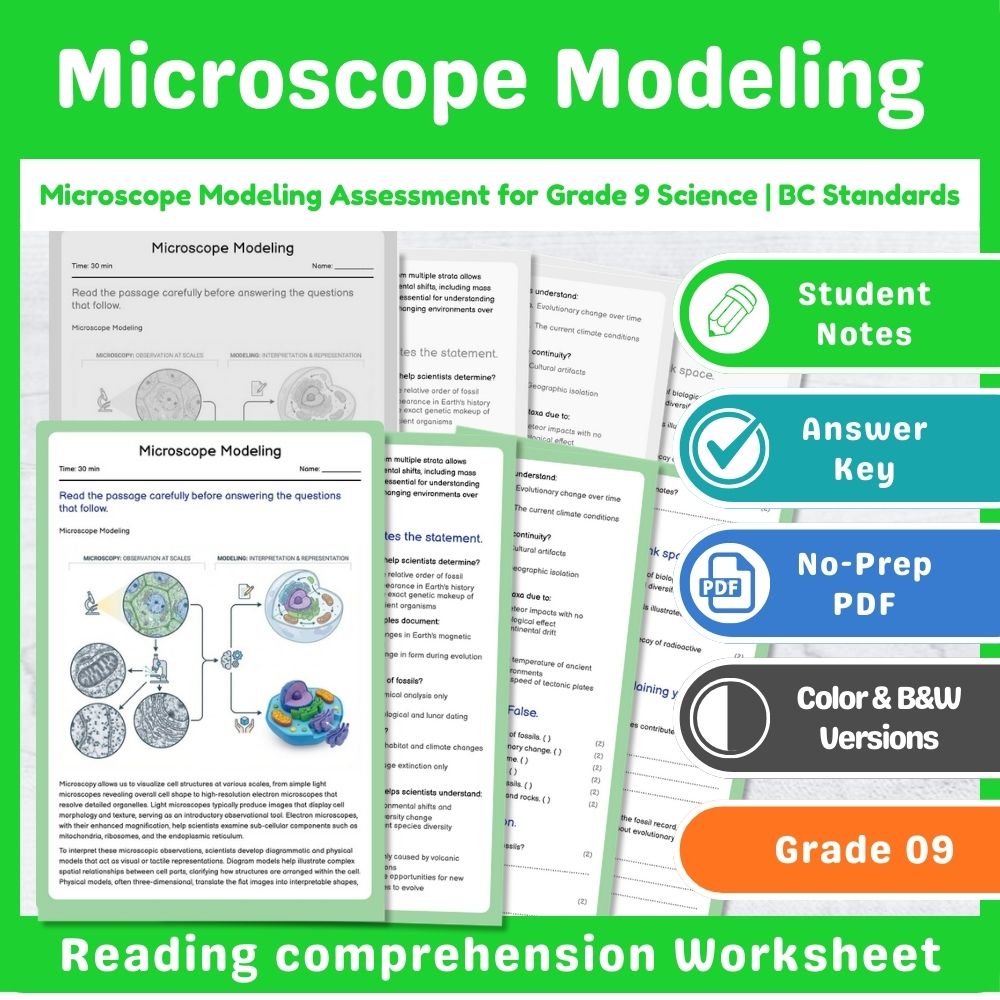
Microscope Modeling Assessment for Grade 9 Science | BC Standards
Created byPrism Point LearningLearning Objectives
- Understand how different microscope models reveal structural details of cells.
- Identify the role of diagrammatic and physical models in microscopy.
- Explain the importance of size, scale, and spatial relationships in cellular understanding.
Instant download
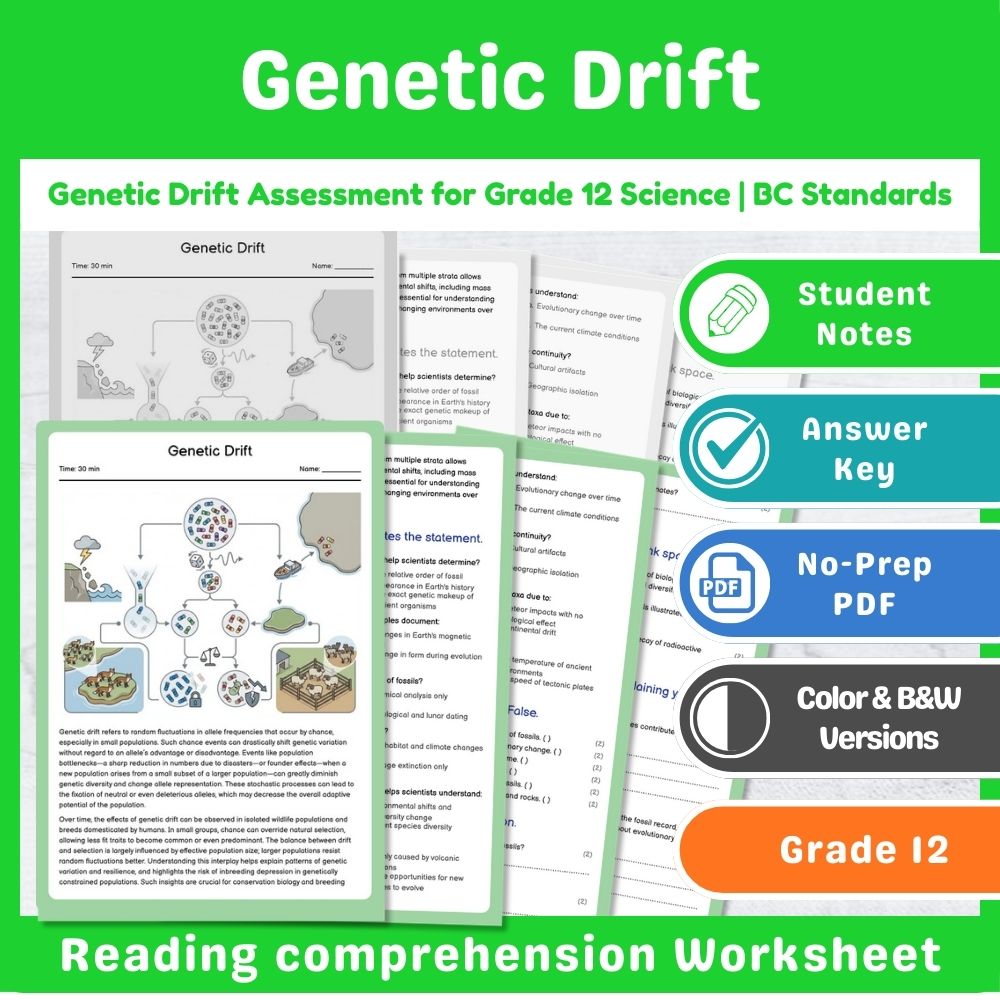
Genetic Drift Assessment for Grade 12 Science | BC Standards
Created byPrism Point LearningLearning Objectives
- Describe the concept of genetic drift and its effects on allele frequencies in populations.
- Explain how bottlenecks and founder events influence genetic diversity.
- Analyze the role of genetic drift in small isolated populations and domesticated breeds.
Also included in: Grade 12 Science Mini Bundle – Genetics & Evolution Assessment Pack
Instant download
Browse more categories
About Science Worksheets
Find Science worksheets spanning core skills, practice, and review. All 44,295 resources are instant PDF downloads for the classroom or home.
Every worksheet on MyTeachingSheets is created by independent teacher-authors and reviewed before publication. All resources download as printable PDFs for classroom, homework, or at-home practice, and many include answer keys. Preview any worksheet free before buying.