
Science Worksheets
44,295 subject resources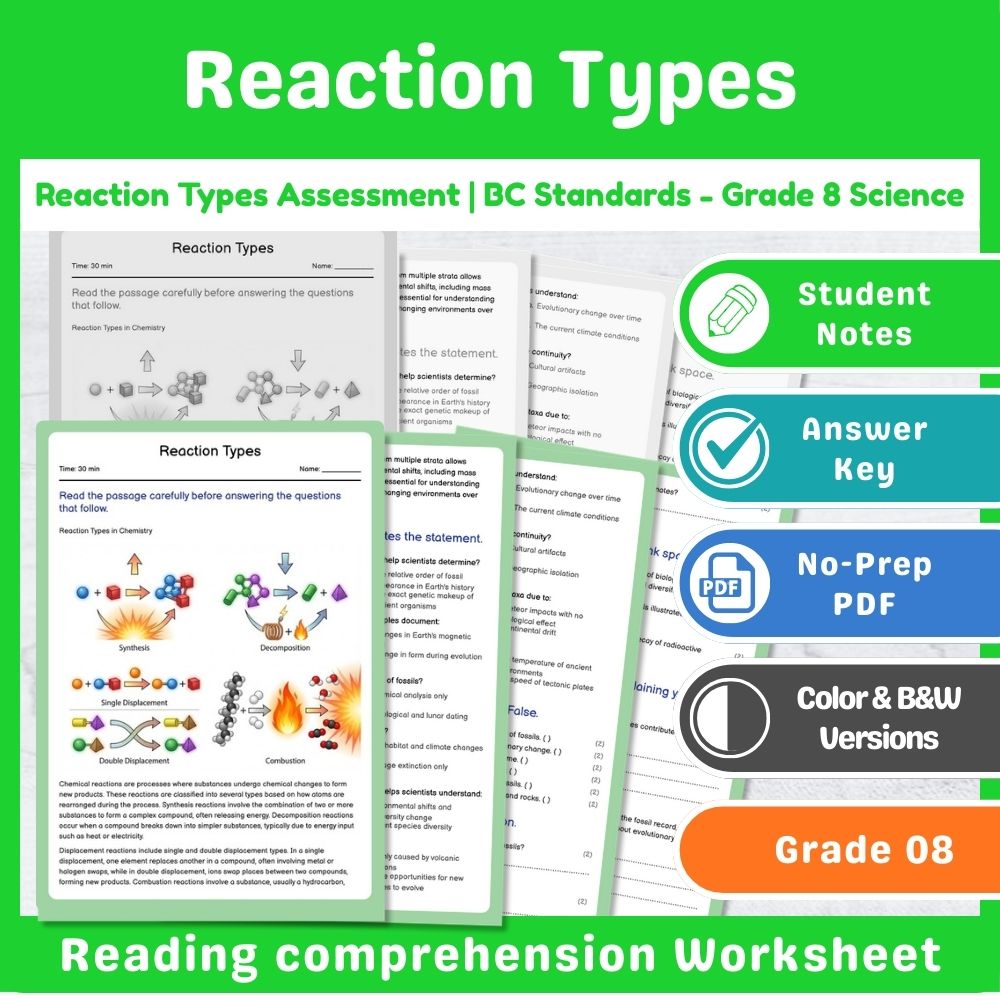
Reaction Types Assessment | BC Standards - Grade 8 Science
 Created byPrism Point Learning
Learning Objectives
- Identify the various types of chemical reactions and their characteristic patterns.
- Explain how atoms rearrange during synthesis, decomposition, displacement, and combustion reactions.
- Predict possible products based on reaction type.
Also included in: Grade 8 Science Lesson – Reaction Types & Evidence Assessment Bundle
Instant download
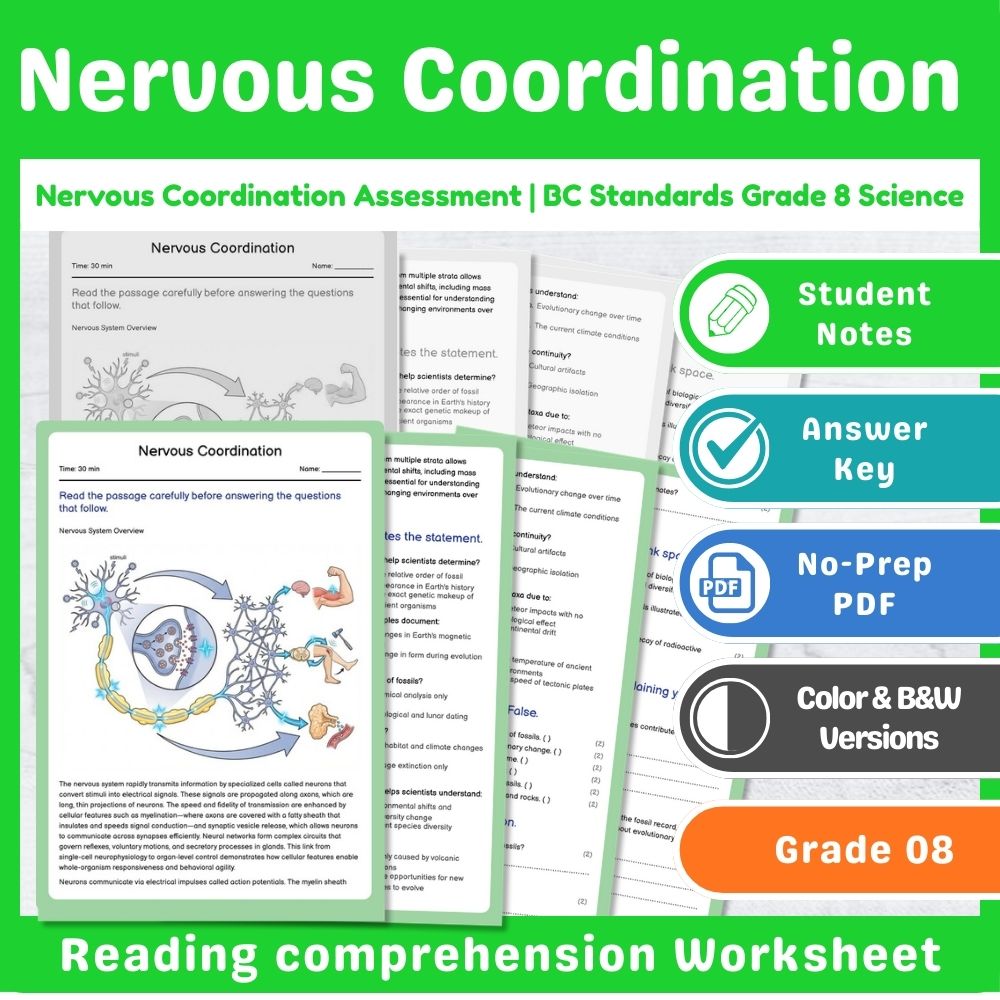
Nervous Coordination Assessment | BC Standards Grade 8 Science
Created byPrism Point LearningLearning Objectives
- Understand how neurons transmit electrical signals for nervous communication.
- Identify cellular features that enhance the speed and fidelity of nerve signaling.
- Explain the neural circuits involved in reflexes, voluntary movements, and gland secretion.
Instant download
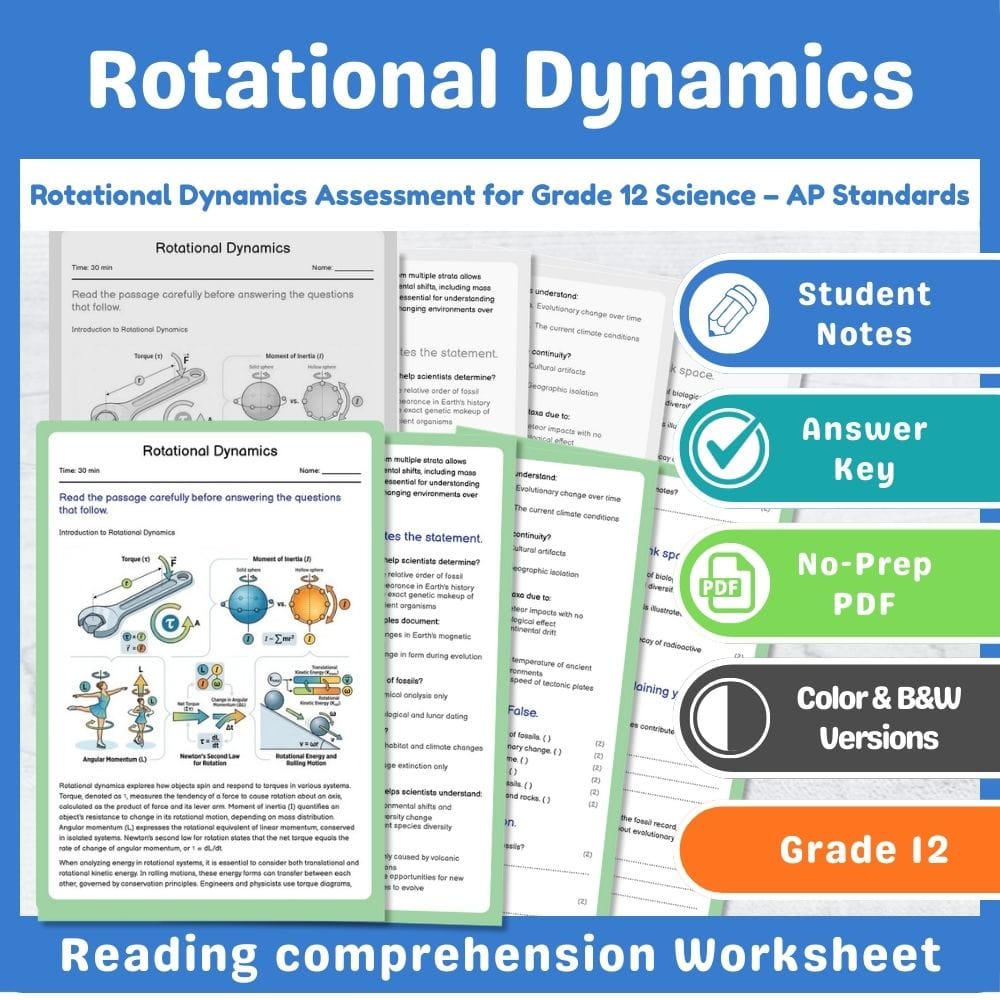
Rotational Dynamics Assessment for Grade 12 Science – AP Standards
Created byPrism Point LearningLearning Objectives
- Understand the concept of torque and how it relates to rotational motion.
- Define and explain the significance of moment of inertia and angular momentum in rigid bodies.
- Develop and apply equations linking net torque to angular acceleration.
Also included in: Grade 12 Science Mini Bundle | Physics Principles AP Standards-Aligned
Instant download

Muscle Contraction Assessment | BC Standards Grade 8 Science Worksheet
Created byPrism Point LearningLearning Objectives
- Explain how actin and myosin filaments interact during muscle contraction.
- Describe the role of ATP and calcium in muscle contraction regulation.
- Identify how sarcomere organization influences contraction strength and speed.
Instant download
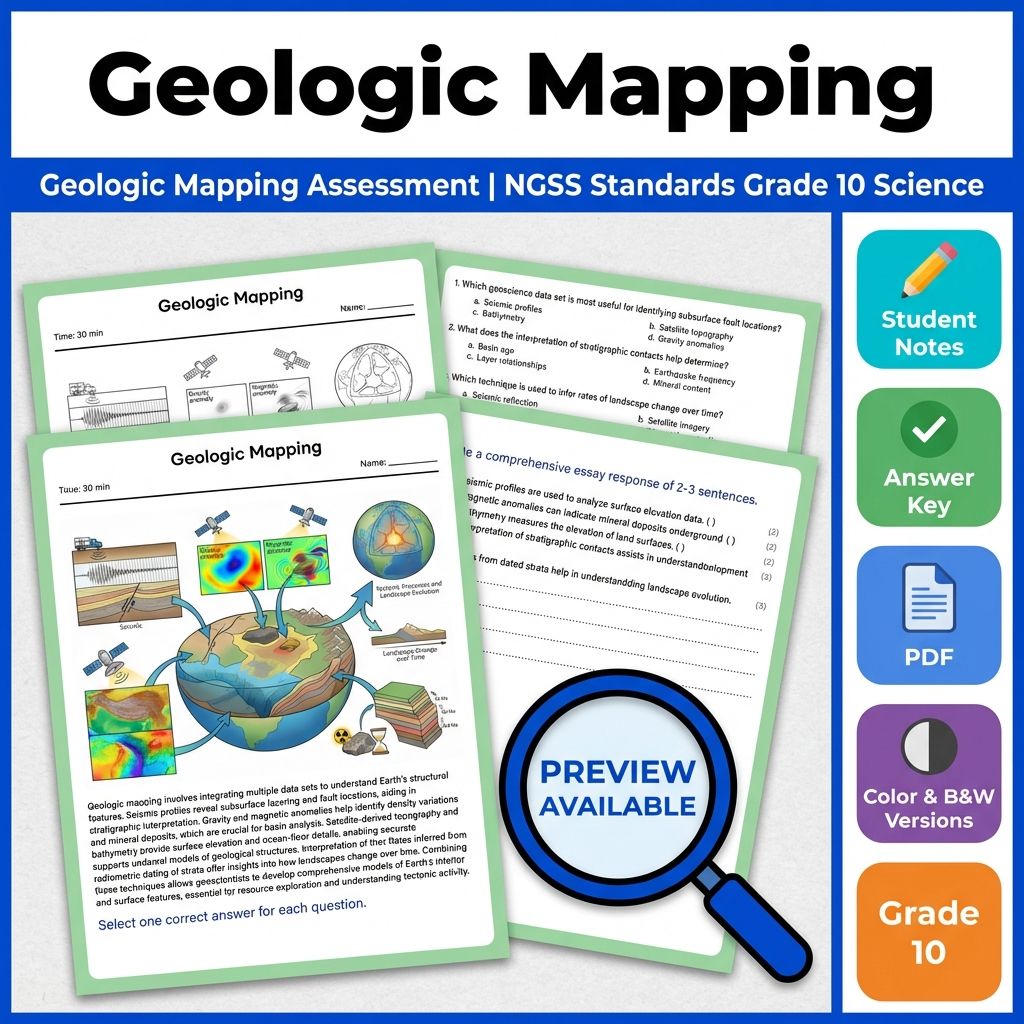
Geologic Mapping Assessment | NGSS Standards Grade 10 Science
Created byPrism Point LearningLearning Objectives
- Understand the components and data sources used in geologic mapping.
- Interpret stratigraphic contacts, fault systems, and basin structures from geological data.
- Explain how rates from geochronology support landscape evolution models.
Instant download
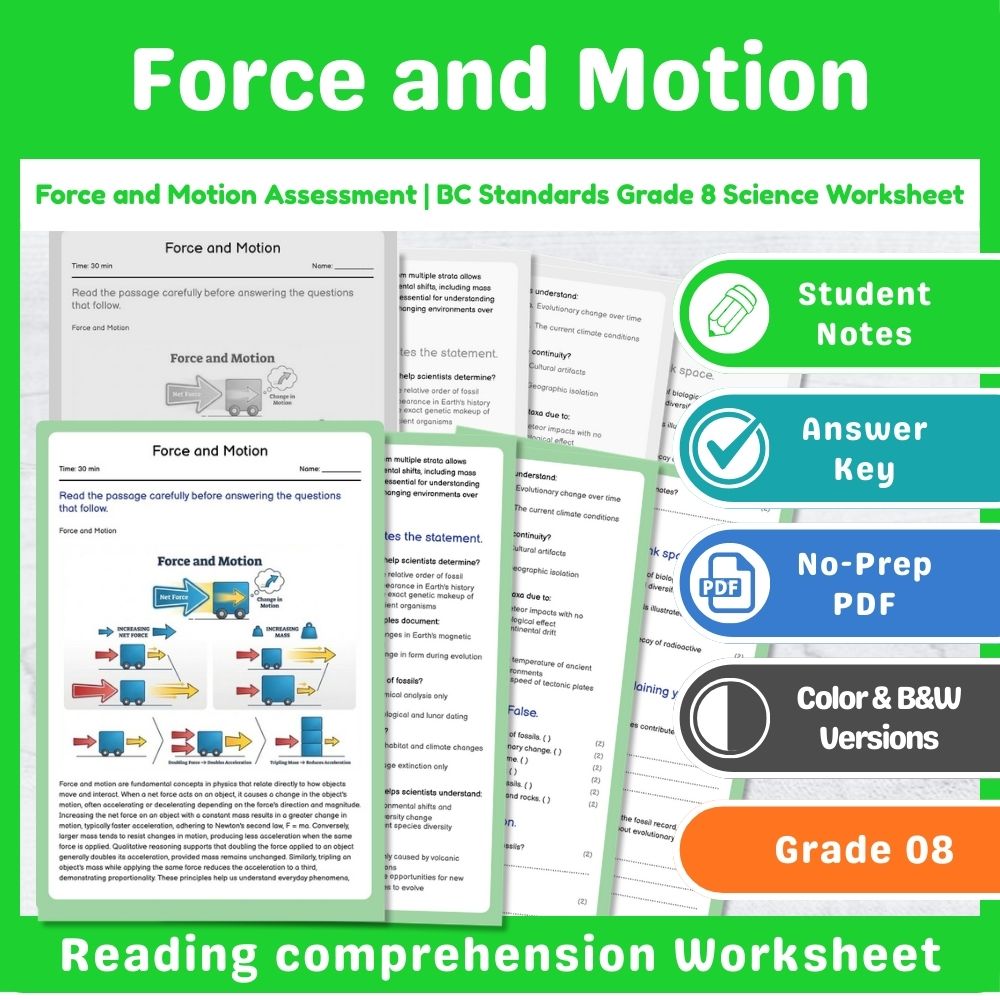
Force and Motion Assessment | BC Standards Grade 8 Science Worksheet
Created byPrism Point LearningLearning Objectives
- Understand the relationship between net force, mass, and acceleration.
- Explain qualitatively how increasing net force affects motion.
- Describe the effect of increased mass on acceleration under the same force.
Instant download

Conservation Strategies Assessment | BC Standards Grade 6 Science
Created byPrism Point LearningLearning Objectives
- Understand various conservation strategies including protected areas, habitat restoration, sustainable harvesting, and invasive species control.
- Evaluate the ecological, economic, and social trade-offs involved in different conservation methods.
- Describe how monitoring and long-term resilience are essential for assessing conservation effectiveness.
Instant download

Quantum Photons Assessment | BC Standards Grade 12 Science
Created byPrism Point LearningLearning Objectives
- Describe the concept of photon energy and its relation to frequency through the equation E = hf.
- Explain the photoelectric effect as evidence of light's particle-like behavior.
- Define work function and threshold frequency in the context of electron emission.
Also included in: Grade 12 Science Wave & Quantum Assessment Mini Bundle – BC Standards
Instant download
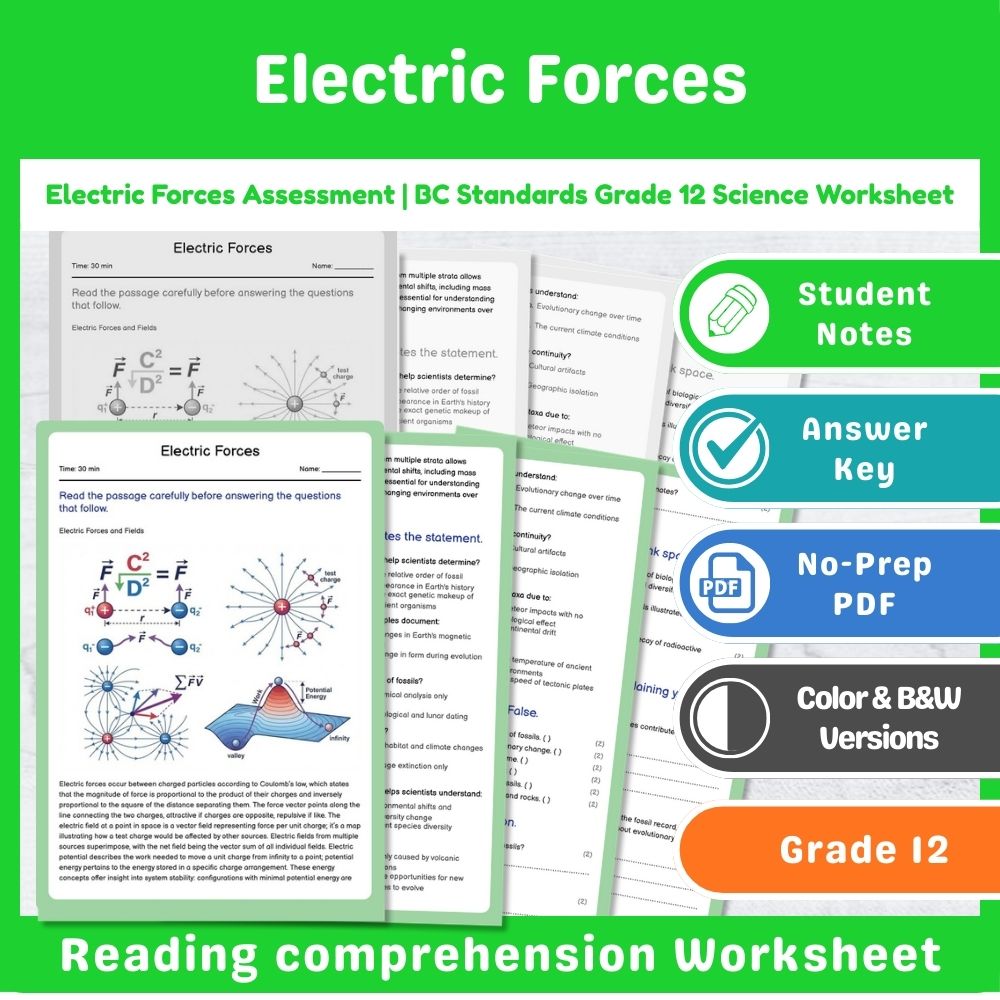
Electric Forces Assessment | BC Standards Grade 12 Science Worksheet
Created byPrism Point LearningLearning Objectives
- Explain Coulomb’s law and how it determines the magnitude and direction of electric forces between point charges.
- Describe the concept of electric field as a spatial force distribution and understand superposition of fields.
- Define electric potential and potential energy, and analyze energy configurations of charged systems.
Also included in: Grade 12 Science Wave & Quantum Assessment Mini Bundle – BC Standards
Instant download
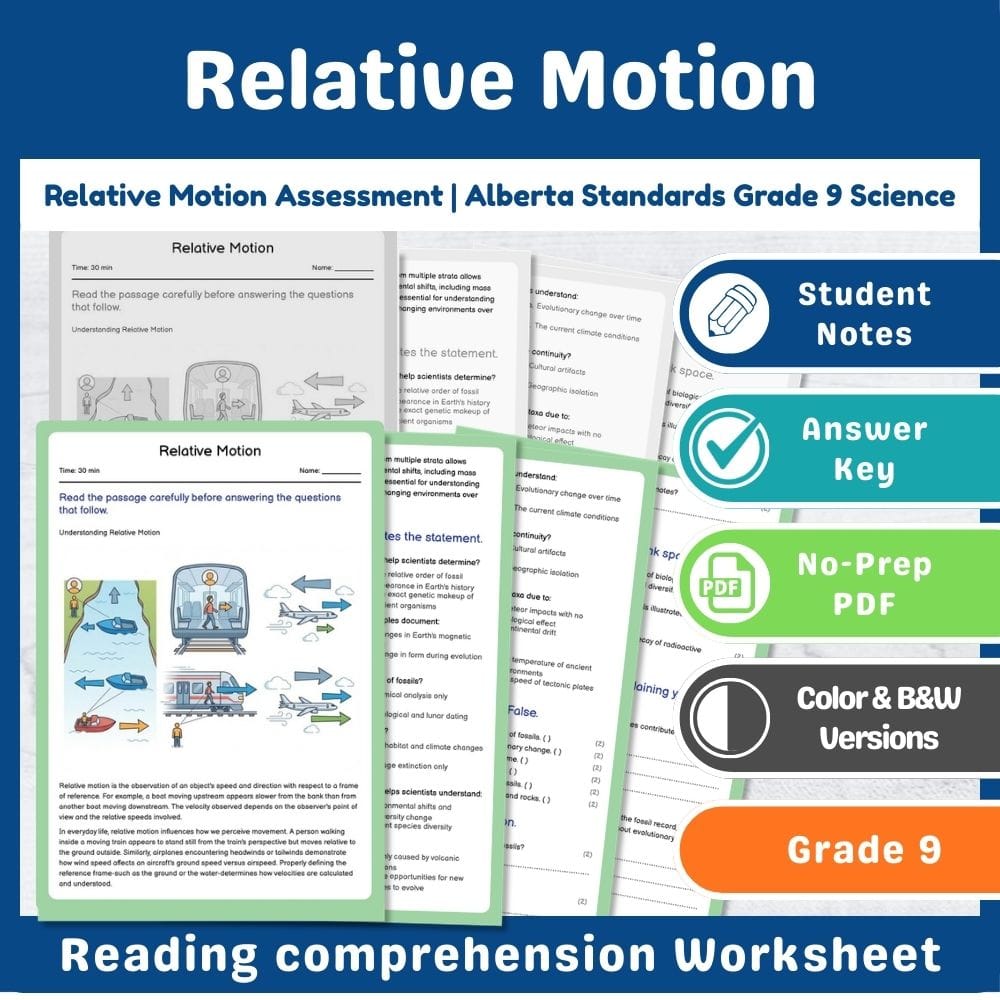
Relative Motion Assessment | Alberta Standards Grade 9 Science
Created byPrism Point LearningLearning Objectives
- Understand the concept of relative motion and how velocities combine in different reference frames.
- Describe how observed speed and direction depend on the observer's frame of reference.
- Apply vector addition principles to various motion scenarios involving boats, trucks, and aircraft.
Also included in: Grade 9 Forces and Motion Science Lesson Bundle Alberta Framework +1 more
Instant download

Species Interactions Assessment for Grade 8 Science | Florida NGSSS
Created byPrism Point LearningLearning Objectives
- Explain how competition, predation, mutualism, commensalism, and parasitism affect survival and reproduction
- Describe how species interactions can change population sizes over time
- Use evidence from examples to identify the type of species interaction and its ecosystem impact
Also included in: Grade 8 Evolution and Genetics Science Lesson Bundle | Florida NGSSS
Instant download

Population Growth Assessment for Grade 8 Science – BC Standards
Created byPrism Point LearningLearning Objectives
- Understand the key factors influencing population change, including birth rates, death rates, immigration, and emigration.
- Identify patterns of population increase, stability, or decline based on various biological and environmental factors.
- Analyze how reproductive strategies, resource availability, and environmental pressures affect population dynamics.
Instant download

Chemical Equations Assessment | BC Standards Grade 10 Science Worksheet
Created byPrism Point LearningLearning Objectives
- Understand the components and symbols used in typical chemical equations.
- Identify the meaning of coefficients, formulas, and state symbols in chemical reactions.
- Learn how to balance chemical equations to obey the law of conservation of mass.
Instant download

Force Balance Assessment for Grade 8 Science | Alberta Standards
Created byPrism Point LearningLearning Objectives
- Understand the concept of balanced and unbalanced forces and how they affect motion or equilibrium.
- Analyze force vectors, support reactions, and their role in static and dynamic systems.
- Identify real-world examples of force balance and describe their behavior.
Also included in: Lesson Grade 8 Science Mini Bundle | Forces and Motion Alberta Standards
Instant download
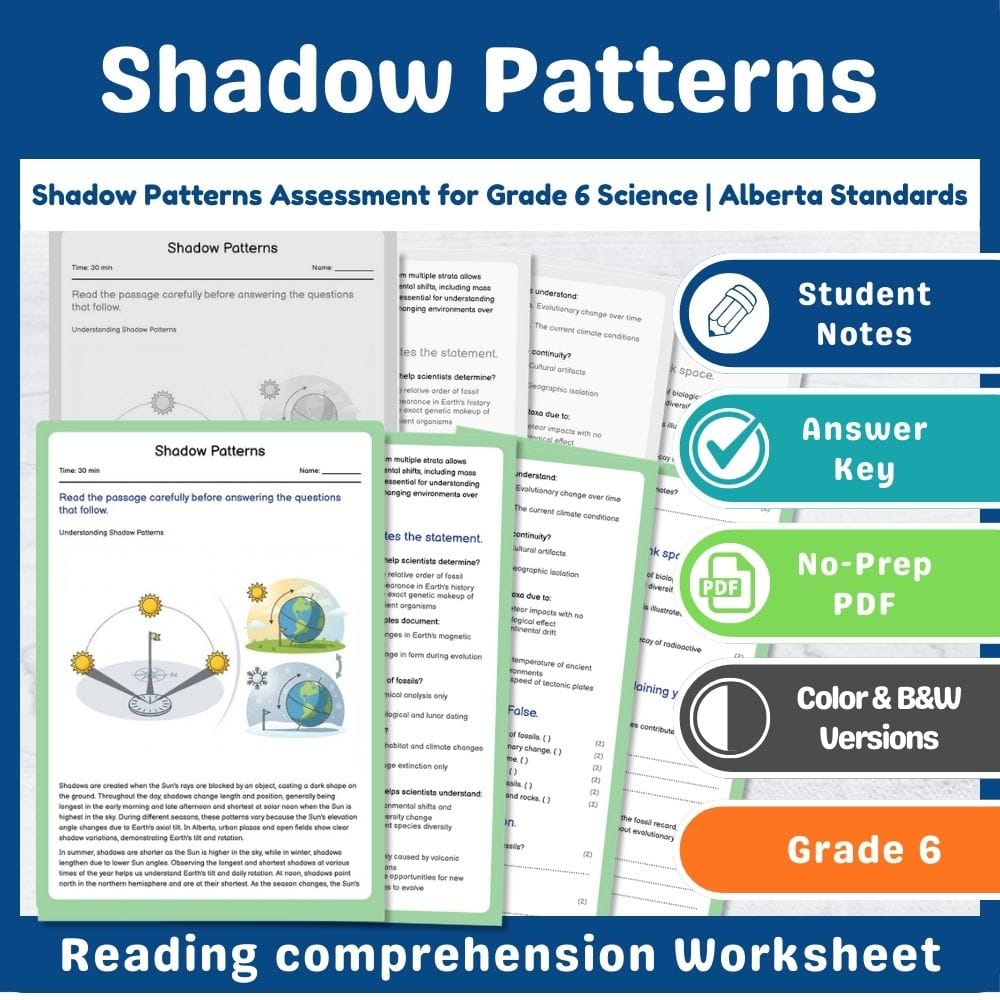
Shadow Patterns Assessment for Grade 6 Science | Alberta Standards
Created byPrism Point LearningLearning Objectives
- Describe how daily and seasonal changes in Sun angle affect shadow length and direction.
- Identify different shadow patterns such as noon shadows, longest shadows, and shortest shadows.
- Explain how Earth's motion and axial tilt influence shadow characteristics across seasons.
Also included in: Lesson Grade 6 Science Assessment | Celestial & Earth Movements
Instant download

Scale and Proportion Assessment | AP Science Standard Grade 9
Created byPrism Point LearningLearning Objectives
- Understand the principles of scaling laws and dimensional similarity.
- Apply proportional reasoning to construct models and interpret data across different scales.
- Analyze how nonlinearity and scale-dependent effects impact extrapolations in scientific contexts.
Instant download

Evaporation and Transpiration Assessment | California Standards Grade 6 Science
Created byPrism Point LearningLearning Objectives
- Explain how evaporation and transpiration add water vapor to the atmosphere
- Describe how temperature and available liquid water affect the amount of water vapor
- Connect phase changes to the water cycle, including condensation and precipitation
Also included in: Grade 6 Water in Earth Systems Science Lesson Bundle: California Standards +1 more
Instant download

Plate Motions Assessment | NGSSS Florida Standards Grade 12 Science
Created byPrism Point LearningLearning Objectives
- Explain how Earth’s internal energy drives long-term tectonic plate motion.
- Compare the main types of plate boundaries and the geologic processes associated with each.
- Interpret evidence for plate motion, including seafloor magnetic stripes, matching rock ages, and earthquake patterns.
Also included in: Grade 12 Science Assessment Lesson Bundle: Florida NGSSS Standards +1 more
Instant download
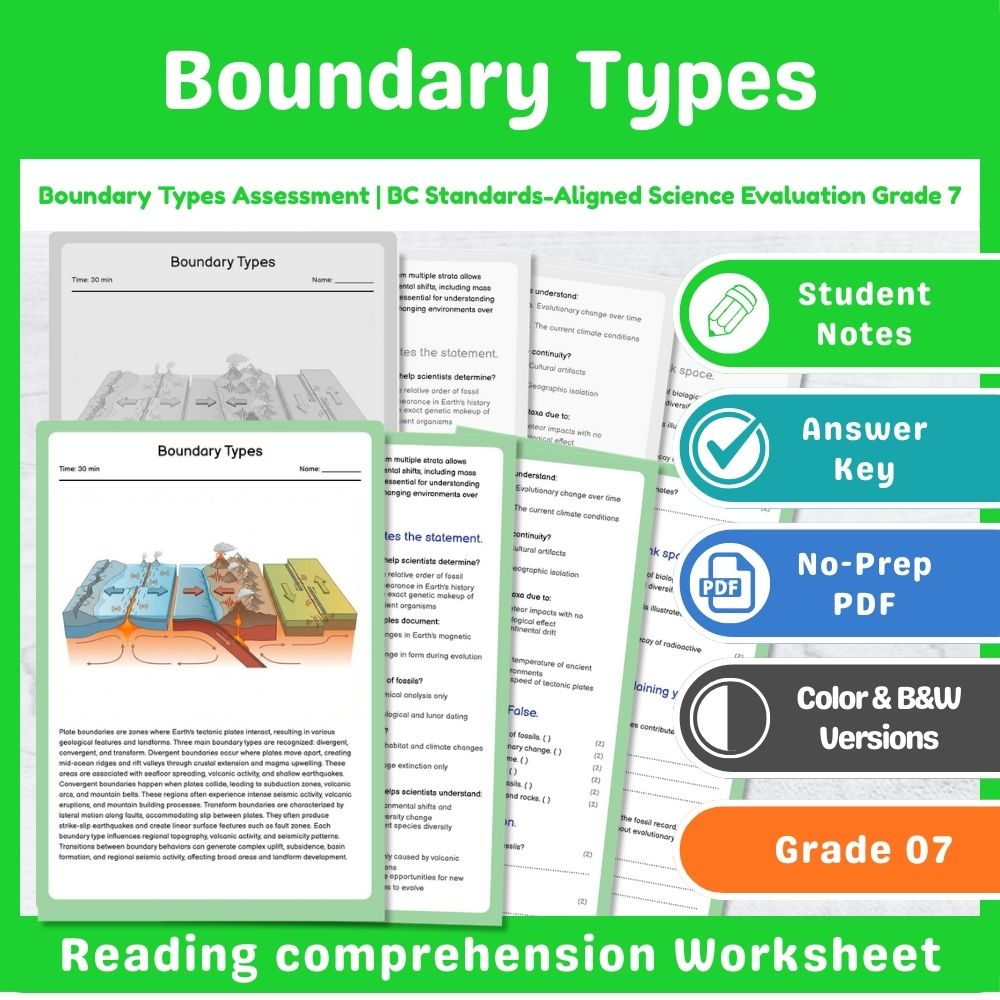
Boundary Types Assessment | BC Standards-Aligned Science Evaluation Grade 7
Created byPrism Point LearningLearning Objectives
- Understand the three principal boundary types and their characteristic landforms.
- Identify the processes and landforms associated with divergent, convergent, and transform boundaries.
- Explain how boundary transitions can produce complex regional geological patterns.
Also included in: Grade 7 Science Lesson – Earth Processes Assessment & Landforms Bundle
Instant download
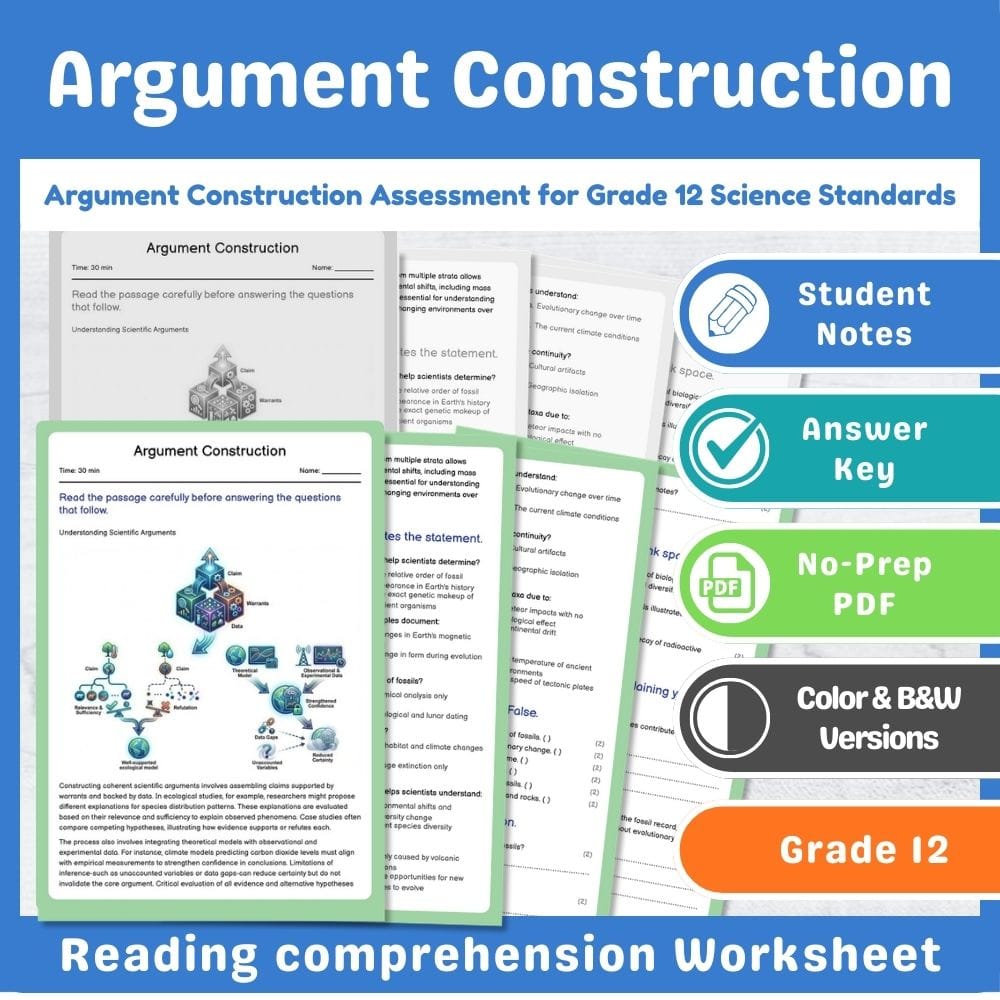
Argument Construction Assessment for Grade 12 Science Standards
Created byPrism Point LearningLearning Objectives
- Understand how to construct evidence-based arguments in scientific contexts.
- Identify components such as claims, warrants, and backing in case studies.
- Evaluate relevance, sufficiency, and alternative hypotheses in argumentation.
Instant download

Density Evidence Assessment | General Grade 6 Science Standards
Created byPrism Point LearningLearning Objectives
- Understand how density relates mass to volume and its role in classifying substances.
- Identify how objects with different densities behave in water, such as floating or sinking.
- Explain that density depends on how tightly matter is packed and does not change the substance's identity.
Also included in: Grade 6 Physical Science Science Lesson Bundle: General Framework
Instant download
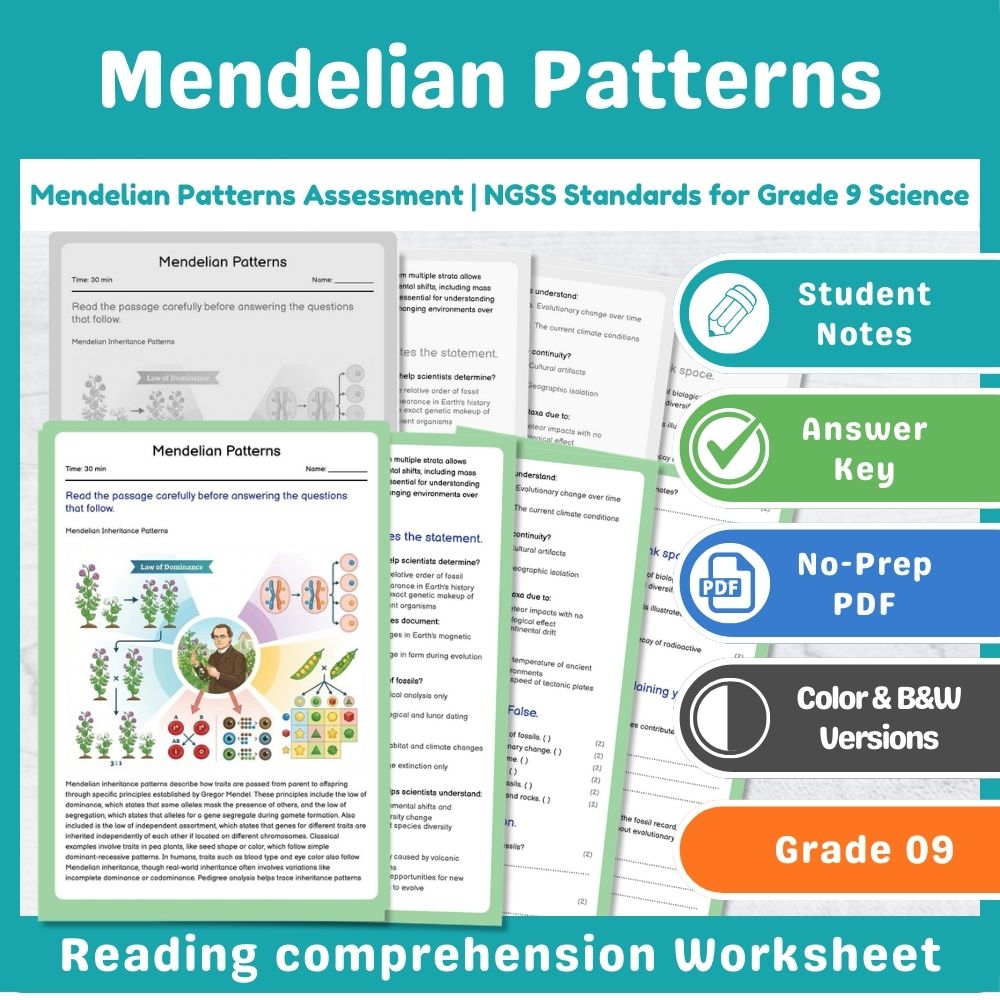
Mendelian Patterns Assessment | NGSS Standards for Grade 9 Science
Created byPrism Point LearningLearning Objectives
- Describe the basic principles of Mendelian inheritance, including dominance, segregation, and independent assortment.
- Use Punnett squares to predict genotype and phenotype ratios of monohybrid and dihybrid crosses.
- Interpret pedigree charts to analyze inheritance patterns.
Instant download

Net Force Acceleration Assessment | NGSSS Standards Grade 8 Science
Created byPrism Point LearningLearning Objectives
- Define net force and determine its direction when forces act in opposite directions
- Explain how a nonzero net force causes changes in velocity (speed and/or direction)
- Use force values to predict acceleration for a cart moving on a track
Instant download

Speciation And Change Assessment for Grade 8 Science | NGSSS Standards
Created byPrism Point LearningLearning Objectives
- Explain how reproductive isolation can lead to speciation over many generations
- Describe how geographic barriers, habitat changes, or behavioral differences reduce gene flow
- Use natural selection and genetic variation to predict how traits may diverge in separated populations
Also included in: Grade 8 Evolution and Genetics Science Lesson Bundle | Florida NGSSS
Instant download
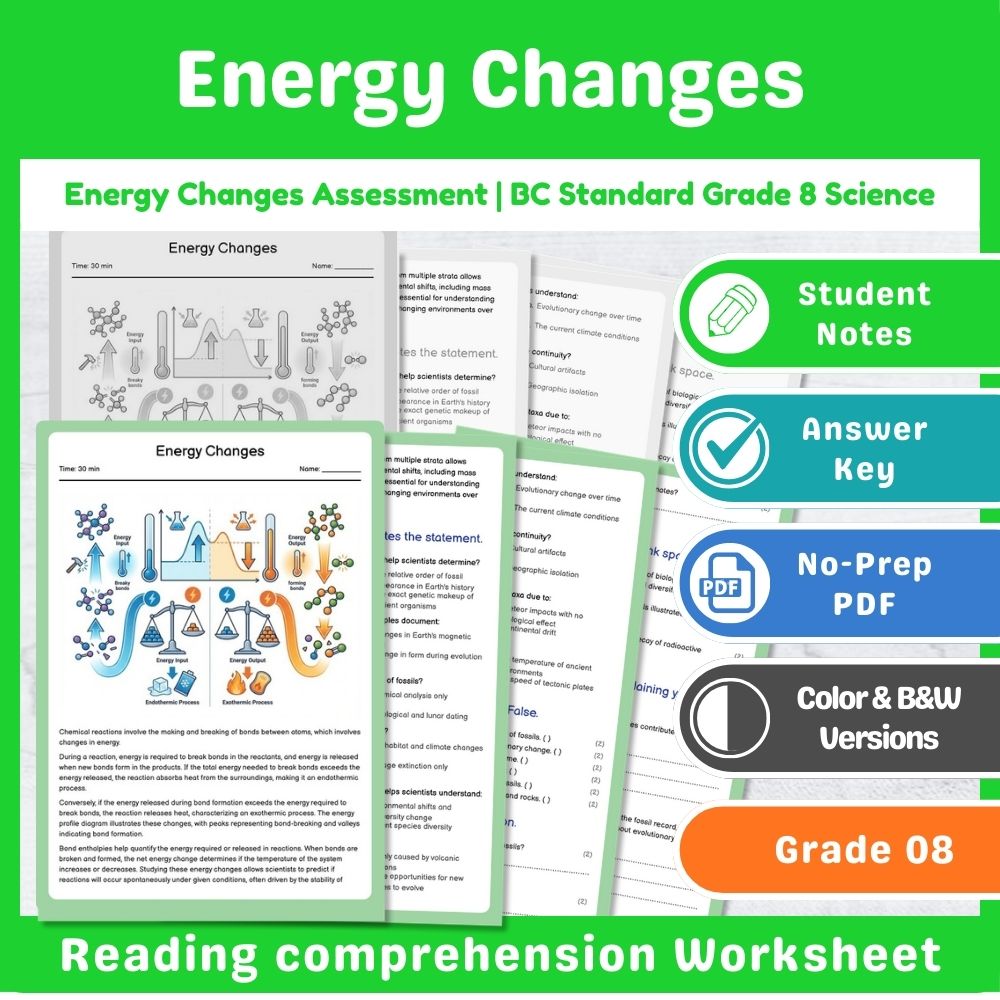
Energy Changes Assessment | BC Standard Grade 8 Science
Created byPrism Point LearningLearning Objectives
- Understand how chemical bonds involve energy changes during reactions.
- Differentiate between endothermic and exothermic reactions based on energy transfer.
- Interpret energy profiles and bond enthalpy diagrams to explain temperature changes.
Also included in: Grade 8 Science Lesson – Reaction Types & Evidence Assessment Bundle
Instant download

Precipitation and Infiltration Assessment | California Standards Grade 6 Science
Created byPrism Point LearningLearning Objectives
- Explain how precipitation returns water to Earth and describe examples of precipitation types.
- Describe infiltration and runoff and how they affect soil moisture and groundwater recharge.
- Use gravity and landscape features to predict how water moves across or into the ground.
Also included in: Grade 6 Water in Earth Systems Science Lesson Bundle: California Standards +1 more
Instant download
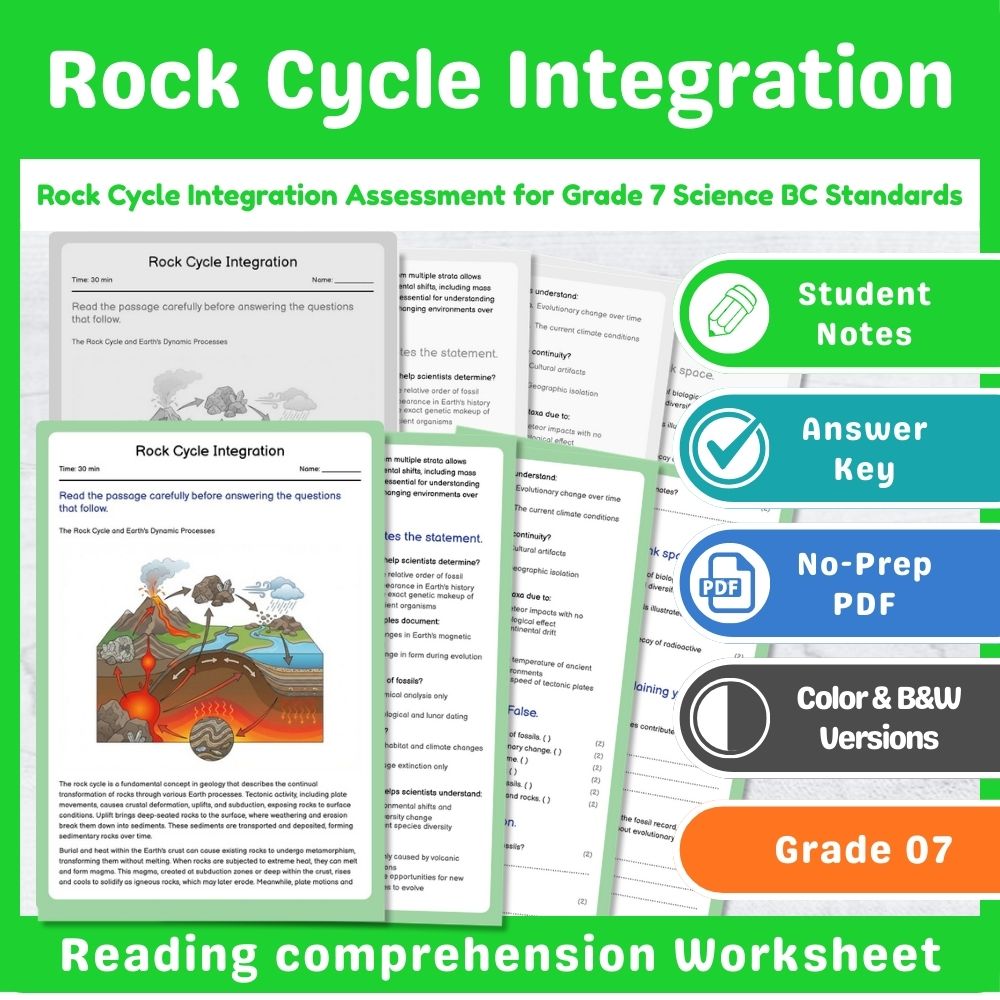
Rock Cycle Integration Assessment for Grade 7 Science BC Standards
Created byPrism Point LearningLearning Objectives
- Understand how the rock cycle links tectonics, magmatism, and surface processes.
- Identify the pathways of material transformation in the rock cycle.
- Explain how uplift, erosion, burial, and heat contribute to different rock types.
Also included in: Grade 7 Science Lesson – Earth Processes Assessment & Landforms Bundle
Instant download

Atoms and Particles Assessment | California Standards Grade 6 Science
Created byPrism Point LearningLearning Objectives
- Explain how particle models describe matter using atoms and particles too small to see
- Relate the composition of atoms in substances to observable physical and chemical properties
- Use particle-level reasoning to predict how changes in matter affect properties
Also included in: Grade 6 Atoms and Chemical Change Science lesson bundle | California Standards +1 more
Instant download

Growth and Stored Energy Assessment Grade 6 Science California Standards
Created byPrism Point LearningLearning Objectives
- Explain how photosynthesis provides energy and matter for plant growth.
- Describe why plants store chemical energy and how they use it when light is limited.
- Identify how plant structures change over time through ongoing energy transformations and matter use.
Also included in: Grade 6 Energy and Matter Cycles Science Lesson Bundle | California Standards +1 more
Instant download

Advanced Circuit Analysis Assessment | BC Standards Grade 6 Science
Created byPrism Point LearningLearning Objectives
- Explain how power dissipation in resistive elements converts electrical energy into thermal energy.
- Analyze how internal source resistance affects terminal voltage under load conditions.
- Describe the relationship between current, voltage, and power in complex circuits.
Instant download
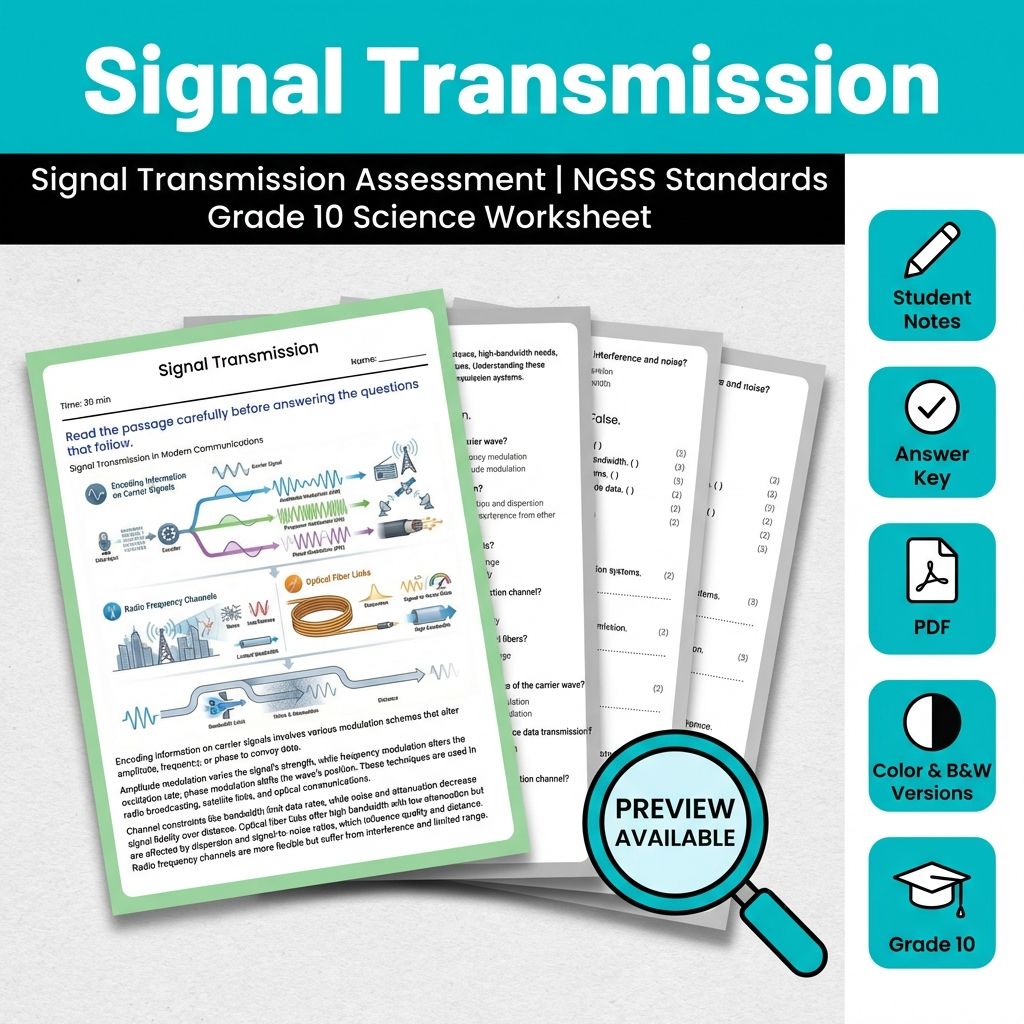
Signal Transmission Assessment | NGSS Standards Grade 10 Science Worksheet
Created byPrism Point LearningLearning Objectives
- Describe various modulation schemes used in encoding information on carrier signals.
- Evaluate the trade-offs between bandwidth, noise, and signal fidelity in different transmission modes.
- Explain how channel constraints such as attenuation and dispersion affect communication systems.
Instant download
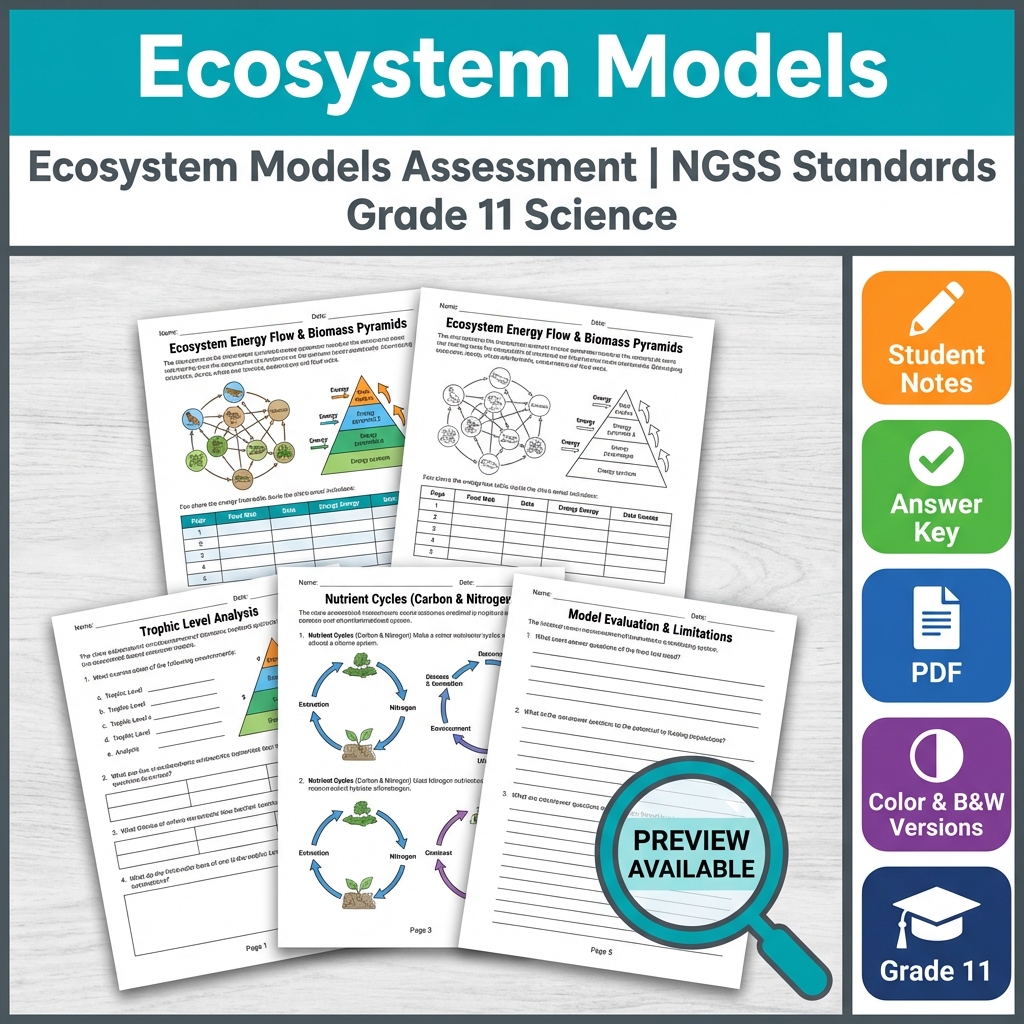
Ecosystem Models Assessment | NGSS Standards Grade 11 Science
Created byPrism Point LearningLearning Objectives
- Understand different types of ecosystem models and their applications.
- Analyze how models represent ecological interactions and predict system behavior.
- Evaluate the parameters and feedback mechanisms in ecosystem modeling.
Also included in: Grade 11 Science Mini Bundle | Ecosystems Interactions & Energy NGSS
Instant download

Heat and Temperature Assessment | NGSSS Standards Grade 6 Science
Created byPrism Point LearningLearning Objectives
- Explain the difference between heat and temperature using particle motion and energy transfer.
- Use everyday examples (hot water, warm air, cooling objects) to predict how energy moves.
- Interpret warming and cooling patterns by reasoning about temperature differences.
Also included in: Grade 6 Energy and Matter Science Lesson Bundle Unit: Florida NGSSS
Instant download

Niche Relationships Assessment for Grade 6 Science | Florida NGSSS
Created byPrism Point LearningLearning Objectives
- Explain what a niche is and how it describes an organism’s role in an ecosystem.
- Identify how different niches can allow two species to coexist in the same habitat.
- Analyze how niche overlap can increase competition when resources become limited.
Also included in: Grade 6 Ecosystems Science Lesson Bundle | Florida NGSSS Assessment
Instant download
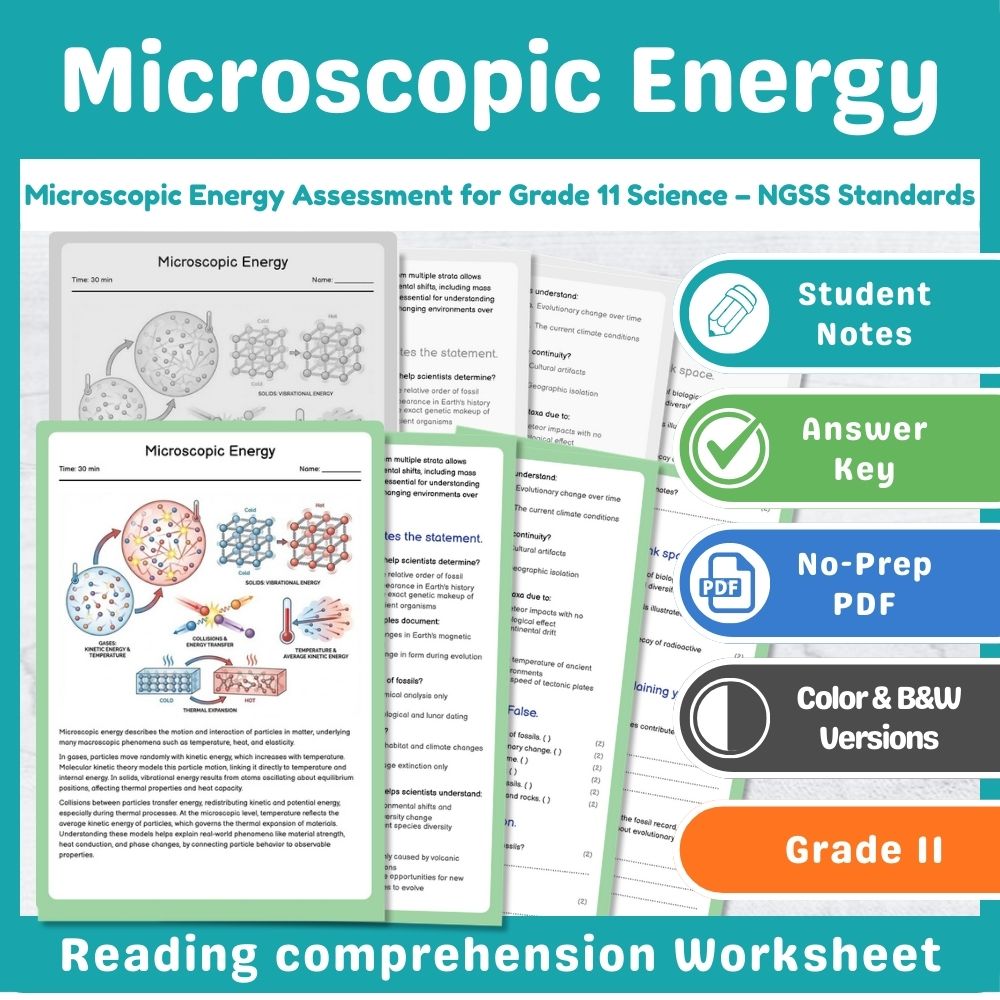
Microscopic Energy Assessment for Grade 11 Science – NGSS Standards
Created byPrism Point LearningLearning Objectives
- Explain the representation of energy at the microscopic scale and how it relates to macroscopic phenomena.
- Describe molecular kinetic theory and how it connects particle motion to temperature.
- Analyze energy redistribution during collisions in gases and vibrations in solids.
Instant download

Food Chains Assessment for Grade 6 Science | Florida NGSSS Standards
Created byPrism Point LearningLearning Objectives
- Identify the roles of producers and consumers in a food chain
- Explain how energy transfers between trophic levels
- Describe why real ecosystems often form food webs instead of single pathways
Also included in: Grade 6 Ecosystems Science Lesson Bundle | Florida NGSSS Assessment
Instant download

Friction Effects Assessment for Grade 6 Science | NGSSS Standards
Created byPrism Point LearningLearning Objectives
- Explain how friction affects the motion of objects on different surfaces
- Describe how friction can convert kinetic energy into thermal energy
- Compare friction on solid surfaces with air resistance (drag) in fluids
Also included in: Grade 6 Energy and Matter Science Lesson Bundle Unit: Florida NGSSS
Instant download

Science Assessment: Atmospheric Circulation Grade 6 | Assessment NGSSS
Created byPrism Point LearningLearning Objectives
- Explain how uneven heating causes air to rise and sink, forming atmospheric circulation patterns
- Describe how warm air and cool air differ in density and how that affects pressure and wind
- Connect atmospheric circulation to moisture transport and the development of storms
Instant download

Science Assessment: Oceans Regulate Climate (Grade 6) – Assessment | NGSSS
Created byPrism Point LearningLearning Objectives
- Explain how oceans absorb, store, and release heat more slowly than land to moderate temperatures.
- Describe how ocean heat affects evaporation, atmospheric humidity, and storm or weather patterns.
- Use evidence from ocean conditions to predict how coastal climates may respond to climate shifts.
Instant download

Ecosystem Components Assessment | Florida NGSSS Standards Grade 6 Science
Created byPrism Point LearningLearning Objectives
- Identify abiotic factors and explain how they affect where organisms can live.
- Distinguish biotic factors (producers, consumers, decomposers) by their roles in an ecosystem.
- Use ecosystem component vocabulary to describe how ecosystem structure can vary by location.
Also included in: Grade 6 Ecosystems Science Lesson Bundle | Florida NGSSS Assessment
Instant download

Trophic Levels Assessment for Grade 6 Science | Florida NGSSS Standard
Created byPrism Point LearningLearning Objectives
- Explain how producers, consumers, and decomposers relate to trophic levels and energy flow
- Identify the correct trophic level for different organisms based on what they eat
- Describe how energy transfer between trophic levels affects ecosystem structure and populations
Also included in: Grade 6 Ecosystems Science Lesson Bundle | Florida NGSSS Assessment
Instant download

Behavioral Strategies Assessment | Florida NGSSS Standards Grade 6 Science
Created byPrism Point LearningLearning Objectives
- Explain how behavioral adaptations help organisms survive in changing environments
- Identify examples of behavioral adaptations such as migration, hibernation, and daily timing
- Describe how behavior works together with structural and physiological traits
Also included in: Grade 6 Ecosystems Science Lesson Bundle | Florida NGSSS Assessment
Instant download

Science Assessment: Energy From Sun (Grade 6) – Florida NGSSS Assessment
Created byPrism Point LearningLearning Objectives
- Explain how the angle of incoming solar energy affects heating on Earth
- Describe how unequal heating drives air movement and influences weather
- Connect energy transfers in the atmosphere and oceans to seasonal climate patterns
Instant download

Diffusion Rates Assessment | BC Grade 6 Science Standards
Created byPrism Point LearningLearning Objectives
- Explain the process of diffusion and the factors that influence its rate.
- Connect microscopic particle movement to observable phenomena like scent dispersion and gas mixing.
- Identify how temperature, particle size, and medium viscosity affect diffusion speed.
Instant download
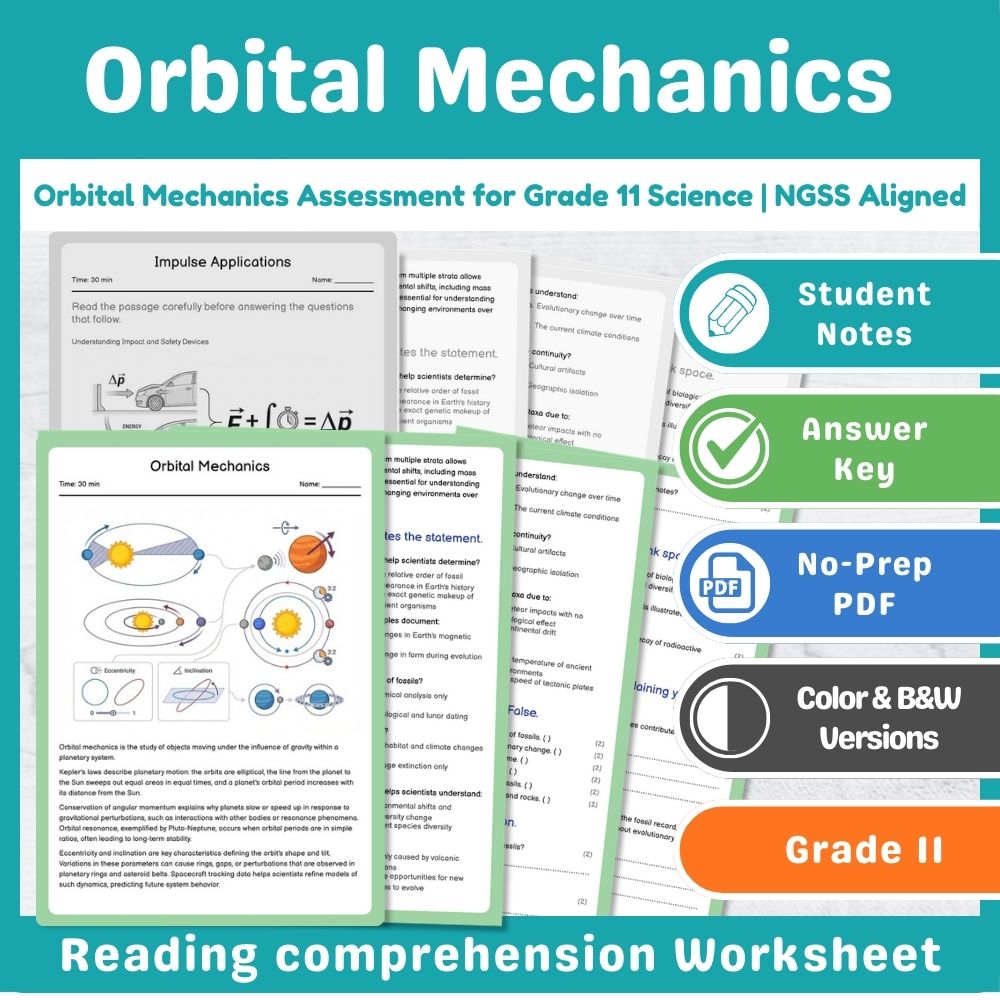
Orbital Mechanics Assessment for Grade 11 Science | NGSS Aligned
Created byPrism Point LearningLearning Objectives
- Explain the fundamental principles of orbital motion and Kepler's laws.
- Analyze the effects of gravitational interactions and orbital perturbations.
- Describe phenomena such as orbital resonance, eccentricity, and inclination.
Also included in: Grade 11 Science Mini Bundle | Cosmic/Orbital Mechanics Assessment NGSS
Instant download

Friction And Drag Assessment | NGSSS Standards Grade 10 Science
Created byPrism Point LearningLearning Objectives
- Explain how nonconservative forces like friction and drag oppose motion and remove mechanical energy
- Analyze how friction and drag affect acceleration and velocity over time
- Relate real-world observations (slowing down, reaching terminal velocity) to the concept of net force
Also included in: Grade 10 Waves Energy Forces Science Lesson Mini Bundle | Florida NGSSS +1 more
Instant download

Chromosomes and Inheritance Assessment | Florida NGSSS Grade 10 Science
Created byPrism Point LearningLearning Objectives
- Explain how chromosomes carry genes and how alleles at specific loci influence inherited traits.
- Describe how meiosis and fertilization connect chromosome transmission to offspring genotypes.
- Distinguish between simple dominance patterns and inheritance patterns involving multiple genes.
Also included in: Grade 10 Cells, Genetics & Evolution Science Lesson Bundle | Florida NGSSS +1 more
Instant download

Newtonian Forces Assessment for Grade 10 Science | Florida NGSSS
Created byPrism Point LearningLearning Objectives
- Explain how net force affects an object’s motion, including changes in velocity and constant velocity in the absence of net force.
- Use proportionality ideas to predict acceleration changes when net force or mass changes.
- Connect equilibrium to balanced forces and interpret outcomes using free-body diagram reasoning.
Also included in: Grade 10 Waves Energy Forces Science Lesson Mini Bundle | Florida NGSSS +1 more
Instant download
Browse more categories
About Science Worksheets
Find Science worksheets spanning core skills, practice, and review. All 44,295 resources are instant PDF downloads for the classroom or home.
Every worksheet on MyTeachingSheets is created by independent teacher-authors and reviewed before publication. All resources download as printable PDFs for classroom, homework, or at-home practice, and many include answer keys. Preview any worksheet free before buying.