
Science Worksheets
44,295 subject resources
Graphical Reasoning Assessment Grade 8 Science TEKS Standards-Aligned
 Created byPrism Point Learning
Learning Objectives
- Interpret slopes, areas under curves, and rates of change in mathematical graphs.
- Connect graphical representations with physical phenomena such as motion and energy transfer.
- Translate between equations, data tables, and graphical formats to analyze scientific data.
Also included in: Grade 8 Scientific Inquiry & Data Analysis Science Lesson Bundle TEKS
Instant download

Anthropogenic Drivers Assessment | TEKS Grade 12 Science Standards
Created byPrism Point LearningLearning Objectives
- Analyze human land-use changes and their effects on ecosystems.
- Evaluate the pathways through which industrial emissions contribute to pollution.
- Assess the impact of urbanization on air, water, and soil quality.
Instant download

Net Force Effects Assessment | California Standards Grade 7 Science
Created byPrism Point LearningLearning Objectives
- Explain how forces add to create a net force using both magnitude and direction
- Predict how an unbalanced net force changes an object’s speed and/or direction
- Determine when forces are balanced and describe the resulting motion
Also included in: Grade 7 Forces and Matter Science Lesson Bundle: California Standards +1 more
Instant download
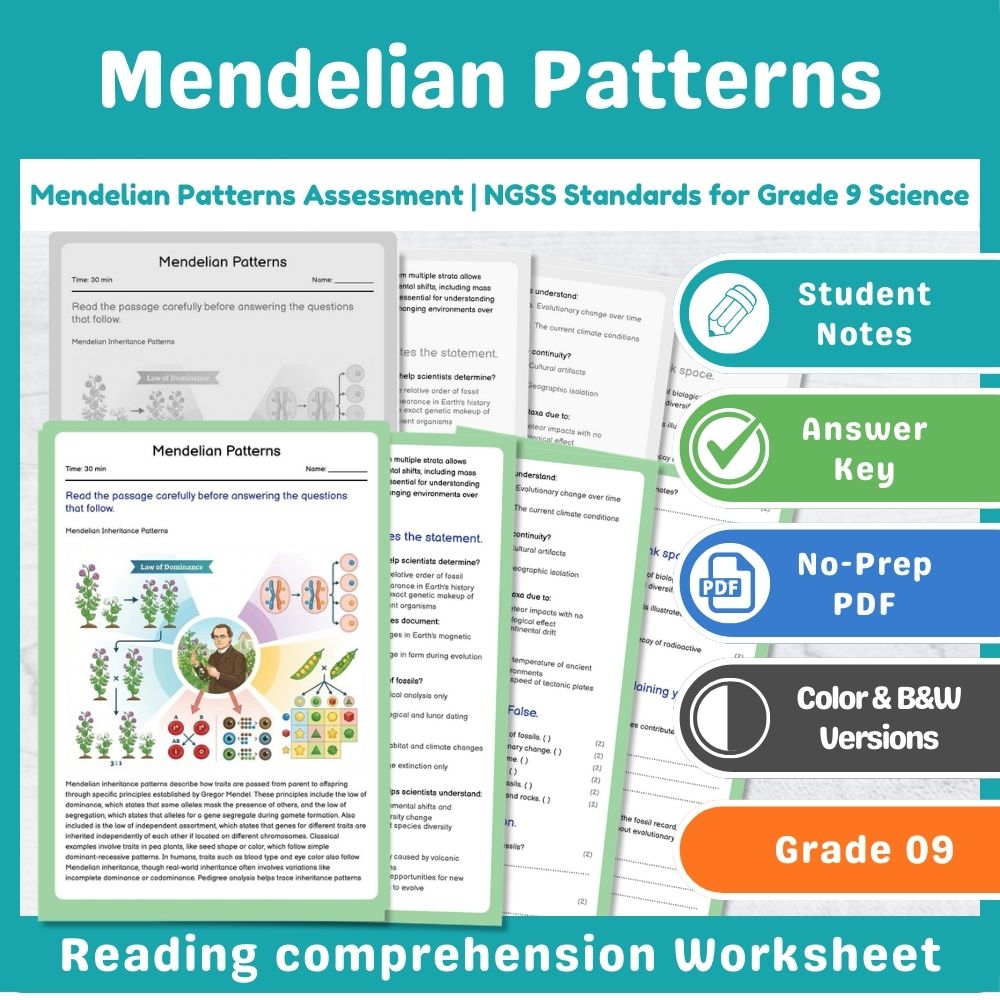
Mendelian Patterns Assessment | NGSS Standards for Grade 9 Science
Created byPrism Point LearningLearning Objectives
- Describe the basic principles of Mendelian inheritance, including dominance, segregation, and independent assortment.
- Use Punnett squares to predict genotype and phenotype ratios of monohybrid and dihybrid crosses.
- Interpret pedigree charts to analyze inheritance patterns.
Instant download

Thermal Expansion Assessment Grade 7 Science California Standards
Created byPrism Point LearningLearning Objectives
- Explain how increasing temperature affects particle motion and spacing in solids, liquids, and gases
- Describe and predict contraction and expansion when materials are heated or cooled
- Connect thermal expansion to real-world situations such as tight metal fits and gas pressure in sealed containers
Also included in: Grade 7 Forces and Matter Science Lesson Bundle: California Standards +1 more
Instant download

Innovation Pathways Assessment | TEKS Standards Grade 12 Science
Created byPrism Point LearningLearning Objectives
- Understand the process of translating scientific discoveries into market-ready technologies.
- Identify key components such as intellectual property, patenting, and commercialization models.
- Analyze the roles of research funding, industry partnerships, and regulatory constraints in innovation.
Also included in: Grade 12 Science Technology and Society Science Lesson Bundle: TEKS
Instant download
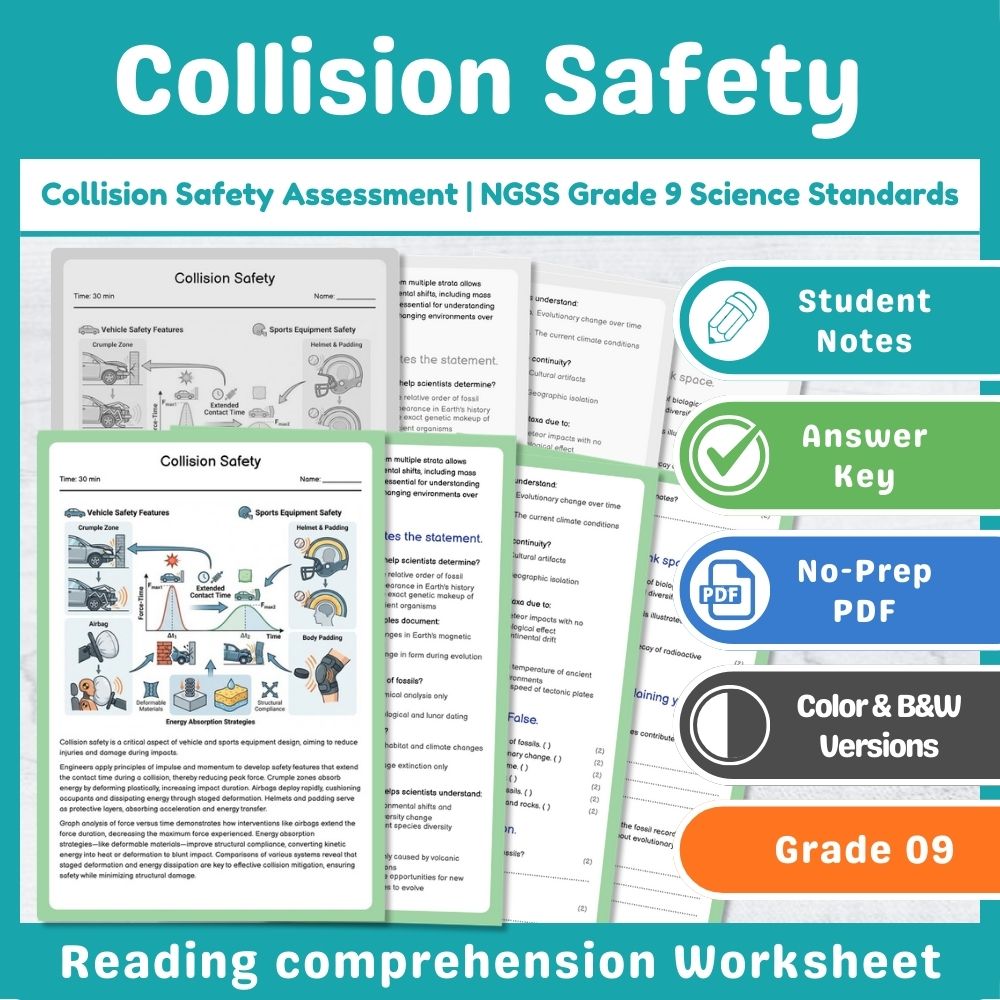
Collision Safety Assessment | NGSS Grade 9 Science Standards
Created byPrism Point LearningLearning Objectives
- Understand how impulse and force-time tradeoffs influence collision mitigation strategies.
- Identify engineering design features such as crumple zones, airbags, and helmets for safer high-impact interactions.
- Analyze force-time graphs and energy absorption techniques to evaluate shock absorption effectiveness.
Instant download

Historical Context in Science Assessment | TEKS Grade 12 Science
Created byPrism Point LearningLearning Objectives
- Analyze how historical events influenced scientific development and societal change.
- Identify key examples of scientific advancements and their societal impacts.
- Evaluate the patterns of technological diffusion and public perception over time.
Also included in: Grade 12 Science Technology and Society Science Lesson Bundle: TEKS
Instant download

Fermentation Pathways Assessment for Grade 11 Science TEKS Standards
Created byPrism Point LearningLearning Objectives
- Explain the process of anaerobic fermentation pathways and their role in ATP regeneration.
- Differentiate between lactic acid and alcoholic fermentation in terms of products and energy yield.
- Describe how cells adapt biochemical pathways to maintain energy production without oxygen.
Also included in: Grade 11 Photosynthesis and Respiration Science Lesson Bundle | TEKS
Instant download

Condensation and Clouds Assessment | California Standards Grade 6 Science
Created byPrism Point LearningLearning Objectives
- Explain how cooling and vapor pressure changes lead to condensation or ice crystal formation in the atmosphere
- Describe how clouds form from condensed droplets or ice crystals and how this relates to the water cycle
- Compare how clouds affect Earth’s energy balance by reflecting sunlight and trapping infrared radiation
Also included in: Grade 6 Water in Earth Systems Science Lesson Bundle: California Standards +1 more
Instant download

Decomposer Matter Return Assessment Grade 6 Science | California Standards
Created byPrism Point LearningLearning Objectives
- Explain how decomposers recycle matter in ecosystems by breaking down dead organisms and waste
- Describe how atoms and nutrients move from living things to nonliving parts of an ecosystem (soil and water) and back to producers
- Compare the roles of decomposers and producers in maintaining ecosystem functioning
Also included in: Grade 6 Energy and Matter Cycles Science Lesson Bundle | California Standards +1 more
Instant download
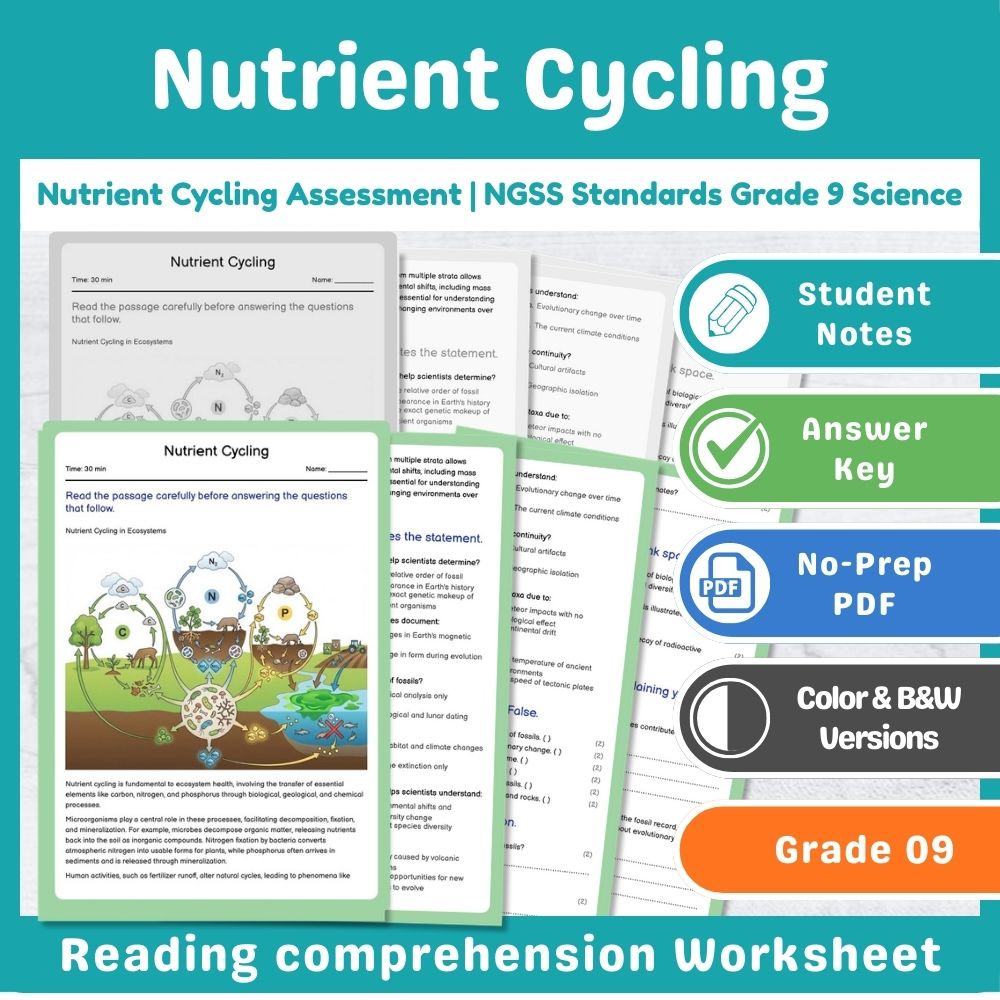
Nutrient Cycling Assessment | NGSS Standards Grade 9 Science
Created byPrism Point LearningLearning Objectives
- Understand the processes involved in the cycling of carbon, nitrogen, and phosphorus within ecosystems.
- Identify human activities that disrupt nutrient cycles and recognize their ecological impacts.
- Explain how changes in nutrient cycling rates influence ecosystem productivity and soil carbon storage.
Instant download

Mixtures and Compounds Assessment | California Standards Grade 6 Science
Created byPrism Point LearningLearning Objectives
- Differentiate mixtures and compounds using particle models
- Explain how composition affects properties of matter
- Use physical vs chemical ideas to predict whether a sample can be separated
Also included in: Grade 6 Atoms and Chemical Change Science lesson bundle | California Standards +1 more
Instant download

Mass Measurement Assessment for Grade 9 Science | BC Standards
Created byPrism Point LearningLearning Objectives
- Understand how mass measurements reflect the conservation of atoms during chemical reactions.
- Identify factors affecting measured mass, such as gaseous product escape and external influences.
- Explain the importance of defining system boundaries and accounting for all phases in mass analysis.
Instant download
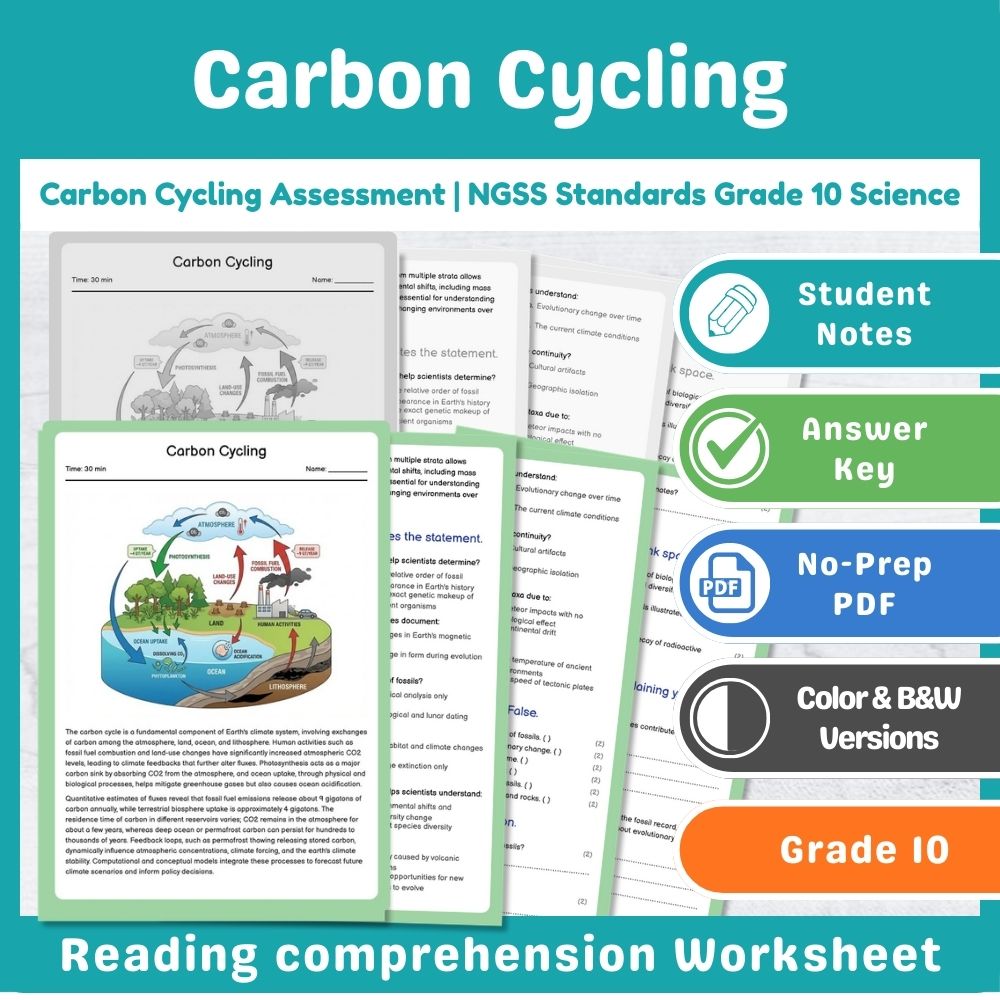
Carbon Cycling Assessment | NGSS Standards Grade 10 Science
Created byPrism Point LearningLearning Objectives
- Describe the components of the global carbon cycle, including sources and sinks.
- Explain feedback mechanisms influencing atmospheric CO2 concentrations.
- Quantify the flux magnitudes, residence times, and their impact on climate.
Also included in: Grade 10 Science Resource Tradeoffs Assessment | NGSS Standards-Aligned
Instant download
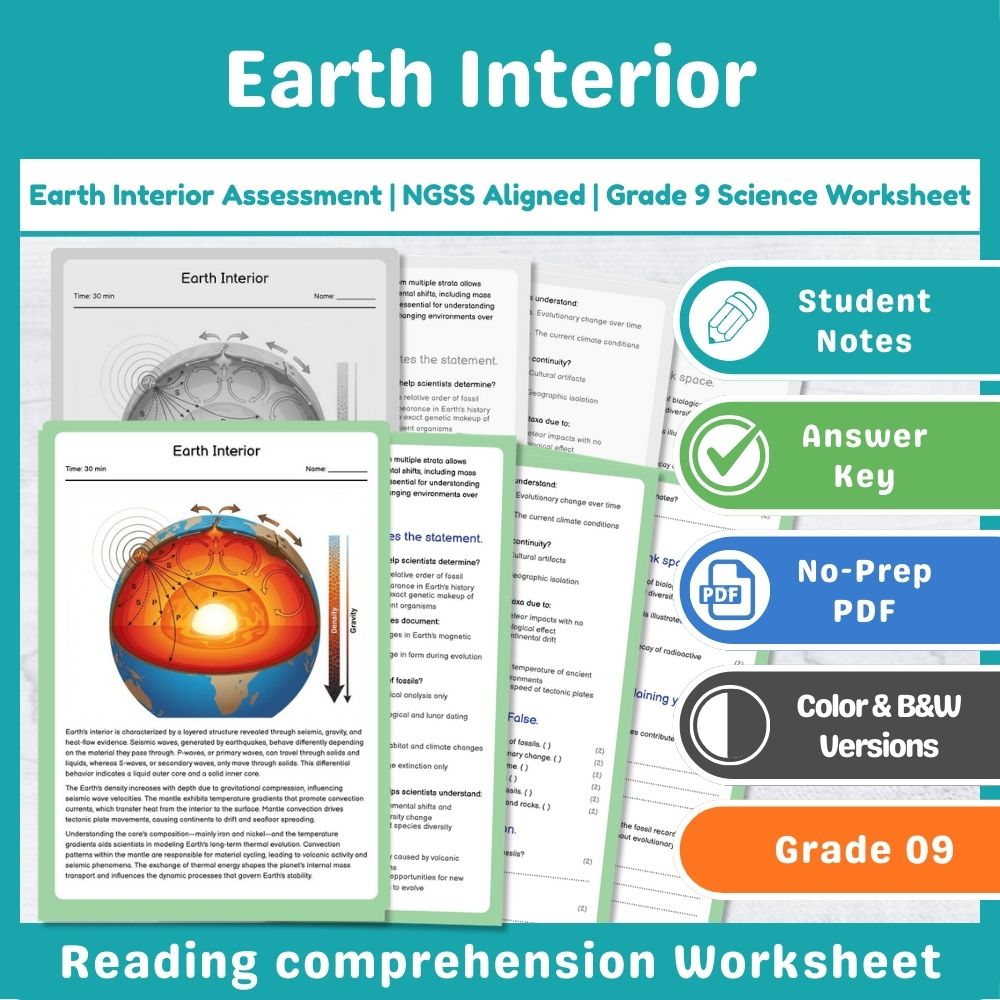
Earth Interior Assessment | NGSS Aligned | Grade 9 Science Worksheet
Created byPrism Point LearningLearning Objectives
- Describe the layered structure of Earth's interior based on seismic evidence.
- Interpret the behaviors of P-waves and S-waves to understand Earth's composition.
- Explain the transfer of thermal energy within Earth and its impact on planetary processes.
Instant download

Net Force Concept Assessment | BC Standards Grade 9 Science
Created byPrism Point LearningLearning Objectives
- Explain what net force is and how it affects motion.
- Differentiate between balanced and unbalanced forces.
- Resolve forces into components and calculate the net force.
Instant download

Chemical Equilibrium Assessment | Alberta Standards Grade 12 Science
Created byPrism Point LearningLearning Objectives
- Explain the concept of chemical equilibrium in reversible reactions.
- Predict how changes in concentration, pressure, and temperature shift chemical equilibria using Le Chatelier’s principle.
- Apply equilibrium expressions to optimize reaction yields and understand environmental implications.
Also included in: Grade 12 Chemistry Science Lesson Bundle Assessments | Alberta Framework +1 more
Instant download
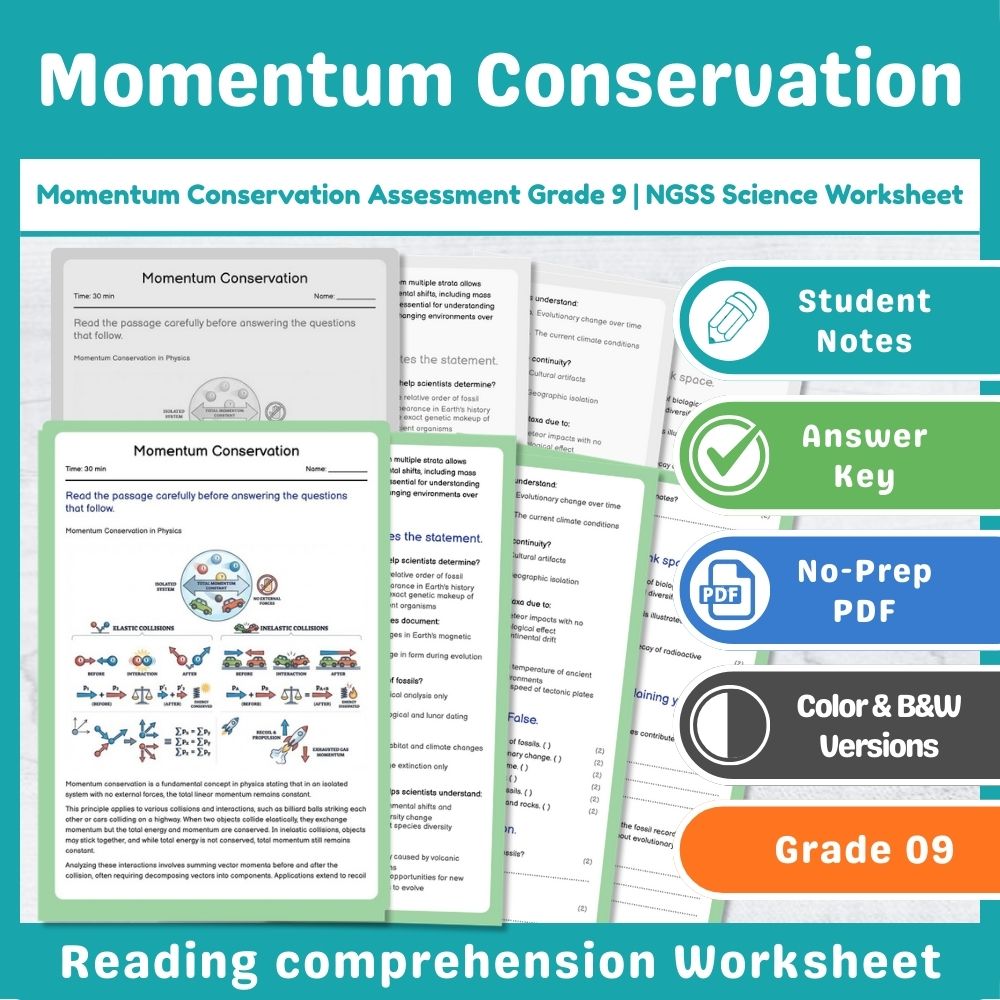
Momentum Conservation Assessment Grade 9 | NGSS Science Worksheet
Created byPrism Point LearningLearning Objectives
- Understand the principle of conservation of linear momentum in isolated systems.
- Differentiate between elastic and inelastic collisions using vector sums.
- Calculate total momentum before and after interactions in various scenarios.
Instant download
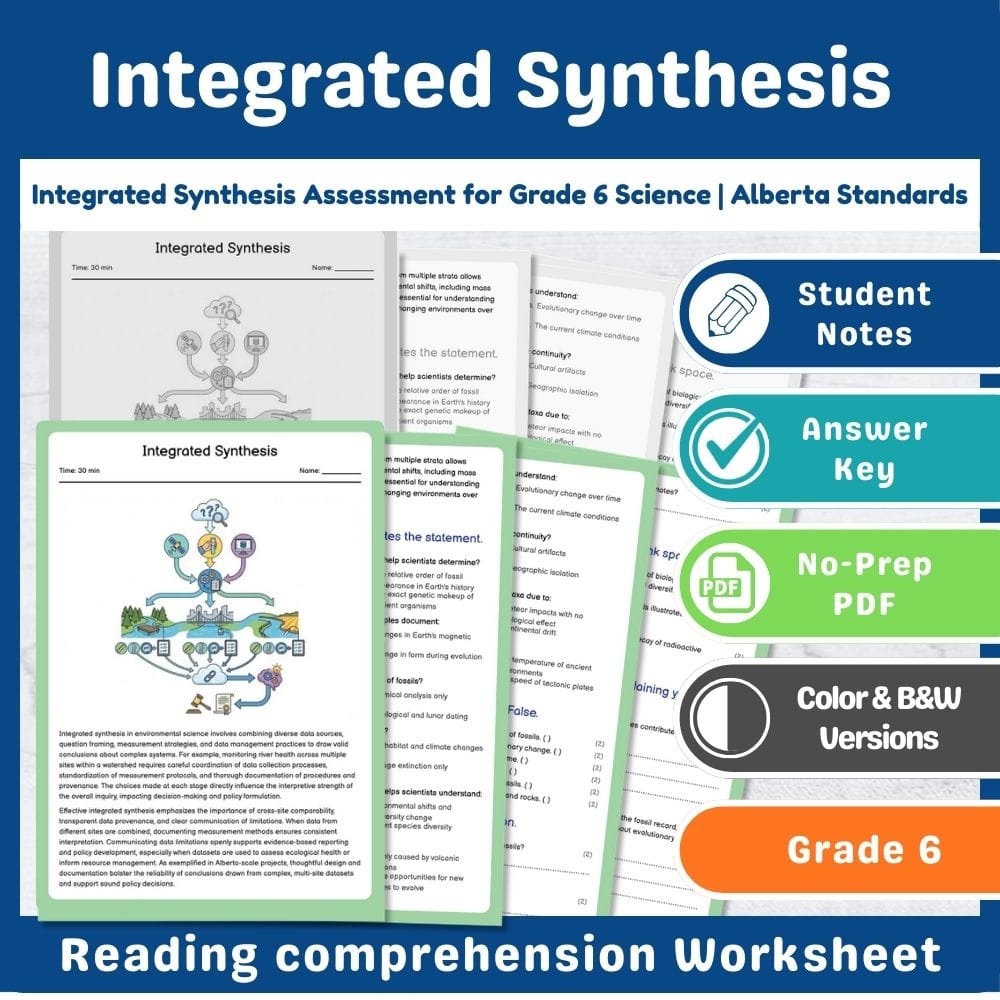
Integrated Synthesis Assessment for Grade 6 Science | Alberta Standards
Created byPrism Point LearningLearning Objectives
- Understand the key components involved in integrated synthesis within environmental monitoring.
- Evaluate the importance of documentation and data provenance in scientific inquiry.
- Analyze how measurement strategies influence the interpretation of multi-site environmental data.
Also included in: Lesson Grade 6 Science Mini Bundle | Evidence and Investigation
Instant download
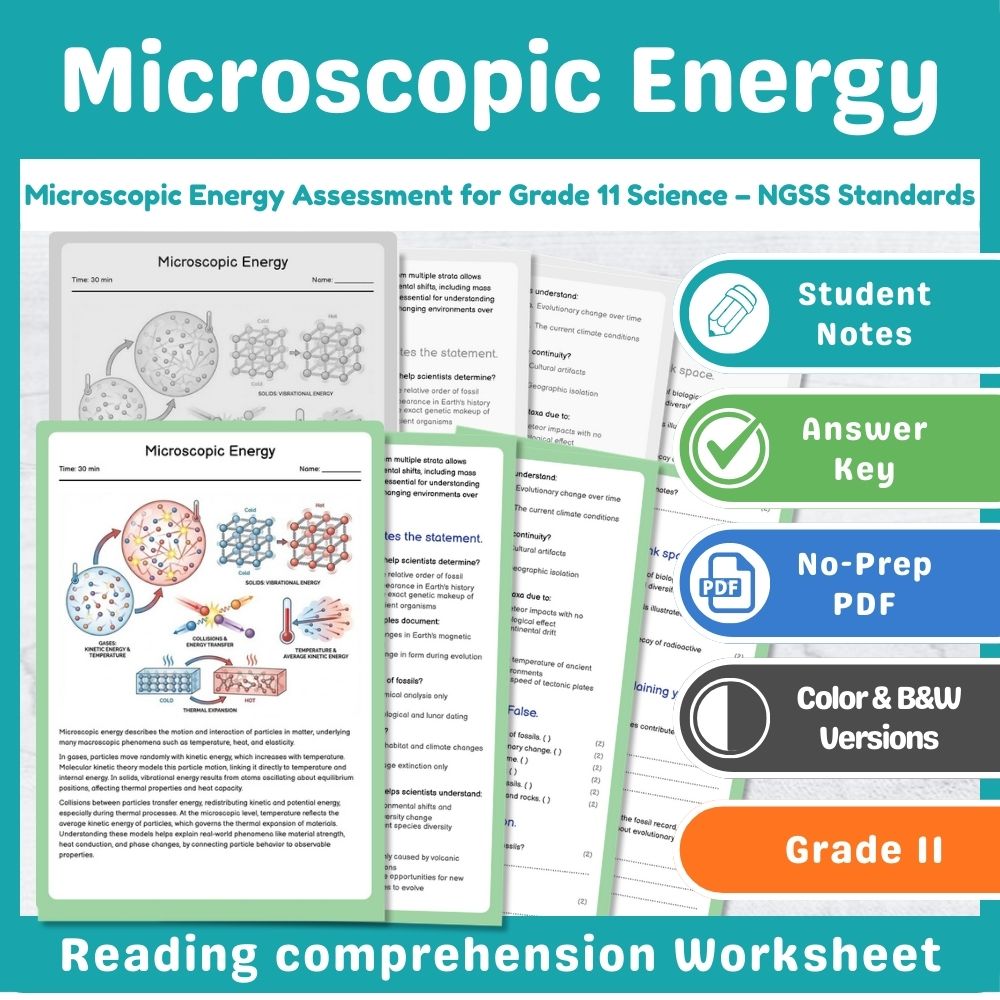
Microscopic Energy Assessment for Grade 11 Science – NGSS Standards
Created byPrism Point LearningLearning Objectives
- Explain the representation of energy at the microscopic scale and how it relates to macroscopic phenomena.
- Describe molecular kinetic theory and how it connects particle motion to temperature.
- Analyze energy redistribution during collisions in gases and vibrations in solids.
Instant download
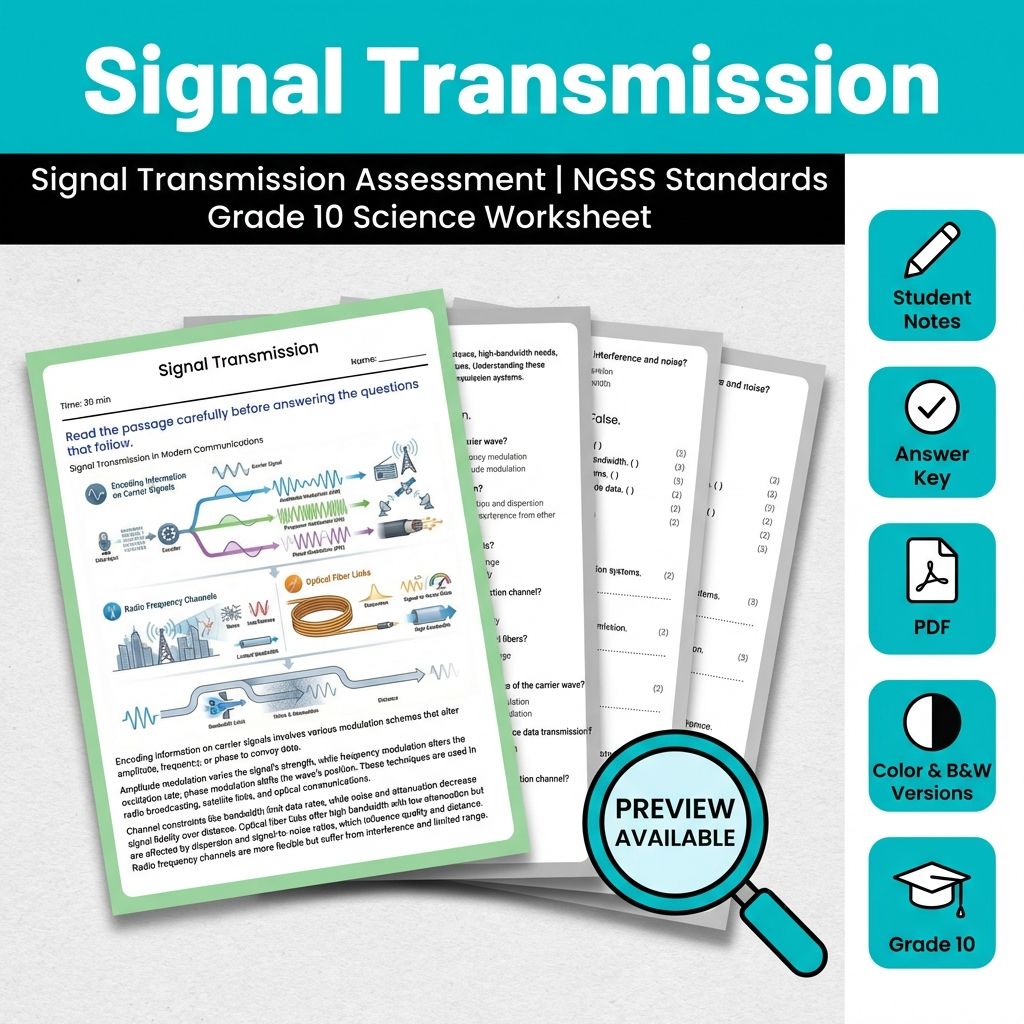
Signal Transmission Assessment | NGSS Standards Grade 10 Science Worksheet
Created byPrism Point LearningLearning Objectives
- Describe various modulation schemes used in encoding information on carrier signals.
- Evaluate the trade-offs between bandwidth, noise, and signal fidelity in different transmission modes.
- Explain how channel constraints such as attenuation and dispersion affect communication systems.
Instant download

Trophic Modeling Assessment for Grade 8 Science – Alberta Standards
Created byPrism Point LearningLearning Objectives
- Understand the principles of trophic modeling in ecological systems.
- Identify different types of models used to represent energy and matter fluxes.
- Explain how models estimate production, respiration, and decomposition rates.
Also included in: Grade 8 Science Mini Bundle | Interactions and Ecosystems Curriculum
Instant download
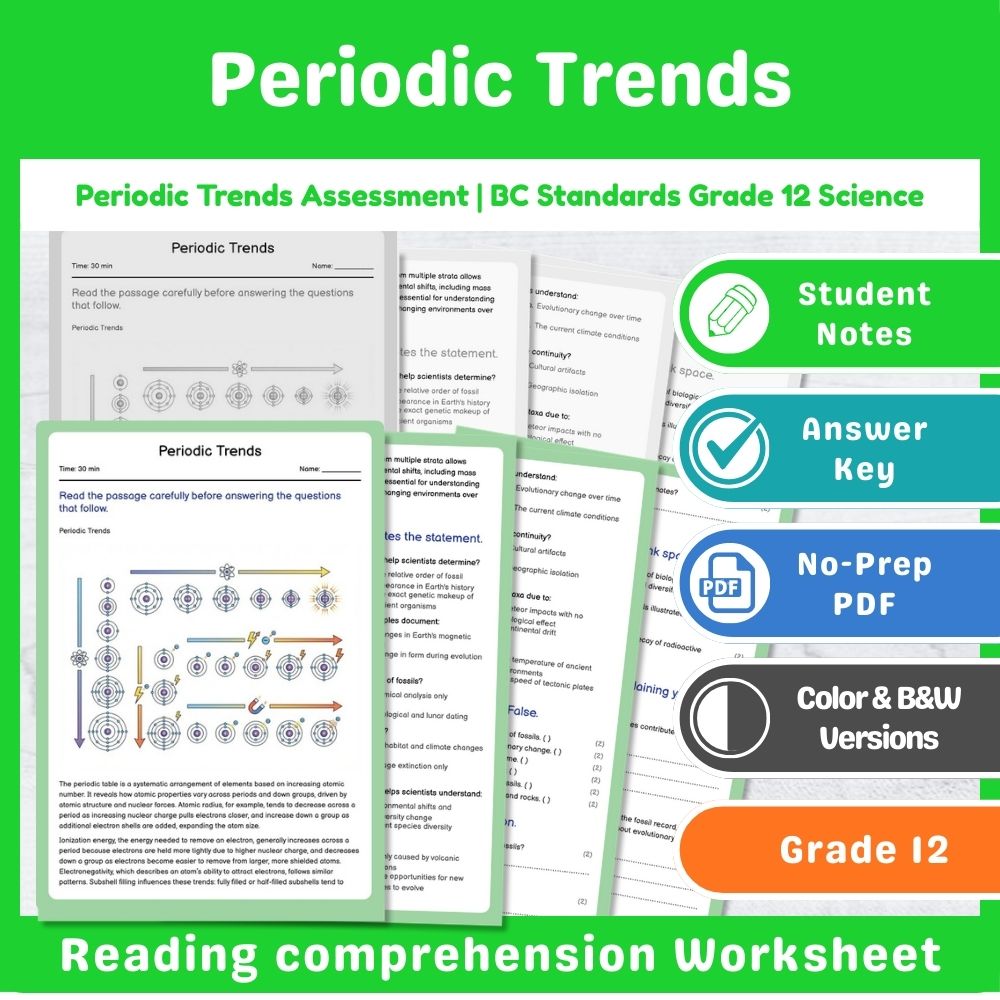
Periodic Trends Assessment | BC Standards Grade 12 Science
Created byPrism Point LearningLearning Objectives
- Explain how atomic and ionic properties vary across the periodic table.
- Understand the concepts of nuclear charge and electron shielding in relation to periodic trends.
- Predict element reactivity, ionic sizes, and bond tendencies based on periodic properties.
Also included in: Grade 12 Science Mini Bundle – Thermochemistry & Equilibrium Assessment
Instant download
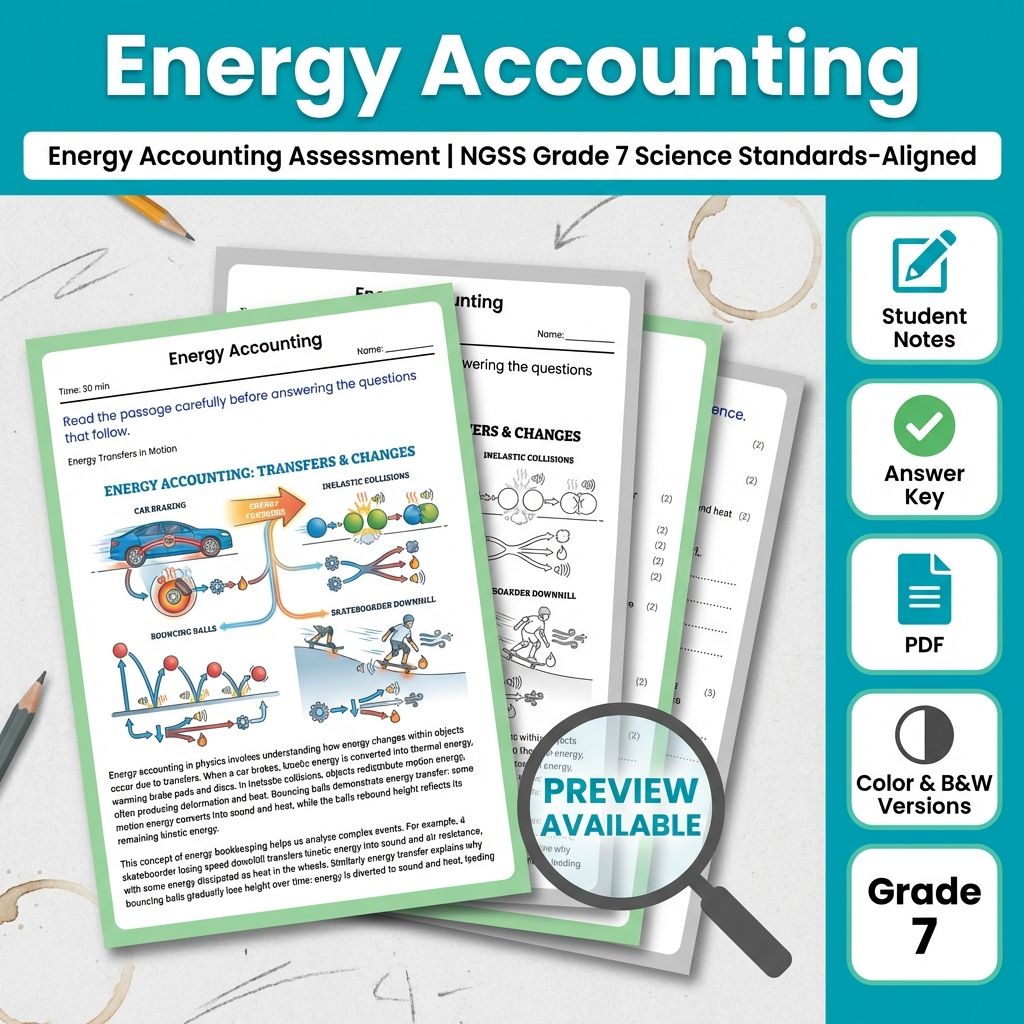
Energy Accounting Assessment | NGSS Grade 7 Science Standards-Aligned
Created byPrism Point LearningLearning Objectives
- Explain how changes in an object's motion energy are linked to energy transfers into or out of the object.
- Identify real-world scenarios where energy transformation occurs, such as braking a car or bouncing a ball.
- Quantitatively and qualitatively analyze energy transfers during different physical events.
Also included in: Grade 7 Science Mini Bundle | Energy Unit & NGSS Standards-Aligned Resources +1 more
Instant download
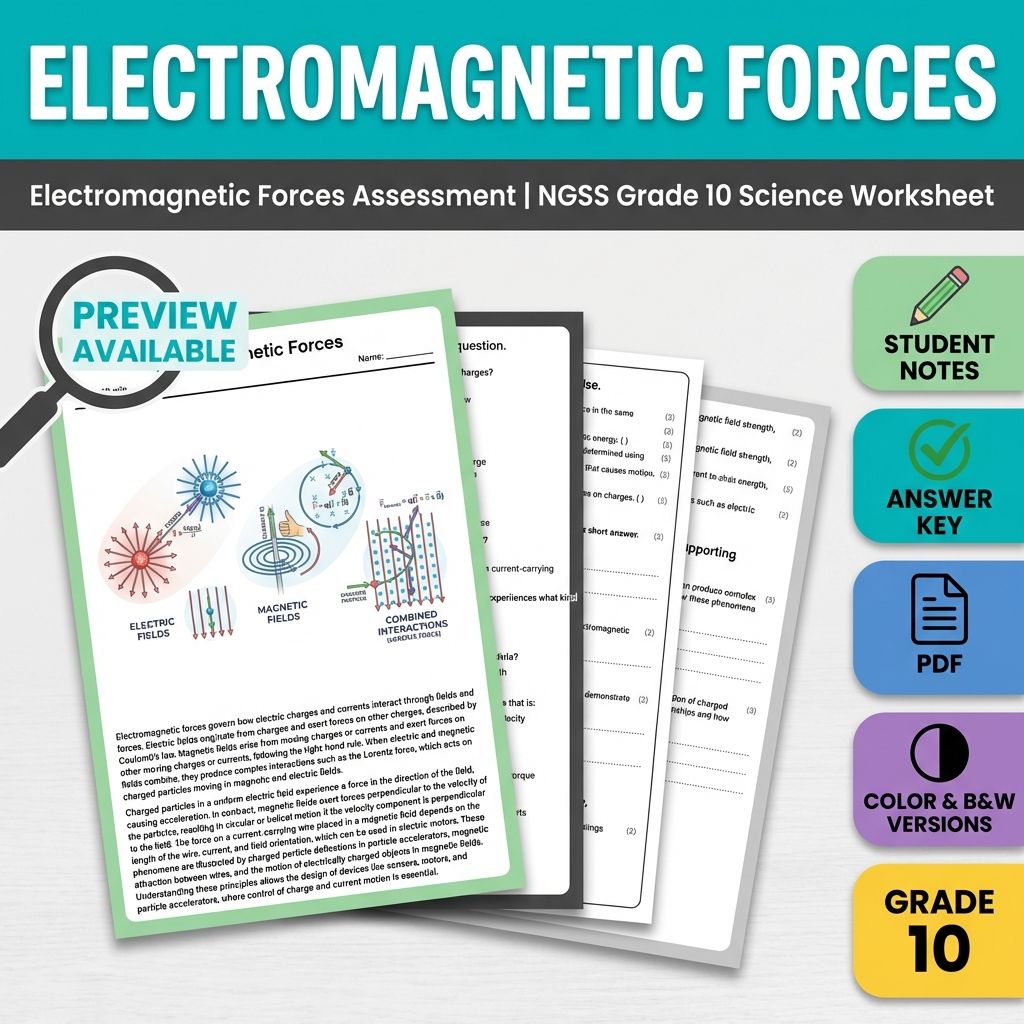
Electromagnetic Forces Assessment | NGSS Grade 10 Science Worksheet
Created byPrism Point LearningLearning Objectives
- Understand how electric and magnetic fields influence charged particles and current-carrying wires.
- Describe the forces exerted on charges in uniform electric and magnetic fields.
- Explain the Lorentz force law and its applications in real-world phenomena.
Instant download

Inheritance Patterns Assessment for Grade 12 Science | BC Standards
Created byPrism Point LearningLearning Objectives
- Explain various inheritance models such as Mendelian segregation, linkage, Sex linkage, incomplete dominance, and polygenic traits.
- Describe how recombination frequency reveals chromosomal distances and influences trait distribution.
- Interpret pedigrees to infer inheritance modes and estimate carrier status.
Also included in: Grade 12 Science Mini Bundle – Genetics & Evolution Assessment Pack
Instant download
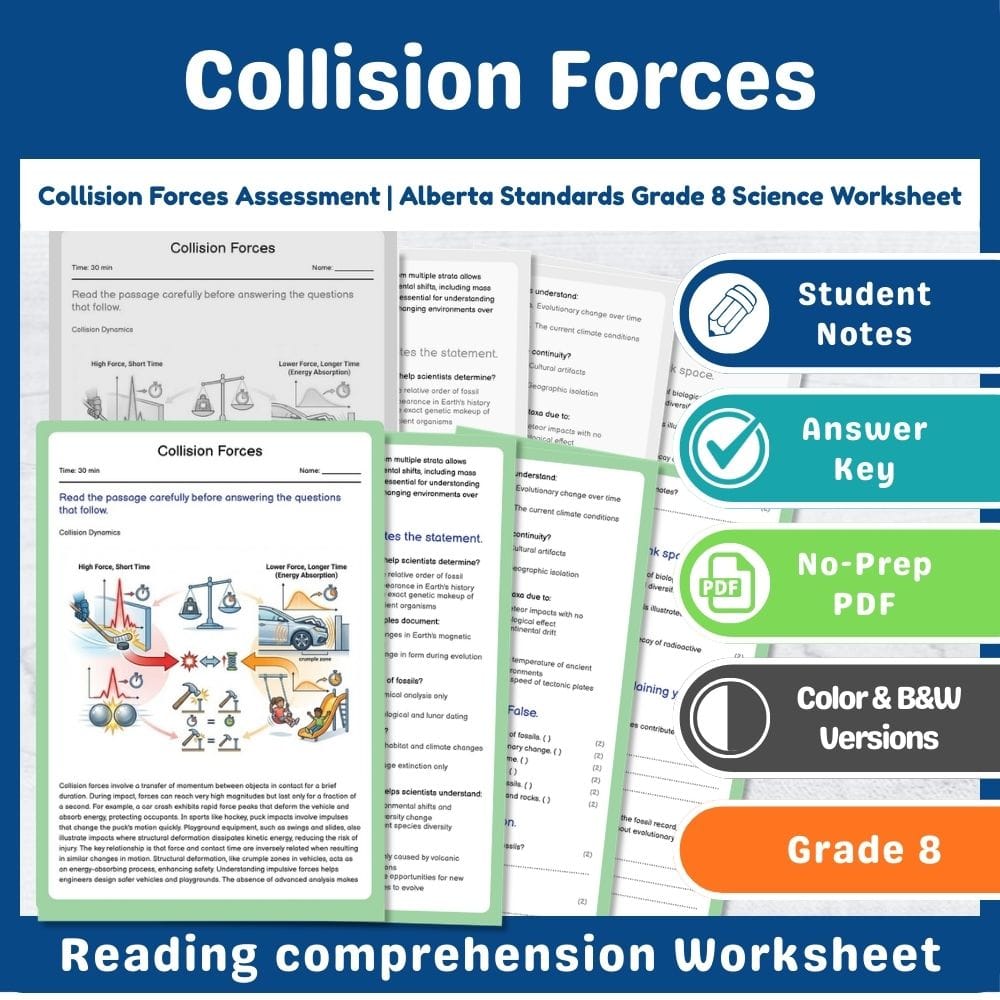
Collision Forces Assessment | Alberta Standards Grade 8 Science Worksheet
Created byPrism Point LearningLearning Objectives
- Understand the relationship between force magnitude and contact time during collisions.
- Explain how structural deformation absorbs energy in impact events.
- Analyze real-world collision scenarios to identify impulse effects and observable outcomes.
Also included in: Lesson Grade 8 Science Mini Bundle | Forces and Motion Alberta Standards
Instant download

Metabolic Integration Assessment | NGSS Standards Grade 11 Science
Created byPrism Point LearningLearning Objectives
- Explain how interconnected metabolic pathways regulate energy flow across different tissues.
- Describe enzyme kinetics, allosteric regulation, and pathway branching in metabolism.
- Illustrate examples of metabolic processes such as fermentation and gluconeogenesis and their roles in energy supply.
Instant download

Decomposition Recycling Assessment | Florida NGSSS Grade 6 Science
Created byPrism Point LearningLearning Objectives
- Explain how decomposers break down dead organisms and waste into simpler materials.
- Describe how decomposition returns nutrients to the environment for producers to use again.
- Connect decomposition to matter cycling and ecosystem stability over time.
Also included in: Grade 6 Ecosystems Science Lesson Bundle | Florida NGSSS Assessment
Instant download
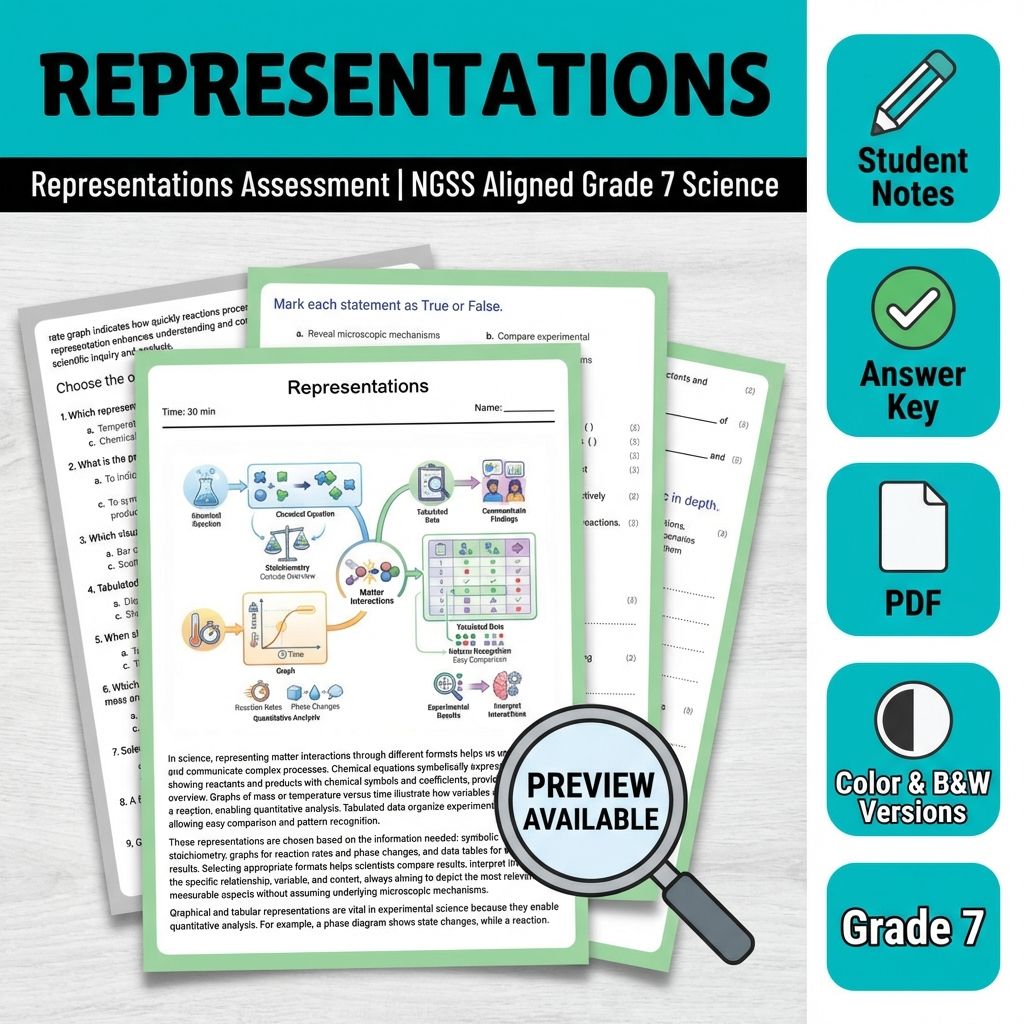
Representations Assessment | NGSS Aligned Grade 7 Science
Created byPrism Point LearningLearning Objectives
- Characterize how multiple representations convey matter interactions including symbolic chemical equations
- Interpret graphs of mass or temperature versus time in reaction contexts
- Analyze tabulated experimental data to understand matter interactions
Also included in: Grade 7 Science Lesson | Matter and Its Interactions Standards +1 more
Instant download
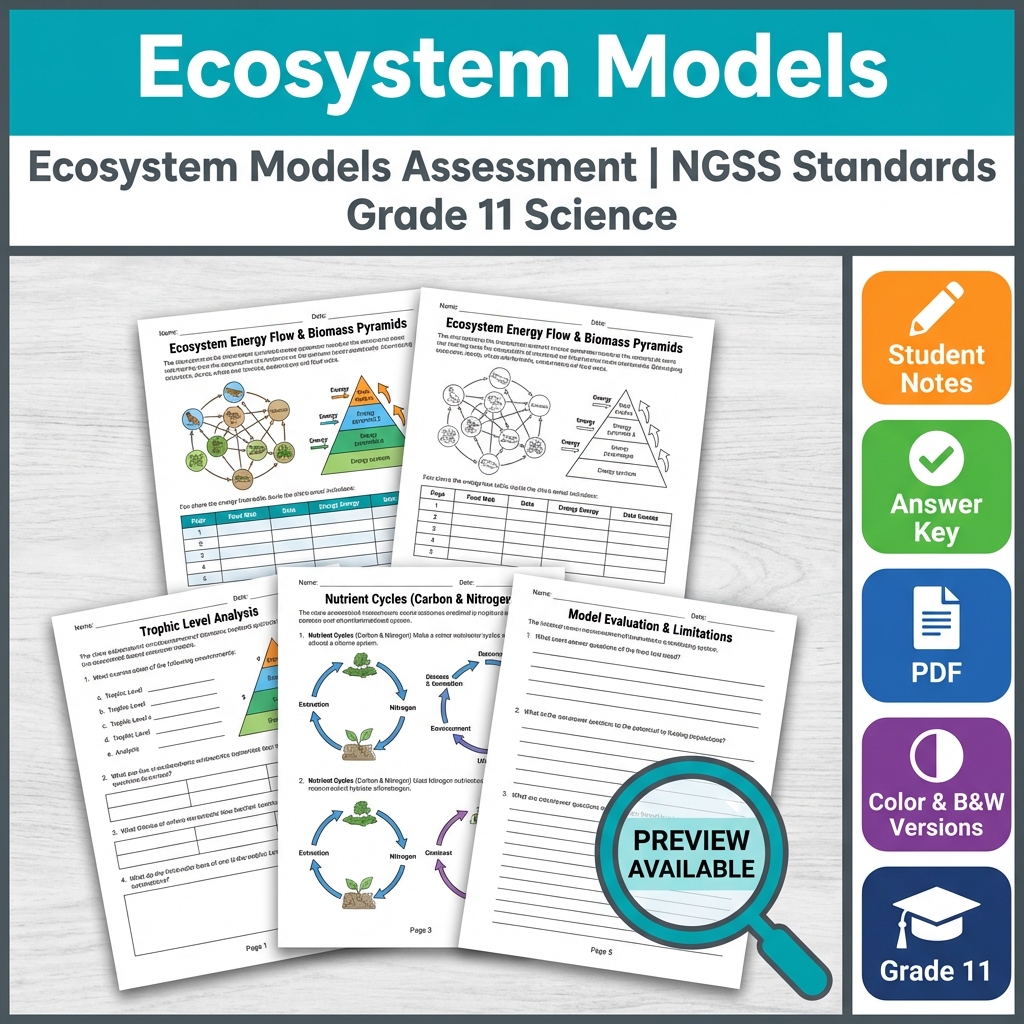
Ecosystem Models Assessment | NGSS Standards Grade 11 Science
Created byPrism Point LearningLearning Objectives
- Understand different types of ecosystem models and their applications.
- Analyze how models represent ecological interactions and predict system behavior.
- Evaluate the parameters and feedback mechanisms in ecosystem modeling.
Also included in: Grade 11 Science Mini Bundle | Ecosystems Interactions & Energy NGSS
Instant download
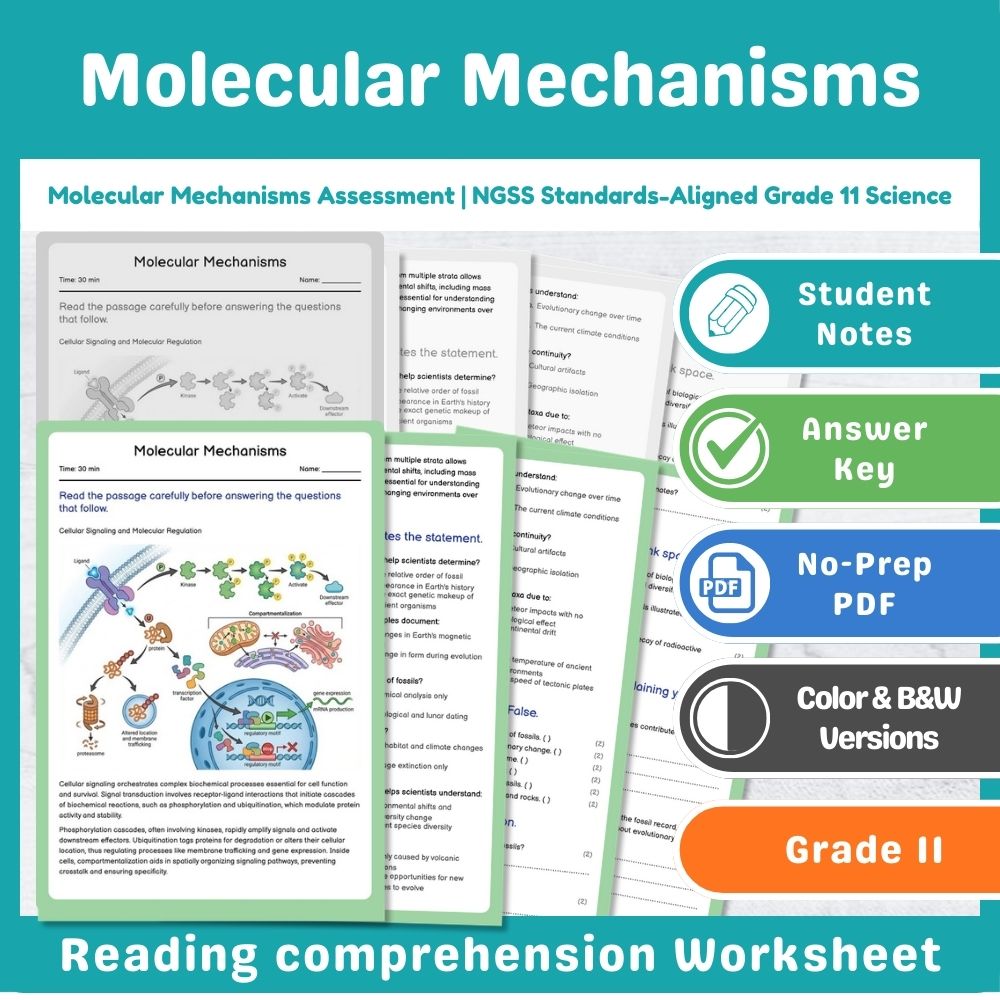
Molecular Mechanisms Assessment | NGSS Standards-Aligned Grade 11 Science
Created byPrism Point LearningLearning Objectives
- Explain the biochemical mechanisms involved in cellular signaling pathways.
- Identify key motifs and processes such as phosphorylation cascades, ubiquitination, and transcriptional regulation.
- Describe how intracellular compartmentalization and membrane transport influence molecular mechanisms.
Instant download

Bonding Types Assessment for Grade 10 Science | BC Standards-Aligned Assessment
Created byPrism Point LearningLearning Objectives
- Identify and describe the three main types of chemical bonding: ionic, covalent, and metallic.
- Explain how atom properties influence the type of bonding formed.
- Relate bonding types to the properties of compounds, such as melting point and electrical conductivity.
Instant download
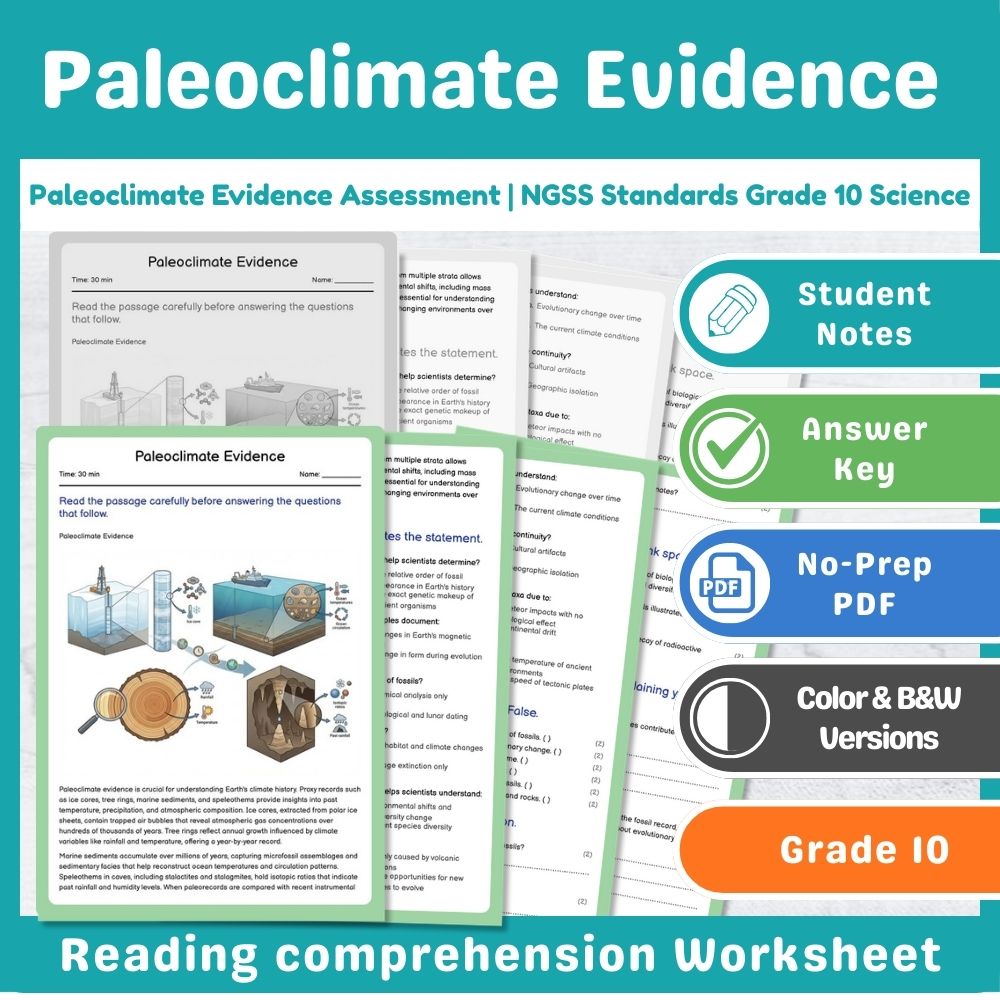
Paleoclimate Evidence Assessment | NGSS Standards Grade 10 Science
Created byPrism Point LearningLearning Objectives
- Understand different types of proxy records used to analyze past climate conditions.
- Identify how isotopic ratios, microfossil assemblages, and sedimentary facies provide clues about historical climate shifts.
- Compare paleoclimate reconstructions with recent instrumental data to analyze climate variability.
Instant download

Periodic Trends Assessment | BC Standards-Aligned Grade 10 Science
Created byPrism Point LearningLearning Objectives
- Understand the concept of periodic trends such as atomic radius, ionization energy, and electronegativity.
- Explain how nuclear charge and electron shielding influence these trends.
- Apply knowledge of periodic trends to predict atom behavior in bonding and reactions.
Instant download

Atomic Particles Assessment | BC Standards Grade 10 Science
Created byPrism Point LearningLearning Objectives
- Describe the structure of an atom, including protons, neutrons, and electrons.
- Explain how the number of protons determines an element and contributes to atomic mass.
- Identify the arrangement of electrons in shells and how it influences chemical behavior.
Instant download
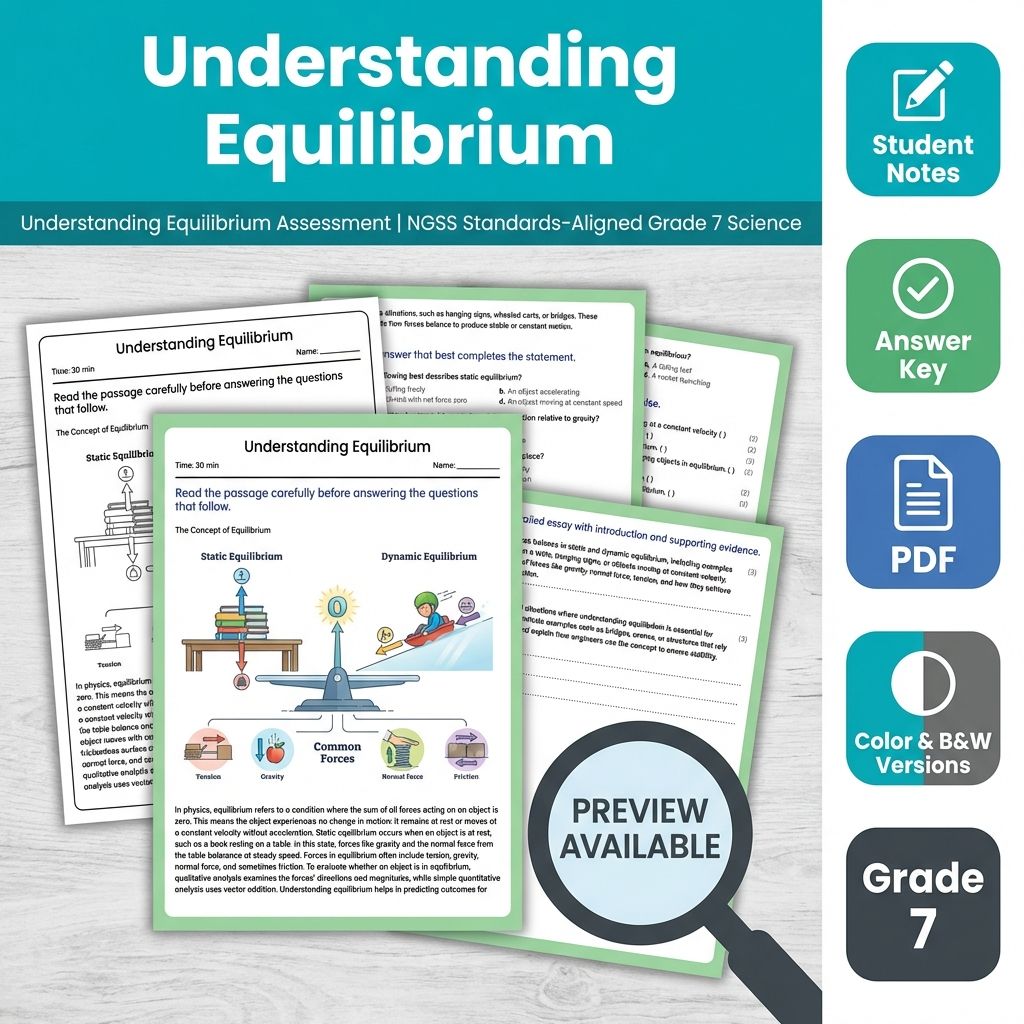
Understanding Equilibrium Assessment | NGSS Standards-Aligned Grade 7 Science
Created byPrism Point LearningLearning Objectives
- Explain the concept of equilibrium as the balance of forces in an object.
- Differentiate between static and dynamic equilibrium in real-world scenarios.
- Apply qualitative and simple quantitative analyses to predict objects' behavior at rest or moving with constant velocity.
Also included in: Grade 7 Science Mini Bundle – Forces & Interactions NGSS Unit (Printable) +1 more
Instant download
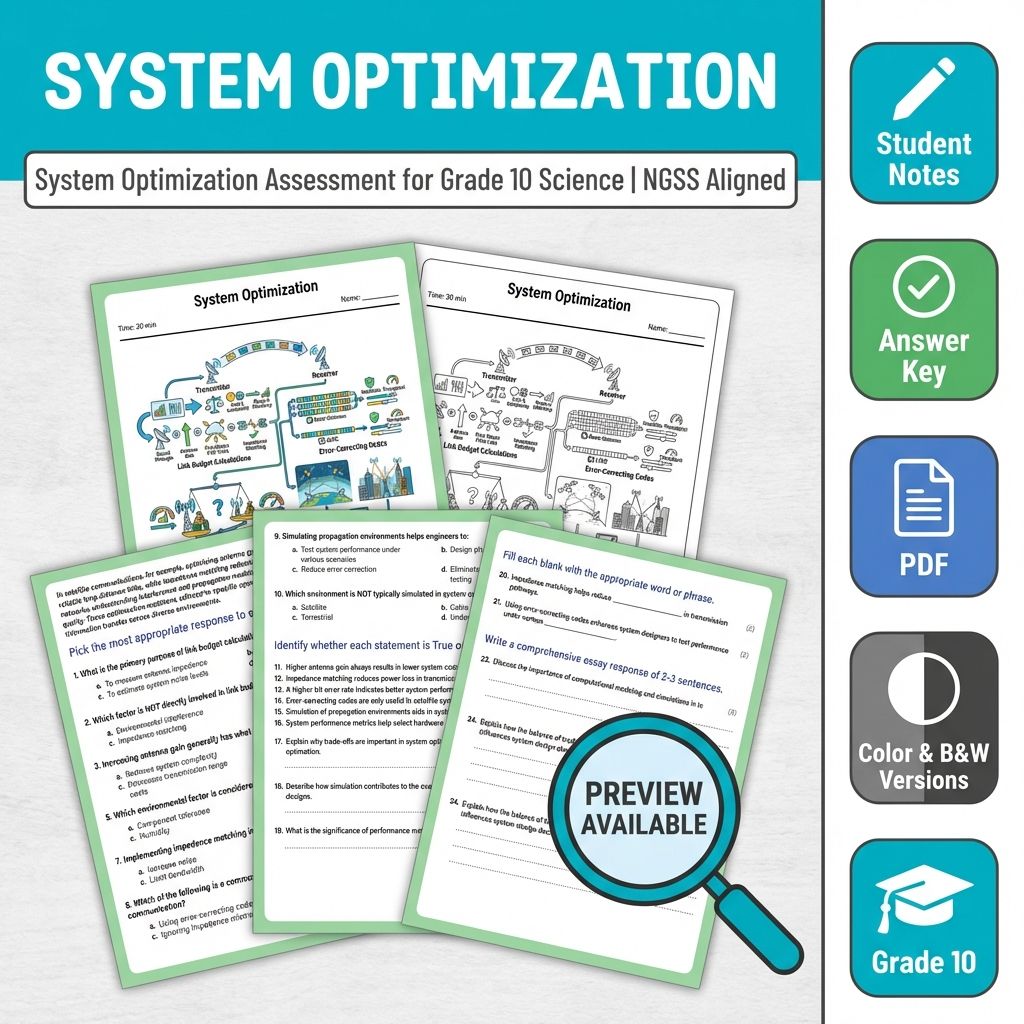
System Optimization Assessment for Grade 10 Science | NGSS Aligned
Created byPrism Point LearningLearning Objectives
- Understand mathematical models used for system optimization in communication networks.
- Analyze trade-offs among range, throughput, and reliability in system design.
- Apply concepts of antenna gain, impedance matching, and error correction to optimize performance.
Instant download

Physiological Traits Assessment | Standards-Aligned Assessment Grade 6 Science
Created byPrism Point LearningLearning Objectives
- Explain how physiological adaptations help organisms survive in specific environments
- Identify examples of internal traits related to water balance, metabolism, and ion regulation
- Interpret statements about physiological adaptations as true or false
Also included in: Grade 6 Ecosystems Science Lesson Bundle | Florida NGSSS Assessment
Instant download

Food Webs Assessment | Florida NGSSS Grade 6 Science
Created byPrism Point LearningLearning Objectives
- Explain what a food web is and how it shows feeding relationships in an ecosystem
- Use food web ideas to describe how energy moves between trophic levels
- Predict effects of changes to one organism on other organisms in a community
Also included in: Grade 6 Ecosystems Science Lesson Bundle | Florida NGSSS Assessment
Instant download
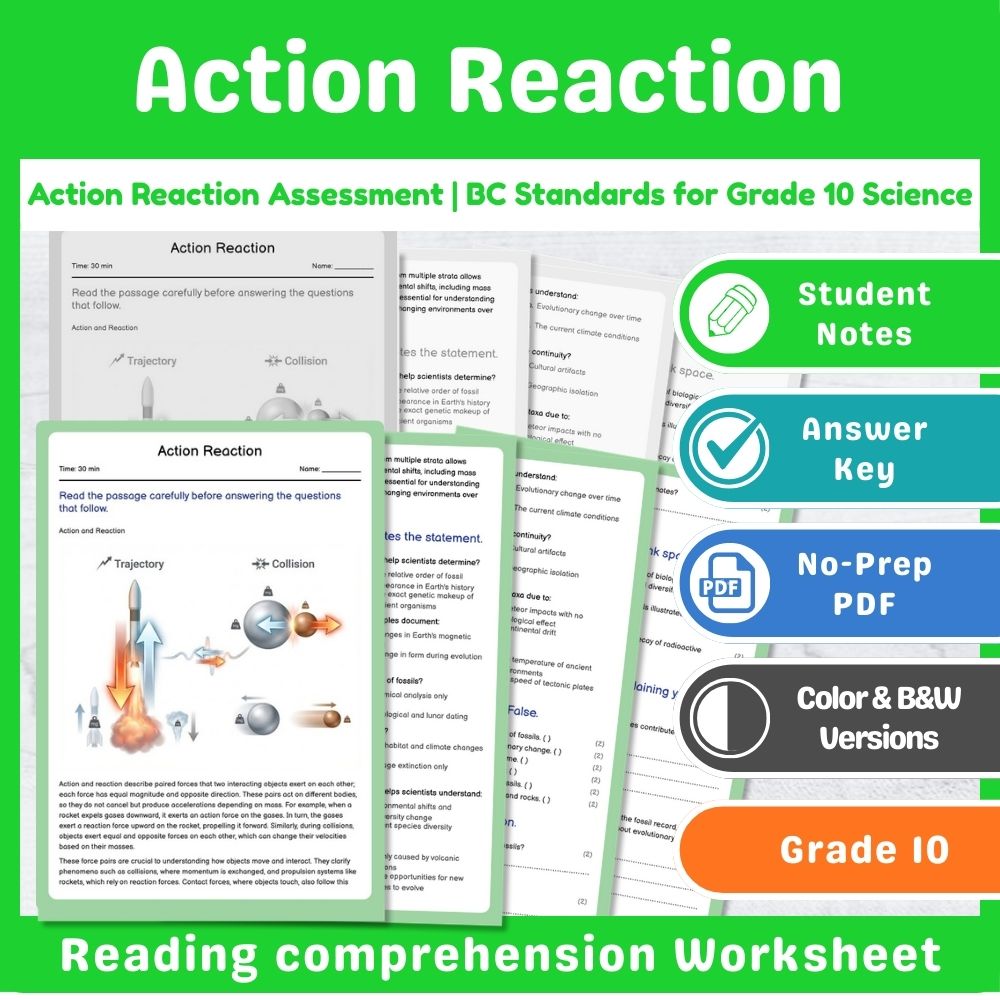
Action Reaction Assessment | BC Standards for Grade 10 Science
Created byPrism Point LearningLearning Objectives
- Explain the concept of Newton's third law of motion in terms of action-reaction pairs.
- Identify real-life examples of action-reaction forces such as collisions and rocket thrust.
- Describe how forces act on different objects and result in acceleration depending on mass.
Instant download
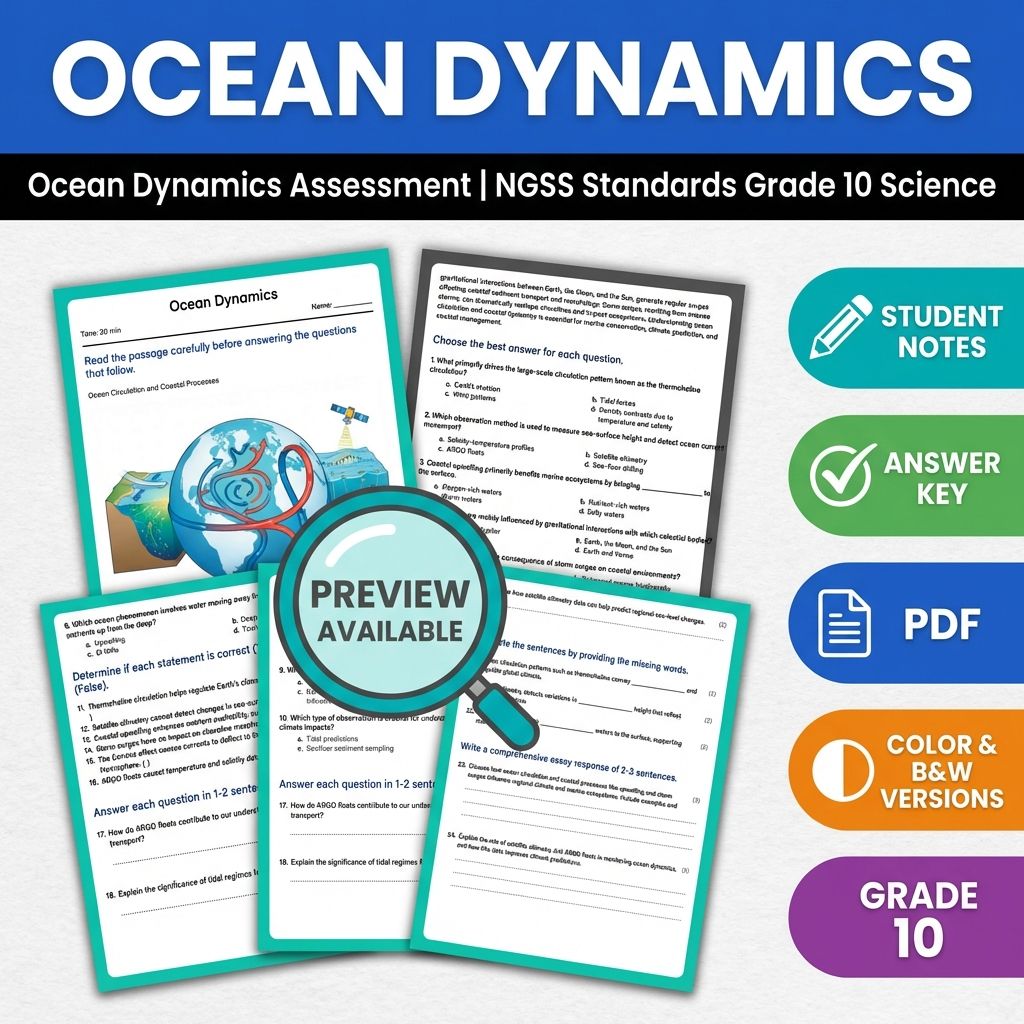
Ocean Dynamics Assessment | NGSS Standards Grade 10 Science
Created byPrism Point LearningLearning Objectives
- Describe the key circulation patterns driven by ocean dynamics, including thermohaline circulation, gyres, and coastal upwelling.
- Explain how observations from ARGO floats, satellite altimetry, and salinity-temperature profiles help understand heat and mass transport in oceans.
- Analyze the influence of tidal regimes and storm surges on coastal sediment transport, shoreline morphology, and ecosystems.
Instant download
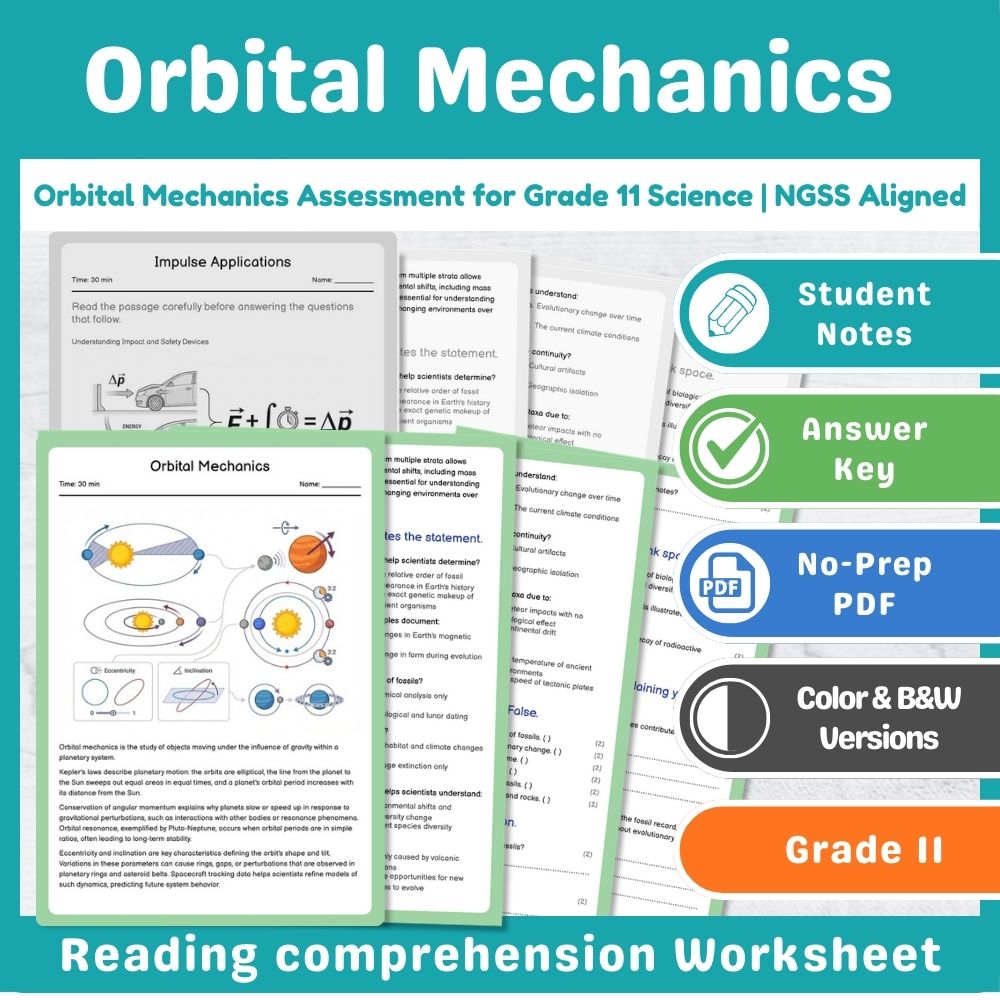
Orbital Mechanics Assessment for Grade 11 Science | NGSS Aligned
Created byPrism Point LearningLearning Objectives
- Explain the fundamental principles of orbital motion and Kepler's laws.
- Analyze the effects of gravitational interactions and orbital perturbations.
- Describe phenomena such as orbital resonance, eccentricity, and inclination.
Also included in: Grade 11 Science Mini Bundle | Cosmic/Orbital Mechanics Assessment NGSS
Instant download

Science Assessment: Water Cycle Pathways (Grade 6) – Florida NGSSS
Created byPrism Point LearningLearning Objectives
- Describe the major pathways of the water cycle, including evaporation, condensation, precipitation, runoff, and infiltration
- Explain how energy transfer affects water’s state changes and movement between land and the atmosphere
- Use evidence from the water cycle to predict how changes can lead to droughts or flooding
Instant download
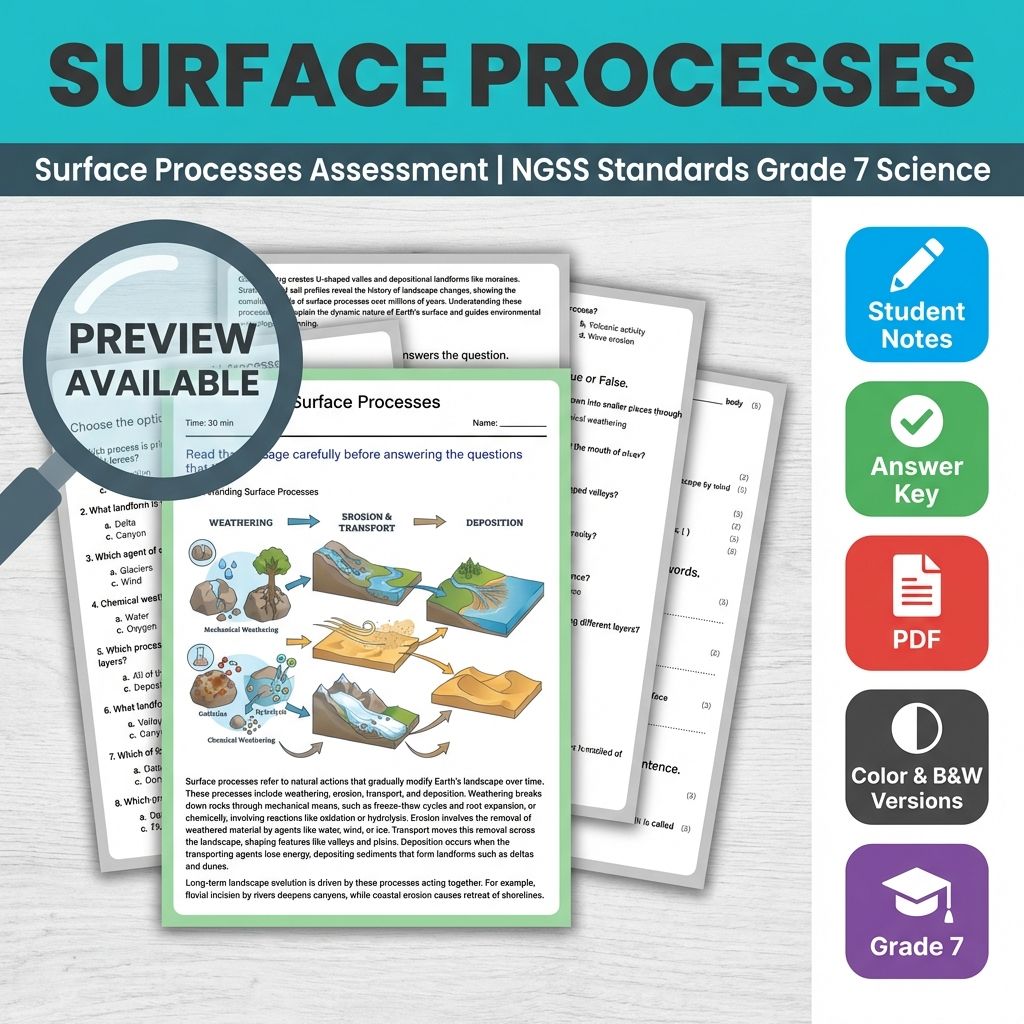
Surface Processes Assessment | NGSS Standards Grade 7 Science
Created byPrism Point LearningLearning Objectives
- Describe key surface geological processes such as weathering, erosion, transport, and deposition.
- Differentiate between mechanical and chemical weathering mechanisms.
- Explain how landforms like canyons, deltas, and moraines are formed by these processes.
Also included in: Grade 7 Science Lesson | Earth's Systems NGSS Not specified Unit +1 more
Instant download
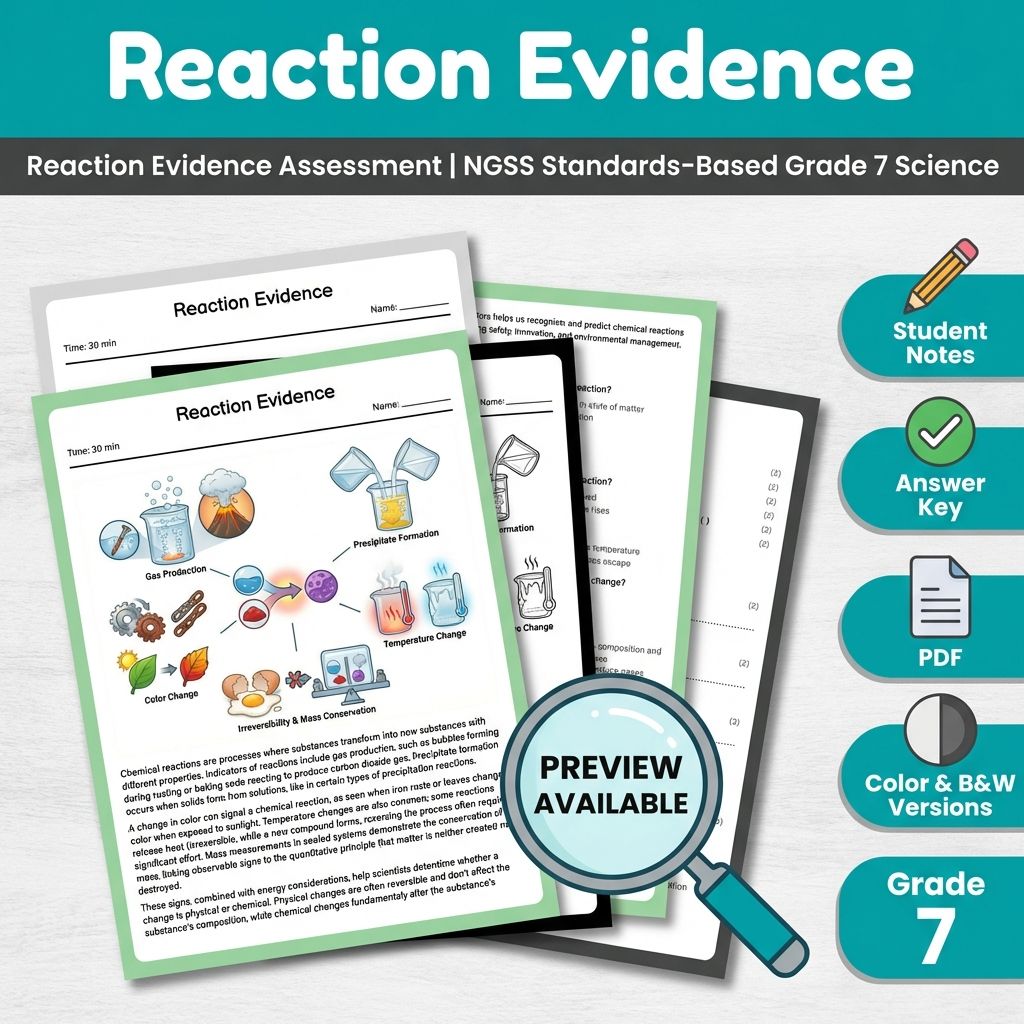
Reaction Evidence Assessment | NGSS Standards-Based Grade 7 Science
Created byPrism Point LearningLearning Objectives
- Identify key indicators that a chemical reaction has occurred.
- Describe observable signs of chemical reactions, including gas production and color change.
- Understand how mass measurements and energy considerations distinguish chemical changes from physical changes.
Also included in: Grade 7 Science Lesson | Matter and Its Interactions Standards +1 more
Instant download
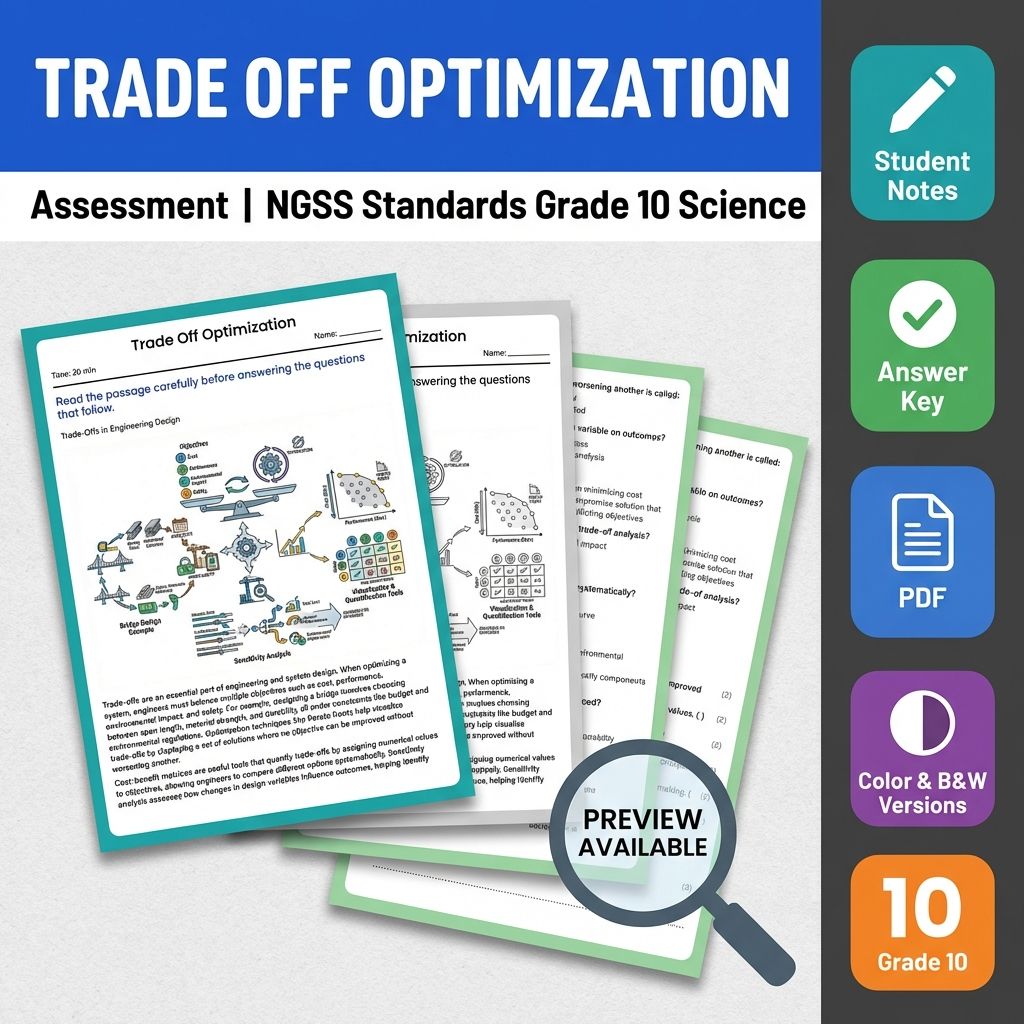
Trade Off Optimization Assessment | NGSS Standards Grade 10 Science
Created byPrism Point LearningLearning Objectives
- Understand how to analyze trade-offs and make optimization decisions in engineering design.
- Learn to use cost-benefit matrices, Pareto fronts, and sensitivity analysis to evaluate options.
- Apply concepts of performance metrics, constraints, and objective weighting to real-world problems.
Also included in: Grade 10 Science Assessment Mini Bundle | Engineering Design & Systems
Instant download
Browse more categories
About Science Worksheets
Find Science worksheets spanning core skills, practice, and review. All 44,295 resources are instant PDF downloads for the classroom or home.
Every worksheet on MyTeachingSheets is created by independent teacher-authors and reviewed before publication. All resources download as printable PDFs for classroom, homework, or at-home practice, and many include answer keys. Preview any worksheet free before buying.